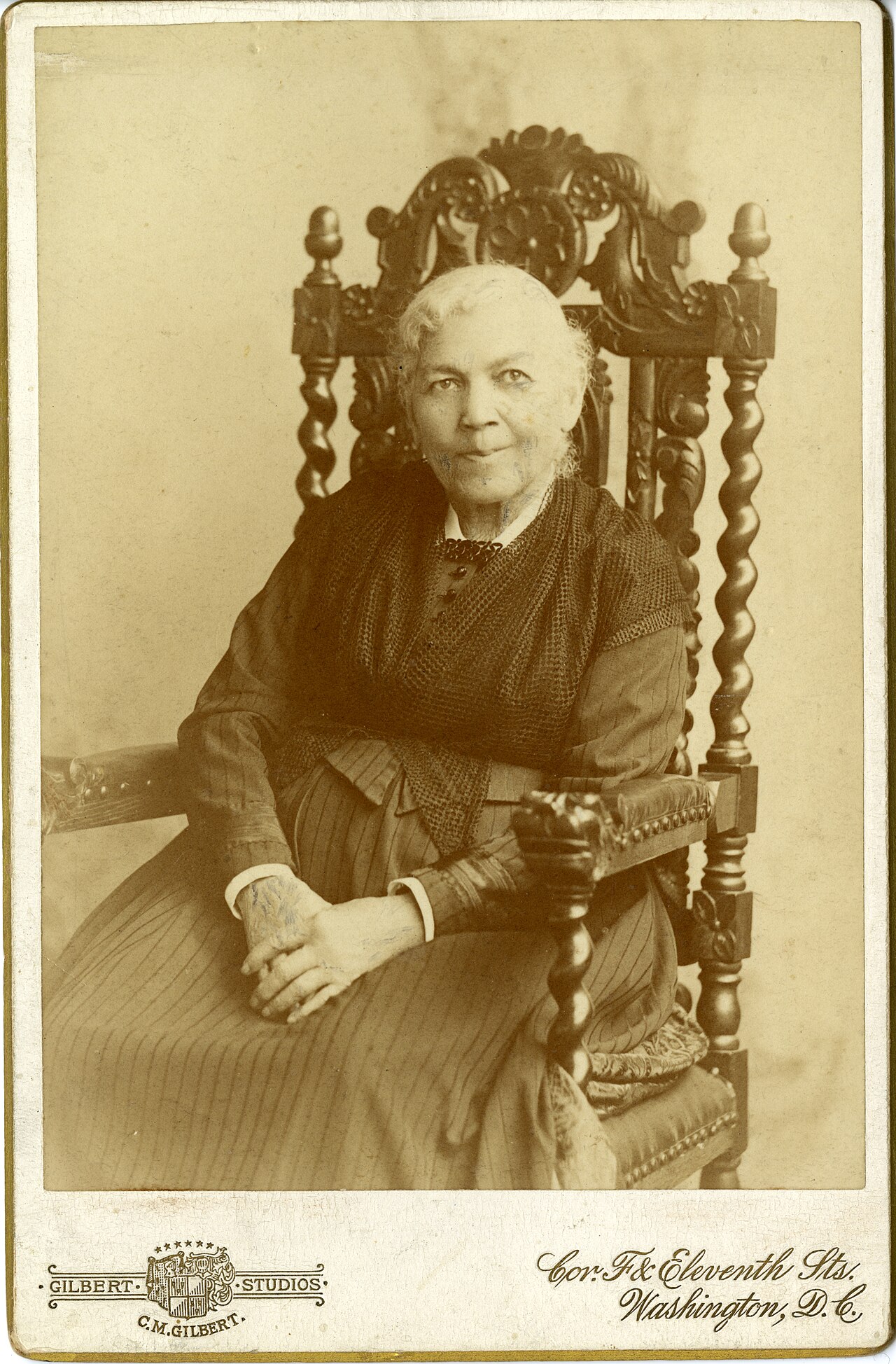
Portrait of Harriet Jacobs

AI Historical Figure

Harriet Jacobs

American abolitionist and writer known for her autobiographical book "Incidents in the Life of a Slave Girl.

Chat with Harriet Jacobs via text or voice — in 42 languages, drawing on a curated biography and 54 historical sources. Available 24/7.

Start chatting with Harriet Jacobs20 messages free · No credit card
Lived
1813–1897
From
United States
Known for
Literature & writingActivism & reform
Harriet Jacobs

Harriet Jacobs

Online · responds in seconds

Hello — I'm Harriet Jacobs. American abolitionist and writer known for her autobiographical book "Incidents in the Life of a Slave Girl. What would you like to ask me?

20 messages free · No credit card · Powered by Humy.ai

Live preview · Switch between 42 languages above · Send a message to continue in the app

Multilingual

Talk to Harriet Jacobs in 42 languages

Ask Harriet Jacobs questions in any language below, and the rest of Humy's app speaks it too. Pick yours to open the chat in that language.

Also in German (Austria), German (Switzerland), English (UK), English (Australia), English (Canada).

The sources behind this AI

54 sources · 14 documents · 11 photographs · 9 books · 7 newspaper articles · 7 paintings · 4 artifacts · 1 diary entry · 1 letter

Harriet Jacobs doesn’t improvise from thin air. The AI is grounded in 54 curated historical sources students can inspect. Open any of them to see what informs the conversation.

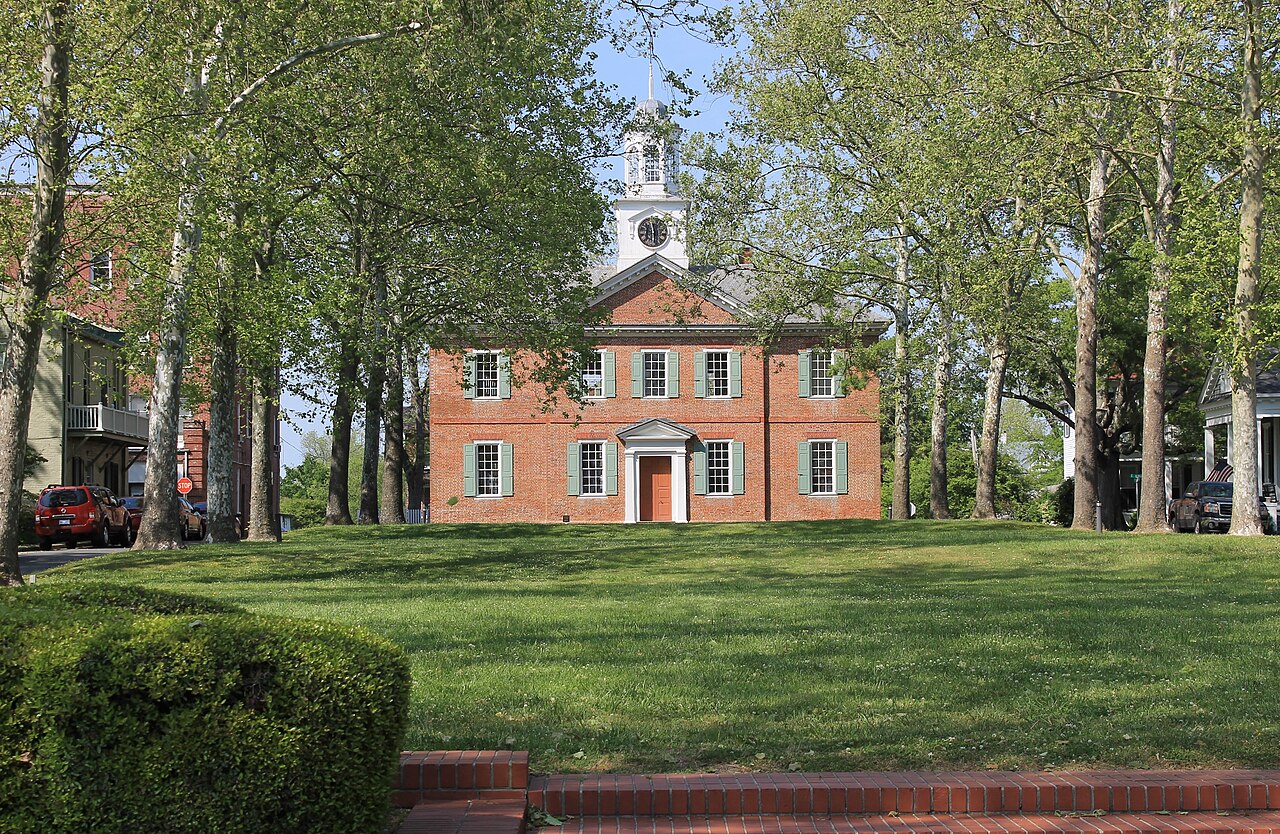
Brick two-story courthouse with white cupola and clock tower, green shutters, and a central pedimented entrance with an orange door, set on a grassy lawn beneath tall trees on a sunny day.Artifact

Secondary source

Chowan County Courthouse

1767

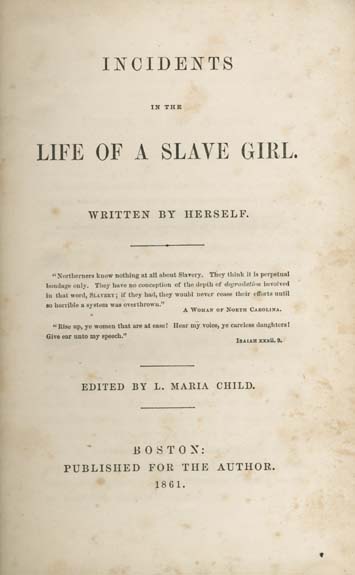
Title page of 'Incidents in the Life of a Slave Girl, Written by Herself', edited by L. Maria Child, published for the author in Boston, 1861. Includes two epigraph quotations and a small decorative rule.Book

Primary source

Incidents in the Life of a Slave Girl

Harriet Jacobs · 1861

Sepia cabinet card portrait of an elderly woman with white hair seated in an ornately carved wooden chair with barley-twist legs. She wears a dark striped dress and knitted shawl, hands folded in her lap. Printed mount reads Gilbert Studios, Cor. F & Eleventh Sts., Washington, D.C.Photograph

Primary source

Gilbert Studios Photograph of Harriet Jacobs

Gilbert Studios (C. M. Gilbert)

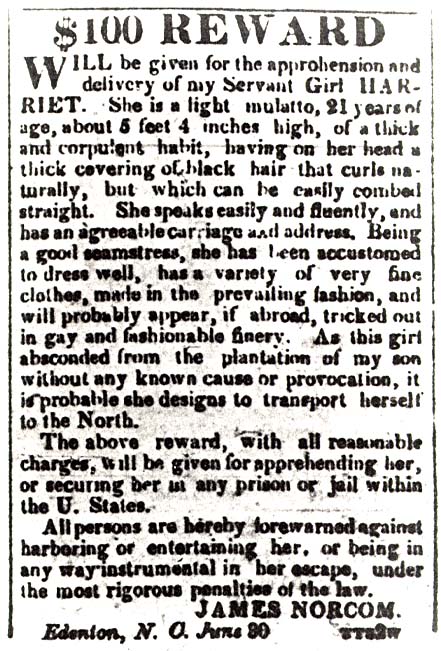
Scanned newspaper advertisement titled "$100 REWARD" offering payment for capture of runaway servant girl Harriet, described as a light mulatto, 21 years of age. Signed James Norcom, Edenton, N.C., June 30.Newspaper article

Primary source

$100 Reward Advertisement for Harriet Jacobs

James Norcom · 30 June 1835

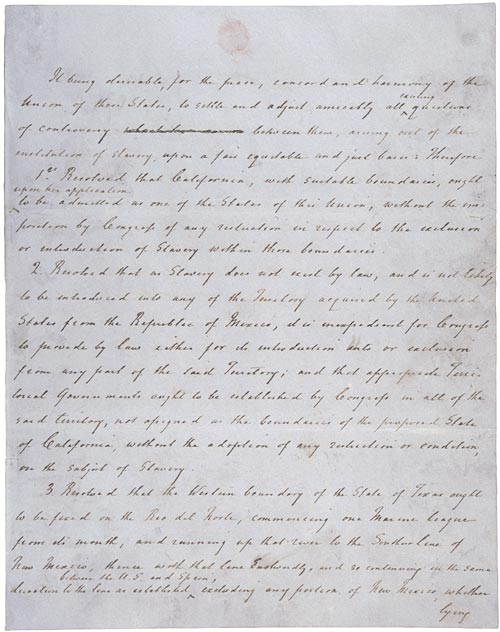
Handwritten manuscript on aged paper with cursive text and crossed-out words, showing the resolutions of the Compromise of 1850, including provisions on California statehood and slavery in the territories.Document

Primary source

Compromise of 1850

Henry Clay · 29 January 1850 (resolutions); statutes enacted September 1850

Document

Primary source

Fugitive Slave Act of 1850

United States Congress · 1850

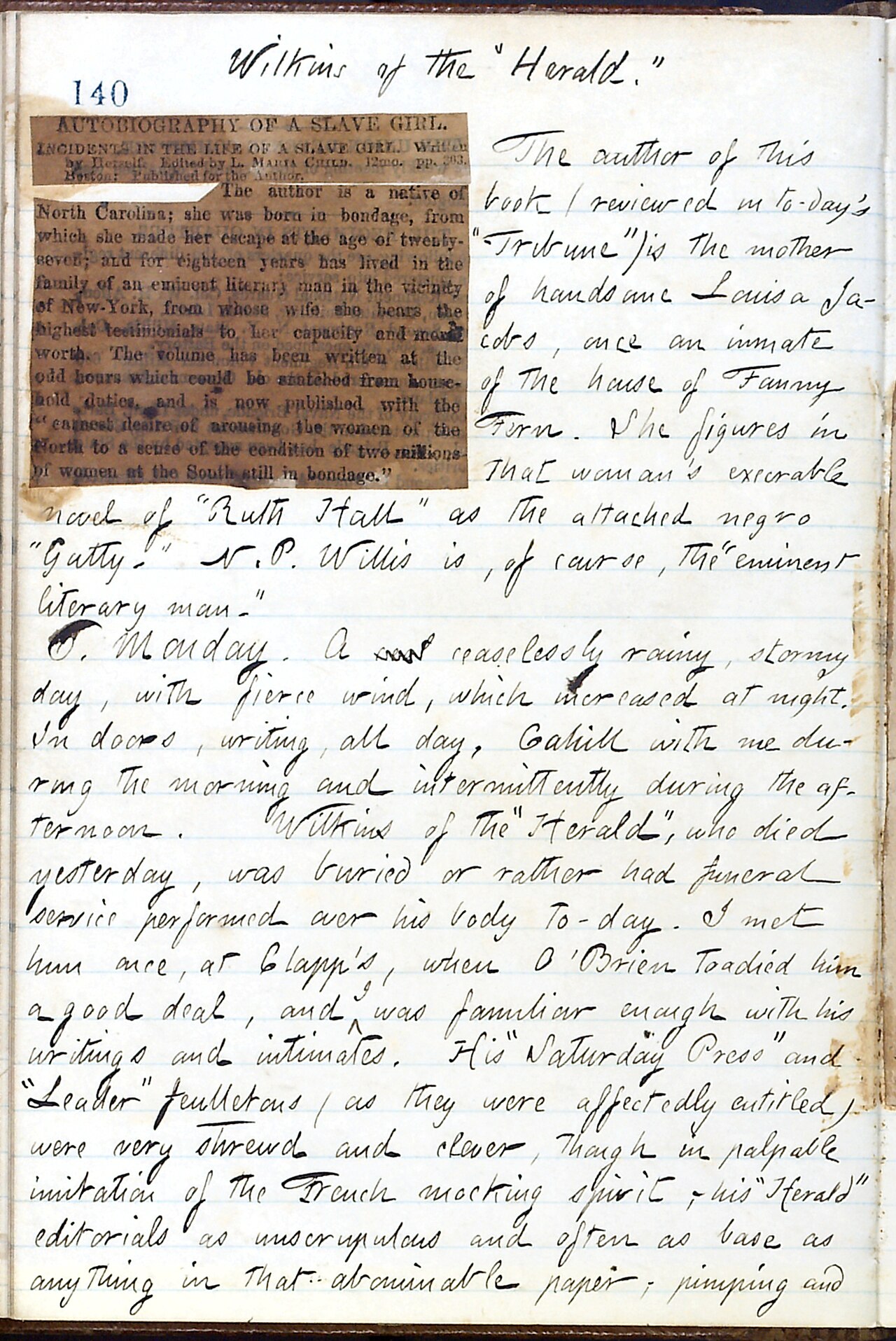
Handwritten diary page in cursive ink on lined paper, headed 'Wilkins of the Herald' with page number 140. A pasted newspaper clipping at upper left reads 'Autobiography of a Slave Girl' and describes Incidents in the Life of a Slave Girl. The entry discusses the author's review in the Tribune, a 'Ruth Hall' novel, and the death and funeral of Wilkins.Diary entry

Primary source

Thomas Butler Gunn diary entry on Jacobs's book

Thomas Butler Gunn · 5 May 1861

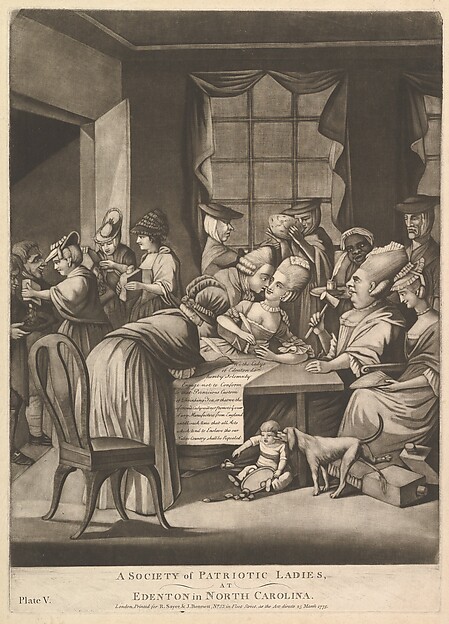
Engraved print in grey tones of a 1775 satirical scene: a group of fashionably dressed women in tall hairstyles gather around a draped table in an interior with a window and curtains. One woman writes at the table while others look on; a dog and a small seated child figure appear in the foreground, and men stand at the left doorway. Caption reads 'A Society of Patriotic Ladies, at Edenton in North Carolina' with publication details below.Painting

Primary source

A Society of Patriotic Ladies at Edenton in North Carolina

Philip Dawe · 25 March 1775

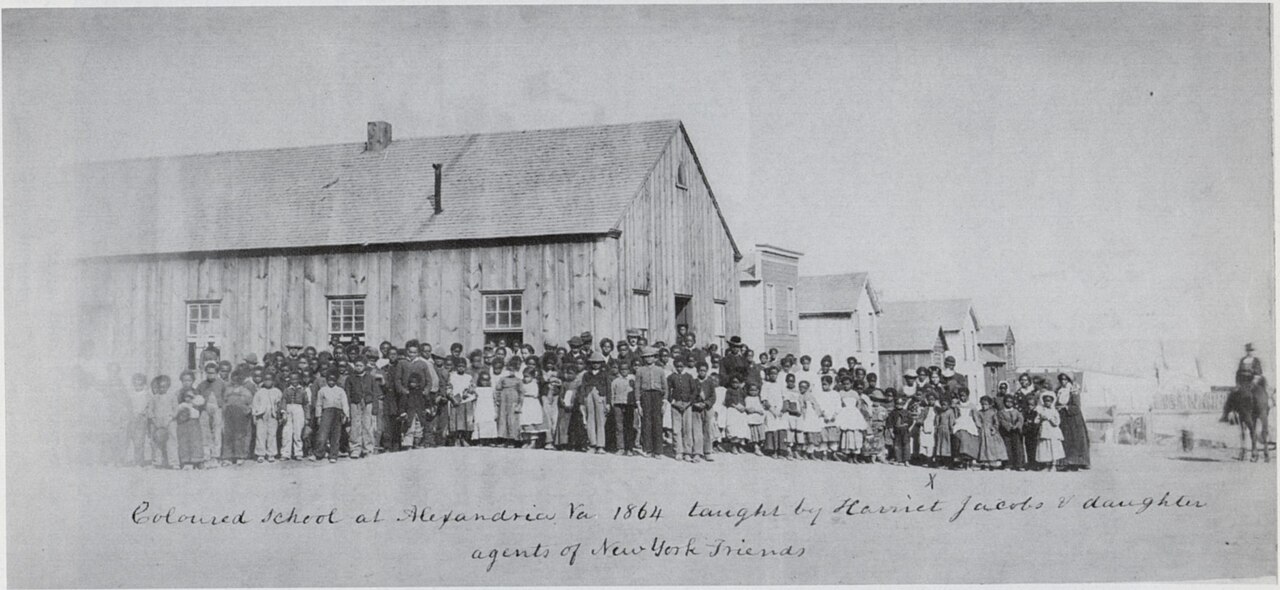
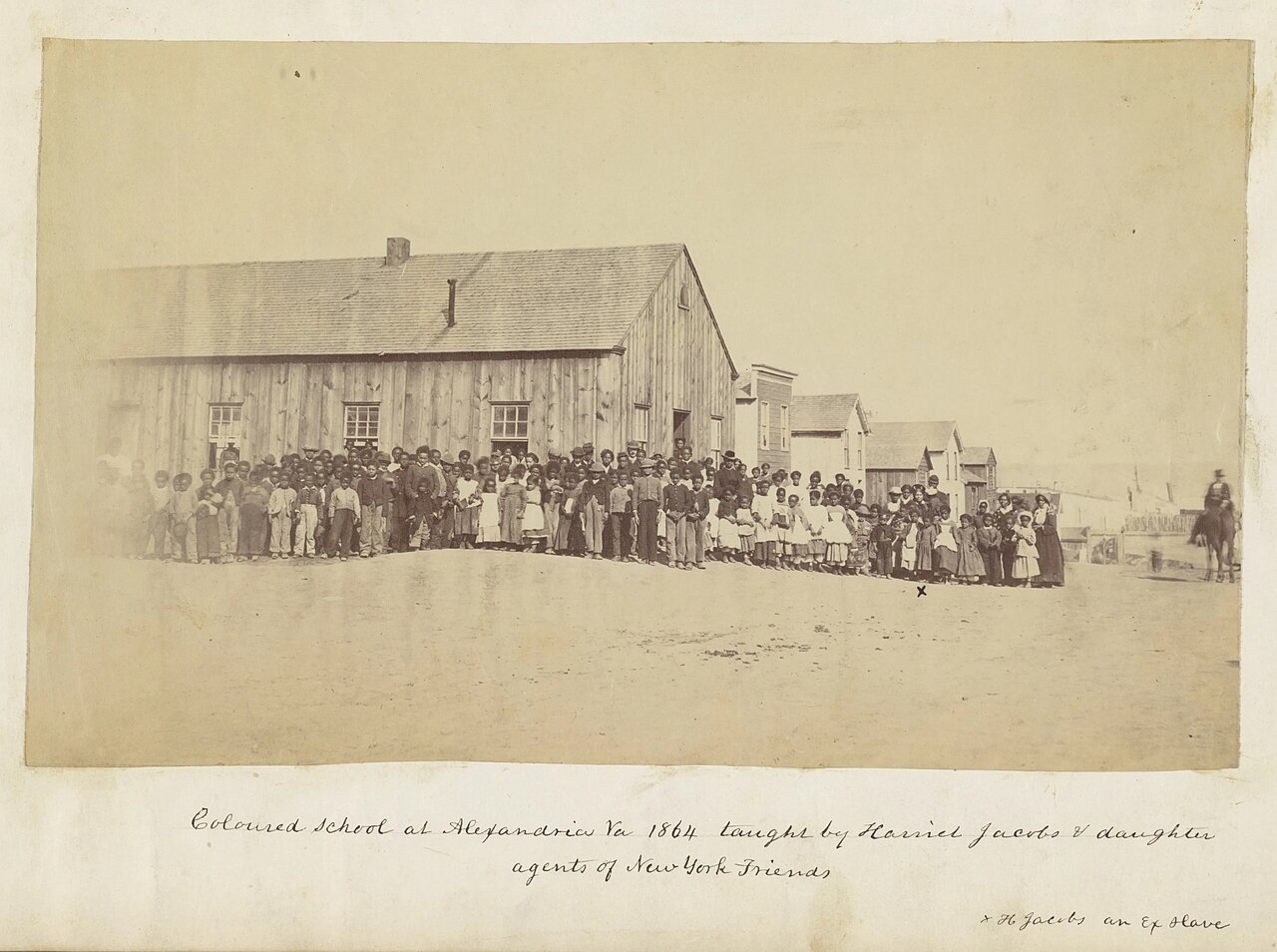
Black-and-white photograph of a large group of students, children and some adults, standing in front of a long wooden schoolhouse with a chimney and multiple windows. Handwritten caption below reads: Coloured School at Alexandria Va. 1864, taught by Harriet Jacobs & daughter, agents of New York Friends. A man on horseback is at the right edge.Photograph

Primary source

Coloured School at Alexandria, Virginia, 1864

Unknown photographer · 1864

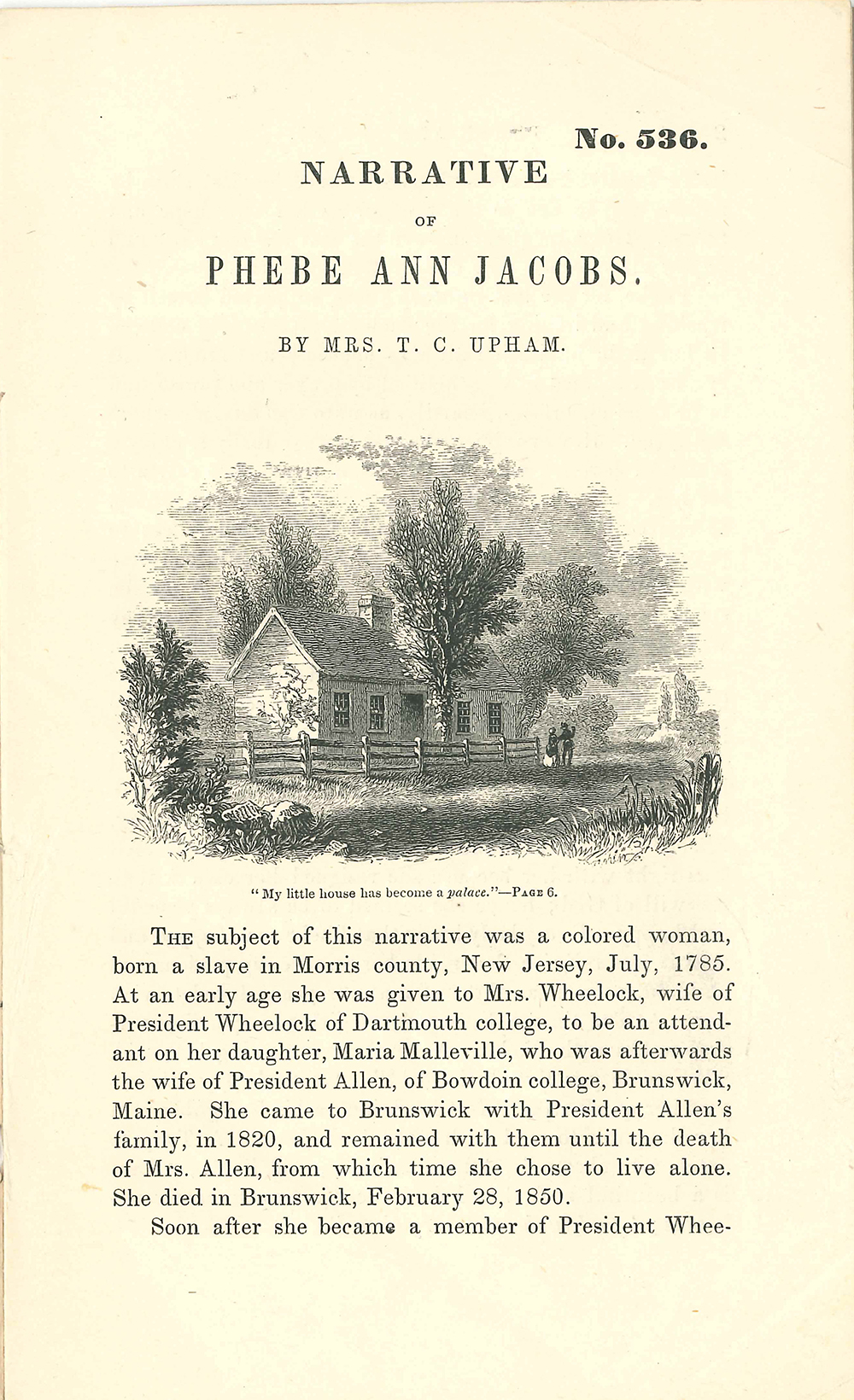
Scanned first page of a pamphlet titled 'Narrative of Phebe Ann Jacobs, by Mrs. T. C. Upham', marked No. 536. Below the title is an engraved illustration of a small house with a fence and trees, captioned 'My little house has become a palace.'—Page 6. Printed text below begins describing the subject as a colored woman born a slave in Morris county, New Jersey, in 1785.Book

Primary source

Narrative of Phebe Ann Jacobs

Phebe Lord Upham · c. 1850

Sepia photograph of a large group of students, children and adults, standing in front of a long wooden schoolhouse with a shingled roof and several small windows. Other wooden buildings and a dirt road are visible; a rider on horseback stands at the far right. Handwritten caption below reads: Colored School at Alexandria Va 1864, taught by Harriet Jacobs and daughter, agents of New York Friends.Photograph

Primary source

Jacobs Free School

Unknown · 1864

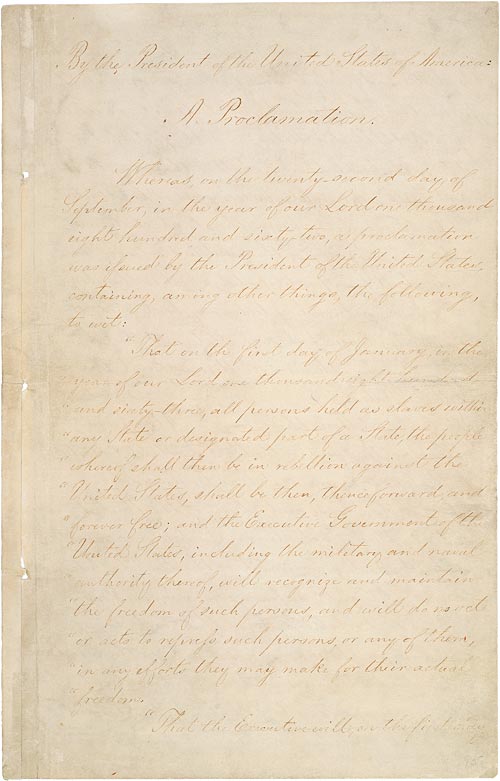
Handwritten manuscript page of the Emancipation Proclamation, headed 'By the President of the United States of America: A Proclamation,' in cursive script on aged cream paper, with the text beginning 'Whereas on the twenty-second day of September...'Document

Primary source

Emancipation Proclamation

Abraham Lincoln · 1 January 1863

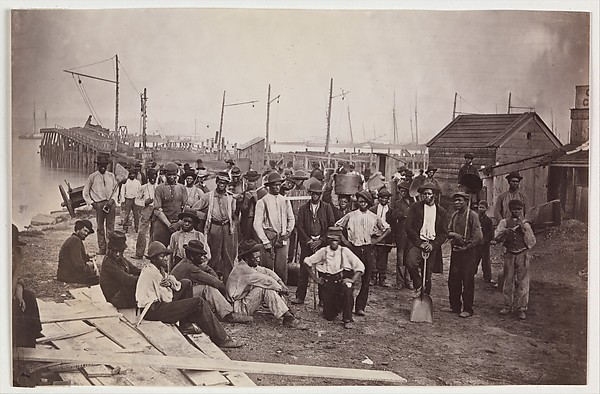
Sepia photograph of a waterfront scene with a large group of Black men in work clothes gathered on a dirt bank near a wooden wharf and pilings. Some sit on planks in the foreground, others stand behind, and a shed stands to the right.Photograph

Primary source

Laborers at Quartermaster's Wharf, Alexandria, Virginia

Andrew Joseph Russell · 1863–65

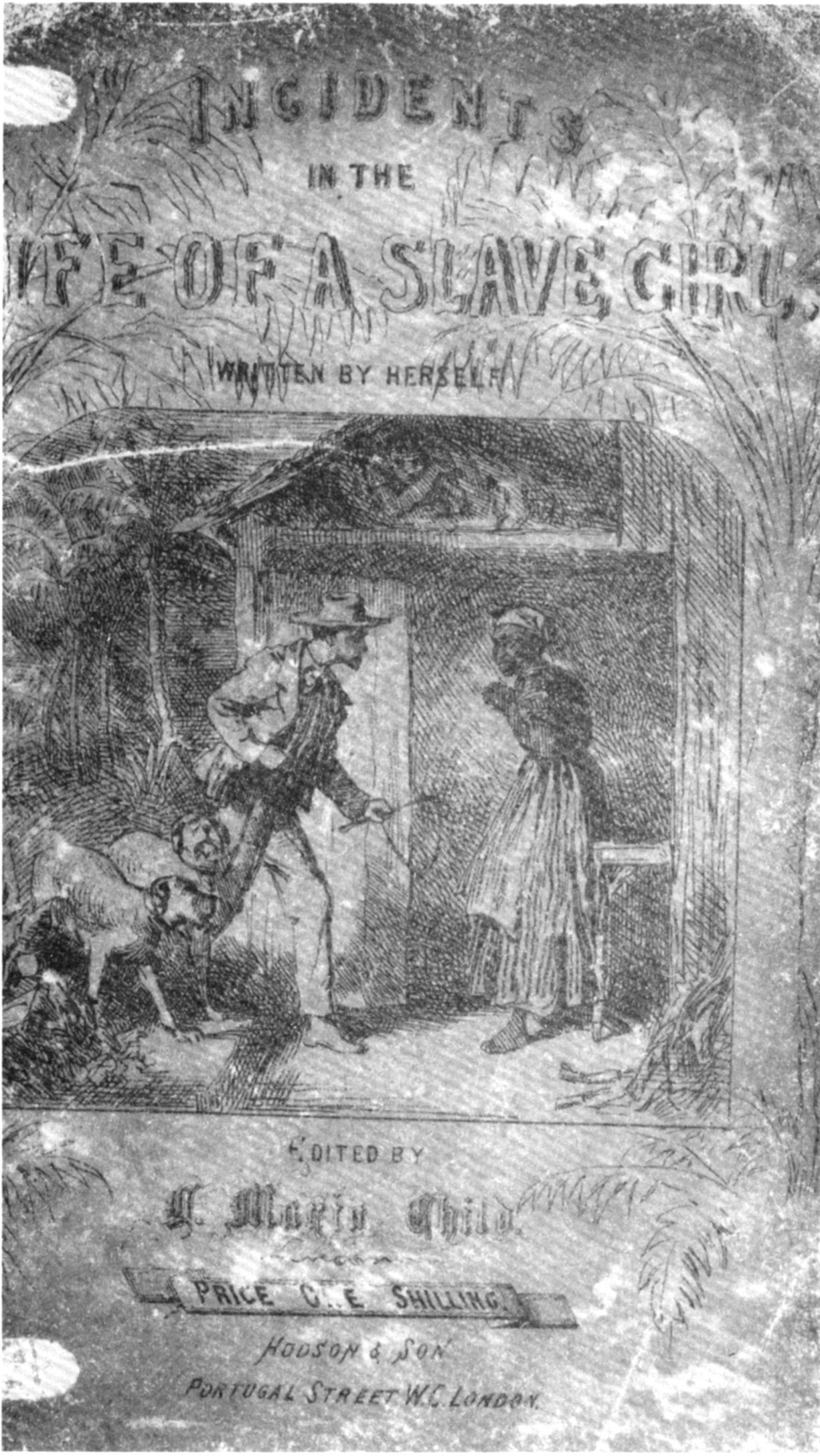
Title page of a book with the heading 'Incidents in the Life of a Slave Girl, Written by Herself', edited by L. Maria Child, 'Price One Shilling', Hodson & Son, Portugal Street, London. Engraved illustration shows a man in a wide-brimmed hat with a whip, accompanied by a dog, at the doorway of a hut, facing a woman in a head wrap and long dress.Book

Secondary source

The Deeper Wrong

Hodson & Son (publisher) · 1862

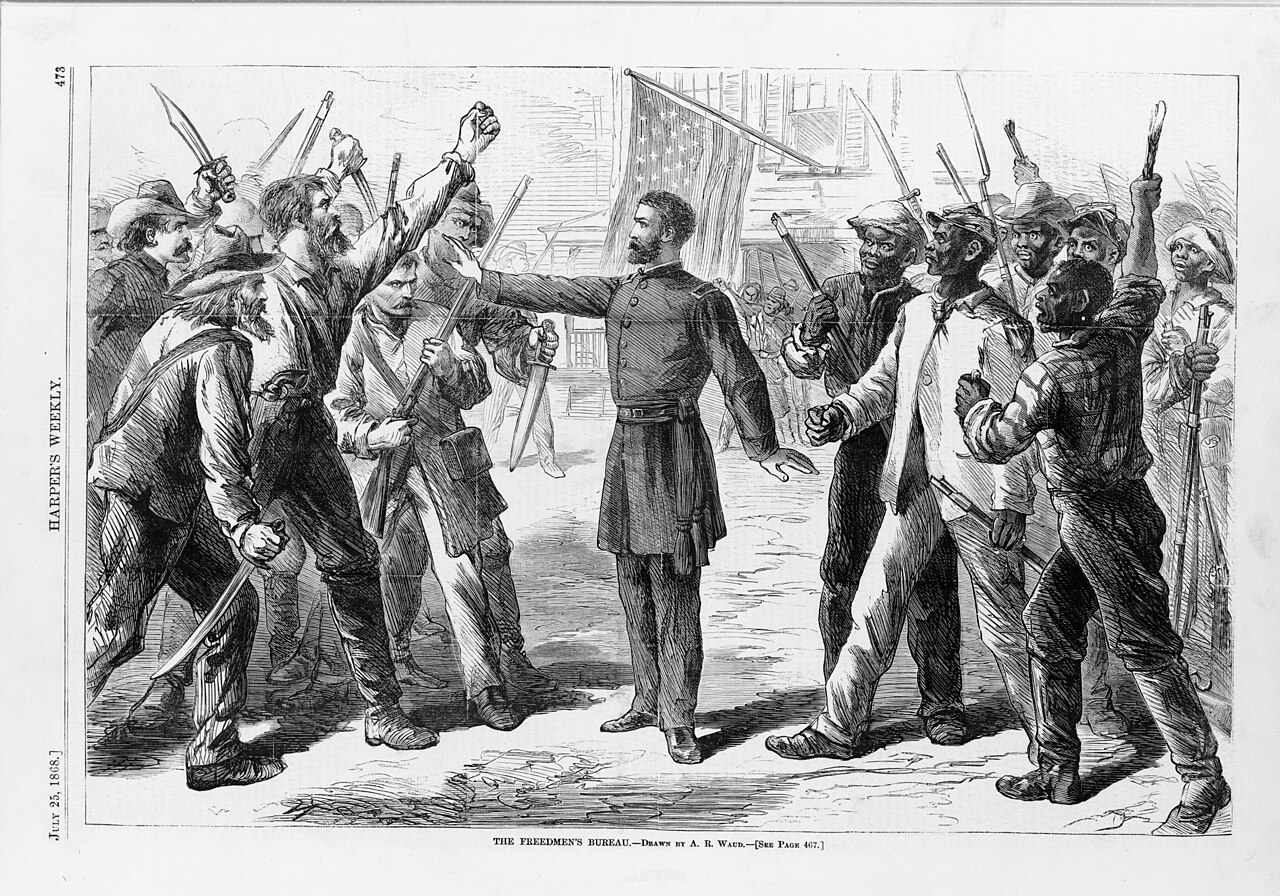
Wood engraving titled The Freedmen's Bureau, drawn by A.R. Waud, from Harper's Weekly. A Union officer in a dark uniform stands center with arm outstretched, facing a crowd of armed white men on the left and Black men on the right, some holding up rifles and bayonets. An American flag hangs behind on a building.Painting

Primary source

The Freedmen's Bureau

Alfred R. Waud · 1868

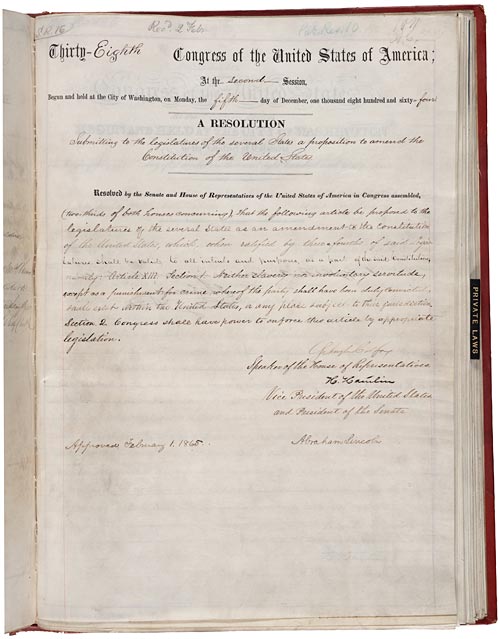
Scanned page of the 1865 joint resolution of the Thirty-Eighth Congress proposing the 13th Amendment, with the heading 'A Resolution Submitting to the Legislatures of the several States a proposition to amend the Constitution of the United States,' handwritten text, signatures of the Speaker and Vice President, and 'Approved February 1, 1865' at lower left.Document

Primary source

13th Amendment to the U.S. Constitution

1865

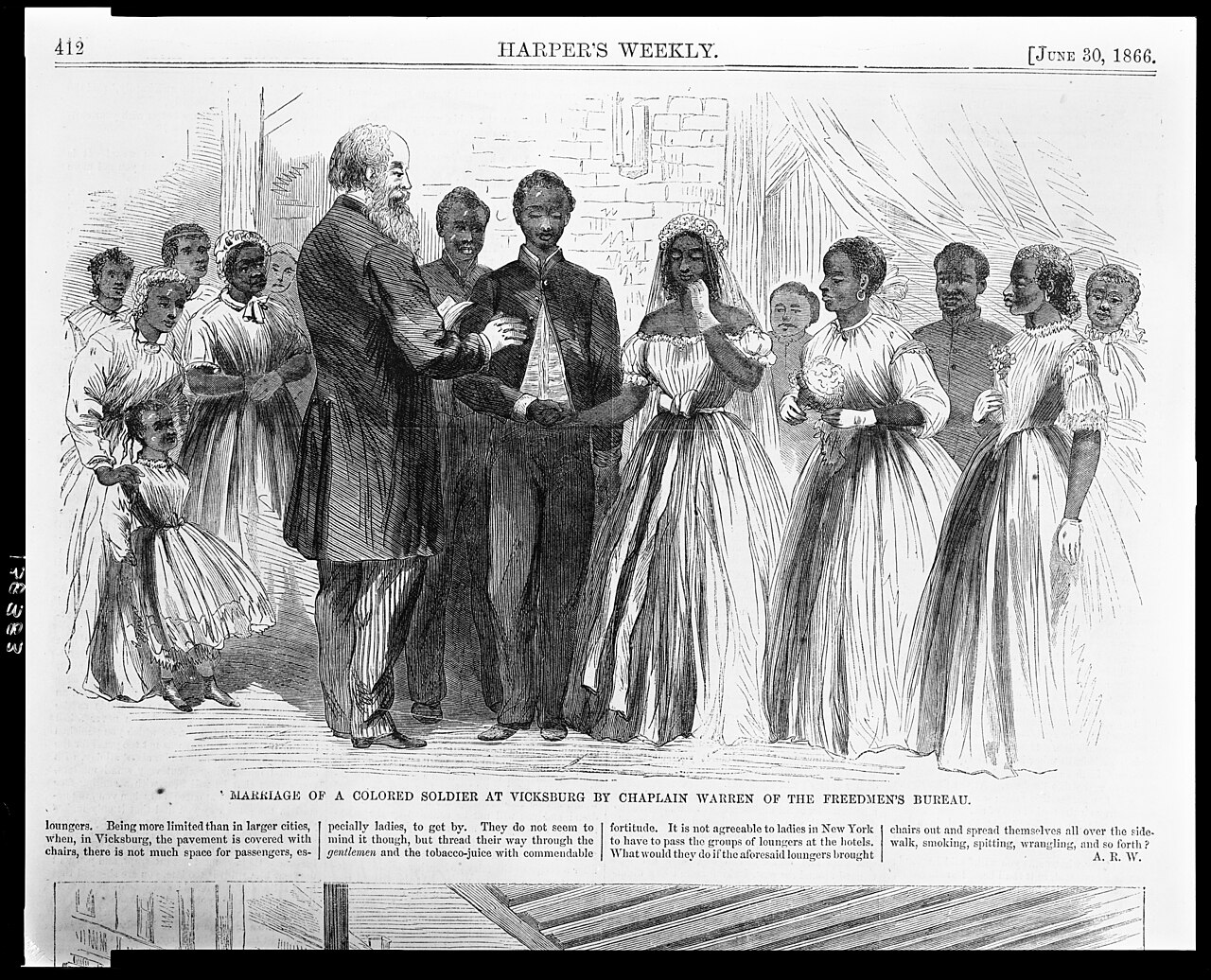
Wood engraving from Harper's Weekly, June 30, 1866, page 412. A bearded older white man in a dark coat joins hands with a young Black soldier in a dark suit beside a Black bride in a white gown and veil. Black women, children, and men stand around them. Caption and text columns appear below.Painting

Primary source

Marriage of a Colored Soldier at Vicksburg

Alfred R. Waud · 30 June 1866

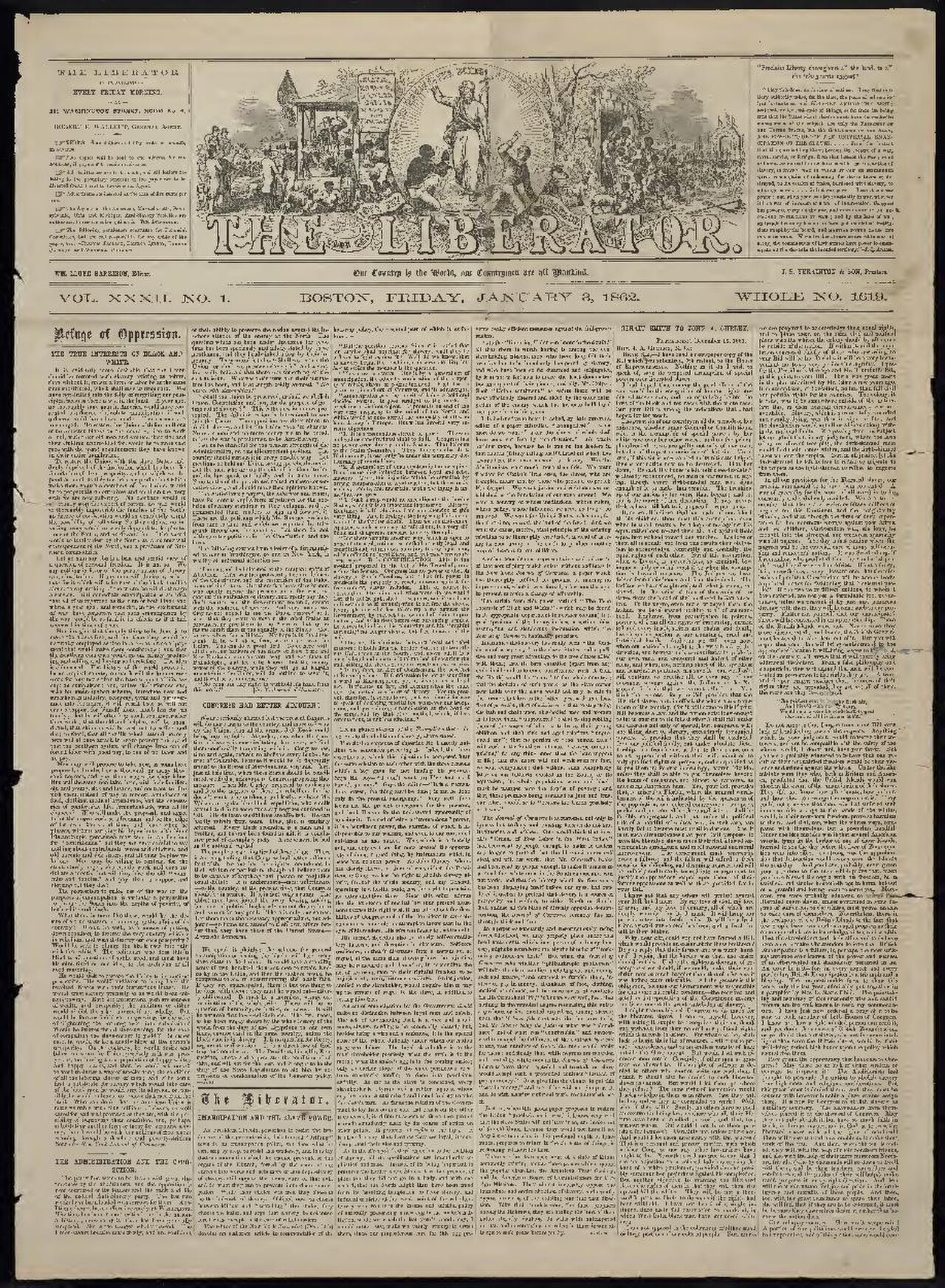
Front page of The Liberator, Boston, Friday, January 3, 1862, Vol. XXXII, No. 1, Whole No. 1619. A woodcut vignette of figures, including a standing woman, sits above the masthead. Dense columns of small printed text fill the page.Newspaper article

Primary source

The Liberator

William Lloyd Garrison · 1831-1865

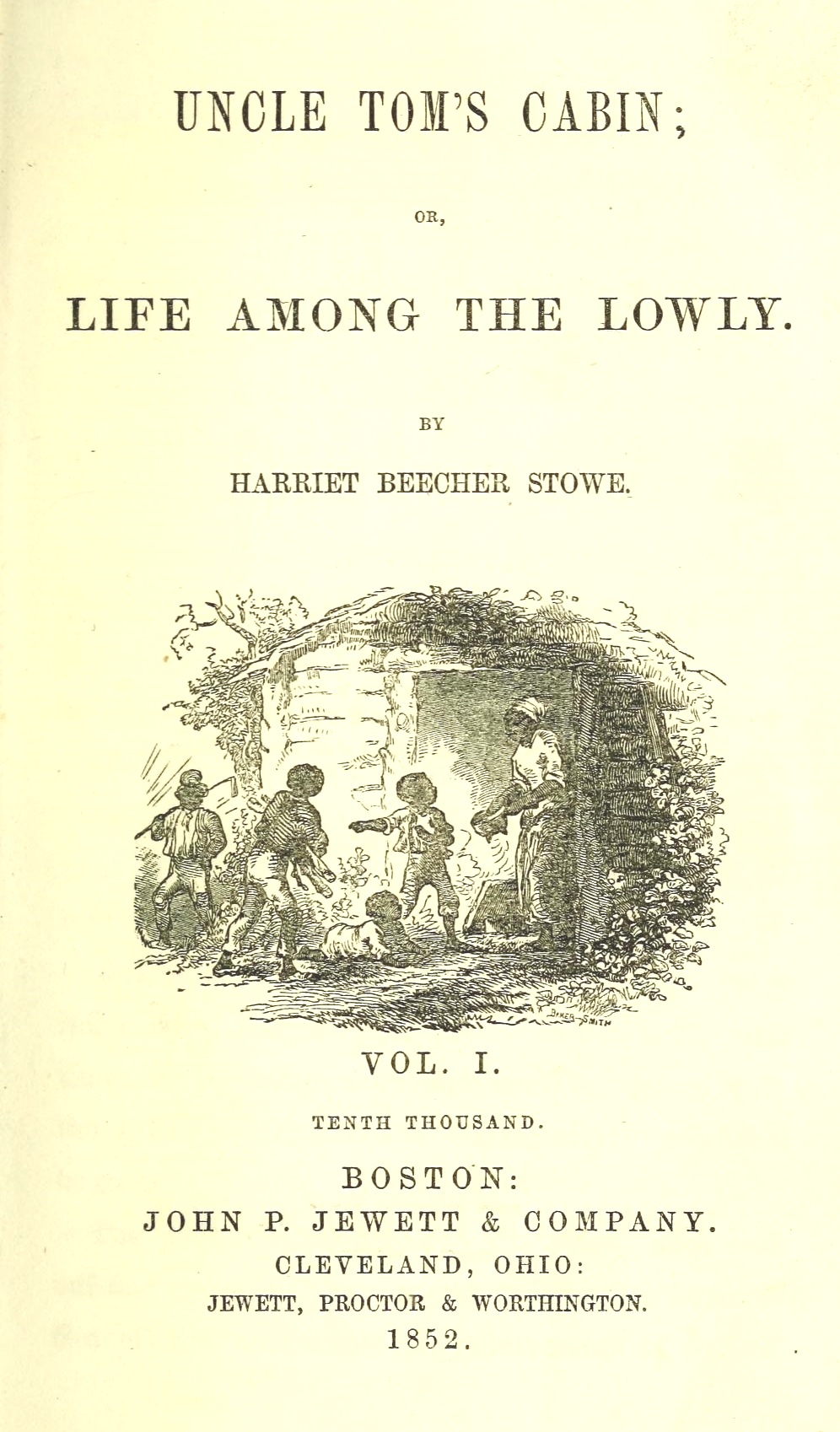
Title page of Uncle Tom's Cabin, Vol. I, by Harriet Beecher Stowe, Boston, John P. Jewett & Company, 1852. Engraved vignette shows a log cabin with several figures in front, including a standing man and children.Book

Primary source

Uncle Tom's Cabin

Harriet Beecher Stowe · 1852

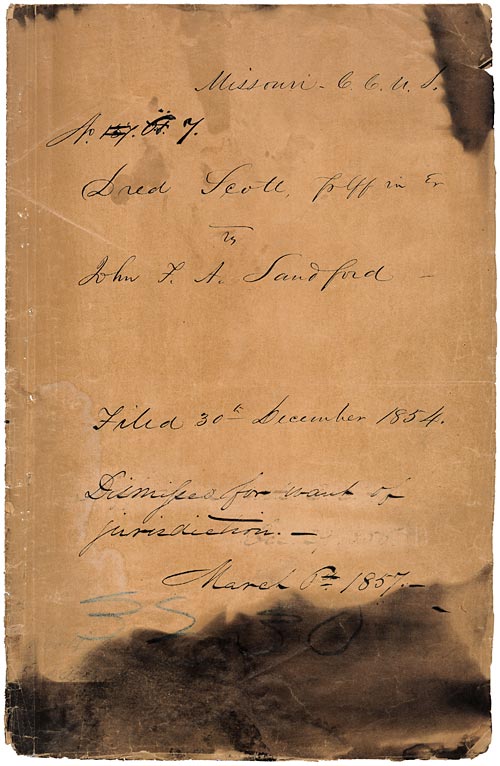
Handwritten cover sheet of the court record for Dred Scott v. Sandford. Top reads 'Missouri C.C.U.S.' with a case number, then 'Dred Scott, Plaintiff in Error, v. John F. A. Sandford', 'Filed 30th December 1854', 'Dismissed for want of jurisdiction', and 'March 6th 1857'. Scorched and darkened edges, with a blue pencil mark at lower left.Document

Primary source

Dred Scott v. Sandford

Roger B. Taney · 6 March 1857

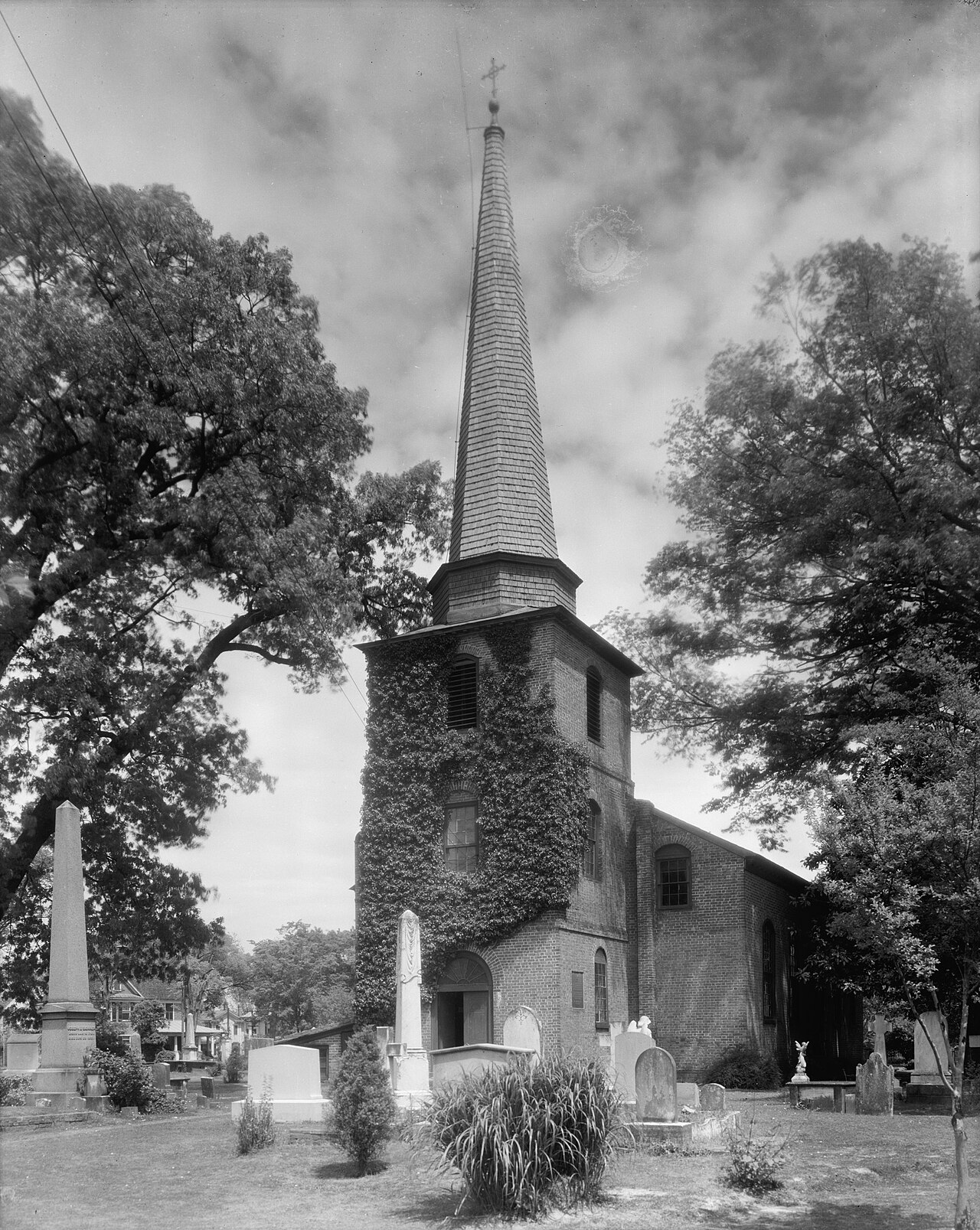
Black-and-white photo of a brick church with a tall shingled steeple and ivy covering part of the tower, with gravestones and obelisks in the grassy churchyard and large trees around it.Artifact

Secondary source

St. Paul's Church, Edenton

1701 (parish established); building later

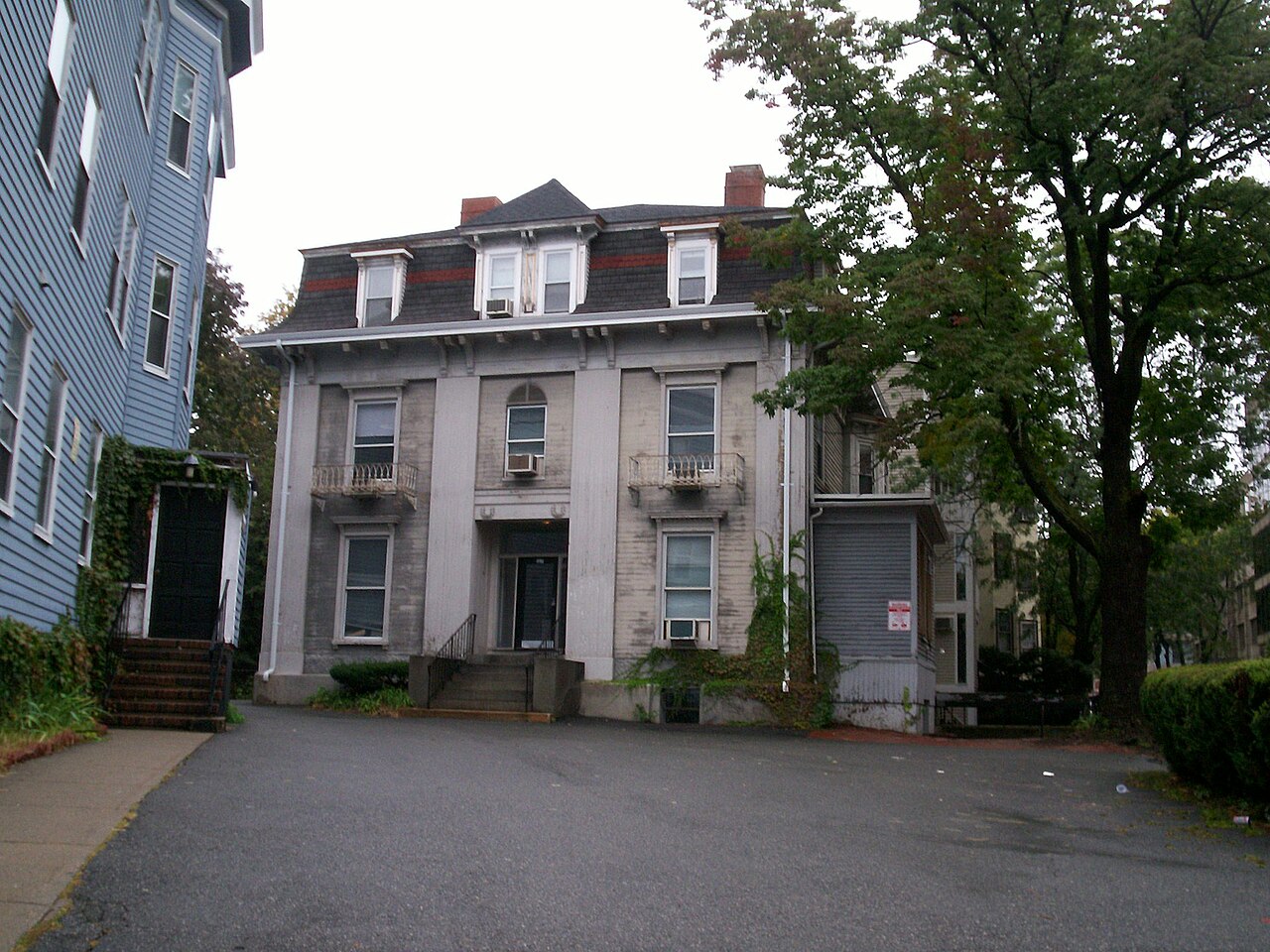
Three-story gray-clapboard house with a central entrance, two balconies, dormers, and a brick chimney, set beside a blue clapboard building. An asphalt driveway and a tree are in the foreground.Artifact

Secondary source

Harriet Jacobs House, Cambridge

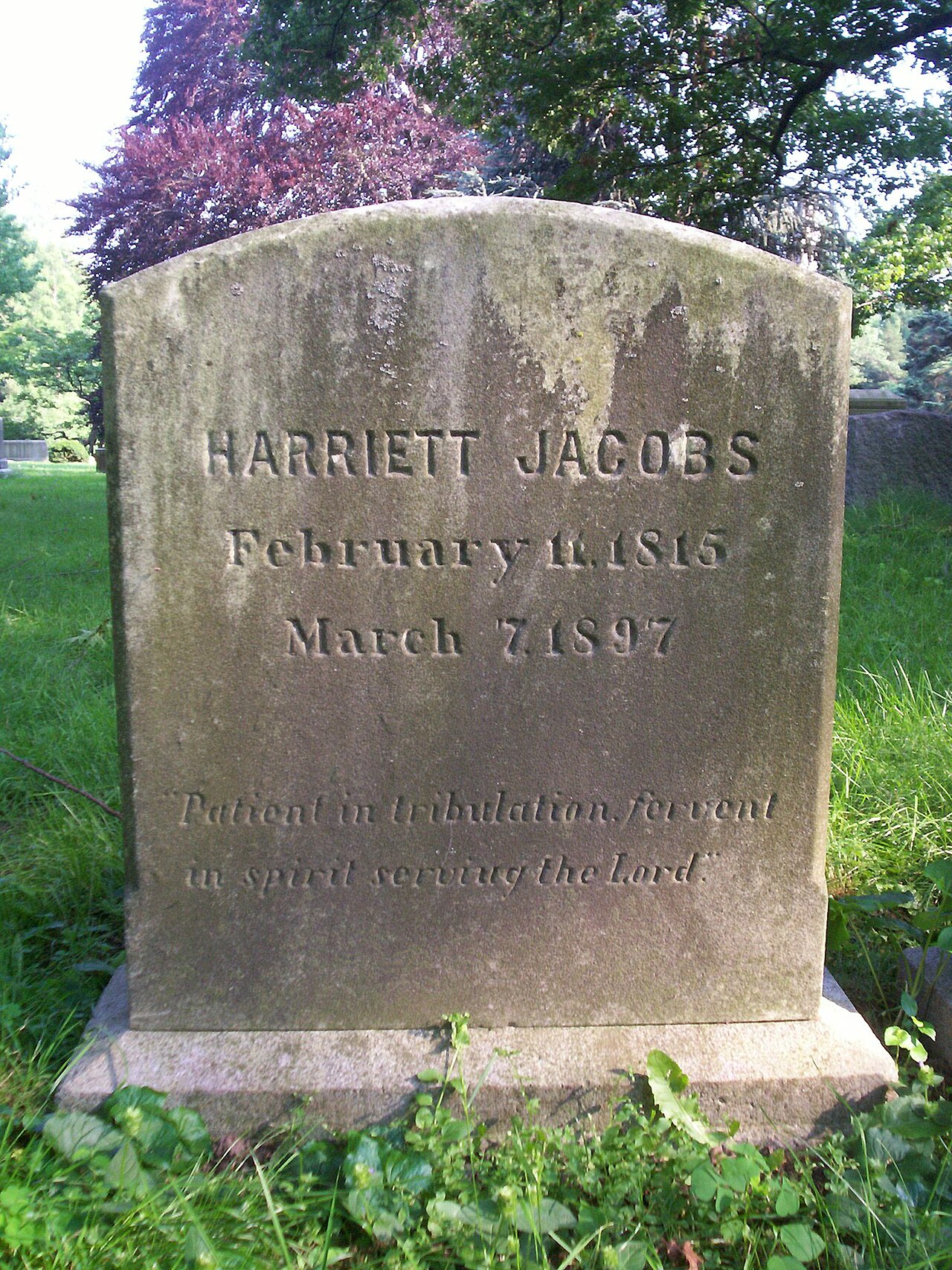
Upright gravestone of pale stone with an arched top, set on a stone base in grass. It is inscribed HARRIETT JACOBS, February 11, 1815, March 7, 1897, and a quotation: Patient in tribulation, fervent in spirit, serving the Lord. Trees stand behind it.Artifact

Secondary source

Grave of Harriet Jacobs

after 7 March 1897

Title page of 'A Key to Uncle Tom's Cabin' by Harriet Beecher Stowe. Header reads 'Facts for the People.' Text states it presents the facts and documents upon which the story is founded, published in Boston, Cleveland, and London.Book

Primary source

A Key to Uncle Tom's Cabin

Harriet Beecher Stowe · 1853

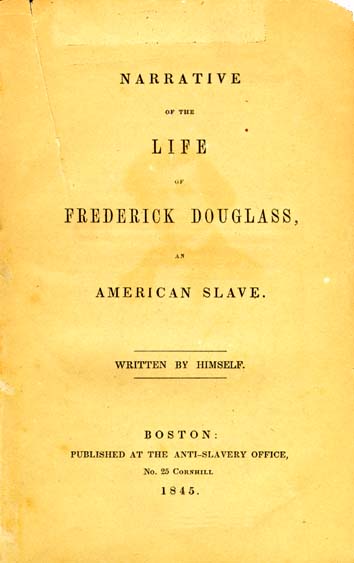
Yellowed title page of the 1845 Narrative of the Life of Frederick Douglass, an American Slave. Text reads 'Narrative of the Life of Frederick Douglass, an American Slave, Written by Himself', 'Boston: Published at the Anti-Slavery Office, No. 25 Cornhill, 1845'.Book

Primary source

Narrative of the Life of Frederick Douglass, an American Slave

Frederick Douglass · 1845

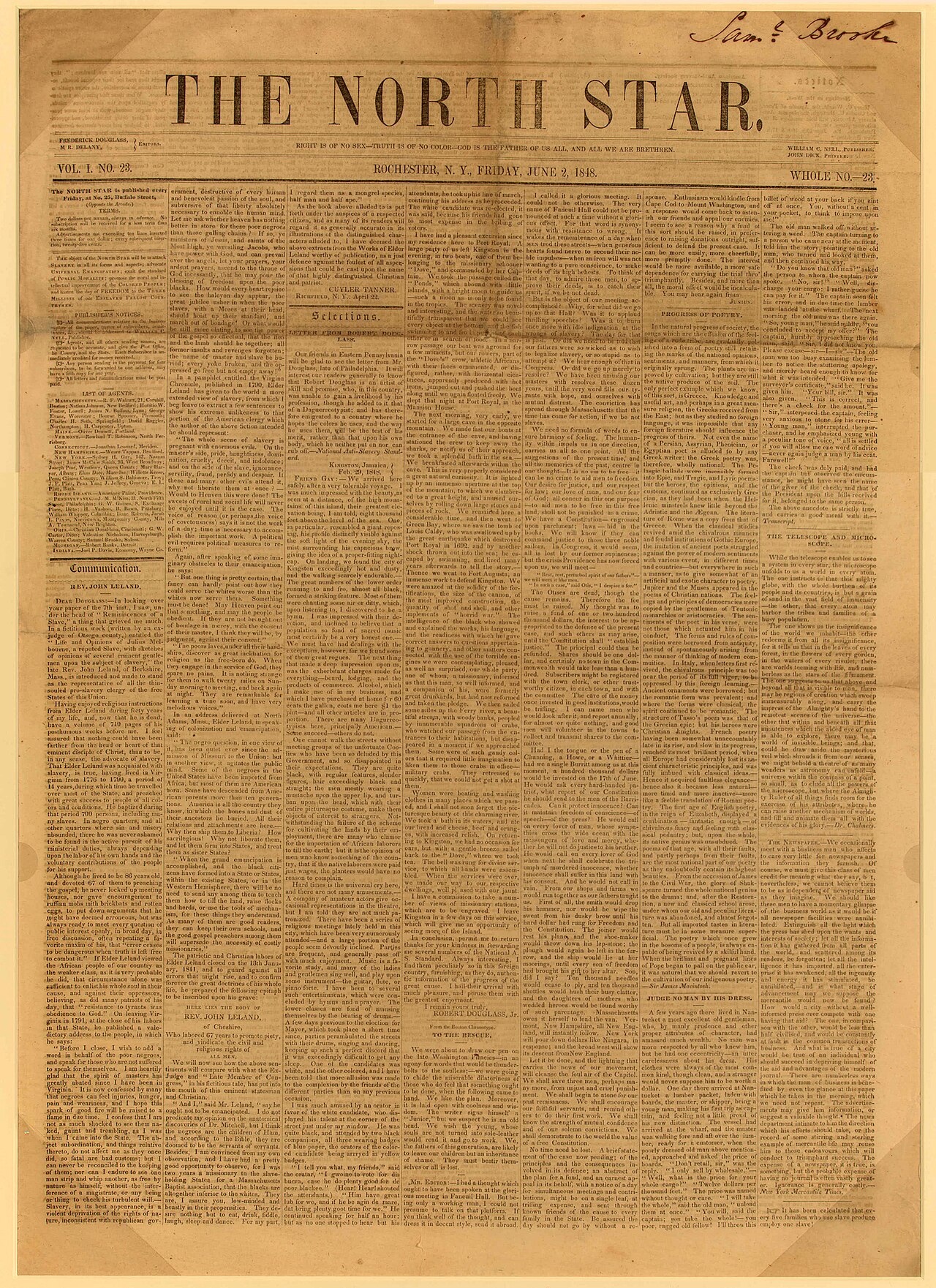
Front page of The North Star newspaper, Rochester, N.Y., Friday, June 2, 1848, Vol. I, No. 29. Masthead reads 'The North Star' in large letters, with Frederick Douglass and N.P. Dellany named as editors. Dense columns of small printed text fill the page, with a handwritten signature in the upper right corner.Newspaper article

Primary source

The North Star

Frederick Douglass · 1847

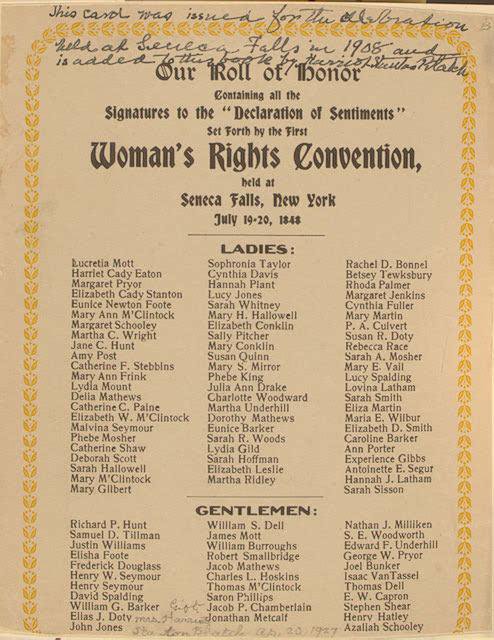
Printed broadside titled "Our Roll of Honor" listing the signatories to the Declaration of Sentiments from the 1848 Woman's Rights Convention at Seneca Falls, New York. Names are arranged in columns under headings Ladies and Gentlemen, with handwritten notes across the top and bottom margins.Document

Primary source

Declaration of Sentiments

Elizabeth Cady Stanton · 1848

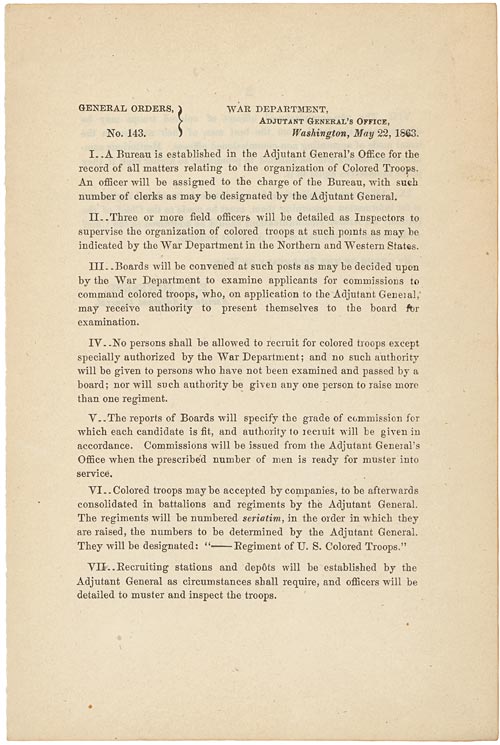
Scanned page of War Department General Orders No. 143, dated Washington, May 22, 1863, with seven numbered paragraphs establishing a Bureau for colored troops in the Adjutant General's Office and related recruiting rules.Document

Primary source

War Department General Order 143: Creation of the U.S. Colored Troops

22 May 1863

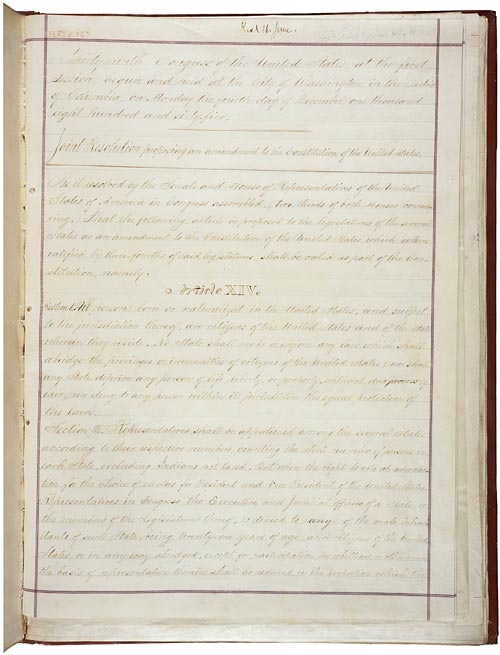
Handwritten manuscript page of the Joint Resolution proposing an amendment to the Constitution, with the heading 'Joint Resolution proposing an amendment to the Constitution of the United States' and the text of Section 1 of the 14th Amendment, including 'Article XIV.' Ruled border lines frame the text.Document

Primary source

14th Amendment to the U.S. Constitution: Civil Rights

United States Congress · 1868

Book

Secondary source

LibriVox Audio Reading of Incidents in the Life of a Slave Girl

Harriet Jacobs · 1861 (text); recording made later

American Slavery As It Is: Testimony of a Thousand WitnessesBook

Primary source

American Slavery As It Is: Testimony of a Thousand Witnesses

Theodore Dwight Weld · 1839

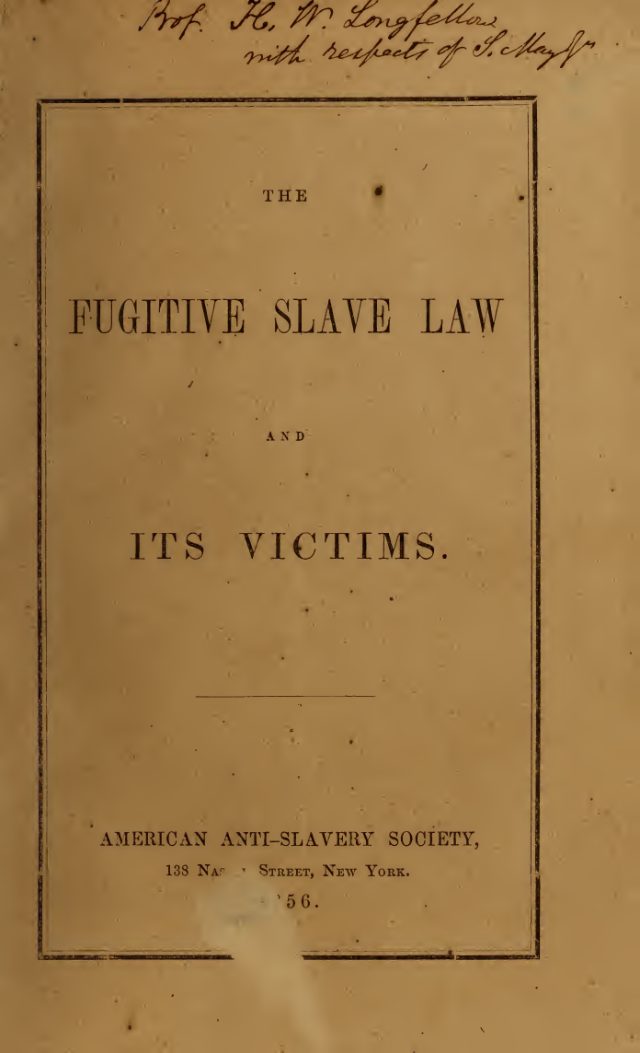
The Fugitive Slave Law and Its VictimsDocument

Primary source

The Fugitive Slave Law and Its Victims

Samuel May · 1856

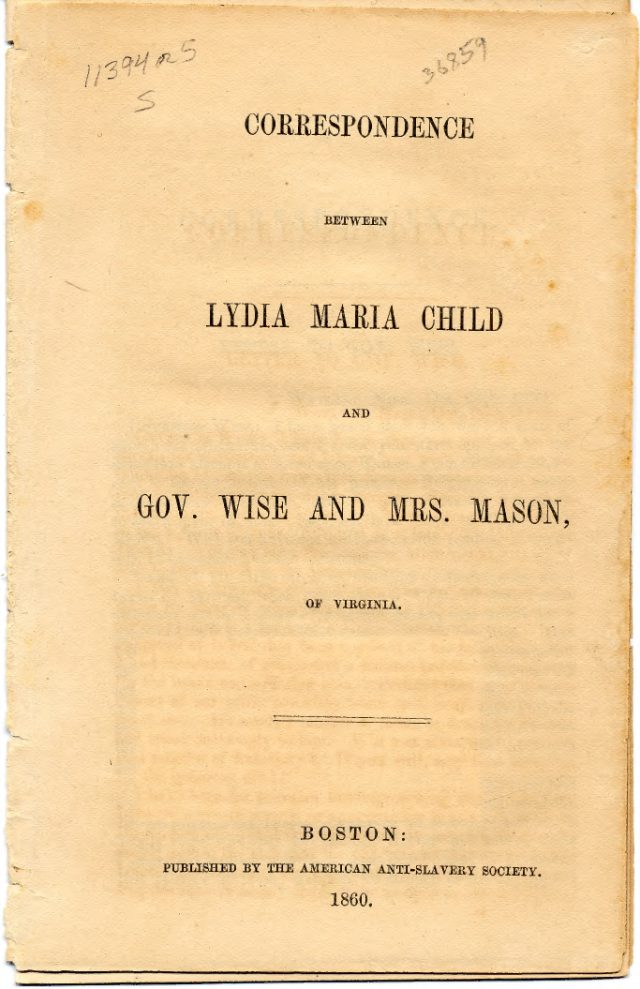
Correspondence Between Lydia Maria Child and Gov. Wise and Mrs. MasonLetter

Primary source

Correspondence Between Lydia Maria Child and Gov. Wise and Mrs. Mason

Lydia Maria Child · 1860

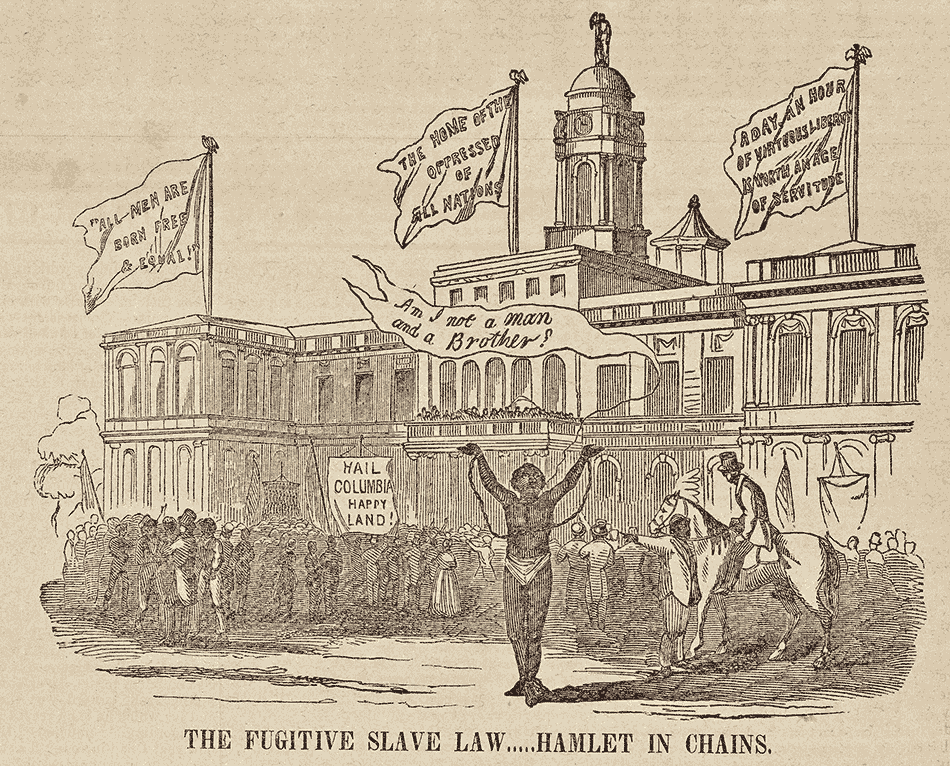
Wood engraving titled 'The Fugitive Slave Law.....Hamlet in Chains.' A shirtless Black man stands in chains with arms raised in a crowded street before a large columned building. Flags and banners read 'All men are born free & equal,' 'Am I not a man and a brother?' and others. A man on horseback and a crowd of onlookers are at the sides.Newspaper article

Primary source

The Fugitive Slave Law.....Hamlet in Chains

17 October 1850

Book

Primary source

The Underground Railroad

William Still · 1872

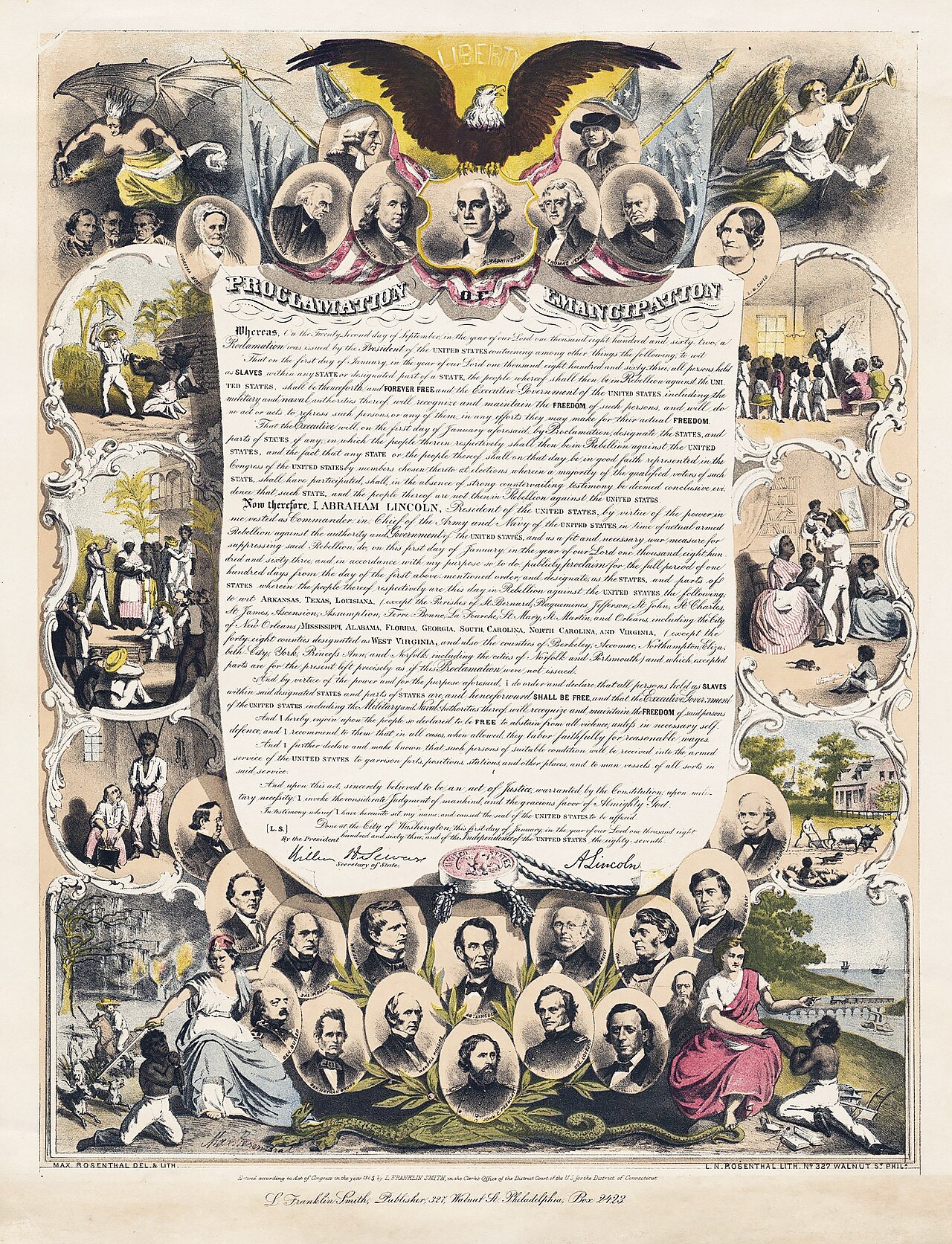
Decorative lithographed broadside of the Emancipation Proclamation with central printed text, an eagle and 'Liberty' banner at top, oval portraits of political figures, and vignettes of enslaved people and freedom scenes around the border. Printed credit at bottom reads L. Franklin Smith, Philadelphia.Document

Primary source

Emancipation Proclamation Broadside

L. Franklin Smith · 1865

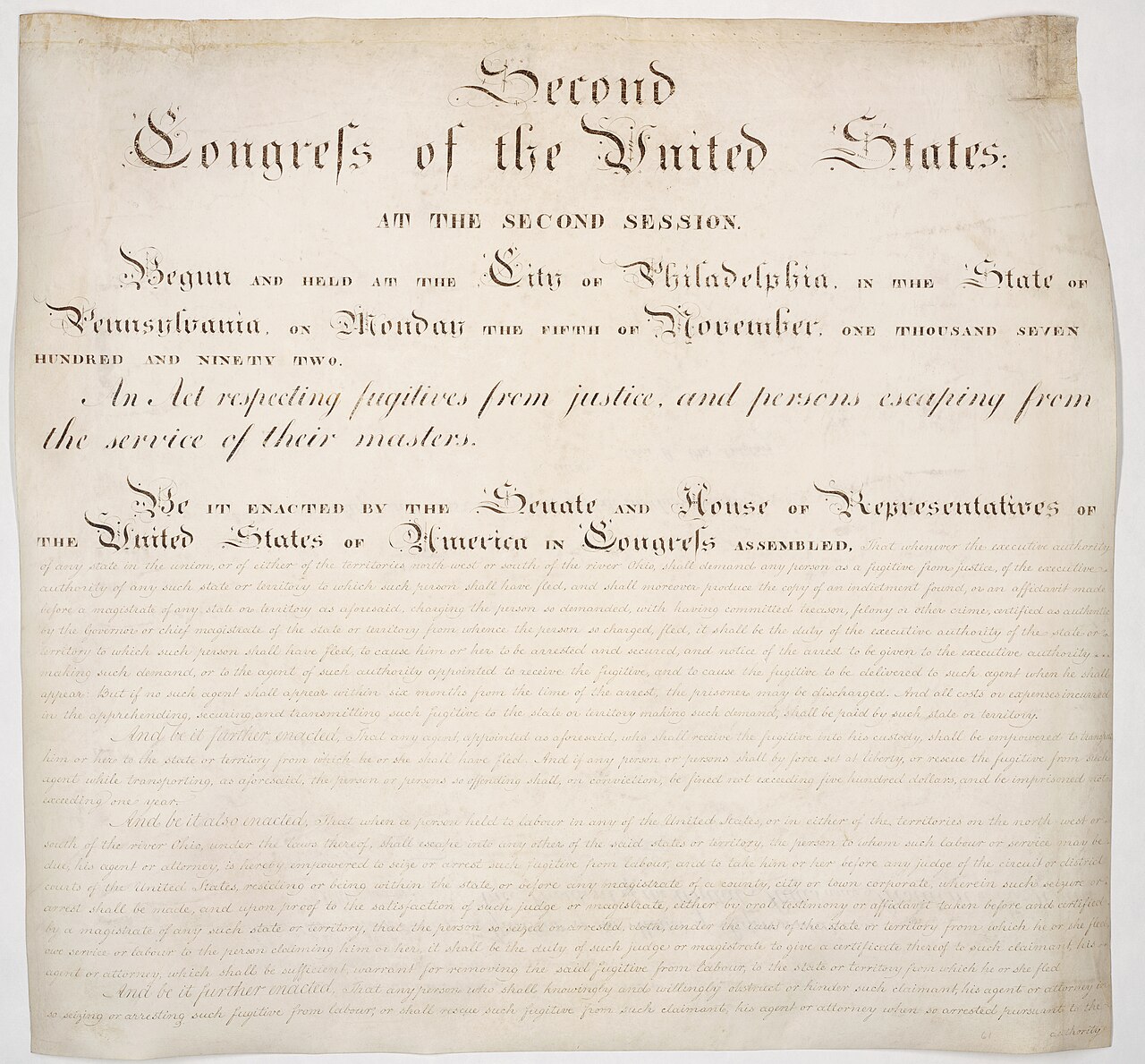
Handwritten parchment page headed 'Second Congress of the United States, at the Second Session,' beginning 'An Act respecting fugitives from justice, and persons escaping from the service of their masters,' dated Philadelphia, November 1792.Document

Primary source

An Act Respecting Fugitives from Justice

November 1792

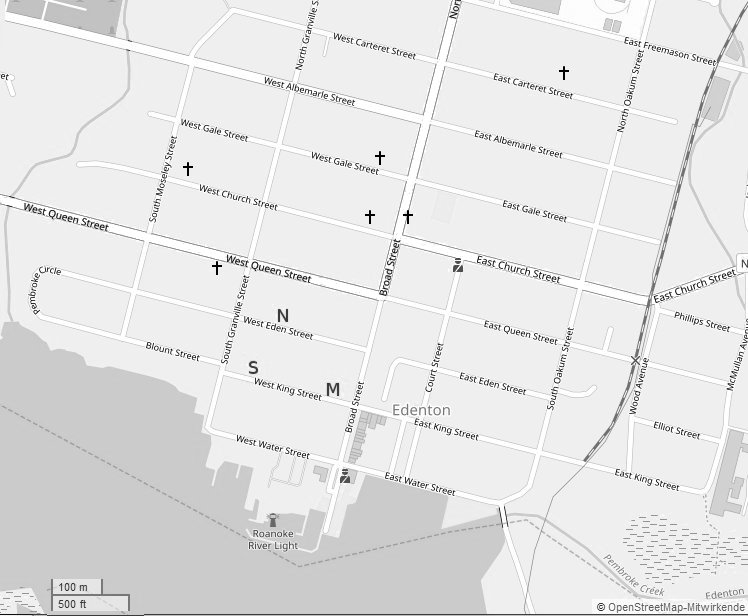
Street map of central Edenton, North Carolina, from OpenStreetMap. Shows streets including Broad Street, South Granville Street, Court Street, East Water Street and West Queen Street, with church crosses marked, the Roanoke River Light near the waterfront, and a scale bar in metres and feet.Document

Tertiary source

Map of Edenton, North Carolina

OpenStreetMap contributors, rsk6400 · 2019

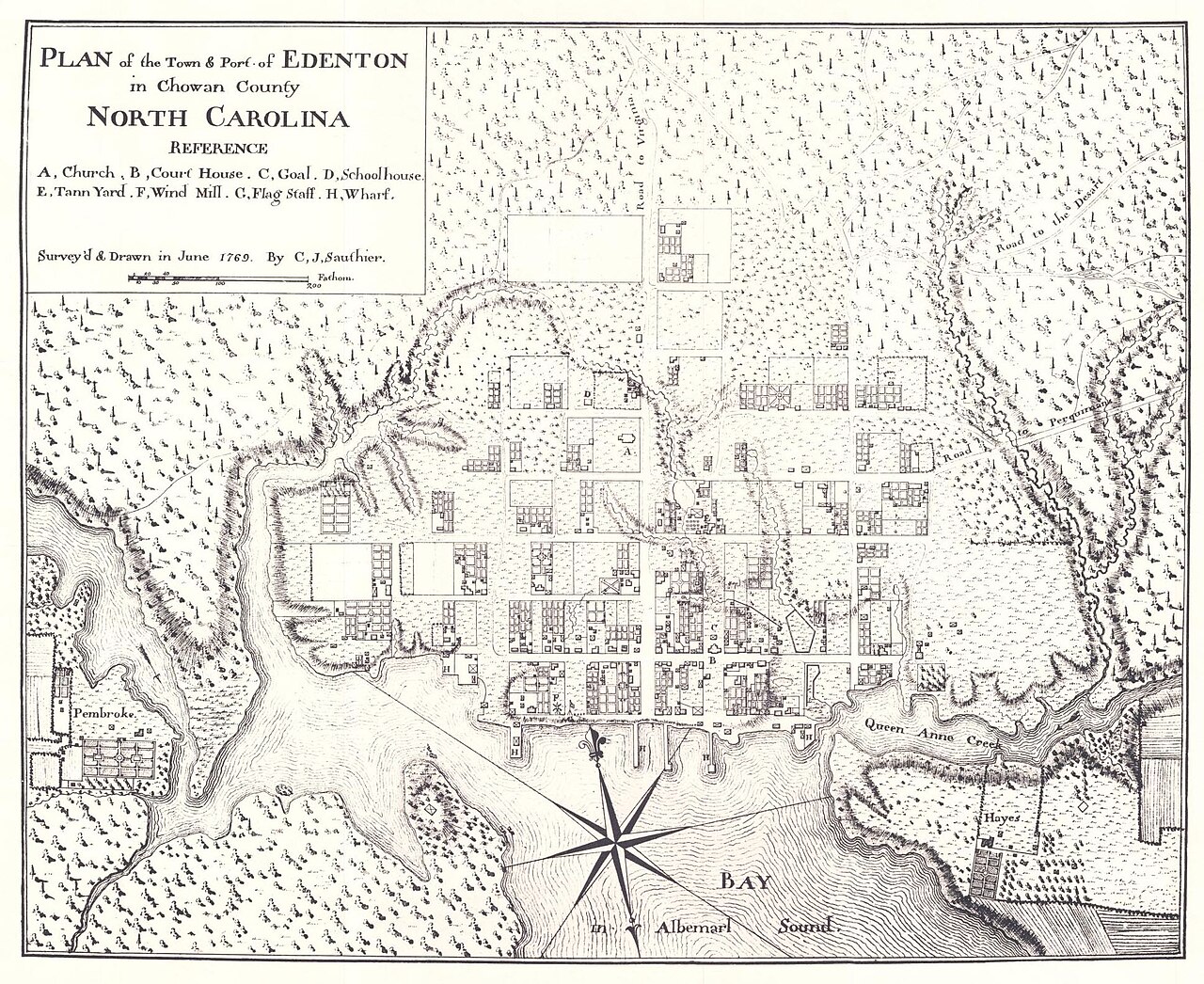
Engraved map titled 'Plan of the Town & Port of Edenton in Chowan County North Carolina,' surveyed and drawn June 1769 by C. J. Sauthier. Shows a street grid of town lots, a compass rose, water with 'Albemarl Sound' and 'Queen Anne Creek,' and a reference key in the upper left.Document

Primary source

Plan of the Town & Port of Edenton in Chowan County, North Carolina

Claude Joseph Sauthier · June 1769

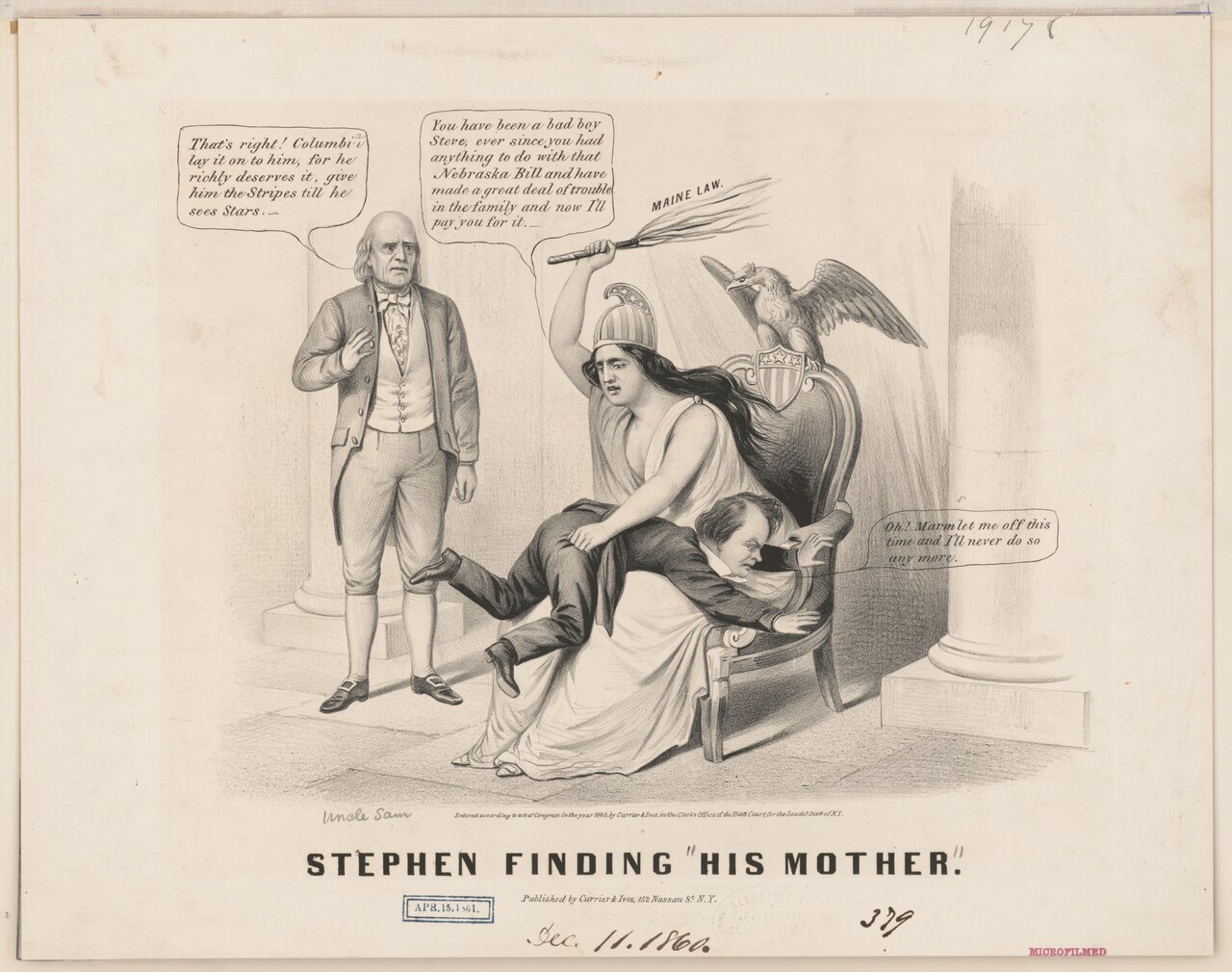
Lithograph political cartoon titled 'Stephen Finding His Mother.' A bald older man on the left says 'That's right! Columbia lay it on to him.' A helmeted woman representing Columbia raises a whip over a man draped across her lap in a chair, under an eagle perched on a shield. A speech bubble reads 'You have been a bad boy Steve...' and another man says 'Oh! Mamma let me off this time.' A sign reads 'Maine Law.' Caption below reads 'Stephen Finding His Mother.'Painting

Primary source

Stephen Finding His Mother

Popular Graphic Arts · 1860

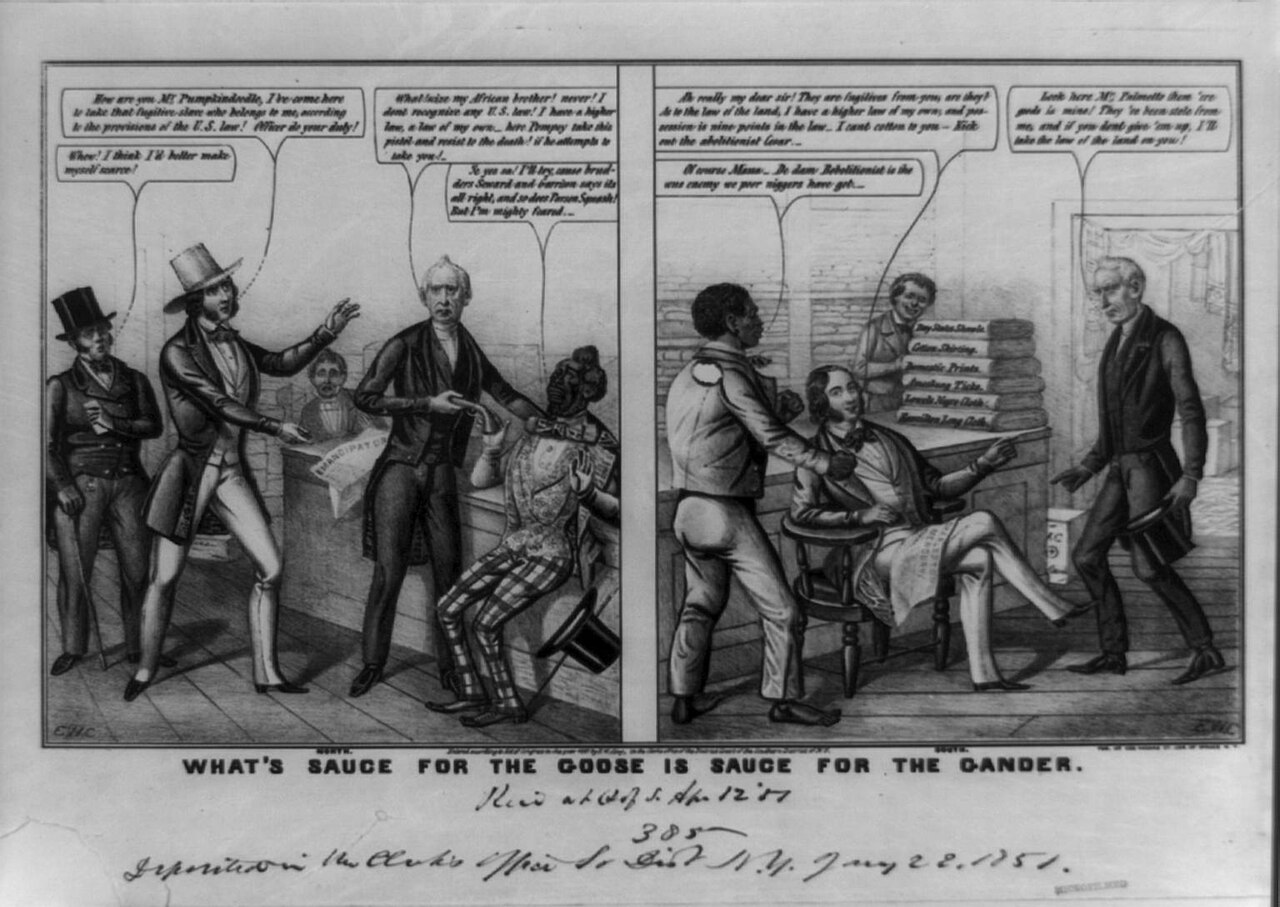
Two-panel lithograph titled 'What's Sauce for the Goose is Sauce for the Gander.' Left panel: men in top hats and a seated official at a counter; a Black man in plaid trousers is being restrained. Right panel: a Black man speaks to a seated white man reading a newspaper while another man stands near a stack of books; a older man in a long coat gestures.Painting

Primary source

What's Sauce for the Goose is Sauce for the Gander

Edward Williams Clay · 1851

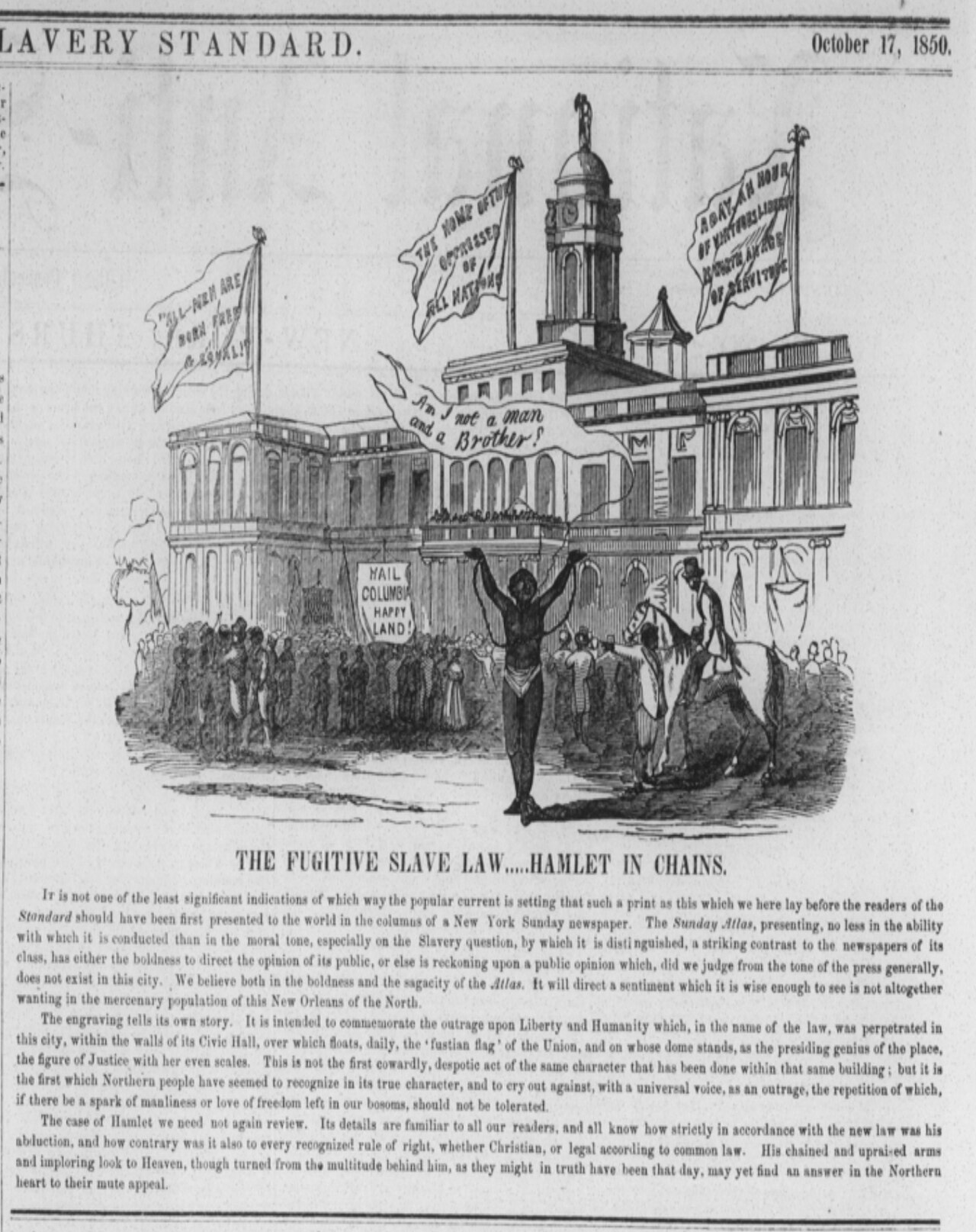
Woodcut-style newspaper engraving titled 'The Fugitive Slave Law....Hamlet in Chains' from the Liberty Standard... masthead reads 'Slavery Standard, October 17, 1850'. A shackled, bare-chested Black man with raised arms stands before a columned building with banners; a crowd and a mounted figure appear nearby. Caption text below describes the print.Newspaper article

Primary source

The Fugitive Slave Law: Hamlet in Chains

17 October 1850

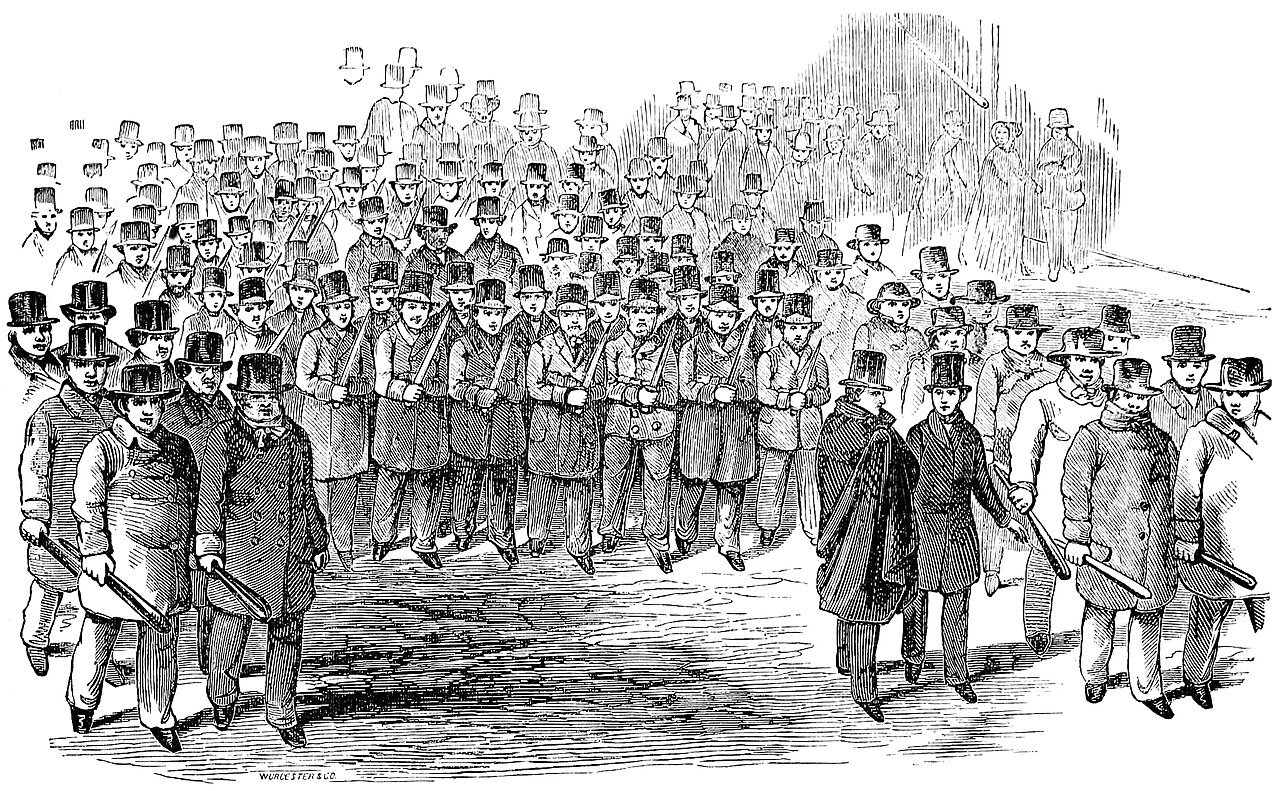
Black and white engraving of a column of men in top hats and long coats walking through a street, with officers in front and at the sides carrying clubs. Crowds of onlookers line the background.Newspaper article

Primary source

Boston Police Conveying Fugitive Slave Sims to the Vessel

Anonymous engraver, Worcester & Co. · 1851

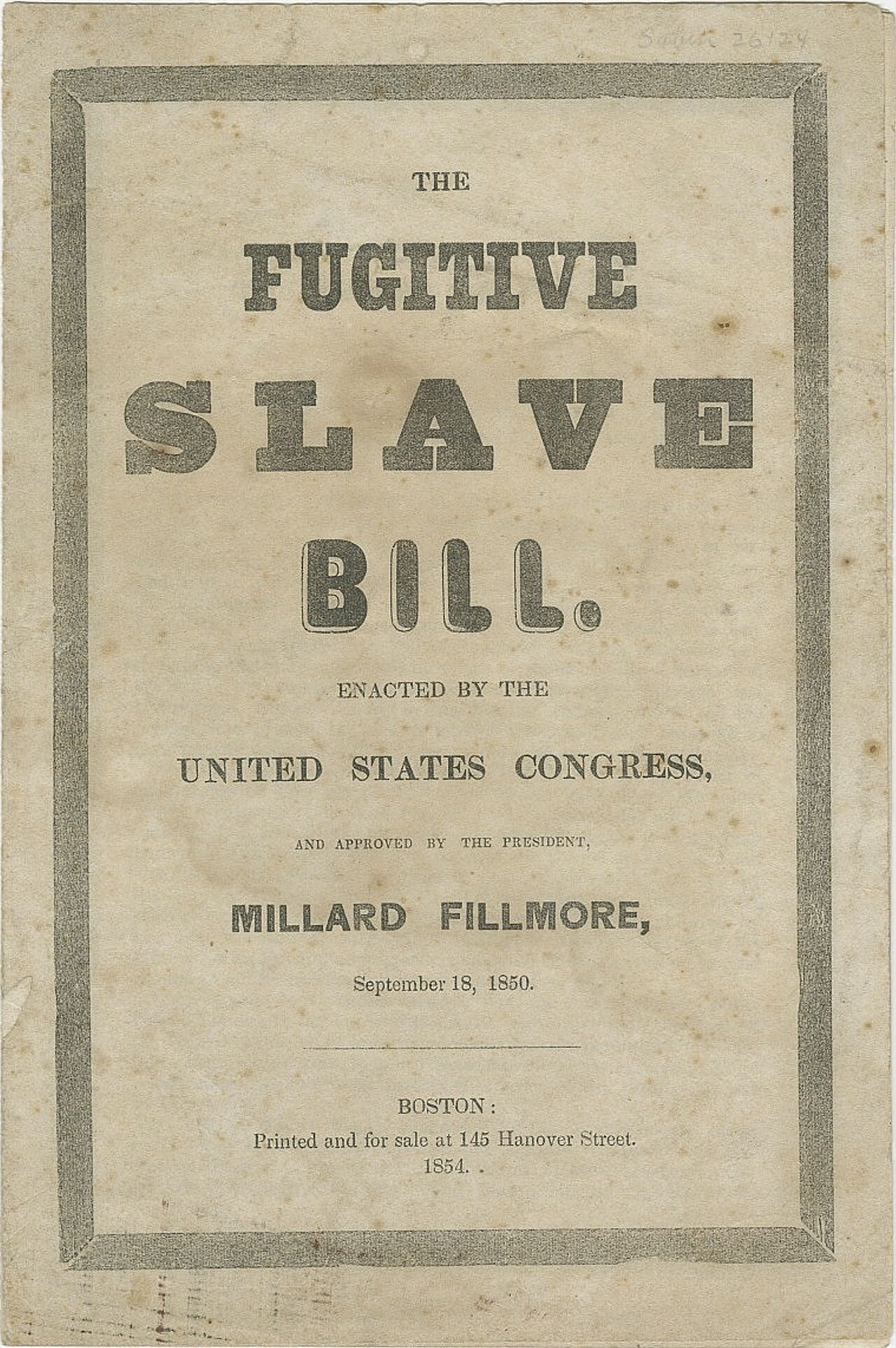
Printed title page of a Boston 1854 pamphlet reading 'The Fugitive Slave Bill, enacted by the United States Congress, and approved by the President, Millard Fillmore, September 18, 1850,' printed at 145 Hanover Street, within a decorative border on aged paper.Document

Primary source

The Fugitive Slave Bill, 1854 Protest Printing

American Anti-Slavery Society · 1854

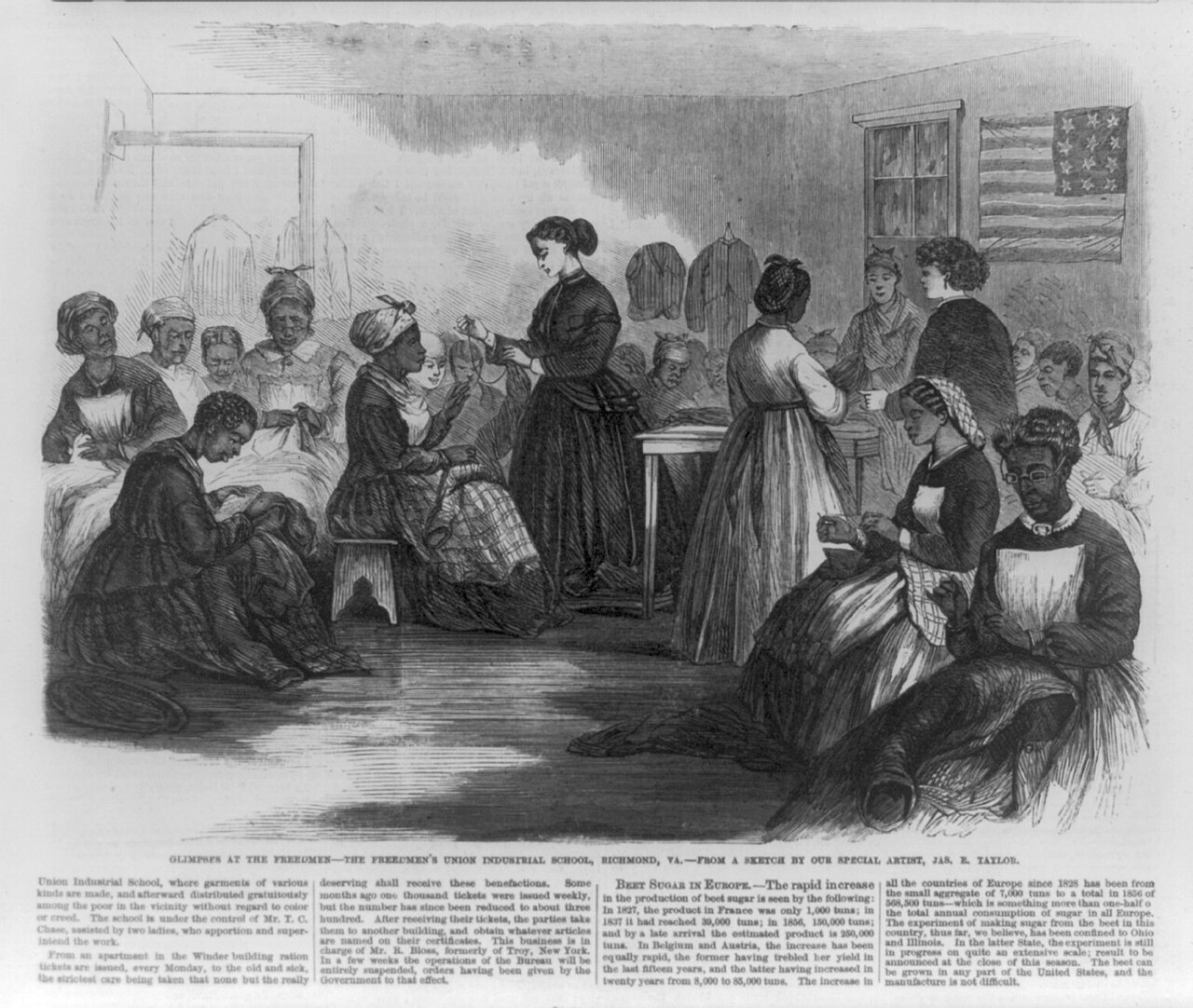
Wood engraving of the Freedmen's Union Industrial School in Richmond, Virginia. Women and girls sew and work at tables in a bare room; a standing teacher in dark dress faces a seated student. An American flag hangs on the wall. Caption text runs below.Painting

Primary source

The Freedmen's Union Industrial School, Richmond, Va.

James E. Taylor · 1866

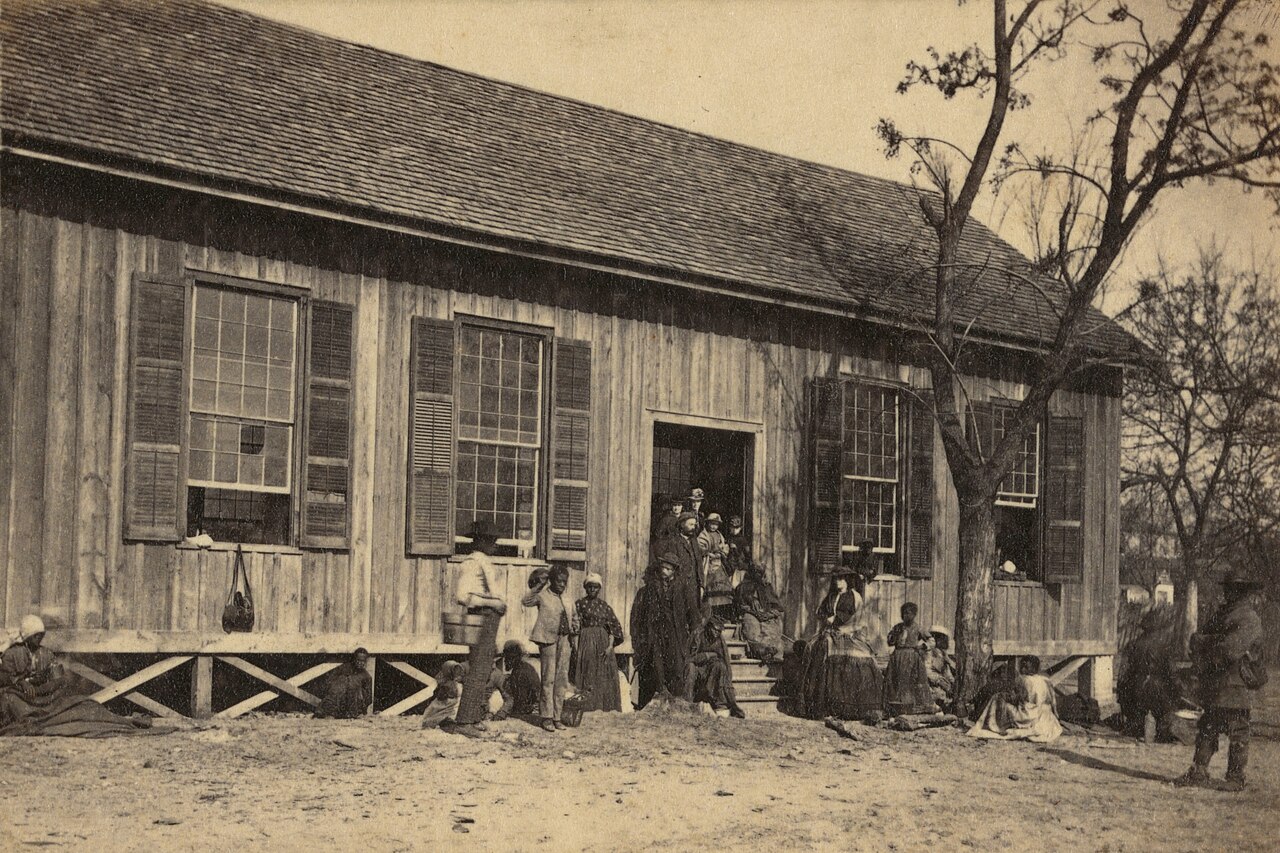
Sepia photograph of a wooden clapboard building with a shingled roof, shuttered multi-pane windows, and an open doorway. Groups of people stand and sit in front of it, some on steps, and a bare tree stands at right.Photograph

Primary source

Freedmen's School, Edisto Island, S.C.

Samuel A. Cooley · between 1862 and 1865

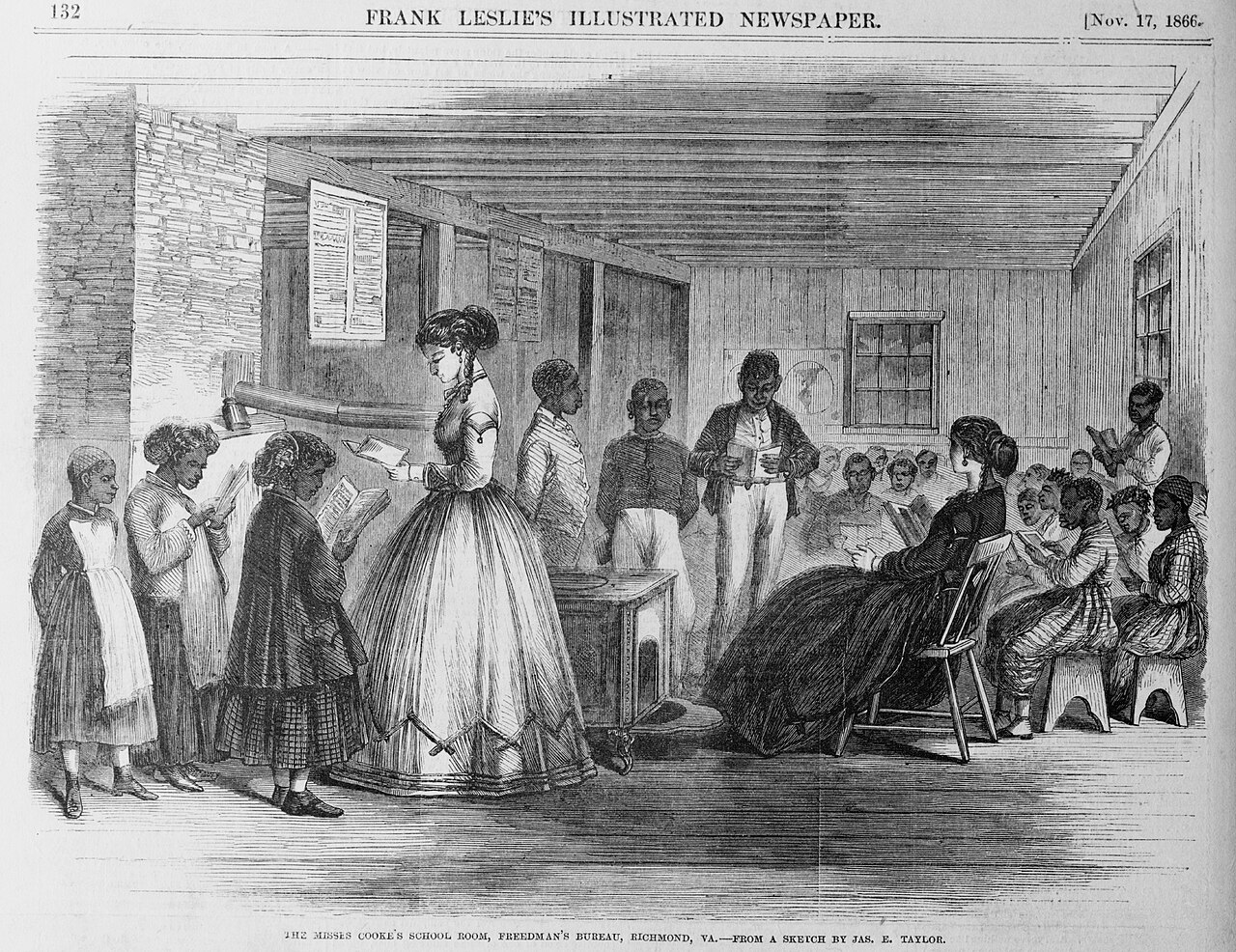
Wood engraving from Frank Leslie's Illustrated Newspaper, Nov. 17, 1866, of Misses Cooke's school room at the Freedmen's Bureau in Richmond. A woman in a full skirt stands center holding papers, with Black students reading at left and right. A seated teacher, a wall map, and a window are visible.Painting

Primary source

Misses Cooke's School for Freedmen, Richmond

James E. Taylor · 17 November 1866

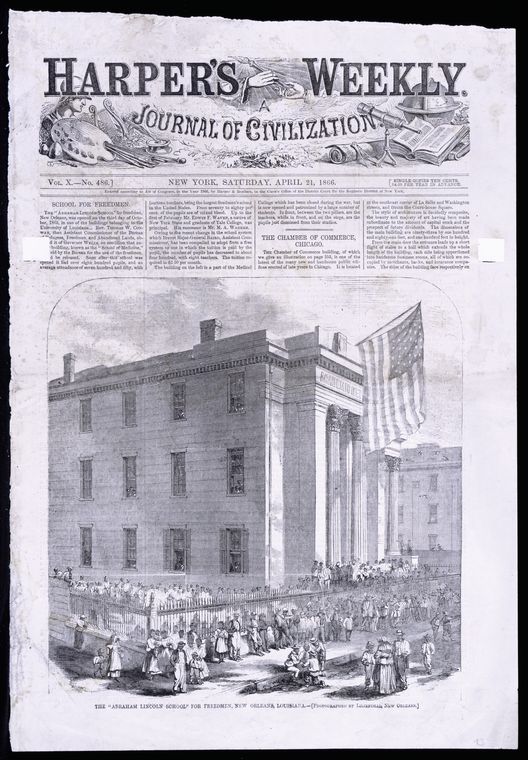
Front page of Harper's Weekly, April 21, 1866, showing its masthead and a wood-engraved illustration of the Abraham Lincoln School for freedmen in New Orleans, with a crowd of people and an American flag in front of the building.Newspaper article

Primary source

Abraham Lincoln School, New Orleans

Staff of Harper's Weekly · 21 April 1866

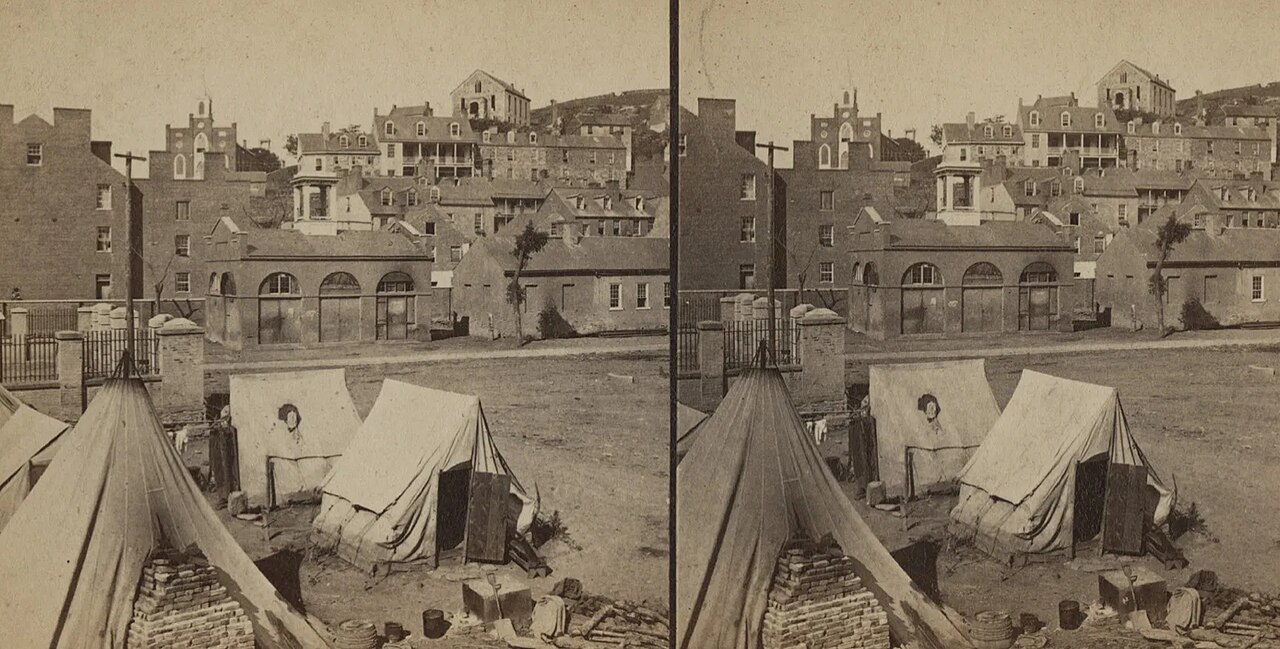
Sepia stereoscopic pair of a Civil War contraband camp at Harpers Ferry. In the foreground, white canvas tents stand on bare ground, with brick chimney remains and cooking debris. Behind them are brick buildings with arched doorways and a row of multi-story houses on a hillside.Photograph

Primary source

Contraband Camp at Harpers Ferry

Unknown · 1861

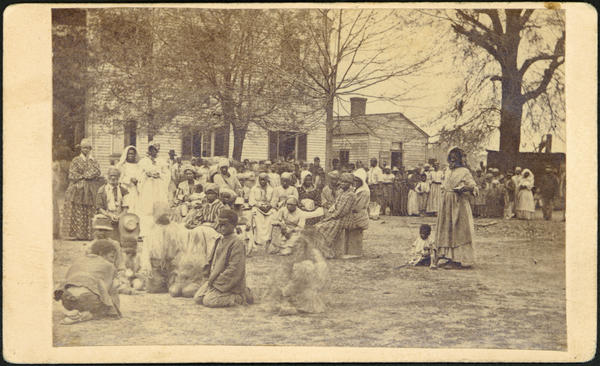
Sepia photograph of a crowd of African American men, women and children gathered on dirt ground in front of a white wooden building with a porch, a tall bare tree at right. Some people sit on the ground in the foreground; a woman in a long dress stands at right.Photograph

Primary source

Contraband Camp in Former Female Seminary, Baton Rouge

Ascribed to McPherson & Oliver · c. 1863

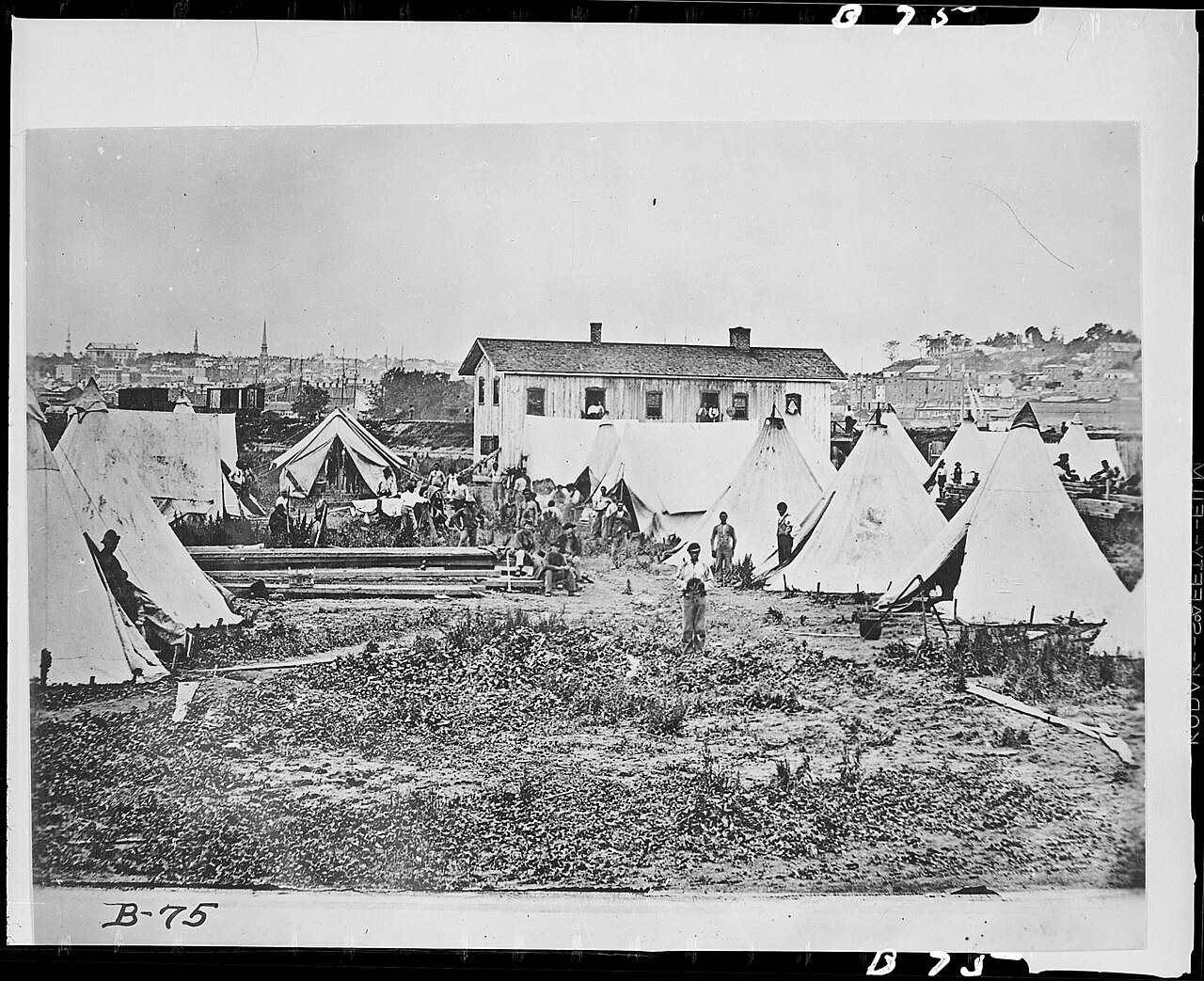
Black-and-white photograph of a Civil War-era contraband camp in Richmond, Virginia. Rows of white conical tents and a two-story wooden building stand on a dirt field, with groups of people gathered among them and a city skyline in the distance.Photograph

Primary source

Contraband Camp, Richmond, Virginia (National Archives)

Mathew Brady · 1865

Black-and-white photograph of a contraband camp in Richmond, Virginia, c.1865. Rows of conical and wall tents stand on a bare, weedy field in front of a two-story wooden building. Many people, including adults and children, stand and sit among the tents, and a few are seen near the doorways and in the foreground. Buildings and a church spire appear on the distant horizon.Photograph

Primary source

Contraband Camp, Richmond, Virginia, by Mathew Brady

Mathew Brady · c. 1860-1865

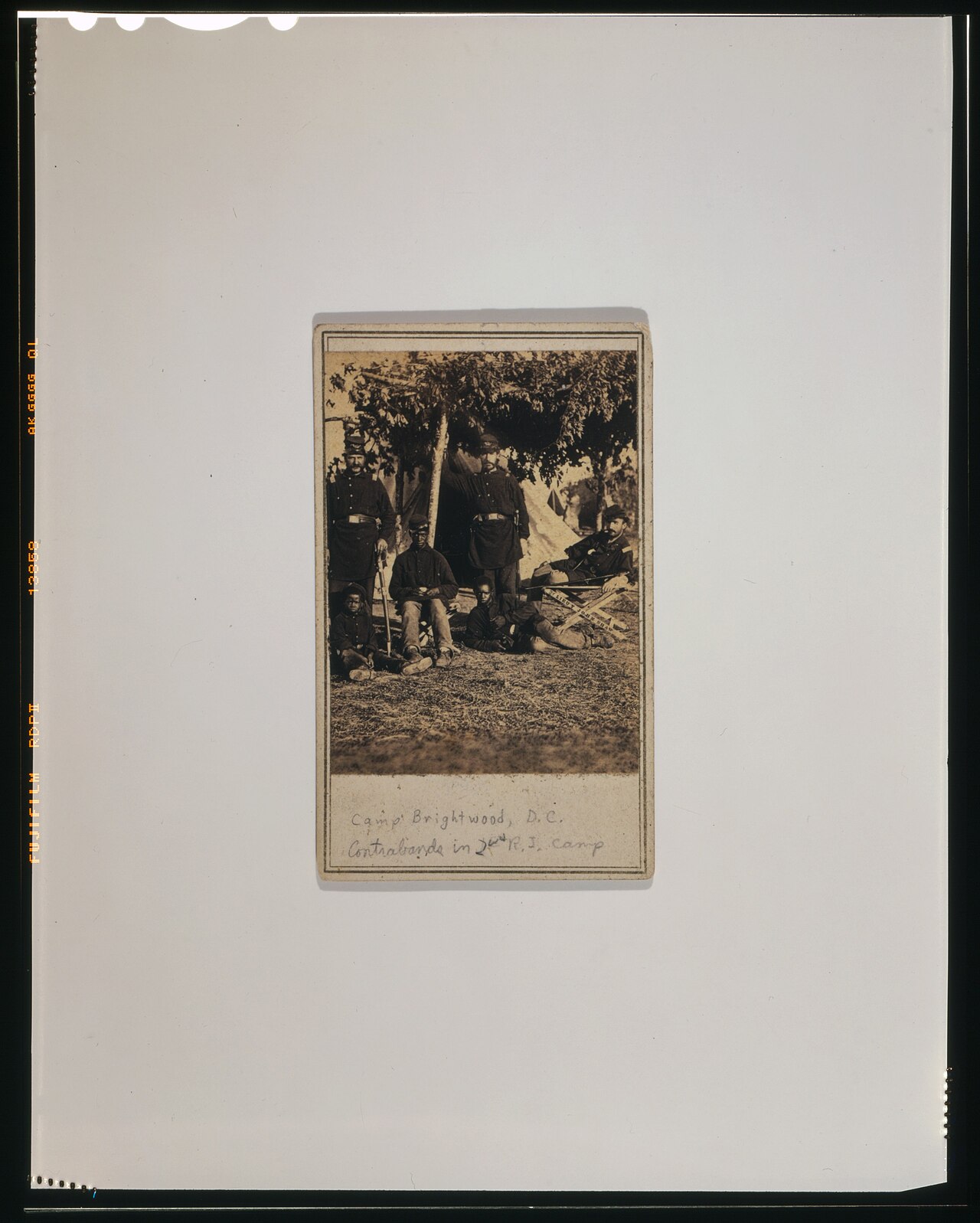
Photograph of a carte de visite mounted print showing a group of Black men at Camp Brightwood. Some wear Union army uniforms and stand under a tree near a tent, while others sit or recline on the grass. Handwritten caption on the mount reads: Camp Brightwood, D.C., Contrabands in 2nd R.I. Camp.Photograph

Primary source

Camp Brightwood, D.C.: Contrabands in 2nd R.I. Camp

Unknown · 1861-1865

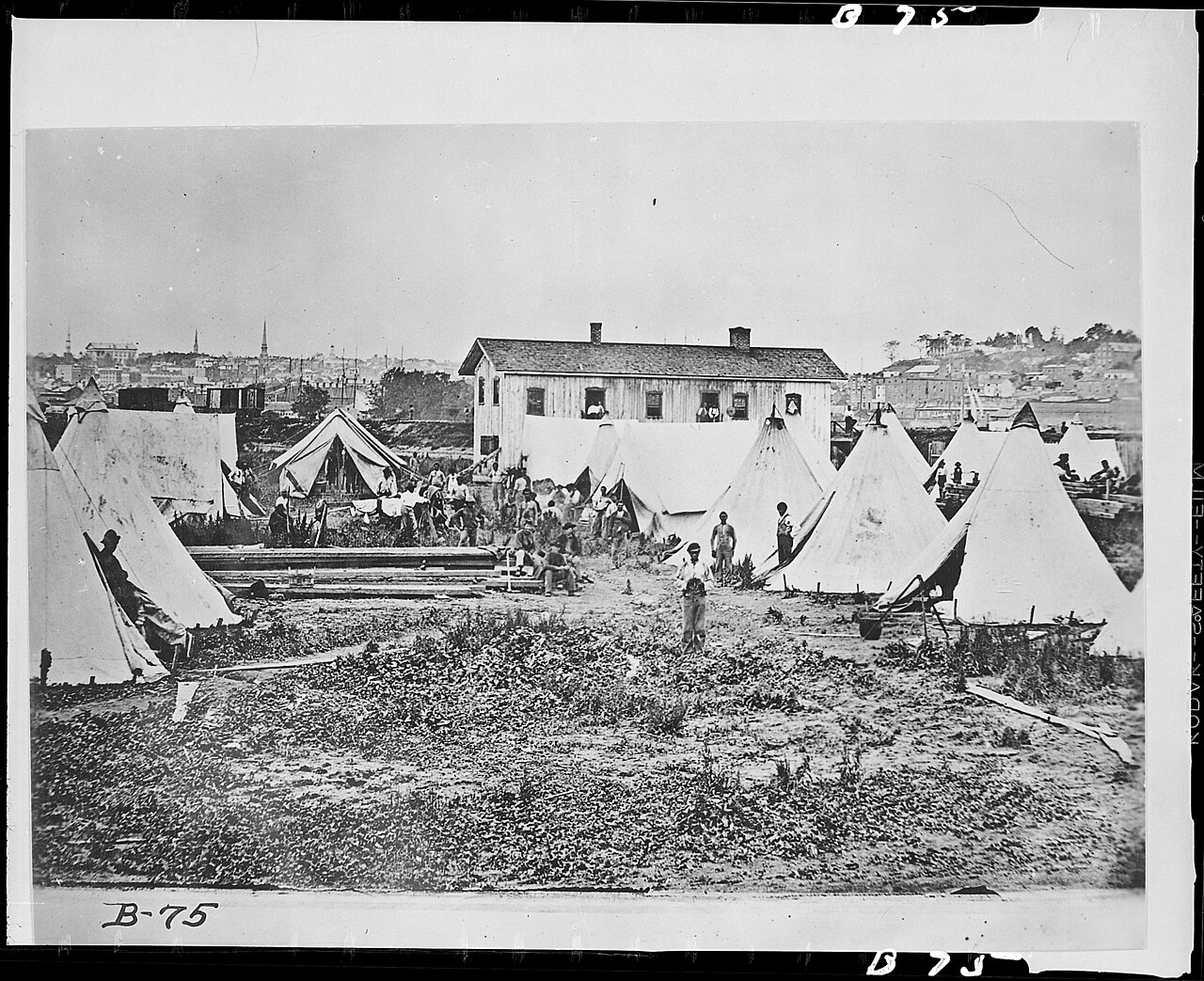
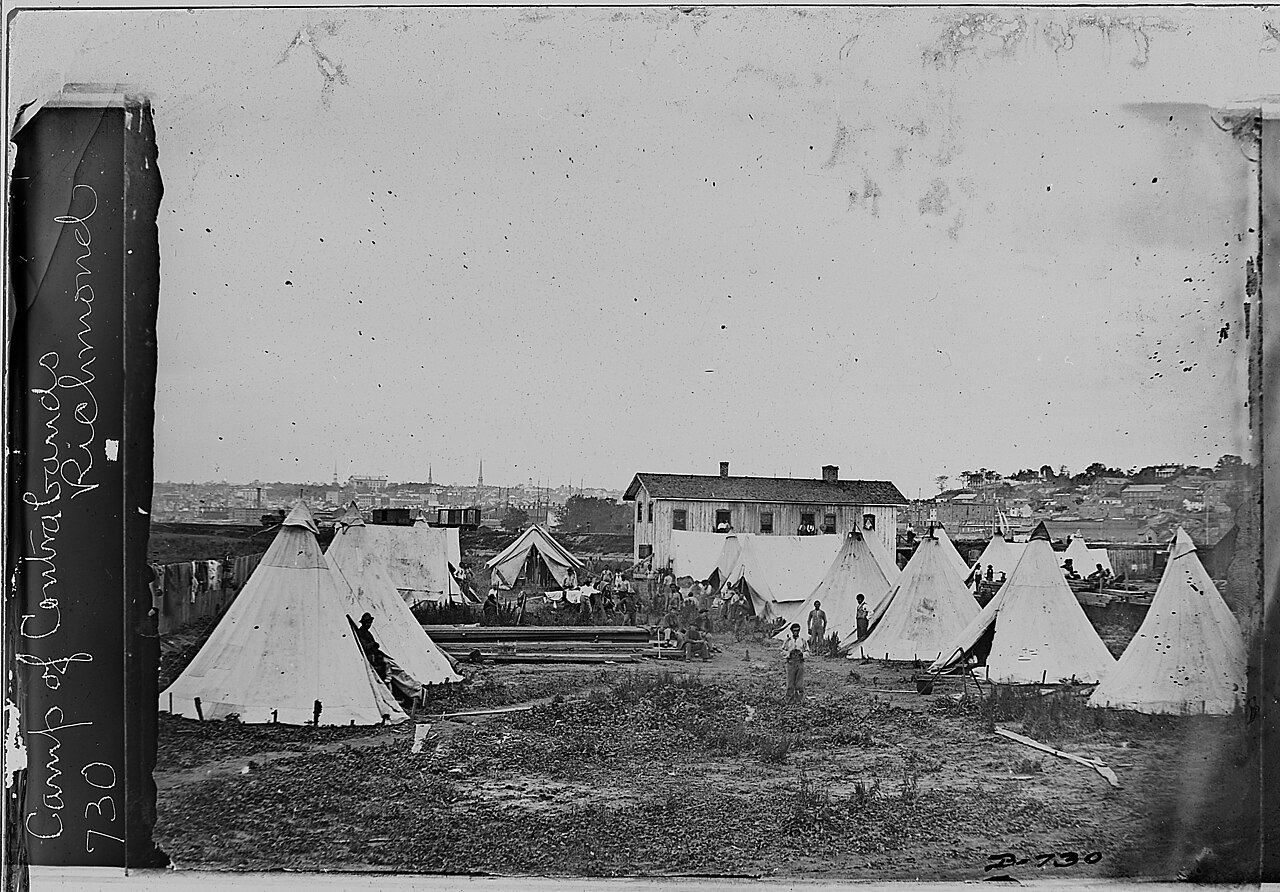
Black-and-white photograph of a Civil War camp of tents. Several conical white tents stand in the foreground on bare ground, with a two-story wooden building and a few people visible in the middle distance. A city skyline lies beyond. The handwritten label on the left edge reads 'Camp of Contrabands Richmond'.Photograph

Primary source

Camp of Contrabands, Richmond, Virginia (National Archives)

Mathew Brady · 1863-1865

Want the full shelf? Chat with Harriet Jacobs in the app and open the Sources panel — every quote links back to the original.

Use Harriet Jacobs in class

1 collection

A ready-made collection from the Humy team that features Harriet Jacobs. Preview it, then try it free.

Trusted by educators worldwide

Conversations
375,000+
Real exchanges between students and historical figures
Messages exchanged
4,142,000+
Across every figure, classroom and language
Historical figures
100,000+
Each informed by a curated biography and selected sources
Languages supported
50+
From English and Spanish to Arabic and Korean

Paying customers

Used by 98 schools and universities

Partner school logo
Tecnológico de Monterrey logo
Hyper Island logo
Partner school logo
Chambersburg Area School District logo
Broward County Public Schools logo
Nebo School District logo
National Louis University logo
South Florida PBS logo
Punahou School logo
University of Wisconsin–River Falls logo
Partner school logo
Partner school logo
Archbishop Mitty High School logo
Kingsburg High School logo
Norwalk Public Schools logo
Partner school logo
Connections logo
Partner school logo
Moore Public Schools logo
Partner school logo
Partner school logo
Partner school logo
Partner school logo
Robbinsville Public Schools logo
Partner school logo
Partner school logo
Partner school logo
Tecnológico de Monterrey logo
Hyper Island logo
Partner school logo
Chambersburg Area School District logo
Broward County Public Schools logo
Nebo School District logo
National Louis University logo
South Florida PBS logo
Punahou School logo
University of Wisconsin–River Falls logo
Partner school logo
Partner school logo
Archbishop Mitty High School logo
Kingsburg High School logo
Norwalk Public Schools logo
Partner school logo
Connections logo
Partner school logo
Moore Public Schools logo
Partner school logo
Partner school logo
Partner school logo
Partner school logo
Robbinsville Public Schools logo
Partner school logo
Partner school logo

What educators are saying

“We enjoyed the program last year and used it frequently.”
“My students say it’s a welcome change of pace. I’m not a fan of the “sage on the stage” model, so I try to incorporate research-oriented and self-paced activities. With Humy, students have to take charge of their learning. They’ve become more adept at critical thinking, forming better questions, and improving their reading comprehension. The interview feature has been my go-to tool. I create assignments where students must ask historical figures a set number of questions, then summarize the responses to ensure they’re truly absorbing the material. This approach lets them actively explore the past rather than passively consuming information.”
“Humy has helped me bring historical figures, sometimes long past, to life. When my students interact with these figures in real-time, it eliminates some of the perceived “ancient” characteristics of my curriculum. This has shifted my students’ thinking away from viewing history as abstract or irrelevant. Real-time interactions make historical figures relatable, even allowing students to ask off-topic questions that help put historical lives in a more relevant context for 13-year-olds. The feature I use the most is the interview feature. After teaching a topic, most recently Gandhi and Joan of Arc, I have the students ask pointed, focused questions. We practice good conversation techniques beforehand, teaching them to listen (or read) carefully and formulate thoughtful follow-up questions rather than just interrogating. It helps students practice effective conversation skills.”

FAQ

Frequently asked questions

Who is Harriet Jacobs?
American abolitionist and writer known for her autobiographical book "Incidents in the Life of a Slave Girl. On Humy.ai you can chat with an AI version of Harriet Jacobs that draws on a short biography and 54 historical sources during the conversation — by text or voice, in 42 languages.
Is Harriet Jacobs AI free?
Harriet Jacobs is part of Humy's full library of more than 100,000 figures, which comes with a paid plan. A free account (no credit card) includes 20 messages a month with the free library's figures, so you can try how the conversations work first.
What sources does the Harriet Jacobs AI use?
It draws on a short biography and 54 historical sources (documents, photographs and books), including “Chowan County Courthouse”, “Incidents in the Life of a Slave Girl” and “Gilbert Studios Photograph of Harriet Jacobs”. Each source has its own page on Humy.ai.
How historically accurate is the AI version of Harriet Jacobs?
Each figure uses a short biography and a small set of selected historical sources as context (retrieval-augmented generation), so answers stay closer to known material than the model's general knowledge alone. It isn't a citation-grade research tool — like any LLM, the AI can get details wrong or extrapolate. Treat it as a strong starting point for inquiry and cross-reference important claims.
Can I talk to Harriet Jacobs by voice?
Yes. In addition to text chat, you can call Harriet Jacobs and hear their voice respond in real time — useful for auditory learners, interview practice and Socratic dialogue.
Is Humy.ai safe and compliant for schools?
Yes. Humy.ai is used by more than 100 schools, universities and organisations. The platform is FERPA- and GDPR-aligned, supports SSO, and offers an IT-approval pack tailored for school procurement teams.

Ready when you are

Start chatting with Harriet Jacobs now.

20 messages free · No credit card · Available in 50+ languages.