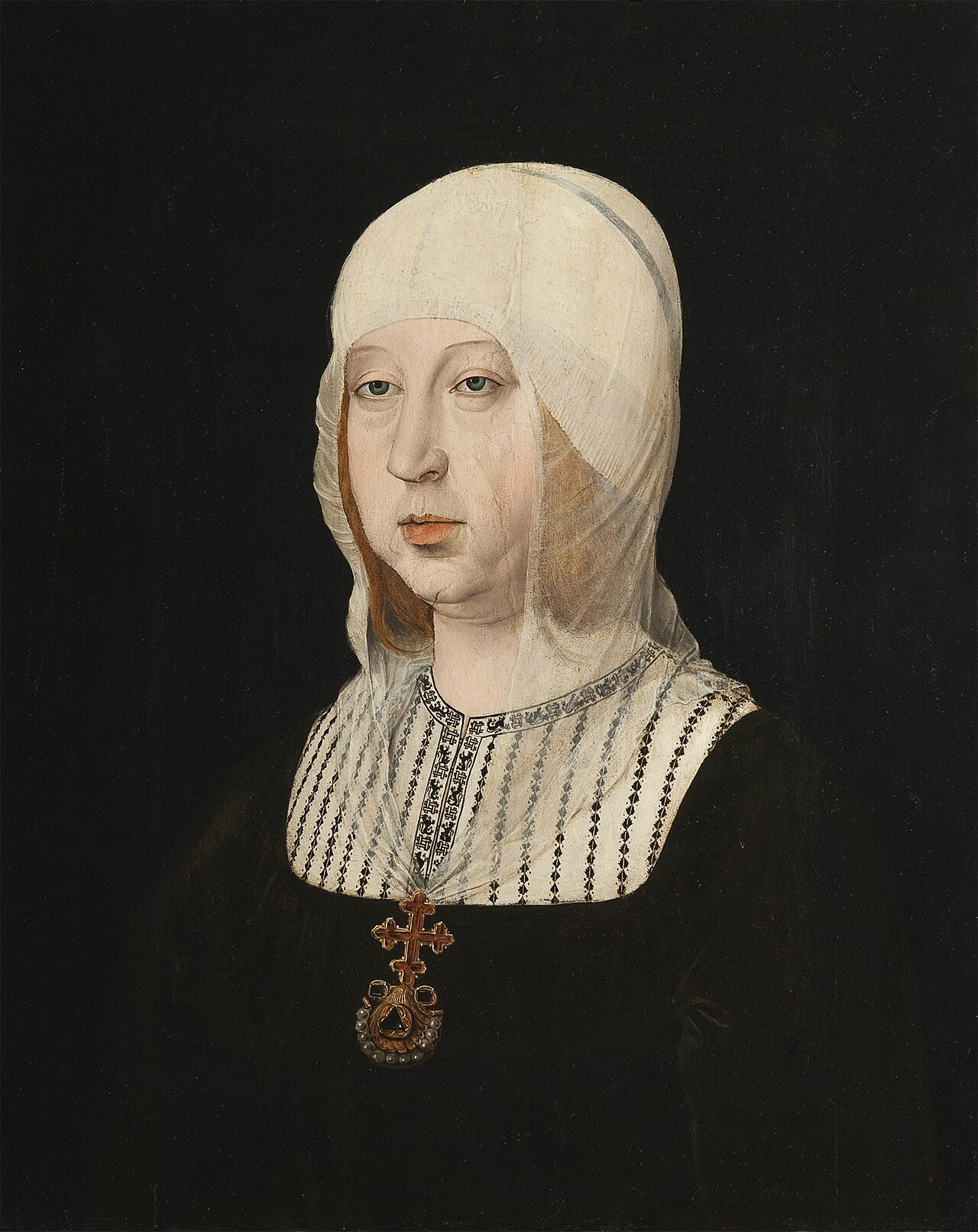
Portrait of Queen Isabella I

AI Historical Figure

Queen Isabella I

Queen of Castile and patron of Christopher Columbus.

Chat with Queen Isabella I via text or voice — in 42 languages, drawing on a curated biography and 84 historical sources. Available 24/7.

Start chatting with Queen Isabella I20 messages free · No credit card
Lived
1451–1504
From
Spain
Known for
Rulers & royaltyPolitics & government
Queen Isabella I

Queen Isabella I

Online · responds in seconds

Hello — I'm Queen Isabella I. Queen of Castile and patron of Christopher Columbus. What would you like to ask me?

20 messages free · No credit card · Powered by Humy.ai

Live preview · Switch between 42 languages above · Send a message to continue in the app

Multilingual

Talk to Queen Isabella I in 42 languages

Ask Queen Isabella I questions in any language below, and the rest of Humy's app speaks it too. Pick yours to open the chat in that language.

Also in German (Austria), German (Switzerland), English (UK), English (Australia), English (Canada).

The sources behind this AI

84 sources · 27 paintings · 21 documents · 14 books · 11 artifacts · 6 letters · 3 photographs · 2 sculptures

Queen Isabella I doesn’t improvise from thin air. The AI is grounded in 84 curated historical sources students can inspect. Open any of them to see what informs the conversation.

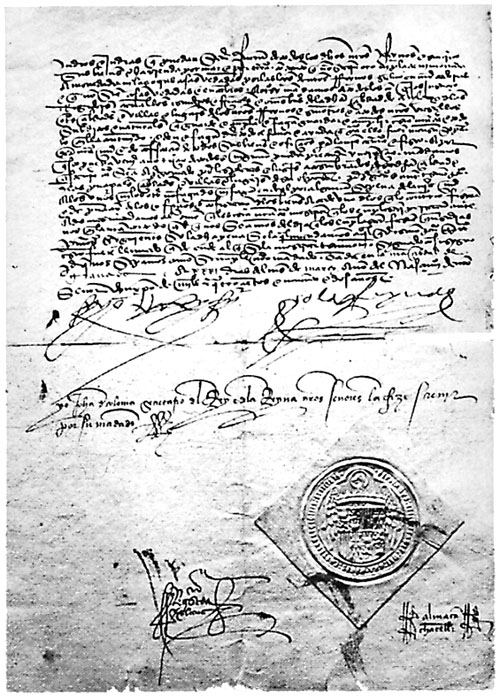
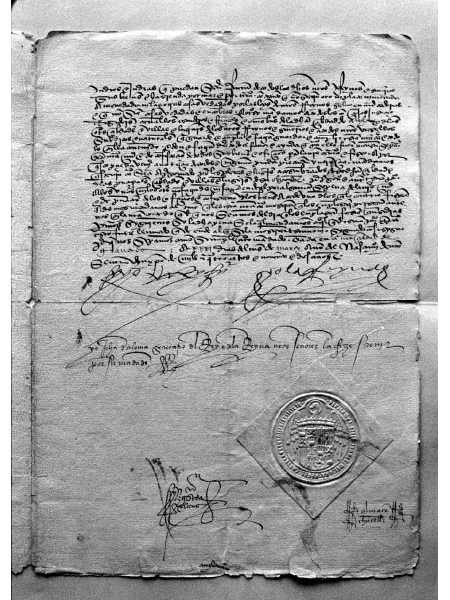
Scan of a handwritten Spanish manuscript page in old script, with signatures below the text, a wax seal impression on a diamond-shaped paper flap at lower right, and additional scribbled signatures at lower left.Document

Primary source

Alhambra Decree

Isabella I of Castile and Ferdinand II of Aragon · 31 March 1492

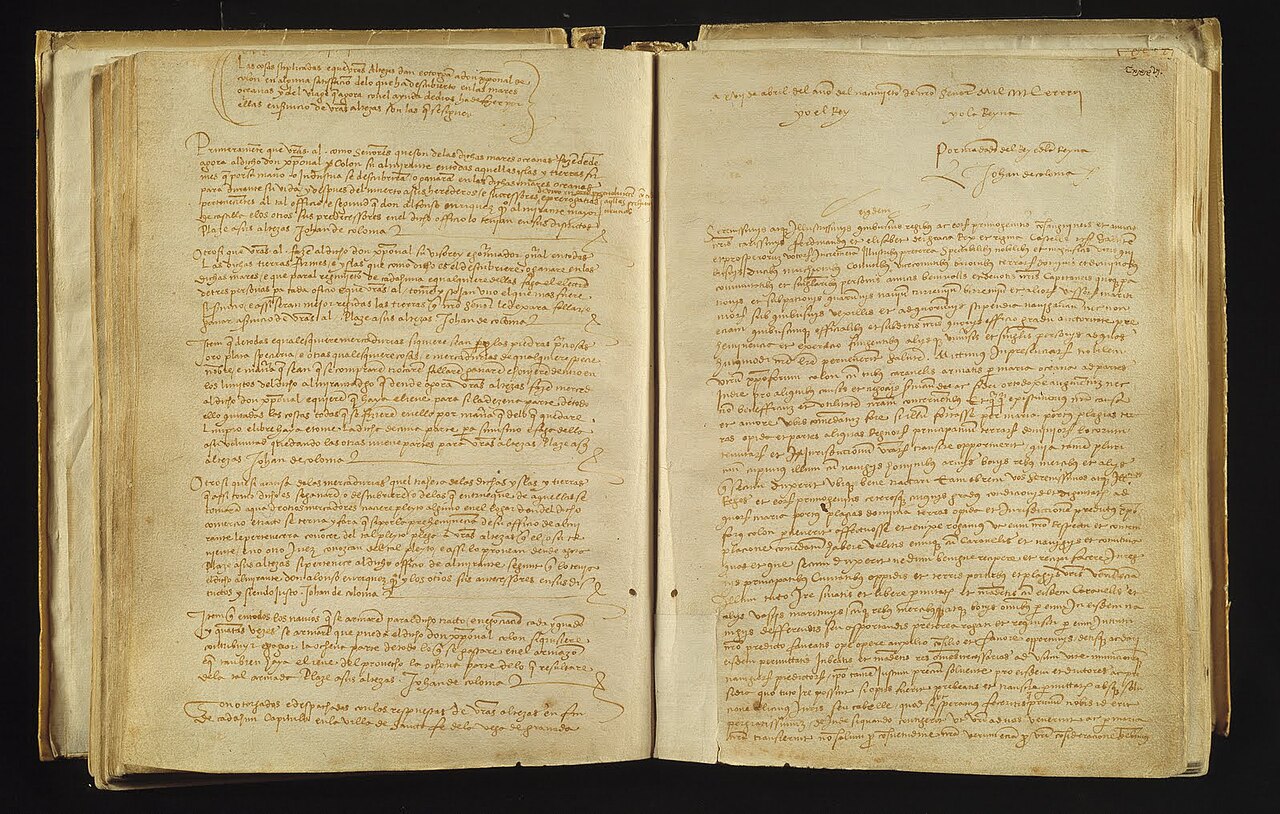
Open bound register showing two manuscript pages of handwritten Spanish legal text in brown ink on aged parchment, with a signature and date line near the top right of the right page. Dark background surrounds the book.Document

Primary source

Capitulations of Santa Fe

Catholic Monarchs · 17 April 1492

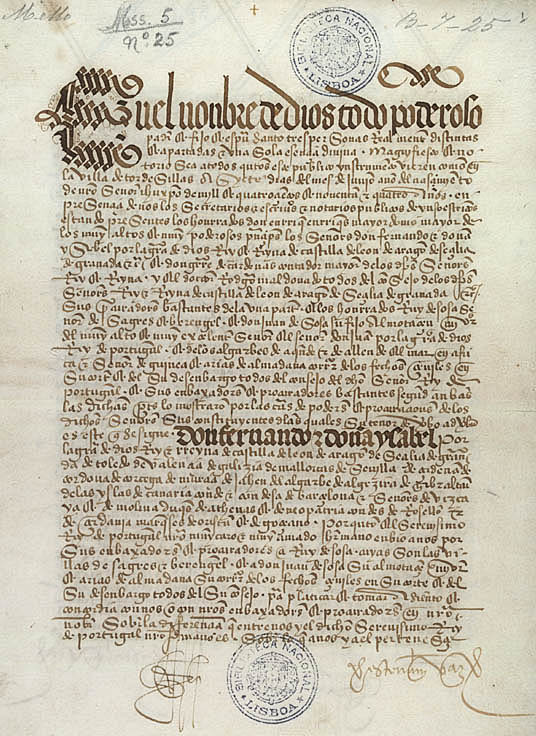
Photograph of a handwritten manuscript page in brown and black ink in Gothic-style script, with decorated illuminated capital letters at the top and middle. Blue circular library stamps reading Lisboa and Biblioteca Nacional appear at the top and bottom, along with a handwritten shelfmark and signatures at the bottom.Document

Primary source

Treaty of Tordesillas

7 June 1494

Document

Primary source

Testament of Isabella I of Castile

Isabella I of Castile · 12 October 1504

Painted portrait of a woman against a dark background, shown from the shoulders up. She wears a white veil covering her head, a white embroidered blouse with black patterned stripes, and a dark gown. A gold cross pendant hangs from a pearl-edged ornament at her chest. Her blue eyes look directly forward.Painting

Primary source

Portrait of Isabella the Catholic

Juan de Flandes · c. 1500

Document

Primary source

Treaty of Granada

Ferdinand II of Aragon, Isabella I of Castile, and Boabdil · 25 November 1491

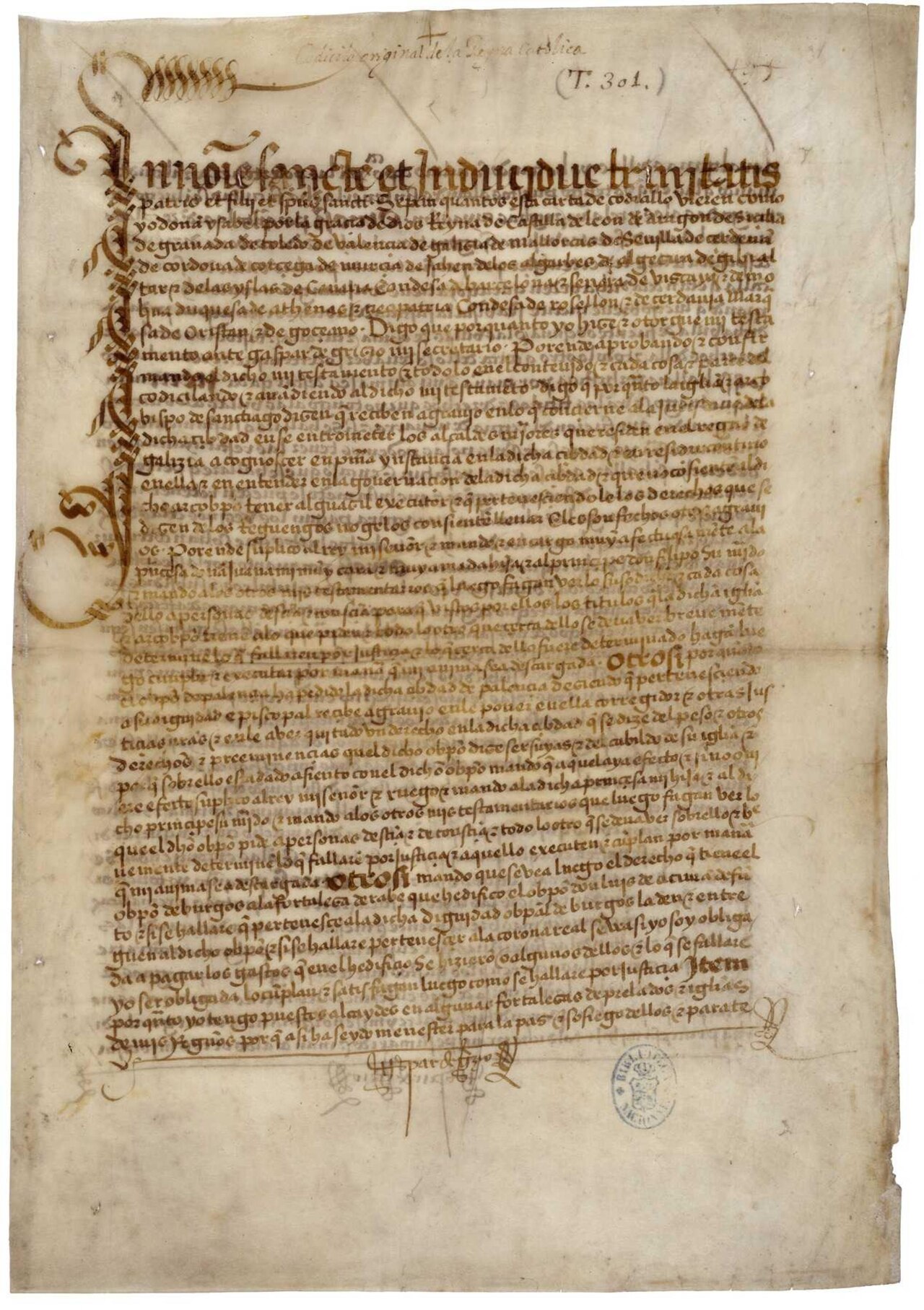
Scan of a handwritten manuscript page on aged parchment, with an ornate illuminated initial letter at the top left and dense brown ink script in multiple lines. Handwritten note '(T. 301)' appears at top right, and a blue ink library stamp is at lower right.Document

Primary source

Codicil of Queen Isabella the Catholic

Isabella I, Queen of Spain · 23 November 1504

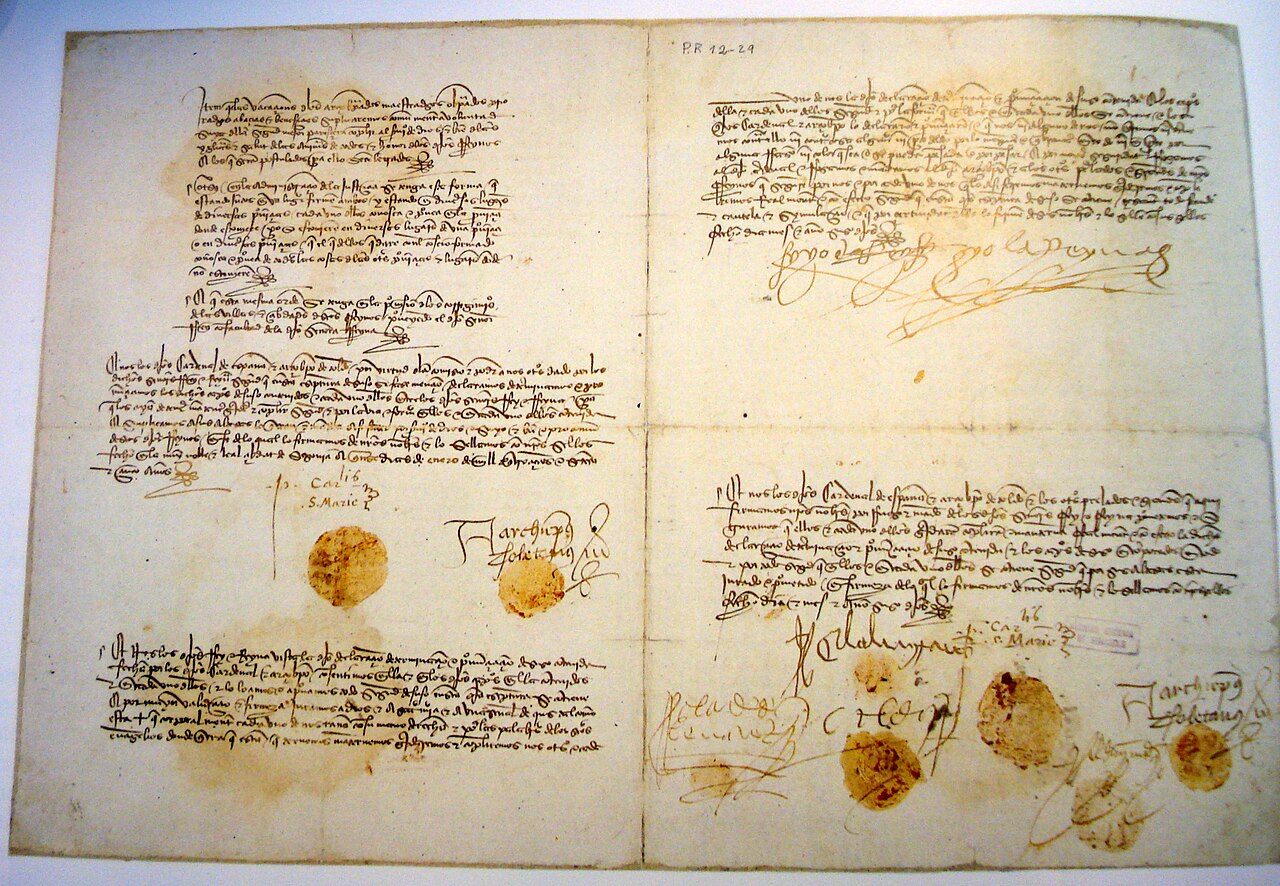
Photograph of a handwritten 15th-century parchment or paper document laid flat, with brown wax seals, signatures, and dense cursive Spanish script in four blocks. A faded label reads PR 12-29 at the top.Document

Primary source

Concord of Segovia

15 January 1475

Black-and-white scan of an early printed page in Gothic-style black letter type, with a large decorated initial at the top left. The page is the first page of a printed Spanish text of Columbus's letter, dense with columns of text.Letter

Primary source

Columbus Letter on the First Voyage

Christopher Columbus · 15 February 1493

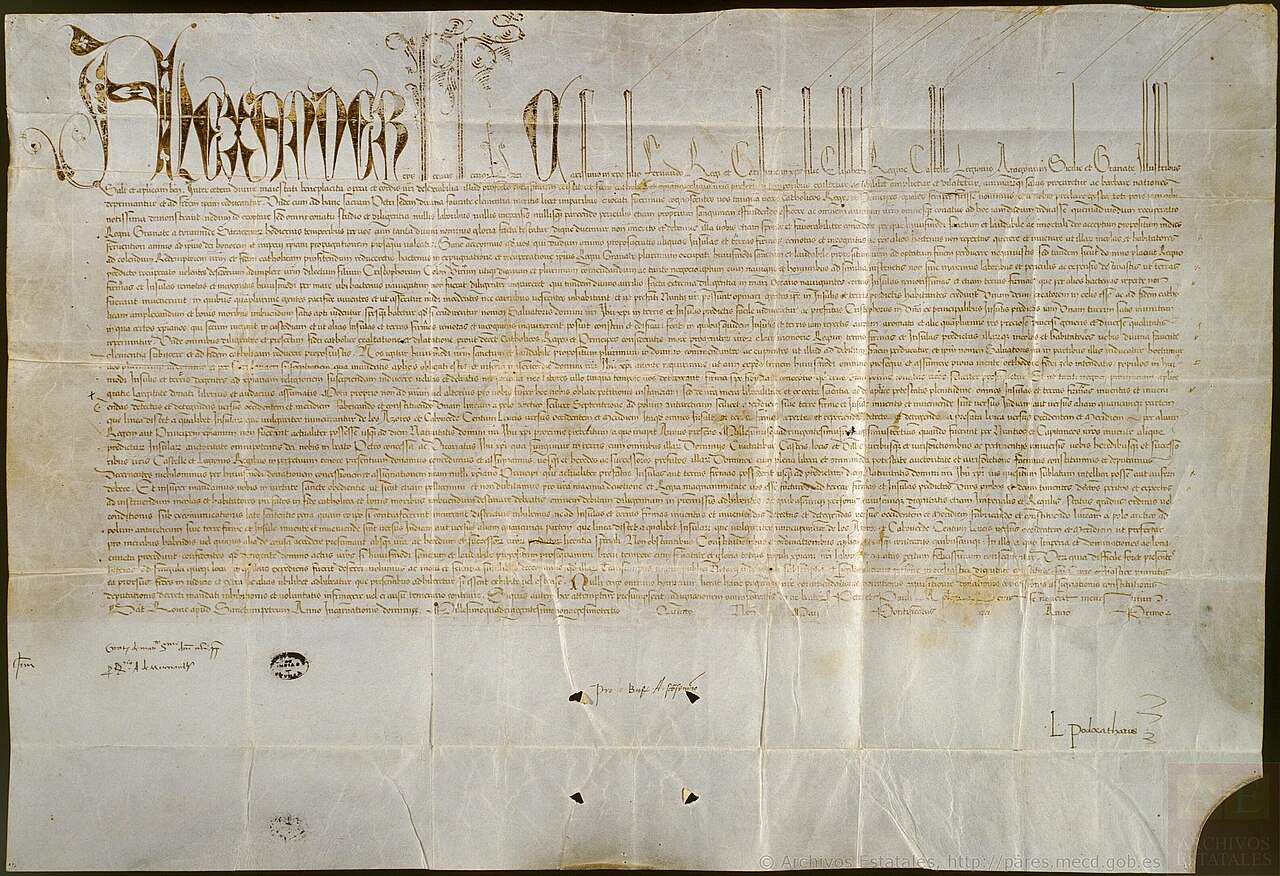
Scan of a large parchment document with an ornate illuminated initial letter at top left and dense handwritten Latin text in several columns of lines, with a hanging seal and signatures near the bottom. A watermark-like copyright line appears in the lower right corner.Document

Primary source

Inter caetera

Pope Alexander VI · 4 May 1493

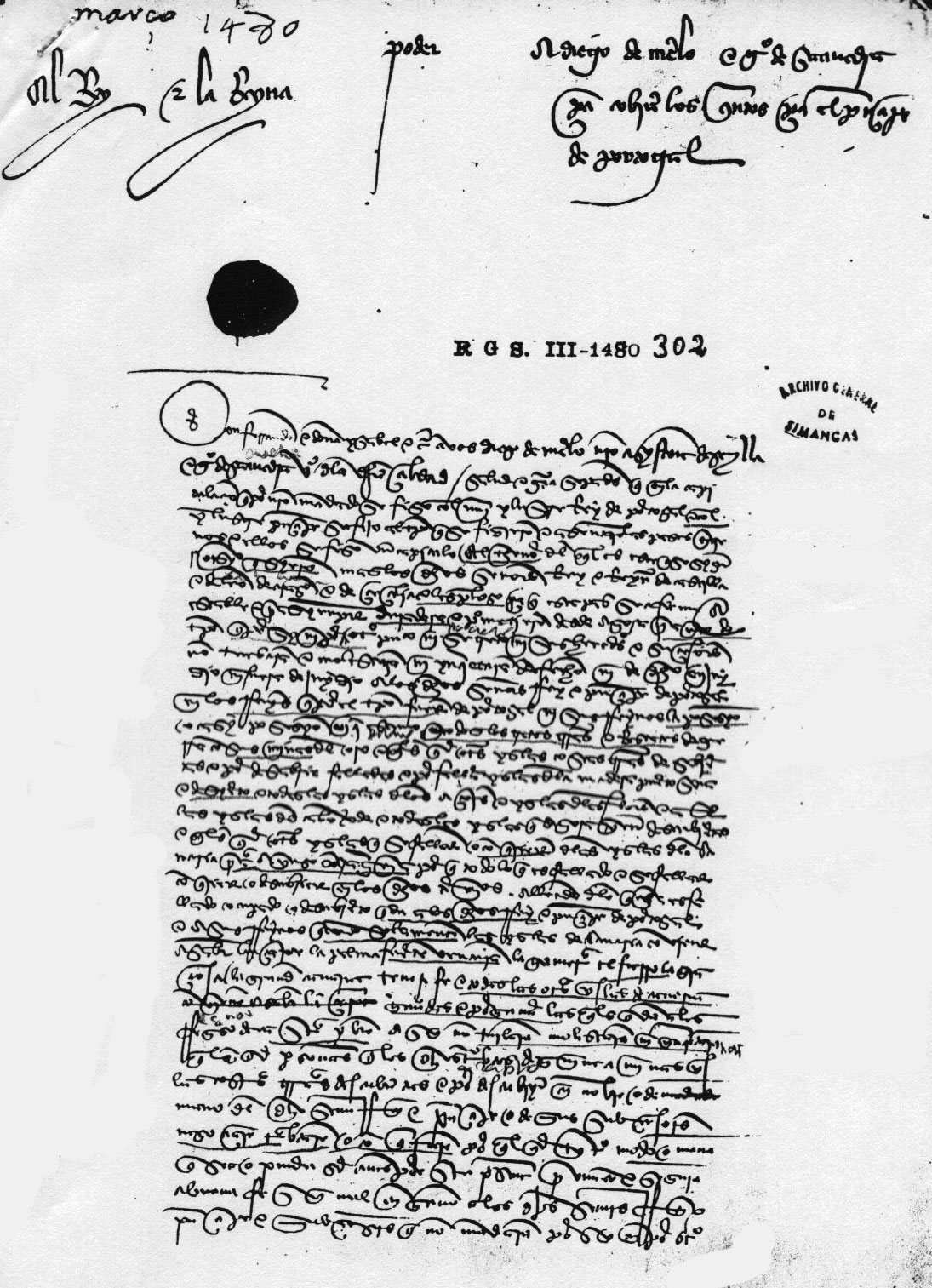
Black and white scan of a handwritten 15th-century Spanish manuscript page. Faded notes at the top include the date 'marzo 1480' and a seal impression sits in the upper middle. A label reads 'RGS III-1480 302' and a stamp reads 'Archivo General de Simancas'. Dense cursive handwriting fills the page below a large initial letter.Document

Primary source

Treaty of Alcáçovas

4 September 1479

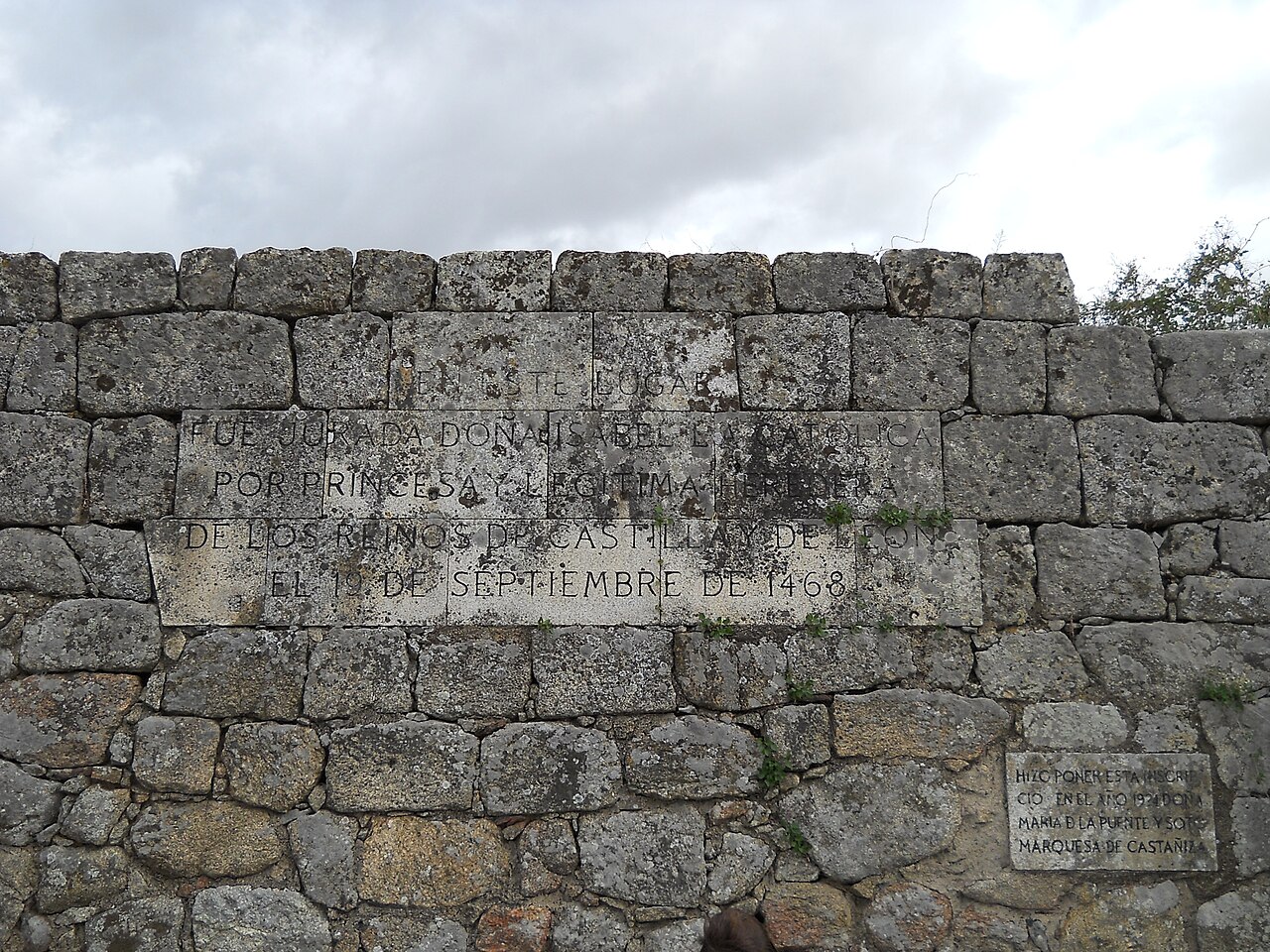
A rough stone wall of mortared gray blocks with an inscribed stone plaque in its center. The carved capitals read: EN ESTE LUGAR FUE JURADA DOÑA ISABEL LA CATOLICA POR PRINCESA Y LEGITIMA HEREDERA DE LOS REINOS DE CASTILLA Y DE LEON EL 19 DE SEPTIEMBRE DE 1468. A smaller plaque sits lower right. Cloudy sky above.Document

Primary source

Treaty of the Bulls of Guisando

19 September 1468

Close crop of an aged parchment page showing a brown-ink flourished handwritten signature beneath a line of cramped cursive writing above it.Document

Primary source

Signature of Isabella I of Castile

Isabella I of Castile

Open illuminated manuscript book with richly painted pages. The left page shows a large heraldic coat of arms with a crowned eagle at top, surrounded by ribbon-like scrolls and smaller shields. The right page shows a painted miniature of figures in a golden sky with a central scene, surrounded by decorated text columns and colorful floral borders.Book

Primary source

Isabella Breviary

Master of the Dresden Prayer Book · c. 1497

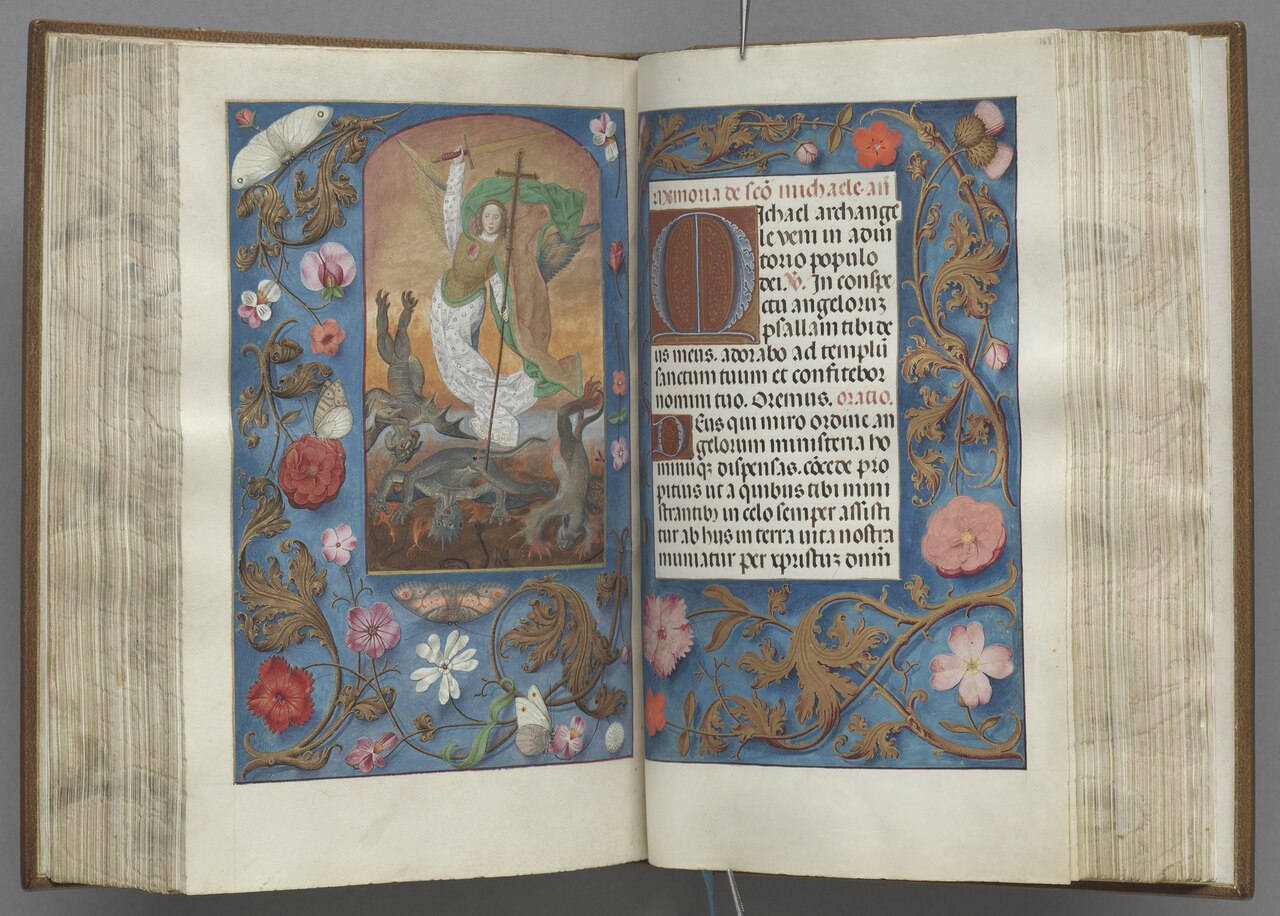
Open illuminated manuscript spread. Left page: a painted miniature of an angel with a cross-topped staff and green cloak standing over writhing dragons and demons, framed by blue and gold foliage and flowers. Right page: Latin text in black and red with a decorated initial, framed by gold and blue foliage.Book

Primary source

Hours of Queen Isabella the Catholic, Queen of Spain

Alexander Bening · 1495

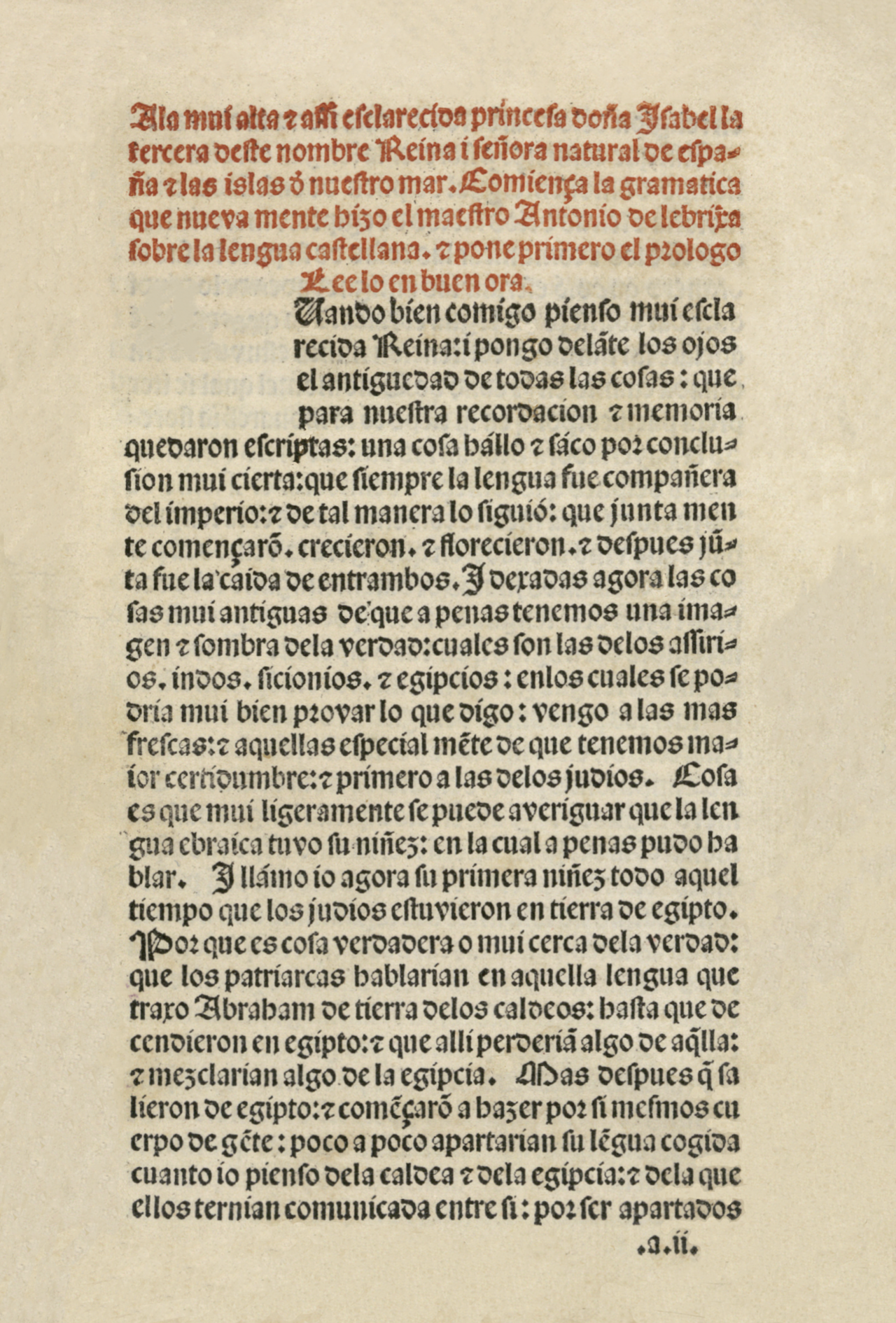
Scanned page of a 1492 printed book in black-letter type with red rubric headings. The red opening lines read dedicating the work to Princess Isabel, third of that name, Queen and natural lady of Spain. Below, black text begins a discussion of the ancient history of languages, mentioning the Assyrians, Hebrews, Phoenicians and Egyptians. The page ends with the signature mark a.ii at the bottom right.Book

Primary source

Gramática de la lengua castellana

Antonio de Nebrija · 1492

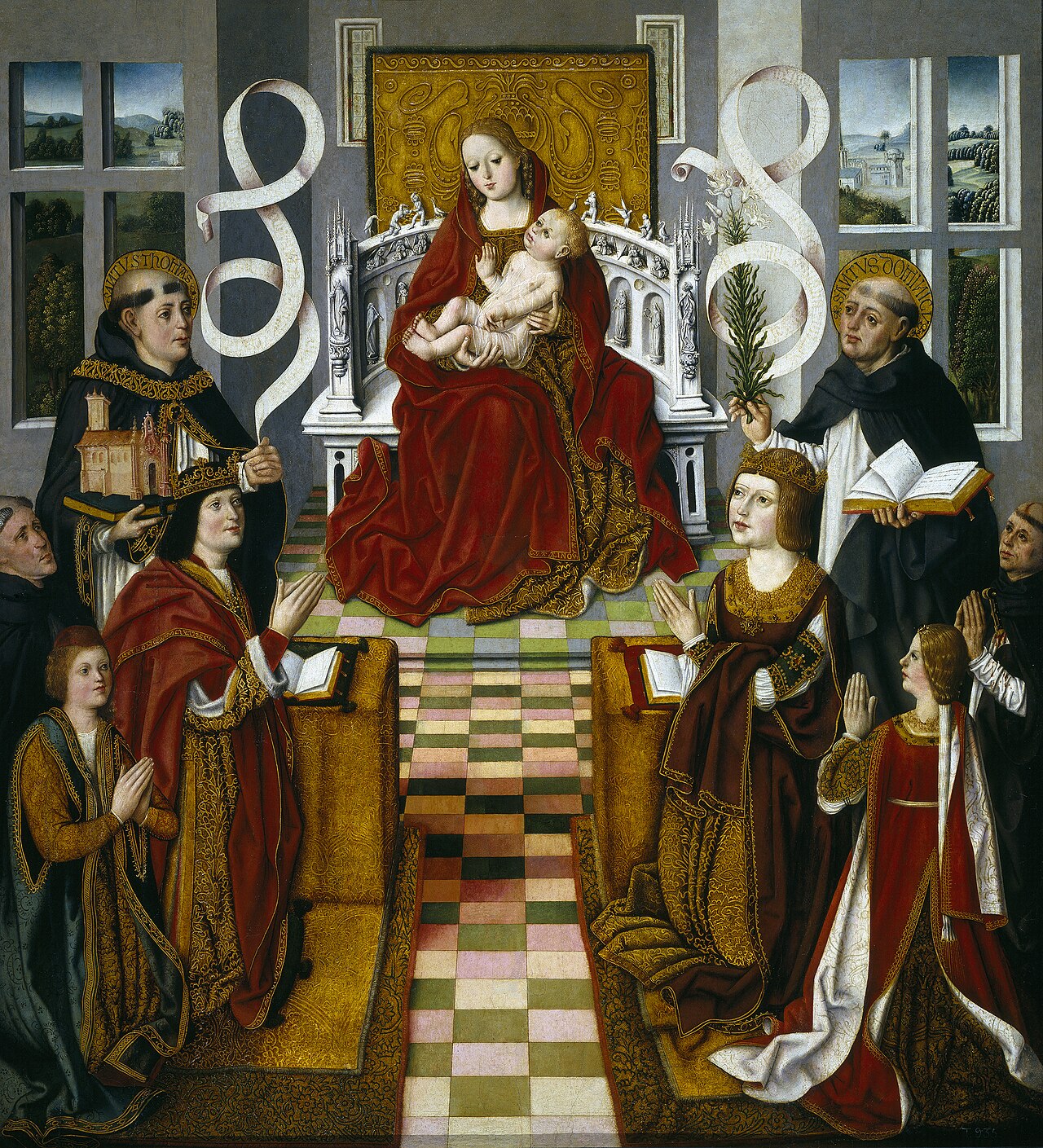
Painting of the Virgin Mary seated on a white throne holding the infant Christ, surrounded by kneeling figures: a crowned king and queen at prie-dieu desks on either side, saints with halos, and a checkered marble floor. Windows show landscapes.Painting

Primary source

Madonna of the Catholic Monarchs

Anonymous · 1492

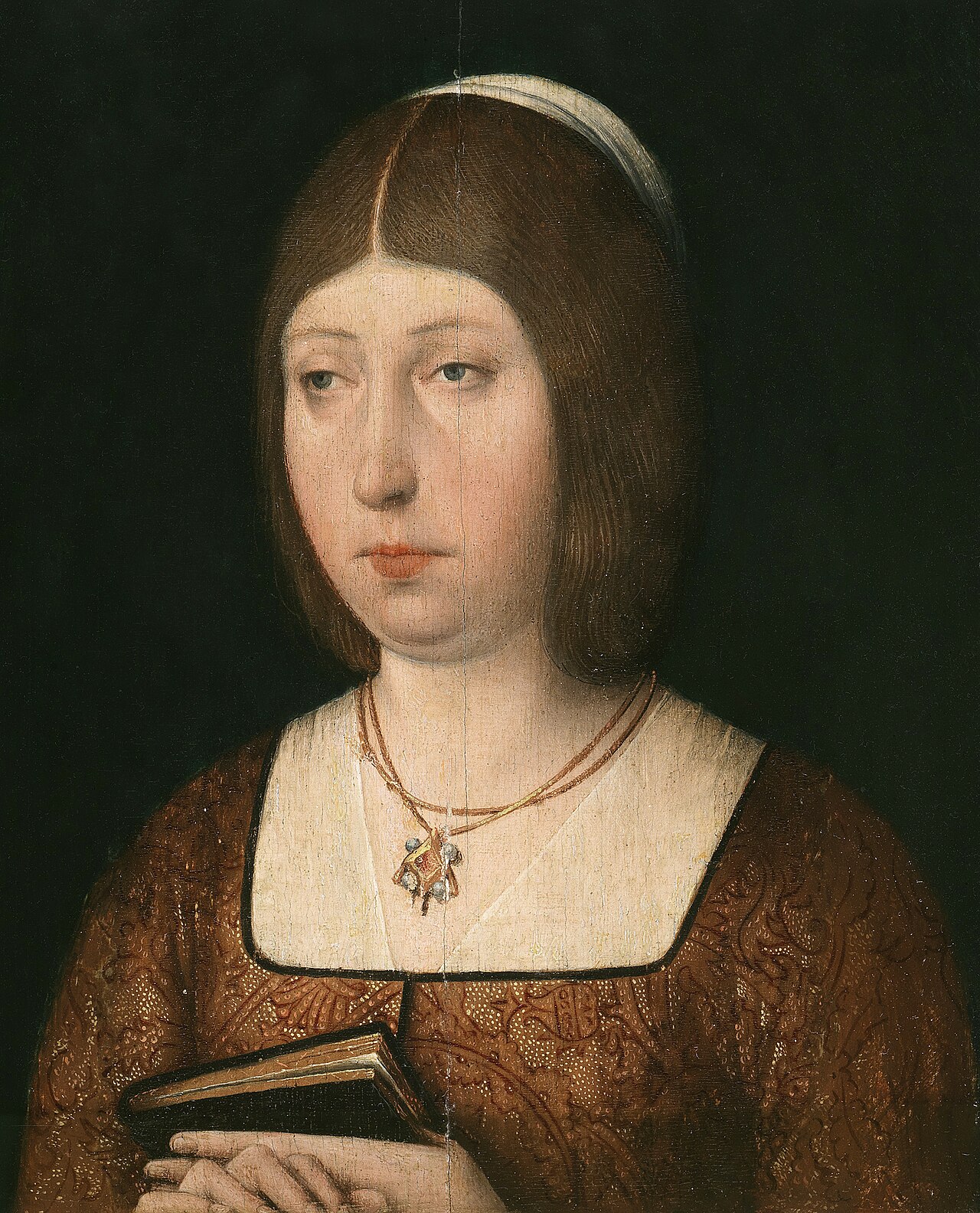
Painted portrait of a woman with straight brown hair parted in the middle and a white headband, wearing a brown embroidered gown with a black-edged neckline, a gold necklace with a jeweled pendant, and holding a dark closed book against a dark background.Painting

Primary source

Isabella I of Castile

Anonymous · c. 1490

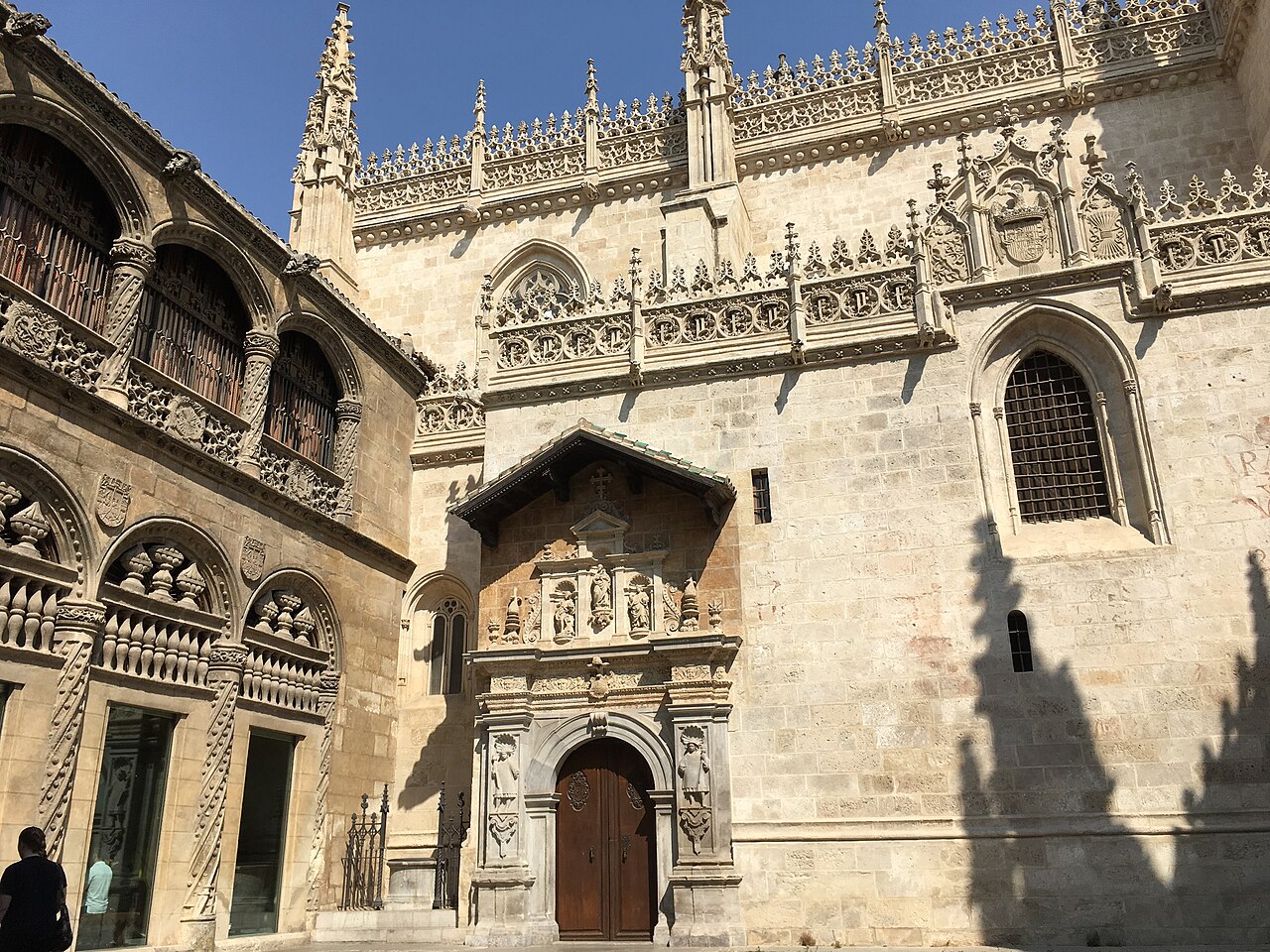
Exterior facade of a richly carved Gothic-style stone building in sunlight, with ornate pinnacles, openwork balustrades, a carved stone portal with a wooden double door, and arched windows with iron grilles. A person in dark clothing stands at the lower left edge.Artifact

Primary source

Royal Chapel of Granada

Enrique Egas · 1505–1517 (founded 1504)

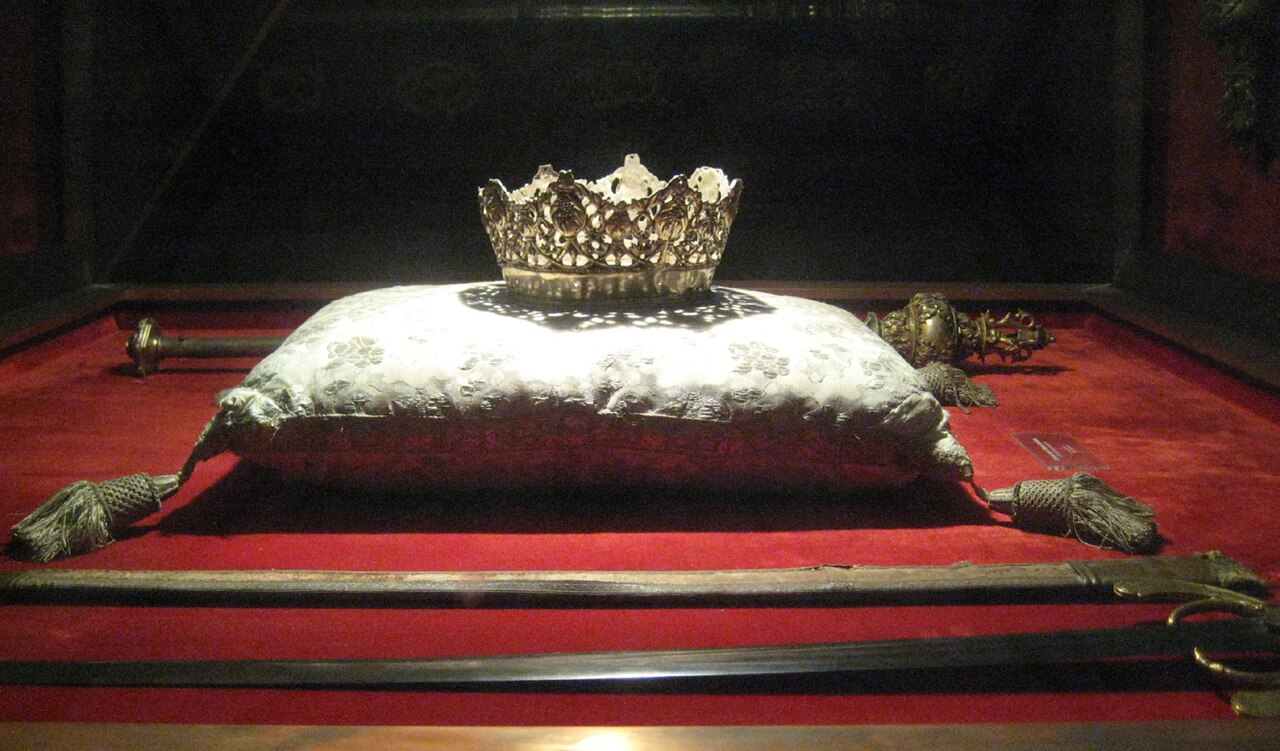
A gilded openwork crown resting on a silver brocade cushion with tassels, displayed in a glass case on red velvet. A sheathed sword lies in front, and a scepter is partly visible behind the cushion.Artifact

Primary source

Crown and Sword of the Catholic Monarchs

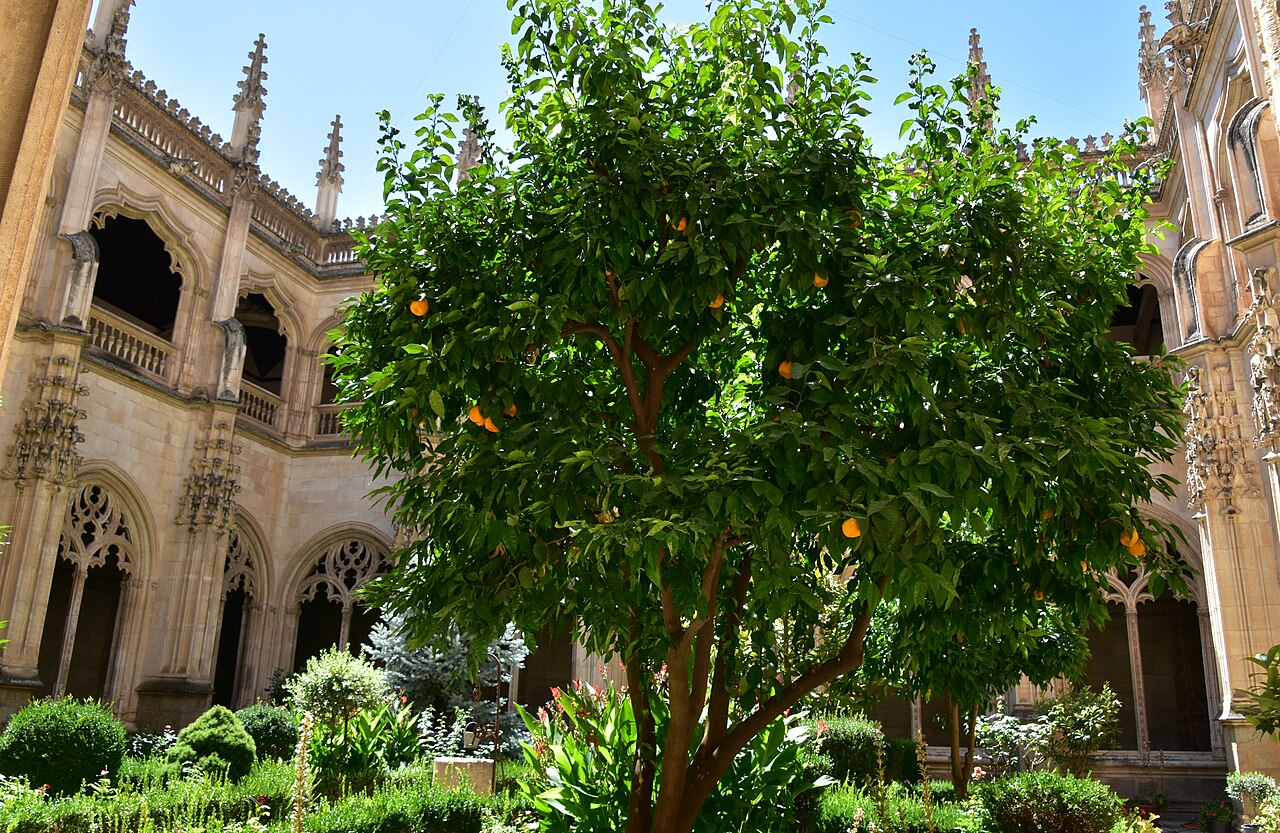
Courtyard of a Gothic stone monastery with ornate pinnacles, tracery windows and arched galleries, with a large orange tree laden with fruit in the centre and green shrubs in the foreground.Artifact

Primary source

Monastery of San Juan de los Reyes

Juan Guas · 1477–1504

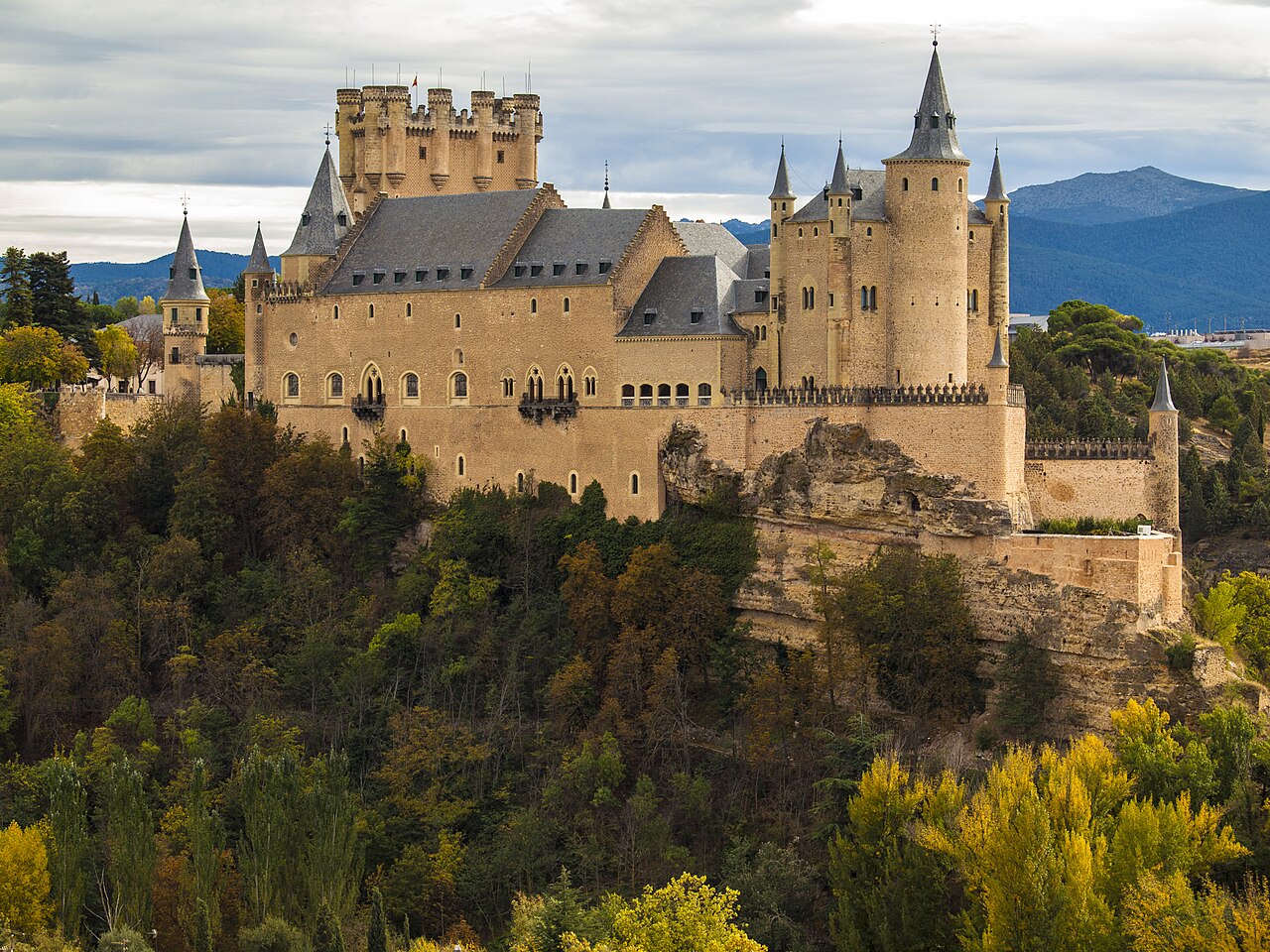
Exterior view of the Alcázar of Segovia, a stone castle with tall slate-roofed towers and turrets on a rocky outcrop, surrounded by autumn trees with yellow and green foliage, under a cloudy sky with mountains behind.Artifact

Primary source

Royal Alcázar of Segovia

12th century, with later additions

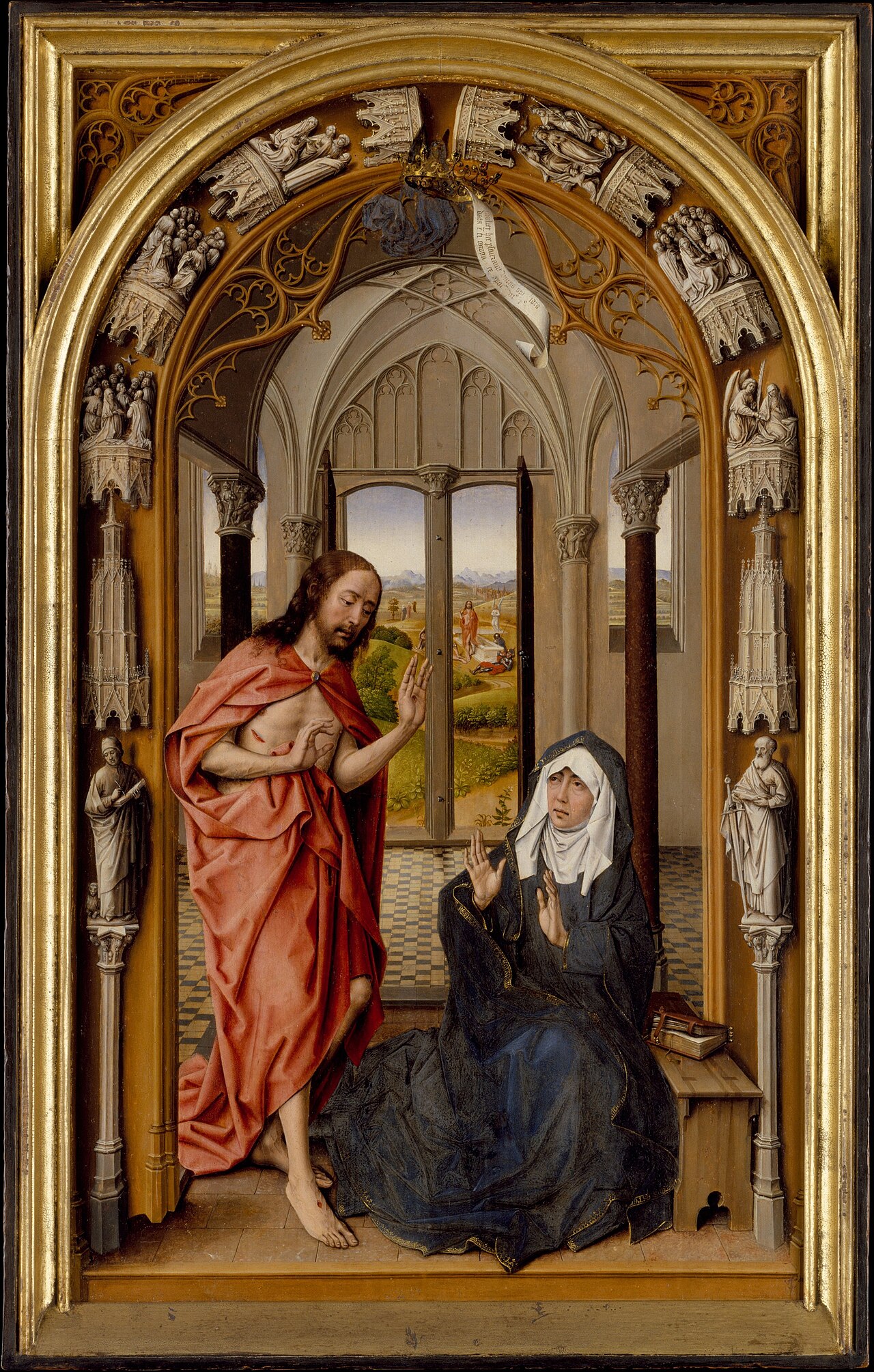
Painting of a gothic-arched interior with a checkered floor. Christ, in a red robe with a wound on his chest, raises his right hand toward a kneeling woman in a white headcloth and dark blue cloak. Through open doors behind them is a green landscape.Painting

Primary source

Christ Appearing to His Mother

Juan de Flandes · 1496

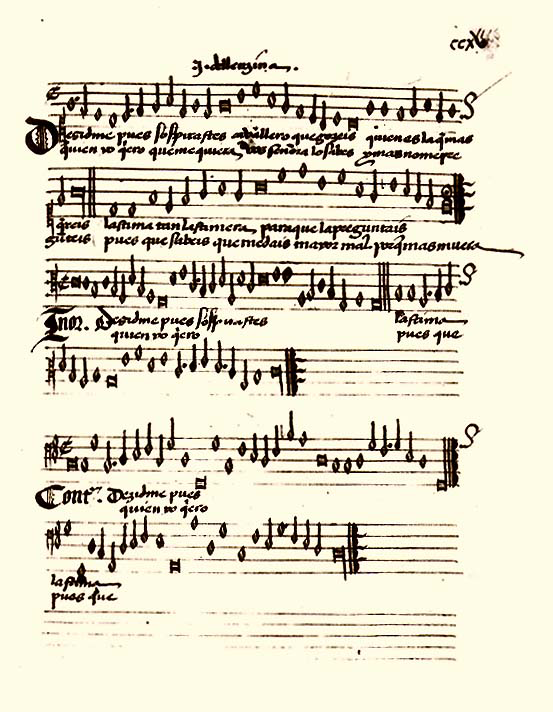
Scanned page of a 15th-century manuscript of polyphonic music in black ink on yellowed paper. Five-line staves with diamond-shaped and square noteheads, Spanish lyrics written beneath the notes, a decorated initial letter D at left, and a page number in the upper right corner.Book

Primary source

Cancionero musical de Palacio

c. 1470s-1520

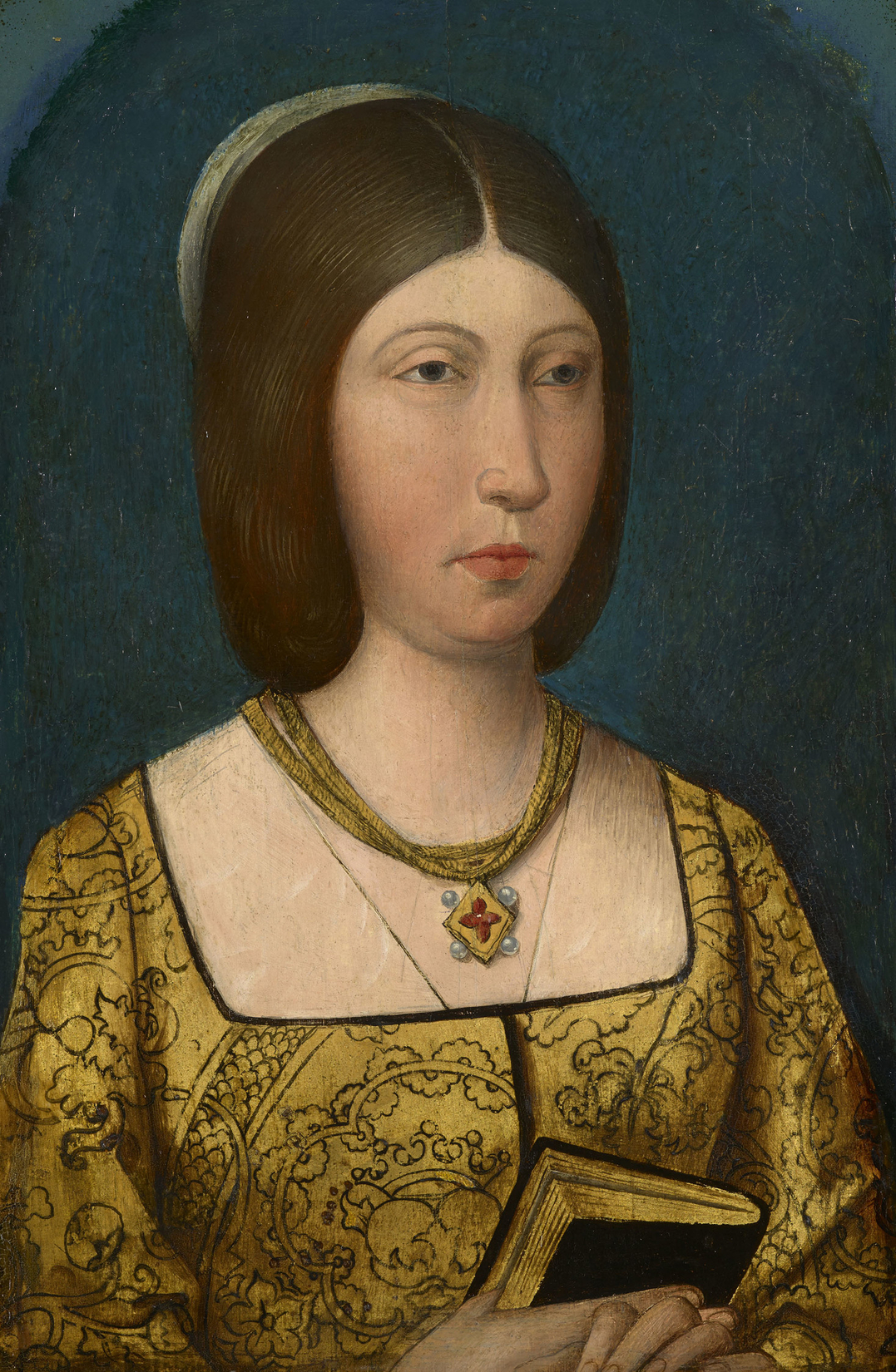
Painted portrait of a woman with dark hair parted in the center and a white headband, wearing a gold embroidered gown, a gold necklace with a red and pearl pendant, and holding a closed black book. Dark blue arched background.Painting

Primary source

Queen Isabella I of Spain, Queen of Castille

Spanish School, 15th century · 1500

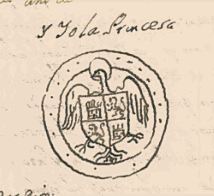
Pen drawing of a circular seal with a double-headed eagle over a shield with castle and lion quarters, bordered by a dotted ring. Handwritten Spanish inscription above reads 'Sola Princesa' with a flourish.Painting

Secondary source

Escudo de Isabel de Castilla 1473

Luis de Salazar y Castro · 1473 (seal); drawing made later

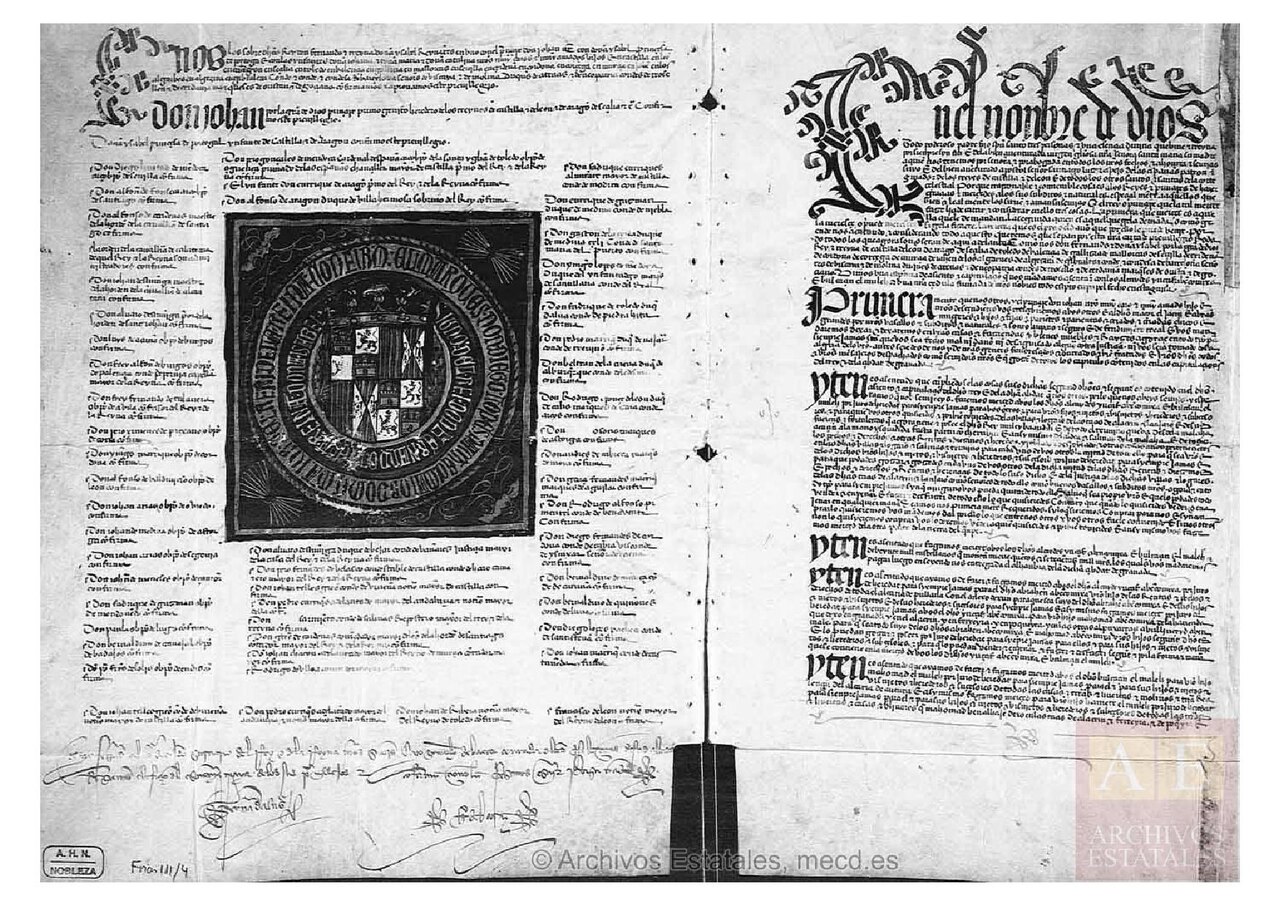
Black and white scan of a large parchment document with decorated Gothic lettering, a central circular seal with a shield of Castile and Leon quarterings, and handwritten columns of text with signatures at the bottom.Document

Primary source

Capitulaciones de Granada

Crown of Castile · 30 December 1491

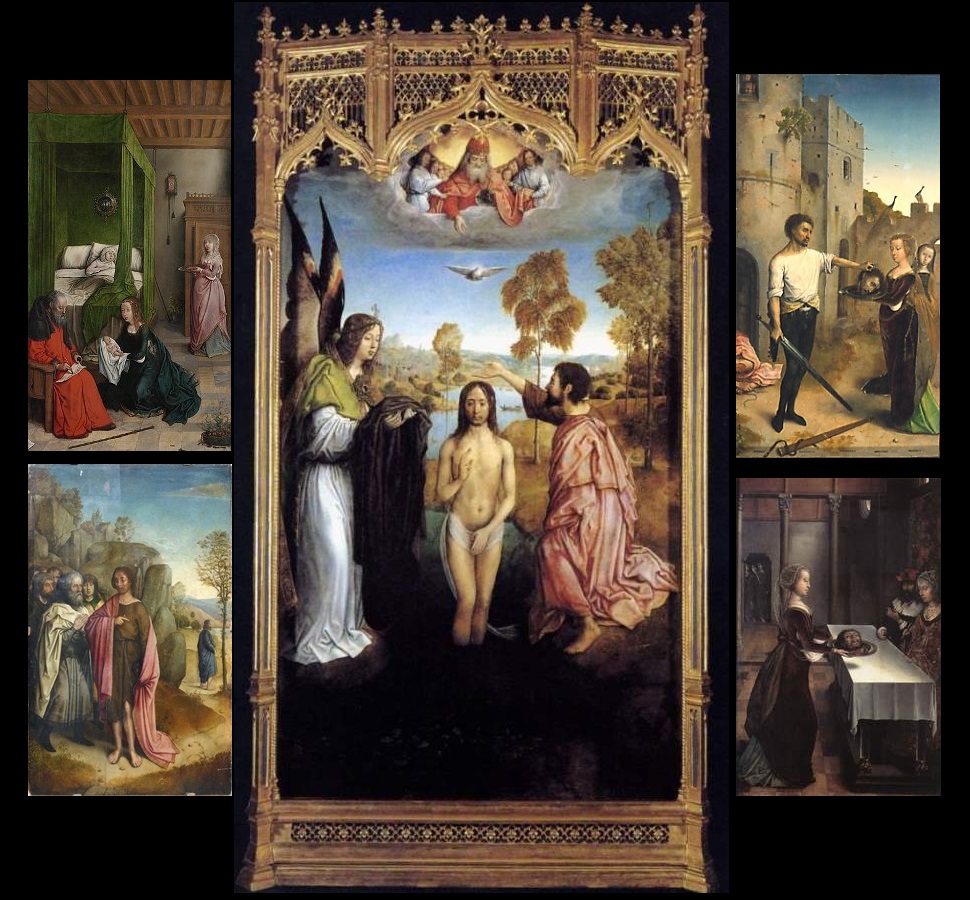
Reconstruction of a multi-panel gothic altarpiece with a gilded tracery frame. The large central panel shows the baptism of a nude Christ by John in a landscape, with God and angels above and an angel beside. Five smaller side panels show scenes including a bedchamber birth, a preaching scene, a beheading, and a banquet.Painting

Primary source

St John Altarpiece

Juan de Flandes · 1496

Gilded Gothic monstrance with a circular glass lunette set within a golden ring decorated with enamel and gems, topped by a small cross and a tall canopy with spires. Ornate Gothic tabernacle surrounds it.Artifact

Primary source

Monstrance of Isabella the Catholic

Jaume Aimeric · 1495

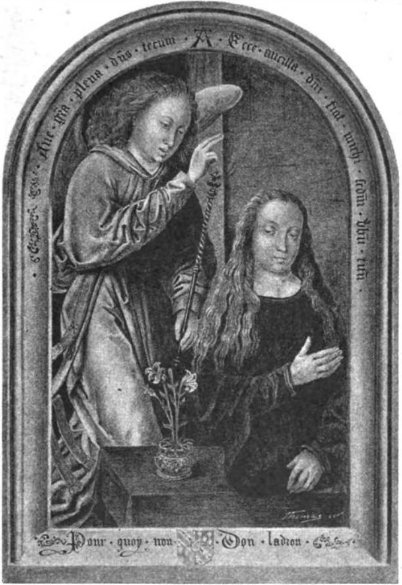
Black-and-white reproduction of a painted Annunciation in an arched frame. On the left, the angel Gabriel stands with raised hand and a scroll-like banner above; on the right, the Virgin Mary sits with long loose hair, hands folded at her chest. A vase of lilies stands on a ledge between them. Latin inscriptions run around the frame.Painting

Primary source

Annunciation (Holy House of Loyola)

1490

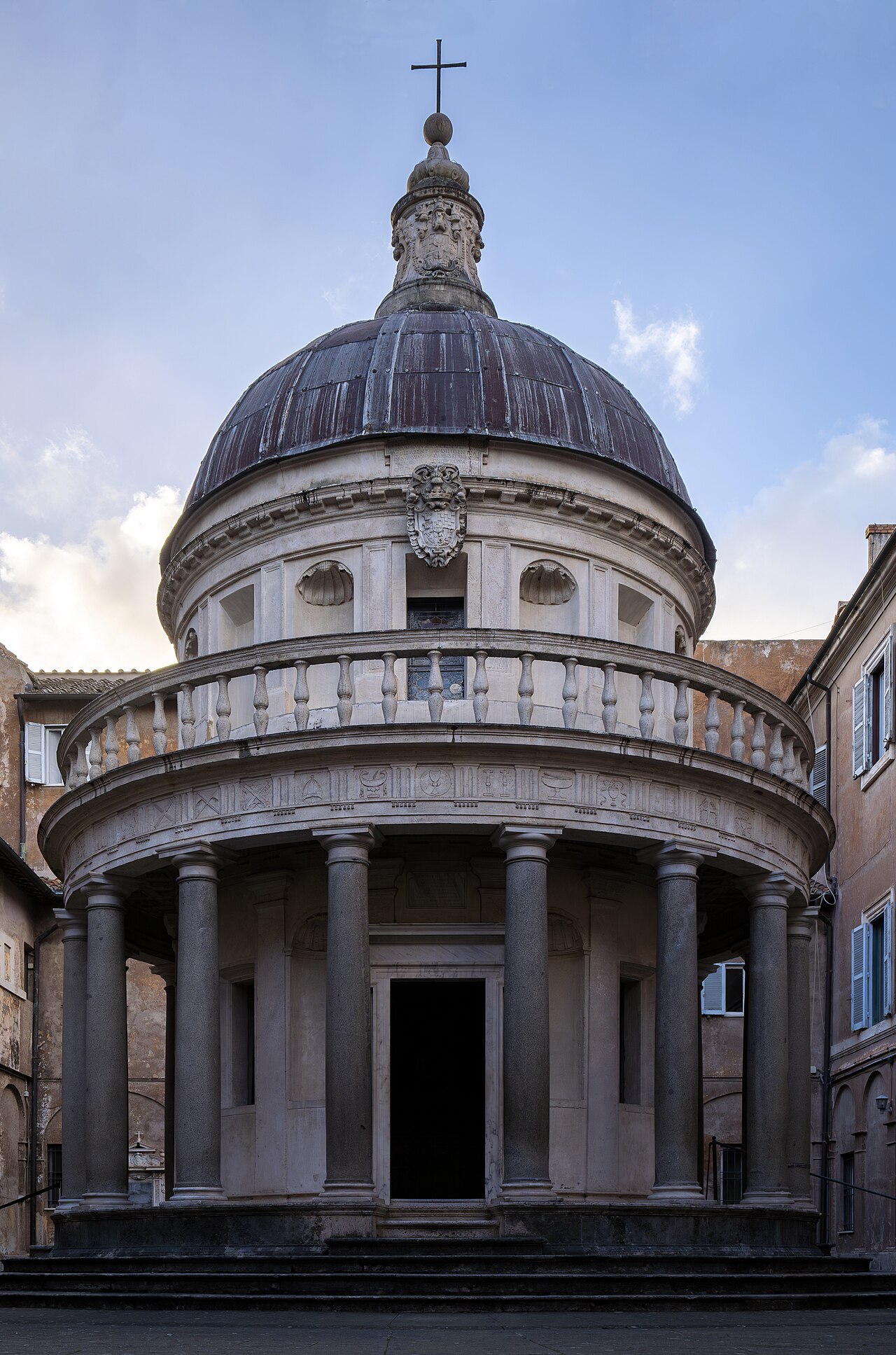
Front view of the Tempietto, a small circular stone building with a domed roof topped by a cross, surrounded by a colonnade of grey columns and a balustraded upper gallery, set in a courtyard with surrounding buildings.Artifact

Primary source

Tempietto

Donato Bramante · c. 1500-1502

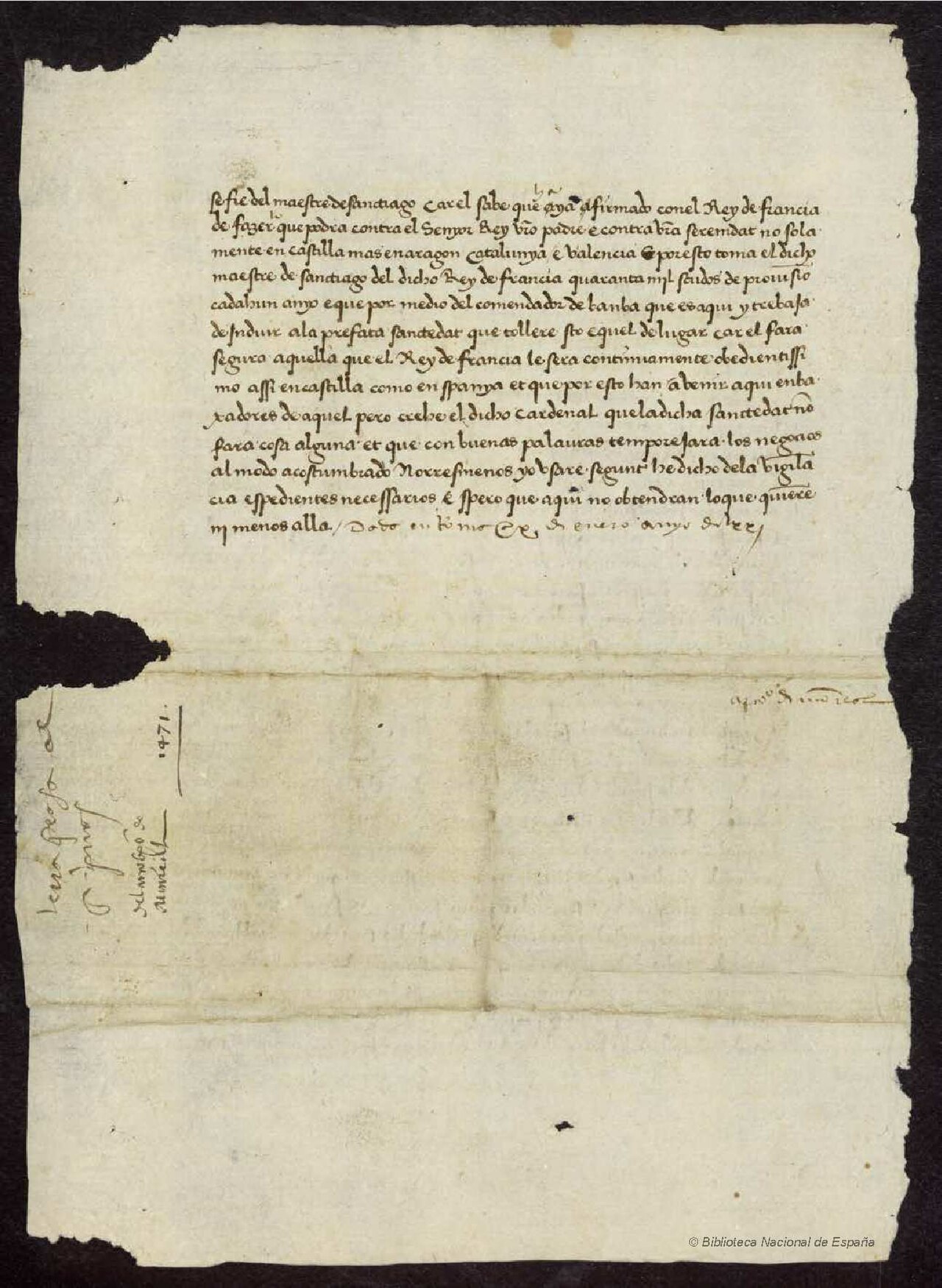
Handwritten manuscript letter on aged, torn paper in brown ink, Spanish script, with a line of marginal notes at lower left reading 1471 and a small annotation at right. Water-stained edges visible.Letter

Primary source

Letter from the Archbishop of Monreal to Ferdinand on his Marriage to Isabella

Archbishop of Monreal · 10 January 1471

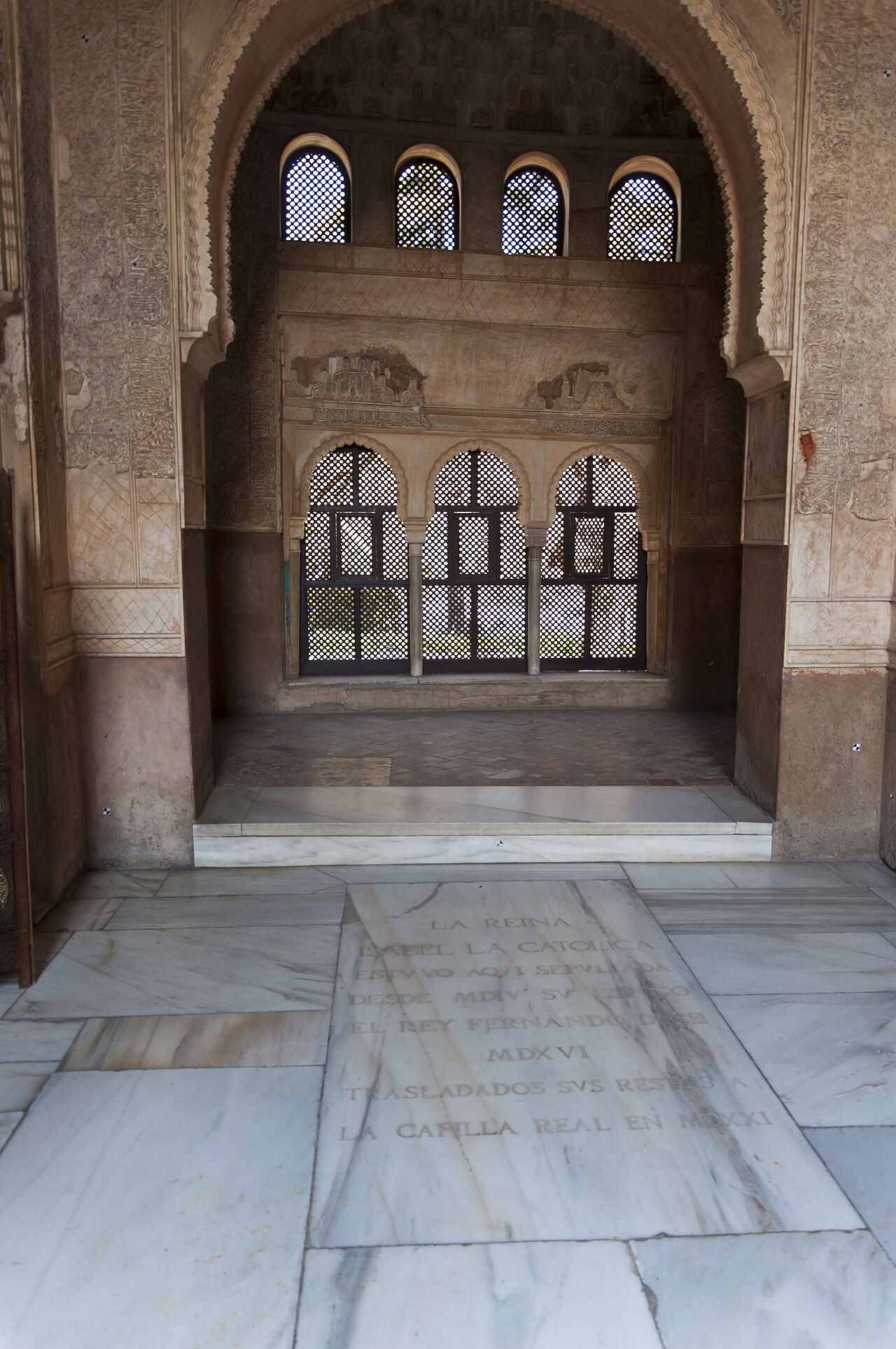
Interior of an Islamic-style arched hall with carved stucco walls and lattice windows. In the foreground, a marble floor slab is inscribed with Spanish text commemorating Queen Isabel la Catolica, who was buried here, and her later transfer to the Royal Chapel in 1521.Photograph

Secondary source

Tomb Site of Isabella I of Castile at the Alhambra

Paul Hermans · 17 March 2011

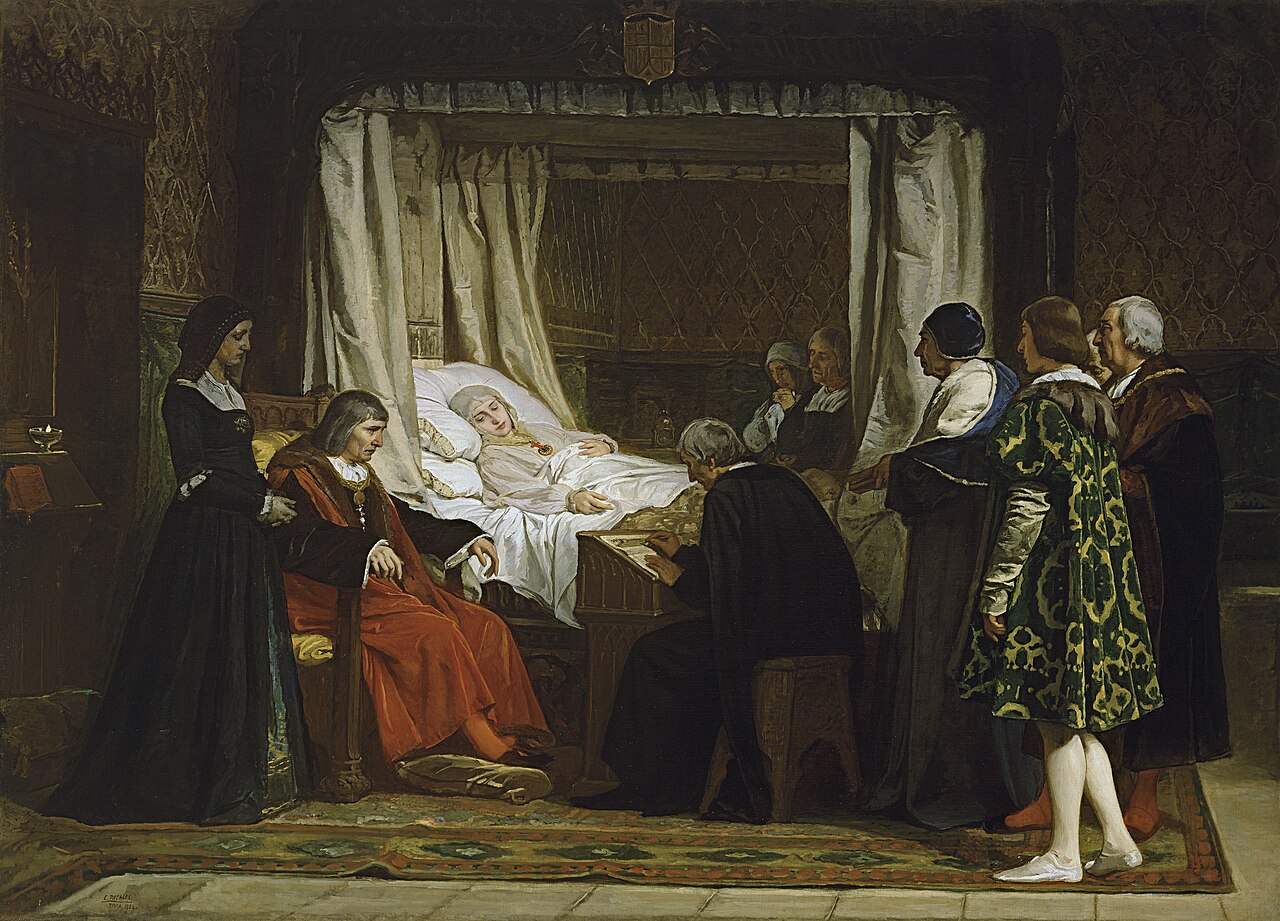
Painting of a dying woman in white lying in a canopied bed with curtains, a man in a red robe seated beside her, a woman in black mourning dress standing at left, a scribe in black writing at a desk, and courtiers in rich robes standing at right.Painting

Secondary source

Queen Isabel la Católica Dictating Her Last Will and Testament

Eduardo Rosales · 1864

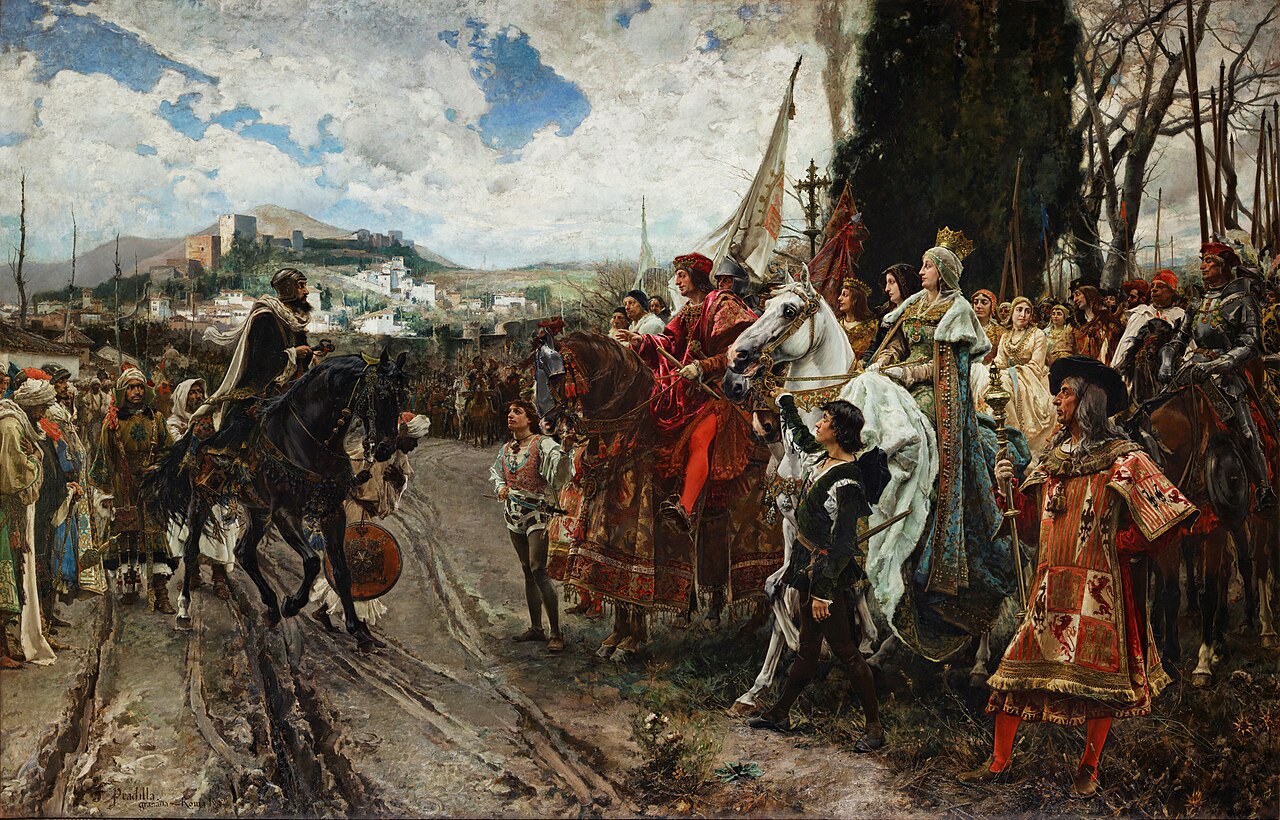
Large historical painting of a procession on a dirt road: on the left, a rider in dark cloak on a black horse faces a group of turbaned men; on the right, a crowned king and queen on white and red-draped horses, with armored soldiers and banners. A hilltop fortress and white town lie behind.Painting

Secondary source

La rendición de Granada

Francisco Pradilla y Ortiz · 1882

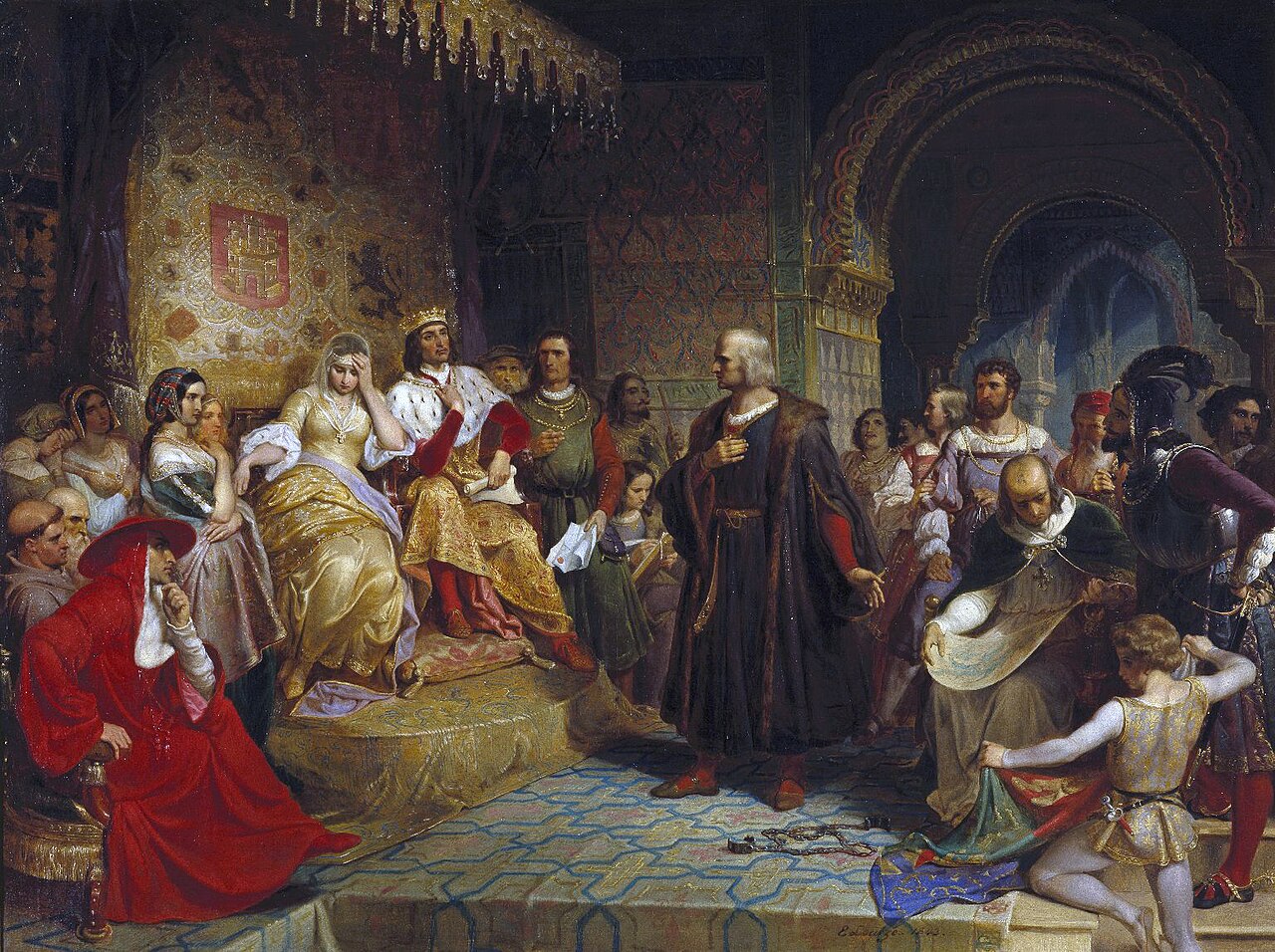
Painting of a 15th-century court scene. Seated on a raised dais under a canopy are a crowned king and a woman in a gold gown with a veil, with a red-robed cardinal in the foreground left. Christopher Columbus, in a dark cloak, stands center-right, gesturing toward a man unrolling a map. Courtiers and a page crowd the scene, and a Moorish-style arched hall is visible behind.Painting

Secondary source

Columbus Before the Queen

Emanuel Leutze · 1843

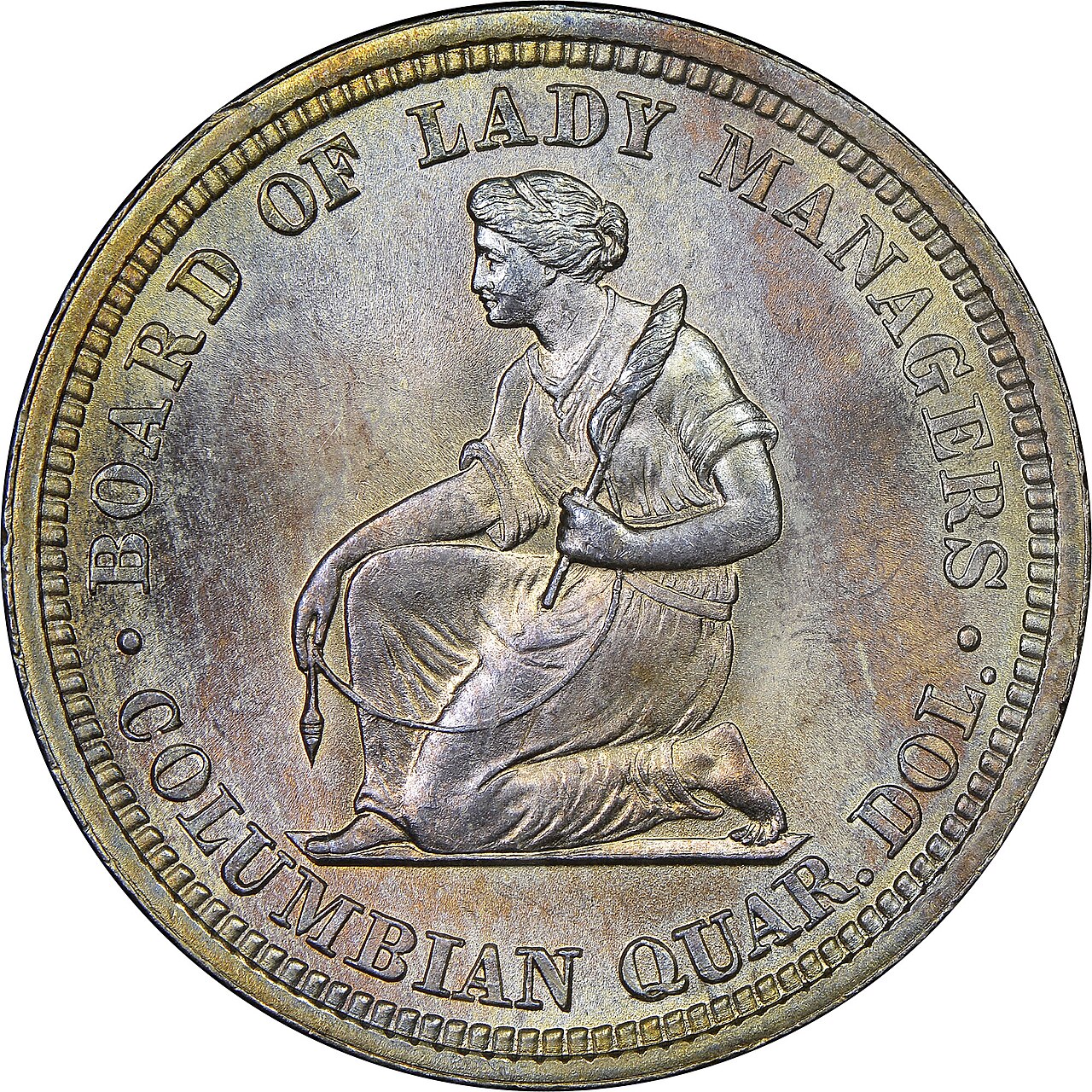
Reverse of a silver-toned coin with a rim of beads. Inscription around the top reads BOARD OF LADY MANAGERS; around the bottom reads COLUMBIAN QUAR. DOL. A seated woman in classical dress kneels, holding a quill pen and resting her arm on a tablet-like shape, with a scroll at her side.Artifact

Secondary source

Isabella Quarter

Charles E. Barber · 1893

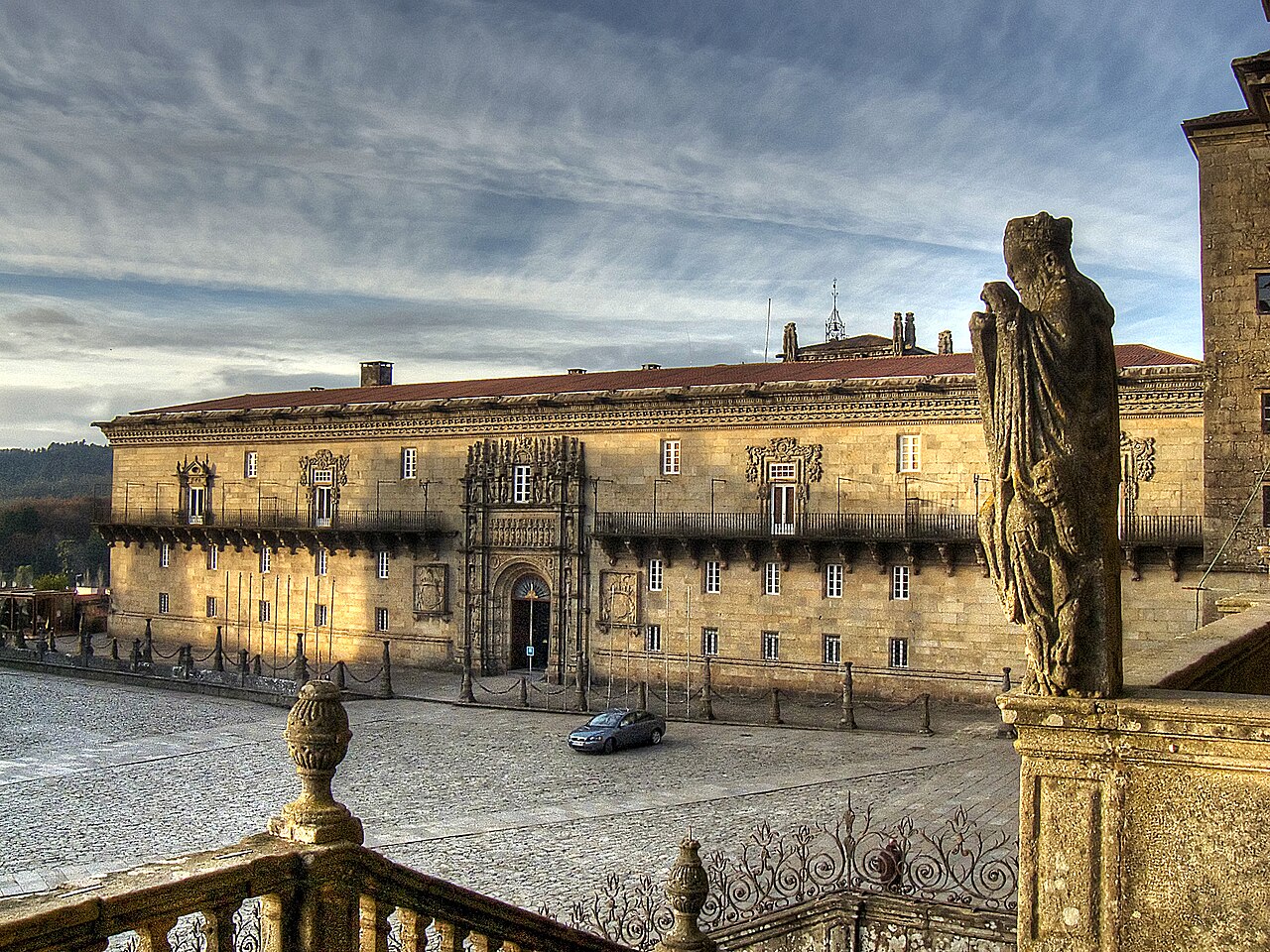
Long stone facade of a historic building with a central ornate Plateresque portal, rows of windows, iron balconies, and a red tiled roof, viewed across a cobbled square with a parked car. A stone statue of a bearded figure stands in the right foreground beside a balustrade.Artifact

Secondary source

Hostal dos Reis Católicos

Enrique Egas · 1511

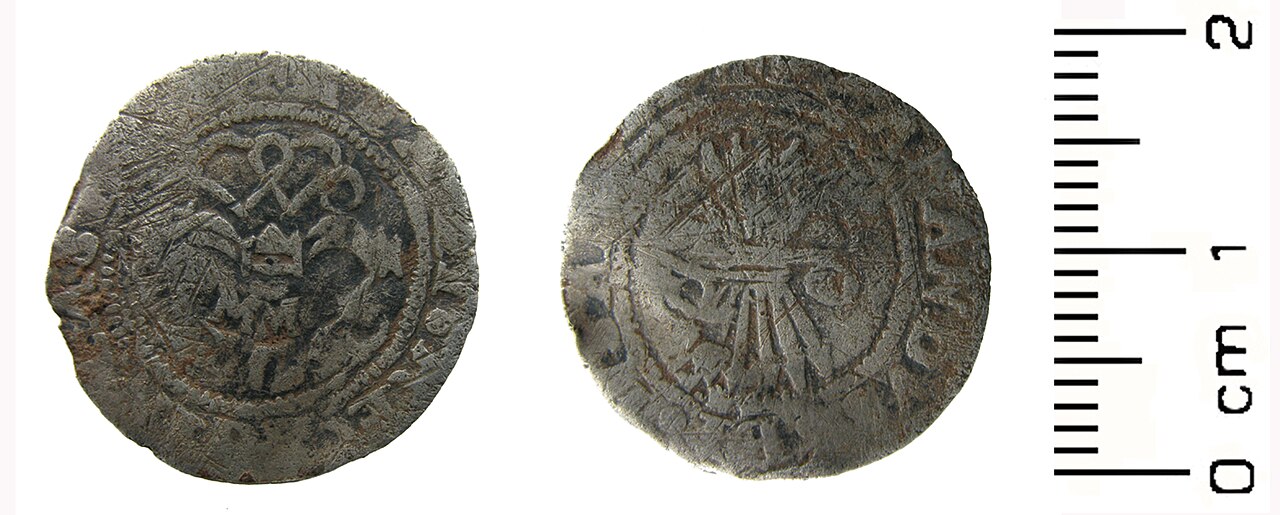
Two photographs of a small, worn, grey metal coin, obverse on the left and reverse on the right, with a centimetre scale bar on the right showing 0 to 2 cm. The coin is roughly 2 cm across.Artifact

Primary source

Spanish Half Real of Ferdinand and Isabella

1469-1504

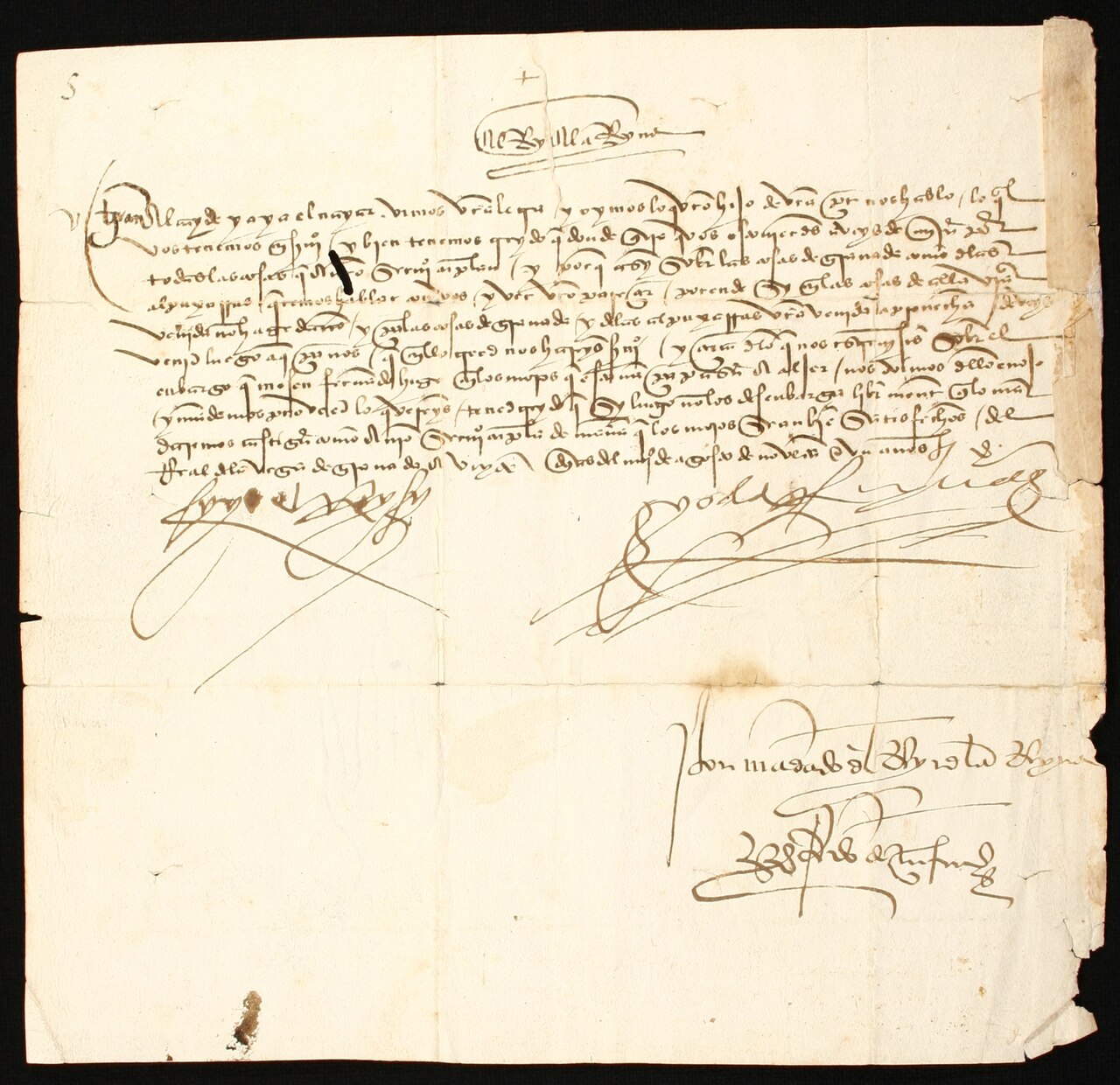
Scan of a handwritten 16th-century Spanish manuscript on aged, yellowed paper. Dense brown ink script in several lines with a heading at top and two large ornate signatures at the bottom, plus a secretary's signature at lower right.Document

Primary source

Catholic Kings Document, 1491

Isabella of Castile, Ferdinand II of Aragon · 1491

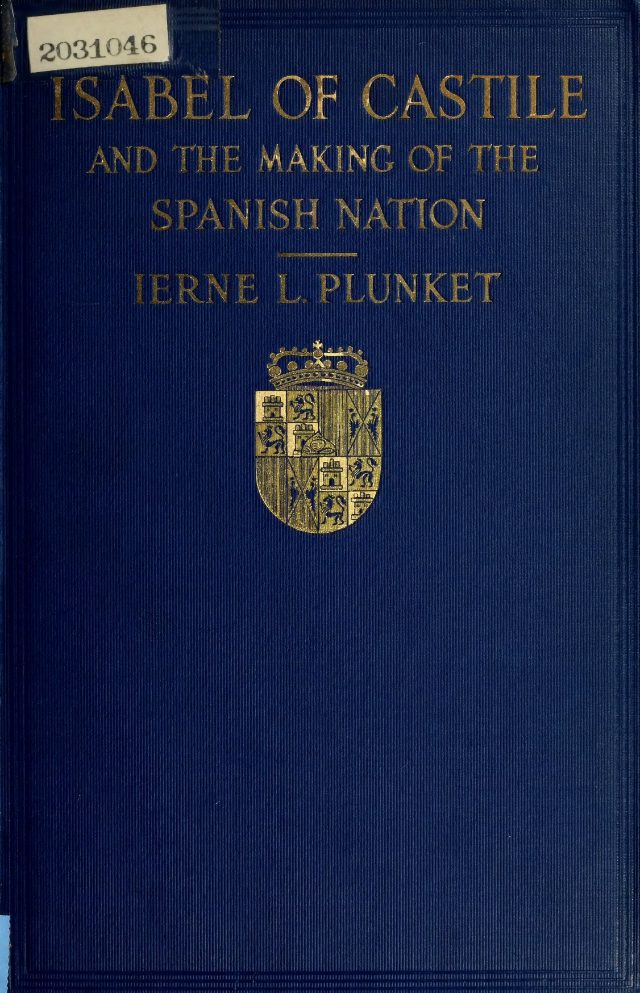
Isabel of Castile and the Making of the Spanish NationBook

Secondary source

Isabel of Castile and the Making of the Spanish Nation

Ierne L. Plunket · 1915

Book

Secondary source

History of the Reign of Ferdinand and Isabella the Catholic, of Spain

William H. Prescott · 1849

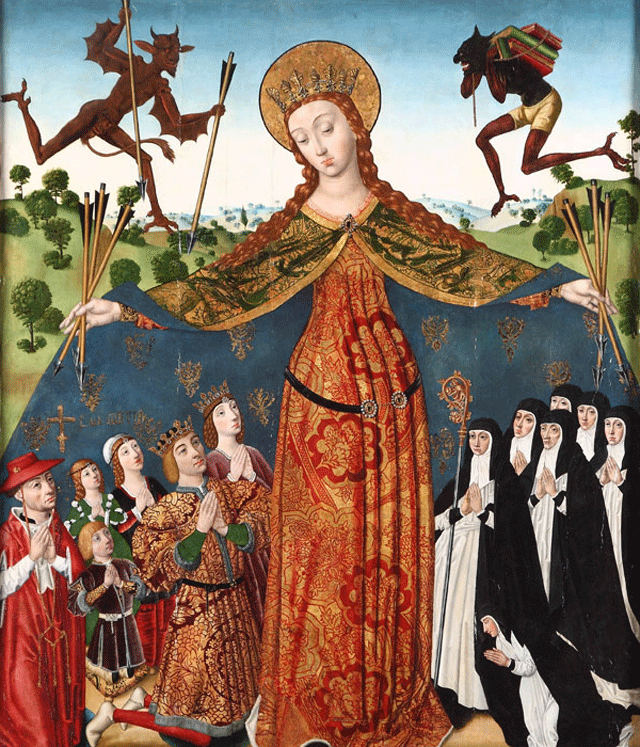
Painting of the Virgin of Mercy standing with outspread cloak, crowned with a halo, sheltering kneeling figures in royal and religious dress. Two devils with arrows flank her at upper left and right, and nuns in black veils kneel at the right.Painting

Primary source

Virgin of Mercy with the Catholic Monarchs and their family

Diego de la Cruz · c. 1486

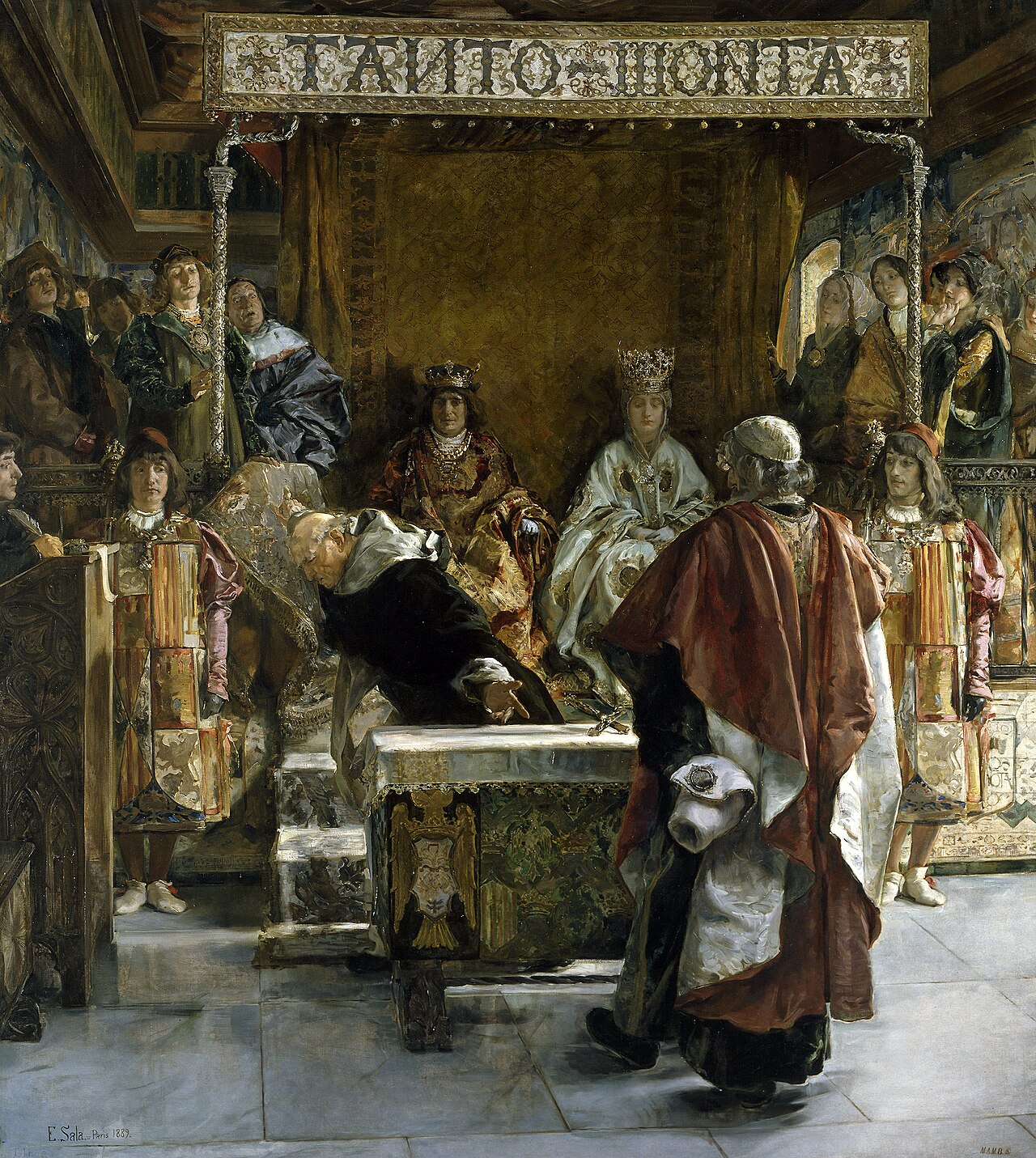
Oil painting in a lavish hall: a kneeling friar in black robes presents a document on a marble table to a crowned king and queen seated on a dais under a canopy inscribed with Latin text. Courtiers in rich garments watch; a man in a red cape stands at right with his back to the viewer. Signature at lower left reads E. Sala, Paris 1889.Painting

Secondary source

Expulsion of the Jews from Spain

Emilio Sala · 1889

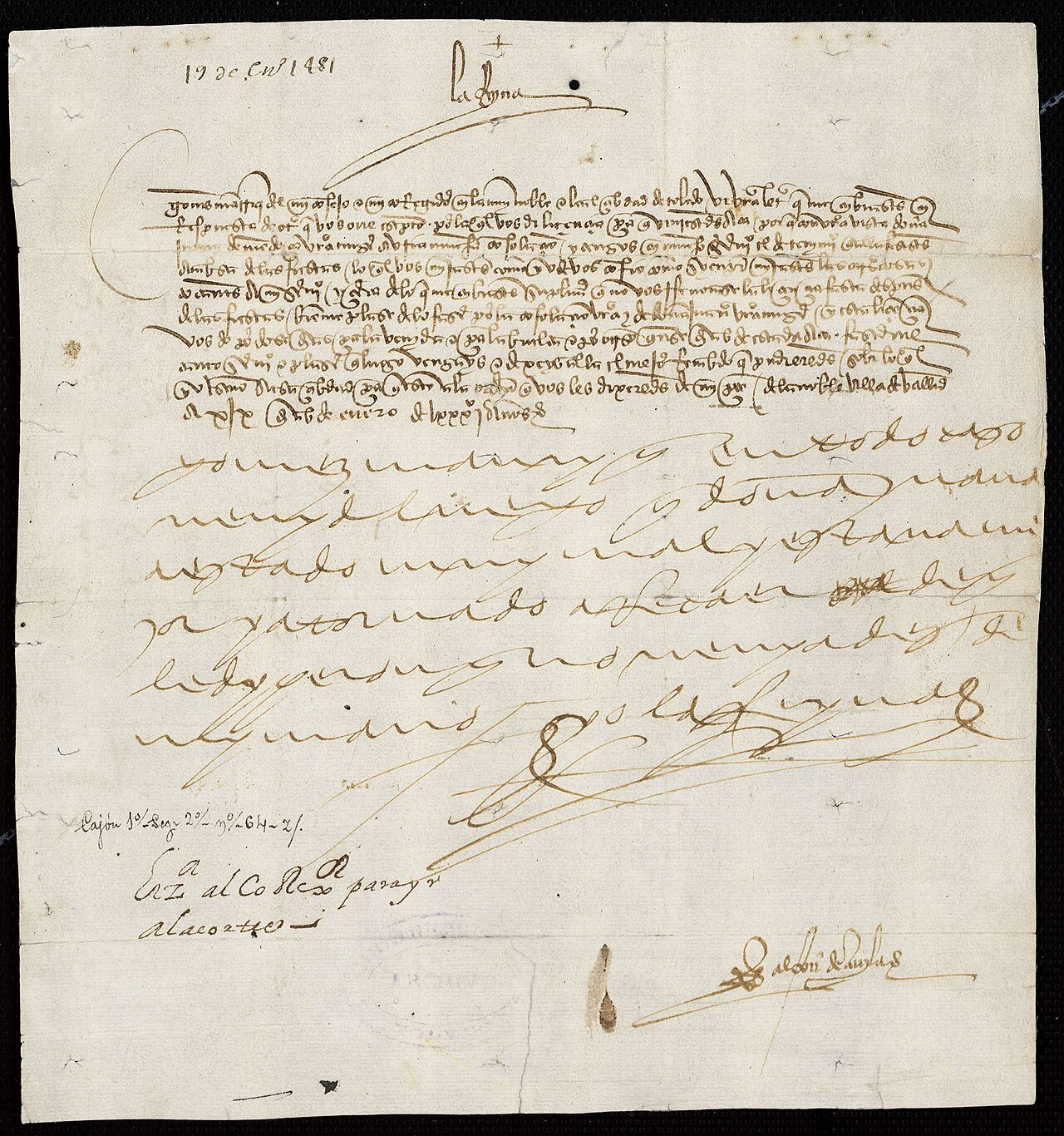
Handwritten letter on aged paper dated 1481 at top left, with a sprawling brown-ink text block, a large flourished signature in the lower right, and a secretary's notation at lower left. Lines of cursive script fill the page.Letter

Primary source

Letter of Queen Isabella the Catholic, 1481

Isabella I of Castile · 1481

Book

Secondary source

Isabelle la Grande, Queen of Castile

Jane Dieulafoy · 1920

Book

Secondary source

Historia del reinado de los reyes católicos

William Hickling Prescott · 1854

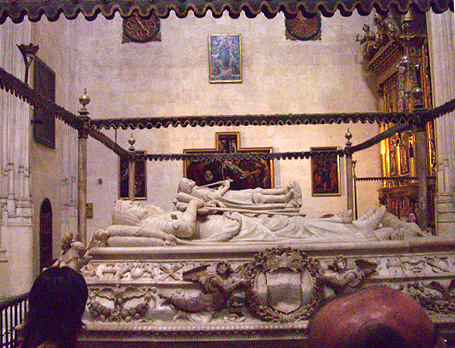
Marble tomb monument in the Royal Chapel of Granada: two recumbent effigies of a king and queen lie atop a sarcophagus with carved reliefs, with a second pair of effigies on a tomb behind, under a dark wooden canopy, and a painted panel on the wall behind. Visitors' heads are visible at the bottom of the frame.Sculpture

Secondary source

Tombs of the Catholic Monarchs, Royal Chapel of Granada

Domenico Fancelli · circa 1517

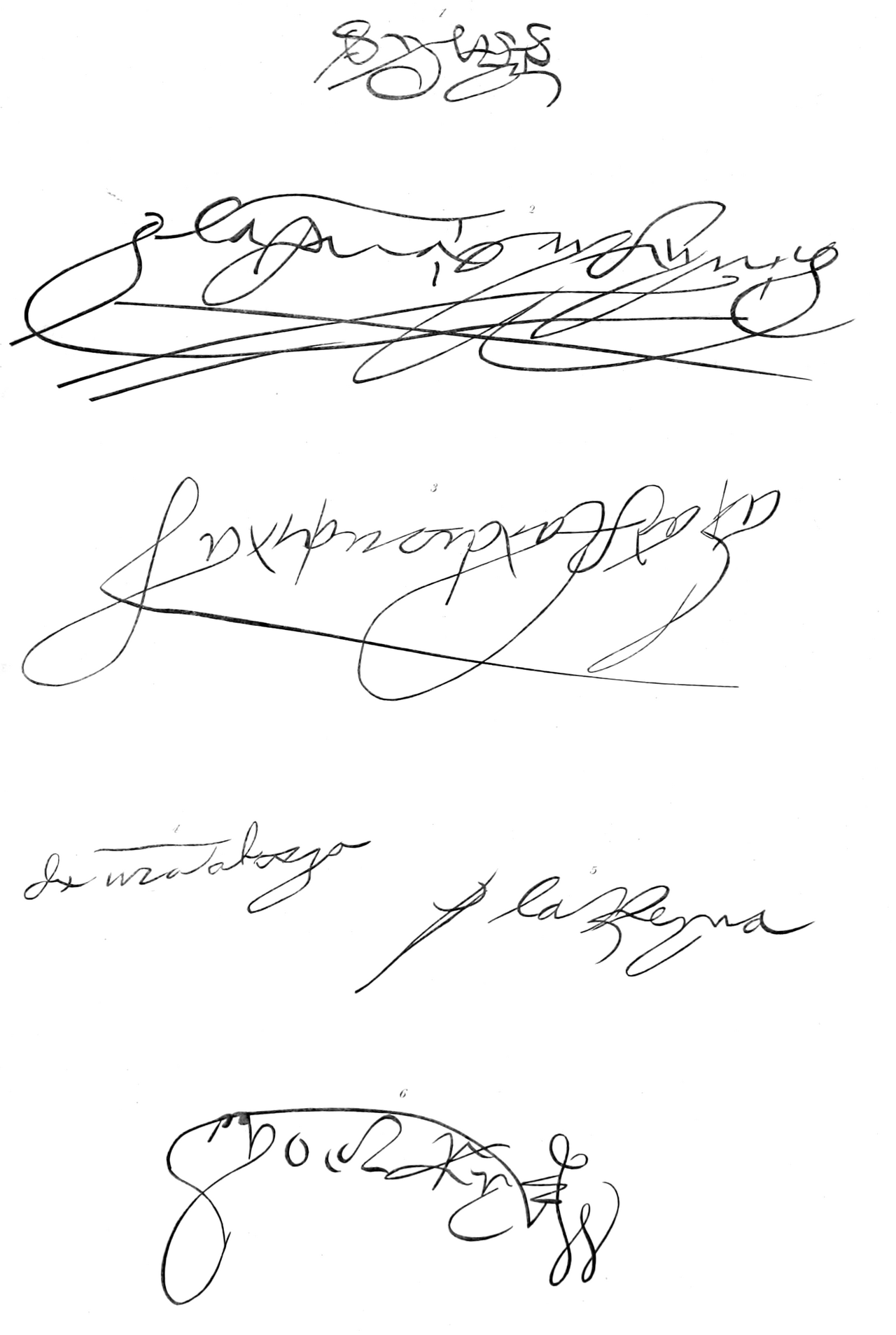
Scan of six facsimile autographs on a white page, numbered 1 to 6 in small marks, shown as handwritten signatures in ink. Signature 4 and 5 are in the lower area, including a signature reading 'la Reyna' near the bottom right.Document

Secondary source

Facsimile Autographs of Spanish Rulers, 1472-1473

William Hickling Prescott · 1846 (reproducing a signature dated 1473)

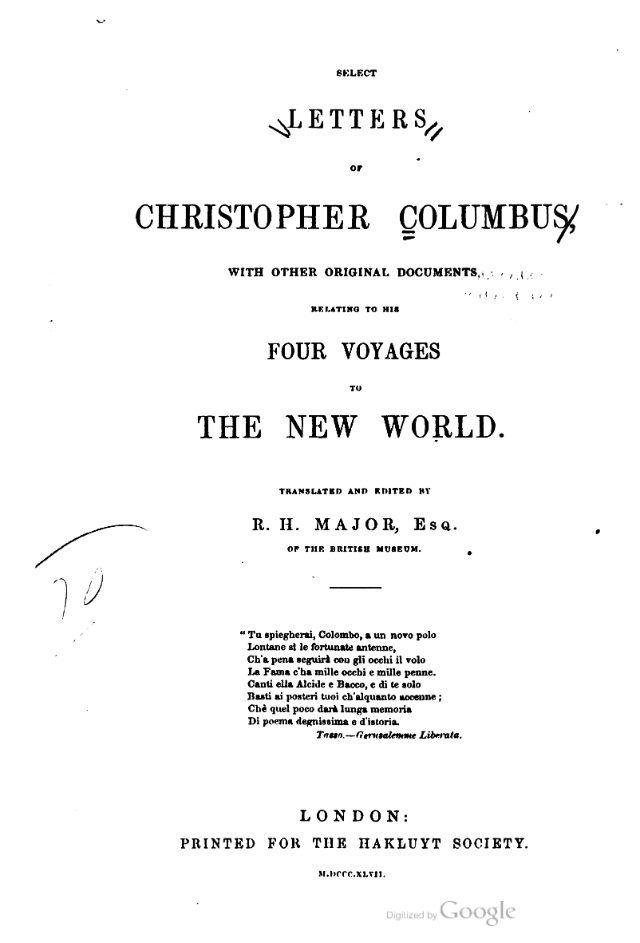
Select Letters of Christopher ColumbusLetter

Primary source

Select Letters of Christopher Columbus

Christopher Columbus · 1493-1503 (translated and published 1847)

Document

Tertiary source

Isabella I, Catholic Encyclopedia Entry

Ramón Ruiz Amado · 1913

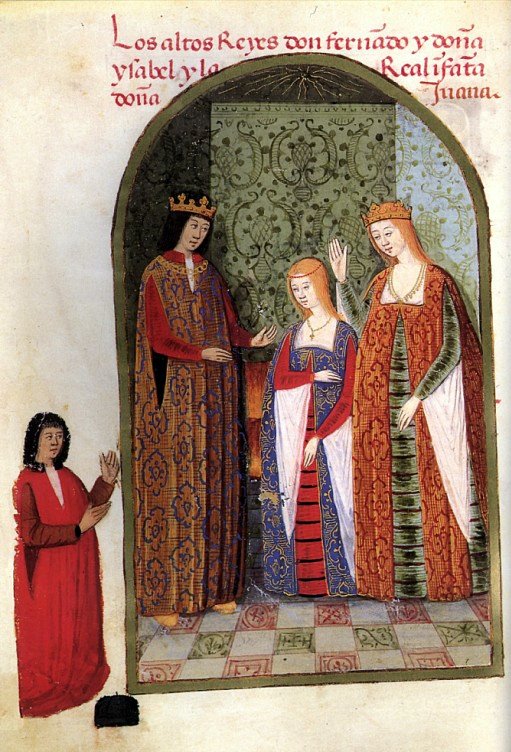
Illuminated manuscript miniature with red handwritten caption reading 'Los altos Reyes don Fernando y doña Ysabel y la Reyna Ysabel y la doña Juana'. Under a painted arch, a crowned king in brown gown and a crowned queen in red and green gown stand beside a young woman in blue and red, while a small figure in red kneels or bows at left. Checkered tile floor.Painting

Primary source

The Catholic Monarchs and Infanta Juana

Unknown · 15th century

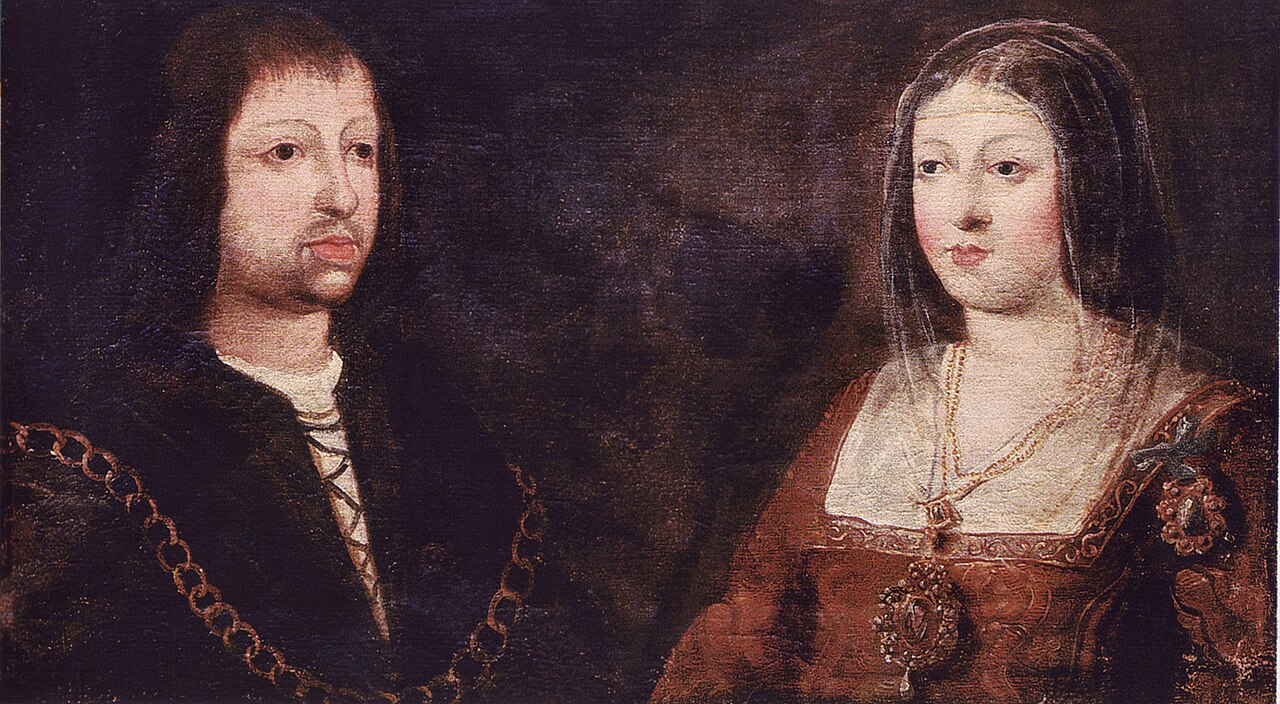
Painting of two figures side by side against a dark background. On the left, a man with shoulder-length brown hair wears a dark robe with a gold chain and a white shirt. On the right, a woman wears a dark veil, a pearl necklace, and a reddish-brown gown with a brooch.Painting

Secondary source

Wedding Portrait of Ferdinand of Aragon and Isabella of Castile

Unknown · 15th century

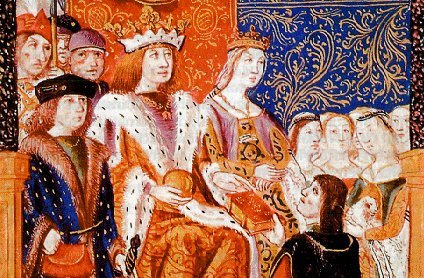
Painted scene of a crowned king and queen seated on a throne in red and gold robes, the king holding an orb and the queen holding a scepter. Standing figures in fur-trimmed garments flank them, with a young man in a dark cap at left and a row of women in headdresses at right. Blue background with gold foliage.Painting

Secondary source

Ferdinand and Isabel the Catholic Monarchs with Children

Unknown · 2 January 1754

The Discovery of America and the Jewels of Queen IsabellaBook

Secondary source

The Discovery of America and the Jewels of Queen Isabella

Francisco Martínez y Martínez · 1916

Women of CatholicityBook

Secondary source

Women of Catholicity

Anna T. Sadlier · 1885

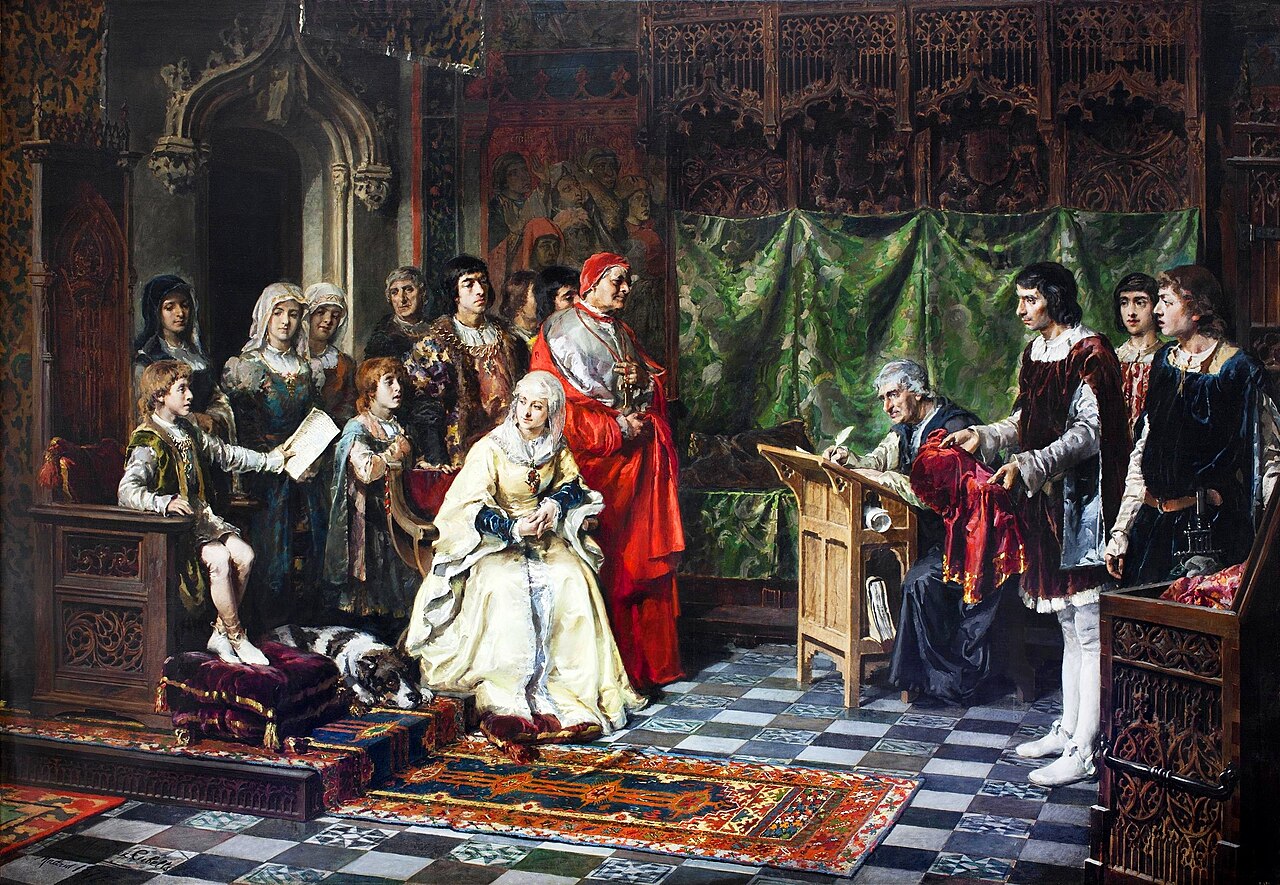
Large historical painting of a richly decorated Gothic-style interior with a black and white checkered floor. A seated woman in a pale yellow gown and white headdress sits at center, surrounded by a young boy holding a scroll, a cardinal in red robes, a group of courtiers and women in period dress, a dog, and a man in a dark robe at a lectern. Two young men in red and dark velvet stand at right, and ornate carved wooden screens and green drapery frame the room.Painting

Secondary source

Education of Prince Juan

Salvador Martínez Cubells · 1877

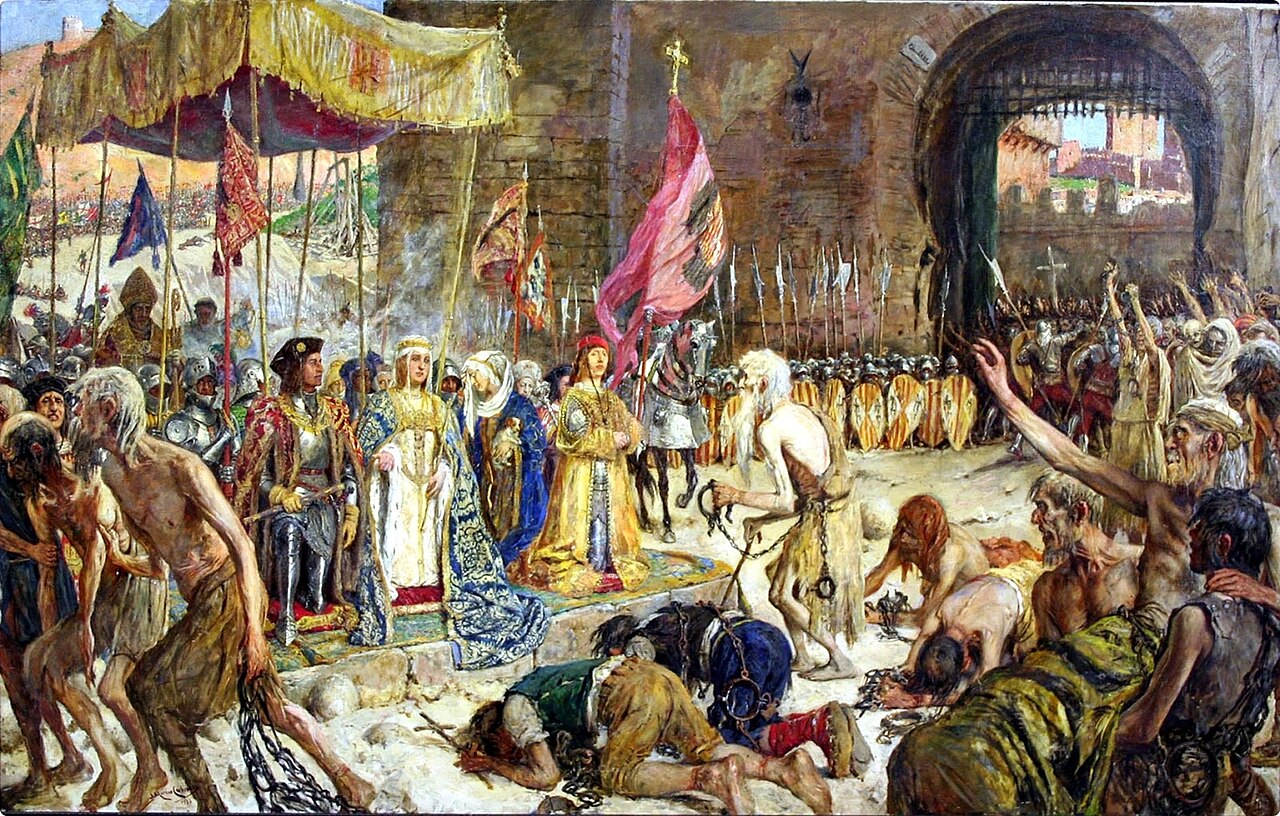
Painting of a royal procession in a stone gateway. Two crowned monarchs sit under a gold canopy beside a kneeling woman in a blue robe. Before them, emaciated, partly nude captives in chains kneel, reach upward, or are led forward, while armored soldiers and banners stand behind.Painting

Secondary source

Liberation of Christian Captives at Málaga by the Catholic Monarchs

José Moreno Carbonero · 1930

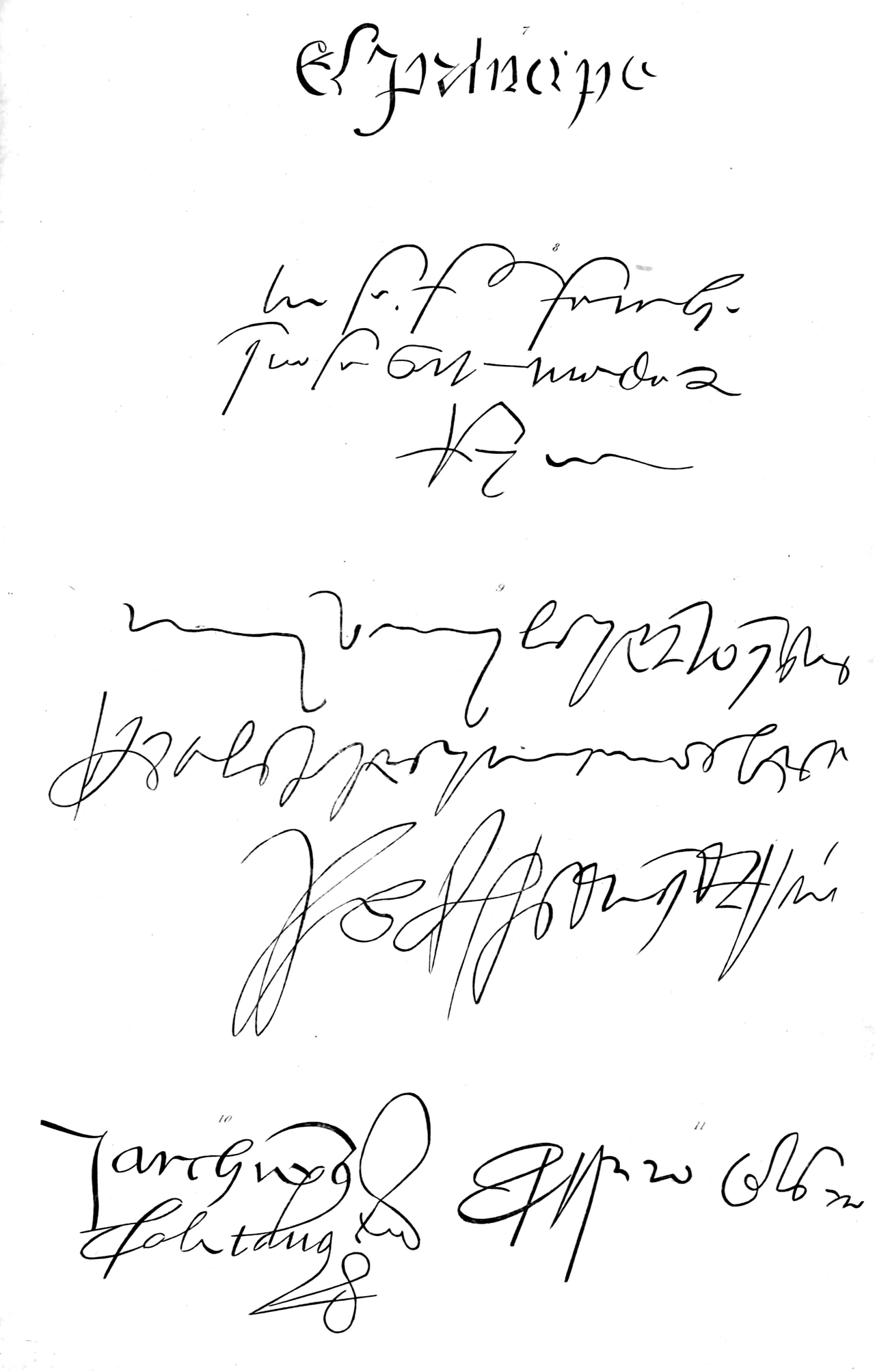
Scan of a page of handwritten facsimile autographs in black ink on white paper. At top, the cursive words 'El Principe'. Below are several signatures of different people, including a short signature with a large initial and a longer multi-line signature.Document

Secondary source

Facsimile Autographs 7-11, Prescott's History of Ferdinand and Isabella

William Hickling Prescott · 1846

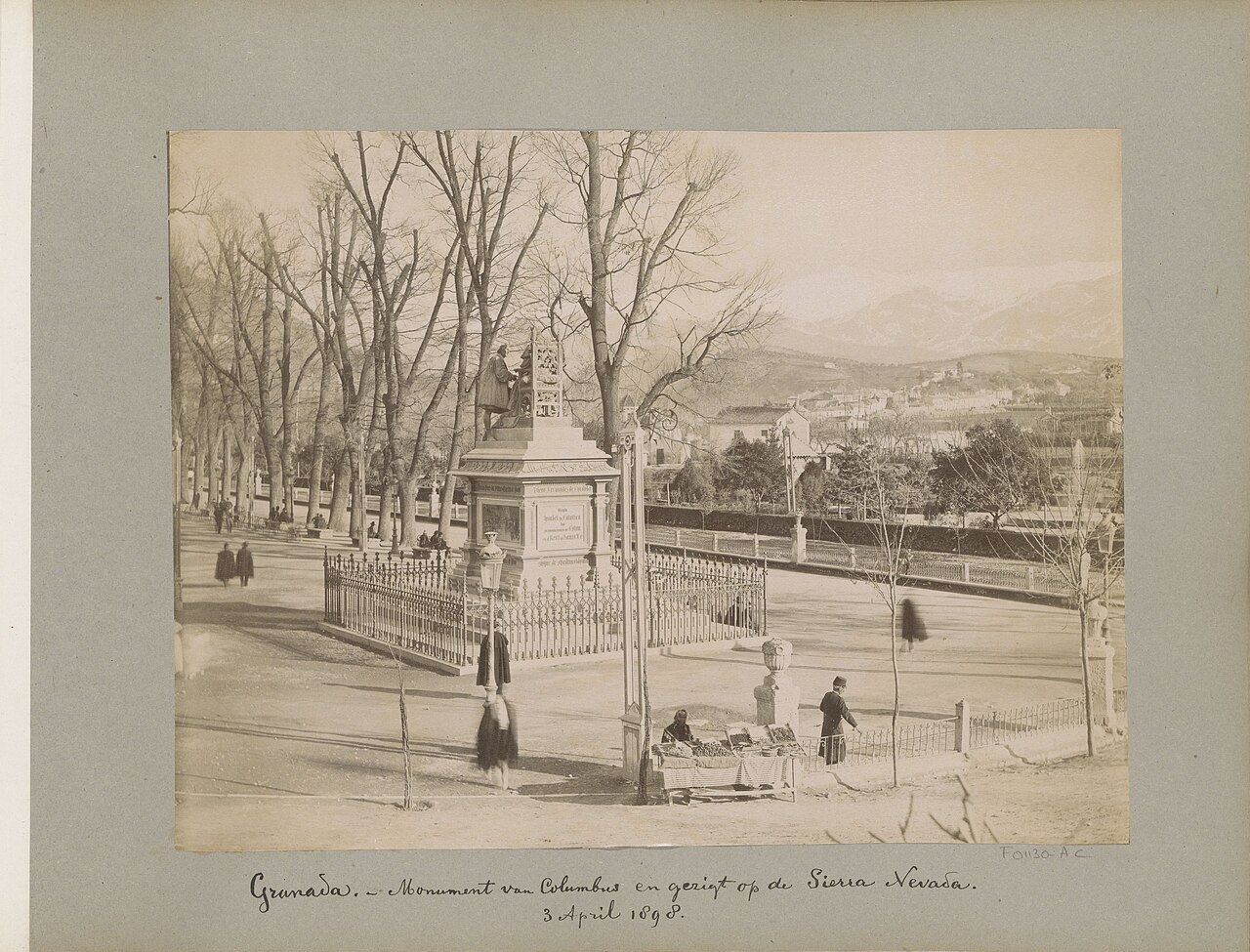
Black-and-white photograph mounted on a grey album page, showing a monument with a statue on a tall pedestal inside an iron railing, bare trees, a promenade with people, a market stall, and snow-capped mountains behind. Handwritten caption below reads Granada, Monument van Columbus en gezigt op de Sierra Nevada, 3 April 1898.Photograph

Secondary source

Monument to Isabella I and Columbus in Granada

Rafael Garzón (attributed) · c. 1880-1898

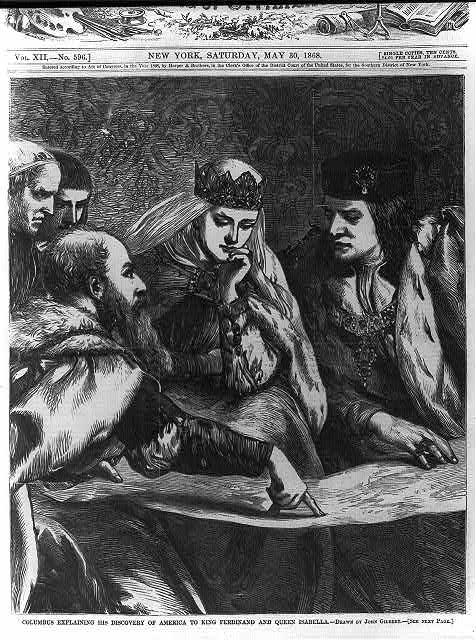
Black-and-white engraving from Harper's Weekly, May 30, 1868, titled Columbus explaining his discovery to King Ferdinand and Queen Isabella. A bearded man in fur-trimmed robes points at a map on a table while a crowned queen and a man in a fur-collared cap and jeweled collar look at it. A second man peers over from the left.Painting

Secondary source

Columbus Explaining His Discovery to King Ferdinand and Queen Isabella

Sir John Gilbert · 30 May 1868

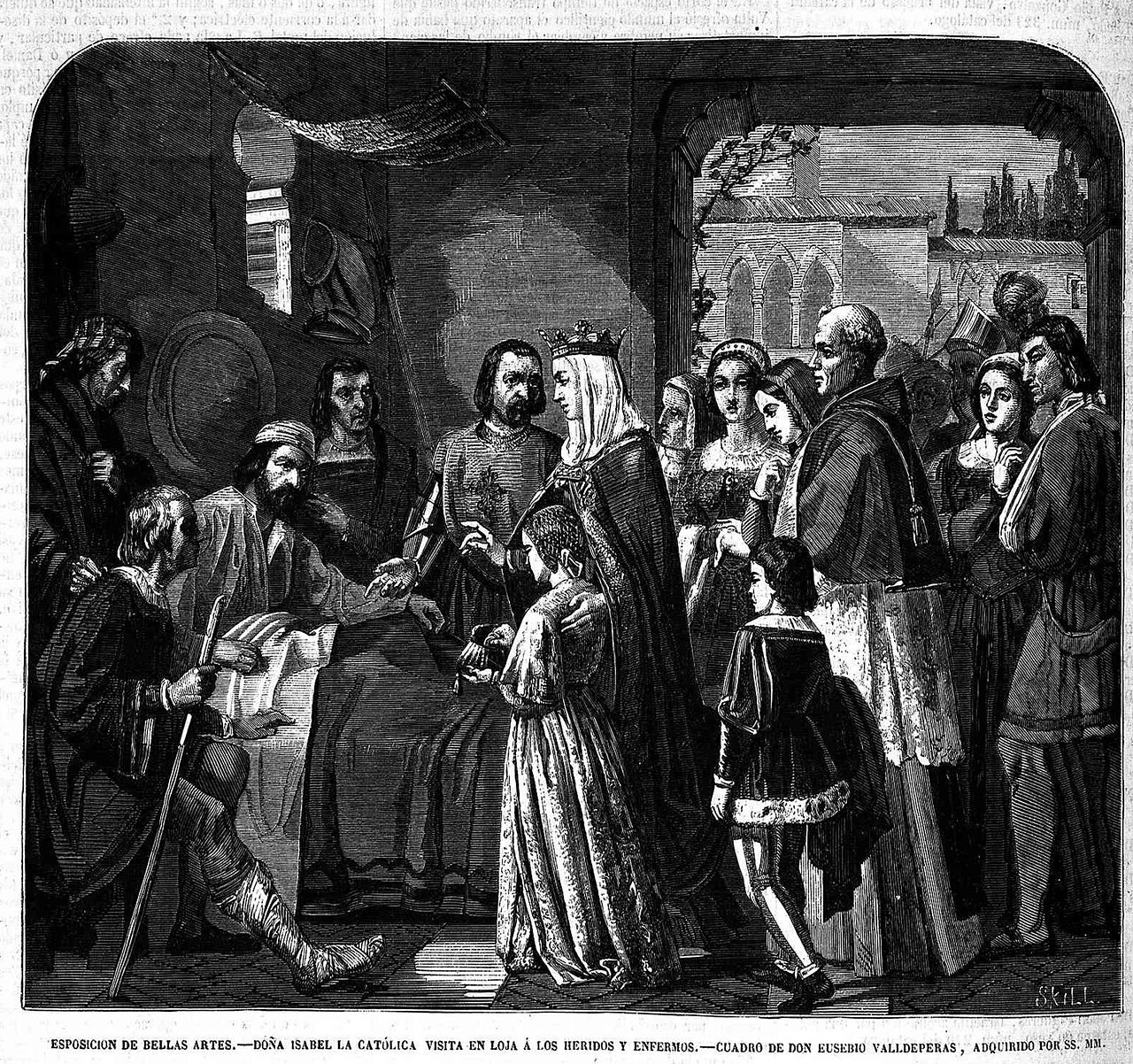
Black-and-white wood engraving of a 15th-century scene: a crowned queen in a long veil stands in a stone hall, while a bearded man in a robe sits with an open book and an injured man on crutches approaches. Courtiers and a child look on; an arched doorway opens to a city view.Painting

Secondary source

Isabella Visits the Wounded and Sick at Loja

Eusebi Valldeperes / Edward Skill · 9 December 1860

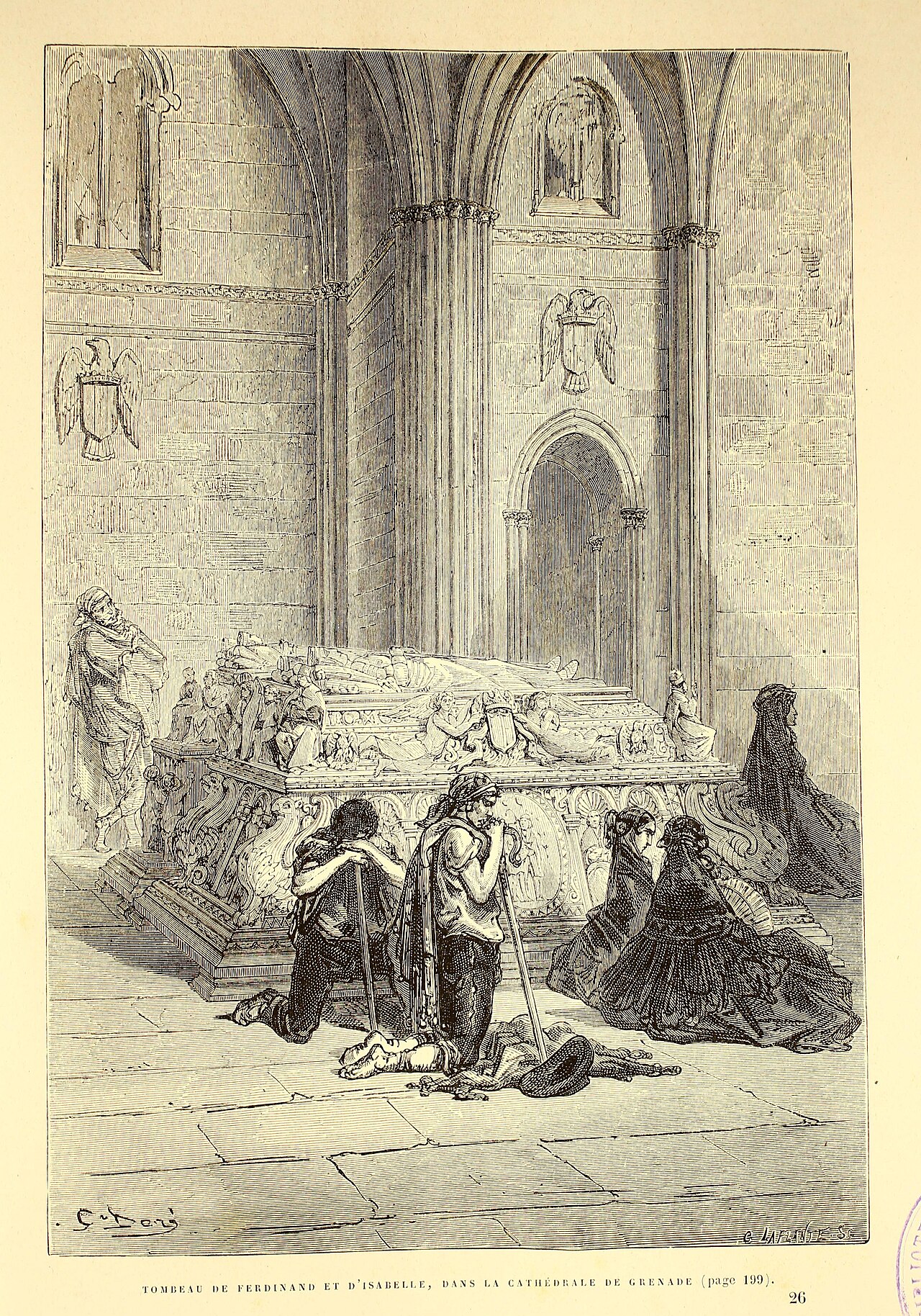
Engraving of the Royal Chapel interior in Granada: the white marble tomb of Ferdinand and Isabella with recumbent effigies, surrounded by kneeling mourners in dark robes and veils, and figures lying on the floor in front. Caption below reads Tombeau de Ferdinand et d'Isabelle, dans la Cathédrale de Grenade.Painting

Secondary source

Tomb of Ferdinand and Isabella in Granada

Gustave Doré / Charles Laplante · 1874

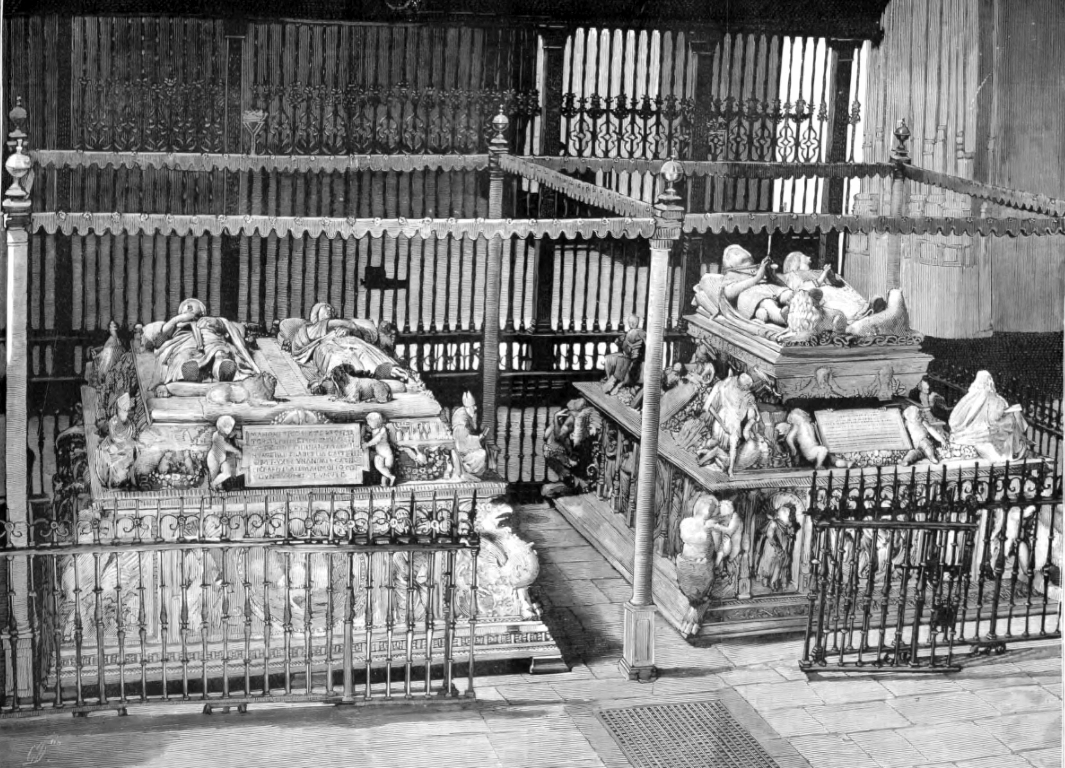
Black-and-white engraving of the interior of the Royal Chapel in Granada showing two elaborate marble tombs with recumbent effigies of a king and queen, surrounded by iron railings, with a third tomb in the right foreground.Painting

Secondary source

Tombs of Isabella and Ferdinand in the Royal Chapel, Granada

Anonymous · 1892

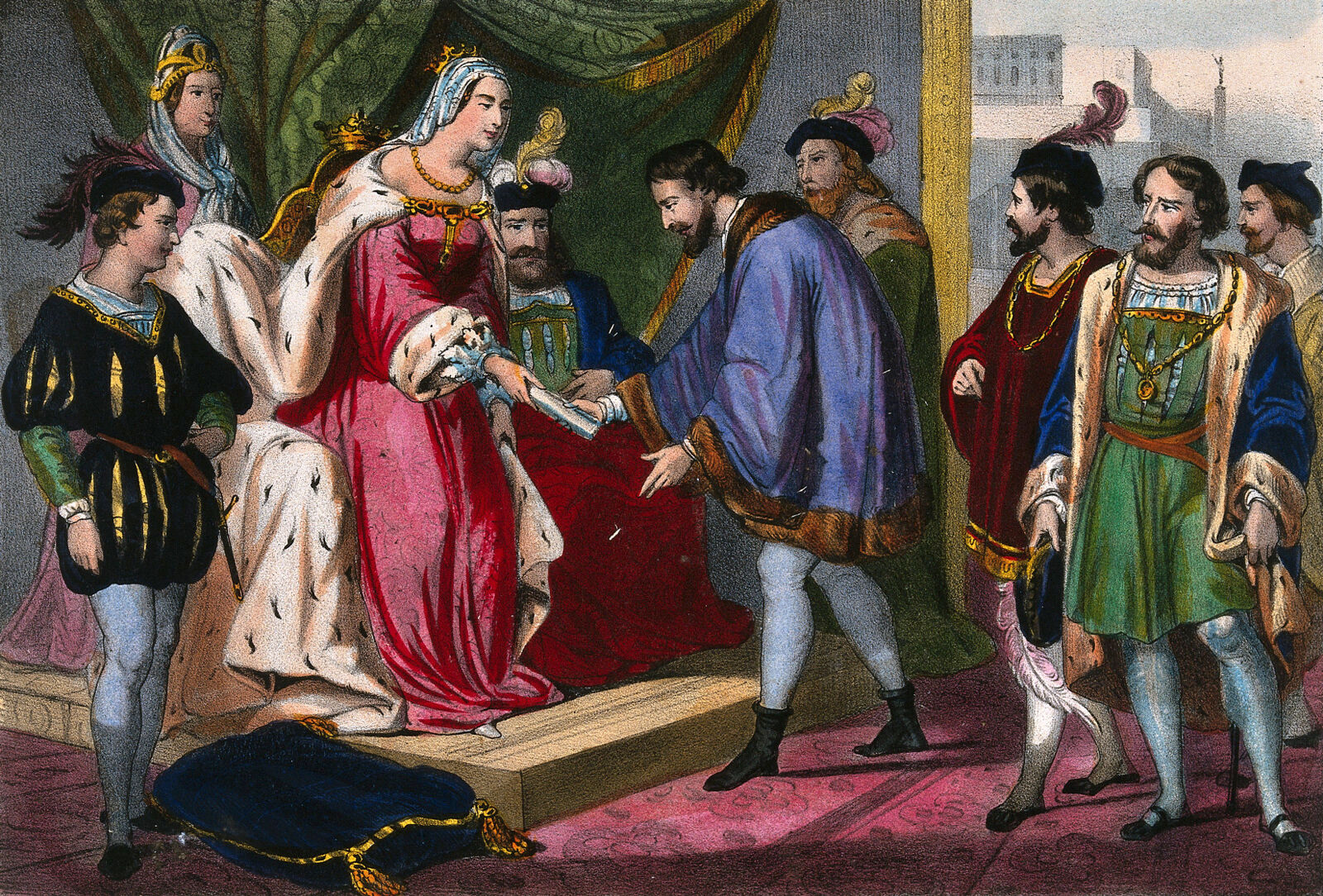
Coloured lithograph of a crowned queen in a red gown with white ermine-trimmed mantle, seated on a raised platform, extending a rolled document to a bearded man in a purple robe who bends toward her. Courtiers in feathered caps and chains stand around, with a blue cushion with gold tassels in the foreground and a green curtain behind.Painting

Secondary source

Columbus Receiving His Viceroy Nomination from Queen Isabella

c. 1850

Libro de la cámara real del Príncipe Don JuanBook

Primary source

Libro de la cámara real del Príncipe Don Juan

Gonzalo Fernández de Oviedo y Valdés · 1870 (text originally earlier)

The Letter of Columbus on the Discovery of AmericaLetter

Primary source

The Letter of Columbus on the Discovery of America

Christopher Columbus · 1893 facsimile of 1493 original

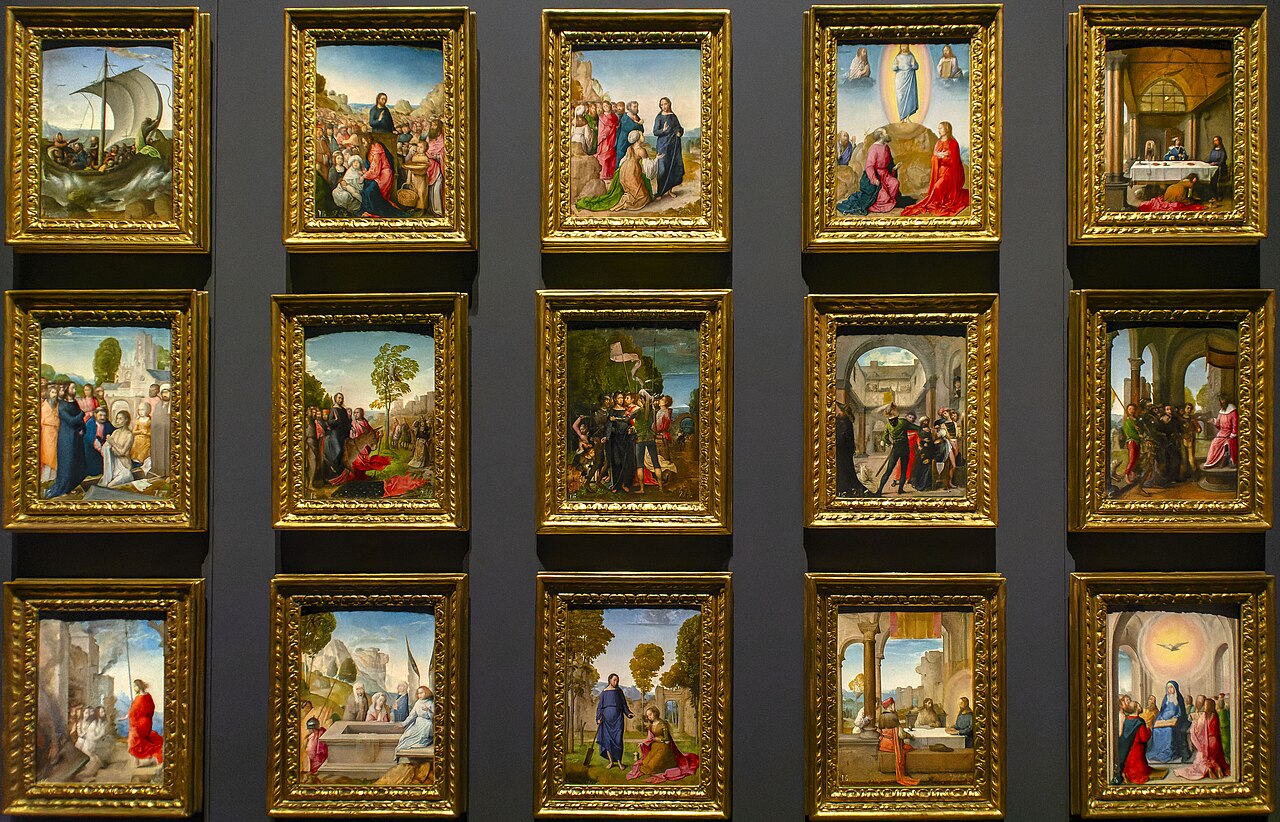
Fifteen small gold-framed panel paintings arranged in three rows of five on a dark gray wall, showing scenes from the life of Christ including a boat at sea, the Transfiguration, the Last Supper, the Crucifixion-related and Resurrection-era scenes, and the Annunciation-type scene with a dove at top right.Painting

Primary source

Polyptych of Isabella the Catholic

Juan de Flandes · c. 1500

Black and white photograph of a handwritten historical document on aged paper, with dense cursive script in the upper portion, two large signatures in the middle, a line of smaller handwritten text below, and a round wax or embossed seal with a coat of arms on the lower right, plus a smaller signature and marginal notes at the bottom.Document

Primary source

Page of 1492 Royal Edict Signed by Ferdinand and Isabella

King Ferdinand of Aragon and Queen Isabella of Castile · 1492

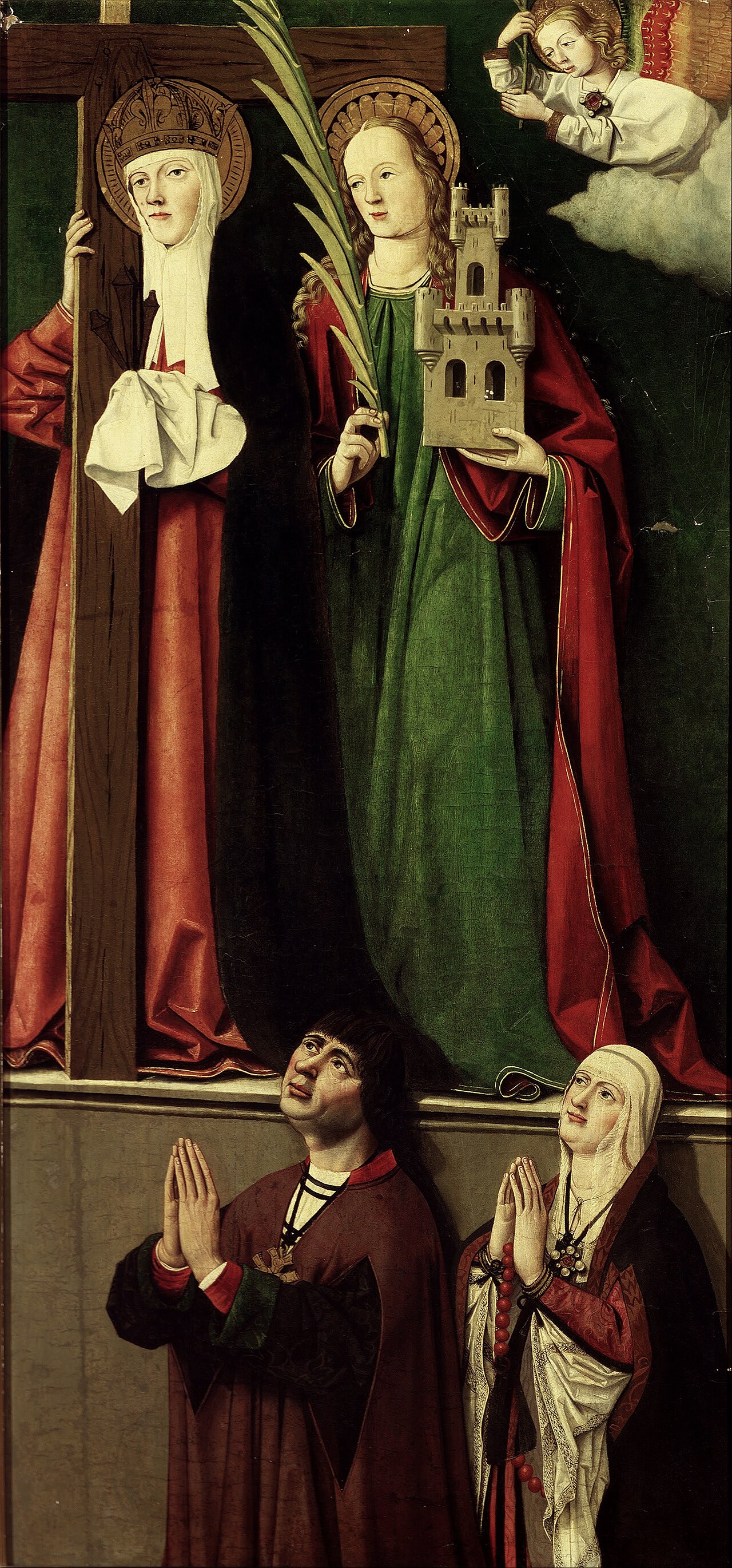
Painting of two standing female saints in rich robes against a dark green background. Left, a crowned saint in red and black holds a large wooden cross. Center, a saint in green gown and red cloak holds a palm frond and a small stone tower. An angel in white appears at top right. Two kneeling praying figures in dark red and black clothing are at lower right and lower left.Painting

Primary source

The Catholic Kings with Saints Helena and Barbara

Master of Manzanillo · c. 1485

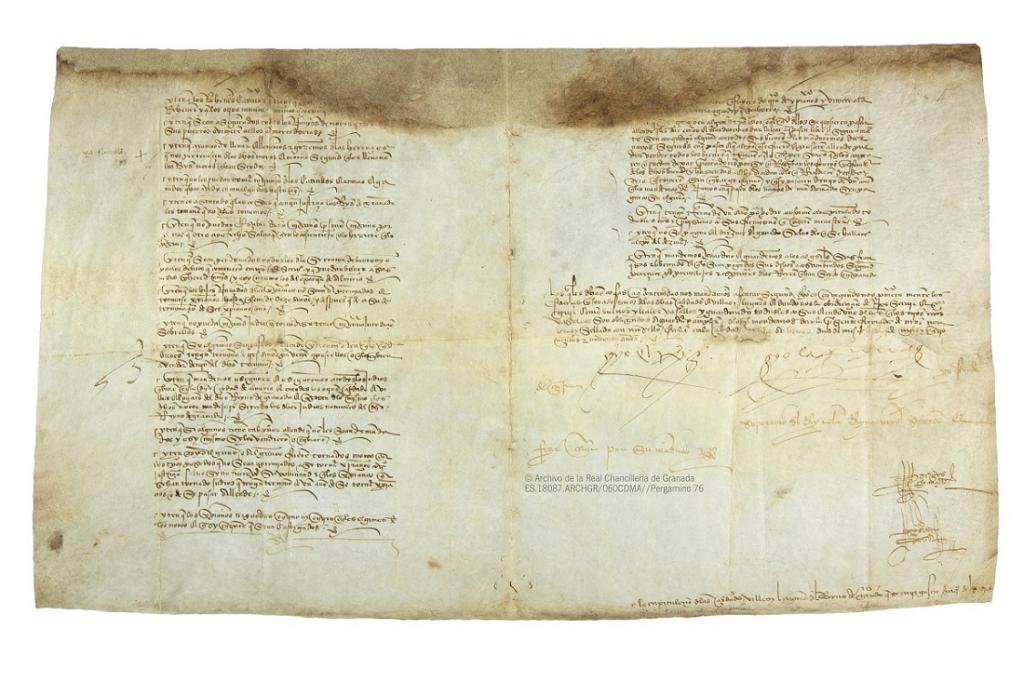
Photograph of a large parchment document with handwritten Gothic script in brown ink in two columns, dark stains along the top edge, and several signatures and flourishes near the lower right. A watermark credit reads Archivo de la Real Chancillería de Granada.Document

Primary source

Capitulations granted by the Catholic Monarchs to Almería

Isabella I of Castile; Ferdinand II of Aragon; Saad Baggas Boutarbpuch · 11 February 1490

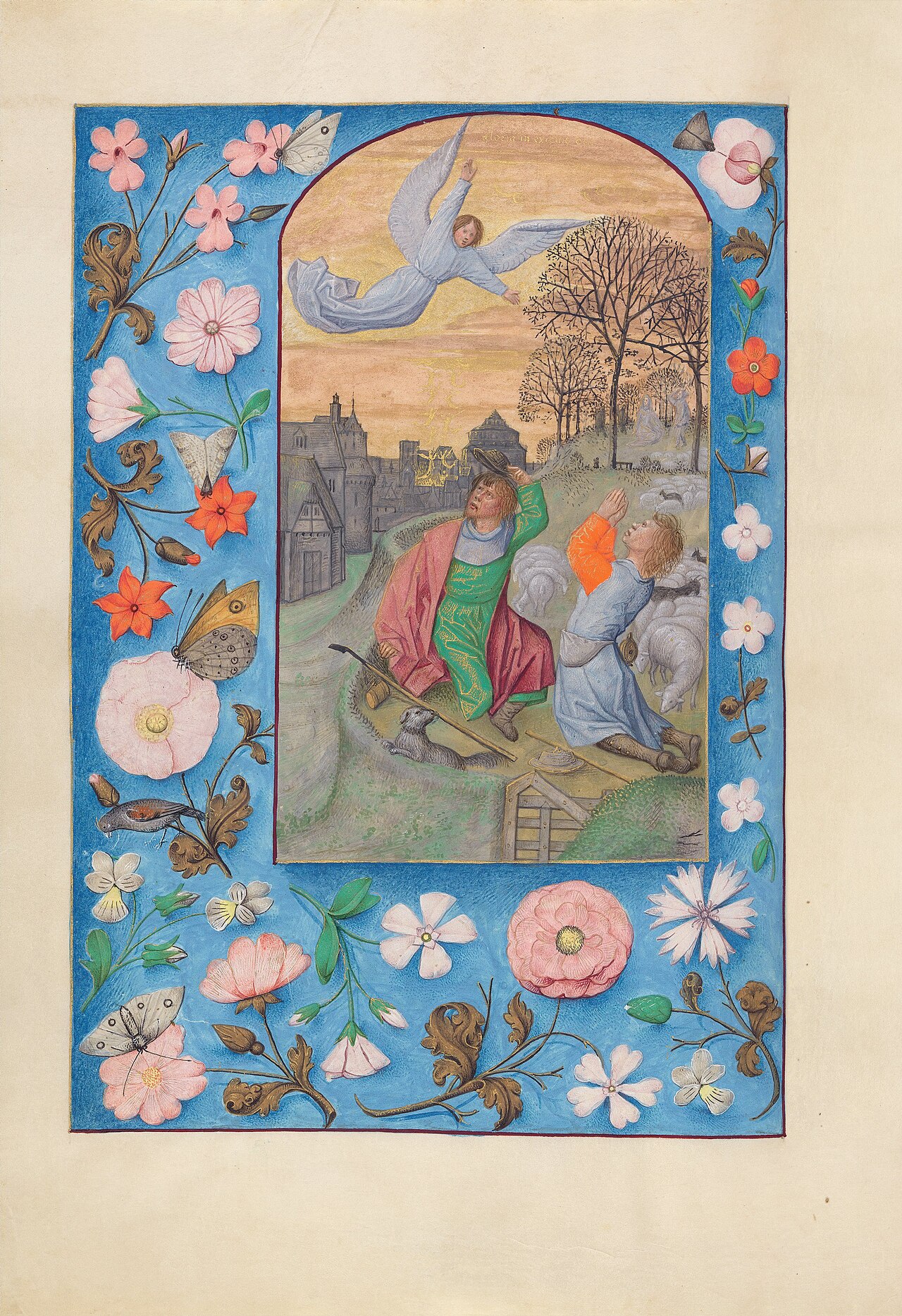
Illuminated manuscript page with a blue border of flowers, butterflies and leaves around a painted scene: an angel in white flies above two shepherds in a hilly landscape with sheep, a dog, and a town behind them.Book

Primary source

Hours of Queen Isabella the Catholic, Annunciation to the Shepherds

Master of the First Prayerbook of Maximilian; Alexander Bening · 1495

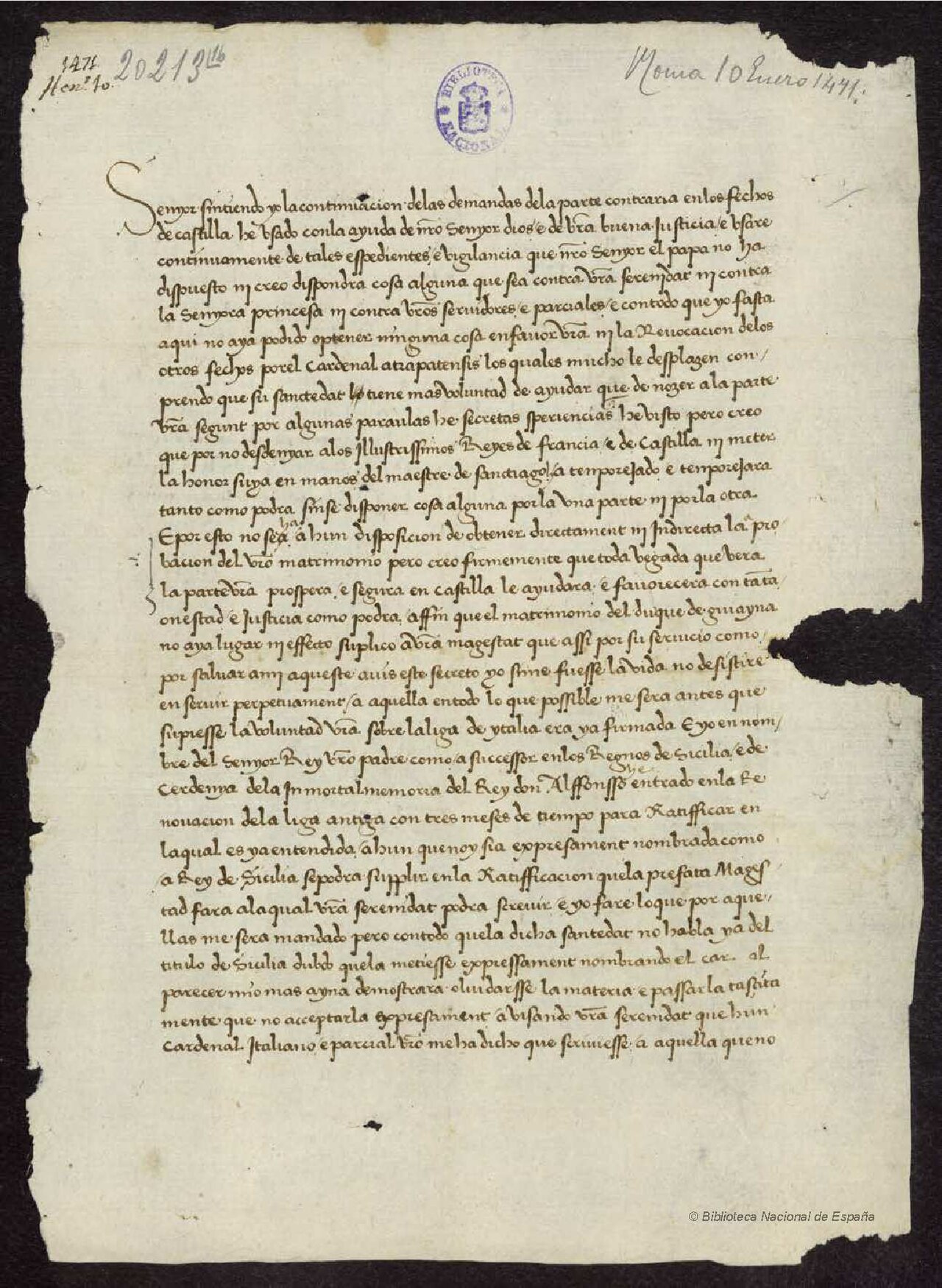
Handwritten manuscript letter in brown ink on aged paper, dated Roma 10 enero 1471 at top right, with a blue library stamp and a catalogue number in the top left. The letter is written in Spanish secretary hand in dense lines of text.Letter

Primary source

Letter of the Archbishop of Monreal to Ferdinand on Isabella's marriage

Archbishop of Monreal · 10 January 1471

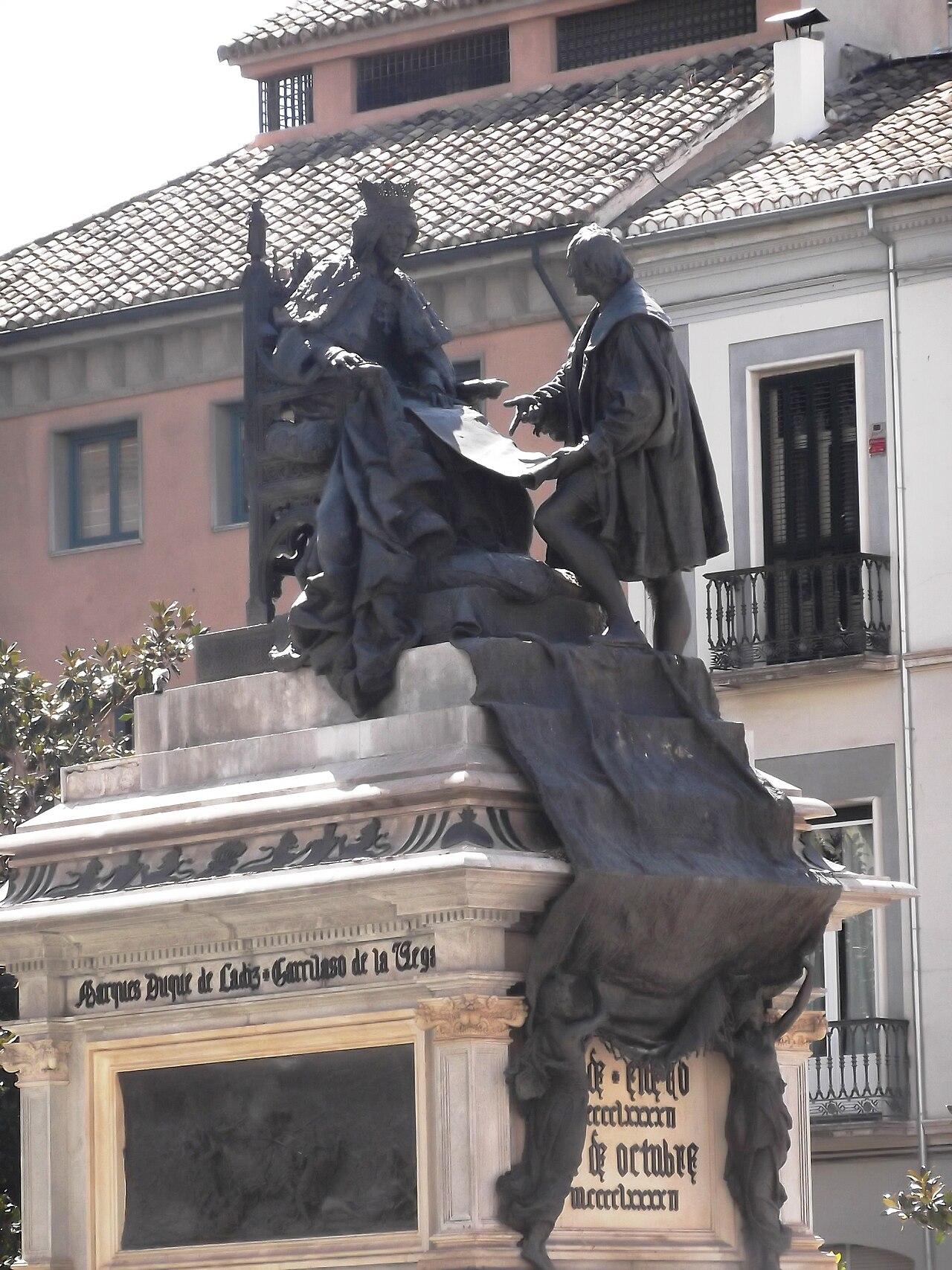
Dark bronze monument on a stone pedestal in a city square: a seated crowned queen in a flowing robe, with a standing man in a long cloak and cap beside her holding a sheet of paper. Beige buildings with tiled roofs and balconies are behind it.Sculpture

Secondary source

Monument of Columbus before the Catholic Monarchs, Granada

لا روسا · photographed 22 September 2013

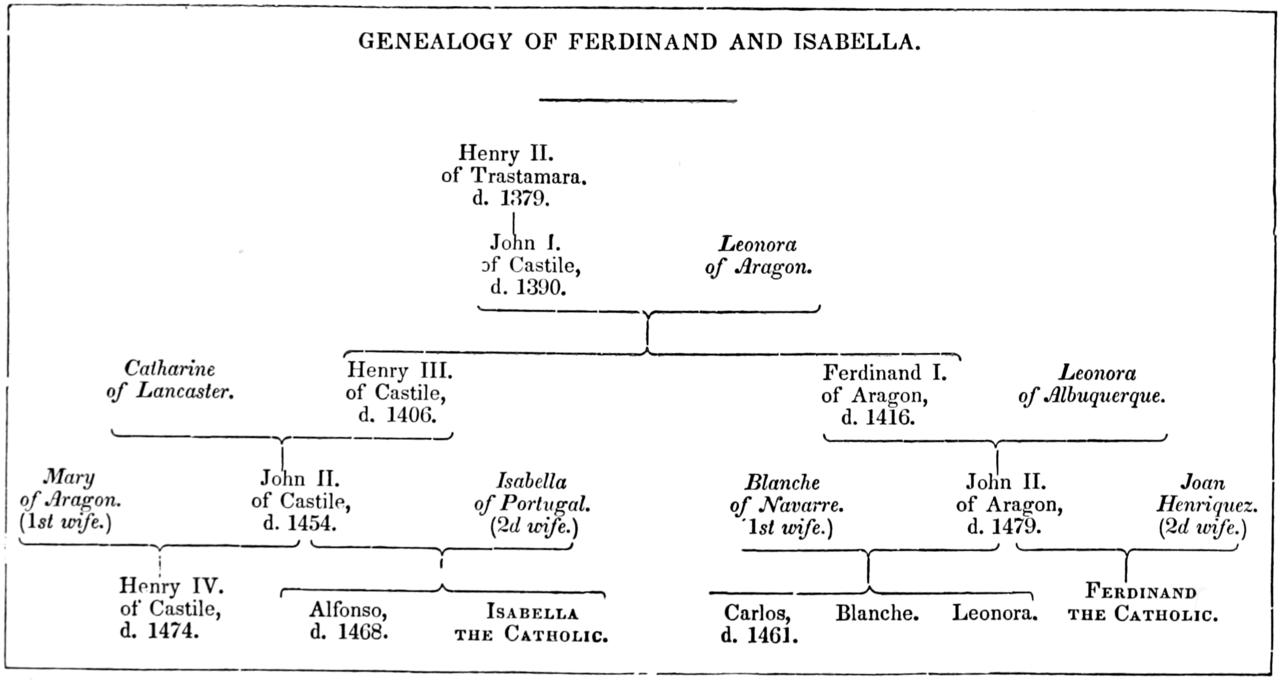
Printed family tree titled 'Genealogy of Ferdinand and Isabella'. Top center: Henry II of Trastamara (d. 1379) above John I of Castile (d. 1390) and Leonora of Aragon, joined by a bracket. Below, Henry III of Castile (d. 1406) and Ferdinand I of Aragon (d. 1416), with Catharine of Lancaster and Leonora of Albuquerque as spouses. Lines descend to John II of Castile, Isabella of Portugal, Blanche of Navarre, John II of Aragon, and Joan Henriquez. Final generation: Henry IV of Castile, Alfonso, Isabella the Catholic, Carlos, Blanche, Leonora, and Ferdinand the Catholic.Document

Secondary source

Genealogy of Ferdinand and Isabella, from Prescott's history

William Hickling Prescott · 1846

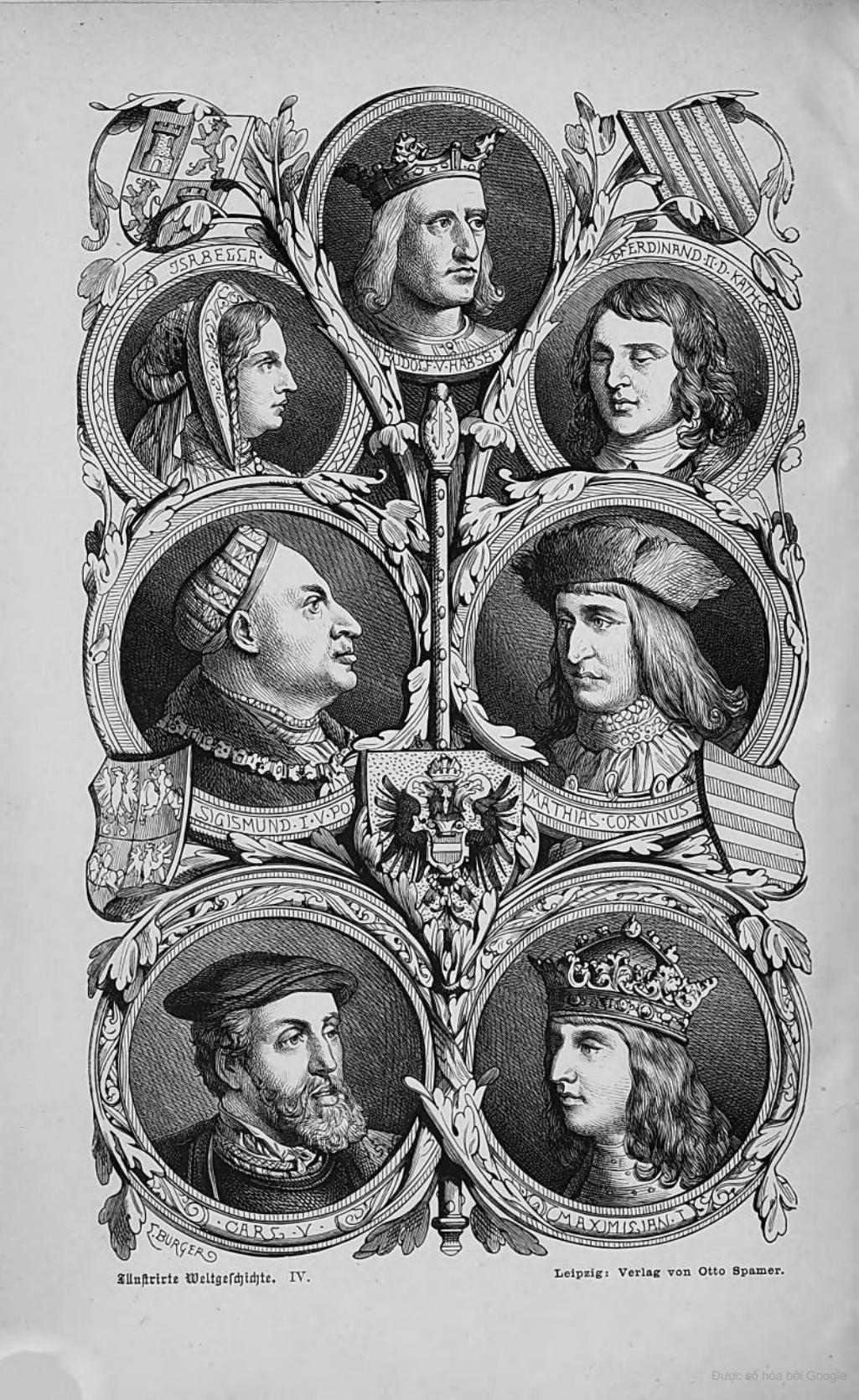
Engraved print of seven medallion portraits of medieval rulers arranged around a central heraldic shield with a double-headed eagle. Top: a crowned man (Rudolf). Upper left: a woman in a headdress (Isabella). Upper right: a man with long hair (Ferdinand). Middle left: a man in a fur hat (Sigismund). Middle right: a man in a plumed hat (Matthias Corvinus). Lower left: a bearded man in a cap (Charles V). Lower right: a young crowned man (Maximilian). Caption text reads Illustrirte Weltgeschichte IV and Leipzig: Verlag von Otto Spamer.Painting

Secondary source

Medieval rulers medallion print, 1883

L. F. Dieffenbach and others · 1883

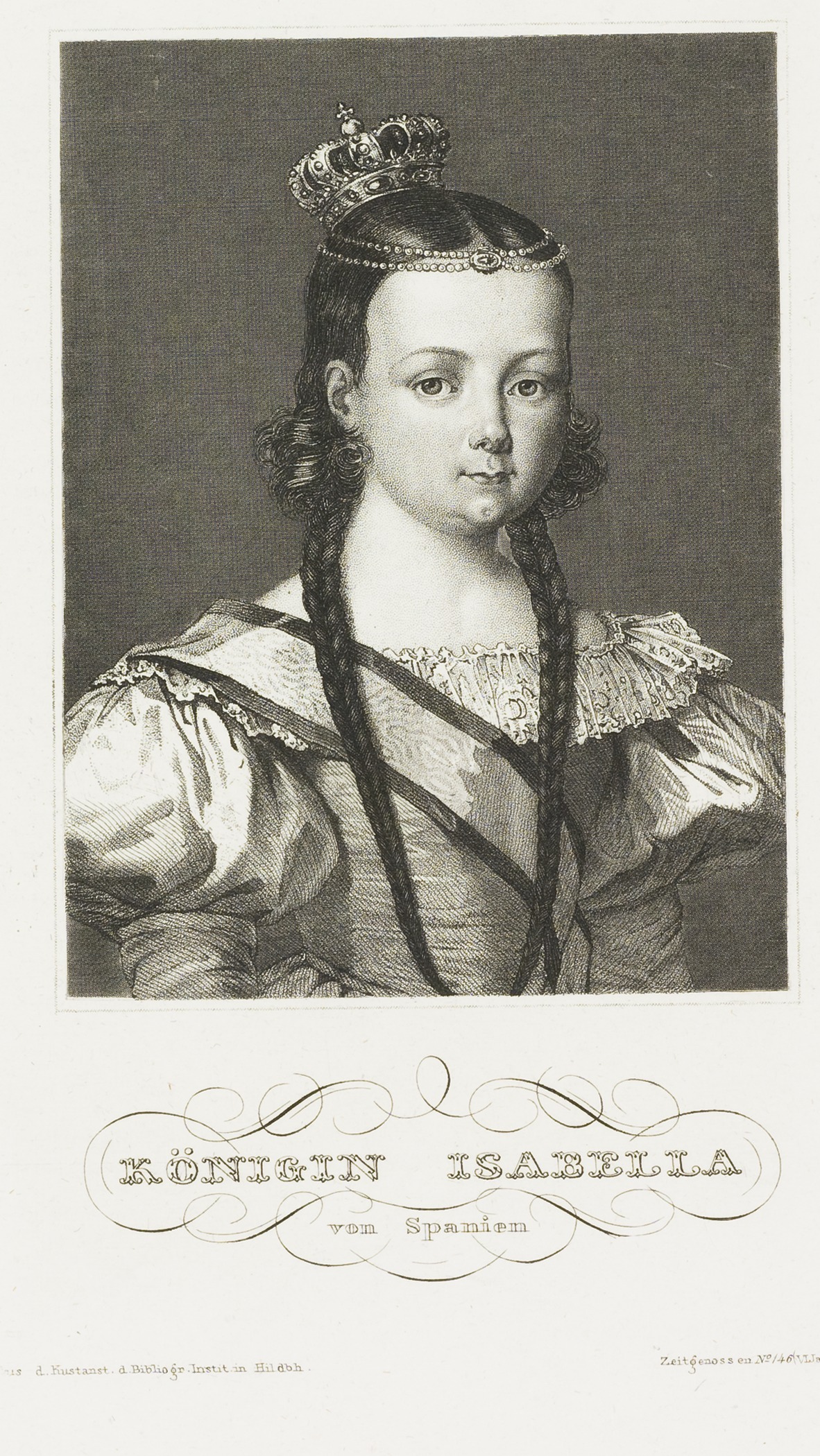
Black-and-white engraved portrait of a young woman wearing a jeweled crown and a tiara, with dark hair in braids and curls, a lace-collared gown with puffed sleeves. Below the image is the German title 'Königin Isabella von Spanien' in decorative script within an ornamental frame.Painting

Secondary source

Königin Isabella von Spanien (Zeitgenossen portrait print)

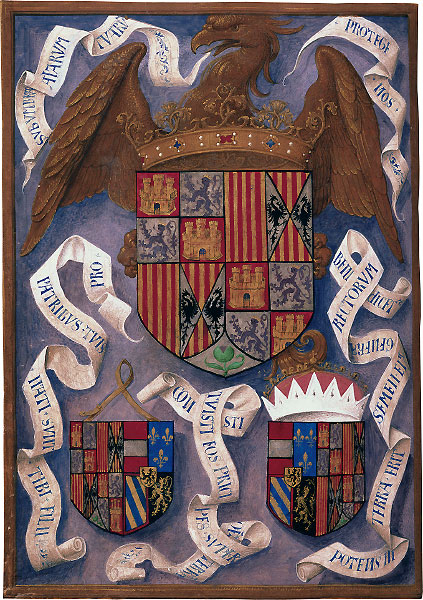
Painted heraldic page showing a large brown imperial eagle with a crown above a shield of quartered Castilian, Aragonese, and other arms, flanked by two smaller shields below. Scrolls with Latin inscriptions surround the eagle and shields on a blue-violet background.Book

Primary source

Coat of arms page, Isabella Breviary

1492-October 4th 1497

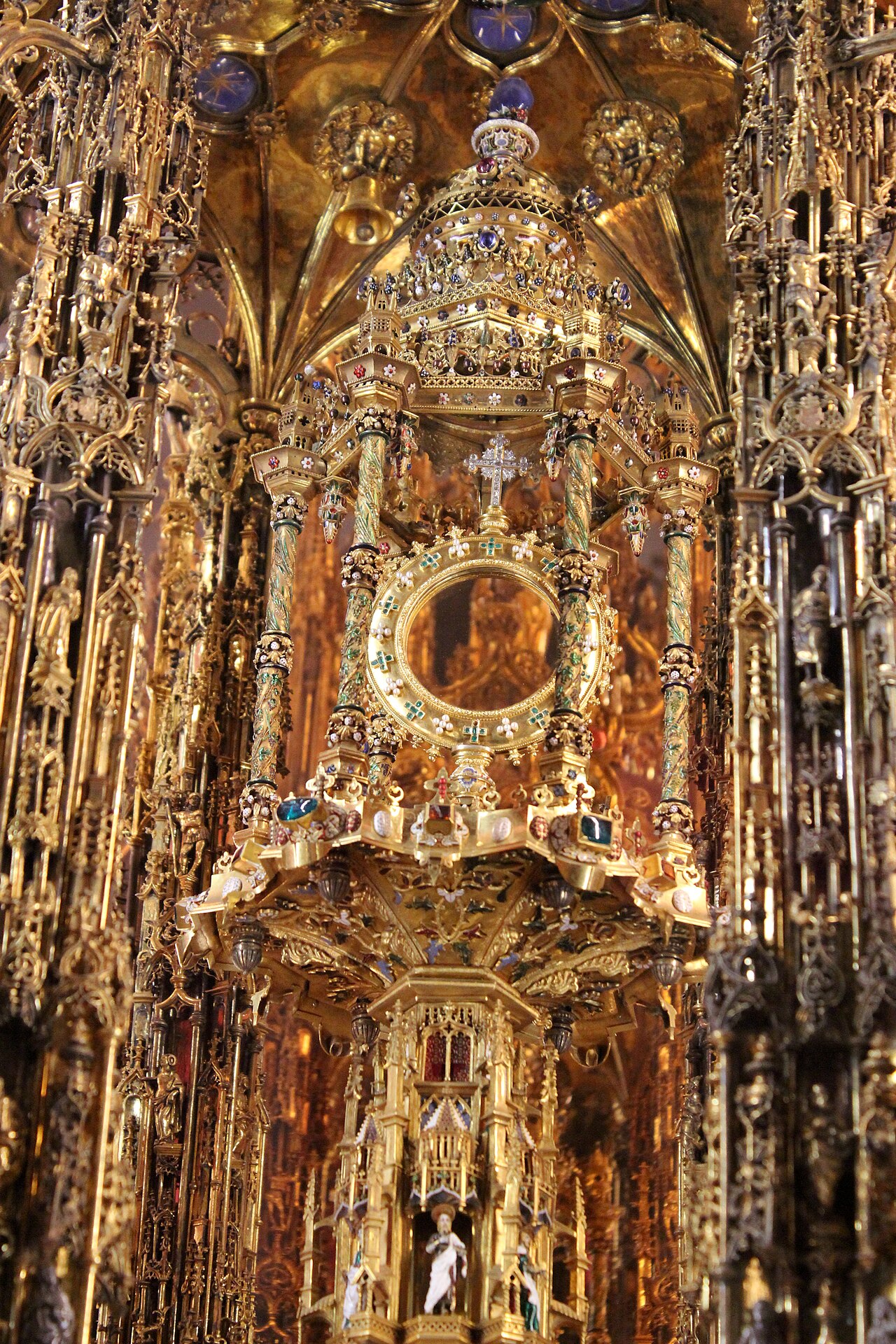
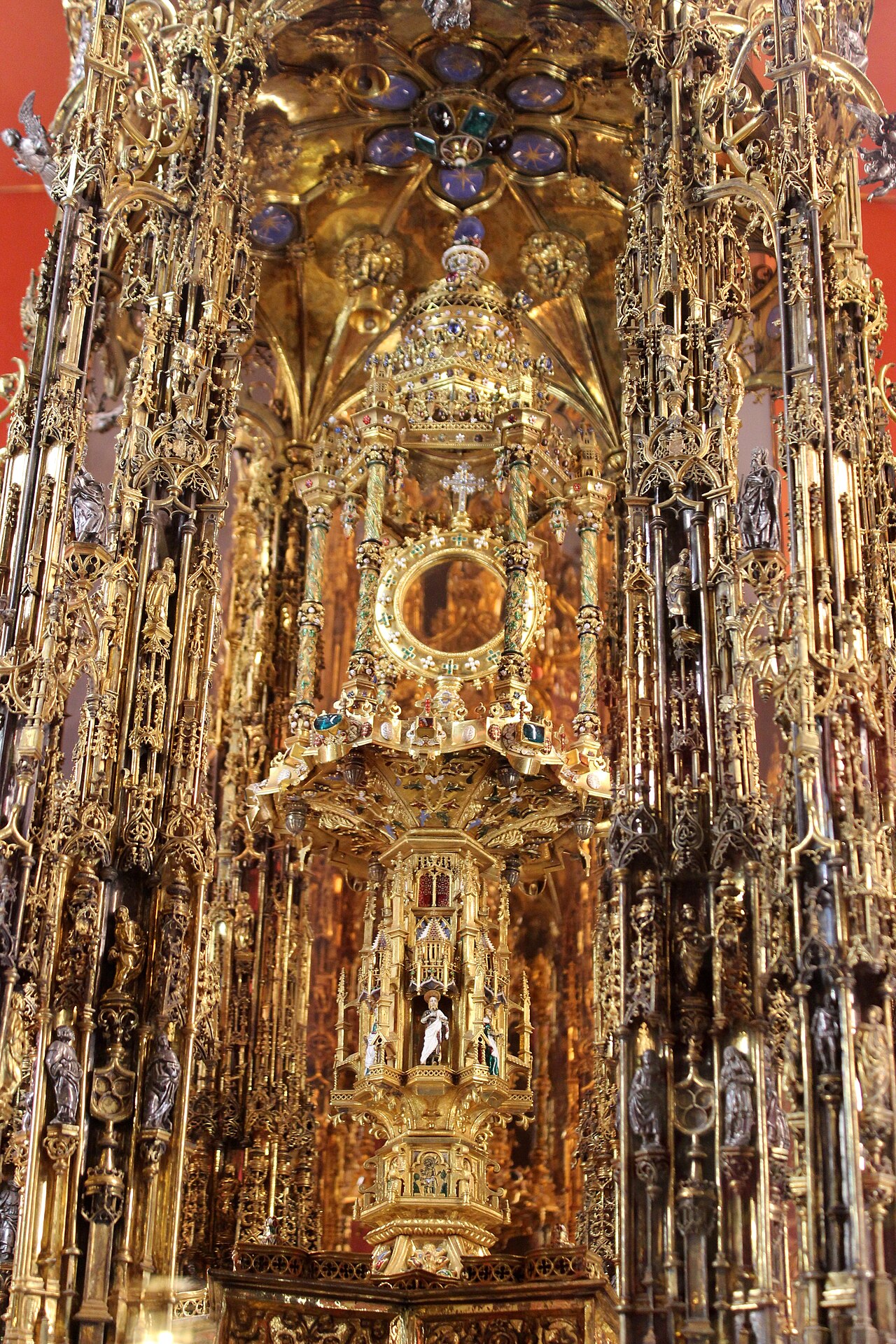
Close view of a large gilded Gothic monstrance in Toledo Cathedral: an ornate tower of spires and tracery surrounds a central smaller gilded monstrance with a glass lunette, columns, and a figure in a niche.Artifact

Primary source

Monstrance of Isabella the Catholic, Toledo Cathedral

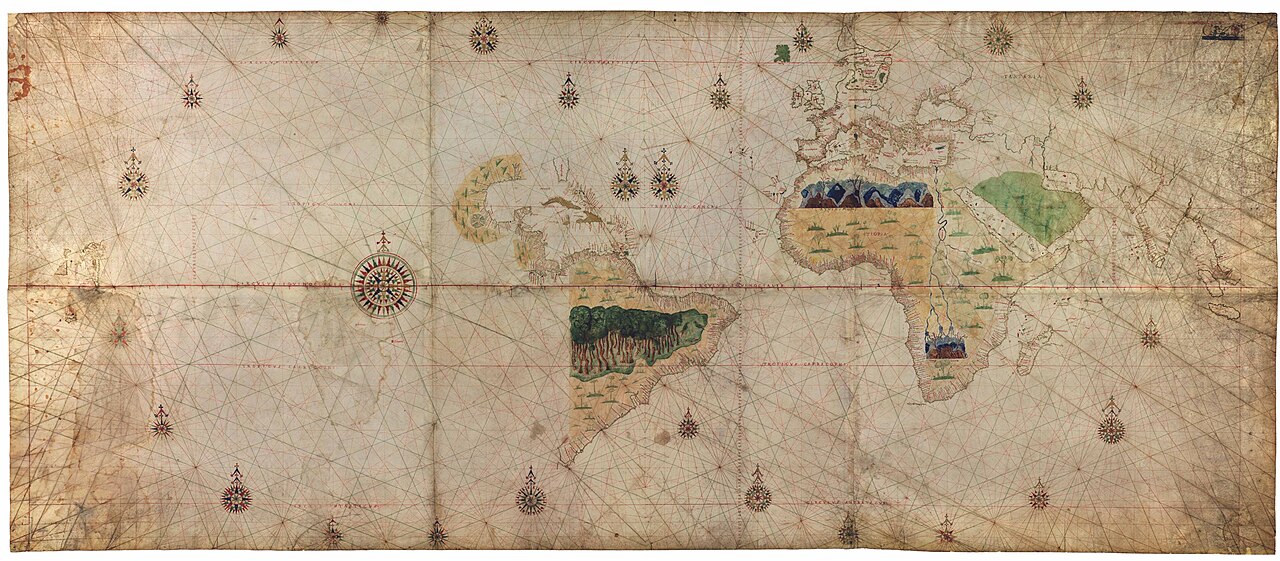
Hand-painted portolan chart on aged parchment showing the Atlantic, with the Americas on the left, Europe and Africa on the right, compass roses, rhumb lines, and colored landmasses, flags and ships.Document

Primary source

Turin Map (Geocarta Nautica Universale), 1523

Juan Vespucci (attributed); Nuño García de Toreno also credited · 1523

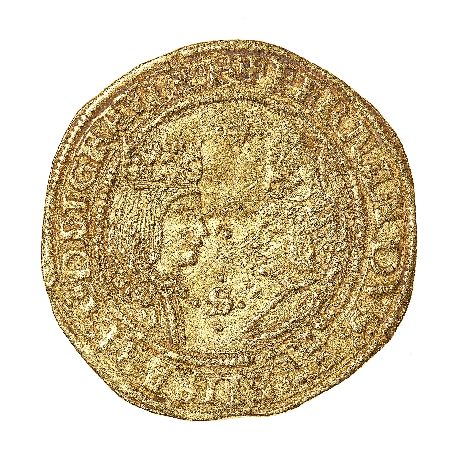
Gold coin viewed face-on on a white background. Worn, slightly irregular round coin with a raised profile portrait of a bearded or helmeted figure facing left, and partial inscription lettering around the rim.Artifact

Primary source

Double ducat of Ferdinand II and Isabella I

up to 1516

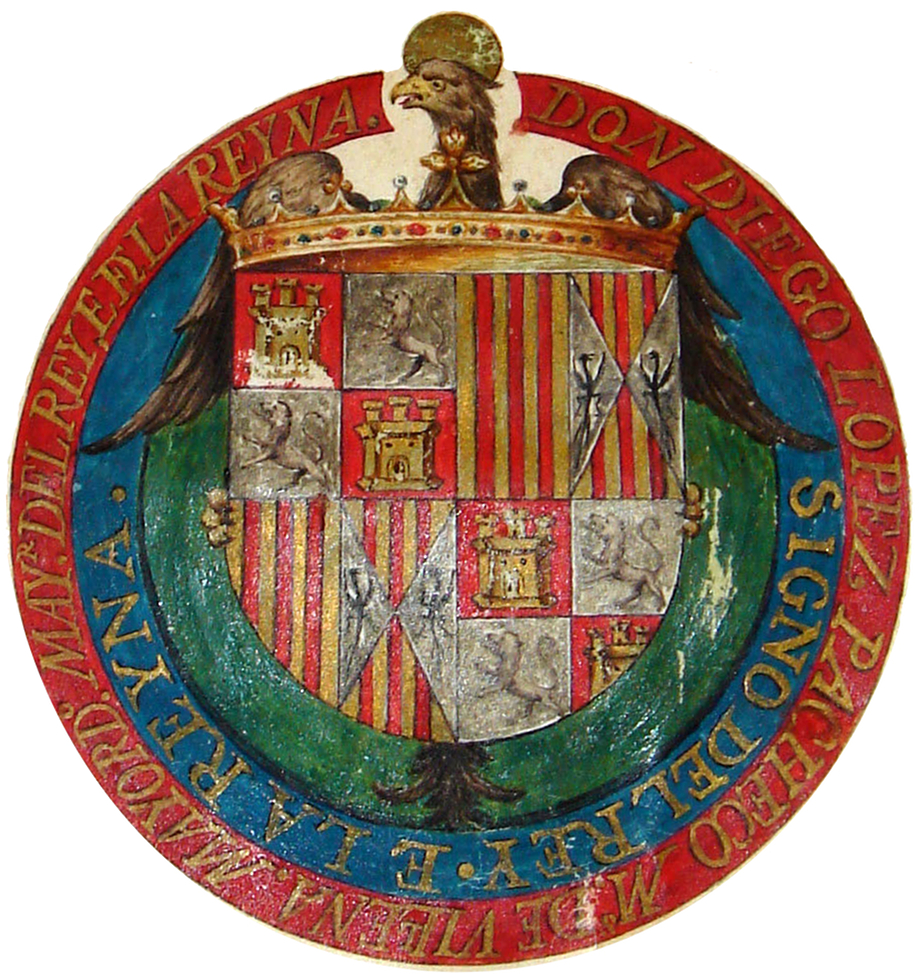
Circular painted seal in red, blue and green rings bearing gold lettering. Inside sits a coat of arms with a gold crown above, flanked by two dark eagle wings, showing castles, lions and red-and-gold stripes.Document

Primary source

1491 privilege with the emblem of the Catholic Monarchs for the Tejada estate

1491

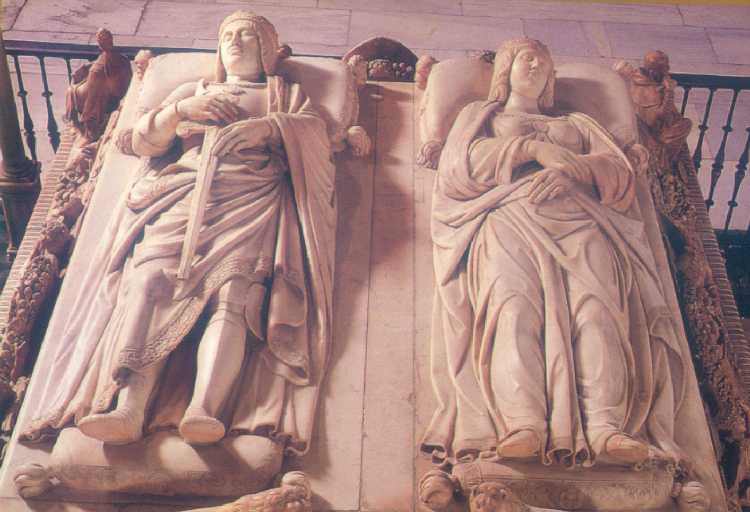
Marble effigies of a king and queen lying side by side on a tomb, with hands folded and eyes open, wearing royal robes and crowns on pillows. Carved decorative figures stand at the corners of the tomb, and an iron railing is visible behind.Photograph

Secondary source

Tomb of the Catholic Monarchs by Domenico Fancelli, Granada

Javi Guerra Hernando · 7 October 2014

Book

Secondary source

The Heroines of History

John S. Jenkins · 1851

Want the full shelf? Chat with Queen Isabella I in the app and open the Sources panel — every quote links back to the original.

Use Queen Isabella I in class

1 collection

A ready-made collection from the Humy team that features Queen Isabella I. Preview it, then try it free.

Trusted by educators worldwide

Conversations
375,000+
Real exchanges between students and historical figures
Messages exchanged
4,142,000+
Across every figure, classroom and language
Historical figures
100,000+
Each informed by a curated biography and selected sources
Languages supported
50+
From English and Spanish to Arabic and Korean

Paying customers

Used by 98 schools and universities

Partner school logo
Tecnológico de Monterrey logo
Hyper Island logo
Partner school logo
Chambersburg Area School District logo
Broward County Public Schools logo
Nebo School District logo
National Louis University logo
South Florida PBS logo
Punahou School logo
University of Wisconsin–River Falls logo
Partner school logo
Partner school logo
Archbishop Mitty High School logo
Kingsburg High School logo
Norwalk Public Schools logo
Partner school logo
Connections logo
Partner school logo
Moore Public Schools logo
Partner school logo
Partner school logo
Partner school logo
Partner school logo
Robbinsville Public Schools logo
Partner school logo
Partner school logo
Partner school logo
Tecnológico de Monterrey logo
Hyper Island logo
Partner school logo
Chambersburg Area School District logo
Broward County Public Schools logo
Nebo School District logo
National Louis University logo
South Florida PBS logo
Punahou School logo
University of Wisconsin–River Falls logo
Partner school logo
Partner school logo
Archbishop Mitty High School logo
Kingsburg High School logo
Norwalk Public Schools logo
Partner school logo
Connections logo
Partner school logo
Moore Public Schools logo
Partner school logo
Partner school logo
Partner school logo
Partner school logo
Robbinsville Public Schools logo
Partner school logo
Partner school logo

What educators are saying

“We enjoyed the program last year and used it frequently.”
“My students say it’s a welcome change of pace. I’m not a fan of the “sage on the stage” model, so I try to incorporate research-oriented and self-paced activities. With Humy, students have to take charge of their learning. They’ve become more adept at critical thinking, forming better questions, and improving their reading comprehension. The interview feature has been my go-to tool. I create assignments where students must ask historical figures a set number of questions, then summarize the responses to ensure they’re truly absorbing the material. This approach lets them actively explore the past rather than passively consuming information.”
“Humy has helped me bring historical figures, sometimes long past, to life. When my students interact with these figures in real-time, it eliminates some of the perceived “ancient” characteristics of my curriculum. This has shifted my students’ thinking away from viewing history as abstract or irrelevant. Real-time interactions make historical figures relatable, even allowing students to ask off-topic questions that help put historical lives in a more relevant context for 13-year-olds. The feature I use the most is the interview feature. After teaching a topic, most recently Gandhi and Joan of Arc, I have the students ask pointed, focused questions. We practice good conversation techniques beforehand, teaching them to listen (or read) carefully and formulate thoughtful follow-up questions rather than just interrogating. It helps students practice effective conversation skills.”

FAQ

Frequently asked questions

Who is Queen Isabella I?
Queen of Castile and patron of Christopher Columbus. On Humy.ai you can chat with an AI version of Queen Isabella I that draws on a short biography and 84 historical sources during the conversation — by text or voice, in 42 languages.
Is Queen Isabella I AI free?
Queen Isabella I is part of Humy's full library of more than 100,000 figures, which comes with a paid plan. A free account (no credit card) includes 20 messages a month with the free library's figures, so you can try how the conversations work first.
What sources does the Queen Isabella I AI use?
It draws on a short biography and 84 historical sources (paintings, documents and books), including “Alhambra Decree”, “Capitulations of Santa Fe” and “Treaty of Tordesillas”. Each source has its own page on Humy.ai.
How historically accurate is the AI version of Queen Isabella I?
Each figure uses a short biography and a small set of selected historical sources as context (retrieval-augmented generation), so answers stay closer to known material than the model's general knowledge alone. It isn't a citation-grade research tool — like any LLM, the AI can get details wrong or extrapolate. Treat it as a strong starting point for inquiry and cross-reference important claims.
Can I talk to Queen Isabella I by voice?
Yes. In addition to text chat, you can call Queen Isabella I and hear their voice respond in real time — useful for auditory learners, interview practice and Socratic dialogue.
Is Humy.ai safe and compliant for schools?
Yes. Humy.ai is used by more than 100 schools, universities and organisations. The platform is FERPA- and GDPR-aligned, supports SSO, and offers an IT-approval pack tailored for school procurement teams.

Cross-reference Queen Isabella I

Like any LLM, the AI version of Queen Isabella I can get details wrong. Open one of these sources in a new tab to verify what you’ve read.

Ready when you are

Start chatting with Queen Isabella I now.

20 messages free · No credit card · Available in 50+ languages.