
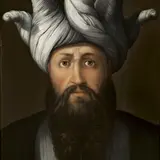
Portrait of Saladin

AI Historical Figure

Saladin

Kurdish military leader and Muslim sultan, known for his role in the Crusades.

Chat with Saladin via text or voice — in 42 languages, drawing on a curated biography and 78 historical sources. Available 24/7.

Start chatting with Saladin20 messages free · No credit card
Lived
c. 1137–1193
From
EgyptSyria
Known for
Rulers & royaltyPolitics & government
Saladin

Saladin

Online · responds in seconds

Hello — I'm Saladin. Kurdish military leader and Muslim sultan, known for his role in the Crusades. What would you like to ask me?

20 messages free · No credit card · Powered by Humy.ai

Live preview · Switch between 42 languages above · Send a message to continue in the app

Multilingual

Talk to Saladin in 42 languages

Ask Saladin questions in any language below, and the rest of Humy's app speaks it too. Pick yours to open the chat in that language.

Also in German (Austria), German (Switzerland), English (UK), English (Australia), English (Canada).

The sources behind this AI

78 sources · 22 paintings · 19 artifacts · 16 photographs · 10 books · 9 documents · 2 sculptures

Saladin doesn’t improvise from thin air. The AI is grounded in 78 curated historical sources students can inspect. Open any of them to see what informs the conversation.

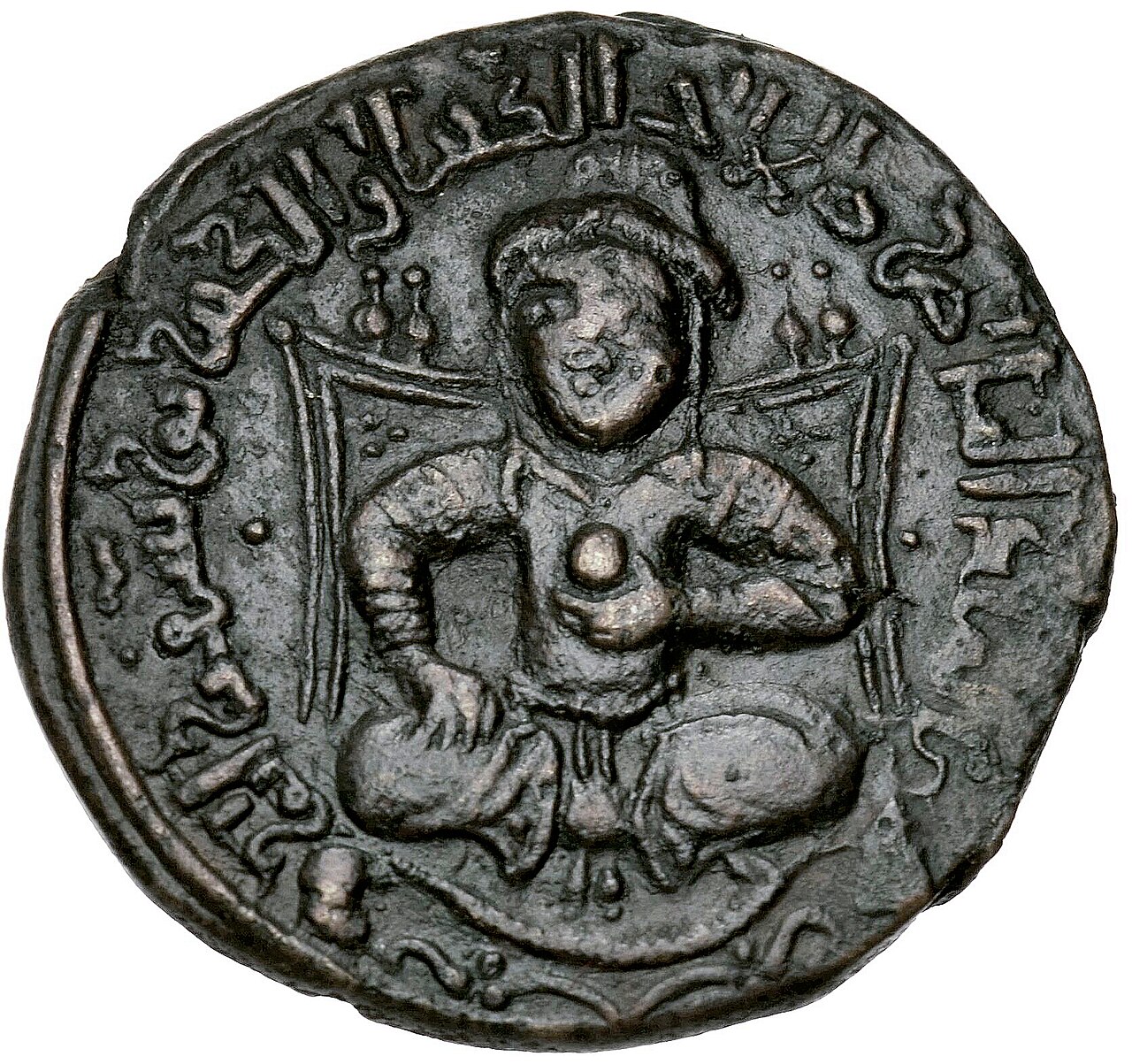
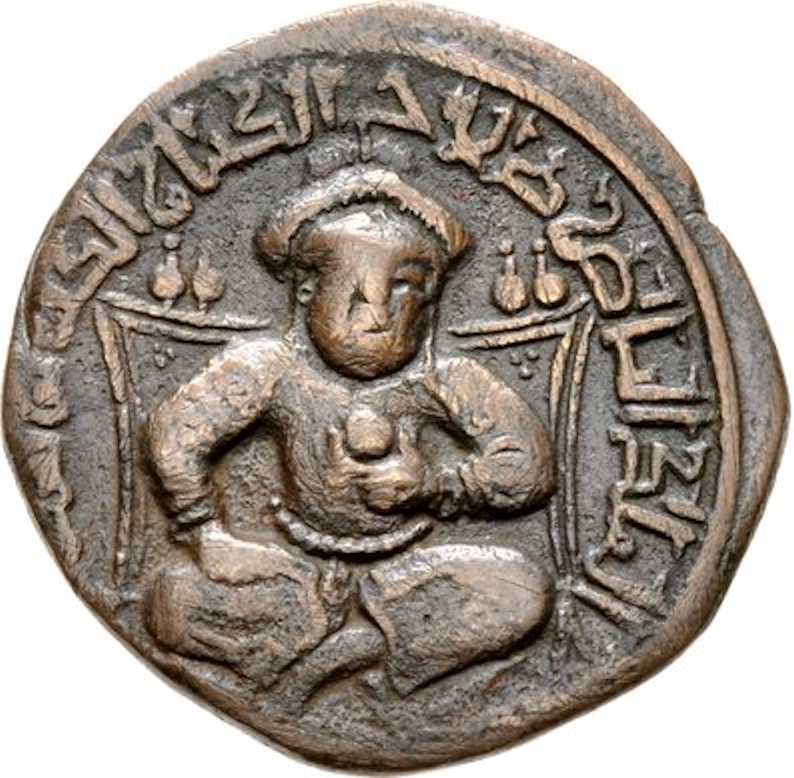
Bronze dirham coin, obverse, showing a seated figure facing forward, cross-legged, with a rounded face and hands resting on knees, flanked by a high-backed throne. Arabic inscriptions in circular margin around the edge.Artifact

Primary source

Dirham of Saladin

AH 586 (AD 1190-91)

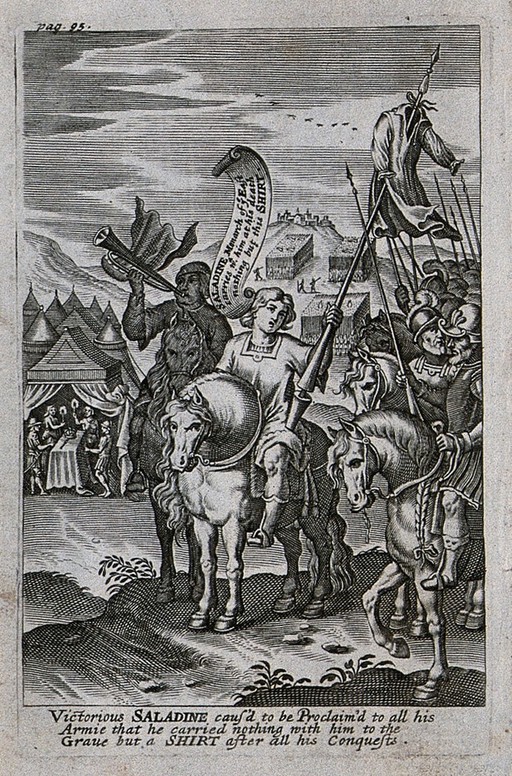
Engraving of a mounted figure in a tunic on a pale horse, with a banner-carrying rider behind him and a scroll above reading a proclamation. Soldiers with spears and a tent camp appear on the left, and a walled town on a hill behind. Caption below in print reads that Saladin caused it to be proclaimed that he carried nothing with him to the grave but a shirt.Painting

Secondary source

Saladin Proclaims He Will Take Only a Shirt to His Grave

John Payne · 1639

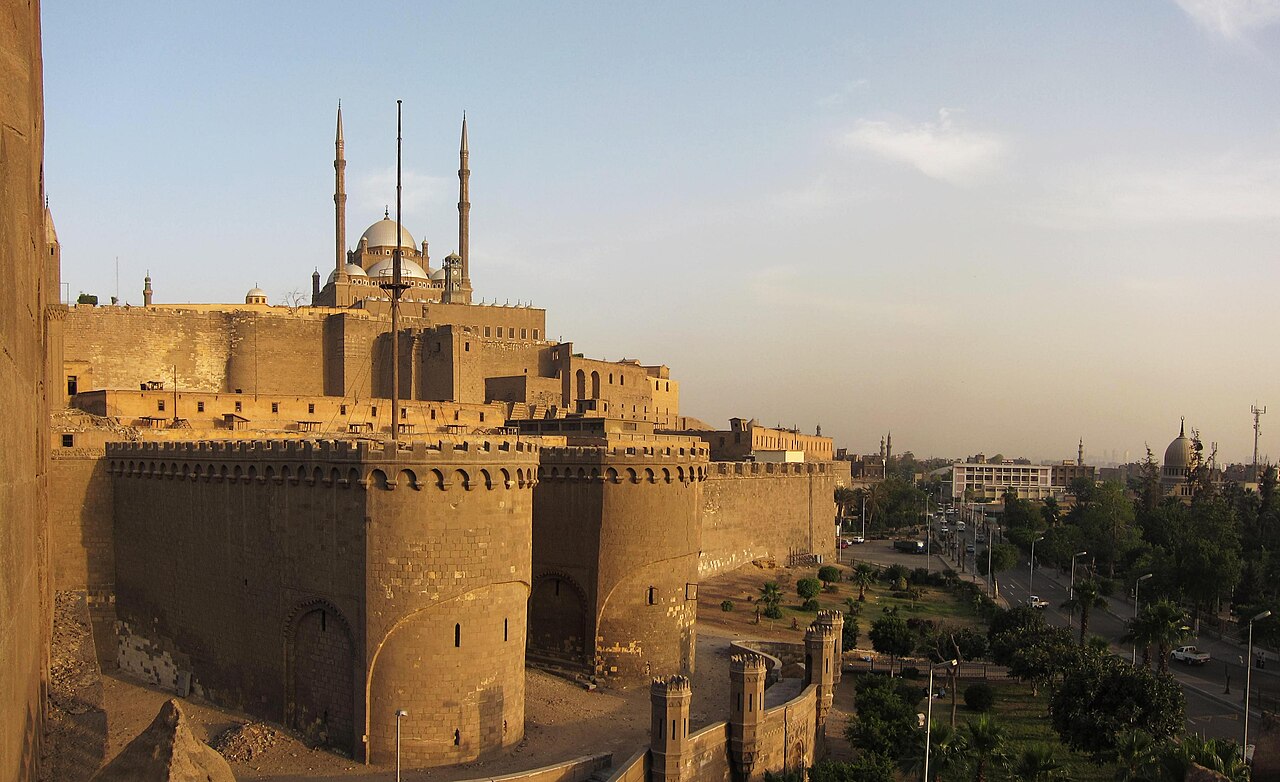
Exterior of the Saladin Citadel in Cairo at golden hour: thick tan stone walls with round towers and crenellated battlements, with the domed mosque and two slender minarets rising behind on the hilltop. A modern city street with trees and lamp posts lies to the right.Artifact

Primary source

Cairo Citadel

Saladin · begun 1176

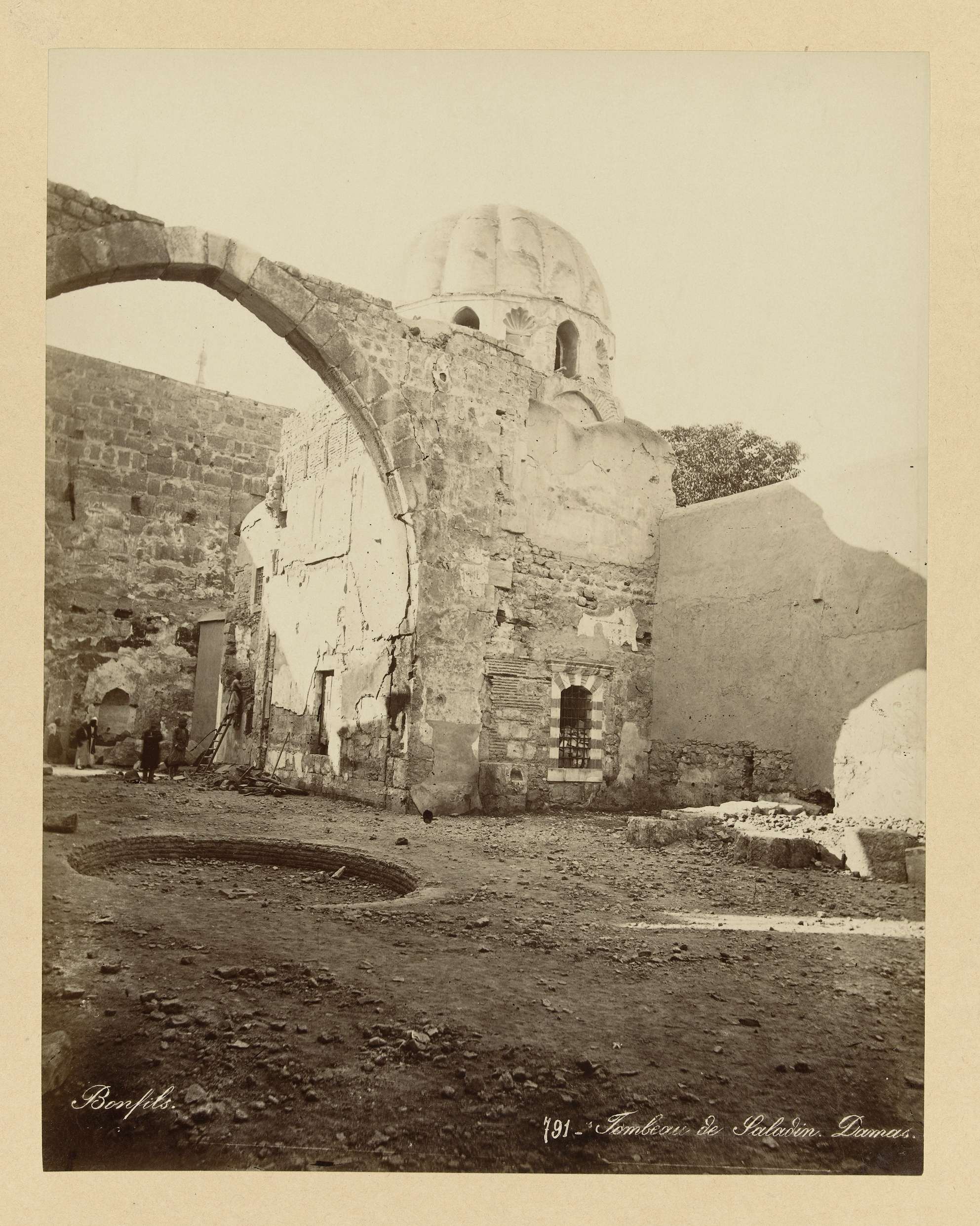
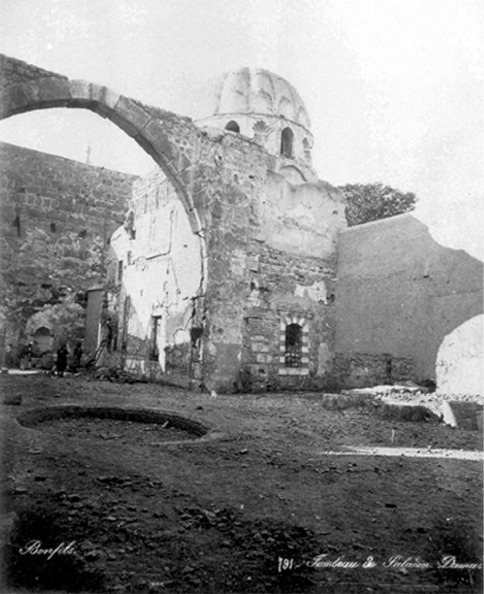
Sepia photograph of the Tomb of Saladin in Damascus. A large stone arch spans the left, behind a domed structure with arched windows and a striped-arch window. Ruined walls, a rubble courtyard, and a few people near a ladder stand in front. The caption reads 791 Tombeau de Saladin Damas, with the name Bonfils.Photograph

Secondary source

Tomb of Saladin, Damascus

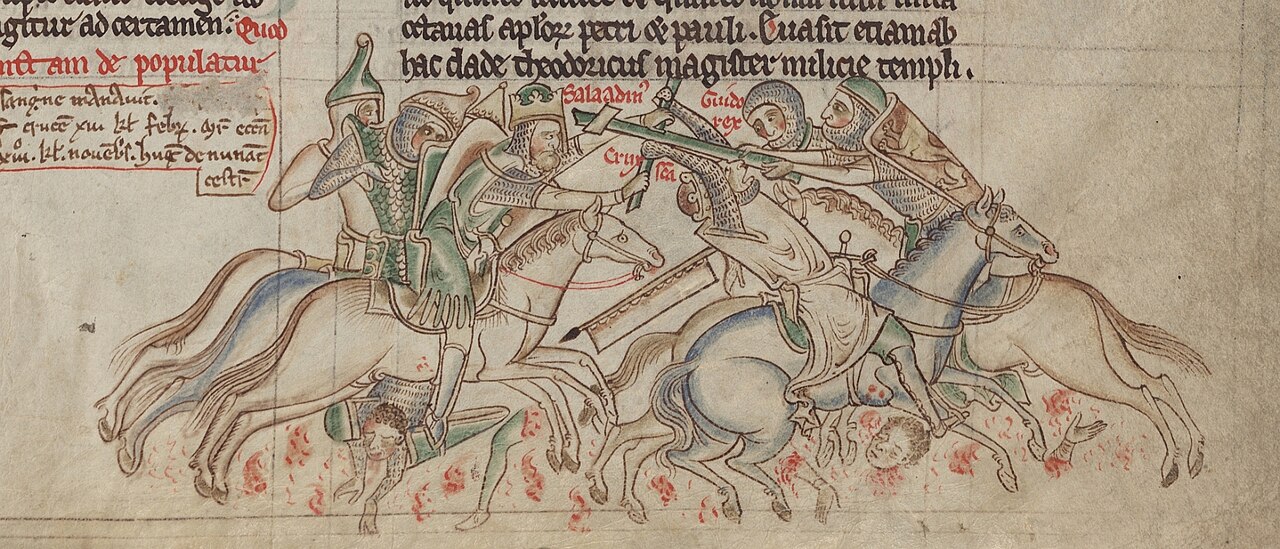
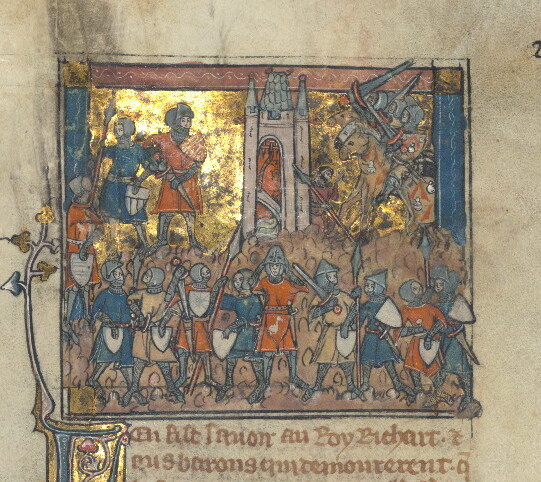
Medieval manuscript illumination of mounted knights in combat on a grassy field with red-dotted ground. Riders with lances and shields charge; one rider labeled Saladin and another labeled Guy. Red and black Latin text fills the page above.Painting

Secondary source

Saladin Seizing the True Cross from Guy of Lusignan

Matthew Paris

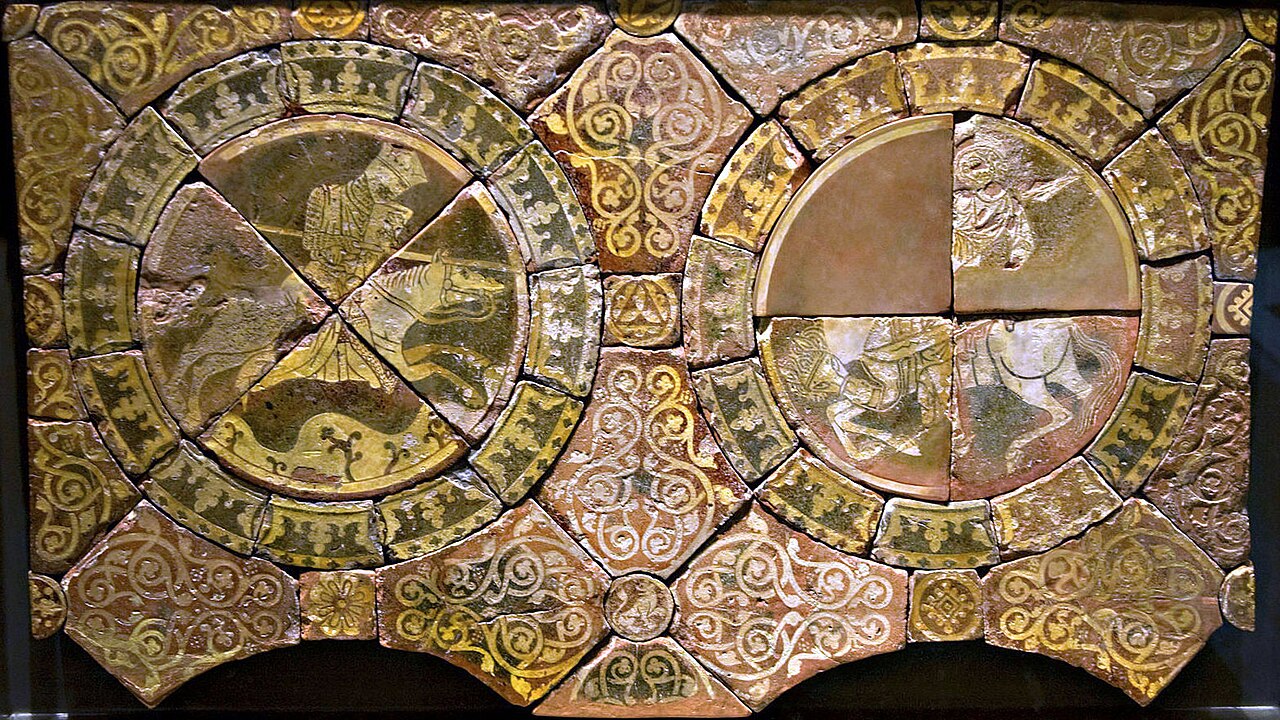
A rectangular panel of decorated medieval earthenware tiles with lead glaze, arranged around two large circular tiles. The left circle shows a mounted rider and a horse with a figure; the right circle shows a mounted figure and a horse, with a helmeted head in the upper section. Surrounding tiles have scrolling foliage and heraldic-style patterns in yellow and green.Artifact

Secondary source

Chertsey Tiles of Richard and Saladin

c. 1250-1260

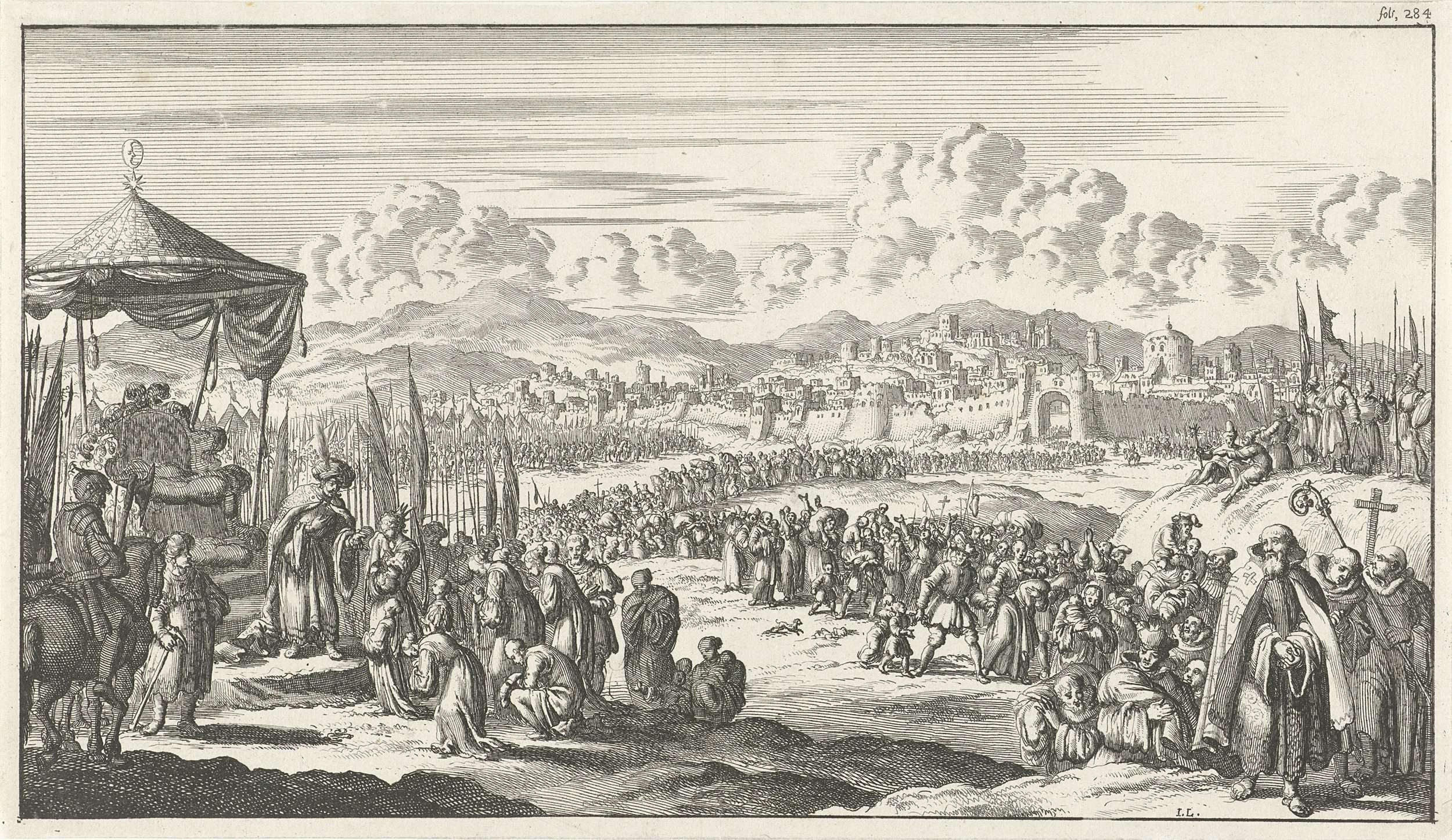
Engraving of a crowd scene before a walled city on a hill. At left, a canopied tent and a turbaned figure in a long robe stand before kneeling people; soldiers with spears and banners line the area. At right, clergy with a cross and crozier stand among a crowd of people, some carrying bundles. Hills and buildings fill the background. Page number 'fol. 284' appears top right.Painting

Secondary source

Jerusalem Retaken by Saladin

1683

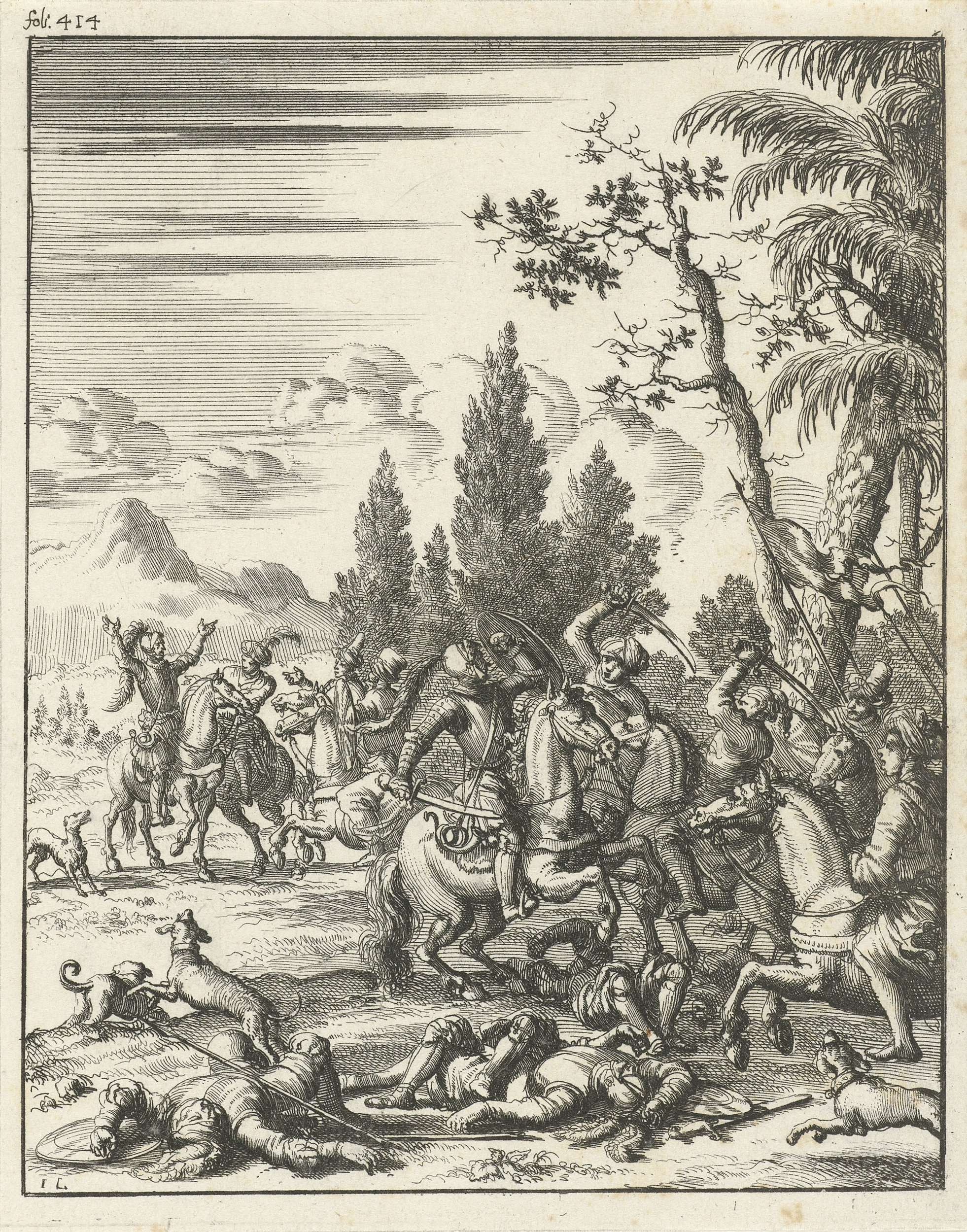
Engraving labeled folio 414 showing a cavalry battle in a landscape with cypress trees and a palm tree. Armored riders on horses wielding swords clash among fallen bodies. Dogs and a figure pointing stand at left. Signed IL at lower left.Painting

Secondary source

Cavalry Battle Between Richard the Lionheart and Saladin

1683

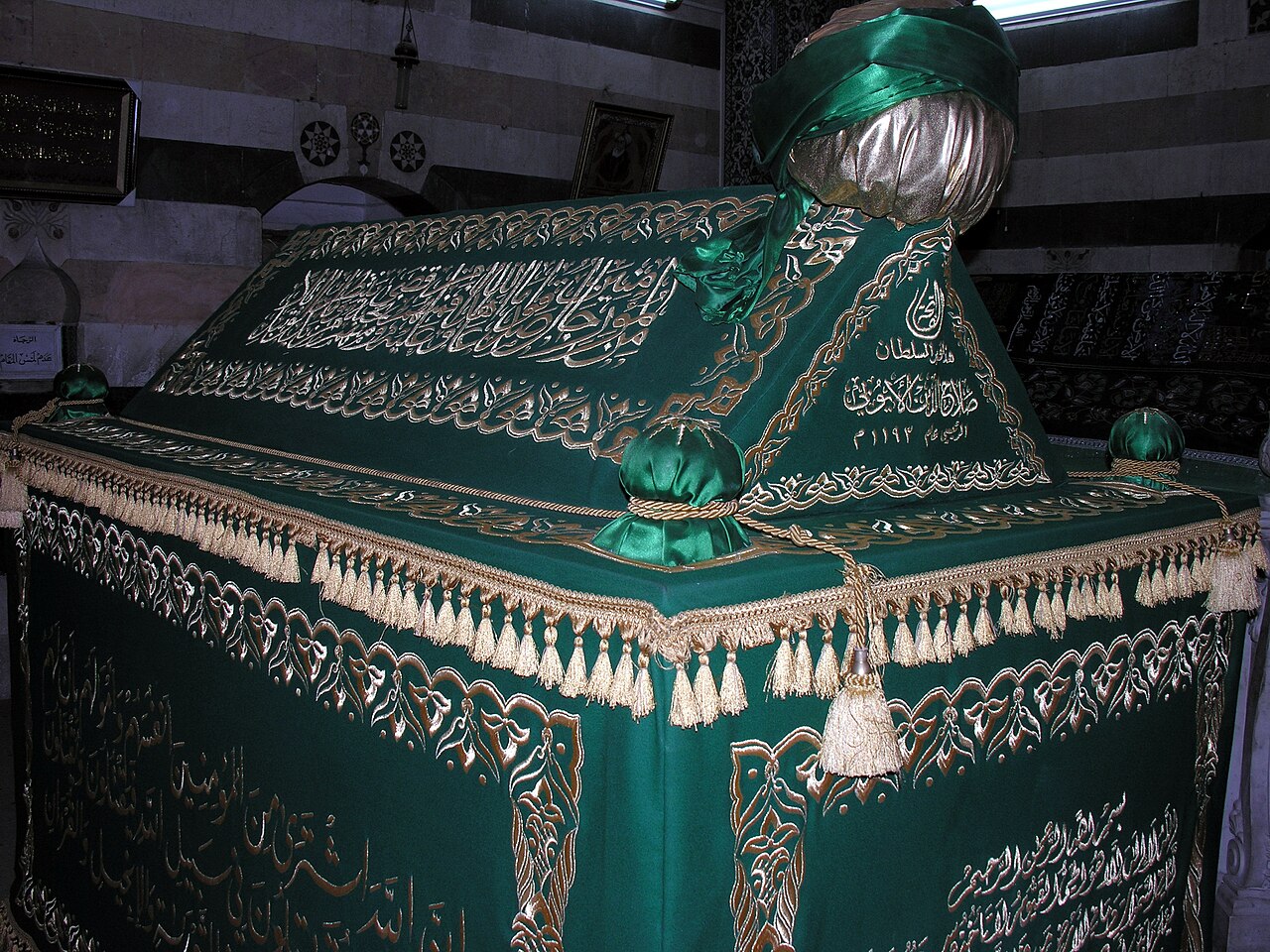
A green cloth-draped tomb covered with gold embroidered Arabic inscriptions and gold tassels, topped with a green and gold turban-shaped finial, inside a dim stone-walled room.Artifact

Secondary source

Grave of Saladin

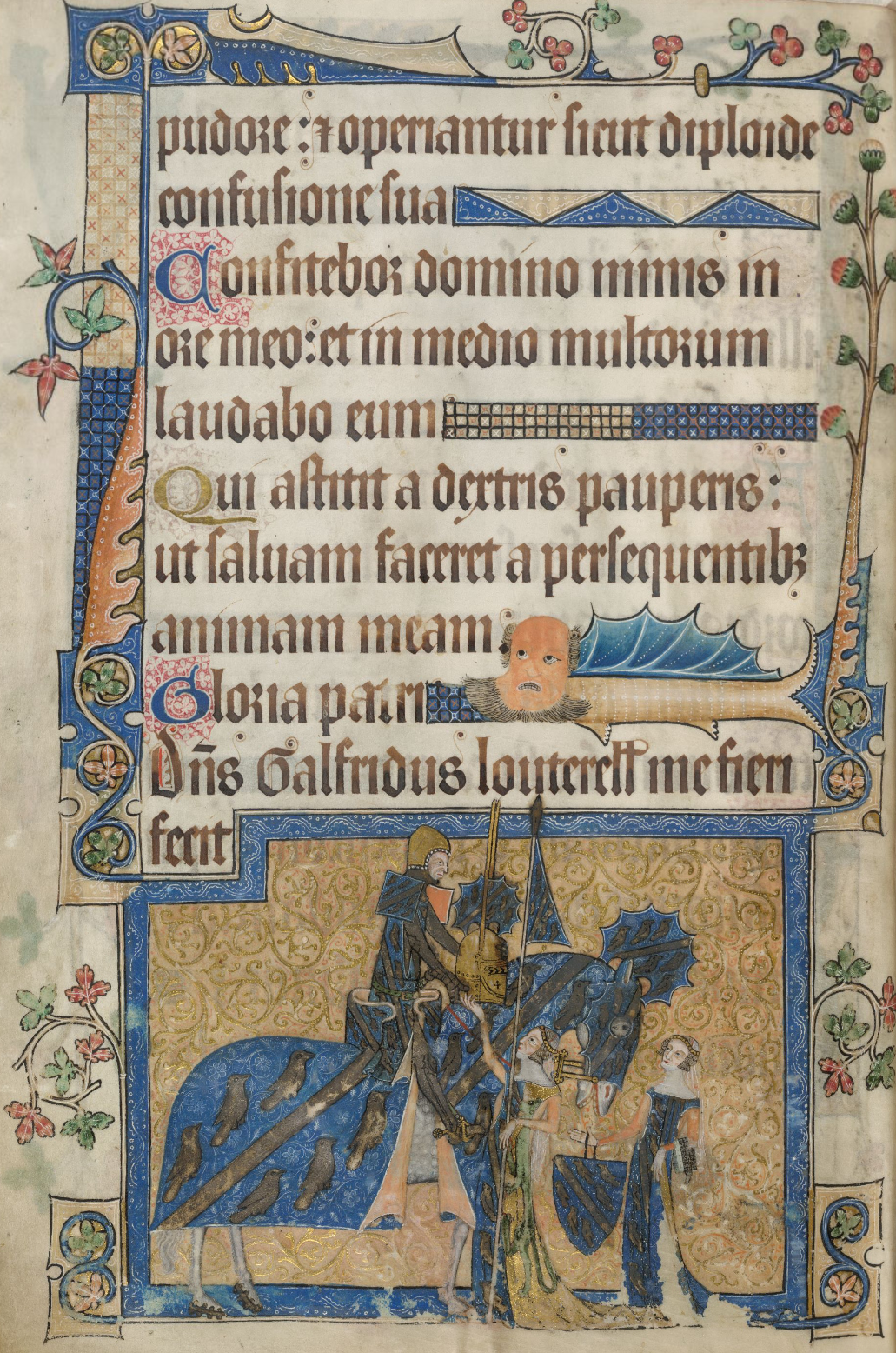
Illuminated manuscript folio with Latin text in black gothic script and a lower miniature of a mounted armored knight in blue caparison, with a helmeted attendant, a standing woman holding a spear-like staff, and a woman at right, on gold patterned background. A grotesque face appears in the margin.Book

Secondary source

Luttrell Psalter

c. 1320-1340

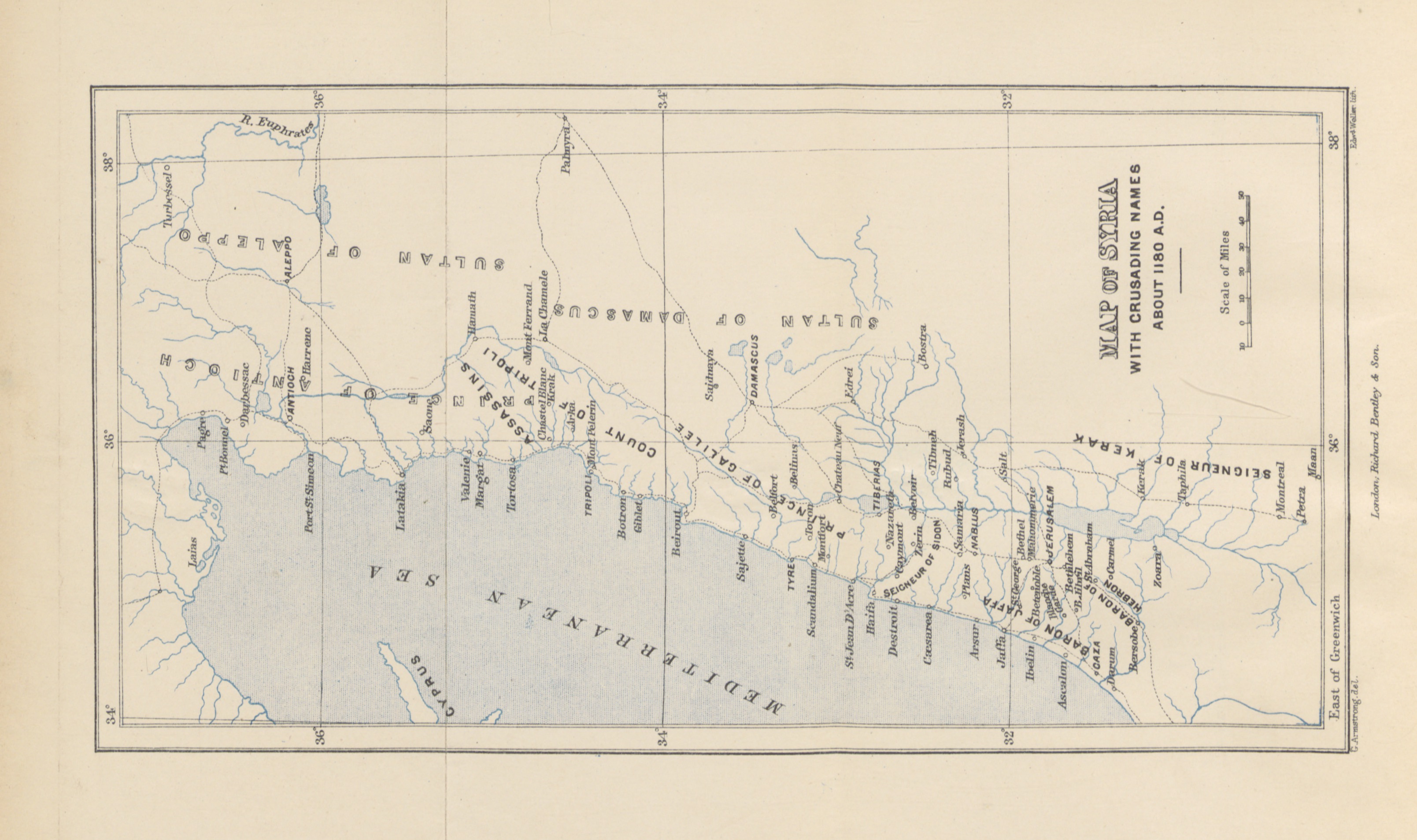
Antique map titled 'Map of Syria with Crusading Names about 1180 A.D.', showing the coastline of the Mediterranean Sea, Cyprus, rivers such as the Euphrates, and labeled regions including Aleppo, Antioch, Damascus, Tripoli, Tyre, Acre, Jerusalem, and Hebron in faded blue and black ink.Document

Tertiary source

Map of Syria with Crusading Names About 1180 A.D.

1888

Book

Secondary source

Libellus de expugnatione Terrae Sanctae per Saladinum

late 12th–early 13th century

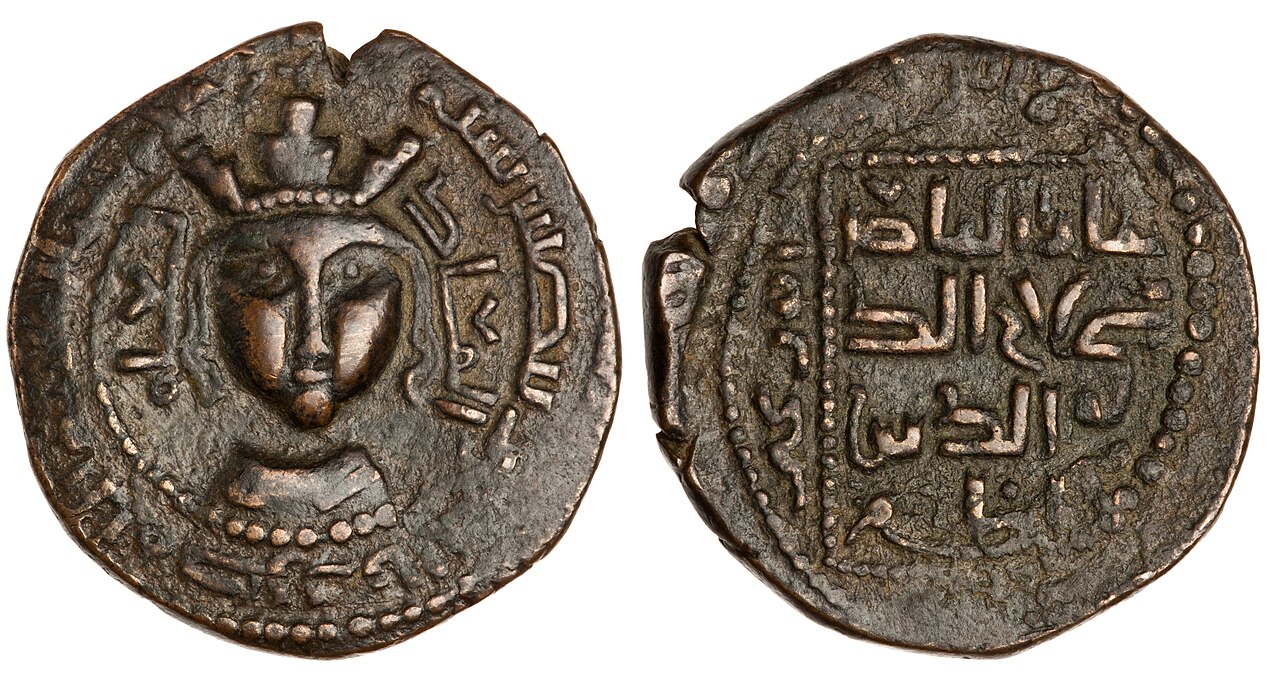
Two sides of a bronze coin. The obverse shows a stylized facing human head with a crown-like headdress and a bust below, surrounded by Arabic inscriptions. The reverse shows Arabic script in a rectangular frame with a dotted border.Artifact

Primary source

Coin of Saladin, Nisibin Mint

578 AH (1182–83 CE)

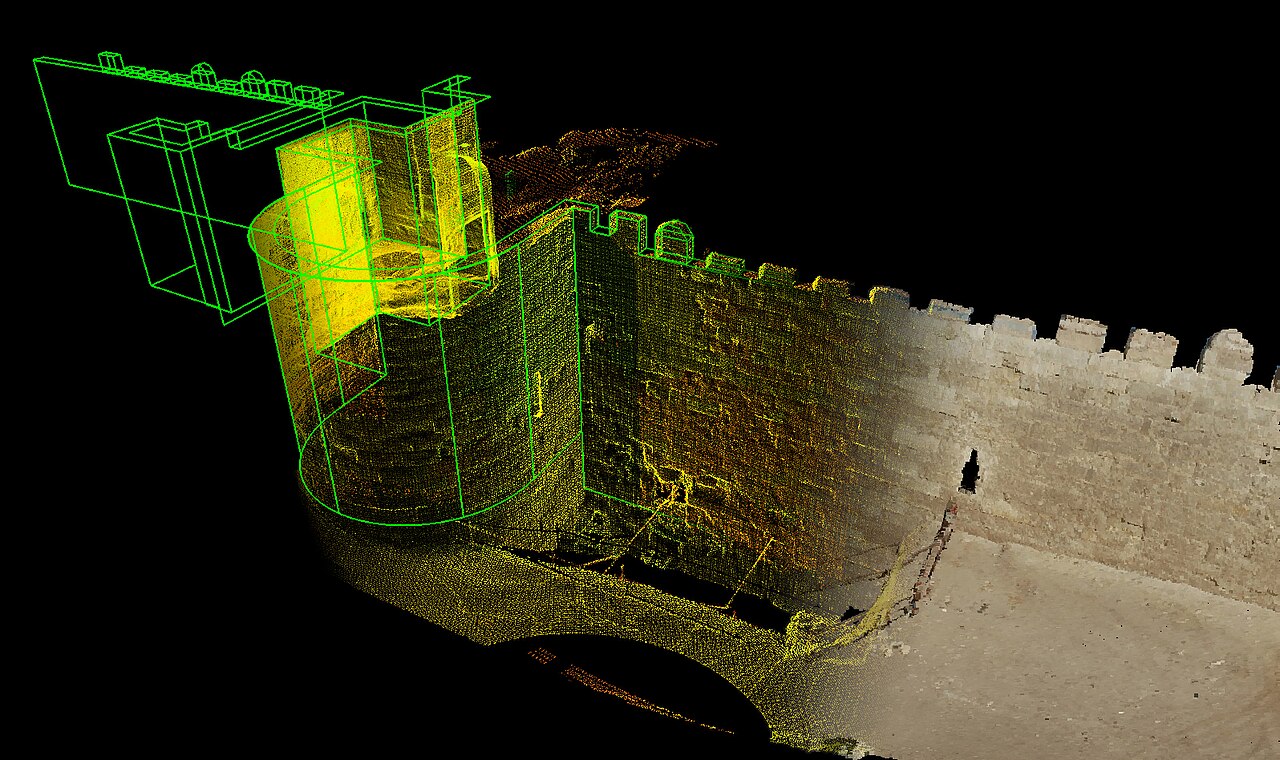
A 3D laser-scan model of a section of the Ayyubid wall in Cairo. Green wireframe boxes outline a tower and wall top, with yellow point-cloud mesh showing the stone masonry. On the right, the wall is rendered in photographic color above a sandy ground.Artifact

Primary source

Ayyubid Wall of Cairo

1176 CE

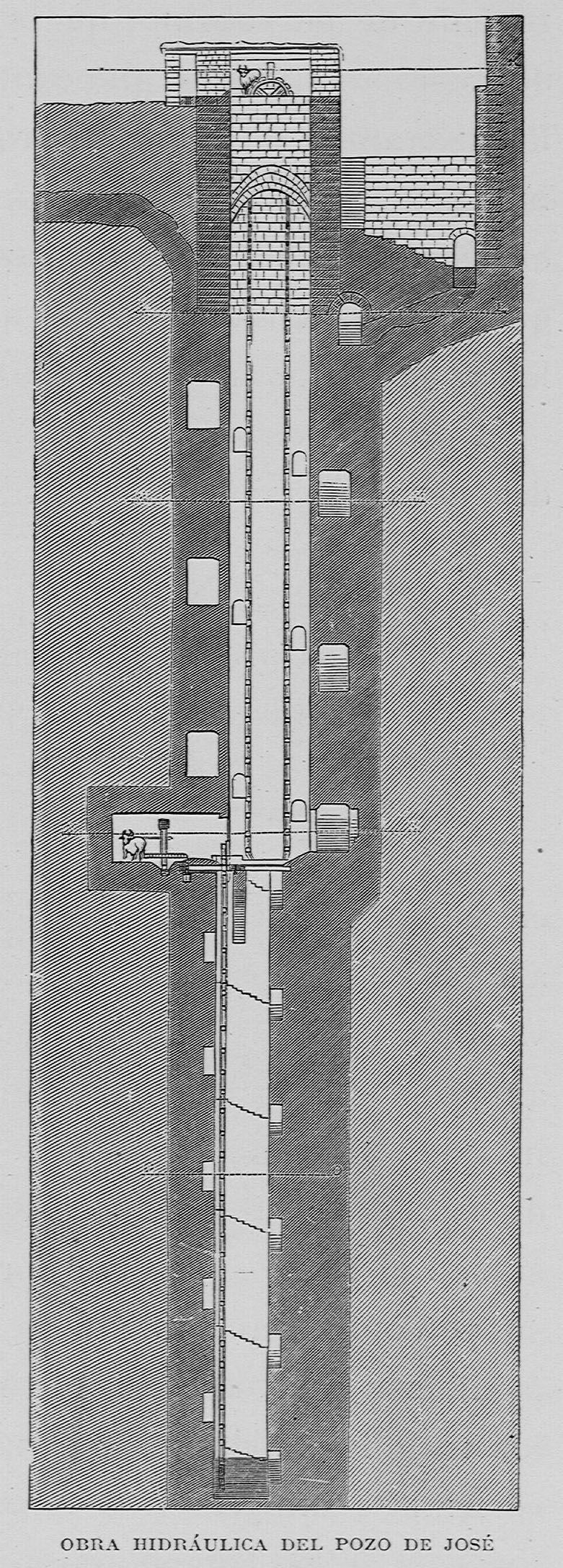
Engraved cross-section drawing of the hydraulic works of Joseph's Well (Pozo de José) in Egypt. A tall vertical shaft descends from a domed stone housing at the top, with a spiral stair cut around the shaft, animal-powered wheel mechanism at the upper level, side chambers, and a horizontal gallery. Caption below reads: Obra hidráulica del Pozo de José.Artifact

Secondary source

Yusuf's Well

Georg Moritz Ebers · 12th century (well); 1882 (engraving)

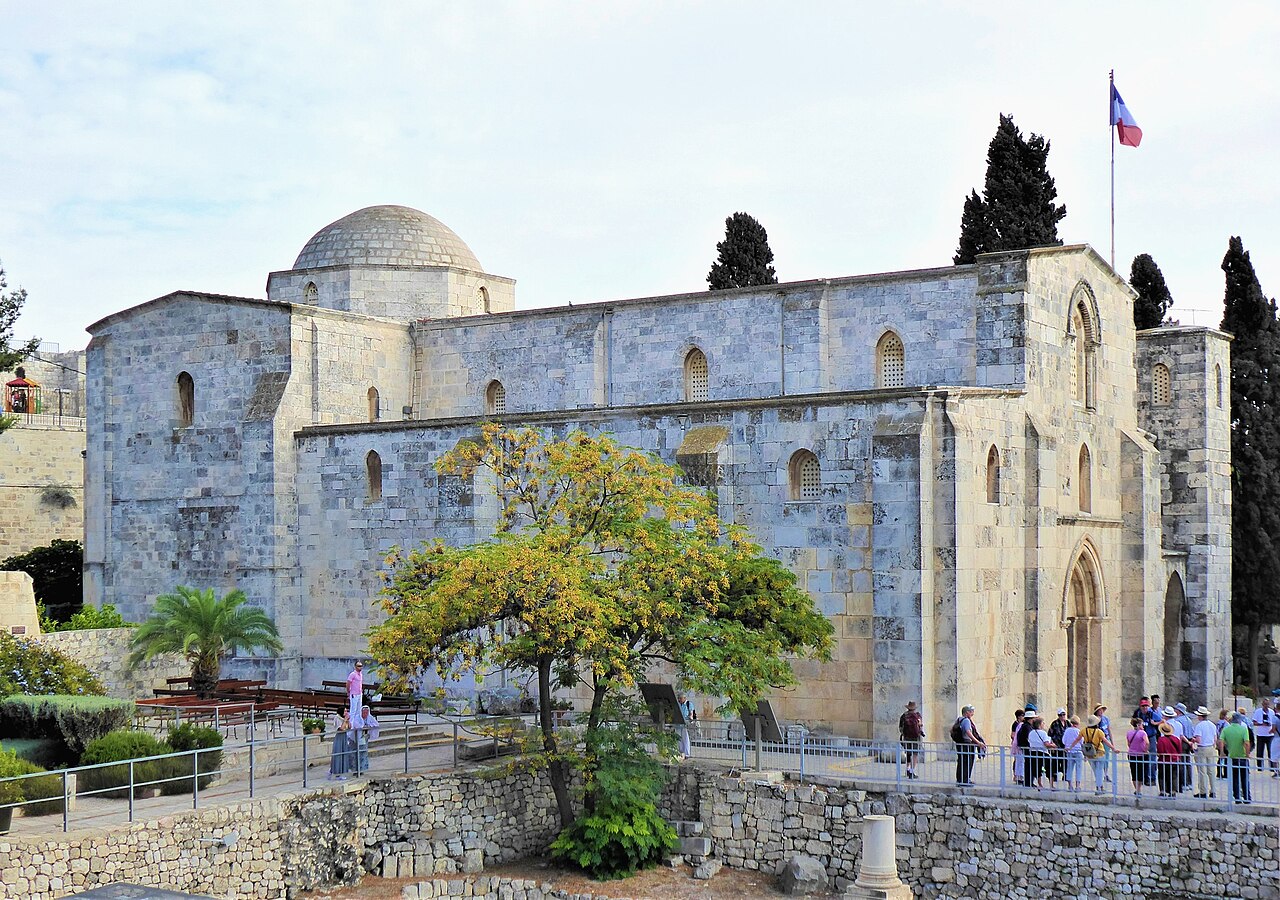
Exterior of a pale stone church with a small stone dome on a drum at the upper left, arched windows, and a tall arched doorway on the right. A flagpole flies a red, white, and blue flag on the roof. A yellow-flowering tree and a crowd of tourists stand in front, with a stone wall below.Artifact

Secondary source

Church of Saint Anne, Jerusalem

built 1131–1138; converted 1192

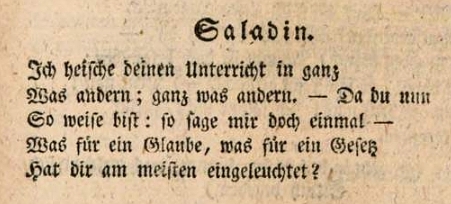
Scan of a printed page in German blackletter type with the heading 'Saladin' and six lines of verse: 'Ich heische deinen Unterricht in ganz / Was andern; ganz was andern. — Da du nun / So weise bist: so sage mir doch einmal — / Was für ein Glaube, was für ein Gesetz / Hat dir am meisten eingeleuchtet?'Book

Secondary source

Saladins Frage an Nathan

Gotthold Ephraim Lessing · 1779

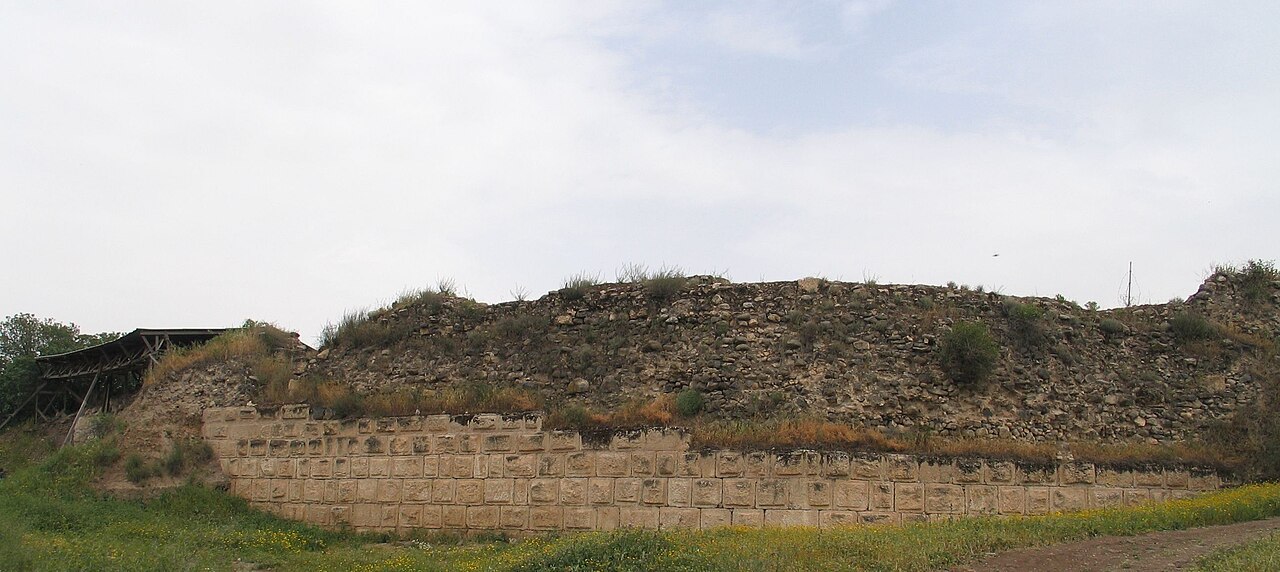
A long ruined stone wall on a grassy hillside under a pale sky. The lower part is a neat course of rectangular cut-stone blocks; above it, an irregular rubble stone wall with patches of dry grass. A metal-roofed shelter stands at the far left.Artifact

Primary source

Ateret Fortress

1178

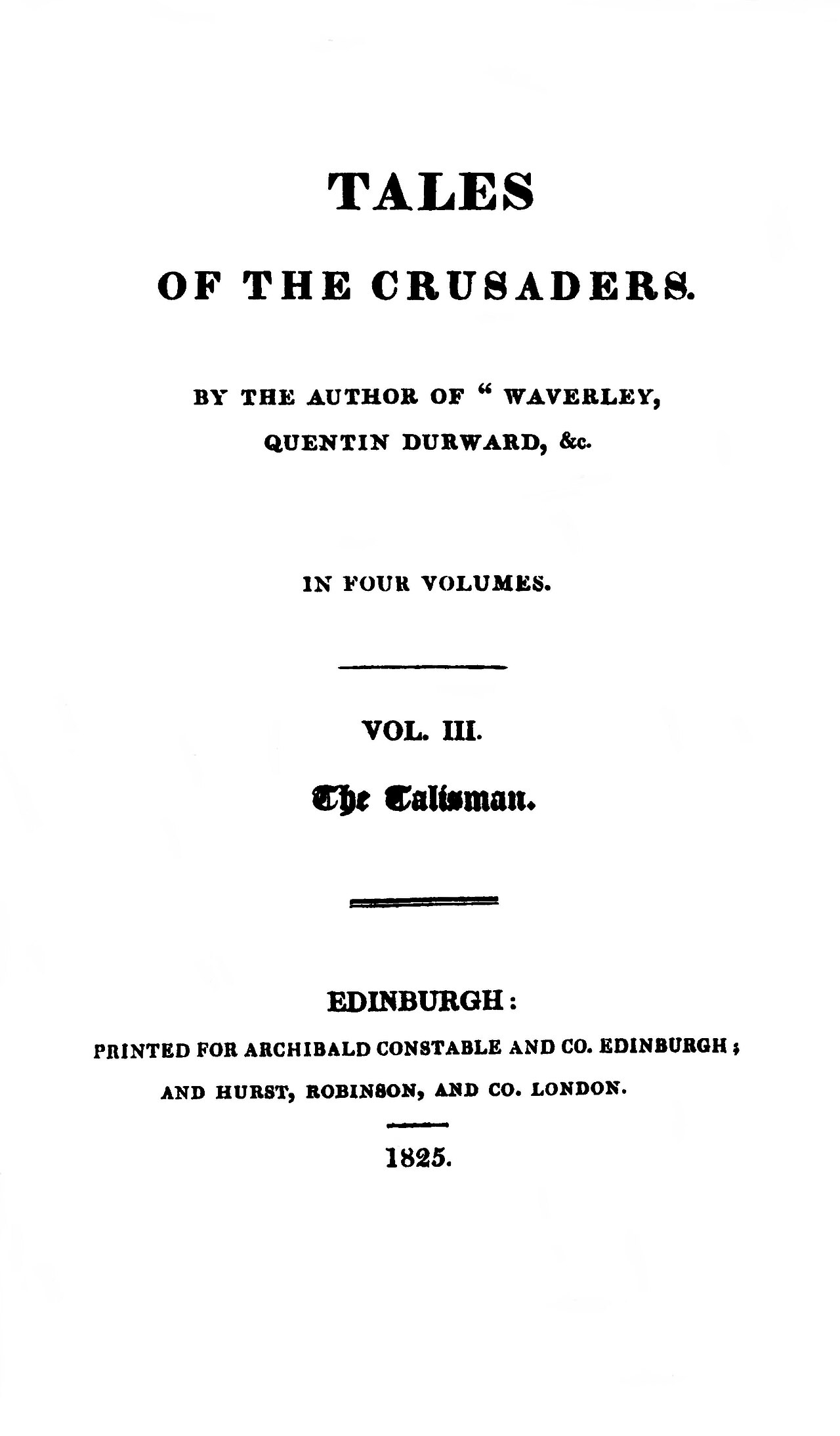
Title page of Tales of the Crusaders, by the author of Waverley, Quentin Durward, etc., in four volumes. Vol. III, The Talisman. Printed for Archibald Constable and Co., Edinburgh, and Hurst, Robinson, and Co., London, 1825.Book

Secondary source

The Talisman

Walter Scott · 1825

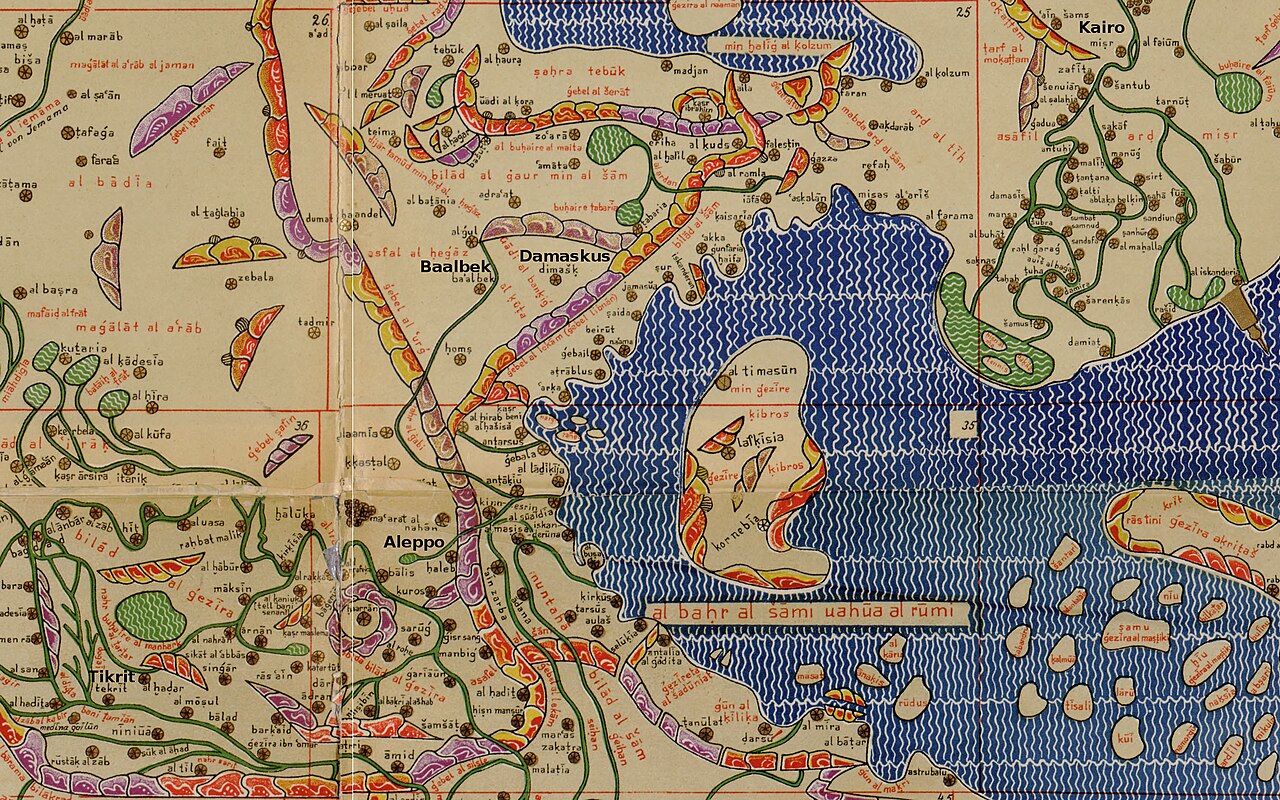
Detail of a colorful historical map in the style of al-Idrisi's world map, with Arabic and red-lettered labels on tan parchment. Blue wavy seas, a green and red-outlined coastline, and labels including Damaskus, Baalbek, Aleppo, Tikrit, and Kairo. Several cities are marked in bold black text.Document

Secondary source

Saladins Lebensstationen

Al-Idrisi; Konrad Miller (copy) · 1154 (map); labels added later

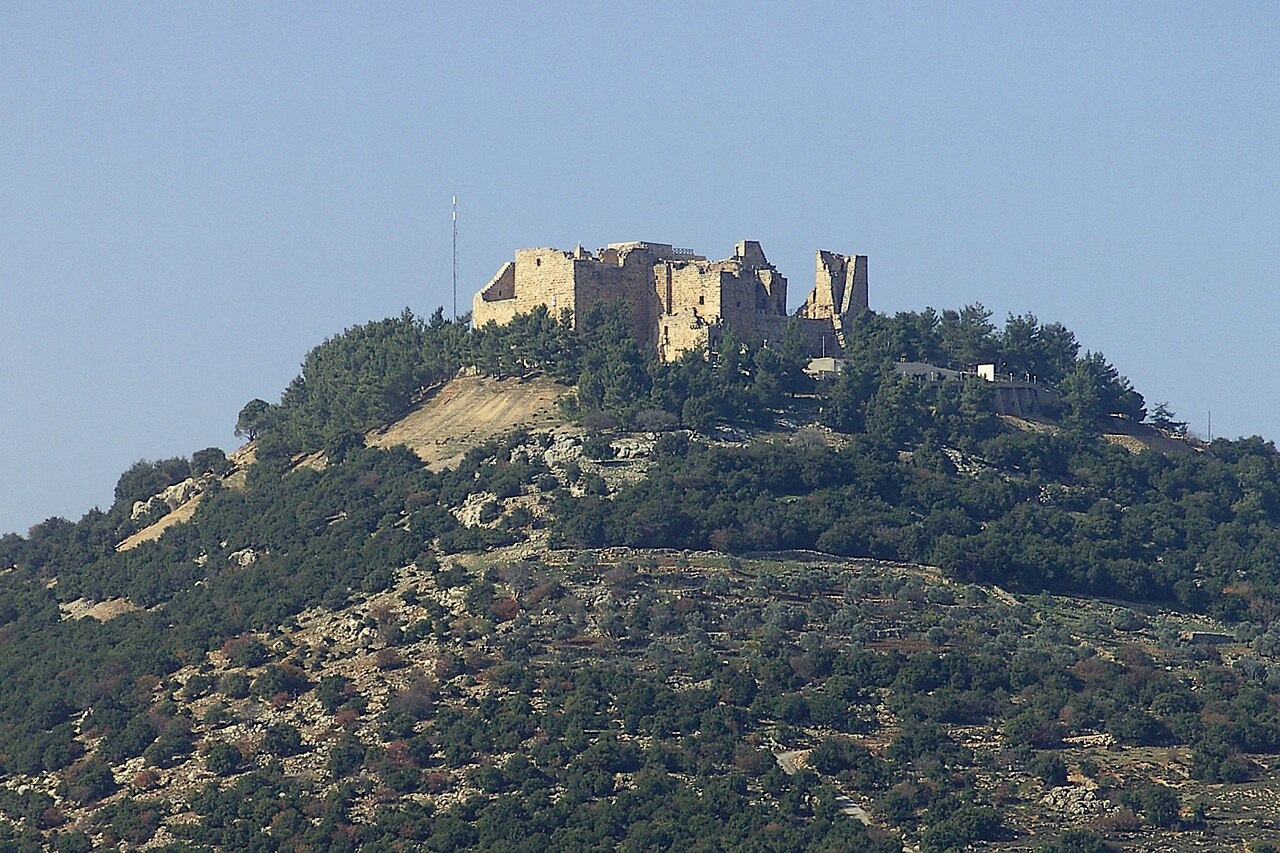
Ruins of a stone castle with crumbling walls and towers on top of a wooded hill, under a clear blue sky. Pine and oak trees cover the slopes, and a radio mast stands to the left.Artifact

Primary source

Ajlun Castle

Izz al-Din Usama · 1184

Brown cover of a library book with a black dot at top left and handwritten call number 'PQ 1499 .O38 1919' and 'copy 2' in black ink. No text from the poem is visible.Book

Secondary source

Ordene de chevalerie

c. 1220 (manuscript shown 1919)

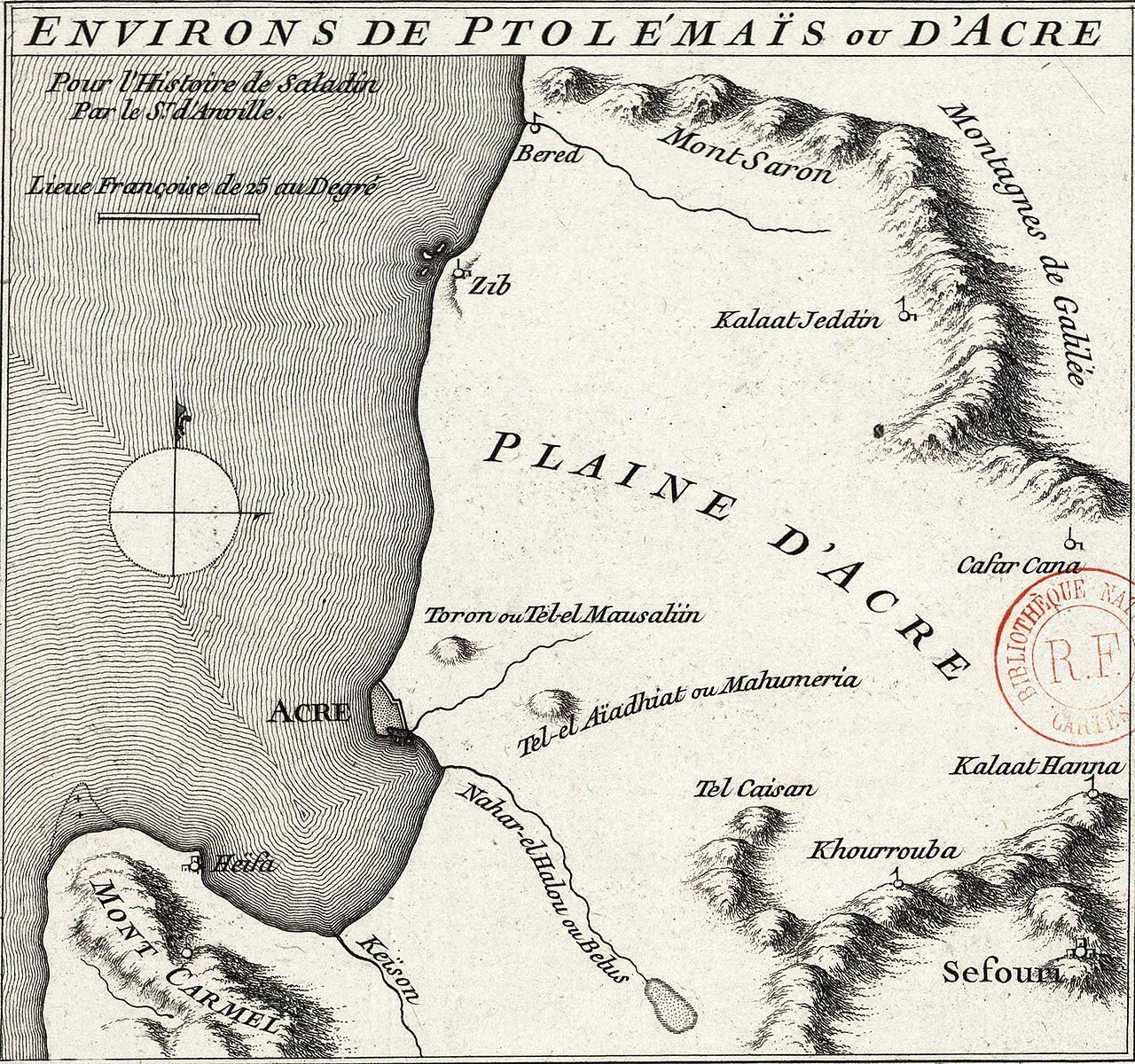
Engraved historical map titled 'Environs de Ptolémaïs ou d'Acre', showing the Acre plain, Mount Carmel, Mount Saron, the Galilee mountains, the coastline, and place names such as Acre, Zib, Bered, and Plaine d'Acre. A scale bar and compass rose appear, with a red Bibliothèque nationale stamp at right.Document

Secondary source

Environs de Ptolémaïs ou d'Acre pour l'Histoire de Saladin

Jean Baptiste Bourguignon d'Anville

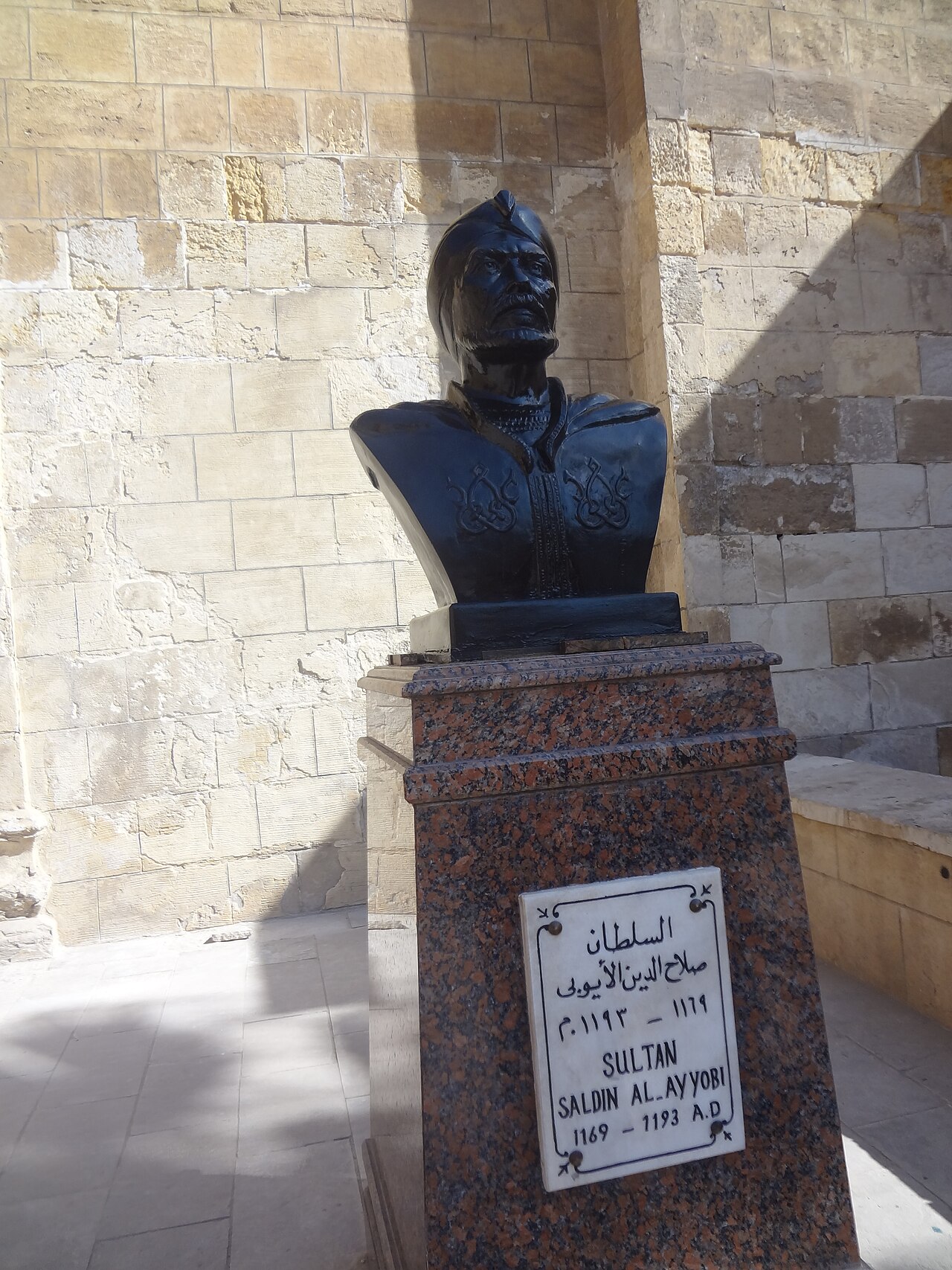
Black bronze-look bust of a man in a turban and high-collared coat with embroidered shoulder roundels, set on a dark base atop a red-and-brown granite pedestal. The pedestal holds a white plaque with Arabic and English text reading Sultan Saladin al-Ayyobi, 1169-1193 AD. Beige stone block wall behind.Sculpture

Secondary source

Statue of Saladin at the Cairo Citadel

Ahmed yousri elmamlouk (photographer) · 2013-03-29

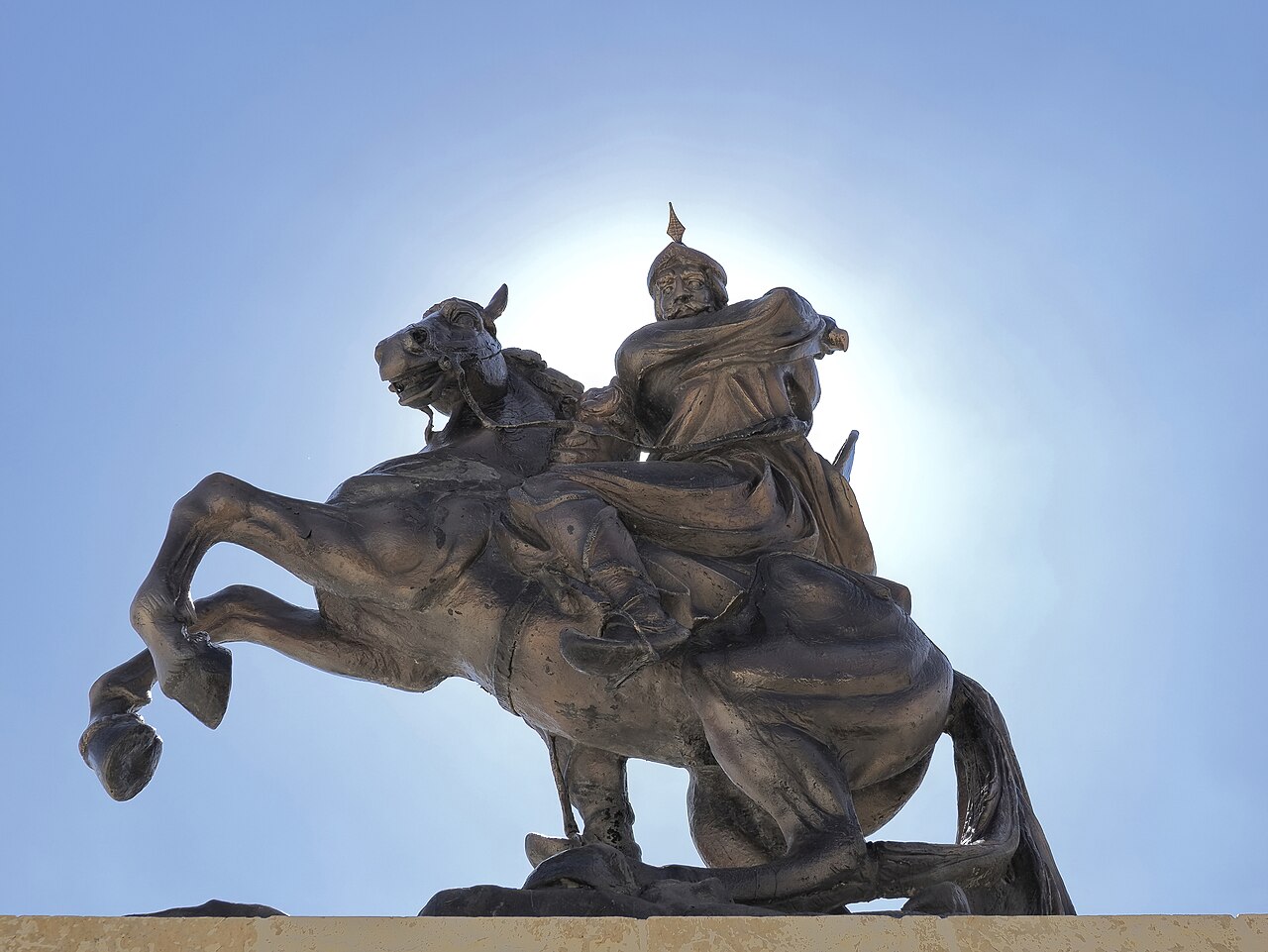
Bronze equestrian statue of a rider on a rearing horse, photographed from below against a bright blue sky with the sun glowing behind the figure. The rider wears a helmet with a small gold finial and a flowing cloak. The horse's front legs are raised and its mane and tail are visible.Sculpture

Secondary source

Saladin Monument in Al-Karak

Petar Milošević · 28 March 2023 (photo); statue undated

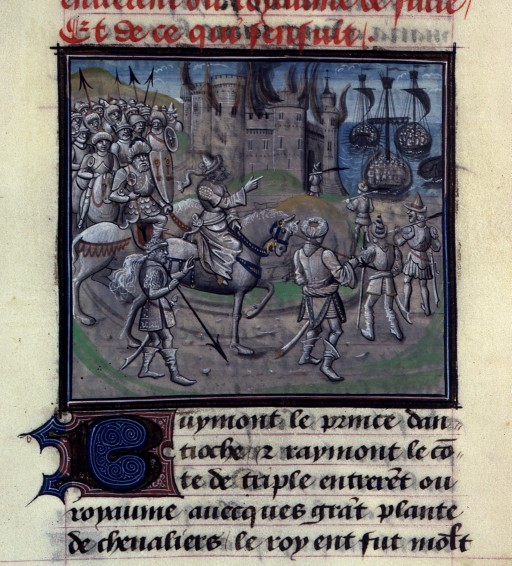
Medieval manuscript illumination with red and black Gothic text above and below. The painted scene shows mounted and foot soldiers in turbans and armor on a green hillside, a castle with towers and flames rising behind it, and ships with sails on water at right. A rider on a grey horse points forward while a soldier in the foreground holds a spear.Painting

Secondary source

Saladin Burning a City

Unknown 15th-century manuscript illuminator · 15th century

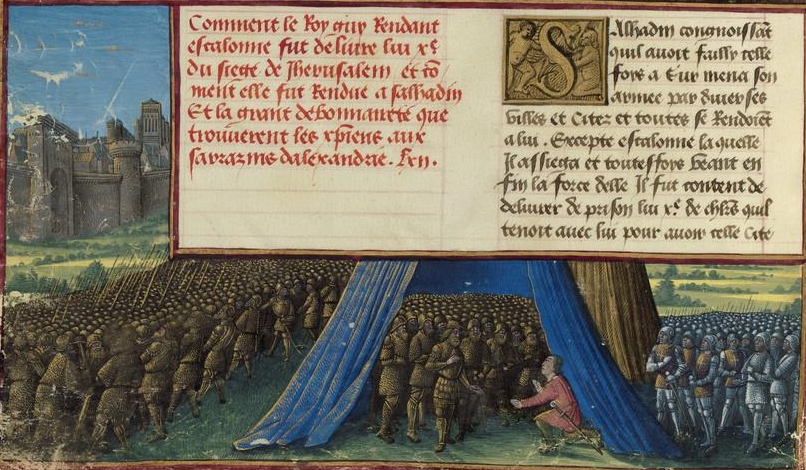
Illuminated manuscript page with red and black text in two columns above a painted miniature. On the left, a walled city with towers under a blue sky. In the center, a large crowd of armored medieval soldiers in dark mail and helmets gathers beside blue drapery. A kneeling man in red clothing is at the lower center, facing a standing figure in a tent opening. On the right, lines of armored knights in silver armor stand in formation. An ornate gold initial letter S decorates the text.Painting

Secondary source

Saladin and Balian of Ibelin

Jean Colombe · 15th century

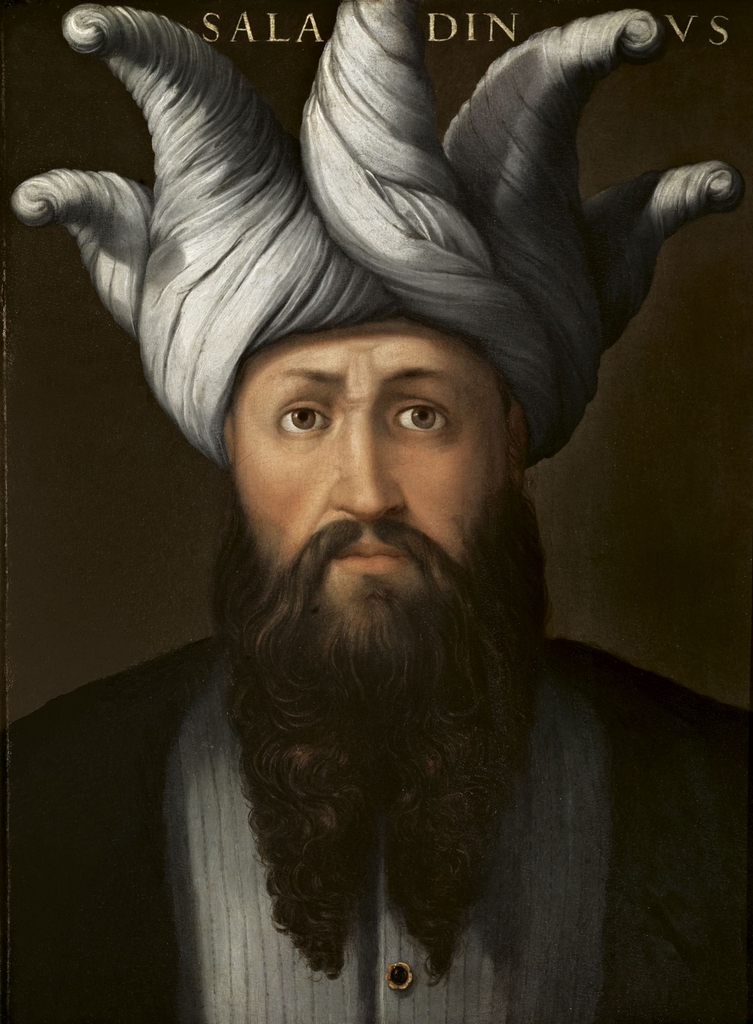
Oil portrait of a bearded man in a large white turban with curled, pointed folds, dark robe with a white collar, and a small dark brooch. Dark background with the Latin inscription SALADINVS across the top.Painting

Secondary source

Saladino

Cristofano dell'Altissimo · between 1552 and 1568

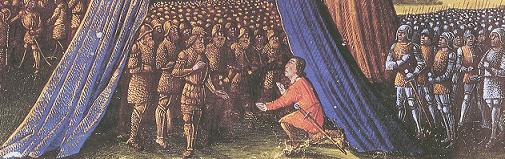
Painted miniature of a medieval scene: a kneeling man in red robes before a tall, armored figure in mail among a crowd of soldiers, with blue and red draped tent fabric framing the scene and armored troops lined up on the right.Painting

Secondary source

Balian of Ibelin Surrenders Jerusalem to Saladin

1490

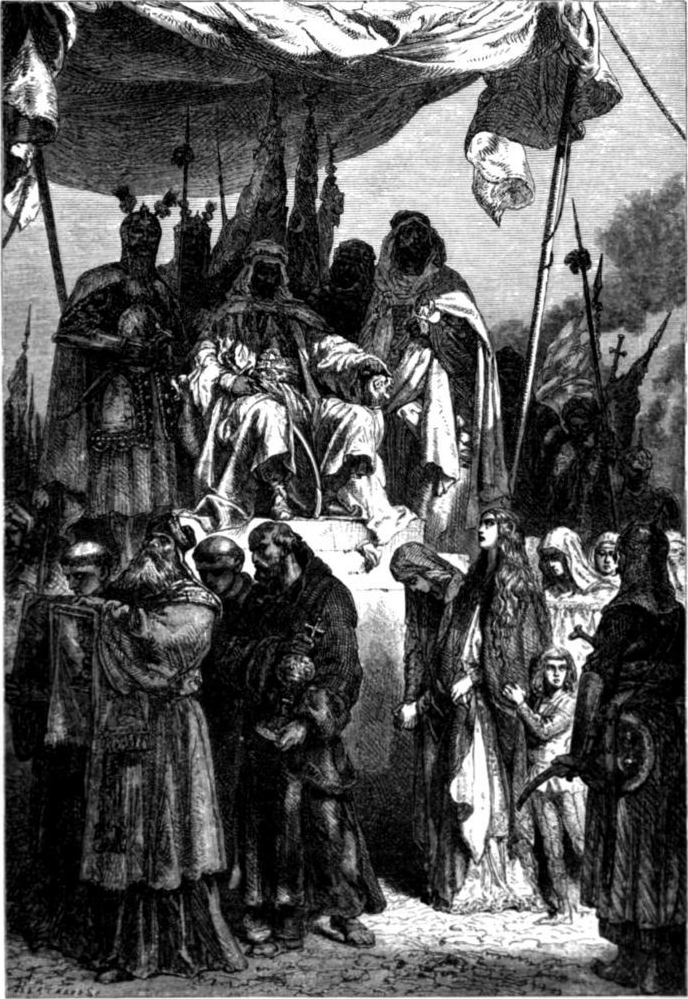
Black-and-white engraving of a seated ruler under a draped canopy on a raised platform, flanked by standing attendants in dark robes and headwear. In the foreground, a crowd of figures in cloaks and hoods, including a bearded man, a long-haired woman bowing, and a girl with clasped hands, look toward him.Painting

Secondary source

The Christians of the Holy City Defiling before Saladin

Alphonse de Neuville · 1883

Document

Tertiary source

Saladin Entry, Encyclopaedia Britannica 1911

1911

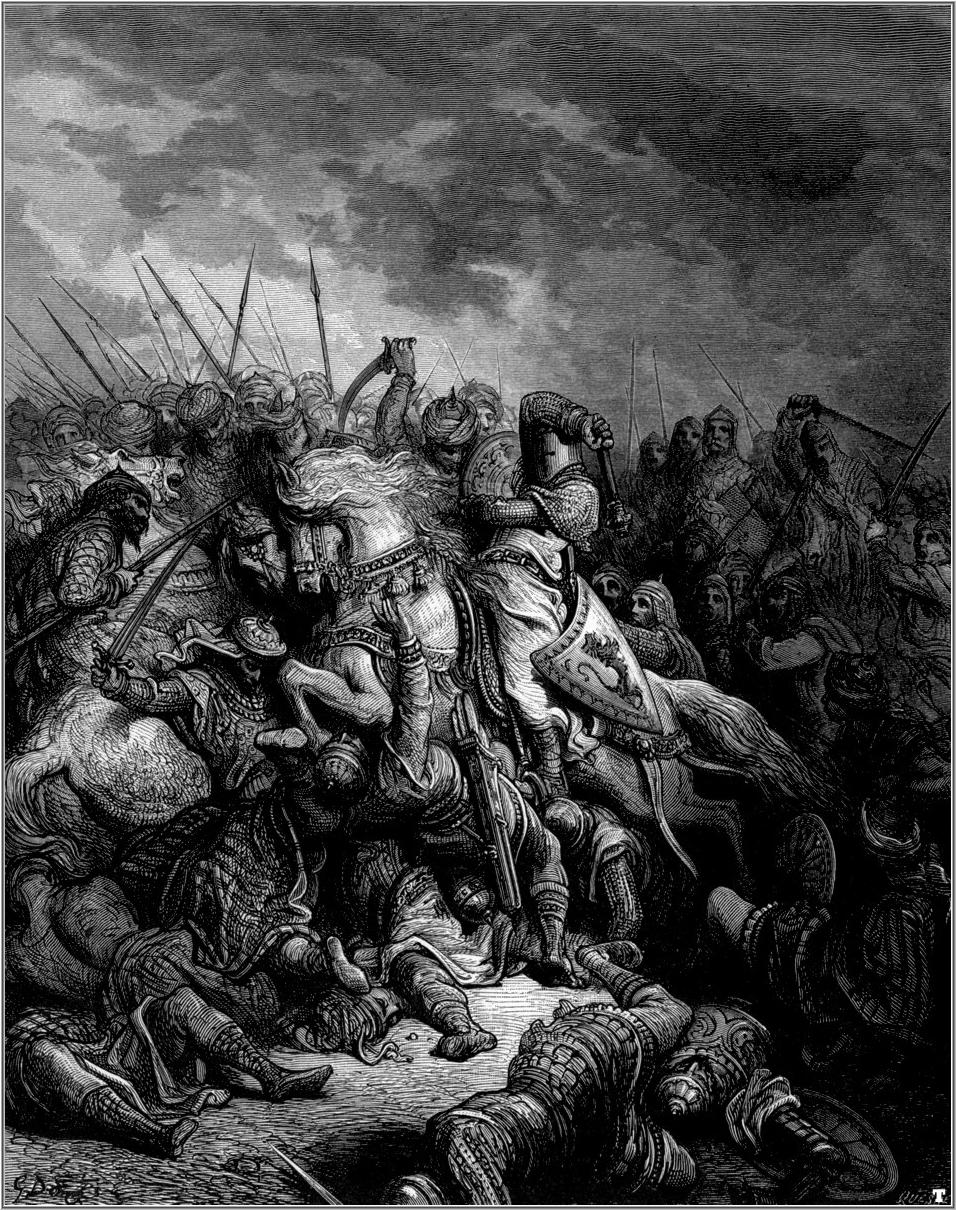
Black-and-white engraving of a medieval cavalry battle under a stormy sky. A mounted knight in chainmail with a lion-emblazoned shield raises a sword. Turbaned riders with curved swords and spears surround him. Fallen men and horses lie in the foreground.Painting

Secondary source

Richard and Saladin at the Battle of Arsuf

Gustave Doré · 19th century

Book

Secondary source

Saladin Chapter, Syria: A Short History

1959

Les grands guerriers des croisadesBook

Secondary source

Les grands guerriers des croisades

Louis Nicolas Bescherelle · 1851

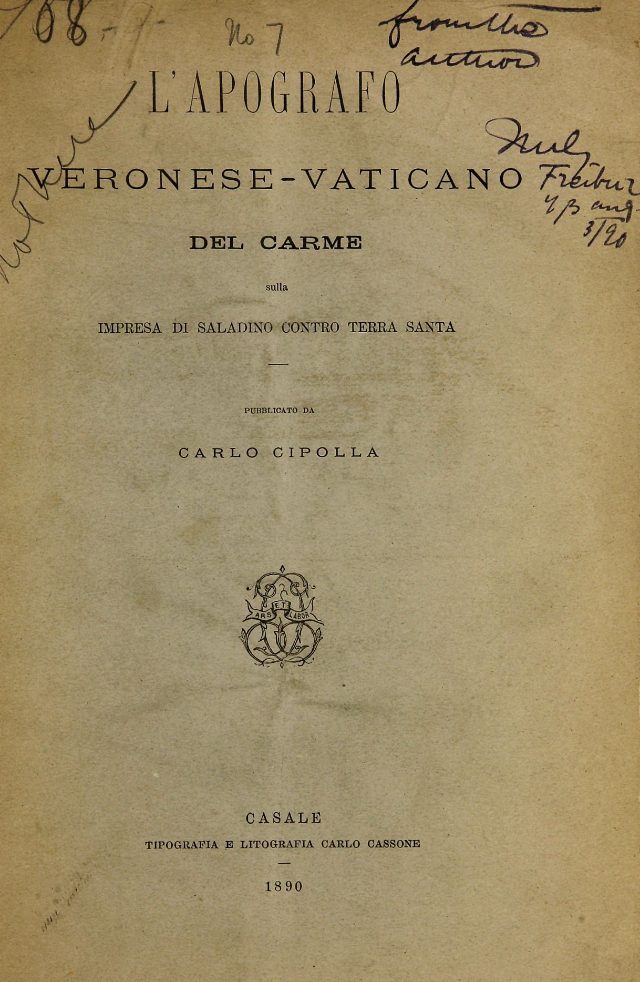
L'apografo Veronese-Vaticano del carme sulla impresa di Saladino contro Terra SantaBook

Secondary source

L'apografo Veronese-Vaticano del carme sulla impresa di Saladino contro Terra Santa

Carlo Cipolla · 1890

Book

Secondary source

Cassell's Illustrated History of England, Chapter 47: The Third Crusade

1865

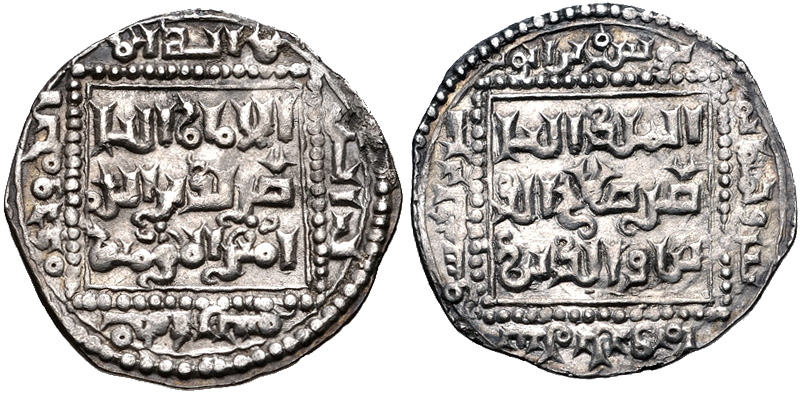
Two sides of a silver dirham coin with Arabic inscriptions in square fields surrounded by beaded borders. Obverse and reverse shown side by side, both worn at the edges.Artifact

Primary source

Dirham of Saladin, Damascus Mint

AH 583 (1187-1188 CE)

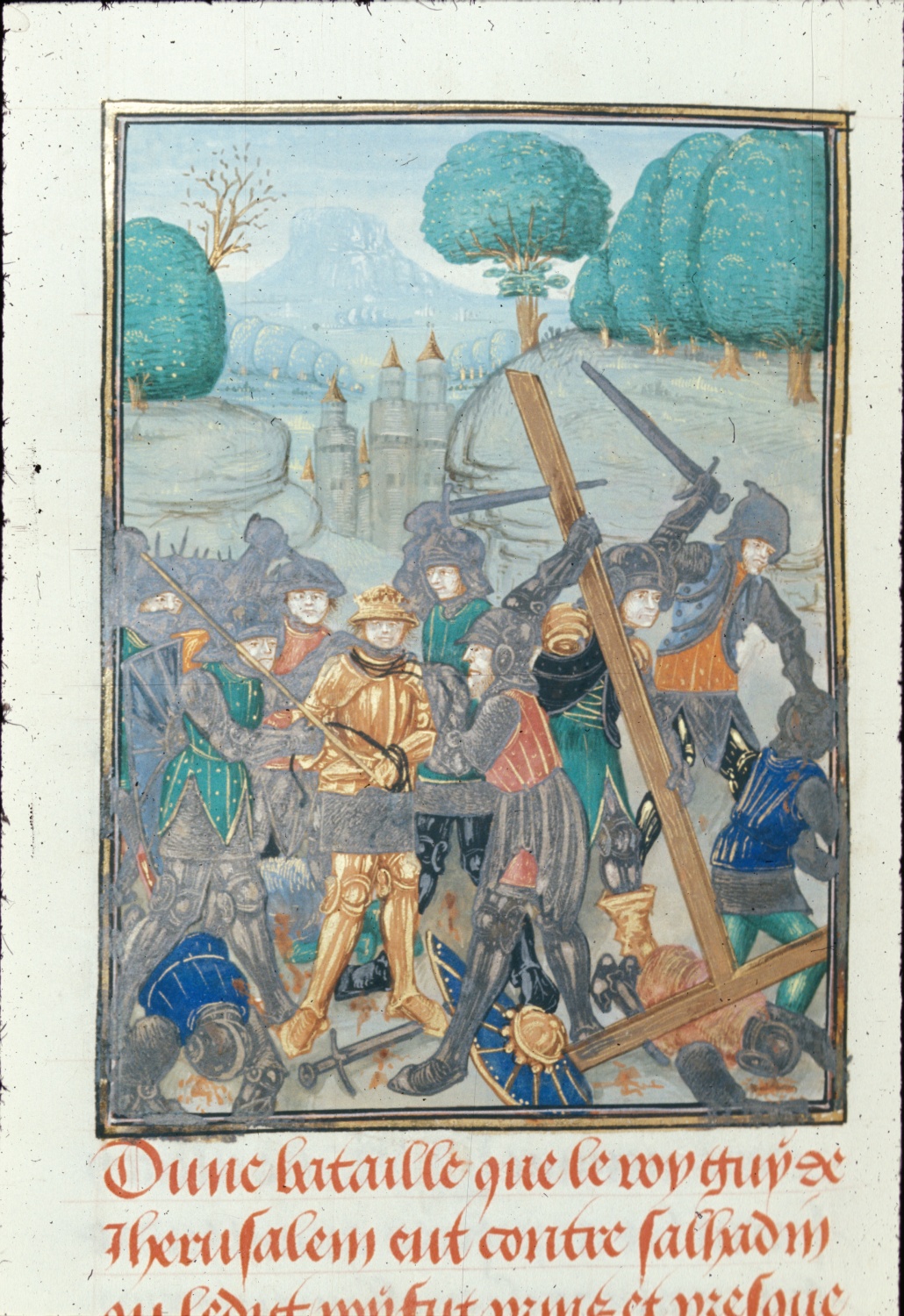
Medieval manuscript painting of a battle on a hillside before a distant castle. Armored knights fight, one in gold armor is central, and a large wooden cross is tilted and falling. Fallen men and helmets lie in the foreground. Red-lettered French text is below.Painting

Primary source

Saladin Defeats Guy of Lusignan and Takes the Holy Cross

Unknown medieval artist · Medieval period

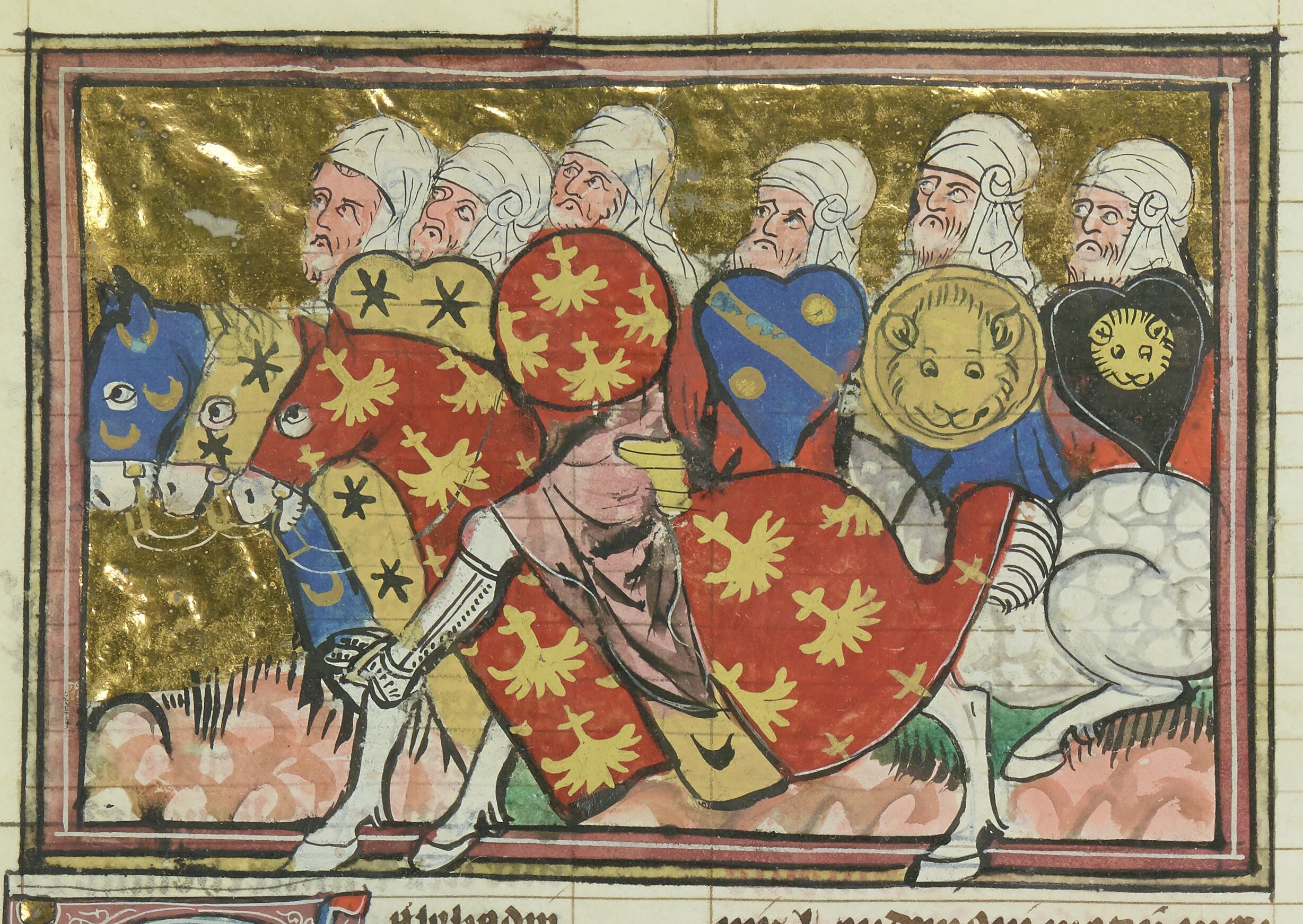
Medieval illuminated manuscript miniature with gold background showing a mounted knight in red shield with gold fleur-like motifs, horses with blue and gold trappings, and a row of white-turbaned men behind shields with stars and a lion emblem.Painting

Secondary source

The Army of Saladin, from William of Tyre's History of Outremer

Anonymous · 1337

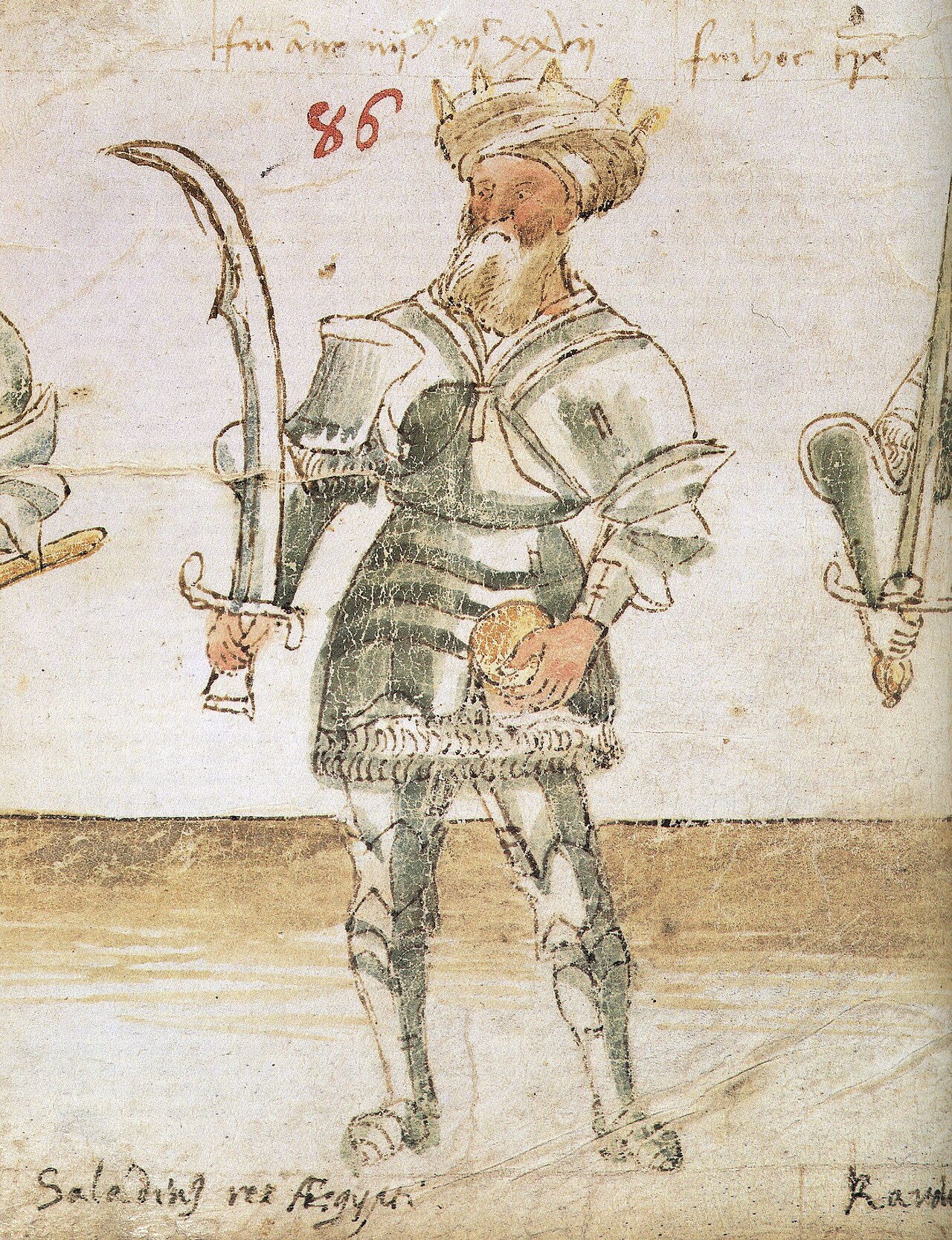
Painted illustration from a manuscript showing a bearded man in a crown or turban, wearing armor with a scalloped collar and greaves, holding a curved sword and a golden orb. Handwritten caption at bottom reads 'Saladinus rex Aegypti'. Number 86 in red at top left.Painting

Secondary source

Saladinus Rex Aegypti

15th century

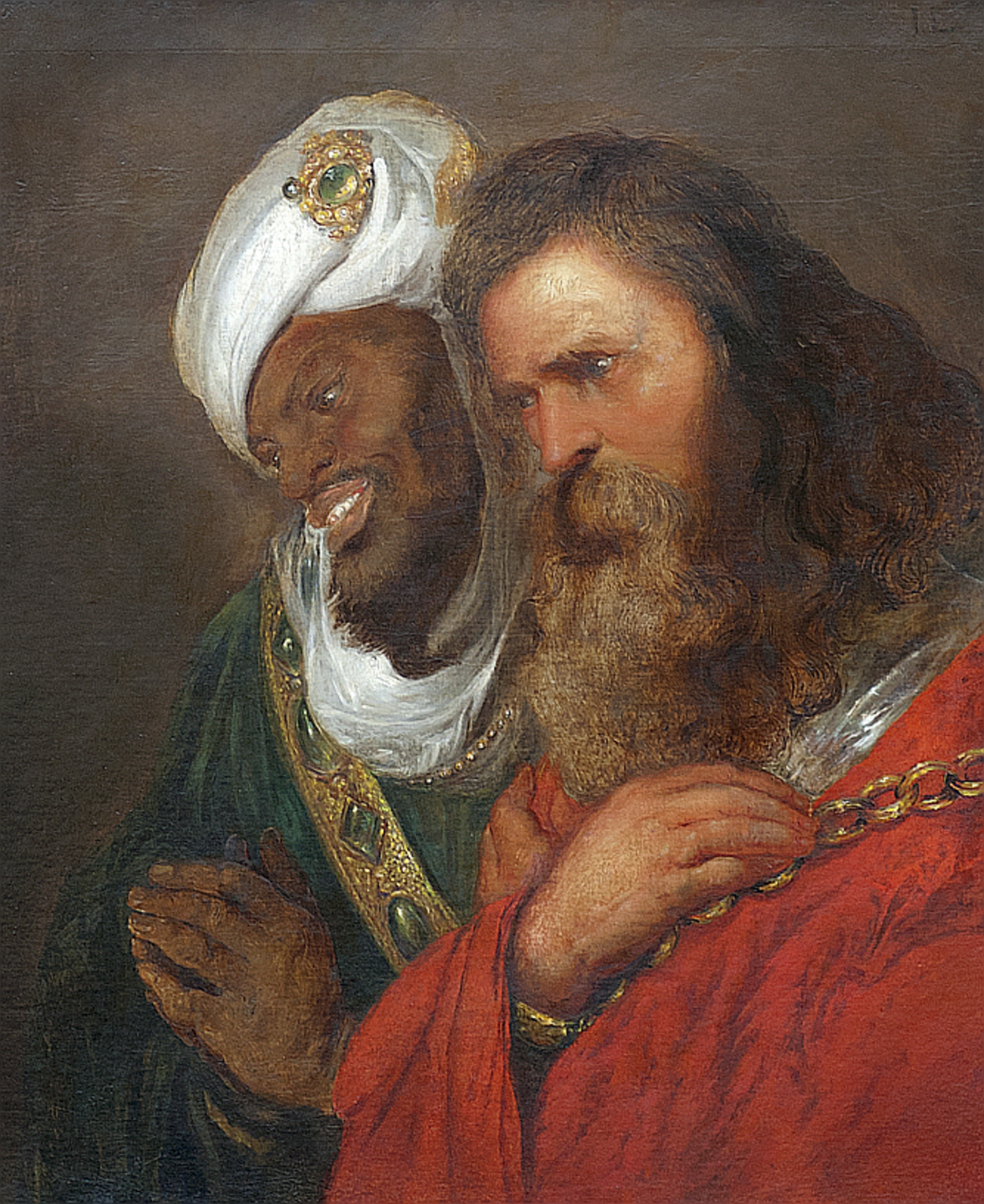
Oil painting of two bearded men in close half-length view. On the left, a man in a white turban with a jewel and a green robe with gold trim, with dark skin, looks down. On the right, a red-robed man with long brown hair and beard wears a gold chain, looking down at it. Dark brown background.Painting

Secondary source

King Guy of Lusignan and King Saladin

Jan Lievens · 1625

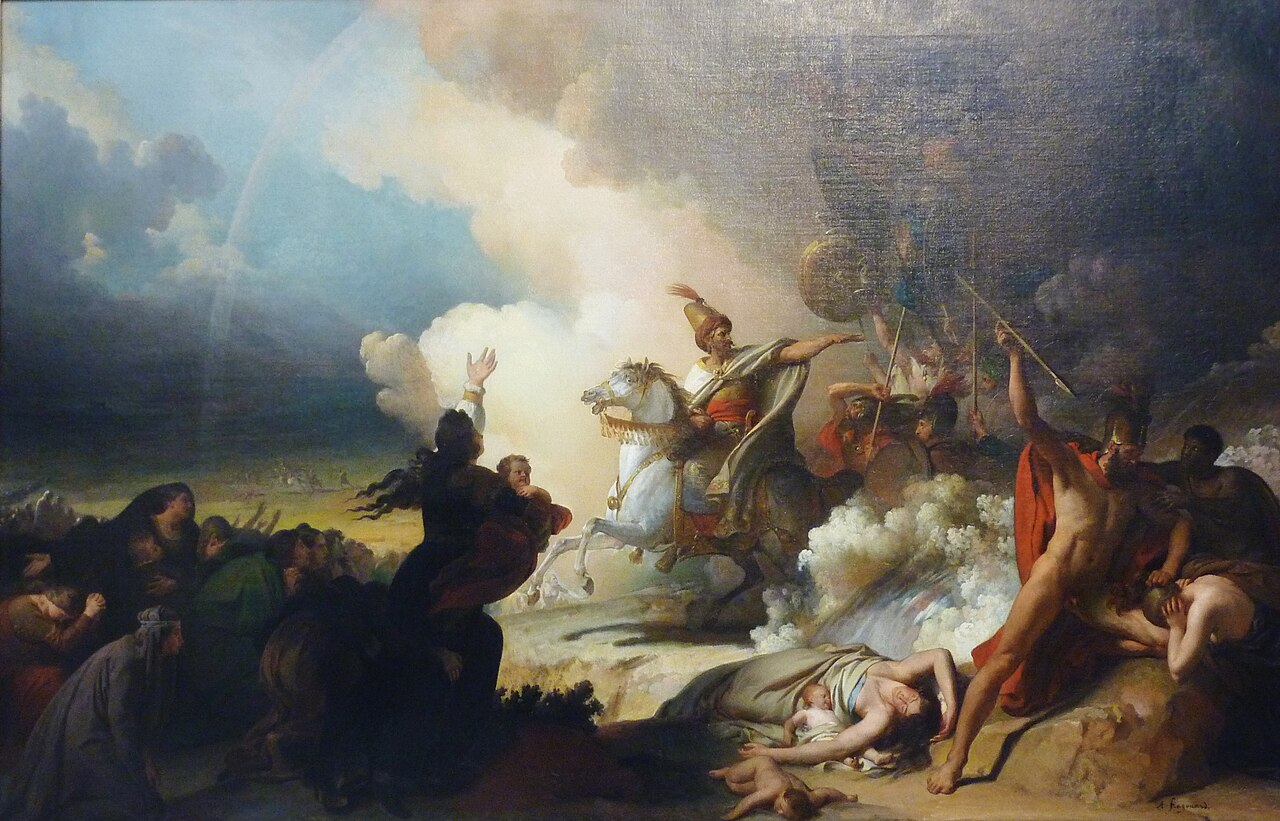
Painting of a battle scene. A rider in a plumed helmet on a white horse points forward at the left, with a rainbow in a stormy sky. A woman holding a child and people in dark robes crowd the left. Armed men fight at right, and bodies lie on the ground.Painting

Secondary source

Saladin in Jerusalem

Alexandre-Évariste Fragonard · c. 1830-1850

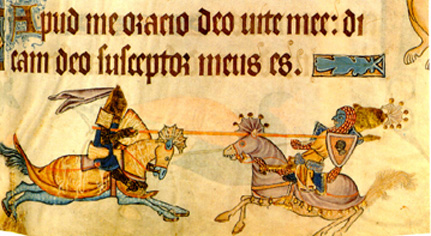
Manuscript illumination: two mounted knights jousting on horses across a field, with Latin text above reading 'Apud me oracio deo unte mee: di tam deo susceptor meus es.' Decorative border at right. Parchment background.Painting

Secondary source

Richard versus Saladin

Anonymous Unknown author · 13th century

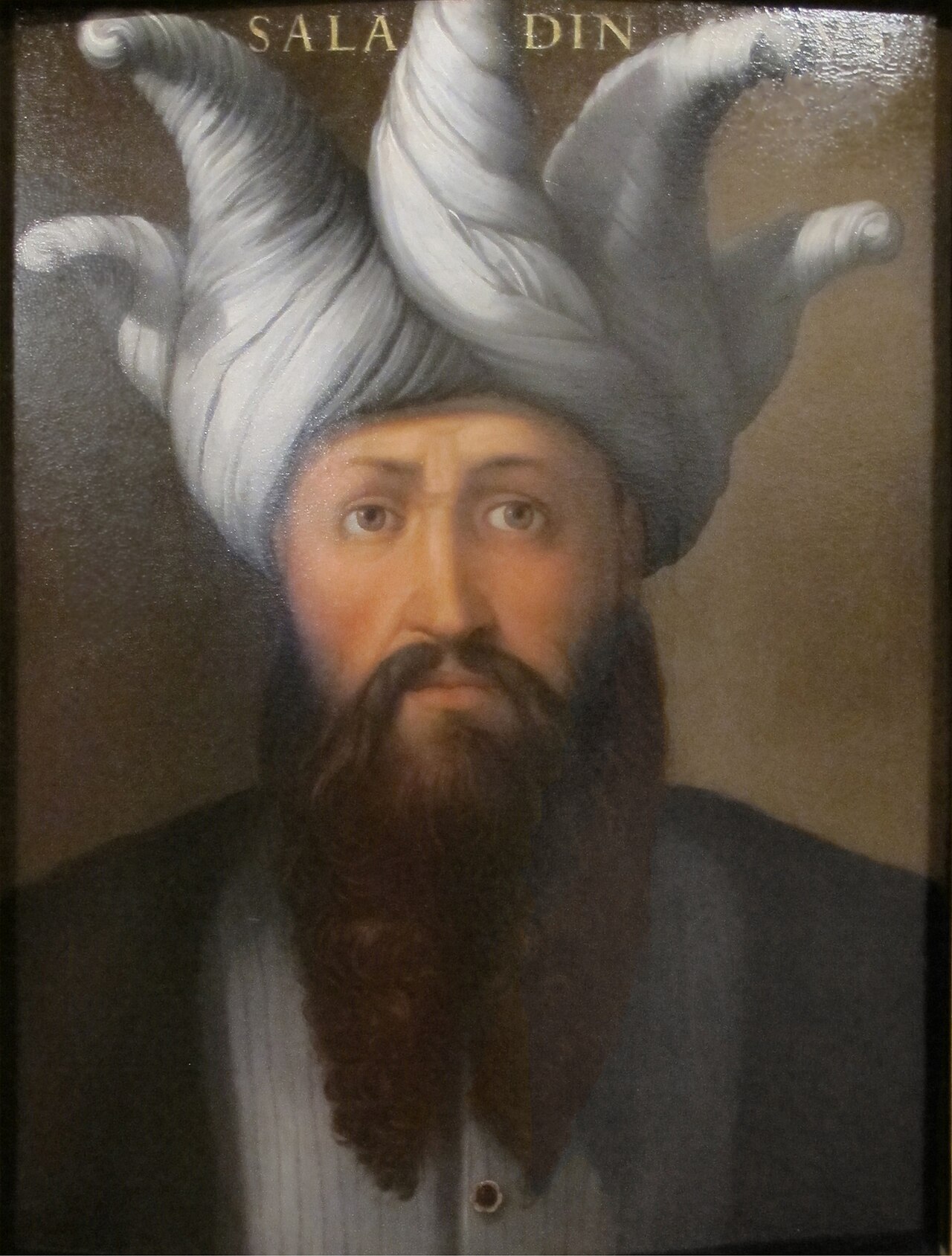
Painting of a bearded man with dark eyes and a thick dark beard, wearing a large white turban with tall folded fabric and a dark robe over a light shirt. The inscription at the top reads SALADIN. Brown background.Painting

Secondary source

Saladin portrait by Cristofano dell'Altissimo

Cristofano dell'Altissimo · before 1568

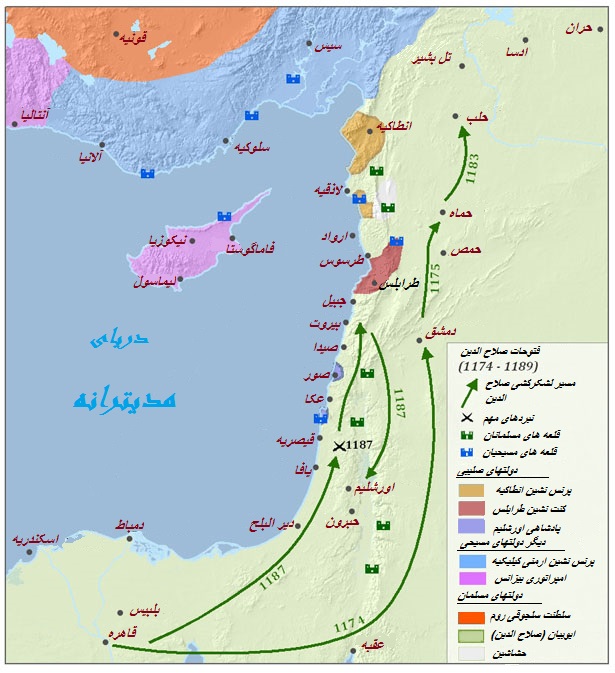
Map in Persian of the eastern Mediterranean and Middle East showing Saladin's conquests from 1174 to 1189. Green arrows trace his military campaign routes from Cairo and Egypt northward through Palestine to Damascus, Aleppo, and Antioch, with battle markers for 1187. Key labels include the Mediterranean Sea, Cyprus, Crusader states, Ayyubid territories, and Seljuk Sultanate of Rum in orange.Document

Secondary source

Map of Saladin's Conquests

ExploretheMed · 5 January 2010

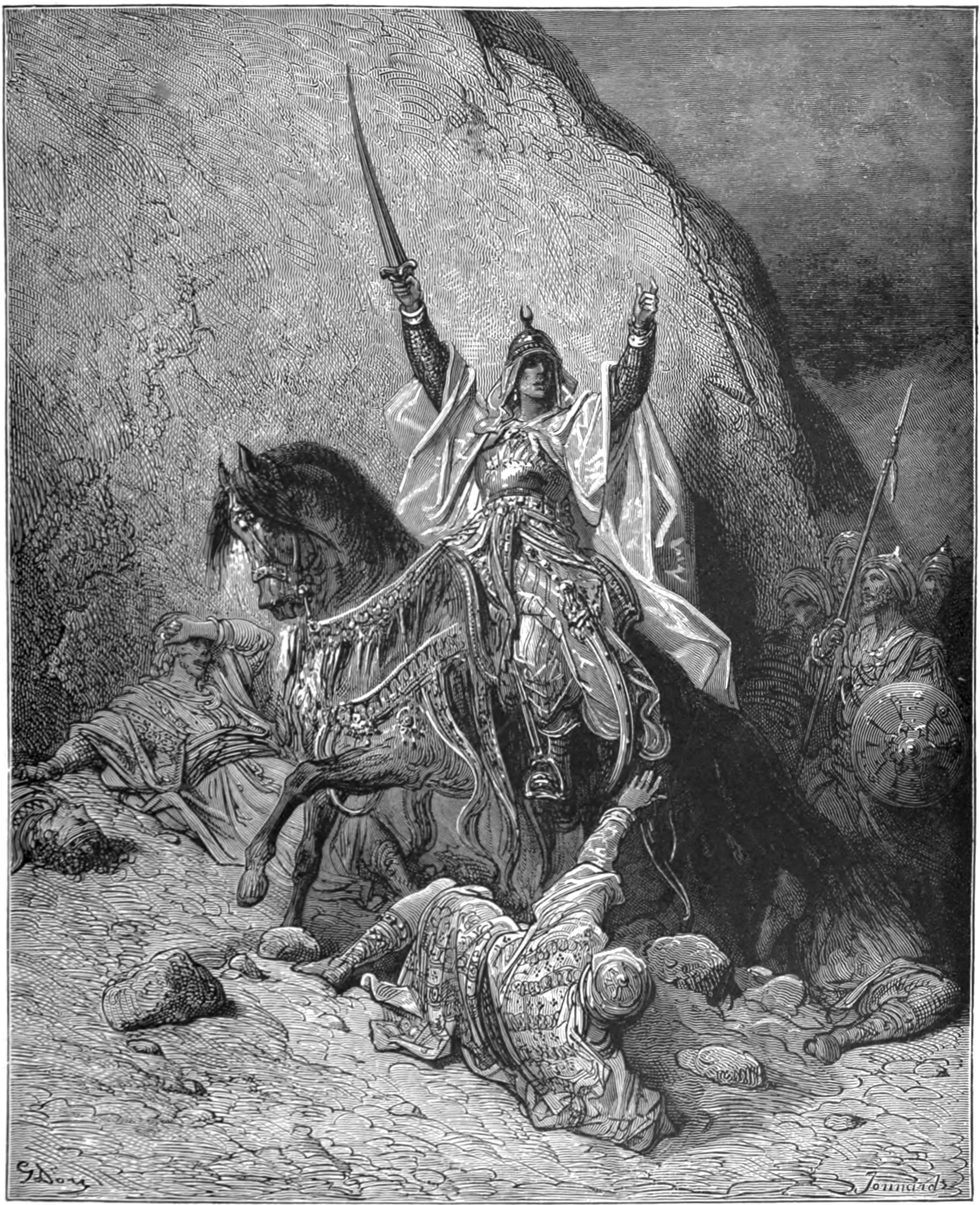
Black and white engraving of a mounted warrior in chainmail and a helmet, raising a sword high in one hand and his other arm up, on a pale horse with ornate trappings. Fallen figures lie on the ground and armed men with shields stand at right, before a rocky hillside.Painting

Secondary source

Saladin, engraving by Gustave Doré

Gustave Doré · 1894

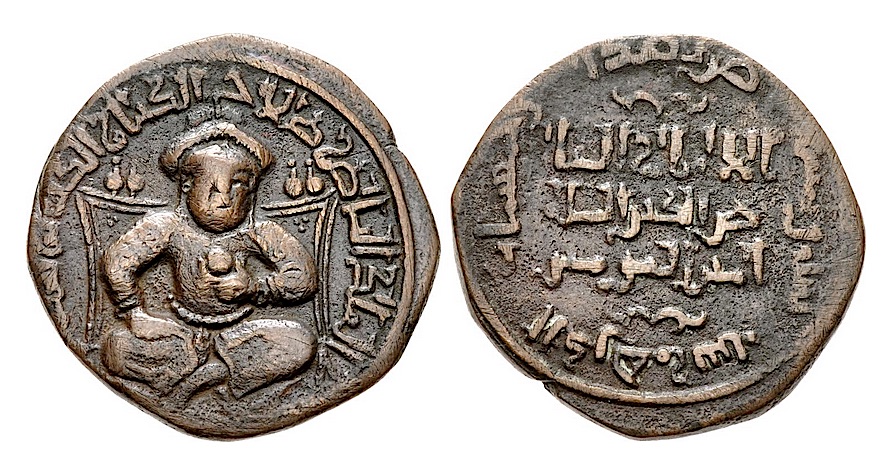
Two sides of a bronze dirham coin. The obverse shows a seated human figure holding a cup, flanked by hanging ornaments, within a circular Arabic inscription. The reverse bears several lines of Arabic script in a central field with a border of inscription.Artifact

Primary source

Dirham of Saladin, Mayyafariqin Mint

1189-1190

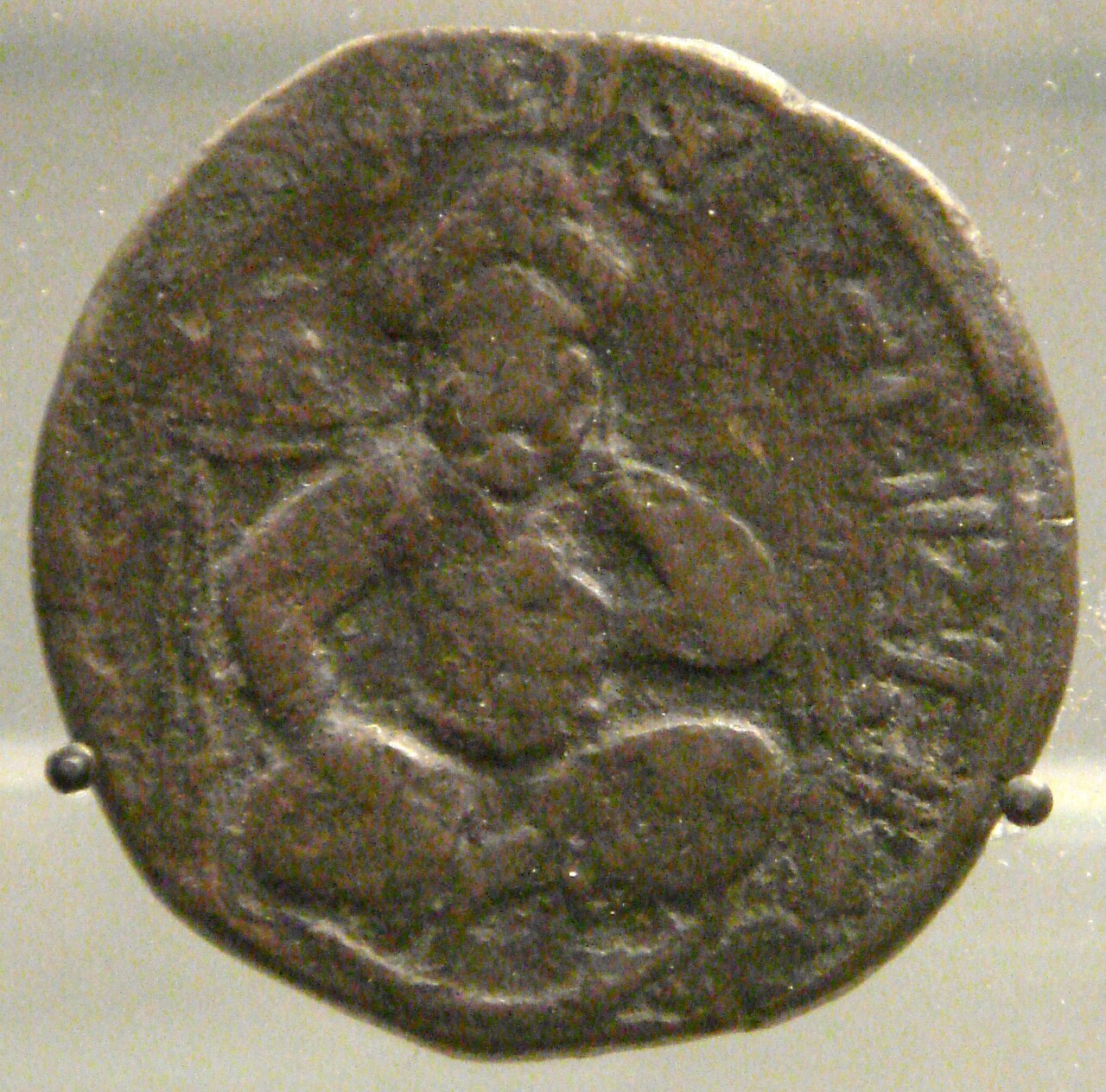
Photograph of a dark bronze coin on a plain background, with a worn central figure seated or standing, a raised rim, and faint inscriptions along the right edge. Two small loops project from the left and right edges.Artifact

Primary source

Coin of Saladin, Mayyafariqin Mint

Unknown mint of Mayyafariqin · 1190

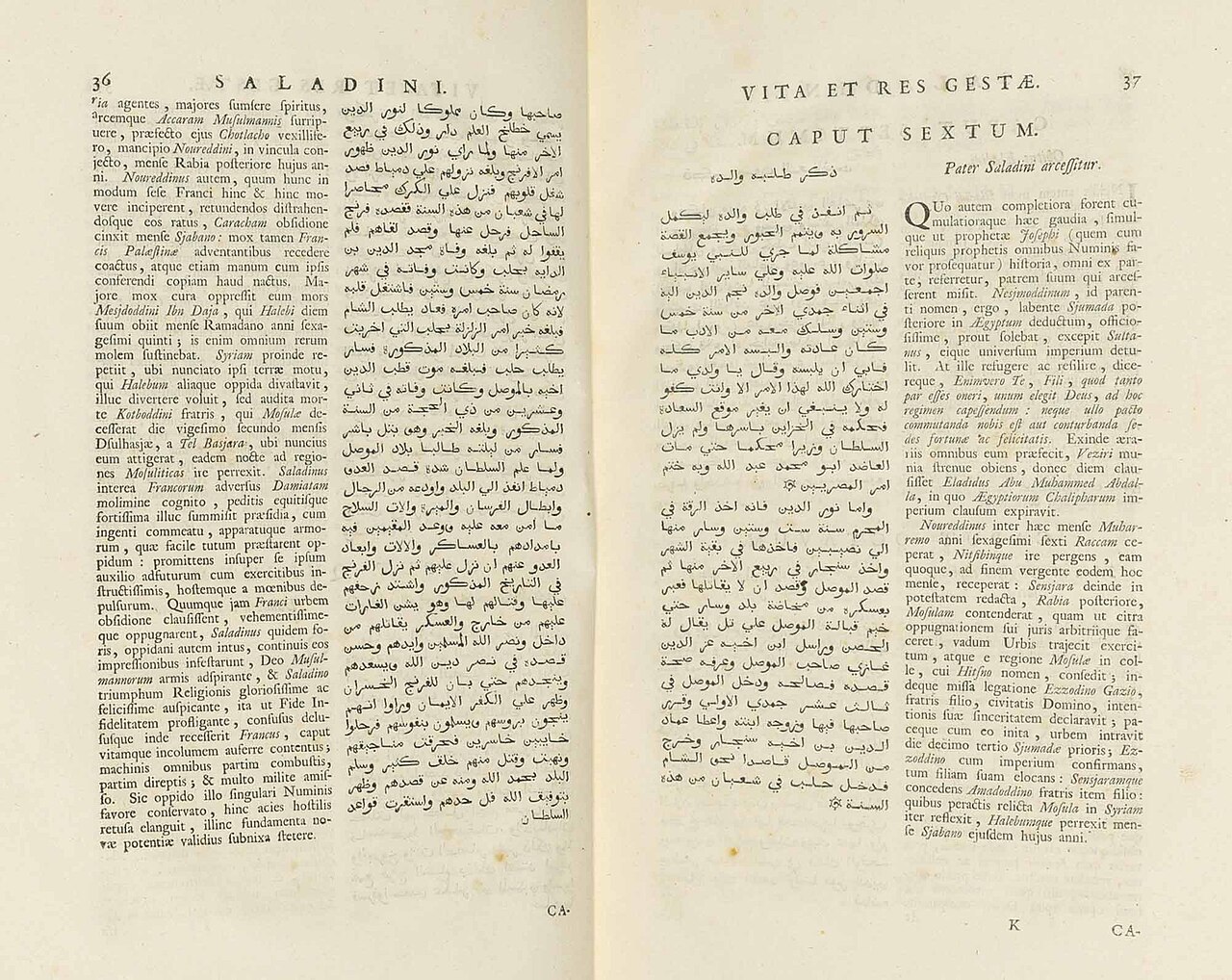
Open book spread of the 1732 Leiden edition of Vita et res gestae Saladini. Left page 36 has Latin text in columns beside Arabic text; right page 37 has Arabic and Latin text under the heading Caput Sextum.Book

Primary source

Vita et res gestae Saladini

Baha al-Din ibn Shaddad (edited and translated by Albert Schultens) · 1732 (text composed earlier, by a contemporary of Saladin)

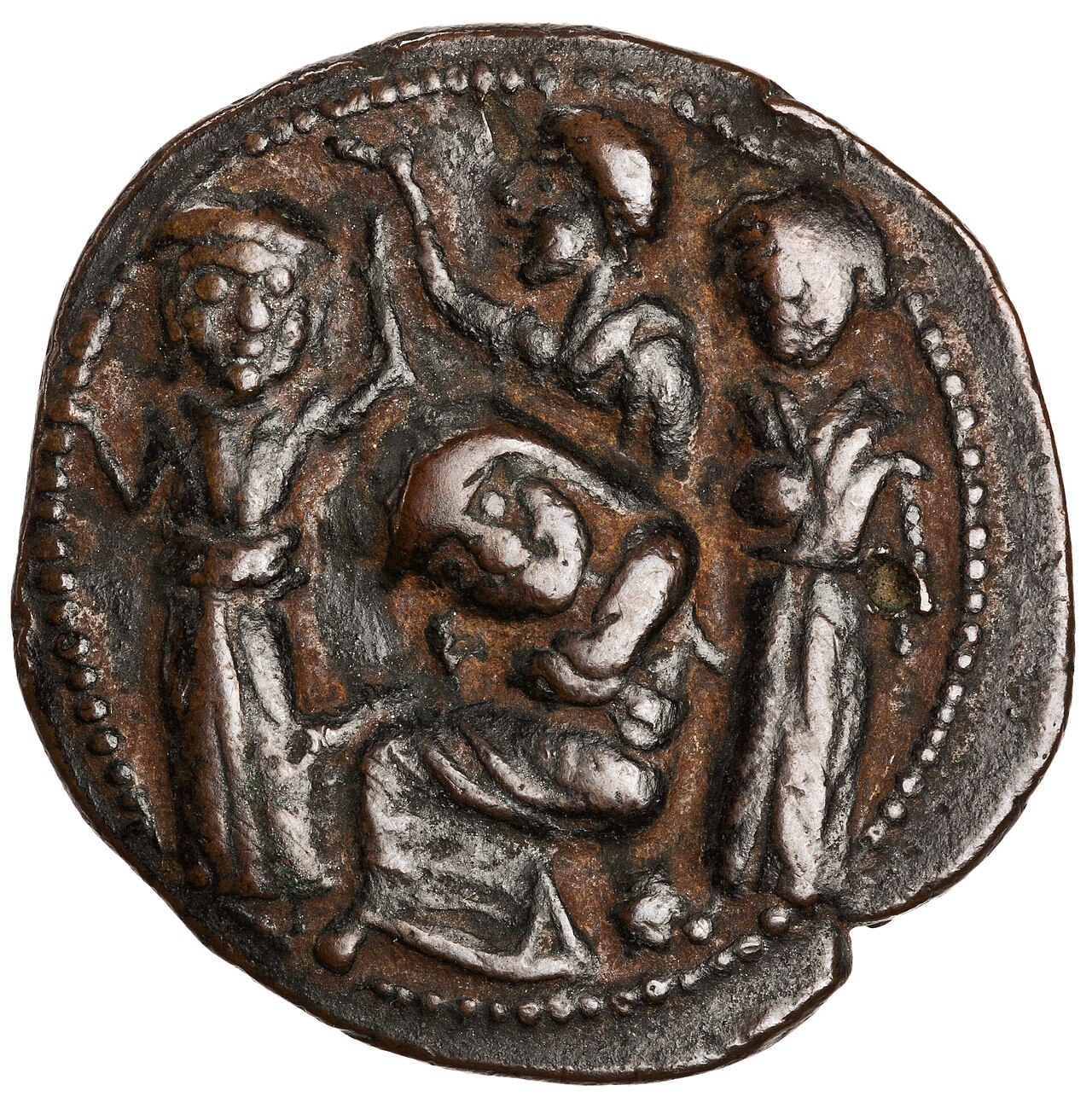
Bronze-colored copper coin with a raised beaded rim showing four figures: on the left a standing woman in a long robe, at top center a figure raising an arm, on the right a standing figure, and at lower center a seated figure leaning forward with head bowed. Figures are in relief.Artifact

Primary source

Copper Dirham of Mardin Mourning Saladin's Death

Husam al-Din Yuluq Arslan (Mardin mint) · 1193

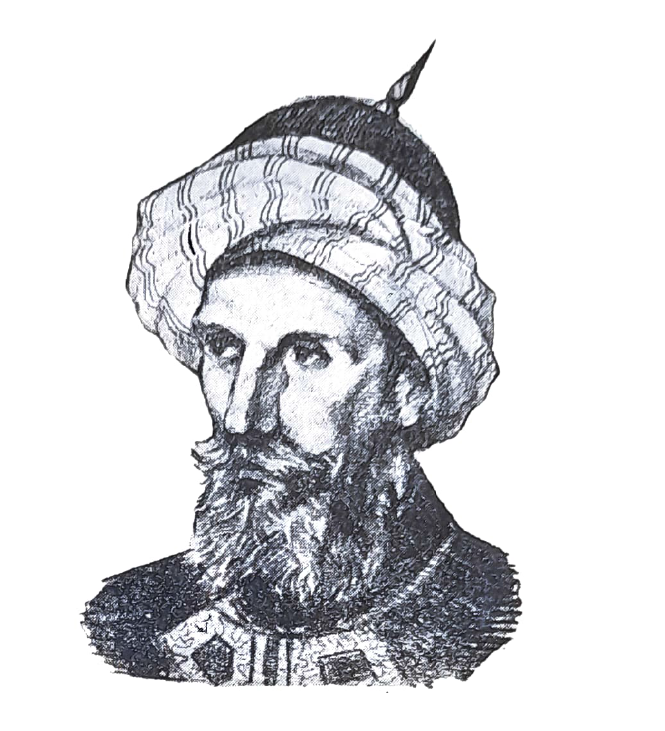
Black and white engraved-style drawing of a bearded man in a large wrapped turban with a feather or plume at the top, wearing a dark robe with an ornamented collar. Head and shoulders, facing slightly to the left.Artifact

Secondary source

Imaginary Sketch of Sultan Saladin

Unknown · 1961

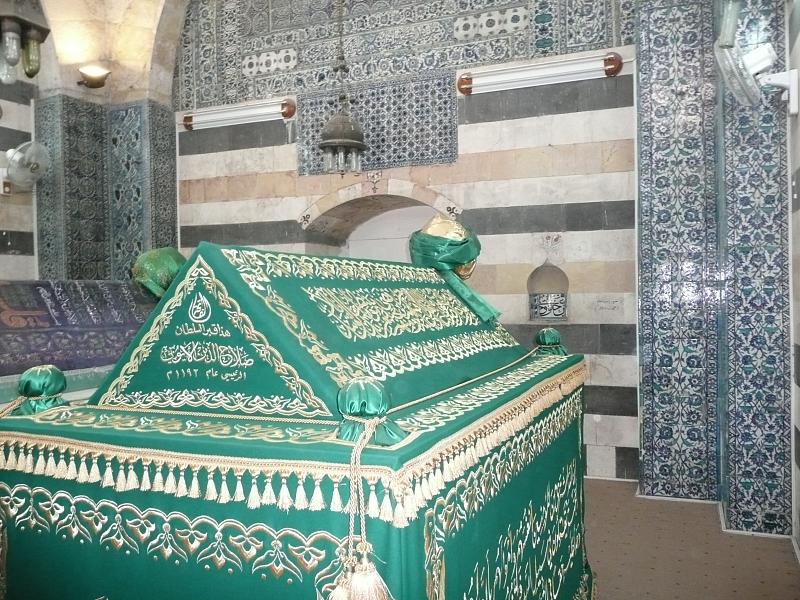
Interior of a mausoleum with a green cloth-covered tomb decorated with gold Arabic calligraphy and tassels, set against blue and white patterned tiles and striped stone walls with an arched niche.Photograph

Secondary source

Mausoleum of Saladin, Damascus

gray_um · 3 March 2008

Photograph of a bronze coin, obverse, showing a seated figure in a robe with a hat, holding an object, flanked by two hanging ornaments and surrounded by raised Arabic script around the rim.Artifact

Primary source

Coin of Saladin, Obverse

CNG Coins · photographed 2021; coin from Saladin's reign

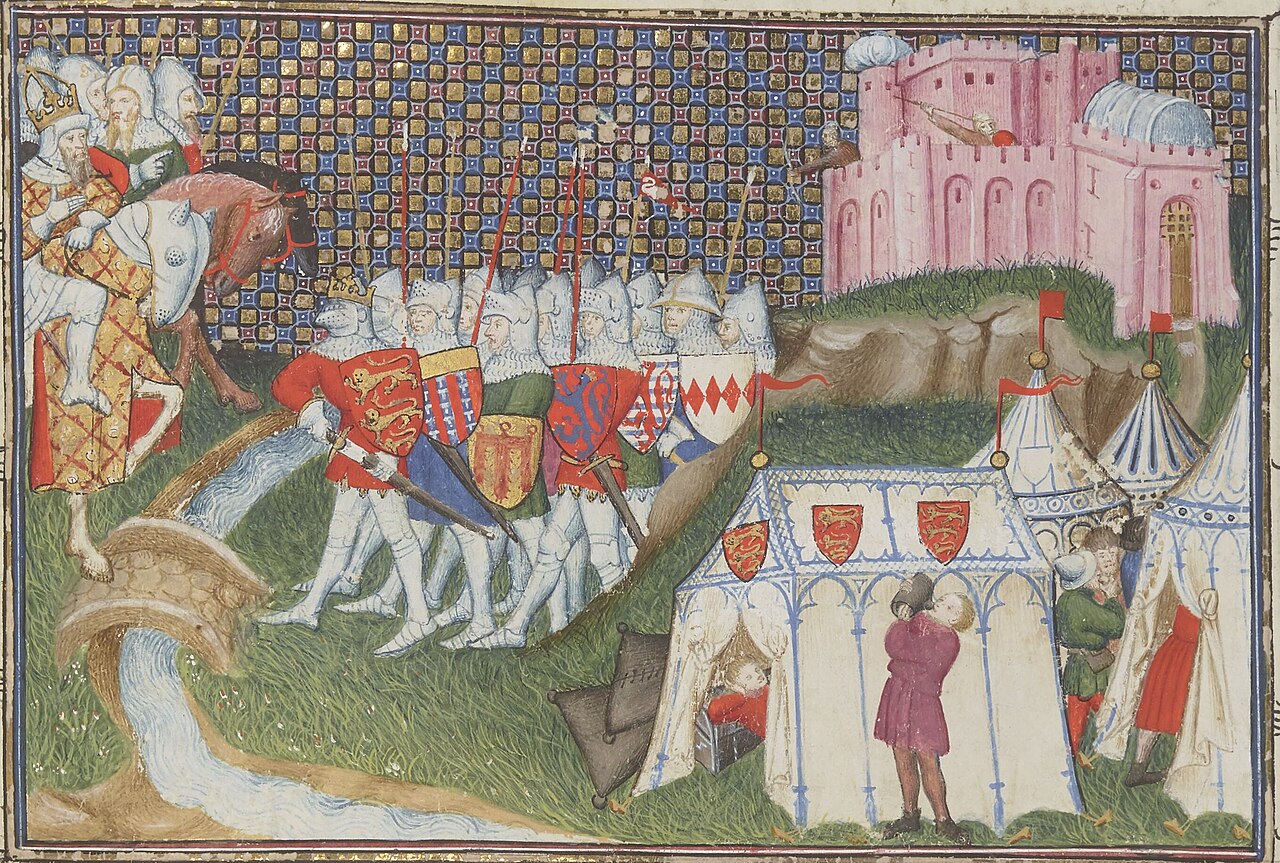
Medieval manuscript miniature: on the left, a crowned rider on a white horse leads a column of turbaned warriors across a stream toward a bridge. On the right, armored knights in red and white with heraldic shields advance; a pink castle and striped tents with lion banners stand behind.Painting

Secondary source

Le chevalier errant, Saladin and Richard at the Bridge

Master of the City of Ladies · 1403-1404 (manuscript copy of 1395 text)

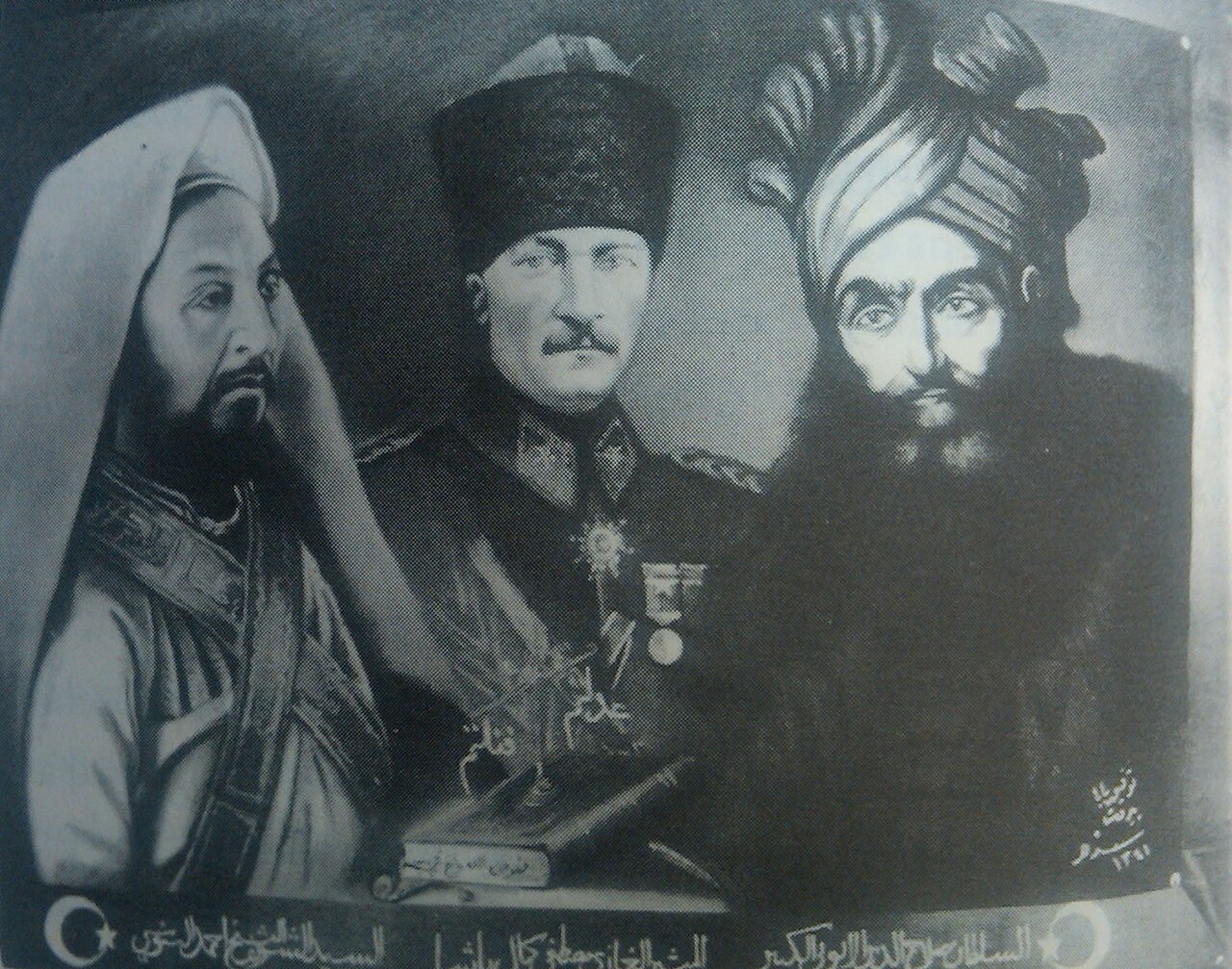
Black-and-white postcard of three men in half-length portrait. Left: a bearded man in a light headdress and robe. Center: a mustached man in a tall fur-trimmed cap and military uniform with medals. Right: a bearded man in a striped turban. Arabic and Turkish inscriptions and crescent-and-star emblems are at the bottom.Photograph

Primary source

Postcard of Mustafa Kemal with Saladin and Ahmed Sharif

توفيق بابا (Tawfiq Baba), Beirut · 1922

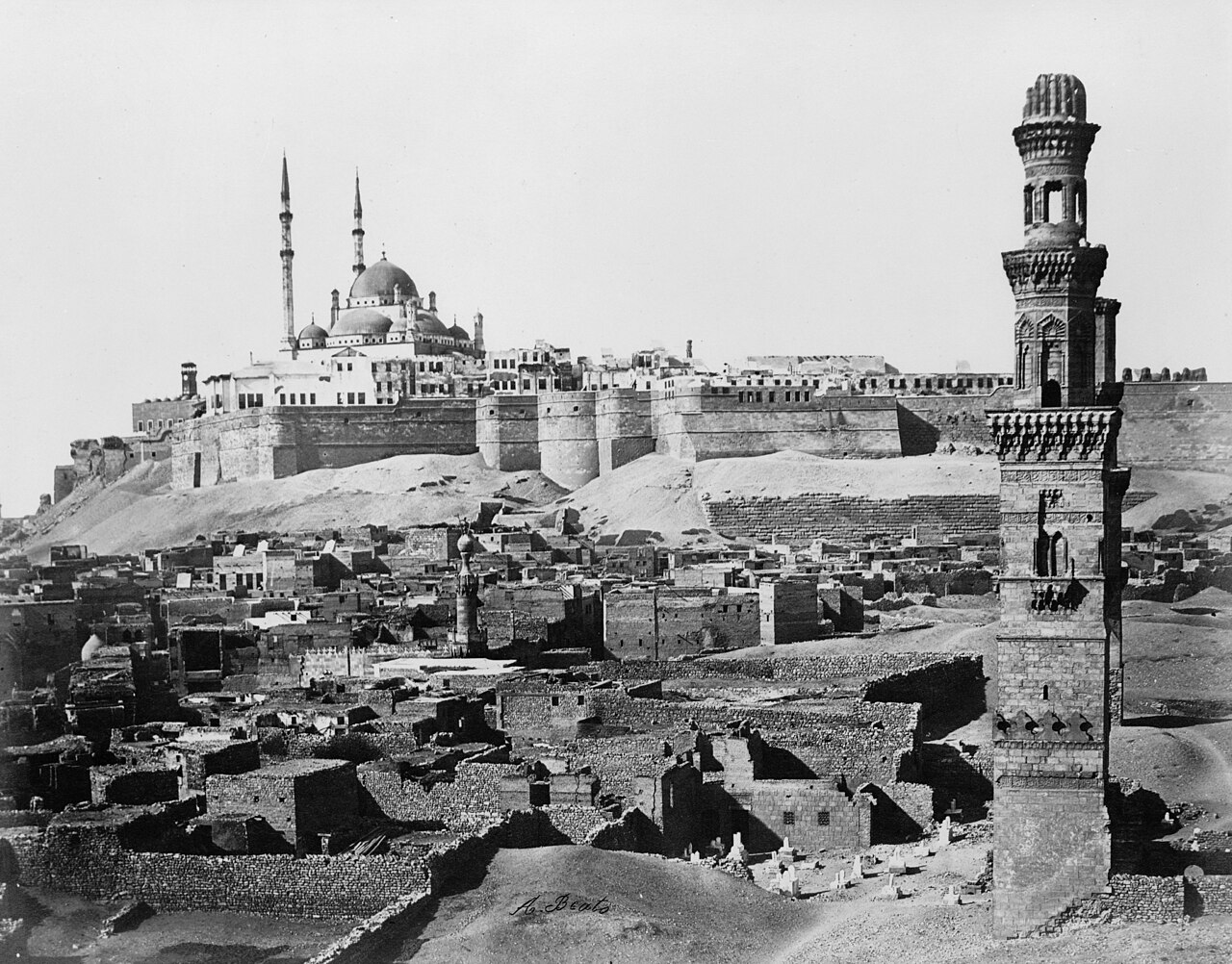
Black-and-white photograph of Cairo viewed from below: the Citadel walls and a large domed mosque with two slender minarets sit on a hill, while a tall ornate minaret rises at right over low flat-roofed houses and walled ruins in the foreground.Photograph

Secondary source

Cairo Citadel and Tombs

Antonio Beato · between 1870 and 1890

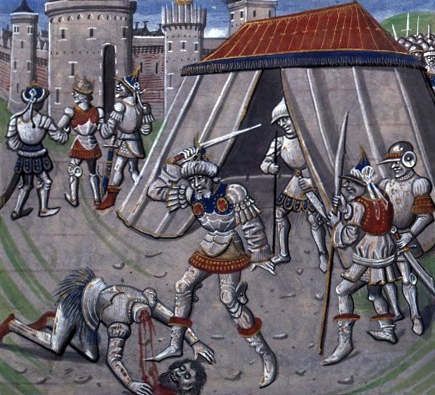
Medieval manuscript miniature of armored knights in a camp before a walled city with towers. A knight in plumed helmet raises a sword over a kneeling, headless figure whose blood spurts onto the ground. Other soldiers in armor and a tent with red trim stand nearby.Painting

Secondary source

Death of Raynald of Chatillon

15th century

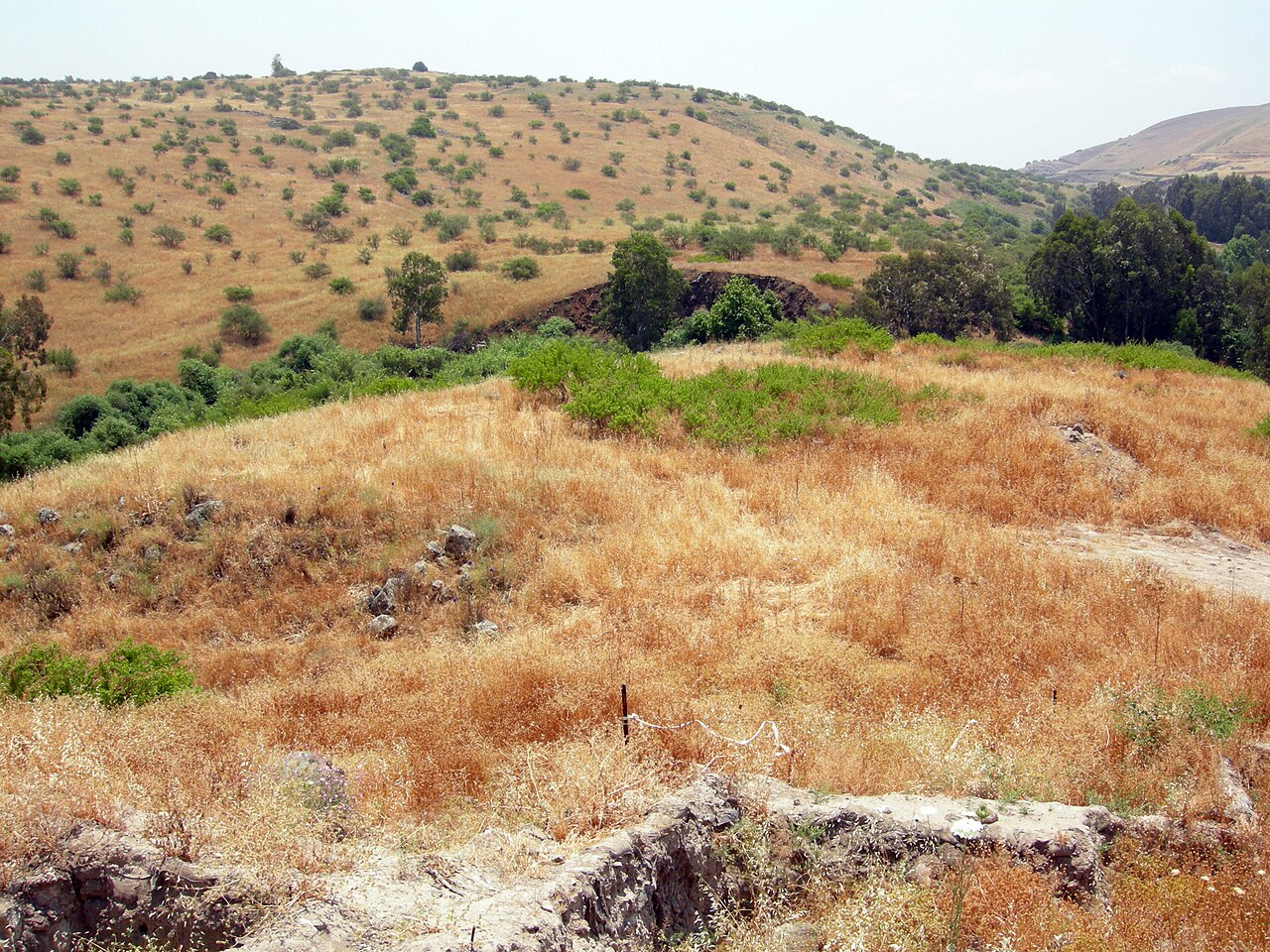
Dry hillside landscape with golden grass, scattered shrubs and trees, and low rocky stone outcrops in the foreground under a pale sky. Ridges rise to the left and right, with a dark patch of earth near the middle.Photograph

Secondary source

Jacob's Ford Battlefield

Wilson44691 · 26 May 2009

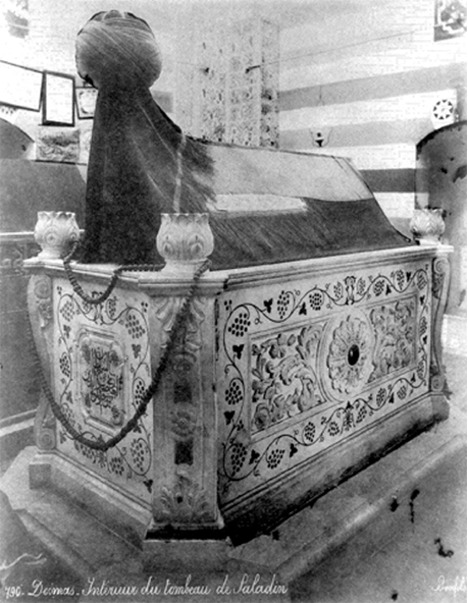
Black and white photograph of an ornate marble tomb with carved panels and a dark cloth draped over the top, with chains along the front, inside a building. A caption at the bottom reads 'Interieur du tombeau de Saladin'.Photograph

Secondary source

Interior of Saladin's Mausoleum, Damascus

Félix Bonfils · 1850s

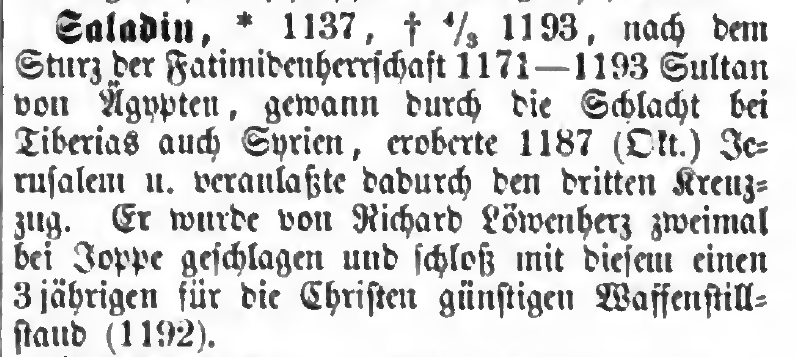
Scan of a German encyclopedia entry in Fraktur typeface headed 'Saladin', giving his dates (1137 to 1193), his rule as Sultan of Egypt after the fall of the Fatimid dynasty, the Battle of Hattin, the 1187 conquest of Jerusalem, the Third Crusade, his two defeats by Richard Lionheart near Jaffa, and a 3-year ceasefire of 1192.Document

Tertiary source

Saladin entry in Handlexikon für evangelische Theologen

Autorenkollektiv · 1891

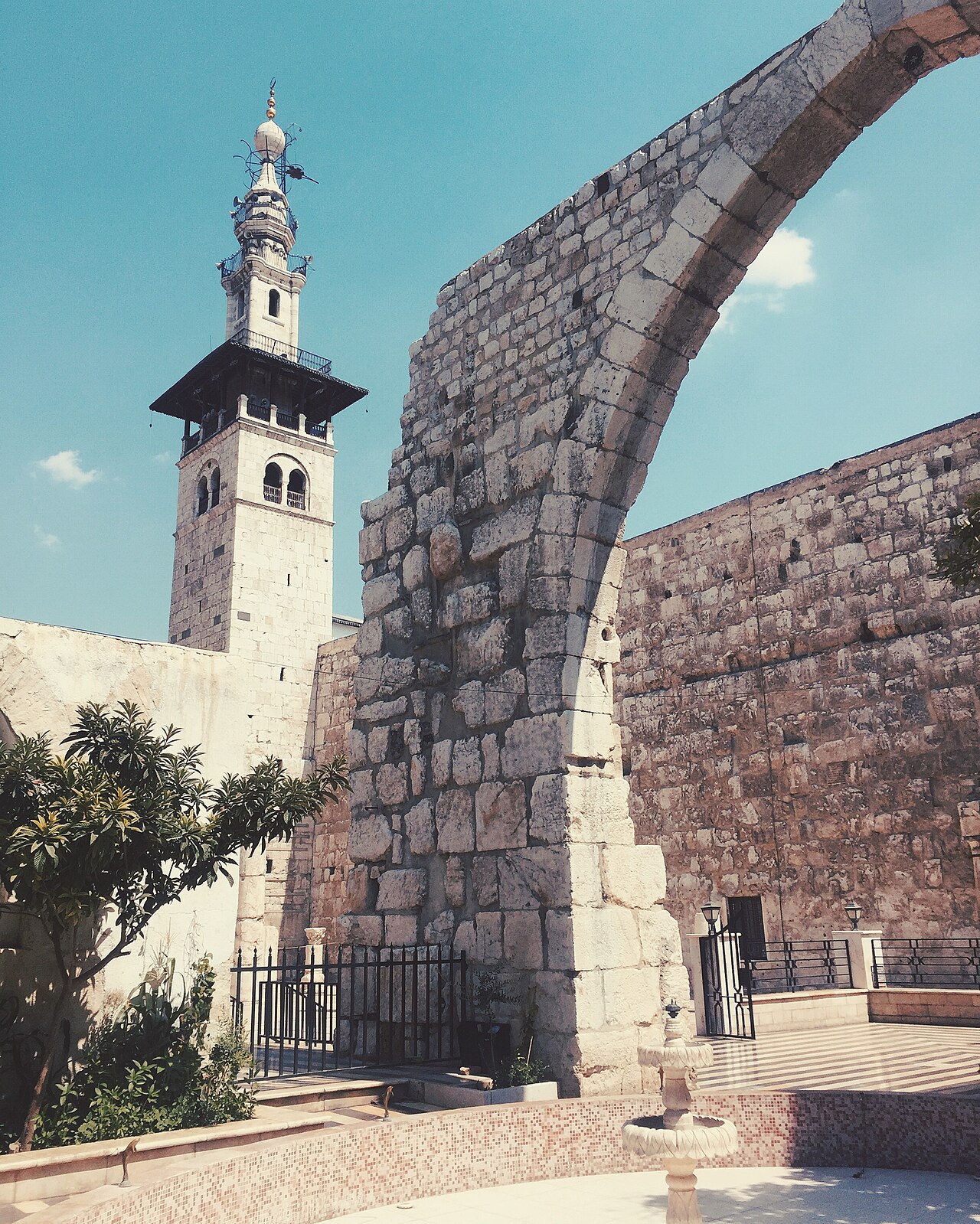
Photograph of a large stone arch built of dressed masonry blocks, next to a white minaret with a dark wooden balcony and small arched windows, under a clear blue sky. A small ornate fountain and a tree are in the foreground, with a low wall and iron railing.Photograph

Secondary source

Mausoleum of Saladin and Umayyad Mosque

Bassel Khabbaz · 24 July 2016

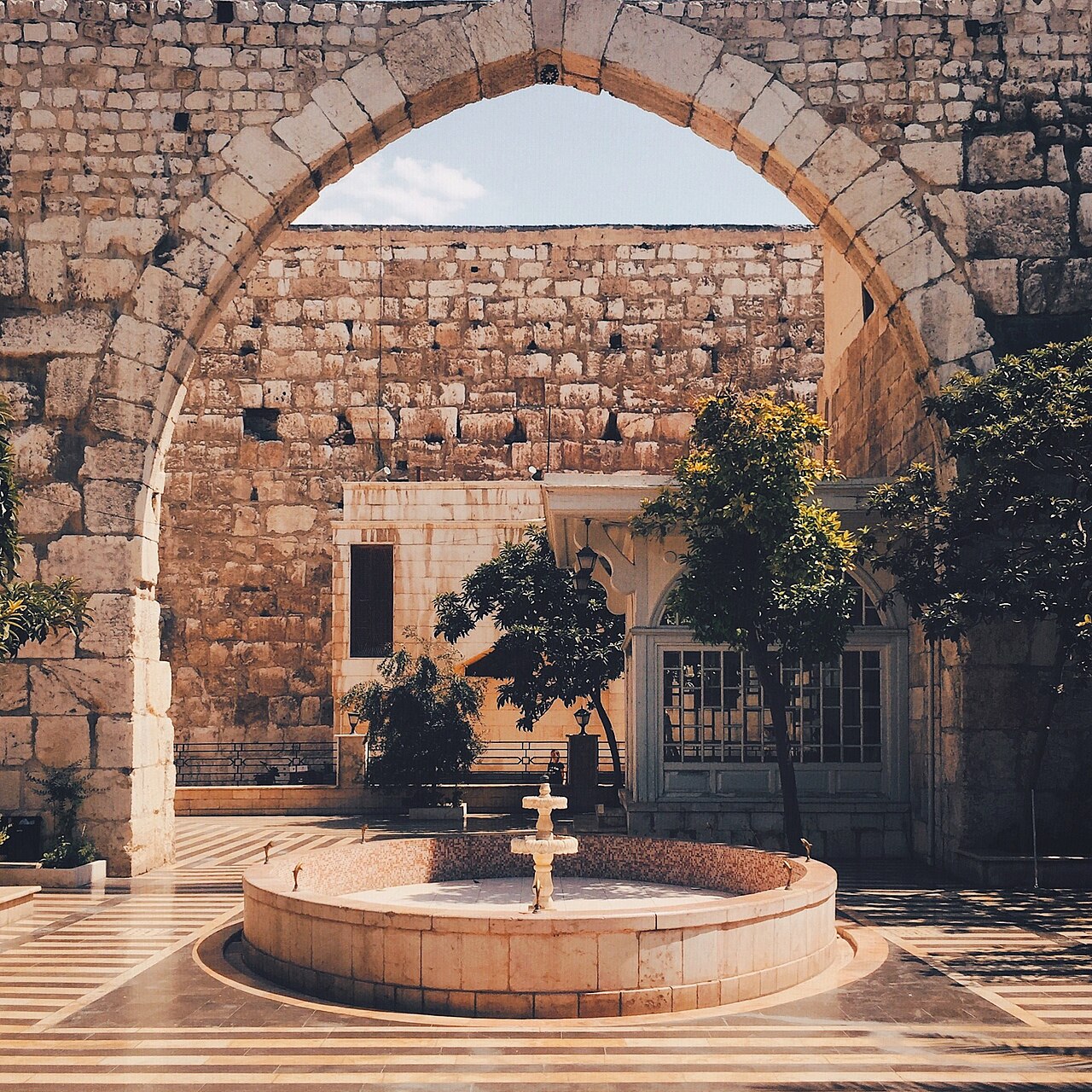
A stone archway in an old stone wall frames a courtyard with a round, tiered stone fountain in the foreground. Behind it stand a stone wall, a small building with a barred window, and orange-leaved trees under a pale blue sky.Photograph

Secondary source

Mausoleum of Saladin, Entrance

Bassel Khabbaz · 24 July 2016

Black-and-white 19th-century photograph of a stone ruin in Damascus. A tall arch spans the left side, and a domed structure with small windows rises behind a weathered stone wall. A caption at bottom right reads Tombeau de Saladin Damas. Bonfils is signed at bottom left.Photograph

Secondary source

Saladin's Mausoleum in Damascus

Félix Bonfils · c. 1850

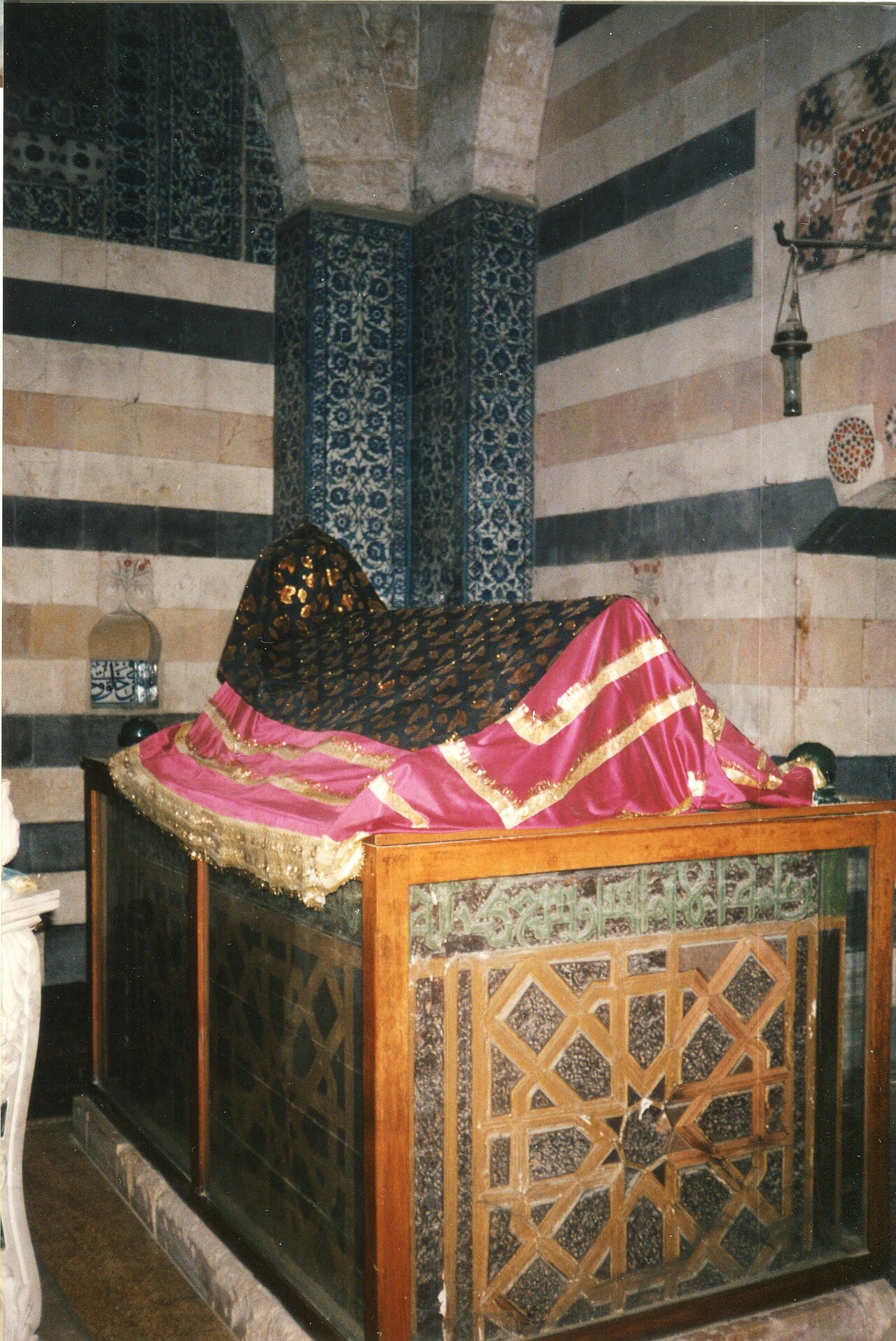
Photograph of a wooden and glass tomb cenotaph draped with a pink satin cloth edged in gold, and a dark cloth with gold patterns, inside a room with striped stone walls and blue tile columns. Arabic inscription is visible on the tomb.Photograph

Secondary source

Mausoleum Salah Ad-Din in the Great Mosque

Gerhard Haubold · 17 October 1994

Medieval manuscript illumination with gold-leaf background showing armored knights in blue and red tunics with shields fighting on foot in a crowd, a castle tower with an arched gateway in the center, and a mounted figure on the upper right. Below the image are lines of Old French text in red and black ink.Painting

Secondary source

Histoire d'Outremer Illumination of the Battle of Jaffa

Unknown author · c. 1300

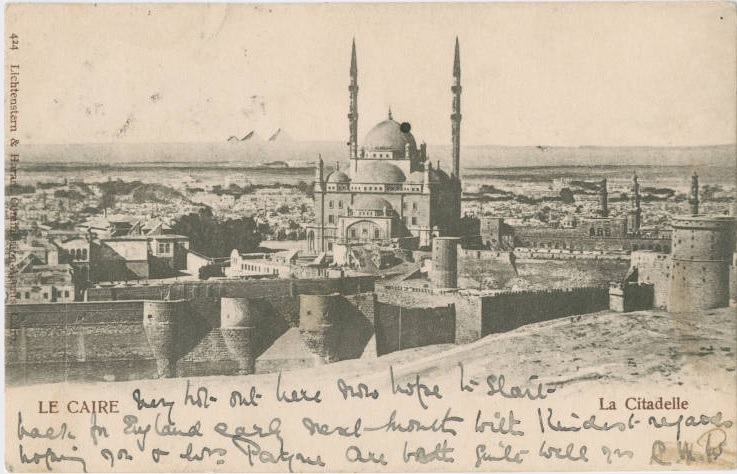
Sepia postcard of the Cairo Citadel with the Muhammad Ali Mosque, its tall minarets and central dome rising above a walled fortress. Pyramids are faint on the distant horizon over a city. Handwritten cursive message fills the lower part, with 'LE CAIRE' and 'La Citadelle' printed captions.Photograph

Primary source

Postcard of Cairo Citadel and Muhammad Ali Mosque

1904

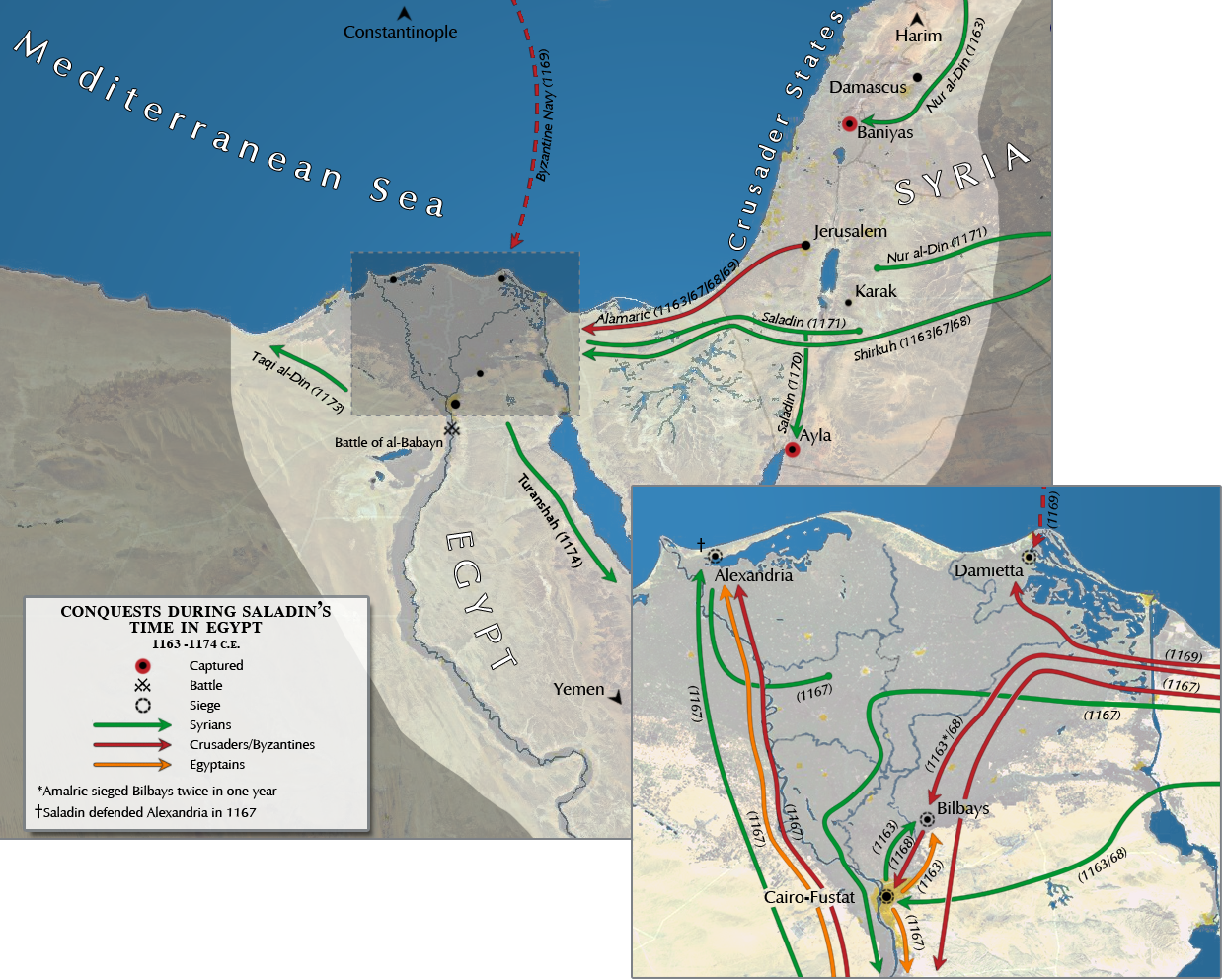
Map titled Conquests during Saladin's time in Egypt, 1163-1174 C.E., showing the Mediterranean Sea, Syria, Egypt, and the Crusader States. Colored arrows mark Syrian, Crusader/Byzantine, and Egyptian campaigns, with a detail inset of Lower Egypt around Alexandria, Damietta, Bilbays, and Cairo-Fustat.Document

Tertiary source

Map of Saladin's Conquests in Egypt and Syria

abattenb · 13 March 2008

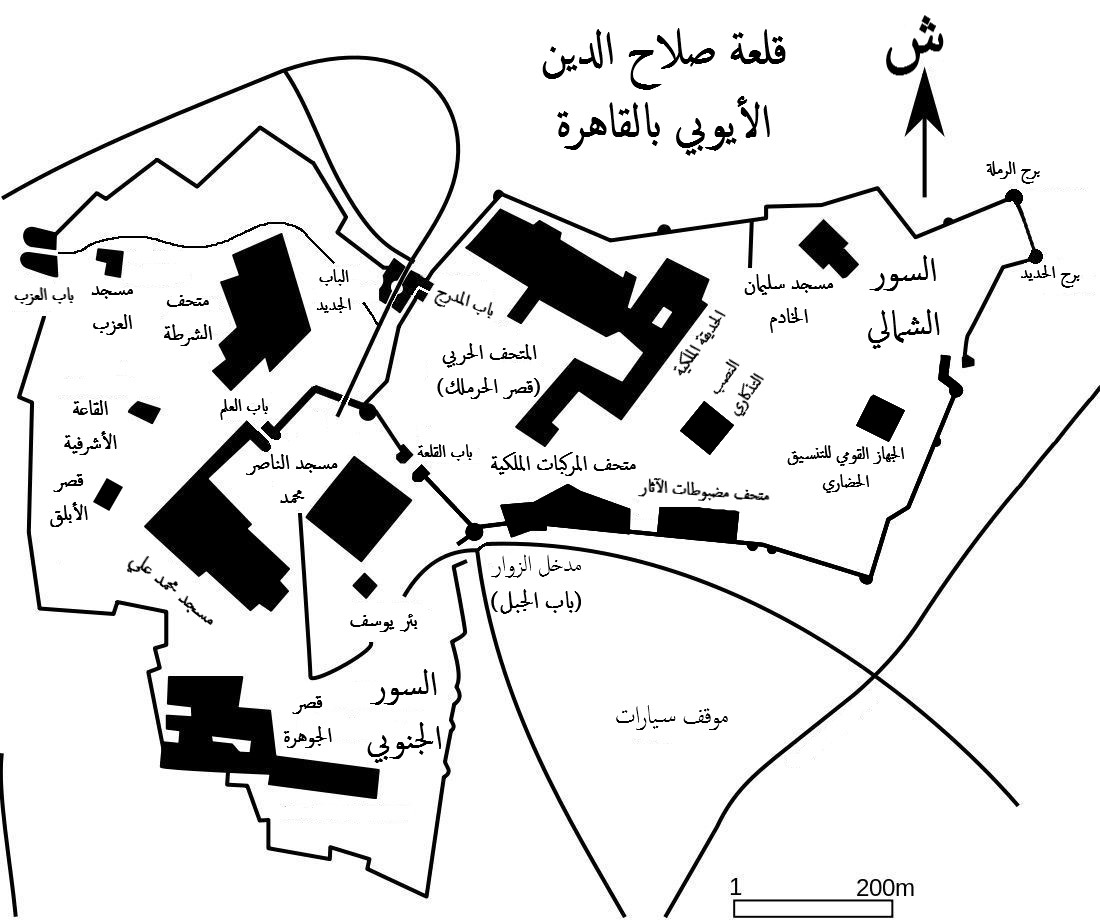
Black-and-white line map in Arabic titled 'قلعة صلاح الدين الأيوبي بالقاهرة' (Saladin Citadel in Cairo). It shows the citadel's walls and gates, with filled black building footprints, labelled areas such as the Northern and Southern sectors, a 200 m scale bar at bottom right, and a north arrow marked with the letter ش at top right.Artifact

Tertiary source

Map of the Saladin Citadel in Cairo

Néfermaât; Malyszkz; Robert Prazeres · 2026

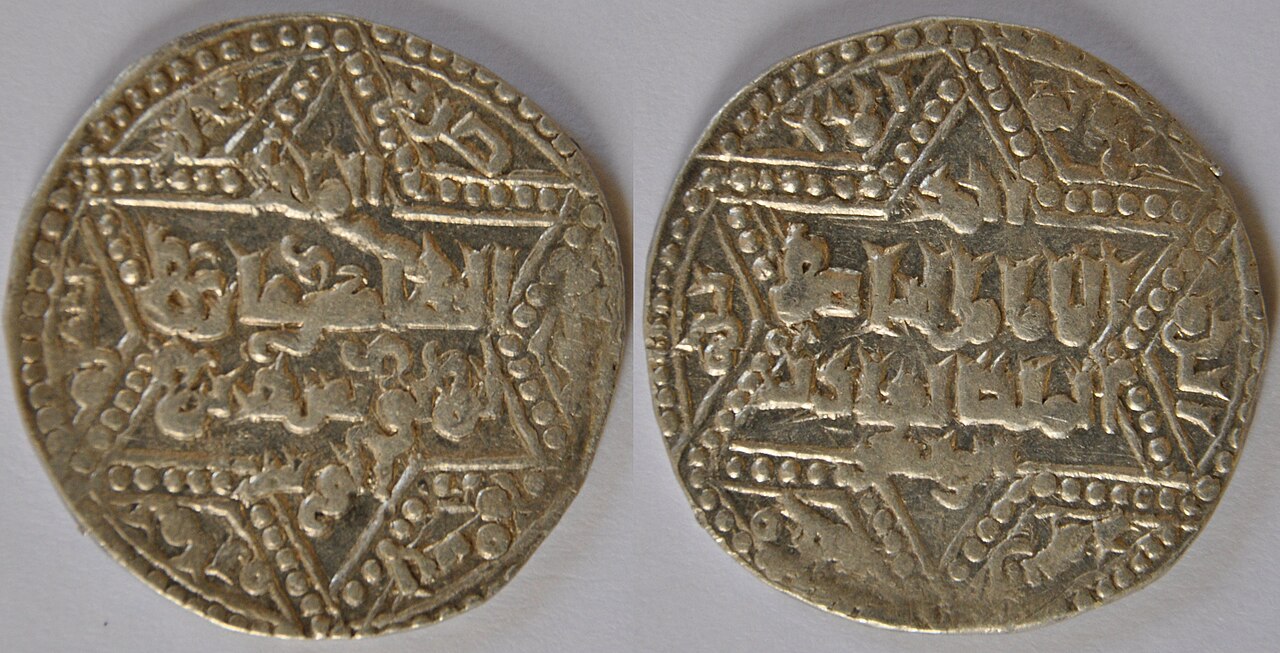
Photograph of two silver Ayyubid dirham coins side by side against a light background. Each coin is a circular silver piece with raised Arabic inscriptions in the center, surrounded by a six-pointed star pattern formed by lines and dotted borders.Artifact

Primary source

Silver Dirham of az-Zahir Ghazi

AH 582-613 / 1186-1216 AD

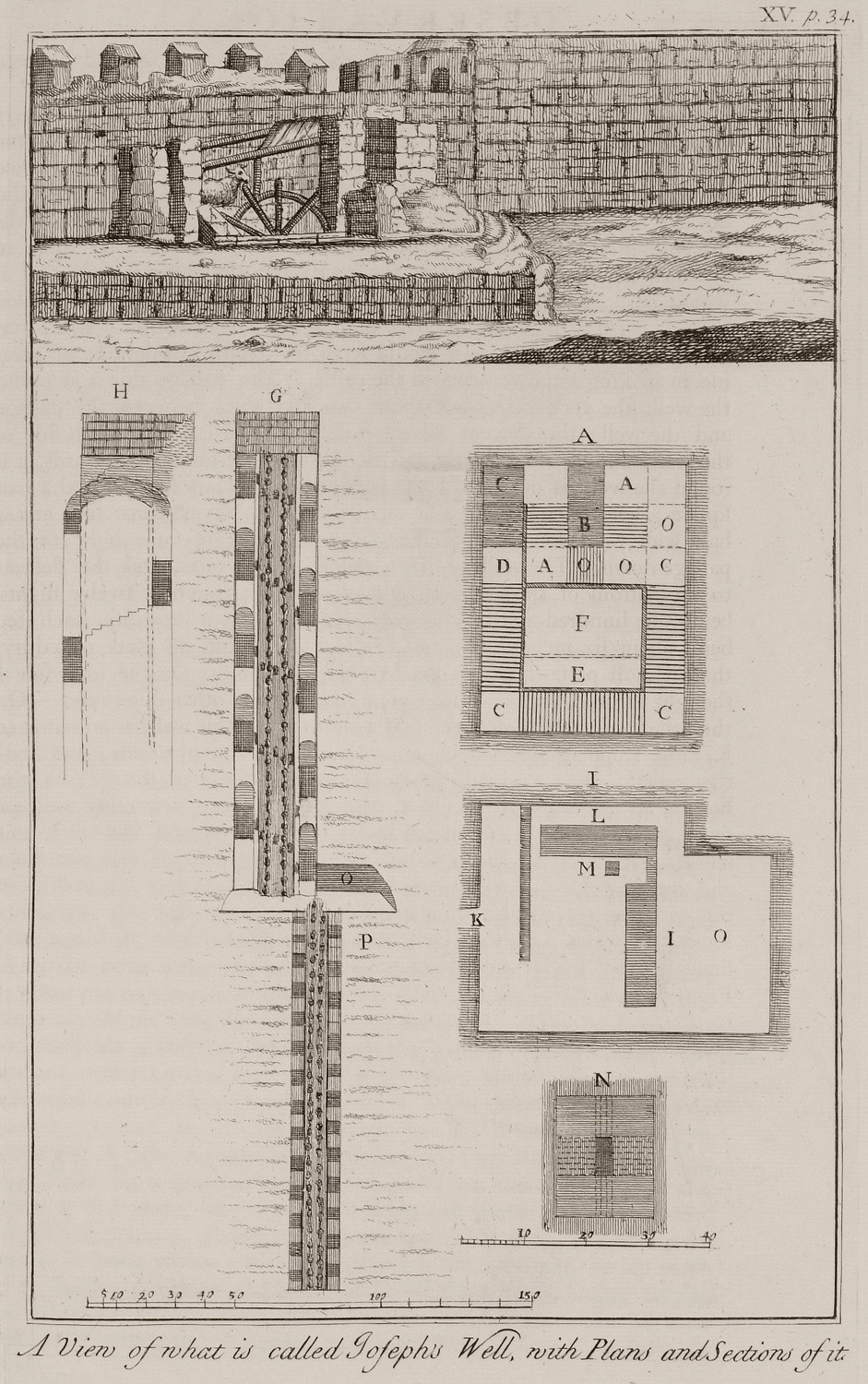
Engraved plate titled 'A View of what is called Joseph's Well, with Plans and Sections of it.' Top: a perspective view of a well-house with a wheel and a stone wall with battlements. Below: a section (H, G), plans lettered A through N, and a scale bar in feet. Page marked XV p.34.Document

Secondary source

Plan and Sections of Joseph's Well, Cairo

Richard Pococke · 1745

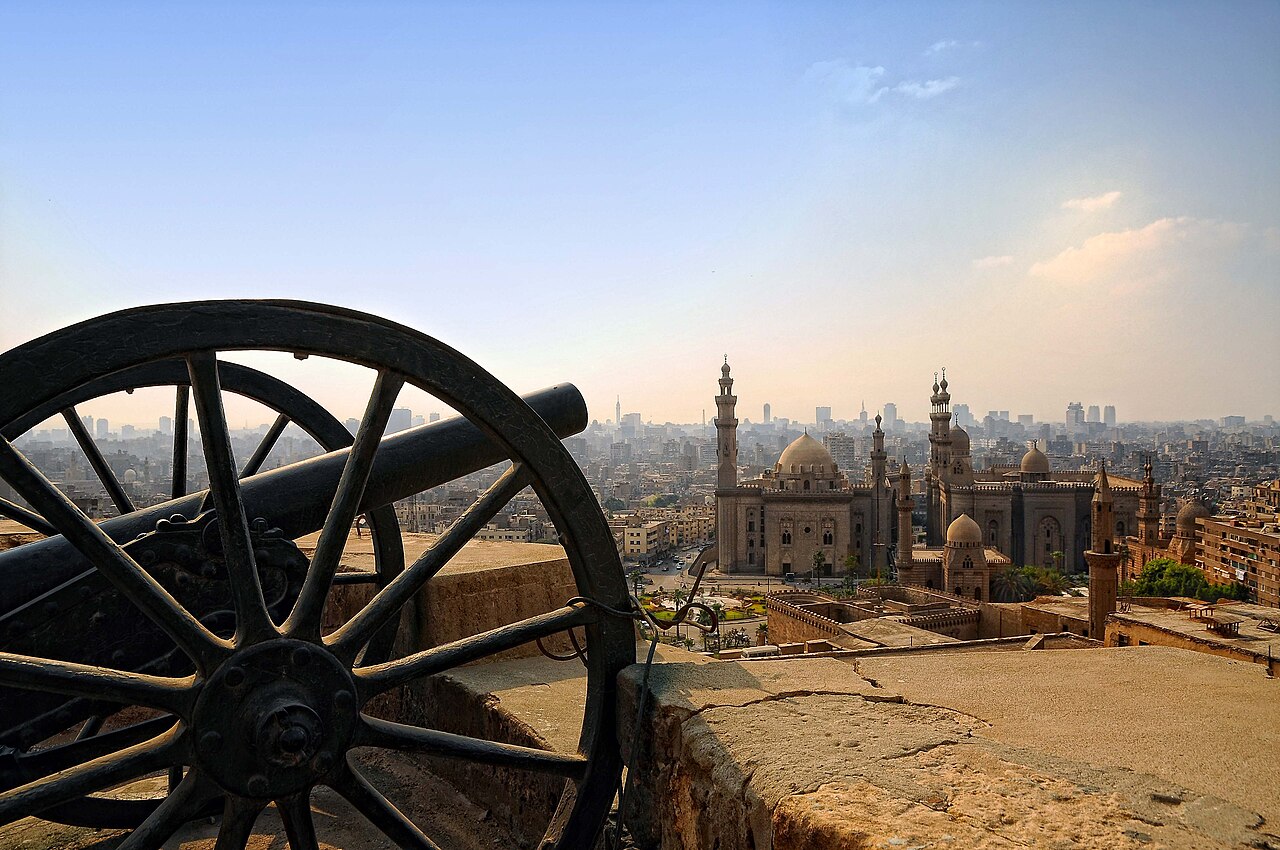
A large black cannon with a spoked wooden-style wheel in the foreground on a stone parapet, overlooking a hazy city of Cairo with two domed Islamic mosques with minarets in the middle distance under a pale blue sky.Photograph

Secondary source

Cairo Citadel with Al-Rifa'i and Sultan Hassan Mosques

Mohamed kamal 1984 · 15 May 2011

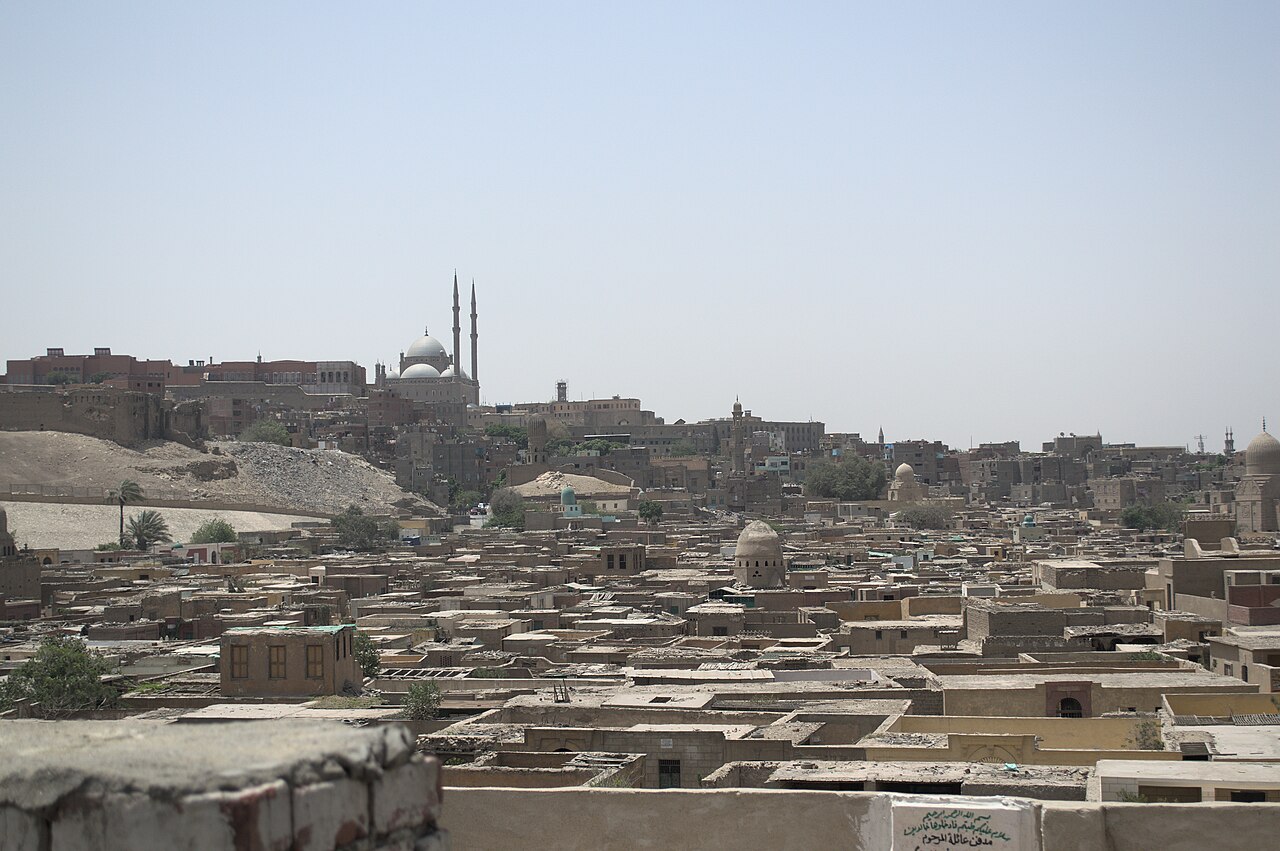
Wide view over a dense, flat-roofed cityscape of low tan buildings and domed tombs in Cairo, with a hazy sky. In the background, the Citadel's mosque with a large dome and tall minarets rises on a hill, with a rocky slope at left.Photograph

Secondary source

View over Qarafat Bab al-Wazir to Cairo Citadel

H. Hakan Atik · 29 April 2017

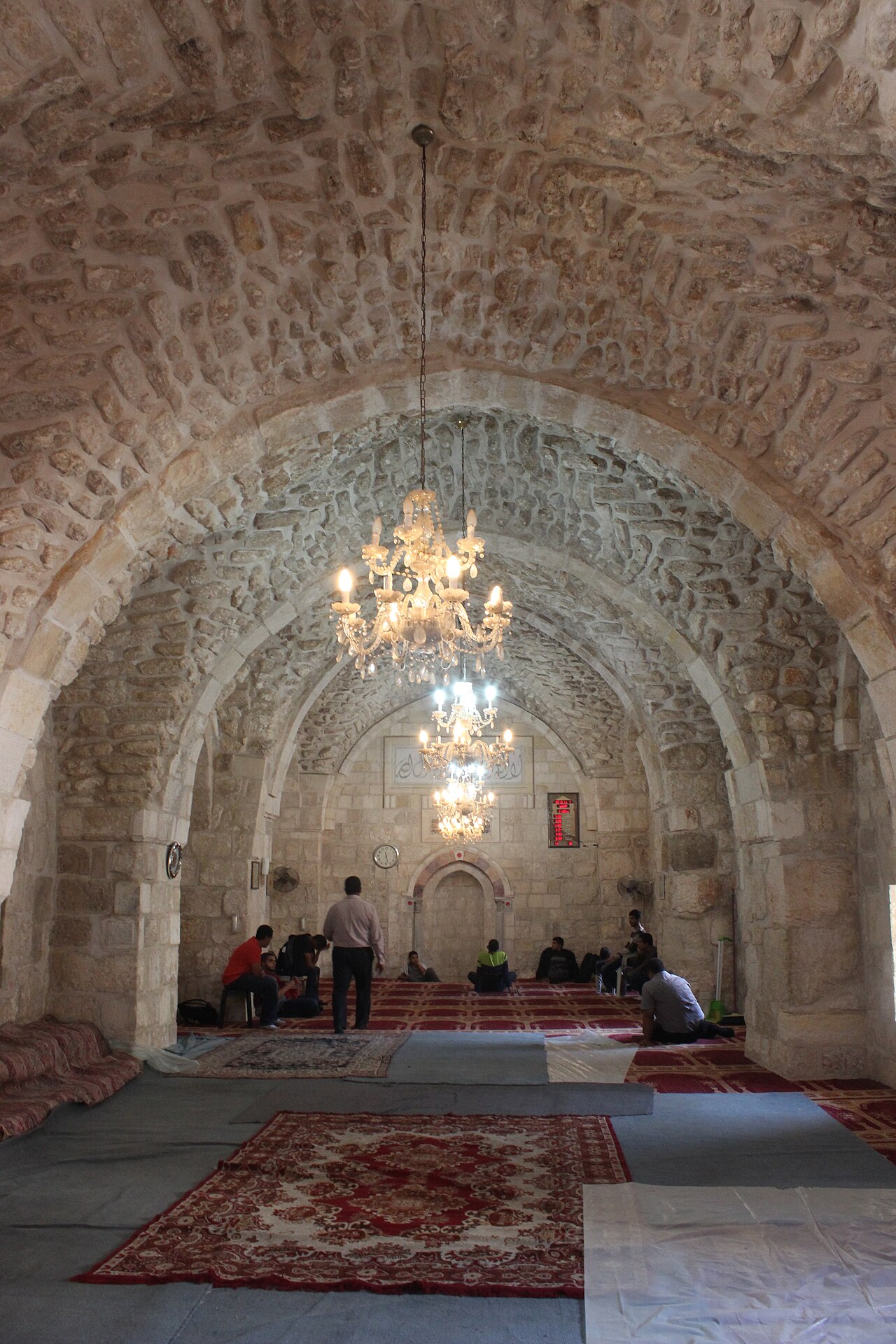
Interior of a vaulted stone hall with a chandelier-lit prayer space. Stone arches and ribbed stone ceiling; red patterned carpets on the floor; several men sit or stand on the carpets, and a mihrab niche is visible at the far end.Photograph

Secondary source

Khanqah al-Salahiyya, Jerusalem

Moataz1997 · 4 November 2013

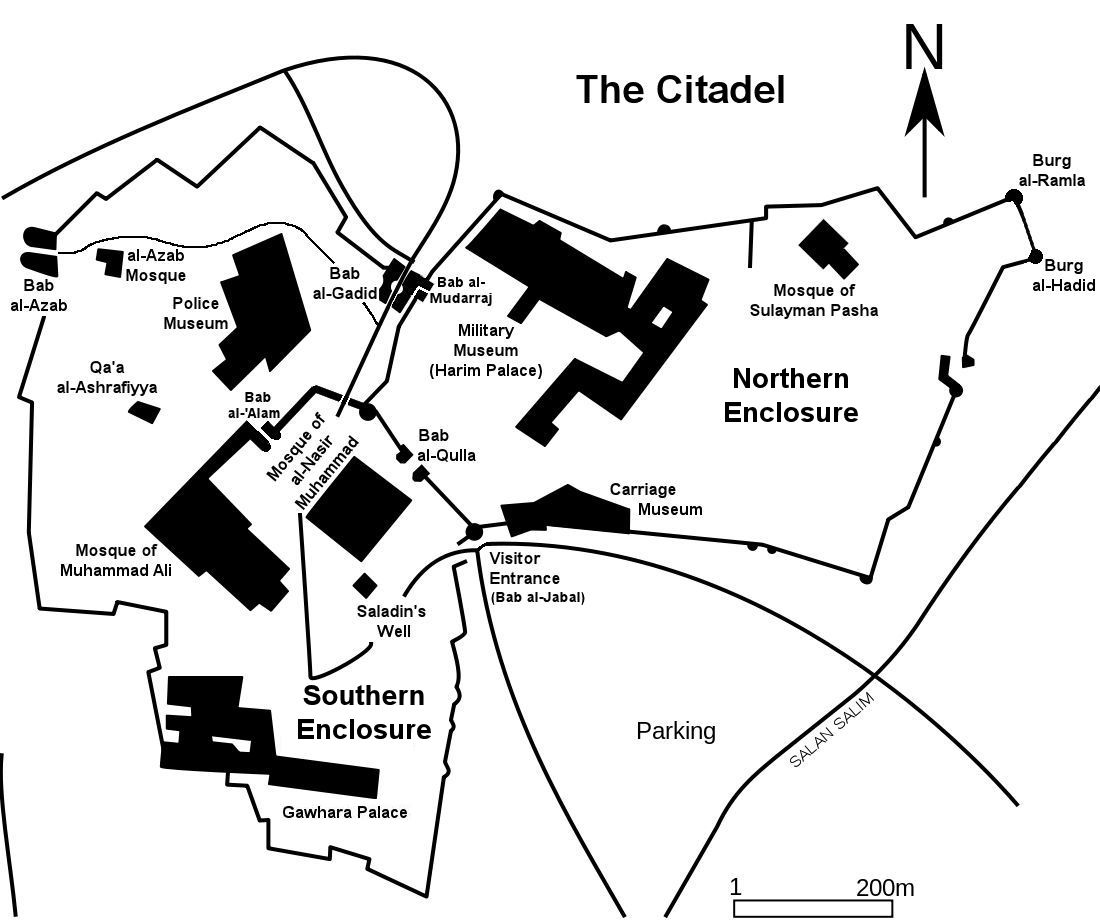
Black-and-white line map of the Cairo Citadel labelled in English, with north arrow and 200m scale bar. Named features include the Citadel, Northern and Southern Enclosures, mosques, museums, gates such as Bab al-Azab and Bab al-Jabal, Saladin's Well, Gawhara Palace, and Parking.Document

Tertiary source

Map of the Cairo Citadel Layout

Néfermaât, Malyszkz, Robert Prazeres · 13 November 2019

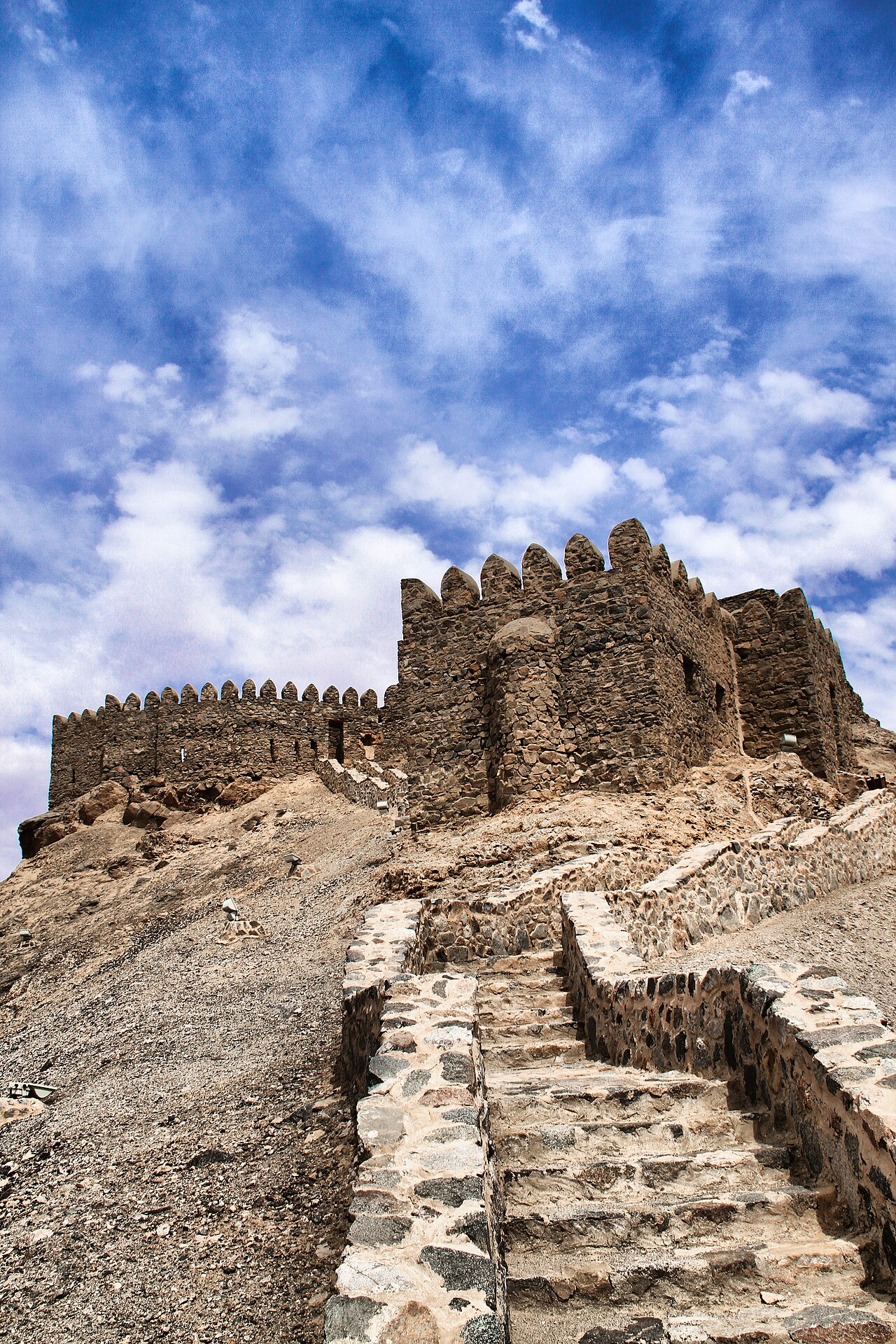
Stone fortress with crenellated battlements on a rocky hilltop under a partly cloudy blue sky. A stone staircase with low walls leads up toward the castle gate in the foreground. Dry, gravelly terrain surrounds the site.Artifact

Secondary source

Citadel of Saladin, Pharaoh's Island, Taba

Ahmedherz · 10 September 2014

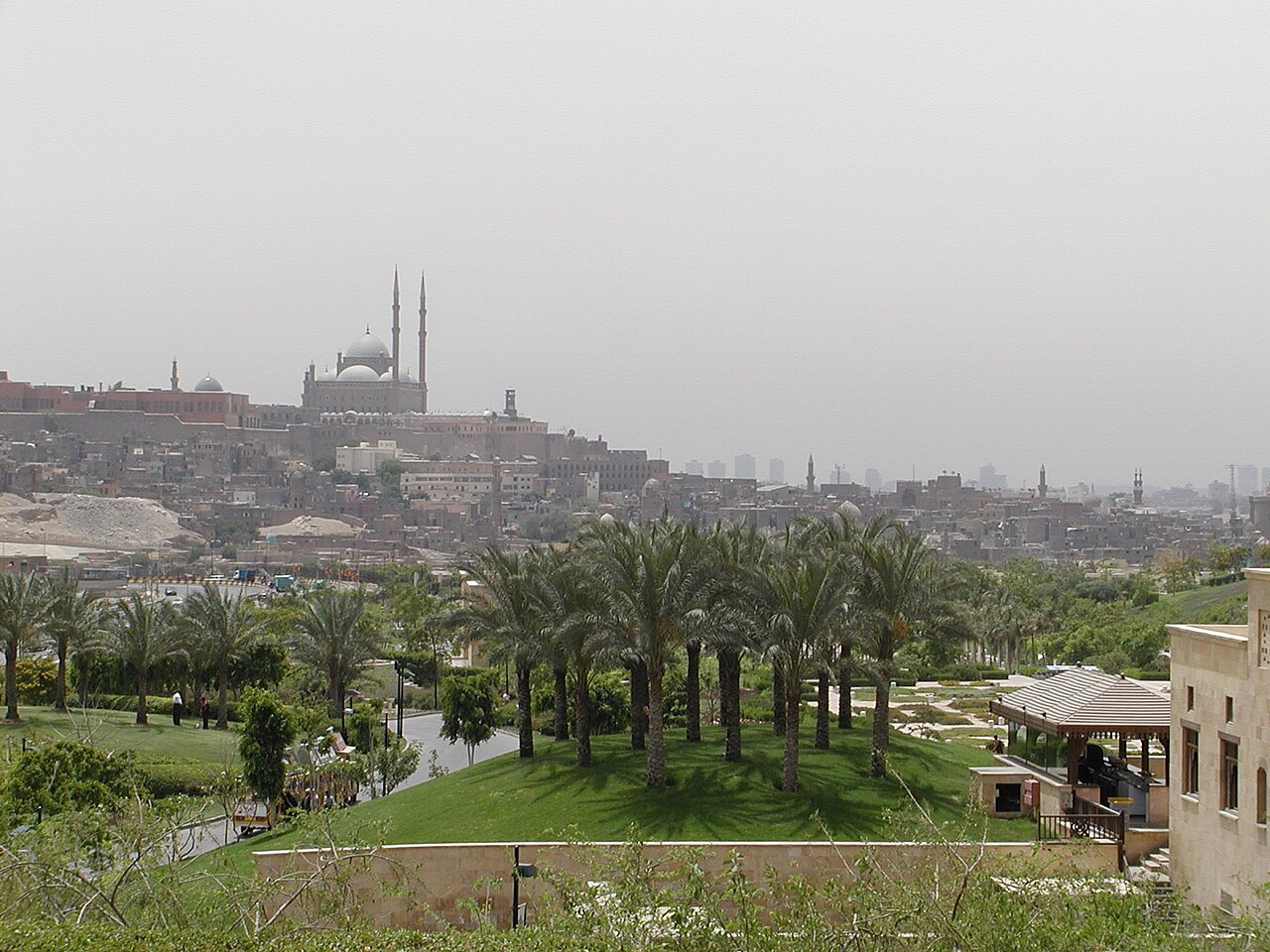
Hazy view over Cairo from Al-Azhar Park: rows of palm trees on a grassy slope in the foreground, a stone pavilion at right, and in the background the domed Mosque of Muhammad Ali on the Citadel hill above dense city buildings and minarets under a pale sky.Photograph

Secondary source

Cairo Citadel seen from Al-Azhar Park

Gérard Ducher · 13 May 2006

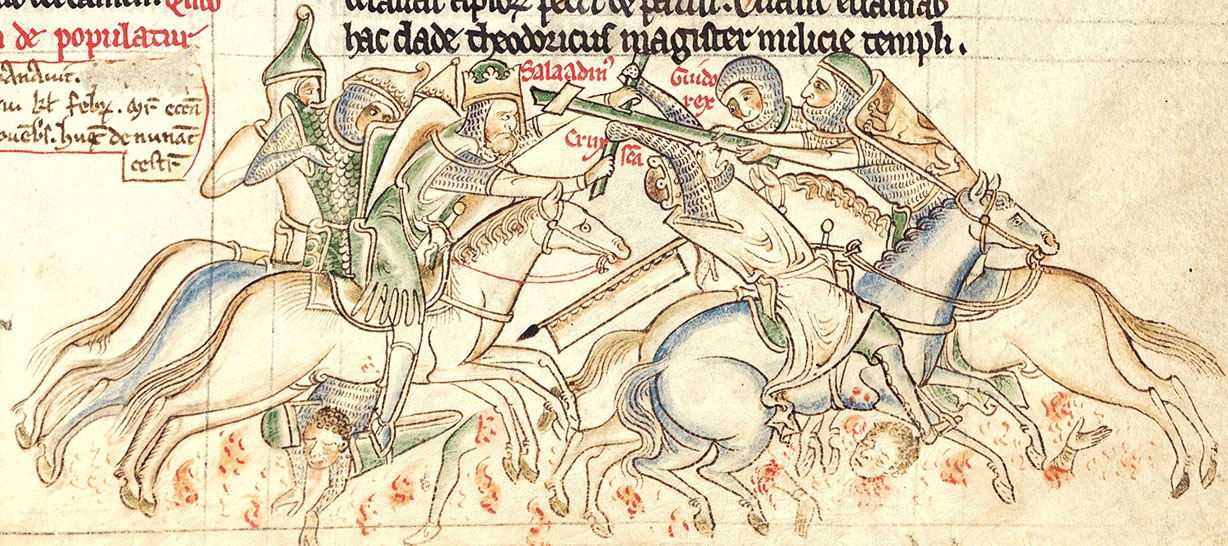
Medieval manuscript painting of a mounted battle. On the left, a rider in a green pointed helmet and armor carries a shield. In the center, a bearded rider with a crown-like headpiece, labeled 'Saladin' in red, thrusts a lance. Opposing knights in mail and helmets charge from the right. Red-brown flames or blood-like marks and severed heads lie on the ground below the horses. Latin text is written at the top and in the left margin.Painting

Primary source

Saladin, Illustration by Matthew Paris

Matthew Paris · 13th century

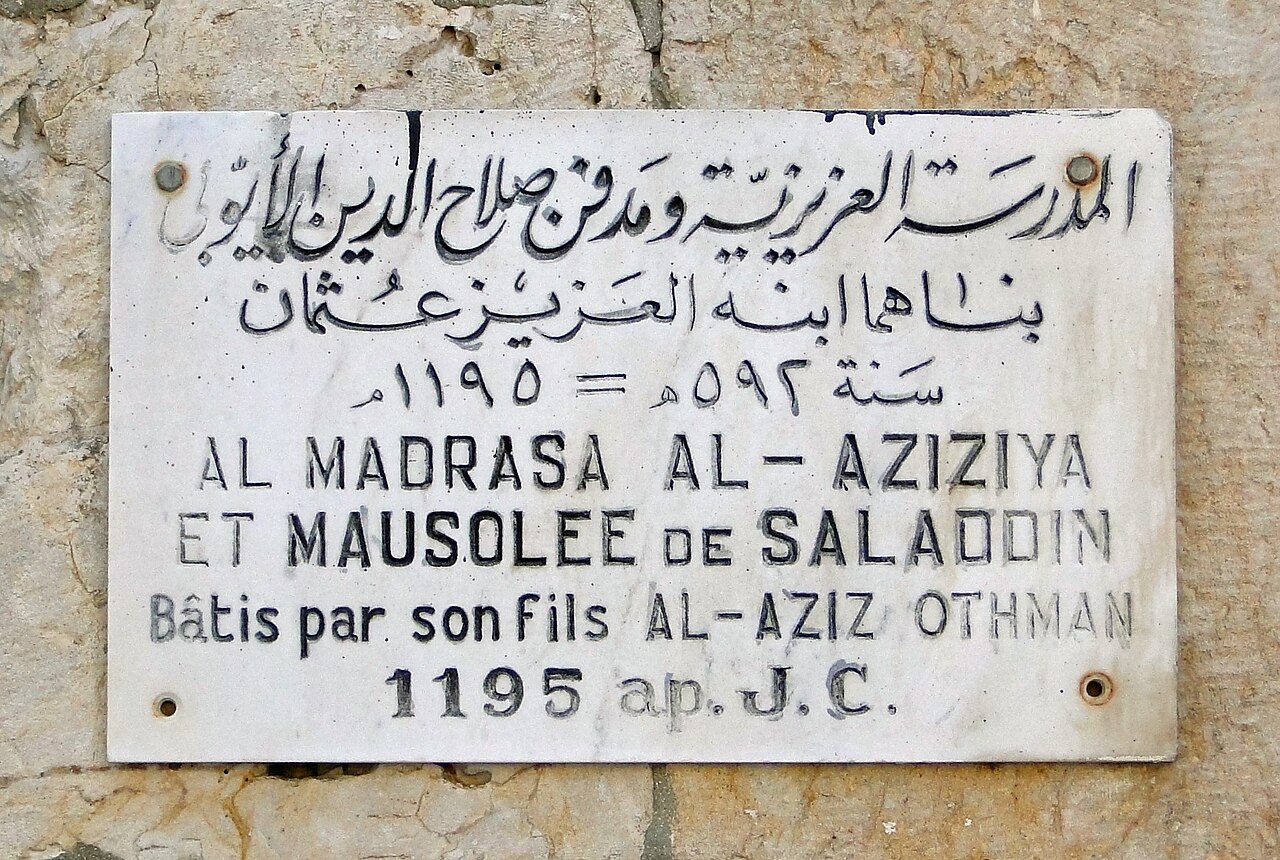
Photograph of a white marble plaque mounted on a rough stone wall. It has Arabic inscriptions at top and middle and French and English text below, reading Al Madrasa Al-Aziziya et Mausolee de Saladdin, built by his son Al-Aziz Othman, 1195 A.D.Photograph

Secondary source

Plaque at Saladin's Mausoleum, Damascus

Bernard Gagnon · 31 March 2010

Want the full shelf? Chat with Saladin in the app and open the Sources panel — every quote links back to the original.

Use Saladin in class

3 collections

Ready-made collections from the Humy team that feature Saladin. Preview any of them, then try it free.

Trusted by educators worldwide

Conversations
375,000+
Real exchanges between students and historical figures
Messages exchanged
4,142,000+
Across every figure, classroom and language
Historical figures
100,000+
Each informed by a curated biography and selected sources
Languages supported
50+
From English and Spanish to Arabic and Korean

Paying customers

Used by 98 schools and universities

Partner school logo
Tecnológico de Monterrey logo
Hyper Island logo
Partner school logo
Chambersburg Area School District logo
Broward County Public Schools logo
Nebo School District logo
National Louis University logo
South Florida PBS logo
Punahou School logo
University of Wisconsin–River Falls logo
Partner school logo
Partner school logo
Archbishop Mitty High School logo
Kingsburg High School logo
Norwalk Public Schools logo
Partner school logo
Connections logo
Partner school logo
Moore Public Schools logo
Partner school logo
Partner school logo
Partner school logo
Partner school logo
Robbinsville Public Schools logo
Partner school logo
Partner school logo
Partner school logo
Tecnológico de Monterrey logo
Hyper Island logo
Partner school logo
Chambersburg Area School District logo
Broward County Public Schools logo
Nebo School District logo
National Louis University logo
South Florida PBS logo
Punahou School logo
University of Wisconsin–River Falls logo
Partner school logo
Partner school logo
Archbishop Mitty High School logo
Kingsburg High School logo
Norwalk Public Schools logo
Partner school logo
Connections logo
Partner school logo
Moore Public Schools logo
Partner school logo
Partner school logo
Partner school logo
Partner school logo
Robbinsville Public Schools logo
Partner school logo
Partner school logo

What educators are saying

“We enjoyed the program last year and used it frequently.”
“My students say it’s a welcome change of pace. I’m not a fan of the “sage on the stage” model, so I try to incorporate research-oriented and self-paced activities. With Humy, students have to take charge of their learning. They’ve become more adept at critical thinking, forming better questions, and improving their reading comprehension. The interview feature has been my go-to tool. I create assignments where students must ask historical figures a set number of questions, then summarize the responses to ensure they’re truly absorbing the material. This approach lets them actively explore the past rather than passively consuming information.”
“Humy has helped me bring historical figures, sometimes long past, to life. When my students interact with these figures in real-time, it eliminates some of the perceived “ancient” characteristics of my curriculum. This has shifted my students’ thinking away from viewing history as abstract or irrelevant. Real-time interactions make historical figures relatable, even allowing students to ask off-topic questions that help put historical lives in a more relevant context for 13-year-olds. The feature I use the most is the interview feature. After teaching a topic, most recently Gandhi and Joan of Arc, I have the students ask pointed, focused questions. We practice good conversation techniques beforehand, teaching them to listen (or read) carefully and formulate thoughtful follow-up questions rather than just interrogating. It helps students practice effective conversation skills.”

FAQ

Frequently asked questions

Who is Saladin?
Kurdish military leader and Muslim sultan, known for his role in the Crusades. On Humy.ai you can chat with an AI version of Saladin that draws on a short biography and 78 historical sources during the conversation — by text or voice, in 42 languages.
Is Saladin AI free?
Saladin is part of Humy's full library of more than 100,000 figures, which comes with a paid plan. A free account (no credit card) includes 20 AI messages a month with the free library's figures, so you can try how the conversations work first. The free plan's 20 AI messages a month are shared by you and your students: enough to try Humy yourself; a whole class needs Plus.
What sources does the Saladin AI use?
It draws on a short biography and 78 historical sources (paintings, artifacts and photographs), including “Dirham of Saladin”, “Saladin Proclaims He Will Take Only a Shirt to His Grave” and “Cairo Citadel”. Each source has its own page on Humy.ai.
How historically accurate is the AI version of Saladin?
Each figure uses a short biography and a small set of selected historical sources as context (retrieval-augmented generation), so answers stay closer to known material than the model's general knowledge alone. It isn't a citation-grade research tool — like any LLM, the AI can get details wrong or extrapolate. Treat it as a strong starting point for inquiry and cross-reference important claims.
Can I talk to Saladin by voice?
Yes. In addition to text chat, you can call Saladin and hear their voice respond in real time — useful for auditory learners, interview practice and Socratic dialogue.
Is Humy.ai safe and compliant for schools?
Yes. Humy.ai is used by more than 100 schools, universities and organisations. The platform is FERPA- and GDPR-aligned, supports SSO, and offers an IT-approval pack tailored for school procurement teams.

Ready when you are

Start chatting with Saladin now.

20 messages free · No credit card · Available in 50+ languages.