
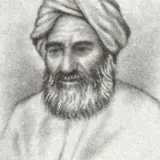
Portrait of Al-Biruni

AI Historical Figure

Al-Biruni

Persian polymath known for his contributions to mathematics, astronomy, and geography.

Chat with Al-Biruni via text or voice — in 42 languages, drawing on a curated biography and 79 historical sources. Available 24/7.

Start chatting with Al-Biruni20 messages free · No credit card
Lived
973–1048
From
UzbekistanAfghanistan
Known for
Science & medicineScholarship & social science
Al-Biruni

Al-Biruni

Online · responds in seconds

Hello — I'm Al-Biruni. Persian polymath known for his contributions to mathematics, astronomy, and geography. What would you like to ask me?

20 messages free · No credit card · Powered by Humy.ai

Live preview · Switch between 42 languages above · Send a message to continue in the app

Multilingual

Talk to Al-Biruni in 42 languages

Ask Al-Biruni questions in any language below, and the rest of Humy's app speaks it too. Pick yours to open the chat in that language.

Also in German (Austria), German (Switzerland), English (UK), English (Australia), English (Canada).

The sources behind this AI

79 sources · 31 books · 29 paintings · 14 artifacts · 2 documents · 2 photographs · 1 documentary

Al-Biruni doesn’t improvise from thin air. The AI is grounded in 79 curated historical sources students can inspect. Open any of them to see what informs the conversation.

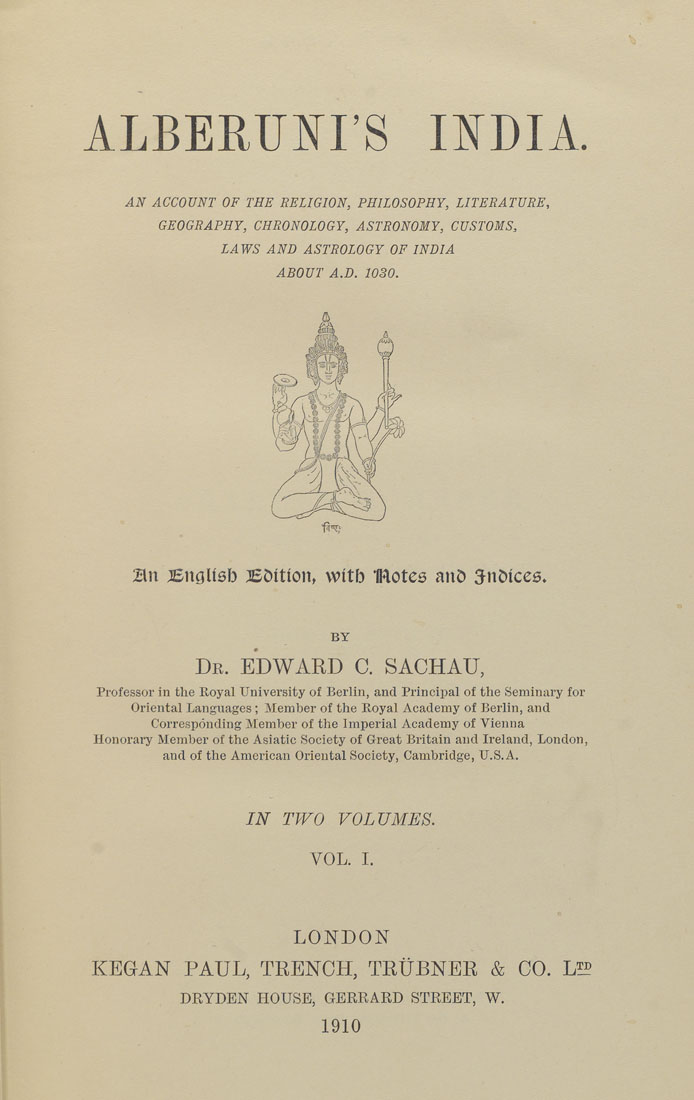
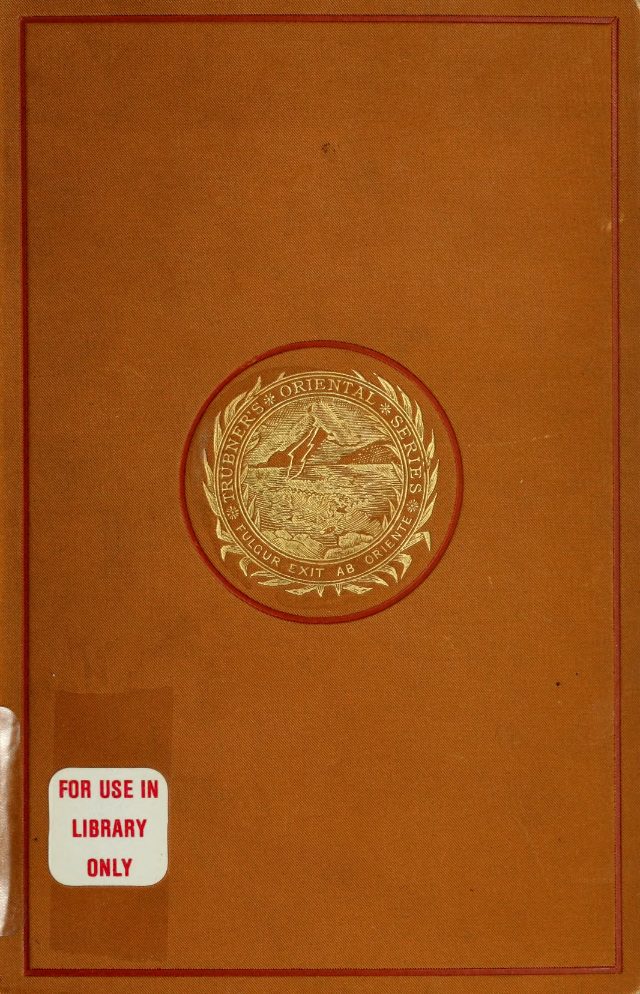
Title page of 'Alberuni's India', an English edition by Dr. Edward C. Sachau, Vol. I, London, Kegan Paul, Trench, Trübner & Co., 1910. Includes a line drawing of a seated multi-armed Hindu deity holding objects, with a subtitle about religion, philosophy, astrology and customs of India about A.D. 1030.Book

Primary source

Al-Biruni's India

Al-Biruni · c. 1030

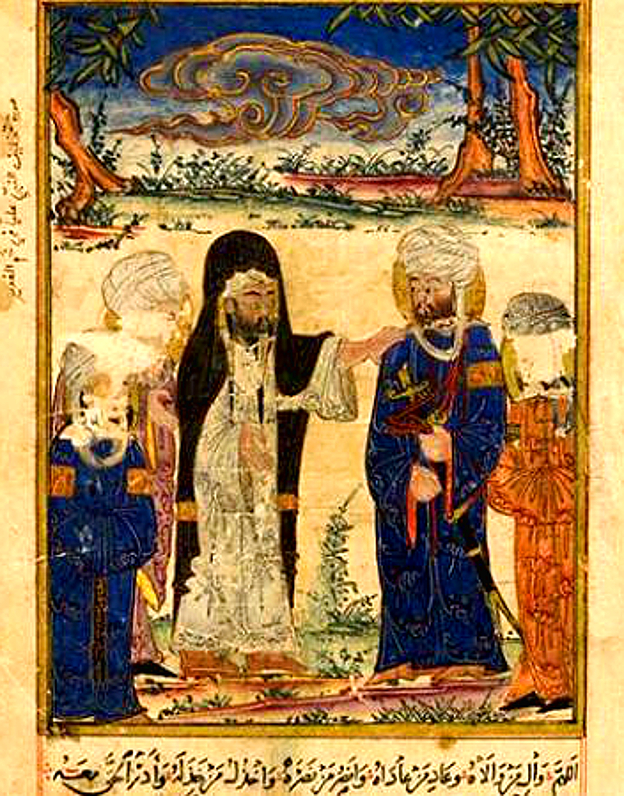
Manuscript miniature painting of a scene with a central figure in white robes and a black cloak, a bearded man in a blue robe and white turban placing his hand on the central figure's arm, and other turbaned figures standing around in a landscape with stylized clouds and trees, with an Arabic inscription band below.Book

Primary source

The Remaining Signs of Past Centuries

Al-Biruni · c. 1000, illustrated copy 1307-1308

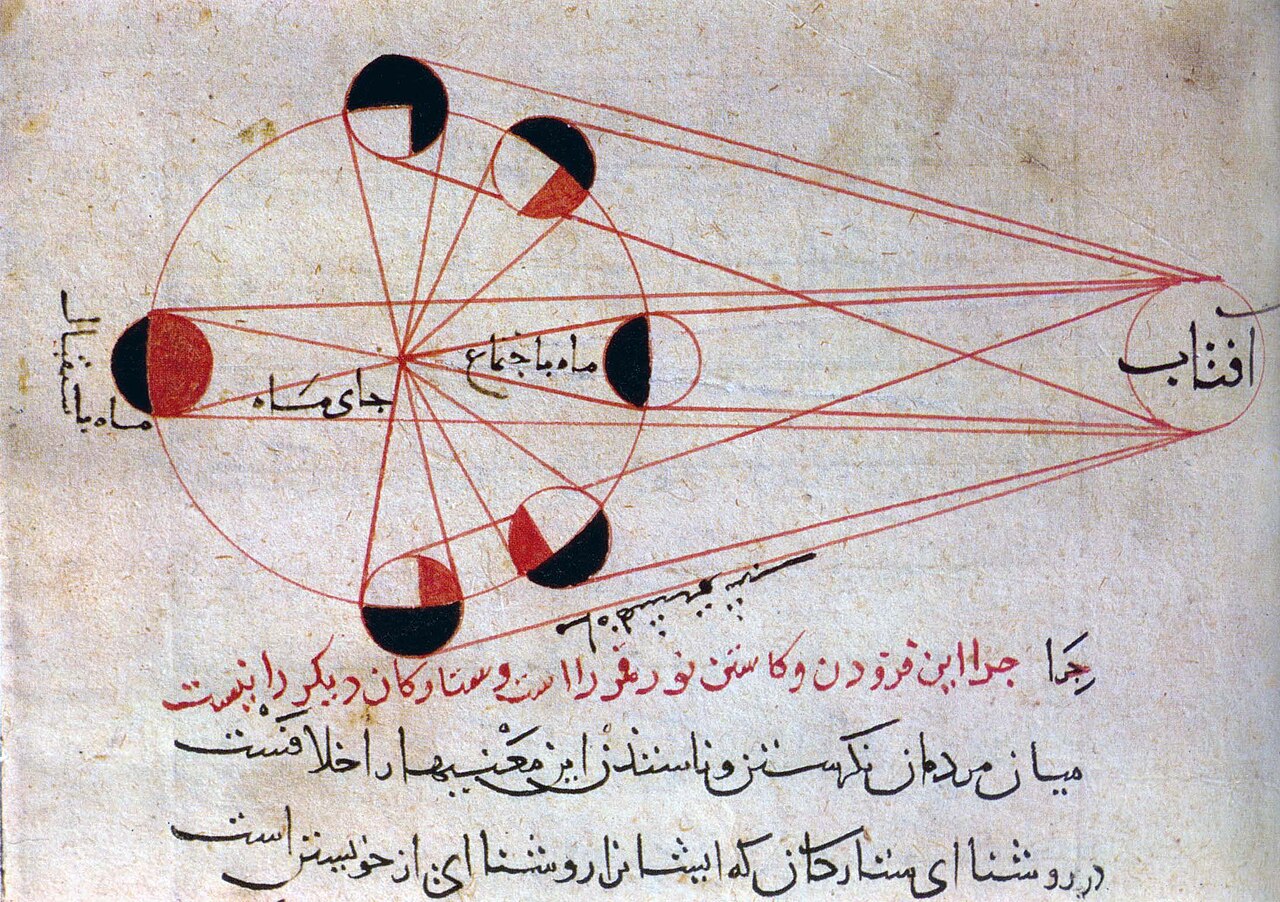
Hand-drawn diagram from a manuscript showing the Sun at right and the Moon at left orbiting Earth at center. Red lines show sunlight; eight small moon discs show phases, lit in red and dark in black. Arabic-script labels and text appear below and beside.Artifact

Primary source

Diagram of the Phases of the Moon

Al-Biruni

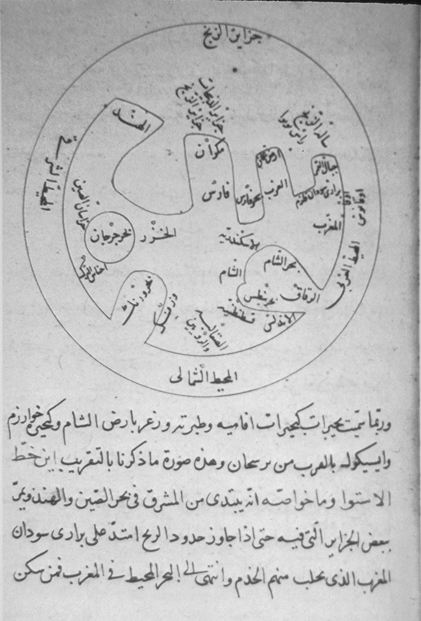
Circular hand-drawn map in Arabic script showing a ring-shaped ocean enclosing land masses, with the words Al-Muhit al-Shamali at the bottom and Janub at the top. Below the map is a block of Arabic handwritten text in several lines.Artifact

Primary source

Al-Biruni's World Map of the Distribution of Land and Sea

Al-Biruni · 1029

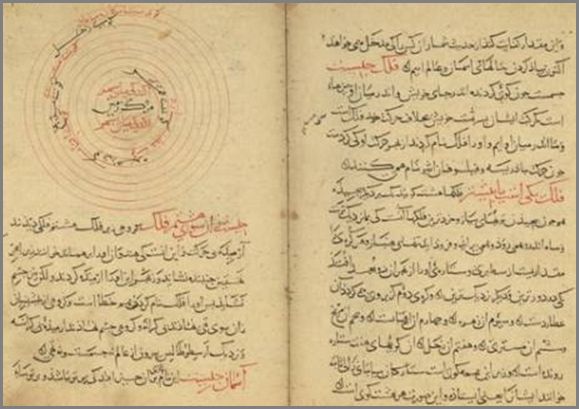
Two facing pages of an old Arabic manuscript in brown ink with red headings. The left page has a red and black diagram of concentric circles with labels. The right page is dense handwritten text in columns.Book

Primary source

Page from the Oldest Manuscript of the Tafhim

Al-Biruni

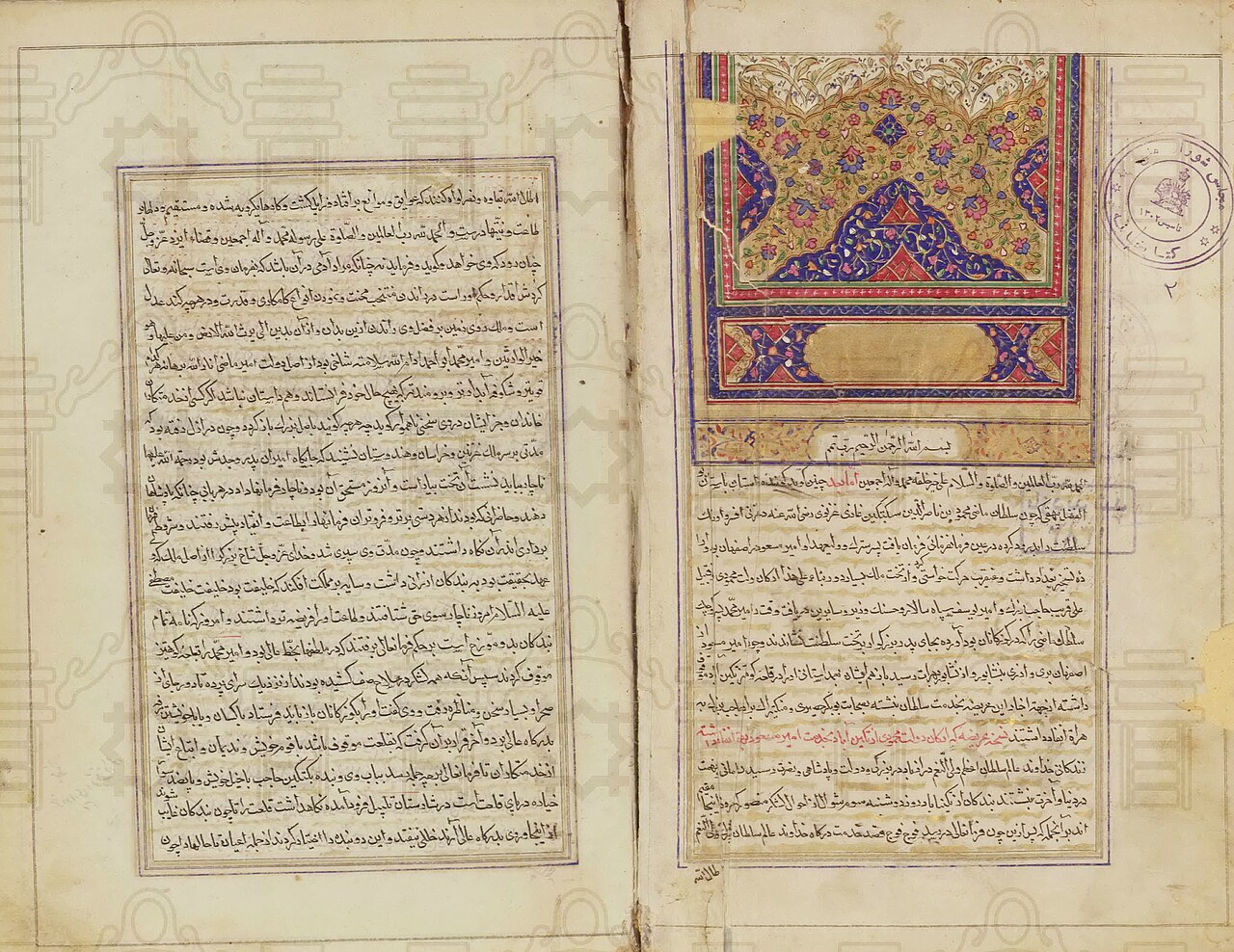
Open double-page manuscript spread in Arabic script. The right page has an illuminated floral and geometric frontispiece with gold and blue panels and a central title cartouche above dense text. The left page is a text block framed in blue ink lines. An oval red-stamped seal appears at upper right.Book

Secondary source

Tarikh-e Beyhaqi

Abul-Fazl Bayhaqi · 11th century CE

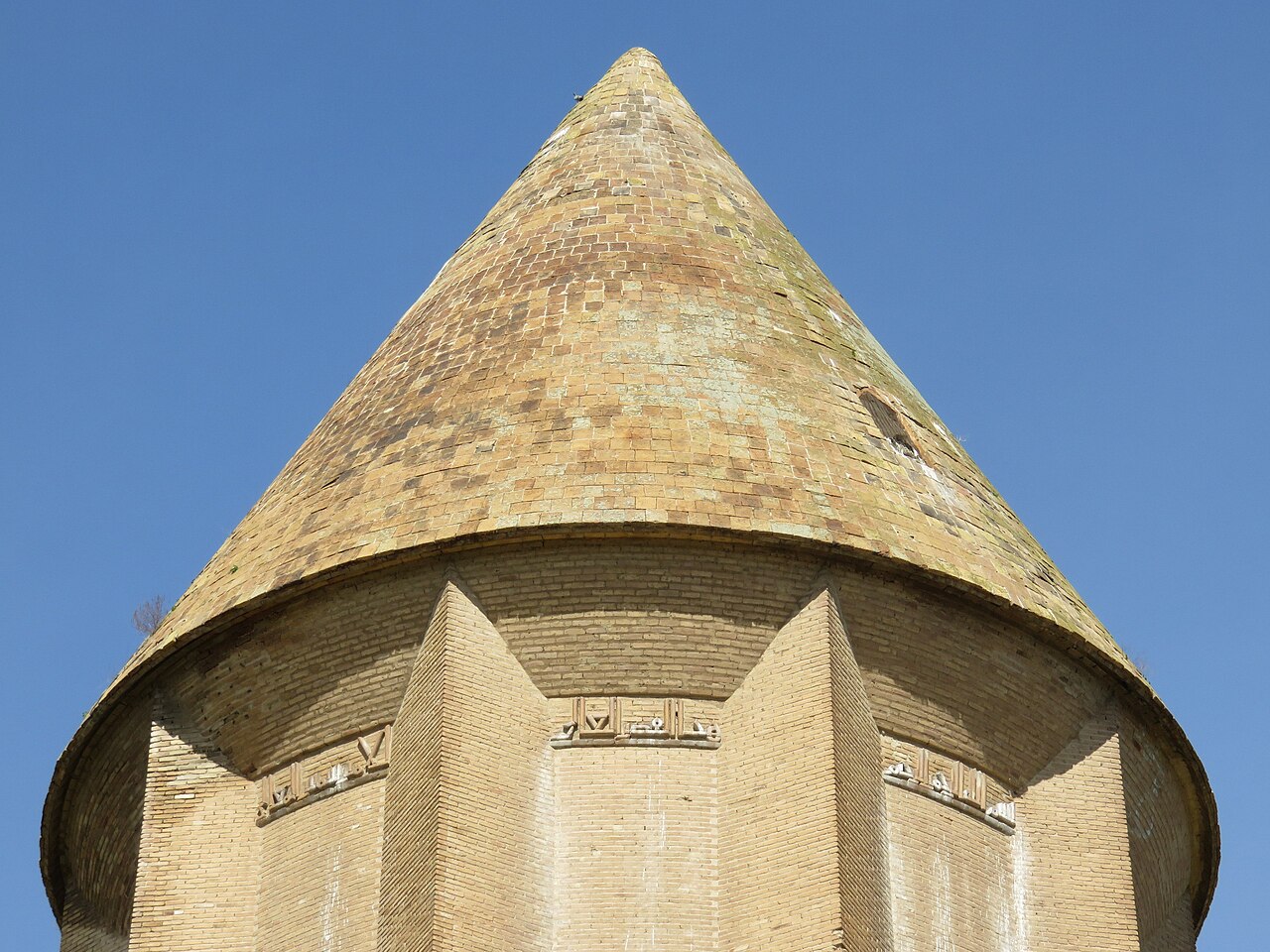
Photo of a tall brick tower with a steep conical roof, seen from below against a clear blue sky. The brickwork is tan and weathered, with decorative inscription bands on the drum.Artifact

Primary source

Gonbad-e Qabus

1006/7 CE

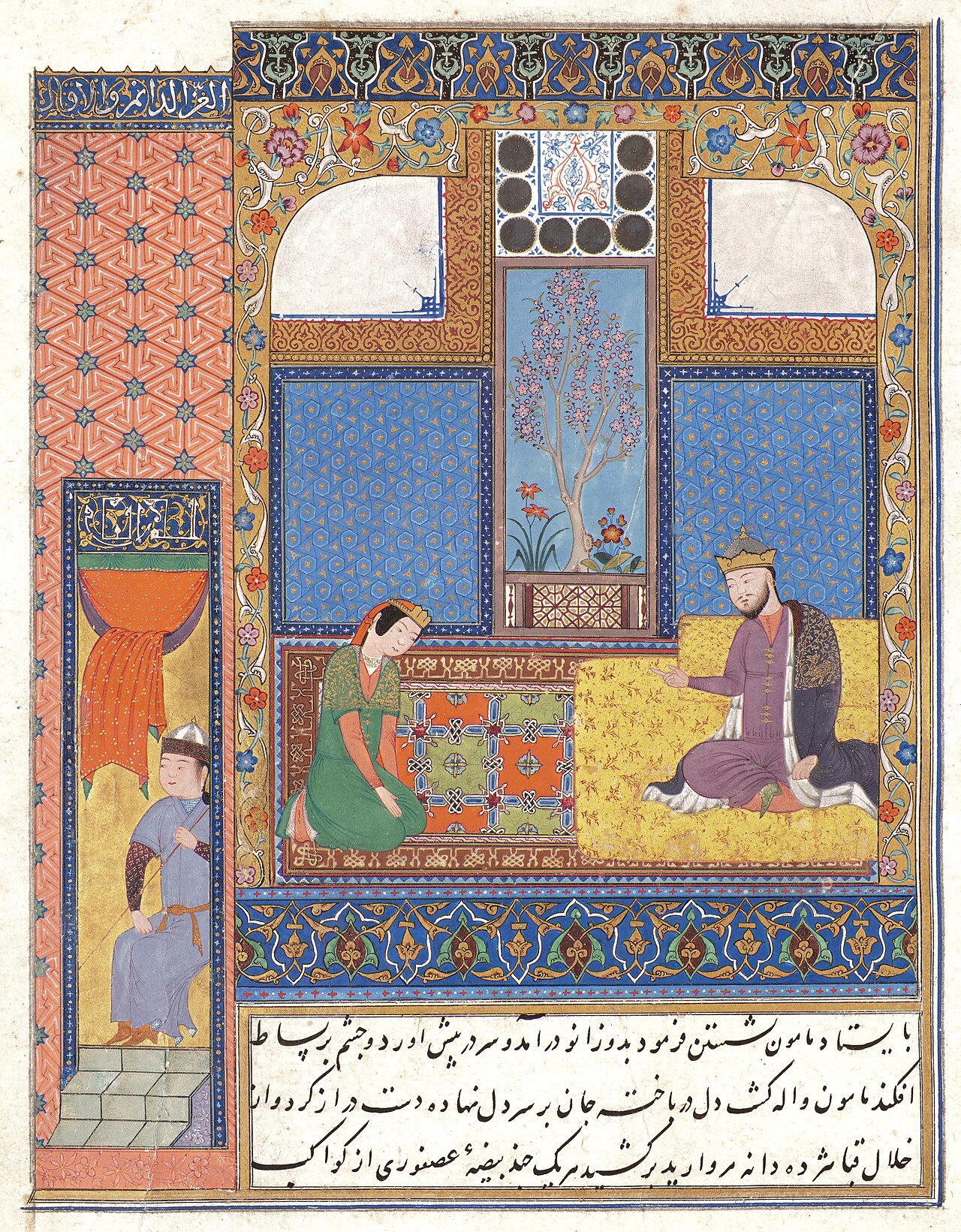
Painted manuscript page in Persian miniature style: a seated bearded ruler in a crown gestures toward a woman in green kneeling on a rug, while a small attendant in a blue robe stands at a doorway on the left. Persian text fills the bottom panel.Book

Secondary source

Chahar Maqala

Nizami Aruzi · 1155–1157

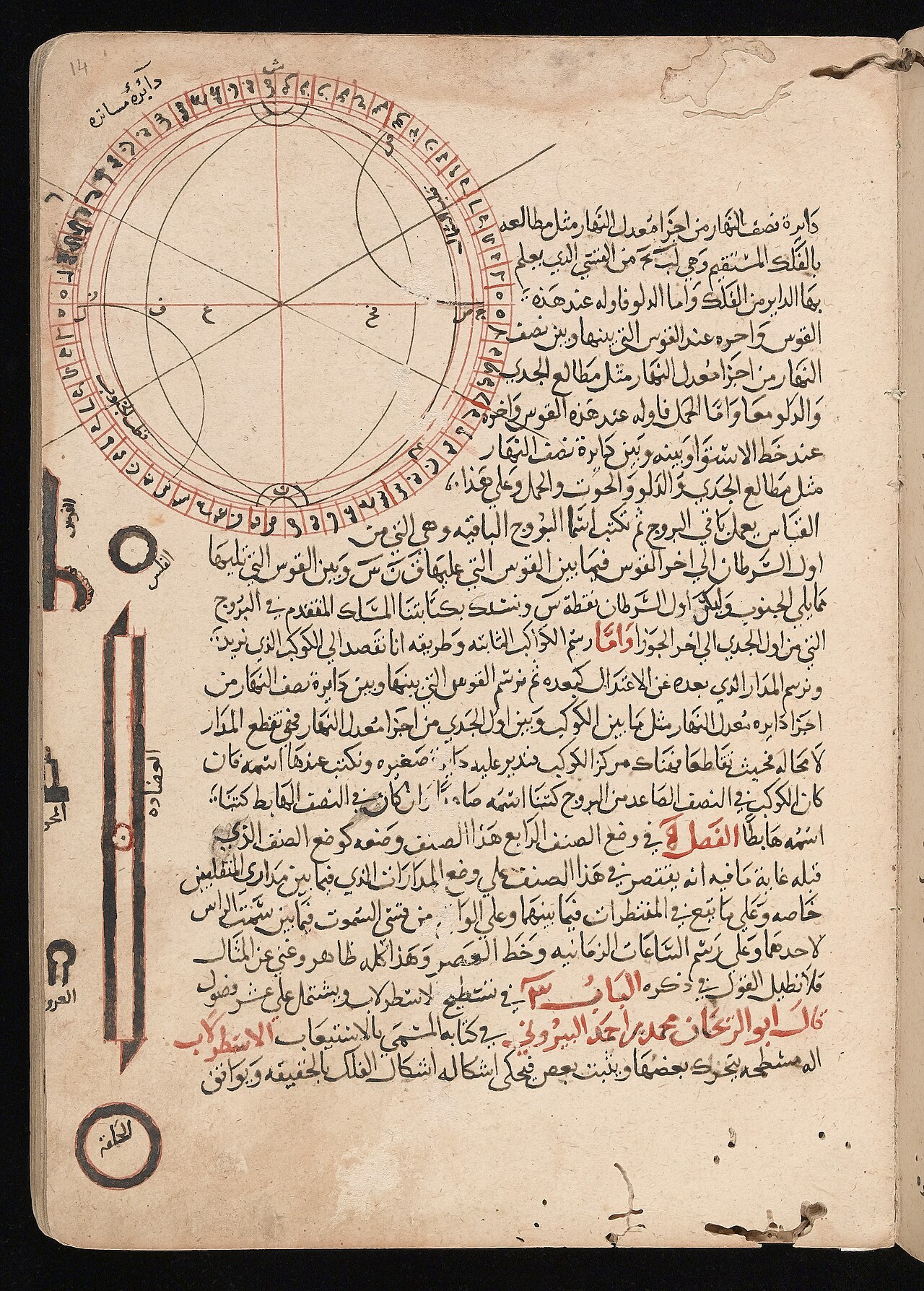
Manuscript page in Arabic script showing a circular astrolabe-style diagram with red-ruled degree scale and intersecting lines at top left, beside handwritten text in black and red ink. Vertical instrument diagrams appear at left.Artifact

Secondary source

A Drawing of an Astrolabe

Title page of Alberuni's India, Vol. I. Large title at top, subtitle in italics, a line drawing of a seated multi-armed deity holding objects, 'An English Edition, with Notes and Indices', author Dr. Edward C. Sachau with affiliations, 'In Two Volumes, Vol. I', publisher Kegan Paul, Trench, Trübner & Co., London, 1910.Book

Secondary source

Alberuni's India

Carl Edward Sachau · 1910

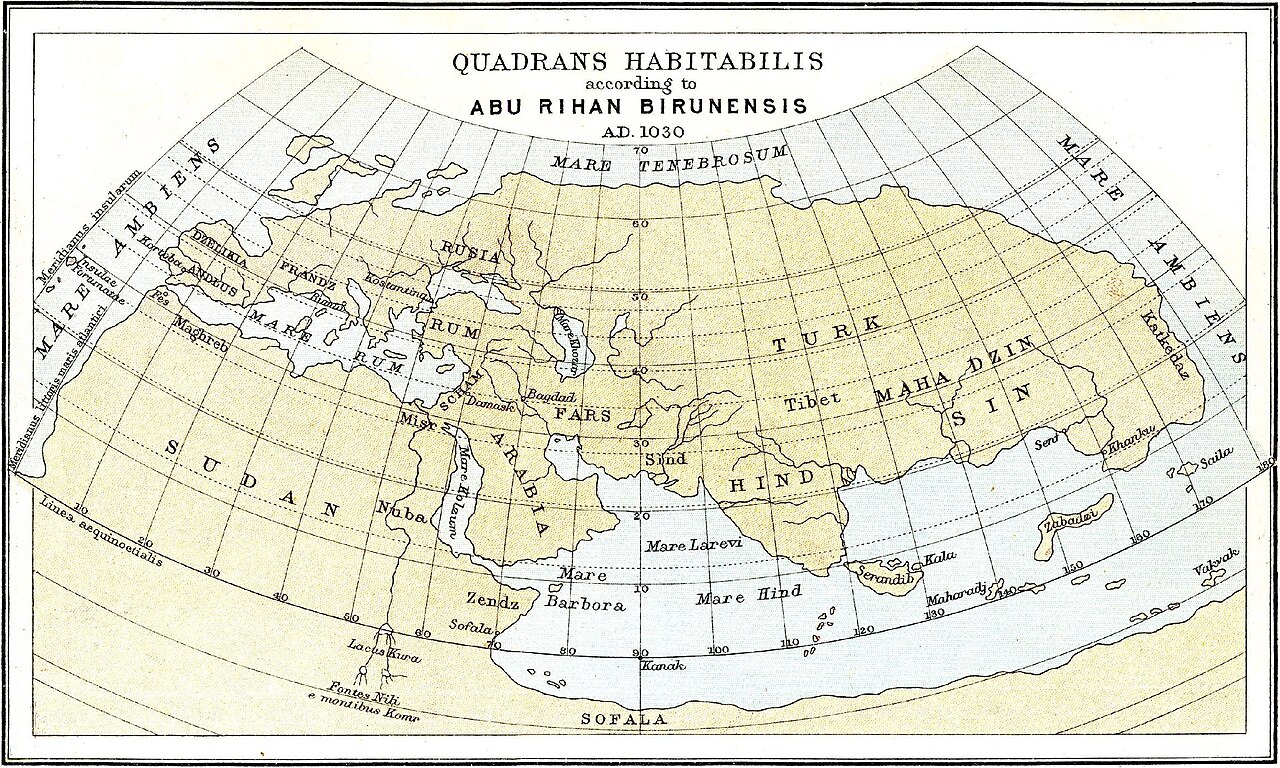
Antique map titled 'Quadrans Habitabilis according to Abu Rihan Birunensis, A.D. 1030'. It shows the known inhabited world on a curved grid with labels such as Mare Tenebrosum, Turk, Sin, Hindi, Sudan, Arabia, Sofala, and Mare Ambiens, in sepia and blue tones.Document

Tertiary source

Quadrans Habitabilis according to Abu Rihan Birunensis

Ernest Rhys · 1912

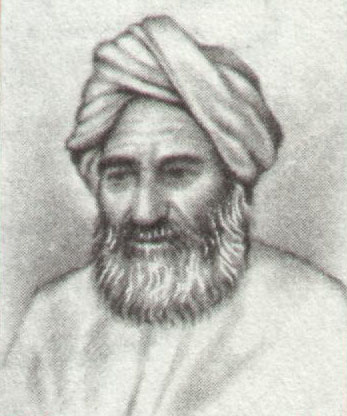
Black-and-white engraved or printed portrait of a bearded man wearing a turban and a loose robe, with a calm, gently smiling expression, shown from the shoulders up against a light background.Artifact

Secondary source

Biruni Commemorative Stamp

Ali Azargin · 1973

Spine or back cover of a brown leather manuscript binding. A round paper label at the bottom reads 'MILLET' in red, 'FEYZULLAH' in red, and the number '1333' in black handwriting.Book

Secondary source

Al-Tafhim Manuscript

Al-Biruni

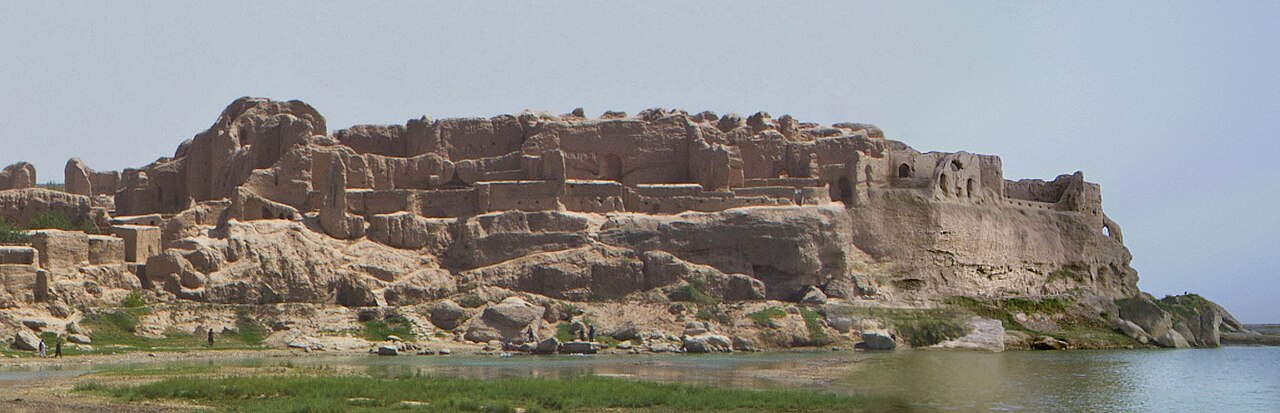
Panoramic view of the ruined palace complex of Lashkari Bazar: long mud-brick walls and towers of tan earth on a rocky rise above a sandy shore, with green grass and calm water in the foreground under a pale sky.Artifact

Secondary source

Lashkari Bazar

c. 1200

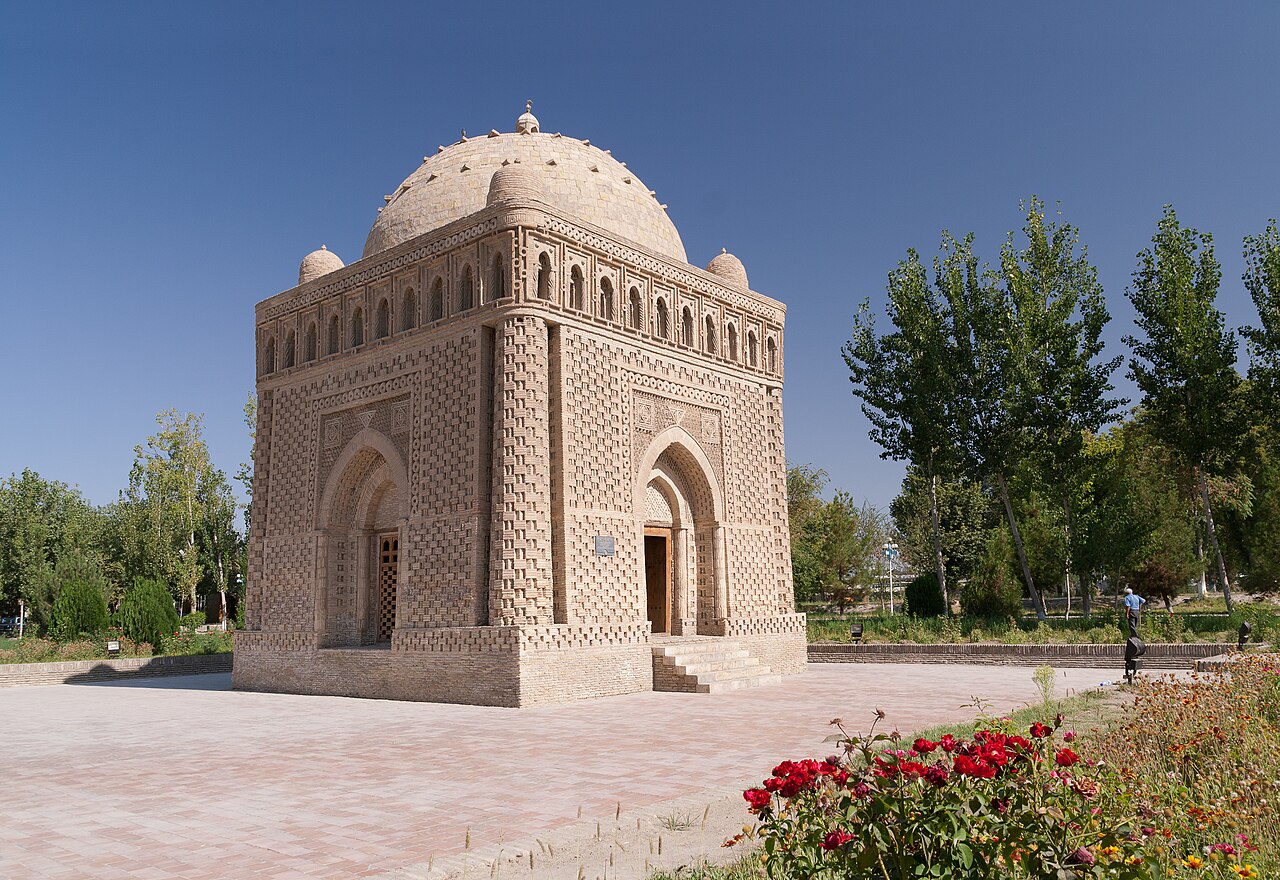
Exterior of the Samanid Mausoleum, a small brick cube building with a central dome, four corner domes, arched recessed niches and decorative brickwork, set in a paved courtyard with red flowers and trees under a clear blue sky.Artifact

Secondary source

Samanid Mausoleum

c. 892

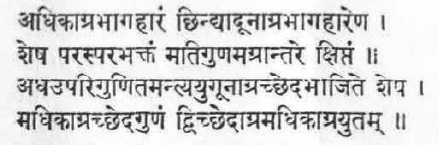
Four lines of Sanskrit verse in Devanagari script, set in black text on a light background, giving the rule for the kuttaka method as described in the Aryabhatiya.Book

Primary source

Aryabhatiya

Aryabhata · c. 510

Book

Primary source

Brahmasphutasiddhanta

Brahmagupta · c. 628

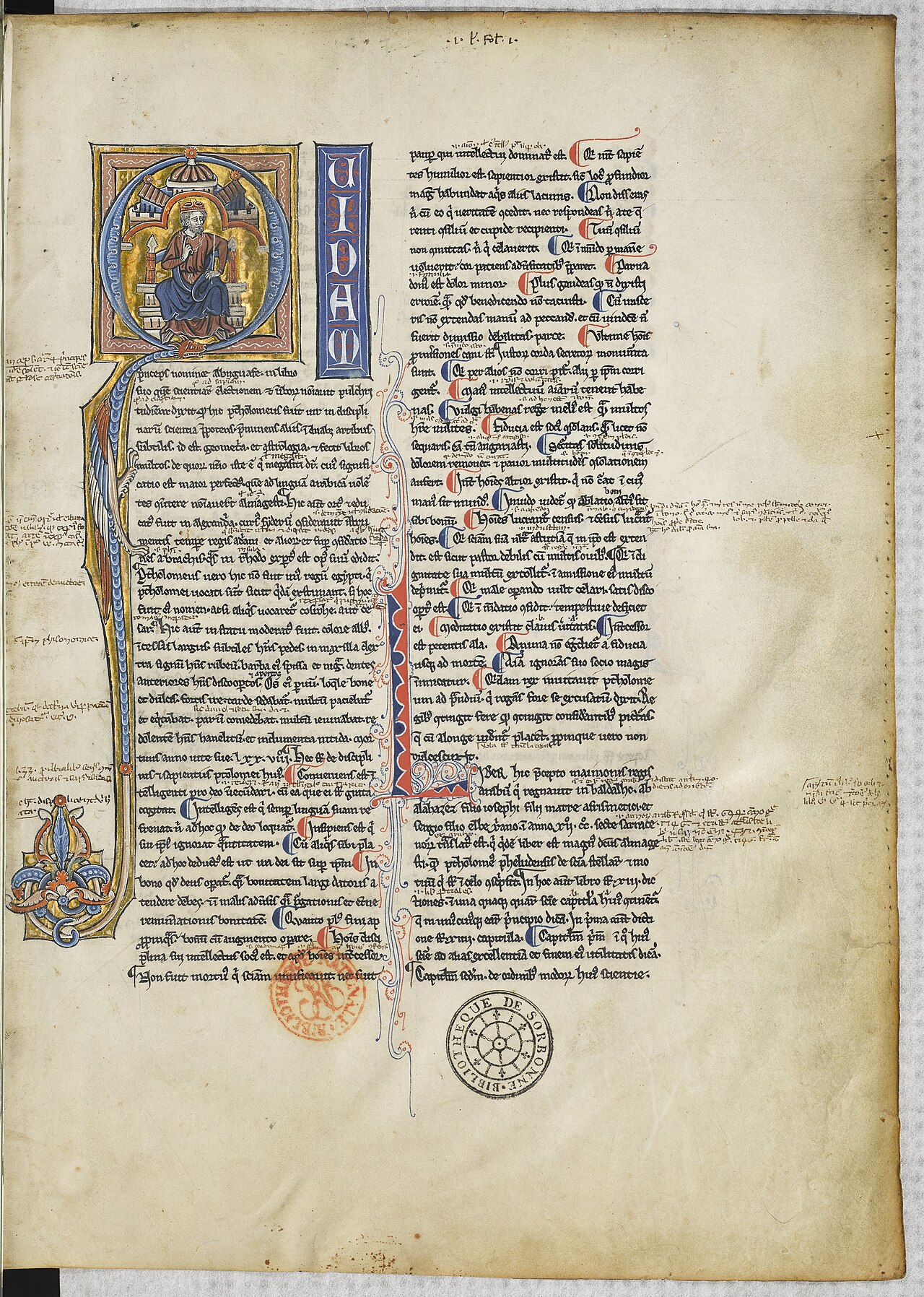
Manuscript page of a medieval Latin text in black ink with red and blue initials. A large illuminated initial P at left contains a painted figure of a seated, crowned man holding a book, with gold background. Marginal notes surround the text, and two round library stamps appear at the bottom.Book

Secondary source

Almagest

Ptolemy · c. 148-150

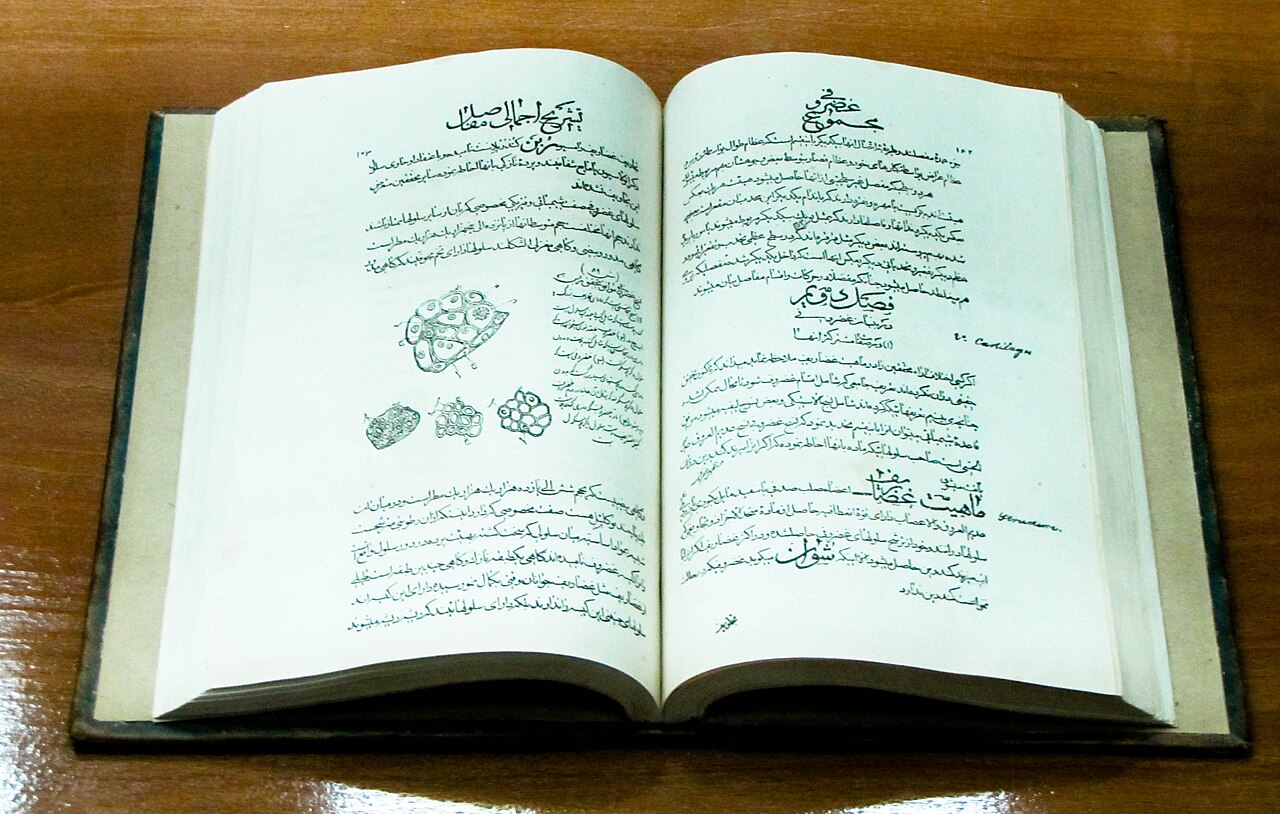
An open bound book on a wooden table, showing two pages of handwritten Arabic-script manuscript text in dark ink, with small diagrams of round, clustered shapes on the left page and marginal notes on the right page.Book

Secondary source

Canon of Medicine

Avicenna · 1025

Alberuni's IndiaBook

Primary source

Alberuni's India

Al-Biruni · 1888 translation of a work from c. 1030

Illuminated manuscript page with large black and red Arabic calligraphic headings above several lines of Arabic text. A framed painting in the middle shows a bearded man in a green robe and white turban gesturing, beside a blue rock formation, while a man in a blue shirt and grey trousers digs with a spade under a tree. Lower text continues below the image.Book

Primary source

Folio 230 of al-Athar al-Baqiya in al-Biruni's hand

Al-Biruni · 1050 (442 AH)

Illuminated manuscript folio with Arabic calligraphy in red-bordered text blocks, and a painted miniature in the middle showing a bearded man in a blue robe and white turban, with a halo, gesturing from a railed pulpit toward a seated group of men in turbans and robes. A hanging lamp is at center.Book

Secondary source

Folio from a 17th-century copy of The Remaining Signs of Past Centuries

anonymous (original text by al-Biruni) · 17th century copy of an 11th-century text

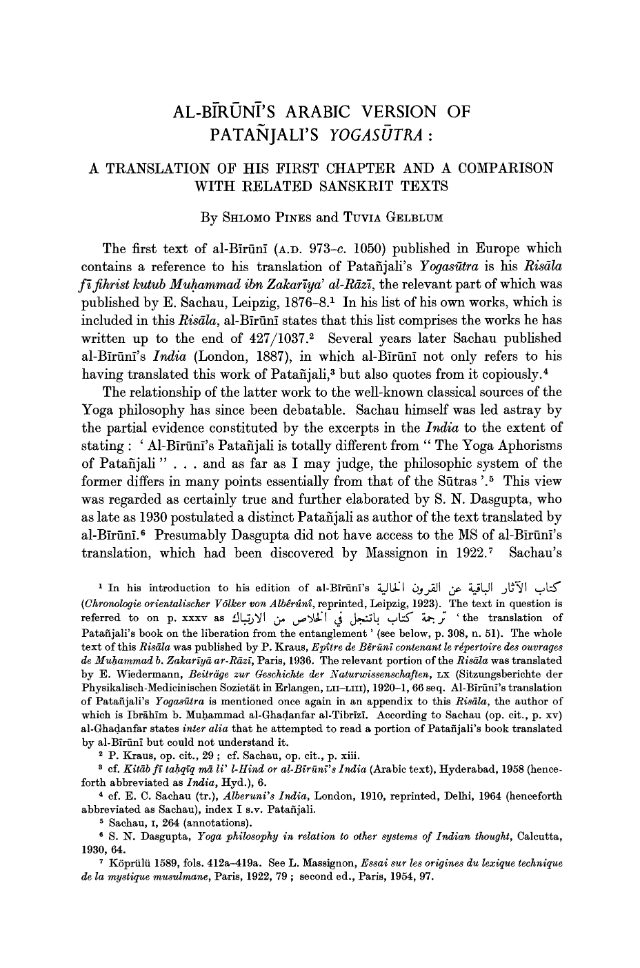
Al-Biruni's Arabic Version of Patanjali's YogasutraBook

Secondary source

Al-Biruni's Arabic Version of Patanjali's Yogasutra

Shlomo Pines and Tuvia Gelblum · 1989 (study); translation completed by 1037

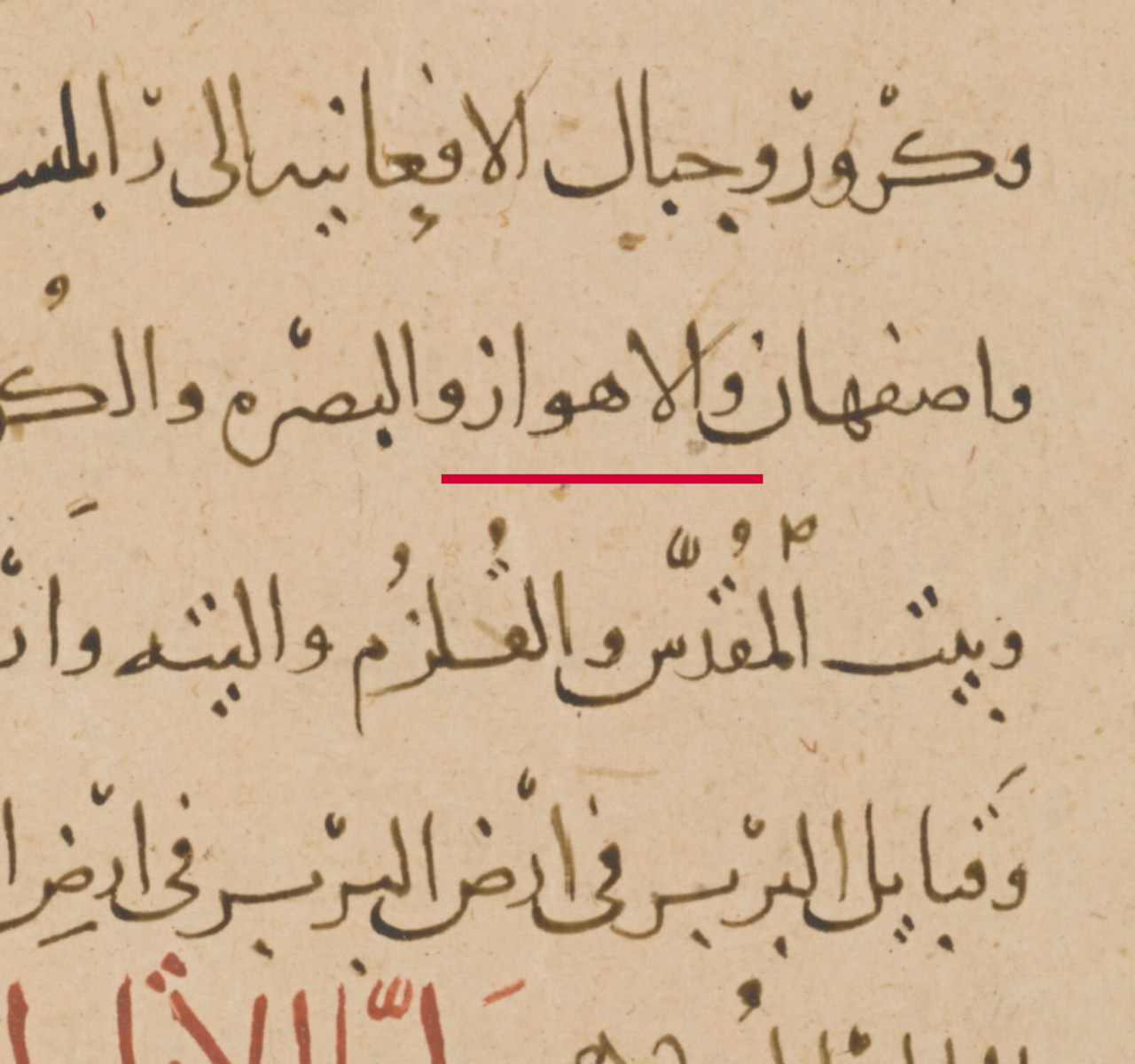
Close-up of handwritten Arabic manuscript text in brown ink on aged tan paper, four lines visible, with a red line underlining one word in the second line. Red ink appears at the bottom edge.Book

Primary source

Al-Tafhim Manuscript Fragment on Al-Ahwaz

Al-Biruni · after 973 AD; this copy c. 1436

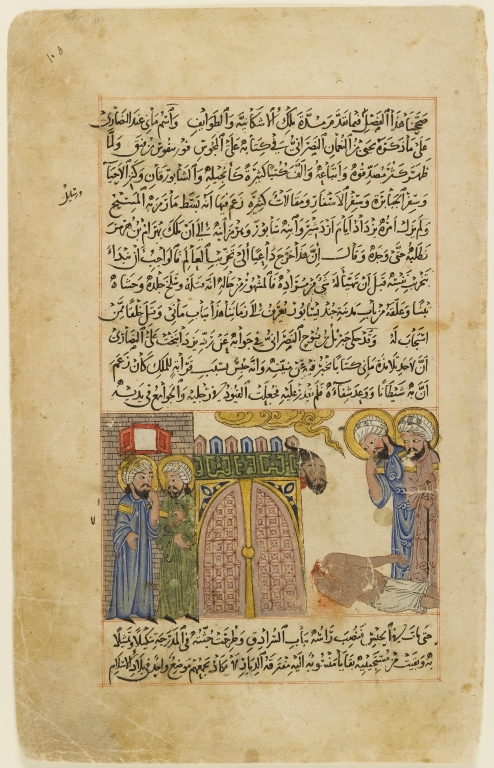
Manuscript page with Arabic calligraphy in black ink in two blocks, and a painted miniature in the lower middle. The miniature shows robed figures in blue and green, a red-roofed structure, a tall wooden door, and a figure lying on the ground beside a gold-haloed figure.Painting

Secondary source

Chronology of Ancient Nations: Death of Mani

Al-Biruni · 1307 copy

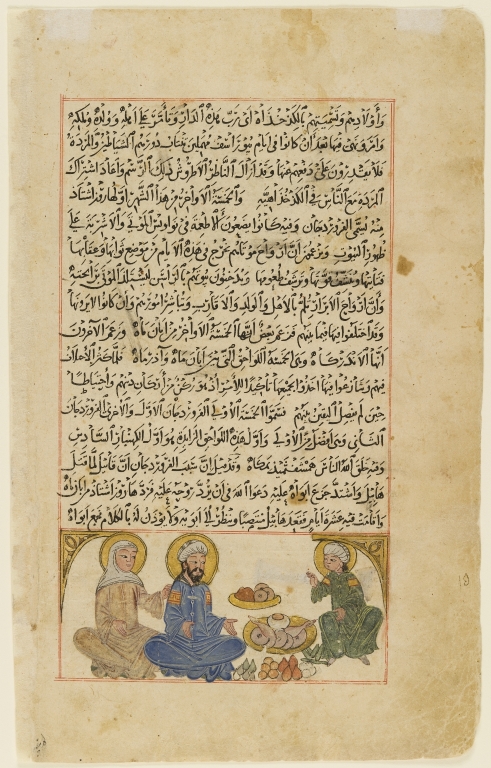
Manuscript page in Arabic calligraphy in black ink on aged parchment, with a painted miniature at the bottom showing three seated figures with golden halos around a spread of food: a bearded man in blue robes at center, a veiled figure at left, and a figure in green at right, with bowls of fruit and fish before them.Painting

Secondary source

Chronology of Ancient Nations: Farwardijan Festival

Al-Biruni · 1307 copy

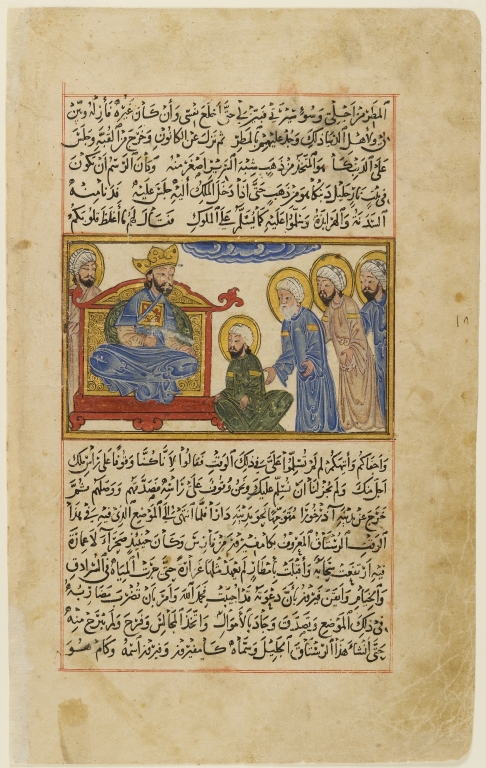
Manuscript page with Arabic calligraphy in black ink above and below a painted miniature. The miniature shows a seated, crowned ruler on a red-framed throne with a gold cushion, and a bearded figure in green robes seated before him. Two standing bearded men in blue and tan robes, with haloes, stand at right. Page has aged, yellowed paper with red ruling lines.Painting

Secondary source

Chronology of Ancient Nations: Peroz and the Priests

Al-Biruni · 1307 copy

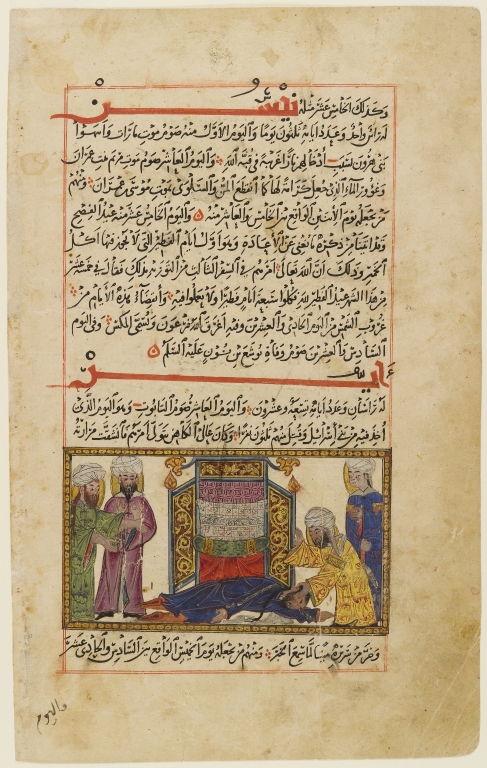
Manuscript page with Arabic calligraphy in black and red ink, and a framed painted miniature at the bottom. The miniature shows a canopied bed, a man in yellow robes bending over a figure lying on the floor, and two standing men in green and purple.Painting

Secondary source

Chronology of Ancient Nations: Death of Eli

Al-Biruni · 1307 (copy of a work by Al-Biruni)

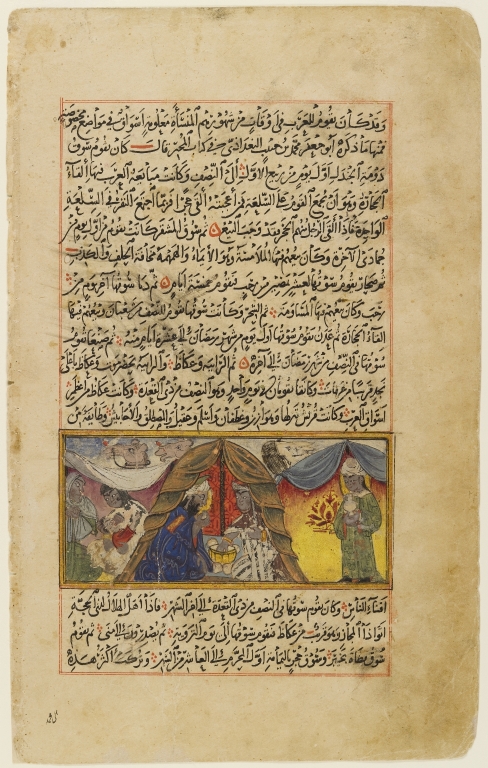
Manuscript page in Arabic calligraphy with red and black ink, framed by a painted miniature showing figures in a tent with draped curtains, a fire, and a seated figure at right. Aged paper borders.Painting

Secondary source

Chronology of Ancient Nations: Figures in Tents

Al-Biruni · 1307 (copy of a work by Al-Biruni)

Scan of a manuscript page with Arabic calligraphy in red-ruled text blocks above and below a framed painted miniature. The miniature shows robed figures standing on grass beside a small plant, with a sky of orange flames and clouds. One central figure wears green robes and a tall crown-like headdress.Painting

Secondary source

Chronology of Ancient Nations: The Day of the Cursing

Al-Biruni · 1307 (copy of a work by Al-Biruni)

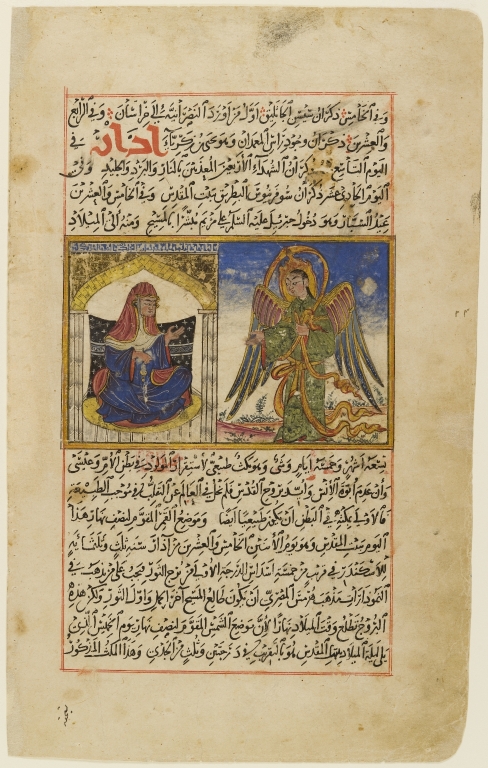
Manuscript page with Arabic calligraphy in black and red ink above and below a framed painted miniature. The miniature shows a seated robed figure on the left in an arched niche and a winged angel with a halo holding a staff on the right against a blue sky. The page is aged with yellowed paper and a red border.Painting

Secondary source

Chronology of Ancient Nations: The Annunciation

Al-Biruni · 1307 (copy of a work by Al-Biruni)

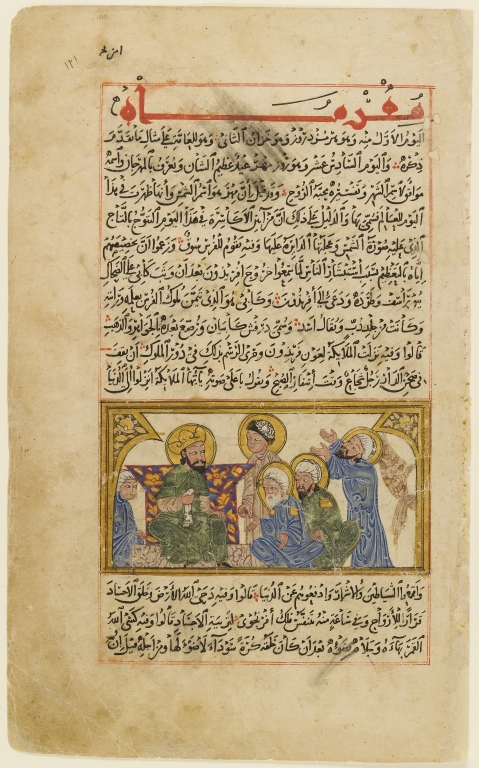
Manuscript page with Arabic text in black ink, a red-framed heading at top, and a framed painted miniature in the middle showing a crowned enthroned ruler in green robes on a patterned red cushion, with attendants in blue and green around him and a figure gesturing at right. Text continues below the image.Painting

Secondary source

Chronology of Ancient Nations: Enthroned Ruler

Al-Biruni · 1307 (copy of a work by Al-Biruni)

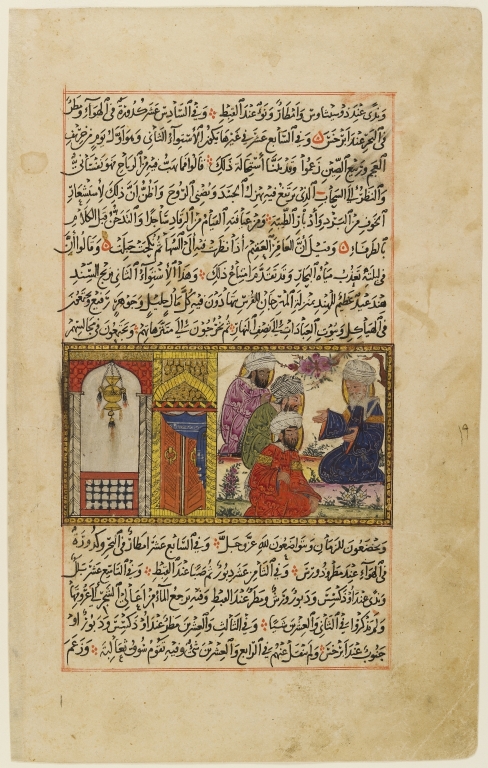
Manuscript page in Arabic script with red-ruled text blocks above and below a central painted miniature. The miniature shows, on the left, a niche with a golden object and rows of small round items beside a red and yellow structure; on the right, a seated figure in red robes and a turbaned figure in blue robes, with other turbaned figures in green and purple standing behind.Painting

Secondary source

Chronology of Ancient Nations: Indian Autumnal Equinox Festival

Al-Biruni · 1307 (copy of a work by Al-Biruni)

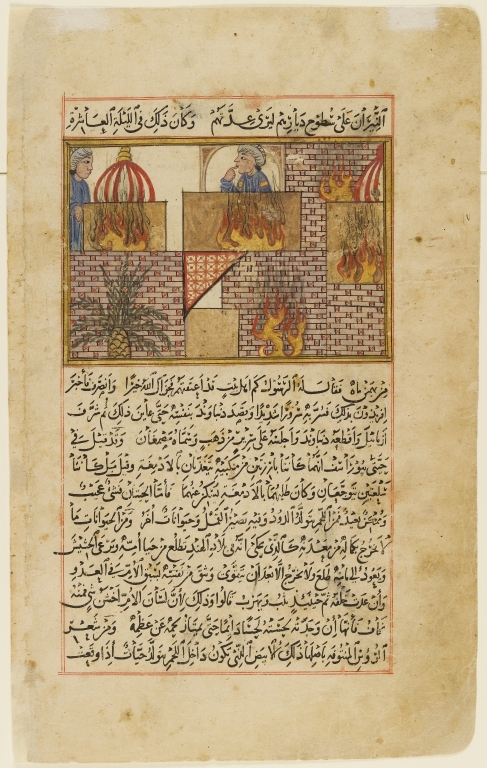
Manuscript page with an illuminated painting above Arabic script. The painting shows a robed figure at left beside a striped red-and-white dome, and a seated turbaned figure at right in an arched window, with flames rising from fire-filled brick chambers and a green plant at lower left. Text in Arabic fills the lower half of the page on aged paper.Painting

Secondary source

Chronology of Ancient Nations: The Tale of Azmaa

1307

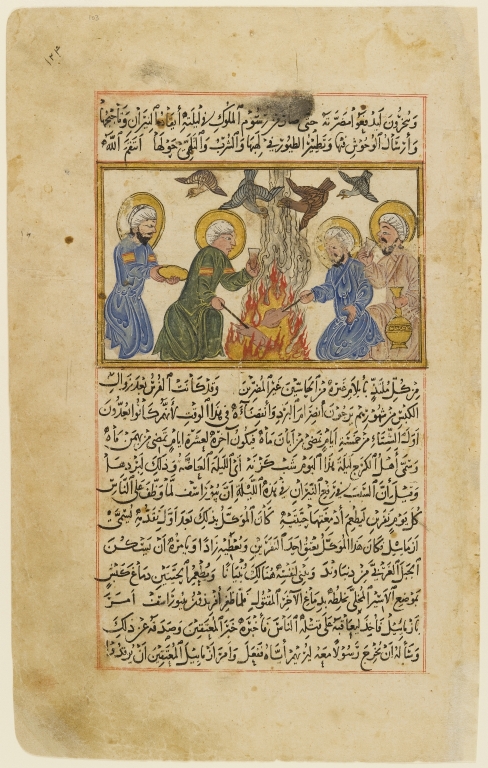
Manuscript page with Arabic text in two columns below a framed painted miniature. The miniature shows three haloed, turbaned men in blue and green robes beside a fire, one tending it, with birds flying above a tree.Painting

Secondary source

Chronology of Ancient Nations: Bahman Mah Festival

1307

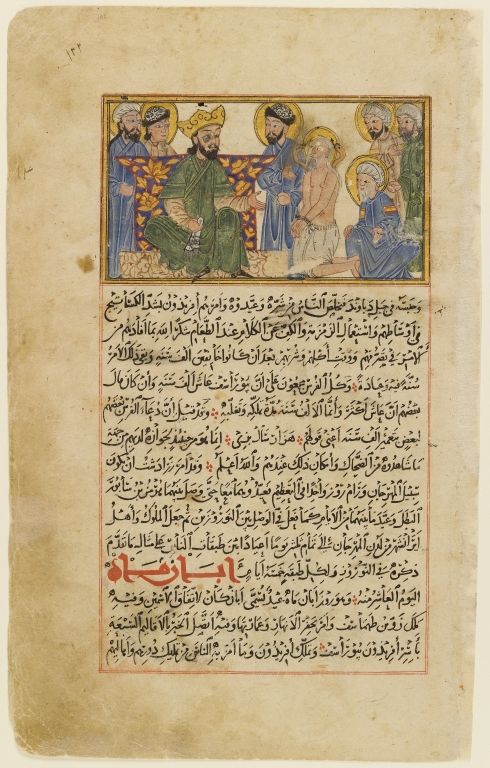
Manuscript page with an illuminated miniature at top showing a seated king in green robes with a gold crown, surrounded by standing and kneeling figures in blue and green with halos; below, several lines of Arabic calligraphy in black and red ink on aged paper.Painting

Secondary source

Chronology of Ancient Nations: Dahhak before Faridun

1307

Document

Tertiary source

Bīrūnī Entry, 1911 Encyclopaedia Britannica

Griffithes Wheeler Thatcher · 1911

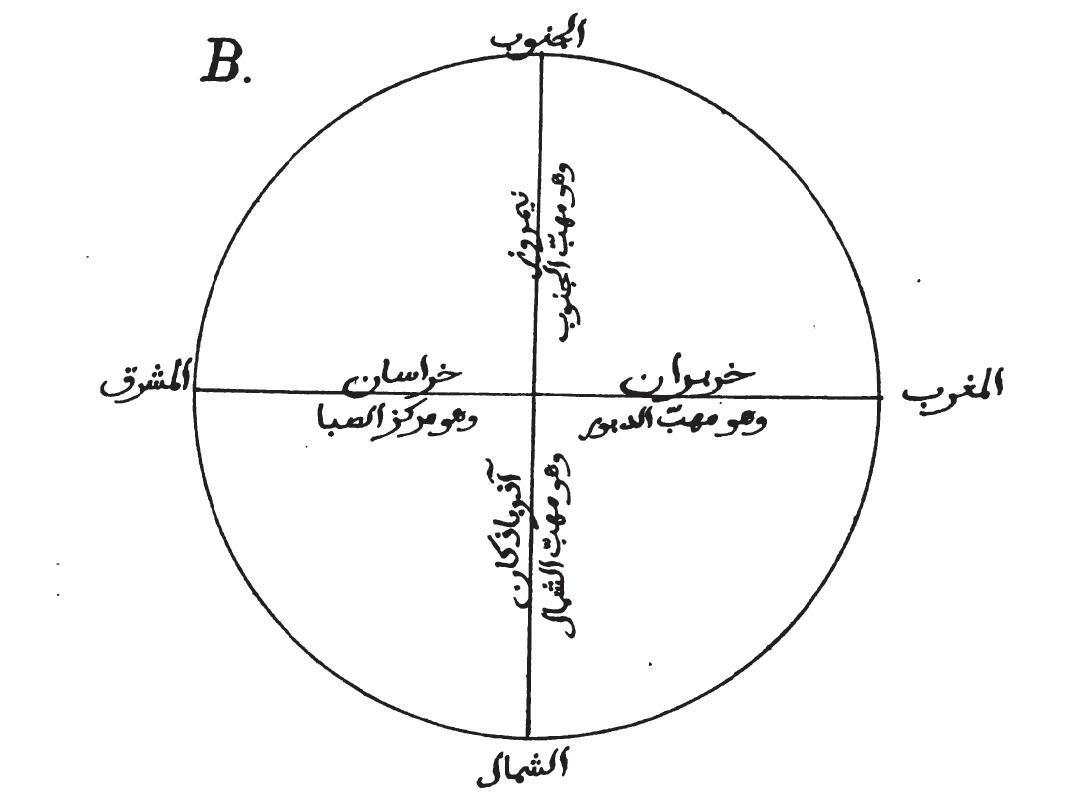
Diagram labeled B in Arabic script: a circle with a horizontal and vertical line dividing it into four quadrants. Arabic labels mark the cardinal directions (south at top, north at bottom, east left, west right) and regional names in each quadrant.Book

Primary source

The Remaining Signs of Past Centuries, Page vii

Al-Biruni

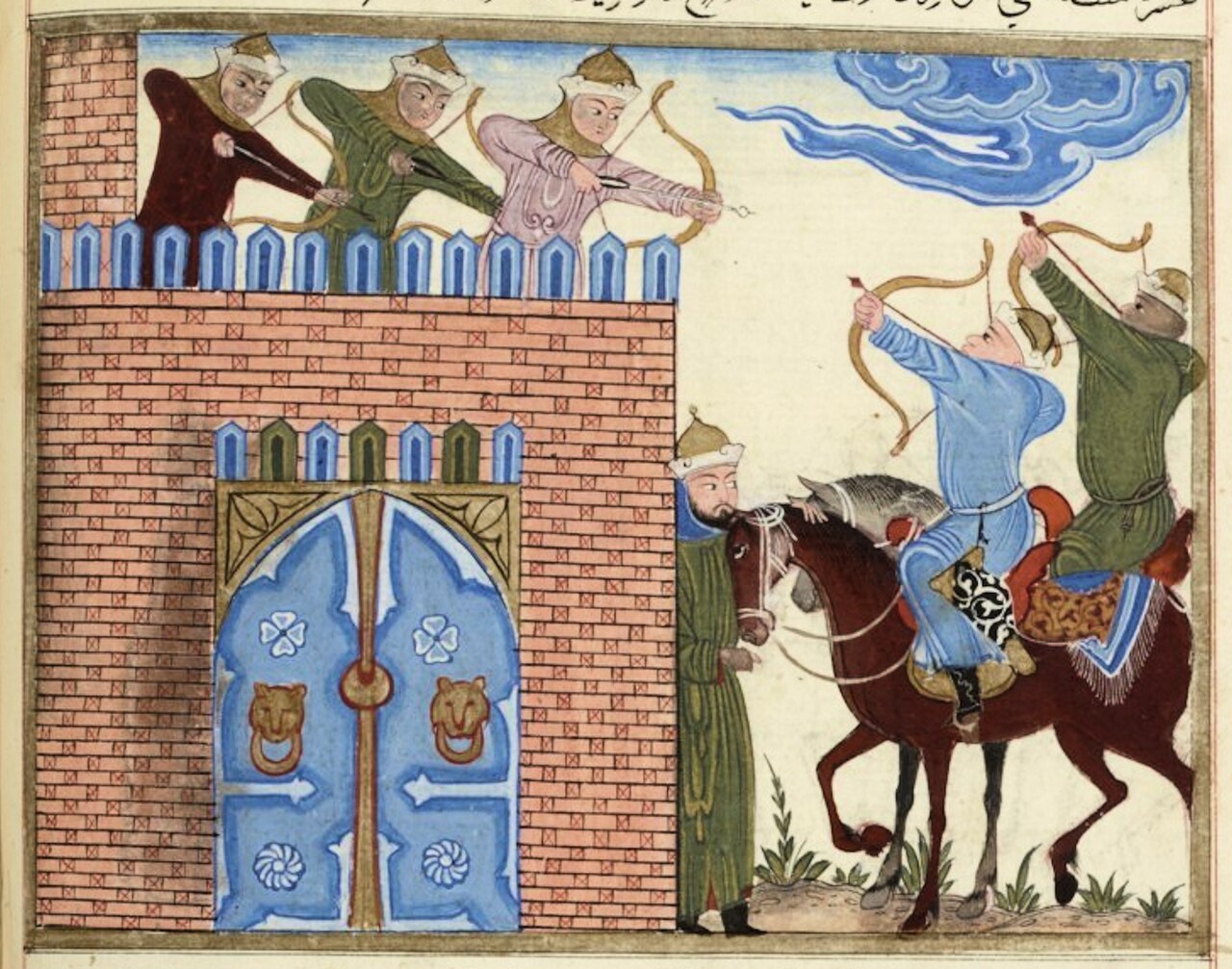
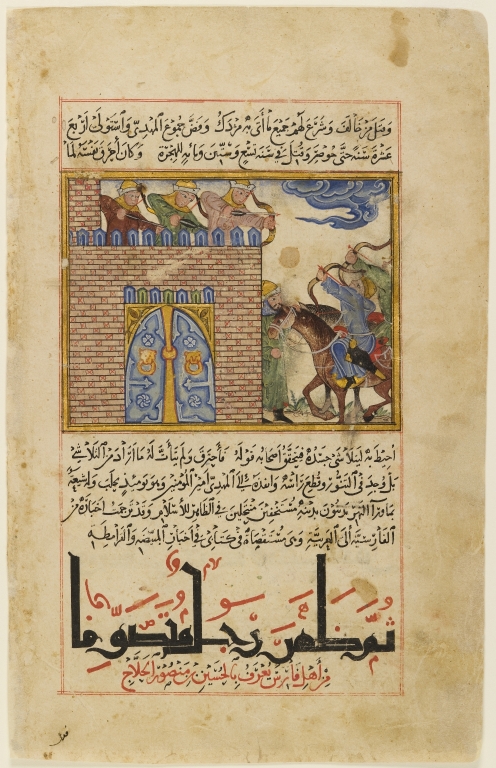
Miniature painting from a manuscript: on the left, three archers in turbans fire from the top of a brick fortress wall with blue merlons; below, a blue double gate with lion-head knockers. On the right, two mounted horsemen in blue and green draw bows against the sky.Painting

Secondary source

Chronology of Ancient Nations Manuscript, BnF Folio 87r

14th century author

Book cover in gold and brown tones with Arabic script title 'الصيدنة في الطب' and subtitle '(داروشناسی در پزشکی)', author 'ابوریحان بیرونی', and translator 'باقر مظفرزاده'. Iranian emblem at upper left.Book

Secondary source

Ketab al-Saydana

Al-Biruni

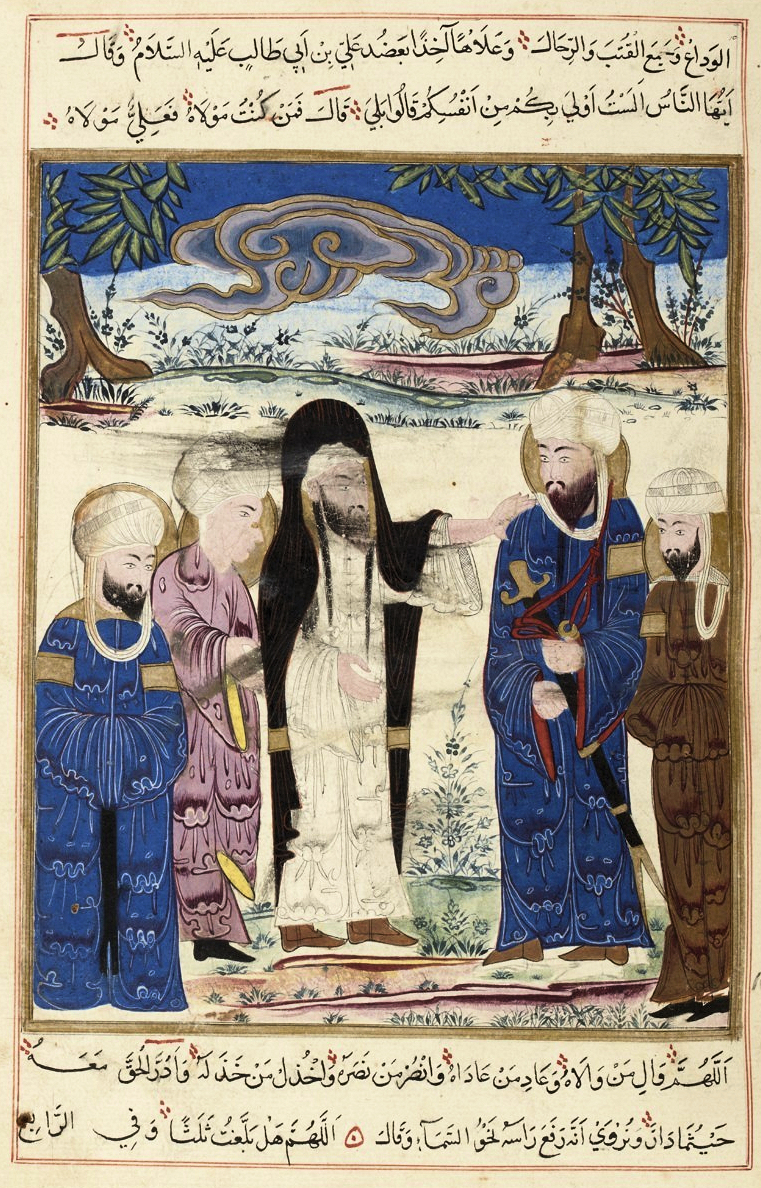
Detail of a manuscript page: a painted miniature of a landscape with trees and a cloud, with robed, turbaned men in blue, pink and brown and a veiled figure in black and white. Arabic calligraphy frames the top and bottom.Painting

Secondary source

Chronology of Ancient Nations Manuscript Page (BnF)

Unknown 14th-century copyist · 14th century

Front cover of a manuscript on deep red leather-like ground, with a gold-and-black braided border and a central painted floral design of tall green leaves, a slender stem bearing yellow daffodil-like flowers, and orange blossoms with green foliage at the lower left and right.Book

Primary source

Chronology of Ancient Nations, Front Cover Detail

Al-Biruni · 1307

Manuscript page with Arabic calligraphy above and below a framed miniature painting. The painting shows mounted riders in blue and red garments attacking a brick fortress with blue-domed gates and turrets, while defenders in yellow headgear watch from the walls under a blue sky.Painting

Primary source

Storming of al-Muqanna's Fortress

Al-Biruni · 1307

Manuscript page in Arabic script with red and black text in two columns, framing a painted miniature in the middle showing a scene of destruction: a blue-domed structure with flames and figures, and a standing robed figure at right. Aged cream paper with decorative borders.Painting

Primary source

Destruction of the Jerusalem Temple

Al-Biruni · 1307

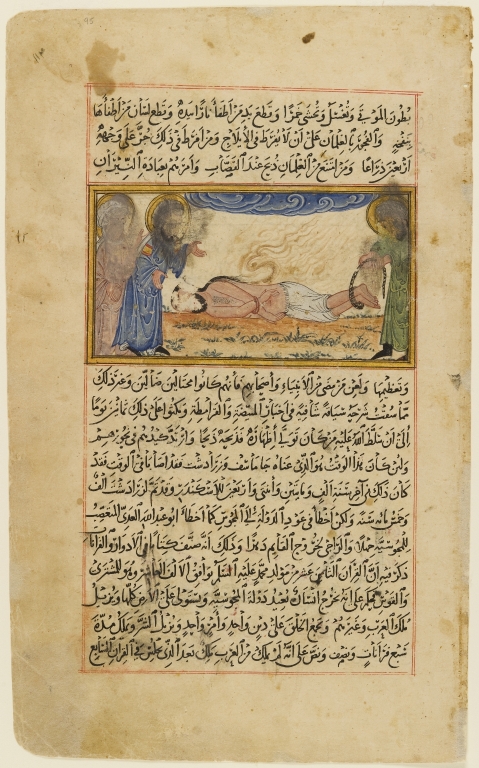
Illuminated manuscript page with Arabic text above and below a framed painting. The painting shows a bearded figure in a blue robe with a halo, a prone figure lying on the ground, and a winged figure at left and a figure in green at right.Painting

Primary source

Punishment of a Sect Member

Al-Biruni · 1307

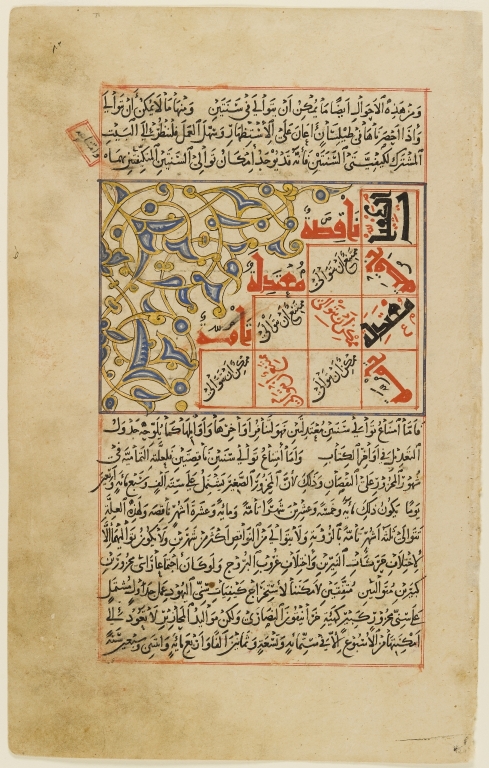
Manuscript page with Arabic script in red and black ink framing the page, a central diagram of a grid of boxes with colored Arabic lettering, and an ornate blue and gold arabesque panel on the left side. Cream-colored paper with a faded edge.Book

Secondary source

Diagram page, Chronology of Ancient Nations

Al-Biruni · 1307

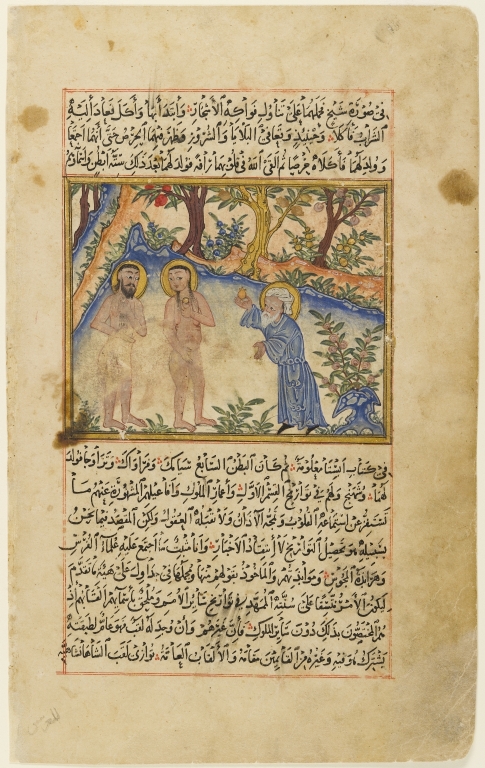
Manuscript page with Arabic text in two blocks framing a painted miniature. The miniature shows two nude figures, one bearded, standing by a blue-green pool among trees, and a robed figure in blue kneeling and gesturing toward them.Painting

Secondary source

Misha and Mishyana legend

Al-Biruni · 1307

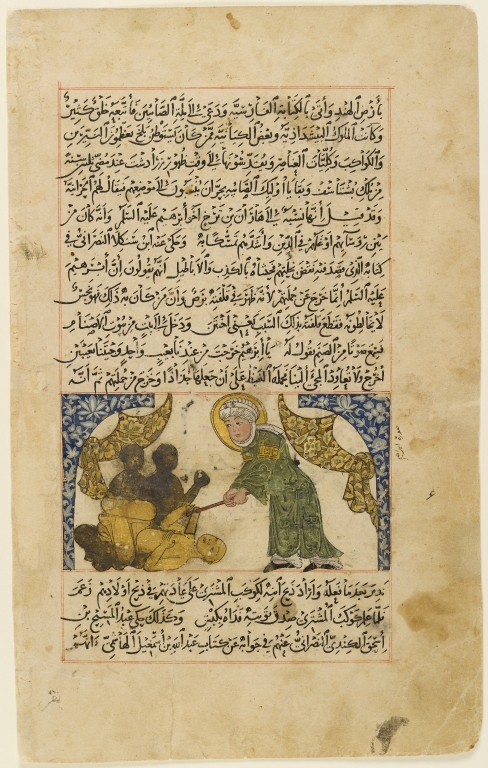
Manuscript page with Arabic script in brown ink above and below a central painted panel. The panel shows a figure in a green robe with a golden halo and white turban, holding a hammer, facing several dark seated figures on a gold ground, within blue arches.Painting

Secondary source

Abraham and Buddha statue

Al-Biruni · 1307

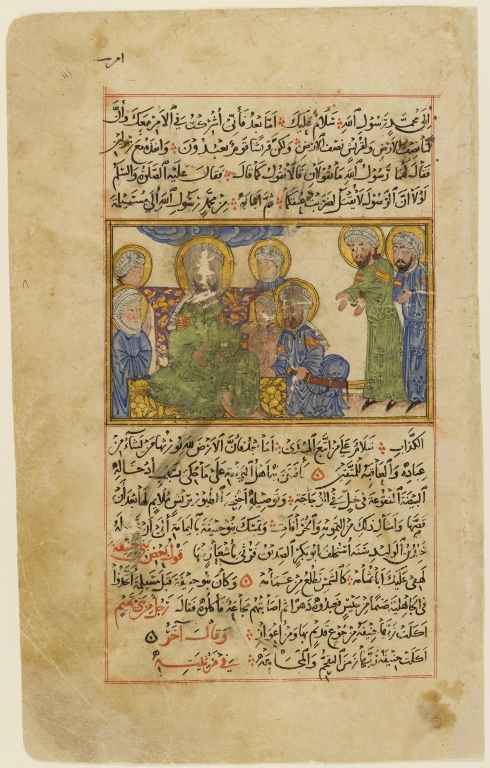
Manuscript page with Arabic calligraphy above and below a framed miniature painting. The miniature shows a seated, haloed figure in green robes on a cushioned throne, with attendants and two standing men in green and blue robes at right.Painting

Secondary source

Muhammad and Musailama's Envoy

Al-Biruni · 1307

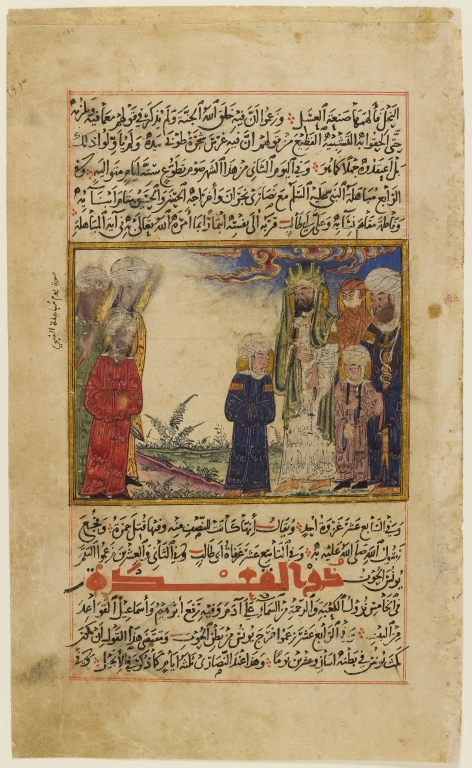
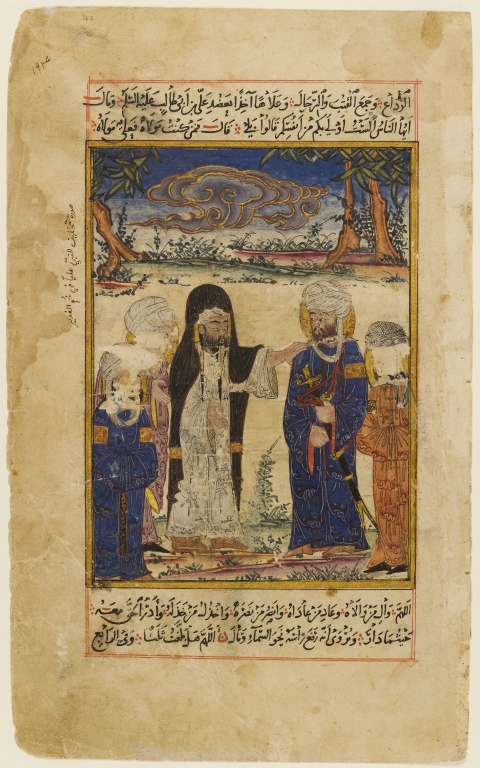
Manuscript page with Arabic text above and below a framed miniature painting. The painting shows a veiled figure in a black cloak and white veil, flanked by two men in turbans and blue robes and a man in an orange robe, under a blue sky with gold clouds and trees.Painting

Secondary source

Investiture of Ali

Al-Biruni · 1307

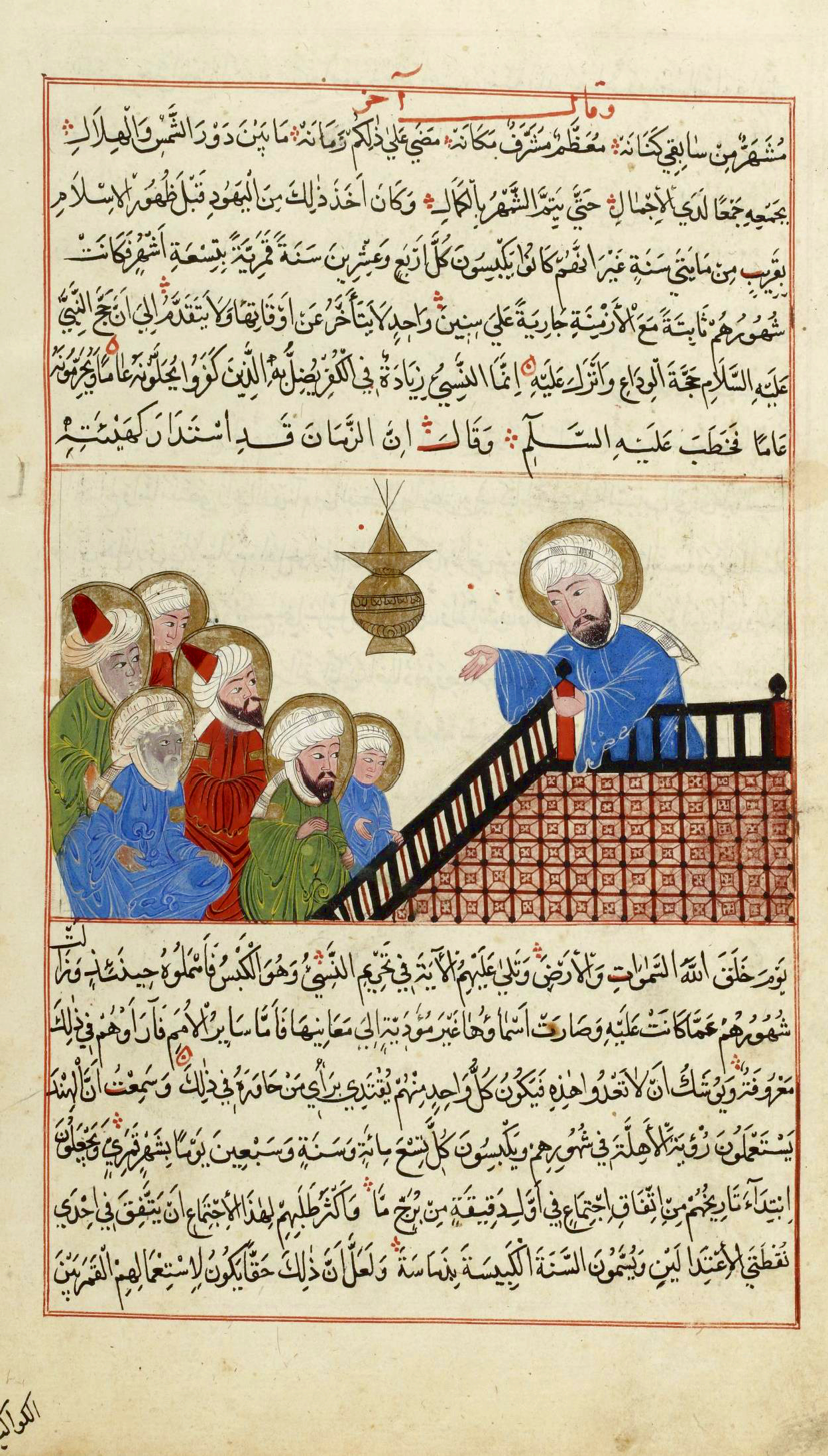
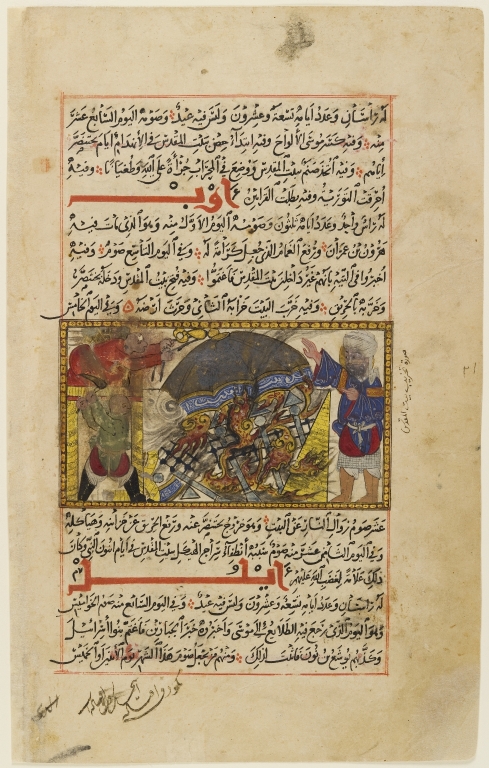
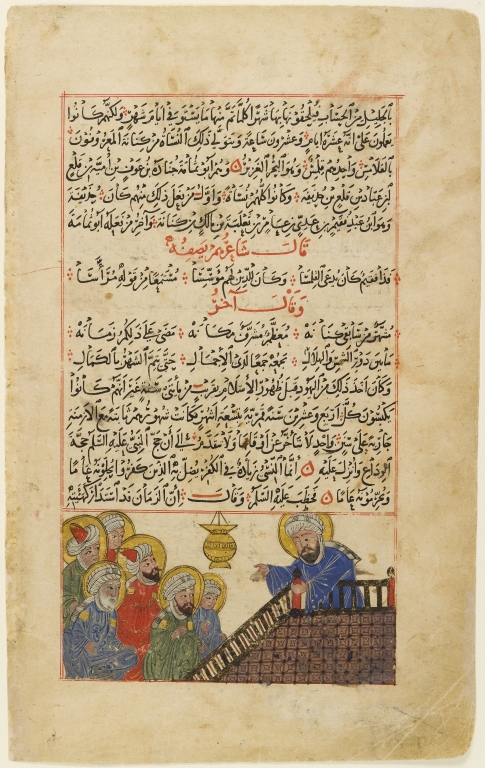
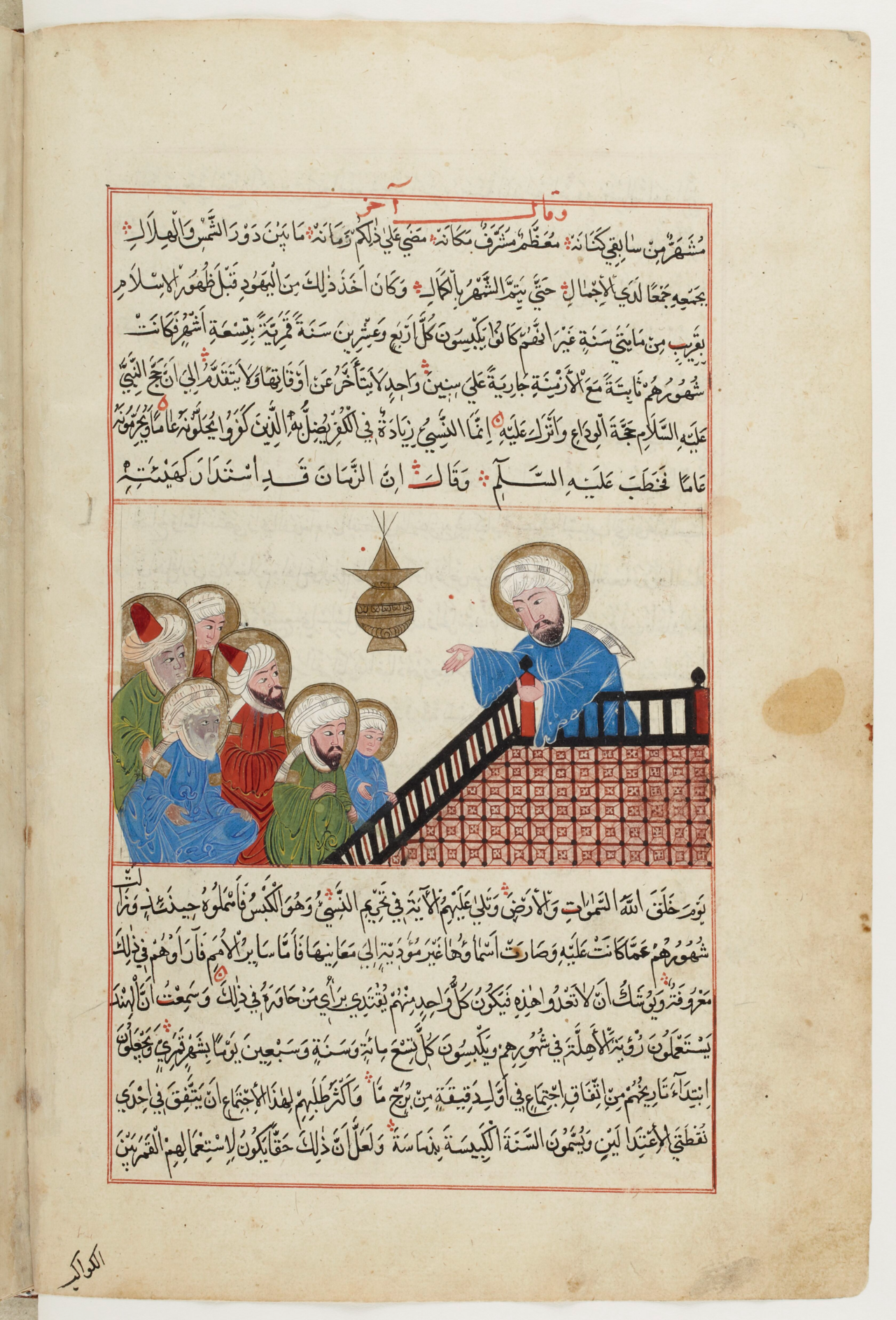
Manuscript page with Arabic calligraphy in black ink and red headings across the upper and middle sections. At the bottom is a painted miniature showing a robed figure in blue standing on a raised platform with a minbar-like railing, gesturing toward a group of turbaned men in green, red, and blue robes, with a hanging lamp above.Painting

Secondary source

Farewell Pilgrimage at Arafat

Al-Biruni · 1307

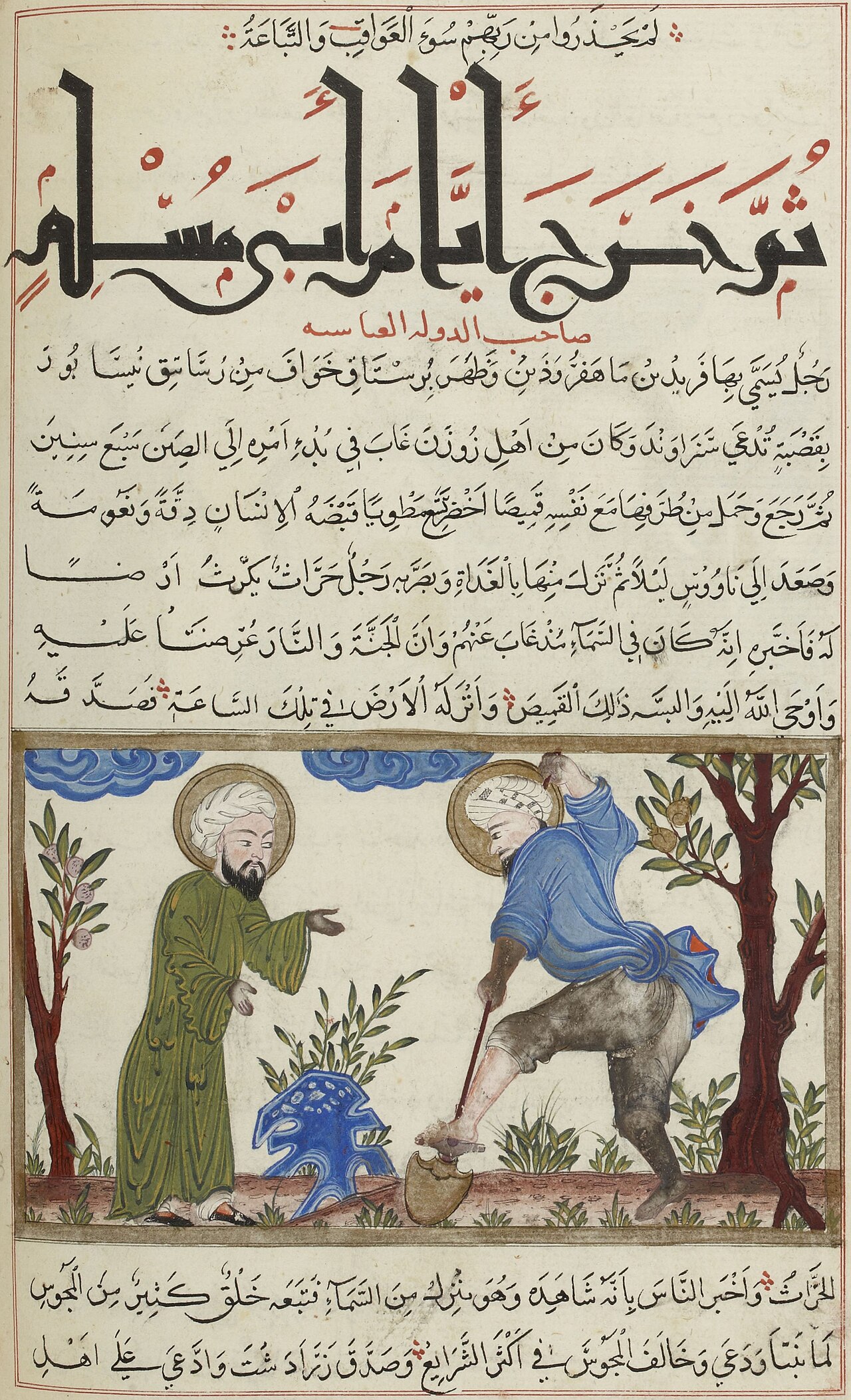
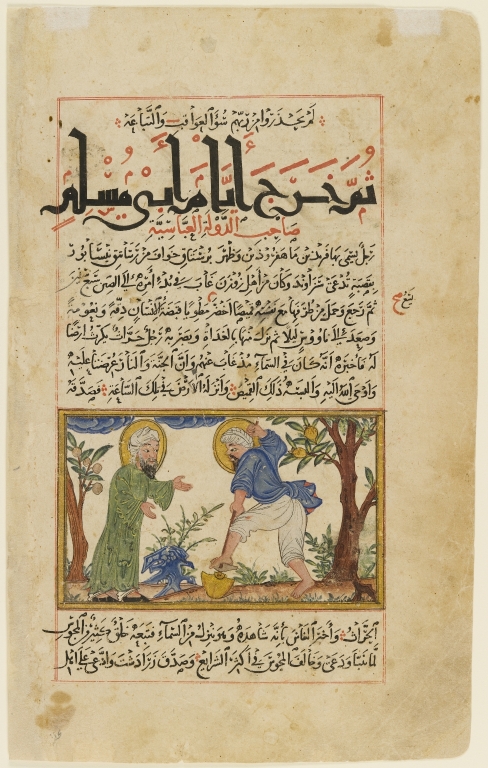
Manuscript page in Arabic script with a red-bordered calligraphic heading and text blocks. A framed illustration shows a bearded man in green robes gesturing toward a man in blue with a white turban who is kneeling and pouring from a yellow vessel near a plant, with trees and blue sky behind.Book

Primary source

Bihafarid Convincing a Peasant

Al-Biruni · 1307

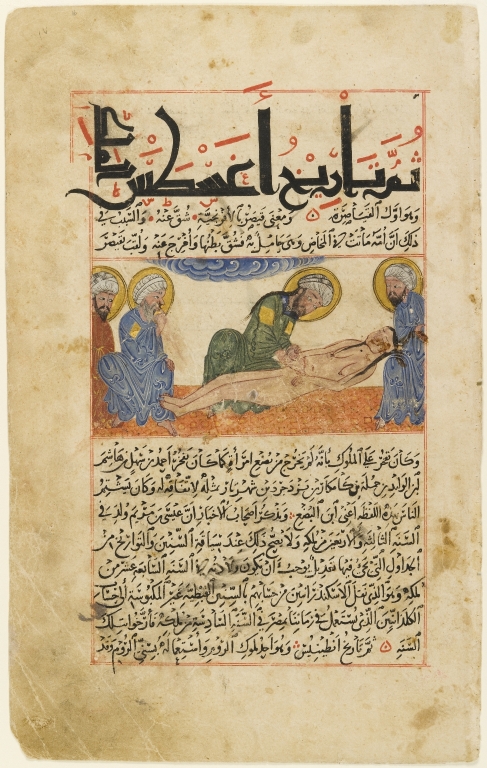
Manuscript page with Arabic calligraphy in black ink and a red-ruled header. A framed miniature shows a reclining nude figure on a bed, with attendants in blue and green robes with golden halos around their heads, under a blue cloud band.Book

Primary source

Birth of Augustus

Al-Biruni · 1307

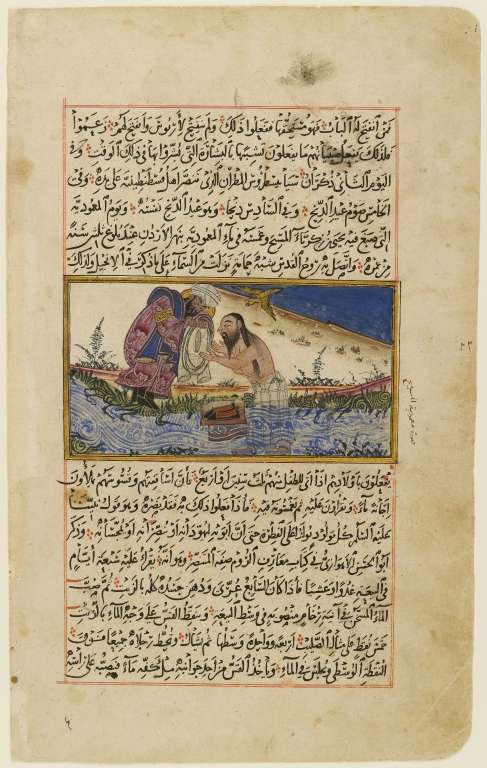
Manuscript page with Arabic text in black and red ink above and below a framed painted miniature. The miniature shows a bearded man standing waist-deep in blue-patterned water, hands raised, while two robed figures in pink and white stand on the bank.Book

Primary source

Baptism of Jesus

Al-Biruni · 1307

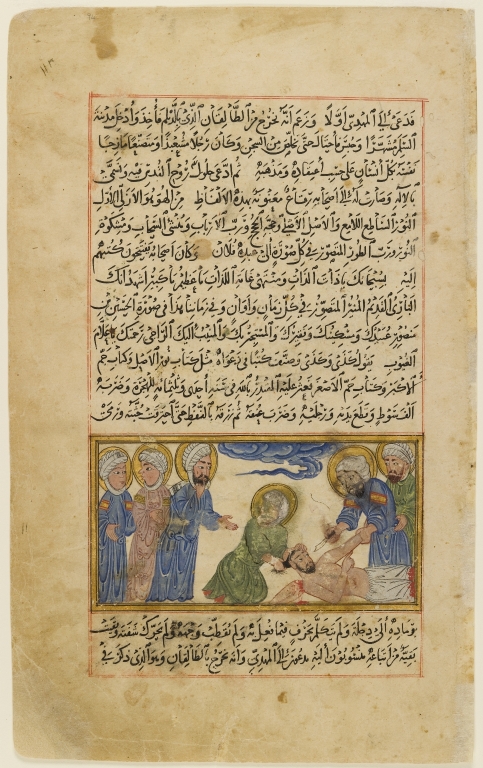
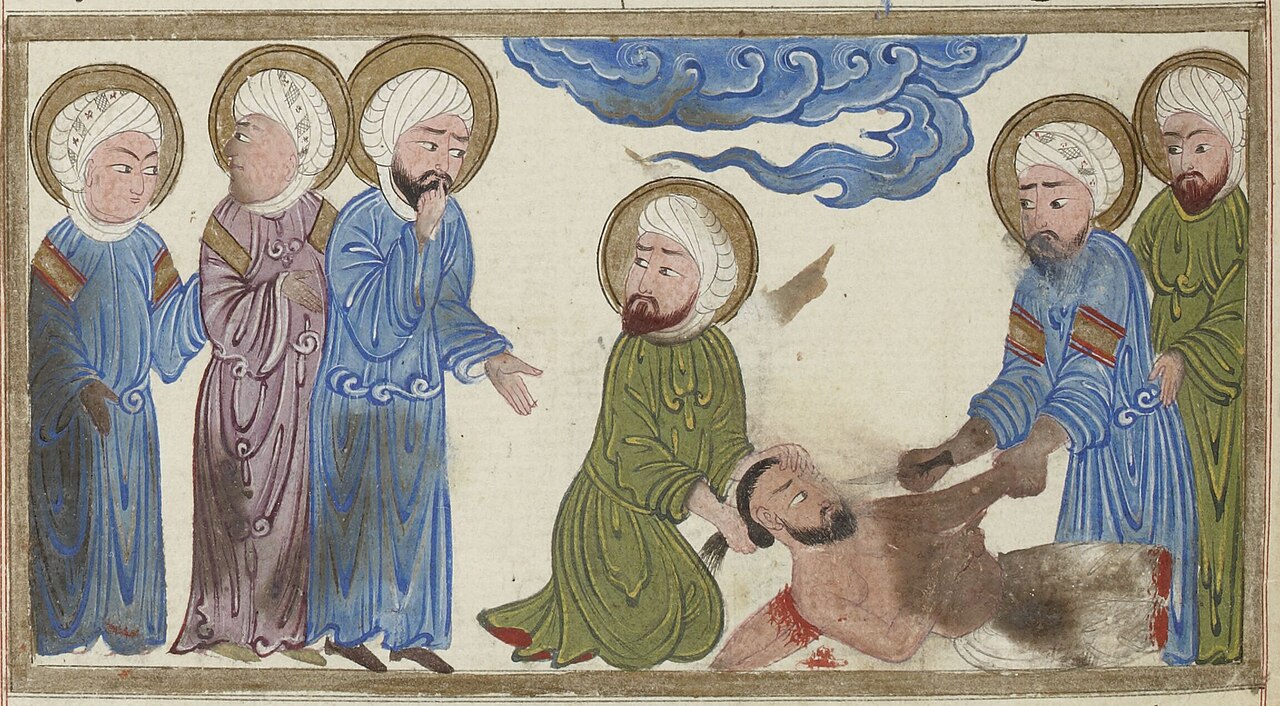
Manuscript page with Arabic text in two blocks above and below a framed painted miniature. The miniature shows a bare-chested man lying on the ground while a figure in green robes and a halo kneels over him. Several bearded figures in blue and red robes and turbans, some with halos, stand and watch under a blue sky. The page is aged, yellowed paper.Book

Primary source

Execution of al-Hallaj

Al-Biruni · 1307

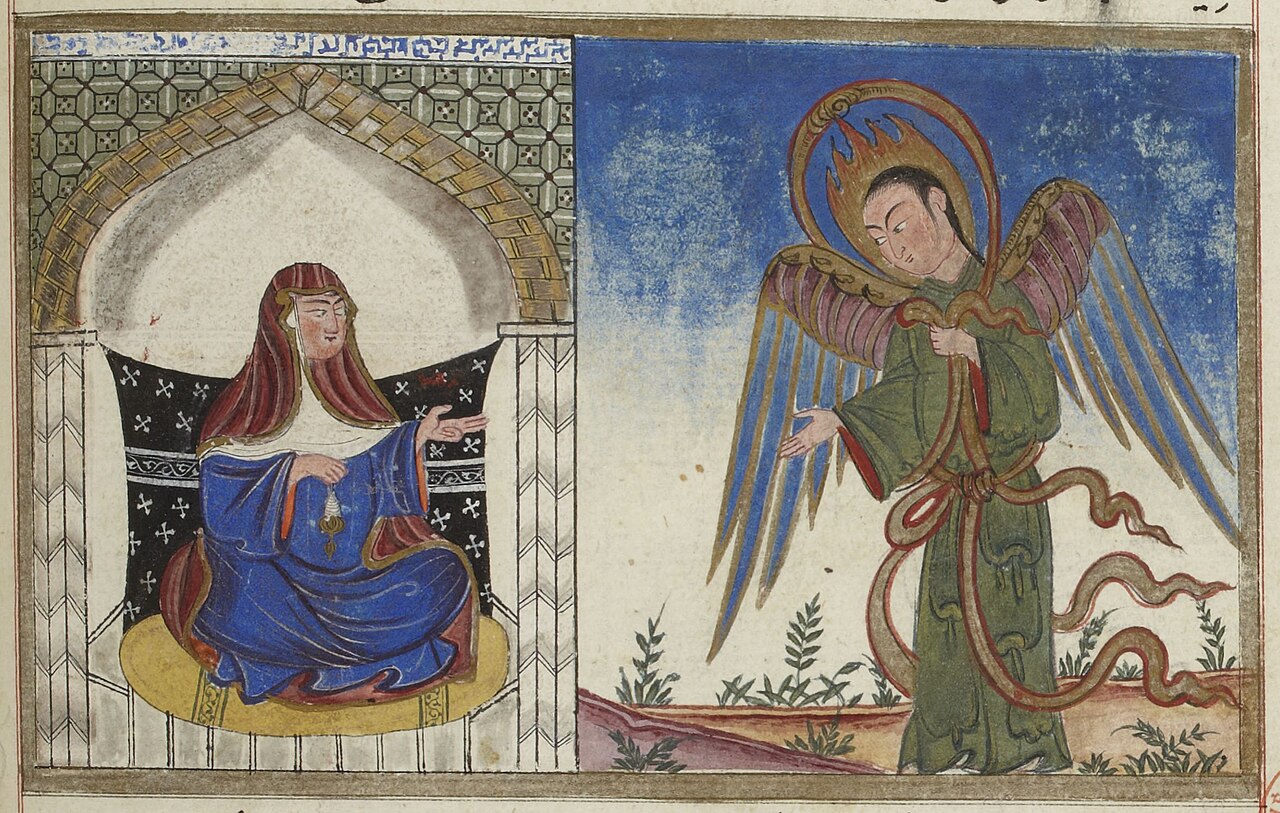
Miniature painting in two panels. On the left, a seated veiled woman with long red hair in a blue robe holds a small object in a niche with a patterned backdrop. On the right, a winged figure with a flaming halo and green robe, with red ribbon-like bands, gestures toward her against a blue sky over a grassy ground.Book

Primary source

Annunciation in The Remaining Signs of Past Centuries

Unknown author · 1501-1600

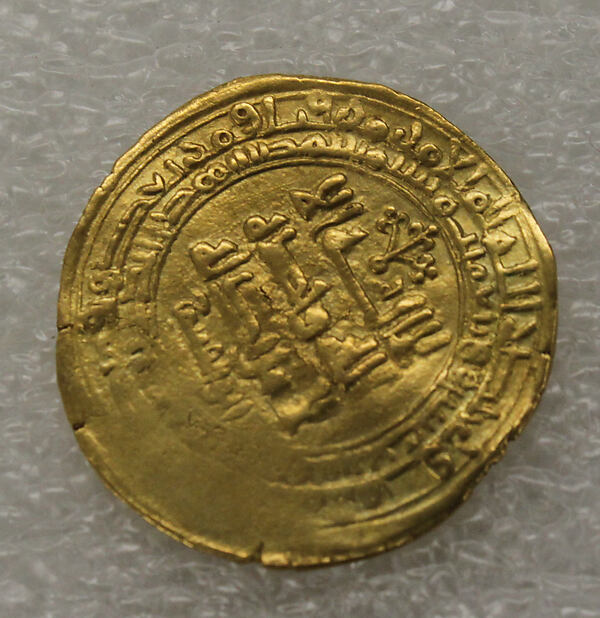
Photo of a round gold coin on a grey textured background. The coin has raised Arabic inscriptions in concentric rings around a central multi-line inscription in a field, with a worn, slightly irregular edge.Artifact

Primary source

Gold Dinar of Mahmud of Ghazni

419 AH/1028 CE

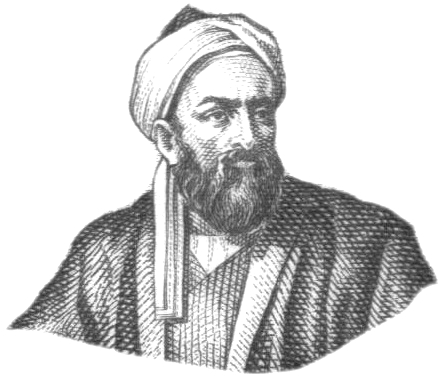
Black-and-white hatched engraving-style portrait of a bearded man in a white turban and dark striped robe, shown from the shoulders up, turned to his left, with a scarf-like cloth hanging at his side.Painting

Secondary source

Imagined Portrait of Al-Biruni

Michel Bakni · 2020-12-08

Book

Secondary source

Sacred Books of the East, Volume 6: Introduction

Book

Secondary source

The History of India as Told by Its Own Historians, Volume 1

John Dowson · 1867

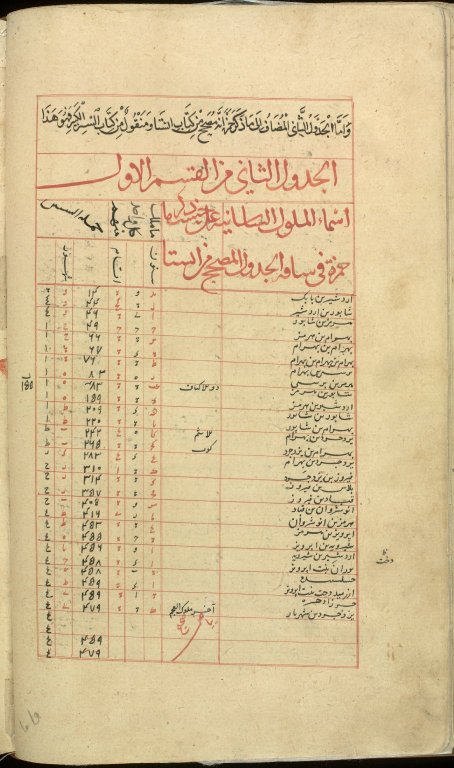
Manuscript page with red-ruled table in Arabic script. A red-ink heading sits at the top, and the page is divided into columns of numbers and Arabic names listing rulers and dynasties, with some marginal notes. The page number 186 appears in the left margin.Book

Primary source

Chronology of Ancient Nations Manuscript Page

Al-Biruni · 1307

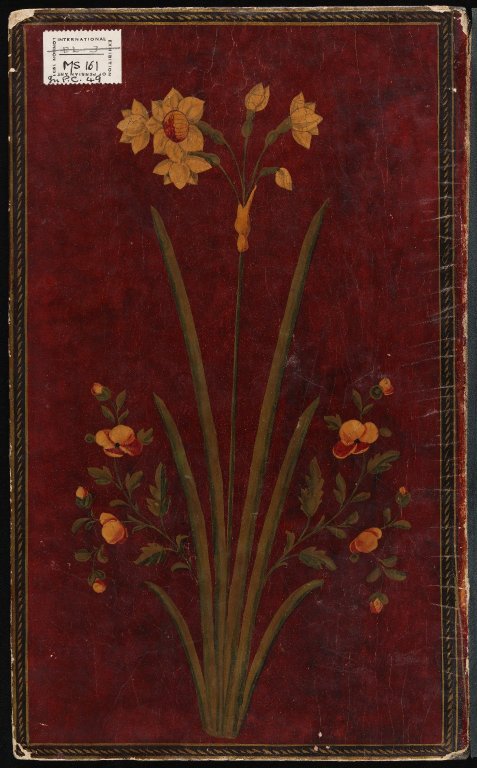
Red leather book cover with a gold-bordered frame and painted flowers: a tall stalk with yellow blossoms and long green leaves, plus smaller orange flowers and sprigs on either side. A white library label at upper left reads MS 161.Artifact

Secondary source

Chronology of Ancient Nations Manuscript, Inside Back Cover Detail

Al-Biruni · 1307

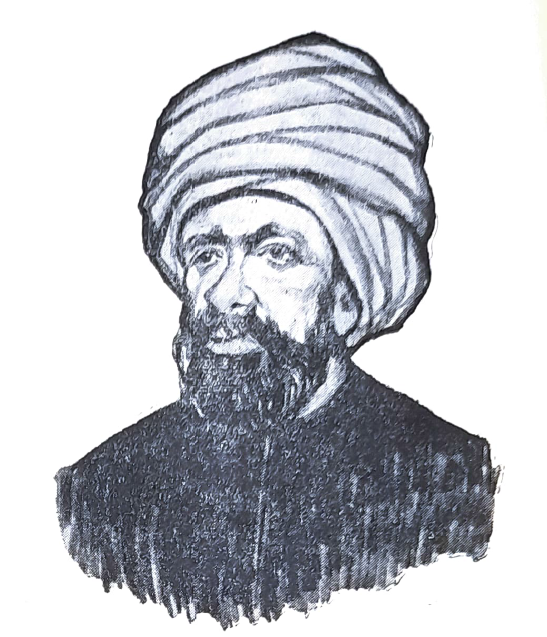
Black-and-white engraved-style drawing of a bearded man in a wrapped turban and dark robe, shown from the chest up, facing slightly to the viewer's left. The image is an imaginary portrait.Painting

Secondary source

Imaginary Sketch of Abu al-Rayhan al-Biruni

Unknown · 1961

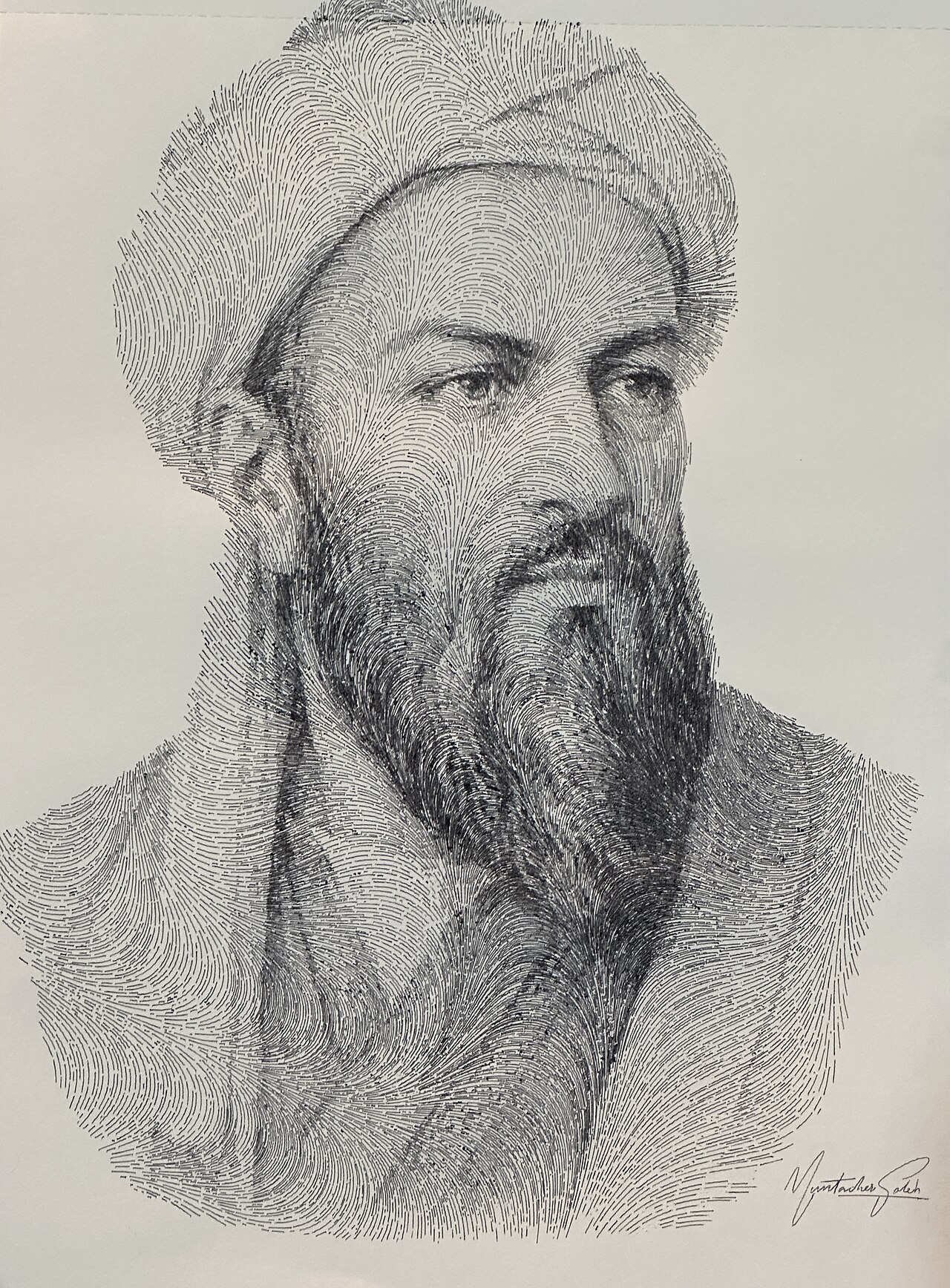
Pen-and-ink line drawing in fine, flowing hatching of a bearded man in a turban, shown from the shoulders up and turned slightly to the right. A signature appears in the lower right corner.Painting

Secondary source

Al-Biruni Portrait by Muntadher Saleh

Muntadher Saleh · 29 April 2022

Documentary

Secondary source

Video: Abu Rayhan al-Biruni and the Discovery of the Americas

Muhammadaziz Abdullayev · 15 March 2026

White Arabic calligraphy reading أبو الريحان البيروني (Abu Rayhan al-Biruni) arranged in two lines inside a gray circle with a white ring border, on a plain white background.Artifact

Secondary source

Icon of Abu Rayhan al-Biruni

عبد الله · 10 March 2019

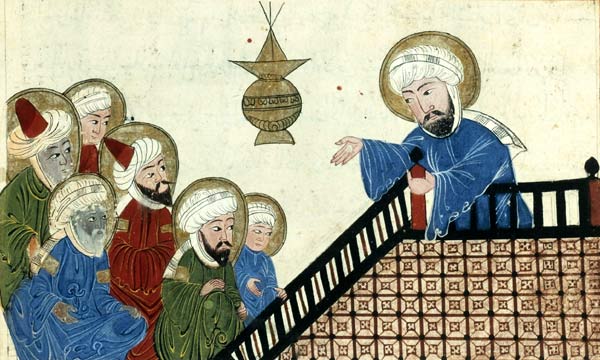
Miniature painting of a man in a blue robe and white turban, with a gold halo, standing on a raised pulpit with stairs and gesturing toward a group of turbaned men in green, red, and blue robes seated below. A hanging lamp is above.Painting

Secondary source

Muhammad Forbids Intercalation

Unknown · 17th century

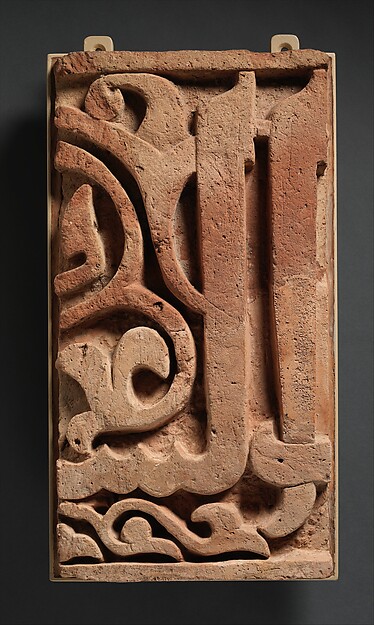
A rectangular terracotta panel with raised, carved decoration in a reddish-buff clay, mounted on a pale wooden backing with two small hanging tabs at the top. The carved design includes large upright vertical strokes and curling, looping forms resembling calligraphic lettering with scrolling foliage below against a dark background.Artifact

Primary source

Mosque Frieze Panel Bearing the Name of a Sultan

11th century

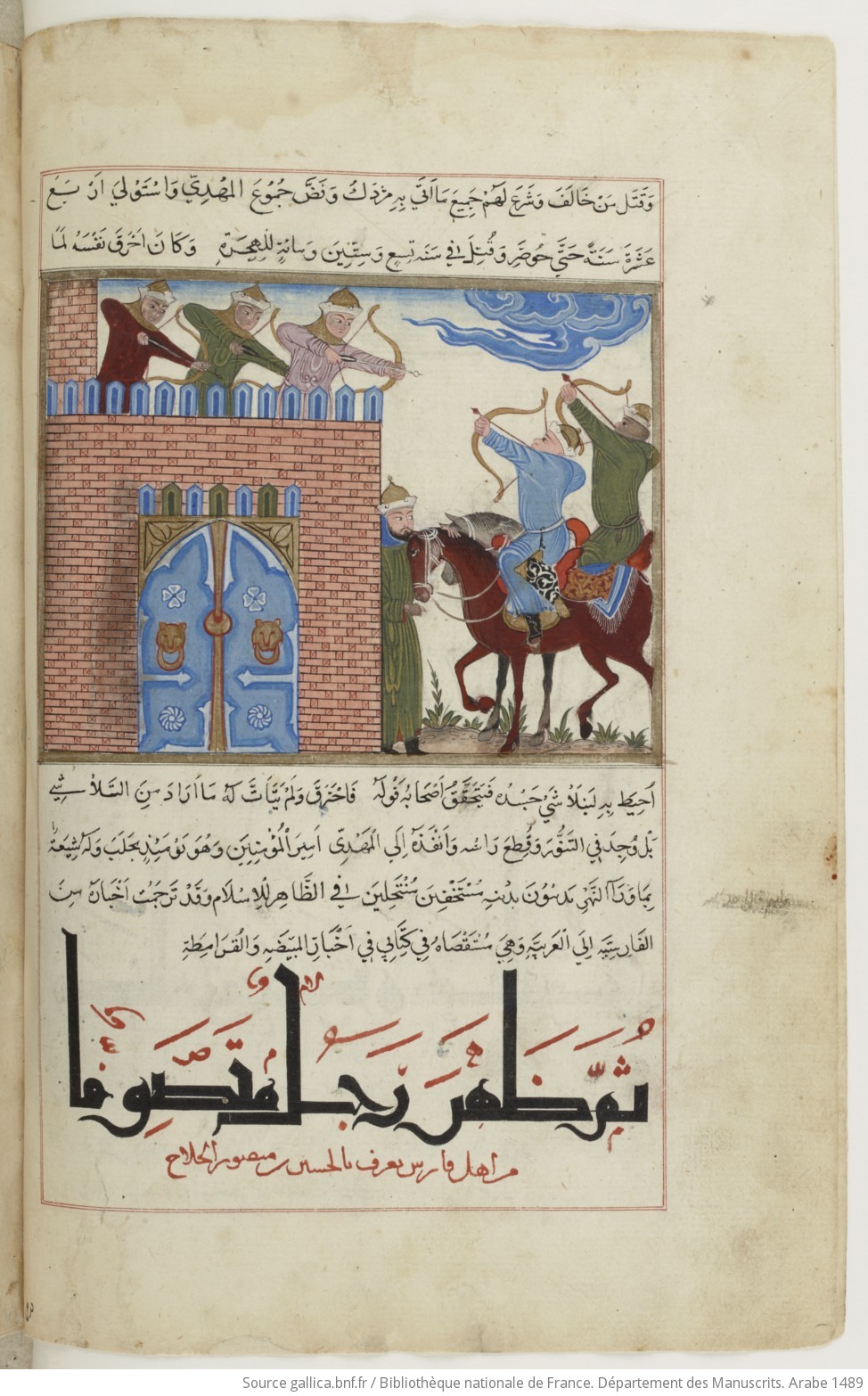
Manuscript folio page with Arabic calligraphy text at top and bottom and a framed painted miniature in the middle. The miniature shows archers on a brick battlement firing at a rider on a red-brown horse, with a blue-studded gate and a figure in green beside the horse. Margin text and red-ink headings appear on the page.Painting

Primary source

Chronology of Ancient Nations, Folio 112v

Unknown · 14th century (manuscript tradition)

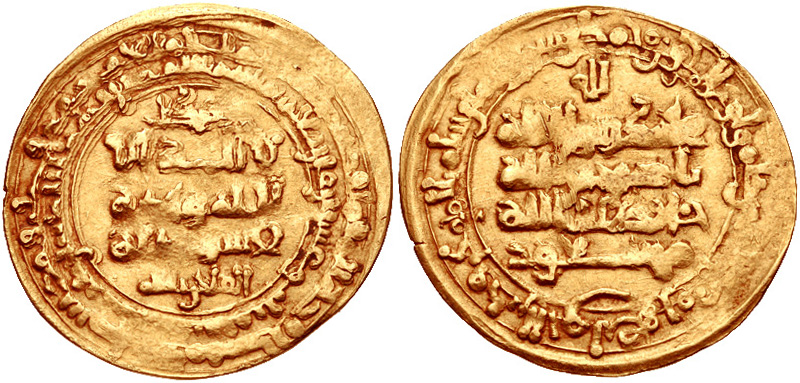
Two sides of a gold dinar coin, shown side by side. Left side has Arabic calligraphic inscription in a central field within a border of inscribed text. Right side has Arabic inscription in horizontal lines within a circular inscribed border, with a small ornamental mark at the bottom.Artifact

Primary source

Gold Dinar of Sultan Mas'ud I of Ghazni

1031-1041 AD

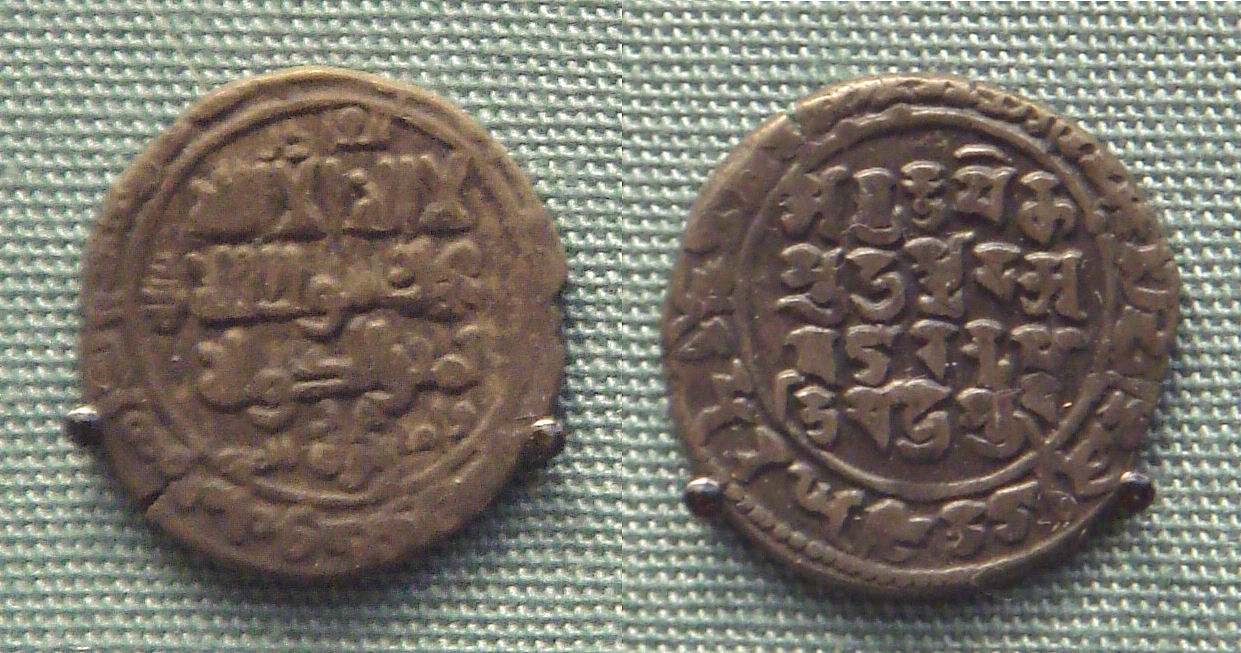
Two small round bronze-colored coins on a grey-green fabric background. The left coin shows Arabic script in its center and around its rim. The right coin shows Sanskrit-style script in a central field with a ring of inscription around the edge.Artifact

Primary source

Silver jitals of Mahmud of Ghazna, bilingual Arabic and Sanskrit

1028

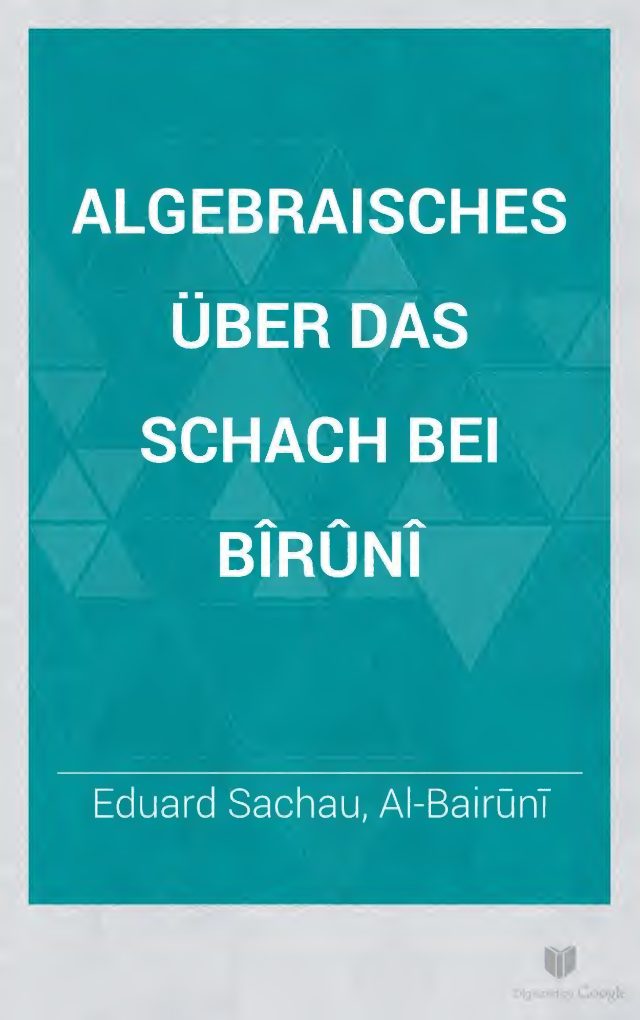
Algebra of chess according to BīrūnīBook

Secondary source

Algebra of chess according to Bīrūnī

Eduard Sachau · 1875

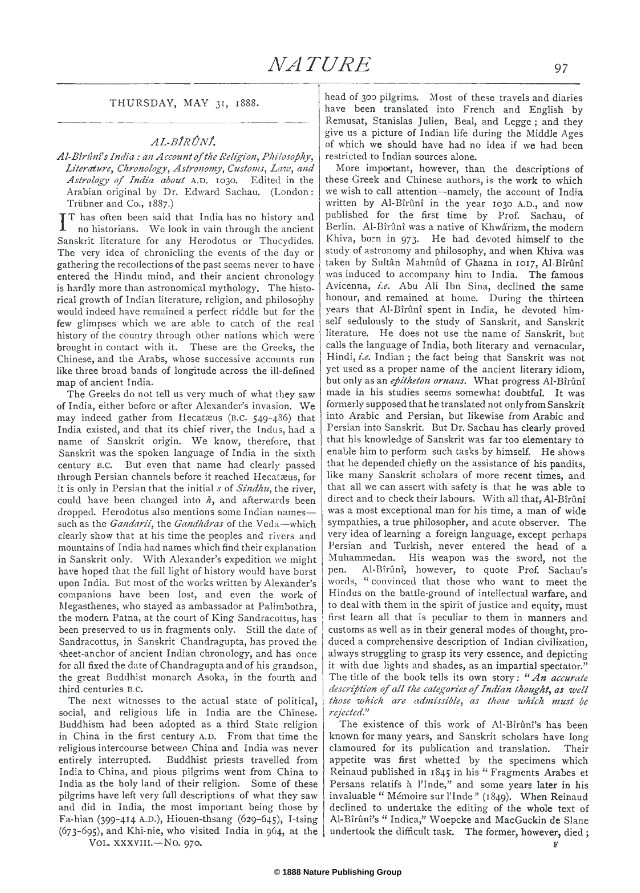
Review of Al-Bīrūnī's India (Nature, 1888)Book

Secondary source

Review of Al-Bīrūnī's India (Nature, 1888)

31 May 1888

Manuscript page with Arabic text in black and red ink above and below a framed miniature. The miniature shows a bearded man in a blue robe and white turban standing on a tiled platform with a railing, gesturing toward a group of turbaned men in green, red, and blue robes. A hanging lamp is visible above them.Book

Secondary source

Muhammad forbids intercalation, folio 5v

between 1501 and 1600

Miniature painting of a 16th-century-style illustration: a bearded man in a green robe kneels and grips the hair of a shirtless bearded man lying on the ground, while a man in blue robes pulls at his leg. Three figures in blue and purple robes stand at left with haloes, one gesturing, and a bearded figure in green stands at far right. A blue cloud fills the top center against a cream background.Painting

Secondary source

Execution of al-Hallaj

16th century

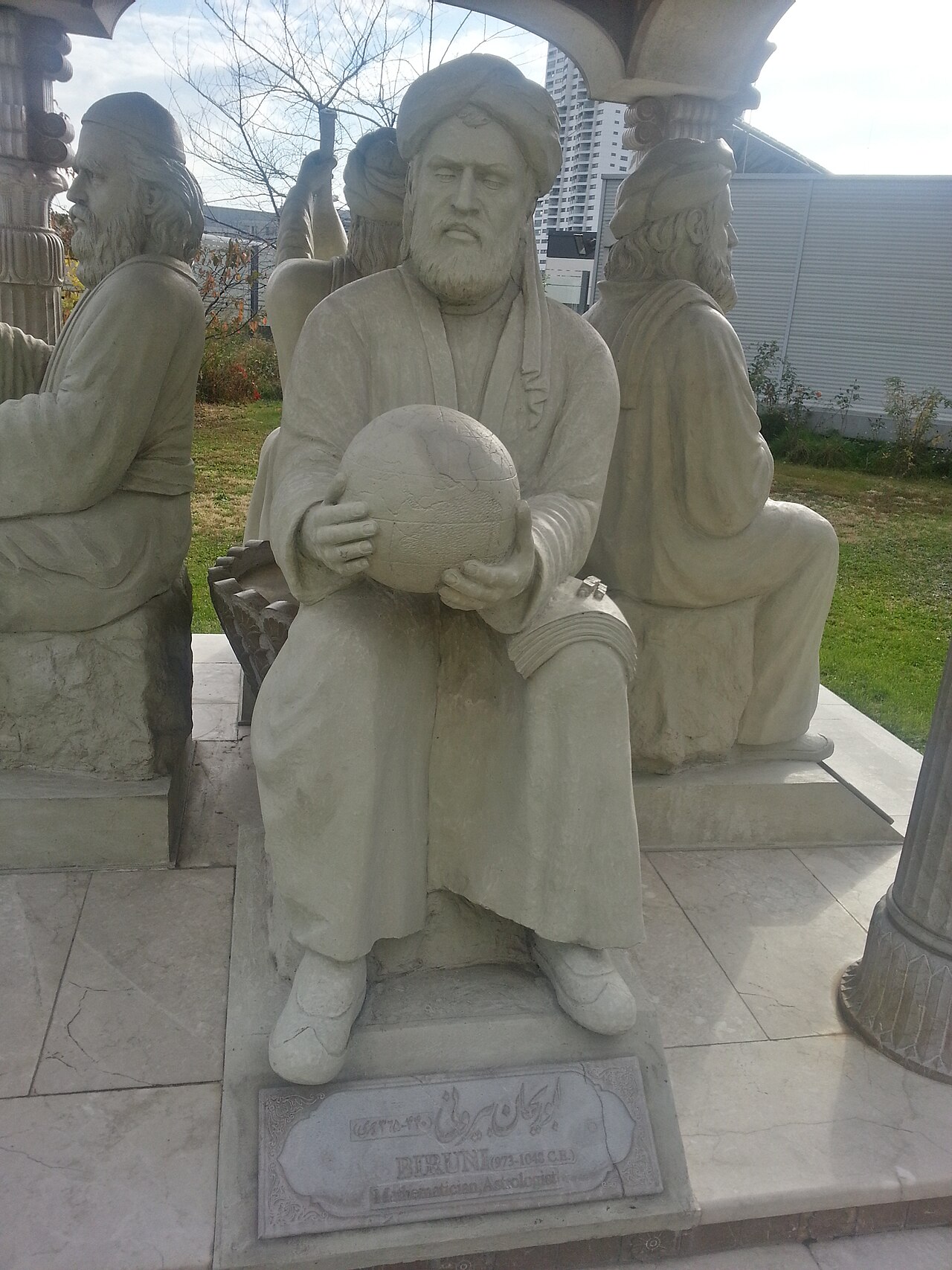
A seated stone statue of a bearded scholar in a turban and long robe, holding a globe on his lap, with a plaque below. Other statues of scholars sit beside him under a pavilion with columns and grass.Photograph

Secondary source

Persian Scholar Pavilion, Vienna International Centre

Yamaha5 · 2009 (pavilion donated by Iran); photograph dated 16 October 2013

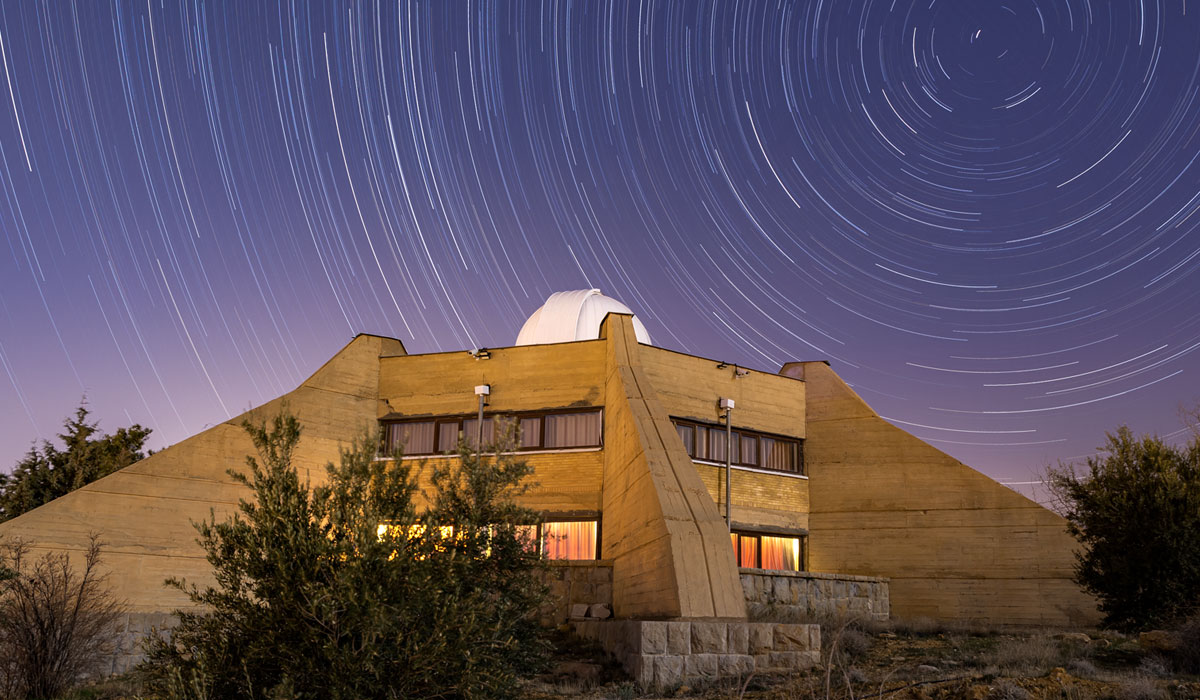
Long-exposure night photo of concentric star trails arcing across a dark blue-purple sky above a tan, angular concrete observatory building with a white dome on top, lit windows, and shrubs in the foreground.Photograph

Secondary source

Star trails over the Al-Biruni Observatory

Sepehr moeini · 7 September 2023

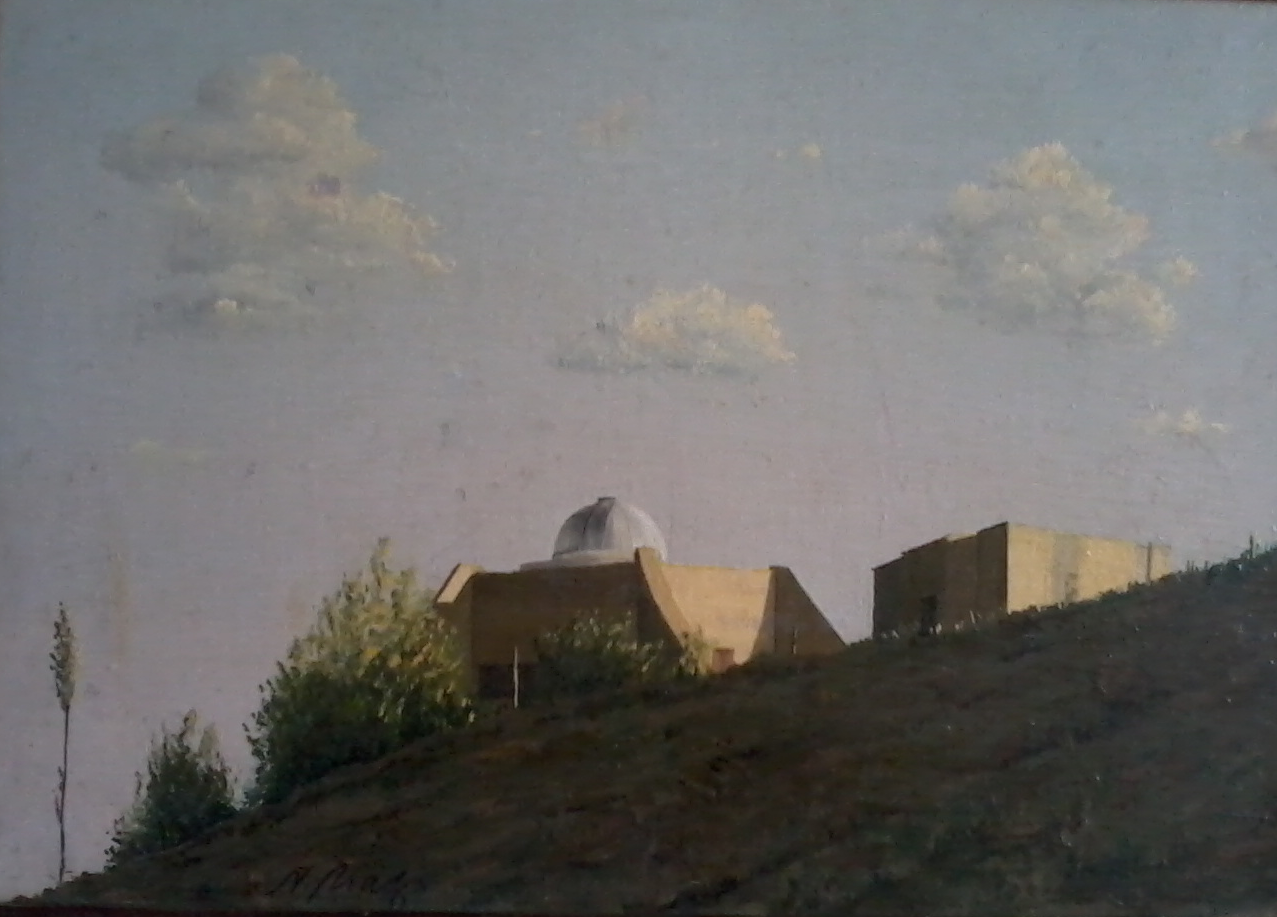
Oil painting of a hillside with scrubby trees and a dark brown slope in the foreground. Beige flat-roofed buildings with a domed observatory roof stand on the hill under a pale blue sky with scattered white clouds. A signature is in the lower left corner.Painting

Secondary source

Biruni Observatory (oil painting)

Nematollah Riazi · 13 November 2013 (Commons upload date)

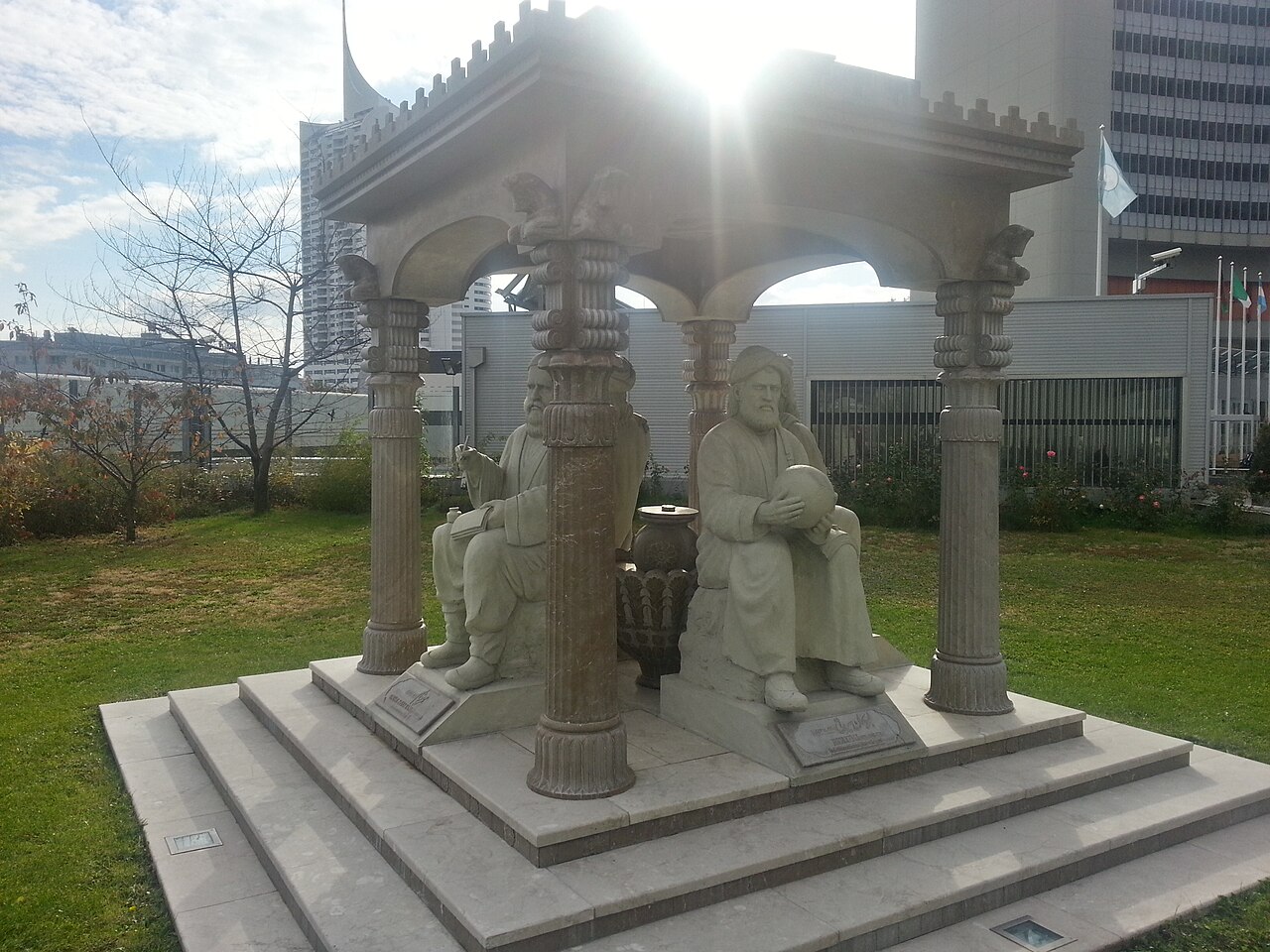
A stone pavilion with a domed roof and columns in a grassy garden, with two seated stone statues of scholars holding a globe and a book, set on a multi-tiered stone base with plaques. Modern glass office buildings and flagpoles stand behind it.Artifact

Secondary source

Persian Scholar Pavilion in Vienna

2009 (donated by Iran, June 2009)

Want the full shelf? Chat with Al-Biruni in the app and open the Sources panel — every quote links back to the original.

Use Al-Biruni in class

2 collections

Ready-made collections from the Humy team that feature Al-Biruni. Preview any of them, then try it free.

Trusted by educators worldwide

Conversations
375,000+
Real exchanges between students and historical figures
Messages exchanged
4,142,000+
Across every figure, classroom and language
Historical figures
100,000+
Each informed by a curated biography and selected sources
Languages supported
50+
From English and Spanish to Arabic and Korean

Paying customers

Used by 98 schools and universities

Partner school logo
Tecnológico de Monterrey logo
Hyper Island logo
Partner school logo
Chambersburg Area School District logo
Broward County Public Schools logo
Nebo School District logo
National Louis University logo
South Florida PBS logo
Punahou School logo
University of Wisconsin–River Falls logo
Partner school logo
Partner school logo
Archbishop Mitty High School logo
Kingsburg High School logo
Norwalk Public Schools logo
Partner school logo
Connections logo
Partner school logo
Moore Public Schools logo
Partner school logo
Partner school logo
Partner school logo
Partner school logo
Robbinsville Public Schools logo
Partner school logo
Partner school logo
Partner school logo
Tecnológico de Monterrey logo
Hyper Island logo
Partner school logo
Chambersburg Area School District logo
Broward County Public Schools logo
Nebo School District logo
National Louis University logo
South Florida PBS logo
Punahou School logo
University of Wisconsin–River Falls logo
Partner school logo
Partner school logo
Archbishop Mitty High School logo
Kingsburg High School logo
Norwalk Public Schools logo
Partner school logo
Connections logo
Partner school logo
Moore Public Schools logo
Partner school logo
Partner school logo
Partner school logo
Partner school logo
Robbinsville Public Schools logo
Partner school logo
Partner school logo

What educators are saying

“We enjoyed the program last year and used it frequently.”
“My students say it’s a welcome change of pace. I’m not a fan of the “sage on the stage” model, so I try to incorporate research-oriented and self-paced activities. With Humy, students have to take charge of their learning. They’ve become more adept at critical thinking, forming better questions, and improving their reading comprehension. The interview feature has been my go-to tool. I create assignments where students must ask historical figures a set number of questions, then summarize the responses to ensure they’re truly absorbing the material. This approach lets them actively explore the past rather than passively consuming information.”
“Humy has helped me bring historical figures, sometimes long past, to life. When my students interact with these figures in real-time, it eliminates some of the perceived “ancient” characteristics of my curriculum. This has shifted my students’ thinking away from viewing history as abstract or irrelevant. Real-time interactions make historical figures relatable, even allowing students to ask off-topic questions that help put historical lives in a more relevant context for 13-year-olds. The feature I use the most is the interview feature. After teaching a topic, most recently Gandhi and Joan of Arc, I have the students ask pointed, focused questions. We practice good conversation techniques beforehand, teaching them to listen (or read) carefully and formulate thoughtful follow-up questions rather than just interrogating. It helps students practice effective conversation skills.”

FAQ

Frequently asked questions

Who is Al-Biruni?
Persian polymath known for his contributions to mathematics, astronomy, and geography. On Humy.ai you can chat with an AI version of Al-Biruni that draws on a short biography and 79 historical sources during the conversation — by text or voice, in 42 languages.
Is Al-Biruni AI free?
Al-Biruni is part of Humy's full library of more than 100,000 figures, which comes with a paid plan. A free account (no credit card) includes 20 AI messages a month with the free library's figures, so you can try how the conversations work first. The free plan's 20 AI messages a month are shared by you and your students: enough to try Humy yourself; a whole class needs Plus.
What sources does the Al-Biruni AI use?
It draws on a short biography and 79 historical sources (books, paintings and artifacts), including “Al-Biruni's India”, “The Remaining Signs of Past Centuries” and “Diagram of the Phases of the Moon”. Each source has its own page on Humy.ai.
How historically accurate is the AI version of Al-Biruni?
Each figure uses a short biography and a small set of selected historical sources as context (retrieval-augmented generation), so answers stay closer to known material than the model's general knowledge alone. It isn't a citation-grade research tool — like any LLM, the AI can get details wrong or extrapolate. Treat it as a strong starting point for inquiry and cross-reference important claims.
Can I talk to Al-Biruni by voice?
Yes. In addition to text chat, you can call Al-Biruni and hear their voice respond in real time — useful for auditory learners, interview practice and Socratic dialogue.
Is Humy.ai safe and compliant for schools?
Yes. Humy.ai is used by more than 100 schools, universities and organisations. The platform is FERPA- and GDPR-aligned, supports SSO, and offers an IT-approval pack tailored for school procurement teams.

Ready when you are

Start chatting with Al-Biruni now.

20 messages free · No credit card · Available in 50+ languages.