
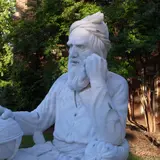
Portrait of Omar Khayyam

AI Historical Figure

Omar Khayyam

Persian mathematician, astronomer, and poet.

Chat with Omar Khayyam via text or voice — in 42 languages, drawing on a curated biography and 83 historical sources. Available 24/7.

Start chatting with Omar Khayyam20 messages free · No credit card
Lived
1048–1131
From
Iran
Known for
Science & medicineLiterature & writing
Omar Khayyam

Omar Khayyam

Online · responds in seconds

Hello — I'm Omar Khayyam. Persian mathematician, astronomer, and poet. What would you like to ask me?

20 messages free · No credit card · Powered by Humy.ai

Live preview · Switch between 42 languages above · Send a message to continue in the app

Multilingual

Talk to Omar Khayyam in 42 languages

Ask Omar Khayyam questions in any language below, and the rest of Humy's app speaks it too. Pick yours to open the chat in that language.

Also in German (Austria), German (Switzerland), English (UK), English (Australia), English (Canada).

The sources behind this AI

83 sources · 38 books · 16 photographs · 9 documents · 7 paintings · 7 sculptures · 6 artifacts

Omar Khayyam doesn’t improvise from thin air. The AI is grounded in 83 curated historical sources students can inspect. Open any of them to see what informs the conversation.

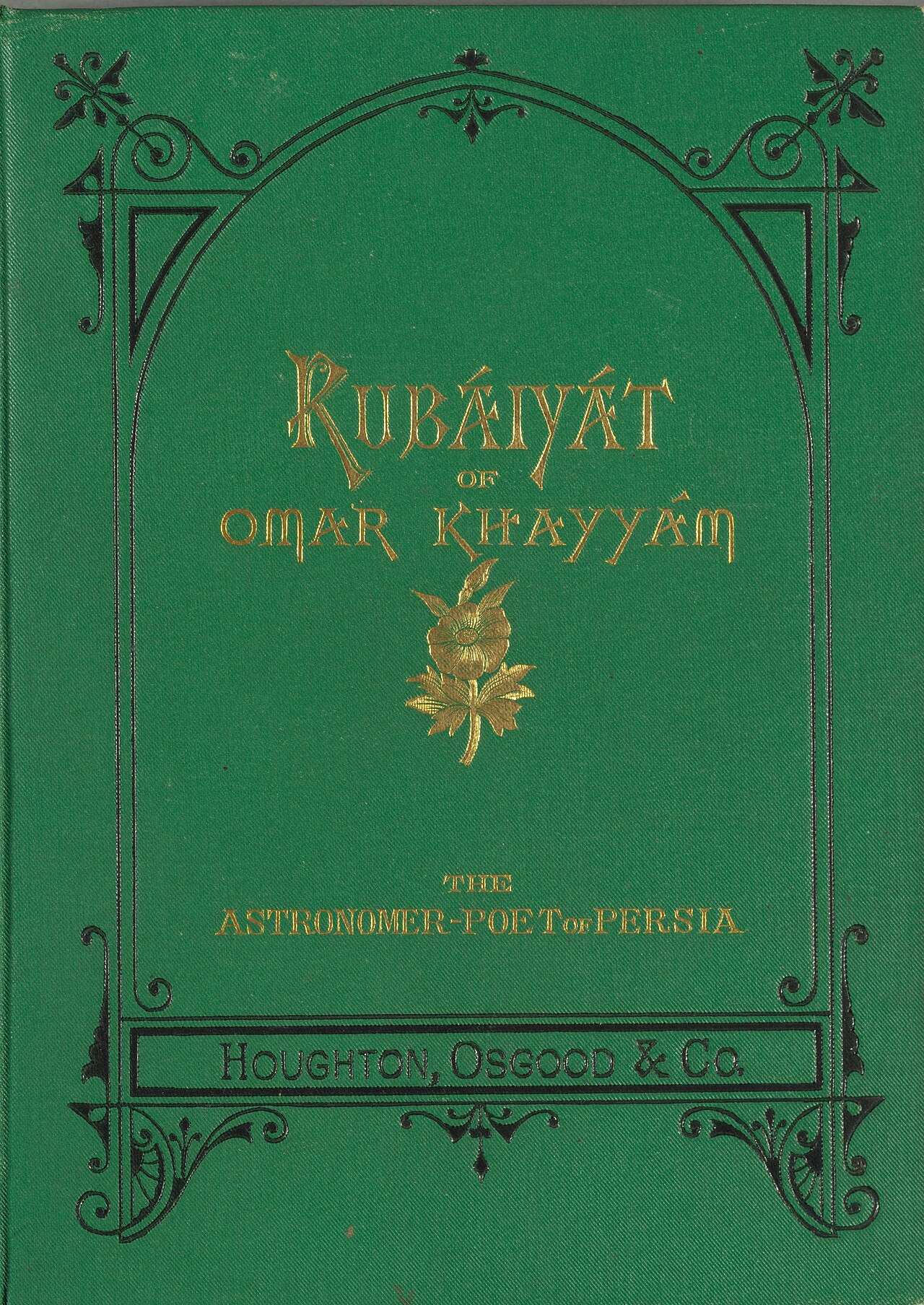
Front cover of a green cloth book titled Rubáiyát of Omar Khayyám, the Astronomer-Poet of Persia, with gold lettering, a gold floral emblem, black decorative arch border, and publisher Houghton, Osgood & Co. at the bottom.Book

Secondary source

Rubáiyát of Omar Khayyám

Edward FitzGerald · 1878

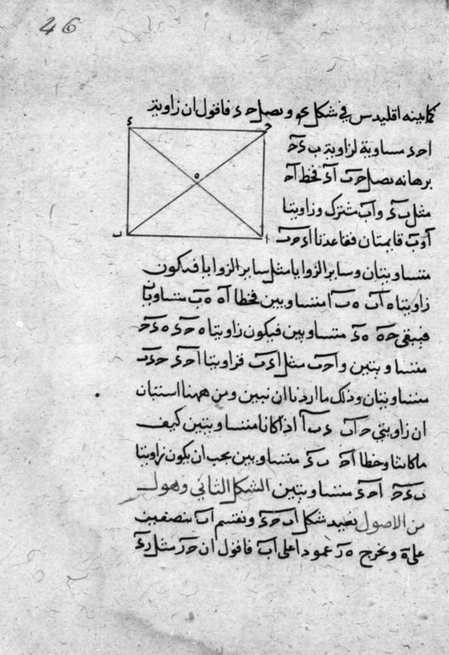
Manuscript page numbered 46 in Arabic script, with a geometric diagram of a rectangle with both diagonals drawn and lettered corners at the top of the page, above several lines of handwritten Arabic text in black ink on aged, yellowish paper.Document

Primary source

Khayyam Geometry Manuscript

Omar Khayyám

Book

Secondary source

The Rubaiyat of Omar Khayyam (First Edition)

Edward FitzGerald · 1859

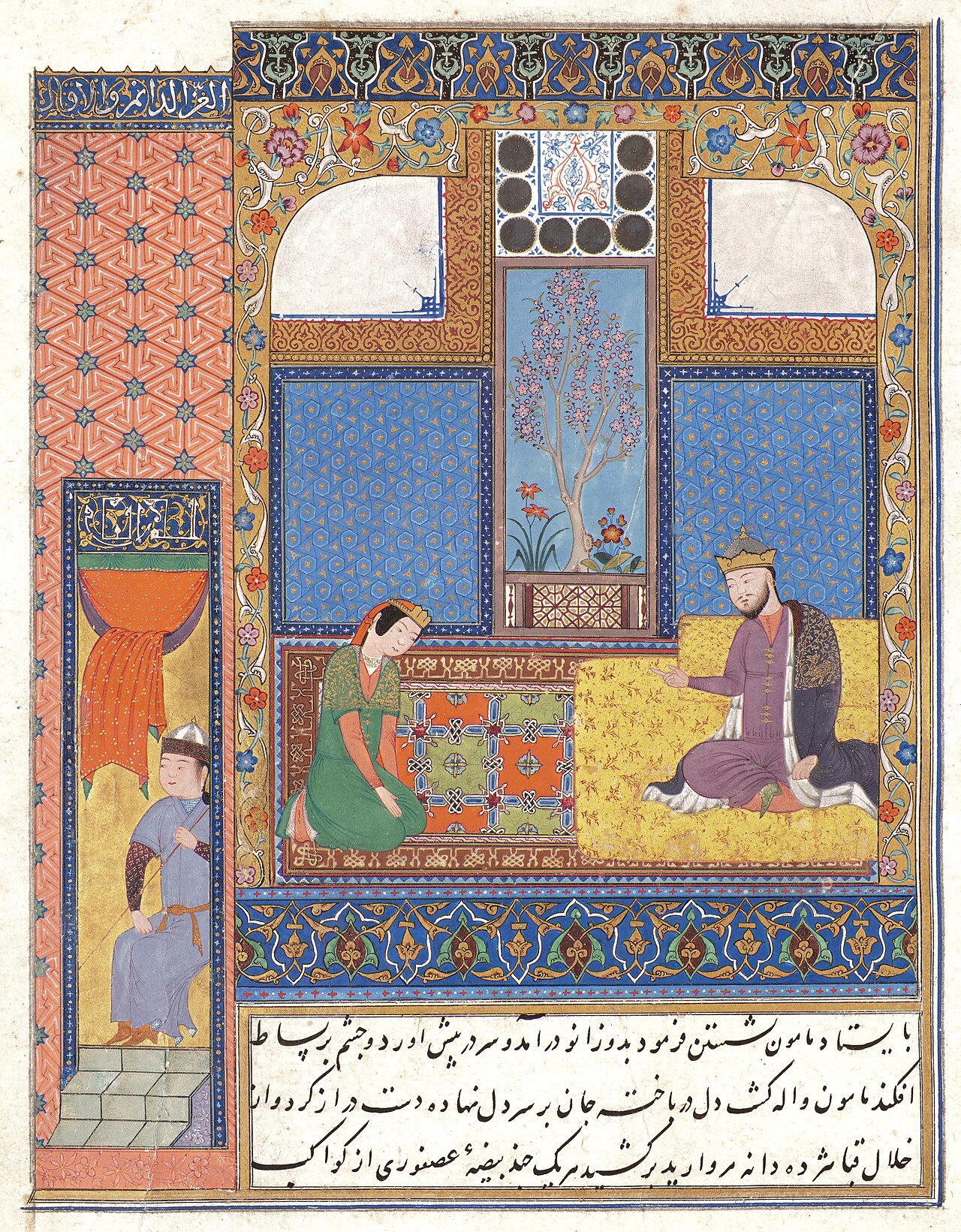
Painted manuscript page in Persian miniature style: a seated bearded ruler in a crown gestures toward a woman in green kneeling on a rug, while a small attendant in a blue robe stands at a doorway on the left. Persian text fills the bottom panel.Book

Secondary source

Chahar Maqala

Nizami Aruzi · 1155–1157

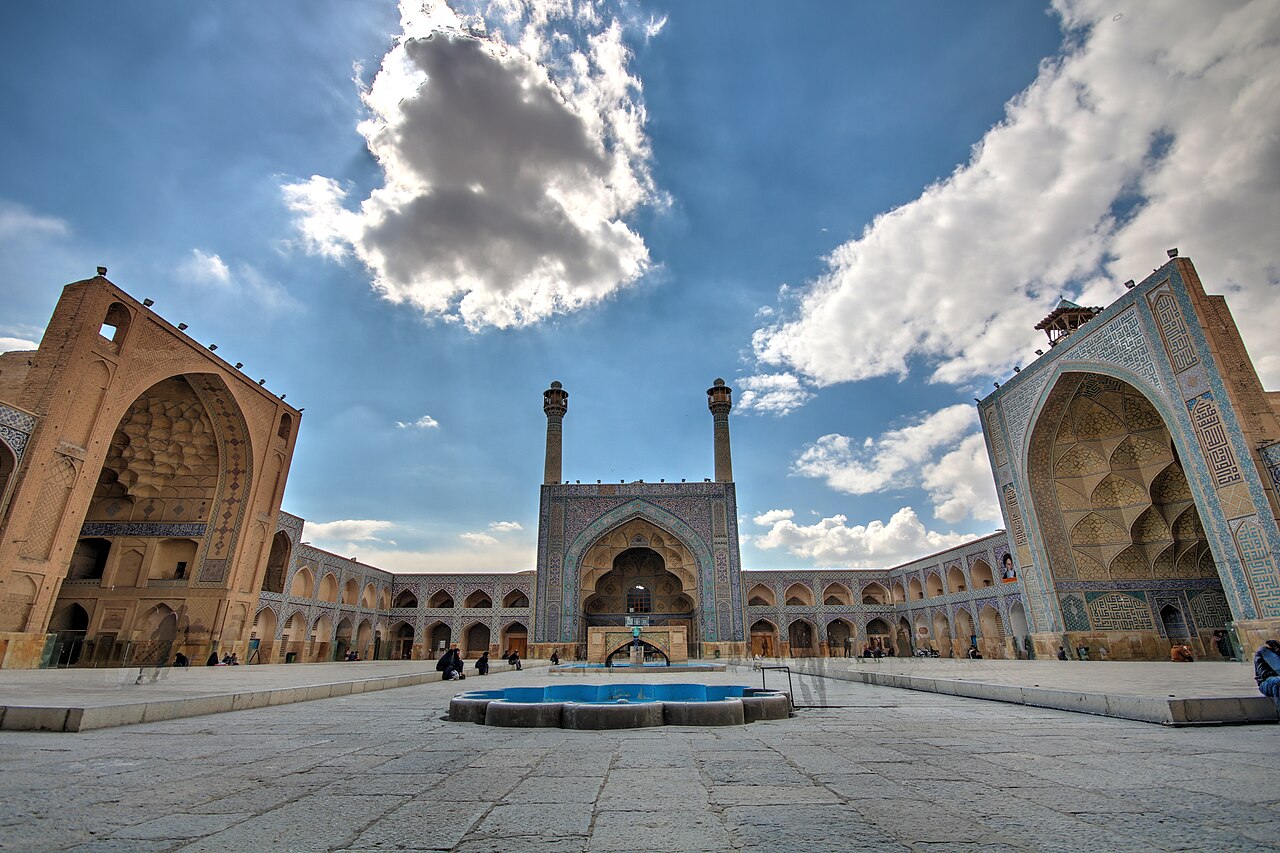
Wide view of the central courtyard of the Jameh Mosque of Isfahan under a blue sky with clouds. Tall iwans with ornate tiled and muqarnas vaulting frame the square, with a blue-tiled fountain pool in the foreground and a pair of minarets rising behind the central portal.Artifact

Secondary source

Jameh Mosque of Isfahan

841 (rebuilt 1086-1089 under Khayyám's patrons)

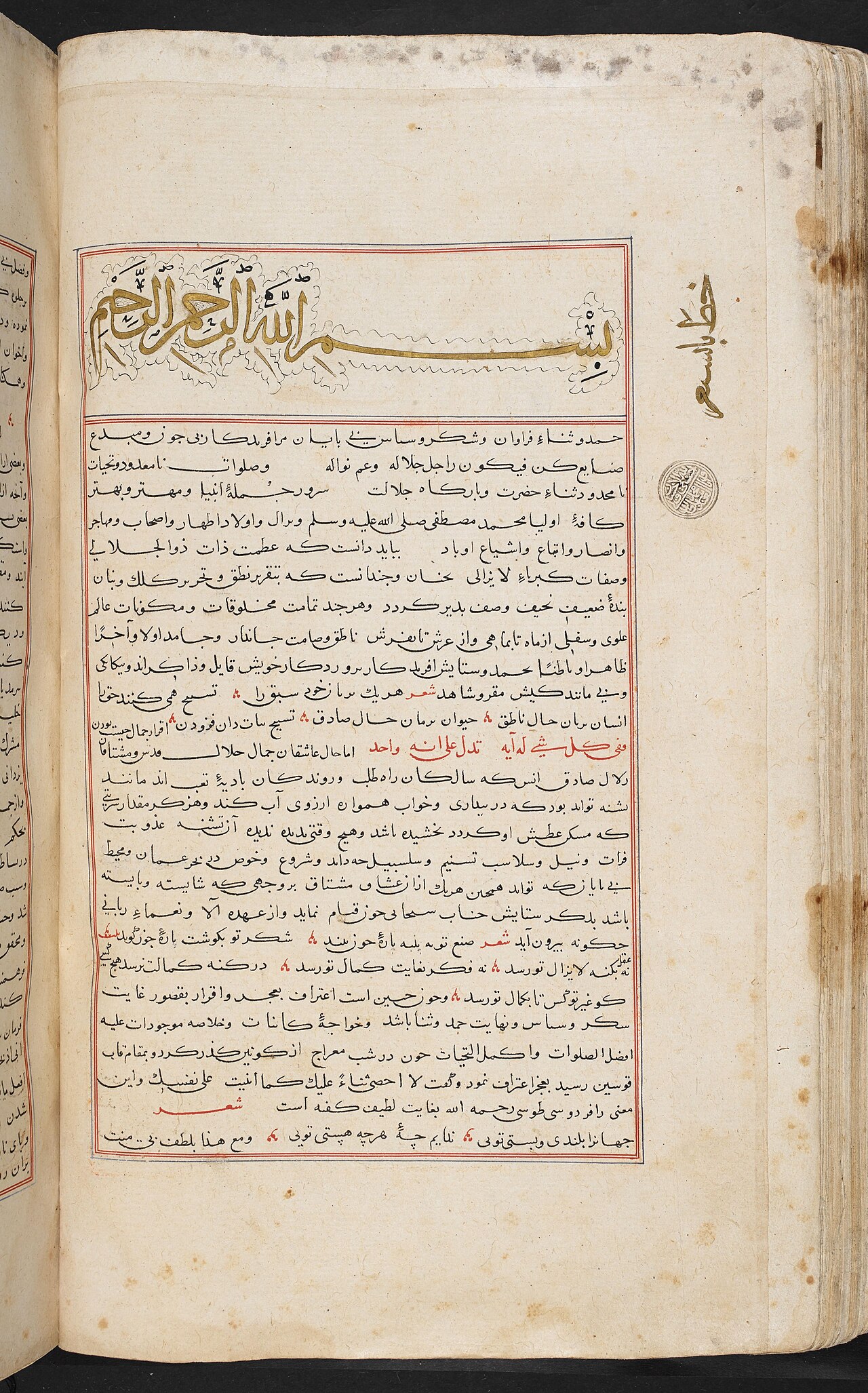
Manuscript page in Persian nastaliq script with an ornate gold-and-blue illuminated Bismillah heading at top, red-ruled borders, a marginal note in gold, and a round seal stamp in the margin on the right. Adjacent page edge visible at left.Book

Secondary source

Jami' al-tawarikh

Rashid al-Din Hamadani · c. 1400 (manuscript copy)

Book

Secondary source

The Quatrains of Omar Khayyam

E. H. Whinfield

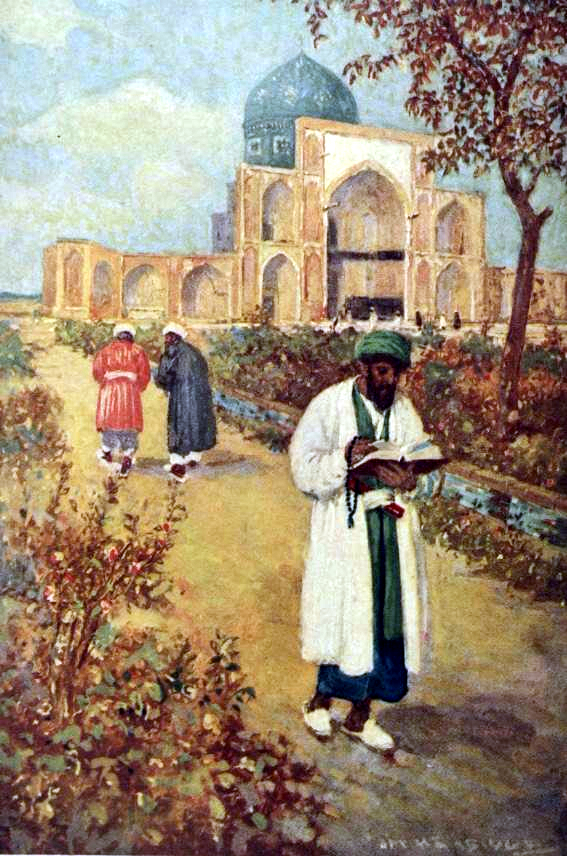
A painting of a sunlit garden path lined with flowering shrubs and a water channel. A bearded man in a white robe, green sash and green turban holds an open book and beads. Two figures in red and grey robes walk ahead toward a domed, arched mosque with a turquoise dome.Painting

Secondary source

At the Tomb of Omar Khayyam

Jay Hambidge

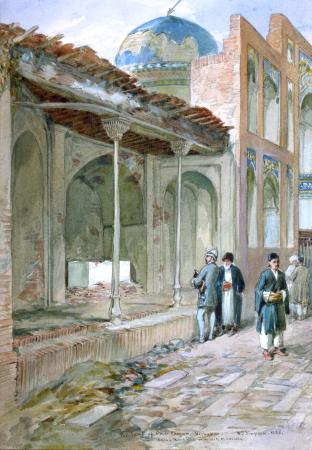
Watercolor painting of a ruined colonnaded courtyard with arched openings, a tall blue-domed structure behind, and a tiled wall at right. Three robed figures in turbans and one in a tall hat walk on the pavement.Painting

Secondary source

The Painting of Omar Khayyam's Tomb

William Simpson · 1823-1899 (artist's lifetime)

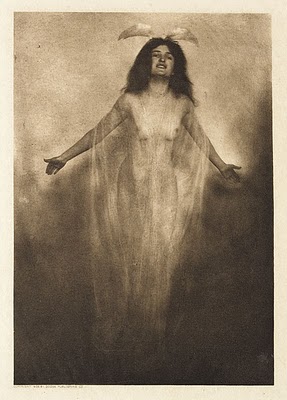
Sepia-toned photograph of a woman with long dark hair and a feathered or winged headdress, arms outstretched, wearing a sheer flowing gown against a misty, darkened background.Photograph

Secondary source

Rubaiyat of Omar Khayyam (Hanscom photograph)

Adelaide Hanscom Leeson · 1905

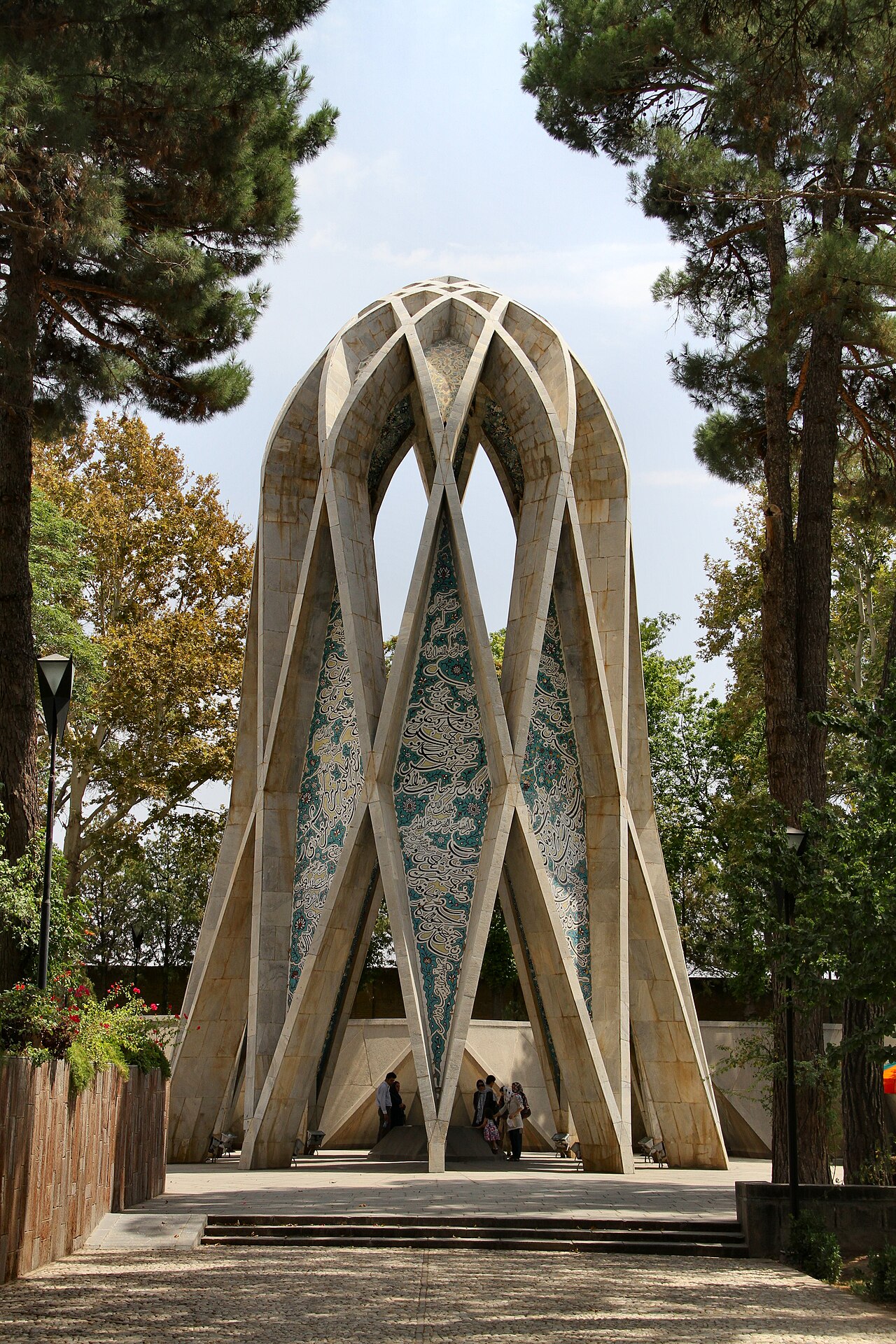
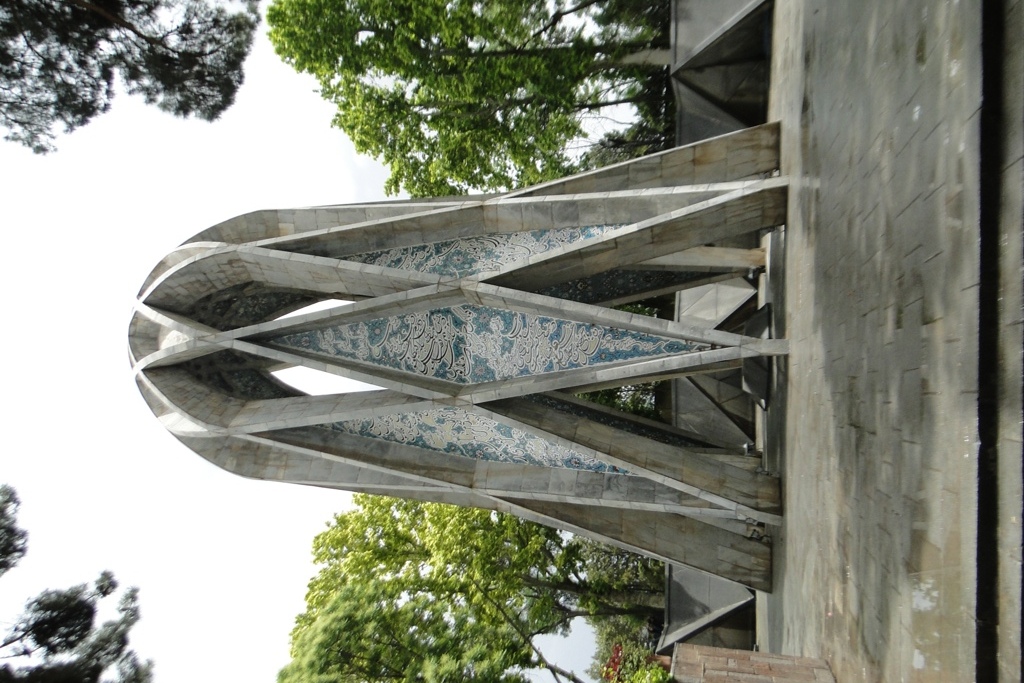
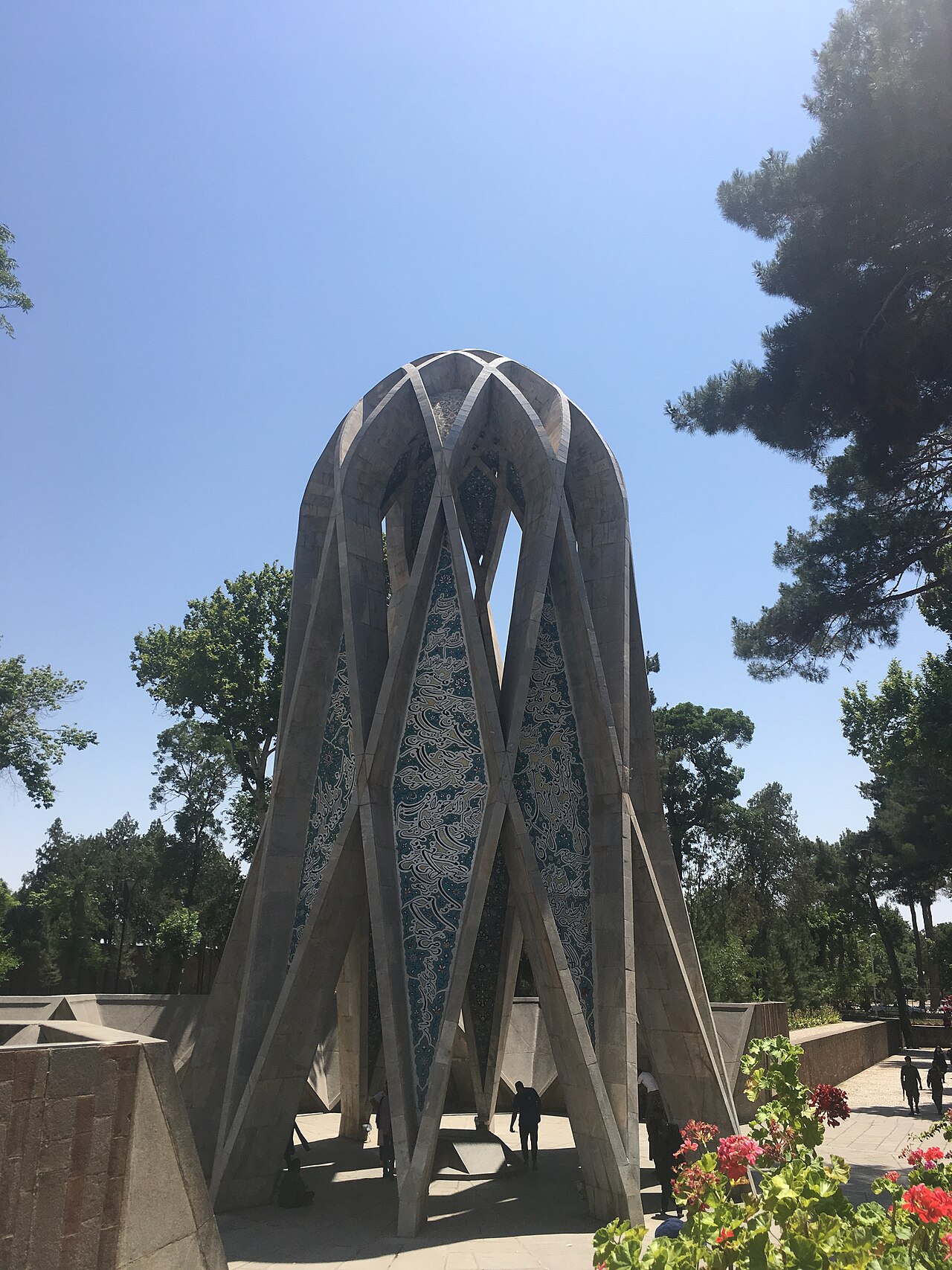
A tall modern white concrete mausoleum with a lattice-like latticed structure of crossing arches, with teal mosaic panels inscribed with script, set among pine and plane trees; a few visitors stand at its base and a paved plaza with steps lies in front.Artifact

Secondary source

Grave of Omar Khayyám

Houshang Seyhoun · 1963

Document

Tertiary source

1911 Encyclopædia Britannica: 'Omar Khayyām'

1911

Orange cloth book cover with a circular gold-stamped emblem in a dark red ring. The emblem shows a laurel wreath, a scene of a mountain, water and a sailing or mythical bird, with the text 'TRÜBNER'S ORIENTAL SERIES' and 'FULGUR EXIT AB ORIENTE' around the rim.Book

Secondary source

The Quatrains of Omar Khayyam, translated by E. H. Whinfield

Edward Henry Whinfield · 1882–1883

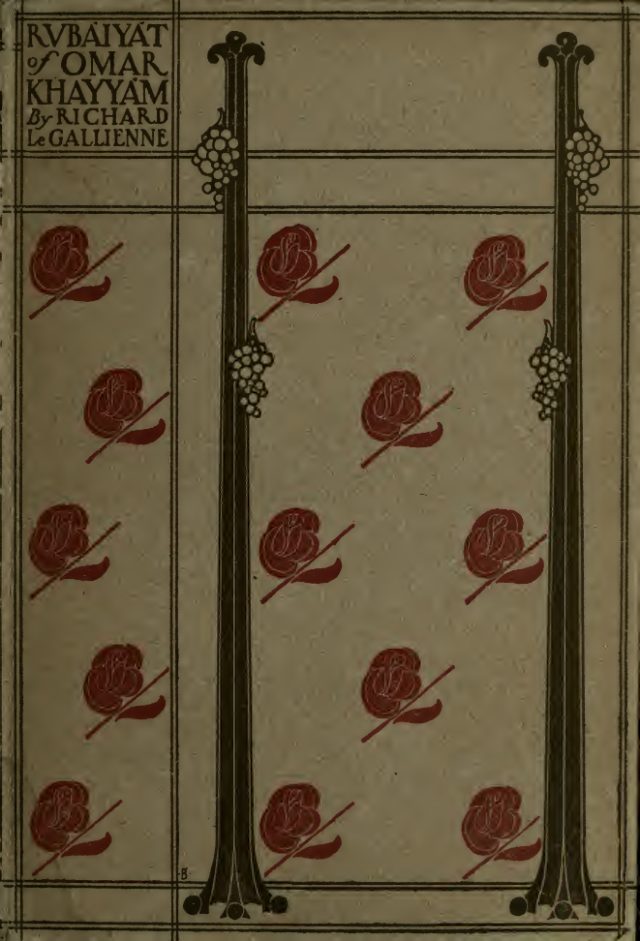
Book

Secondary source

Rubáiyát of Omar Khayyám (Le Gallienne paraphrase)

Richard Le Gallienne · 1897

Cover of a red-brown cloth-bound book with a white barcode label on the upper left showing the number 31761 04384 9736. The spine is visible along the left edge. No title text is visible.Book

Secondary source

Recherches sur les Rubaiyat de Omar Khayyam

Arthur Christensen · 1905

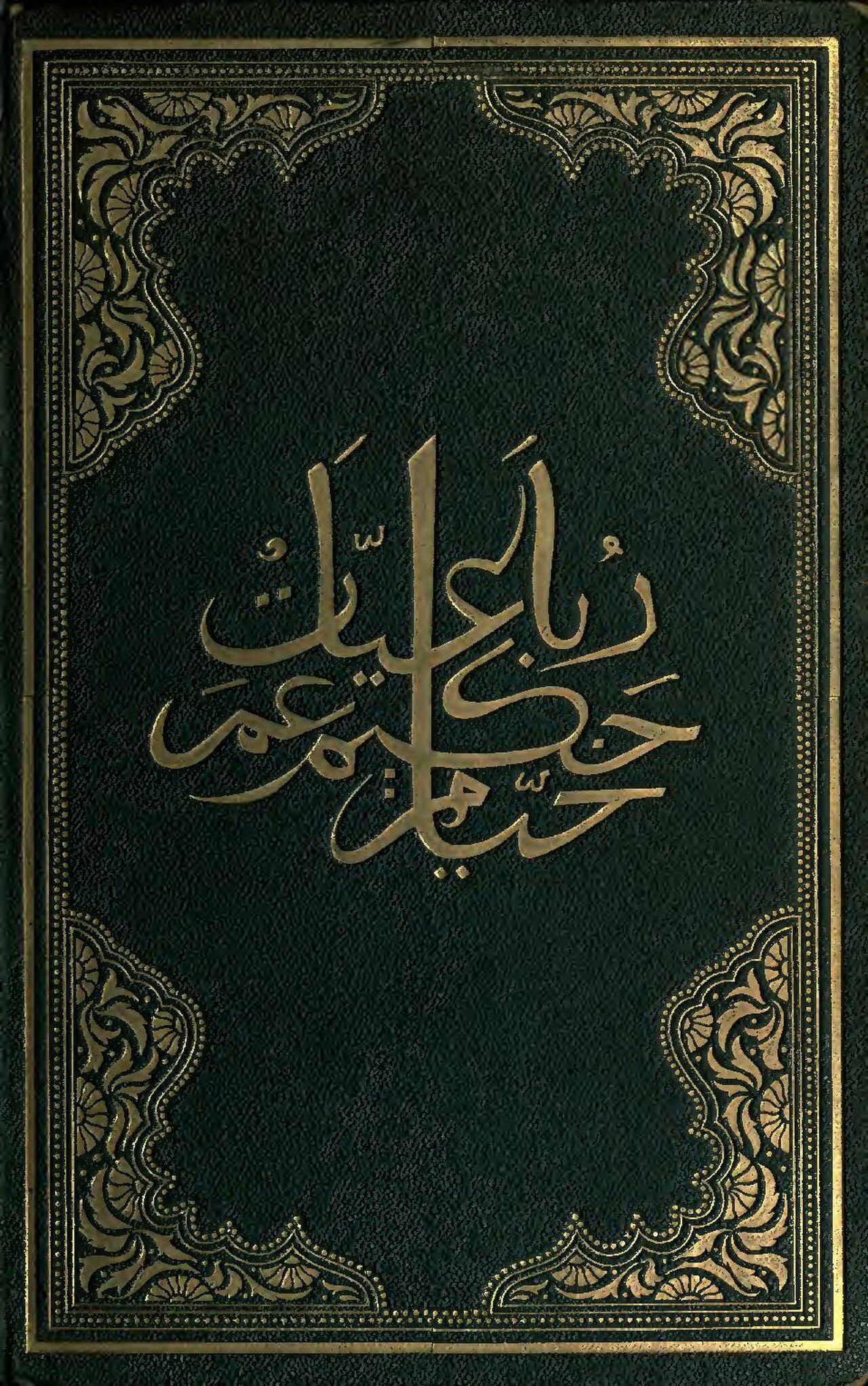
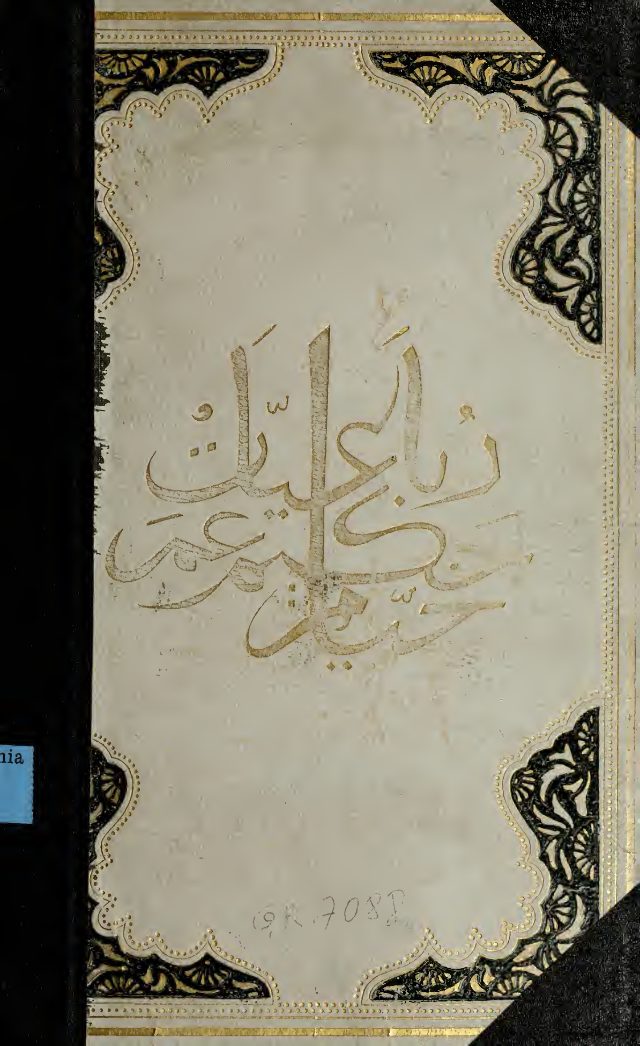
Front cover of a dark green book with gold-stamped Arabic-script calligraphy in the center reading rubaiyat-style title lettering, framed by ornate gold floral and arabesque corner decorations and a gold border.Book

Secondary source

Edward FitzGerald's Rubáiyát with their Original Persian Sources

Edward Heron-Allen · 1899

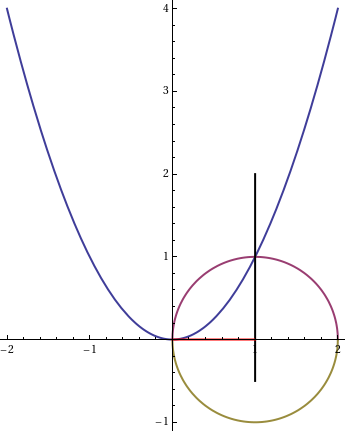
Graph with x-axis from -2 to 2 and y-axis from -1 to 4. A blue parabola opens upward with vertex at origin. A magenta circle passes through the origin and through (2,0) with its top near (1,1). A olive-green lower semicircle hangs below the x-axis. A black vertical line at x=1 runs from about y=-0.5 to y=2, and a short red horizontal segment lies along the x-axis from 0 to 1.Artifact

Tertiary source

Geometric Solution to a Cubic Equation

Ruud Koot

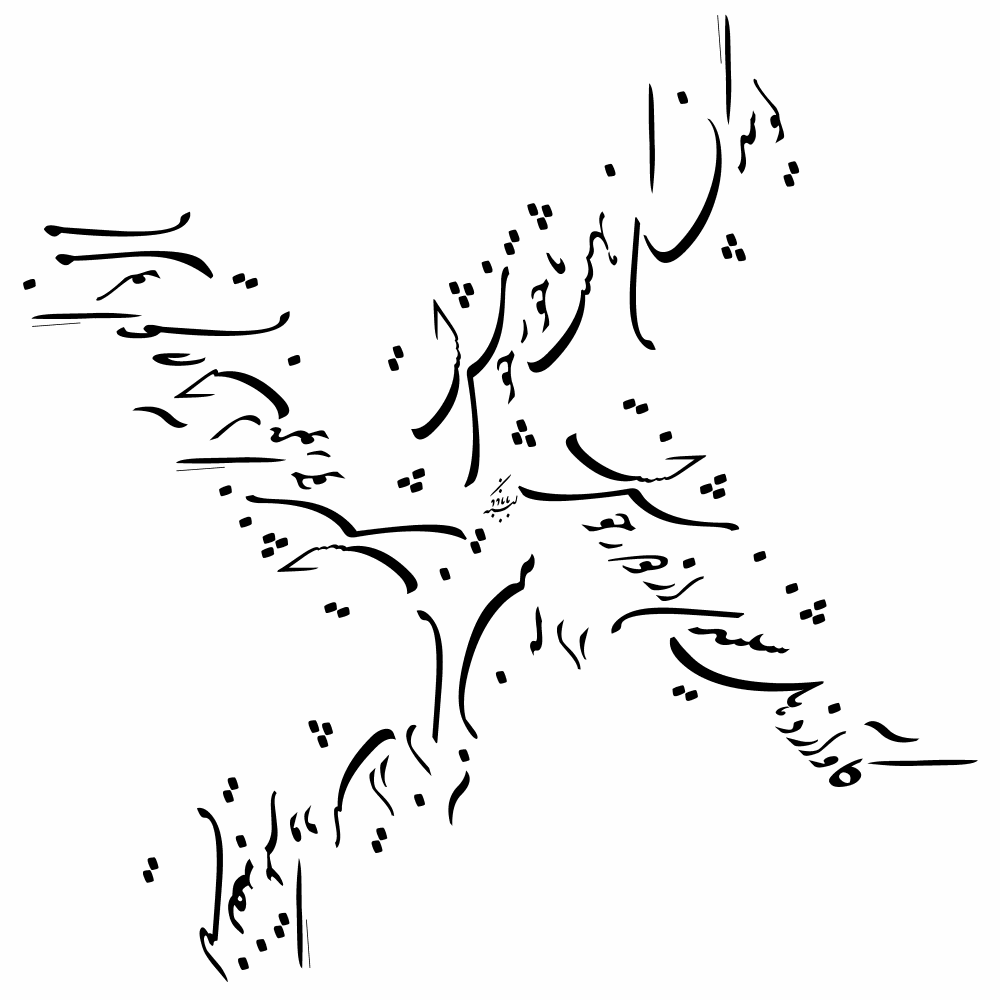
Black Persian calligraphy on a white background, written in flowing, angular strokes with small dots scattered among them. The lines run diagonally across the image, with the text starting at the upper right and reading counterclockwise.Artifact

Secondary source

Chayyam guyand kasan behescht ba hur chosch ast

Baba66

The Ruba'iyat of Omar Khayyam: Facsimile of the Bodleian ManuscriptBook

Primary source

The Ruba'iyat of Omar Khayyam: Facsimile of the Bodleian Manuscript

Omar Khayyam · 1898

Book

Secondary source

From Constantinople to the Home of Omar Khayyam

A. V. Williams Jackson · 1911

Omar Khayyam as a MathematicianBook

Secondary source

Omar Khayyam as a Mathematician

William Edward Story · 1919

Omar Khajjâms Rubâijât, en litterærhistorisk undersøgelseBook

Secondary source

Omar Khajjâms Rubâijât, en litterærhistorisk undersøgelse

Arthur Christensen · 1903

Rubaiyat of Omar Khayyam: a paraphrase from several literal translationsBook

Secondary source

Rubaiyat of Omar Khayyam: a paraphrase from several literal translations

1901

Edward FitzGerald's Rubáiyát of Omar Khayyám, second edition reprintBook

Secondary source

Edward FitzGerald's Rubáiyát of Omar Khayyám, second edition reprint

1908

The Quatrains of Omar KhayyámBook

Secondary source

The Quatrains of Omar Khayyám

1882

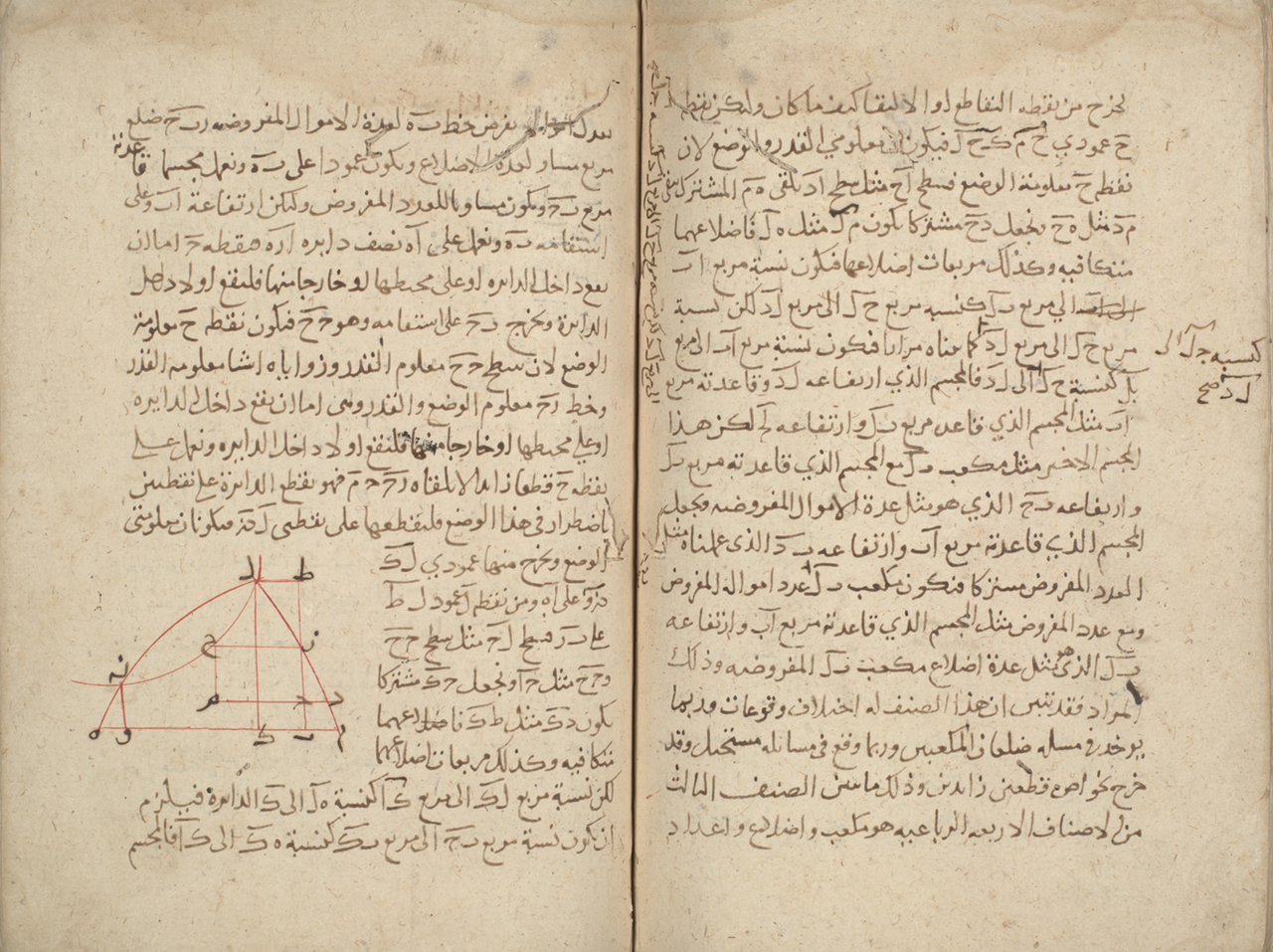
Open manuscript spread in Arabic script on aged cream paper with handwritten brown ink text in columns. The left page contains a red-ink geometric diagram of a curved figure with labeled points and lines. The right page is densely written text.Book

Primary source

Page from Omar Khayyam's Treatise on Algebra

Omar Khayyám · 13th century (copy)

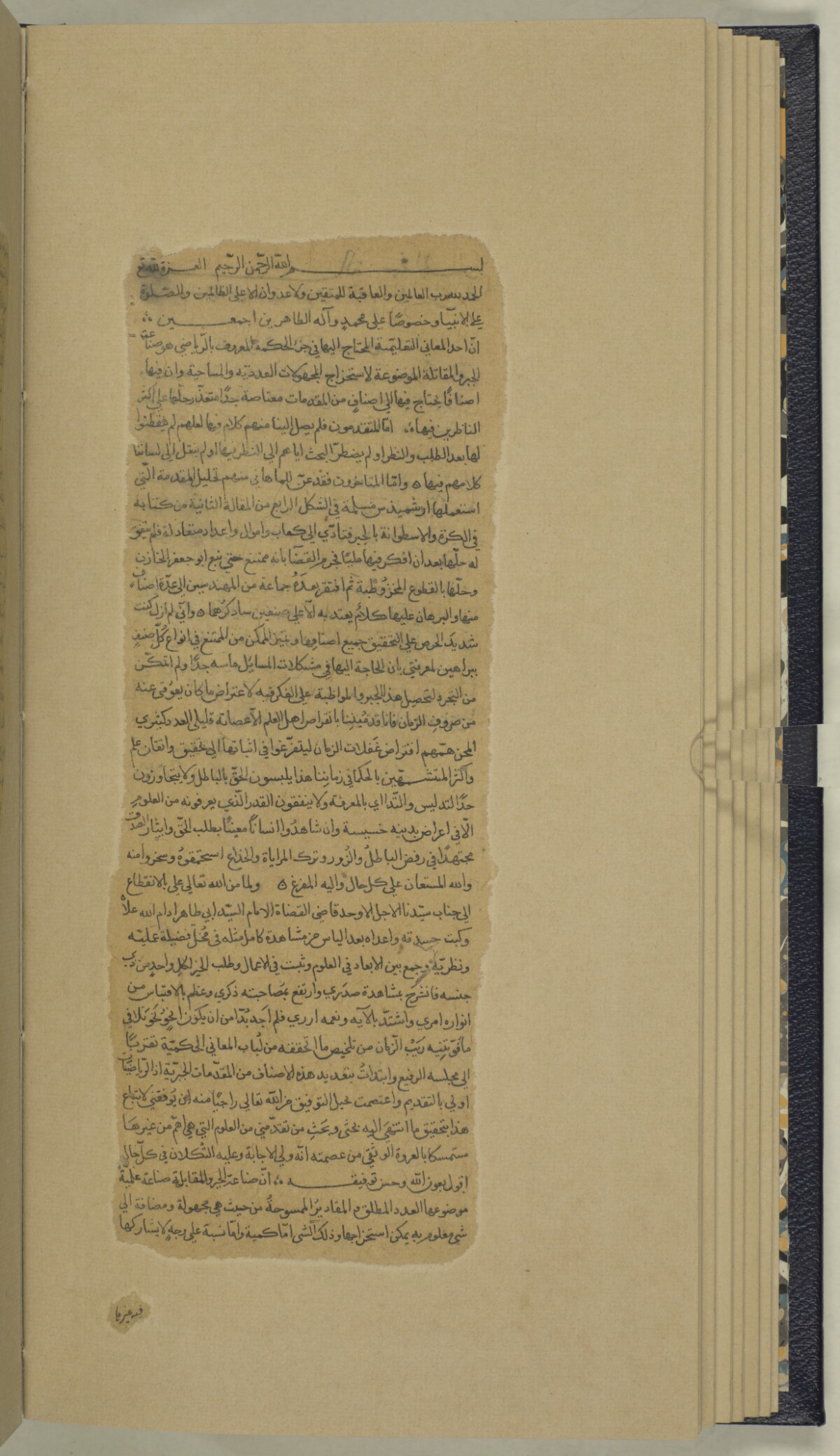
Scanned manuscript page in Arabic script on a cream mount within a dark-bound album. A torn-edged, aged sheet of handwritten text in black ink occupies the left-center area, with a title line at the top.Document

Primary source

Risāla fī al-barāhīn ʿalā masāʾil al-jabr wa-al-muqābala

Omar Khayyám

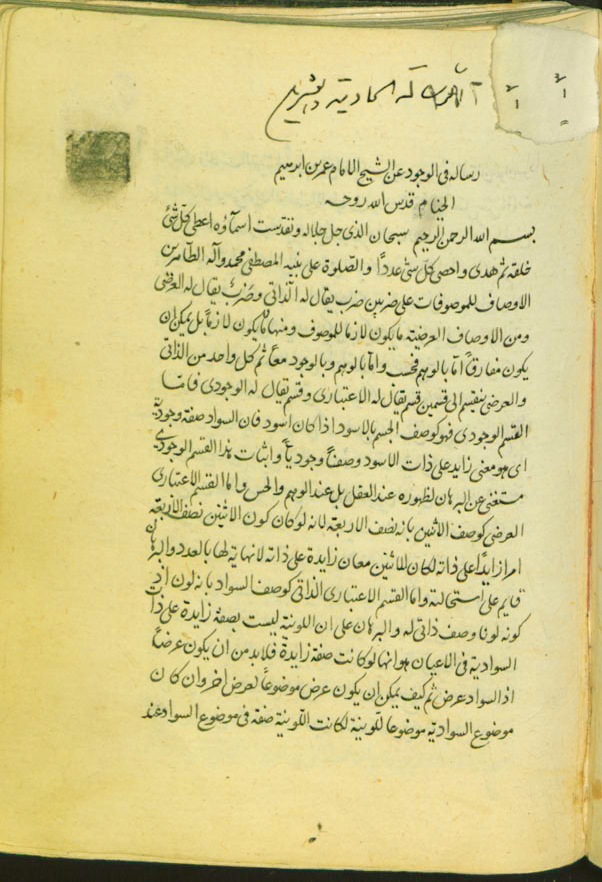
First page of an Arabic manuscript in black ink on aged yellowed paper, with a decorative heading at top, a centered title line, and several lines of dense handwritten Arabic script. A dark smudge and a torn paper patch appear at the edges.Document

Primary source

Al-Risālah fi'l-wujūd

Omar Khayyám

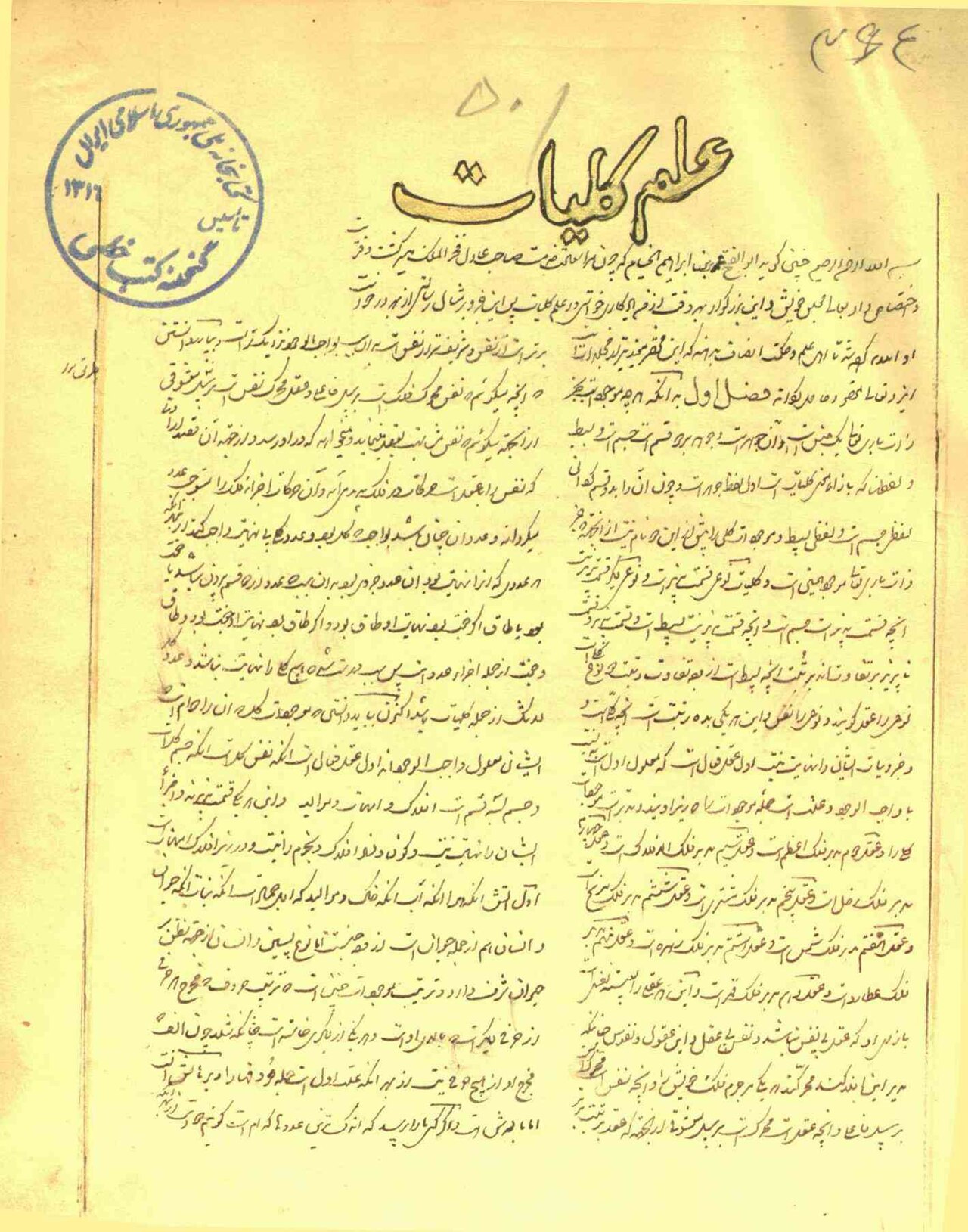
First page of a handwritten Persian manuscript on a yellowed paper, headed with the title 'علم کلیات' in decorative script, with dense lines of handwritten text in two columns and a blue library stamp on the left margin.Document

Primary source

Risālah dar ʿilm kulliyāt-i wujūd

Omar Khayyám

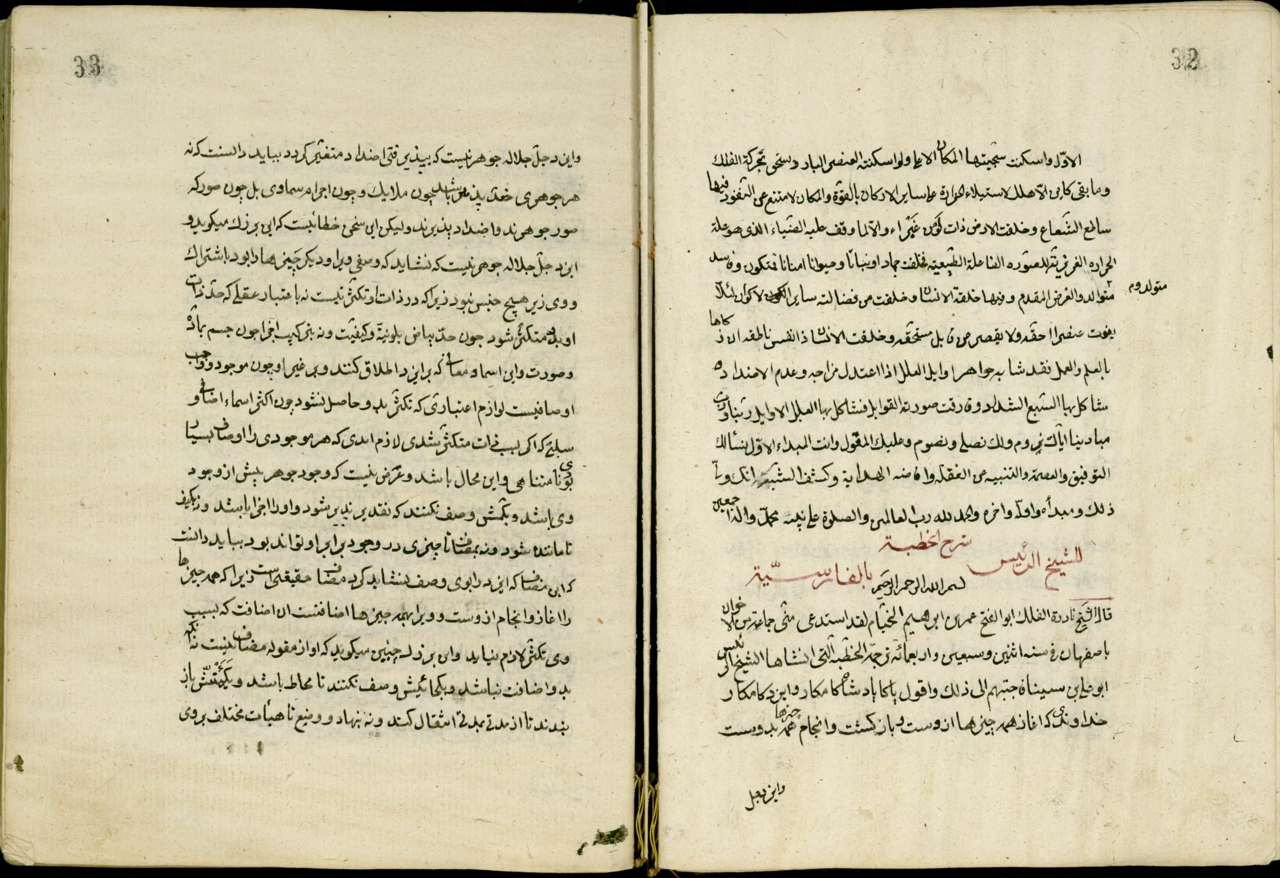
Open manuscript spread of handwritten Arabic-script pages with page numbers 33 and 32 at the top corners. Dense black ink text in right-to-left lines on aged cream paper; red ink heading in the right page reads a title with a name below it.Document

Primary source

Sharḥ al-Khuṭbah al-ghurrāʾ

Omar Khayyám

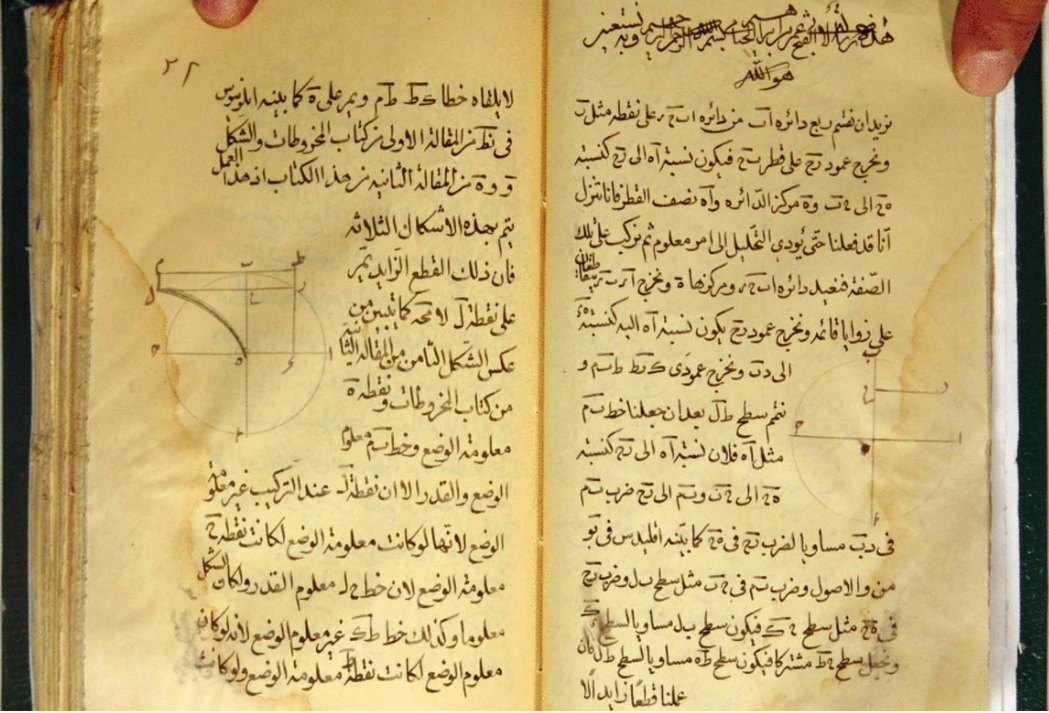
Open manuscript book with handwritten Arabic script on yellowed pages, geometric diagrams of circles, arcs and straight lines on the left and right pages, and a hand holding the book's edge at the top.Document

Primary source

Risālah fī qismat rubʿ al-dāʾirah

Omar Khayyám

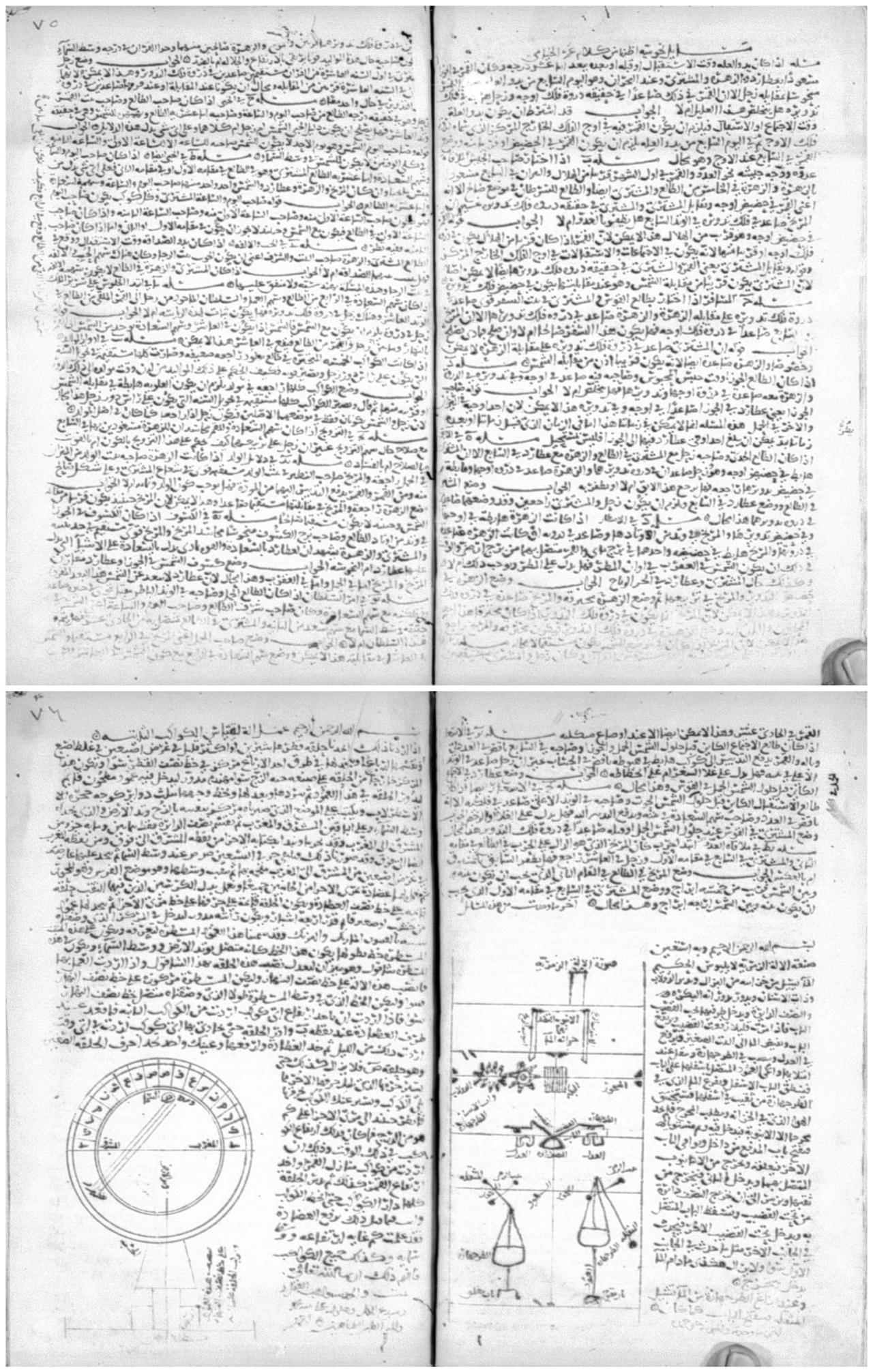
Four facing pages of an Arabic manuscript in brown-black ink on aged paper, arranged in two spreads. Dense handwritten text fills most pages. The lower left page has a circular astronomical diagram with a ruled scale around the rim, and the lower right page has two small instrument diagrams with labeled parts.Document

Primary source

Masāʾil nujūmiyya

Omar Khayyám

Book

Primary source

Rubaiyat of Omar Khayyam (Le Gallienne translation)

Richard Le Gallienne · 1902

Book

Primary source

What is the benefit of our arrival and departure?

Omar Khayyám

Book

Primary source

The Rubaiyat, Sacred Books of the East, Volume 8

Front cover of a dark red cloth-bound book with a vertical ribbed texture. A cream-colored library label in the upper left reads PK, 6516, G3, Copy 2 in handwritten black ink.Book

Primary source

The Stanzas of Omar Khayyam (Garner translation)

John Leslie Garner

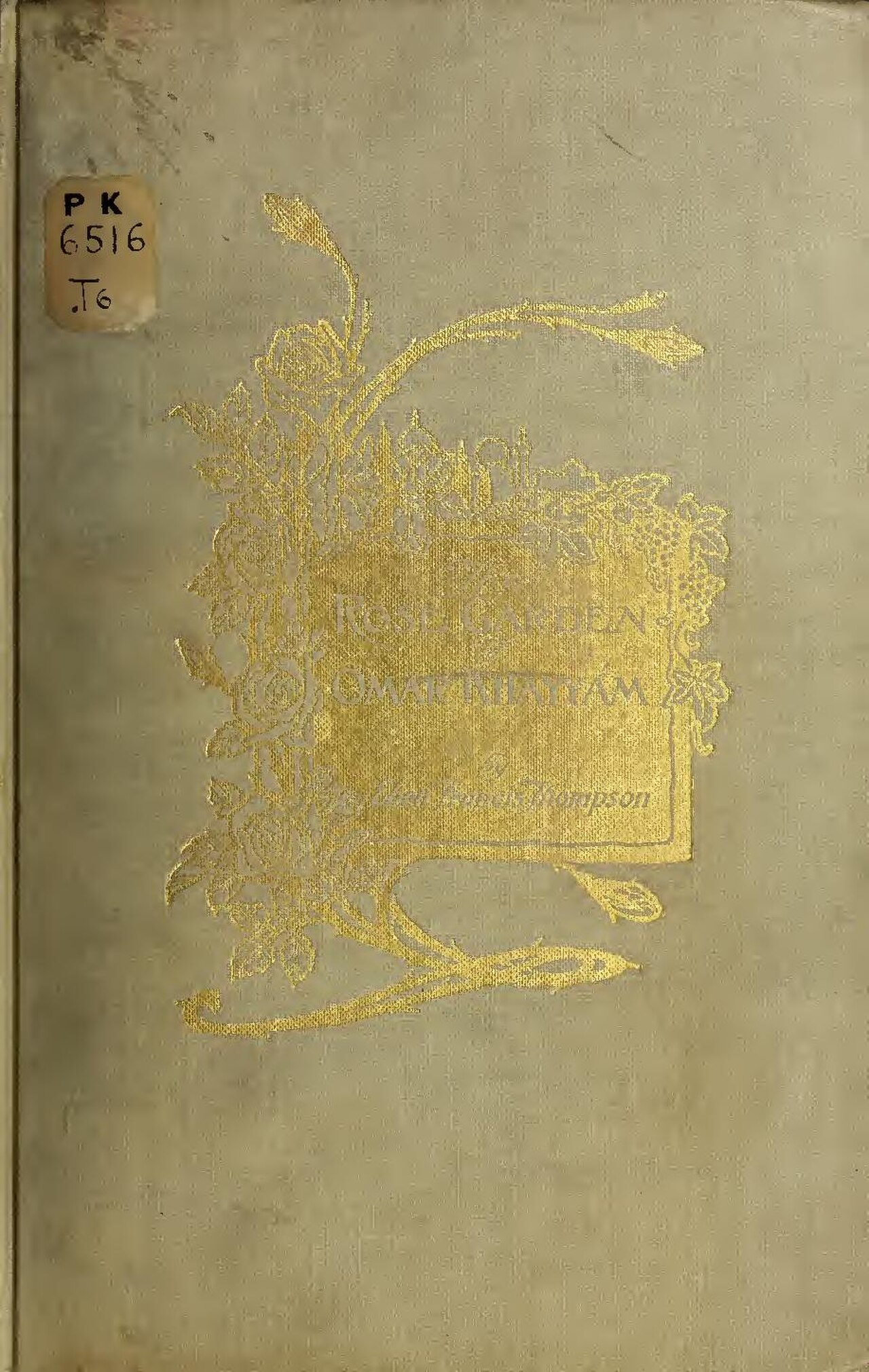
Front cover of a grey cloth-bound book with gold-stamped decoration of climbing roses and leaves framing a central panel with the title 'Rose Garden of Omar Khayyam' and the name 'Eben Francis Thompson' in gold lettering. A library call number label reading 'PK 6516 .T6' is affixed to the upper left corner.Book

Primary source

The Rose Garden of Omar Khayyam (Thompson translation)

Eben Francis Thompson

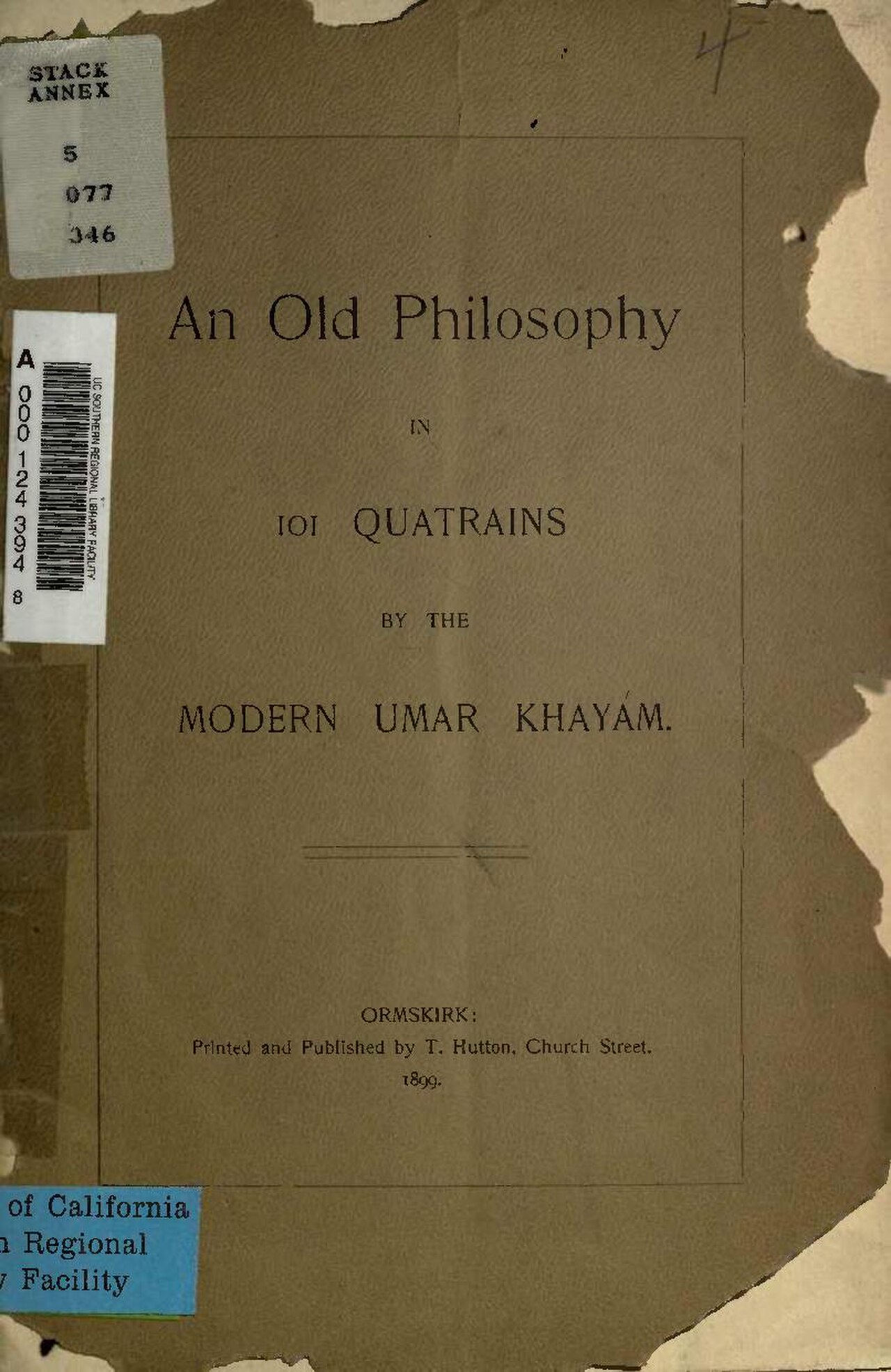
Scanned title page of 'An Old Philosophy in 101 Quatrains by the Modern Umar Khayam', printed and published by T. Hutton, Ormskirk, 1899. Library stack and barcode labels are affixed to the page, with a blue University of California Southern Regional Library Facility label at the bottom left.Book

Primary source

An Old Philosophy in 101 Quatrains

Omar Khayyám · 1899

Cover of a teal book with gold lettering reading 'Strophes of Omar Khayyám' (partly obscured). Library barcode labels at top and left edge, including call number PK 6516 G3 and a University of California San Diego barcode.Book

Secondary source

The Strophes of Omar Khayyám

John Leslie Garner

Sufism: Omar Khayyam and E. FitzGeraldBook

Secondary source

Sufism: Omar Khayyam and E. FitzGerald

C. H. A. Bjerregaard · 1915

Book

Tertiary source

Omar Khayyam entry, The New Student's Reference Work

1914

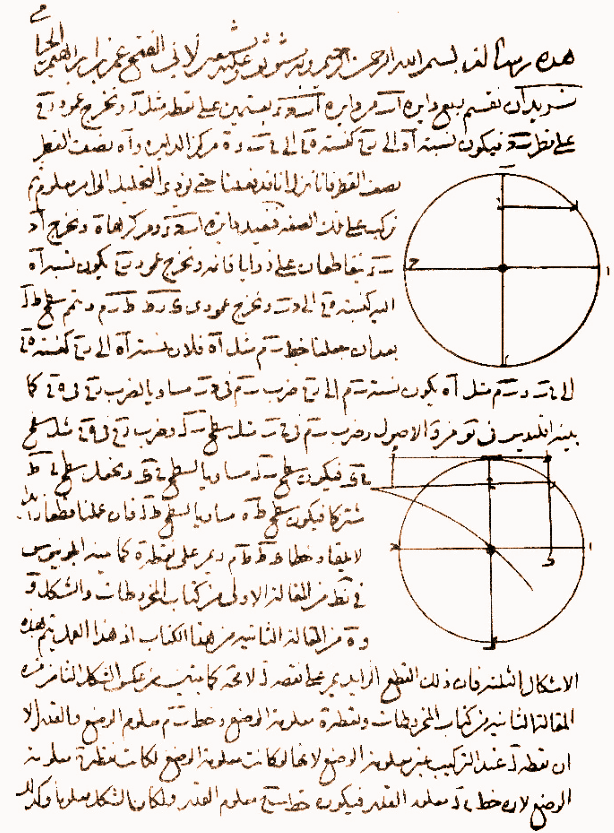
Scanned page of Arabic handwritten manuscript in sepia tones, with several lines of right-to-left script and two diagrams of circles with intersecting diameters, chords, and perpendicular lines drawn inside them.Document

Primary source

First page of an untitled manuscript attributed to Khayyám

Book

Secondary source

The Rubaiyat of Omar Khayyam, LibriVox audio reading

Omar Khayyam

Book

Secondary source

Strophes of Omar Khayyam, LibriVox audio reading

Omar Khayyám · 1888

The Stanzas of Omar KhayyamBook

Secondary source

The Stanzas of Omar Khayyam

Omar Khayyám (translated by John Leslie Garner) · 1898

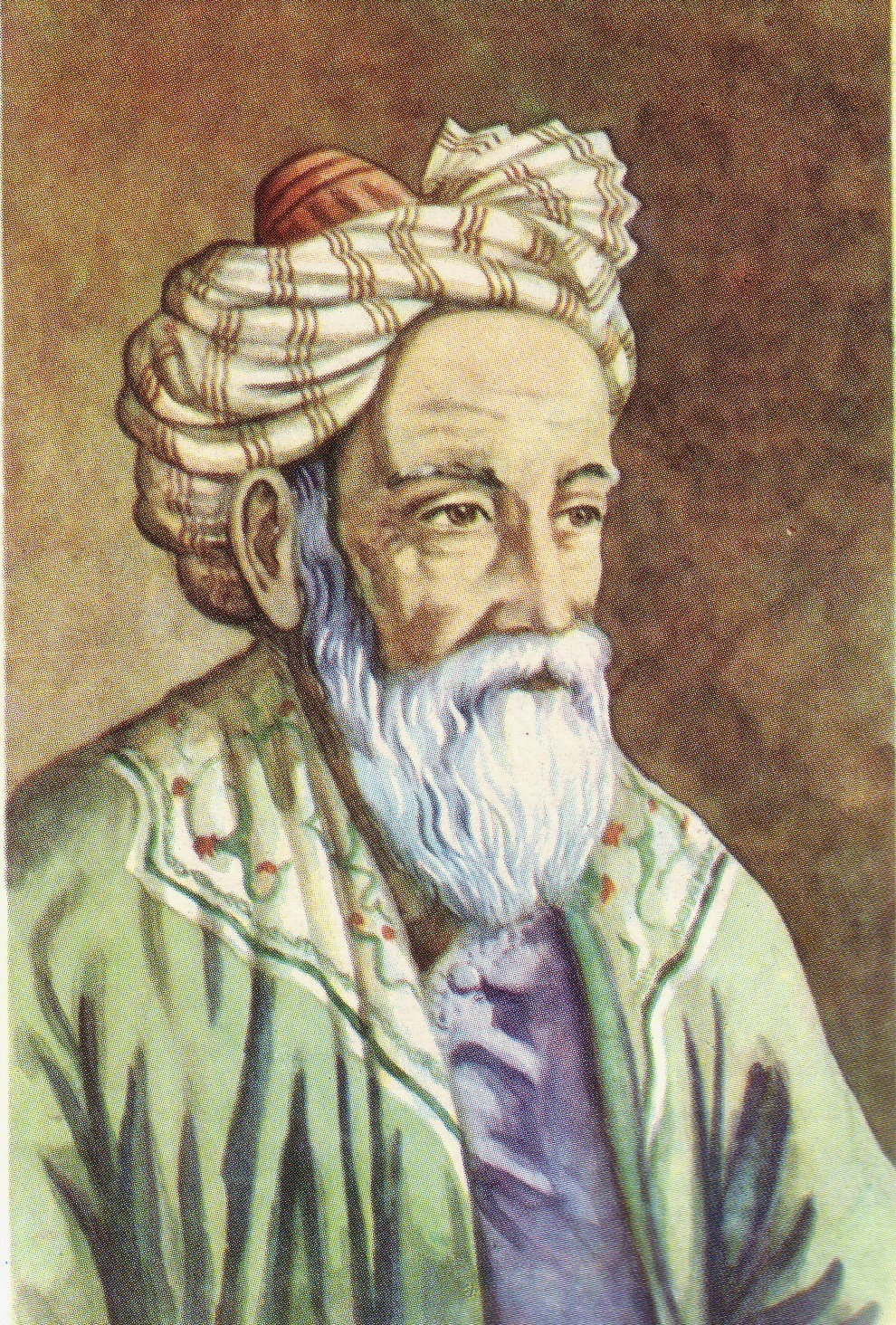
Painted portrait of an elderly bearded man in a white and reddish turban and a light green robe over a purple garment, shown in three-quarter view against a brown background, looking to the side.Painting

Secondary source

Omar Khayyam portrait drawing by A. Venediktov

A. Venediktov

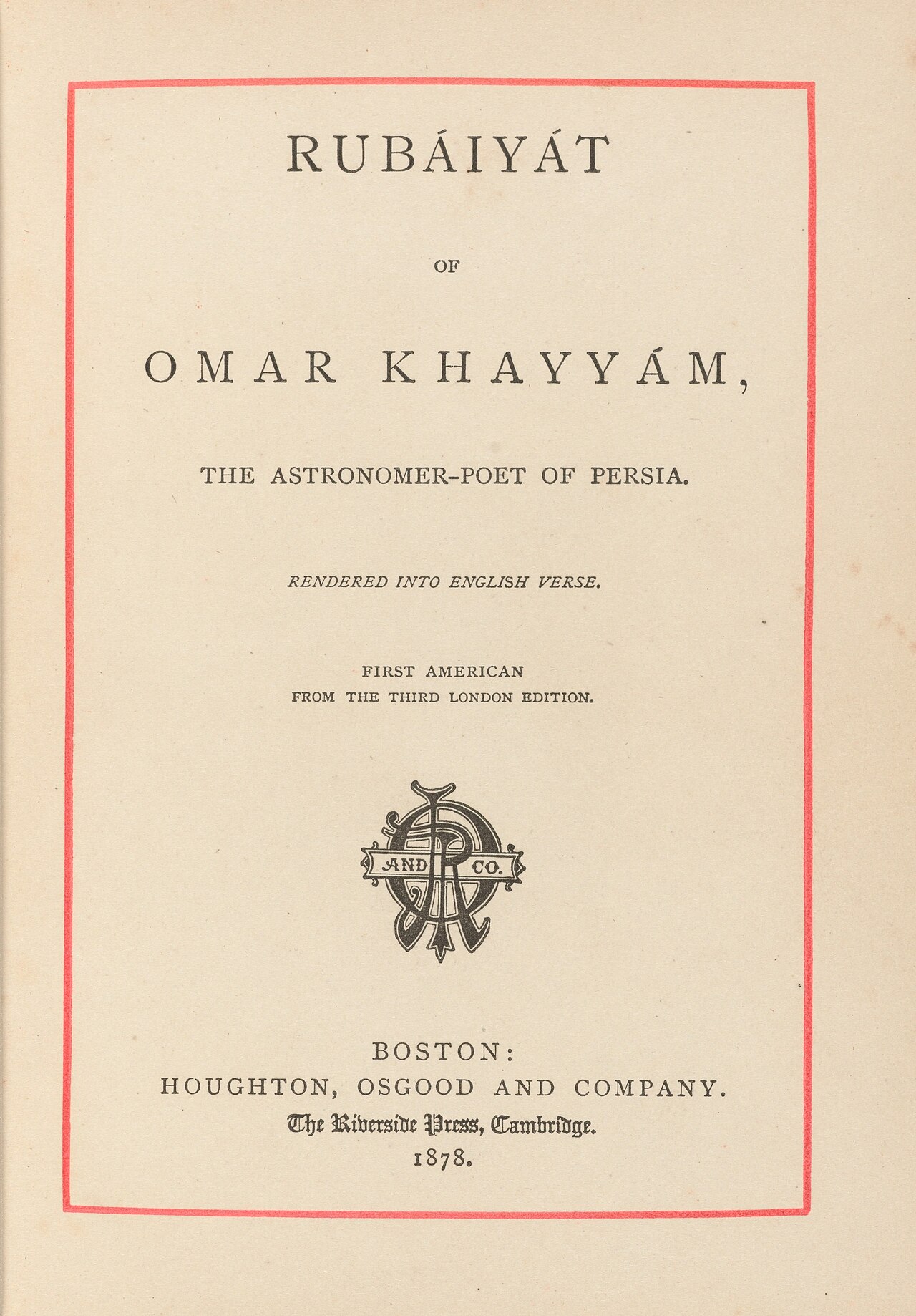
Title page of the Rubáiyát of Omar Khayyám, printed in black with a red border. Text reads: Rubáiyát of Omar Khayyám, the astronomer-poet of Persia, rendered into English verse, first American from the third London edition. Below is a publisher's monogram with 'AND CO.' and the imprint Boston: Houghton, Osgood and Company, The Riverside Press, Cambridge, 1878.Book

Secondary source

Title Page of the First American Rubáiyát

Omar Khayyám (author), Edward FitzGerald (translator) · 1878

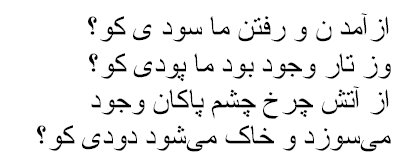
Four lines of Persian script, right-aligned, forming a quatrain of the Rubaiyat on a white background. The text reads from top to bottom: from our coming and going what benefit is there; from the weft of the thread of our life's hope what warp is there; from the fire of the fair ones' faces... burning and turning to dust, what smoke is there.Book

Primary source

Rubaiyat Quatrain in Persian

Omar Khayyám

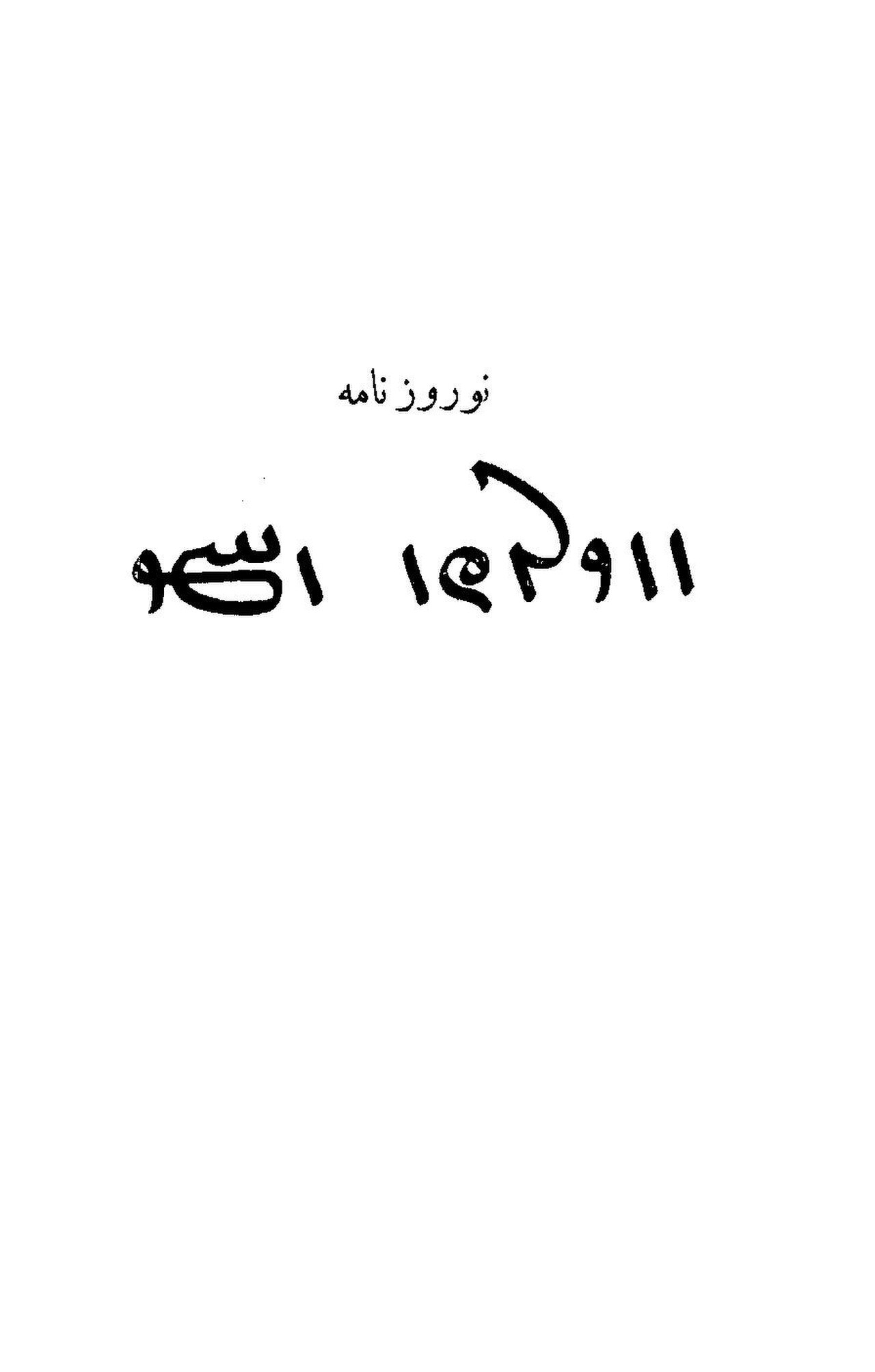
Title page of a Persian book. Small Persian heading reads نوروزنامه (Nowruznama) above a large bold Persian title line in black script on a white page. The rest of the page is blank.Book

Primary source

Nowruznama

Omar Khayyám

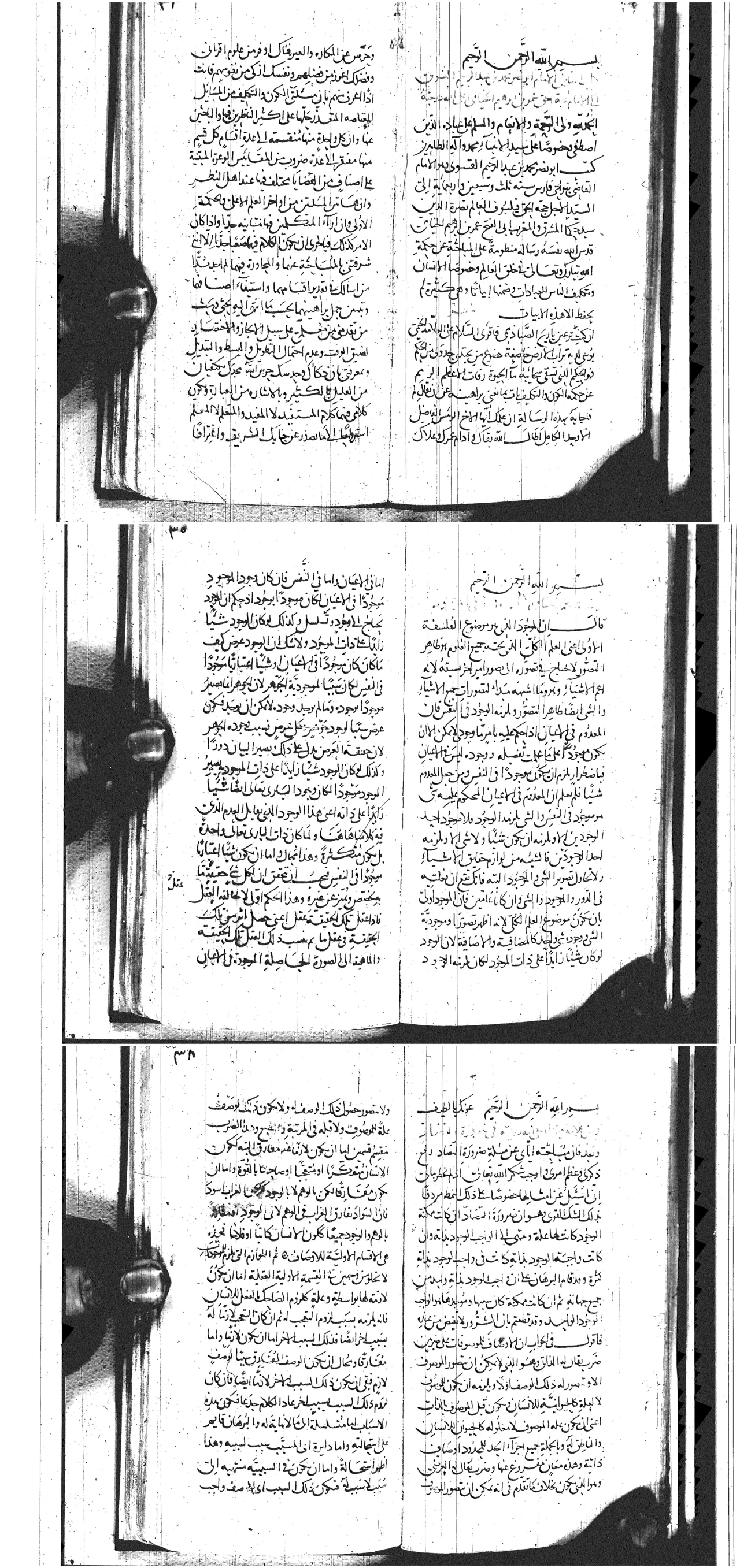
Three scanned manuscript pages stacked vertically, black and white, written in dense Arabic script in right-to-left columns with marginal annotations and a dark binding edge at left. The top and middle pages show headings with decorative opening lines; the bottom page has a page number and a similar text block.Book

Primary source

Khayyám's Philosophical Treatises

Omar Khayyám

Front cover of a book bound in dark red cloth, with a white library barcode label in the upper left reading UC Southern Regional Library Facility and G 000 083 540 5. No title is visible on this cover.Book

Secondary source

The Sufistic Quatrains of Omar Khayyam in definitive form

Omar Khayyám (translated and edited by Edward FitzGerald, Edward Heron-Allen, E. H. Whinfield, J. B. Nicolas, and Robert Arnot)

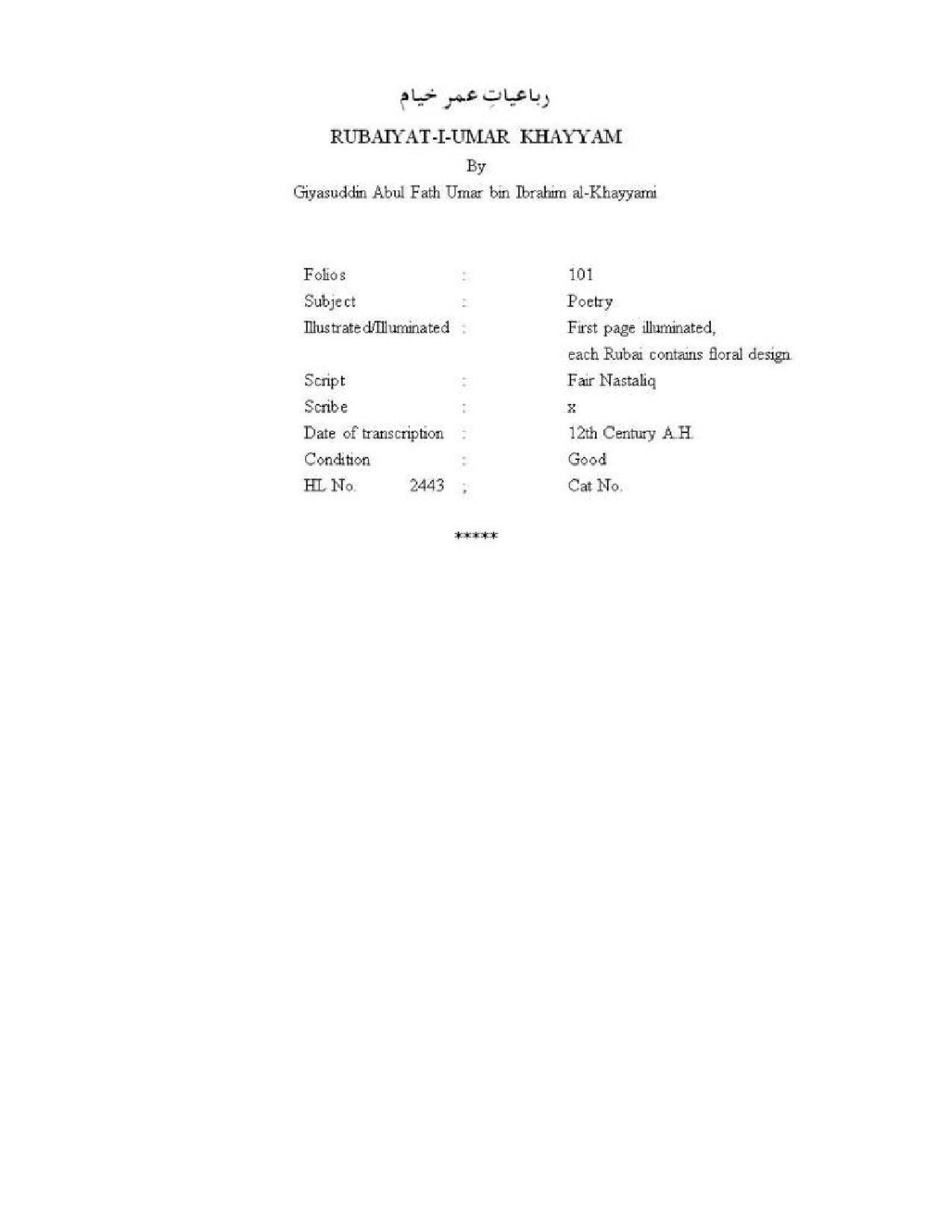
Catalogue record page for the Rubaiyat-i-Umar Khayyam, with Persian title above the English title, author line, and a table of details: 101 folios, subject poetry, first page illuminated, each rubai with floral design, Fair Nastaliq script, 12th century AH, condition good.Book

Primary source

Rubaiyat of Khayyam, Persian Illustrated Manuscript

Omar Khayyám · 12th century AH

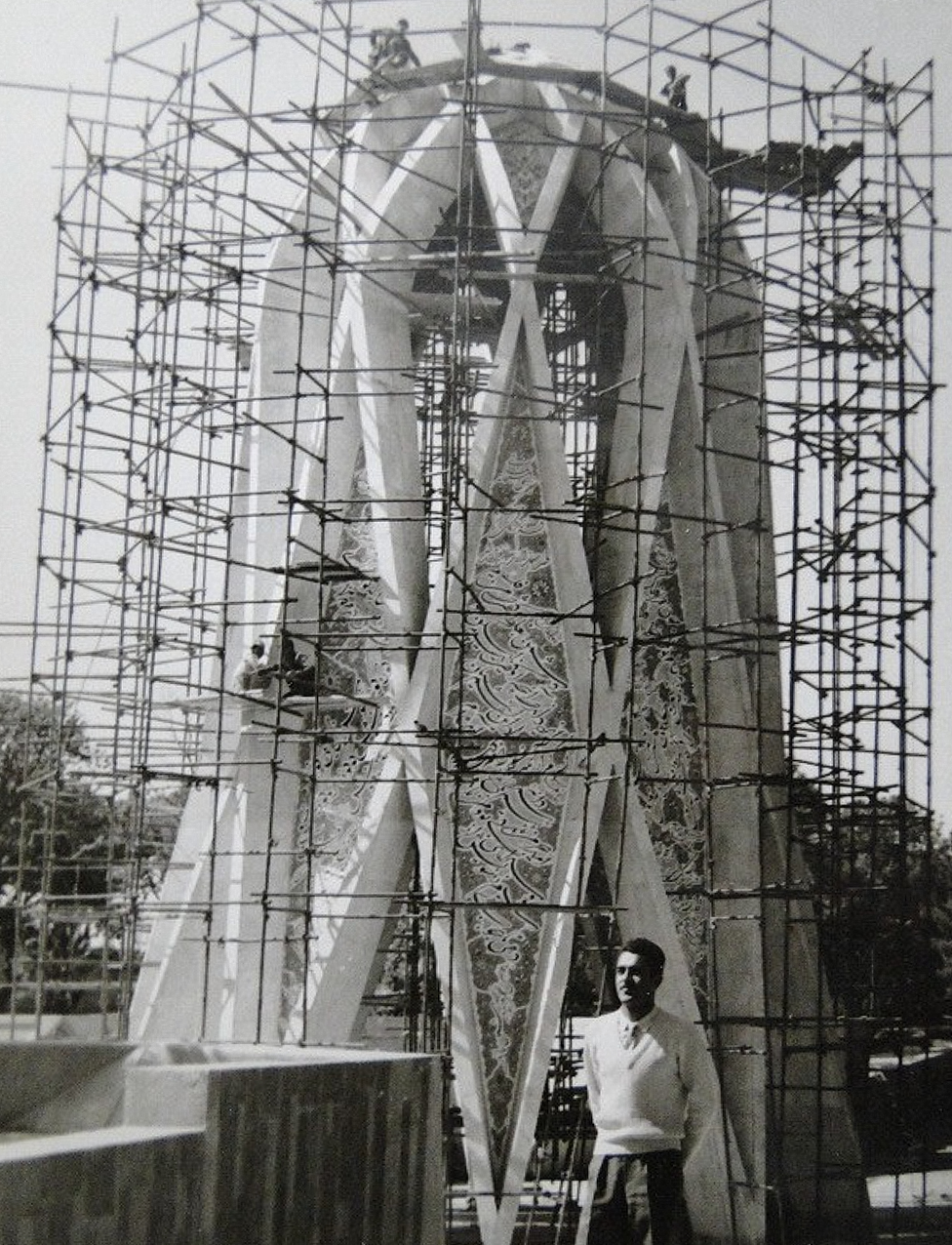
Black-and-white photograph of a tall, tapering concrete structure wrapped in a dense lattice of bamboo or metal scaffolding. Workers stand on top and on the scaffolding. A man in a light sweater and dark trousers stands in the foreground at the base.Photograph

Secondary source

Construction of the Omar Khayyam Mausoleum

Unknown · 1 March 1963

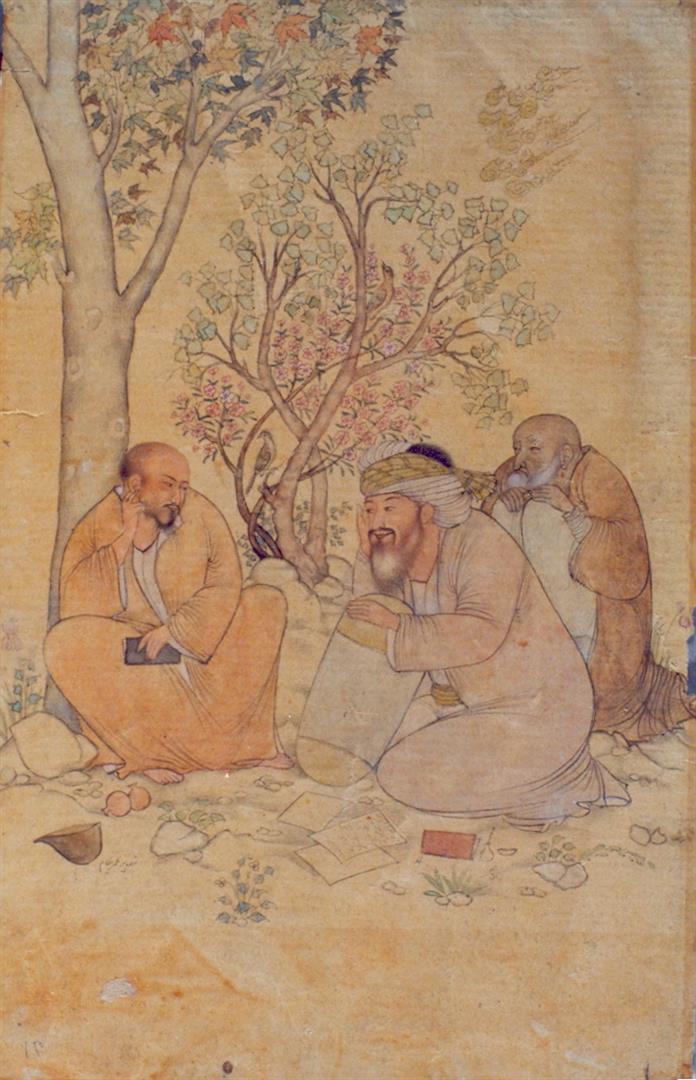
A painted miniature in warm ochre tones of three seated men under a tree. The man at center in a striped turban and pale robe leans forward with hands clasped and smiles. A man on the left in orange robes sits cross-legged holding a small book. A bearded man on the right rests his chin on his hand. Scattered papers, a bowl, and fruit lie on the ground.Painting

Secondary source

Khayyam Teaching a Class

Hossein Behzad

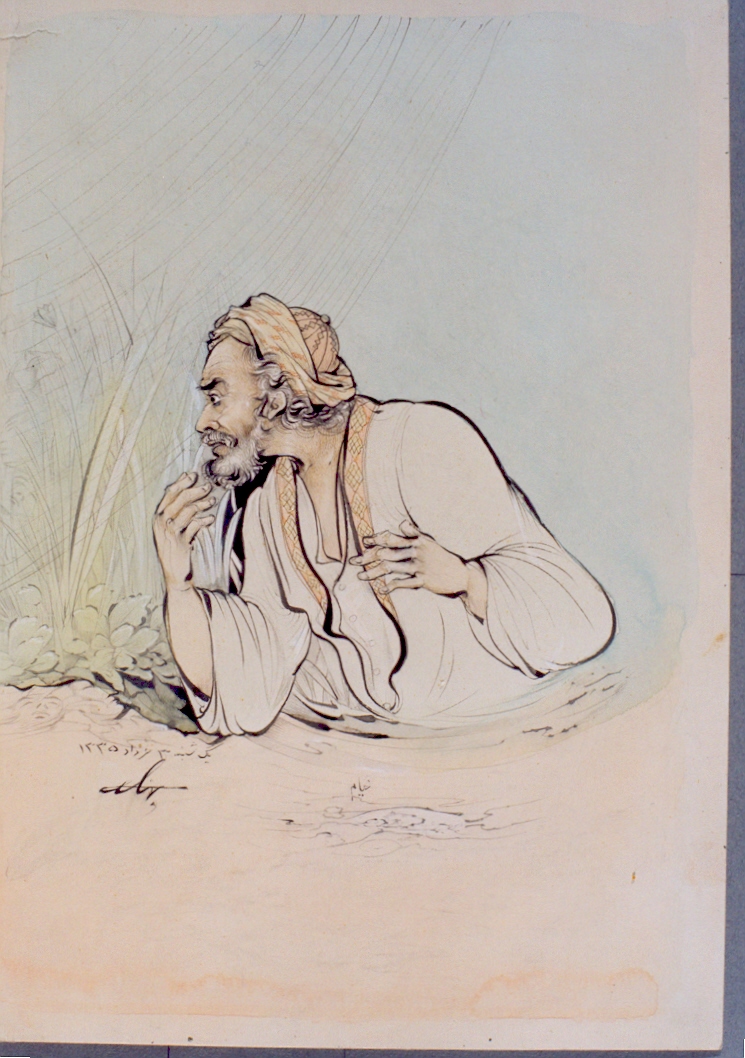
Painting of a bearded man in a striped orange and cream turban and a light robe, leaning forward on one elbow with his hand raised to his chin and gazing to the left. Grass and foliage appear at left, with fine diagonal lines in the sky. Persian inscription and signature at lower left on pale paper.Painting

Secondary source

Portrait of Omar Khayyam

Hossein Behzad · 1956 (3 Khordad 1335)

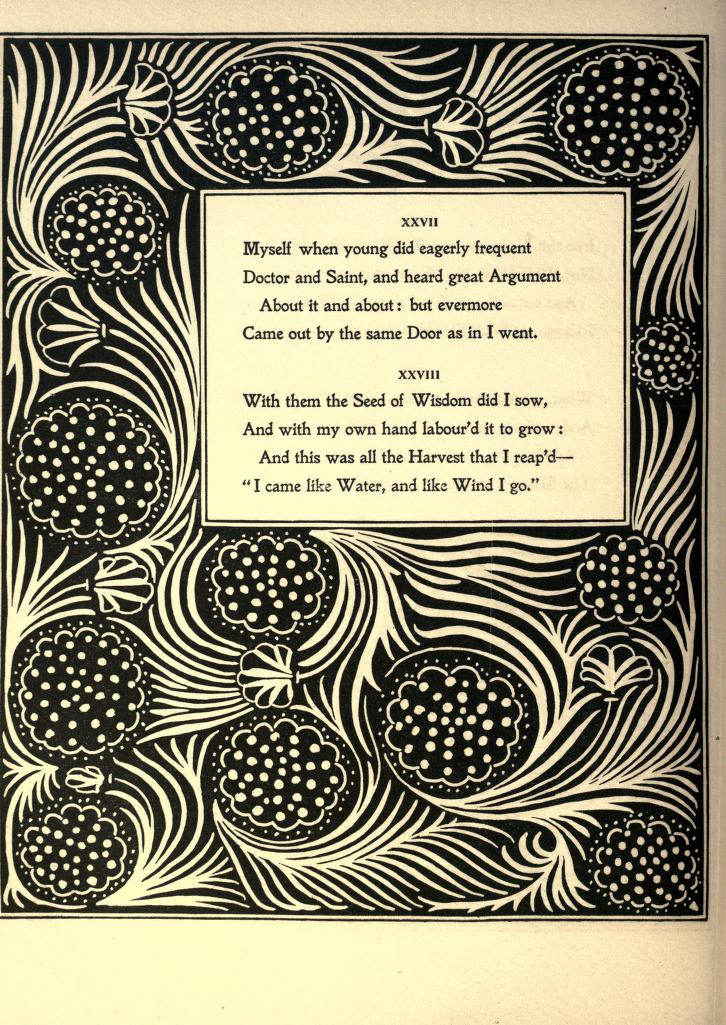
Printed page from the Rubaiyat of Omar Khayyam with a decorative black-and-cream botanical border of stylized flower heads and swirling leaves. Inside the border are stanzas XXVII and XXVIII in verse, ending with the line about coming like water and going like wind.Book

Secondary source

Rubáiyyát of Omar Khayyám, the Astronomer Poet of Persia

Omar Khayyám (translated by Edward FitzGerald, illustrated by William Brown MacDougall) · 1897

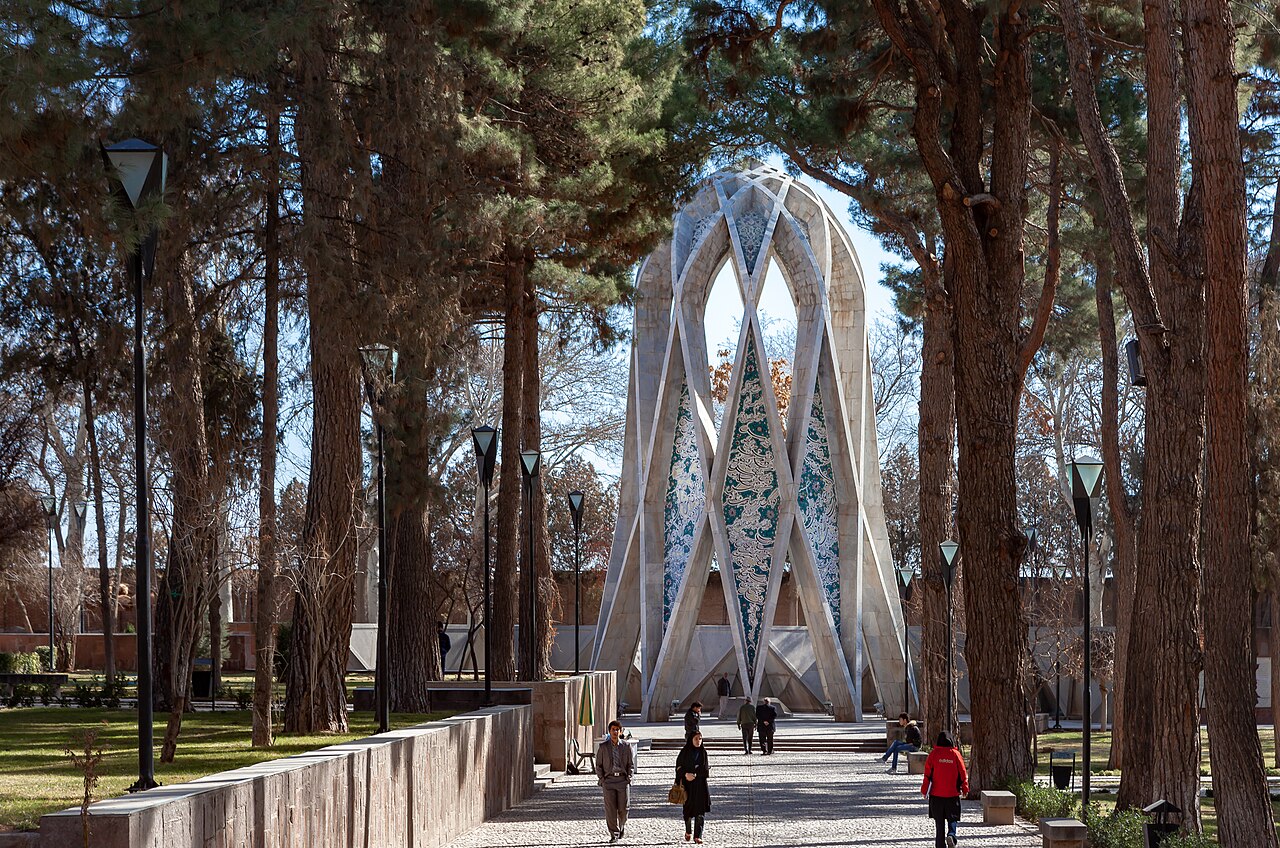
Modern white concrete mausoleum with tall, pointed arched lattice-like structure inset with blue-green mosaic panels, set among tall pine trees in a park with lampposts and people walking on a paved path.Photograph

Secondary source

Mausoleum of Omar Khayyam, Nishapur

Ninara · 28 January 2011

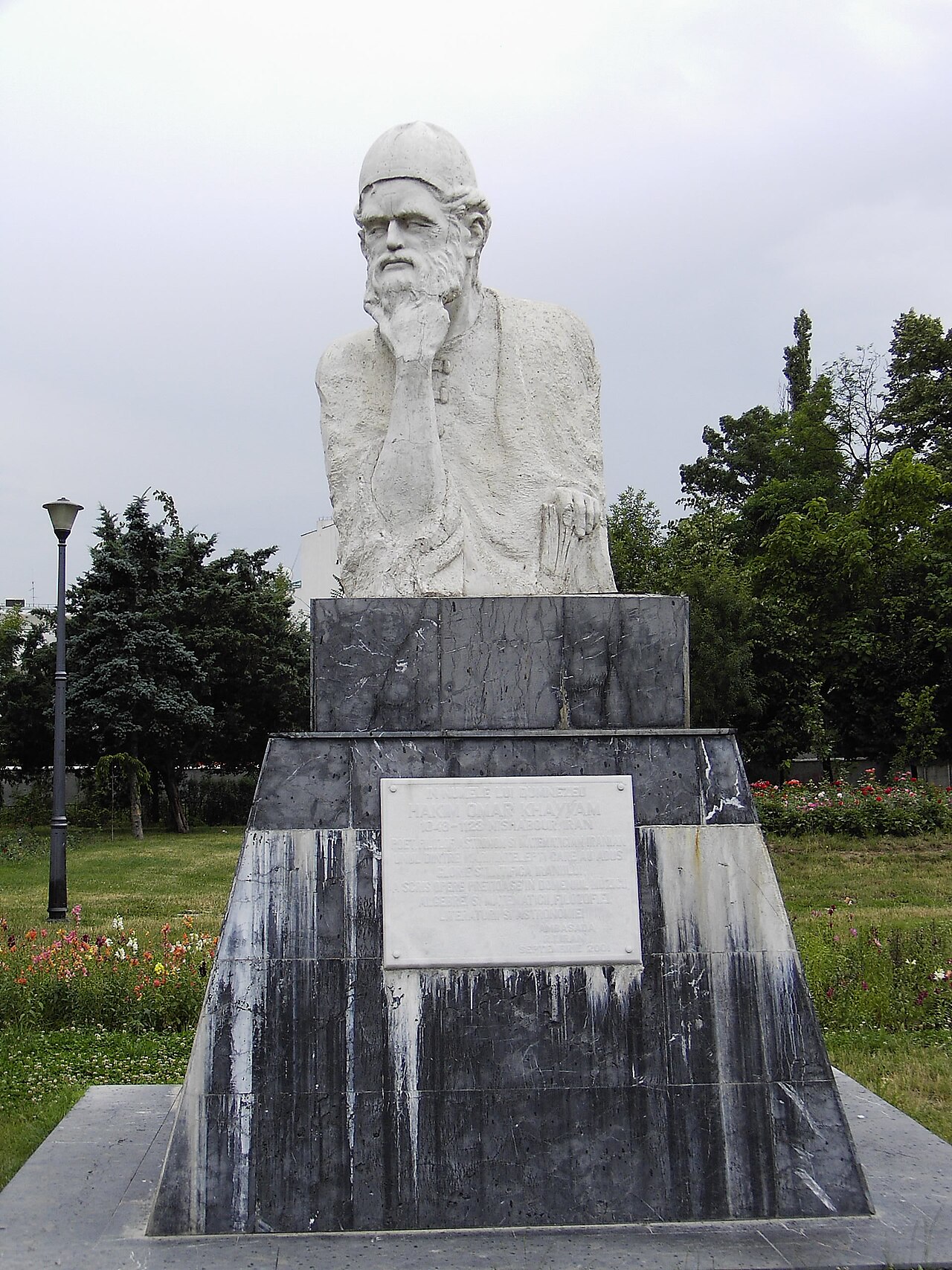
Photograph of a white marble bust sculpture of a bearded man wearing a close-fitting cap, with his hand resting on his chin, mounted on a tiered dark grey marble pedestal in a park with green lawns, flowers, and trees.Sculpture

Secondary source

Omar Khayyam Monument in Bucharest

6 July 2006

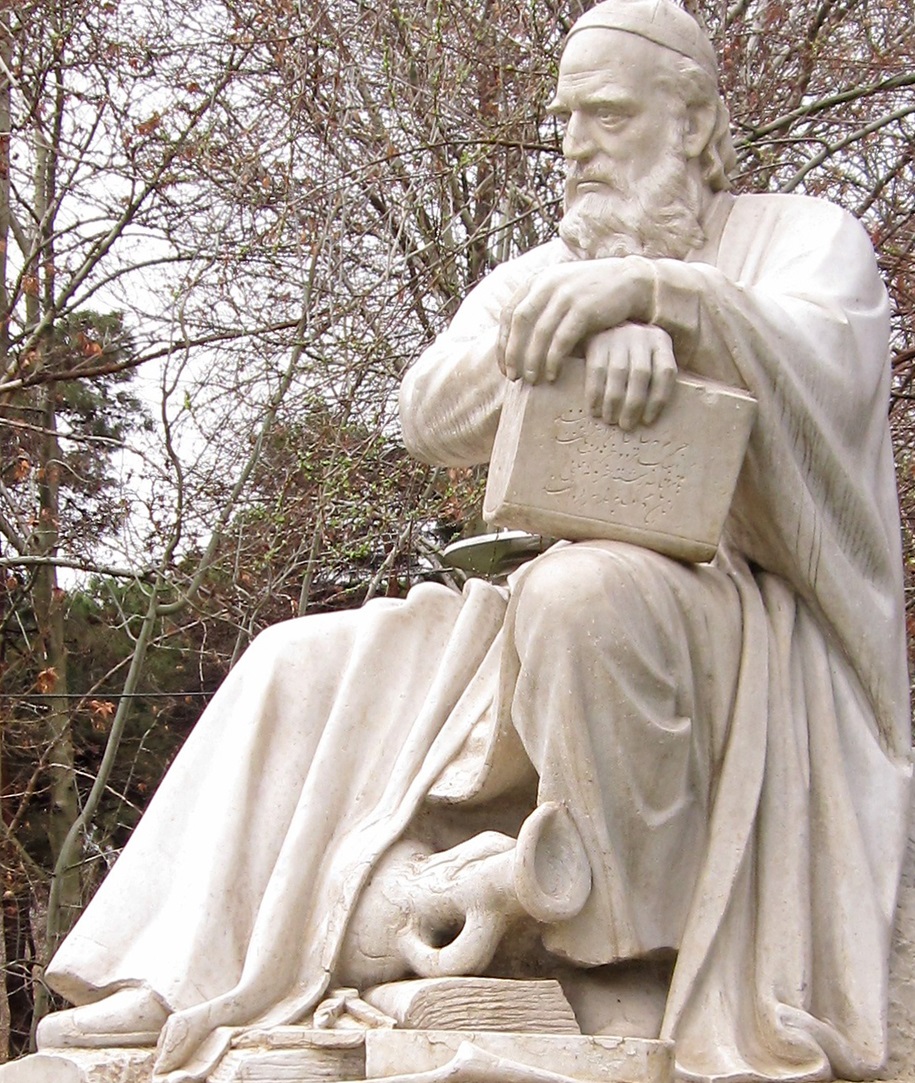
Photograph of a white marble seated statue of a bearded man wearing a cap and long robes, holding a book inscribed with script on his lap, with bare trees behind him and a small pot-like vessel at his feet.Sculpture

Secondary source

Hakim Omar Khayam Statue

12 March 2011

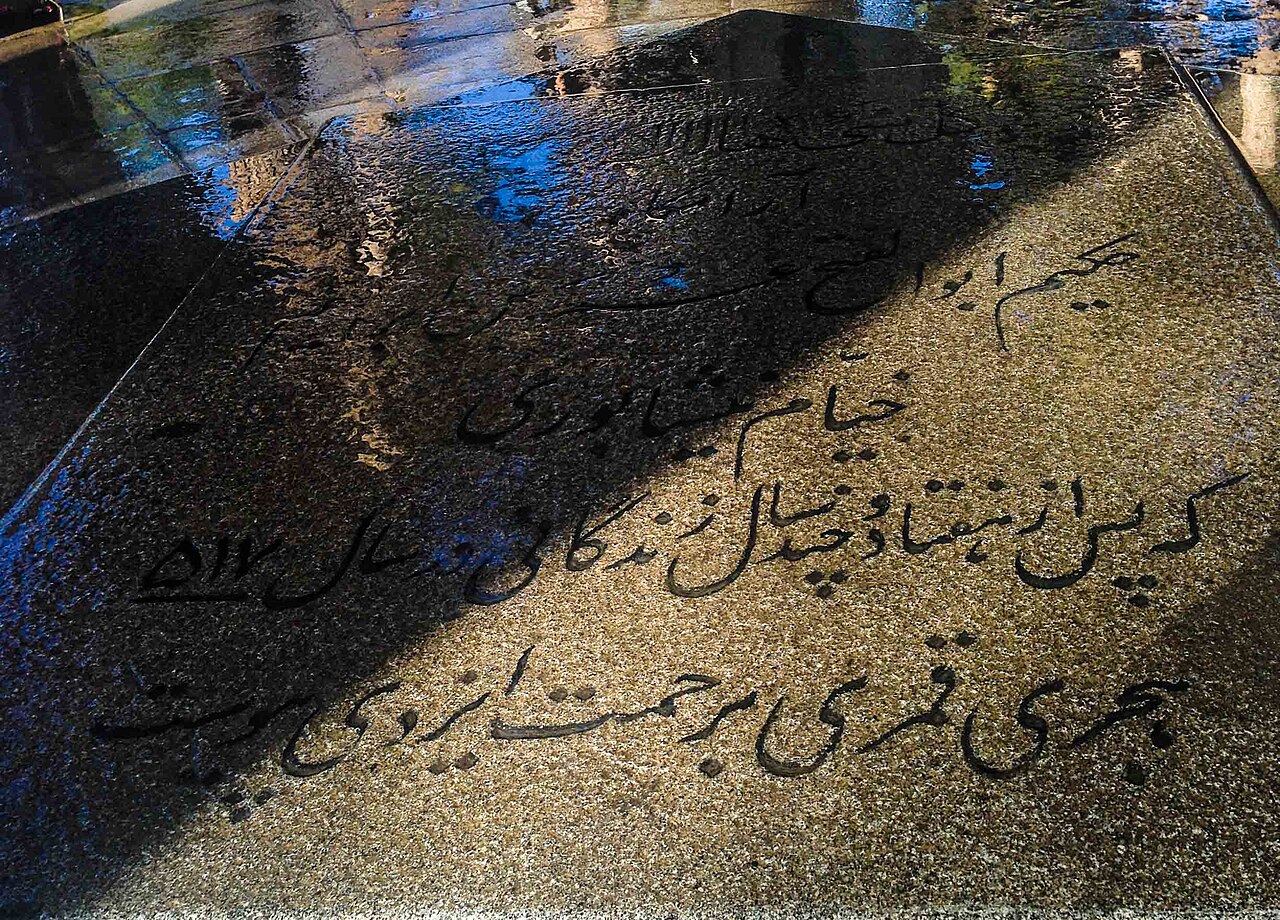
Wet dark stone slab with Persian script carved into it, partly in shadow, reflecting bluish light from the surrounding pavement. Inscription lines are visible on the grave marker of Omar Khayyam.Photograph

Secondary source

Khayyam Tomb Inscription, Nishapur

Lord aras · 19 January 2016

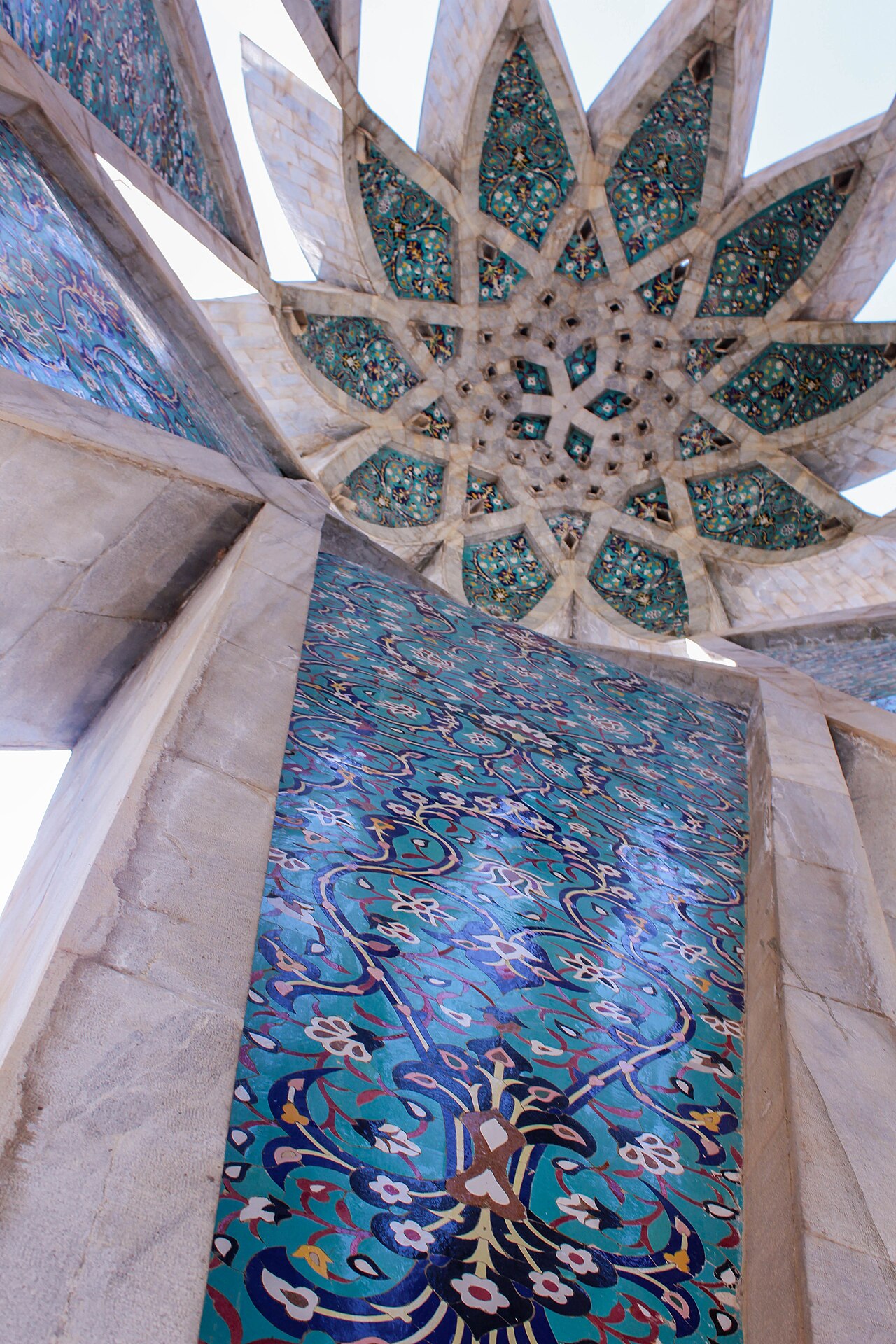
Looking upward at the interior of the Khayyam monument in Neyshabur: a star-shaped dome of ribbed white panels with turquoise and gold floral tilework, and a large vertical panel of blue and turquoise floral mosaic tiles below.Photograph

Secondary source

Khayyam Monument Dome, Neyshabur

Reyhaneh golmohmdyn · 5 July 2019

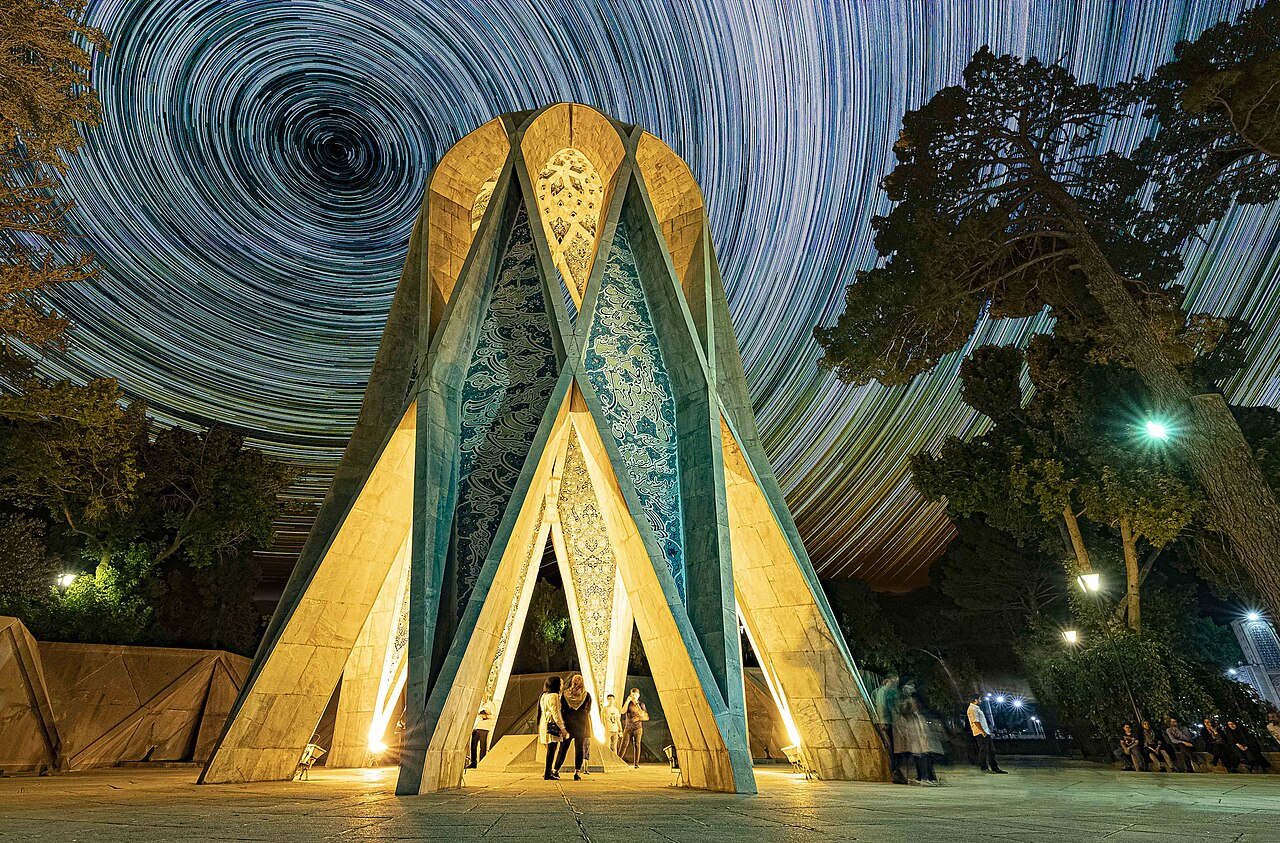
Night photograph of the Khayyam monument in Iran: a tall, angular, faceted structure with tiled blue patterned panels and warm-lit golden stone, with people standing near its base. Star trails swirl across the dark sky above, and trees and lights frame the scene.Photograph

Secondary source

Khayyam Monument Photograph

Mahdieshaghi58 · 17 July 2018

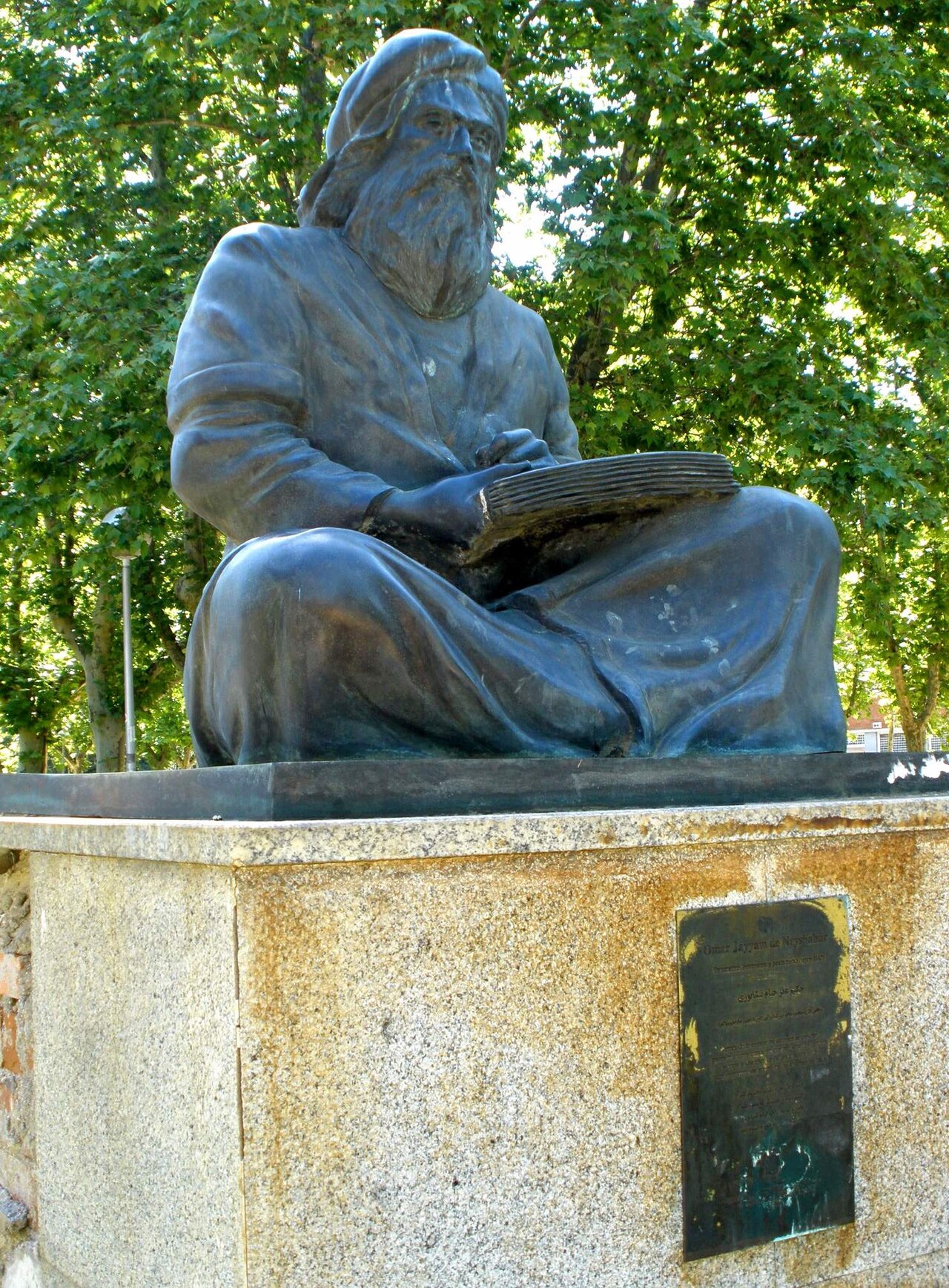
Bronze seated statue of a bearded man in a long robe and cap, holding an open book on his lap, set on a granite pedestal beside trees. A bronze plaque with inscriptions is mounted on the pedestal.Sculpture

Secondary source

Omar Jayyam Monument, Madrid University City

Zarateman · 2022

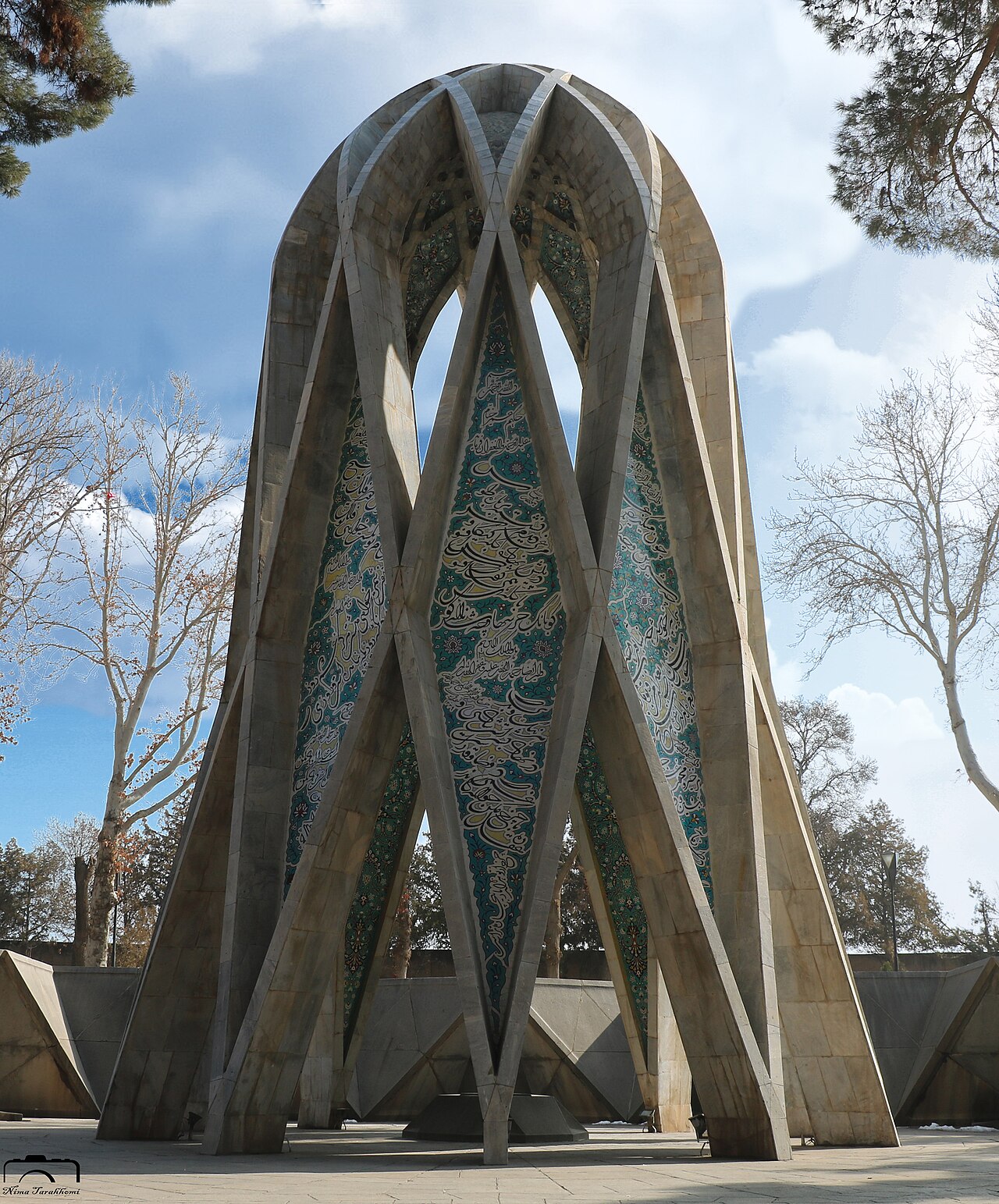
Front view of a modern concrete mausoleum with tall pointed arches and crisscrossing angular ribs, set against blue sky with bare winter trees. Turquoise tilework with gold calligraphy covers the inner panels. A camera watermark appears in the lower left corner.Photograph

Secondary source

Khayyam Tomb Photograph

Nima raevant · 27 January 2020

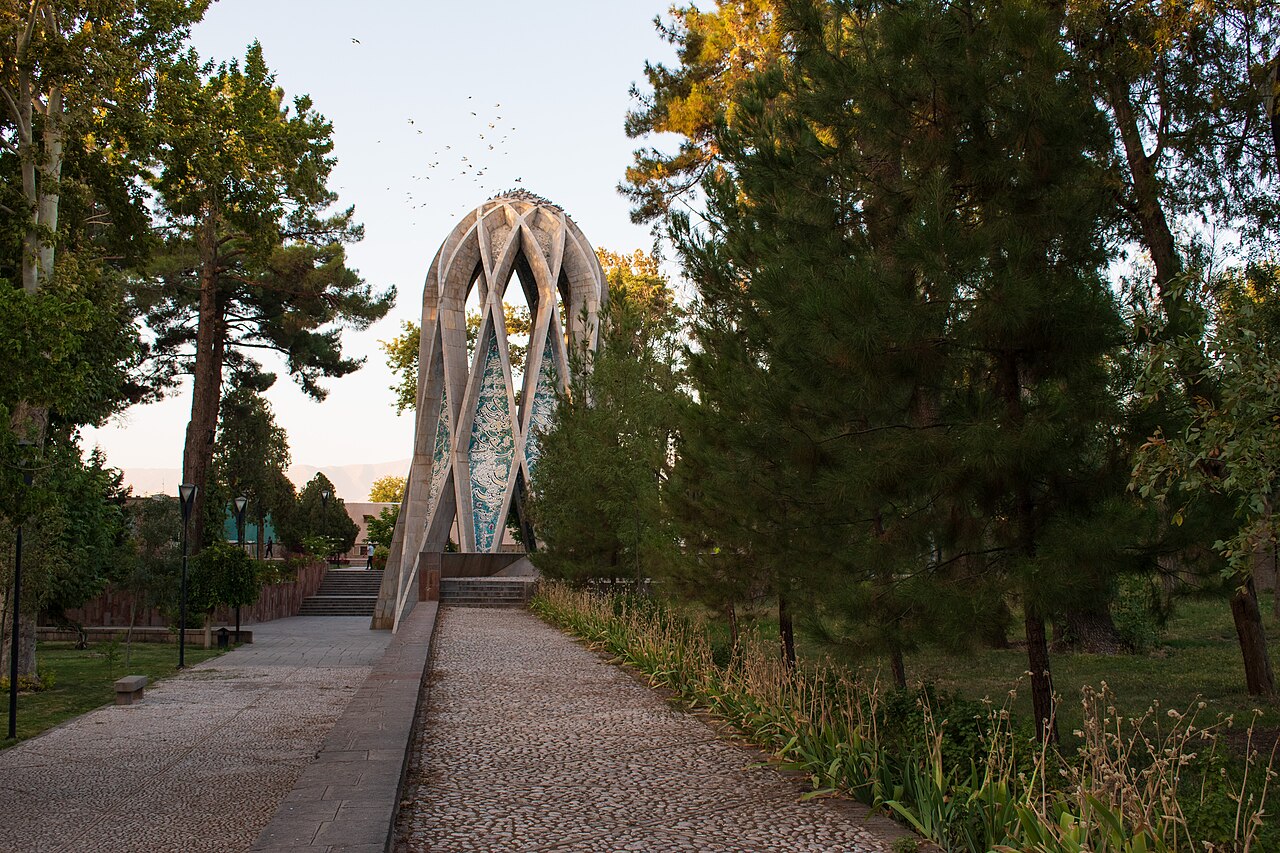
Photograph of the Mausoleum of Omar Khayyam in Iran: a tall, lattice-like concrete structure with blue tilework panels, set among tall pine trees along a cobblestone path at dusk, with birds flying overhead.Photograph

Secondary source

Mausoleum of Omar Khayyam, photograph 2020

Ehsan Rangani · 7 September 2020

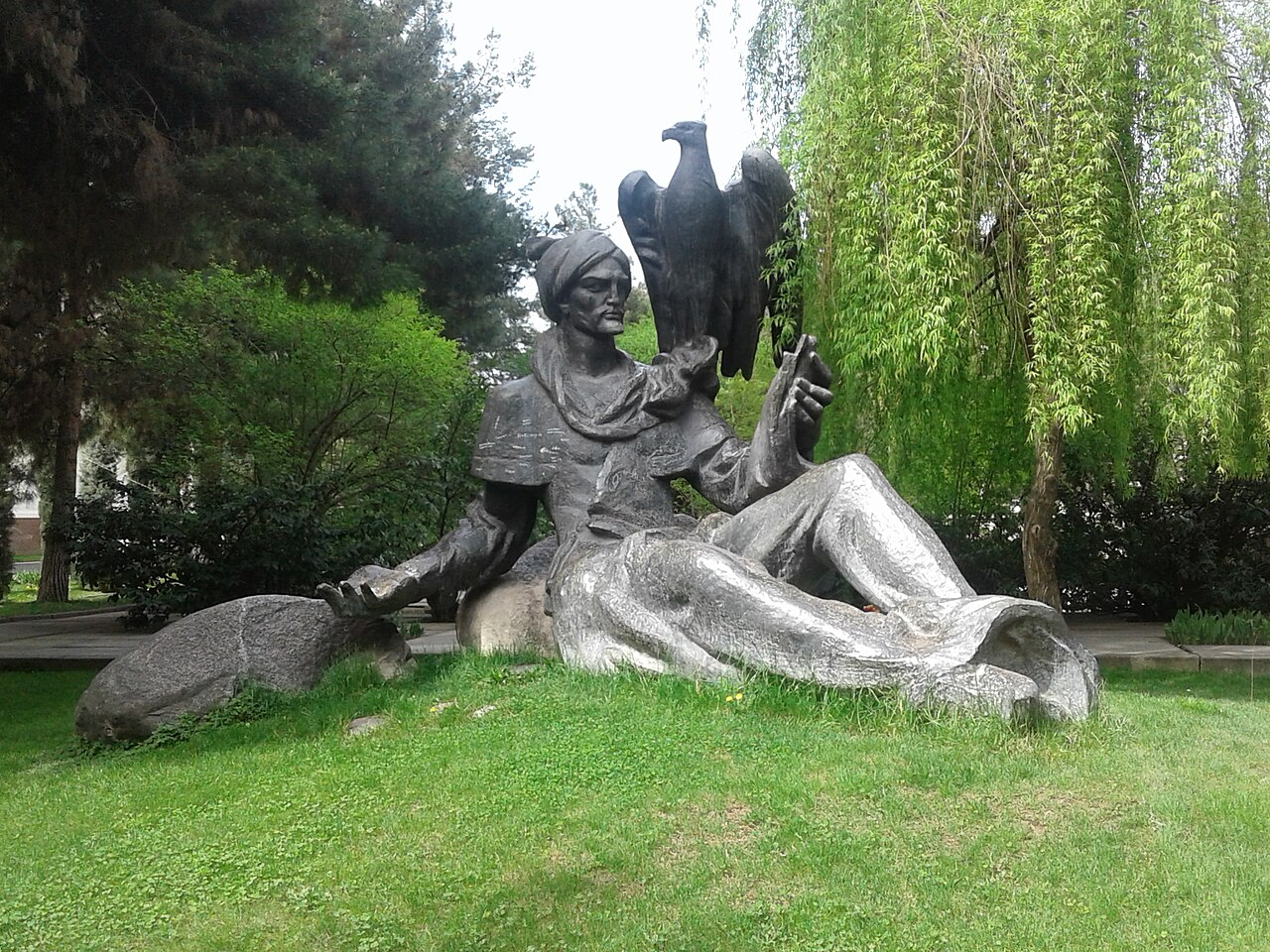
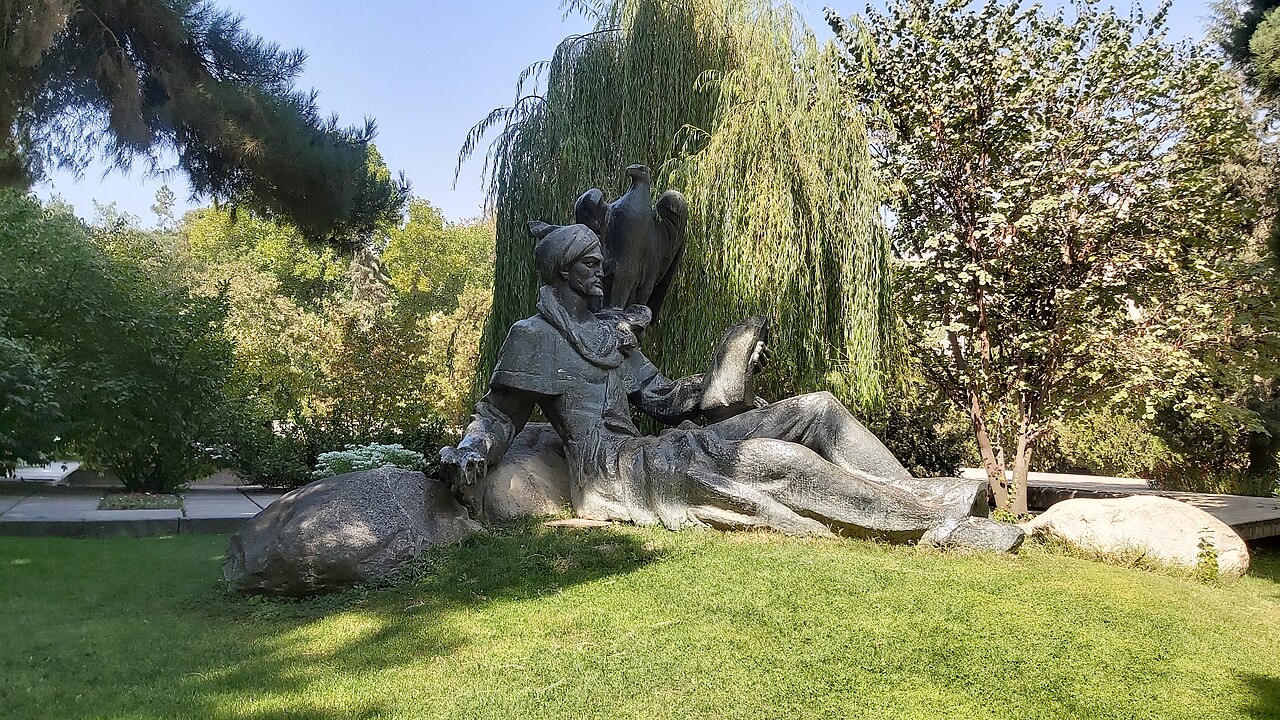
Dark bronze sculpture of a turbaned man reclining on a stone base in a grassy park, with a large raised bird of prey on his left arm and his right hand extended. Weeping willow and conifer trees behind.Sculpture

Secondary source

Omar Khayyam bust in Dushanbe

Shuhrat Sa'diev

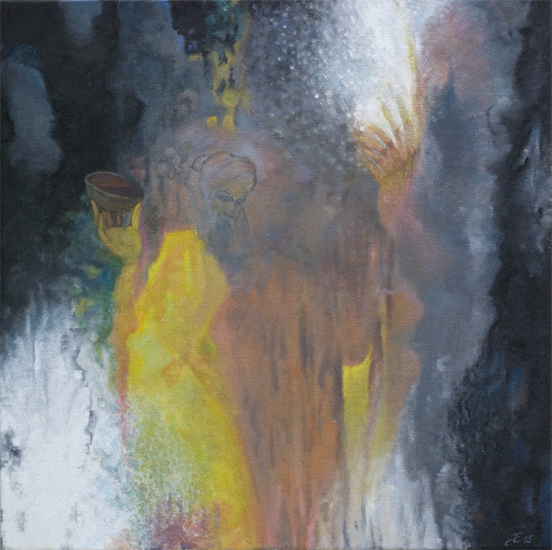
Abstract oil painting on canvas in dark blues and greys with yellow, orange and white washes. A figure in a yellow robe holds a cup or bowl at left, with faint ghostly forms and a glowing white area at upper right.Painting

Secondary source

Omar Khayyam, oil painting by Alexegor

Alexegor · 2 November 2015

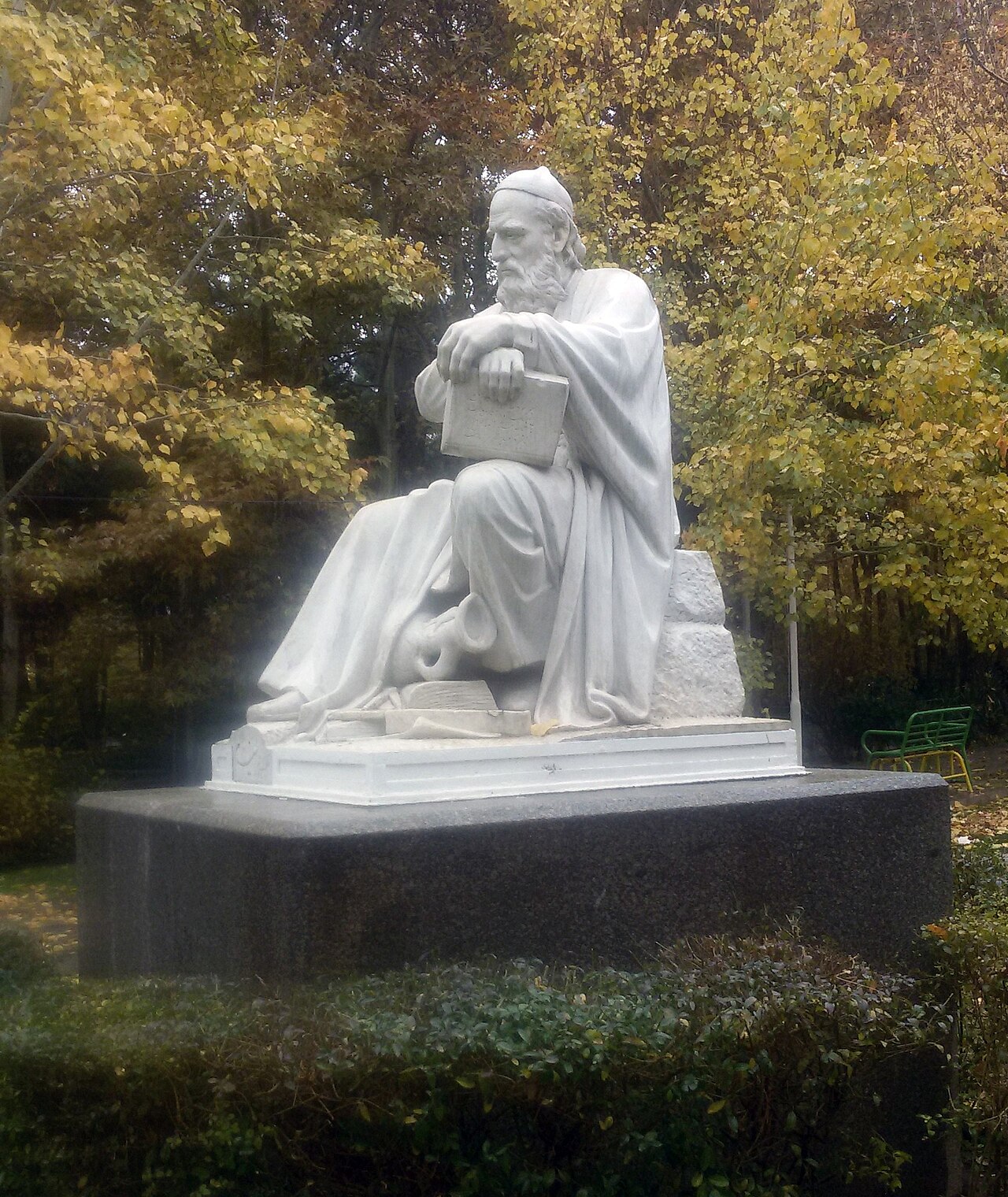
Photograph of a white marble statue of a bearded man seated on a block, wearing a cap and draped robe, resting his hands on a closed book. The statue stands on a white plinth and dark granite base among autumn trees and shrubs, with a green bench at right.Sculpture

Secondary source

Modern statue of Omar Khayyam in Laleh Park, Tehran

20 November 2016

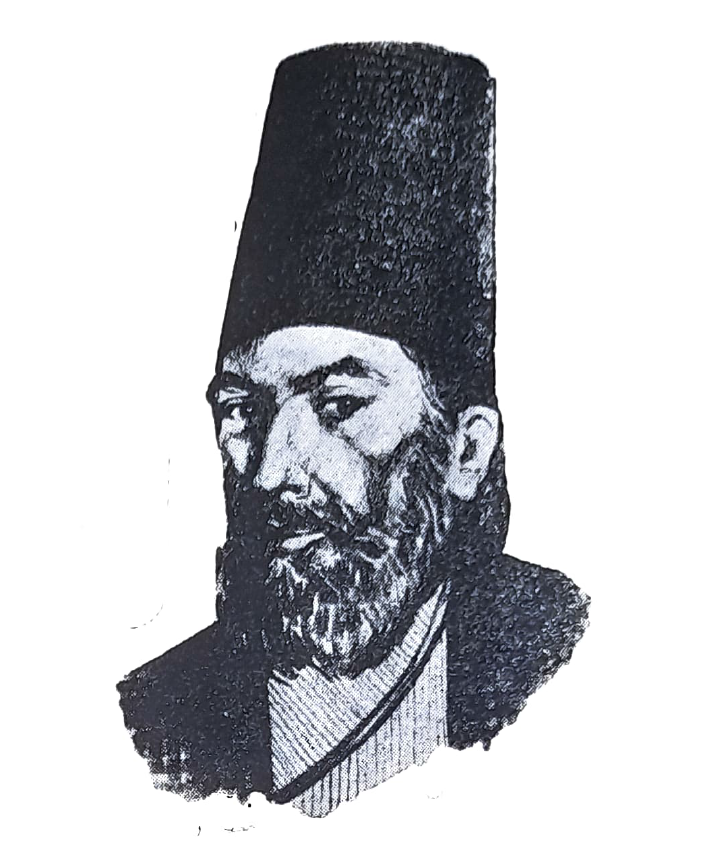
Black and white halftone illustration of a bearded man in a tall cylindrical felt hat, shown in head-and-shoulders bust view facing left, with a high forehead, deep-set eyes, and a long beard. Printed on white paper.Painting

Secondary source

Imaginary sketch of Omar Khayyam from a 1961 Arabic book

1961

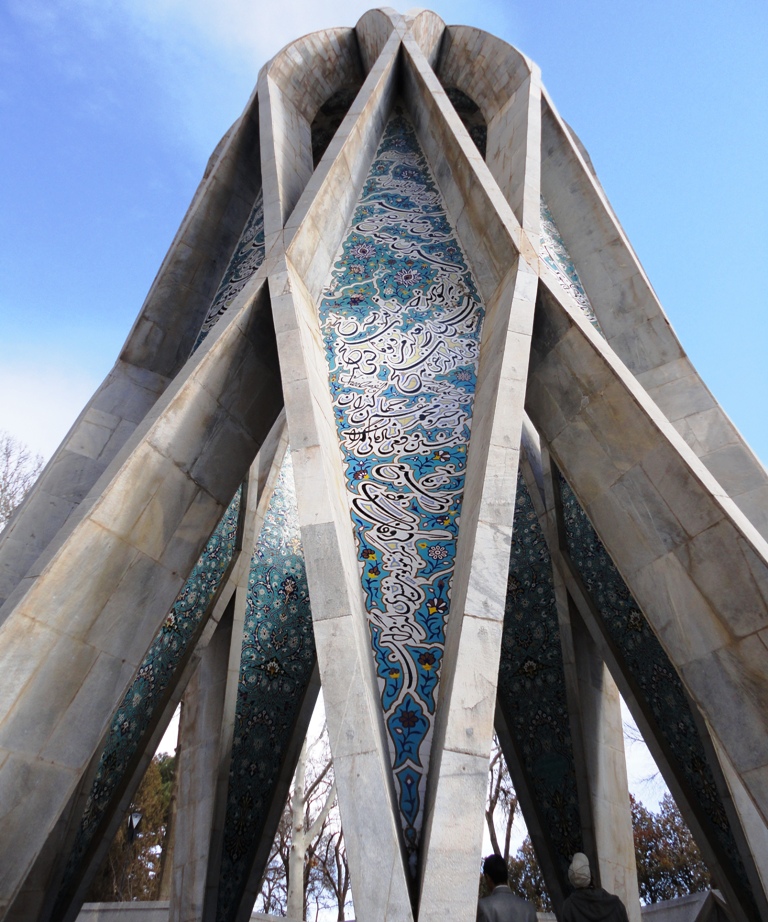
Low-angle view looking up at a tall memorial of pale stone arches that converge at the top against a blue sky. Panels between the arches are covered with blue and turquoise mosaic tilework bearing white calligraphic script. Bare trees and a few people at the base.Photograph

Secondary source

Khayyam Poet-Philosopher Memorial, Tehran (2010 photograph)

احسان عابدین · 17 November 2010

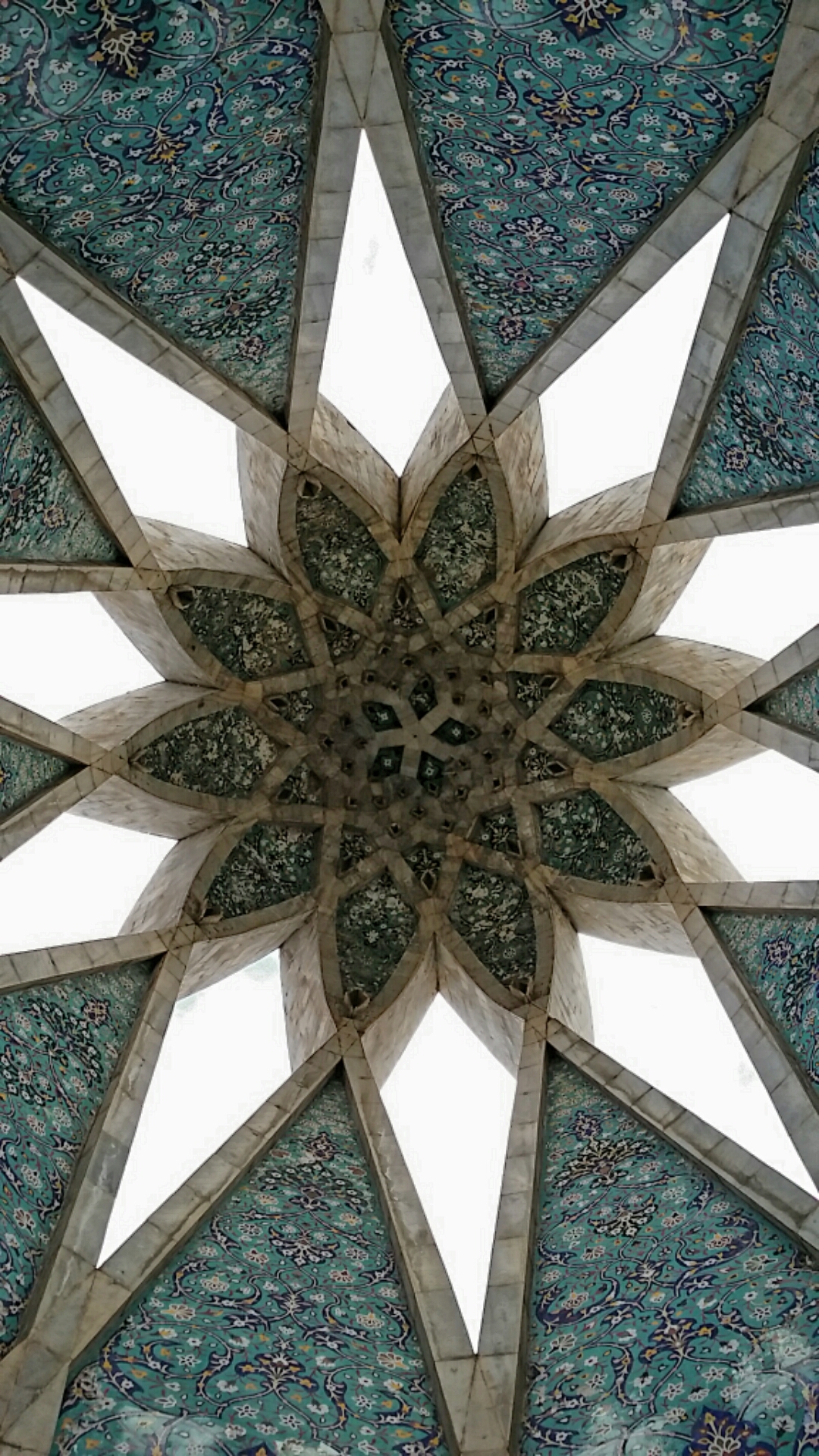
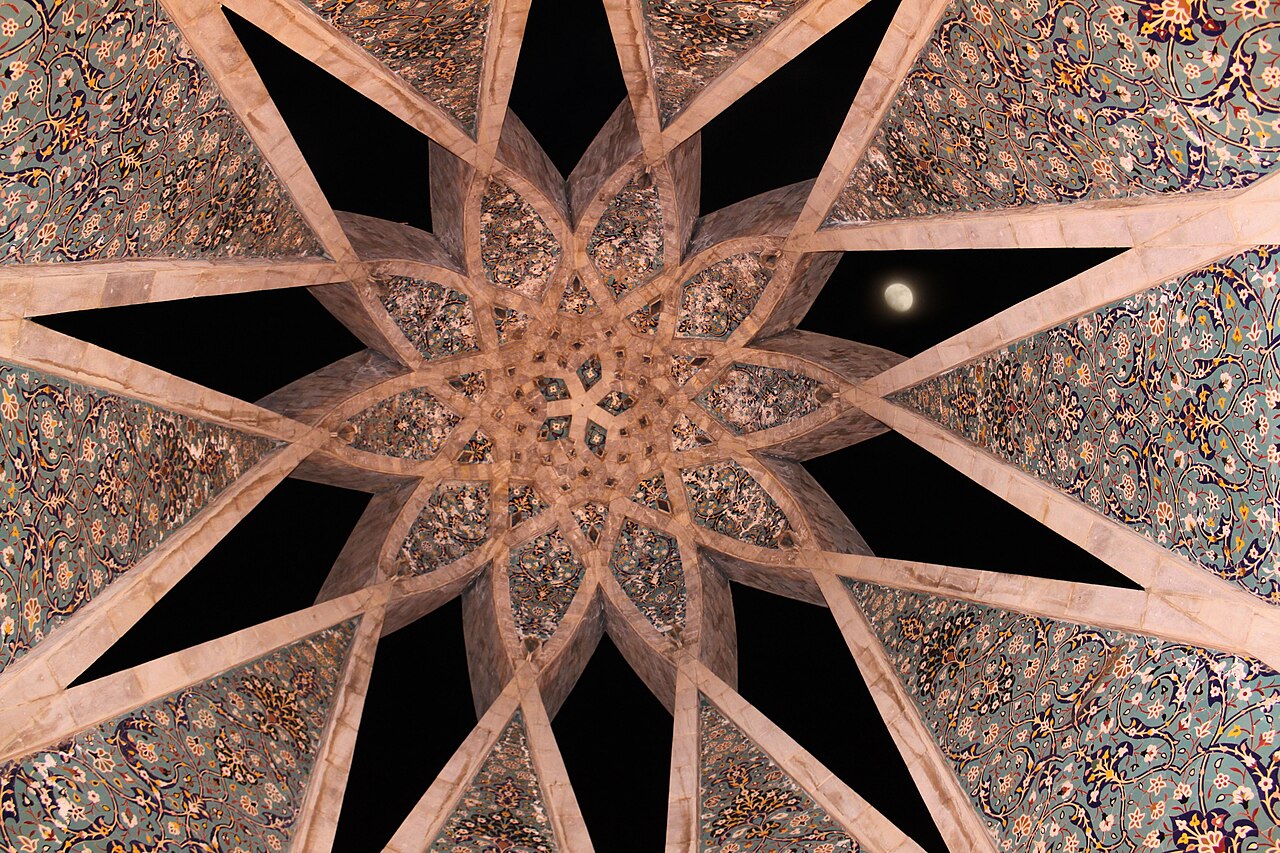
Looking up at a star-shaped ceiling of a domed structure. Pale stone ribs radiate from a central point forming points and lobes, with turquoise tiled panels decorated with white and yellow floral patterns filling the spaces between, and bright sky visible through the gaps.Photograph

Secondary source

Ceiling of Omar Khayyam's Tomb, Neyshabur (2014 photograph)

Dr. Dalili · 3 November 2014

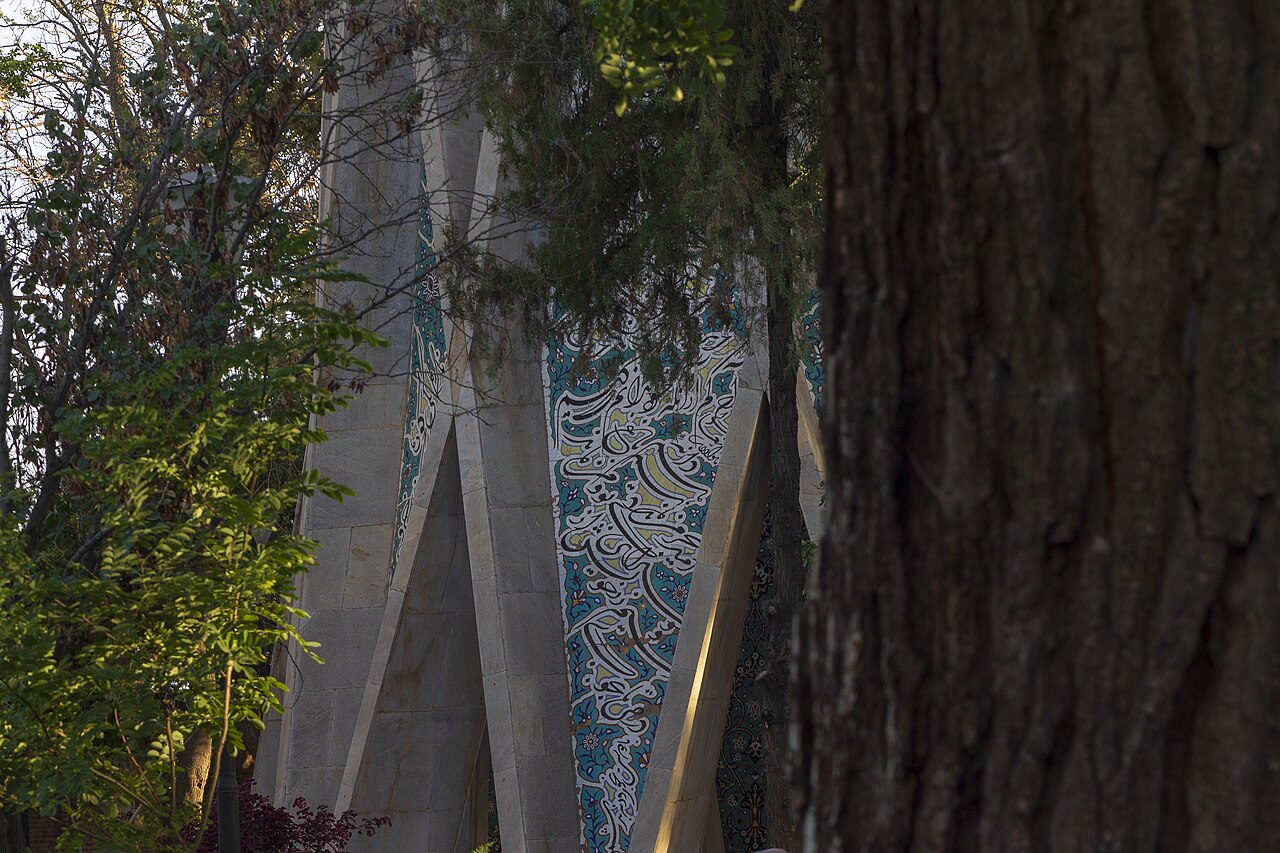
Photo of a tall angular stone monument with blue and white calligraphic tilework panels, partly framed by green foliage on the left and a large tree trunk in the right foreground.Photograph

Secondary source

Omar Khayyam Tomb Monument, Neyshabur (2018 photograph)

Ebrahim Rahiminezhad · 31 August 2018

Bronze statue in a park of a seated, turbaned robed man reclining against a rock, holding a book on his lap, with a bird perched on his shoulder area; a weeping willow and green lawn surround it.Sculpture

Secondary source

Omar Khayyam Statue, Dushanbe (2019 photograph)

Eritasardakan77 · 16 September 2019

Looking up at a star-shaped ceiling dome with radiating pale stone ribs and intricately patterned tilework in teal, cream, and orange on the panels between them. A small moon is visible in the dark sky between the ribs.Photograph

Secondary source

Omar Khayyam Mausoleum, Nishapur (2010 photograph)

آرمین · 25 April 2010

Photo of the Khayyam Tomb Tower in Neyshabur, Iran: a tall concrete structure of angled, lattice-like arches with blue patterned tilework panels, set on a paved courtyard among green trees.Photograph

Secondary source

Khayyam Tomb Tower, Neyshabur (2013 photograph)

Omid mojabi · 23 May 2013

A tall, pointed, lattice-like concrete mausoleum with diamond-shaped panels of blue mosaic tilework, set in a park under a clear blue sky. Pine and other trees surround it; a few people stand near its base and red flowers are in the foreground.Photograph

Secondary source

Khayyam tomb, Neyshabur, 2019 photo

Hoka8080 · 12 July 2019

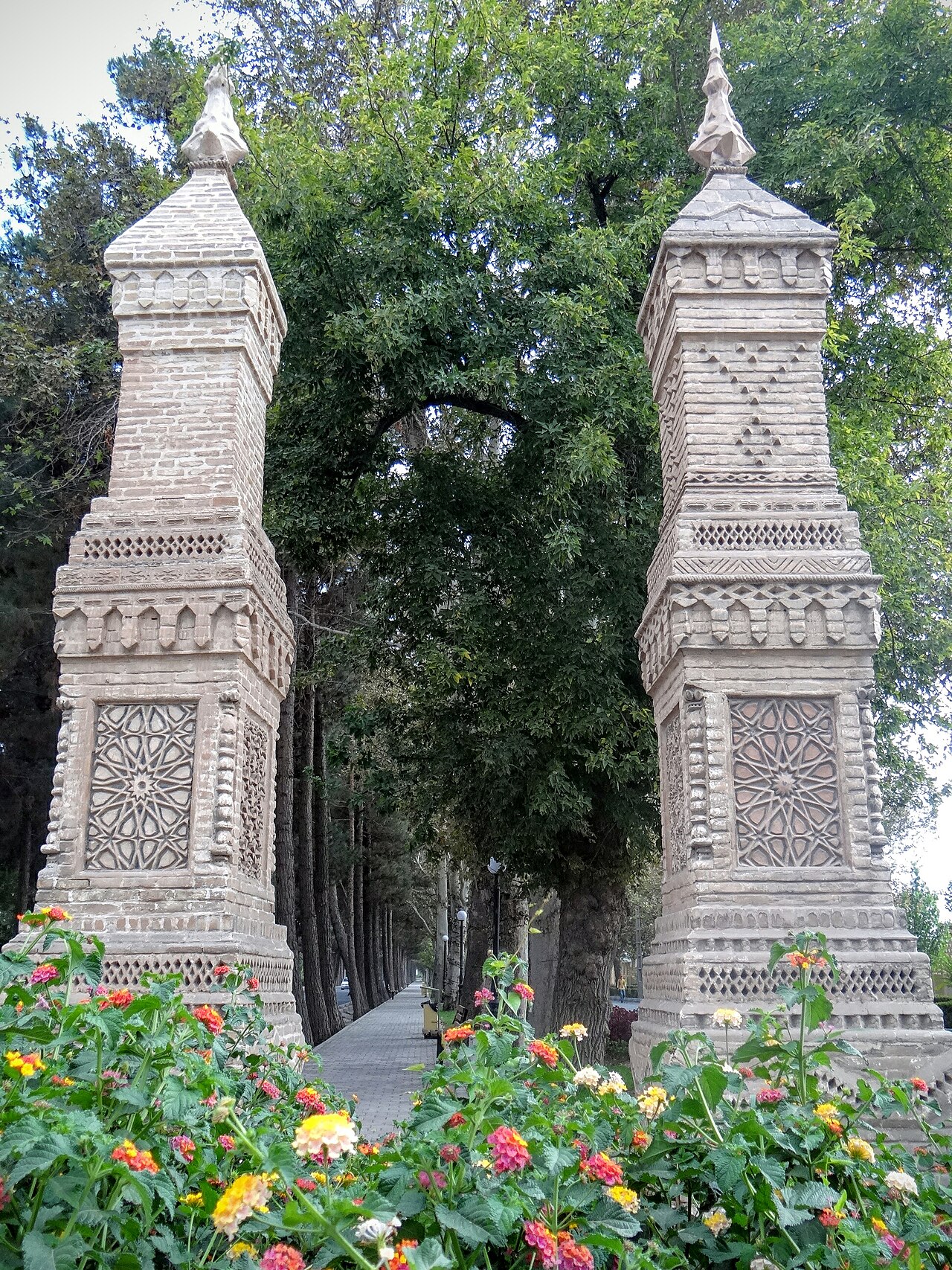
Two tall brick-and-stucco pillars with pointed finials stand on either side of a paved garden path lined with trees. Each pillar has carved geometric star patterns and lattice bands. Pink, orange and yellow flowers fill the foreground.Photograph

Secondary source

Khayyam memorial column, Neyshabur, 2018 photo

Mojtabamovahed · 6 October 2018

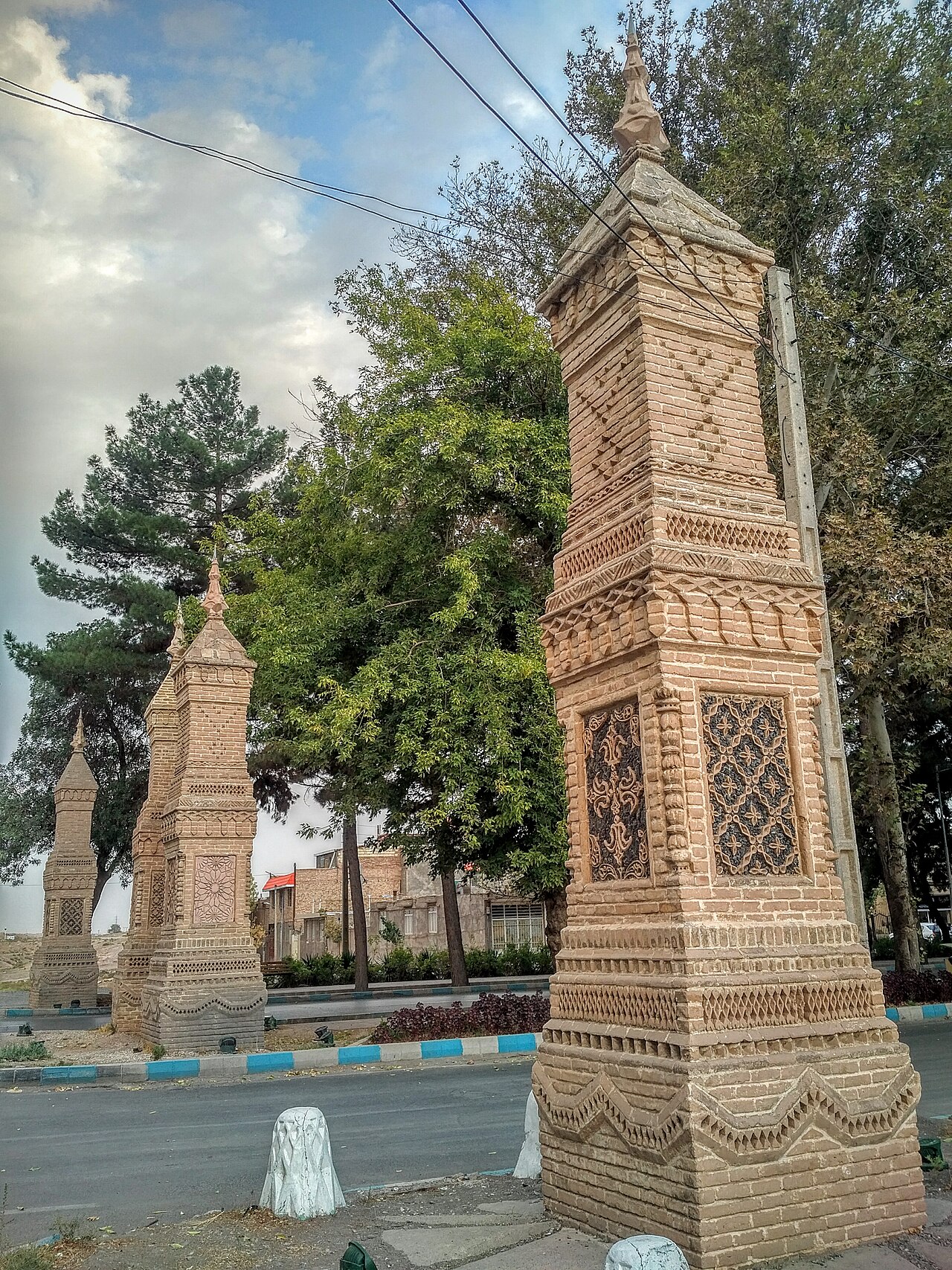
Several tall brick pillars with pointed finials stand along a roadside in a park-like street. The nearest pillar is large and has carved brick patterns, geometric panels, and a zigzag band near its base. Trees and a building are behind them.Photograph

Secondary source

Khayyam memorial pillar, Neyshabur, 2018 photo

Mojtabamovahed · 6 October 2018

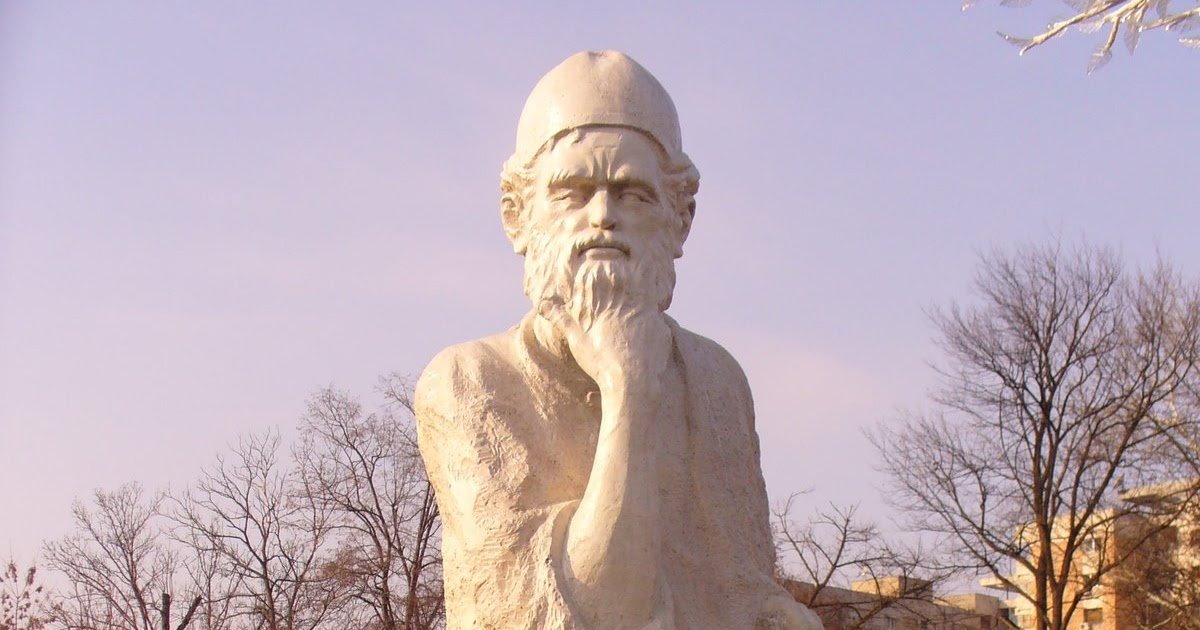
Outdoor photograph of a pale stone statue of a bearded man wearing a close-fitting cap, with one hand raised to his chin in a thoughtful pose. Bare trees and a building are behind it under a lavender sky.Sculpture

Secondary source

Omar Khayyam bust in Bucharest after renovation, 2022 photo

Yas Irani · 19 May 2022

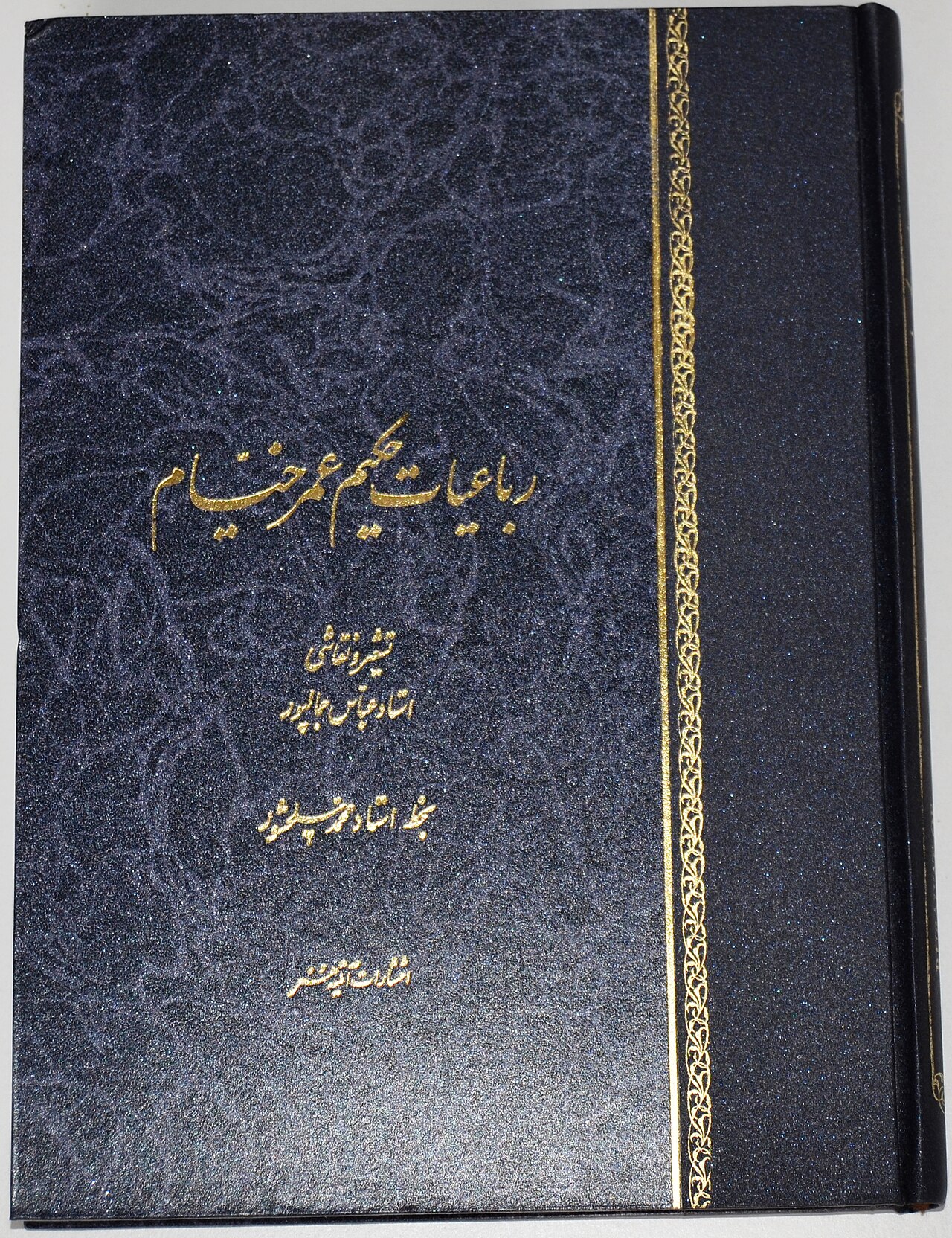
Front cover of a dark navy book with marbled texture and gold Persian script title reading Rubaiyat of Hakim Omar Khayyam, with gold decorative border along the spine edge, a subtitle and editor credit in Persian, and a publisher name at the bottom.Book

Secondary source

Rubaiyat of Hakim Omar Khayyam, Persian edition cover (2013)

2013

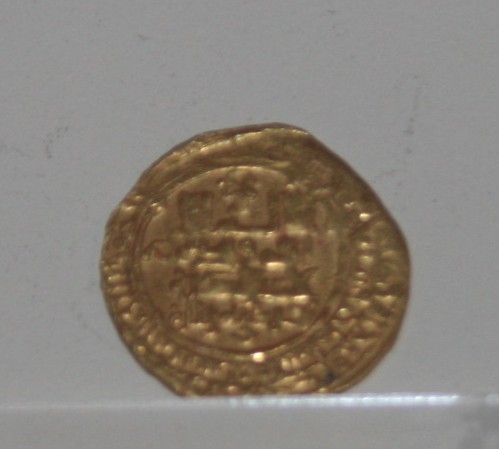
Photograph of a small, irregular gold coin on a pale background. The coin has a worn cross-like or lattice design in the centre with raised border lettering around its edge.Artifact

Primary source

Gold dinar of Sultan Malikshah I, Seljuk

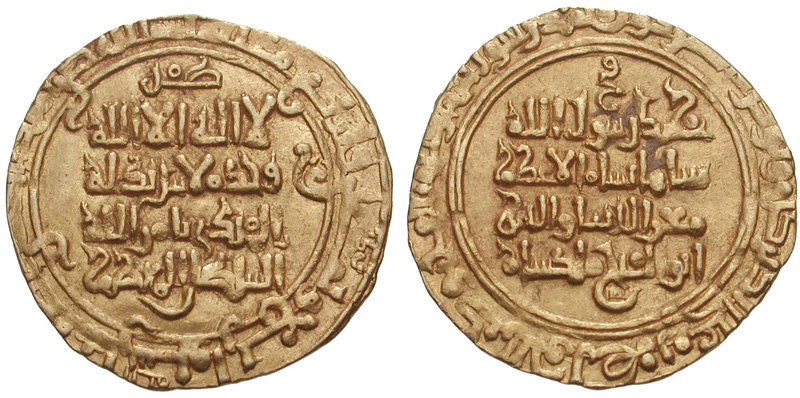
Two sides of a gold dinar coin with raised Arabic calligraphic inscriptions in circular fields and marginal legends. The left side has text in four lines within a central field; the right side has a central inscription and an outer margin of script.Artifact

Primary source

Dinar of Malik Shah I

AH 484 (AD 1091/2)

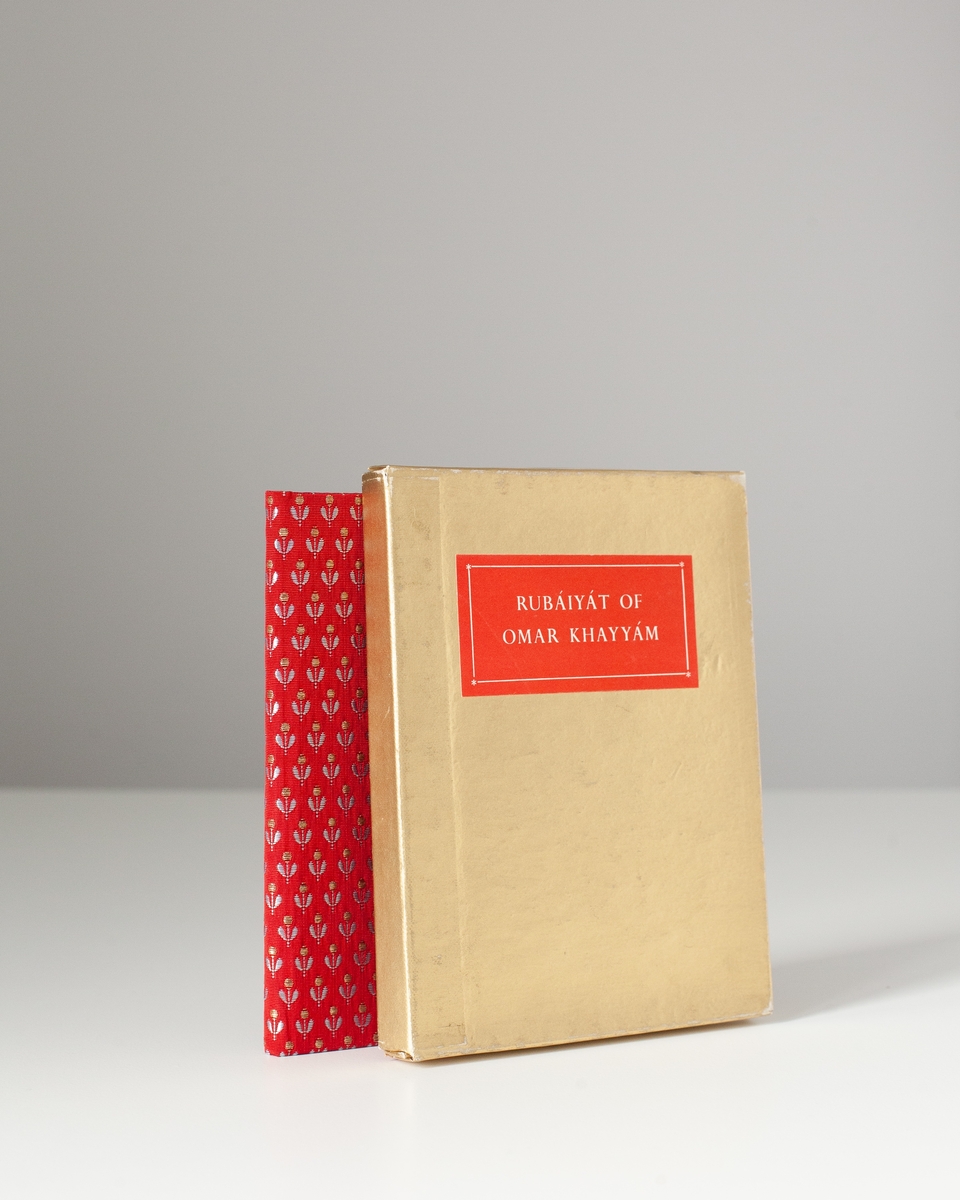
A book in a gold-colored slipcase with a red label reading 'RUBÁIYÁT OF OMAR KHAYYÁM' in white capitals. Beside it stands the red patterned spine of the book, decorated with a repeated white and gold tulip-like motif, on a light gray background.Book

Secondary source

Rubáiyát of Omar Khayyám, Nynorsk Cultural Centre

Want the full shelf? Chat with Omar Khayyam in the app and open the Sources panel — every quote links back to the original.

Use Omar Khayyam in class

2 collections

Ready-made collections from the Humy team that feature Omar Khayyam. Preview any of them, then try it free.

Trusted by educators worldwide

Conversations
375,000+
Real exchanges between students and historical figures
Messages exchanged
4,142,000+
Across every figure, classroom and language
Historical figures
100,000+
Each informed by a curated biography and selected sources
Languages supported
50+
From English and Spanish to Arabic and Korean

Paying customers

Used by 98 schools and universities

Partner school logo
Tecnológico de Monterrey logo
Hyper Island logo
Partner school logo
Chambersburg Area School District logo
Broward County Public Schools logo
Nebo School District logo
National Louis University logo
South Florida PBS logo
Punahou School logo
University of Wisconsin–River Falls logo
Partner school logo
Partner school logo
Archbishop Mitty High School logo
Kingsburg High School logo
Norwalk Public Schools logo
Partner school logo
Connections logo
Partner school logo
Moore Public Schools logo
Partner school logo
Partner school logo
Partner school logo
Partner school logo
Robbinsville Public Schools logo
Partner school logo
Partner school logo
Partner school logo
Tecnológico de Monterrey logo
Hyper Island logo
Partner school logo
Chambersburg Area School District logo
Broward County Public Schools logo
Nebo School District logo
National Louis University logo
South Florida PBS logo
Punahou School logo
University of Wisconsin–River Falls logo
Partner school logo
Partner school logo
Archbishop Mitty High School logo
Kingsburg High School logo
Norwalk Public Schools logo
Partner school logo
Connections logo
Partner school logo
Moore Public Schools logo
Partner school logo
Partner school logo
Partner school logo
Partner school logo
Robbinsville Public Schools logo
Partner school logo
Partner school logo

What educators are saying

“We enjoyed the program last year and used it frequently.”
“My students say it’s a welcome change of pace. I’m not a fan of the “sage on the stage” model, so I try to incorporate research-oriented and self-paced activities. With Humy, students have to take charge of their learning. They’ve become more adept at critical thinking, forming better questions, and improving their reading comprehension. The interview feature has been my go-to tool. I create assignments where students must ask historical figures a set number of questions, then summarize the responses to ensure they’re truly absorbing the material. This approach lets them actively explore the past rather than passively consuming information.”
“Humy has helped me bring historical figures, sometimes long past, to life. When my students interact with these figures in real-time, it eliminates some of the perceived “ancient” characteristics of my curriculum. This has shifted my students’ thinking away from viewing history as abstract or irrelevant. Real-time interactions make historical figures relatable, even allowing students to ask off-topic questions that help put historical lives in a more relevant context for 13-year-olds. The feature I use the most is the interview feature. After teaching a topic, most recently Gandhi and Joan of Arc, I have the students ask pointed, focused questions. We practice good conversation techniques beforehand, teaching them to listen (or read) carefully and formulate thoughtful follow-up questions rather than just interrogating. It helps students practice effective conversation skills.”

FAQ

Frequently asked questions

Who is Omar Khayyam?
Persian mathematician, astronomer, and poet. On Humy.ai you can chat with an AI version of Omar Khayyam that draws on a short biography and 83 historical sources during the conversation — by text or voice, in 42 languages.
Is Omar Khayyam AI free?
Omar Khayyam is part of Humy's full library of more than 100,000 figures, which comes with a paid plan. A free account (no credit card) includes 20 messages a month with the free library's figures, so you can try how the conversations work first.
What sources does the Omar Khayyam AI use?
It draws on a short biography and 83 historical sources (books, photographs and documents), including “Rubáiyát of Omar Khayyám”, “Khayyam Geometry Manuscript” and “The Rubaiyat of Omar Khayyam (First Edition)”. Each source has its own page on Humy.ai.
How historically accurate is the AI version of Omar Khayyam?
Each figure uses a short biography and a small set of selected historical sources as context (retrieval-augmented generation), so answers stay closer to known material than the model's general knowledge alone. It isn't a citation-grade research tool — like any LLM, the AI can get details wrong or extrapolate. Treat it as a strong starting point for inquiry and cross-reference important claims.
Can I talk to Omar Khayyam by voice?
Yes. In addition to text chat, you can call Omar Khayyam and hear their voice respond in real time — useful for auditory learners, interview practice and Socratic dialogue.
Is Humy.ai safe and compliant for schools?
Yes. Humy.ai is used by more than 100 schools, universities and organisations. The platform is FERPA- and GDPR-aligned, supports SSO, and offers an IT-approval pack tailored for school procurement teams.

Ready when you are

Start chatting with Omar Khayyam now.

20 messages free · No credit card · Available in 50+ languages.