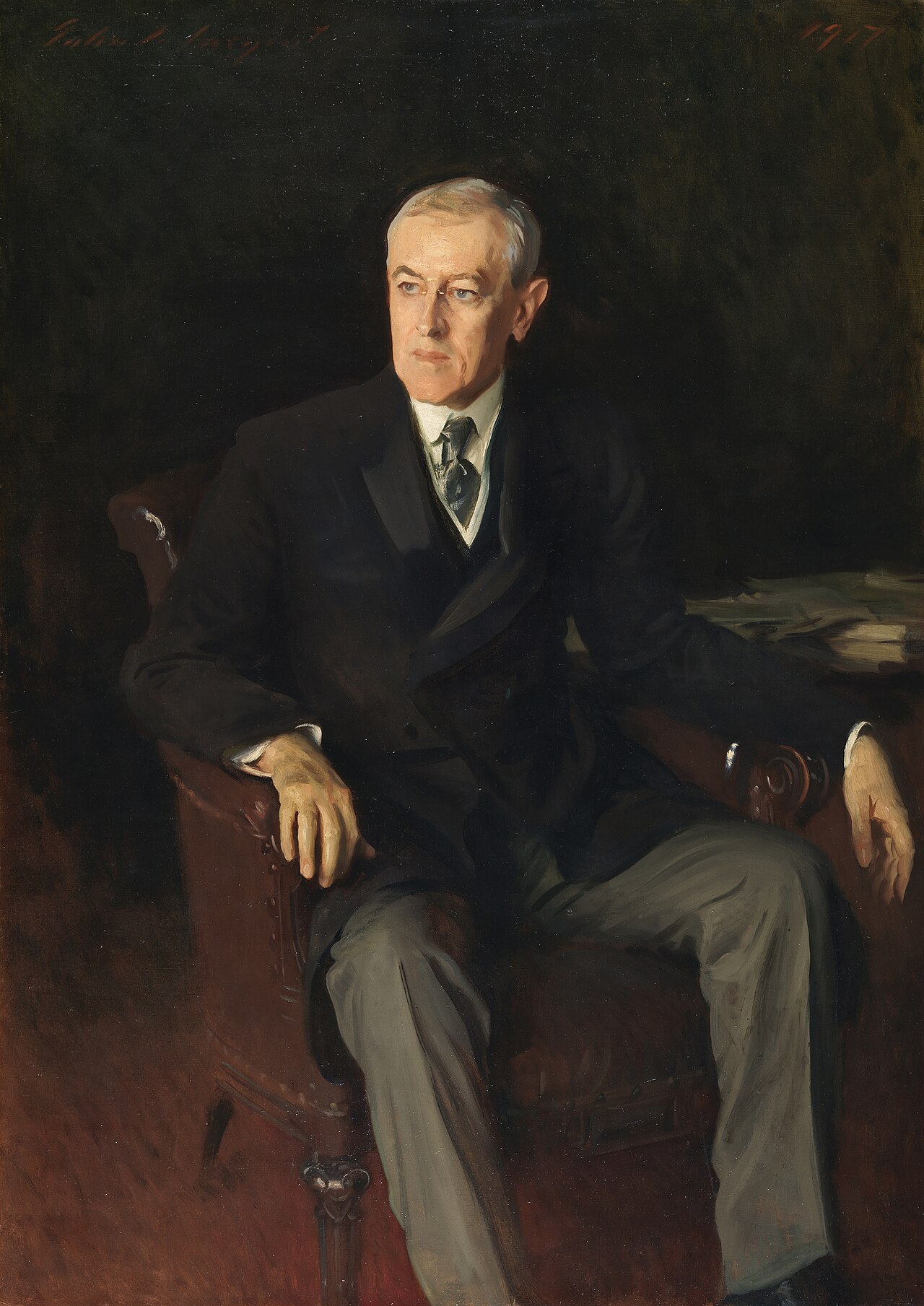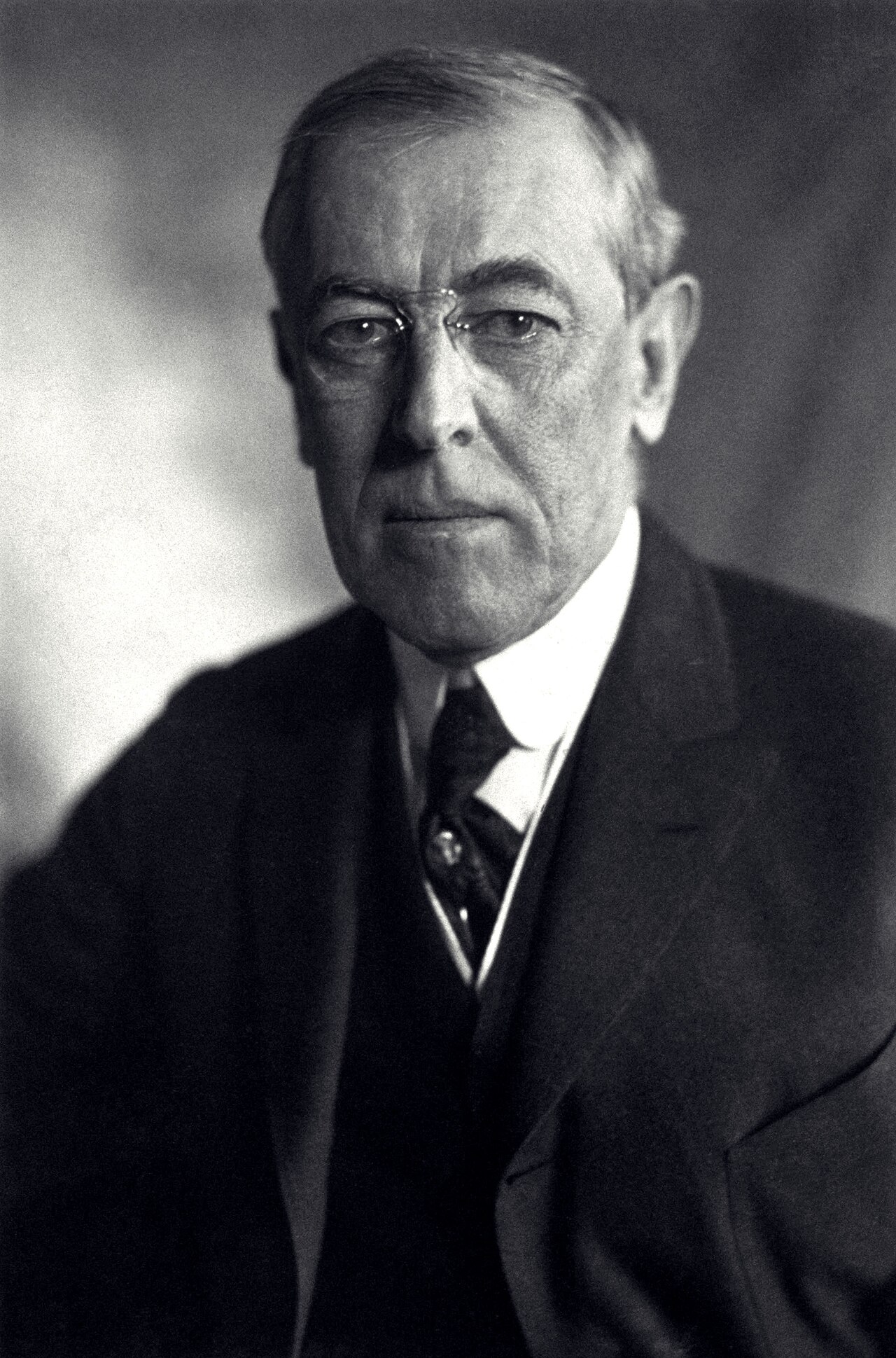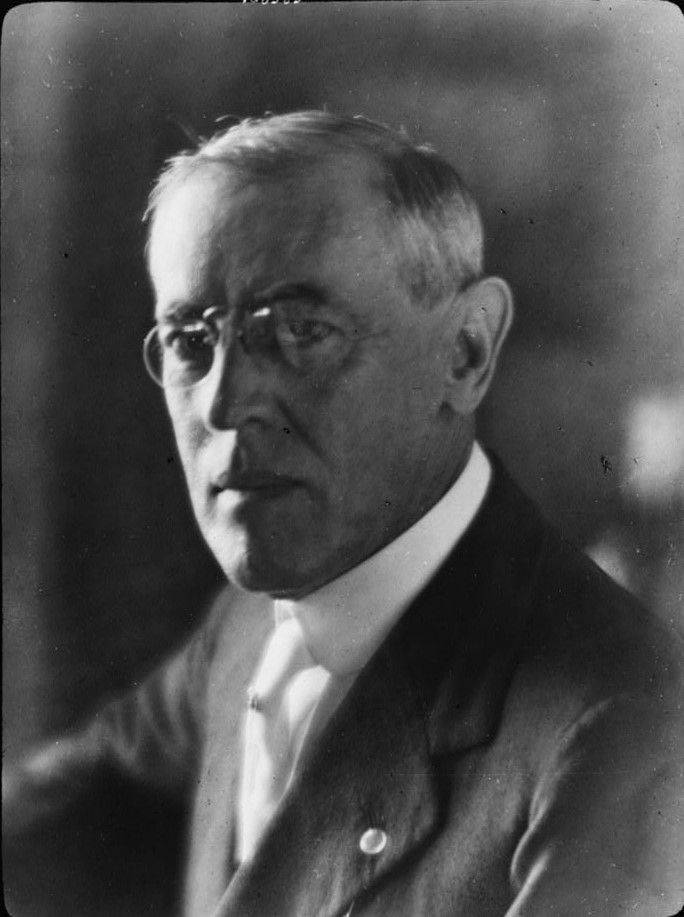

Portrait of Woodrow Wilson

AI Historical Figure

Woodrow Wilson

28th President of the United States and key figure in the establishment of the League of Nations.

Chat with Woodrow Wilson via text or voice — in 42 languages, drawing on a curated biography and 97 historical sources. Available 24/7.

Start chatting with Woodrow Wilson20 messages free · No credit card
Lived
1856–1924
From
United States
Known for
Politics & governmentLaw
Woodrow Wilson

Woodrow Wilson

Online · responds in seconds

Hello — I'm Woodrow Wilson. 28th President of the United States and key figure in the establishment of the League of Nations. What would you like to ask me?

20 messages free · No credit card · Powered by Humy.ai

Live preview · Switch between 42 languages above · Send a message to continue in the app

Multilingual

Talk to Woodrow Wilson in 42 languages

Ask Woodrow Wilson questions in any language below, and the rest of Humy's app speaks it too. Pick yours to open the chat in that language.

Also in German (Austria), German (Switzerland), English (UK), English (Australia), English (Canada).

The sources behind this AI

97 sources · 24 books · 22 speeches · 16 documents · 14 paintings · 11 photographs · 6 artifacts · 2 newspaper articles · 1 documentary · 1 letter

Woodrow Wilson doesn’t improvise from thin air. The AI is grounded in 97 curated historical sources students can inspect. Open any of them to see what informs the conversation.

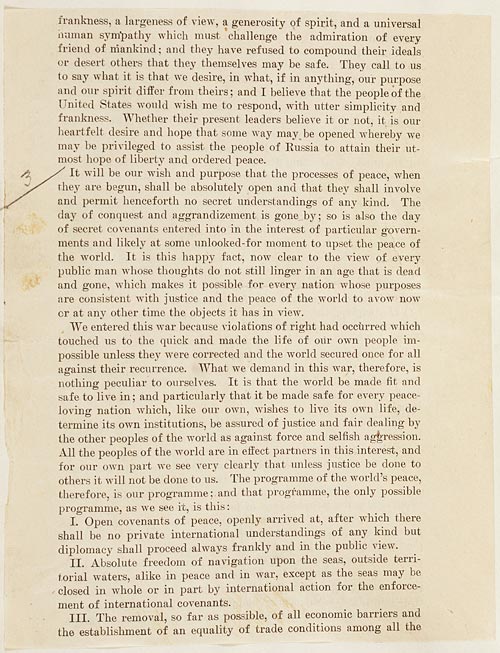
Scanned printed page of a typed speech with dense paragraphs of text, showing Wilson's call for open covenants of peace and a list of numbered points including freedom of navigation and removal of economic barriers.Speech

Primary source

President Woodrow Wilson's 14 Points

Woodrow Wilson · 8 January 1918

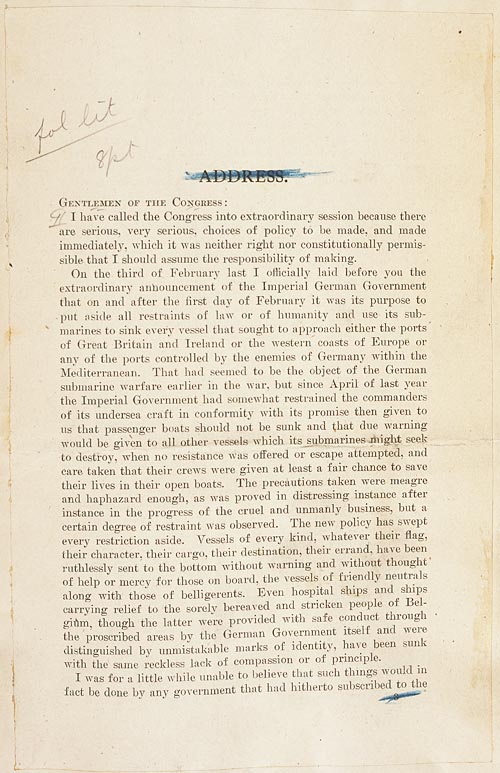
Scanned typed page titled ADDRESS, beginning 'Gentlemen of the Congress' and discussing the German submarine warfare announcement. Handwritten notes appear in pencil at upper left, and a blue pencil mark sits near the title.Speech

Primary source

Joint Address to Congress Leading to a Declaration of War Against Germany

Woodrow Wilson · 2 April 1917

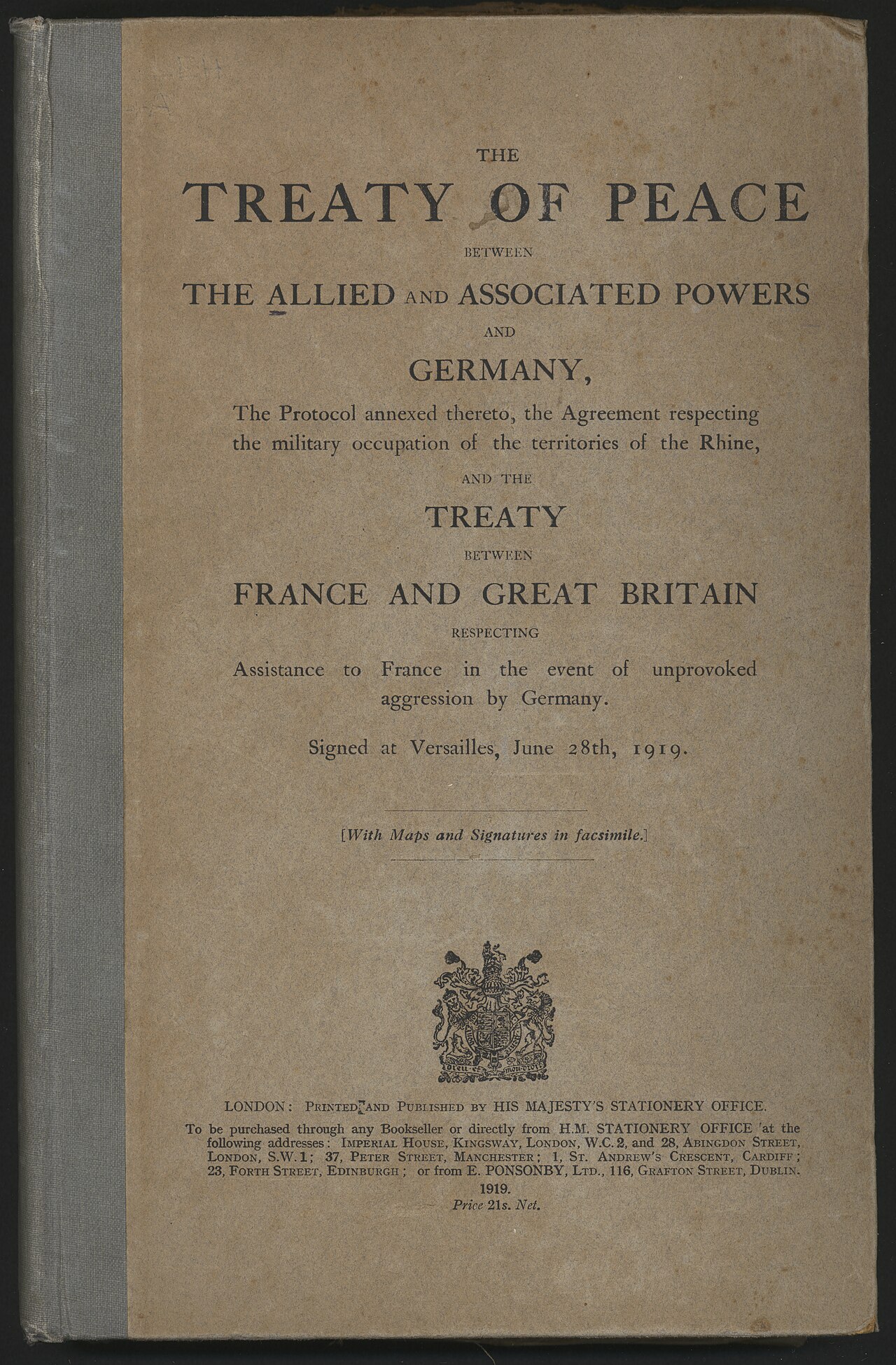
Front cover of a printed booklet of the Treaty of Peace between the Allied and Associated Powers and Germany, signed at Versailles June 28th, 1919, with a royal crest at the bottom and London publisher details. Tan cover with grey spine.Document

Primary source

Treaty of Versailles

28 June 1919

Document

Primary source

Covenant of the League of Nations

28 June 1919

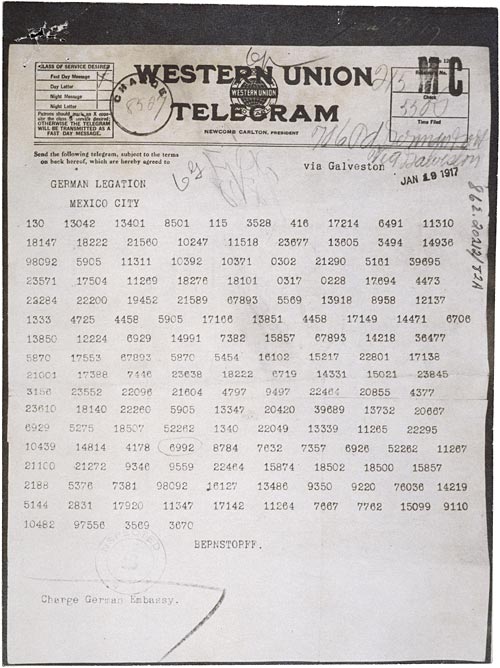
Scan of the encrypted Zimmermann Telegram on a Western Union telegram form, addressed to German Legation, Mexico City, via Galveston, dated January 1917. The body is a grid of groups of numbers, signed Bernstorff at the bottom, with a handwritten 'Charge German Embassy' note and a Western Union 'Night Letter' header.Document

Primary source

Zimmermann Telegram

Arthur Zimmermann · 1917

Speech

Primary source

Recording of the Voice of Woodrow Wilson

Woodrow Wilson · 7 August 1912

Speech

Primary source

League of Nations Address at Pueblo

Woodrow Wilson · 25 September 1919

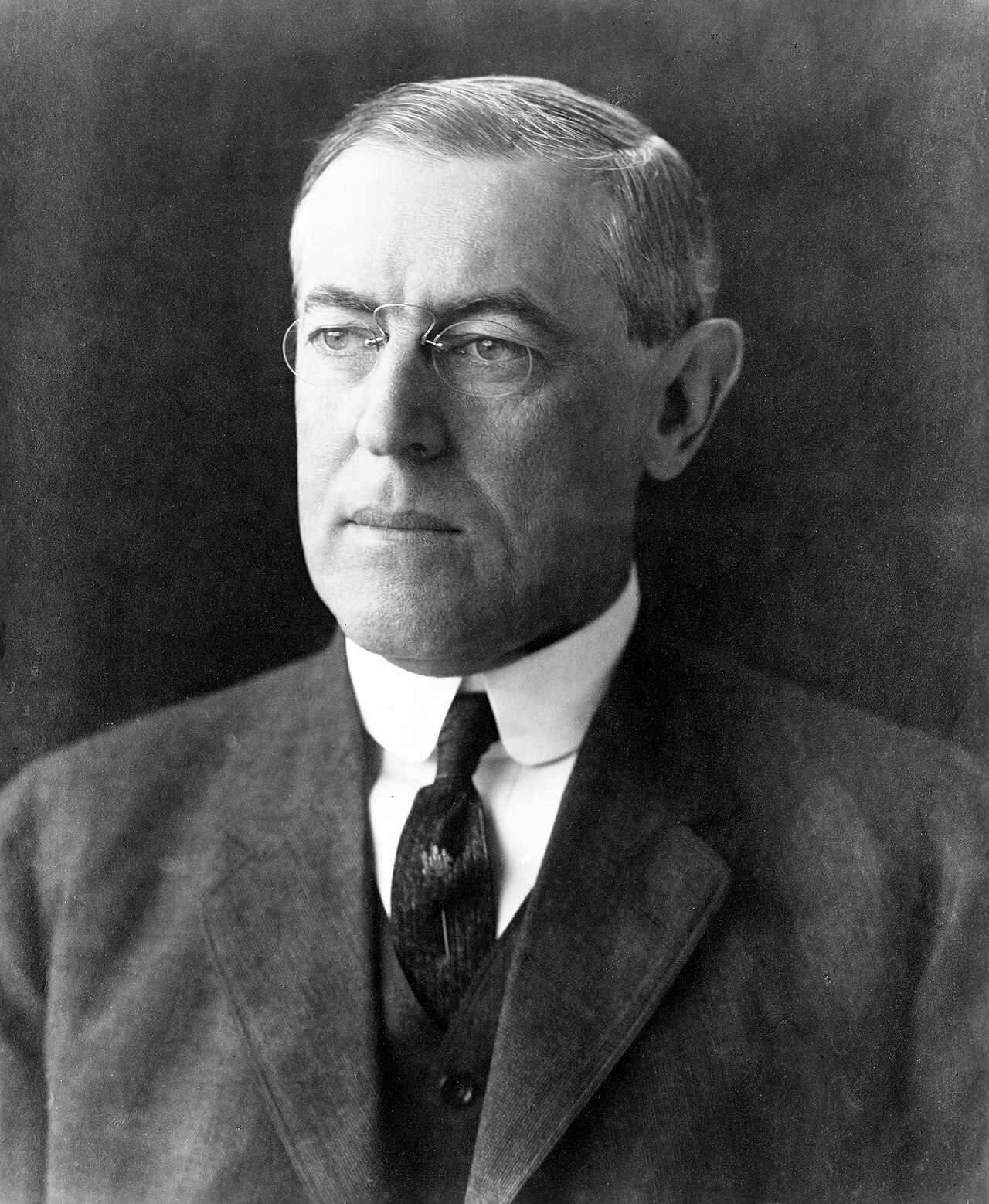
Black-and-white head-and-shoulders studio portrait of a man in a dark suit, white shirt, and dark tie, wearing rimless pince-nez glasses, turned to his left against a dark backdrop, with a serious expression.Photograph

Primary source

President Woodrow Wilson Portrait, December 2, 1912

Pach Brothers, New York · 2 December 1912

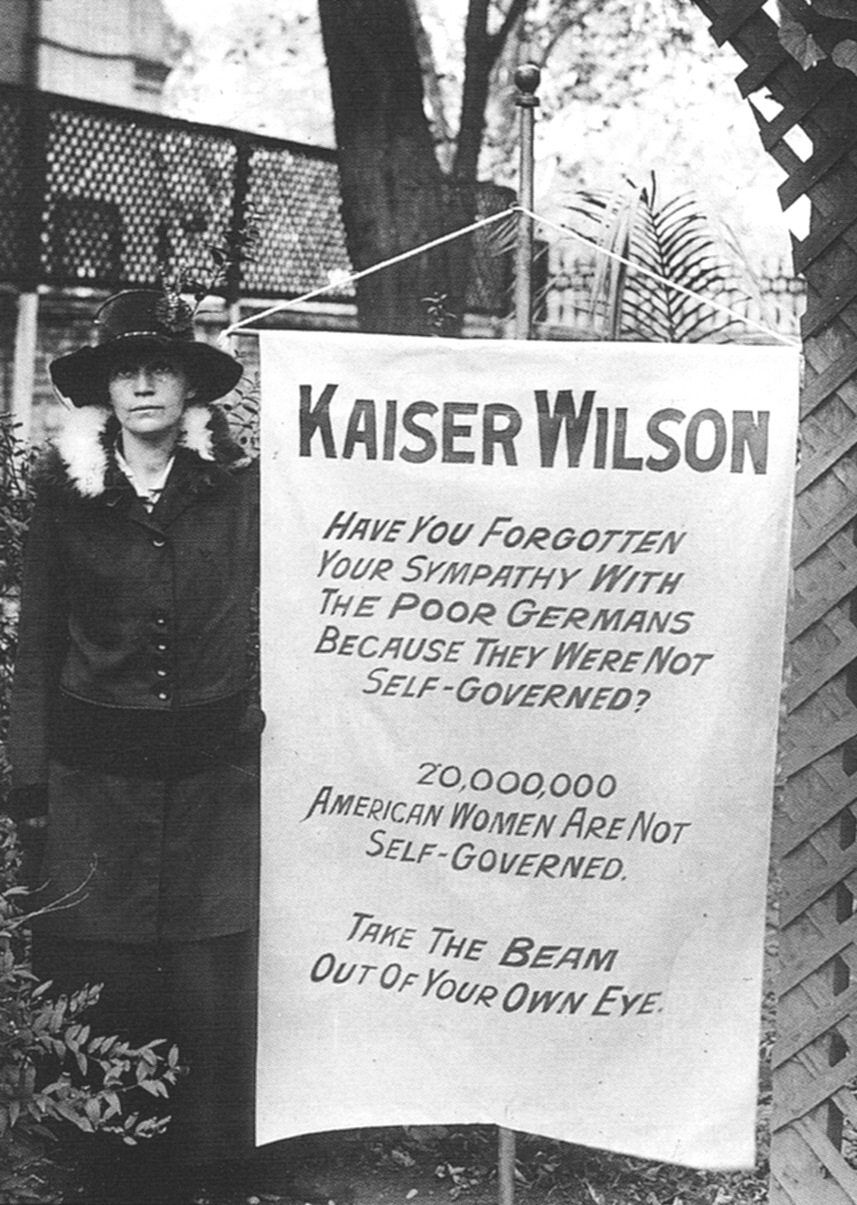
Black and white photograph of a woman in a dark hat with a fur collar and dark coat, standing outdoors beside a large white banner on a pole. The banner reads 'KAISER WILSON' and includes several lines of text protesting women's lack of self-government. Trees and a fence are behind her.Photograph

Primary source

Kaiser Wilson Suffragette Banner Photograph

Harris & Ewing, Washington, D.C.

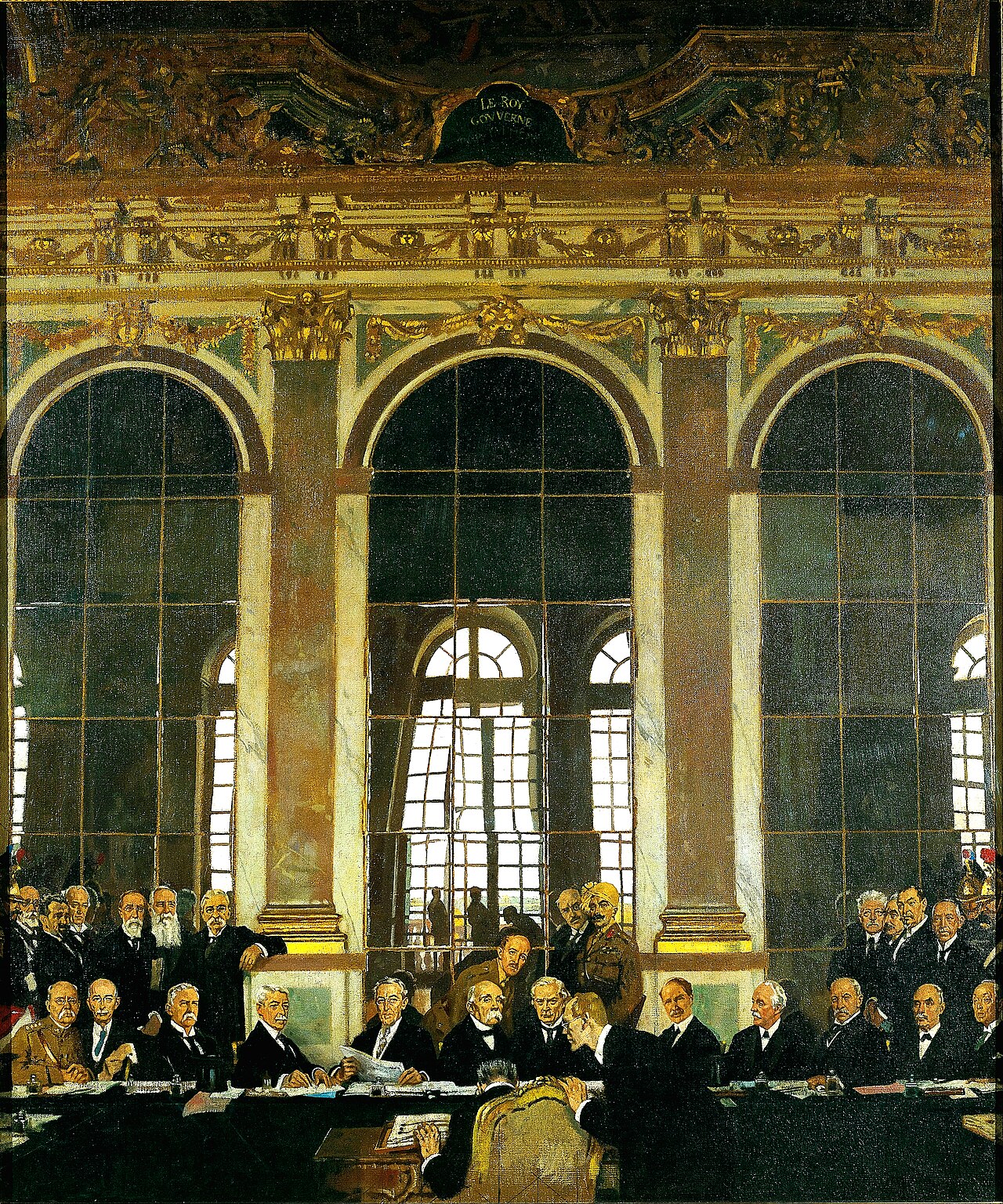
Painting of a formal assembly in an ornate gilded hall with tall arched windows. Men in dark suits and some in military uniform sit and stand around a long table in the foreground, with a seated figure in the lower center.Painting

Primary source

The Signing of Peace in the Hall of Mirrors, Versailles, 28 June 1919

William Orpen · 1919

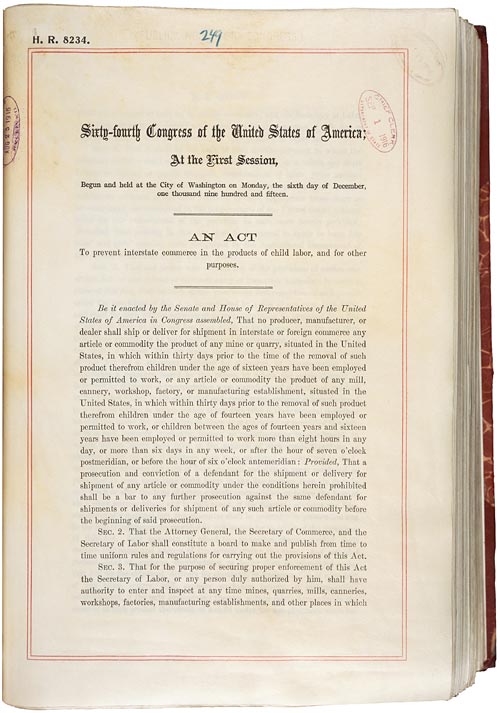
Scanned page of H. R. 8234, the enrolled bill headed 'Sixty-fourth Congress of the United States of America; At the First Session,' with the title 'An Act to prevent interstate commerce in the products of child labor, and for other purposes.' Handwritten page number 249 and a red stamp appear at the top, with body text in a bound volume.Document

Primary source

Keating-Owen Child Labor Act

1 September 1916

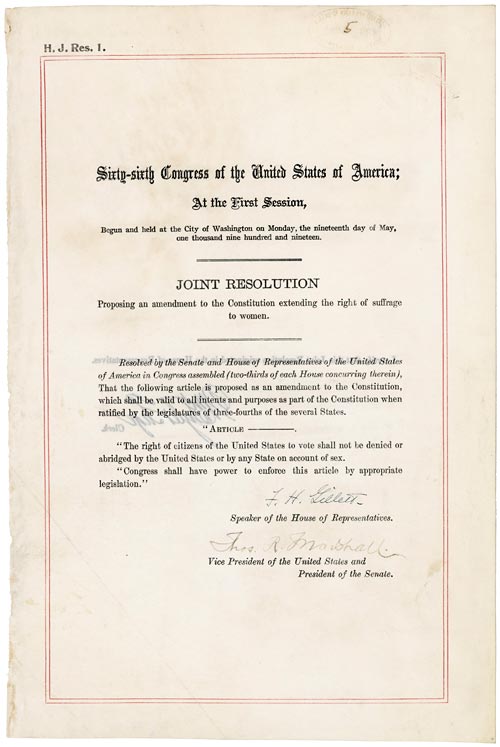
Scanned page of the joint resolution H.J. Res. 1 from the Sixty-sixth Congress, First Session, proposing the 19th Amendment extending suffrage to women. Printed text with signature lines for the Speaker of the House and the Vice President and President of the Senate.Document

Primary source

19th Amendment to the U.S. Constitution

United States Congress · 4 June 1919

Speech

Primary source

First Inaugural Address of Woodrow Wilson

Woodrow Wilson · 4 March 1913

Document

Primary source

Espionage Act of 1917

15 June 1917

Book

Primary source

Congressional Government

Woodrow Wilson · 1885 (this edition 1900)

Plain red cloth-bound book cover with a fine textured grain and a spine along the left edge. No title or text is visible on the cover.Book

Primary source

The New Freedom

Woodrow Wilson · 1913

Book

Primary source

A History of the American People

Woodrow Wilson · 1902

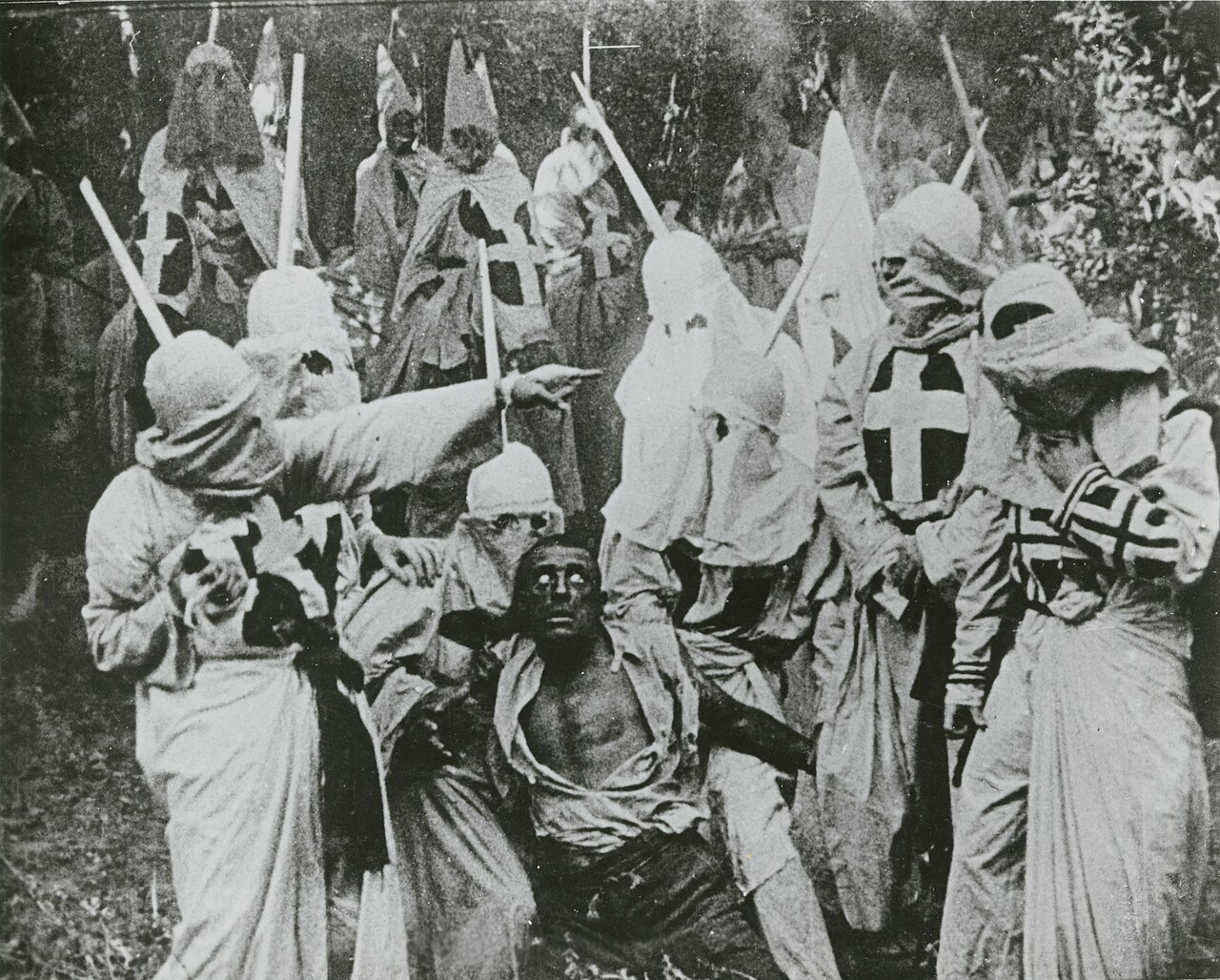
Black and white film still: several hooded figures in white robes with cross emblems surround a seated man with bare chest and torn shirt, his eyes wide. One hooded figure points off to the left, and others stand with flags and poles behind.Documentary

Secondary source

The Birth of a Nation

D. W. Griffith · 1915

Oil painting of a seated man in a dark suit, white shirt and dark tie, with grey trousers. He sits in a dark red upholstered armchair with carved wooden arms, resting one hand on the chair arm and gazing to the left against a dark background. A signature and the date 1917 appear in the upper corners.Painting

Primary source

Portrait of Woodrow Wilson

John Singer Sargent · 1917

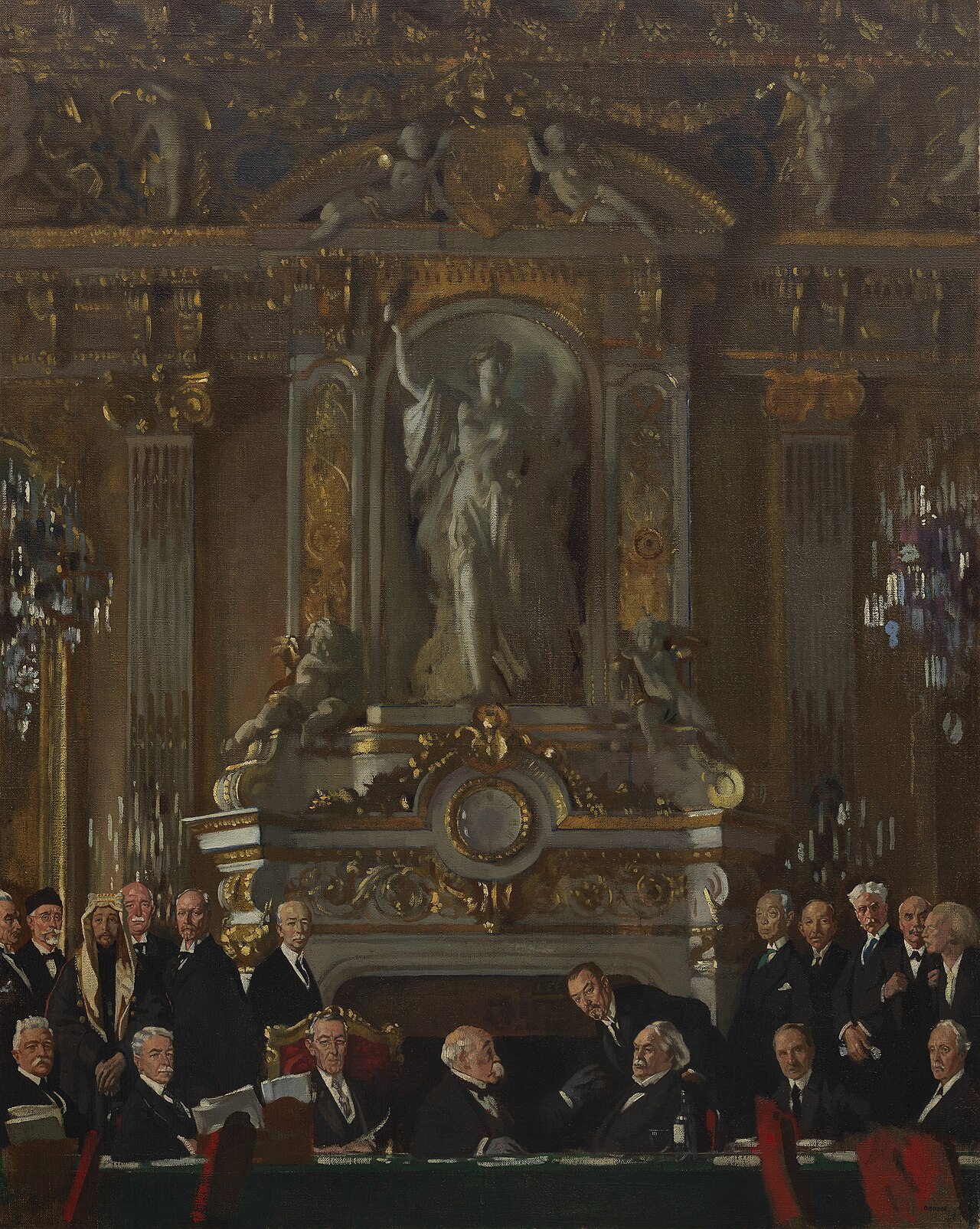
Painting of a formal gathering of men in dark suits and robes seated and standing around a green-draped table in an ornate gilded room. Chandeliers hang on both sides, cherubs decorate the upper walls, and a white marble statue of a winged figure stands above a fireplace.Painting

Primary source

A Peace Conference at the Quai d'Orsay

William Orpen · 1919

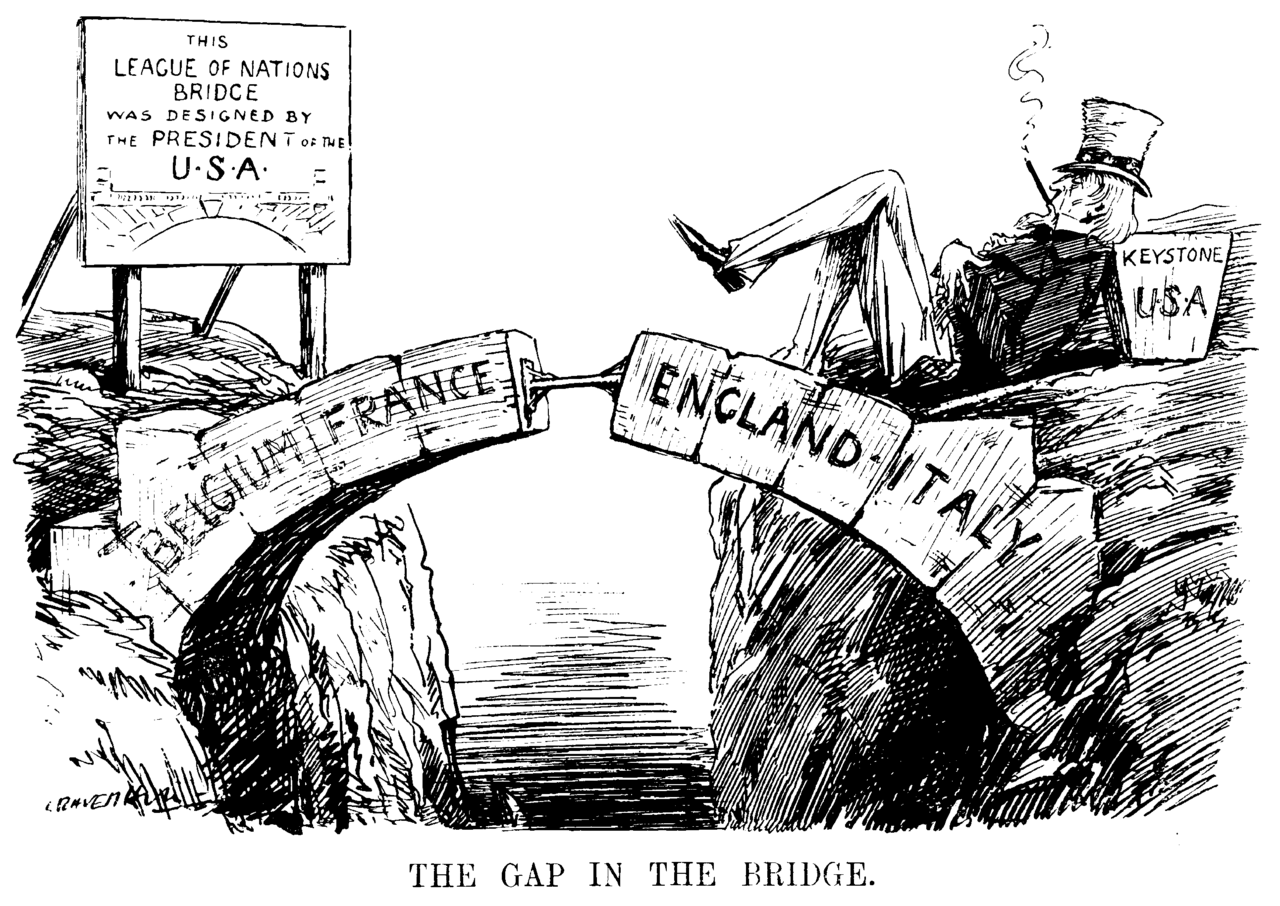
Black-and-white cartoon titled 'The Gap in the Bridge'. A stone arch bridge is labeled BELGIUM, FRANCE, ENGLAND, ITALY, with a missing central keystone gap. A sign reads 'This League of Nations Bridge was designed by the President of the U.S.A.' On the right, a seated Uncle Sam in top hat smokes a cigar, legs crossed, beside a separate block labeled 'KEYSTONE U.S.A.' Caption below reads 'The Gap in the Bridge.'Artifact

Primary source

The Gap in the Bridge

Leonard Raven-Hill · 10 December 1919

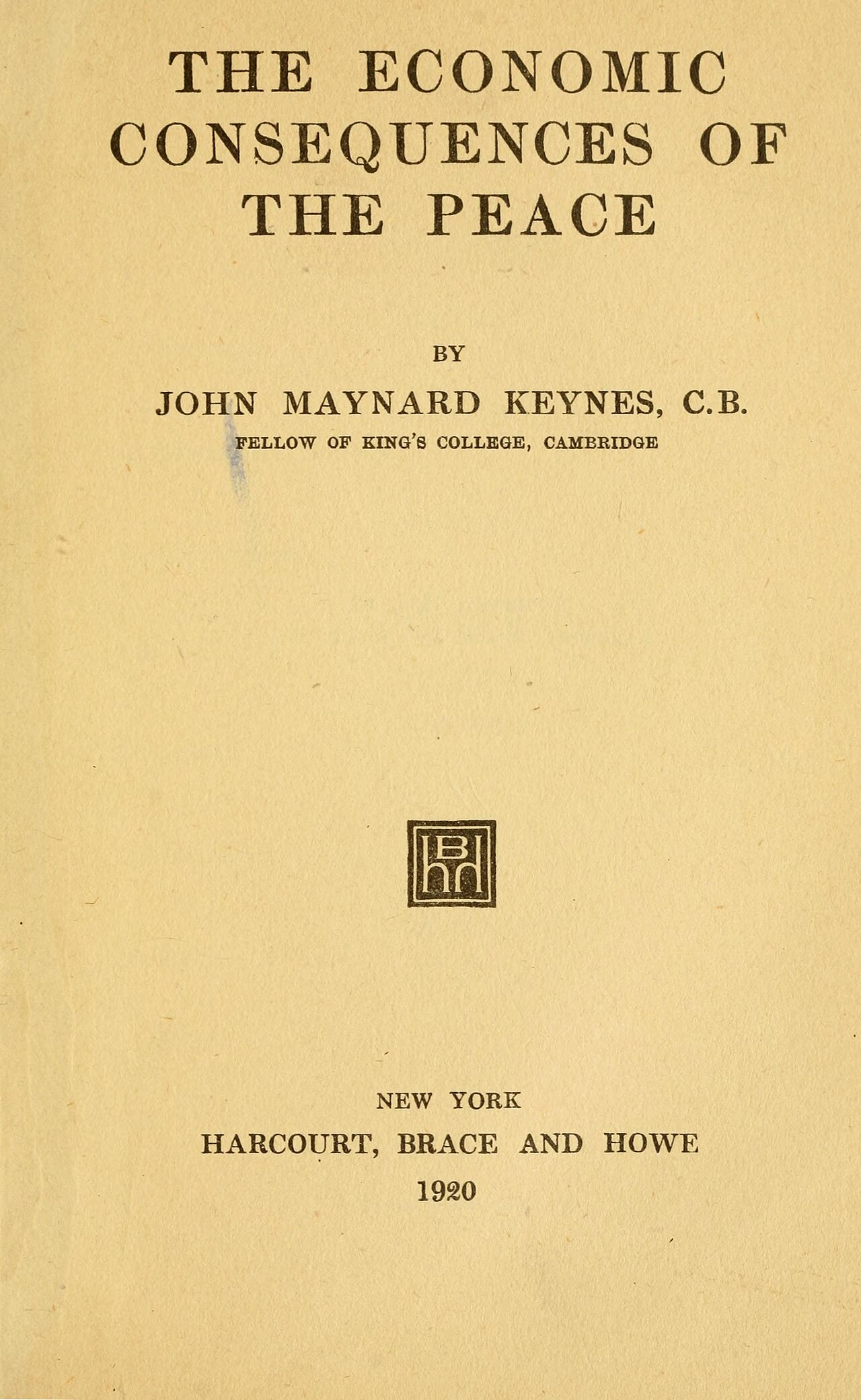
Title page of The Economic Consequences of the Peace by John Maynard Keynes, Fellow of King's College, Cambridge. Published New York by Harcourt, Brace and Howe, 1920. Cream-colored page with a small publisher's device.Book

Primary source

The Economic Consequences of the Peace

John Maynard Keynes · 1919

Black-and-white studio portrait of an older man with short gray hair and rimless pince-nez glasses, wearing a dark suit, white shirt, and dark patterned tie, gazing directly at the camera against a soft gray backdrop.Photograph

Primary source

Portrait of Thomas Woodrow Wilson by Harris & Ewing

Harris & Ewing · 1919

Speech

Primary source

1917 State of the Union Address

Woodrow Wilson · 4 December 1917

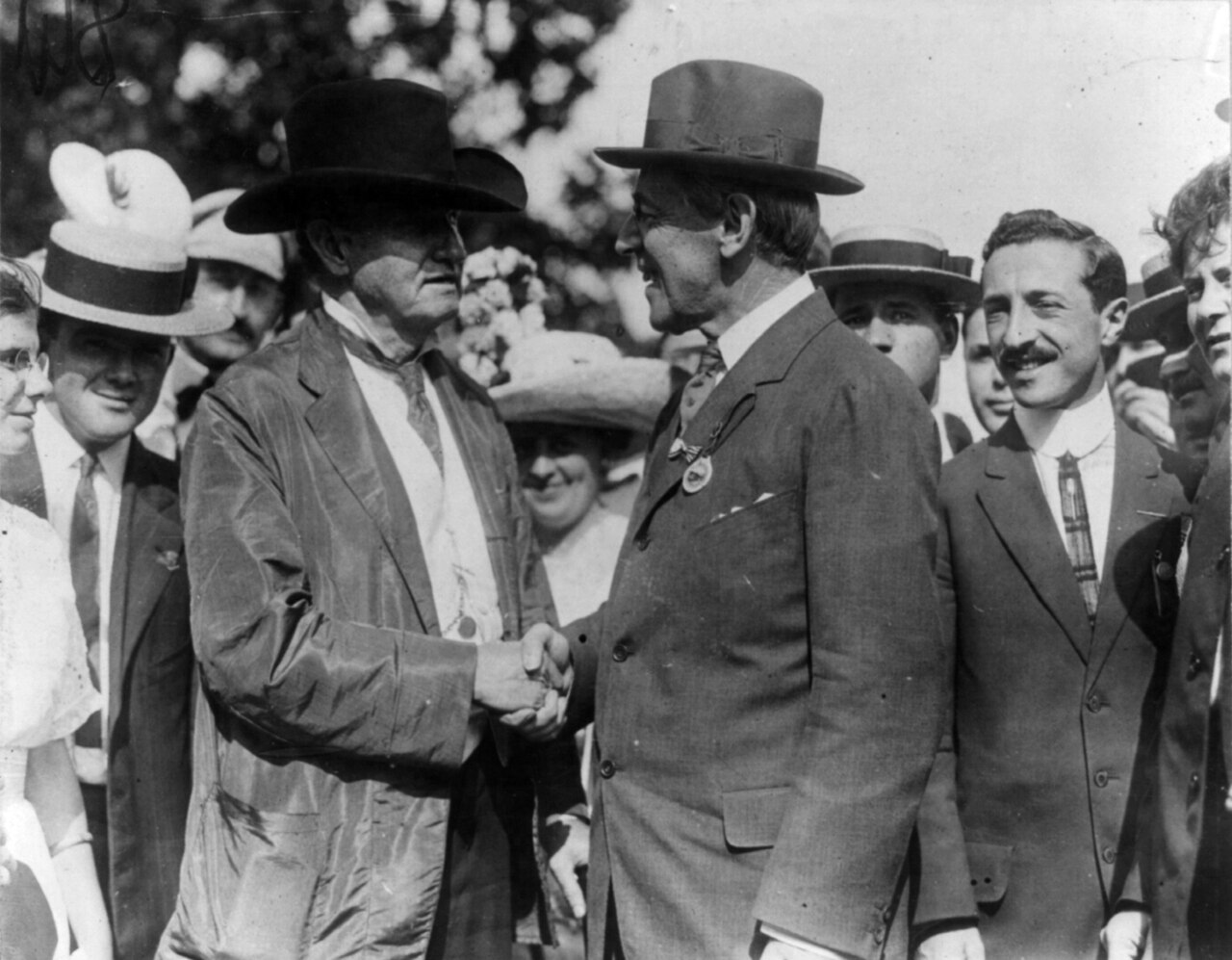
Black-and-white photograph of two men shaking hands outdoors. The older man on the left wears a dark wide-brimmed hat and long coat; the man on the right wears a straw boater, suit, and tie. Onlookers in hats and suits crowd around them.Photograph

Primary source

Benjamin Tillman and Woodrow Wilson

Black-and-white portrait photograph of an older man with light, swept-back hair, wire-rimmed glasses, a white collar and dark suit with a small lapel pin, turned slightly to the side and looking toward the camera against a dark background.Photograph

Primary source

Portrait photograph of Woodrow Wilson

Arnold Genthe · 7 August 1916

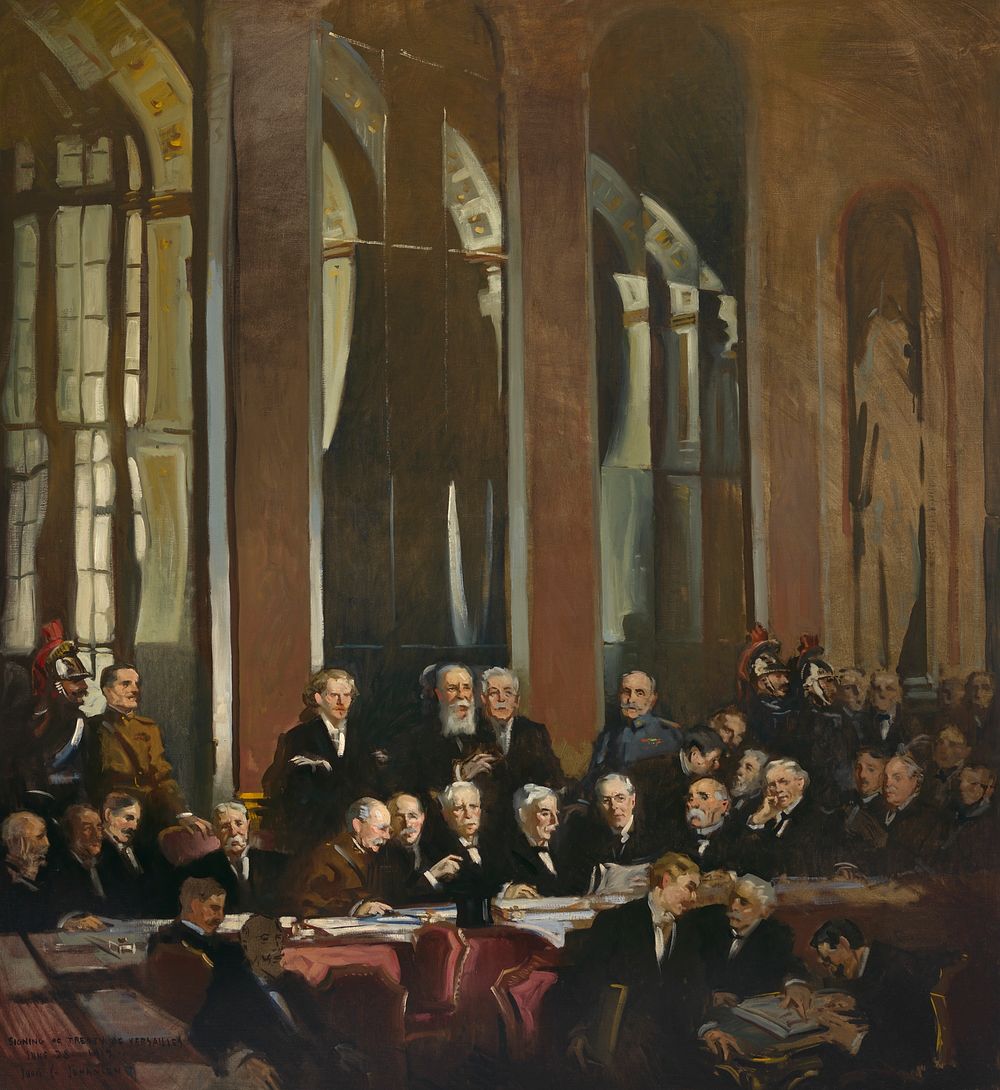
Painting of a grand hall with tall arched windows and marble columns, where men in dark suits and some in military uniforms sit at a long table and stand behind it, signing documents.Painting

Secondary source

Signing of the Treaty of Versailles, 1919

John Christen Johansen · 1919

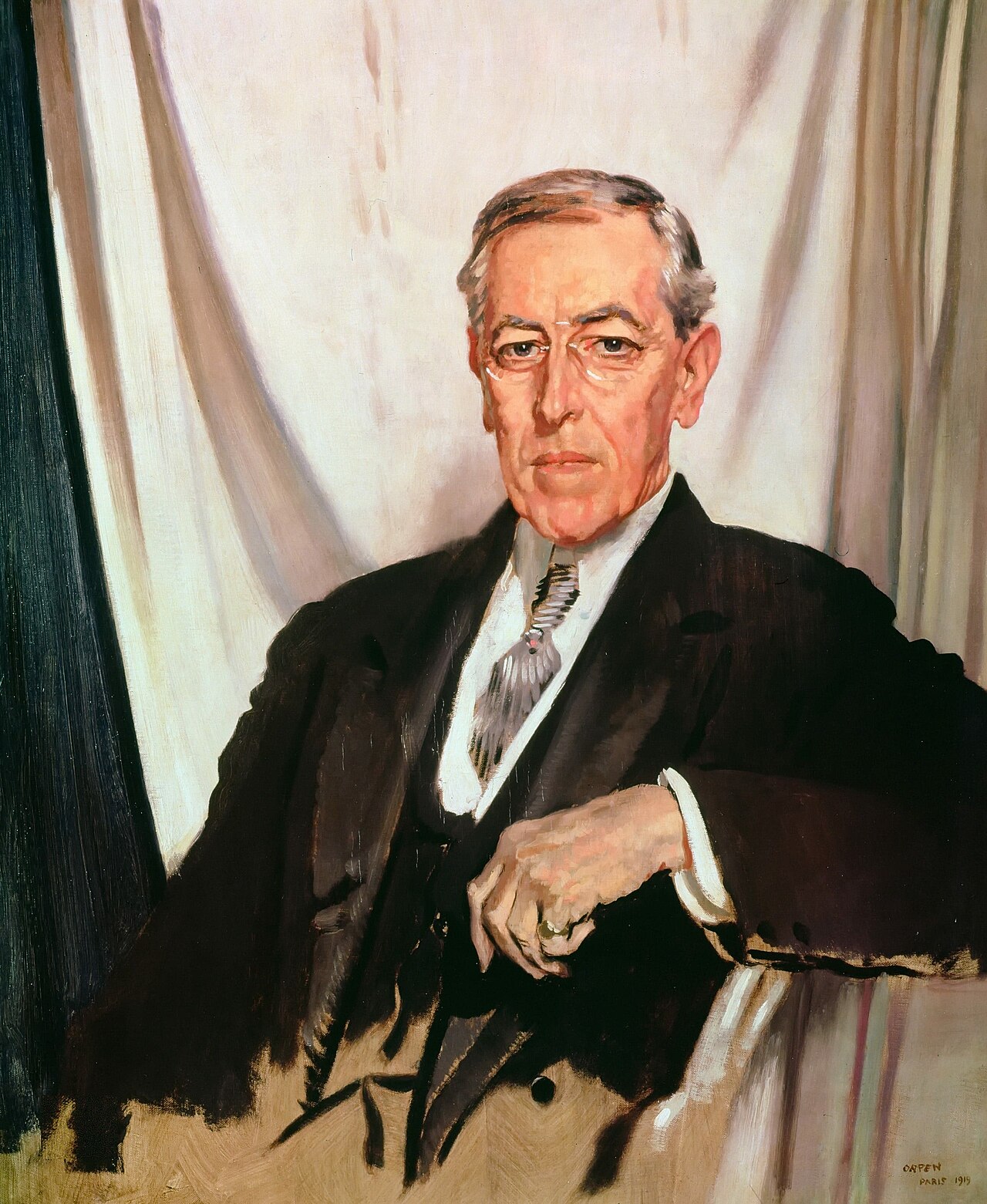
Oil portrait of an older man with gray hair and wire-rimmed glasses, seated and resting one hand on the arm of a chair, wearing a dark suit, white shirt, and patterned gray tie, against a pale draped curtain. Signed 'Orpen Paris 1919' in the lower right.Painting

Primary source

Woodrow Wilson (Orpen portrait)

William Orpen · 1919

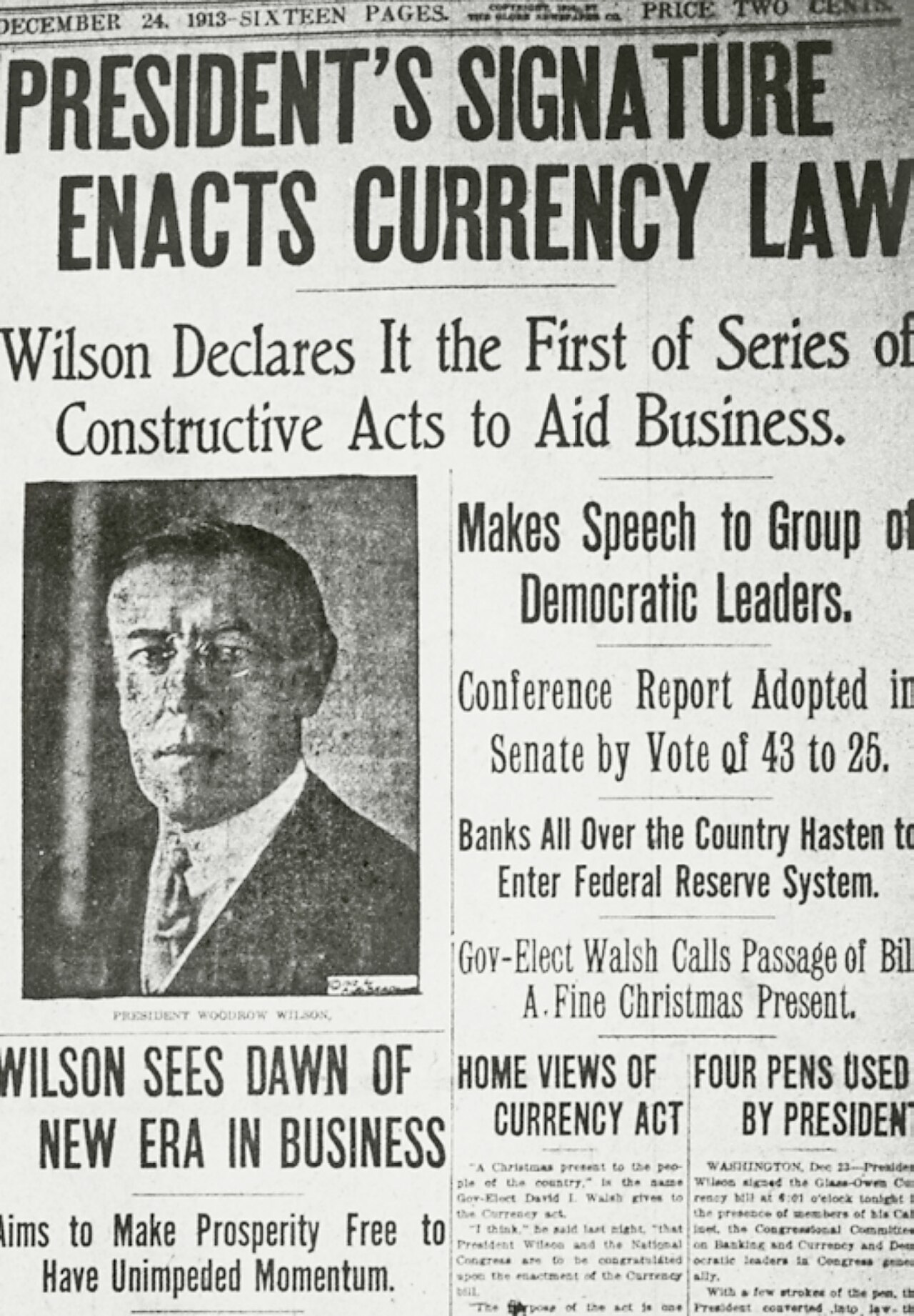
Black-and-white front page of a December 24, 1913 newspaper, headline 'President's Signature Enacts Currency Law', with a portrait photo of President Woodrow Wilson and several smaller headlines and columns of text.Newspaper article

Primary source

Newspaper front page reporting the Federal Reserve Act signing

24 December 1913

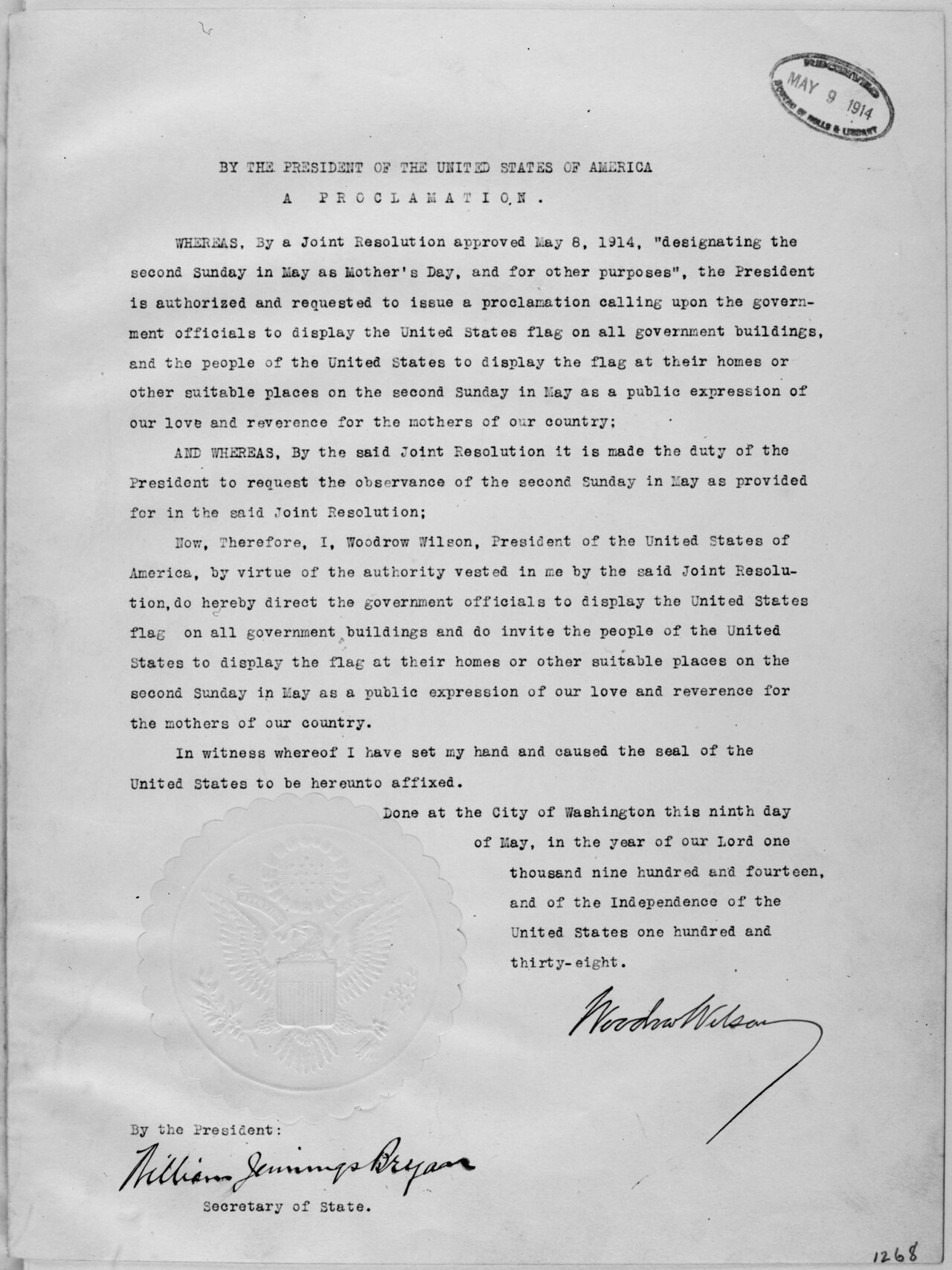
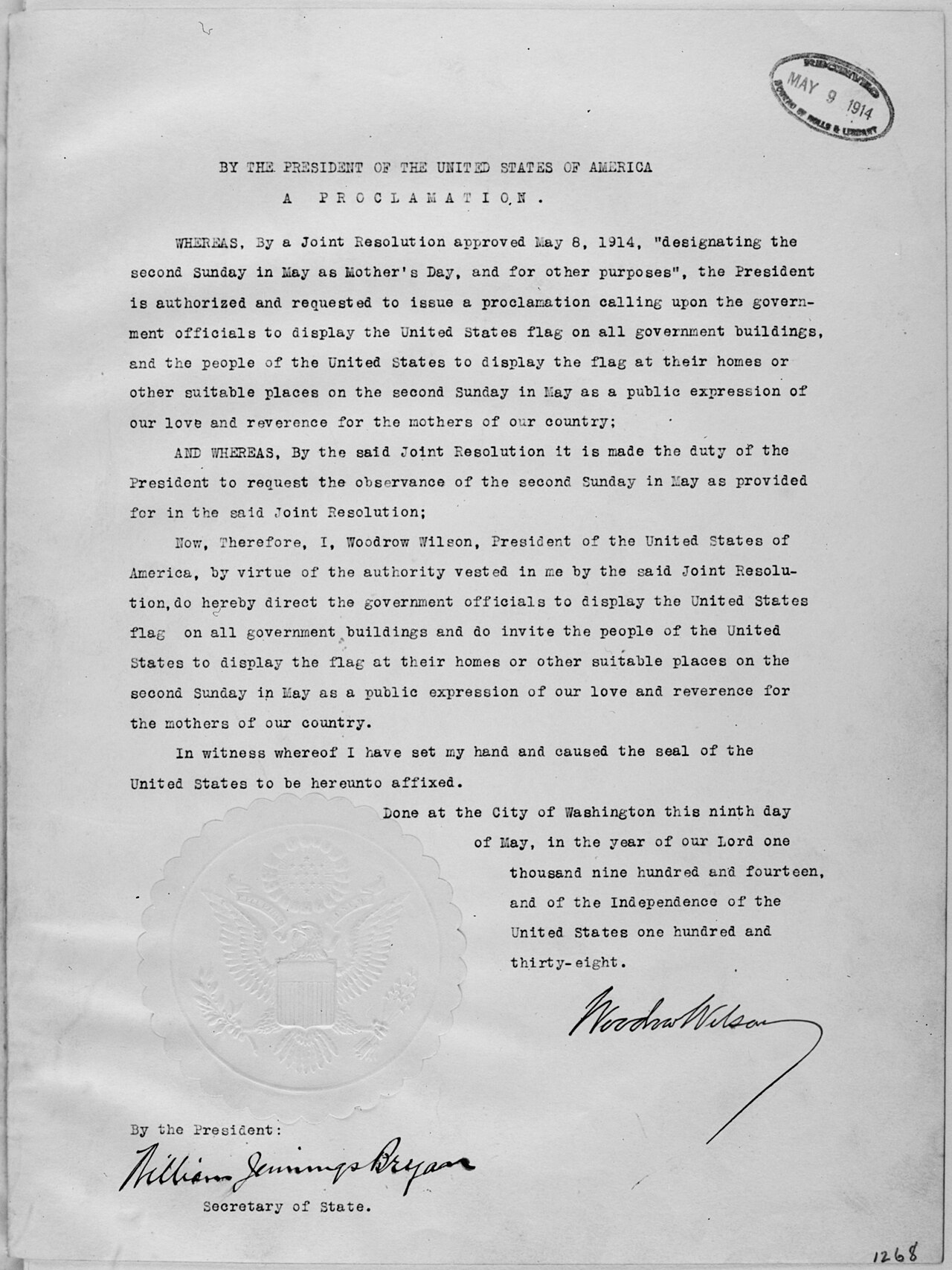
Scan of a typed presidential proclamation titled 'By the President of the United States of America, A Proclamation', dated May 9, 1914, designating Mother's Day. It bears a received stamp, an embossed seal of the United States, Woodrow Wilson's signature, and William Jennings Bryan's signature as Secretary of State.Document

Primary source

Mother's Day Proclamation of May 9, 1914

May 9, 1914

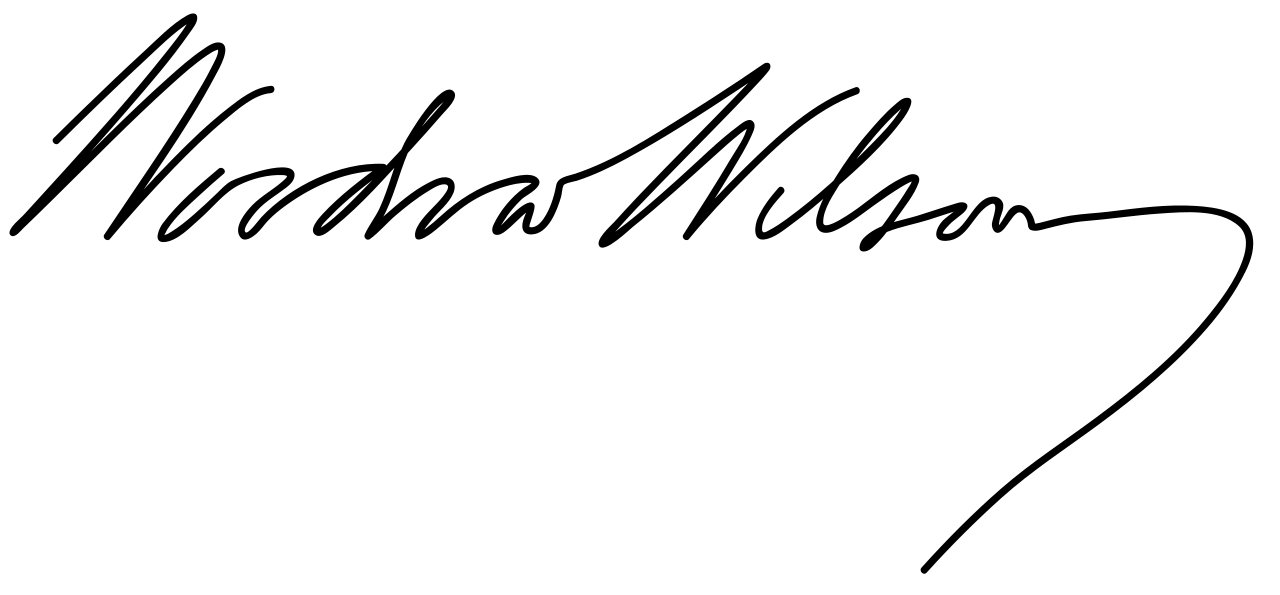
Black cursive handwritten signature on white background, reading 'Woodrow Wilson' with a long trailing flourish extending down to the lower right.Document

Primary source

Signature of Woodrow Wilson

Woodrow Wilson

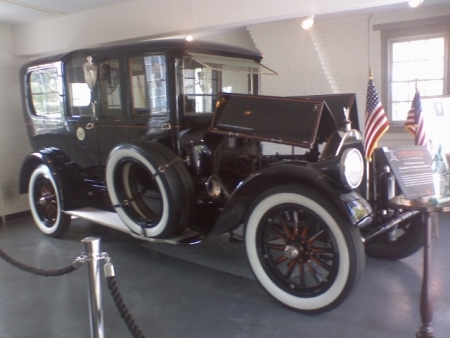
A black 1919 Pierce-Arrow automobile with white-wall tires and a folded-down top, displayed indoors on a gray floor behind silver posts and rope, with American flags in the background.Artifact

Primary source

Wilson's 1919 Pierce-Arrow Limousine

1919

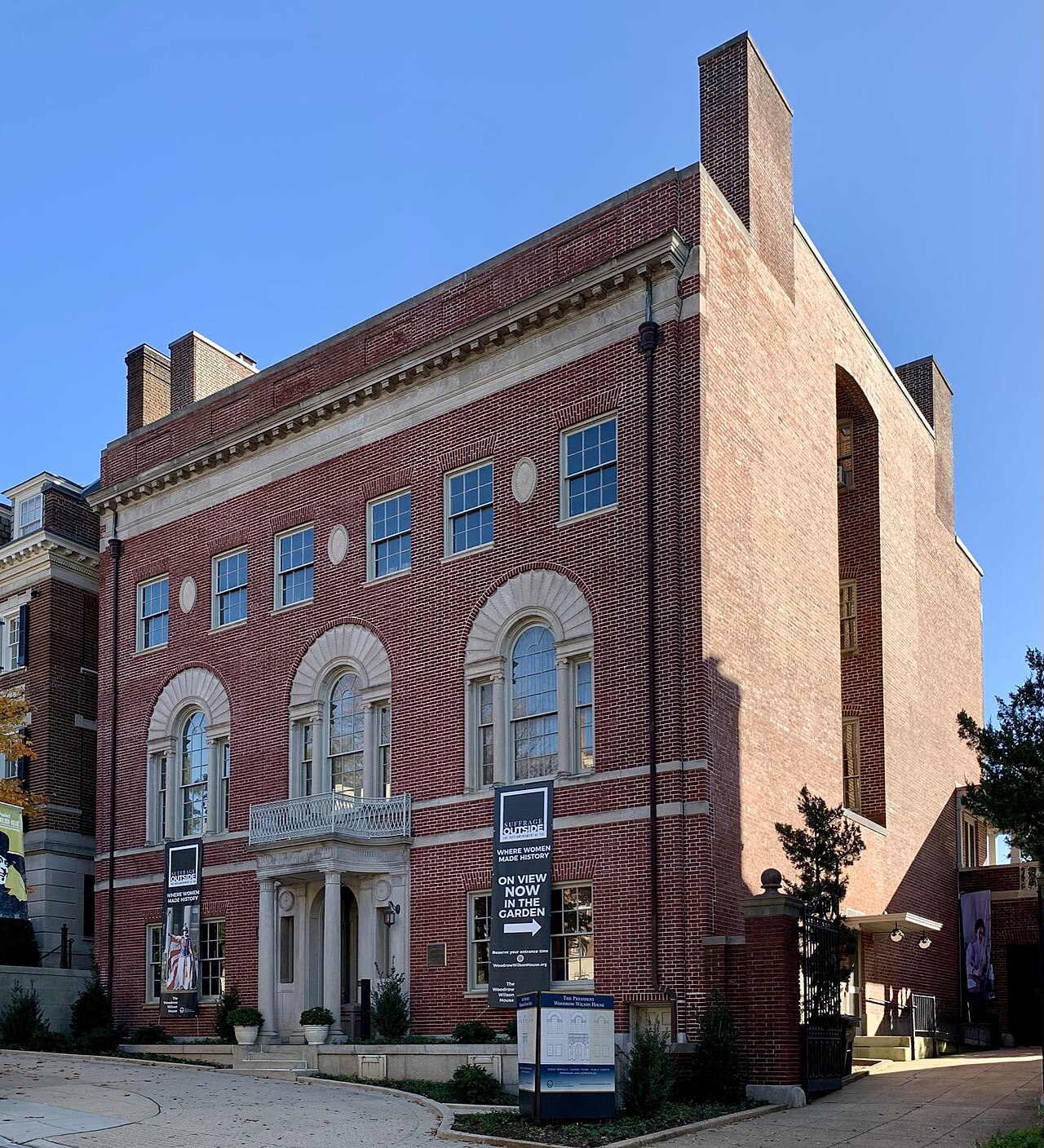
Exterior of a three-story red brick house with white stone trim, arched windows, and a columned front entrance with a small balcony. Banners on the lawn read 'Where Women Made History' and 'On View Now in the Garden'.Artifact

Secondary source

Woodrow Wilson House

Waddy Wood · 1915

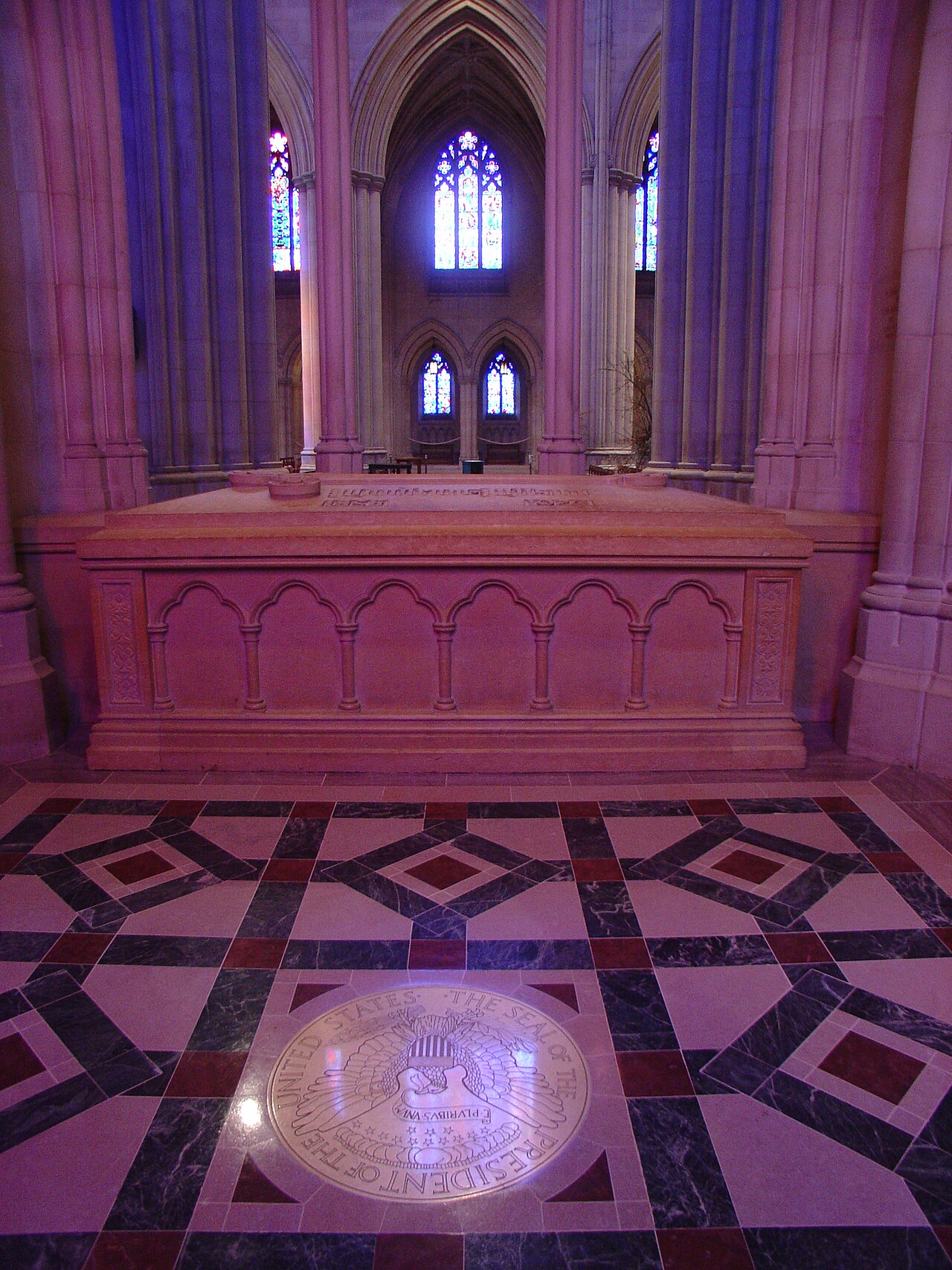
Interior of the Washington National Cathedral's chancel. A pale stone sarcophagus-style tomb with arched panels stands in the center. Its top bears inscription lines. In the floor in front is a circular seal of the President of the United States with an inscription. Tall Gothic pillars and stained glass windows surround the space.Artifact

Secondary source

Tomb of Woodrow Wilson

Speech

Secondary source

Czechoslovakia's Tribute to the Memory of Woodrow Wilson

Tomáš Garrigue Masaryk · 1924

Speech

Primary source

Princeton in the Nation's Service

Woodrow Wilson · 21 October 1896

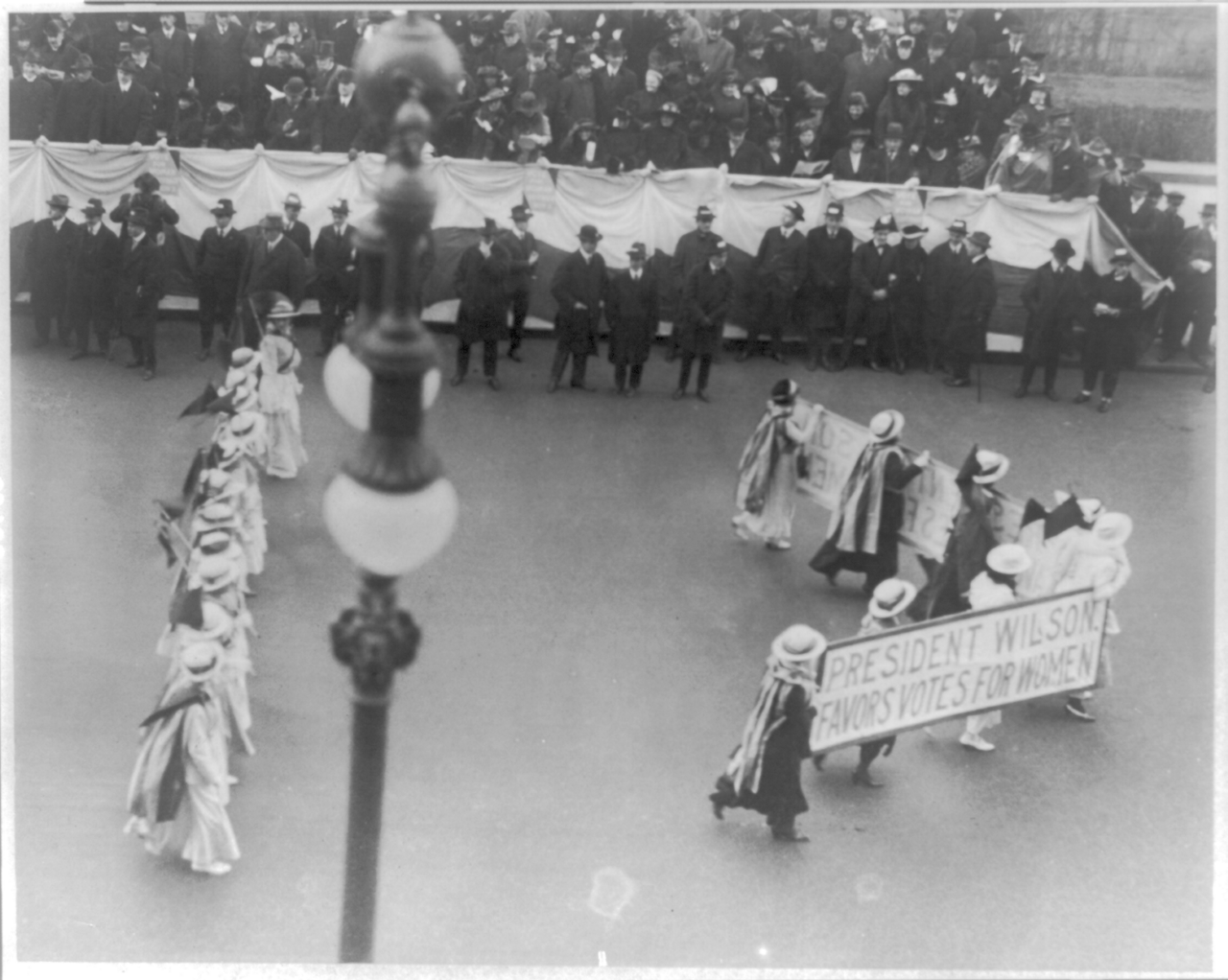
Black and white photograph from above of women suffragists in long dresses and hats marching in a street. One group holds a banner reading 'President Wilson favors votes for women'. Men in dark coats and hats line a crowd behind a white bunting barrier. A lamppost is in the foreground.Photograph

Primary source

Suffragettes parading with banner

George Grantham Bain · ca. 1916

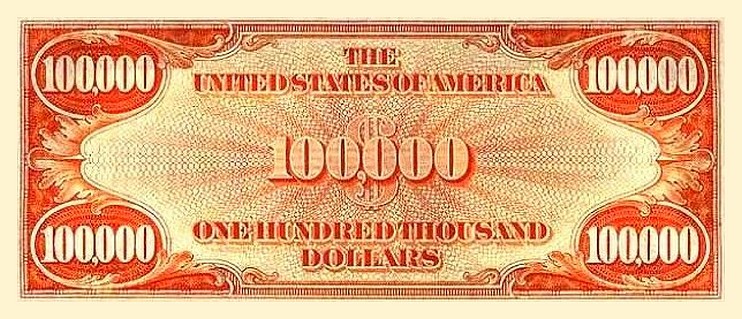
Reverse side of a large red and orange United States one hundred thousand dollar bill. Text reads 'The United States of America' above a central '100,000' and 'One Hundred Thousand Dollars' below, with 100,000 in each corner.Artifact

Secondary source

United States one hundred thousand-dollar bill

1934

Speech

Primary source

Why We Are at War

Woodrow Wilson · 1917

Book

Primary source

The New Freedom

Woodrow Wilson · 1913

Speech

Primary source

In Our First Year of War

Woodrow Wilson · 1917-1918

Book

Primary source

The Peace Negotiations, a personal narrative

Robert Lansing

Speech

Primary source

President Wilson's Addresses

Woodrow Wilson · 1918

Book

Secondary source

Woodrow Wilson and the World War

Charles Seymour · 1921

Book

Secondary source

Woodrow Wilson's Administration and Achievements

Frank B. Lord

Book

Primary source

On Being Human

Woodrow Wilson · 1897

Book

Primary source

When a Man Comes to Himself

Woodrow Wilson · 1901

Book

Primary source

The Road Away from Revolution

Woodrow Wilson · 1923

Book

Secondary source

Woodrow Wilson and World Settlement

Ray Stannard Baker · 1923

Speech

Primary source

Second Inaugural Address of Woodrow Wilson

Woodrow Wilson · 4 March 1917

Speech

Primary source

First State of the Union Address

Woodrow Wilson · 2 December 1913

Speech

Primary source

The Conditions of Peace: Fourteen Points Speech

Woodrow Wilson · 8 January 1918

Book

Primary source

George Washington

Woodrow Wilson · 1896

Woodrow Wilson's Case for the League of NationsBook

Primary source

Woodrow Wilson's Case for the League of Nations

Hamilton Foley · 1923

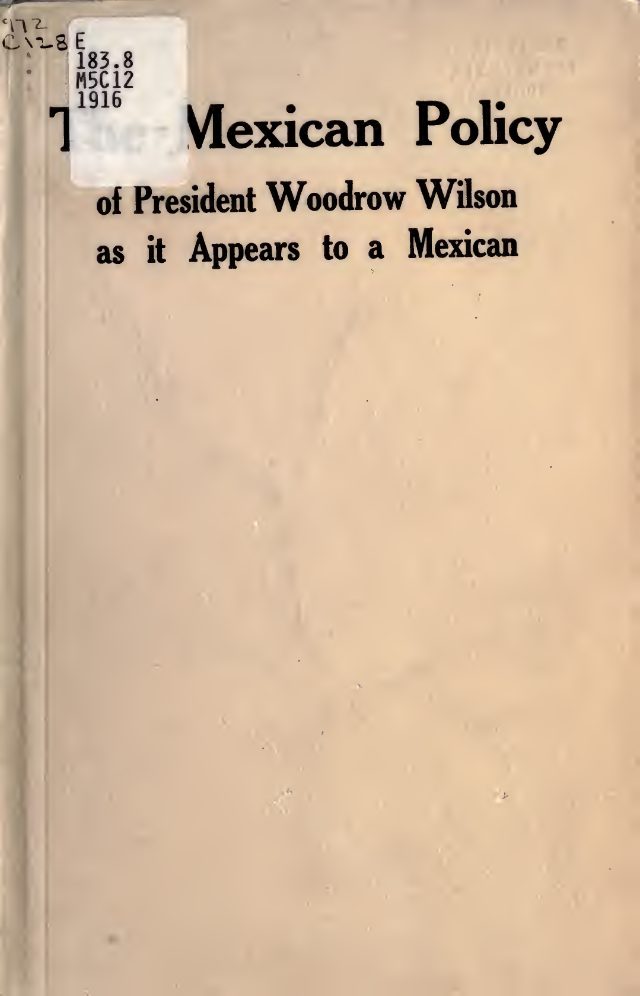
The Mexican Policy of President Woodrow Wilson as It Appears to a MexicanBook

Primary source

The Mexican Policy of President Woodrow Wilson as It Appears to a Mexican

Manuel Calero · 1916

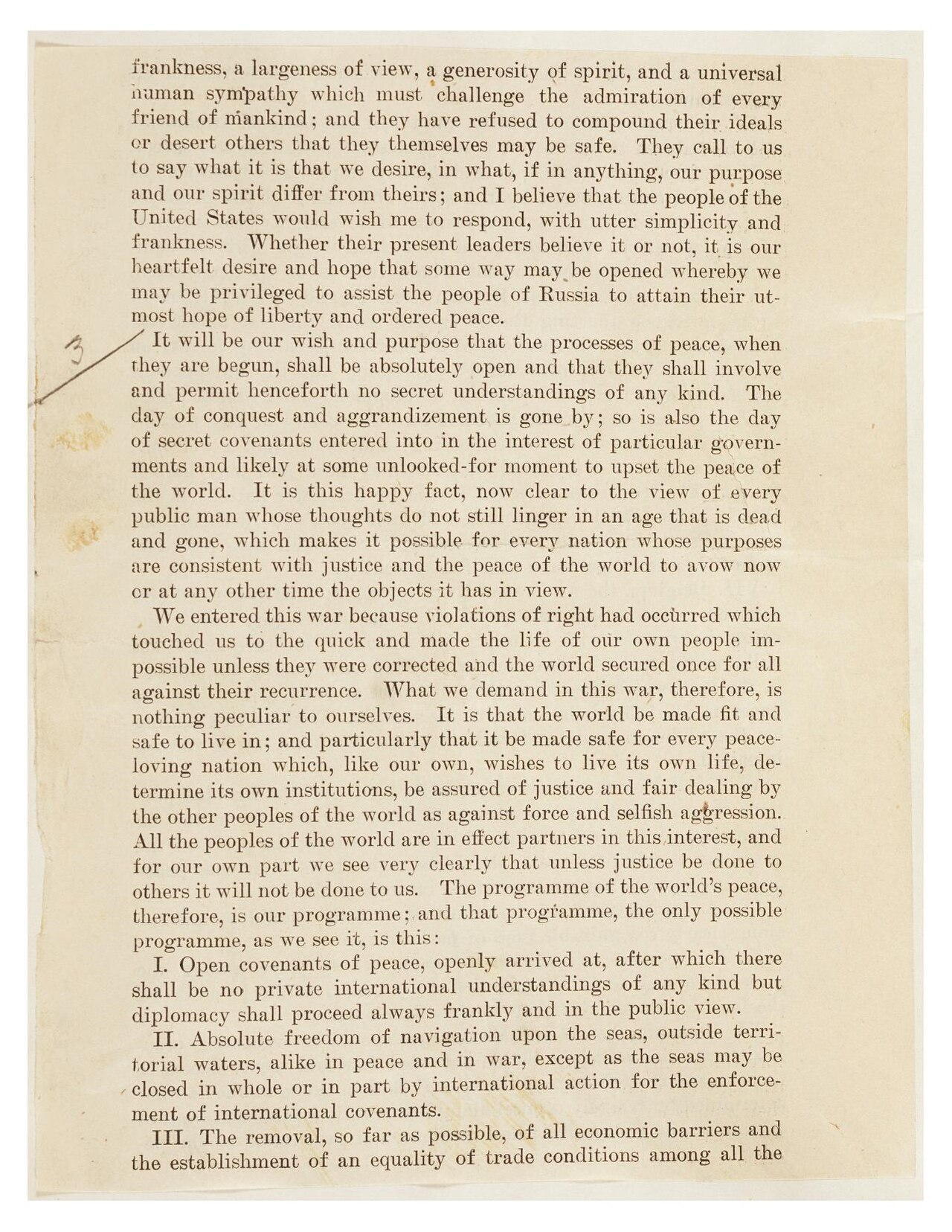
Scanned page of typed text on aged cream paper, showing the opening portion of Wilson's Fourteen Points speech, including the programme of open covenants and freedom of the seas, with a handwritten mark in the left margin.Document

Primary source

Original Fourteen Points Speech, Page 1

Woodrow Wilson · 8 January 1918

Speech

Primary source

Address to the American Indians

Woodrow Wilson · 1913

Speech

Primary source

Address to the American Indians (Audio Recording)

Woodrow Wilson · 1913

Book

Secondary source

The Wilson Administration and the Great War

Ernest W. Young · 1922

Book

Secondary source

Woodrow Wilson: The Man, His Times and His Task

William Allen White · 1924

Book

Secondary source

Woodrow Wilson As I Know Him

Joseph P. Tumulty · 1924

Speech

Primary source

Address to the American Indians

Woodrow Wilson · 1913

Speech

Primary source

The Triumph of Women's Suffrage

Woodrow Wilson · 8 September 1916

Document

Primary source

The President's Note to Russia

Woodrow Wilson · 22 May 1917 (published 9 June 1917)

Document

Primary source

President Wilson's Peace Note, December 18, 1916

Woodrow Wilson and Robert Lansing · 18 December 1916

Document

Primary source

Formal U.S. Declaration of War with Germany

United States Congress · 6 April 1917

Book

Primary source

The New Democracy

Woodrow Wilson · 1913

Book

Primary source

An Old Master and Other Political Essays

Woodrow Wilson · 1893

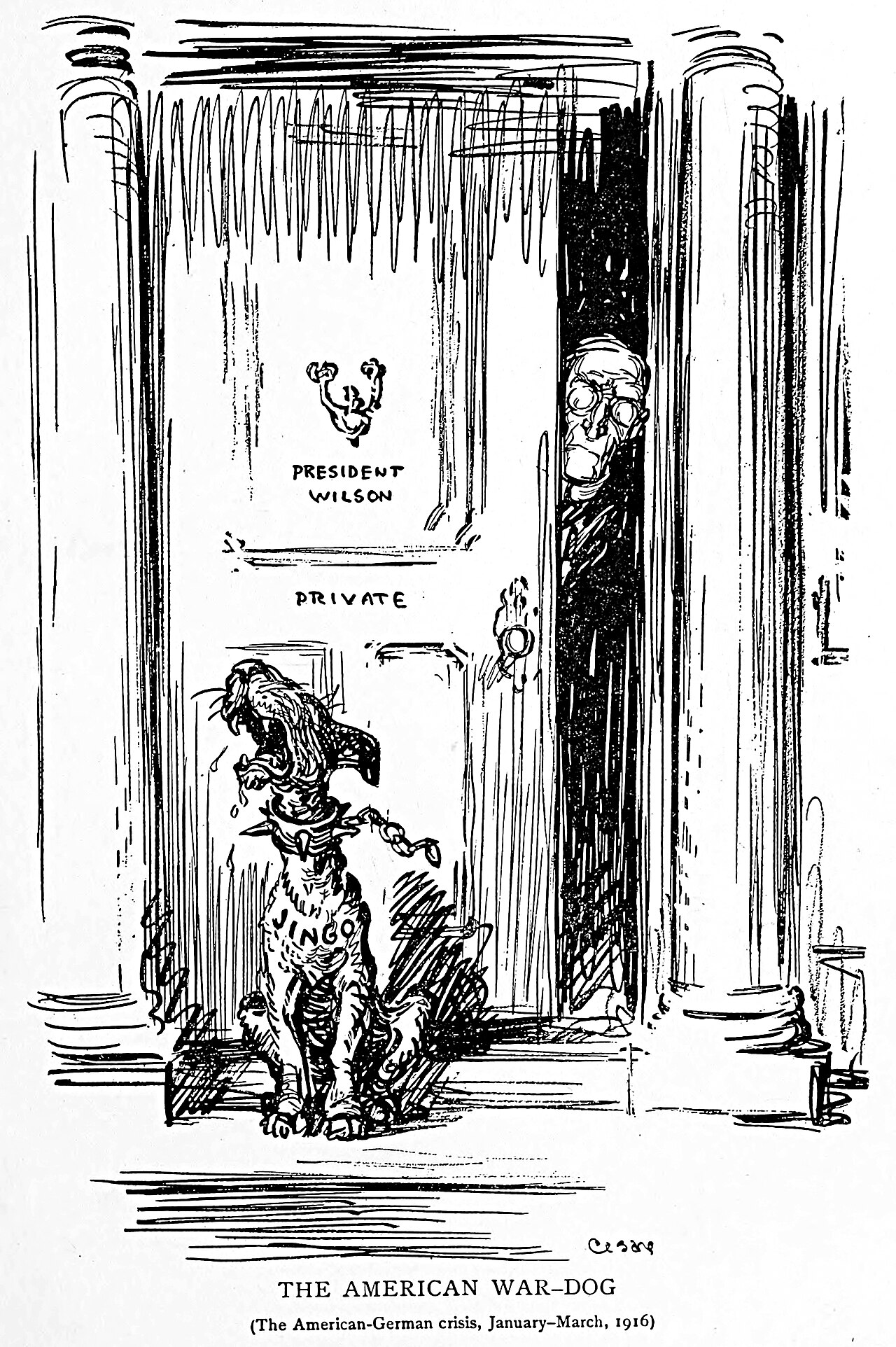
Pen-and-ink cartoon titled The American War-Dog. A snarling, chained dog labeled JINGO stands on a doorstep under a door marked PRESIDENT WILSON and PRIVATE. A bespectacled man peers out from the doorway at the dog.Painting

Primary source

The American War-Dog

Oscar Cesare · 1916

Address of President Woodrow Wilson at Swarthmore CollegeSpeech

Primary source

Address of President Woodrow Wilson at Swarthmore College

Woodrow Wilson · 25 October 1913

The Frontier between Armenia and Turkey as Decided by Wilson, 1920Document

Primary source

The Frontier between Armenia and Turkey as Decided by Wilson, 1920

Armenian National Committee · 1920

Scan of a typed presidential proclamation dated May 9, 1914, with the United States seal embossed at lower left, a signature of Woodrow Wilson at lower right, and a signature of William Jennings Bryan below left. A May 9 1914 receipt stamp appears top right.Document

Primary source

Wilson's Mother's Day Proclamation

Woodrow Wilson · 9 May 1914

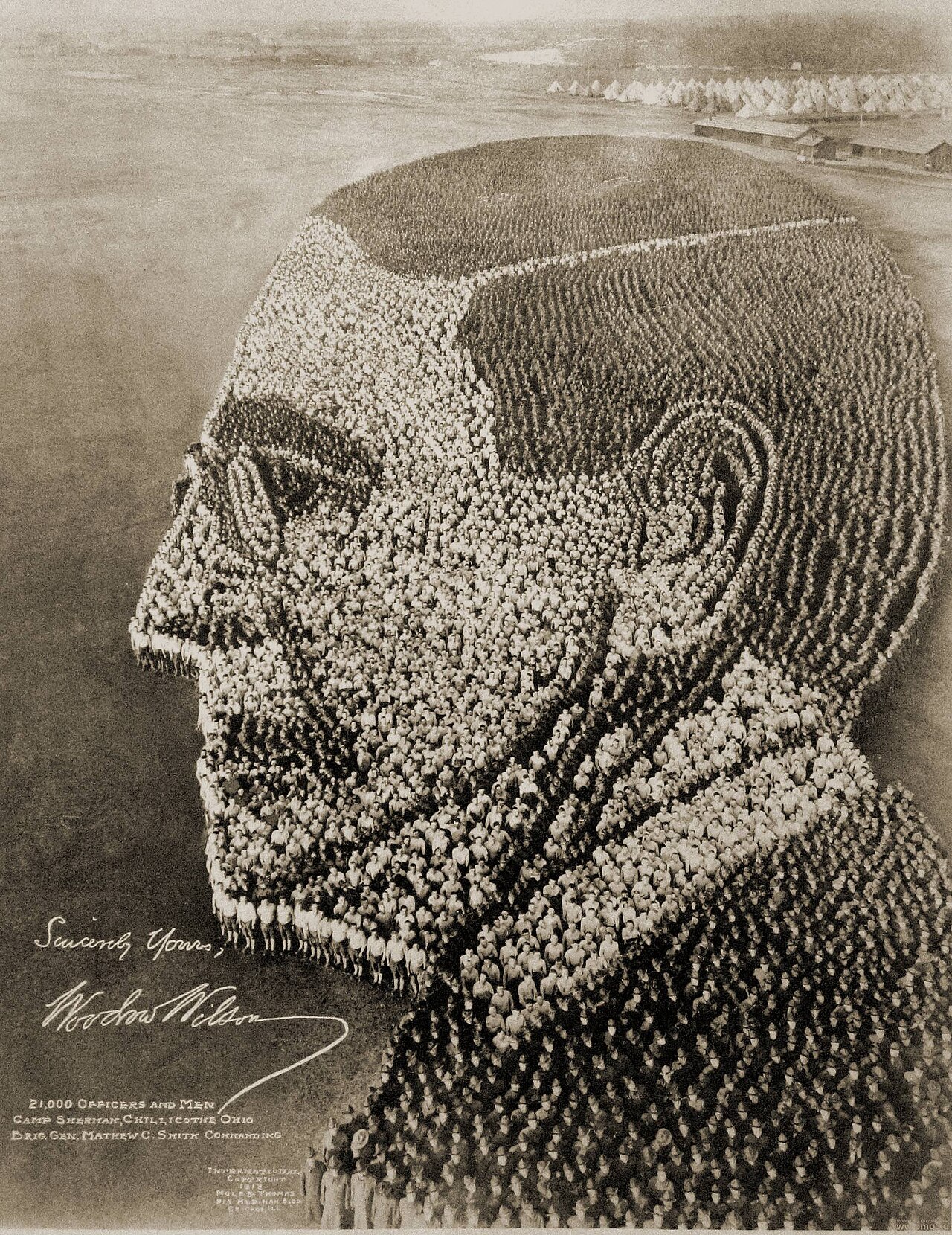
Aerial photograph of thousands of soldiers arranged in formation on a field to form a giant portrait of Woodrow Wilson in profile. Tents and barracks sit at the top right. Handwritten signature 'Sincerely yours, Woodrow Wilson' and caption text appear at lower left.Photograph

Primary source

Woodrow Wilson Portrait Formed by Soldiers, Camp Sherman

Arthur Samuel Mole · 1918

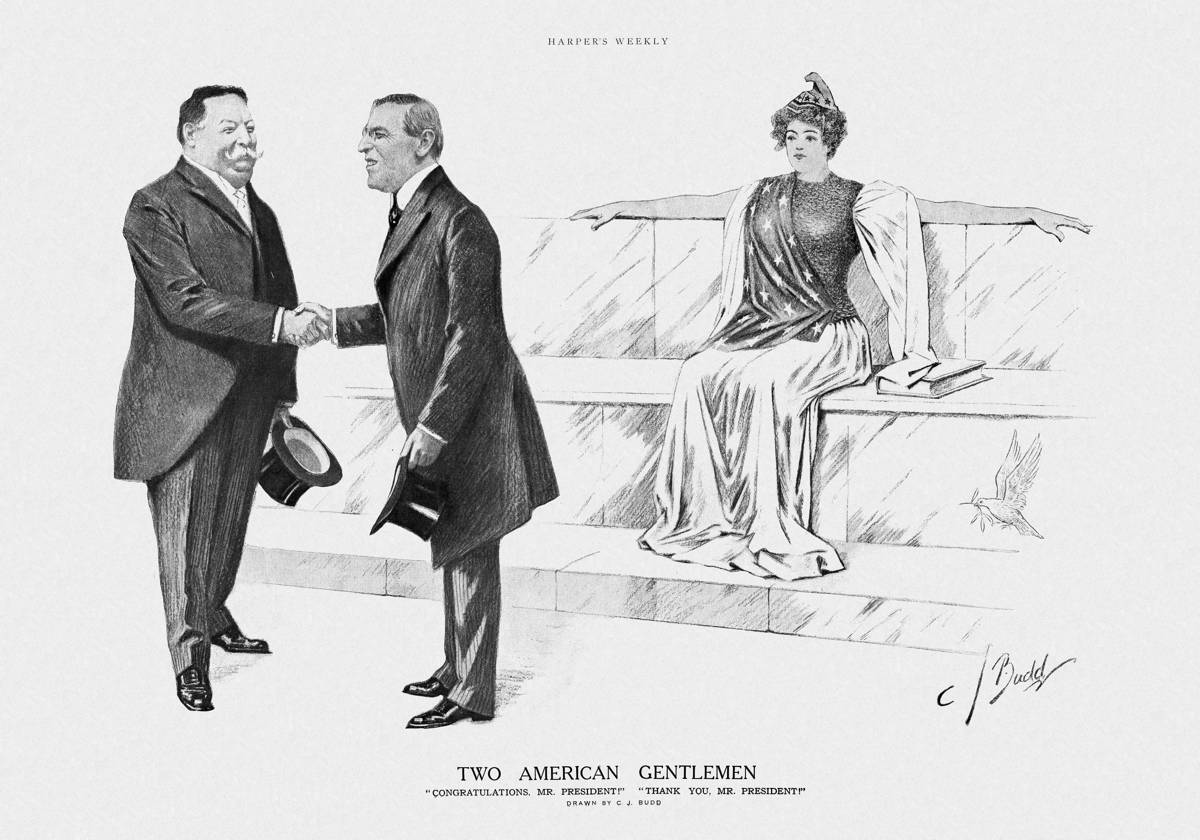
Black-and-white cartoon titled 'Two American Gentlemen' from Harper's Weekly. Two men in suits shake hands on the left; the man on the left holds a top hat and has a large mustache, and the man on the right holds a silk hat. A seated woman in a draped star-spangled robe with a cap of stars sits on a stone bench on the right, arms outstretched, with a book beside her. A dove is shown near the bench. Caption reads 'Congratulations, Mr. President' and 'Thank you, Mr. President'.Painting

Primary source

Two American Gentlemen

Charles Jay Budd · 9 November 1912

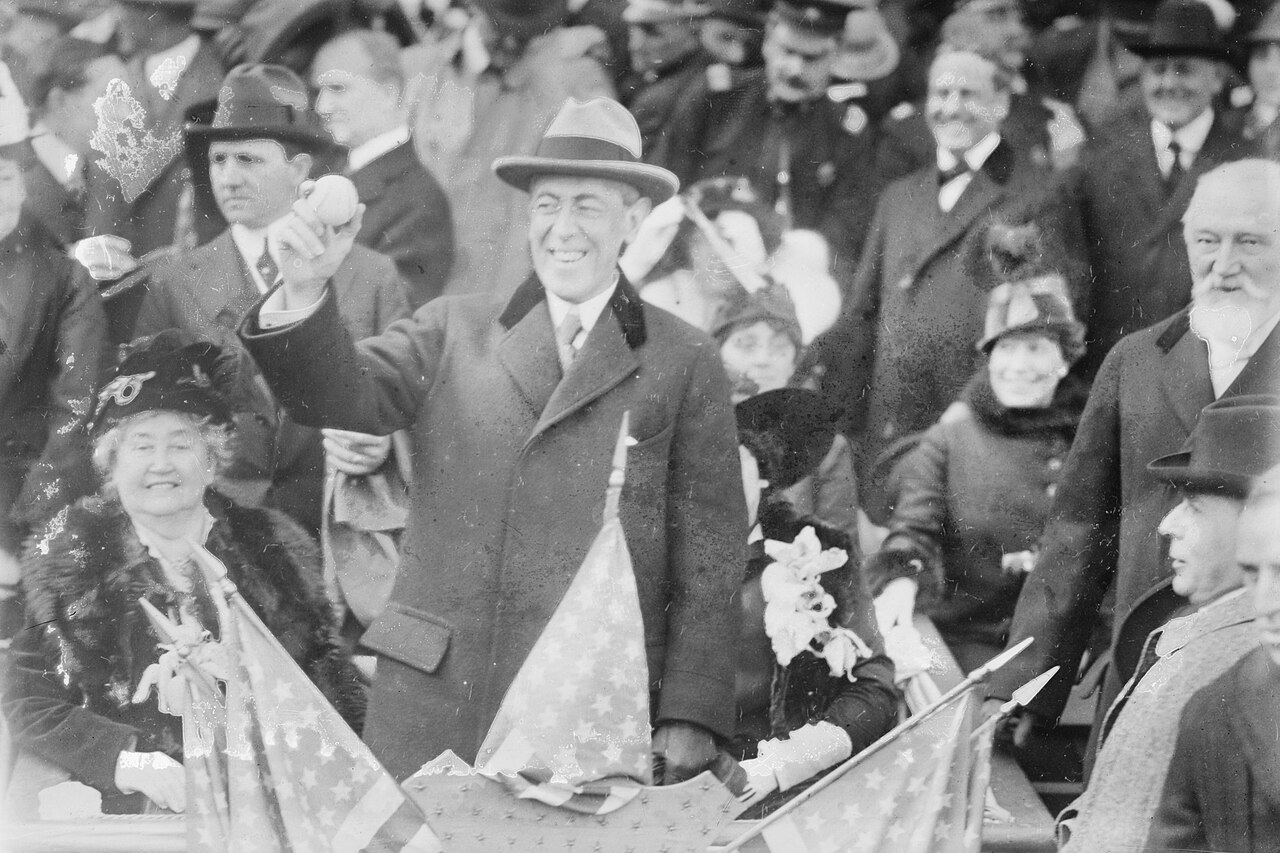
Black-and-white photograph of a smiling man in a fedora and overcoat raising a baseball in his right hand, standing in a crowd of men in hats and coats. A smiling older woman in a fur-trimmed hat is at left, and a bearded older man is at right.Photograph

Primary source

Wilson Throws First Pitch, 1915 World Series

Bain News Service · 9 October 1915

Speech

Primary source

Wilson Speaks on American Indian Affairs

Woodrow Wilson · 1913

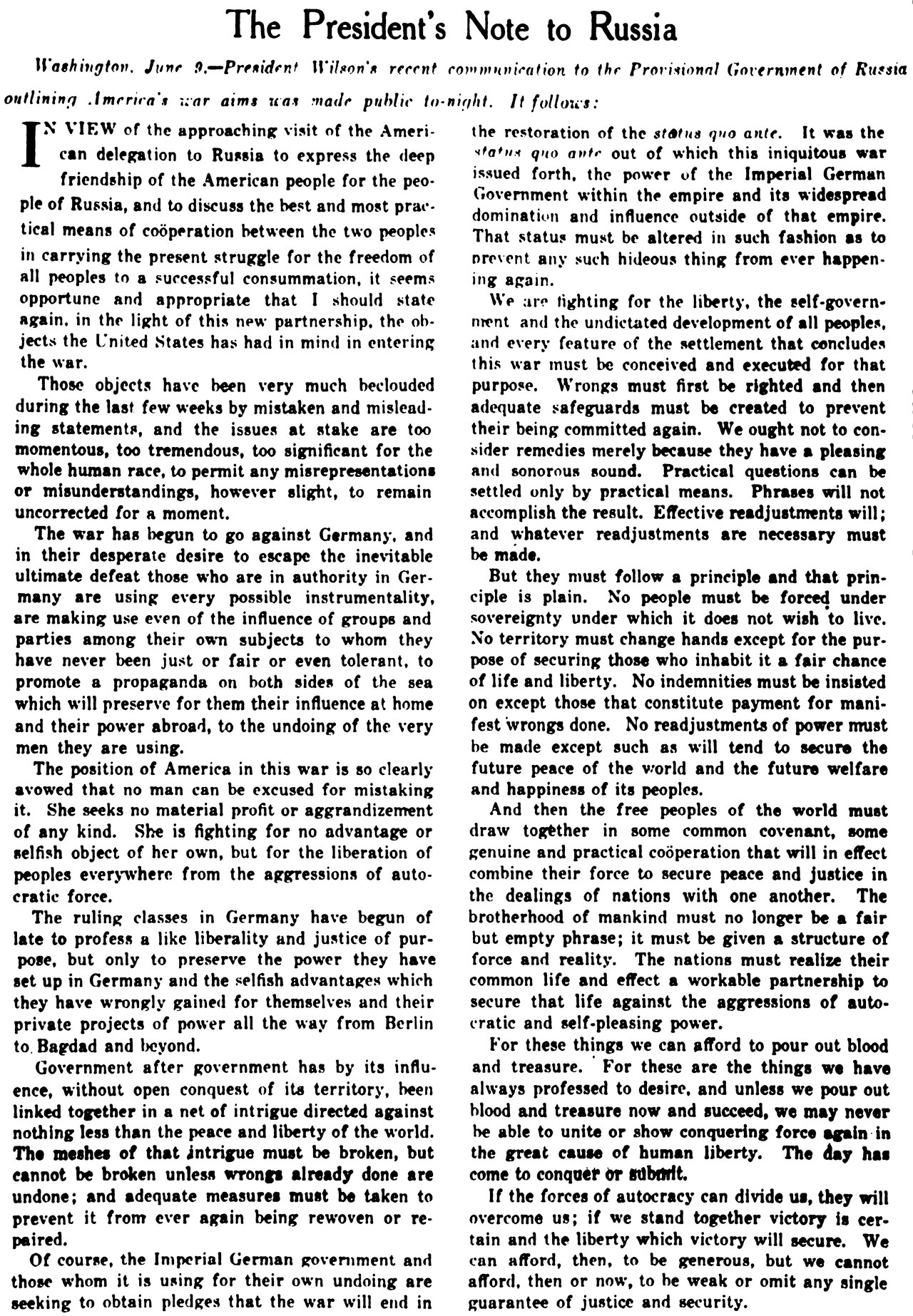
Scanned newspaper page titled 'The President's Note to Russia', dated Washington, June 9, with a dateline and subheading about America's war aims, followed by two columns of body text in a 1917 newspaper typeface.Newspaper article

Primary source

The President's Note to Russia

Woodrow Wilson · 10 June 1917

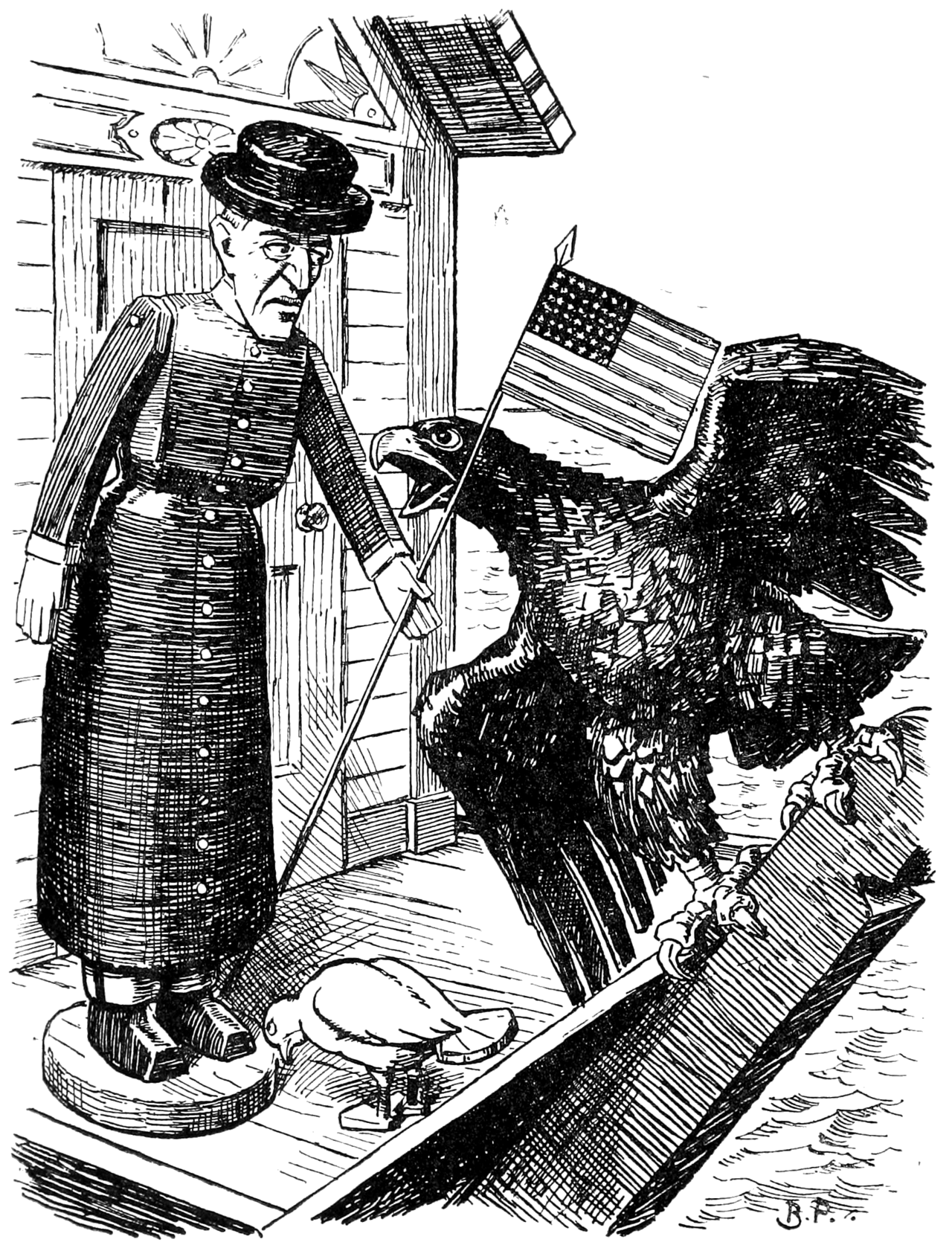
Line-drawn cartoon: an elderly man in a tall hat and long coat stands on a platform beside a small dove, facing a large eagle with spread wings that holds an American flag on a pole and grips a ledge with its talons. Signed 'B.P.' in the lower right corner.Painting

Primary source

Some Bird: The Returning Dove

John Bernard Partridge · 16 June 1915

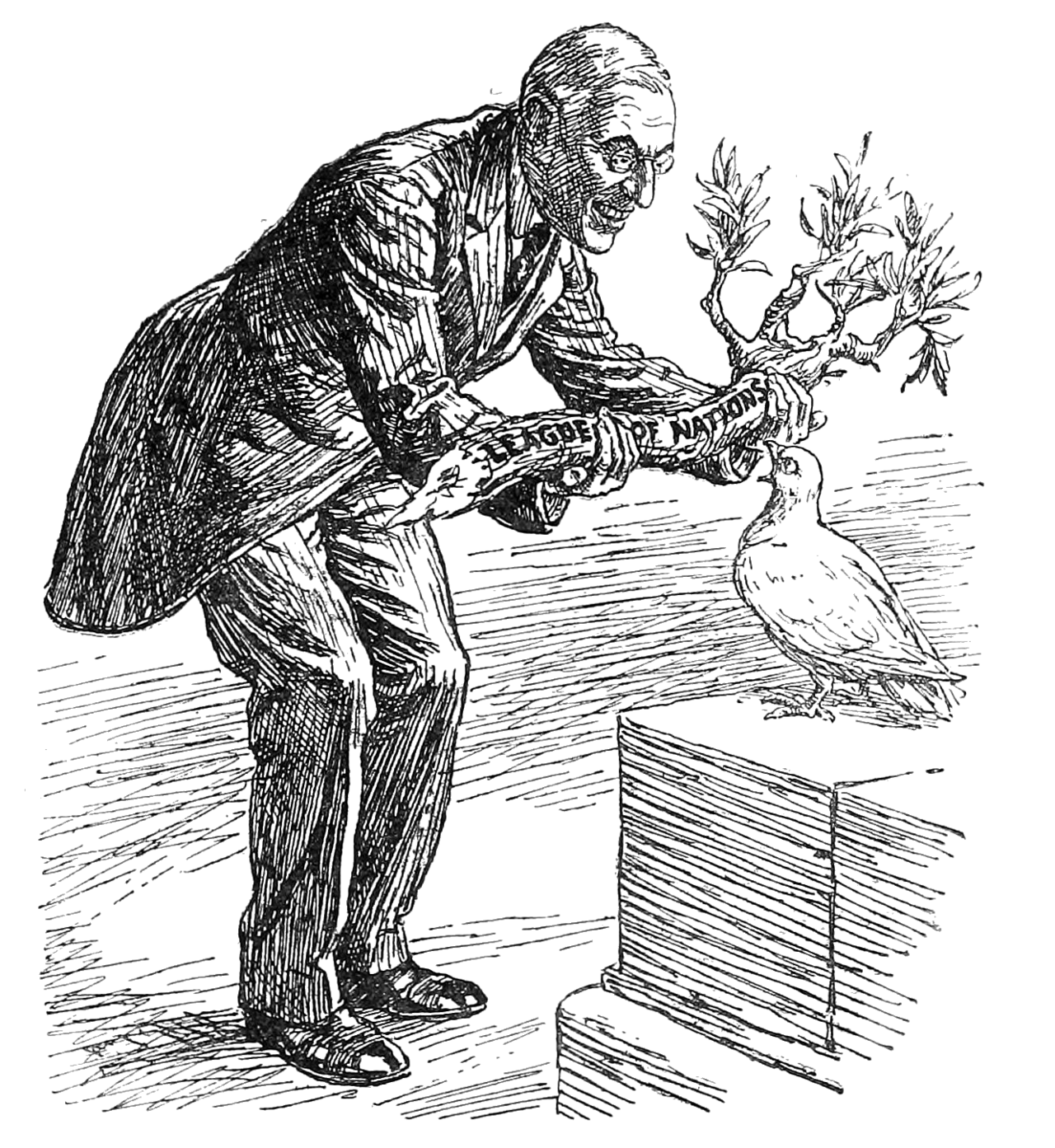
Pen-and-ink cartoon of a stooped, bald man with glasses offering an olive branch labeled LEAGUE OF NATIONS to a white dove perched on a block. The branch is heavy and the man looks strained.Painting

Primary source

Overweighted: President Wilson and the Dove of Peace

John Bernard Partridge · 26 March 1919

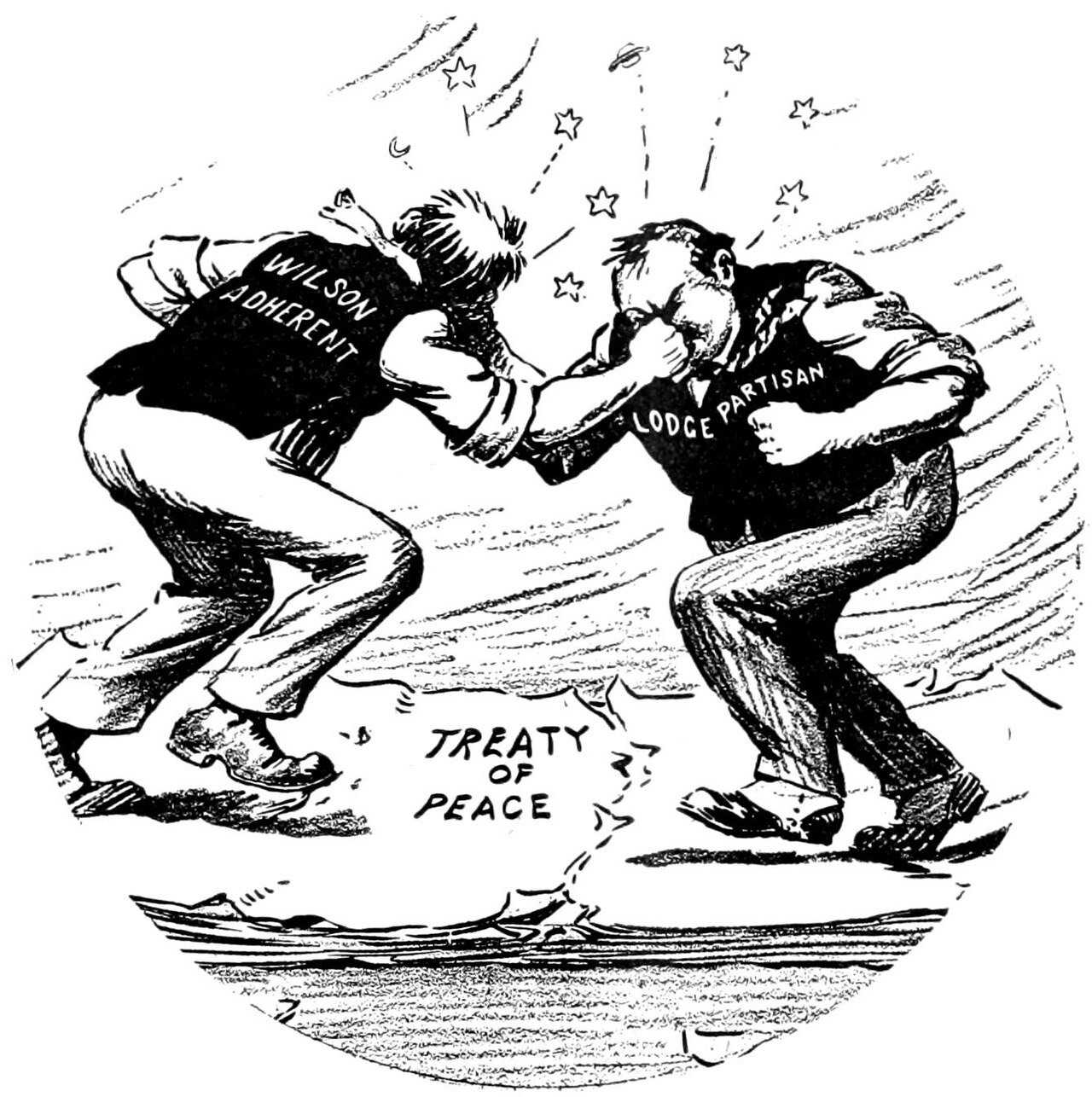
Black and white editorial cartoon showing two men in a boxing-like clinch, one labeled 'Wilson Adherent' with a fist raised, the other labeled 'Lodge Partisan' grabbing him by the face. Between them the words 'Treaty of Peace' appear on the ground, and stars and a crescent are drawn in the sky above.Painting

Primary source

Getting Together on the Peace Treaty

Nelson Harding · by 22 May 1920

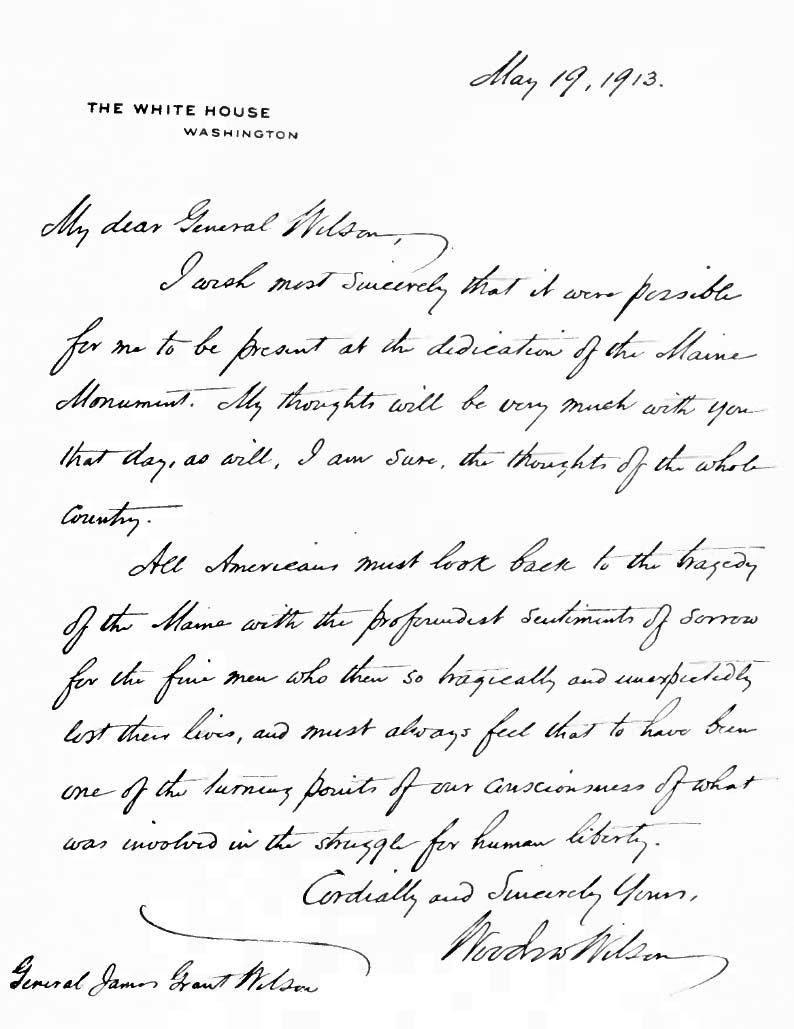
Handwritten letter on White House letterhead, dated May 19, 1913, from Woodrow Wilson to General James Grant Wilson, expressing regret at not attending the dedication of the Maine Monument and reflecting on the sinking of the Maine. Signed Woodrow Wilson.Letter

Primary source

Letter from Woodrow Wilson to James Grant Wilson about a monument

Woodrow Wilson · 19 May 1913

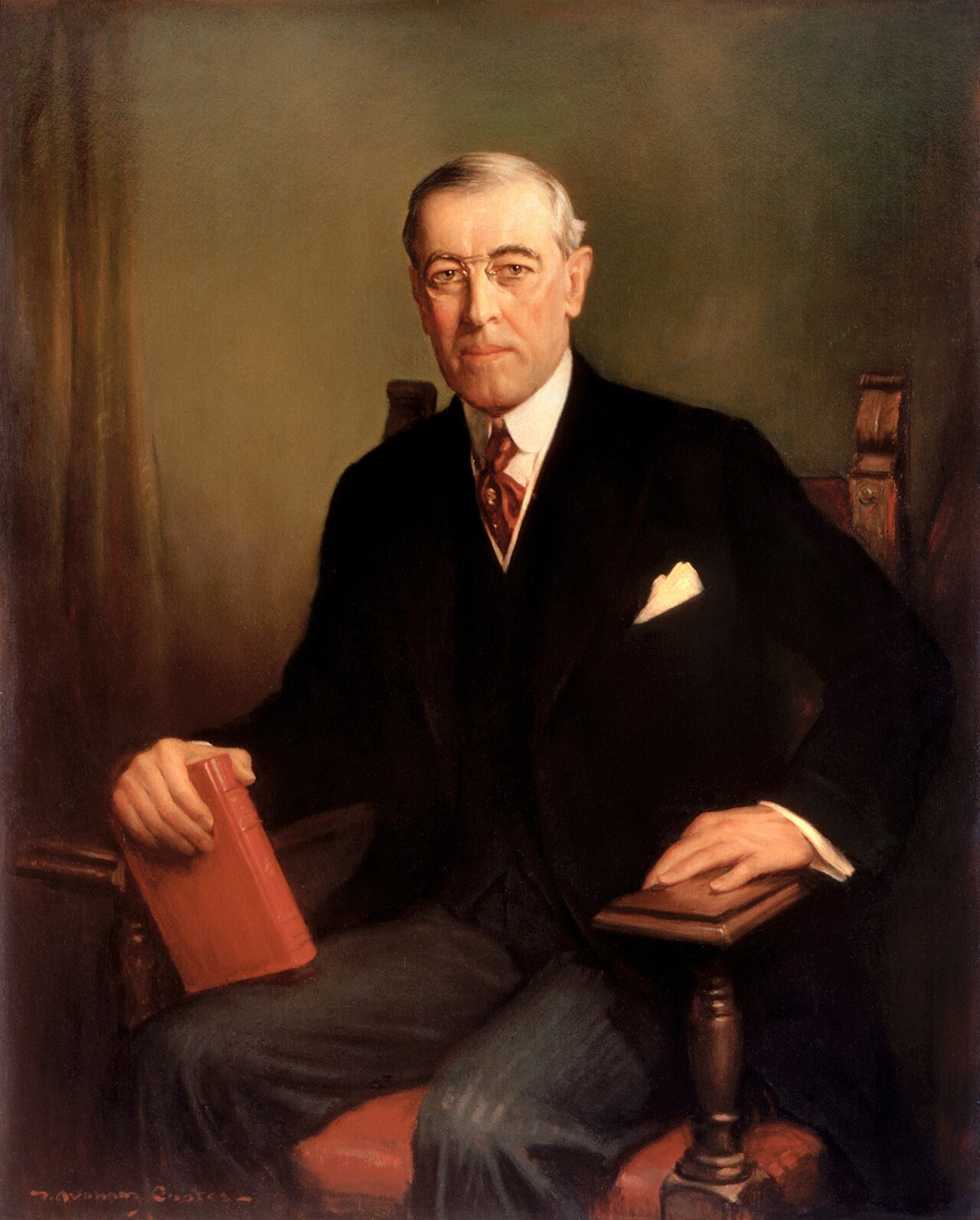
Oil painting of a seated man with white hair and round wire-rimmed glasses, wearing a dark suit, white shirt, and red patterned tie. He holds a red book on his left knee and rests his right hand on a wooden armrest. Dark olive background with a drape at left.Painting

Secondary source

Official White House Portrait of Woodrow Wilson

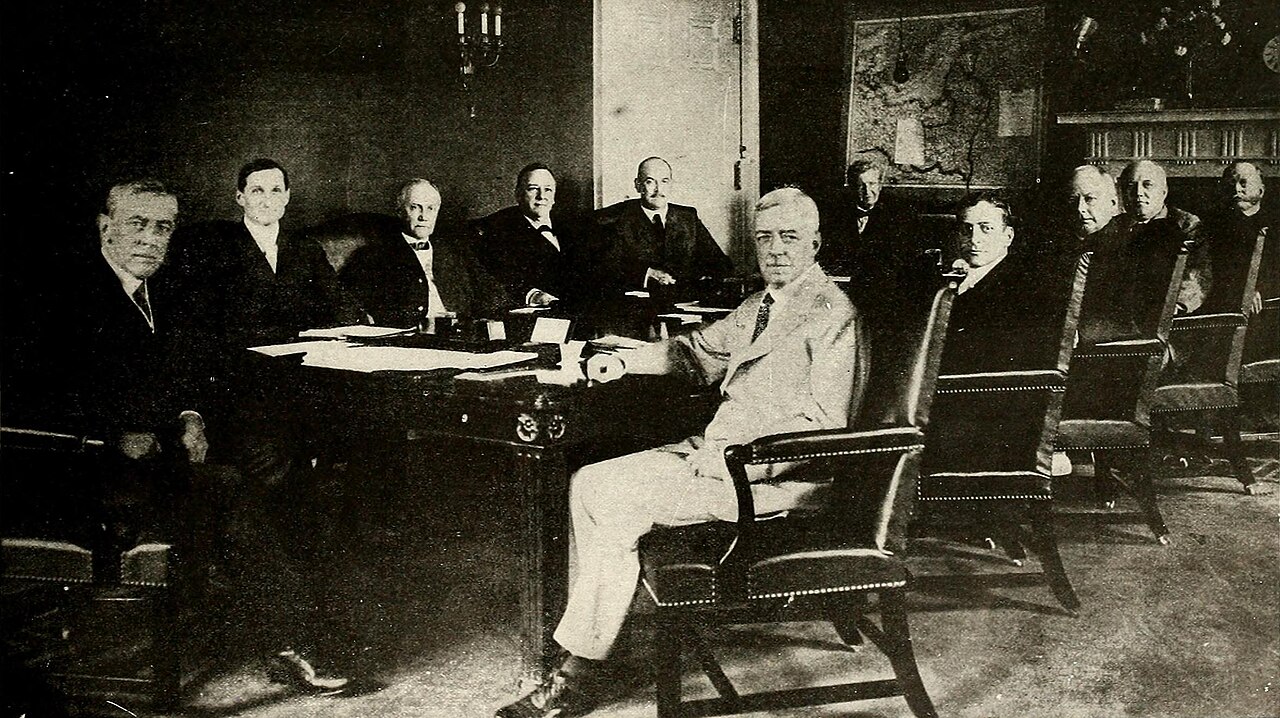
Black-and-white photograph of a group of men in suits seated around a large wooden desk in an office with a wall map and leather chairs. A man in a light suit sits at the desk front, looking at the camera, while others sit along the table and behind it.Photograph

Primary source

President Wilson and His War Cabinet

G. V. Buck · published 1918

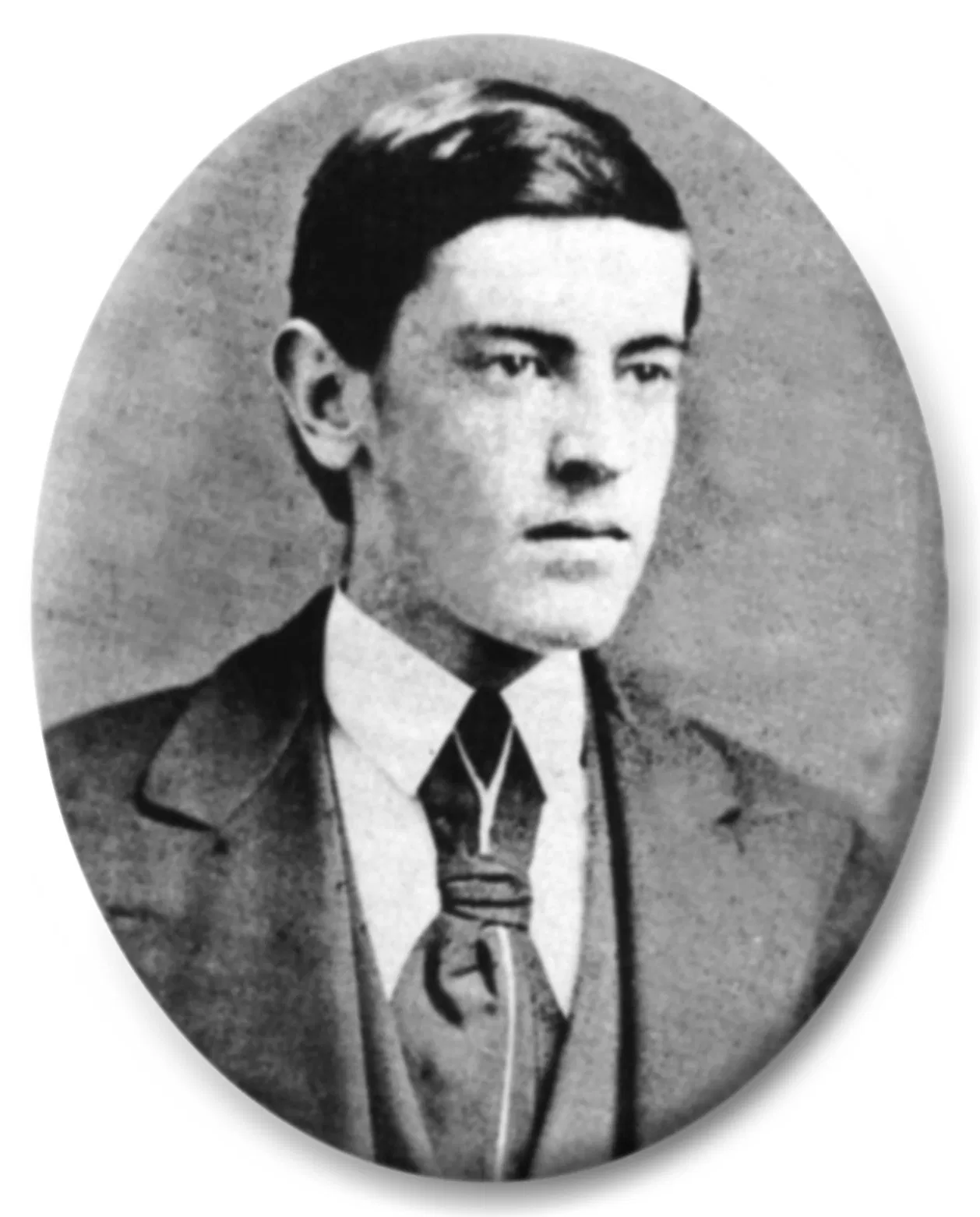
Black-and-white oval portrait of a young man with short dark hair, wearing a dark suit jacket, waistcoat, white collar, and dark patterned tie. He looks toward the viewer with a serious expression against a gray backdrop.Photograph

Primary source

Young Woodrow Wilson

Unknown · 1871

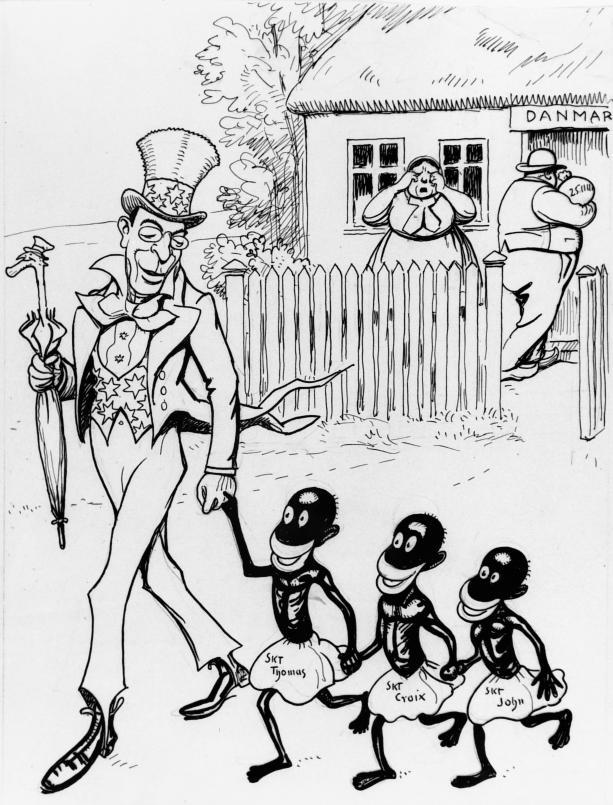
Black-and-white satirical cartoon. A figure in a top hat with star patterns and tailcoat, resembling Uncle Sam, holds an umbrella and leads three small caricatured Black children by the hand, labeled St. Thomas, St. Croix and St. John. Behind a picket fence, a woman and a man watch from a house with a sign reading DANMARK.Painting

Primary source

Klods-Hans Caricature of Wilson and the Danish West Indies Sale

Alfred Schmidt · January 1917

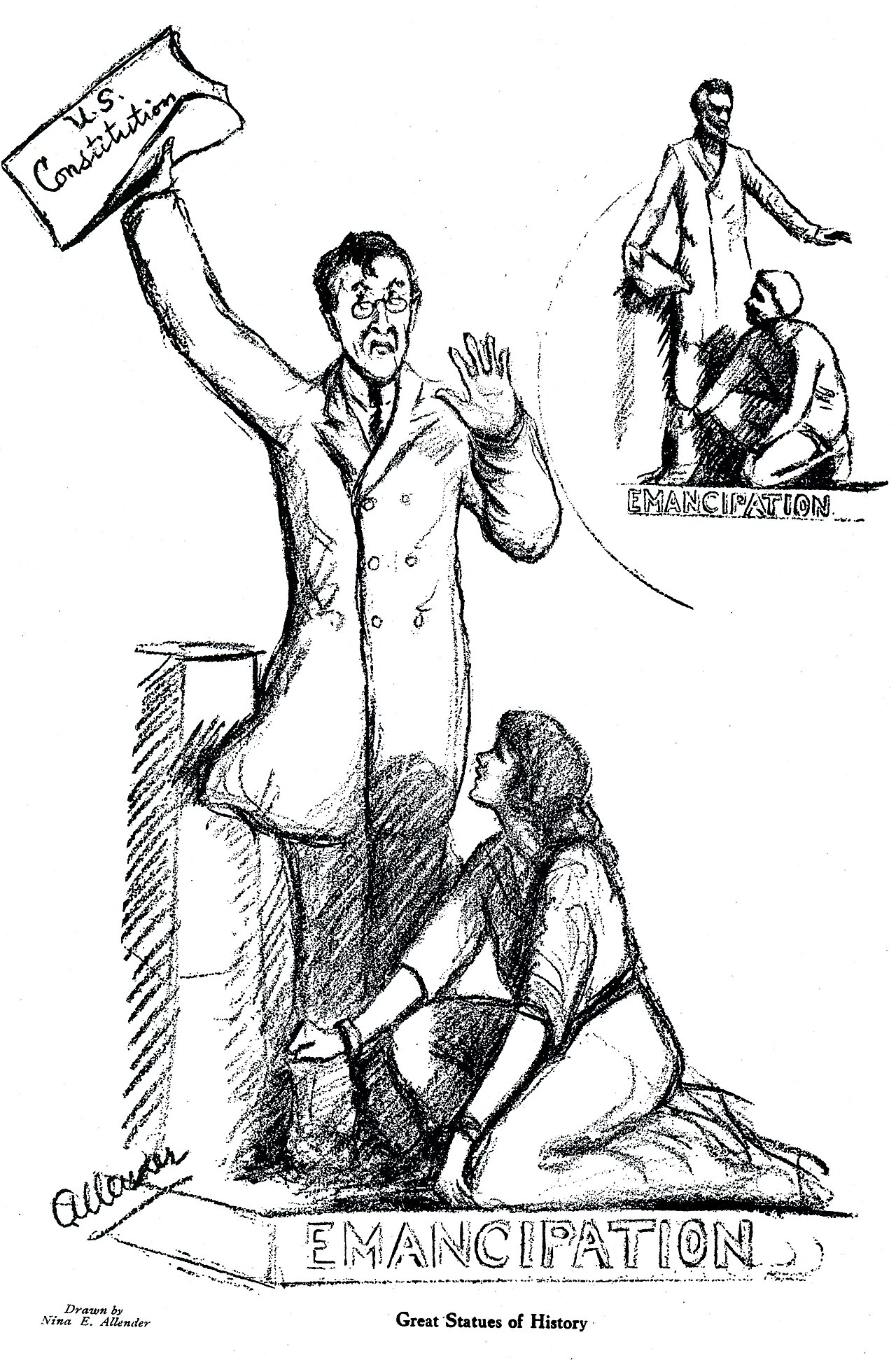
Editorial cartoon titled Great Statues of History, drawn by Nina E. Allender. A large figure of a man in a long coat and glasses holds up a sign reading U.S. Constitution while standing atop a pedestal labeled EMANCIPATION, with a kneeling woman gazing up at him. A smaller inset at upper right shows a bearded man in a long coat gesturing over a kneeling figure, also labeled EMANCIPATION.Painting

Primary source

Great Statues of History: Lincoln and Wilson on Suffrage

Nina Allender · 23 January 1915

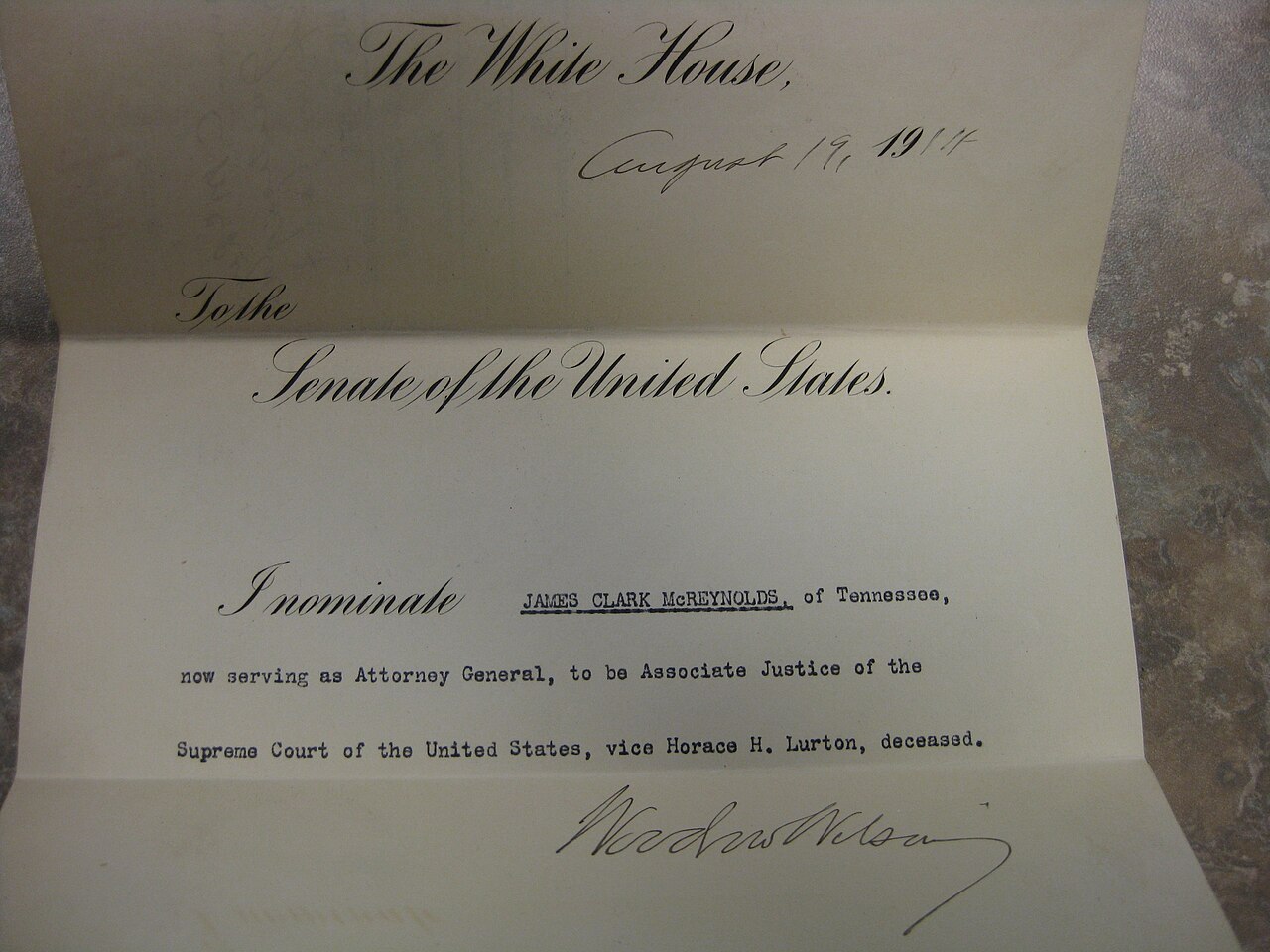
Photo of a typed and signed White House letter dated August 19, 1914, addressed to the Senate of the United States, nominating James Clark McReynolds of Tennessee to be Associate Justice of the Supreme Court, bearing a handwritten signature of Woodrow Wilson. The paper rests on a mottled grey surface.Document

Primary source

Wilson's Nomination of James McReynolds to the Supreme Court

Woodrow Wilson · 19 August 1914

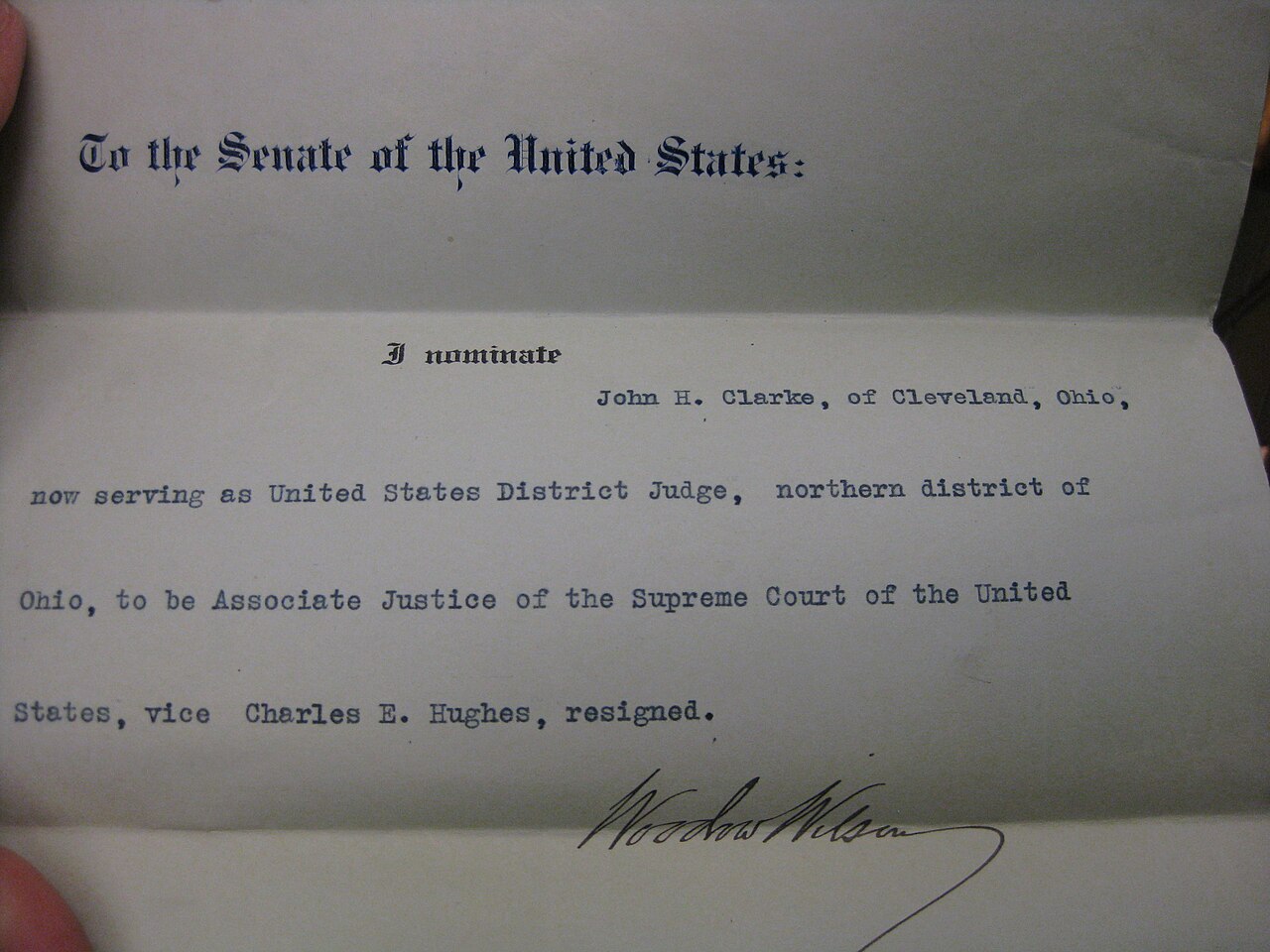
Photo of a typed letter headed 'To the Senate of the United States:' stating 'I nominate John H. Clarke, of Cleveland, Ohio, now serving as United States District Judge, northern district of Ohio, to be Associate Justice of the Supreme Court of the United States, vice Charles E. Hughes, resigned.' Signed in cursive at the bottom, with fingers visible at the edges of the frame.Document

Primary source

Wilson's Nomination of John H. Clarke to the Supreme Court

Woodrow Wilson · 14 July 1916

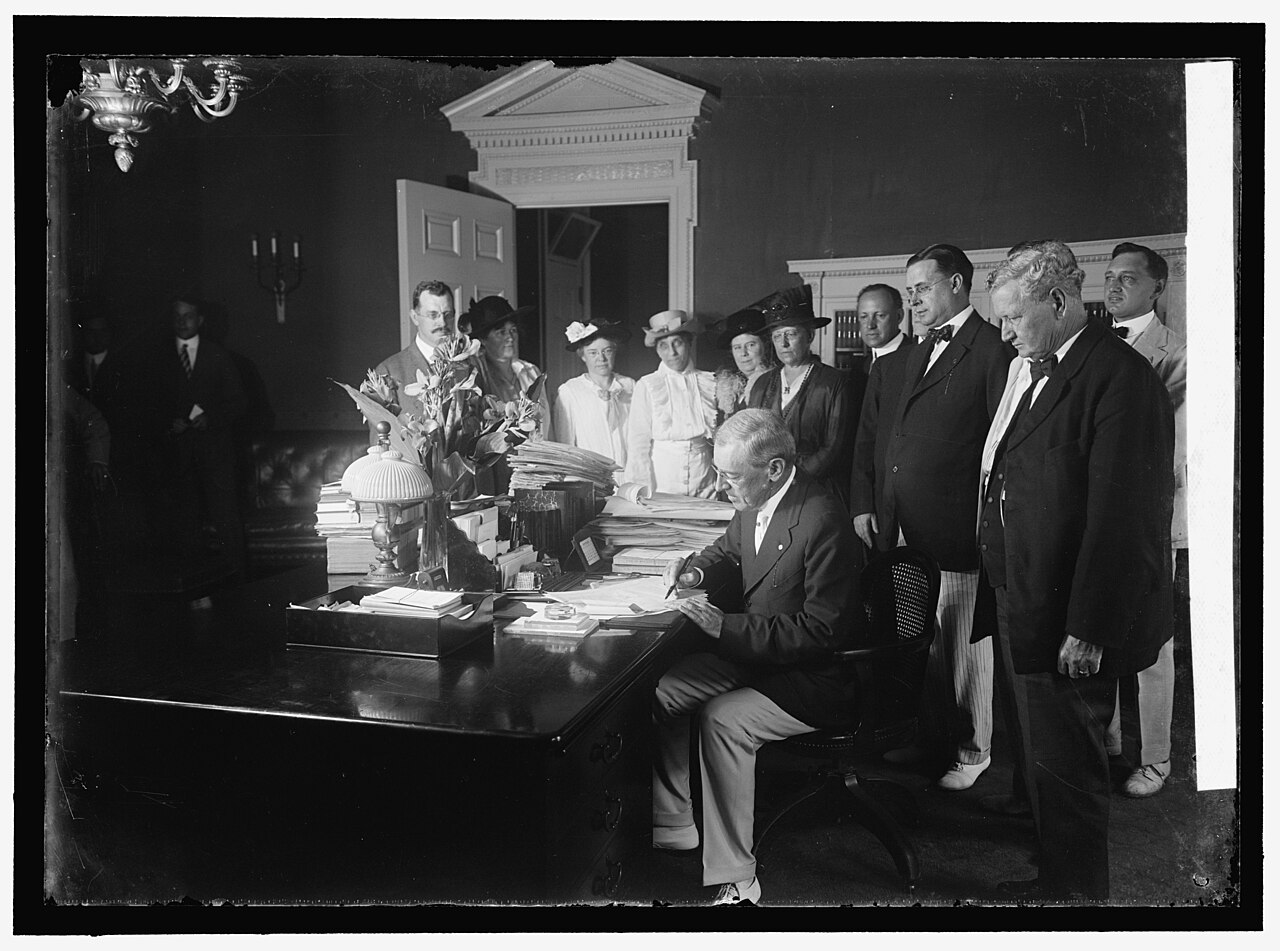
Black-and-white photograph of a man seated at a large desk signing a document with a pen, while a group of men and women in formal dress and hats stand around him and watch. Desk holds lamp, flowers, and stacks of papers.Photograph

Primary source

Wilson Signing the Child Labor Bill

Harris & Ewing · 1 September 1916

Woodrow Wilson and His WorkBook

Secondary source

Woodrow Wilson and His Work

William E. Dodd · 1920

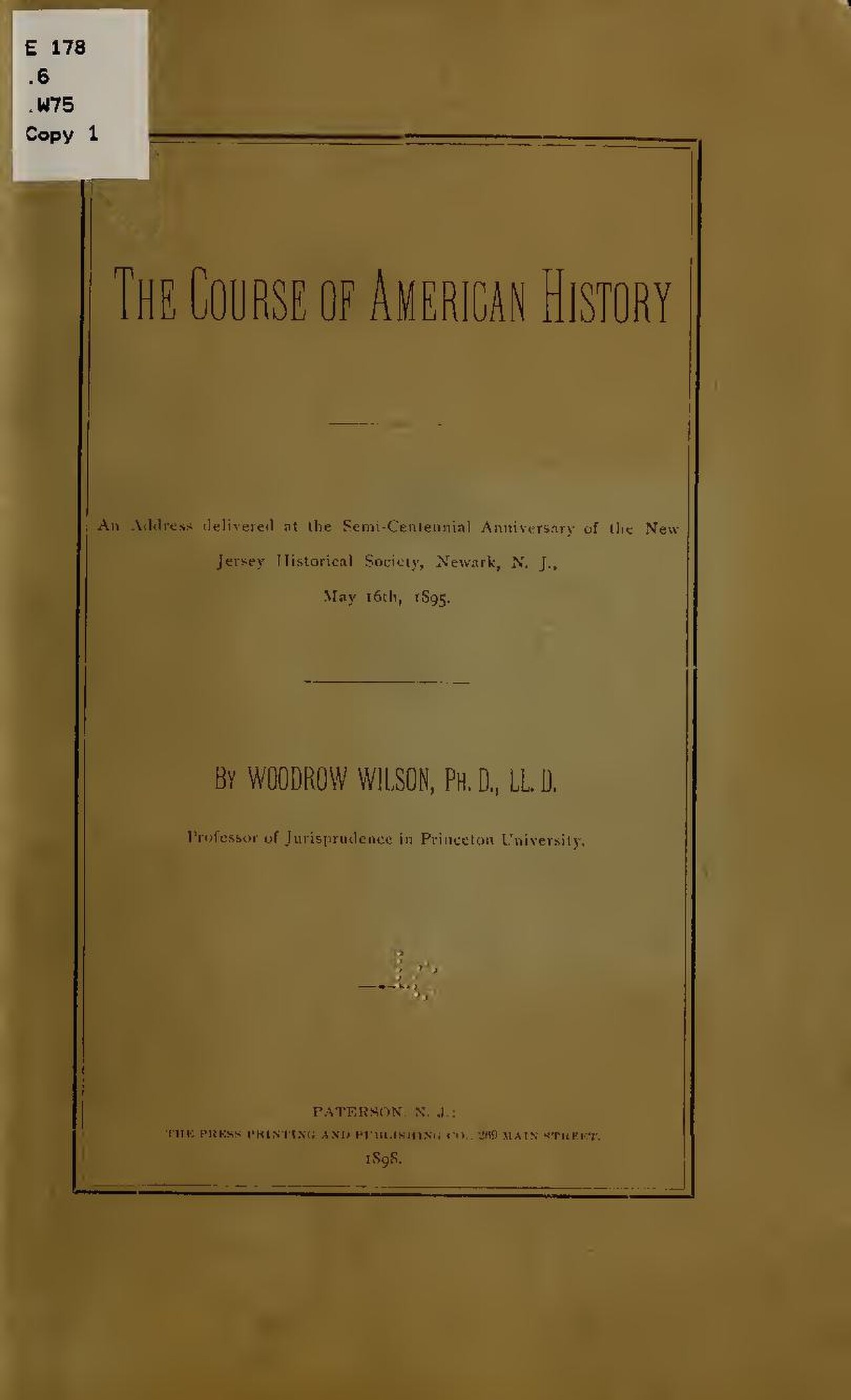
Title page of a printed booklet titled 'The Course of American History', an address by Woodrow Wilson, Ph.D., LL.D., Professor of Jurisprudence at Princeton University, delivered May 16th, 1895 at the Semi-Centennial Anniversary of the New Jersey Historical Society, Newark. Printed in Paterson, N.J., 1898. A library label reading 'E 178 .6 .W75 Copy 1' is in the upper left corner.Speech

Primary source

The Course of American History

Woodrow Wilson · 16 May 1895; printed 1898

Dark maroon cloth book cover with a white Library of Congress label in the lower left. The label reads LIBRARY OF CONGRESS, has a barcode, the number 0000579469 9, and a red dot.Book

Primary source

Division and Reunion, 1829-1889

Woodrow Wilson · covers 1829-1889

Plain tan cover of a book with handwritten call number in black ink: 'D 642', '.W5', '1918' in three lines at top left. A partial black printed mark appears at the bottom right corner.Speech

Primary source

The Bases of Durable Peace

Woodrow Wilson · 1918

Dark red cloth book cover with a white Library of Congress library label near the bottom, showing the printed text LIBRARY OF CONGRESS, a barcode, the number 00008441522, and a small red dot.Book

Primary source

Constitutional Government in the United States

Woodrow Wilson · 1908

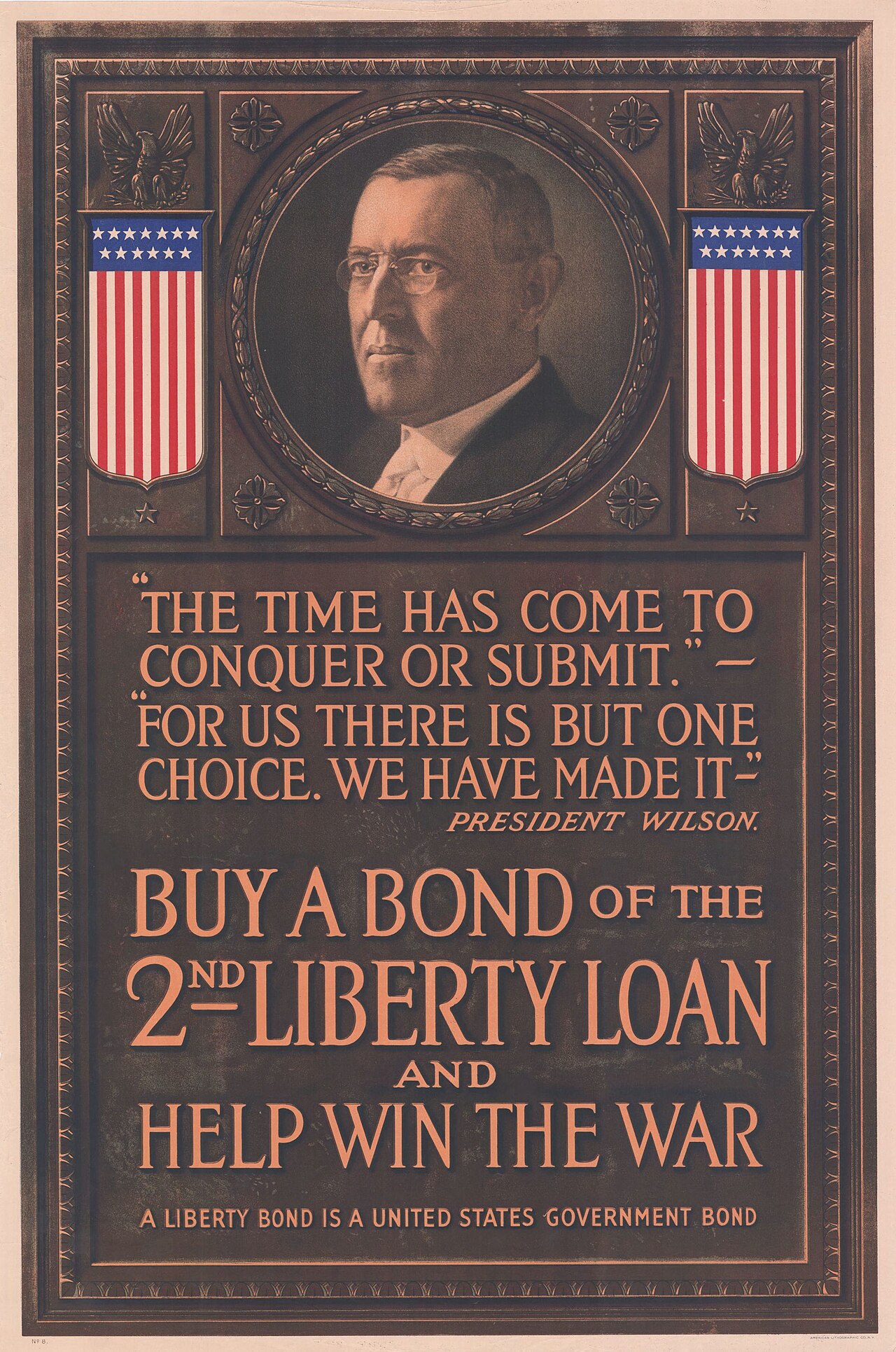
World War I Liberty Loan poster with an oval portrait of a man in glasses and dark suit, flanked by eagles and American flag panels. Text urges buying a 2nd Liberty Loan bond and includes a Wilson quotation.Artifact

Primary source

Buy a Bond of the 2nd Liberty Loan

1917-1918

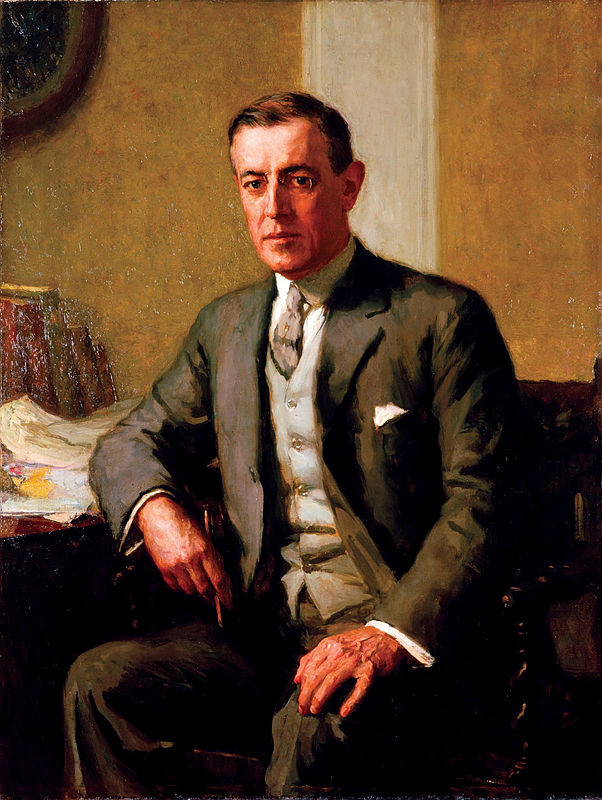
Painted portrait of a seated man in a gray three-piece suit with a white vest, light shirt, and patterned tie, with a white pocket square. He rests one hand on a chair arm and the other on his knee. Ochre wall, a books and papers on a table at left.Painting

Secondary source

Portrait of Woodrow Wilson

Stephen Seymour Thomas · 1913

The Free LifeBook

Primary source

The Free Life

Woodrow Wilson · 1908

Want the full shelf? Chat with Woodrow Wilson in the app and open the Sources panel — every quote links back to the original.

Use Woodrow Wilson in class

1 assignment · 4 collections

A ready-made assignment and collections from the Humy team that feature Woodrow Wilson. Preview any of them, then try it free.

Trusted by educators worldwide

Conversations
375,000+
Real exchanges between students and historical figures
Messages exchanged
4,142,000+
Across every figure, classroom and language
Historical figures
100,000+
Each informed by a curated biography and selected sources
Languages supported
50+
From English and Spanish to Arabic and Korean

Paying customers

Used by 98 schools and universities

Partner school logo
Tecnológico de Monterrey logo
Hyper Island logo
Partner school logo
Chambersburg Area School District logo
Broward County Public Schools logo
Nebo School District logo
National Louis University logo
South Florida PBS logo
Punahou School logo
University of Wisconsin–River Falls logo
Partner school logo
Partner school logo
Archbishop Mitty High School logo
Kingsburg High School logo
Norwalk Public Schools logo
Partner school logo
Connections logo
Partner school logo
Moore Public Schools logo
Partner school logo
Partner school logo
Partner school logo
Partner school logo
Robbinsville Public Schools logo
Partner school logo
Partner school logo
Partner school logo
Tecnológico de Monterrey logo
Hyper Island logo
Partner school logo
Chambersburg Area School District logo
Broward County Public Schools logo
Nebo School District logo
National Louis University logo
South Florida PBS logo
Punahou School logo
University of Wisconsin–River Falls logo
Partner school logo
Partner school logo
Archbishop Mitty High School logo
Kingsburg High School logo
Norwalk Public Schools logo
Partner school logo
Connections logo
Partner school logo
Moore Public Schools logo
Partner school logo
Partner school logo
Partner school logo
Partner school logo
Robbinsville Public Schools logo
Partner school logo
Partner school logo

What educators are saying

“We enjoyed the program last year and used it frequently.”
“My students say it’s a welcome change of pace. I’m not a fan of the “sage on the stage” model, so I try to incorporate research-oriented and self-paced activities. With Humy, students have to take charge of their learning. They’ve become more adept at critical thinking, forming better questions, and improving their reading comprehension. The interview feature has been my go-to tool. I create assignments where students must ask historical figures a set number of questions, then summarize the responses to ensure they’re truly absorbing the material. This approach lets them actively explore the past rather than passively consuming information.”
“Humy has helped me bring historical figures, sometimes long past, to life. When my students interact with these figures in real-time, it eliminates some of the perceived “ancient” characteristics of my curriculum. This has shifted my students’ thinking away from viewing history as abstract or irrelevant. Real-time interactions make historical figures relatable, even allowing students to ask off-topic questions that help put historical lives in a more relevant context for 13-year-olds. The feature I use the most is the interview feature. After teaching a topic, most recently Gandhi and Joan of Arc, I have the students ask pointed, focused questions. We practice good conversation techniques beforehand, teaching them to listen (or read) carefully and formulate thoughtful follow-up questions rather than just interrogating. It helps students practice effective conversation skills.”

FAQ

Frequently asked questions

Who is Woodrow Wilson?
28th President of the United States and key figure in the establishment of the League of Nations. On Humy.ai you can chat with an AI version of Woodrow Wilson that draws on a short biography and 97 historical sources during the conversation — by text or voice, in 42 languages.
Is Woodrow Wilson AI free?
Woodrow Wilson is part of Humy's full library of more than 100,000 figures, which comes with a paid plan. A free account (no credit card) includes 20 messages a month with the free library's figures, so you can try how the conversations work first.
What sources does the Woodrow Wilson AI use?
It draws on a short biography and 97 historical sources (books, speeches and documents), including “President Woodrow Wilson's 14 Points”, “Joint Address to Congress Leading to a Declaration of War Against Germany” and “Treaty of Versailles”. Each source has its own page on Humy.ai.
How historically accurate is the AI version of Woodrow Wilson?
Each figure uses a short biography and a small set of selected historical sources as context (retrieval-augmented generation), so answers stay closer to known material than the model's general knowledge alone. It isn't a citation-grade research tool — like any LLM, the AI can get details wrong or extrapolate. Treat it as a strong starting point for inquiry and cross-reference important claims.
Can I talk to Woodrow Wilson by voice?
Yes. In addition to text chat, you can call Woodrow Wilson and hear their voice respond in real time — useful for auditory learners, interview practice and Socratic dialogue.
Is Humy.ai safe and compliant for schools?
Yes. Humy.ai is used by more than 100 schools, universities and organisations. The platform is FERPA- and GDPR-aligned, supports SSO, and offers an IT-approval pack tailored for school procurement teams.

Ready when you are

Start chatting with Woodrow Wilson now.

20 messages free · No credit card · Available in 50+ languages.