Portrait of Sigmund Freud

AI Historical Figure

Sigmund Freud

Revolutionary psychologist and founder of psychoanalysis.

Chat with Sigmund Freud via text or voice — in 42 languages, drawing on a curated biography and 80 historical sources. Available 24/7.

Start chatting with Sigmund Freud20 messages free · No credit card
Lived
1856–1939
From
Austria
Known for
Scholarship & social science
Sigmund Freud

Sigmund Freud

Online · responds in seconds

Hello — I'm Sigmund Freud. Revolutionary psychologist and founder of psychoanalysis. What would you like to ask me?

20 messages free · No credit card · Powered by Humy.ai

Live preview · Switch between 42 languages above · Send a message to continue in the app

Multilingual

Talk to Sigmund Freud in 42 languages

Ask Sigmund Freud questions in any language below, and the rest of Humy's app speaks it too. Pick yours to open the chat in that language.

Also in German (Austria), German (Switzerland), English (UK), English (Australia), English (Canada).

The sources behind this AI

80 sources · 36 books · 11 photographs · 10 documents · 5 artifacts · 4 letters · 4 sculptures · 4 newspaper articles · 3 paintings · 2 speeches · 1 diary entry

Sigmund Freud doesn’t improvise from thin air. The AI is grounded in 80 curated historical sources students can inspect. Open any of them to see what informs the conversation.

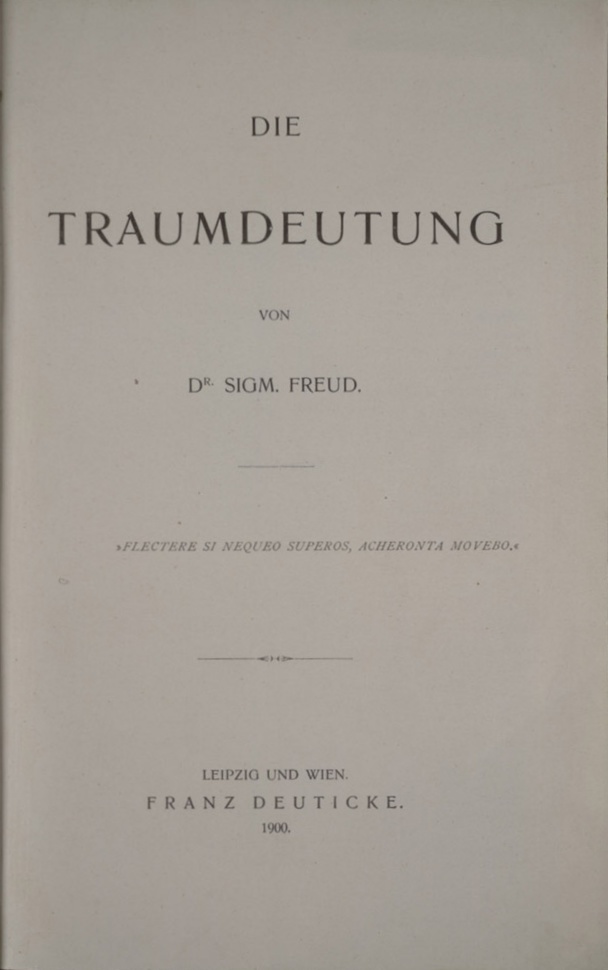
Title page of the German book Die Traumdeutung by Dr. Sigm. Freud, printed in Leipzig und Wien by Franz Deuticke, dated 1900. Includes a Latin epigraph in italics: Flectere si nequeo superos, Acheronta movebo.Book

Secondary source

The Interpretation of Dreams

Sigmund Freud · 1900

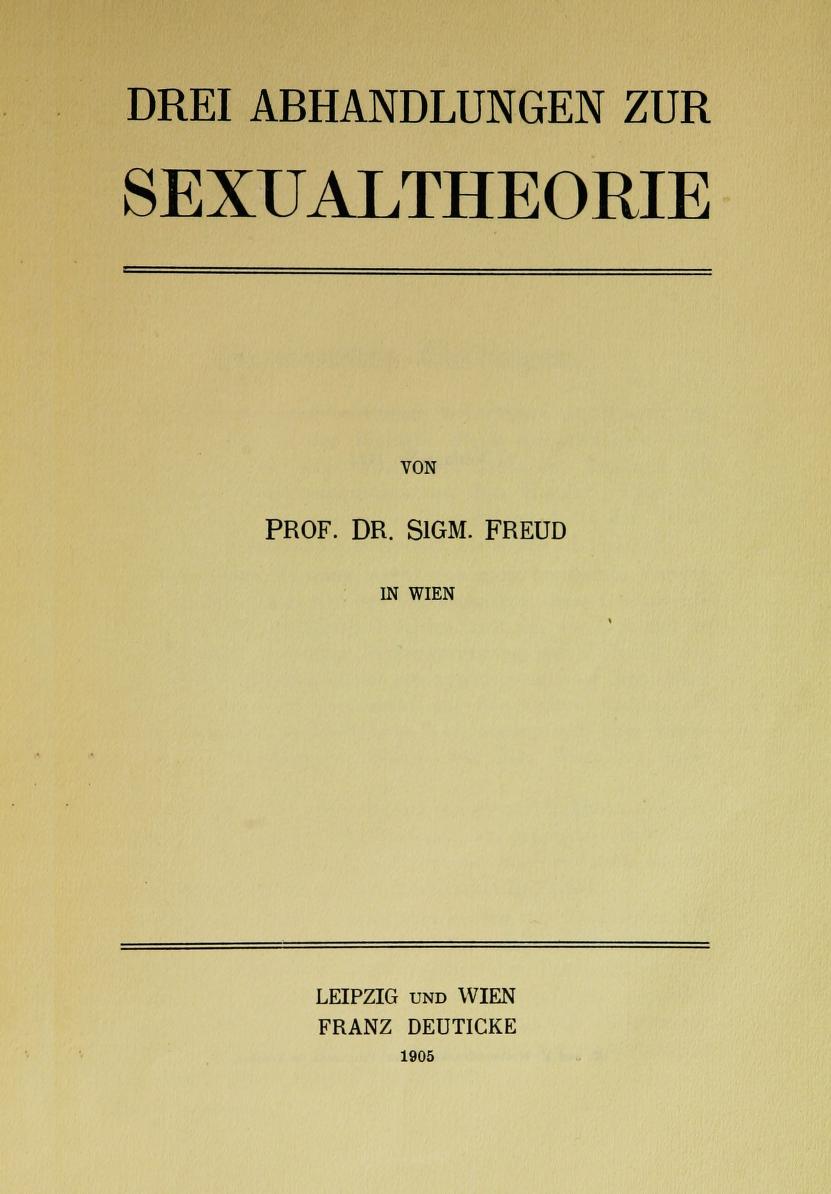
Title page of the 1905 book Drei Abhandlungen zur Sexualtheorie by Prof. Dr. Sigm. Freud in Wien, published by Franz Deuticke in Leipzig und Wien. Cream-colored page with black serif text and rules.Book

Primary source

Three Essays on the Theory of Sexuality

Sigmund Freud · 1905

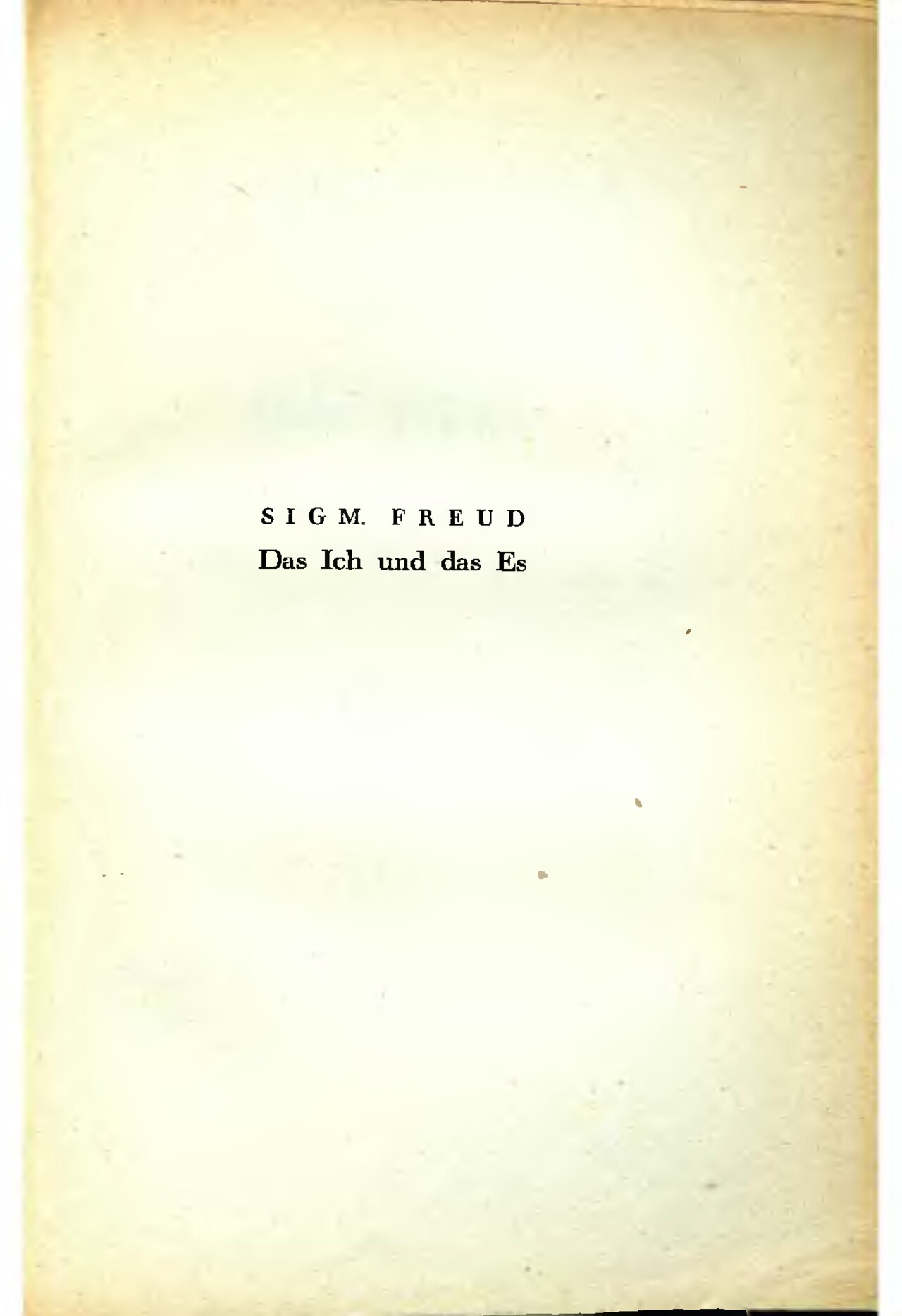
Title page of a book on yellowed paper. Centered small capital text reads 'SIGM. FREUD' above the bold German title 'Das Ich und das Es'. Faint marks and spots are visible on the page.Book

Primary source

The Ego and the Id

Sigmund Freud · 1923

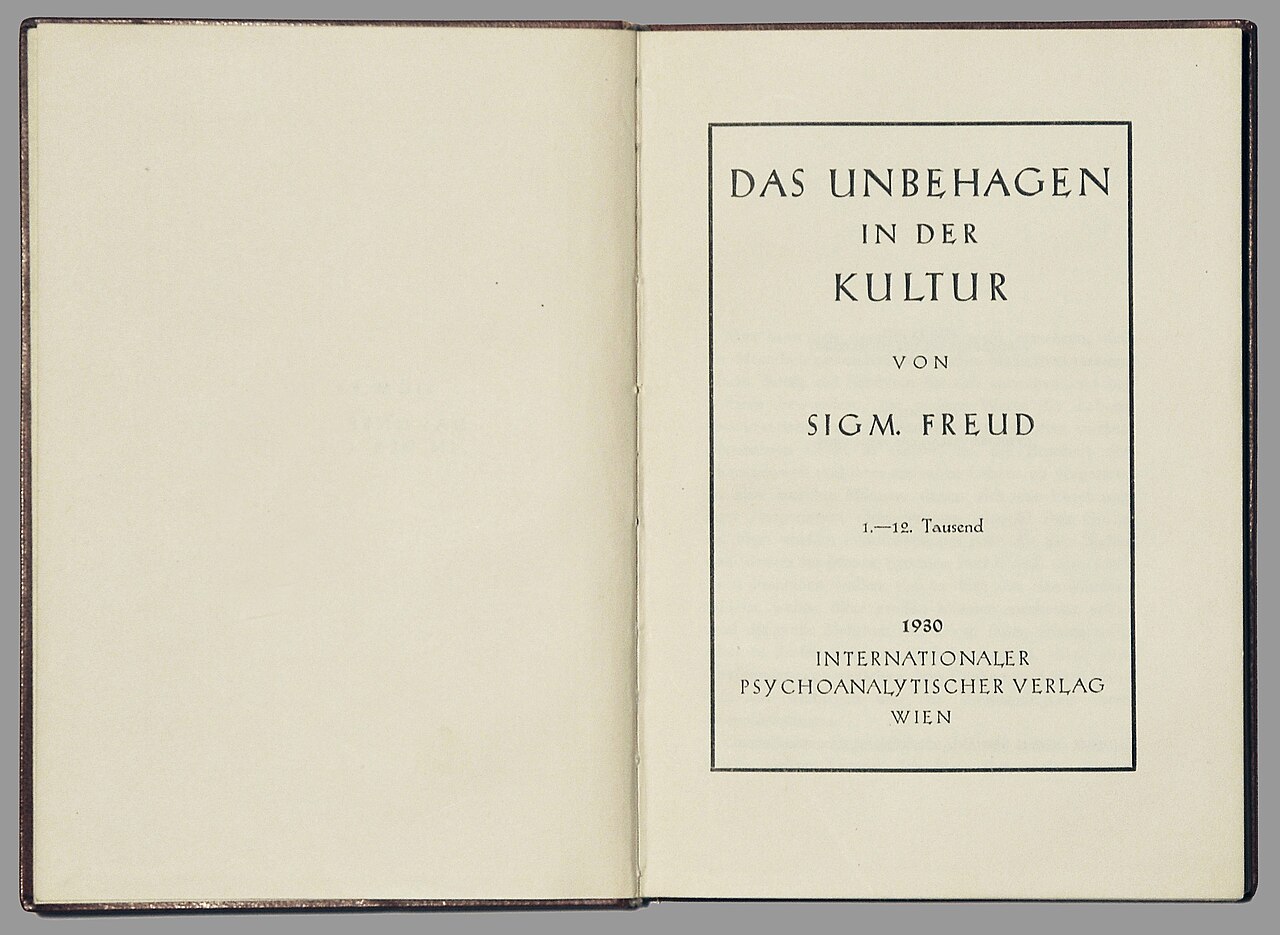
Open book showing a title page on the right, with a boxed German title: 'Das Unbehagen in der Kultur, von Sigm. Freud, 1.-12. Tausend, 1930, Internationaler Psychoanalytischer Verlag, Wien'. The left page is blank.Book

Primary source

Civilization and Its Discontents

Sigmund Freud · 1930

Speech

Primary source

Sigmund Freud's Voice (BBC Broadcast Recording, 1938)

Sigmund Freud · 27 December 1938

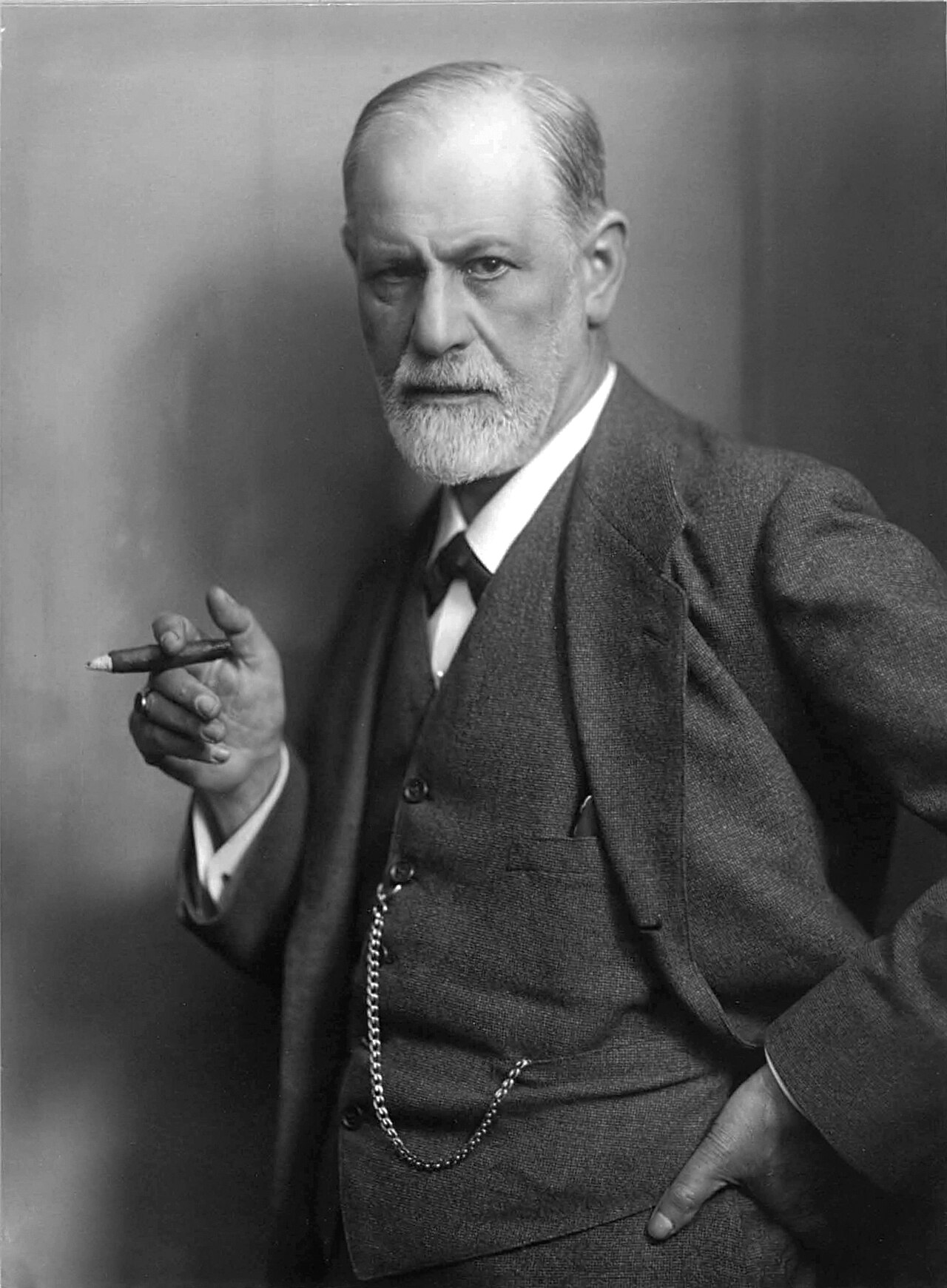
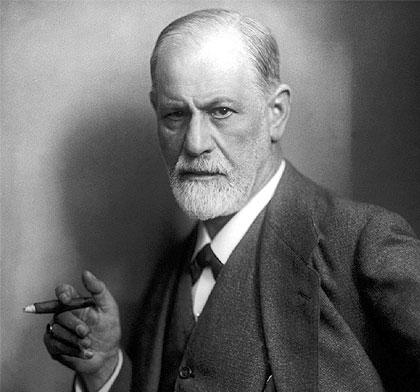
Black-and-white studio portrait of an older bearded man in a three-piece suit with a watch chain, holding a cigar in his raised left hand and his right hand in his trouser pocket, against a dark backdrop.Photograph

Primary source

Portrait of Sigmund Freud

Max Halberstadt

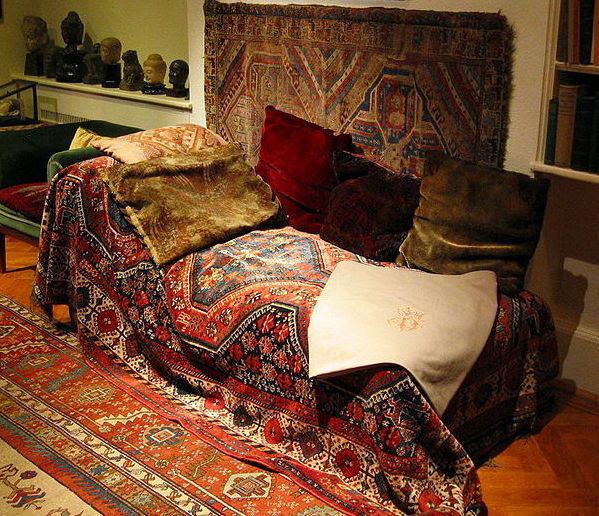
A couch draped with an oriental-patterned rug and several cushions, including fur-covered and dark red velvet pillows, with a white cloth on the seat. A large patterned rug hangs on the wall behind, and a shelf of carved heads sits in the upper left.Artifact

Primary source

Sigmund Freud's Psychoanalytic Couch

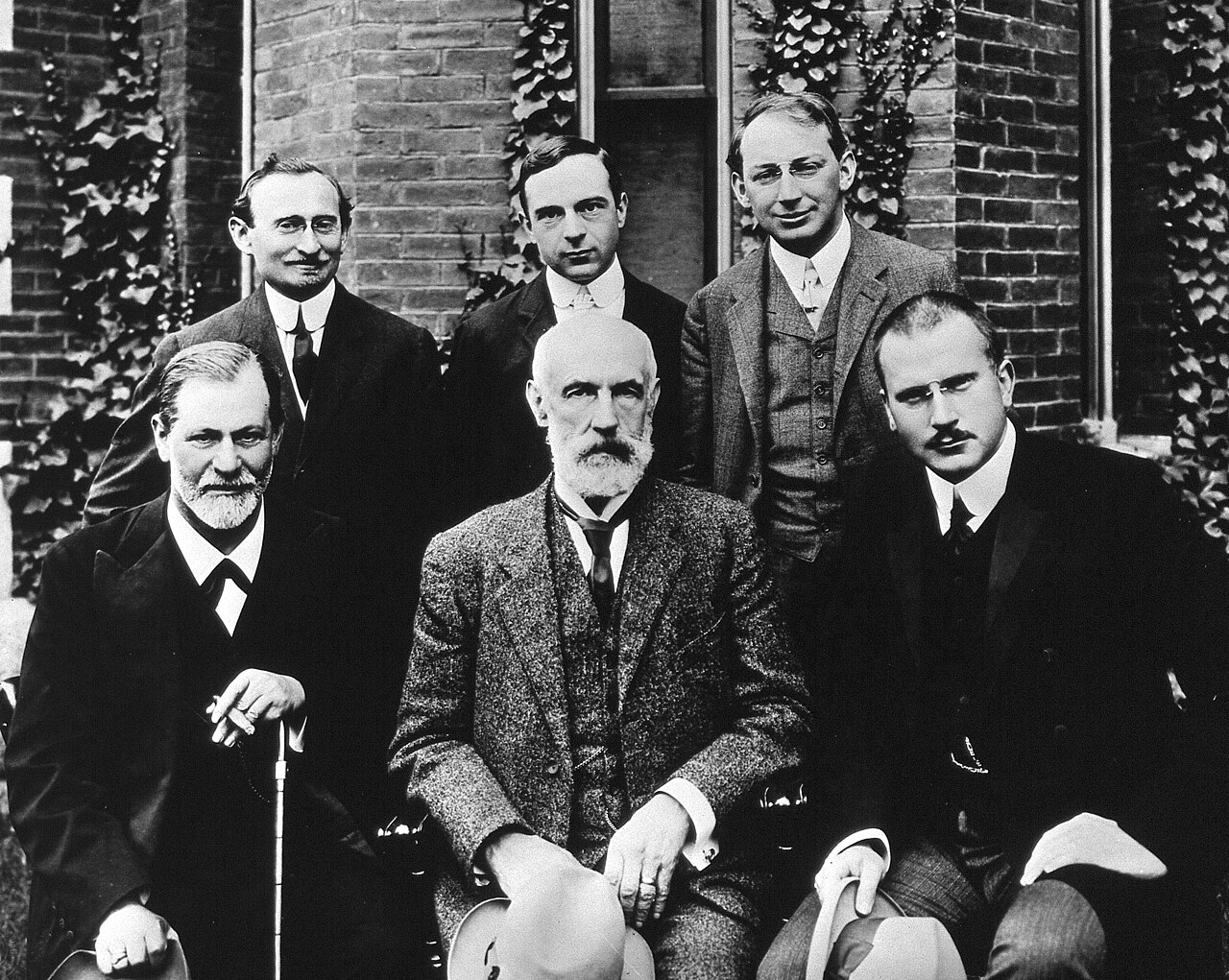
Black-and-white group photograph of six men in front of a brick building with ivy. Three men stand in the back row and three sit in the front. The seated man on the left holds a cane and a cigar; the central seated man has a white beard and holds a hat; the seated man on the right wears round glasses and a mustache.Photograph

Primary source

Group Photo of Freud, Jung and Colleagues at Clark University

1909

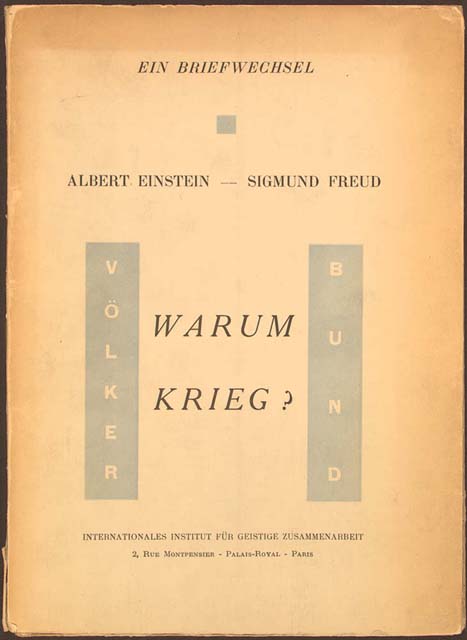
Cover of the 1933 pamphlet 'Warum Krieg?' (Why War?), a correspondence between Albert Einstein and Sigmund Freud. Cream cover with text 'Ein Briefwechsel', the names Albert Einstein and Sigmund Freud, the title 'Warum Krieg?' flanked by blue vertical bands reading 'Völkerbund', and publisher details for Internationales Institut für Geistige Zusammenarbeit, Paris.Letter

Primary source

Why War?

Albert Einstein · 1933

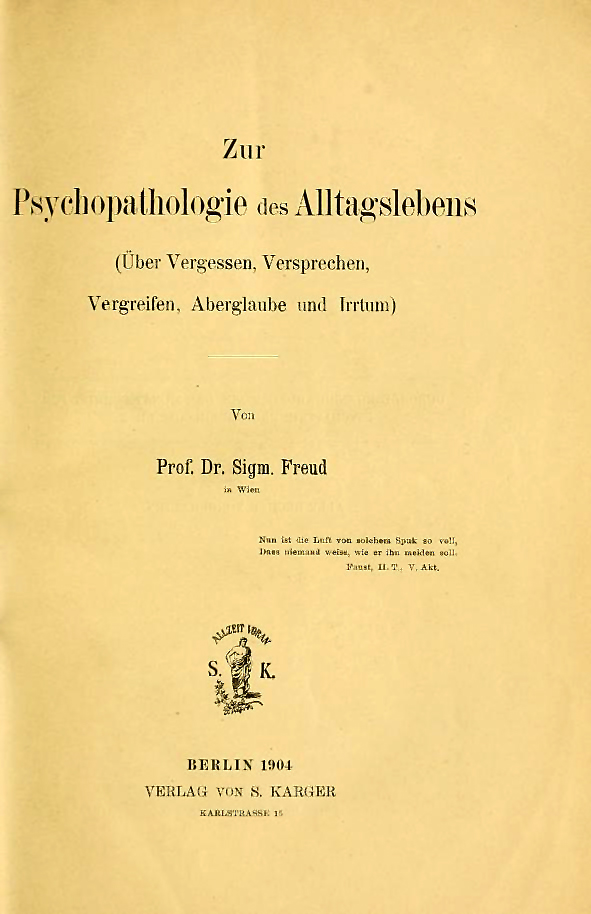
Title page of the 1904 Berlin edition of Freud's Zur Psychopathologie des Alltagslebens, printed in German on yellowed paper. It names Prof. Dr. Sigm. Freud in Wien, publisher Verlag von S. Karger, with a Faust quotation and a small Karger device.Book

Primary source

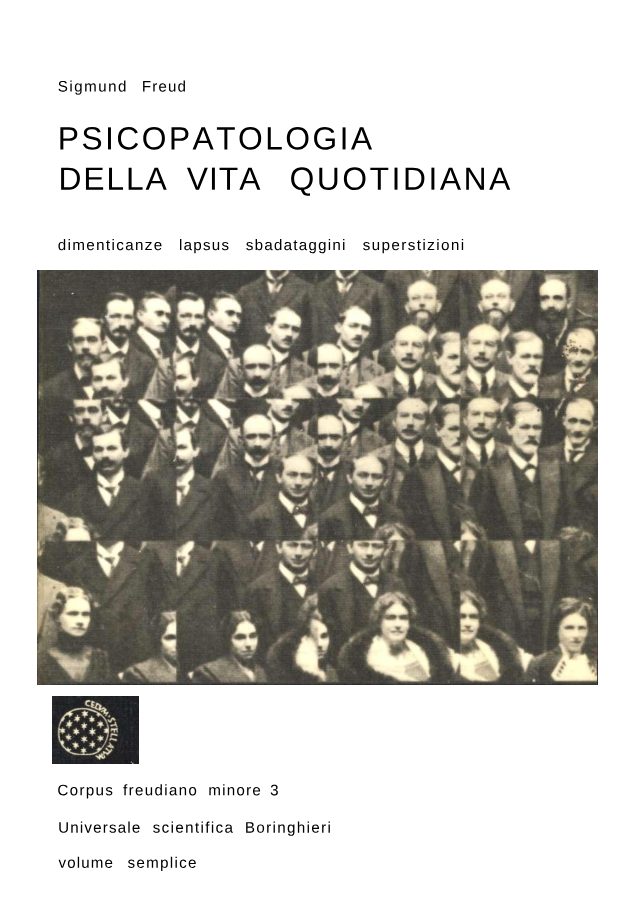
The Psychopathology of Everyday Life

Sigmund Freud · 1901 (monograph); 1904 (book)

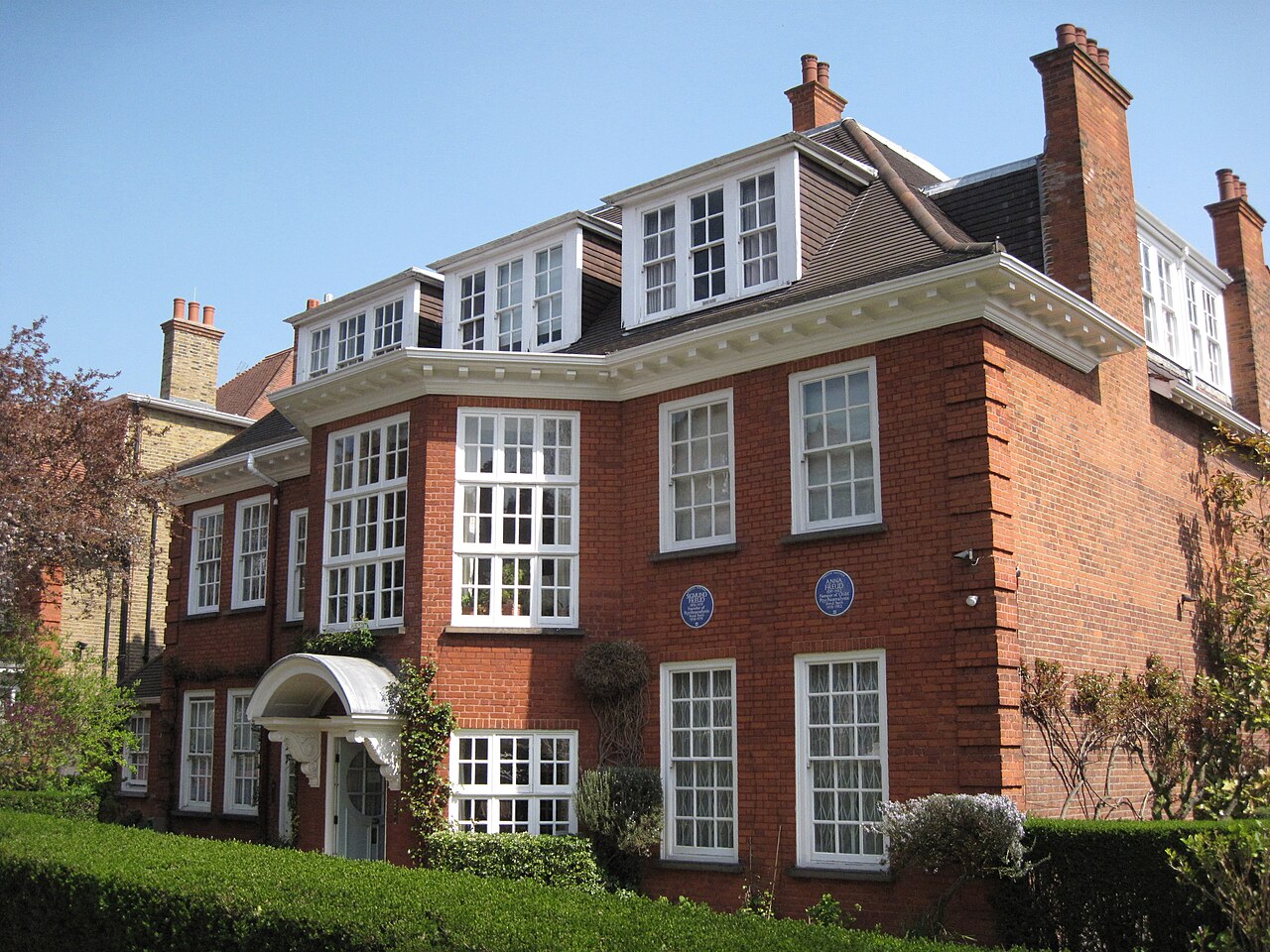
Red brick house with white-framed sash windows, a white cornice, dormer windows and tall chimneys, with a green hedge in front. Two blue plaques are on the facade, and a white porch is at the left side of the entrance.Artifact

Secondary source

Freud Museum London

opened 1986

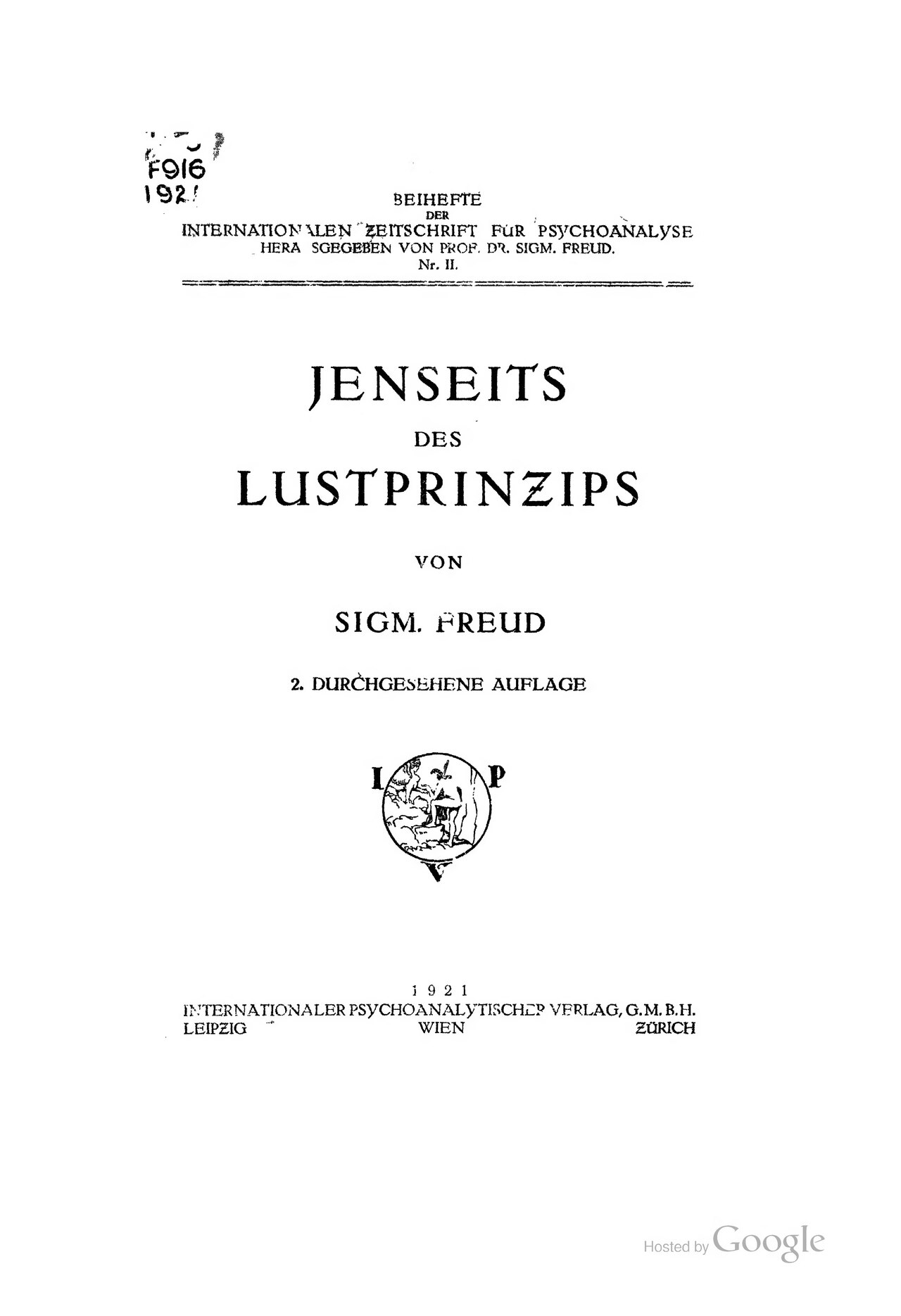
Title page of 'Jenseits des Lustprinzips' by Sigm. Freud, 2nd revised edition, 1921, published by Internationaler Psychoanalytischer Verlag in Leipzig, Wien, Zürich. Header reads Beihefte der Internationalen Zeitschrift für Psychoanalyse, Nr. II. Small circular emblem with the letters I and P.Book

Primary source

Beyond the Pleasure Principle

Sigmund Freud · 1920

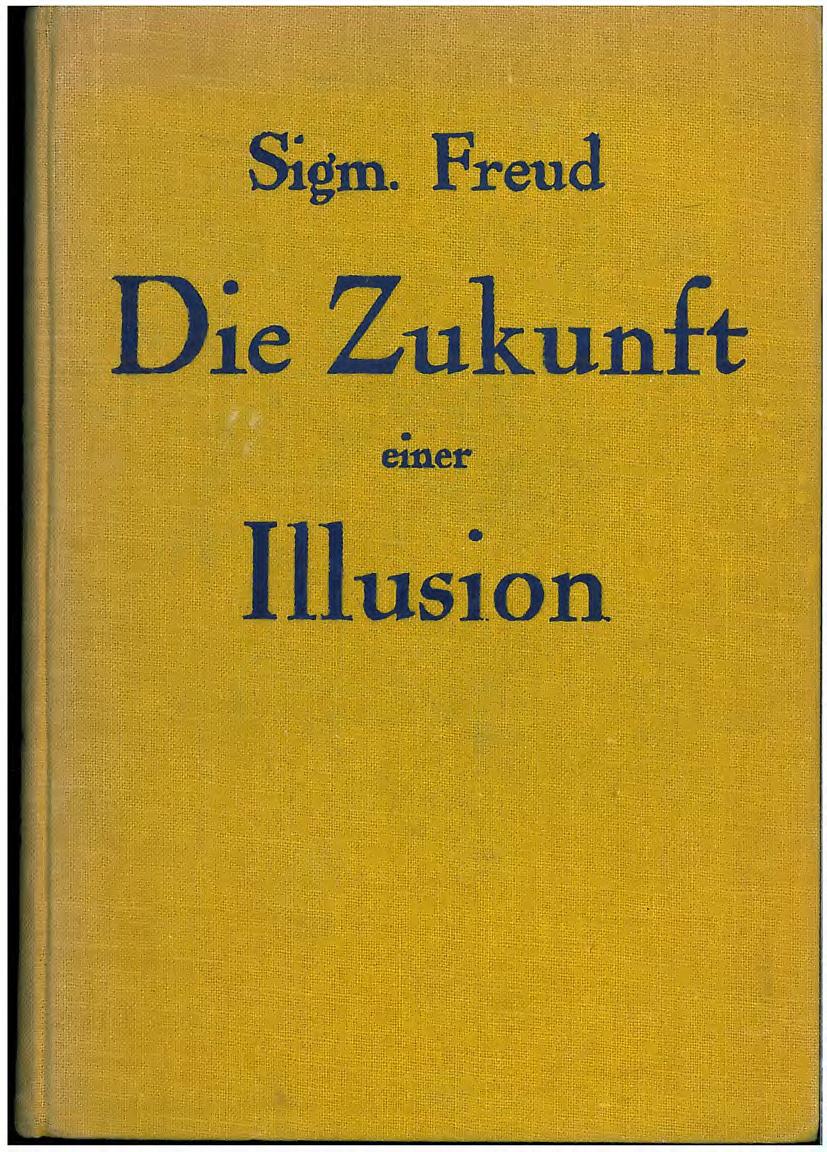
Front cover of a yellow cloth-bound book with blue printed title: 'Sigm. Freud' at top, then 'Die Zukunft' in large letters, 'einer' in smaller letters, and 'Illusion' below.Book

Primary source

The Future of an Illusion

Sigmund Freud · 1927

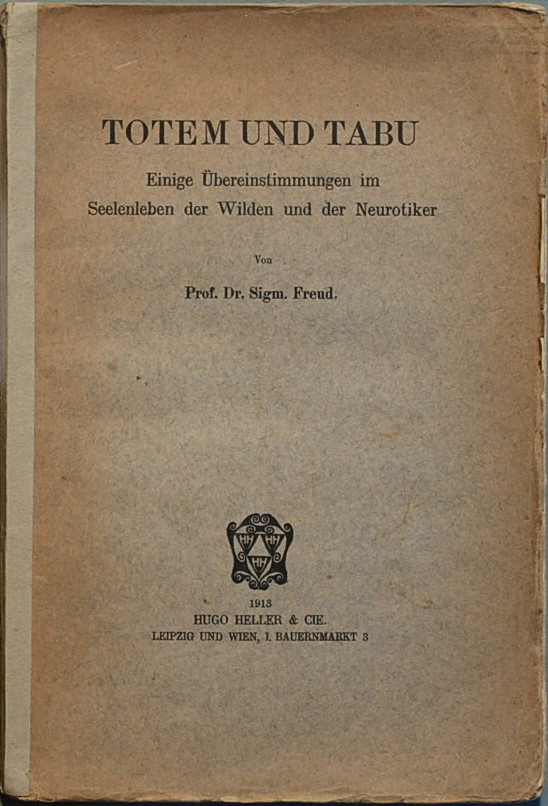
Front cover of the 1913 German book Totem und Tabu by Sigmund Freud, tan paper cover with title, subtitle, author line, a decorative publisher emblem, and the imprint Hugo Heller & Cie, Leipzig und Wien.Book

Primary source

Totem and Taboo

Sigmund Freud · 1913

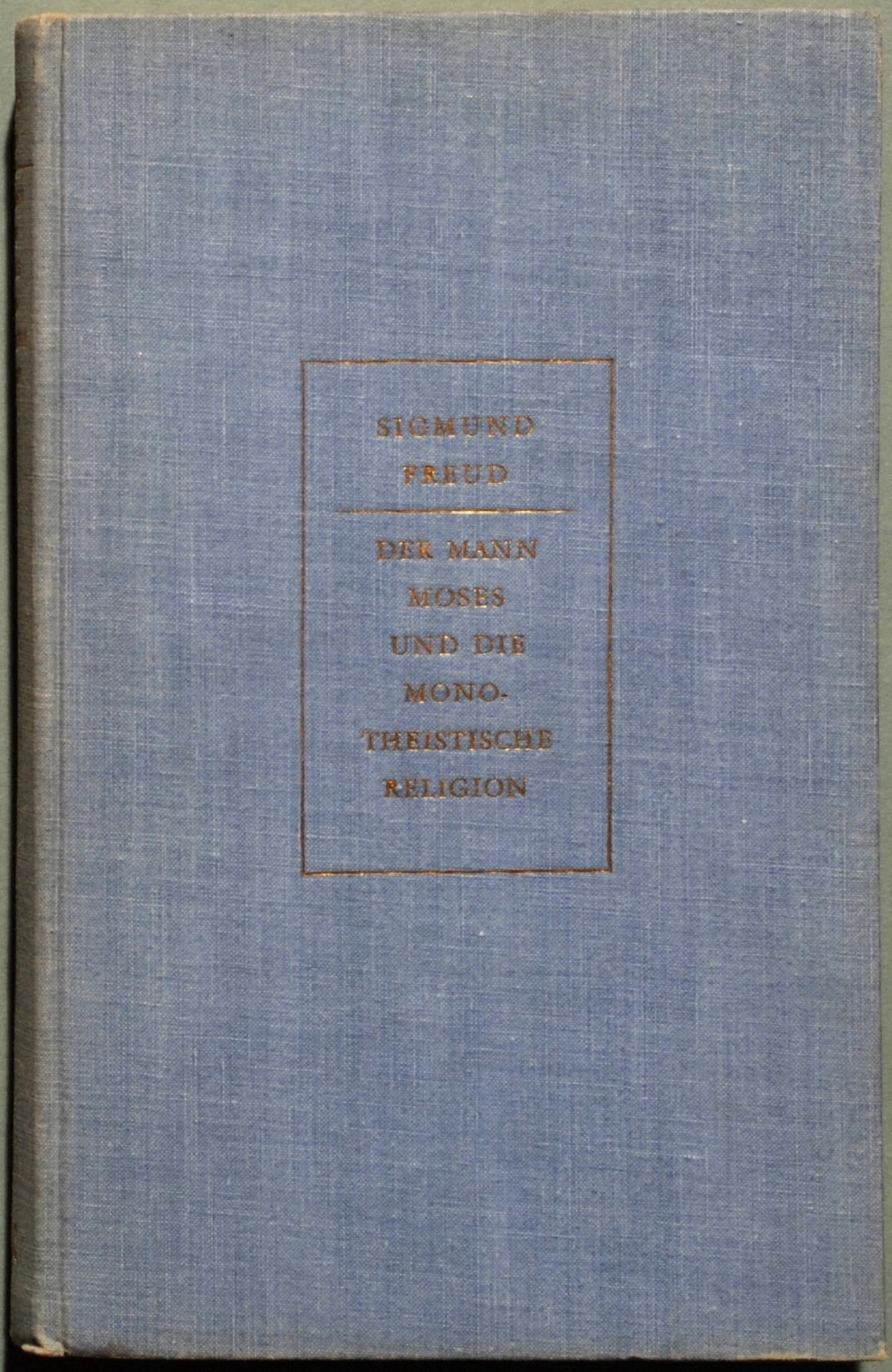
Front cover of a blue cloth-bound book. Gold-stamped text inside a rectangular border reads: SIGMUND FREUD, then DER MANN MOSES UND DIE MONO-THEISTISCHE RELIGION. The book is shown straight on against a grey background.Book

Primary source

Moses and Monotheism

Sigmund Freud · 1939

Document

Primary source

Über Coca

Sigmund Freud · 1884

Letter

Primary source

Letter to an American Mother

Sigmund Freud · 9 April 1935

Empty cream-colored archival folder tab with a dark border. Printed labels read SIGMUND FREUD, Box 13, Folder 62, FAMILY PAPERS, SUBJECT FILE. Handwritten notes read FREUD, AMALIA & JACOB, GOOD CONDUCT CERTIFICATE, 1859. The folder interior is blank.Document

Primary source

Sigmund Freud Papers

Sigmund Freud · 1871–1939

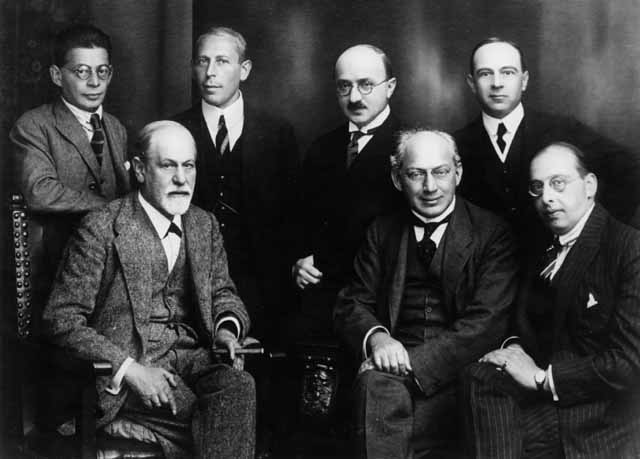
Black-and-white group portrait of seven men posed in a studio. Seated in front: an older bearded man in a tweed suit on the left, a man with a mustache and spectacles in a dark suit in the center, and a man with round spectacles on the right. Standing behind them are four men in suits.Photograph

Primary source

Freud and Other Psychoanalysts, 1922

Becker & Maass / Marie Boehm · 1922

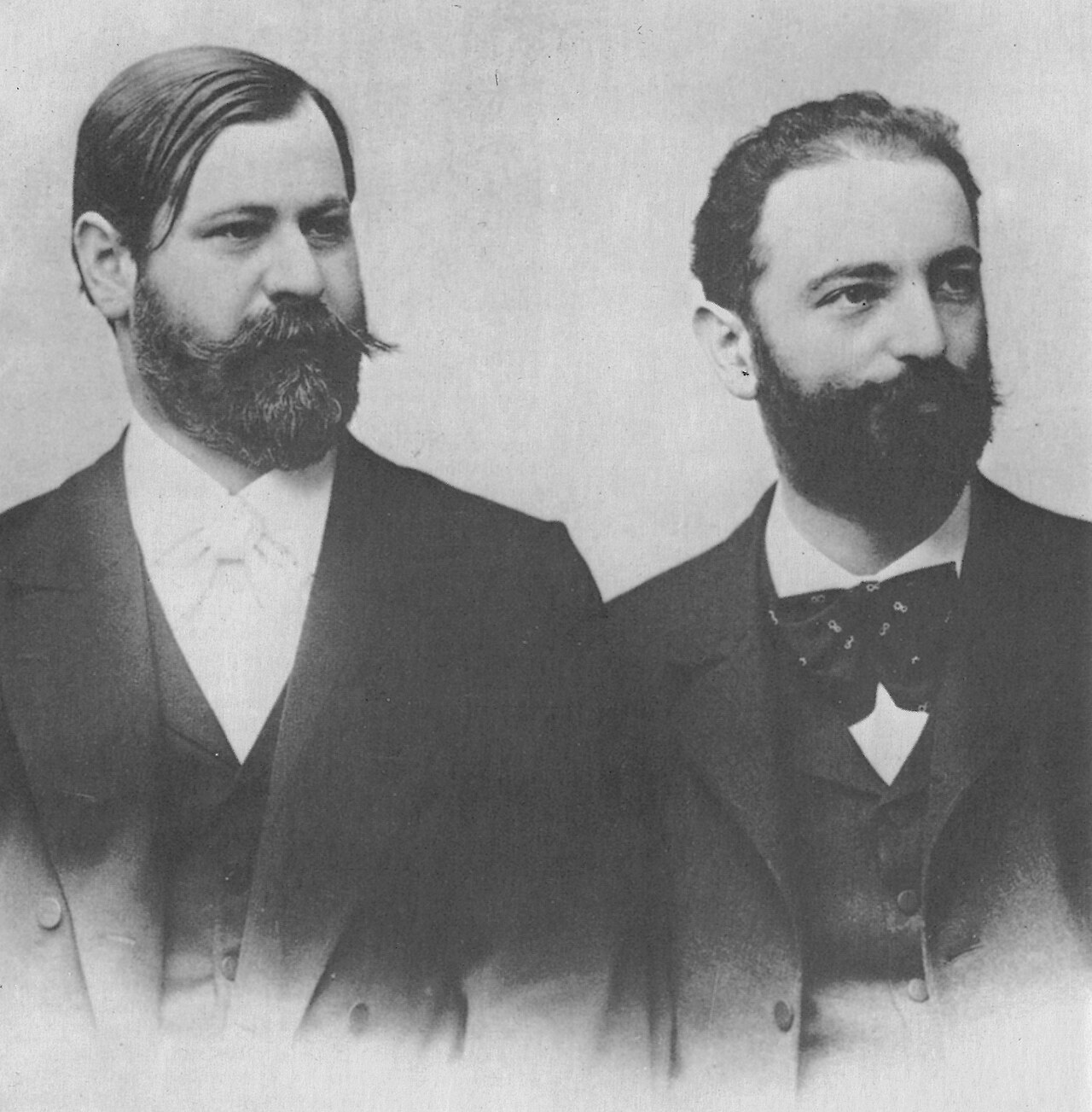
Black-and-white studio portrait of two bearded men in dark suits shown side by side against a plain light background. The man on the left has slicked-back hair, a full beard and a mustache, and wears a white high collar with a cravat. The man on the right has dark wavy hair, a full beard, and wears a dark bow tie and white shirt.Photograph

Primary source

Photograph of Freud and Wilhelm Fliess

Unknown · c. 1890

Front cover of a grey-green book reading 'Prof. Sigm. Freud' above the title 'Massenpsychologie und Ich-Analyse', with the publisher 'Internationaler Psychoanalytischer Verlag G. m. b. H.' printed near the bottom.Book

Primary source

Group Psychology and the Analysis of the Ego

Sigmund Freud · 1921

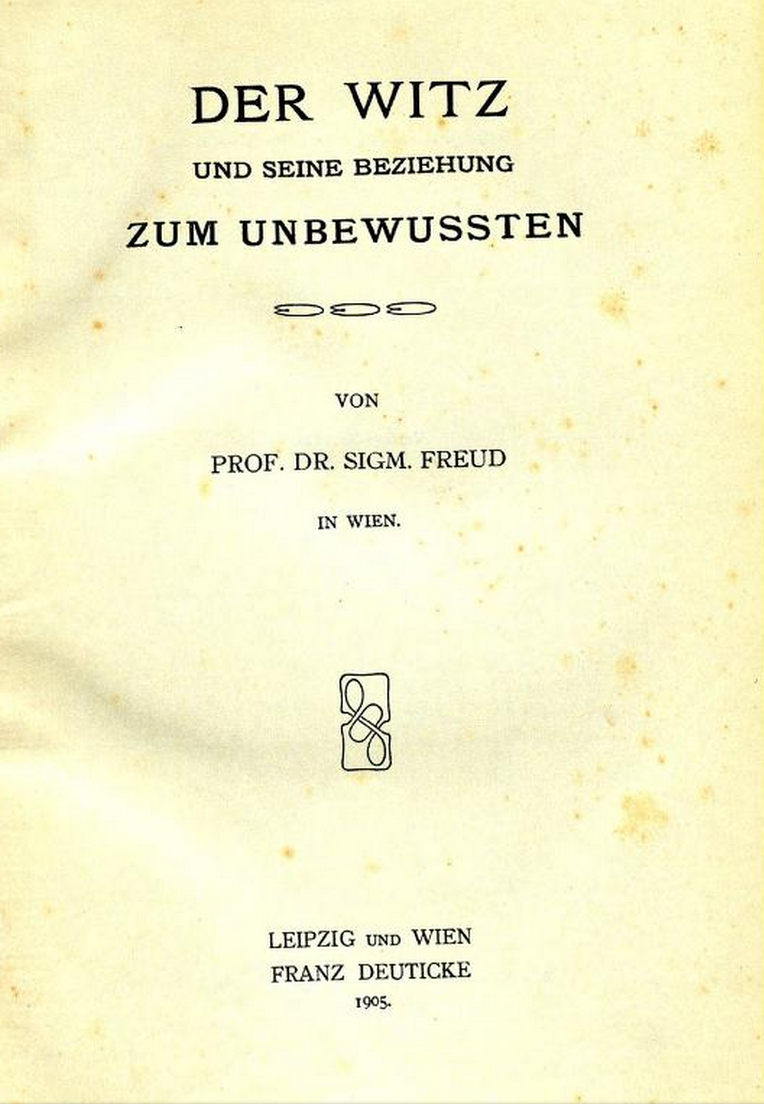
Title page of the 1905 German first edition of Freud's book 'Der Witz und seine Beziehung zum Unbewussten', by Prof. Dr. Sigm. Freud in Wien, published by Franz Deuticke in Leipzig und Wien. Yellowed paper with a decorative device.Book

Primary source

Jokes and Their Relation to the Unconscious

Sigmund Freud · 1905

Book

Primary source

Leonardo da Vinci and a Memory of His Childhood

Sigmund Freud · 1910

Book

Primary source

The Uncanny

Sigmund Freud · 1919

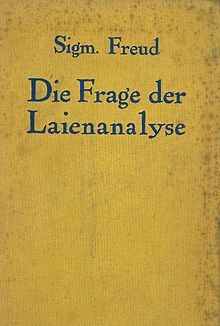
Front cover of the 1926 German edition of Freud's book 'Die Frage der Laienanalyse'. Yellow cloth cover with the author name 'Sigm. Freud' in dark blue capital letters at top and the title in larger blue letters below.Book

Primary source

The Question of Lay Analysis

Sigmund Freud · 1926

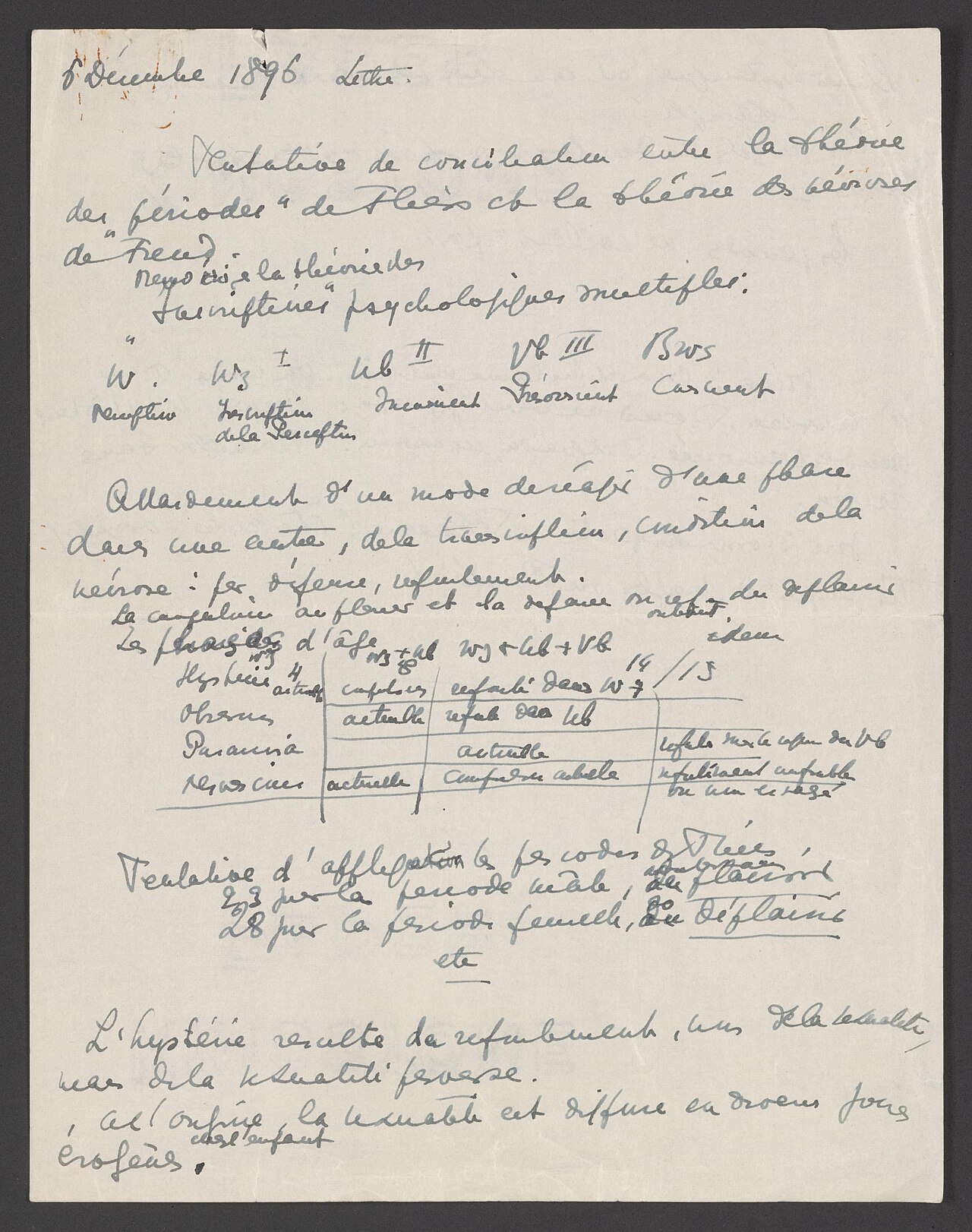
Handwritten page in French, dated 1 December 1896 at top, in blue-black ink on cream paper. It discusses reconciling Fleiss's period theory with psychological theories, includes a table of stages and a few calculations, and ends with a short note. The page is written in cursive script with several crossings-out and insertions.Letter

Primary source

Letter to Wilhelm Fliess, 6 December 1896 (Letter 52)

Sigmund Freud · 6 December 1896

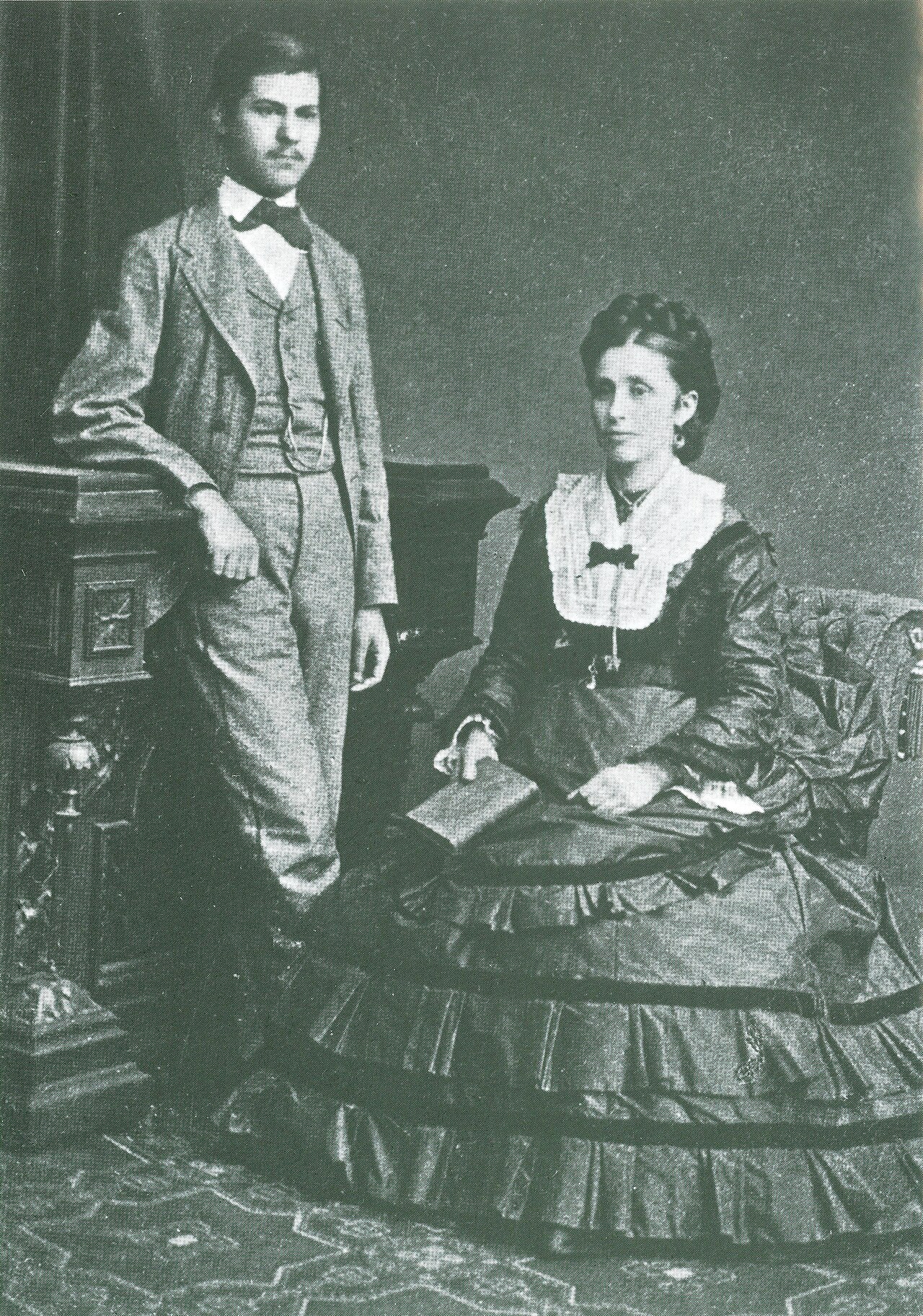
Sepia-toned studio portrait of a young man standing with one arm resting on a carved wooden cabinet, wearing a suit, waistcoat and bow tie. Seated beside him is an older woman in a dark dress with a white lace collar, holding a closed book on her lap.Photograph

Primary source

Sigmund Freud and his mother Amalia

Unknown

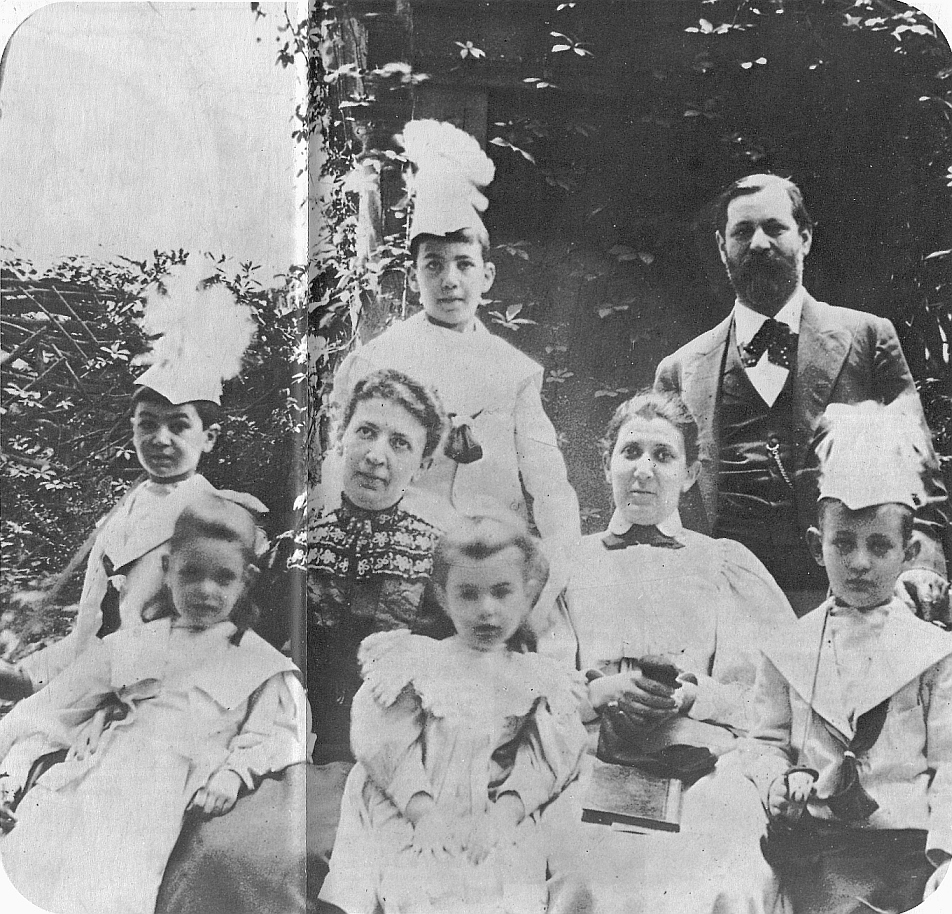
Black-and-white outdoor group photograph of a family of seven in a garden with dense foliage. A man with a mustache and suit stands at the back right, a boy in a light outfit and feathered hat stands behind, and a woman with dark hair sits left of center. Children in light dresses and feathered hats sit in front.Photograph

Primary source

The Freud Family, c. 1898

Unknown · c. 1898

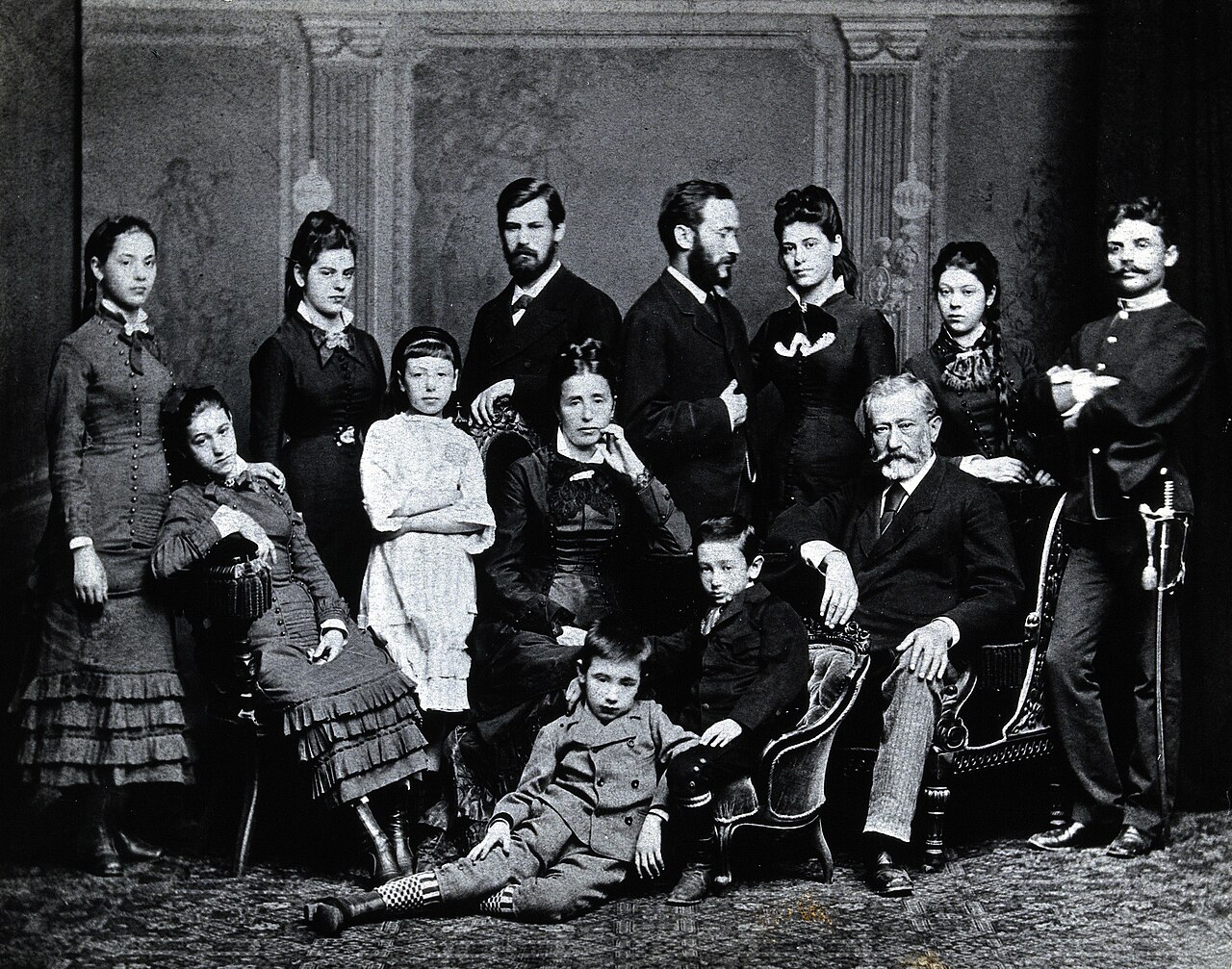
Black and white group photograph of about twelve people arranged in a studio setting with a patterned backdrop. A seated older man with a moustache on the right, and a seated woman in dark dress in the center. Young people stand behind, and children sit or lie in front. One young man in a military-style uniform with a sword stands at the far right.Photograph

Primary source

Freud Family Group, c. 1876

Unknown · c. 1876

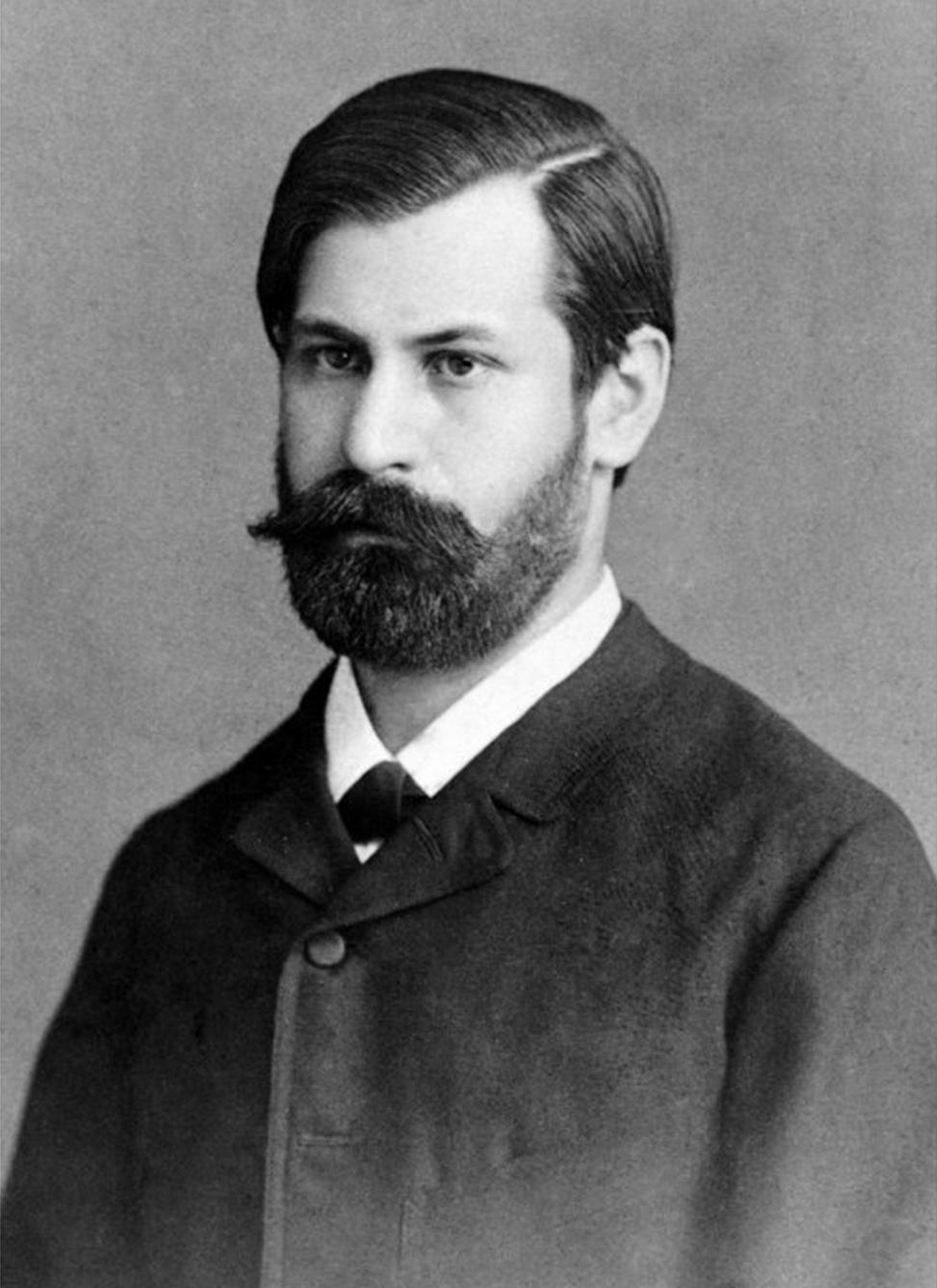
Black and white studio portrait of a man with dark, slicked-back hair parted on the side, a full mustache and beard, wearing a dark jacket, white collar and dark tie against a grey backdrop.Photograph

Primary source

Freud, 1885

c. 1885

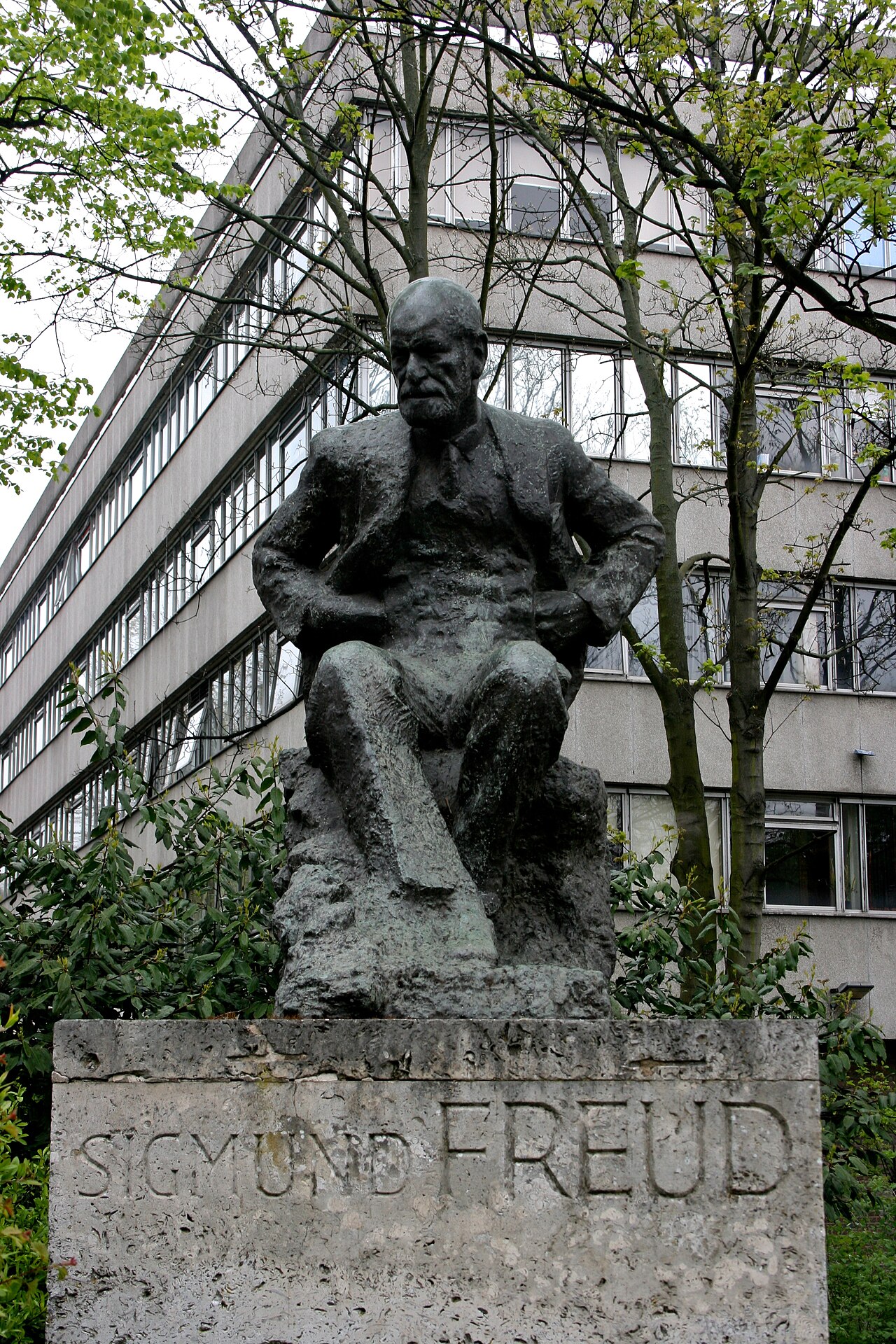
Bronze statue of a seated, bald, bearded man in a suit, with one leg crossed over the other and hands clasped on his lap, set on a rough stone base. The pedestal inscription reads SIGMUND FREUD. Trees and a multi-storey grey building stand behind.Sculpture

Secondary source

Statue of Sigmund Freud

Oscar Nemon · 1971

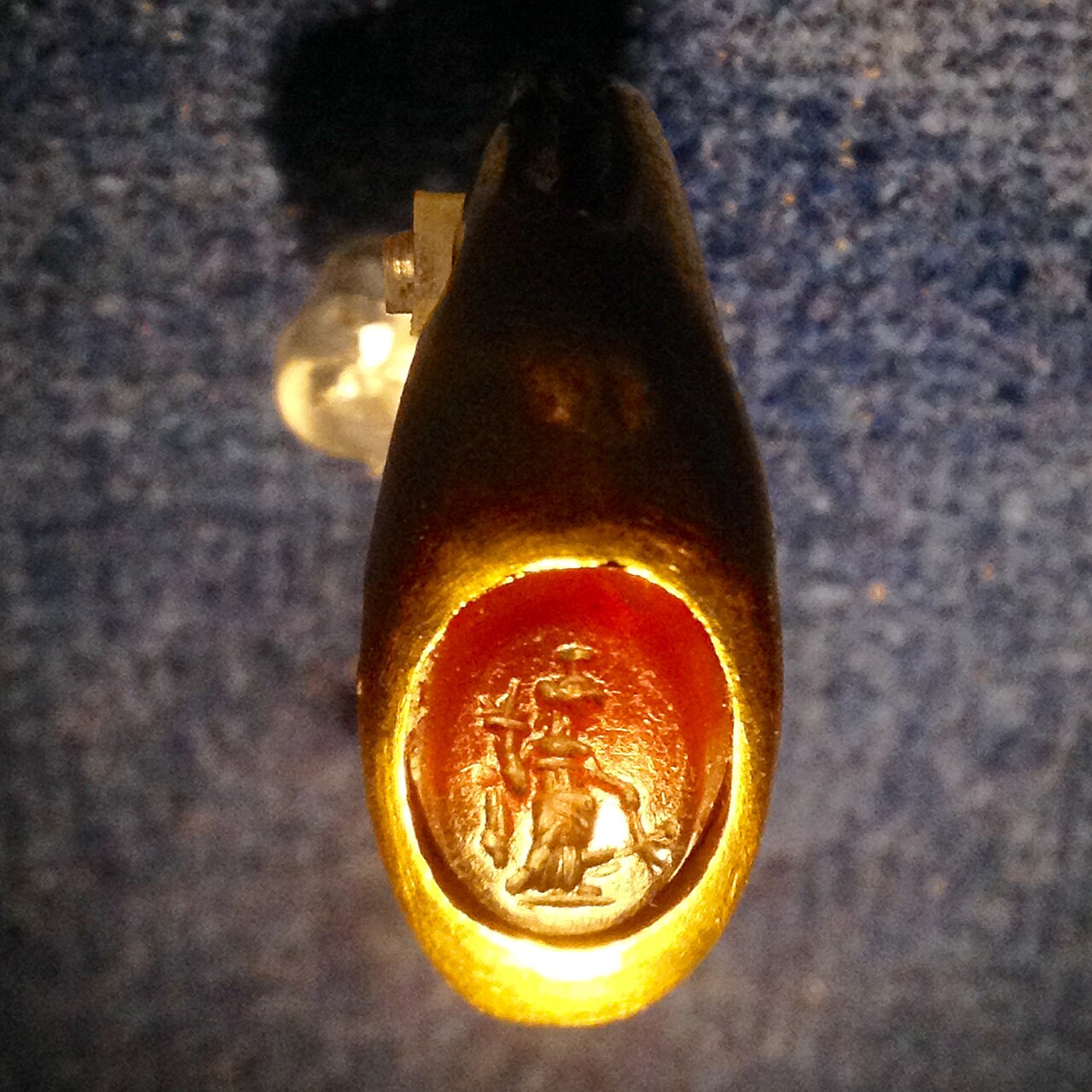
Close-up of a dark gold-colored oval signet ring set with a red carnelian stone. Engraved in the stone is a small figure of a standing or seated female figure with a wheel or object beside her, lit from below against a blue background.Artifact

Primary source

Engraved Signet Ring Depicting Fortuna

75

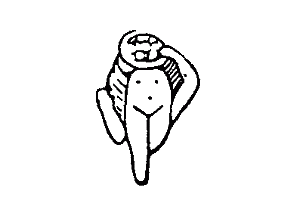
Black-and-white line drawing on white background of a squatting figure with a round face with eyes, nose and mouth, a bulbous rounded top to the head, bent arms raised toward the head, and a long tapering lower body.Painting

Primary source

Skizze der Baubo

Sigmund Freud

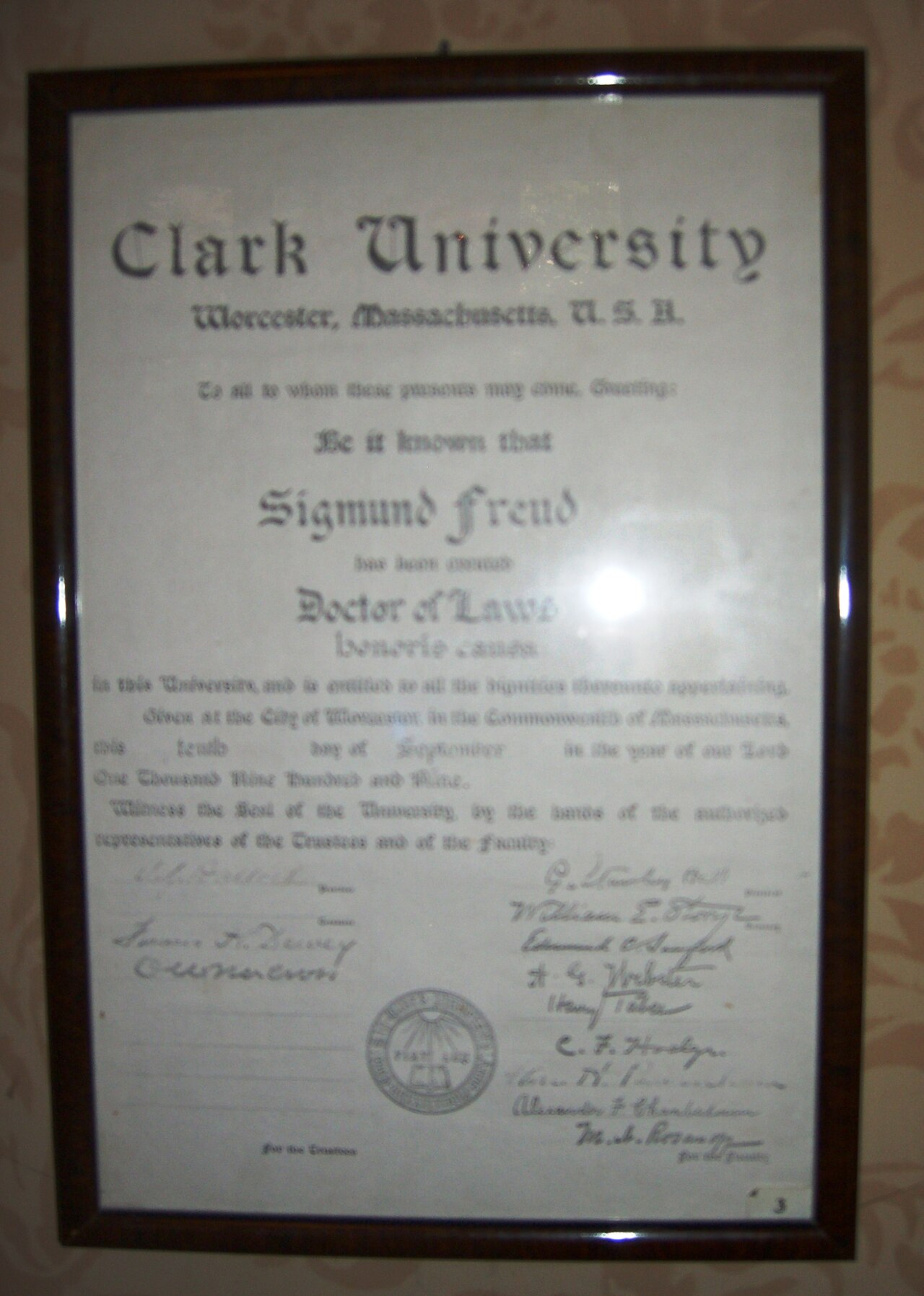
Framed honorary Doctor of Laws certificate from Clark University, Worcester, Massachusetts, U.S.A., naming Sigmund Freud, with a seal and several handwritten signatures, hung on a wall.Document

Primary source

Clark University Honorary Doctor of Laws Diploma

September 1909

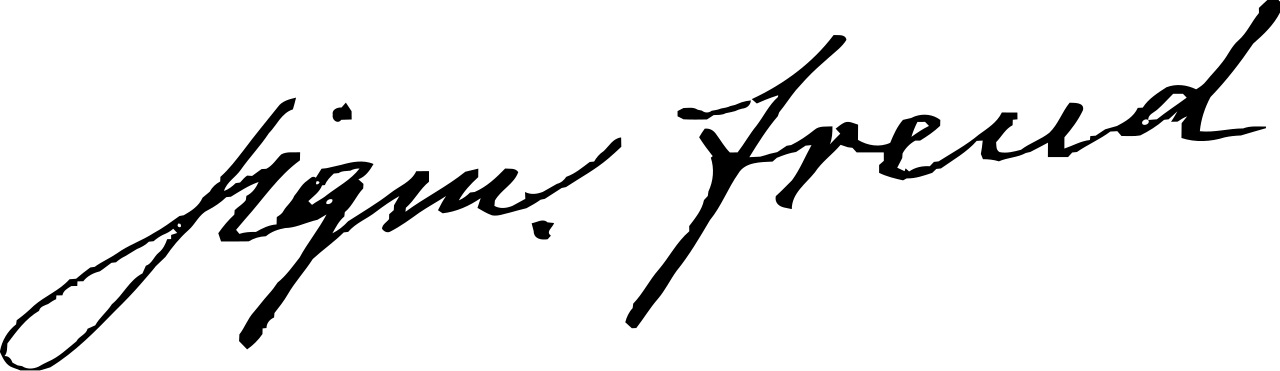
Black handwritten signature on a white background, reading 'Sigm. Freud' in a flowing cursive script, slanted upward from left to right.Document

Primary source

Signature of Sigmund Freud

Sigmund Freud

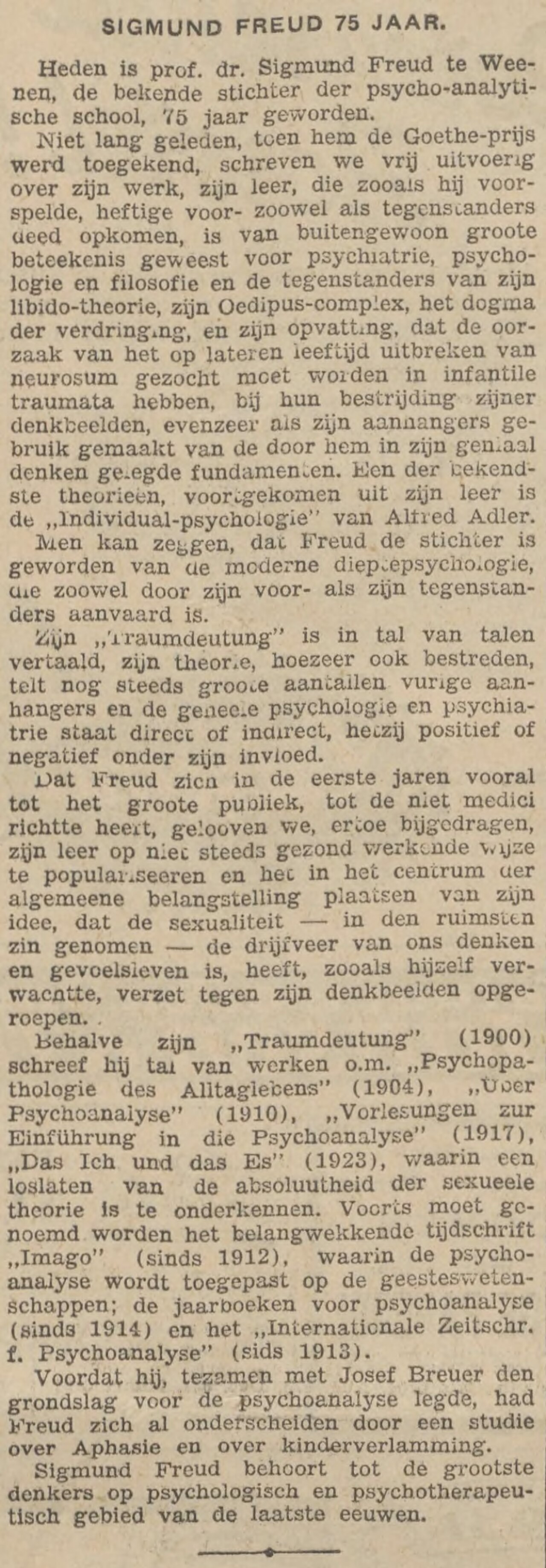
Scanned newspaper clipping titled 'SIGMUND FREUD 75 JAAR' in Dutch, a column of printed body text celebrating Freud's 75th birthday and discussing his psychoanalytic work and publications.Newspaper article

Secondary source

Sigmund Freud 75 Jaar

6 May 1931

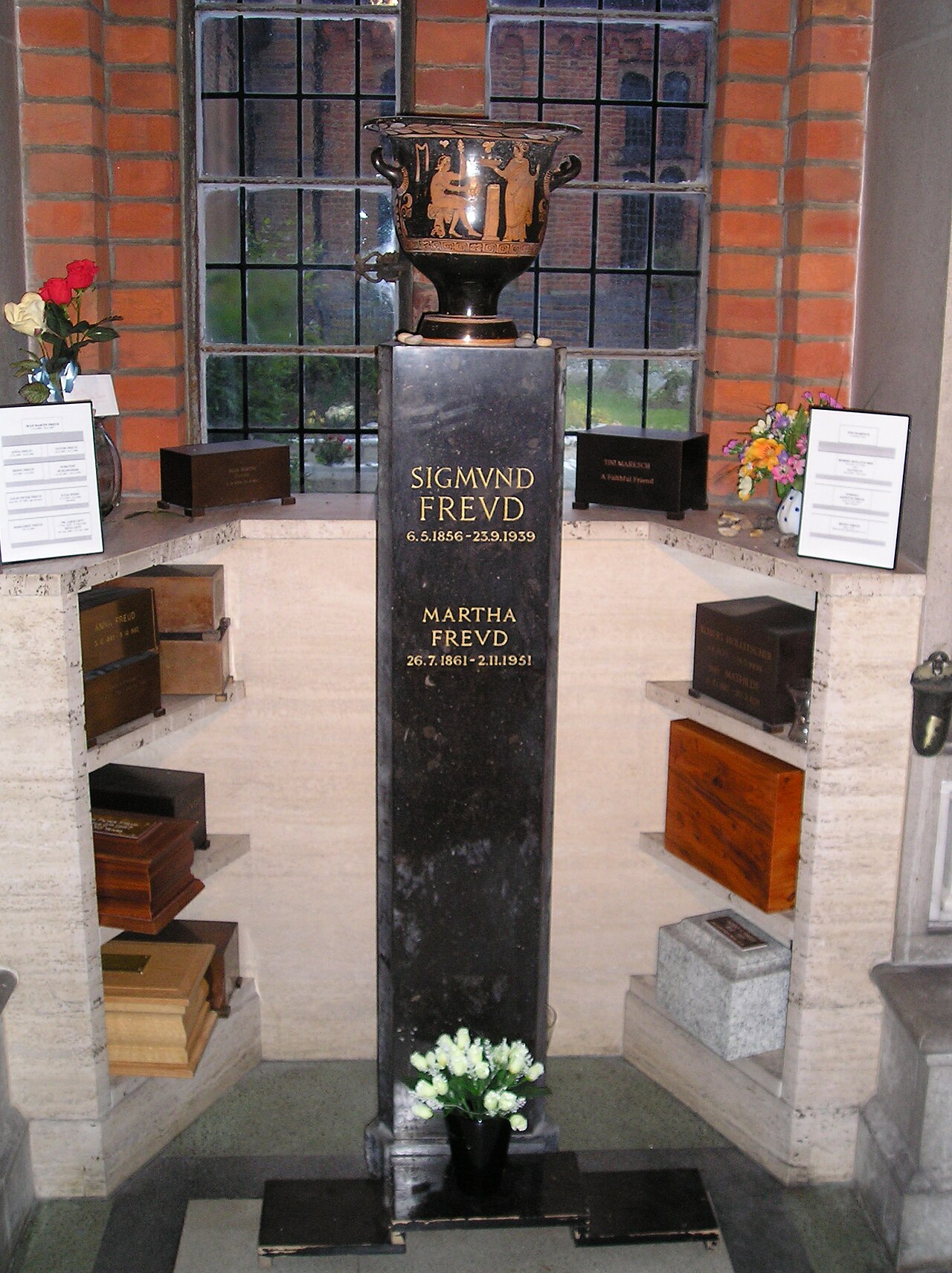
A dark stone columbarium niche with a black marble pillar inscribed 'SIGMUND FREUD 6.5.1856 - 23.9.1939' and 'MARTHA FREUD 26.7.1861 - 2.11.1951', topped by a red-figure Greek krater vase. Urns and plaques surround it in a light stone wall, with white flowers at the base.Artifact

Secondary source

Grave of Sigmund Freud

Book

Primary source

The History of the Psychoanalytic Movement

Sigmund Freud · 1917

Book

Primary source

A General Introduction to Psycho-Analysis

Sigmund Freud · 1922

Book

Primary source

Die Zukunft einer Illusion

Sigmund Freud · 1928

Book

Primary source

Sigmund Freud: Persönliche Erinnerungen

Isidor Sadger · 1929

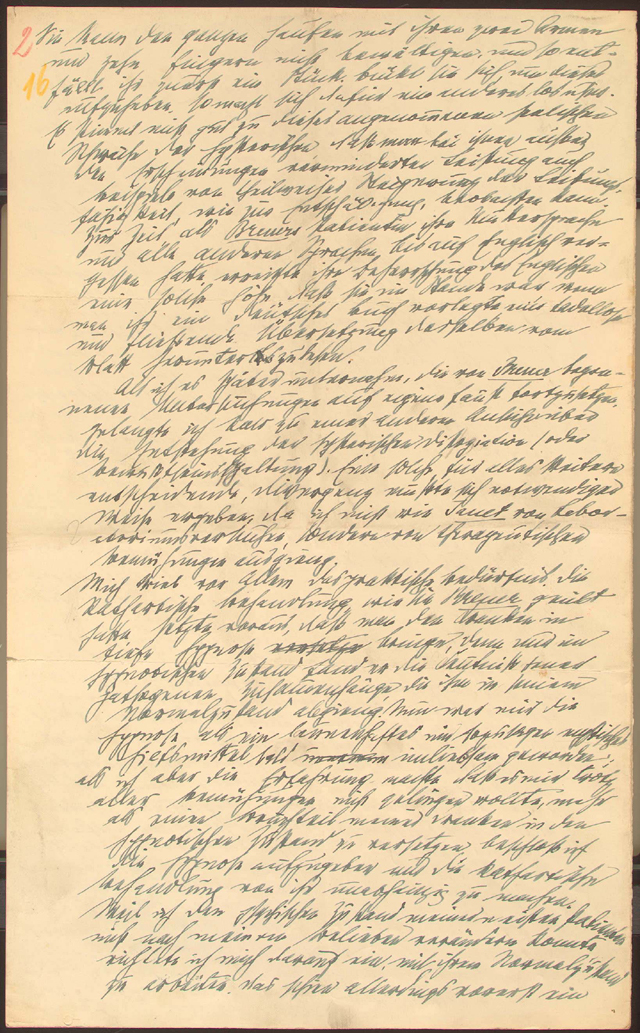
Scan of a handwritten manuscript page in German cursive script on aged yellowed paper, with page number 2 and 16 in red and orange ink at the top left. The dense handwriting contains crossed-out words and marginal corrections.Document

Primary source

Manuscript of the Rat Man Case

Sigmund Freud · 1909

Sigmund Freud: His Personality, His Teaching, and His SchoolBook

Secondary source

Sigmund Freud: His Personality, His Teaching, and His School

Fritz Wittels · 1924

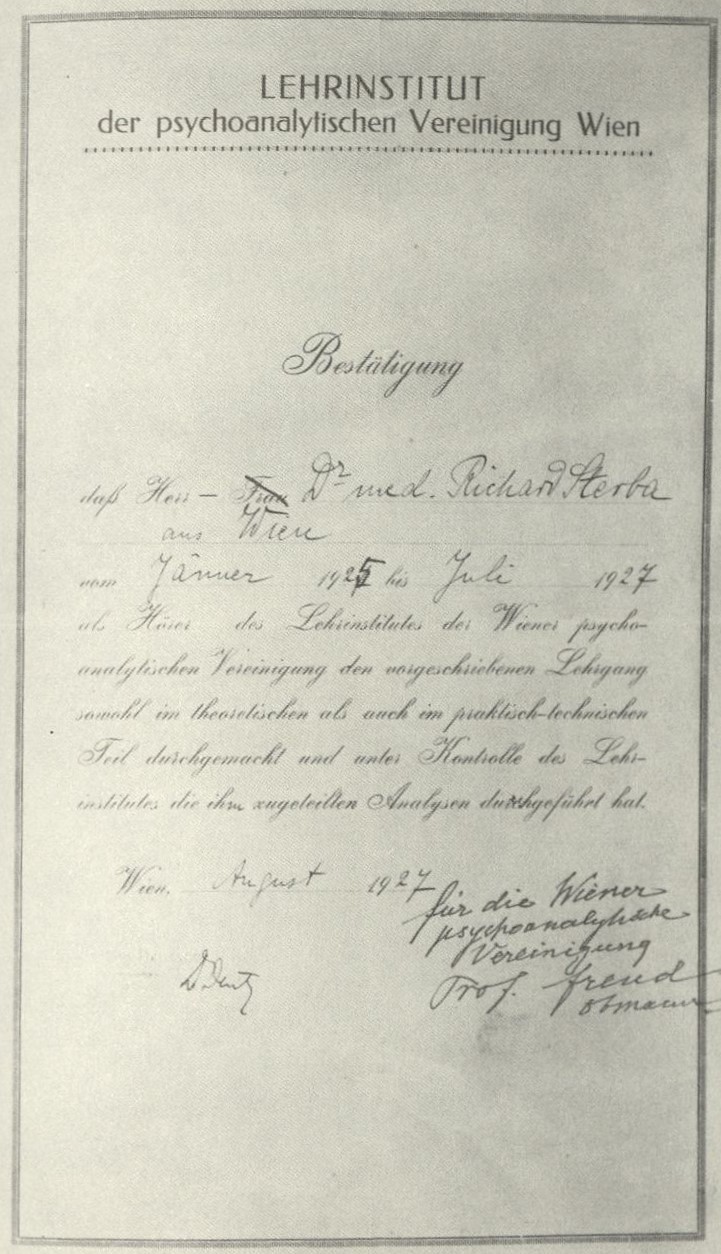
Scanned typed and handwritten certificate titled Bestätigung from the Lehrinstitut der psychoanalytischen Vereinigung Wien, confirming Dr. med. Richard Sterba of Wien completed training from January 1925 to July 1927, dated August 1927, with signatures.Document

Primary source

Certificate of Vienna Psychoanalytic Institute Training

August 1927

Book

Primary source

Three Contributions to the Theory of Sex

Sigmund Freud · 1910

Book

Primary source

Concerning "Wild" Psychoanalysis

Sigmund Freud · 1912

Book

Primary source

Wit and Its Relation to the Unconscious, Part I

Sigmund Freud · 1905

Book

Primary source

Psychopathology of Everyday Life: Forgetting of Proper Names

Sigmund Freud · 1914

Book

Primary source

Dream Psychology: Psychoanalysis for Beginners

Sigmund Freud · 1920

Book

Primary source

Leonardo da Vinci: A Psychosexual Study of an Infantile Reminiscence

Sigmund Freud · 1916

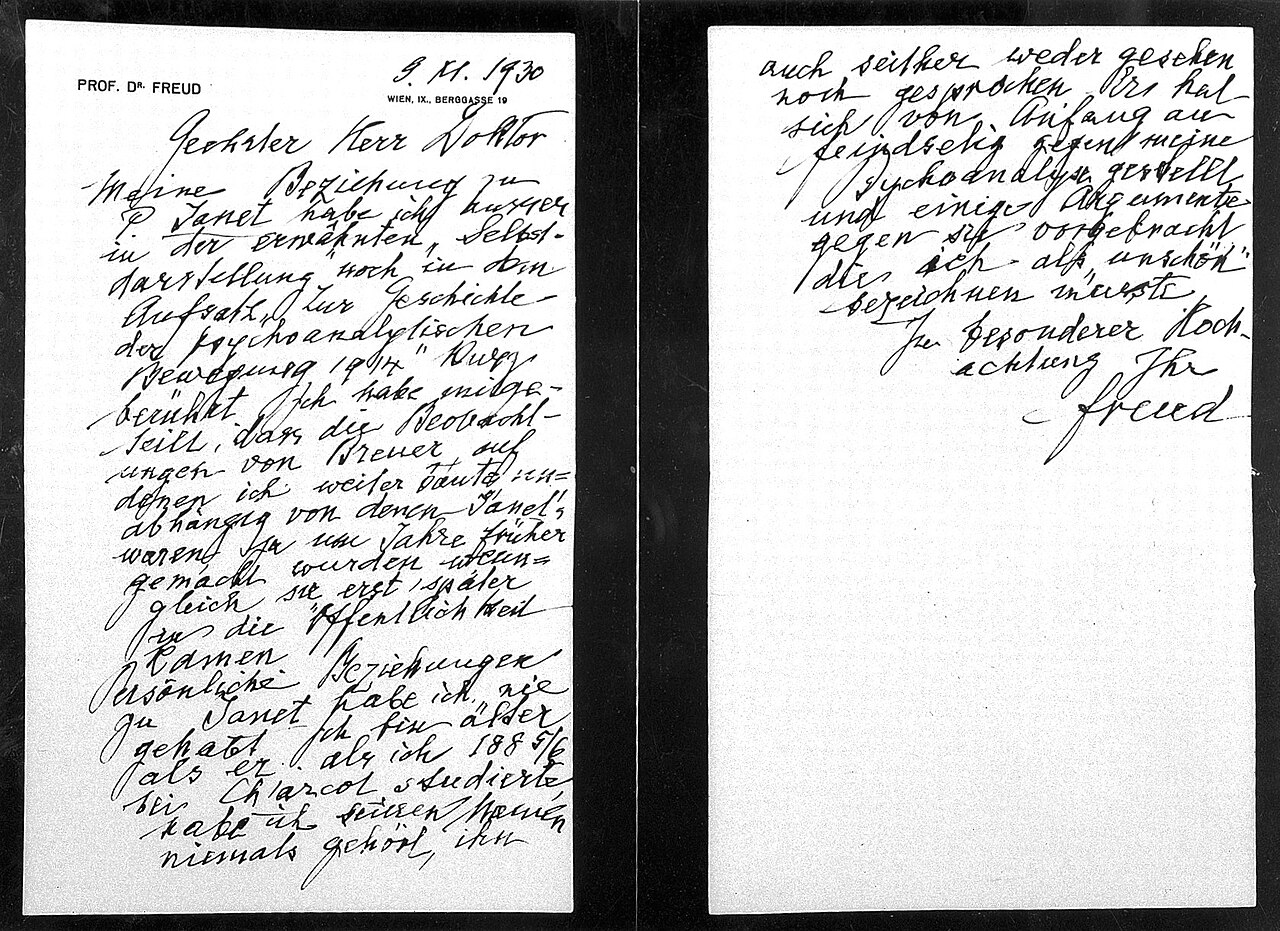
Two-page scan of a handwritten letter in German script, dated 9.11.1930 from Vienna, signed by Freud. Black-and-white image on a dark background; left page begins 'Geehrter Herr Kollege' and right page continues the text ending with 'Freud'.Letter

Primary source

Letter to a Colleague on Pierre Janet

Sigmund Freud · 9 November 1930

Book

Primary source

Reflections on War and Death

Sigmund Freud · 1918

Speech

Secondary source

Über Psychoanalyse (audio reading)

Sigmund Freud

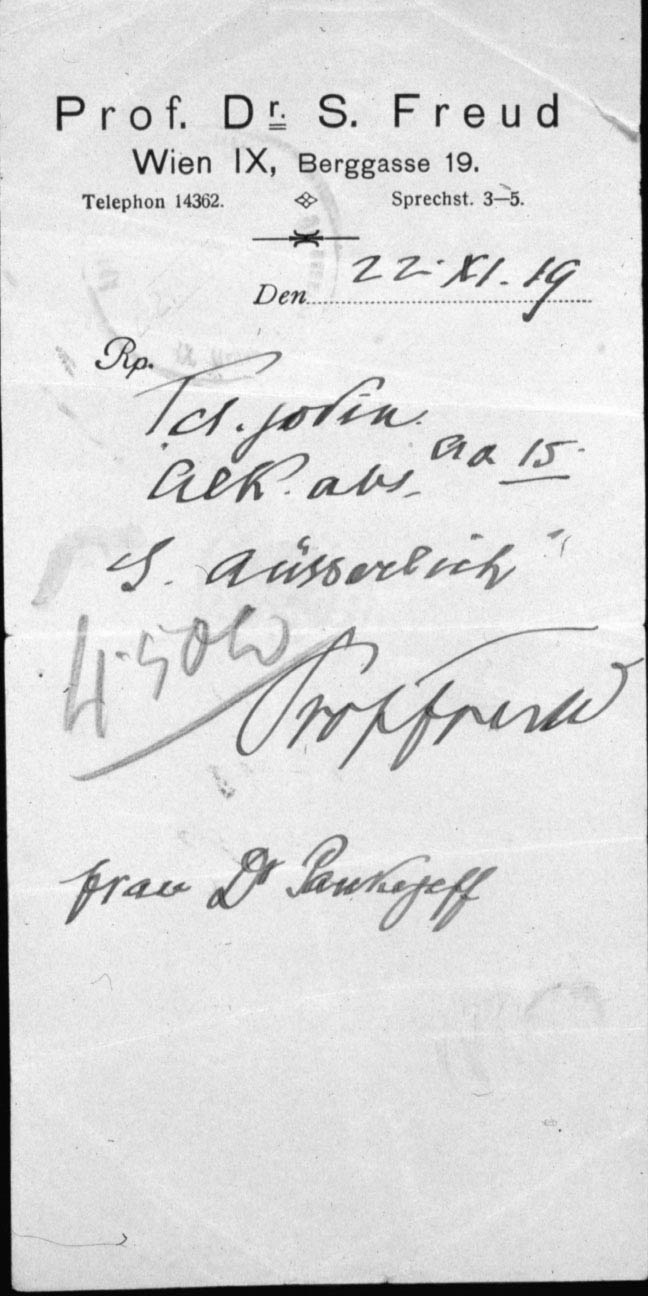
Scan of a handwritten prescription on letterhead reading 'Prof. Dr. S. Freud, Wien IX, Berggasse 19', with telephone and consultation hours, dated 22 XI 19. Handwritten Rp. and prescription lines, signed Prof Freud, with a note at the bottom reading 'Frau Dr Pankejeff'.Document

Primary source

Prescription for the Wolf Man's Wife

Sigmund Freud · 22 November 1919

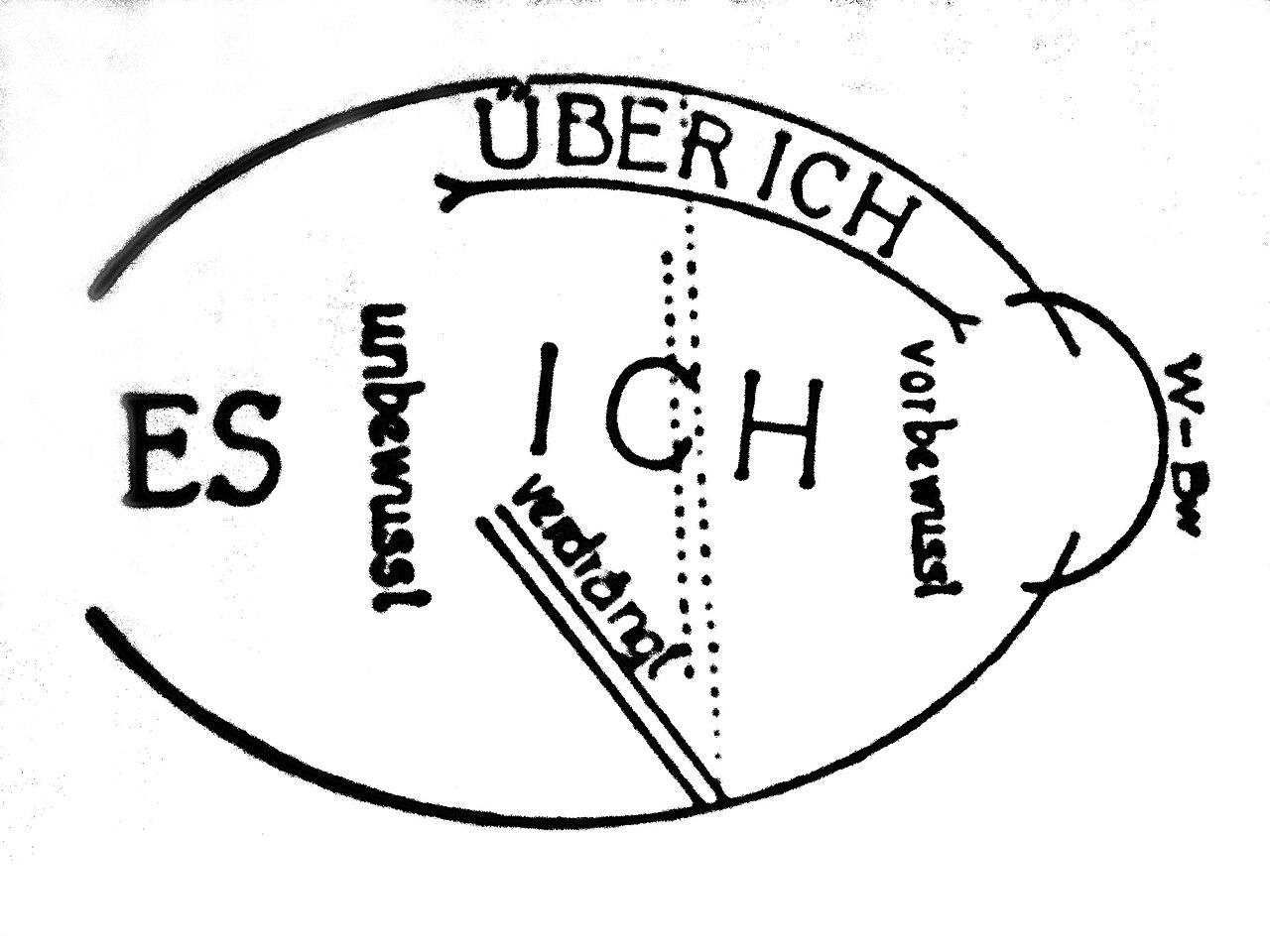
Hand-drawn diagram in black ink on white: an oval divided into regions labeled ES at left, ICH in the center, and ÜBER ICH across the top arc. Labels include unbewusst, vorbewusst, verdrängt, and W-Bw near a small bump on the right.Document

Primary source

Freud's Second Topography Diagram (Id, Ego, Superego)

Sigmund Freud · 1933 (photographic reproduction 2010)

Close crop of a handwritten page in blue ink cursive on pale cream paper. Lines of looping script run diagonally; a word in the center-right resembles 'Psychoanalyse'. Partial lines appear above and below.Document

Primary source

Handwritten Word 'Die Psychoanalyse' by Freud

Sigmund Freud · 6 December 1938

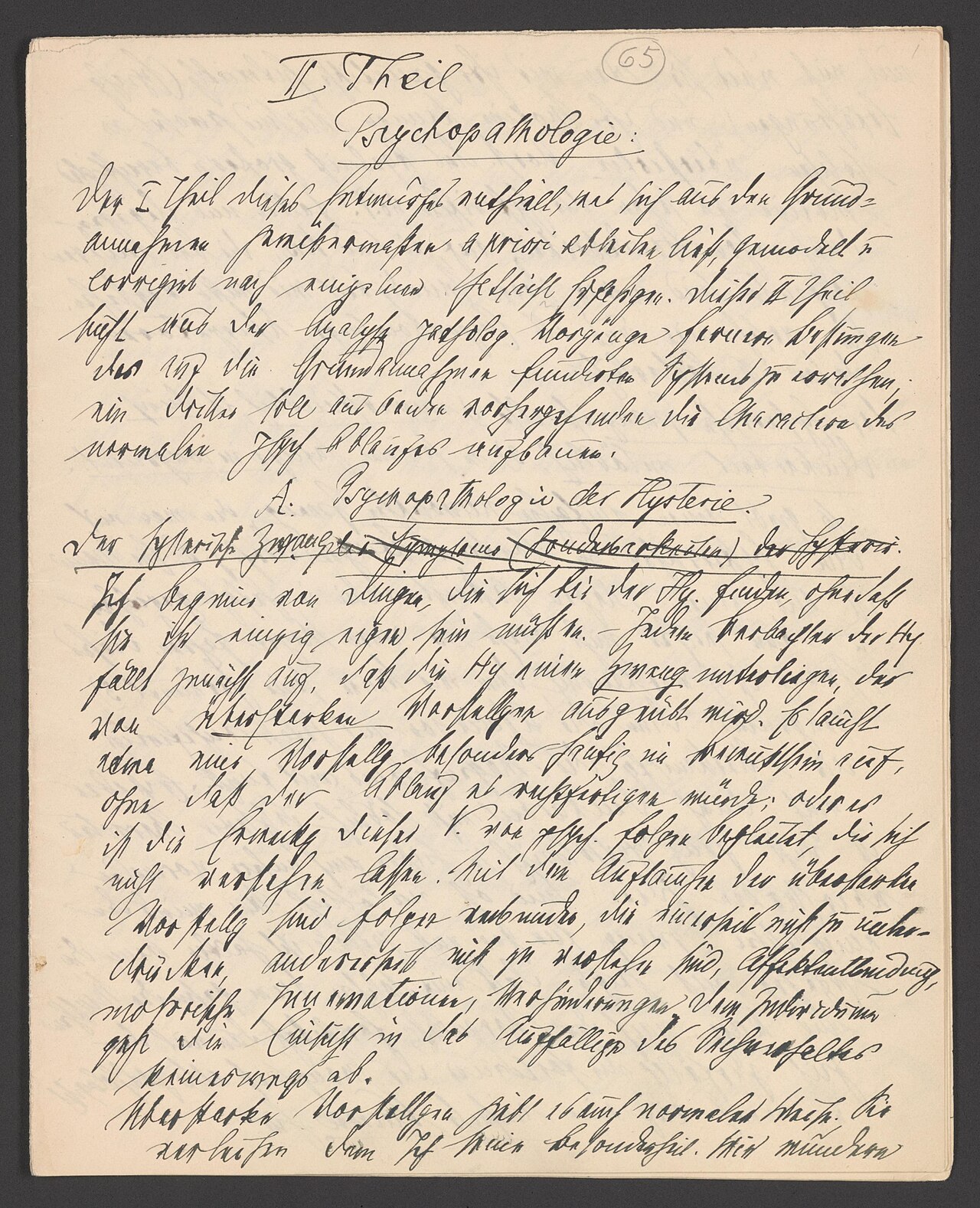
Handwritten manuscript page in ink on cream paper, headed 'II Theil Psychopathologie' with a section 'I. Psychopathologie der Hysterie' below. Dense cursive German text, with some words struck through. Page number 65 circled at top right.Book

Primary source

Manuscript Fragment of Project for a Scientific Psychology, Part II

Sigmund Freud · 1895

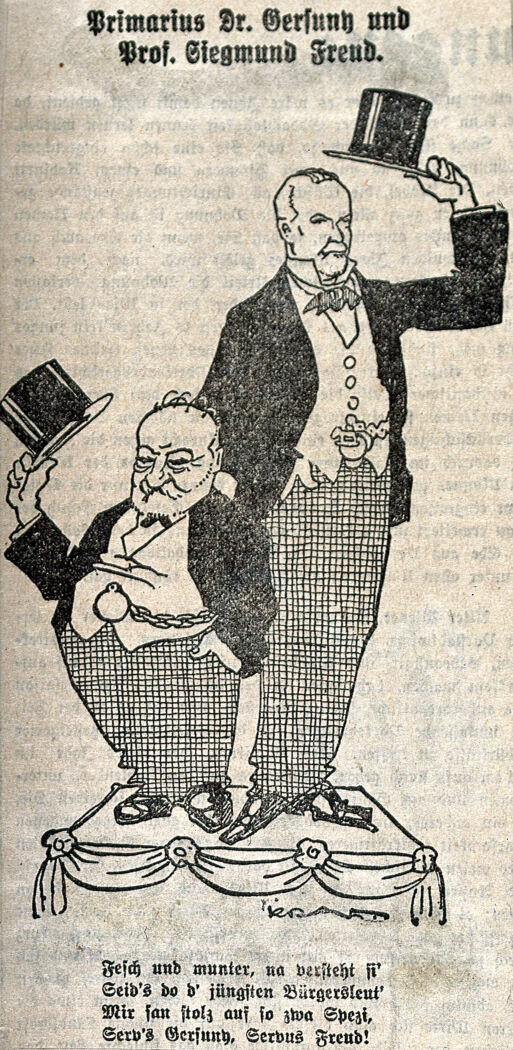
Newspaper caricature titled 'Primarius Dr. Gersuny und Prof. Sigmund Freud'. Two exaggerated men in formal tailcoats stand on a draped platform, raising top hats. The shorter, bearded man is on the left and the taller, mustached man on the right. Dialect verse caption is printed below.Painting

Primary source

Gersuny and Freud Caricature, Der Morgen

1924

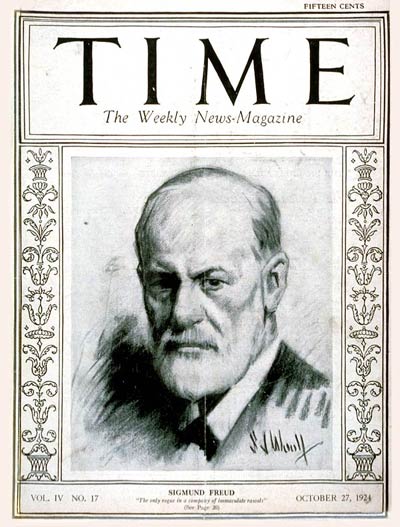
Cover of TIME, The Weekly News-Magazine, Vol. IV No. 17, October 27, 1924, fifteen cents. A charcoal-style portrait of Sigmund Freud, an older bald man with a moustache and dark suit, fills the central frame, signed in the lower right. Caption reads SIGMUND FREUD.Photograph

Primary source

Sigmund Freud on the Cover of Time Magazine

Time Magazine · 27 October 1924

The Freudian Wish and Its Place in EthicsBook

Secondary source

The Freudian Wish and Its Place in Ethics

Edwin B. Holt · 1916

Psycho-analysis: A Brief Account of the Freudian TheoryBook

Secondary source

Psycho-analysis: A Brief Account of the Freudian Theory

Barbara Low · 1920

La psicanalisi, Volume OneBook

Secondary source

La psicanalisi, Volume One

Enrico Morselli · 1926

Book

Primary source

Dream Psychology

Sigmund Freud · 1920

Book

Primary source

Psychopathology of Everyday Life

Sigmund Freud

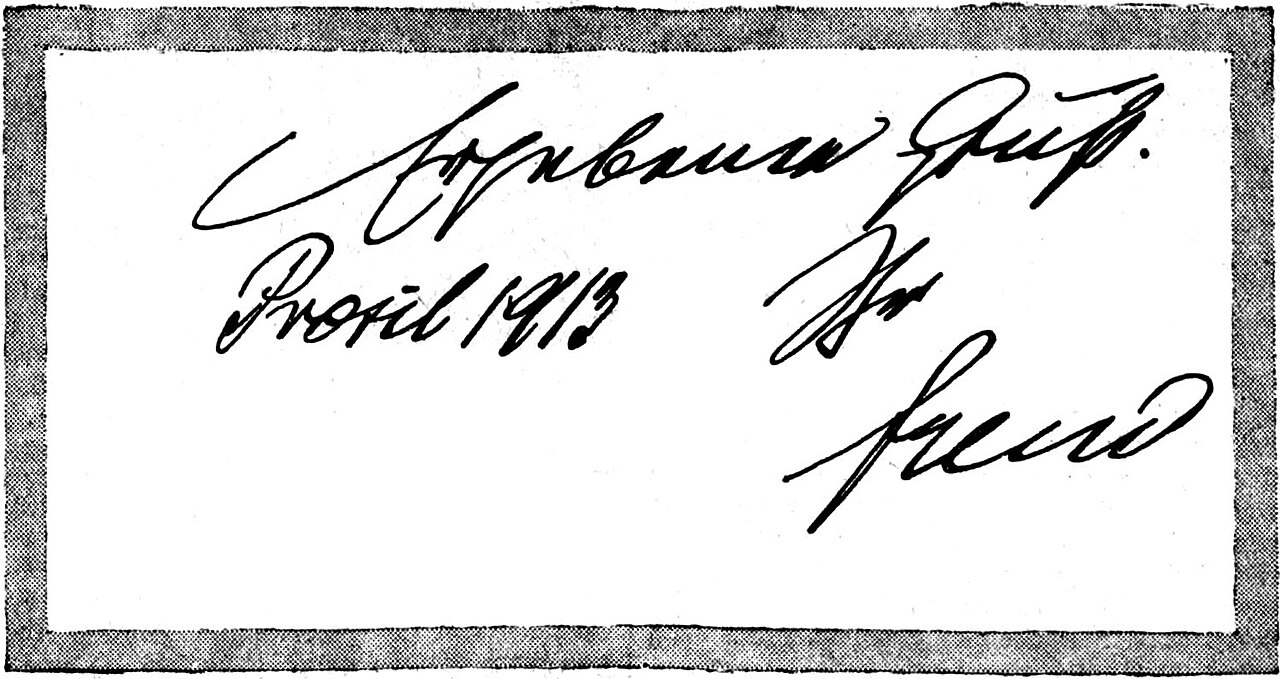
Scanned image of a handwritten calling card with a black-and-white dotted border. Cursive ink text reads 'Sigmund Freud' at top, 'Profil 1913' below left, and a signature 'Freud' at lower right, on white paper.Newspaper article

Primary source

Freud carte de visite in Algemeen Handelsblad

1 May 1933

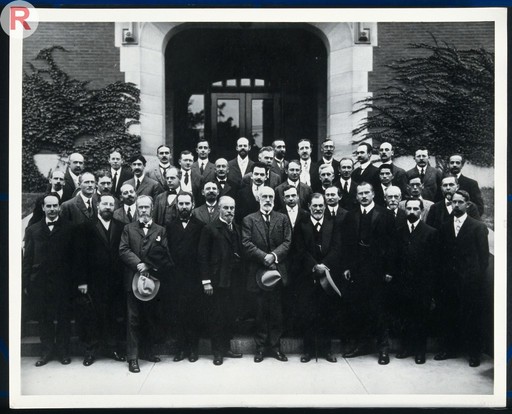
Black and white group photograph of about forty men in dark suits and hats, arranged in rows on steps in front of a stone archway with a doorway and ivy on the building walls.Photograph

Primary source

Psychoanalysts including Freud

Introduction to Freud's Psychopathology of Everyday LifeBook

Secondary source

Introduction to Freud's Psychopathology of Everyday Life

Peter Gay · 1902 (date likely incorrect)

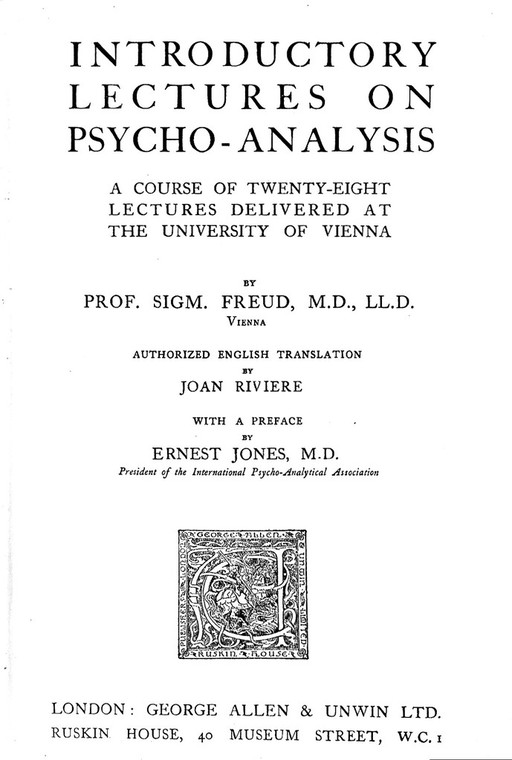
Title page of Introductory Lectures on Psycho-Analysis by Prof. Sigm. Freud, authorized English translation by Joan Riviere, with a preface by Ernest Jones, published by George Allen & Unwin, London, with an ornamental Ruskin House device.Book

Primary source

Title Page of Introductory Lectures on Psycho-Analysis

Sigmund Freud · 1922

Diary entry

Primary source

A Young Girl's Diary, with introduction by Sigmund Freud

1919 translation

Black and white portrait of an older bearded man in a suit and tie, holding a cigar in his right hand, against a dark backdrop, gazing toward the viewer.Photograph

Secondary source

Portrait of Sigmund Freud (2016 scan)

Veroraz · 2016

Front cover of the book Der Fall Freud by Han Israëls. Yellow background with a pale top section. Title in large blue letters 'Der Fall Freud', author name 'Han Israëls' in red above, and subtitle 'Die Geburt der Psychoanalyse aus der Lüge' in red below. Publisher logo 'eva Europäische Verlagsanstalt' on the spine edge.Book

Secondary source

Der Fall Freud

Han Israëls · 1999

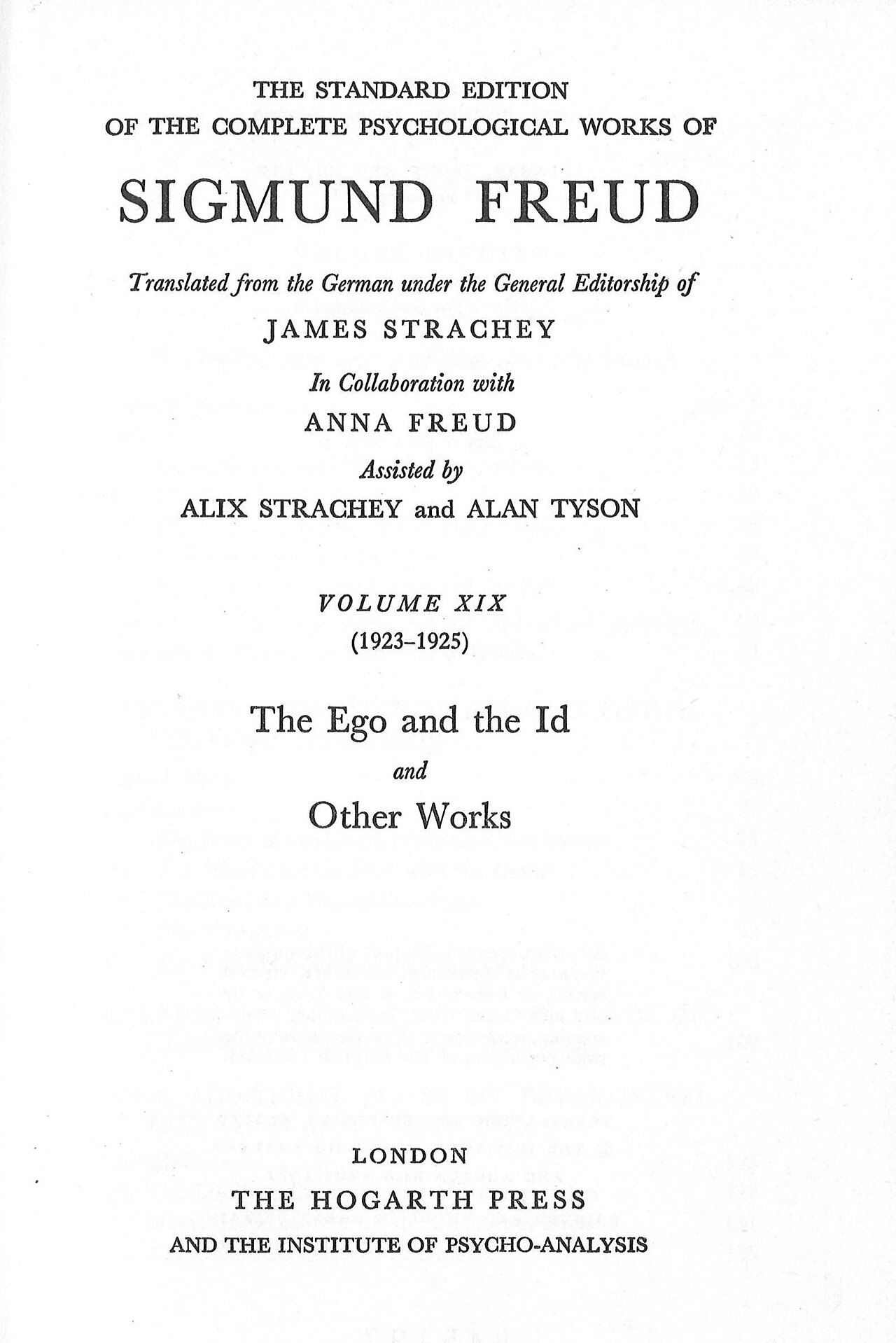
Title page of The Standard Edition of the Complete Psychological Works of Sigmund Freud, Volume XIX (1923-1925), The Ego and the Id and Other Works. Translated by James Strachey, with Anna Freud, Alix Strachey and Alan Tyson. London: The Hogarth Press and The Institute of Psycho-Analysis.Book

Secondary source

Title Page of the Standard Edition, Volume XIX

Sigmund Freud · before 1975

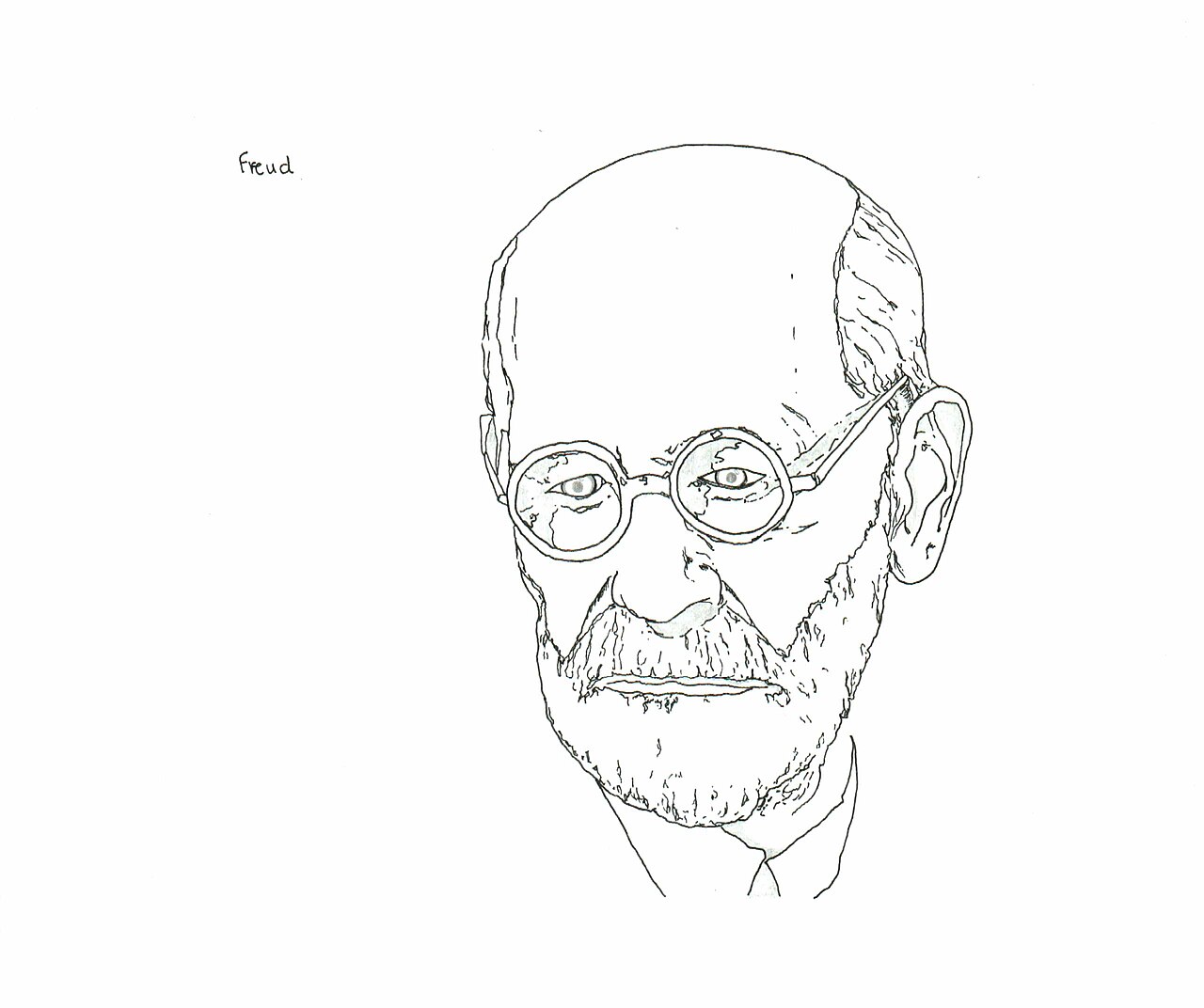
Black-and-white line drawing of a bald, bearded older man with round wire-rimmed glasses, a mustache, and a handwritten label reading 'Freud' in the upper left corner.Painting

Secondary source

Illustration of Sigmund Freud

Núcleo Editorial · 2012

Newspaper article

Primary source

B'nai B'rith Mitteilungen für Österreich, May 1926

Arnold Ascher · May 1926

Newspaper article

Secondary source

B'nai B'rith Monatsblätter, Prague, April 1926

April 1926

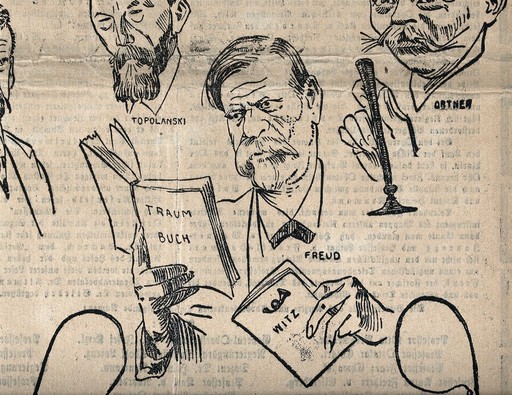
Detail of a caricature print on newspaper-like paper showing a bearded man with a bald head and mustache, labeled FREUD, holding an open book titled TRAUMBUCH and a small book labeled WITZ. Other caricature heads labeled TOPOLANSKI and OTHER appear around him.Artifact

Primary source

Ten Viennese Doctors

Carl von Noorden · 1913

Document

Primary source

Manifesto Against Conscription and the Military System

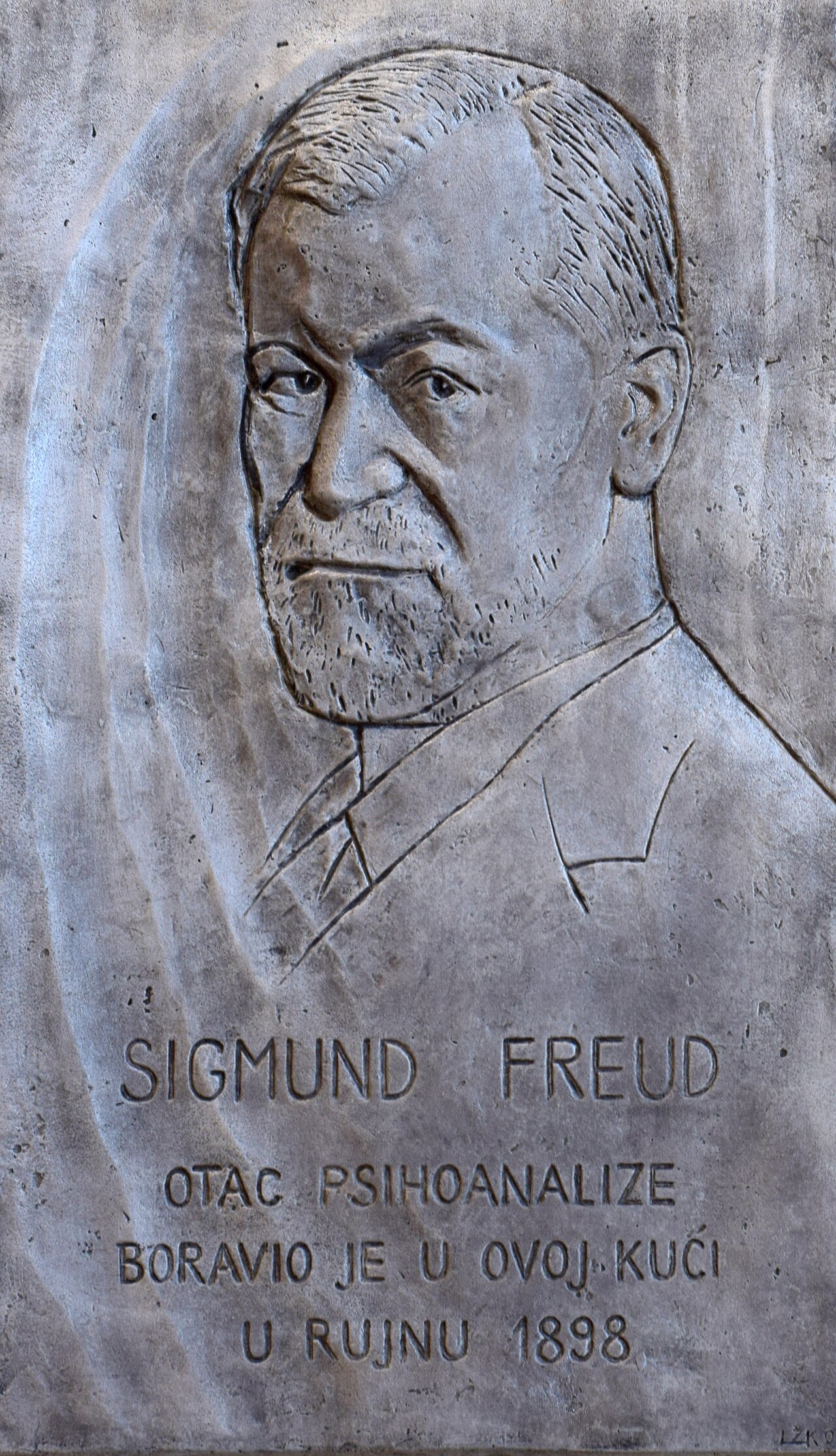
Bas-relief bronze-toned memorial plaque showing a bearded man with receding hair in three-quarter view, wearing a suit jacket. Below are engraved capital letters reading SIGMUND FREUD, OTAC PSIHOANALIZE, BORAVIO JE U OVOJ KUĆI U RUJNU 1898.Sculpture

Secondary source

Freud memorial plaque in Split

Manfred Kuzel

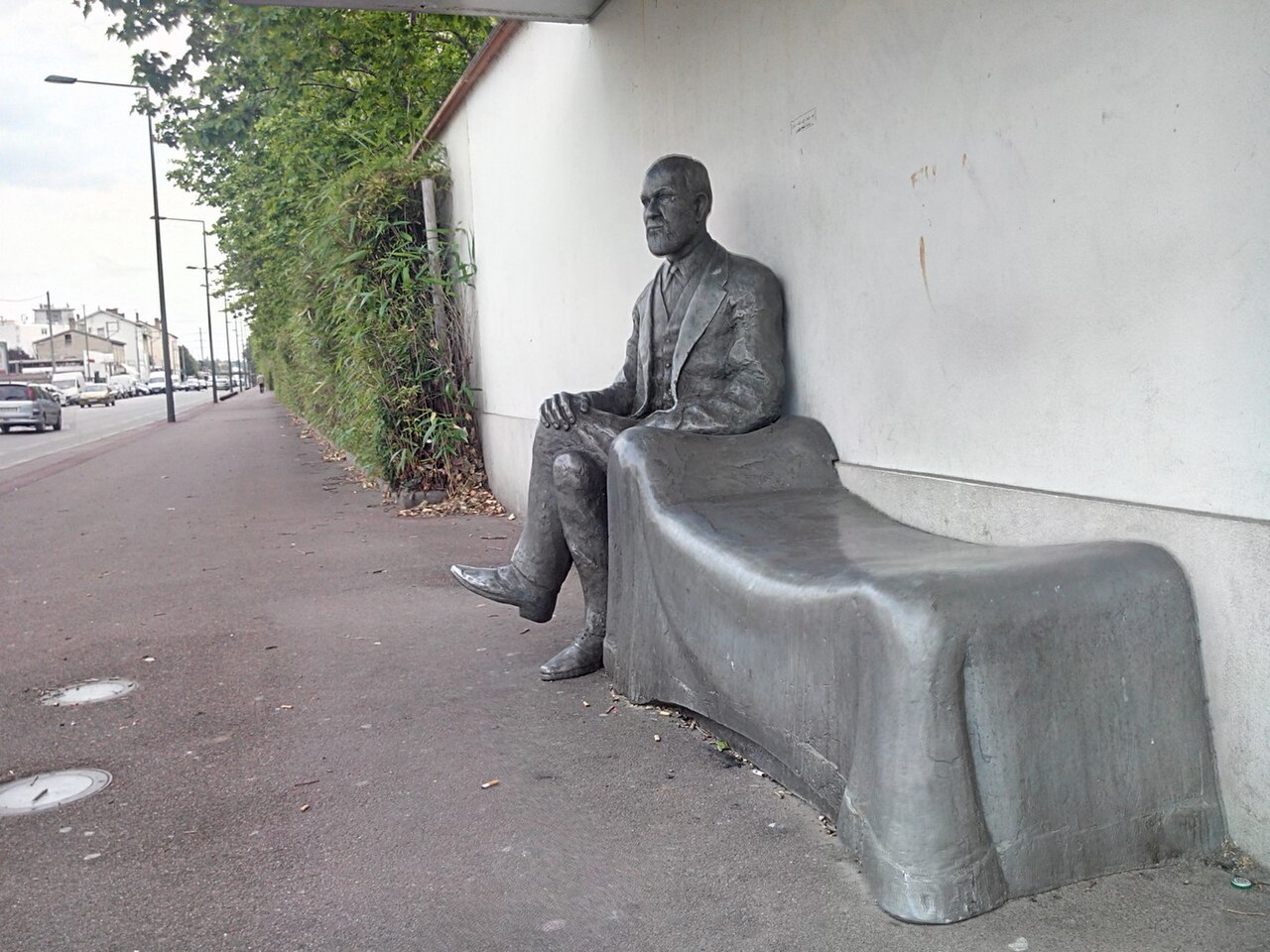
Bronze-grey statue of a bearded man in a suit and tie sitting on a curved stone bench against a white wall beside a sidewalk. One leg is crossed over the other, hands rest on his knee, and a tree-lined street with parked cars is behind.Sculpture

Secondary source

Freud statue beside Lyon demi-millennium fresco, 2014

2014

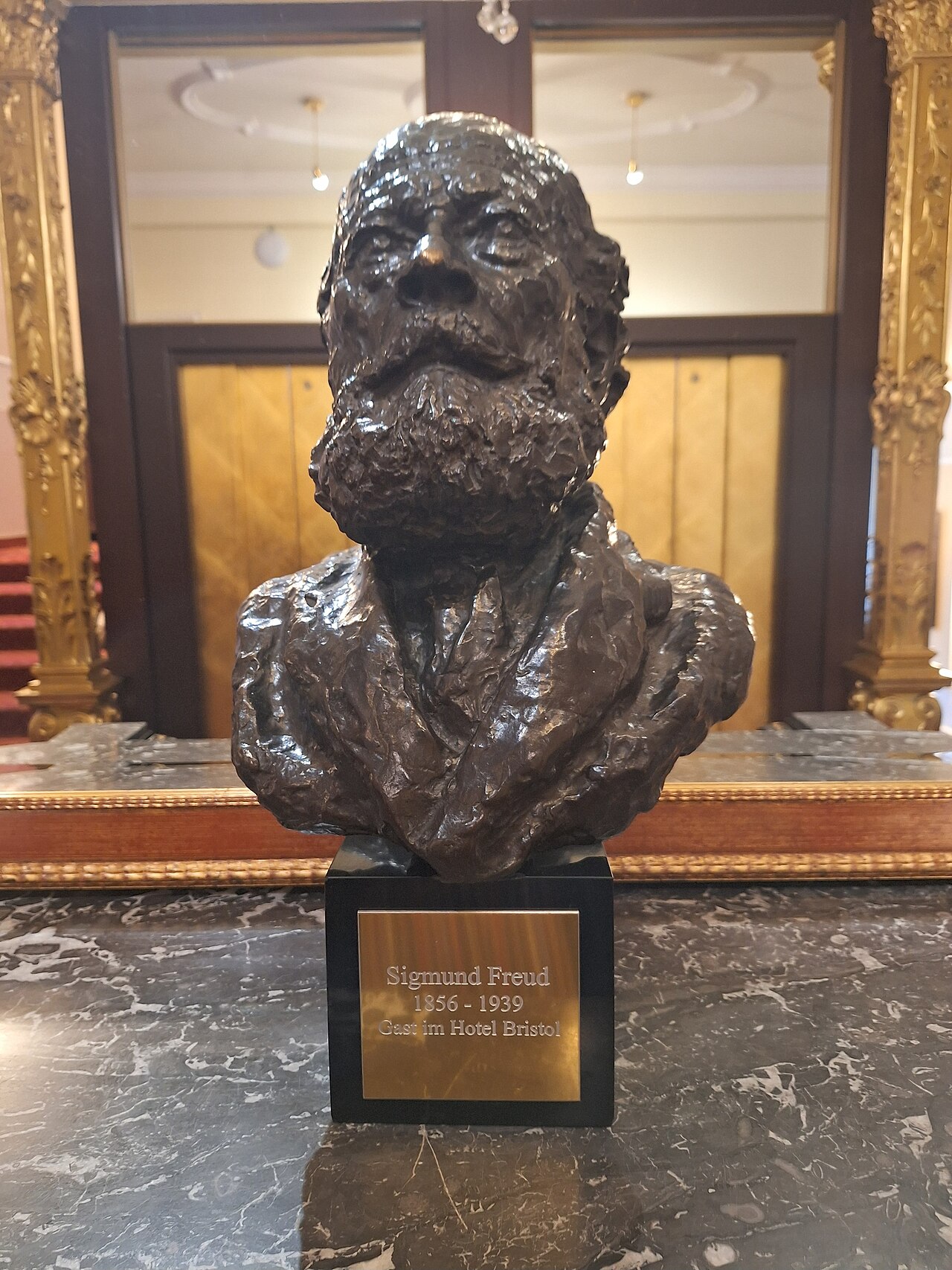
Dark bronze bust of a bearded older man with a textured, rough-surfaced finish, on a black base with a gold plaque reading 'Sigmund Freud 1856 - 1939 Gast im Hotel Bristol'. Ornate gold-framed mirror and marble table behind.Sculpture

Secondary source

Freud bust in Hotel Bristol, Salzburg, 2025

2025-11-03

Want the full shelf? Chat with Sigmund Freud in the app and open the Sources panel — every quote links back to the original.

Use Sigmund Freud in class

1 collection

A ready-made collection from the Humy team that features Sigmund Freud. Preview it, then try it free.

Trusted by educators worldwide

Conversations
375,000+
Real exchanges between students and historical figures
Messages exchanged
4,142,000+
Across every figure, classroom and language
Historical figures
100,000+
Each informed by a curated biography and selected sources
Languages supported
50+
From English and Spanish to Arabic and Korean

Paying customers

Used by 98 schools and universities

Partner school logo
Tecnológico de Monterrey logo
Hyper Island logo
Partner school logo
Chambersburg Area School District logo
Broward County Public Schools logo
Nebo School District logo
National Louis University logo
South Florida PBS logo
Punahou School logo
University of Wisconsin–River Falls logo
Partner school logo
Partner school logo
Archbishop Mitty High School logo
Kingsburg High School logo
Norwalk Public Schools logo
Partner school logo
Connections logo
Partner school logo
Moore Public Schools logo
Partner school logo
Partner school logo
Partner school logo
Partner school logo
Robbinsville Public Schools logo
Partner school logo
Partner school logo
Partner school logo
Tecnológico de Monterrey logo
Hyper Island logo
Partner school logo
Chambersburg Area School District logo
Broward County Public Schools logo
Nebo School District logo
National Louis University logo
South Florida PBS logo
Punahou School logo
University of Wisconsin–River Falls logo
Partner school logo
Partner school logo
Archbishop Mitty High School logo
Kingsburg High School logo
Norwalk Public Schools logo
Partner school logo
Connections logo
Partner school logo
Moore Public Schools logo
Partner school logo
Partner school logo
Partner school logo
Partner school logo
Robbinsville Public Schools logo
Partner school logo
Partner school logo

What educators are saying

“We enjoyed the program last year and used it frequently.”
“My students say it’s a welcome change of pace. I’m not a fan of the “sage on the stage” model, so I try to incorporate research-oriented and self-paced activities. With Humy, students have to take charge of their learning. They’ve become more adept at critical thinking, forming better questions, and improving their reading comprehension. The interview feature has been my go-to tool. I create assignments where students must ask historical figures a set number of questions, then summarize the responses to ensure they’re truly absorbing the material. This approach lets them actively explore the past rather than passively consuming information.”
“Humy has helped me bring historical figures, sometimes long past, to life. When my students interact with these figures in real-time, it eliminates some of the perceived “ancient” characteristics of my curriculum. This has shifted my students’ thinking away from viewing history as abstract or irrelevant. Real-time interactions make historical figures relatable, even allowing students to ask off-topic questions that help put historical lives in a more relevant context for 13-year-olds. The feature I use the most is the interview feature. After teaching a topic, most recently Gandhi and Joan of Arc, I have the students ask pointed, focused questions. We practice good conversation techniques beforehand, teaching them to listen (or read) carefully and formulate thoughtful follow-up questions rather than just interrogating. It helps students practice effective conversation skills.”

FAQ

Frequently asked questions

Who is Sigmund Freud?
Revolutionary psychologist and founder of psychoanalysis. On Humy.ai you can chat with an AI version of Sigmund Freud that draws on a short biography and 80 historical sources during the conversation — by text or voice, in 42 languages.
Is Sigmund Freud AI free?
Sigmund Freud is part of Humy's full library of more than 100,000 figures, which comes with a paid plan. A free account (no credit card) includes 20 messages a month with the free library's figures, so you can try how the conversations work first.
What sources does the Sigmund Freud AI use?
It draws on a short biography and 80 historical sources (books, photographs and documents), including “The Interpretation of Dreams”, “Three Essays on the Theory of Sexuality” and “The Ego and the Id”. Each source has its own page on Humy.ai.
How historically accurate is the AI version of Sigmund Freud?
Each figure uses a short biography and a small set of selected historical sources as context (retrieval-augmented generation), so answers stay closer to known material than the model's general knowledge alone. It isn't a citation-grade research tool — like any LLM, the AI can get details wrong or extrapolate. Treat it as a strong starting point for inquiry and cross-reference important claims.
Can I talk to Sigmund Freud by voice?
Yes. In addition to text chat, you can call Sigmund Freud and hear their voice respond in real time — useful for auditory learners, interview practice and Socratic dialogue.
Is Humy.ai safe and compliant for schools?
Yes. Humy.ai is used by more than 100 schools, universities and organisations. The platform is FERPA- and GDPR-aligned, supports SSO, and offers an IT-approval pack tailored for school procurement teams.

Ready when you are

Start chatting with Sigmund Freud now.

20 messages free · No credit card · Available in 50+ languages.