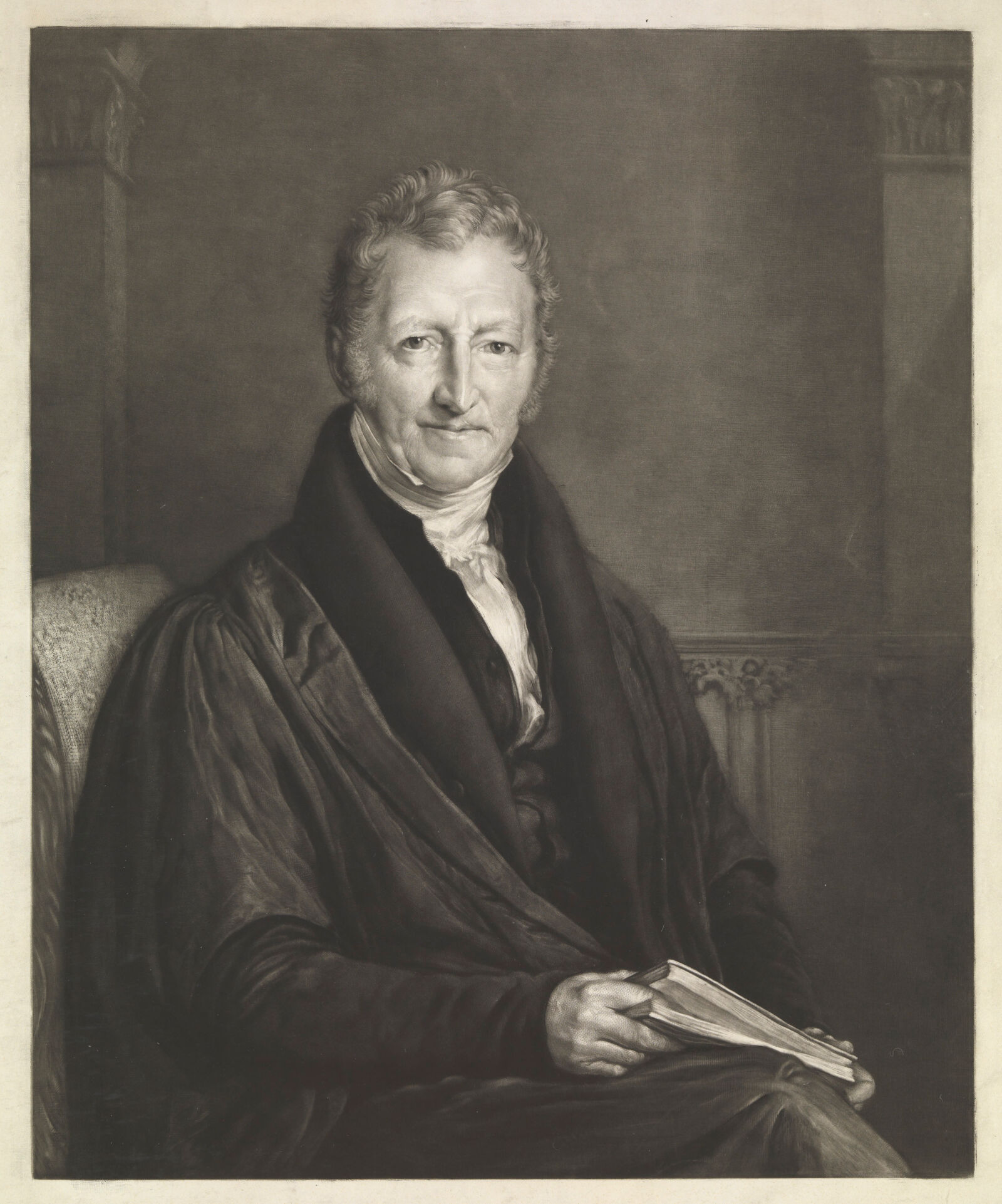

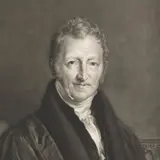
Portrait of Thomas Malthus

AI Historical Figure

Thomas Malthus

Economist known for the concept of population growth outstripping food supply.

Chat with Thomas Malthus via text or voice — in 42 languages, drawing on a curated biography and 55 historical sources. Available 24/7.

Start chatting with Thomas Malthus20 messages free · No credit card
Lived
1766–1834
From
United Kingdom
Known for
PhilosophyScholarship & social science
Thomas Malthus

Thomas Malthus

Online · responds in seconds

Hello — I'm Thomas Malthus. Economist known for the concept of population growth outstripping food supply. What would you like to ask me?

20 messages free · No credit card · Powered by Humy.ai

Live preview · Switch between 42 languages above · Send a message to continue in the app

Multilingual

Talk to Thomas Malthus in 42 languages

Ask Thomas Malthus questions in any language below, and the rest of Humy's app speaks it too. Pick yours to open the chat in that language.

Also in German (Austria), German (Switzerland), English (UK), English (Australia), English (Canada).

The sources behind this AI

55 sources · 30 books · 8 paintings · 7 documents · 5 letters · 4 artifacts · 1 photograph

Thomas Malthus doesn’t improvise from thin air. The AI is grounded in 55 curated historical sources students can inspect. Open any of them to see what informs the conversation.

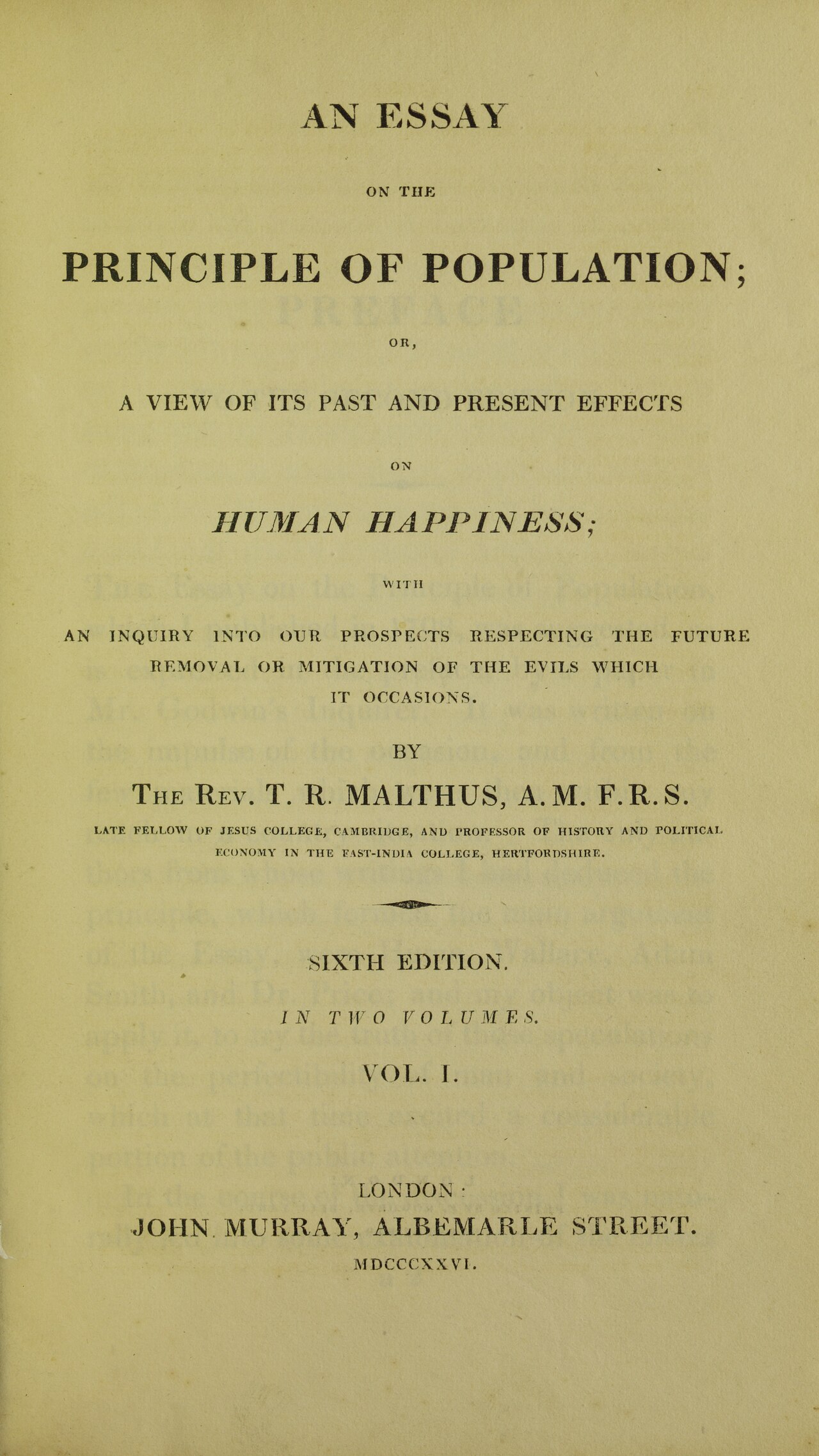
Title page of the 1826 sixth edition of An Essay on the Principle of Population by the Rev. T. R. Malthus, in two volumes, Vol. I, published by John Murray, London. Cream-colored page with black serif text.Book

Primary source

An Essay on the Principle of Population

Thomas Robert Malthus · 1798 (6th ed. 1826)

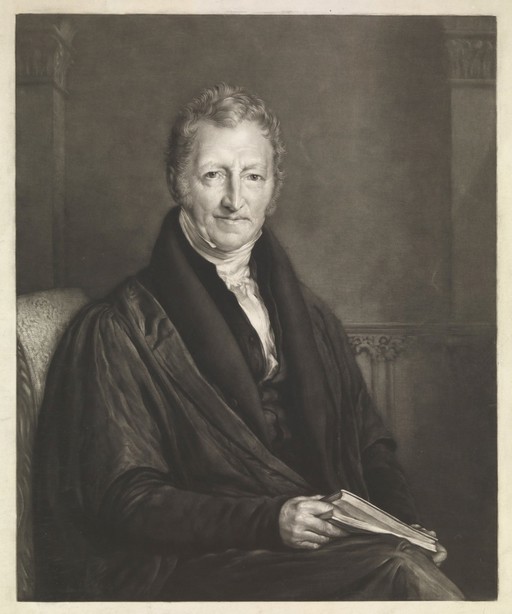
Black and white mezzotint-style portrait of an older man with light, wavy hair seated in a chair, wearing a dark cloak over a white cravat and waistcoat. He rests one hand on a closed book on his lap and gazes directly at the viewer. Dark background with a column at left.Painting

Primary source

Portrait Print of Thomas Robert Malthus

John Linnell

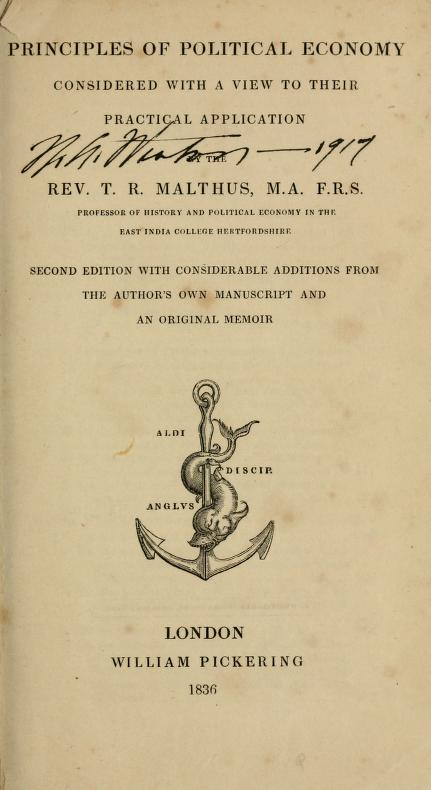
Title page of Principles of Political Economy by Rev. T. R. Malthus, second edition, London, William Pickering, 1836. Includes a handwritten inscription with a signature and the date 1917, and a printer's anchor emblem with the Latin motto Aldi Discipulus Anglus.Book

Primary source

Principles of Political Economy

Thomas Robert Malthus · 1820 (2nd ed. 1836)

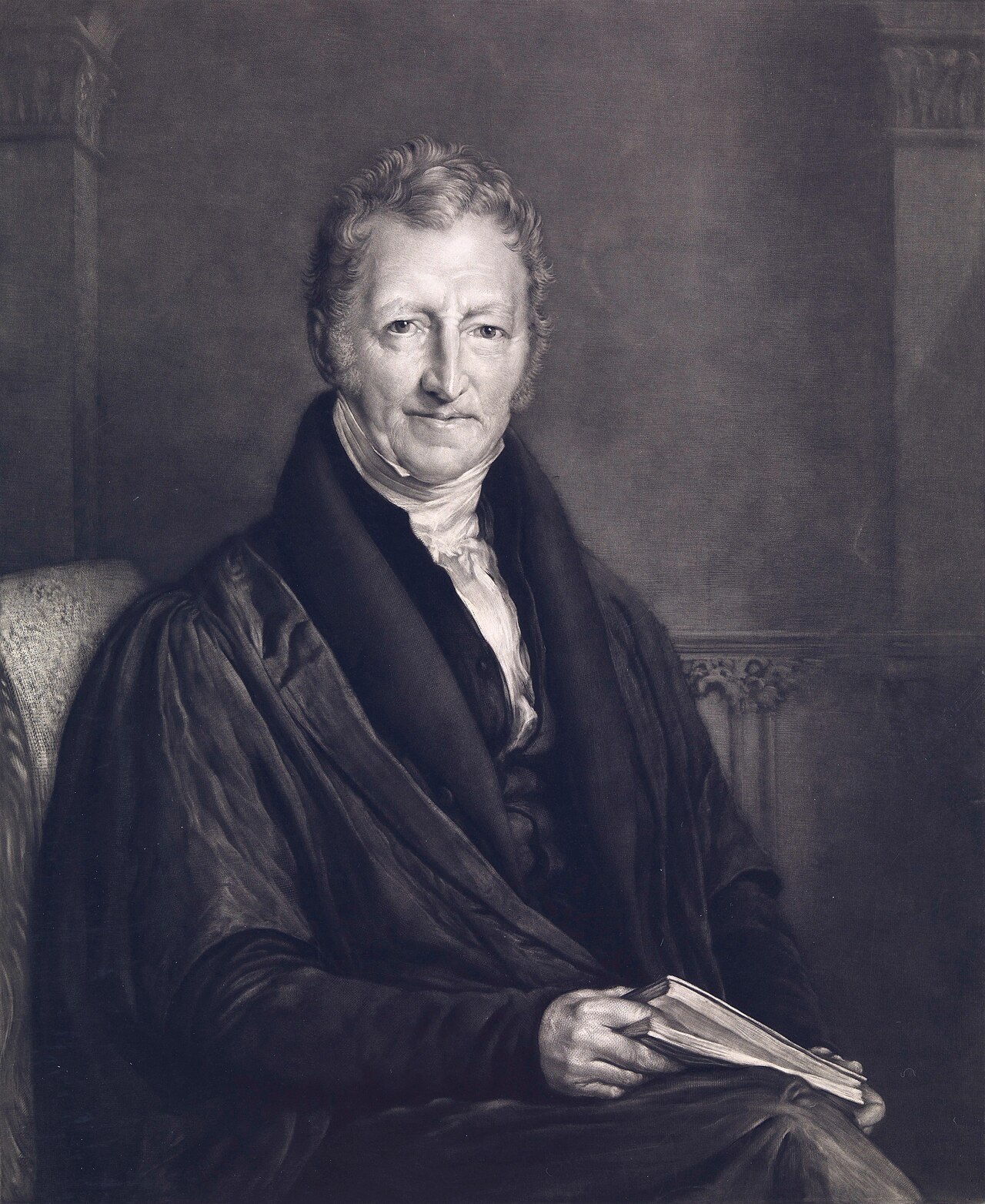
Black-and-white engraved portrait of an older man with light, curly hair seated in a chair, wearing a dark coat with a high white cravat, holding a closed book in his hands, against a dark background with a classical column.Painting

Primary source

Portrait of Thomas Robert Malthus

John Linnell · after 1833

Dark brown cover of a book with thin gold horizontal rules near the top and bottom edges. Faint embossed lettering is visible near the lower center but is not legible. No text is clearly readable.Letter

Primary source

Correspondence between Malthus and David Ricardo

Thomas Robert Malthus; David Ricardo · 1811–1823

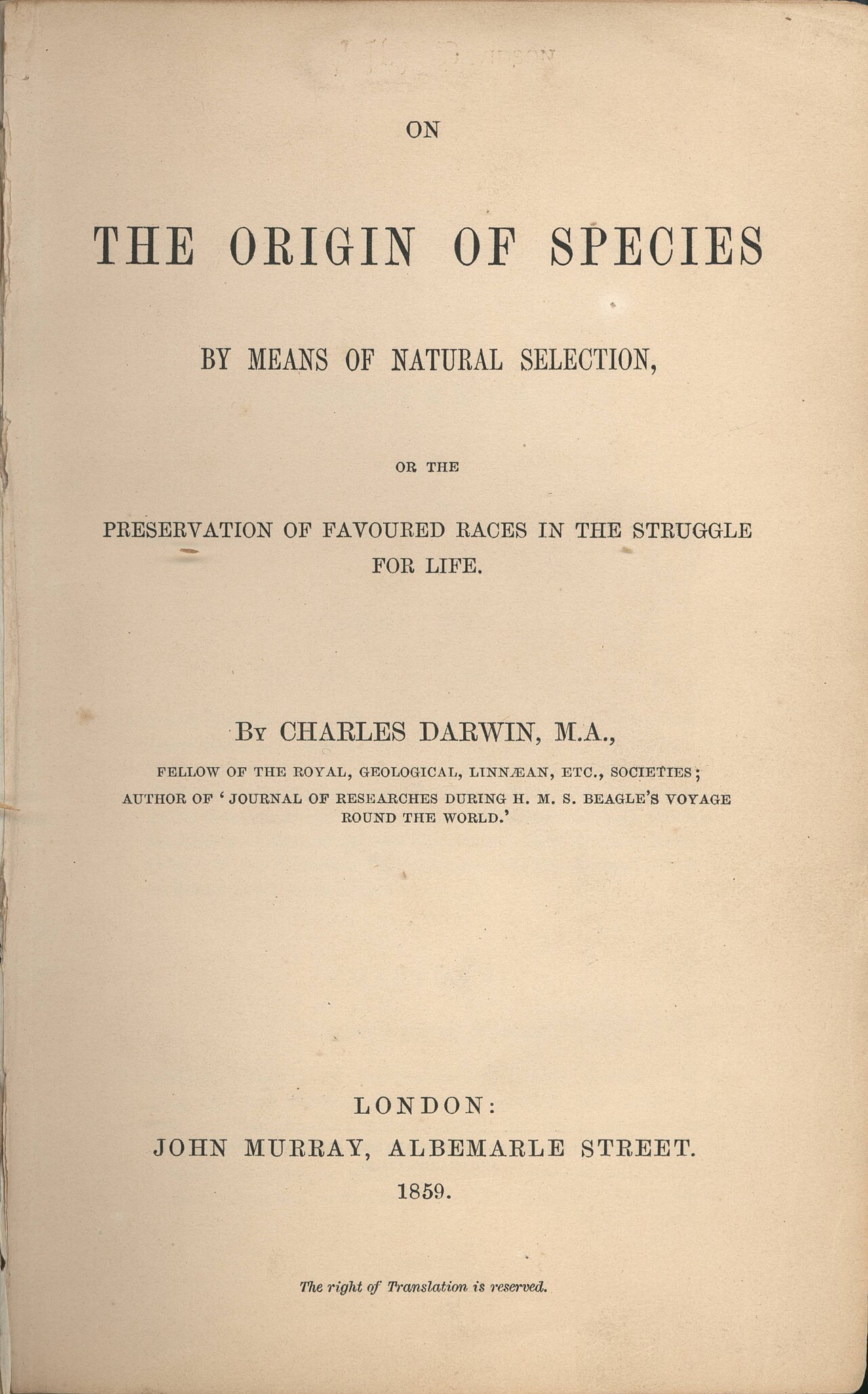
Title page of the 1859 John Murray first edition of 'On the Origin of Species by Means of Natural Selection' by Charles Darwin. Cream paper with black serif type, London: John Murray, Albemarle Street, 1859.Book

Primary source

On the Origin of Species

Charles Darwin · 1859

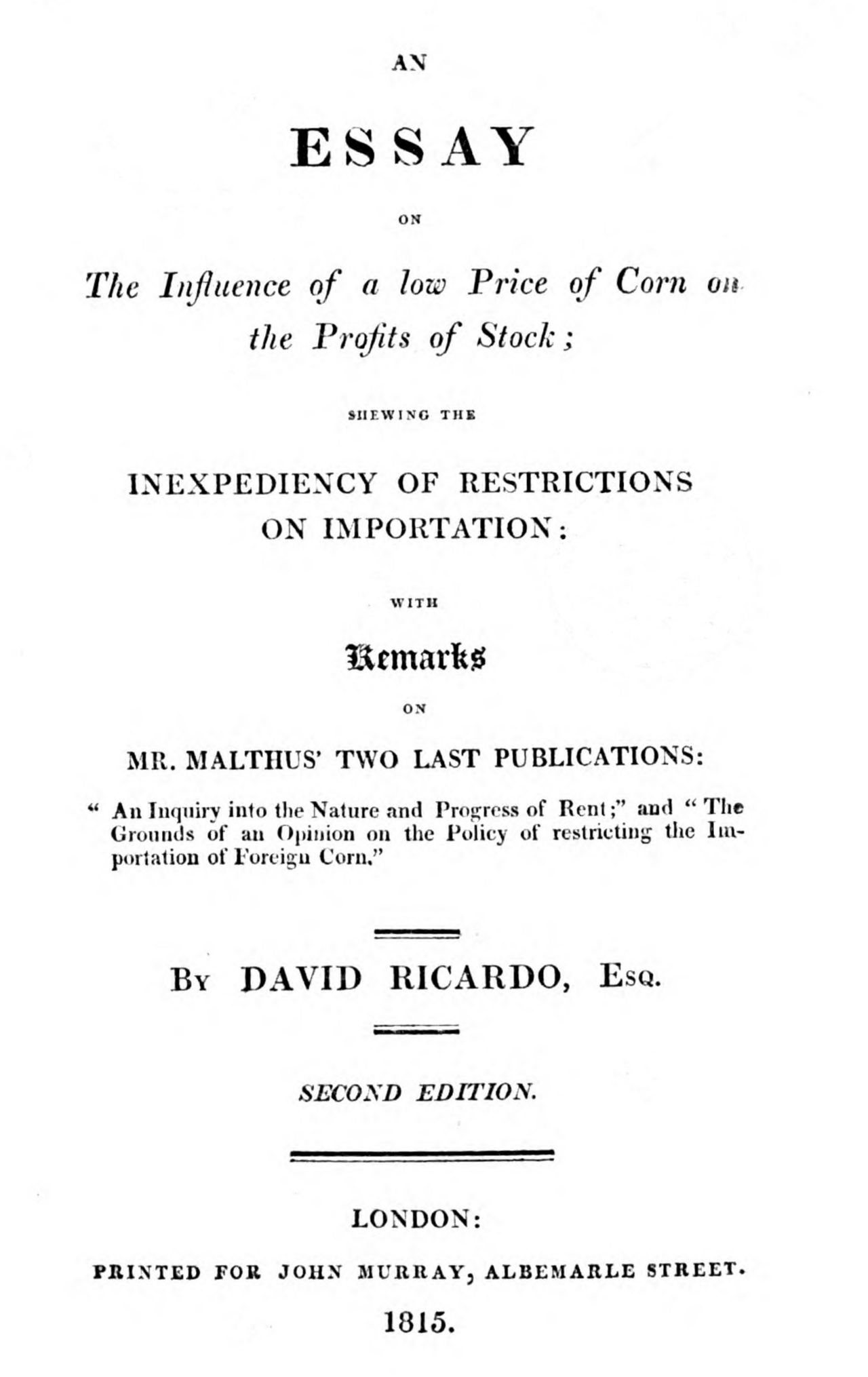
Title page of David Ricardo's 'An Essay on the Influence of a Low Price of Corn on the Profits of Stock', second edition, London, printed for John Murray, 1815. Text is black on white, with a long subtitle referencing Malthus's publications.Book

Primary source

An Essay on the Influence of a Low Price of Corn on the Profits of Stock

David Ricardo · 1815

Letter

Primary source

A Letter to Samuel Whitbread, Esq. M.P. on His Proposed Bill for the Amendment of the Poor Laws

Thomas Robert Malthus · 1807

Book

Primary source

The Grounds of an Opinion on the Policy of Restricting the Importation of Foreign Corn

Thomas Robert Malthus · 1815

Book

Primary source

Observations on the Effects of the Corn Laws

Thomas Robert Malthus · 1814

Book

Primary source

An Inquiry into the Nature and Progress of Rent

Thomas Robert Malthus · 1815

Book

Primary source

An Investigation of the Cause of the Present High Price of Provisions

Thomas Robert Malthus · 1800

Back cover of a book bound in dark blue-grey cloth on the spine edge, with a pink cover printed in a repeating pattern of cream-colored flowers within lattice lines. A white barcode label reads 00027567 near the lower left.Book

Primary source

Definitions in Political Economy

Thomas Robert Malthus · 1827

Book

Secondary source

Mr. Malthus

William Hazlitt · 1825

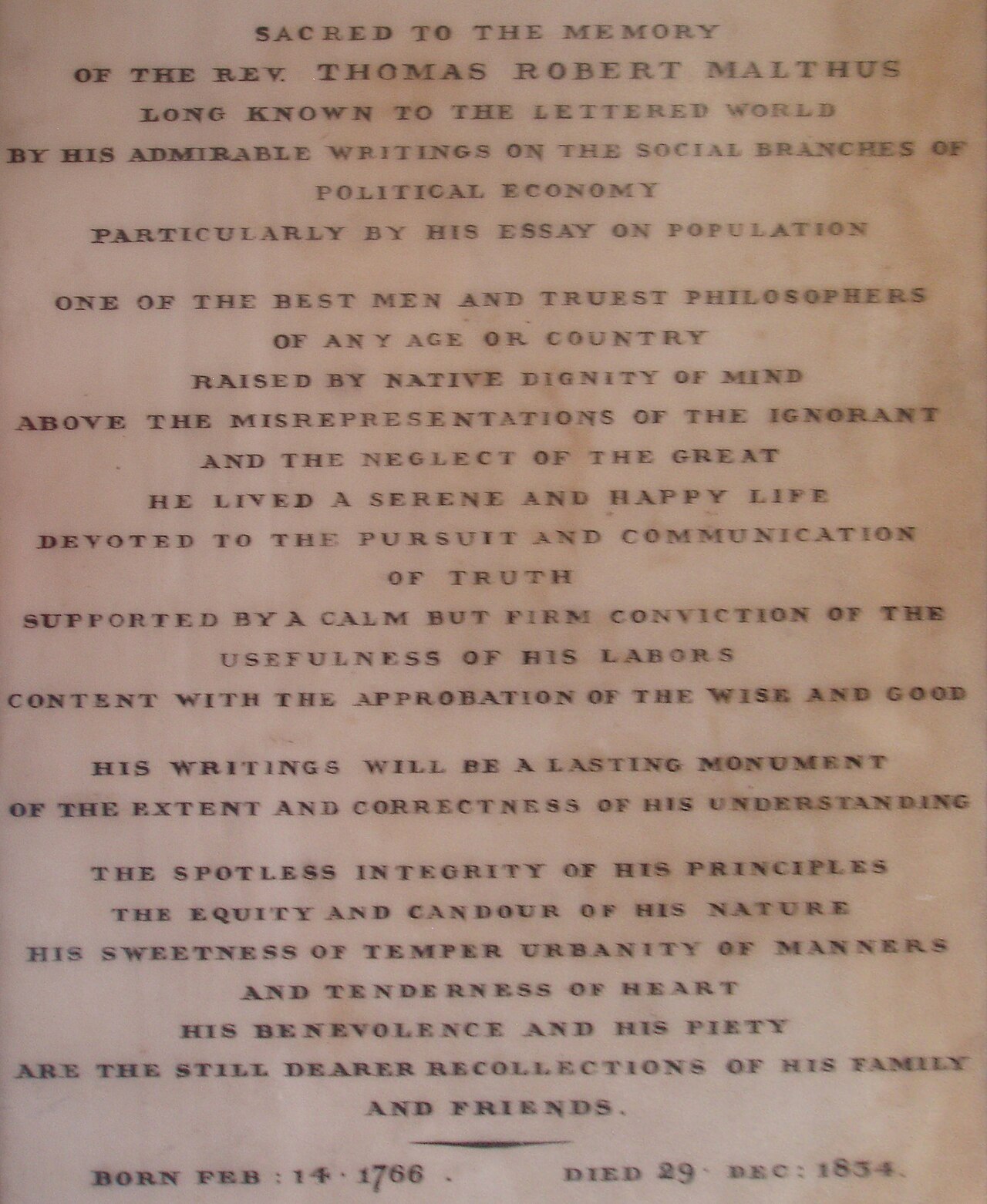
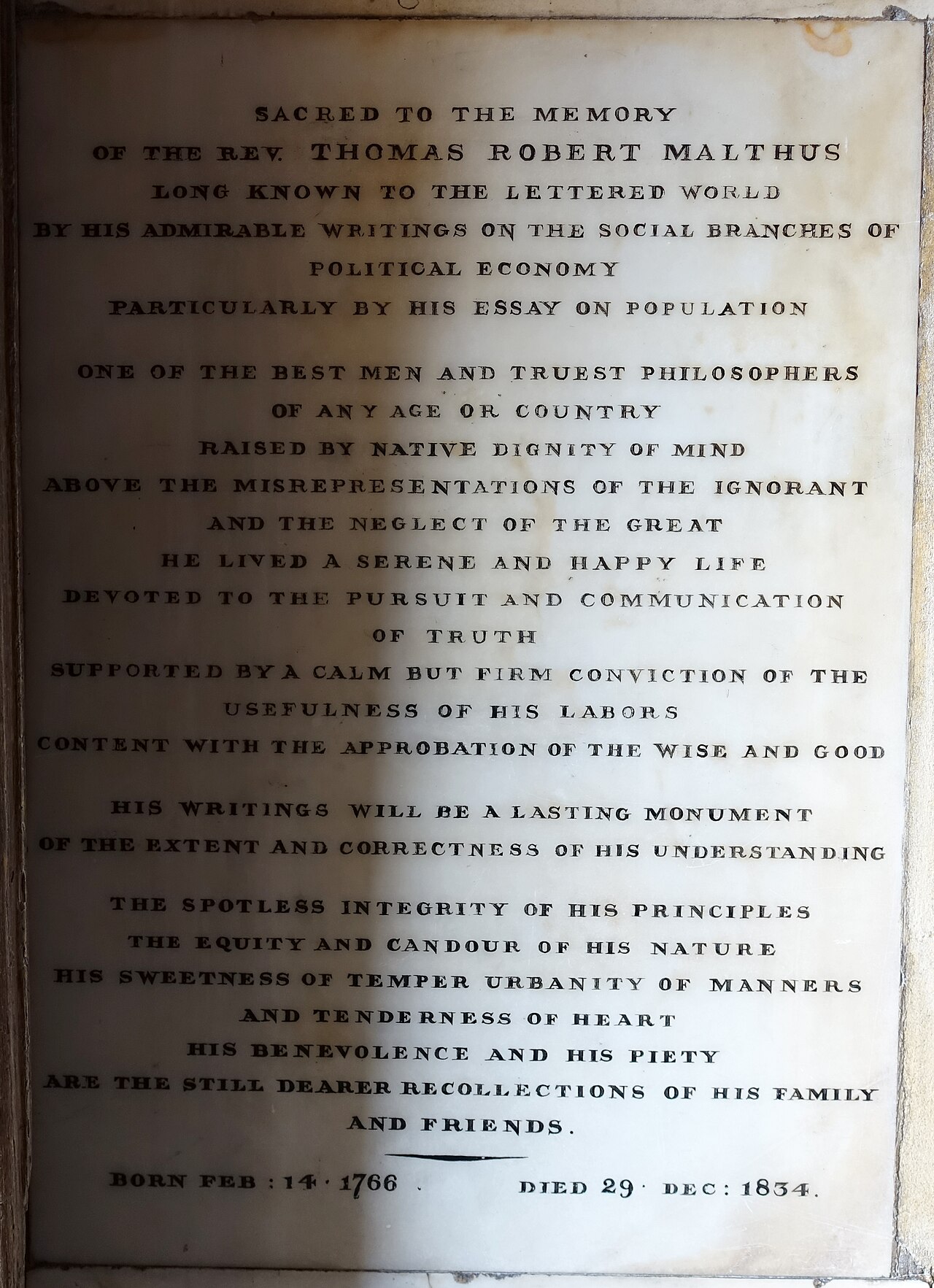
Photo of a marble memorial tablet with engraved capital letters in several lines honoring the Rev. Thomas Robert Malthus, noting his writings on political economy and his Essay on Population, and his birth and death dates: born Feb 14, 1766, died 29 Dec 1834.Artifact

Secondary source

Epitaph of Thomas Malthus

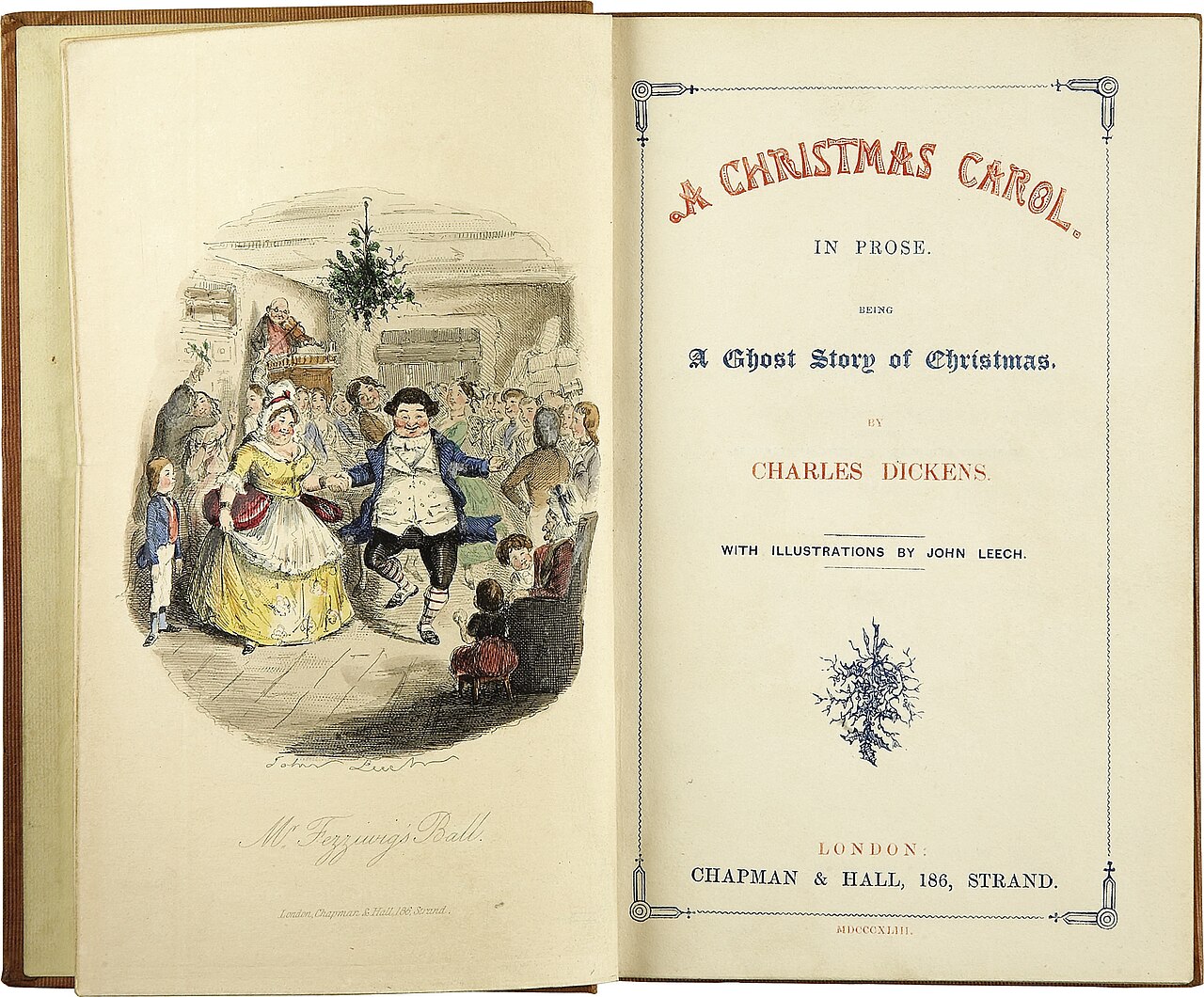
Open book showing the first edition title page of A Christmas Carol by Charles Dickens, with red and black lettering reading 'A Christmas Carol. In Prose. Being a Ghost Story of Christmas. By Charles Dickens. With Illustrations by John Leech. London: Chapman & Hall, 186 Strand.' Facing page holds a hand-colored illustration of a Christmas ball scene titled Mr. Fezziwig's Ball.Book

Primary source

A Christmas Carol

Charles Dickens · 1843

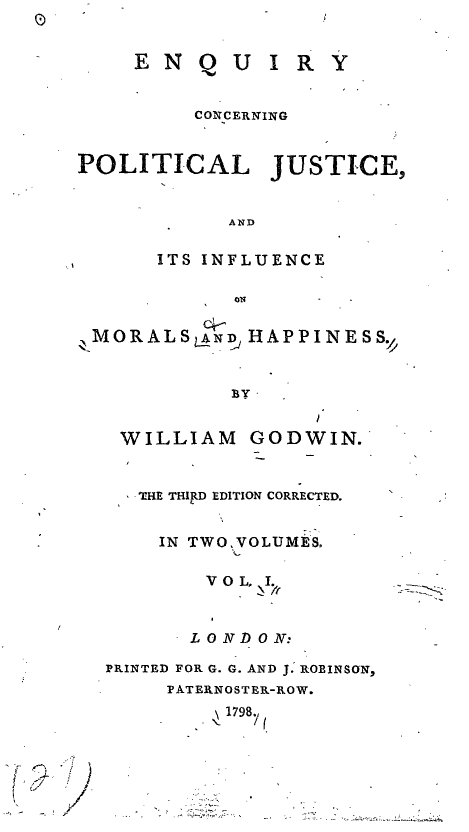
Title page of Enquiry Concerning Political Justice and its Influence on Morals and Happiness by William Godwin, third edition corrected, in two volumes, vol. I, printed for G. G. and J. Robinson, Paternoster-Row, London, 1798.Book

Primary source

Enquiry Concerning Political Justice

William Godwin · 1793

Letter

Primary source

Letters to Mr. Malthus on Several Subjects of Political Economy

Jean-Baptiste Say · 1820

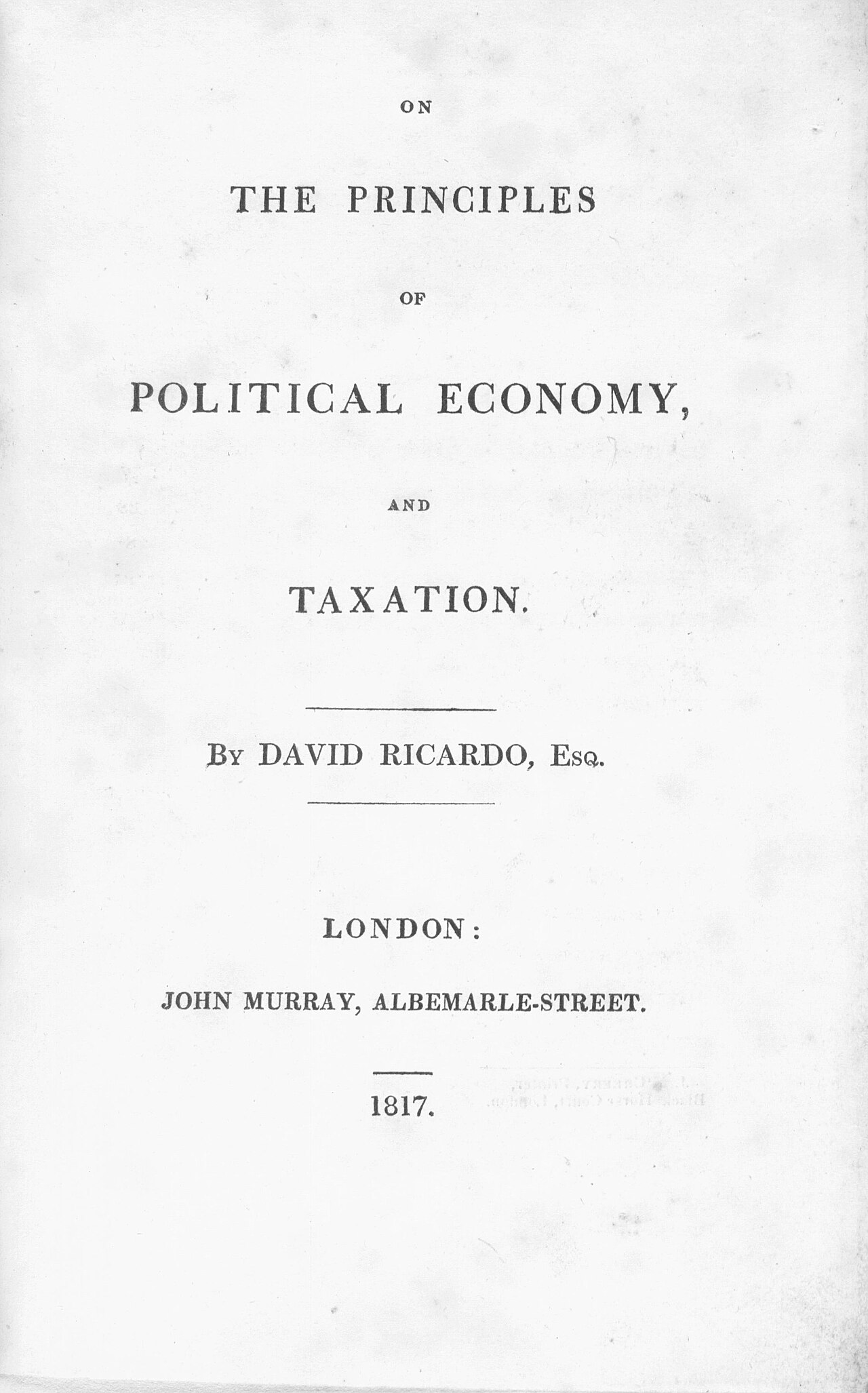
Title page of a book reading 'On the Principles of Political Economy, and Taxation, by David Ricardo, Esq.', London: John Murray, Albemarle-Street, 1817. Black text on a pale background.Book

Primary source

On the Principles of Political Economy, and Taxation

David Ricardo · 1817

Book

Primary source

The Measure of Value Stated and Illustrated

Thomas Robert Malthus · 1823

Cover of a book with dark green-brown marbled paper boards, with two white library labels on the left: one reads 'Stack Annex LF 795 H41M3 1817' and the other shows a barcode with 'US Southern Regional Library Facility'.Book

Primary source

Statements Respecting the East-India College

Thomas Robert Malthus · 1817

Black-and-white scanned title page showing 'HARVARD UNIVERSITY' at top, a Veritas crest with a wreath and an open book with the letters VE RI TAS, and text 'LIBRARY OF THE GRADUATE SCHOOL OF EDUCATION' below. Black background surrounds the white page.Letter

Primary source

A Letter to the Rt. Hon. Lord Grenville

Thomas Robert Malthus · 1813

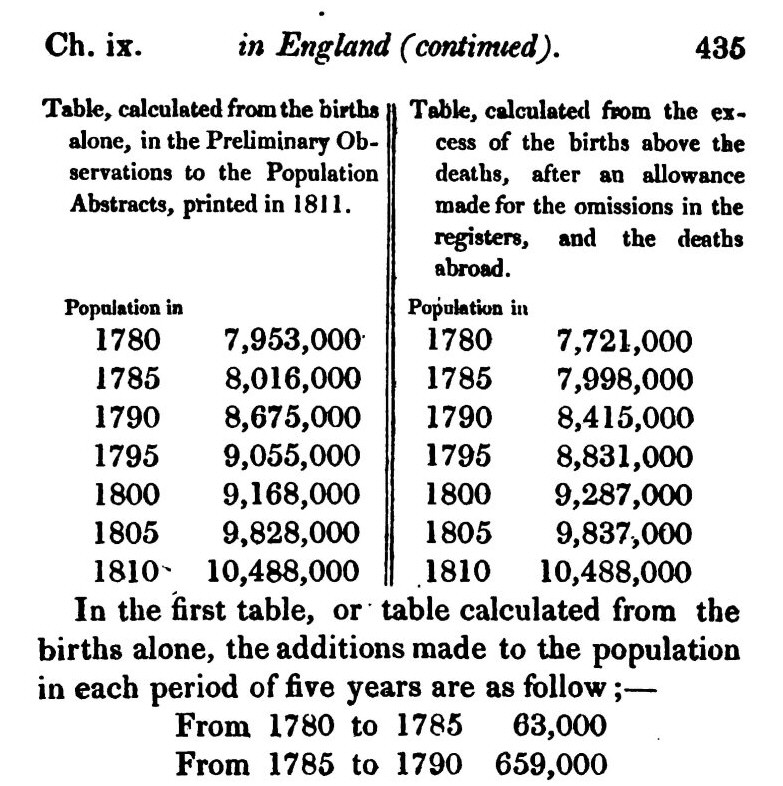
Scanned book page 435, 'Ch. ix. in England (continued).' Two side-by-side population tables for England, 1780 to 1810, with explanatory text above and below. Left table: births alone, 7,953,000 in 1780 rising to 10,488,000 in 1810. Right table: births minus deaths, 7,721,000 in 1780 rising to 10,488,000 in 1810.Document

Primary source

Table of Population Growth in England 1780-1810

Thomas Robert Malthus · 1826

Dark brown cloth-bound book cover with a white library barcode label at the top left reading 3 3433 06911447 2. The spine is visible along the left edge; no title is visible on this cover.Book

Secondary source

A Reply to the Essay on Population

William Hazlitt · 1807

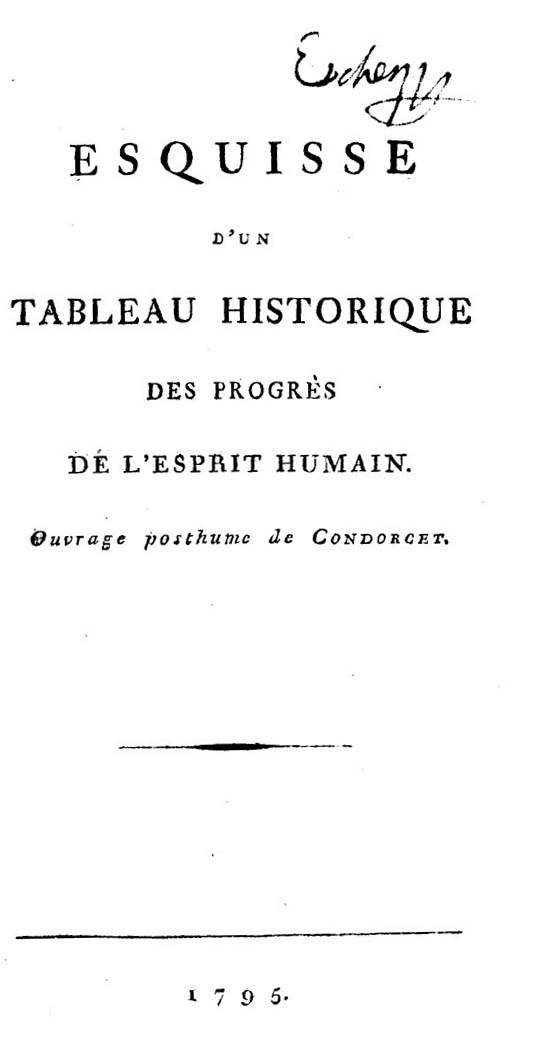
Title page of the 1795 book Esquisse d'un tableau historique des progrès de l'esprit humain, with handwritten marks at top right, the title in capitals, and the note 'Ouvrage posthume de Condorcet' with the year 1795 at the bottom.Book

Primary source

Sketch for a Historical Picture of the Progress of the Human Mind

Marquis de Condorcet · 1795 (written 1794)

Document

Primary source

On the Tendency of Varieties to Depart Indefinitely From the Original Type

Alfred Russel Wallace · 1858

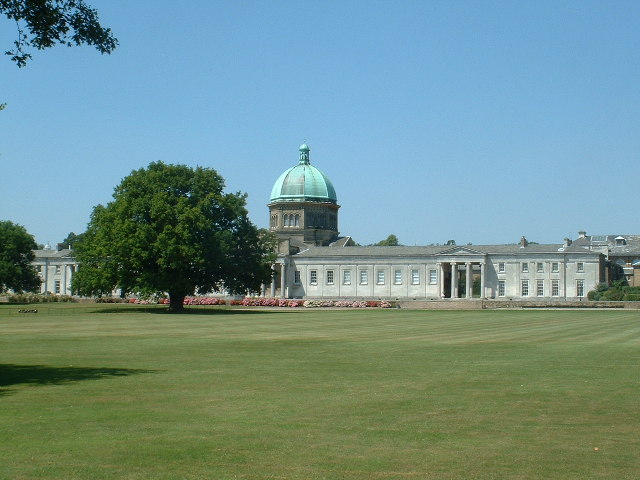
A large cream-colored stone neoclassical building with a green copper dome on a central drum with arched windows, a long facade with columns at the center, and a wide lawn with a large tree in front under a clear blue sky.Artifact

Secondary source

East India Company College

William Wilkins · 1806

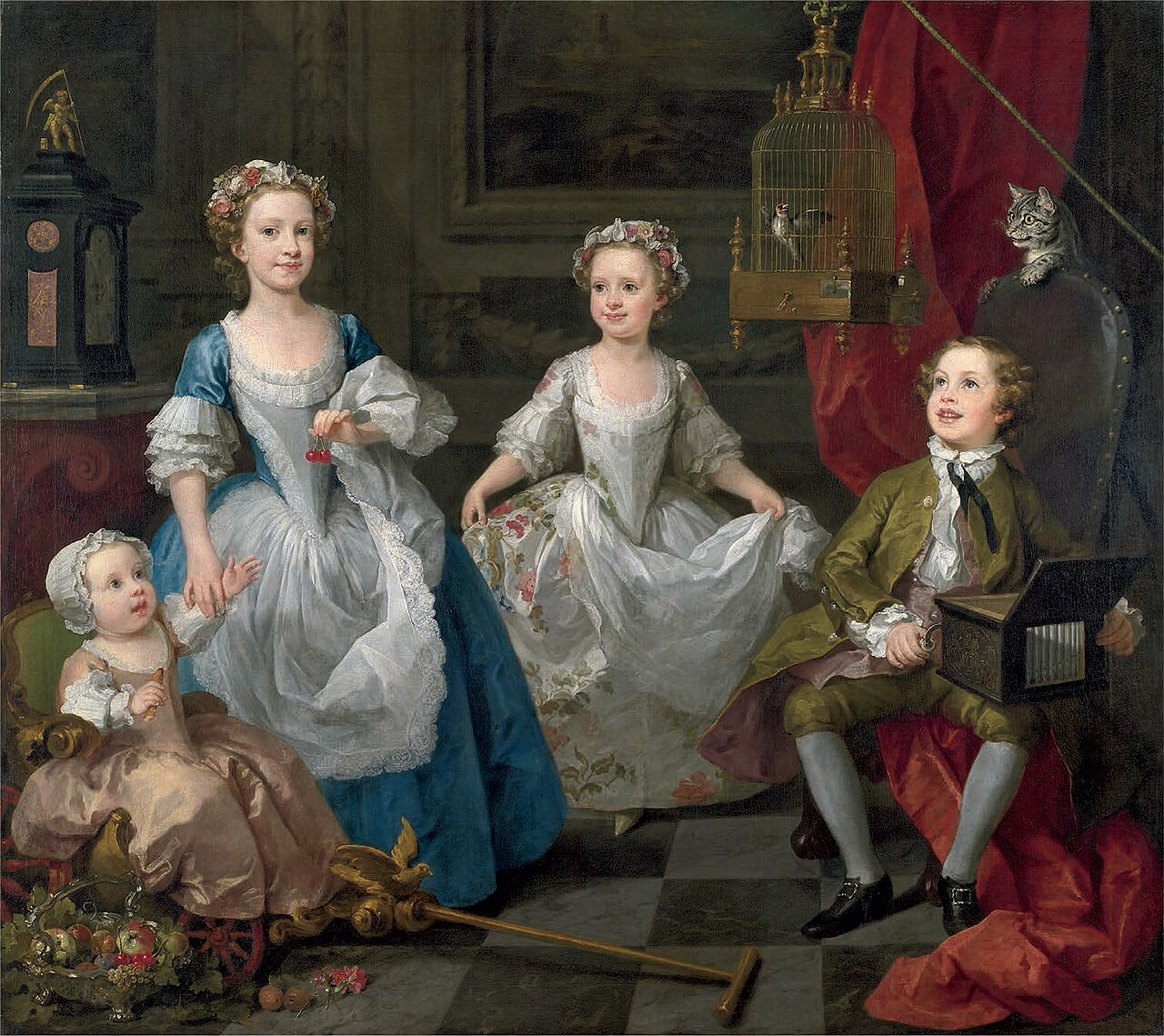
Oil painting of four children in an 18th-century interior: a girl in blue dress holding a cherry, a younger girl in white dress with flowers in hair, a toddler in a white bonnet, and a boy in green suit with a bird cage and cat nearby.Painting

Primary source

The Graham Children

William Hogarth · 1742

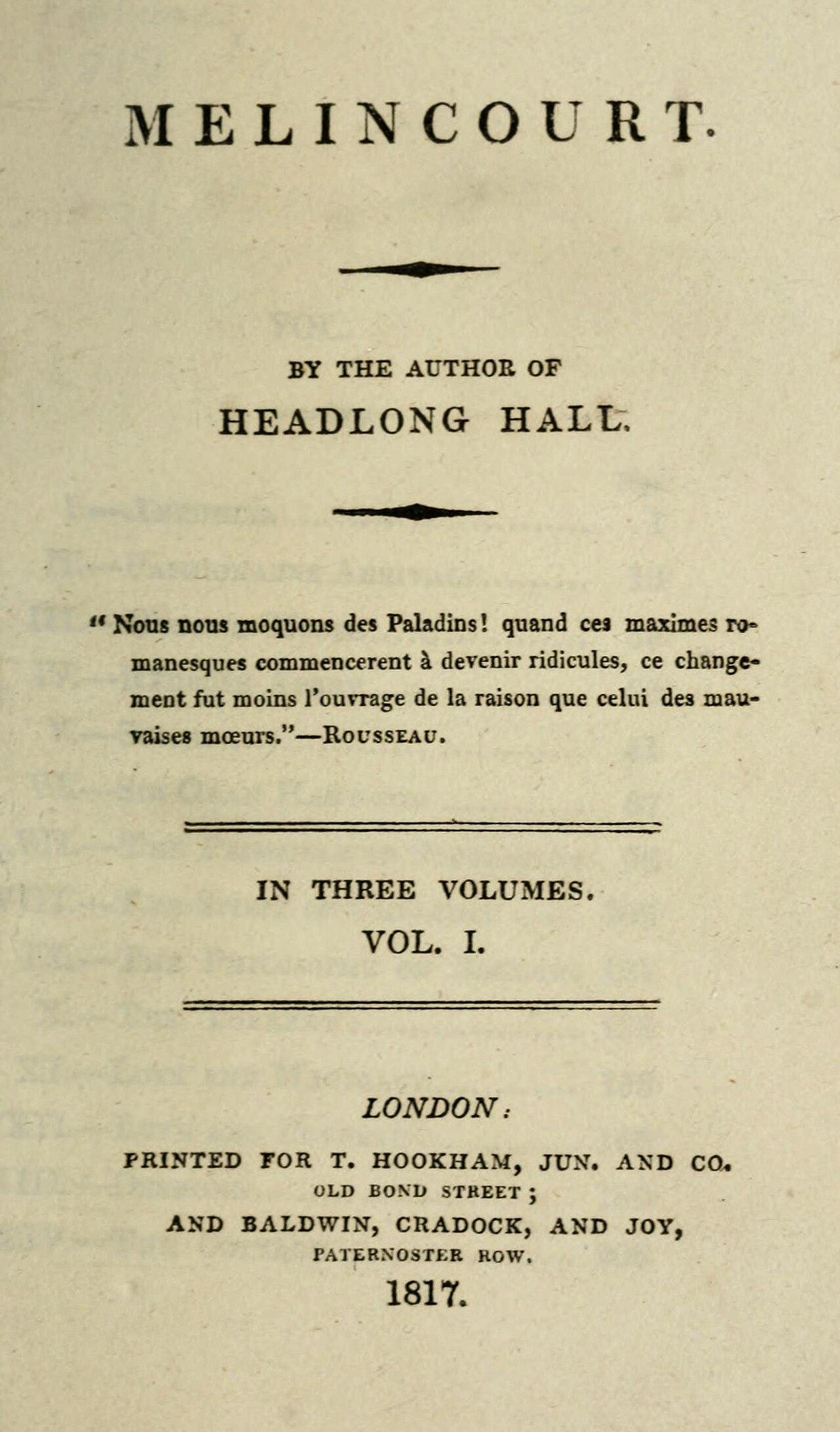
Title page of the 1817 first edition of the novel Melincourt, in three volumes, volume I. Text reads 'MELINCOURT, by the author of Headlong Hall', with an epigraph from Rousseau in French, and printed for T. Hookham, Jun. and Co. and Baldwin, Cradock, and Joy, London.Book

Secondary source

Melincourt

Thomas Love Peacock · 1817

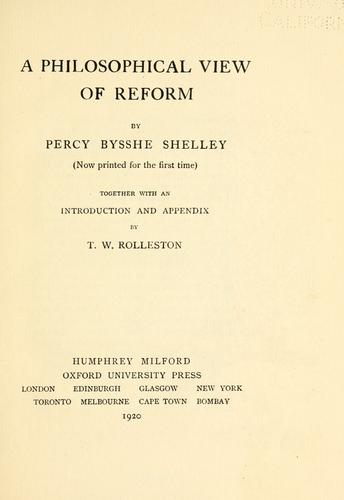
Title page of the 1920 Oxford University Press edition of 'A Philosophical View of Reform' by Percy Bysshe Shelley, with introduction and appendix by T. W. Rolleston, published by Humphrey Milford. Cream-colored page with black serif text listing imprint cities London, Edinburgh, Glasgow, New York, Toronto, Melbourne, Cape Town, and Bombay.Document

Secondary source

A Philosophical View of Reform

Percy Bysshe Shelley · 1819-1820

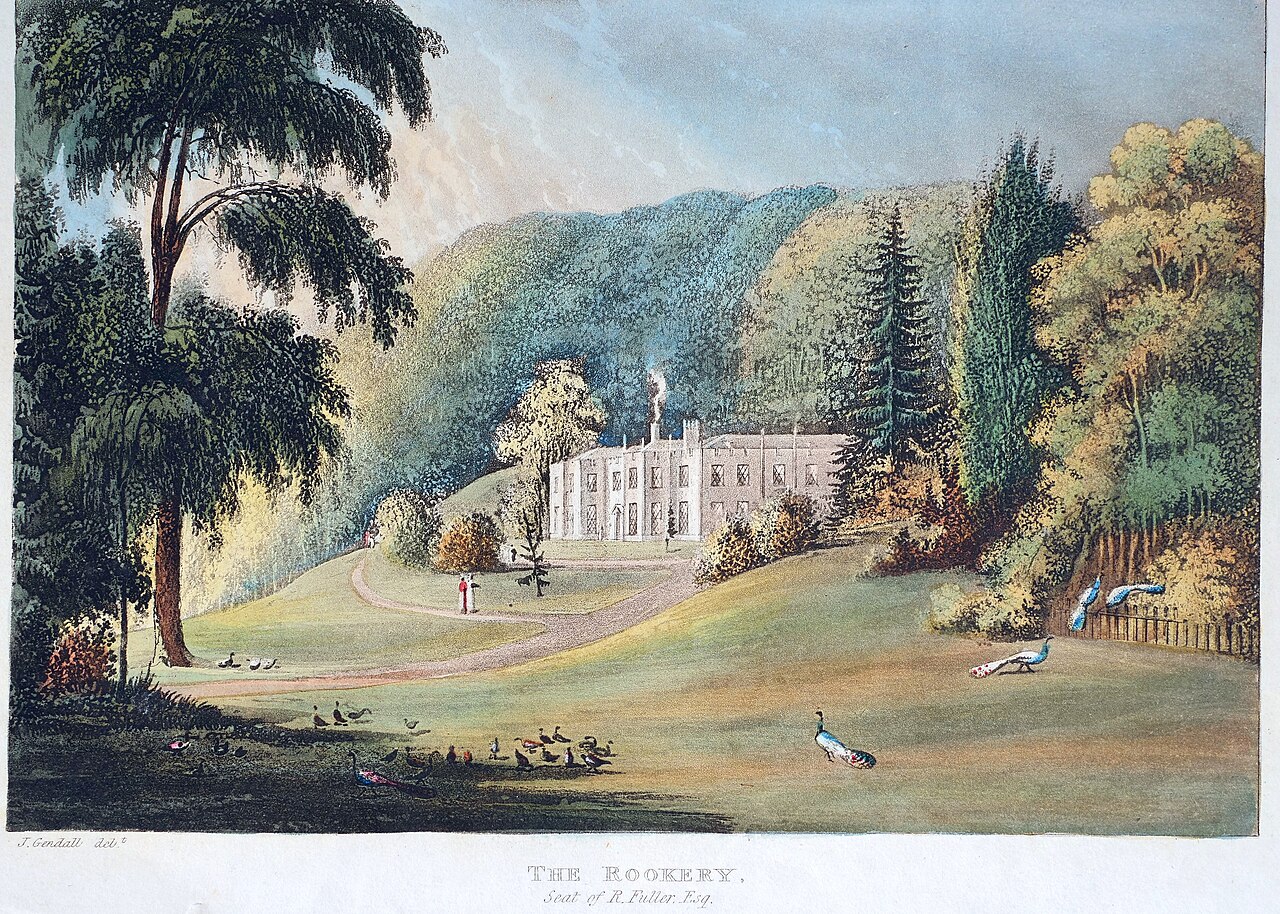
Hand-colored engraving titled 'The Rookery, Seat of R. Fuller Esq.' showing a pale two-story classical country house with a central portico and tall windows, set on a grassy slope with a winding gravel path, tall trees on the left and right, wooded hills behind, a figure in red walking on the path, and several peacocks and ducks on the lawn.Painting

Secondary source

The Rookery, Westcott

Rudolph Ackermann · c. 1760s (remodelling); engraving later

A Letter to Samuel Whitbread on the Poor LawsLetter

Primary source

A Letter to Samuel Whitbread on the Poor Laws

Thomas Robert Malthus · 1807

Malthus and His WorkBook

Secondary source

Malthus and His Work

James Bonar · 1924 (2nd edition; originally 1885)

Book

Primary source

Memoir of Thomas Robert Malthus

1836

Book

Secondary source

Life and Writings of Thomas R. Malthus

Charles R. Drysdale · 1892 (2nd edition)

Monochrome mezzotint portrait of an older man with curly light hair seated in a chair, wearing a dark cloak over a white cravat and waistcoat, holding a closed book on his lap. Plain dark background with classical pilasters.Painting

Primary source

Thomas Robert Malthus

John Linnell · 1834

Dark green cloth book cover with a white paper label in the upper left corner reading 'HB 861 .E78 Copy 2' in black print. The cover has a faint woven texture.Book

Primary source

Parallel Chapters from the First and Second Editions of the Essay on Population

Thomas Robert Malthus

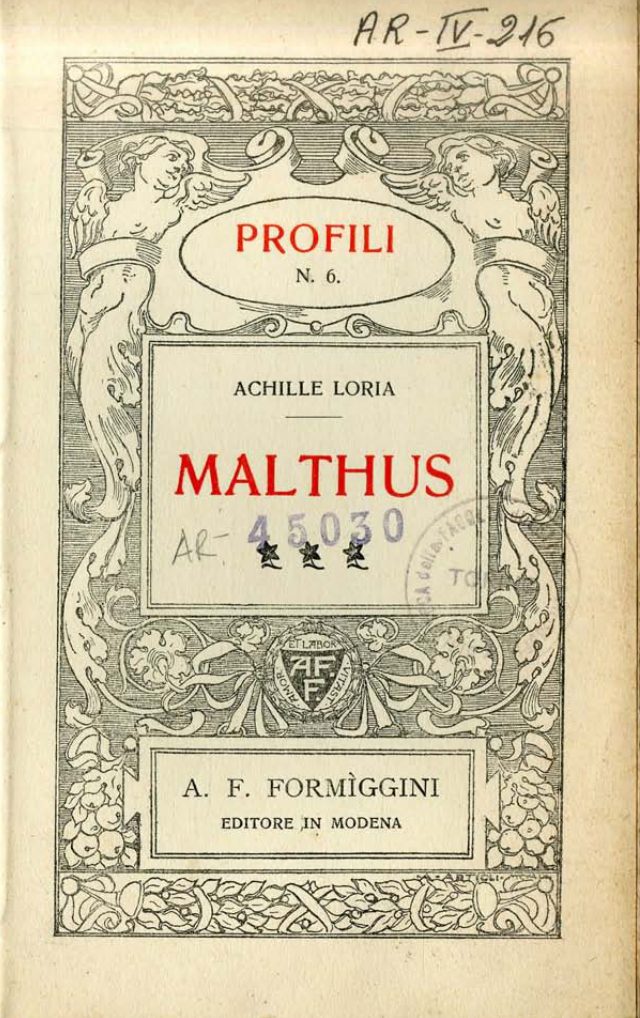
MalthusBook

Secondary source

Malthus

Achille Loria · 1909

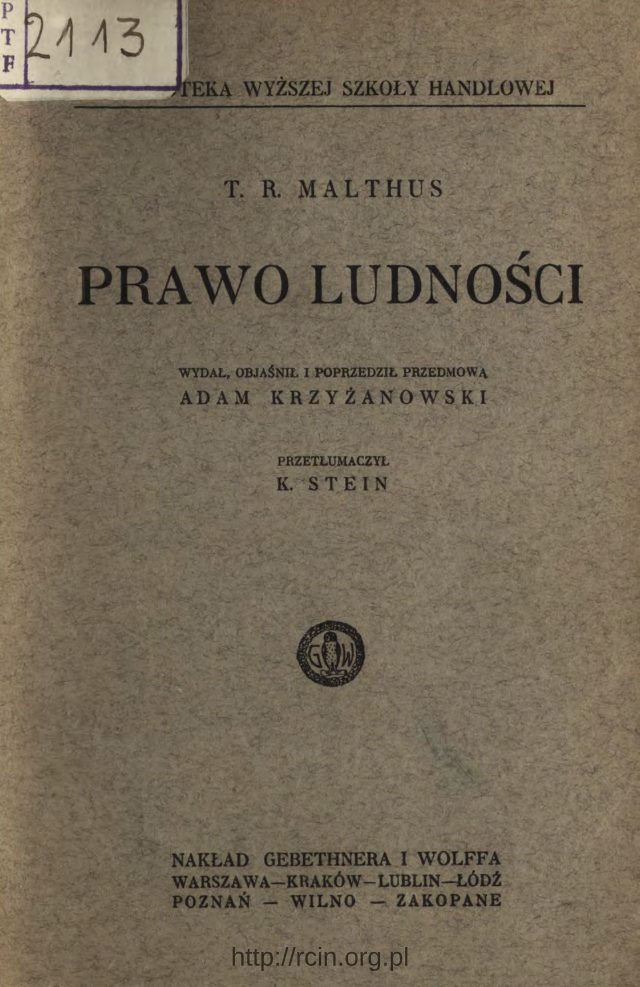
Prawo ludnościBook

Secondary source

Prawo ludności

K. Stein · 1925

Book

Primary source

An Essay on the Principle of Population

Thomas Malthus · 1798

Document

Tertiary source

Malthus, Thomas Robert, in the Dictionary of National Biography

1885

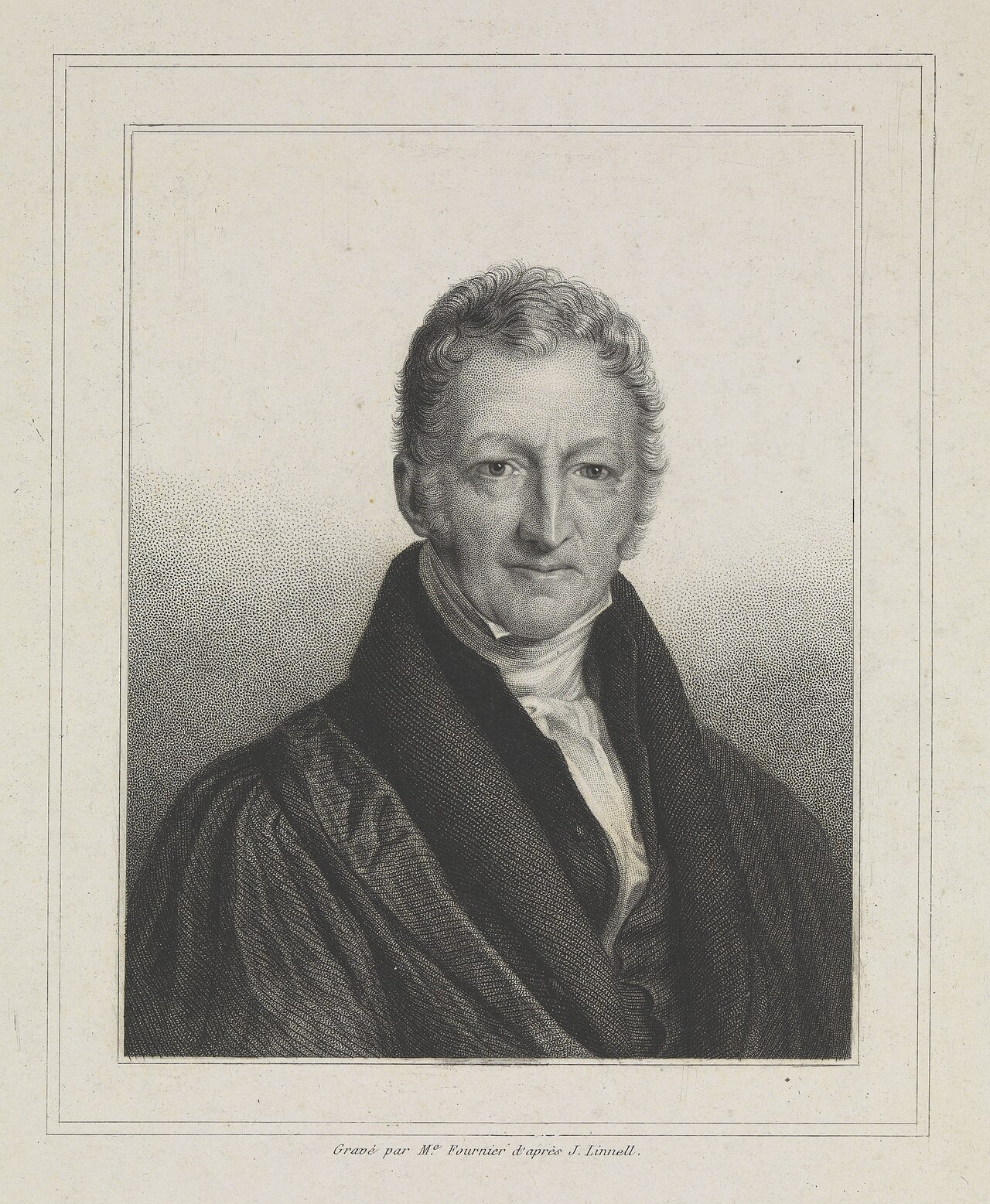
Black and white stipple engraving of a man with curly hair, wearing a dark coat with wide lapels over a white high-collared shirt, in a double-ruled border. Caption below reads 'Gravé par Me Fournier d'après J. Linnell.'Painting

Primary source

Thomas Robert Malthus, Stipple Engraving

Félicie Fournier (after John Linnell) · c. 1834

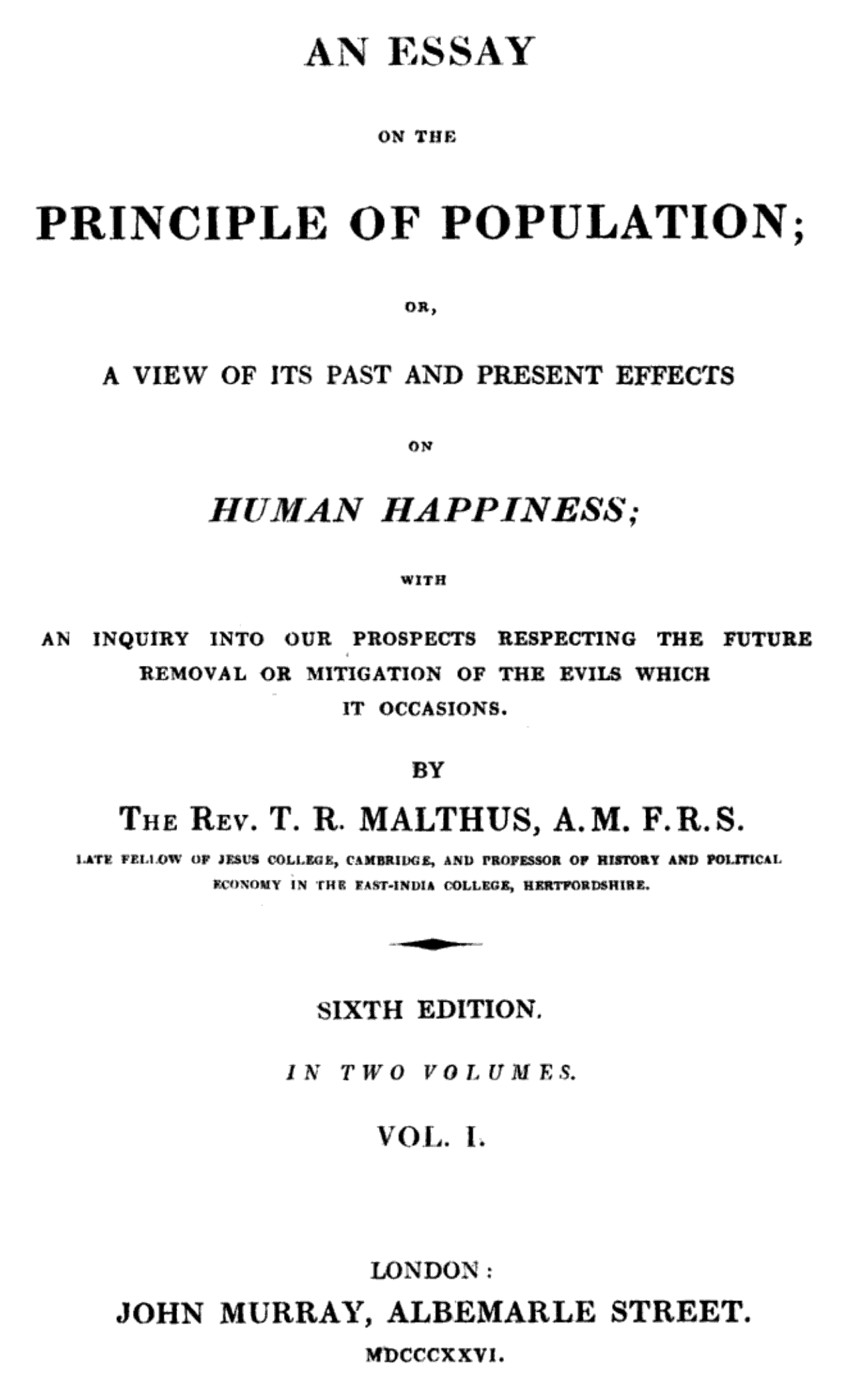
Title page of Volume I of An Essay on the Principle of Population, sixth edition, by the Rev. T. R. Malthus, published by John Murray, Albemarle Street, London, MDCCCXXVI (1826). Black text on white background.Book

Primary source

Title Page of An Essay on the Principle of Population, Sixth Edition

Thomas Robert Malthus · 1826

A dark brown leather book cover with a white rectangular library label in the upper left corner reading HB 861 .E8 1831 in black lettering. No title is visible on the cover.Book

Primary source

Additions to An Essay on the Principle of Population

Thomas Robert Malthus

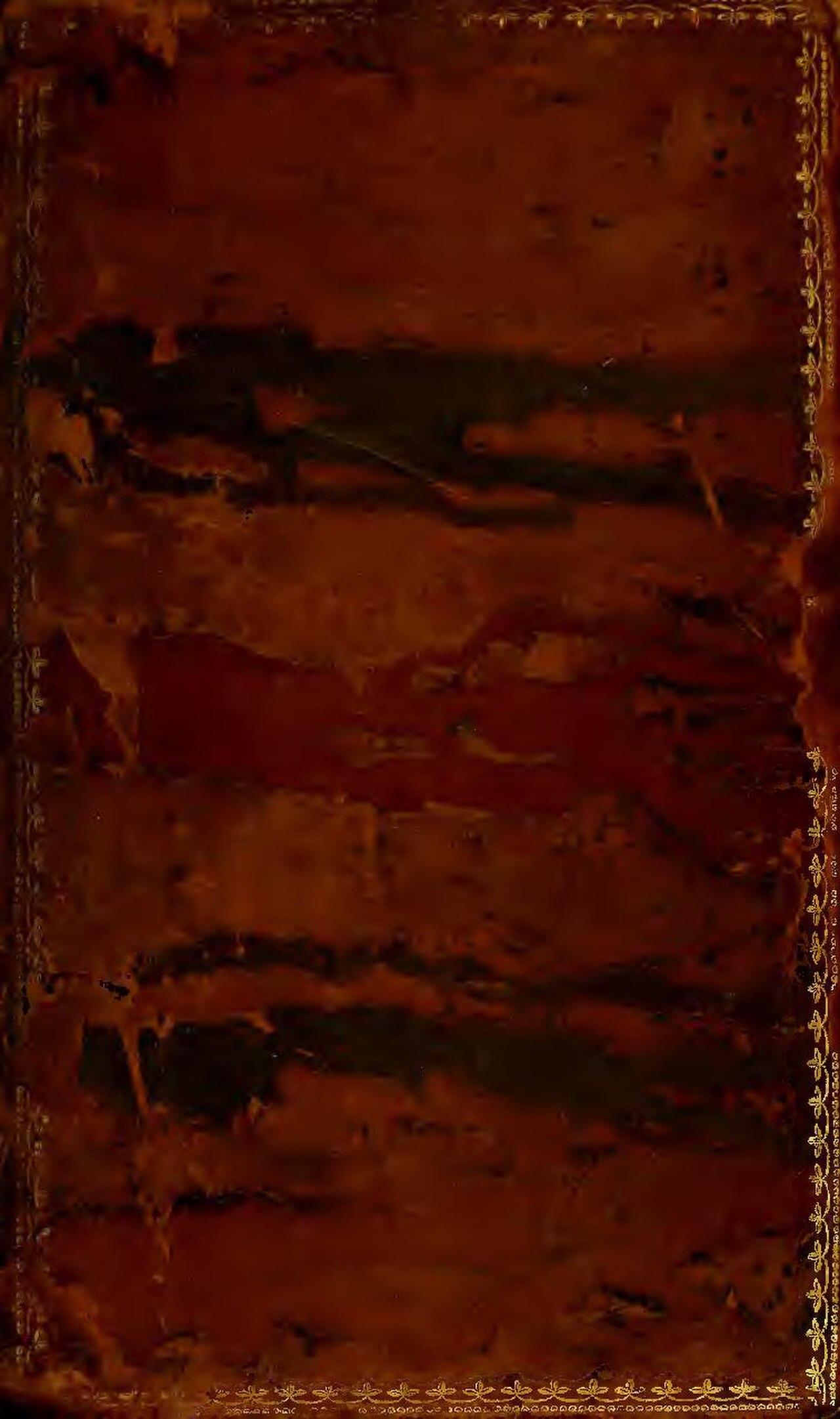
Cover of a book bound in worn reddish-brown leather with darker mottled patches and a gold-tooled floral border along the edges. No title or lettering is visible on the cover.Book

Primary source

Additions to the Fourth and Former Editions of An Essay on the Principle of Population

Thomas Robert Malthus

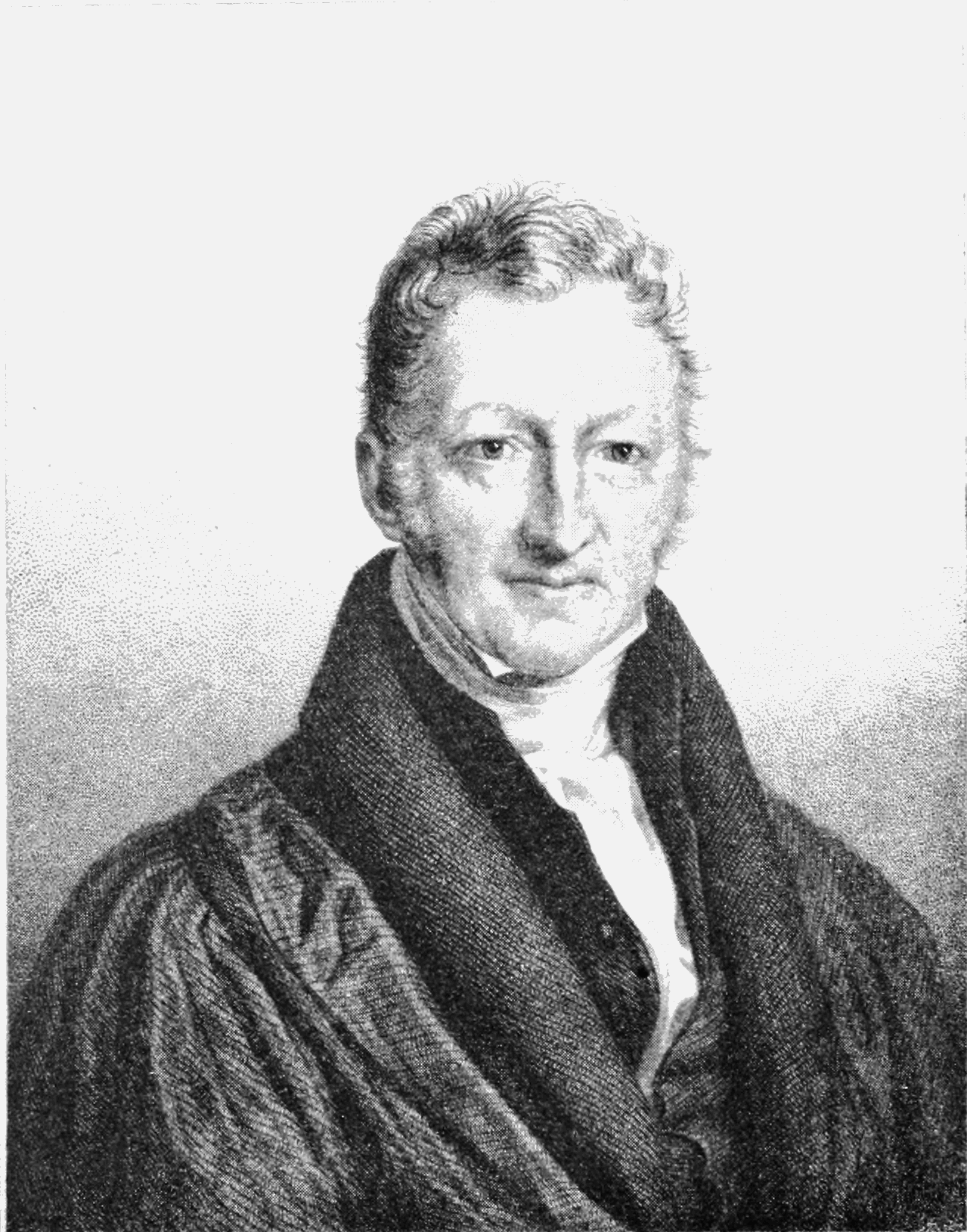
Black and white engraved portrait of a middle-aged man with short wavy hair, wearing a dark wrap-style coat with a high collar over a white shirt and cravat, against a plain pale background.Painting

Secondary source

Thomas Robert Malthus, Portrait in Popular Science Monthly

1909

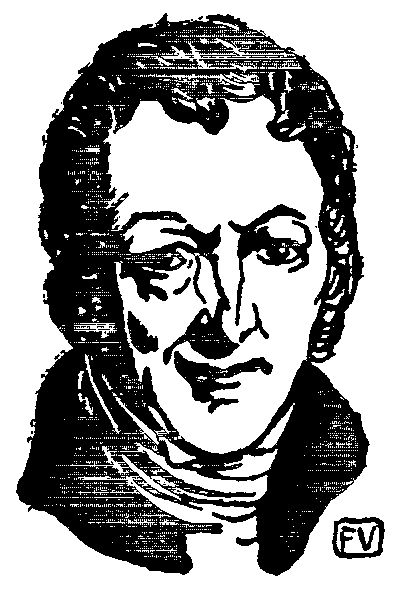
Black-and-white woodcut-style portrait of a man with swept-back hair, a furrowed brow, a slight smile, and a high collar with a cravat. The initials FV appear in the lower right corner.Painting

Secondary source

Thomas Malthus by Félix Vallotton

Félix Vallotton · 1897

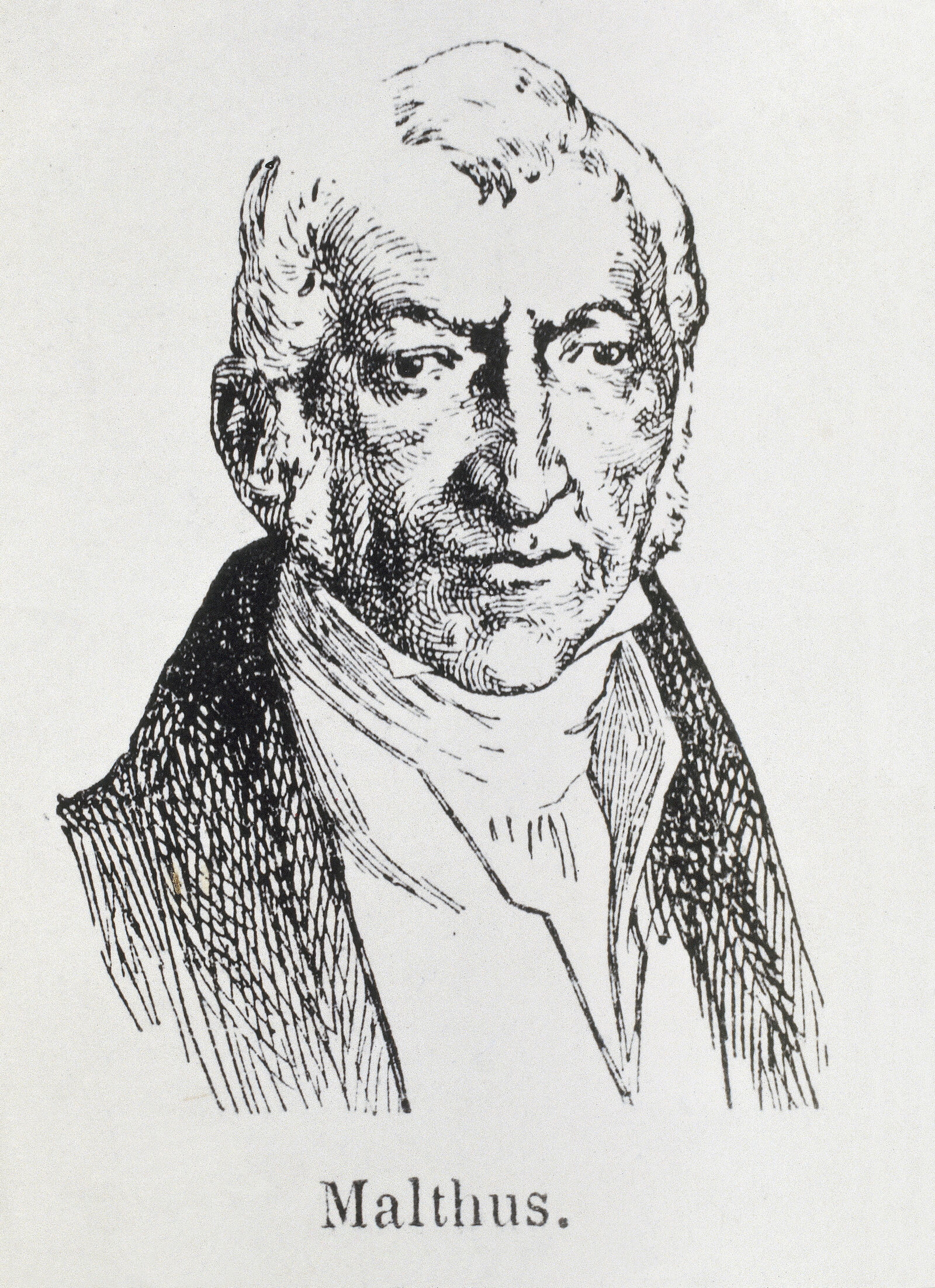
Black-and-white engraved portrait of an older man with receding hair, heavy brows, and a prominent nose, shown from the chest up in a dark coat and white collar. Printed caption below reads 'Malthus.'Photograph

Secondary source

Portrait of Thomas Robert Malthus

Document

Secondary source

Malthus, Thomas Robert, Encyclopaedia Britannica 1911

1911

PopulationDocument

Primary source

Population

Thomas Robert Malthus · 1859

Front cover of a book bound in dark maroon marbled paper with blue, cream and tan scalloped patterns. A paper label on the spine reads 312.1 and B632M in white print.Book

Secondary source

A Medical Address on the Benevolence of Malthus

Elizabeth Blackwell

Scan of a book spine and front cover showing a yellow-tan cloth spine on the left with a white paper label reading HB 863 F42, and green, black, and red marbled endpaper covering the rest of the board.Book

Secondary source

The Essay of Malthus: A Centennial Review

Frank A. Fetter · 1898

Document

Tertiary source

Malthus, Thomas Robert, in A Short Biographical Dictionary of English Literature

John William Cousin · 1910

Photograph of a white marble memorial plaque with black serif capitals reading 'Sacred to the memory of the Rev. Thomas Robert Malthus', praising his writings on political economy and essay on population, with birth and death dates 1766 and 1834 at the bottom.Artifact

Secondary source

Thomas Robert Malthus Memorial Plaque, Bath Abbey

Reverse of a faded beige Bank of England one-pound note dated 1816, with mirrored (reversed) printed text, a copperplate-style flourish, an ornamental crest seal at upper right, and a small black stamped oval at lower right.Artifact

Primary source

Bank of England £1 Banknote (1816)

The Bank of England · 1816

Want the full shelf? Chat with Thomas Malthus in the app and open the Sources panel — every quote links back to the original.

Use Thomas Malthus in class

3 collections

Ready-made collections from the Humy team that feature Thomas Malthus. Preview any of them, then try it free.

Trusted by educators worldwide

Conversations
375,000+
Real exchanges between students and historical figures
Messages exchanged
4,142,000+
Across every figure, classroom and language
Historical figures
100,000+
Each informed by a curated biography and selected sources
Languages supported
50+
From English and Spanish to Arabic and Korean

Paying customers

Used by 98 schools and universities

Partner school logo
Tecnológico de Monterrey logo
Hyper Island logo
Partner school logo
Chambersburg Area School District logo
Broward County Public Schools logo
Nebo School District logo
National Louis University logo
South Florida PBS logo
Punahou School logo
University of Wisconsin–River Falls logo
Partner school logo
Partner school logo
Archbishop Mitty High School logo
Kingsburg High School logo
Norwalk Public Schools logo
Partner school logo
Connections logo
Partner school logo
Moore Public Schools logo
Partner school logo
Partner school logo
Partner school logo
Partner school logo
Robbinsville Public Schools logo
Partner school logo
Partner school logo
Partner school logo
Tecnológico de Monterrey logo
Hyper Island logo
Partner school logo
Chambersburg Area School District logo
Broward County Public Schools logo
Nebo School District logo
National Louis University logo
South Florida PBS logo
Punahou School logo
University of Wisconsin–River Falls logo
Partner school logo
Partner school logo
Archbishop Mitty High School logo
Kingsburg High School logo
Norwalk Public Schools logo
Partner school logo
Connections logo
Partner school logo
Moore Public Schools logo
Partner school logo
Partner school logo
Partner school logo
Partner school logo
Robbinsville Public Schools logo
Partner school logo
Partner school logo

What educators are saying

“We enjoyed the program last year and used it frequently.”
“My students say it’s a welcome change of pace. I’m not a fan of the “sage on the stage” model, so I try to incorporate research-oriented and self-paced activities. With Humy, students have to take charge of their learning. They’ve become more adept at critical thinking, forming better questions, and improving their reading comprehension. The interview feature has been my go-to tool. I create assignments where students must ask historical figures a set number of questions, then summarize the responses to ensure they’re truly absorbing the material. This approach lets them actively explore the past rather than passively consuming information.”
“Humy has helped me bring historical figures, sometimes long past, to life. When my students interact with these figures in real-time, it eliminates some of the perceived “ancient” characteristics of my curriculum. This has shifted my students’ thinking away from viewing history as abstract or irrelevant. Real-time interactions make historical figures relatable, even allowing students to ask off-topic questions that help put historical lives in a more relevant context for 13-year-olds. The feature I use the most is the interview feature. After teaching a topic, most recently Gandhi and Joan of Arc, I have the students ask pointed, focused questions. We practice good conversation techniques beforehand, teaching them to listen (or read) carefully and formulate thoughtful follow-up questions rather than just interrogating. It helps students practice effective conversation skills.”

FAQ

Frequently asked questions

Who is Thomas Malthus?
Economist known for the concept of population growth outstripping food supply. On Humy.ai you can chat with an AI version of Thomas Malthus that draws on a short biography and 55 historical sources during the conversation — by text or voice, in 42 languages.
Is Thomas Malthus AI free?
Thomas Malthus is part of Humy's full library of more than 100,000 figures, which comes with a paid plan. A free account (no credit card) includes 20 messages a month with the free library's figures, so you can try how the conversations work first.
What sources does the Thomas Malthus AI use?
It draws on a short biography and 55 historical sources (books, paintings and documents), including “An Essay on the Principle of Population”, “Portrait Print of Thomas Robert Malthus” and “Principles of Political Economy”. Each source has its own page on Humy.ai.
How historically accurate is the AI version of Thomas Malthus?
Each figure uses a short biography and a small set of selected historical sources as context (retrieval-augmented generation), so answers stay closer to known material than the model's general knowledge alone. It isn't a citation-grade research tool — like any LLM, the AI can get details wrong or extrapolate. Treat it as a strong starting point for inquiry and cross-reference important claims.
Can I talk to Thomas Malthus by voice?
Yes. In addition to text chat, you can call Thomas Malthus and hear their voice respond in real time — useful for auditory learners, interview practice and Socratic dialogue.
Is Humy.ai safe and compliant for schools?
Yes. Humy.ai is used by more than 100 schools, universities and organisations. The platform is FERPA- and GDPR-aligned, supports SSO, and offers an IT-approval pack tailored for school procurement teams.

Ready when you are

Start chatting with Thomas Malthus now.

20 messages free · No credit card · Available in 50+ languages.