
Portrait of Prince Henry the Navigator

AI Historical Figure

Prince Henry the Navigator

Portuguese Prince, Patron, Explorer

Chat with Prince Henry the Navigator via text or voice — in 42 languages, drawing on a curated biography and 81 historical sources. Available 24/7.

Start chatting with Prince Henry the Navigator20 messages free · No credit card
Lived
1394–1460
From
Portugal
Known for
Rulers & royaltyExploration
Prince Henry the Navigator

Prince Henry the Navigator

Online · responds in seconds

Hello — I'm Prince Henry the Navigator. Portuguese Prince, Patron, Explorer. What would you like to ask me?

20 messages free · No credit card · Powered by Humy.ai

Live preview · Switch between 42 languages above · Send a message to continue in the app

Multilingual

Talk to Prince Henry the Navigator in 42 languages

Ask Prince Henry the Navigator questions in any language below, and the rest of Humy's app speaks it too. Pick yours to open the chat in that language.

Also in German (Austria), German (Switzerland), English (UK), English (Australia), English (Canada).

The sources behind this AI

81 sources · 22 artifacts · 18 paintings · 13 photographs · 10 books · 9 sculptures · 9 documents

Prince Henry the Navigator doesn’t improvise from thin air. The AI is grounded in 81 curated historical sources students can inspect. Open any of them to see what informs the conversation.

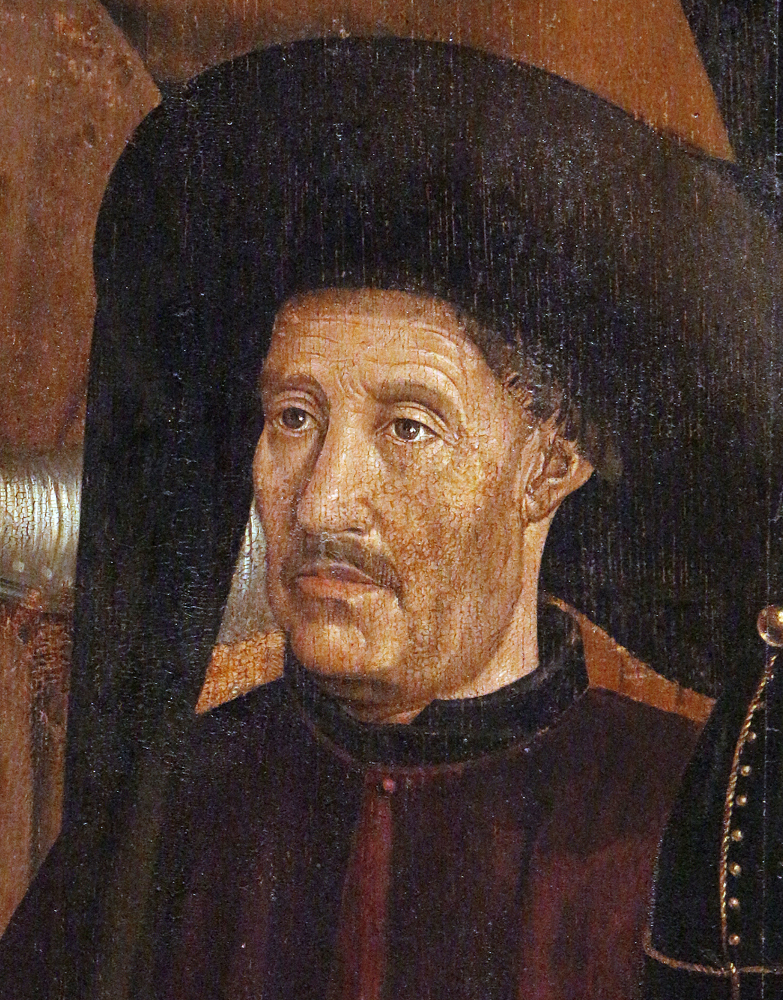
Close-up detail of a painted man with a moustache and dark wide-brimmed hat, wearing a dark red garment with a high black collar, in a Gothic-style oil painting with brown background.Painting

Secondary source

Panel of the Prince (Detail)

Nuno Gonçalves · c. 1470

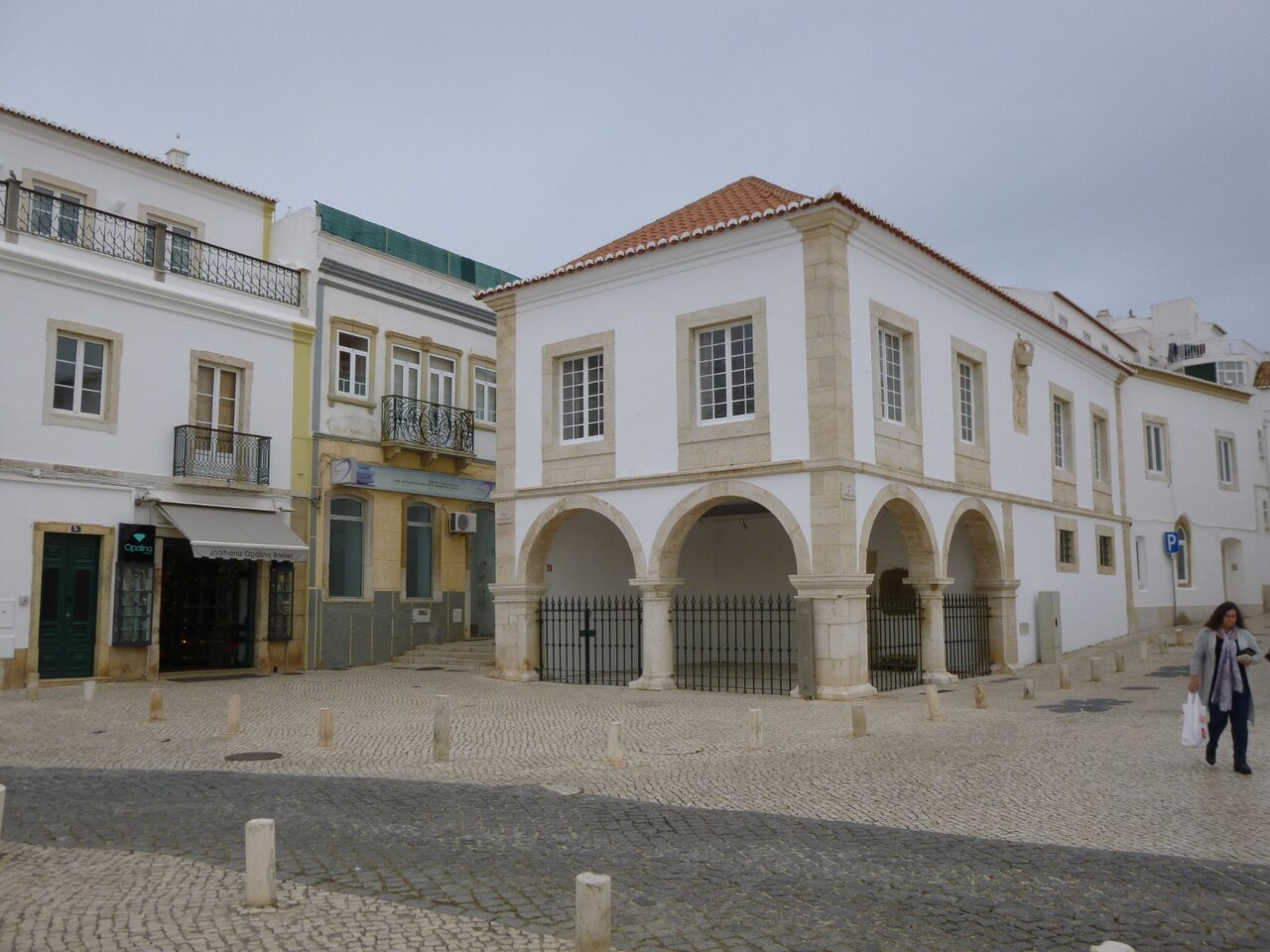
Whitewashed two-storey building with an arcade of stone arches at street level, a terracotta tiled roof, and iron gates, on a cobbled square. A woman with a shopping bag walks at right.Artifact

Secondary source

Mercado de Escravos

Built 1691; site of 1444 slave sale

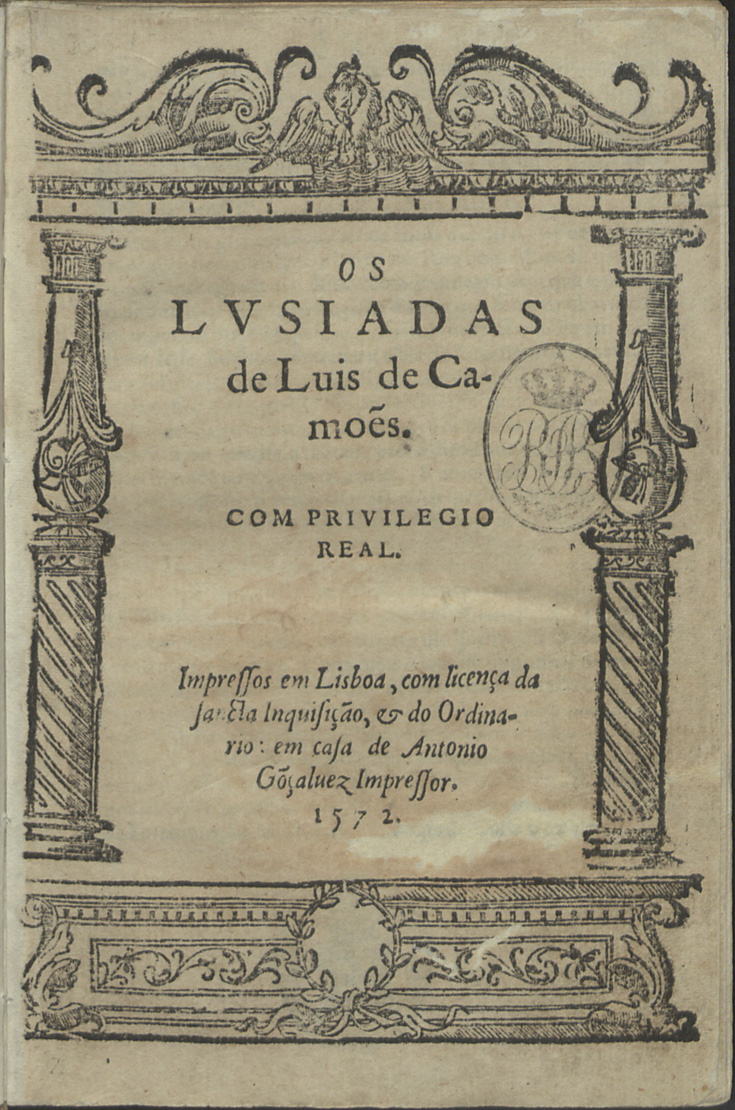
Title page of the 1572 Lisbon edition of Os Lusíadas by Luis de Camões. Ornate woodcut border with columns and a decorative top frame. Text reads 'OS LVSIADAS de Luis de Camões, COM PRIVILEGIO REAL', with a printer's note and the year 1572. A round royal emblem stamp sits at the right.Book

Secondary source

Os Lusíadas

Luís de Camões · 1572

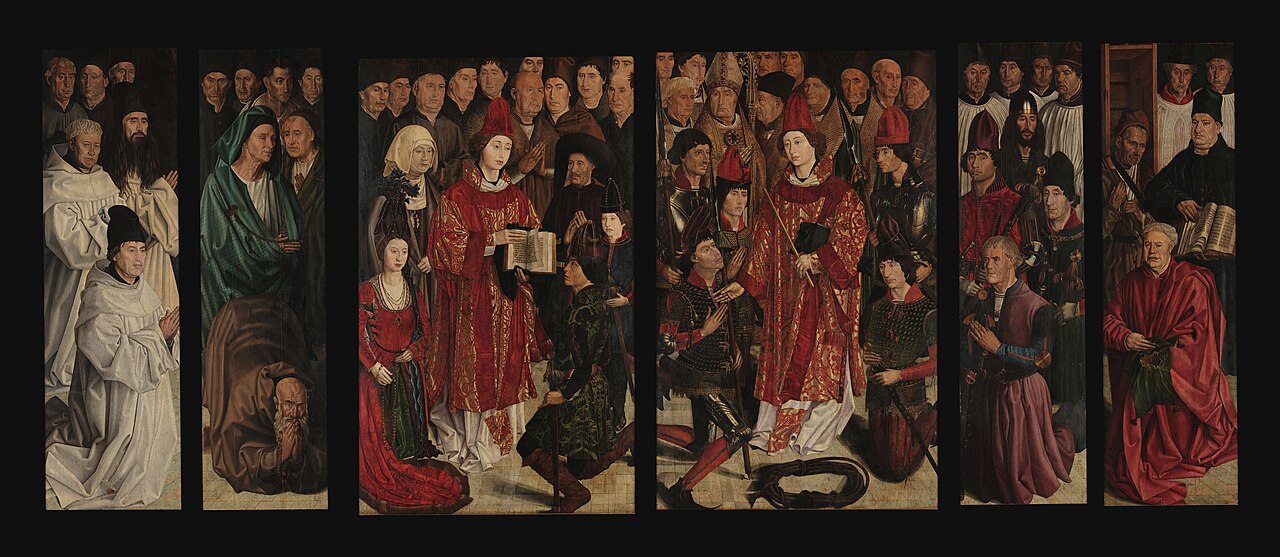
Six-panel altarpiece painting with a dark background. Robed figures in red, white, and green kneel and stand among crowds of men in hats and armor. Figures in the central panels include a bishop in red vestments holding an open book, and a figure in red with a dragon at the bottom right.Painting

Secondary source

Saint Vincent Panels

Nuno Gonçalves · c. 1450-1480

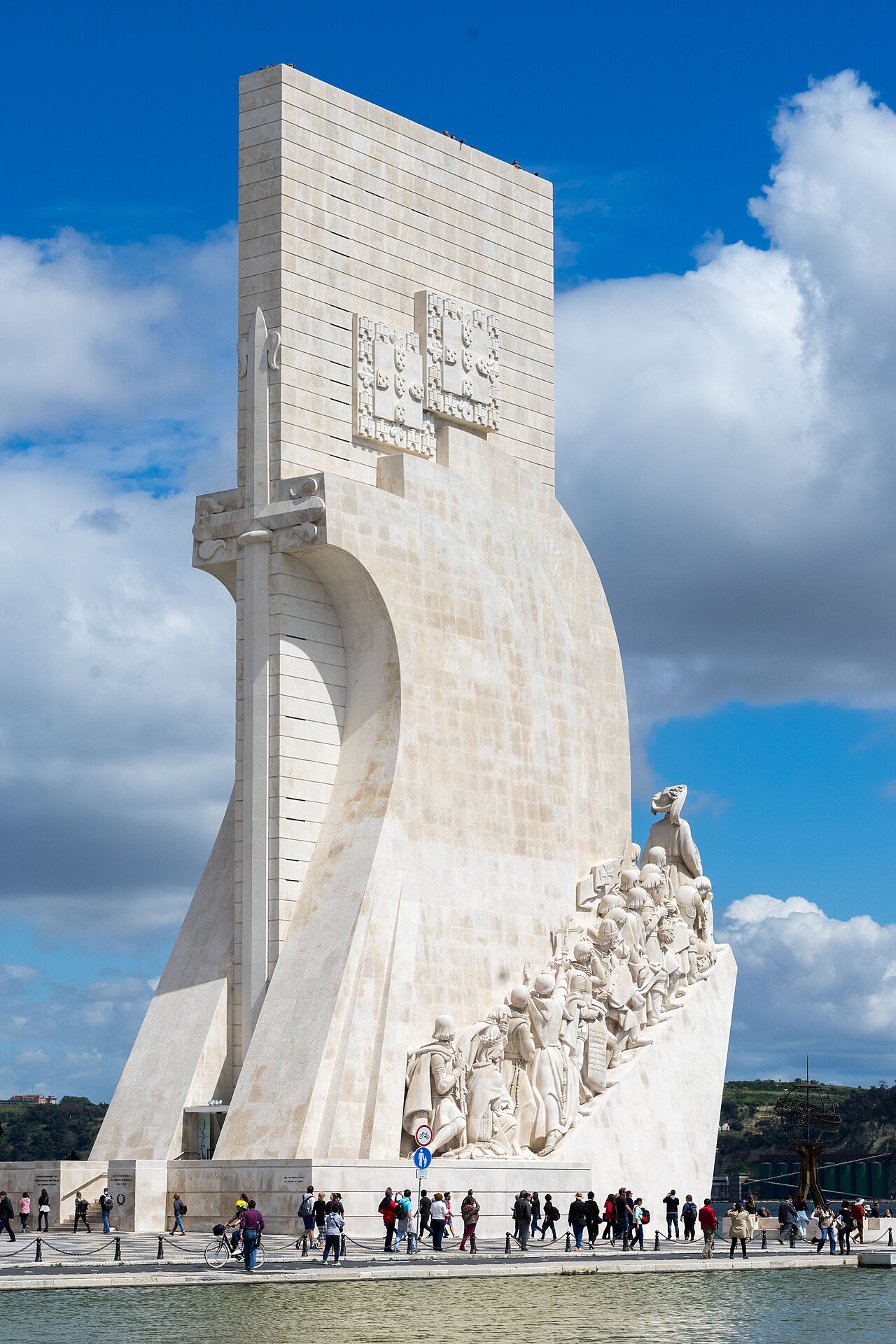
Close view of the Padrão dos Descobrimentos, a tall white limestone monument shaped like a ship's prow on the Tagus riverside in Lisbon. Its face carries a stone cross and heraldic shields, and a row of carved figures in relief stands at its base, with tourists walking along the waterfront in front.Sculpture

Secondary source

Padrão dos Descobrimentos

Leopoldo de Almeida · 1960 (inaugurated 9 August 1960)

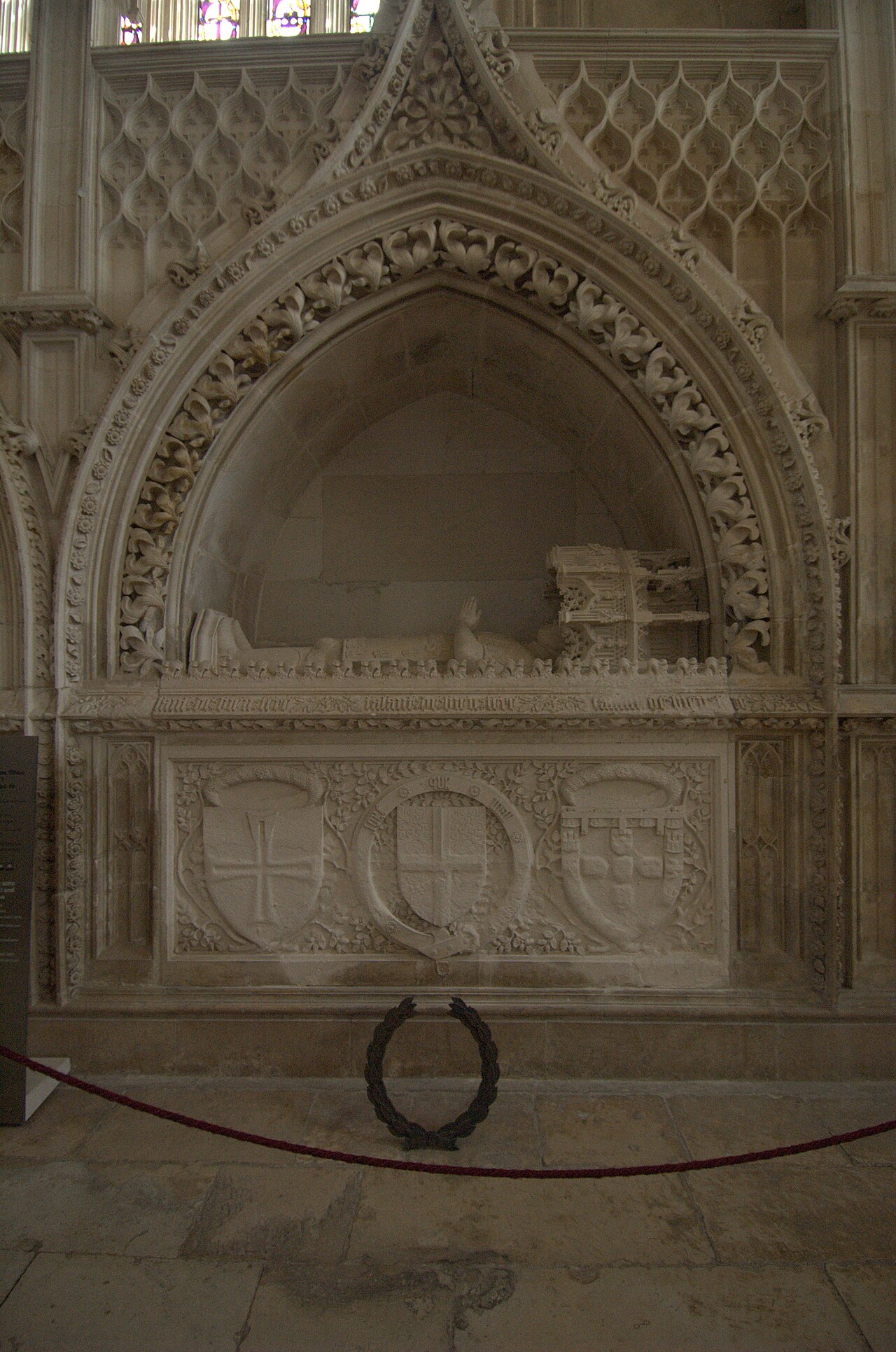
Stone Gothic tomb recess in a church, with a carved recumbent effigy of a figure lying on a sarcophagus under a pointed arch with ornate foliage. Below are carved coats of arms in a panel, and a dark wreath lies on the floor before a red rope barrier.Sculpture

Secondary source

Grave of Prince Henry the Navigator

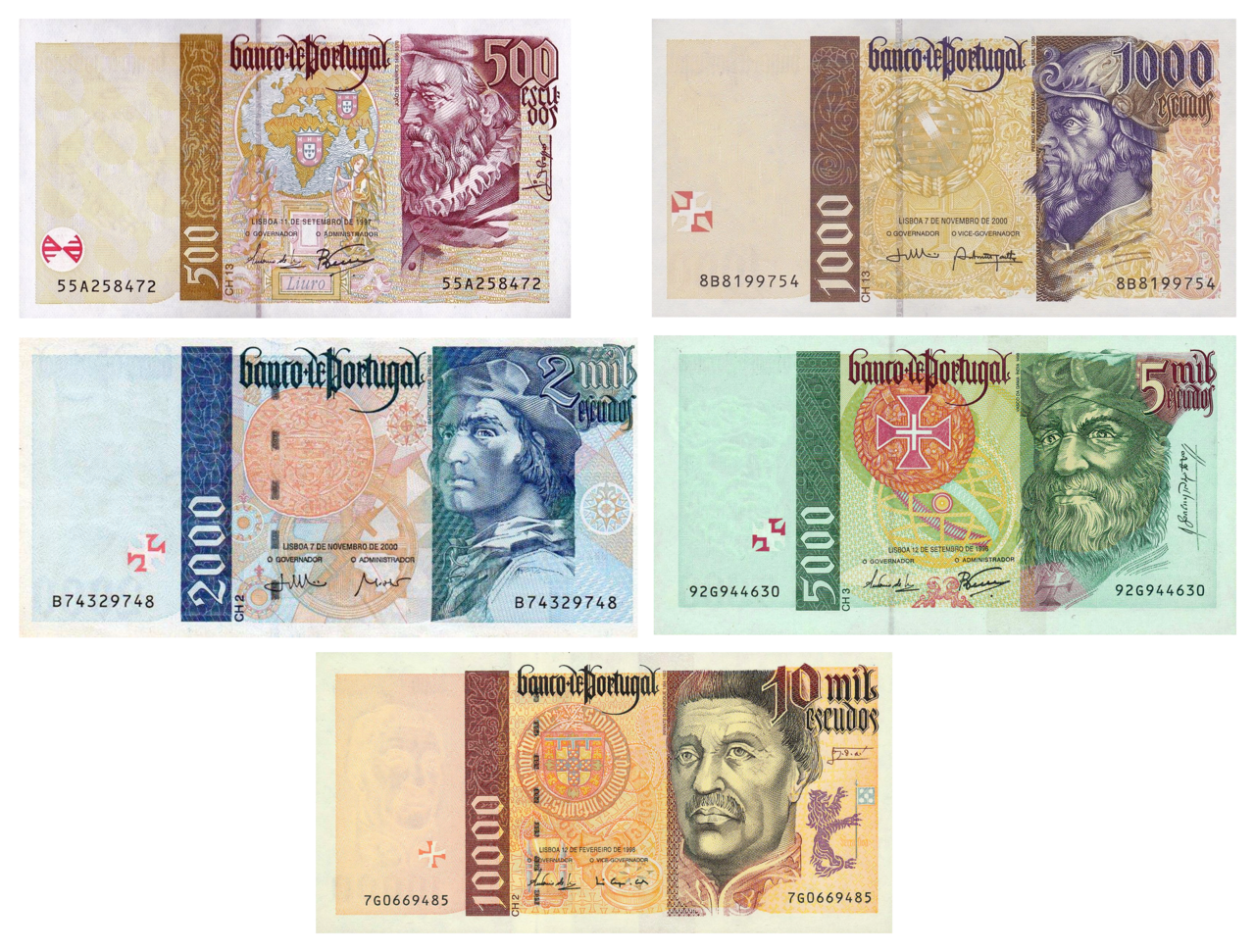
Five Portuguese escudo banknotes in a row, from 500 to 10,000 escudos, each showing a historical portrait figure, the denomination, and Banco de Portugal printing. The notes are arranged in a 2-2-1 layout.Photograph

Secondary source

Last Series of Portuguese Escudo Banknotes

ZabilioZ

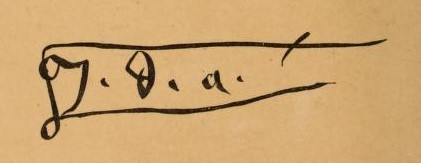
Handwritten ink signature on a pale background, enclosed by a long flourished stroke. It reads roughly as a stylized 'I' or 'J' with a loop, followed by 'D.' and 'H' style letters with dots between them.Document

Primary source

Signature of Prince Henry the Navigator

Prince Henry the Navigator

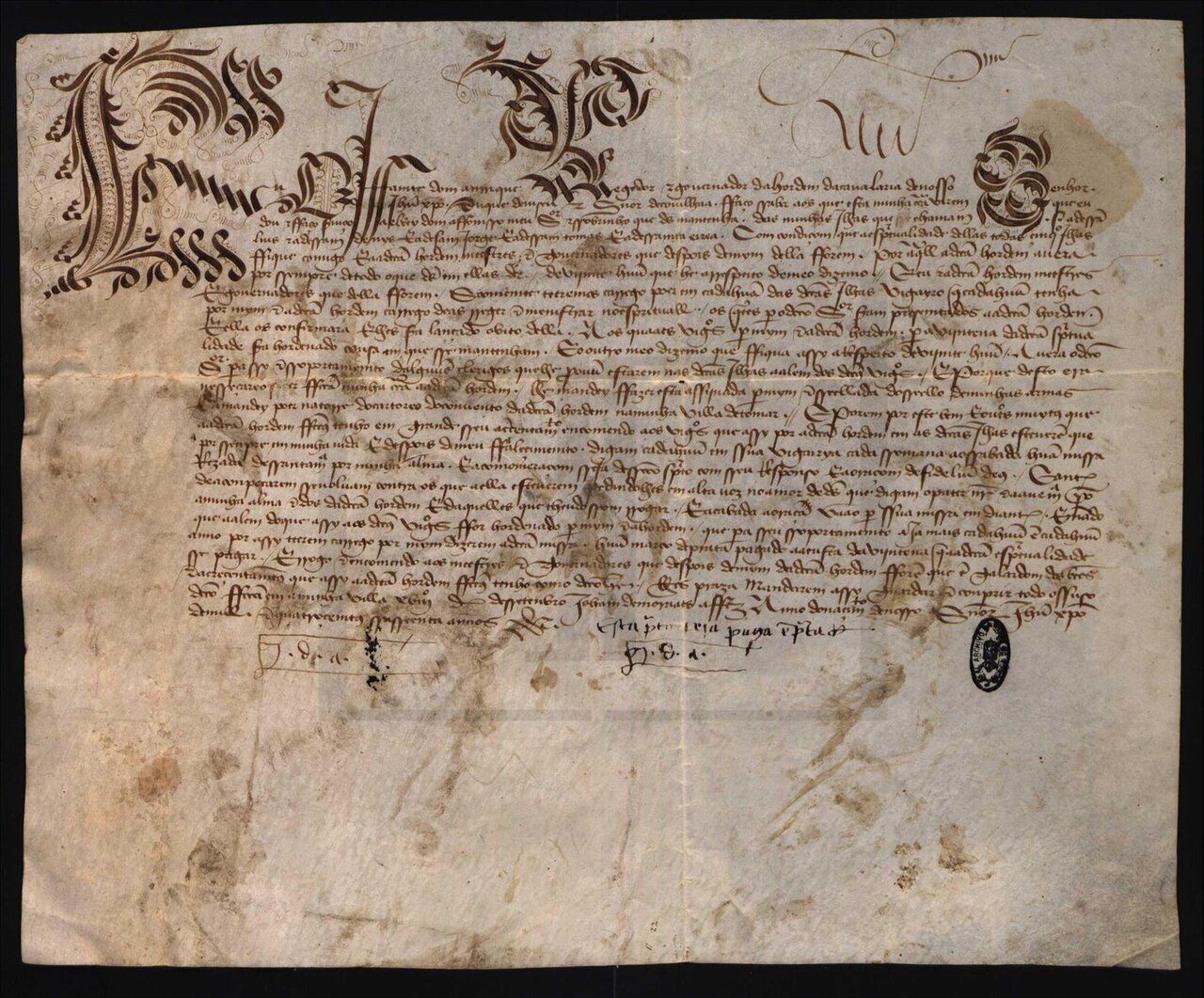
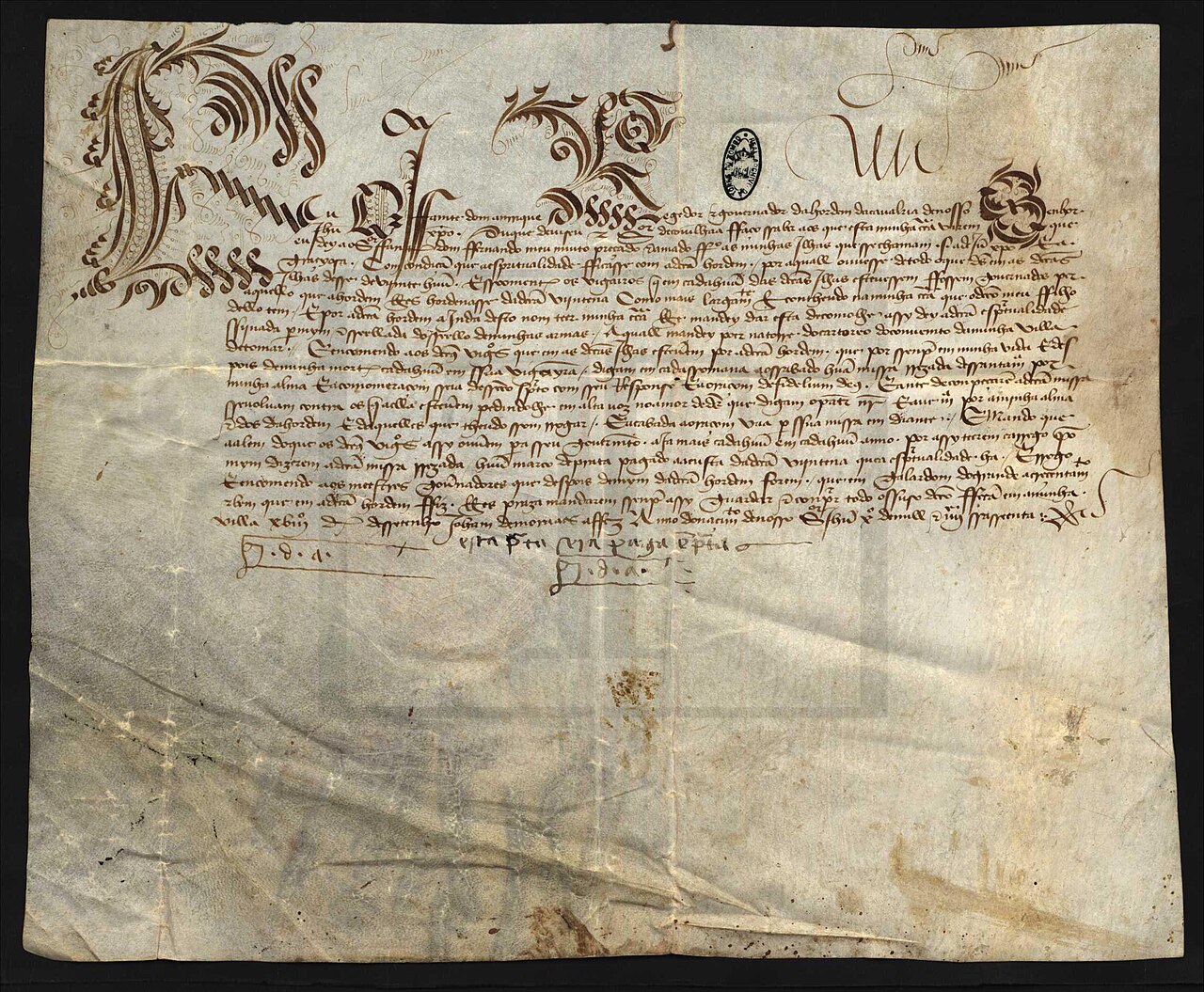
Photograph of a medieval parchment charter with ornate illuminated capital letters in brown ink, dense handwritten Gothic script in several lines, a signature and a dangling black wax seal with a red-brown mark near the bottom right. The parchment shows stains and wrinkles.Document

Primary source

Charter Granting Five Islands to Afonso V

Chancery of Infante D. Henrique; scribe Joham de Moraes · 18 September 1460

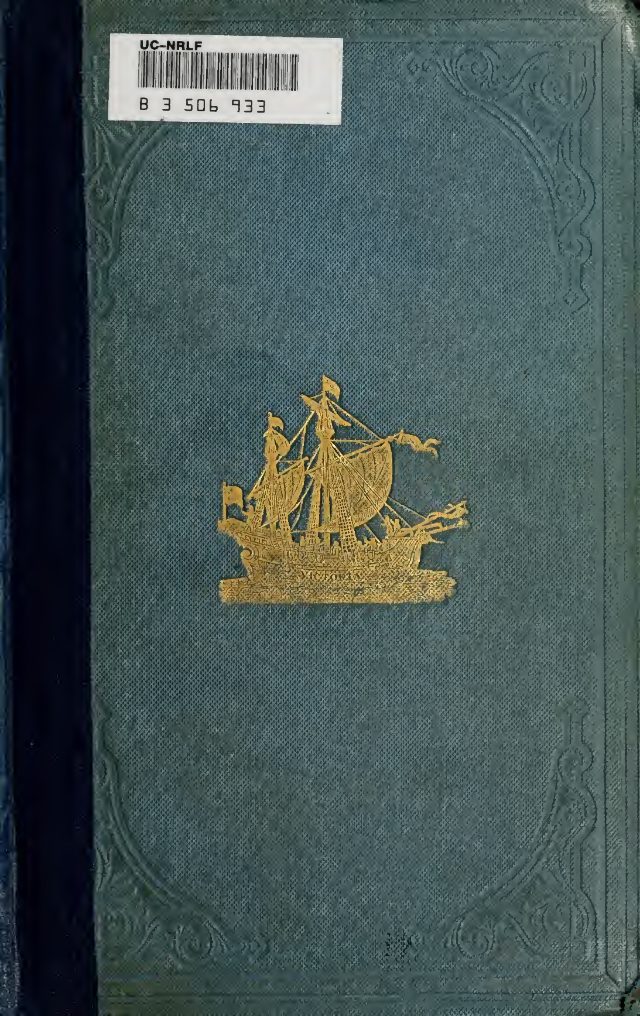
Book

Secondary source

The Discoveries of Prince Henry the Navigator and Their Results

Richard Henry Major · 1877

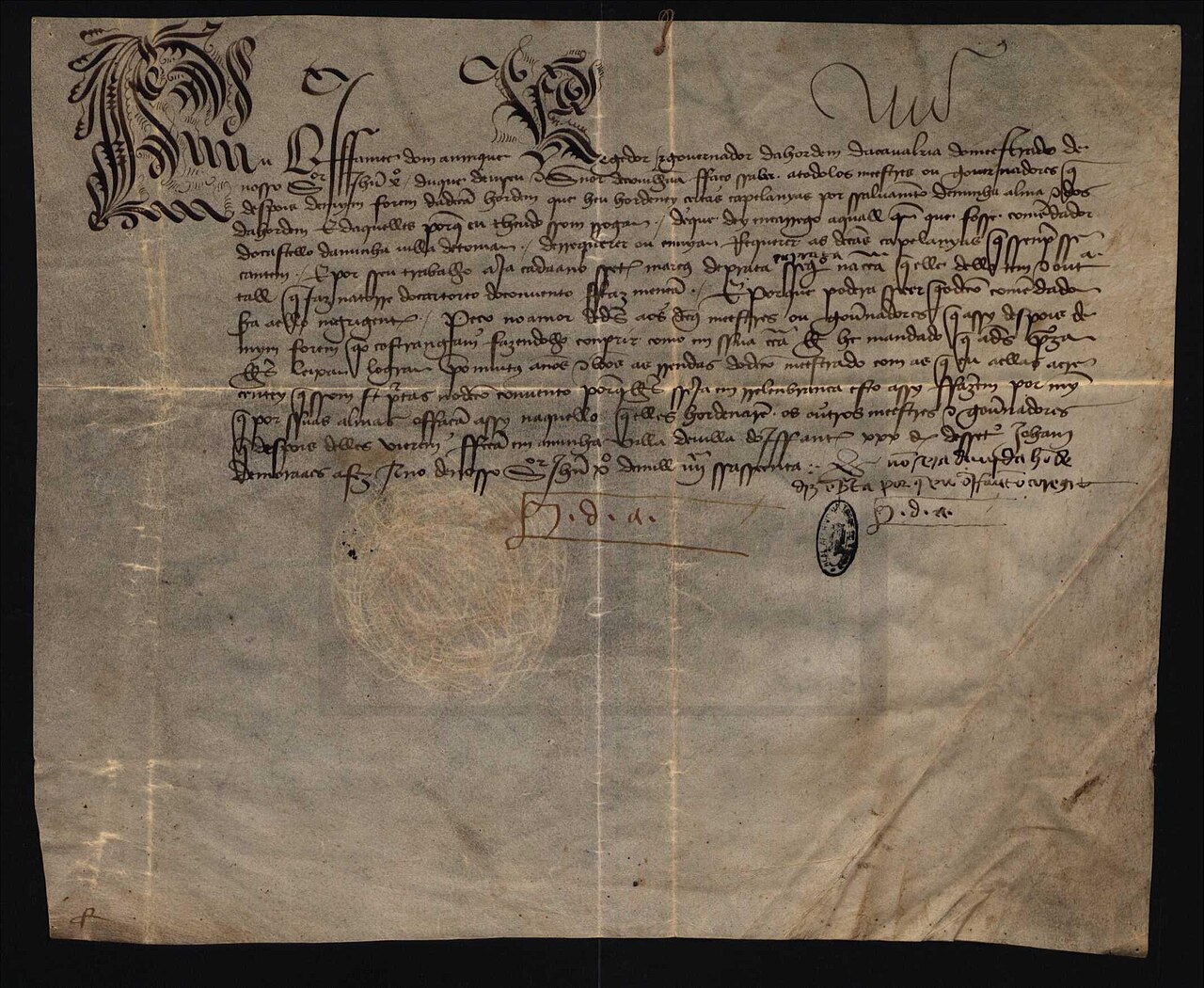
Photograph of a medieval parchment charter, aged and creased, with a large ornate illuminated initial letter at upper left and several lines of brown handwritten Portuguese script in gothic-style hand. A small dark wax seal is visible at lower right, and a faded signature mark appears near the bottom left.Document

Primary source

Charter Donating the Church of Santa Maria de Belém

Chancery of Infante D. Henrique; scribe Joham de Moraes · 18 September 1460

The Discoveries of the WorldBook

Primary source

The Discoveries of the World

António Galvão · 1555 (original text); this edition 1862

Book

Secondary source

Essays in Historical Criticism

Edward Gaylord Bourne · 1901

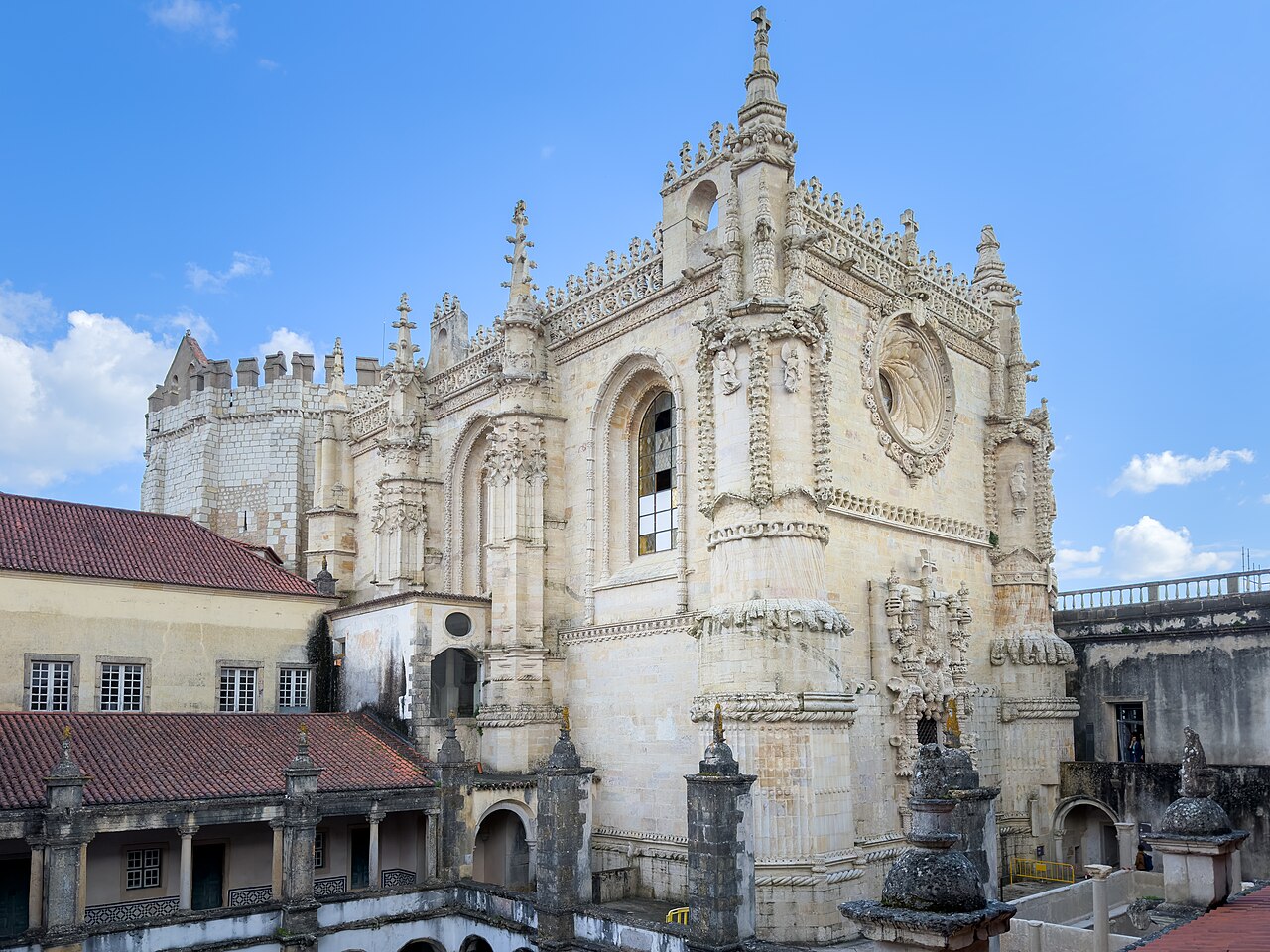
Exterior view of an ornate stone church building with Gothic and Manueline carvings, pointed windows, a rose window, and a tall spired tower, under a blue sky with clouds. Red-tiled roofs and a stone arcade are in the foreground.Artifact

Secondary source

Convent of Christ

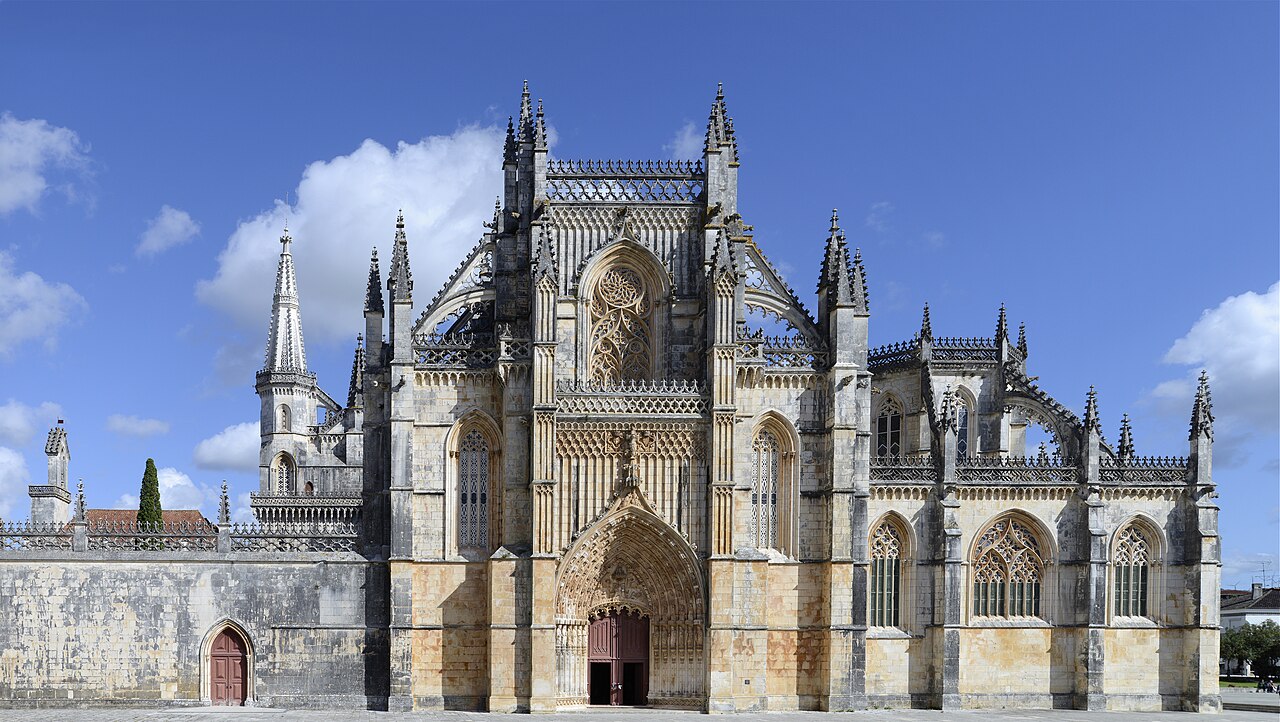
Front facade of the Batalha Monastery in Portugal, a Gothic stone building with pointed spires, ornate tracery, a large central portal with a wooden door, and tall windows under a blue sky with clouds.Artifact

Secondary source

Batalha Monastery

1386

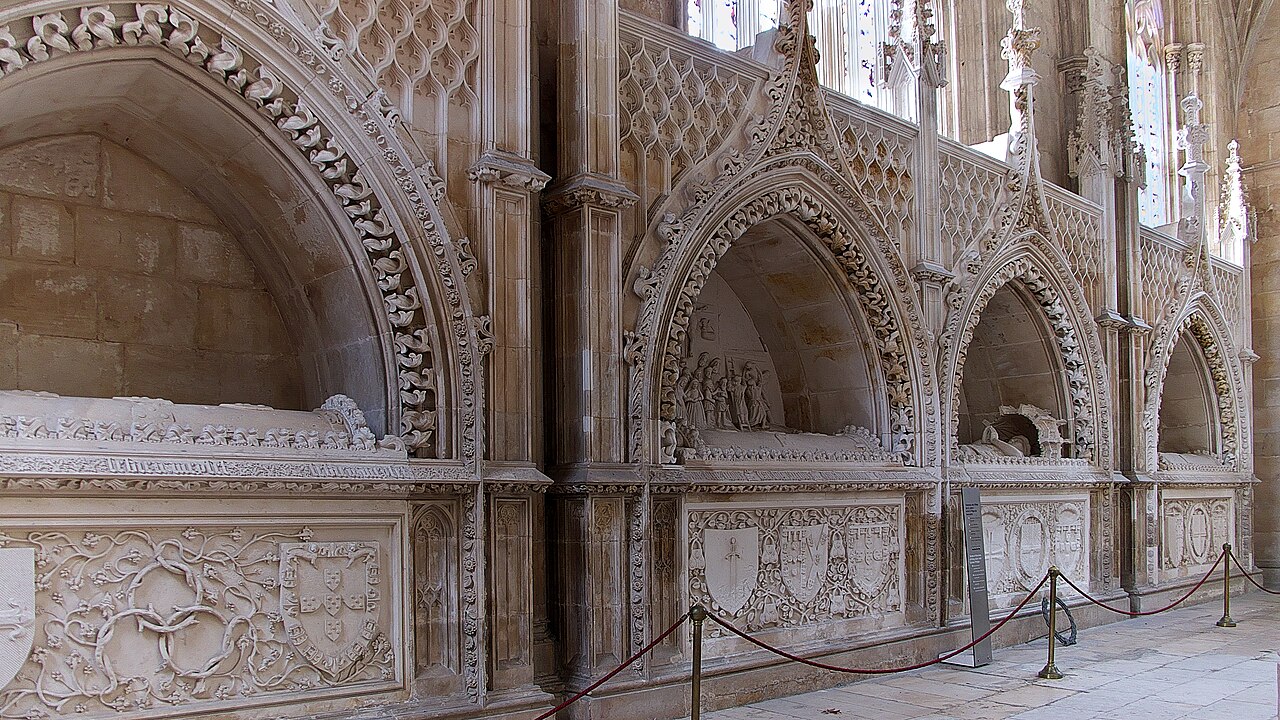
Stone Gothic tombs in a row inside a cathedral-like chapel, with carved arches, tracery, heraldic shields, and a recumbent effigy at left. A rope barrier with brass posts runs along the floor in front.Photograph

Secondary source

Tombs of the Infantes, Founder's Chapel, Batalha Monastery

José Luis Filpo Cabana · 2010-11

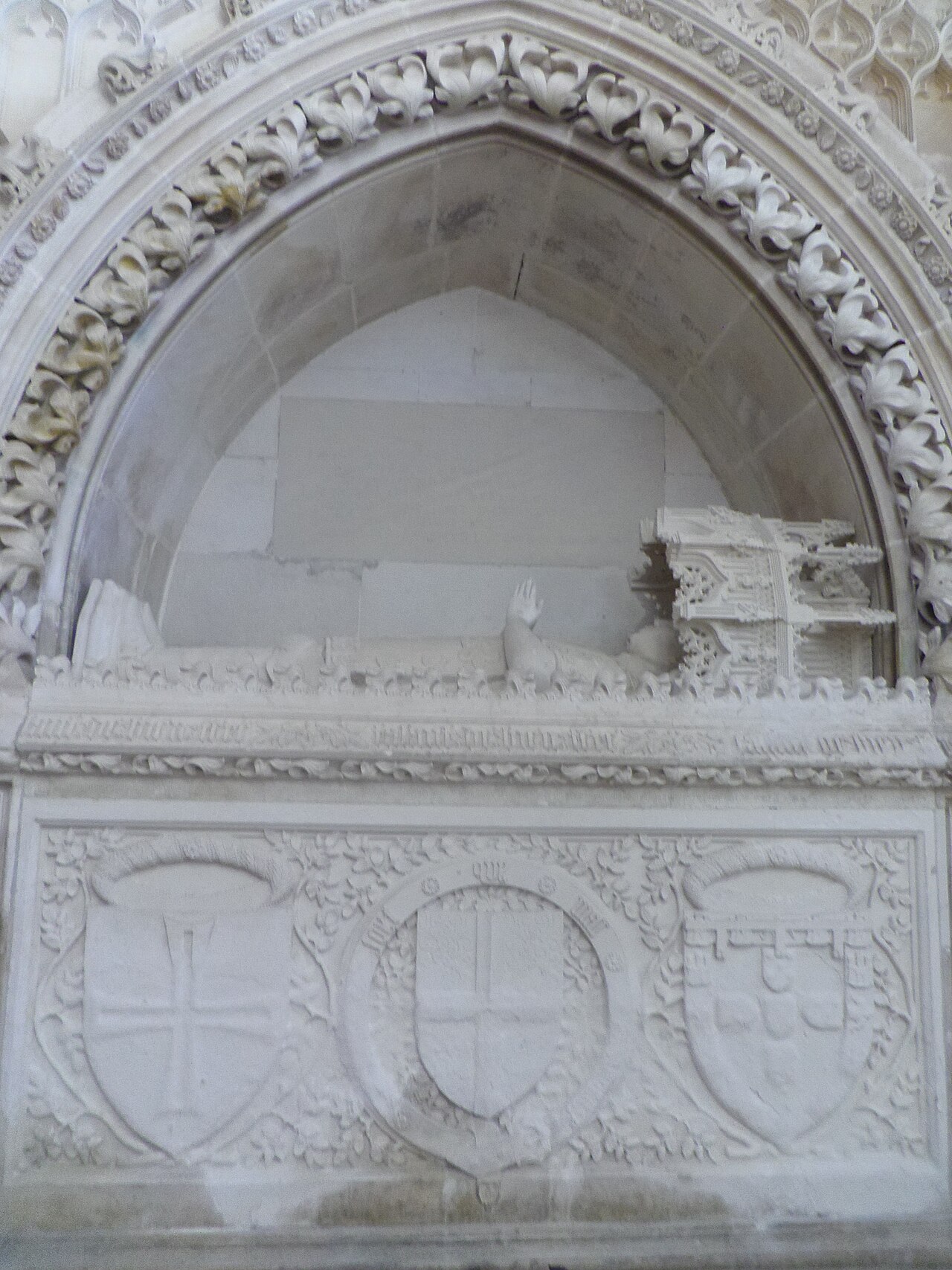
White stone Gothic tomb in a pointed arch niche at Batalha. A recumbent effigy with a raised hand rests on a tomb chest carved with a foliage-decorated border and three heraldic shields below.Photograph

Secondary source

Tomb of Prince Henry the Navigator

ricardo from London · 26 December 2011 (photograph)

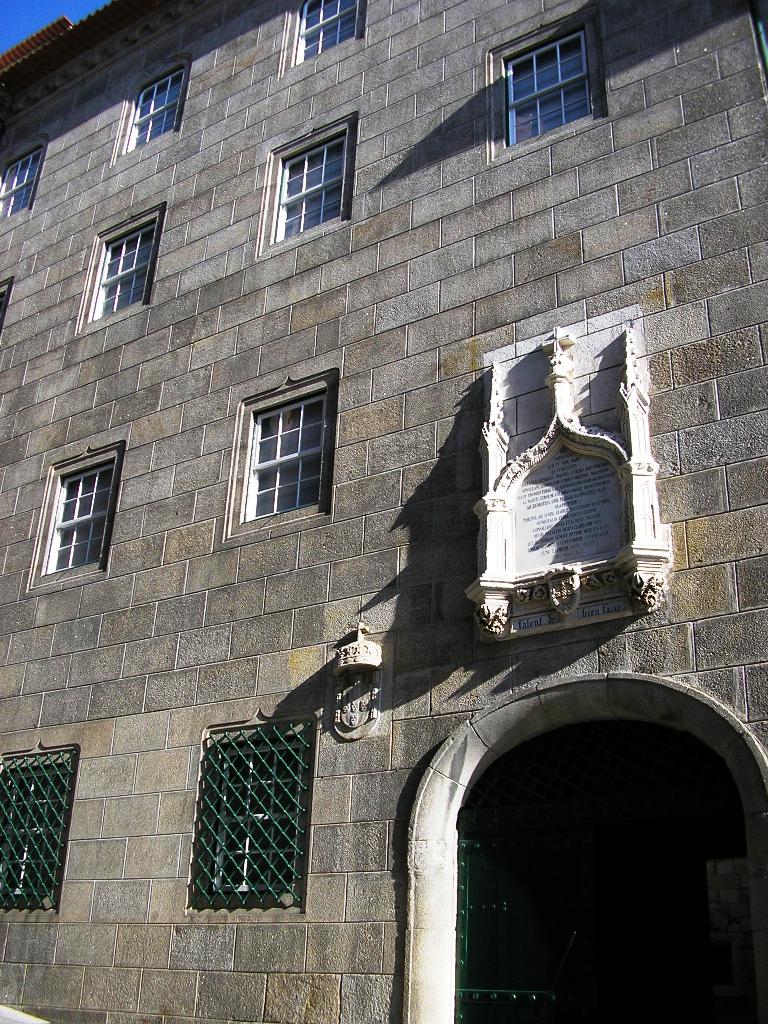
Facade of a multi-storey granite-block building with grid-paned windows, a carved stone plaque with an inscription above a doorway, and a dark arched entrance at street level with a green gate.Artifact

Secondary source

Casa do Infante

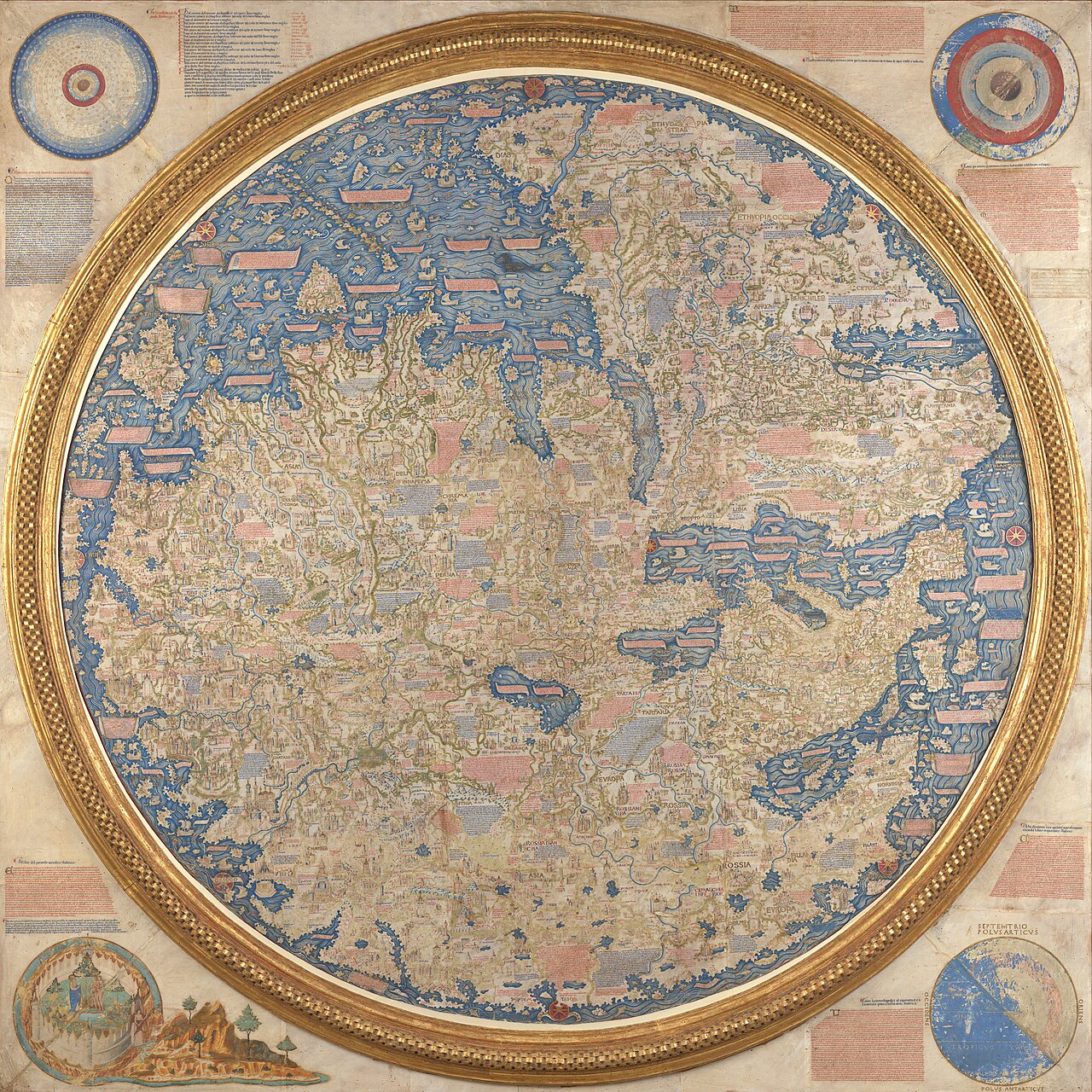
Circular world map in a gold frame, with south at top. Blue oceans with ships surround tan-colored landmasses, with rivers, cities and labels in Italian. Text panels and small circular diagrams fill the four corners.Artifact

Secondary source

Fra Mauro map

Fra Mauro · c. 1450-1459

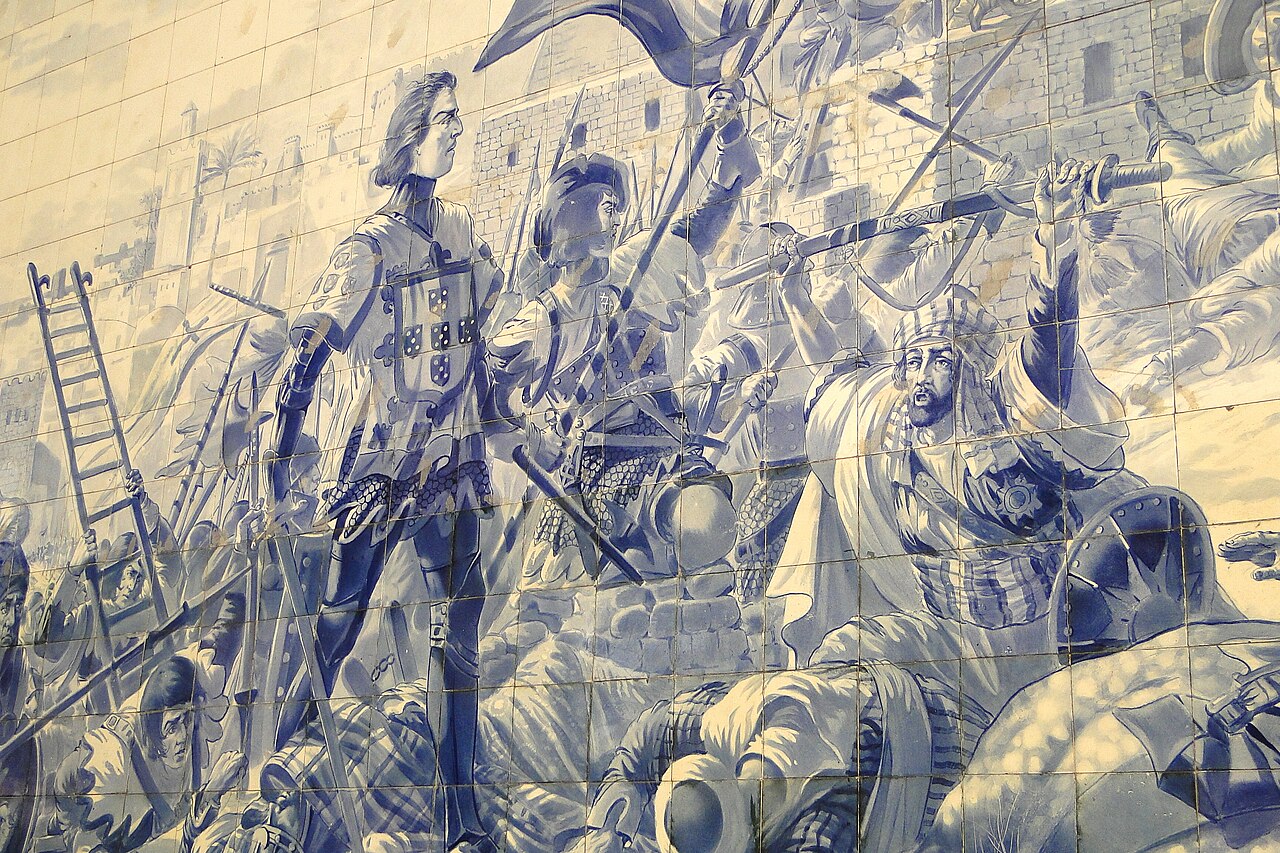
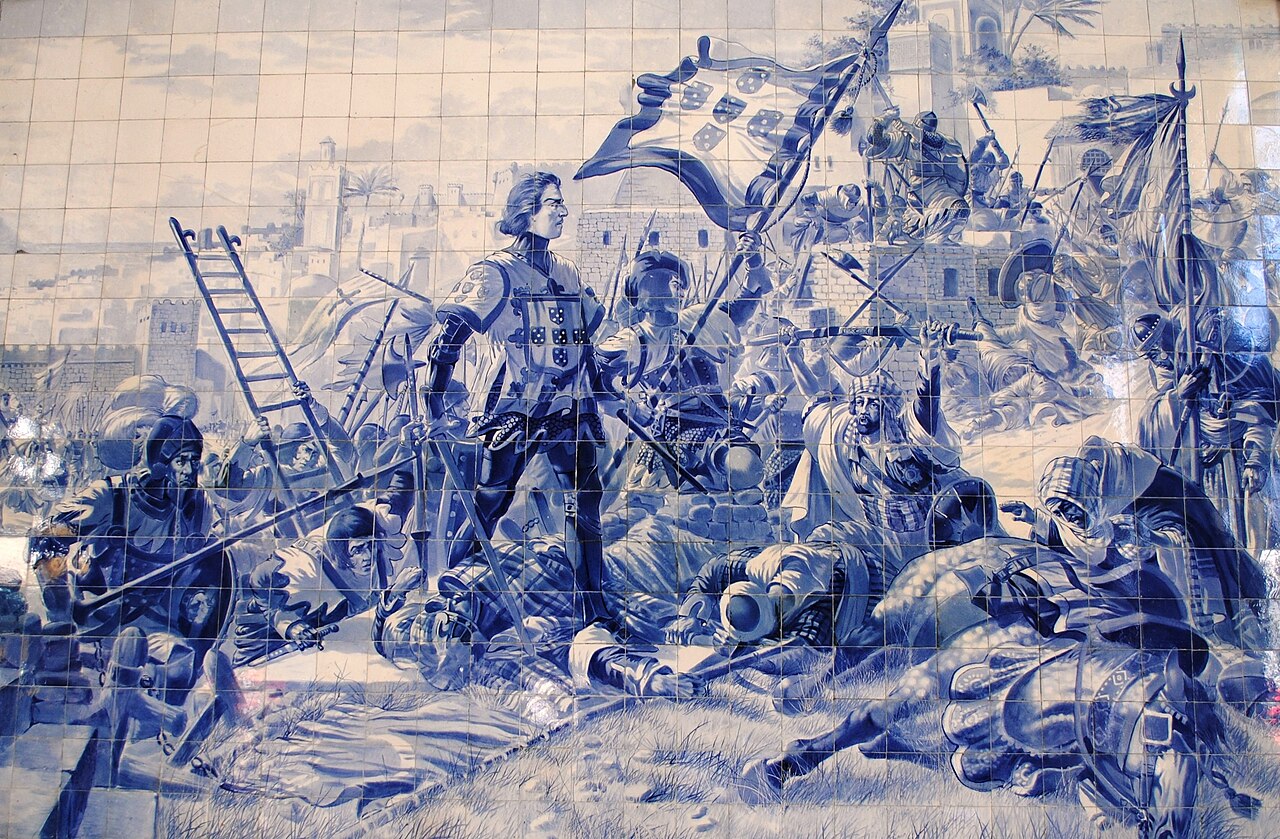
Blue-and-white azulejo tile panel depicting a battle scene: a Portuguese soldier in armour with a shield bearing blue and white emblems stands center-left, while turbaned defenders and fallen figures fill the foreground under a city wall with a ladder and raised flag.Painting

Secondary source

Azulejo tile panel showing the Conquest of Ceuta

Jorge Colaço · 20th century

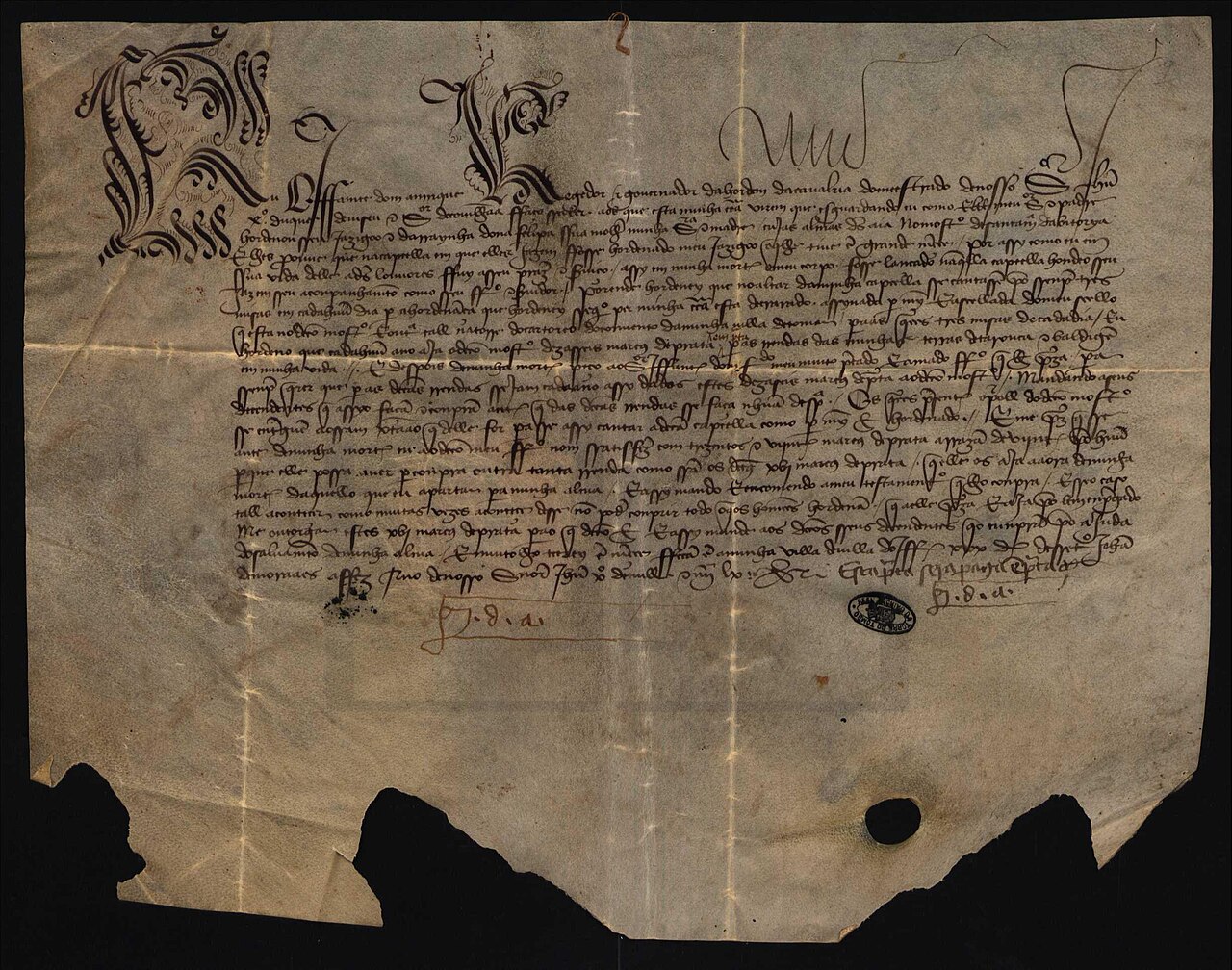
Photograph of a medieval parchment charter in brown ink with an ornate illuminated initial letter at upper left and a red wax or ink signature mark at lower left. A round dark seal is visible at lower right. The parchment is torn along its bottom edge.Document

Primary source

Charter granting silver marks to the Monastery of Batalha

Chancery of Infante D. Henrique (scribe Joham de Moraes) · 30 September 1460

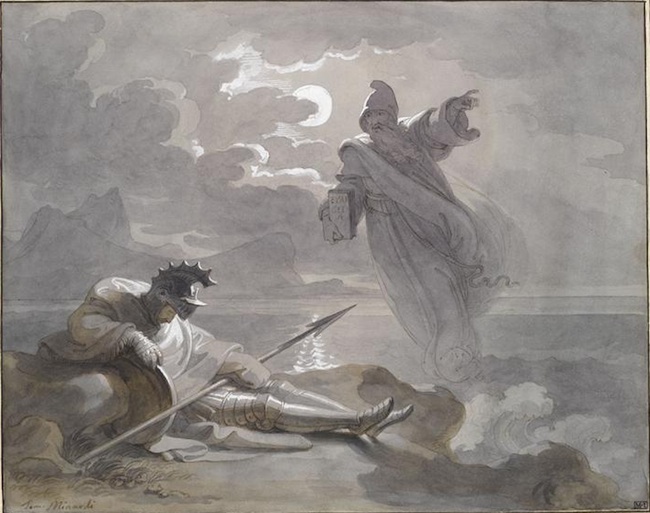
Grey wash drawing of a seated armored knight with a crown-like helmet resting against rocks beside a spear, gazing down, while a bearded robed old man with a pointed hood gestures from a glowing mist above. A crescent moon shines in a cloudy sky over a calm sea and distant hills.Painting

Secondary source

The Vision of Prince Henry the Navigator

Tommaso Minardi · circa 1810

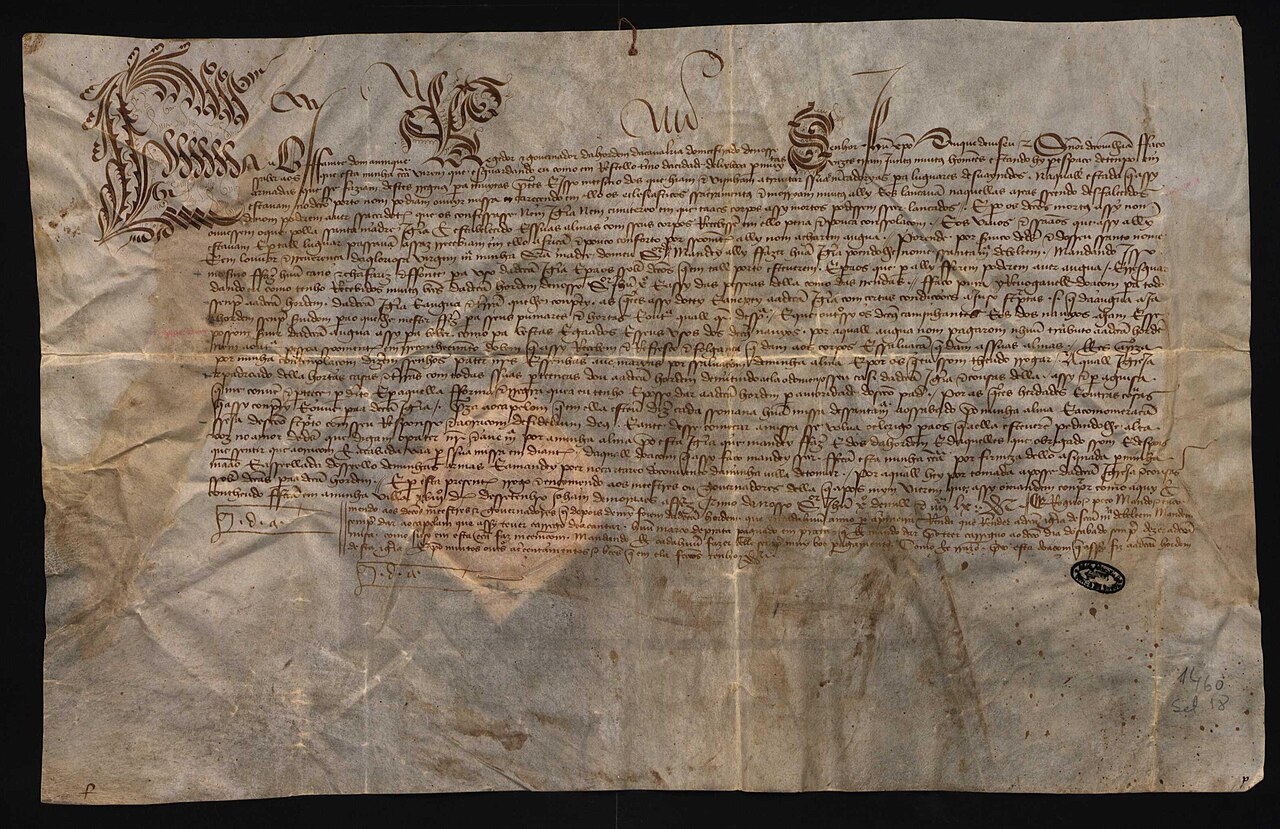
A large, weathered parchment charter with ornate illuminated decorated initial letters at the top left and right, dense handwritten brown-ink Gothic script in lines across the page, and two wax or ink seal marks with signatures near the bottom. The page has creases and stains.Document

Primary source

Charter on the spirituality of Terceira and Graciosa

Chancery of Infante D. Henrique (scribe Joham de Moraes) · 18 September 1460

Scan of a 1460 Portuguese manuscript charter on yellowed parchment, with an ornate decorated initial letter at upper left, dense brown iron-gall handwriting in several lines, a round dark wax seal with a pale circular impression at the center, and handwritten signatures at lower right.Document

Primary source

Charter on the chaplaincies at Tomar

Chancery of Infante D. Henrique (scribe Joham de Moraes) · 30 September 1460

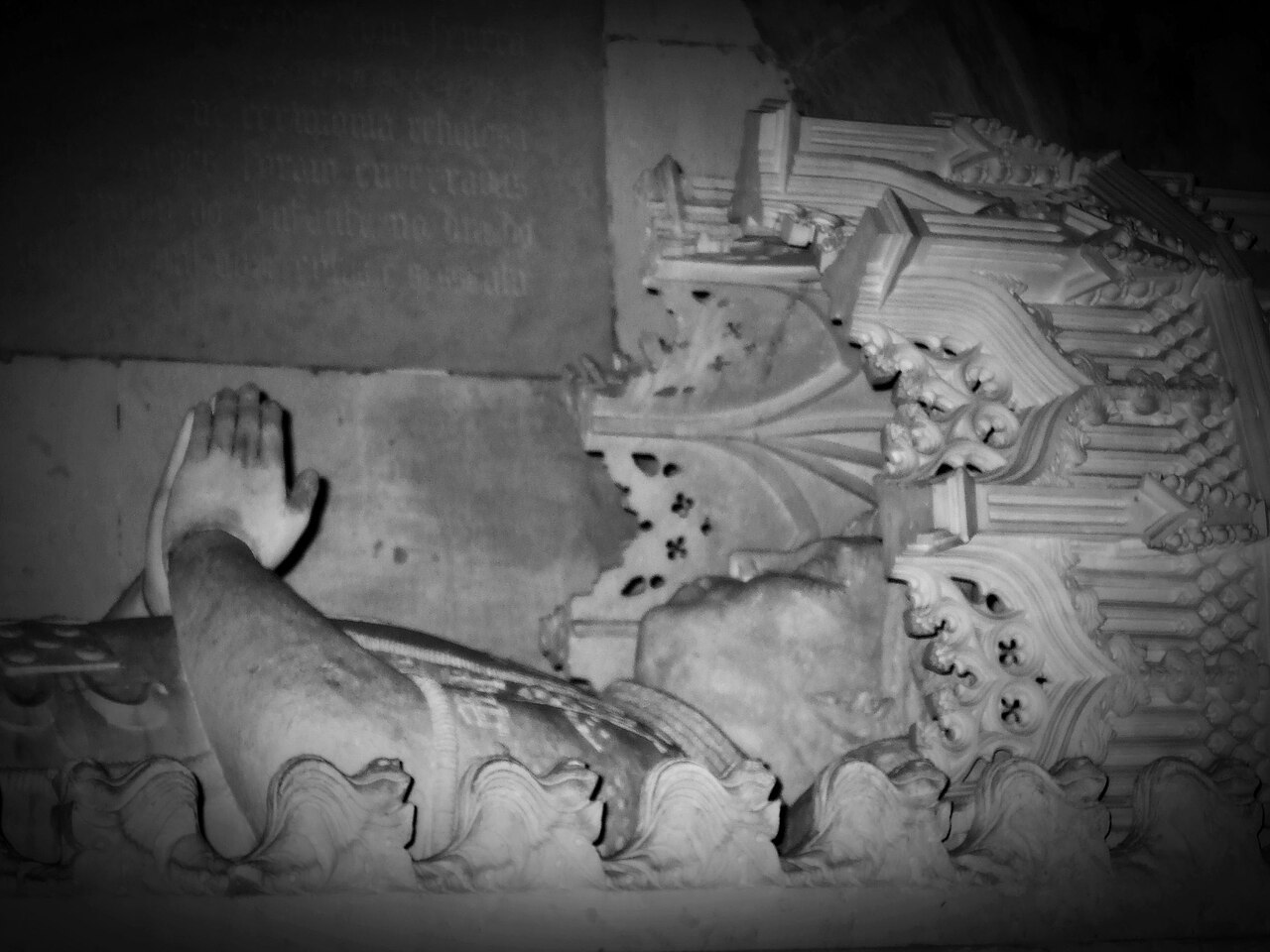
Black and white photo of a stone tomb effigy with a carved hand raised, draped stone fabric, and Gothic canopy with pinnacles and tracery, beside an inscribed stone panel with worn Gothic lettering.Photograph

Secondary source

Mosteiro da Batalha, Wiki Loves Monuments photo

Nelson Monteiro Magalhães · 1 November 2009 (photograph)

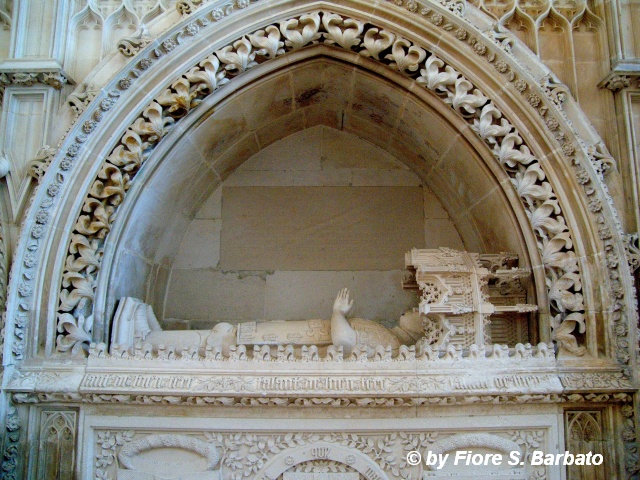
Stone tomb effigy of a recumbent figure in a Gothic arched niche at the Batalha Monastery, with an ornate carved canopy and a hand raised. A photographer's watermark appears in the lower right.Photograph

Secondary source

Monastero di Batalha

Fiore Silvestro Barbato · 22 June 2011 (photograph)

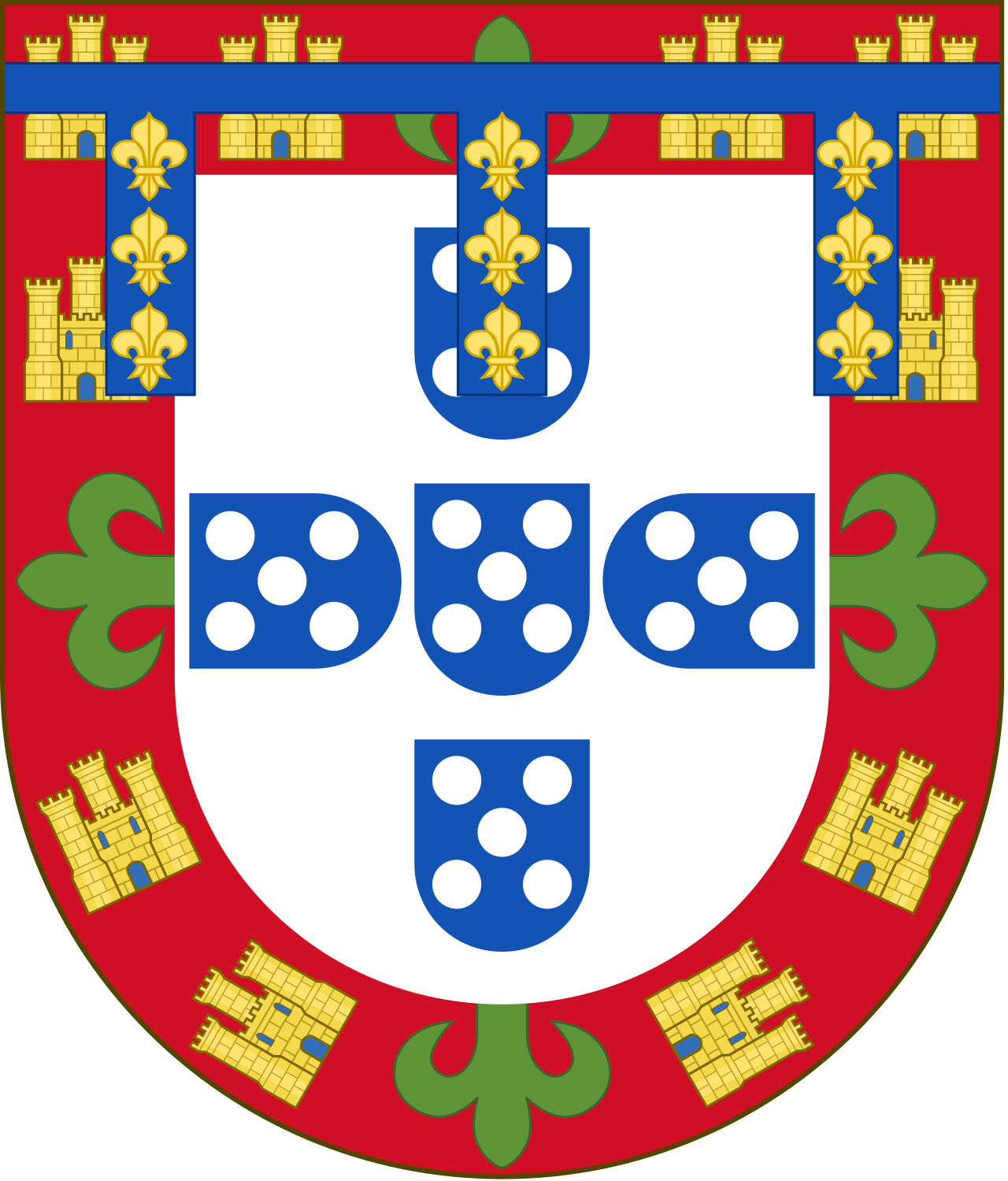
Heraldic coat of arms shield: red border with gold castles and green fleurs-de-lis, a blue label with three gold fleurs-de-lis across the top, and a white field with five blue escutcheons, each bearing white dots, in a cross arrangement.Artifact

Secondary source

Coat of Arms of Henry of Portugal, Duke of Viseu

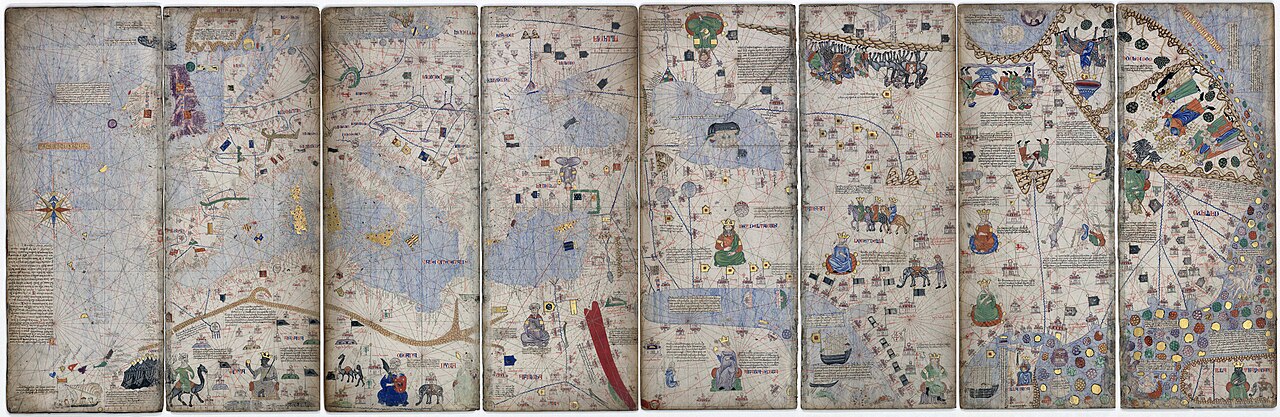
Eight vertical panels of the Catalan Atlas side by side, showing an illuminated medieval world map with colored seas, decorated landmasses, compass roses, flags, rulers on thrones, and figures and animals.Painting

Primary source

Catalan Atlas

Cresques Abraham · c. 1375

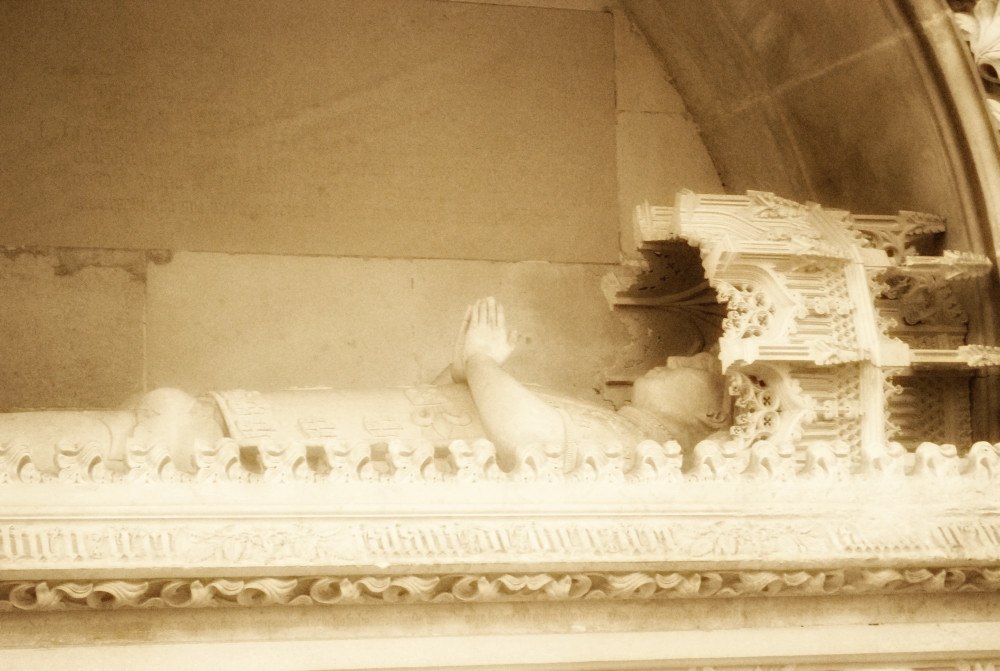
Sepia-toned photograph of a carved stone tomb effigy of a recumbent figure with one hand raised, beneath an ornate Gothic canopy with carved tracery and a decorated base frieze.Photograph

Secondary source

Batalha 024 photograph

Jan S0L0 · 14 May 2010

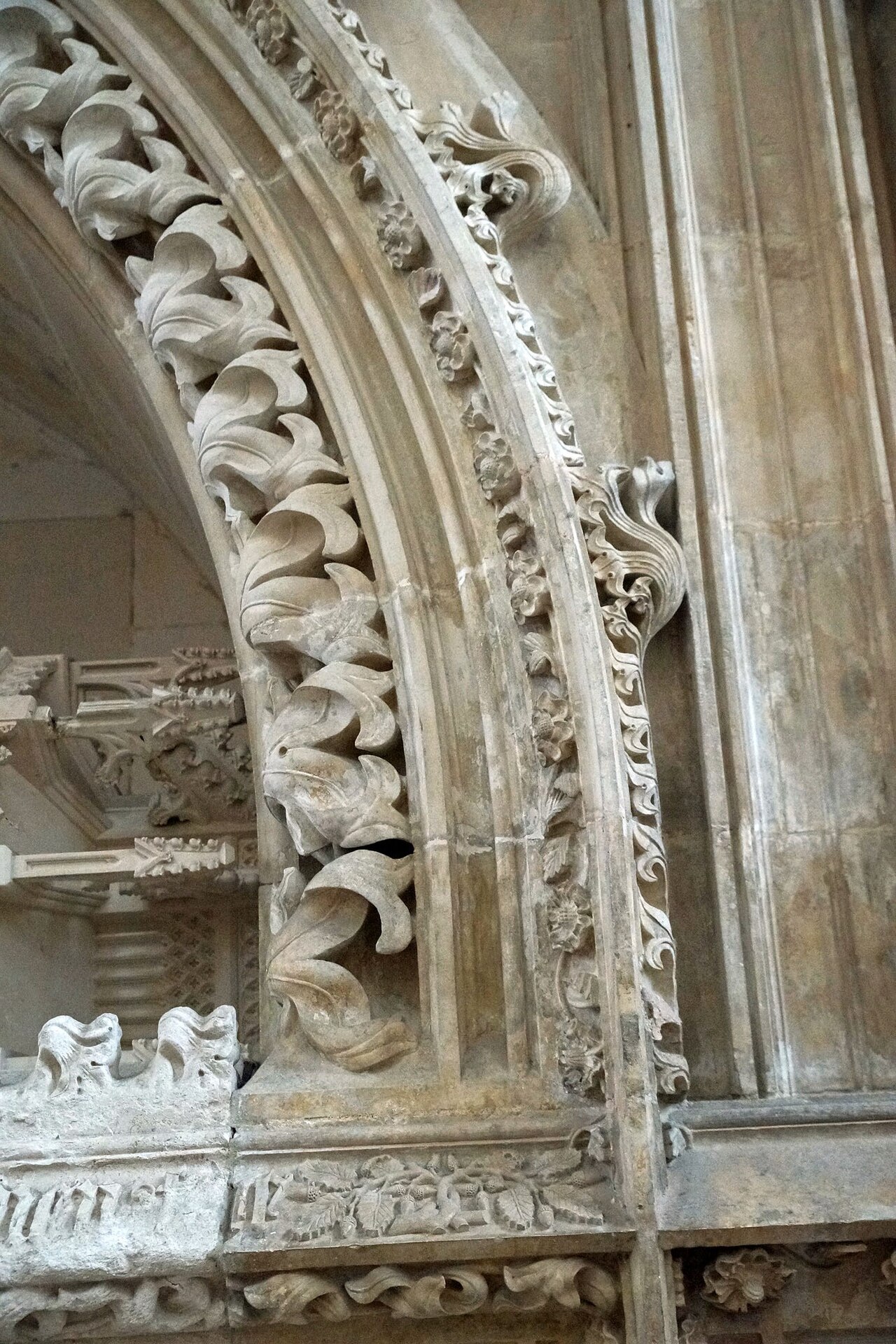
Close-up of a richly carved stone arch in a church interior, with dense Manueline-style foliage and flowers carved along the arch edges, and a carved corbel with curling leaves at the lower left.Photograph

Secondary source

Batalha Monastery photograph

Heribert Bechen · 24 February 2017

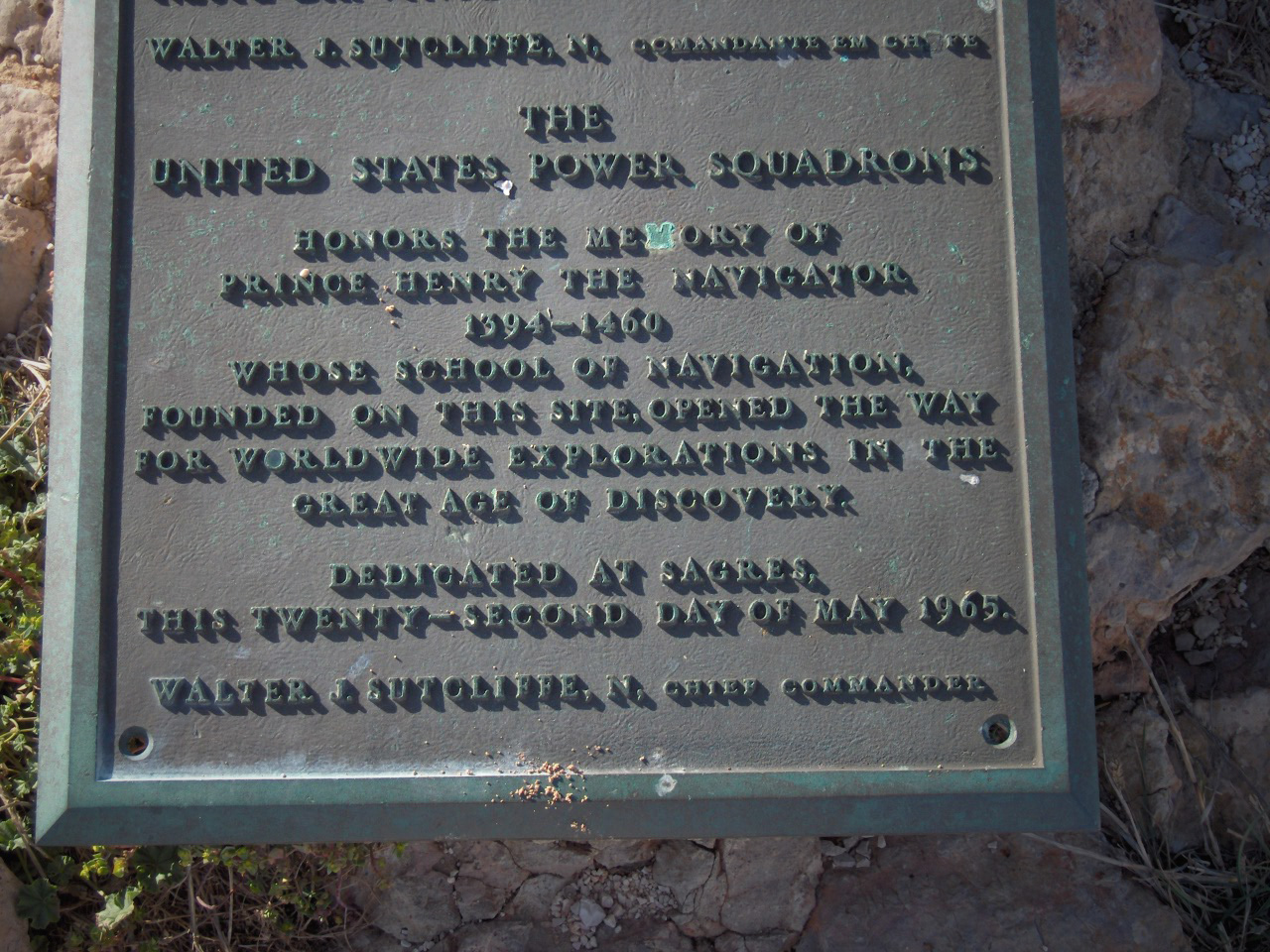
Bronze plaque set in stone ground, dedicated by the United States Power Squadrons. Text honours Prince Henry the Navigator (1394-1460), whose school of navigation was founded on this site. Dedicated at Sagres on 22 May 1965, signed by Walter J. Sutcliffe Jr., Chief Commander.Artifact

Secondary source

Fortress of Sagres

15th century (rebuilt later)

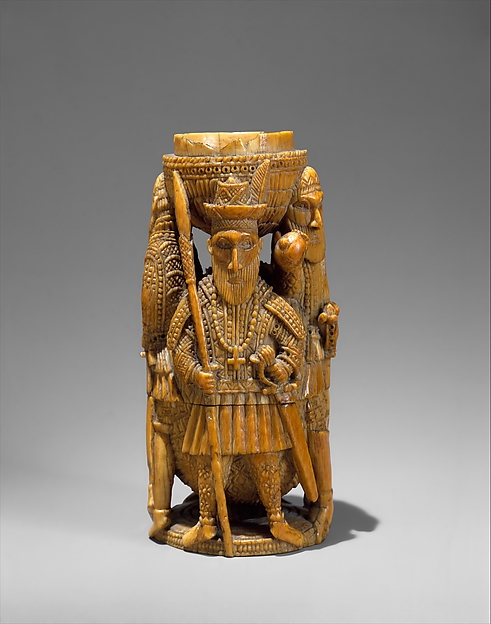
Carved ivory saltcellar in golden-brown tone on a gray background. A standing male figure with a beard, wearing a crown-like headdress, a necklace and a knee-length garment, holds a staff and sword. Two smaller figures flank him, and the bowl-shaped salt container sits on his head.Artifact

Primary source

Saltcellar with Portuguese Figures

Master of the Heraldic Ship · ca. 1525–1600

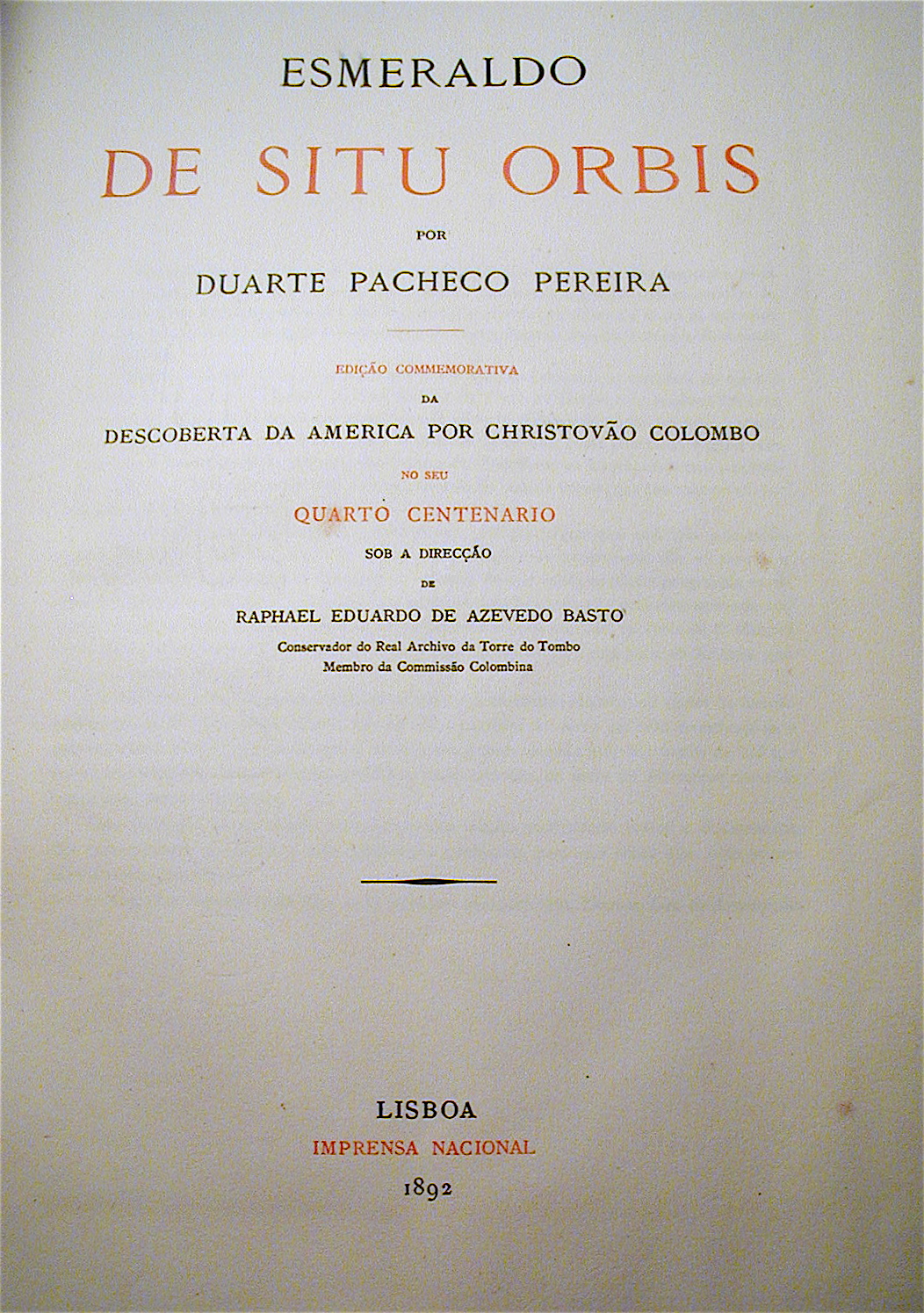
Title page of a book reading 'Esmeraldo de Situ Orbis' by Duarte Pacheco Pereira, with red and black lettering, a commemorative edition note about the discovery of America by Christopher Columbus, editor Raphael Eduardo de Azevedo Basto, and the imprint 'Lisboa, Imprensa Nacional, 1892'.Book

Primary source

Esmeraldo de Situ Orbis

Duarte Pacheco Pereira · 1505-1508

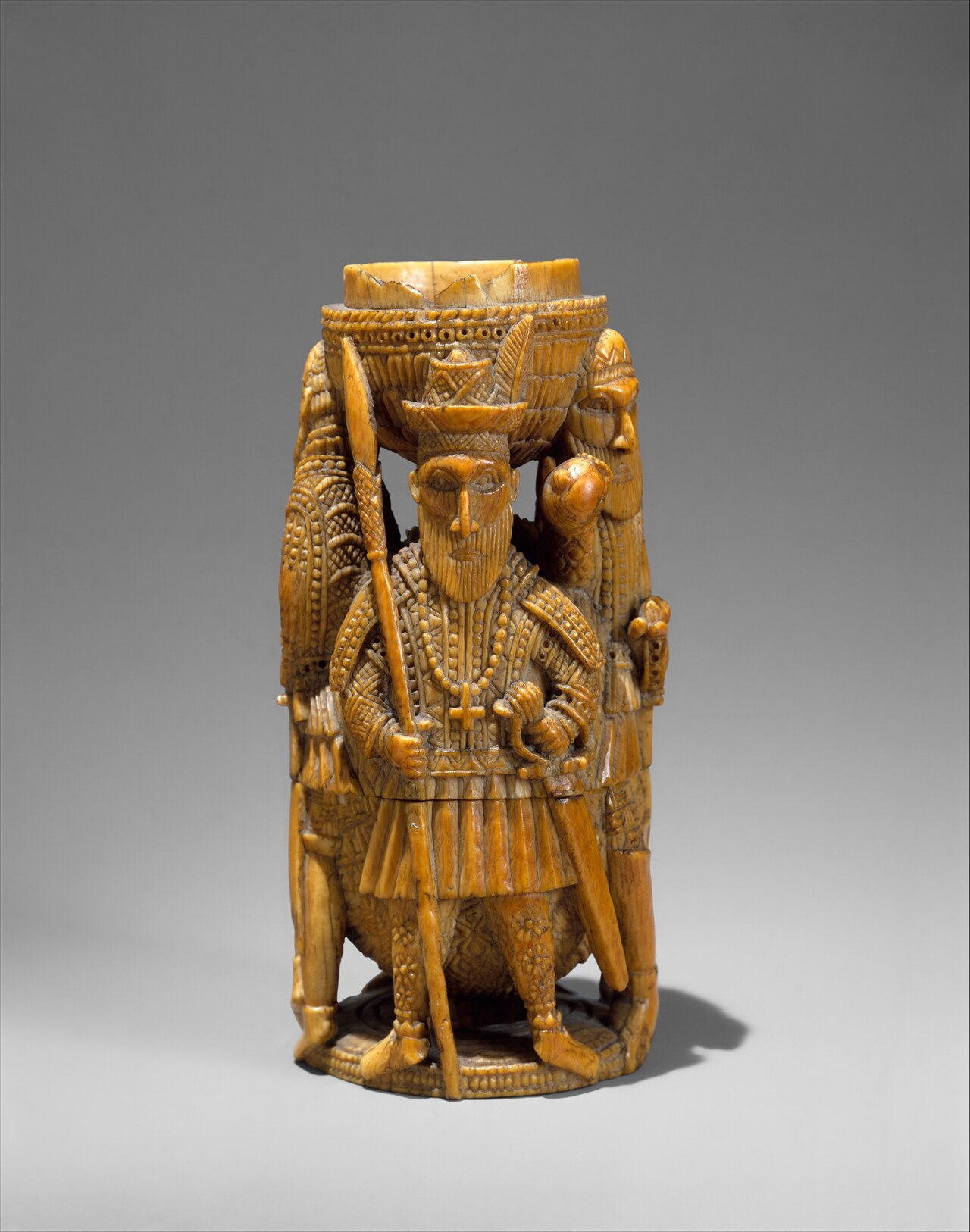
Photograph of a carved ivory saltcellar against a grey background. A central figure wearing a crown-like hat, beaded necklace with cross pendant, and a patterned tunic holds a staff. Two smaller figures stand at the sides, and the sculpture's top forms a bowl-shaped cup.Artifact

Primary source

Saltcellar with Portuguese Figures (Bini-Portuguese)

circa 1525–1600

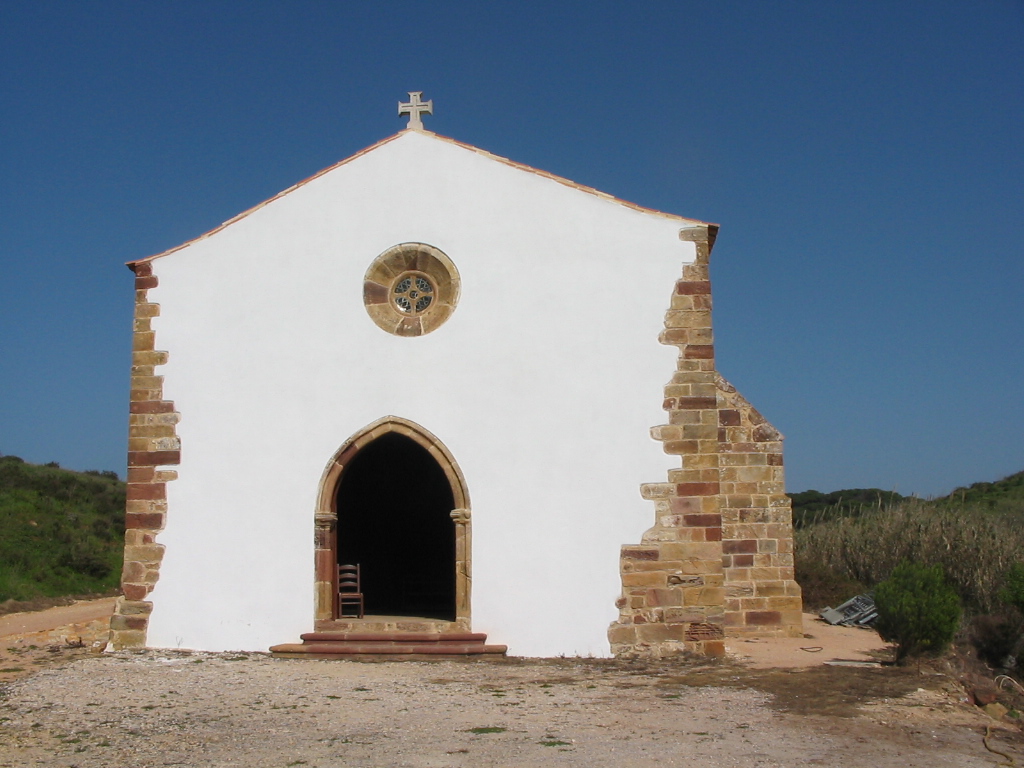
A small whitewashed chapel with a gabled front topped by a stone cross, a round window with ornate stone surround above an arched doorway, and weathered stone corner buttresses, under a clear blue sky with scrubby vegetation around it.Artifact

Secondary source

Hermitage of Our Lady of Guadalupe

medieval, possibly 13th-15th century

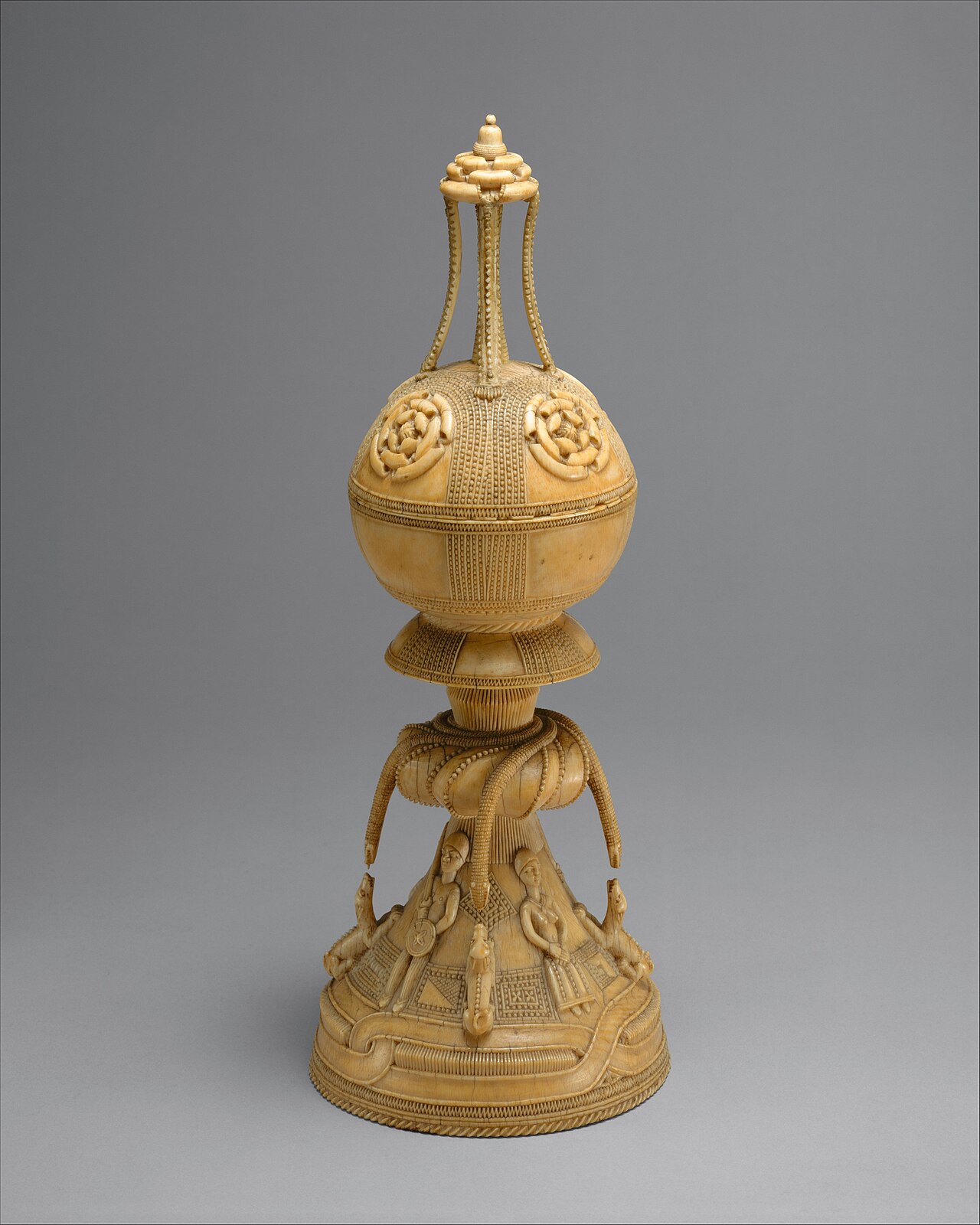
A carved ivory lidded saltcellar on a grey background. It has a tall finial lid with stacked knob tiers, a bulbous globe body decorated with rosettes and dotted bands, a flared collar, and a base with figures, a serpent-like coil, and a spreading foot.Artifact

Primary source

Lidded Saltcellar (Sapi-Portuguese)

15th–16th century

Book

Primary source

The Chronicle of the Discovery and Conquest of Guinea

Gomes Eannes de Zurara · 15th century (this edition translated later)

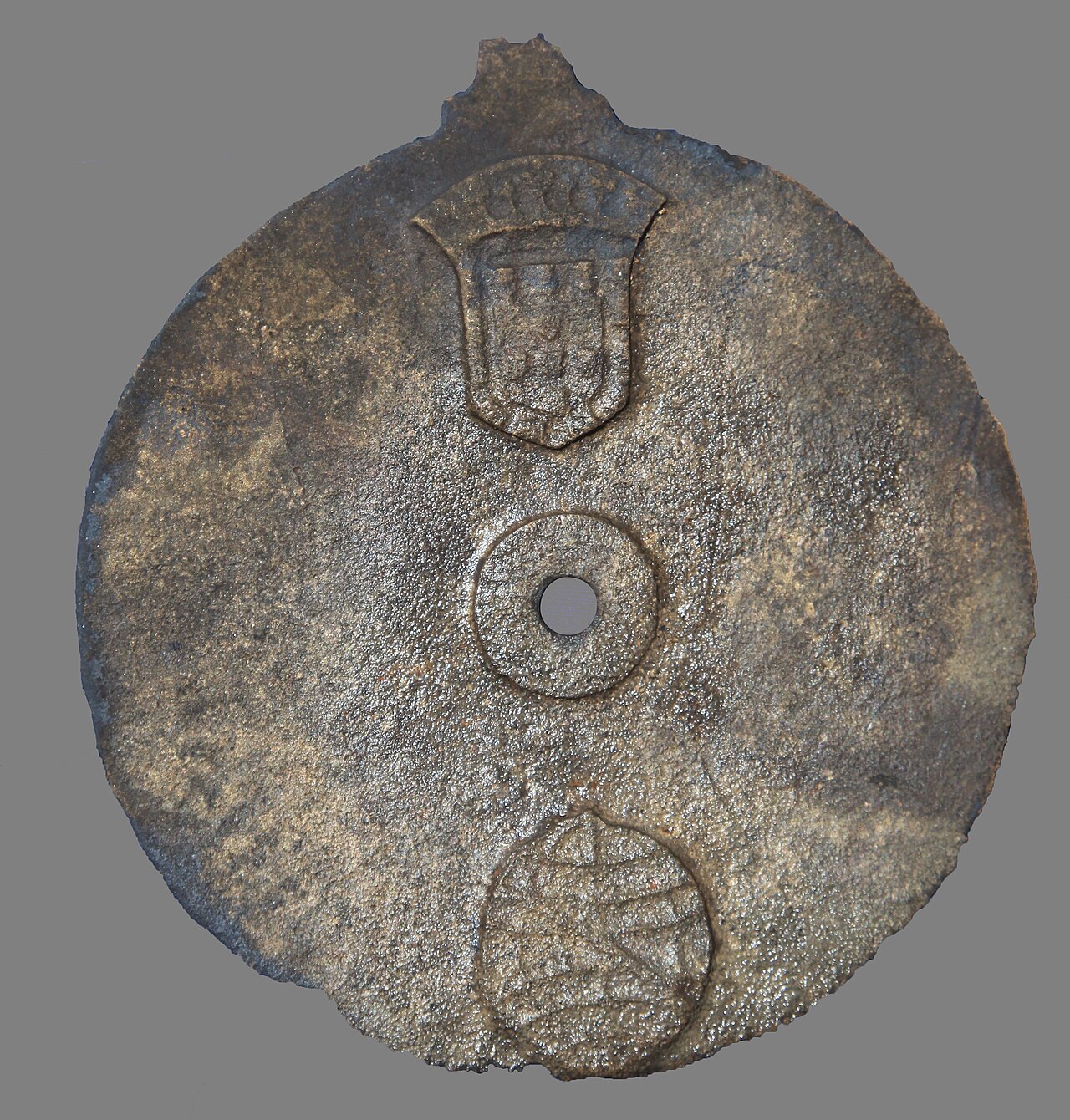
Photograph of a round, corroded bronze disc with a small pointed lug at the top and a central hole. Raised heraldic shield with a crown sits at the upper part, and a worn engraved design appears at the lower part.Artifact

Secondary source

Sodré mariner's astrolabe

before 1503

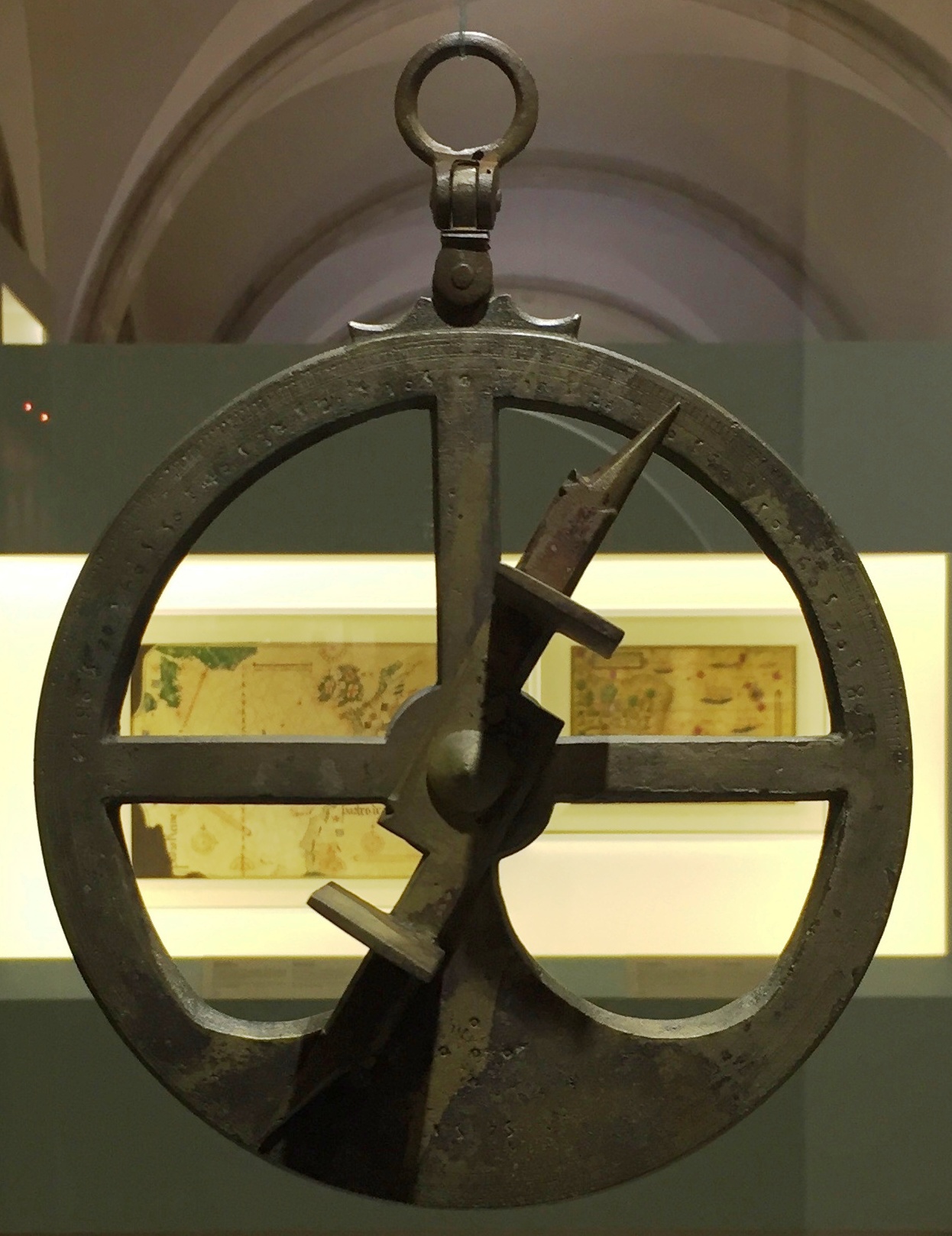
A dark bronze mariner's astrolabe hanging by a ring at top, with a circular graduated limb, a central alidade with sighting vanes and a pointer, and an open framework. Behind it are glass cases with old maps.Artifact

Primary source

Mariner's astrolabe recovered from Ria de Aveiro wreck

c. 1600

Book

Secondary source

Prince Henry the Navigator: The Hero of Portugal and of Modern Discovery

C. Raymond Beazley · 1923

The Golden Age of Prince Henry the NavigatorBook

Secondary source

The Golden Age of Prince Henry the Navigator

J. P. Oliveira Martins · 1914

Book

Secondary source

LibriVox Audiobook of Prince Henry the Navigator by Charles Raymond Beazley

Charles Raymond Beazley

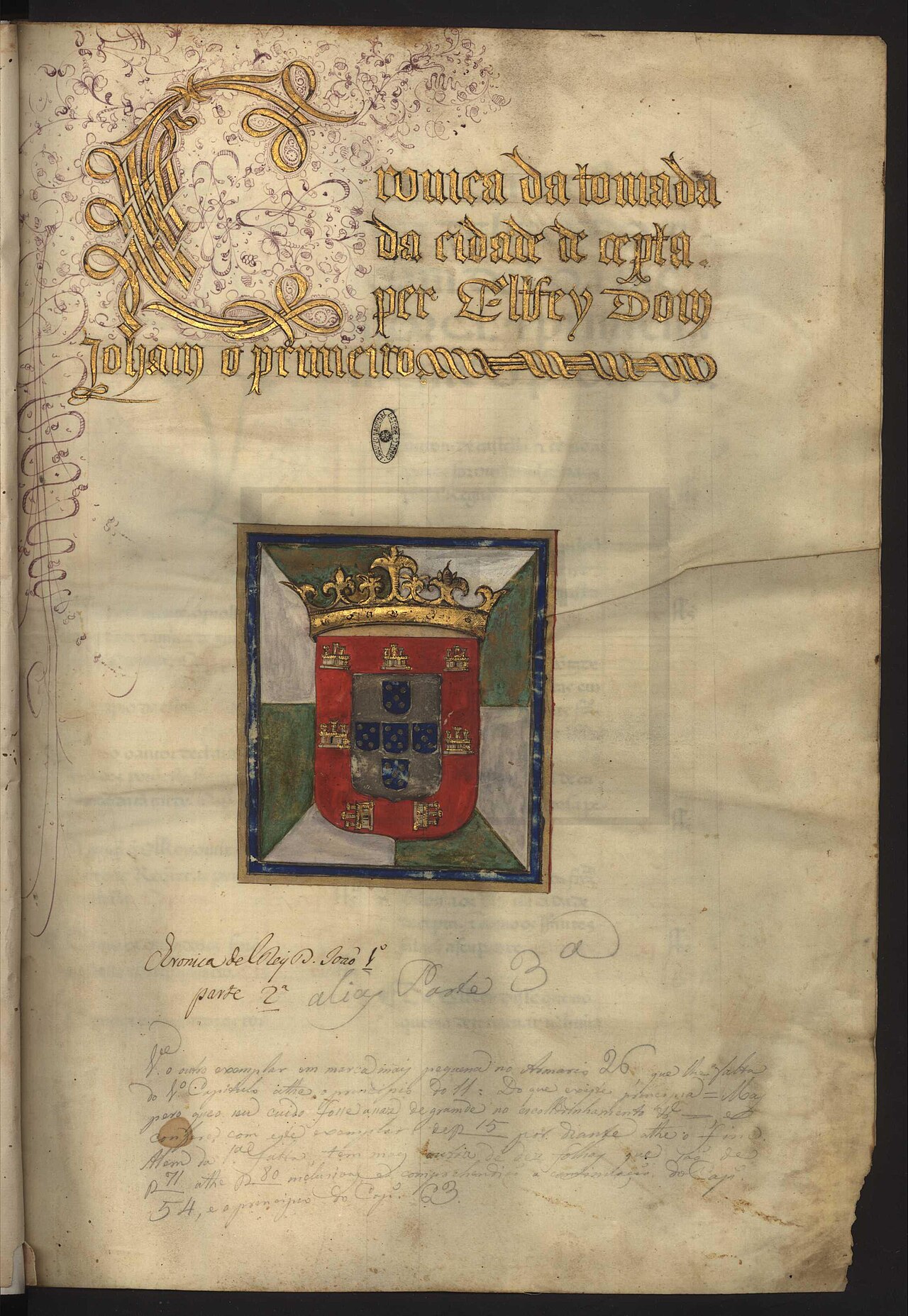
Manuscript title page with an illuminated gold and purple decorated initial letter at upper left and gold-lettered title text reading Cronica da tomada da cidade de cepta per Elrey Dom Joham o primeiro. Below the title is a painted coat of arms with a gold crown over red and gray shield bearing blue Portuguese cross shields and gold castles. Handwritten notes in brown ink appear at the bottom of the page.Document

Primary source

Chronicle of the Conquest of Ceuta, Title Page

Gomes Eanes de Zurara · after 1450

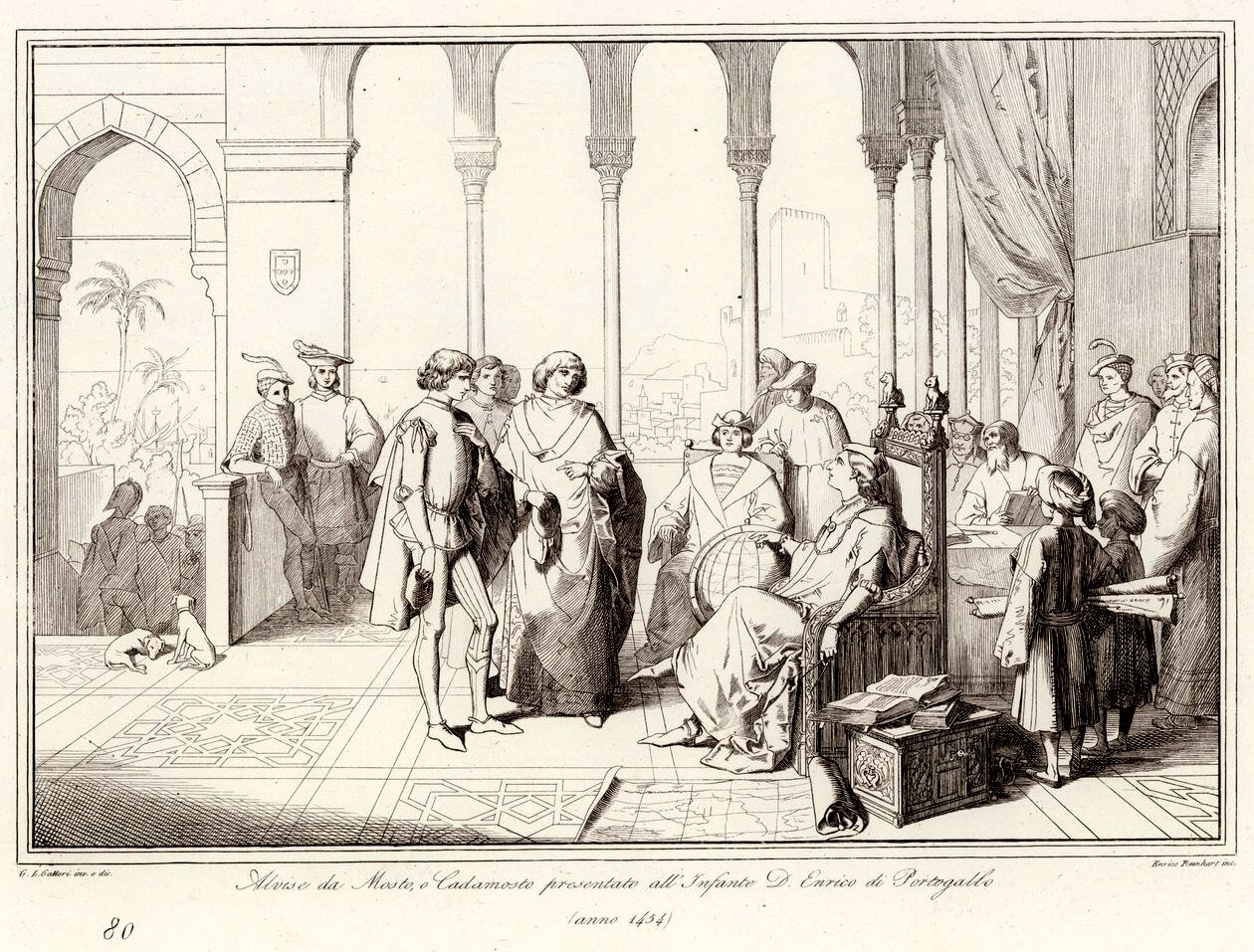
Engraved print in sepia tones of a courtly scene under arcades with pointed arches. A young man in a tunic and a older man in a long robe stand center-left, speaking, while a seated figure in a long robe and headdress sits on an ornate throne-like chair at right beside a wooden chest with open books and a globe. Men in period dress stand around, a dog lies on the tiled floor at left, and a palm tree and distant tower appear through the arches. Italian caption reads Alvise da Mosto, o Cadamosto presentato all'Infante D. Enrico di Portogallo, anno 1454.Painting

Secondary source

Alvise da Mosto Presented to Prince Henry of Portugal

Giuseppe Lorenzo Gatteri and Francesco Zanotto · 1863

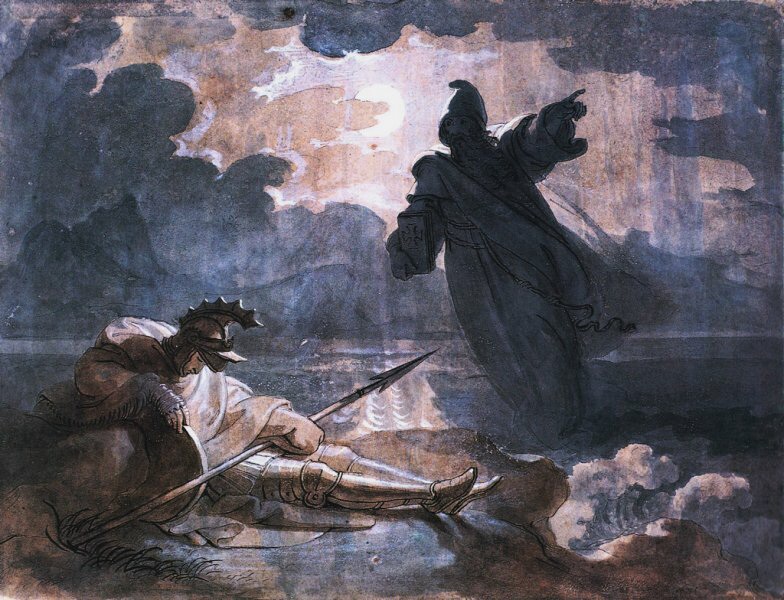
Wash drawing in muted blues, greys and warm tan tones. On the right, a dark-robed, hooded figure with a long beard stands and points toward a pale moon in a cloudy sky. On the lower left, a knight in armor with a plumed helmet lies on the ground beside a spear, gazing up.Painting

Secondary source

La visione di Enrico il navigatore

Tommaso Minardi · between 1819 and 1820

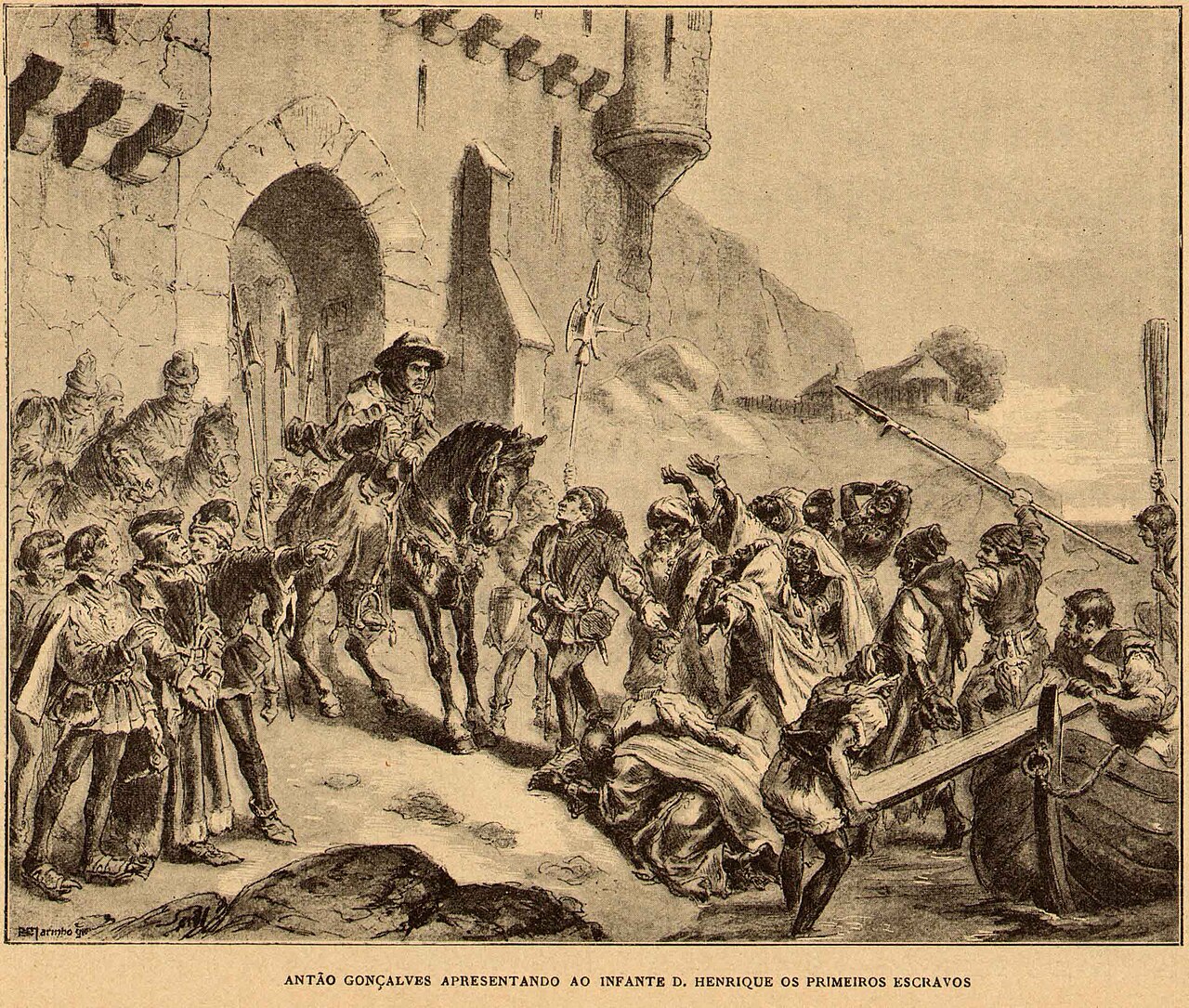
Sepia-toned printed illustration of a walled stone gate. A man on horseback in a wide-brimmed hat faces a group of armed, finely dressed men on foot. Before him, many people in robes and turbans, some kneeling or bowing, stand near a wooden boat on a beach.Painting

Secondary source

Antão Gonçalves Presenting the First Slaves to Prince Henry

Roque Gameiro · c. 1899

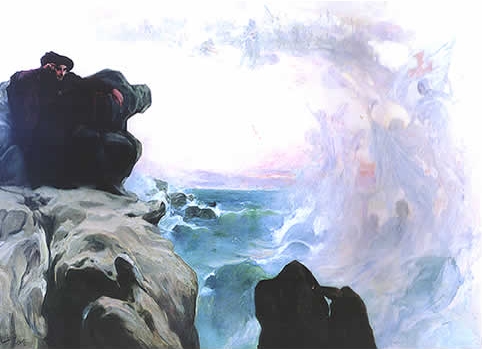
Painting of a seated figure in dark clothing on a rocky headland, looking out over turbulent sea with breaking white waves and a hazy, pale sky with swirling clouds and ghostly figures.Painting

Secondary source

O sonho do Infante

José Malhoa · 1905

Line engraving of Prince Henry of Portugal in plate armour with a feathered helmet, holding a spear and standing before a battle scene with the city of Ceuta. Coat of arms with motto is at upper right; a caption reads 'Prince Henry of Portugal'.Painting

Secondary source

Prince Henry of Portugal, line engraving

Unknown · probably 17th century

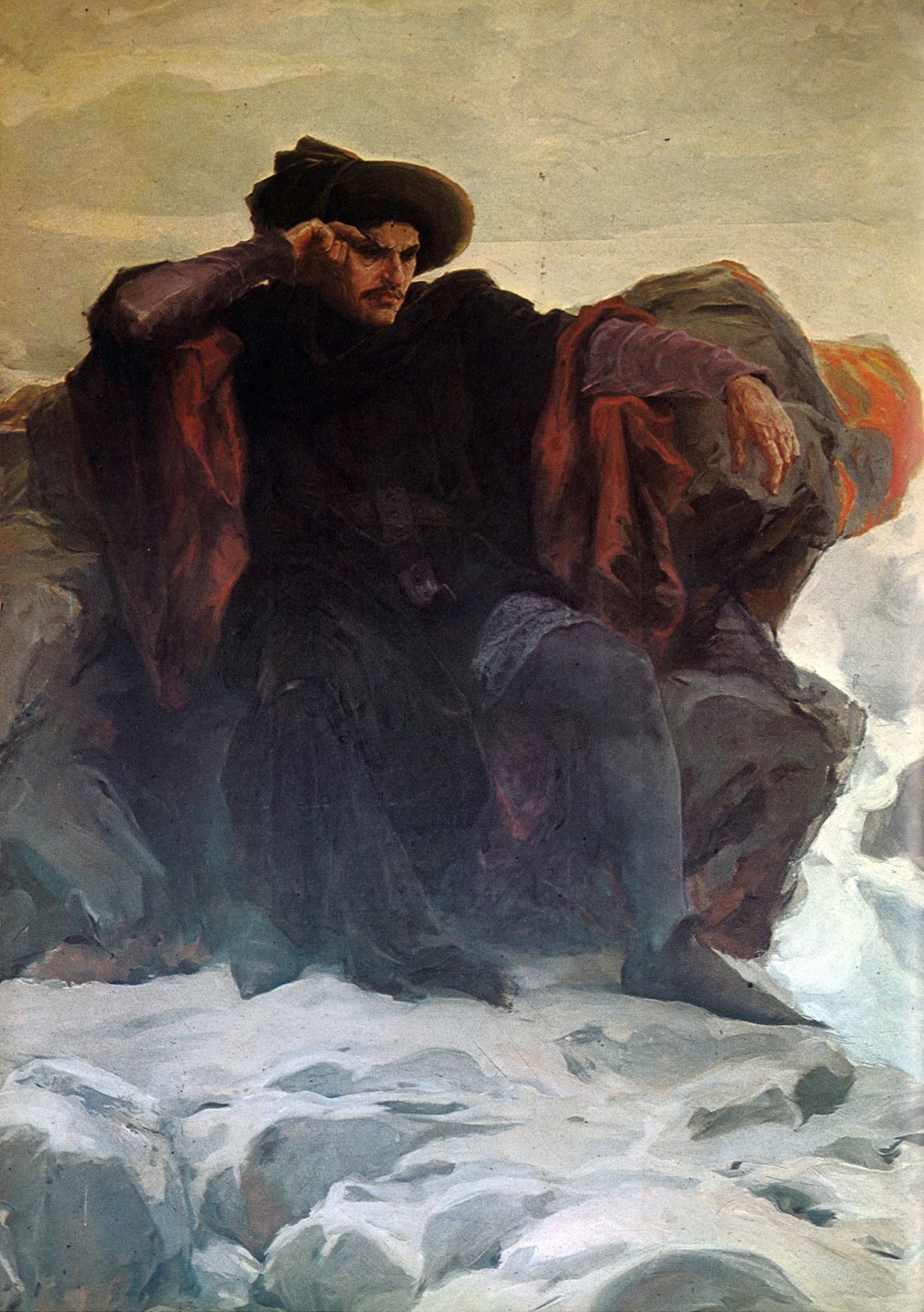
Painting of a man in a dark wide-brimmed hat and dark cloak with red lining, seated on rocks, one hand raised to his hat brim and gazing to the left. Snowy or pale rocky ground lies in the foreground under a muted sky.Painting

Secondary source

Infante D. Henrique

José Malhoa · Unknown

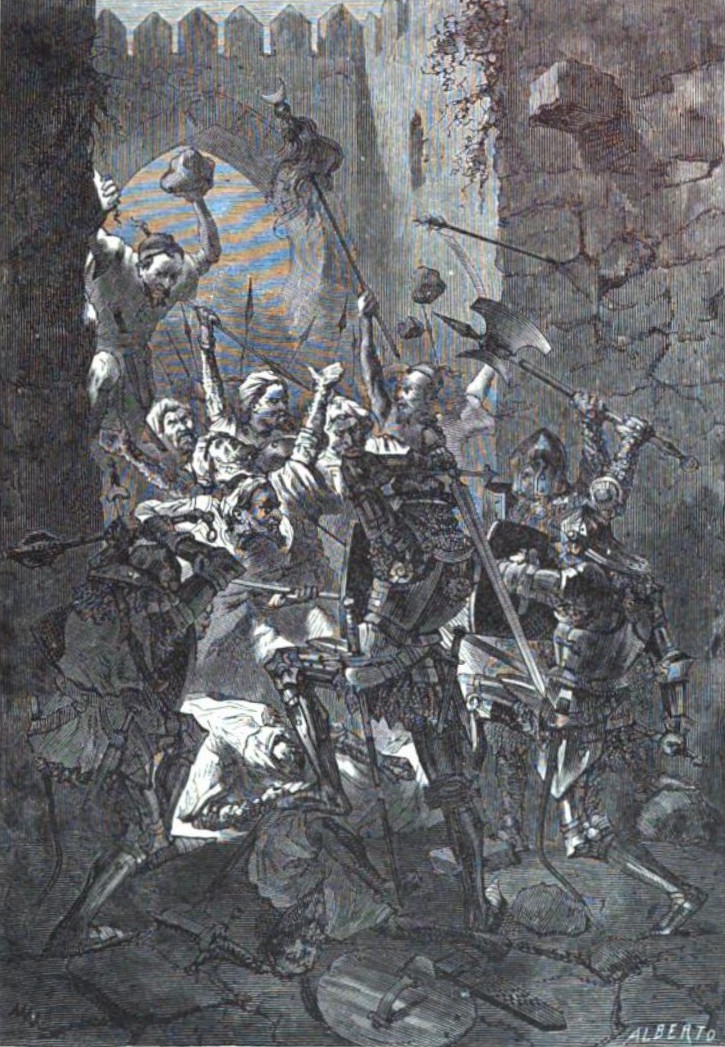
Engraved illustration of a medieval battle at a city wall. Armored knights with swords, axes and lances fight among turbaned defenders; one defender raises a mace atop the wall, and bodies lie on the ground in the foreground. Signed 'ALBERTO' in the lower right corner.Painting

Secondary source

The Infantes in Ceuta (1415)

Manuel Maria de Macedo · c. 1877

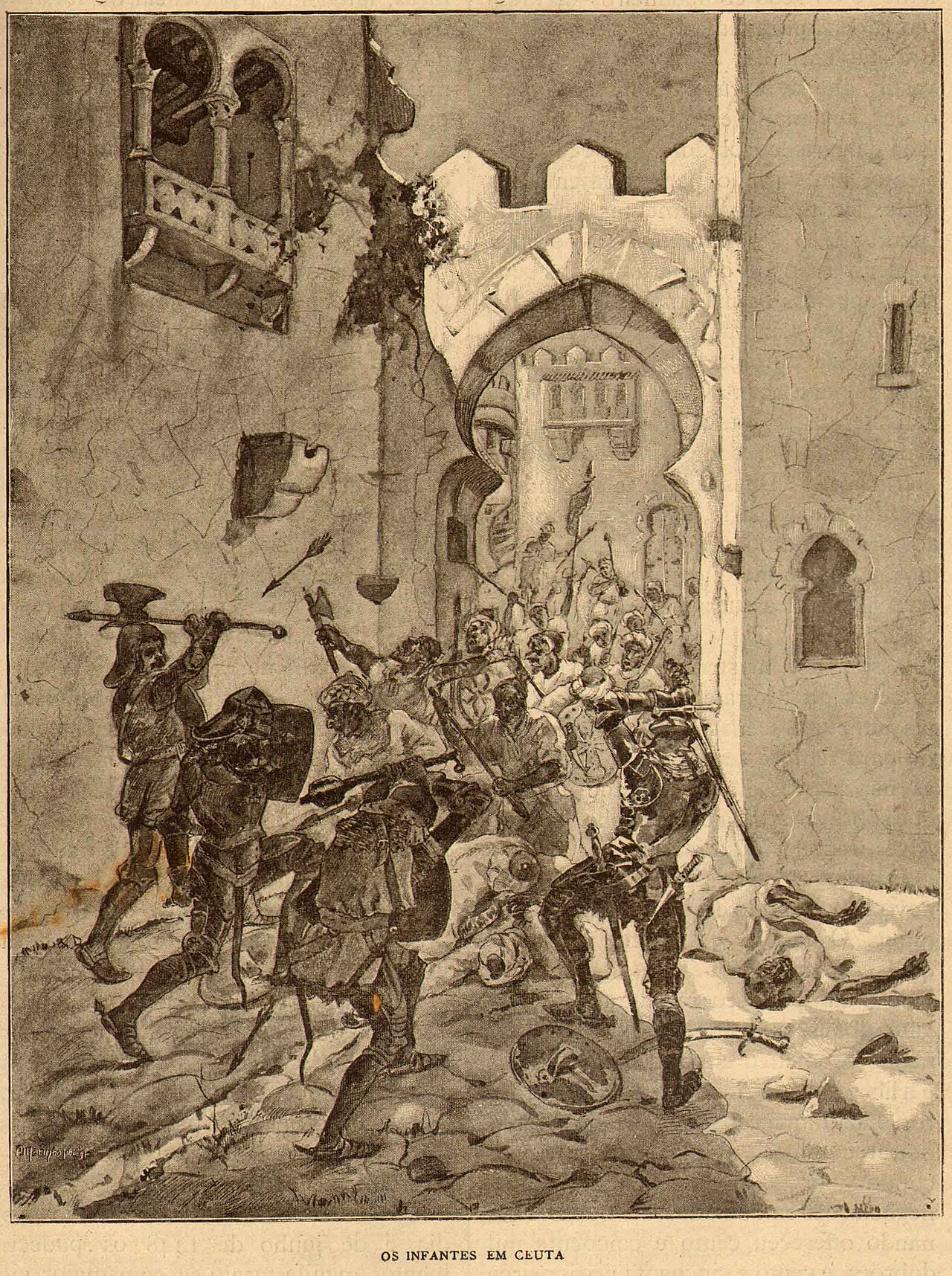
Sepia engraving-style illustration titled 'Os Infantes em Ceuta': armored Portuguese soldiers fight turbaned defenders in a stone gateway beneath a pointed arch, with fallen bodies and shields on the ground, and an arrow in flight.Painting

Secondary source

The Infantes in Ceuta

Roque Gameiro · c. 1899

Blue-and-white azulejo tile mural showing a battle scene. A figure in armor with a Portuguese coat of arms stands center holding a banner with blue shields, while soldiers climb a ladder and fight near a walled town with palm trees. Fallen soldiers lie in the foreground.Artifact

Secondary source

Azulejo panel of Prince Henry at Ceuta, São Bento station

Jorge Colaço · made by Jorge Colaço, 1864-1942; photographed 2014

Book

Secondary source

The Dawn of Modern Geography, vol. 3

C. Raymond Beazley · 1897

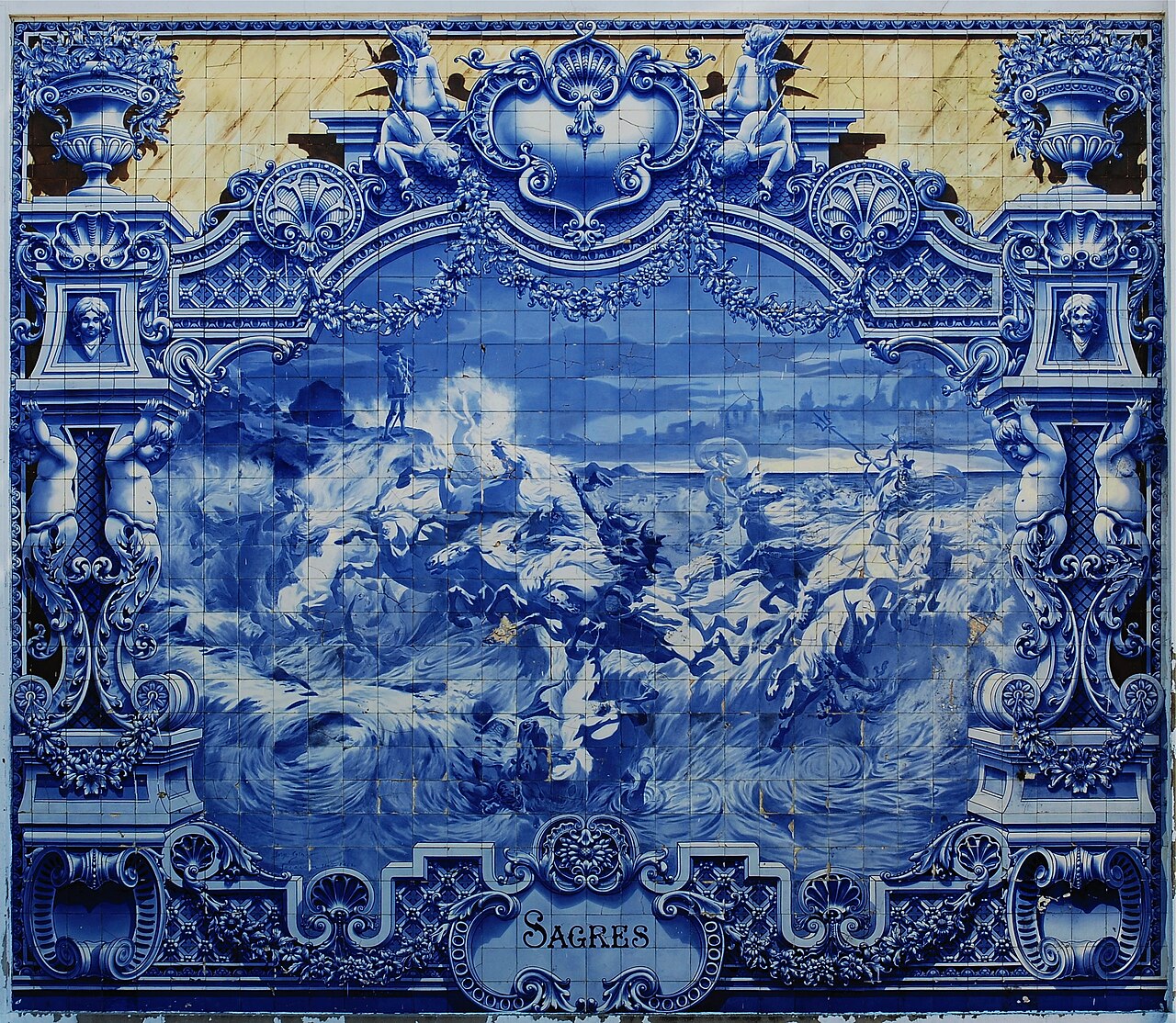
Blue-and-white glazed tile panel in a Baroque frame with scrollwork, shells, cherubs, and a vase at the top corners. The central scene shows a figure on a rocky shore beside a sea of waves, with horsemen and figures in the foreground. The word SAGRES is inscribed in a cartouche at the bottom.Artifact

Secondary source

Azulejo panel showing Henry at Sagres

Jorge Colaço · 1922 (tile panel); photographed 2007

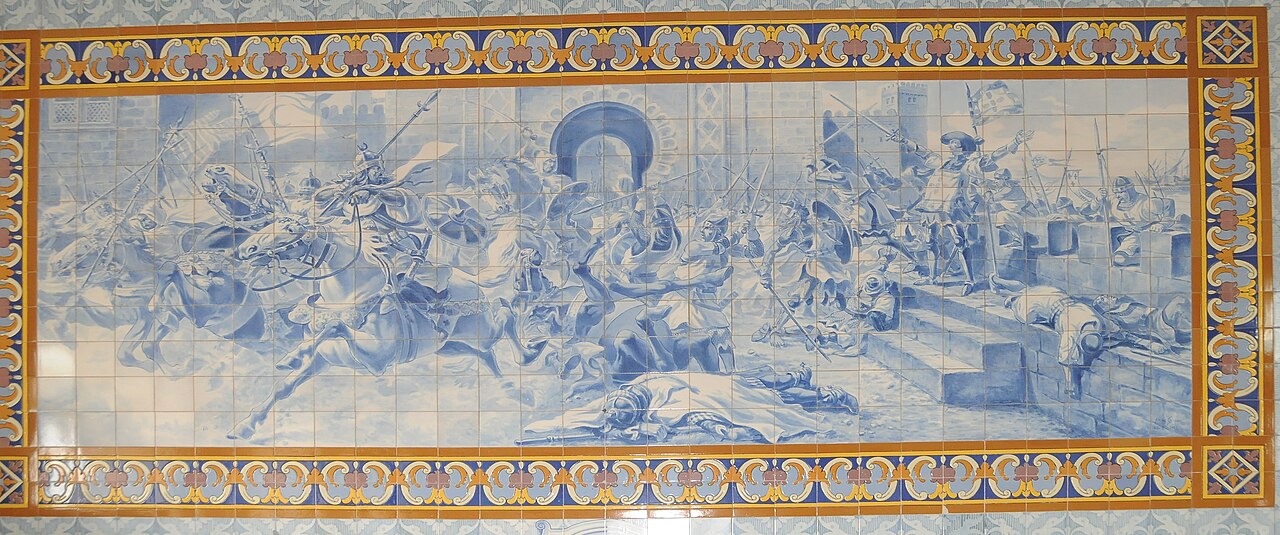
Blue-and-white azulejo tile panel framed by yellow and blue ornamental borders. It depicts a battle scene with mounted knights on horseback, soldiers with spears and banners, fallen figures on the ground, and a stone wall with an arched gateway on the right.Artifact

Secondary source

Azulejo panel of Henry at the conquest of Ceuta

Jorge Colaço · created 1900s; photographed 2009

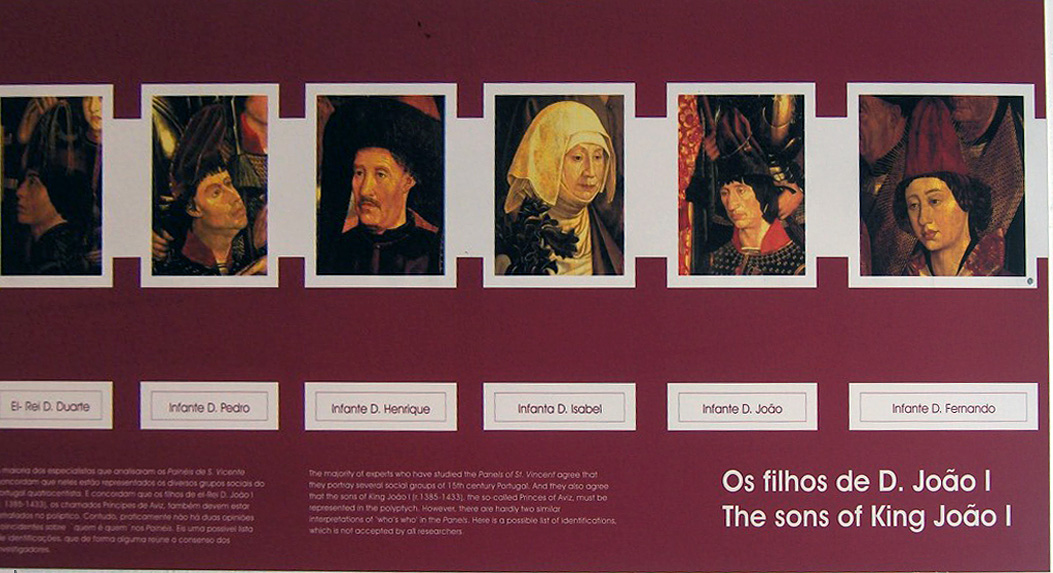
Information board in maroon with six cropped portraits of figures from the panels, each with a caption: El-Rei D. Duarte, Infante D. Pedro, Infante D. Henrique, Infanta D. Isabel, Infante D. João, Infante D. Fernando. Title: Os filhos de D. João I / The sons of King João I. Small text blocks in Portuguese and English.Artifact

Secondary source

The children of King John I, replica panels in Lagos

photographed 2006; original panels earlier

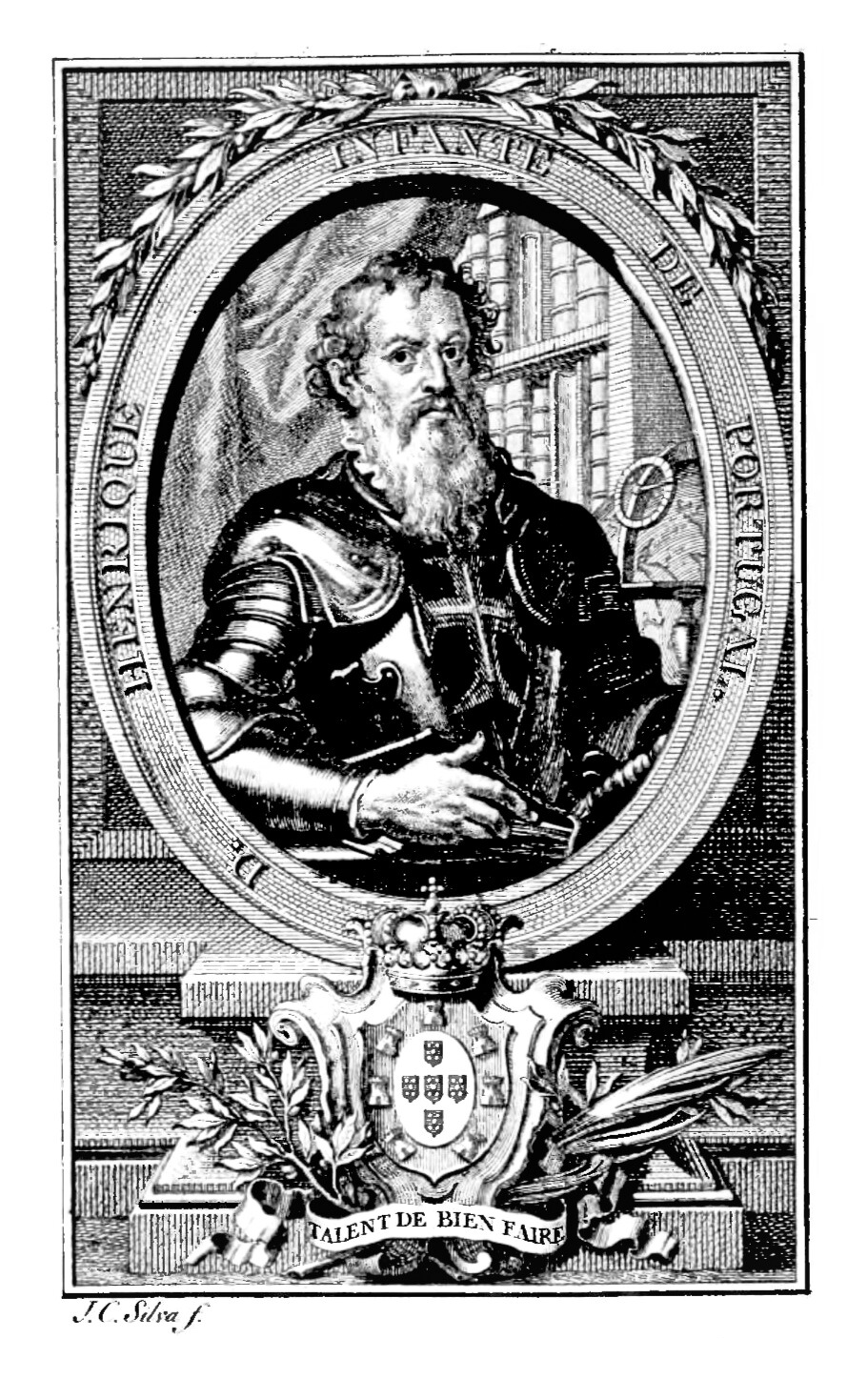
Engraved oval portrait of a bearded man in armor with curly hair, set in a laurel-wreath frame inscribed INFANTE, DE, PORTUGAL, and D. HENRIQUE. A crest with a crown sits below, with the motto TALENT DE BIEN FAIRE and the signature J.C. Silva f. at bottom left.Painting

Secondary source

Picture of Infante D. Henrique by J.C. Silva F.

J.C. Silva F. · 1700

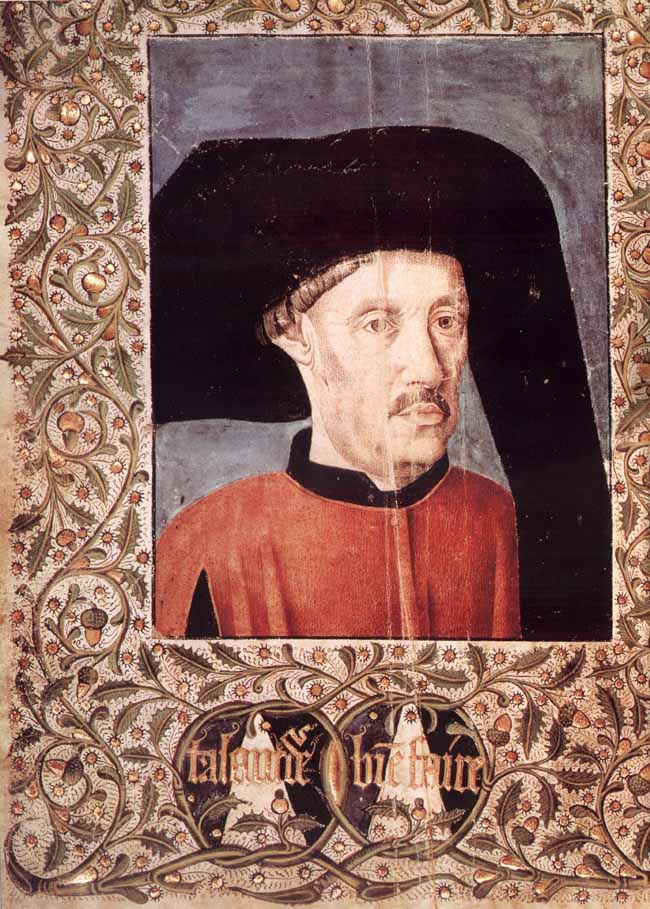
Painted portrait of a man with a short mustache wearing a black wide-brimmed hat and a red robe with a black collar, set against a gray-blue background. The portrait is framed by an ornate gold and green foliage border with a banner at the bottom bearing gilded lettering.Painting

Primary source

Frontispiece portrait in a 15th-century Zurara edition

Unknown · Book from 1453; portrait possibly slightly later

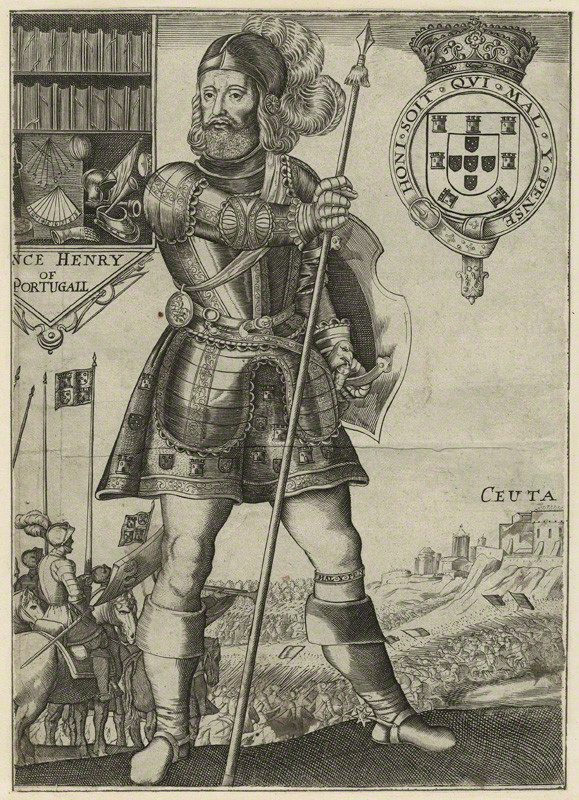
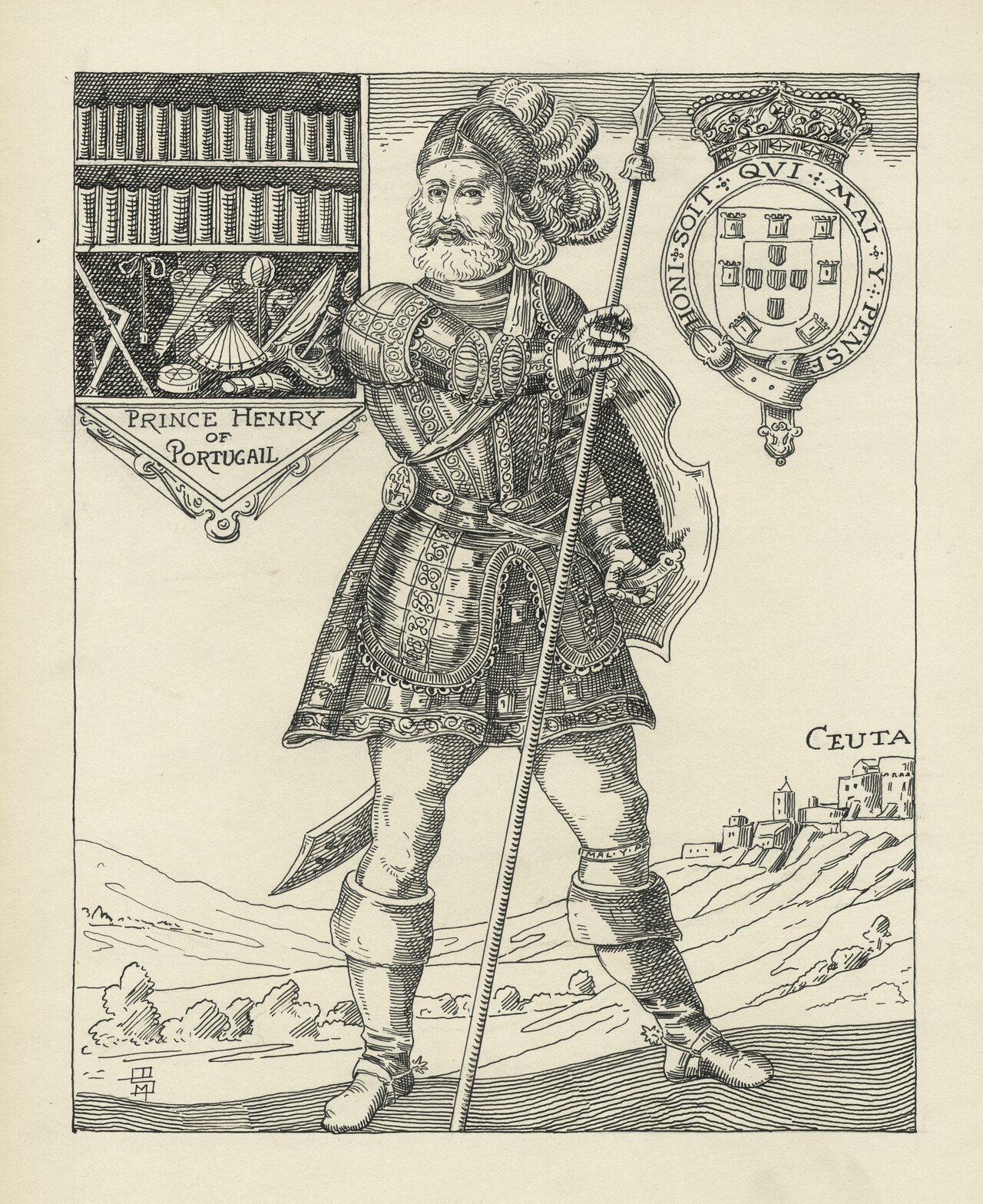
Engraving of Prince Henry of Portugal standing in armor with a plumed helmet, holding a spear and a shield. Above left is a bookshelf and navigational instruments labeled Prince Henry of Portugal. Above right is a crowned coat of arms of Portugal with a motto. Behind him on the right is a walled city labeled Ceuta, with hills and trees in the background.Painting

Secondary source

Prince Henry of Portugal, engraving from Lossing's history

David McNeely Stauffer (draughtsman); Mosley I. Danforth, F. Gutekunst, Samuel Sartain, T. Sinclair (printmakers) · 19th century

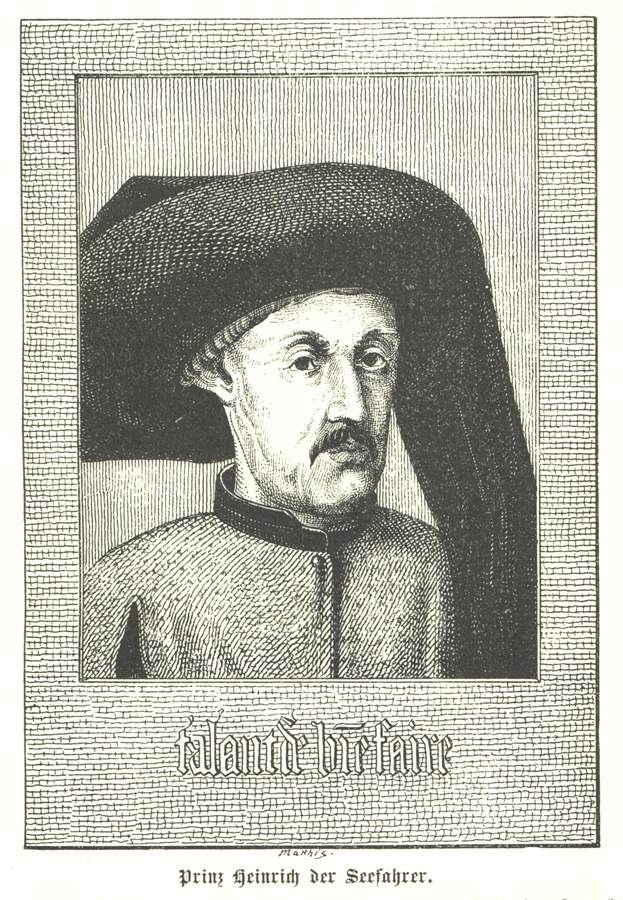
Engraved portrait of a man in a dark wide-brimmed hat with a long dark cloak over a high-collared gown, in a decorative bordered frame. Gothic lettering below reads 'Infante Heinrich' and the caption reads 'Prinz Heinrich der Seefahrer'.Painting

Secondary source

Heinrich der Seefahrer portrait print

1894

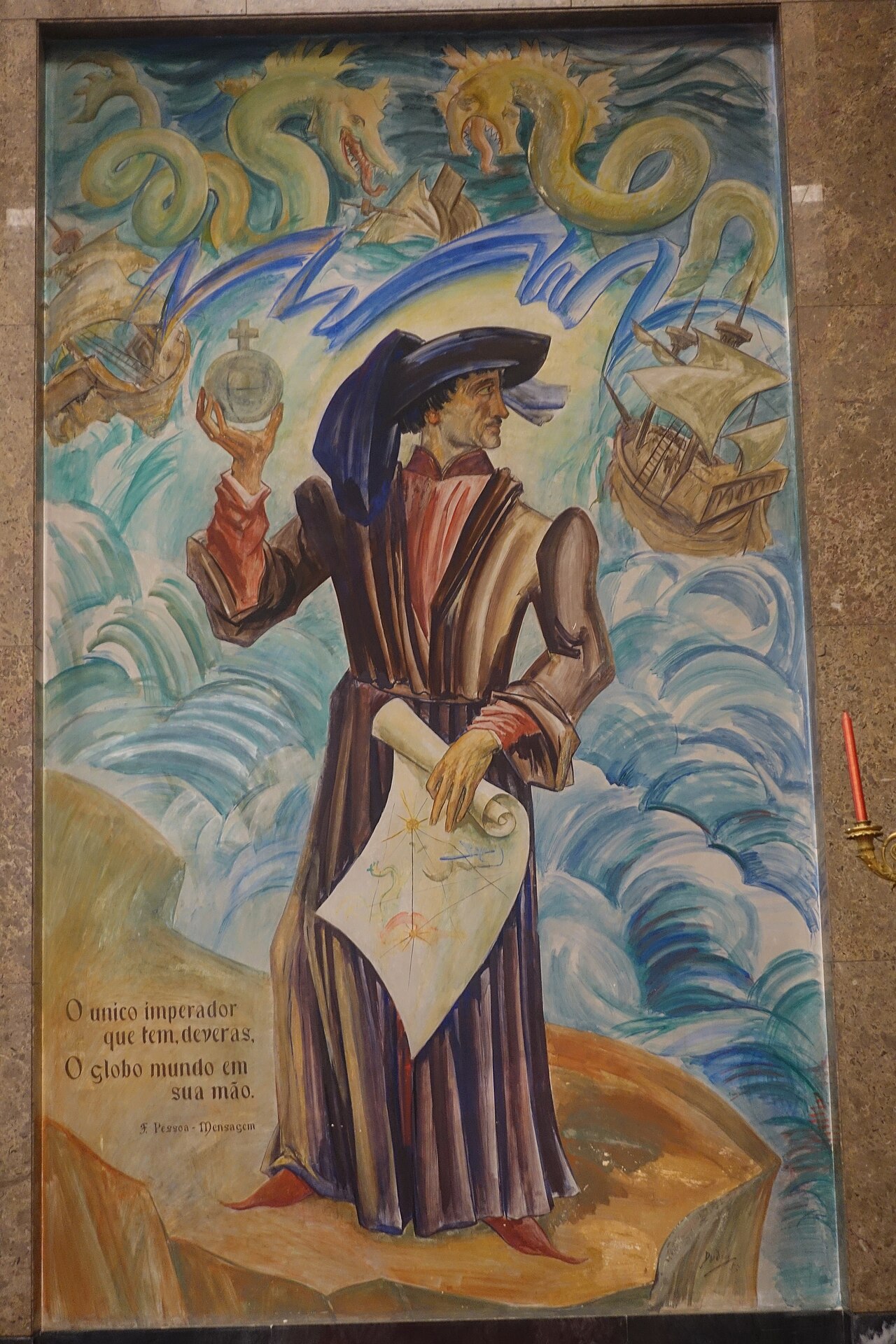
Large painted mural in a stone-framed panel showing a standing man in a dark hat and long brown robe holding a globe in one hand and a rolled map in the other. Painted sea serpents, sailing ships, and blue waves fill the background. Portuguese text appears at lower left.Painting

Secondary source

Painting of Henry the Navigator, Porto City Hall

unknown (photographed 2025)

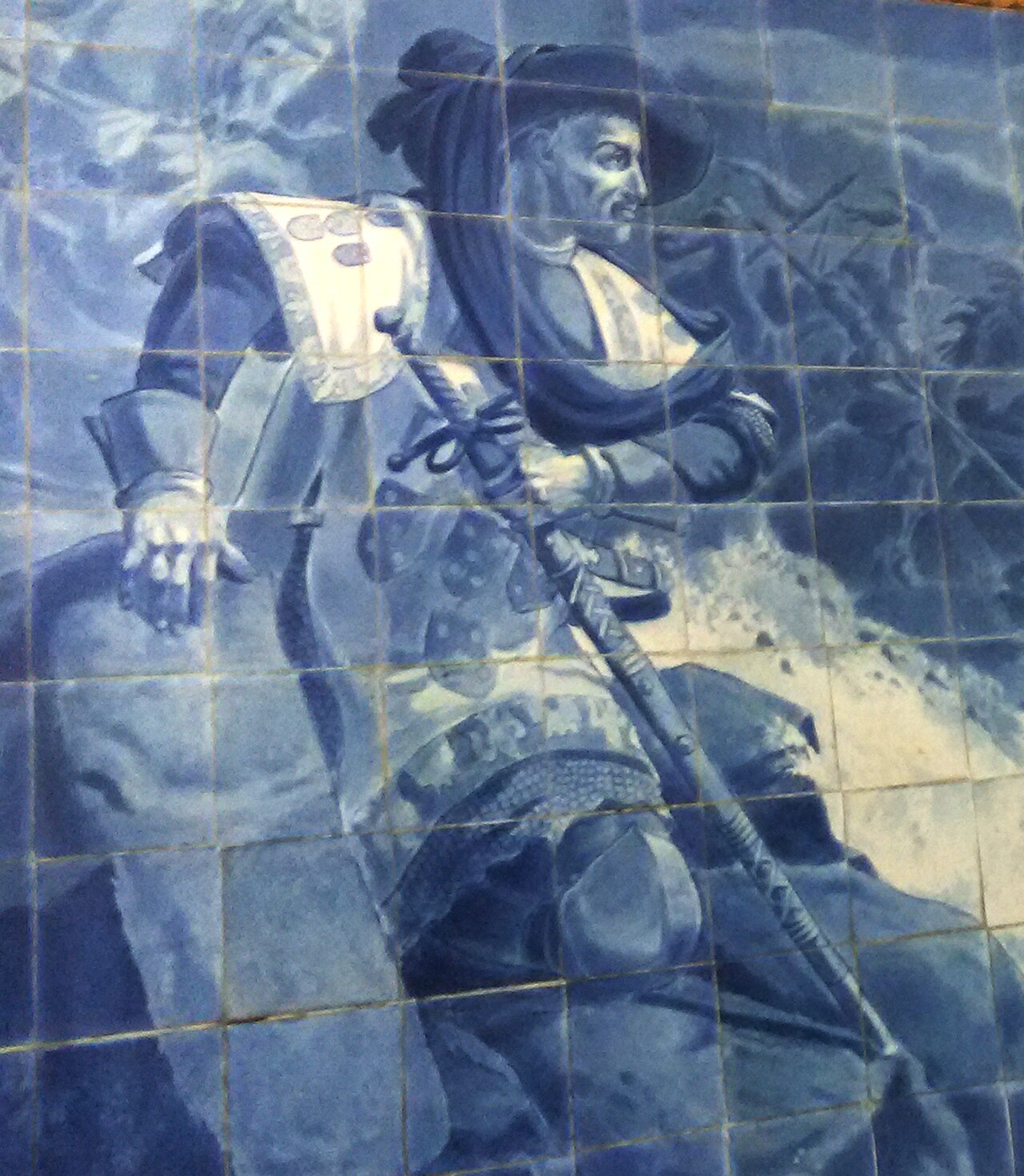
Close-up of a blue-and-white azulejo tile panel showing a man in a plumed hat and cloak holding a long staff, with a rocky coastline and sea behind him. The tiles are visibly grouted in a grid.Artifact

Secondary source

Azulejo Tile Panel of Prince Henry, Liceu Literário Português, Rio

unknown (photographed 2019)

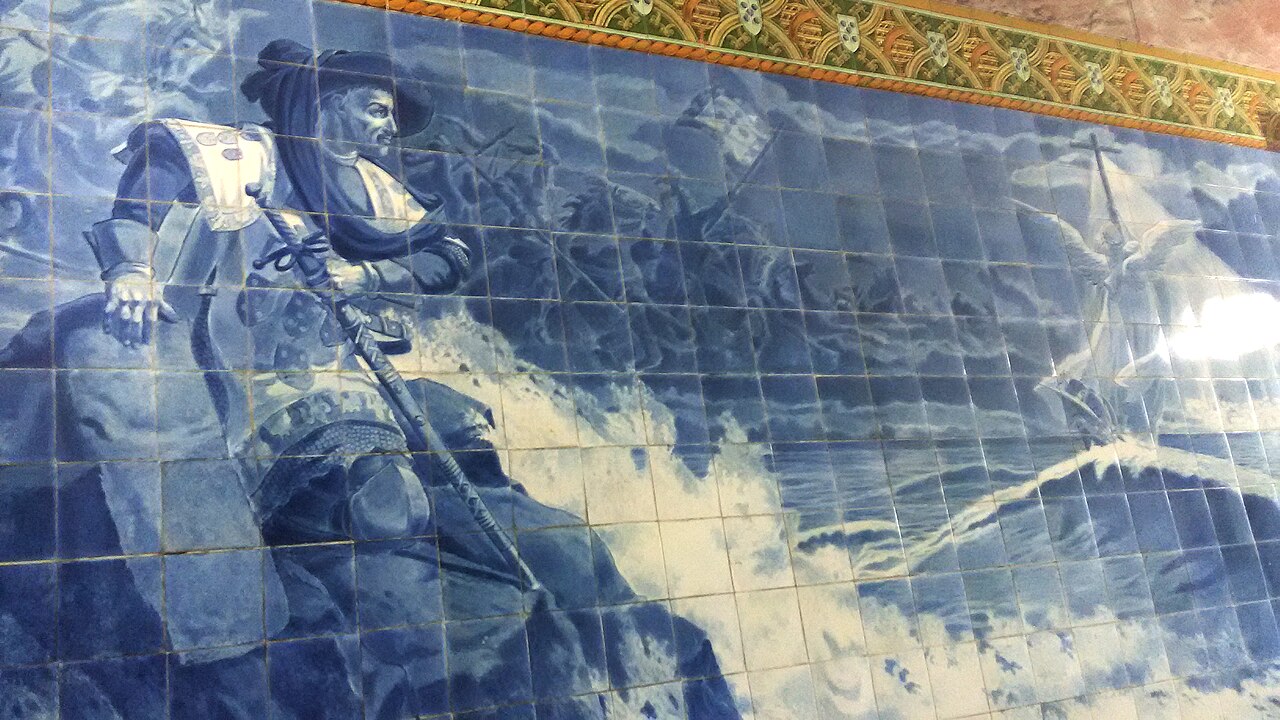
Blue and white azulejo tile panel showing a man in a plumed hat and period dress holding a staff, with a sailing ship on rough waves at right, and a gold-patterned border along the top.Artifact

Secondary source

Azulejo Tile Panel Depicting Prince Henry the Navigator, Rio de Janeiro

unknown (photographed 2019)

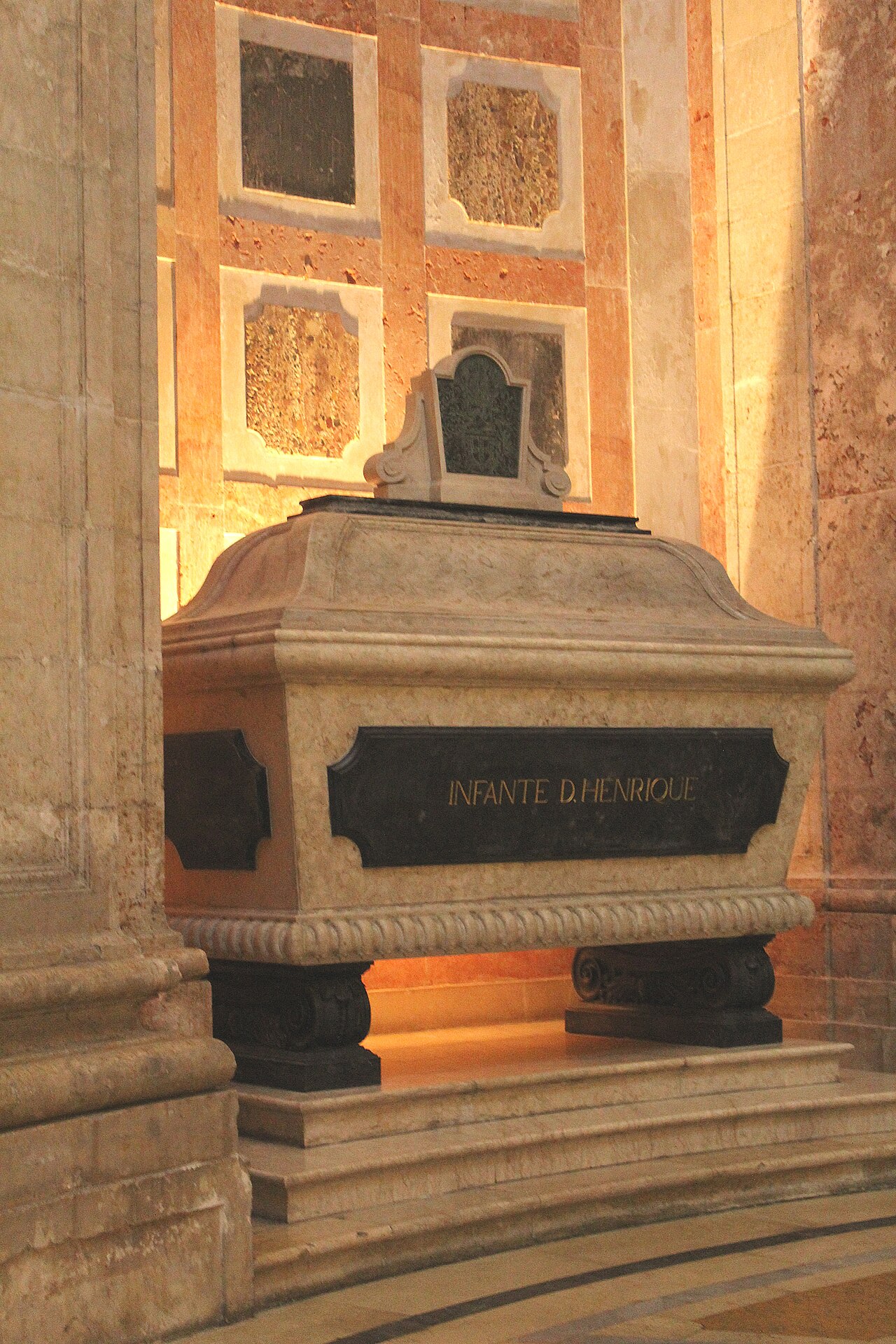
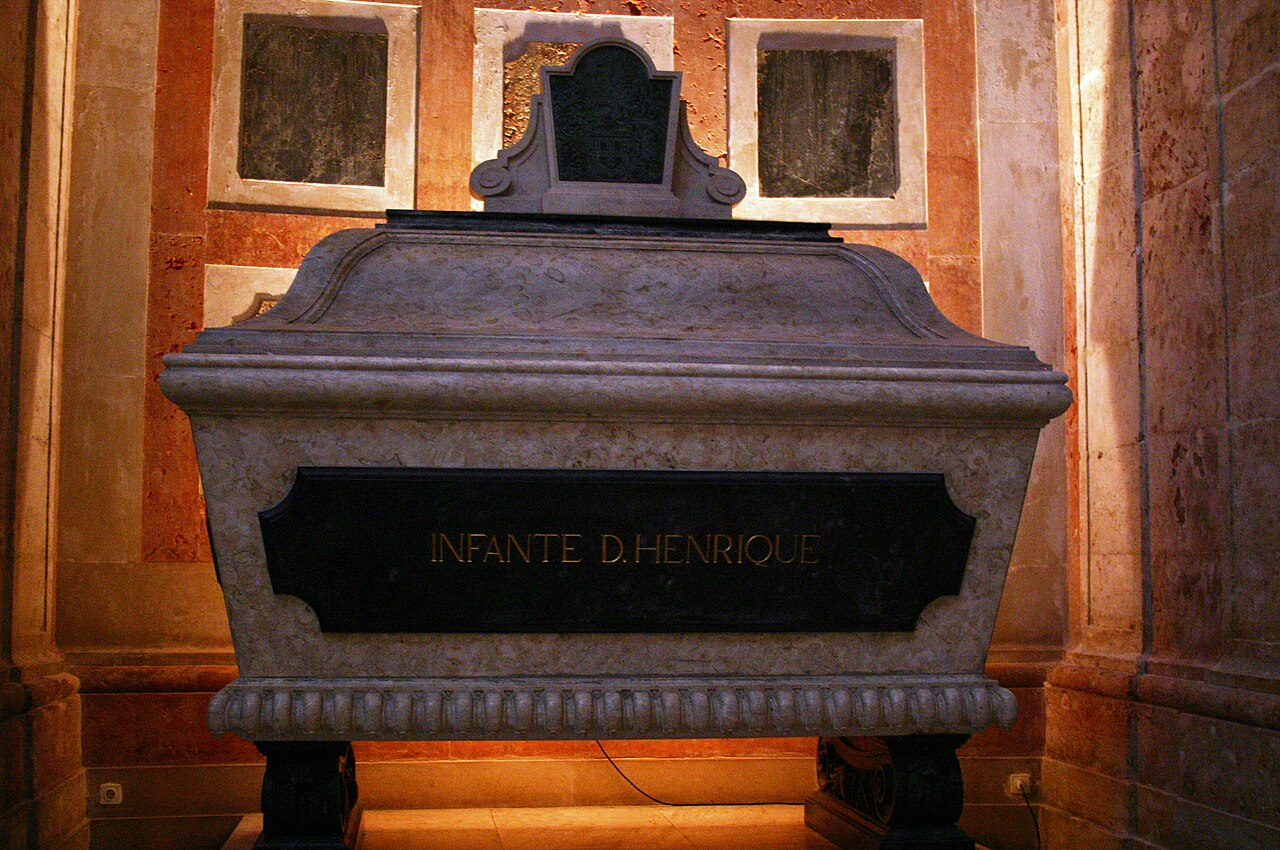
Marble tomb monument (cenotaph) in a stone niche with a dark plaque inscribed 'INFANTE D. HENRIQUE' on its front, set on a stepped plinth with dark scroll-shaped feet. Behind it, marble panels and warm lighting.Artifact

Secondary source

Photograph of Henry the Navigator's Cenotaph, Lisbon Pantheon

unknown (photographed 2017)

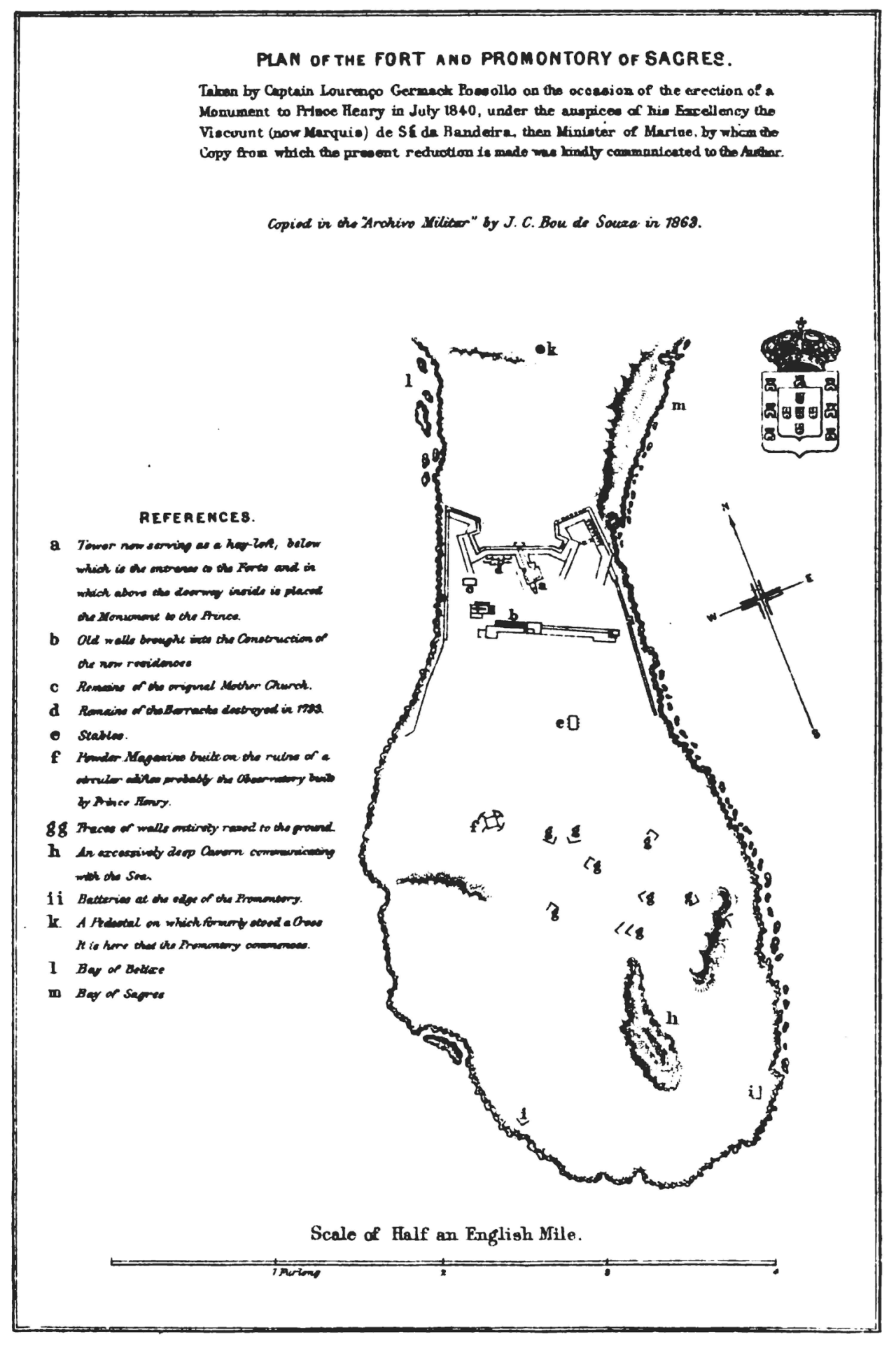
Engraved plan titled 'Plan of the fort and promontory of Sagres', with a Portuguese coat of arms at upper right, a references key listing lettered features at left, a compass rose, and a scale of half an English mile at bottom. It depicts the fort walls, the promontory outline, and the bays of Sagres and Belixe.Document

Secondary source

Plan of the Fort and Promontory of Sagres

Richard Henry Major · 1877

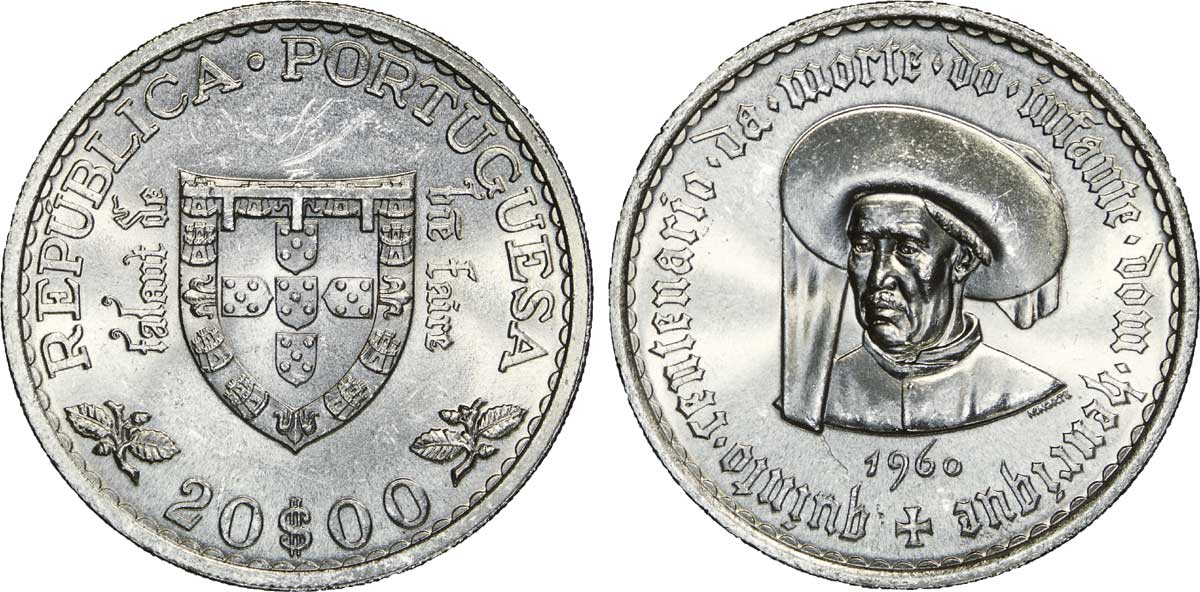
Two sides of a silver-colored 20 Escudos coin. The obverse shows the Portuguese coat of arms with the text REPUBLICA PORTUGUESA and 20$00. The reverse shows a bust portrait of a man in a wide-brimmed hat and cape, with the inscription QUINTO CENTENARIO DA MORTE DO INFANTE DOM HENRIQUE and the date 1960.Artifact

Secondary source

20 Escudos Coin for the 500th Anniversary of Henry's Death

1960

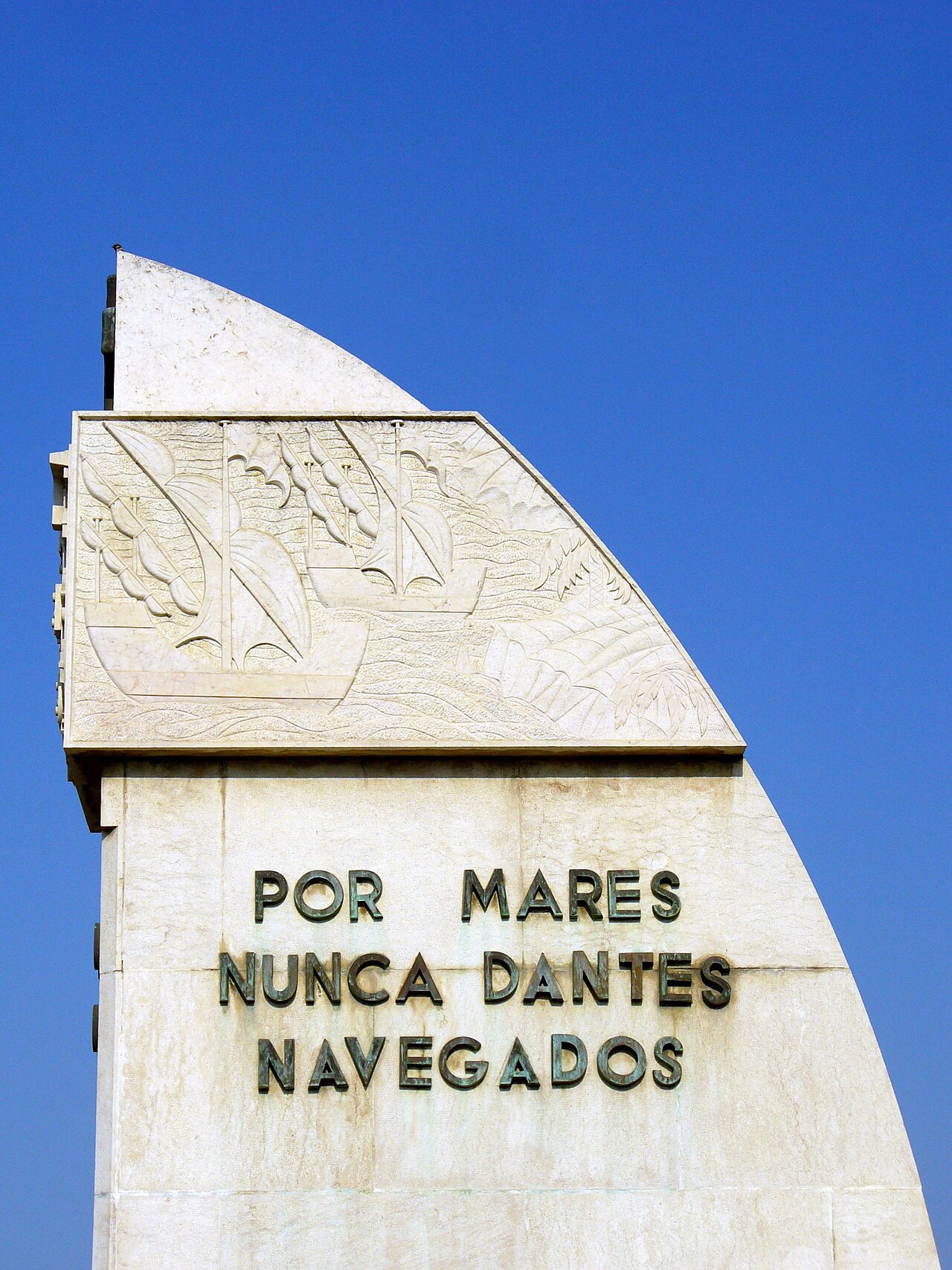
Upper part of a white stone monument against a bright blue sky. Carved relief panel shows sailing ships with billowing sails and waves. Below, green bronze letters read: POR MARES NUNCA DANTES NAVEGADOS.Sculpture

Secondary source

Monument of Prince Henry the Navigator, Dili

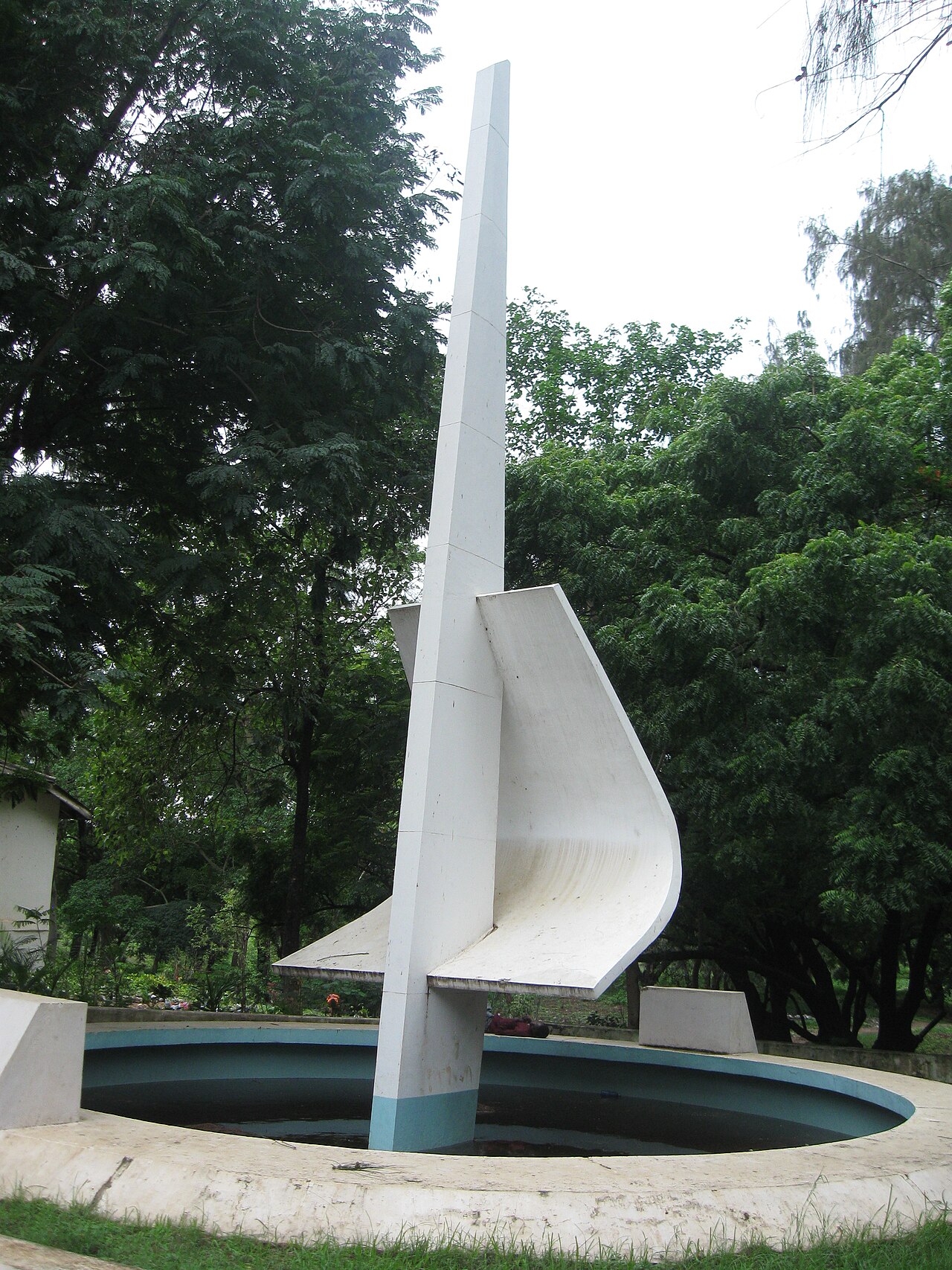
A tall white concrete sculpture rises from a circular pool surrounded by trees. It has a slender vertical fin and a curved, sweeping sail-like slab attached to its side. The pool has a blue-green rim.Sculpture

Secondary source

Prince Henry the Navigator Monument, Malindi

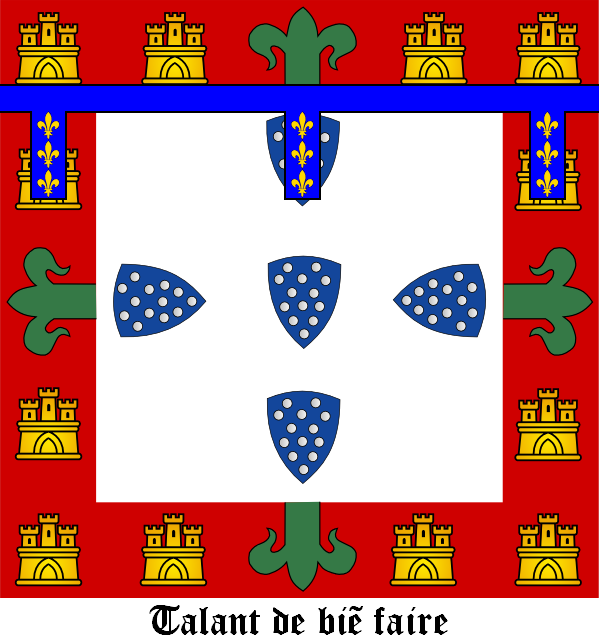
Heraldic banner with a red border decorated with gold towers and green fleurs-de-lis, a blue horizontal band with gold fleurs-de-lis, and a white central field bearing five blue shields with white dots, plus the motto Talant de bien faire in black letters below.Artifact

Secondary source

Banner of Arms of Prince Henry the Navigator

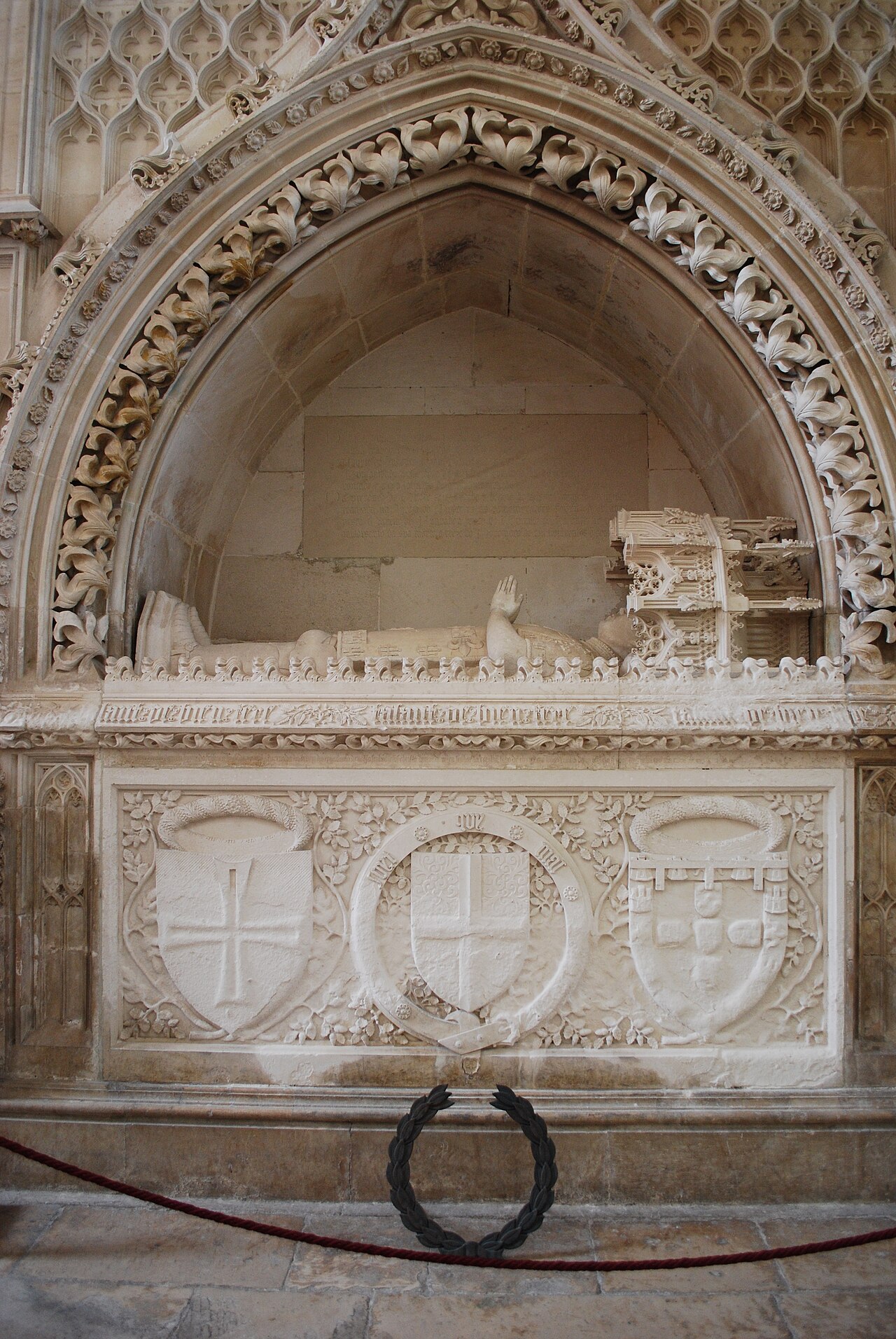
Stone tomb in a pointed Gothic arch niche at Batalha Monastery, with a carved recumbent effigy of a figure with a raised hand, flanked by carved tracery and a lower panel bearing three heraldic shields, with a dark wreath on the floor in front.Sculpture

Secondary source

Tomb of Henry the Navigator, Batalha Monastery

2009

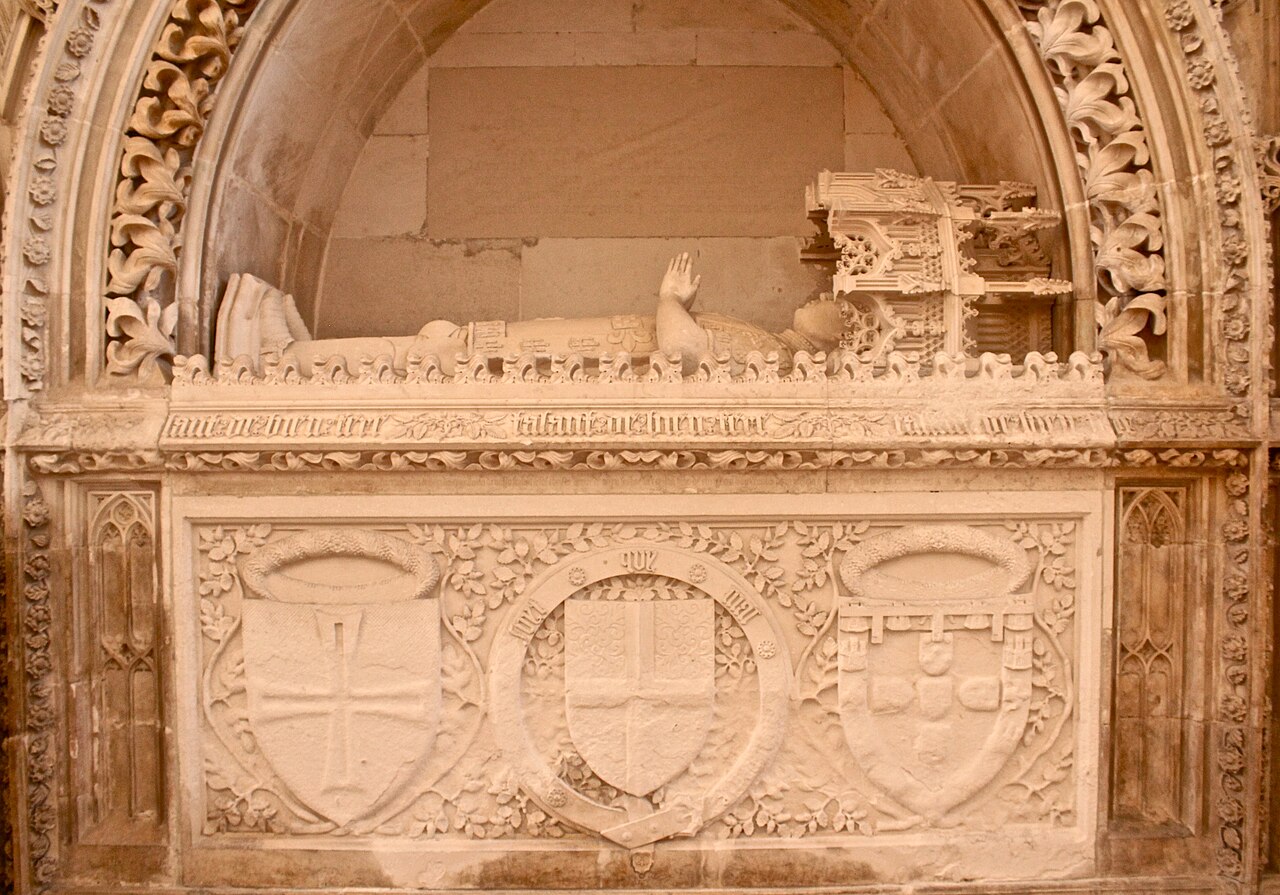
Carved stone tomb with a recumbent effigy of a figure lying on a slab beneath a Gothic arch, with ornate foliage and a carved inscription band. Below are three carved heraldic shields with crosses and emblems.Sculpture

Secondary source

Tomb of Infante D. Henrique

André Luís · 25 April 2011 (photograph)

A marble tomb with a dark inscribed plaque reading INFANTE D. HENRIQUE, set in a niche with a carved pediment and dark wall panels behind it, lit warmly against reddish-brown stone walls.Sculpture

Secondary source

Tomb of Infante D. Henrique, Santa Engrácia

José Luiz · 20 January 2013 (photograph)

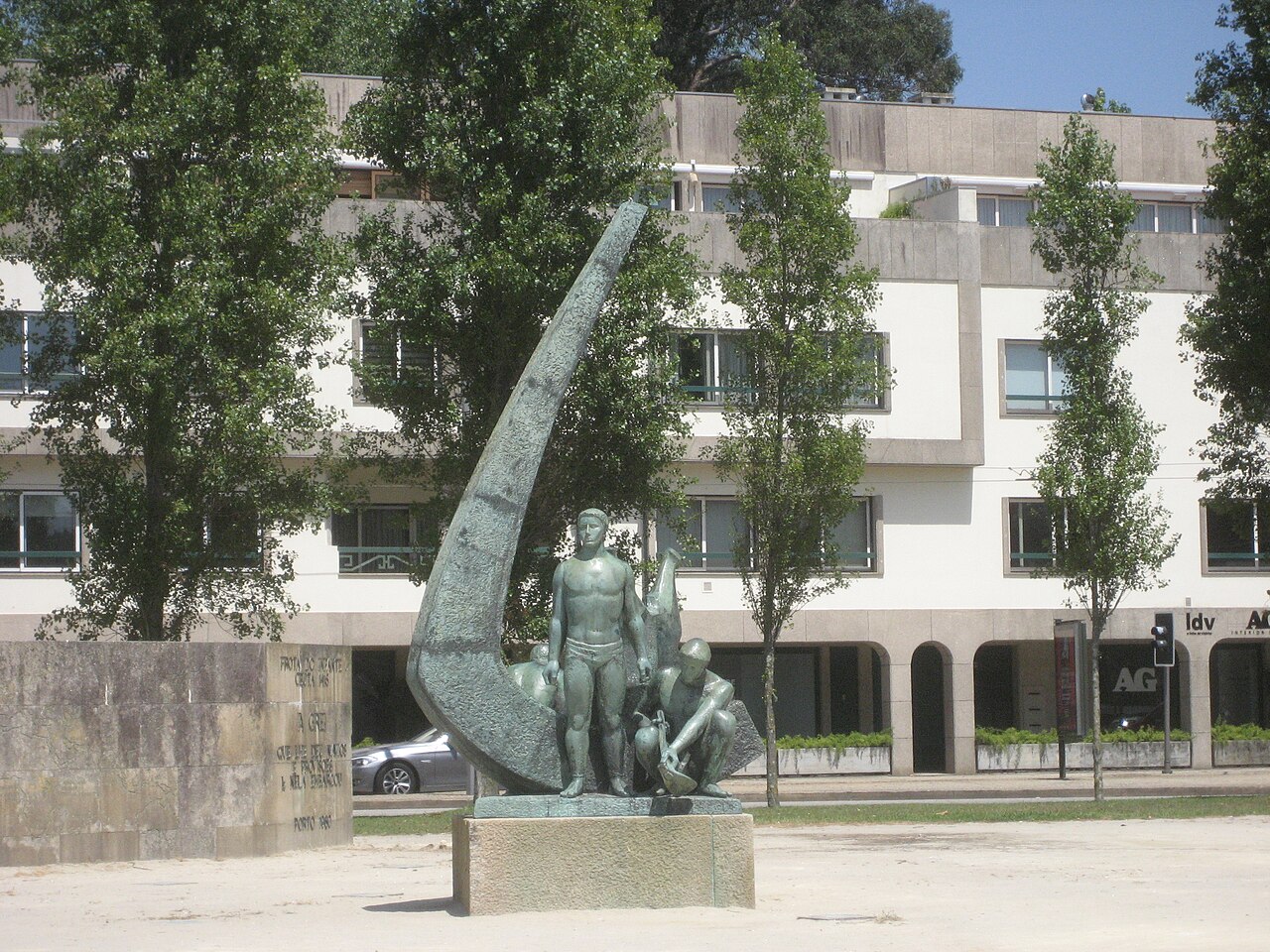
Bronze statue on a granite plinth in a plaza: a tall curved sail-like form rises behind a standing nude male figure flanked by two smaller figures, one kneeling. Modern white multi-story building and trees behind, with a car on the road.Sculpture

Secondary source

A Grei

Lagoa Henriques · 16 July 2015 (photograph)

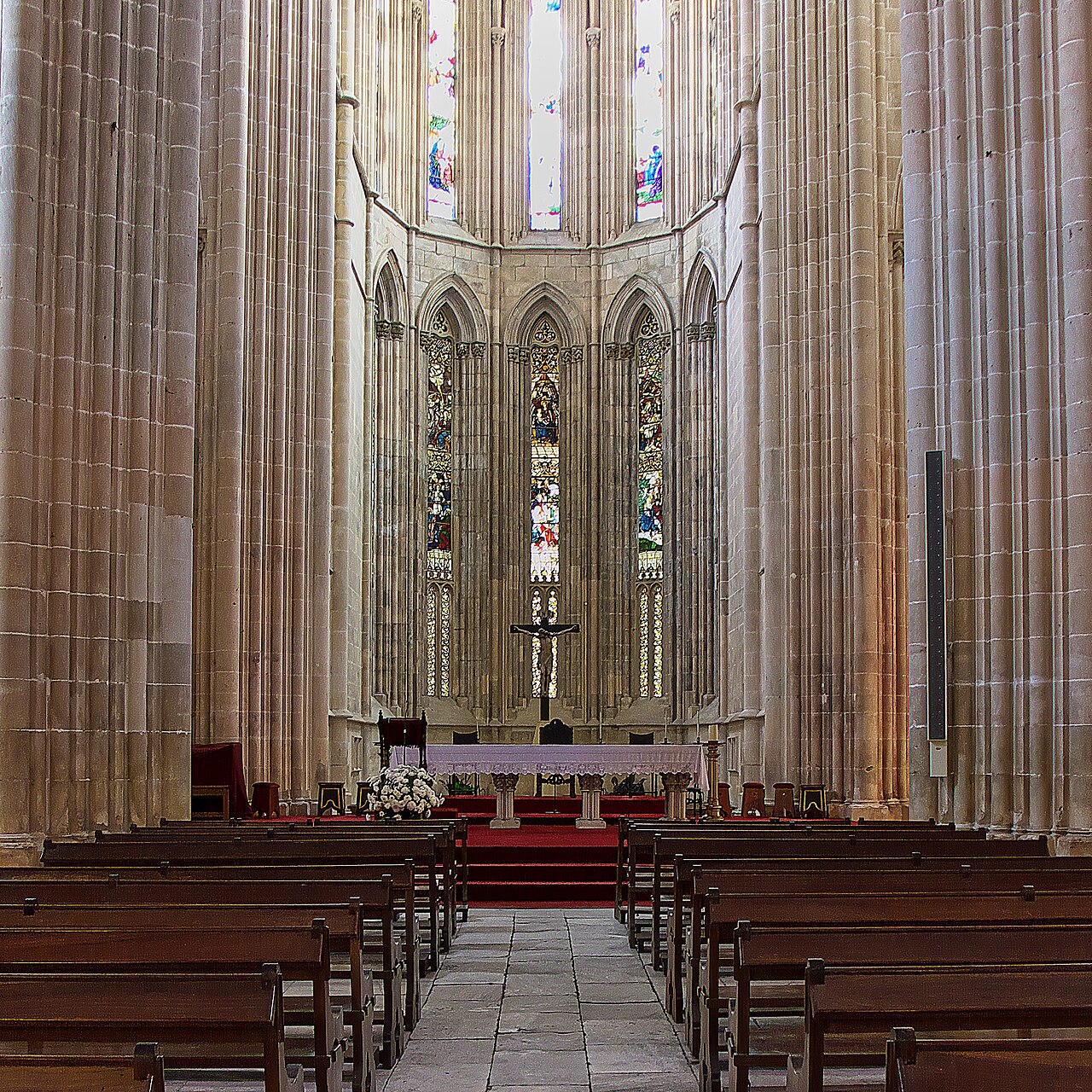
Interior of a Gothic church looking toward the altar: tall clustered stone pillars line the nave, with rows of dark wooden pews on both sides and a stone-paved aisle leading to a red-carpeted step and altar draped in white cloth. Tall stained-glass windows with colorful figures fill the apse, and a large crucifix stands above the altar. White flower arrangements sit near the altar.Photograph

Secondary source

Presbytery of Batalha Monastery

José Luis Filpo Cabana · November 2010

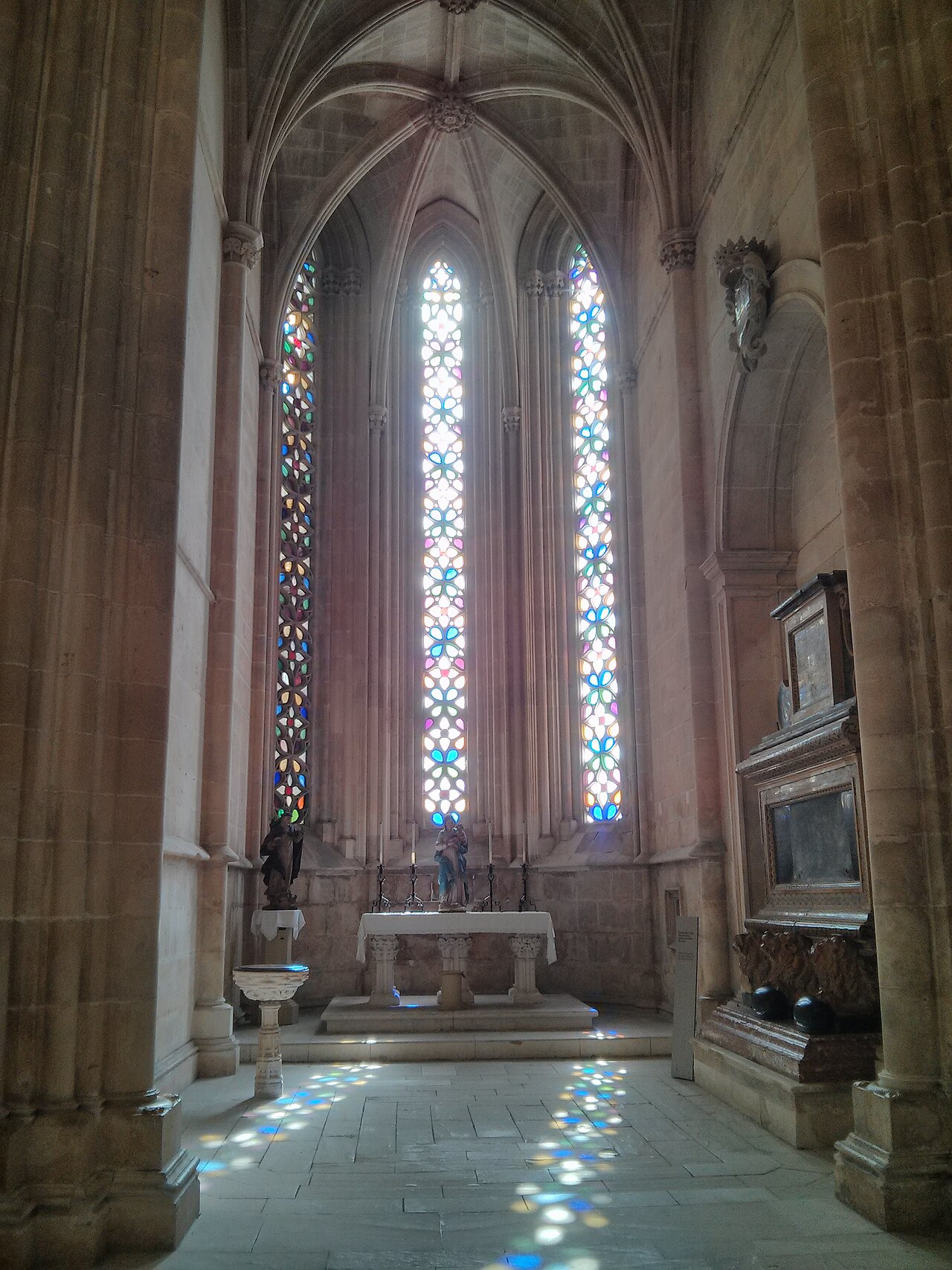
Interior of a Gothic church chapel at Batalha Monastery with tall stained-glass windows behind a white-draped altar, a statue of a figure on the altar, a stone baptismal font on the left, and light patterns on the stone floor.Photograph

Secondary source

Batalha Monastery Interior

Antonio Periago Miñarro · 13 August 2013

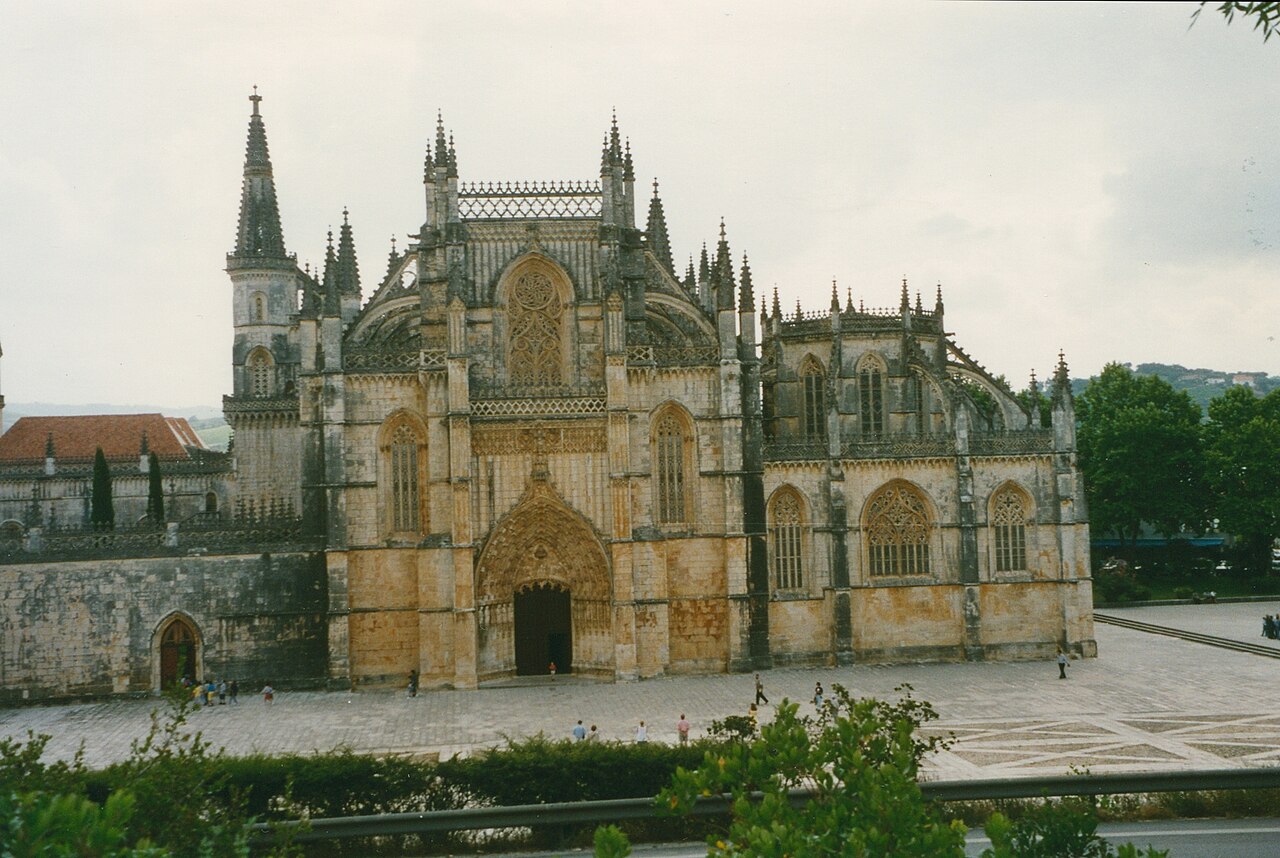
Exterior view of the Batalha Monastery facade in Portugal, a Gothic church with tall pointed spires, pinnacles, large tracery windows and a central pointed portal, set across a paved plaza with trees and a few people.Photograph

Secondary source

Batalha Monastery Western Portal

Arian Zwegers · 1 July 1995

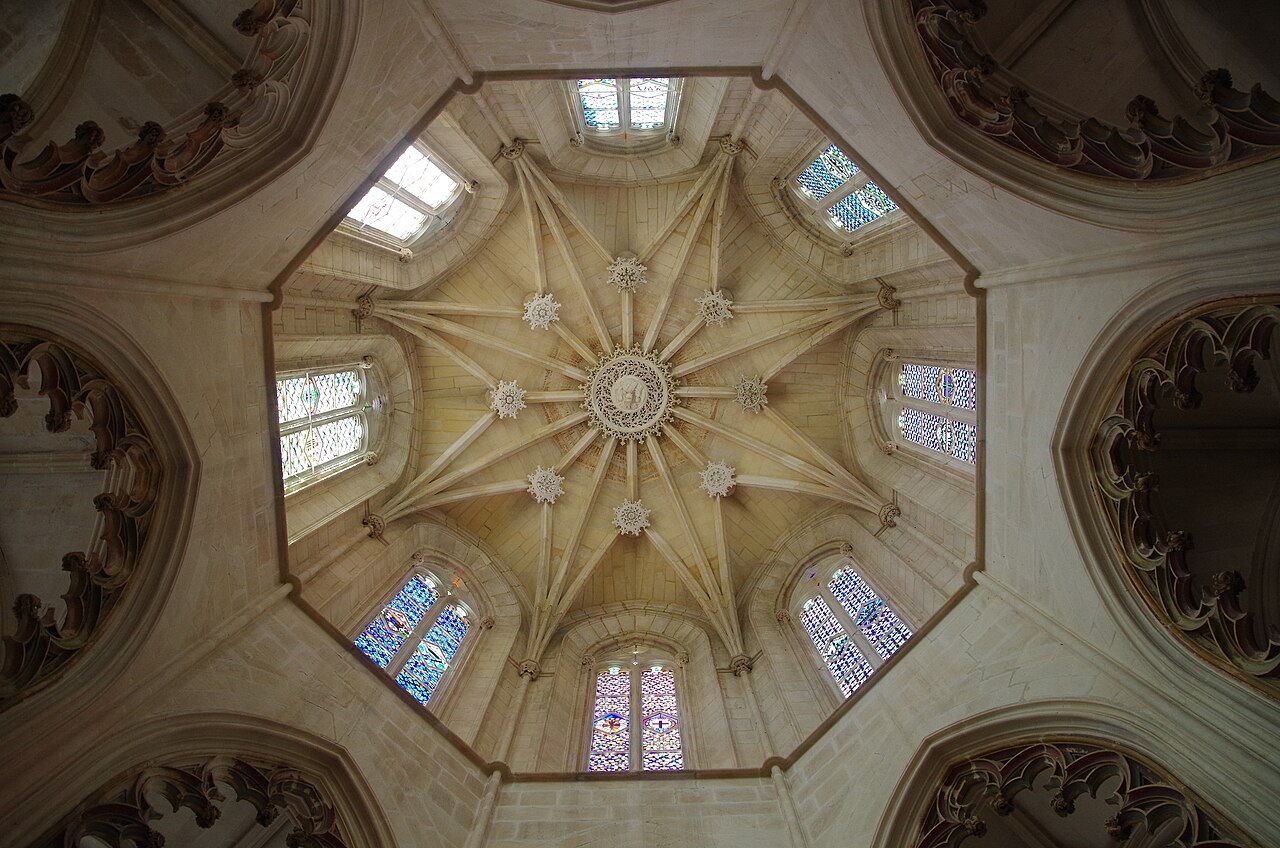
Looking up at a star-shaped Gothic ribbed vault with a central carved boss, radiating ribs, and small rosettes, framed by stained-glass windows and pale stone tracery in an octagonal chamber.Photograph

Secondary source

Vault of the Founder's Chapel, Batalha

Cardilio · 18 May 2017

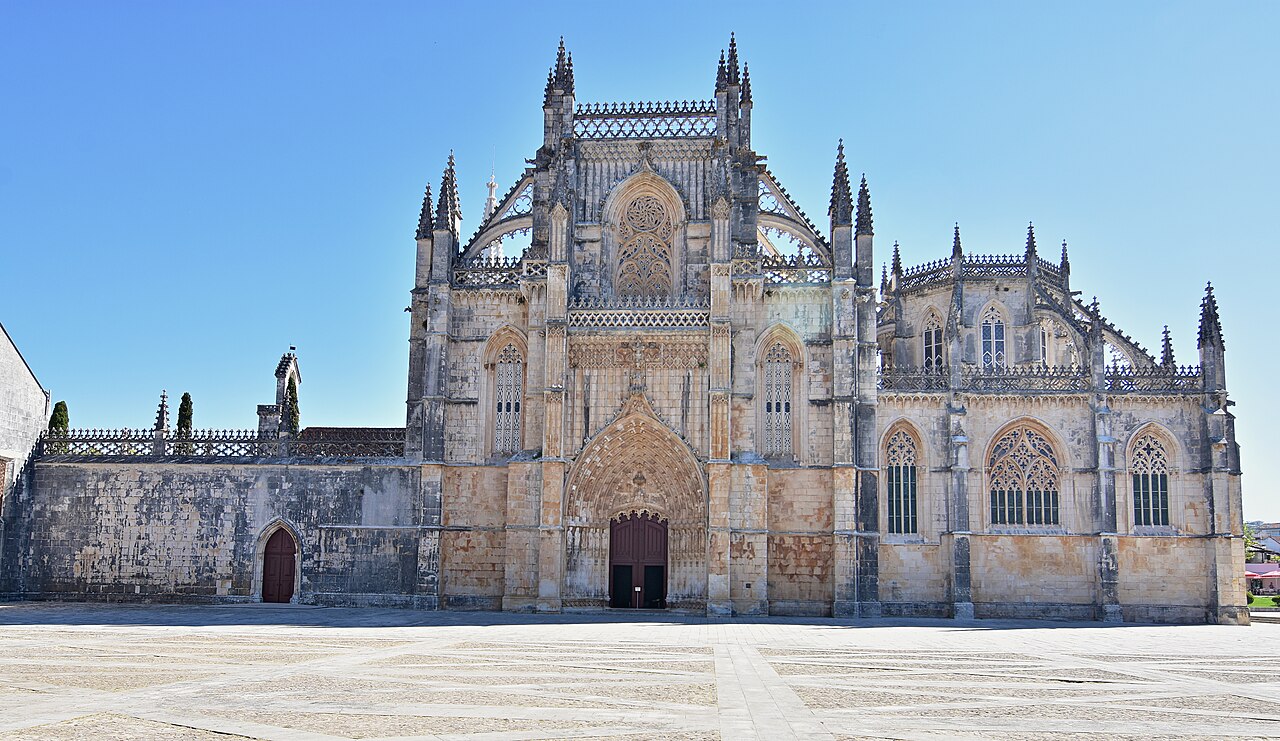
Front facade of the Batalha Monastery in Portugal, a Gothic church with pointed arches, ornate stone tracery, tall pinnacled towers, and a dark wooden portal under a clear blue sky, with a large paved courtyard in front.Photograph

Secondary source

Mosteiro da Batalha

pedrik · 2 October 2017

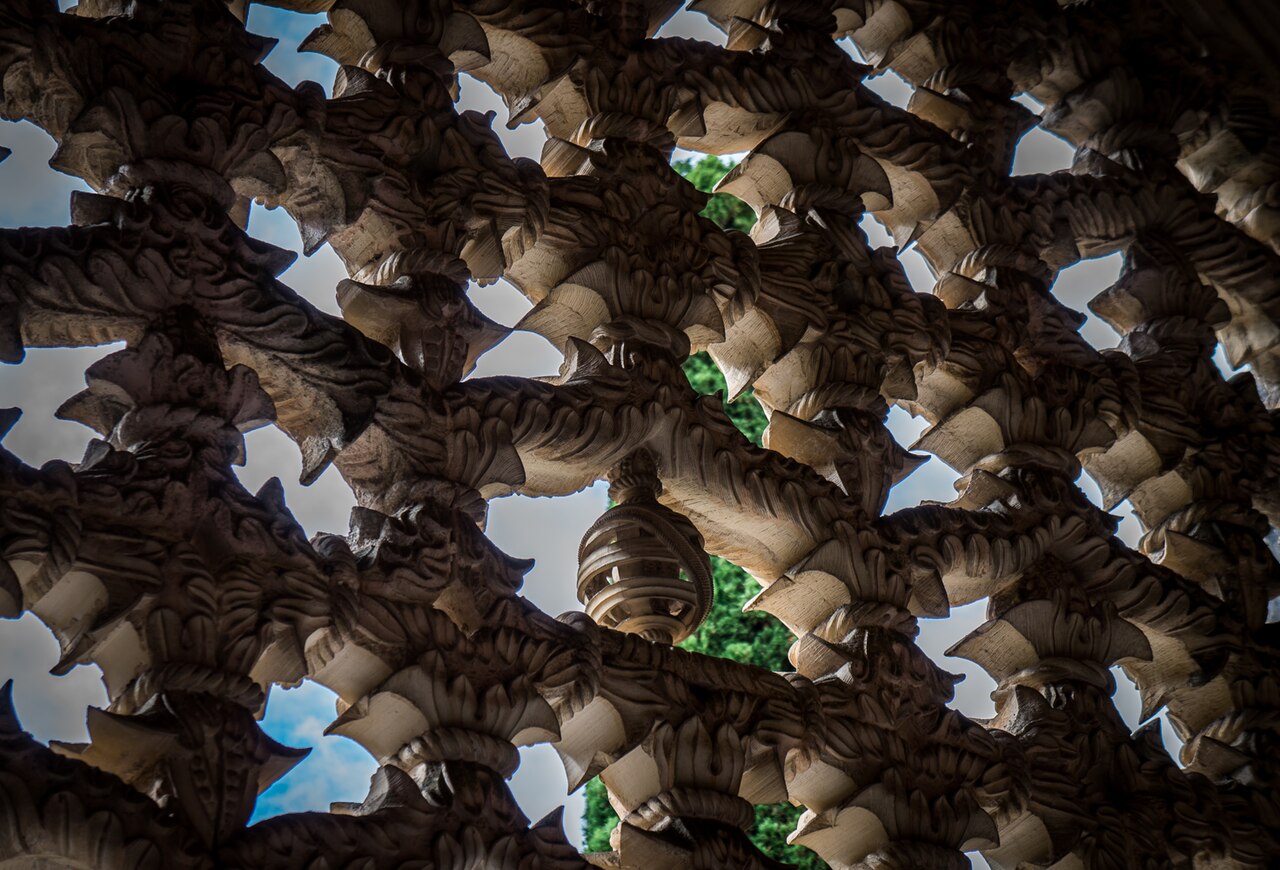
Close-up, upward-angled view of intricately carved stone tracery and pinnacles, with dark weathered carved foliage and a small ornate finial in the center. Patches of blue sky and green trees show through the openings.Photograph

Secondary source

Batalha Monastery (UNESCO World Heritage Site)

Travelholic Path · 15 November 2015

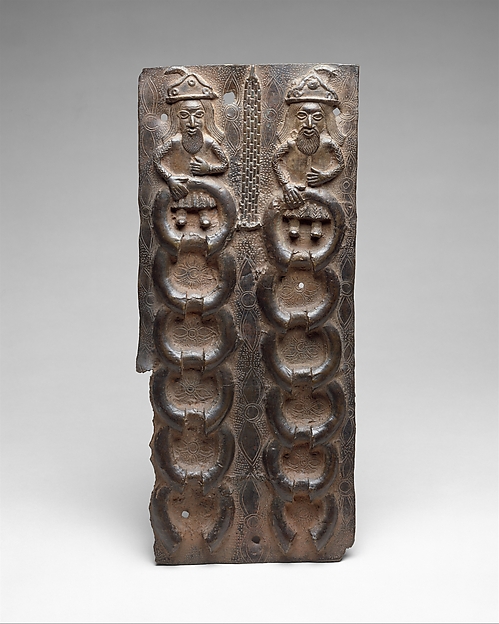
Rectangular bronze-brass plaque in relief. Two standing male figures wearing hats and holding objects appear at top, flanking a central vertical band. Below them, rows of stacked ring shapes (manillas) fill the plaque's two columns, with incised patterned borders.Sculpture

Secondary source

Plaque with Portuguese Traders and Manillas

Ìgùn Ẹ́rọ̀nwwọ̀n (brass-casting guild) artists · ca. 1540-1570

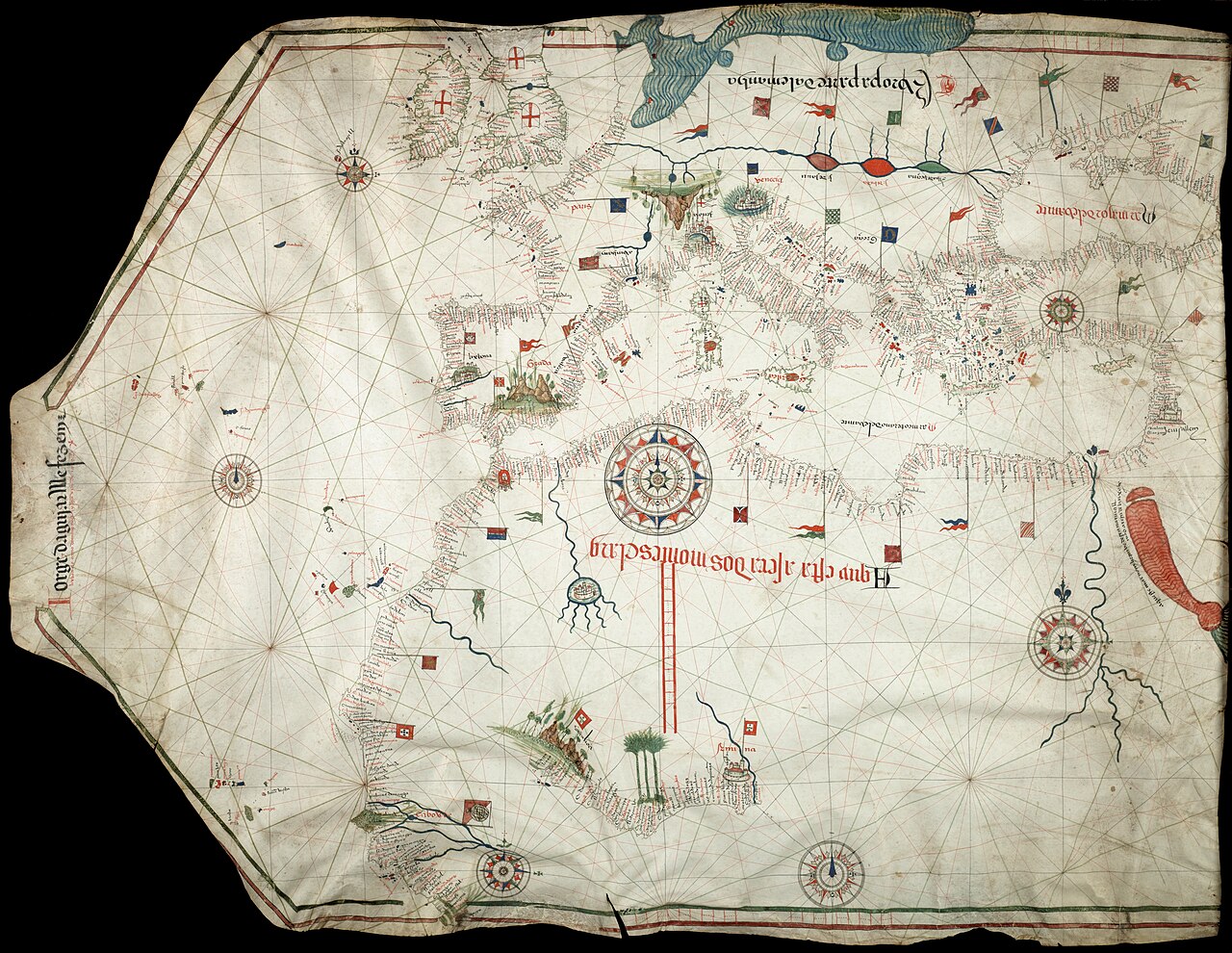
Full view of an aged, hand-painted portolan chart on vellum with a ragged, irregular outline. It shows coastlines of the Mediterranean, Western Europe and the African coast, with compass roses, rhumb lines, colored flags, and red and green Latin and Portuguese place-name labels, with a large red central compass rose. The map is mounted against a black background.Document

Secondary source

Jorge de Aguiar's Chart of the Mediterranean and African Coast

Jorge de Aguiar · 1492

Want the full shelf? Chat with Prince Henry the Navigator in the app and open the Sources panel — every quote links back to the original.

Use Prince Henry the Navigator in class

1 collection

A ready-made collection from the Humy team that features Prince Henry the Navigator. Preview it, then try it free.

Trusted by educators worldwide

Conversations
375,000+
Real exchanges between students and historical figures
Messages exchanged
4,142,000+
Across every figure, classroom and language
Historical figures
100,000+
Each informed by a curated biography and selected sources
Languages supported
50+
From English and Spanish to Arabic and Korean

Paying customers

Used by 98 schools and universities

Partner school logo
Tecnológico de Monterrey logo
Hyper Island logo
Partner school logo
Chambersburg Area School District logo
Broward County Public Schools logo
Nebo School District logo
National Louis University logo
South Florida PBS logo
Punahou School logo
University of Wisconsin–River Falls logo
Partner school logo
Partner school logo
Archbishop Mitty High School logo
Kingsburg High School logo
Norwalk Public Schools logo
Partner school logo
Connections logo
Partner school logo
Moore Public Schools logo
Partner school logo
Partner school logo
Partner school logo
Partner school logo
Robbinsville Public Schools logo
Partner school logo
Partner school logo
Partner school logo
Tecnológico de Monterrey logo
Hyper Island logo
Partner school logo
Chambersburg Area School District logo
Broward County Public Schools logo
Nebo School District logo
National Louis University logo
South Florida PBS logo
Punahou School logo
University of Wisconsin–River Falls logo
Partner school logo
Partner school logo
Archbishop Mitty High School logo
Kingsburg High School logo
Norwalk Public Schools logo
Partner school logo
Connections logo
Partner school logo
Moore Public Schools logo
Partner school logo
Partner school logo
Partner school logo
Partner school logo
Robbinsville Public Schools logo
Partner school logo
Partner school logo

What educators are saying

“We enjoyed the program last year and used it frequently.”
“My students say it’s a welcome change of pace. I’m not a fan of the “sage on the stage” model, so I try to incorporate research-oriented and self-paced activities. With Humy, students have to take charge of their learning. They’ve become more adept at critical thinking, forming better questions, and improving their reading comprehension. The interview feature has been my go-to tool. I create assignments where students must ask historical figures a set number of questions, then summarize the responses to ensure they’re truly absorbing the material. This approach lets them actively explore the past rather than passively consuming information.”
“Humy has helped me bring historical figures, sometimes long past, to life. When my students interact with these figures in real-time, it eliminates some of the perceived “ancient” characteristics of my curriculum. This has shifted my students’ thinking away from viewing history as abstract or irrelevant. Real-time interactions make historical figures relatable, even allowing students to ask off-topic questions that help put historical lives in a more relevant context for 13-year-olds. The feature I use the most is the interview feature. After teaching a topic, most recently Gandhi and Joan of Arc, I have the students ask pointed, focused questions. We practice good conversation techniques beforehand, teaching them to listen (or read) carefully and formulate thoughtful follow-up questions rather than just interrogating. It helps students practice effective conversation skills.”

FAQ

Frequently asked questions

Who is Prince Henry the Navigator?
Portuguese Prince, Patron, Explorer On Humy.ai you can chat with an AI version of Prince Henry the Navigator that draws on a short biography and 81 historical sources during the conversation — by text or voice, in 42 languages.
Is Prince Henry the Navigator AI free?
Prince Henry the Navigator is part of Humy's full library of more than 100,000 figures, which comes with a paid plan. A free account (no credit card) includes 20 AI messages a month with the free library's figures, so you can try how the conversations work first. The free plan's 20 AI messages a month are shared by you and your students: enough to try Humy yourself; a whole class needs Plus.
What sources does the Prince Henry the Navigator AI use?
It draws on a short biography and 81 historical sources (artifacts, paintings and photographs), including “Panel of the Prince (Detail)”, “Mercado de Escravos” and “Os Lusíadas”. Each source has its own page on Humy.ai.
How historically accurate is the AI version of Prince Henry the Navigator?
Each figure uses a short biography and a small set of selected historical sources as context (retrieval-augmented generation), so answers stay closer to known material than the model's general knowledge alone. It isn't a citation-grade research tool — like any LLM, the AI can get details wrong or extrapolate. Treat it as a strong starting point for inquiry and cross-reference important claims.
Can I talk to Prince Henry the Navigator by voice?
Yes. In addition to text chat, you can call Prince Henry the Navigator and hear their voice respond in real time — useful for auditory learners, interview practice and Socratic dialogue.
Is Humy.ai safe and compliant for schools?
Yes. Humy.ai is used by more than 100 schools, universities and organisations. The platform is FERPA- and GDPR-aligned, supports SSO, and offers an IT-approval pack tailored for school procurement teams.

Cross-reference Prince Henry the Navigator

Like any LLM, the AI version of Prince Henry the Navigator can get details wrong. Open one of these sources in a new tab to verify what you’ve read.

Ready when you are

Start chatting with Prince Henry the Navigator now.

20 messages free · No credit card · Available in 50+ languages.