Portrait of James Armistead Lafayette

AI Historical Figure

James Armistead Lafayette

Revolutionary War spy for the Continental Army.

Chat with James Armistead Lafayette via text or voice — in 42 languages, drawing on a curated biography and 49 historical sources. Available 24/7.

Start chatting with James Armistead Lafayette20 messages free · No credit card
Lived
c. 1748–1830
From
United States
Known for
Military
James Armistead Lafayette

James Armistead Lafayette

Online · responds in seconds

Hello — I'm James Armistead Lafayette. Revolutionary War spy for the Continental Army. What would you like to ask me?

20 messages free · No credit card · Powered by Humy.ai

Live preview · Switch between 42 languages above · Send a message to continue in the app

Multilingual

Talk to James Armistead Lafayette in 42 languages

Ask James Armistead Lafayette questions in any language below, and the rest of Humy's app speaks it too. Pick yours to open the chat in that language.

Also in German (Austria), German (Switzerland), English (UK), English (Australia), English (Canada).

The sources behind this AI

49 sources · 18 paintings · 16 documents · 5 photographs · 4 books · 3 sculptures · 1 letter · 1 diary entry · 1 artifact

James Armistead Lafayette doesn’t improvise from thin air. The AI is grounded in 49 curated historical sources students can inspect. Open any of them to see what informs the conversation.

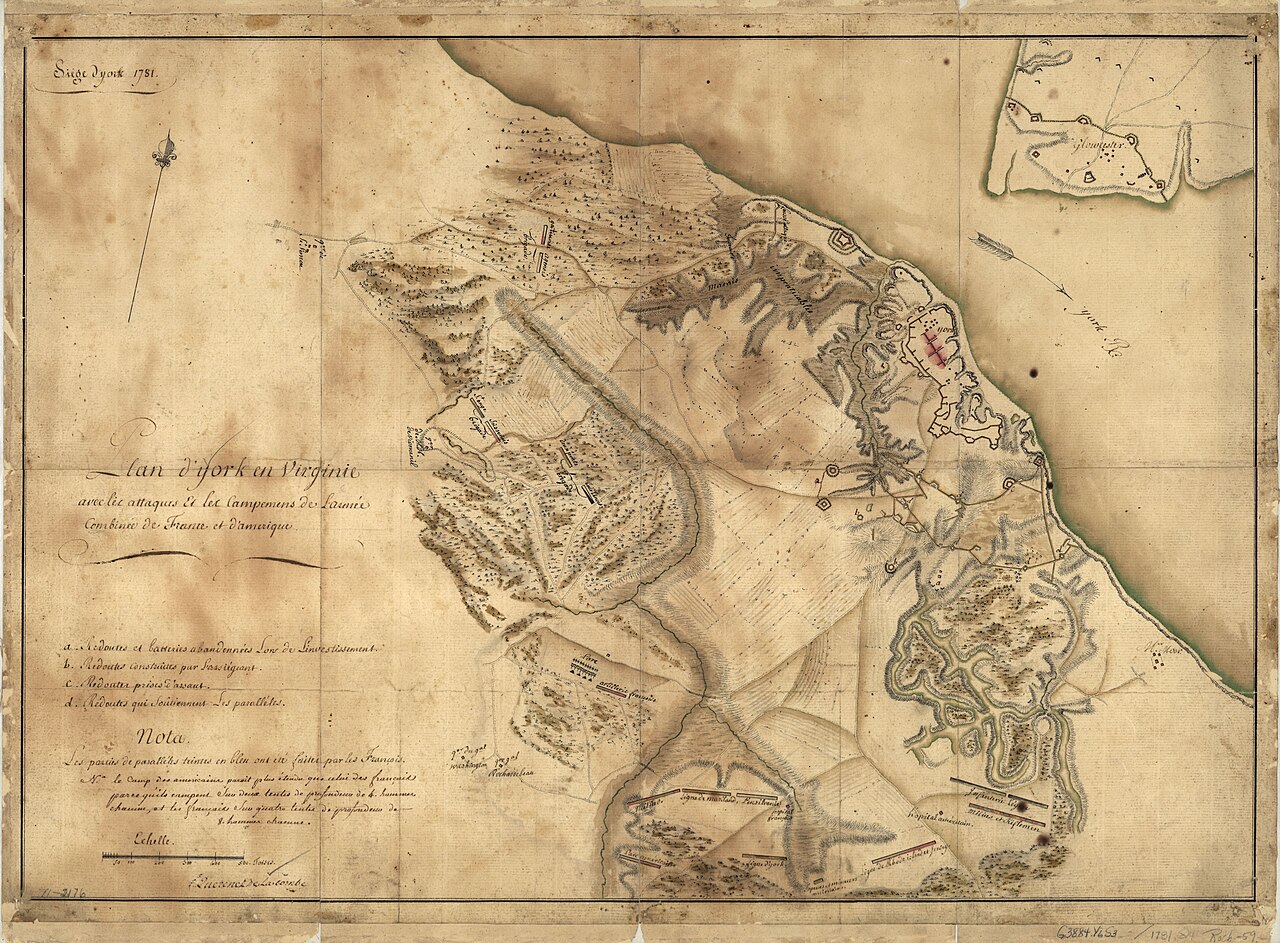
Manuscript pen-and-ink and watercolor map titled 'Siege d'York 1781, Plan d'York en Virginie avec les attaques et les campemens de l'Armée combinée de France et d'Amérique.' Shows York, Virginia, with hachured relief, siege trenches and batteries, encampments, and a small inset map at upper right. A scale bar and a handwritten Nota key appear at lower left.Document

Primary source

Siege of York, 1781: Plan of Franco-American Siege Works

Querenet De La Combe · 1781

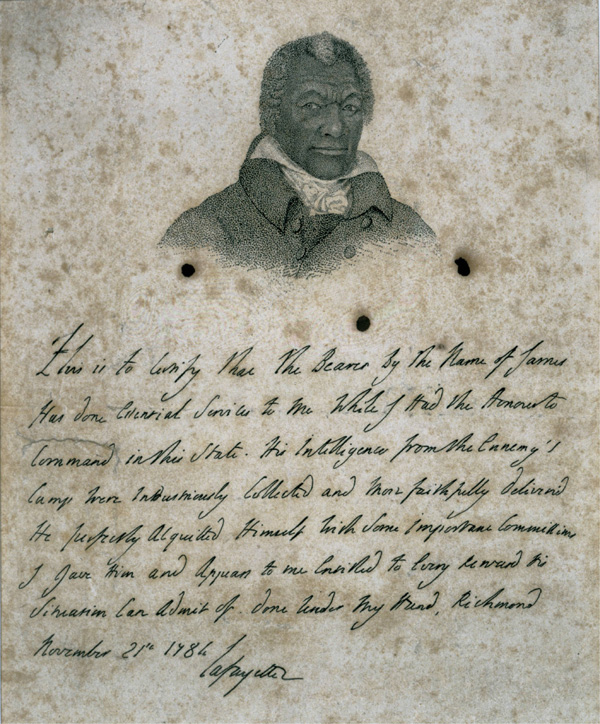
Engraving of a man's head and shoulders in a high-collared coat and cravat, above a handwritten manuscript certificate signed by Lafayette dated November 21, 1784, attesting to James's service as a spy.Document

Primary source

Certificate for James Armistead Lafayette

Marquis de Lafayette · 21 November 1784

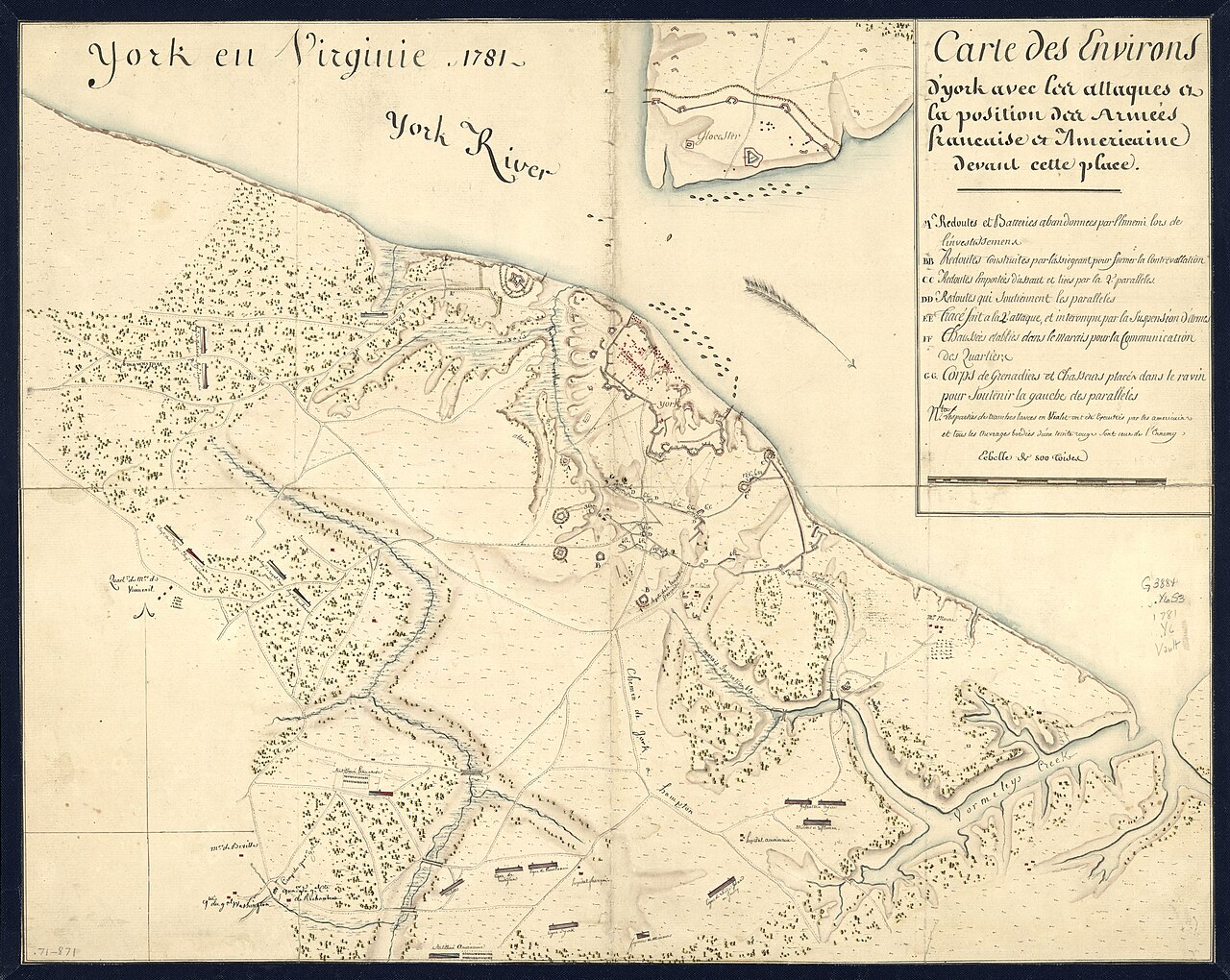
Hand-drawn manuscript map in pen-and-ink and watercolor titled 'York en Virginie 1781' showing the York River, the town of Yorktown and siege lines, with an inset of Gloucester, French title panel and key on the right.Document

Primary source

York en Virginie, 1781: Map of Franco-American Positions at York

1781

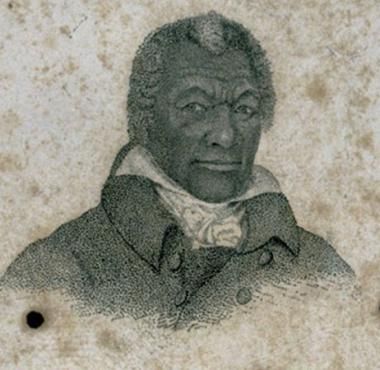
Stippled engraving of a middle-aged man with short gray hair, wearing a dark high-collared coat with buttons and a white cravat, against a speckled beige background. A small dark spot appears at lower left.Painting

Primary source

Portrait of James Armistead Lafayette

John B. Martin · c. 1824

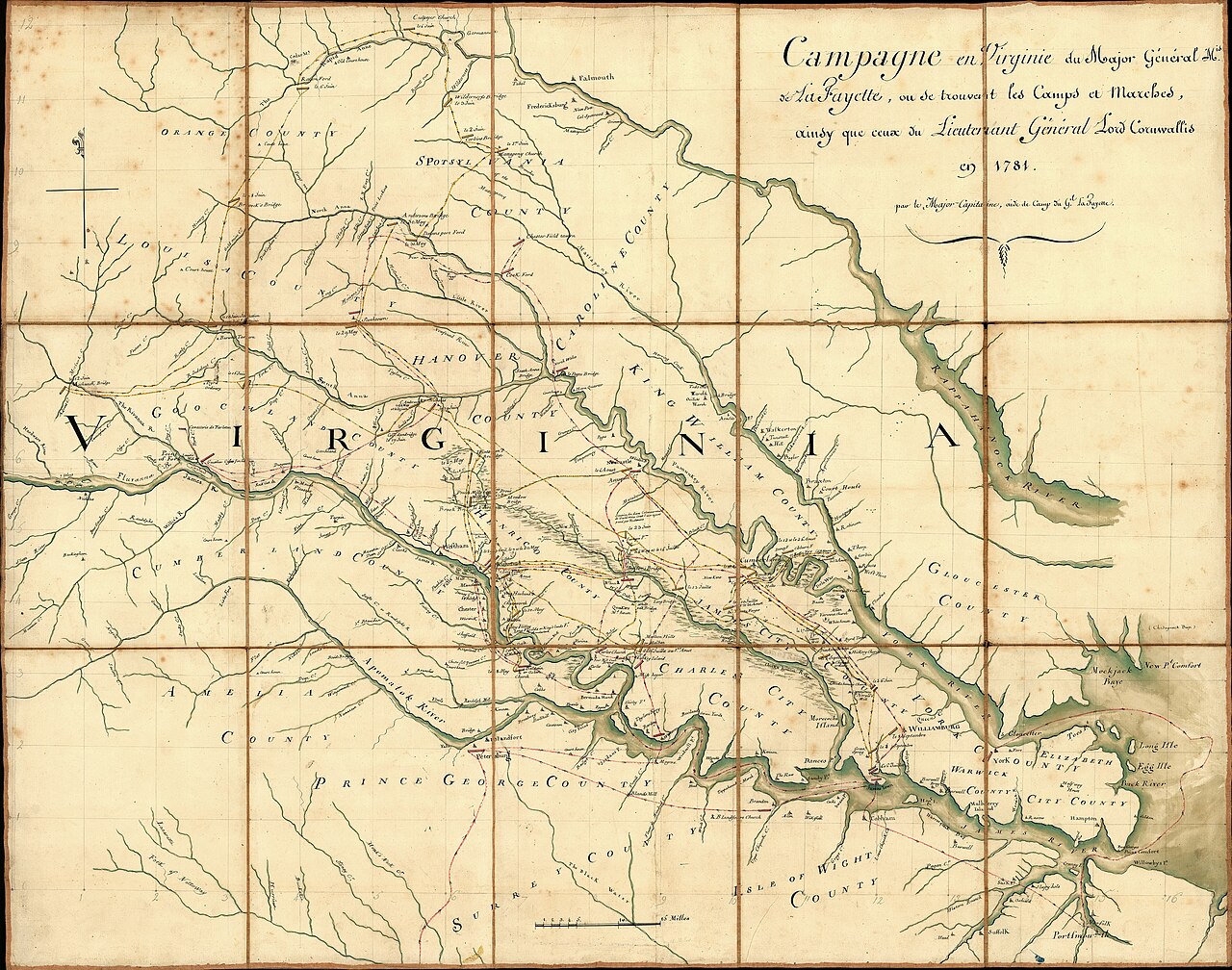
Hand-drawn 1781 manuscript map titled Campagne en Virginie, showing rivers, roads, county names and military camp routes across Virginia from Orange County south to Isle of Wight County, with a Chesapeake-area coastline at right.Document

Primary source

Campaign of the Marquis de Lafayette in Virginia, 1781

Michel Capitaine Du Chesnoy · 1781

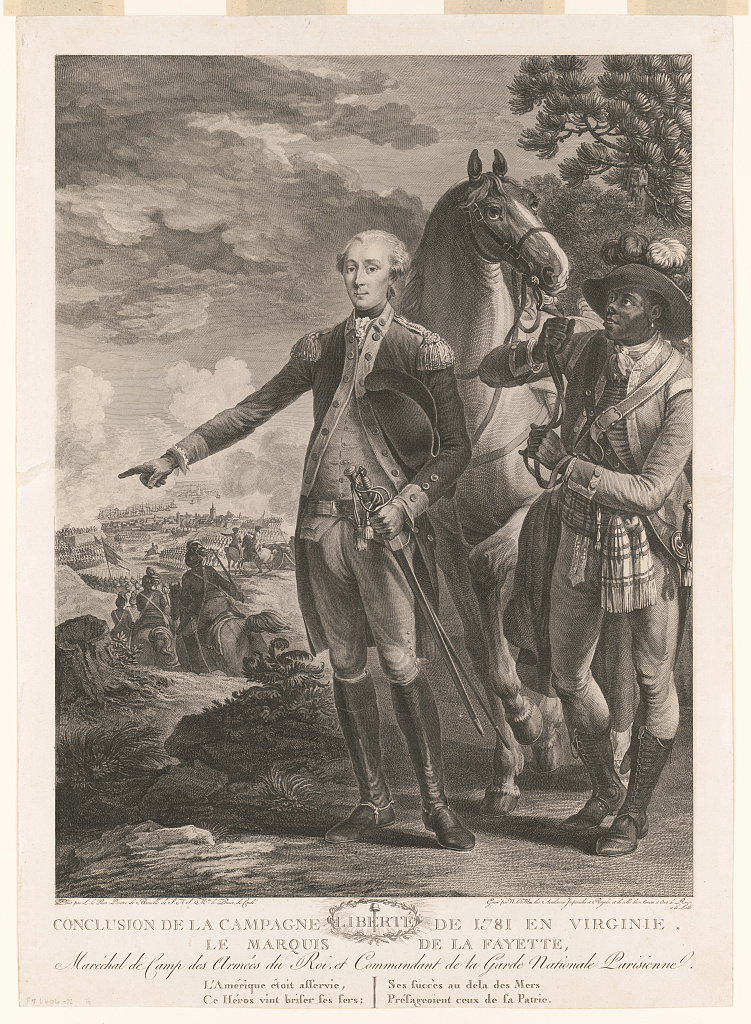
Engraved print of the Marquis de Lafayette standing in military uniform, pointing left toward distant troops in battle, with a horse and a Black soldier in a plumed hat at his right. Caption text is below the image.Painting

Primary source

Conclusion de la campagne de 1781 en Virginie (Lafayette and Attendant)

Noël Le Mire, after Jean-Baptiste Le Paon · c. 1781-1785

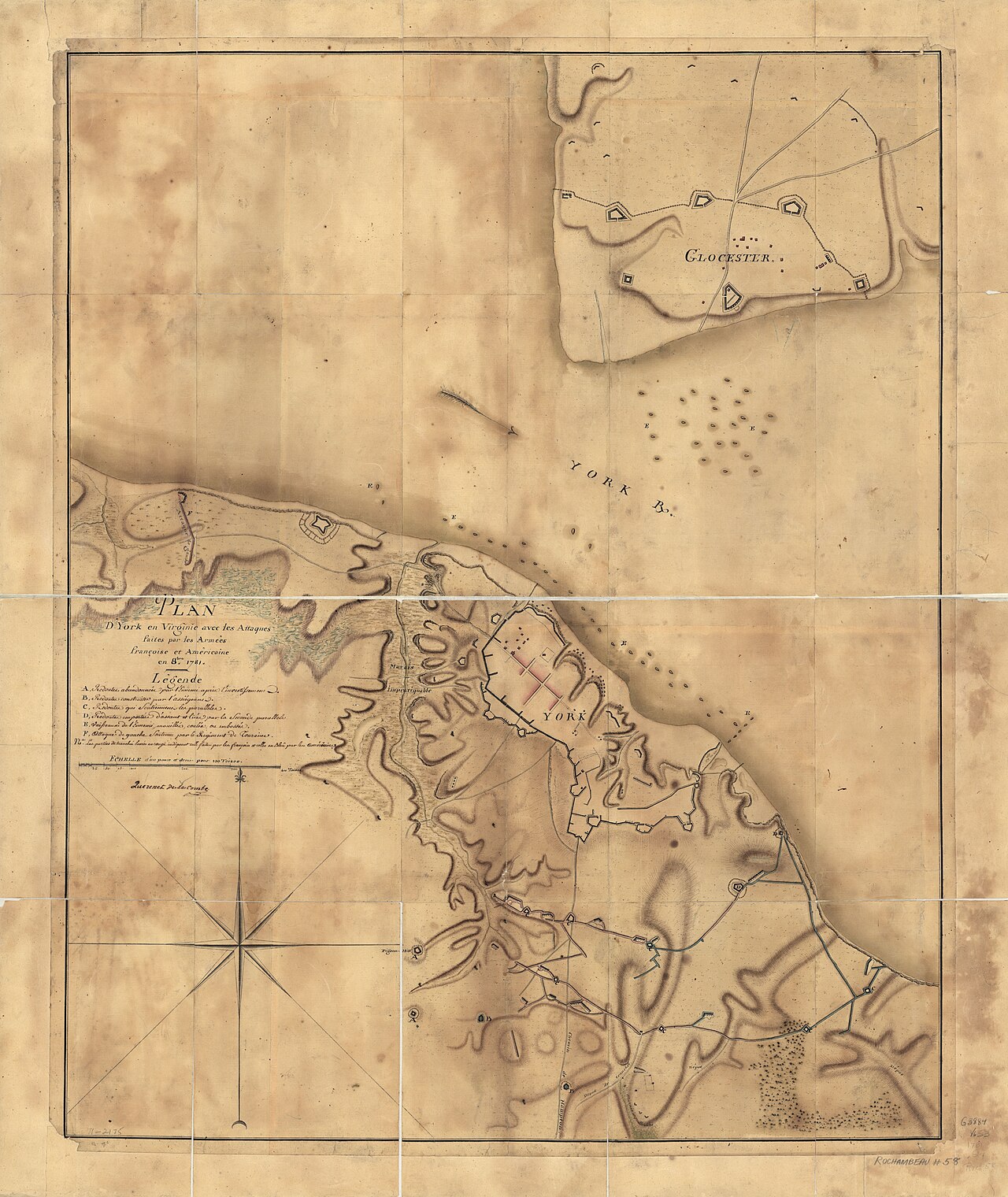
Manuscript pen-and-ink and watercolor map titled Plan d'York en Virginie, showing the siege lines and fortifications around York and Gloucester with labeled features, a compass rose, and a legend in French. Hachures indicate terrain relief. Brown, aged paper.Document

Primary source

Plan of York in Virginia Showing October 1781 Attacks

Querenet De La Combe · 1781

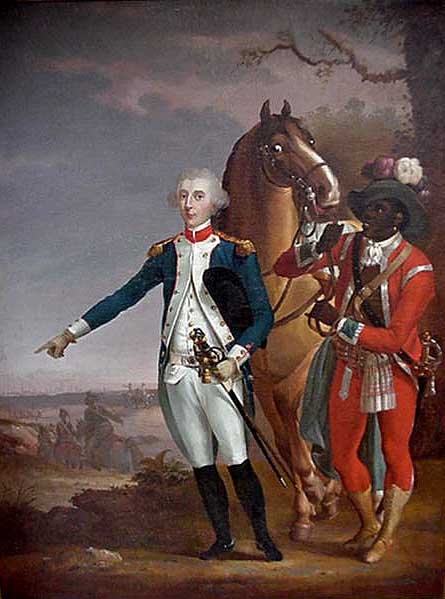
Oil painting of a powdered-haired man in a blue military coat with red collar and gold epaulettes, pointing left, with a sword at his side. Beside him stands a Black man in a red uniform and tricorn hat holding a bay horse. Behind them is a cloudy landscape with distant figures.Painting

Primary source

Lafayette at Yorktown

Jean-Baptiste Le Paon · c. 1783-1785

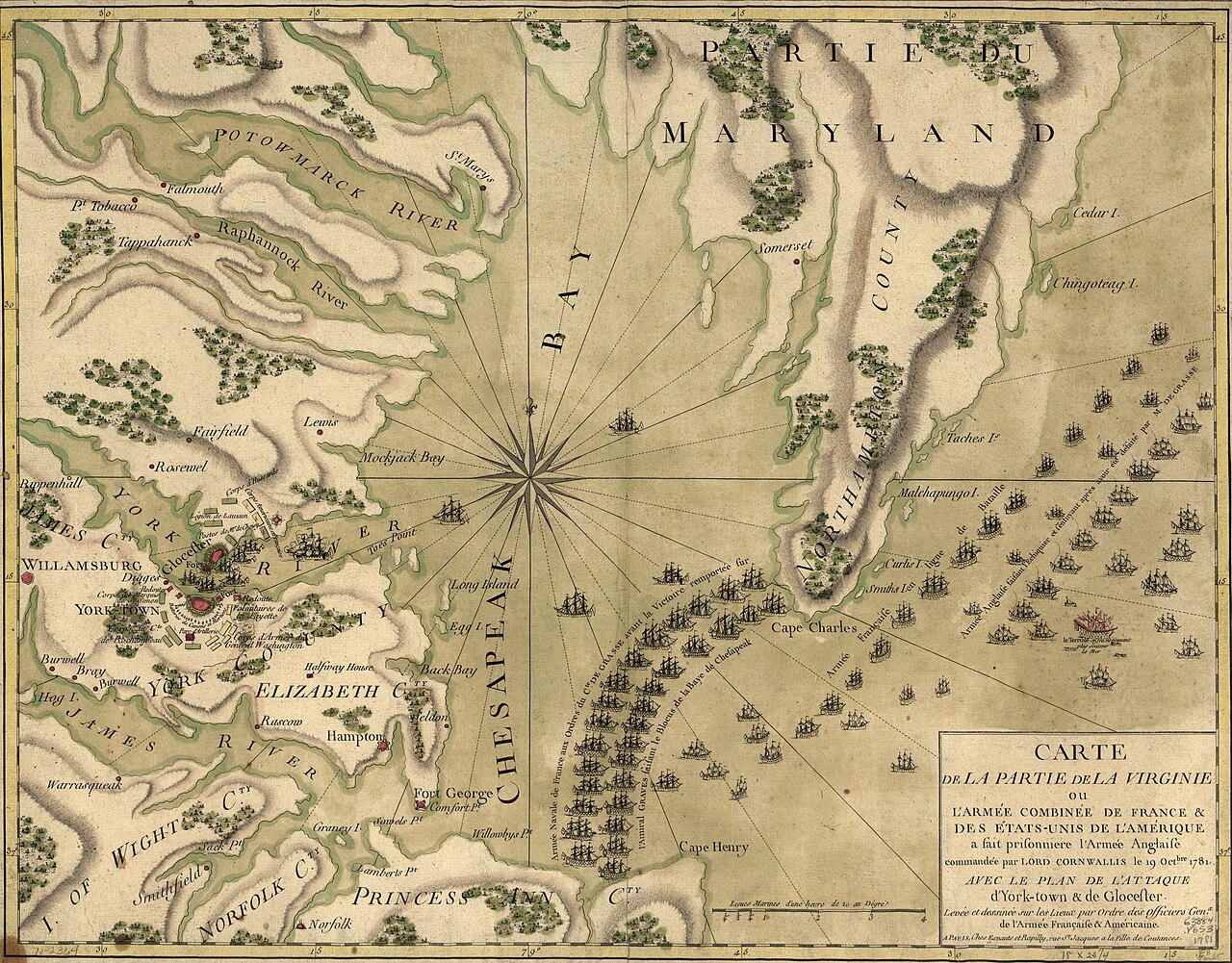
Hand-colored 1781 map of the Chesapeake Bay and Virginia coast, titled 'Carte de la partie de la Virginie', with place names, rivers, hachured land relief, a compass rose, and fleets drawn as ships in the bay and off Cape Charles and Cape Henry.Document

Primary source

Map of Virginia Showing Where the British Army Was Captured, 1781

Esnauts et Rapilly · 1781

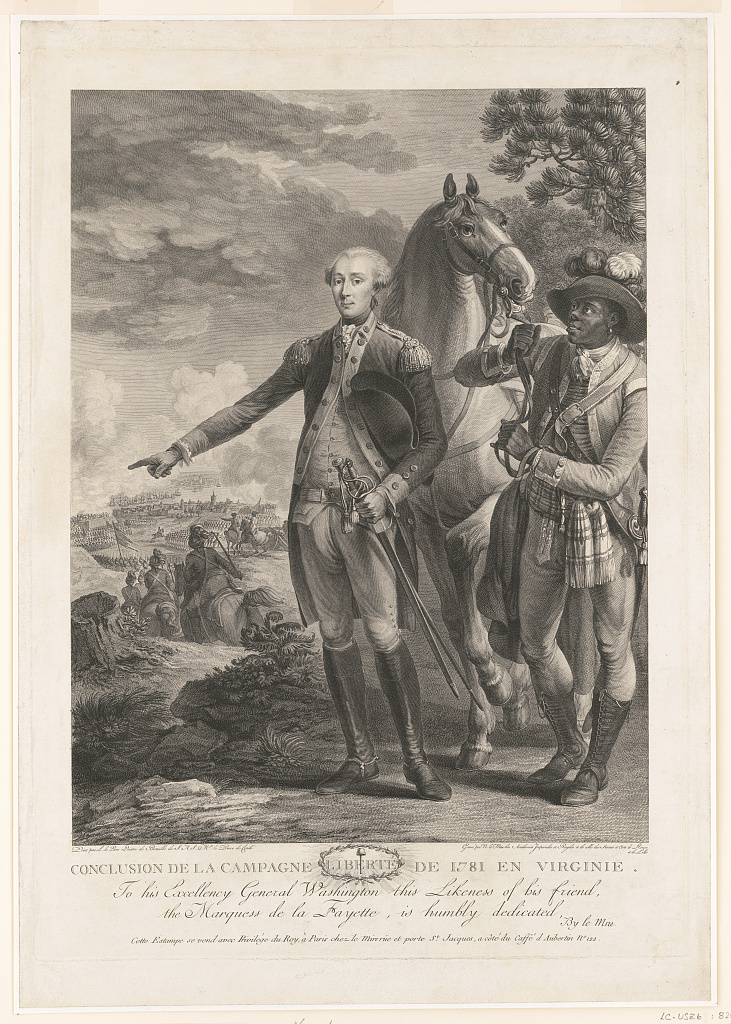
Engraved print titled 'Conclusion de la campagne de 1781 en Virginie.' Standing man in military uniform points left toward distant troops; beside him a horse and a Black man in a feathered hat and military coat. Trees at right, battle scene at left.Painting

Primary source

Conclusion de la campagne de 1781 en Virginie (Washington Dedication)

Noël Le Mire, after Jean-Baptiste Le Paon · c. 1781-1785

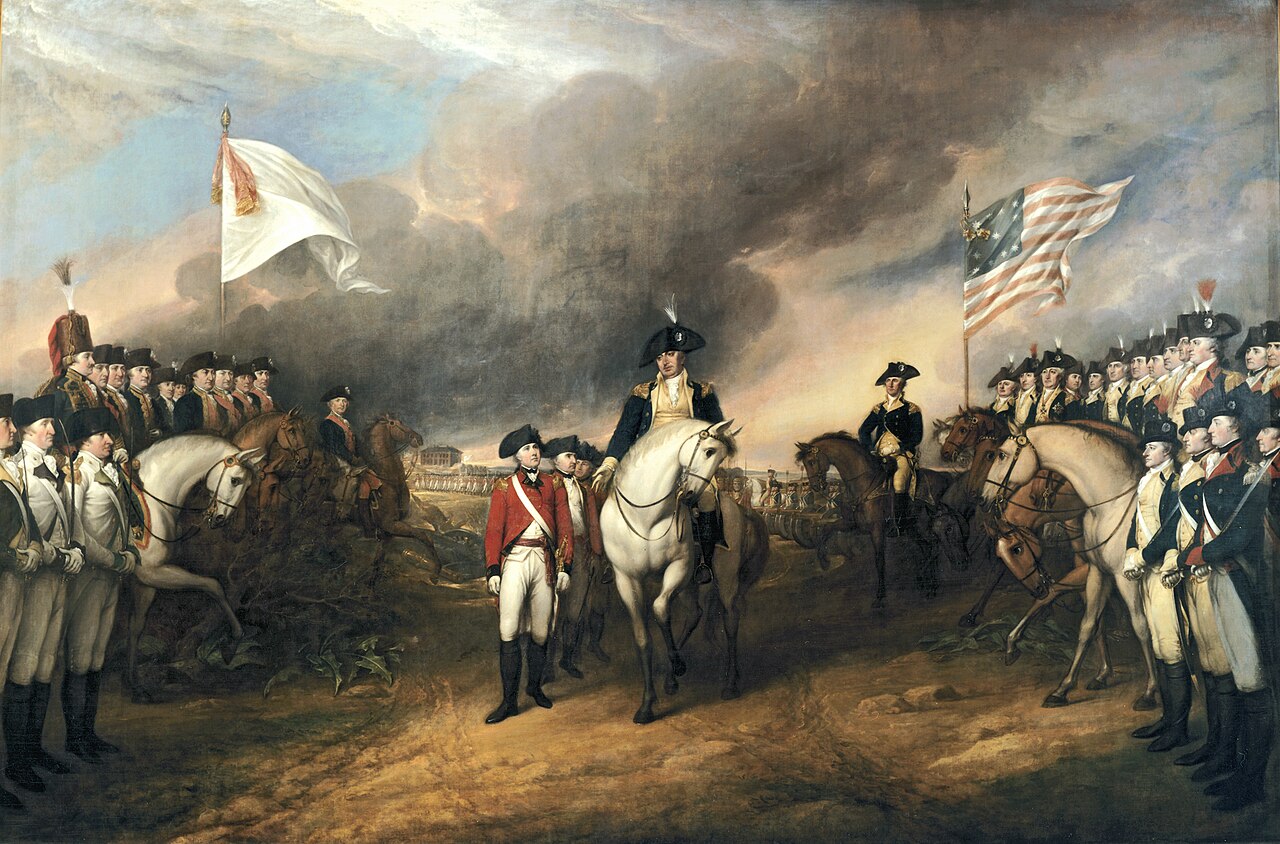
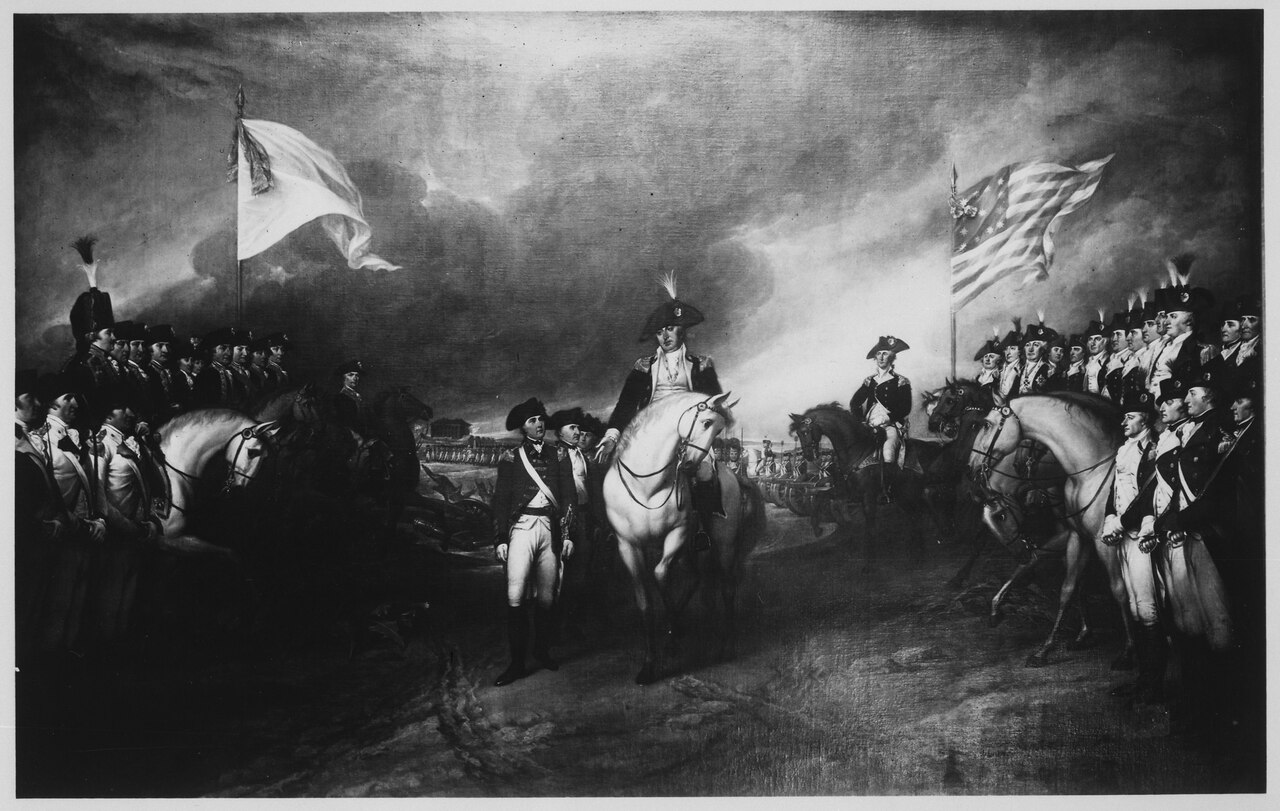
Large painting of a battlefield scene with a grey, stormy sky. On the left, British redcoat troops stand in lines beside a white flag. On the right, American troops in blue and buff stand beside a striped flag. In the center, a mounted commander on a white horse, with a figure in red uniform walking in front, faces the lines.Painting

Secondary source

Surrender of Lord Cornwallis

John Trumbull · 1819

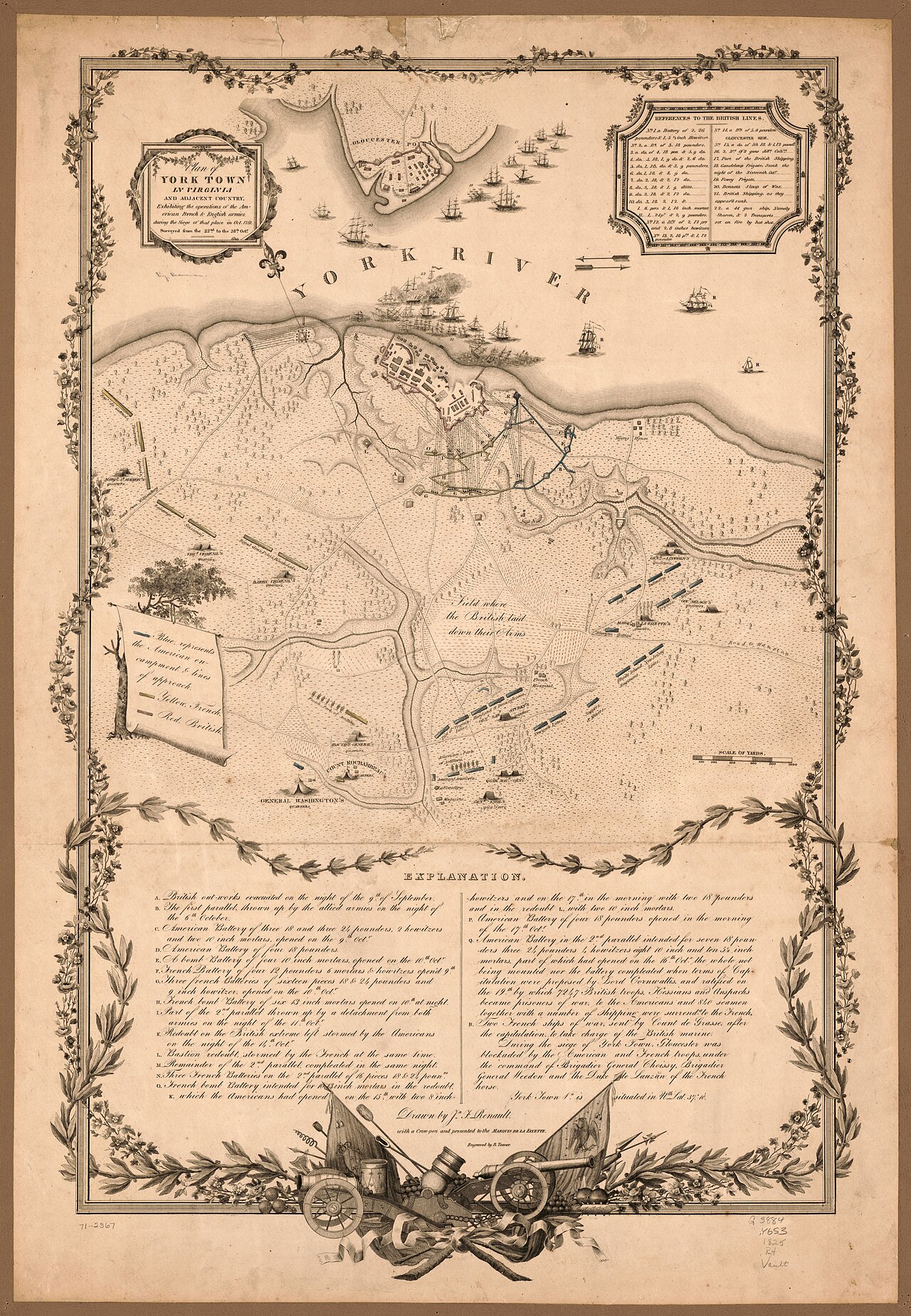
Antique hand-colored engraved map titled Plan of York Town in Virginia, showing York River, Gloucester Point, siege lines, ships, and fortifications, with decorative border, legend, explanation text, and a cannon illustration at the bottom.Document

Secondary source

Plan of York Town Showing Siege Operations, Renault and Tanner, 1825

John Francis Renault and Benjamin Tanner · 1825

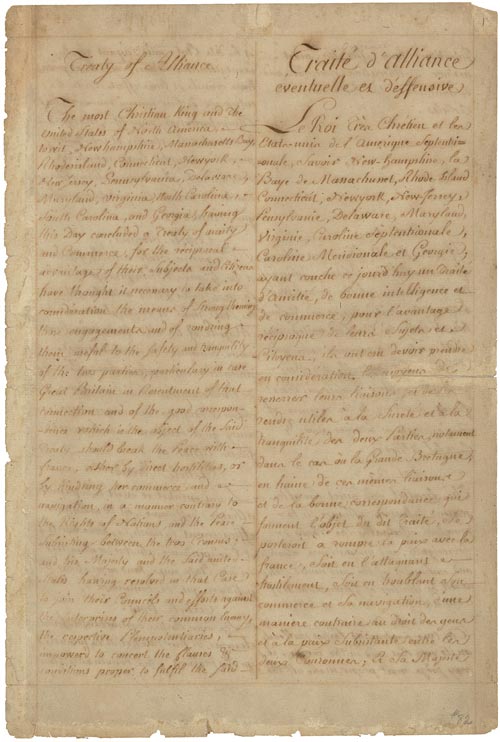
Scan of a handwritten two-column manuscript on aged, browned paper. The left column is in English under the heading 'Treaty of Alliance', and the right column is in French under 'Traité d'alliance eventuelle et défensive'. The text opens by naming the Most Christian King and the United States of North America.Document

Primary source

Treaty of Alliance with France

6 February 1778

Book

Primary source

Memoirs, Correspondence and Manuscripts of General Lafayette

Marquis de Lafayette · 1837 (published)

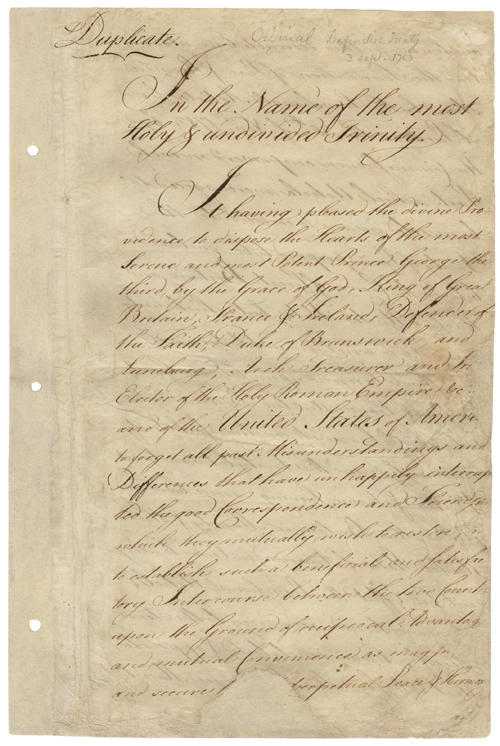
Scan of a handwritten manuscript page headed 'Duplicate' with the calligraphic opening 'In the Name of the most Holy & undivided Trinity' and a preamble naming King George the Third and the United States of America.Document

Primary source

Treaty of Paris

3 September 1783

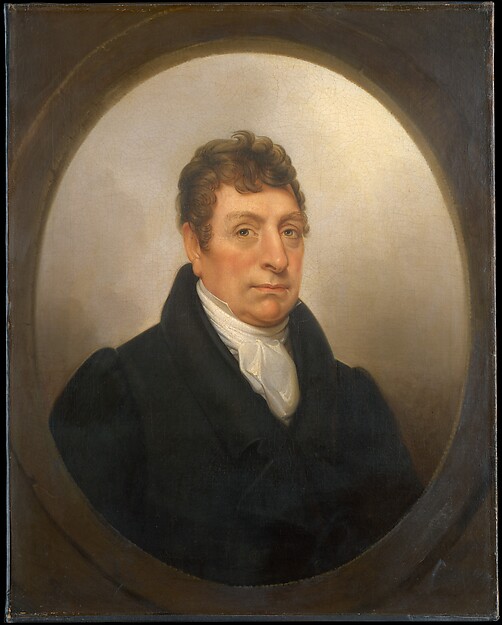
Oval portrait of a man with curly brown hair, wearing a dark high-collared coat and white cravat, set against a pale gray background within a dark brown frame border.Painting

Primary source

The Marquis de Lafayette

Rembrandt Peale · 1825

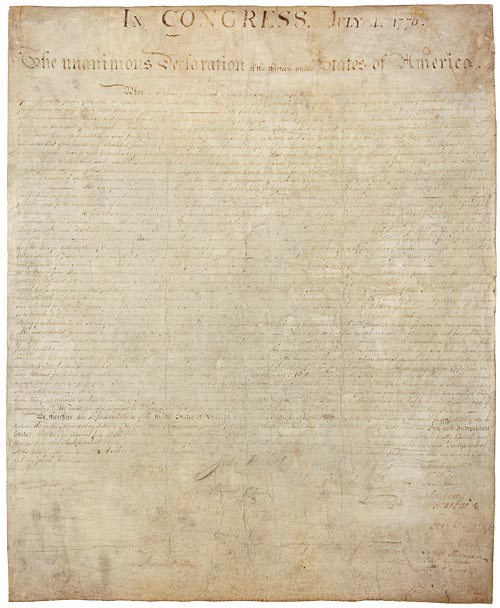
Scan of the engrossed Declaration of Independence on aged parchment. Heading reads 'In Congress, July 4, 1776' with the title 'The unanimous Declaration of the thirteen United States of America' below. Dense handwritten text fills the page; signatures appear at the bottom.Document

Primary source

Declaration of Independence

Continental Congress (drafted by Thomas Jefferson) · 1776

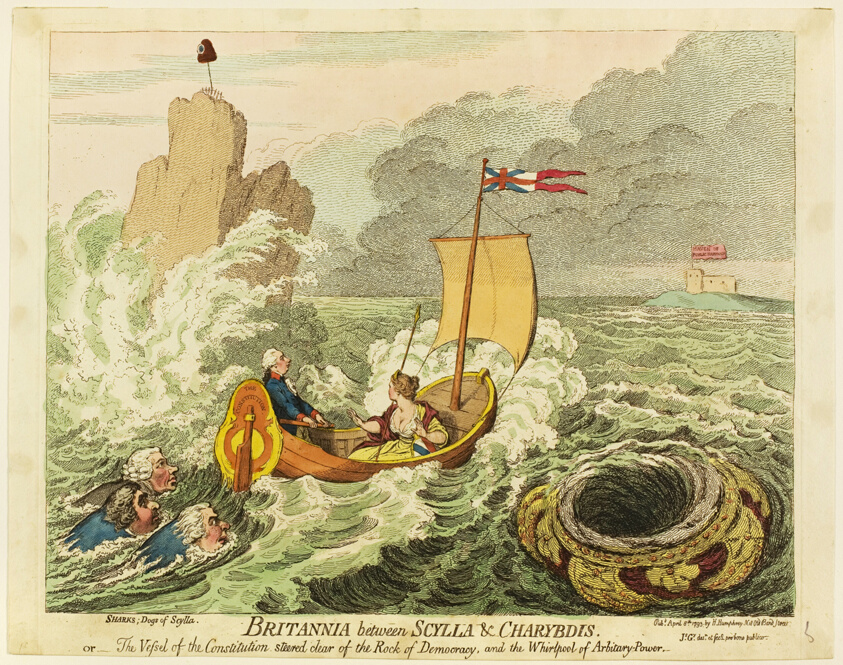
Hand-colored etching by James Gillray titled 'Britannia between Scylla & Charybdis'. A small boat with a Union flag and yellow sail carries a seated woman in red and a man in a blue coat at the thelm, steering past a rocky crag labeled with sharks and a whirlpool on the right. Three men struggle in the waves at lower left, and a fort sits on a distant island under stormy clouds.Painting

Primary source

Britannia Between Scylla and Charybdis

James Gillray · published 8 April 1793

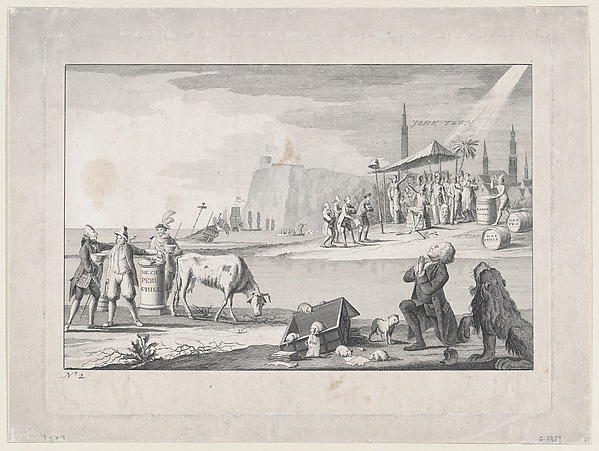
Black and white engraving of a satirical scene. On the left, two men in tricorn hats stand by a barrel labeled with text, a cow nearby. Center-right, a canopied stage with figures dancing and a flag reading 'YORK TOWN'. Bottom right, a kneeling man and a lion, with sheep and a dog in the foreground.Painting

Primary source

Yorktown

Anonymous, Dutch, 18th century · 1781

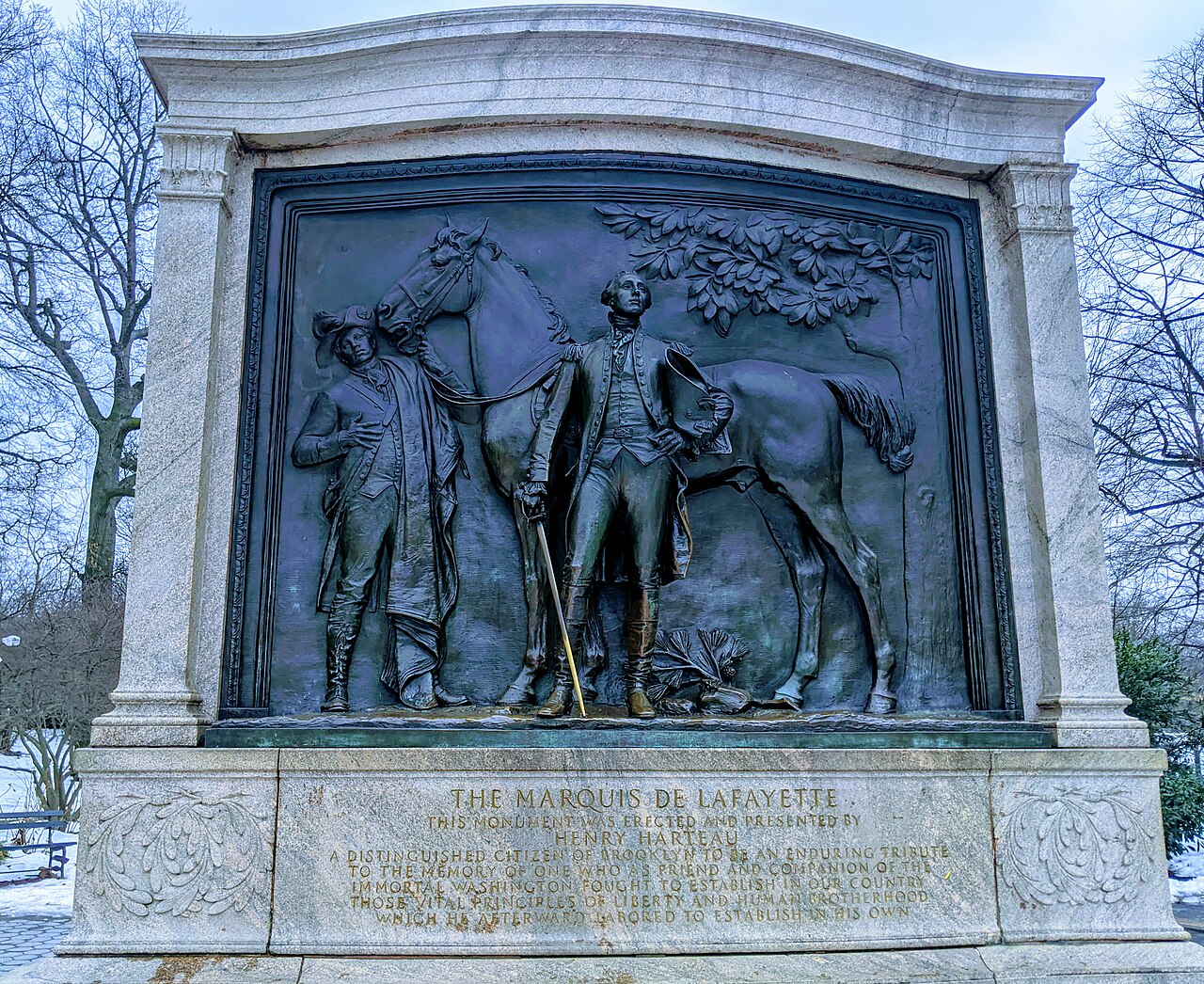
Photo of the Lafayette Monument in winter in Prospect Park: a granite monument with a bronze relief panel showing a standing uniformed man in a tricorn hat beside a horse, and a figure at left in a hat and cloak holding a horse's bridle. Inscription reads 'The Marquis de Lafayette'.Sculpture

Secondary source

Lafayette Monument, Prospect Park

Daniel Chester French

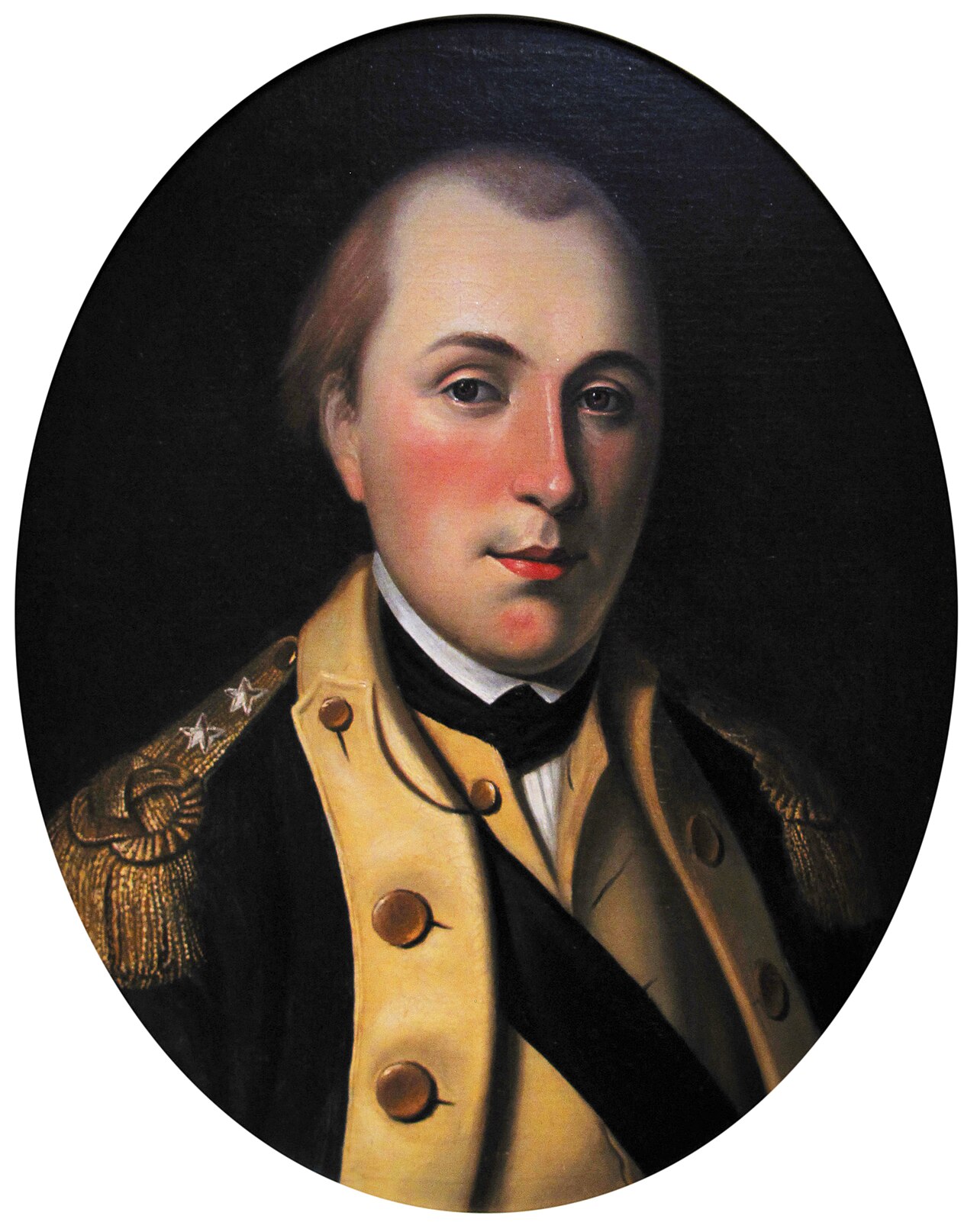
Oval oil portrait of a man with reddish hair, shown from the chest up against a dark background. He wears a yellow-buff coat with brown buttons, a black stock, a black sash across his chest, and a gold epaulette with silver stars on his shoulder.Painting

Primary source

Portrait of Lafayette

Charles Willson Peale · c. 1780

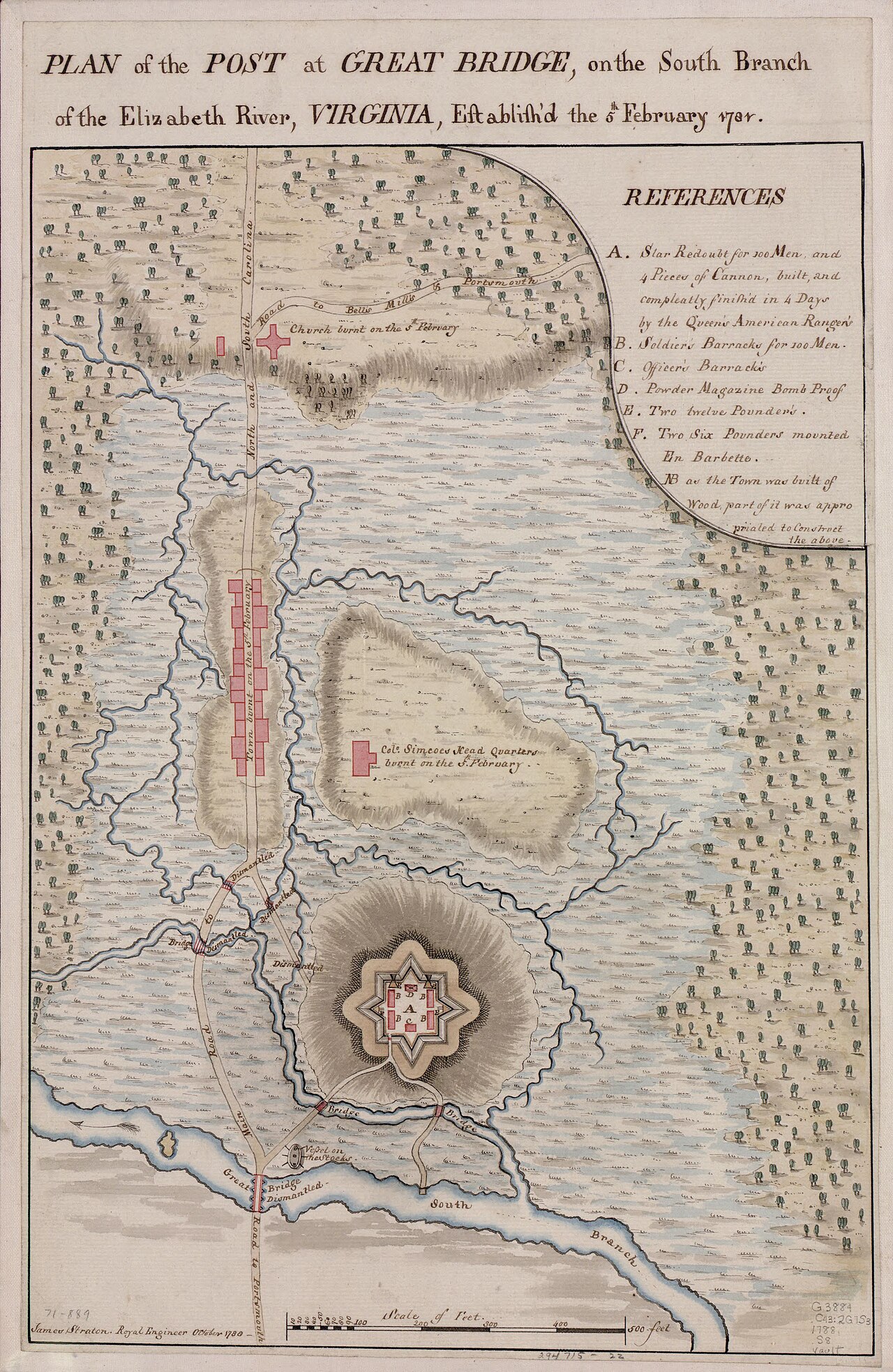
Hand-drawn manuscript map titled Plan of the Post at Great Bridge on the South Branch of the Elizabeth River, Virginia, with pen-and-ink and watercolor. It shows a star-shaped redoubt, rows of buildings, a road, bridges, the river, and a references key on the upper right. Signed James Stratton, Royal Engineer, October 1780.Document

Primary source

Plan of the Post at Great Bridge, Virginia

James Stratton · 1781

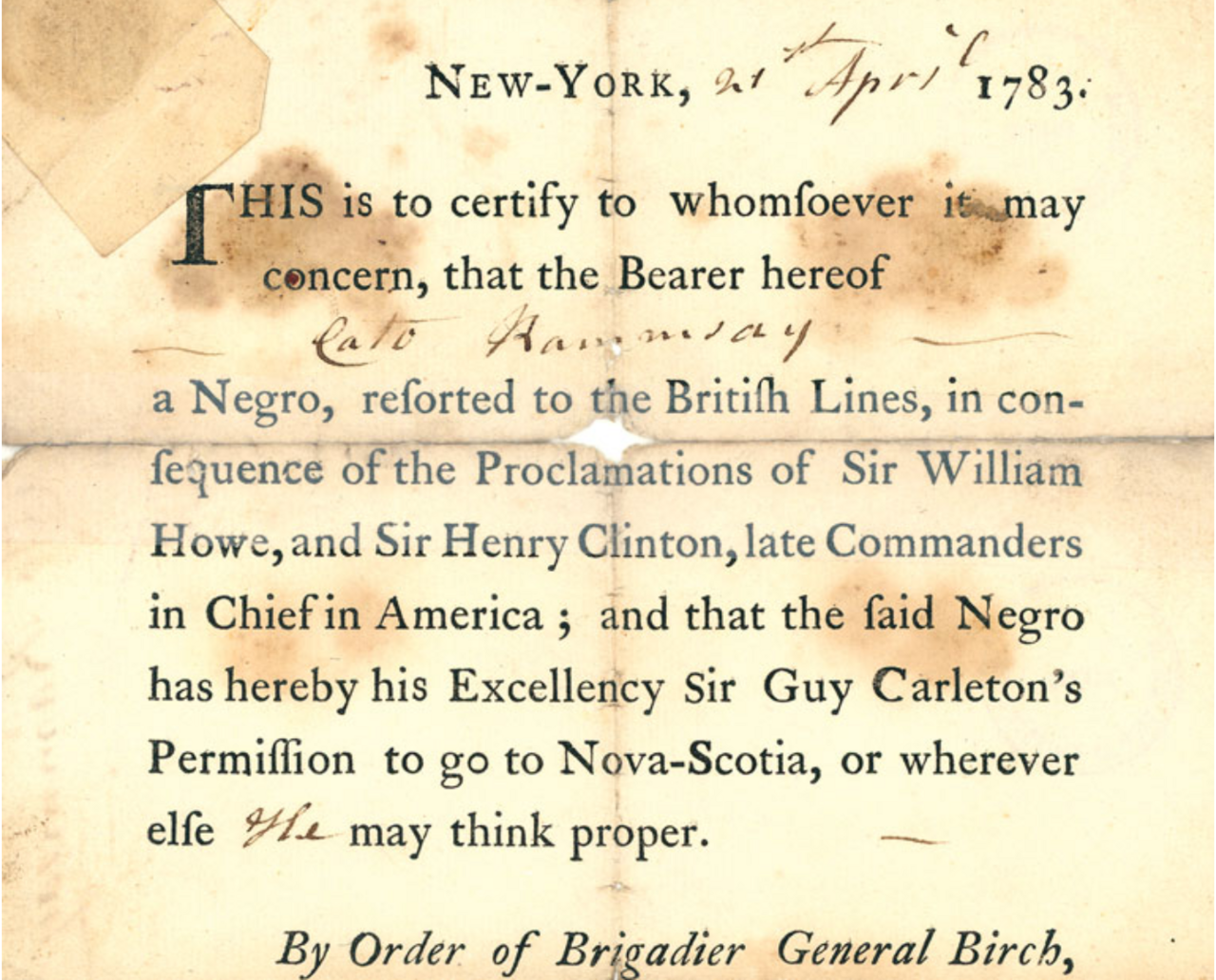
Aged printed certificate dated New York, 21 April 1783, with handwritten name Cato Hannasay. It states the bearer resorted to the British lines and has permission to go to Nova Scotia. Signed by order of Brigadier General Birch.Document

Primary source

Book of Negroes

Samuel Birch · 1783

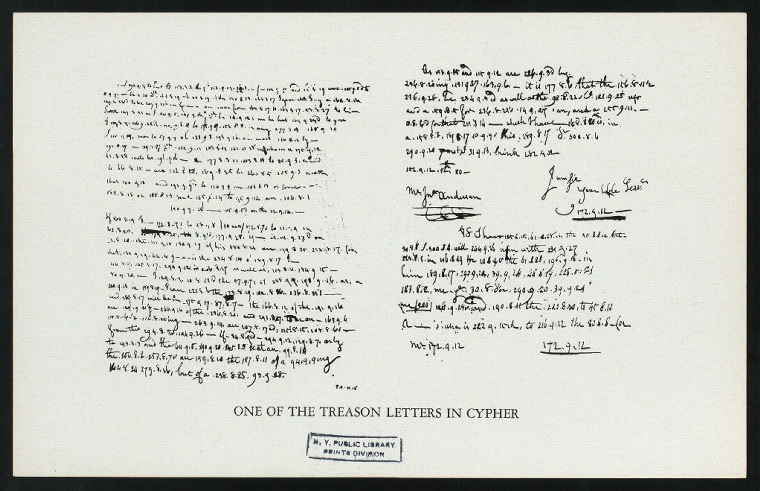
Printed reproduction of a handwritten page of cipher text on cream paper, with two columns of coded symbols and numbers, signatures at lower right, and the caption 'One of the Treason Letters in Cypher' beneath. A New York Public Library stamp appears at bottom.Letter

Primary source

Arnold Treason Cipher Letter

Benedict Arnold; Peggy Shippen Arnold · 1780

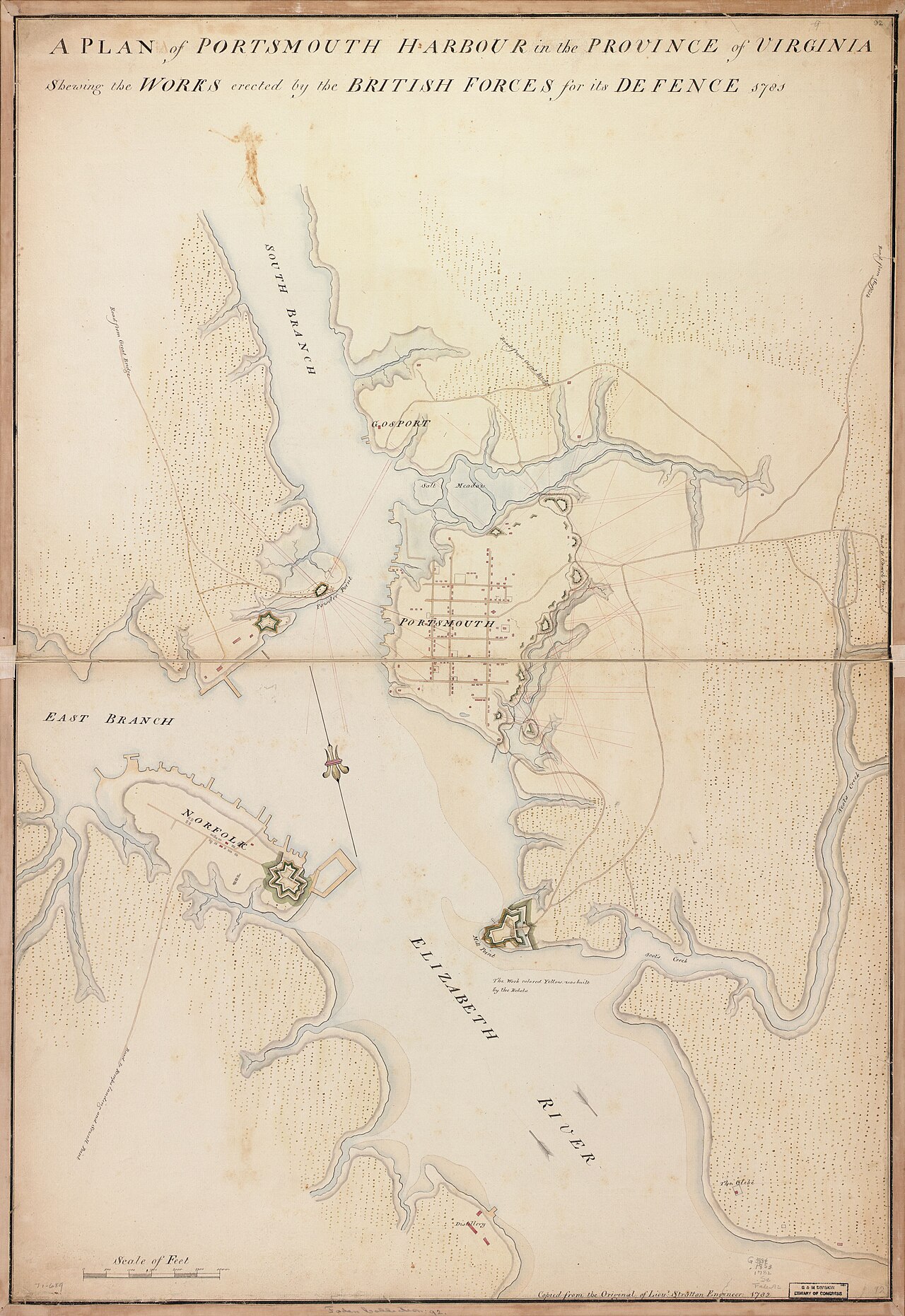
Hand-drawn manuscript map titled 'A Plan of Portsmouth Harbour in the Province of Virginia, Shewing the Works erected by the British Forces for its Defence 1781'. It shows the South and East Branches, the town of Portsmouth, Gosport, Norfolk, and Elizabeth River, with fortifications, roads, and dotted marsh areas in brown ink and watercolor on aged paper.Document

Primary source

Plan of Portsmouth Harbour

James Stratton · 1782

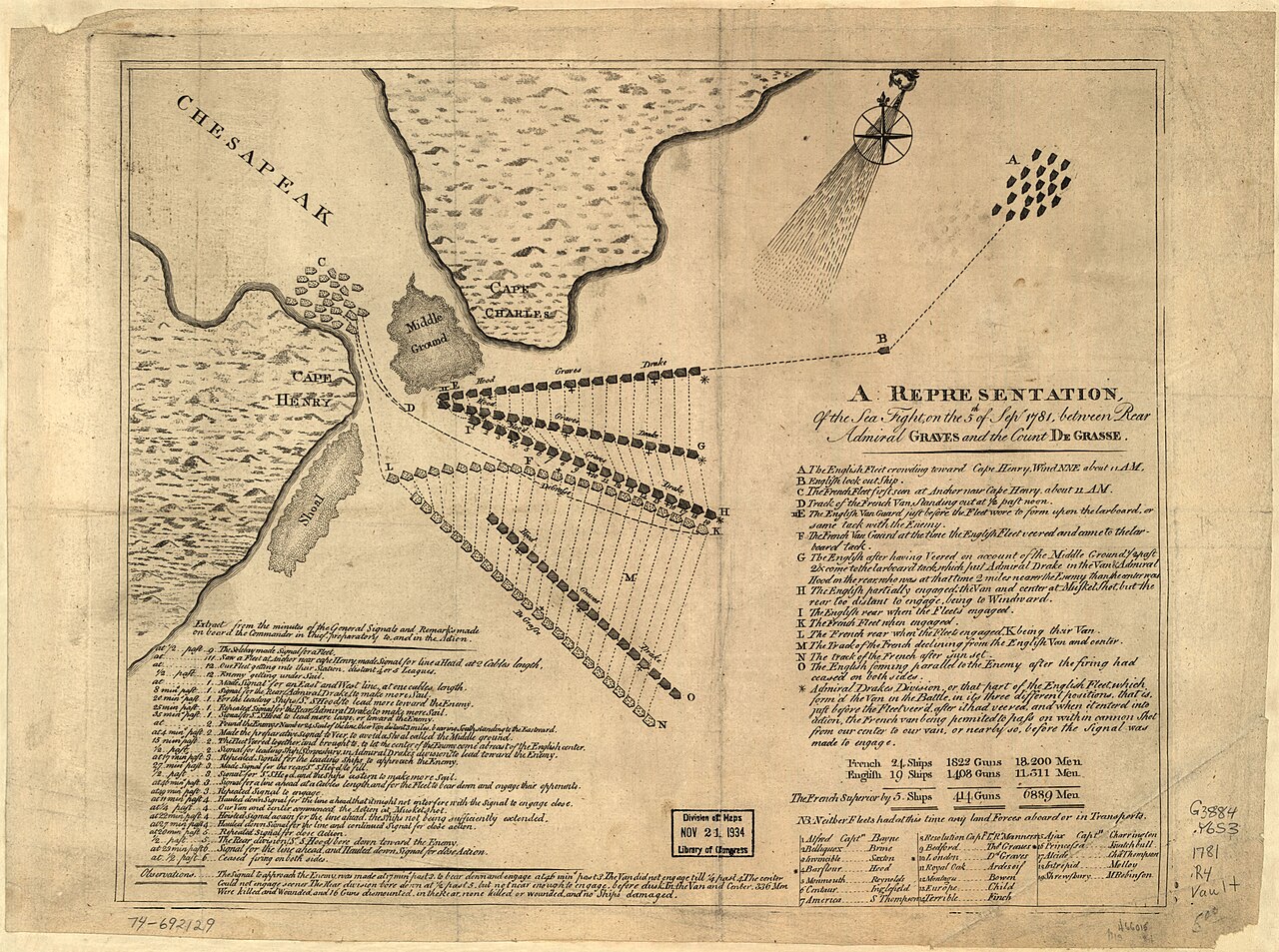
Engraved battle map titled 'A Representation of the Sea Fight on the 5th of Sept 1781 between Rear Admiral Graves and the Count De Grasse.' It shows Chesapeake Bay, Cape Henry and Cape Charles, fleet positions as rows of ship symbols, a compass rose, dashed movement lines, a lettered key, and a Library of Congress stamp.Document

Primary source

Sea fight between Graves and de Grasse, 5 September 1781

1781

Diary entry

Primary source

Lafayette in America in 1824 and 1825, vol. 1

Auguste Levasseur · 1829 (covering 1824-1825)

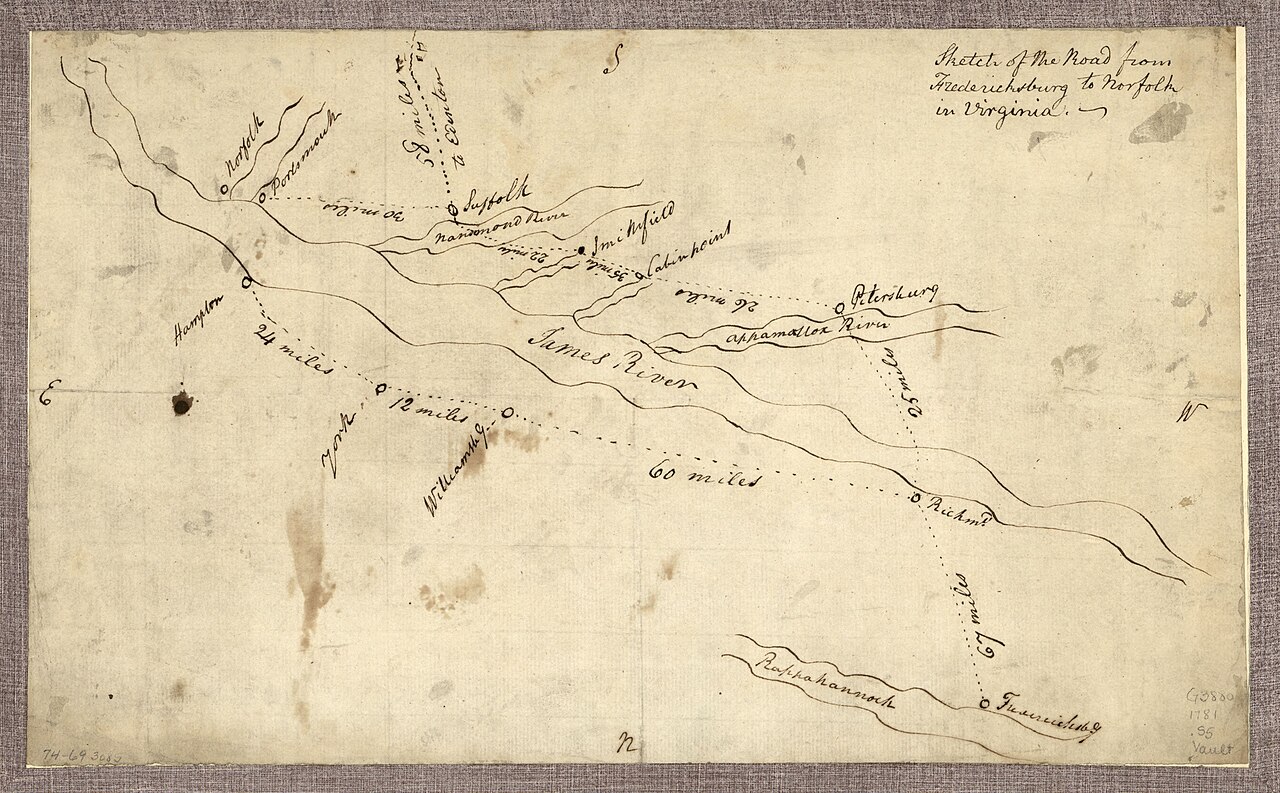
Hand-drawn pen-and-ink sketch map titled 'Sketch of the road from Fredericksburg to Norfolk in Virginia' on aged paper. It shows rivers including James River and Appomattox River, towns like Petersburg, Richmond, Williamsburg, York, Hampton, and Norfolk, with mileage notes and a dotted route line. North is at the bottom.Document

Primary source

Sketch of the road from Fredericksburg to Norfolk, Virginia

1781

Book

Secondary source

Encyclopedia of Virginia Biography, Volume 1

Lyon Gardiner Tyler · 1915

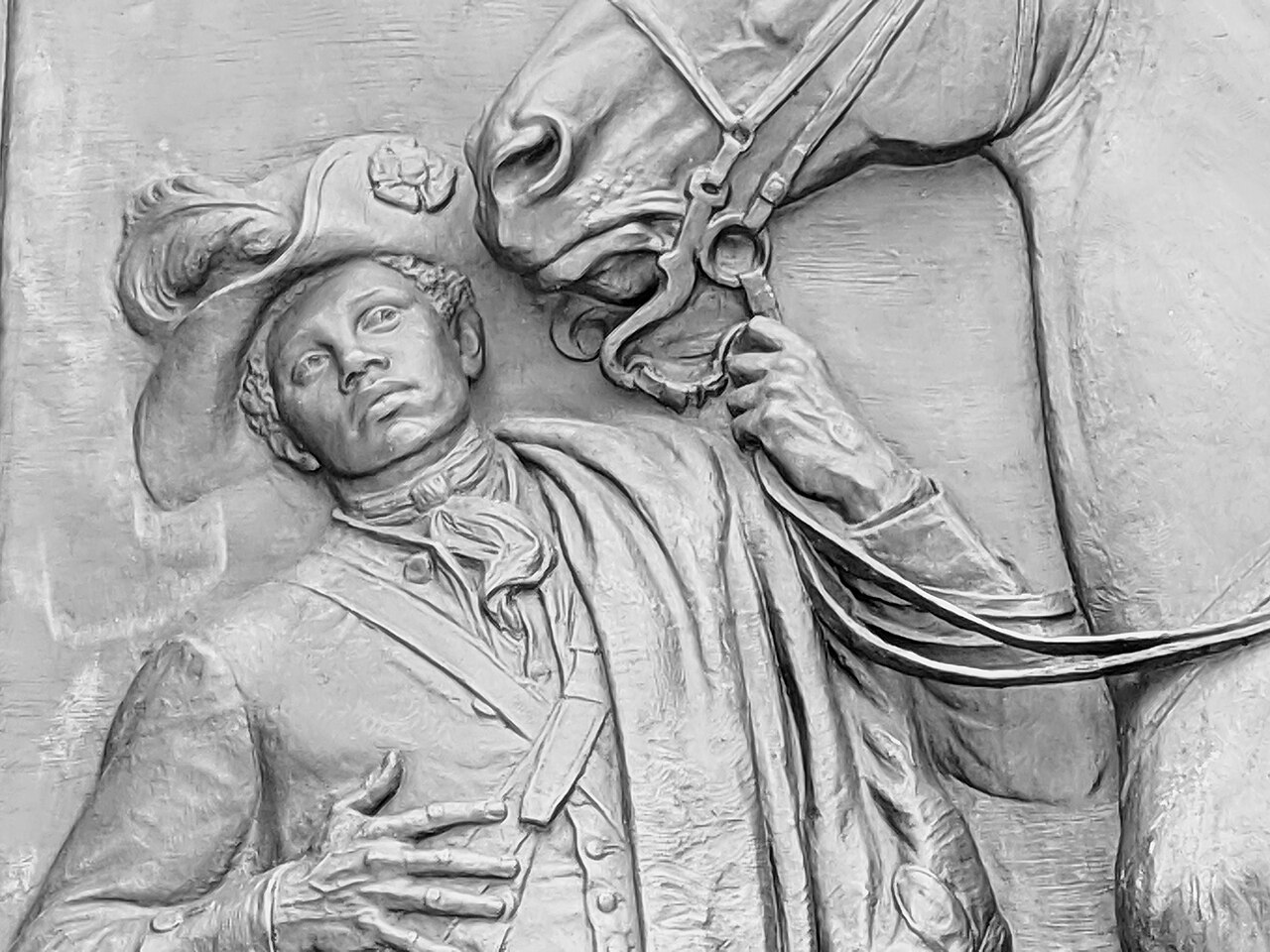
Black-and-white close-up of a bronze relief sculpture of a man in a tricorn hat with a plume, holding a horse's bridle with one hand and resting the other hand on his chest. A horse's head appears behind him.Sculpture

Secondary source

James Armistead Lafayette Figure on the Lafayette Monument

CaptJayRuffins · photographed 2021 (monument created later)

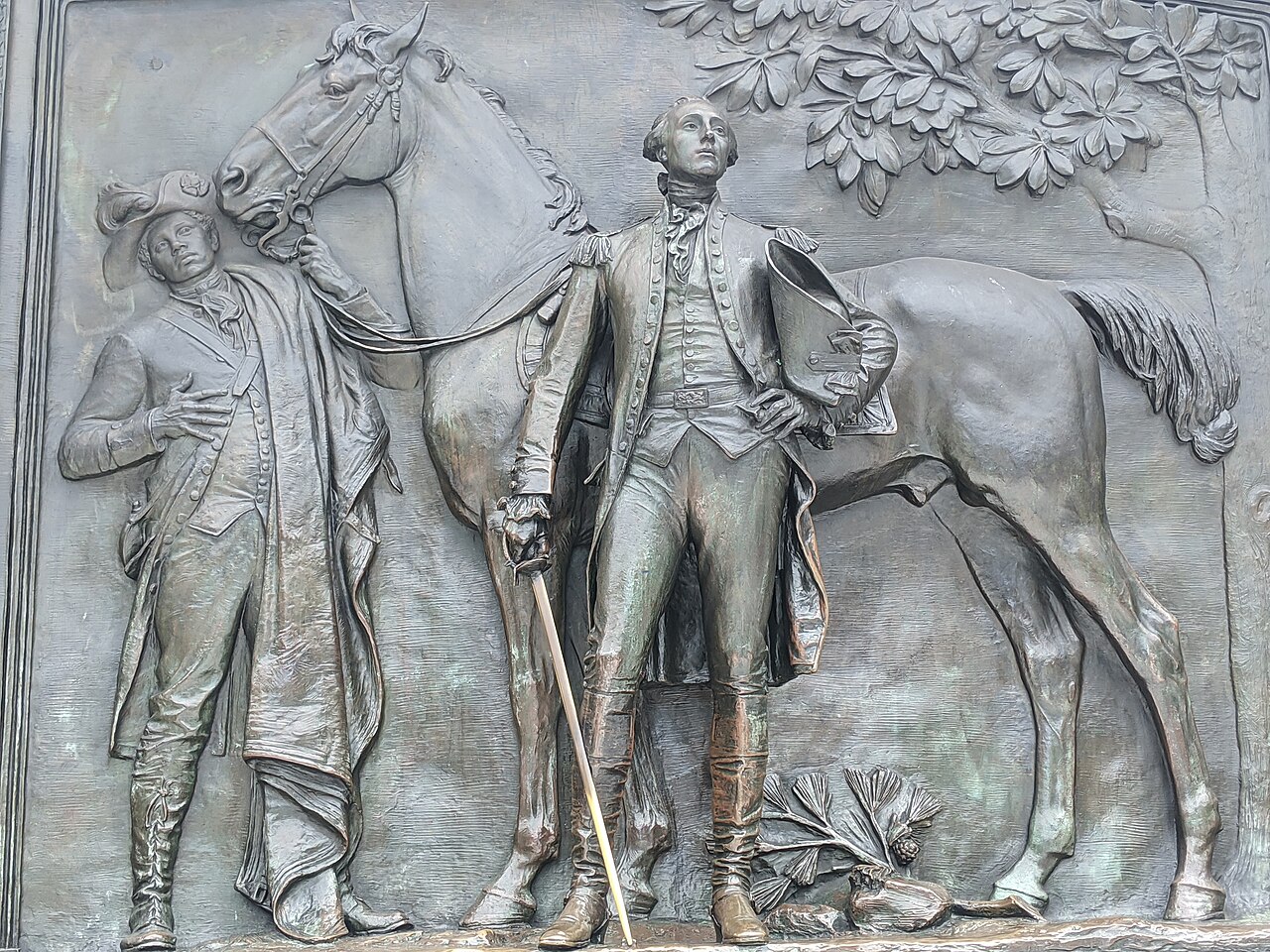
Bronze relief sculpture of two standing men beside a horse. On the left, a man in a tricorn hat holds the horse's bridle with one hand and rests his other hand on his chest. On the right, a man in a military coat and tricorn hat stands with a sword, his hand on his hip, while a tree with leaves and a small plant appear at the top and bottom.Sculpture

Secondary source

James Armistead Lafayette and Marquis de Lafayette on the Monument

CaptJayRuffins · photographed 2021 (monument created later)

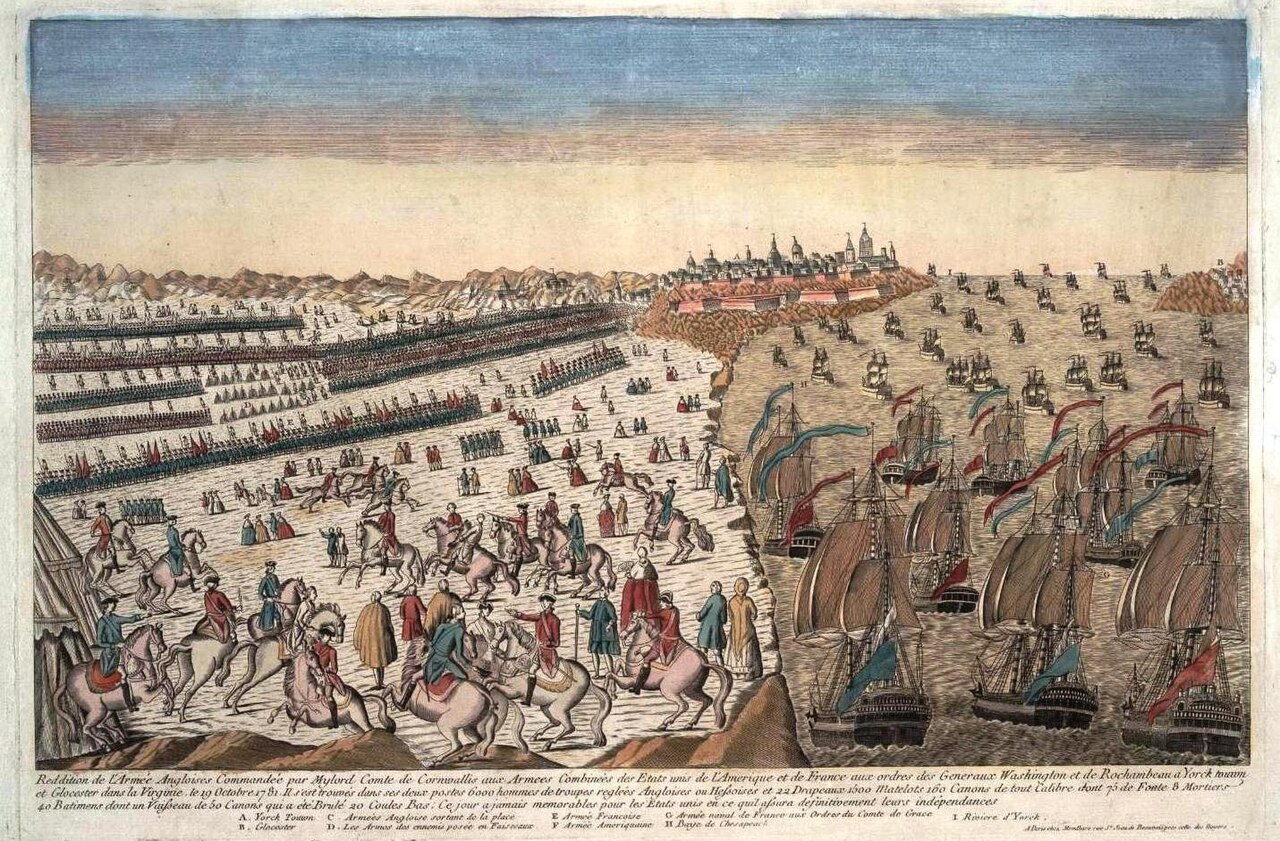
Hand-colored 18th-century engraving of the surrender at Yorktown. Left: lines of red-coated and blue-coated troops with horsemen and officers in the foreground. Right: a harbor filled with tall-masted sailing ships with flags. A town with spires sits on the distant shore. A caption runs along the bottom.Painting

Primary source

Reddition de l'armée anglaise à Yorktown

Artiste inconnu · 1781

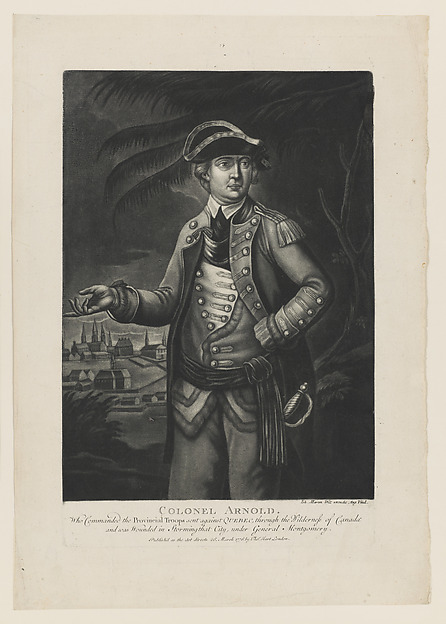
Mezzotint portrait print of a man in a tricorn hat and military uniform with double-breasted buttoned coat, epaulette, and sword, standing before a town skyline and dark trees. Title engraved in capitals below the image, with explanatory text beneath it.Painting

Primary source

Colonel Arnold, Who Commanded the Provincial Troops Sent against Quebec

Thomas Hart · 26 March 1776

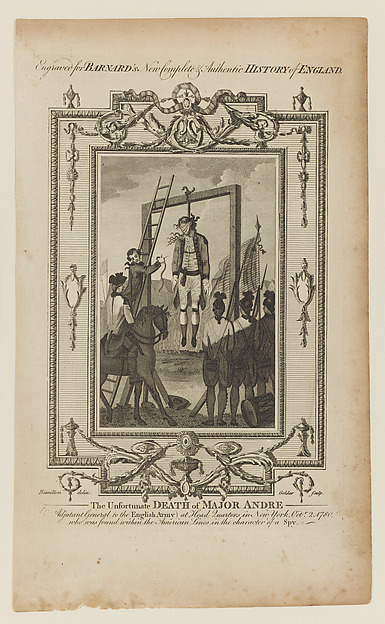
Engraved print titled 'The Unfortunate Death of Major André' framed by ornamental borders, with a caption reading 'Adjutant General to the English Army at Head Quarters, New York, Oct 2, 1780, who was found within the American Lines in the character of a Spy.' Central scene shows a hanged man on a gallows-like frame, with a ladder leaning against it, and a crowd of soldiers with rifles and a flag on the right. Engraver credits appear at the bottom corners. Title band at top reads 'Engraved for Barnard's New Complete & Authentic History of England.'Painting

Primary source

The Unfortunate Death of Major André

Jabez Goldar · 1782

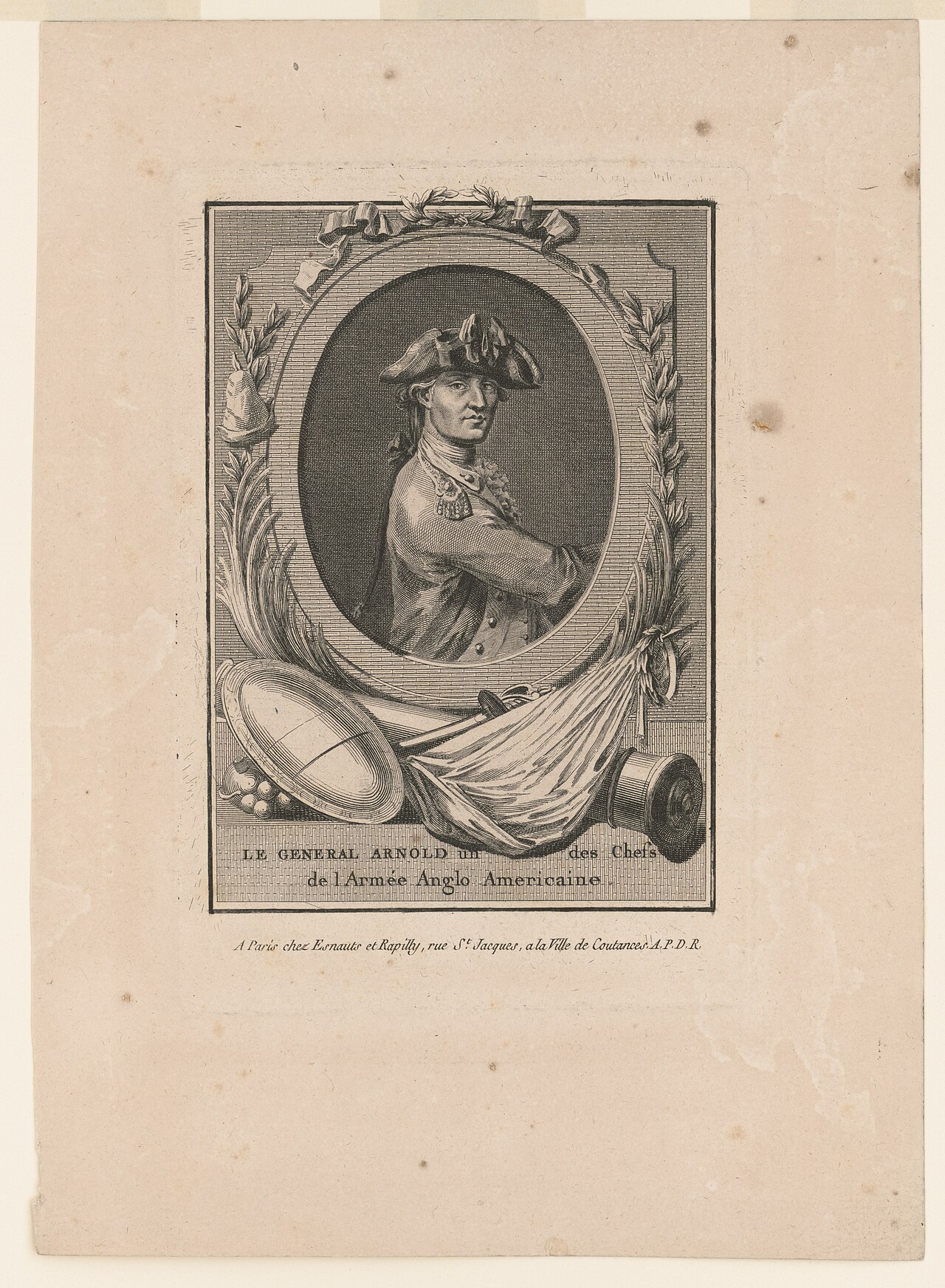
Engraved print of a half-length portrait of a man in an oval frame, wearing a tricorn hat with decorative trim and a military-style coat with ornamental buttons and lace. Below the oval is a caption reading 'Le General Arnold' and a publisher line. Around the frame are laurel branches, a drum, a flag, and a cannon.Painting

Primary source

Le General Arnold

c. 1770-1780

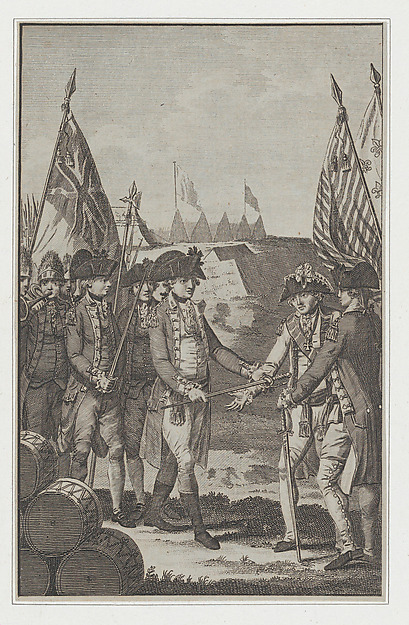
Engraving of the surrender at Yorktown: a British officer in a cocked hat hands a sword to an American officer in a tricorn hat, while uniformed soldiers stand in line with flags and tents behind them, barrels in the foreground.Painting

Secondary source

The Surrender of Earl Cornwallis to General Washington and Count De Rochambeau

T. Thornton · 1781-1783 or 1791

Surrender of CornwallisPainting

Secondary source

Surrender of Cornwallis

between 1899 and 1932

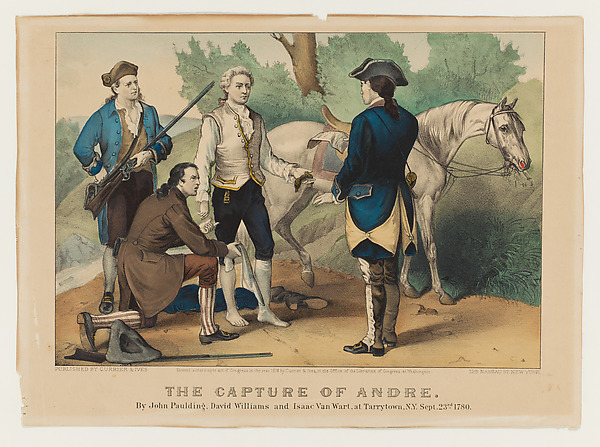
Color lithograph titled 'The Capture of Andre'. Three men in 18th-century dress surround a seated man who is pulling off a boot; a fourth man in a dark blue coat and tricorn hat stands at right beside a gray horse. Trees and a hillside are behind them, and a rifle leans against a tree at left. Printed caption text runs along the bottom.Painting

Secondary source

The Capture of André at Tarrytown

Currier & Ives · 1876

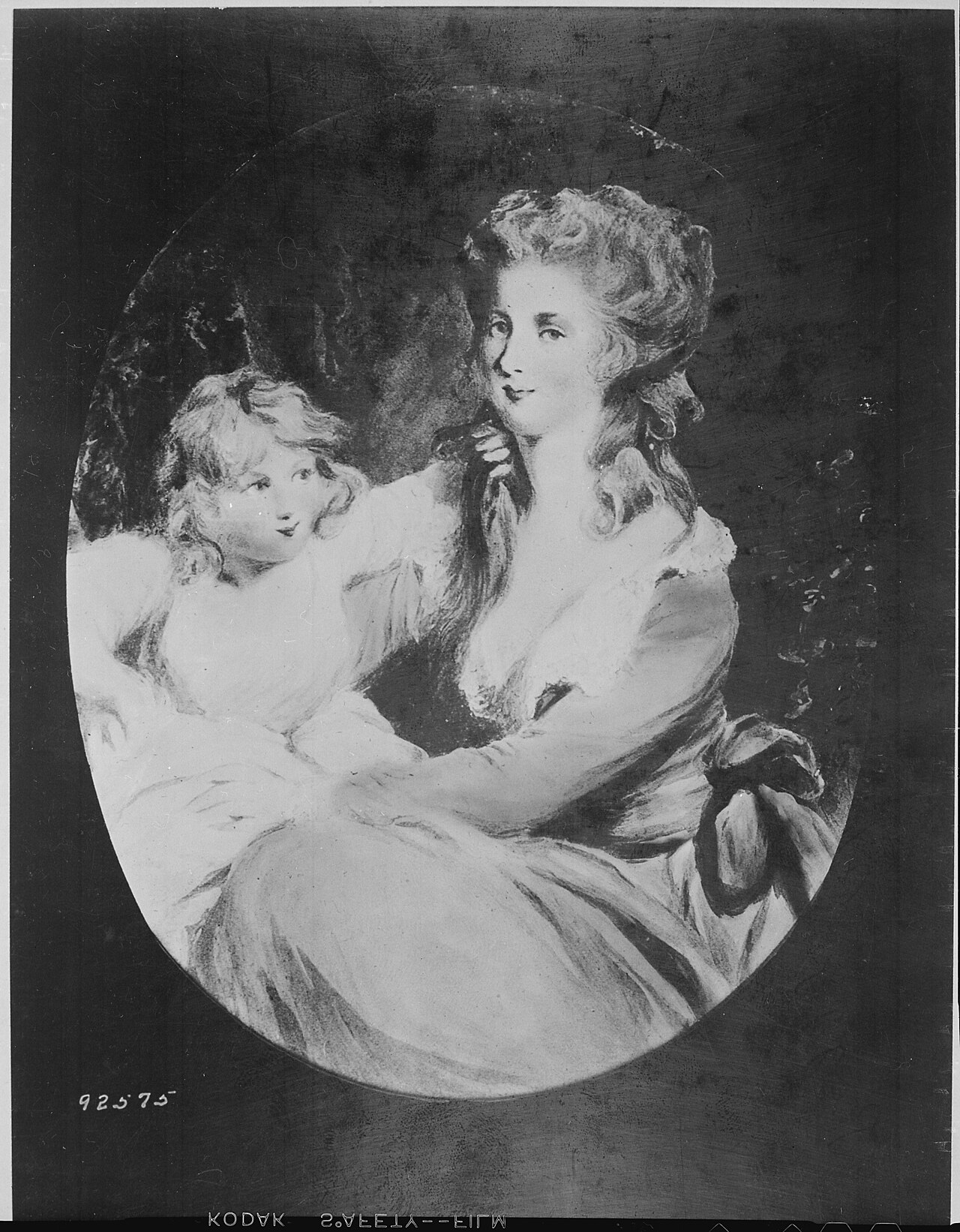
Black-and-white photographic reproduction of an oval painting: a woman with upswept curled hair in a low-cut gown sits turned toward the viewer, holding a child with curly hair who gazes out beside her. A film edge and catalog number appear at the bottom.Painting

Primary source

Portrait of Mrs. Benedict Arnold (Peggy Shippen) and Child

Daniel Gardner · c. 1783–1789

Memoirs of the War in the Southern Department of the United StatesBook

Primary source

Memoirs of the War in the Southern Department of the United States

Henry Lee · 1812

Book

Secondary source

The Campaign in Virginia, 1781

Benjamin Franklin Stevens · 1888

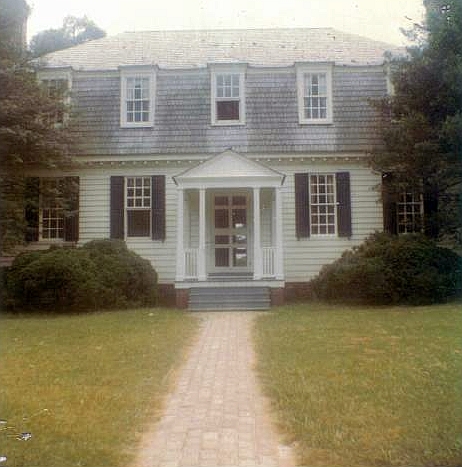
Color photograph of a two-story white clapboard colonial house with gray shingled roof, dormer windows, dark shutters, and a central pediment porch with a brick path leading up to the entrance across a grassy lawn.Photograph

Secondary source

House Where Cornwallis Surrendered to Washington, 1971 Photograph

Billy Hathorn · July 1971

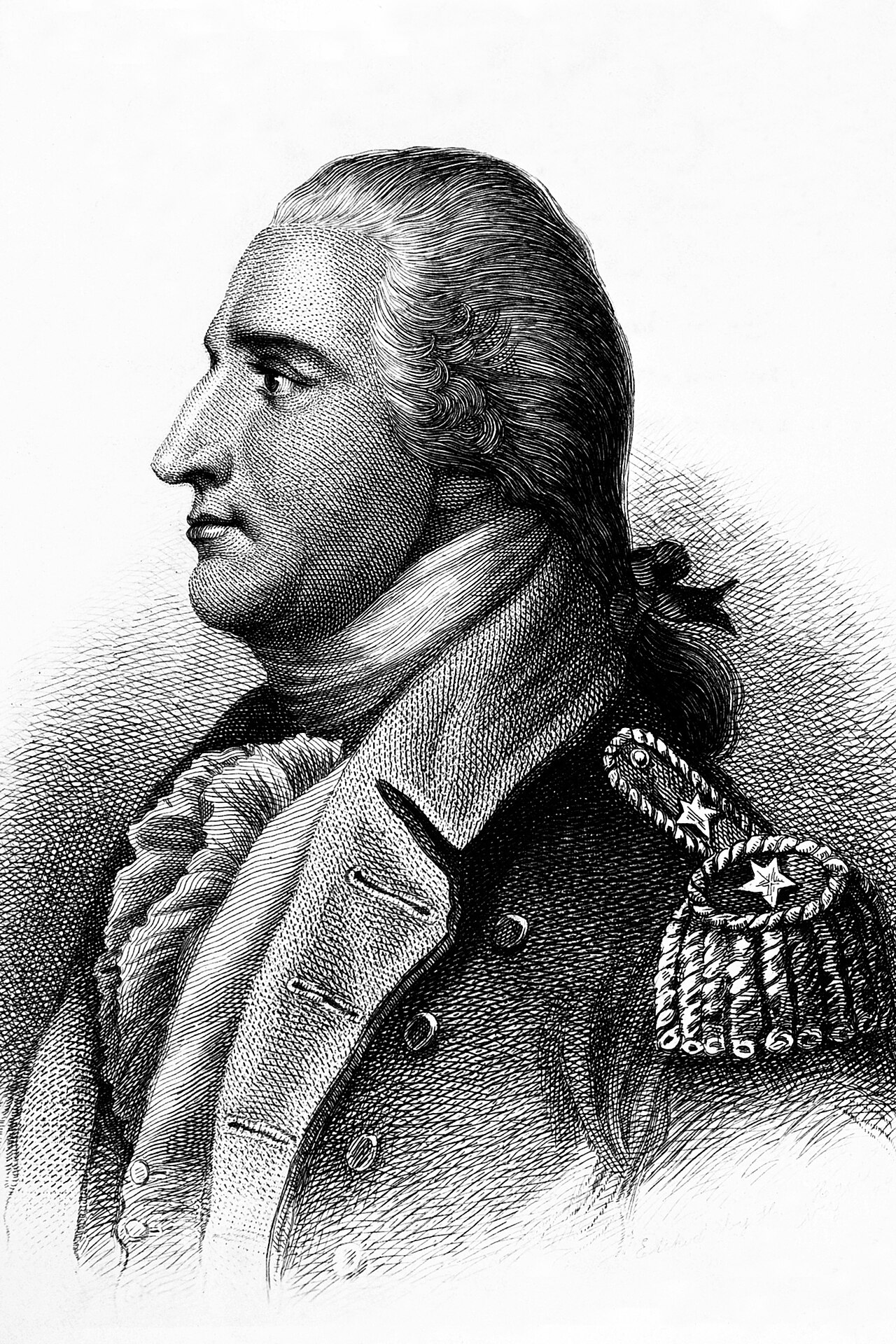
Black and white engraving in profile facing left of a man with powdered hair tied back, wearing a high cravat, a military coat with epaulettes bearing star insignia, and a ruffled shirt front.Painting

Secondary source

Benedict Arnold Illustration

Henry Bryan Hall, after John Trumbull

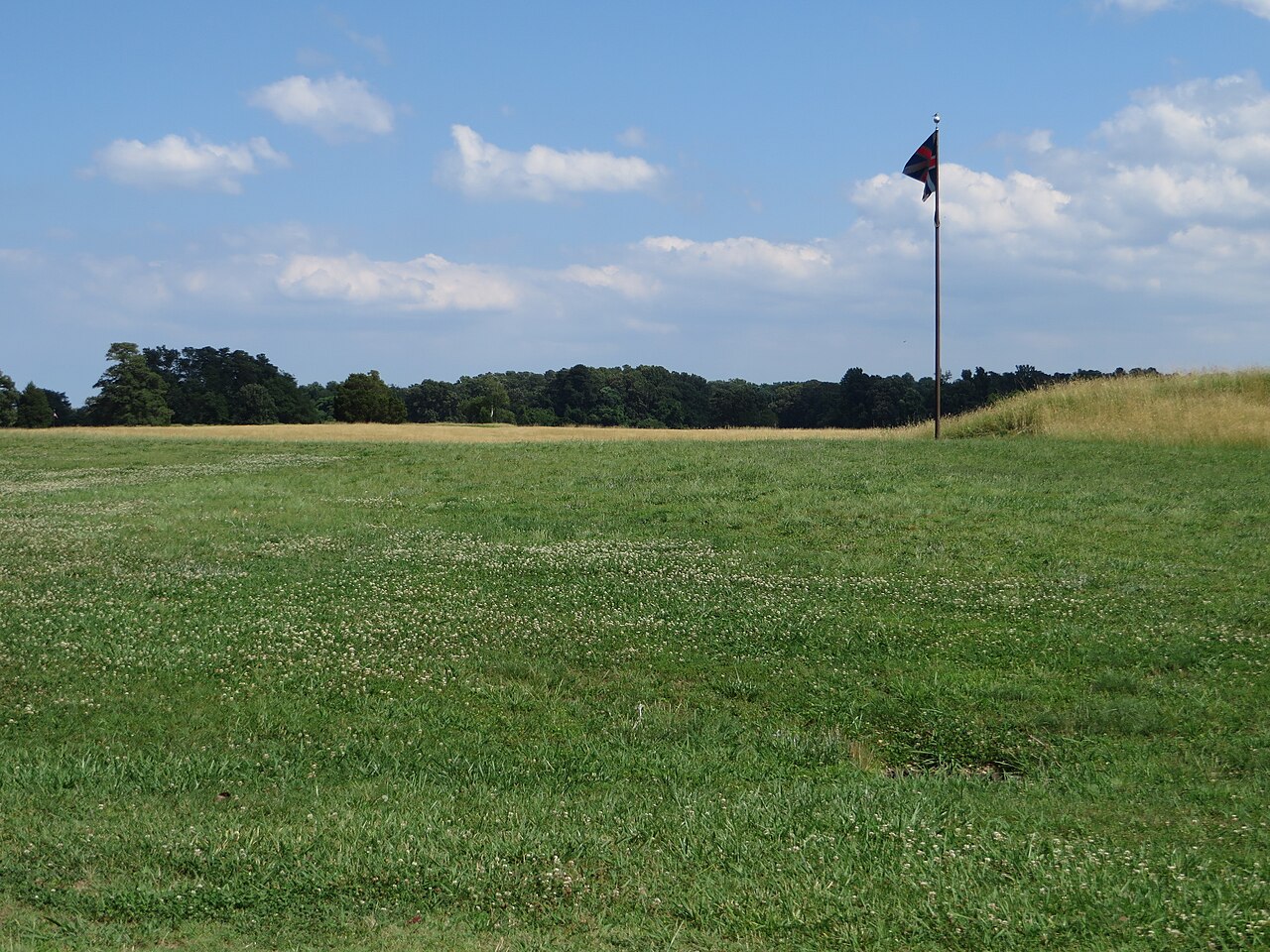
A wide grassy field with scattered white clover under a partly cloudy blue sky. A line of dense green trees lies in the distance. On the right, a flagpole flies a small dark flag with red markings atop a grassy earthen rise.Photograph

Secondary source

British Inner Defense Lines at Yorktown Battlefield

Ken Lund · 14 June 2014

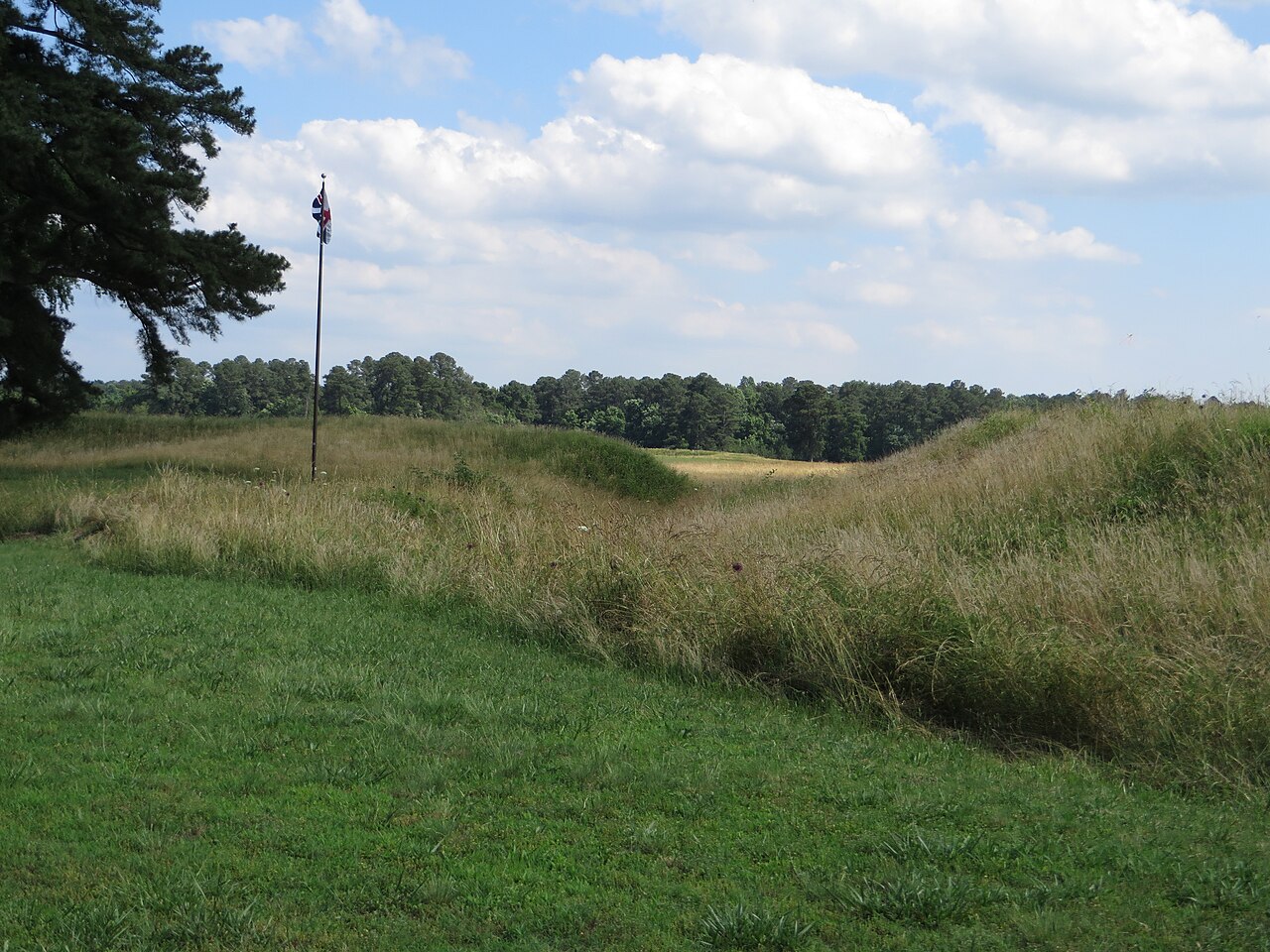
Grassy earthwork defensive lines at Yorktown battlefield under a partly cloudy sky, with a tall flagpole flying a small flag on the left, a large pine tree at the left edge, and tree line in the distance.Photograph

Secondary source

British Inner Defense Lines at Yorktown, Second Photograph

Ken Lund · 14 June 2014

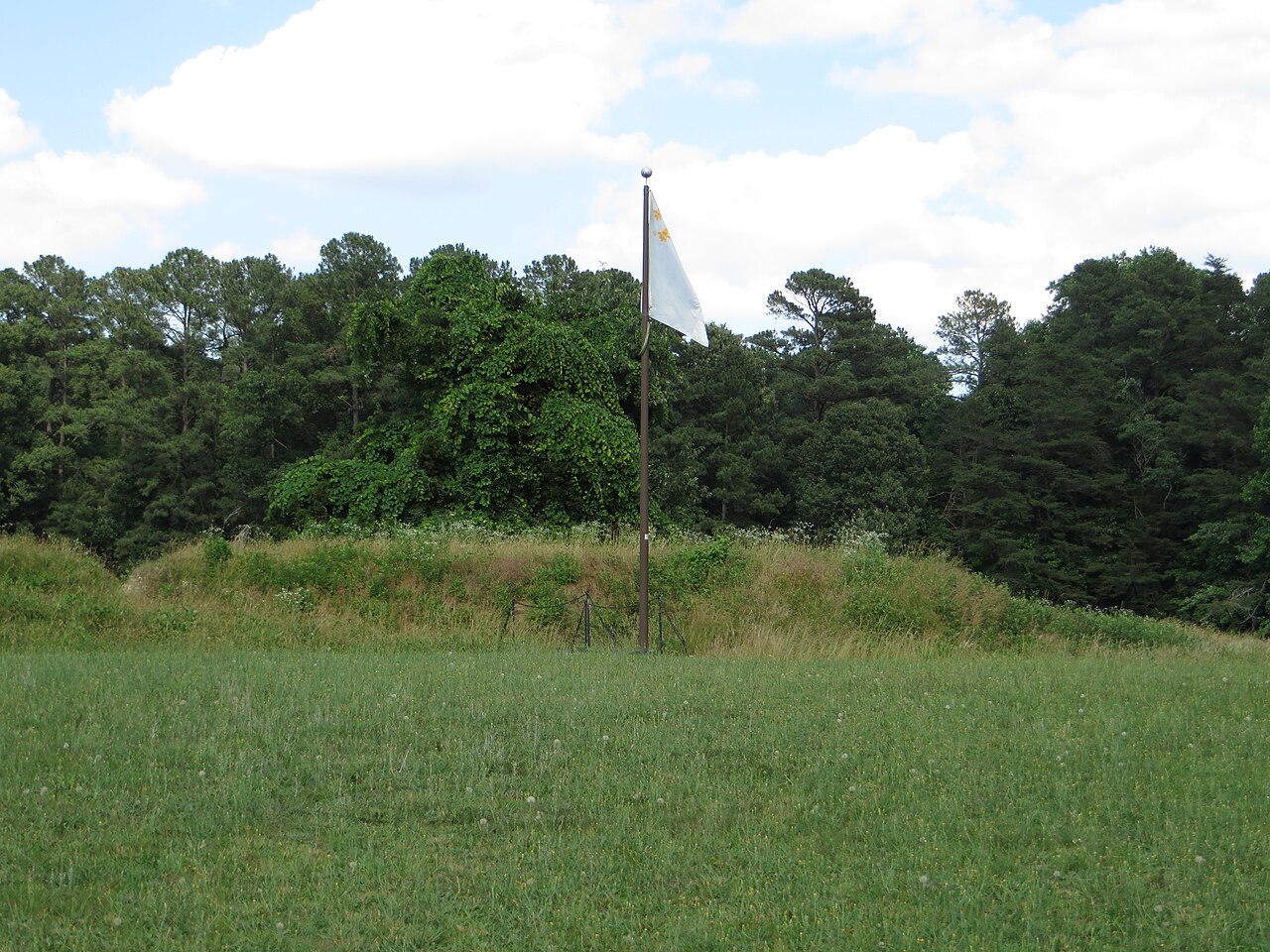
A grassy earthen siege line rises across a field at Yorktown battlefield, with dense green trees behind it. A tall flagpole stands on the grass in front, flying a white flag with small gold stars under a partly cloudy blue sky.Photograph

Secondary source

First Allied Siege Line at Yorktown Battlefield

Ken Lund · 14 June 2014

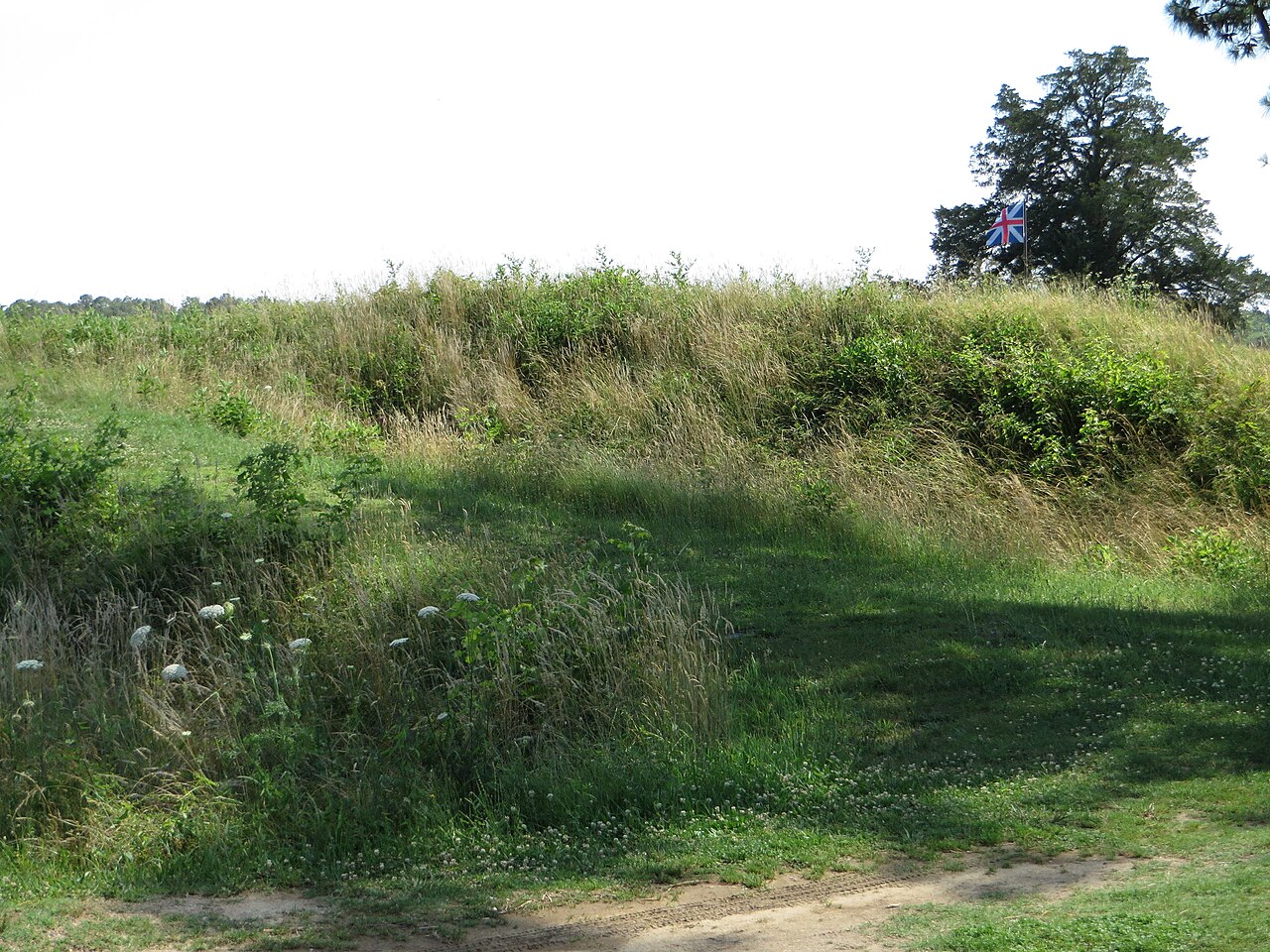
Grassy earthwork rampart at Yorktown battlefield sloping across the frame, covered in tall grass, shrubs, and white wildflowers, with a dirt path in the foreground. A small Union Jack flag flies atop a tree on the right under a pale sky.Photograph

Secondary source

British Inner Defense Lines at Yorktown, Third Photograph

Ken Lund · 14 June 2014

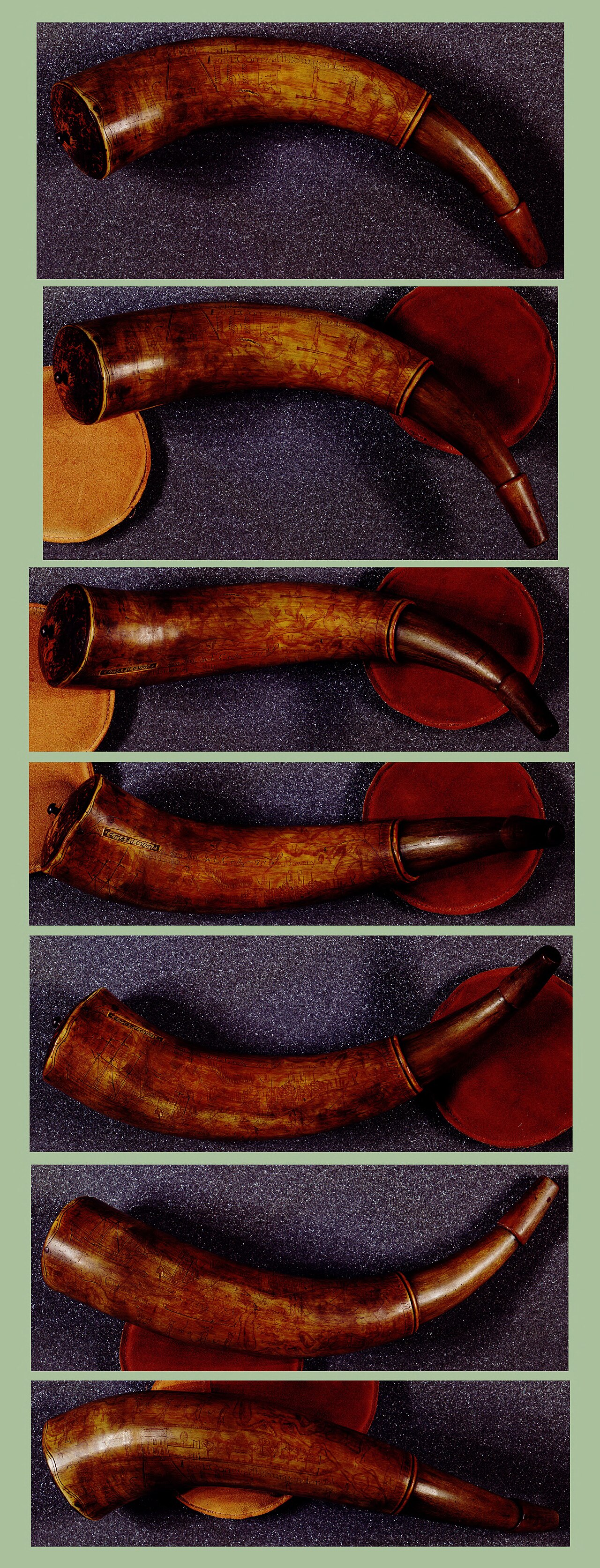
Multiple views of an engraved curved powder horn with a wooden pouring spout at the narrow end and a hinged cap at the wide end, some views resting on red and tan cloth. Engraved lines and text cover the horn's surface.Artifact

Primary source

Engraved Powder Horn Showing Yorktown and the York River

E. Crosby · 1781

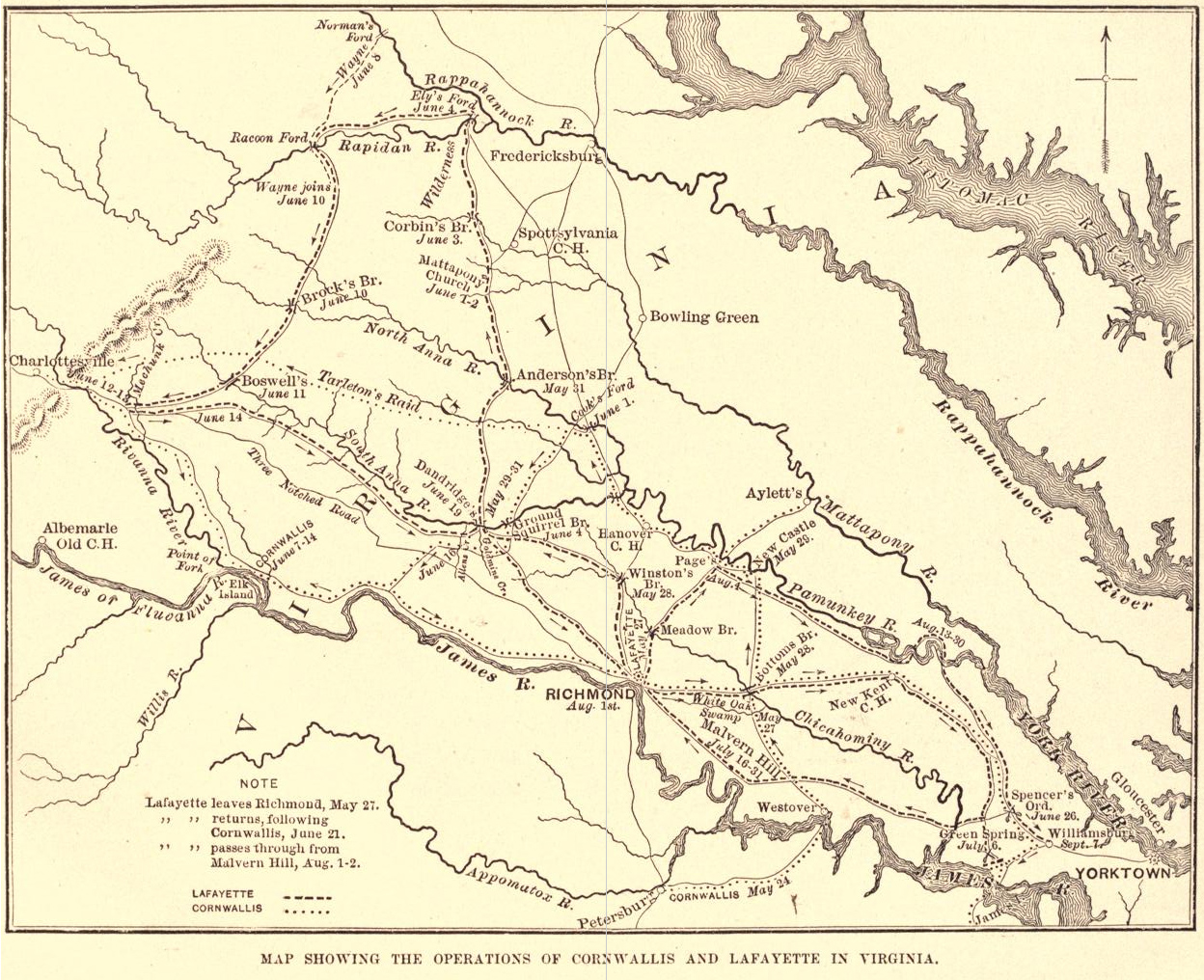
Antique engraved map of Virginia showing the operations of Cornwallis and Lafayette, with rivers including the Rappahannock, James, Pamunkey and Potomac, towns such as Richmond, Williamsburg and Yorktown, and a legend noting Lafayette's and Cornwallis's routes with dashed lines and dates from May to September 1781.Document

Secondary source

Map of the Yorktown Campaign

Henry Phelps Johnston · 1881

Want the full shelf? Chat with James Armistead Lafayette in the app and open the Sources panel — every quote links back to the original.

Use James Armistead Lafayette in class

2 collections

Ready-made collections from the Humy team that feature James Armistead Lafayette. Preview any of them, then try it free.

Trusted by educators worldwide

Conversations
375,000+
Real exchanges between students and historical figures
Messages exchanged
4,142,000+
Across every figure, classroom and language
Historical figures
100,000+
Each informed by a curated biography and selected sources
Languages supported
50+
From English and Spanish to Arabic and Korean

Paying customers

Used by 98 schools and universities

Partner school logo
Tecnológico de Monterrey logo
Hyper Island logo
Partner school logo
Chambersburg Area School District logo
Broward County Public Schools logo
Nebo School District logo
National Louis University logo
South Florida PBS logo
Punahou School logo
University of Wisconsin–River Falls logo
Partner school logo
Partner school logo
Archbishop Mitty High School logo
Kingsburg High School logo
Norwalk Public Schools logo
Partner school logo
Connections logo
Partner school logo
Moore Public Schools logo
Partner school logo
Partner school logo
Partner school logo
Partner school logo
Robbinsville Public Schools logo
Partner school logo
Partner school logo
Partner school logo
Tecnológico de Monterrey logo
Hyper Island logo
Partner school logo
Chambersburg Area School District logo
Broward County Public Schools logo
Nebo School District logo
National Louis University logo
South Florida PBS logo
Punahou School logo
University of Wisconsin–River Falls logo
Partner school logo
Partner school logo
Archbishop Mitty High School logo
Kingsburg High School logo
Norwalk Public Schools logo
Partner school logo
Connections logo
Partner school logo
Moore Public Schools logo
Partner school logo
Partner school logo
Partner school logo
Partner school logo
Robbinsville Public Schools logo
Partner school logo
Partner school logo

What educators are saying

“We enjoyed the program last year and used it frequently.”
“My students say it’s a welcome change of pace. I’m not a fan of the “sage on the stage” model, so I try to incorporate research-oriented and self-paced activities. With Humy, students have to take charge of their learning. They’ve become more adept at critical thinking, forming better questions, and improving their reading comprehension. The interview feature has been my go-to tool. I create assignments where students must ask historical figures a set number of questions, then summarize the responses to ensure they’re truly absorbing the material. This approach lets them actively explore the past rather than passively consuming information.”
“Humy has helped me bring historical figures, sometimes long past, to life. When my students interact with these figures in real-time, it eliminates some of the perceived “ancient” characteristics of my curriculum. This has shifted my students’ thinking away from viewing history as abstract or irrelevant. Real-time interactions make historical figures relatable, even allowing students to ask off-topic questions that help put historical lives in a more relevant context for 13-year-olds. The feature I use the most is the interview feature. After teaching a topic, most recently Gandhi and Joan of Arc, I have the students ask pointed, focused questions. We practice good conversation techniques beforehand, teaching them to listen (or read) carefully and formulate thoughtful follow-up questions rather than just interrogating. It helps students practice effective conversation skills.”

FAQ

Frequently asked questions

Who is James Armistead Lafayette?
Revolutionary War spy for the Continental Army. On Humy.ai you can chat with an AI version of James Armistead Lafayette that draws on a short biography and 49 historical sources during the conversation — by text or voice, in 42 languages.
Is James Armistead Lafayette AI free?
James Armistead Lafayette is part of Humy's full library of more than 100,000 figures, which comes with a paid plan. A free account (no credit card) includes 20 messages a month with the free library's figures, so you can try how the conversations work first.
What sources does the James Armistead Lafayette AI use?
It draws on a short biography and 49 historical sources (paintings, documents and photographs), including “Siege of York, 1781: Plan of Franco-American Siege Works”, “Certificate for James Armistead Lafayette” and “York en Virginie, 1781: Map of Franco-American Positions at York”. Each source has its own page on Humy.ai.
How historically accurate is the AI version of James Armistead Lafayette?
Each figure uses a short biography and a small set of selected historical sources as context (retrieval-augmented generation), so answers stay closer to known material than the model's general knowledge alone. It isn't a citation-grade research tool — like any LLM, the AI can get details wrong or extrapolate. Treat it as a strong starting point for inquiry and cross-reference important claims.
Can I talk to James Armistead Lafayette by voice?
Yes. In addition to text chat, you can call James Armistead Lafayette and hear their voice respond in real time — useful for auditory learners, interview practice and Socratic dialogue.
Is Humy.ai safe and compliant for schools?
Yes. Humy.ai is used by more than 100 schools, universities and organisations. The platform is FERPA- and GDPR-aligned, supports SSO, and offers an IT-approval pack tailored for school procurement teams.

Cross-reference James Armistead Lafayette

Like any LLM, the AI version of James Armistead Lafayette can get details wrong. Open one of these sources in a new tab to verify what you’ve read.

Ready when you are

Start chatting with James Armistead Lafayette now.

20 messages free · No credit card · Available in 50+ languages.