
Portrait of Johann Wolfgang von Goethe

AI Historical Figure

Johann Wolfgang von Goethe

Influential German writer and poet.

Chat with Johann Wolfgang von Goethe via text or voice — in 42 languages, drawing on a curated biography and 91 historical sources. Available 24/7.

Start chatting with Johann Wolfgang von Goethe20 messages free · No credit card
Lived
1749–1832
From
Germany
Known for
PhilosophyLiterature & writing
Johann Wolfgang von Goethe

Johann Wolfgang von Goethe

Online · responds in seconds

Hello — I'm Johann Wolfgang von Goethe. Influential German writer and poet. What would you like to ask me?

20 messages free · No credit card · Powered by Humy.ai

Live preview · Switch between 42 languages above · Send a message to continue in the app

Multilingual

Talk to Johann Wolfgang von Goethe in 42 languages

Ask Johann Wolfgang von Goethe questions in any language below, and the rest of Humy's app speaks it too. Pick yours to open the chat in that language.

Also in German (Austria), German (Switzerland), English (UK), English (Australia), English (Canada).

The sources behind this AI

91 sources · 40 books · 22 paintings · 9 documents · 7 letters · 5 artifacts · 4 sculptures · 2 speeches · 1 newspaper article · 1 diary entry

Johann Wolfgang von Goethe doesn’t improvise from thin air. The AI is grounded in 91 curated historical sources students can inspect. Open any of them to see what informs the conversation.

Book

Primary source

Faust

Johann Wolfgang von Goethe · drafted 1770s-1831

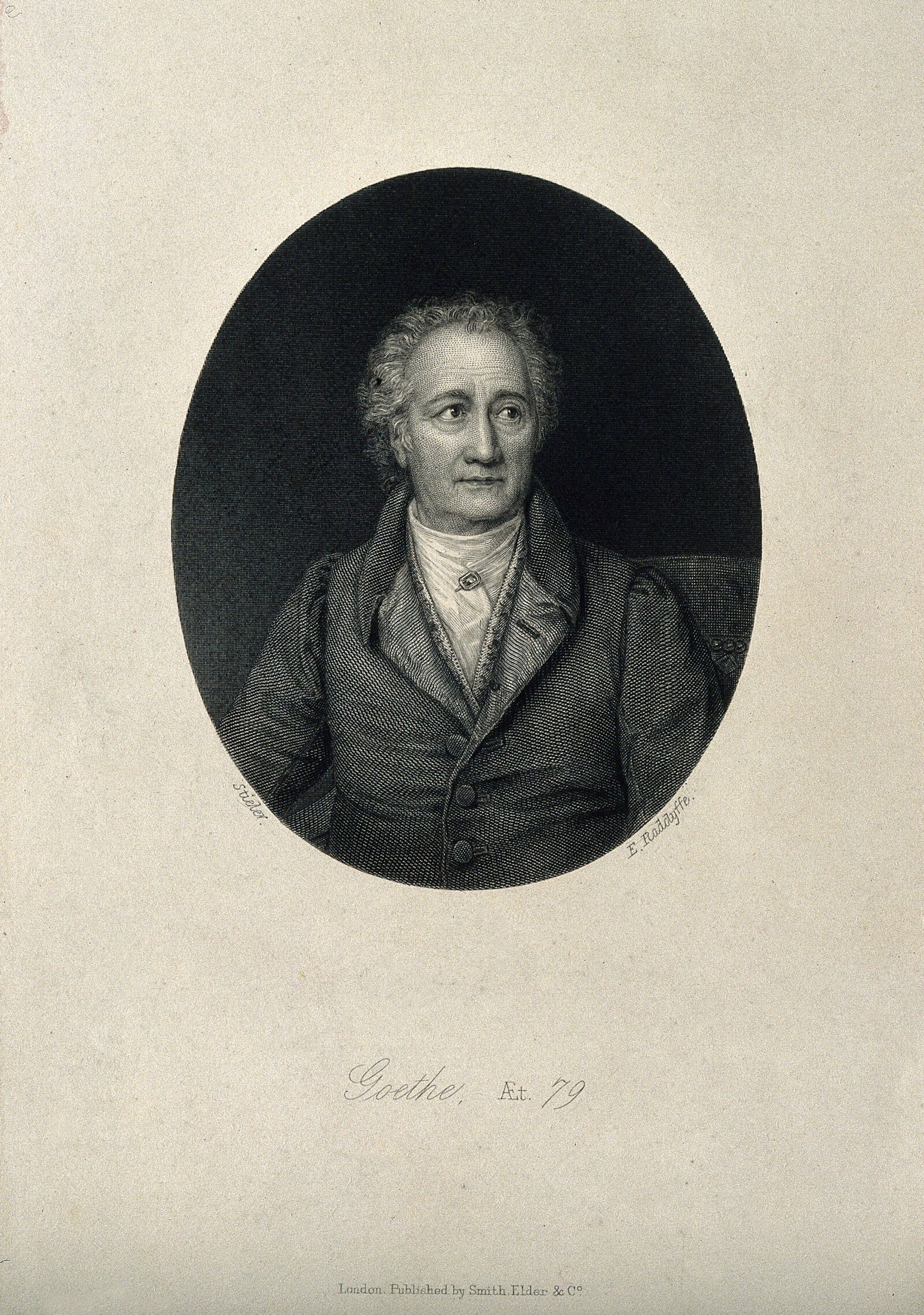
Black-and-white line engraving in an oval frame of an older man with curly grey hair, wearing a dark high-collared coat, white cravat with a pin, looking to the side. Printed caption below reads 'Goethe, Æt. 79' and 'London. Published by Smith Elder & Co.'Painting

Primary source

Goethe Line Engraving by Radclyffe after Stieler

E. Radclyffe after J. K. Stieler · 1828

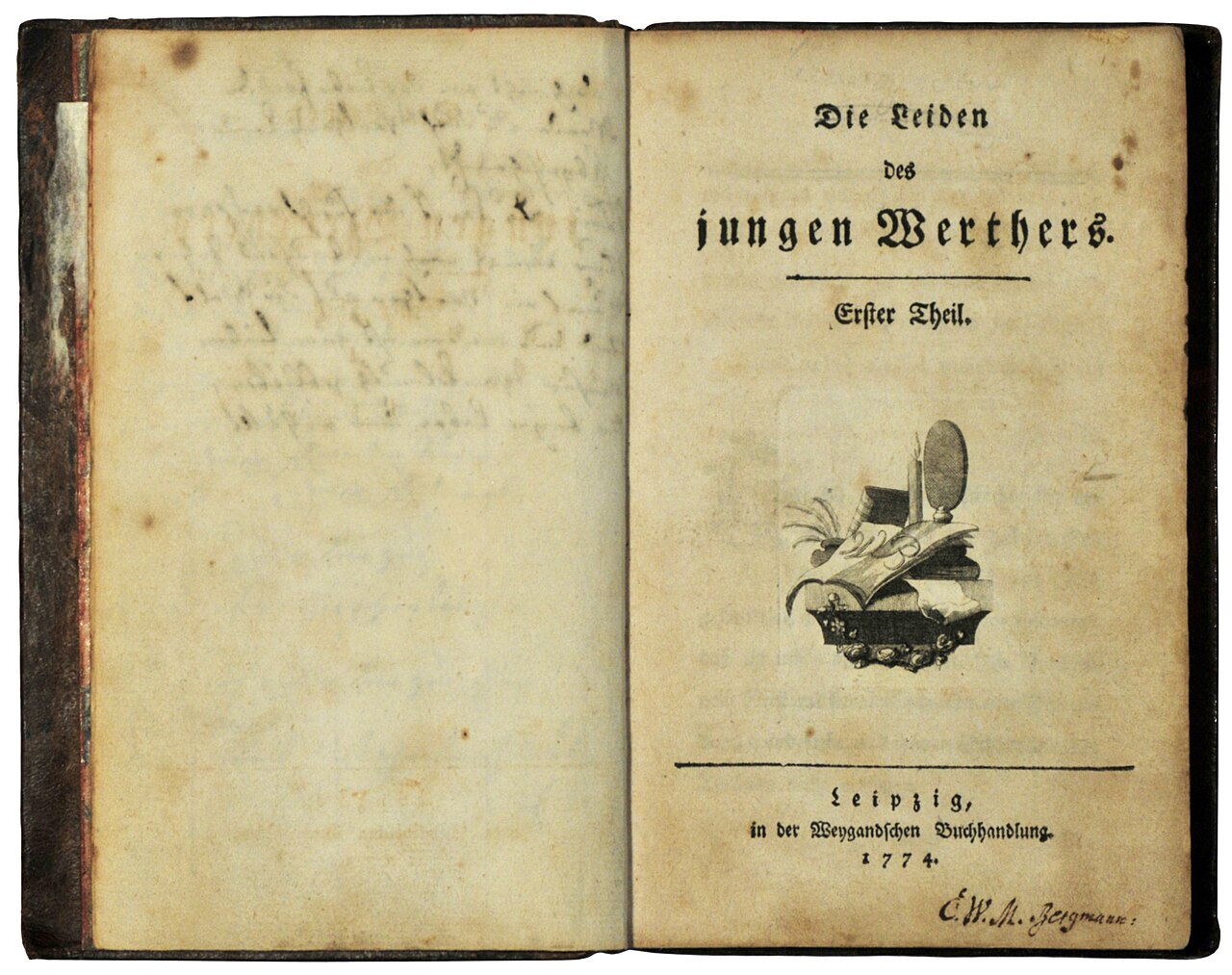
Open first edition of Die Leiden des jungen Werthers, 1774, showing the title page reading 'Die Leiden des jungen Werthers. Erster Theil' with a vignette of books and a quill, imprint 'Leipzig, in der Weygandschen Buchhandlung, 1774', and a handwritten signature at lower right. The left page is blank with faint ink show-through.Book

Primary source

The Sorrows of Young Werther

Johann Wolfgang von Goethe · 1774

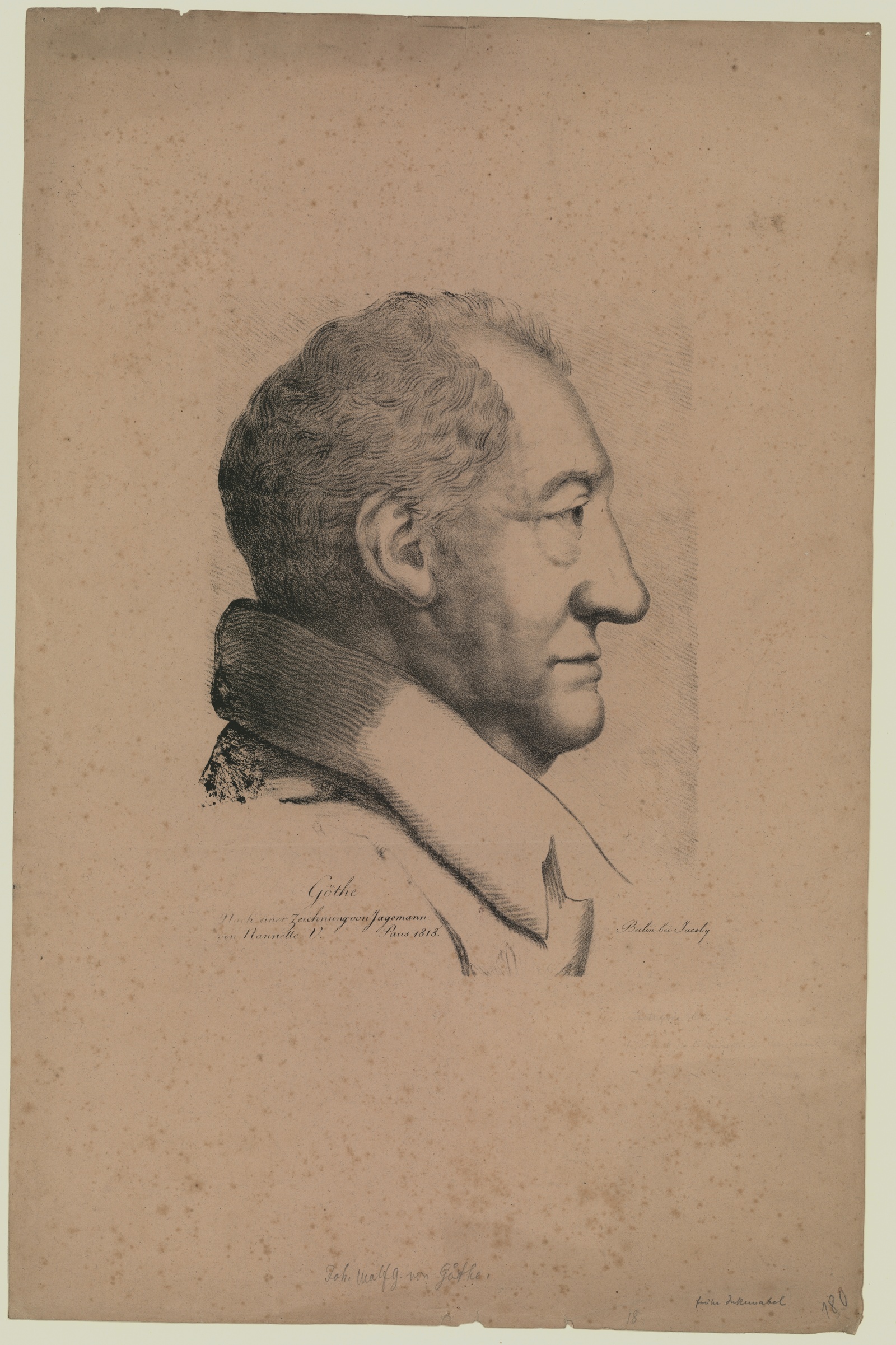
Sepia-toned lithograph portrait in profile facing right of an older man with wavy hair, prominent nose, and high collar. Inscribed 'Göthe, nach einer Zeichnung von Jagemann, von Nanette v. Paris 1813, Berlin bei Jacoby' with handwritten archive labels below.Painting

Primary source

Lithograph Portrait of Goethe by Jagemann and Nanette

F. Jagemann and Nanette · c. 1818

Book

Primary source

Der Erlkönig

Johann Wolfgang von Goethe · 1782

Book

Primary source

Prometheus

Johann Wolfgang von Goethe · written 1772-1774, published 1789

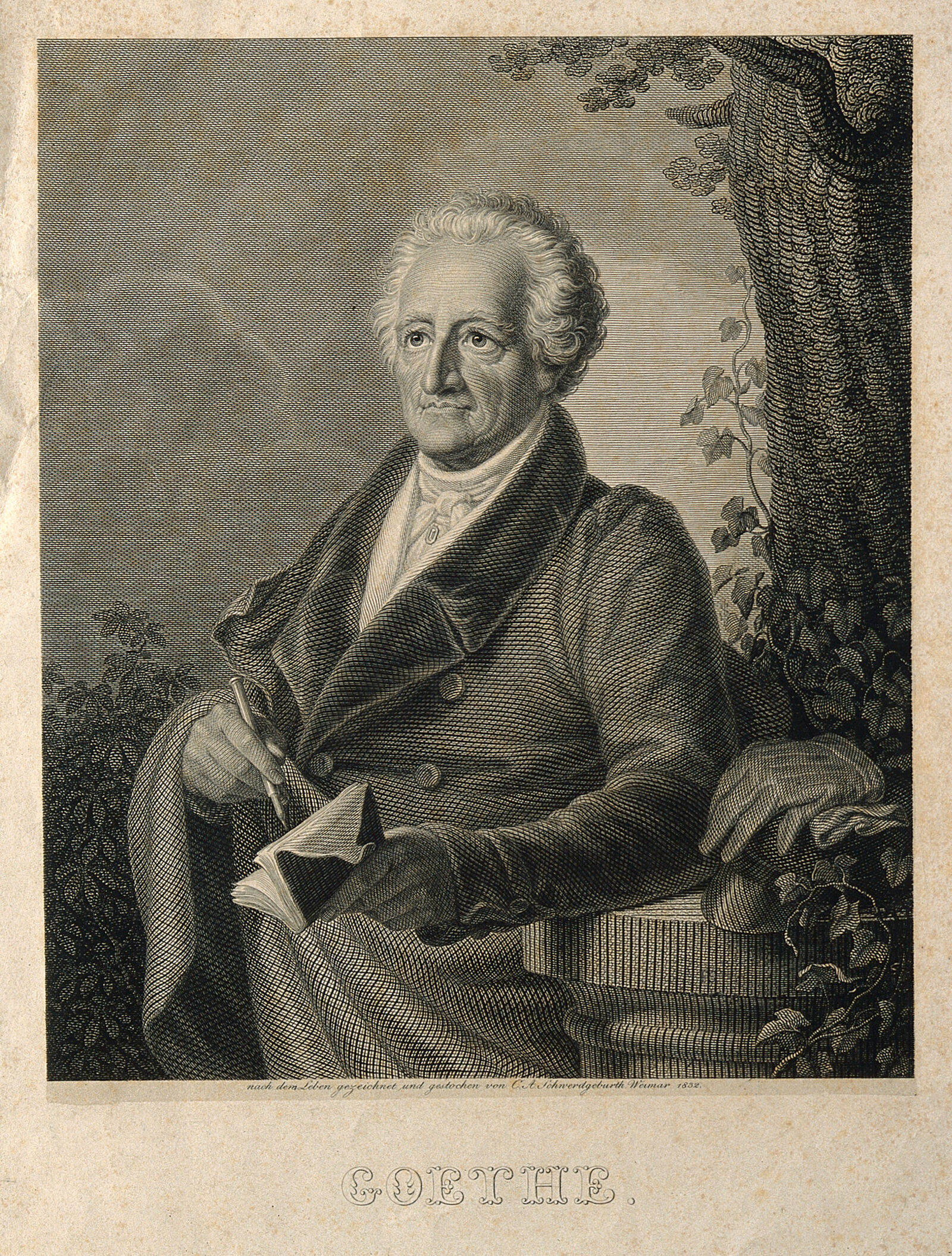
Line engraving of an elderly man with curly white hair, wearing a dark coat and white cravat, holding a pen and a small open book, leaning on a stone block beside an ivy-covered tree. Caption below reads GOETHE; inscription reads nach dem Leben gezeichnet und gestochen von C.A. Schwerdgeburth Weimar 1832.Painting

Primary source

Goethe Line Engraving by Schwerdgeburth, 1832

Carl August Schwerdgeburth · 1832

Book

Primary source

Welcome and Farewell

Johann Wolfgang von Goethe · 1771

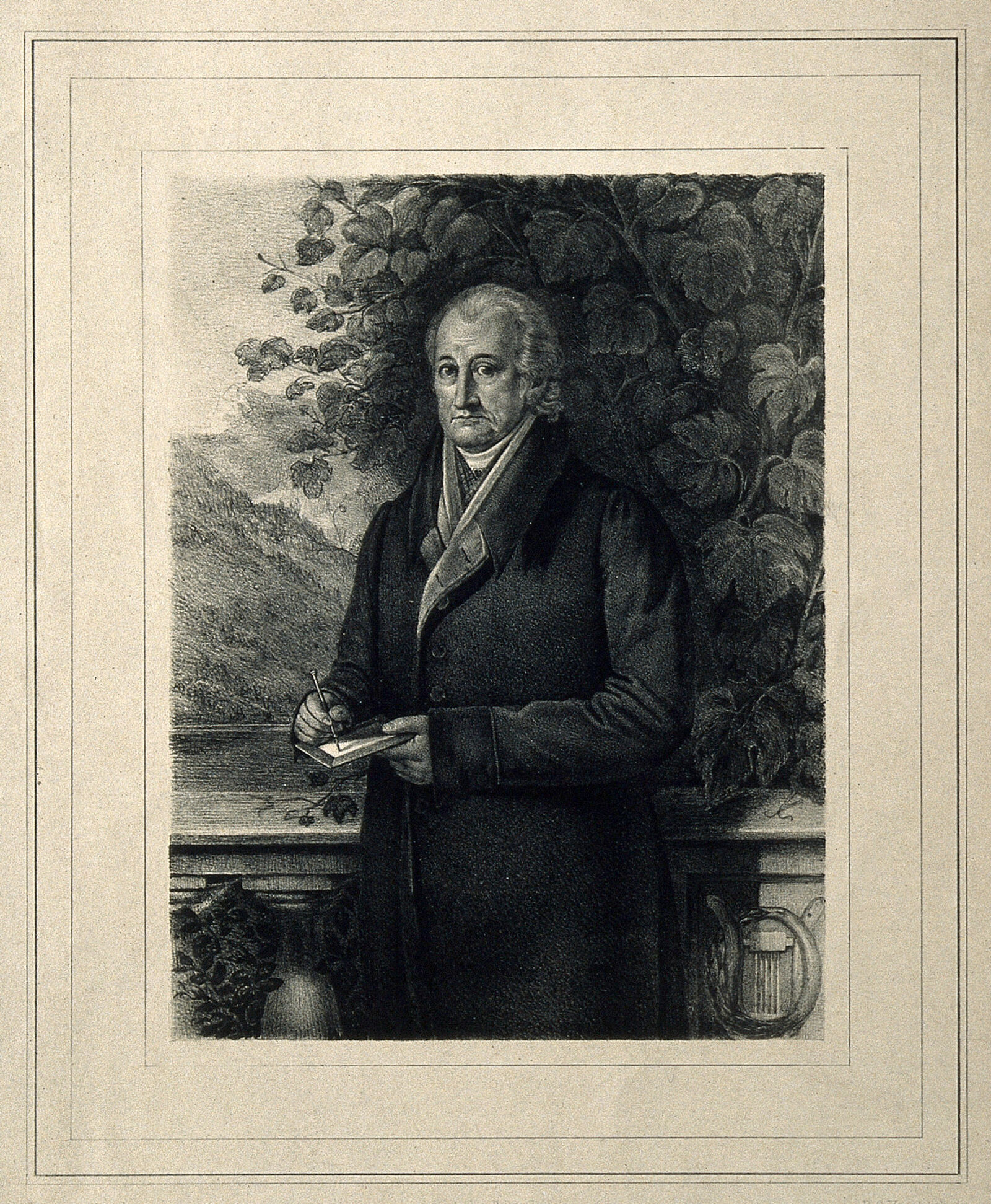
Black and white lithograph of an older man with powdered gray hair in a dark, high-collared overcoat, holding a small notebook and pencil at waist height. Behind him are large leafy branches and a hillside landscape; a stone balustrade with a lyre-shaped urn is at the bottom. A double-ruled border frames the print.Painting

Primary source

Goethe Lithograph by Vogel after Jagemann

F. C. Vogel after Ferdinand Jagemann

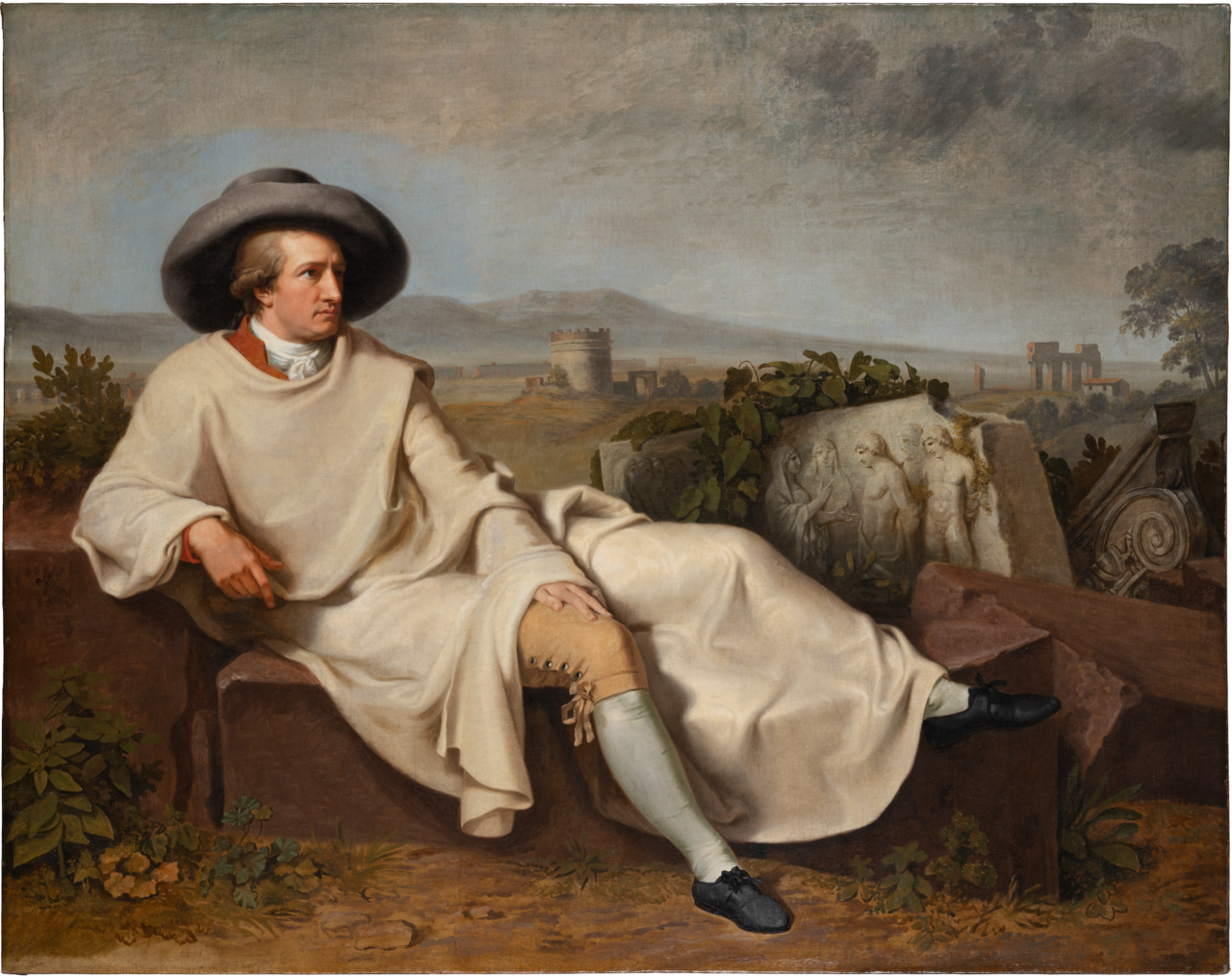
Painting of a man in a wide-brimmed grey hat and loose cream cloak reclining on a stone block, gazing left. Behind him are a ruined tower, distant hills, classical ruins, and a carved marble relief of figures.Painting

Primary source

Goethe in the Roman Campagna

Johann Heinrich Wilhelm Tischbein · 1787-1788

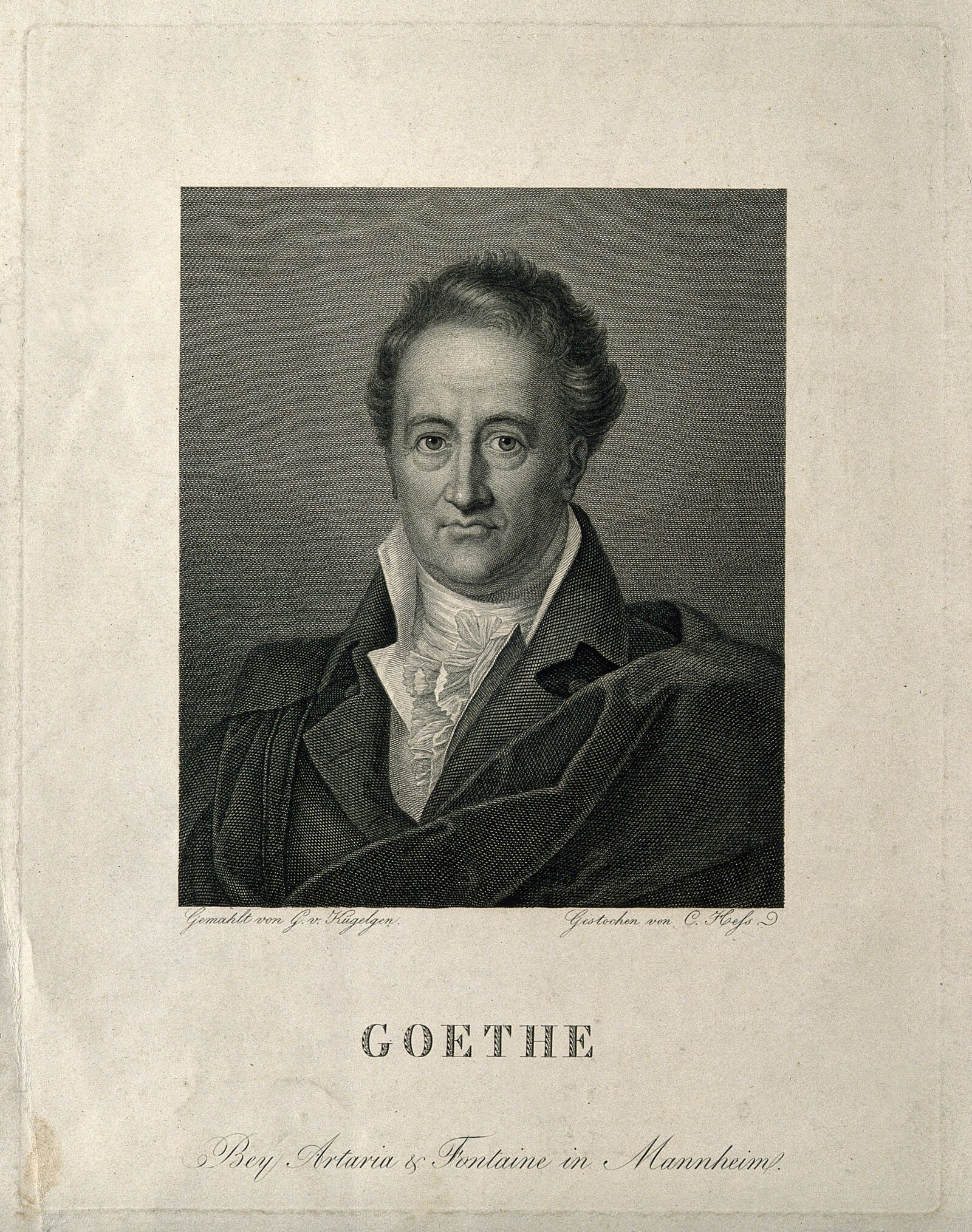
Black-and-white line engraving of a man with wavy hair, wearing a dark coat, white frilled cravat, and high collar, facing forward. Below the image are signatures reading 'Gemahlt von G.v. Kügelgen' and 'Gestochen von C. Hess', and the title 'GOETHE' with 'Bey Artaria & Fontaine in Mannheim' beneath.Painting

Primary source

Goethe Line Engraving after Kügelgen, 1810

C. Hess after Gerhard von Kügelgen · 1810

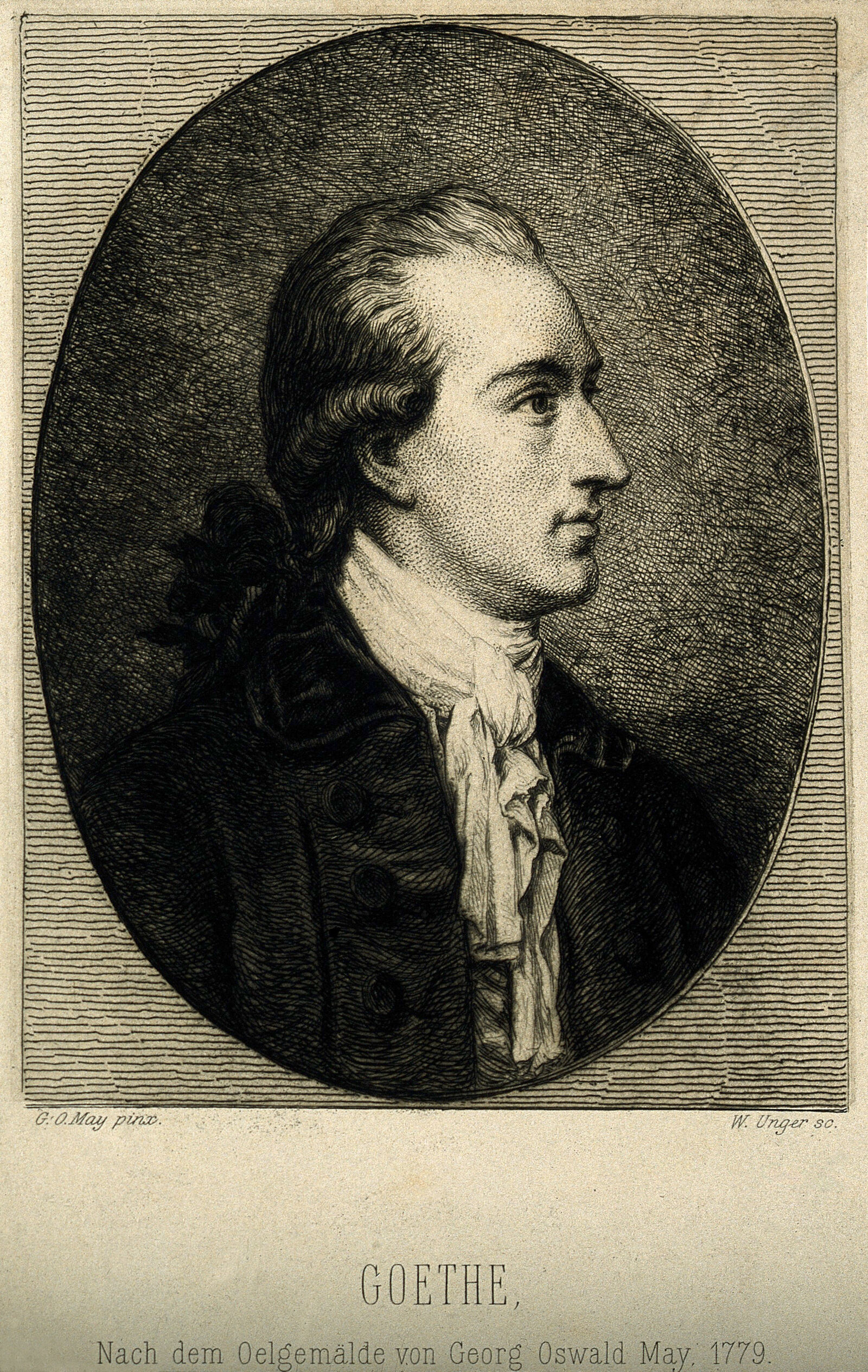
Oval-framed black-and-white etching of a man in profile facing right, with powdered hair tied back, a high white cravat, and a dark buttoned coat. Background is hatched; text below reads GOETHE and after Oelgemälde by Georg Oswald May, 1779.Painting

Secondary source

Goethe Etching after G. O. May

W. Unger after G. O. May · 1779 (painting), etching after

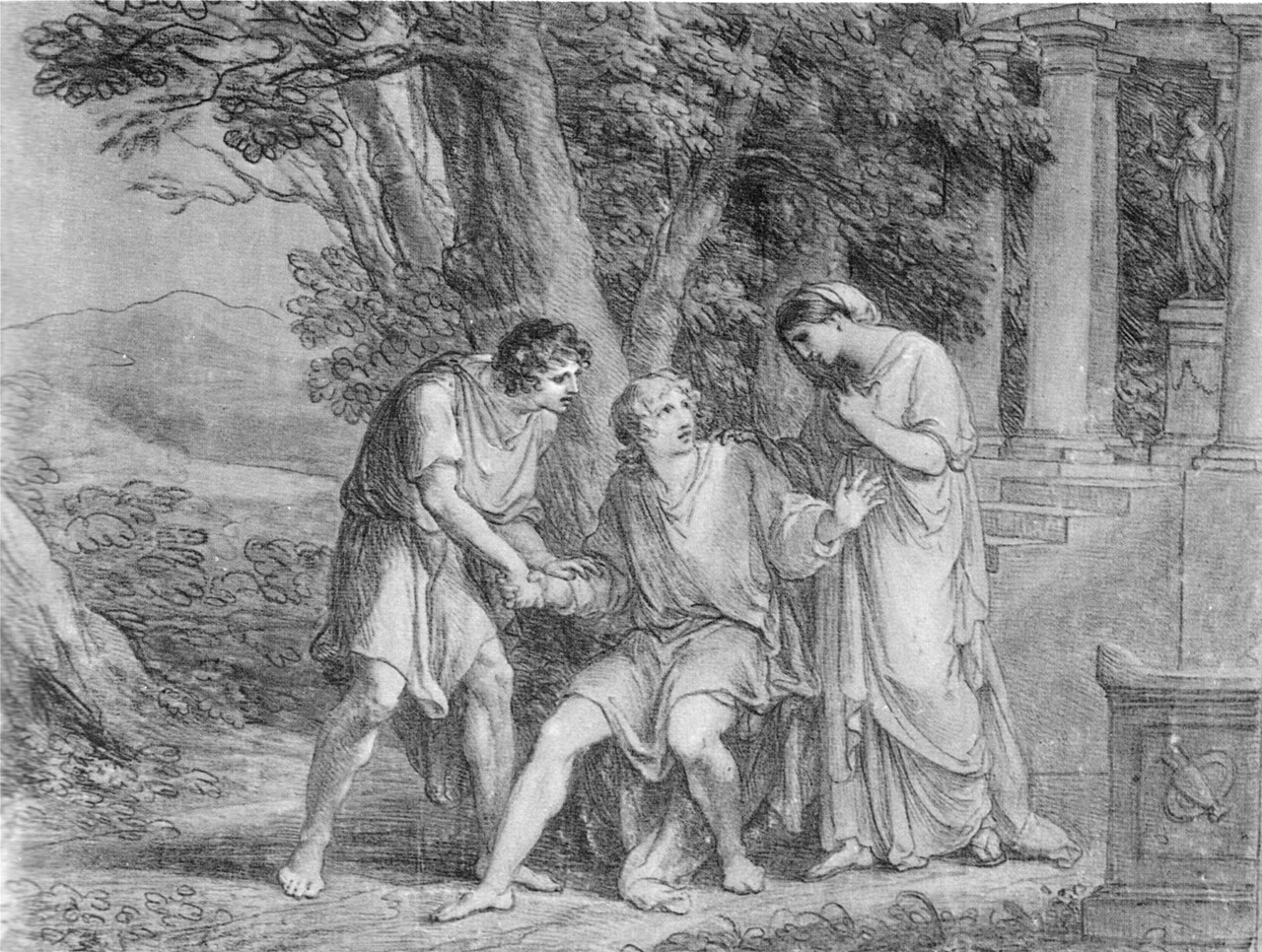
Grey-toned drawing of a classical scene: a standing young man in a short tunic holds the hand of a seated young man in a loose robe, while a woman in a flowing gown leans in behind. A temple colonnade and tree stand behind them.Book

Primary source

Iphigenia in Tauris

Johann Wolfgang von Goethe · 1787

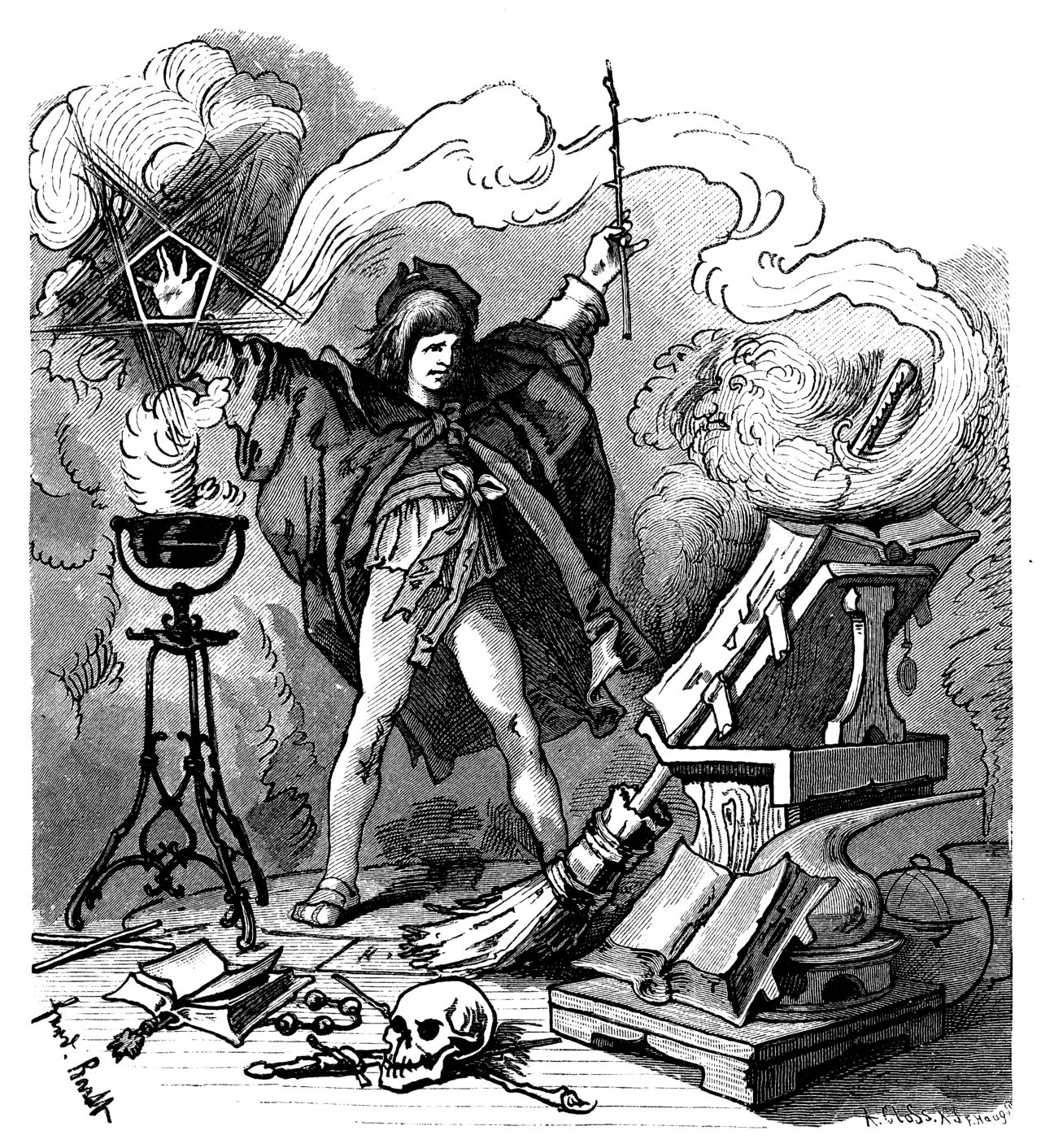
Black and white engraving of a young man in a cloak and cap holding a wand aloft in a smoky room, a pentagram with a hand glowing in smoke at upper left, a bubbling cauldron on a stand at left, a broom with water at lower center, and a skull and scattered books in the foreground.Book

Primary source

Der Zauberlehrling

Johann Wolfgang von Goethe · 1797

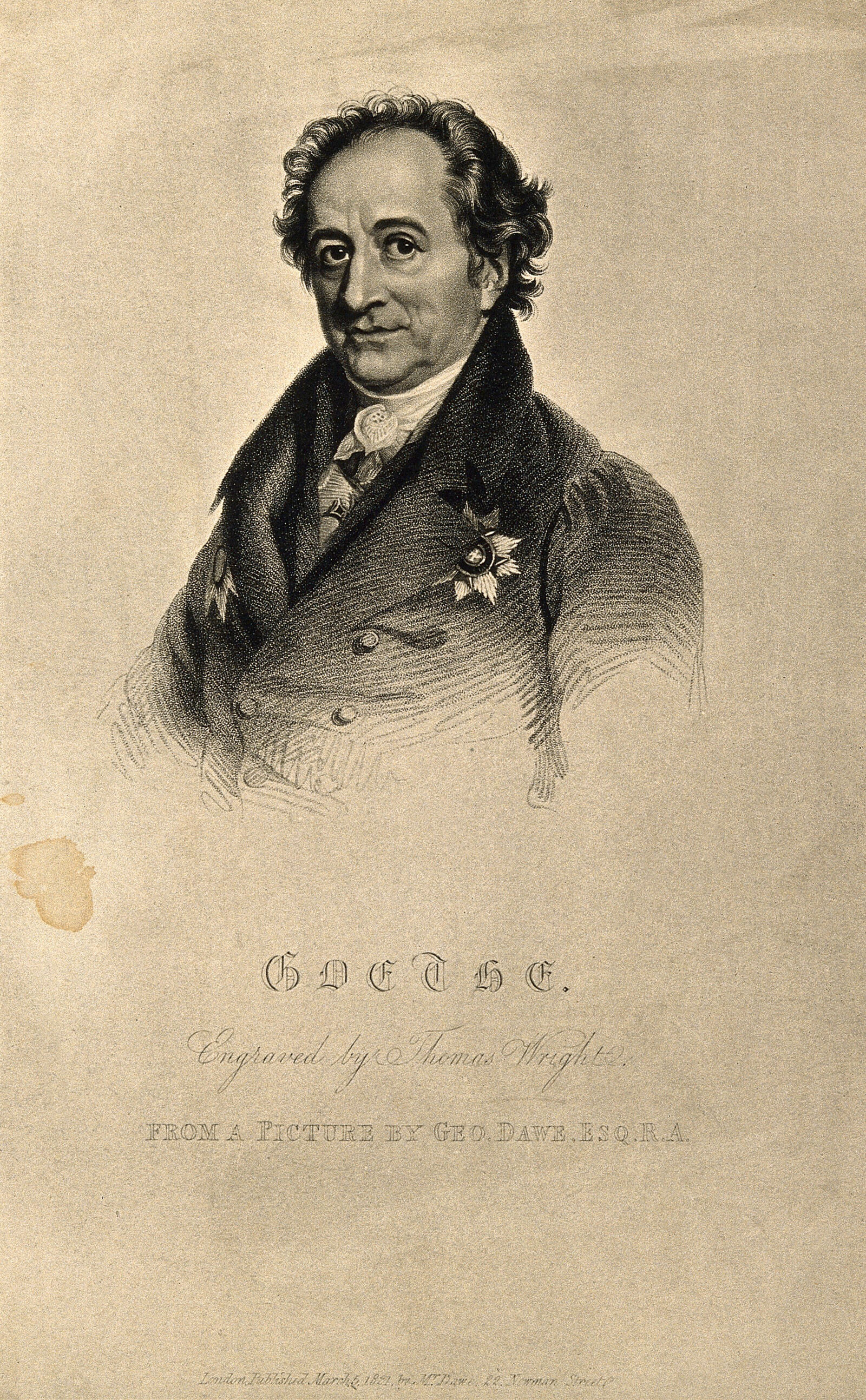
Black-and-white stipple engraving of a man with curly hair, wearing a dark high-collared coat, white cravat, and star-shaped order medals on his chest. Printed caption below reads GOETHE, engraved by Thomas Wright from a picture by Geo. Dawe.Painting

Primary source

Goethe Stipple Engraving after George Dawe

Thomas Wright after George Dawe · 5 March 1821, after a 1819 painting

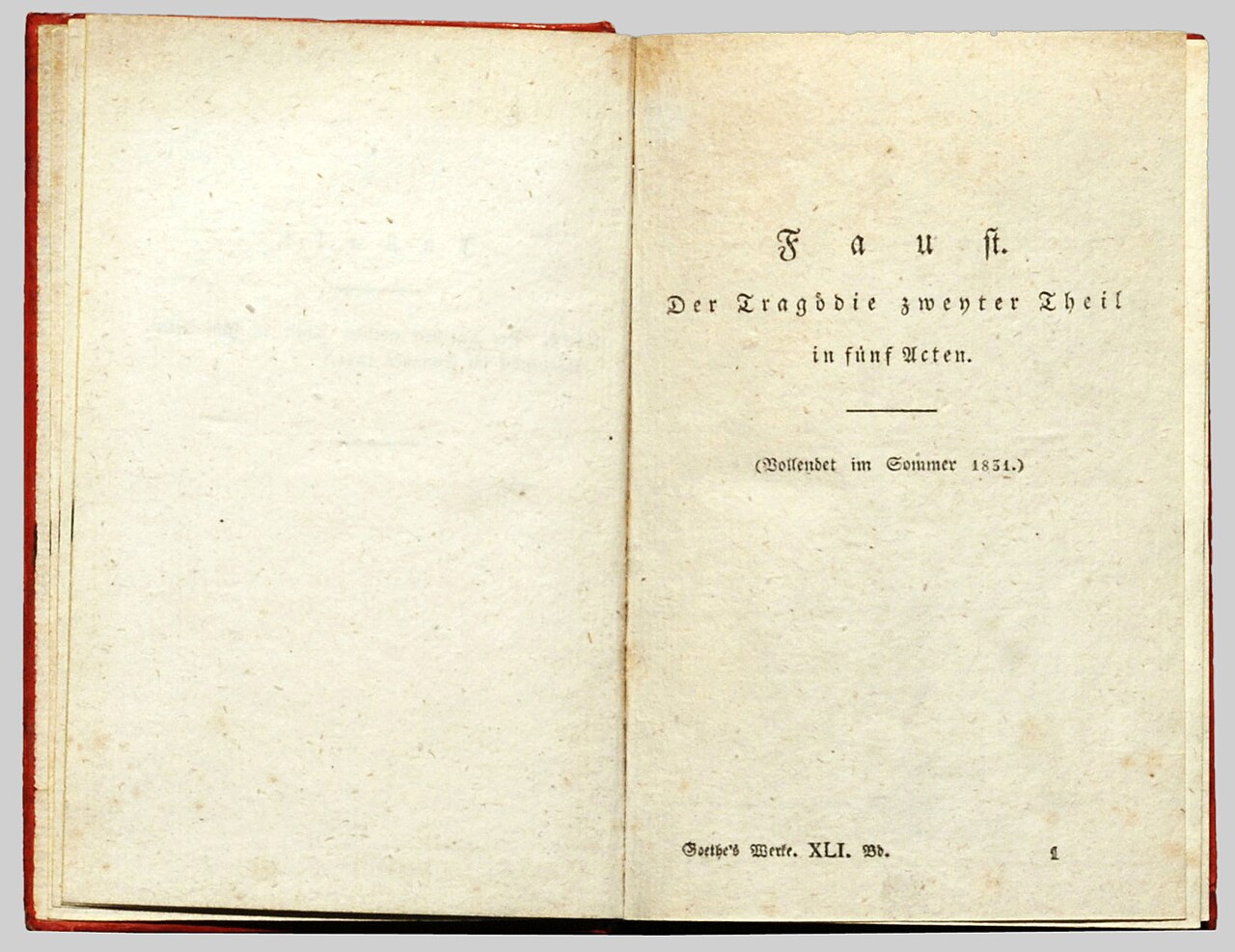
Open book with a red cloth cover showing a title page on the right in old German blackletter type: 'Faust. Der Tragödie zweyter Theil in fünf Acten. (Vollendet im Sommer 1831.)' with the footer 'Goethe's Werke. XLI. Bd.' and page number 1. The left page is blank.Book

Primary source

Faust, Part Two

Johann Wolfgang von Goethe · 1825, completed 1831, published 1832

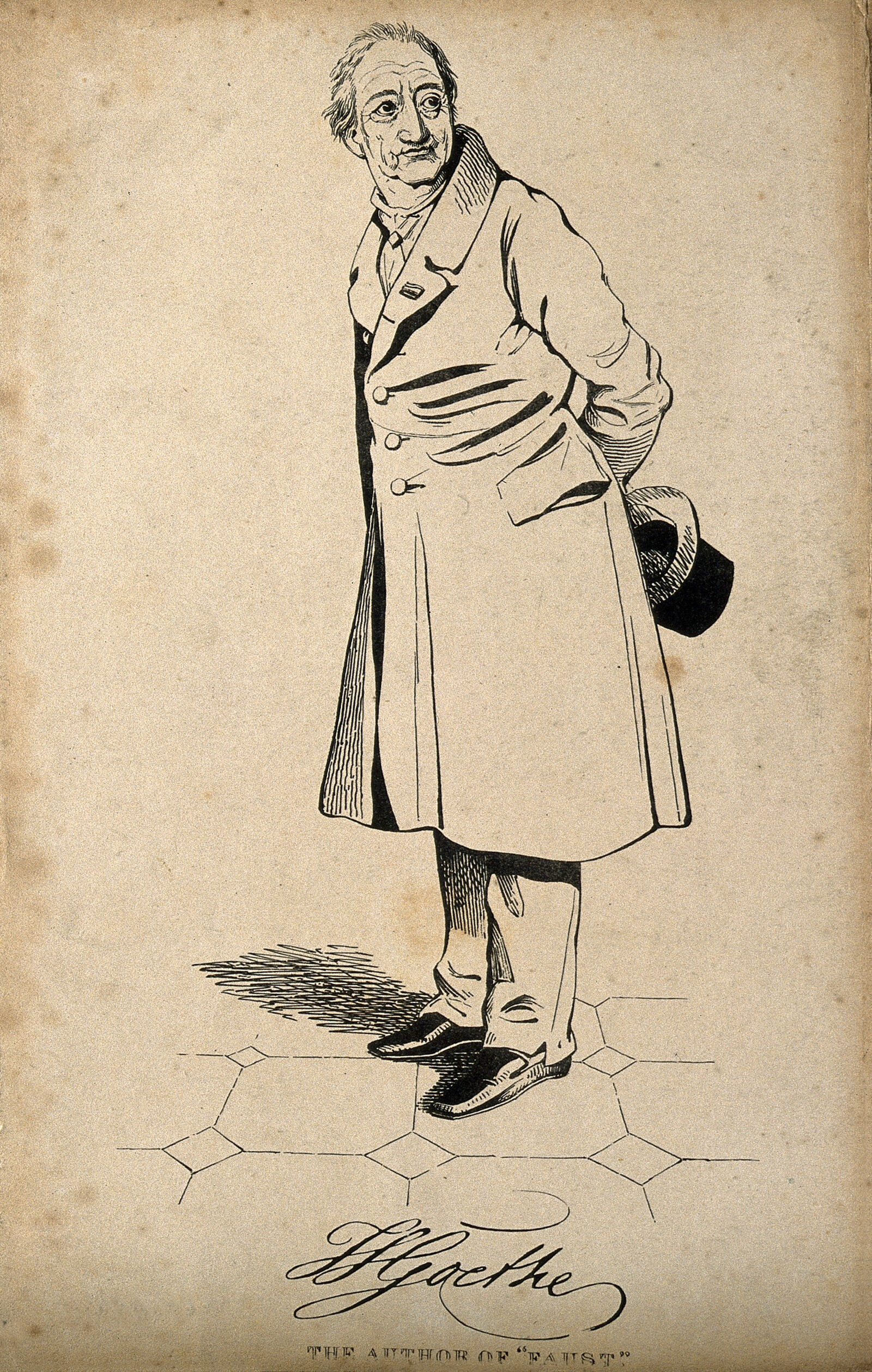
Ink caricature of an elderly man in a long coat, hat held in one hand, hands in pocket, standing on a tiled floor. Signature 'Goethe' below and caption 'The Author of Faust' at bottom.Painting

Secondary source

Goethe Lithograph by Daniel Maclise after Stieler

Daniel Maclise after J. K. Stieler and W. M. Thackeray · 1832

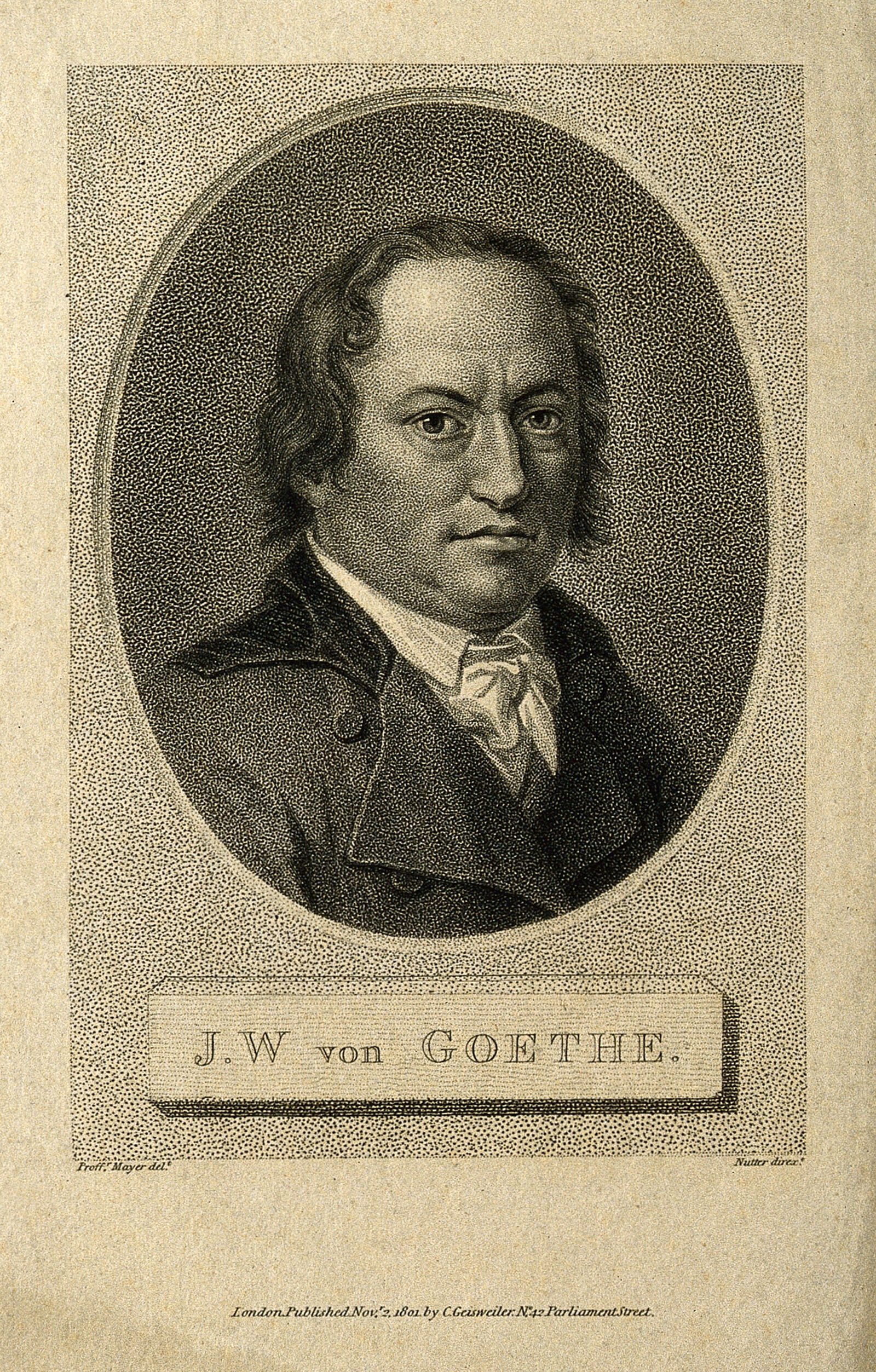
Oval stipple engraving portrait of a man with wavy, shoulder-length hair wearing a dark coat and a cravat, with a label reading 'J.W von GOETHE.' below. Text at bottom reads 'London Published Nov 2, 1801 by C. Geisweiler'.Painting

Secondary source

Goethe Stipple Engraving after Friedrich Bury

W. Nutter (attributed) after Meyer after Friedrich Bury · 1801, after an earlier 1800 portrait

Book

Secondary source

Conversations with Goethe

Johann Peter Eckermann · 1836

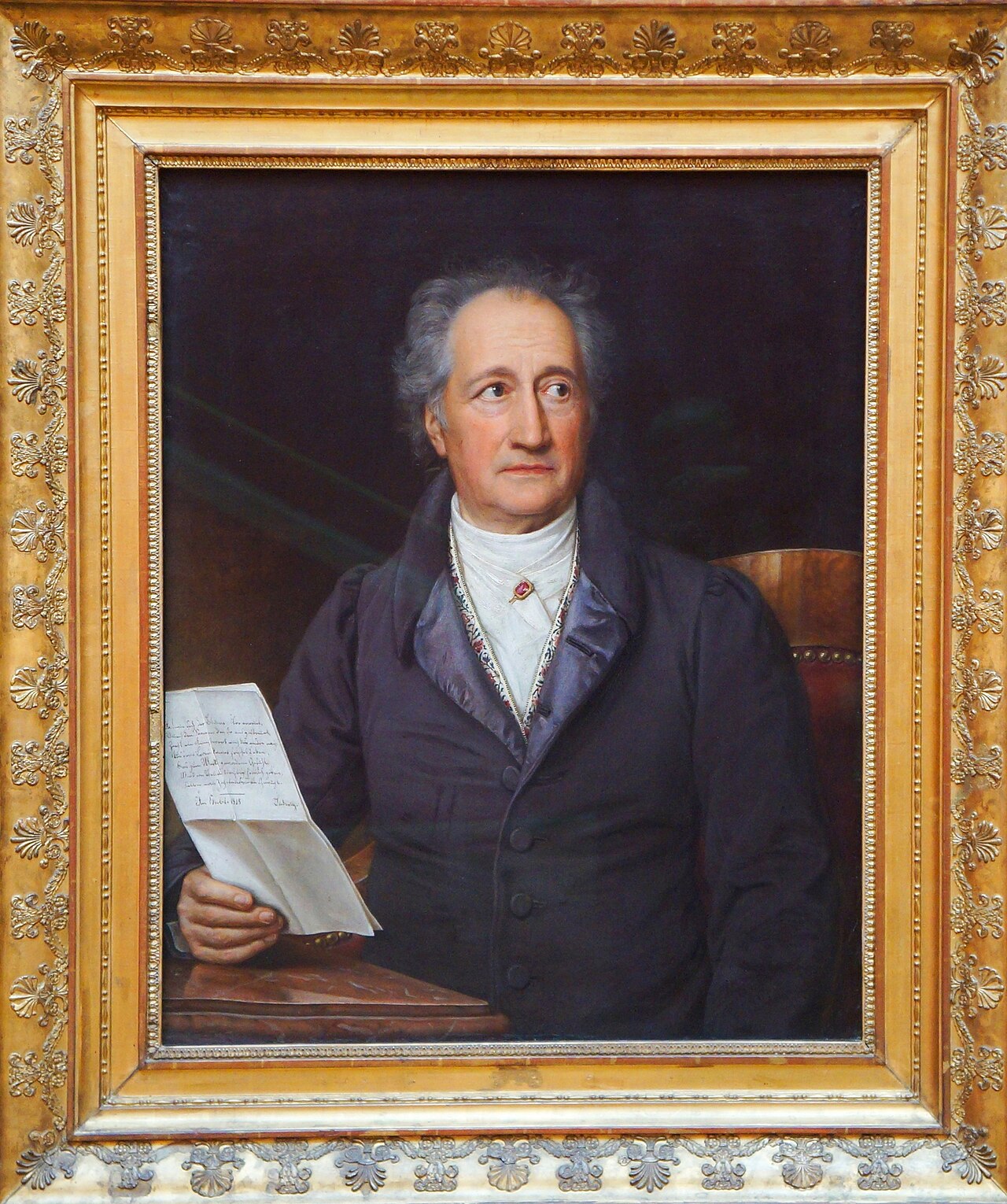
Framed oil portrait of an older man with gray hair, wearing a dark blue coat, white cravat, and a red-jeweled pendant on a chain. He holds a folded letter in his left hand and looks to the side against a dark background.Painting

Primary source

Johann Wolfgang von Goethe

Joseph Karl Stieler · 1828

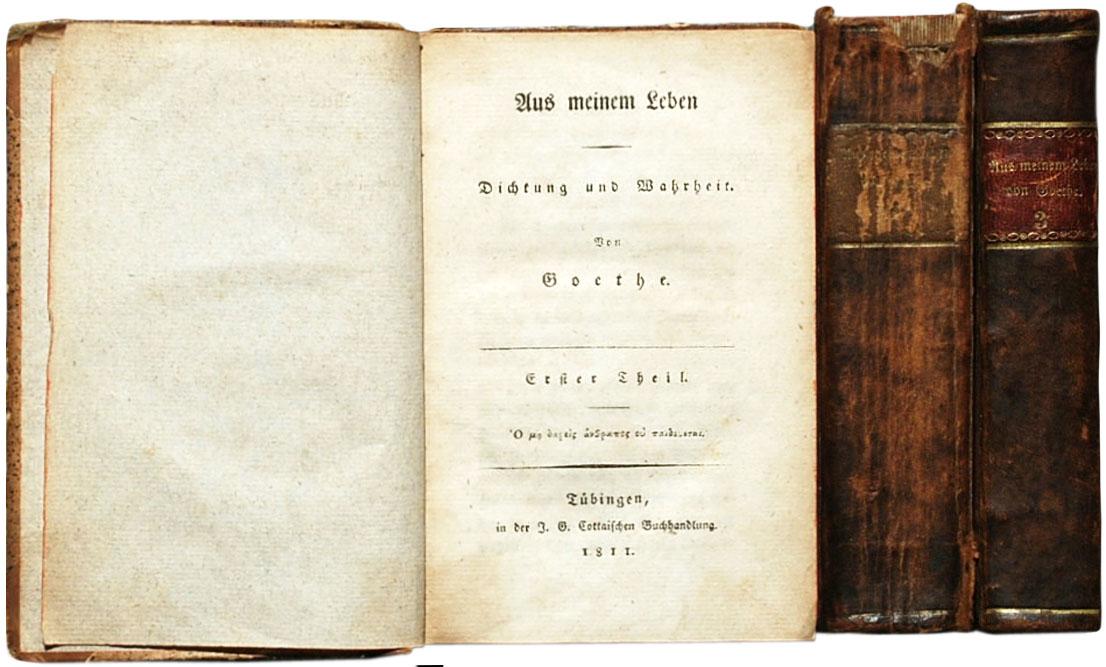
Open book showing the title page of Goethe's 'Aus meinem Leben, Dichtung und Wahrheit', Erster Theil, Tübingen, 1811. Two leather-bound volumes stand to the right, one with a red spine label reading 'Aus meinem Leben von Goethe, 2'.Book

Primary source

From my Life: Poetry and Truth

Johann Wolfgang von Goethe · 1811–1833

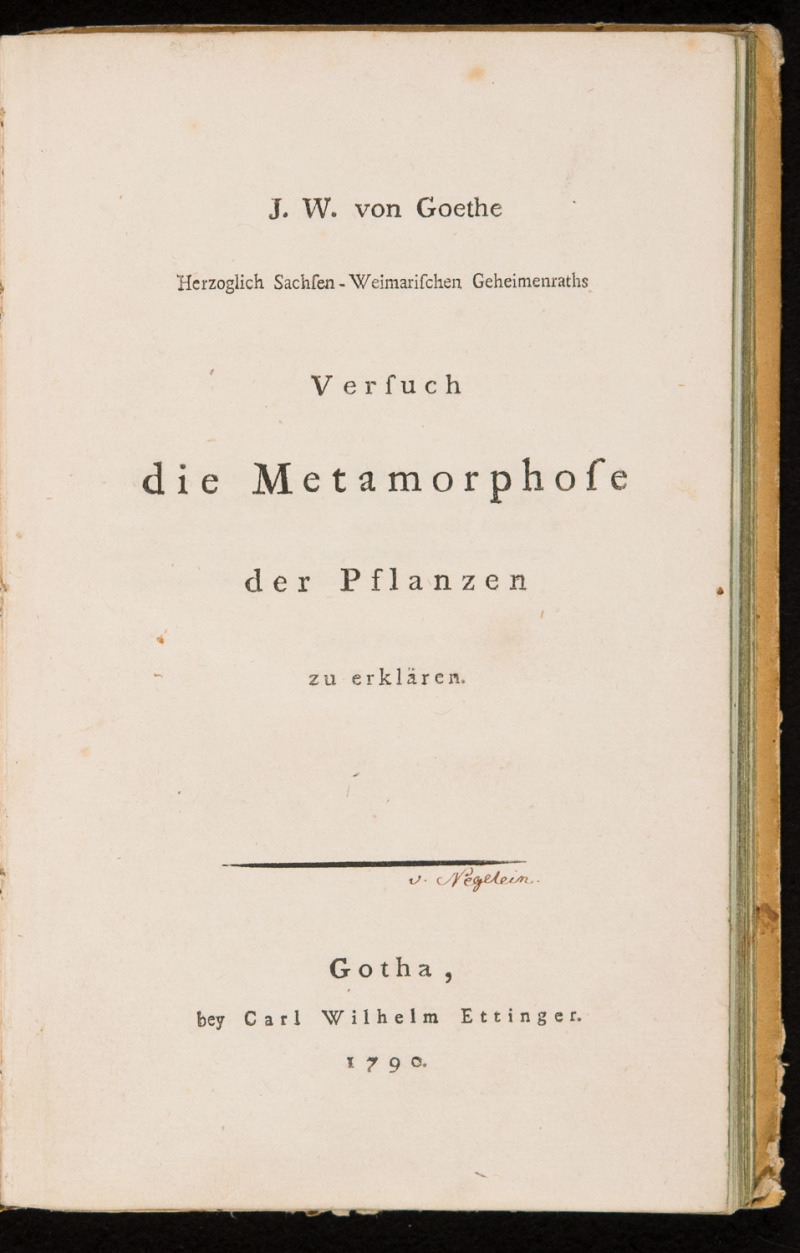
Title page of Goethe's 'Versuch die Metamorphose der Pflanzen zu erklären', printed in Gotha by Carl Wilhelm Ettinger in 1790. Black serif text on cream paper, with a handwritten annotation in brown ink near the bottom, and a green-edged book spine at the right.Book

Primary source

Metamorphosis of Plants

Johann Wolfgang von Goethe · 1790

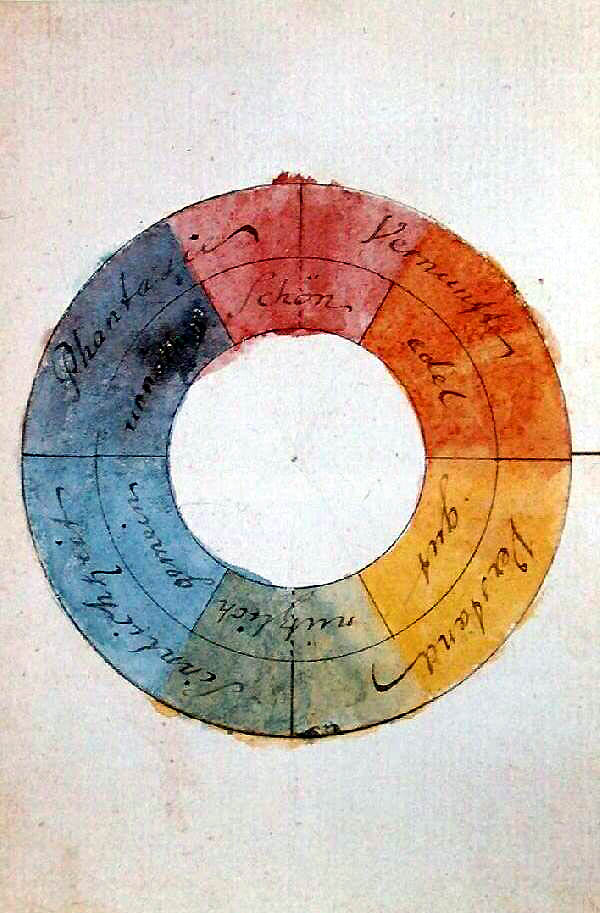
Hand-painted colour wheel in watercolour with a ring of blue, red, orange, yellow, and green segments, each labelled with handwritten German words in ink. A plain white circle sits in the centre.Book

Primary source

Theory of Colours

Johann Wolfgang von Goethe · 1810

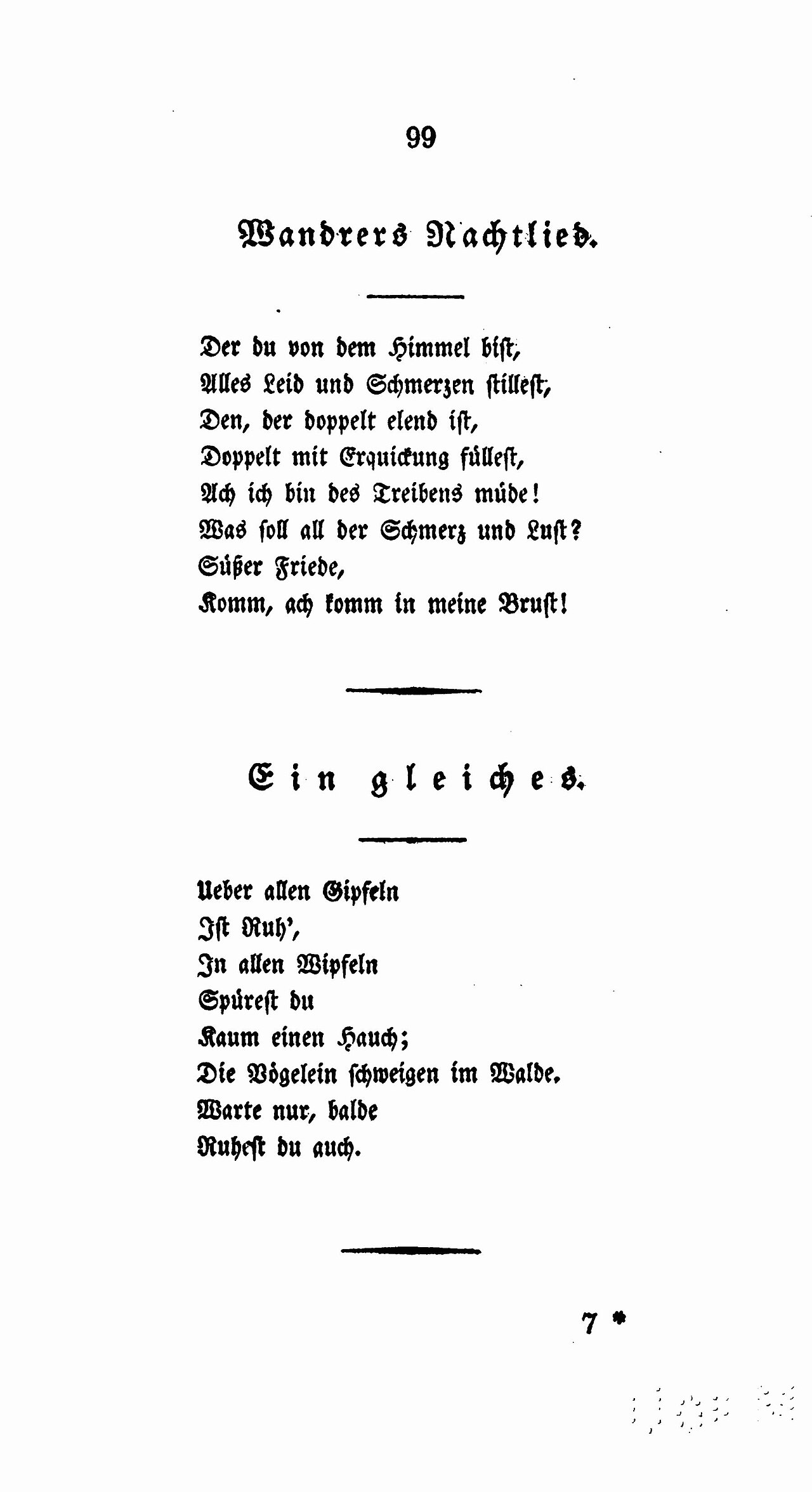
Scan of a printed book page numbered 99 in Fraktur blackletter type. It contains the poem titled Wandrers Nachtlied in German, eight lines, followed by a second poem titled Ein gleiches with six lines, separated by decorative rules.Book

Primary source

Wanderer's Nightsong

Johann Wolfgang von Goethe · 1776 and 1780

Dark maroon cloth book cover with a University of Toronto barcode label reading 31761 01103005 3 at upper left, and a circular embossed library stamp reading 'John Ross' and 'Library' near the center.Letter

Primary source

Correspondence between Schiller and Goethe

Johann Wolfgang von Goethe and Friedrich Schiller · 1794–1805 (published 1828–29)

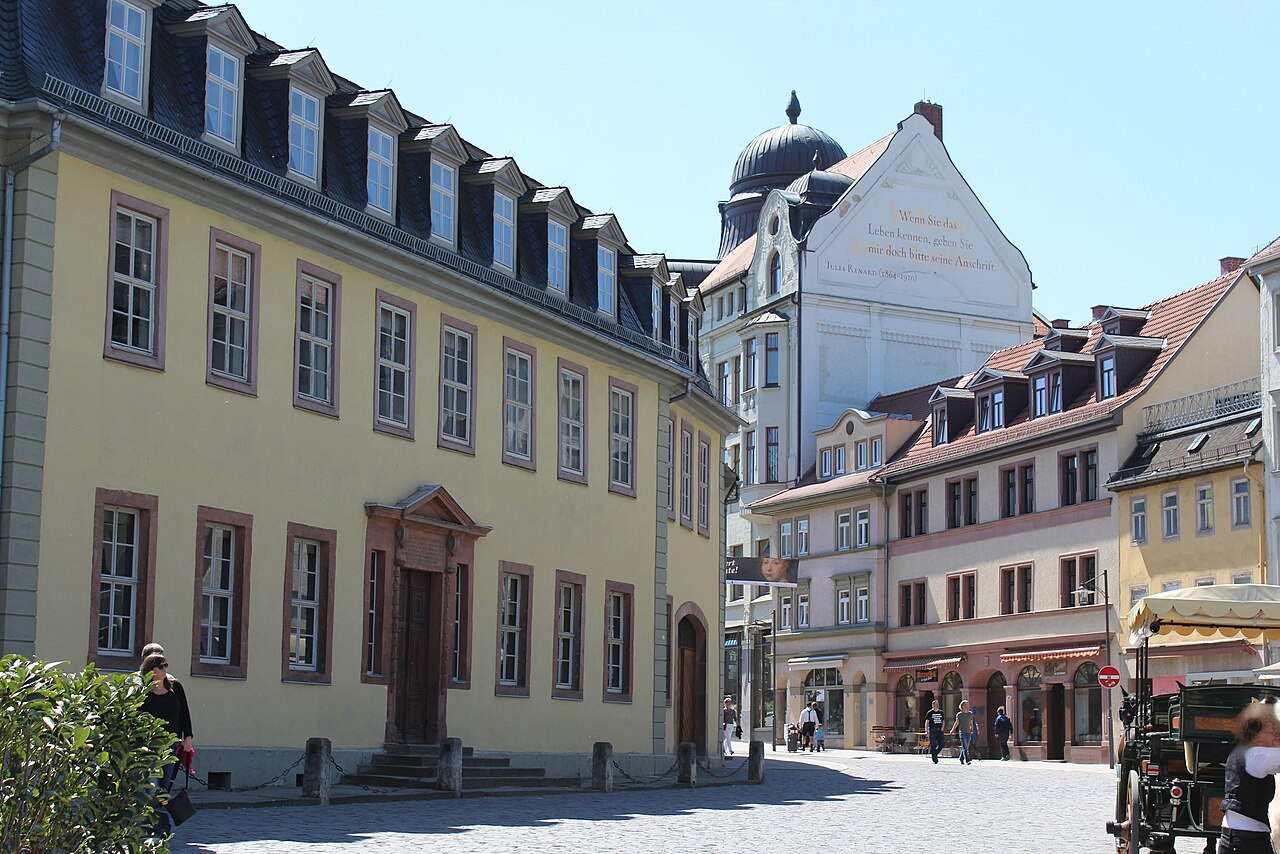
A cobbled street scene in Weimar with a long pale yellow multi-storey building with many windows and a dark mansard roof, its central wooden door set in a small stone portal with steps. Pedestrians walk nearby, and a horse-drawn carriage is at the right. Other buildings, including a white gabled house with a dome, stand behind.Artifact

Primary source

Goethe's House on the Frauenplan, Weimar

1709; Goethe's residence 1782–1832

Book

Primary source

Götz von Berlichingen

Johann Wolfgang von Goethe · 1771

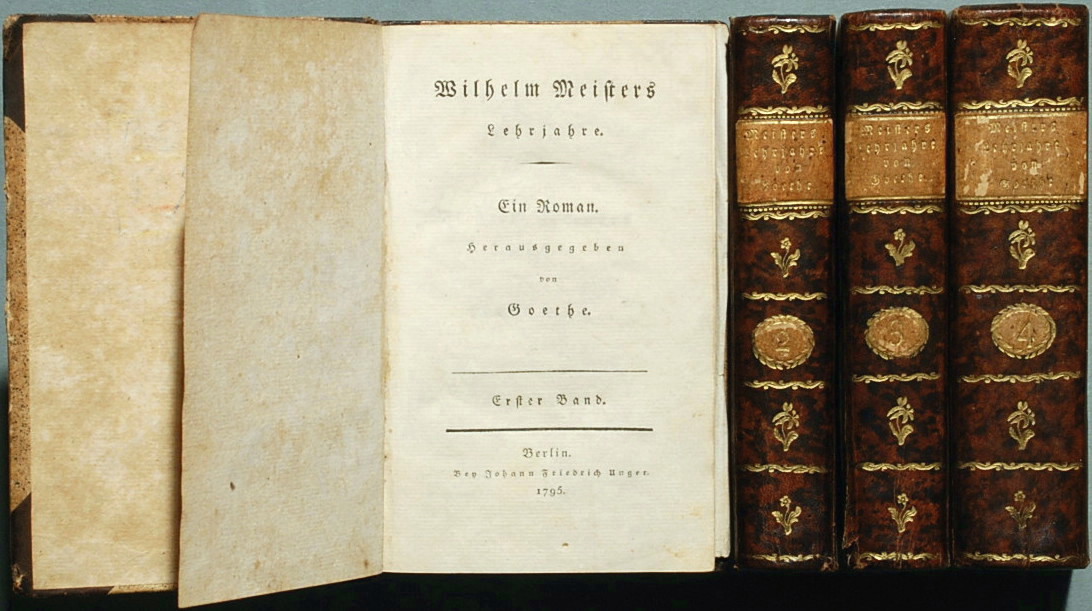
Open book showing the title page of Wilhelm Meisters Lehrjahre, Ein Roman, Herausgegeben von Goethe, Erster Band, Berlin, Bey Johann Friedrich Unger, 1795. Three leather-bound volumes with gilt decorations and numbered labels 2, 3, and 4 stand to the right.Book

Primary source

Wilhelm Meister's Apprenticeship

Johann Wolfgang von Goethe · 1795–96

Book

Primary source

Heidenröslein

Johann Wolfgang von Goethe · 1771

Book

Primary source

Das Göttliche

Johann Wolfgang von Goethe · 1783

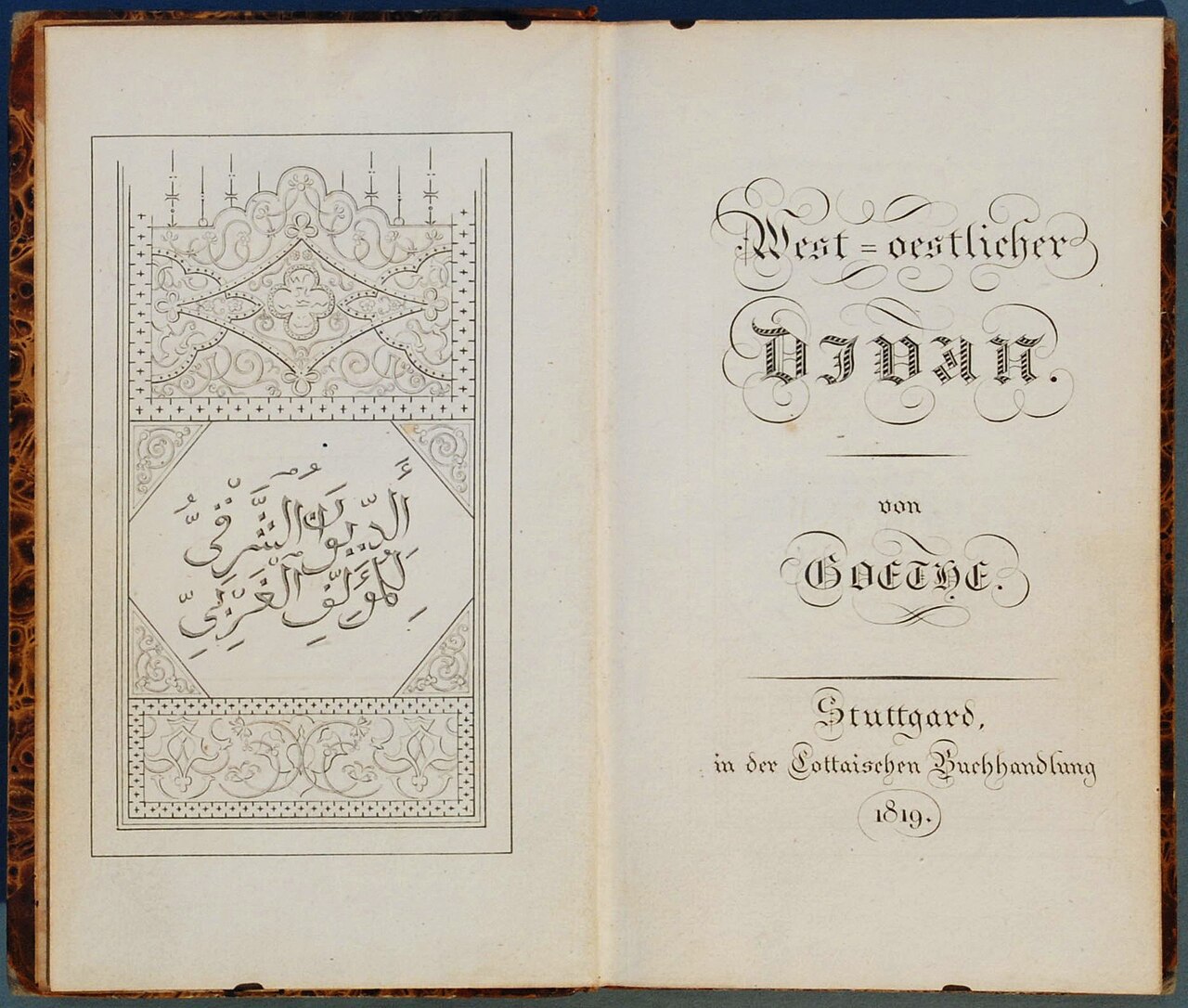
Open book showing the 1819 title page of West-östlicher Divan by Goethe, with calligraphic title lettering, 'von Goethe', and 'Stuttgart, in der Cottaischen Buchhandlung, 1819'. Facing page is an engraved frontispiece with Arabic calligraphy framed by ornamental arabesques.Book

Primary source

West–Eastern Diwan

Johann Wolfgang von Goethe · 1814–1819

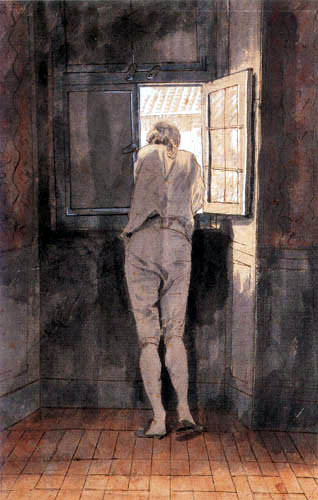
Watercolor drawing of a man seen from behind, wearing a light jacket and pale knee breeches, standing at an open casement window in a dim room with a wooden floor. Bright light comes through the window.Painting

Primary source

Goethe at the Window

Johann Heinrich Wilhelm Tischbein · 1786/7

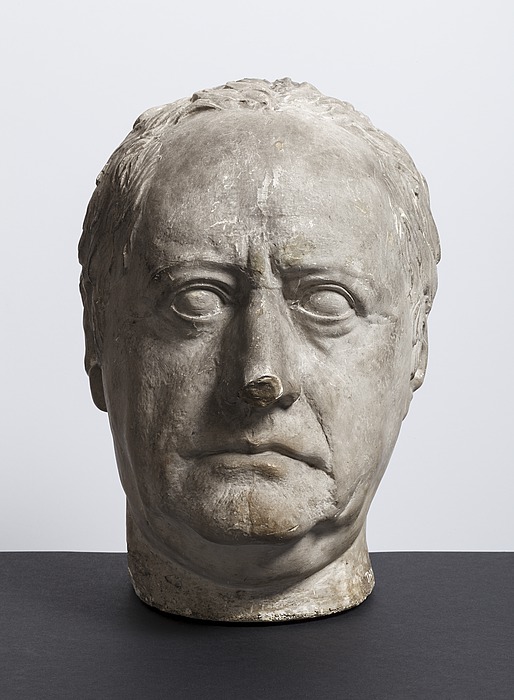
Photograph of a pale grey plaster head sculpture of an older man with short wavy hair, deep-set eyes, a prominent nose, closed lips, and a heavy jaw, set on a plain neck base against a light background.Sculpture

Primary source

Goethe's Life Mask, 1807

Carl Gottlieb Weisser · 1807

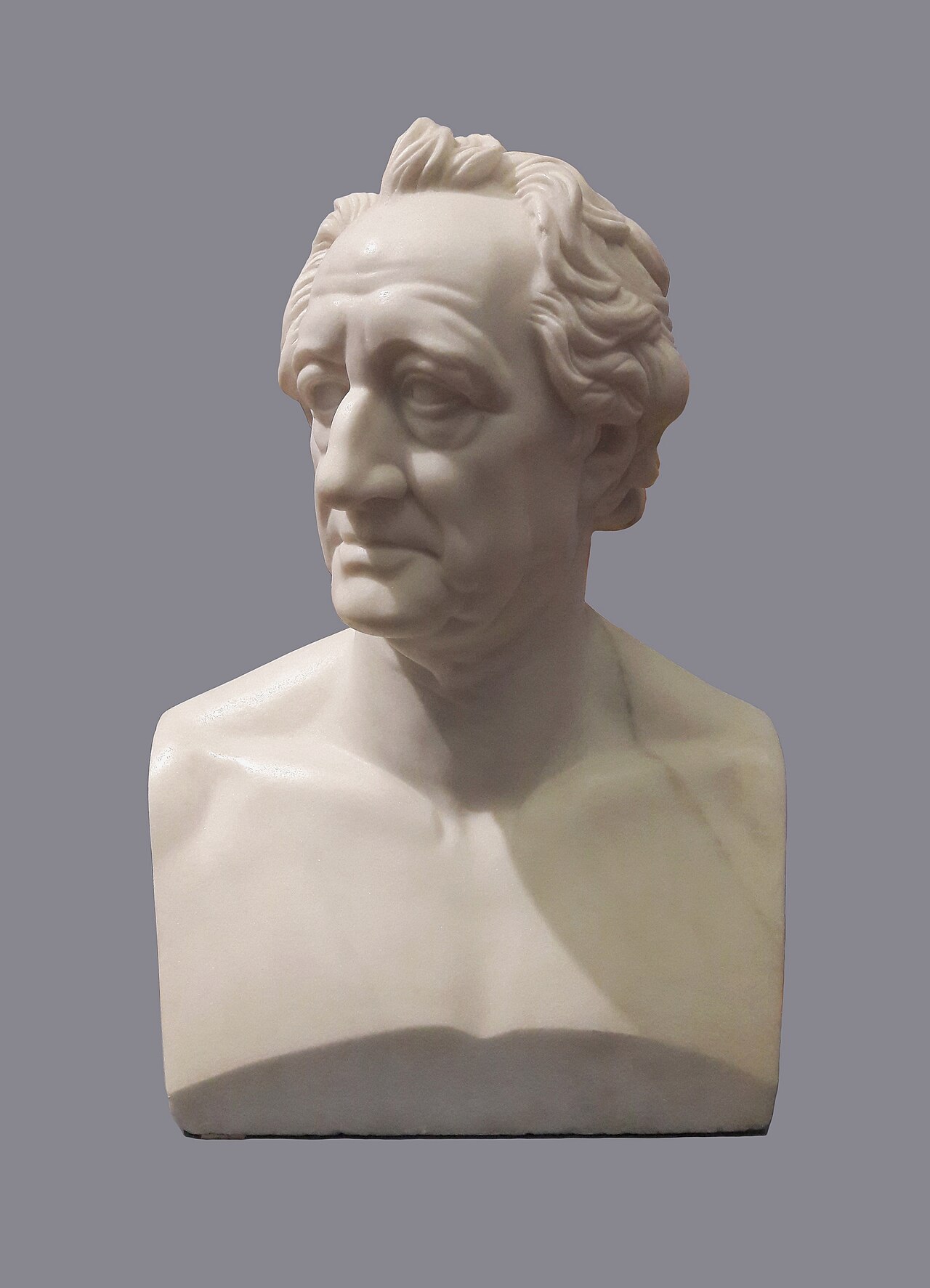
White marble bust of an older man with wavy hair swept back, deep-set eyes, furrowed brow, and a firm mouth, turned to his left. The bust has bare shoulders and chest and sits on a plain block base against a grey background.Sculpture

Primary source

Bust of Johann Wolfgang von Goethe

Christian Daniel Rauch · 1820

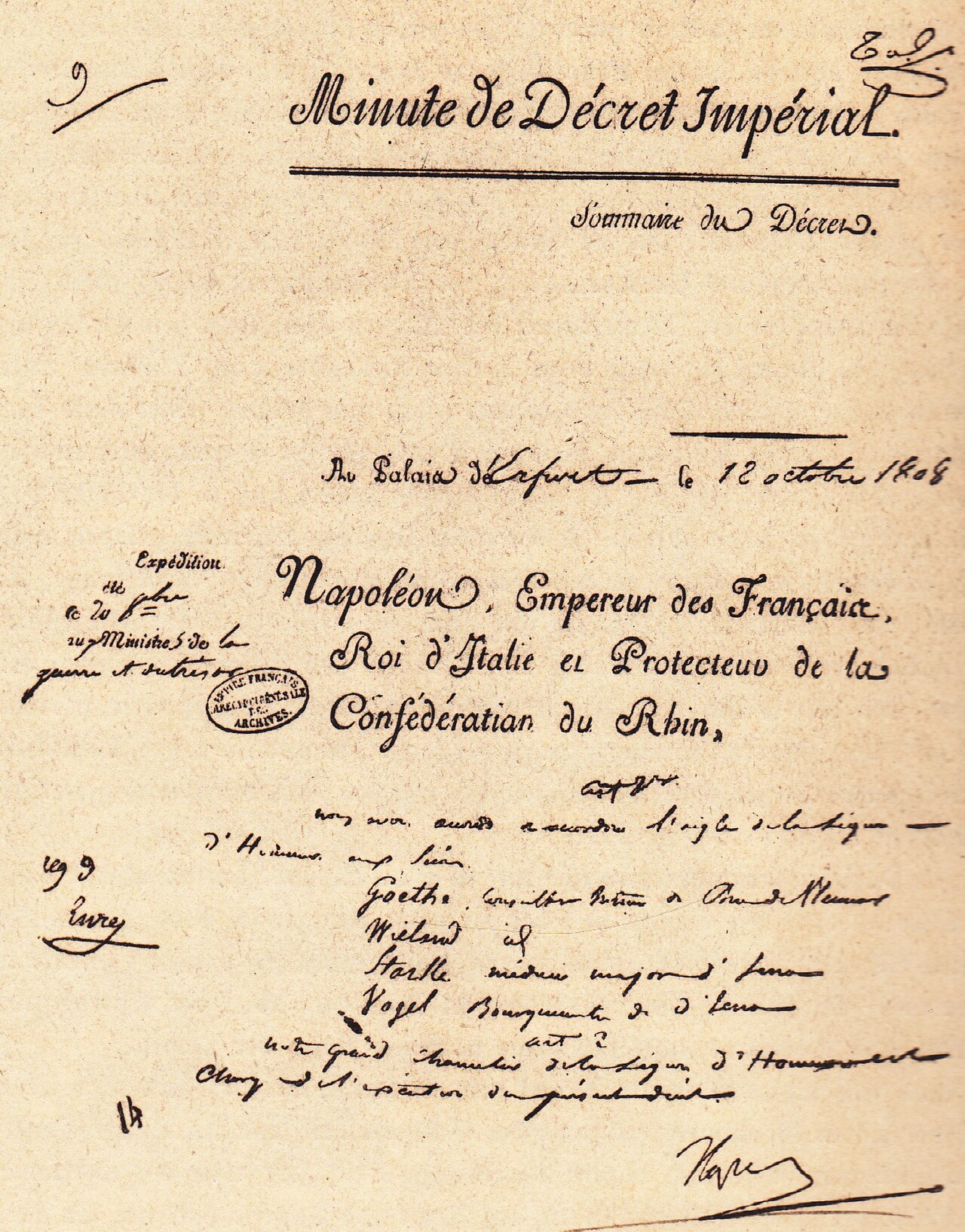
Scan of a French handwritten Imperial Decree minute dated Palais de Erfurt, 12 October 1808, headed 'Minute de Décret Impérial', naming Goethe, Wieland, Starke and Vogel for the Legion of Honour, signed with a flourish at lower right.Document

Primary source

Napoleon's Decree Naming Goethe to the Legion of Honour

12 October 1808

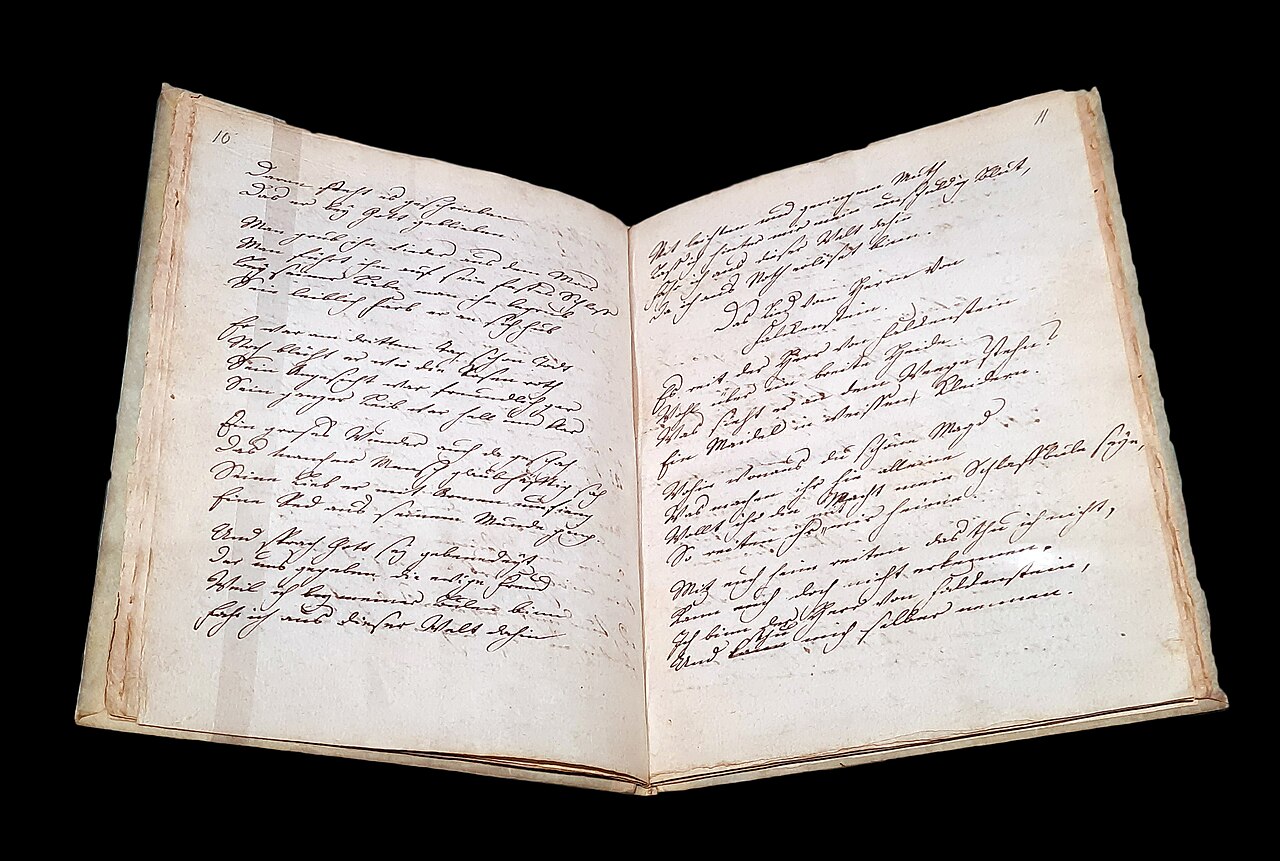
An open handwritten manuscript book on a black background, showing two facing pages of cursive German-script handwriting in brown ink on aged cream paper. Page numbers 16 and 17 are visible at the top corners.Book

Primary source

Chansons populaires recueillies par Goethe en Alsace

Johann Wolfgang von Goethe · c. 1770-1771

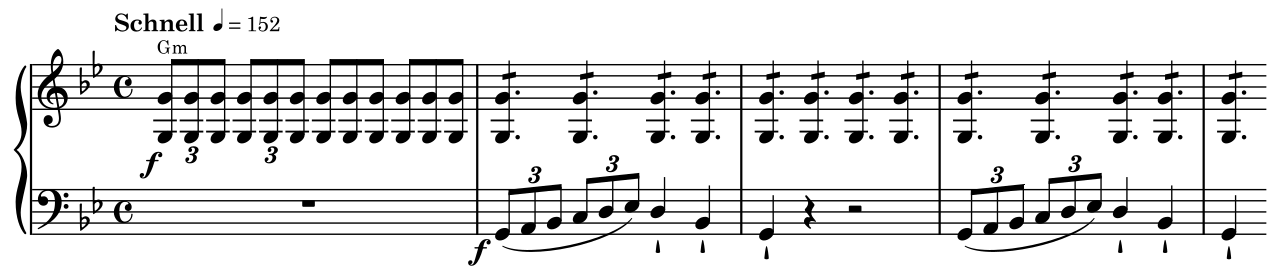
Musical score excerpt of Schubert's Erlkönig, measures 1-5, piano part. Marked Schnell, quarter note 152, in G minor chord over B-flat key signature. Treble staff has repeated sixteenth-note figures in triplets; bass staff shows triplet figures and rests.Document

Secondary source

Erlkönig

Franz Schubert · 1815

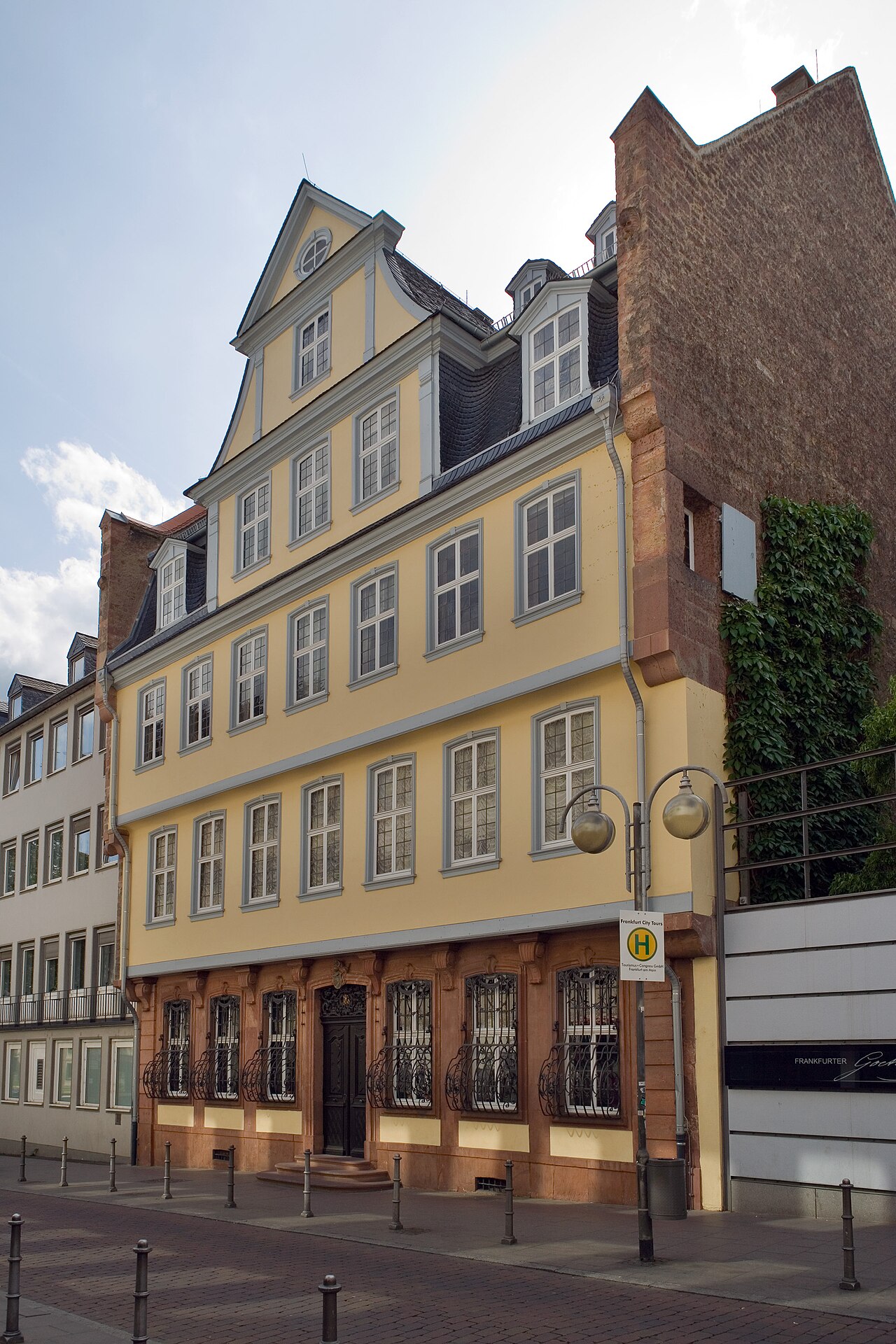
Front view of a multi-story yellow plastered building with white-framed windows, a steep roof with dormers, and a reddish sandstone ground floor with ornate iron balcony grilles and a dark wooden entrance door. A street lamp and a bus stop sign stand in front on a brick pavement, with a modern building to the right.Artifact

Secondary source

Goethe House, Frankfurt

rebuilt 1859

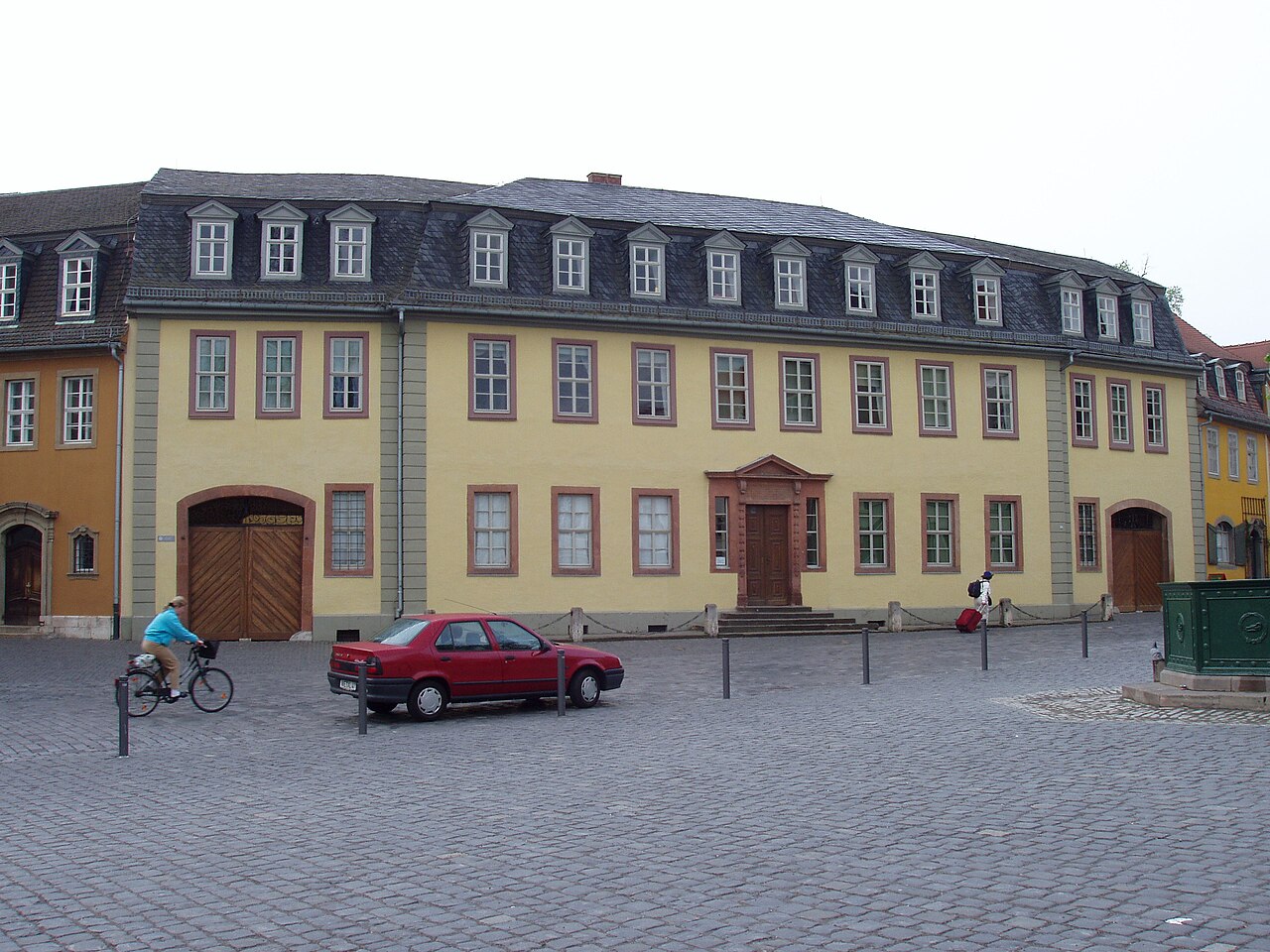
Exterior of a long yellow multi-storey building with a steep slate roof and many dormer windows, set on a cobblestone square. A door with a stone pediment is in the centre with steps leading up to it. A red car is parked in front, and a cyclist rides past on the left.Artifact

Primary source

Goethe House, Weimar

Georg Caspar Helmershausen · 1709 (Goethe's home from 1782)

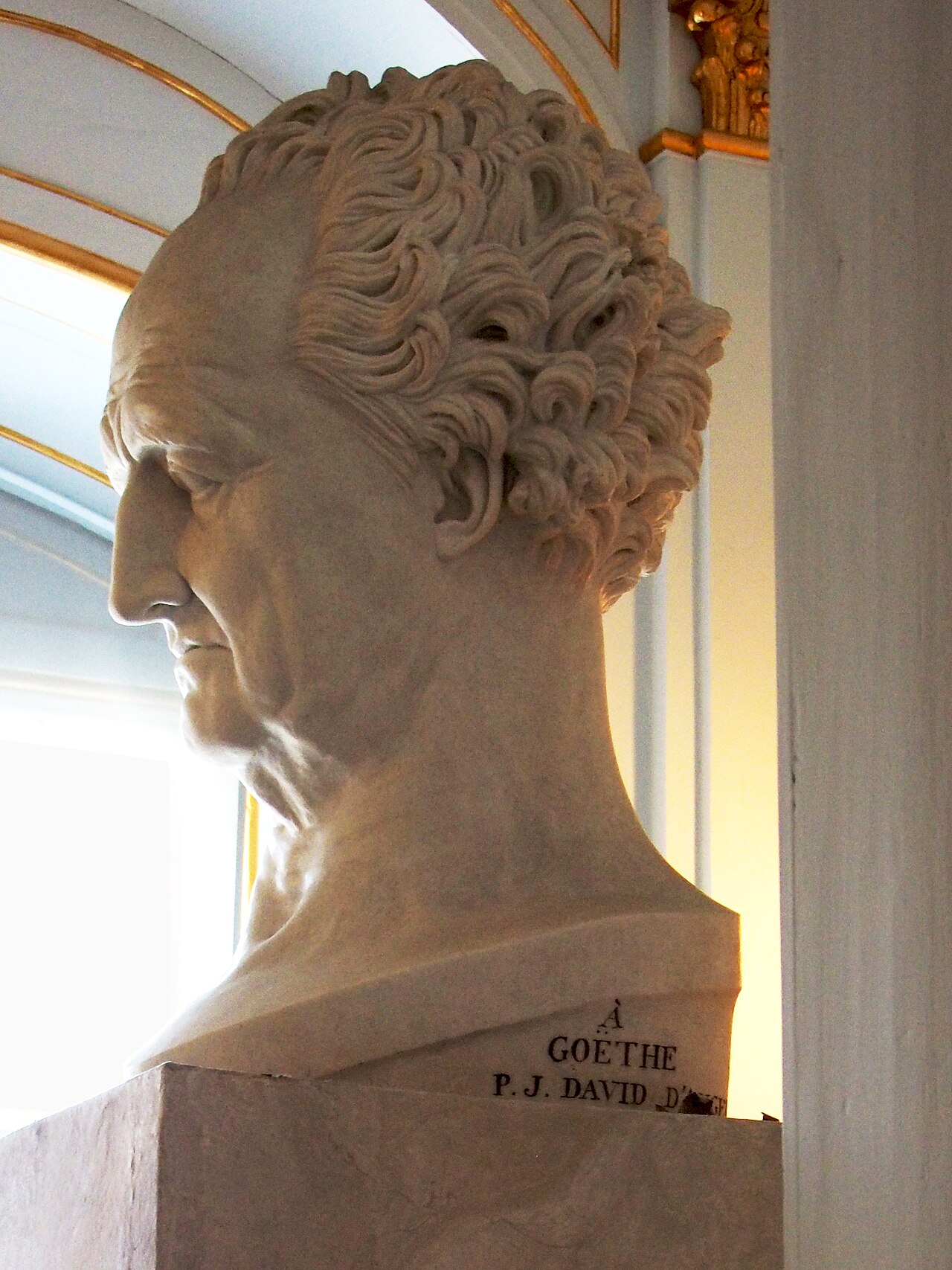
Photo of a white marble bust of an older man with wavy curly hair and a long nose, turned in profile to the left, on a stone plinth. Inscription on the bust reads 'A GOETHE P. J. DAVID D'ANGERS'. Gilded architectural trim and a pale wall are behind it.Sculpture

Primary source

Bust of Goethe

David d'Angers · 1831

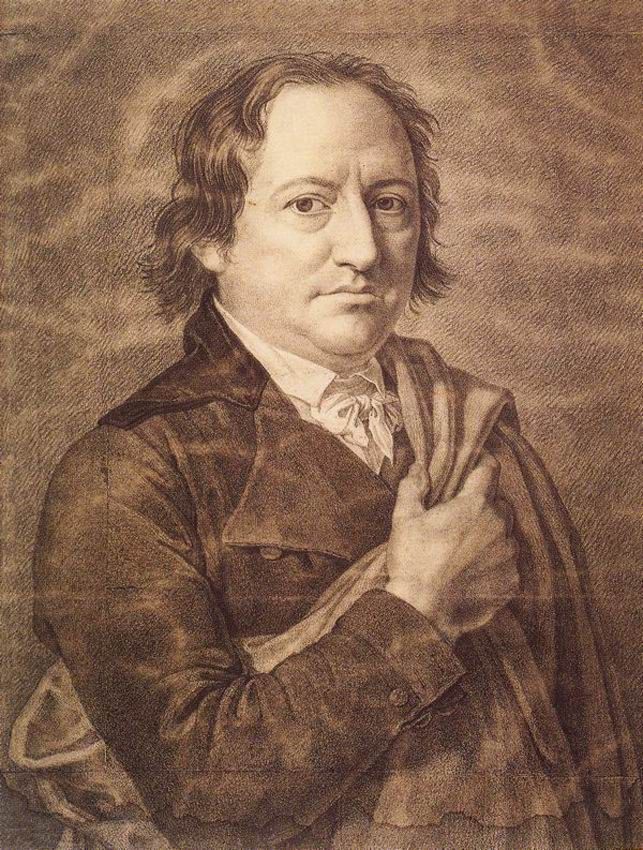
Sepia-toned chalk drawing of a man with shoulder-length wavy hair, wearing a dark coat and white cravat, with one hand pressed to his chest and a draped cloak over his shoulder. Soft shaded background.Painting

Primary source

Portrait of Johann Wolfgang von Goethe

Friedrich Bury · c. 1800

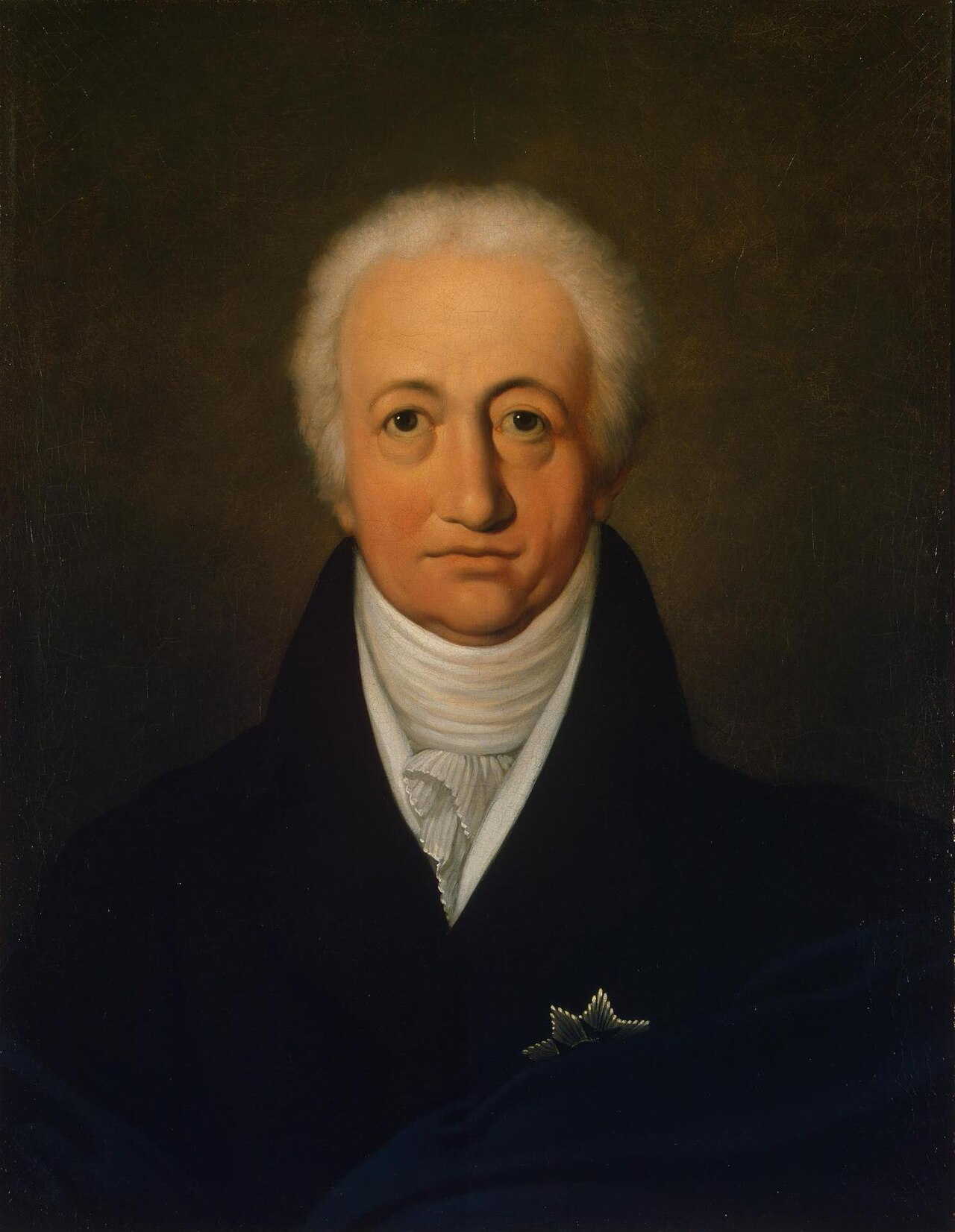
Oil painting of an older man with white hair, dark eyes, and a serious expression, wearing a dark high-collared coat, white cravat, and a small silver star medal on his chest, against a dark brown background.Painting

Primary source

Portrait of Johann Wolfgang Goethe

Ferdinand Jagemann · 1818

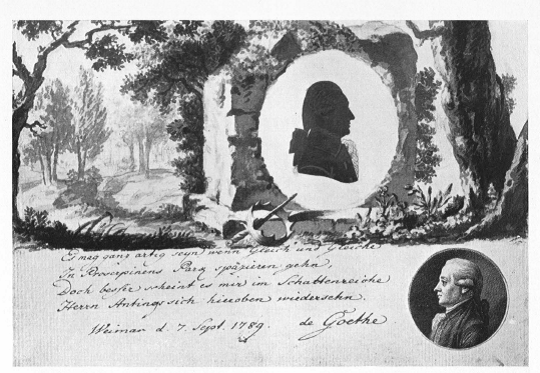
Black-and-white reproduction of a drawing: a silhouette profile of a man inside an oval cutout framed by trees and a stone arch, with a handwritten verse and signature below, and a small inset portrait profile of a man at lower right.Painting

Primary source

Silhouette and Inscription of Goethe in Anthing's Album

Johann Friedrich Anthing · 7 September 1789

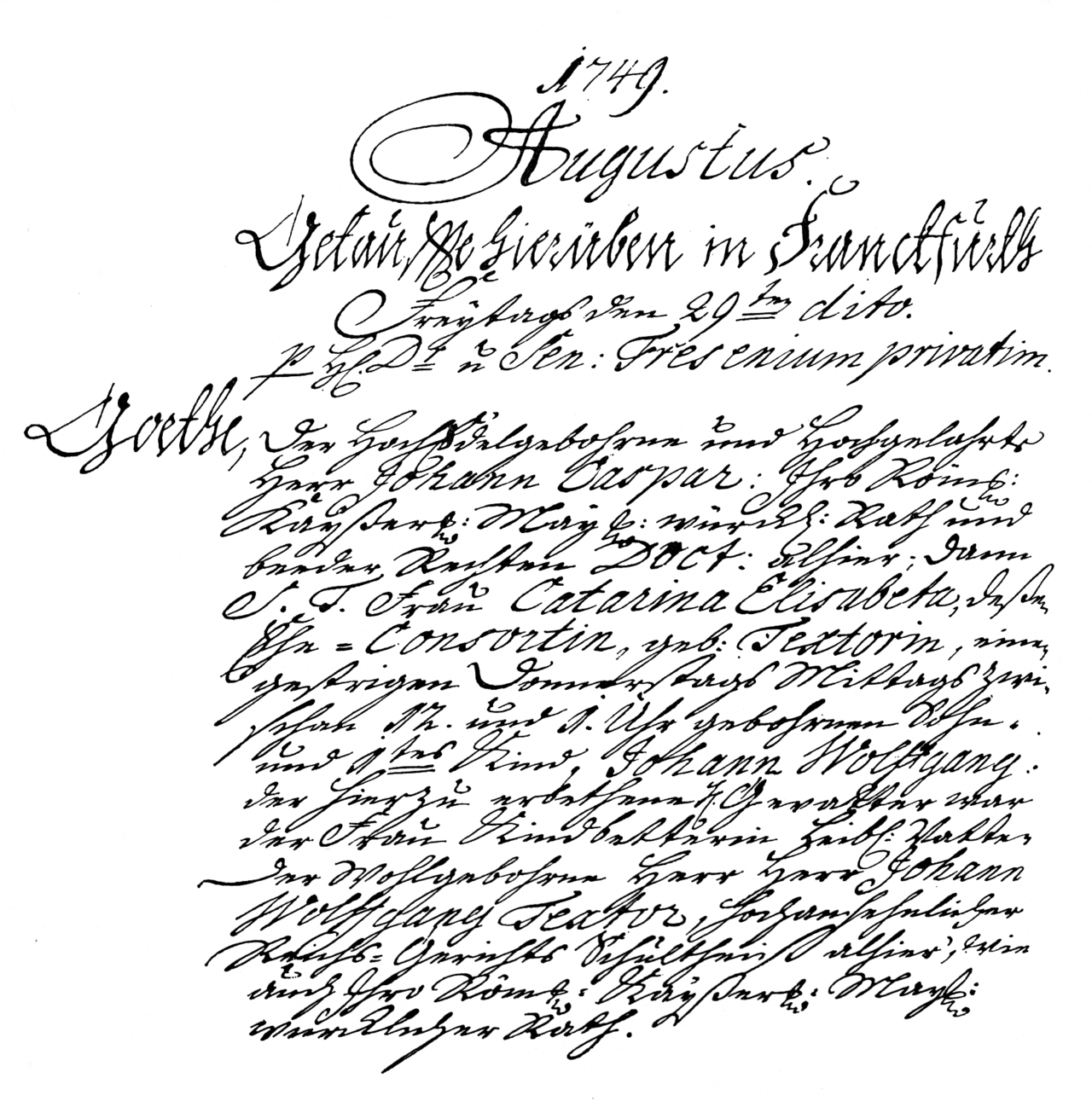
Handwritten 18th-century German baptism entry dated 1749 in ornate script, headed 'Augustus' and 'Frankfurt', recording the birth and baptism of Johann Wolfgang Goethe to Johann Caspar Goethe and Catharina Elisabeth. Black ink on white paper.Document

Primary source

Goethe's Birth and Baptism Entry

1749

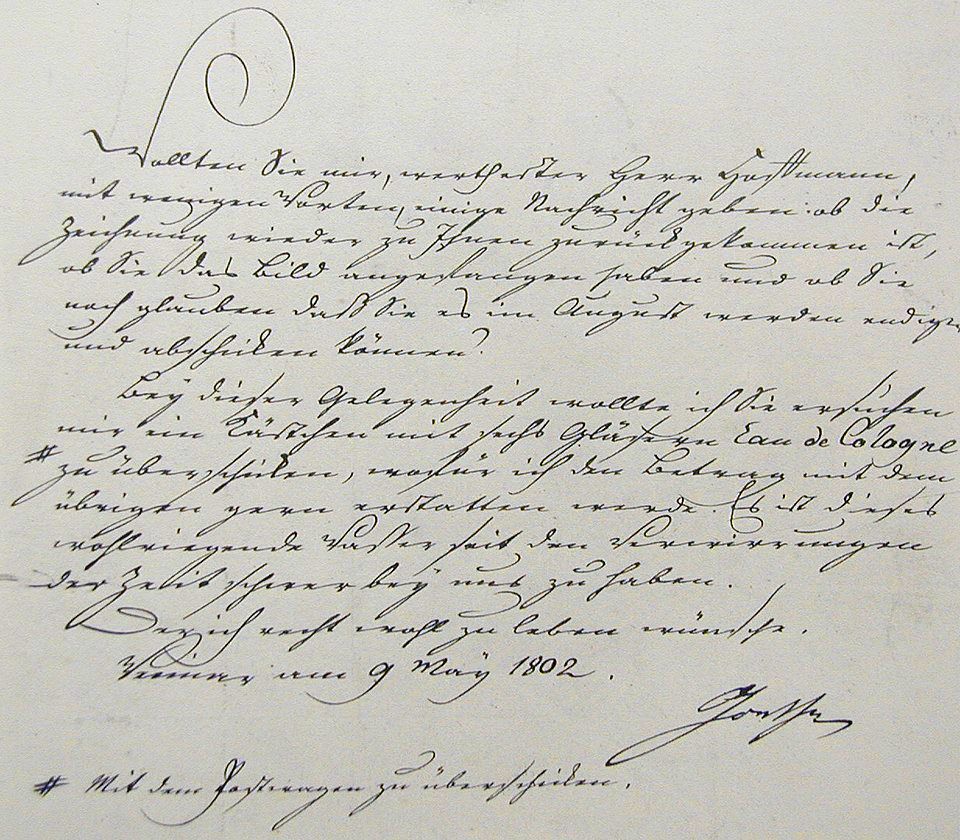
Handwritten German letter in dark ink on aged paper, dated Weimar 9 May 1802, with a large decorative initial and a signature at lower right. A footnote with an asterisk appears at the bottom.Letter

Primary source

Letter to the Painter Hoffmann in Cologne

Johann Wolfgang von Goethe · 9 May 1802

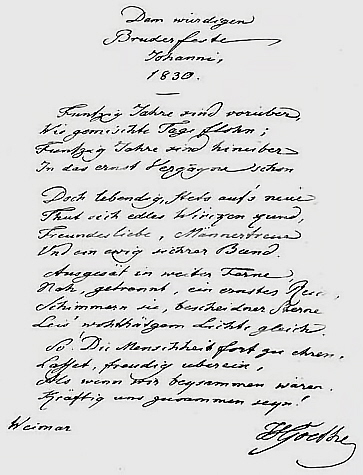
Handwritten German poem in cursive script headed 'Dem würdigen Bruderkreise, Johanni, 1830', signed with a flourished signature and the place 'Weimar' at the bottom left.Letter

Primary source

Danksagung an die Loge Amalia

Johann Wolfgang von Goethe · 1830

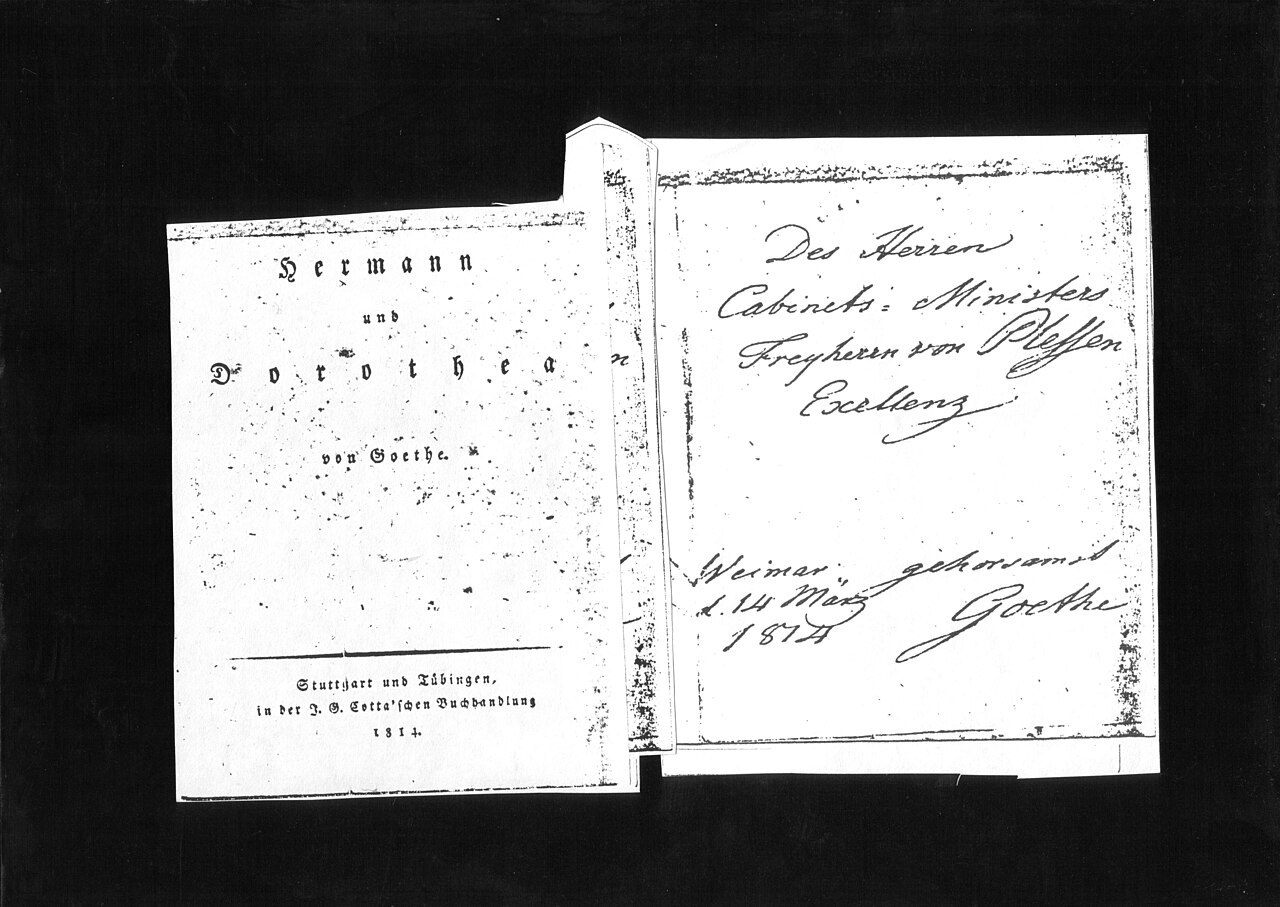
Black-and-white scan of a book title page reading 'Hermann und Dorothea von Goethe, Stuttgart und Tübingen, in der J. G. Cotta'schen Buchhandlung, 1814' beside a handwritten note addressed to 'Des Herren Cabinets-Minister Freyherren von Plessen Excellenz', signed 'Goethe', dated Weimar 14 März 1814.Document

Primary source

Invitation Card to Hermann und Dorothea

Johann Wolfgang von Goethe · 14 March 1814

A black ink signature on a white background, drawn with a looping flourish on the upper left and a long sweeping tail extending to the right, with a smaller stroke beneath.Document

Primary source

Signature of Johann Wolfgang von Goethe

Johann Wolfgang von Goethe

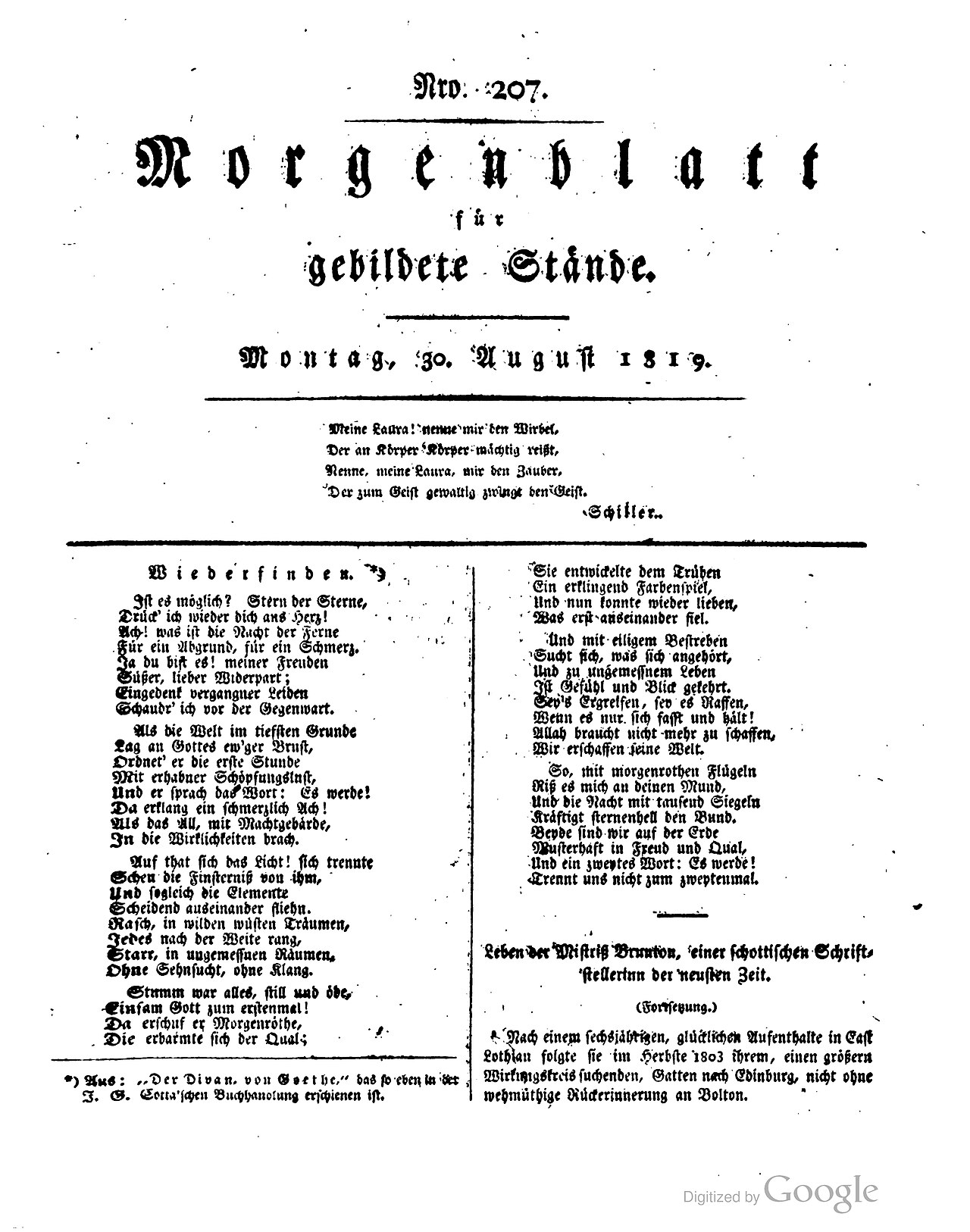
Scan of page from Morgenblatt für gebildete Stände, Nr. 207, Montag 30 August 1819, with the poem 'Wiederfinden' in two columns in German blackletter type, with epigraph from Schiller and a footnote.Newspaper article

Primary source

Wiederfinden

Johann Wolfgang von Goethe · 30 August 1819

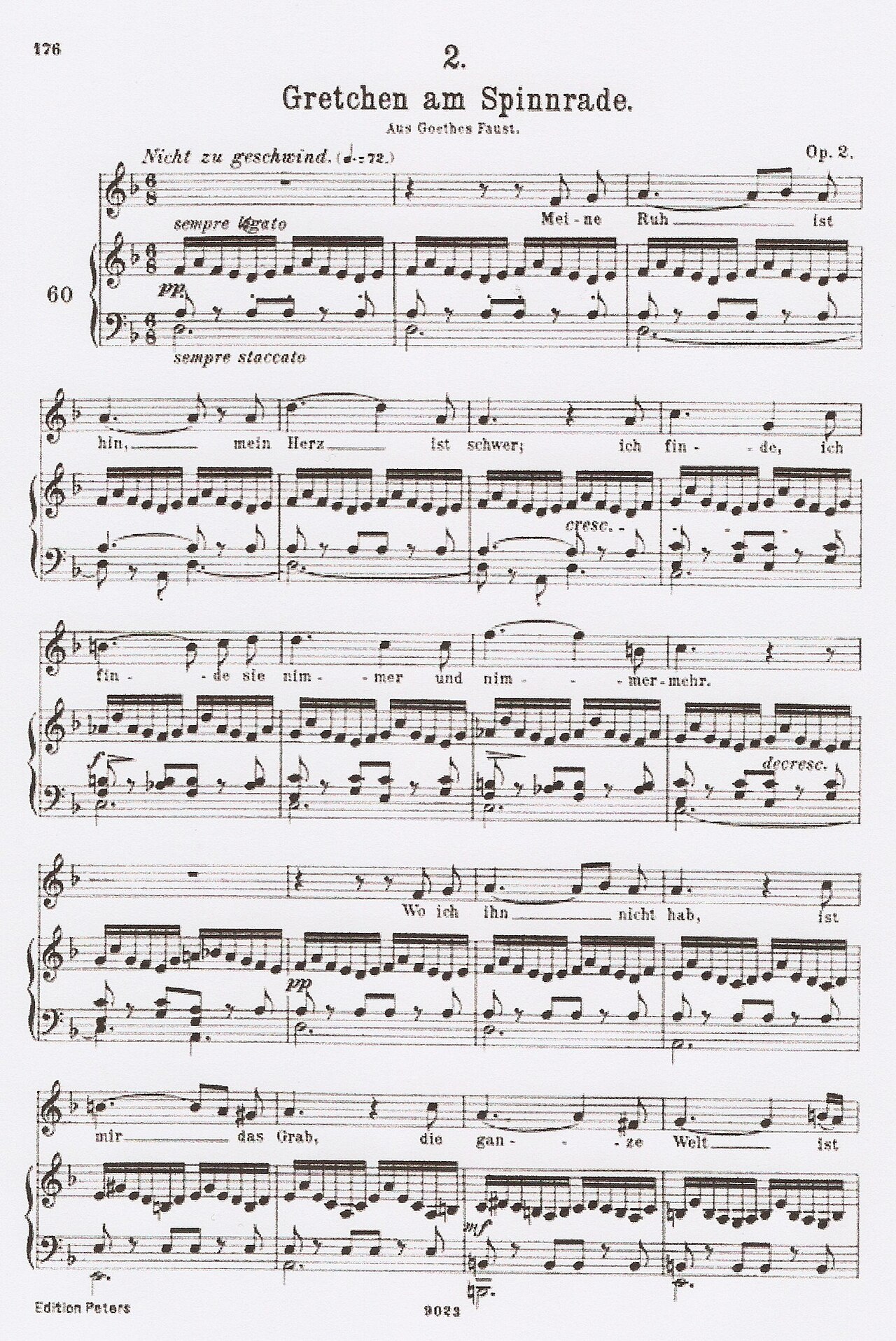
Printed sheet music page titled '2. Gretchen am Spinnrade', subtitled 'Aus Goethes Faust', Op. 2, marked 'Nicht zu geschwind', with voice line and piano score in several staves, lyrics such as 'Meine Ruh ist hin' and 'mein Herz ist schwer', and the publisher Edition Peters at bottom left.Document

Secondary source

Gretchen am Spinnrade

Franz Schubert · 1814

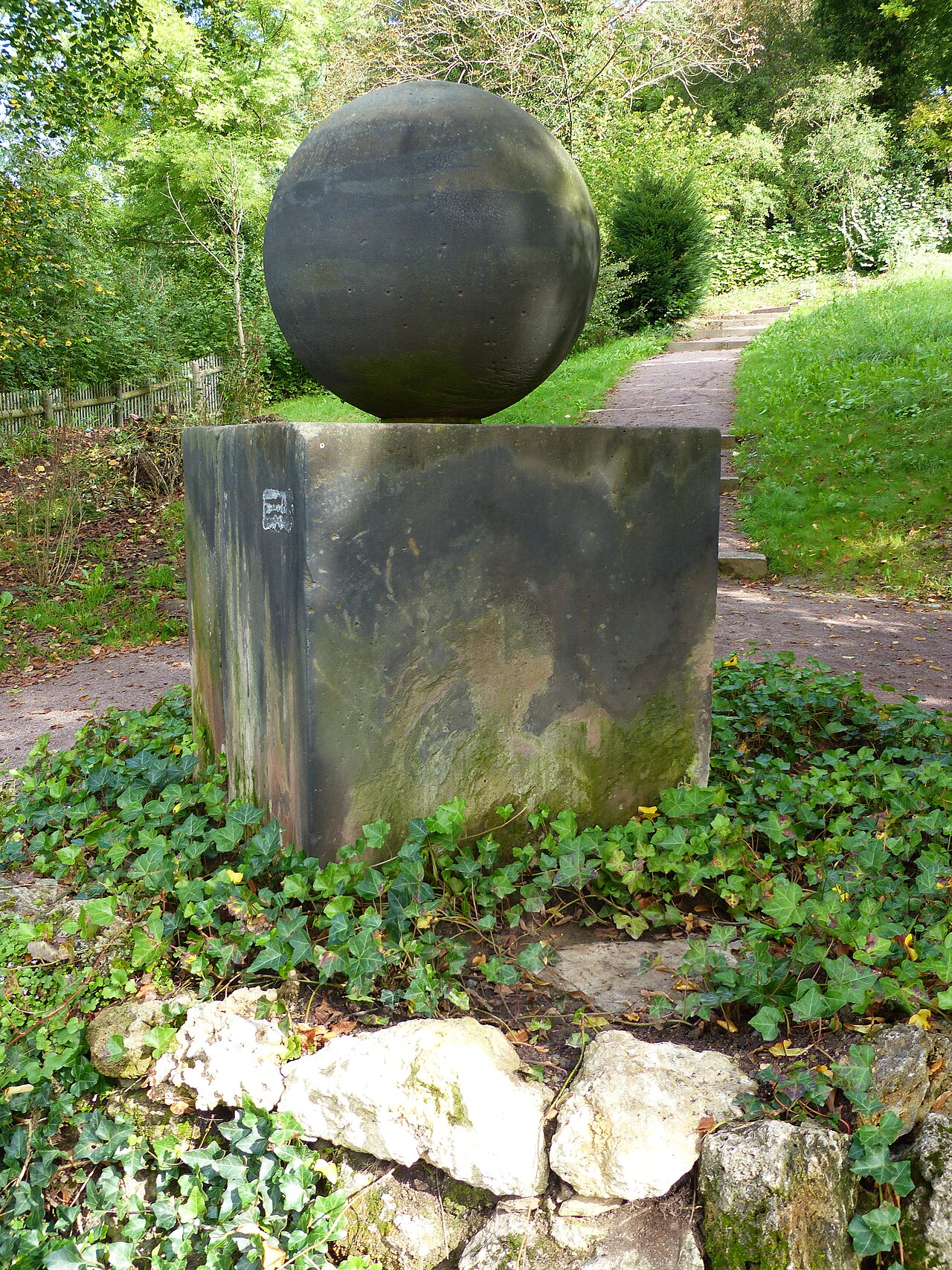
A dark, weathered sphere sits atop a large grey stone cube pedestal in a garden. Ivy covers the ground around the base, with a stone wall in front and a gravel path with a grassy slope behind it. Trees and shrubs fill the background.Artifact

Primary source

Stein des guten Glücks

Johann Wolfgang von Goethe · 1777

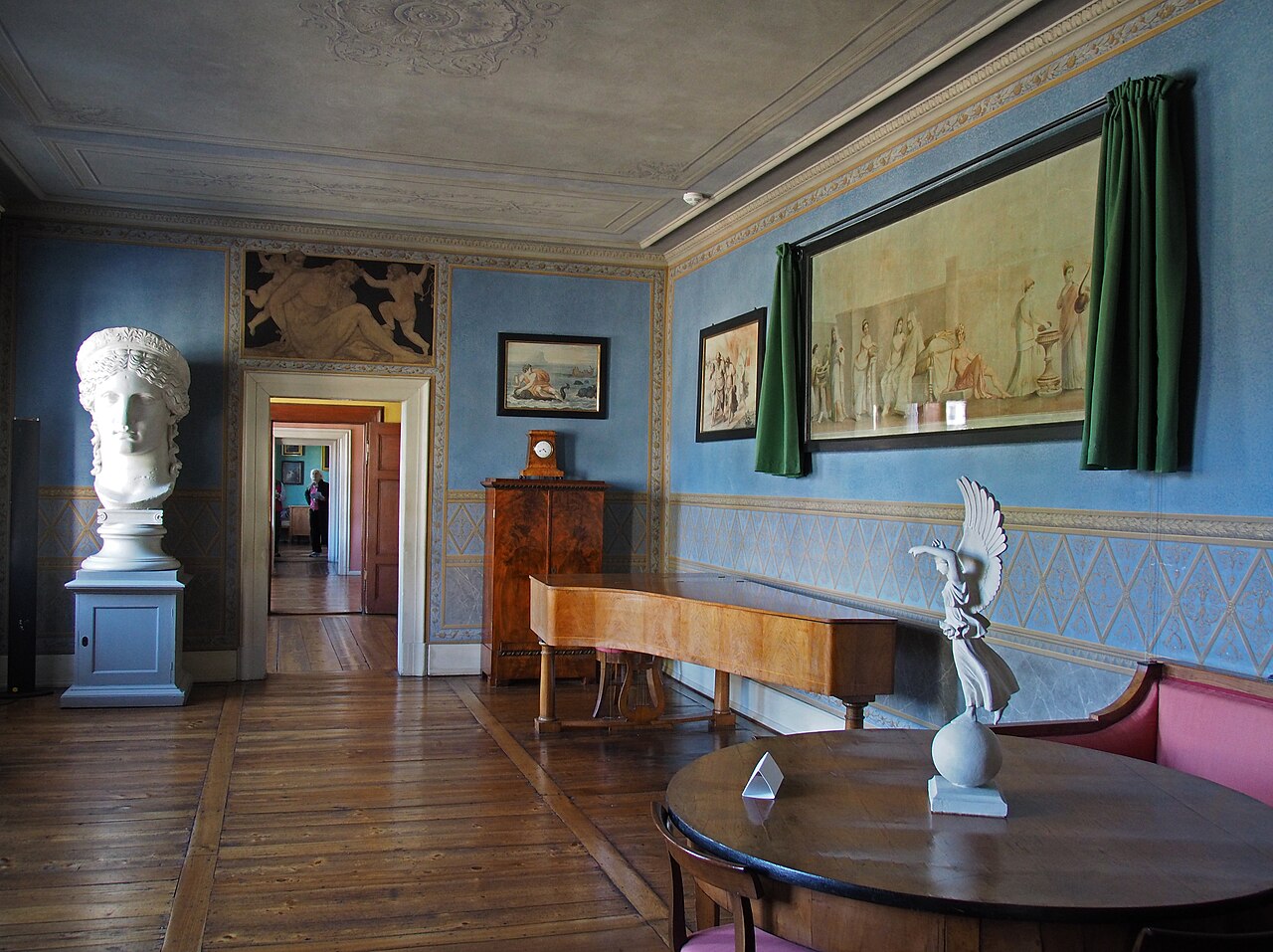
Interior room with blue walls, gold trim, and a wooden parquet floor. On the left stands a white plaster bust of a woman with a diadem. Right: a large framed classical painting, green curtains, a wooden piano, and a round table with a white winged figure.Artifact

Primary source

Juno Ludovisi at the Goethe House

1823

Book

Primary source

Truth and Poetry: From My Own Life

Johann Wolfgang von Goethe · 1848 (translation; original German text earlier)

Letter

Primary source

Letters from Switzerland and Travels in Italy

Johann Wolfgang von Goethe · 1881 (translation)

Book

Primary source

Egmont

Johann Wolfgang von Goethe

Letter

Primary source

Goethe's Letters to Zelter

Johann Wolfgang von Goethe · 1892 (published edition)

West-Eastern DivanBook

Primary source

West-Eastern Divan

Johann Wolfgang von Goethe · 1914 (translation)

Faust, Parts I and IIBook

Primary source

Faust, Parts I and II

Johann Wolfgang von Goethe · 1908

Elective AffinitiesBook

Primary source

Elective Affinities

Johann Wolfgang von Goethe · 1900

The Complete Works of Goethe in Ten VolumesBook

Primary source

The Complete Works of Goethe in Ten Volumes

Johann Wolfgang von Goethe · 1839

Early and Miscellaneous Letters of J. W. Goethe, Including Letters to His MotherLetter

Primary source

Early and Miscellaneous Letters of J. W. Goethe, Including Letters to His Mother

Johann Wolfgang von Goethe · 1884

Book

Primary source

Italienische Reise

Johann Wolfgang von Goethe · 1913

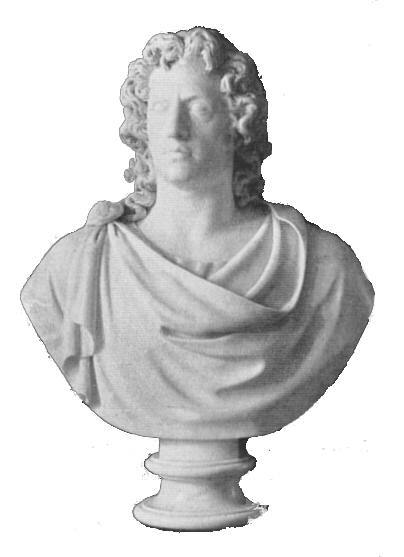
Black-and-white photograph of a white marble bust of a man with curly, shoulder-length hair, draped with a cloak fastened at the shoulder, resting on a stepped pedestal base.Sculpture

Primary source

Marble bust of Goethe by Alexander Trippel

Alexander Trippel · 1787

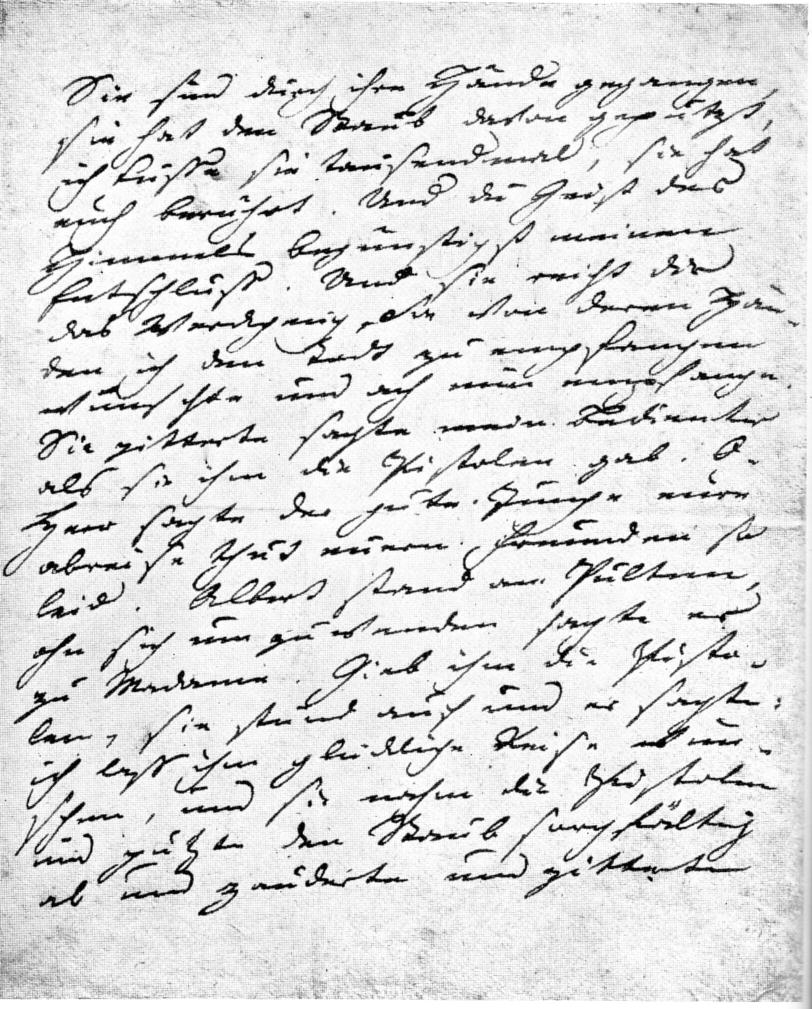
Photographed black-and-white page of handwritten German manuscript in cursive script, dense lines of ink on aged paper, believed to be Goethe's draft leaf for Werther.Document

Primary source

Goethe's manuscript leaf for The Sorrows of Young Werther

Johann Wolfgang von Goethe · 1774

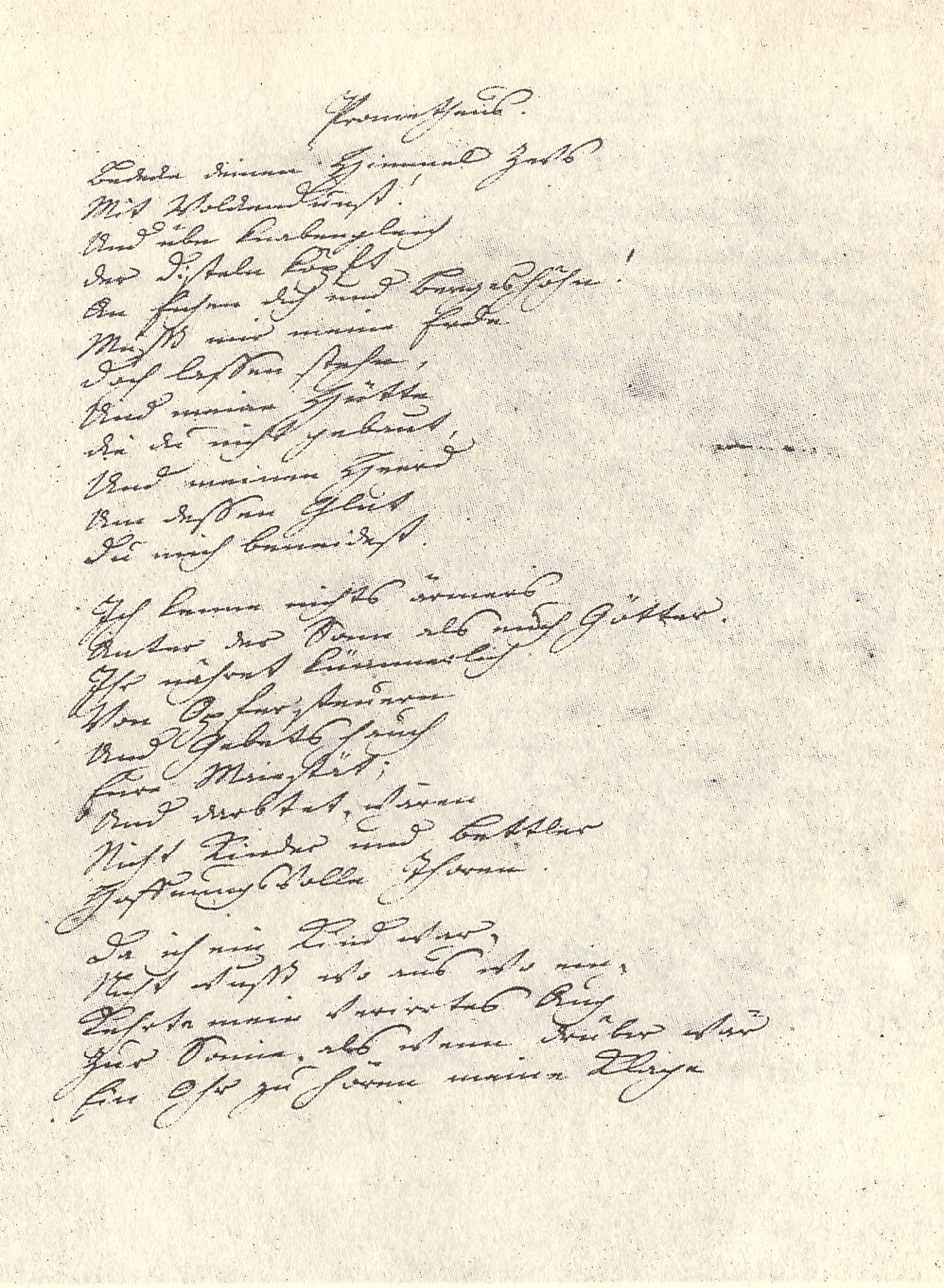
Handwritten German manuscript on yellowed paper, a poem in cursive script with the title 'Prometheus' at the top, arranged in stanzas of short lines with some lines indented.Document

Primary source

Autograph of Goethe's hymn Prometheus

Johann Wolfgang von Goethe · 1777

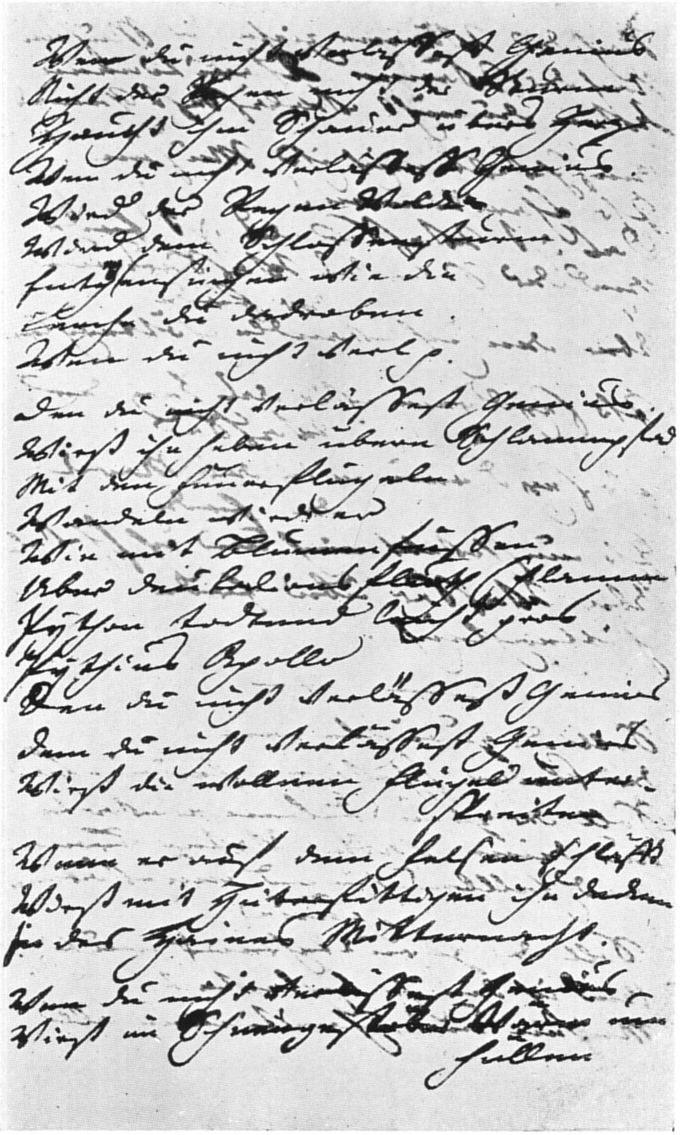
Black-and-white photograph of a handwritten manuscript page in German cursive script, with dark ink lines of verse, some crossed-out words, and faint ink bleed-through from the reverse side.Diary entry

Primary source

Wanderer's Storm Song Manuscript

Johann Wolfgang von Goethe · April 1772

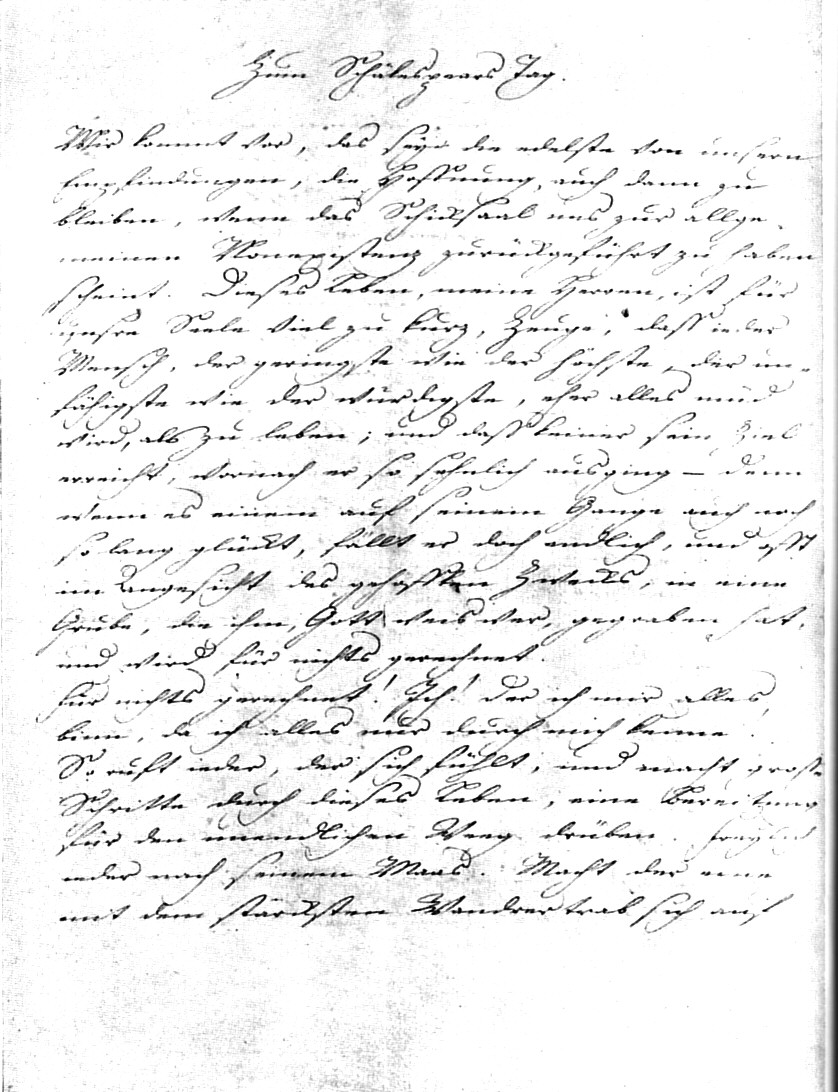
Scan of a handwritten German manuscript page in cursive script, with a heading at top reading 'Zum Shakespearstag' and dense lines of ink text below on aged paper.Speech

Secondary source

Goethe's Speech for Shakespeare Day

Johann Wolfgang von Goethe · 14 October 1771

Book

Secondary source

Goethe by Friedrich Gundolf

Friedrich Gundolf · 1916

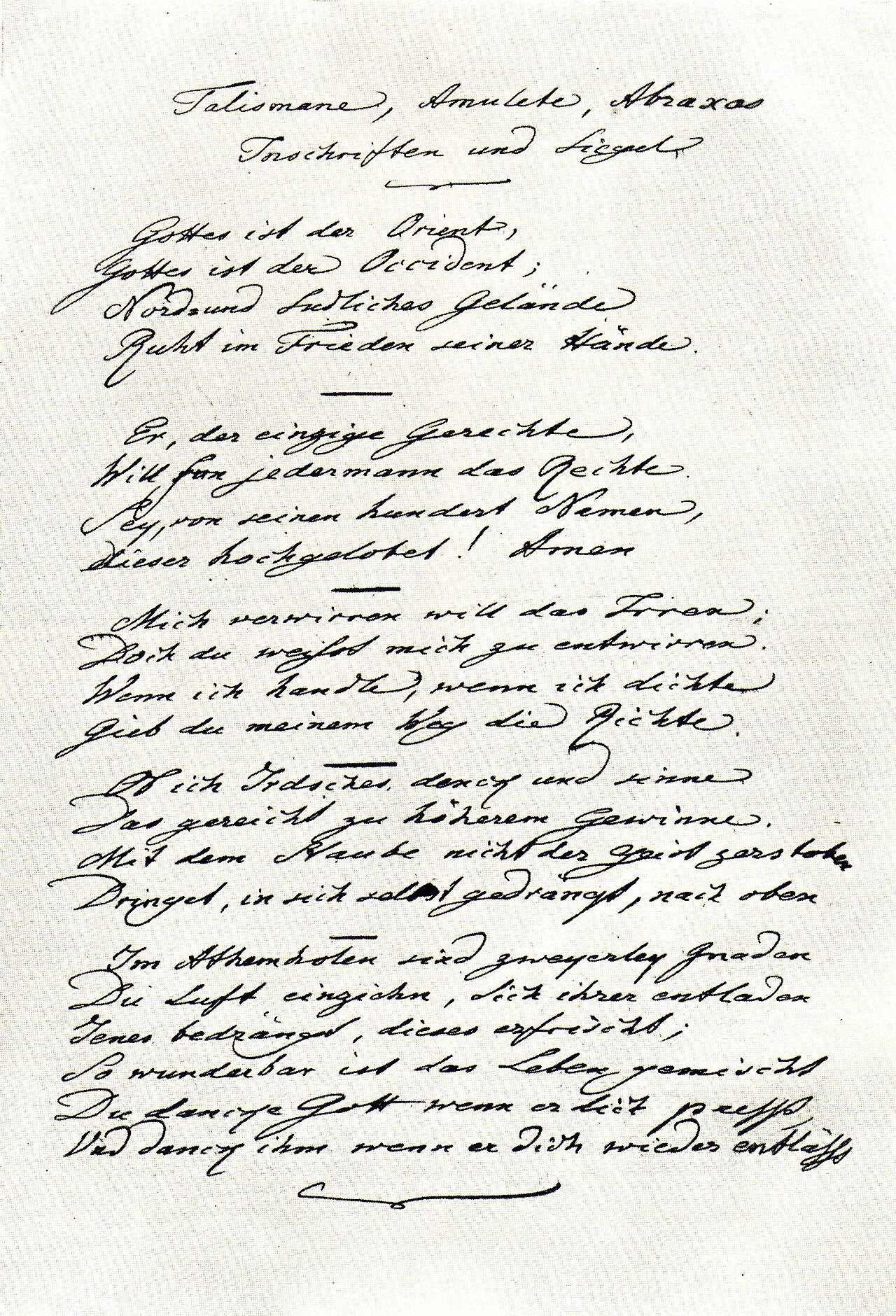
Handwritten manuscript in German cursive on cream paper, titled 'Talismane, Amulete, Abraxas, Inschriften und Siegel', with four stanzas of verse separated by short horizontal dashes and a flourish at the bottom.Book

Primary source

Fair Copy of Talismans

Johann Wolfgang von Goethe · 1815

Book

Primary source

Hermann und Dorothea

Johann Wolfgang von Goethe · 1797

Book

Primary source

Italian Journey

Johann Wolfgang von Goethe · 1786-1788 (journey); published later

Book

Secondary source

The Youth of Goethe

P. Hume Brown · 1913

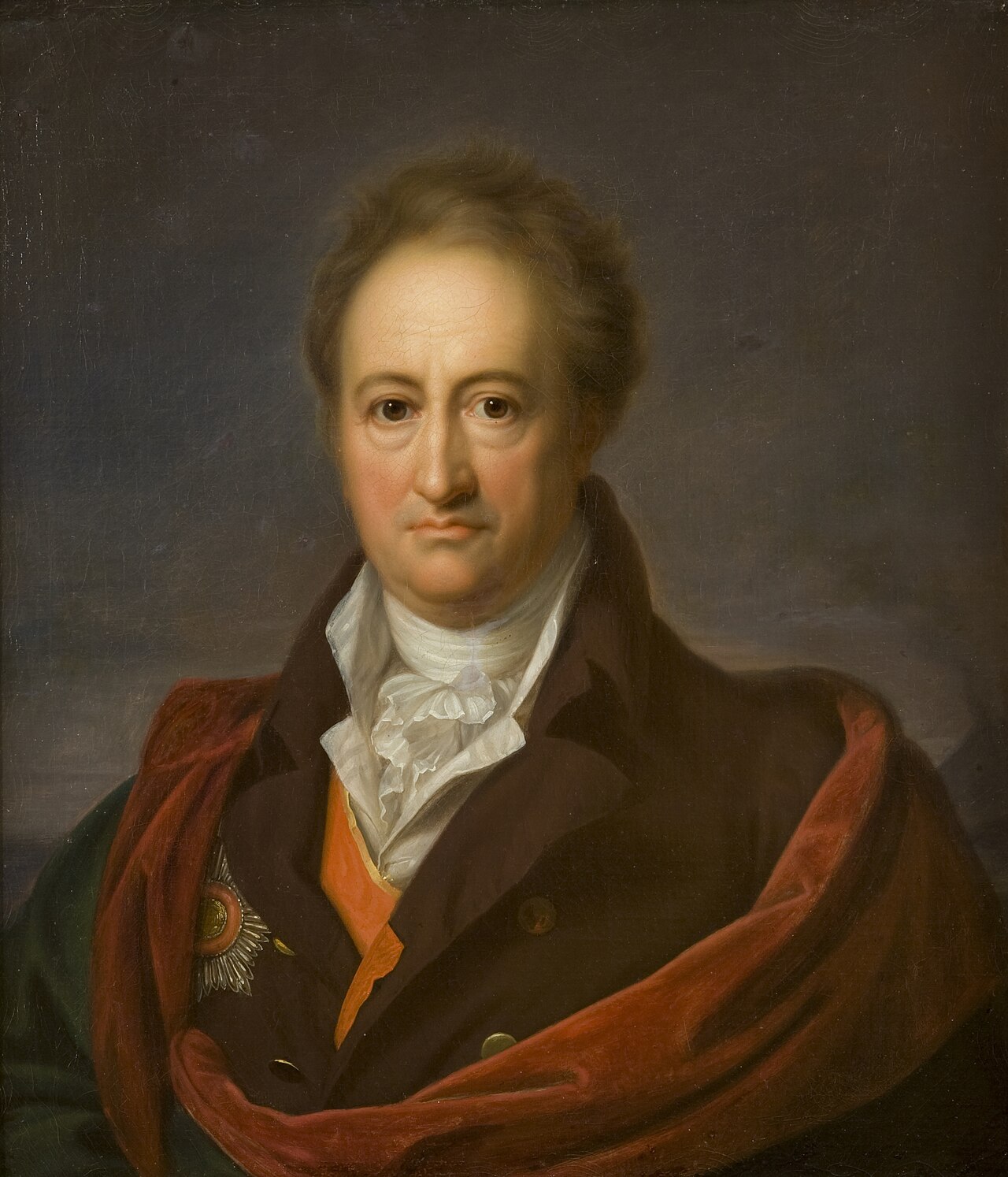
Oil painting portrait of a middle-aged man with short, tousled brown hair, looking directly at the viewer. He wears a dark brown coat, white cravat, a red sash draped over his shoulder, and a star-shaped medal on his chest. Dark grey background.Painting

Primary source

Portrait of Goethe

Gerhard von Kügelgen · 1808-1809

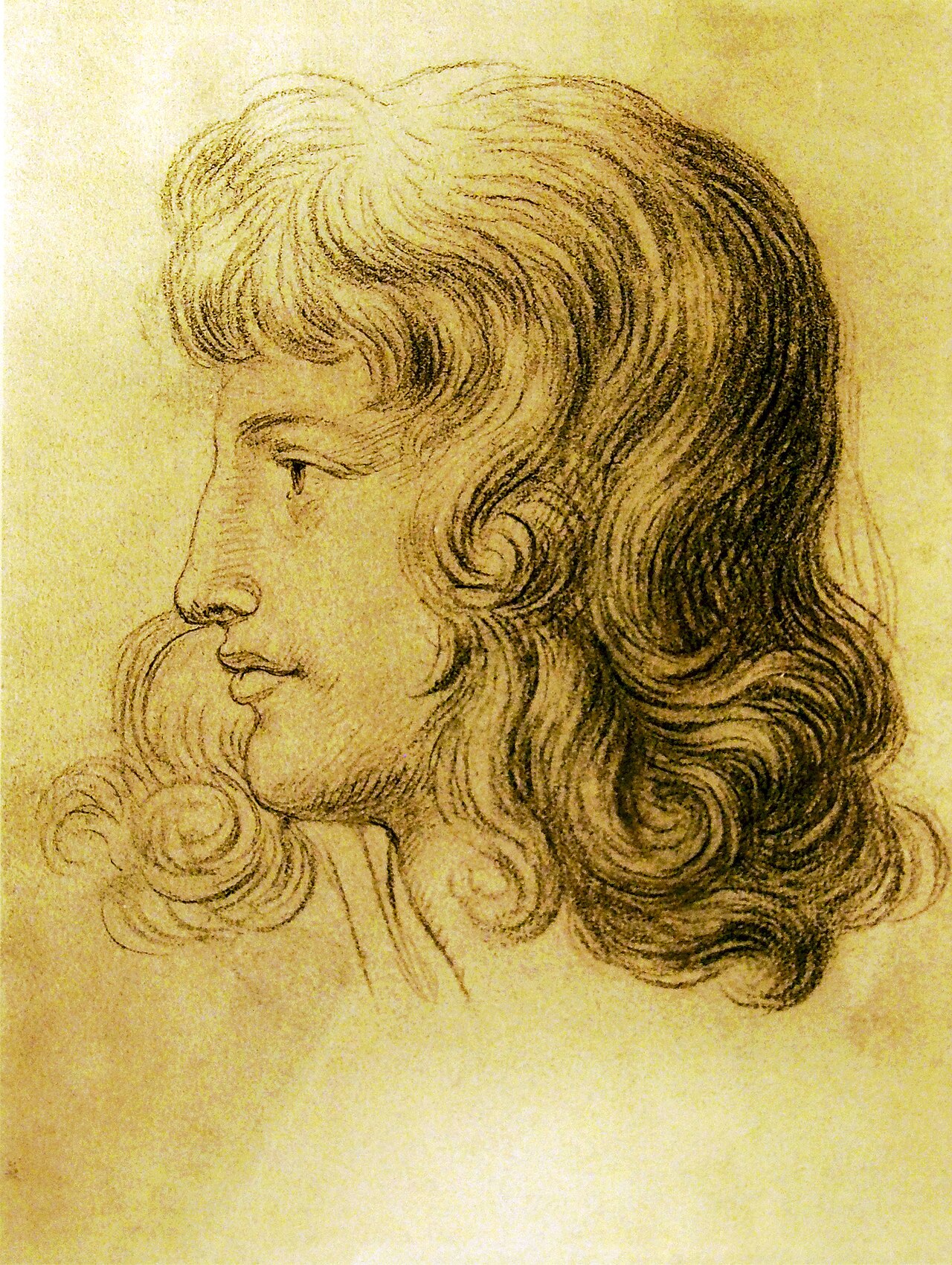
Pencil or chalk drawing on yellowed paper of a head in left-facing profile. The figure has long, wavy, curly hair falling to the shoulders and a curled beard. Shading is soft and sepia-toned.Painting

Primary source

Profile Drawing of Christiane Vulpius

Johann Wolfgang von Goethe · c. 1788-1789

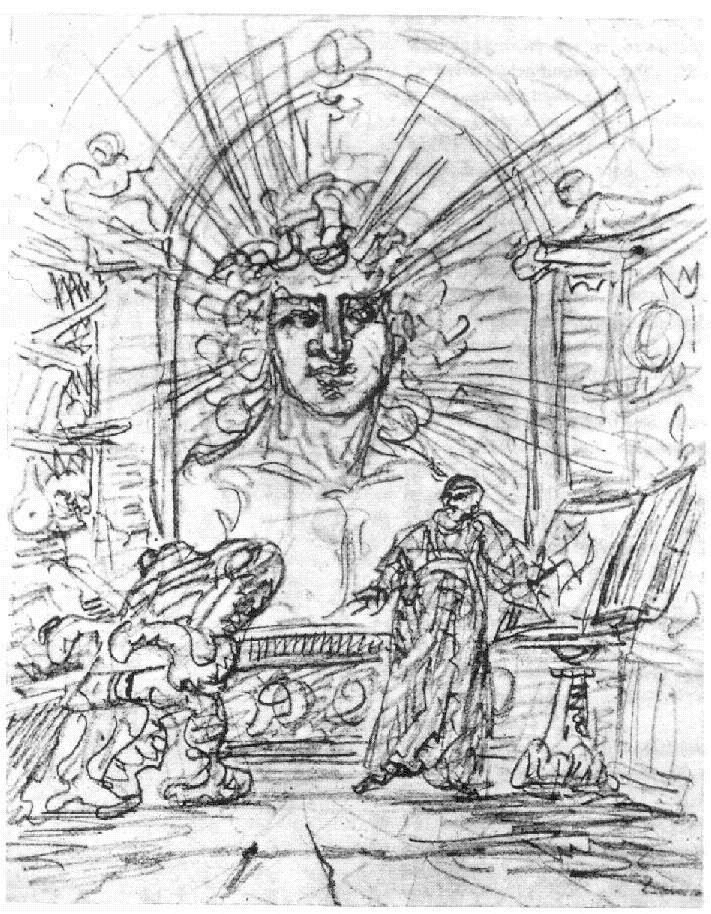
Pen-and-ink sketch of a scene: a large radiating face with flowing hair in an arched niche at center, a robed figure standing at right, a crouching creature at left, a bench and a pedestal nearby, with loose sketch lines throughout.Painting

Primary source

Faust and Erdgeist

Johann Wolfgang Goethe

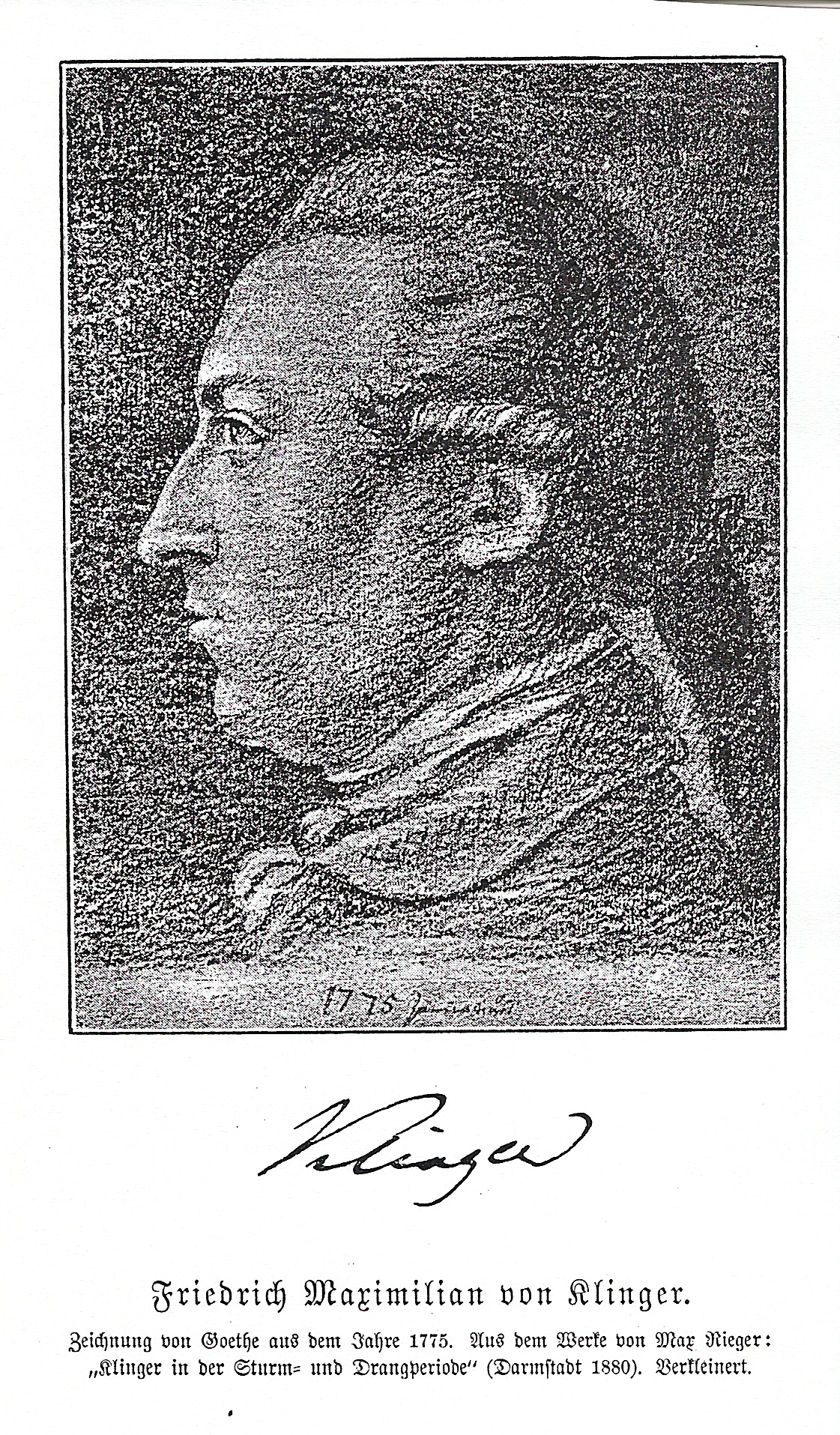
Reproduction of a chalk drawing in profile of a man facing left, with a balding head, long nose, and loosely tied cravat, dated 1775 in the lower corner. Below are a printed signature and a German caption naming Friedrich Maximilian von Klinger.Painting

Primary source

Chalk Drawing of Friedrich Klinger

Johann Wolfgang von Goethe · 1775

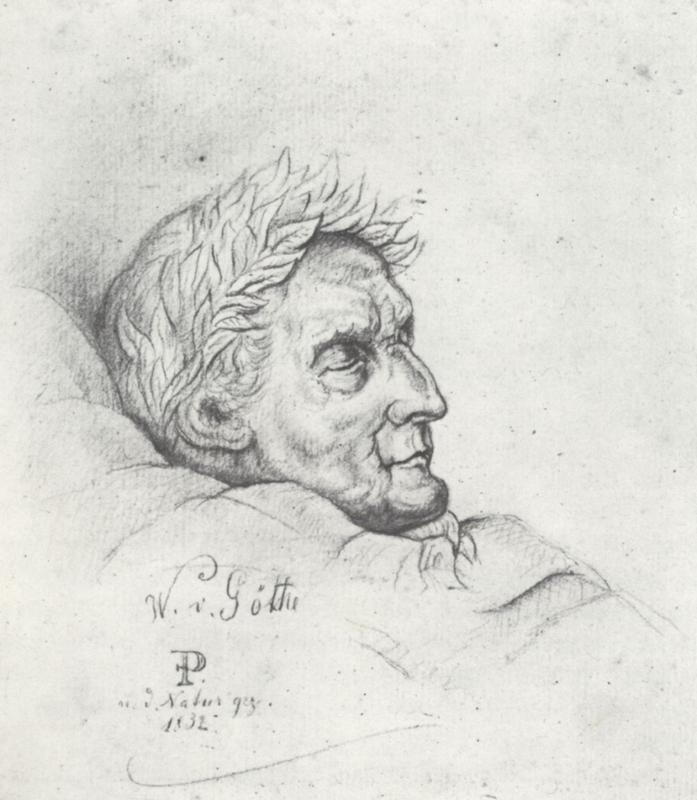
Pencil drawing in profile of an elderly man with a wreath of laurel leaves in his hair, resting his head on a pillow. Handwritten inscription reads W. v. Göthe, with a monogram, Nach der Natur, and 1832 below.Painting

Primary source

Goethe on His Deathbed

Friedrich Preller the Elder · 26 March 1832

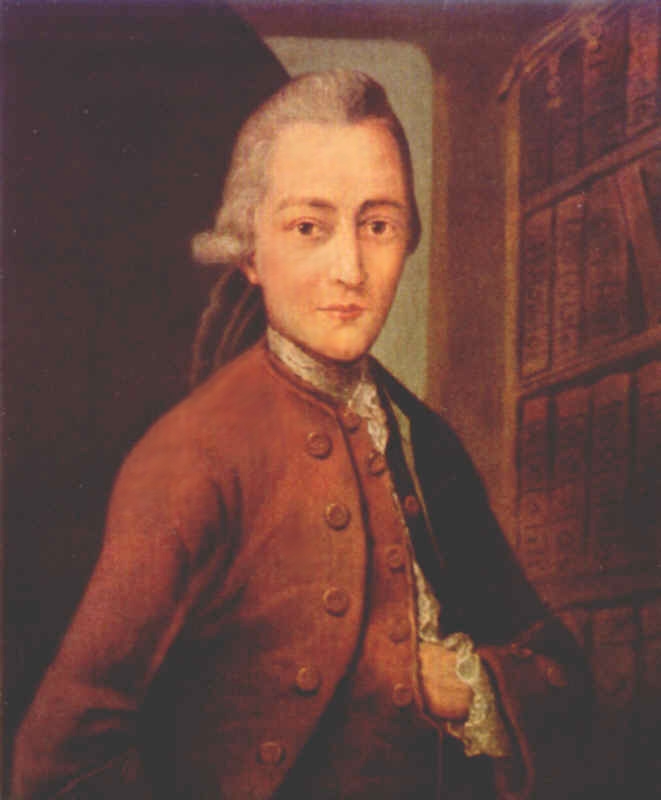
Oil portrait of a young man with powdered gray hair tied back, wearing a rust-red buttoned coat with white lace jabot, standing beside a bookcase filled with books, against a dark background.Painting

Primary source

Portrait of Young Goethe by Anton Kern

Anton Johann Kern · 1765

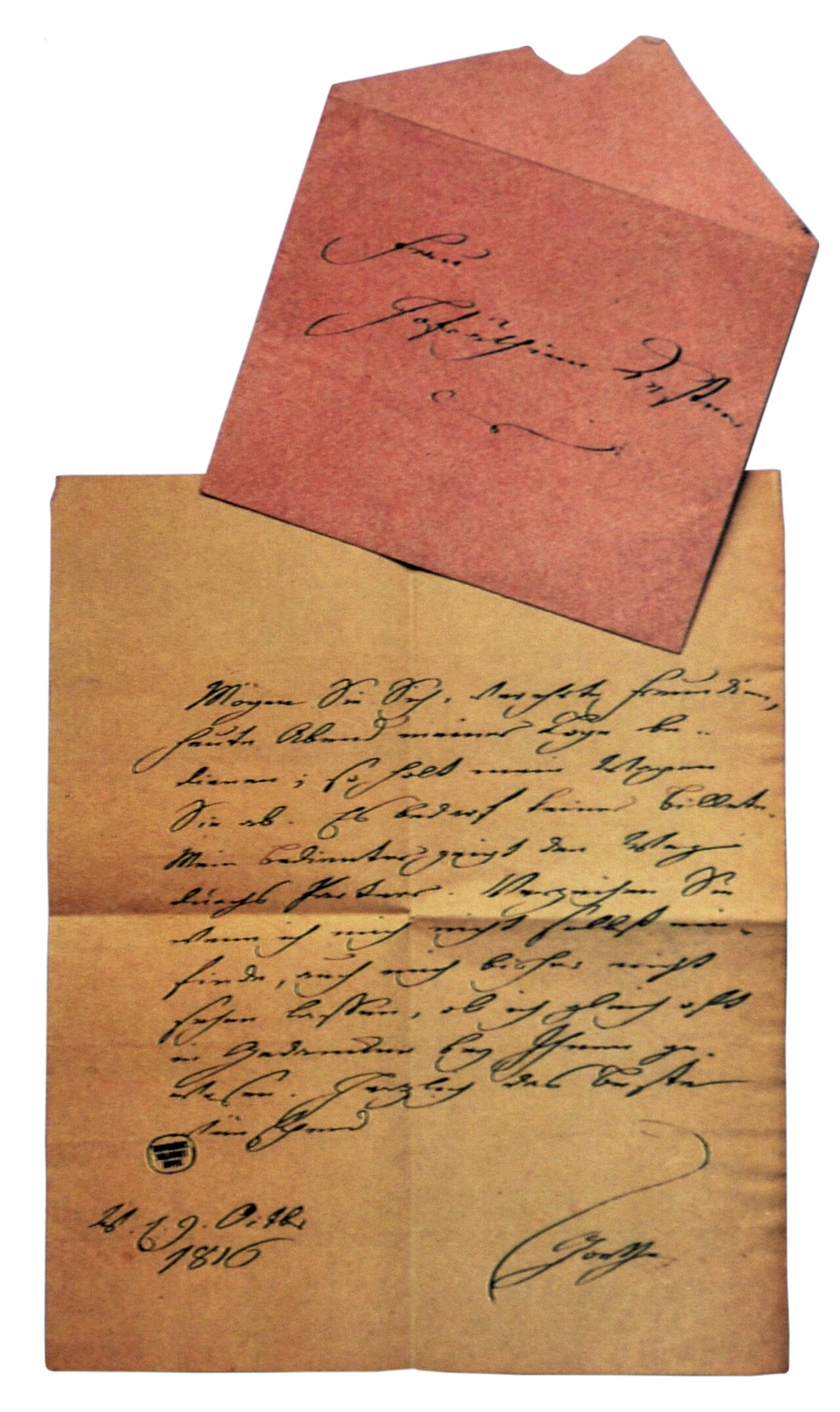
Photograph of a handwritten letter in German script on tan paper, with a pink envelope addressed in cursive lying partly over it. The letter is dated 9 October 1816 and signed with a flourished signature; a small red wax-like seal mark is at lower left.Letter

Primary source

Letter to Charlotte Kestner

Johann Wolfgang von Goethe · 9 October 1816

Goethe-JahrbuchBook

Secondary source

Goethe-Jahrbuch

Ludwig Geiger · 1880

Book

Secondary source

Goethe, with special consideration of his philosophy

Paul Carus · 1915

Book

Secondary source

Goethe, by Georg Brandes

Georg Brandes · 1922

Wolfgang Goethe, by Georg BrandesBook

Secondary source

Wolfgang Goethe, by Georg Brandes

Georg Brandes · 1915

Goethes Rheinreise, with Lavater and Basedow, 1774Document

Secondary source

Goethes Rheinreise, with Lavater and Basedow, 1774

Adolf Bach · 1923

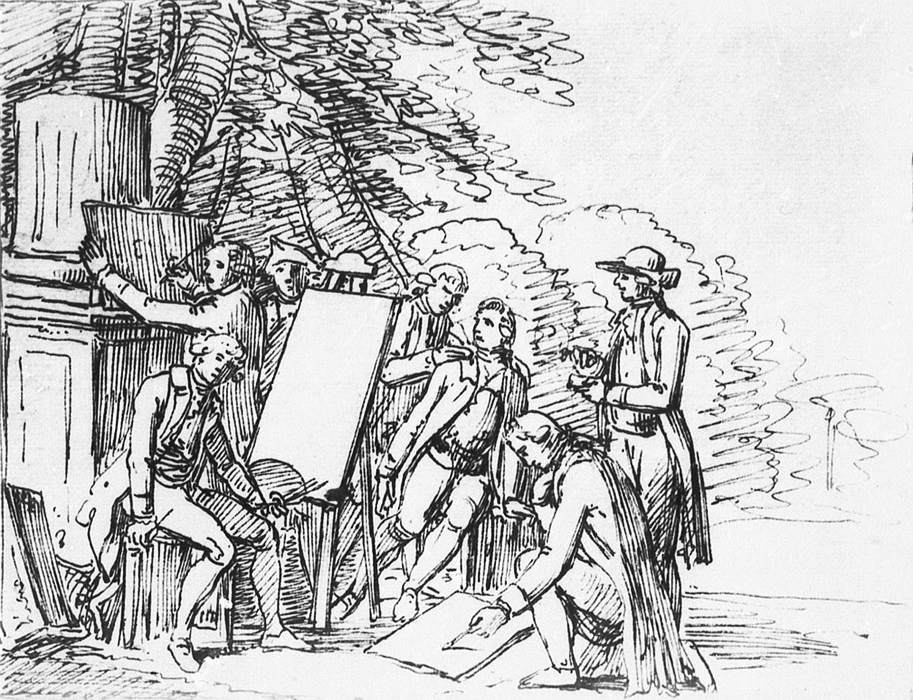
Pen and ink drawing of a group of men outdoors near a classical stone pillar and trees. A seated man in a hat and cloak sits on a stone block, a figure stands behind an easel holding a canvas, another man kneels in the foreground, and a standing man in a broad hat looks on.Painting

Secondary source

Goethe with His Italian Friends

Friedrich Bury · first half of 19th century

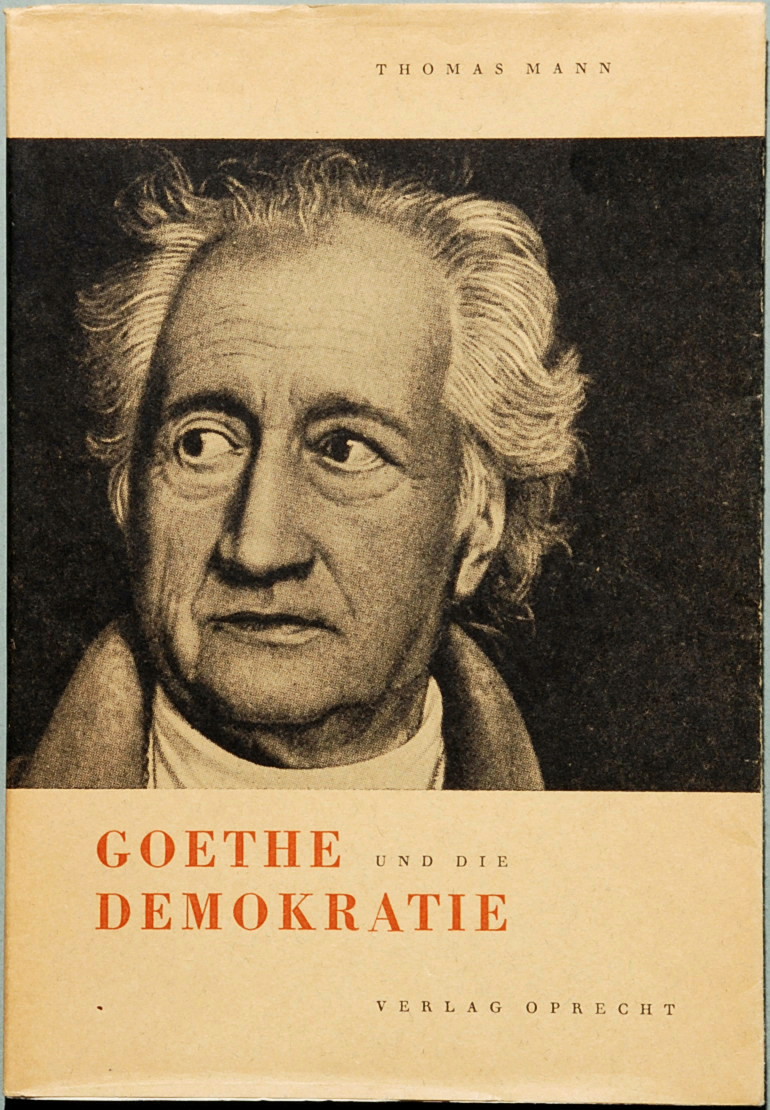
Front cover of the book Goethe und die Demokratie by Thomas Mann, published by Verlag Oprecht. Beige cover with a black-and-white engraved portrait of an older man with wavy white hair, a white collar and dark cloak. Title and publisher are in red and black type.Speech

Secondary source

Goethe and Democracy

Thomas Mann · 2 May 1949

Book

Primary source

The Sorrows of Young Werther (German LibriVox reading)

Johann Wolfgang von Goethe

Book

Primary source

Erotica Romana (Roman Elegies)

Johann Wolfgang von Goethe

Book

Primary source

Elective Affinities (English LibriVox reading)

Johann Wolfgang von Goethe

Book

Primary source

Faust, Part One (German LibriVox reading)

Johann Wolfgang von Goethe

Book

Secondary source

Life of Johann Wolfgang Goethe

James Sime · 1888

Want the full shelf? Chat with Johann Wolfgang von Goethe in the app and open the Sources panel — every quote links back to the original.

Use Johann Wolfgang von Goethe in class

1 collection

A ready-made collection from the Humy team that features Johann Wolfgang von Goethe. Preview it, then try it free.

Trusted by educators worldwide

Conversations
375,000+
Real exchanges between students and historical figures
Messages exchanged
4,142,000+
Across every figure, classroom and language
Historical figures
100,000+
Each informed by a curated biography and selected sources
Languages supported
50+
From English and Spanish to Arabic and Korean

Paying customers

Used by 98 schools and universities

Partner school logo
Tecnológico de Monterrey logo
Hyper Island logo
Partner school logo
Chambersburg Area School District logo
Broward County Public Schools logo
Nebo School District logo
National Louis University logo
South Florida PBS logo
Punahou School logo
University of Wisconsin–River Falls logo
Partner school logo
Partner school logo
Archbishop Mitty High School logo
Kingsburg High School logo
Norwalk Public Schools logo
Partner school logo
Connections logo
Partner school logo
Moore Public Schools logo
Partner school logo
Partner school logo
Partner school logo
Partner school logo
Robbinsville Public Schools logo
Partner school logo
Partner school logo
Partner school logo
Tecnológico de Monterrey logo
Hyper Island logo
Partner school logo
Chambersburg Area School District logo
Broward County Public Schools logo
Nebo School District logo
National Louis University logo
South Florida PBS logo
Punahou School logo
University of Wisconsin–River Falls logo
Partner school logo
Partner school logo
Archbishop Mitty High School logo
Kingsburg High School logo
Norwalk Public Schools logo
Partner school logo
Connections logo
Partner school logo
Moore Public Schools logo
Partner school logo
Partner school logo
Partner school logo
Partner school logo
Robbinsville Public Schools logo
Partner school logo
Partner school logo

What educators are saying

“We enjoyed the program last year and used it frequently.”
“My students say it’s a welcome change of pace. I’m not a fan of the “sage on the stage” model, so I try to incorporate research-oriented and self-paced activities. With Humy, students have to take charge of their learning. They’ve become more adept at critical thinking, forming better questions, and improving their reading comprehension. The interview feature has been my go-to tool. I create assignments where students must ask historical figures a set number of questions, then summarize the responses to ensure they’re truly absorbing the material. This approach lets them actively explore the past rather than passively consuming information.”
“Humy has helped me bring historical figures, sometimes long past, to life. When my students interact with these figures in real-time, it eliminates some of the perceived “ancient” characteristics of my curriculum. This has shifted my students’ thinking away from viewing history as abstract or irrelevant. Real-time interactions make historical figures relatable, even allowing students to ask off-topic questions that help put historical lives in a more relevant context for 13-year-olds. The feature I use the most is the interview feature. After teaching a topic, most recently Gandhi and Joan of Arc, I have the students ask pointed, focused questions. We practice good conversation techniques beforehand, teaching them to listen (or read) carefully and formulate thoughtful follow-up questions rather than just interrogating. It helps students practice effective conversation skills.”

FAQ

Frequently asked questions

Who is Johann Wolfgang von Goethe?
Influential German writer and poet. On Humy.ai you can chat with an AI version of Johann Wolfgang von Goethe that draws on a short biography and 91 historical sources during the conversation — by text or voice, in 42 languages.
Is Johann Wolfgang von Goethe AI free?
Johann Wolfgang von Goethe is part of Humy's full library of more than 100,000 figures, which comes with a paid plan. A free account (no credit card) includes 20 messages a month with the free library's figures, so you can try how the conversations work first.
What sources does the Johann Wolfgang von Goethe AI use?
It draws on a short biography and 91 historical sources (books, paintings and documents), including “Faust”, “Goethe Line Engraving by Radclyffe after Stieler” and “The Sorrows of Young Werther”. Each source has its own page on Humy.ai.
How historically accurate is the AI version of Johann Wolfgang von Goethe?
Each figure uses a short biography and a small set of selected historical sources as context (retrieval-augmented generation), so answers stay closer to known material than the model's general knowledge alone. It isn't a citation-grade research tool — like any LLM, the AI can get details wrong or extrapolate. Treat it as a strong starting point for inquiry and cross-reference important claims.
Can I talk to Johann Wolfgang von Goethe by voice?
Yes. In addition to text chat, you can call Johann Wolfgang von Goethe and hear their voice respond in real time — useful for auditory learners, interview practice and Socratic dialogue.
Is Humy.ai safe and compliant for schools?
Yes. Humy.ai is used by more than 100 schools, universities and organisations. The platform is FERPA- and GDPR-aligned, supports SSO, and offers an IT-approval pack tailored for school procurement teams.

Cross-reference Johann Wolfgang von Goethe

Like any LLM, the AI version of Johann Wolfgang von Goethe can get details wrong. Open one of these sources in a new tab to verify what you’ve read.

Ready when you are

Start chatting with Johann Wolfgang von Goethe now.

20 messages free · No credit card · Available in 50+ languages.