Portrait of Al-Farabi

AI Historical Figure

Al-Farabi

Medieval Muslim philosopher and polymath.

Chat with Al-Farabi via text or voice — in 42 languages, drawing on a curated biography and 35 historical sources. Available 24/7.

Start chatting with Al-Farabi20 messages free · No credit card
Lived
c. 872–950
From
KazakhstanUzbekistan
Known for
PhilosophyScience & medicine
Al-Farabi

Al-Farabi

Online · responds in seconds

Hello — I'm Al-Farabi. Medieval Muslim philosopher and polymath. What would you like to ask me?

20 messages free · No credit card · Powered by Humy.ai

Live preview · Switch between 42 languages above · Send a message to continue in the app

Multilingual

Talk to Al-Farabi in 42 languages

Ask Al-Farabi questions in any language below, and the rest of Humy's app speaks it too. Pick yours to open the chat in that language.

Also in German (Austria), German (Switzerland), English (UK), English (Australia), English (Canada).

The sources behind this AI

35 sources · 16 artifacts · 13 books · 5 paintings · 1 document

Al-Farabi doesn’t improvise from thin air. The AI is grounded in 35 curated historical sources students can inspect. Open any of them to see what informs the conversation.

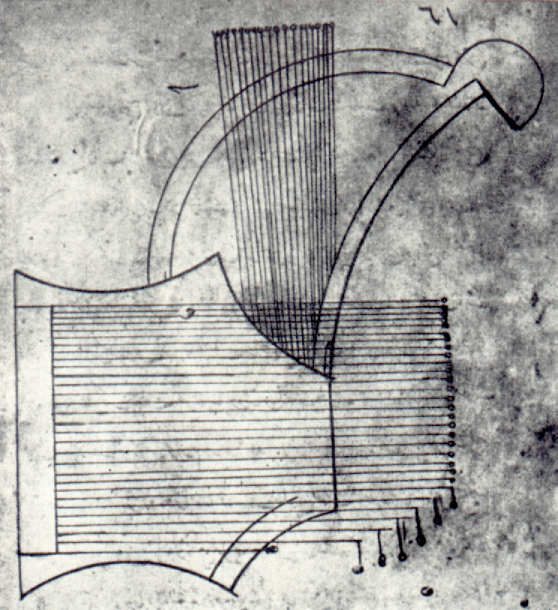
Black-and-white engraved line drawing of the Shahrud instrument from al-Farabi's treatise: a fan of many vertical strings rising from a curved wooden body with horizontal lines, and a curved neck ending in a scroll-like head at upper right.Book

Primary source

Kitab al-Musiqa al-Kabir

Farabi · 10th century

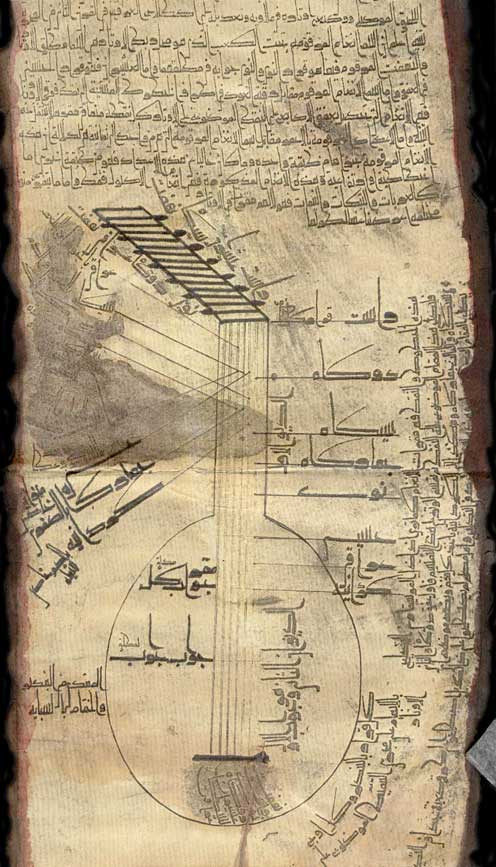
Manuscript page with an Arabic-script diagram of a lute (oud) drawn in ink on aged, yellowed paper. The pear-shaped body, long neck with frets, and strings are drawn, with Arabic text in columns around it and labels beside the instrument.Artifact

Primary source

Lute Diagram with Seven Courses

Farabi · 10th century

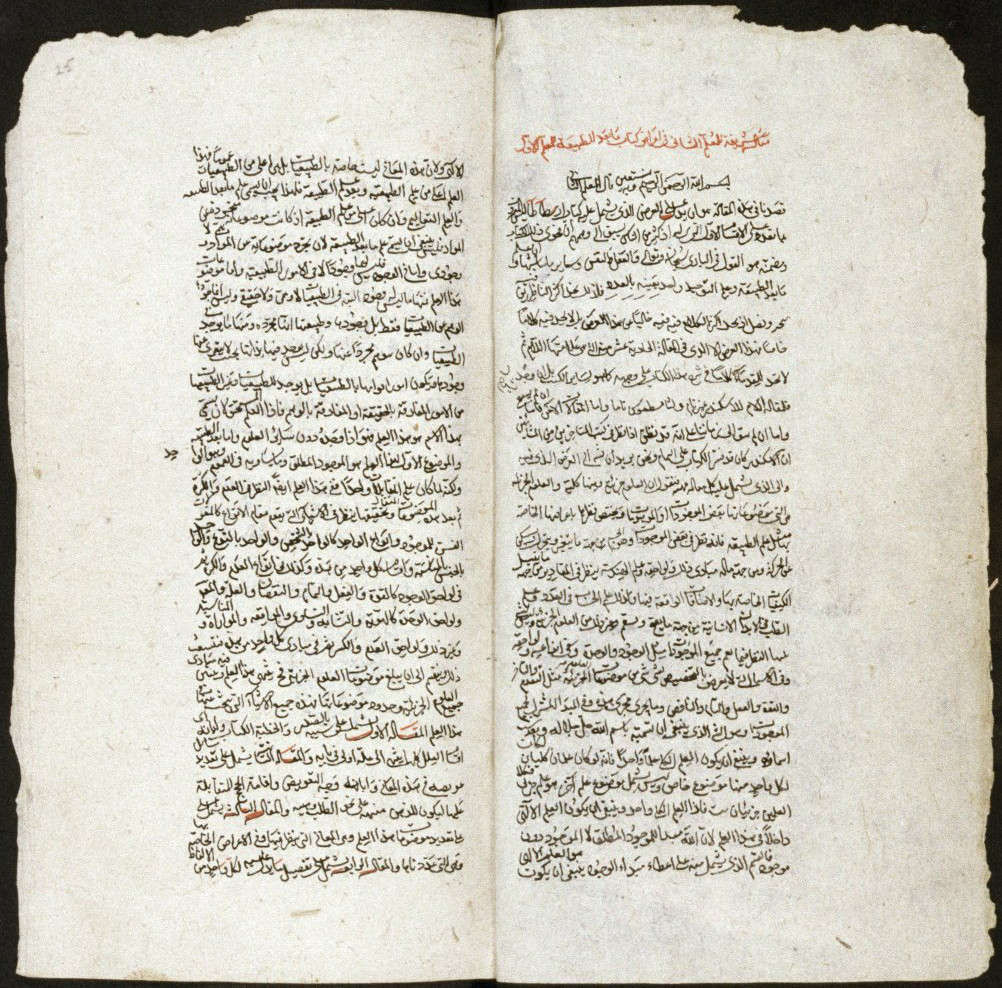
Open double-page spread of a handwritten Arabic manuscript on aged, yellowed paper with deckled edges. Dark brown ink text in naskh-style script fills both pages, with red ink used for a heading at top right and some marginal marks. The dark background surrounds the pages.Book

Primary source

On the Scope of Aristotle's Metaphysics

Farabi · 10th century

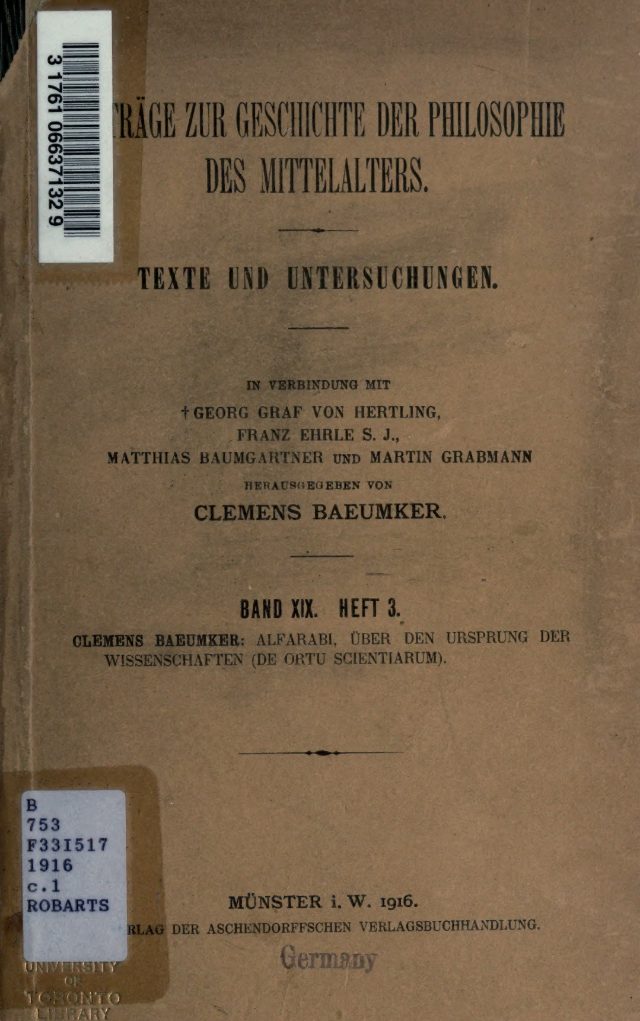
Über den Ursprung der WissenschaftenBook

Primary source

Über den Ursprung der Wissenschaften

Farabi · 1916 (edition of the original treatise)

Black and white drawing of the Shahrud, a musical instrument described by Farabi: a fan-shaped arrangement of many vertical strings over a large horizontal bank of parallel strings, with a curved arm and a tuning peg at upper right, on a grainy background.Painting

Primary source

Drawing of the Shahrud from the Great Book of Music

Farabi · 10th century

The Political RegimeBook

Primary source

The Political Regime

Al Farabi

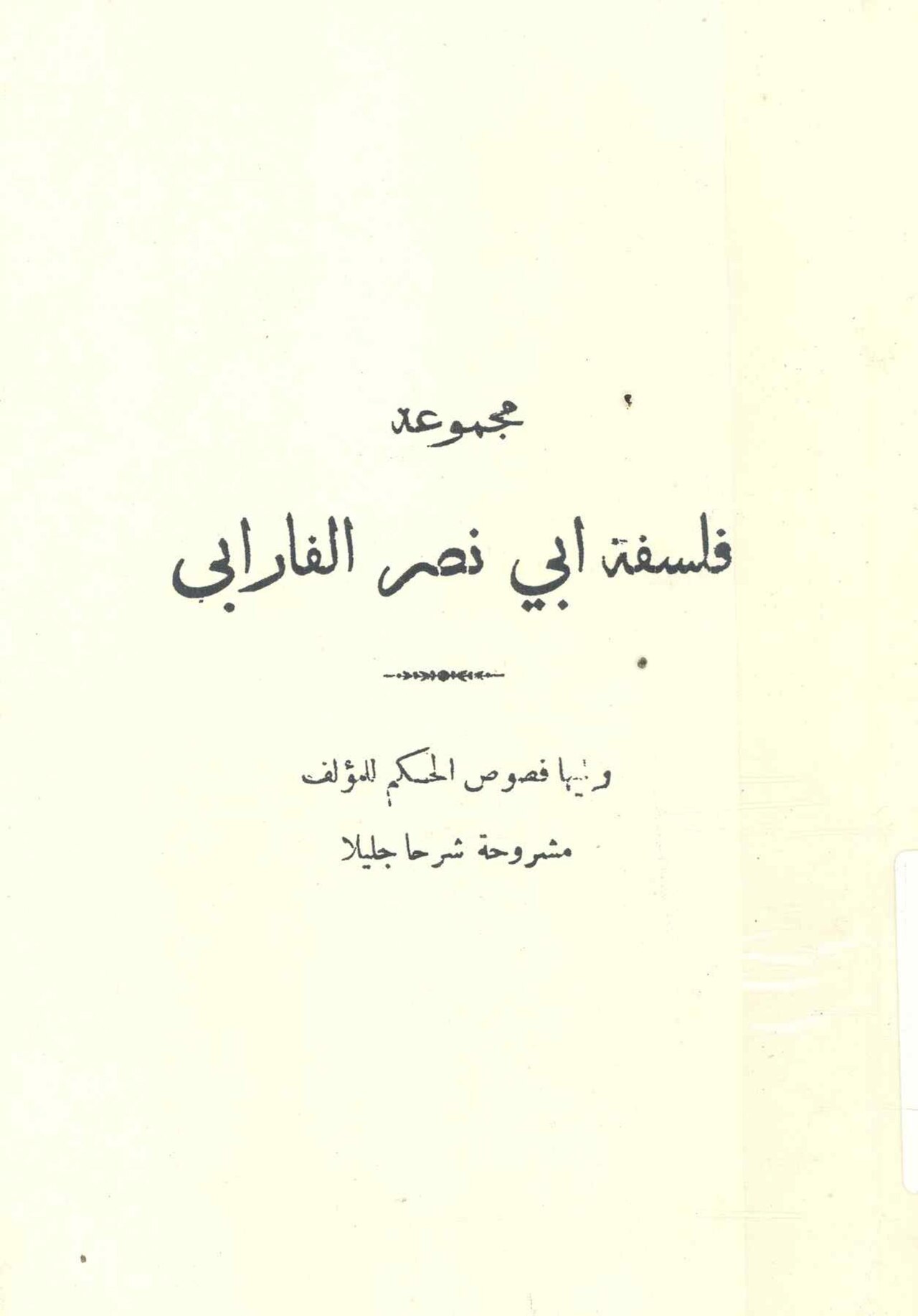
Title page of an Arabic book. Large handwritten-style Arabic title reads 'Majmu'a Falsafat Abi Nasr al-Farabi' (Collection of the philosophy of Abu Nasr al-Farabi), with a decorative divider below and a smaller line of Arabic text beneath it. Cream-colored paper.Book

Primary source

Majmu'a Falsafat Abi Nasr al-Farabi

Farabi · 10th century

Book

Secondary source

The History of Philosophy in Islam

T. J. de Boer · 1955 (first published 1903)

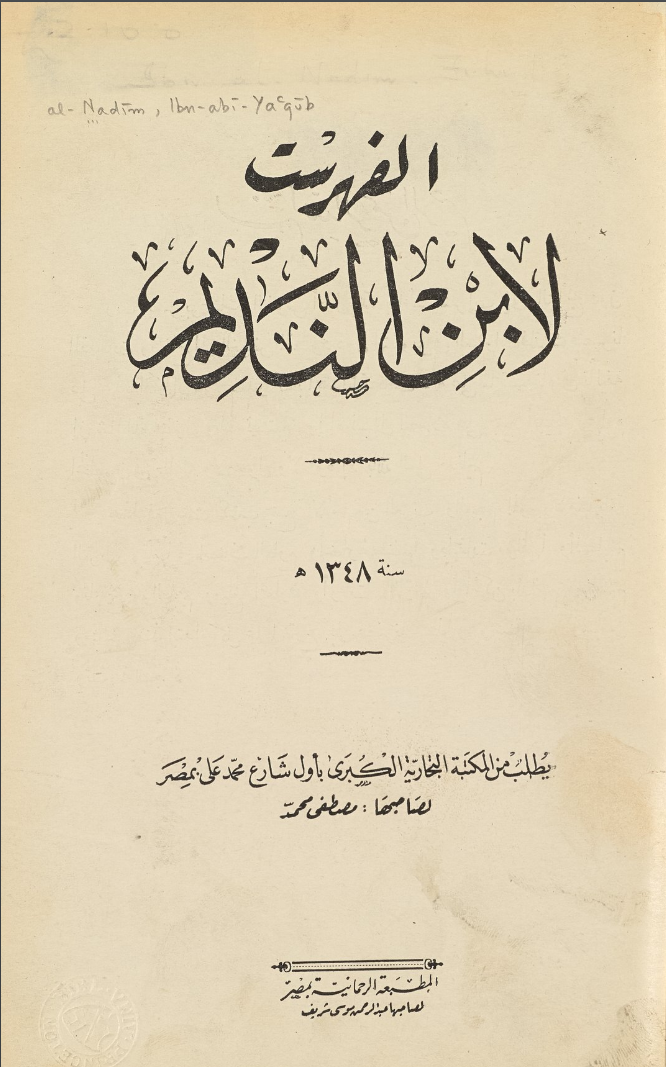
Title page of an Arabic book. Large decorative calligraphic title reads الفهرست لابن النديم. Below is the date سنة ١٣٤٨ هـ. Lower text gives the publisher's details in Arabic, and a faint pencil note in Latin letters reads al-Nadim, Ibn-abi-Ya'qub at top left.Book

Secondary source

Al-Fihrist

Ibn al-Nadim · 987

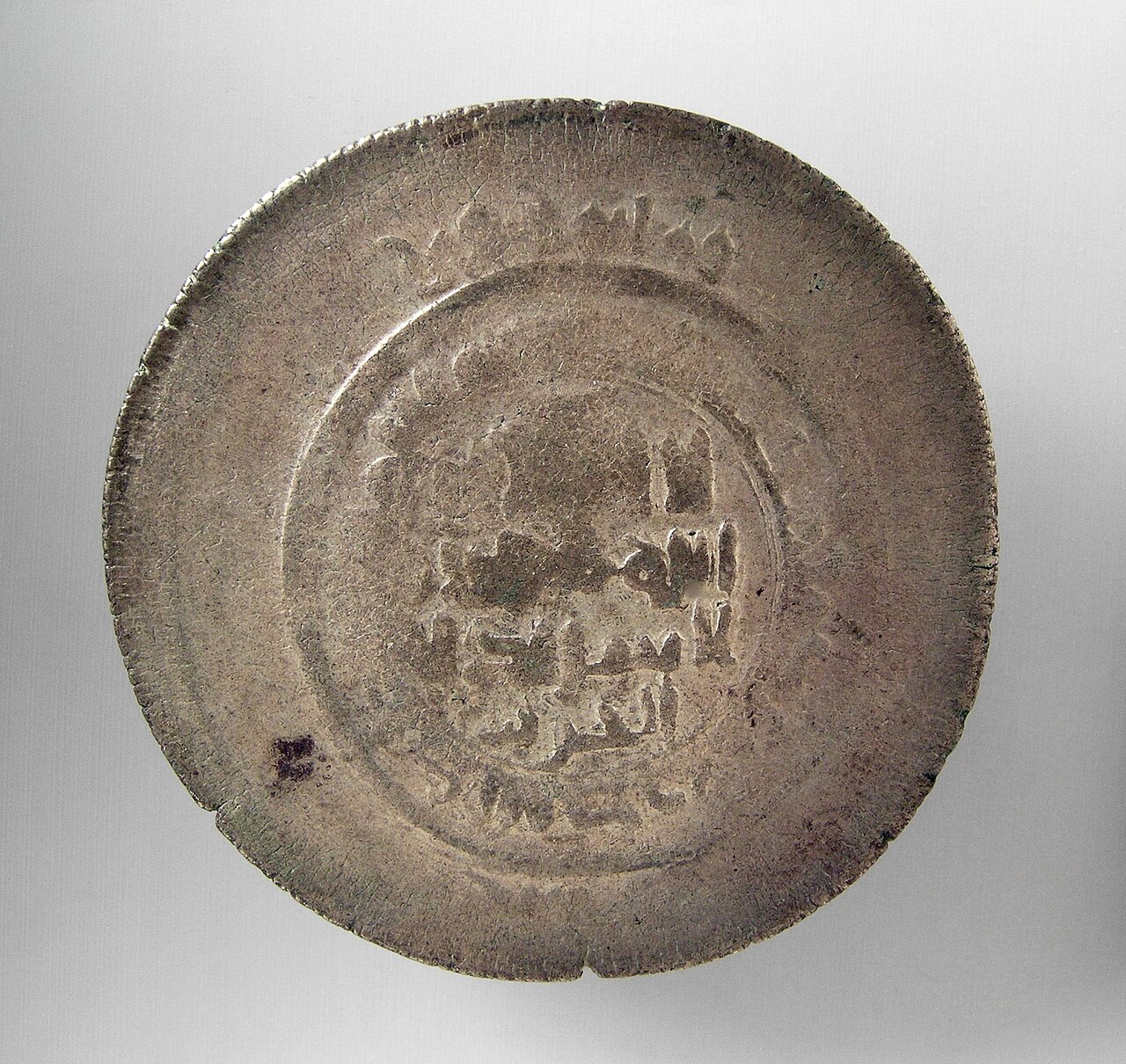
Photograph of a flat, circular silver coin on a light grey background. The surface is worn with a raised rim and a central field bearing a few lines of Arabic inscription, with a pronounced ring around the inner area and a dark spot near the lower left edge.Artifact

Primary source

Samanid Silver Dirham

second half of 10th century

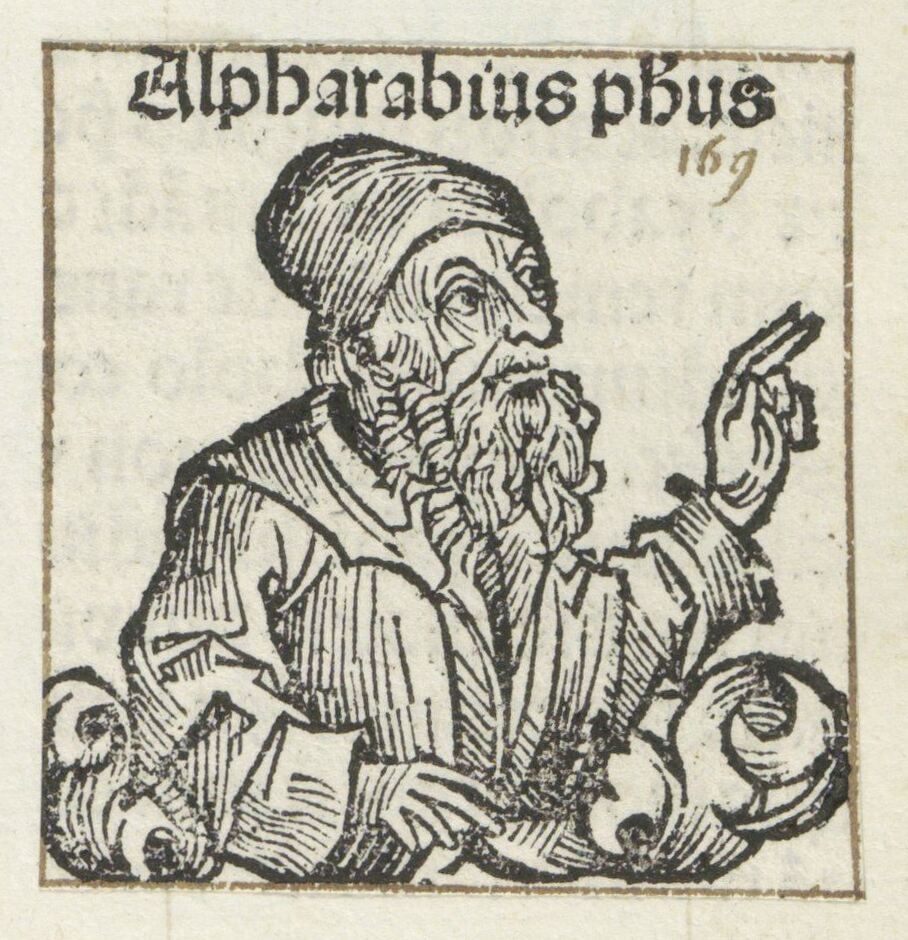
Woodcut print of a bearded man in a tall rounded cap and long robe, pointing upward with his right hand, with scrolling foliage below. Printed title above reads 'Alpharabius philosophus' and a handwritten '169' appears at upper right.Painting

Secondary source

Alpharabius philosophus, Nuremberg Chronicle

Michel Wolgemut and Wilhelm Pleydenwurff (workshop) · 1493

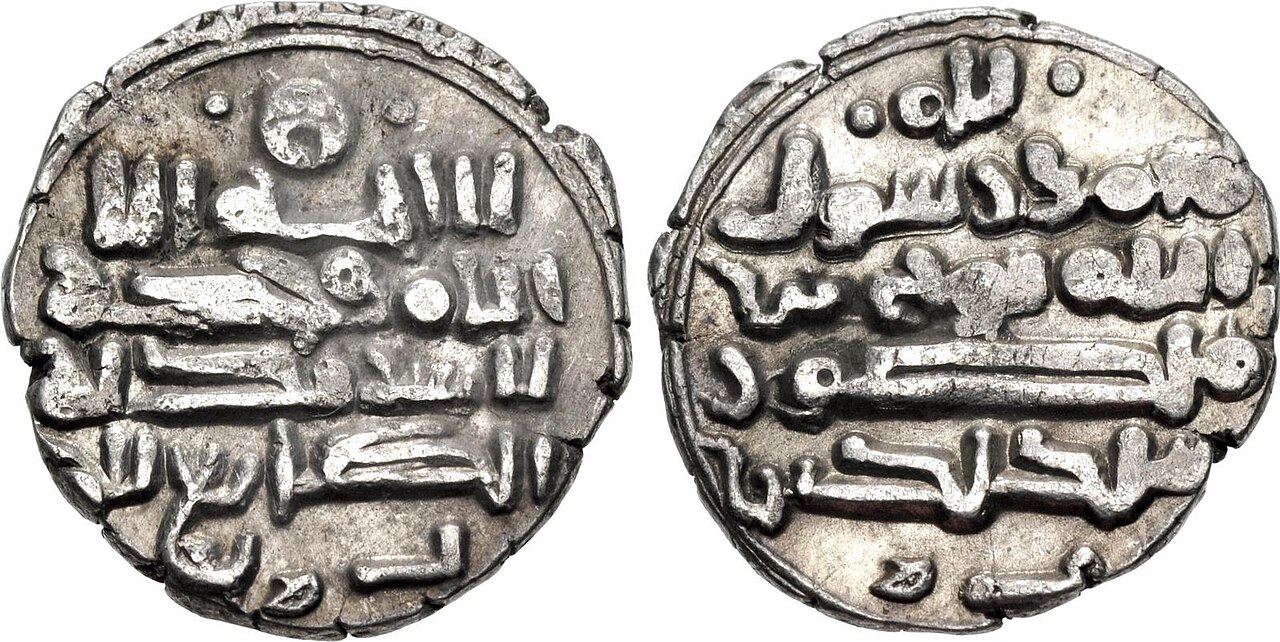
Two sides of a silver coin with raised Arabic inscriptions in Kufic-style script. The left side has a central circular mark and text in several lines; the right side has text in lines and a small mark at the bottom. The coin shows a worn, irregular edge.Artifact

Primary source

Coin of Sabuktigin Citing Samanid Amir Nuh

Classical Numismatic Group · date unknown

Book

Primary source

De intellectu et intellecto

Al-Farabi

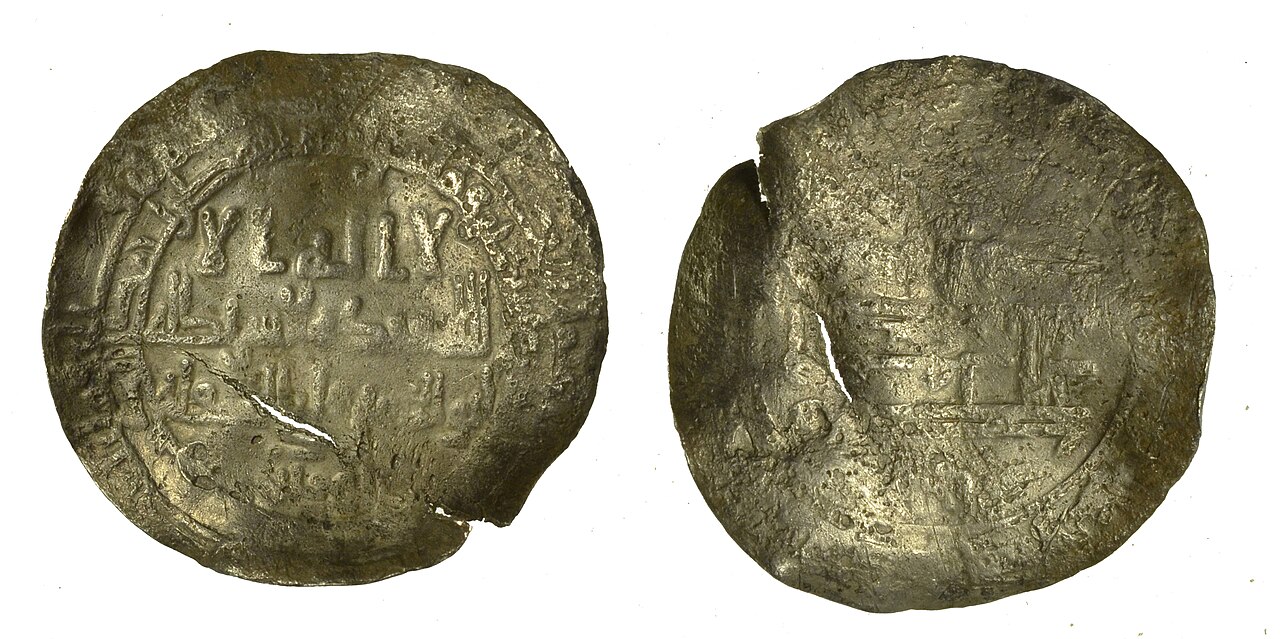
Two sides of a worn, cracked silver-grey early medieval dirham coin on a white background. The left side shows Arabic inscriptions in a central field within a circular border. The right side shows a faint, worn design with partial lines and a crack along the edge.Artifact

Primary source

Silver Dirham of Samanid Amir Ismail, 903-904

903-904 AD

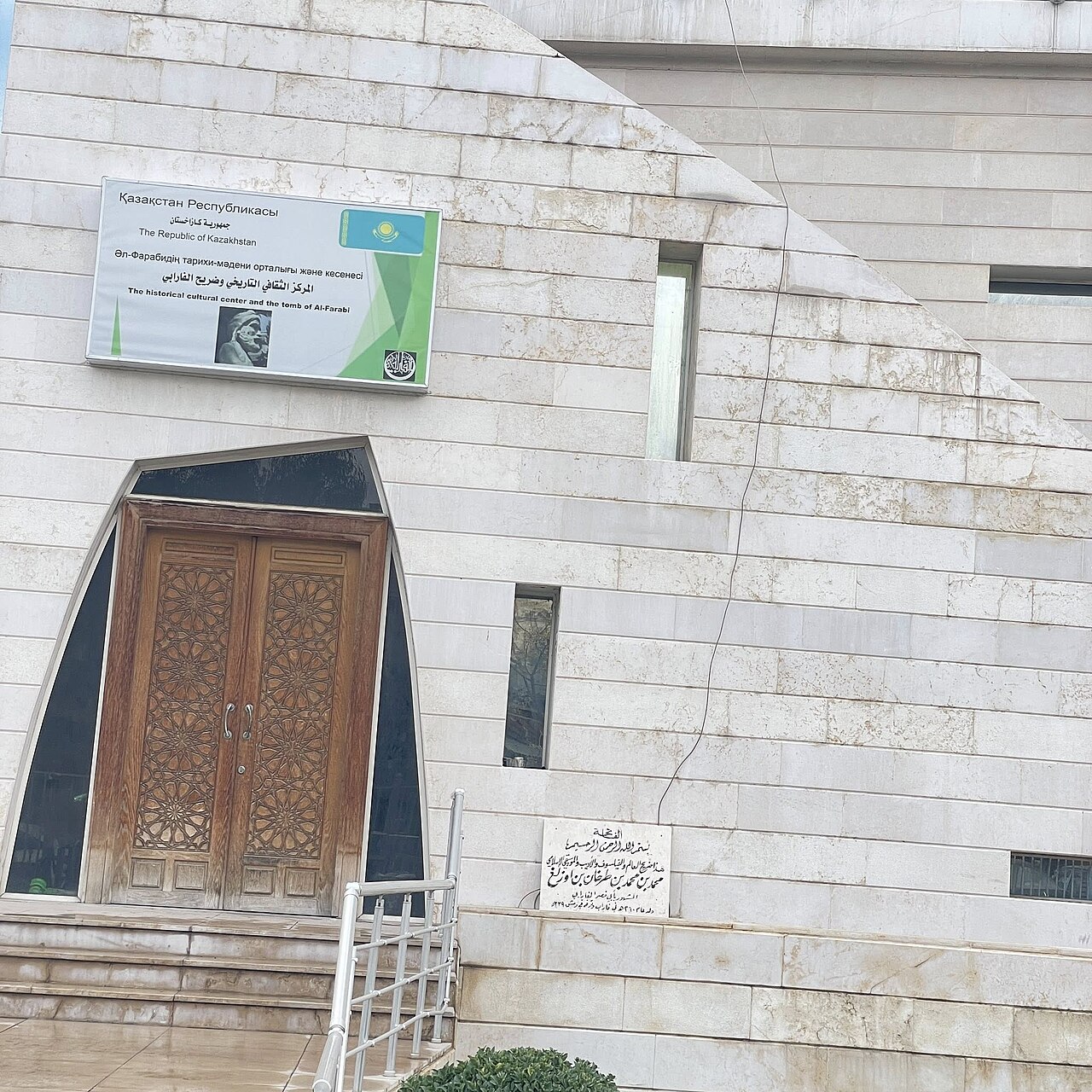
Front facade of a pale stone building with a tall arched entrance framing carved wooden double doors with geometric rosette patterns. A sign above reads The Republic of Kazakhstan, The historical cultural center and the tomb of Al-Farabi, with a portrait image and Kazakh flag. A stone plaque with Arabic inscription is on the right wall.Artifact

Secondary source

Tomb of Al-Farabi, Damascus

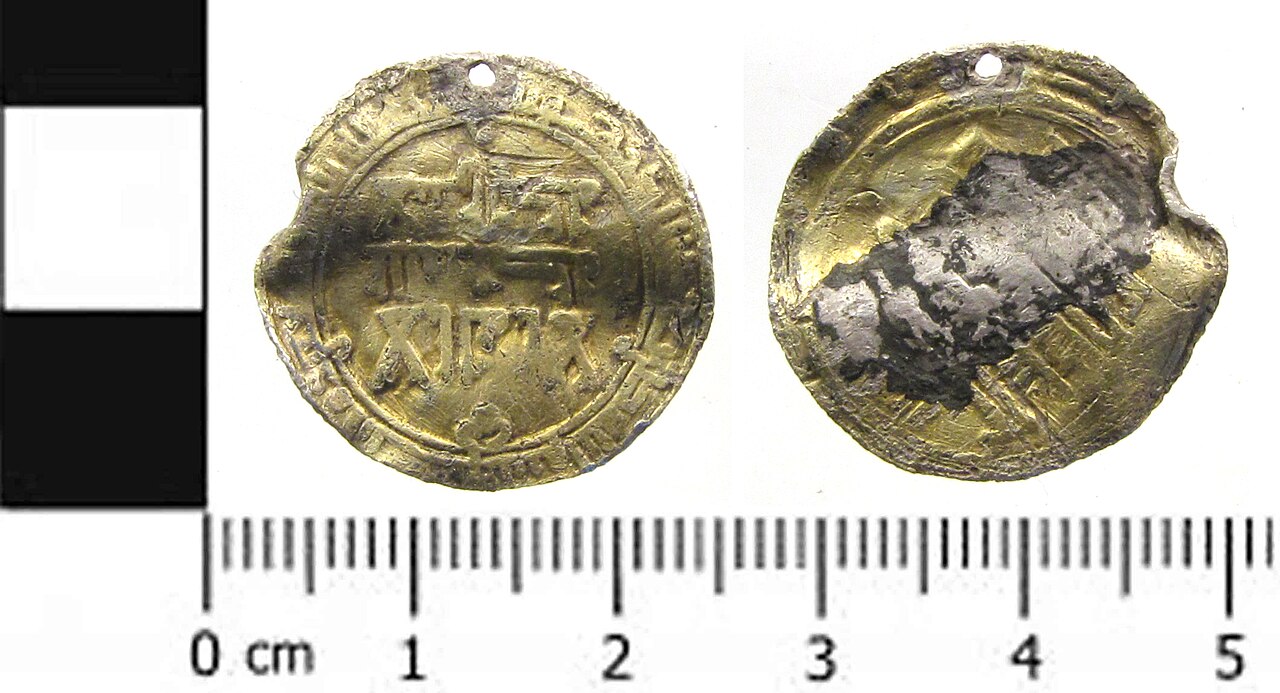
Two views of a small gilded coin-like object with a hole near the rim, shown beside a centimetre scale ruler. The left face has Arabic-style inscriptions in a central field and a marginal band. The right face is mostly gold with a dark, corroded silvery patch across the centre and lower area.Artifact

Primary source

Gilded Dirham of Isma'il I ibn Ahmad, 905-906

905-906 AD

Document

Tertiary source

1911 Encyclopædia Britannica: Fārābī

Griffithes Wheeler Thatcher · 1911

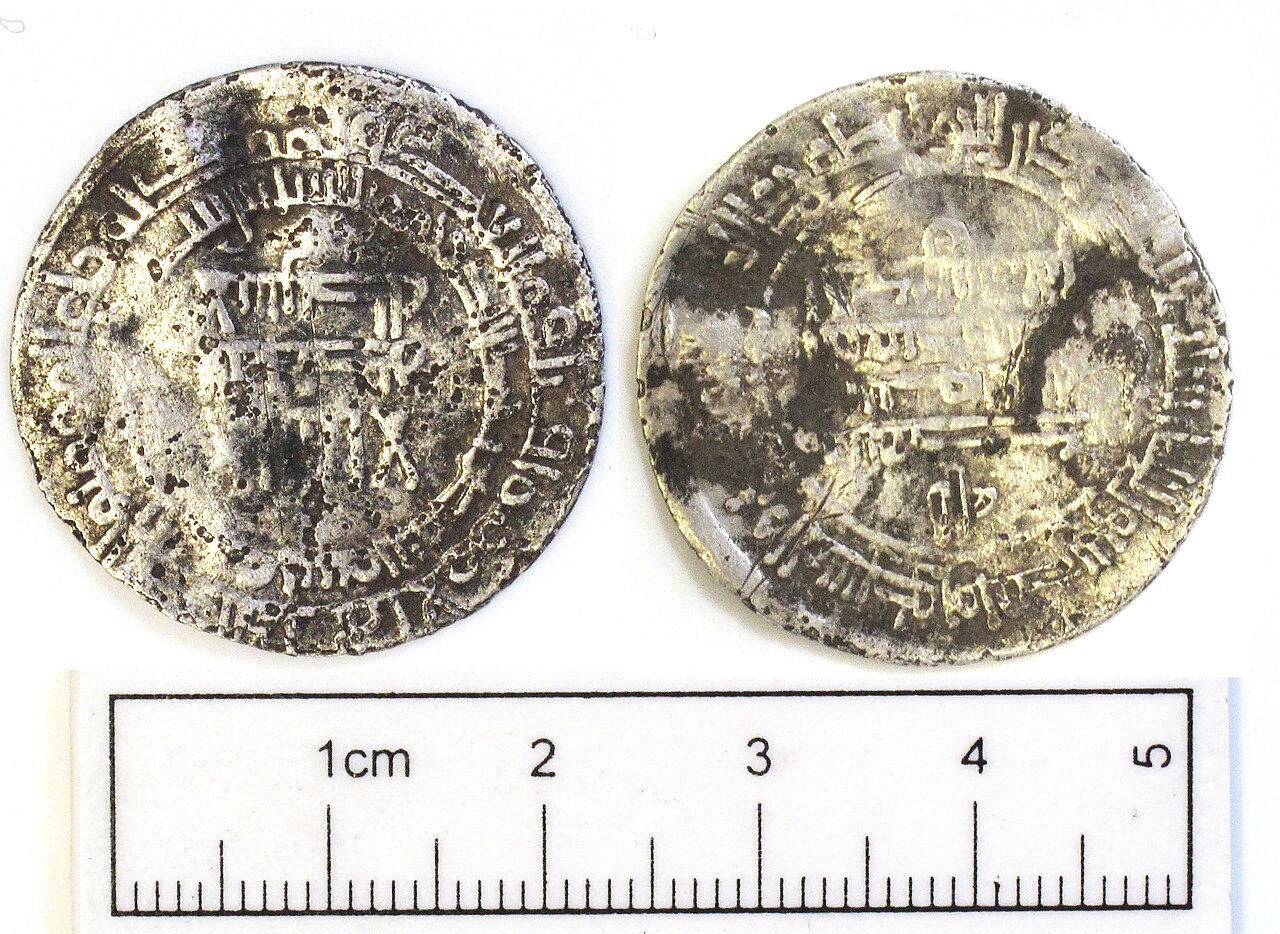
Two silver-grey Samanid dirhams side by side on a white background, with a centimetre ruler below them marked 1 to 5 cm. The left coin has a central inscribed field with a crown-like top; the right coin is tarnished and shows Arabic inscriptions around a central field. Both show worn, corroded surfaces.Artifact

Primary source

Samanid Dirham of al-Shash, c. 912 CE

c. 912 AD

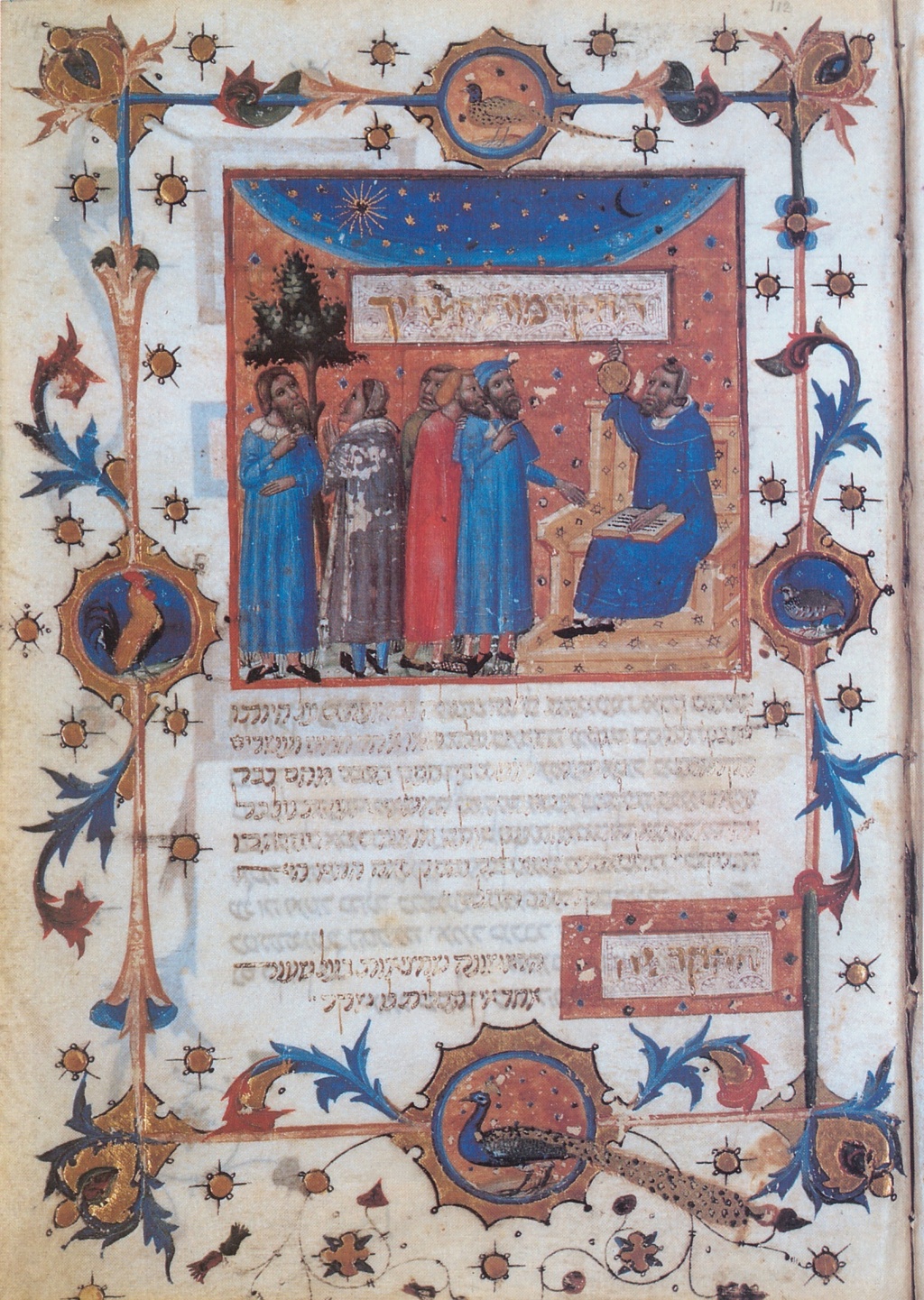
Illuminated manuscript page with a painted miniature inside a red and gold frame showing a seated figure at a lectern with an open book, facing a group of standing men in blue, red and grey robes under a blue starry sky. Below are columns of Hebrew text, surrounded by decorative gold and blue borders with peacocks and roosters in roundels.Book

Secondary source

The Guide for the Perplexed

Moses Maimonides · c. 1190

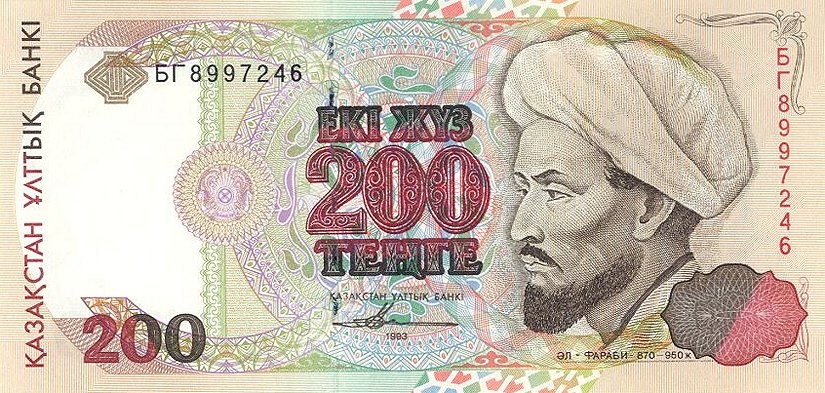
Front of a 200 tenge Kazakhstan banknote. A large red '200' and 'ЕКІ ЖҮЗ ТЕҢГЕ' are printed in the center, with a bearded man in a white turban shown in profile on the right, labeled 'ЭЛ-ФАРАБИ 870-950 Х' below. Serial number БГ 8997246 appears at top and right. Kazakhstan Ulttyk Bank and 1993 printed near the bottom center, with ornate green and pink patterns in the background.Artifact

Secondary source

200 Tenge Banknote of Kazakhstan

National Bank of the Republic of Kazakhstan · 1999

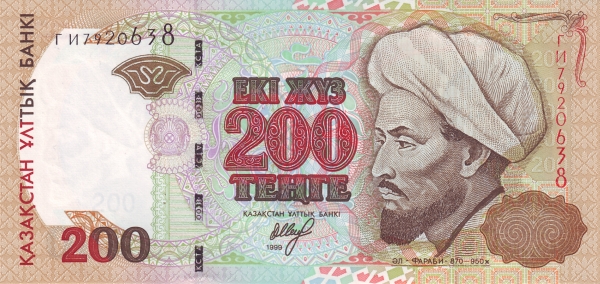
Front side of a Kazakhstan 200 tenge banknote. Large red numerals and words 'ЕКІ ЖҮЗ ТЕҢГЕ' sit at center beside a portrait of a bearded man in a white turban facing right, with the name 'ӘЛ ФАРАБИ 870-950' below. Kazakh text and a signature appear, and the serial number is at top right.Artifact

Secondary source

Kazakhstan 200 Tenge Banknote

National Bank of the Republic of Kazakhstan · 2002

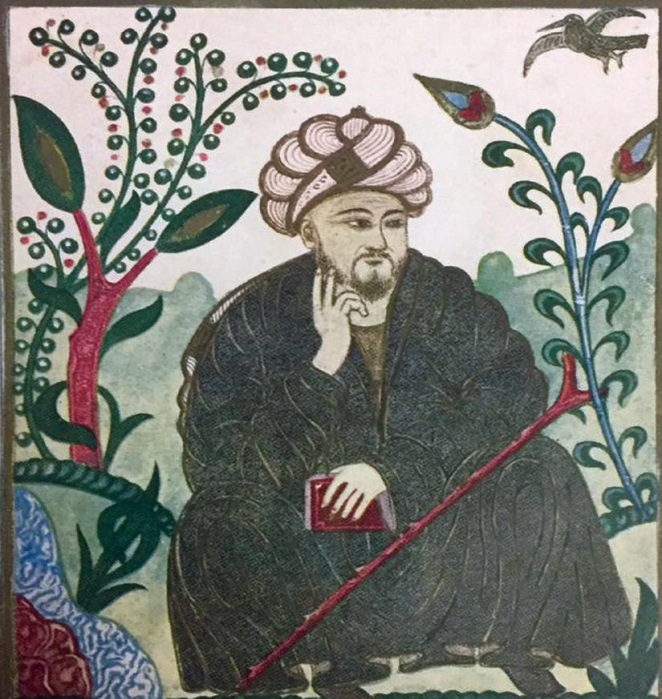
Painted miniature of a bearded man in a striped turban and dark fur-trimmed robe, seated with his hand raised to his chin and a red book in his other hand. Stylized plants and a bird surround him.Painting

Tertiary source

Imagined Portrait of Al-Farabi

Unknown

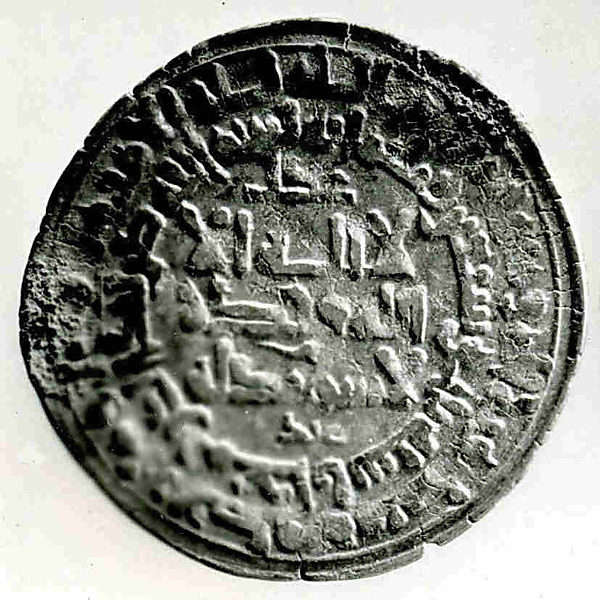
Black-and-white photograph of a round, worn silver coin on a light background. Its surface shows raised Arabic-style inscriptions in concentric rings, with a central field of script and a border of lettering around the edge.Artifact

Primary source

Silver Coin Dated 374 AH

374 AH/983-84 CE

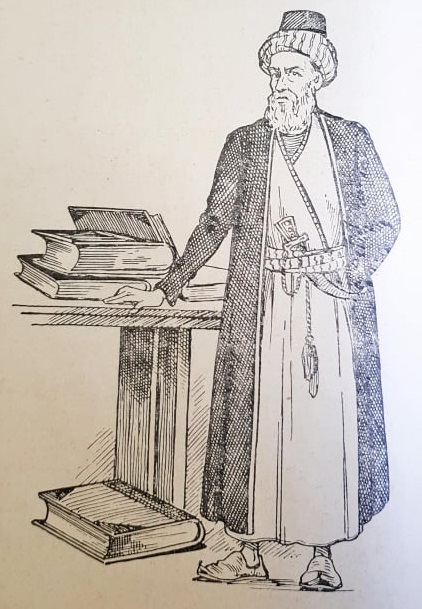
Black-and-white line drawing of a bearded man in a long robe, sash, and tall cap, standing beside a wooden lectern stacked with books. A large book lies on the floor in the lower left.Painting

Tertiary source

Imagined Portrait of Al-Fārābī (Egyptian Drawing)

Muhammad Atiyya Al-Ibrashi (probable) · 20th century

Book

Primary source

Al-Siyasa (The Political Treatise)

Al-Farabi · 10th century

Texts on faith and reason in Islam: Farabi, Avicenna, AverroesBook

Secondary source

Texts on faith and reason in Islam: Farabi, Avicenna, Averroes

M. Horten · 1913

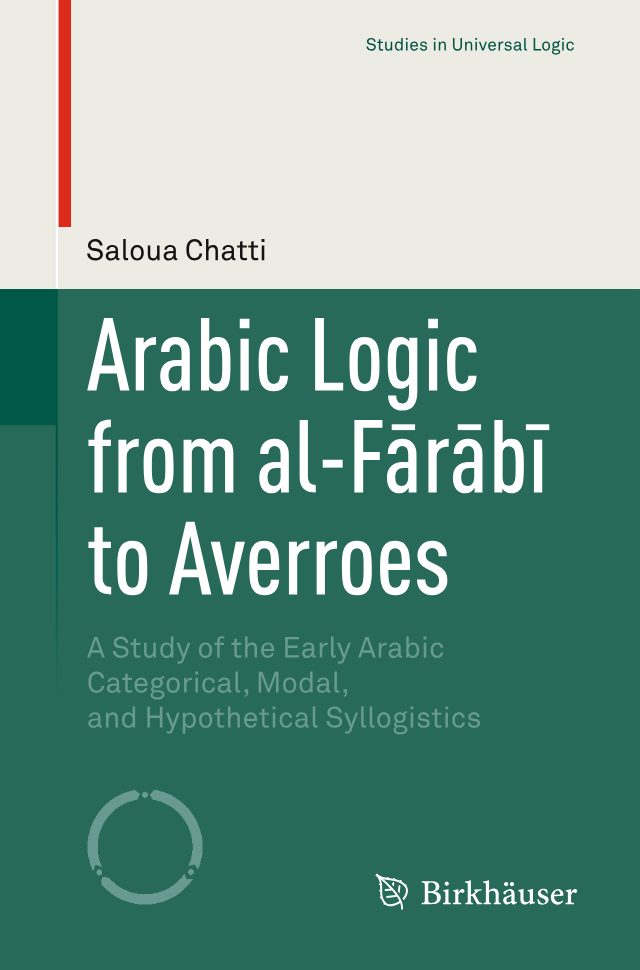
Arabic Logic from Al-Farabi to AverroesBook

Secondary source

Arabic Logic from Al-Farabi to Averroes

Saloua Chatti · 1910

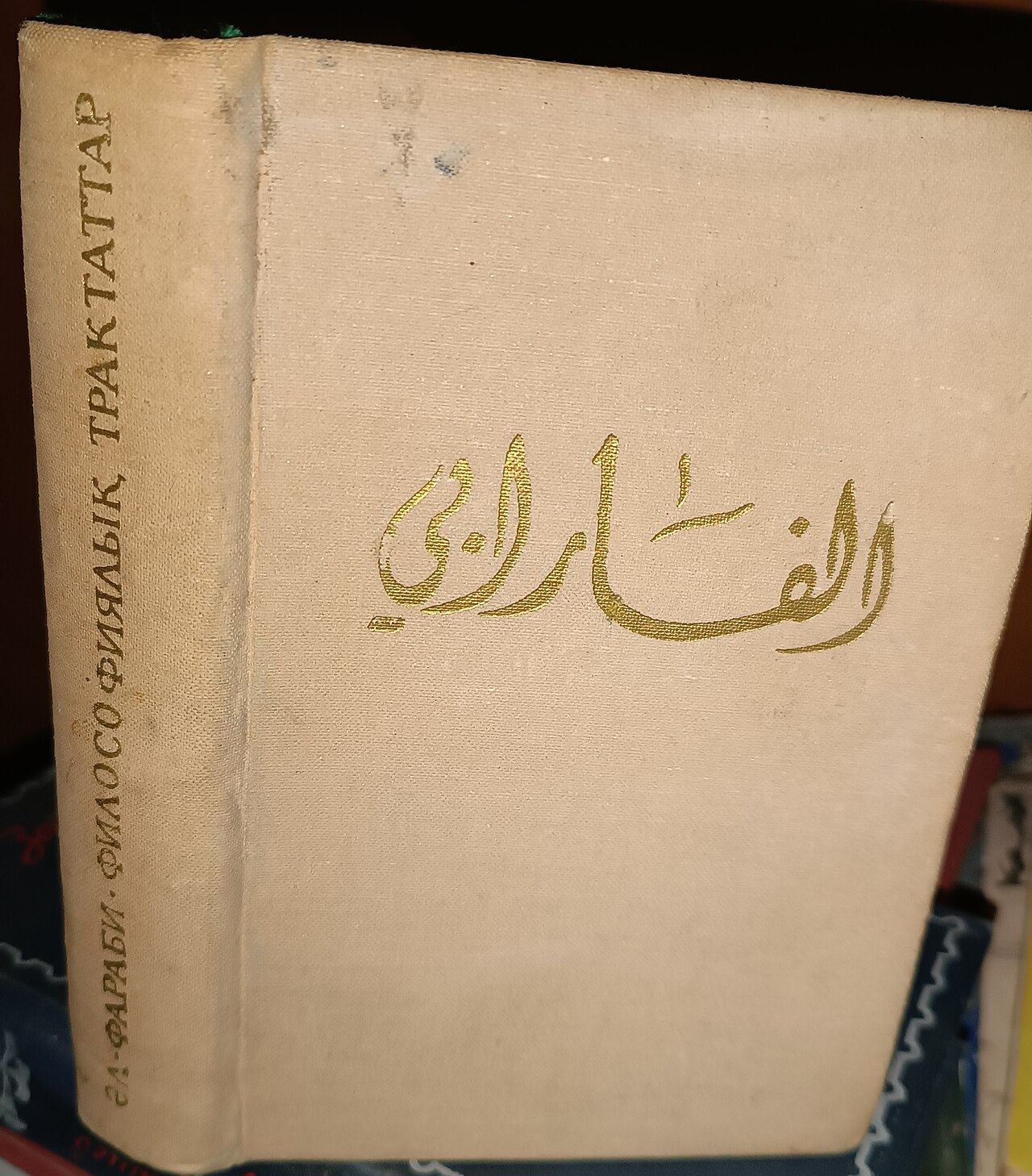
Photograph of a beige cloth-bound book standing upright on a shelf. The cover shows gold Arabic calligraphy reading Al-Farabi. The spine has Cyrillic text reading Әл-Фараби Философиялық трактаттар. Other books are visible behind it.Book

Secondary source

Cover of Farabi's Philosophical Treatises, Kazakh edition

1973

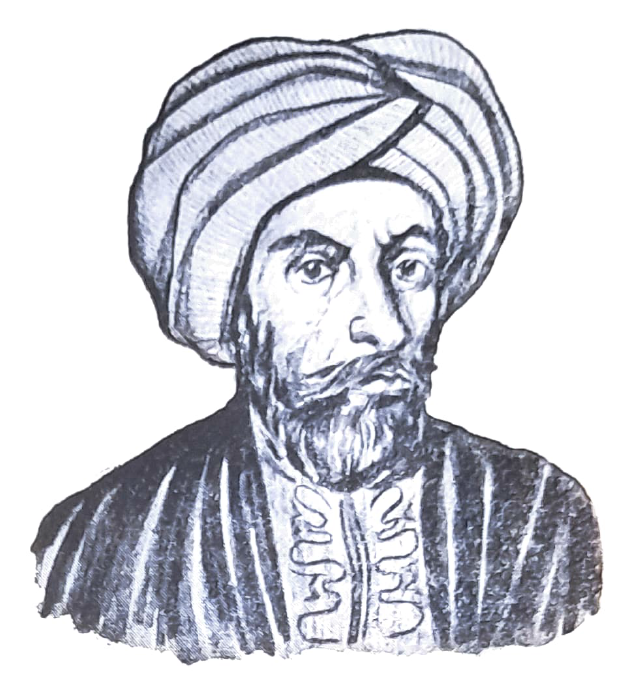
Black-and-white engraved-style drawing of a bearded man in a large wrapped turban and a dark robe with decorative vertical stripes and ornamental embroidery at the chest, shown from the shoulders up, facing slightly to the right.Painting

Secondary source

Imaginary Sketch of Al-Farabi

Unknown · 1961

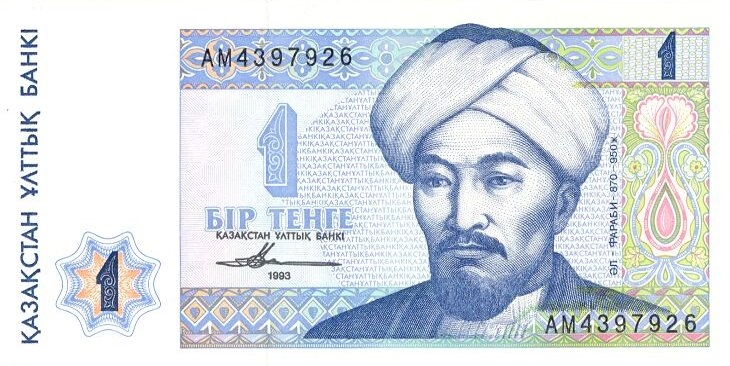
Front of a blue and green 1 tenge Kazakhstan banknote from 1993. A bearded man in a white turban is shown in a central portrait. Large numeral 1, Kazakh text, serial number AM4397926, and a wave-like ornament border are visible.Artifact

Secondary source

Kazakhstan 1 Tenge Banknote, 1993

National Bank of the Republic of Kazakhstan · 1993

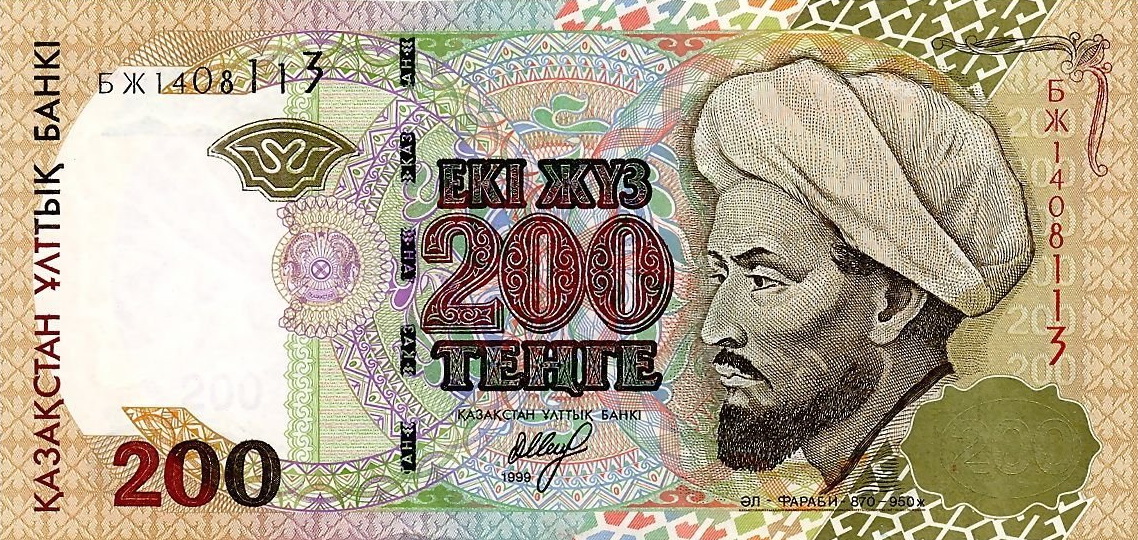
Front of a Kazakhstan 200 tenge banknote. Large red text reads 'EKI ZHUZ 200 TENGE' with a bearded man in a white turban shown in profile on the right. Kazakh text runs along the left edge and a green 200 appears on the right. Serial number BZh 1408113 and the date 1999 are visible.Artifact

Secondary source

Kazakhstan 200 Tenge Banknote

National Bank of the Republic of Kazakhstan · 2000

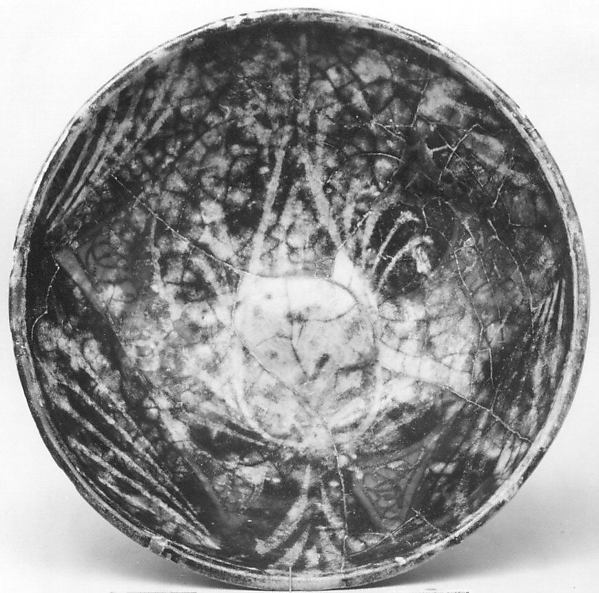
Black and white photograph of a shallow round ceramic bowl viewed from above. The glazed interior shows a central white medallion with a large palmette design radiating outward, surrounded by dark crackled glaze and fine radiating lines.Artifact

Primary source

Ruby Luster Bowl with Large Palmette

9th century

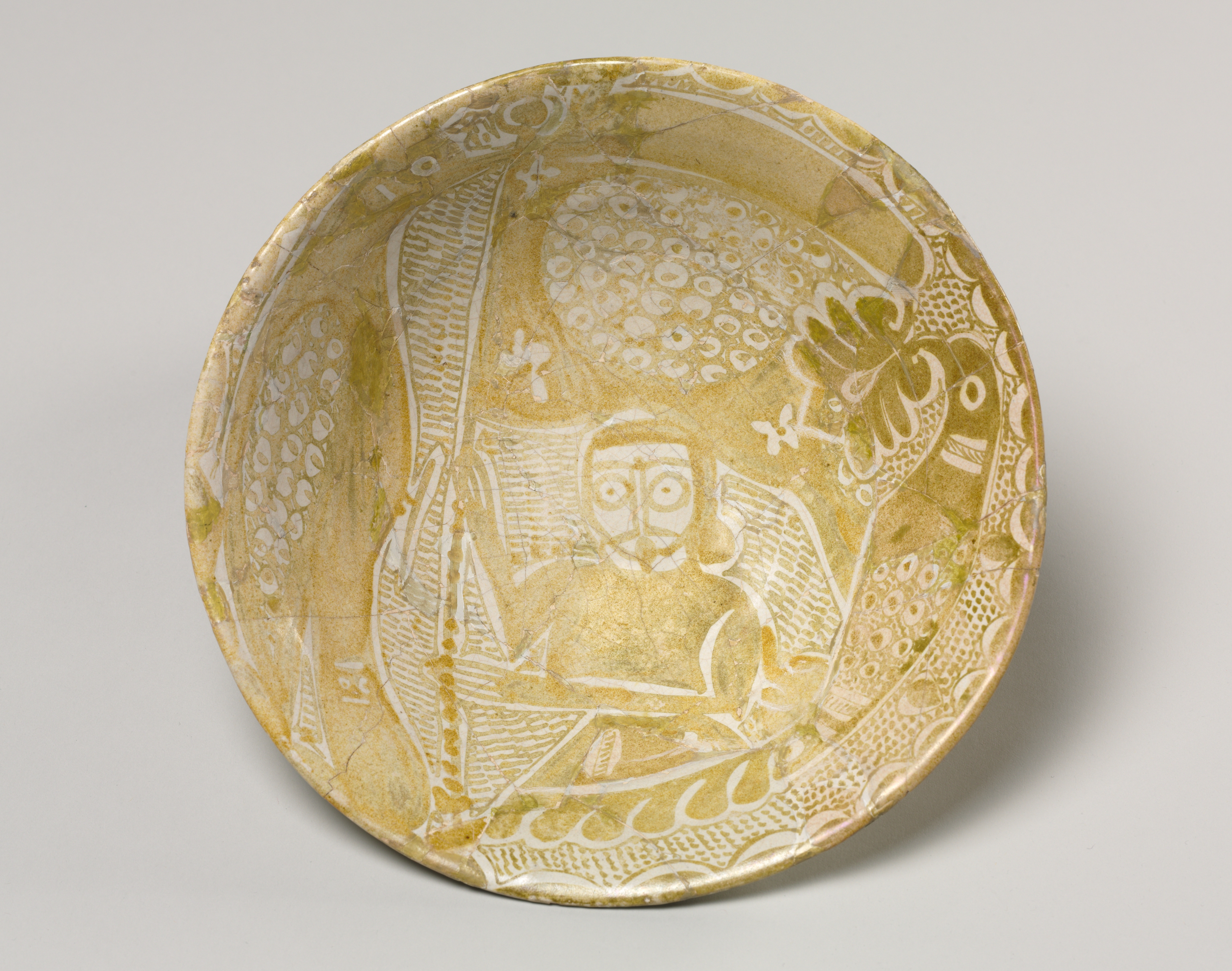
Photo of a shallow ceramic bowl with a pale yellow-green lustered glaze and white painted decoration. At the center is a seated human figure with a large round face holding a banner-like shape, flanked by patterned panels, dotted motifs, and a wave-like border around the rim.Artifact

Primary source

Luster Bowl with Man Holding a Banner

900s

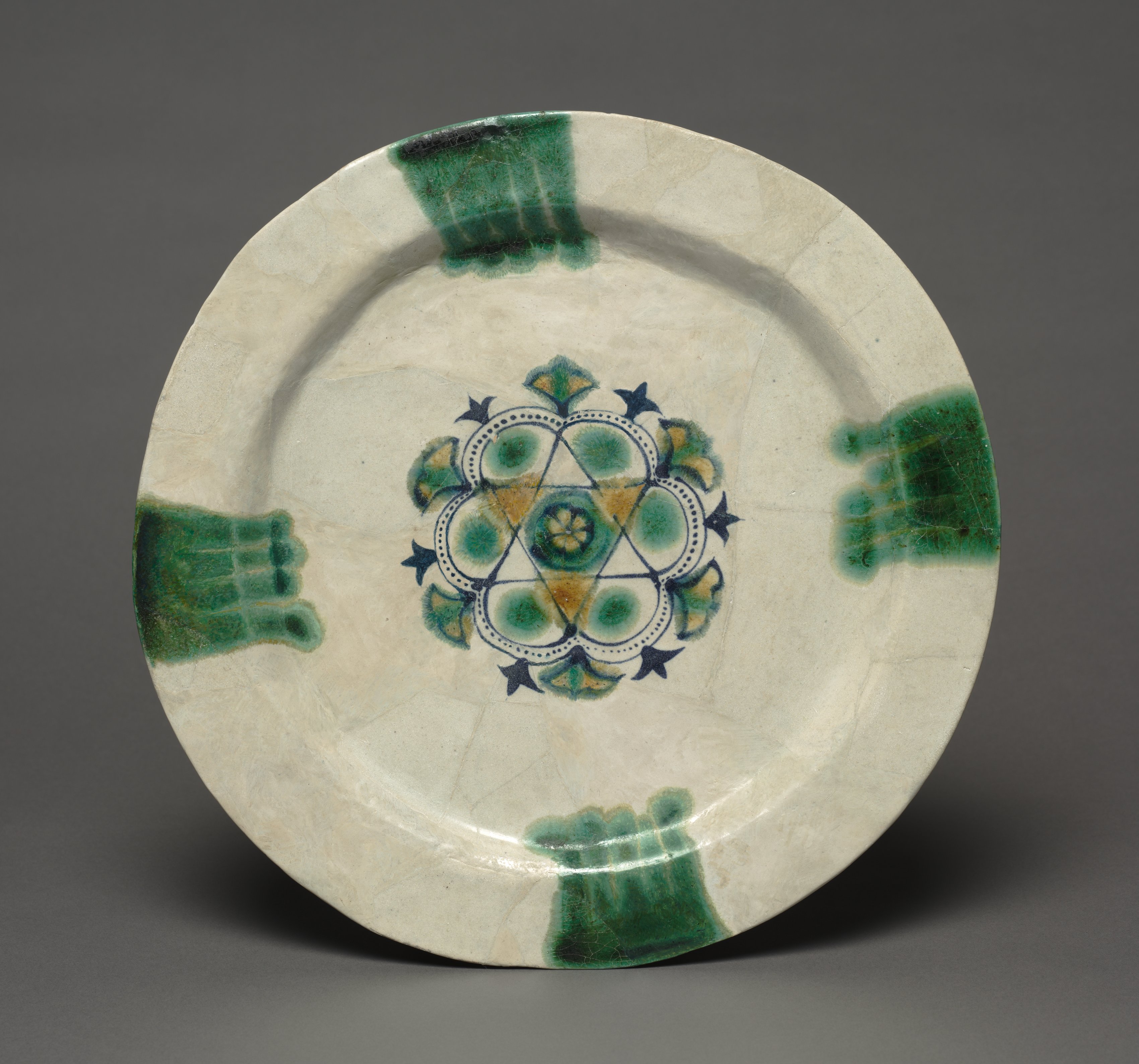
Photograph of a shallow white ceramic dish with a glossy glaze, decorated with four irregular green splashes around the rim and a central motif of blue star-like lines, green and yellow circles and a small flower-like center on a grey background.Artifact

Primary source

Dish with Splashes of Green

830–900

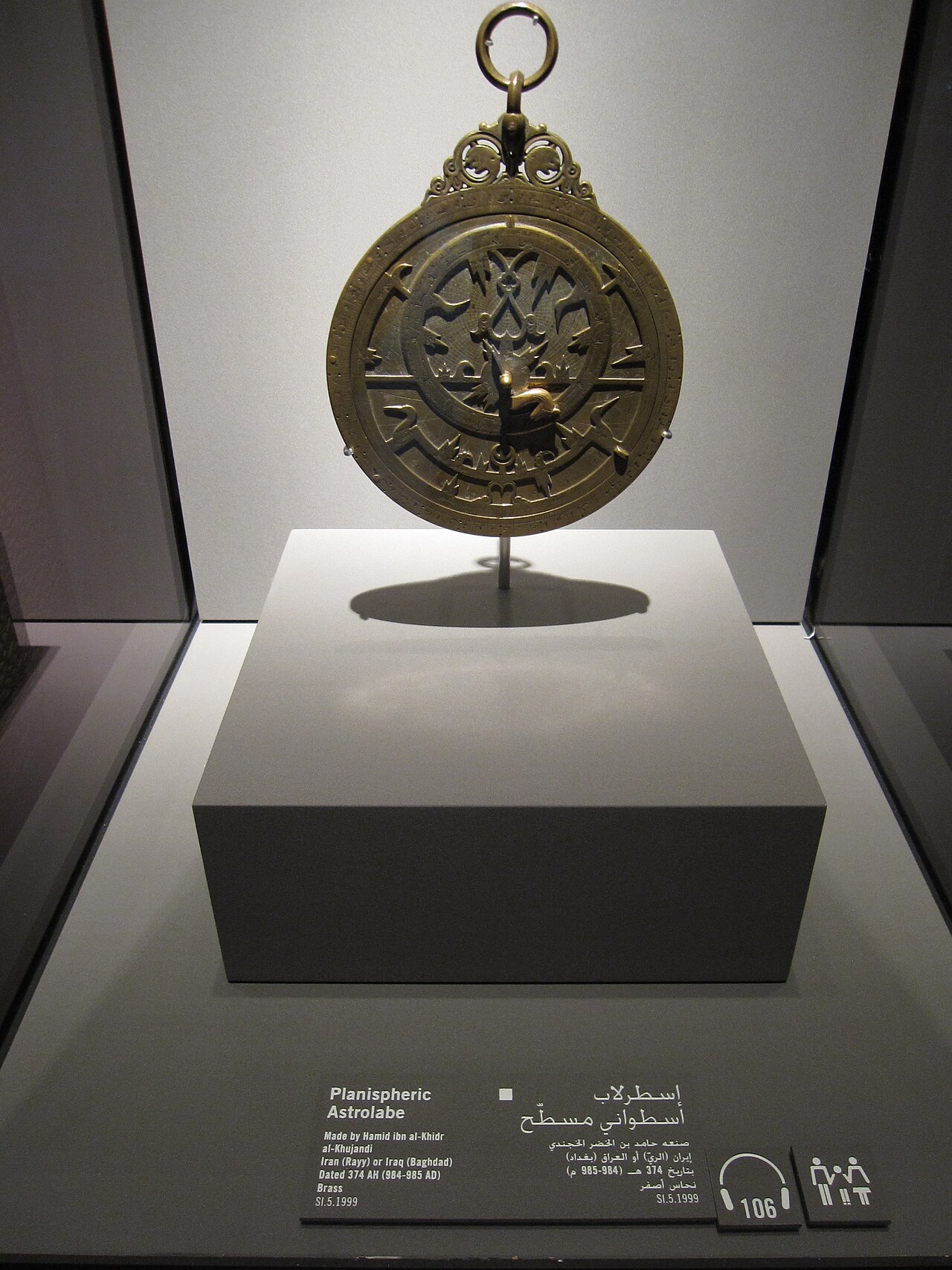
A brass planispheric astrolabe with a ring at top, mounted on a stand inside a glass display case. Its front face has intricate openwork and engraved star pointers. Below is a museum label reading Planispheric Astrolabe, made by Hamid ibn al-Khidr al-Khujandi, Iran (Rayy) or Iraq (Baghdad), dated 374 AH (984-985 AD), brass.Artifact

Secondary source

Planispheric Astrolabe, Iran, 984 AD

Hamid ibn al-Khidr al-Khujandi · 984-985 AD

Want the full shelf? Chat with Al-Farabi in the app and open the Sources panel — every quote links back to the original.

Use Al-Farabi in class

1 collection

A ready-made collection from the Humy team that features Al-Farabi. Preview it, then try it free.

Trusted by educators worldwide

Conversations
375,000+
Real exchanges between students and historical figures
Messages exchanged
4,142,000+
Across every figure, classroom and language
Historical figures
100,000+
Each informed by a curated biography and selected sources
Languages supported
50+
From English and Spanish to Arabic and Korean

Paying customers

Used by 98 schools and universities

Partner school logo
Tecnológico de Monterrey logo
Hyper Island logo
Partner school logo
Chambersburg Area School District logo
Broward County Public Schools logo
Nebo School District logo
National Louis University logo
South Florida PBS logo
Punahou School logo
University of Wisconsin–River Falls logo
Partner school logo
Partner school logo
Archbishop Mitty High School logo
Kingsburg High School logo
Norwalk Public Schools logo
Partner school logo
Connections logo
Partner school logo
Moore Public Schools logo
Partner school logo
Partner school logo
Partner school logo
Partner school logo
Robbinsville Public Schools logo
Partner school logo
Partner school logo
Partner school logo
Tecnológico de Monterrey logo
Hyper Island logo
Partner school logo
Chambersburg Area School District logo
Broward County Public Schools logo
Nebo School District logo
National Louis University logo
South Florida PBS logo
Punahou School logo
University of Wisconsin–River Falls logo
Partner school logo
Partner school logo
Archbishop Mitty High School logo
Kingsburg High School logo
Norwalk Public Schools logo
Partner school logo
Connections logo
Partner school logo
Moore Public Schools logo
Partner school logo
Partner school logo
Partner school logo
Partner school logo
Robbinsville Public Schools logo
Partner school logo
Partner school logo

What educators are saying

“We enjoyed the program last year and used it frequently.”
“My students say it’s a welcome change of pace. I’m not a fan of the “sage on the stage” model, so I try to incorporate research-oriented and self-paced activities. With Humy, students have to take charge of their learning. They’ve become more adept at critical thinking, forming better questions, and improving their reading comprehension. The interview feature has been my go-to tool. I create assignments where students must ask historical figures a set number of questions, then summarize the responses to ensure they’re truly absorbing the material. This approach lets them actively explore the past rather than passively consuming information.”
“Humy has helped me bring historical figures, sometimes long past, to life. When my students interact with these figures in real-time, it eliminates some of the perceived “ancient” characteristics of my curriculum. This has shifted my students’ thinking away from viewing history as abstract or irrelevant. Real-time interactions make historical figures relatable, even allowing students to ask off-topic questions that help put historical lives in a more relevant context for 13-year-olds. The feature I use the most is the interview feature. After teaching a topic, most recently Gandhi and Joan of Arc, I have the students ask pointed, focused questions. We practice good conversation techniques beforehand, teaching them to listen (or read) carefully and formulate thoughtful follow-up questions rather than just interrogating. It helps students practice effective conversation skills.”

FAQ

Frequently asked questions

Who is Al-Farabi?
Medieval Muslim philosopher and polymath. On Humy.ai you can chat with an AI version of Al-Farabi that draws on a short biography and 35 historical sources during the conversation — by text or voice, in 42 languages.
Is Al-Farabi AI free?
Al-Farabi is part of Humy's full library of more than 100,000 figures, which comes with a paid plan. A free account (no credit card) includes 20 AI messages a month with the free library's figures, so you can try how the conversations work first. The free plan's 20 AI messages a month are shared by you and your students: enough to try Humy yourself; a whole class needs Plus.
What sources does the Al-Farabi AI use?
It draws on a short biography and 35 historical sources (artifacts, books and paintings), including “Kitab al-Musiqa al-Kabir”, “Lute Diagram with Seven Courses” and “On the Scope of Aristotle's Metaphysics”. Each source has its own page on Humy.ai.
How historically accurate is the AI version of Al-Farabi?
Each figure uses a short biography and a small set of selected historical sources as context (retrieval-augmented generation), so answers stay closer to known material than the model's general knowledge alone. It isn't a citation-grade research tool — like any LLM, the AI can get details wrong or extrapolate. Treat it as a strong starting point for inquiry and cross-reference important claims.
Can I talk to Al-Farabi by voice?
Yes. In addition to text chat, you can call Al-Farabi and hear their voice respond in real time — useful for auditory learners, interview practice and Socratic dialogue.
Is Humy.ai safe and compliant for schools?
Yes. Humy.ai is used by more than 100 schools, universities and organisations. The platform is FERPA- and GDPR-aligned, supports SSO, and offers an IT-approval pack tailored for school procurement teams.

Ready when you are

Start chatting with Al-Farabi now.

20 messages free · No credit card · Available in 50+ languages.