
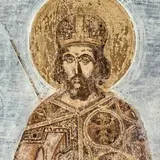
Portrait of Constantine XI Palaiologos

AI Historical Figure

Constantine XI Palaiologos

The last Byzantine Emperor who died defending Constantinople against the Ottoman Empire in 1453.

Chat with Constantine XI Palaiologos via text or voice — in 42 languages, drawing on a curated biography and 41 historical sources. Available 24/7.

Start chatting with Constantine XI Palaiologos20 messages free · No credit card
Lived
1405–1453
From
GreeceTürkiye
Known for
Rulers & royaltyMilitary
Constantine XI Palaiologos

Constantine XI Palaiologos

Online · responds in seconds

Hello — I'm Constantine XI Palaiologos. The last Byzantine Emperor who died defending Constantinople against the Ottoman Empire in 1453. What would you like to ask me?

20 messages free · No credit card · Powered by Humy.ai

Live preview · Switch between 42 languages above · Send a message to continue in the app

Multilingual

Talk to Constantine XI Palaiologos in 42 languages

Ask Constantine XI Palaiologos questions in any language below, and the rest of Humy's app speaks it too. Pick yours to open the chat in that language.

Also in German (Austria), German (Switzerland), English (UK), English (Australia), English (Canada).

The sources behind this AI

41 sources · 13 paintings · 12 artifacts · 7 photographs · 7 documents · 1 sculpture · 1 book

Constantine XI Palaiologos doesn’t improvise from thin air. The AI is grounded in 41 curated historical sources students can inspect. Open any of them to see what informs the conversation.

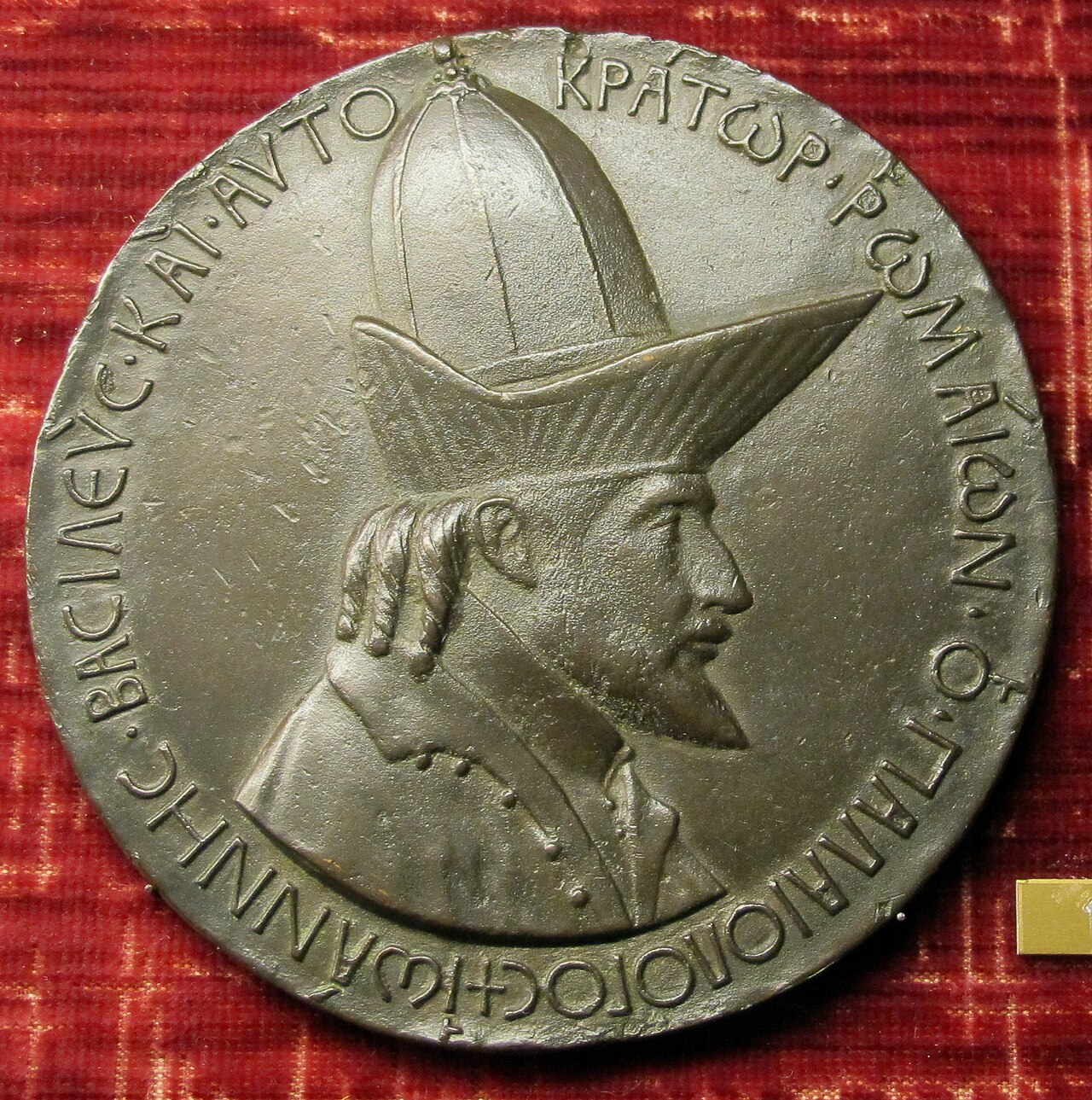
Round bronze medal on a red textured background. In profile, facing right, a bearded man wears a tall pointed cap and a high-collared garment, with curled hair over his ear. Greek lettering runs around the rim.Sculpture

Primary source

Medal of John VIII Palaiologos

Pisanello · 1438-1439

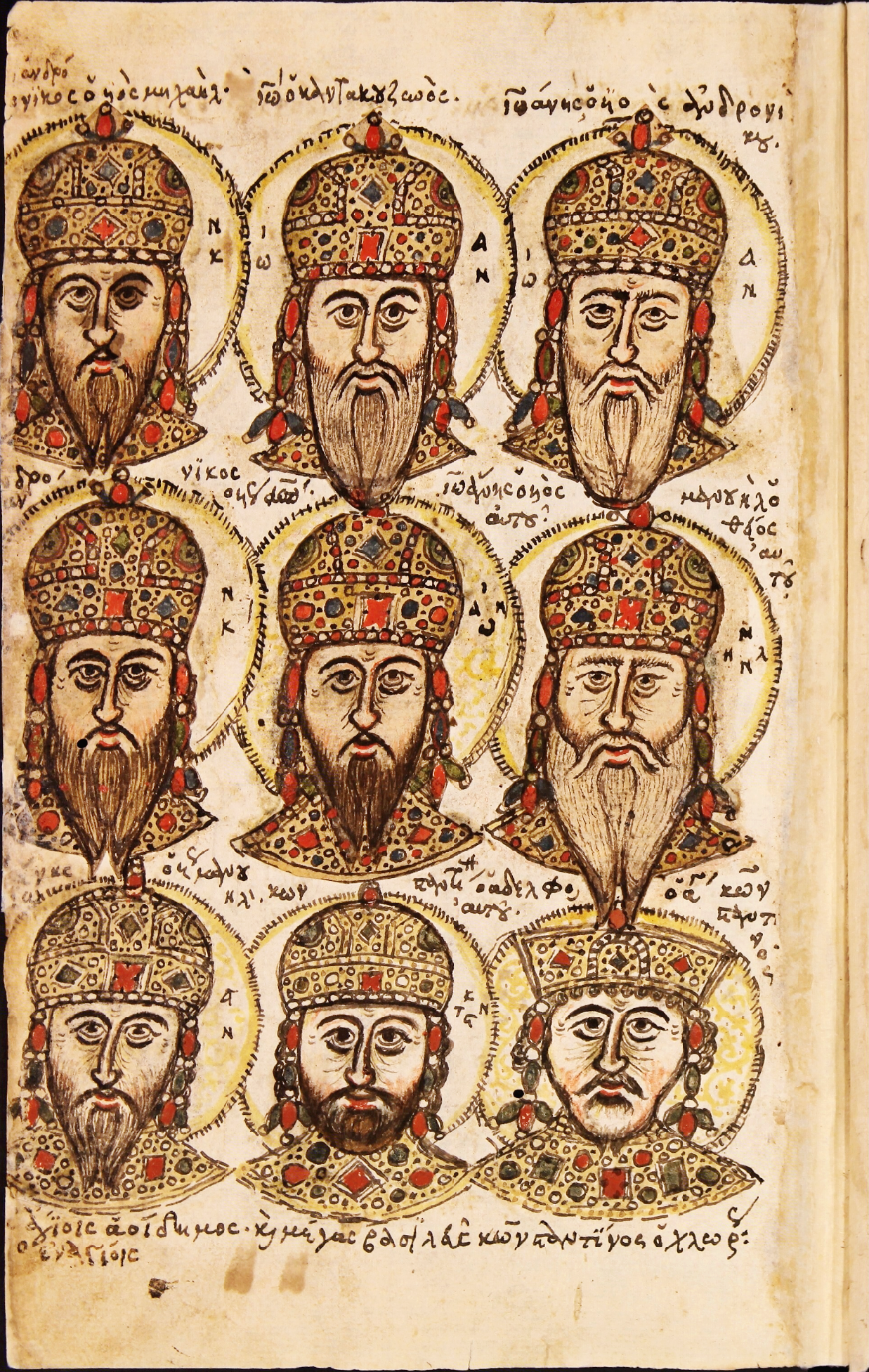
Manuscript page with nine painted portraits of Byzantine emperors in three rows of three, each within a gold halo and wearing jeweled crowns and jeweled collars. Greek inscriptions appear above, between, and below the portraits.Painting

Secondary source

Zonaras Chronicle Portrait Folio

Unknown Byzantine scribes

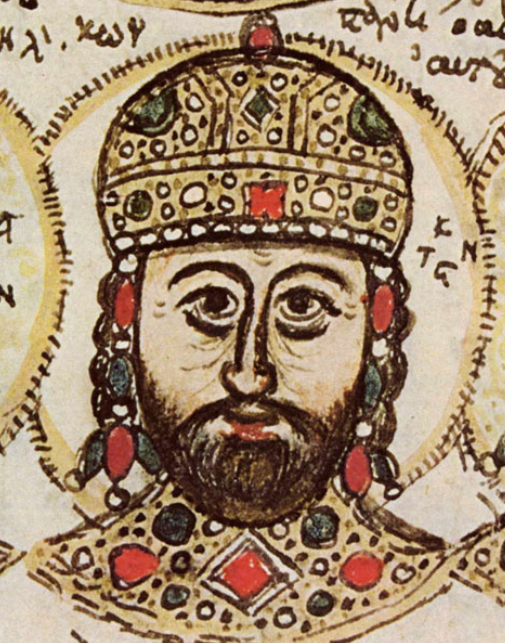
Painted miniature portrait of a bearded man with dark eyes and a jeweled crown with red and green gems, wearing a jeweled collar with red and green stones, set within a gold circular halo with Greek lettering around it.Painting

Secondary source

Portrait of Constantine XI Palaiologos in the Mutinensis gr. 122 Codex

Unknown Byzantine artist · 15th century

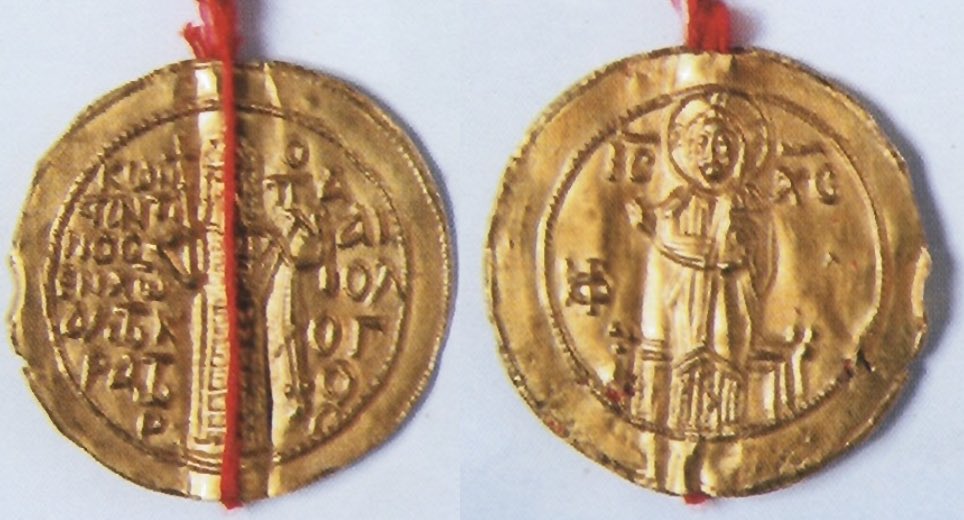
Two photographs of a gold bulla seal hanging from a red cord, showing both faces. The left face has Greek inscription lines and a standing figure in a robe. The right face shows a haloed standing saint holding a cross, with a cross symbol and inscription to the left.Artifact

Primary source

Gold Seal of Constantine XI for Ragusa

1451

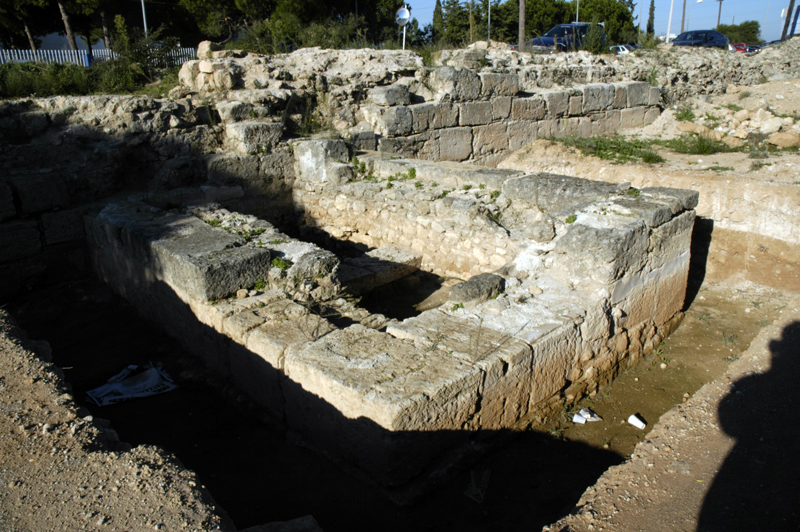
Stone ruins in an excavated trench: rectangular dressed limestone blocks and a low rubble wall, partly overgrown with grass, under bright sunlight. Cars and a fence are visible in the background, and a shadow of a person falls on the right side.Photograph

Secondary source

Hexamilion Wall Ruins Across the Corinth Isthmus

Nefasdicere

Scan of a handwritten Greek signature in black ink on white paper, written in two lines of cursive script with flourishes and a horizontal stroke above part of the text.Document

Primary source

Signature of Constantine XI Palaiologos

Constantine XI Palaiologos

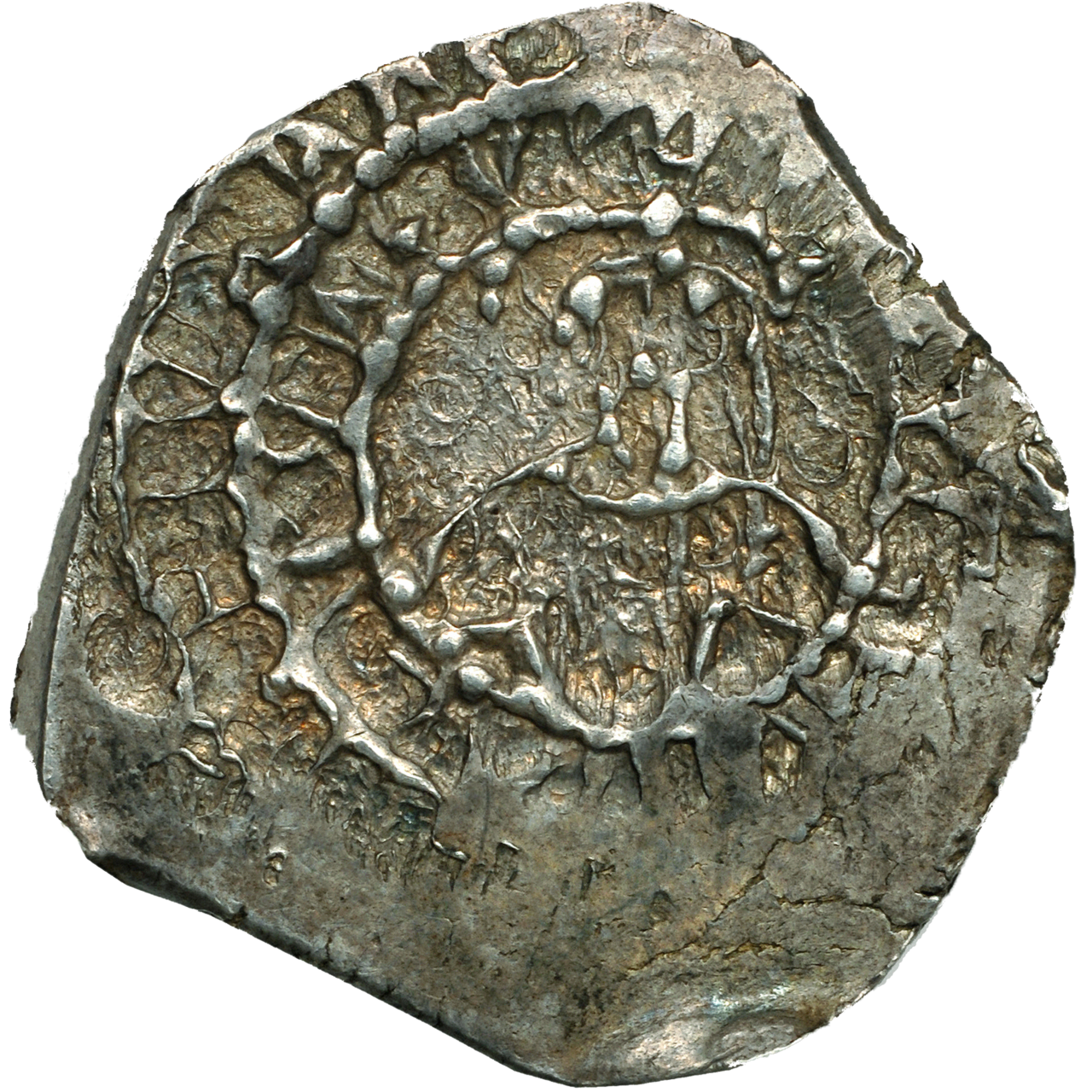
Photo of a damaged, irregularly shaped silver coin with a raised beaded border and worn, partly obscured design of a central figure and lettering. Its surface is tarnished with brownish and bluish patches.Artifact

Primary source

Silver Stavraton of Constantine XI

Constantinople mint · 1449–1453

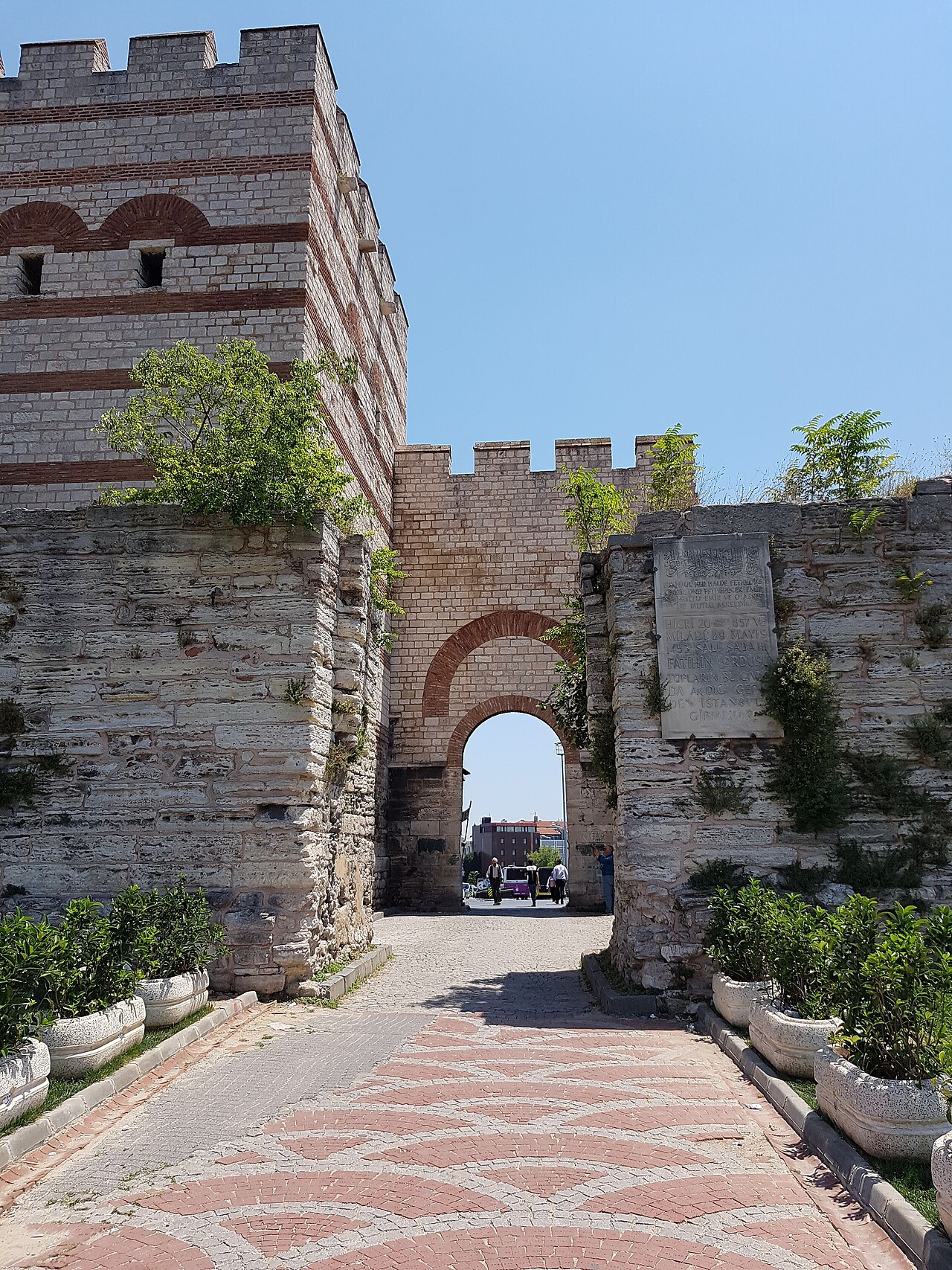
A stone gateway in old city walls: a tall brick-banded tower on the left with crenellations, and a central arched passage with a brick arch. A marble plaque with inscription is mounted on the right wall. Paved road leads through, with a pink van and people beyond.Photograph

Secondary source

Romanus Gate in the Theodosian Walls, Now Topkapı

Isabeau · 2 July 2018

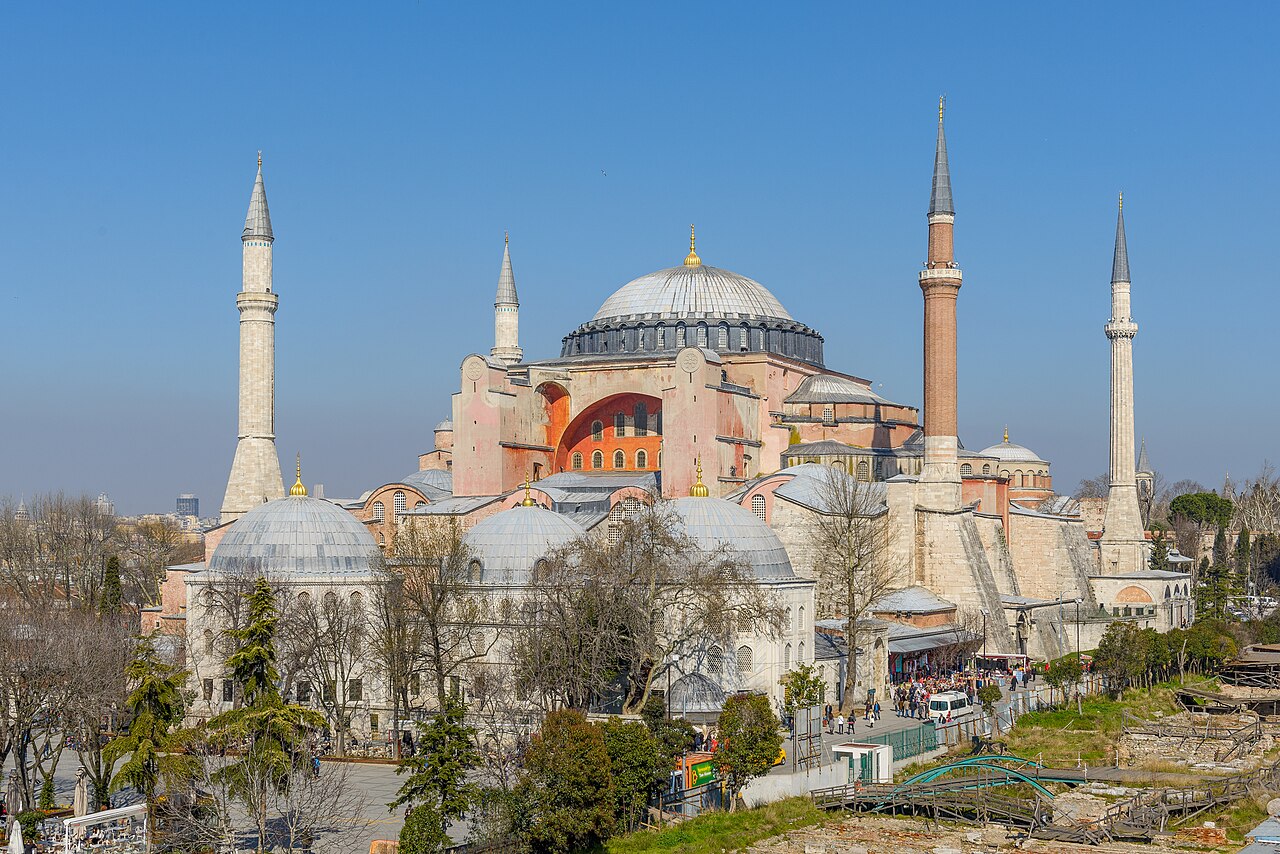
Exterior view of the Hagia Sophia in Istanbul under a clear blue sky. A large central dome rests on a pink-and-cream walled structure, flanked by tall white minarets and a brick-red minaret, with smaller domes and trees in the foreground and visitors on the paths below.Artifact

Secondary source

Hagia Sophia

Isidore of Miletus and Anthemius of Tralles · 532-537 CE

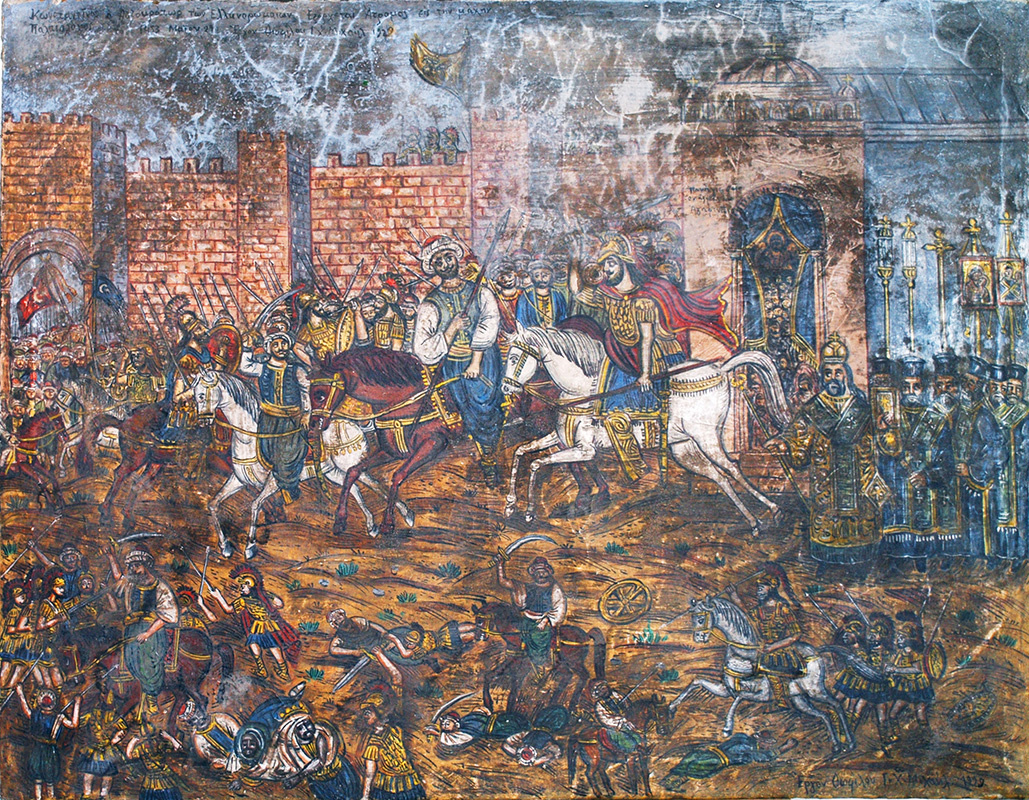
Naive-style painting of a battle scene at a walled city. Brick fortifications stand at left, with a gate and a dome beyond. Mounted and foot soldiers clash in the foreground, many figures lie fallen on the ground. A rider in red cloak and helmet, with a white horse, leads the charge. A robed dignitary and a row of attendants stand at right near a church-like doorway, with a crescent-shaped banner in the sky.Painting

Secondary source

Constantine Palaeologus Exits Fearless into the Battle

Theophilos Chatzimichael · probably 1929

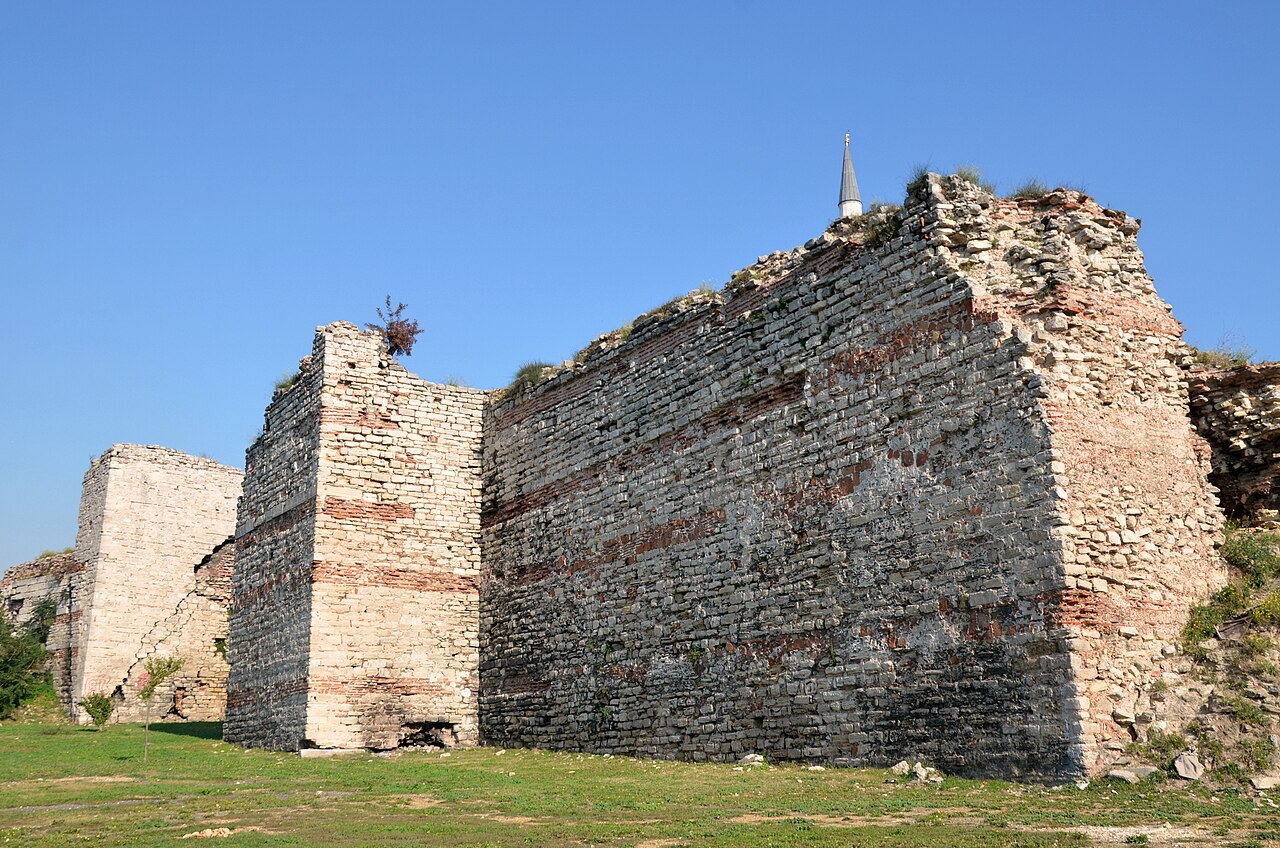
Ruined stone and brick city walls under a clear blue sky. A large section of masonry with alternating red brick courses rises at center, with a square tower to its left and a lower wall on the far left. Grass covers the ground, and a thin spire is visible on top of the wall in the distance.Photograph

Secondary source

Theodosian Walls of Constantinople, Istanbul

Carole Raddato · 21 October 2017

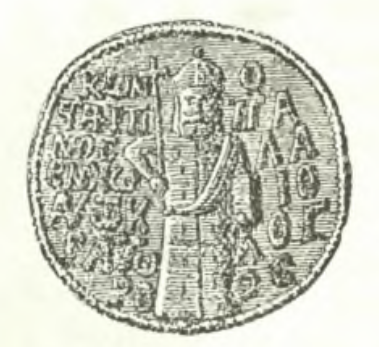
Black-and-white engraved image of a round seal showing a standing robed figure holding a long staff, with Greek inscription letters arranged around the left and right edges of the circular design.Artifact

Primary source

Seal of Constantine XI Palaiologos

Excavated stone ruins in a trench: rectangular, pale limestone block courses and a low wall of rubble masonry, with grass and scattered stones. Behind them, more walls and parked cars under trees.Artifact

Primary source

Hexamilion Wall

rebuilt 1444; destroyed 1446

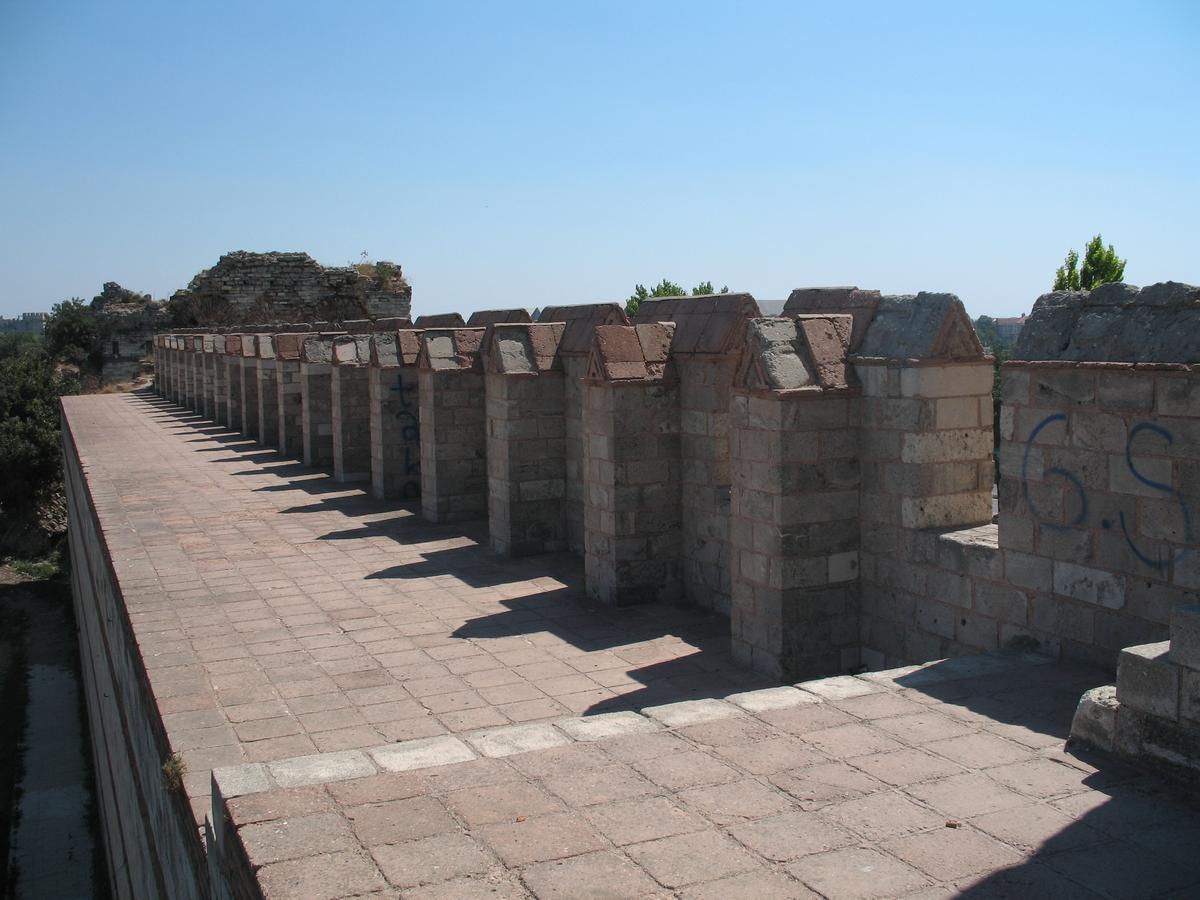
A stone-paved walkway atop a long defensive wall with a row of crenellated merlons, some capped with tiled roofs, under a clear blue sky. Ruined masonry and green shrubs appear in the background, and a faded blue graffiti scribble is on a wall section at right.Photograph

Secondary source

Theodosian Walls in Constantinople

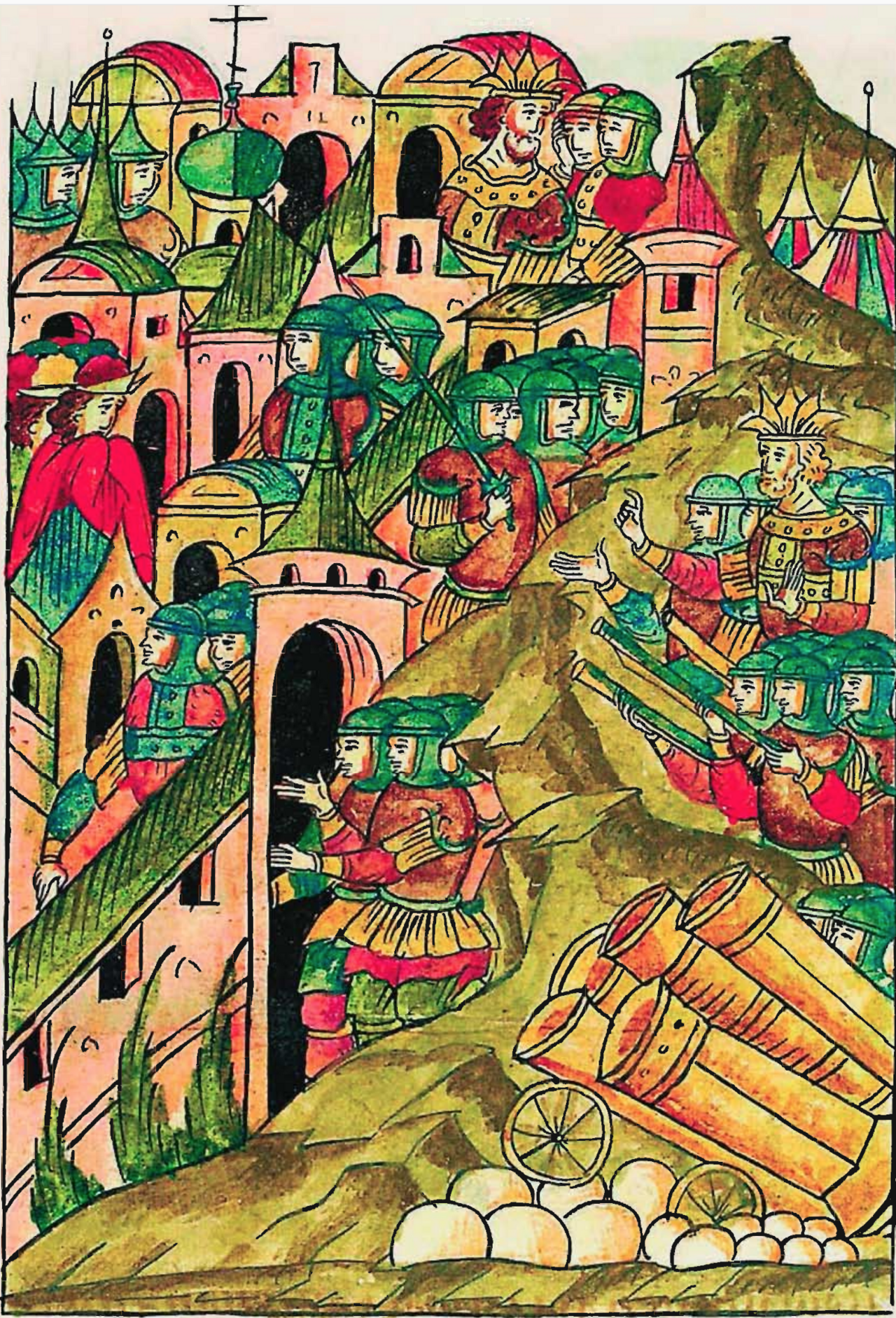
Colored miniature from a 16th-century Russian illuminated chronicle showing a siege scene. Turbaned and helmeted soldiers climb a hillside toward a walled city with domed towers and arched gates. On the right, a crowned ruler gestures toward troops firing guns, while large cannon barrels and cannonballs lie in the foreground. A crowned figure looks from a city window above.Painting

Secondary source

Facial Chronicle - Siege of Constantinople Miniature

Anonymous Russian manuscript illuminators · 1560s-1570s

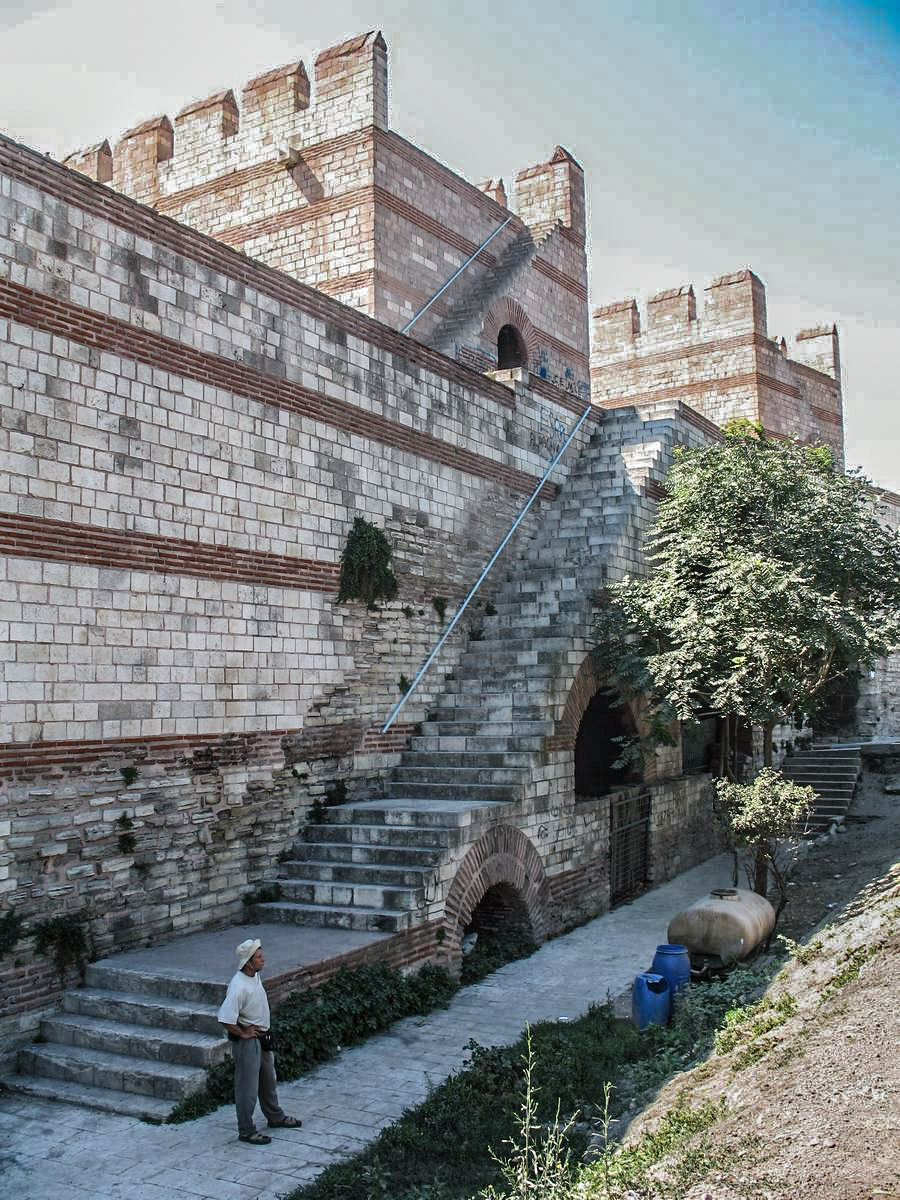
Photograph of a long stone and brick city wall with crenellated battlements and a steep stone ramp of stairs climbing along it. A man in a white cap and light clothing stands at the foot of the steps, with a tree and blue barrels on the right.Photograph

Secondary source

Theodosian Walls in Constantinople Ramp

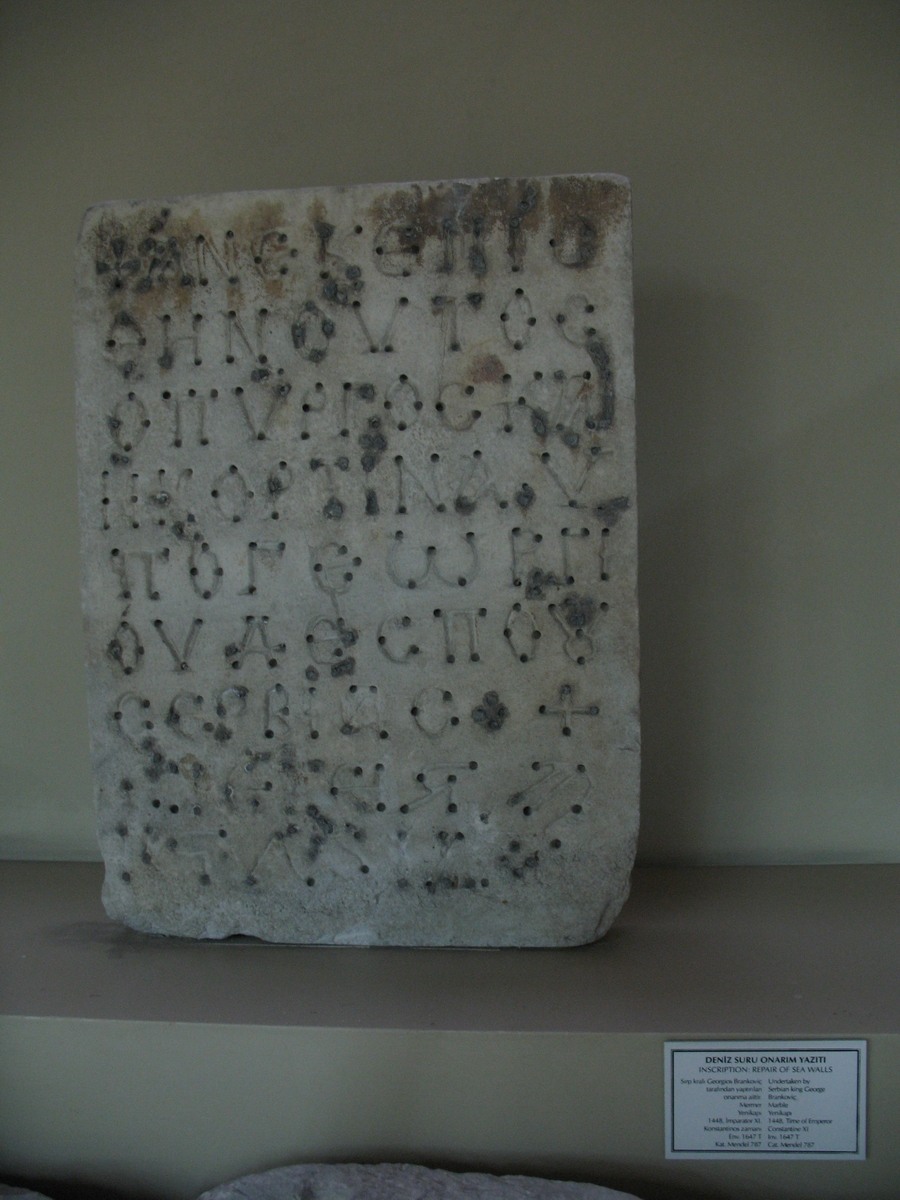
Photo of a pale marble slab mounted on a wall in a museum, its surface covered with rows of Greek-style inscribed letters with drilled holes. A museum label sits on the shelf below, reading in Turkish and Serbian about the inscription on the repair of sea walls.Document

Primary source

Marble Plaque of Đurađ Branković

Đurađ Branković · 1448

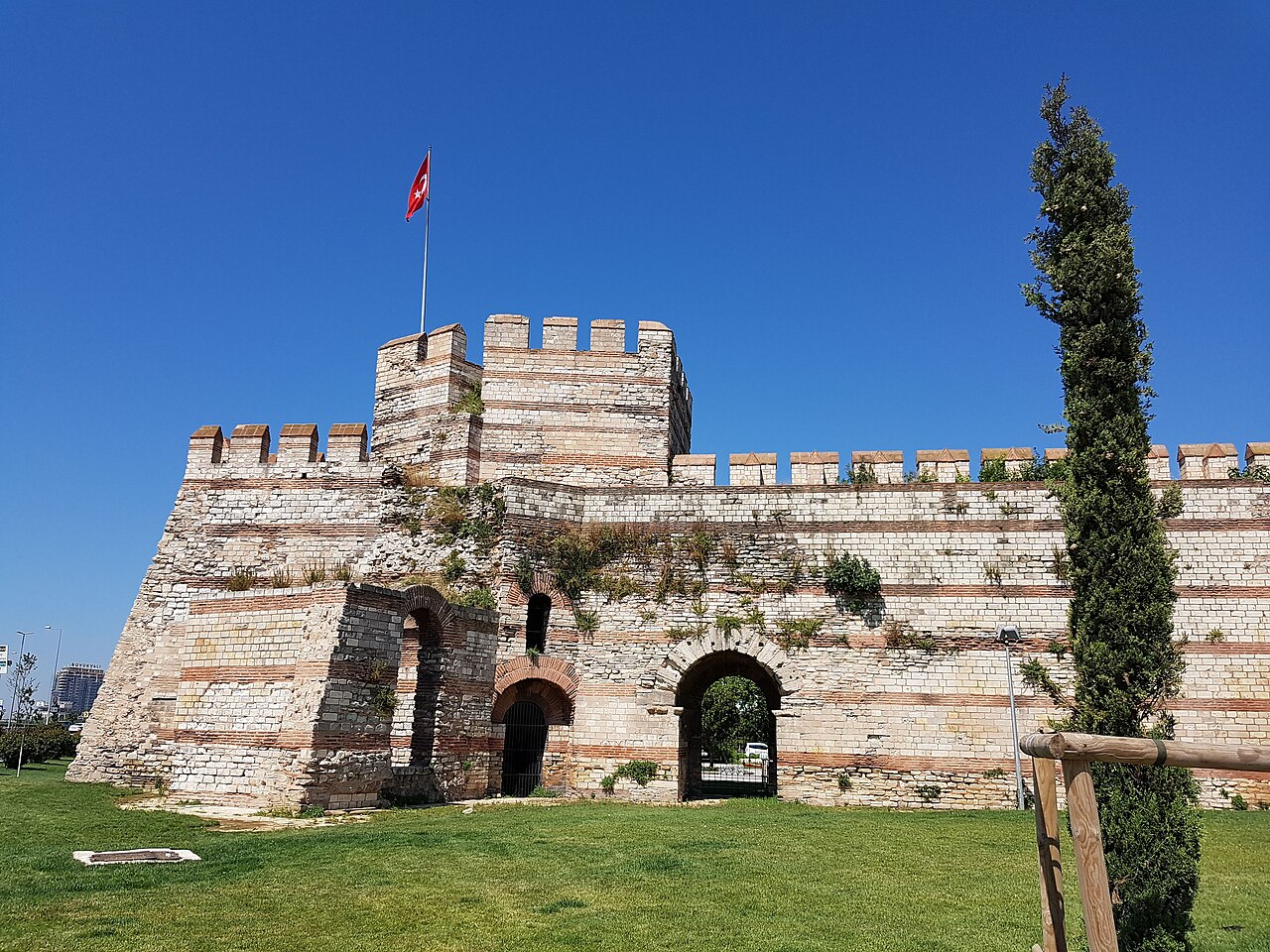
Stone and brick fortification with crenellated battlements and a square tower topped by a red Turkish flag, with arched gateways at ground level. Green grass in the foreground, a cypress tree at right, and a clear blue sky.Photograph

Secondary source

First Military Gate of Theodosian Walls

Isabeau · 2 July 2018

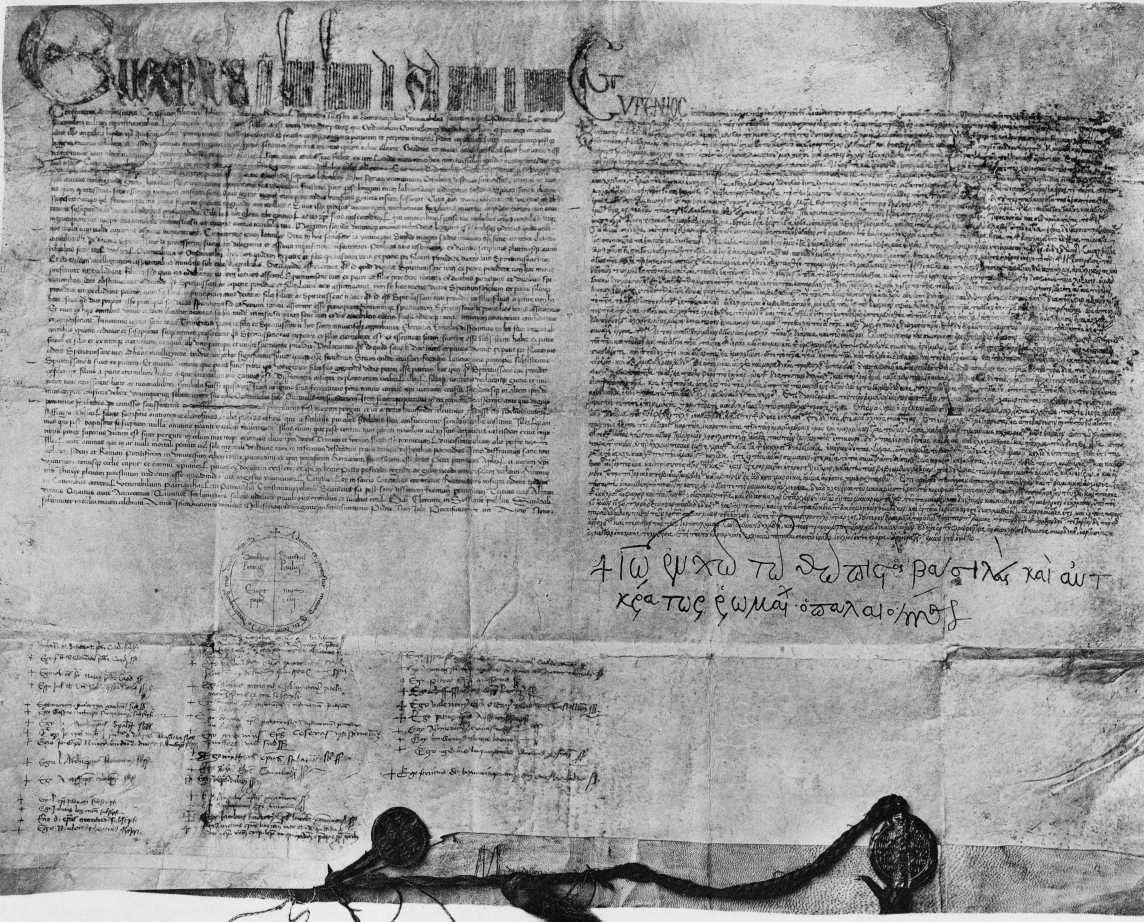
Black-and-white photograph of the 1439 Florentine union bull on aged parchment, with two columns of Latin text, a Greek signature in cursive ink at lower right, a round seal, and dangling cords with seals at the bottom.Document

Primary source

Laetentur Caeli

Eugene IV · 6 July 1439

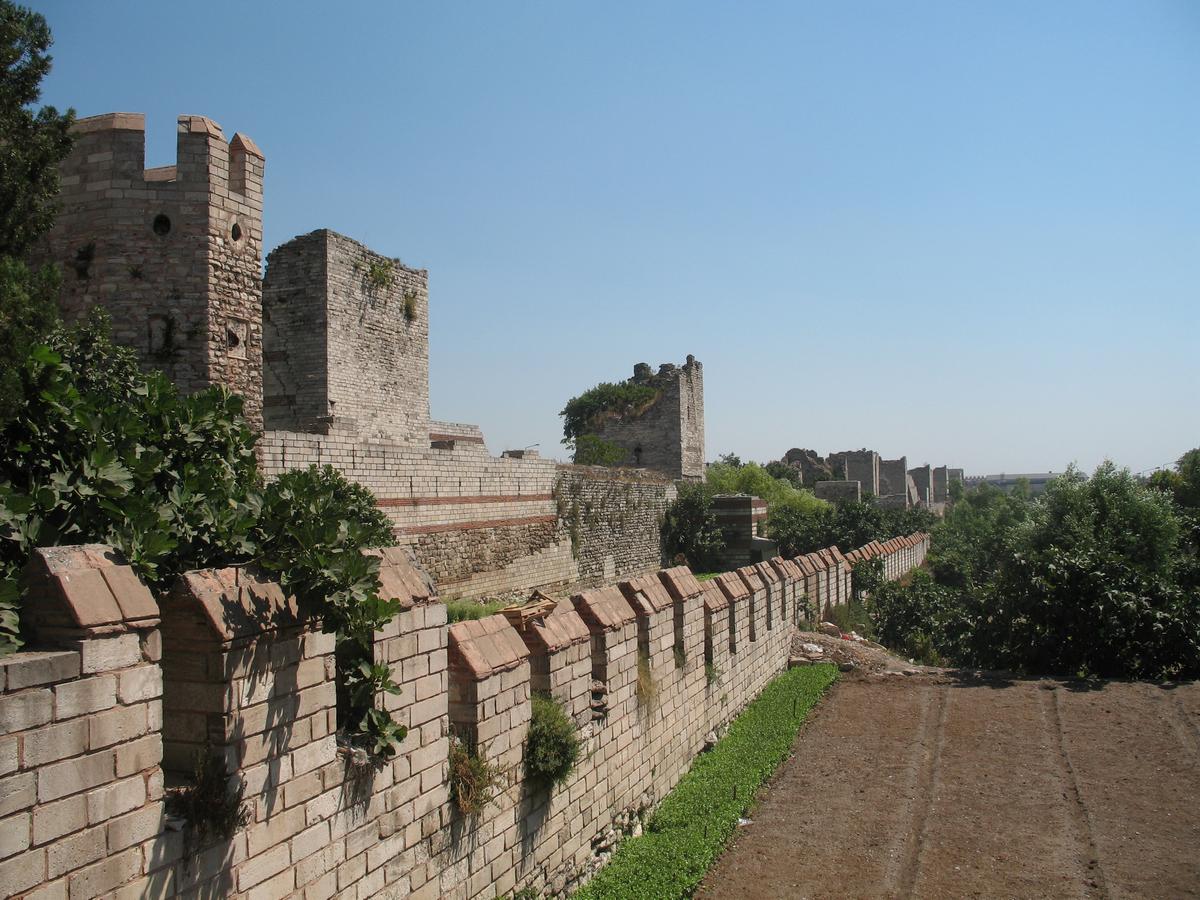
Ruined stone and brick city walls under a clear blue sky. Crenellated towers stand on the left, with a line of brick-capped battlements running diagonally toward the right. Green shrubs grow beside a dirt path.Photograph

Secondary source

Walls of Constantinople

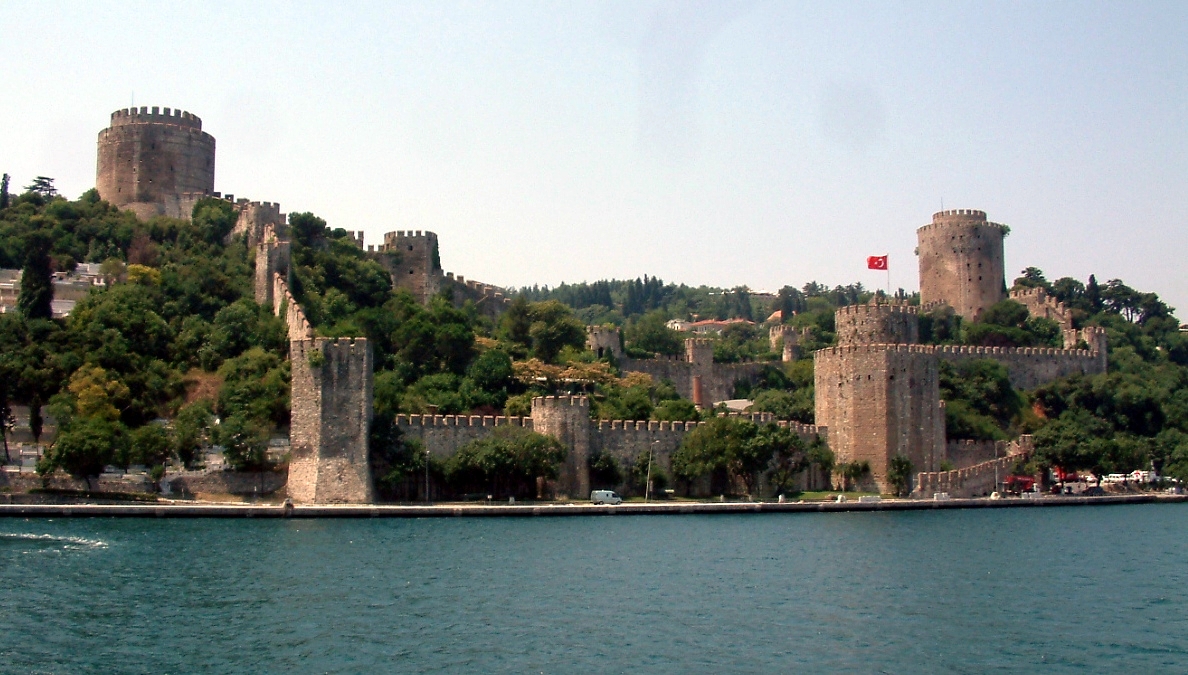
Rumeli Hisarı fortress on a hillside above the Bosphorus strait. Stone walls with crenellations, round towers with conical-topped turrets, green trees on the slope, a Turkish flag on a tower, and a calm blue waterway in the foreground.Artifact

Primary source

Rumeli Hisarı

1451-1452

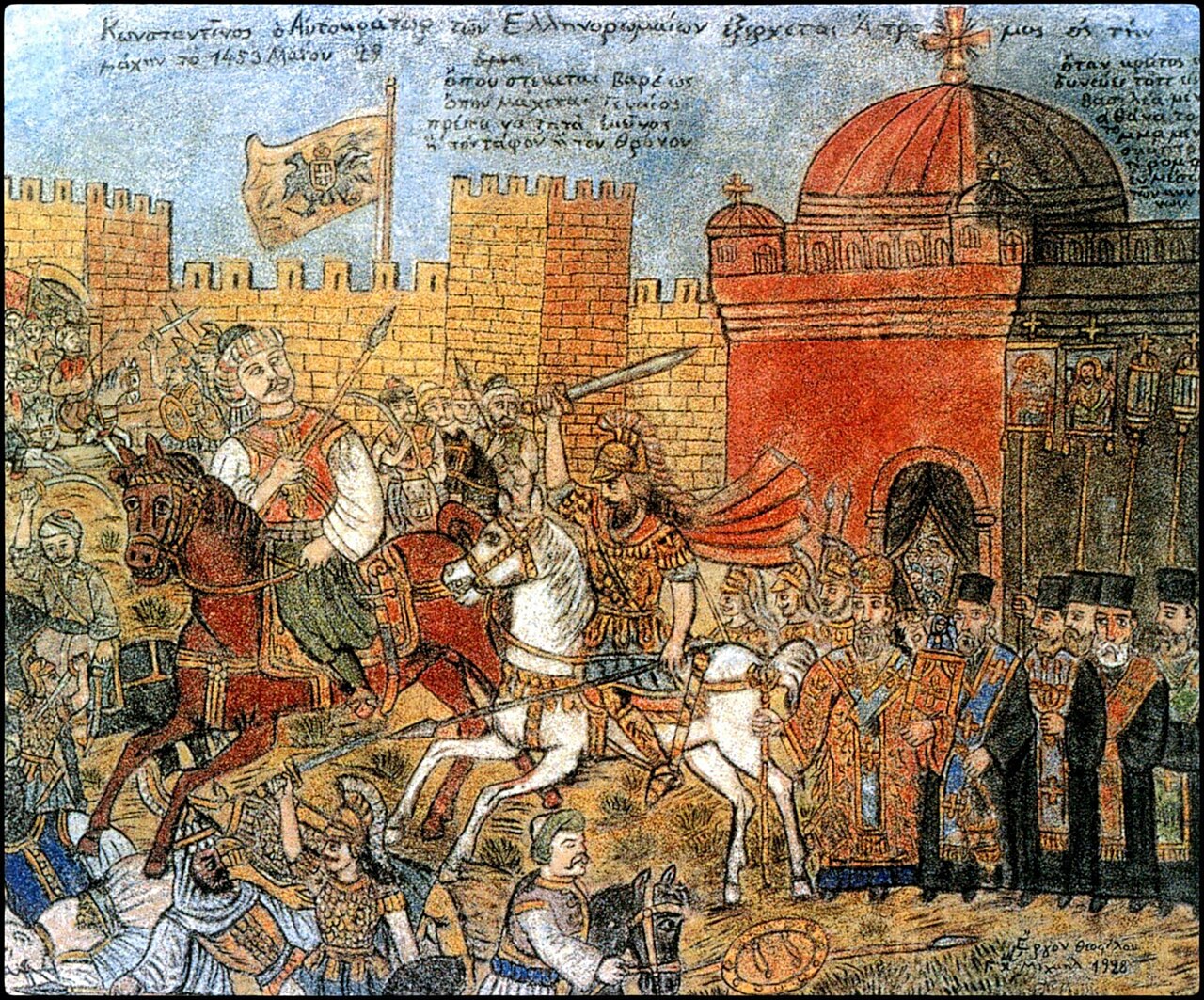
Colorful naive-style painting of the fall of Constantinople. On the left, a mounted Ottoman-era commander on a red-brown horse leads troops toward yellow city walls under a banner with a double-headed eagle. On the right, a red domed church with a cross, and in front a bearded emperor on a white horse with a sword raised, flanked by clergy in black and gold robes. Fallen soldiers lie in the foreground. Greek inscriptions appear at the top.Painting

Secondary source

Constantine Palaeologus Enters Battle

Theophilos Chatzimichael · 1928

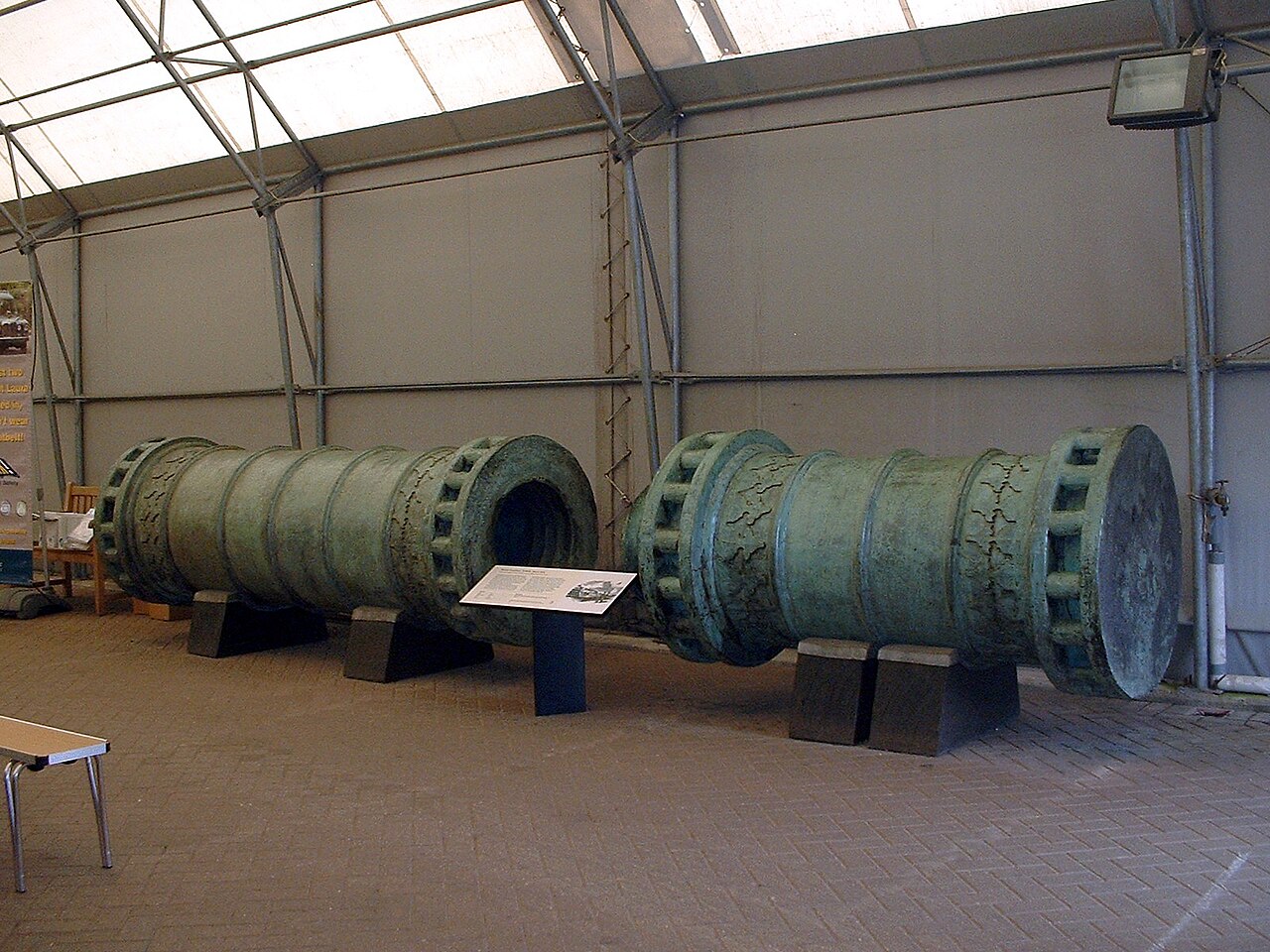
Two green, weathered bronze siege-gun sections lie horizontally on dark stone blocks in a hall with a tiled floor and a skylit ceiling. The left piece has an open muzzle, and the right piece has a closed rear end with a ring of sockets. An information panel stands in front.Artifact

Primary source

Dardanelles Gun

Munir Ali · 1464

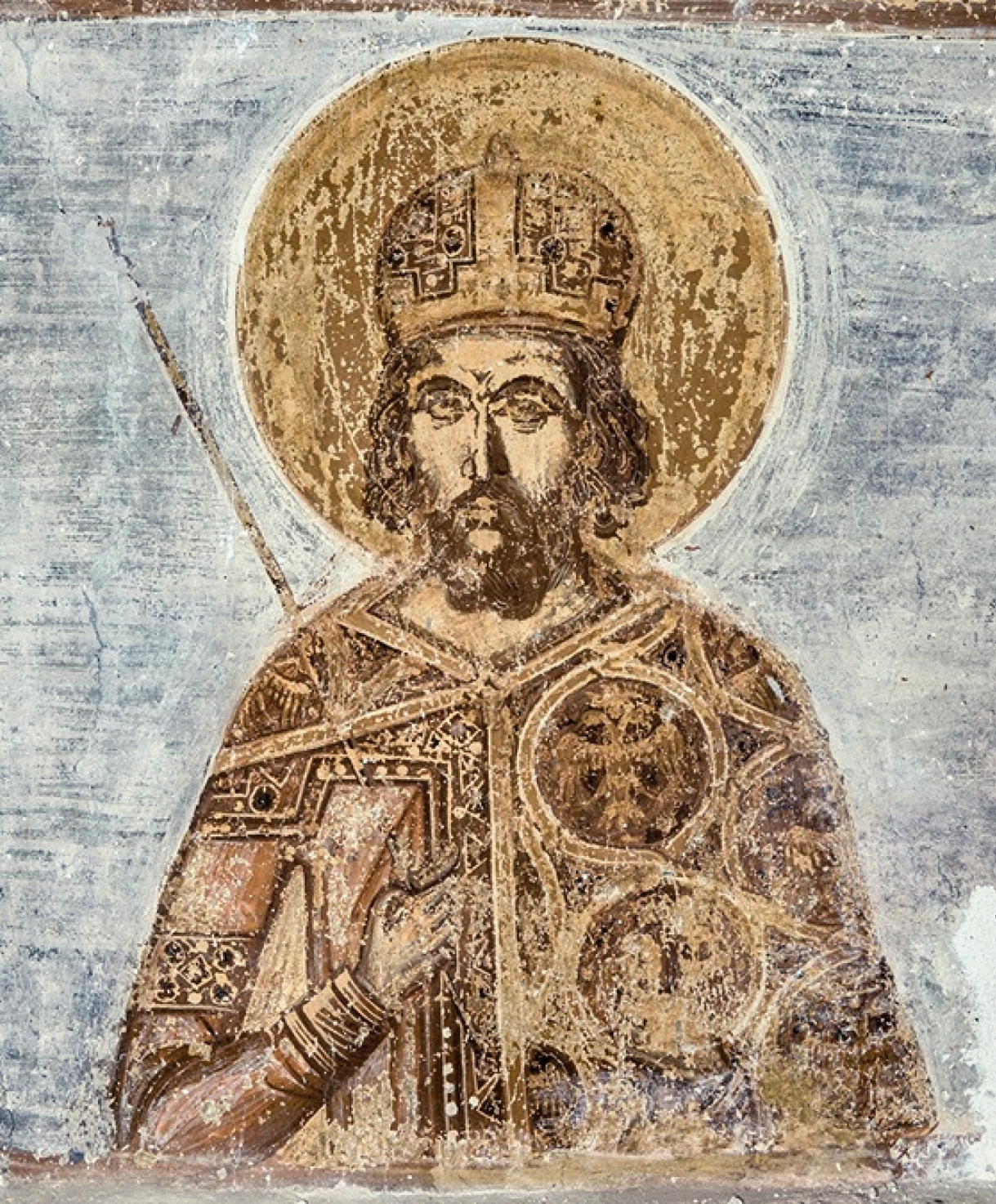
Byzantine-style fresco of a bearded man with long hair wearing a jeweled crown and a golden halo, holding a staff, in an ornate embroidered robe with circular medallions, set against a pale blue-grey wall. The paint is faded and worn.Painting

Tertiary source

Portrait of Konstantinos XI Palaiologos

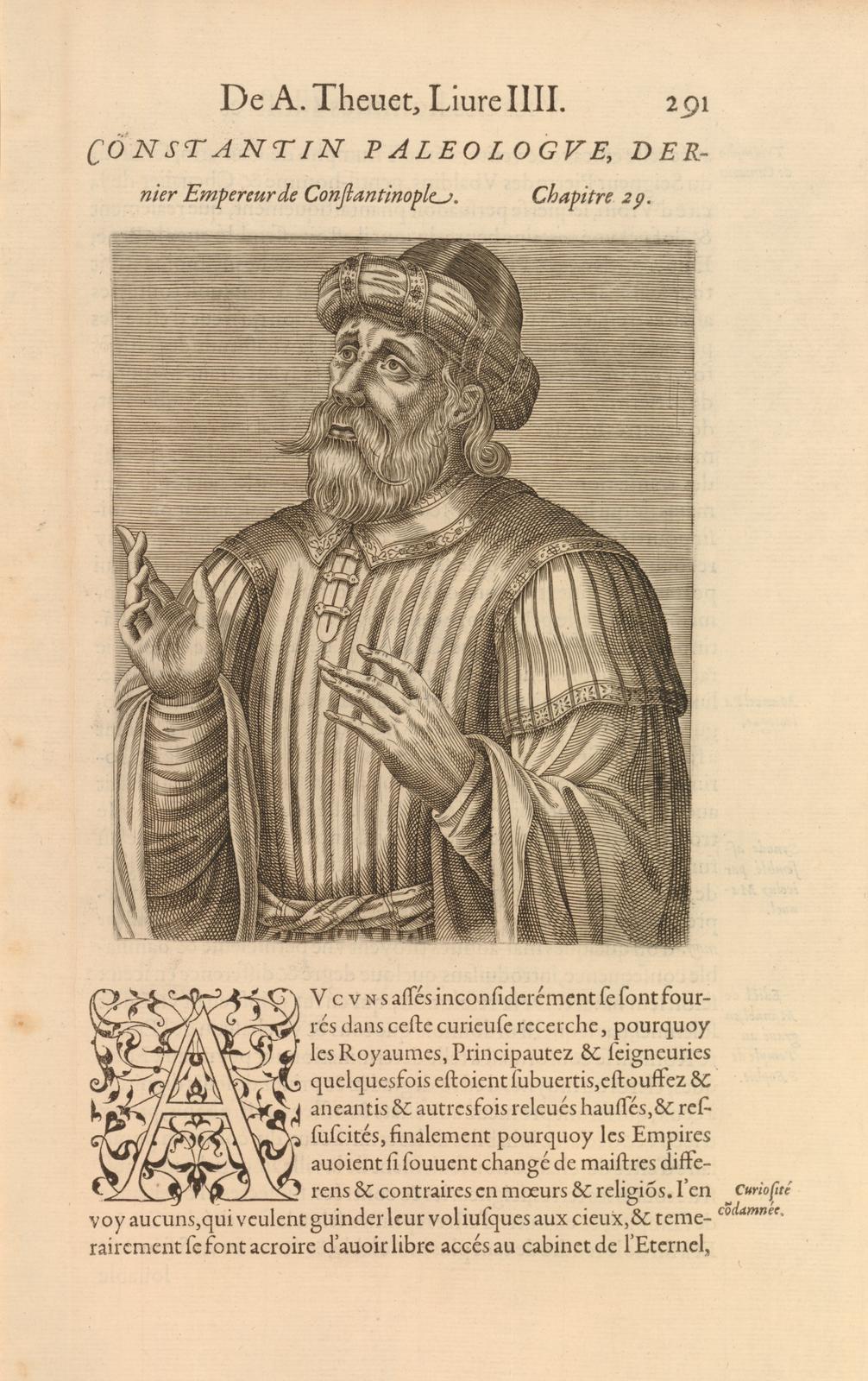
Engraved portrait of a bearded man in a turban and striped robe, turned to the left, gesturing with raised hands. Printed page 291 with French text: Constantin Paleologue, dernier Empereur de Constantinople, chapitre 29.Painting

Secondary source

Constantin Paleologue, dernier Empereur de Constantinople

1584

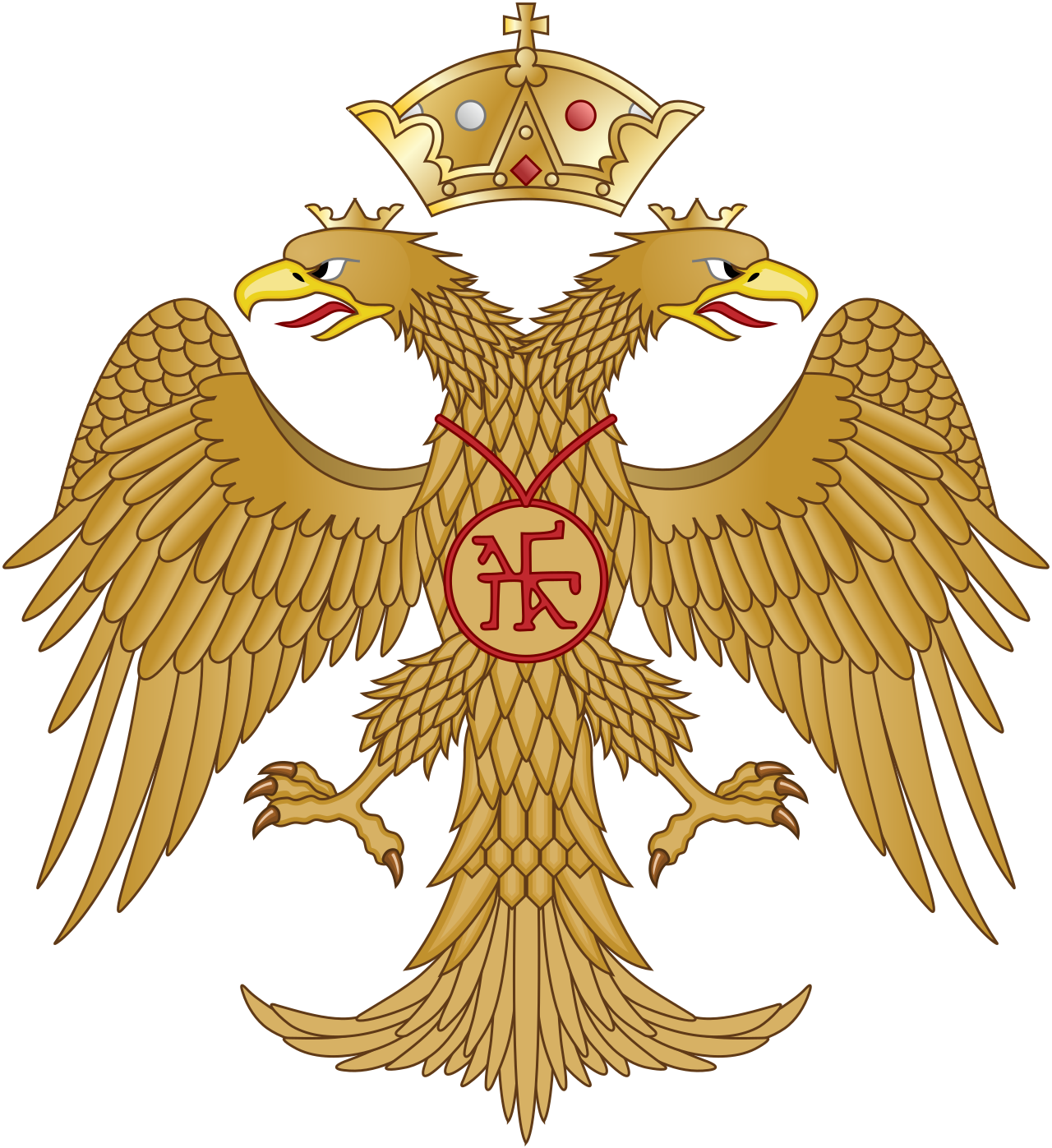
A golden double-headed eagle with a jeweled crown above its two heads and outstretched wings. A red circle with a red monogram sits on its chest, hanging from a red cord. Its talons are curled and red-tipped.Artifact

Secondary source

Coat of Arms of the Palaiologos Dynasty

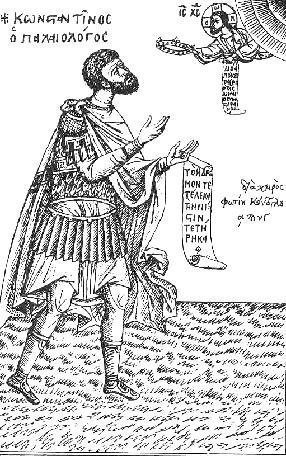
Black-and-white line drawing of a bearded man in armor and a long cloak, holding a scroll with Greek text, with Greek lettering above him and a figure of Christ in a sunburst at upper right blessing him. Ground is hatched with lines.Painting

Secondary source

Emperor Konstantinos Crowned by Christ as a Martyr

Photios Kontoglou

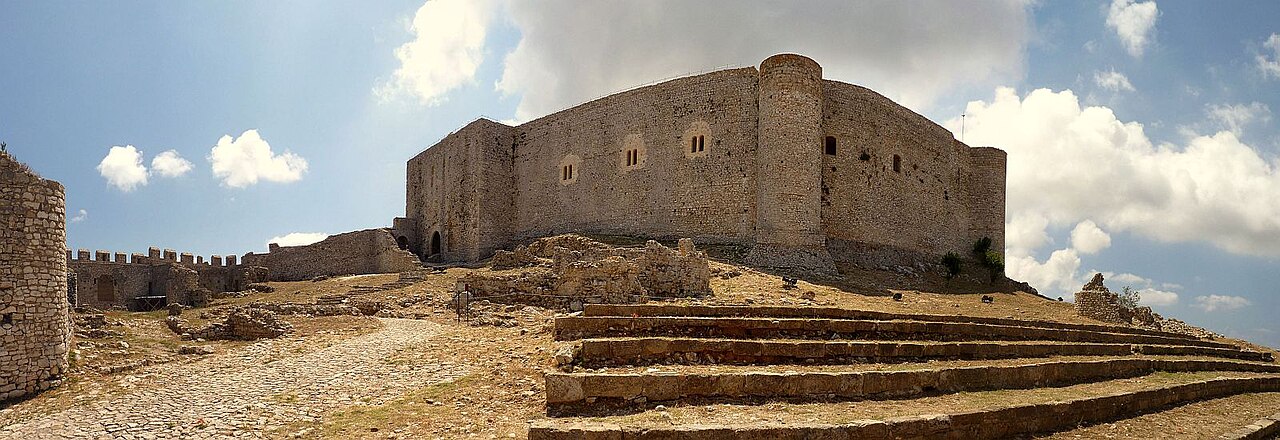
Panoramic view of a stone castle on a hilltop under a partly cloudy blue sky. Massive walls with small windows and a round tower rise above stone steps in the foreground, with a cobbled path and ruined walls to the left.Artifact

Secondary source

Chlemoutsi Castle

1220s

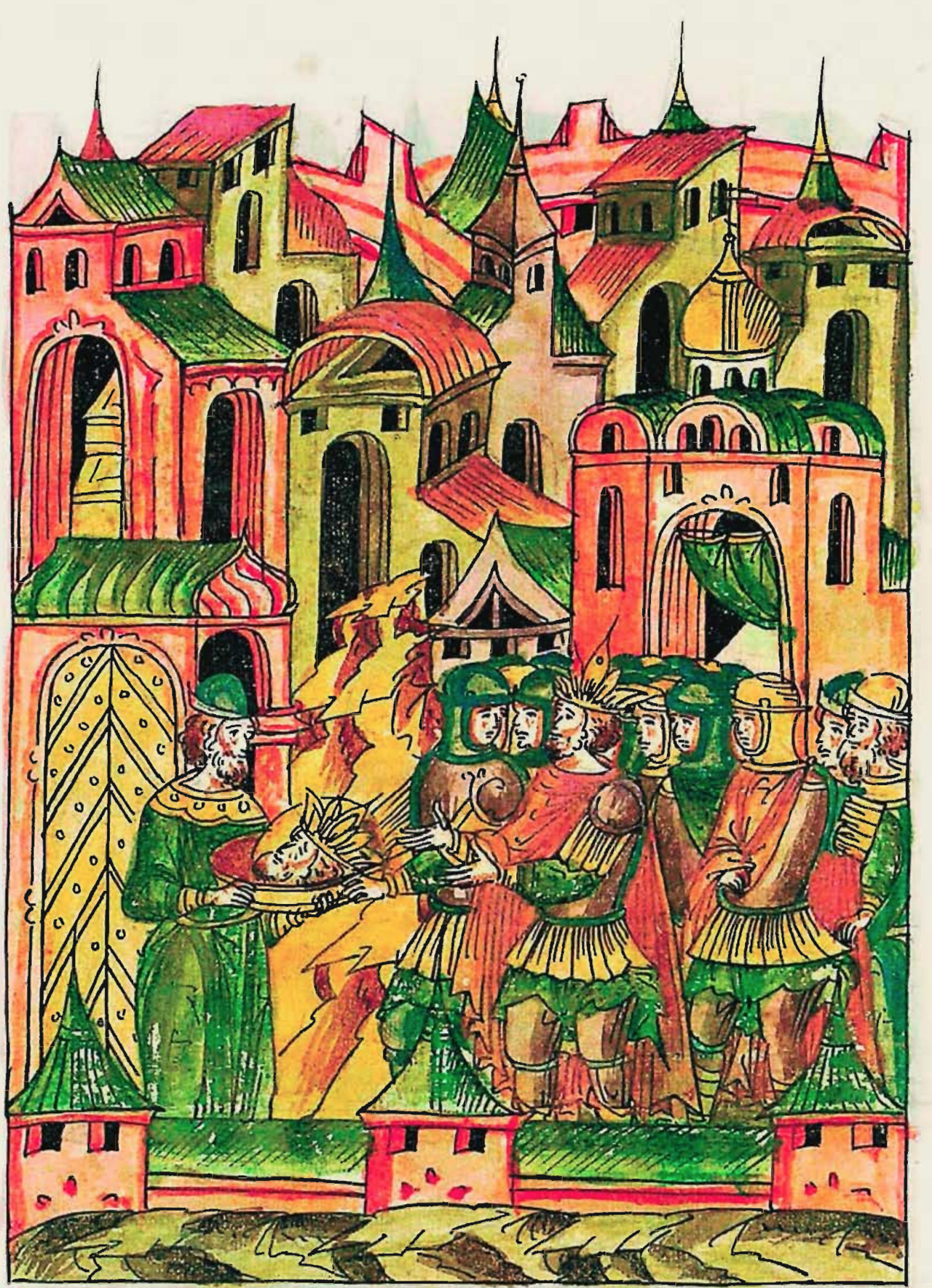
Colored manuscript illumination of a medieval walled city with red and green roofs and domed towers. In the foreground, a bearded man in a green robe and hat holds a platter bearing a severed head, while a group of armored soldiers in helmets and red and gold tunics stands nearby.Painting

Secondary source

Facial Chronicle, Volume 14, Page 440 (Siege of Constantinople)

Anonymous Russian manuscript illuminators · 1560s-1570s

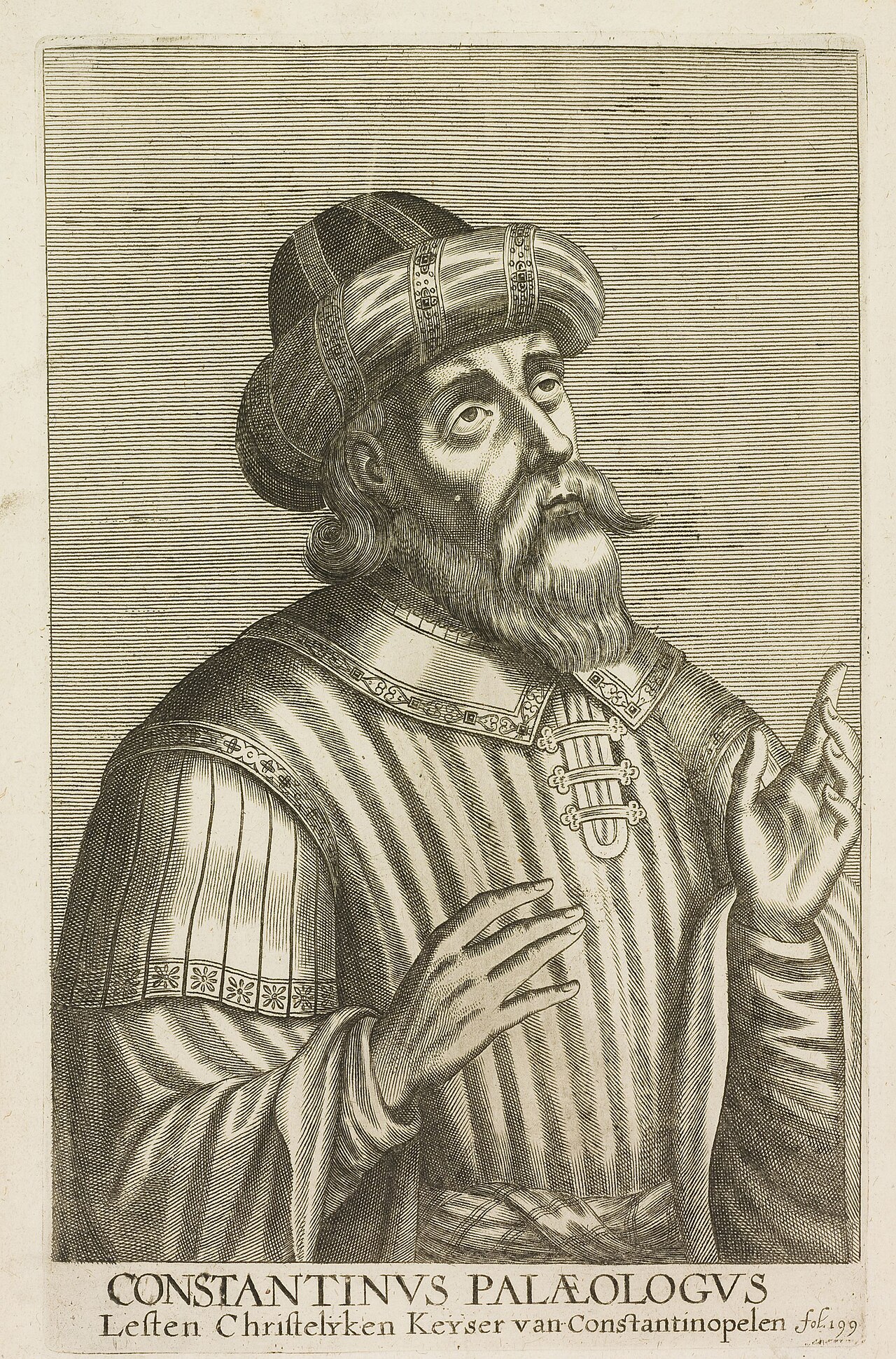
Black-and-white engraved portrait of a bearded man in a wide-brimmed patterned hat and striped embroidered garment, gesturing with one hand raised and the other on his chest. Caption below reads Constantinus Palæologus and a Dutch line about the last Christian emperor of Constantinople.Painting

Secondary source

Constantinus Palæologus

Constantine, the Last Emperor of the GreeksBook

Secondary source

Constantine, the Last Emperor of the Greeks

Cedomilj Mijatovic · 1892

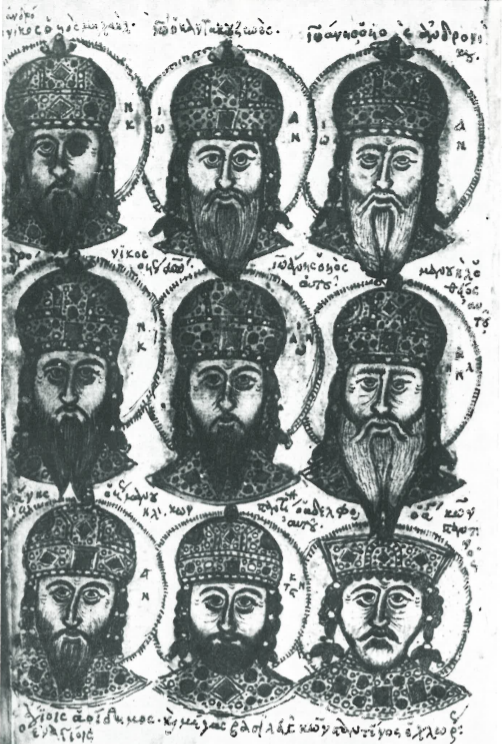
Black-and-white reproduction of a manuscript page with nine framed portrait medallions of Byzantine emperors in three rows, each with bearded men wearing jeweled crowns or caps, with Greek inscriptions above and below.Painting

Primary source

Zonaras Chronicle Folio with Portrait of Constantine XI

Unknown Byzantine artist · c. 1450

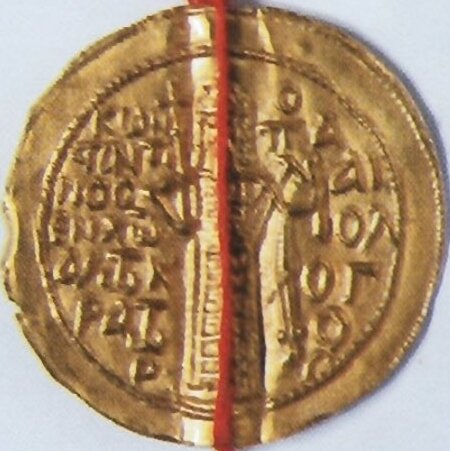
Photograph of a round gold Byzantine seal, cropped, with a red vertical line drawn through its centre. On the left side is Greek inscription text in several lines; on the right side a standing figure in robes with a cross-topped staff and further lettering. The gold surface is worn and slightly uneven.Artifact

Primary source

Gold Seal of Constantine XI on the Ragusa Chrysobull

1451

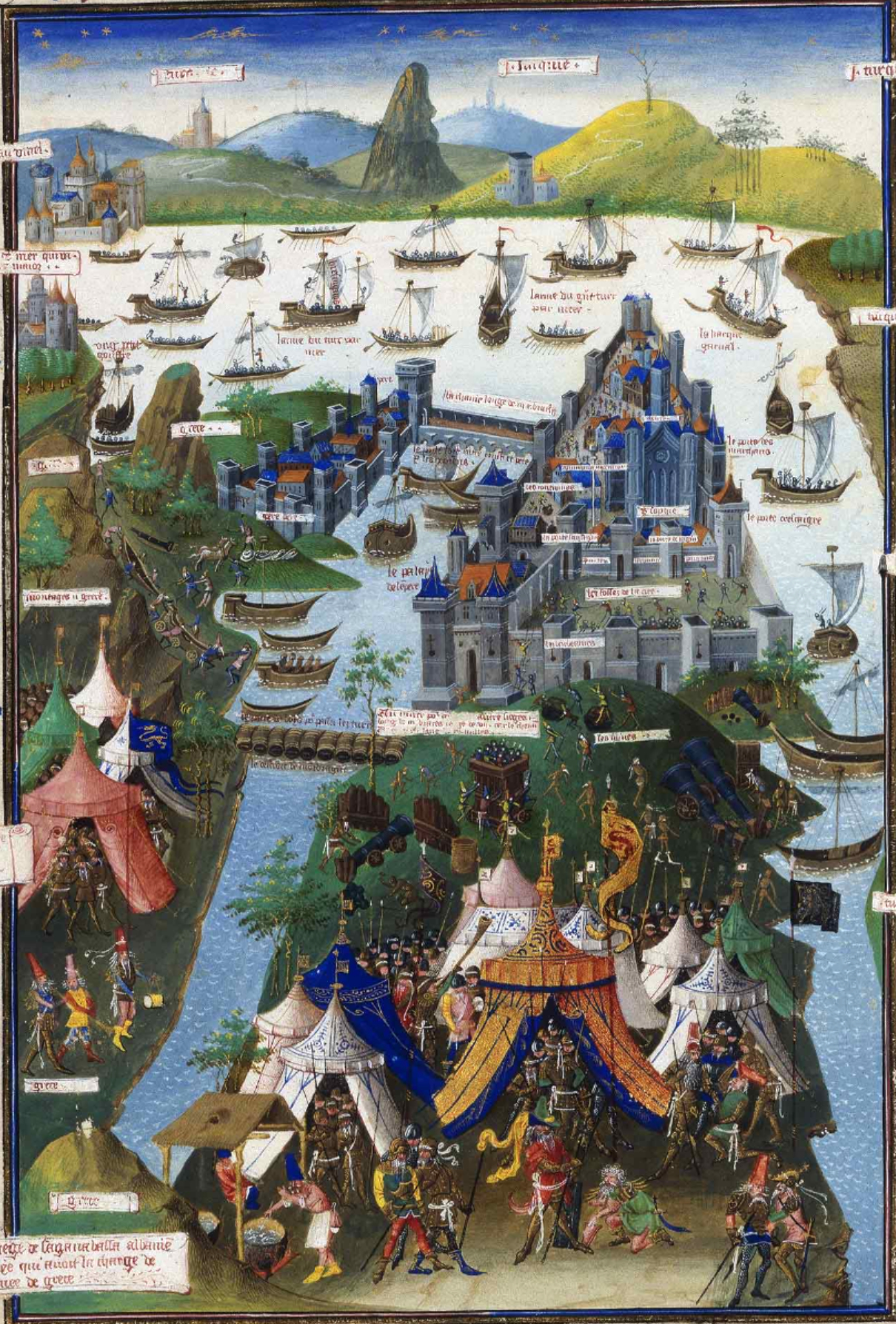
Medieval manuscript miniature of the siege of Constantinople: a walled city on a peninsula with blue-roofed towers and a harbor full of ships, and in the foreground an army camp with striped and blue tents, cannons, banners, and armored soldiers.Painting

Secondary source

The Siege of Constantinople

Jean Le Tavernier · after 1455

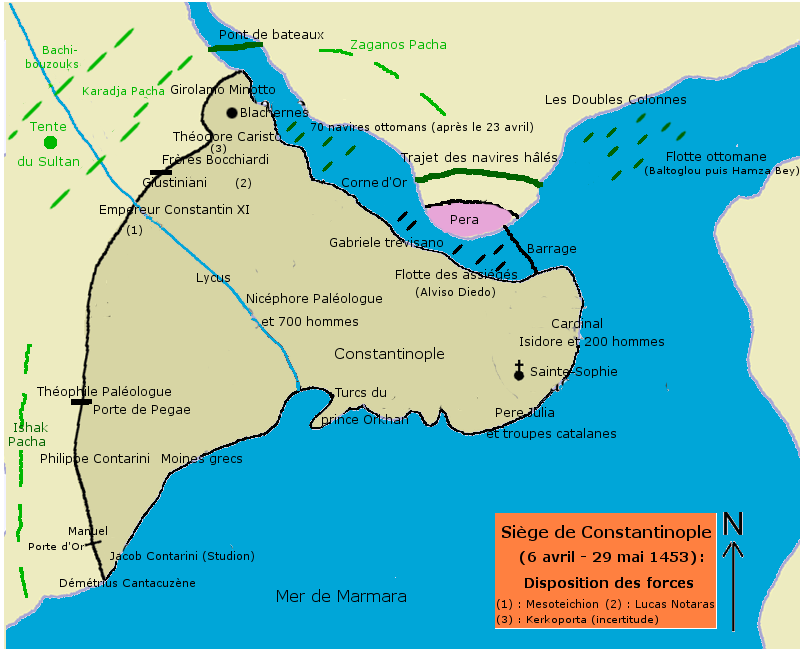
Map titled Siège de Constantinople (6 avril - 29 mai 1453): Disposition des forces. Shows the walled city of Constantinople in beige, the Golden Horn and Bosphorus in blue, and the Ottoman camp to the west in pale green. Labels mark Ottoman positions, the Sultan's tent, the bridge of boats, the ships hauled overland to Pera, Byzantine defender positions with Italian and Catalan commanders, and the Marmara Sea to the south.Document

Secondary source

Order of Battle at the Siege of Constantinople, 1453

Spartan 117 · 2012

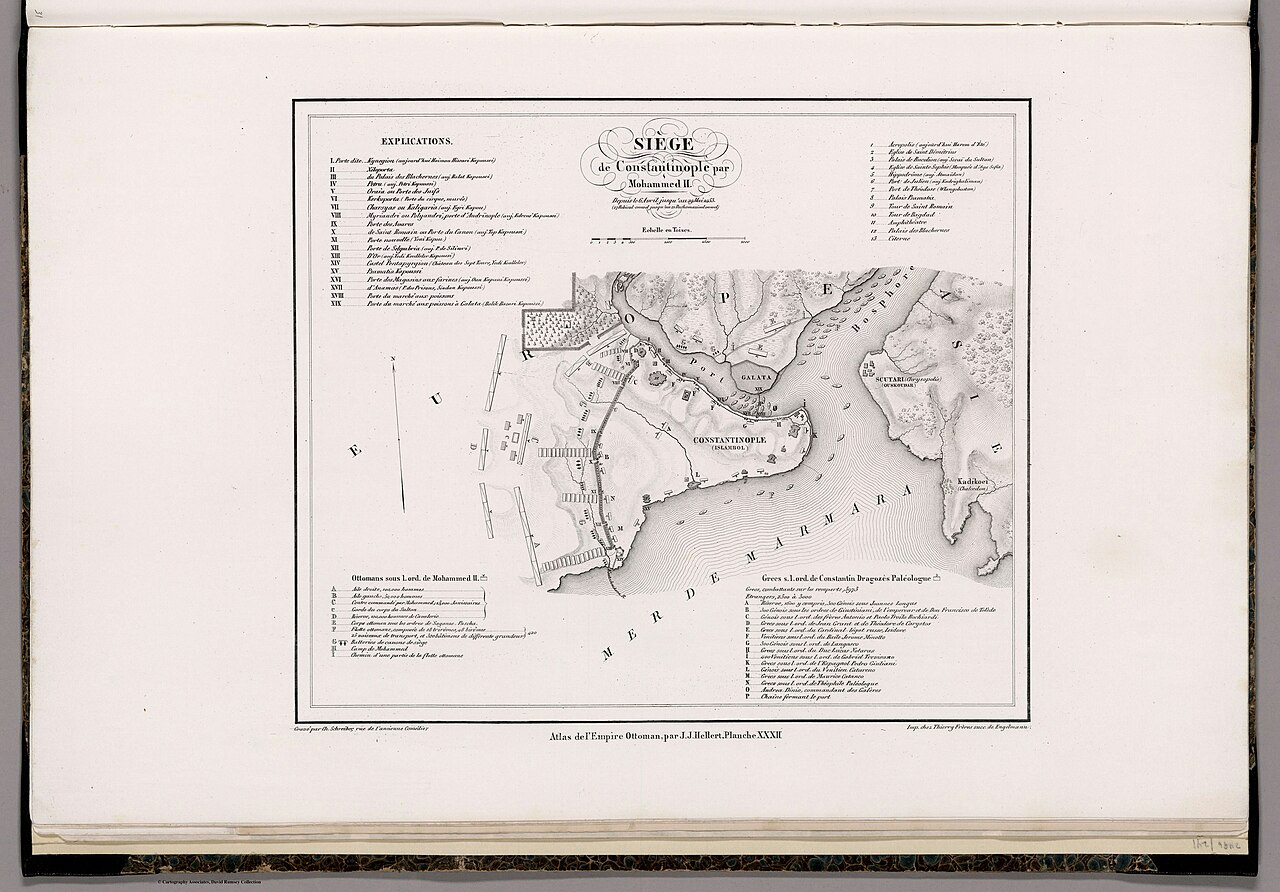
Engraved plan titled 'Siège de Constantinople par Mohammed II' on a page from an atlas. The map shows the city's fortifications, the Golden Horn, the Bosphorus and Sea of Marmara, and the sites of Galata, Scutari and Kadıköy, with a key of numbered explanations on the left and a second key listing Ottoman and Greek forces at lower left and right. The page bears the caption 'Atlas de l'Empire Ottoman, par J. J. Hellert, Planche XXXII'.Document

Secondary source

Siège de Constantinople par Mohammed II

J. J. Hellert; Charles Schreiber

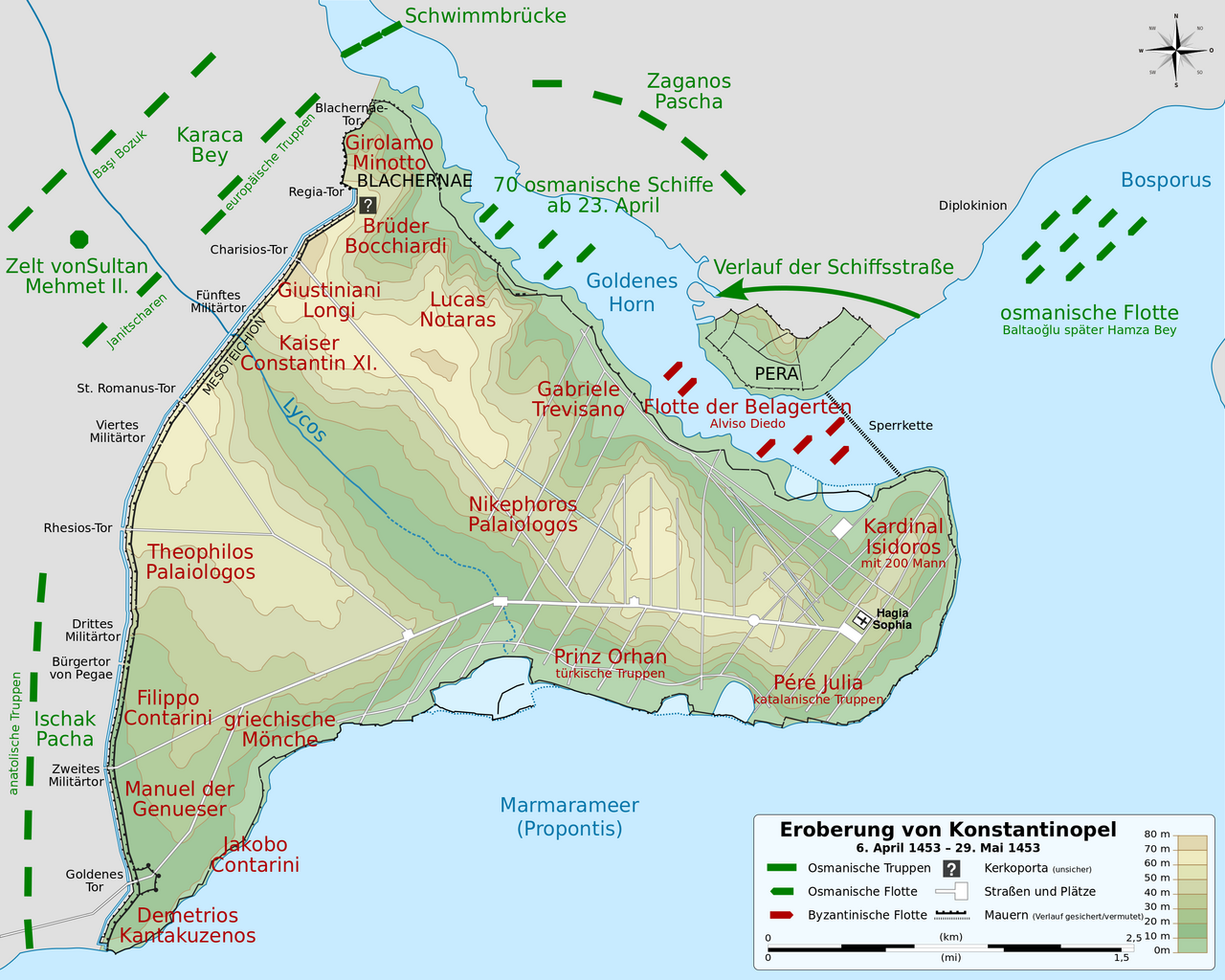
German-language map of Constantinople during the 1453 siege, showing Ottoman troops in green and Byzantine forces in red, with commander names, the Golden Horn, the Sea of Marmara, and a legend.Document

Secondary source

Map of Byzantine Constantinople During the 1453 Siege

Sémhur; Cplakidas; Lokiseinchef · 2013

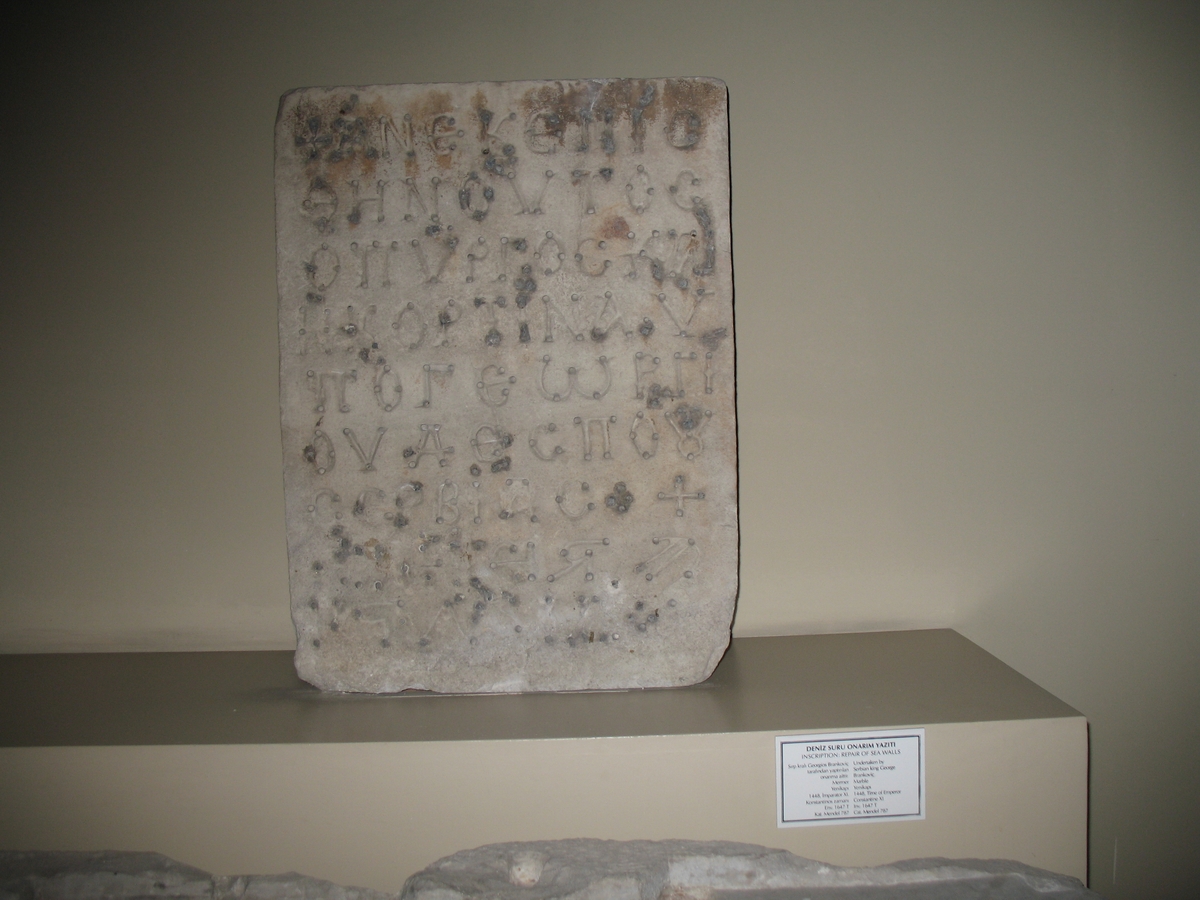
A rectangular pale marble slab with rows of incised Greek letters, some stained with darker patches, mounted upright on a beige display ledge in a museum room. A small placard below reads Deniz Surlu Onarım Yazıtı (Sea Walls Repair Inscription).Artifact

Primary source

Marble Plate of Đurađ Branković (Sea Walls Repair Inscription)

1448

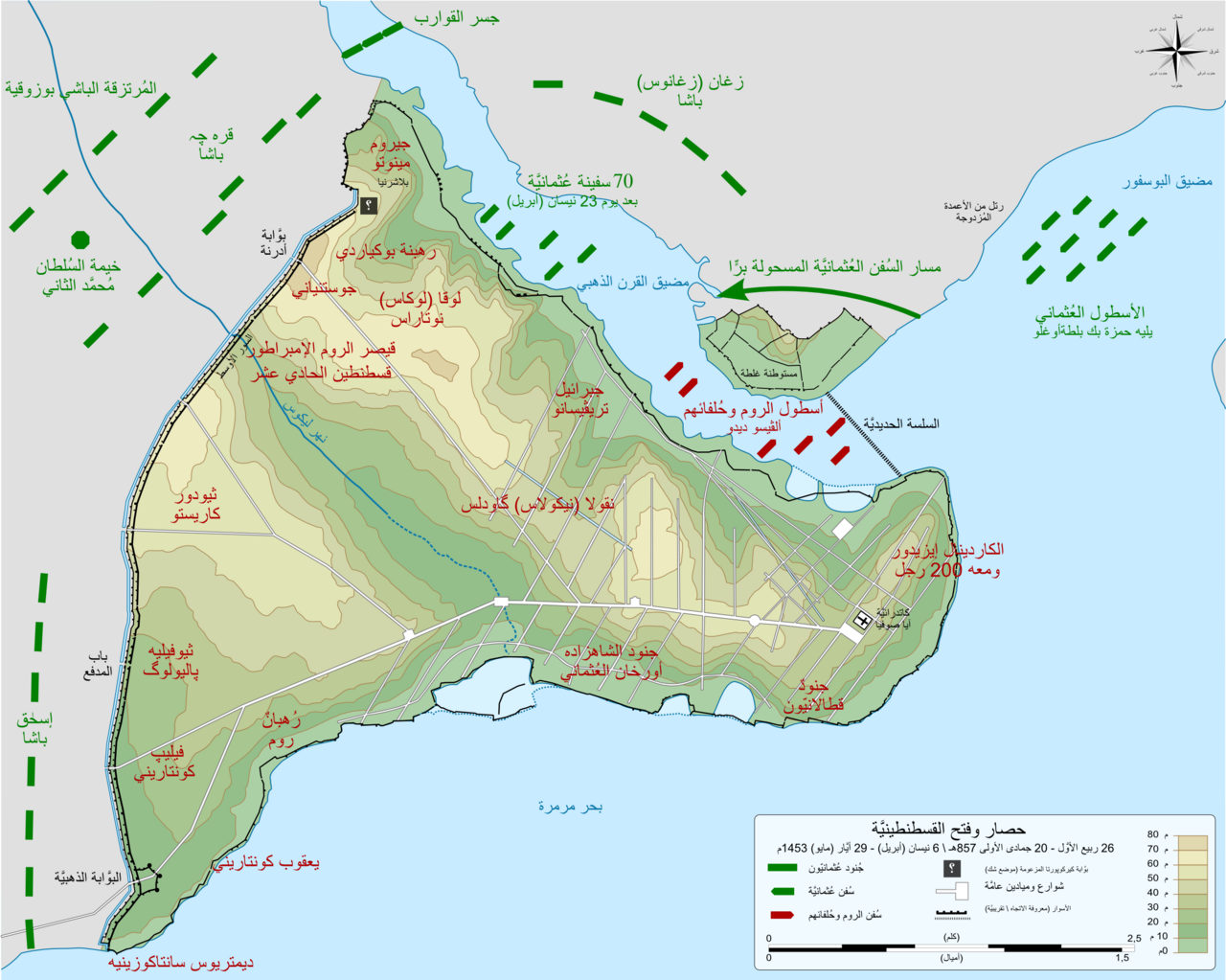
Arabic-labeled military map of Constantinople during the 1453 siege. Green dashed lines show Ottoman forces and ships, red marks show Byzantine forces and ships, with place names, a compass rose, a legend and a scale bar.Document

Secondary source

Map of Byzantine and Ottoman Deployments in the 1453 Siege (Arabic)

Sémhur; باسم · 2014

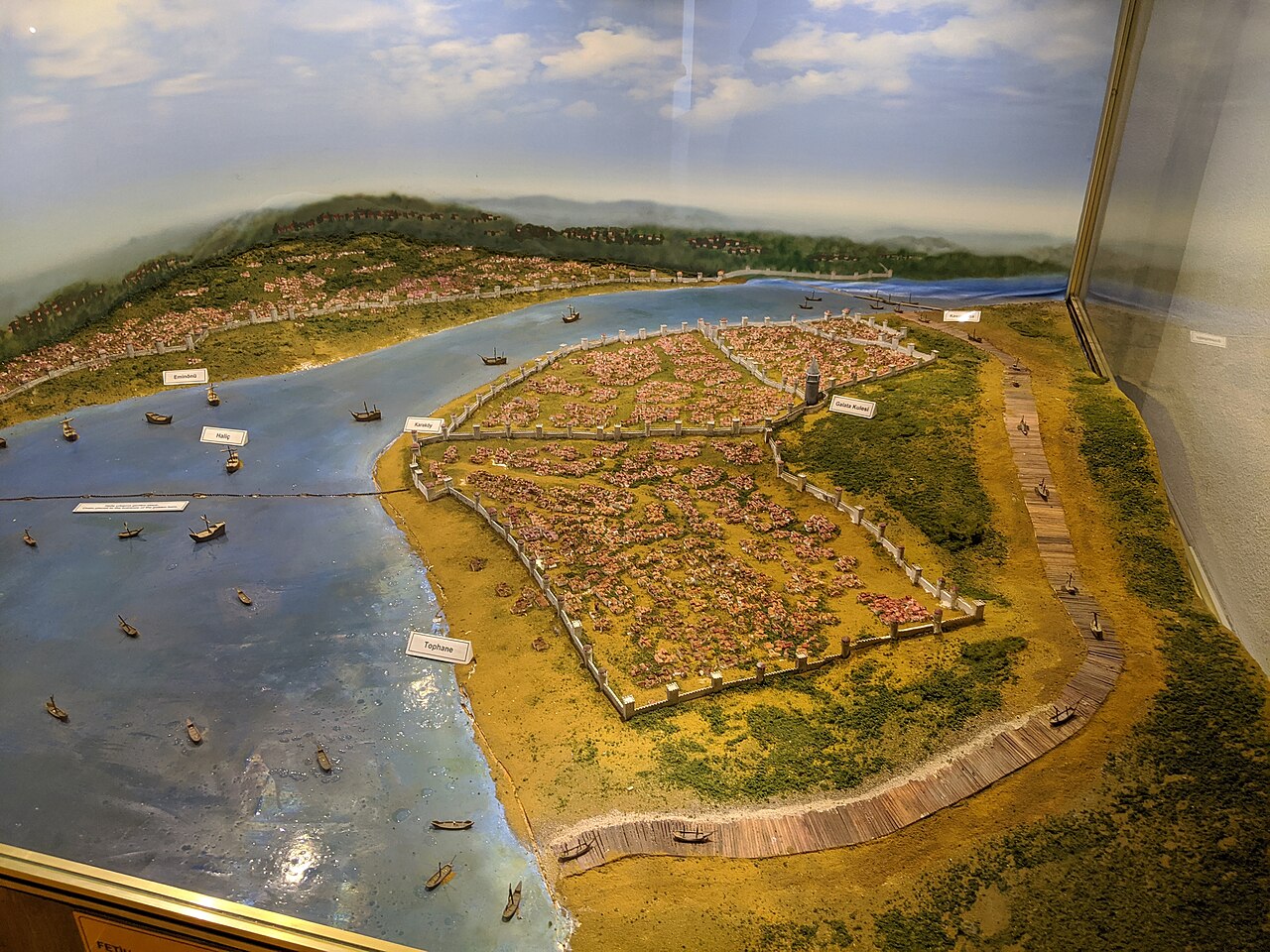
Museum diorama model of a walled city beside a blue waterway with small wooden boats, showing a fortified city with pink-roofed buildings, a walkway along the shore, and labeled tabs. Displayed behind glass in a case.Artifact

Secondary source

Model of the 1453 Siege of Constantinople

2020

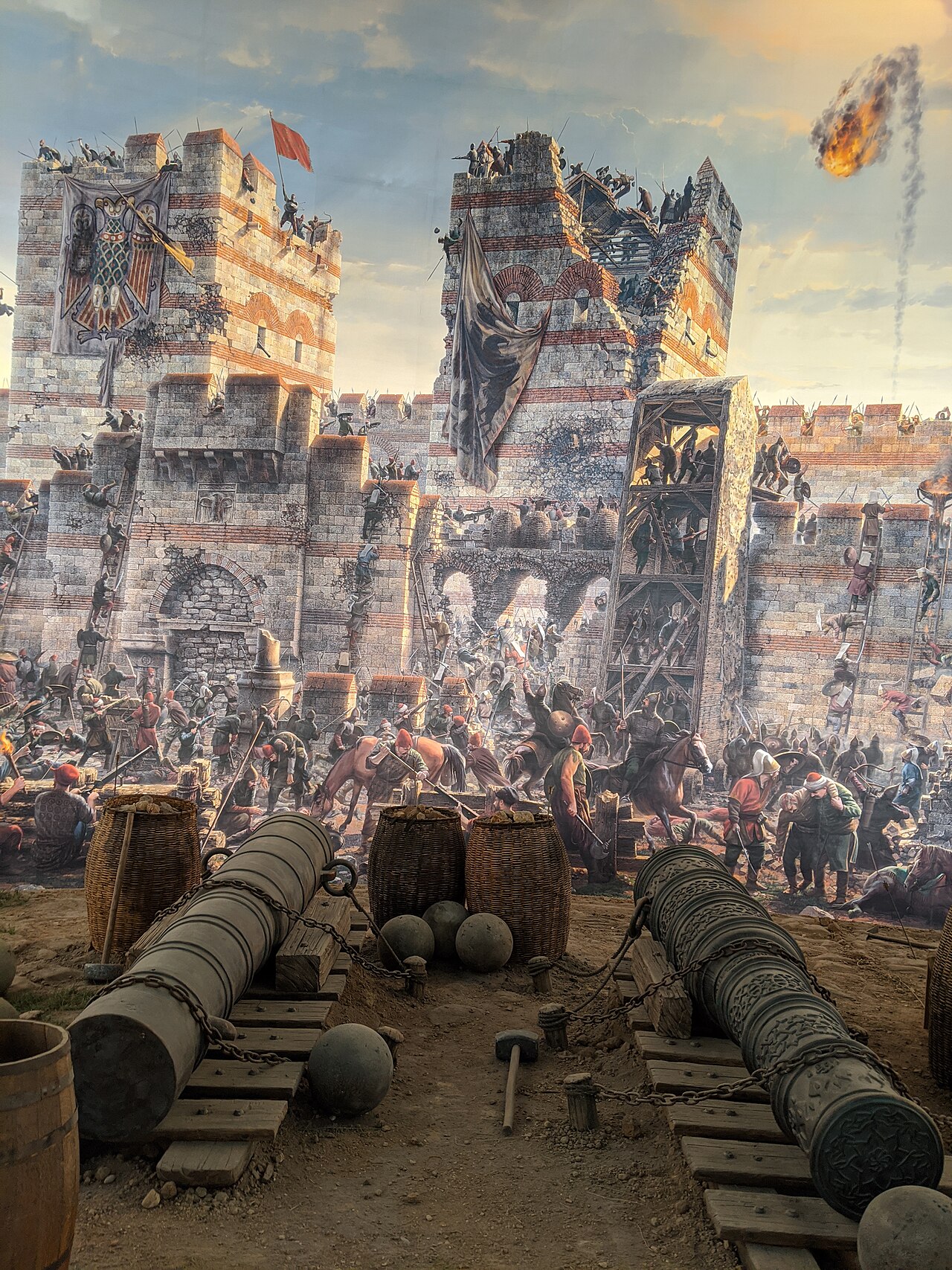
A large realistic panoramic painting-diorama of a medieval siege: stone city walls with towers, a tattered banner on a tower, soldiers climbing ladders, a wooden siege tower, and fighting crowds. Two large cannons on wooden platforms with stone cannonballs and wicker baskets sit in the foreground. A fiery projectile streaks across the sky.Painting

Secondary source

Panorama 1453 Siege Scene

Mustafa-trit20 · 2020

Want the full shelf? Chat with Constantine XI Palaiologos in the app and open the Sources panel — every quote links back to the original.

Use Constantine XI Palaiologos in class

2 collections

Ready-made collections from the Humy team that feature Constantine XI Palaiologos. Preview any of them, then try it free.

Trusted by educators worldwide

Conversations
375,000+
Real exchanges between students and historical figures
Messages exchanged
4,142,000+
Across every figure, classroom and language
Historical figures
100,000+
Each informed by a curated biography and selected sources
Languages supported
50+
From English and Spanish to Arabic and Korean

Paying customers

Used by 98 schools and universities

Partner school logo
Tecnológico de Monterrey logo
Hyper Island logo
Partner school logo
Chambersburg Area School District logo
Broward County Public Schools logo
Nebo School District logo
National Louis University logo
South Florida PBS logo
Punahou School logo
University of Wisconsin–River Falls logo
Partner school logo
Partner school logo
Archbishop Mitty High School logo
Kingsburg High School logo
Norwalk Public Schools logo
Partner school logo
Connections logo
Partner school logo
Moore Public Schools logo
Partner school logo
Partner school logo
Partner school logo
Partner school logo
Robbinsville Public Schools logo
Partner school logo
Partner school logo
Partner school logo
Tecnológico de Monterrey logo
Hyper Island logo
Partner school logo
Chambersburg Area School District logo
Broward County Public Schools logo
Nebo School District logo
National Louis University logo
South Florida PBS logo
Punahou School logo
University of Wisconsin–River Falls logo
Partner school logo
Partner school logo
Archbishop Mitty High School logo
Kingsburg High School logo
Norwalk Public Schools logo
Partner school logo
Connections logo
Partner school logo
Moore Public Schools logo
Partner school logo
Partner school logo
Partner school logo
Partner school logo
Robbinsville Public Schools logo
Partner school logo
Partner school logo

What educators are saying

“We enjoyed the program last year and used it frequently.”
“My students say it’s a welcome change of pace. I’m not a fan of the “sage on the stage” model, so I try to incorporate research-oriented and self-paced activities. With Humy, students have to take charge of their learning. They’ve become more adept at critical thinking, forming better questions, and improving their reading comprehension. The interview feature has been my go-to tool. I create assignments where students must ask historical figures a set number of questions, then summarize the responses to ensure they’re truly absorbing the material. This approach lets them actively explore the past rather than passively consuming information.”
“Humy has helped me bring historical figures, sometimes long past, to life. When my students interact with these figures in real-time, it eliminates some of the perceived “ancient” characteristics of my curriculum. This has shifted my students’ thinking away from viewing history as abstract or irrelevant. Real-time interactions make historical figures relatable, even allowing students to ask off-topic questions that help put historical lives in a more relevant context for 13-year-olds. The feature I use the most is the interview feature. After teaching a topic, most recently Gandhi and Joan of Arc, I have the students ask pointed, focused questions. We practice good conversation techniques beforehand, teaching them to listen (or read) carefully and formulate thoughtful follow-up questions rather than just interrogating. It helps students practice effective conversation skills.”

FAQ

Frequently asked questions

Who is Constantine XI Palaiologos?
The last Byzantine Emperor who died defending Constantinople against the Ottoman Empire in 1453. On Humy.ai you can chat with an AI version of Constantine XI Palaiologos that draws on a short biography and 41 historical sources during the conversation — by text or voice, in 42 languages.
Is Constantine XI Palaiologos AI free?
Constantine XI Palaiologos is part of Humy's full library of more than 100,000 figures, which comes with a paid plan. A free account (no credit card) includes 20 messages a month with the free library's figures, so you can try how the conversations work first.
What sources does the Constantine XI Palaiologos AI use?
It draws on a short biography and 41 historical sources (paintings, artifacts and photographs), including “Medal of John VIII Palaiologos”, “Zonaras Chronicle Portrait Folio” and “Portrait of Constantine XI Palaiologos in the Mutinensis gr. 122 Codex”. Each source has its own page on Humy.ai.
How historically accurate is the AI version of Constantine XI Palaiologos?
Each figure uses a short biography and a small set of selected historical sources as context (retrieval-augmented generation), so answers stay closer to known material than the model's general knowledge alone. It isn't a citation-grade research tool — like any LLM, the AI can get details wrong or extrapolate. Treat it as a strong starting point for inquiry and cross-reference important claims.
Can I talk to Constantine XI Palaiologos by voice?
Yes. In addition to text chat, you can call Constantine XI Palaiologos and hear their voice respond in real time — useful for auditory learners, interview practice and Socratic dialogue.
Is Humy.ai safe and compliant for schools?
Yes. Humy.ai is used by more than 100 schools, universities and organisations. The platform is FERPA- and GDPR-aligned, supports SSO, and offers an IT-approval pack tailored for school procurement teams.

Cross-reference Constantine XI Palaiologos

Like any LLM, the AI version of Constantine XI Palaiologos can get details wrong. Open one of these sources in a new tab to verify what you’ve read.

Ready when you are

Start chatting with Constantine XI Palaiologos now.

20 messages free · No credit card · Available in 50+ languages.