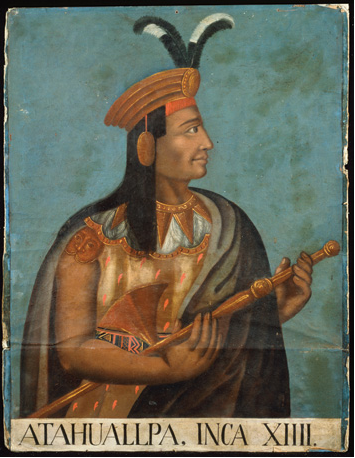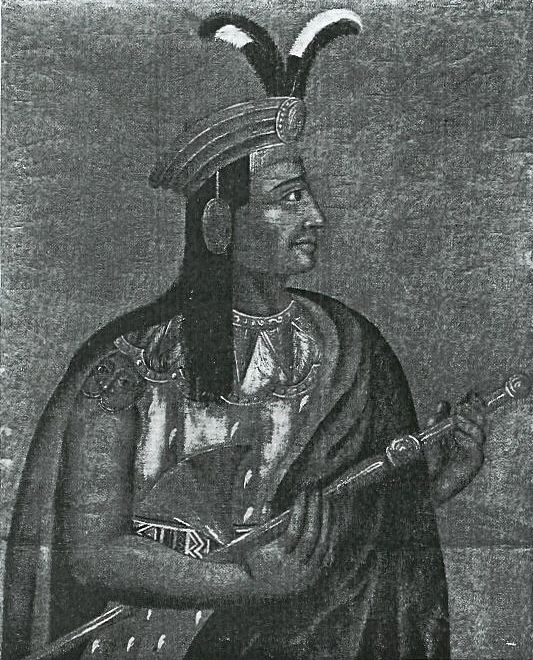

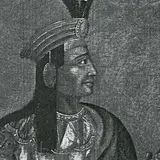
Portrait of Atahualpa

AI Historical Figure

Atahualpa

Last ruling Inca Emperor.

Chat with Atahualpa via text or voice — in 42 languages, drawing on a curated biography and 80 historical sources. Available 24/7.

Start chatting with Atahualpa20 messages free · No credit card
Lived
c. 1502–1533
From
Peru
Known for
Rulers & royaltyPolitics & government
Atahualpa

Atahualpa

Online · responds in seconds

Hello — I'm Atahualpa. Last ruling Inca Emperor. What would you like to ask me?

20 messages free · No credit card · Powered by Humy.ai

Live preview · Switch between 42 languages above · Send a message to continue in the app

Multilingual

Talk to Atahualpa in 42 languages

Ask Atahualpa questions in any language below, and the rest of Humy's app speaks it too. Pick yours to open the chat in that language.

Also in German (Austria), German (Switzerland), English (UK), English (Australia), English (Canada).

The sources behind this AI

80 sources · 37 paintings · 20 books · 8 artifacts · 7 photographs · 5 documents · 3 sculptures

Atahualpa doesn’t improvise from thin air. The AI is grounded in 80 curated historical sources students can inspect. Open any of them to see what informs the conversation.

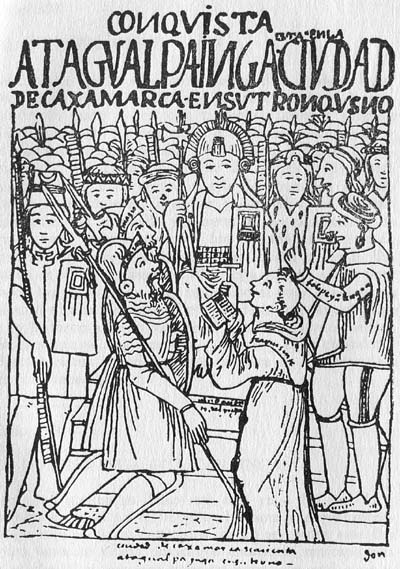
Black-and-white ink line drawing with a bold Spanish caption across the top reading Conquista and Atahualpa, Ciudad de Caxamarca. A robed friar with a cross faces a kneeling Inca man, while a crowd of Spanish soldiers with spears and Andean figures fills the scene.Painting

Secondary source

Atawallpa Pizarro tinkuy

Felipe Guaman Poma de Ayala · 1532 (depicted); drawing later

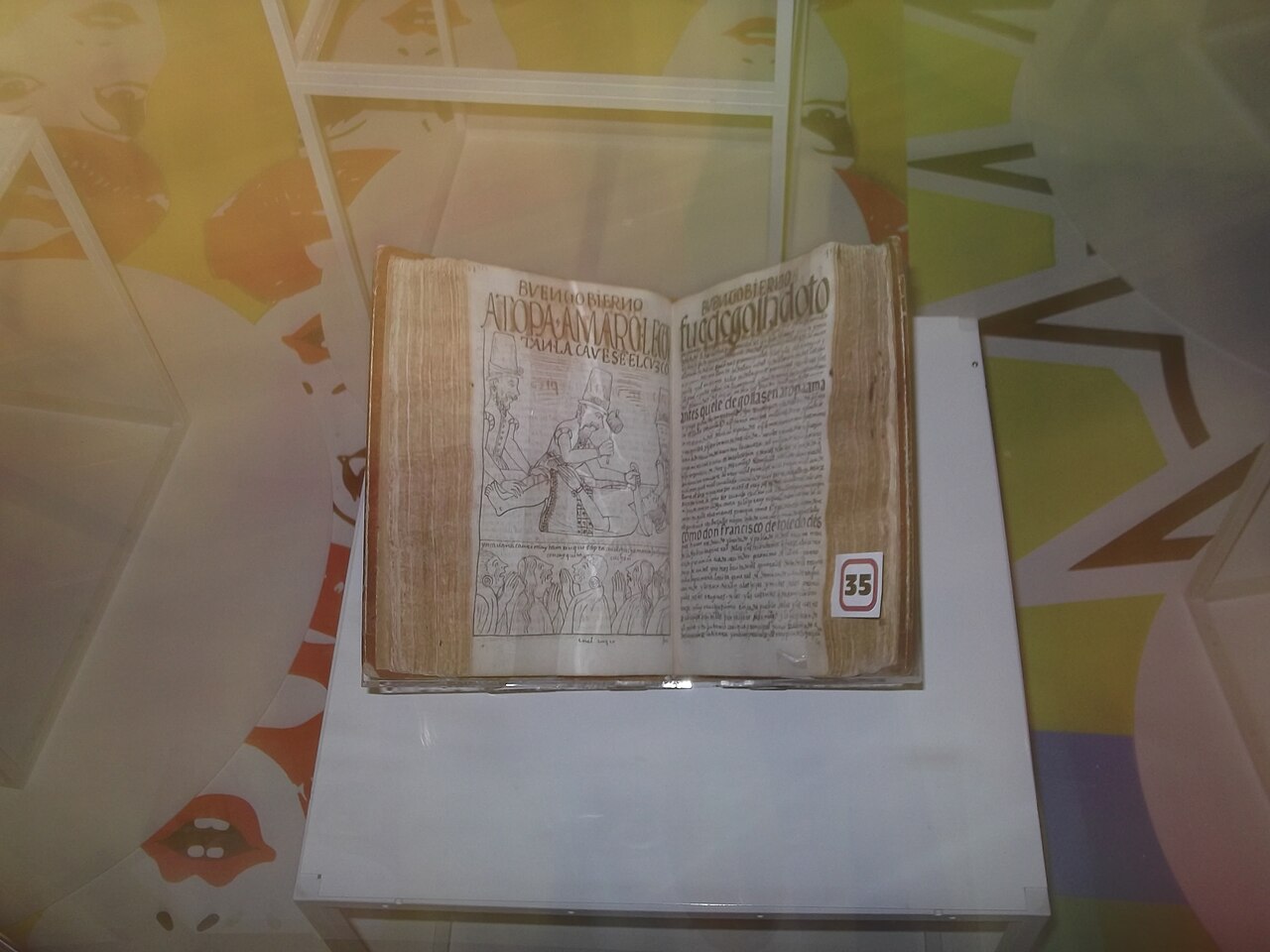
A bound manuscript volume lies open in a glass case on a white pedestal, showing two pages with handwritten Spanish text and a pen-and-ink drawing of figures with a Spanish-style scene at left. A numbered tag reading 35 sits beside it. Colorful graphic wall art surrounds the case.Book

Primary source

El primer nueva corónica y buen gobierno

Felipe Guaman Poma de Ayala · c. 1615

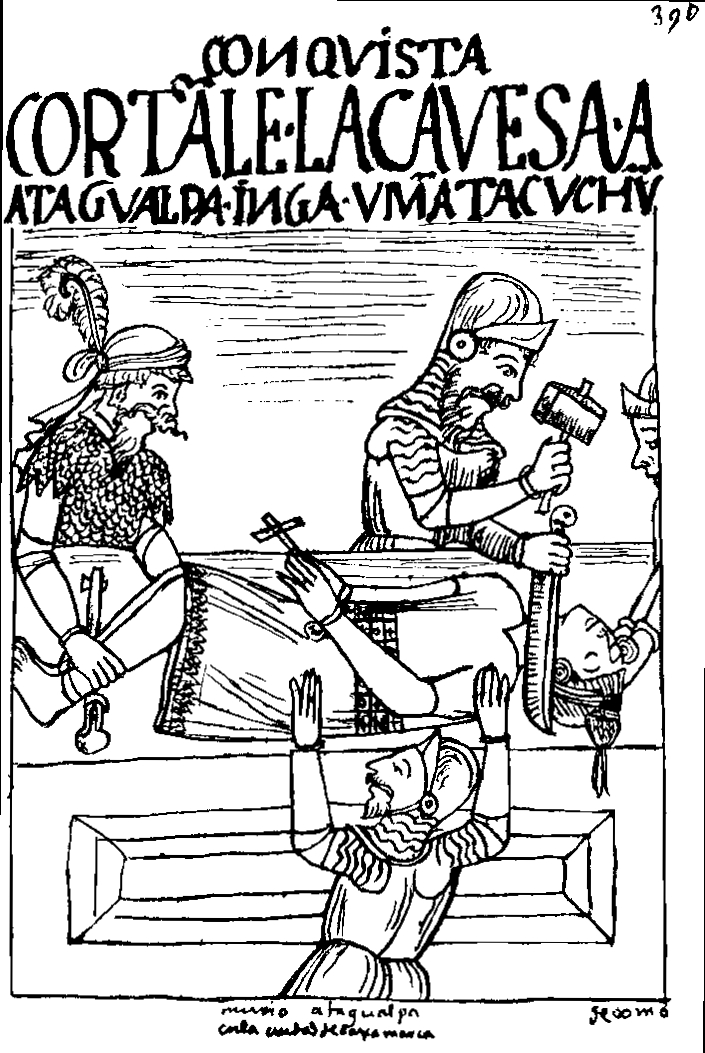
Pen-and-ink drawing titled 'Conquista', showing Spanish soldiers in armor and helmets with a seated Inca ruler being executed. A bearded, feathered Spanish figure stands at left; a figure with a cross and sword stands center; a headless body lies on the ground below, with a severed head held at right. Caption text at the bottom is in Spanish.Painting

Secondary source

Muerte de Atagualpa Inca

Felipe Huaman Puma de Ayala · c. 1615

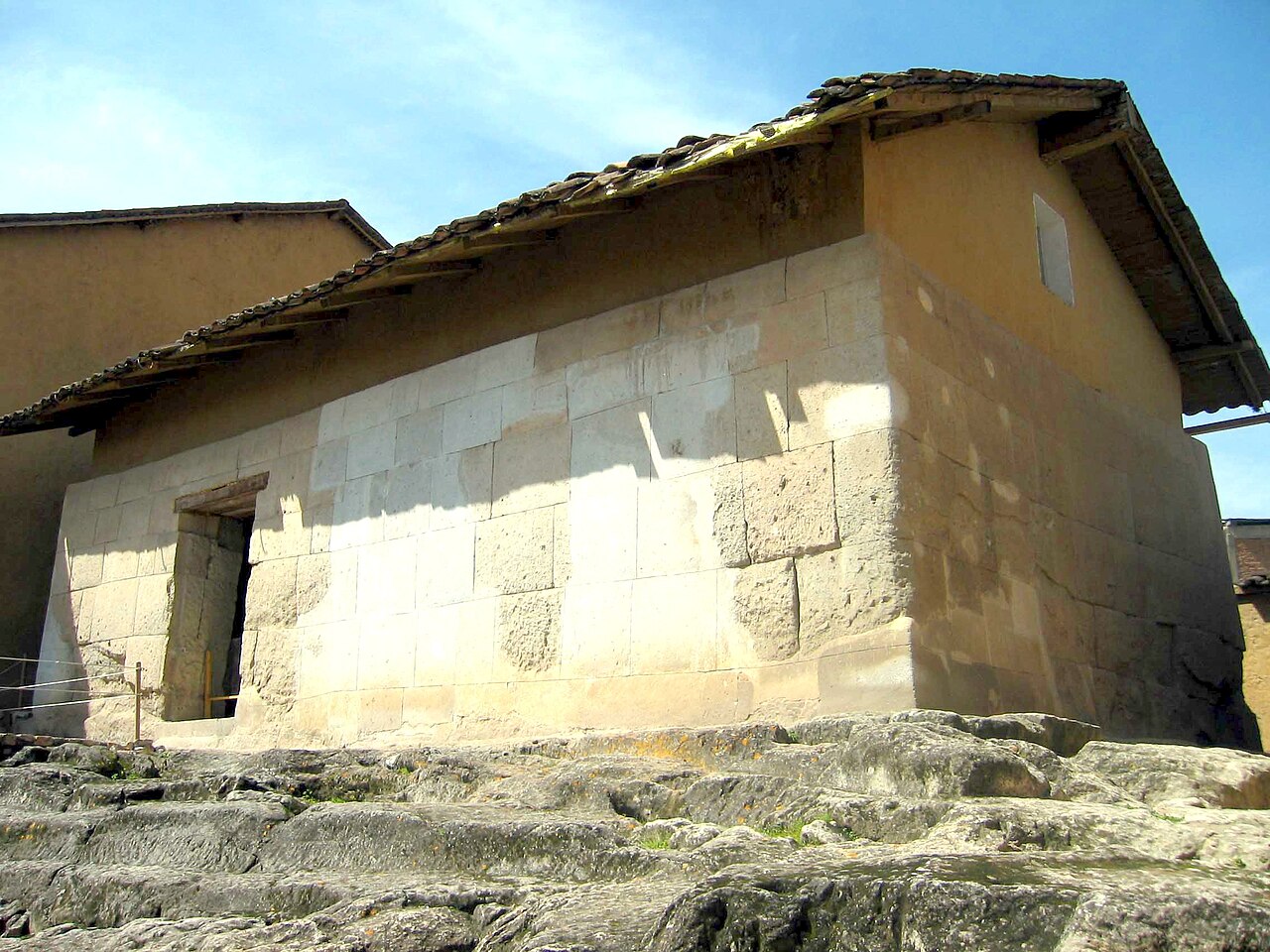
A stone building with a low tiled roof and a small doorway at its base, its pale stone-block walls lit by sunshine under a blue sky. Rough rock slabs lie in the foreground.Artifact

Secondary source

Ransom Room

Book

Secondary source

Suma y Narración de los Incas

Juan de Betanzos · 1551

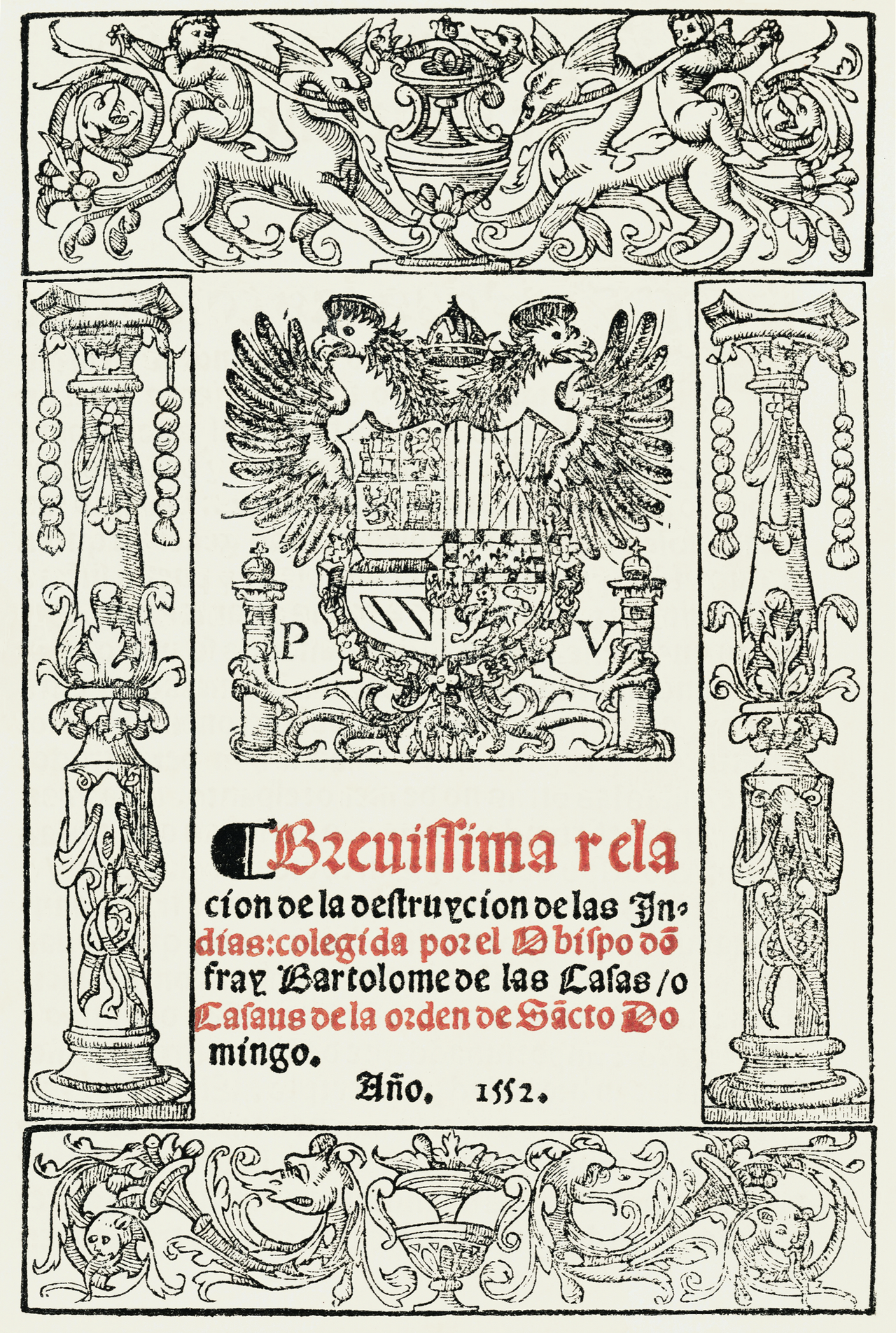
Title page of the 1552 Seville edition of Brevísima relación de la destrucción de las Indias, in black and red letterpress with a woodcut border, a central coat of arms with two eagles, and columns on each side. Text reads Brevísima relación, by Bartolomé de las Casas, Año 1552.Book

Secondary source

A Short Account of the Destruction of the Indies

Bartolomé de las Casas · 1552

Book

Secondary source

Crónica del Perú (El señorío de los Incas)

Pedro Cieza de León · 1553

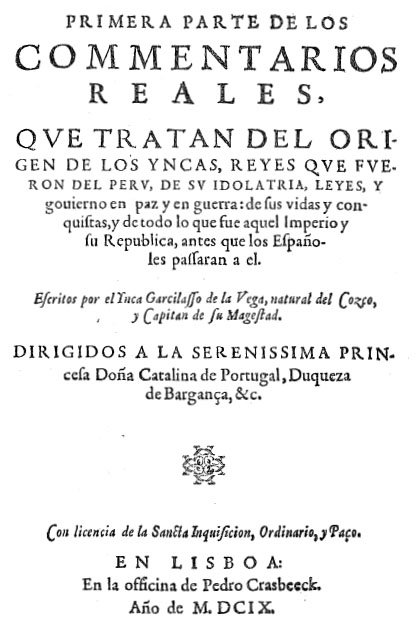
Title page of the 1609 Lisbon edition of Comentarios Reales (Primera parte de los Comentarios Reales), in black-and-white letterpress type. Text names Garcilaso de la Vega and Lisbon, printed by Pedro Crasbeeck, 1609.Book

Secondary source

Comentarios Reales de los Incas

Inca Garcilaso de la Vega · 1609 (part 2: 1617)

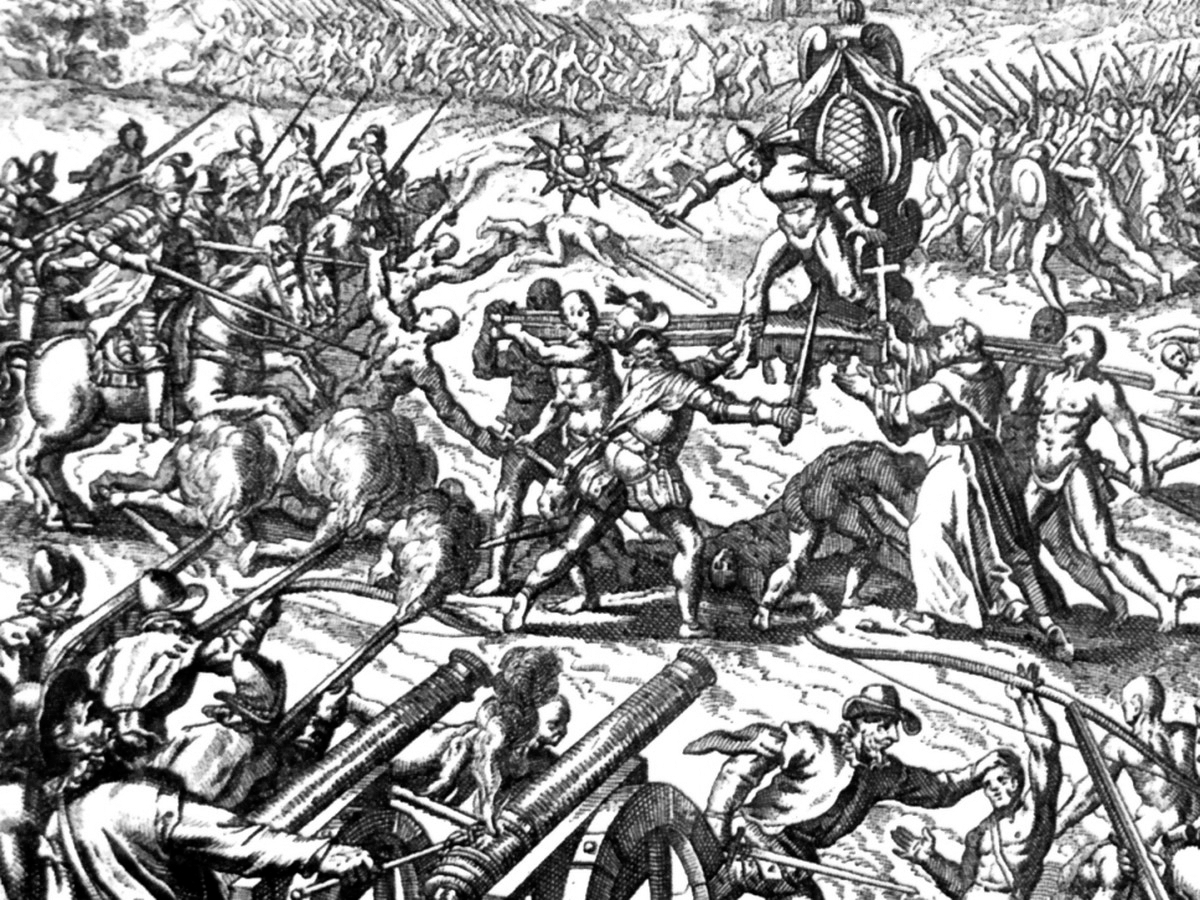
Black-and-white engraving of a battle. Spanish armored horsemen with lances charge from the left. Cannons and musketeers are at the bottom. Inca warriors with clubs and spears fight in the center and right, and a figure in a canopied litter is raised at top center. Bodies lie on the ground.Painting

Secondary source

Inca-Spanish Confrontation at Cajamarca

Theodor de Bry, after Girolamo Benzoni

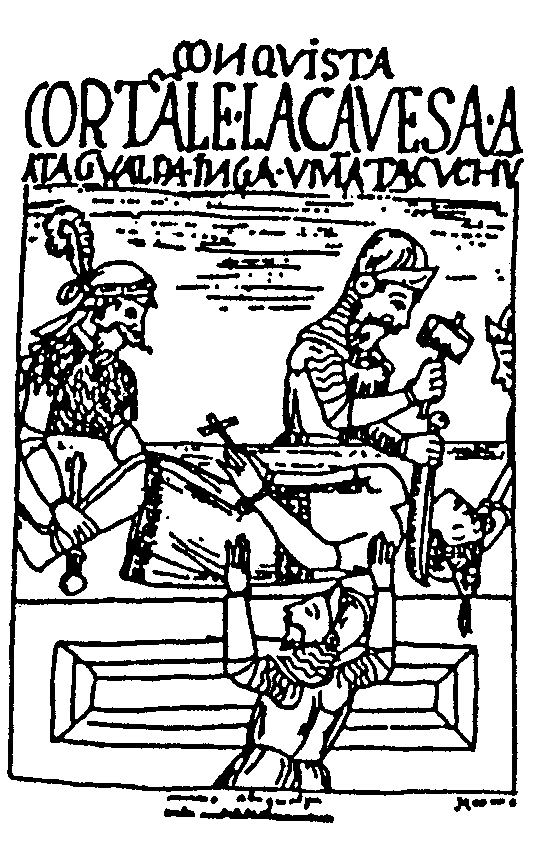
Black and white line drawing with a caption at top reading 'CONQUISTA' and 'CORTALE LACAVESA', with a line of text below. A bearded man with a feathered headdress sits at left. A helmeted, bearded man stands at center right, raising a hand. A kneeling figure with raised arms is in the foreground.Painting

Secondary source

Atawallpap umanta kuchunku

Felipe Guaman Poma de Ayala

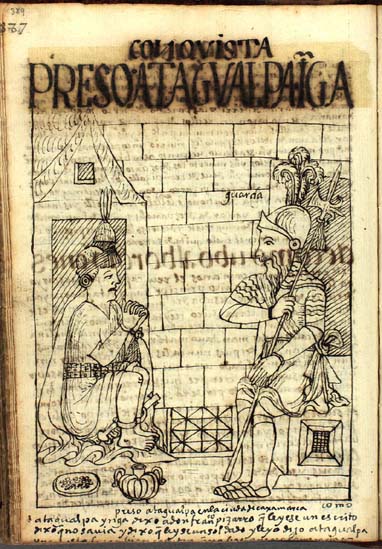
Ink drawing with a title in large capital letters reading 'Conquista, Preso Atagualpa' above a scene. Two figures sit inside a stone-walled room with a window grille. On the left, a seated figure with a tall headdress and cloth wrap faces right. On the right, a bearded Spanish figure in a plumed helmet sits holding a staff. Handwritten Spanish text in ink and faded background script appear on the page below and around the drawing.Painting

Secondary source

Atahuallpa prigioniero

Felipe Guaman Poma de Ayala

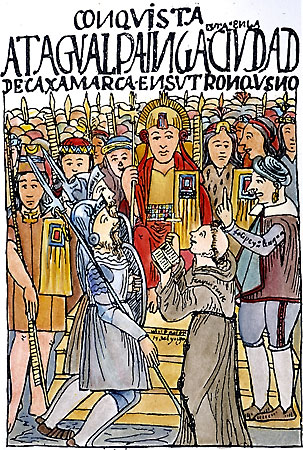
Colored drawing titled in Spanish 'Conquista... Atagualpa... Cajamarca... Ataw Wallpa'. Seated ruler in red robes and headdress surrounded by crowd of figures with spears; a Spanish conquistador in armor and a friar holding a cross or book face him; text labels fill the upper area.Painting

Secondary source

Ataw Wallpa, from Guaman Poma's Chronicle

Felipe Guaman Poma de Ayala

Black and white engraving of a bearded older man in a jeweled crown with feathered plumes, a feathered cape over his shoulder, a chain necklace with a medallion, arms folded, looking upward to the right.Painting

Secondary source

Atabalipa

André Thevet · 1584

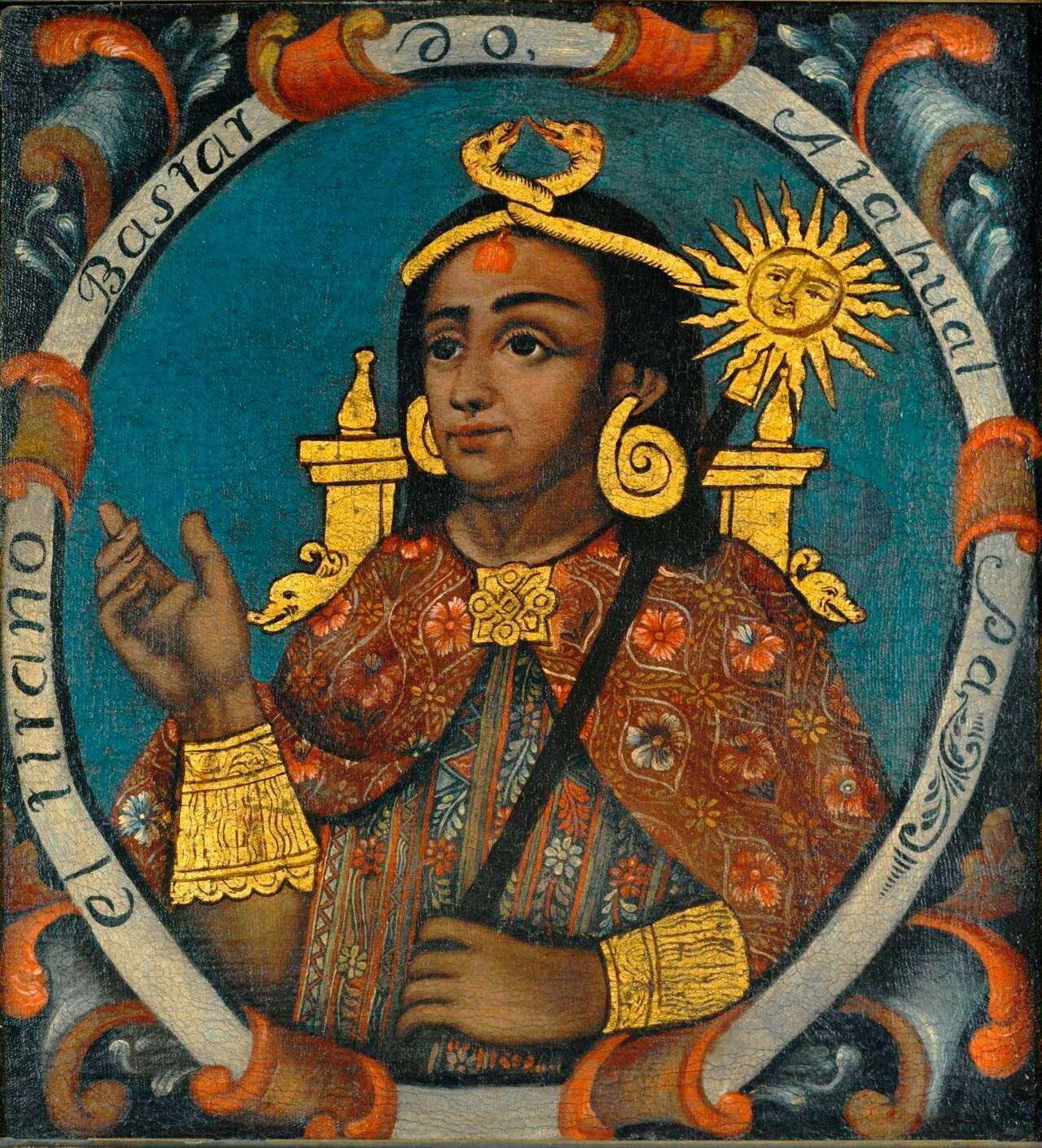
Colonial-era oil painting of a figure with dark hair and a gold headband with a red central jewel, topped by two gold serpent heads. Gold sun disc and earrings, patterned red robe, and gold cuffs. Oval frame bears an inscription reading Atahualpa Inca Ynca Decimo Quarto.Painting

Secondary source

Atahualpa, Fourteenth Inca

Painting of a man in profile facing right, wearing an orange headdress with white and black feathers, a red-and-gold collar, and a dark cloak over a patterned tunic. He holds a gold-tipped staff. The blue background has the caption 'ATAHUALLPA, INCA XIIII' at the bottom.Painting

Secondary source

Portrait of Atahualpa

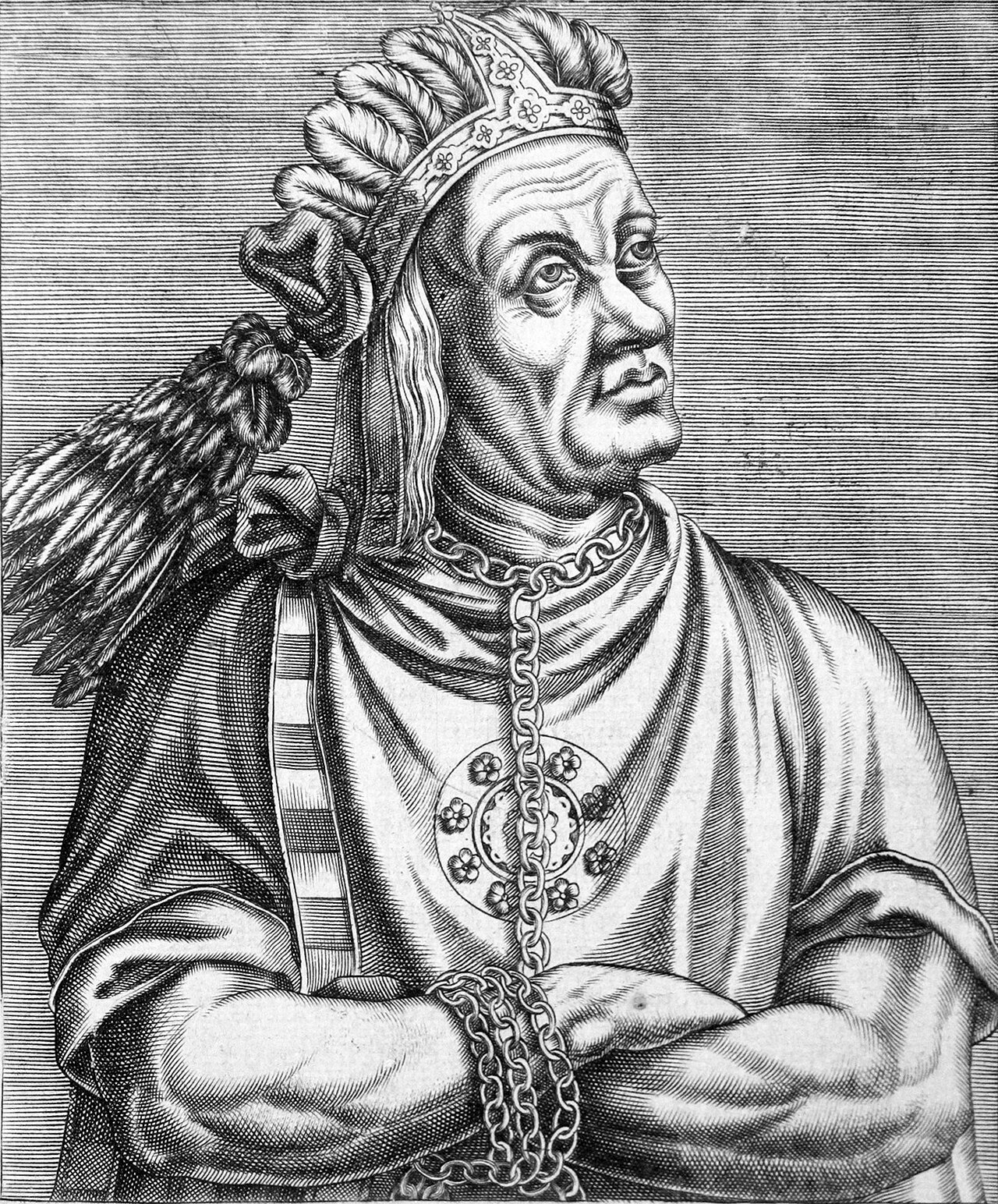
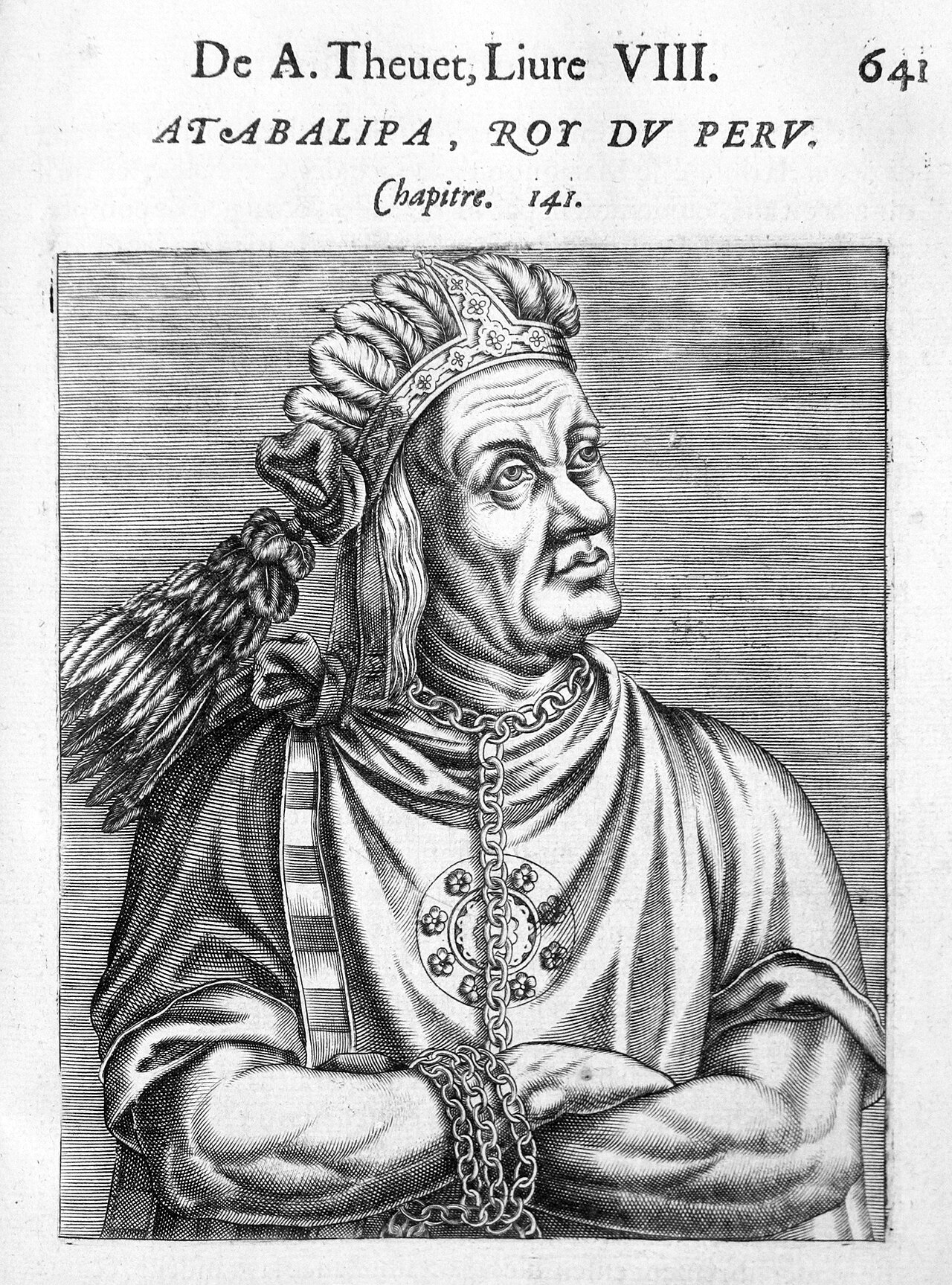
Black-and-white engraved portrait of Atahualpa in profile, facing right, with an ornate crown, a feathered bird-like ornament on his shoulder, a chain necklace, and crossed chained arms. Printed caption above reads 'Atabalipa, Roy du Perv, Chapitre 141' with page number 641.Painting

Secondary source

Atabalipa, Roy du Perv

André Thevet · 1584

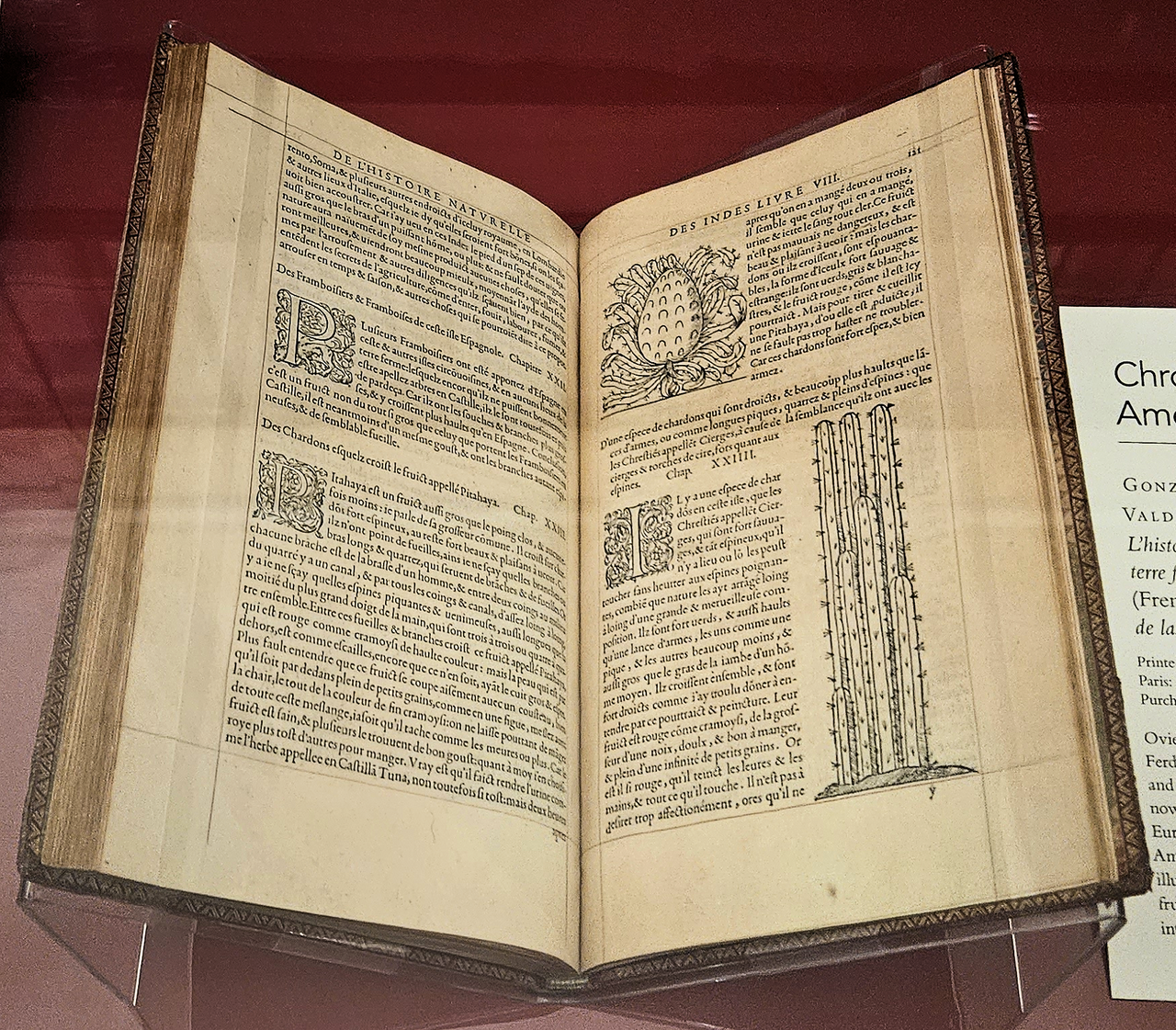
Open book in a display case showing two pages of old printed text in French with decorative woodcut initials and an illustration of a cactus-like plant. A label to the right reads partially 'Chron... Amer... Gonzalo Valdés... L'histoire... Printed... Paris... Purchased... Oviedo...'Book

Secondary source

Historia general y natural de las Indias

Gonzalo Fernández de Oviedo y Valdés · 1556 (French edition); original work 16th century

Front cover of a dark red leather book with thin gold-tooled border lines and corner ornaments, and a gold scrollwork monogram in the centre resembling the letters A, C and B intertwined. No title text is visible.Book

Secondary source

Historia del Mondo Nuovo

Girolamo Benzoni · 1565

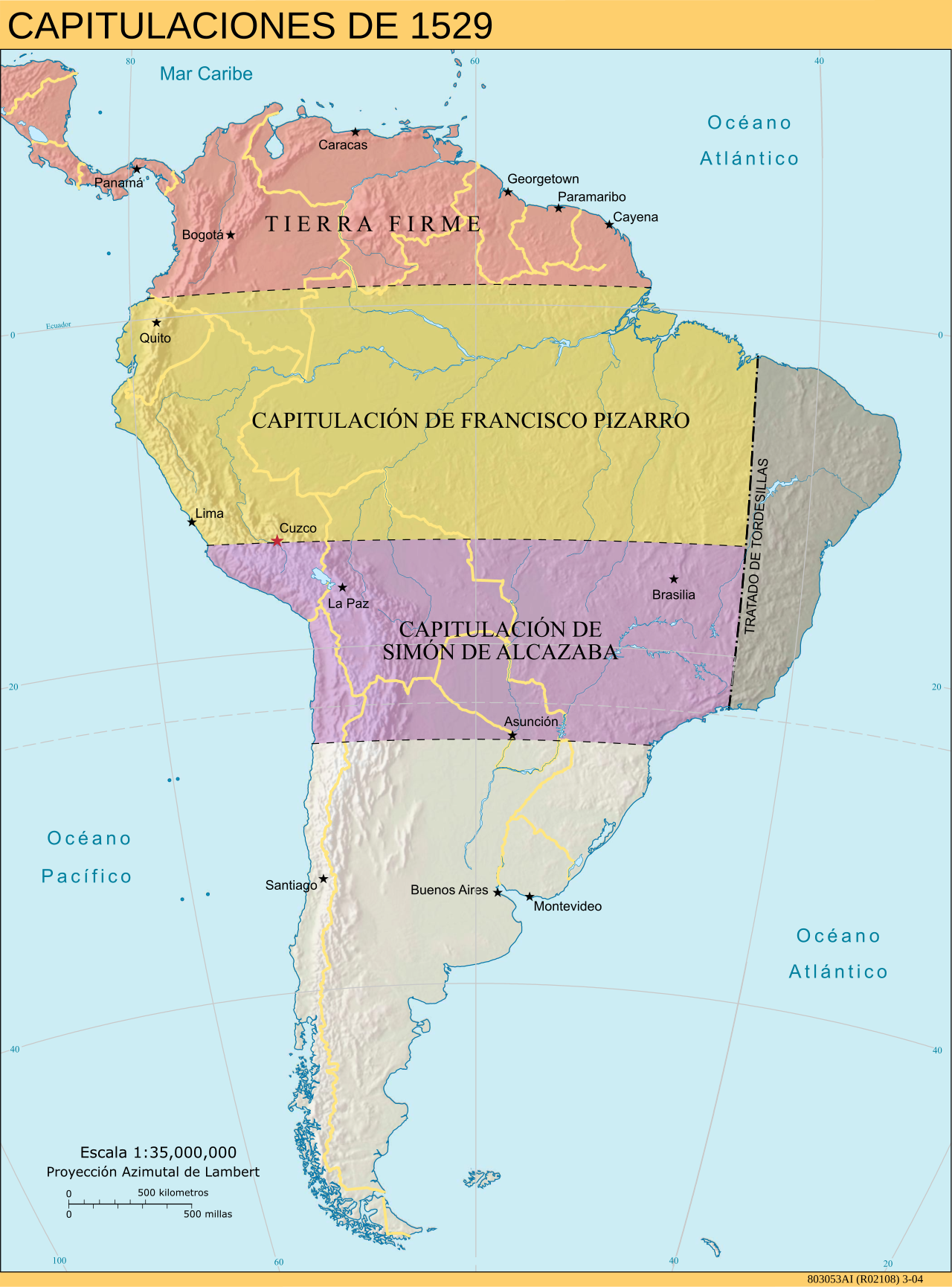
Map titled Capitulaciones de 1529 showing South America divided into colored zones: Tierra Firme at top, Capitulación de Francisco Pizarro in yellow across the middle, Capitulación de Simón de Alcazaba in purple below, and the Tratado de Tordesillas line on the east. Cities labeled include Caracas, Quito, Lima, Cuzco, Asunción, Buenos Aires and Santiago.Document

Primary source

Capitulation of Toledo

Crown of Castile · 26 July 1529

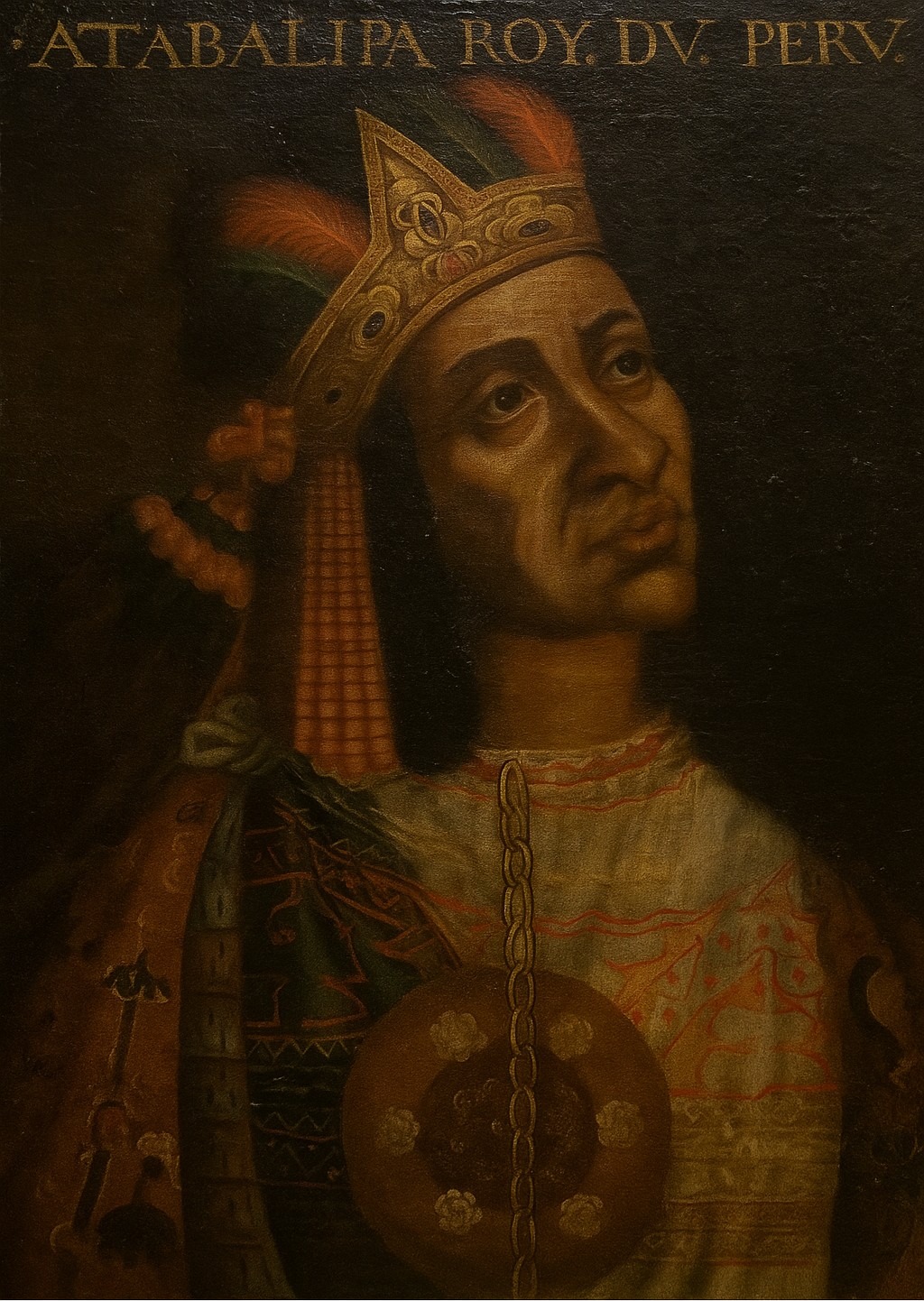
Oil painting of a man in profile-three-quarter view wearing a gold crown with red and green feathers, a patterned white garment with a red-trimmed collar, and a round medallion on a chain. Gold lettering across the top reads 'ATABALIPA ROY. DU. PERV.' Dark background.Painting

Secondary source

Atabalipa Roy Du Peru

Unknown · 17th century

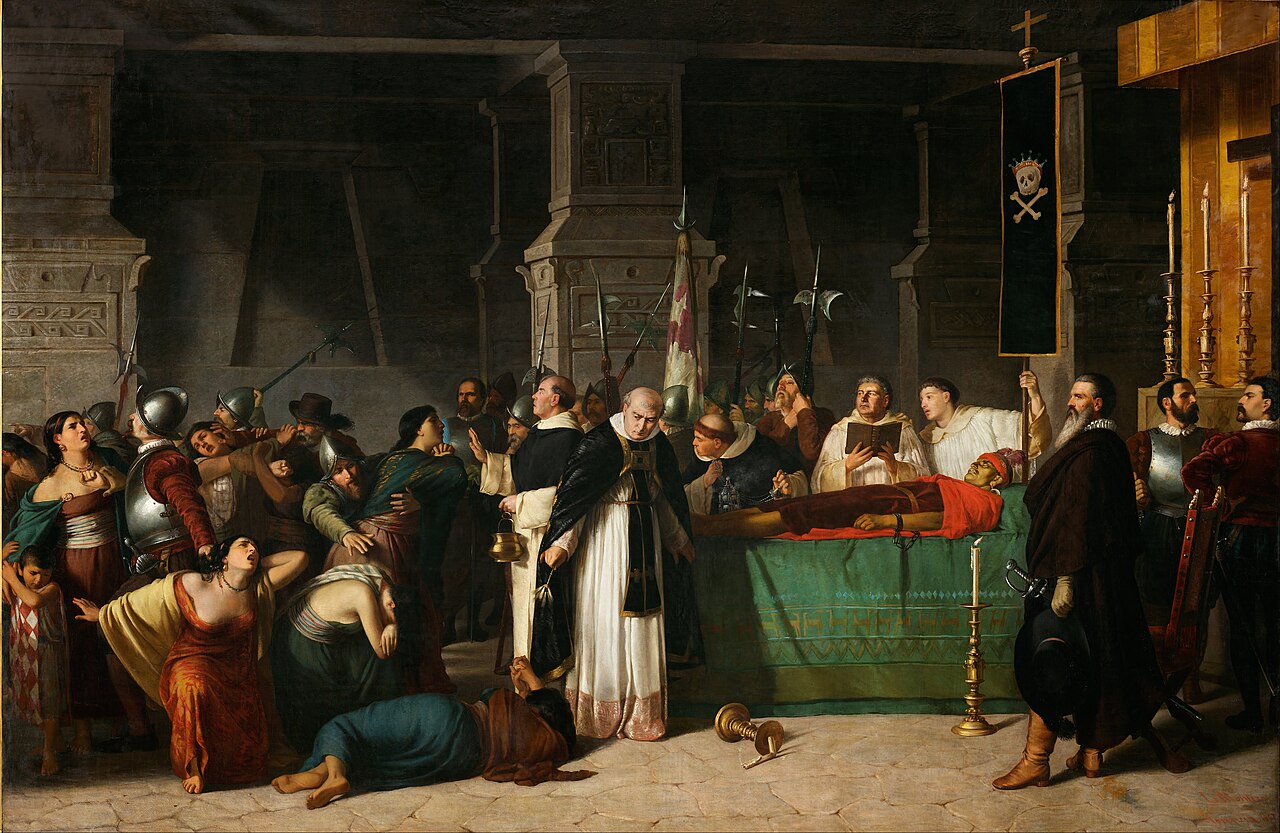
A large painting of a dim stone interior where a body wrapped in red lies on a green-draped bier, surrounded by clergy in white and black robes, armored soldiers, and a crowd of grieving people, some kneeling or collapsed on the floor. A black banner with a skull and crossbones hangs at right, and a gold candlestick stands in front.Painting

Secondary source

The Funerals of Inca Atahualpa

Luis Montero · 1867

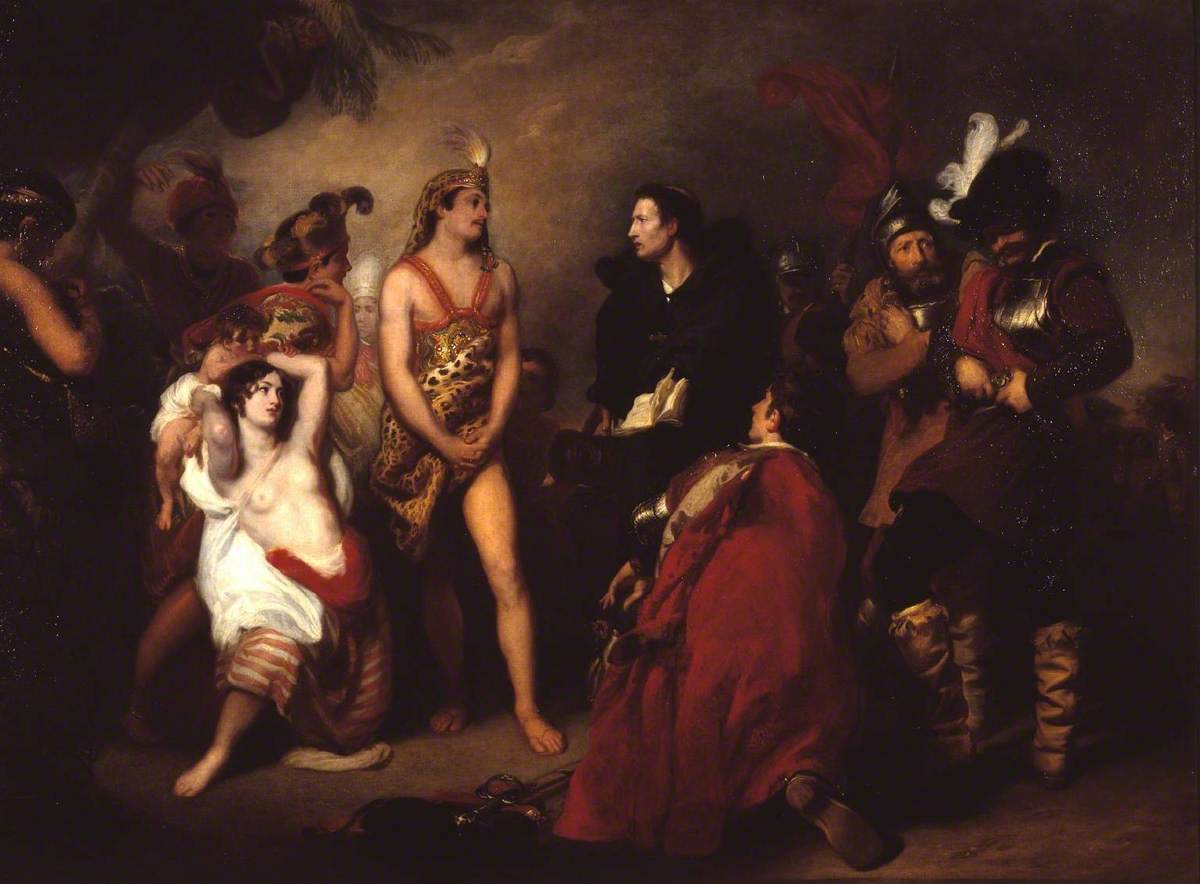
Painting of a 16th-century encounter: a bare-chested man in a feathered headdress and patterned tunic stands center-left, facing a figure in black robes holding a book. A kneeling man in a red cloak and armoured soldiers stand on the right; a partly undressed woman with a child sits at left, and other figures look on in dim light.Painting

Secondary source

The First Interview between the Spaniards and the Peruvians

Henry Perronet Briggs

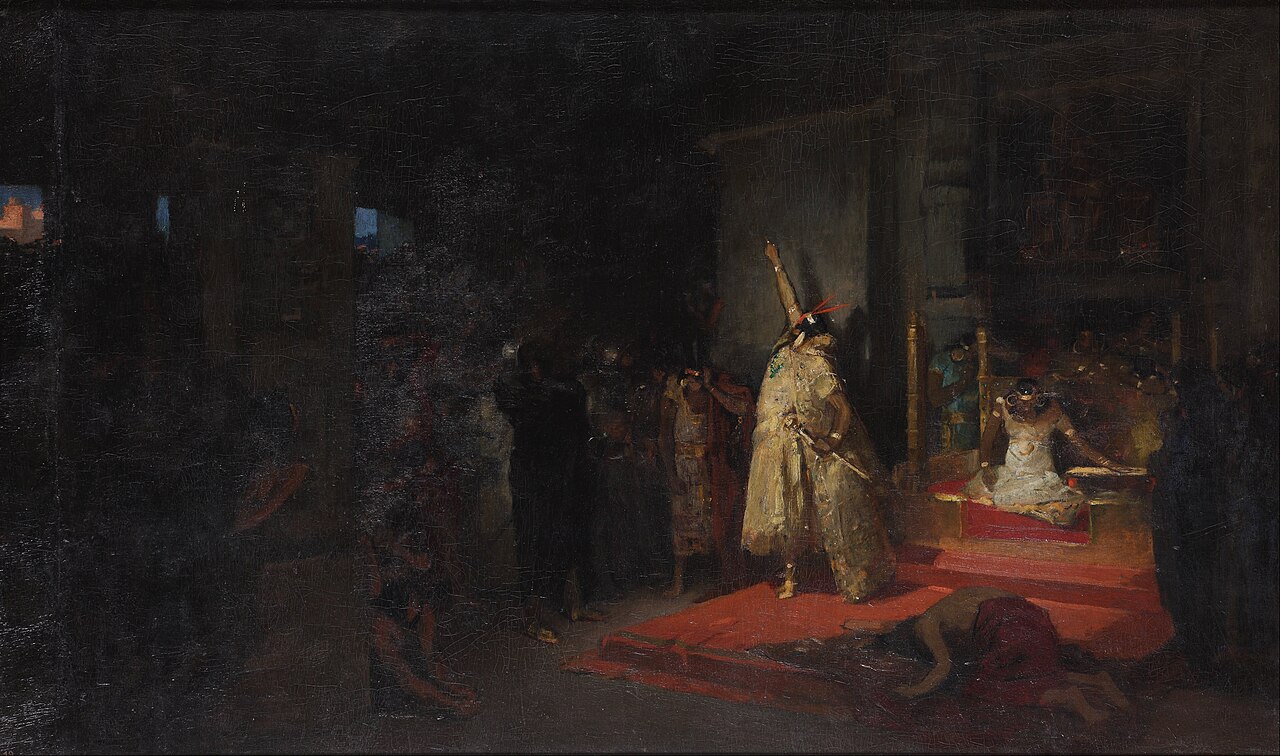
Dark painting of a historical scene. A standing figure in a long pale robe with a raised arm and a sword at the waist stands on a red carpet. On a raised platform at right, a seated figure in white is attended by others. Lower right, a prone body lies on the red carpet. Dim figures stand in the background at left.Painting

Secondary source

The Ransom of Atahualpa

Carlos Baca-Flor

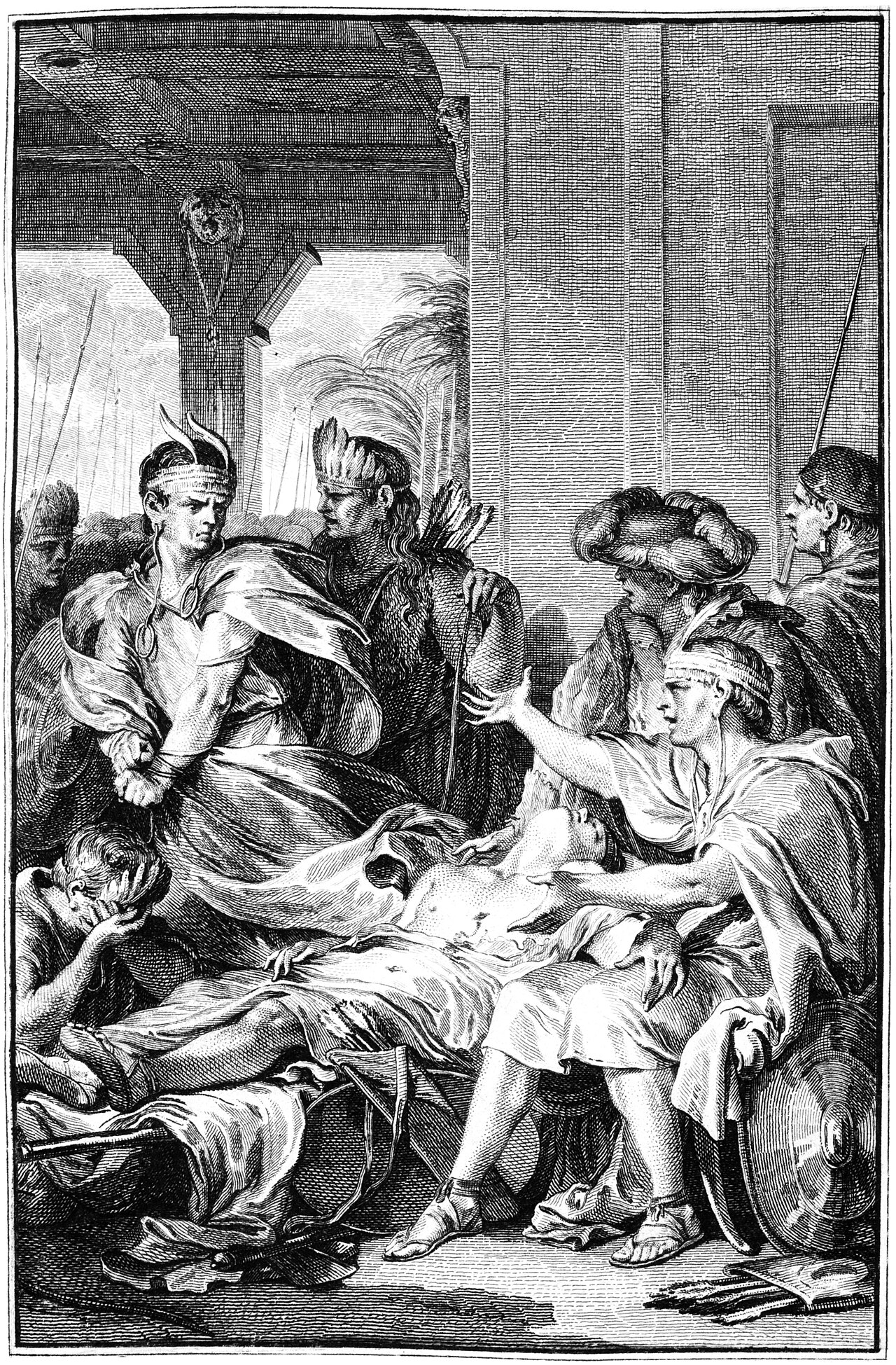
Black-and-white engraving of a scene in a columned hall. A man with a horned headband and a bound-looking wrist stands at left beside a figure with feathered headdress and a quiver of arrows. At center, a bearded-looking helmeted man gestures toward a reclining, partly draped body. A figure at lower left covers his face with his hand. Other armed men stand at right and in the background.Painting

Secondary source

Les Incas engraving by Moreau

Jean-Michel Moreau

Book

Secondary source

Miscelánea Antártica

Miguel Cabello de Balboa

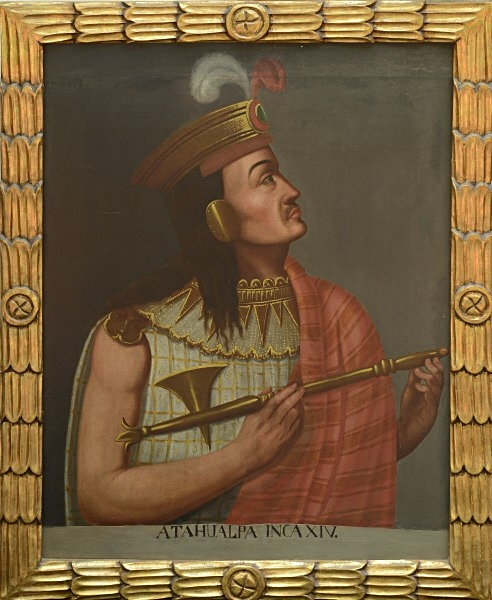
Painted portrait in a gilded frame of a man in profile looking upward, wearing a gold headband with white and red plumes, large gold ear ornaments, a checked white tunic with gold trim, and a red shawl. He holds a gold scepter. The caption below reads ATAHUALPA INCA XIV.Painting

Secondary source

Atahualpa Inca XIV

Unidentified painter

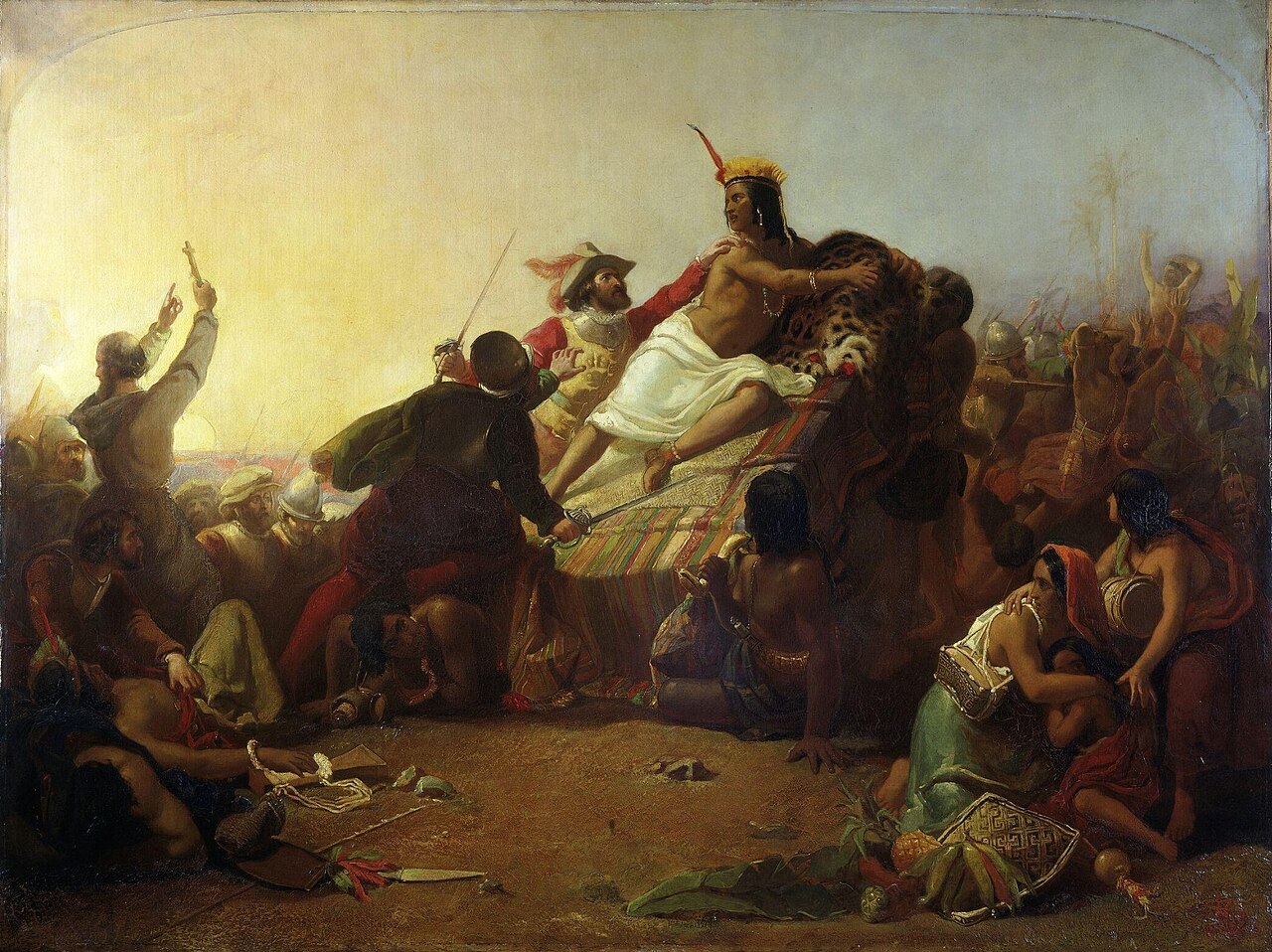
Painting of Spanish conquistador Pizarro seizing an Inca ruler who sits on a draped litter, with a sword raised by a soldier, while Inca attendants kneel and cry out and armed Spanish soldiers stand near a bright sunlit background.Painting

Secondary source

Pizarro Seizing the Inca of Peru

John Everett Millais · 1846

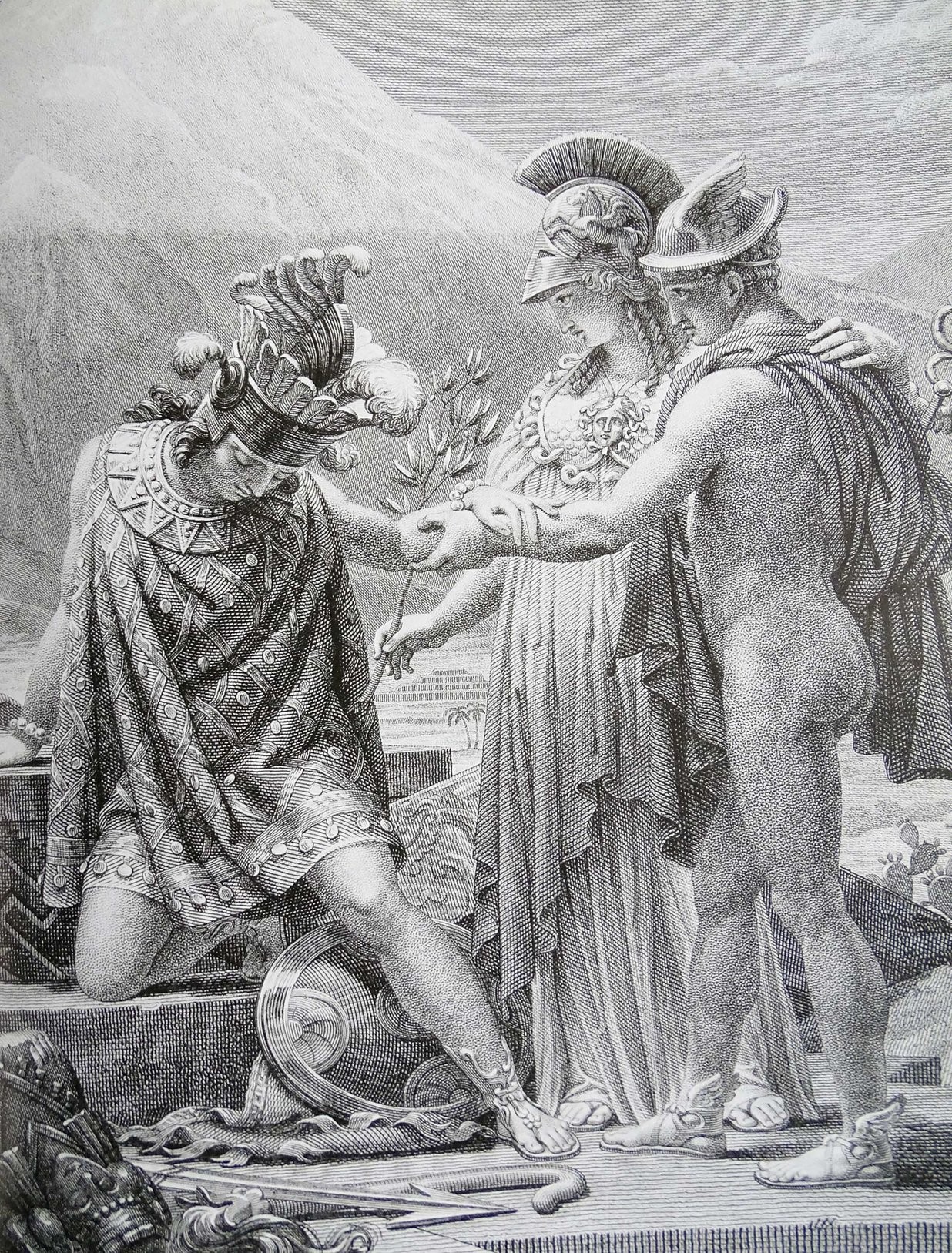
Black-and-white engraving of an allegorical scene. A seated man in patterned Andean-style dress and a feathered headdress sits on a stone tomb-like platform, holding out his hand. A helmeted woman in a Medusa-decorated breastplate and a bareheaded, winged-helmeted man with a bare chest and draped cloak stand beside him. A mountain landscape and a sprig of leaves fill the background.Painting

Secondary source

La sabiduría, junto con la elocuencia, sacan a Atahualpa del sepulcro

François Gérard

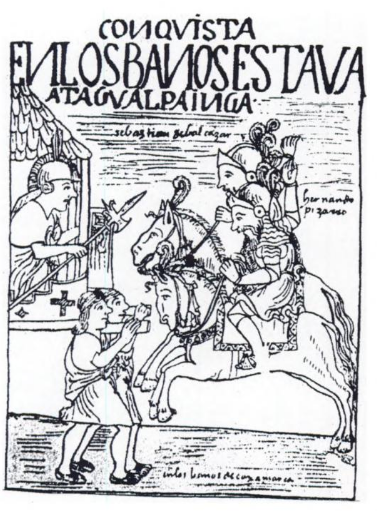
Black-and-white line drawing with Spanish text across the top reading 'Conquista en los Banios estava Atahualpa Inca'. On the left, a man in a plumed helmet and armor sits under a canopy, and a figure in a long tunic holds a spear. On the right, two armored, helmeted riders on horses are shown, with labels 'Hernando Pizarro' and 'Sebastian Benalcazar'. A small figure stands at the lower left, and text at the bottom lists names.Painting

Secondary source

Francisco Pizarro and Sebastián de Benalcázar Riding into Peru

Guaman Poma de Ayala · 1613

Reports on the Discovery of PeruBook

Primary source

Reports on the Discovery of Peru

Clements R. Markham (editor) · written 16th century; this edition 1872

Book

Secondary source

The Royal Commentaries of the Incas

Garcilaso de la Vega · 1609

Book

Primary source

History of the Incas

Pedro Sarmiento de Gamboa · compiled c. 1572, published 1907

Book

Secondary source

The Royal Commentaries of Peru

Garcilaso de la Vega (translated by Paul Rycaut) · 1688

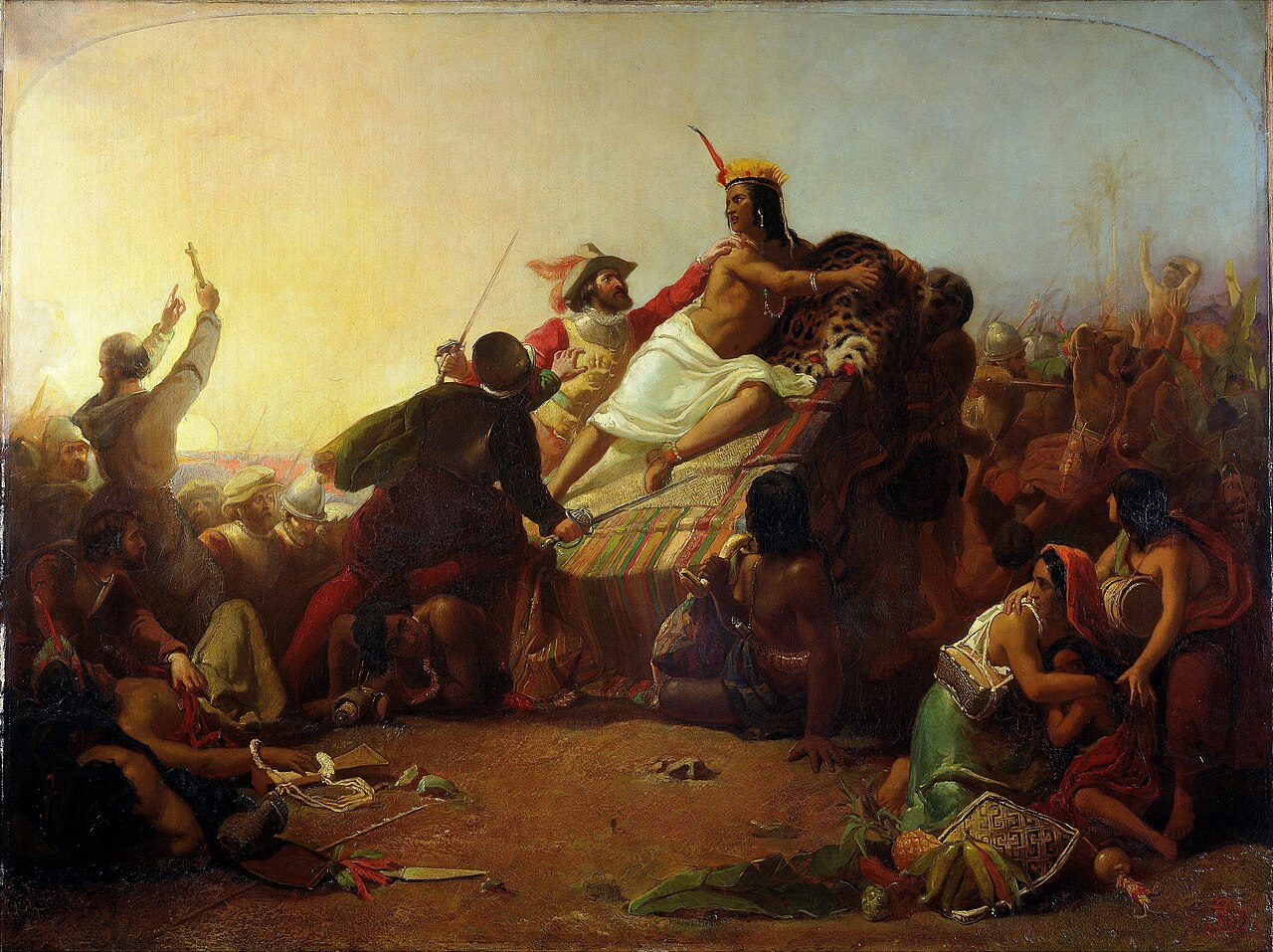
Painting of a bearded Spanish conquistador in armor and a plumed hat grabbing a seated Inca ruler by the shoulder on a striped cloth throne draped with a leopard skin. Armed soldiers surround him, and kneeling, weeping Andean people and fallen figures fill the foreground, with a bright sunlit sky behind.Painting

Secondary source

Pizarro Seizing the Inca of Peru

John Everett Millais · 1845

Document

Secondary source

Atahualpa entry, The New International Encyclopaedia

1902

Document

Secondary source

Atahualpa entry, Appletons' Cyclopaedia of American Biography

1900

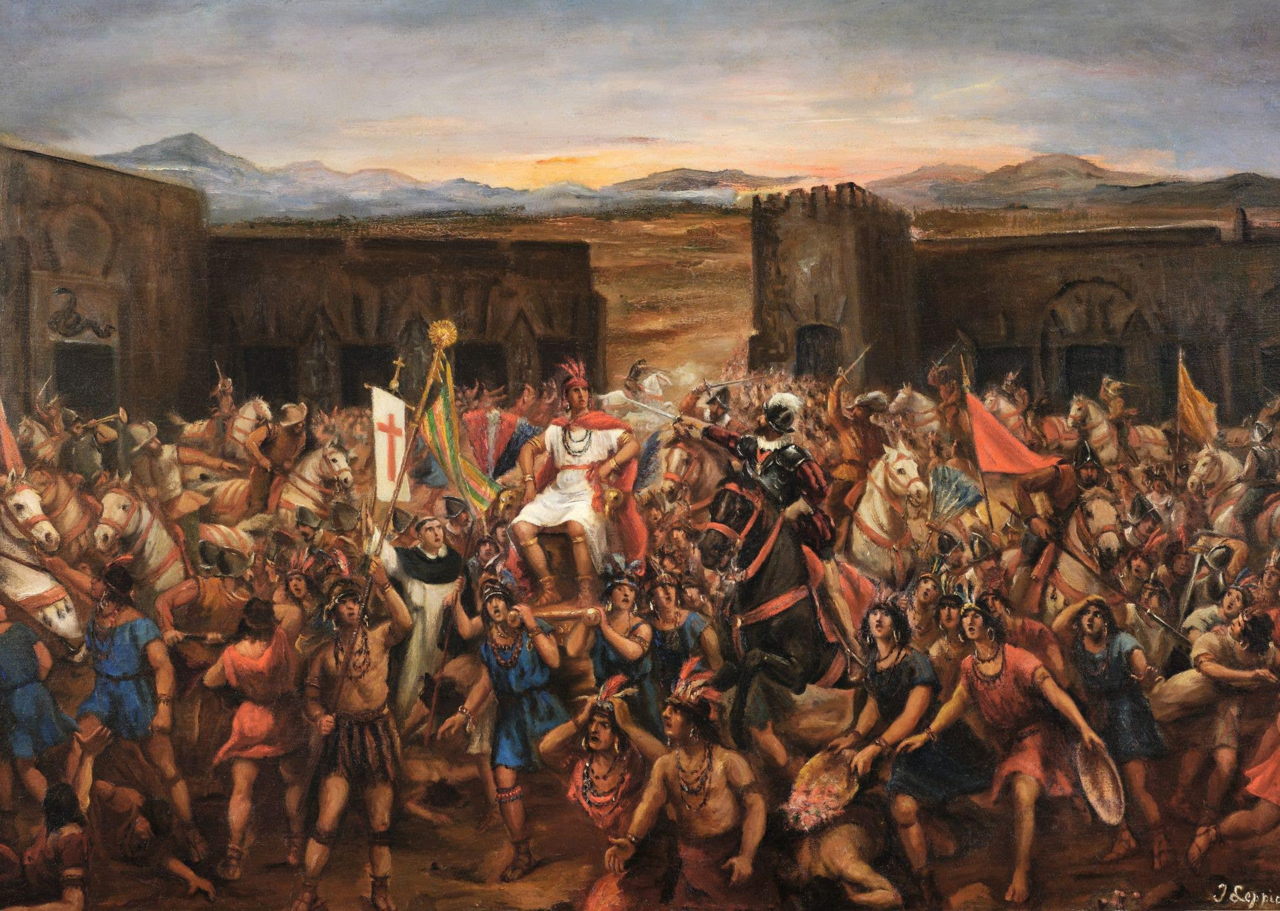
Oil painting of a chaotic plaza before a stone fortress at sunset. A seated figure in a white tunic and red cloak, wearing a large gold headdress, is surrounded by crowds. A mounted, armored Spanish knight on a black horse brandishes a sword, while white horses, a white banner with a red cross, and many fleeing or kneeling people fill the scene.Painting

Secondary source

The Capture of Atahualpa

Juan Lepiani · c. 1920-1927

Book

Secondary source

History of the Conquest of Peru

William Hickling Prescott · 19th century

Elegy: The Imprisonment of AtahualpaBook

Secondary source

Elegy: The Imprisonment of Atahualpa

1821

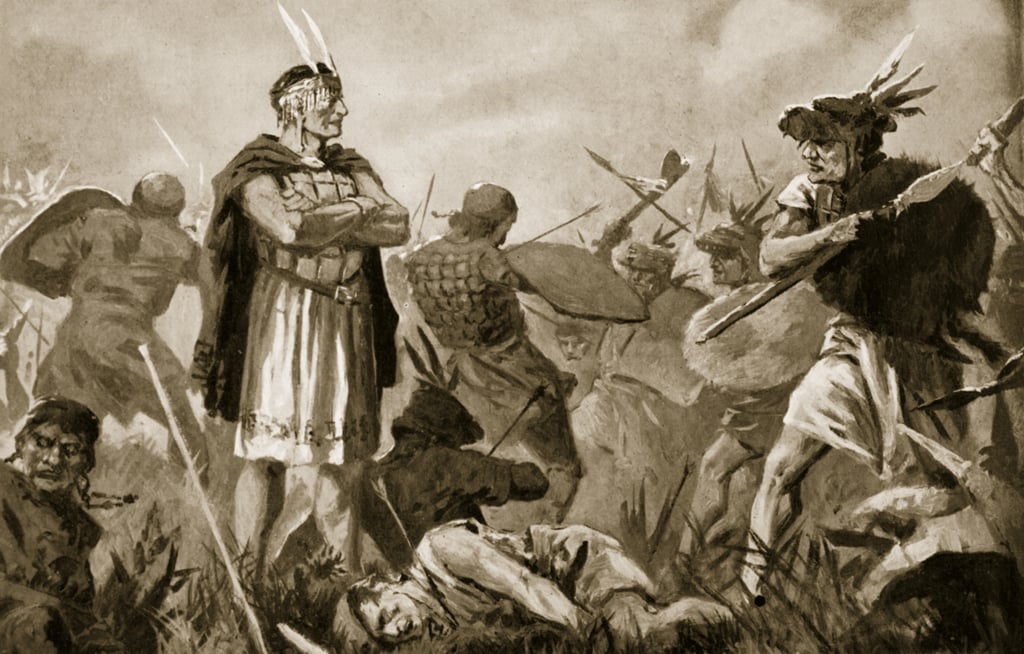
Sepia-toned painting of a battle scene. A figure in a feathered headdress and draped cape stands with arms crossed at left. At right, a warrior in a feathered headdress and fur garment holds a long spear. Fallen bodies lie in the grass, and many armed combatants fill the background.Painting

Secondary source

Huascar and Atahualpa Fighting over the Inca Empire

John Harris Valda · 1915

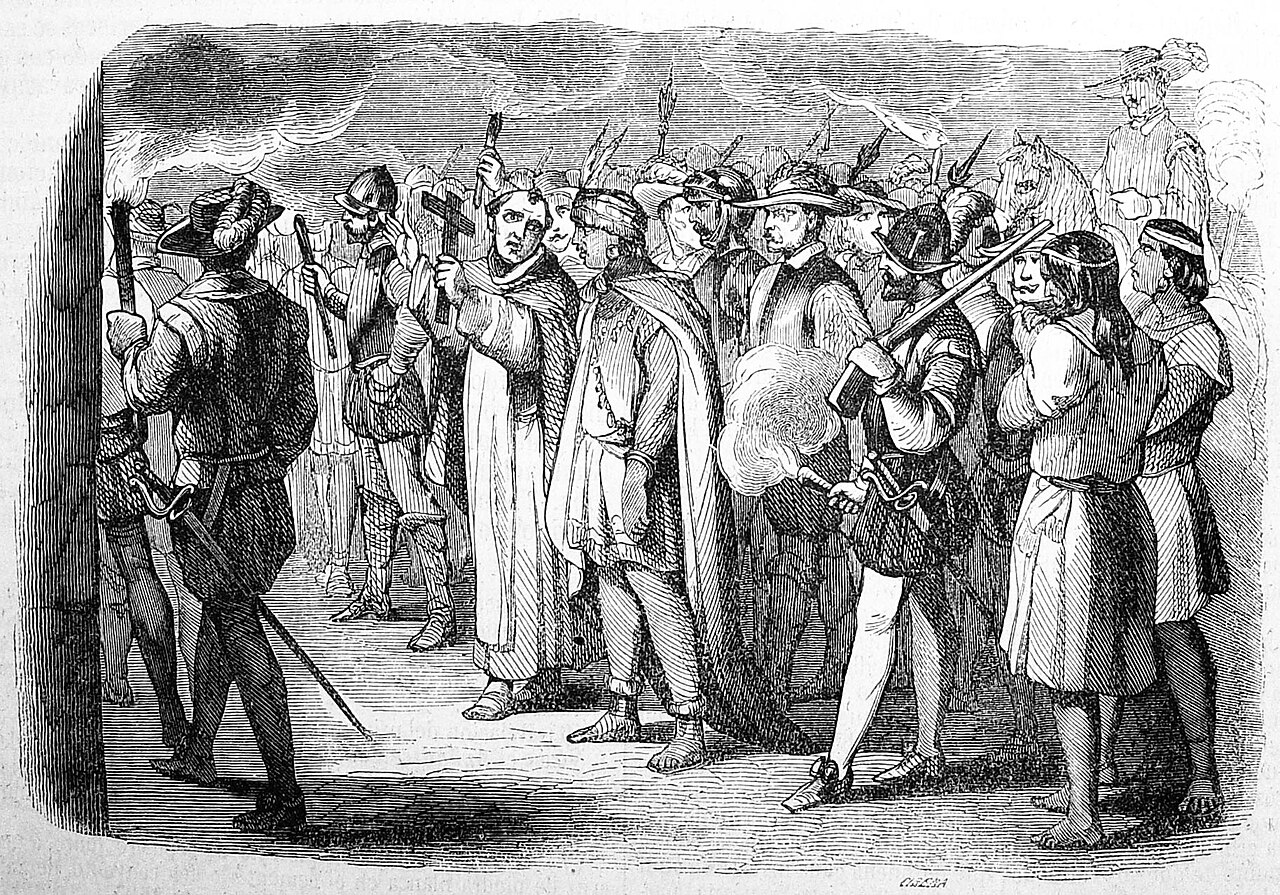
Black-and-white engraving of the execution of the Inca Atahualpa. Armed Spanish soldiers in helmets and hats stand with torches and muskets among a crowd. Robed captives, including a figure in a long white garment, stand in the foreground, one with a bound or resigned bearing. Smoke rises in the background, and horses are visible at right.Painting

Secondary source

Muerte del Inca Atahualpa

1851 (illustration); digitized 2009

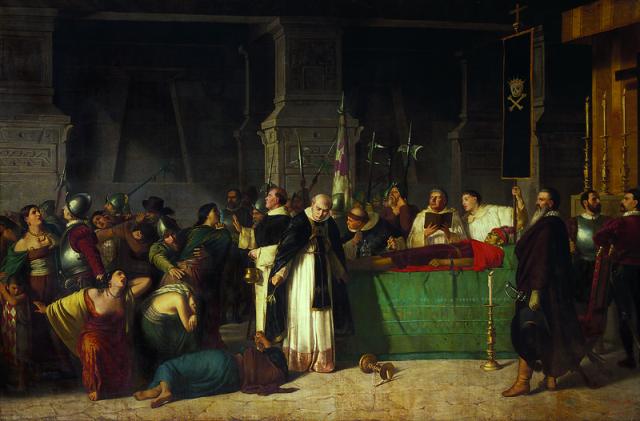
Large 19th-century history painting of a dramatic indoor scene. A priest in white and black vestments stands at a green-draped catafalque bearing a body, surrounded by soldiers with helmets and pikes, and by grieving people, some kneeling, collapsed or embracing, with a dark banner on the right.Painting

Secondary source

Funeral of Atahualpa

Luis Montero · 1868

Document

Secondary source

Atahualpa entry, The New Student's Reference Work

1914

Black-and-white reproduction of a painting of a man in profile facing right, wearing a headdress with two tall white-tipped feathers, large ear ornament, a draped cape, and a patterned band on his arm, holding a long staff.Painting

Secondary source

Portrait of Ataw Wallpa (Atahualpa)

c. 19th century

Book

Secondary source

The Incas of Peru

Clements R. Markham · 1910

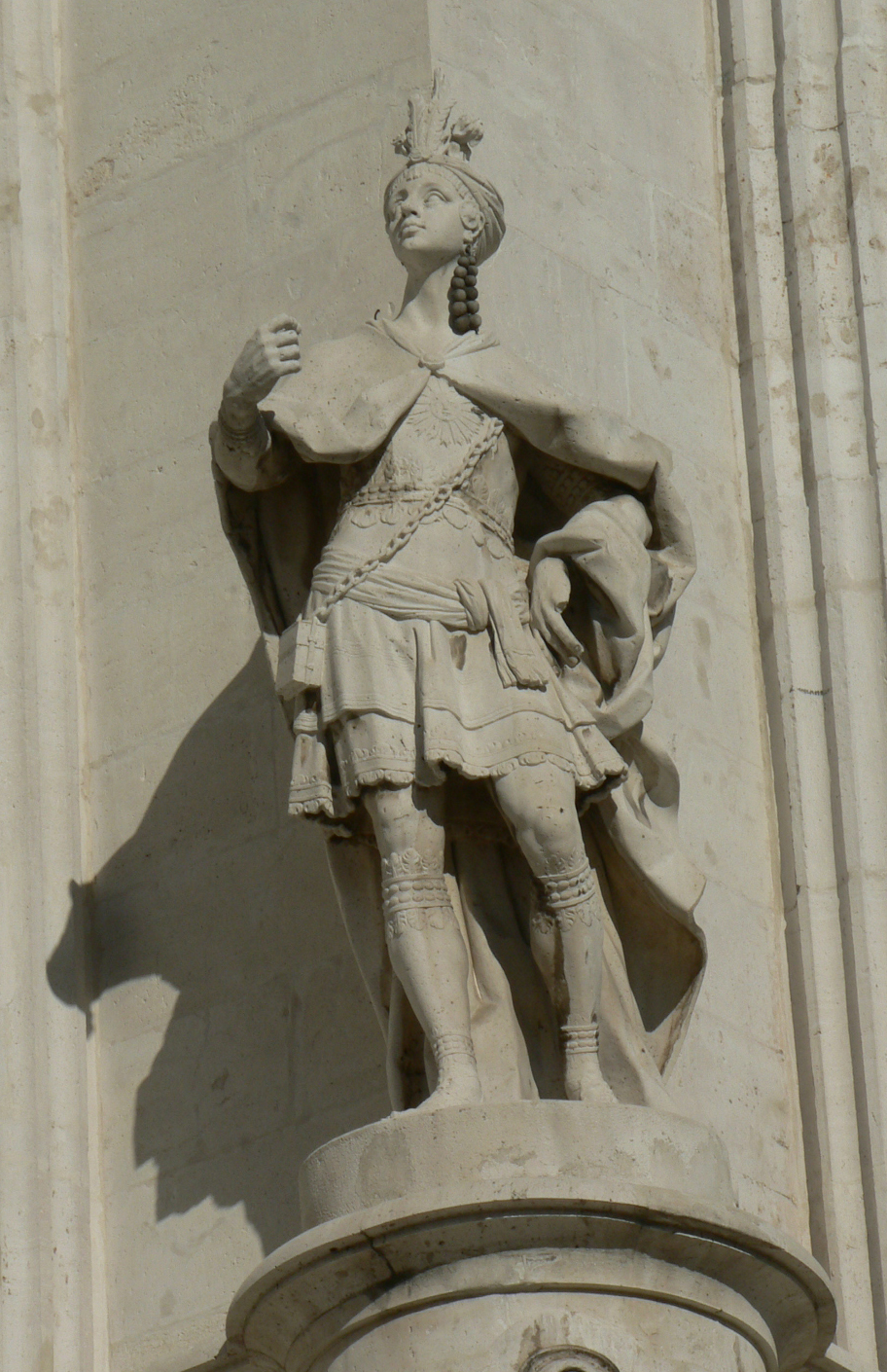
Photograph of a light stone statue set on a pedestal against a pale building wall. The figure wears a headdress with a tassel, a cape draped over the shoulders, a belted tunic with a fringed skirt, and boots. One arm is raised with a fist, the other rests on the hip. Strong shadow falls on the wall to the left.Sculpture

Secondary source

Statue of Atahualpa, Royal Palace of Madrid

Basilio · 2010

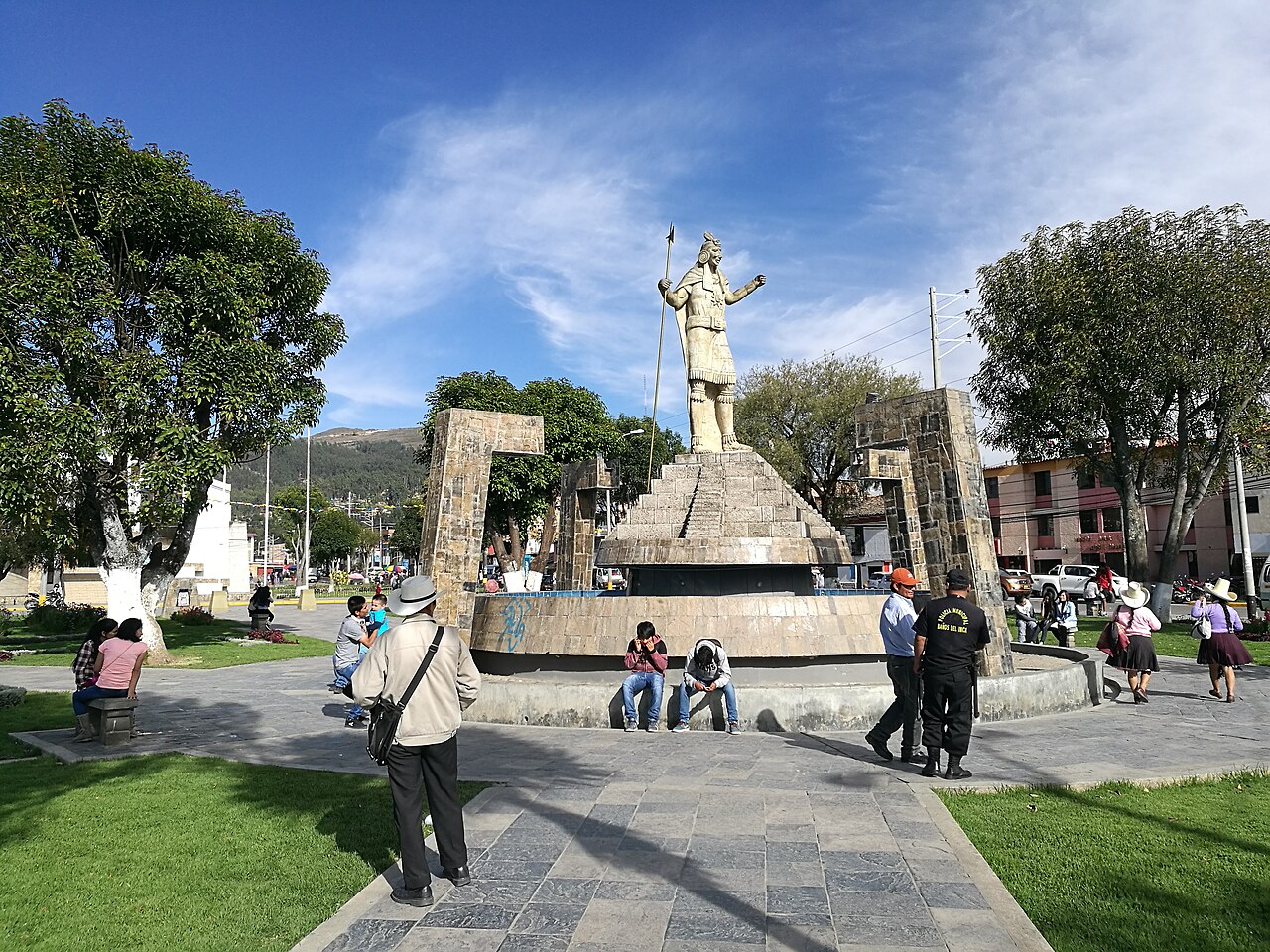
A large stone statue of a standing figure in traditional dress with a raised arm and a tall spear, set on a stepped stone pedestal in a plaza. People walk and sit around the monument; trees and blue sky are visible.Sculpture

Secondary source

Statue of Atahualpa, Banos del Inca Plaza

Pitxiquin · 18 January 2017

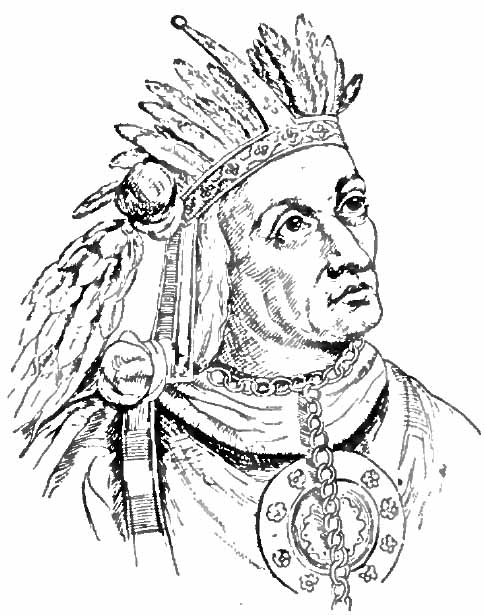
Black and white engraved line drawing of a man in profile facing right, wearing a feathered headdress with a decorative band, a chain necklace, and a medallion pendant with ornamental roundels. Hatching shades the face and garments.Painting

Secondary source

Atahualpa Portrait After Andre Thevet

Jacques Reich, after André Thevet · 1900

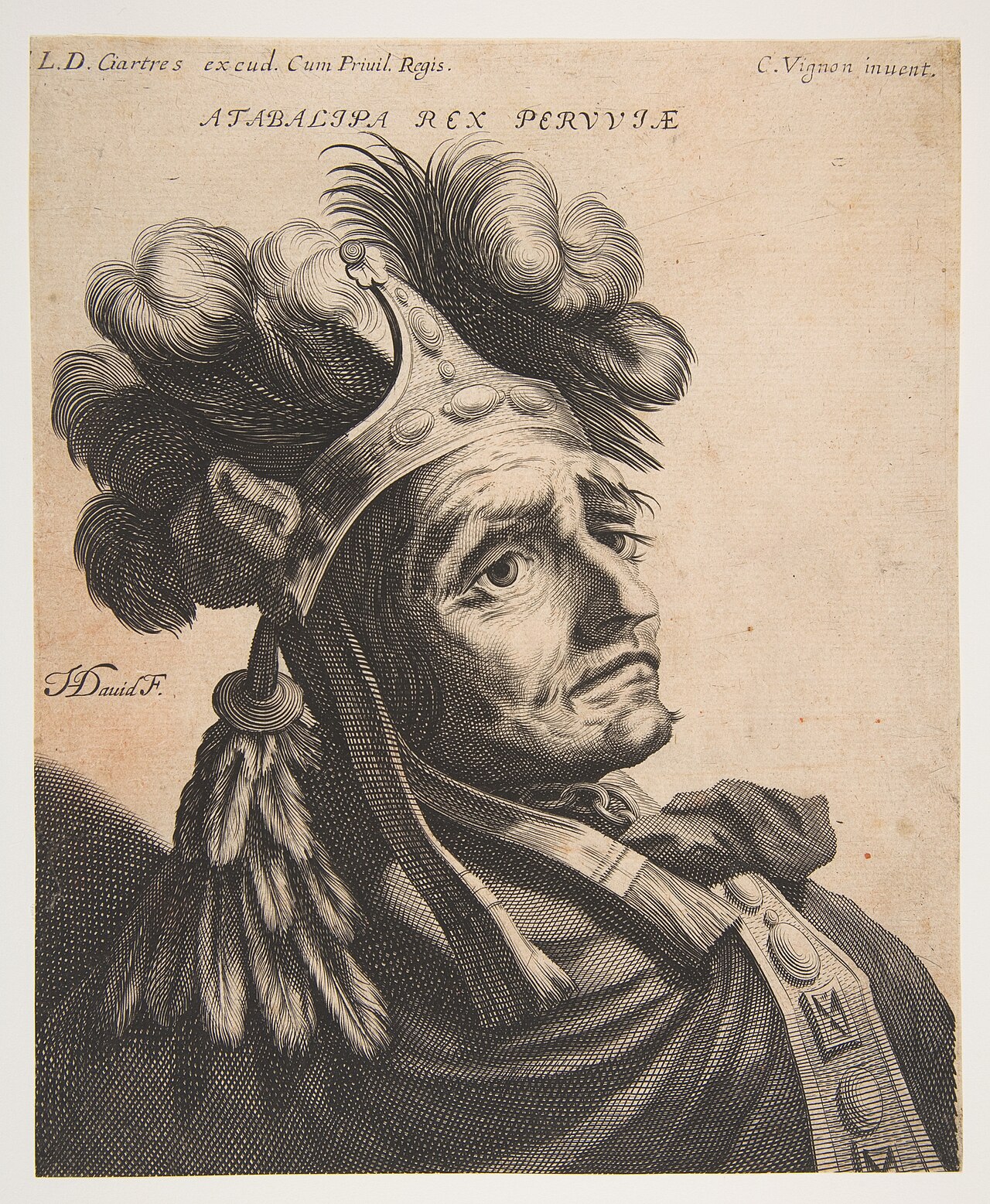
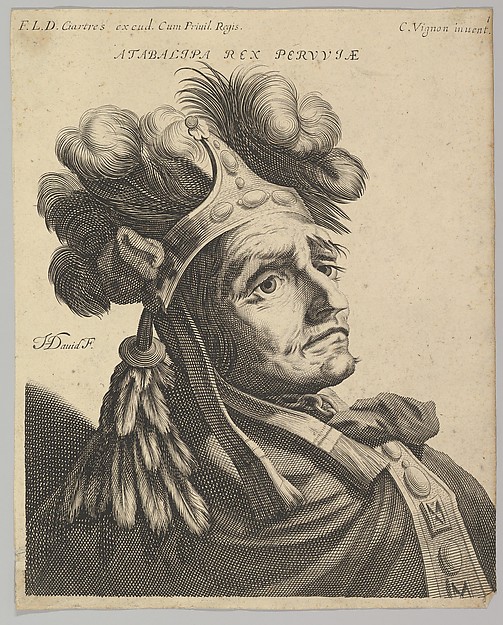
Engraved print of a bearded man in an elaborate feathered headdress with a jeweled crown band and tasseled feather pendant, looking upward with a sorrowful expression. Latin-style inscription reads ATABALIPA REX PERVVIAE across the top, with credits in the corners.Painting

Secondary source

Atabalipa, Roi du Perou

Jérôme David, after Claude Vignon · c. 1634

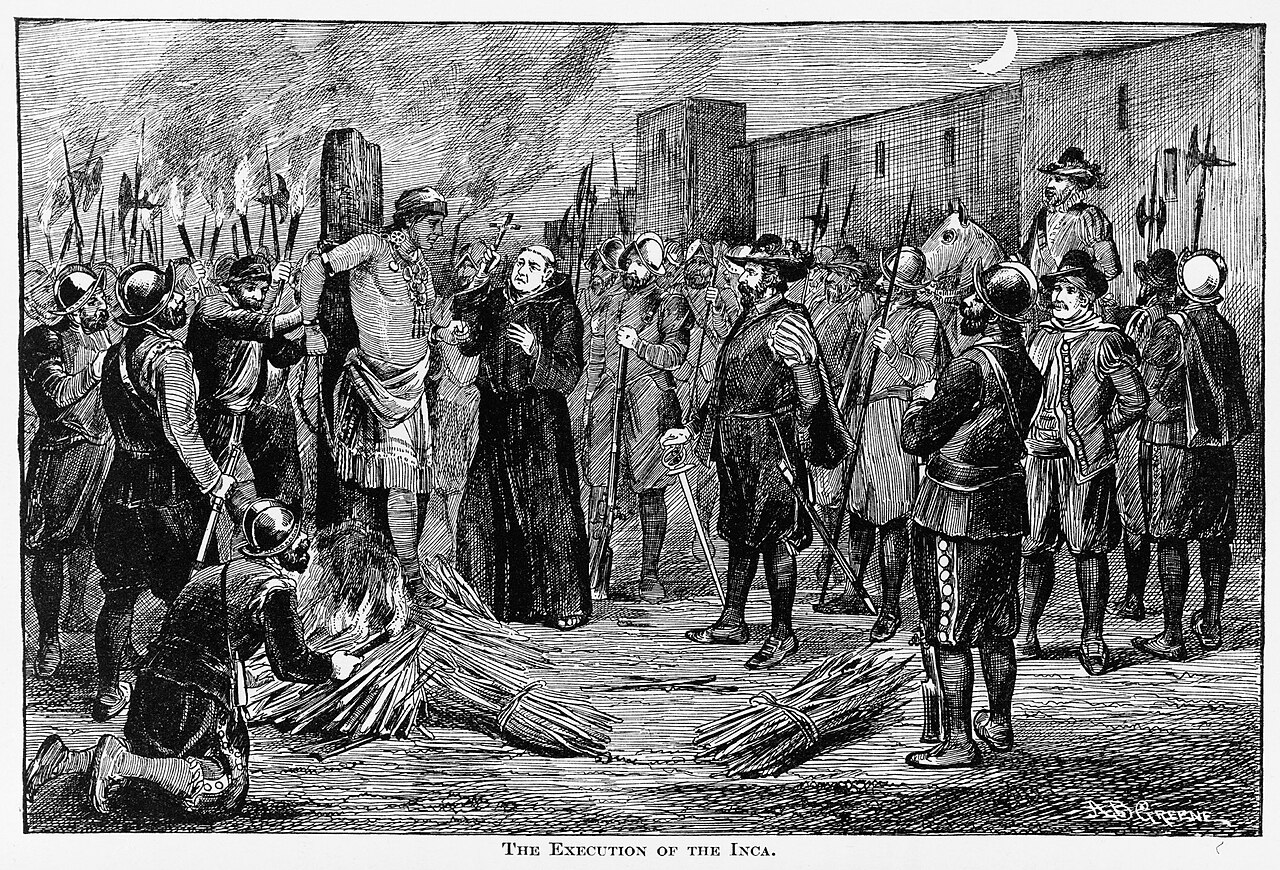
Black and white engraving of a scene in a walled plaza at dusk with smoke and torches. A bound man is tied to a stake while a robed friar holds a crucifix before him. Armed, helmeted Spanish soldiers with pikes and swords surround the scene, and bundles of kindling lie on the ground in the foreground. A mounted rider stands at upper right.Painting

Secondary source

The Execution of the Inca

A. B. Greene · c. 1891

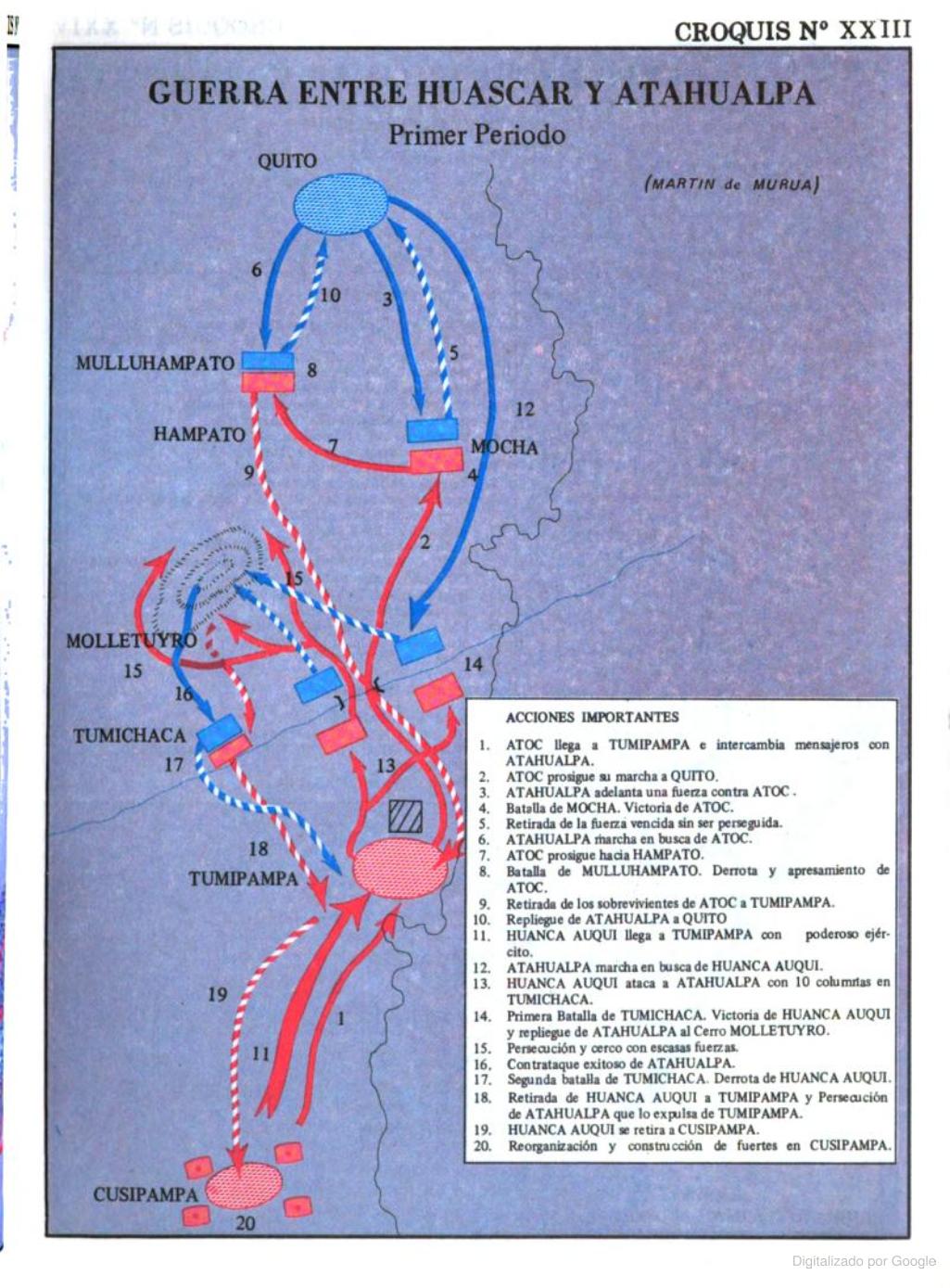
Military strategy map titled 'Guerra entre Huascar y Atahualpa, Primer Periodo' (Croquis No. XXIII), on a bluish background. Blue and red arrows and rectangular unit symbols trace movements across Quito, Mulluhampato, Hampato, Mocha, Molletuyro, Tumichaca, Tumipampa and Cusipampa. Numbered labels 1 to 20 refer to a key of important actions in a box on the right, including battles of Mocha, Mulluhampato, and two battles of Tumichaca. Credit reads Martin de Murua.Document

Secondary source

Inca Civil War, First Phase Map

Ministerio de Defensa · 12 February 2023

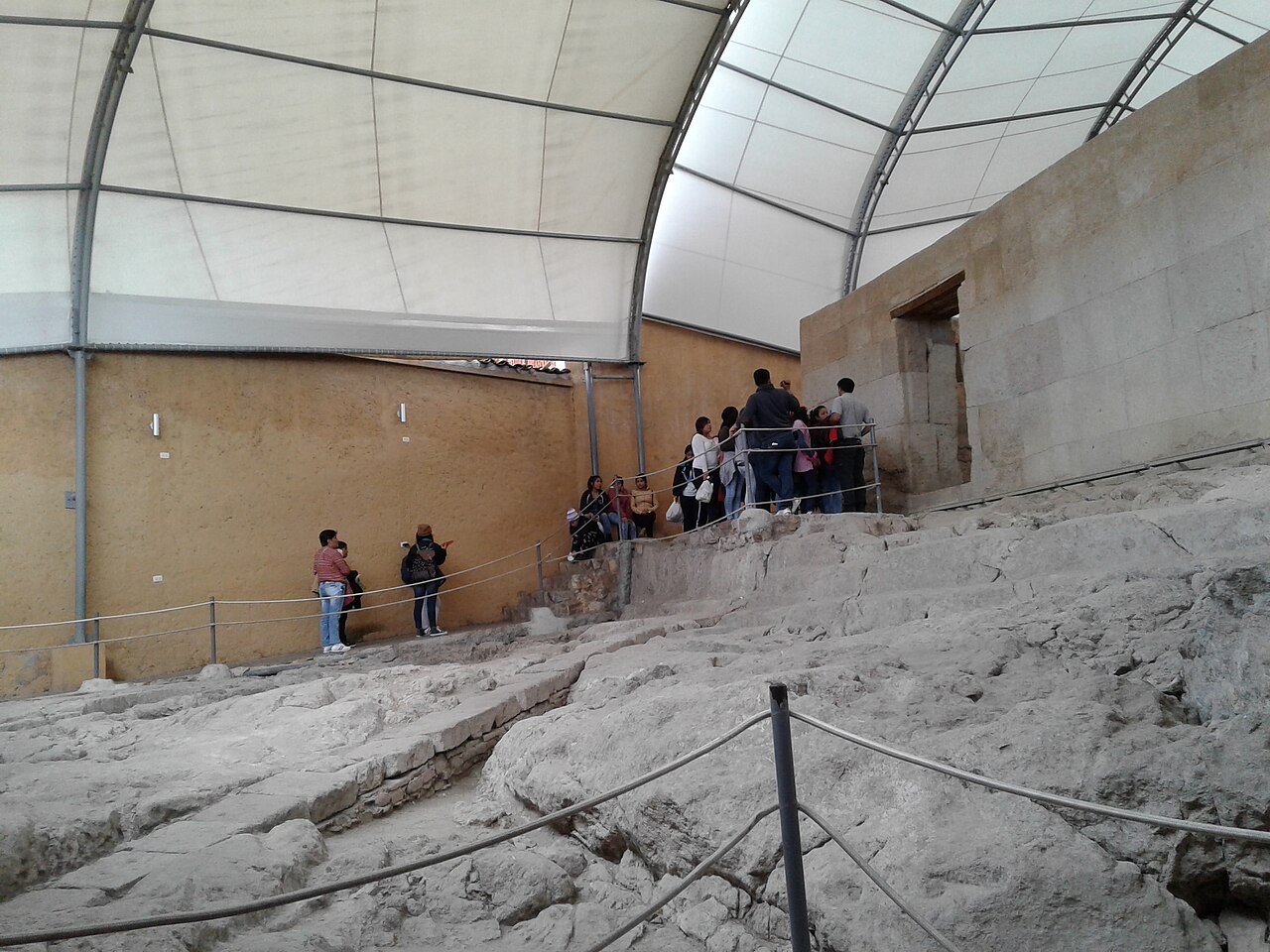
Visitors stand along a metal railing inside a large covered enclosure, looking at an excavated stone area with a low stone wall and a doorway in a stone wall at right. Tan mud-brick walls are on the left.Photograph

Tertiary source

Tourists visiting the Ransom Room, Cajamarca

Polmartin14+ · 9 September 2016

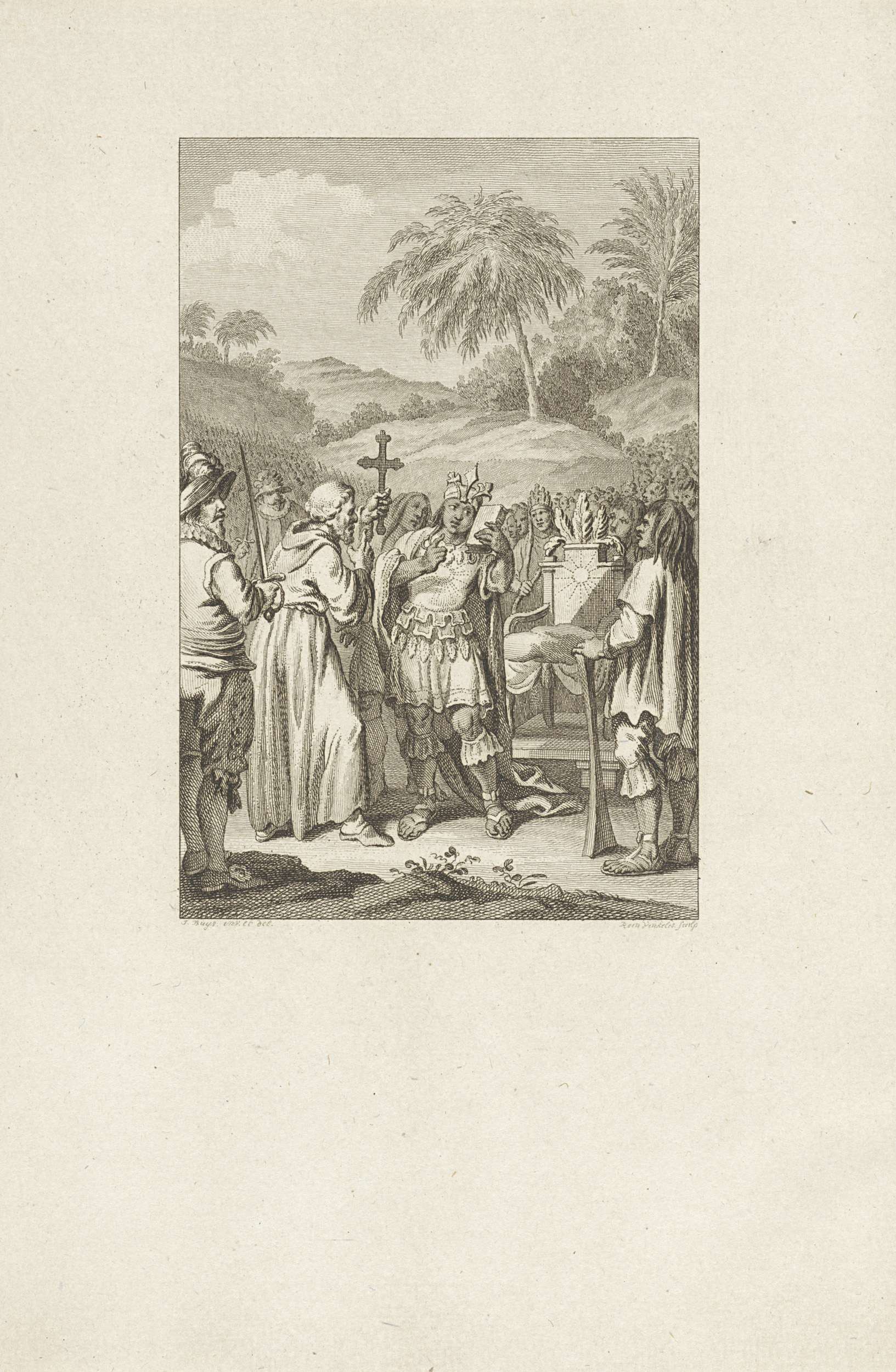
Engraving of a scene in a tropical landscape with palm trees. A bearded friar in a long robe holds up a cross. Beside him stands a armored European in a plumed hat holding a sword. Center, a figure in feathered headdress and armor gestures, seated on a throne-like chair beside a plant offering. On the right, a figure with long hair stands near the chair. Crowds stand behind.Painting

Secondary source

Atahualpa being converted to Catholicism

1788

Black-and-white etching of an interior with a tall barred window. A kneeling figure with raised arm faces a standing man in a military coat who points a pistol. Soldiers with muskets stand at right, and a figure in a plumed headdress stands at left.Painting

Secondary source

L'Ynca du Pérou aux pieds de Pizarre

A.C.F. Villerey after N. Vallain

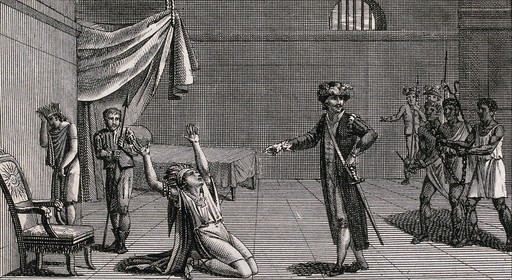
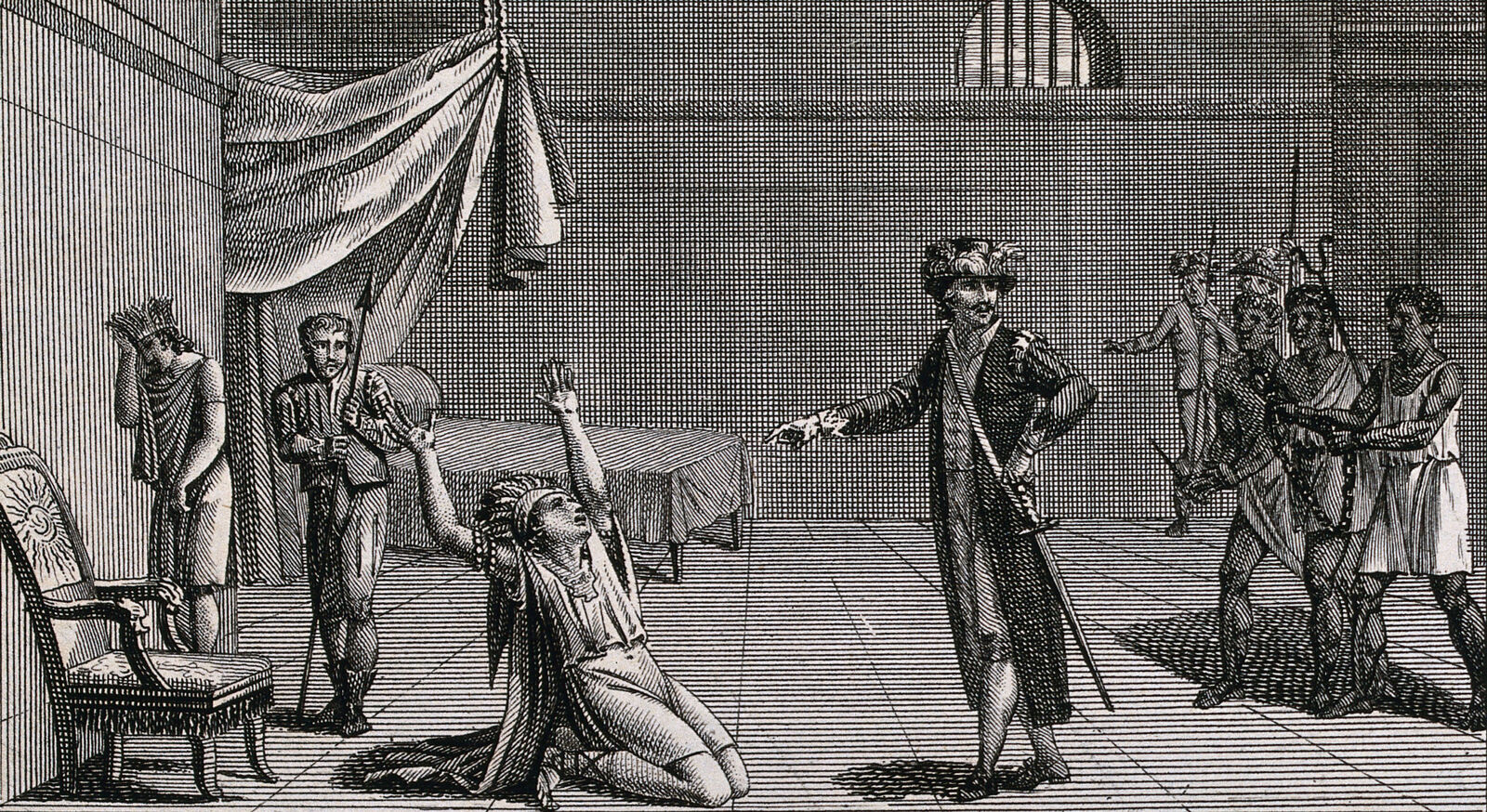
Black and white engraving of an interior scene: a kneeling figure with raised arm faces a standing man in a feathered hat and long coat who extends his hand, while armed soldiers and onlookers stand nearby, a curtained bed and a chair are at left, and a barred window is high on the wall.Painting

Secondary source

Atahualpa begging Pizarro for mercy

A.C.F. Villerey after Nanine Vallain · between 1790 and 1799 (uncertain)

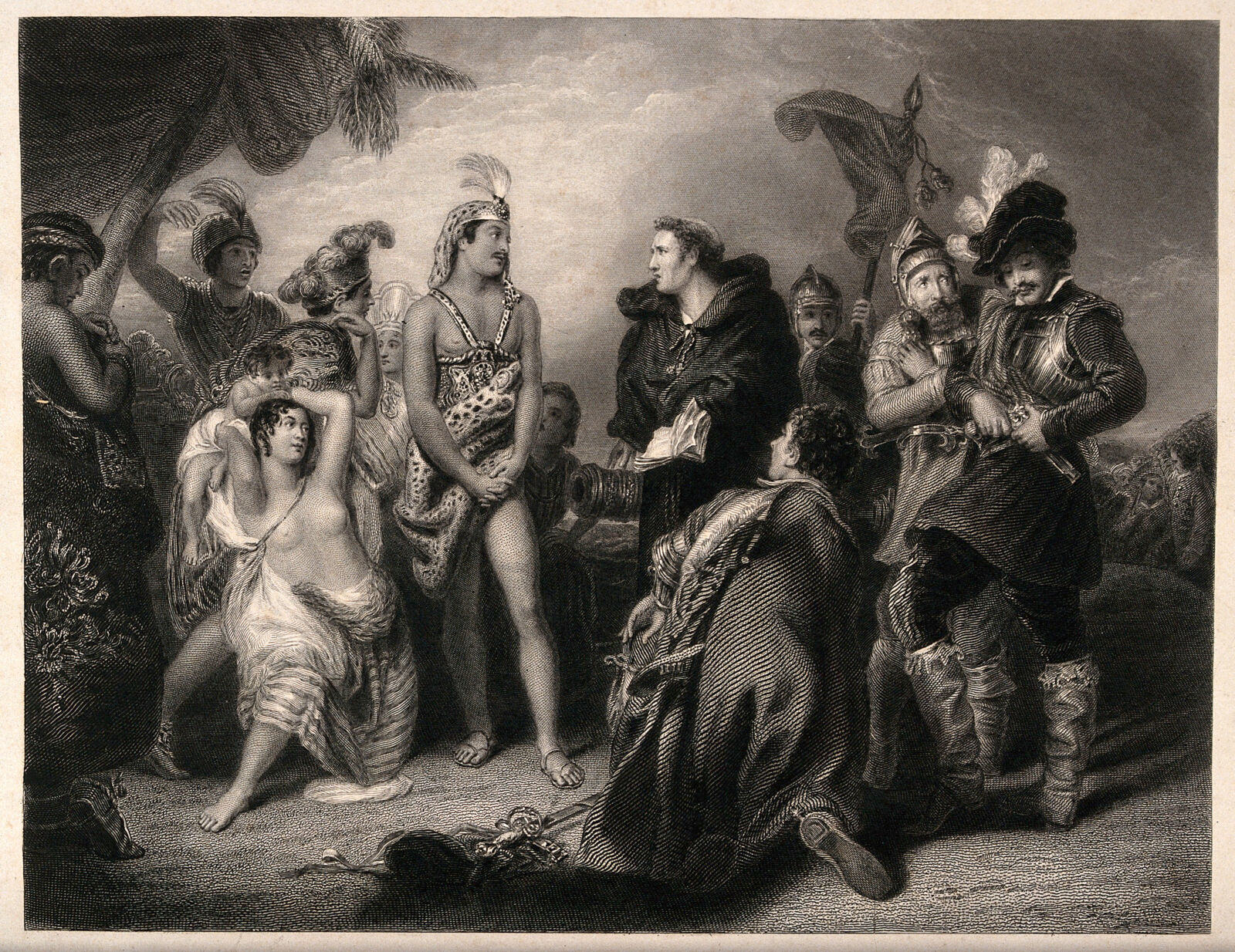
Black and white engraving of a 16th-century confrontation. A feathered, robed figure stands centre, flanked by women and attendants. A friar in a dark hooded robe holds an open book and speaks to him. Armoured Spanish soldiers stand at right, one holding a helmet-topped staff, and a kneeling man in dark clothing is in the foreground. Keys lie on the ground.Painting

Secondary source

Valverde urging Atahualpa to convert

Henry Perronet Briggs (painting); engraved by W. Greatbach · 1830

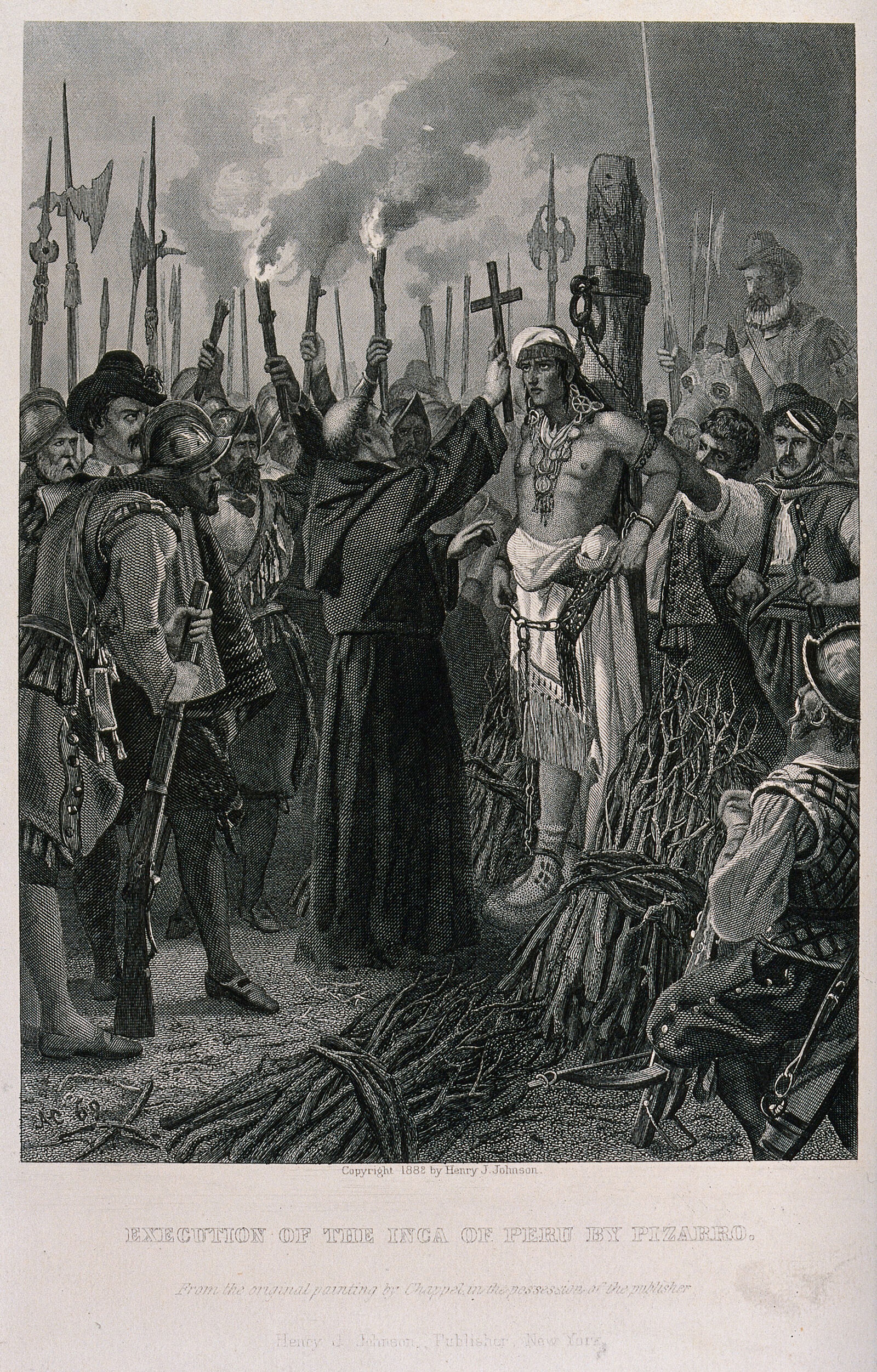
Black and white engraving of a 16th-century scene: a bare-chested, chained man in a white loincloth stands on a pile of brushwood at a wooden stake while a robed friar raises a cross. Armed soldiers with torches and pikes surround him. Text below reads 'Execution of the Inca of Peru by Pizarro.'Painting

Secondary source

Execution of Atahualpa by Pizarro

Edouard Chappel · 19th century

Black-and-white engraving of a bearded man in profile looking to the right, wearing a headdress with large feathery plumes, a crescent-shaped ornament, and a tassel of feathers hanging at his shoulder. Latin inscription at top reads Atabalipa Rex Peruviae.Painting

Secondary source

Atabalipa, Rex Peruviae

Jerôme David · c. 1634-1637

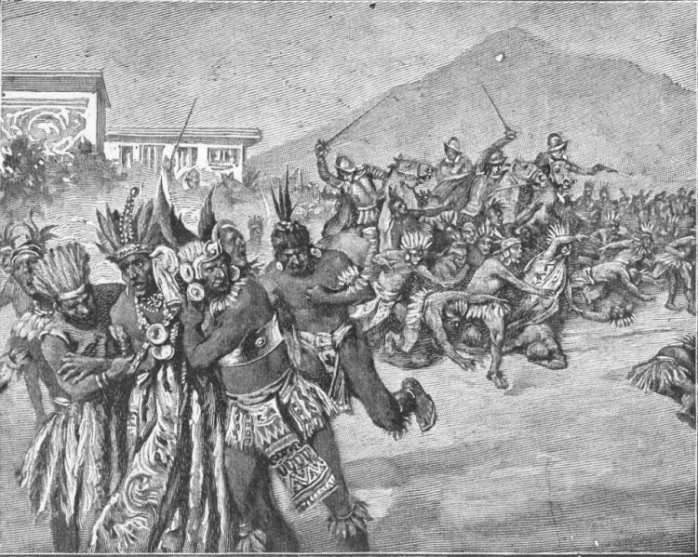
Black-and-white engraving of a violent battle. Armored Spanish horsemen with raised swords charge into a crowd of feathered, loincloth-clad Inca warriors in a plaza. Some figures lie on the ground. A white building and a mountain are in the background.Painting

Secondary source

Atahualpa Attacked

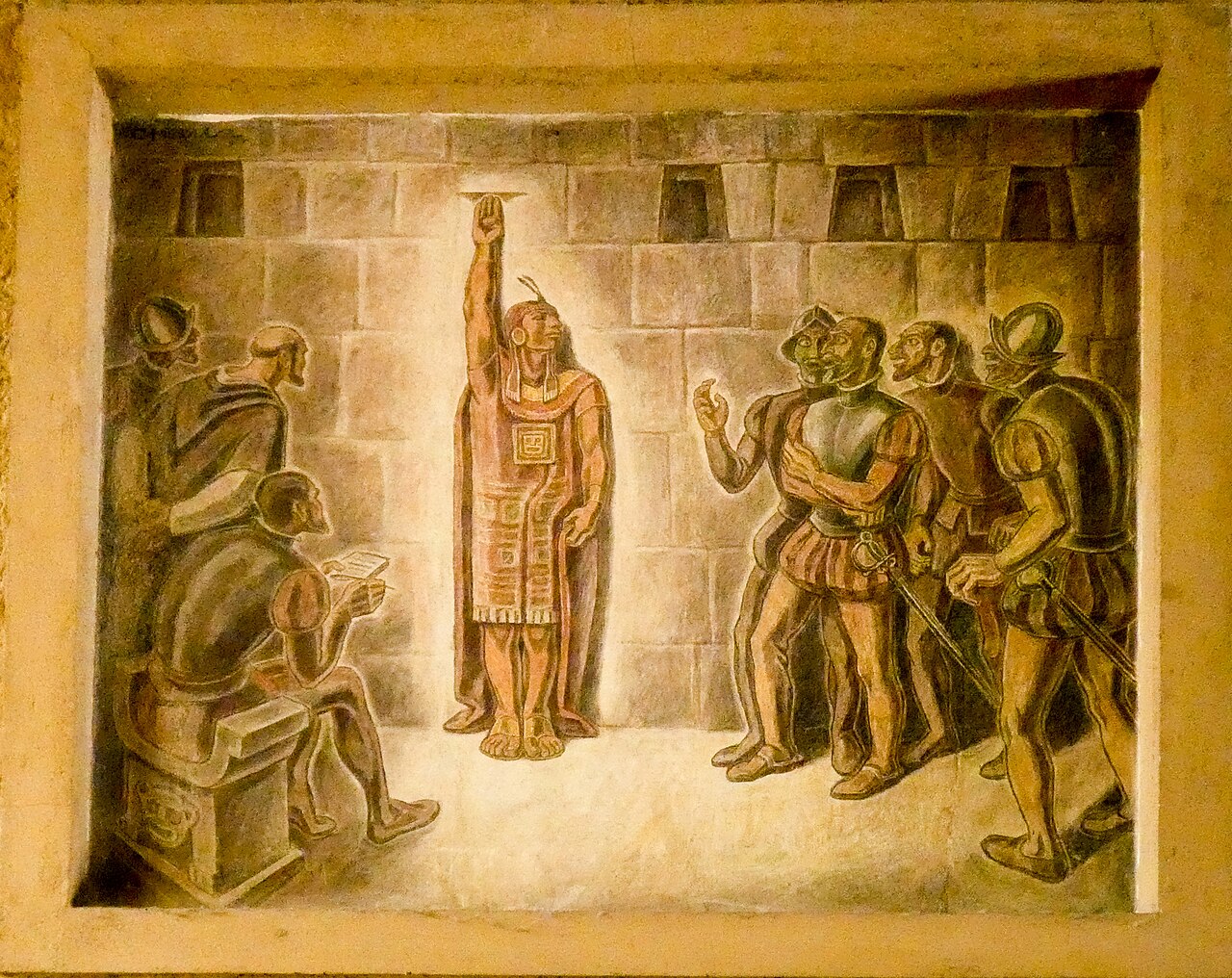
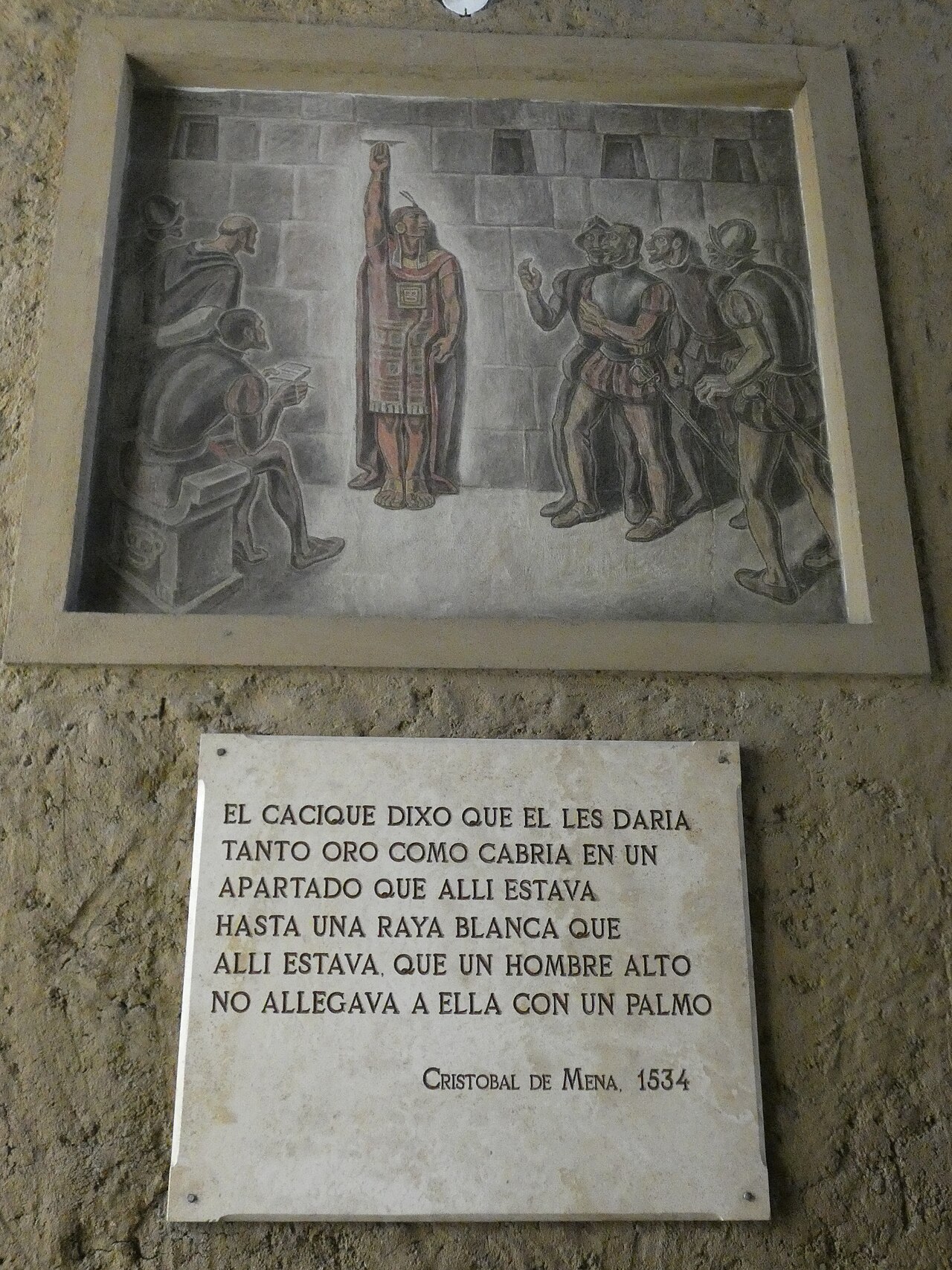
A mural painting in a stone-walled room. A central figure in a red-brown cloak and headdress raises one arm high, with a white mark on the wall above his hand. To the left, three seated and standing figures in dark clothing with a book. To the right, several armored Spanish soldiers with helmets and swords look up toward the raised arm; one gestures with an open hand.Painting

Secondary source

Perou du Nord, Inca Chief and the Ransom Room

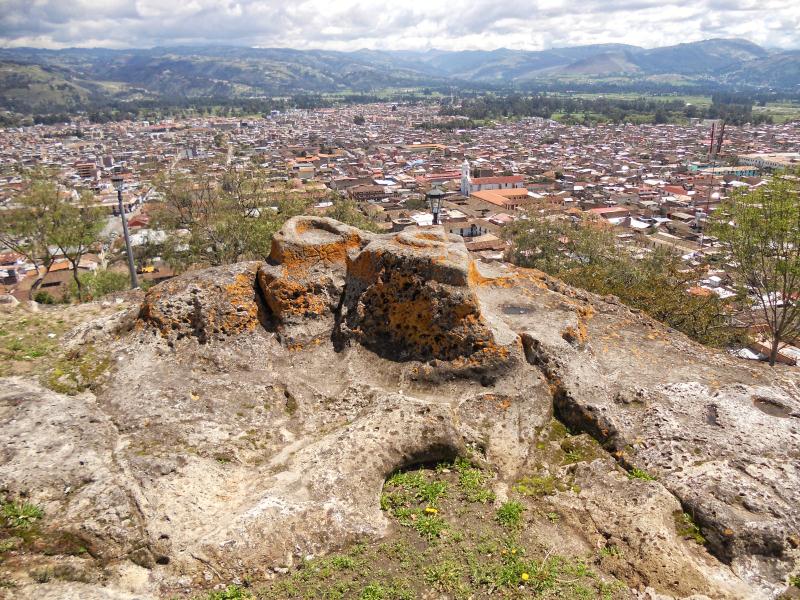
Weathered, lichen-stained sandstone rock outcrop with carved seat-like hollows on a hilltop, overlooking a dense town of red-roofed houses, green trees, and distant mountains under a cloudy sky.Photograph

Secondary source

La Silla del Inca

Gregor Ludwig · 2013

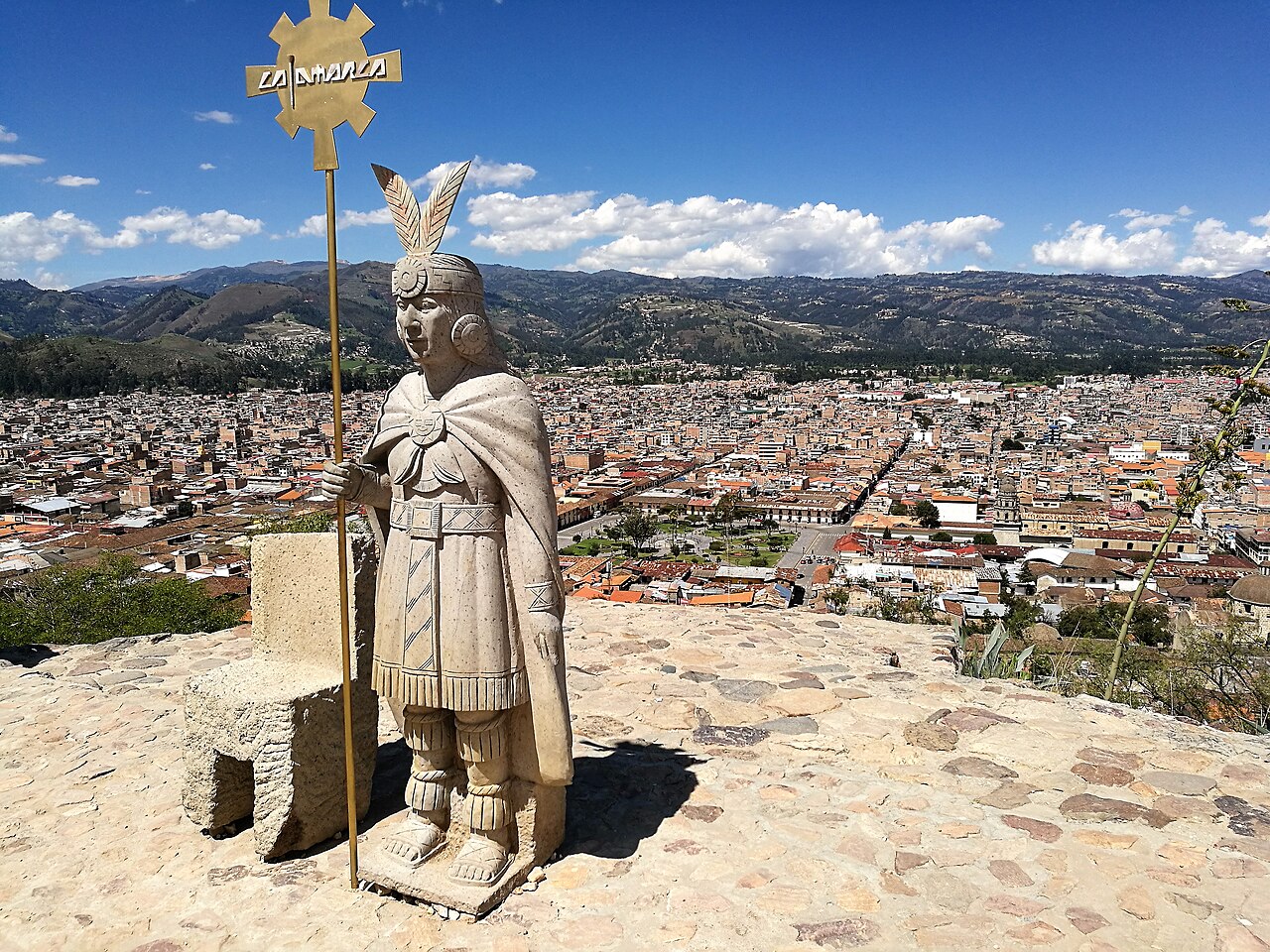
A light stone statue of a standing figure in a cape and feathered headdress holds a gold sun-shaped staff, beside a carved stone chair, on a paved hilltop overlooking a large hillside town with mountains beyond under a blue sky.Sculpture

Secondary source

Statue and Chair of Atahualpa, Cerro de Santa Apolonia

Pitxiquin · 2017

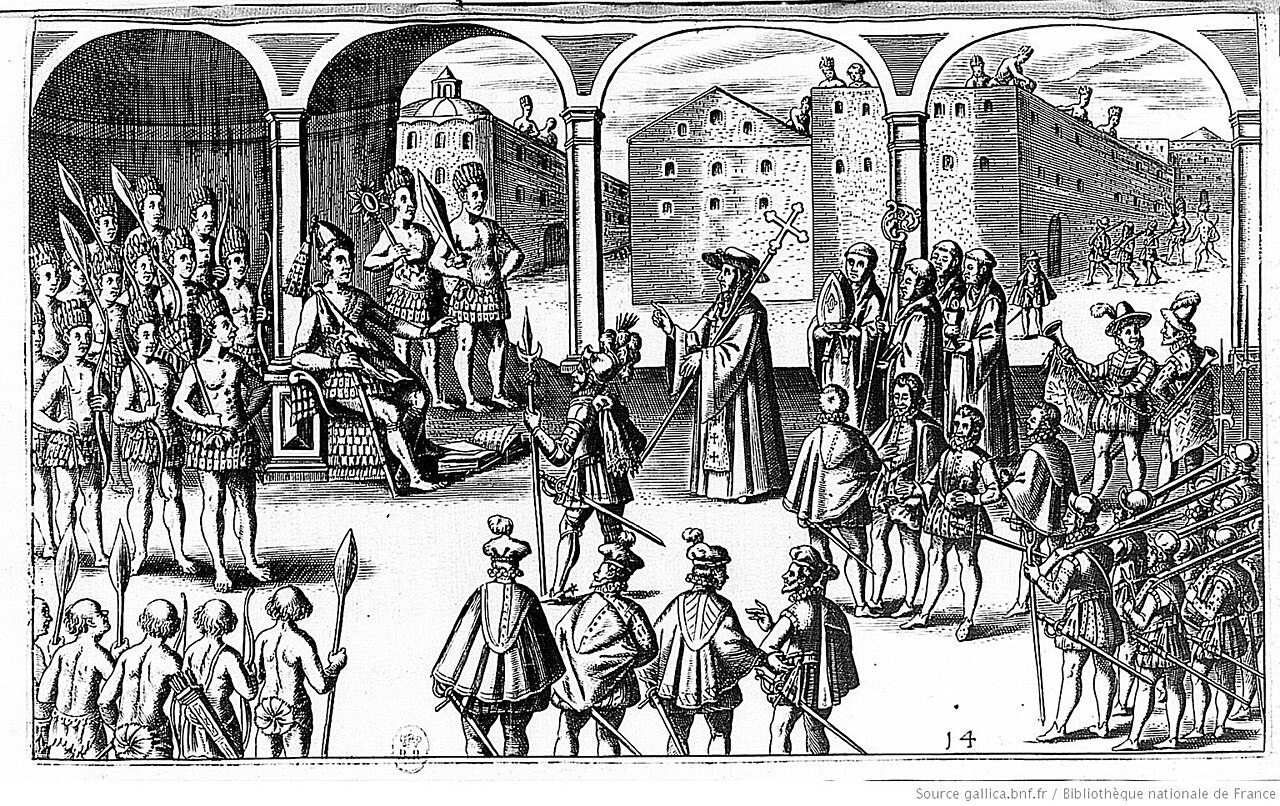
Black-and-white engraving of a seated ruler on a raised throne under arches, with feathered attendants, facing a robed friar holding a cross. Armed Inca warriors stand at left, and Spanish soldiers in plumed hats with pikes fill the foreground.Painting

Secondary source

Attabalipa, Emperor of the Incas, 1532

Samuel Austin · 1532 (depicted date; likely created later)

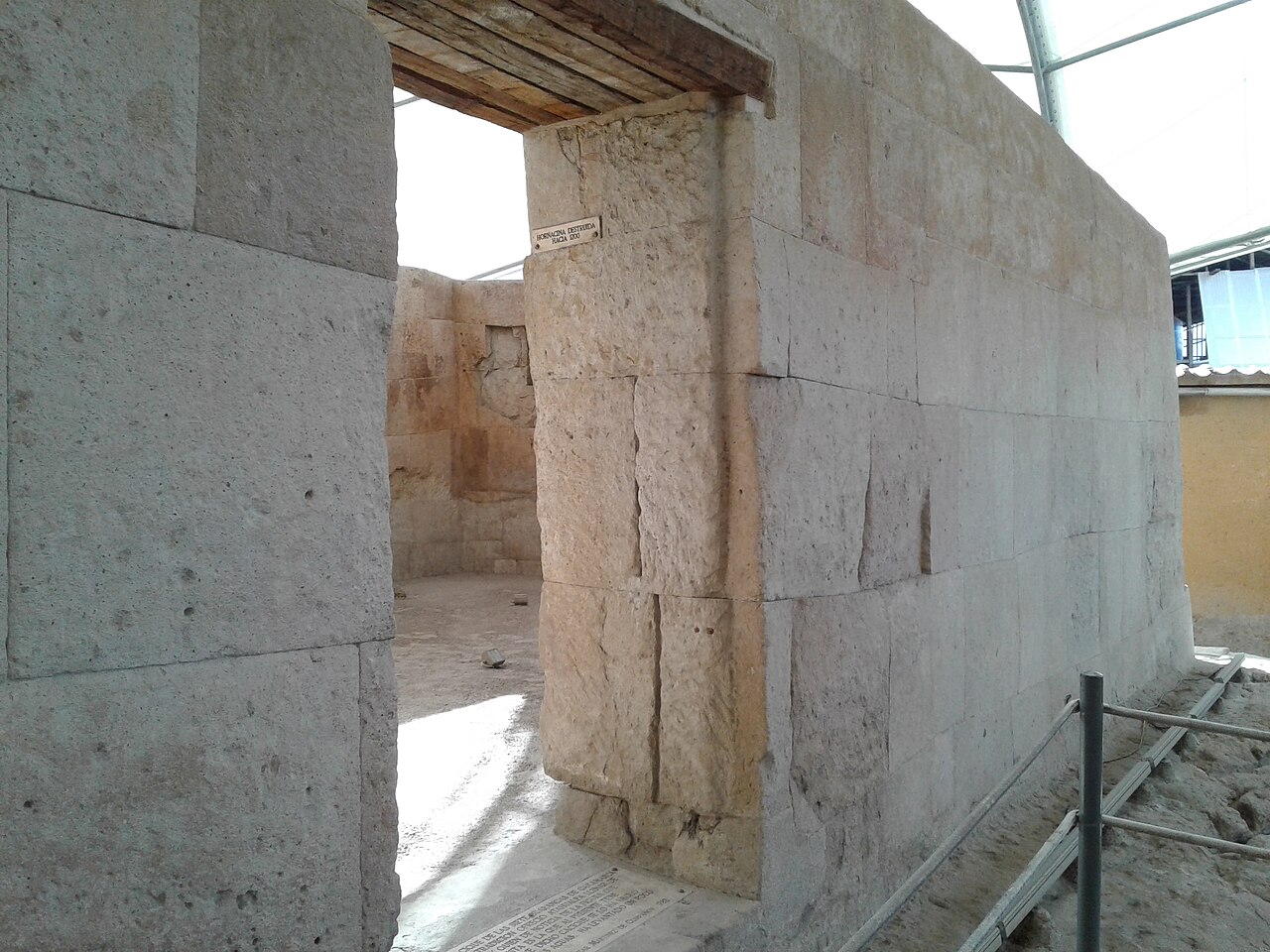
Stone doorway in a large, finely fitted ashlar wall of pale stone blocks, with a wooden lintel above. A small plaque is attached to the jamb. Beyond the doorway is a second wall and an open courtyard floor. A metal railing runs along the right side.Photograph

Secondary source

Inca Doorway of the Ransom Room, Cajamarca

Polmartin14+ · 2016

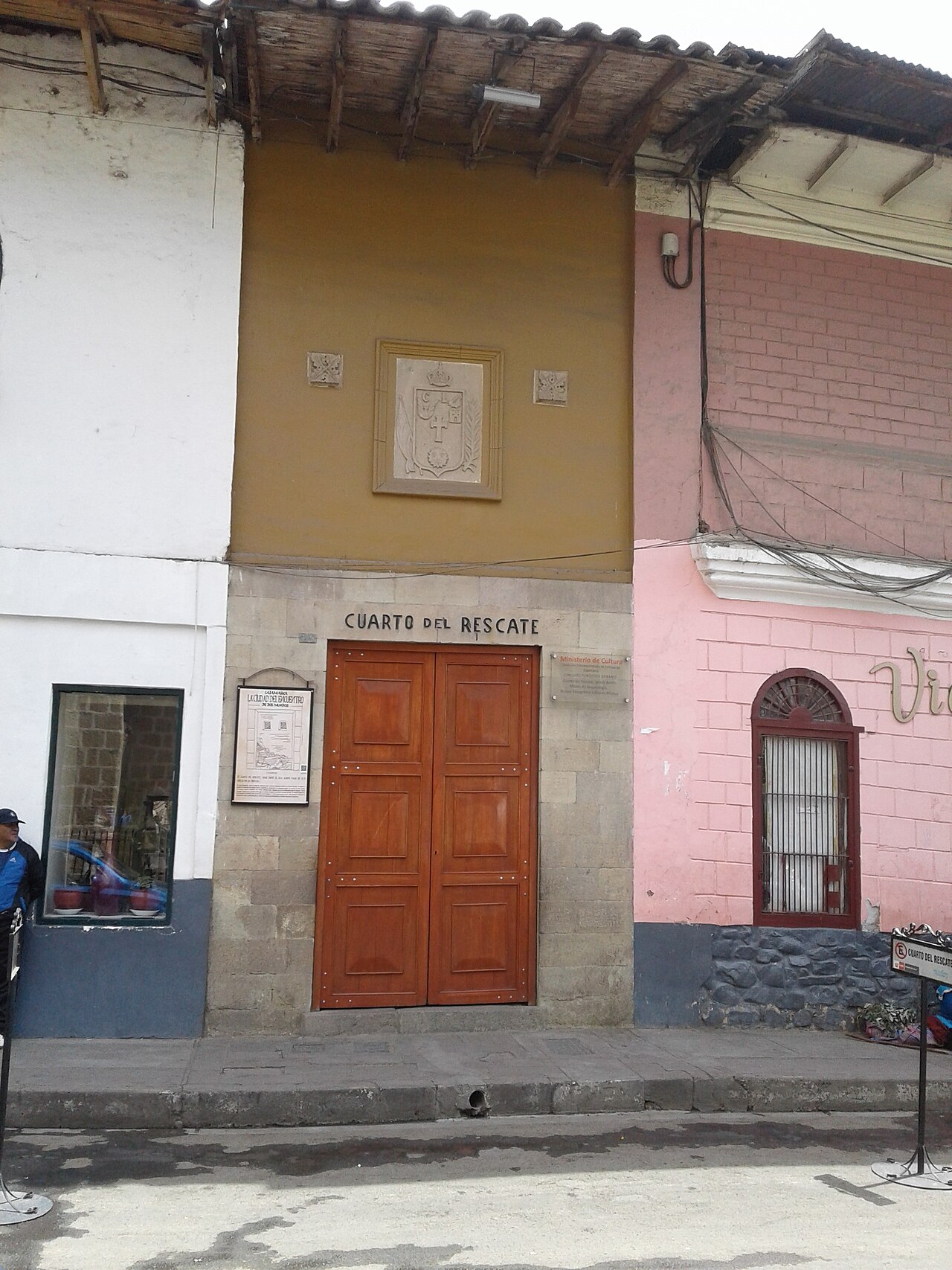
Street facade of the Cuarto del Rescate in Cajamarca: a tall wooden double door in a stone wall, with the sign 'CUARTO DEL RESCATE' above, a coat of arms relief on the ochre wall above, and a plaque beside the door. Pink and white buildings flank it.Photograph

Secondary source

Entrance to the Ransom Room, Cajamarca

Polmartin14+ · 2016

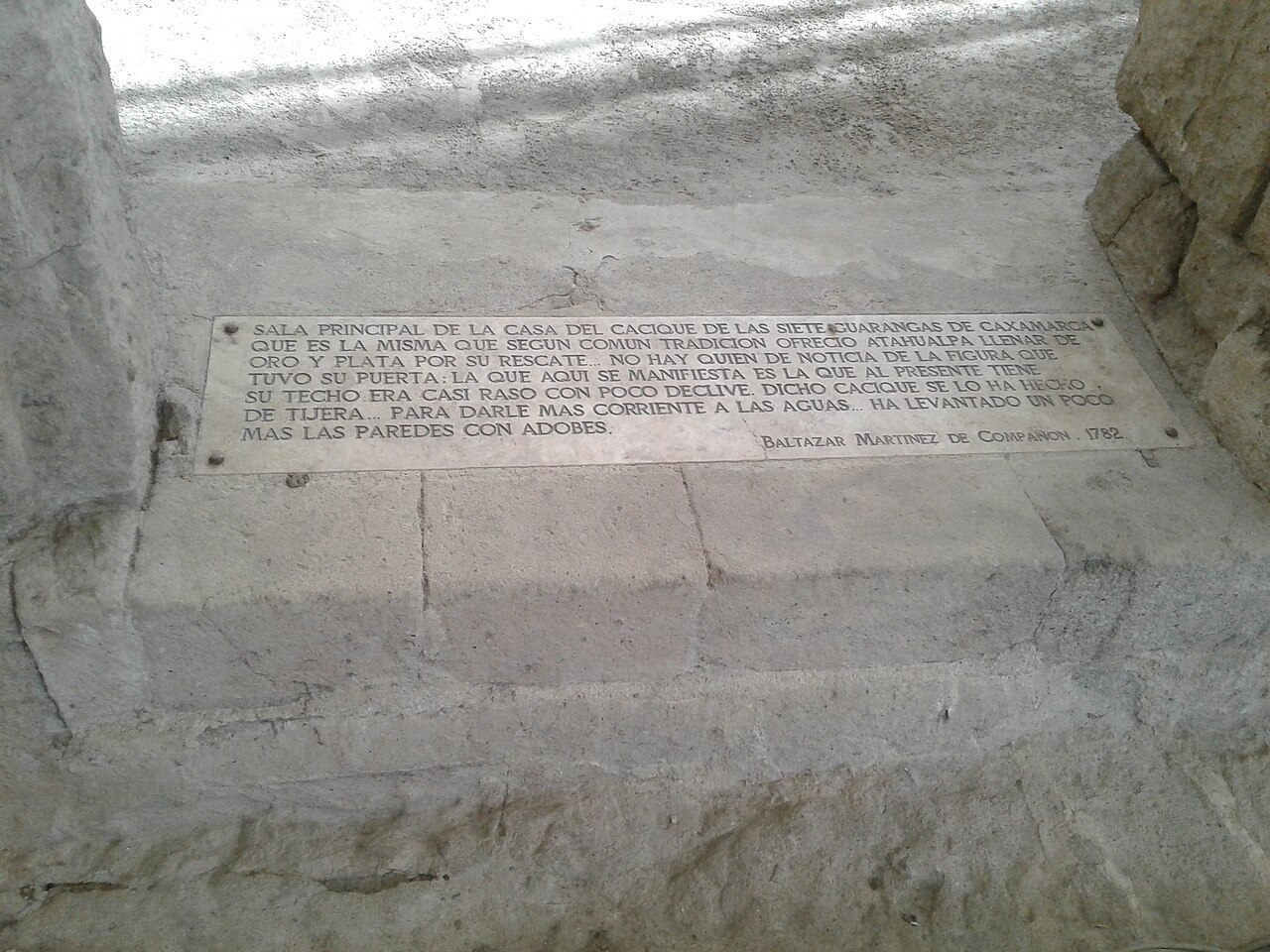
A rectangular metal plaque set into a stone step of a stone room, engraved with Spanish text reading 'Sala principal de la casa del cacique de las siete guarangas de Caxamarca...' signed Baltazar Martinez de Compagnon, 1782. Rough stone walls surround it.Artifact

Secondary source

Ransom Room Step Inscription by Bishop Martínez de Compagnon, 1782

Baltazar Martínez de Compagnon · 1782 (inscription); photograph 2016

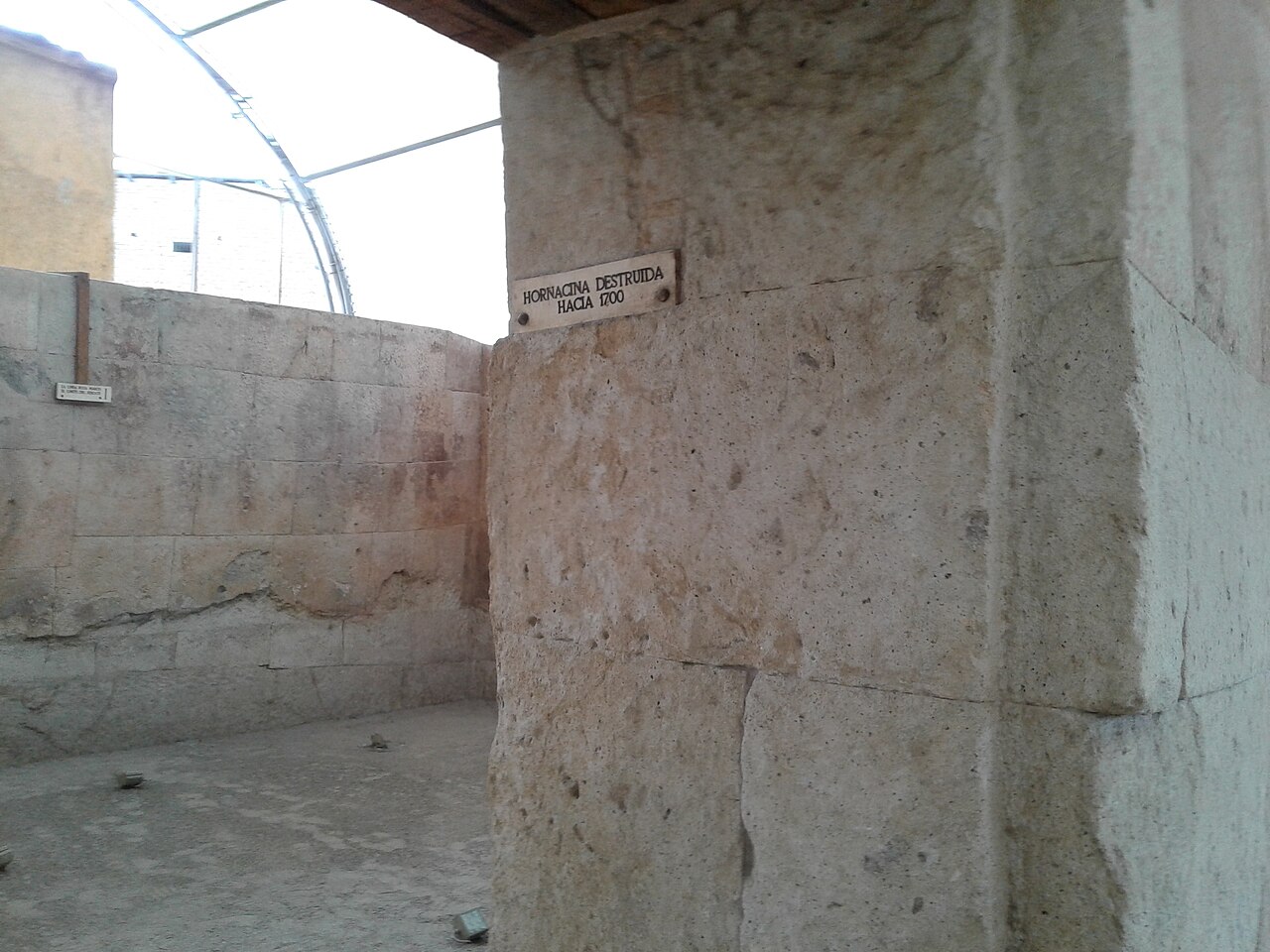
Interior corner of a stone-block room with light sandy walls and a dirt floor. A small wooden plaque on the right wall reads 'HORNACINA DESTRUIDA HACIA 1700'. A curved metal frame and a pale sky are visible through an opening at the top left.Artifact

Secondary source

Ransom Room Wall Marking the Ransom Limit, Cajamarca

Polmartin14+ · 2016 (photograph)

Stone wall with a framed relief-style mural showing a standing figure in Inca dress with arm raised, facing armed Spanish soldiers in helmets, with seated figures on the left. Below is a stone plaque with carved Spanish text and the name Cristobal de Mena, 1534.Photograph

Secondary source

Commemorative Plaque to the Ransom Room, Cajamarca

Catatine · 7 September 2018

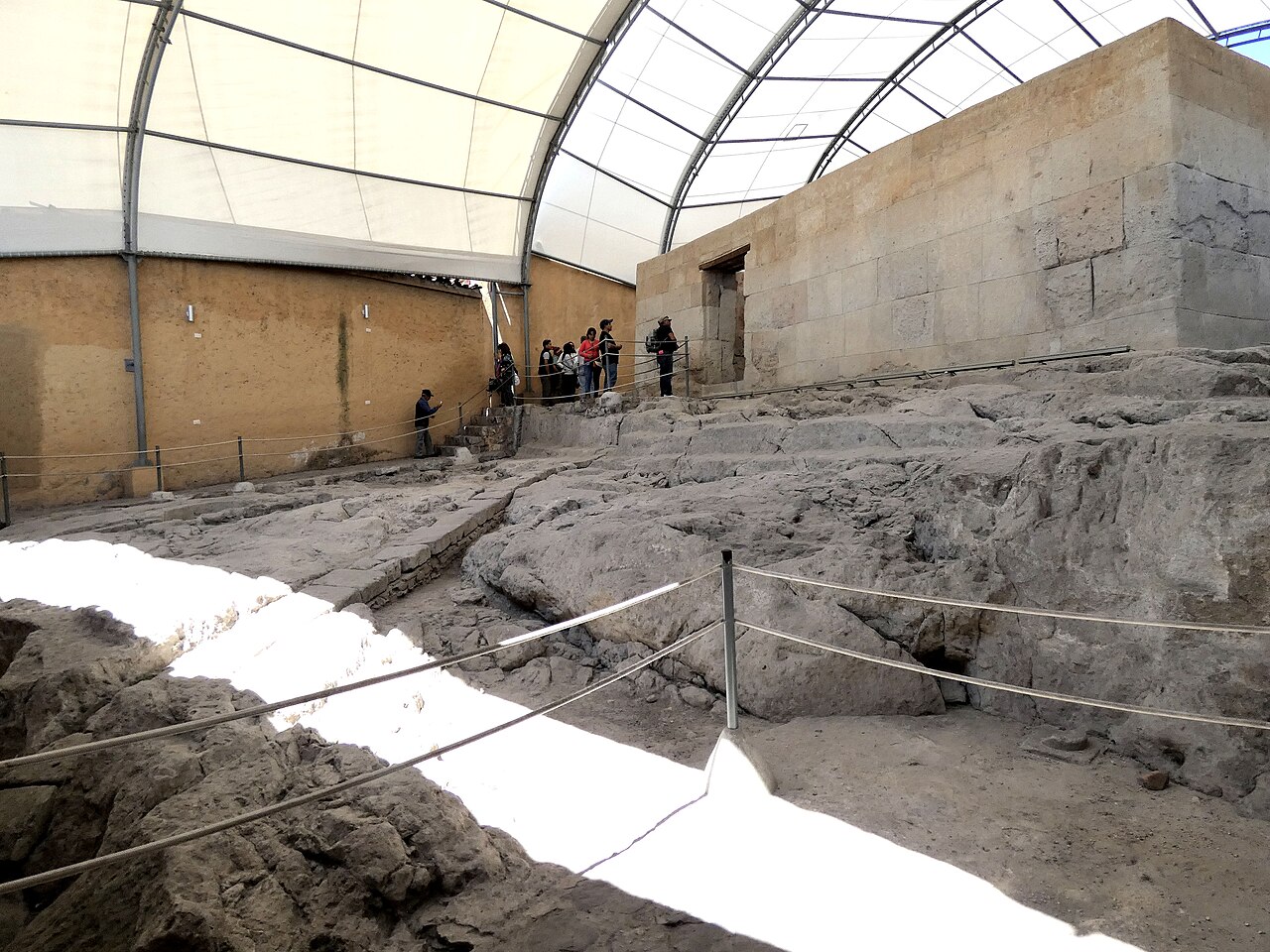
Stone ruins of the Ransom Room in Cajamarca under a large white protective tent-like cover. Visitors stand behind a rope barrier on a raised walkway near a doorway in a cut-stone wall, while rock floor and stone steps lie in the foreground.Photograph

Secondary source

Ransom Room Under Protective Cover, Cajamarca

Catatine · 7 September 2018

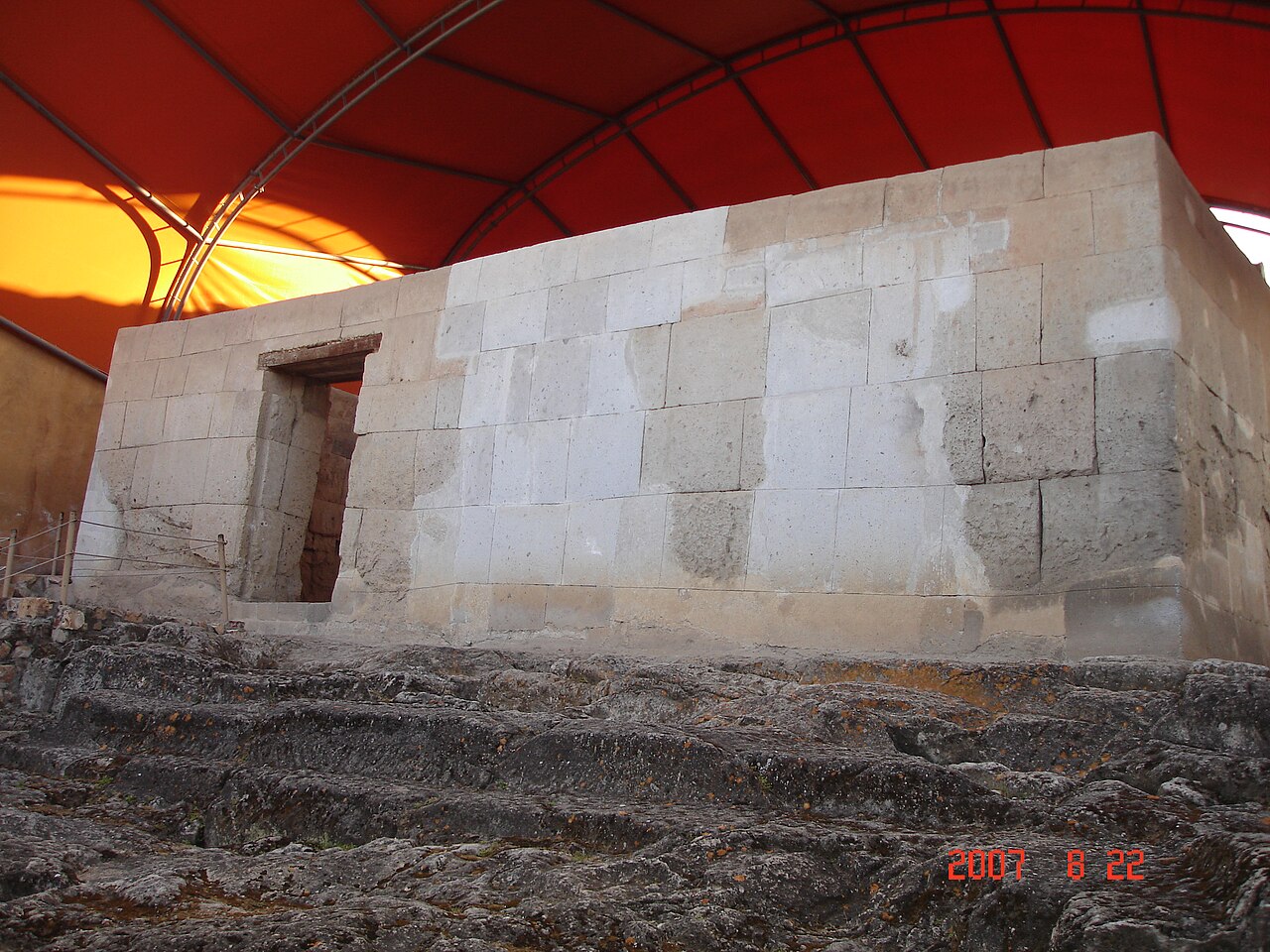
Exterior of a stone room with large pale stone blocks and a doorway with a stone lintel, under a red canopy. Rough dark rock lies in the foreground, and a date stamp reads 2007 8 22.Photograph

Secondary source

Cuarto del Rescate, Cajamarca

Dockyman · 22 August 2007

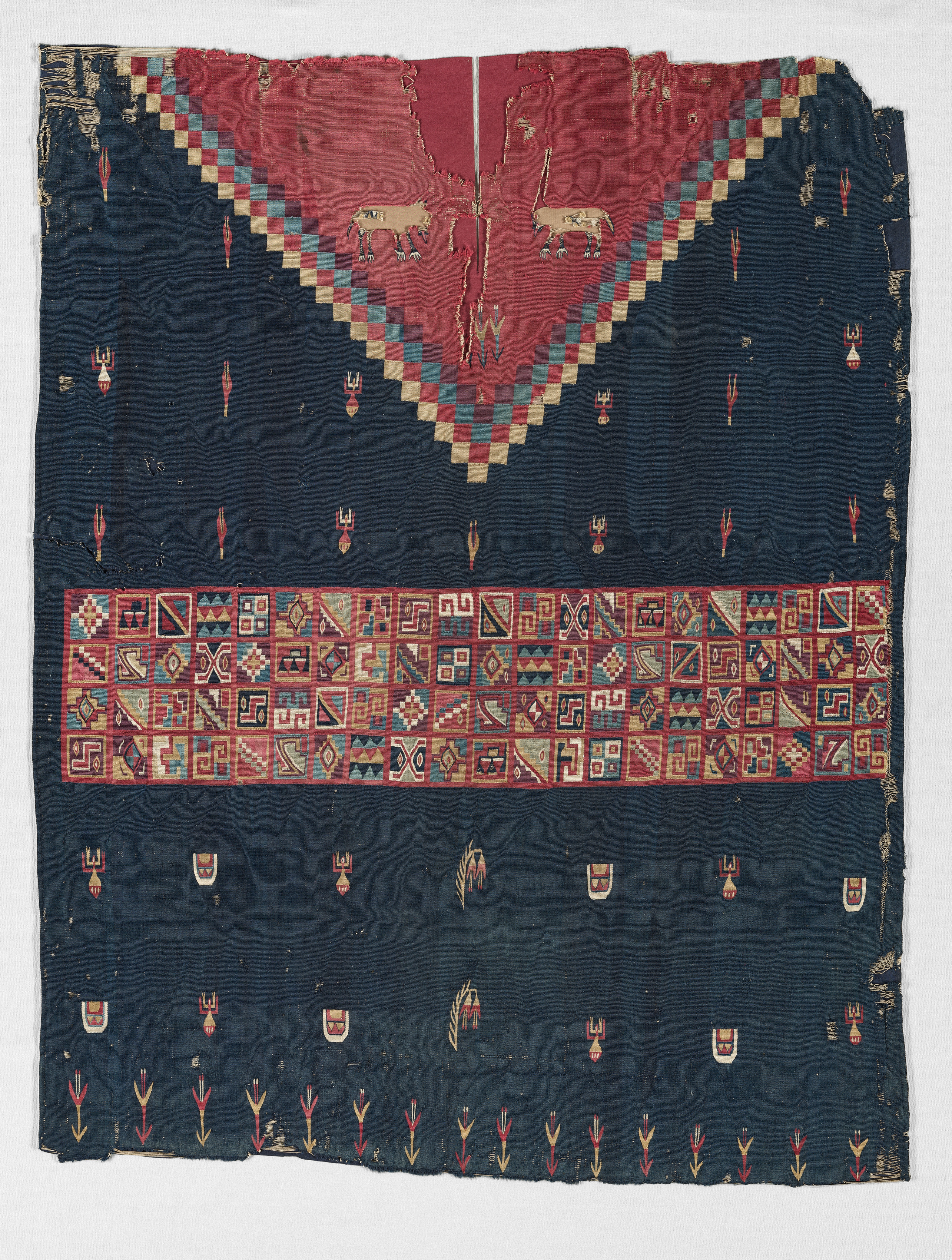
Photograph of a textile garment laid flat on a white background: a dark blue tunic with a red V-shaped yoke bordered by stepped checkered bands and two small tan animal figures, a central horizontal band of small colorful geometric squares, and rows of small motifs and stylized plant or arrow shapes along the lower edge. Edges are frayed.Artifact

Primary source

Inca Half Tunic with T'oqapu Waistband

16th century

Flat photograph of a sleeveless Inca tunic laid out on a pale background. The upper body has a checkerboard pattern of square panels in tan, brown and red, with stepped geometric motifs. The lower portion has horizontal bands of brown and red, and the hem has a zigzag border. A small loop is visible on the left side and a narrow slit at the neckline.Artifact

Primary source

Inca Tapestry Tunic of the Nobility

c. 1400–1540

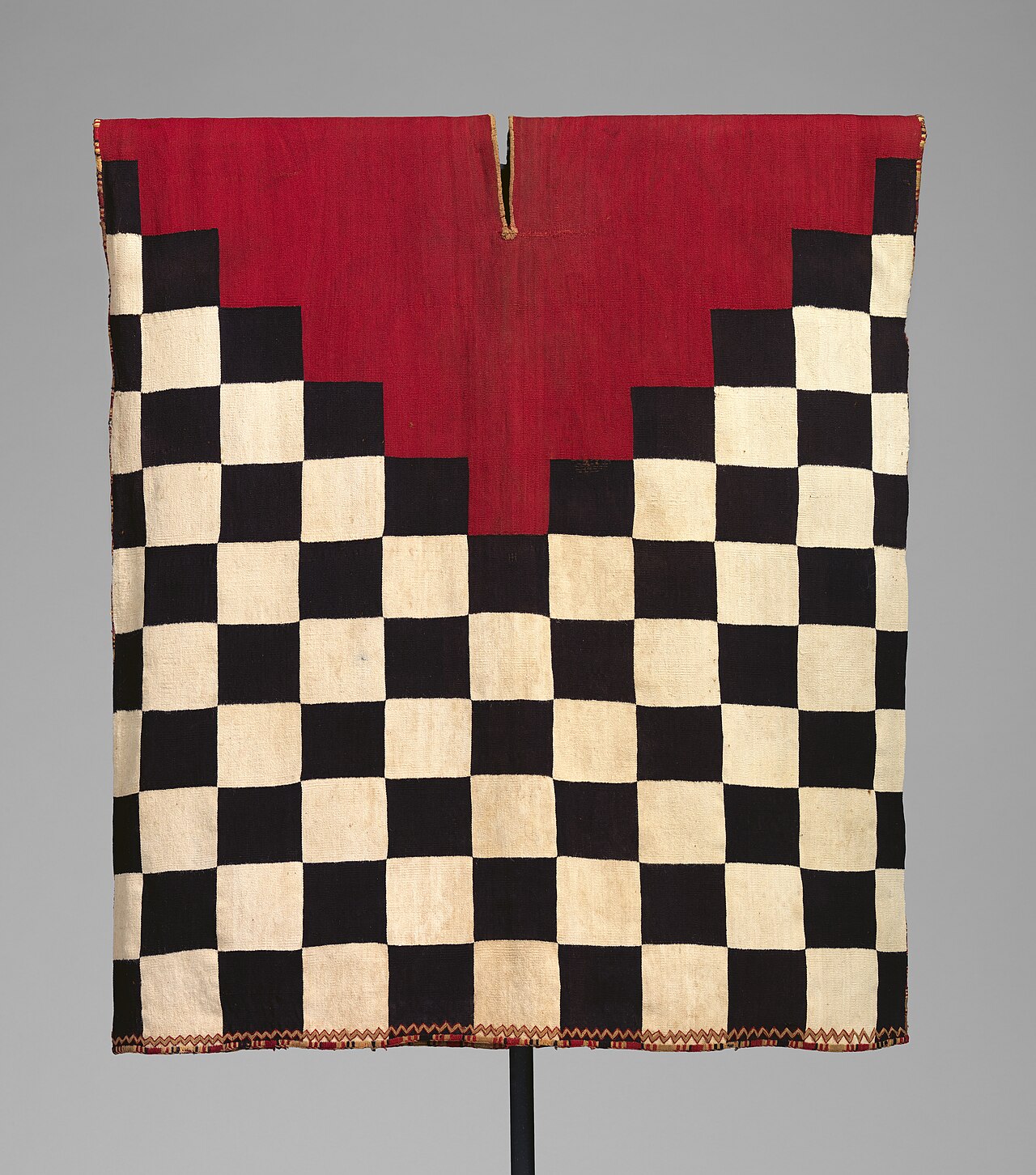
A tapestry-woven tunic laid flat on a stand against a grey background. It has a black-and-white checkerboard pattern with a red V-shaped yoke at the top and a neck slit in the center. The bottom edge has a decorative woven border.Artifact

Primary source

Inca Checkerboard Tunic with Red V-Yoke

Inca artist · 16th century

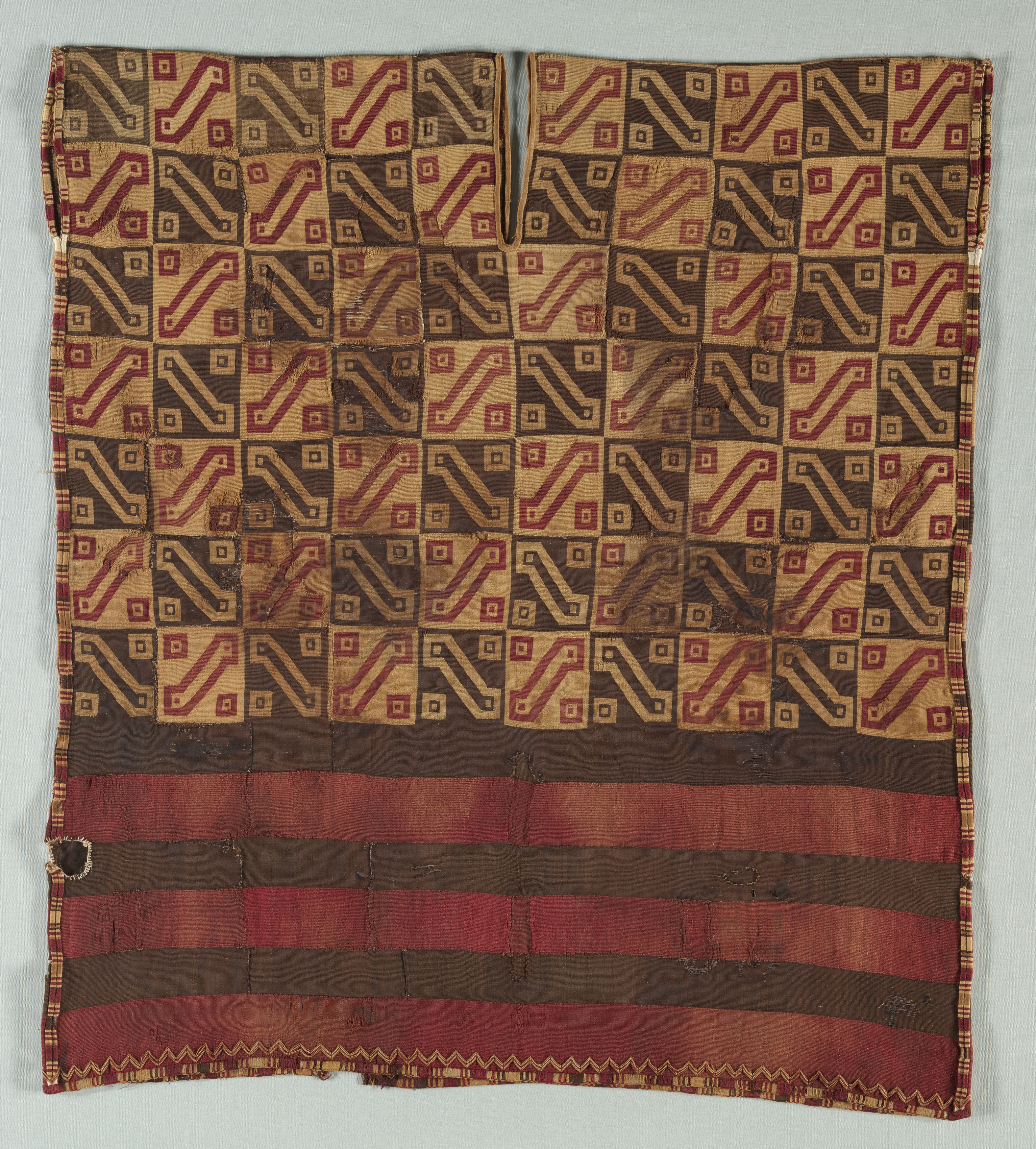
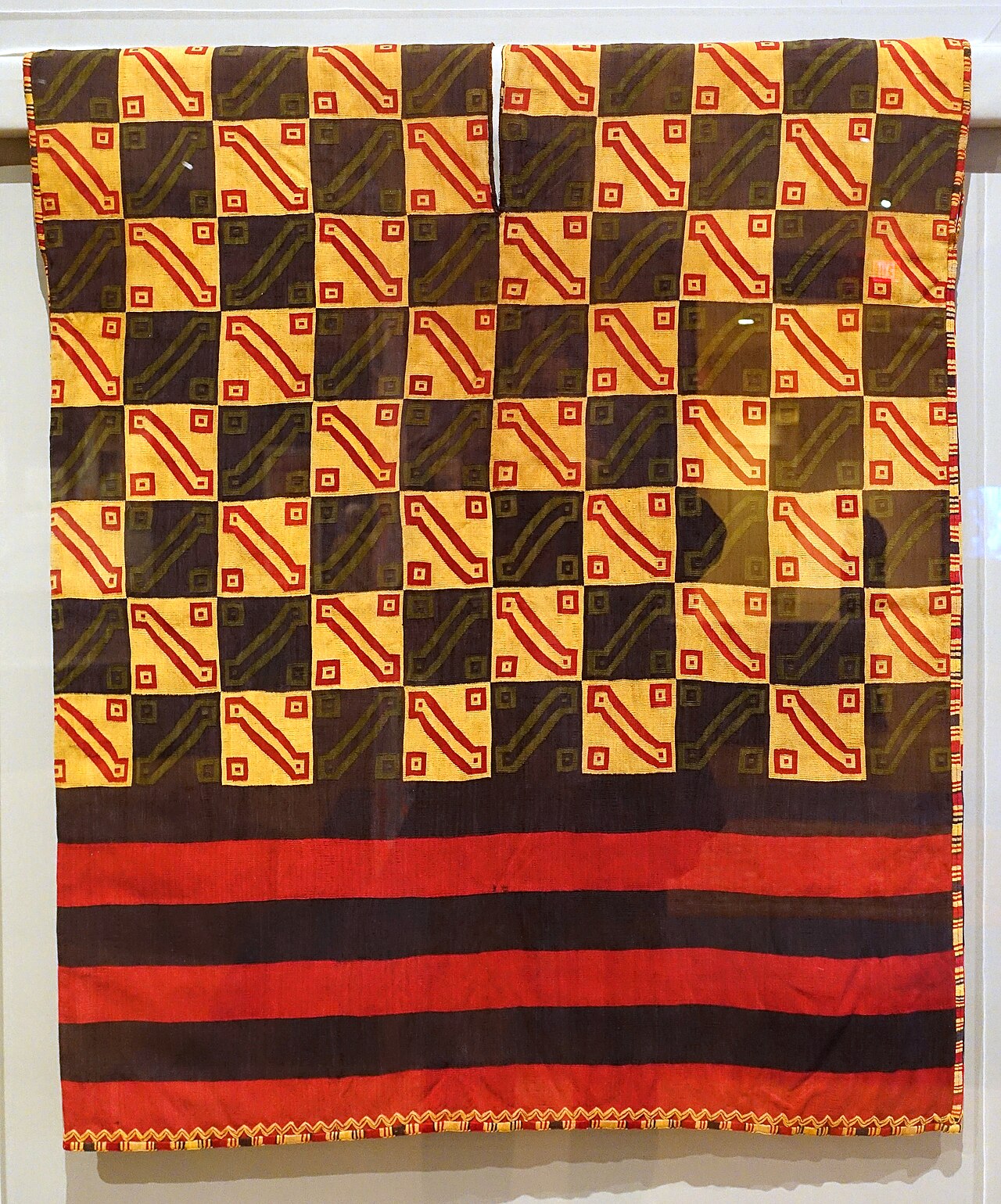
A framed Inca-style man's tunic displayed behind glass. Its upper section has a checkerboard of yellow and dark brown squares with red and olive motifs; the lower section has broad horizontal red and dark brown bands, edged with a zigzag border at the bottom.Artifact

Primary source

Inca Man's Tunic

c. 1410-1532

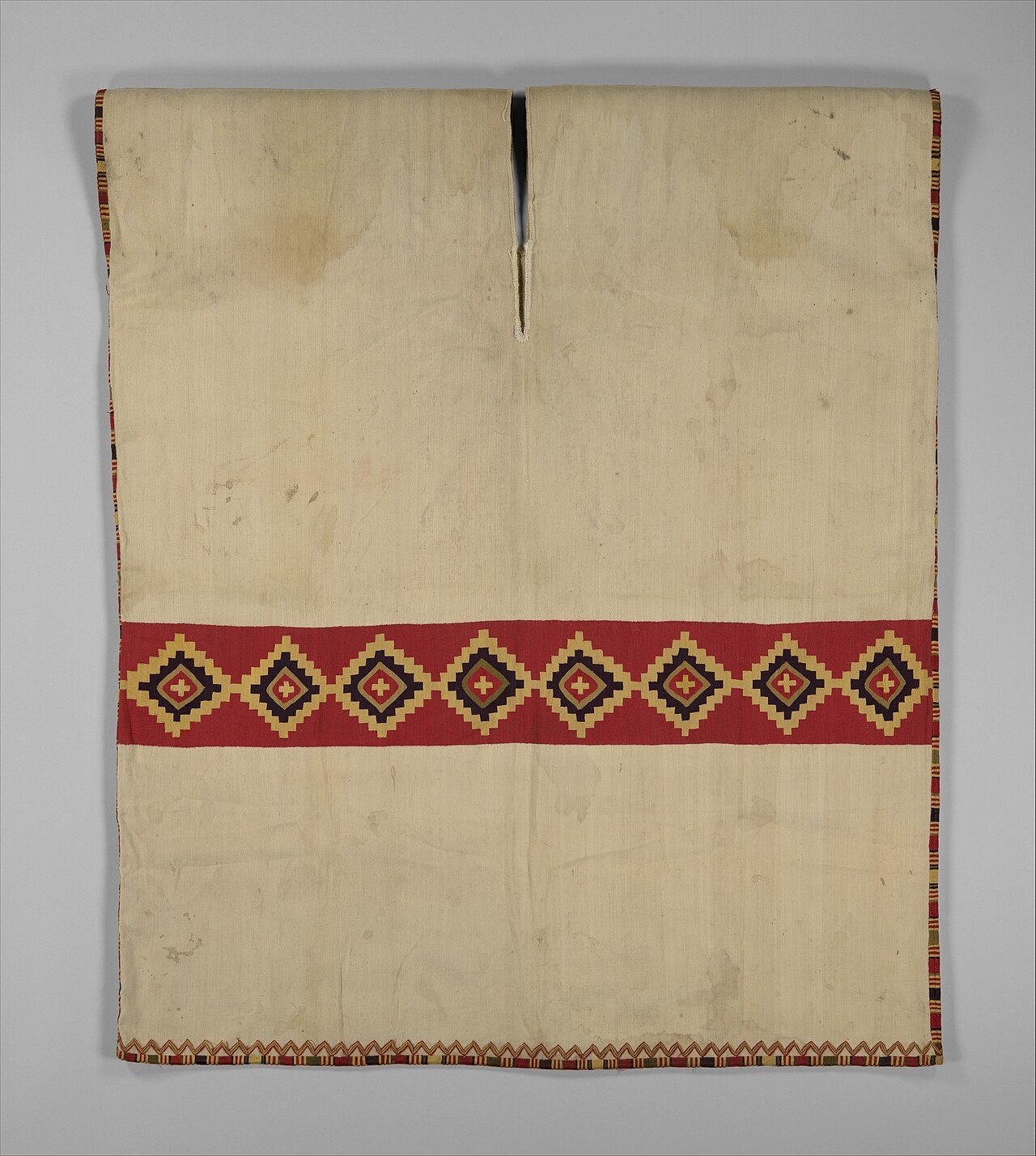
Photograph of a folded-open Inca tunic laid flat against a grey background. The cream-colored cloth has a central neck slit and a horizontal band of red with repeating yellow, purple and red diamond motifs, with striped borders along the sides and a zigzag hem at the bottom.Artifact

Primary source

Inca tunic with diamond band

between 1460 and 1540

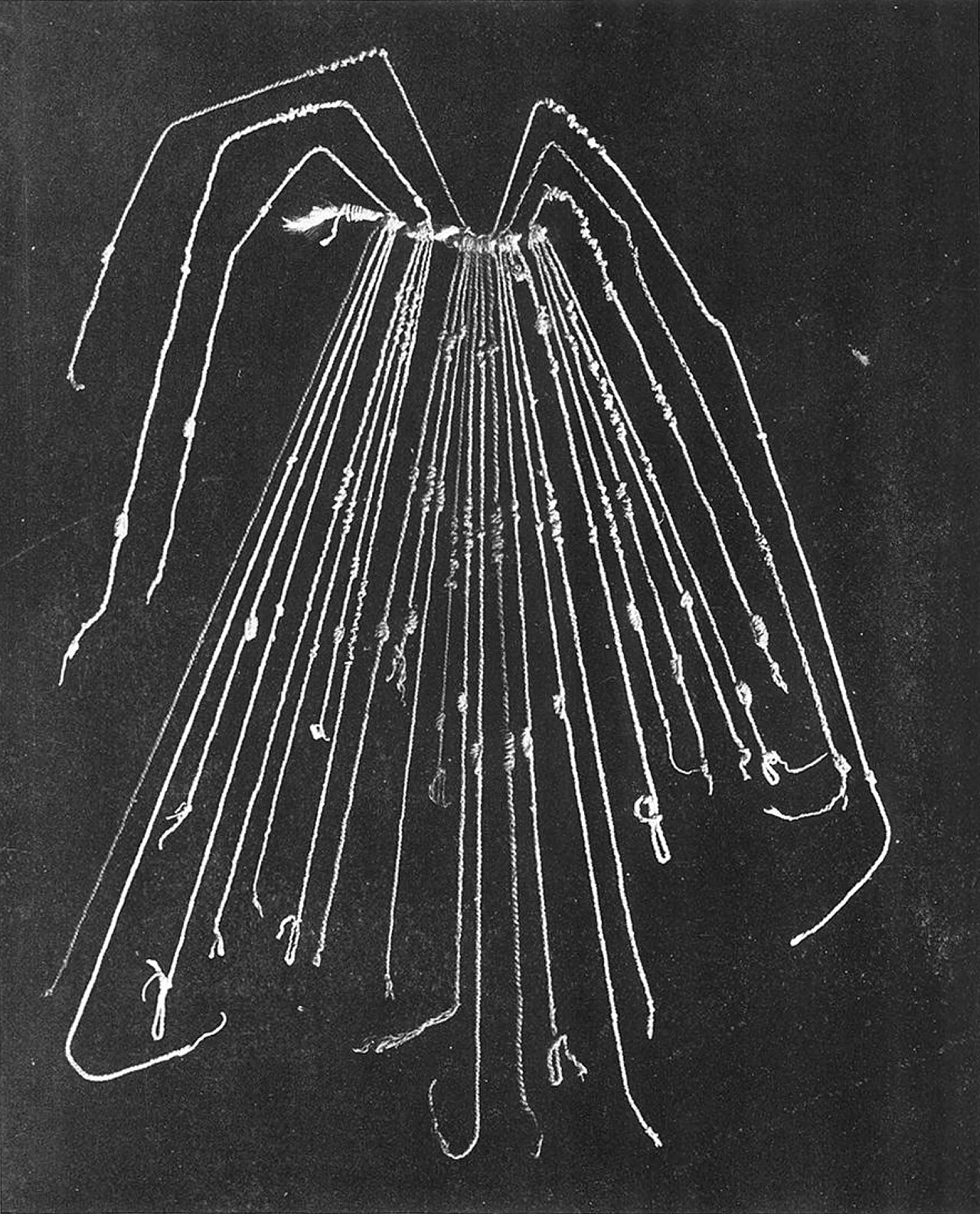
Black-and-white photograph of a quipu, an Andean knotted-cord record, hanging against a dark background. Many long, twisted cords with knots hang from a single top cord that curves across the top, with two loose ends extending outward.Book

Secondary source

The Ancient Quipu, Plate XXII

Leslie Leland Locke · 4 January 1912

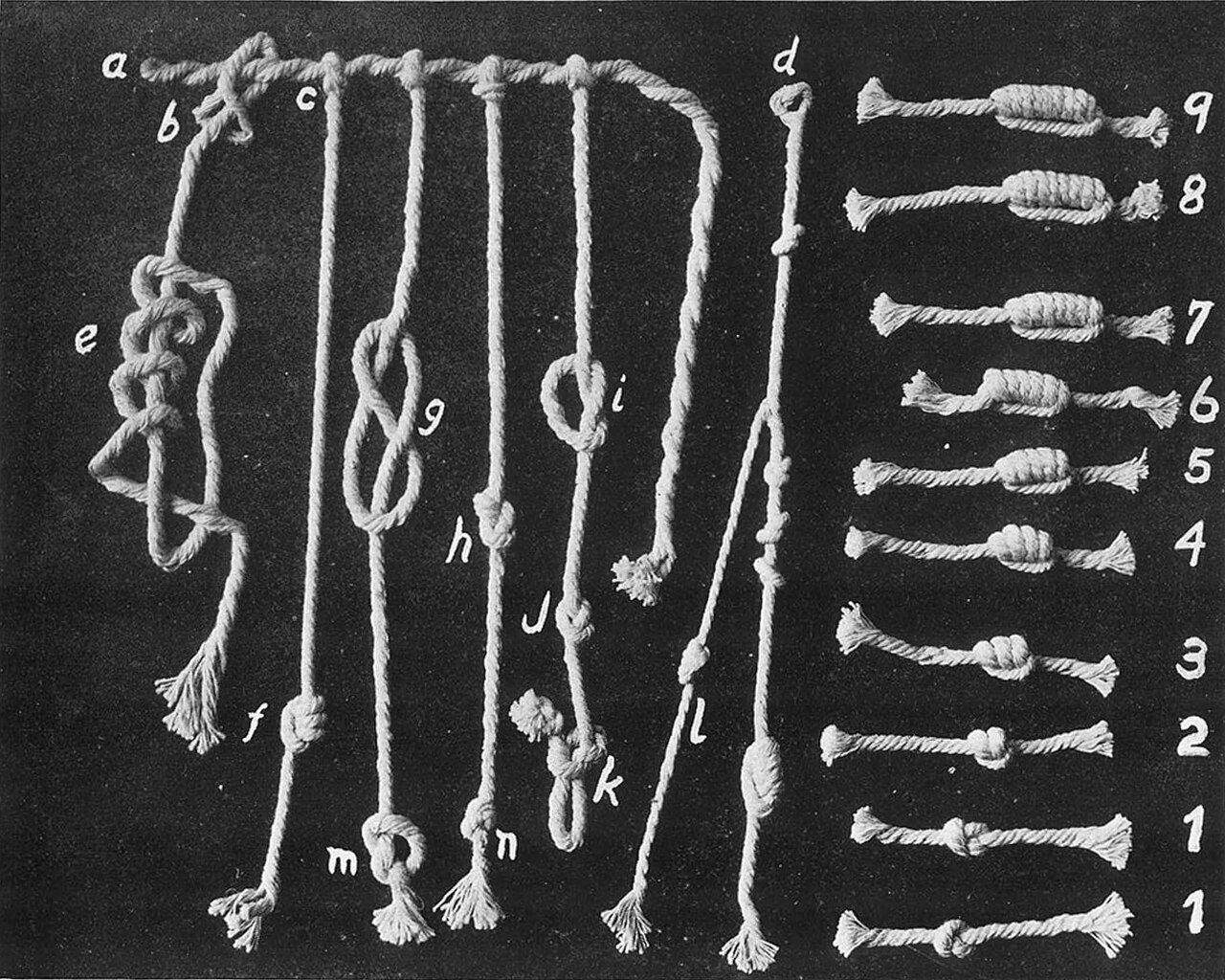
Black-and-white photograph of white cords on a dark background, with letters a to n marking different knotted cords. On the right, a column of short horizontal cords with knots is numbered 9 down to 1.Book

Secondary source

The Ancient Quipu, Plate XXI

Leslie Leland Locke · 4 January 1912

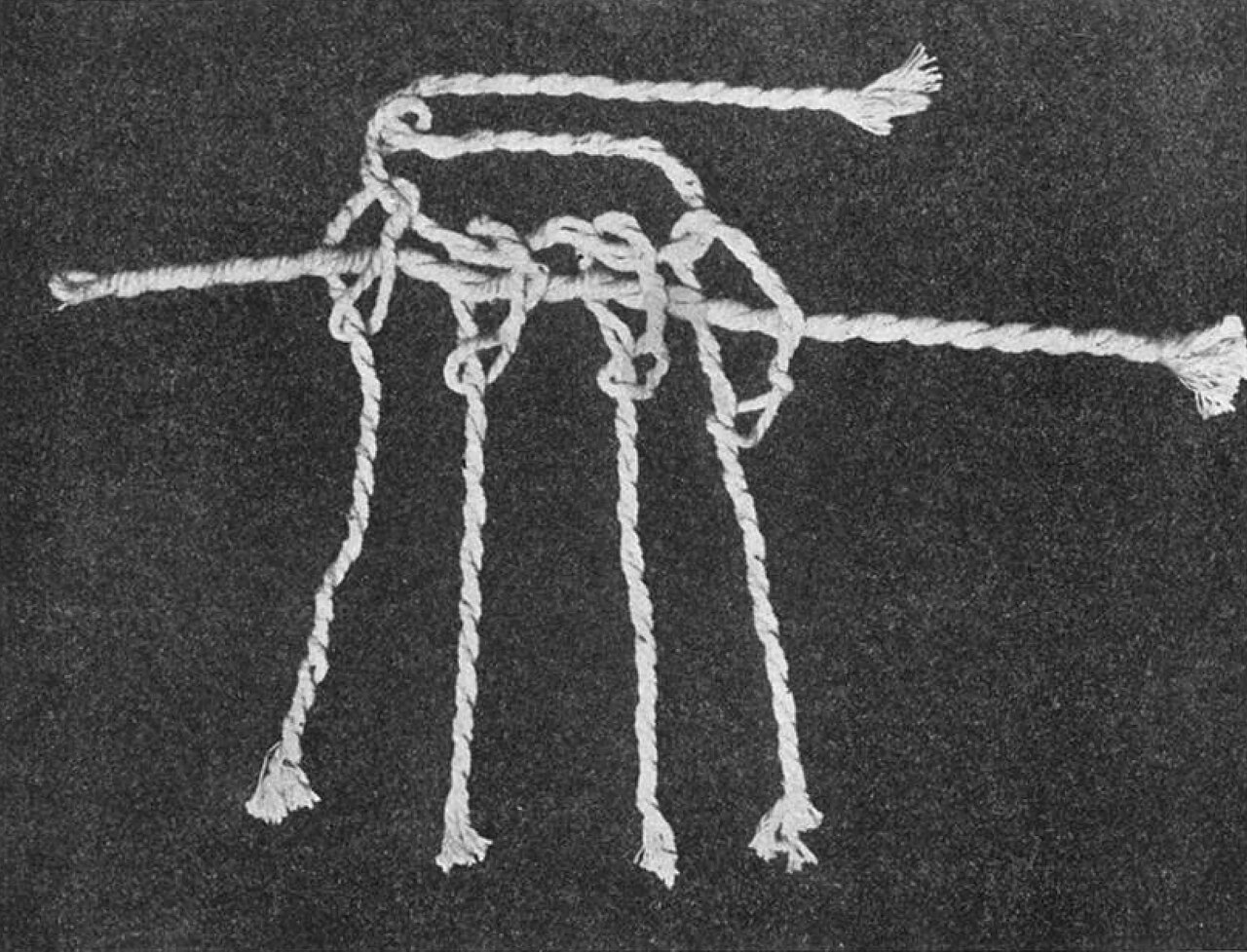
Black-and-white photograph of a knotted cord arrangement on a dark background: a horizontal main cord with several pendant cords hanging down, each with tassel ends, and multiple knots tied along the cords, with one cord ending in a frayed tip at upper right.Book

Secondary source

The Ancient Quipu, Figure 45

Leslie Leland Locke · 4 January 1912

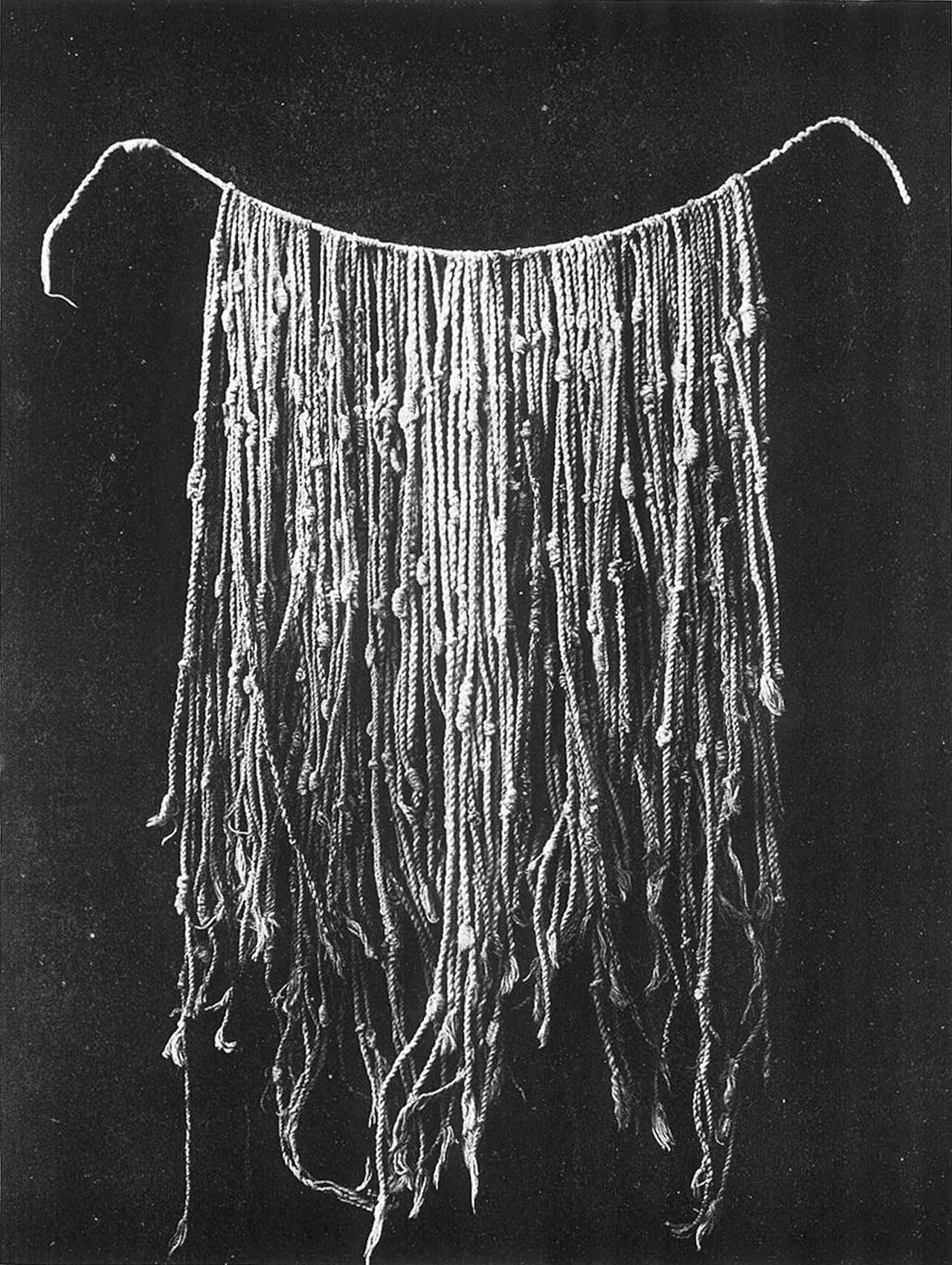
Black-and-white photograph of a khipu, an Andean knotted-cord record, on a dark background. White cords hang from a top attachment point and fan downward, with knots tied along them and pendant cords ending in loose fringed ends.Book

Secondary source

The Ancient Quipu, Plate XXIV

Leslie Leland Locke · 4 January 1912

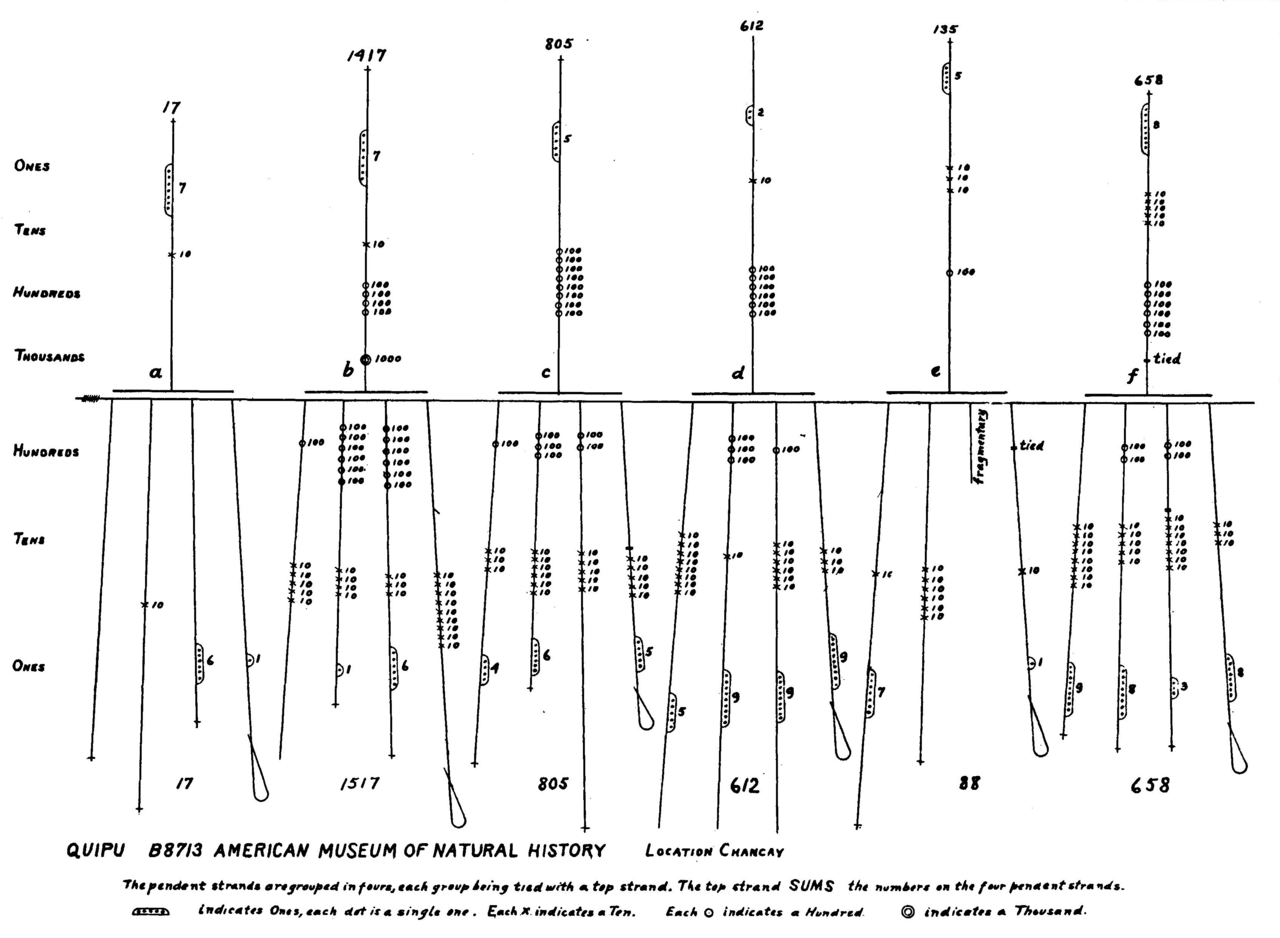
Line diagram of an Inca quipu record from Plate XXIII: many vertical cords hang from horizontal top strands, with knots drawn as tens, hundreds, and thousands symbols and numbers printed above and below. Labels reading Ones, Tens, Hundreds, Thousands, and Location Chancay appear at left and bottom, with caption text describing the quipu as American Museum of Natural History B8713.Book

Secondary source

The Ancient Quipu, Plate XXIII

Leslie Leland Locke · 1 April 1912

Want the full shelf? Chat with Atahualpa in the app and open the Sources panel — every quote links back to the original.

Use Atahualpa in class

2 collections

Ready-made collections from the Humy team that feature Atahualpa. Preview any of them, then try it free.

Trusted by educators worldwide

Conversations
375,000+
Real exchanges between students and historical figures
Messages exchanged
4,142,000+
Across every figure, classroom and language
Historical figures
100,000+
Each informed by a curated biography and selected sources
Languages supported
50+
From English and Spanish to Arabic and Korean

Paying customers

Used by 98 schools and universities

Partner school logo
Tecnológico de Monterrey logo
Hyper Island logo
Partner school logo
Chambersburg Area School District logo
Broward County Public Schools logo
Nebo School District logo
National Louis University logo
South Florida PBS logo
Punahou School logo
University of Wisconsin–River Falls logo
Partner school logo
Partner school logo
Archbishop Mitty High School logo
Kingsburg High School logo
Norwalk Public Schools logo
Partner school logo
Connections logo
Partner school logo
Moore Public Schools logo
Partner school logo
Partner school logo
Partner school logo
Partner school logo
Robbinsville Public Schools logo
Partner school logo
Partner school logo
Partner school logo
Tecnológico de Monterrey logo
Hyper Island logo
Partner school logo
Chambersburg Area School District logo
Broward County Public Schools logo
Nebo School District logo
National Louis University logo
South Florida PBS logo
Punahou School logo
University of Wisconsin–River Falls logo
Partner school logo
Partner school logo
Archbishop Mitty High School logo
Kingsburg High School logo
Norwalk Public Schools logo
Partner school logo
Connections logo
Partner school logo
Moore Public Schools logo
Partner school logo
Partner school logo
Partner school logo
Partner school logo
Robbinsville Public Schools logo
Partner school logo
Partner school logo

What educators are saying

“We enjoyed the program last year and used it frequently.”
“My students say it’s a welcome change of pace. I’m not a fan of the “sage on the stage” model, so I try to incorporate research-oriented and self-paced activities. With Humy, students have to take charge of their learning. They’ve become more adept at critical thinking, forming better questions, and improving their reading comprehension. The interview feature has been my go-to tool. I create assignments where students must ask historical figures a set number of questions, then summarize the responses to ensure they’re truly absorbing the material. This approach lets them actively explore the past rather than passively consuming information.”
“Humy has helped me bring historical figures, sometimes long past, to life. When my students interact with these figures in real-time, it eliminates some of the perceived “ancient” characteristics of my curriculum. This has shifted my students’ thinking away from viewing history as abstract or irrelevant. Real-time interactions make historical figures relatable, even allowing students to ask off-topic questions that help put historical lives in a more relevant context for 13-year-olds. The feature I use the most is the interview feature. After teaching a topic, most recently Gandhi and Joan of Arc, I have the students ask pointed, focused questions. We practice good conversation techniques beforehand, teaching them to listen (or read) carefully and formulate thoughtful follow-up questions rather than just interrogating. It helps students practice effective conversation skills.”

FAQ

Frequently asked questions

Who is Atahualpa?
Last ruling Inca Emperor. On Humy.ai you can chat with an AI version of Atahualpa that draws on a short biography and 80 historical sources during the conversation — by text or voice, in 42 languages.
Is Atahualpa AI free?
Atahualpa is part of Humy's full library of more than 100,000 figures, which comes with a paid plan. A free account (no credit card) includes 20 messages a month with the free library's figures, so you can try how the conversations work first.
What sources does the Atahualpa AI use?
It draws on a short biography and 80 historical sources (paintings, books and artifacts), including “Atawallpa Pizarro tinkuy”, “El primer nueva corónica y buen gobierno” and “Muerte de Atagualpa Inca”. Each source has its own page on Humy.ai.
How historically accurate is the AI version of Atahualpa?
Each figure uses a short biography and a small set of selected historical sources as context (retrieval-augmented generation), so answers stay closer to known material than the model's general knowledge alone. It isn't a citation-grade research tool — like any LLM, the AI can get details wrong or extrapolate. Treat it as a strong starting point for inquiry and cross-reference important claims.
Can I talk to Atahualpa by voice?
Yes. In addition to text chat, you can call Atahualpa and hear their voice respond in real time — useful for auditory learners, interview practice and Socratic dialogue.
Is Humy.ai safe and compliant for schools?
Yes. Humy.ai is used by more than 100 schools, universities and organisations. The platform is FERPA- and GDPR-aligned, supports SSO, and offers an IT-approval pack tailored for school procurement teams.

Ready when you are

Start chatting with Atahualpa now.

20 messages free · No credit card · Available in 50+ languages.