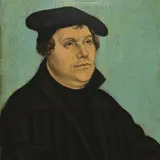
Portrait of Martin Luther

AI Historical Figure

Martin Luther

Key figure in the Protestant Reformation.

Chat with Martin Luther via text or voice — in 42 languages, drawing on a curated biography and 88 historical sources. Available 24/7.

Start chatting with Martin Luther20 messages free · No credit card
Lived
1483–1546
From
Germany
Known for
ReligionLiterature & writing
Martin Luther

Martin Luther

Online · responds in seconds

Hello — I'm Martin Luther. Key figure in the Protestant Reformation. What would you like to ask me?

20 messages free · No credit card · Powered by Humy.ai

Live preview · Switch between 42 languages above · Send a message to continue in the app

Multilingual

Talk to Martin Luther in 42 languages

Ask Martin Luther questions in any language below, and the rest of Humy's app speaks it too. Pick yours to open the chat in that language.

Also in German (Austria), German (Switzerland), English (UK), English (Australia), English (Canada).

The sources behind this AI

88 sources · 30 books · 22 documents · 21 paintings · 6 artifacts · 5 letters · 2 documentaries · 1 speech · 1 newspaper article

Martin Luther doesn’t improvise from thin air. The AI is grounded in 88 curated historical sources students can inspect. Open any of them to see what informs the conversation.

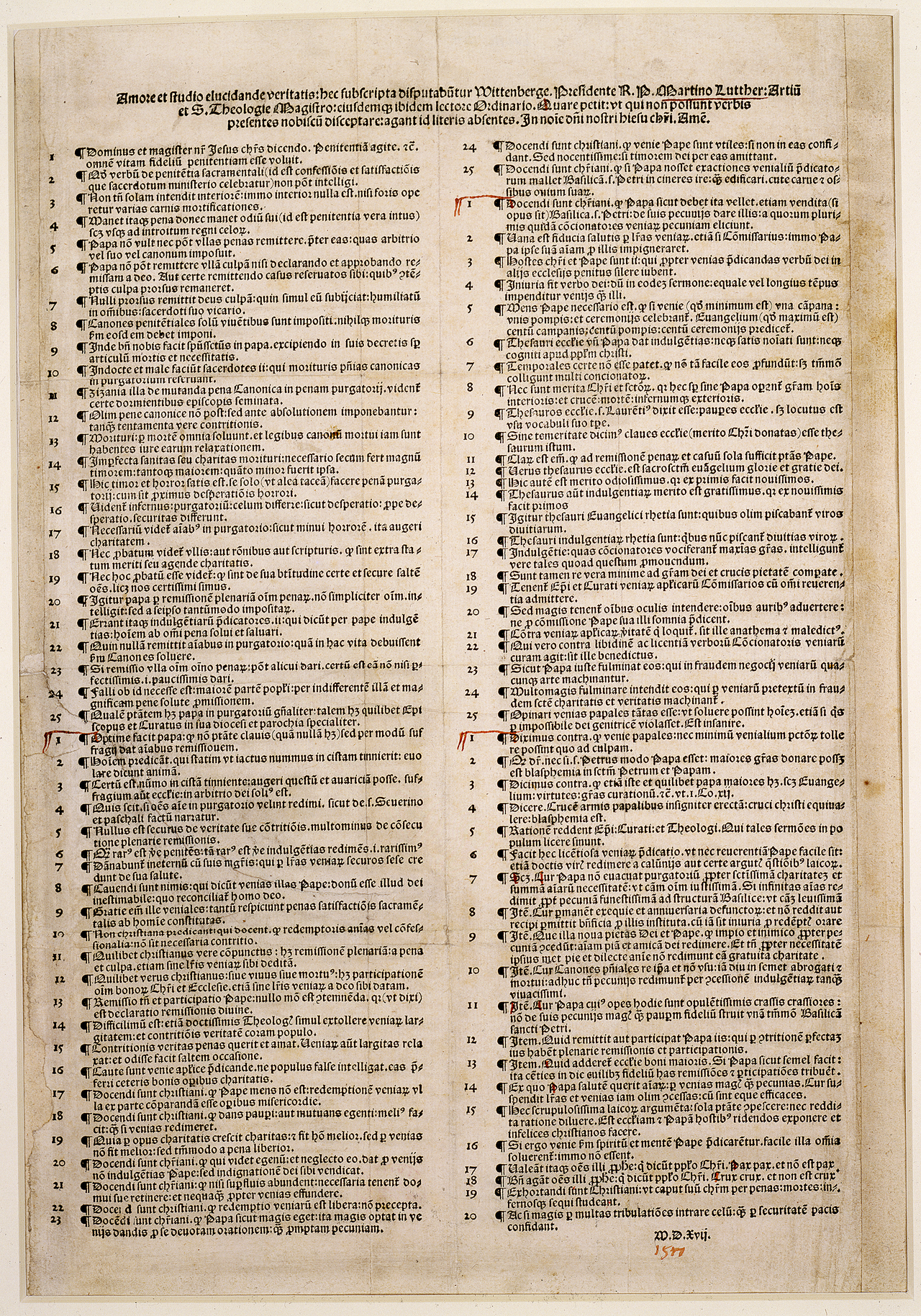
Printed 1517 broadsheet page of Martin Luther's Ninety-Five Theses, in black letter type with red paragraph marks and a title header at top. Dense two-column Latin text, numbered theses, and a date near the bottom.Document

Primary source

Ninety-five Theses

Martin Luther · 1517

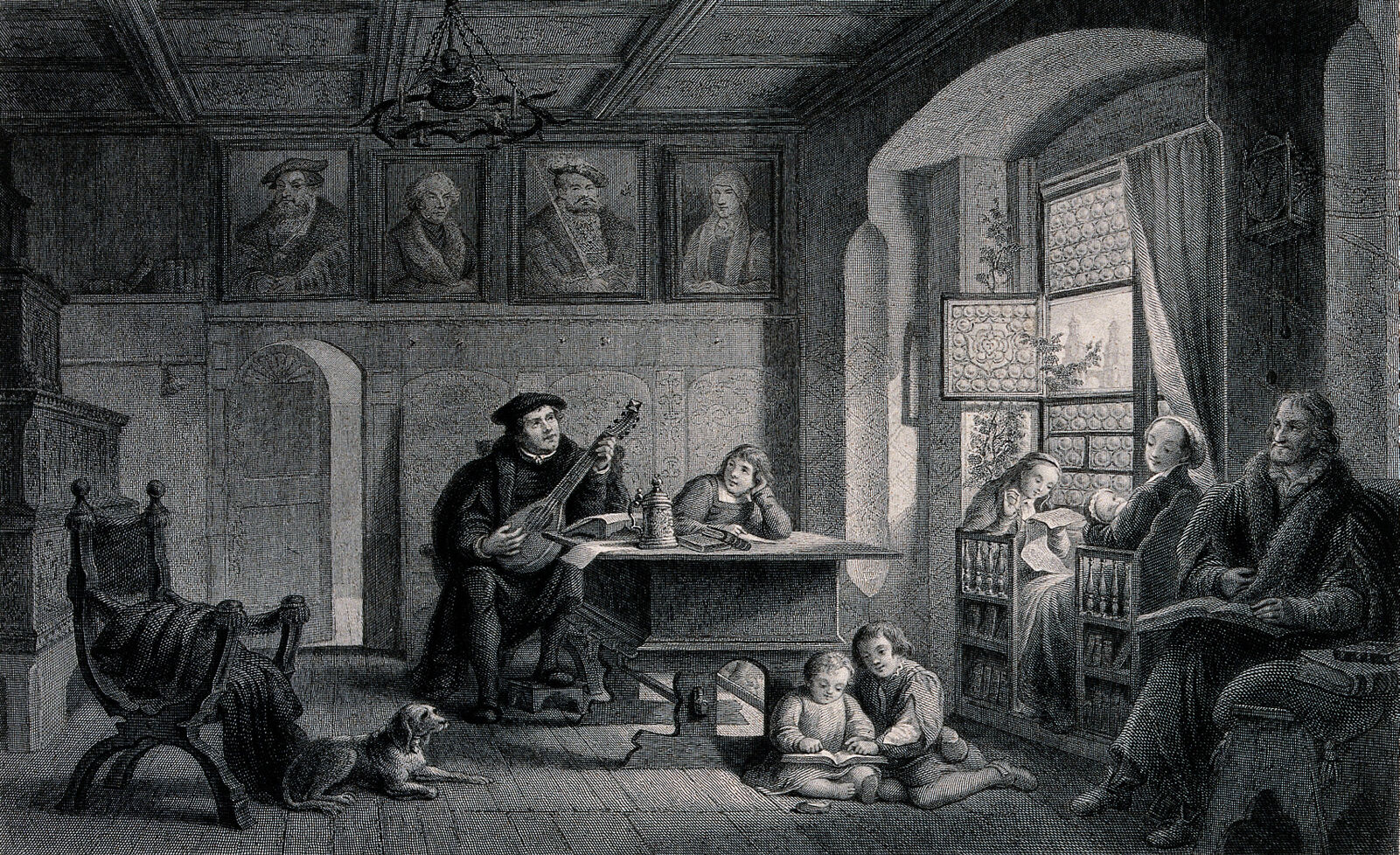
Black and white engraving of an interior room with coffered ceiling and four framed portraits on the wall. A man in dark robes and cap plays a lute at a table while a young boy with a tankard listens. On the right, a woman and a child sit by a window and an older man reads. Two children sit on the floor reading a book, and a dog lies near the left chair.Painting

Secondary source

Domestic Life of Martin Luther at Wittenberg

Pierre-Antoine Labouchère (design); J. D. Nargeot (engraving) · 1800-1899

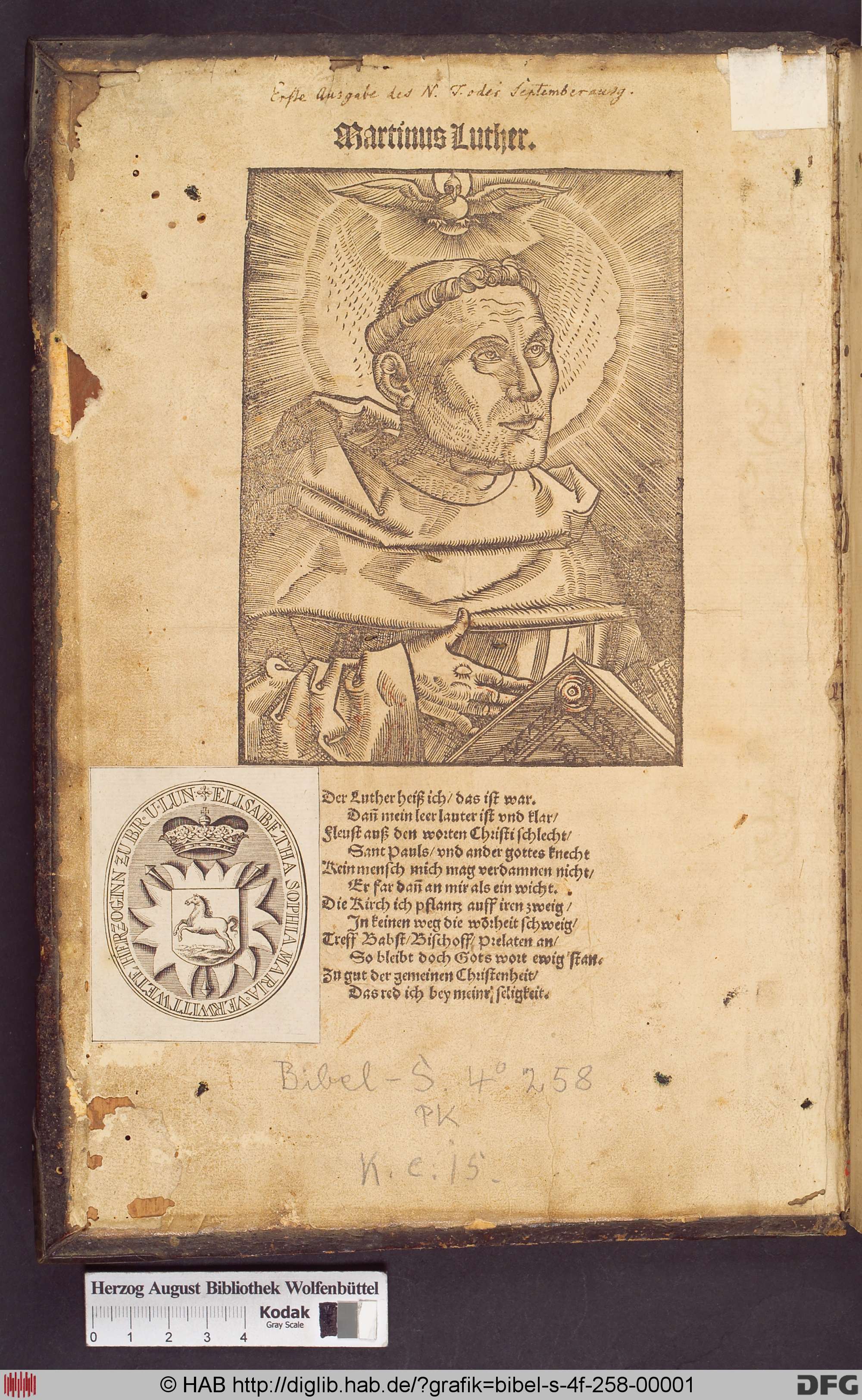
Woodcut portrait of Martin Luther with a dove above his head in a radiating halo, wearing a monastic robe, hands resting on a closed book. Above the image is the title Martinus Luther; below are verses and a coat of arms seal.Painting

Primary source

Martinus Luther Woodcut Portrait

Unbekannt (Formschneider)

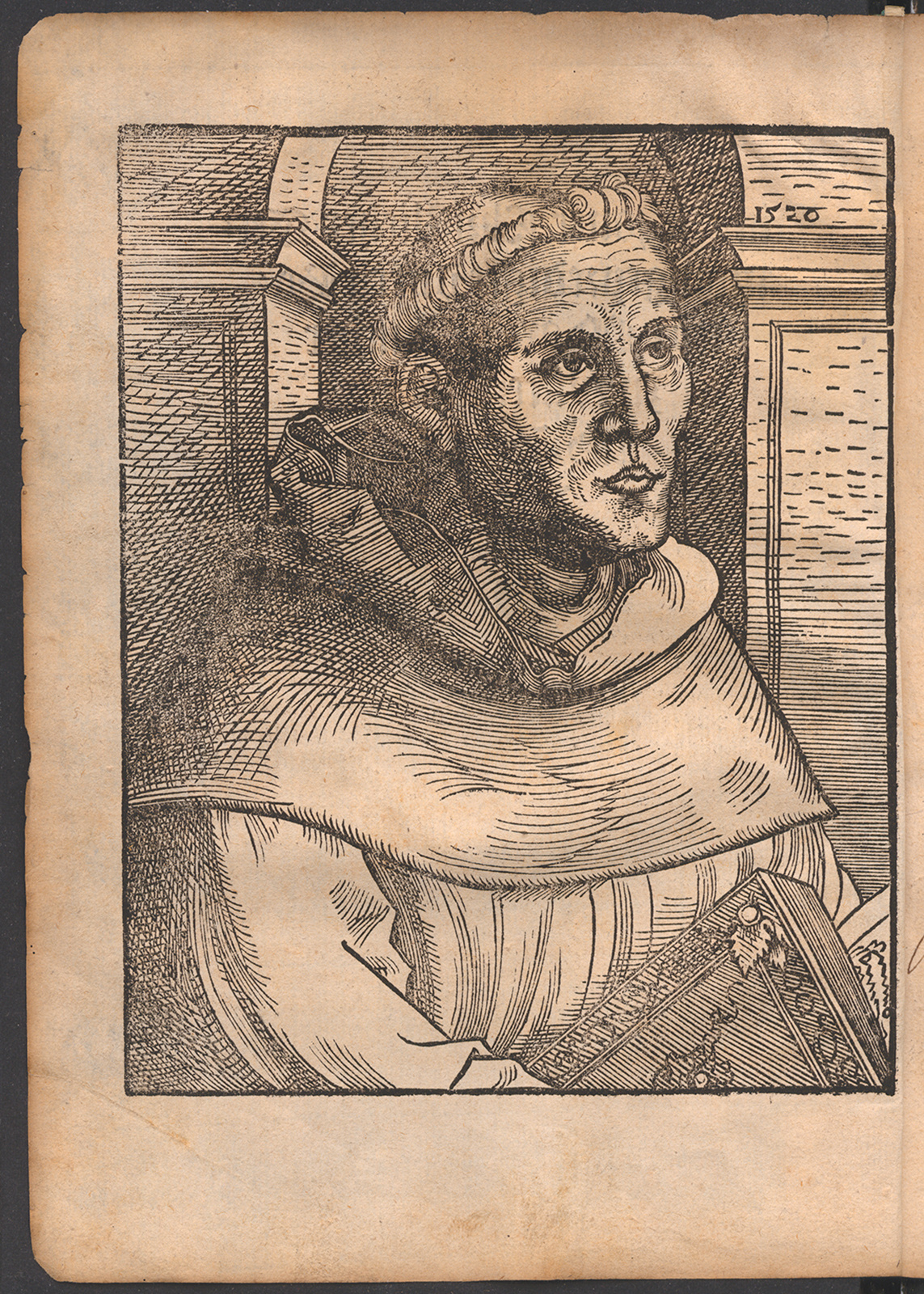
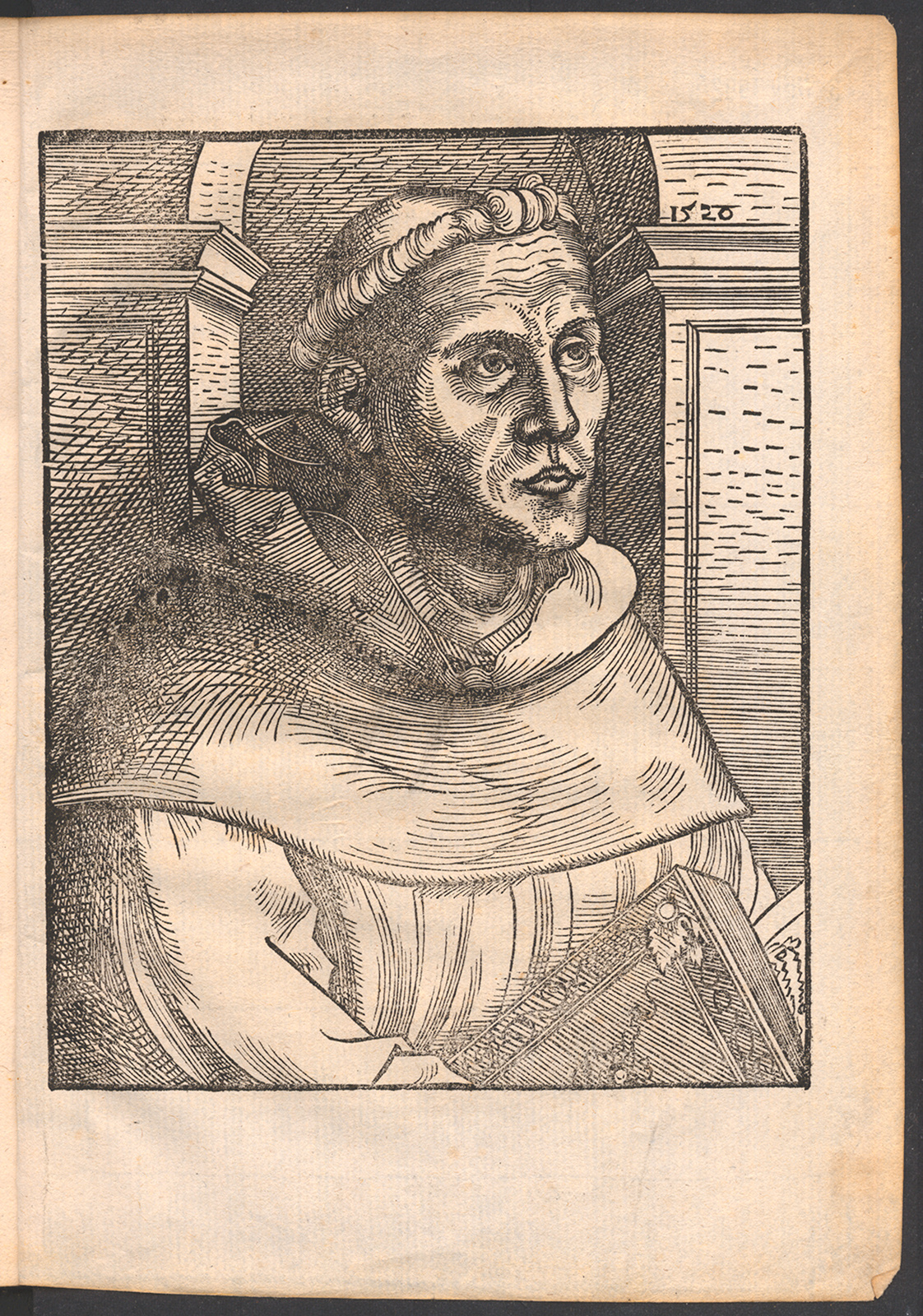
Scan of a printed page with a black-and-white woodcut portrait of a man with short curly hair in a monastic-style robe with a high collar, holding a book with a decorated cover. Architectural columns frame him, and the date 1520 is printed at upper right.Painting

Primary source

Woodcut Portrait of Luther in Sermon Pamphlet

1523

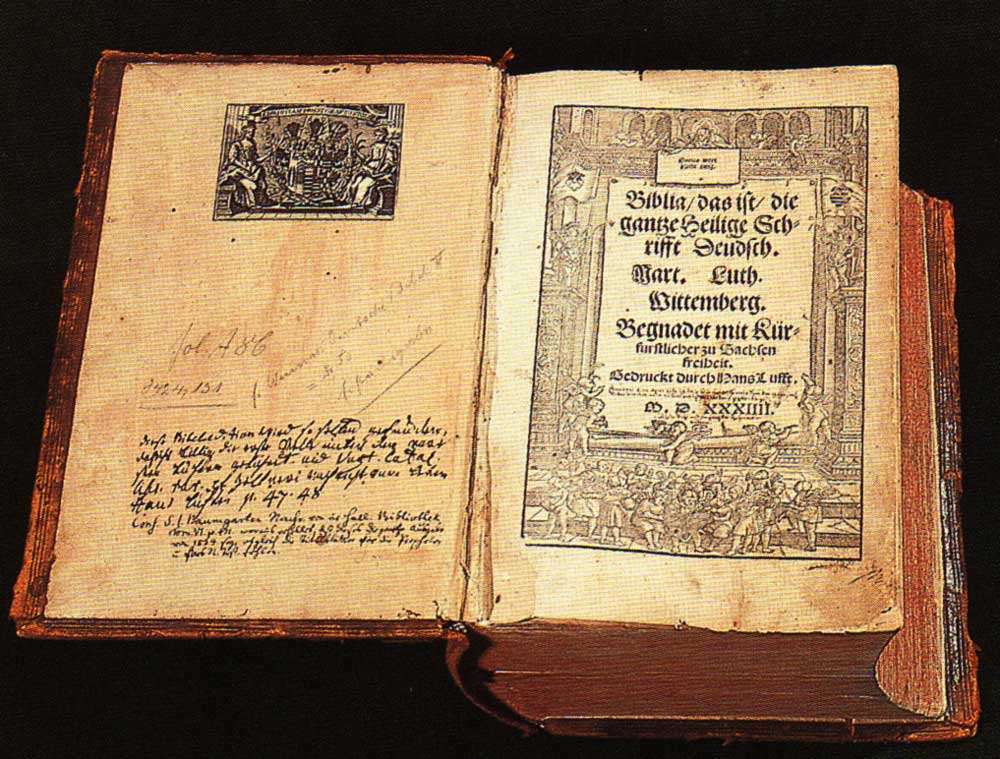
An open, worn leather-bound book lying on a dark background. The right page shows a woodcut title page reading 'Biblia, das ist: die gantze Heilige Schrifft Deudsch, Mart. Luth. Wittemberg' with the date MDXXXIIII. The left page has a small woodcut and handwritten notes.Book

Secondary source

Luther Bible

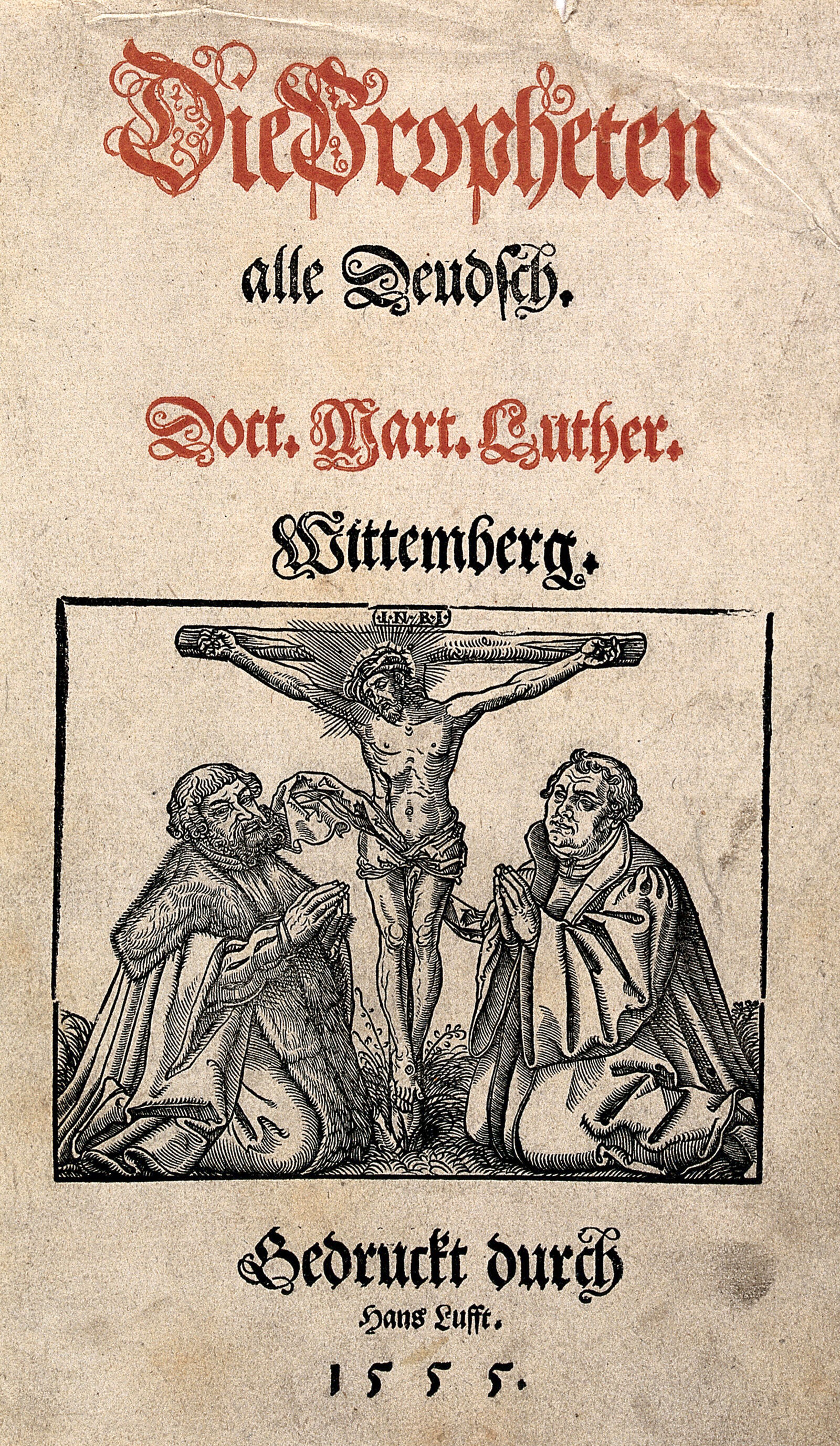
Martin Luther · 1534

Title page of a German Bible printed in Wittenberg in 1555, with red and black gothic lettering reading 'Die Propheten alle Deutsch, Doct. Mart. Luther, Wittenberg, Gedruckt durch Hans Lufft, 1555'. Below is a woodcut of Christ on the cross with two kneeling, praying men in robes on either side.Painting

Secondary source

Frederick the Wise and Martin Luther Kneeling before Christ on the Cross

1555

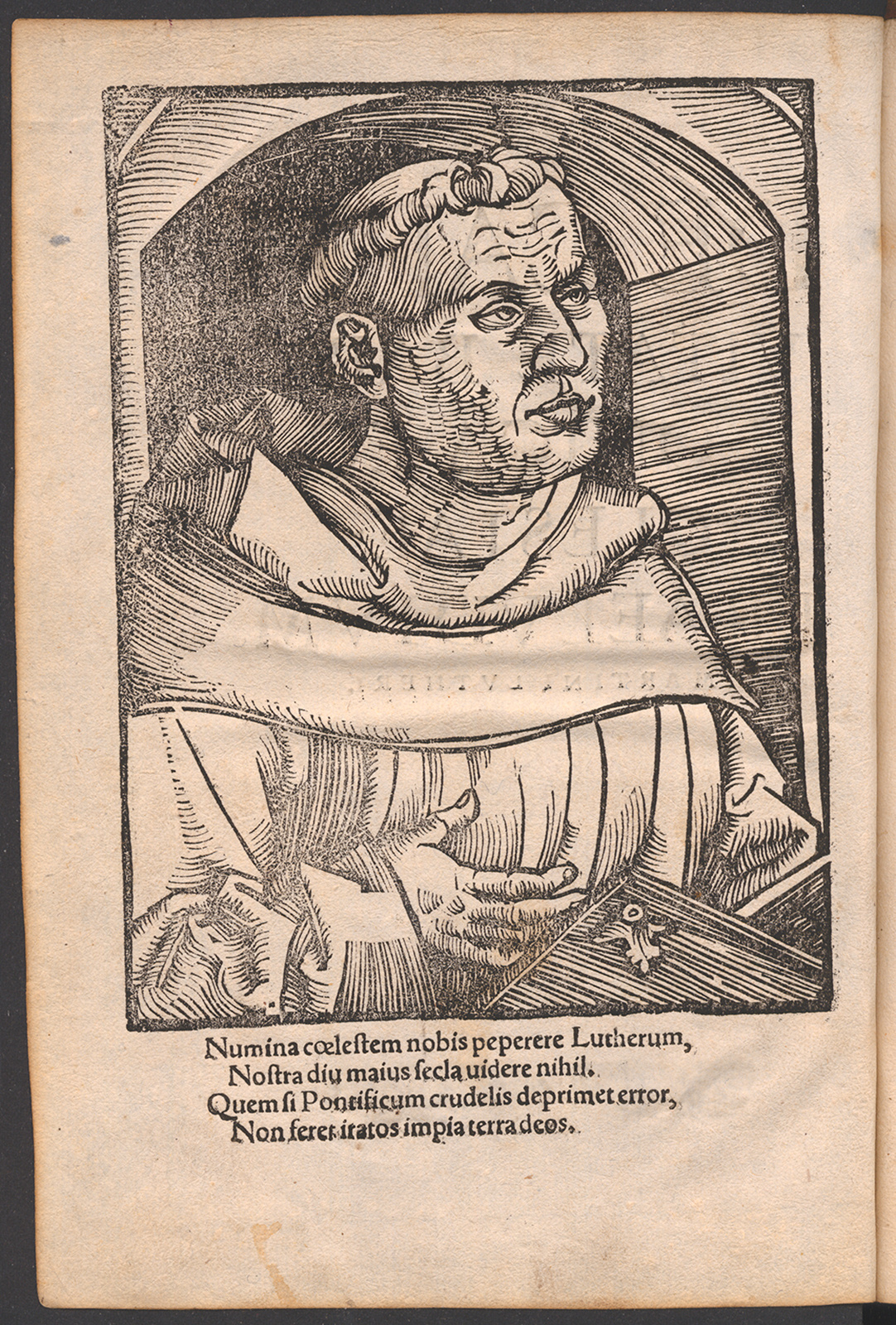
Woodcut portrait of a man with short curled hair, wearing a monastic-style robe with a wide collar, shown within an arched frame. He looks upward to the right and holds a book. Latin verses are printed in a caption below the image, on a book page.Painting

Primary source

Woodcut Portrait of Luther in Babylonian Captivity

1520

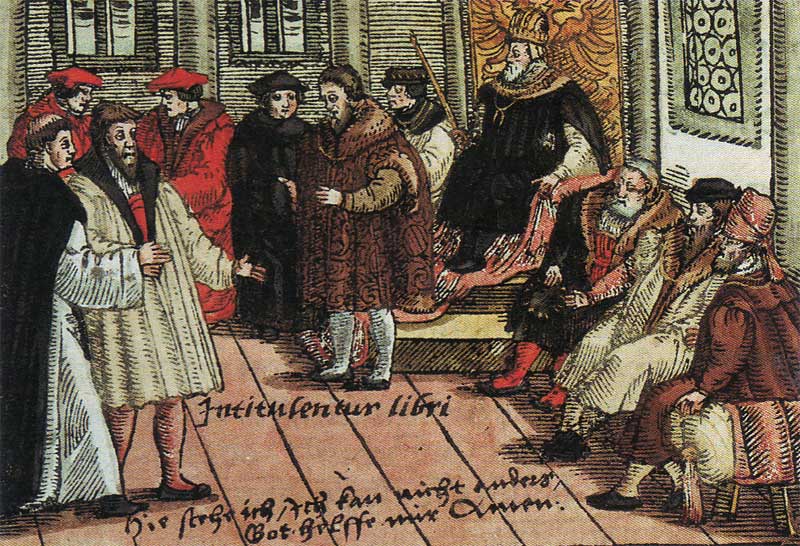
Colored woodcut of the 1521 Diet of Worms: a bearded man in a light robe stands before the emperor on a raised dais under a gold canopy, while nobles in fur and red garments look on. Captions in Latin and German appear below.Speech

Secondary source

Luther's speech at the Diet of Worms

Martin Luther · 18 April 1521

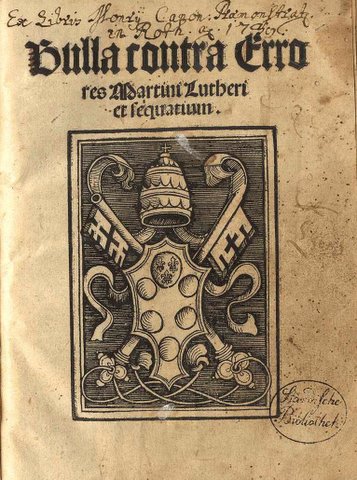
Title page of a printed papal bull reading "Bulla contra Errores Martini Lutheri et sequacium" in black letter type, with a woodcut papal coat of arms showing crossed keys and a tiara above a shield with pellets. Handwritten Latin inscription in the top left corner and a circular library stamp in the bottom right.Document

Primary source

Exsurge Domine

Leo X · 15 June 1520

Black and white woodcut of a bearded... no, a clean-shaven older man in a monk's hooded garment and white collar, seen in three-quarter view within an arched architectural frame. Date 1520 is carved at upper right; a book with ornate border rests at lower right.Painting

Primary source

Woodcut from Luther's Sermon on Worldly Authority

Martin Luther · c. 1523

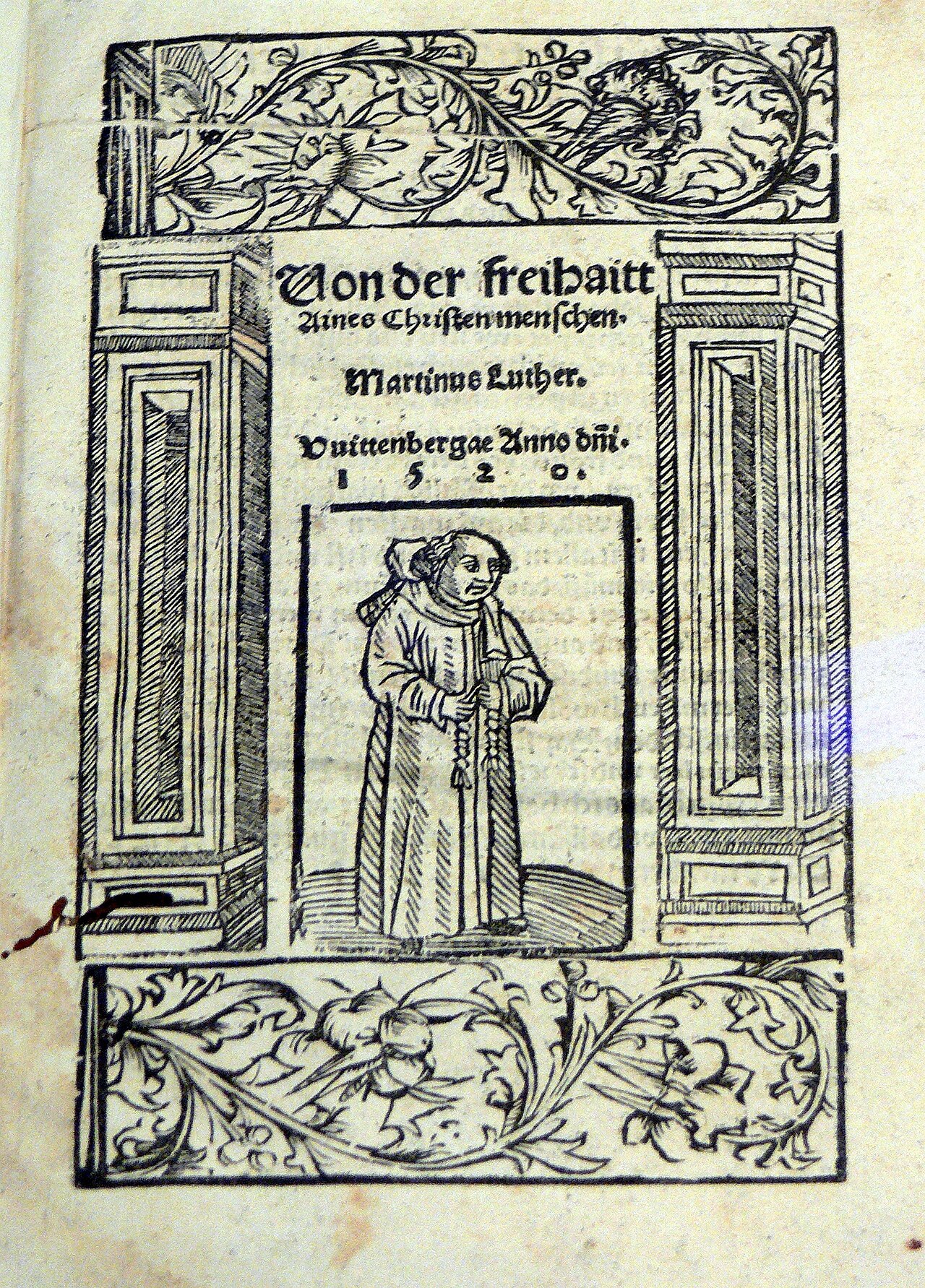
Title page of a 1520 German woodcut-decorated book, with ornate floral borders and architectural pillar frames. Title reads 'Von der freiheit eines Christenmenschen', 'Martinus Luther', 'Vuittenbergae Anno dni 1520'. A woodcut figure of a robed monk with a rosary stands in the center.Book

Primary source

The Freedom of a Christian

Martin Luther · 1520

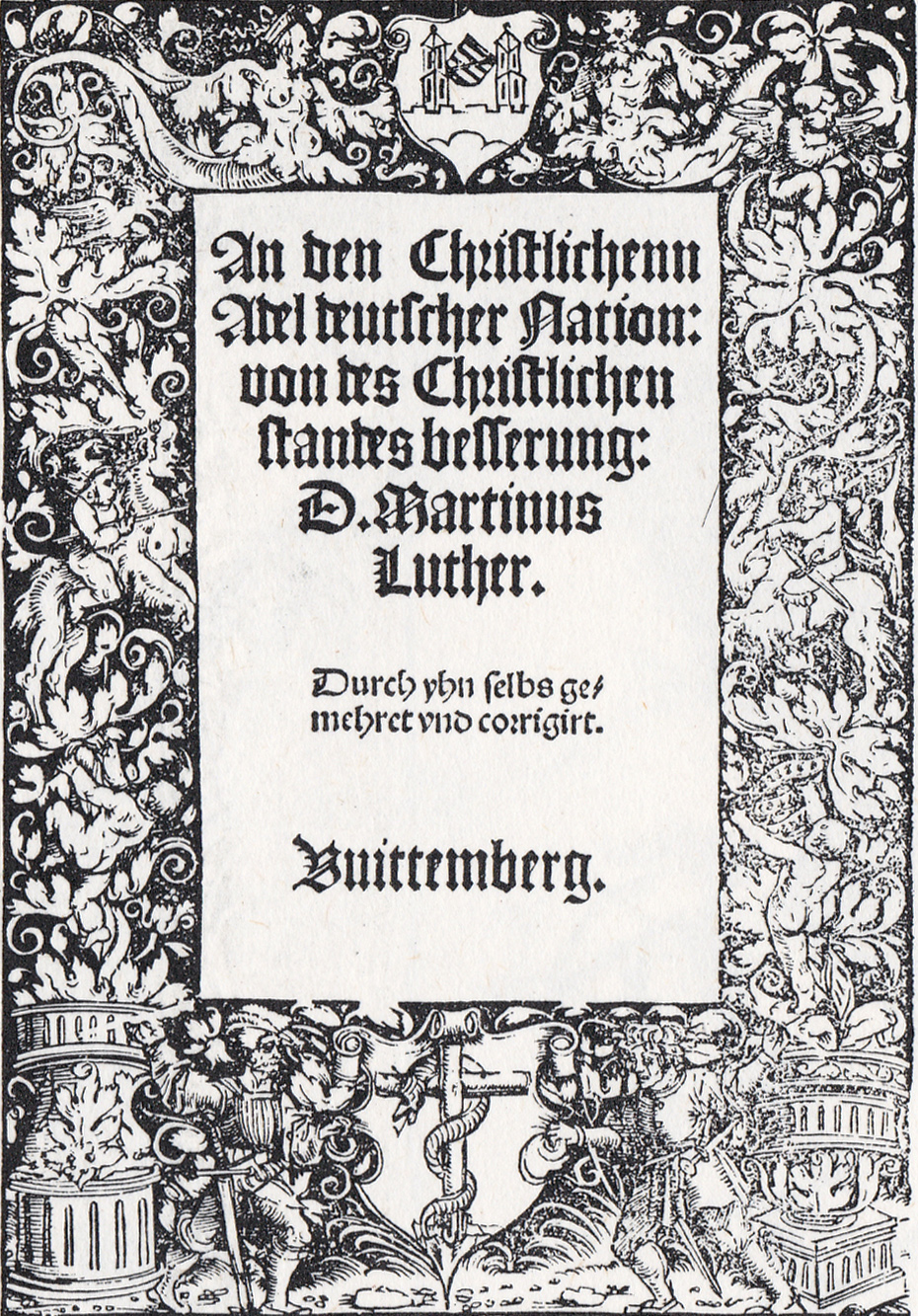
Title page of Martin Luther's 1520 pamphlet in black-letter German type, framed by an ornate woodcut border with figures, scrolls and a coat of arms at top. Text reads: An den Christlichenn Adel teutscher Nation, von des Christlichen standes besserung, D. Martinus Luther, and below it Durch yhn selbs gemehret vnd corrigirt, and Wittenberg.Book

Primary source

To the Christian Nobility of the German Nation

Martin Luther · August 1520

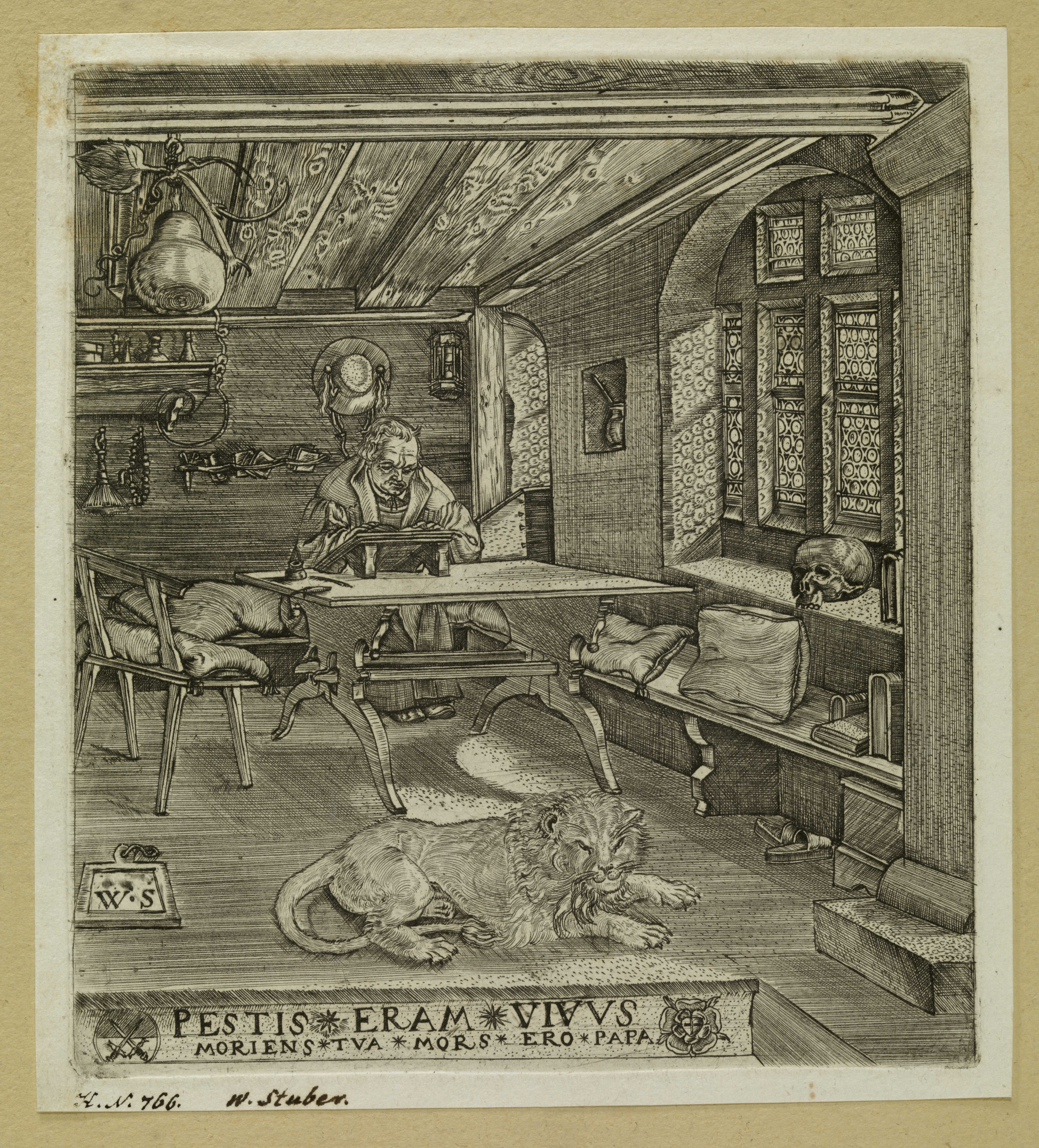
Print showing Martin Luther seated reading at a desk in a study filled with books and objects including a skull and hourglass, with a lion resting in the foreground, based on Dürer's St Jerome composition.Painting

Secondary source

Luther as St Jerome, Copy After Dürer

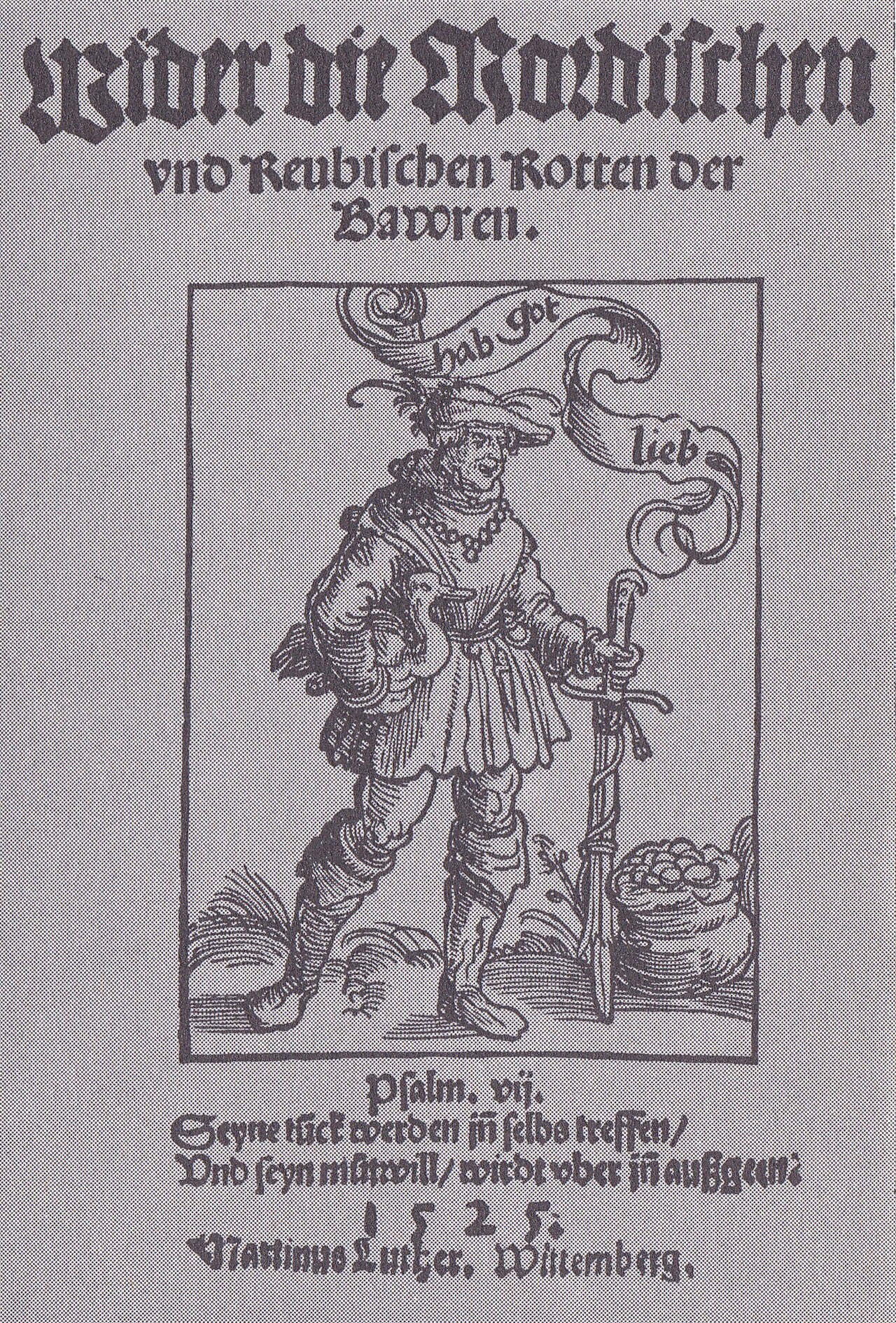
Title page of the 1525 pamphlet 'Wider die Mordischen vnd Räubischen Rotten der Bawren' in blackletter type. Below the title is a woodcut of a peasant with a sword and a banner reading 'hab gott lieb'. Text beneath cites Psalm vii and names Martin Luther, Wittenberg.Book

Primary source

Against the Murderous, Thieving Hordes of Peasants

Martin Luther · 1525

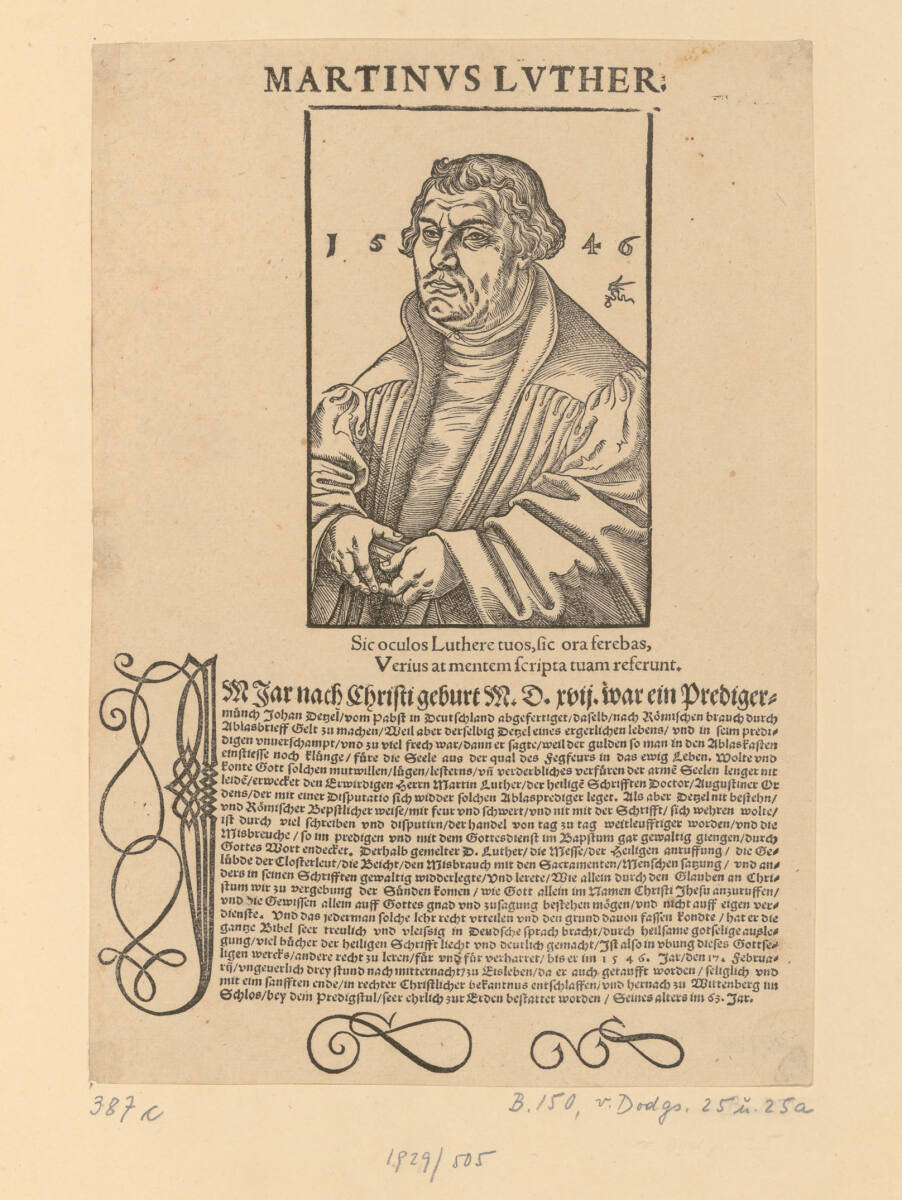
Woodcut print titled MARTINUS LUTHER showing a bust-length portrait of Martin Luther in a fur-collared robe with hands clasped, dated 1546 in the image, with a German text block and decorative initial below.Painting

Primary source

Martin Luther Portrait Woodcut

1546

Black-and-white woodcut title page of a 1543 book. An ornate decorative border surrounds the black-letter title 'Von den Jüden und Iren Lügen', then 'D. M. Luth.', 'Gedruckt zu Wittemberg / Durch Hans Lufft', and the date 'M.D.XLIII'. A small bearded figure appears at the bottom.Book

Primary source

On the Jews and Their Lies

Martin Luther · 1543

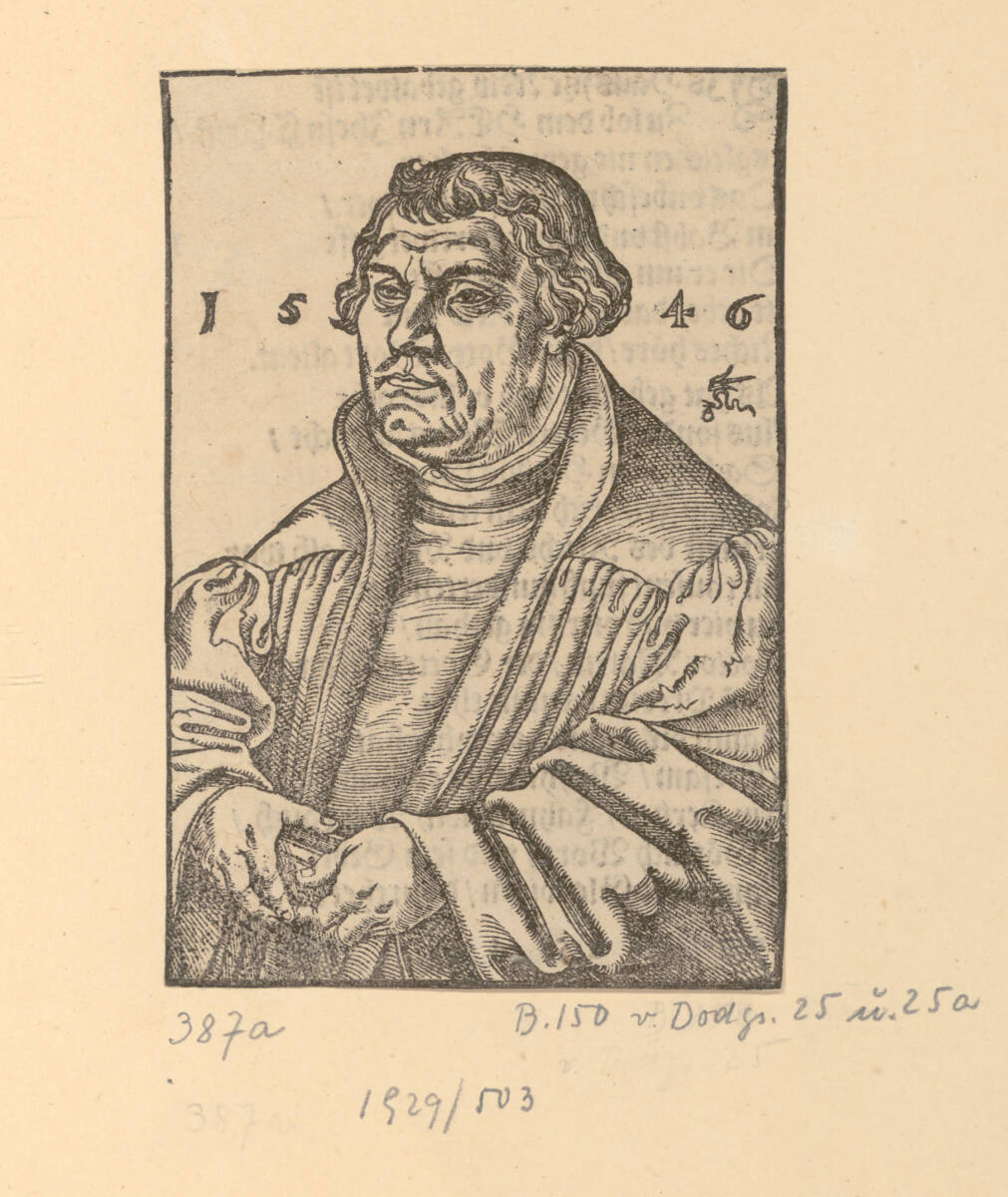
Woodcut-style print of a bearded man with curly hair, wearing a fur-collared robe, hands clasped near his waist. The date 1546 appears at upper left and a monogram at right. Handwritten catalogue notes appear below.Painting

Primary source

Martin Luther Portrait Print with Monogram

1546

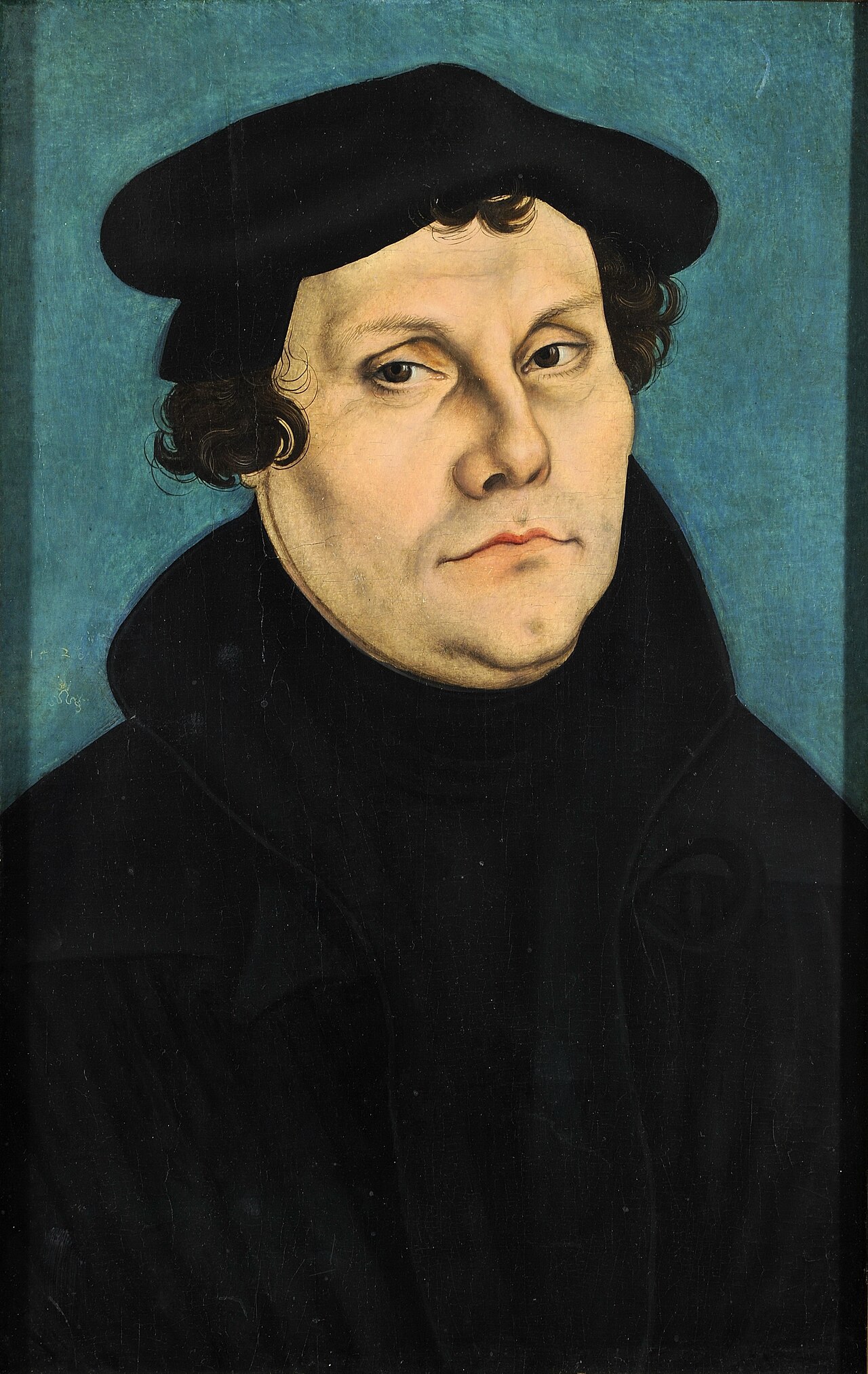
Painting of a man with curly dark hair under a black flat cap and a black high-collared garment, set against a teal-blue background. He has a serious expression, with his head turned slightly to the side.Painting

Primary source

Portrait of Martin Luther

Lucas Cranach the Elder · 1528

Front cover of a bound book with a dark marbled paper cover in black, red, yellow and pink, brown leather spine and corners, and a dark blue label with gold border reading 'Passional Christi und Antichristi'.Painting

Primary source

Passional Christi und Antichristi

1521

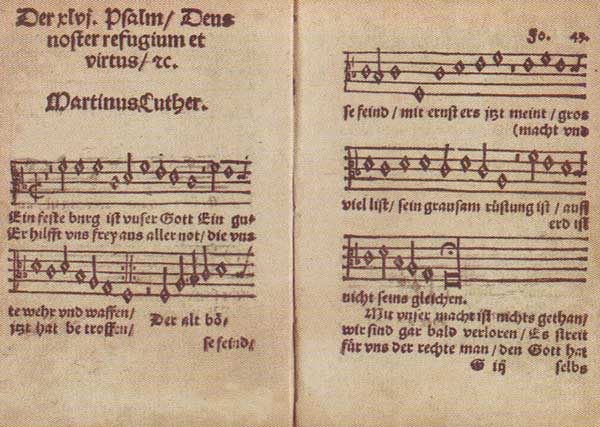
Two facing pages of a 16th-century printed hymnbook showing the hymn Ein feste Burg with musical notation in staff lines and Gothic black-letter German text beneath. Heading reads Der xlvi. Psalm, Deus noster refugium et virtus, and Martinus Luther.Document

Primary source

Ein' feste Burg ist unser Gott

Martin Luther · c. 1527-1529

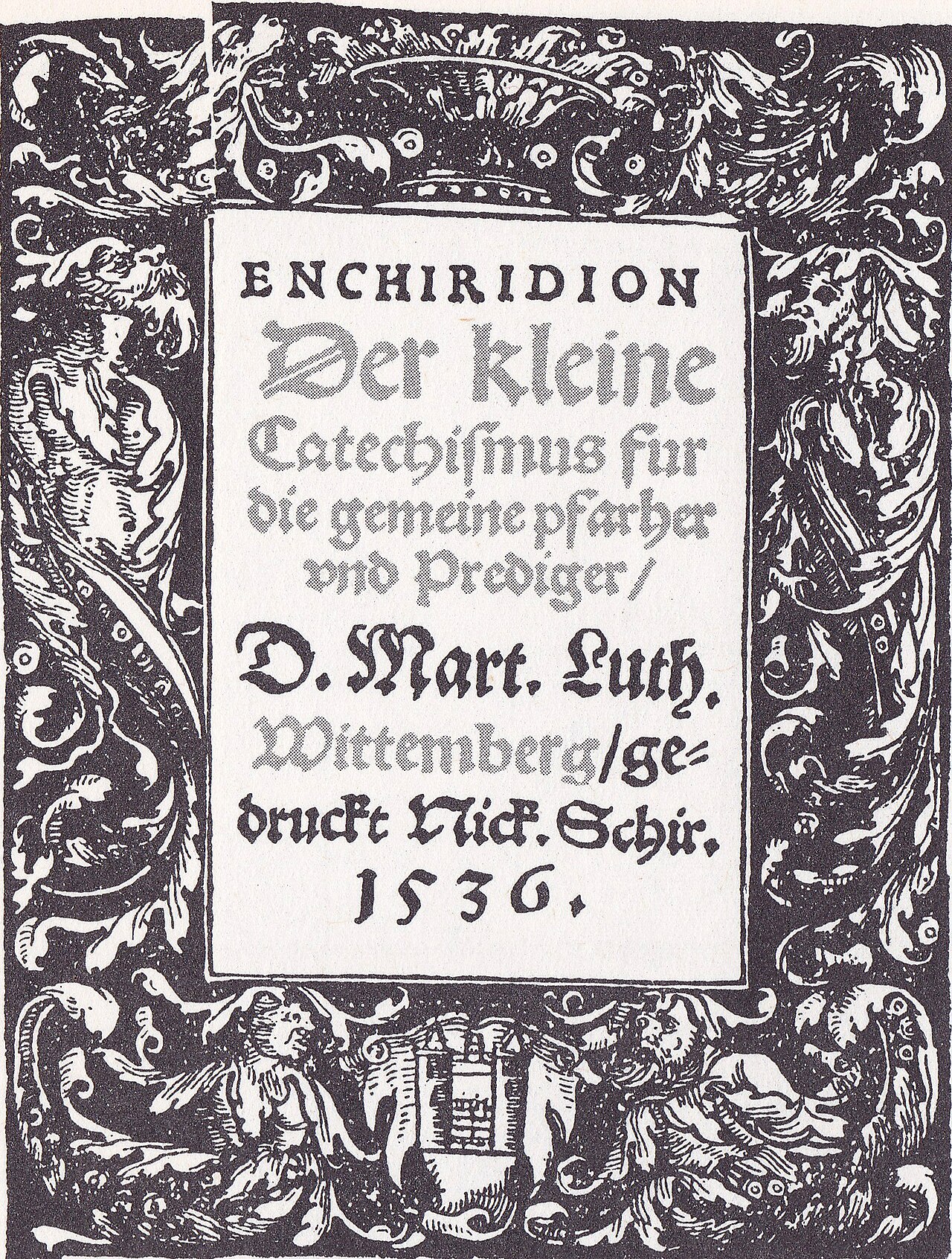
Title page of a printed book in black ornamental woodcut border with figures and a coat of arms at the bottom. Central text reads ENCHIRIDION, Der kleine Catechismus fur die gemeine pfarher und Prediger, D. Mart. Luth. Wittenberg, gedruckt Nick. Schirlentz, 1536.Book

Primary source

Luther's Small Catechism

Martin Luther · 1529

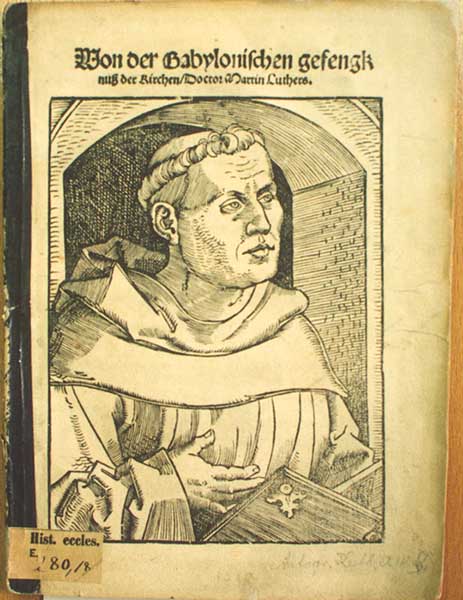
Title page of a 1520 German printed book, with the title 'Von der Babylonischen gefengk nuß der Kirchen/Doctor Martin Luthers' above a woodcut portrait of a bearded monk in a hooded robe, set in an arched frame, holding a book. A library label reads 'Hist. eccles. E 180/8'.Book

Primary source

On the Babylonian Captivity of the Church

Martin Luther · October 1520

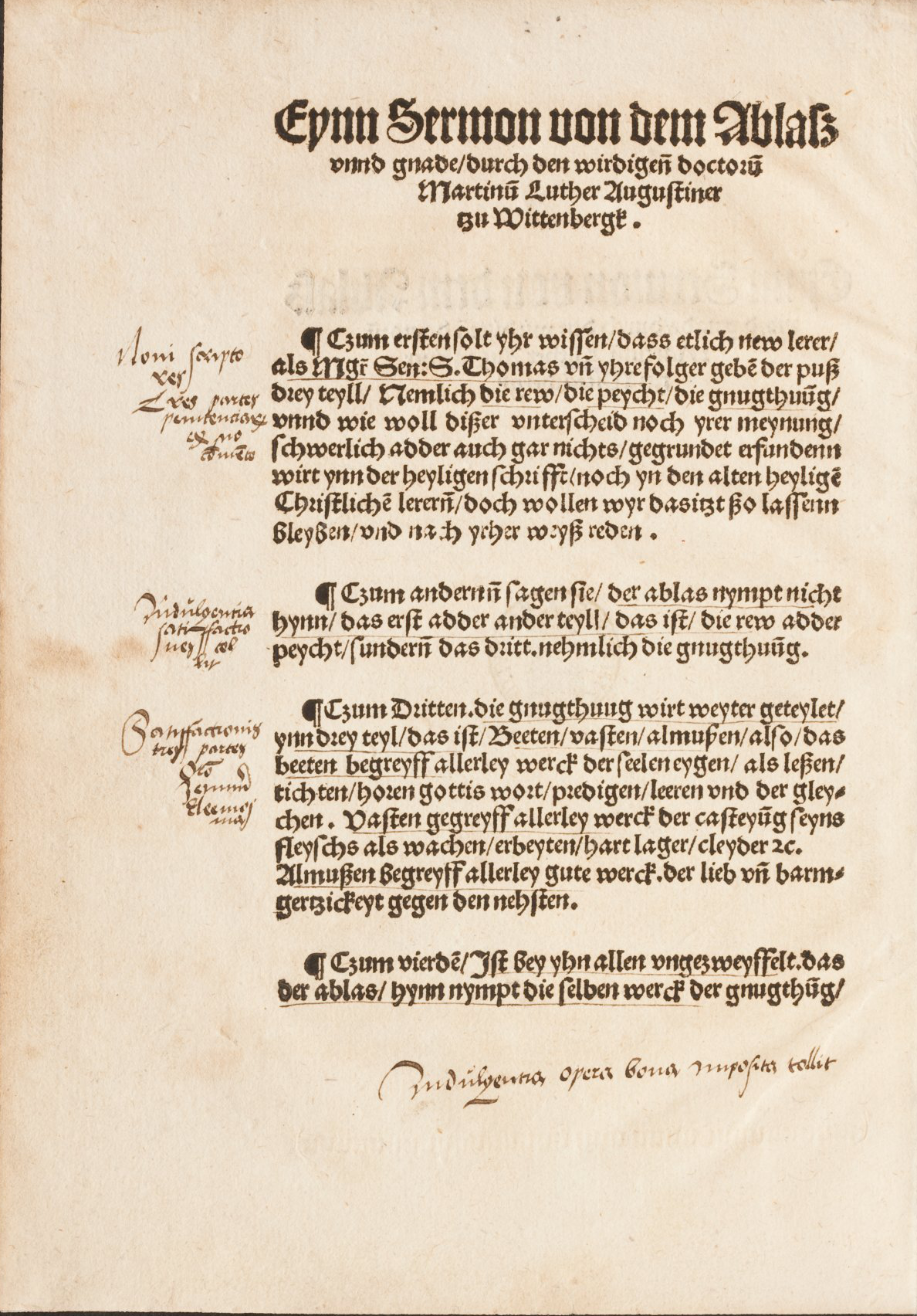
Scan of a printed German page titled 'Eynn Sermon von dem Ablasz vnnd gnade, durch den wirdigen doctor Martin Luther Augustiner zu Wittenberg' with handwritten marginal notes in Latin and German. The body text is in black-letter type.Book

Primary source

A Sermon on Indulgences and Grace

Martin Luther · March–April 1518

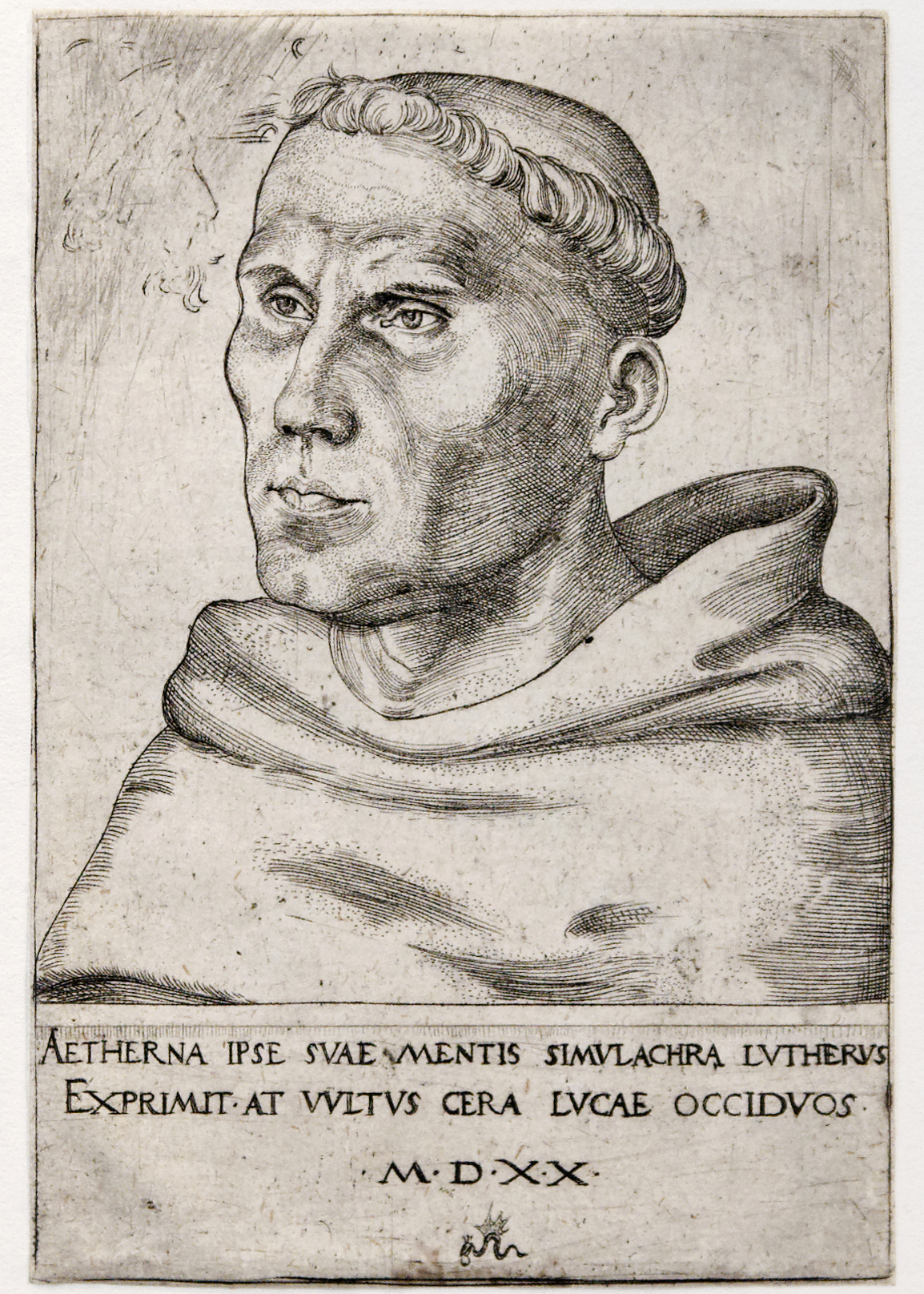
Engraving of a man in a monk's habit and hood, bust-length, turned to the left, with short curled hair and a faint profile sketch in the upper left corner. Latin inscription below and the date MDXX.Painting

Primary source

Martin Luther als Augustinermönch im Ordenshabit

Lucas Cranach the Elder · 1520

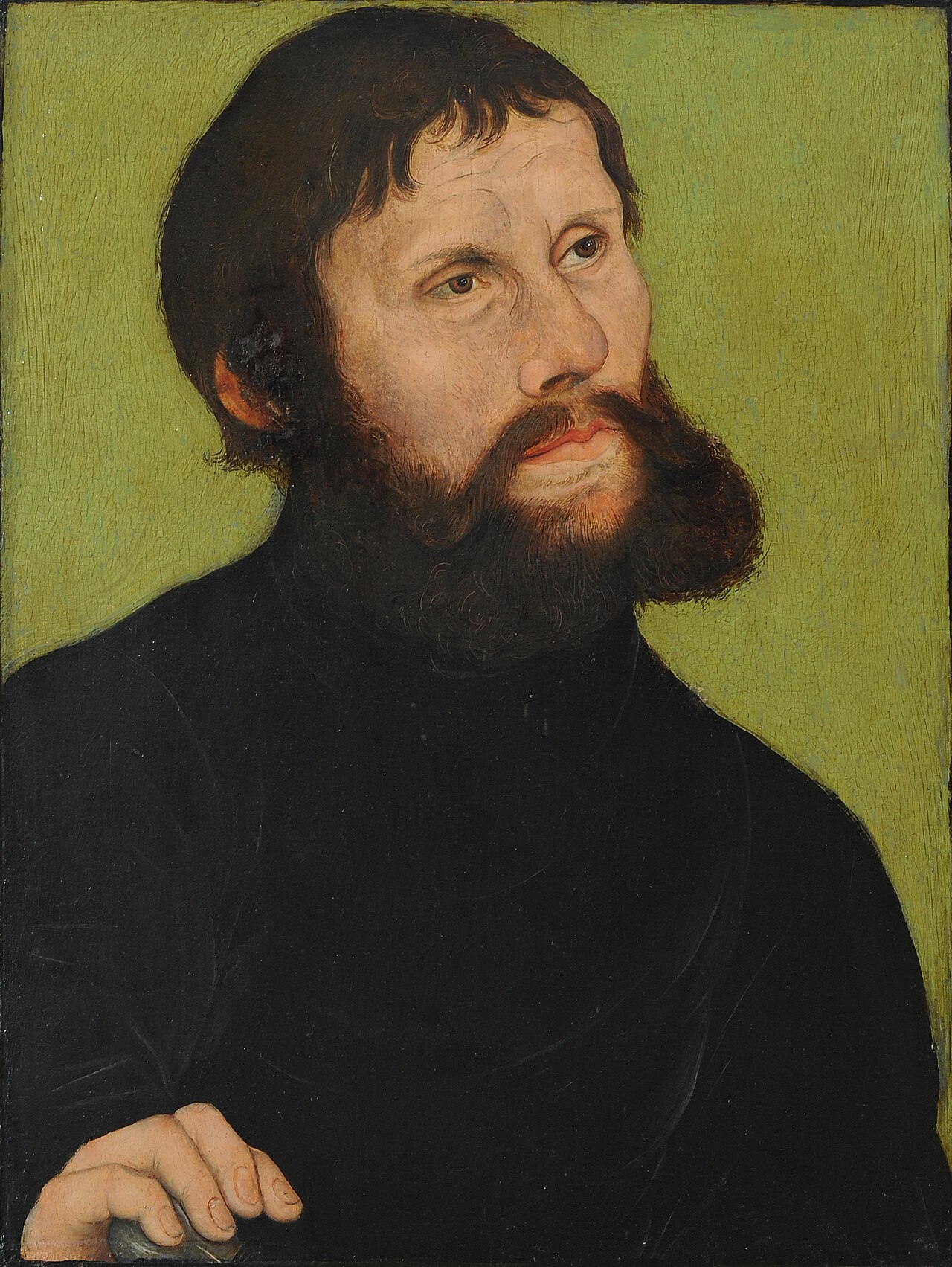
Painted portrait of a bearded man with dark, shoulder-length hair in a black high-necked garment, turned to his left against a bright green background, with one hand visible at the lower left holding a small object.Painting

Primary source

Martin Luther as Junker Jörg

Lucas Cranach the Elder (attributed) · 1521

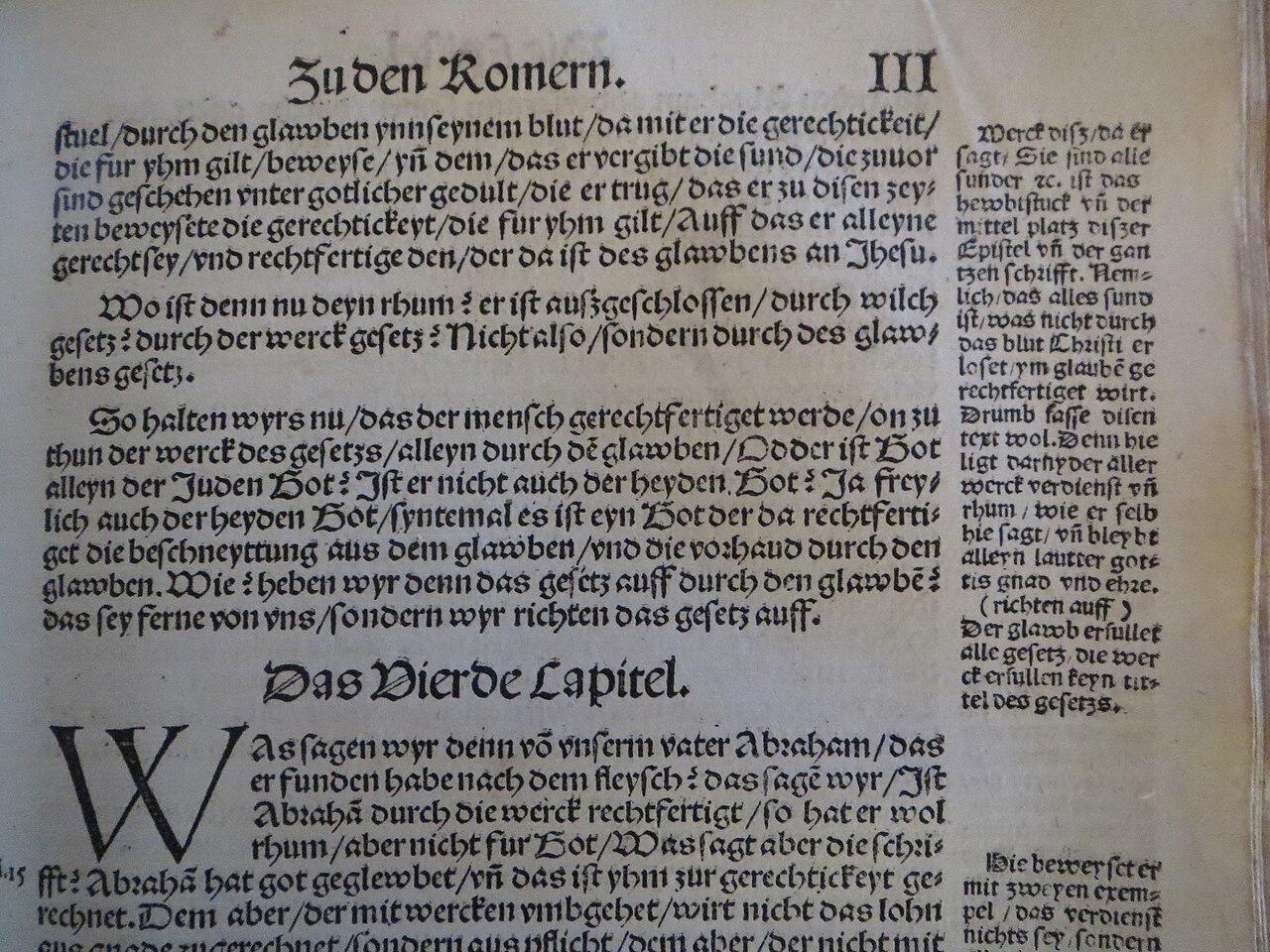
Close photo of a page from a 16th-century German printed book in black-letter type, headed 'Zu den Romern' and 'III', with the chapter beginning 'Das Vierde Lapitel' and marginal glosses on the right. The page is Romans chapter 3 from Luther's New Testament.Book

Primary source

September Testament

Martin Luther · September 1522

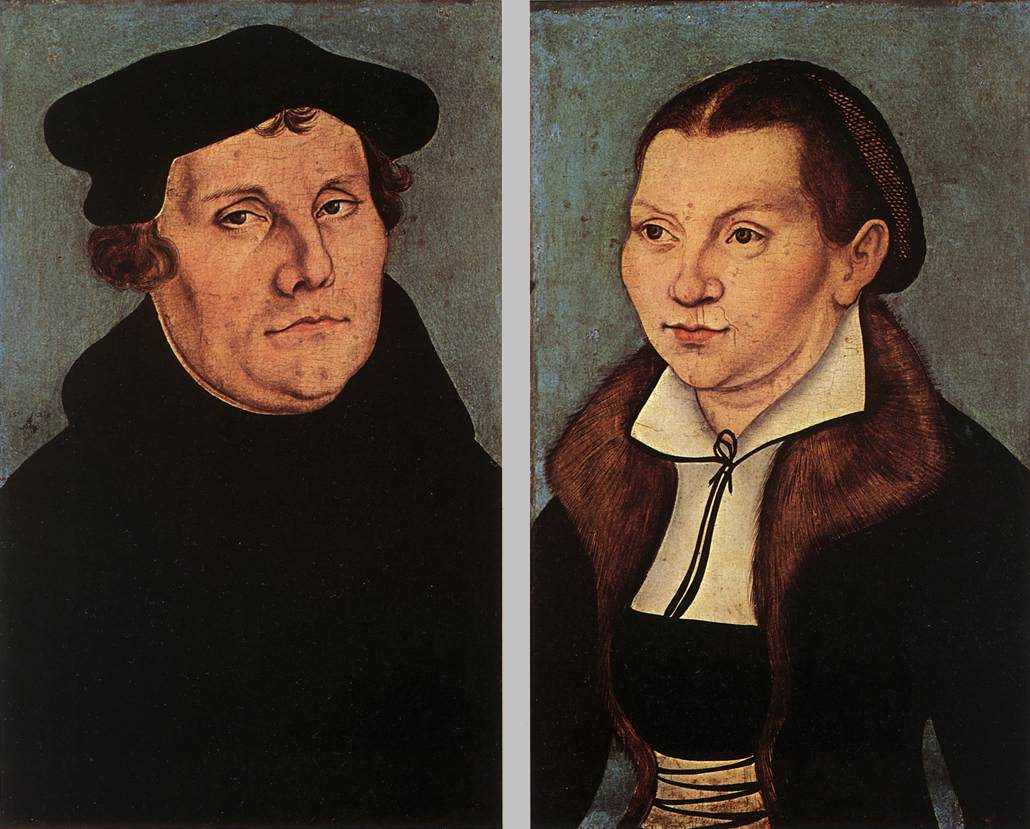
Two side-by-side painted portraits on a blue-grey background. Left: a man in a black beret and black robe, with a stern expression. Right: a woman with hair under a dark cap, wearing a brown fur collar, white collar with black ribbon tie, and black dress.Painting

Primary source

Portraits of Martin Luther and Katharina von Bora

Workshop of Lucas Cranach the Elder · 1529

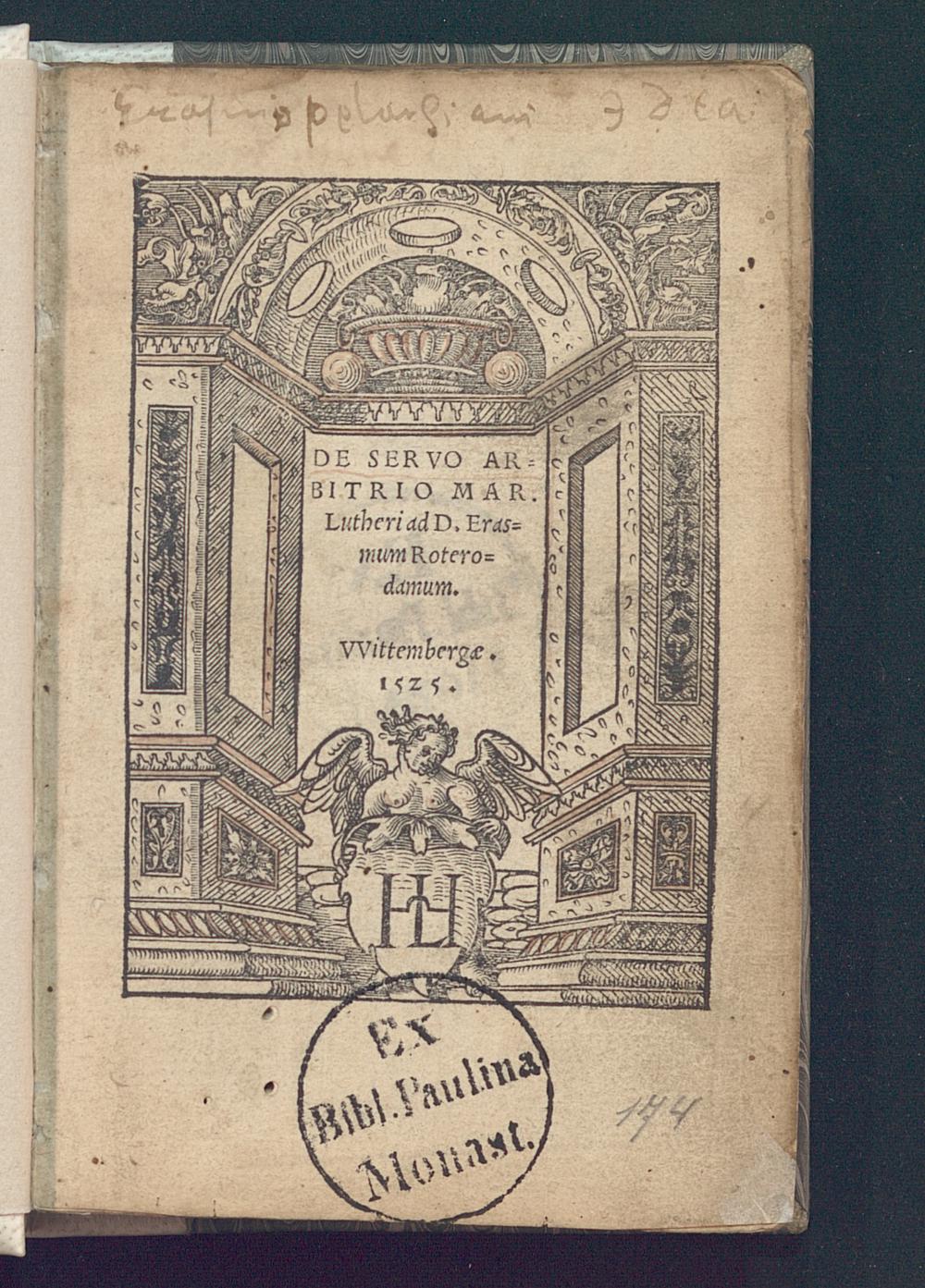
Scan of the title page of a 1525 book, with an ornate woodcut border of architectural arches and foliage. Central text reads 'DE SERVO ARBITRIO MARTINI Lutheri ad D. Erasmum Roterodamum' and 'Vvittembergae 1525', with a winged cherub holding a shield marked with a monogram at the bottom. A circular library stamp reads 'Ex Bibl. Paulina Monast.' and handwritten notes appear at top and right.Book

Primary source

On the Bondage of the Will

Martin Luther · 1525

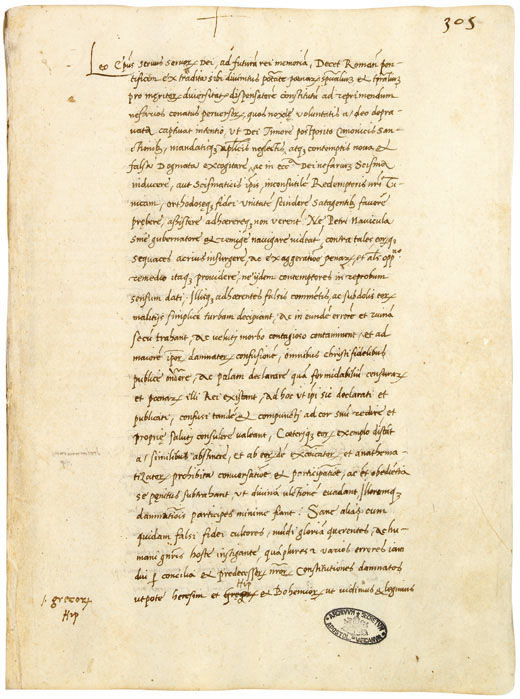
Scan of a handwritten manuscript page in brown ink on aged parchment, with a large decorated opening initial and a cross at the top. A seal is stamped at the lower right and a handwritten note appears at the lower left. The text begins 'Leo Episcopus servus servorum Dei' and continues in dense script.Document

Primary source

Decet Romanum Pontificem

Leo X · 3 January 1521

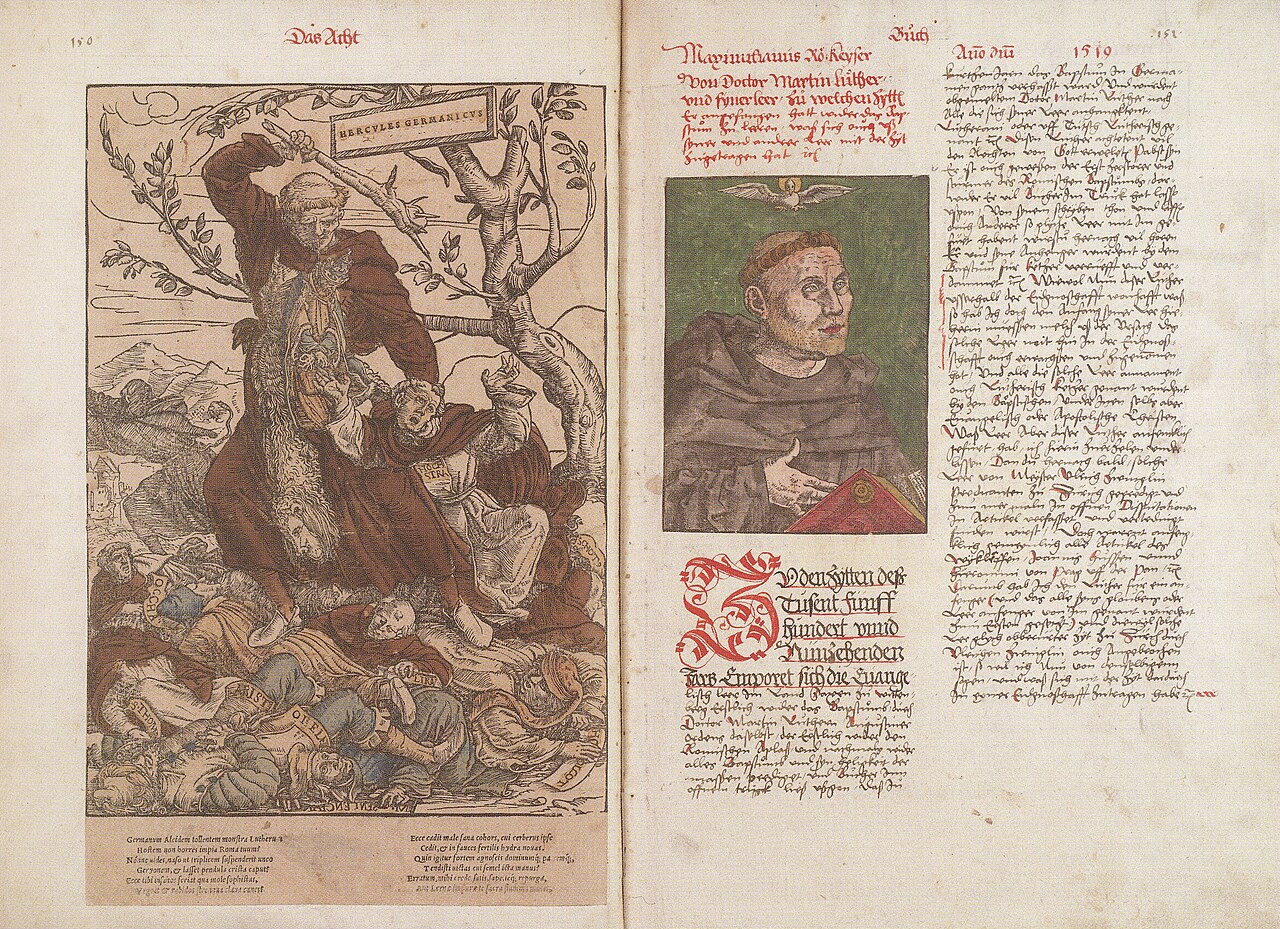
Two-page book spread. Left page: a hand-coloured woodcut of a muscular, club-wielding figure in a lion skin, under a banner reading HERCULES GERMANICUS, standing over fallen bodies; Latin verses below. Right page: a coloured portrait of a monk-like man in a dark robe with a dove above, and handwritten text in black and red ink.Painting

Primary source

Luther as Hercules Germanicus

Hans Holbein the Younger · c. 1519-1520

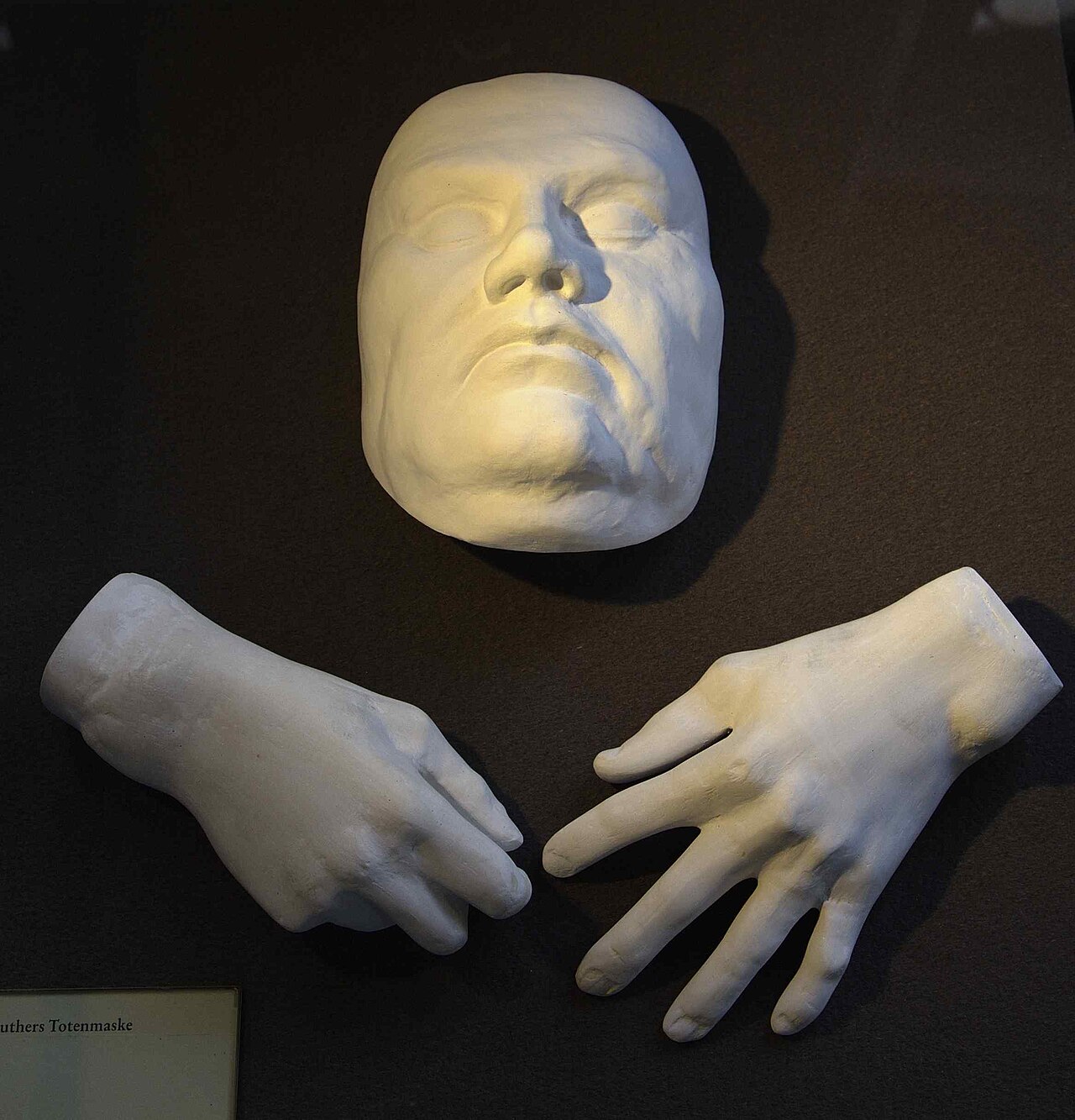
White plaster death mask of a man's face with closed eyes, displayed above two plaster casts of hands, one resting on the left and one open on the right, against a dark background. A label at the lower left reads 'Luthers Totenmaske'.Artifact

Primary source

Luther's Death Mask

1546

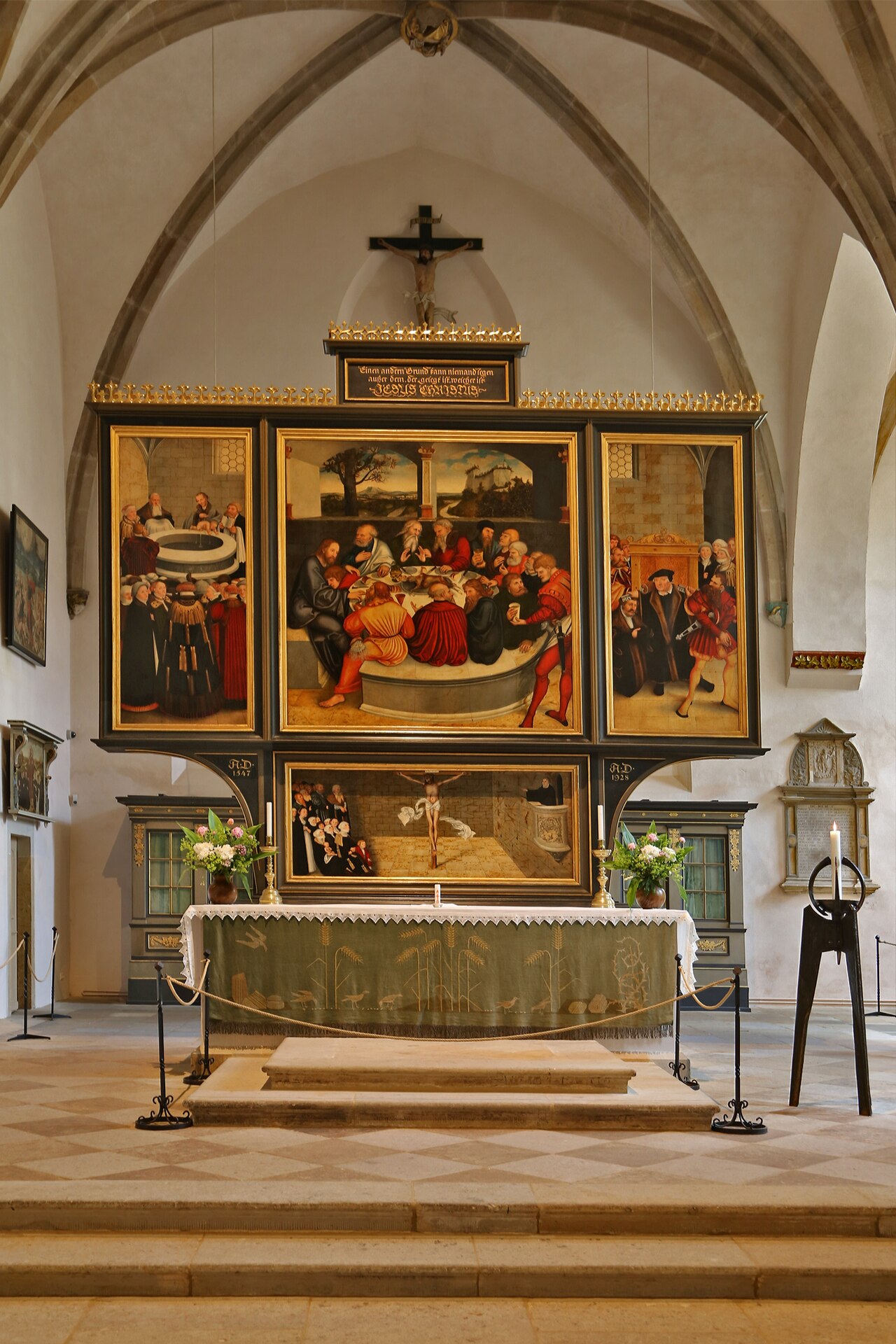
Interior of a church chancel showing the multi-panel Reformation altarpiece with a central painting of a supper scene with Jesus and disciples, flanked by side panels, above a stone altar with a green cloth and flower vases. Vaulted stone ceiling and a crucifix overhead.Painting

Secondary source

Reformation Altarpiece

Lucas Cranach the Elder and Lucas Cranach the Younger · 1547 (installed)

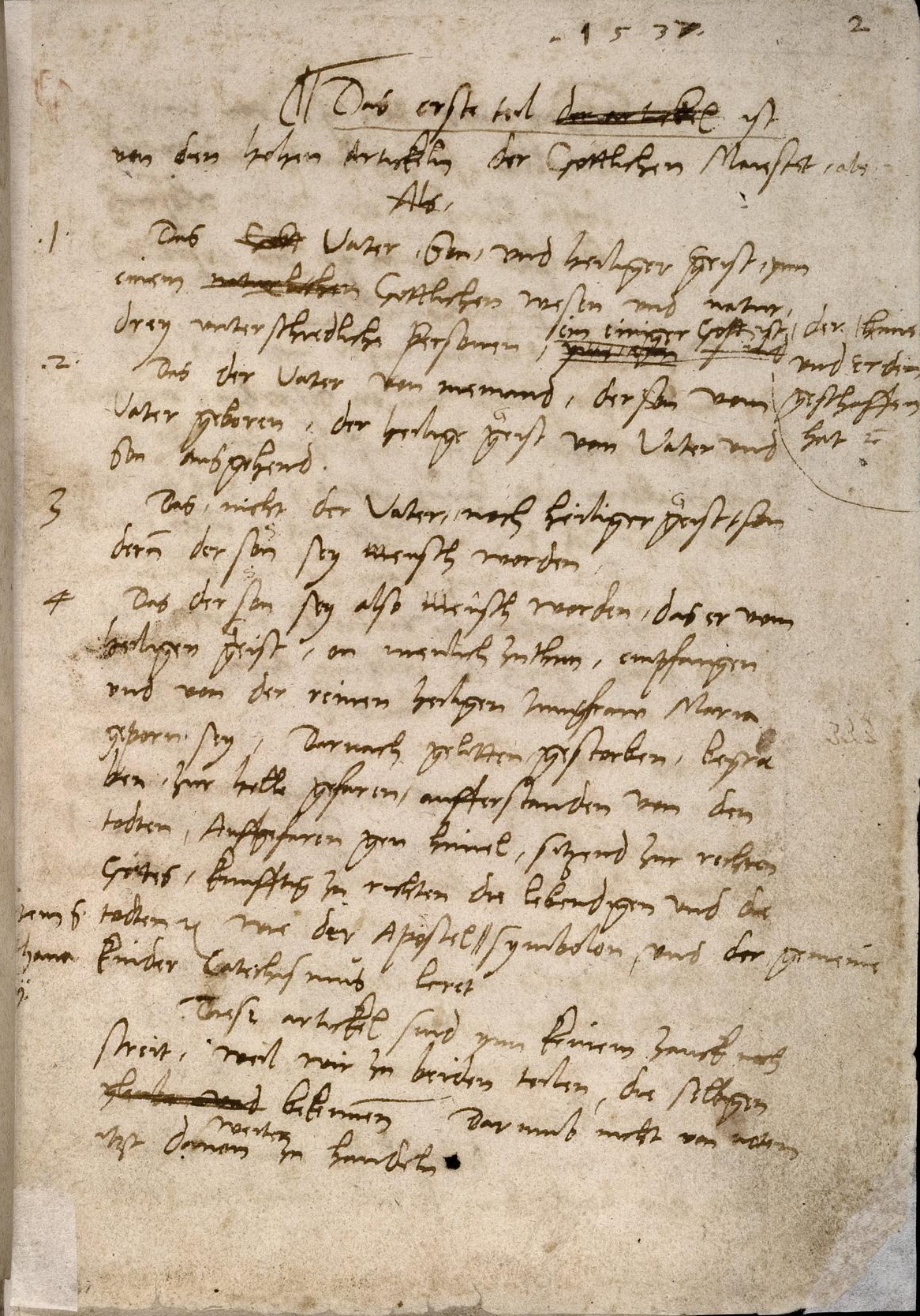
Handwritten manuscript page in German, dated 1537 at top, with numbered paragraphs and crossed-out words. The heading reads 'Das erste teil ist von den hohen artikeln der göttlichen Majestät' and the text describes the Trinity. Page numbered 2.Document

Primary source

Smalcald Articles

Martin Luther · 1537

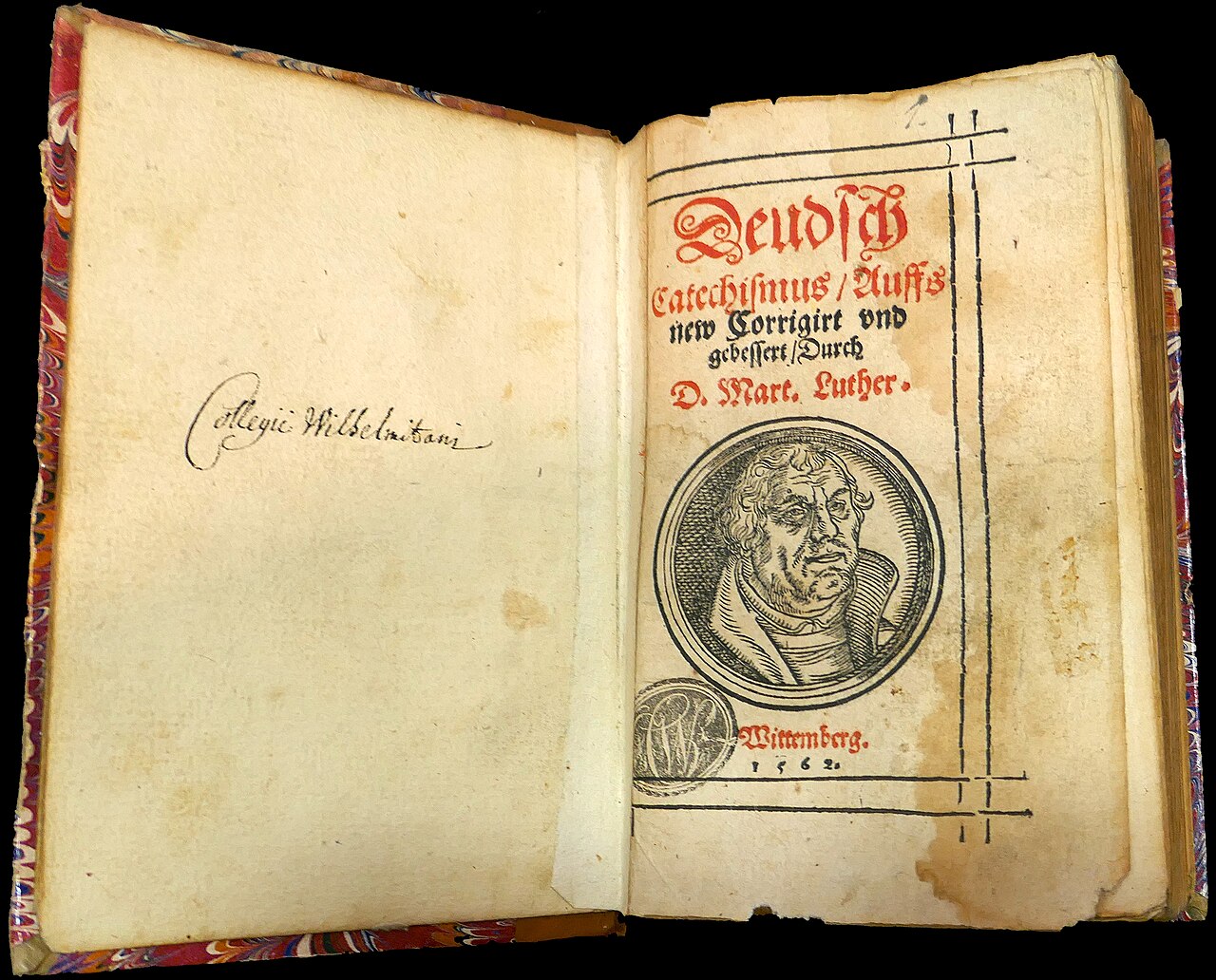
Open antique book with marbled endpapers. Right page shows a red and black title page reading 'Deudsch Catechismus' and 'D. Mart. Luther', with a circular woodcut portrait of a bearded man and 'Wittemberg 1562'. Left page has handwritten inscription 'Collegii Wilhelmitani'.Book

Primary source

Luther's Large Catechism

Martin Luther · 1529

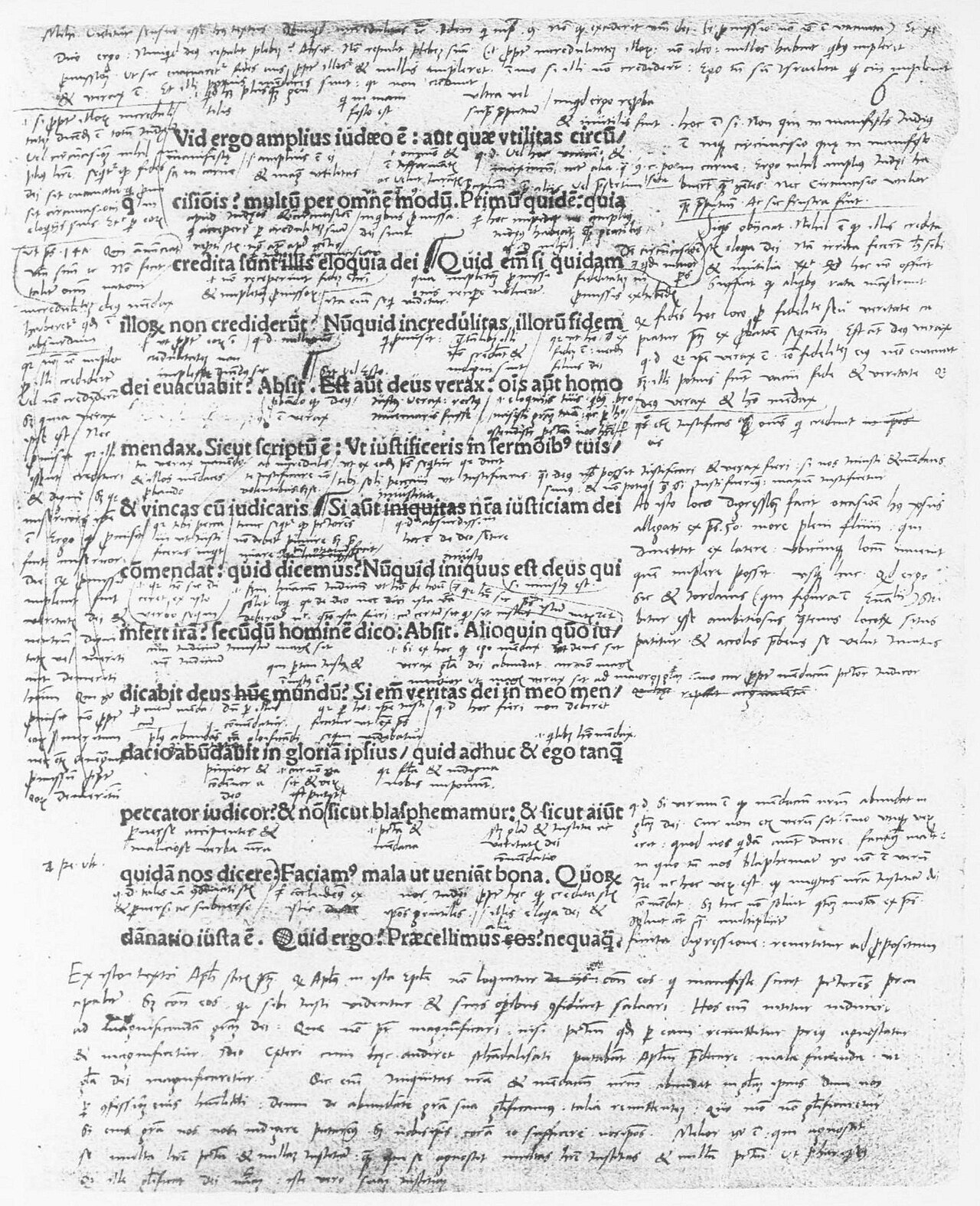
Black and white scan of a manuscript page covered in handwritten Latin annotations in Martin Luther's hand, with printed Latin Bible text in bold lines running across the middle of the page, including 'Vid ergo amplius iudaeo' and 'Quid ergo praecellimus'.Document

Primary source

Römerbriefvorlesung: Autograph on Romans 3:1-9a

Martin Luther · 1515-1516

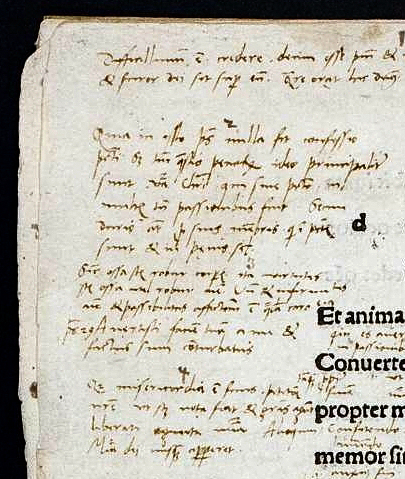
Cropped scan of a handwritten Latin manuscript page with brown ink script in the left and center, and printed black-letter text at right reading 'Et anima' and 'Conuerte' and 'propter'. Lines of marginal notes are visible on aged paper.Document

Primary source

Wolfenbüttel Psalter with Luther's Annotations

Werkstatt von Johann Rhau-Grunenberg in Wittenberg · 1513

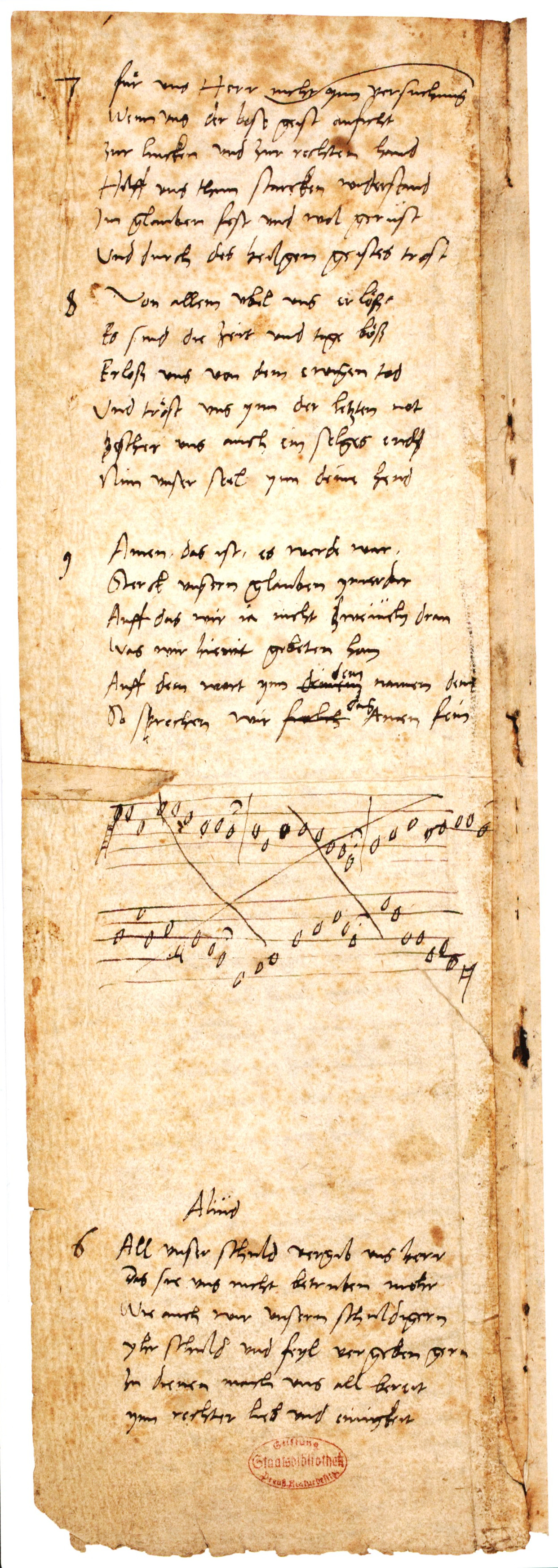
Handwritten manuscript page on aged, yellowed paper with several verses of German text in brown ink, a musical staff with hand-drawn notes and crossed-out lines, a second verse labelled 'Alius' below, and a red oval library stamp at the bottom.Document

Primary source

Das Vaterunser-Lied Autograph Draft

Martin Luther

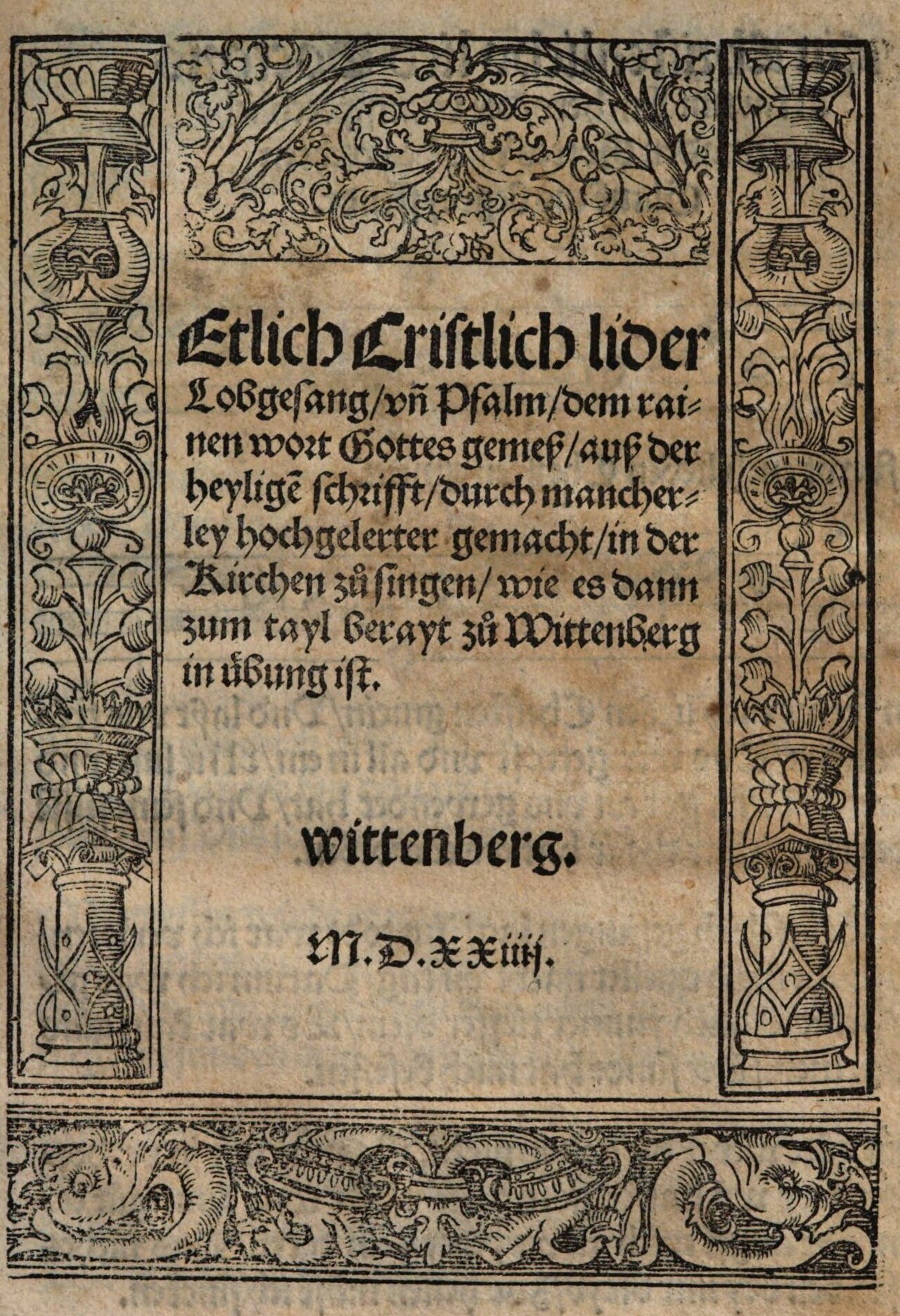
Title page of an early printed German hymnal with woodcut floral and architectural borders. Black-letter text reads 'Etlich Cristlich lider Lobgesang / vnd Psalm...' and ends with 'wittenberg' and 'M.D.XXiiij' (1524).Book

Primary source

Achtliederbuch: First Lutheran Hymnal

Martin Luther and Paul Speratus · 1523-1524

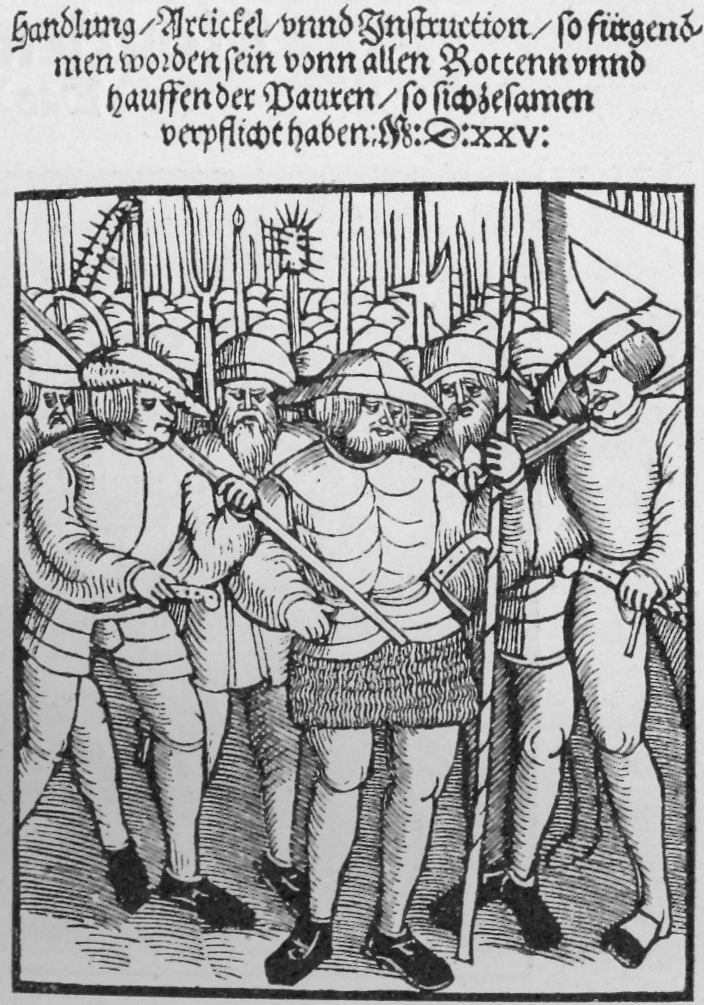
Title page of a 1525 German woodcut leaflet. Black-letter heading reads 'Handlung, Artickel und Instruction, so fürgenommen worden sein von allen Rotten und hauffen der Bauren' with 'M.D.XXV'. Below is a woodcut of armed men with pikes and a banner, and a bearded man in armor and a helmet is held between others.Document

Primary source

The Twelve Articles

1525

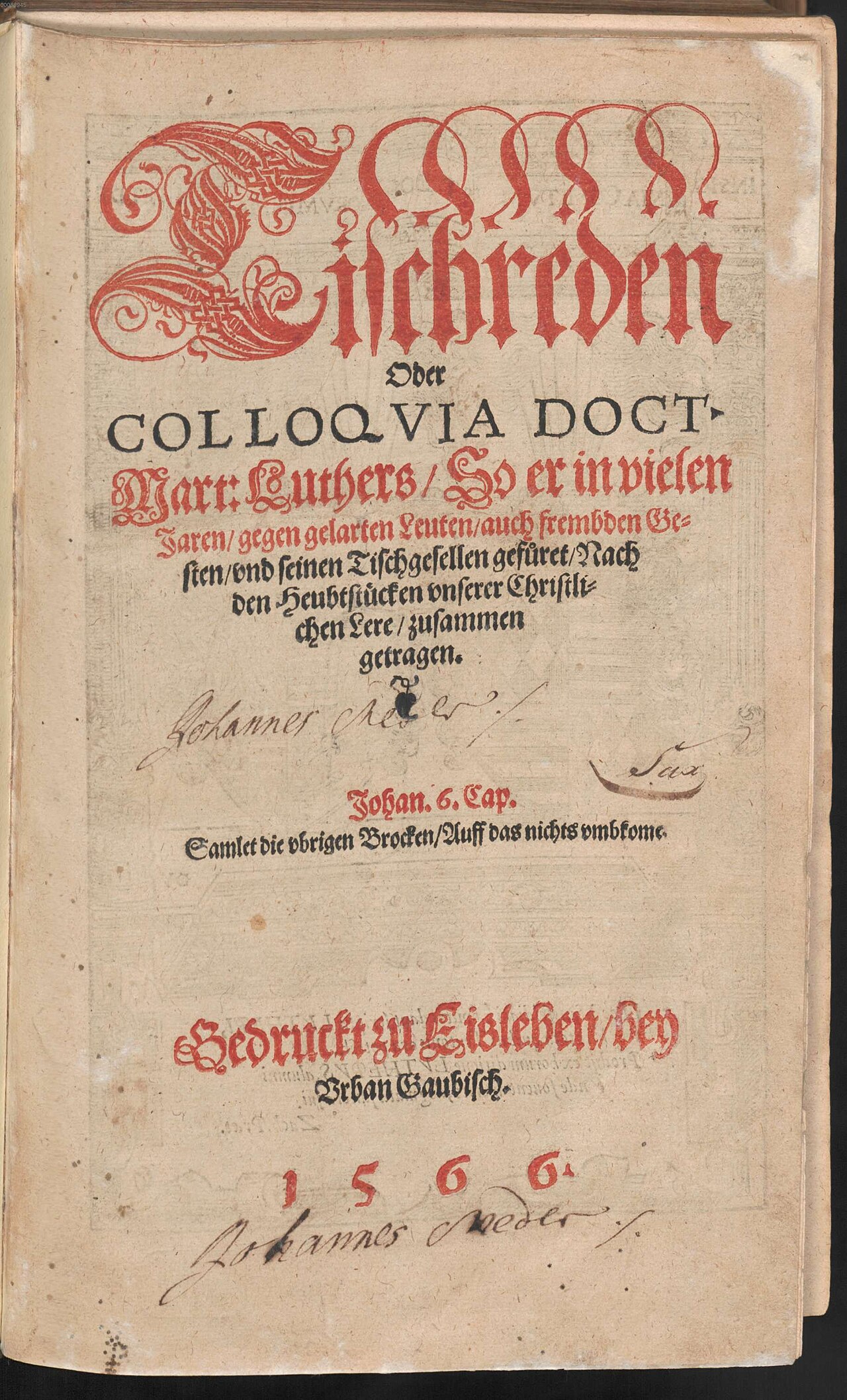
Title page of an early printed book in German blackletter type. Large red decorative initial and red and black title text reads Tischreden oder Colloquia D. Martin Luthers, with the imprint Gedruckt zu Eisleben, bey Urban Gaubisch, 1566. Handwritten signatures and notes appear on the page.Book

Secondary source

Table Talk

Martin Luther · 1566

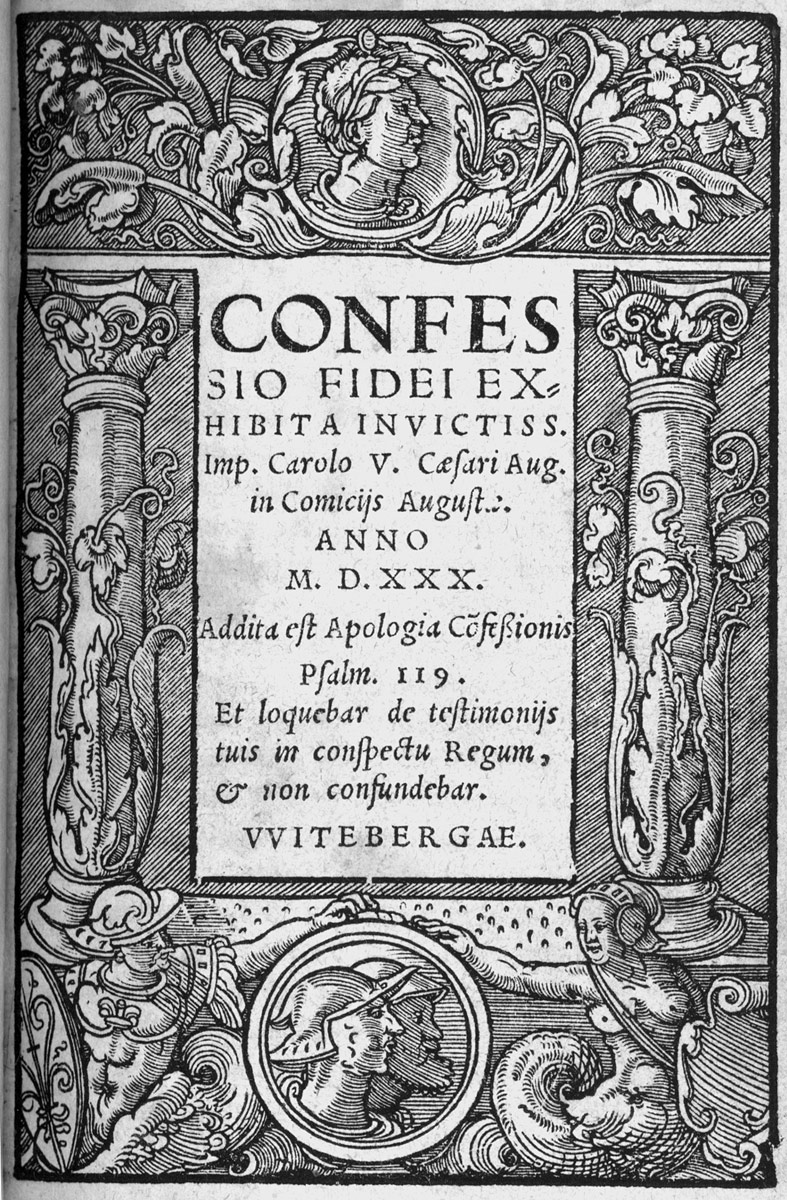
Black-and-white woodcut title page of the Augsburg Confession, with ornate borders of foliage, a medallion portrait at top, columns, and figures at the bottom. Central text reads CONFESSIO FIDEI EXHIBITA, Latin title, ANNO M.D.XXX, and VVITEBERGAE.Document

Primary source

Augsburg Confession

Philipp Melanchthon · 1530

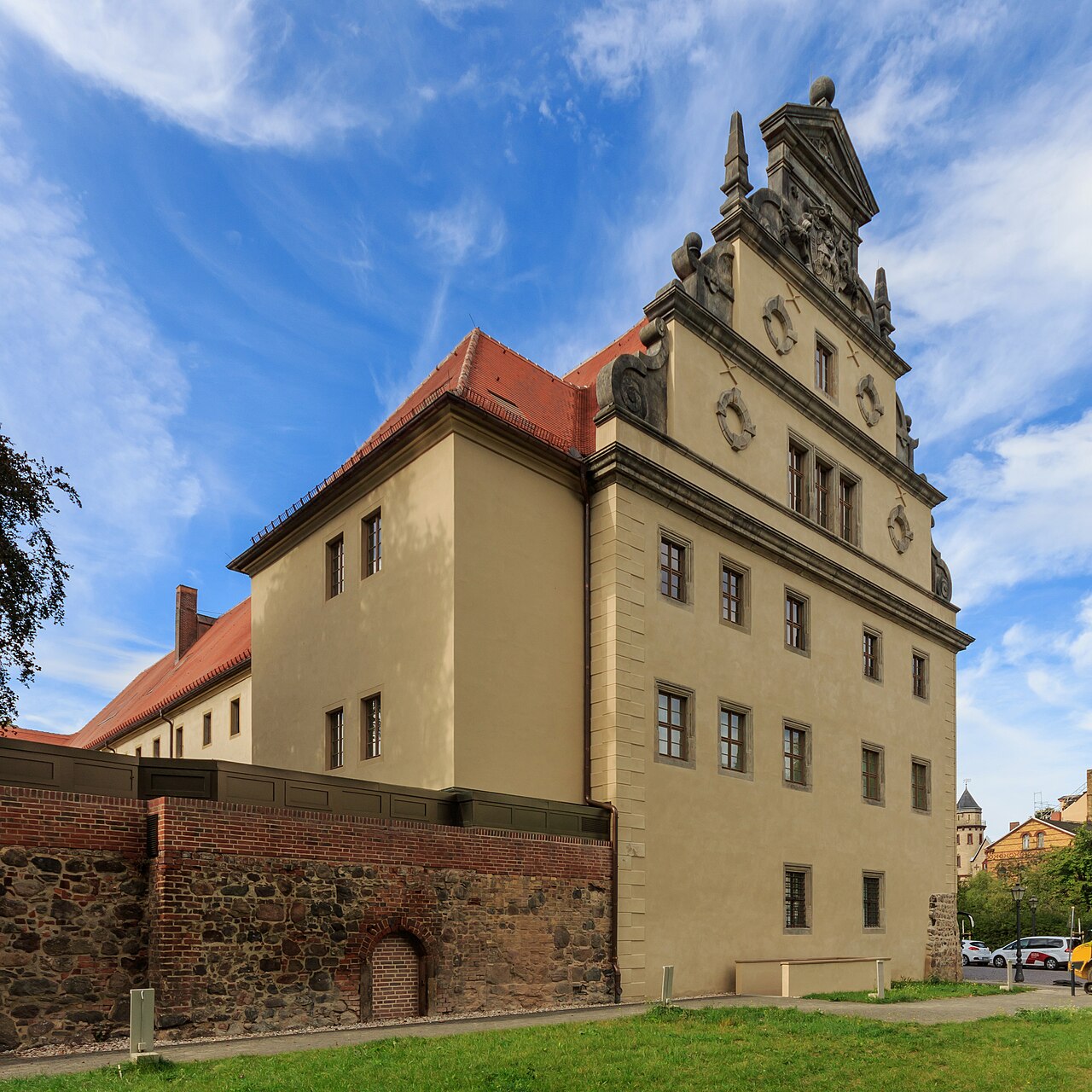
Exterior of a multi-storey cream-coloured building with a red tiled roof and a tall gabled facade decorated with stone ornaments, set beside a brick and stone wall under a blue sky with clouds.Artifact

Primary source

Lutherhaus Wittenberg

1504 onward

Black handwritten cursive signature on a white background, reading 'Martin Luther' in large, flowing strokes with a dot above the i.Artifact

Primary source

Signature of Martin Luther

Martin Luther

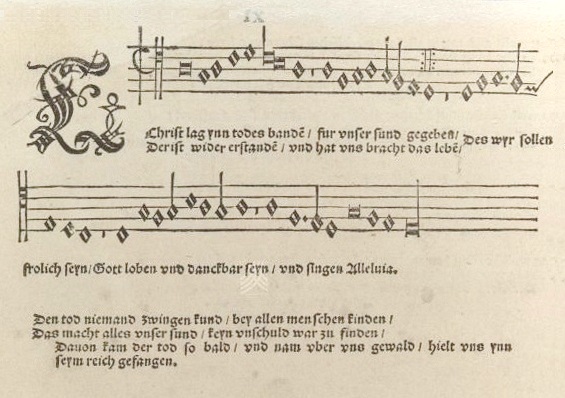
Page from a 1520s German hymnal showing a decorated initial letter C and a staff of square-note music with diamond-shaped notes, above and below lines of black-letter German text of the hymn Christ lag in Todesbanden.Book

Primary source

Eyn geystlich Gesangk Buchleyn

Johann Walter · 1524

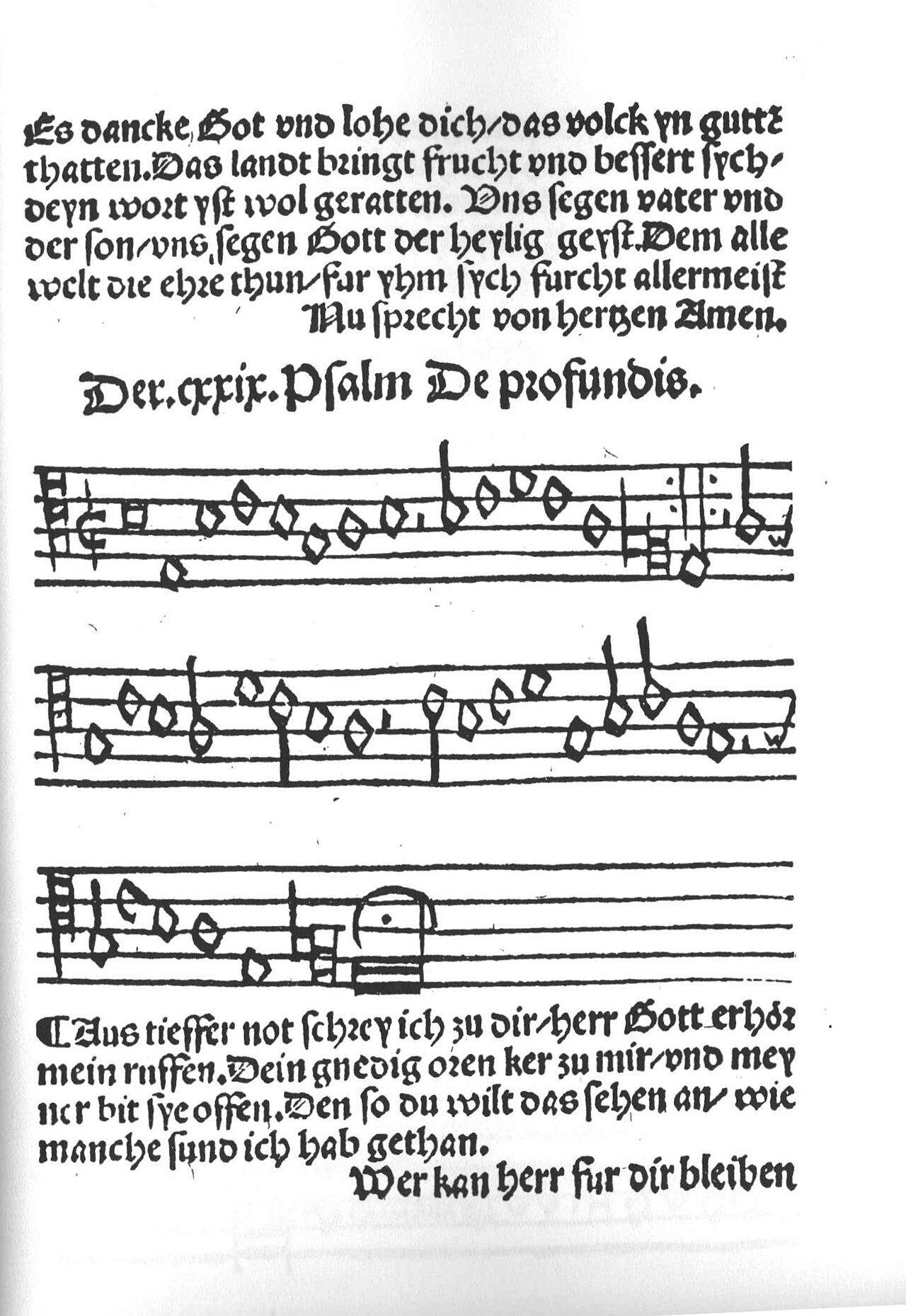
Scanned page of a 16th-century German hymnal showing black-letter printed text in German, a heading reading Der cxxix Psalm De profundis, and three staves of square-note music. The lyrics begin Aus tieffer not schrey ich zu dir.Document

Primary source

Aus tiefer Not schrei ich zu dir

Martin Luther · 1524

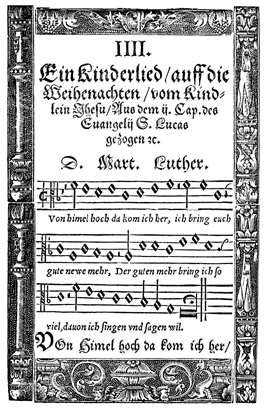
Black-and-white woodcut title page of a 16th-century German hymn sheet. Heading reads 'IIII. Ein Kinderlied auff die Weihenachten vom Kindlein Jhesu', with 'D. Mart. Luther' below, a five-line staff of music notation, and the opening lines of the hymn 'Vom Himmel hoch da komm ich her' in old German type. Ornate decorative border surrounds the page.Book

Primary source

Vom Himmel hoch, da komm ich her

Martin Luther · 1534 (text), 1539 (melody)

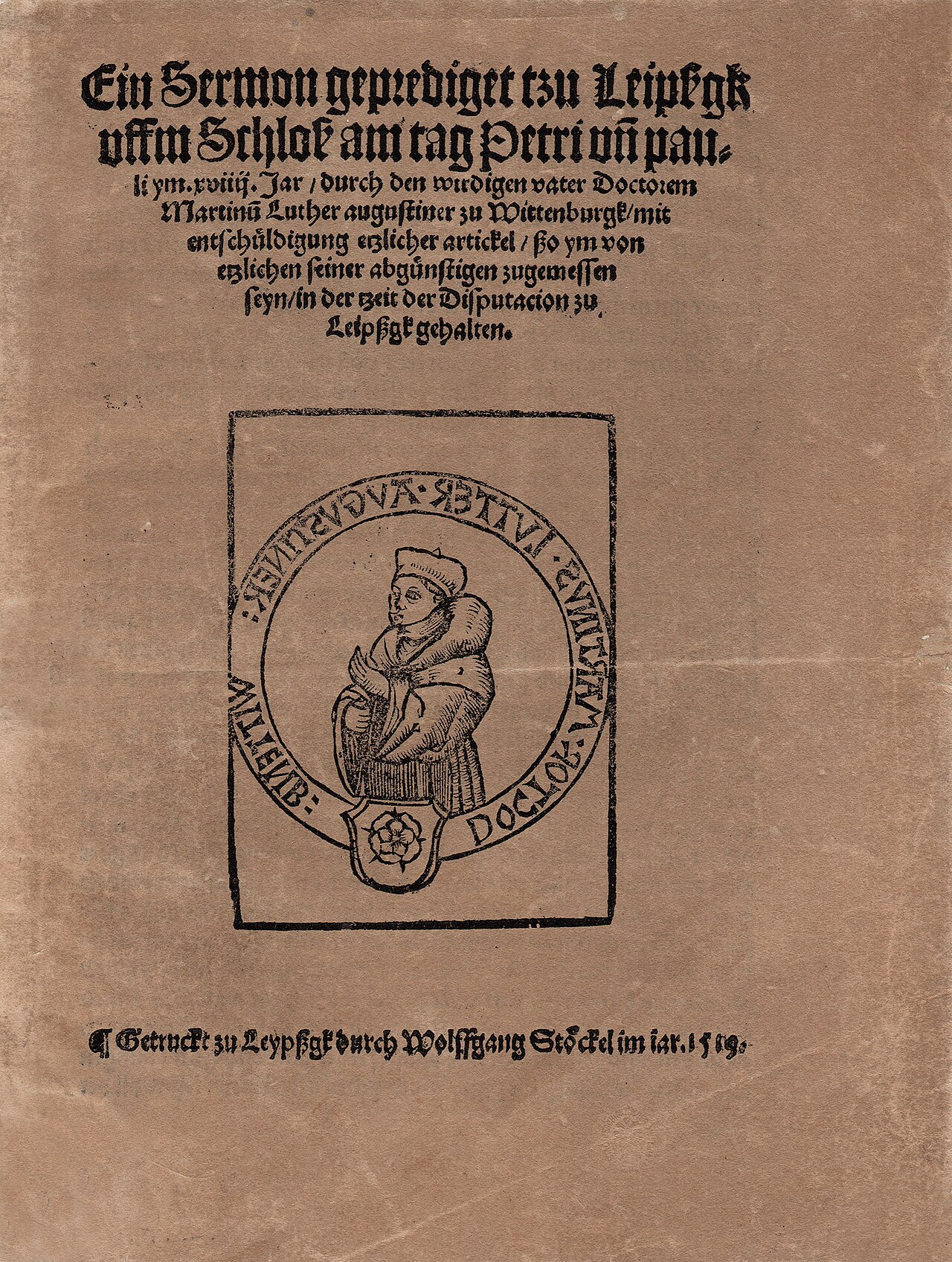
Scan of the title page of a 1519 German sermon printed in Leipzig. Black-letter text at top announces a sermon by Doctor Martin Luther preached at the Leipzig Disputation. Below is a woodcut portrait of Luther in a circular frame with Latin inscriptions, and a small shield with a rose. Printed imprint at bottom reads Getruckt zu Leypßgk durch Wolffgang Stöckel im jar 1519.Book

Primary source

Ein Sermon geprediget tzu Leipßgk

Martin Luther · 1519

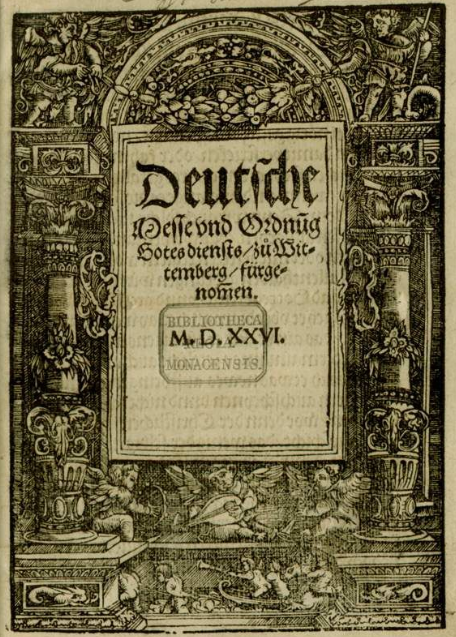
Title page of the 1526 printed Deutsche Messe, a woodcut border with cherubs, pillars and ornamental figures framing the German title text 'Deutsche Messe und Ordnung Gottes diensts zu Wittemberg furgenomen' and the date 'M.D.XXVI.' with a library stamp reading 'Bibliotheca Monacensis'.Document

Primary source

Deutsche Messe

Martin Luther · 1526

Luther rose emblem: a white five-petalled rose with green sepals and radiating lines around a red heart bearing a black Latin cross, all set within a blue ring and a yellow outer border.Artifact

Primary source

Luther Rose

Martin Luther · 1530

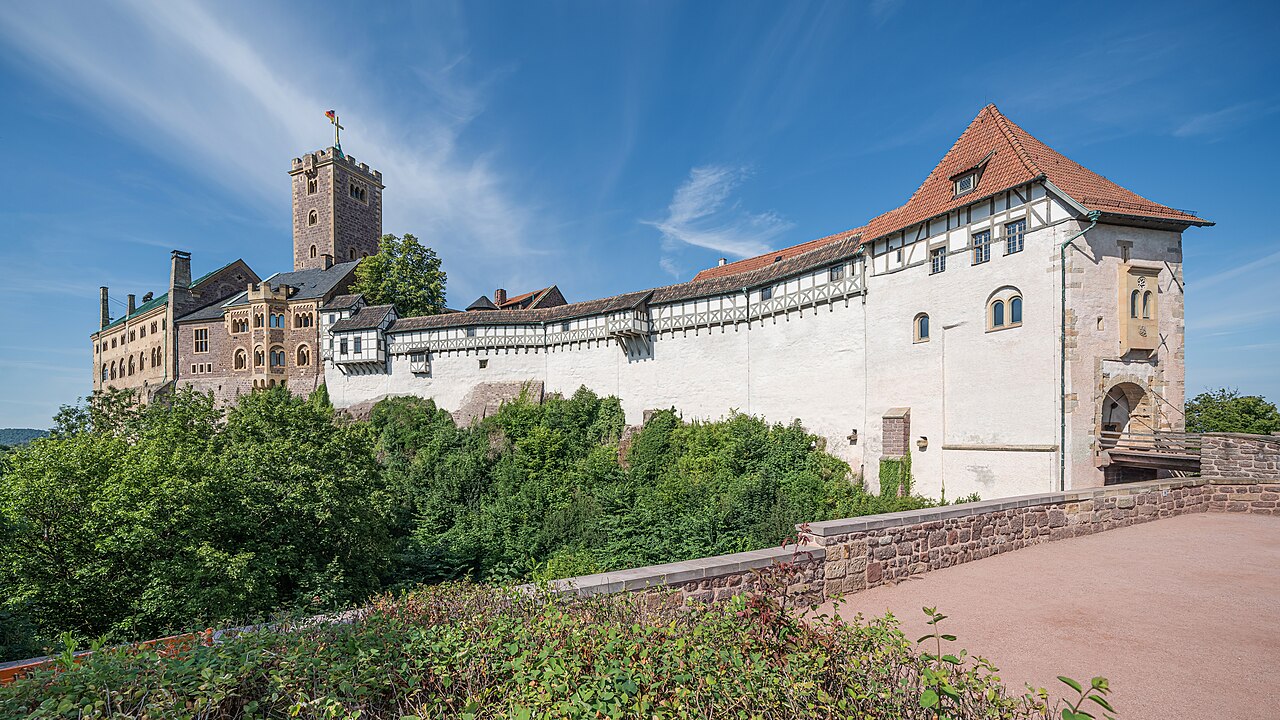
Wartburg Castle on a hilltop in Eisenach under a blue sky. A white plastered wall with half-timbered sections and a red-tiled roof runs across the center, with a square stone tower on the left and green trees below. A stone wall and paved terrace are in the foreground.Artifact

Primary source

Wartburg Castle

founded c. 1067; Luther's stay 1521-1522

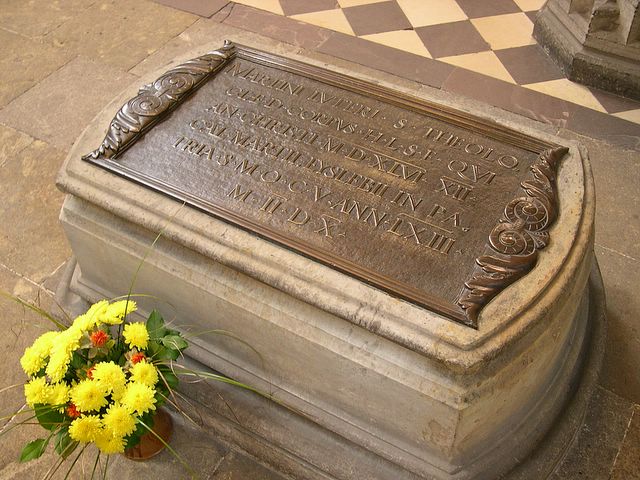
A stone tomb slab with a bronze plaque bearing Latin inscription in raised capital letters, decorated with scrolled bronze corners, set in a stone-floored church. Yellow flowers in a vase sit at the lower left, and a checkered tile floor is visible in the background.Artifact

Secondary source

Grave of Martin Luther

1546 (burial)

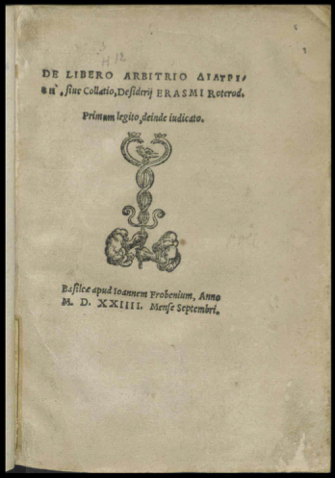
Title page of a 1524 book printed in Basel. Text reads 'De libero arbitrio diatribe sive collatio, Desiderii Erasmi Roterod', with 'Primum legito deinde iudicato' below, a printer's ornament, and 'Basileae apud Ioannem Frobenium, Anno M.D.XXIIII. Mense Septembri.' at the bottom.Book

Primary source

De libero arbitrio diatribe sive collatio

Erasmus · 1524

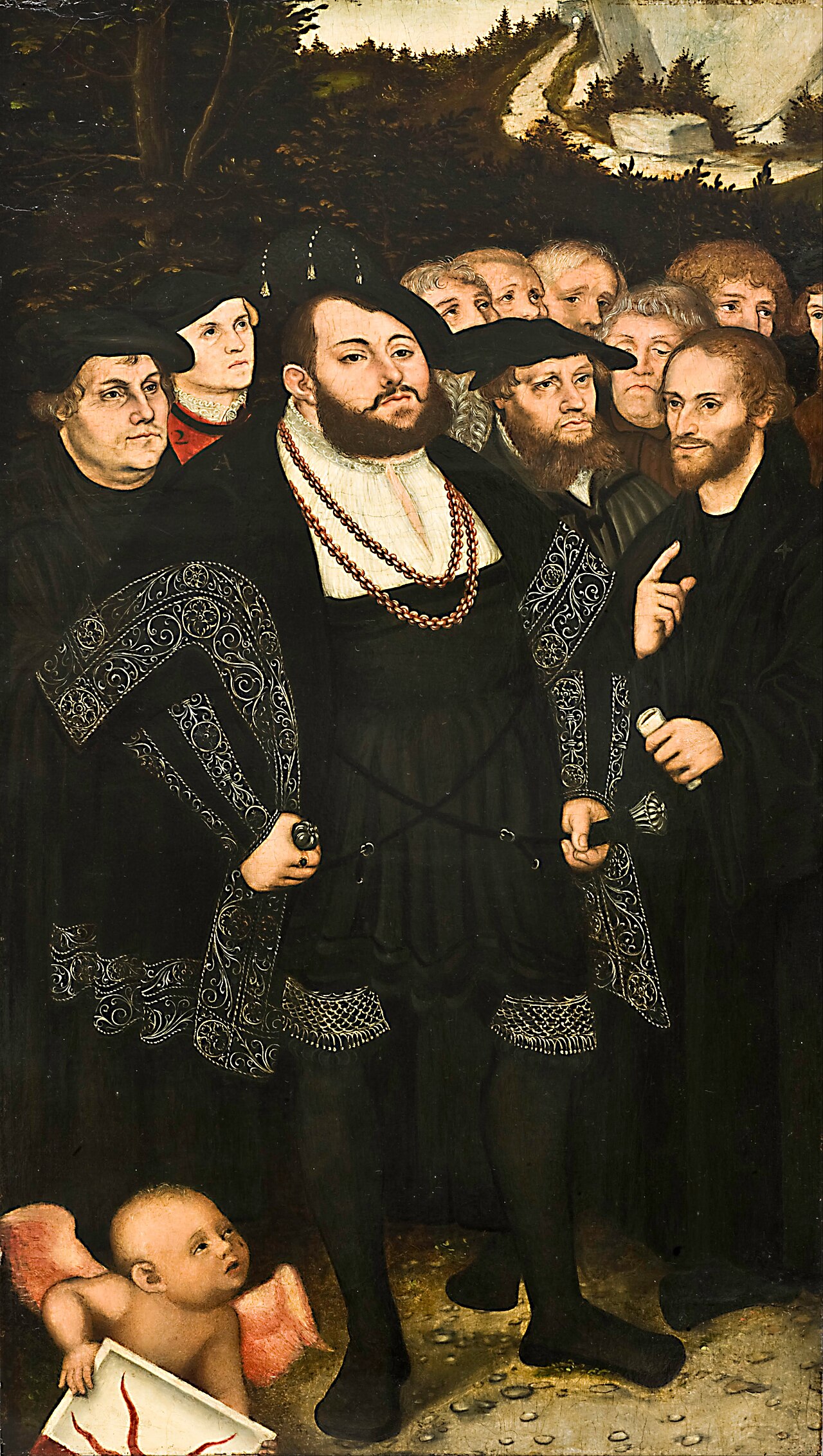
Painting of a group of bearded men in dark 16th-century clothing, standing before a dark wooded landscape. A central figure in an ornate black embroidered coat and red chain looks forward. A small winged cherub sits at lower left.Painting

Primary source

Martin Luther and the Wittenberg Reformers

Lucas Cranach the Younger · 1543

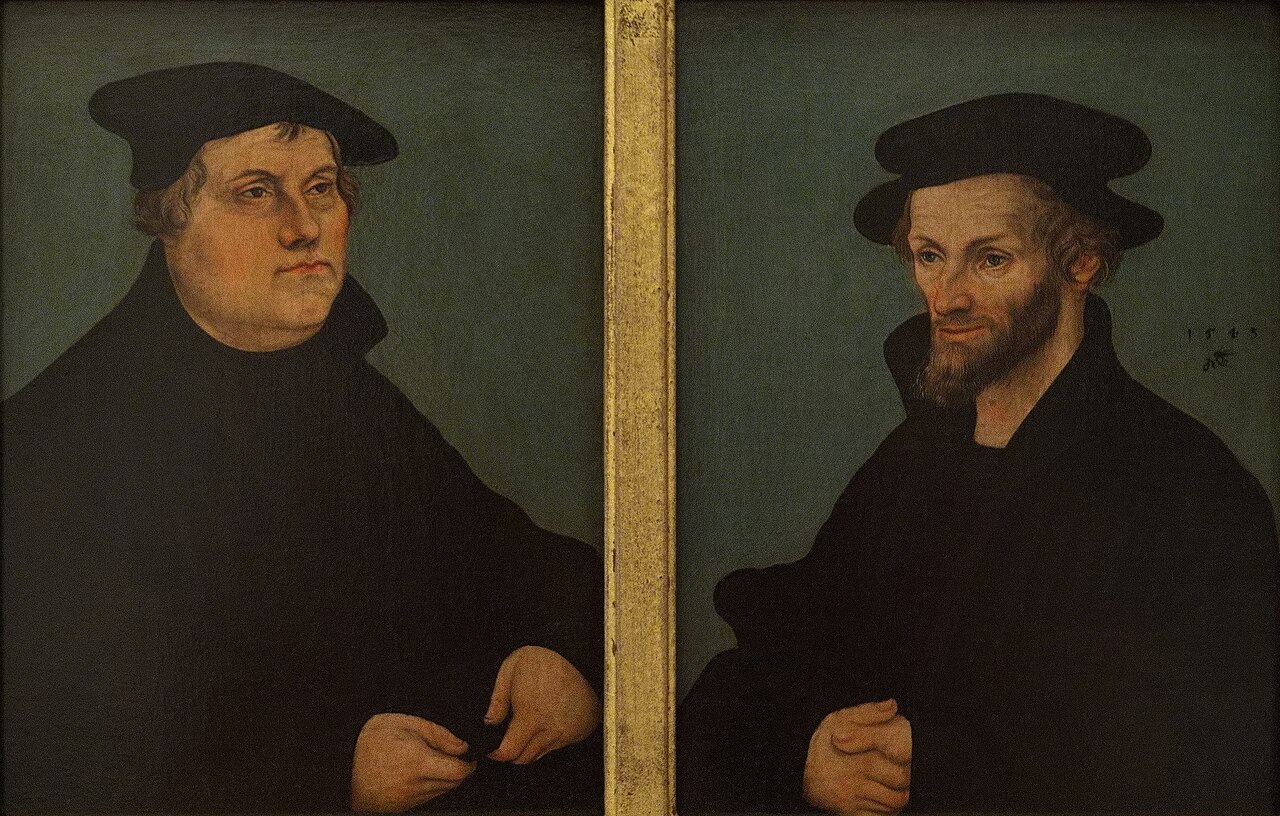
Two side-by-side oil portraits of men in black clothing and black flat caps against dark green backgrounds, separated by a gold frame. The left man has short hair and a high black collar; the right man has a full beard and a date inscription at right.Painting

Primary source

Portraits of Martin Luther and Philipp Melanchthon

Lucas Cranach the Elder · 1543

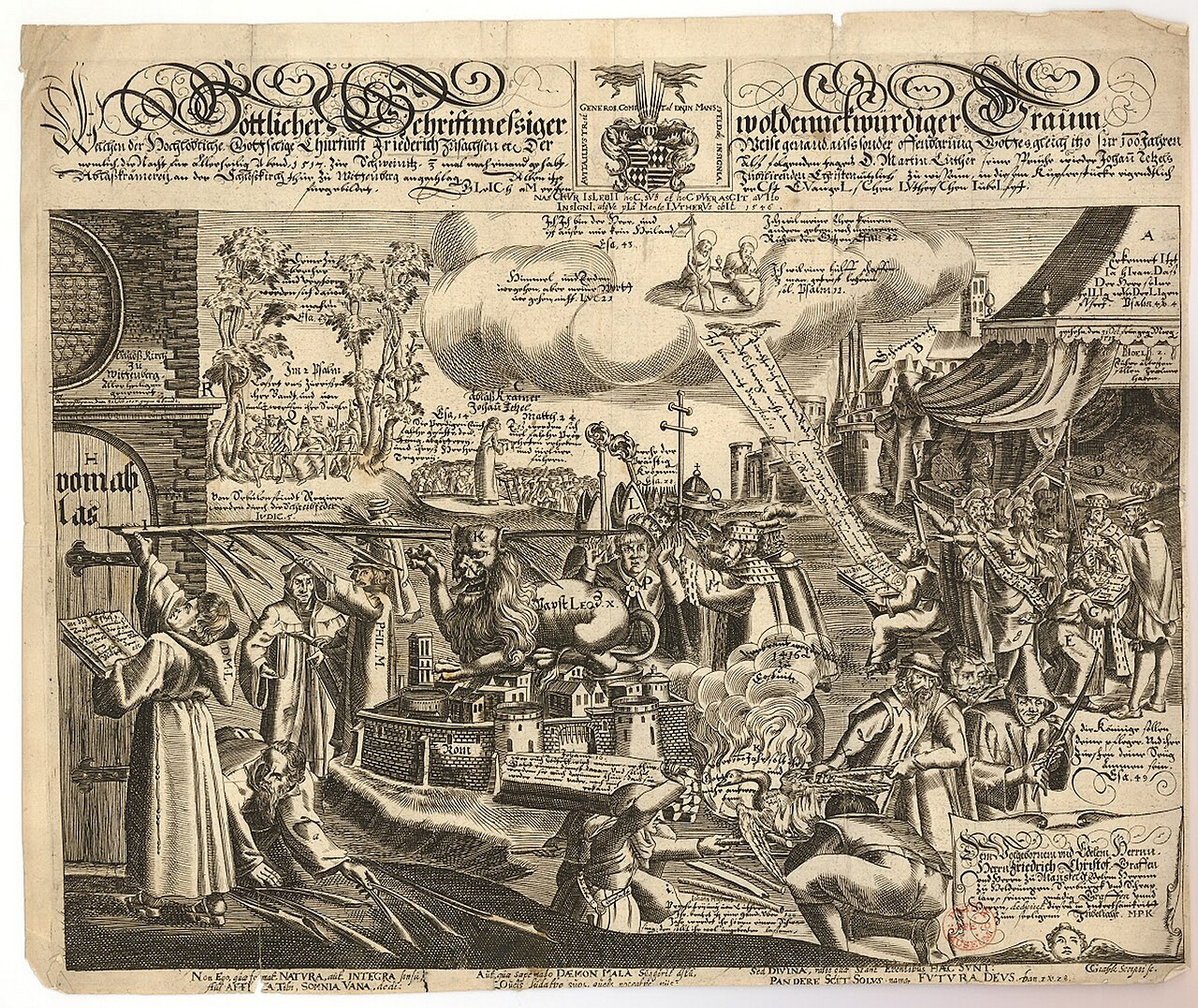
A dense 1617 engraved broadsheet with ornate German title lettering at top and a large allegorical scene below, with clouds, figures, castles, a lion, and many inscribed scrolls with German text and Bible citations.Newspaper article

Secondary source

1617 Reformation Centenary Broadsheet

Conrad Grale · 1617

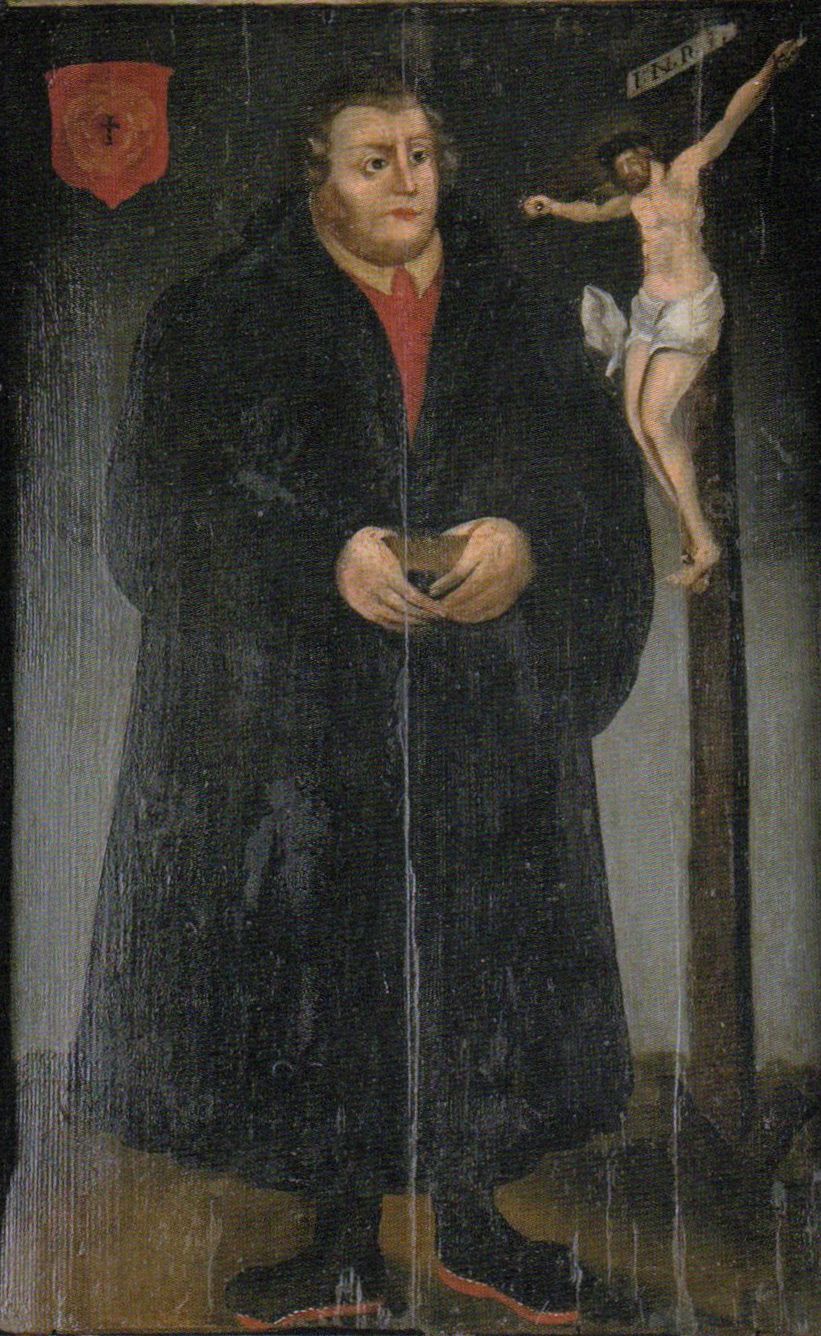
Full-length painting of a bearded man in a black robe with a red collar, holding a small bowl or cup in both hands. To the right stands a wooden crucifix with a figure of Christ and an INRI sign above. A red shield with a cross is in the upper left corner against a dark background.Painting

Secondary source

Unburned Luther

1583

Letter

Primary source

Luther's Correspondence and Other Contemporary Letters

Martin Luther · 1507-1530 (published 1913)

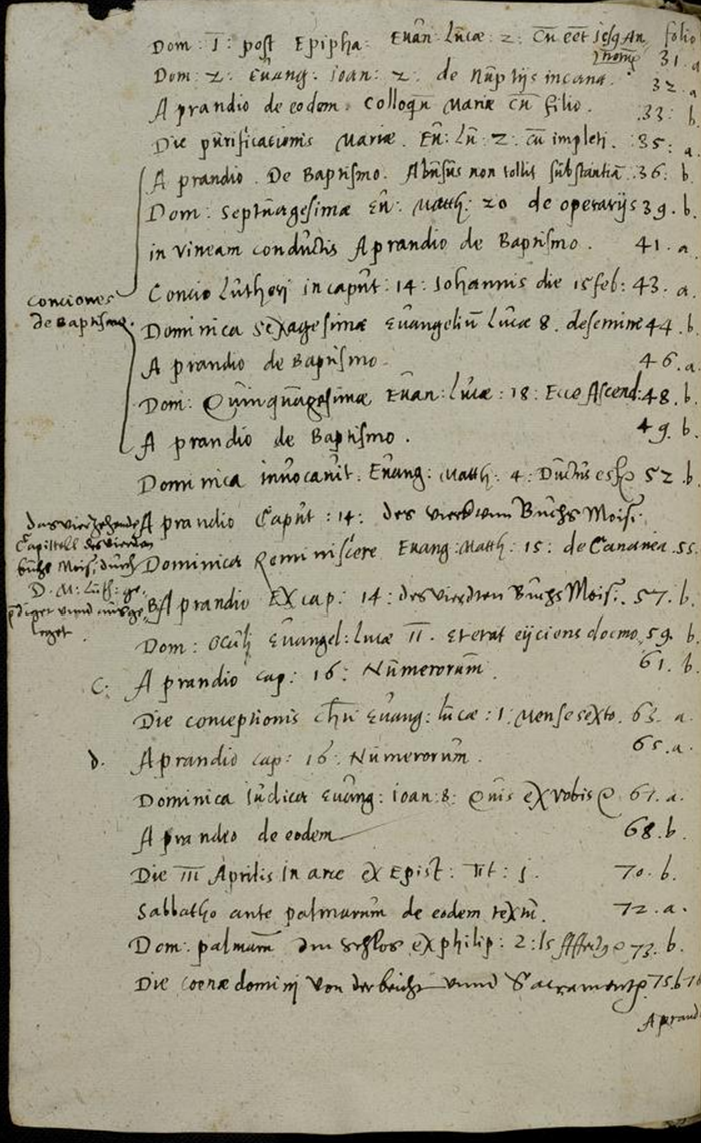
Handwritten early modern manuscript page in ink, a list of Latin and German church calendar entries with folio numbers in the margin, including Dominica, Evangelium, and Sabbatho references, with marginal notes and bracketed groupings on the left.Document

Primary source

Autograph Sermon Manuscript (1535-1538)

Martin Luther · 1535-1538

Document

Primary source

Disputation on the Power and Efficacy of Indulgences (The Ninety-Five Theses)

Martin Luther · 1517 (1915 translation)

Document

Secondary source

The Ninety-Five Theses

Martin Luther · 1517 (1915 translation)

Commentary on GenesisBook

Primary source

Commentary on Genesis

Martin Luther · 1910 (translation of original lectures)

Book

Secondary source

The Table Talk of Martin Luther

Martin Luther · 1857 (recording Luther's remarks)

Book

Primary source

The Precious and Sacred Writings of Martin Luther, vols. 7-14

Martin Luther · 1903

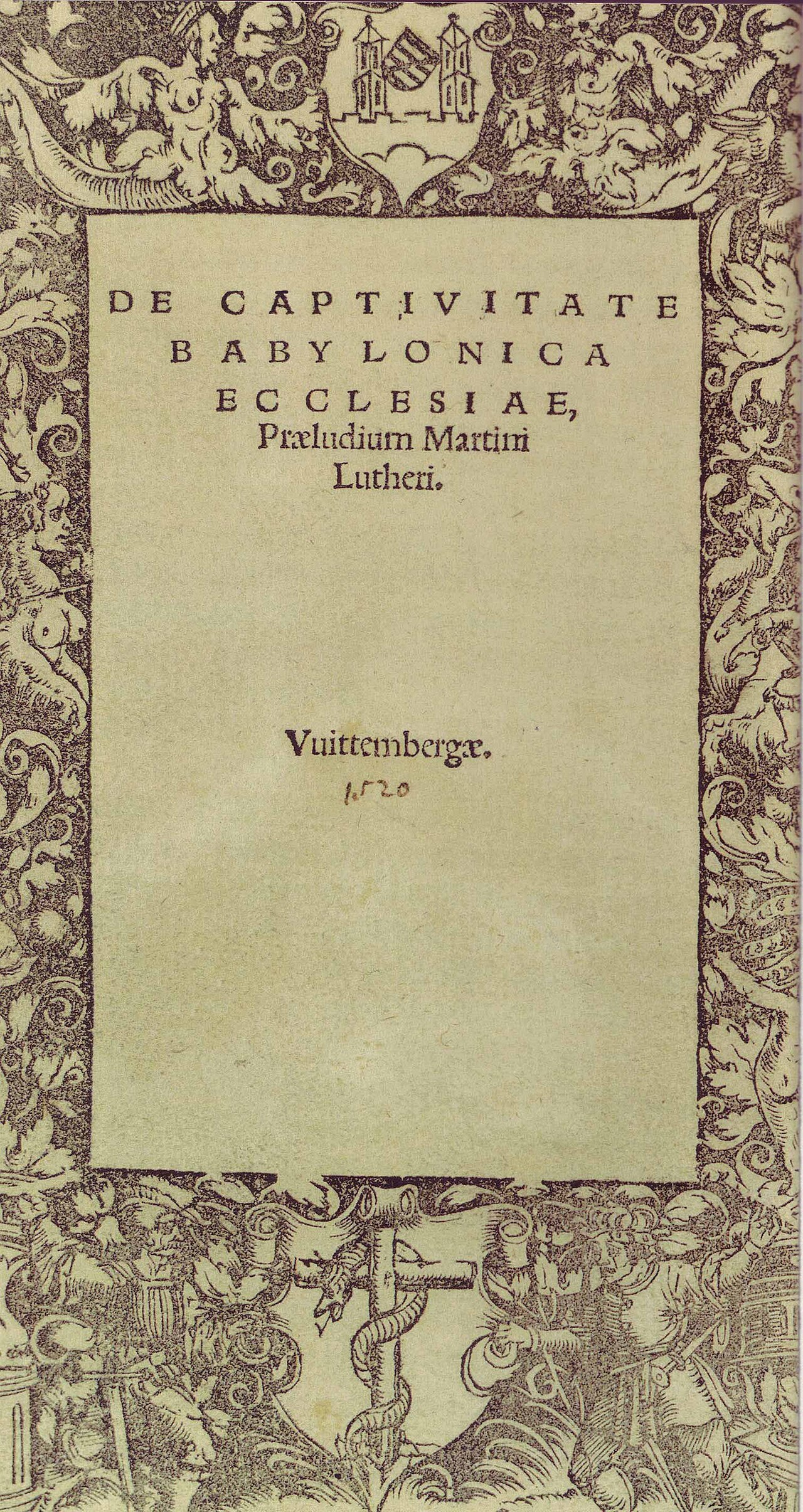
Title page of Martin Luther's 1520 Latin work De captivitate Babylonica ecclesiae praeludium, printed in Wittenberg. Ornate woodcut border with a coat of arms at top and bottom; handwritten date 1520 below the imprint.Book

Primary source

Title page of On the Babylonian Captivity of the Church

Martin Luther · 1520

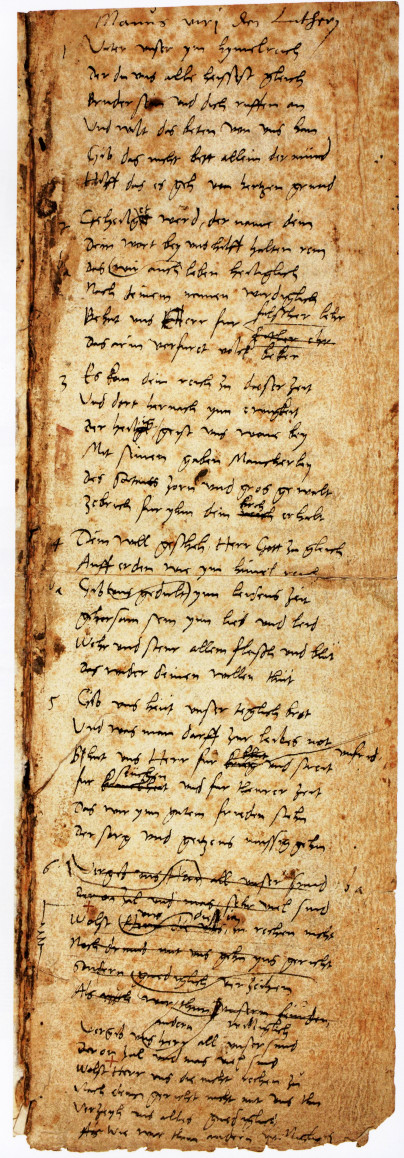
Photograph of a handwritten manuscript on aged, brownish paper, a long vertical page of German verse in brown ink with struck-through and corrected lines, with a title at the top reading Martin Luther's name and the hymn heading.Document

Primary source

Das Vaterunser-Lied autograph manuscript

Martin Luther · c. 1530

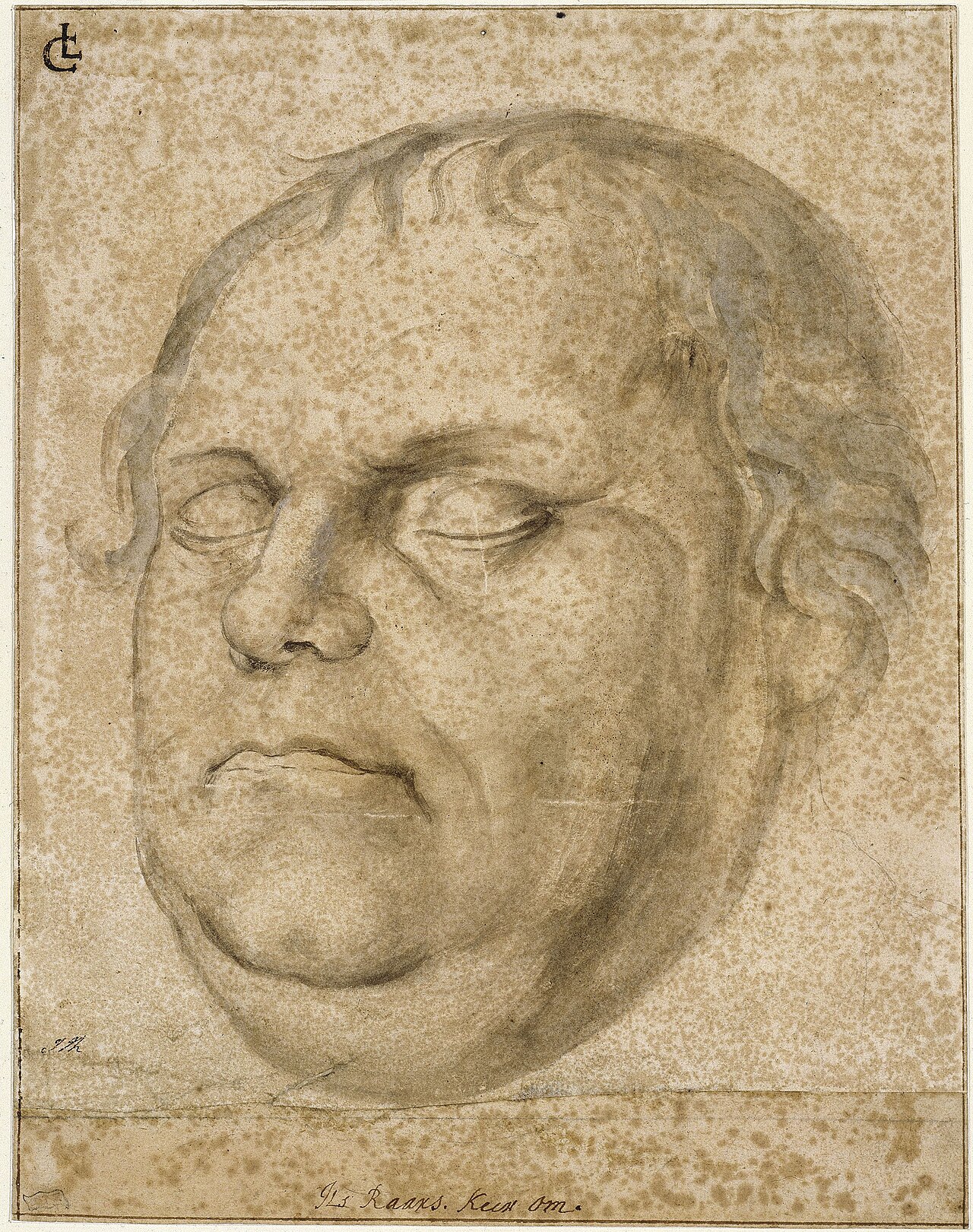
Brown ink and wash drawing on tan paper of a dead man's face in close view, eyes closed, mouth slightly open, with wavy hair and a heavy jaw. Handwritten inscription at bottom reads 'Is Raaxs. Kein Om.' and monogram in upper left.Painting

Primary source

Sketch of the Dead Martin Luther

Lucas Furtenagel · 1546

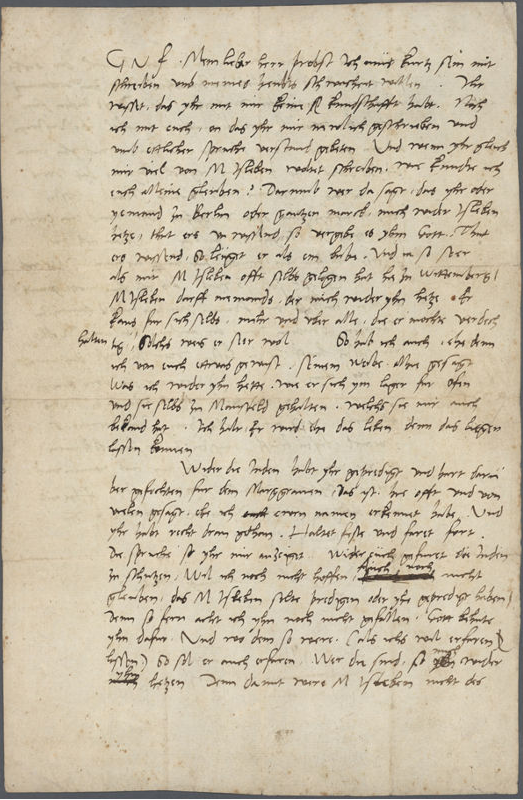
Handwritten manuscript letter on aged, yellowish paper in brownish-black iron gall ink, written in dense early modern German cursive with crossed-out words and interlinear corrections. The first line begins with a decorated opening and the text fills nearly the whole page. No illustration or diagram is present.Letter

Primary source

Letter from Martin Luther to Georg Buchholzer

Martin Luther · c. 1 September 1543

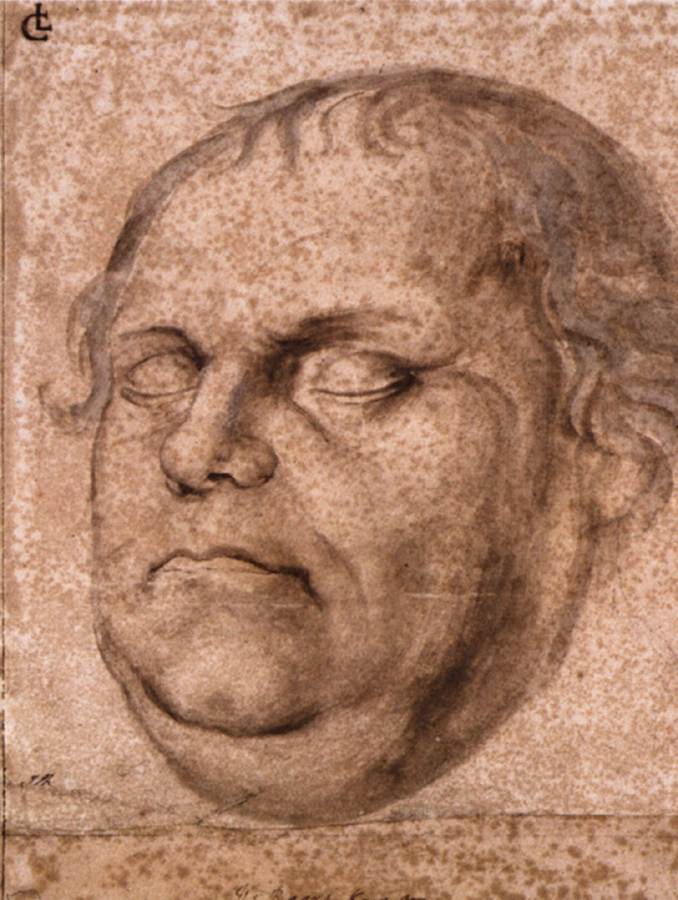
Brown ink-and-wash drawing of a man's face, eyes closed and mouth set, with thinning hair swept back. The paper is speckled tan with a faint inscription at the bottom edge and a monogram at the top left.Painting

Primary source

Sketch of Martin Luther on His Deathbed

Lukas Furtenagel · 18-19 February 1546

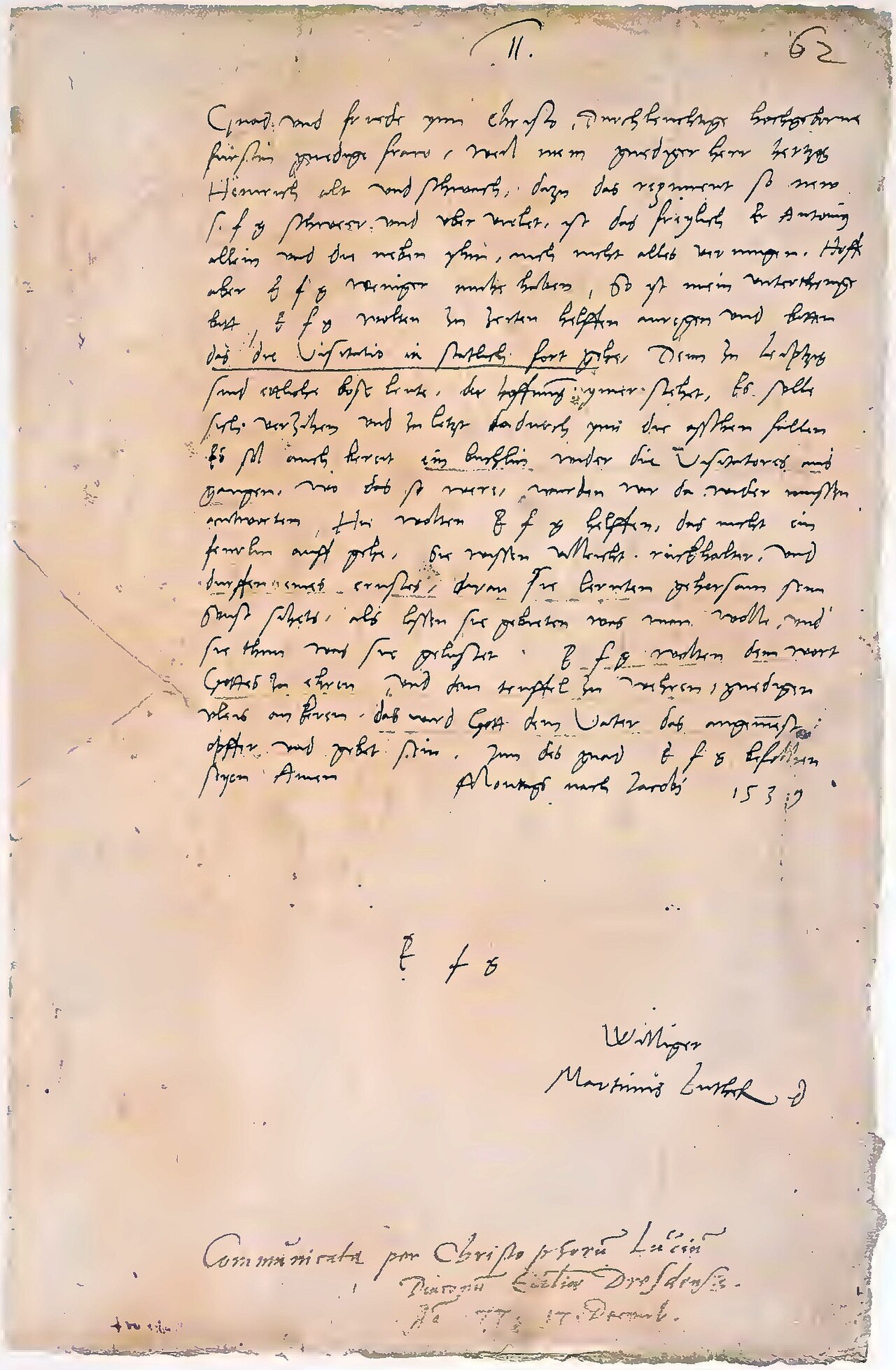
Scan of a handwritten letter in German script on aged paper, signed 'Martinus Luther' at the bottom, dated 'Montags nach Jacobi 1539' near the end. A note in Latin script at the bottom reads 'Communicata per Christoph Lucium' with further annotations.Letter

Primary source

Letter to Duchess Katharina of Saxony

Martin Luther · 28 July 1539

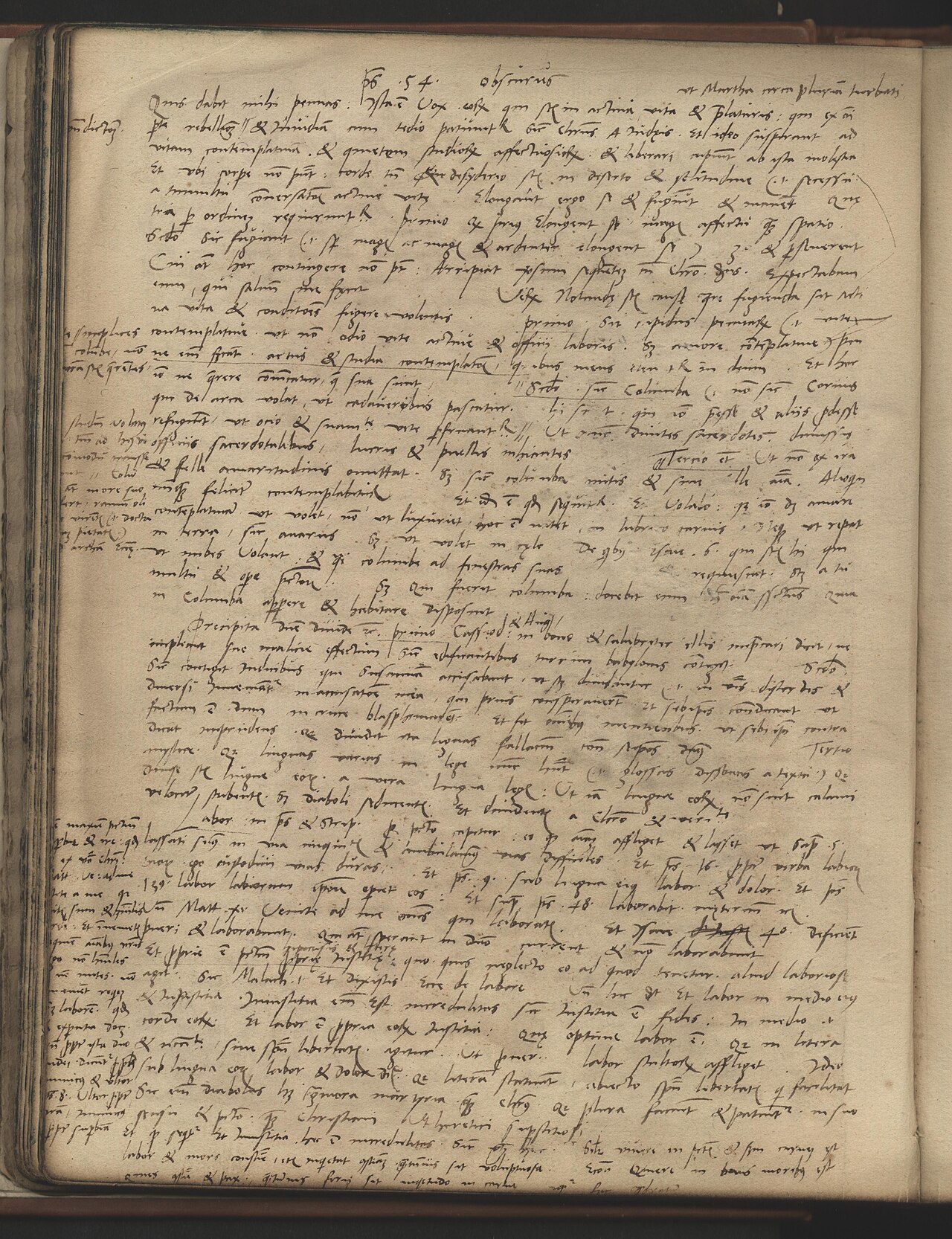
Photograph of a handwritten manuscript page in brown ink on aged paper, bound in a thick volume. The dense cursive Latin text fills the page with marginal notes and a heading reading 'Ps. 54' at top center.Book

Primary source

Manuscript of Luther's First Lecture as Wittenberg Professor

Martin Luther · 1513

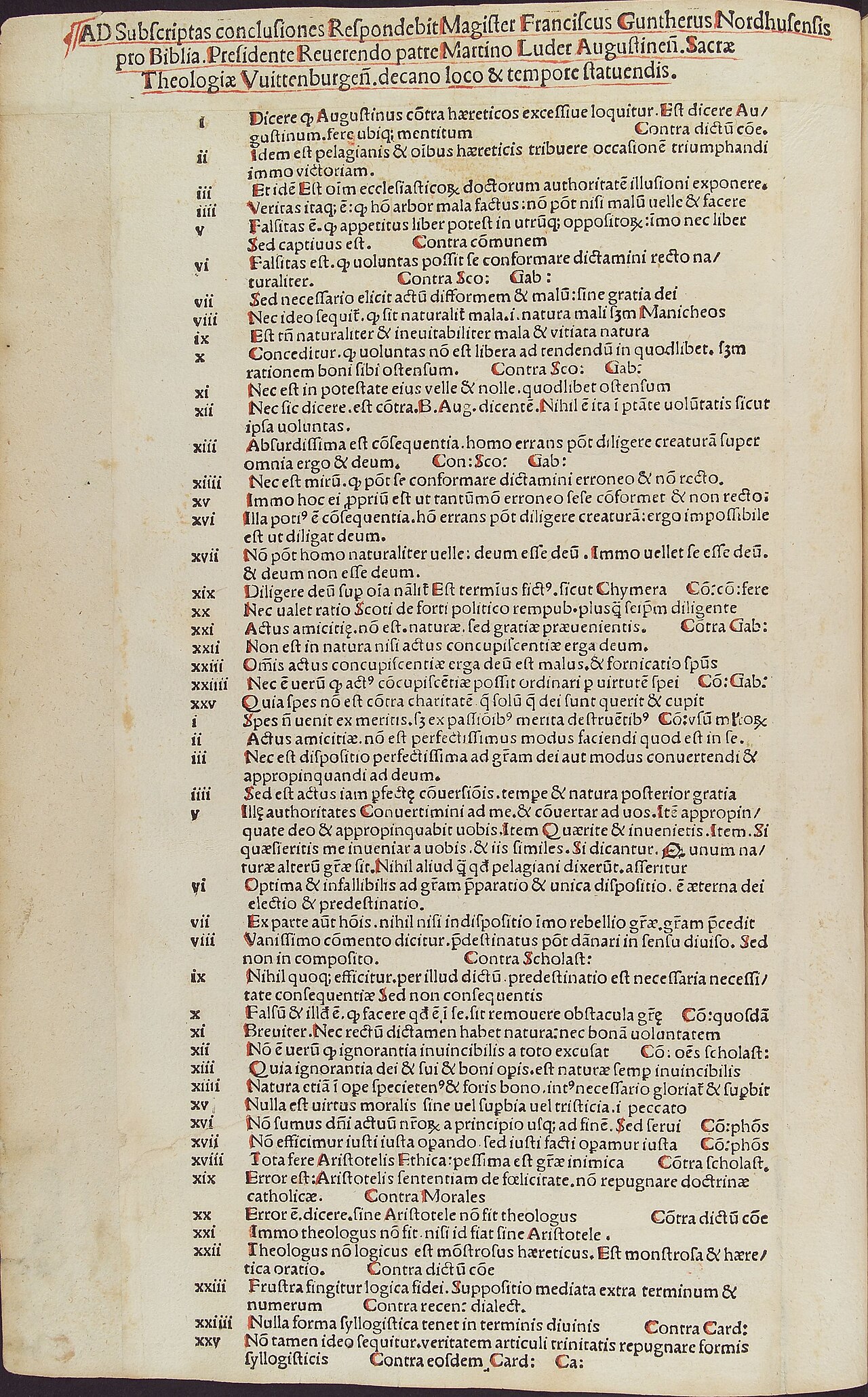
Scanned page of a 1517 printed Latin text with a red-ink title at top, followed by numbered theses in two columns of black type with red-highlighted marginal references and paragraph marks, on aged paper.Document

Primary source

Disputation against Scholastic Theology

Martin Luther · 1517

The Leipzig Debate in 1519: Leaves from the Story of Luther's LifeBook

Secondary source

The Leipzig Debate in 1519: Leaves from the Story of Luther's Life

W. H. T. Dau · 1919

Book

Primary source

Warning Against the Jews

Martin Luther · 1546

Letter

Primary source

Letter to Several Nuns

Martin Luther · 6 August 1524

Letter

Primary source

Letter to Pope Leo X

Martin Luther · 6 September 1518

Document

Primary source

Preface to All Good Hymnbooks

Martin Luther

Document

Primary source

Ninety-five Theses against indulgences

Martin Luther · 1517

Book

Primary source

Dr. Martin Luther's Deutsche Geistliche Lieder

Martin Luther

Document

Primary source

Vom Kriege wider die Türcken

Martin Luther · 1529

Book

Secondary source

Life of Luther

Julius Köstlin

Book

Secondary source

Luther and Lutherdom, from Original Sources

Heinrich Denifle · 1917

The Facts about LutherBook

Secondary source

The Facts about Luther

Patrick F. O'Hare · 1916

Document

Primary source

Come, Holy Ghost, God and Lord

Martin Luther

Document

Primary source

Dear Christians, One and All, Rejoice

Martin Luther

Book

Primary source

Commentary on St. Paul's Epistle to the Galatians

Martin Luther · 1535

Book

Primary source

Commentary on Genesis, Vol. 2: Sin and the Flood

Martin Luther

Documentary

Secondary source

Lecture on What Martin Luther Intended

Craig Harline · 20 October 2017

Documentary

Secondary source

Luther on the Bondage of the Will: Introduction

Onagrus · 29 August 2024

Want the full shelf? Chat with Martin Luther in the app and open the Sources panel — every quote links back to the original.

Use Martin Luther in class

1 collection

A ready-made collection from the Humy team that features Martin Luther. Preview it, then try it free.

Trusted by educators worldwide

Conversations
375,000+
Real exchanges between students and historical figures
Messages exchanged
4,142,000+
Across every figure, classroom and language
Historical figures
100,000+
Each informed by a curated biography and selected sources
Languages supported
50+
From English and Spanish to Arabic and Korean

Paying customers

Used by 98 schools and universities

Partner school logo
Tecnológico de Monterrey logo
Hyper Island logo
Partner school logo
Chambersburg Area School District logo
Broward County Public Schools logo
Nebo School District logo
National Louis University logo
South Florida PBS logo
Punahou School logo
University of Wisconsin–River Falls logo
Partner school logo
Partner school logo
Archbishop Mitty High School logo
Kingsburg High School logo
Norwalk Public Schools logo
Partner school logo
Connections logo
Partner school logo
Moore Public Schools logo
Partner school logo
Partner school logo
Partner school logo
Partner school logo
Robbinsville Public Schools logo
Partner school logo
Partner school logo
Partner school logo
Tecnológico de Monterrey logo
Hyper Island logo
Partner school logo
Chambersburg Area School District logo
Broward County Public Schools logo
Nebo School District logo
National Louis University logo
South Florida PBS logo
Punahou School logo
University of Wisconsin–River Falls logo
Partner school logo
Partner school logo
Archbishop Mitty High School logo
Kingsburg High School logo
Norwalk Public Schools logo
Partner school logo
Connections logo
Partner school logo
Moore Public Schools logo
Partner school logo
Partner school logo
Partner school logo
Partner school logo
Robbinsville Public Schools logo
Partner school logo
Partner school logo

What educators are saying

“We enjoyed the program last year and used it frequently.”
“My students say it’s a welcome change of pace. I’m not a fan of the “sage on the stage” model, so I try to incorporate research-oriented and self-paced activities. With Humy, students have to take charge of their learning. They’ve become more adept at critical thinking, forming better questions, and improving their reading comprehension. The interview feature has been my go-to tool. I create assignments where students must ask historical figures a set number of questions, then summarize the responses to ensure they’re truly absorbing the material. This approach lets them actively explore the past rather than passively consuming information.”
“Humy has helped me bring historical figures, sometimes long past, to life. When my students interact with these figures in real-time, it eliminates some of the perceived “ancient” characteristics of my curriculum. This has shifted my students’ thinking away from viewing history as abstract or irrelevant. Real-time interactions make historical figures relatable, even allowing students to ask off-topic questions that help put historical lives in a more relevant context for 13-year-olds. The feature I use the most is the interview feature. After teaching a topic, most recently Gandhi and Joan of Arc, I have the students ask pointed, focused questions. We practice good conversation techniques beforehand, teaching them to listen (or read) carefully and formulate thoughtful follow-up questions rather than just interrogating. It helps students practice effective conversation skills.”

FAQ

Frequently asked questions

Who is Martin Luther?
Key figure in the Protestant Reformation. On Humy.ai you can chat with an AI version of Martin Luther that draws on a short biography and 88 historical sources during the conversation — by text or voice, in 42 languages.
Is Martin Luther AI free?
Martin Luther is part of Humy's full library of more than 100,000 figures, which comes with a paid plan. A free account (no credit card) includes 20 messages a month with the free library's figures, so you can try how the conversations work first.
What sources does the Martin Luther AI use?
It draws on a short biography and 88 historical sources (books, documents and paintings), including “Ninety-five Theses”, “Domestic Life of Martin Luther at Wittenberg” and “Martinus Luther Woodcut Portrait”. Each source has its own page on Humy.ai.
How historically accurate is the AI version of Martin Luther?
Each figure uses a short biography and a small set of selected historical sources as context (retrieval-augmented generation), so answers stay closer to known material than the model's general knowledge alone. It isn't a citation-grade research tool — like any LLM, the AI can get details wrong or extrapolate. Treat it as a strong starting point for inquiry and cross-reference important claims.
Can I talk to Martin Luther by voice?
Yes. In addition to text chat, you can call Martin Luther and hear their voice respond in real time — useful for auditory learners, interview practice and Socratic dialogue.
Is Humy.ai safe and compliant for schools?
Yes. Humy.ai is used by more than 100 schools, universities and organisations. The platform is FERPA- and GDPR-aligned, supports SSO, and offers an IT-approval pack tailored for school procurement teams.

Ready when you are

Start chatting with Martin Luther now.

20 messages free · No credit card · Available in 50+ languages.