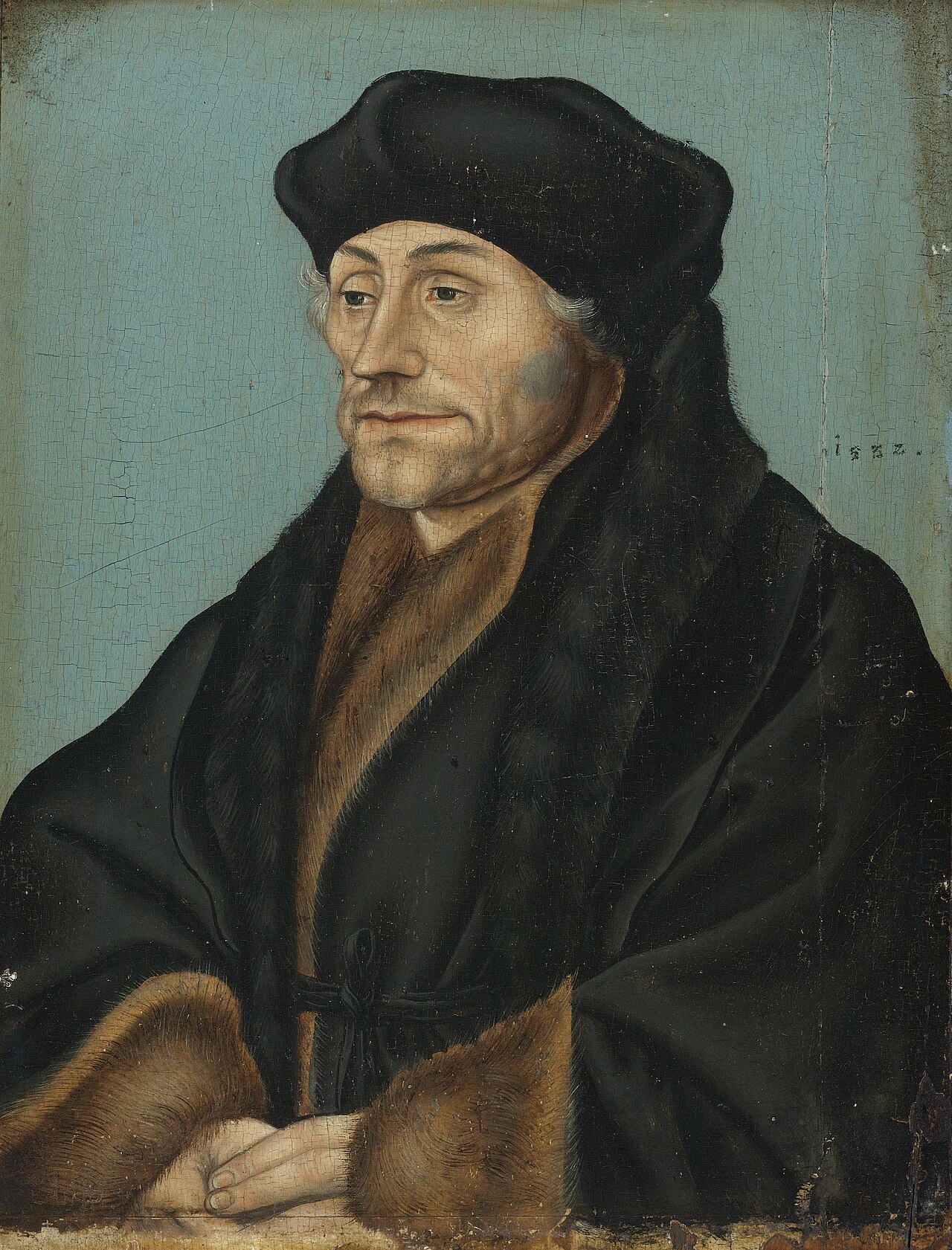
Portrait of Desiderius Erasmus

AI Historical Figure

Desiderius Erasmus

Dutch Renaissance humanist and theologian.

Chat with Desiderius Erasmus via text or voice — in 42 languages, drawing on a curated biography and 85 historical sources. Available 24/7.

Start chatting with Desiderius Erasmus20 messages free · No credit card
Lived
1466–1536
From
Netherlands
Known for
ReligionScholarship & social science
Desiderius Erasmus

Desiderius Erasmus

Online · responds in seconds

Hello — I'm Desiderius Erasmus. Dutch Renaissance humanist and theologian. What would you like to ask me?

20 messages free · No credit card · Powered by Humy.ai

Live preview · Switch between 42 languages above · Send a message to continue in the app

Multilingual

Talk to Desiderius Erasmus in 42 languages

Ask Desiderius Erasmus questions in any language below, and the rest of Humy's app speaks it too. Pick yours to open the chat in that language.

Also in German (Austria), German (Switzerland), English (UK), English (Australia), English (Canada).

The sources behind this AI

85 sources · 44 books · 21 paintings · 9 letters · 5 artifacts · 2 documents · 2 sculptures · 2 photographs

Desiderius Erasmus doesn’t improvise from thin air. The AI is grounded in 85 curated historical sources students can inspect. Open any of them to see what informs the conversation.

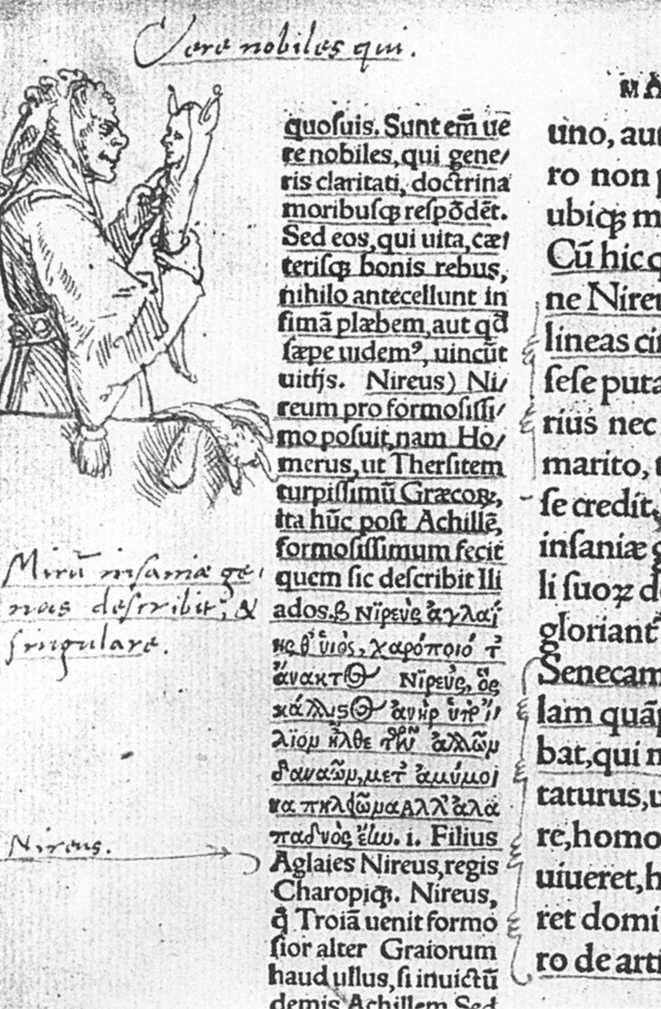
Page from a 16th-century printed Latin book with a pen-and-ink marginal drawing at upper left of a figure in a hooded garment holding up a small figure of a man, with handwritten Latin notes and a printed column of Latin and Greek text beside it. The handwritten annotation reads 'Vere nobiles qui' at the top.Book

Primary source

In Praise of Folly

Erasmus · 1511 (written 1509)

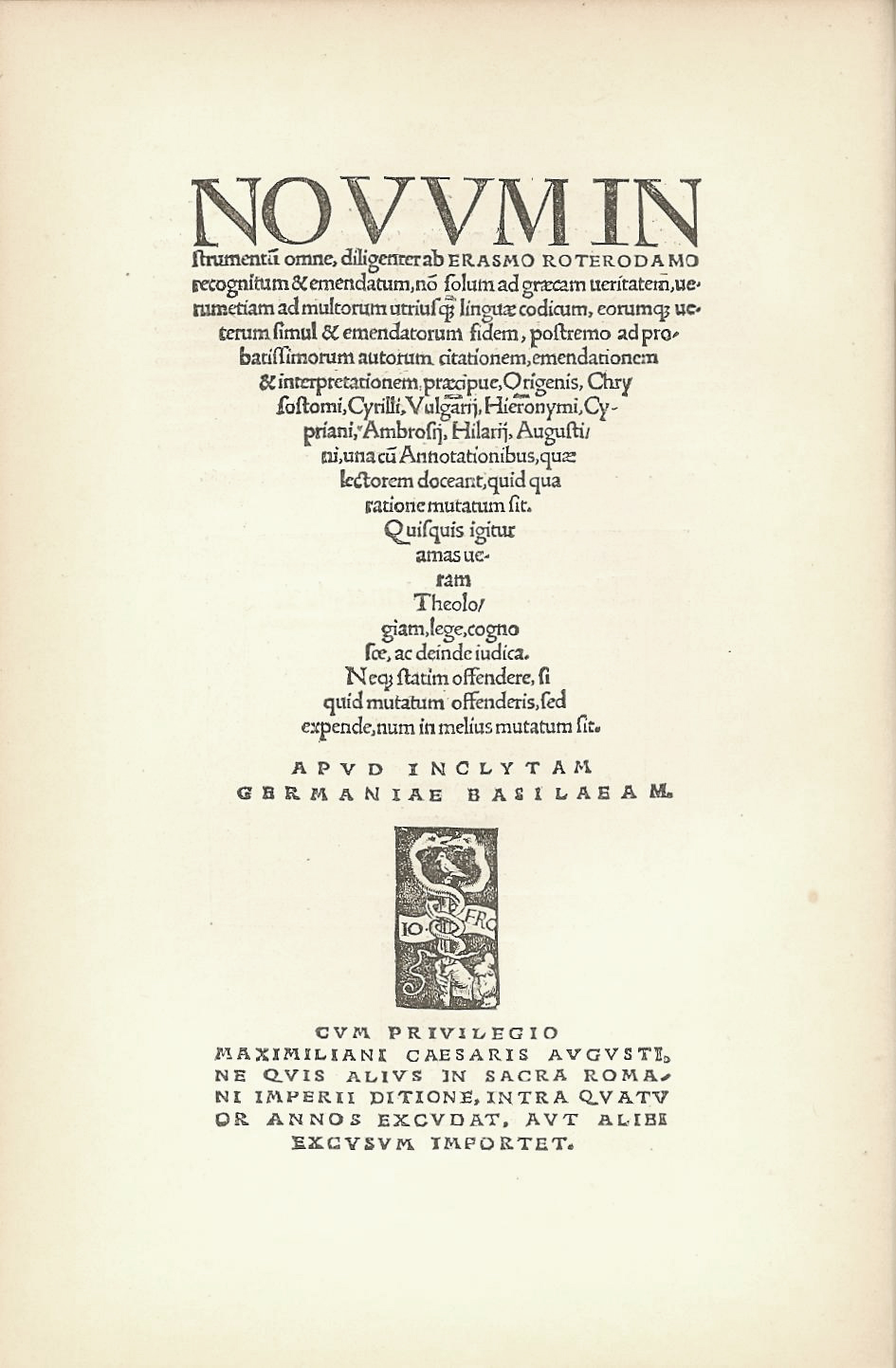
Title page of the 1516 Basel edition of Erasmus's Novum Instrumentum omne, in black letter and roman type, with large capitals NOVVM IN at top, a printer's woodcut device in the center, and a printed privilege notice at the bottom. Text is in Latin.Book

Primary source

Novum Instrumentum omne

Erasmus · 1516

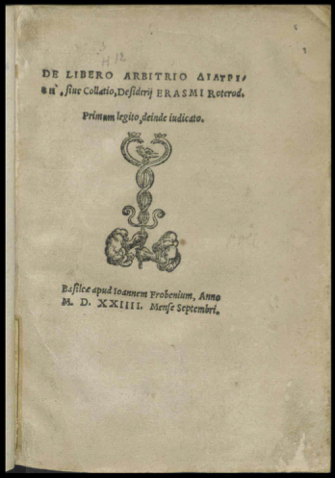
Title page of a 1524 book printed in Basel. Text reads 'De libero arbitrio diatribe sive collatio, Desiderii Erasmi Roterod', with 'Primum legito deinde iudicato' below, a printer's ornament, and 'Basileae apud Ioannem Frobenium, Anno M.D.XXIIII. Mense Septembri.' at the bottom.Book

Primary source

De libero arbitrio diatribe sive collatio

Erasmus · 1524

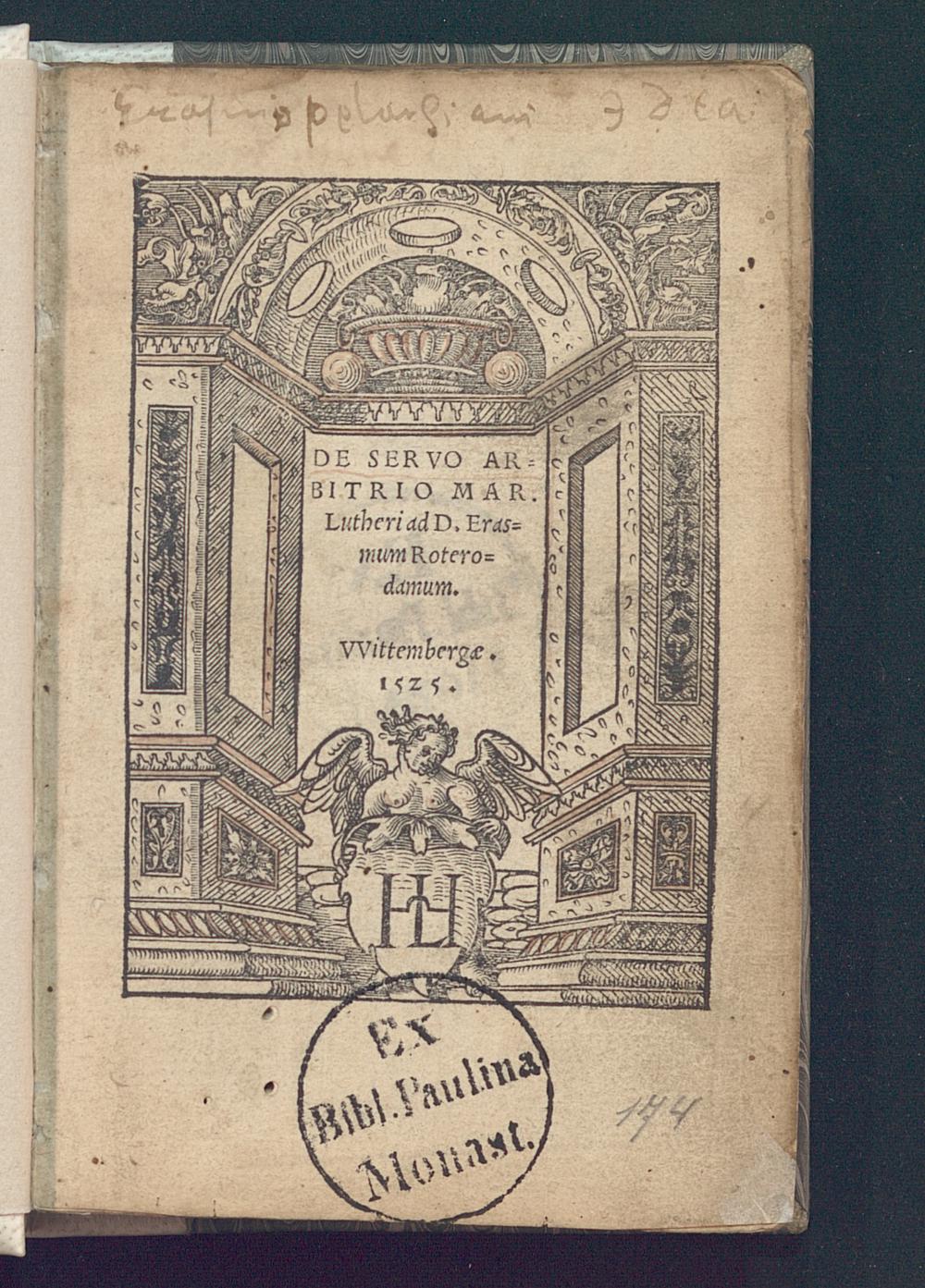
Scan of the title page of a 1525 book, with an ornate woodcut border of architectural arches and foliage. Central text reads 'DE SERVO ARBITRIO MARTINI Lutheri ad D. Erasmum Roterodamum' and 'Vvittembergae 1525', with a winged cherub holding a shield marked with a monogram at the bottom. A circular library stamp reads 'Ex Bibl. Paulina Monast.' and handwritten notes appear at top and right.Book

Primary source

On the Bondage of the Will

Martin Luther · 1525

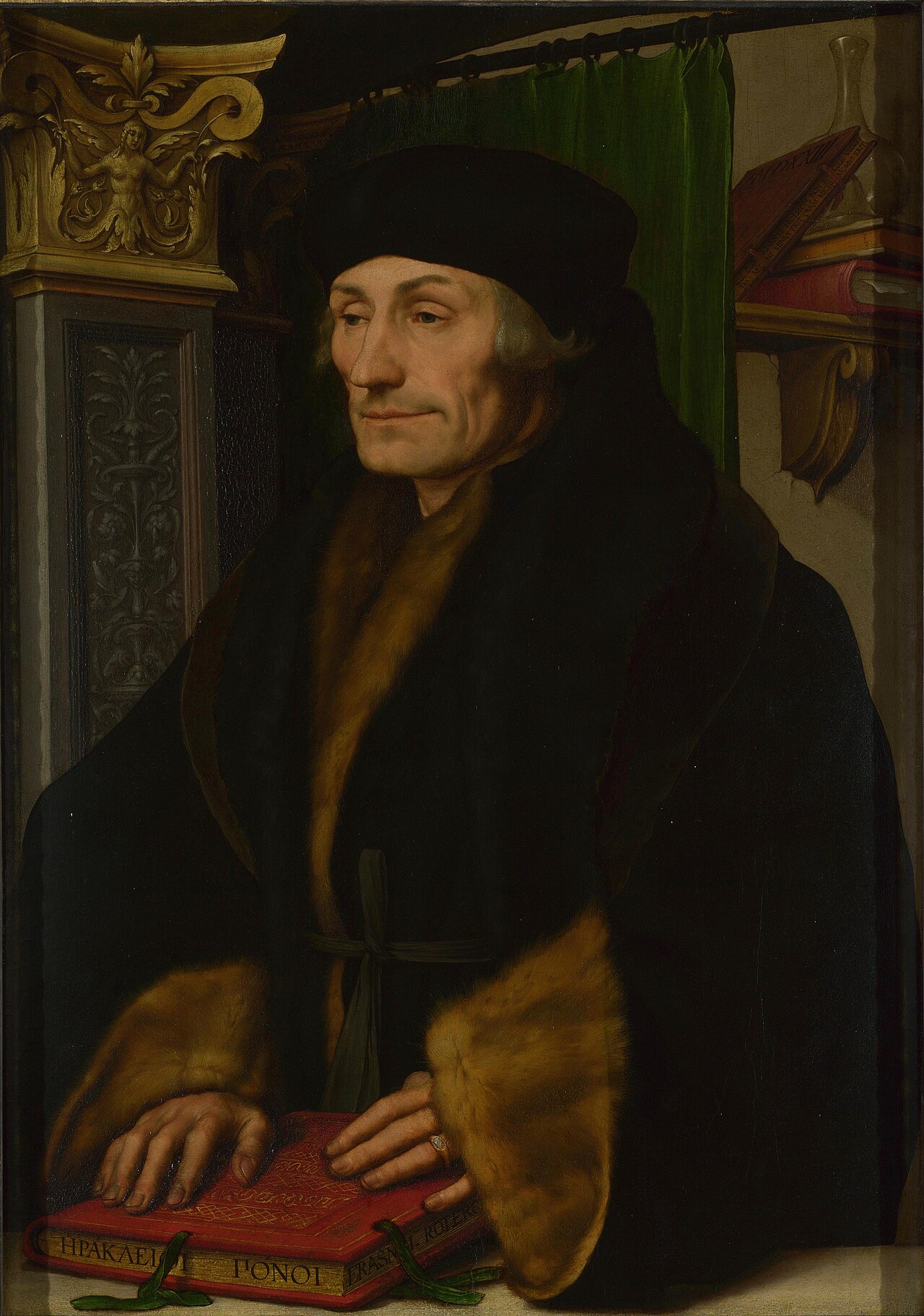
Oil painting of an older man with grey hair wearing a black cap and dark fur-trimmed robe, resting his hands on a red book with gold lettering and green ribbon markers. A green curtain and carved pilaster stand behind him, with books and a glass bottle on a shelf at right.Painting

Primary source

Erasmus

Hans Holbein the Younger · 1523

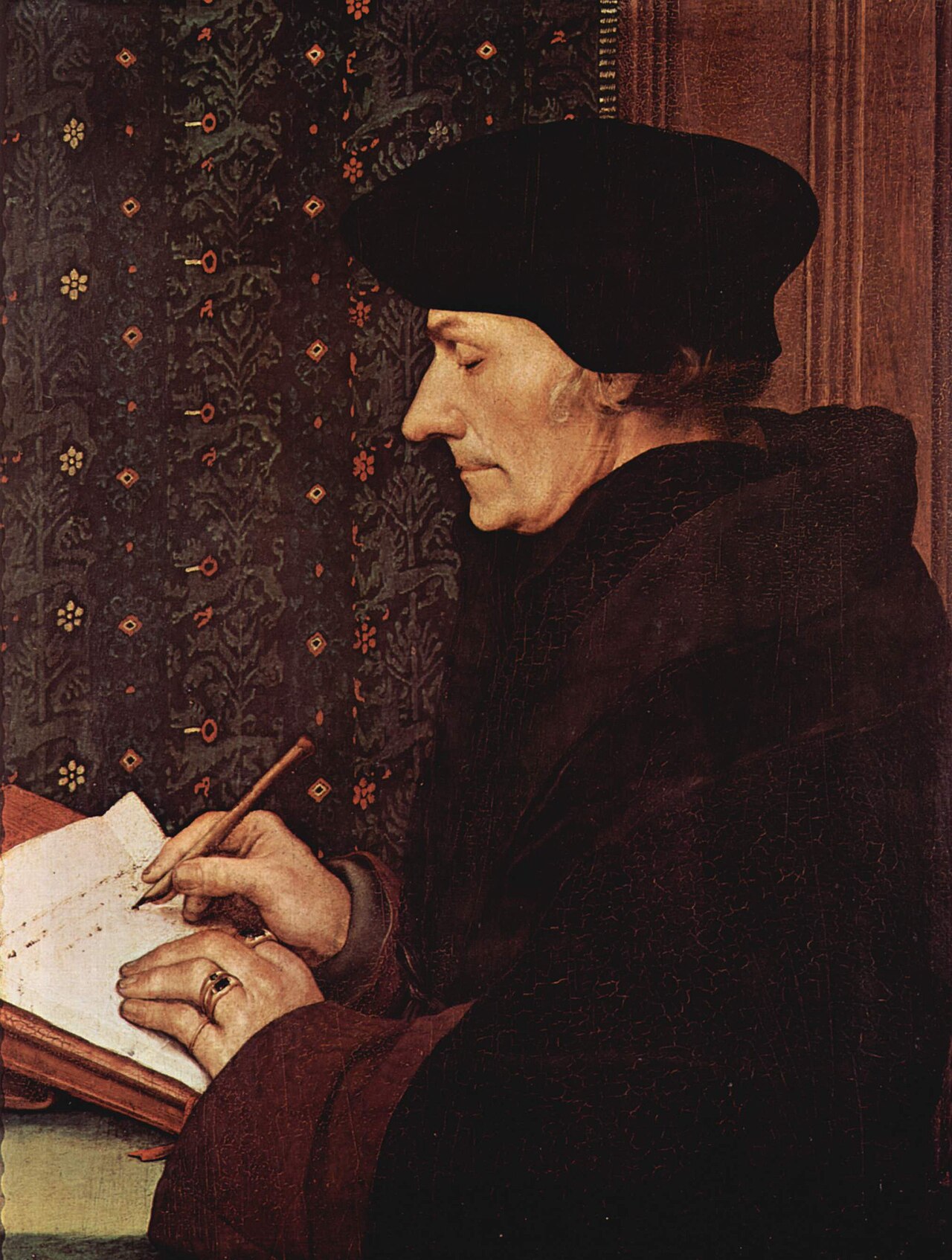
Painting of a man in profile wearing a black flat cap and dark robe, writing with a quill on a sheet of paper resting on a book. He wears rings on his hand. Behind him is a dark patterned textile hanging with red and gold motifs.Painting

Primary source

Portrait of Erasmus Writing

Hans Holbein the Younger · 1528

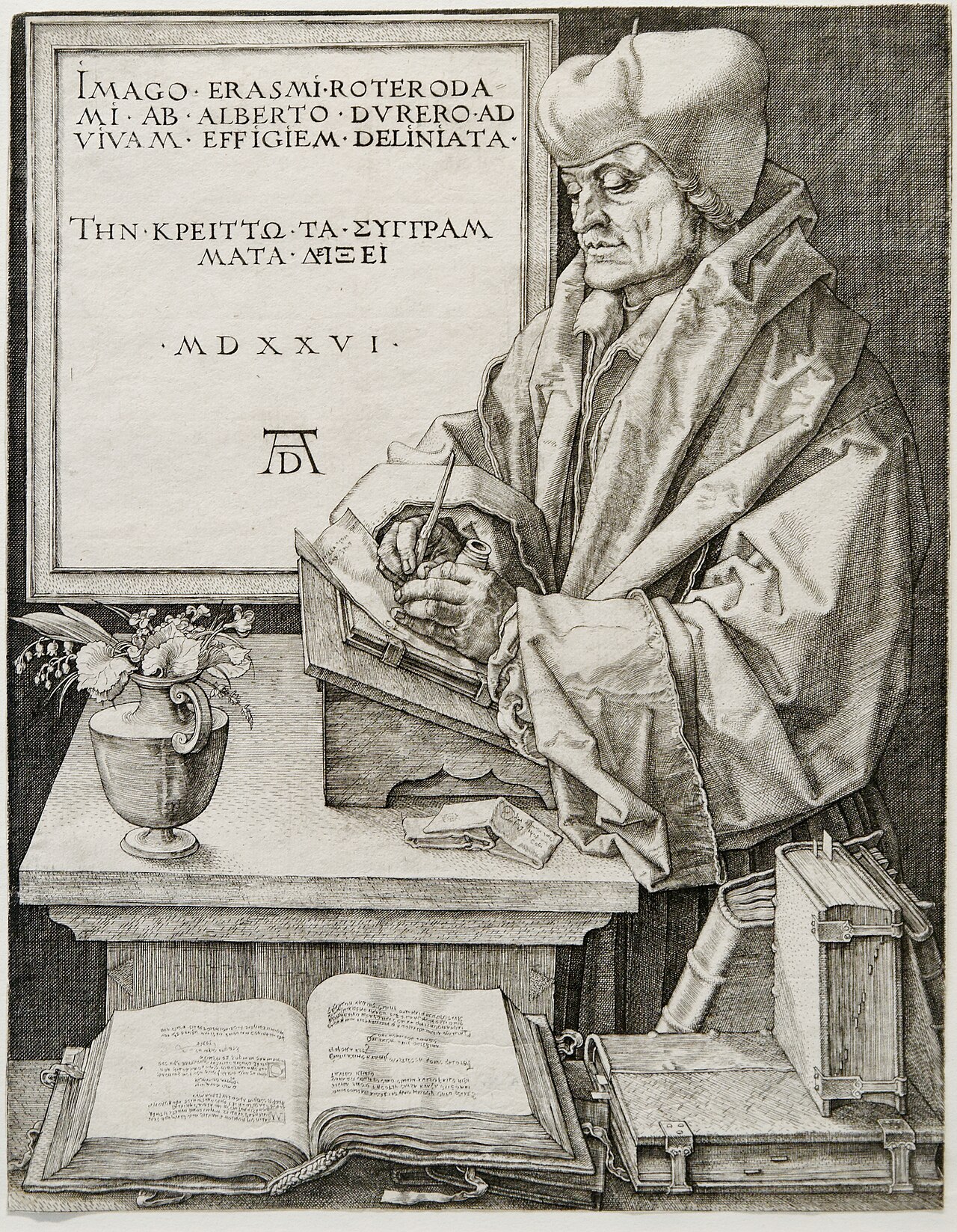
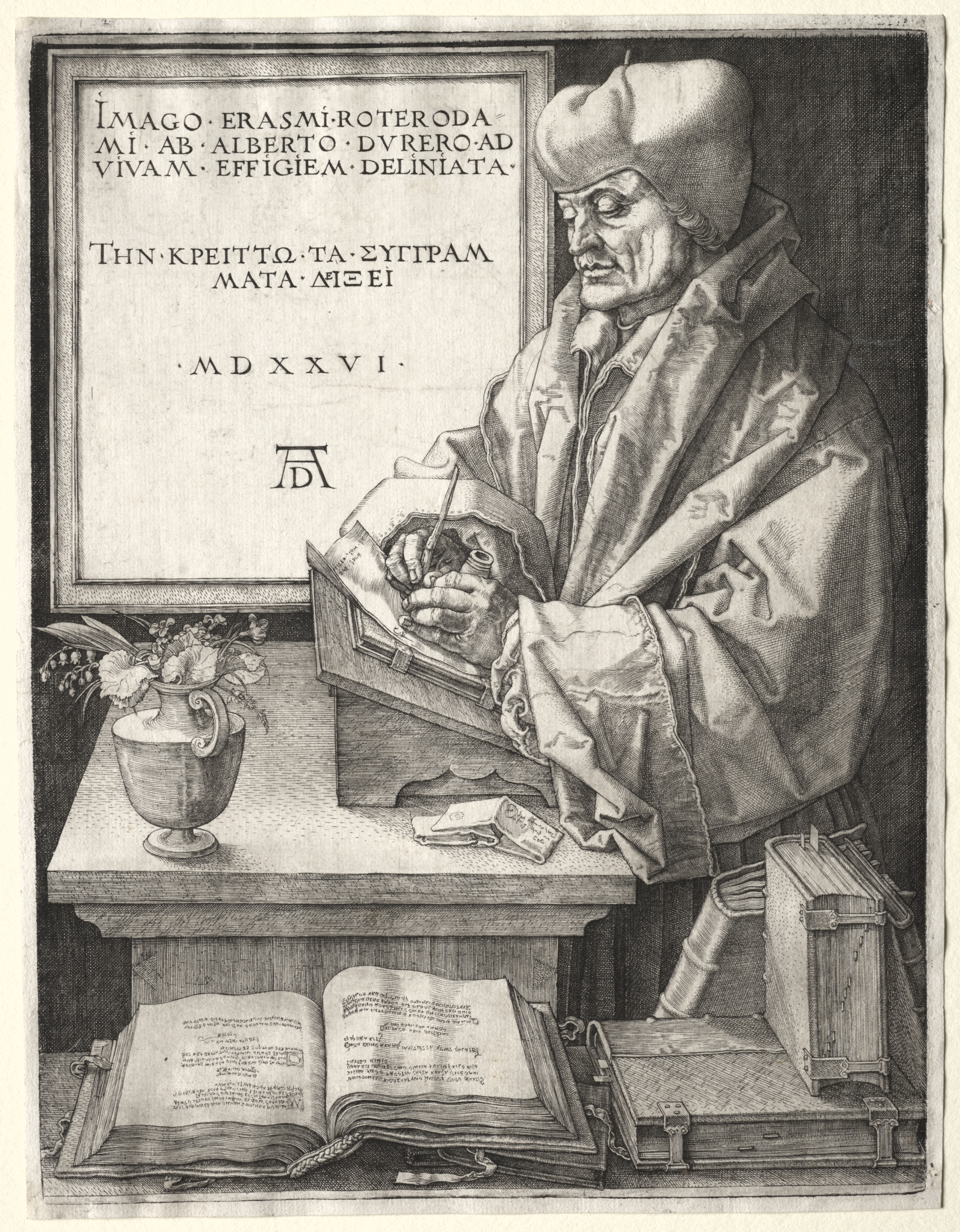
Black and white engraving of a man in a fur-trimmed cap and layered robe, writing at a sloped desk with a quill and inkwell. A vase of flowers and an open book sit nearby. Latin and Greek inscriptions and the date MDXXVI appear on a tablet at left, with a monogram.Painting

Primary source

Portrait of Erasmus of Rotterdam

Albrecht Dürer · 1526

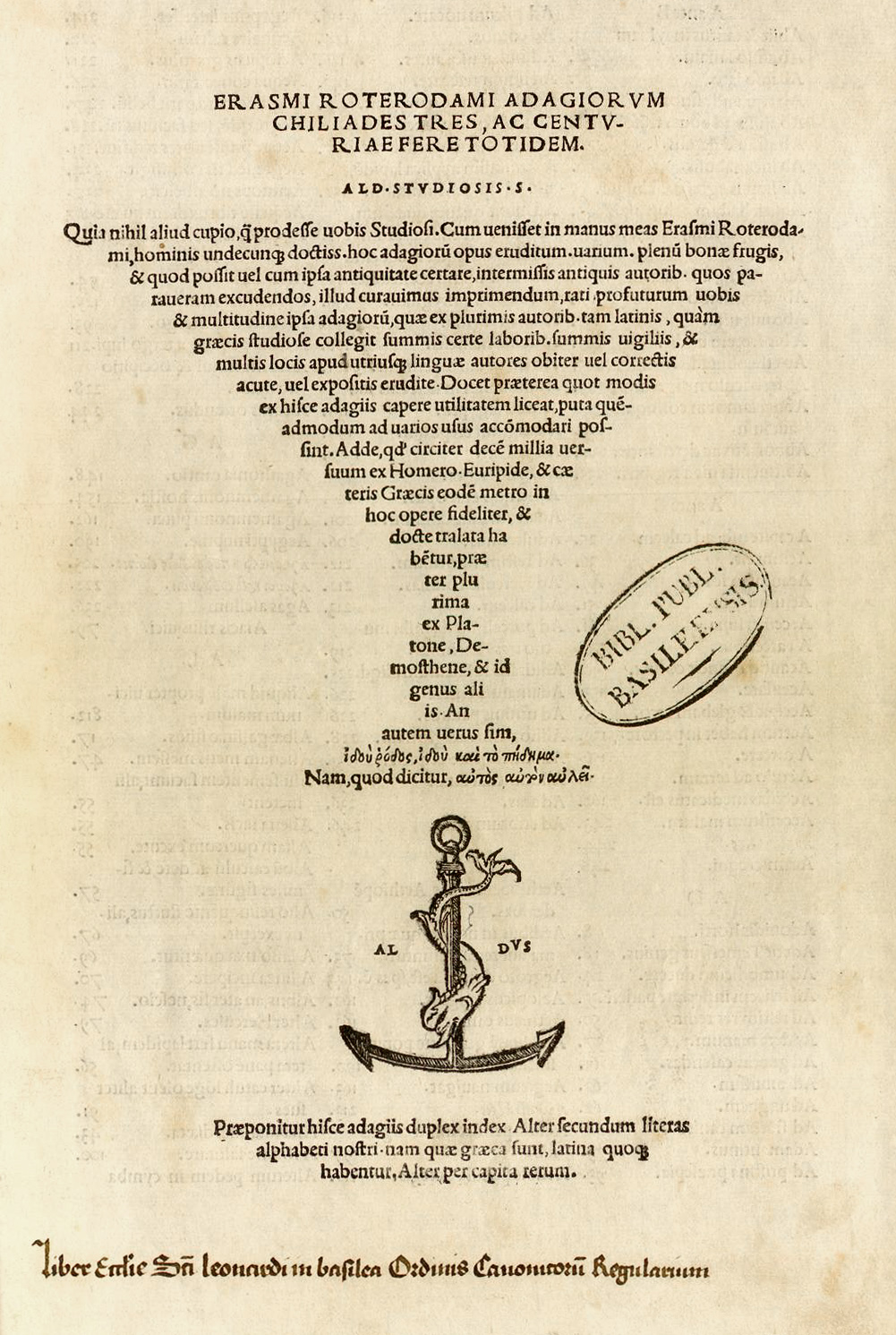
Scan of a printed title page in Latin with a large heading reading Erasmi Roterodami Adagiorum Chiliades tres, ac centurias fere totidem. Below is dense body text, a small oval library stamp reading Bibl. Publ. Basileensis, and a woodcut of an anchor with a dolphin or serpent wrapped around it, flanked by the letters AL and DVS. At the bottom is a line of handwritten-style script.Book

Primary source

Adagia

Erasmus · 1500, expanded until 1536

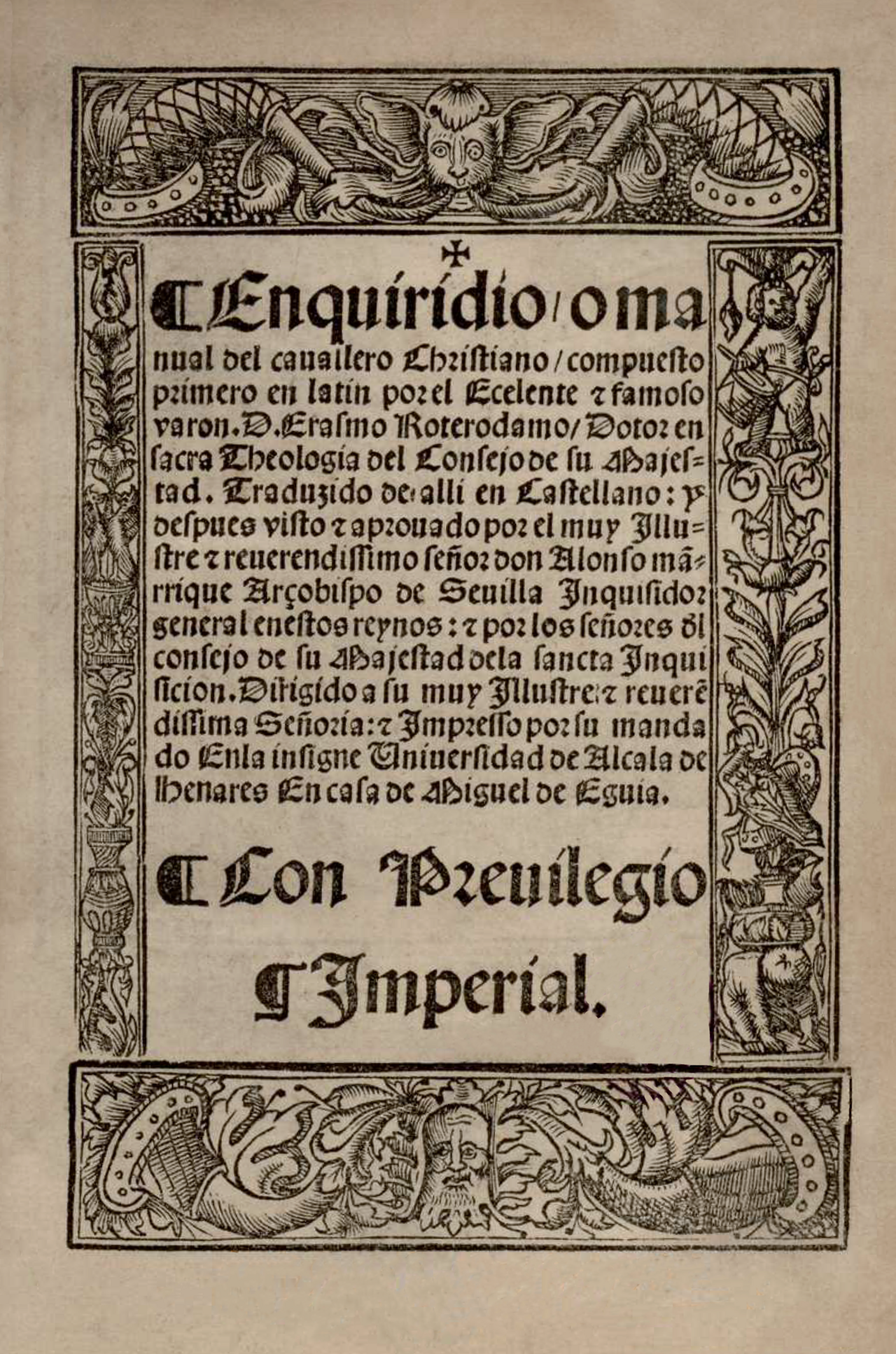
Title page of a Spanish edition of the Handbook of a Christian Knight in black-letter type, framed by ornate woodcut borders with figures and foliage. Text reads Enquiridio o manual del caballero christiano by Erasmus, printed in Alcala de Henares by Miguel de Eguia.Book

Primary source

Handbook of a Christian Knight

Erasmus · 1503 (Spanish edition 1528)

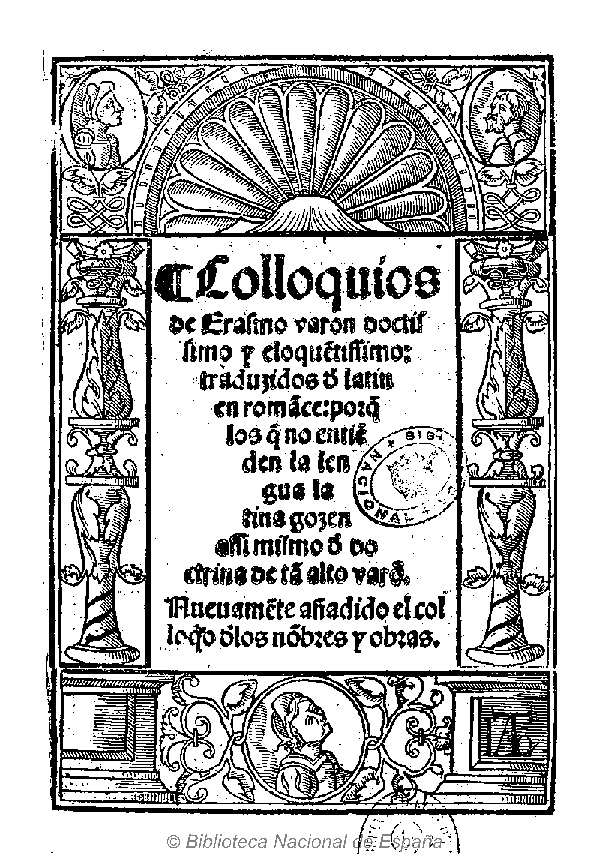
Title page of a 1532 Spanish edition of Erasmus's Colloquies. Large black-letter title reads Colloquios de Erasmo, with woodcut borders, an arched fan-shaped ornament at top, portrait medallions, and a circular library stamp reading Biblioteca Nacional.Book

Primary source

Familiar Colloquies

Erasmus · 1518, expanded through 1533 (Spanish edition 1532)

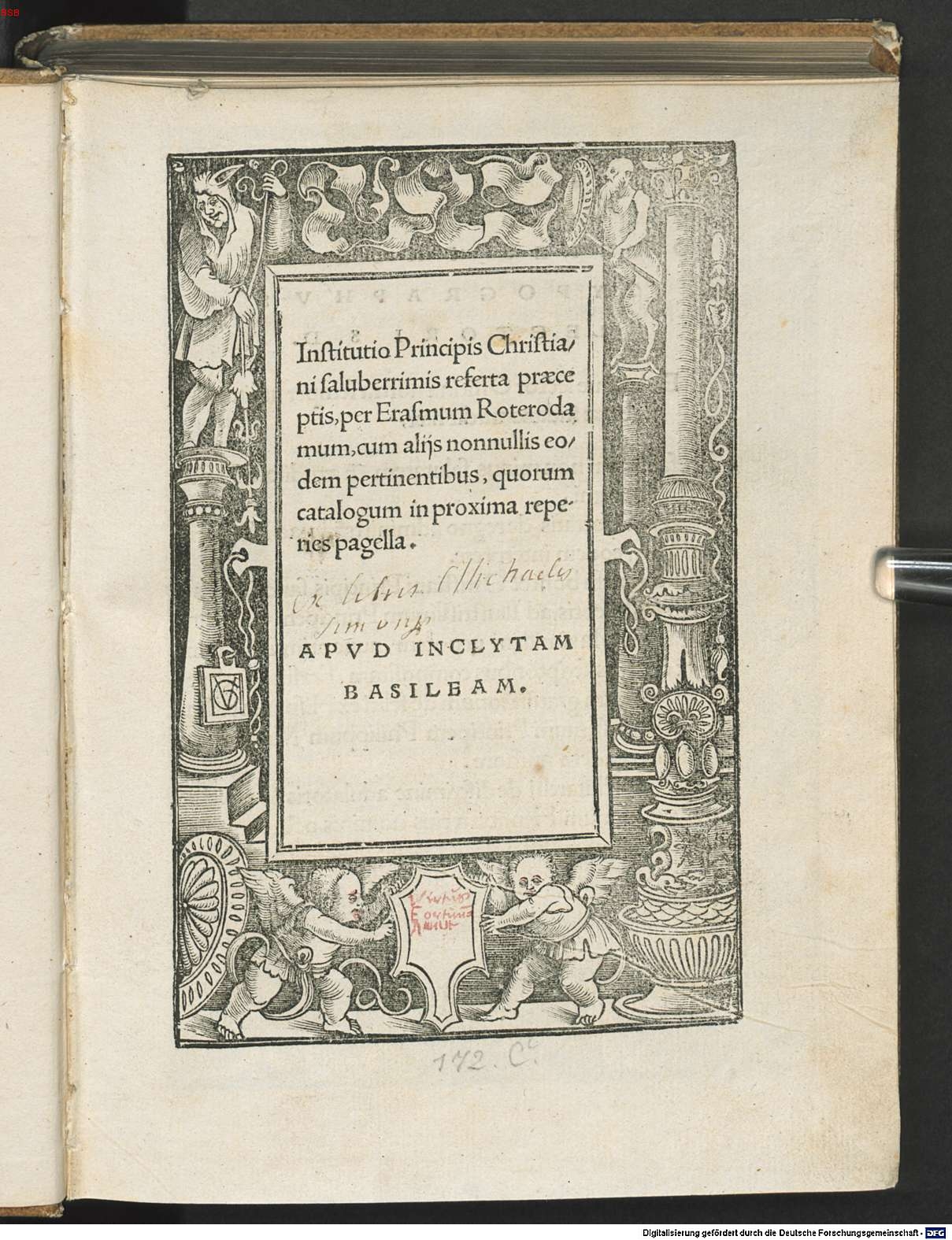
Scan of a book page with a woodcut border of figures, columns and cherubs framing a title page. The central text reads Institutio Principis Christiani, per Erasmum Roterodamum, and ends with Apud inclytam Basilbam.Book

Primary source

The Education of a Christian Prince

Erasmus · 1516

Book

Primary source

The Complaint of Peace

Erasmus · 1517

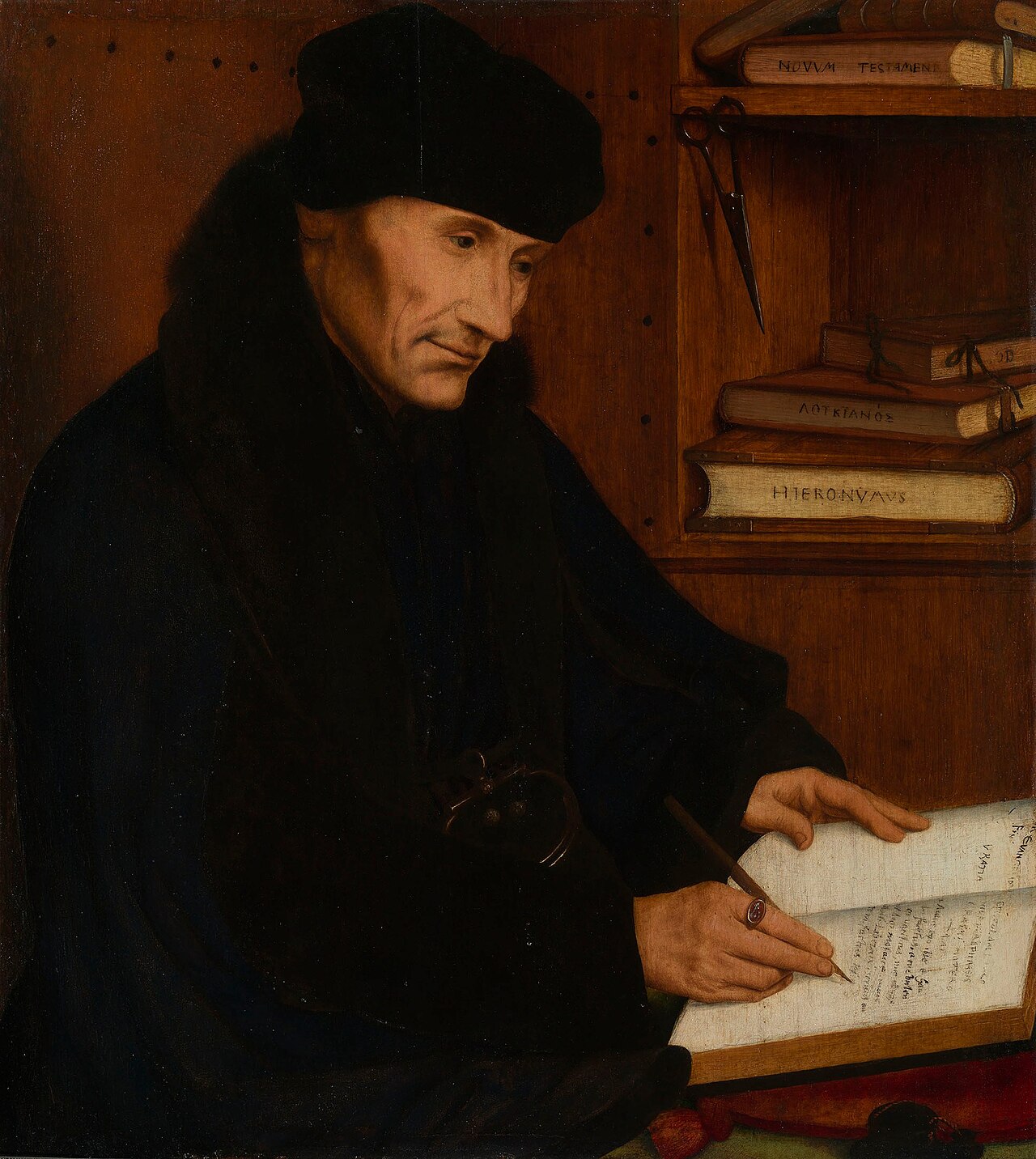
Painted portrait of an older man in a black fur-trimmed cap and dark robe, seated at a wooden desk writing with a quill in an open book. Behind him, a shelf holds books labeled NOVUM TESTAMENTUM, ERASMUS-type titles, and HIERONYMUS, with scissors hanging nearby.Painting

Primary source

Desiderius Erasmus

Quinten Massys · 1517

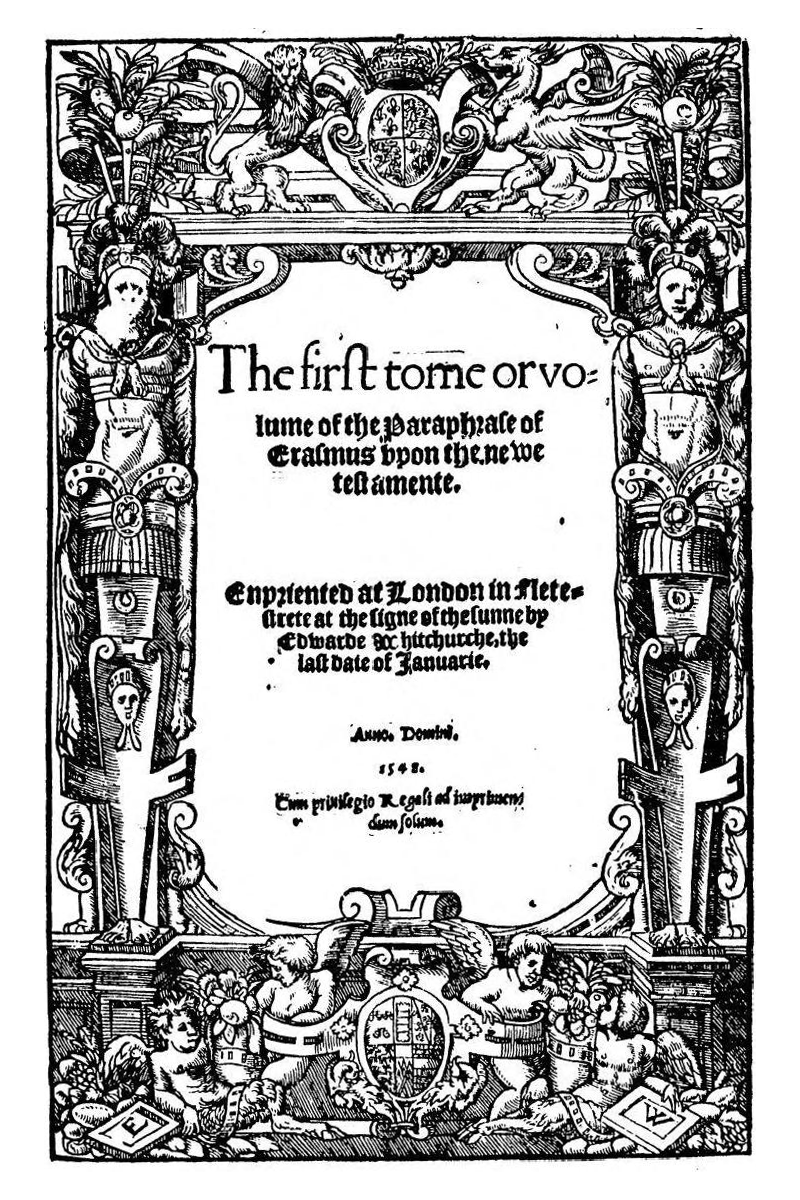
Woodcut illustrated title page of the 1548 English edition of Erasmus's Paraphrase upon the New Testament. Ornate border with figures, coats of arms, and cherubs. Central text reads 'The first tome or volume of the Paraphrase of Erasmus vpon the newe testamente', printed at London by Edward Whitchurch, dated 1548.Book

Primary source

Paraphrases of Erasmus

Erasmus · 1517 (Latin); 1548 (English edition)

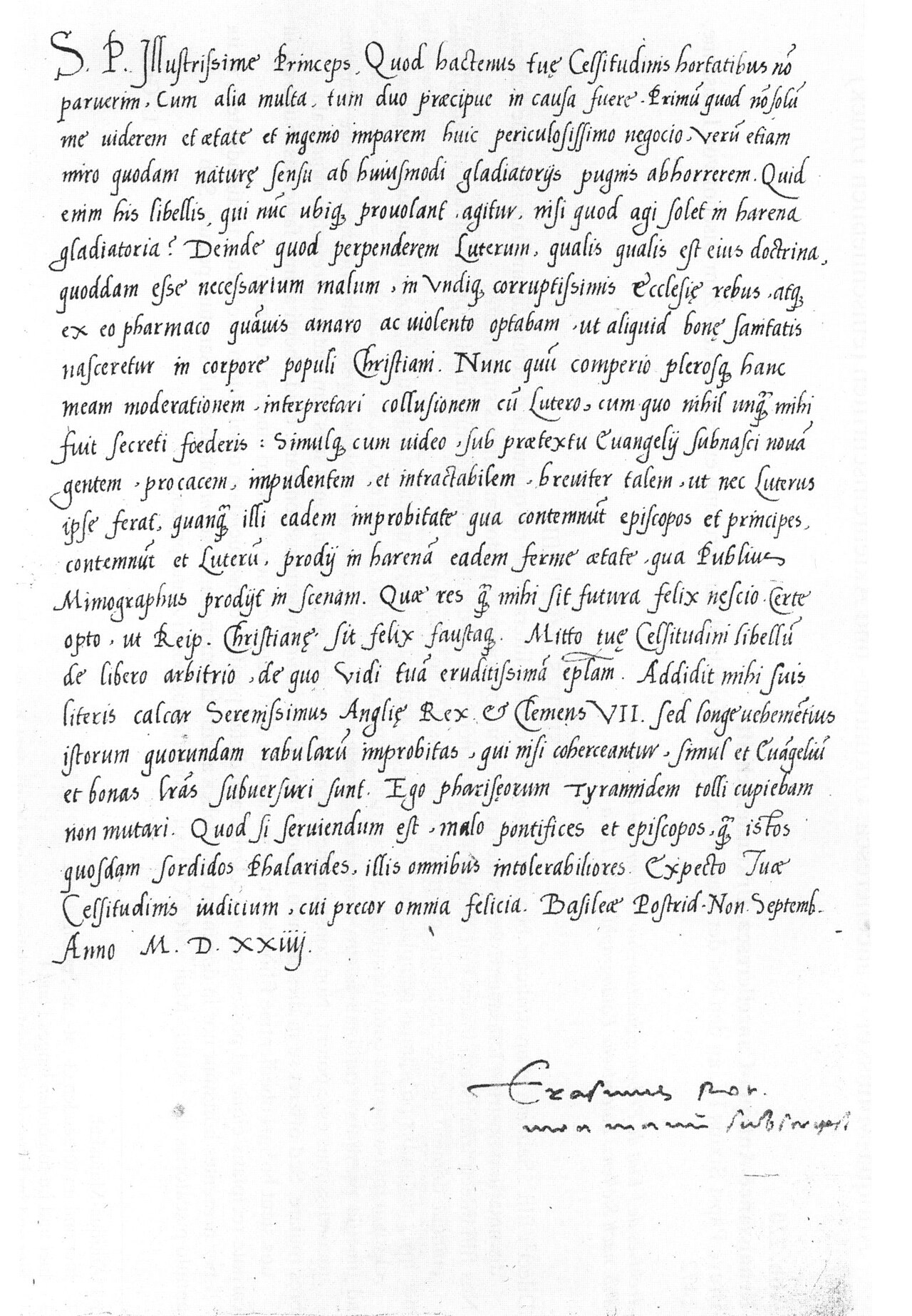
Handwritten letter in early modern Latin script, dated Basel 1524 (Anno MDXXIIII), with Erasmus's signature at the bottom right. The text opens with a salutation to a prince and discusses Luther and the reform controversy.Letter

Primary source

Letter to George, Duke of Saxony

Erasmus · Basel, 1524

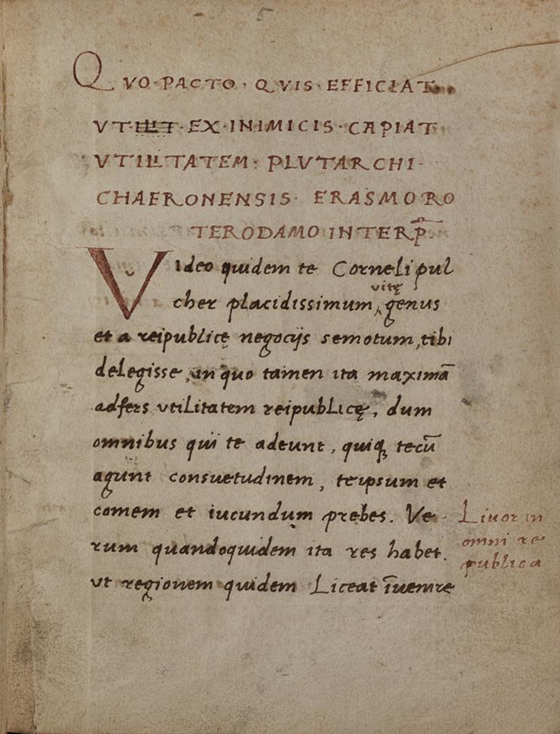
A handwritten page in brown ink on aged, yellowed paper. A decorative red title in capitals reads 'Quo pacto quis efficiat ut ex inimicis capiat utilitatem, Plutarchi Chaeronensis, Erasmo Roterodamo interprete' with a large red initial V below opening a paragraph in cursive script. Marginal notes appear at the lower right.Document

Primary source

Handschrift von Erasmus v. Rotterdam

Erasmus

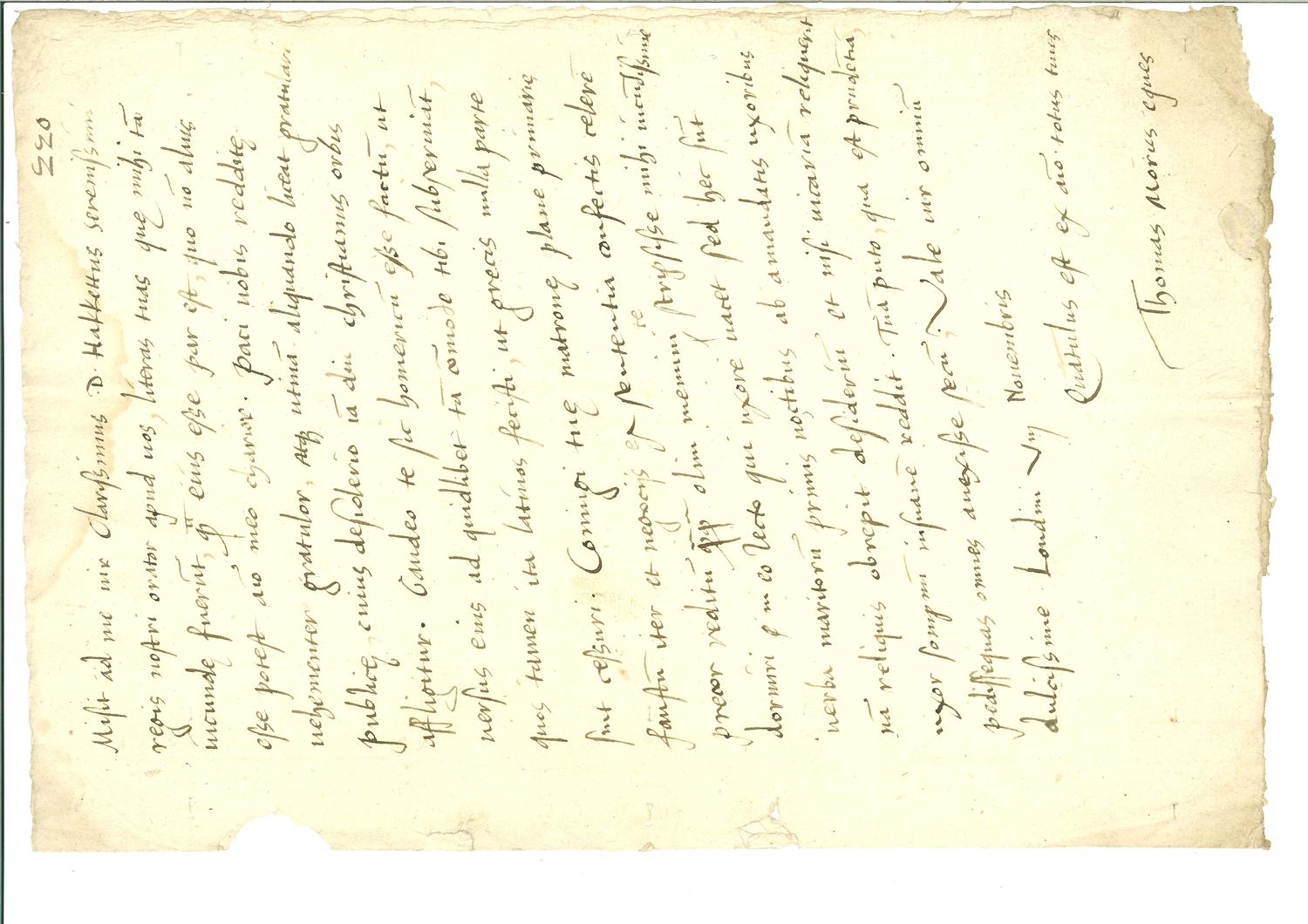
Scan of a handwritten Latin letter on aged, yellowed paper, with brown ink in a cursive secretary hand. The page is numbered 220 at the top right. The letter is signed Thomas Morus eques at the bottom right.Letter

Primary source

Correspondance Cranevelt

Thomas More · 1520

Printed page of a Latin letter headed 'ERASMVS ROT. GASPARI SCHETO S. D.', with a body of running text in numbered lines and a footnote reading '17. munere] Cf. Ep. 2896. 16n.' at the bottom.Letter

Primary source

Erasmus to Gaspar Schets

Erasmus of Rotterdam

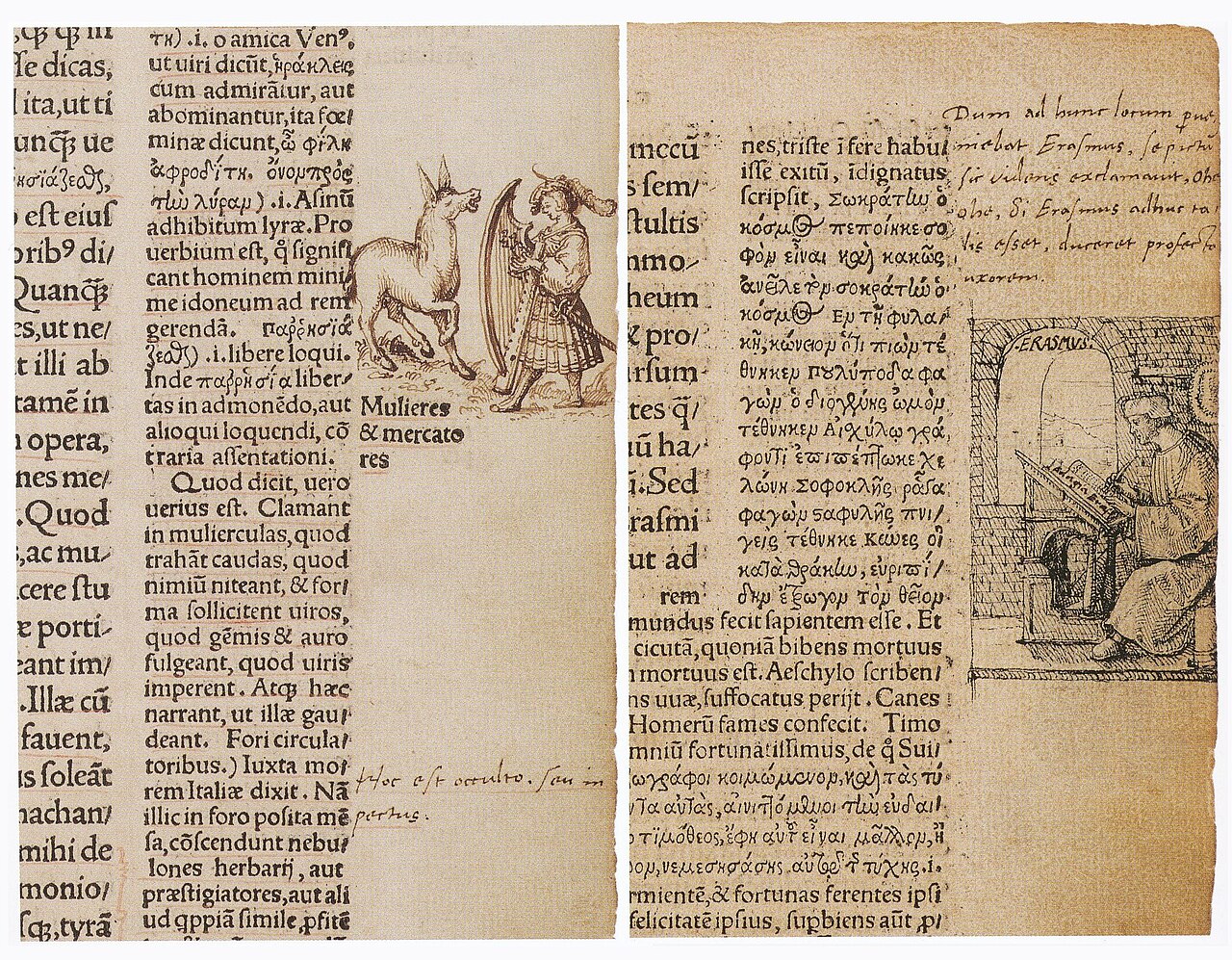
Two facing pages of an old printed Greek and Latin book with dense text, showing pen-and-ink marginal drawings: a donkey beside a standing figure with a shield on the left page, and a scholar at a writing desk in an arched niche labeled Erasmus on the right page. Handwritten notes fill the margins.Painting

Primary source

Marginal Drawings in The Praise of Folly

Hans Holbein the Younger · 1515

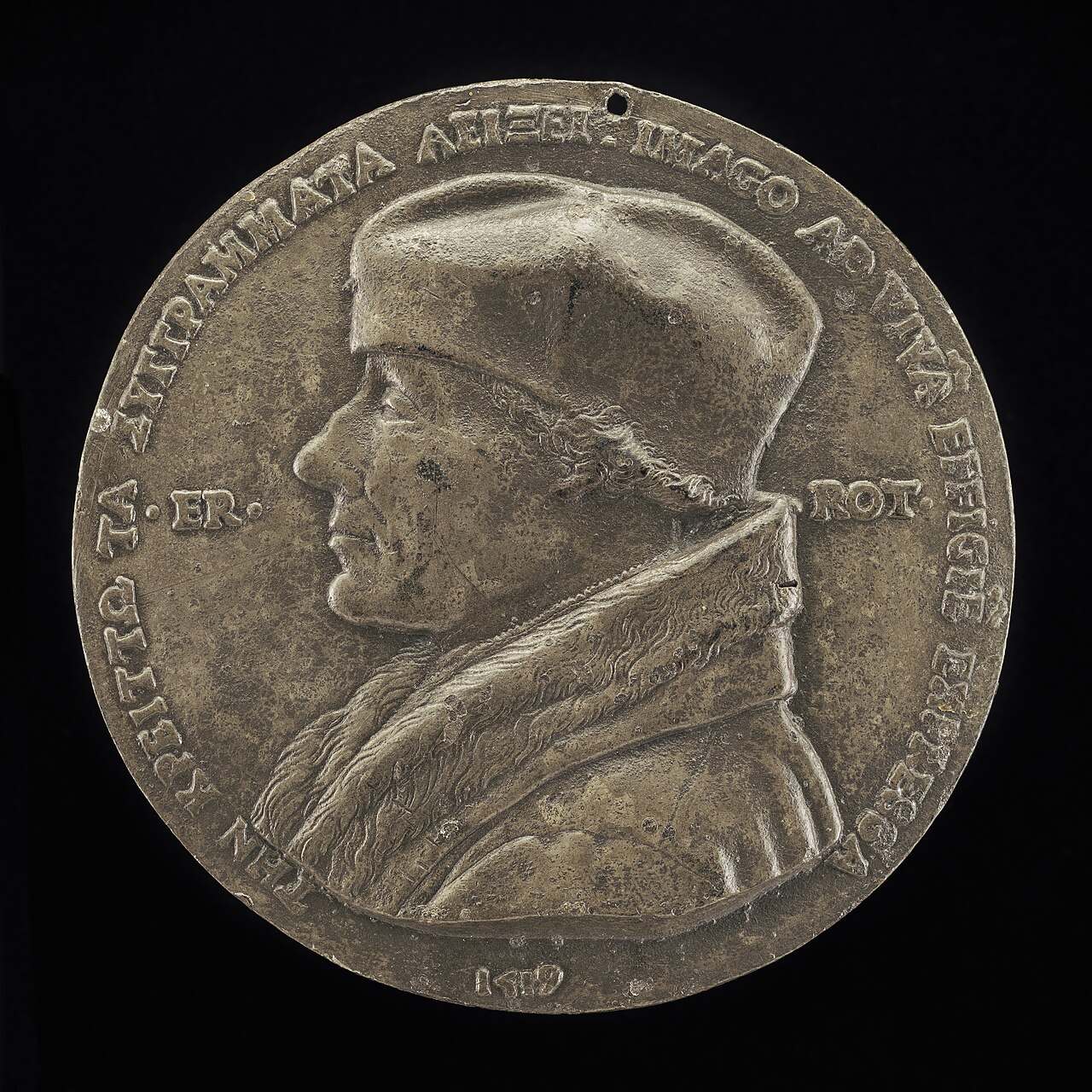
Circular bronze medal on a black background, showing in profile a man in a flat-topped cap and fur-collared cloak, with Latin inscriptions around the rim and the date 1519 at the bottom.Artifact

Primary source

Portrait Medal of Desiderius Erasmus of Rotterdam

Quentin Massys · 1519

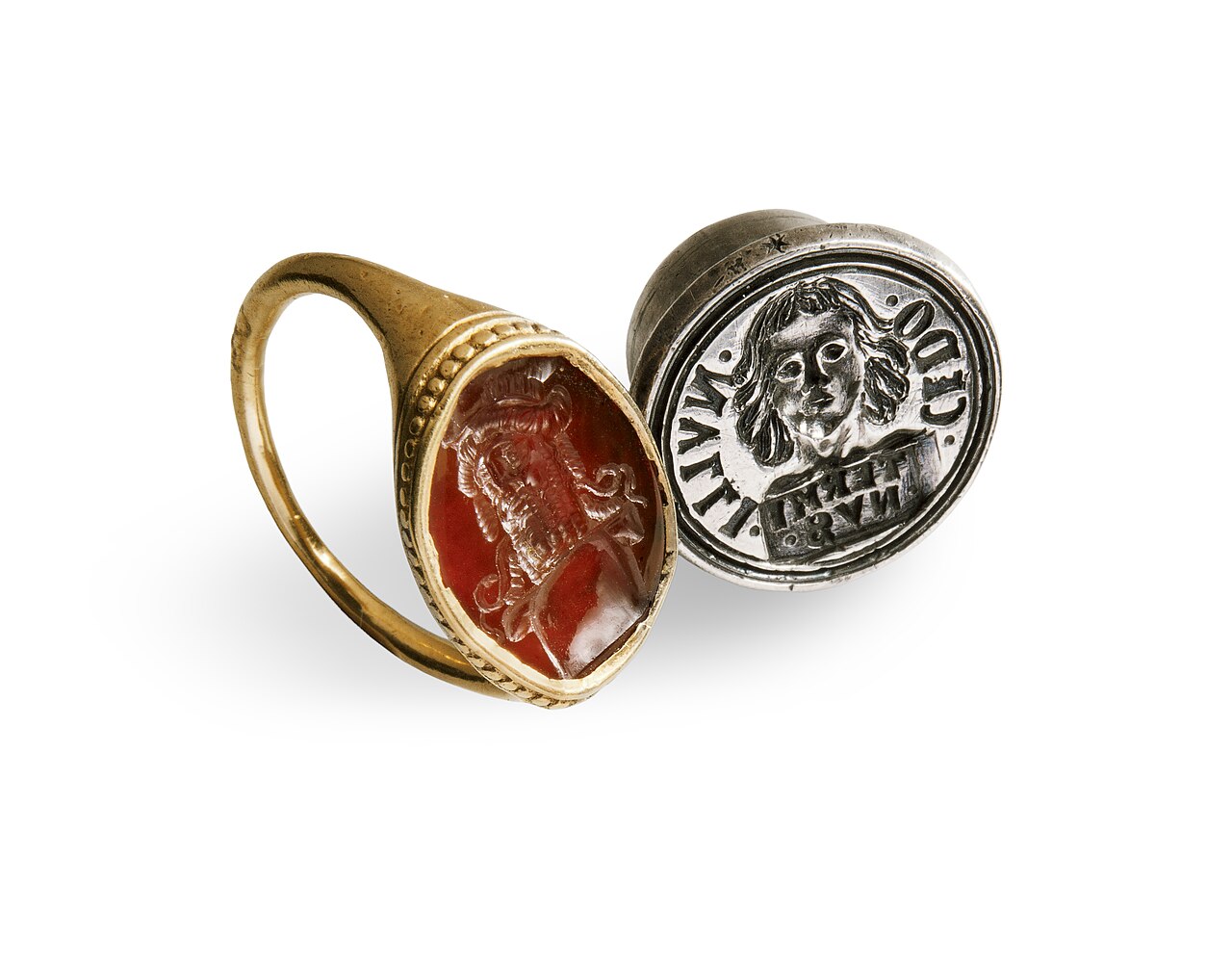
Photograph of a gold ring with a red carnelian intaglio showing a carved figure, beside a silver seal matrix with a bearded man's head in profile-to-front view and Latin inscription around the rim.Artifact

Primary source

Terminus Seal of Erasmus

Peter Portner

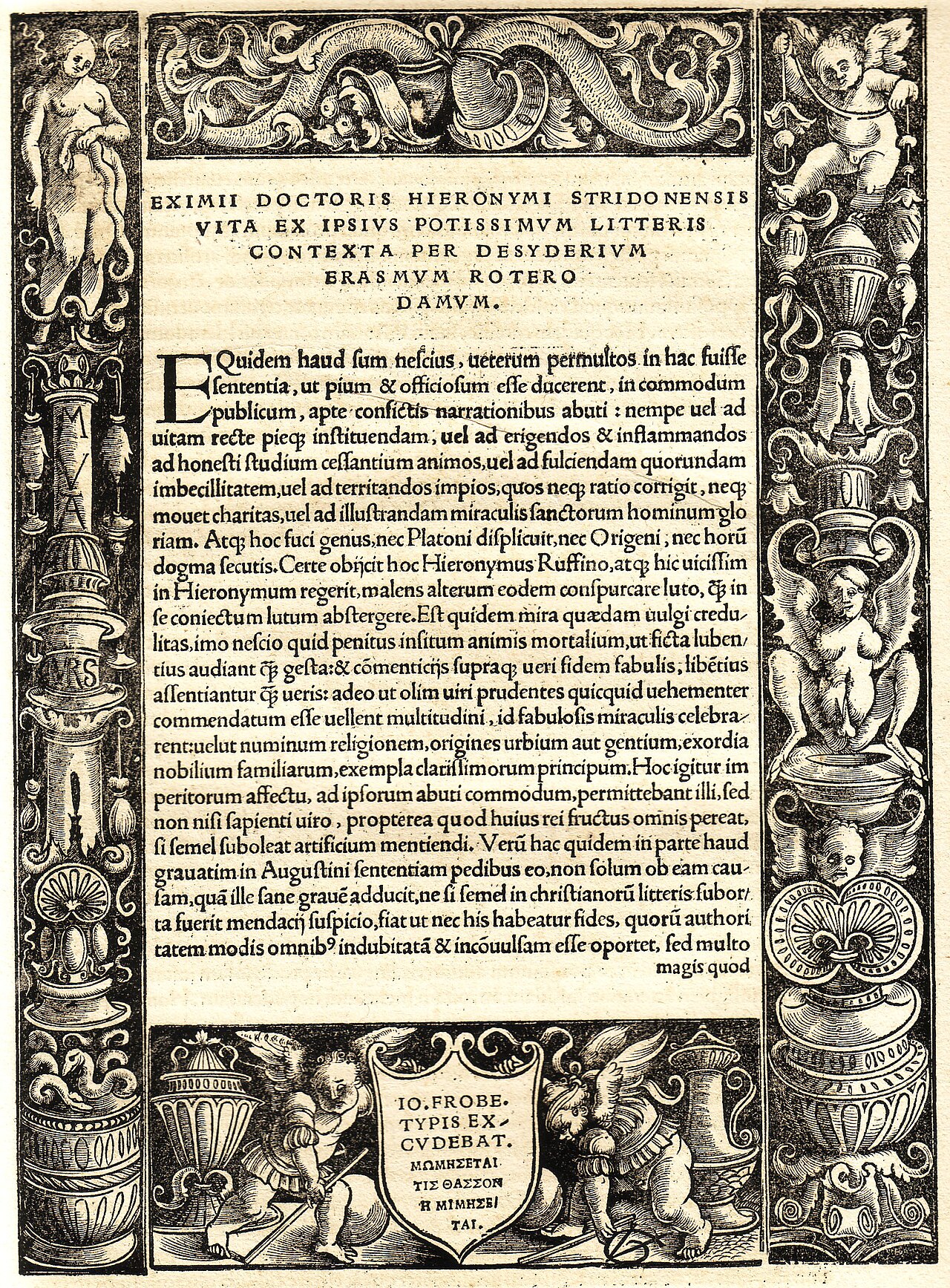
Title page of a printed book in black ink on cream paper. Ornate woodcut borders with figures and foliage frame the text: Eximii Doctoris Hieronymi Stridonensis Vita, contexta per Desyderium Erasmum Roterodamum, followed by a dense block of Latin text. Bottom shield reads Io. Frobenius typis excudebat.Book

Primary source

Life of Jerome

Erasmus of Rotterdam · 1516

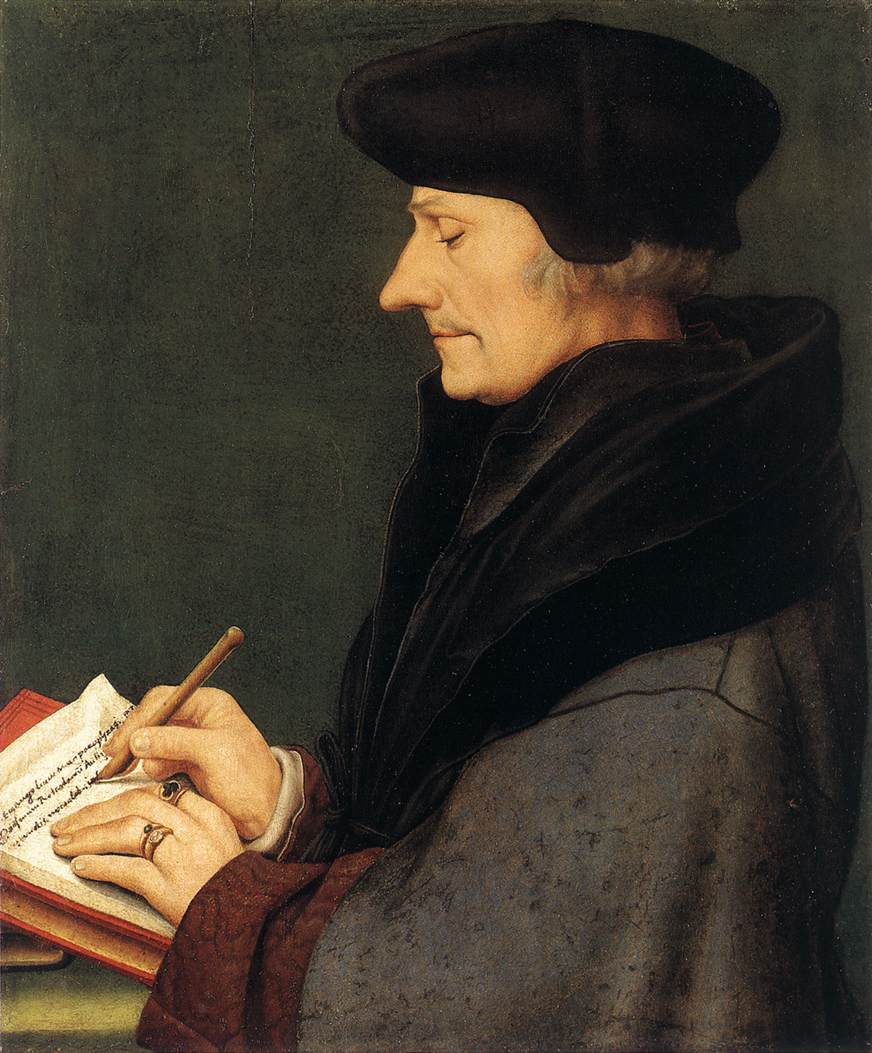
Painting of a man in profile, seen from the left, wearing a dark flat cap and a black fur-trimmed cloak over a grey gown. He writes with a quill on a sheet of paper resting on a red-bound book, with rings on his fingers. Dark green background.Painting

Primary source

Portrait of Erasmus of Rotterdam Writing

Hans Holbein the Younger · 1523

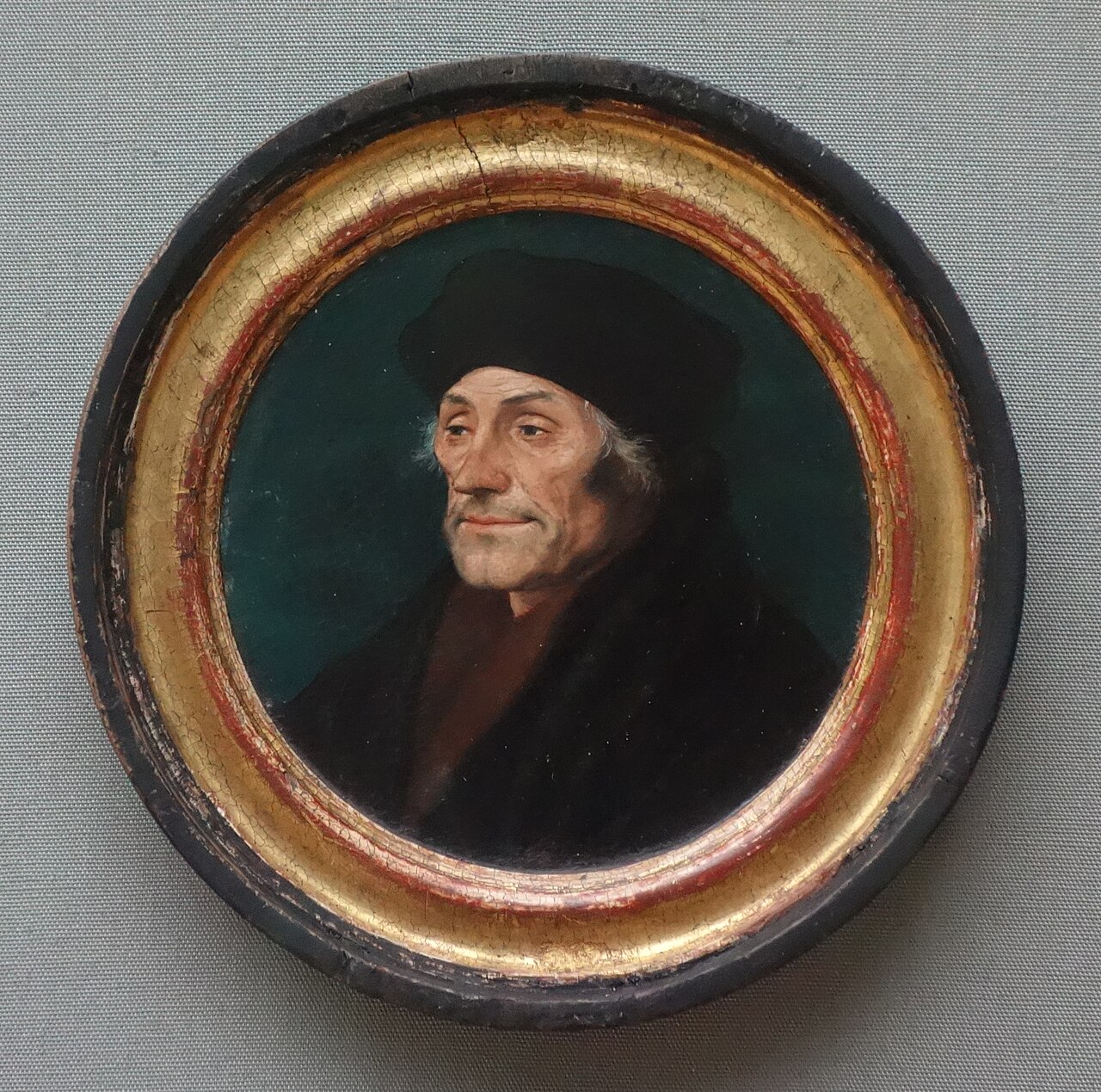
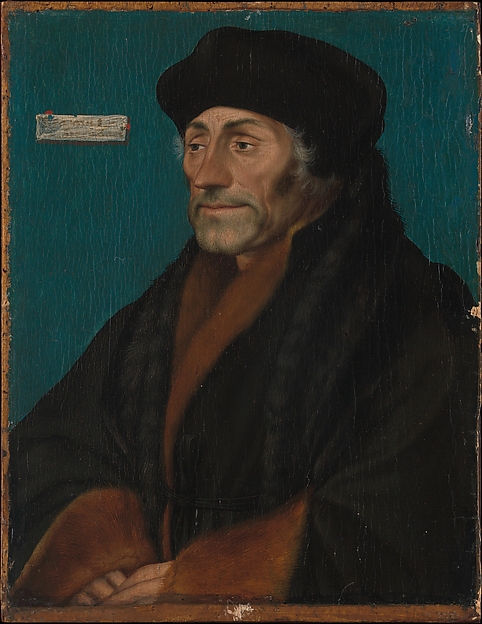
A small round painted portrait in a gilded, cracked wooden frame with a black outer rim. It shows an elderly man in profile facing left, wearing a black cap and dark fur-trimmed robe, against a dark teal background.Painting

Primary source

Round Portrait of Erasmus

Hans Holbein the Younger · 1532

Book

Primary source

Ecclesiastes

Erasmus · 1535

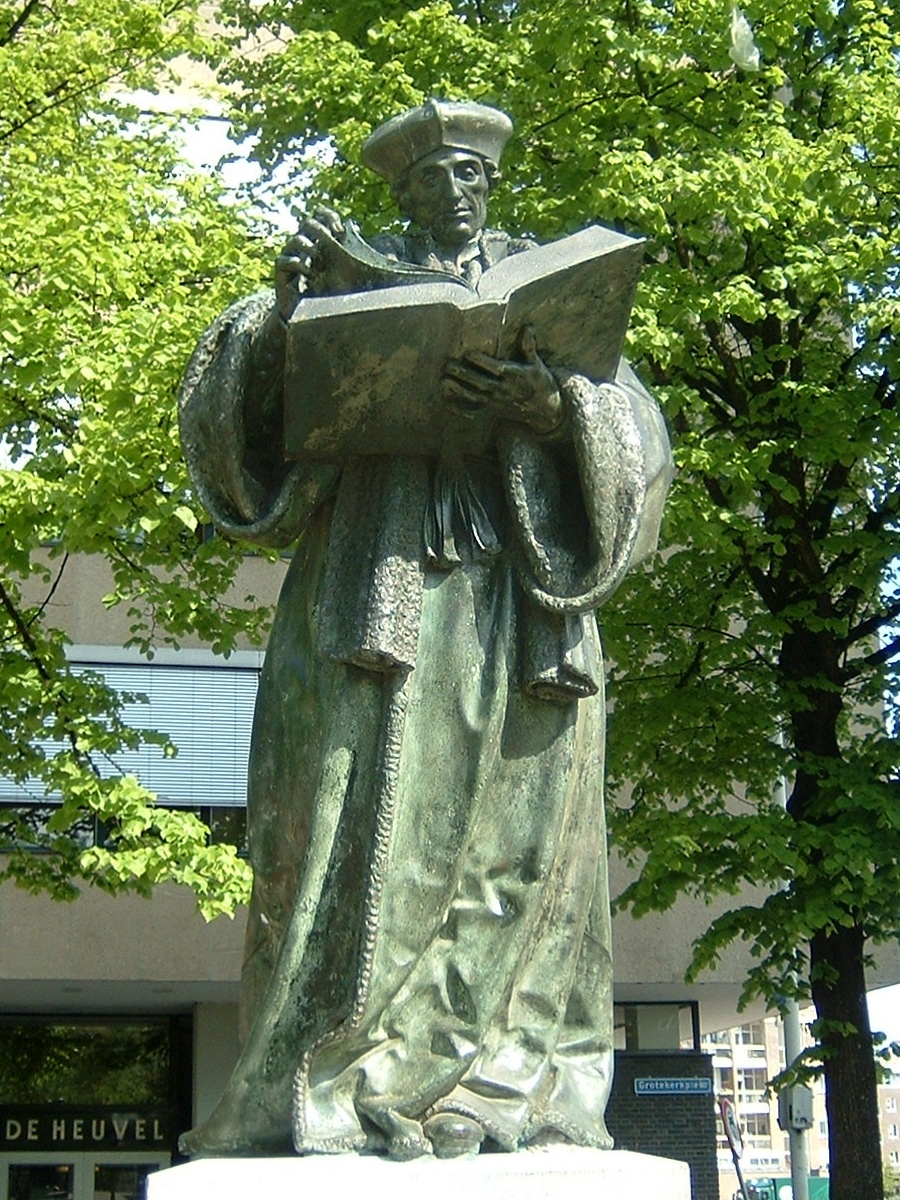
Photo of a bronze statue of a robed scholar in a flat cap, holding an open book, standing on a white pedestal among green trees, with a building and street sign behind.Sculpture

Secondary source

Statue of Erasmus

Hendrick de Keyser · 1622

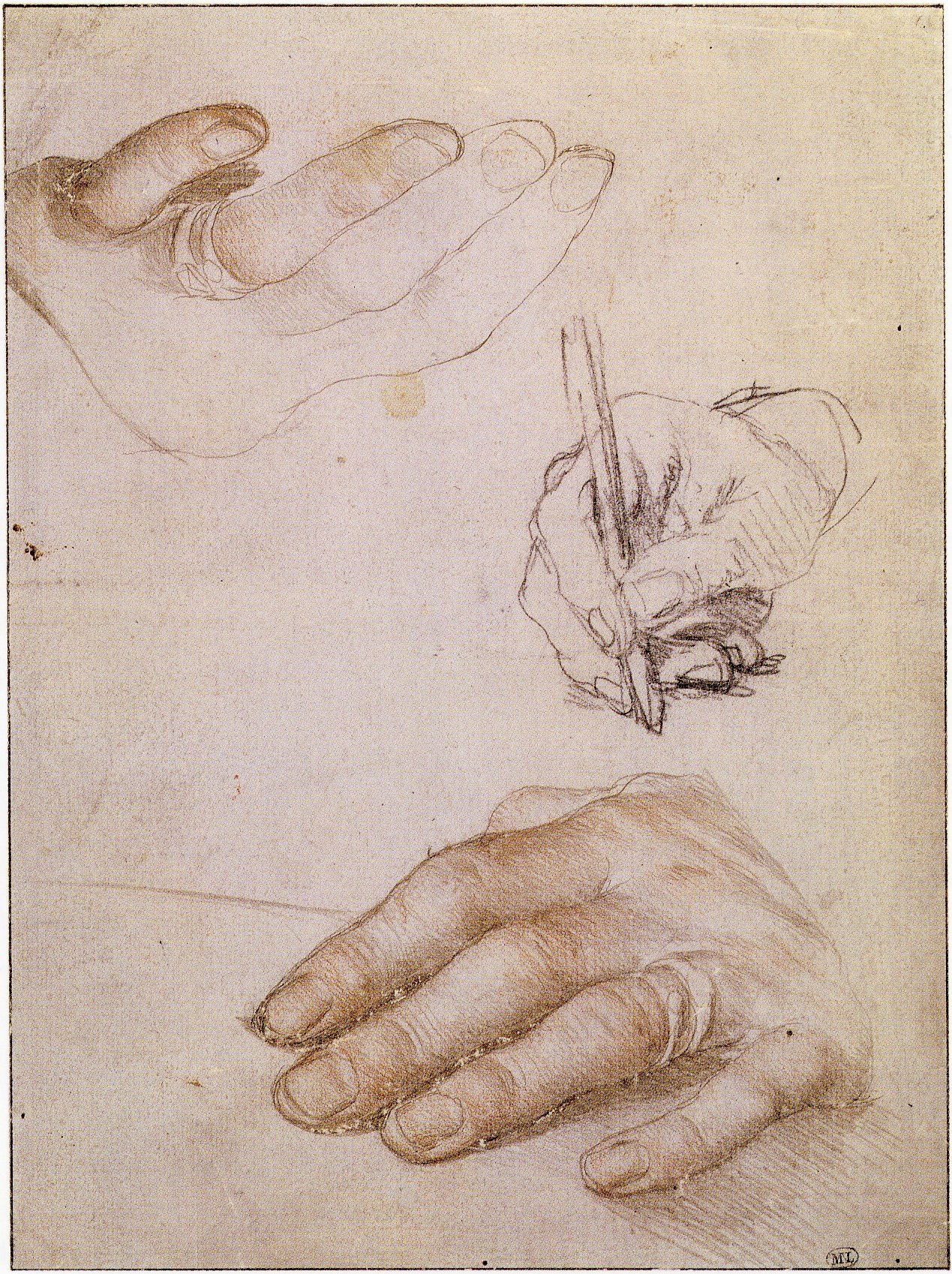
Drawing on pale paper with three studies of hands in red chalk and black crayon. Upper left: an open left hand seen from the side. Center right: a hand holding a pen or stylus, writing. Lower right: a larger hand resting with fingers curled, shown in red chalk.Painting

Primary source

Studies of the Hands of Erasmus

Hans Holbein the Younger · c. 1523

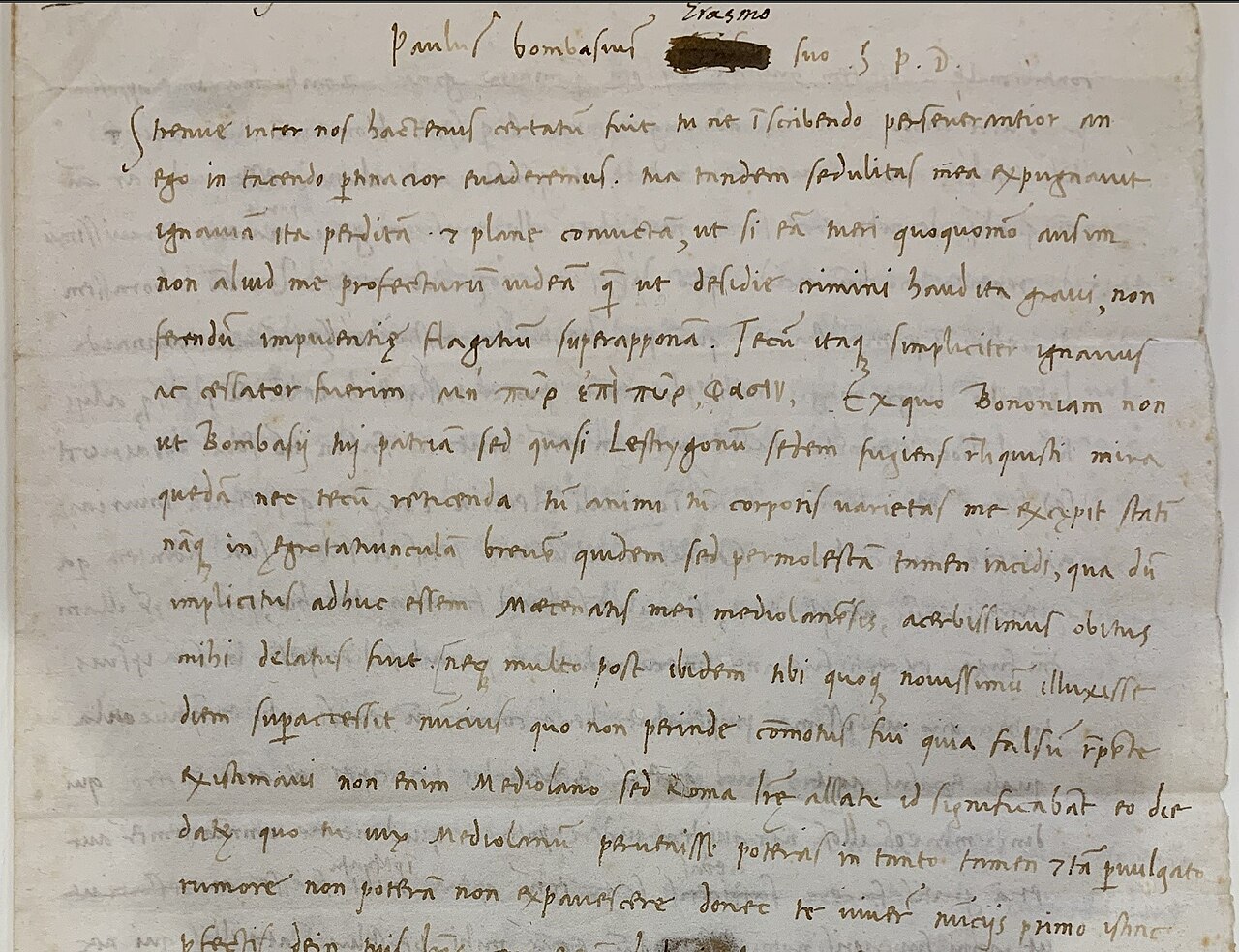
Handwritten Latin manuscript letter on aged, yellowed paper. The heading reads 'Paulus Bombasius' with 'Erasmo' written above and a dark redacted smudge, followed by 'S.P.D.' and several lines of cursive script.Letter

Primary source

Letter from Paulus Bombasius to Erasmus

Paulus Bombasius · 1511

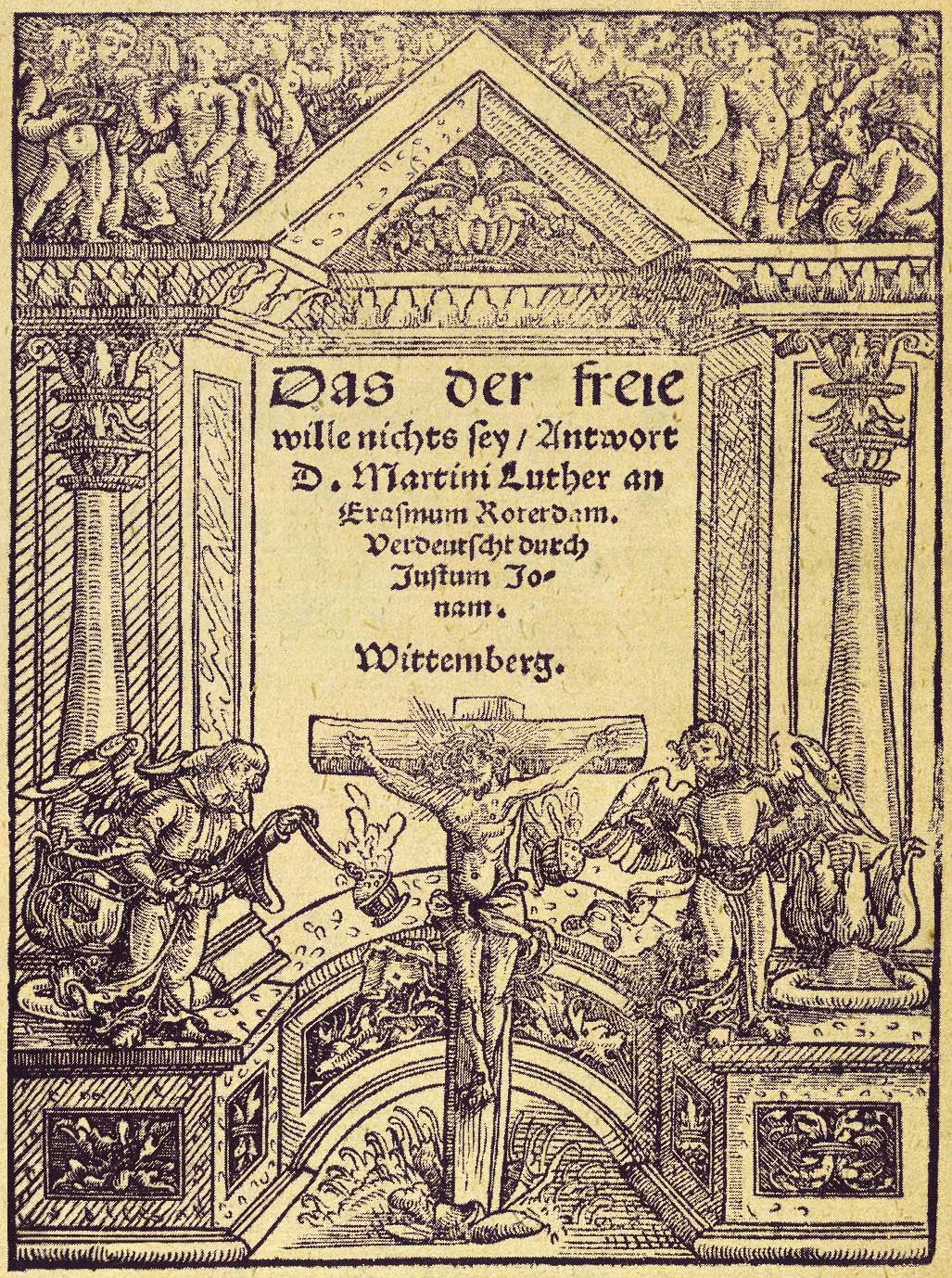
Title page of a 1526 German book printed in Wittenberg, in black letter type within a woodcut architectural frame. Figures of nude putti, a crucified Christ, and two robed figures flank the text, which reads 'Das der freie wille nichts sey' and names Martin Luther and Erasmus.Book

Primary source

Das der freie Wille nichts sey

Martin Luther; translated by Justus Jonas · 1526

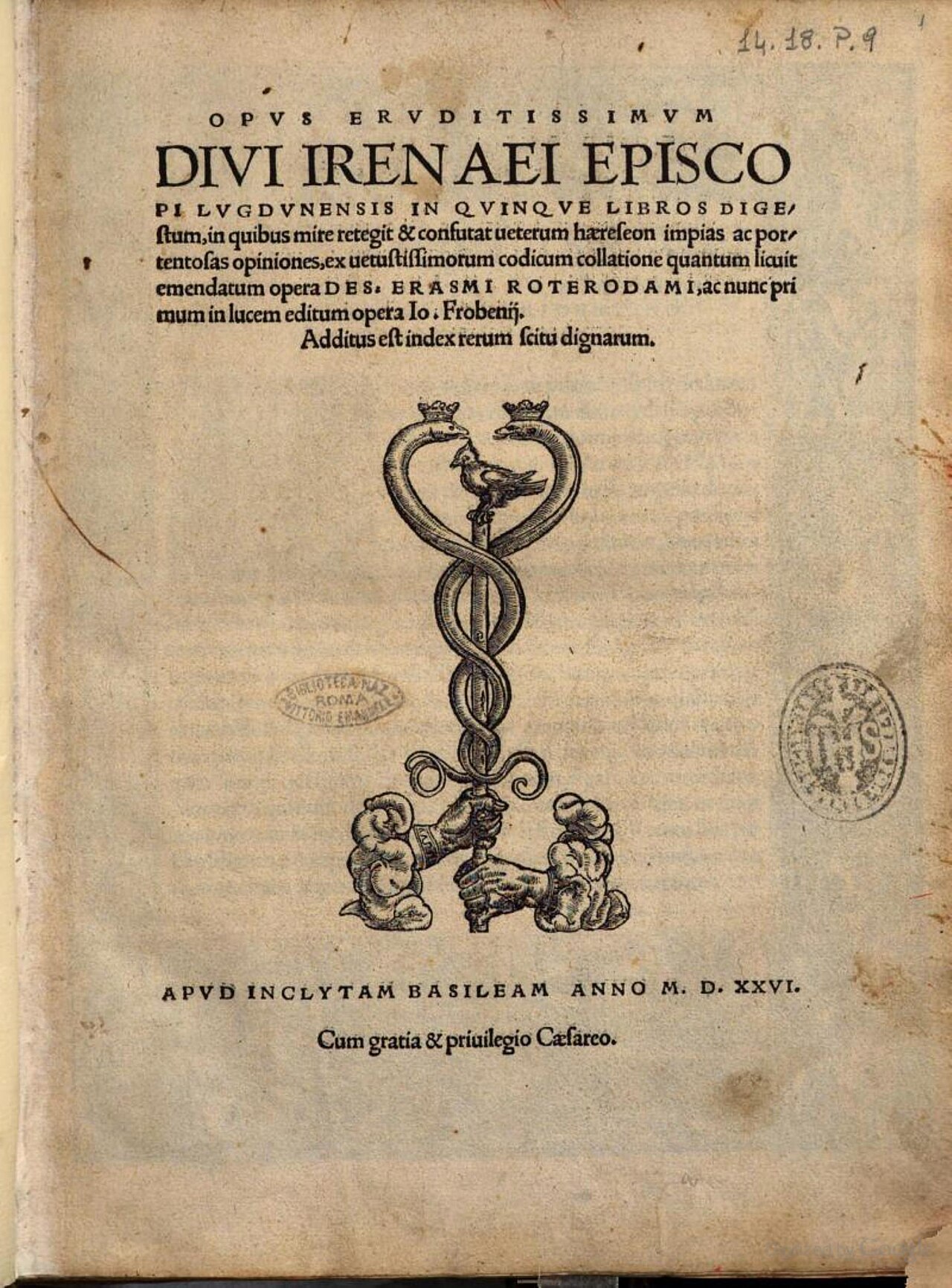
Scan of the title page of a 1526 Basel printed book in Latin. Large capitals read Opus eruditissimum Divi Irenaei Episcopi Lugdunensis, with a woodcut of a caduceus-like staff with two serpents crowned, a bird perched on top, and two hands clasping. Imprint reads apud inclytam Basileam anno MDXXVI. A library stamp and shelfmark appear in the corners.Book

Primary source

Irenaeus, Against Heresies, 1526 Basel edition

Desiderius Erasmus (editor); Johannes Froben (printer) · 1526

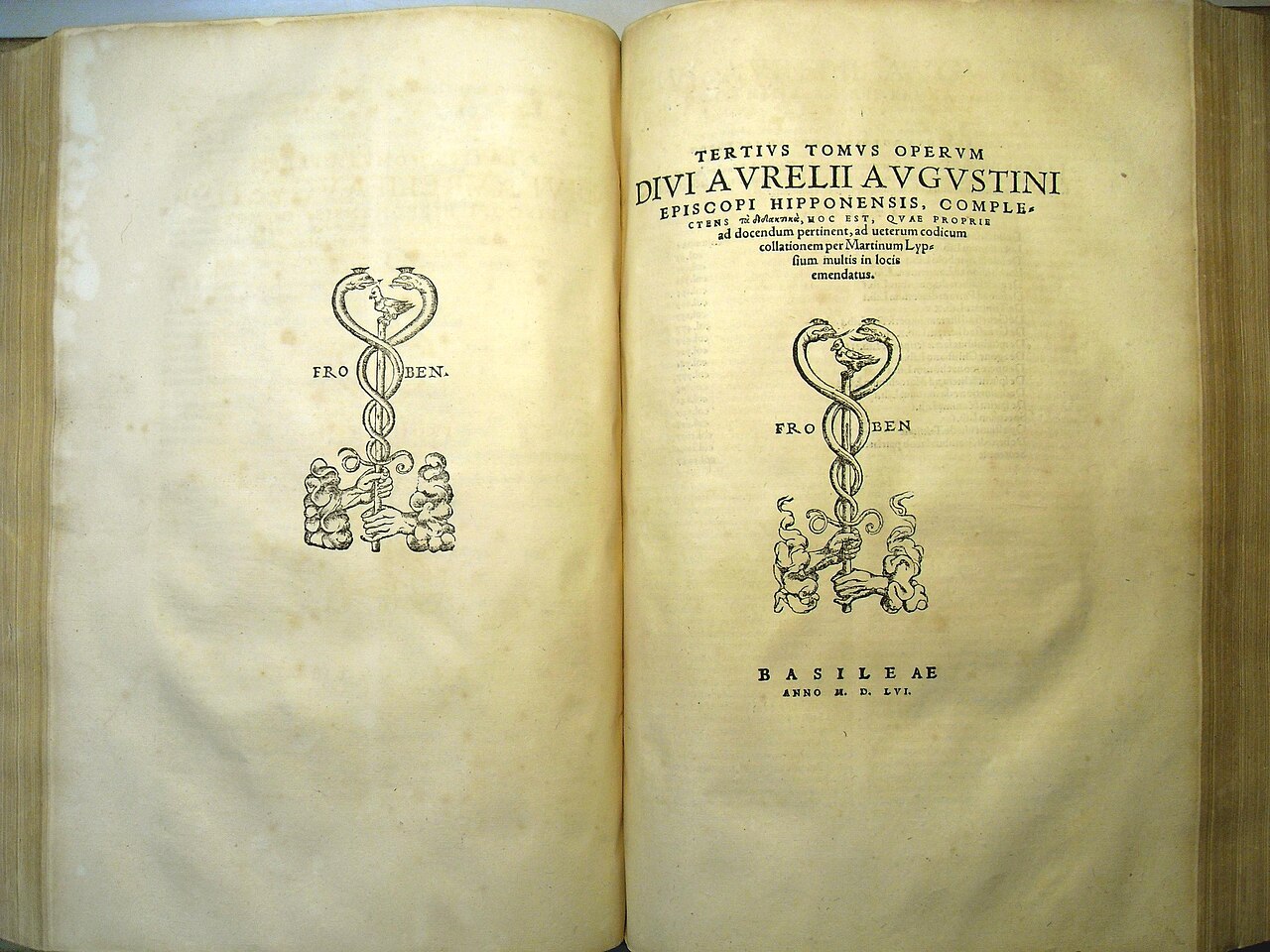
Open book showing a title page on the right with the Latin heading 'Tertius Tomus Operum Divi Aurelii Augustini' and a Froben printer's device; the left page has a matching device. Imprint reads Basileae, Anno MDLVI.Book

Secondary source

Augustine, Opera omnia, third volume, 1556

Augustine; edited by Desiderius Erasmus and Martinus Lipsius · 1556

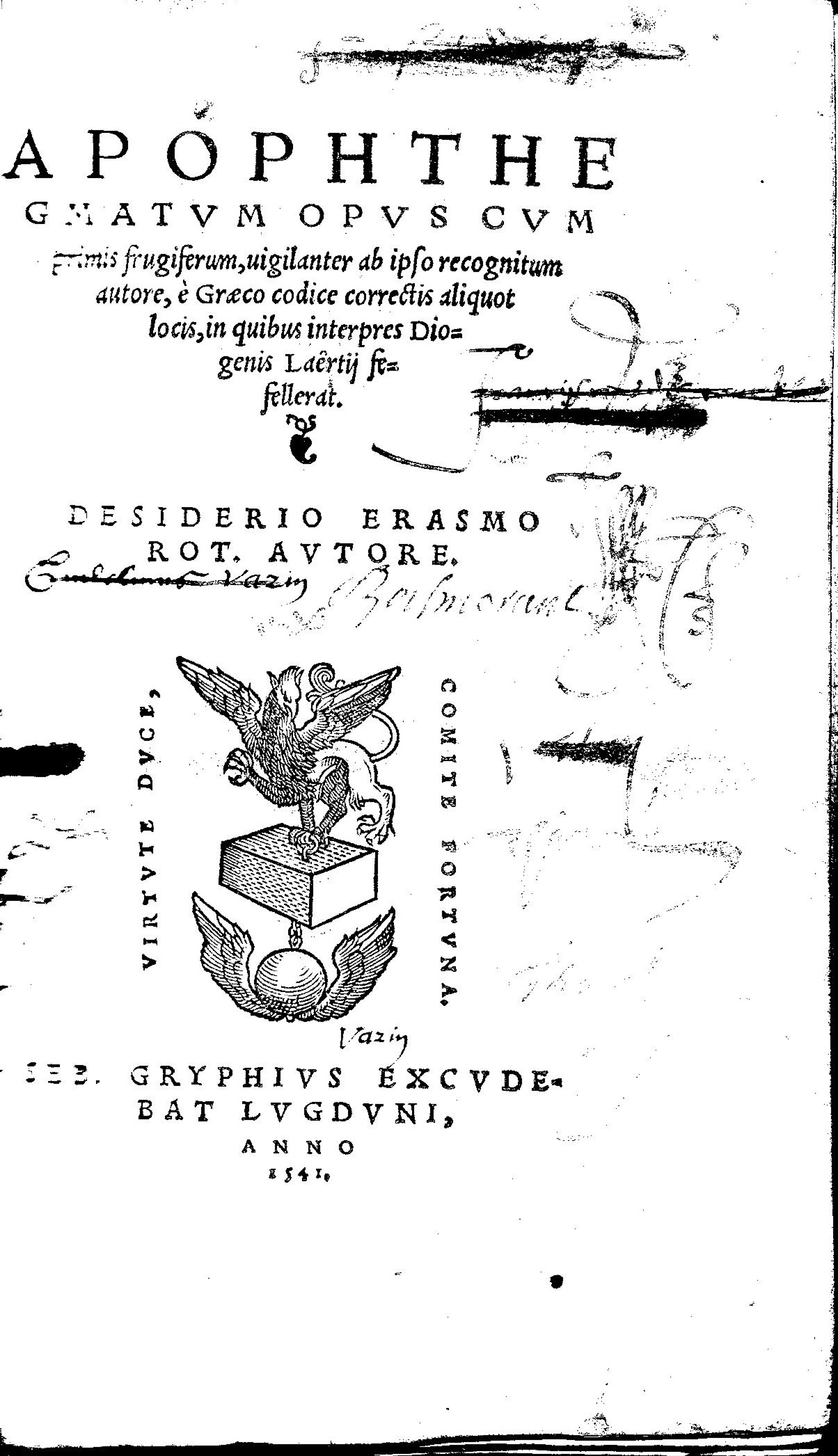
Title page of a 1541 Lyon edition of Erasmus's Apophthegmatum opus, printed by Sebastian Gryphius. Latin title in large capitals, Desiderio Erasmo Rot. auctore, and a griffin emblem with the mottos Virtute duce and Comite Fortuna above a winged sphere. Handwritten marks and ink strokes appear across the page.Book

Secondary source

Apophthegmata

Desiderius Erasmus · 1541

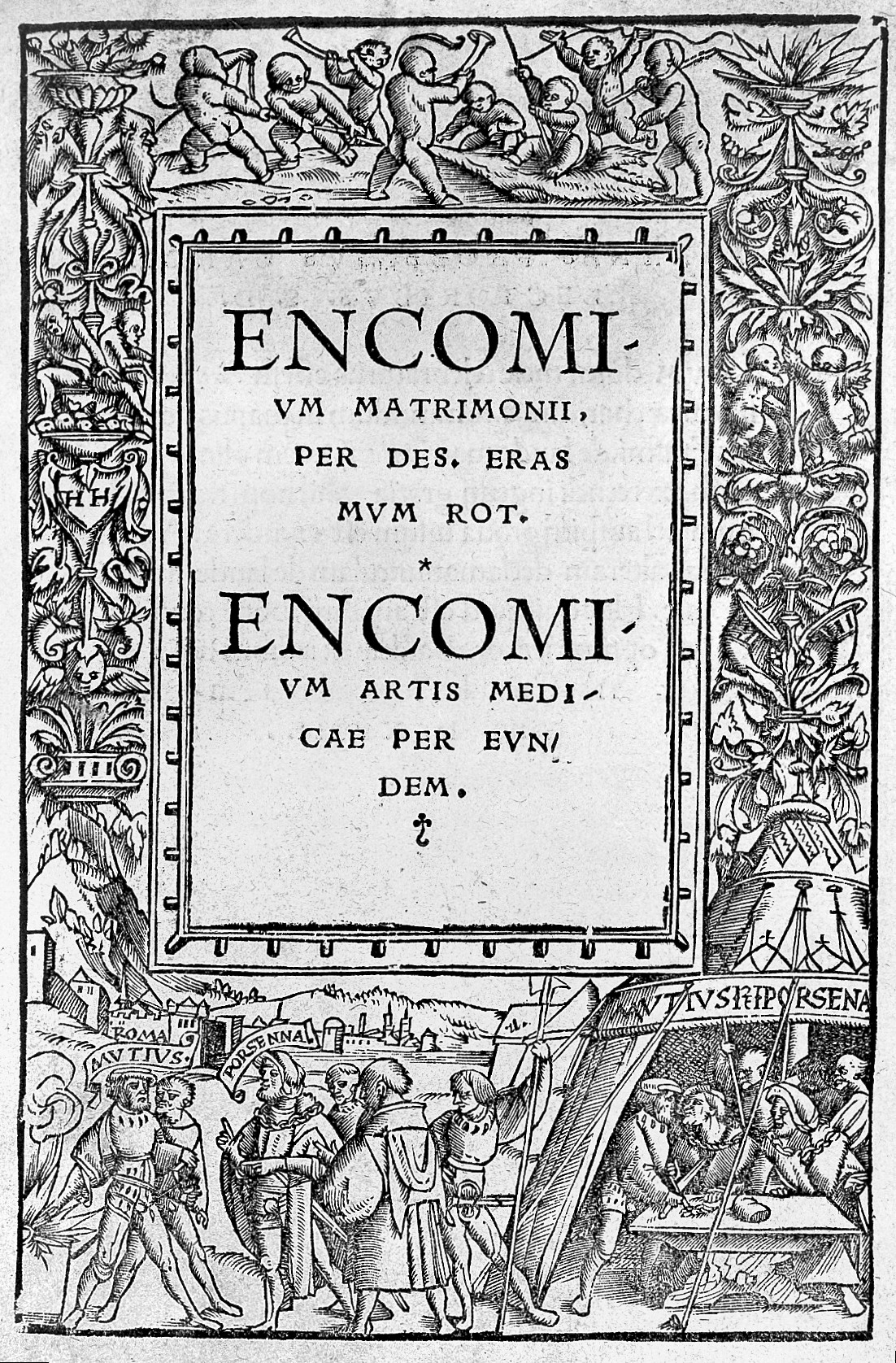
Title page of a printed book in black and white with a richly decorated woodcut border. Centered text reads 'ENCOMIUM MATRIMONII, PER DES. ERASMUM ROT.' and 'ENCOMIUM ARTIS MEDICAE PER EUNDEM'. The border shows putti fighting at top, foliage and figures on the sides, and scenes of men at a table and a tent at the bottom.Book

Primary source

Encomium matrimonii

Desiderius Erasmus · 1518

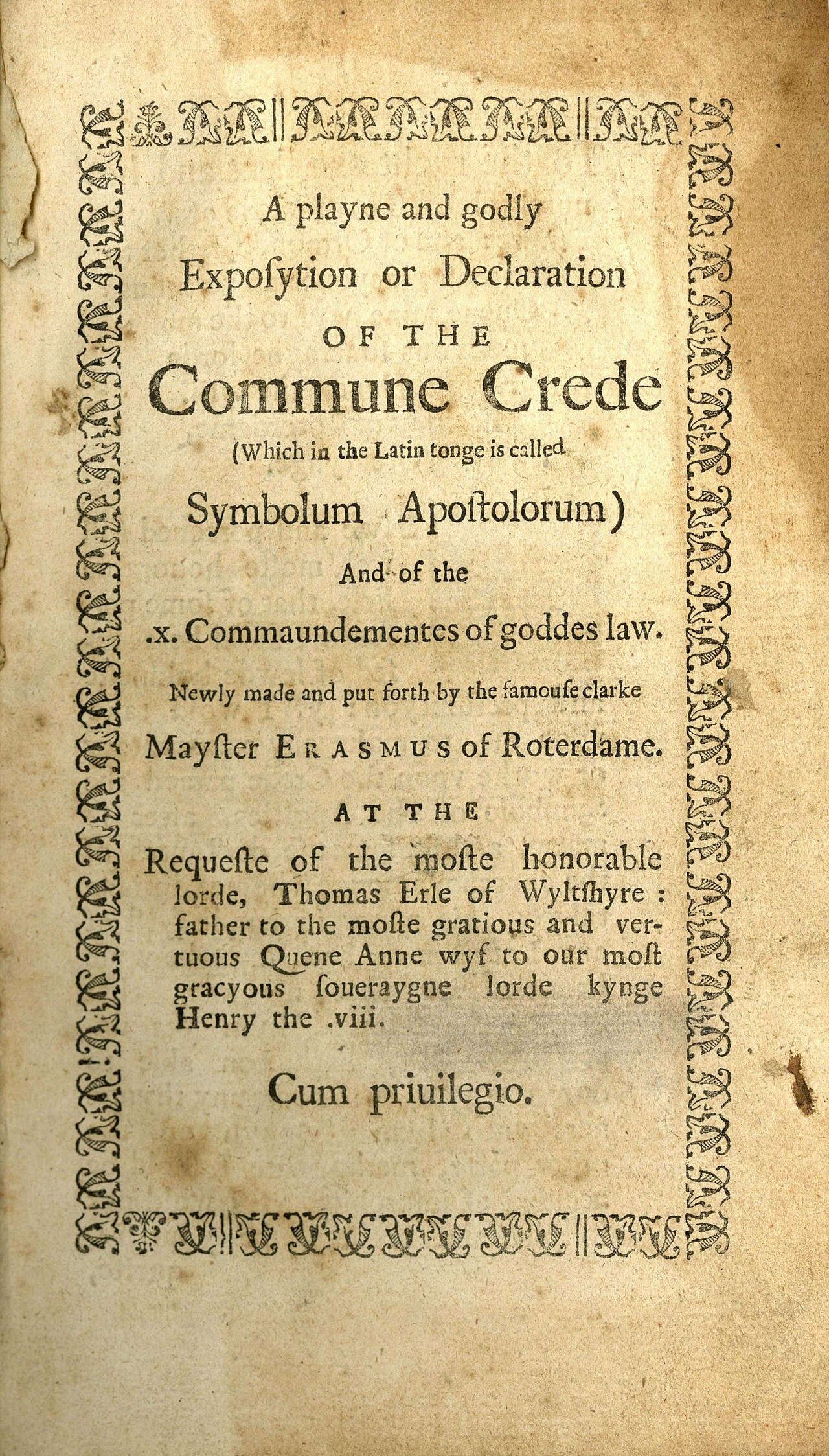
Title page of an early printed book in black letter type on aged, yellowed paper, with an ornate decorative border. The title reads 'A playne and godly Expofytion or Declaration of the Commune Crede' and names Erasmus of Roterdame as author, dedicated to Thomas Erle of Wyltshyre, with 'Cum priuilegio' at the bottom.Book

Primary source

A Playne and Godly Exposition or Declaration of the Commune Crede

Desiderius Erasmus · 1533

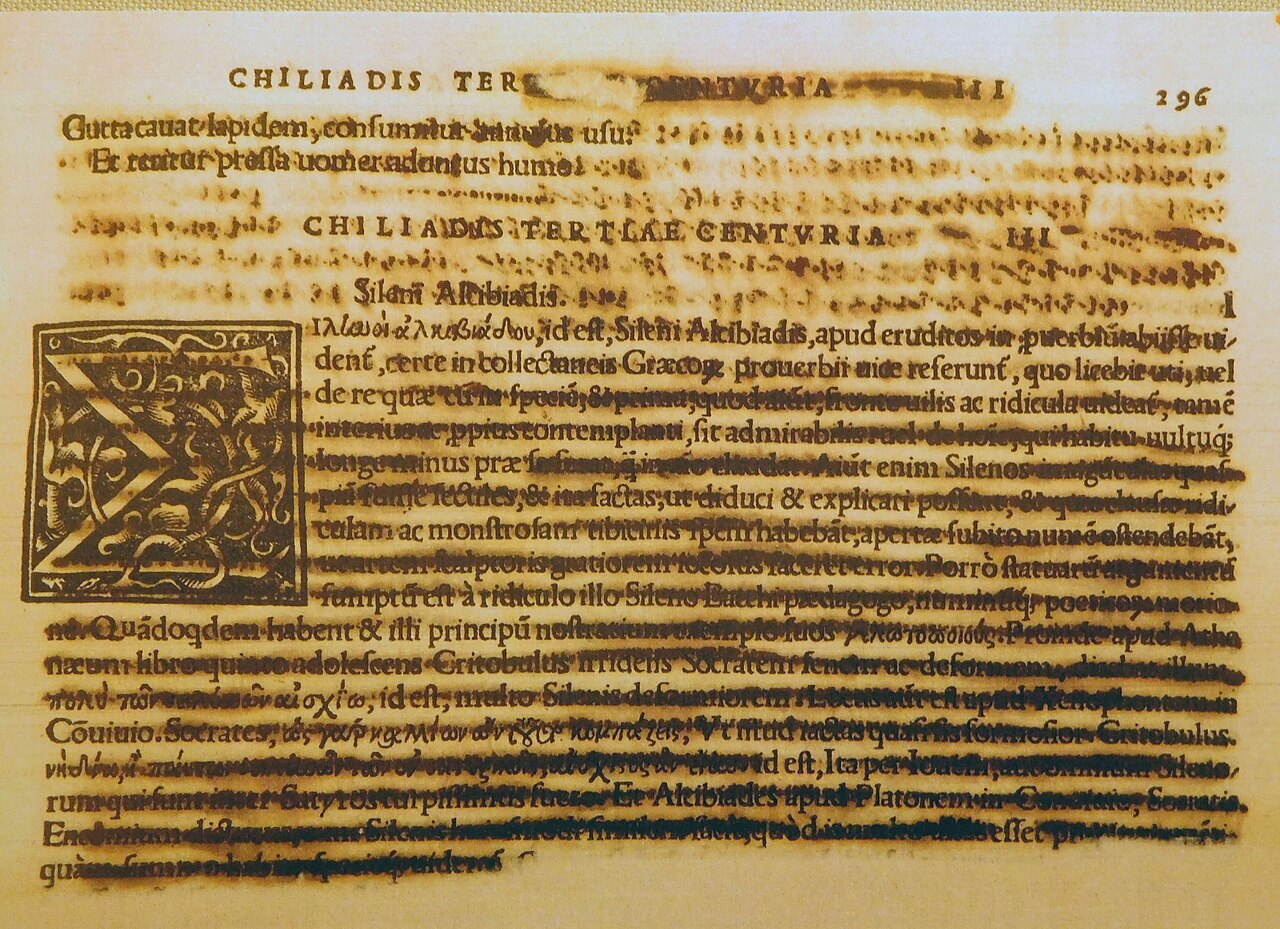
Scanned page 296 of a 1537 printed edition of Erasmus's Adagia, with running heads 'Chiliadis Tertiae Centuriae' and a woodcut initial. Much of the Latin and Greek text is heavily blacked out with censor marks, and the page is brownish with aged paper.Photograph

Secondary source

Adagia, 1537 edition, page 296 (Sileni Alcibiadis)

Ian Alexander · 1537

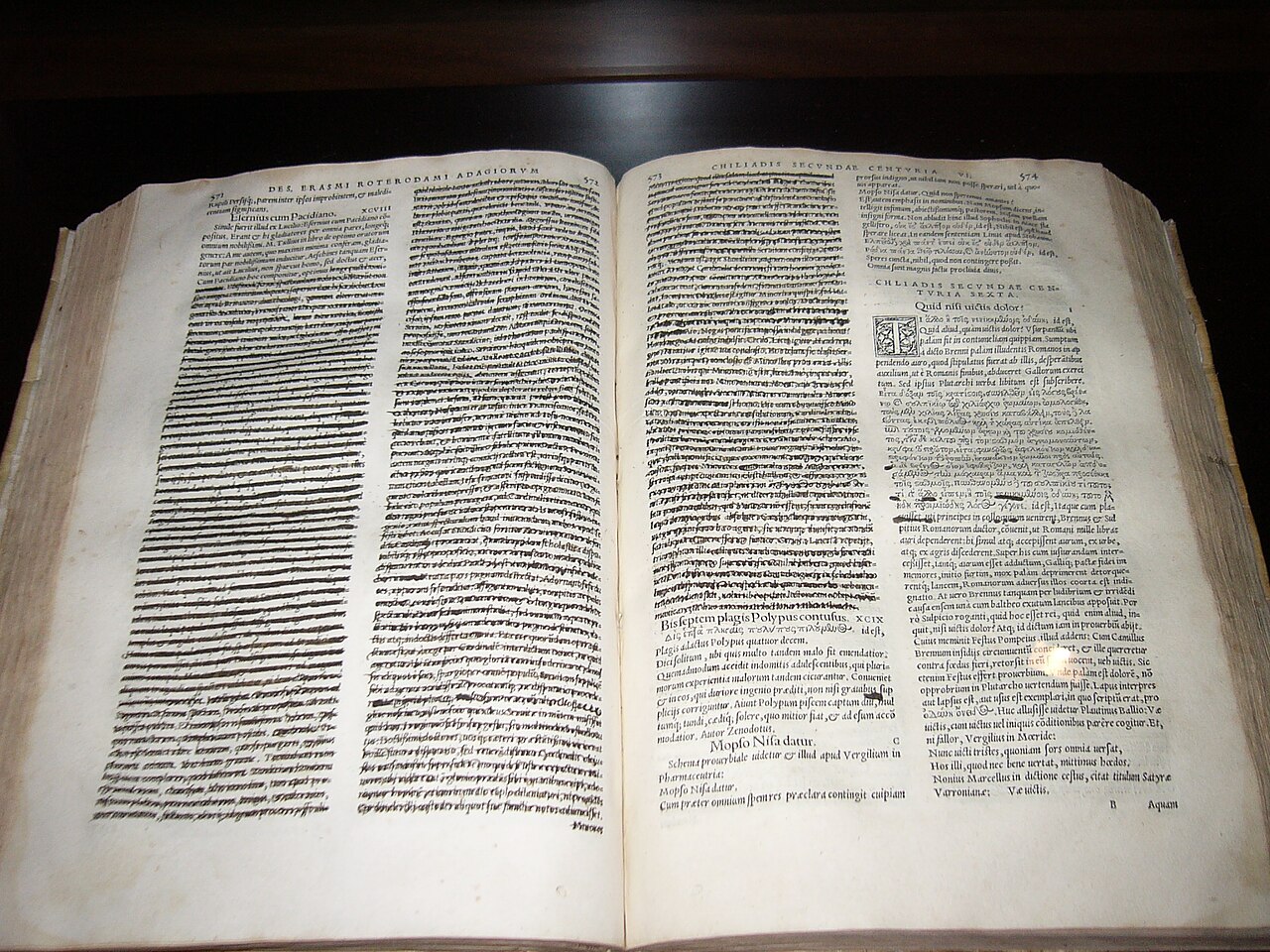
Open page spread of a large early printed book, Des Erasmi Roterodami Adagiorum, with dense black-letter columns of Latin text. Several passages are struck through with heavy dark marks, and a decorated initial letter appears on the right page.Photograph

Secondary source

Inquisition censored text: Des Erasmi Roterodami Adagiorum

November 2004

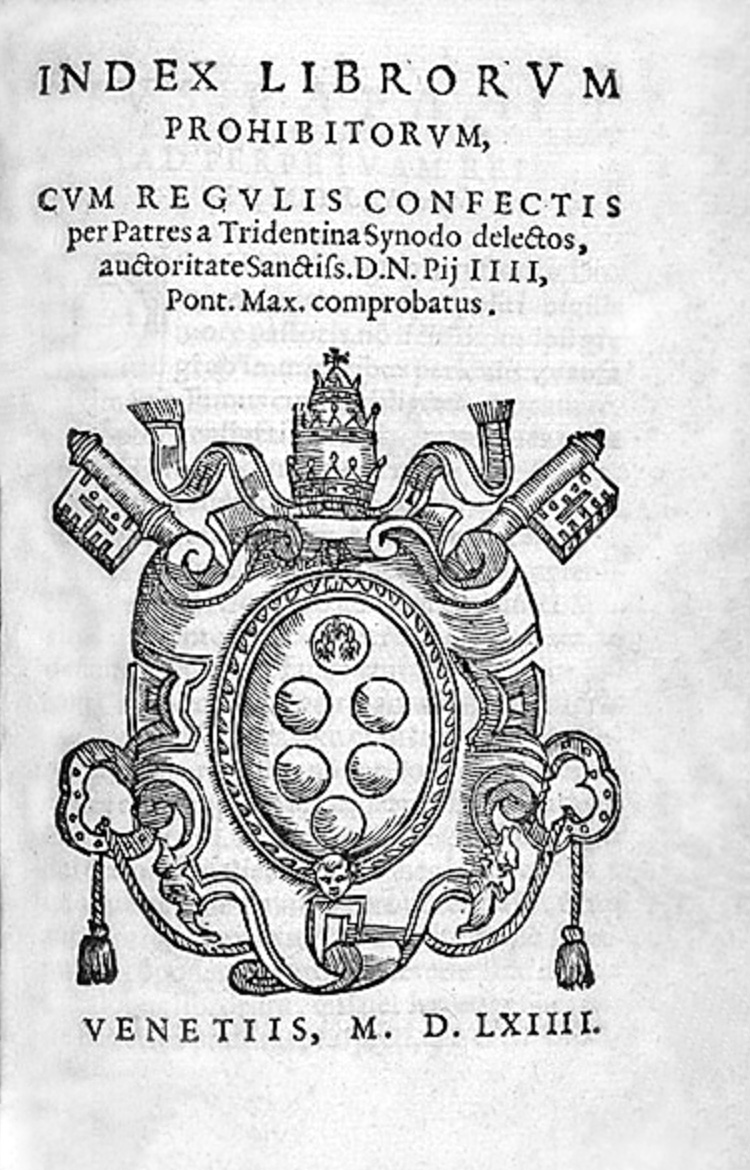
Title page of the Index Librorum Prohibitorum, printed in Venice in 1564 (MDLXIIII). Text reads 'Index Librorum Prohibitorum, cum regulis confectis per Patres a Tridentina Synodo delectos, auctoritate Sanctiss. D.N. Pij IIII, Pont. Max. comprobatus.' Below is a woodcut of papal arms: crossed keys and a tiara above a shield with five roundels and a small emblem at top.Document

Secondary source

Index Librorum Prohibitorum

1564 edition shown; Montesquieu's work added 1751

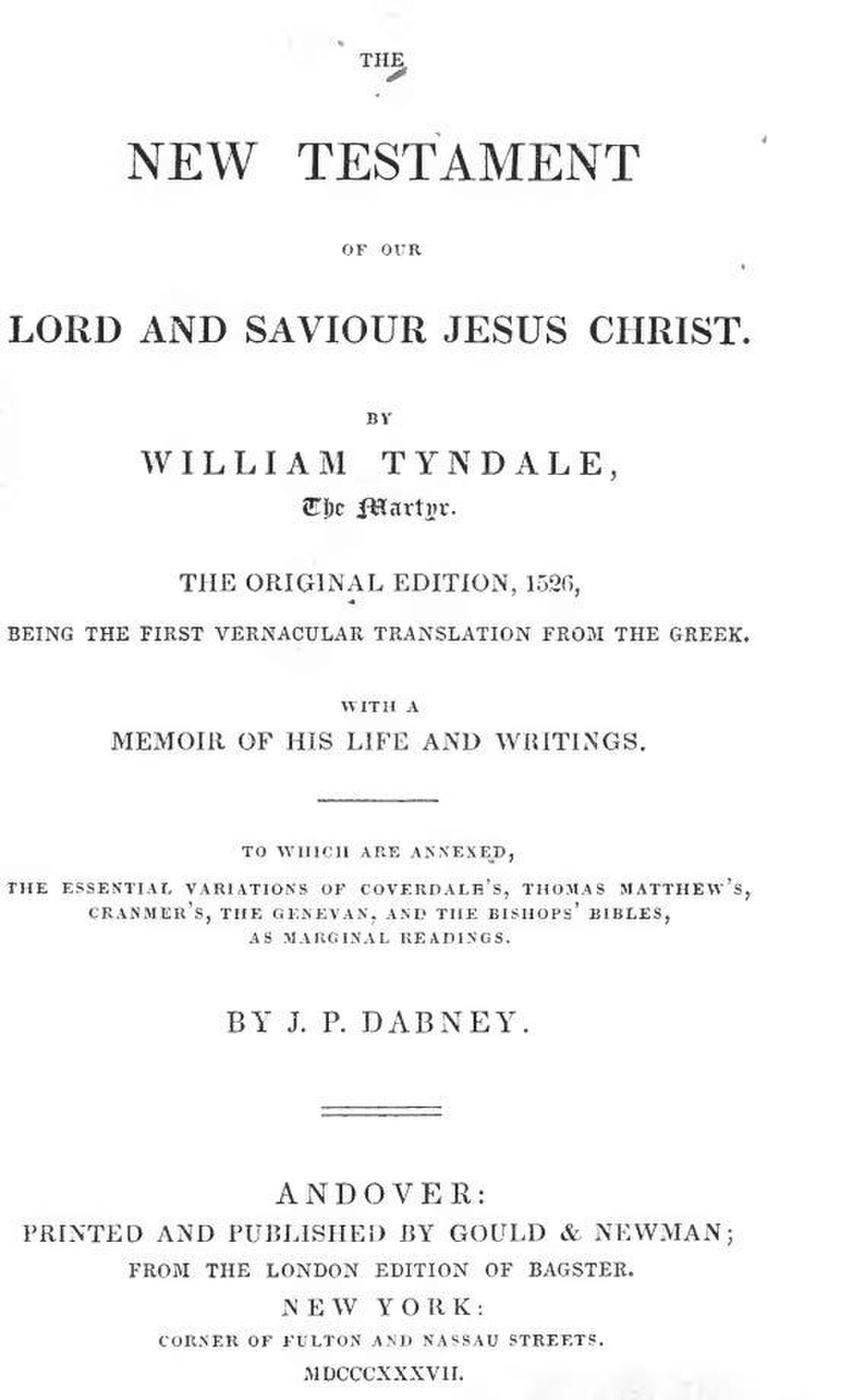
Title page of a later 1837 Andover, New York reprint of William Tyndale's New Testament, stating it is the 1526 original edition, edited with a memoir by J. P. Dabney, printed by Gould & Newman.Book

Secondary source

Tyndale New Testament (Worms, 1526)

William Tyndale · 1526

Painted portrait of a man in a black wide-brimmed cap and dark fur-trimmed black robe with brown fur collar and cuffs, against a pale blue background. He has gray hair, a short beard, and looks to the left. Date inscription on right side.Painting

Primary source

Portrait of Desiderius Erasmus

Lucas Cranach the Elder · 1530

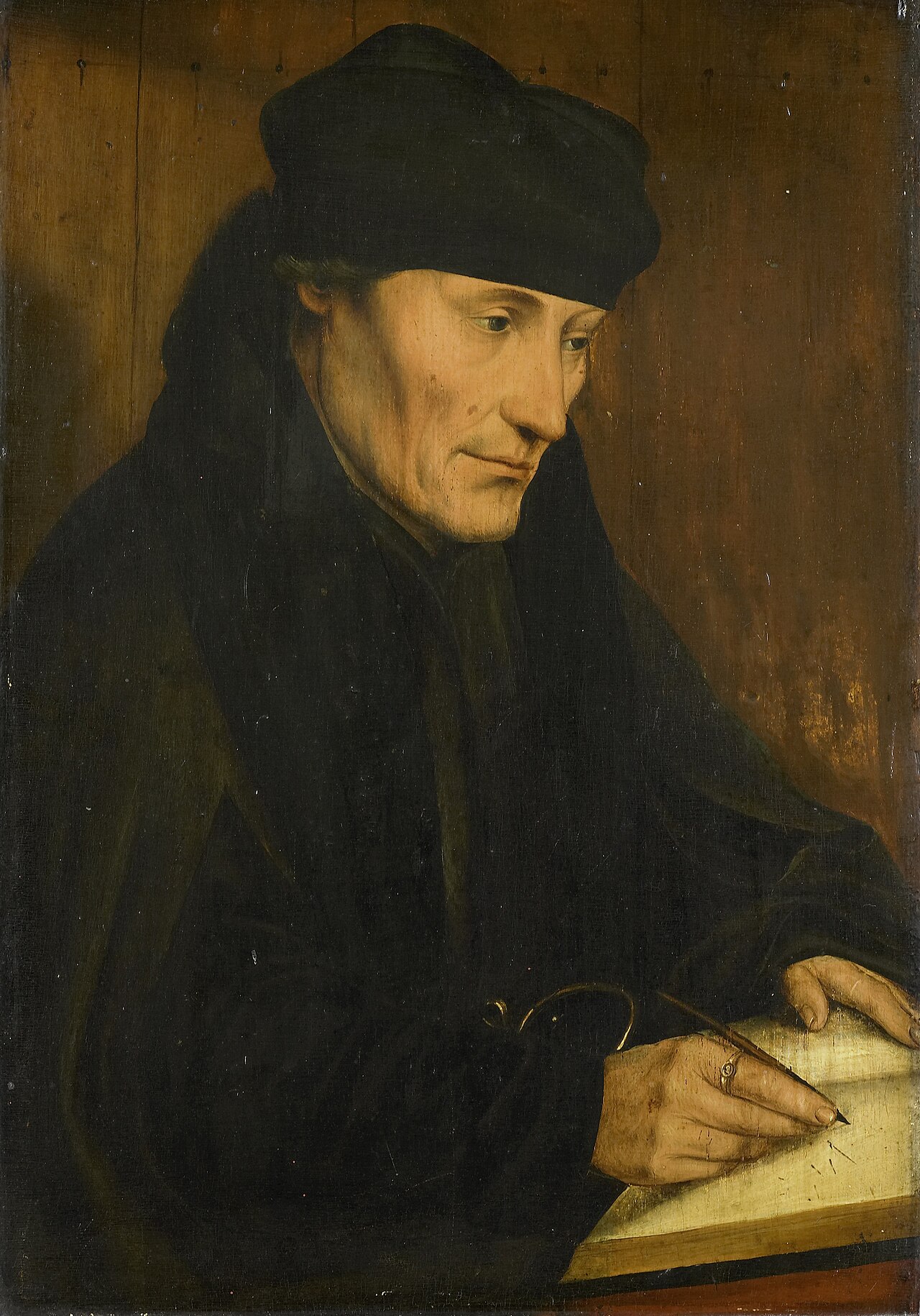
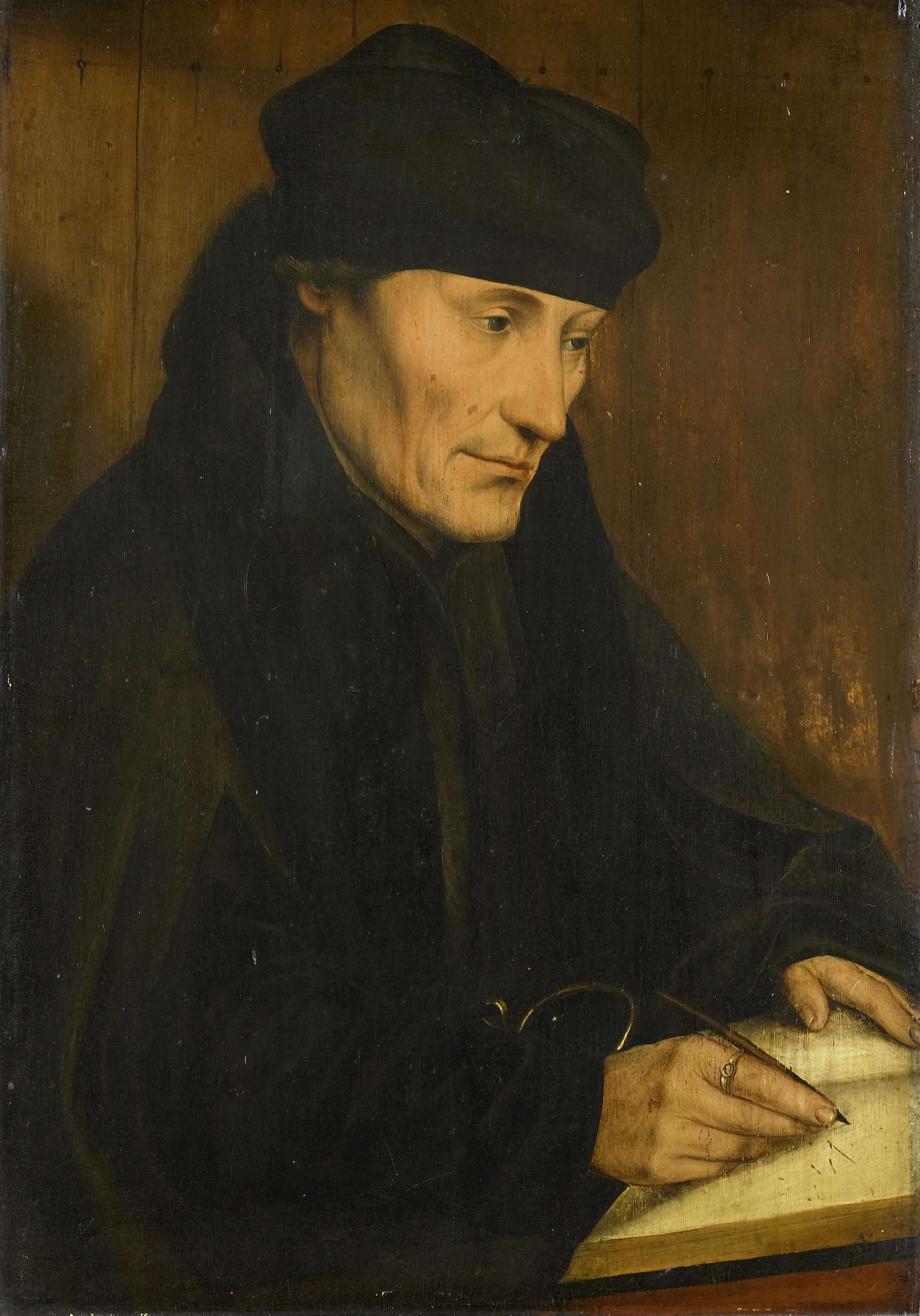
Oil painting of an older man in a black cap and dark robe, seated at a table, looking down while holding a pen over an open book. Dark wooden panel background, warm brown tones.Painting

Secondary source

Portrait of Desiderius Erasmus

1535

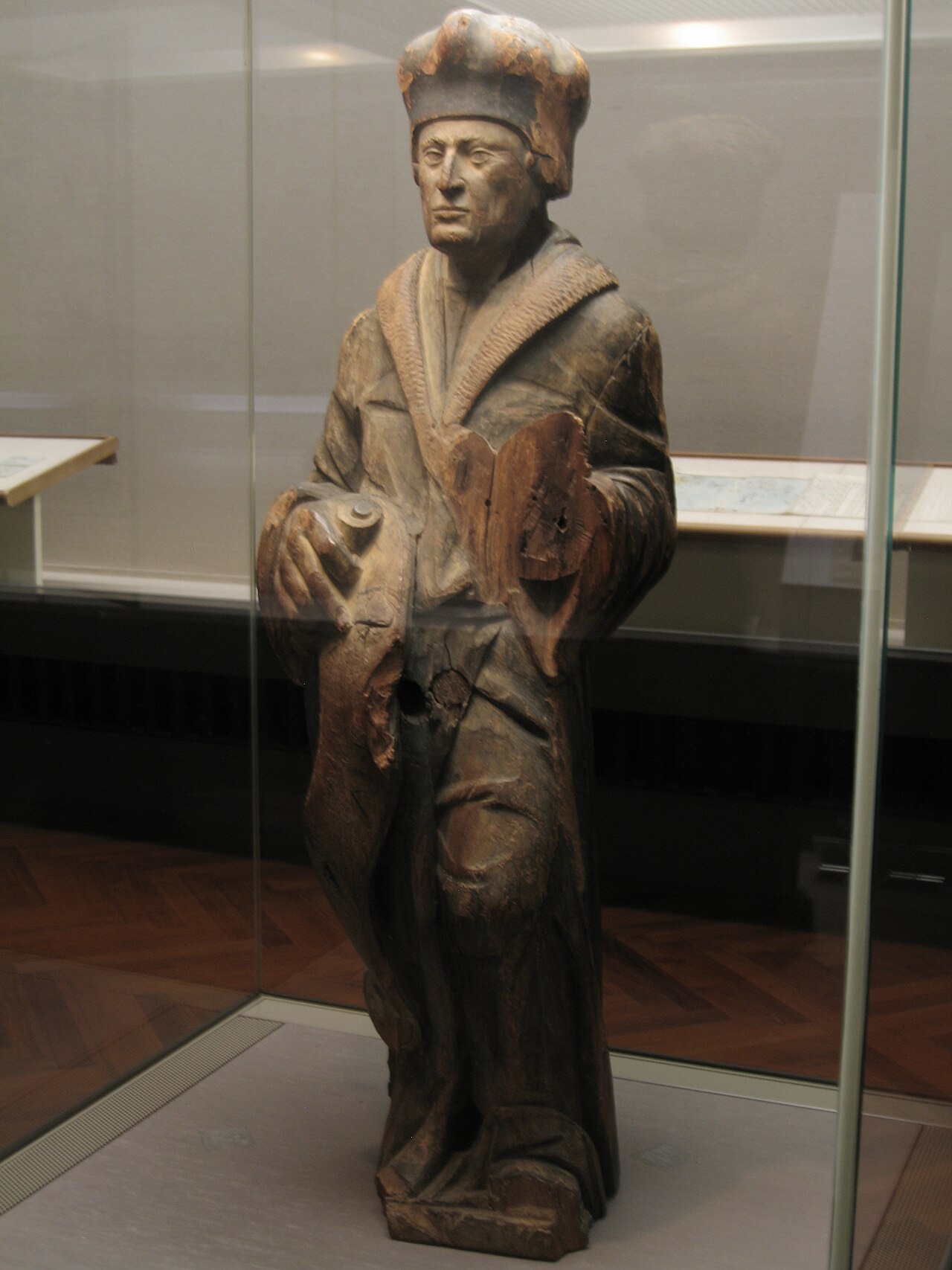
A carved wooden statue of a standing man in a high-brimmed cap and long robe with a fur collar, holding a book in one hand and a round object in the other, displayed behind glass in a museum case.Sculpture

Secondary source

Fence statue Erasmus

1598

The Praise of FollyBook

Primary source

The Praise of Folly

Erasmus · 1913

Letter

Primary source

The Epistles of Erasmus

Erasmus · 1901

CiceronianusBook

Primary source

Ciceronianus

Desiderius Erasmus · 1908

Book

Primary source

The Apophthegmes of Erasmus

Desiderius Erasmus · 1877

The Colloquies of ErasmusBook

Primary source

The Colloquies of Erasmus

Desiderius Erasmus · 1878

Book

Primary source

On the Bondage of the Will

Martin Luther · 1823

Select Familiar Colloquies of ErasmusBook

Primary source

Select Familiar Colloquies of Erasmus

Desiderius Erasmus · 1818

Book

Primary source

All the Familiar Colloquies of Erasmus

Desiderius Erasmus · 1733

Life and Letters of ErasmusBook

Secondary source

Life and Letters of Erasmus

James Anthony Froude · 1899

Desiderius Erasmus Concerning the Aim and Method of EducationBook

Secondary source

Desiderius Erasmus Concerning the Aim and Method of Education

William Harrison Woodward · 1904

Book

Secondary source

Erasmus and Luther: Their Attitude to Toleration

Robert H. Murray · 1920

Desiderius Erasmus of RotterdamBook

Secondary source

Desiderius Erasmus of Rotterdam

Ephraim Emerton · 1899

Engraving of a bearded elderly man in a fur-trimmed cap and heavy robe, writing with a quill at a slanted lectern. A Latin inscription panel reads Imago Erasmi Roterodami and the date MDXXVI. A vase of flowers stands on a table, with open books below.Painting

Primary source

Desiderius Erasmus of Rotterdam

Albrecht Dürer · 1526

Painted portrait of a bearded older man in a black velvet cap and dark fur-trimmed robe with brown fur collar and cuffs, resting folded hands on a ledge, set against a teal background with a small paper note at left.Painting

Primary source

Erasmus of Rotterdam

Hans Holbein the Younger · ca. 1532

Letter

Primary source

Selections from Erasmus: Principally from his Epistles

Erasmus

Book

Primary source

Erasmus Against War

Erasmus

Book

Primary source

De copia verborum

Erasmus · 1512

Book

Primary source

Julius Exclusus e coelis

Erasmus · 1513/1518

Book

Primary source

Institutio principis christiani

Erasmus · 1517

Book

Primary source

Colloquia familiaria

Erasmus · 1892 edition of 1523 text

Book

Primary source

Dialogus Ciceronianus

Erasmus · 1528

Letter

Primary source

Epistolae of Desiderius Erasmus Roterodamus

Erasmus

Book

Secondary source

Erasmus, essay in Essays and Addresses

Richard Claverhouse Jebb · 1907

Book

Secondary source

The Age of Erasmus: Lectures Delivered in Oxford and London

P. S. Allen · 1914

Book

Secondary source

Erasmus

R. C. Jebb · 1897 (second edition; lecture delivered 1890)

Book

Secondary source

Erasmus and the Age of Reformation

Johan Huizinga · 1924 (first published)

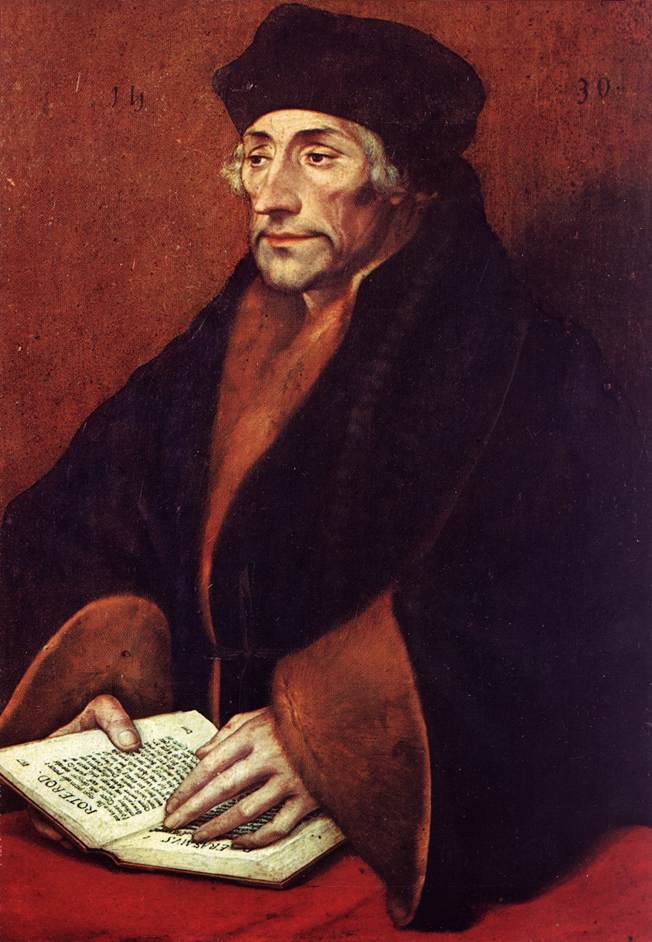
Oil painting of an older man in a dark fur-trimmed cap and black fur-collared robe with orange lining. He rests his hands on an open book with a red tablecloth below. Dark red background with the numbers 1530 at top corners.Painting

Primary source

Portrait of Desiderius Erasmus

Hans Holbein the Younger · 1530

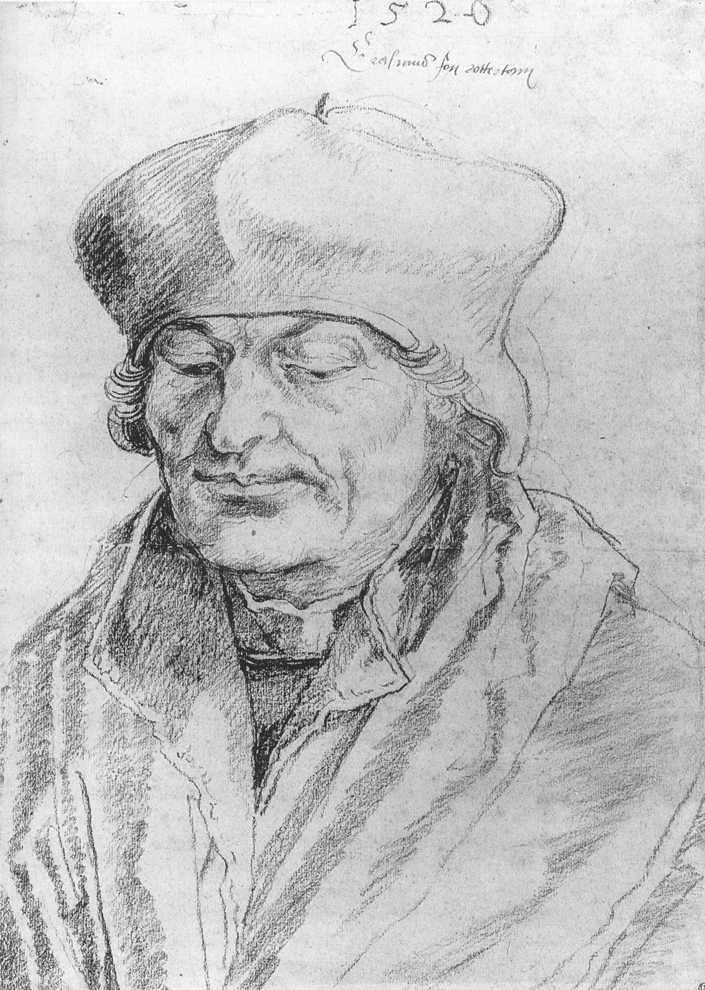
Black and white reproduction of a charcoal or chalk drawing of an older man in a fur-trimmed cap, eyes lowered, with a slight smile and a heavy coat. Inscribed 1520 and a name at top.Painting

Primary source

Portrait of Erasmus

Albrecht Dürer · c. 1520

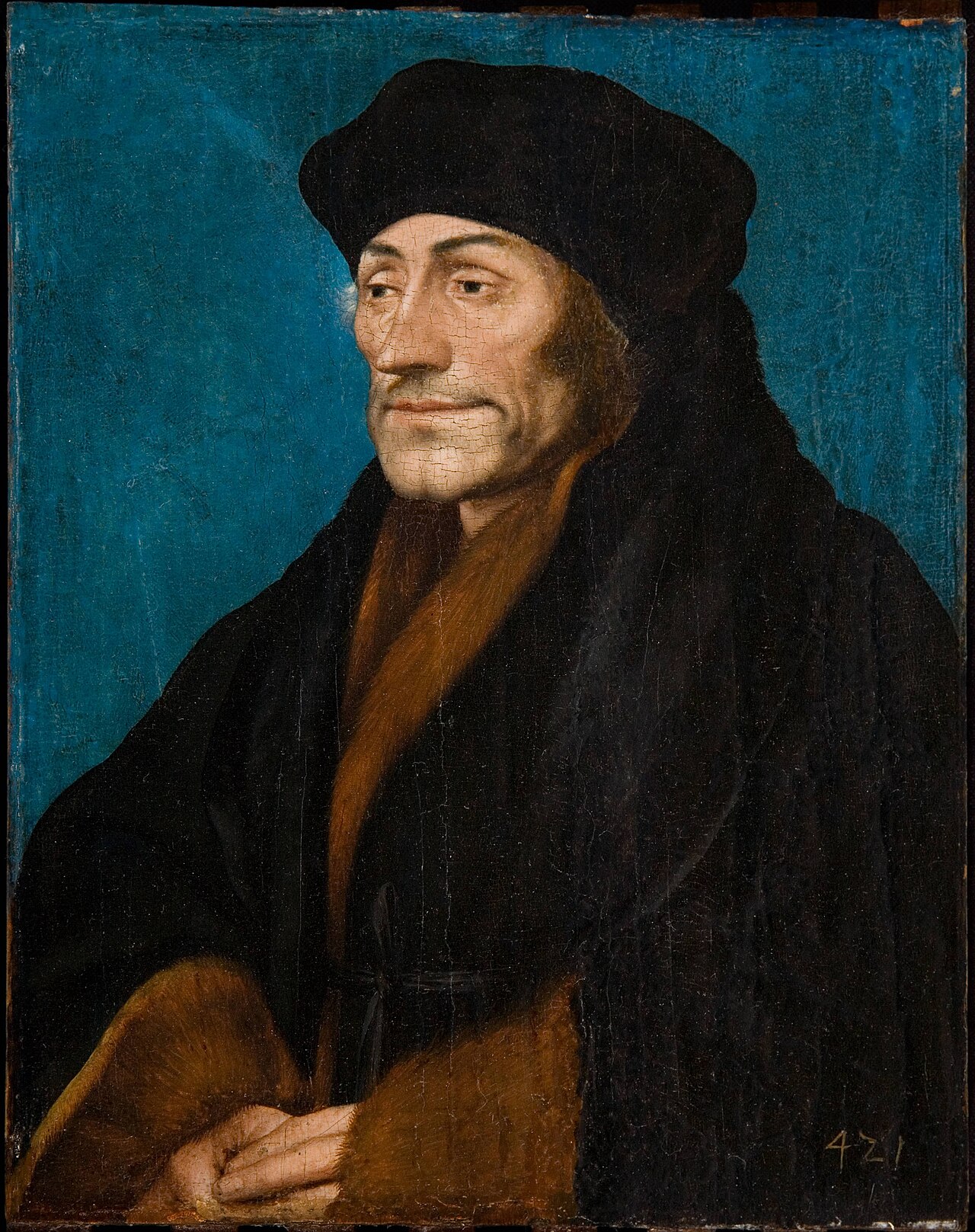
Painting of an older man in a black cap and dark fur-trimmed robe with brown fur collar and cuffs, set against a teal-blue background. He looks to the side with a slight smile, hands clasped at the lower edge. Number 421 is painted at lower right.Painting

Primary source

Portrait of Erasmus of Rotterdam

Hans Holbein the Younger and workshop · c. 1530-1531

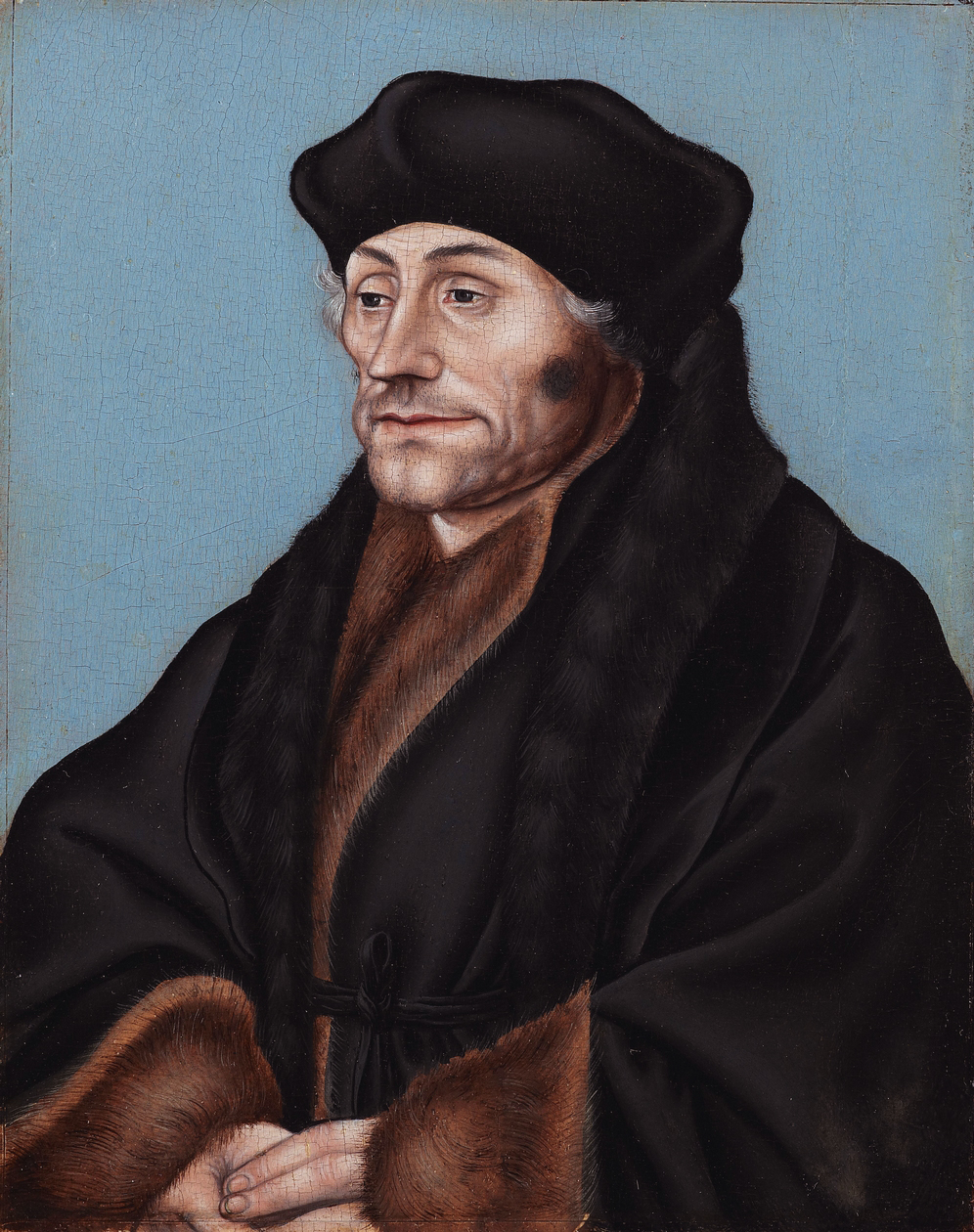
Painting of a man in a black velvet cap and dark fur-trimmed robe with brown fur collar and cuffs, against a pale blue background. He looks to the left with a thoughtful expression, hands folded at the bottom.Painting

Primary source

Portrait of Erasmus

Attributed to Lucas Cranach the Elder · 1530-1536

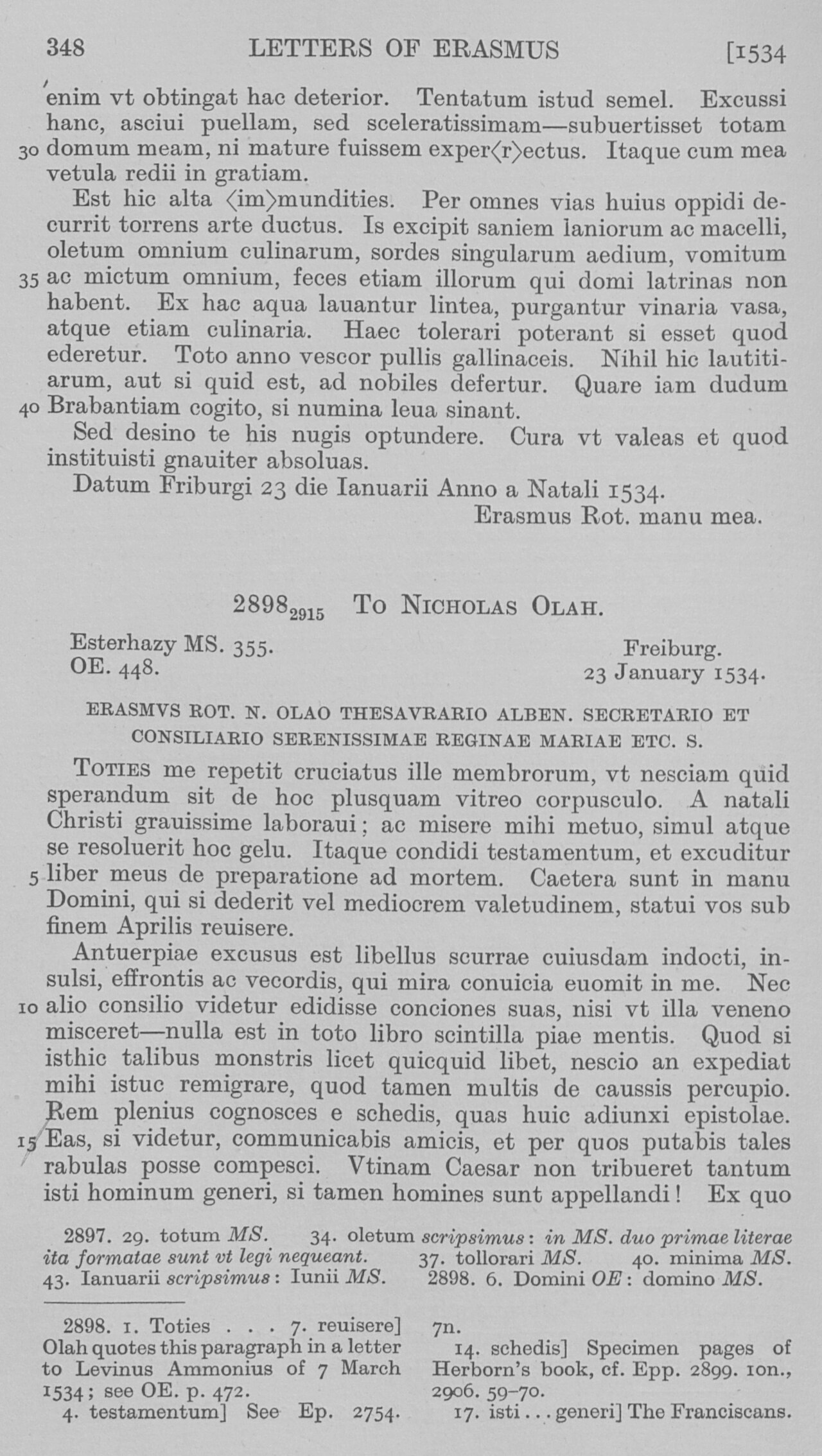
Scanned book page titled Letters of Erasmus, page 348, showing printed Latin text of a letter dated Freiburg, 23 January 1534, addressed to Nicholas Olah, with footnotes below. Page number 348 and year 1534 appear in header.Letter

Primary source

Letter from Erasmus to Nicholas Olah, 23 January 1534

Erasmus of Rotterdam · 23 January 1534

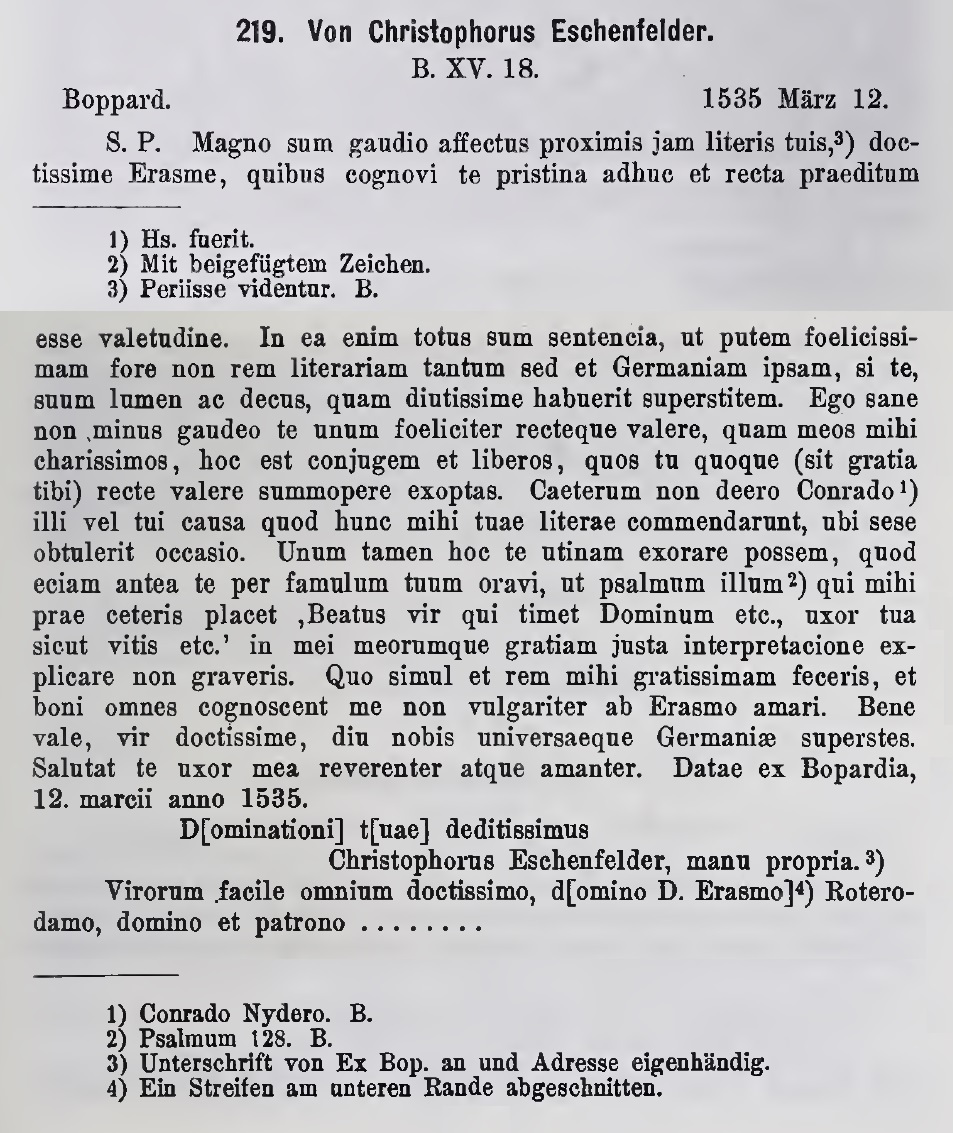
Printed edition page of a Latin letter dated Boppard, 12 March 1535, from Christophorus Eschenfelder to Erasmus, with footnotes at top and bottom and a handwritten-style signature line near the end.Letter

Primary source

Letter from Christoph Eschenfelder to Erasmus, 12 March 1535

Christoph Eschenfelder · 12 March 1535

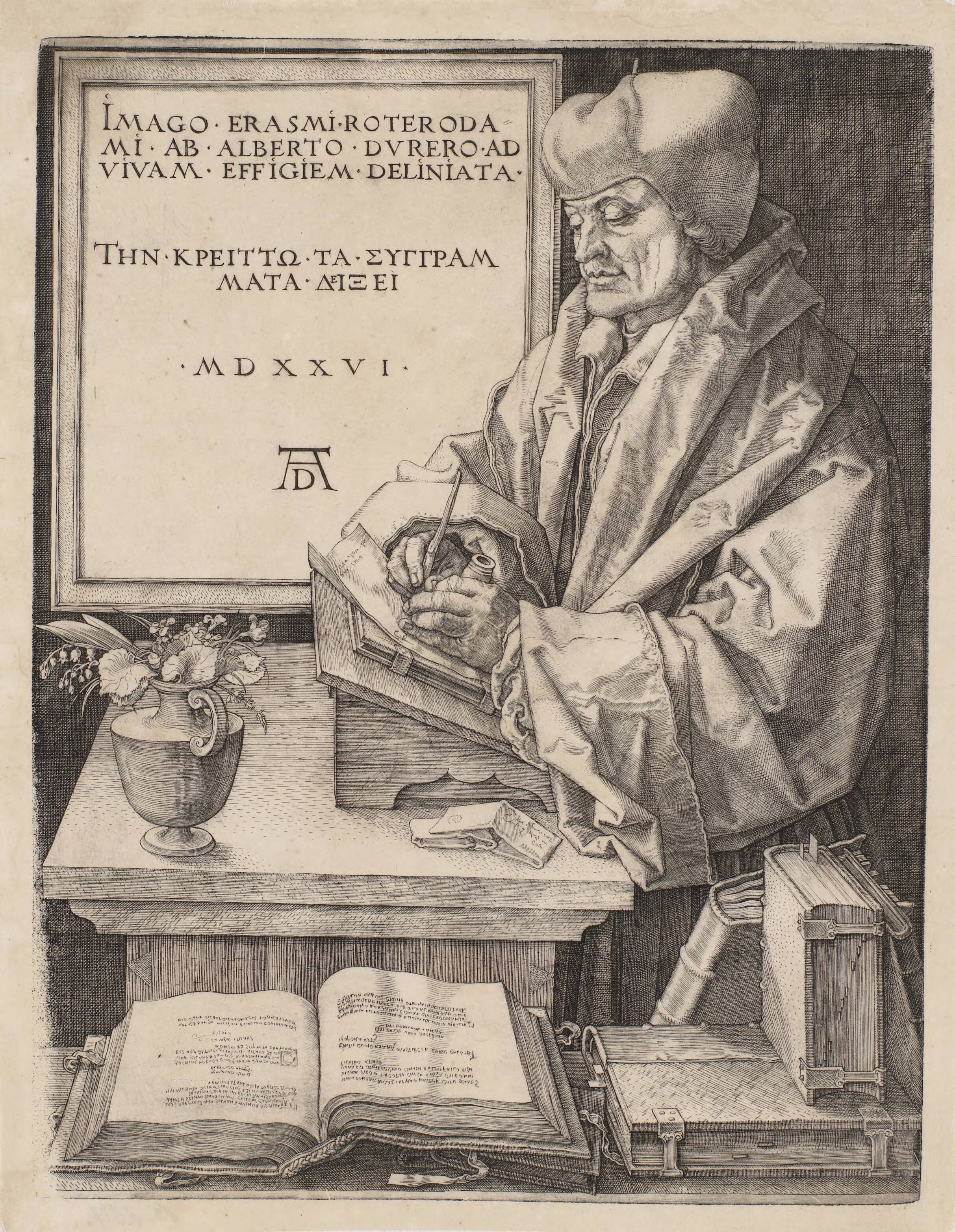
Engraving of a bearded scholar in a fur-trimmed cap and layered robes, seated writing at a slanted desk, with an open book and a vase of flowers on a table beside him. Latin inscription on a tablet reads Imago Erasmi Roterodami, dated MDXXVI, with the Dürer monogram.Painting

Primary source

Portrait of Erasmus of Rotterdam

Albrecht Dürer · 1526

Book

Secondary source

Das Lob der Narrheit (In Praise of Folly), LibriVox German audio reading

Julia Niedermaier

Engraving titled Imago Erasmi Roterodami by Albrecht Durer, dated MDXXVI. A seated man in a fur-trimmed hat and heavy robe writes with a quill at a sloped desk beside a vase of flowers. Open books and a stack of volumes lie in the foreground, and Latin inscription fills the upper left.Painting

Primary source

Imago Erasmi Roterodami

Albrecht Dürer · 1526

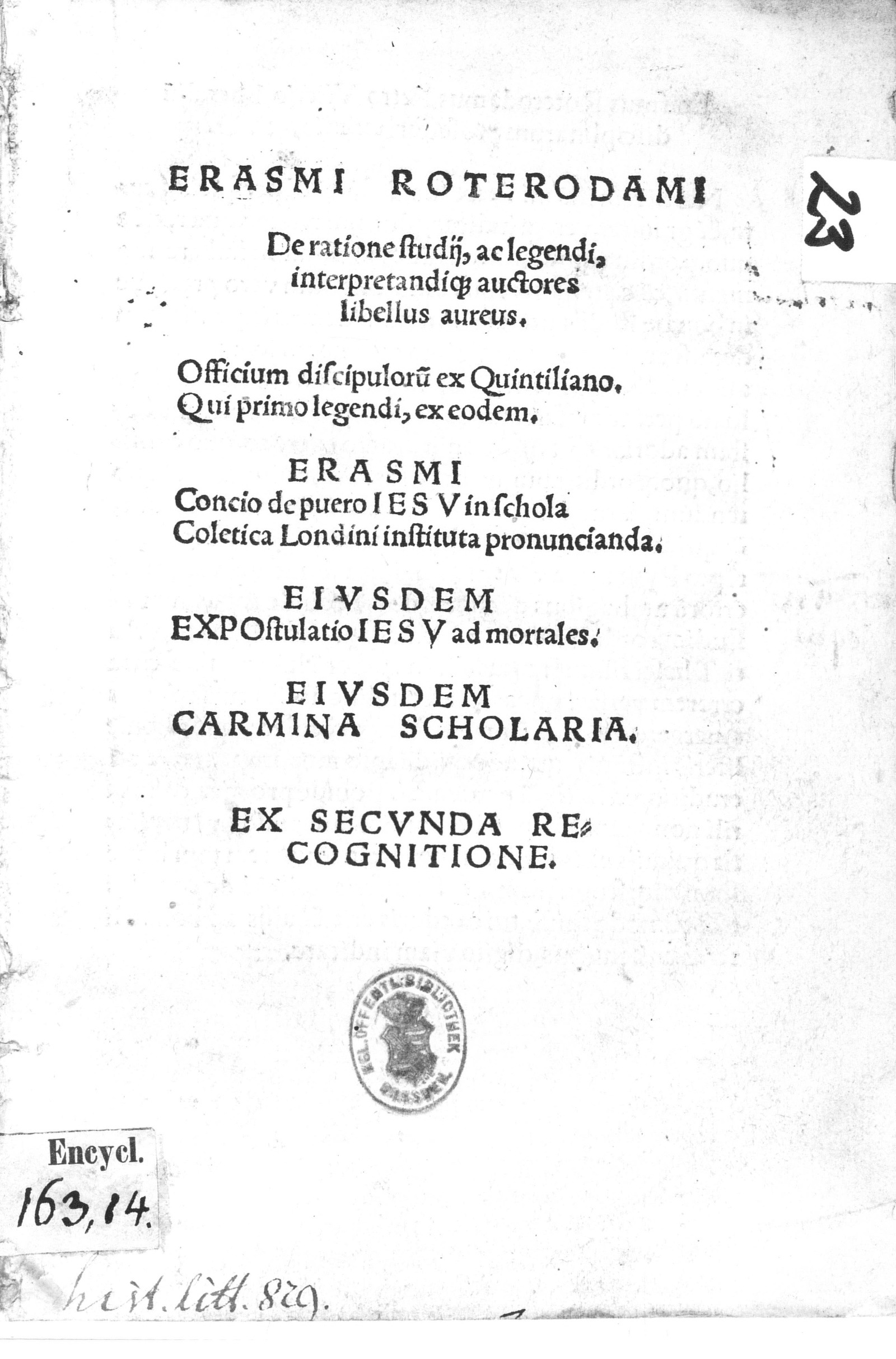
Black-and-white scan of a 16th-century printed title page in black-letter type reading 'Erasmi Roterodami De ratione studii, ac legendi, interpretandique auctores libellus aureus', with further listed works, a round library stamp, and handwritten shelfmarks.Book

Primary source

De ratione studii ac legendi, Leipzig 1526, title page

Desiderius Erasmus · 1526

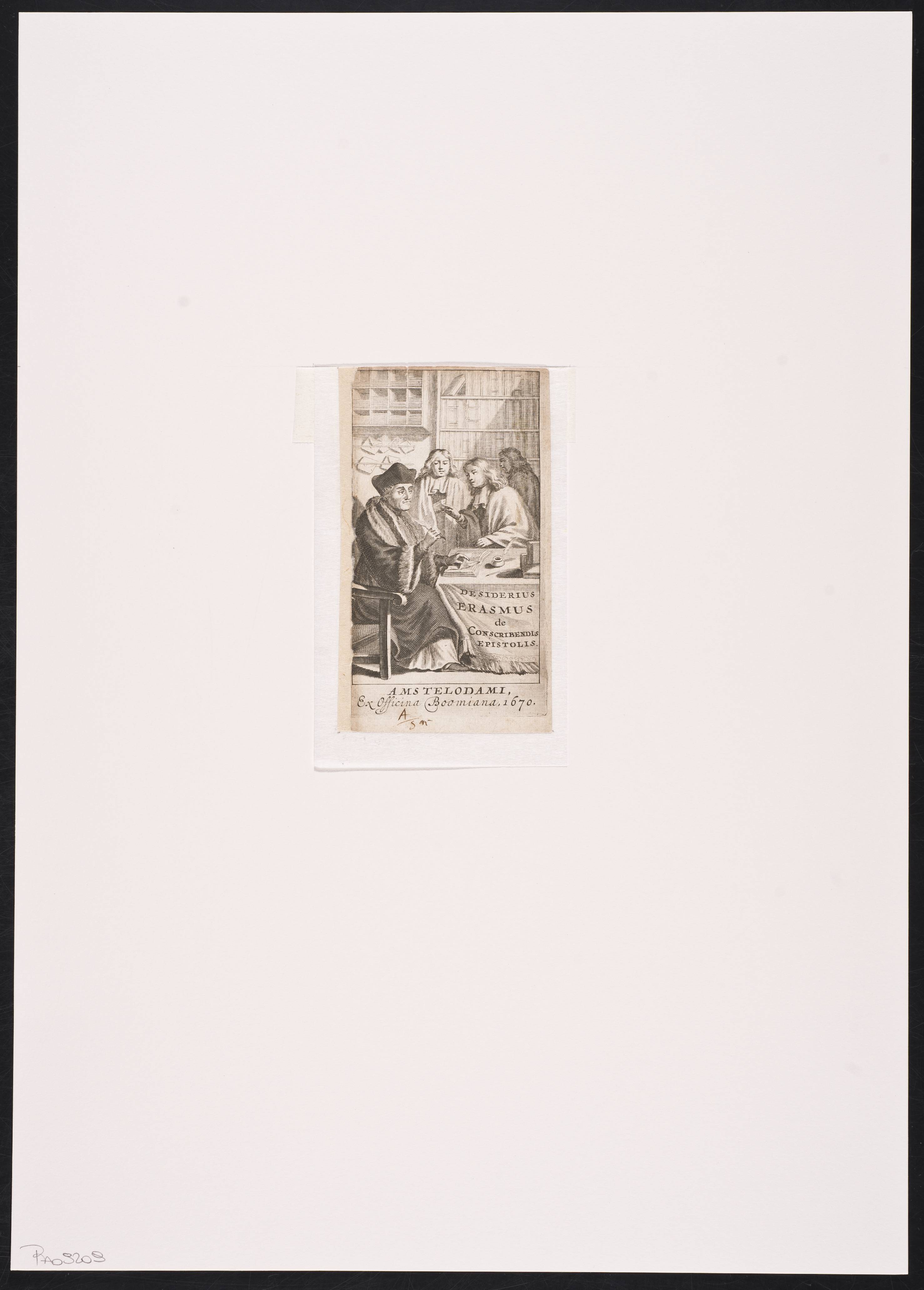
Engraved title page on a mounted sheet showing a seated man in a fur-trimmed robe and hat at a table, with three other men in the background of a study with bookshelves. Text reads: Desiderius Erasmus de Conscribendis Epistolis; Amsterdam, ex officina Boomiana, 1670. Handwritten marks and a catalogue number appear on the sheet.Book

Primary source

De conscribendis epistolis, title page (Amsterdam, 1670)

Desiderius Erasmus · 1670

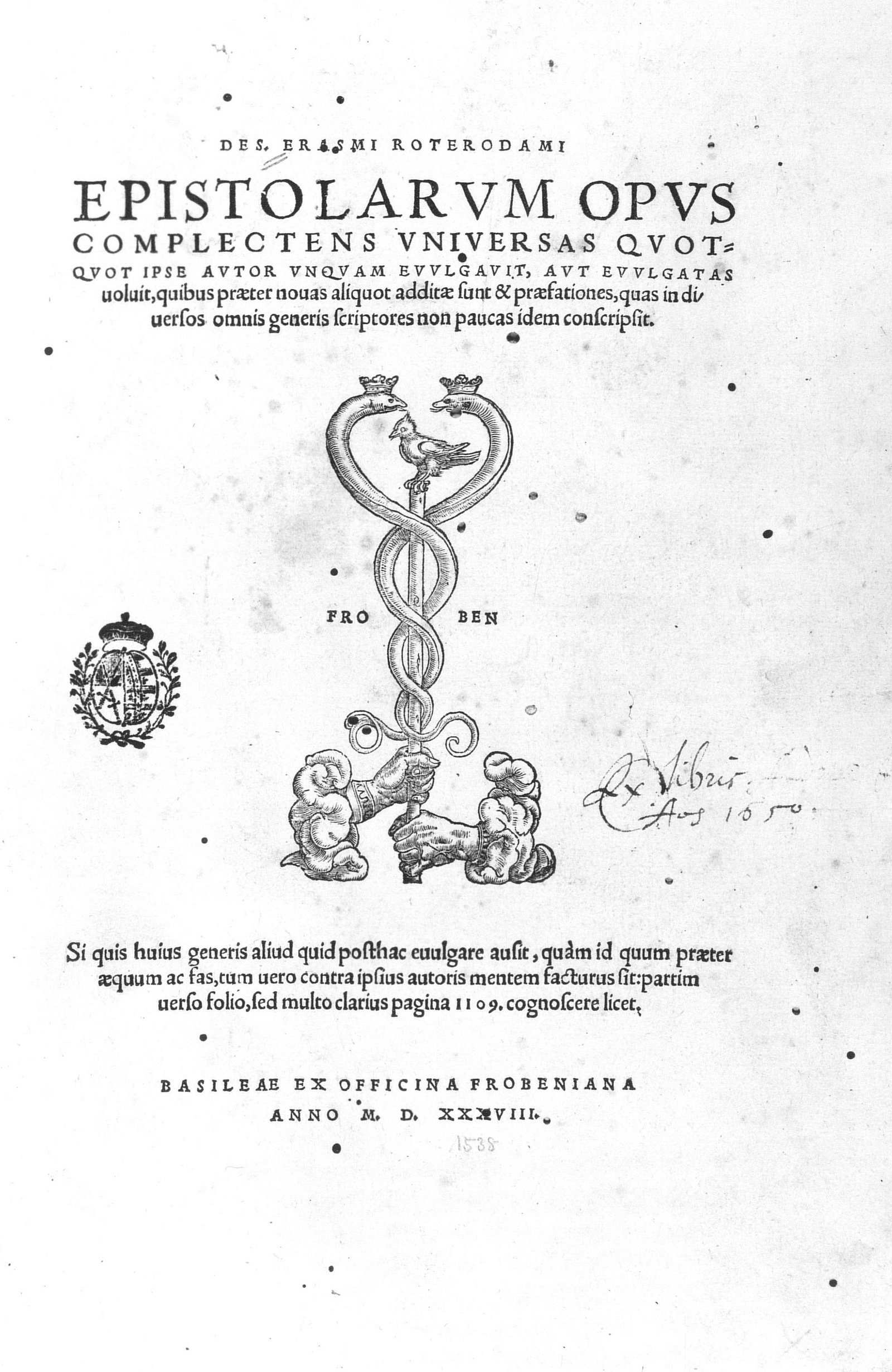
Black and white scan of a printed title page in Latin. Heading reads DES. ERASMI ROTERODAMI, then EPISTOLARUM OPUS in large capitals, followed by smaller text. Central woodcut shows a caduceus-like staff with two crowned serpents forming a heart shape, a bird perched on top, two hands holding the staff below, and the word FROBEN on either side. Imprint at bottom reads BASILEAE EX OFFICINA FROBENIANA ANNO M.D.XXXVIII. A handwritten note reads Ex libris and Anno 1550 at right.Book

Primary source

Epistolarum opus (Basel, 1538)

Desiderius Erasmus · 1538

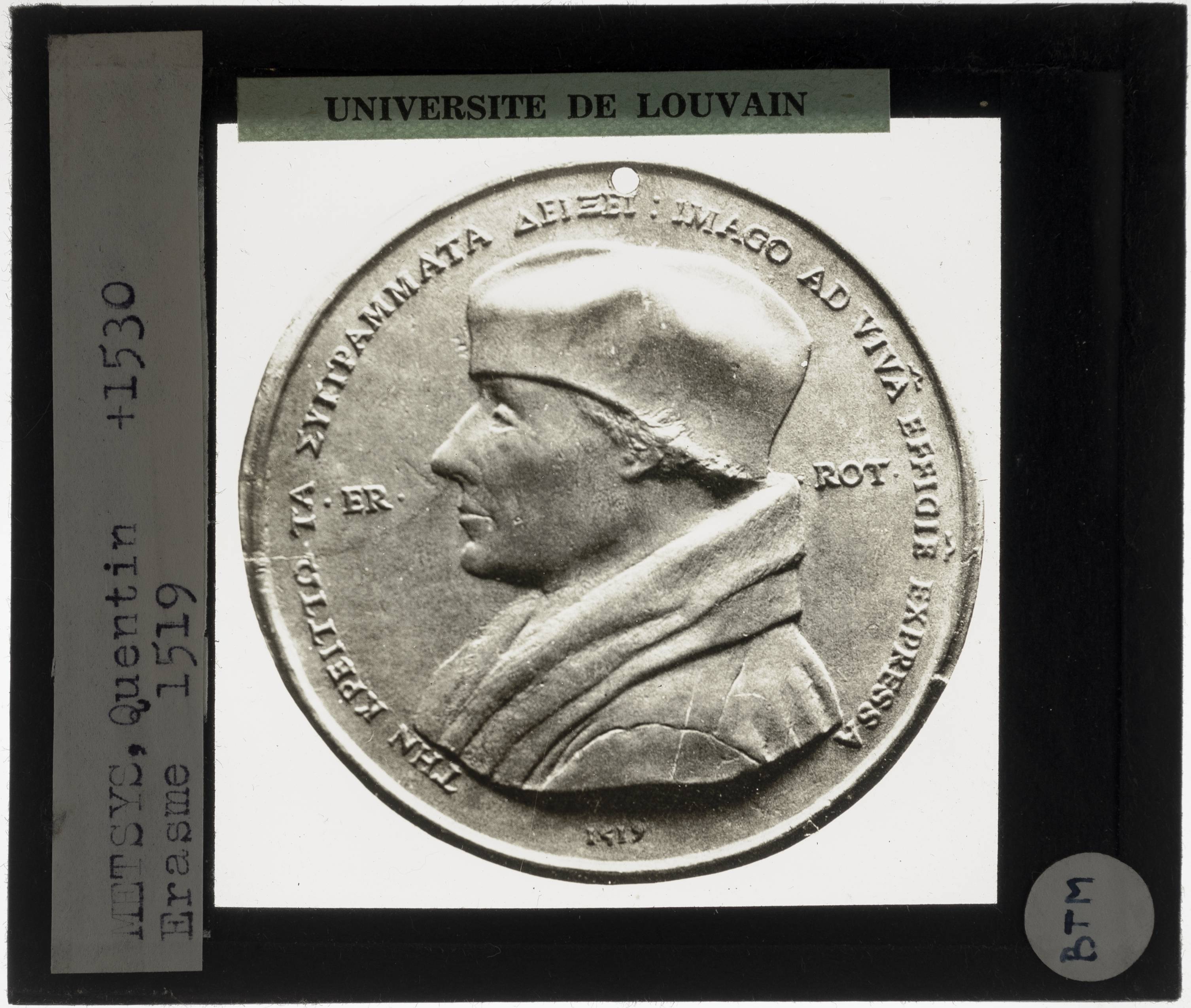
Lantern slide photograph of a bronze-toned medal showing a profile portrait of Erasmus in a flat cap and high-collared cloak, facing left, with Greek and Latin inscriptions and the date 1519 around the rim. A black mount with the label 'Universite de Louvain' surrounds it.Artifact

Primary source

Medal of Desiderius Erasmus by Quinten Metsys (1519)

Quinten Metsys · 1519

Oil painting of an elderly man in a black cap and dark robe, seen in three-quarter view looking down at an open book on a desk. He holds a pen in his right hand, and a gold ring is visible on one finger. The background is a brown wooden panel.Painting

Primary source

Portrait of Desiderius Erasmus Writing (1535)

1535

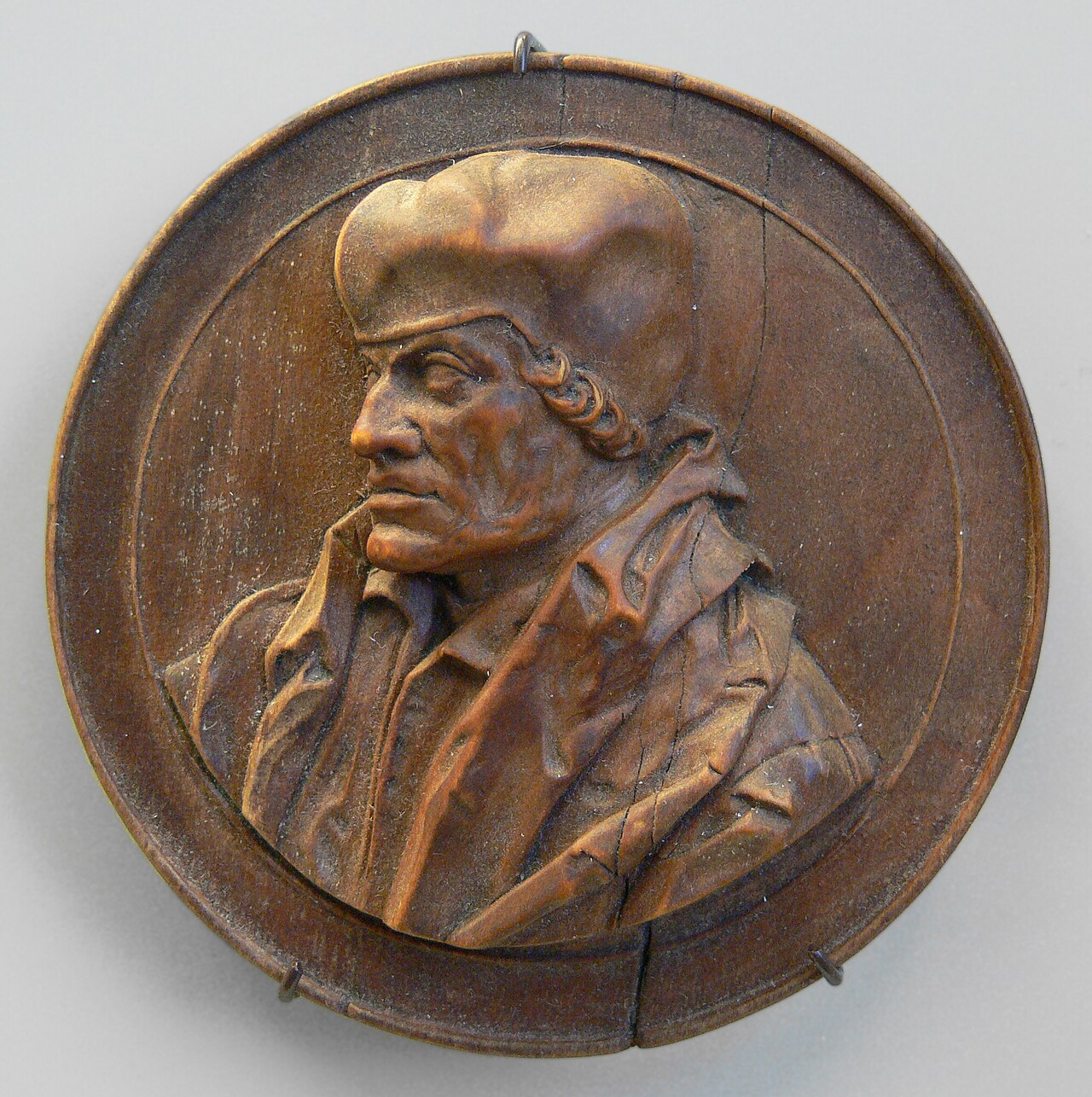
Circular carved wooden relief medallion showing a man in profile facing left, wearing a large flat-topped cap, a high-collared coat, and a hooded cloak. Brown wood with visible grain, mounted by wire loops on the back.Artifact

Secondary source

Cherrywood Relief Medallion of Erasmus (southern Germany)

early 17th century

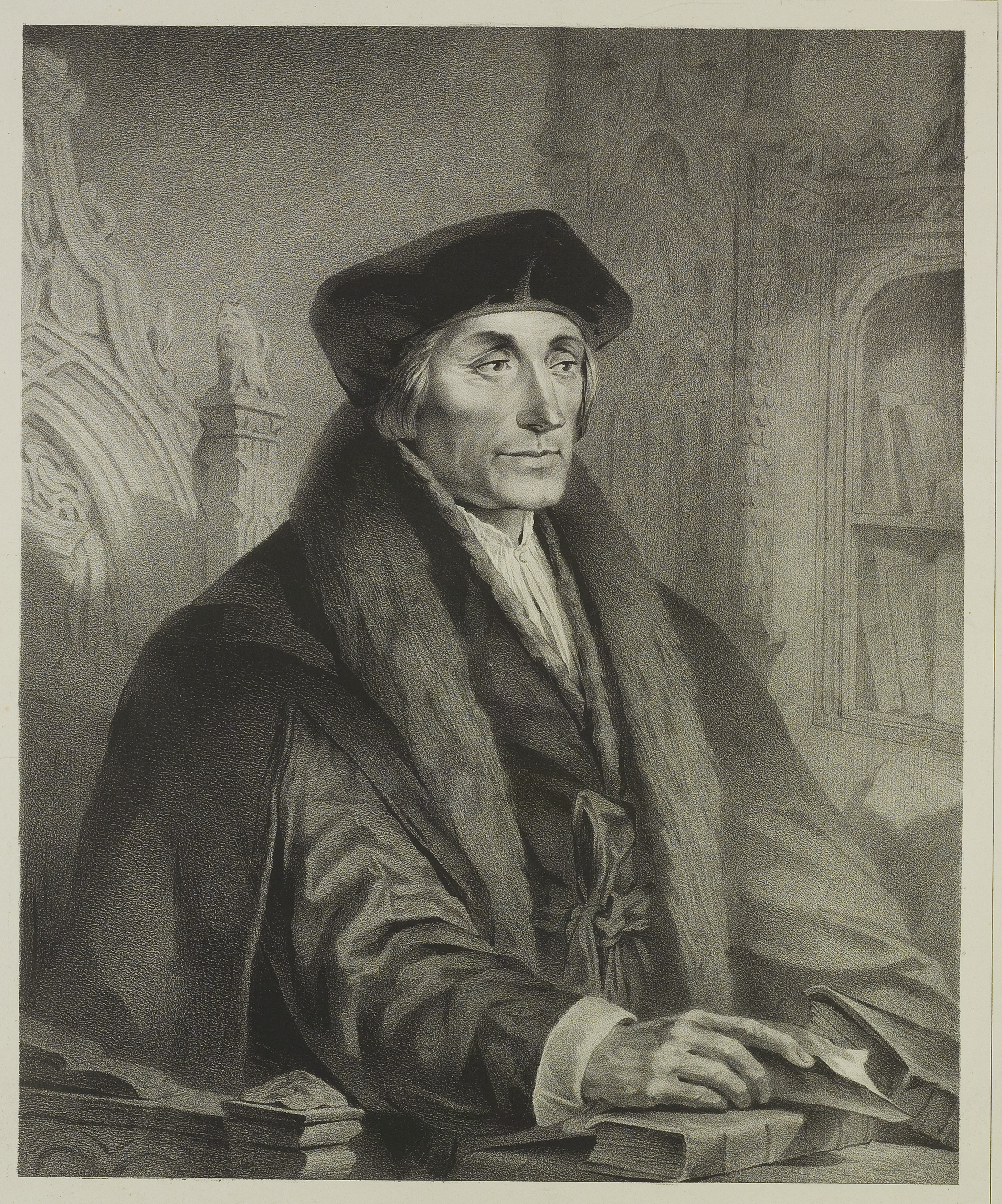
Black and white lithograph portrait of a older man wearing a dark flat beret and a dark fur-collared robe, seated at a table with books, looking to the right. Gothic architectural details appear in the background.Painting

Secondary source

Portrait of Erasmus by F. van Goor

F. van Goor

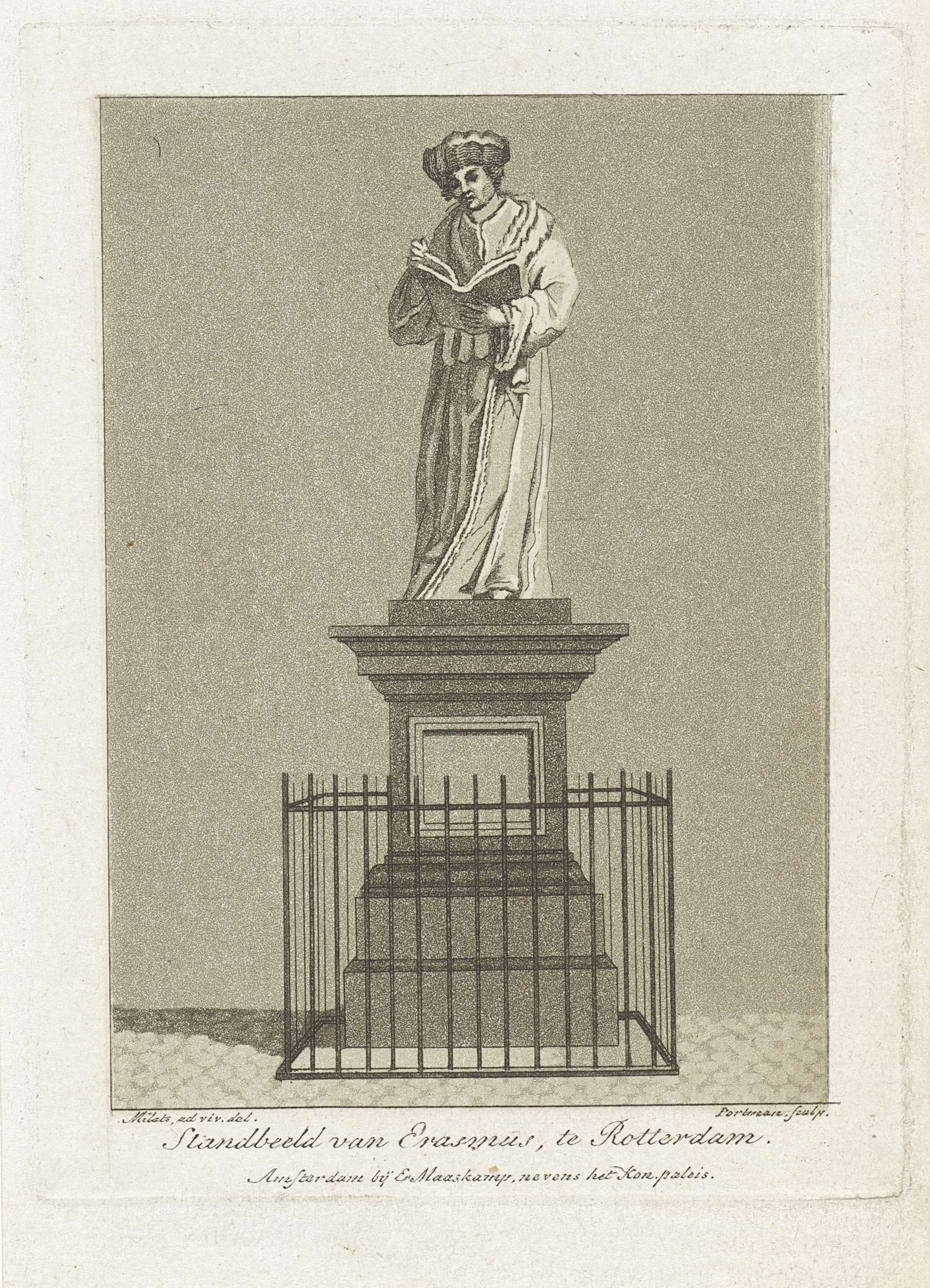
Engraved print titled 'Standbeeld van Erasmus, te Rotterdam'. A standing statue of Erasmus, in a cap and long robe, reads an open book, on a tiered pedestal surrounded by an iron railing. Inscription reads Amsterdam bij E. Maaskamp.Artifact

Secondary source

Erasmus statue on the Grote Markt, Rotterdam

Hendrick de Keyser · 1622

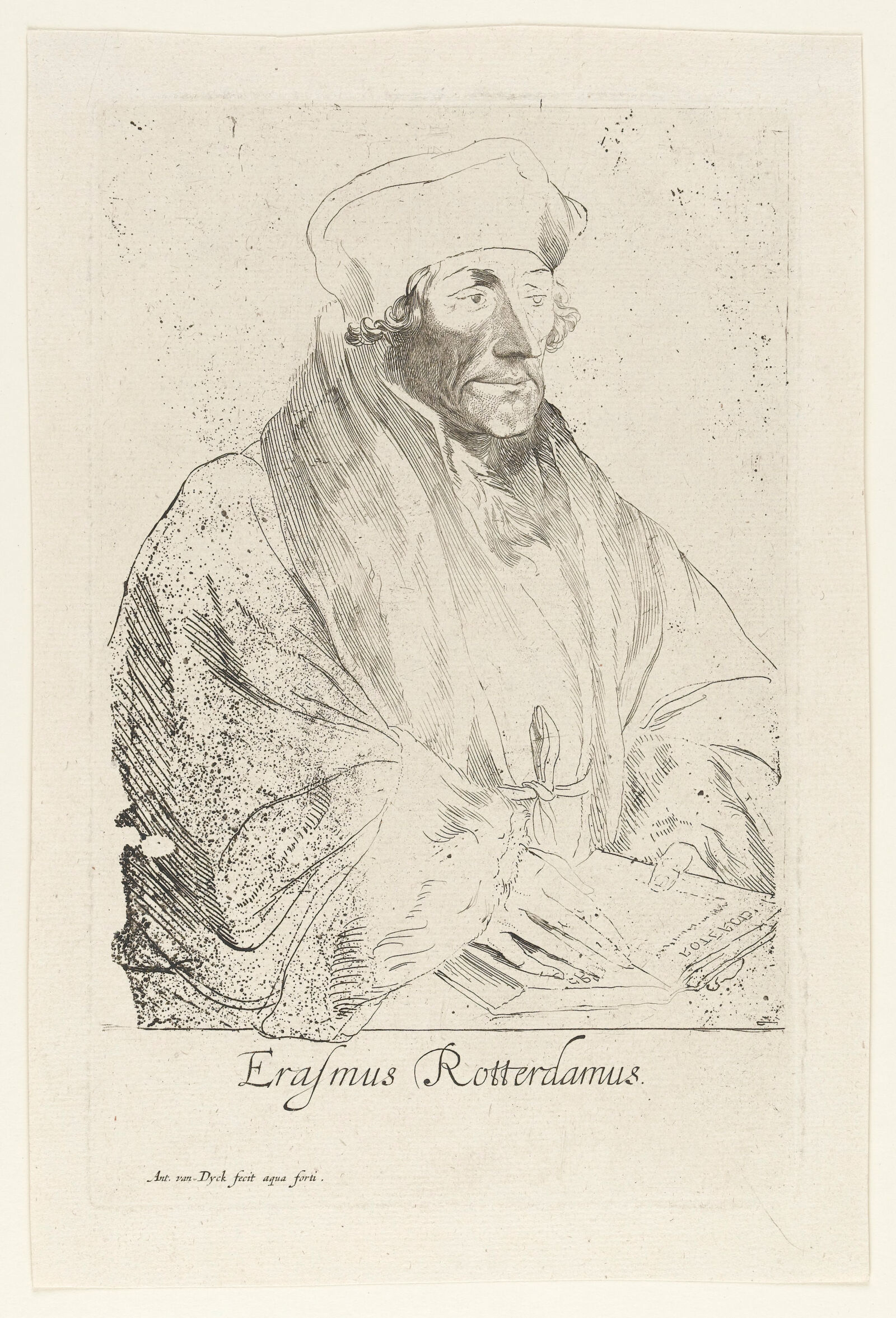
Etching of a bearded older man in a close-fitting cap and layered robe, seated with his hands resting on a book inscribed Rotterdamus. Caption below reads Erasmus Rotterdamus; signed Ant. van Dyck fecit aqua forti.Painting

Secondary source

Desiderius Erasmus, etching by Anthony van Dyck

Anthony van Dyck · between 1600 and 1699

Want the full shelf? Chat with Desiderius Erasmus in the app and open the Sources panel — every quote links back to the original.

Use Desiderius Erasmus in class

1 collection

A ready-made collection from the Humy team that features Desiderius Erasmus. Preview it, then try it free.

Trusted by educators worldwide

Conversations
375,000+
Real exchanges between students and historical figures
Messages exchanged
4,142,000+
Across every figure, classroom and language
Historical figures
100,000+
Each informed by a curated biography and selected sources
Languages supported
50+
From English and Spanish to Arabic and Korean

Paying customers

Used by 98 schools and universities

Partner school logo
Tecnológico de Monterrey logo
Hyper Island logo
Partner school logo
Chambersburg Area School District logo
Broward County Public Schools logo
Nebo School District logo
National Louis University logo
South Florida PBS logo
Punahou School logo
University of Wisconsin–River Falls logo
Partner school logo
Partner school logo
Archbishop Mitty High School logo
Kingsburg High School logo
Norwalk Public Schools logo
Partner school logo
Connections logo
Partner school logo
Moore Public Schools logo
Partner school logo
Partner school logo
Partner school logo
Partner school logo
Robbinsville Public Schools logo
Partner school logo
Partner school logo
Partner school logo
Tecnológico de Monterrey logo
Hyper Island logo
Partner school logo
Chambersburg Area School District logo
Broward County Public Schools logo
Nebo School District logo
National Louis University logo
South Florida PBS logo
Punahou School logo
University of Wisconsin–River Falls logo
Partner school logo
Partner school logo
Archbishop Mitty High School logo
Kingsburg High School logo
Norwalk Public Schools logo
Partner school logo
Connections logo
Partner school logo
Moore Public Schools logo
Partner school logo
Partner school logo
Partner school logo
Partner school logo
Robbinsville Public Schools logo
Partner school logo
Partner school logo

What educators are saying

“We enjoyed the program last year and used it frequently.”
“My students say it’s a welcome change of pace. I’m not a fan of the “sage on the stage” model, so I try to incorporate research-oriented and self-paced activities. With Humy, students have to take charge of their learning. They’ve become more adept at critical thinking, forming better questions, and improving their reading comprehension. The interview feature has been my go-to tool. I create assignments where students must ask historical figures a set number of questions, then summarize the responses to ensure they’re truly absorbing the material. This approach lets them actively explore the past rather than passively consuming information.”
“Humy has helped me bring historical figures, sometimes long past, to life. When my students interact with these figures in real-time, it eliminates some of the perceived “ancient” characteristics of my curriculum. This has shifted my students’ thinking away from viewing history as abstract or irrelevant. Real-time interactions make historical figures relatable, even allowing students to ask off-topic questions that help put historical lives in a more relevant context for 13-year-olds. The feature I use the most is the interview feature. After teaching a topic, most recently Gandhi and Joan of Arc, I have the students ask pointed, focused questions. We practice good conversation techniques beforehand, teaching them to listen (or read) carefully and formulate thoughtful follow-up questions rather than just interrogating. It helps students practice effective conversation skills.”

FAQ

Frequently asked questions

Who is Desiderius Erasmus?
Dutch Renaissance humanist and theologian. On Humy.ai you can chat with an AI version of Desiderius Erasmus that draws on a short biography and 85 historical sources during the conversation — by text or voice, in 42 languages.
Is Desiderius Erasmus AI free?
Desiderius Erasmus is part of Humy's full library of more than 100,000 figures, which comes with a paid plan. A free account (no credit card) includes 20 AI messages a month with the free library's figures, so you can try how the conversations work first. The free plan's 20 AI messages a month are shared by you and your students: enough to try Humy yourself; a whole class needs Plus.
What sources does the Desiderius Erasmus AI use?
It draws on a short biography and 85 historical sources (books, paintings and letters), including “In Praise of Folly”, “Novum Instrumentum omne” and “De libero arbitrio diatribe sive collatio”. Each source has its own page on Humy.ai.
How historically accurate is the AI version of Desiderius Erasmus?
Each figure uses a short biography and a small set of selected historical sources as context (retrieval-augmented generation), so answers stay closer to known material than the model's general knowledge alone. It isn't a citation-grade research tool — like any LLM, the AI can get details wrong or extrapolate. Treat it as a strong starting point for inquiry and cross-reference important claims.
Can I talk to Desiderius Erasmus by voice?
Yes. In addition to text chat, you can call Desiderius Erasmus and hear their voice respond in real time — useful for auditory learners, interview practice and Socratic dialogue.
Is Humy.ai safe and compliant for schools?
Yes. Humy.ai is used by more than 100 schools, universities and organisations. The platform is FERPA- and GDPR-aligned, supports SSO, and offers an IT-approval pack tailored for school procurement teams.

Cross-reference Desiderius Erasmus

Like any LLM, the AI version of Desiderius Erasmus can get details wrong. Open one of these sources in a new tab to verify what you’ve read.

Ready when you are

Start chatting with Desiderius Erasmus now.

20 messages free · No credit card · Available in 50+ languages.