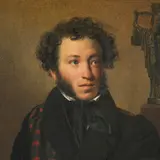
Portrait of Alexander Pushkin

AI Historical Figure

Alexander Pushkin

Renowned Russian poet and writer.

Chat with Alexander Pushkin via text or voice — in 42 languages, drawing on a curated biography and 97 historical sources. Available 24/7.

Start chatting with Alexander Pushkin20 messages free · No credit card
Lived
1799–1837
From
Russia
Known for
Literature & writing
Alexander Pushkin

Alexander Pushkin

Online · responds in seconds

Hello — I'm Alexander Pushkin. Renowned Russian poet and writer. What would you like to ask me?

20 messages free · No credit card · Powered by Humy.ai

Live preview · Switch between 42 languages above · Send a message to continue in the app

Multilingual

Talk to Alexander Pushkin in 42 languages

Ask Alexander Pushkin questions in any language below, and the rest of Humy's app speaks it too. Pick yours to open the chat in that language.

Also in German (Austria), German (Switzerland), English (UK), English (Australia), English (Canada).

The sources behind this AI

97 sources · 61 books · 15 paintings · 9 documents · 7 artifacts · 3 newspaper articles · 1 speech · 1 sculpture

Alexander Pushkin doesn’t improvise from thin air. The AI is grounded in 97 curated historical sources students can inspect. Open any of them to see what informs the conversation.

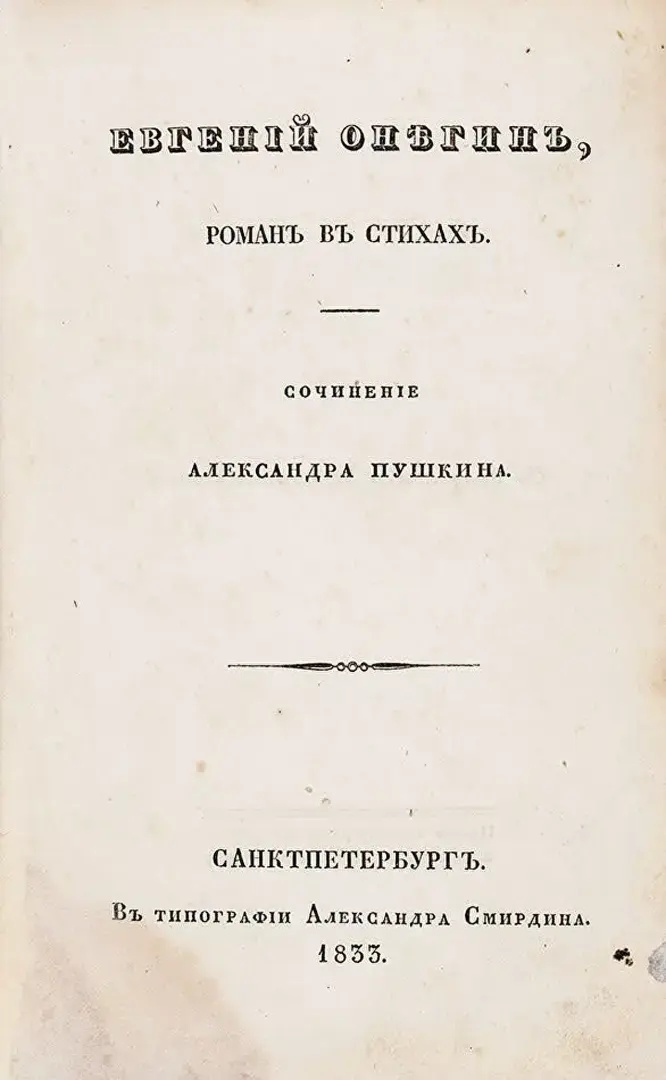
Title page of the 1833 first book edition of Eugene Onegin, printed in Russian Cyrillic on aged cream paper. Heading reads Евгений Онегин, Роман в стихах, Сочинение Александра Пушкина, then a decorative rule, then Санктпетербург, В типографии Александра Смирдина, 1833.Book

Primary source

Eugene Onegin

Alexander Pushkin · 1823-1831

Book

Primary source

Boris Godunov

Alexander Pushkin · 1825

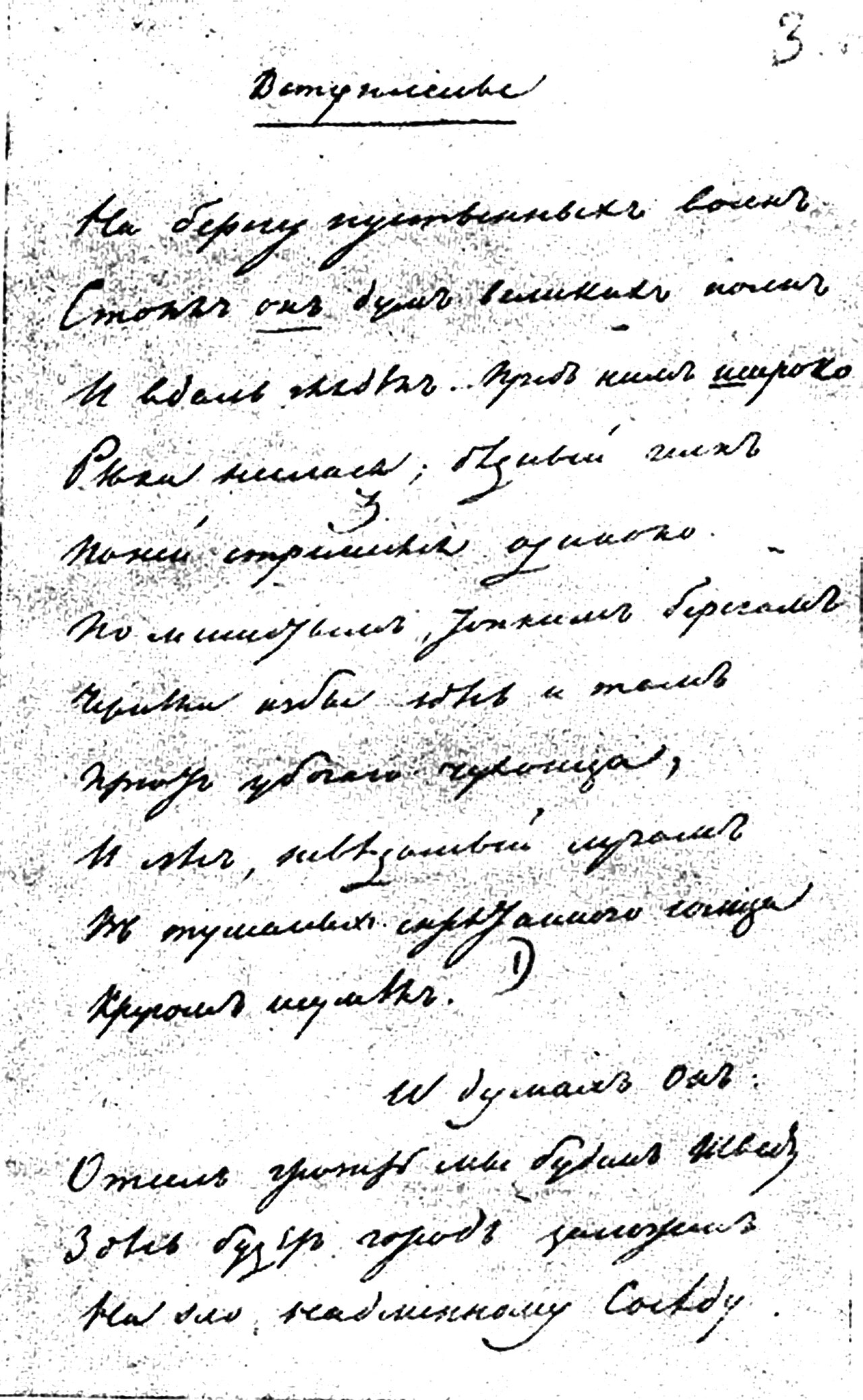
Handwritten manuscript page in Russian cursive, numbered 3 at top right, headed with the title 'Вступление' (Introduction) underlined. The text is Pushkin's verse opening of The Bronze Horseman, with some lines underlined and bracketed notes.Book

Primary source

The Bronze Horseman

Alexander Pushkin · 1833

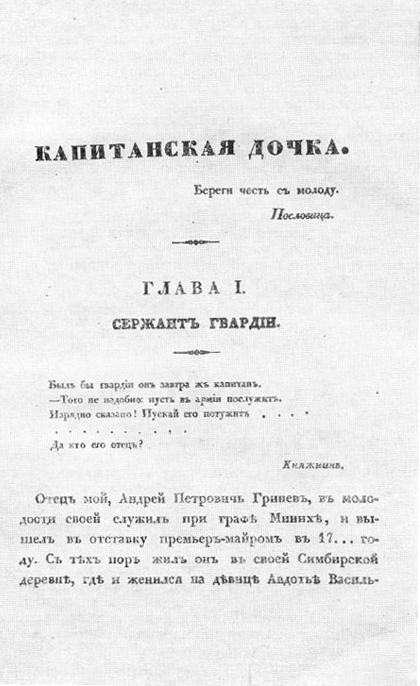
Title page of the first edition of Pushkin's novel 'The Captain's Daughter', printed in Russian with the title 'Капитанская дочка' at top, an epigraph 'Береги честь смолоду' with attribution 'Пословица', then 'Глава I. Сержант гвардии' and the opening paragraph beginning 'Отец мой, Андрей Петрович Гринев'.Book

Primary source

The Captain's Daughter

Alexander Pushkin · 1836

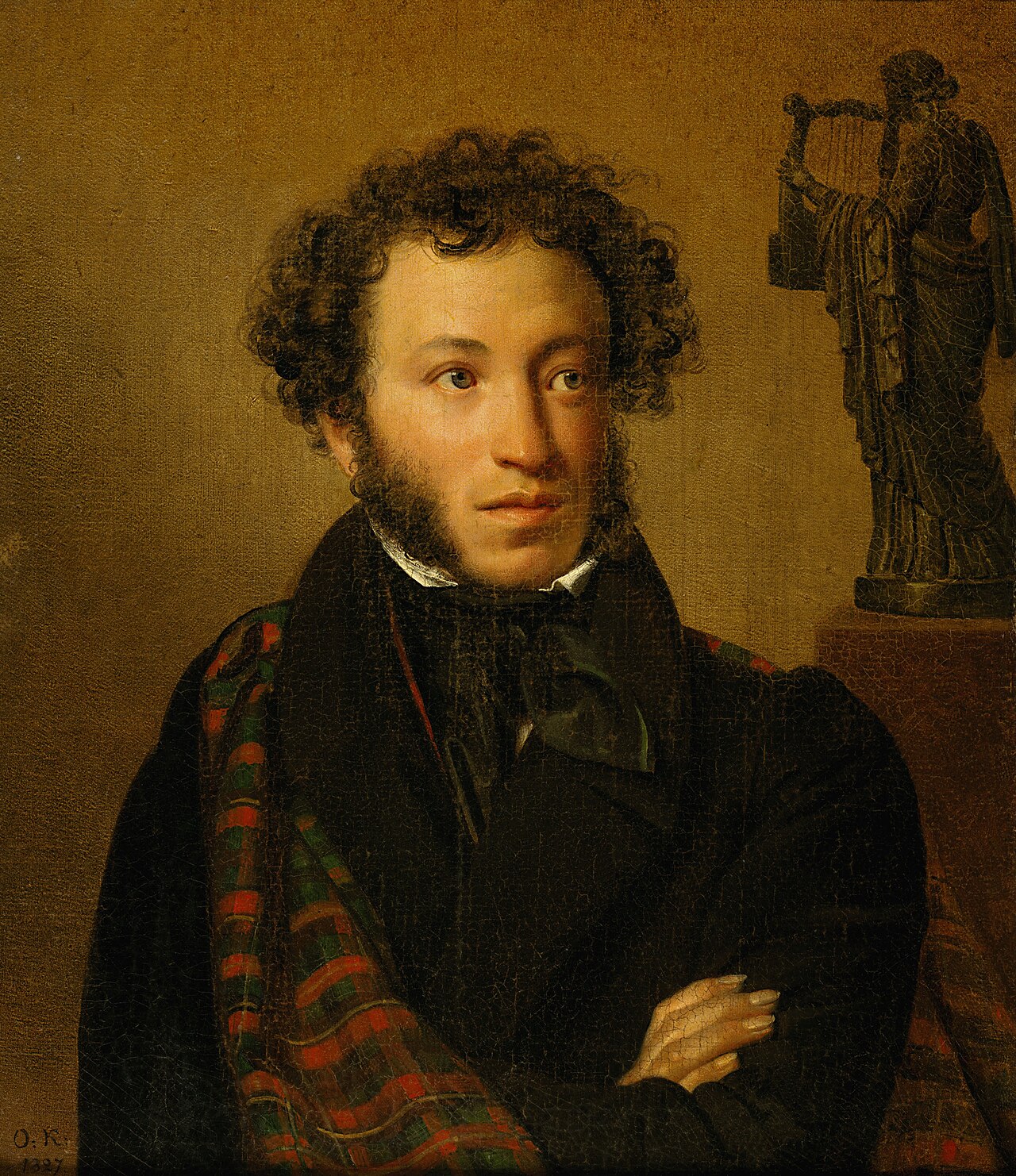
Oil portrait of a man with dark curly hair and sideburns, wearing a black high-collared coat and a red-and-green plaid shawl, arms crossed. A dark bronze statue of a figure holding a lyre stands at right. Initials and date appear bottom left.Painting

Primary source

Alexander Pushkin

Orest Kiprensky · 1827

Book

Primary source

I have erected a monument without hands

Alexander Pushkin · 21 August 1836

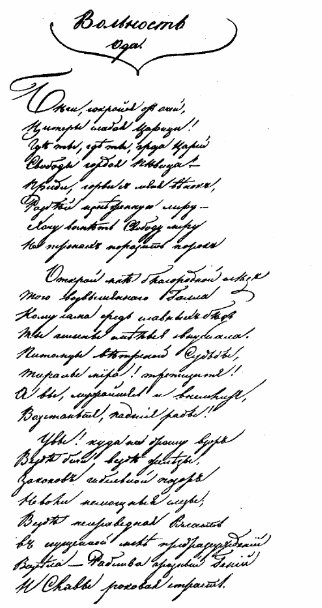
Handwritten manuscript in Russian cursive titled 'Вольность' with 'Ода' beneath, showing stanzas in dark ink on pale paper, with a decorative flourish above the title.Book

Primary source

Ode to Liberty

Alexander Pushkin · 1817

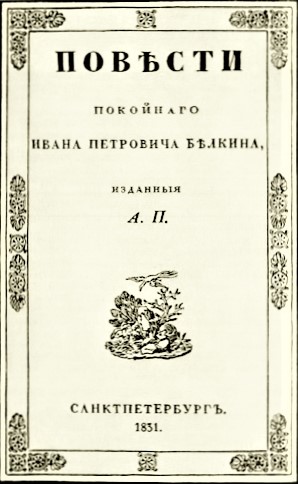
Title page of the 1831 Russian edition of Pushkin's Tales of the Late Ivan Petrovich Belkin. Ornate border; large spaced Cyrillic title 'Повести покойного Ивана Петровича Белкина, изданныя А. П.' with a small vignette of a tree and foliage; imprint 'Санктпетербургъ, 1831' at bottom.Book

Primary source

The Tales of the Late Ivan Petrovich Belkin

Alexander Pushkin · 1831

Book

Primary source

The Queen of Spades

Alexander Pushkin · 1834

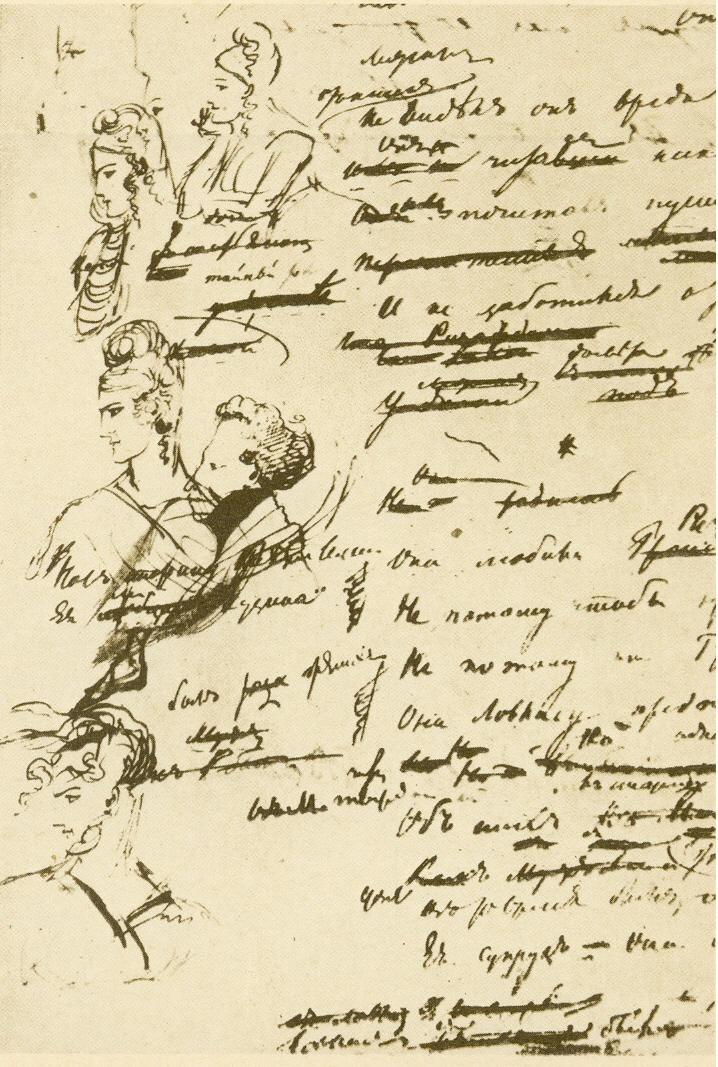
Sepia-toned page of handwritten Russian manuscript text with many crossed-out lines and marginal sketches of women's profiles in period hairstyles, drawn in ink.Book

Primary source

Onegin autograph

Alexander Pushkin

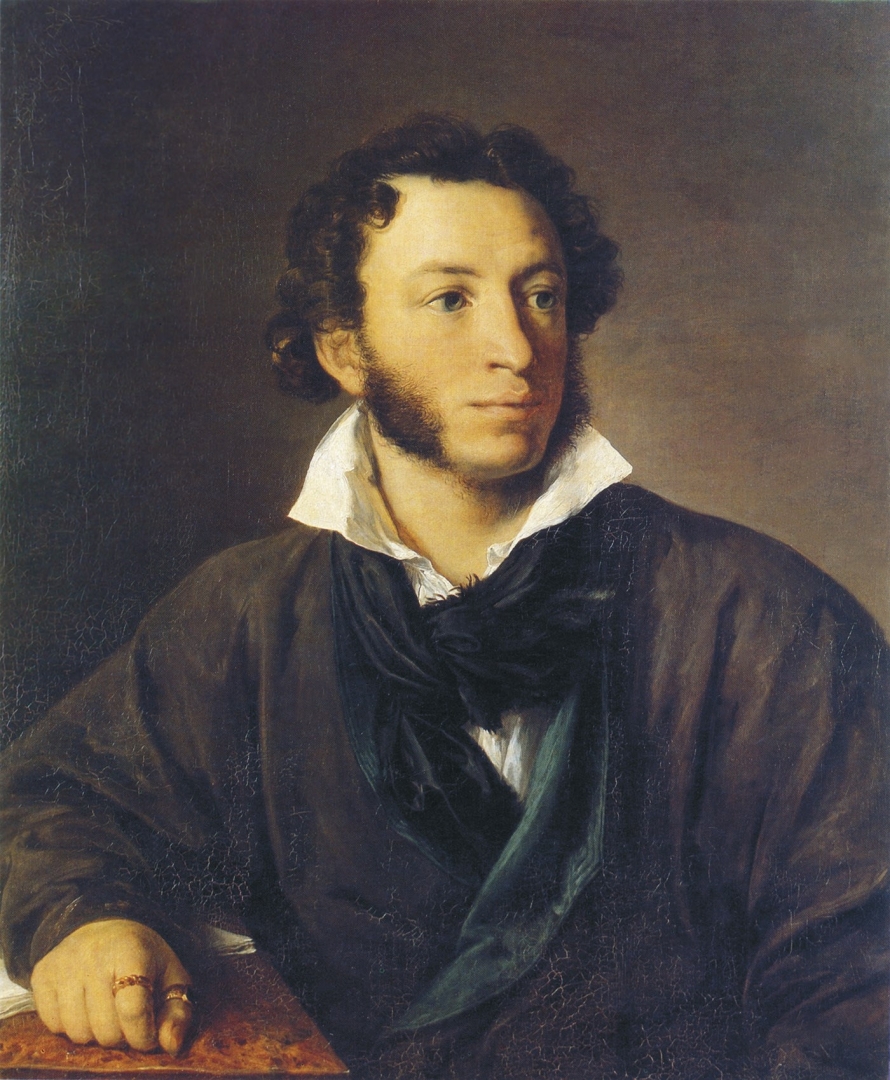
Oil painting of a dark-haired man with curly sideburns and a short beard, wearing a dark coat, white shirt collar and dark cravat, resting one ringed hand on a reddish-brown table against a dark background.Painting

Primary source

Portrait of Alexander Pushkin

Vasily Tropinin · 1827

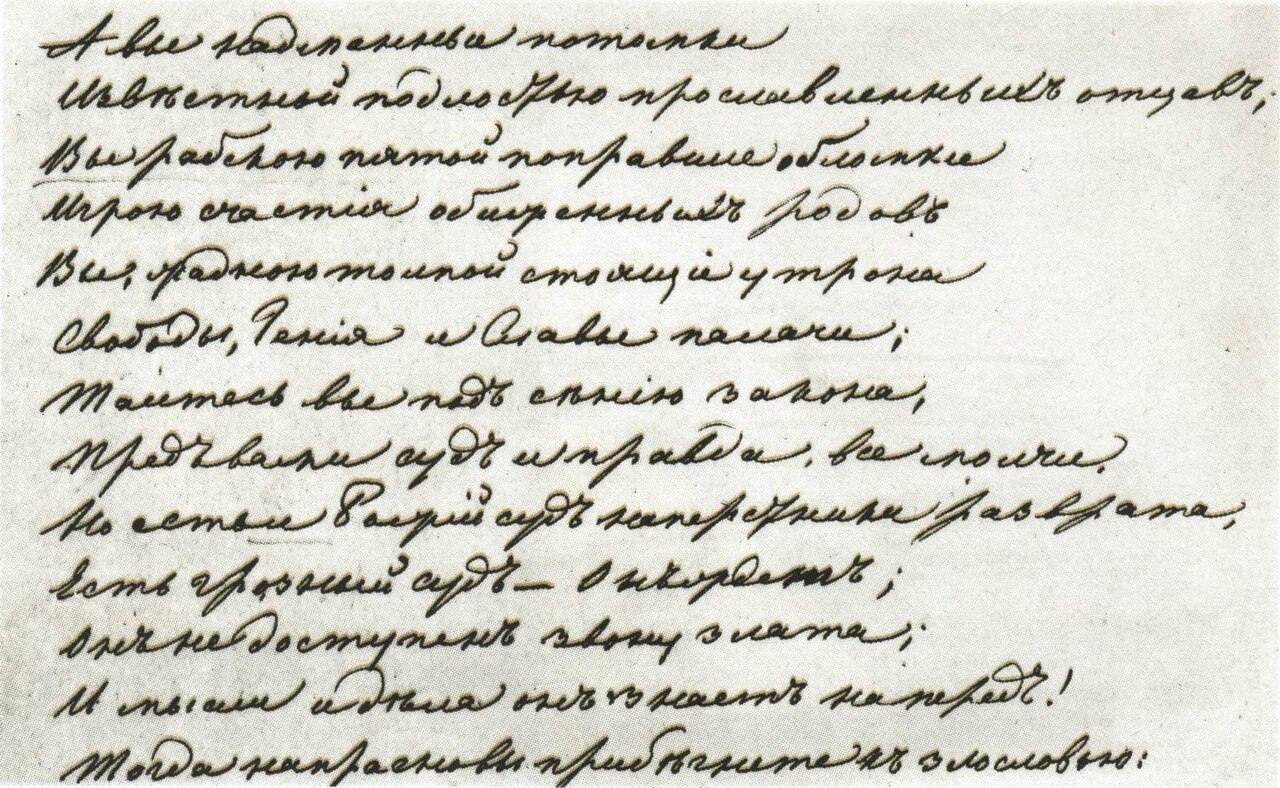
Handwritten manuscript in cursive Russian script on aged paper, showing several lines of verse in ink. The lines are Lermontov's poem on the death of the poet, written in his hand.Book

Primary source

Death of the Poet

Mikhail Lermontov · 1837

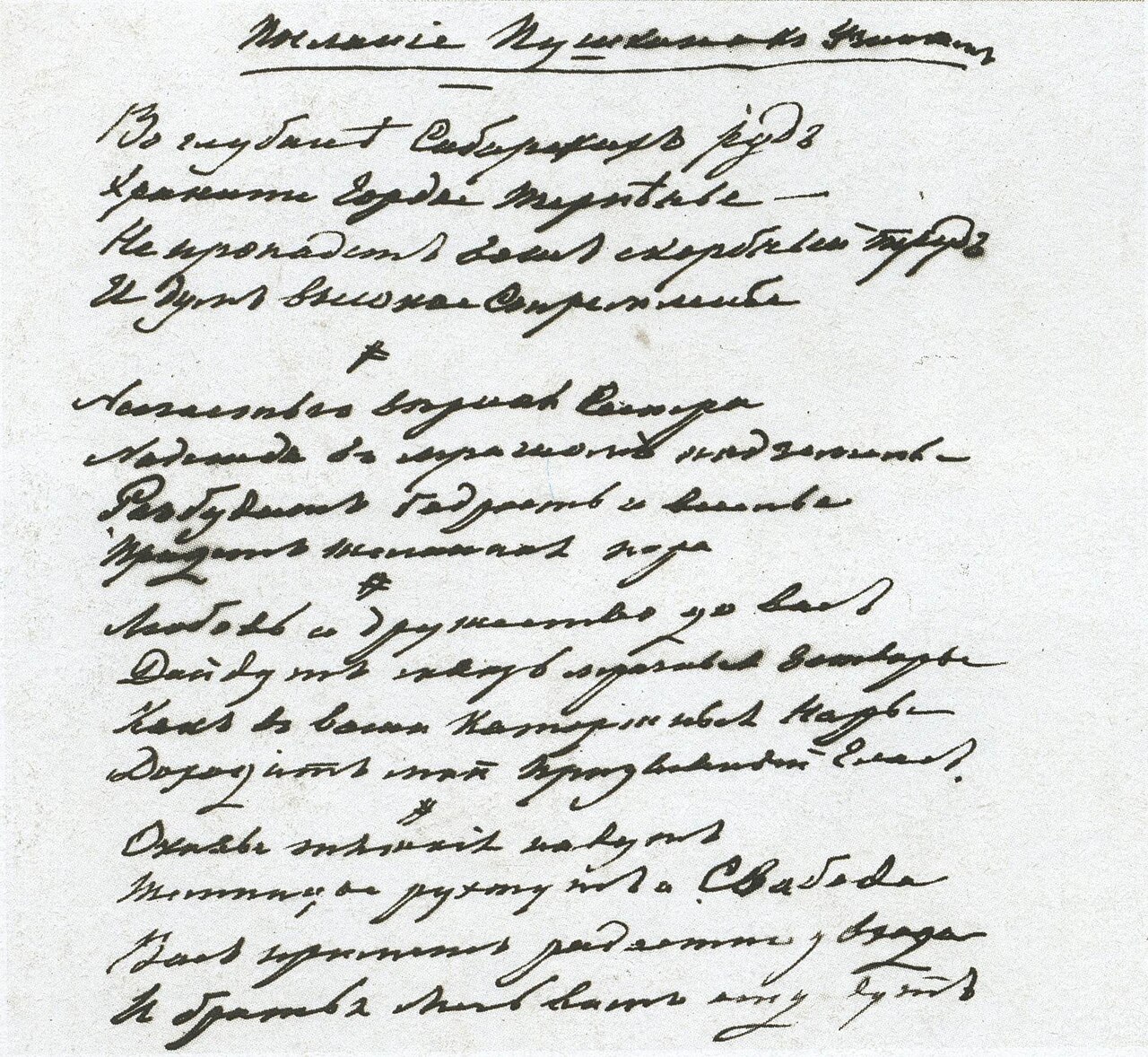
Handwritten manuscript in black ink on off-white paper, with a cursive Russian title at the top underlined, followed by several stanzas of poetry separated by small decorative marks. This is Pushkin's autograph of the poem.Document

Primary source

In the Depths of Siberian Mines

Alexander Pushkin · 1827

Book

Primary source

The Prophet

Alexander Pushkin · 1826

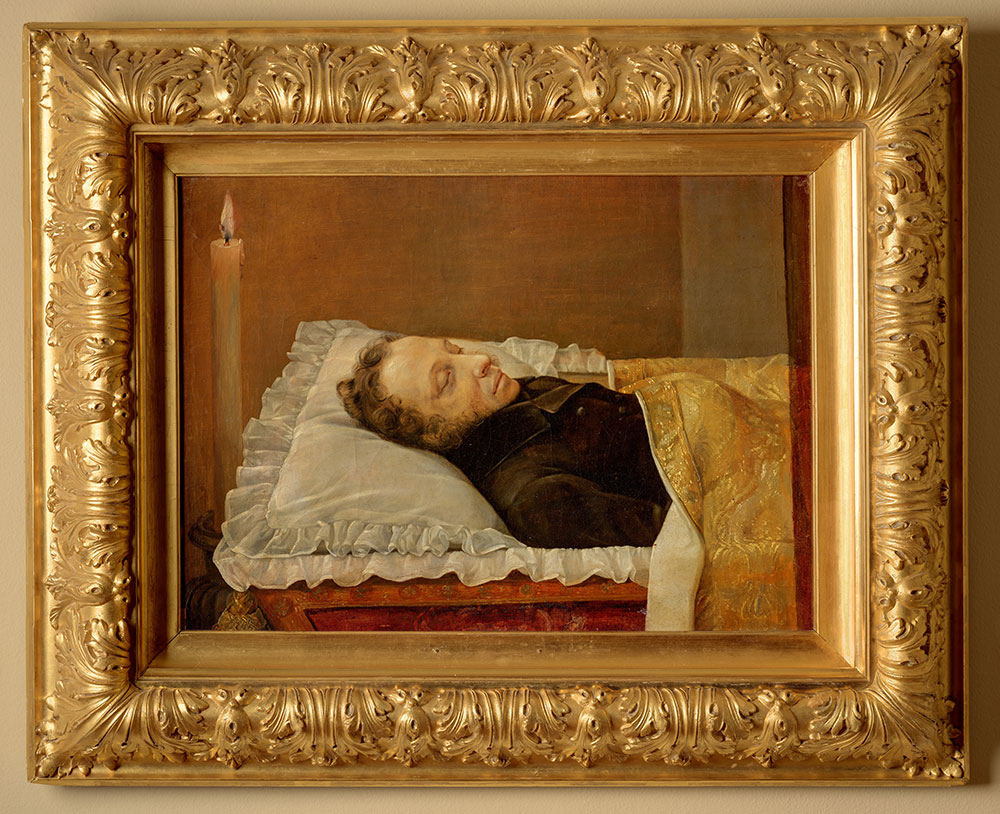
Framed oil painting in an ornate gold frame showing a man with curly dark hair lying on a white ruffled pillow, eyes closed, in a dark coat with a gold brocade vestment. A tall lit candle stands at left against a brown background, and a red-covered surface lies beneath him.Painting

Primary source

Alexander Pushkin on His Deathbed

Alexandr Alexeevich Kozlov · 1837

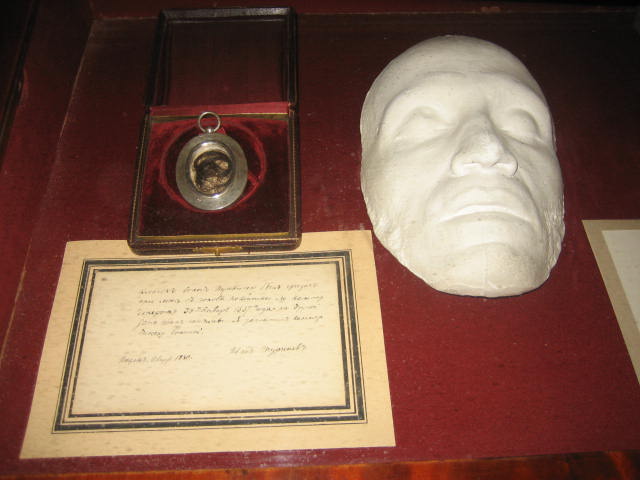
White plaster death mask of a man's face with closed eyes, displayed on a dark red surface. To the left is a small oval silver locket holding a lock of hair, in a red velvet-lined box, and a handwritten note on cream paper.Artifact

Primary source

Death Mask of Alexander Pushkin

Samuel Galberg · 1837

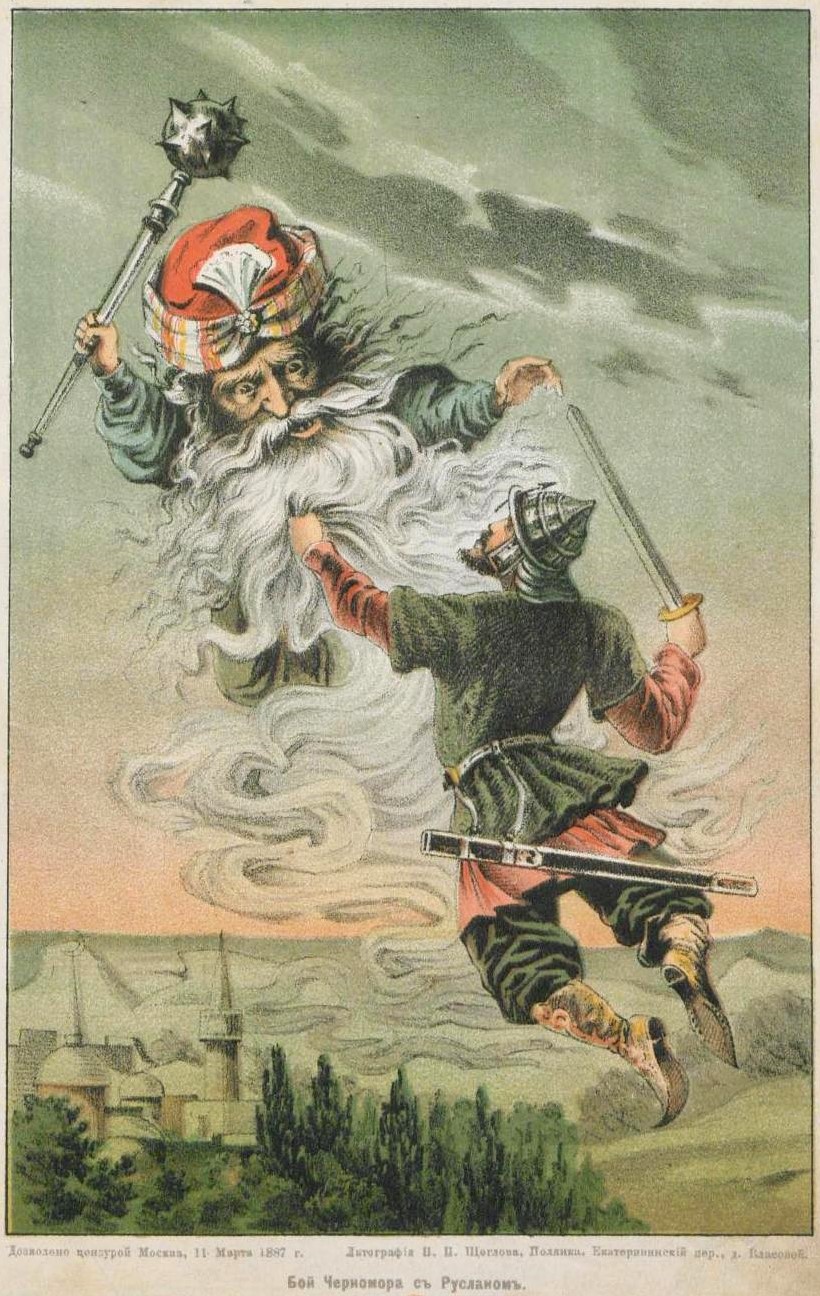
Colour lithograph of a fight: a giant white-bearded old man in a red and gold turban with a spiked mace, his beard swirling, grapples with a knight in a helmet who holds a sword, flying above a town with domes and minarets. Russian caption below.Book

Primary source

Ruslan and Ludmila

Alexander Pushkin · 1820

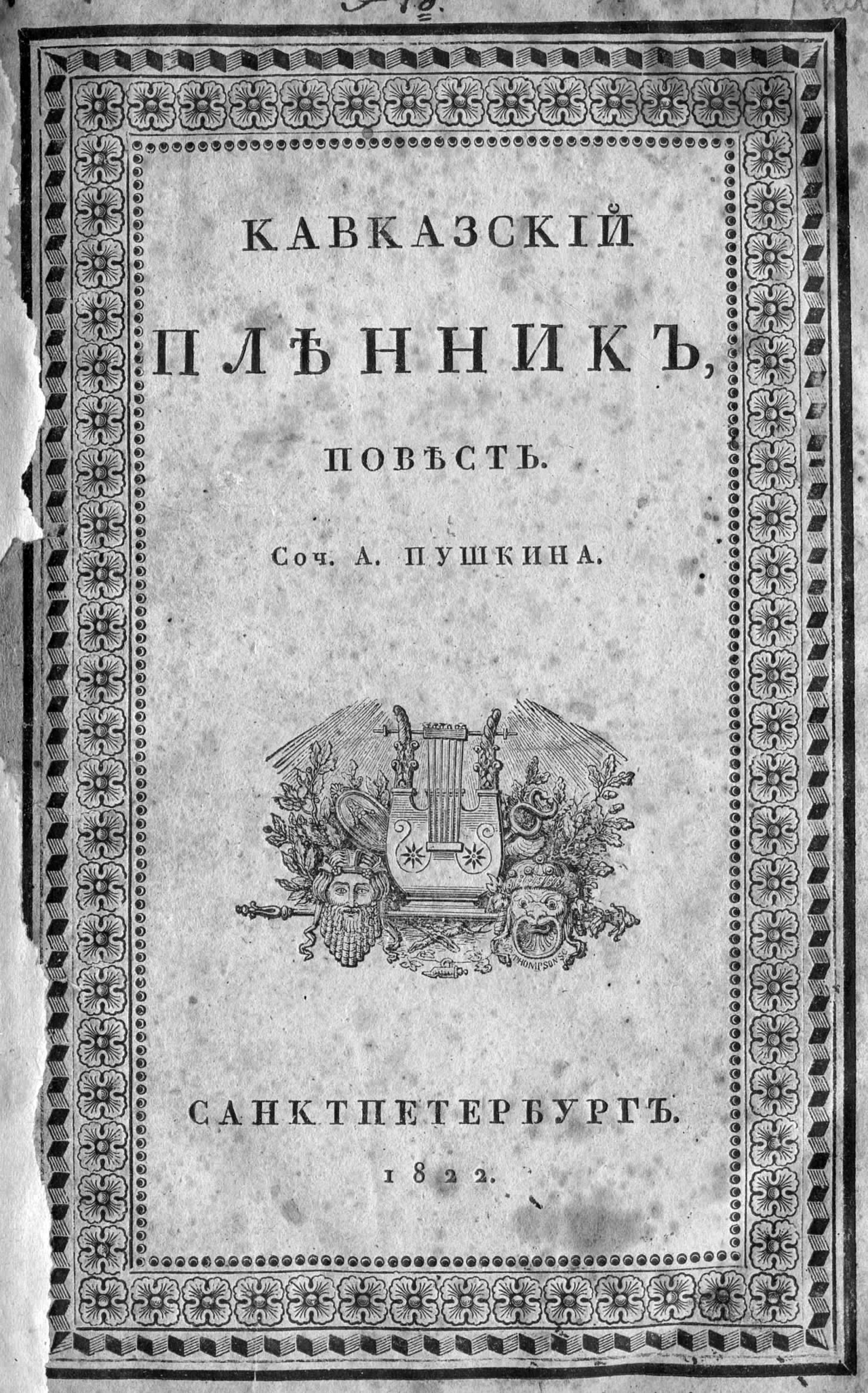
Title page of the first edition of Pushkin's story 'Kavkazskiy plennik' (The Prisoner of the Caucasus), in Russian Cyrillic. Ornate decorative border, central title, 'Соч. А. Пушкина', an engraved lyre and emblem with masks, and the imprint 'Санктпетербургъ 1822'.Book

Primary source

The Prisoner of the Caucasus

Alexander Pushkin · 1820–1822

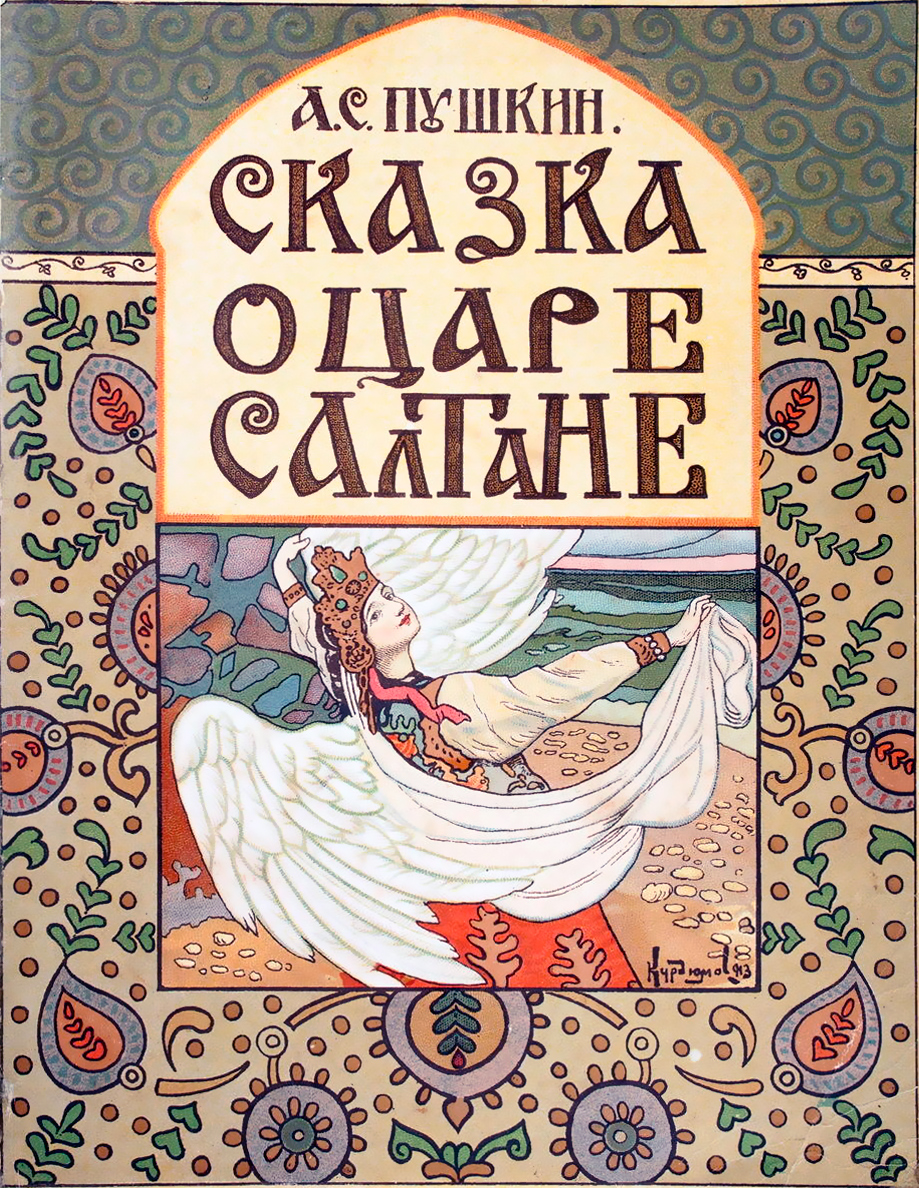
Decorative book cover reading 'А.С. Пушкин. Сказка о царе Салтане' in large ornate Cyrillic lettering on a cream arched panel. Below, a painted swan-maiden in a jeweled crown spreads white wings and a long white cloth over a sandy shore with a sea and sky behind her. Ornate floral and paisley border surrounds the image; signature 'Курдюмов 1913' appears at lower right.Book

Primary source

The Tale of Tsar Saltan

Alexander Pushkin · 1831

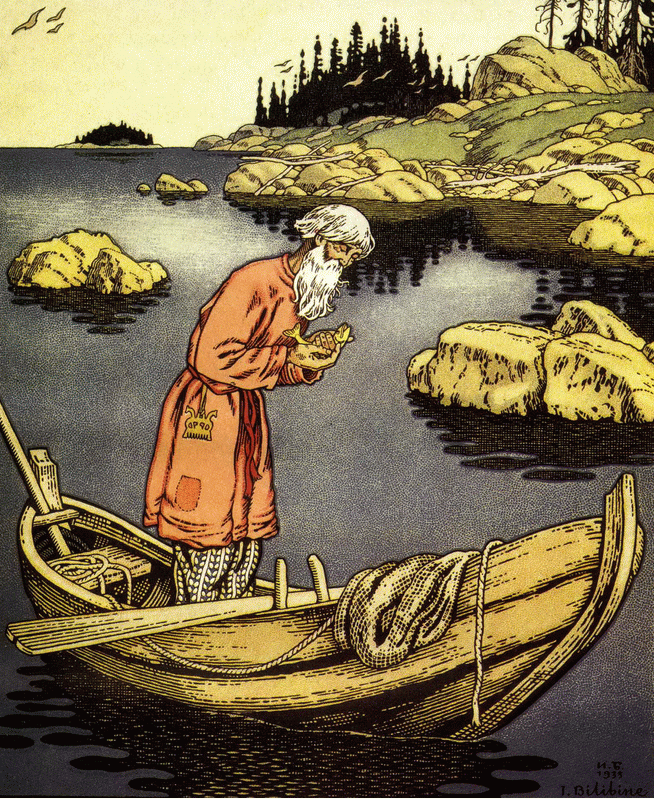
Colored woodcut-style illustration by Ivan Bilibin of an old bearded man in a red-orange robe standing in a wooden boat on calm water, holding a small golden fish in his cupped hands. Yellow rocks, pine trees and a distant island surround him.Book

Primary source

The Tale of the Fisherman and the Fish

Alexander Pushkin · 1833, published 1835

Book

Primary source

Mozart and Salieri

Alexander Pushkin · 1830, published 1832

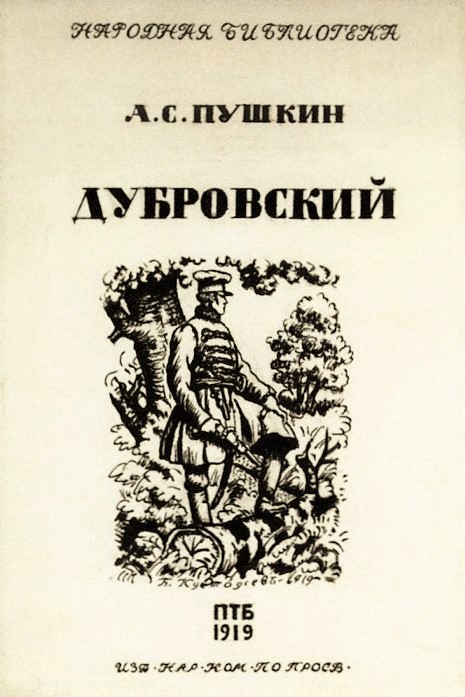
Cover of the 1919 Russian edition of Pushkin's novel Dubrovsky, from the Narodnaya Biblioteka series. Title in Cyrillic reads A. S. Pushkin and Dubrovsky above a black-and-white woodcut of a uniformed man with a cap standing in foliage, and the printed date 1919 with publisher marks at the bottom.Book

Primary source

Dubrovsky

Alexander Pushkin · 1832, published 1841

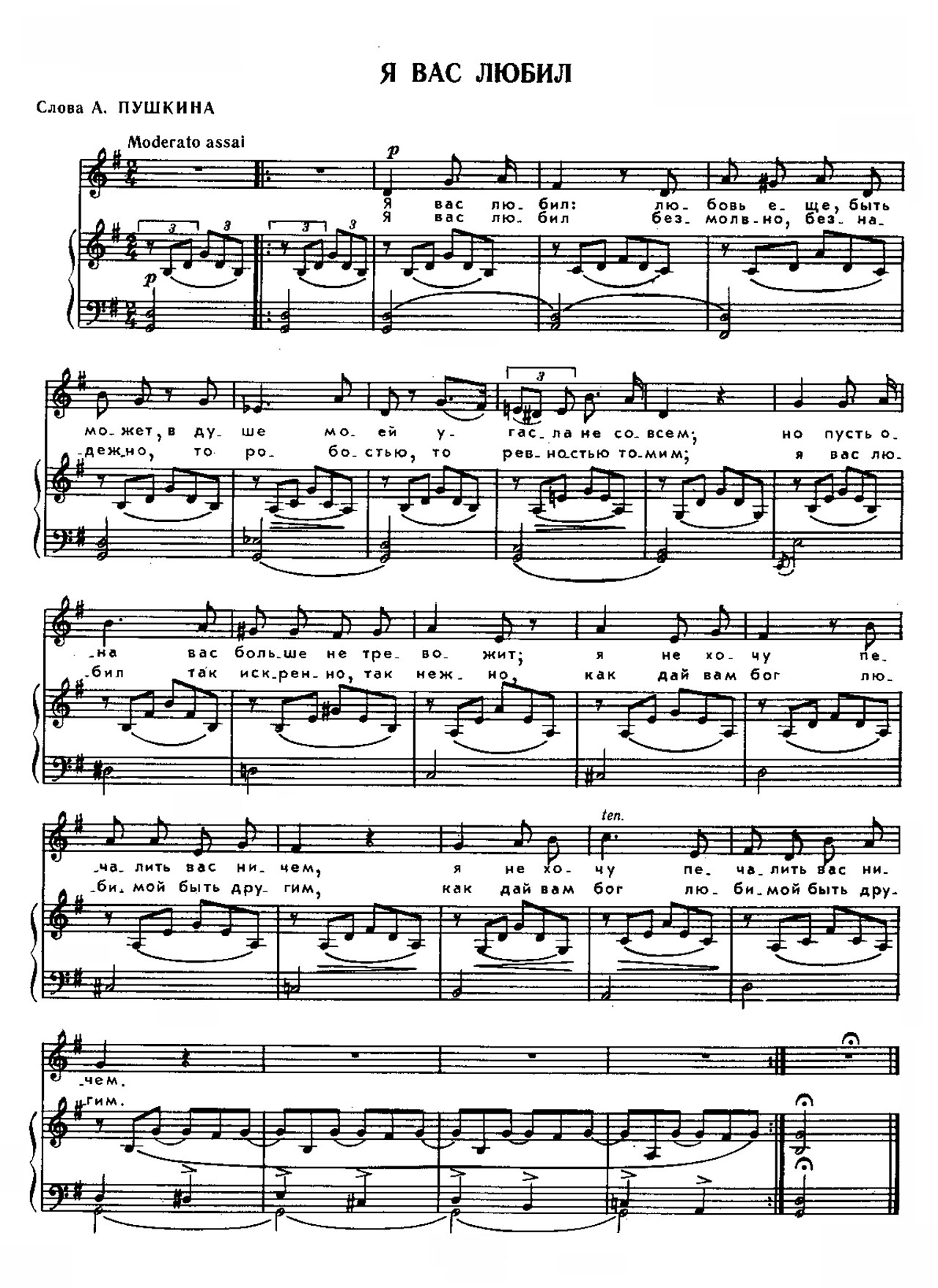
Printed sheet music titled 'Я ВАС ЛЮБИЛ' with the lyrics credited to A. Pushkin (Слова А. ПУШКИНА). Piano and vocal score in G major or E minor, marked Moderato assai, with Russian lyrics under the staff.Book

Primary source

I Loved You

Alexander Pushkin · 1829, published 1830

Book

Primary source

To ***

Alexander Pushkin · 1825

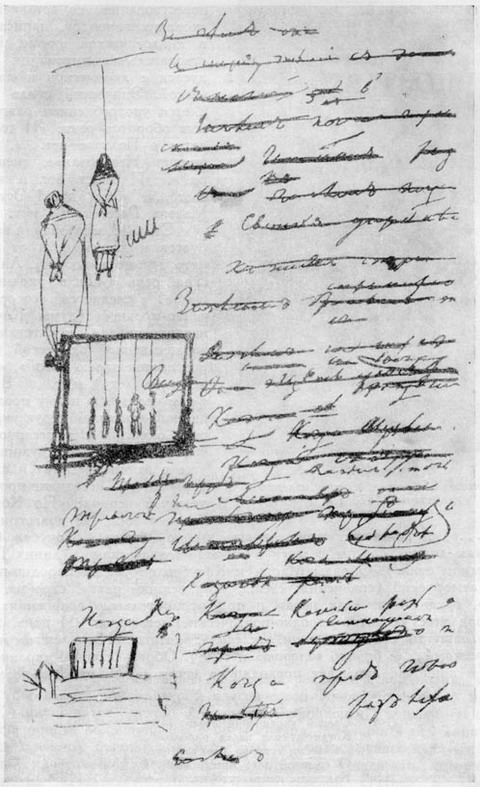
Pen-and-ink manuscript page with handwritten Russian text, many lines crossed out, and sketches including two hanged figures with bound hands on the upper left, a gallows-like row of hanging figures in a frame in the middle left, and a small sketch of a bench or platform at lower left.Artifact

Primary source

Decembrists Sketch

Alexander Pushkin

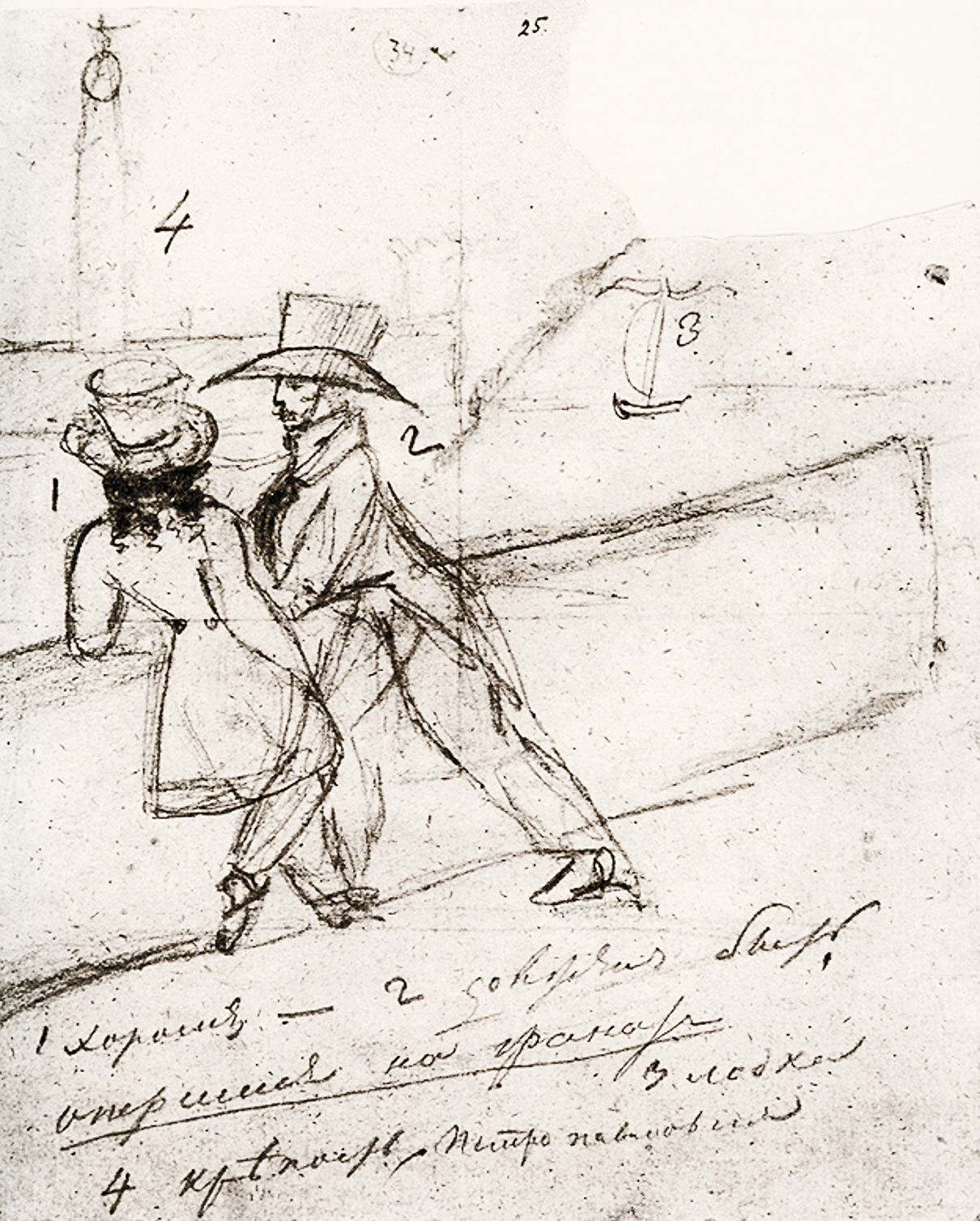
Pencil sketch on a manuscript page: a man in a tall top hat and long coat walks beside a woman in a bonnet and long dress, with numbered labels 1 to 4 and handwritten Russian text below. A building and a lamp post appear in the background.Painting

Primary source

Self-Portrait with Onegin

Alexander Pushkin

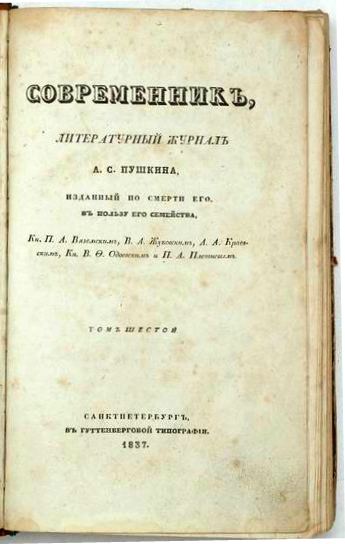
Title page of the literary journal Sovremennik, in Cyrillic type. Text reads Sovremennik, literary journal of A. S. Pushkin, published after his death for the benefit of his family, with editors' names, volume six, and St. Petersburg 1837 printed at the Guttenberg typography. Aged cream paper with a dark binding edge.Newspaper article

Primary source

Sovremennik

Alexander Pushkin · 1837

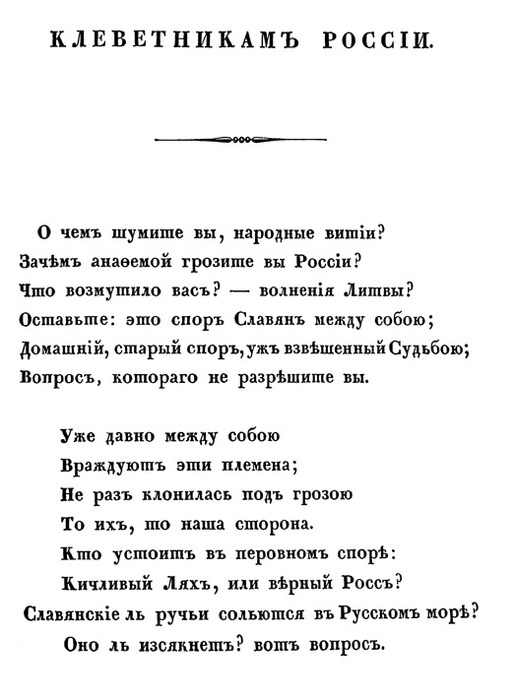
Printed page in Russian with the heading "КЛЕВЕТНИКАМЪ РОССІИ", a decorative divider, and two stanzas of verse beginning "О чемъ шумите вы, народные витіи?" Text is in old-style Cyrillic with long-s and yat letters.Book

Primary source

To the Slanderers of Russia

Alexander Pushkin · 1831

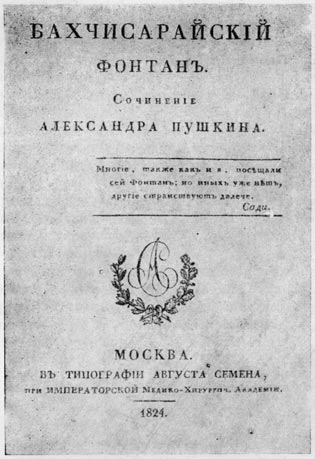
Title page of the 1824 first edition of Pushkin's poem. Russian Cyrillic title 'Бахчисарайский фонтан' at top, with 'Сочинение Александра Пушкина' below. An epigraph follows, then a central emblem of a monogram in a wreath, and the imprint 'Москва' with 'Печатано в типографии Августа Семена' and the year 1824 at bottom.Book

Primary source

The Fountain of Bakhchisaray

Alexander Pushkin · 1821-1823

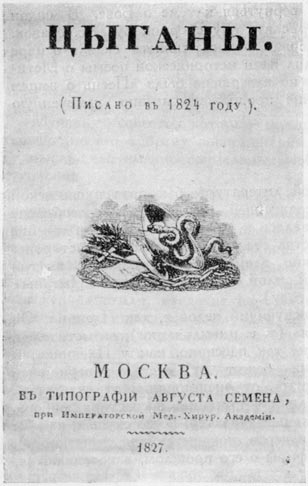
Title page of the book 'Цыганы' (The Gypsies), with the heading in large capitals and the note '(Писано в 1824 году)'. A small engraved vignette of a tree and a coiled snake sits above the imprint: 'Москва, в типографии Августа Семена, при Императорском Мед.-Хирург. Академии, 1827'.Book

Primary source

The Gypsies

Alexander Pushkin · 1824

Book

Primary source

Poltava

Alexander Pushkin · 1828–1829

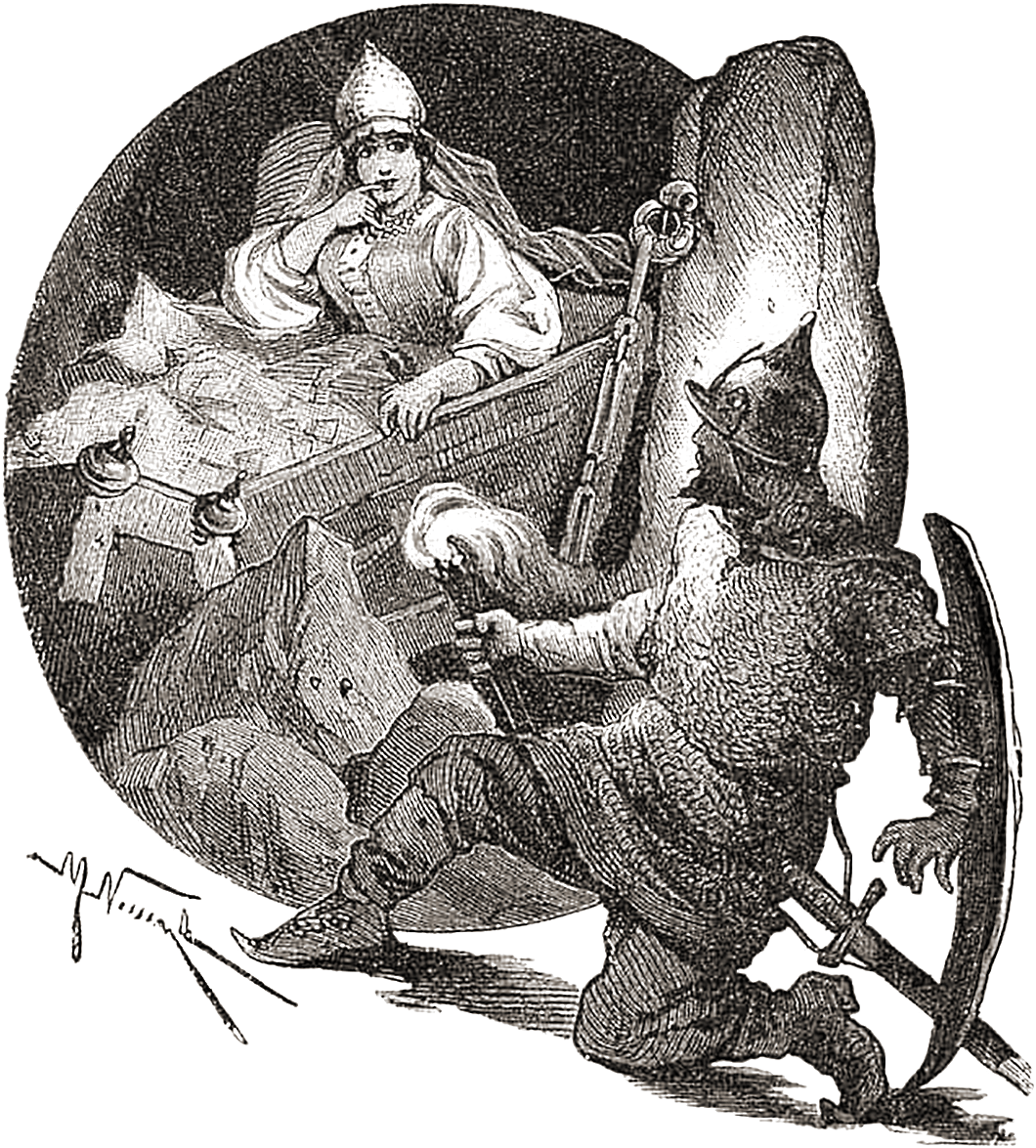
Engraved illustration in an oval frame: a woman in a pointed headdress and long-sleeved gown reclines on a wooden bier, one hand raised to her face. In the foreground a bearded man in a fur-trimmed cloak and pointed helmet kneels, holding a torch with a flame and a curved shield at his side. Signature in lower left.Book

Primary source

The Tale of the Dead Princess and the Seven Knights

Alexander Pushkin · 1833

Book

Primary source

Peter the Great's Negro

Alexander Pushkin · 1827–1828

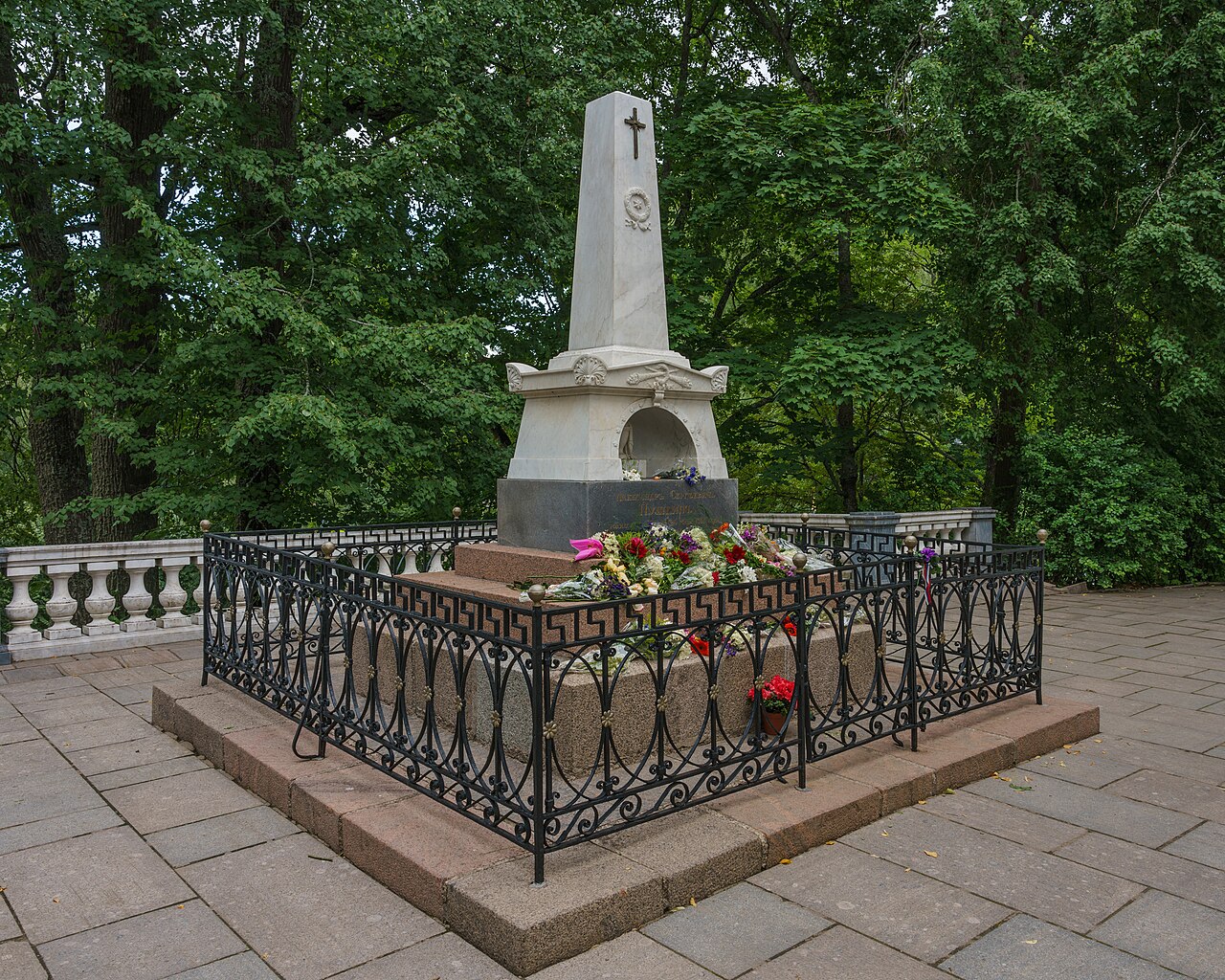
A white marble obelisk with a carved cross and wreath stands on a grey stone base inside a black wrought-iron fence, surrounded by fresh flower bouquets and green trees, on a paved path.Artifact

Secondary source

Grave of Alexander Pushkin

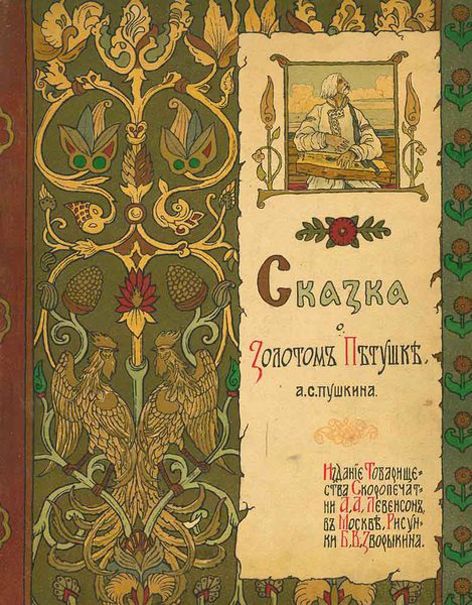
Cover of a 1903 Russian book titled 'Skazka o zolotom petushke' by A. S. Pushkin. Ornate Art Nouveau borders with birds and flowers frame a central panel showing a man in a white shirt seated at a table with a small figure of a cockerel-like scene in the background, plus Cyrillic title and publisher text.Book

Primary source

The Tale of the Golden Cockerel

Alexander Pushkin · 1834

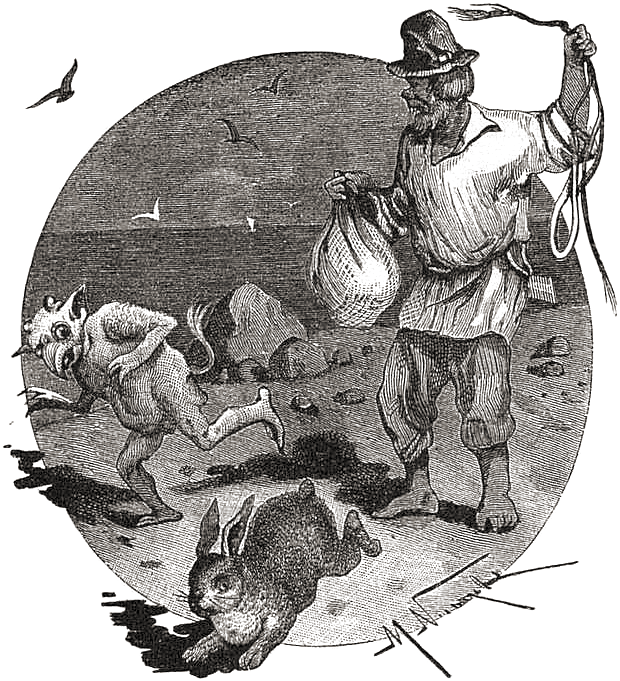
Engraved illustration in a circular vignette: a bearded peasant in a hat and loose shirt holds a whip overhead and a sack over his shoulder on a shore. A small horned devil with a long tail runs away from him. A hare leaps in the foreground, and gulls fly over the sea.Book

Primary source

The Tale of the Priest and of His Workman Balda

Alexander Pushkin · 1830

Book

Primary source

Song of the Prophetic Oleg

Alexander Pushkin · 1824

Book

Primary source

A Journey to Arzrum

Alexander Pushkin · 1836

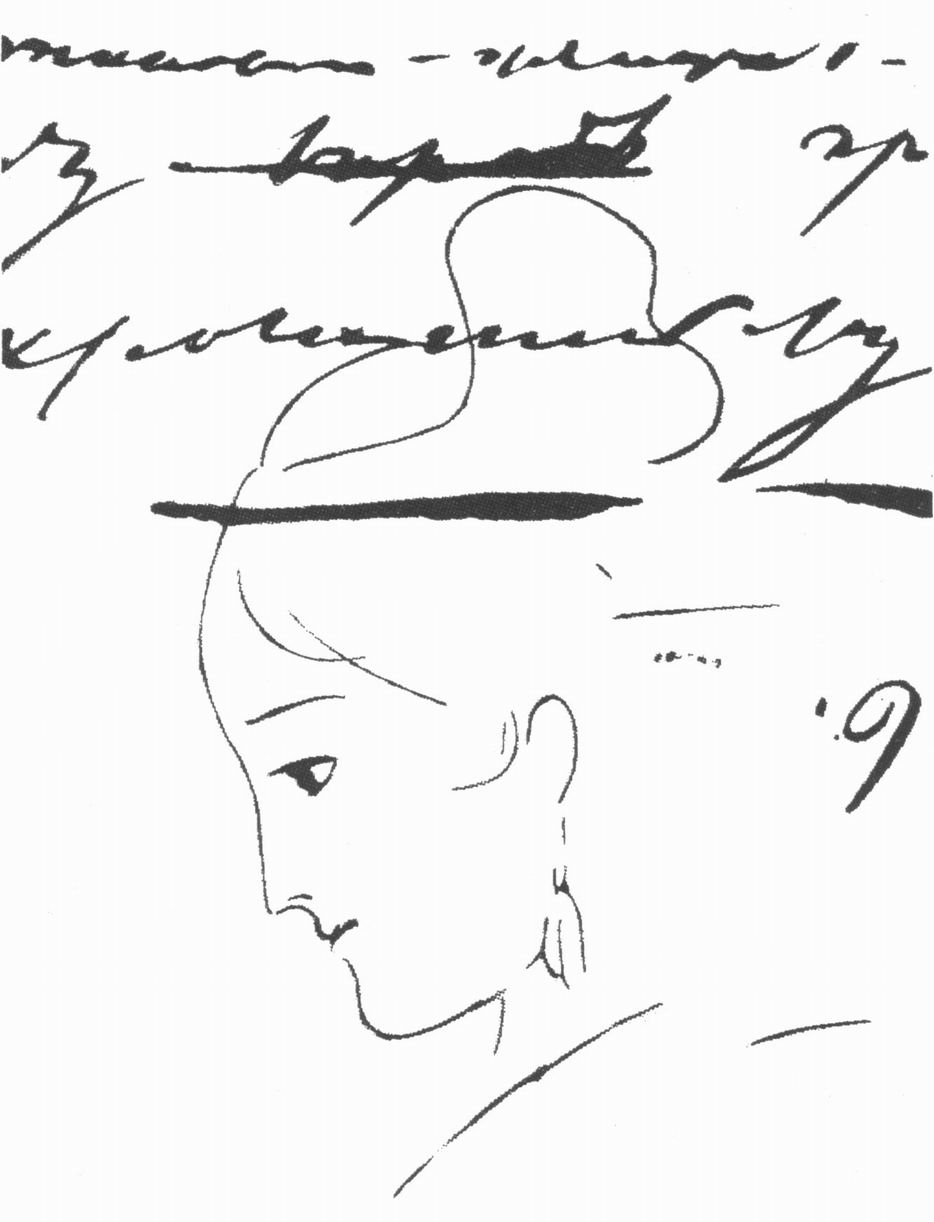
Pen drawing in profile of a woman facing left, with hair gathered in a high bun, an eye, nose, lips and chin drawn in outline, and a visible ear with a small earring. Above her head are several lines of cursive handwriting, and the number 1829 appears at the right, beside a drawn stroke and a dark horizontal stroke.Painting

Primary source

A. P. Kern 1829

Alexander Pushkin · 1829

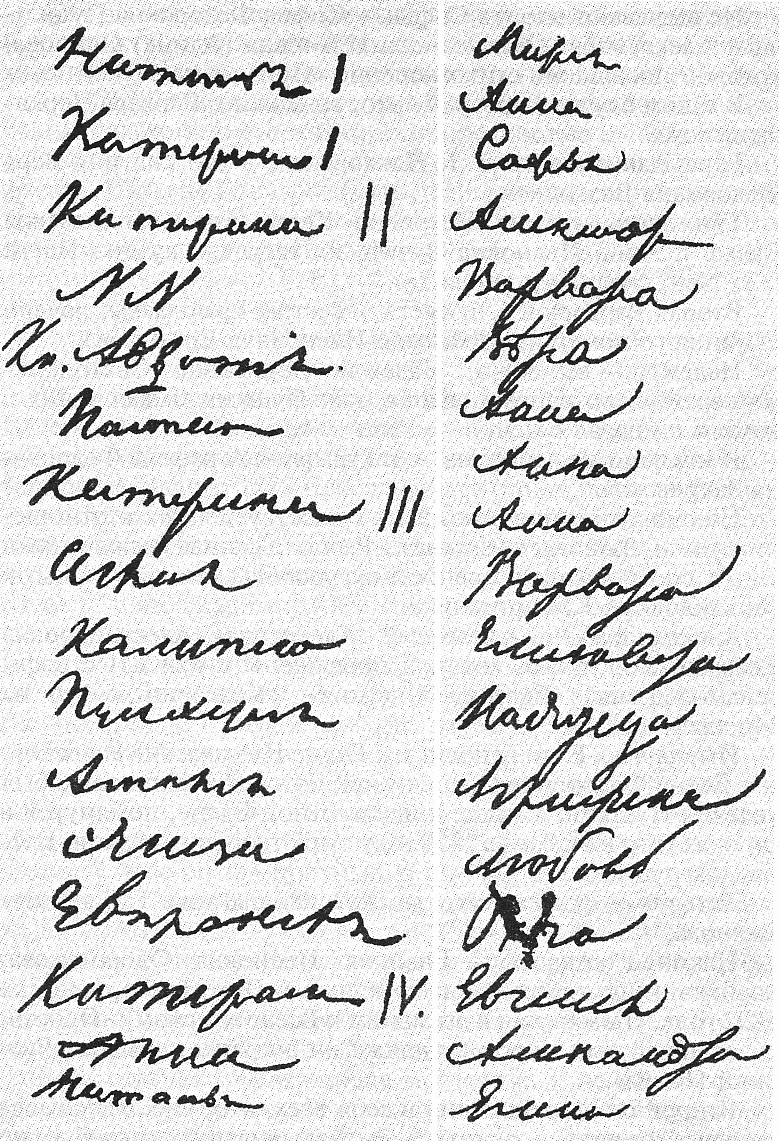
Black-and-white photograph of a handwritten manuscript in Russian cursive, arranged in two columns of names with Roman numerals marking groups, including Katerina I, II, III and IV. This is Pushkin's Don Juan list.Book

Primary source

The Don Juan List of Pushkin

Alexander Pushkin · 1829

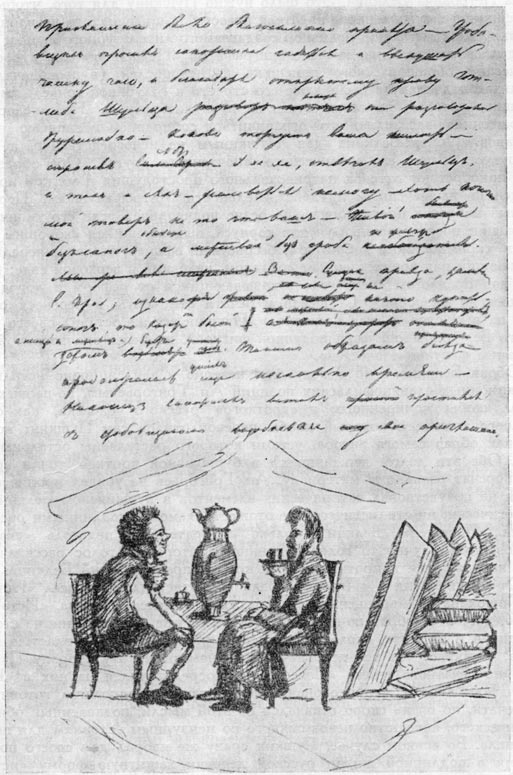
Scanned page of handwritten Russian manuscript text in dense, crossed-out lines, with a pen-and-ink drawing below. The drawing shows two seated men at a small table with a samovar and teacup, beside a stack of books on the right.Book

Primary source

The Undertaker (manuscript)

Alexander Pushkin · September 1830

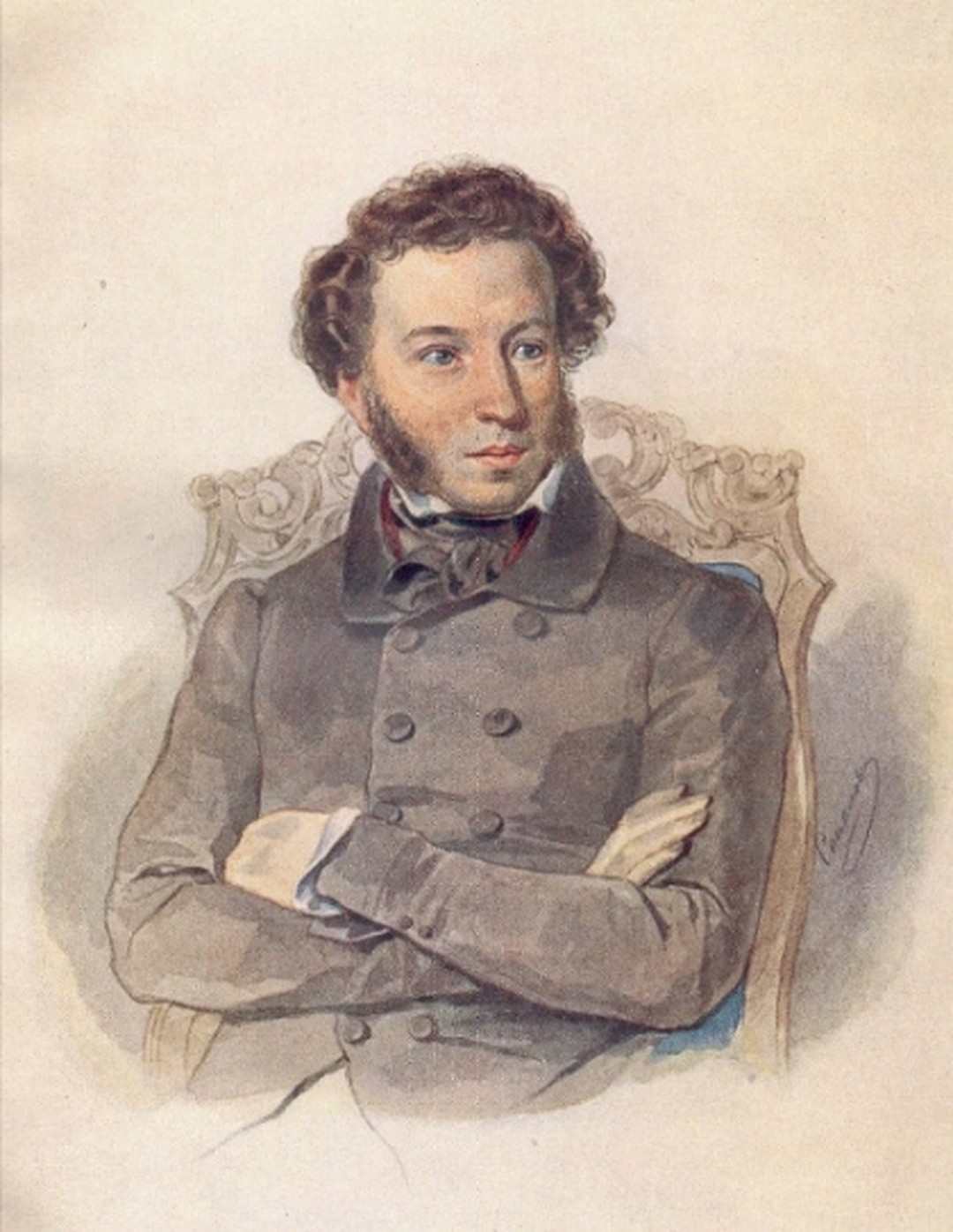
Watercolor portrait of a young man with curly brown hair and short side-whiskers, seated in a carved-back chair. He wears a double-breasted gray coat, a dark cravat, and white collar edges, with arms folded across his waist. He gazes to the side.Painting

Primary source

Alexander Pushkin (Sokolov watercolour)

Pyotr Sokolov · 1836

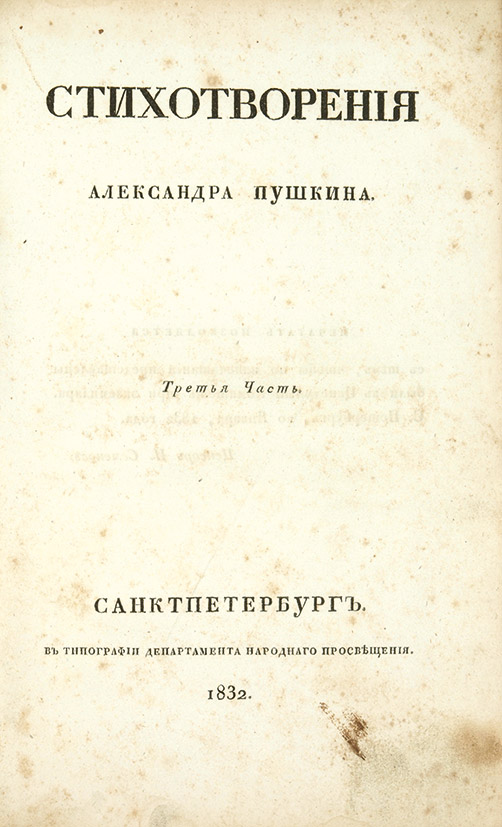
Title page of a Russian book in Cyrillic: 'Стихотворения Александра Пушкина', 'Третья Часть' (Third Part), 'Санктпетербургъ', printed 'в Типографии Департамента Народнаго Просвещения', dated 1832. Aged, yellowed paper with faint show-through text from the reverse.Book

Primary source

Alexander Pushkin's Poems, Volume 3 (1832)

Alexander Pushkin · 1832

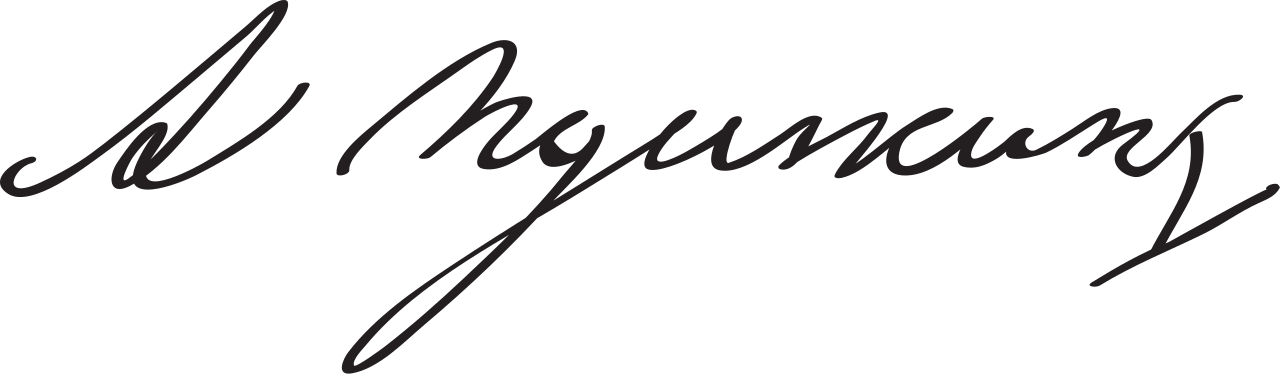
Black handwritten signature on a white background, written in cursive strokes. The first letter is a large looping A-like form, followed by a flowing script reading Pushkin.Document

Primary source

Signature of Alexander Pushkin

Alexander Pushkin

Speech

Secondary source

Dostoyevsky's Pushkin Speech

Fyodor Dostoyevsky · 8 June 1880 (O.S.)

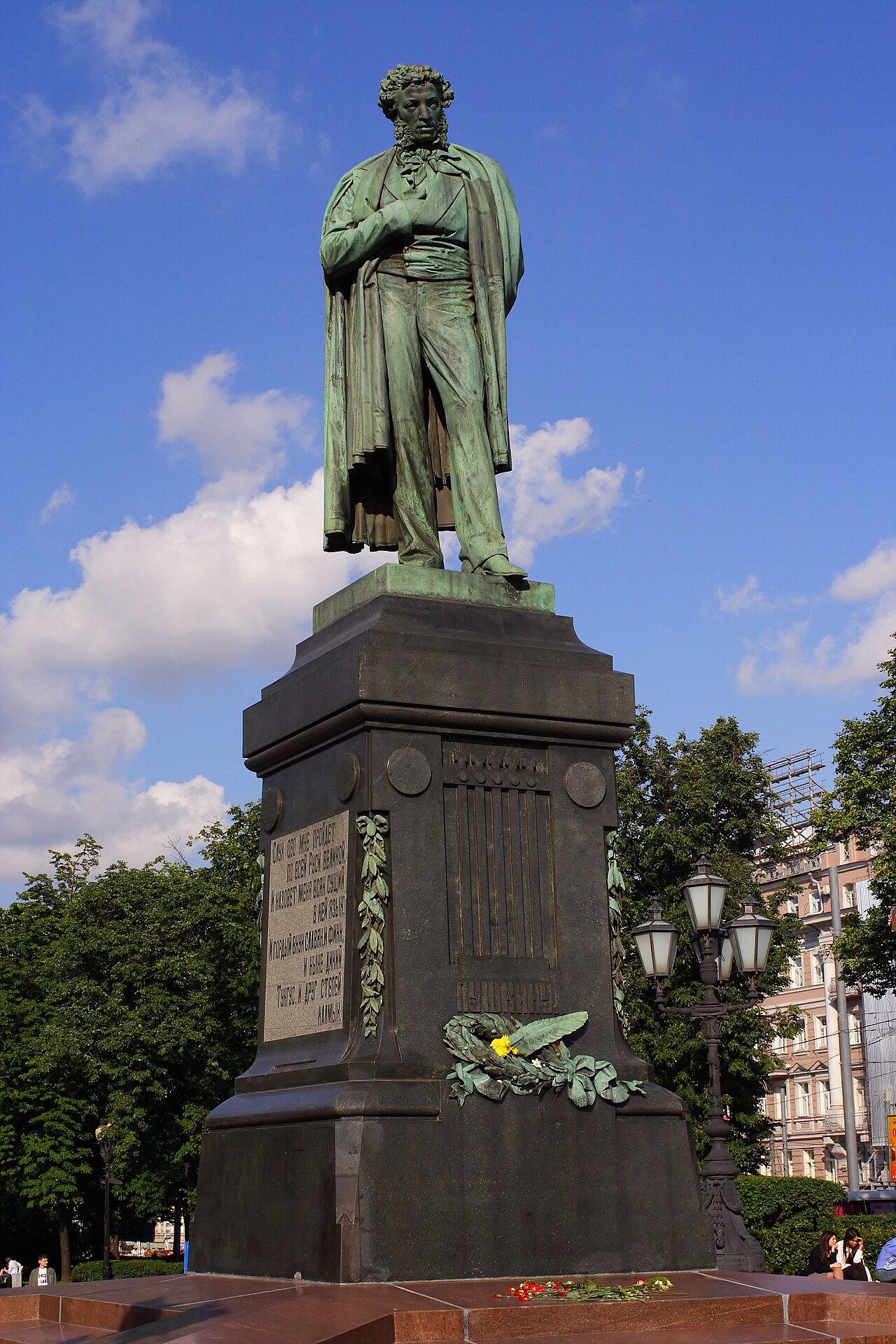
Bronze-green statue of a man with curly hair and sideburns, wearing a long cloak and standing with one hand on his chest, on a tall dark stone pedestal with a plaque and a bronze wreath. Lampposts and trees stand behind; blue sky with clouds.Sculpture

Secondary source

Statue of Pushkin

Alexander Opekushin · 1880

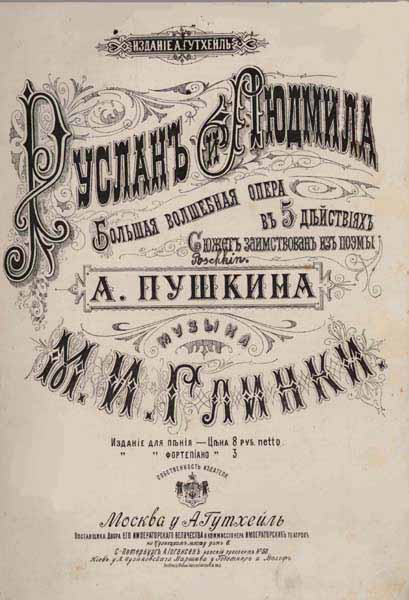
Cover of the vocal-score edition of Glinka's opera Ruslan and Lyudmila, published by Gutheil in Moscow. Ornate Cyrillic title lettering reads Руслан и Людмила, with subtitle text, Pushkin's name, and Glinka's name in large decorative type. Printed price and publisher details appear at the bottom.Document

Secondary source

Ruslan and Lyudmila

Mikhail Glinka · 27 November 1842 (O.S.)

The Captain's DaughterBook

Primary source

The Captain's Daughter

Alexander Pushkin · 1836

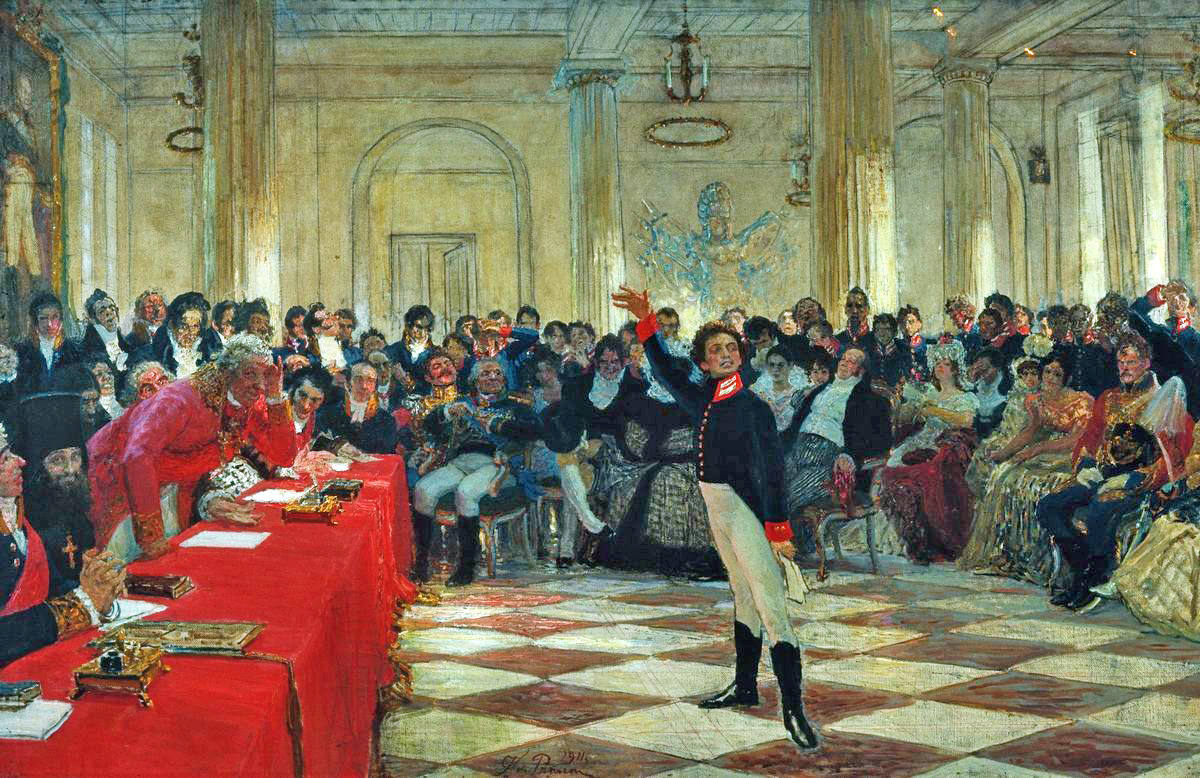
Painting of a formal hall with a checkered floor and columns. A young man in a black coat with red collar stands center, one arm raised, reciting before a red-draped table where elderly men in red and gold uniforms sit. A large audience in period dress watches from behind.Painting

Secondary source

Pushkin Reciting His Poem Before Derzhavin

Ilya Repin · 1911

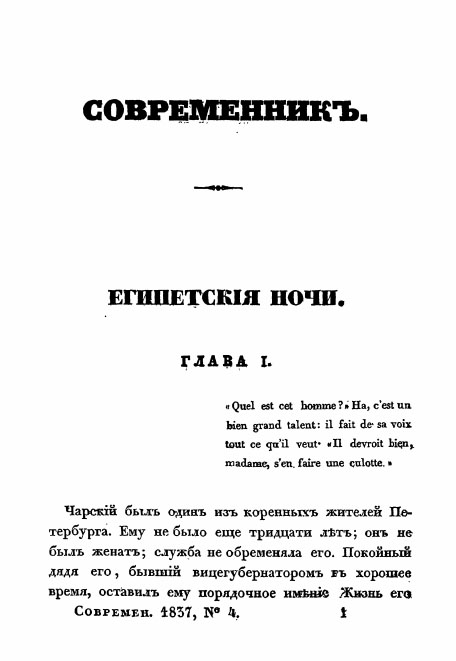
Title page of the journal Современник with the heading Египетские ночи, Глава I, and the opening Russian text of the story, with a French epigraph and the footer Современник 1837, No 4, page 1.Newspaper article

Primary source

First Page of Egyptian Nights in Sovremennik

Alexander Pushkin · 1837

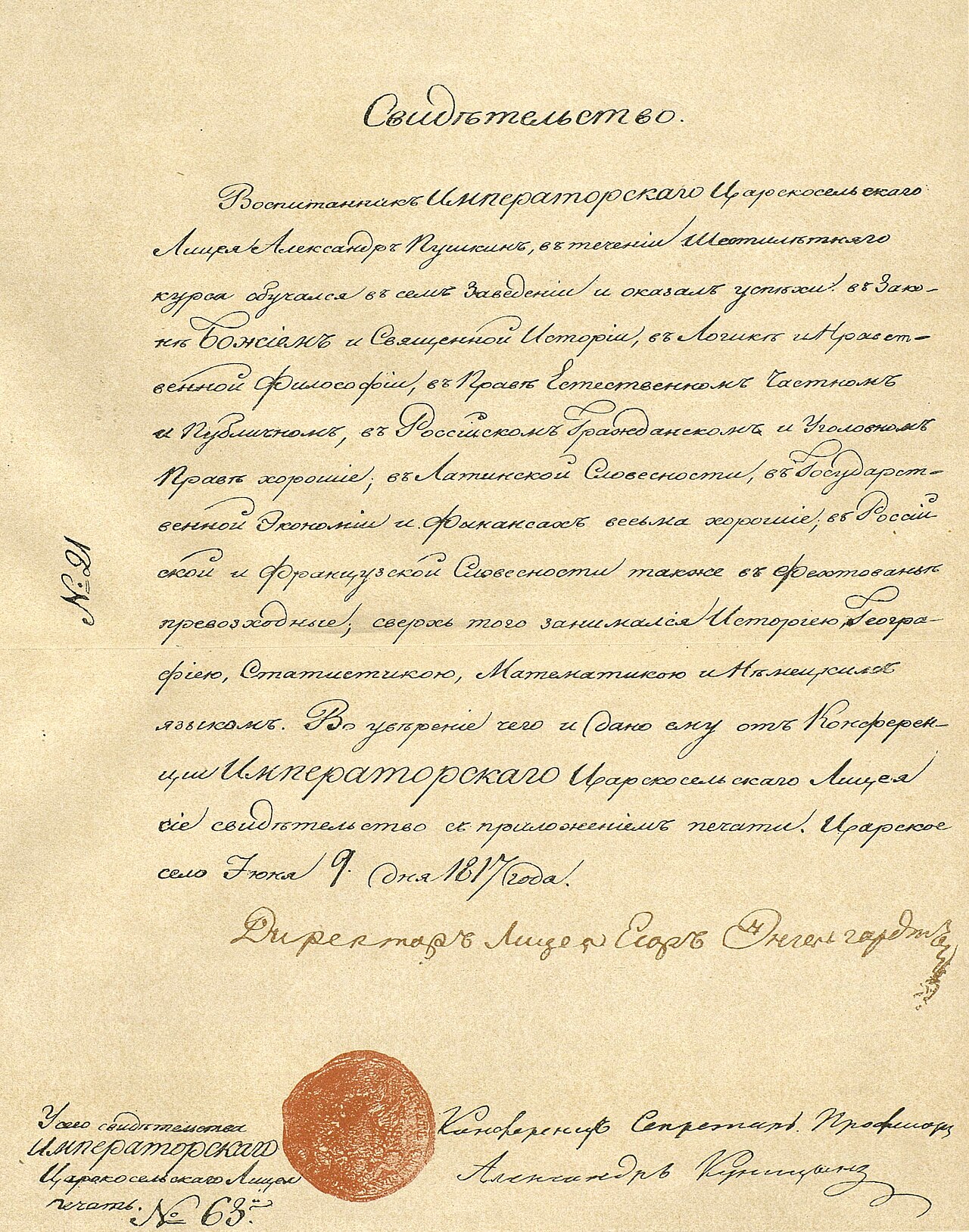
Handwritten Russian certificate on aged cream paper, titled 'Свидетельство', dated Tsarskoye Selo, June 9, 1817, naming Alexander Pushkin as a lyceum student with grades. Signed by the lyceum director, with a red wax seal and a secretary's signature at the bottom.Document

Primary source

Pushkin's Certificate of Completion of the Tsarskoye Selo Lyceum

9 June 1817

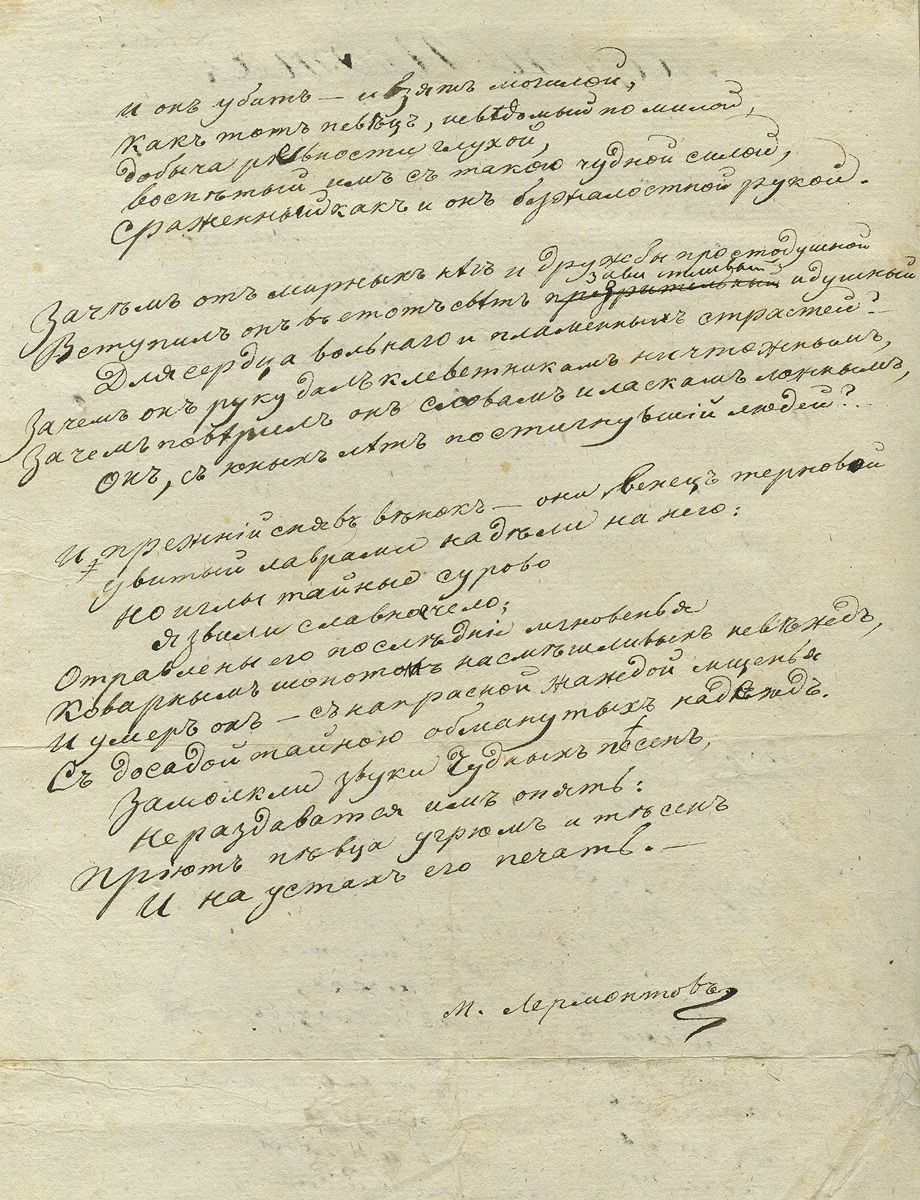
Handwritten manuscript page in Russian cursive ink on aged yellowed paper, showing the final lines of a poem, signed at the bottom with the name M. Lermontov and a flourish. Lines are written in slanted cursive with some crossed-out words.Document

Primary source

Lermontov's Fair Copy of 'Death of the Poet'

Mikhail Lermontov · 1837

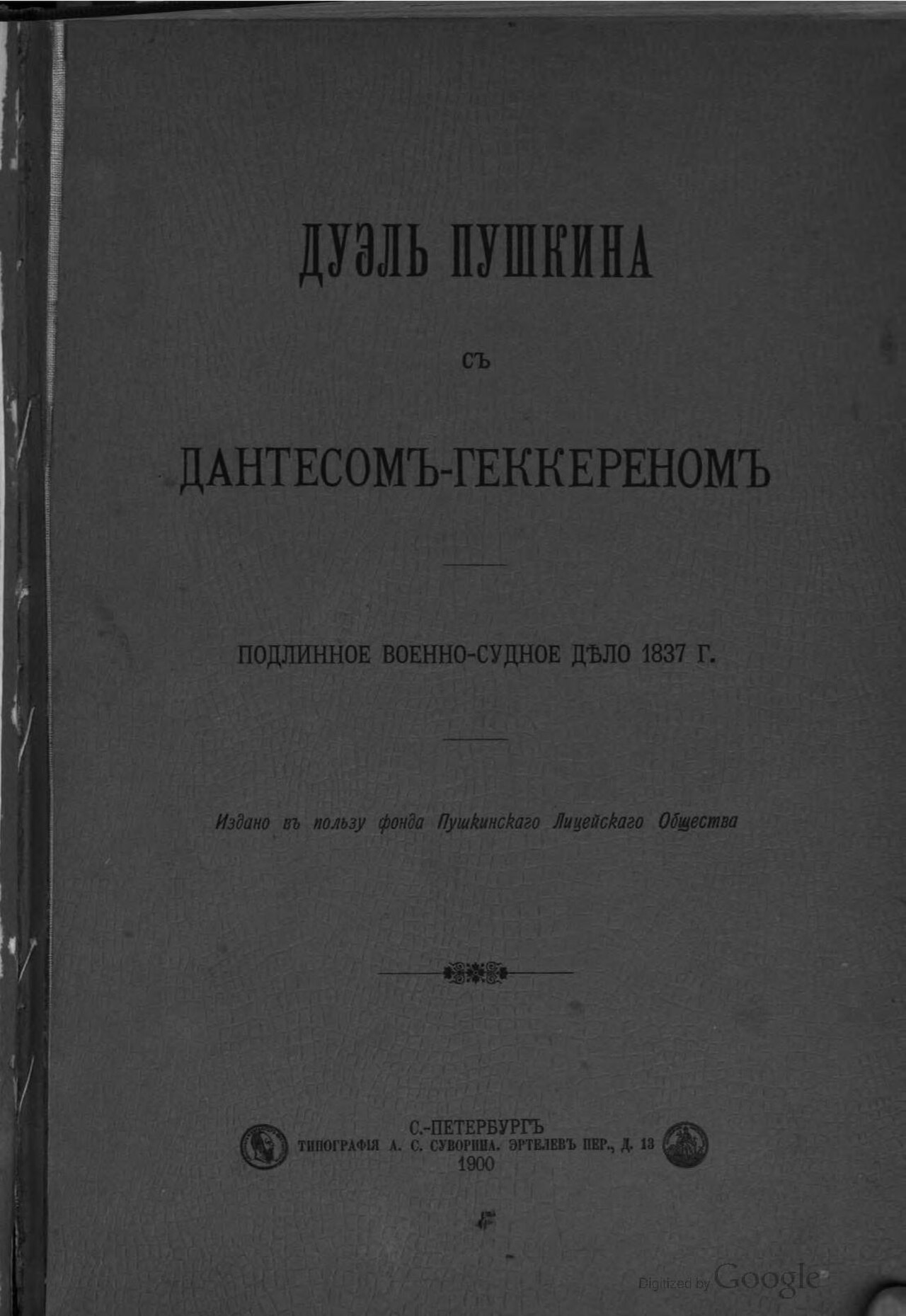
Title page of a Russian book, black and white scan. Large heading reads Дуэль Пушкина с Дантесом-Геккереном, with subtitle Подлинное военно-судное дело 1837 г. Below: Издано в пользу фонда Пушкинского Лицейского Общества. Printed at the bottom: С.-Петербург, Типография А. С. Суворина, 1900. A Google Digitized watermark appears in the corner.Document

Primary source

Duel of Pushkin with Danton-Heckeren: The Official Military Court Case of 1837

Пётр Михайлович Кауфман · 1900

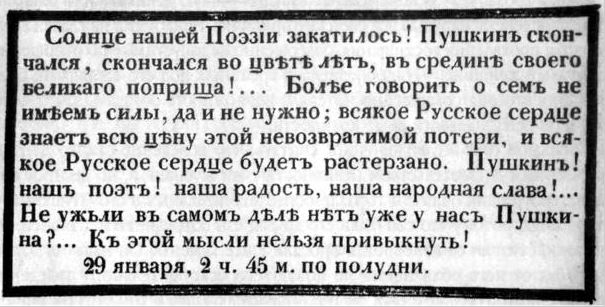
Scan of a bordered newspaper notice in Russian Cyrillic type, headed by the phrase 'Солнце нашей Поэзии закатилось!' (The sun of our Poetry has set!), announcing Pushkin's death, dated 29 января, 2 ч. 45 м. по полудни.Newspaper article

Primary source

Obituary of Pushkin in Literary Supplements

Vladimir Odoevsky · 30 January 1837

Book

Primary source

Collected Works of Pushkin, Dobrolyubov Edition

Alexander Pushkin · 1887

Book

Primary source

The Shot

Alexander Pushkin · 1831 (this translation 1894)

Book

Primary source

The Station-Master

Alexander Pushkin · 1830

Book

Primary source

Ruslan and Lyudmila

Alexander Pushkin · 1817-1820

Book

Primary source

Robbers Brothers

Alexander Pushkin

Book

Primary source

To a Beauty Who Took Snuff

Alexander Pushkin

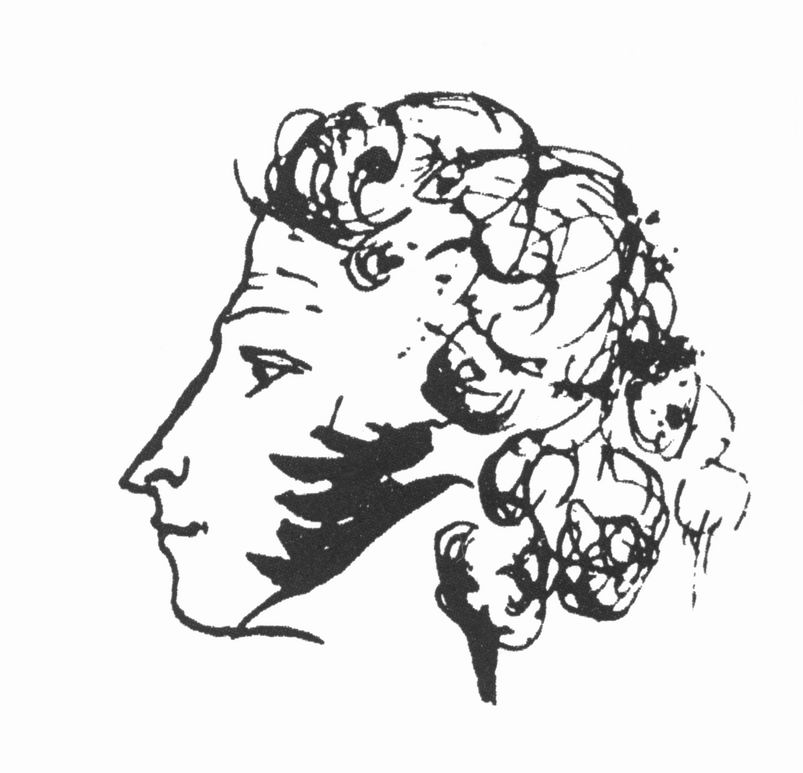
Black-and-white ink line drawing on a white background of a man's head in left-facing profile. He has a prominent nose and lips, a sharp chin, and thick, curly, bushy hair with dark sideburns, drawn in loose, sketchy strokes.Artifact

Primary source

Pushkin self-portrait drawing, 1829

Alexander Pushkin · 1829

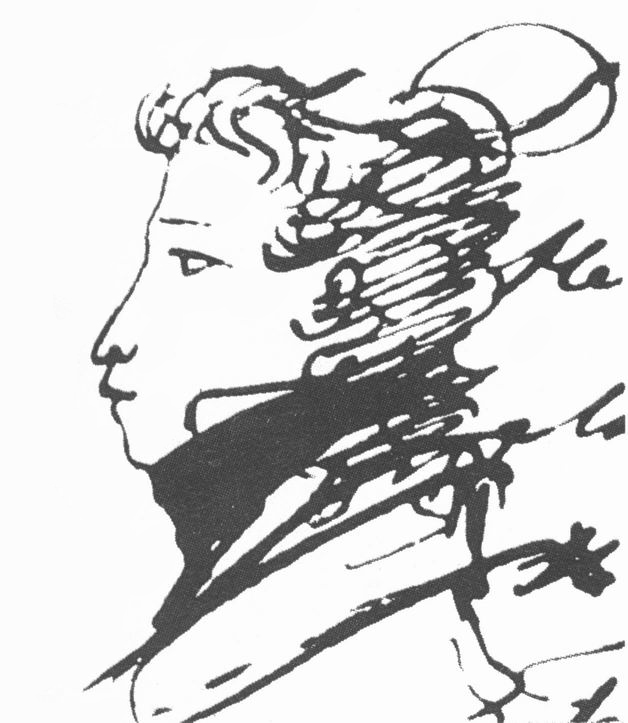
Black-and-white ink line drawing in profile facing left of a young man with curly, tousled hair, a prominent nose, and a high collar with dark shading. A scribbled hatched mass forms the hair and collar area. A circle is drawn at the upper right.Artifact

Primary source

Pushkin self-portrait drawing, 1820s

Alexander Pushkin · 1820s

The Queen of Spades and Other StoriesBook

Primary source

The Queen of Spades and Other Stories

Alexander Pushkin · 1892

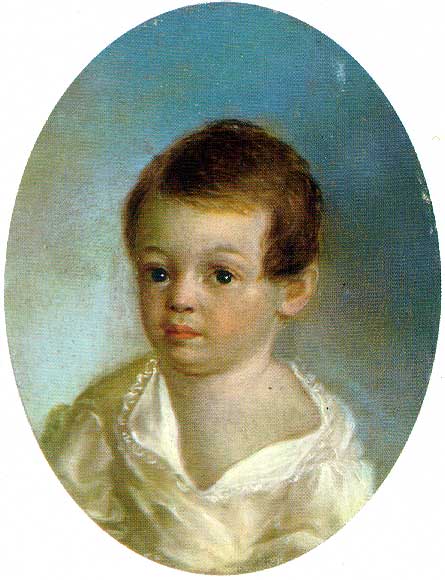
Oval oil painting of a young boy with short brown hair, large dark eyes, and a pale white collar with lace trim, against a soft blue-gray background.Painting

Primary source

Portrait of Pushkin by Xavier de Maistre

Xavier De Maistre · 1800-1802

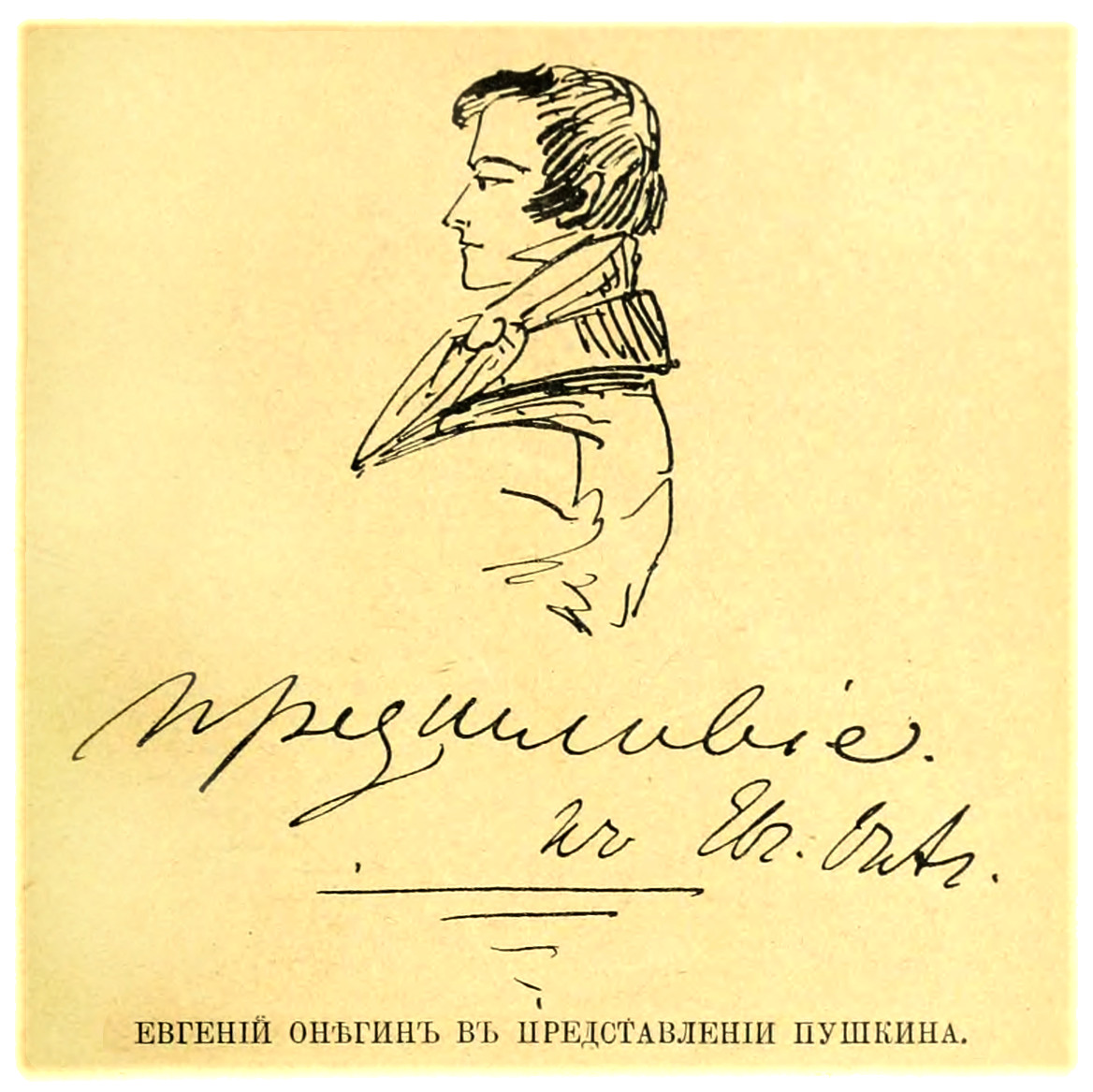
Pen-and-ink profile sketch of a young man with swept-back hair and a high collar, facing left, over a handwritten Cyrillic inscription and a caption reading 'Евгений Онегин в представлении Пушкина'.Artifact

Primary source

Drawing of a Man, Possibly Onegin

Alexander Pushkin · 21 November 1830

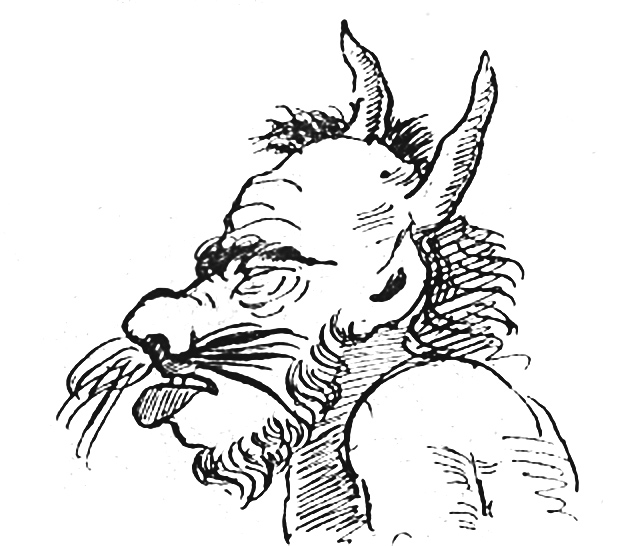
Pen-and-ink sketch in profile of a grotesque figure with long pointed ears, a wrinkled face, a large hooked nose, a pursed mouth with whiskers, and a hairy collar or shoulder, drawn in dense hatching.Painting

Primary source

Drawing from the Manuscript of The Tale of the Priest and Balda

Alexander Pushkin · 1831

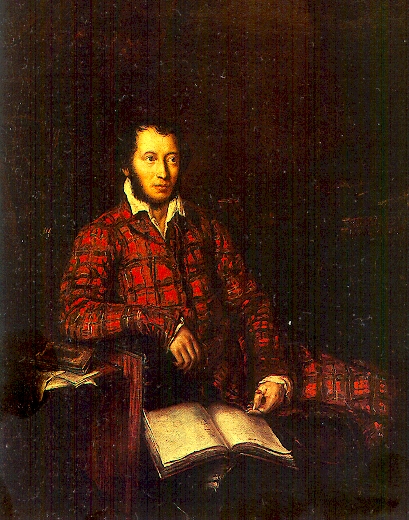
Oil painting of a dark-haired man with sideburns in a red plaid shirt and white collar, seated at a table with an open book in front of him and a stack of books at left, against a dark background.Painting

Primary source

Posthumous Portrait of Pushkin by Karl Mazer

Karl Mazer · 1839

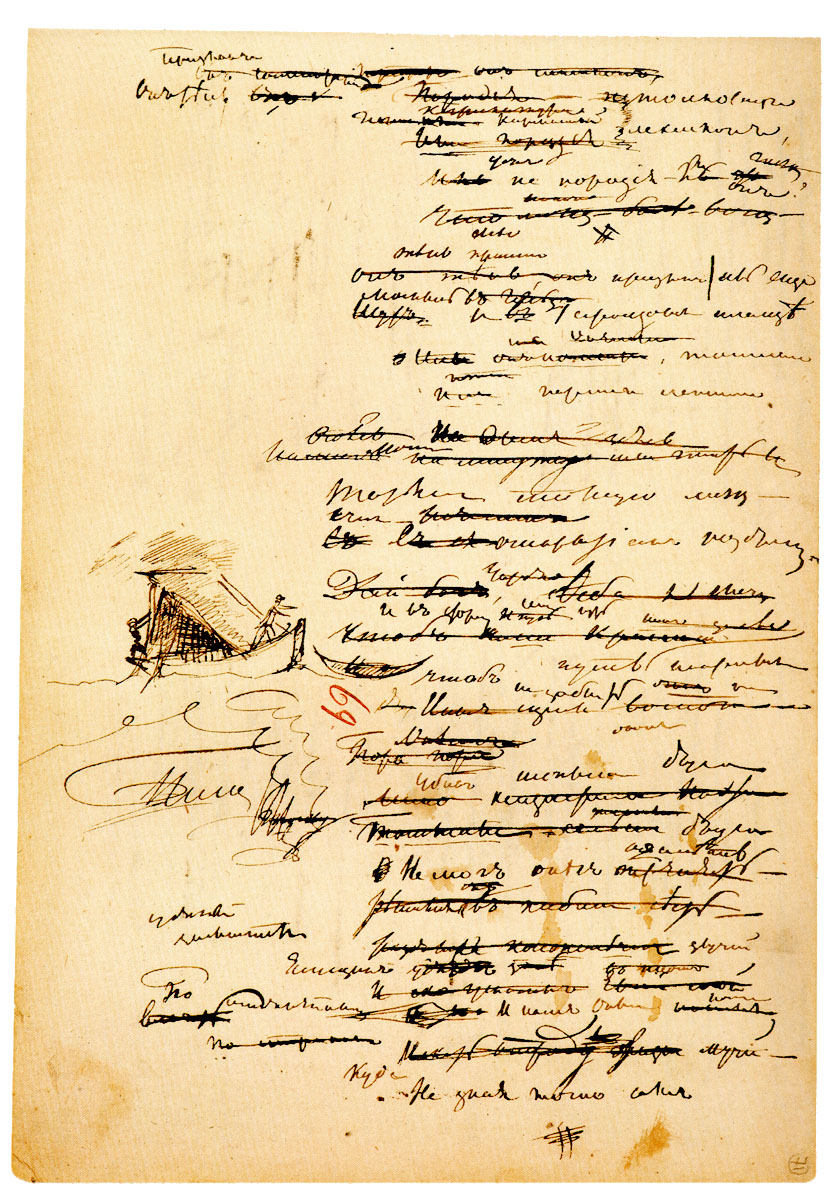
Handwritten manuscript page in Russian with many crossed-out lines and corrections, in dark ink on yellowed paper. In the left-middle area is a small pen sketch of a boat with a figure standing at its stern, with a red number 69 nearby.Book

Primary source

Boat Drawing from the Eugene Onegin Manuscript

Alexander Pushkin · 1828

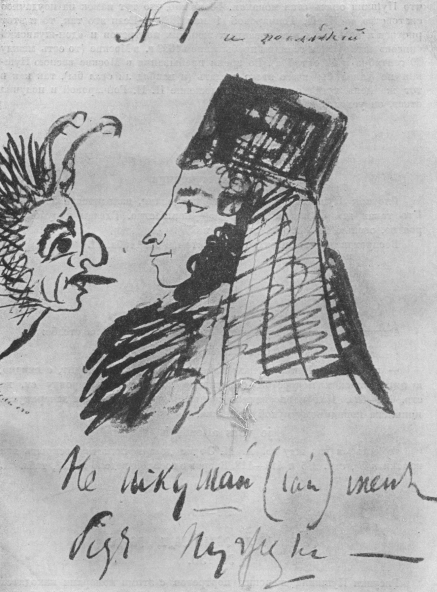
Black-and-white scan of an ink drawing on an album page. A profile of a man in a tall, dark monk-like hood with hatched shading faces a grotesque figure on the left with wild hair, a hooked nose, and horn-like curls. Handwritten Cyrillic lines appear below, and a number and short inscription sit at the top.Artifact

Primary source

Self-Portrait as a Monk with a Demon, Ushakov Album

Alexander Pushkin · 1829

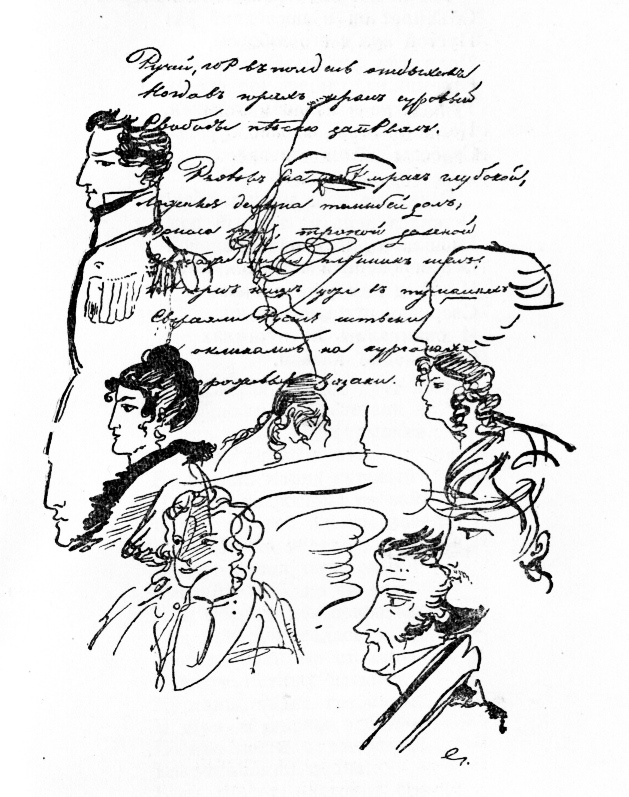
Pencil and ink sketch on a manuscript page: several profile portraits of men and women drawn in ink, overlapping, with handwritten Russian verse lines in cursive across the top and middle. A small signature mark appears at the lower right.Book

Primary source

Manuscript Page with Doodles, c. 1822

Alexander Pushkin · c. 1822

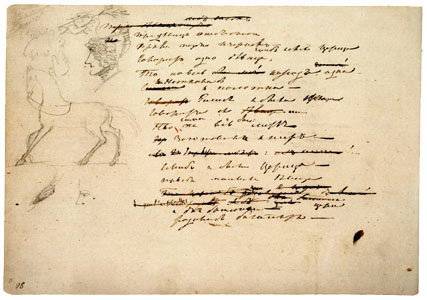
Handwritten manuscript page in Russian with many lines of verse, several crossed out and revised, alongside a pencil sketch of a horse and a partial face in the upper left. The paper is yellowed with a dark mark at the lower right edge.Book

Primary source

Manuscript of The Tale of Tsar Saltan with Pencil Drawing

Alexander Pushkin · June 1828

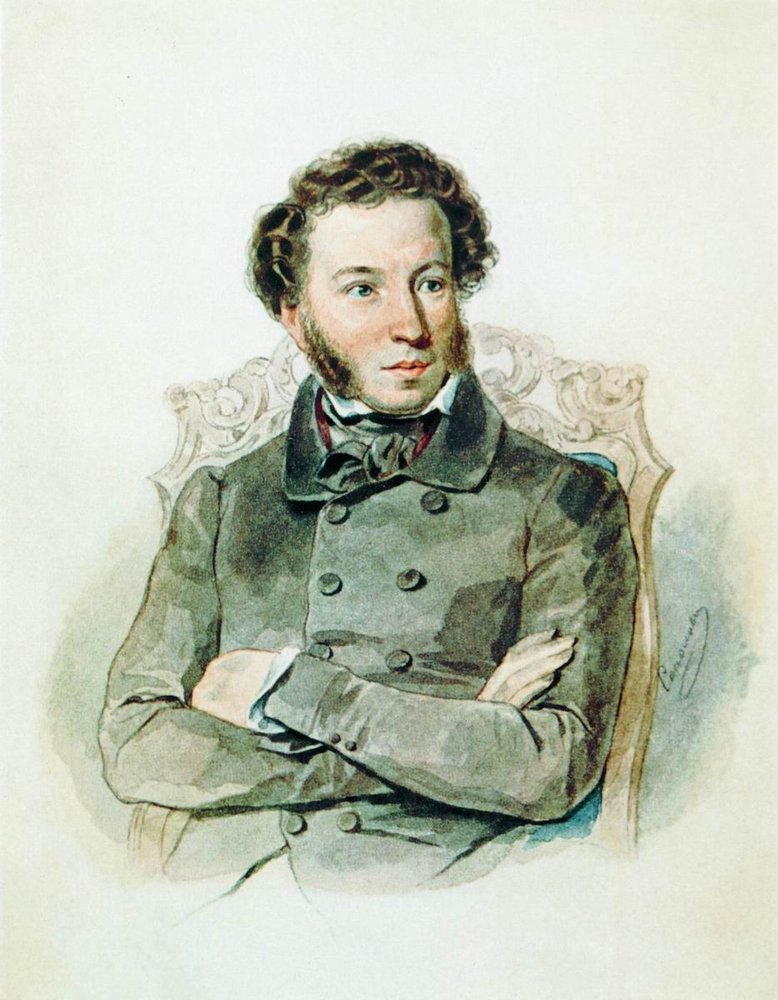
Watercolor portrait of a young man with curly dark hair and side whiskers, seated in a carved chair with his arms crossed. He wears a double-breasted grey-green coat and a dark cravat, and looks to the side.Painting

Primary source

Portrait of Alexander Pushkin

Pyotr Sokolov · 1836

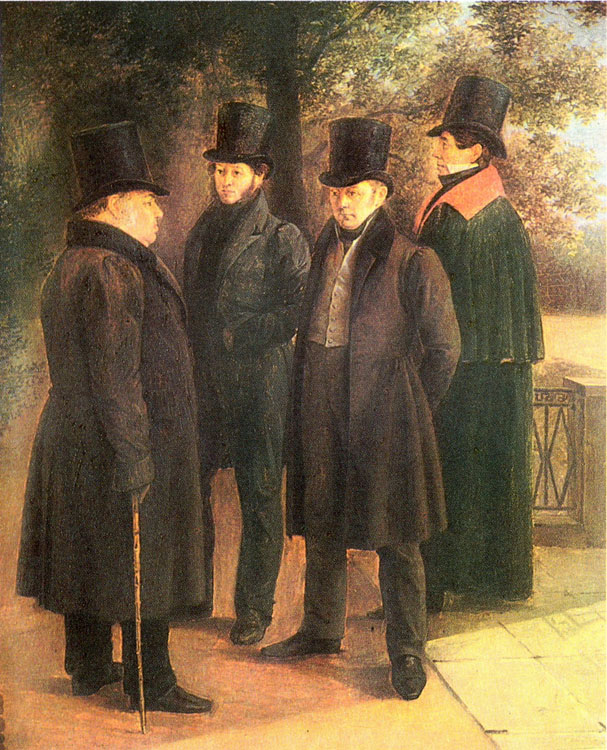
Painting of four men in dark long coats and tall top hats standing outdoors under trees. The man at left, with a cane, faces three others. Behind them is a railing and a stone path.Painting

Primary source

Pushkin, Krylov, Zhukovsky and Gnedich in the Summer Garden

G. Chernetsov · 1832

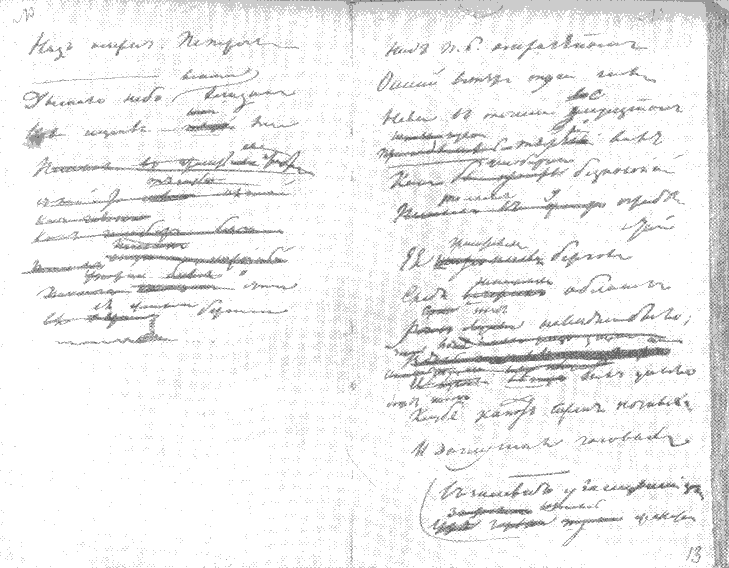
Scan of a handwritten manuscript page in Cyrillic script, with two columns of pencil or ink lines, many words crossed out and revised, and page number 13 at the bottom right. Looks like a draft of a poem.Book

Primary source

Manuscript Page of Yezersky

Alexander Pushkin · 1833

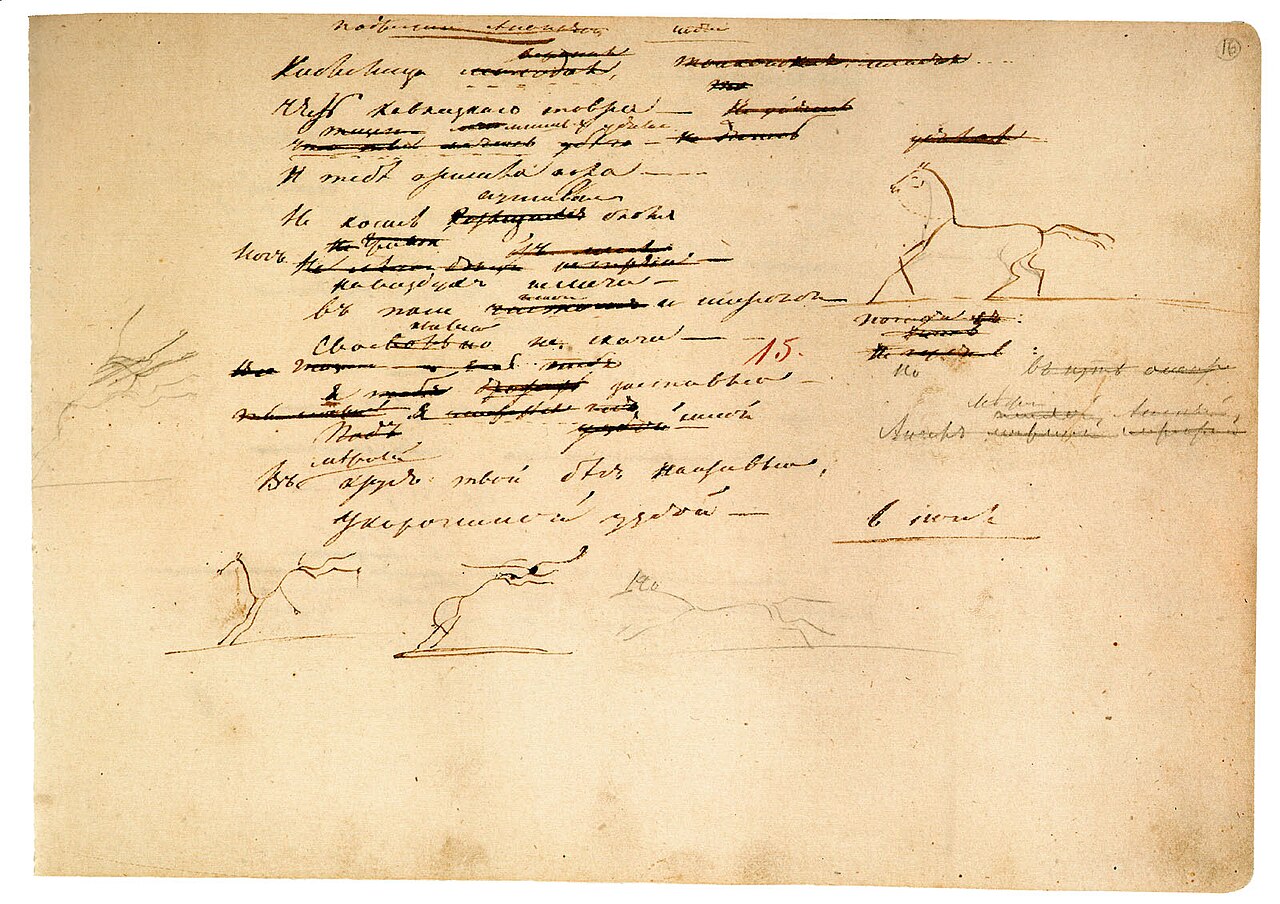
Handwritten manuscript page in brown ink on aged paper, with crossed-out and revised lines of Russian verse, a red numeral 15, and several small pen sketches of horses scattered across the page.Book

Primary source

Manuscript of the Anacreontic Poem 'The Horse'

Alexander Pushkin

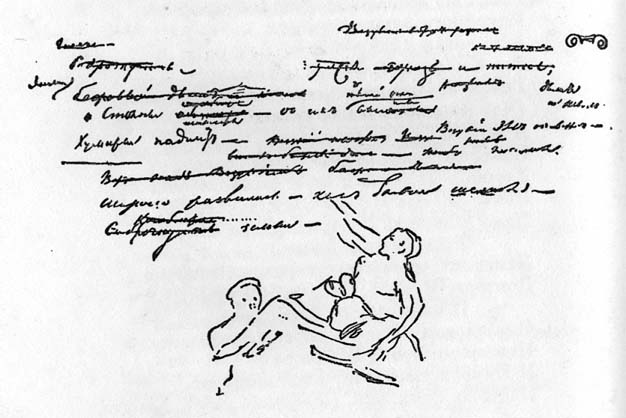
Black-and-white photograph of a handwritten manuscript page in Cyrillic script, with many lines crossed out and revised. At the bottom is a pen sketch of two seated figures, one reclining, with a few small annotations beside them.Book

Primary source

Autograph of 'Vesuvius Gaped Its Maw'

Alexander Pushkin · 1834

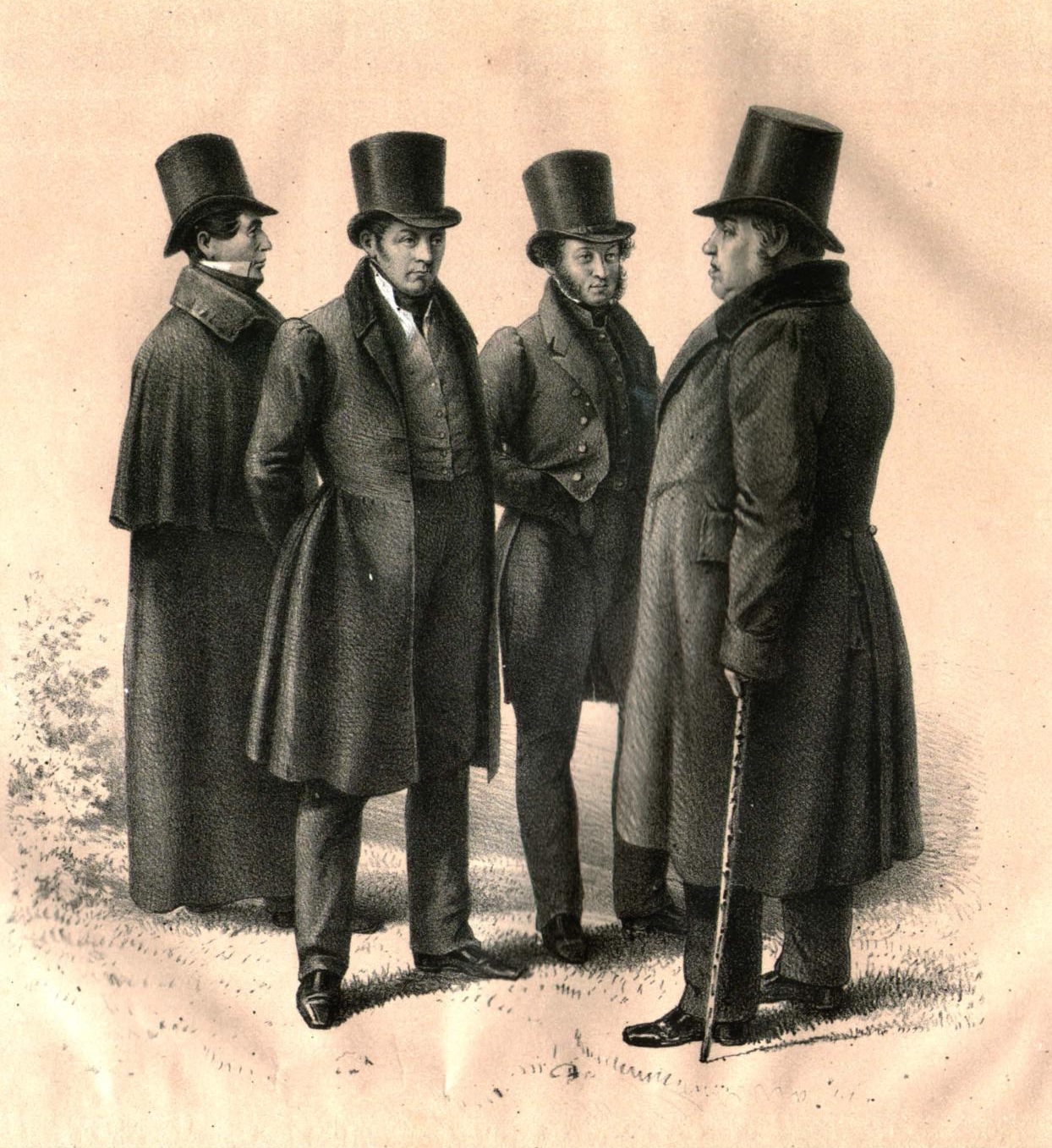
Sepia-toned print of four men standing outdoors on grass, all wearing tall silk top hats and long overcoats. From left: a man in profile wearing a cape-like cloak, a man with a fur-collared frock coat and white collar, a bearded man in a double-breasted coat, and a heavyset man at right with a fur collar holding a cane.Painting

Primary source

Gnedich, Zhukovsky, Pushkin and Krylov

Grigory Chernetsov · 1835

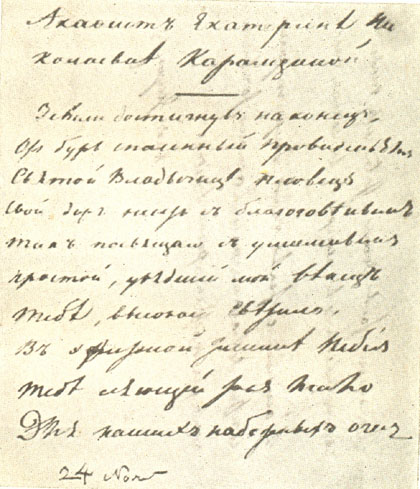
Scan of a handwritten manuscript page in Russian cursive on aged paper, with a title line at top reading 'Акафист Екатерине Николаевне Карамзиной' and a handwritten date '24 Апр' at bottom left, with several lines of verse below.Document

Primary source

Akafist to Ekaterina Karamzina

Alexander Pushkin · 1827

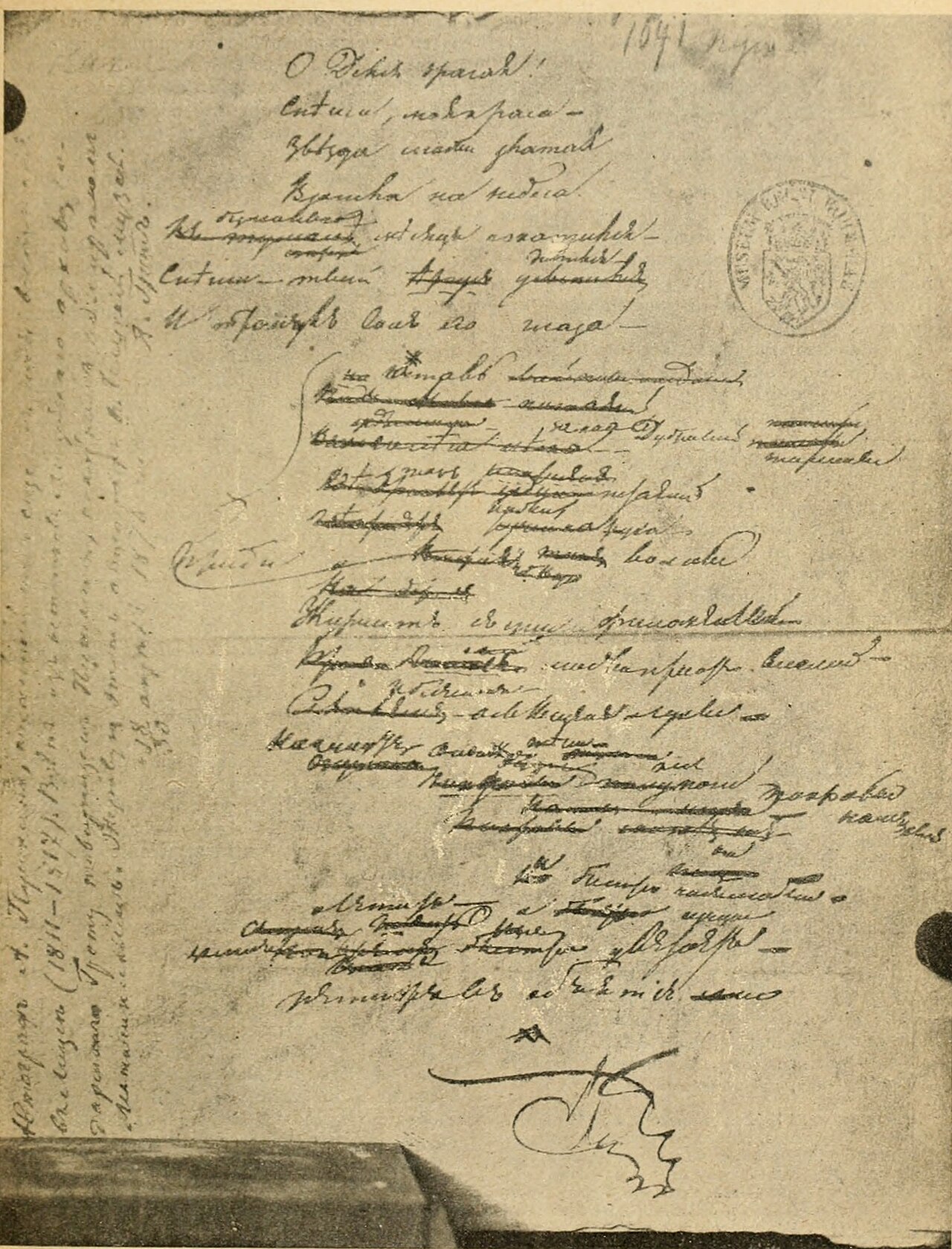
Scanned page of a handwritten manuscript in Russian Cyrillic script, with crossed-out lines and revisions, a round museum stamp at upper right, and a signature at the bottom. Faint marginalia run along the left edge.Document

Primary source

To Delia

Alexander Pushkin · 1812–1816

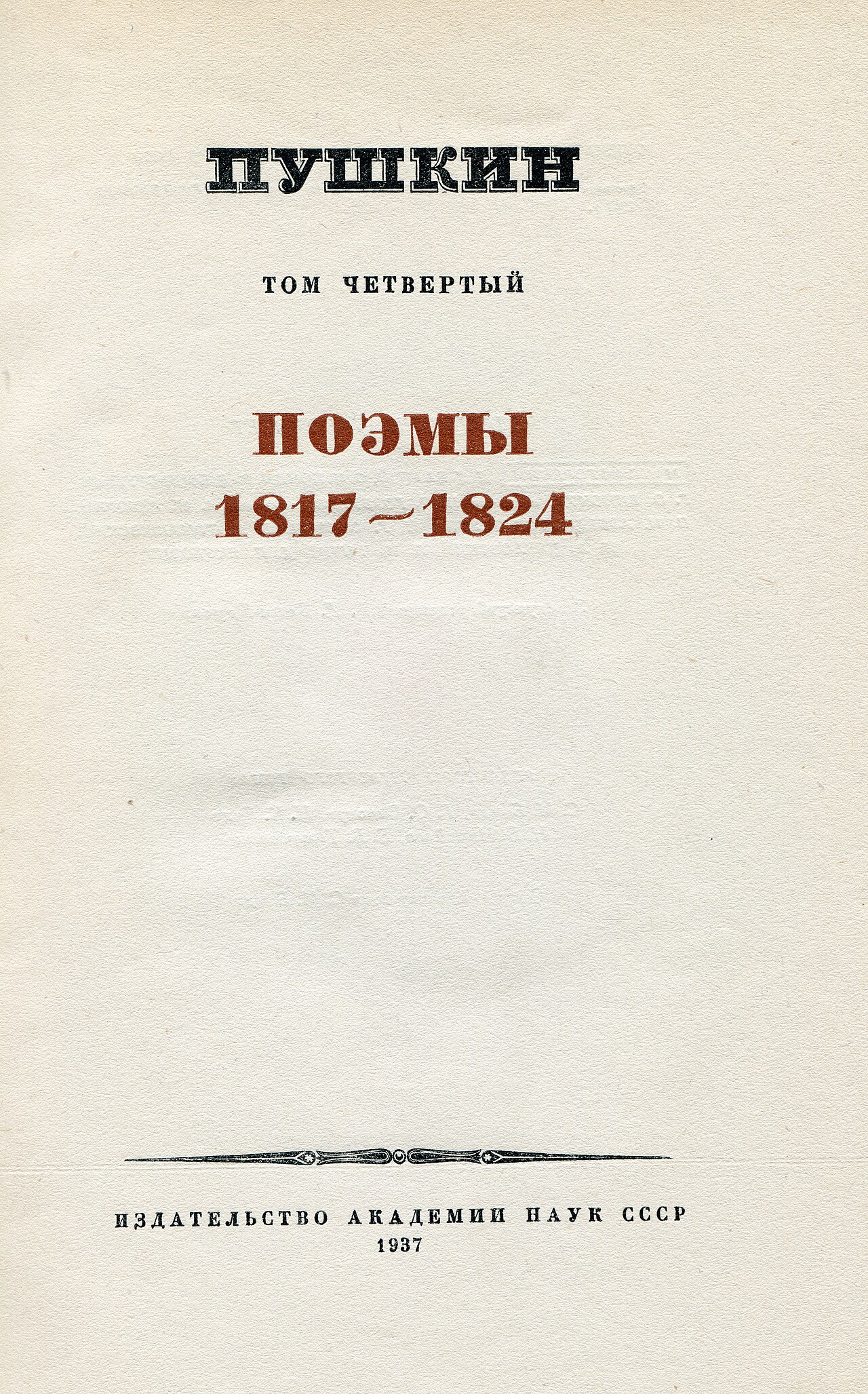
Title page of a Russian book in Cyrillic: 'ПУШКИН, ТОМ ЧЕТВЕРТЫЙ, ПОЭМЫ 1817-1824' in black and red type, with a decorative rule and publisher 'Издательство Академии наук СССР, 1937' at the bottom.Book

Secondary source

Title page of the 1937 academic complete works of Pushkin

1937

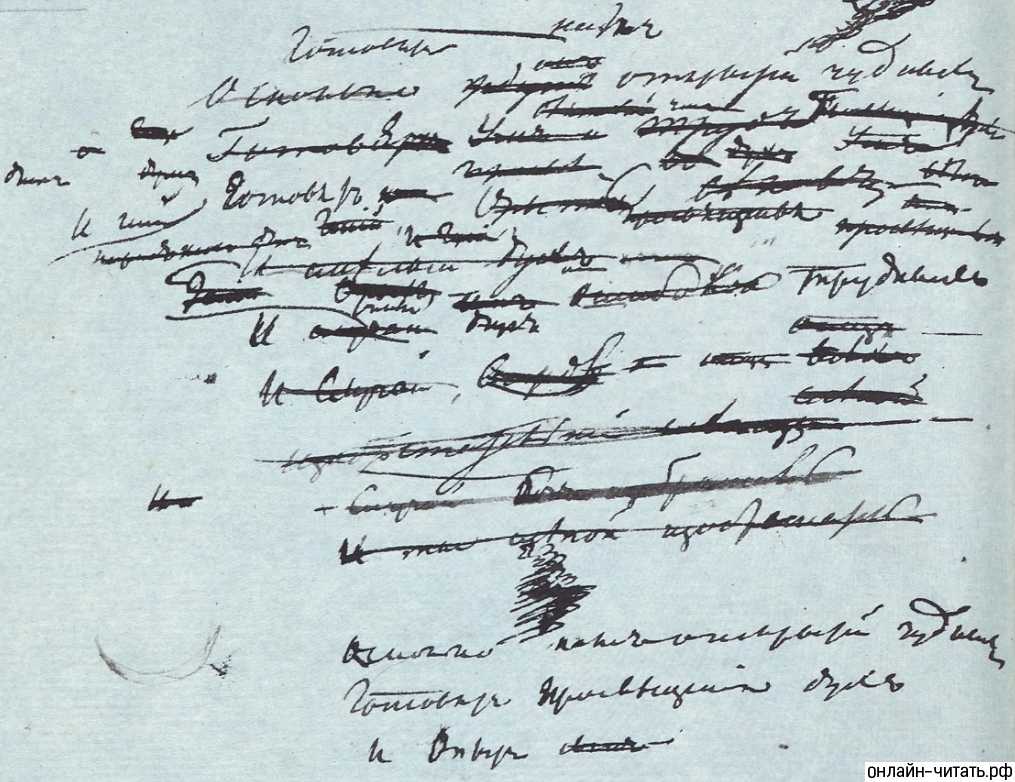
Photograph of a handwritten draft manuscript on pale blue paper, with dense heavily crossed-out and revised lines in dark ink, including the Cyrillic phrase at the bottom beginning with 'О сколько нам открытий чудных'. A watermark-like website label appears in the lower right corner.Document

Primary source

Draft of O skolko nam otkrytiy chudnykh

Alexander Pushkin · 1829

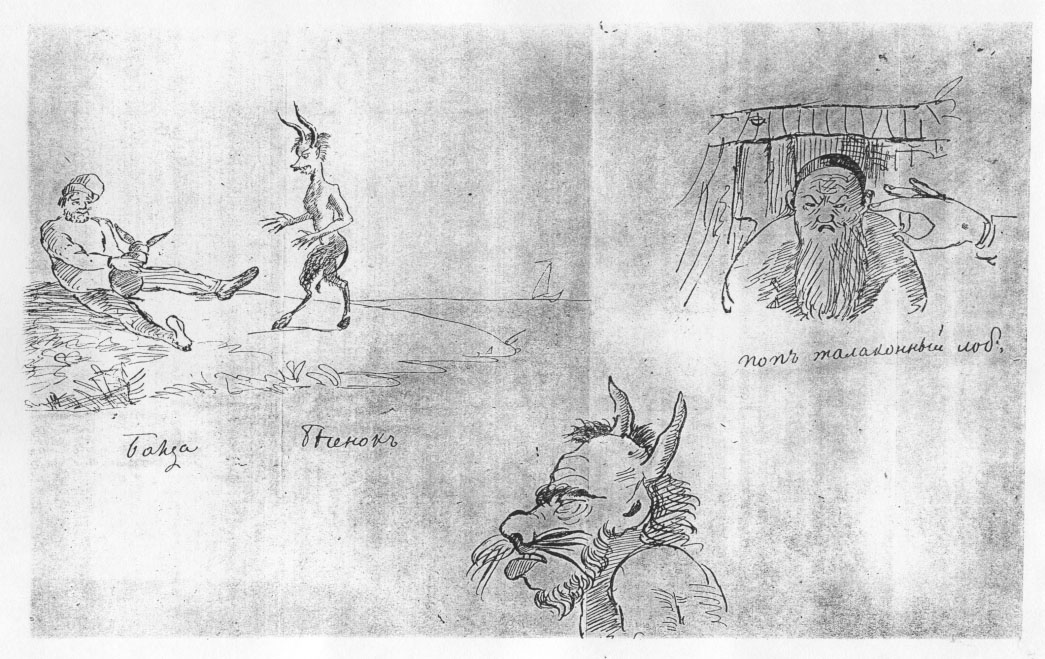
Pen drawing sheet with four sketches: at left, a seated bearded man in a cap holding a small object, labeled Балда; next to him a horned, goat-like imp labeled Бѣсенокъ; at upper right, a bearded priest with a hat or canopy and a hand reaching in, labeled попъ талаконный лобъ; at bottom, a horned devil head with a long beard, profile facing left.Painting

Primary source

Drawings for the Tale of the Priest and His Workman Balda

Alexander Pushkin · September 1831

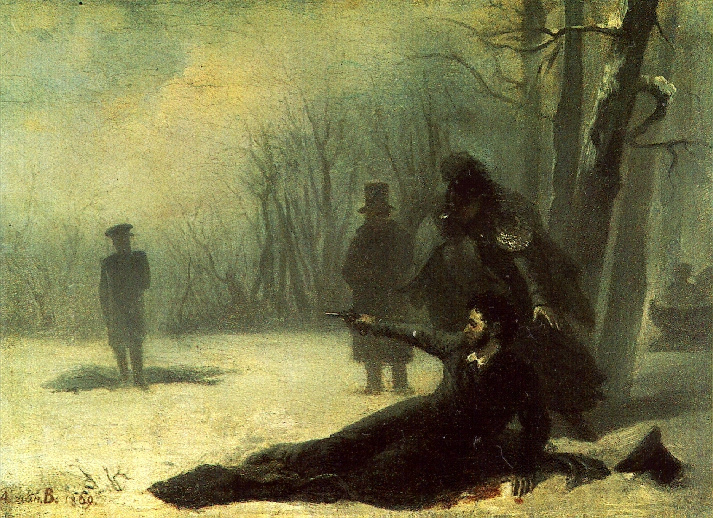
Painting of a winter duel in a snowy wooded clearing. A man in dark clothing lies wounded on the snow, propped up and holding a pistol, with blood visible. A second man in a long dark coat and top hat stands behind him, and a figure in a cap stands far off on the left.Painting

Secondary source

Duel of Pushkin and Georges d'Anthès

Adrian Volkov · 1869

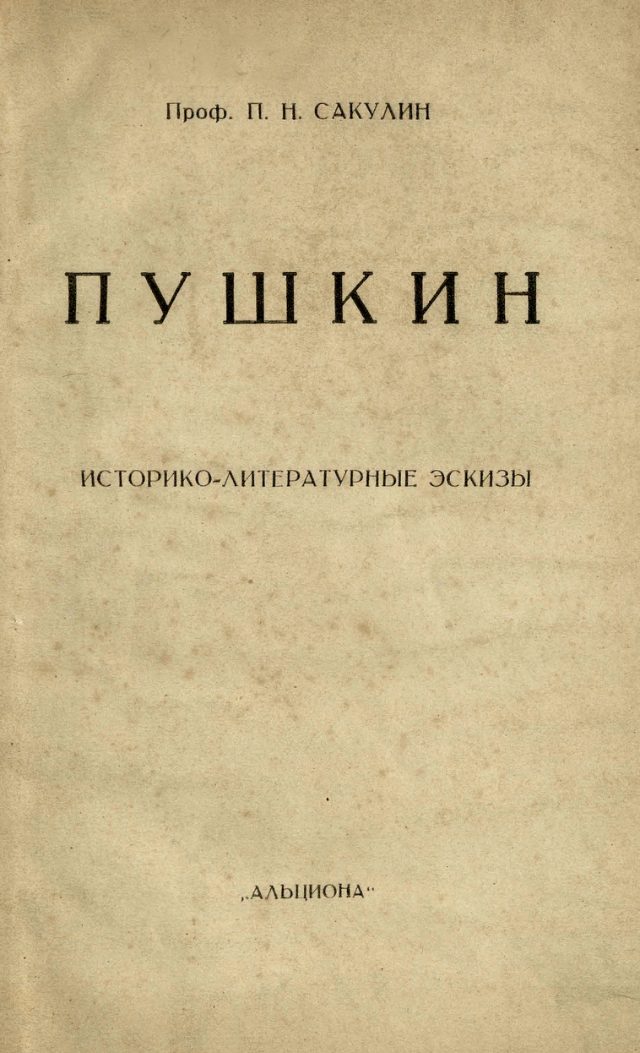
Pushkin and Radishchev: A New Solution to an Old QuestionBook

Secondary source

Pushkin and Radishchev: A New Solution to an Old Question

Pavel Sakulin · 1920

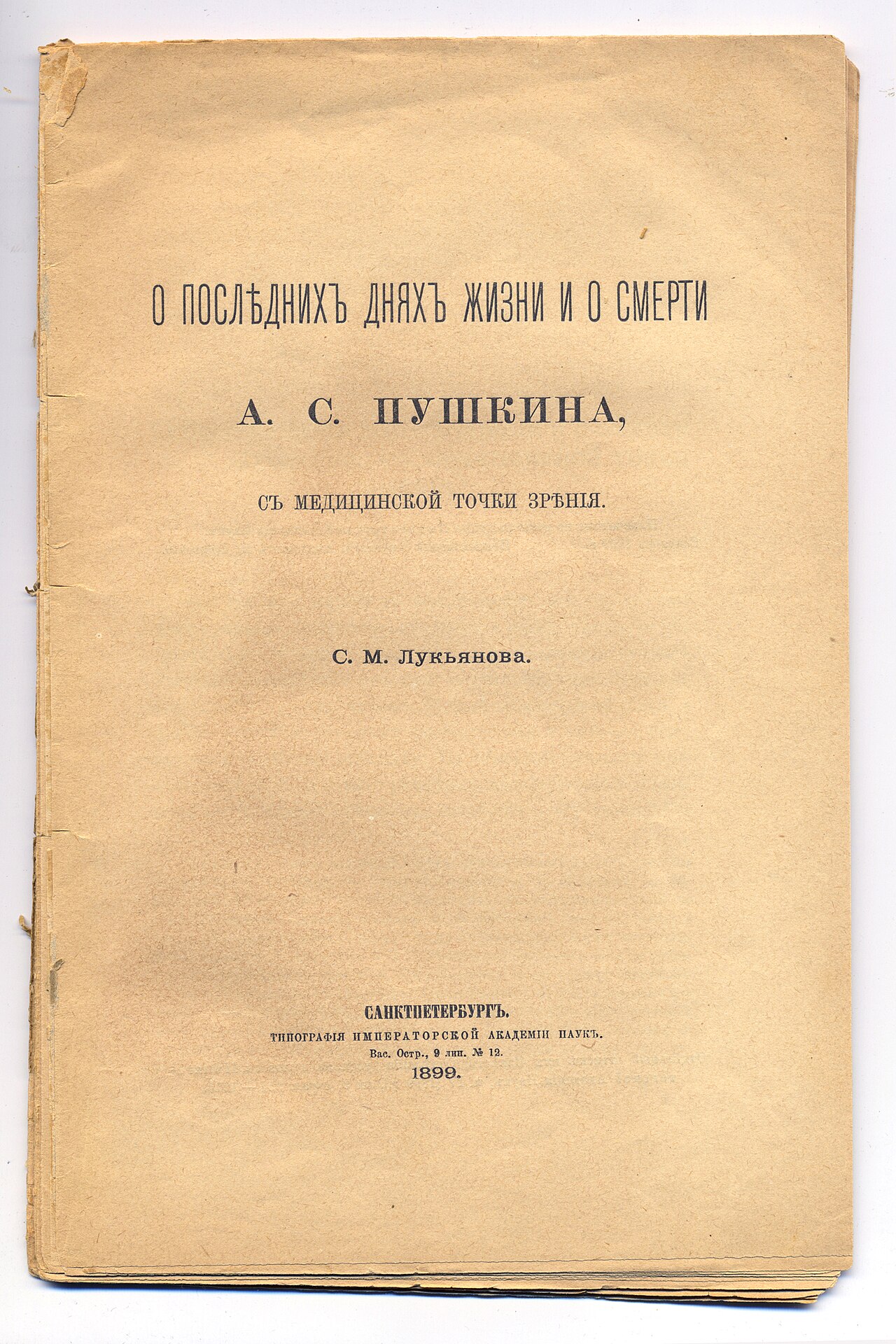
Scan of the cover of a pale tan printed pamphlet. Title in Russian Cyrillic: О последних днях жизни и о смерти А. С. Пушкина, с медицинской точки зрения, by С. М. Лукьянова. Imprint: Санкт-Петербург, 1899.Book

Secondary source

About the Last Days of A. S. Pushkin

S. M. Lukyanov · 1899

Book

Primary source

The Singer

Alexander Pushkin · 1816 (listed as 1816/1819)

Book

Primary source

Awakening

Alexander Pushkin · 1816 (listed as 1816/1825)

Book

Primary source

Behold a Sower Went Forth to Sow

Alexander Pushkin · 1823

Book

Primary source

To Kern

Alexander Pushkin · 1825 (published 1827)

Book

Primary source

Three Springs

Alexander Pushkin · 1827

Book

Primary source

Remembrance

Alexander Pushkin · 1828

Book

Primary source

Verses Written During a Sleepless Night

Alexander Pushkin · 1830

Book

Primary source

Elegy

Alexander Pushkin · 1830, published 1834

Book

Primary source

The Undertaker

Alexander Pushkin · 1830

Book

Primary source

The Lady-Rustic

Alexander Pushkin

Book

Primary source

Kirdjali

Alexander Pushkin · 1834

Book

Primary source

The Egyptian Nights

Alexander Pushkin · 1837

Want the full shelf? Chat with Alexander Pushkin in the app and open the Sources panel — every quote links back to the original.

Use Alexander Pushkin in class

1 collection

A ready-made collection from the Humy team that features Alexander Pushkin. Preview it, then try it free.

Trusted by educators worldwide

Conversations
375,000+
Real exchanges between students and historical figures
Messages exchanged
4,142,000+
Across every figure, classroom and language
Historical figures
100,000+
Each informed by a curated biography and selected sources
Languages supported
50+
From English and Spanish to Arabic and Korean

Paying customers

Used by 98 schools and universities

Partner school logo
Tecnológico de Monterrey logo
Hyper Island logo
Partner school logo
Chambersburg Area School District logo
Broward County Public Schools logo
Nebo School District logo
National Louis University logo
South Florida PBS logo
Punahou School logo
University of Wisconsin–River Falls logo
Partner school logo
Partner school logo
Archbishop Mitty High School logo
Kingsburg High School logo
Norwalk Public Schools logo
Partner school logo
Connections logo
Partner school logo
Moore Public Schools logo
Partner school logo
Partner school logo
Partner school logo
Partner school logo
Robbinsville Public Schools logo
Partner school logo
Partner school logo
Partner school logo
Tecnológico de Monterrey logo
Hyper Island logo
Partner school logo
Chambersburg Area School District logo
Broward County Public Schools logo
Nebo School District logo
National Louis University logo
South Florida PBS logo
Punahou School logo
University of Wisconsin–River Falls logo
Partner school logo
Partner school logo
Archbishop Mitty High School logo
Kingsburg High School logo
Norwalk Public Schools logo
Partner school logo
Connections logo
Partner school logo
Moore Public Schools logo
Partner school logo
Partner school logo
Partner school logo
Partner school logo
Robbinsville Public Schools logo
Partner school logo
Partner school logo

What educators are saying

“We enjoyed the program last year and used it frequently.”
“My students say it’s a welcome change of pace. I’m not a fan of the “sage on the stage” model, so I try to incorporate research-oriented and self-paced activities. With Humy, students have to take charge of their learning. They’ve become more adept at critical thinking, forming better questions, and improving their reading comprehension. The interview feature has been my go-to tool. I create assignments where students must ask historical figures a set number of questions, then summarize the responses to ensure they’re truly absorbing the material. This approach lets them actively explore the past rather than passively consuming information.”
“Humy has helped me bring historical figures, sometimes long past, to life. When my students interact with these figures in real-time, it eliminates some of the perceived “ancient” characteristics of my curriculum. This has shifted my students’ thinking away from viewing history as abstract or irrelevant. Real-time interactions make historical figures relatable, even allowing students to ask off-topic questions that help put historical lives in a more relevant context for 13-year-olds. The feature I use the most is the interview feature. After teaching a topic, most recently Gandhi and Joan of Arc, I have the students ask pointed, focused questions. We practice good conversation techniques beforehand, teaching them to listen (or read) carefully and formulate thoughtful follow-up questions rather than just interrogating. It helps students practice effective conversation skills.”

FAQ

Frequently asked questions

Who is Alexander Pushkin?
Renowned Russian poet and writer. On Humy.ai you can chat with an AI version of Alexander Pushkin that draws on a short biography and 97 historical sources during the conversation — by text or voice, in 42 languages.
Is Alexander Pushkin AI free?
Alexander Pushkin is part of Humy's full library of more than 100,000 figures, which comes with a paid plan. A free account (no credit card) includes 20 messages a month with the free library's figures, so you can try how the conversations work first.
What sources does the Alexander Pushkin AI use?
It draws on a short biography and 97 historical sources (books, paintings and documents), including “Eugene Onegin”, “Boris Godunov” and “The Bronze Horseman”. Each source has its own page on Humy.ai.
How historically accurate is the AI version of Alexander Pushkin?
Each figure uses a short biography and a small set of selected historical sources as context (retrieval-augmented generation), so answers stay closer to known material than the model's general knowledge alone. It isn't a citation-grade research tool — like any LLM, the AI can get details wrong or extrapolate. Treat it as a strong starting point for inquiry and cross-reference important claims.
Can I talk to Alexander Pushkin by voice?
Yes. In addition to text chat, you can call Alexander Pushkin and hear their voice respond in real time — useful for auditory learners, interview practice and Socratic dialogue.
Is Humy.ai safe and compliant for schools?
Yes. Humy.ai is used by more than 100 schools, universities and organisations. The platform is FERPA- and GDPR-aligned, supports SSO, and offers an IT-approval pack tailored for school procurement teams.

Cross-reference Alexander Pushkin

Like any LLM, the AI version of Alexander Pushkin can get details wrong. Open one of these sources in a new tab to verify what you’ve read.

Ready when you are

Start chatting with Alexander Pushkin now.

20 messages free · No credit card · Available in 50+ languages.