Portrait of Jesus Christ

AI Historical Figure

Jesus Christ

Religious leader and central figure of Christianity.

Chat with Jesus Christ via text or voice — in 42 languages, drawing on a curated biography and 88 historical sources. Available 24/7.

Start chatting with Jesus Christ20 messages free · No credit card
Lived
c. 4 BCE–30 CE
From
IsraelPalestinian Territories
Known for
Religion
Jesus Christ

Jesus Christ

Online · responds in seconds

Hello — I'm Jesus Christ. Religious leader and central figure of Christianity. What would you like to ask me?

20 messages free · No credit card · Powered by Humy.ai

Live preview · Switch between 42 languages above · Send a message to continue in the app

Multilingual

Talk to Jesus Christ in 42 languages

Ask Jesus Christ questions in any language below, and the rest of Humy's app speaks it too. Pick yours to open the chat in that language.

Also in German (Austria), German (Switzerland), English (UK), English (Australia), English (Canada).

The sources behind this AI

88 sources · 35 books · 28 paintings · 10 artifacts · 7 documents · 5 speeches · 2 sculptures · 1 letter

Jesus Christ doesn’t improvise from thin air. The AI is grounded in 88 curated historical sources students can inspect. Open any of them to see what informs the conversation.

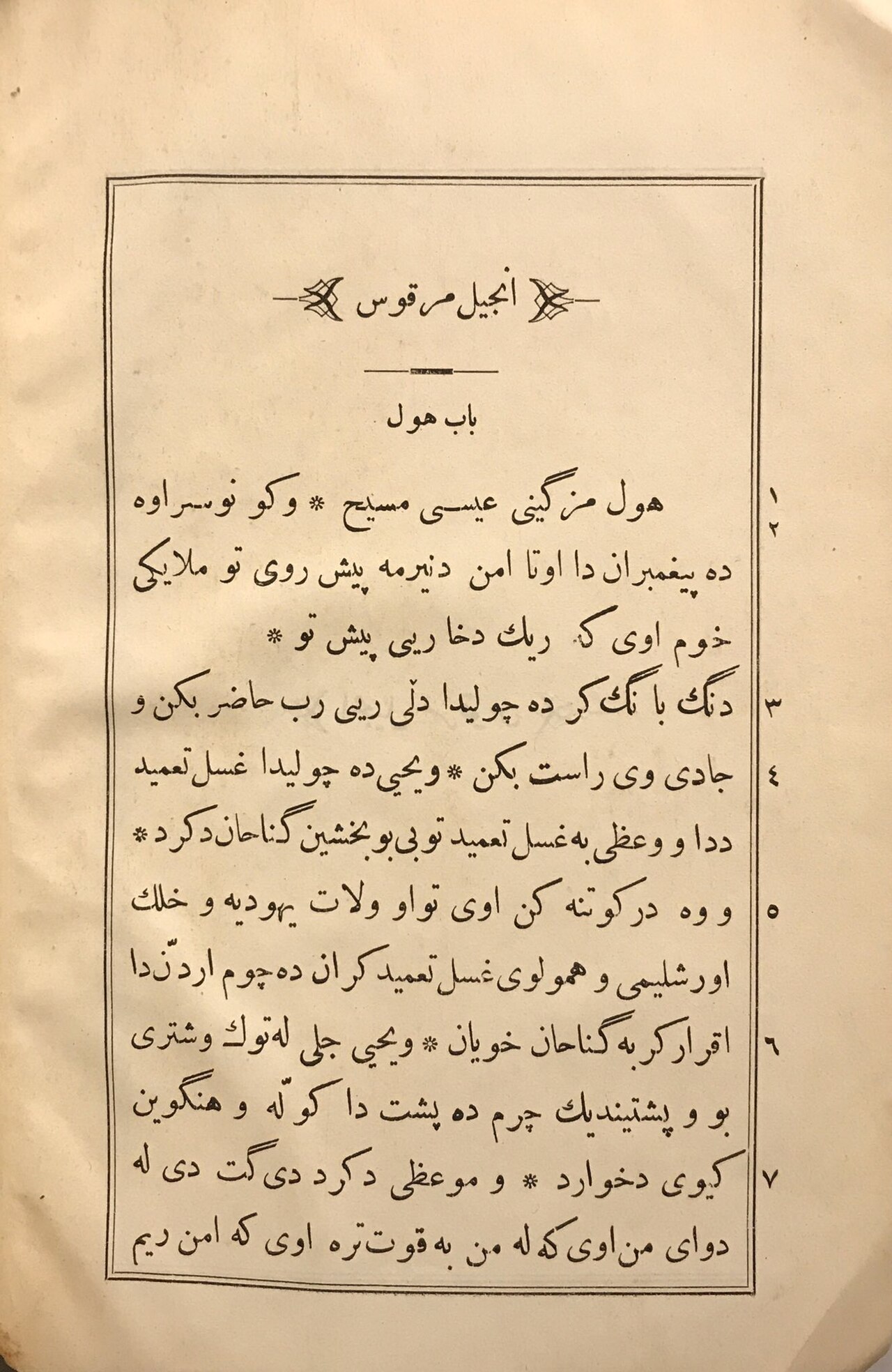
Scanned page of a printed book in Arabic-script text with a decorative title ornament reading Injil Marqus, and a section heading below. The text is in columns of right-to-left lines with verse numbers 1 to 7 along the right margin, enclosed in a double-ruled frame on yellowed paper.Book

Secondary source

Gospel of Mark

Mark the Evangelist · c. AD 66-75

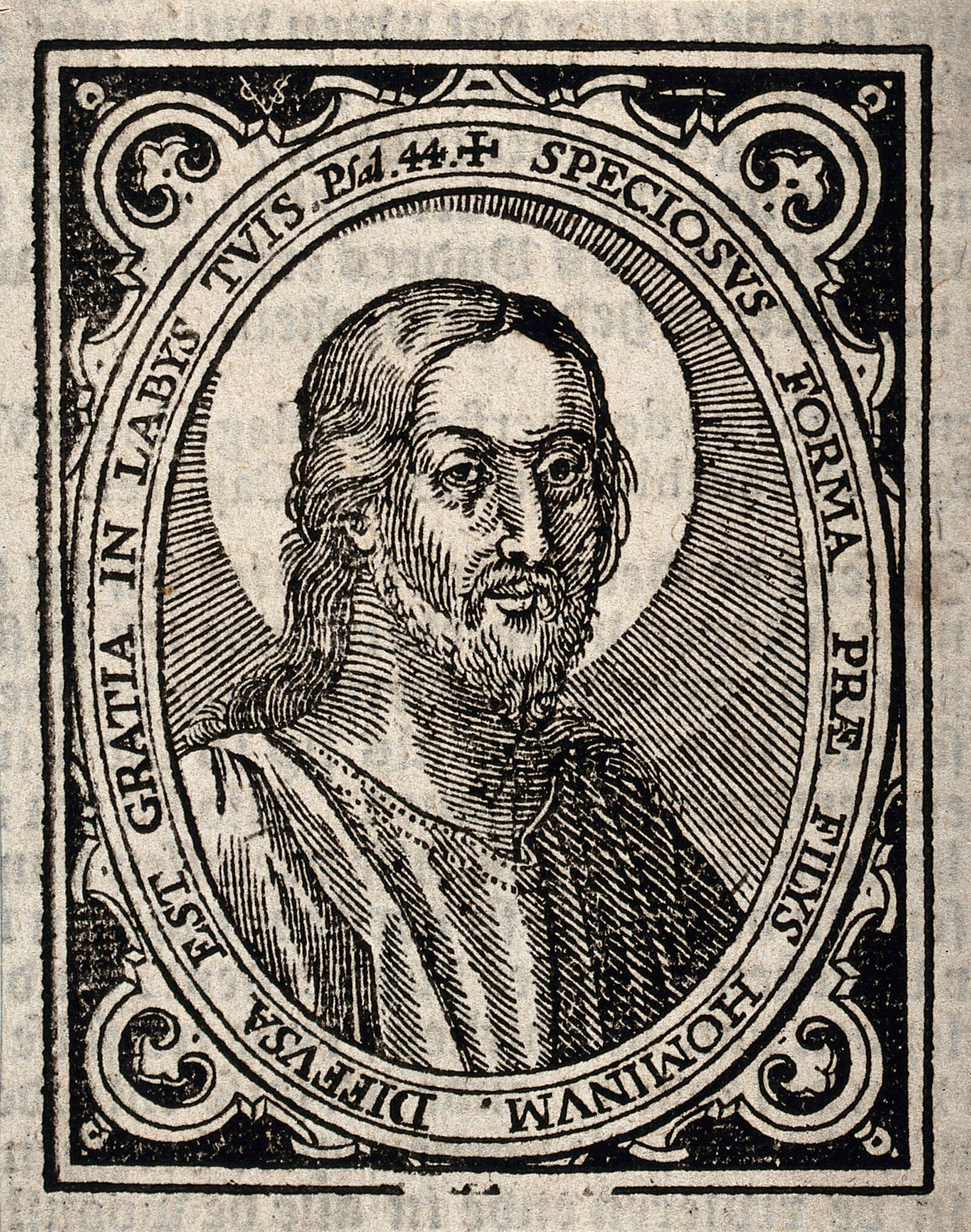
Black and white woodcut print of a bearded man with long hair and a robe, shown in an oval frame with a Latin inscription and ornate decorative corners. The Latin text includes Psalm 44 wording about grace and beauty.Artifact

Secondary source

Jesus Christ, woodcut by Christoffel van Sichem III

Christoffel van Sichem III · c. 1645

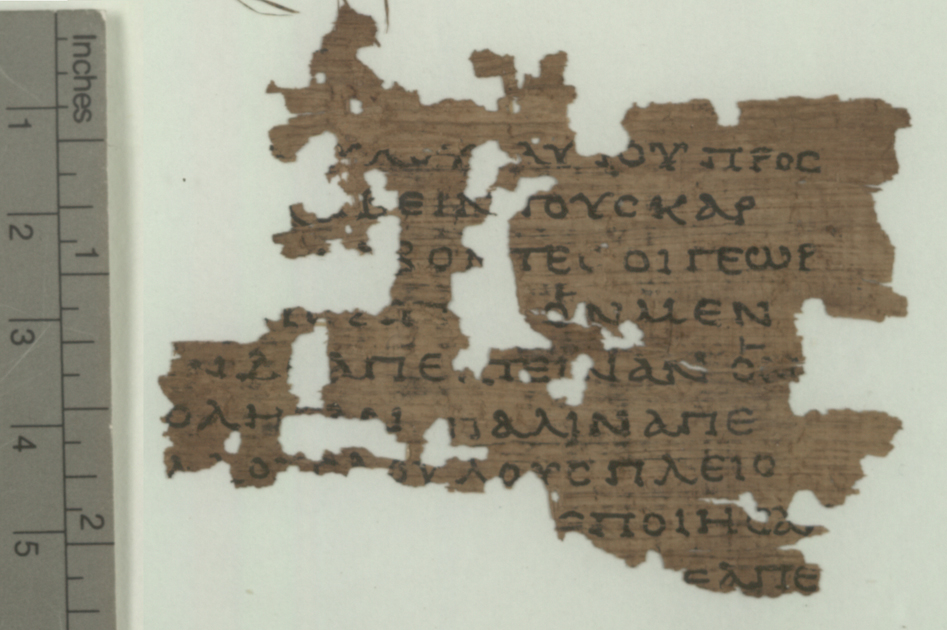
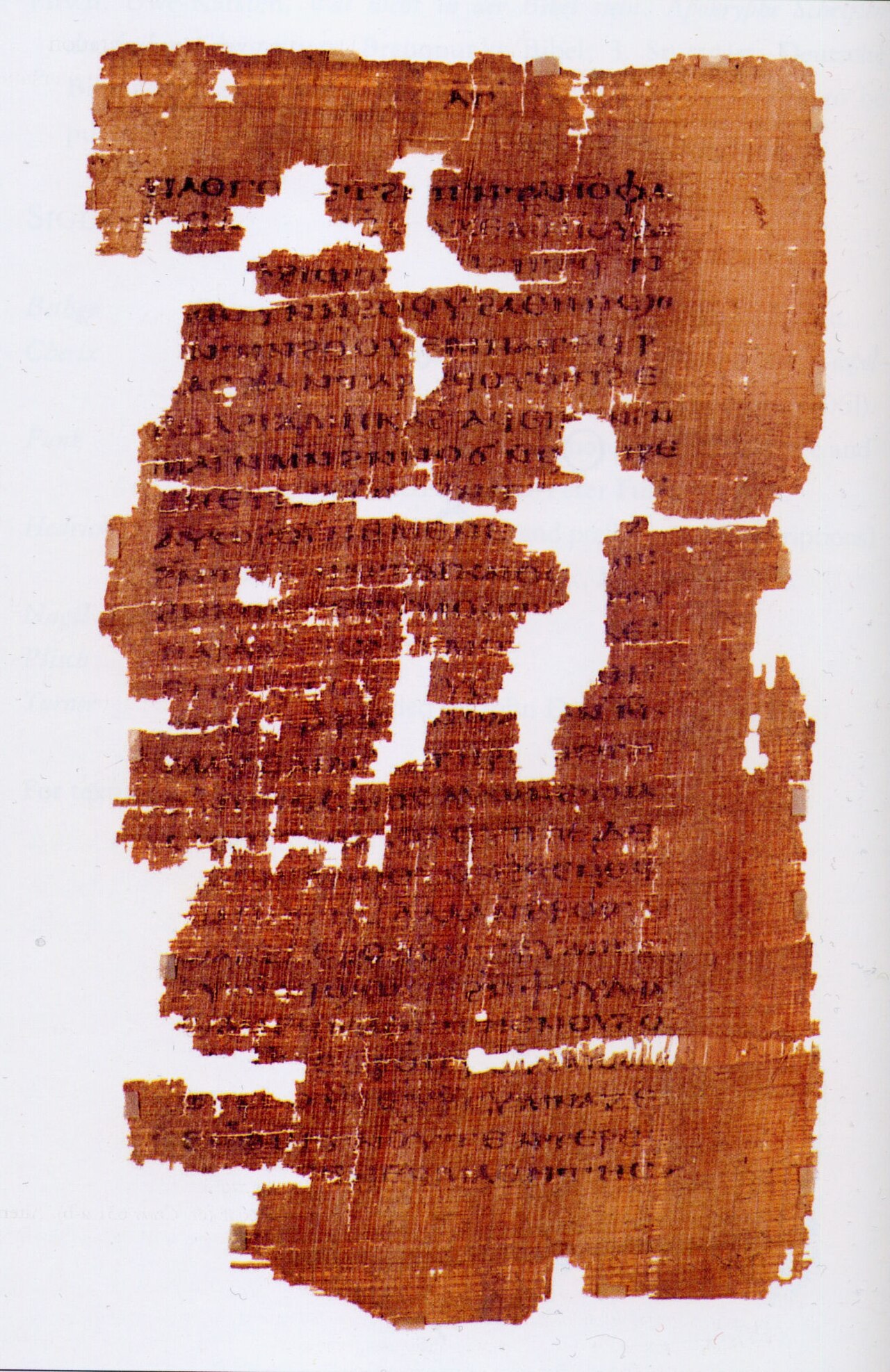
Photograph of a small fragment of ancient papyrus with brown fibrous texture and irregular torn edges, bearing several lines of dark Greek uncial script. A metric ruler labeled inches is at the left edge against a plain white background.Book

Secondary source

Gospel of Matthew

Matthew the Apostle · late 1st century AD

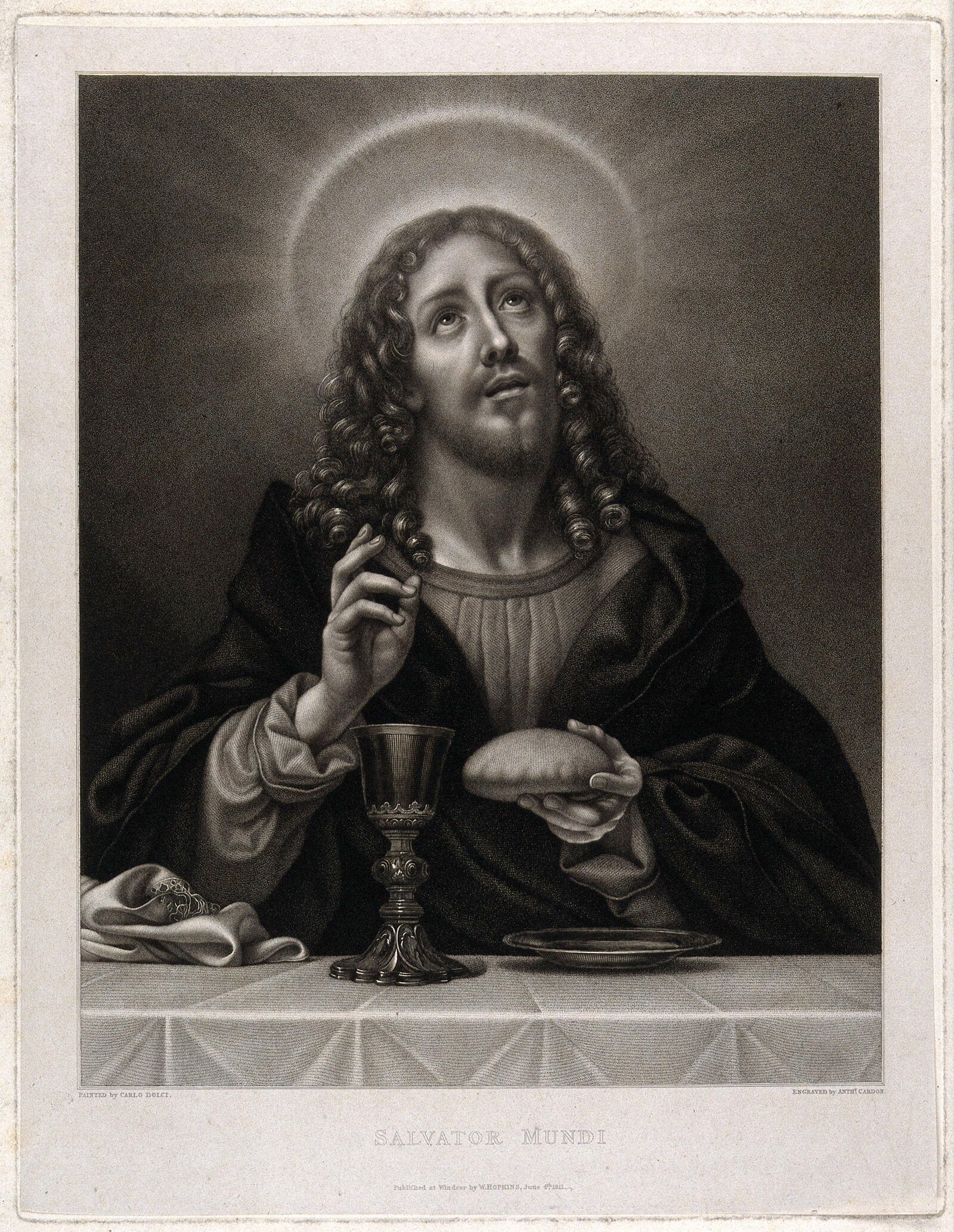
Black-and-white stipple engraving of a bearded man with long curly hair and a halo, gazing upward, one hand raised, the other holding a loaf of bread over a table with a chalice and plate. Titled Salvator Mundi; inscribed painted by Carlo Dolci, engraved by Anth. Cardon, published at Windsor by W. Hopkins, June 4th 1811.Painting

Secondary source

Jesus Christ blessing the Host

Carlo Dolci (painting); Anth. Cardon (engraving) · 4 June 1811

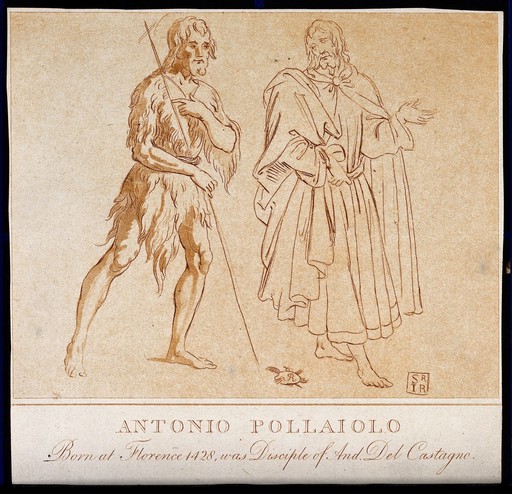
Sepia engraving of two bearded figures on a tan background. On the left, a hairy, partly nude man with a staff and animal-skin garment stands barefoot. On the right, a robed bearded man gestures with one hand. Below is a caption reading Antonio Pollaiuolo, born at Florence 1428, was disciple of Andrea del Castagno.Painting

Secondary source

John the Baptist Meets Jesus Christ

Antonio Pollaiuolo

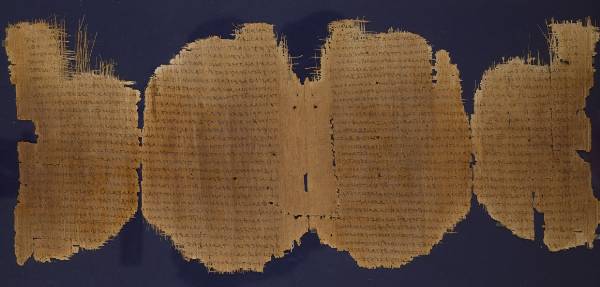
Photograph of a fragmentary papyrus leaf with closely written brown Greek text in many lines, on a dark blue background. The edges are torn and ragged, with several separate sections joined across the image.Book

Secondary source

Gospel of Luke

Luke the Evangelist · c. AD 85

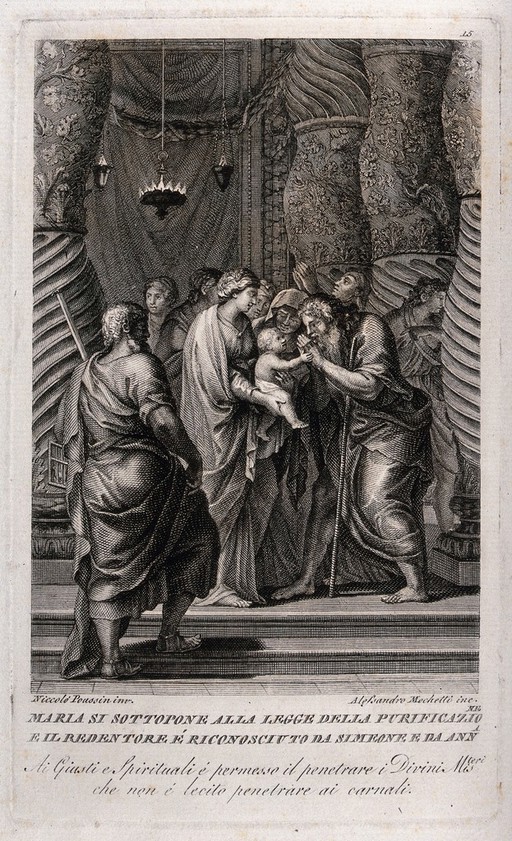
Engraving of the Presentation in the Temple: an elderly bearded man in a robe and cloak leans forward to embrace or bow to an infant held by a woman, while a standing woman in a long draped gown looks on. Other figures, columns, and a hanging drape fill the setting. Italian caption text is printed below the scene.Painting

Secondary source

Simeon Bows to the Infant Jesus

Nicolas Poussin

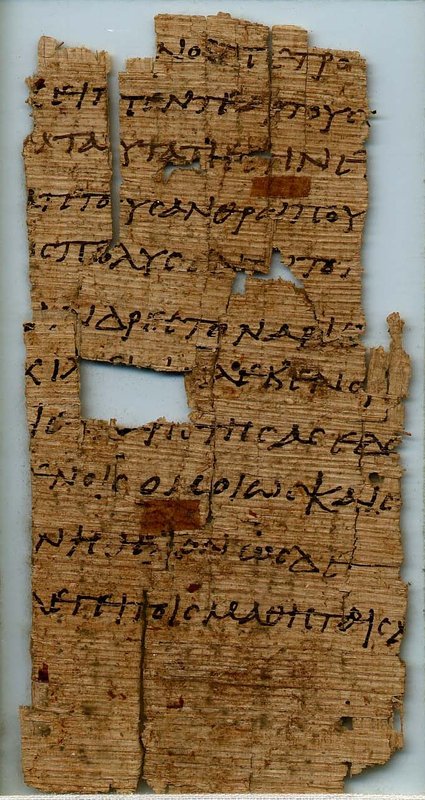
Photograph of a small, damaged papyrus fragment mounted behind glass, showing several lines of dark ink Greek uncial-style text on tan, fibrous papyrus with torn edges and gaps.Book

Secondary source

Gospel of John

John the Evangelist · c. AD 90-100

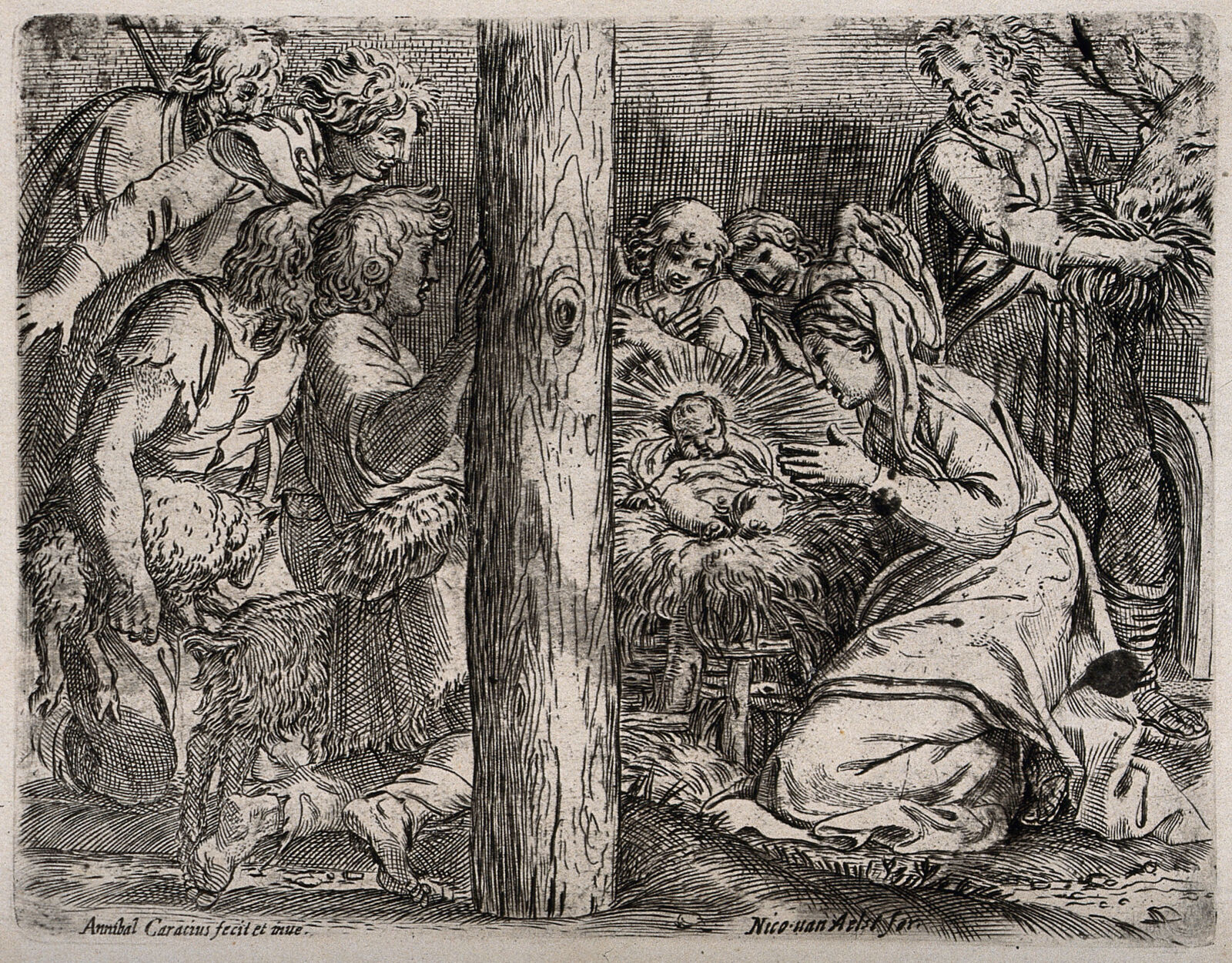
Black and white etching of the Nativity. Shepherds with a lamb and a dog stand at left, angels hover in the upper left. A wooden post divides the scene. At right, Mary kneels beside the newborn Jesus in a manger, haloed in light, while Joseph stands behind her and angels look on. Inscriptions in the lower corners read Annibale Caracci fecit et inue and Nico van Aelst.Painting

Secondary source

The Shepherds Observe the Newborn Jesus Christ

Annibale Carracci · c. 1606

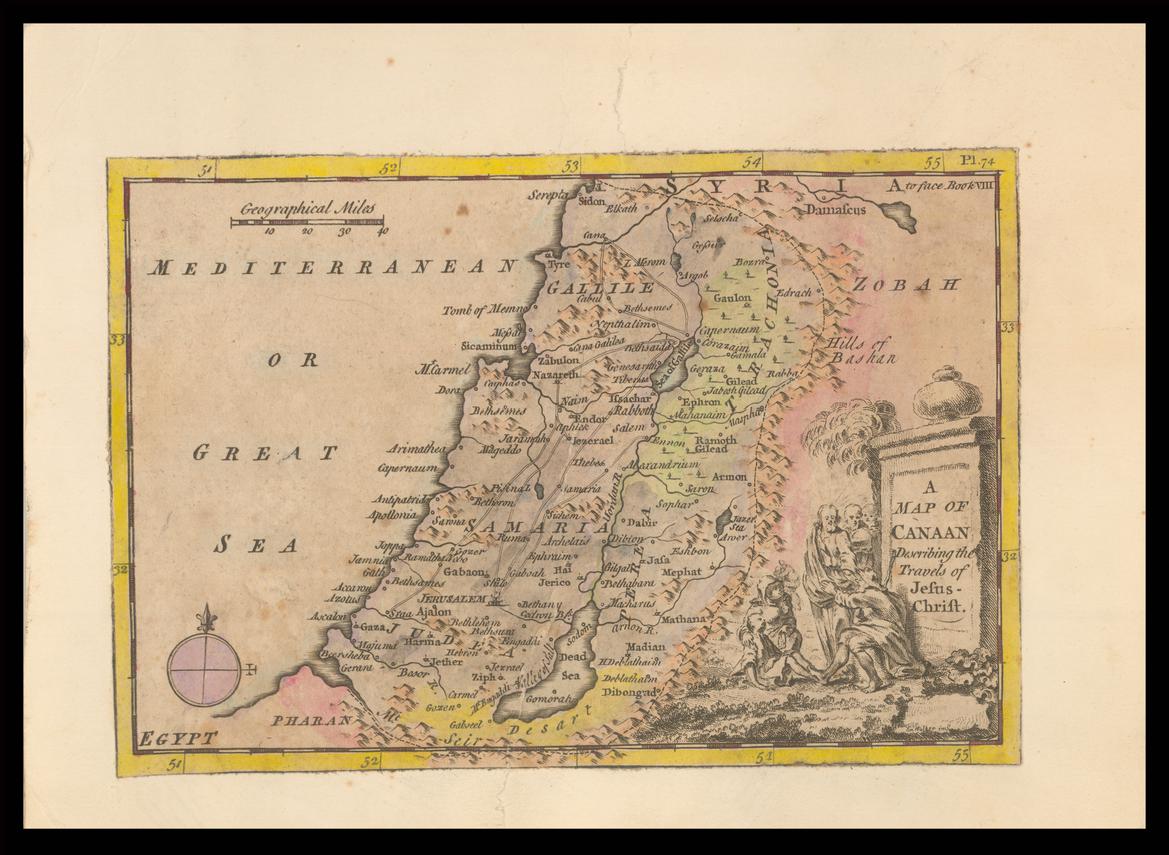
Hand-colored copper-engraved map of Canaan with a yellow decorative border, showing Mediterranean Sea, Galilee, Samaria, Judea, and Syria. Cartouche at right titled 'A Map of Canaan Describing the Travels of Jesus Christ' with an engraved scene of figures.Artifact

Secondary source

Map of Canaan Describing the Travels of Jesus Christ

1750

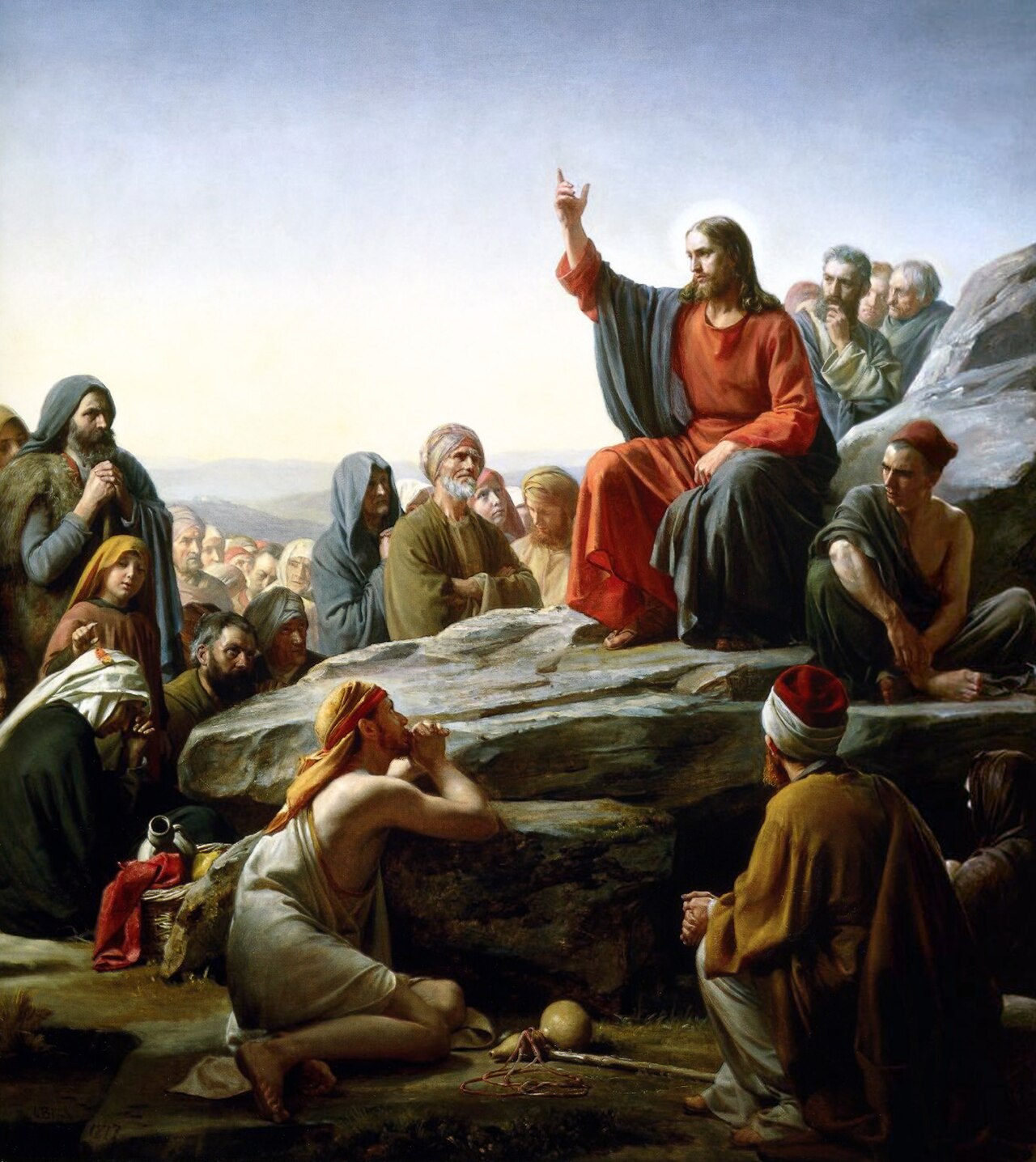
Painting of a bearded man in a red robe and blue cloak seated on a rock, one arm raised, addressing a crowd of robed men and women gathered on hillside rocks under a pale sky.Speech

Primary source

Sermon on the Mount

Jesus Christ · 1st century AD (as recorded in Matthew)

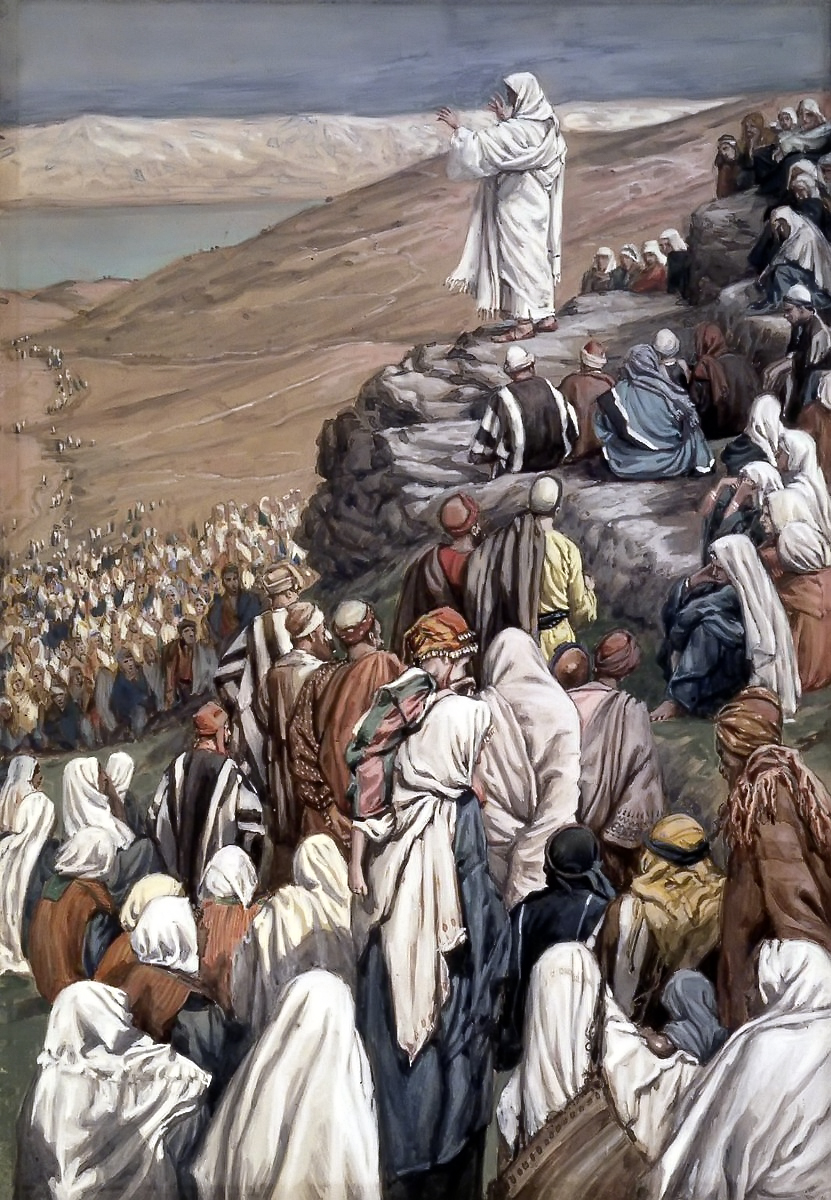
Painting of a robed figure in white standing on a hillside preaching with raised arms, while crowds of people in white and colorful robes sit and stand on rocky slopes listening, with a lake and distant mountains behind.Speech

Secondary source

Beatitudes

Jesus Christ · 1st century AD

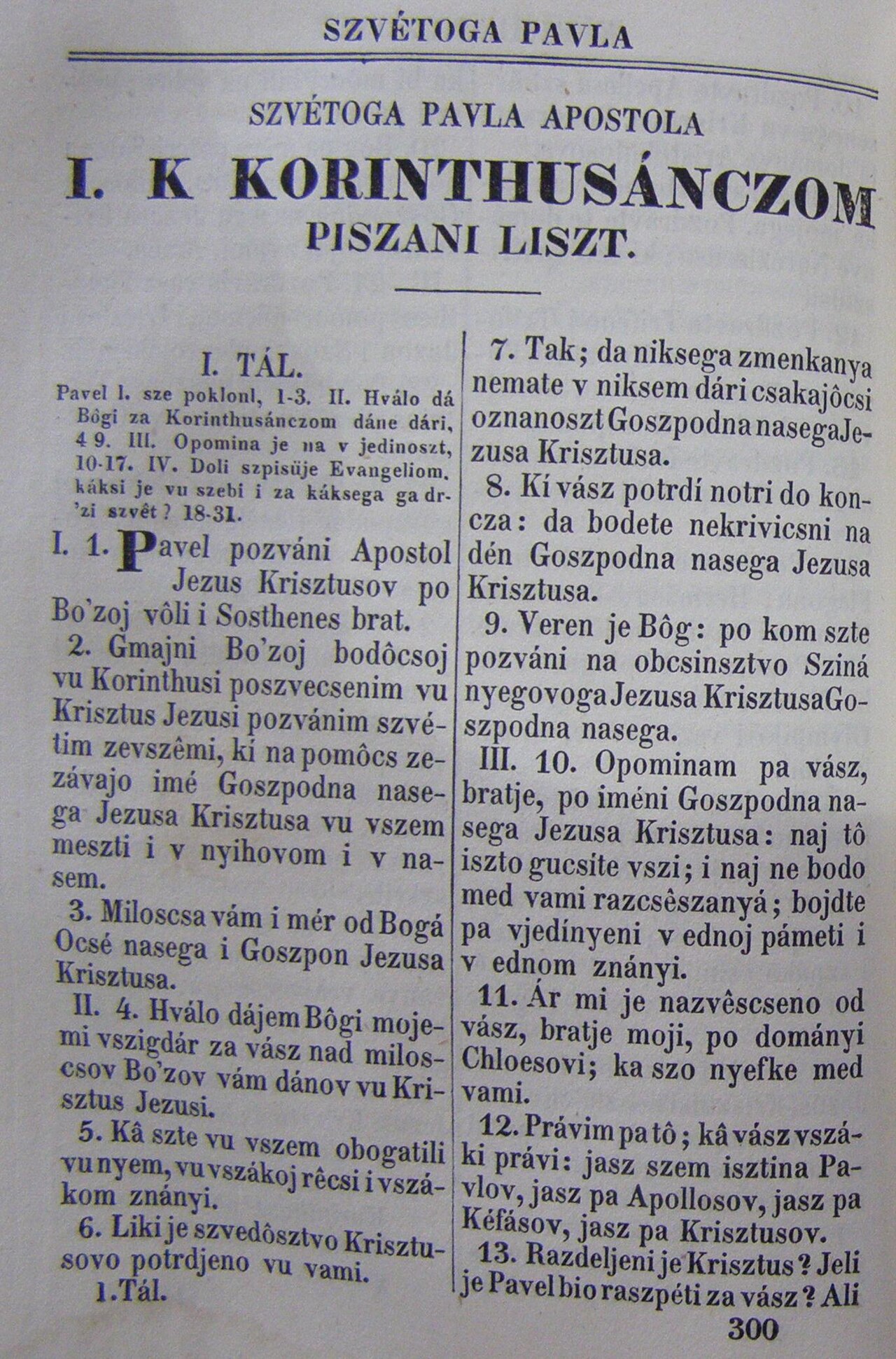
Page 300 of the 1848 Prekmurian New Testament, headed 'Szvétoga Pavla Apostola I. K Korinthusánczom Piszani Liszt' with two columns of Prekmurian Slovene text, chapter 1 verses 1 to 13.Letter

Secondary source

First Epistle to the Corinthians

Paul the Apostle · c. 54 AD

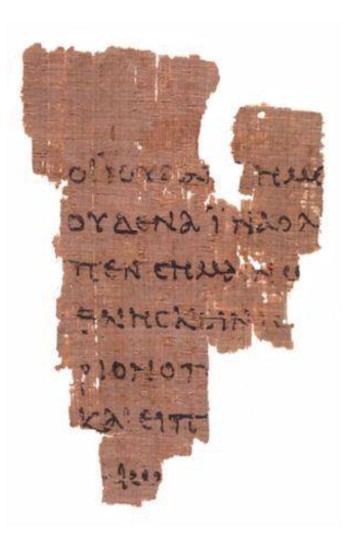
Photograph of a small fragment of brownish papyrus with several lines of black Greek uncial script on the recto, with torn and irregular edges and a smaller piece at upper right.Document

Secondary source

Rylands Library Papyrus P52

c. 125-175 AD

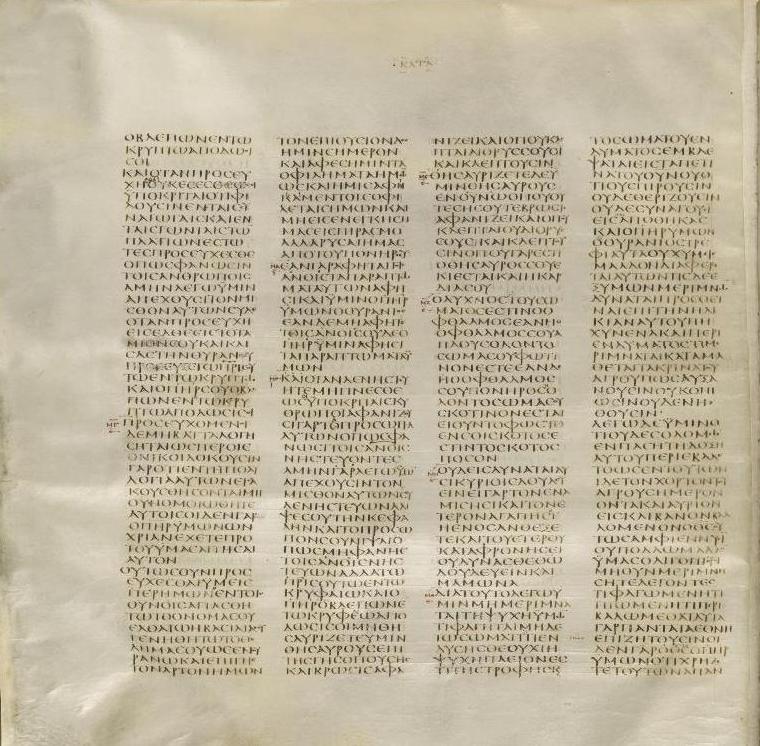
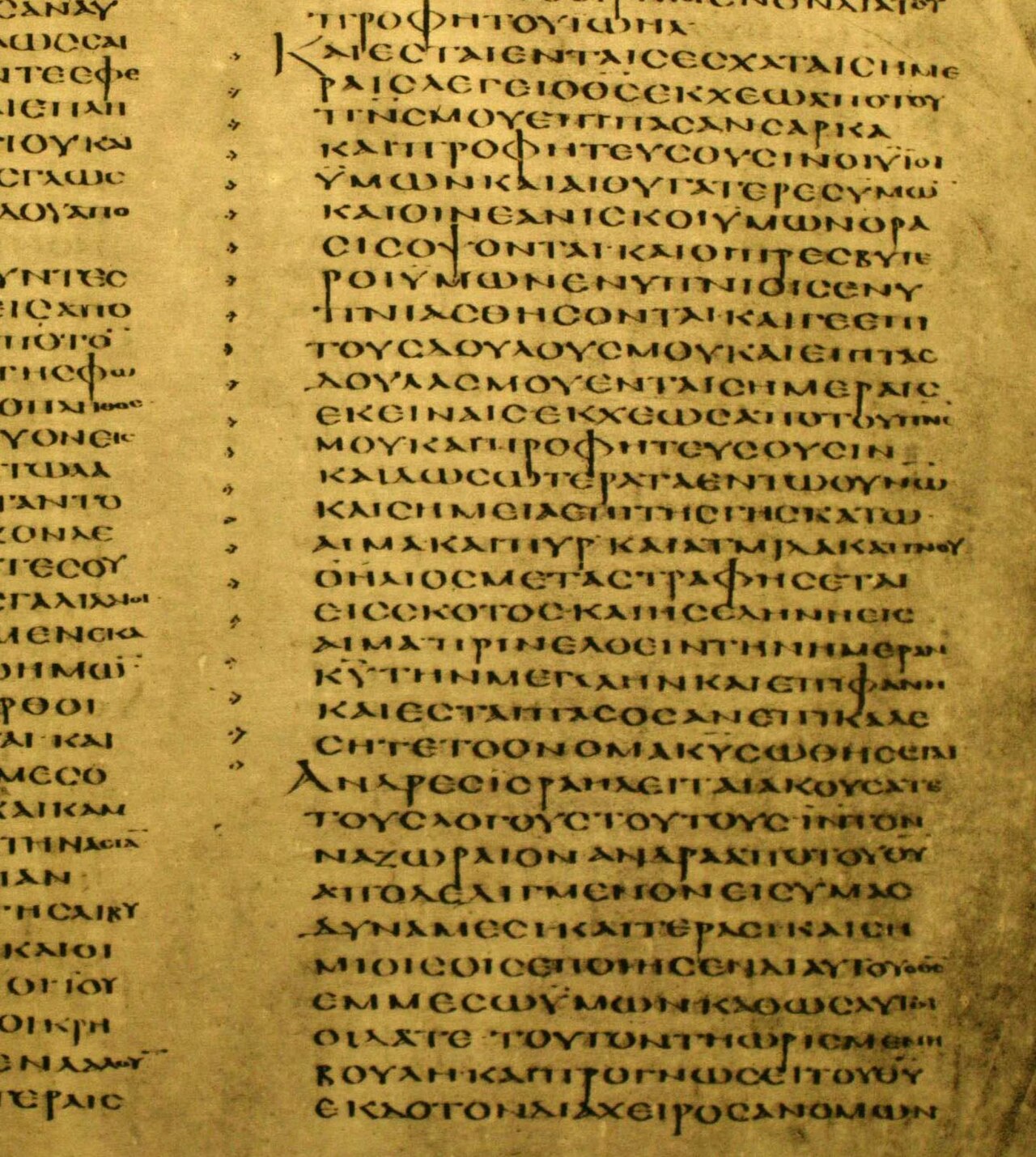
Manuscript page of Codex Sinaiticus: four columns of dense Greek uncial script on aged parchment, with a small heading mark at the top center. Text is in faded brown ink.Book

Secondary source

Codex Sinaiticus

mid-4th century AD

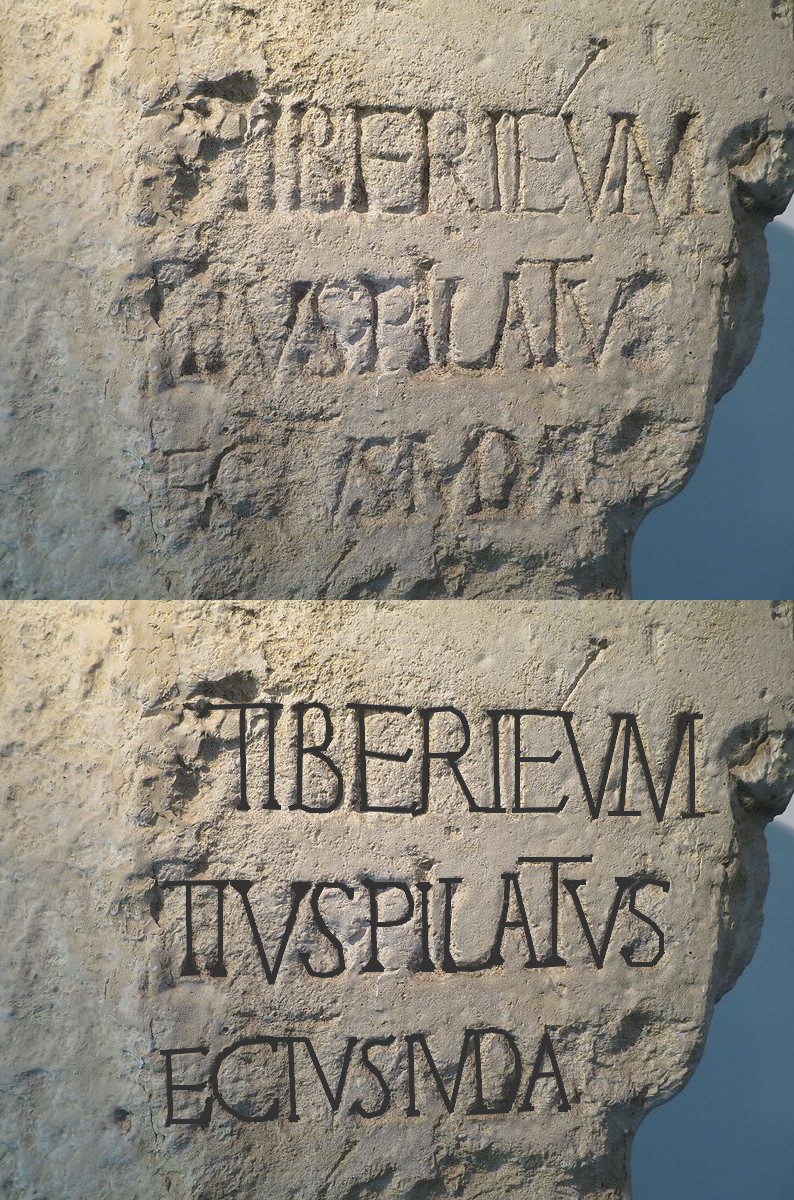
Close-up of a carved stone inscription in Latin capitals, shown twice: the top half is the weathered original and the bottom half has the letters outlined. Lines read TIBERIEM, TIVSPILATVS, ECTVSMDA.Artifact

Primary source

Pilate Stone

1st century AD

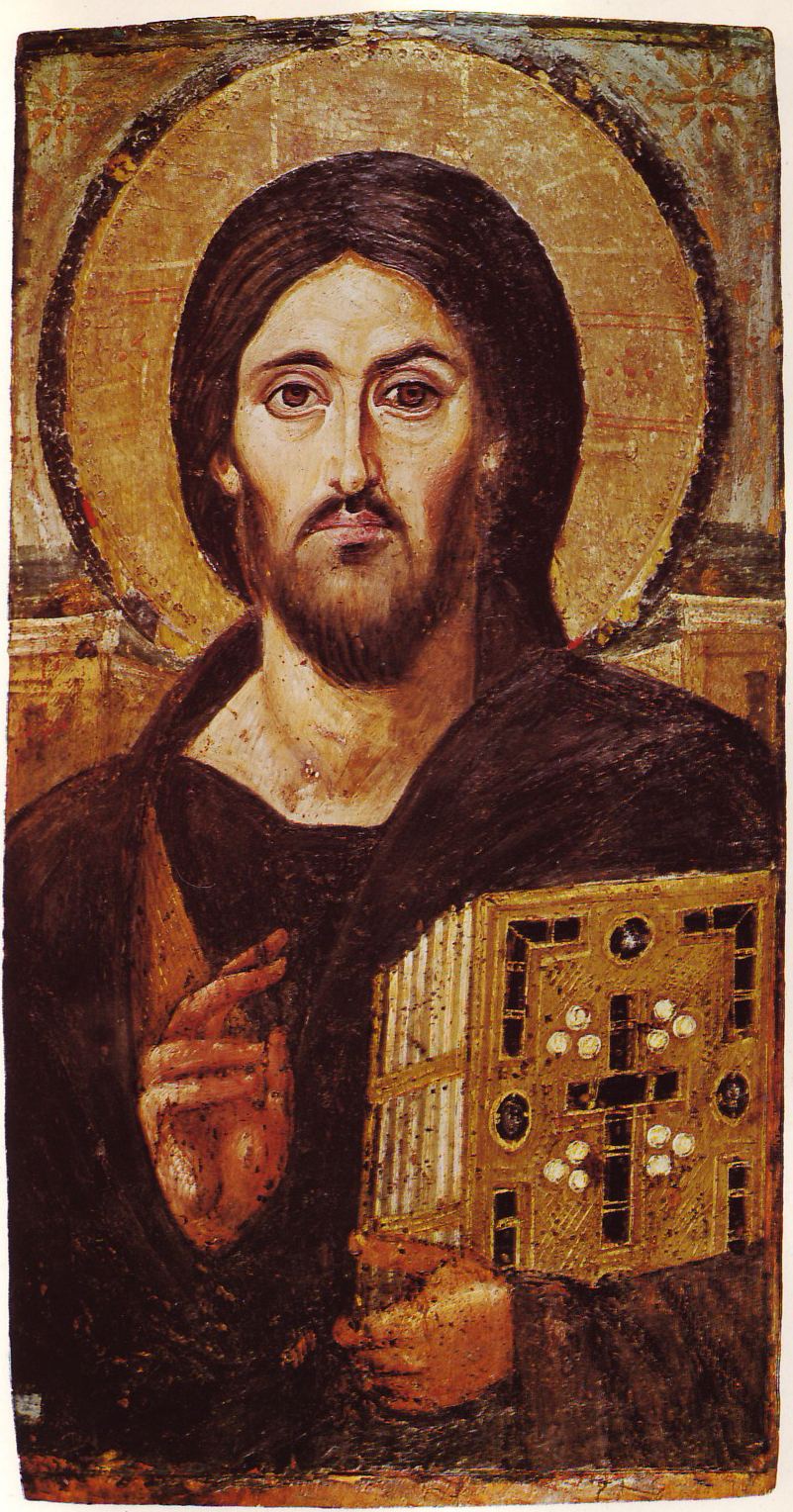
Encaustic icon of a bearded Christ with dark hair and a golden halo, wearing a dark robe, raising his right hand and holding a jeweled golden book with his left hand against a gold background.Painting

Secondary source

Christ Pantocrator (Sinai)

c. 6th century AD

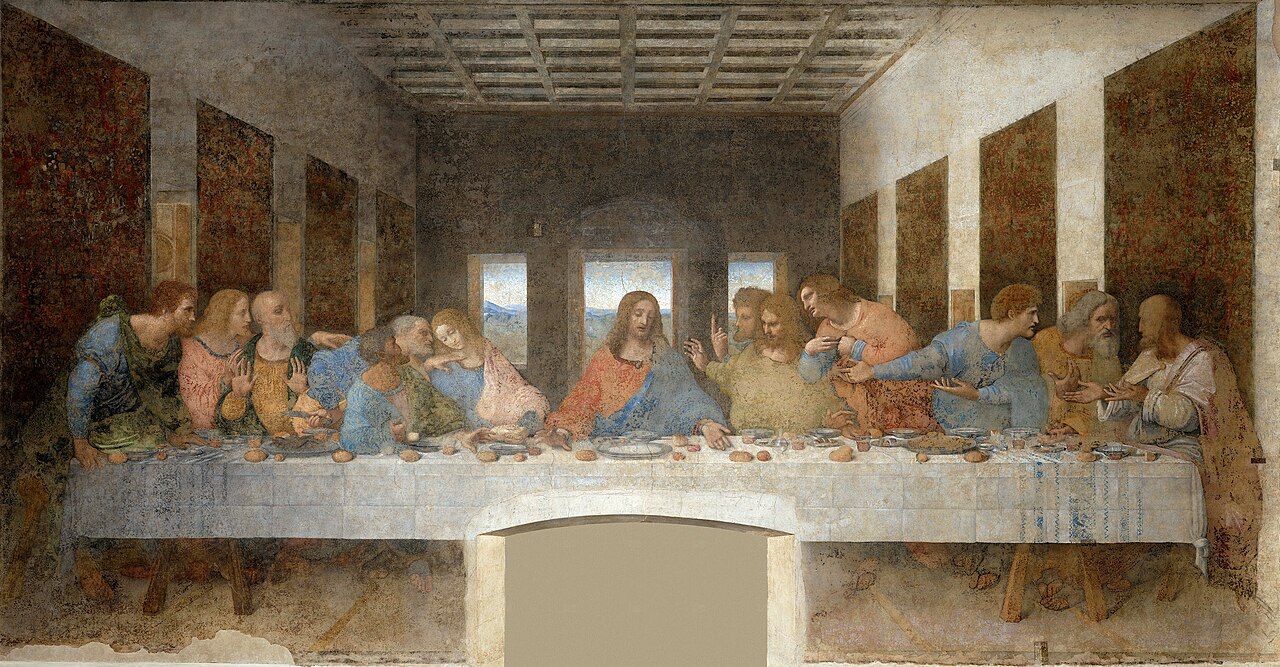
Mural painting of the Last Supper showing Jesus seated at the center of a long table with twelve disciples in groups of three on either side, with bread and dishes on the table. Coffered ceiling and windows visible in the room.Painting

Primary source

The Last Supper

Leonardo da Vinci · c. 1495-1498

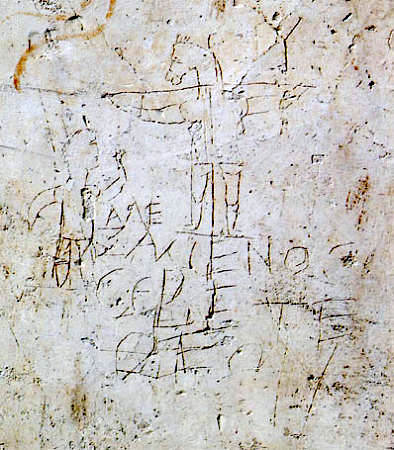
Faded scratched graffiti on pale plaster showing a crude figure on a cross-like shape with a human figure beside it, and Greek letters below reading roughly as a name with a mocking inscription. The surface is weathered and cracked.Artifact

Secondary source

Alexamenos Graffito

c. 100-200

Close-up of a page of the Codex Alexandrinus, an ancient parchment manuscript in uncial Greek script with columns of dense capital letters, marginal marks and a few decorative stroke marks. The text is Greek, consistent with the Acts of the Apostles passage.Book

Secondary source

Acts of the Apostles

Luke the Evangelist · c. 80-90 AD

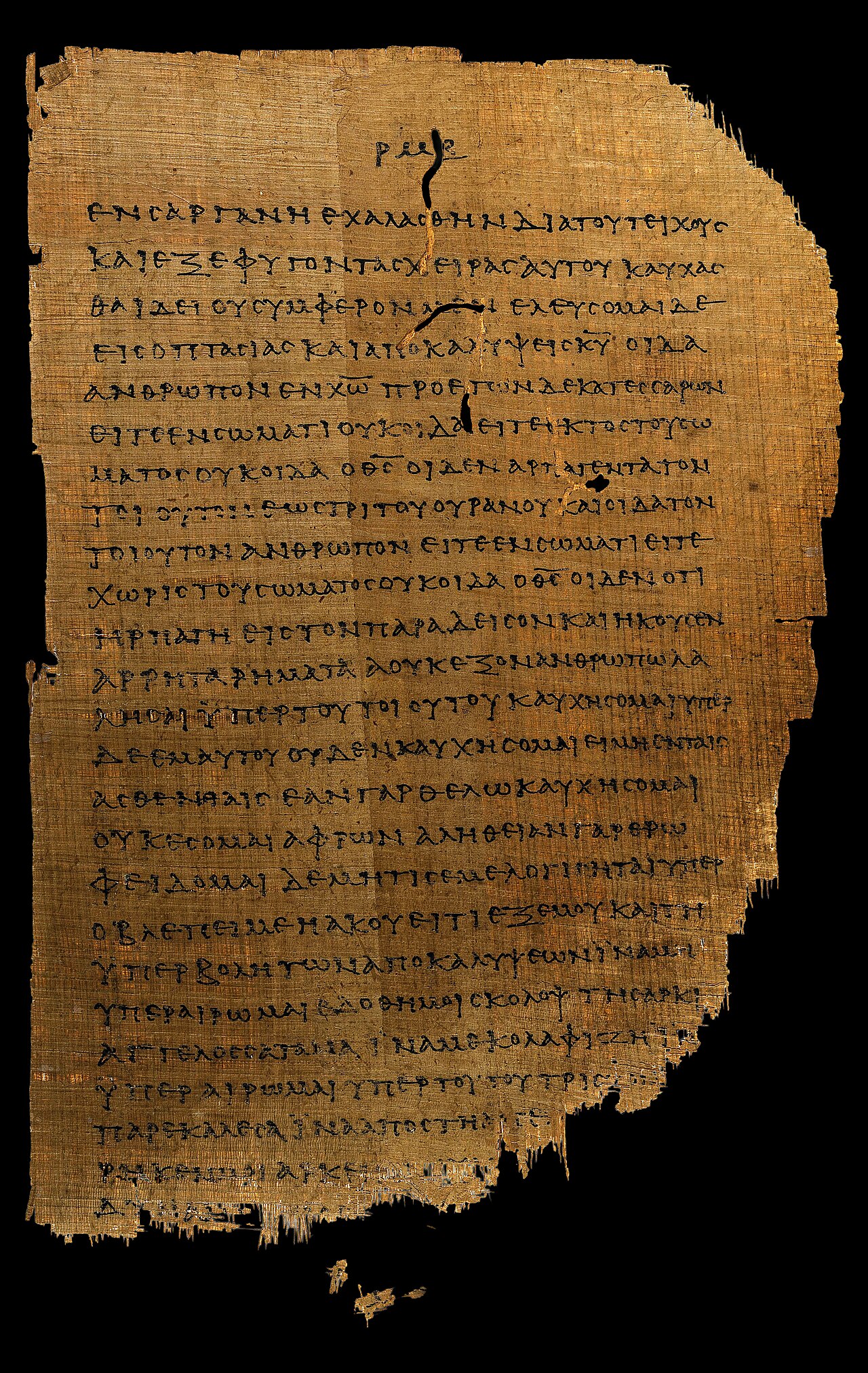
Photograph of a fragmentary, tan papyrus leaf with dark brown ink lines of Greek uncial-style text in neat columns, set against a black background. The torn edges are irregular and a small fragment sits below the main leaf.Document

Secondary source

Papyrus 46

c. 175-225 AD

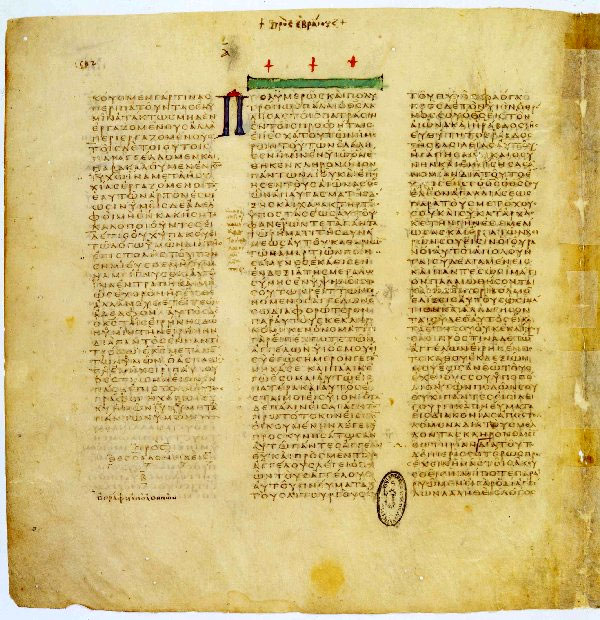
Photograph of a leaf from the Codex Vaticanus, an ancient Greek uncial manuscript. Aged, yellowish parchment with three columns of brown Greek text, a decorated green heading bar with red marks, a large ornamental initial letter, and a small oval seal stamp near the bottom.Document

Secondary source

Codex Vaticanus

4th century AD

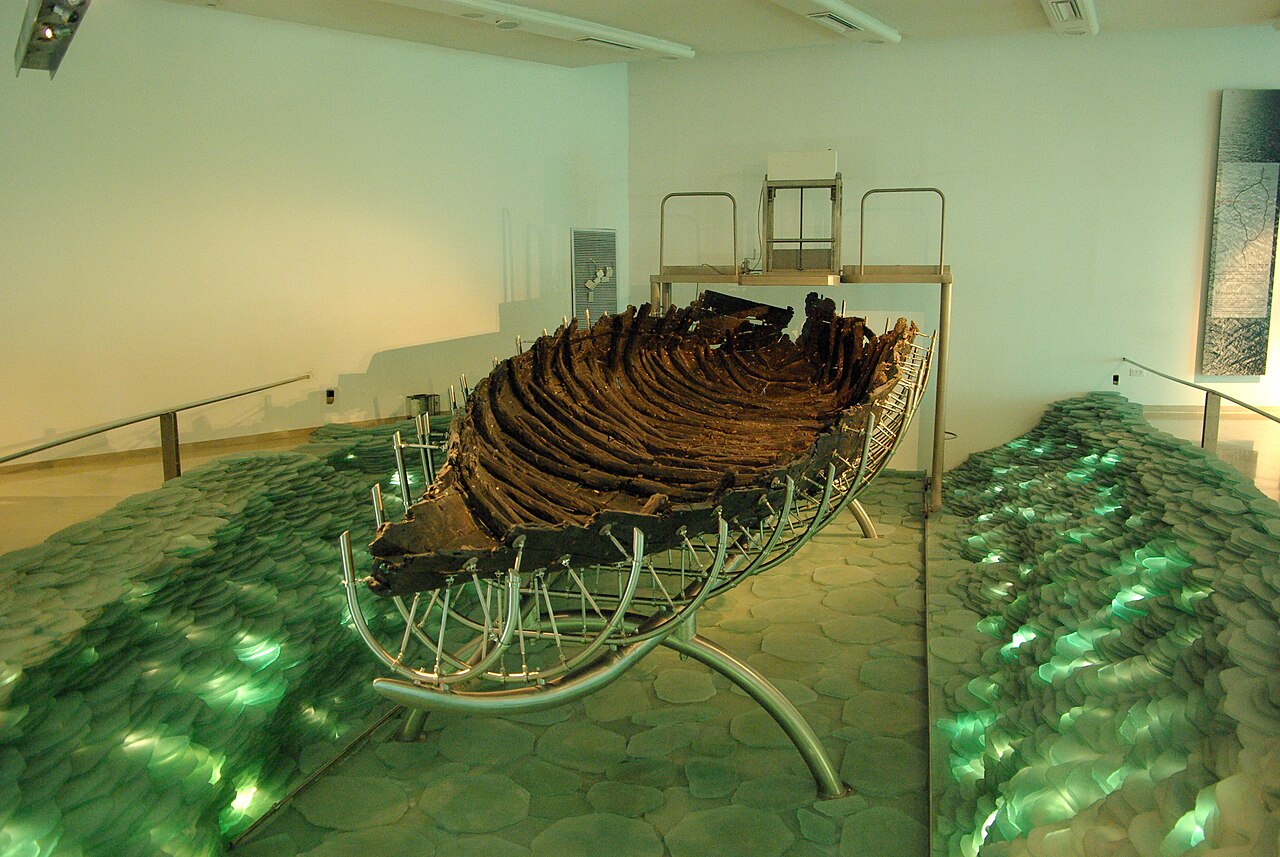
A dark, weathered ancient wooden boat hull displayed on a metal cradle support inside a museum gallery. Its ribs and planks are visible, and the floor beneath is covered with glowing green glass-like stones.Artifact

Primary source

Sea of Galilee Boat

c. 50 BC - 50 AD

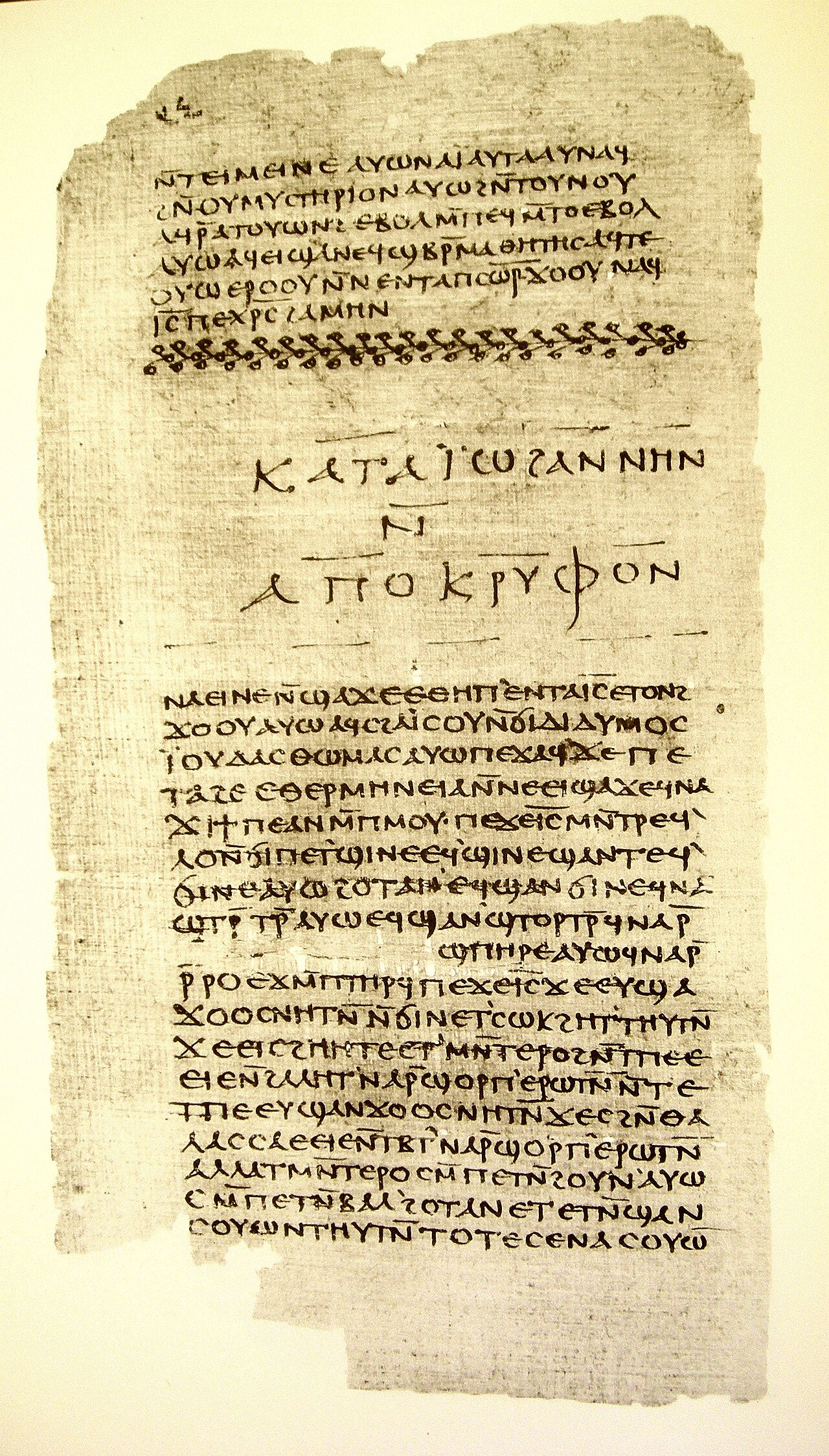
A torn, yellowed papyrus leaf with dark ink text in several lines of Greek-style letters. A large centered heading reads 'KATA IWANNHN APOKRYFON' above a block of text. Decorative vine-like line at top.Book

Secondary source

Gospel of Thomas

c. 100-340 AD (manuscript copy)

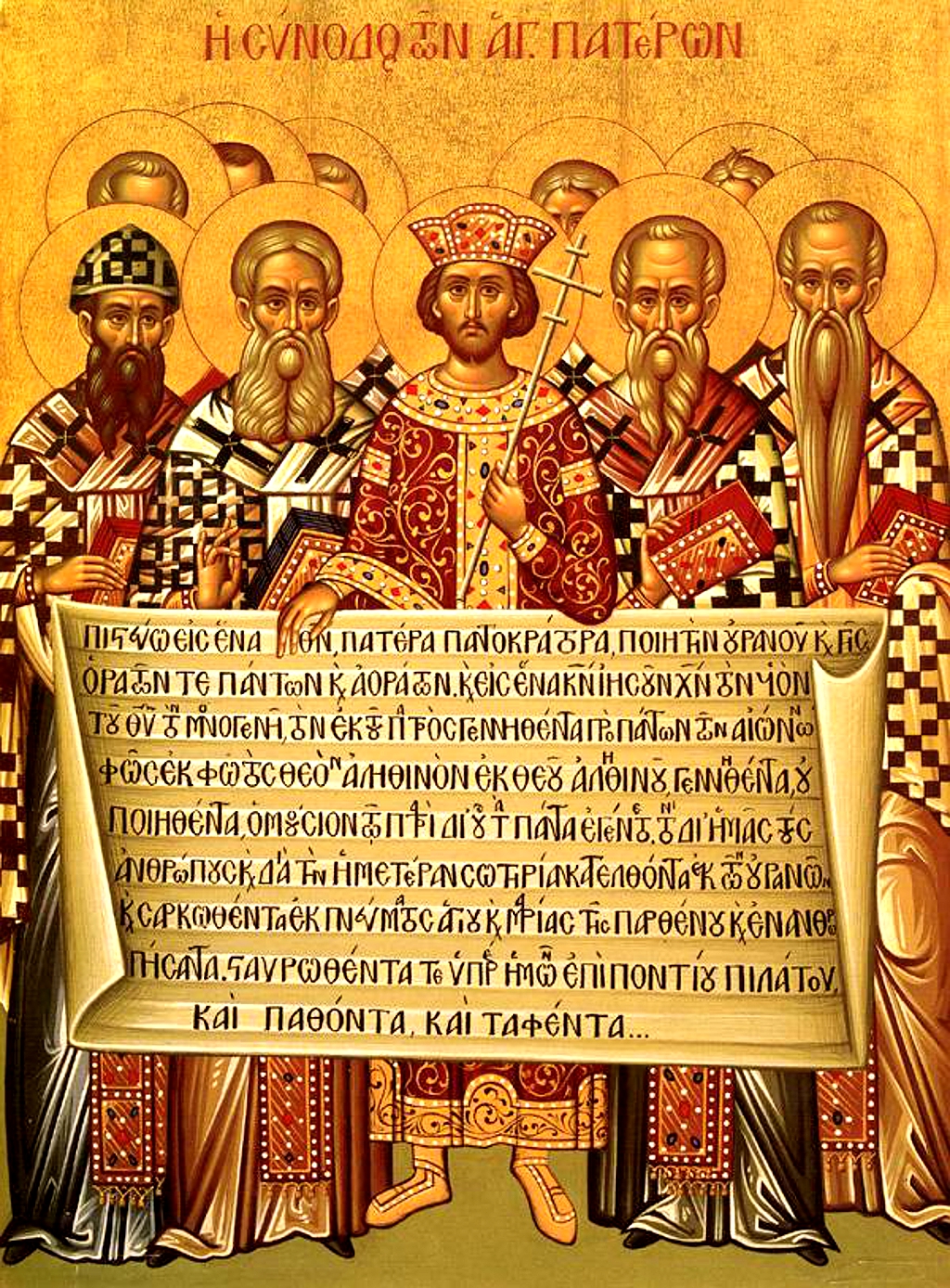
Gold-background Byzantine-style icon titled in Greek. Crowned emperor in red robe holds a scepter at center, flanked by bishops with halos and beards. Bishops hold books. A large scroll with Greek text is held across the bottom.Document

Primary source

Nicene Creed

First Council of Nicaea · 325 AD

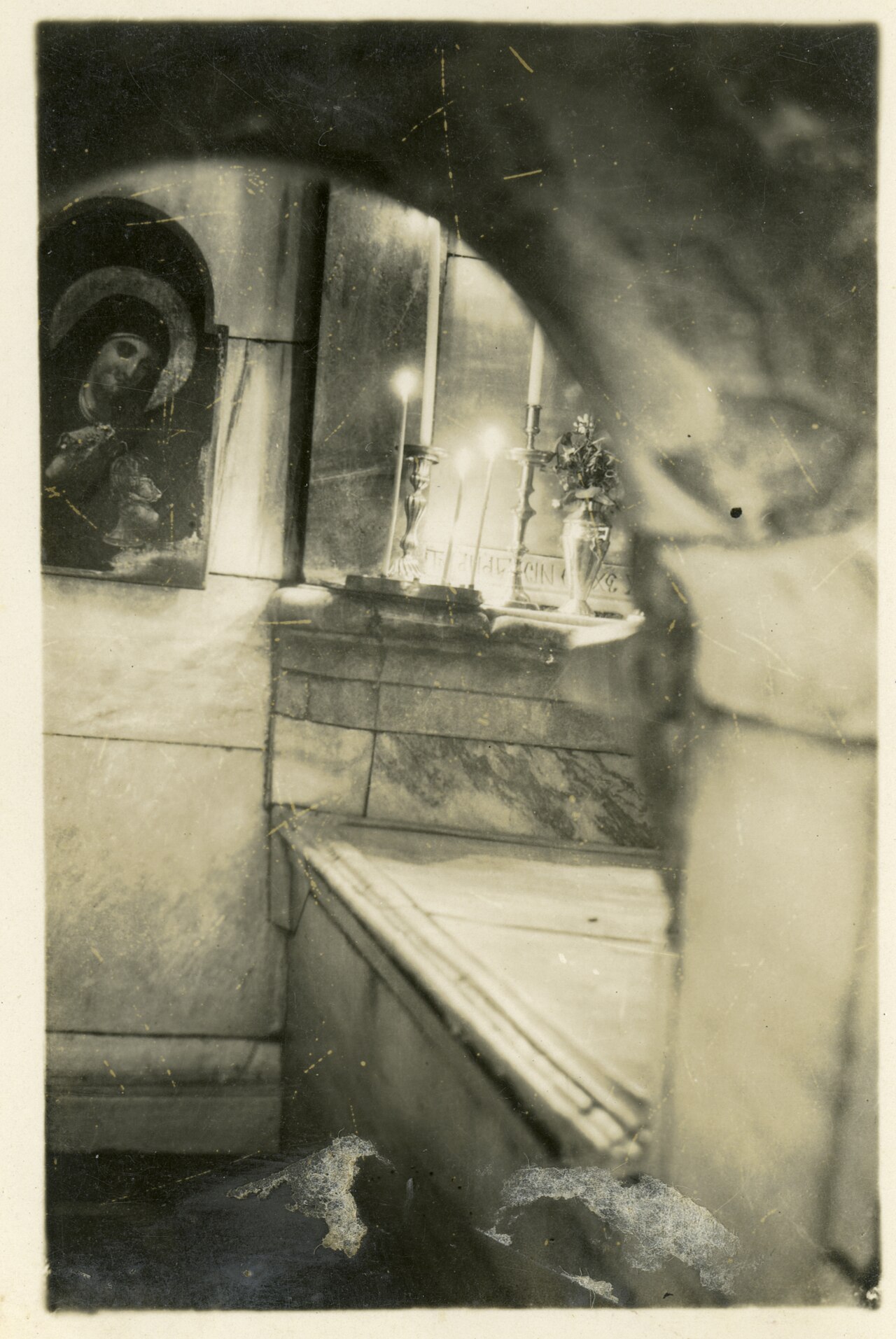
Sepia photograph of a stone interior with an icon of the Virgin Mary on the left, a stone ledge, and a marble-covered shelf holding lit candles, candlesticks, and a flower vase beneath an arched opening.Artifact

Secondary source

Tomb of Jesus (Church of the Holy Sepulchre)

Site identified c. 325; photograph c. 1941-1944

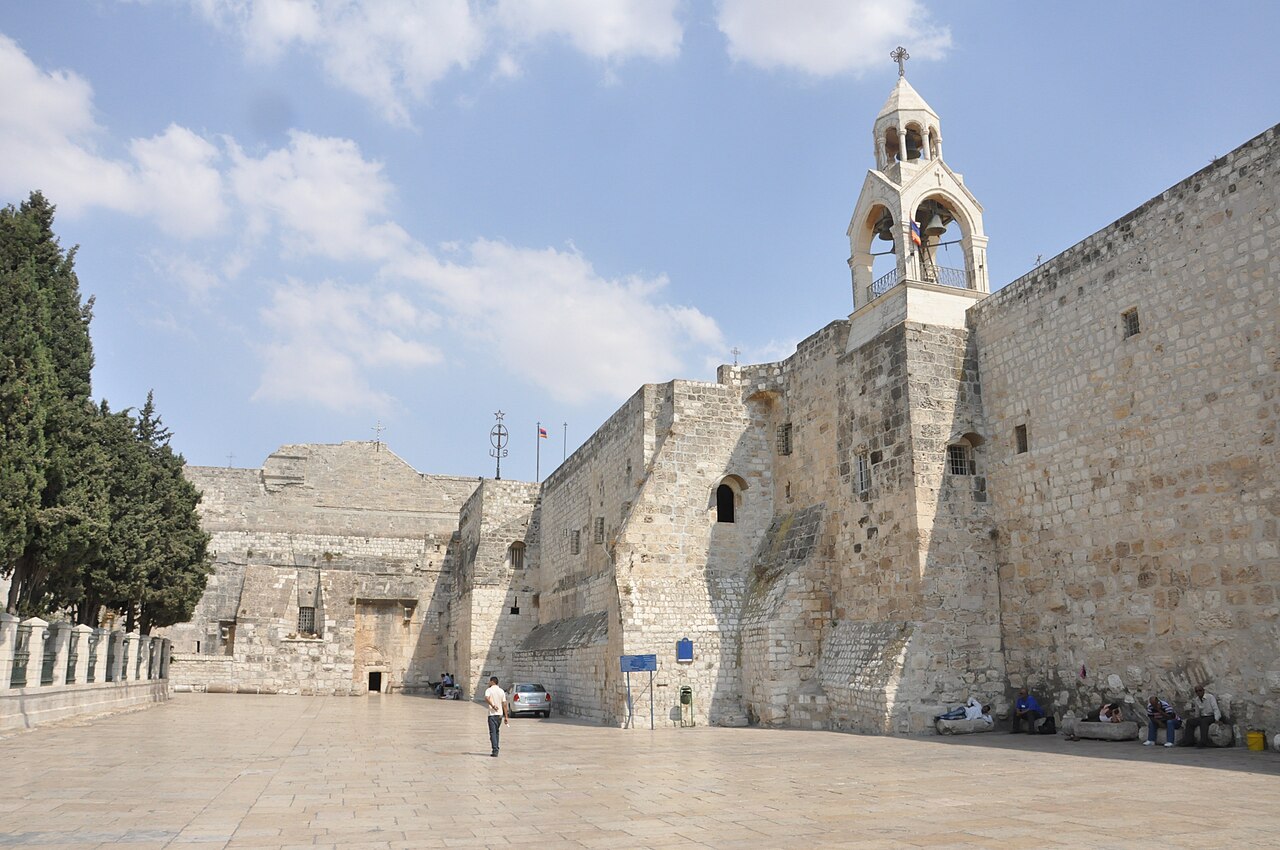
Exterior of the Church of the Nativity in Bethlehem: a large limestone stone facade with a bell tower topped by a cross, set across an empty stone-paved square under a partly cloudy sky. Cypress trees stand at left and a few people sit near the wall at right.Artifact

Secondary source

Church of the Nativity

Constantine the Great and Helena · c. 327 AD (basilica founded)

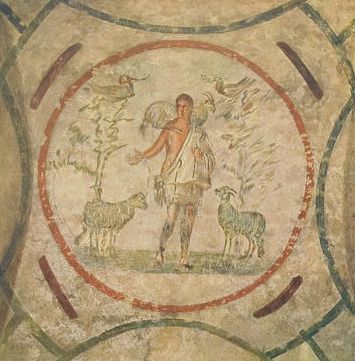
Fresco in a circular medallion on a ceiling: a man in a short tunic carries a ram on his shoulders, flanked by two sheep, with trees and birds in the background, set within a painted frame with dark red and green borders.Painting

Primary source

Good Shepherd fresco, Catacomb of Priscilla

Early Christian community of Rome · c. 200-300 AD

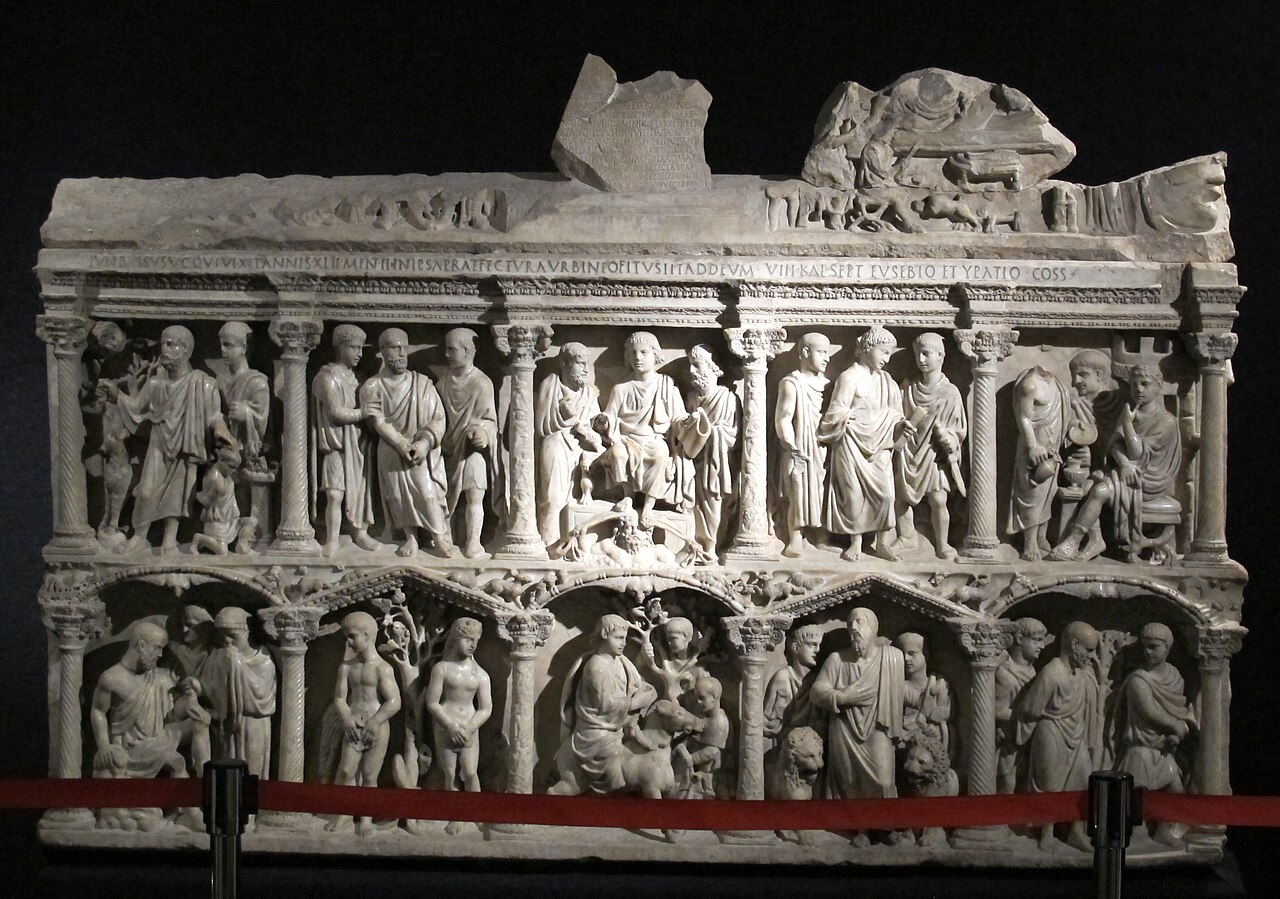
Photograph of the Sarcophagus of Junius Bassus, a marble Roman sarcophagus with two tiers of carved relief scenes of figures, columns and arches, displayed behind a red barrier rope.Sculpture

Primary source

Sarcophagus of Junius Bassus

c. 350 AD

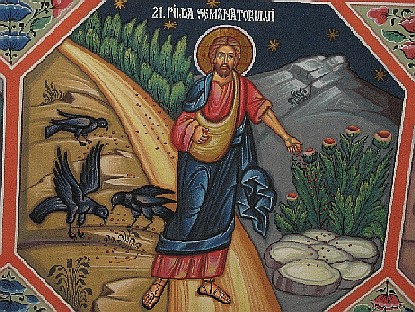
Painted icon in bright colors with a red-and-gold border. A haloed figure in a blue robe and red garment walks along a pale path. Three black birds are at left, and red-flowered plants and gray rocks are at right. Romanian inscription at top: 21 PILDA SEMATORULUI.Speech

Primary source

Parable of the Sower

Jesus Christ · 1st century AD

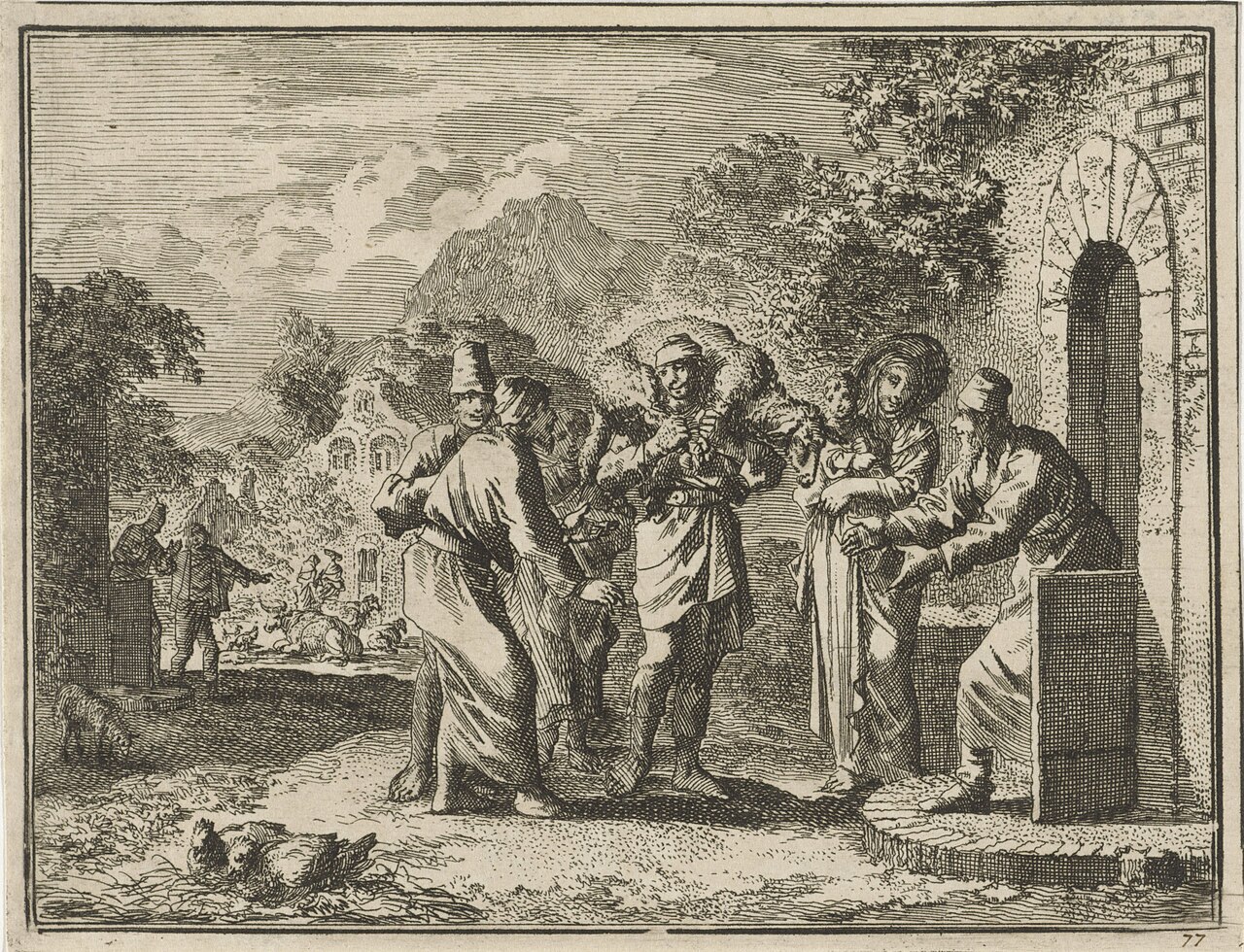
Engraving of a biblical scene: a shepherd in a long robe embraces a man at left, a man with a sheep on his shoulders stands center, and a woman with a child and a seated man stand at a doorway at right. Hens, a sheep, and distant figures appear in a landscape.Speech

Primary source

Parable of the Lost Sheep

Jesus Christ · 1st century AD

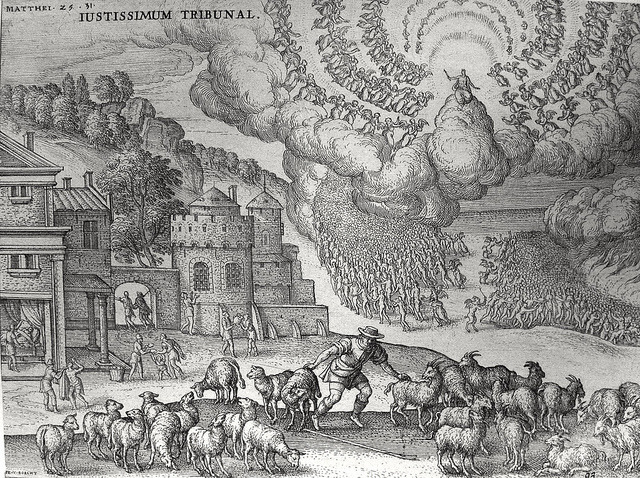
Engraving titled 'JUSTISSIMUM TRIBUNAL' with 'MATTHEI 25' inscribed. Above, clouds and a figure in glory separate crowds; on the left, a shepherd drives sheep past a town, while goats are gathered at right beside a crowd heading toward a fiery cloud.Speech

Primary source

Parable of the Sheep and the Goats

Jesus Christ · c. 30 AD (written c. 80-90)

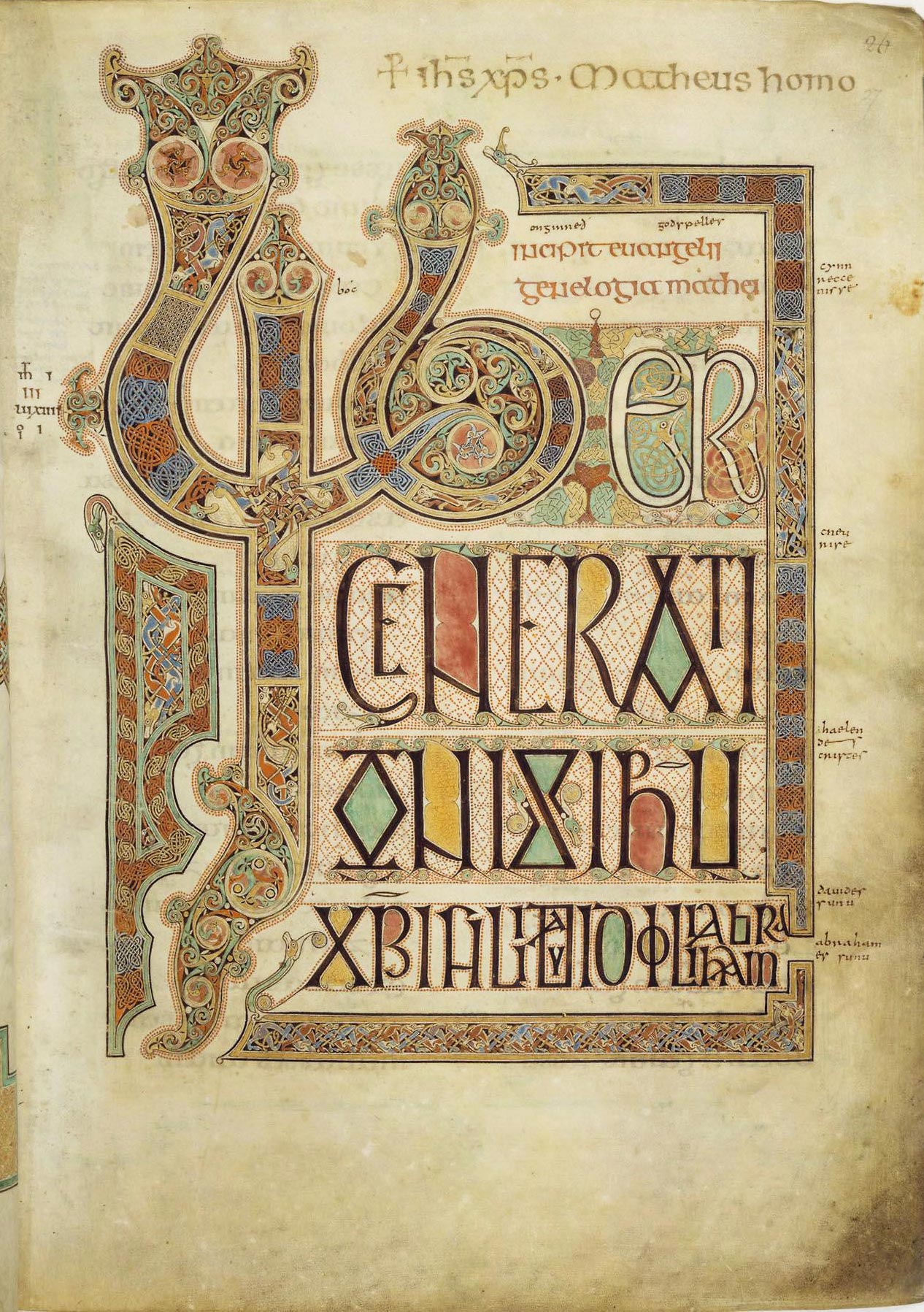
Illuminated manuscript page with large decorated initial letters in interlace knotwork, spirals and animal forms in red, green, blue and yellow. Below, large capital script reads the opening words of a Gospel. Smaller red text sits at the top right.Book

Secondary source

Lindisfarne Gospels

Eadfrith of Lindisfarne · c. 700-720

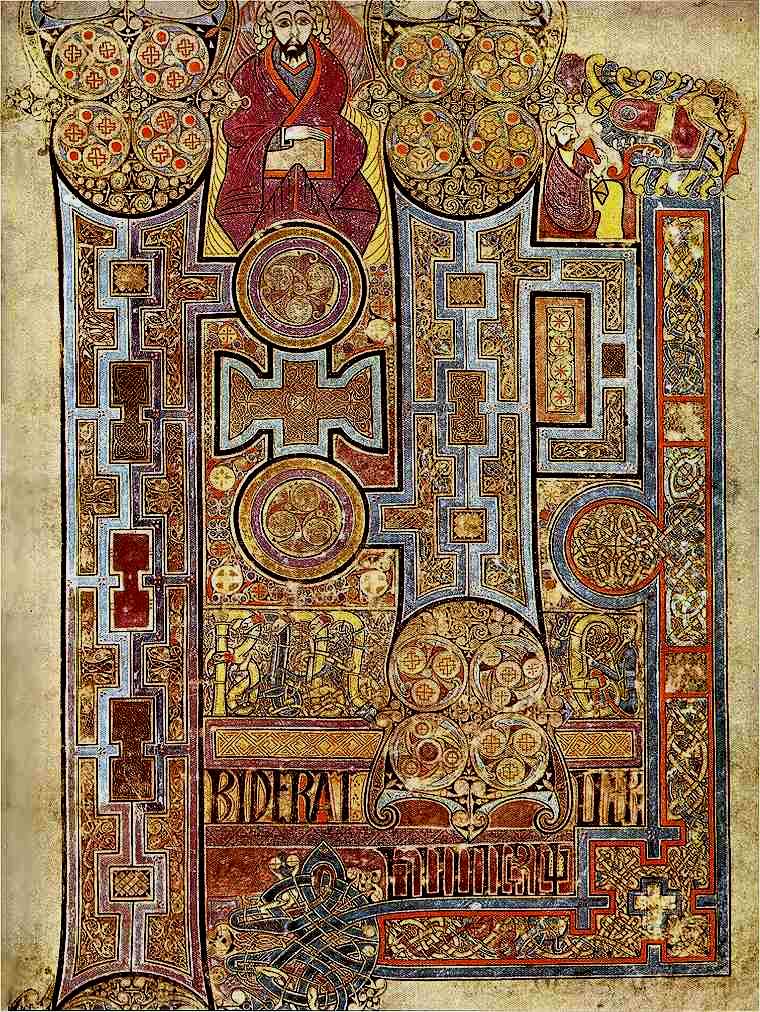
A richly decorated manuscript page with interlaced knotwork, spirals, and geometric panels in red, blue, yellow and green. A small seated figure at top, and the word BIDERAT in large letters near the bottom, with ornamented initials.Book

Secondary source

Book of Kells

c. 800

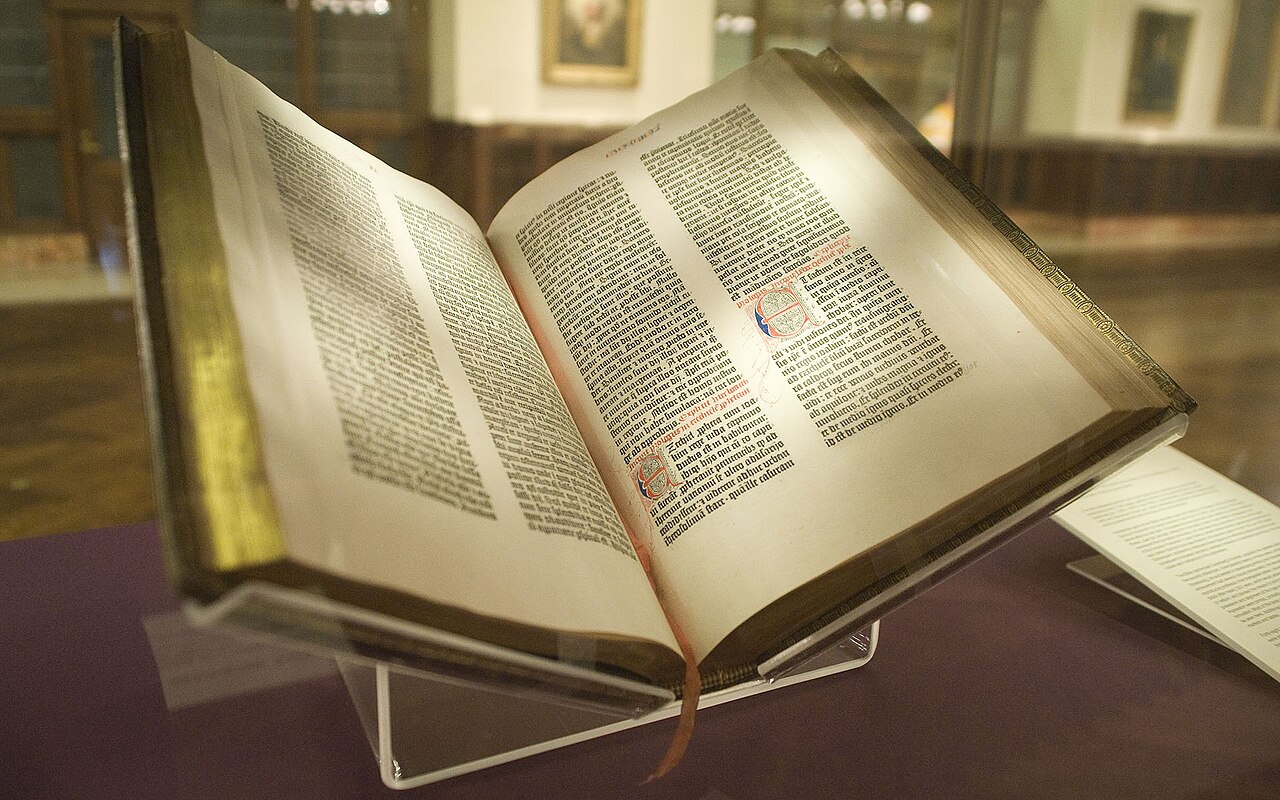
An open printed book with two pages of dense black Gothic-style text in columns, displayed on a clear acrylic stand in a museum case against a purple cloth. Red and blue decorated initials and a red ribbon bookmark are visible. Background shows framed paintings and wooden shelving.Book

Secondary source

Gutenberg Bible

Johannes Gutenberg · c. 1450-1455

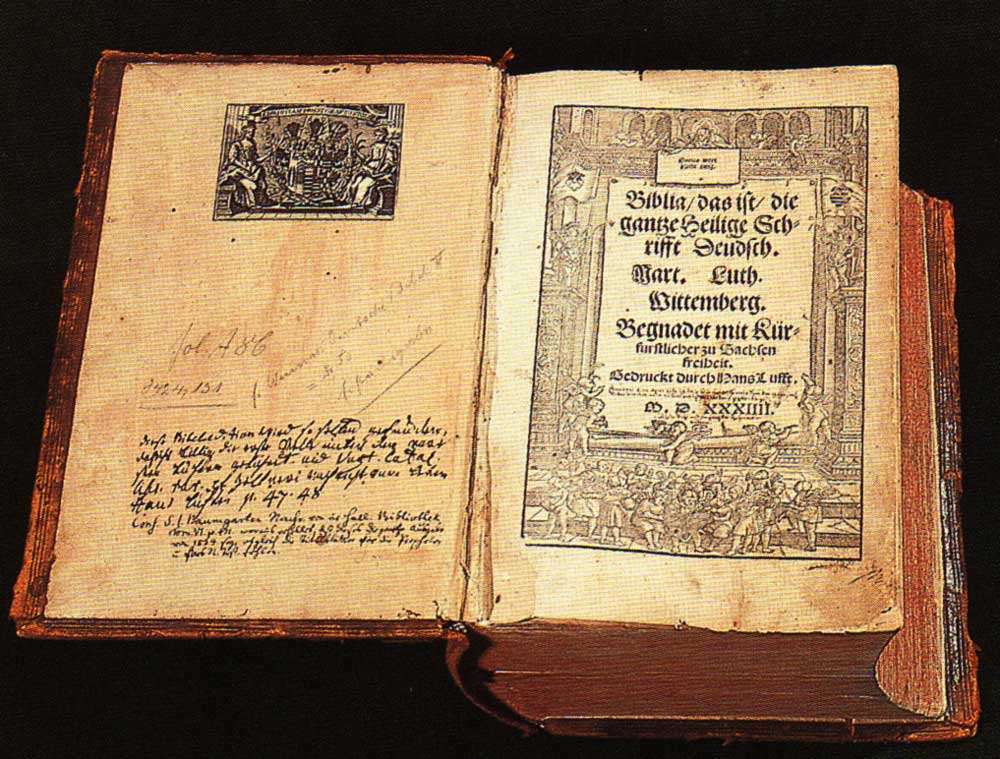
An open, worn leather-bound book lying on a dark background. The right page shows a woodcut title page reading 'Biblia, das ist: die gantze Heilige Schrifft Deudsch, Mart. Luth. Wittemberg' with the date MDXXXIIII. The left page has a small woodcut and handwritten notes.Book

Secondary source

Luther Bible

Martin Luther · 1534

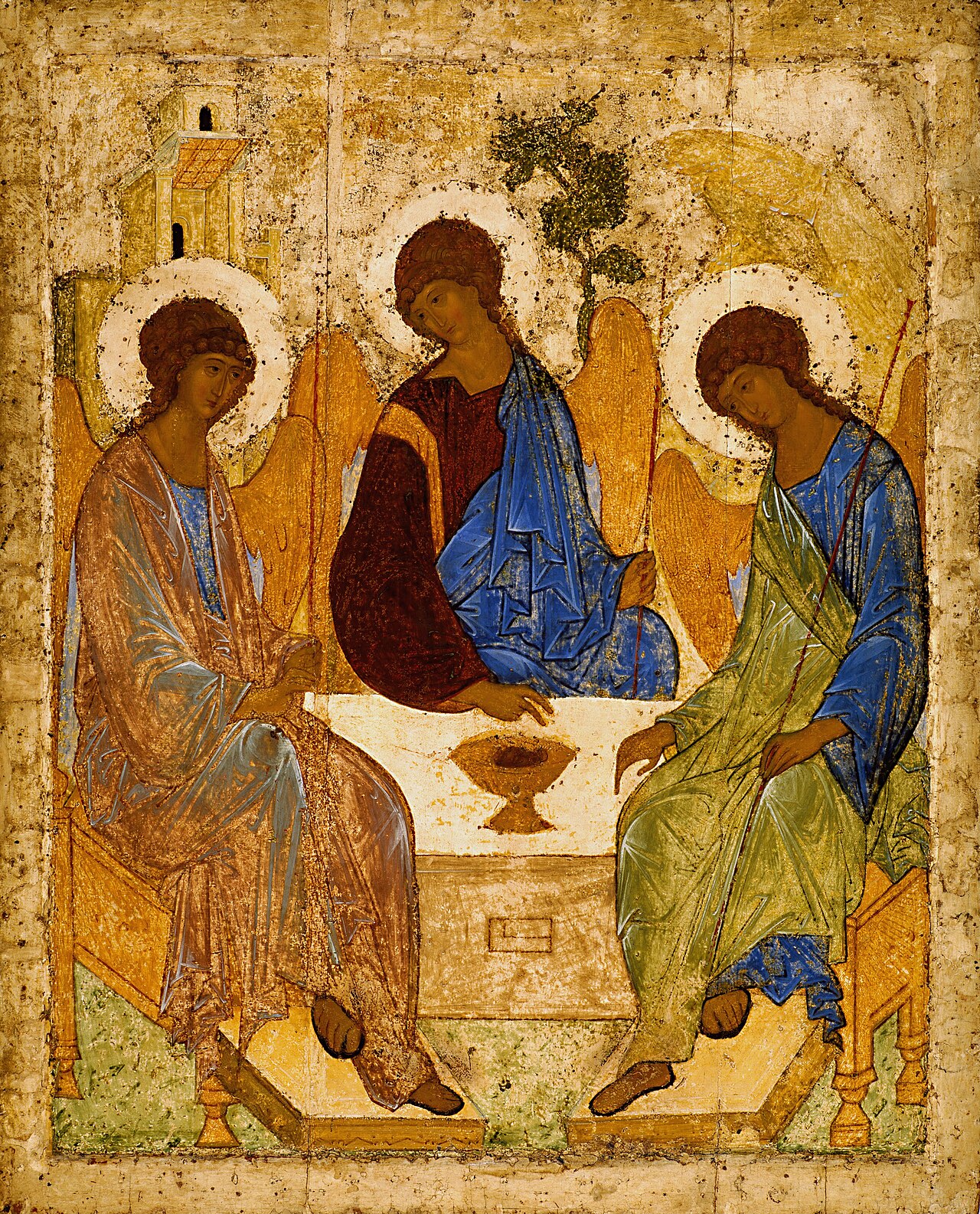
Icon painting of three seated winged figures with golden halos around a table holding a chalice, with a tree and a tower in the background. Gold and earthy tones, aged and worn surface.Painting

Secondary source

The Trinity (Rublev icon)

Andrei Rublev · early 15th century (c. 1412)

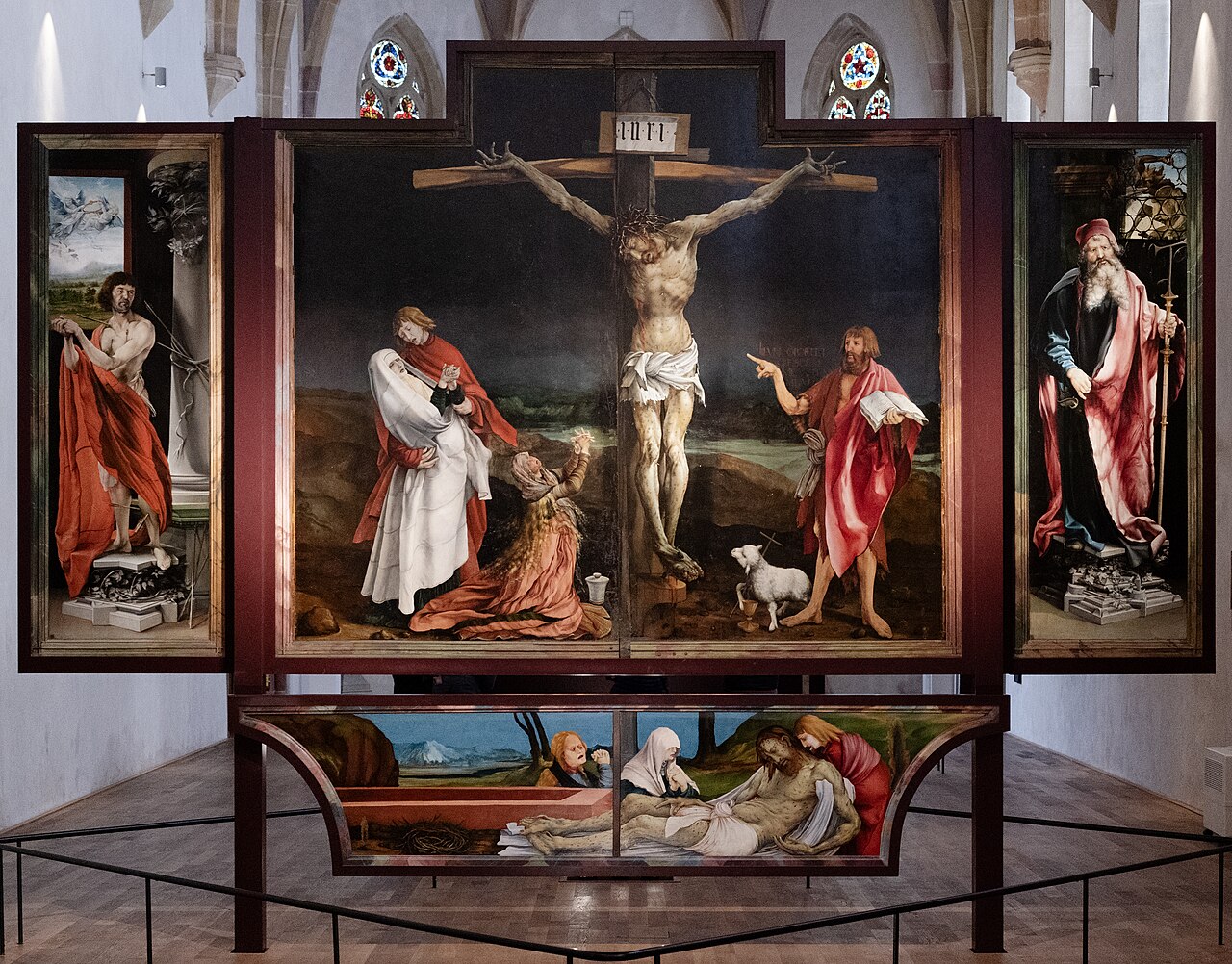
The open Isenheim Altarpiece displayed in a church interior. The central panel shows the crucified Christ with figures at the foot of the cross, including a lamb, a kneeling woman, and John pointing. Side panels show saints, and the predella below shows the entombment.Painting

Secondary source

Isenheim Altarpiece

Matthias Grünewald · 1512-1516

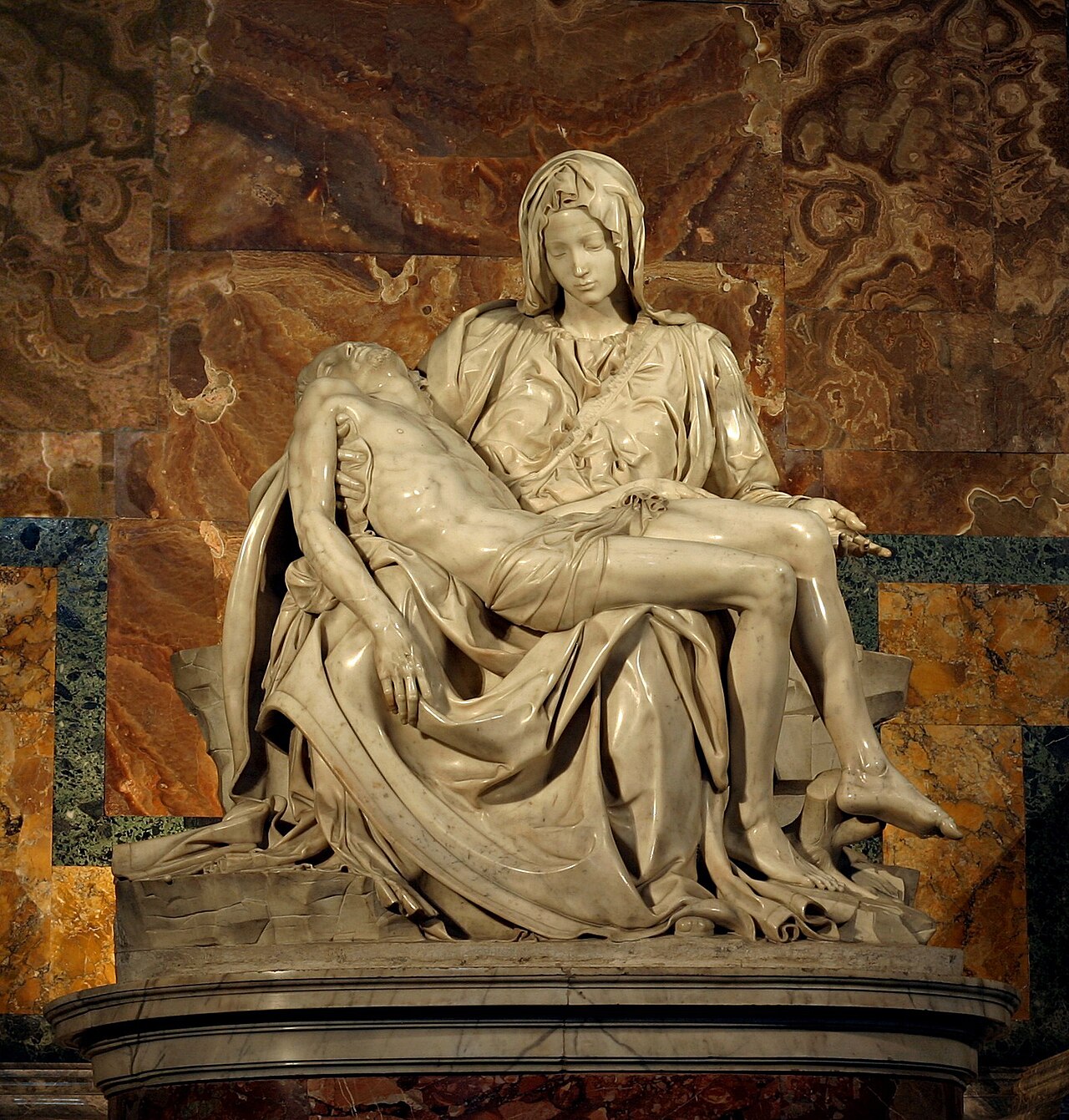
White marble sculpture of a seated woman in a hooded robe holding the body of a man across her lap. The man's head tilts back, his arm hangs down, and his legs extend to the right. Behind them is a richly veined reddish-brown marble wall.Sculpture

Secondary source

Pietà

Michelangelo · 1498-1499

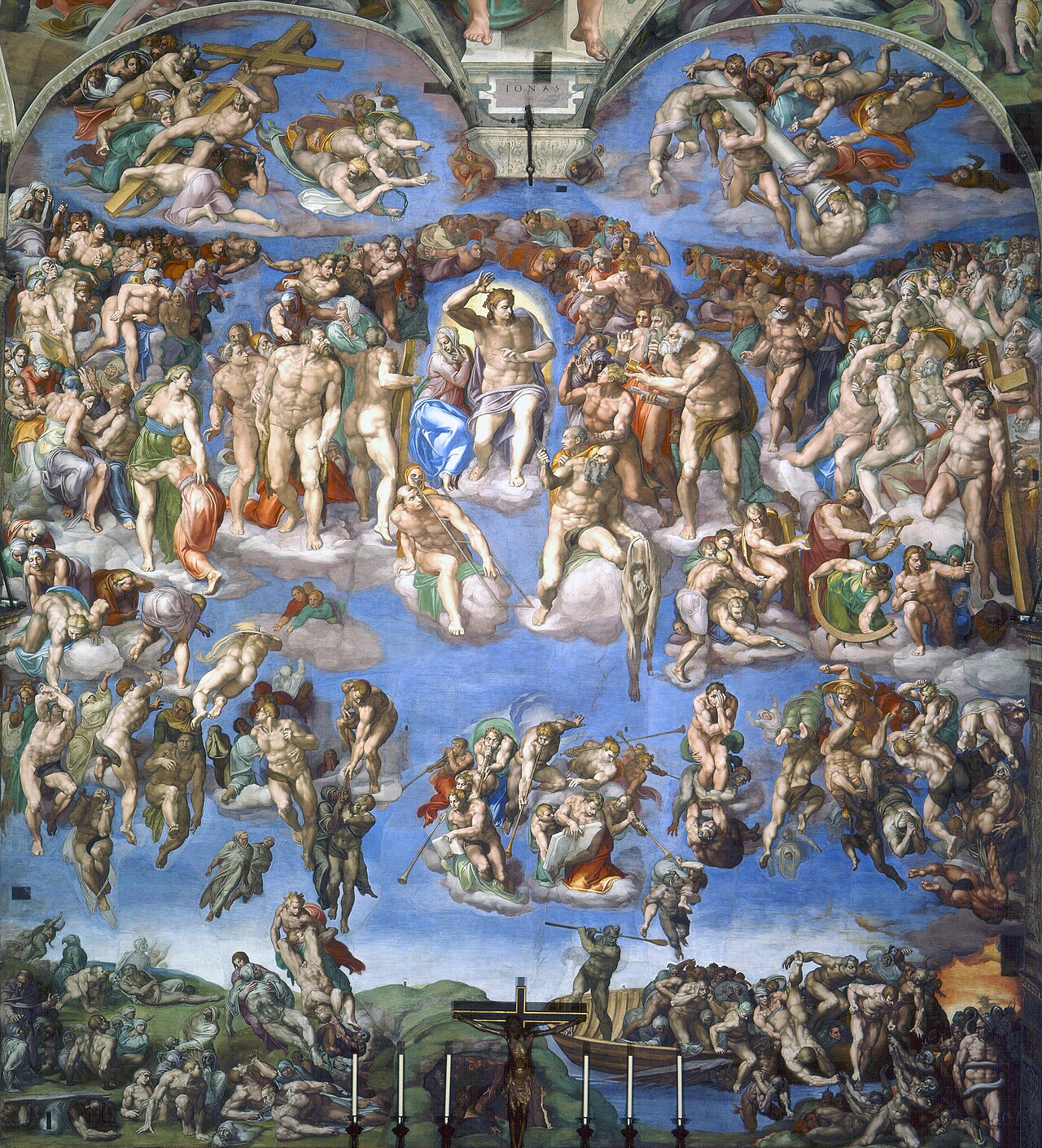
Michelangelo's fresco The Last Judgment on a wall. Christ sits at center in a blue halo surrounded by nude figures. Angels blow trumpets above, the dead rise from the ground, and figures fall into a boat and down toward hell at the bottom.Painting

Secondary source

The Last Judgment

Michelangelo · 1536-1541

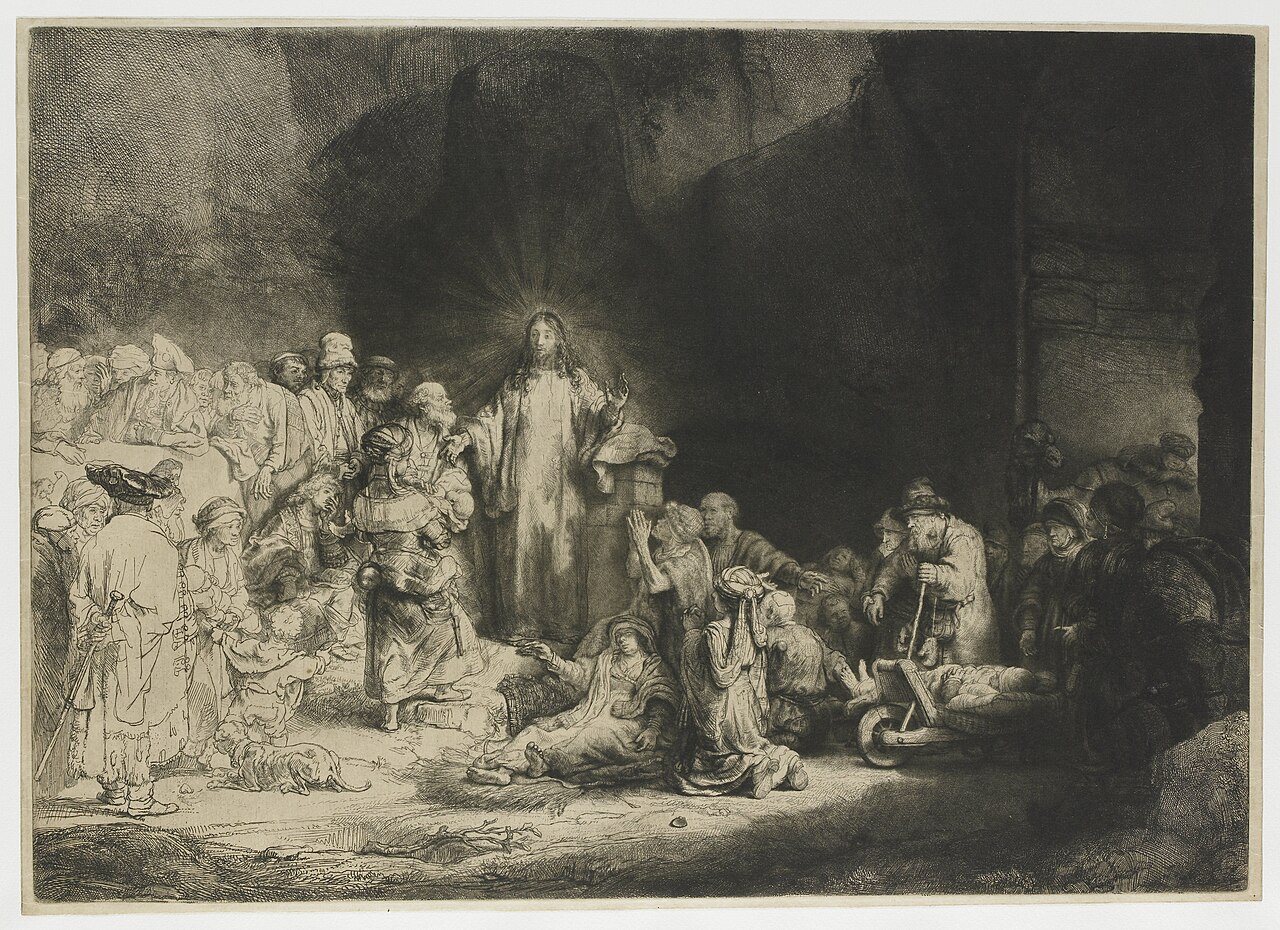
Etching of Christ Healing the Sick: a glowing robed figure stands center-right with arms raised amid a crowd of kneeling, sitting and standing people, some on the left in shadowy groups, and a sick man on a wheeled cart at right. Dark architectural arches frame the scene.Painting

Secondary source

Christ Healing the Sick (Hundred Guilder Print)

Rembrandt · c. 1647-1649

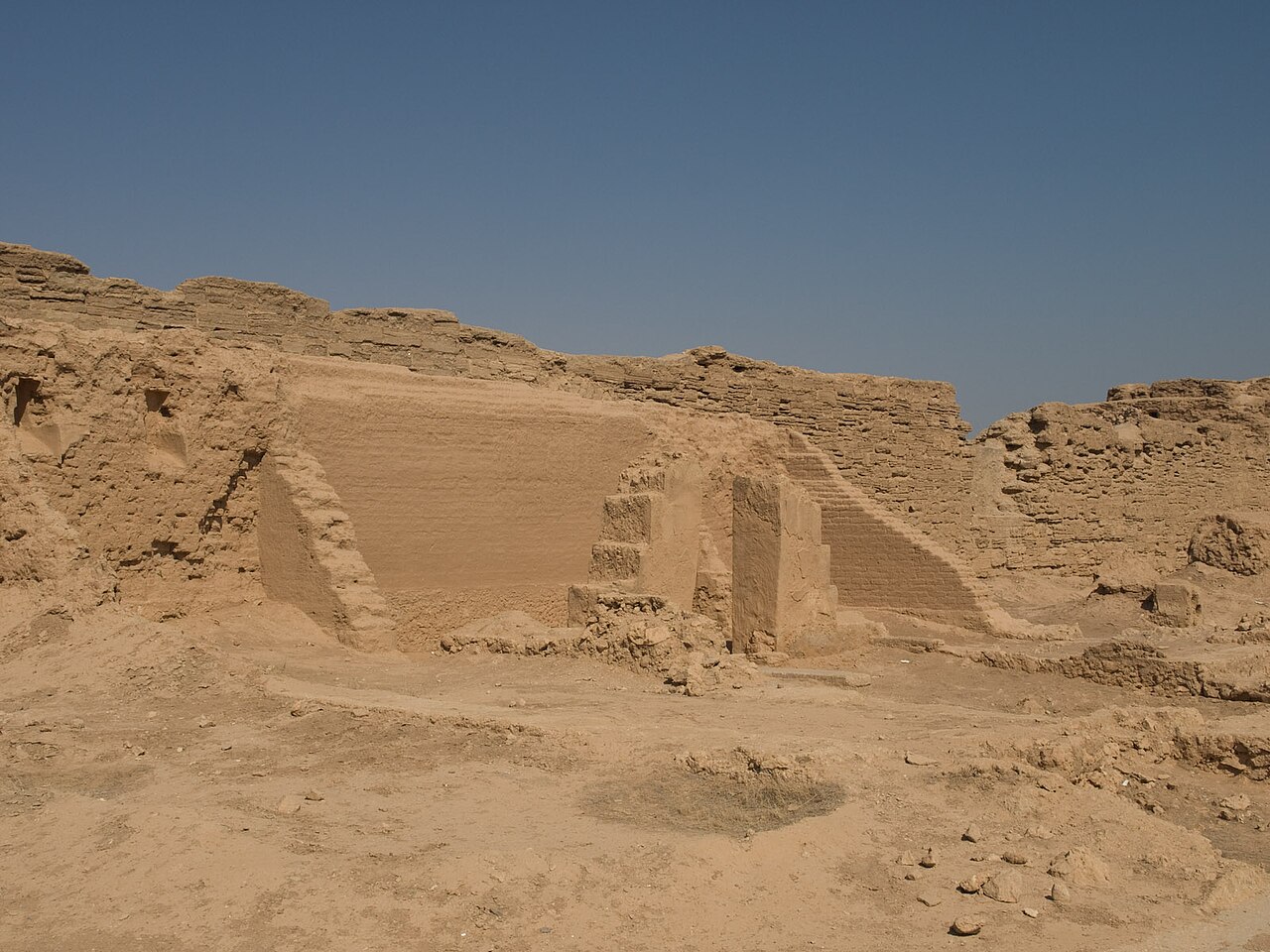
Ruined mud-brick building at an archaeological site in a desert, with a tan plastered wall, stepped brick buttresses, and collapsed walls under a clear blue sky. This is the Dura-Europos house church façade.Artifact

Secondary source

Dura-Europos House Church

c. 300 (converted c. 240/241)

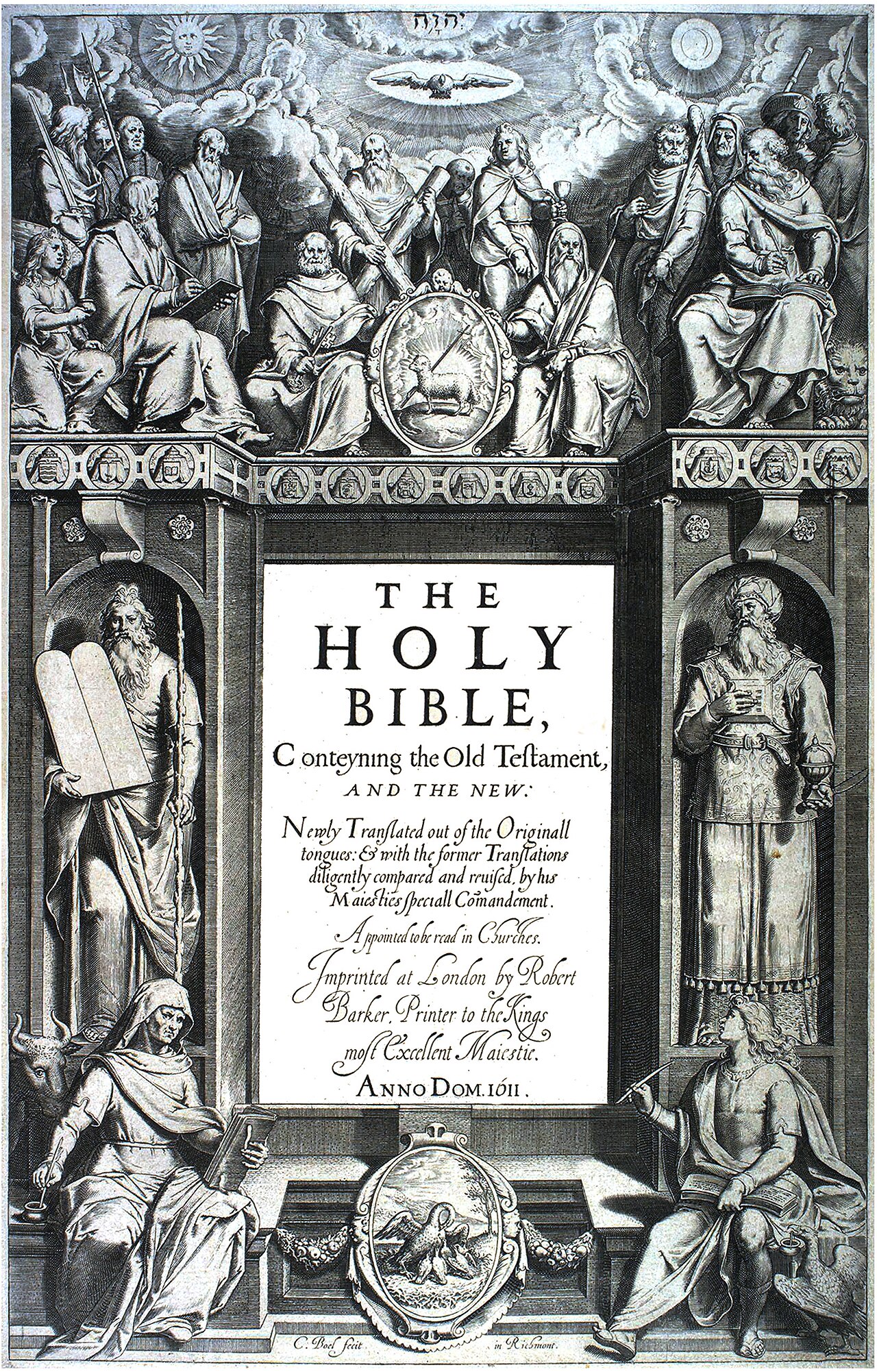
Engraved title page of the 1611 King James Bible. Large white central panel reads 'The Holy Bible' and 'Anno Dom. 1611'. Above, figures in clouds and a dove with rays. Moses holds tablets on the left, Aaron on the right, and four evangelists sit in the lower corners.Book

Secondary source

King James Version

1611

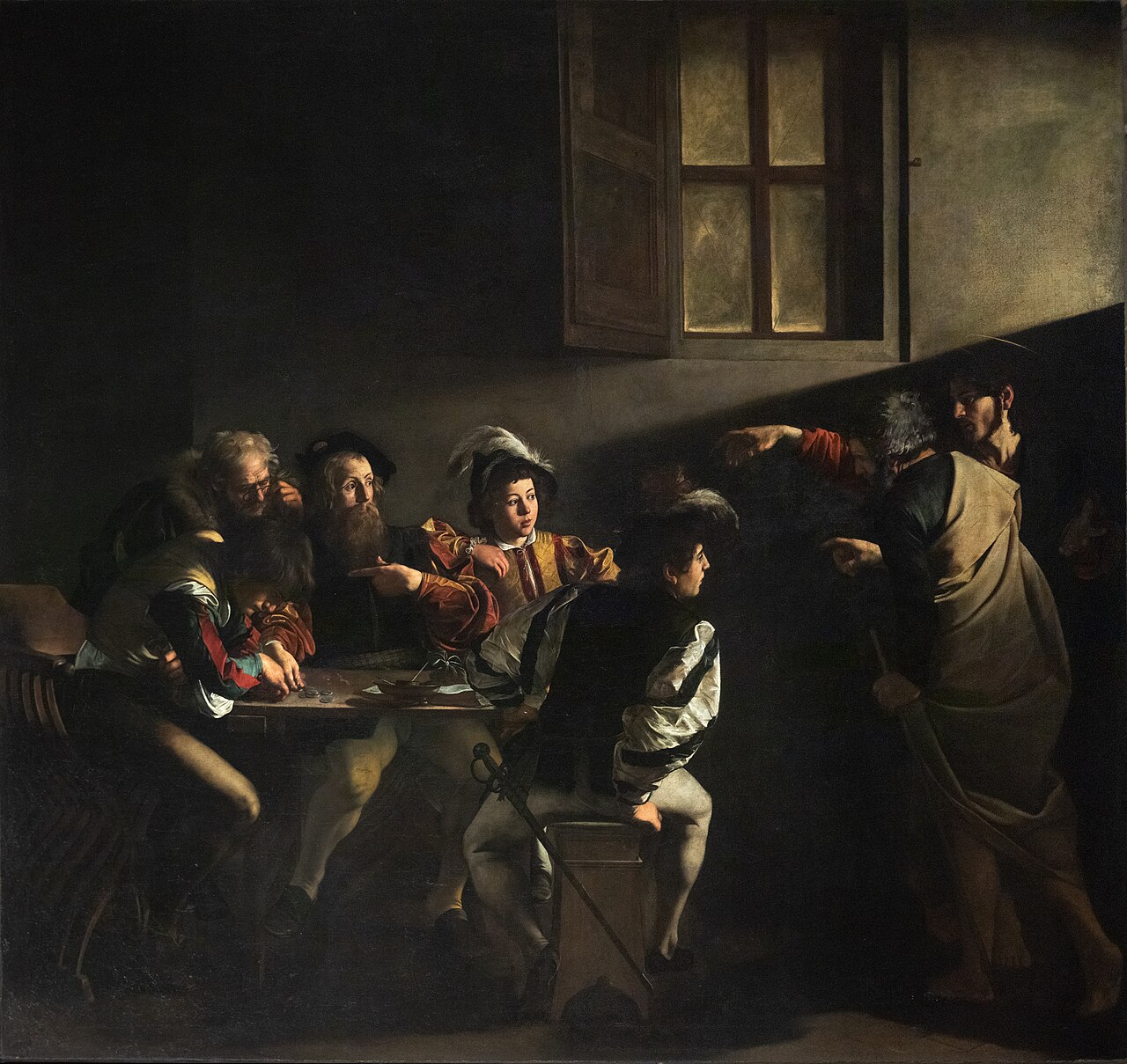
Caravaggio's painting The Calling of Saint Matthew: a dim tavern room lit by a high window on the right. Seated men count coins at a table; a young man in a feathered cap points at himself. Bearded figures in robes enter from the right, one pointing.Painting

Secondary source

The Calling of Saint Matthew

Caravaggio · 1599–1600

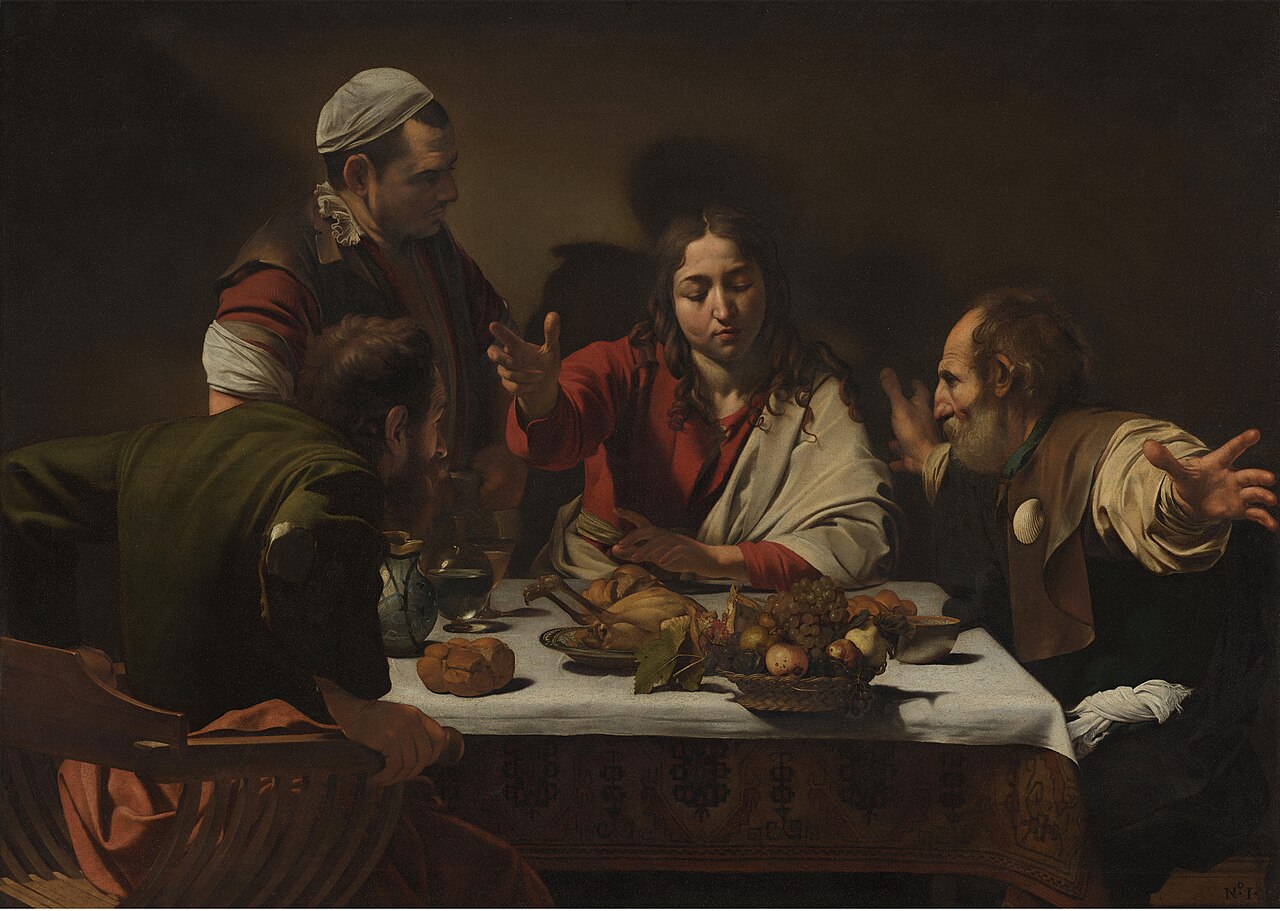
Caravaggio's painting Supper at Emmaus. A bearded man in a green cloak, at left, and an elderly man in a brown vest, at right, gesture with outstretched arms at a table with a roast chicken, bread, fruit and wine. A young man in red and white stands behind, and a bearded figure in a white cap stands at the back.Painting

Secondary source

Supper at Emmaus

Caravaggio · 1601

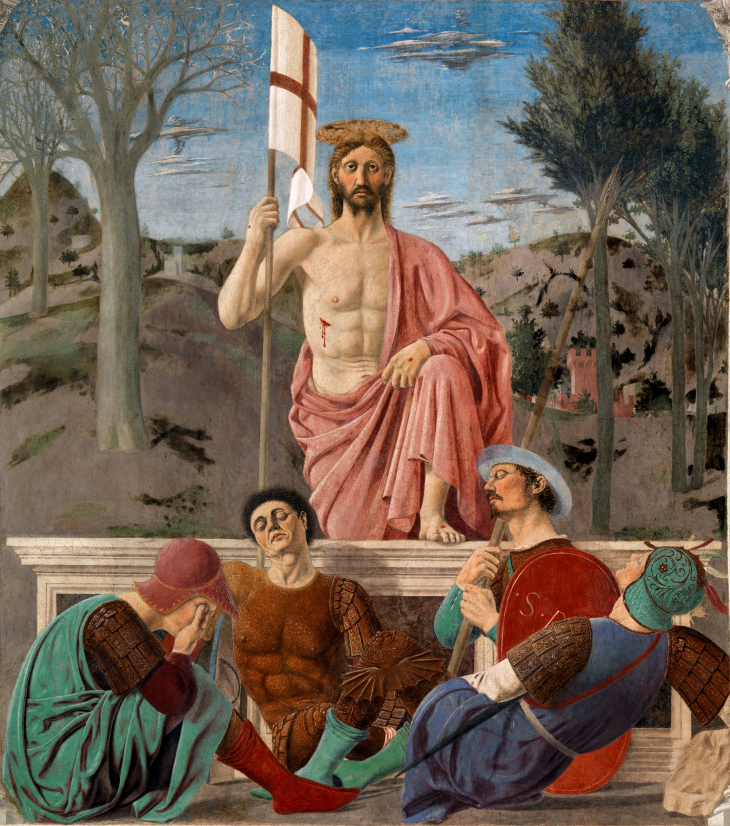
Painting of a standing, muscular, bearded man with a halo, holding a white banner with a red cross, stepping out of a stone tomb in a landscape with bare and evergreen trees. Three sleeping soldiers in armor lie or sit below him on the tomb's ledge.Painting

Secondary source

The Resurrection

Piero della Francesca · 1460s

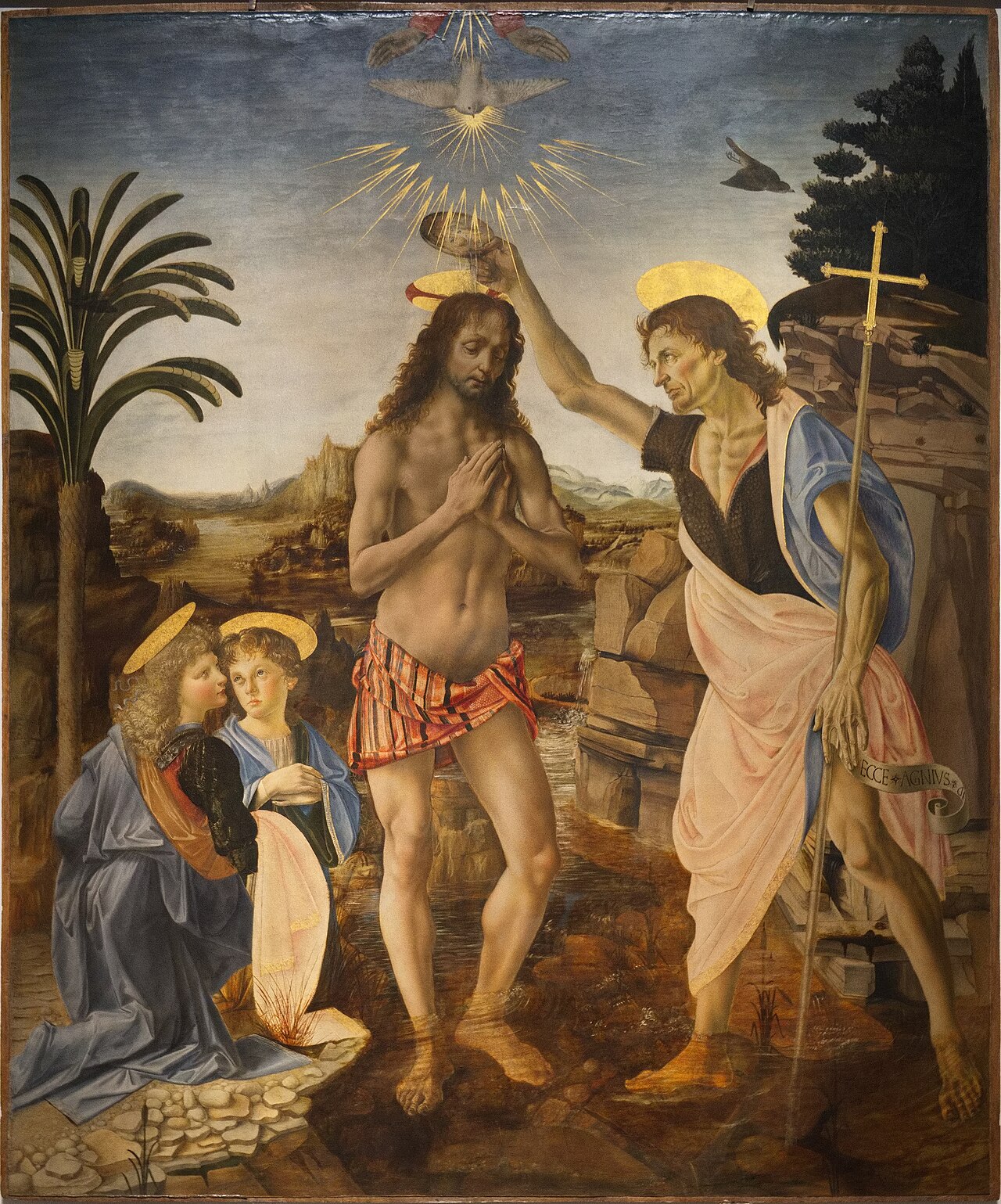
Painting of the Baptism of Christ: a bearded, nude Christ stands in a river with hands clasped in prayer while a kneeling angel on the left looks on. On the right, John the Baptist pours water over Christ's head from a shell, holding a golden cross staff. A dove and golden rays descend from the sky above, and a palm tree stands at the left edge beside a rocky landscape.Painting

Primary source

The Baptism of Christ

Andrea del Verrocchio and Leonardo da Vinci · c. 1470-1475

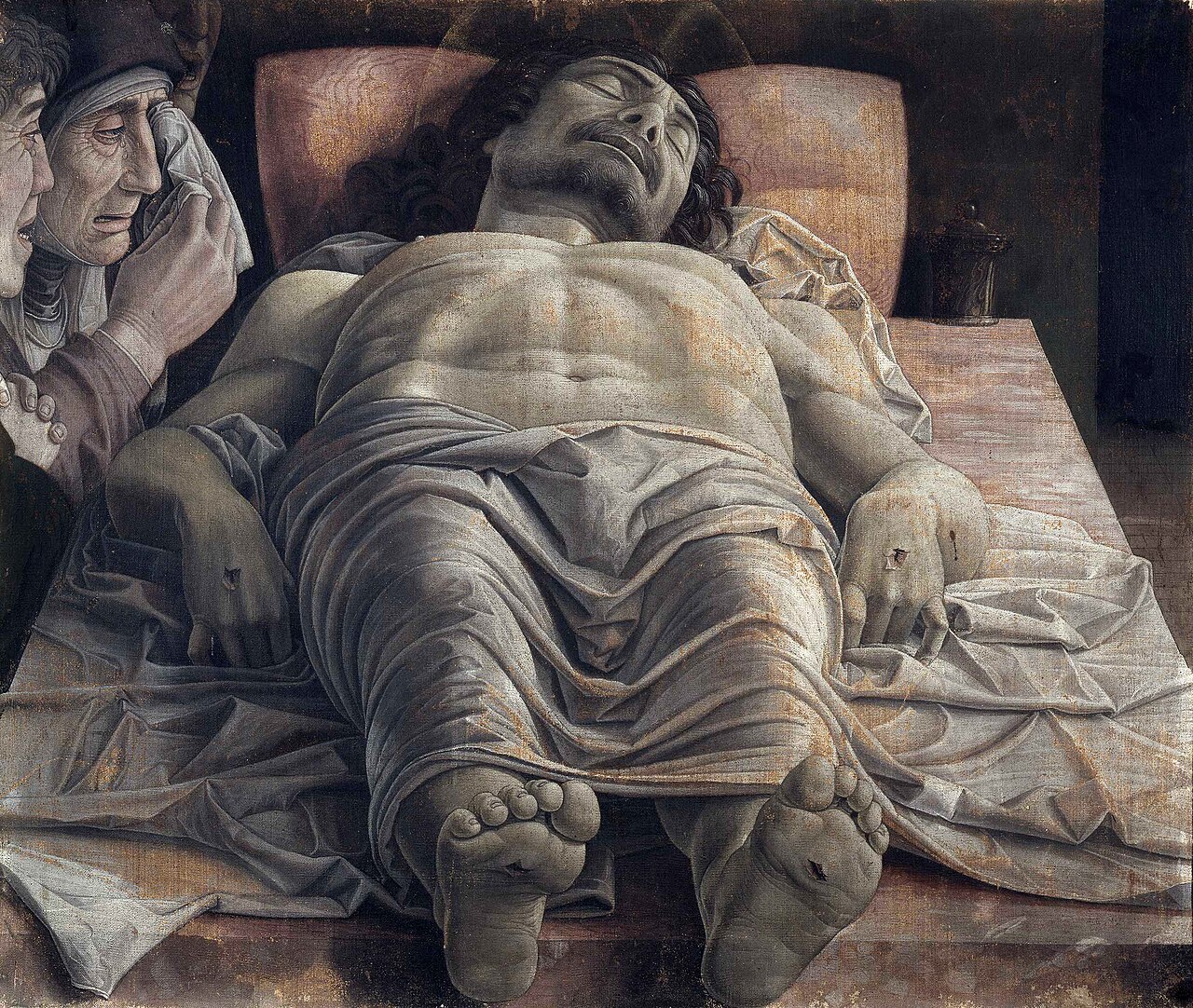
Painting of the dead Christ lying on a stone slab with his feet toward the viewer, wrapped in a cloth. On the left, mourners with grief-stricken faces, one wiping her eyes. Muted grey and brown tones.Painting

Secondary source

Lamentation of Christ

Andrea Mantegna · 1483 (completed early 1480s)

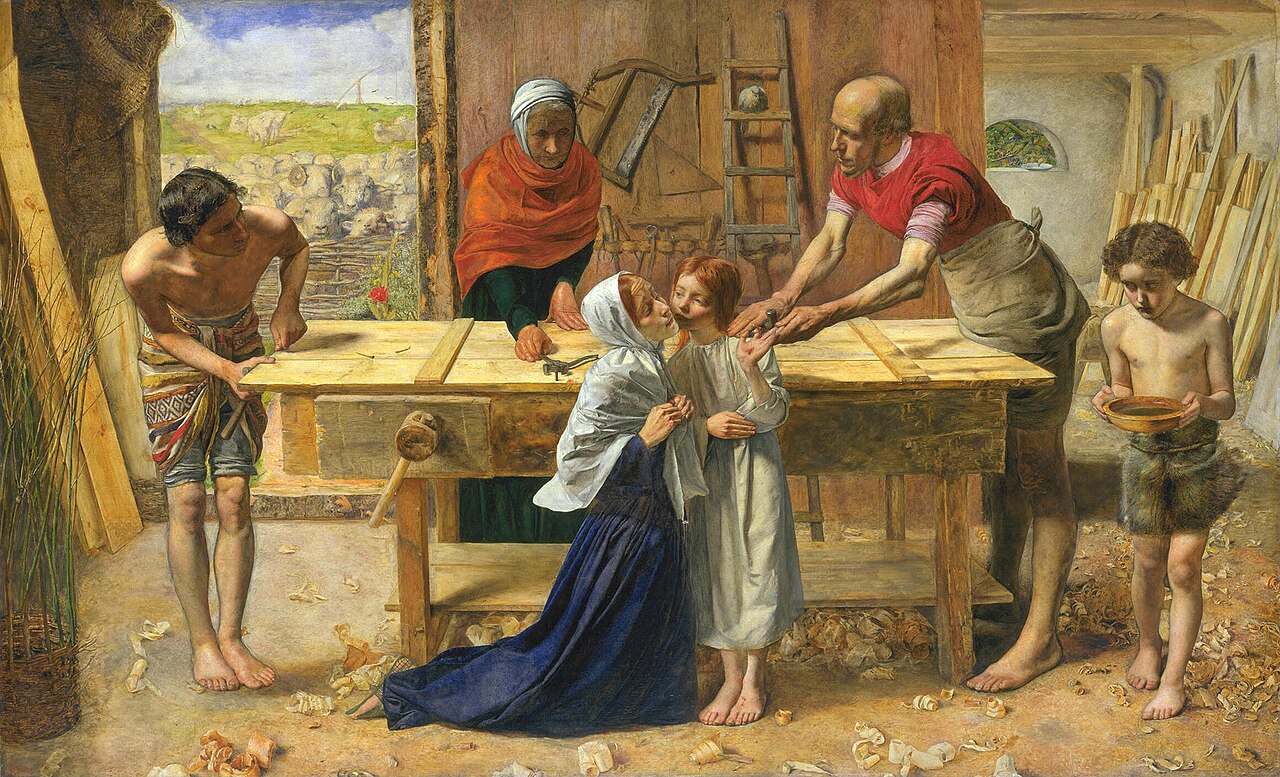
Painting of a carpenter's workshop with a woman in a red shawl and white headscarf at the back, a bald man in a red shirt reaching toward a red-haired boy, a kneeling woman in blue and white robes, a shirtless young man at left, and a barefoot boy holding a bowl at right. Wood shavings cover the floor, and planks lean against the wall.Painting

Secondary source

Christ in the House of His Parents

John Everett Millais · 1849-1850

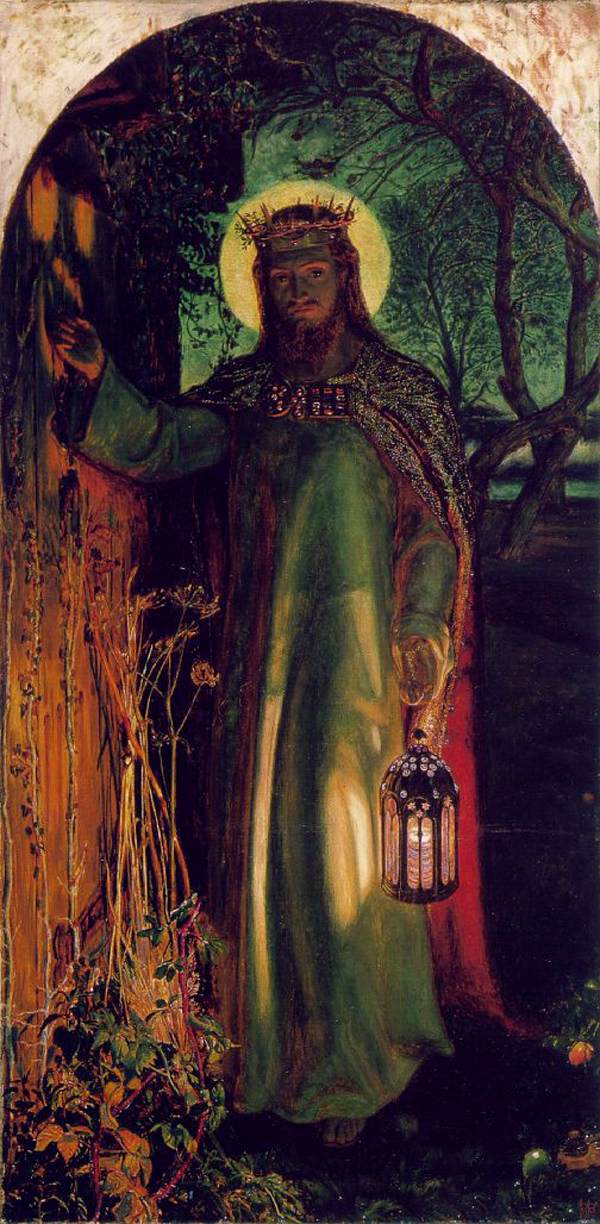
Painting of a bearded, crowned figure in a long green robe and jeweled mantle, holding a lit lantern in his right hand and raising his left hand toward a closed wooden door overgrown with vines. Halo behind his head, dark trees and foliage around him.Painting

Secondary source

The Light of the World

William Holman Hunt · 1851-1854

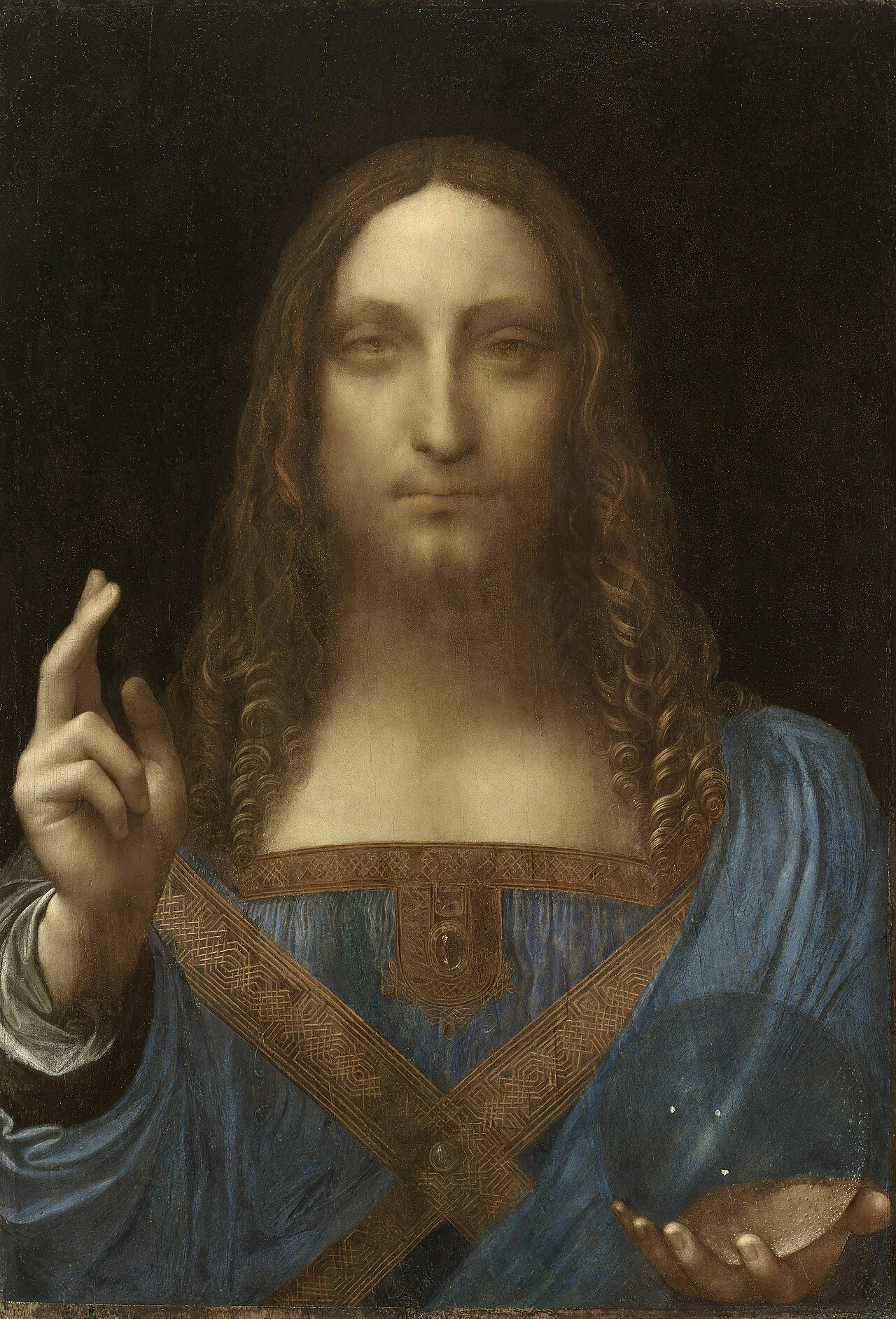
Painting of a bearded man with long, wavy brown hair, raising his right hand with two fingers extended and holding a transparent orb in his left hand. He wears a blue robe with a gold patterned collar and cross-shaped band against a dark background.Painting

Secondary source

Salvator Mundi

Leonardo da Vinci · c. 1499-1510

Photograph of a brown, fragmentary papyrus leaf with dark Coptic script in several columns. Torn edges and white gaps where pieces are missing; the text is faded and partly illegible.Document

Secondary source

Gospel of Judas

c. 200 (manuscript); text composed 2nd century

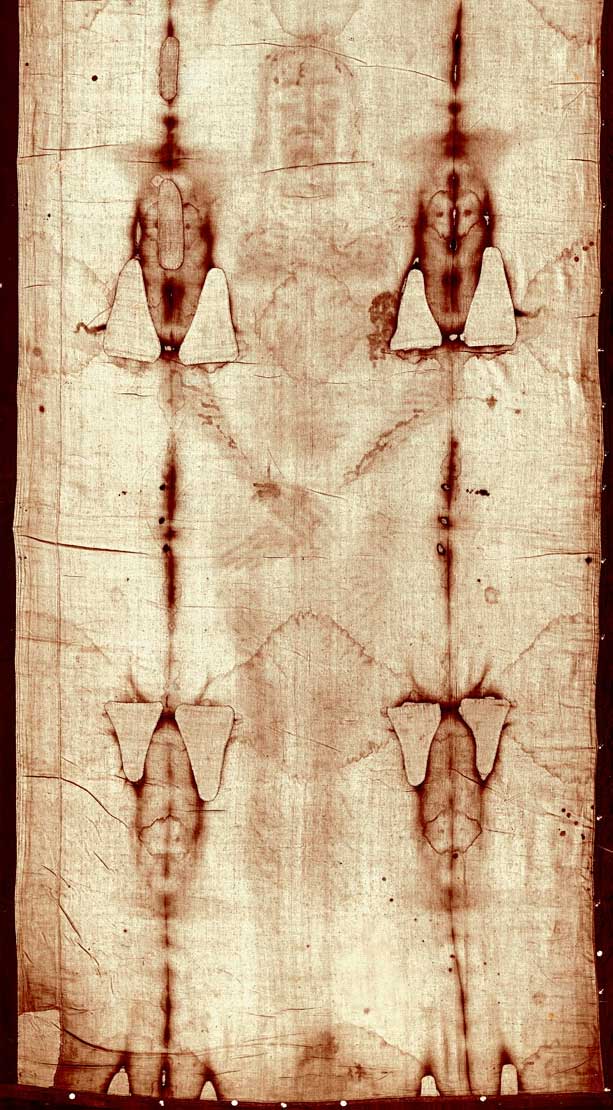
Full-length photographic negative-style image of the Shroud of Turin: a long linen cloth in sepia tones bearing faint double images of a front and back human figure, with burn holes and water stain marks visible.Artifact

Secondary source

Shroud of Turin

documented from 1354; radiocarbon dated 1260-1390

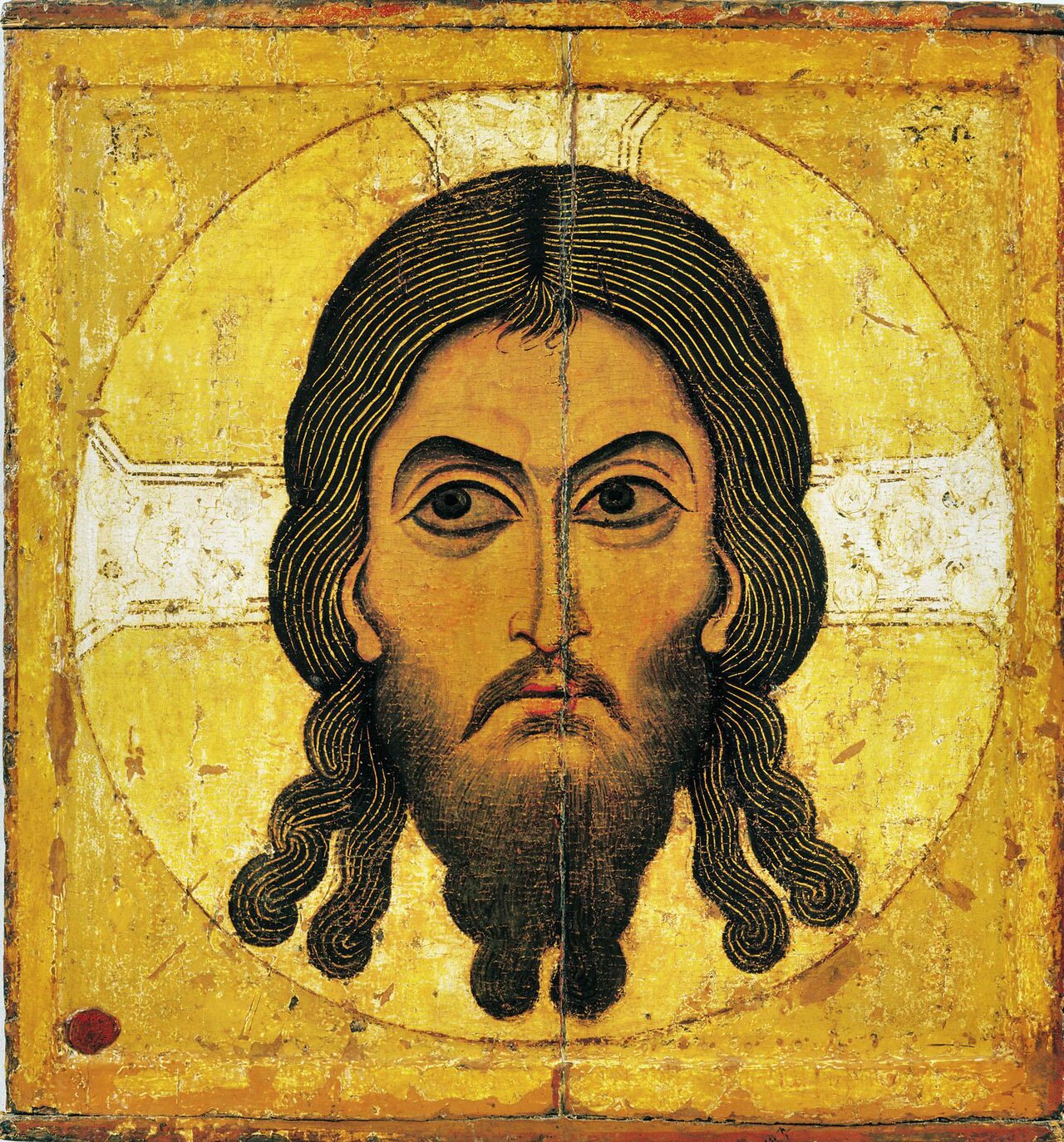
Painted icon of a bearded man's face with long dark hair parted in the center, eyes looking forward, on a gold background with a circular halo and white cross-bar motifs. The image is split vertically down the middle.Artifact

Secondary source

Image of Edessa

Book

Secondary source

The Quest of the Historical Jesus

Albert Schweitzer · 1910

Book

Secondary source

The Life of Jesus

Ernest Renan

Book

Secondary source

The Life of Christ

Frederic Farrar

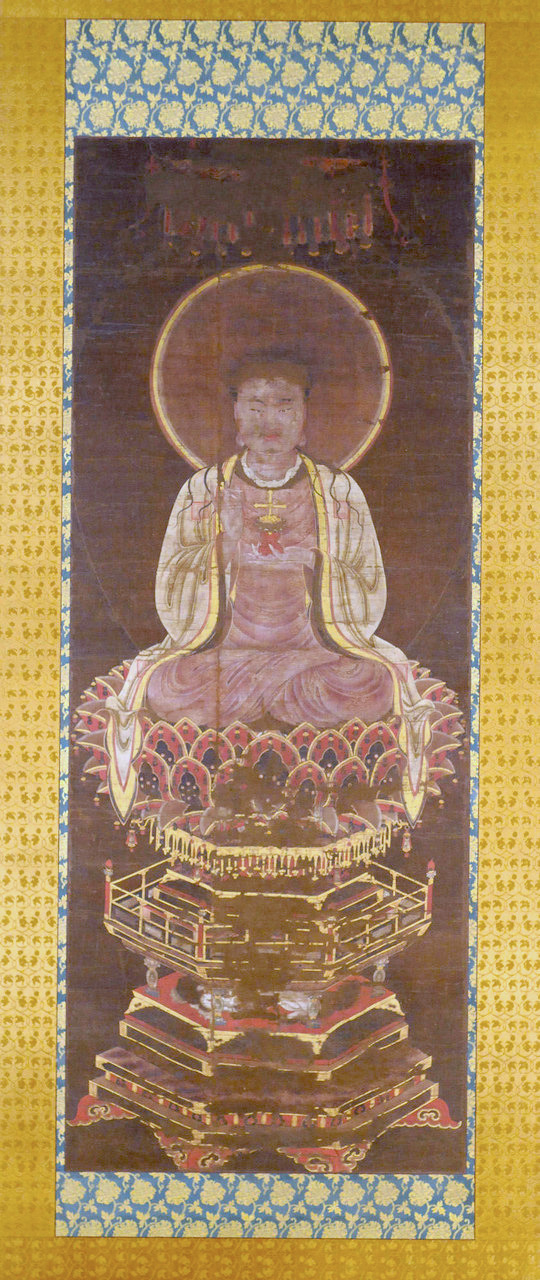
Hanging scroll painting of a seated figure with a gold halo, wearing a pink robe and white outer garment, seated on a red and gold lotus pedestal above a tiered gold and red stepped base, framed by gold patterned silk borders.Painting

Secondary source

Jesus Christ as a Manichaean Prophet

Unknown · early 13th century

Book

Secondary source

The Life and Times of Jesus the Messiah, vol. 1

Alfred Edersheim · 1886

Book

Secondary source

The Life and Teachings of Jesus

G. H. Walser · 1909

St. Bonaventure's Life of our Lord and Saviour Jesus ChristBook

Secondary source

St. Bonaventure's Life of our Lord and Saviour Jesus Christ

Saint Bonaventure (attributed) · 1881

Jesus in the TalmudBook

Secondary source

Jesus in the Talmud

Bernhard Pick · 1913

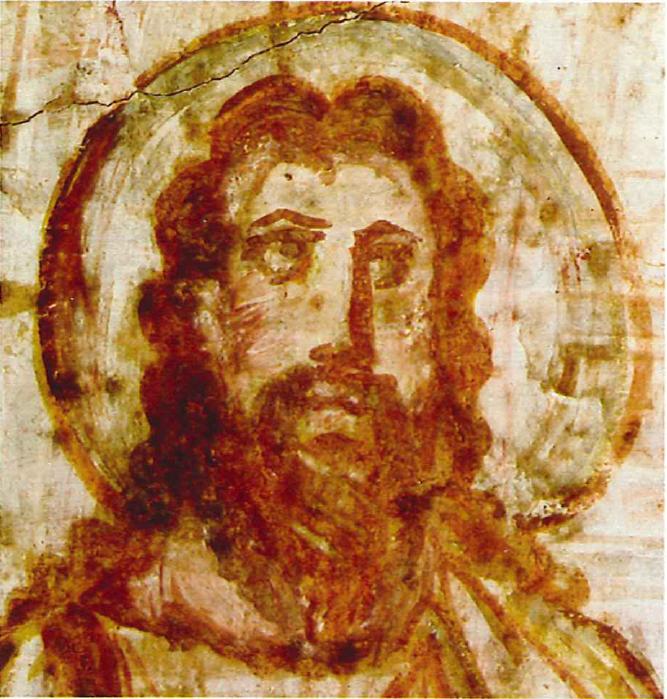
Faded red-brown and ochre fresco of a bearded man's head and shoulders with a halo, seen frontally. Long wavy hair, large eyes, a full beard, and a crack runs across the upper left of the plaster.Painting

Secondary source

Bust of Christ, Catacomb of Commodilla

Unknown · 4th century AD

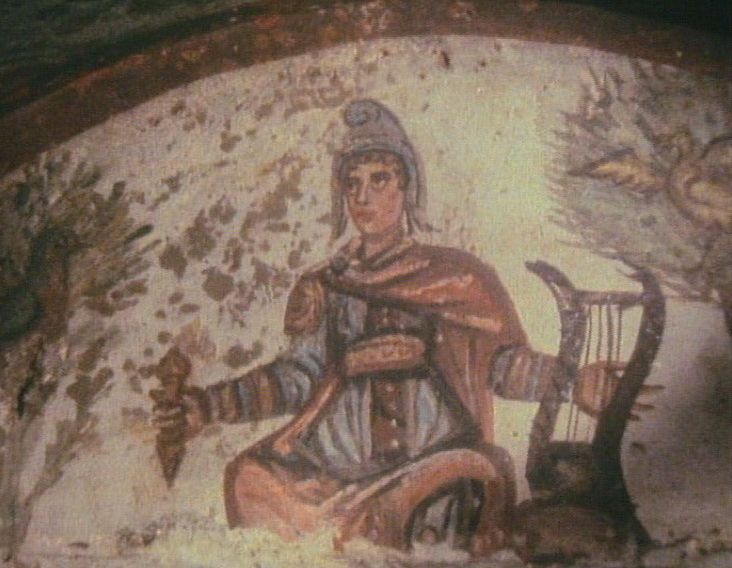
Faded fresco of a seated figure in a Phrygian-style cap and draped reddish cloak, holding a staff-like object in one hand and a lyre in the other, with a trees-and-animals background on a pale plaster ceiling.Painting

Secondary source

Christ as Orpheus

Unknown · 4th century

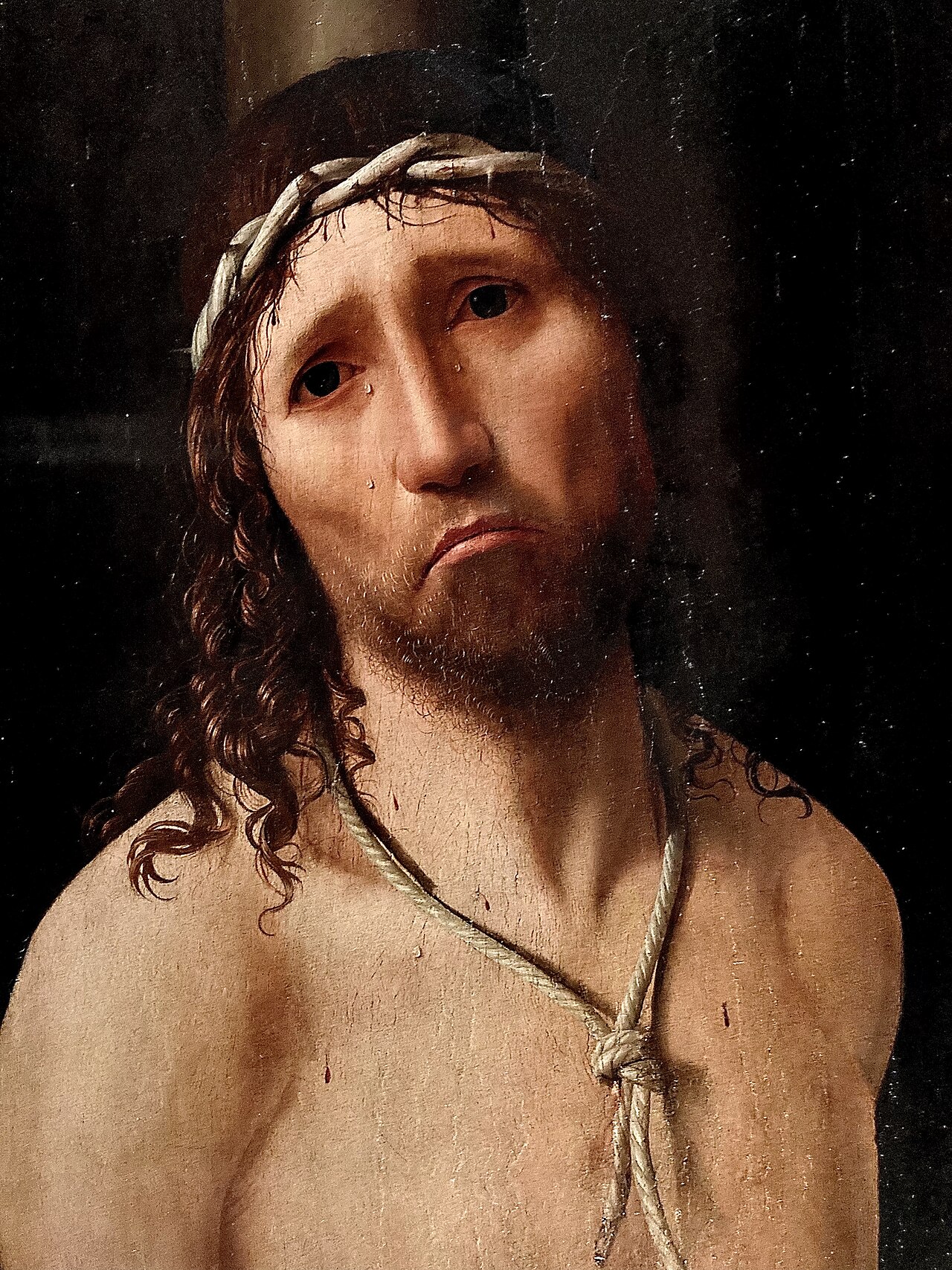
Painted half-length figure of a bearded man with shoulder-length curly brown hair, wearing a crown of thorns and with a rope tied around his neck and shoulders, against a dark background. He gazes upward with a sorrowful expression and small drops of blood are visible on his skin.Painting

Secondary source

Ecce Homo

Antonello da Messina · 1473

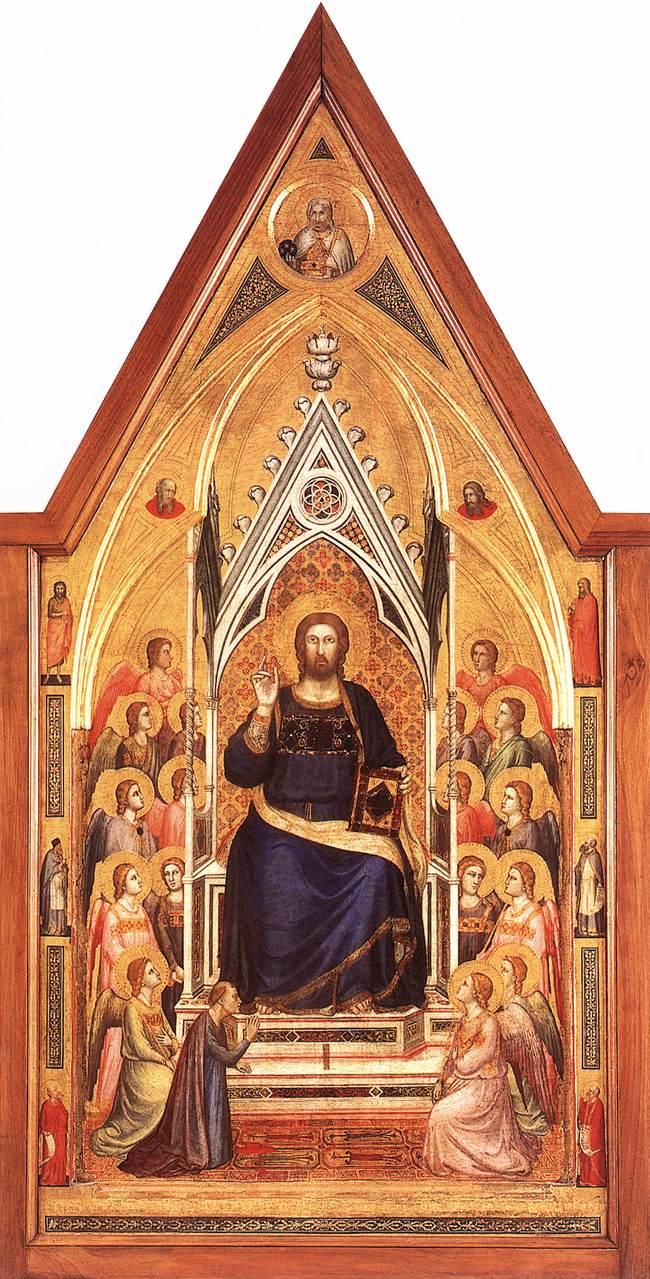
Gothic altarpiece painting of Christ enthroned in a gold background within a pointed arch, blessing with his right hand and holding a book, surrounded by rows of angels with halos on both sides. A kneeling cardinal in red robes at the lower left and a bust of God in a roundel at the top.Painting

Secondary source

Christ Enthroned (Stefaneschi Triptych)

Giotto · c. 1330

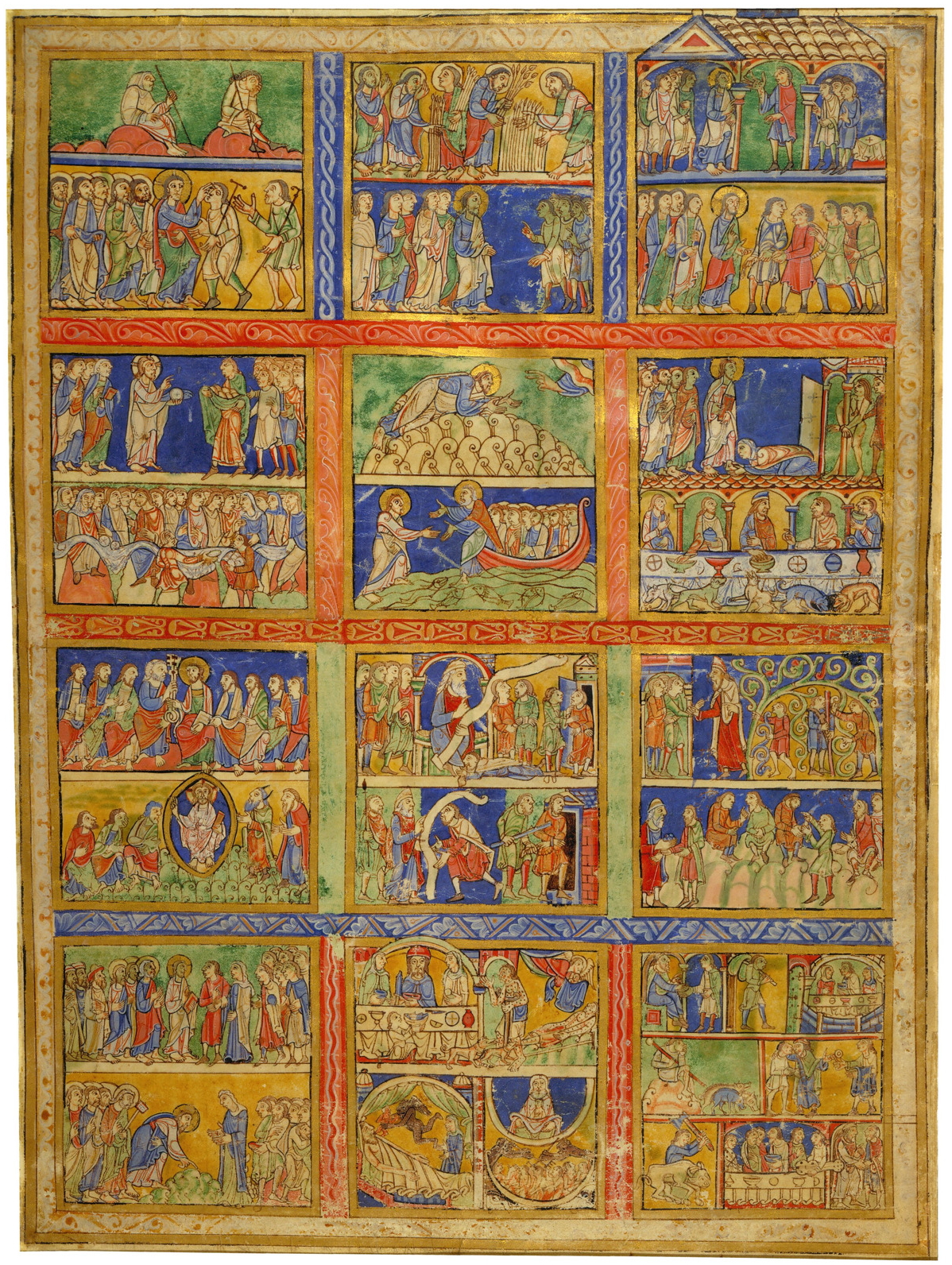
Full illuminated manuscript page divided into a grid of twelve framed rectangular scenes with gold borders, painted in red, blue, green and yellow. The scenes depict figures in medieval dress, some haloed, in groups and interactions, with arches and buildings in some panels.Painting

Secondary source

Eadwine Psalter Leaf with Scenes from Christ's Life

Unknown · c. 1150

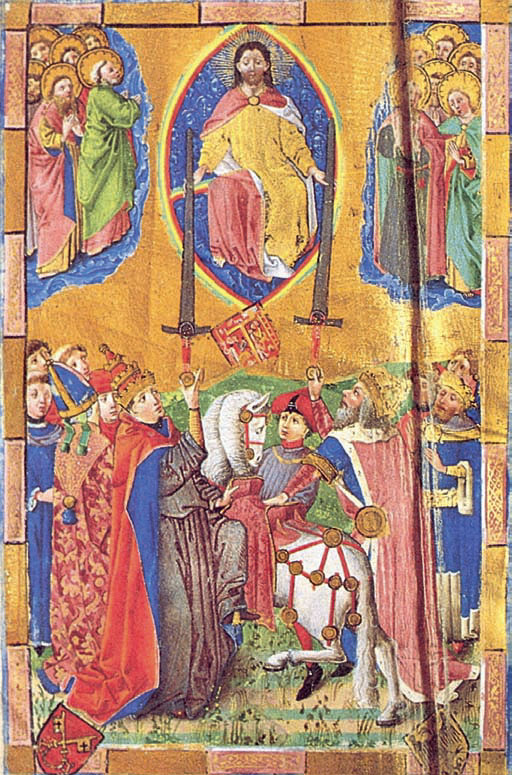
Illuminated manuscript miniature with gold background. Christ sits in a mandorla at top center, holding two swords that extend downward to a pope on the left and an emperor on the right. Angels and saints flank the upper corners. Below, a pope in red and white robes and an emperor in a crown and ermine-trimmed robe kneel or stand before a horse-bearing figure, with attendant clergy and courtiers around them.Document

Secondary source

Christ Giving Two Swords to Pope and Emperor

Hans Bornemann · 1442-1448

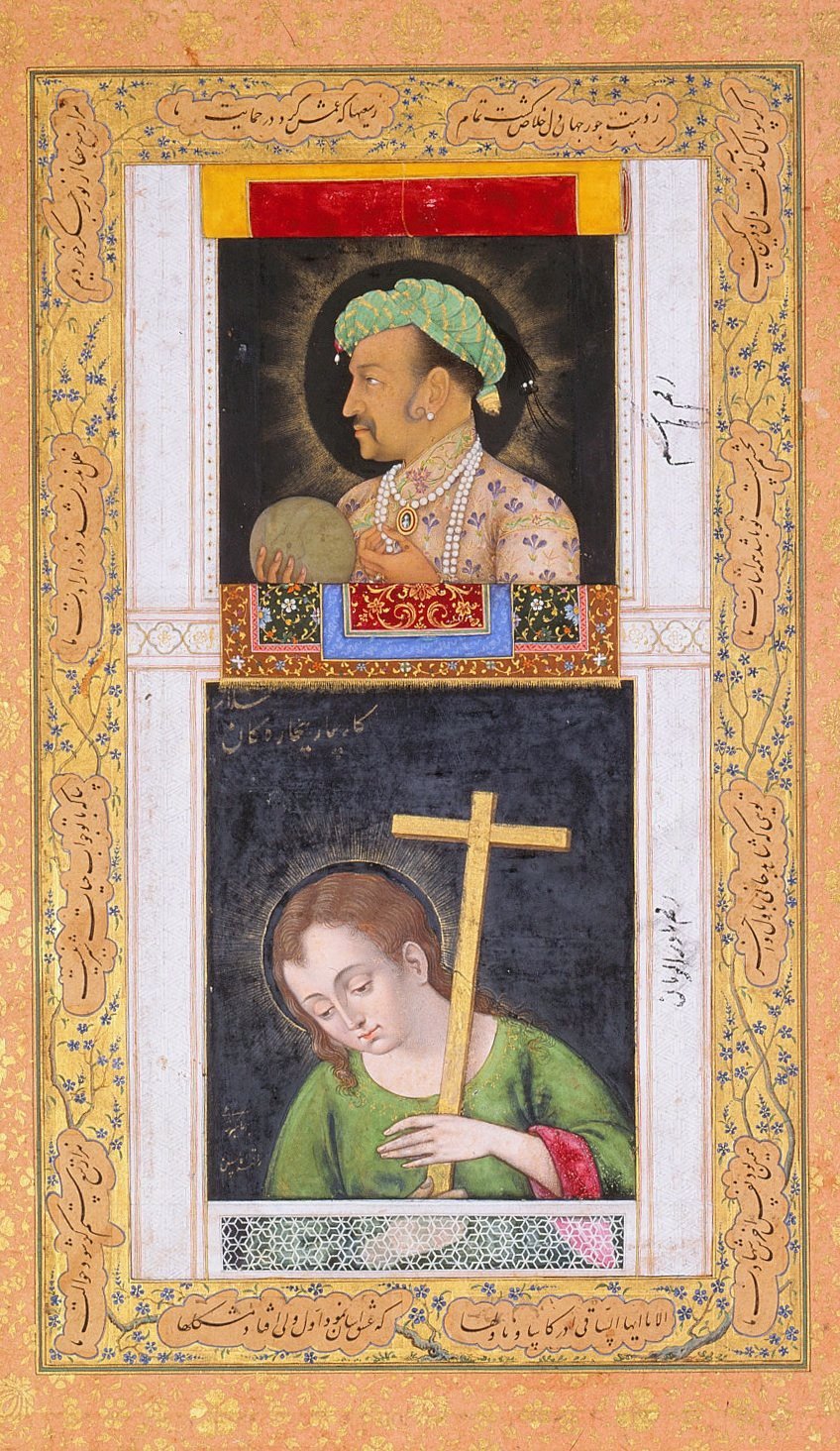
Mughal painting with gold-decorated border of Persian calligraphy. Top panel: profile portrait of a man in a green turban with pearl necklaces, holding a small sphere, against a black halo background. Bottom panel: a youth with a golden halo holds a gold cross, wearing a green garment with a red sleeve.Painting

Secondary source

Jahangir and Jesus

Hashim and Abu'l-Hasan · c. 1610-1620

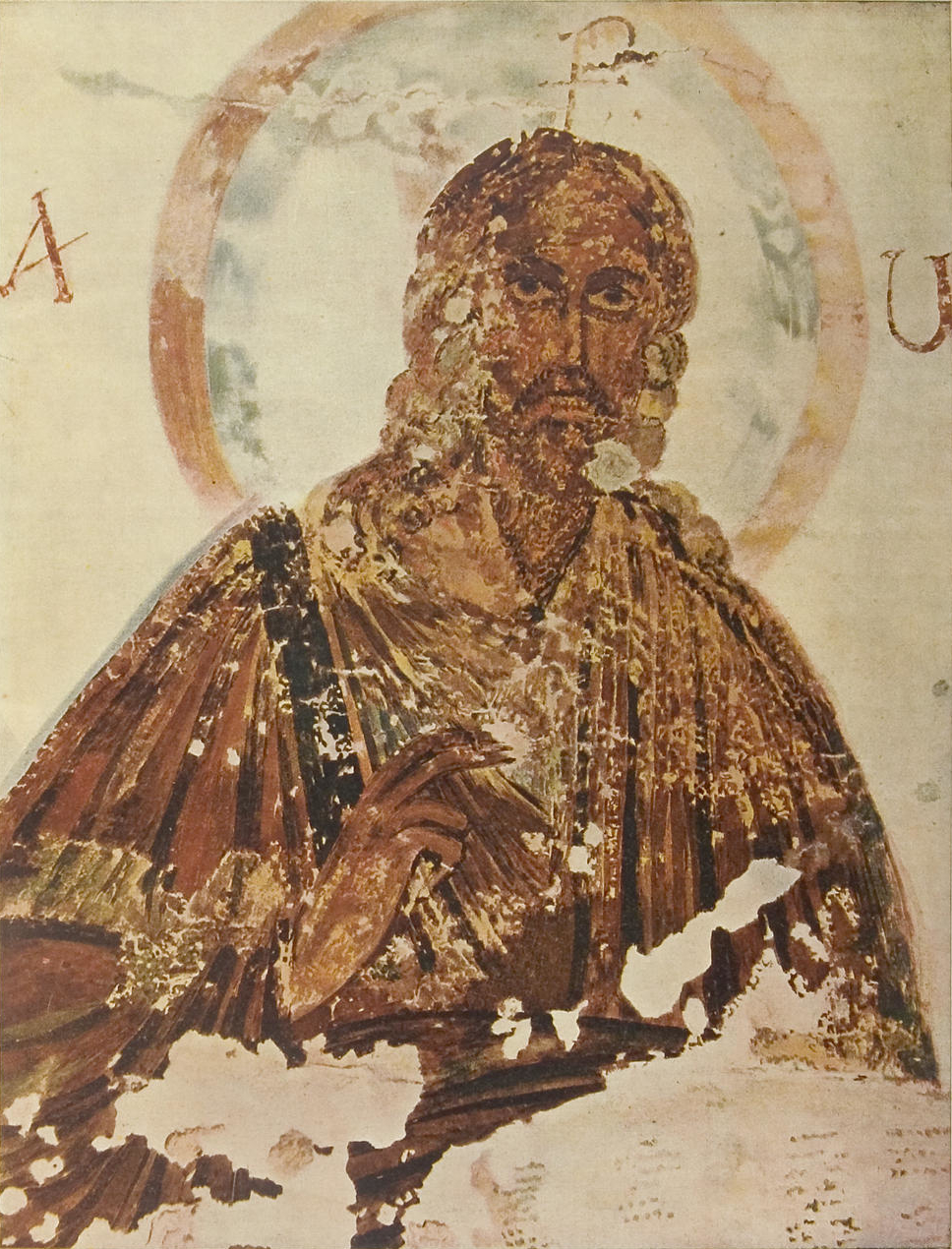
Reproduction of a faded early Christian fresco showing a bearded figure of Christ with a halo and a cross-shaped mark above the head, wearing a draped mantle with one hand raised. Greek letters flank the head, and the painting shows much flaking and loss of paint.Painting

Secondary source

Christ in the Catacomb of Saints Marcellinus and Peter

unknown artist · late 4th century A.D. - early 5th century A.D.

Book

Secondary source

Our Master: Thoughts for Salvationists about Their Lord

Bramwell Booth

Book

Secondary source

The Miracles of Our Lord

George MacDonald · 1870

Book

Secondary source

The Teaching of Jesus

George Jackson · 1903

Book

Secondary source

The Life of Jesus of Nazareth: A Study

Rush Rhees · 1902

Book

Secondary source

The Jesus of History

T. R. Glover

Book

Secondary source

His Life: A Complete Story in the Words of the Four Gospels

William E. Barton

Book

Secondary source

The Trial and Death of Jesus Christ

James Stalker · 1894

Book

Secondary source

Jesus of Nazareth, A Biography

John Mark

Book

Secondary source

St. Bonaventure's Life of Our Lord and Saviour Jesus Christ

Saint Bonaventure

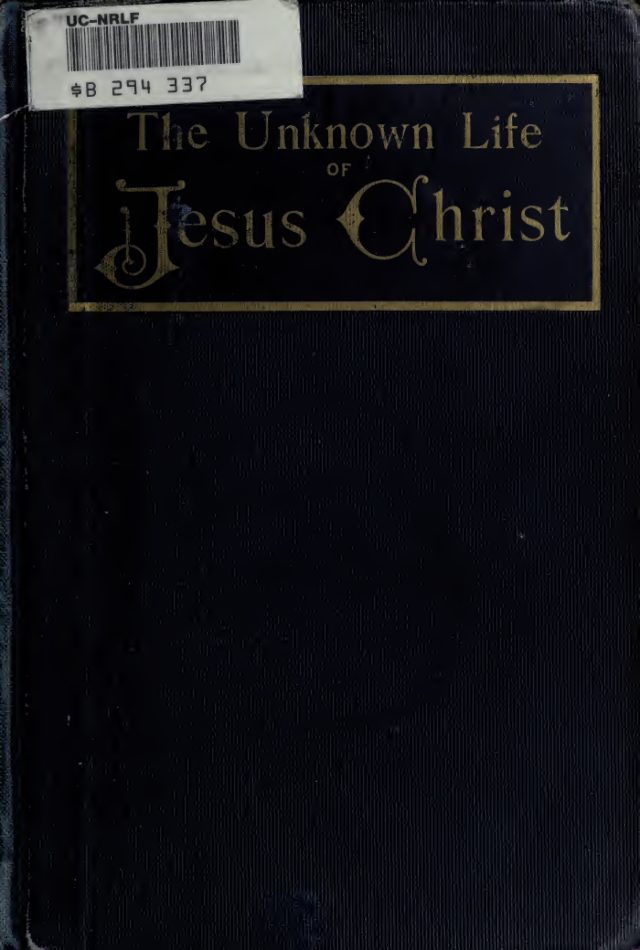
The Unknown Life of Jesus ChristBook

Secondary source

The Unknown Life of Jesus Christ

Nicolas Notovitch · 1894

The Gospel History and Its TransmissionBook

Secondary source

The Gospel History and Its Transmission

F. Crawford Burkitt · 1911

Book

Secondary source

The Parables of Jesus Explained and Illustrated

Friedrich Gustav Lisco · 1850

Book

Secondary source

A Treatise on the Character of Jesus Christ

Ethan Smith · 1814

Book

Secondary source

The Life of Jesus Christ for the Young, Vol. 3

Richard Newton

Book

Secondary source

The Good Shepherd: A Life of Christ for Children

Book

Secondary source

The Everlasting Man

G. K. Chesterton · 1925

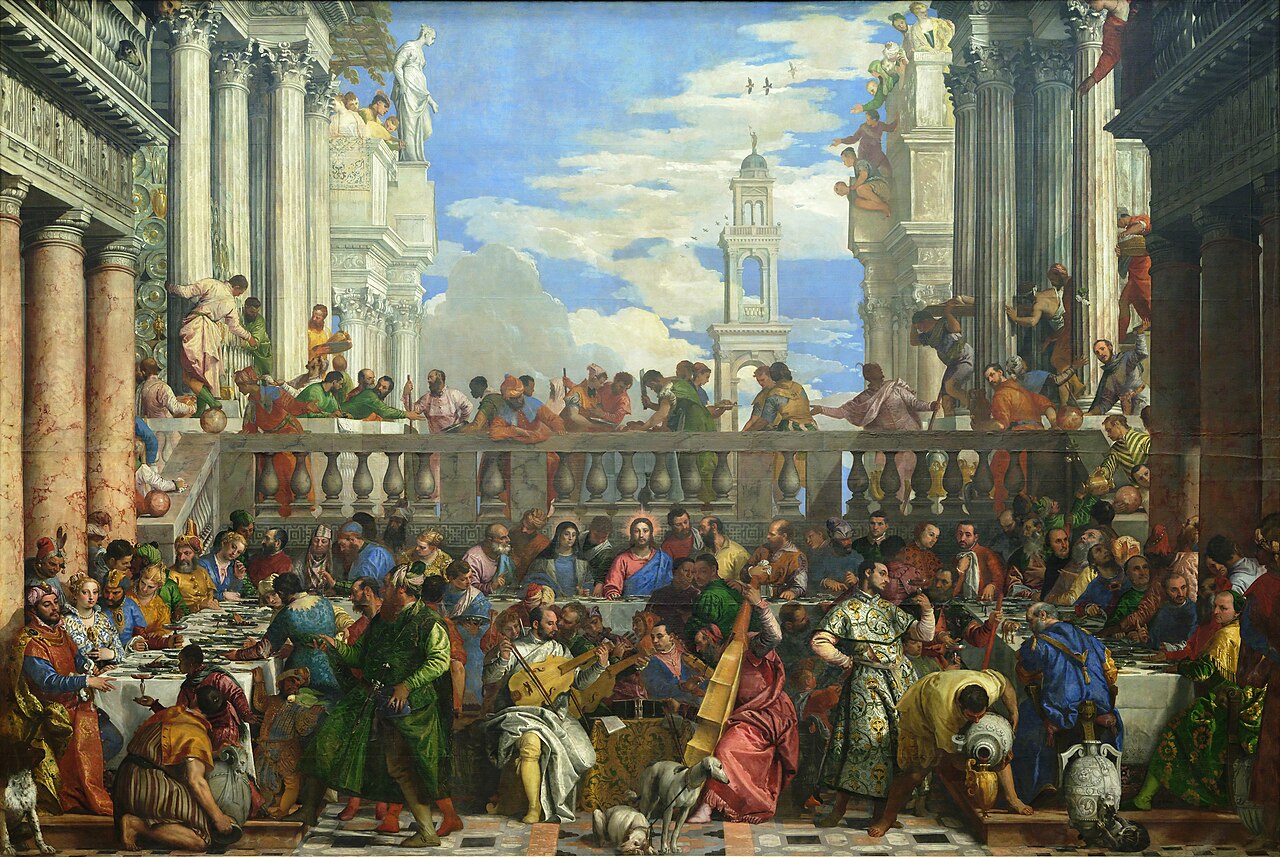
Large Renaissance painting of a crowded banquet set under classical colonnades, with many figures in rich robes at long tables, musicians playing in the foreground, servants pouring wine, and a bell tower visible against a blue sky.Painting

Secondary source

The Wedding at Cana

Paolo Veronese · 1562–1563

Document

Primary source

Appeal to Jesus Christ

Jan Hus · 1412

Want the full shelf? Chat with Jesus Christ in the app and open the Sources panel — every quote links back to the original.

Use Jesus Christ in class

1 assignment · 1 collection

A ready-made assignment and collection from the Humy team and other teachers that feature Jesus Christ. Preview any of them, then try it free.

Trusted by educators worldwide

Conversations
375,000+
Real exchanges between students and historical figures
Messages exchanged
4,142,000+
Across every figure, classroom and language
Historical figures
100,000+
Each informed by a curated biography and selected sources
Languages supported
50+
From English and Spanish to Arabic and Korean

Paying customers

Used by 98 schools and universities

Partner school logo
Tecnológico de Monterrey logo
Hyper Island logo
Partner school logo
Chambersburg Area School District logo
Broward County Public Schools logo
Nebo School District logo
National Louis University logo
South Florida PBS logo
Punahou School logo
University of Wisconsin–River Falls logo
Partner school logo
Partner school logo
Archbishop Mitty High School logo
Kingsburg High School logo
Norwalk Public Schools logo
Partner school logo
Connections logo
Partner school logo
Moore Public Schools logo
Partner school logo
Partner school logo
Partner school logo
Partner school logo
Robbinsville Public Schools logo
Partner school logo
Partner school logo
Partner school logo
Tecnológico de Monterrey logo
Hyper Island logo
Partner school logo
Chambersburg Area School District logo
Broward County Public Schools logo
Nebo School District logo
National Louis University logo
South Florida PBS logo
Punahou School logo
University of Wisconsin–River Falls logo
Partner school logo
Partner school logo
Archbishop Mitty High School logo
Kingsburg High School logo
Norwalk Public Schools logo
Partner school logo
Connections logo
Partner school logo
Moore Public Schools logo
Partner school logo
Partner school logo
Partner school logo
Partner school logo
Robbinsville Public Schools logo
Partner school logo
Partner school logo

What educators are saying

“We enjoyed the program last year and used it frequently.”
“My students say it’s a welcome change of pace. I’m not a fan of the “sage on the stage” model, so I try to incorporate research-oriented and self-paced activities. With Humy, students have to take charge of their learning. They’ve become more adept at critical thinking, forming better questions, and improving their reading comprehension. The interview feature has been my go-to tool. I create assignments where students must ask historical figures a set number of questions, then summarize the responses to ensure they’re truly absorbing the material. This approach lets them actively explore the past rather than passively consuming information.”
“Humy has helped me bring historical figures, sometimes long past, to life. When my students interact with these figures in real-time, it eliminates some of the perceived “ancient” characteristics of my curriculum. This has shifted my students’ thinking away from viewing history as abstract or irrelevant. Real-time interactions make historical figures relatable, even allowing students to ask off-topic questions that help put historical lives in a more relevant context for 13-year-olds. The feature I use the most is the interview feature. After teaching a topic, most recently Gandhi and Joan of Arc, I have the students ask pointed, focused questions. We practice good conversation techniques beforehand, teaching them to listen (or read) carefully and formulate thoughtful follow-up questions rather than just interrogating. It helps students practice effective conversation skills.”

FAQ

Frequently asked questions

Who is Jesus Christ?
Religious leader and central figure of Christianity. On Humy.ai you can chat with an AI version of Jesus Christ that draws on a short biography and 88 historical sources during the conversation — by text or voice, in 42 languages.
Is Jesus Christ AI free?
Yes. Jesus Christ is in Humy's free library: a free account includes 20 messages a month with Jesus Christ and the other free figures, by text or voice. No credit card is needed.
What sources does the Jesus Christ AI use?
It draws on a short biography and 88 historical sources (books, paintings and artifacts), including “Gospel of Mark”, “Jesus Christ, woodcut by Christoffel van Sichem III” and “Gospel of Matthew”. Each source has its own page on Humy.ai.
How historically accurate is the AI version of Jesus Christ?
Each figure uses a short biography and a small set of selected historical sources as context (retrieval-augmented generation), so answers stay closer to known material than the model's general knowledge alone. It isn't a citation-grade research tool — like any LLM, the AI can get details wrong or extrapolate. Treat it as a strong starting point for inquiry and cross-reference important claims.
Can I talk to Jesus Christ by voice?
Yes. In addition to text chat, you can call Jesus Christ and hear their voice respond in real time — useful for auditory learners, interview practice and Socratic dialogue.
Is Humy.ai safe and compliant for schools?
Yes. Humy.ai is used by more than 100 schools, universities and organisations. The platform is FERPA- and GDPR-aligned, supports SSO, and offers an IT-approval pack tailored for school procurement teams.

Ready when you are

Start chatting with Jesus Christ now.

20 messages free · No credit card · Available in 50+ languages.