Portrait of Ludwig van Beethoven

AI Historical Figure

Ludwig van Beethoven

Renowned German composer and pianist of the classical and romantic eras.

Chat with Ludwig van Beethoven via text or voice — in 42 languages, drawing on a curated biography and 96 historical sources. Available 24/7.

Start chatting with Ludwig van Beethoven20 messages free · No credit card
Lived
1770–1827
From
GermanyAustria
Known for
Music
Ludwig van Beethoven

Ludwig van Beethoven

Online · responds in seconds

Hello — I'm Ludwig van Beethoven. Renowned German composer and pianist of the classical and romantic eras. What would you like to ask me?

20 messages free · No credit card · Powered by Humy.ai

Live preview · Switch between 42 languages above · Send a message to continue in the app

Multilingual

Talk to Ludwig van Beethoven in 42 languages

Ask Ludwig van Beethoven questions in any language below, and the rest of Humy's app speaks it too. Pick yours to open the chat in that language.

Also in German (Austria), German (Switzerland), English (UK), English (Australia), English (Canada).

The sources behind this AI

96 sources · 39 documents · 17 books · 15 artifacts · 10 paintings · 5 sculptures · 5 letters · 3 newspaper articles · 1 diary entry · 1 documentary

Ludwig van Beethoven doesn’t improvise from thin air. The AI is grounded in 96 curated historical sources students can inspect. Open any of them to see what informs the conversation.

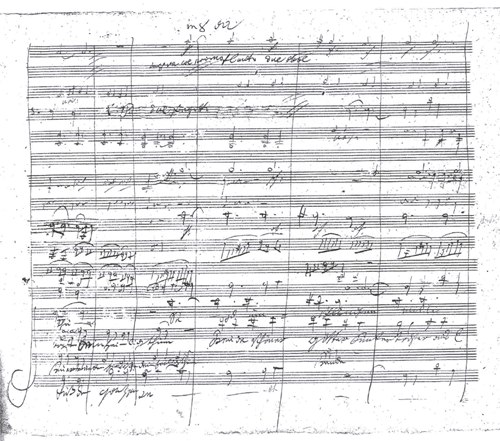
Scan of a handwritten manuscript page of orchestral music on many staves, with pencil or ink notation, Italian and German text written under the staves, and a handwritten heading at the top. Appears to be a sketch or draft score page.Document

Primary source

Symphony No. 9

Ludwig van Beethoven · 1824

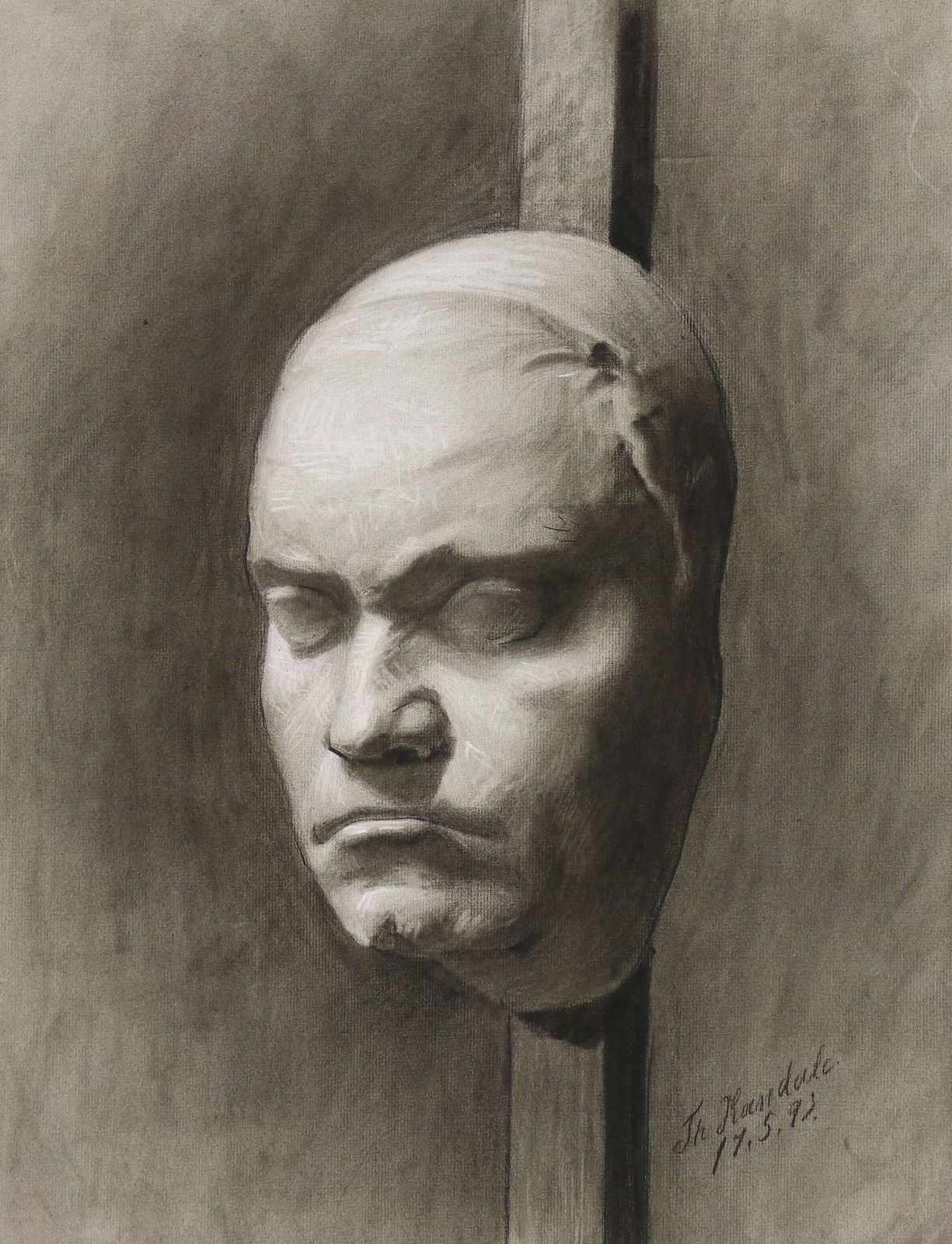
Charcoal and white chalk drawing on grey paper of a death mask of a bald man with closed eyes, a furrowed brow, a large nose and a pursed mouth, seen three-quarter view against a dark background and a vertical wooden post. A cursive signature and date appear at lower right.Sculpture

Secondary source

Death of Ludwig van Beethoven

Theodor Kandale (after Josef Danhauser) · 1827 (mask); drawing 1893

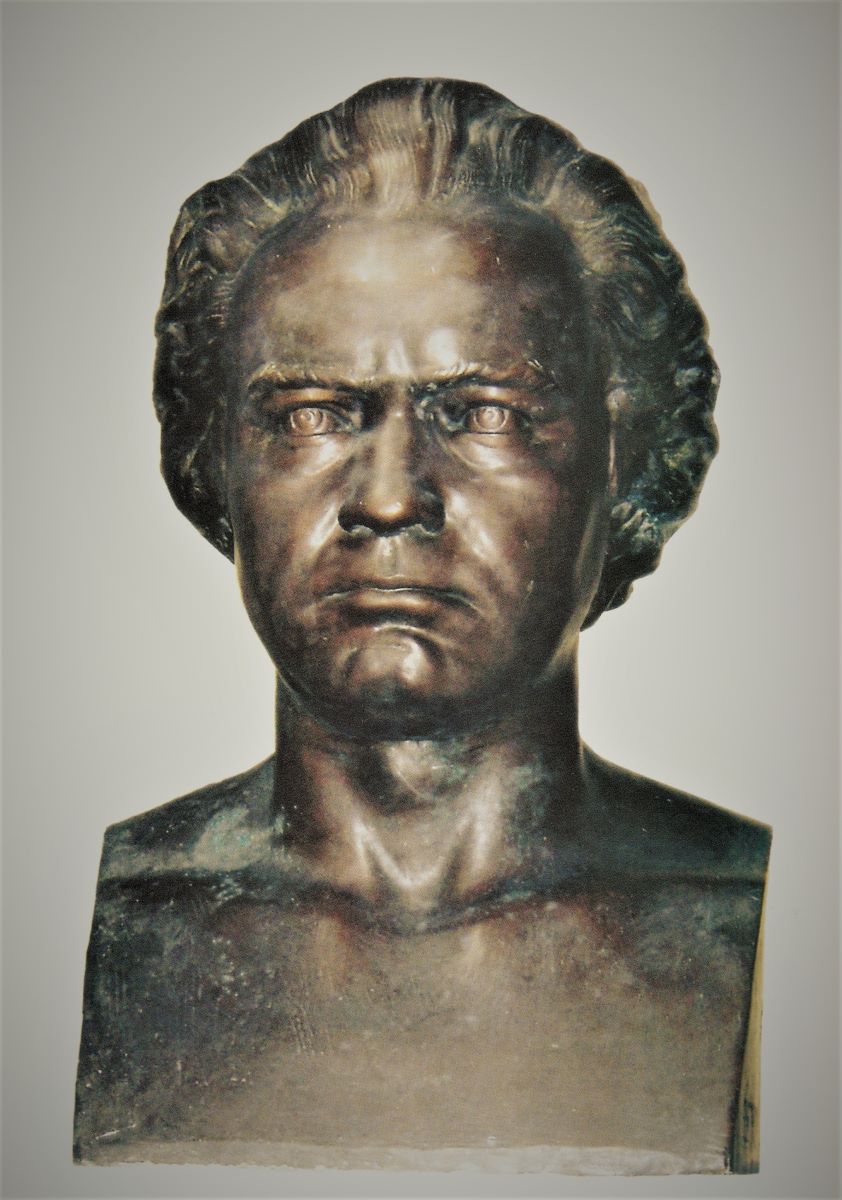
Photograph of a dark bronze-toned bust of a man with full wavy hair swept back, a furrowed brow, and a stern, closed-mouth expression, shown from the chest up against a pale grey background.Sculpture

Secondary source

Bust of Ludwig van Beethoven by Frederic Storck

Frederic Storck · 1930

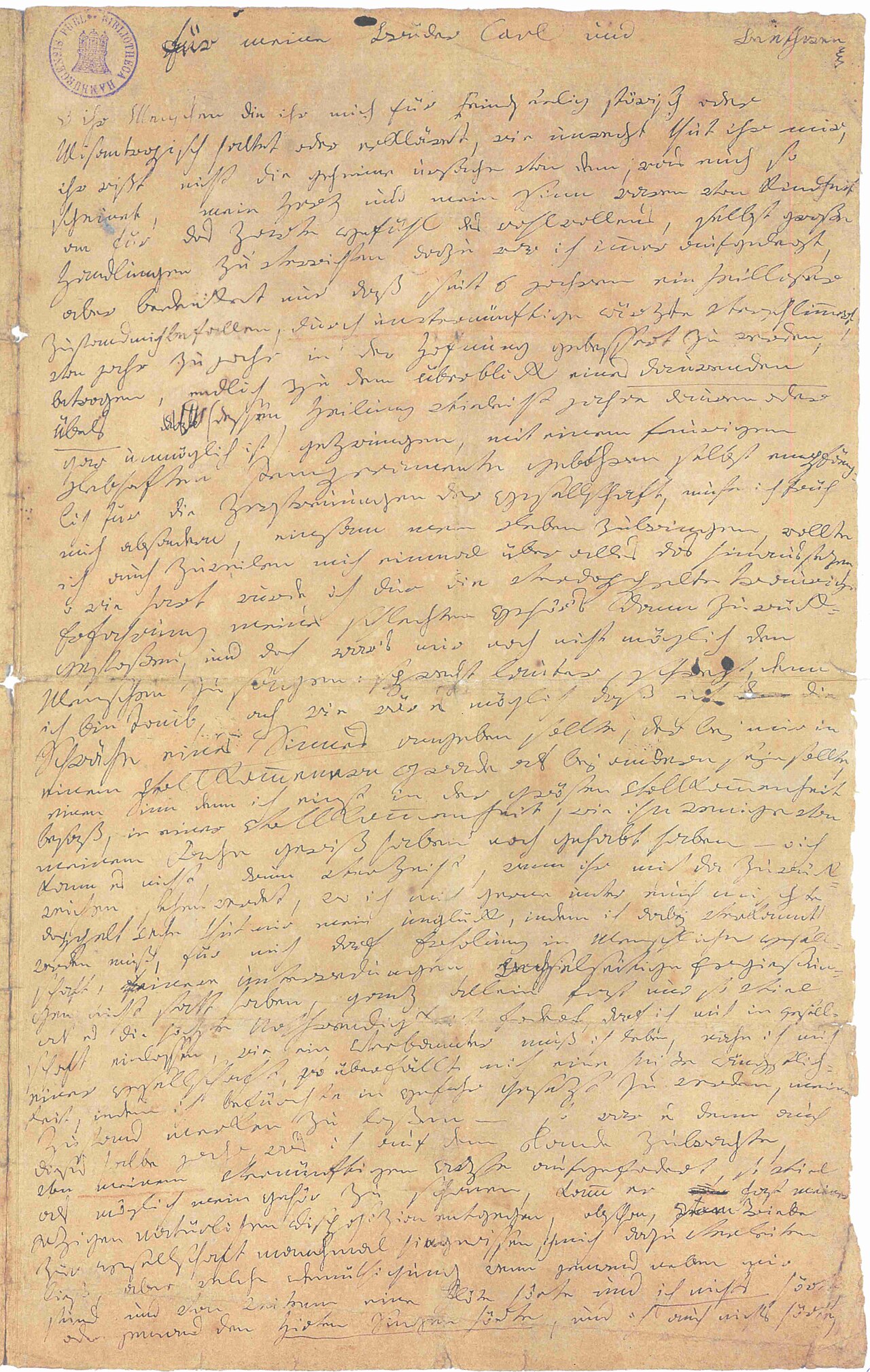
Scan of a handwritten German letter on aged, yellowed paper, in cursive ink with some crossed-out words. A blue library stamp reading 'Nationalbibliothek' with a crest is at the upper left. The heading begins 'Für meine Brüder Carl und'.Letter

Primary source

Heiligenstadt Testament

Ludwig van Beethoven · 6 October 1802

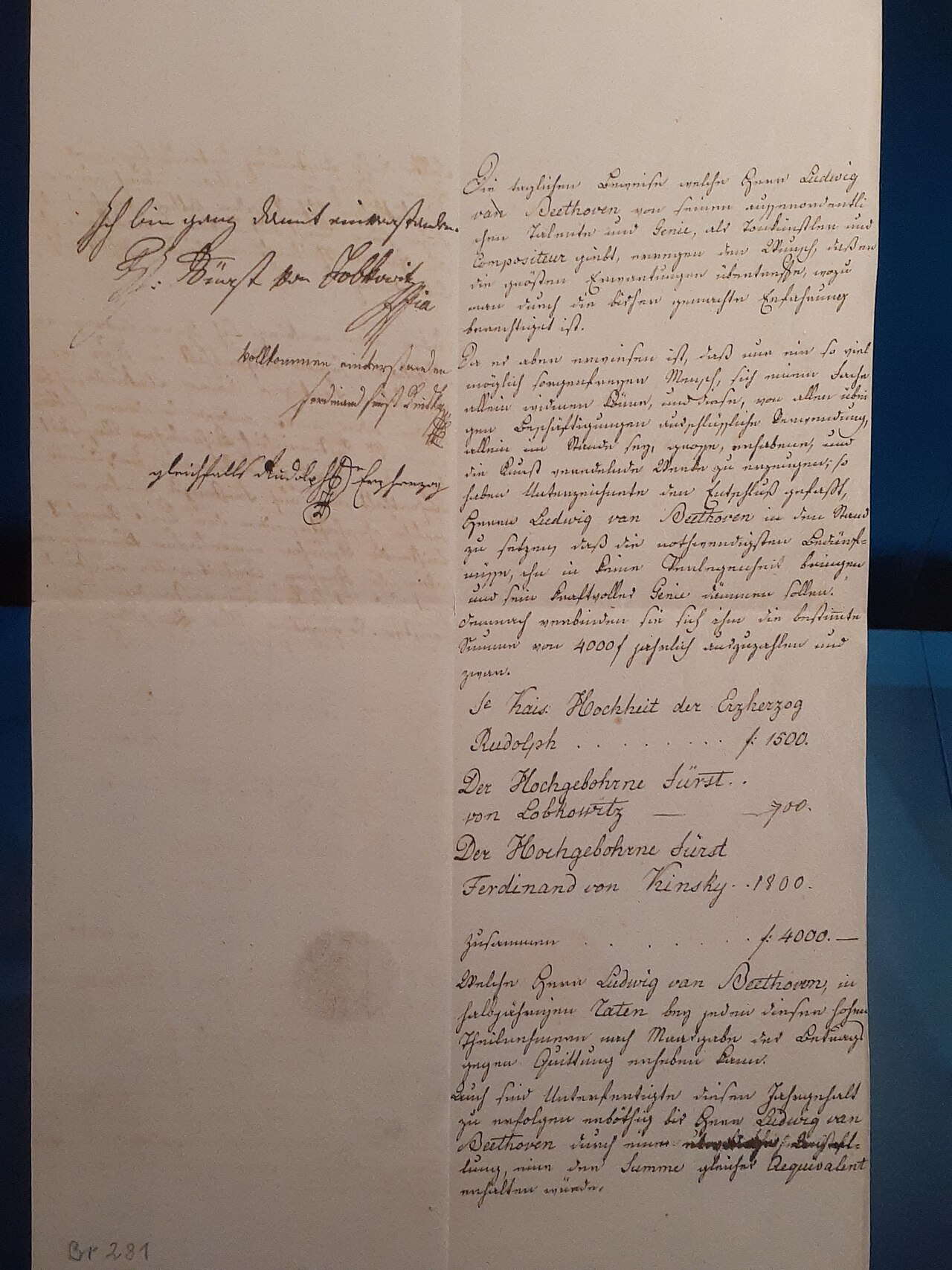
Photograph of a handwritten German document on aged paper, with signatures and seals at left and a column of text at right listing sums of 1500, 700 and 1800 florins totaling 4000 florins, referencing Ludwig van Beethoven.Document

Primary source

Agreement between Beethoven and Archduke Rudolph, Prince Kinsky and Prince Lobkowitz

1 March 1809

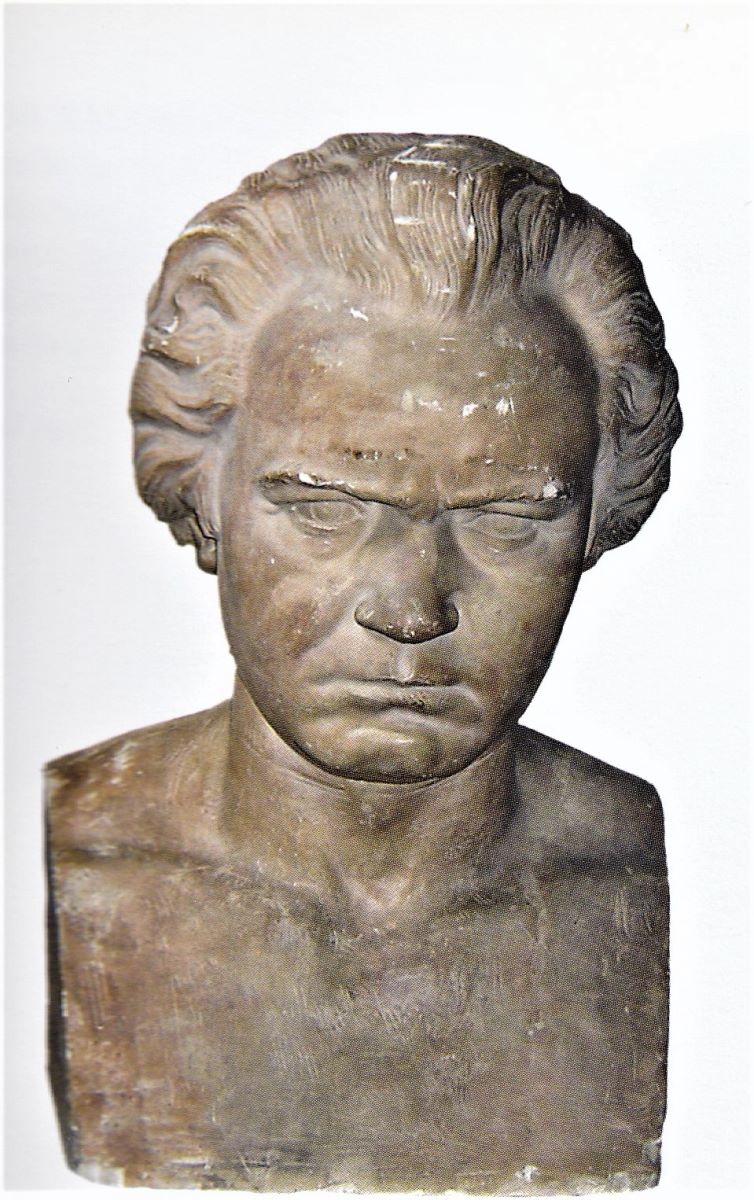
Photograph of a plaster-like bust of a man with wavy, swept-back hair, furrowed brow, and stern expression, shown from the front on a pale background. The bust's surface is worn and slightly chipped.Sculpture

Secondary source

Model for Bronze Casts of the Beethoven Bust

Frederic Storck

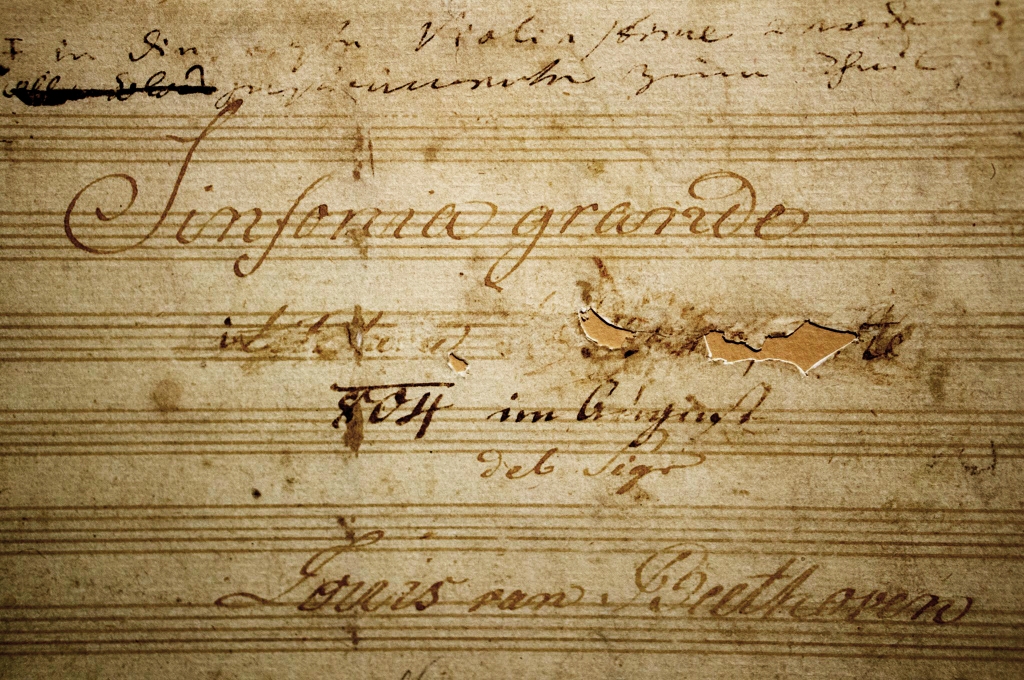
Close-up of aged, stained manuscript paper with ruled staff lines. Handwritten in ink: 'Sinfonia grande' with 'Intitolata' partly visible, 'Buonaparte' area torn and damaged, 'im Bey...' and 'del Sig' lines, and signed 'Louis van Beethoven' at the bottom.Document

Primary source

Symphony No. 3, Eroica

Ludwig van Beethoven · 1803-1804

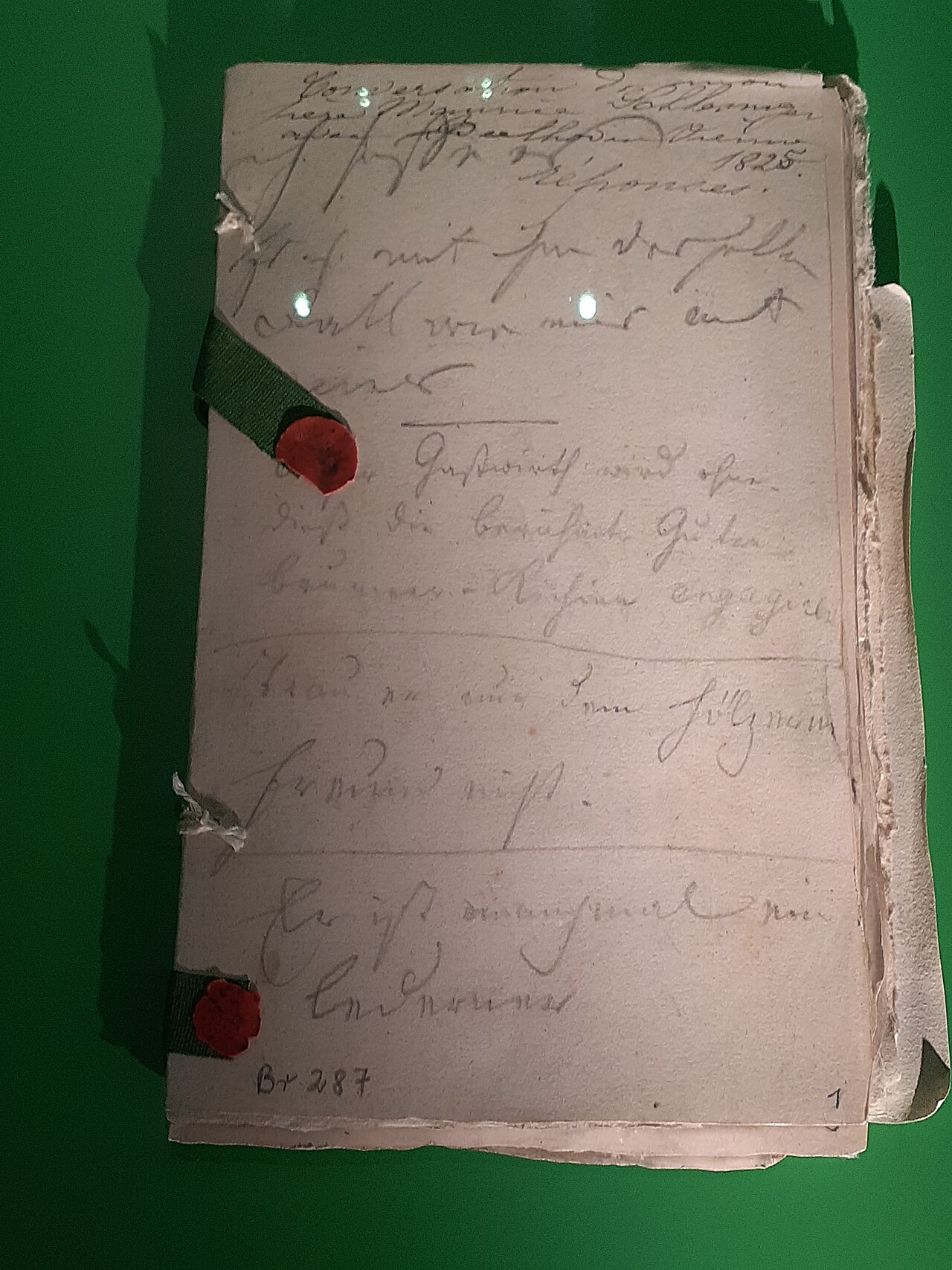
A small, worn paper notebook lying on a green background, with handwritten German pencil text on its cover page and a green ribbon tied with a red wax seal. Ink reads a date of 1825 at the top and the shelf mark Br 287 at the bottom.Diary entry

Primary source

Beethoven's Conversation Book

1825

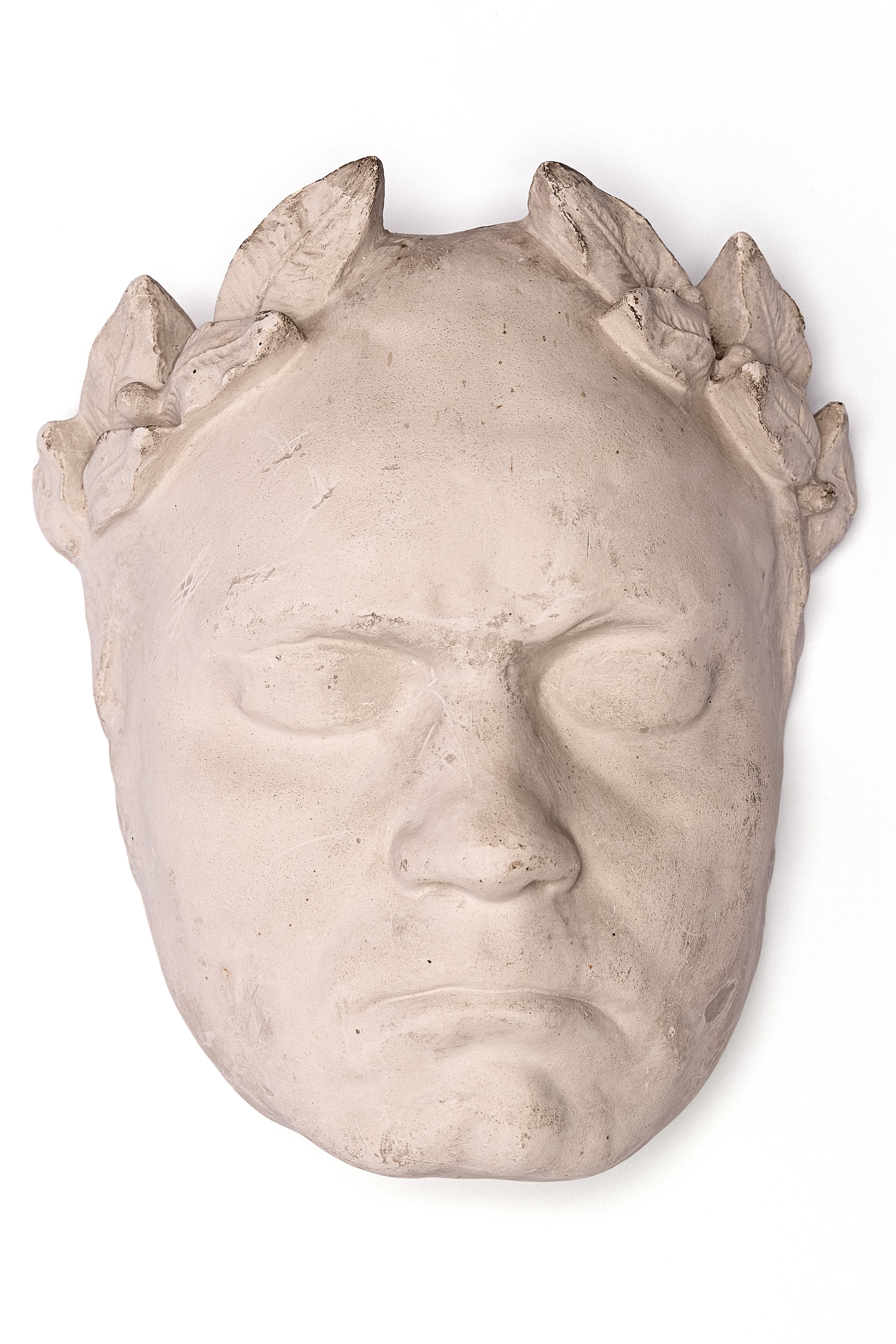
Plaster life mask of a male face with closed eyes, a stern closed mouth, and a wreath of carved laurel leaves across the forehead and temples. The off-white surface shows small marks and wear.Artifact

Primary source

Life Mask of Ludwig van Beethoven

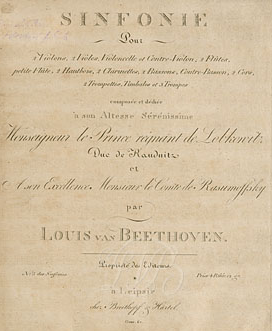
Title page of the first edition of Beethoven's Symphony No. 5, printed in large decorative capitals reading SINFONIE, with the dedication to Prince Lobkowitz and Count Razumovsky and the name LOUIS van BEETHOVEN, published in Leipzig by Breitkopf & Härtel.Document

Primary source

Symphony No. 5

Ludwig van Beethoven · 1804-1808

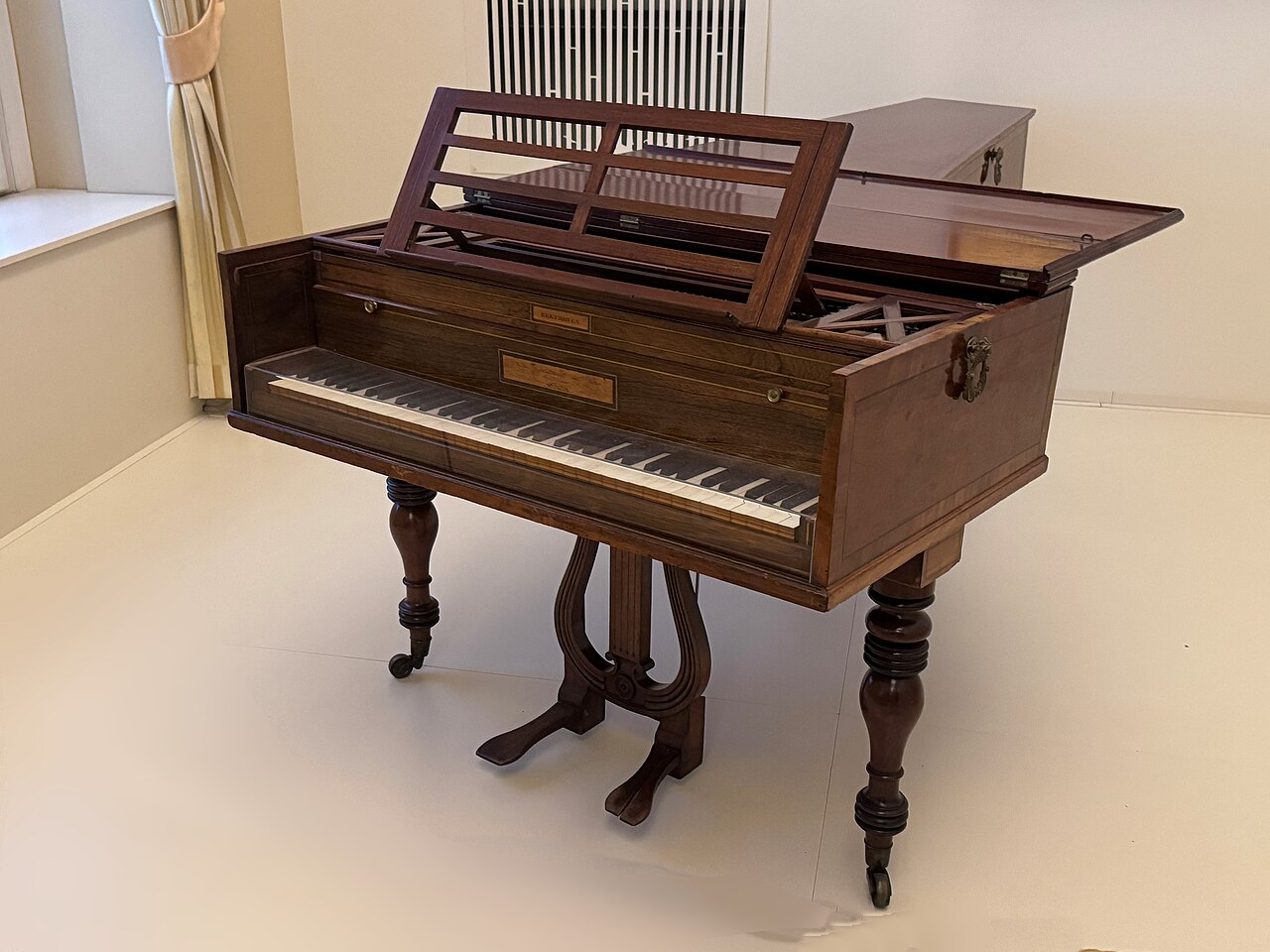
A rosewood square grand piano with its lid open and a music stand raised, displayed in a museum room. Turned wooden legs and a lyre-shaped pedal stand support the case, and the keyboard is visible at the front.Artifact

Primary source

Beethoven's Broadwood Piano

John Broadwood & Sons · 1817

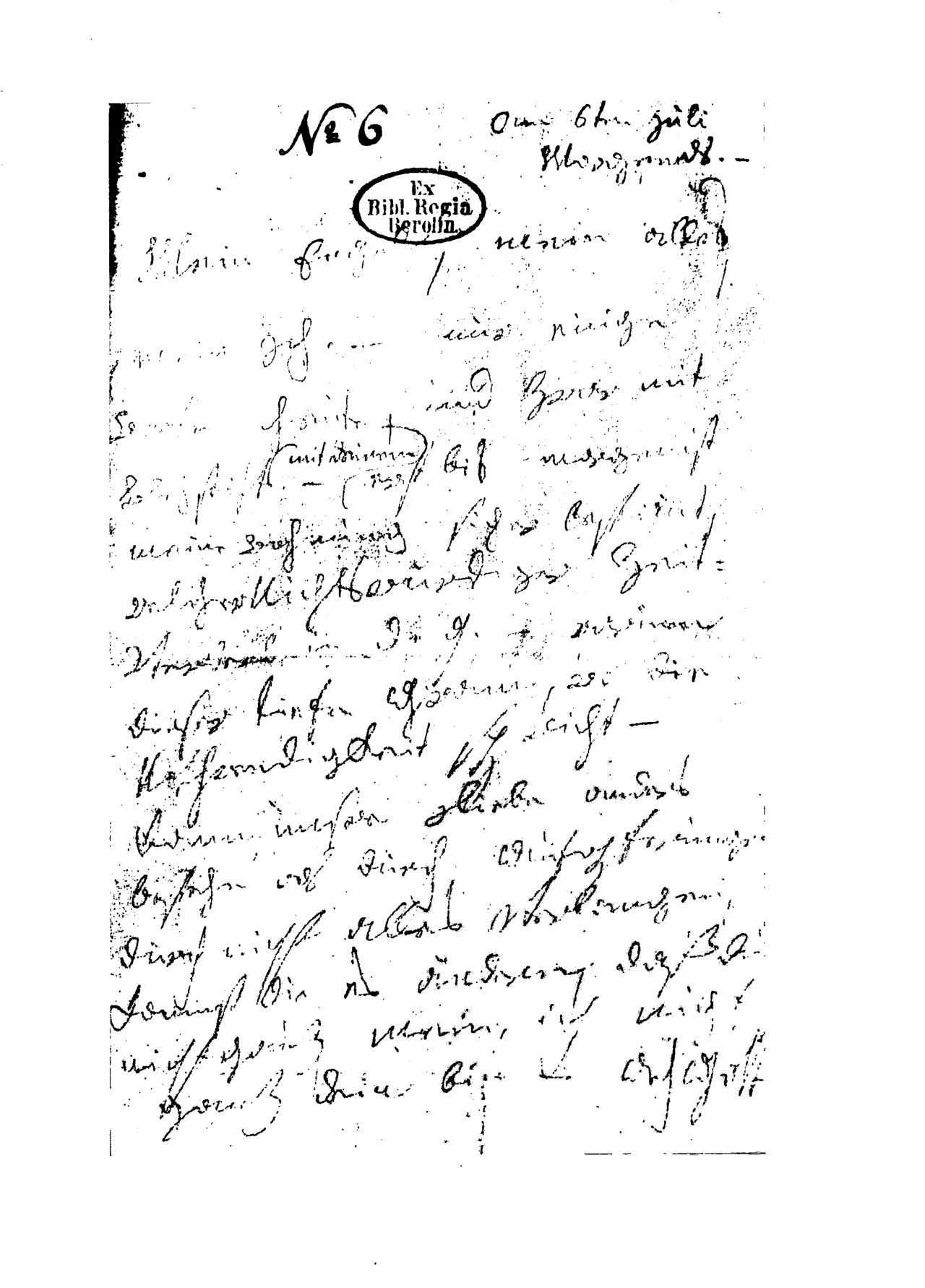
Scanned page of handwritten German manuscript in faded ink, marked No. 6 at top left with a Berlin royal library oval stamp reading Ex Bibl. Regia Berolin, and a date line reading 'den 6ten Juli' at top right. The handwriting is dense and partly illegible in this low-contrast scan.Letter

Primary source

Immortal Beloved Letter

Ludwig van Beethoven · 6-7 July 1812

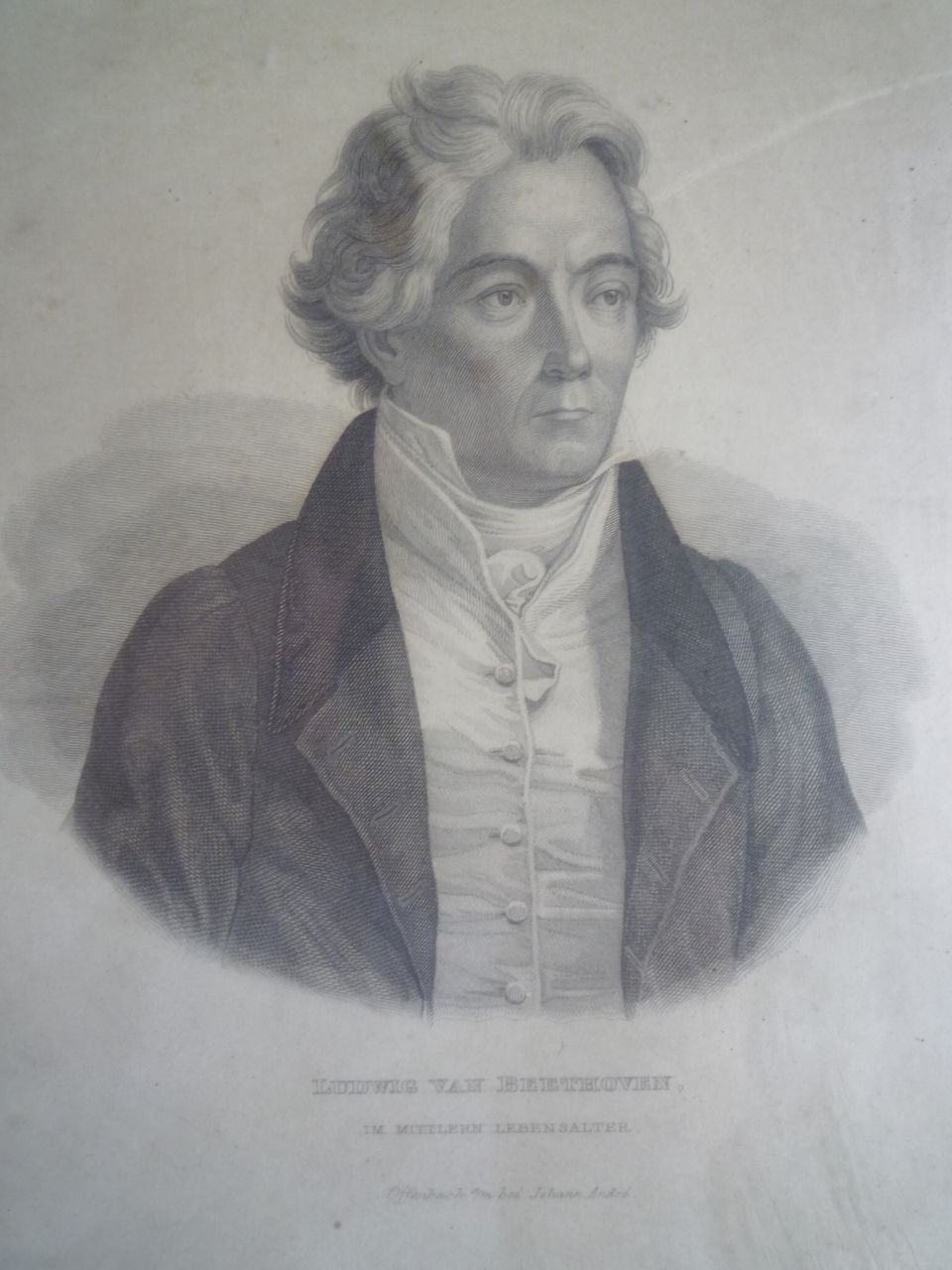
Engraved portrait of a man with wavy, swept-back grey hair, wearing a dark jacket, high white collar, cravat and buttoned waistcoat, looking to his right. Printed caption below reads 'LUDWIG VAN BEETHOVEN' and 'IM MITTLERN LEBENSALTER'.Painting

Secondary source

Ludwig van Beethoven, im mittlern Lebensalter

unknown, after Johann Stephan Decker · mid-19th century, after an 1824 drawing

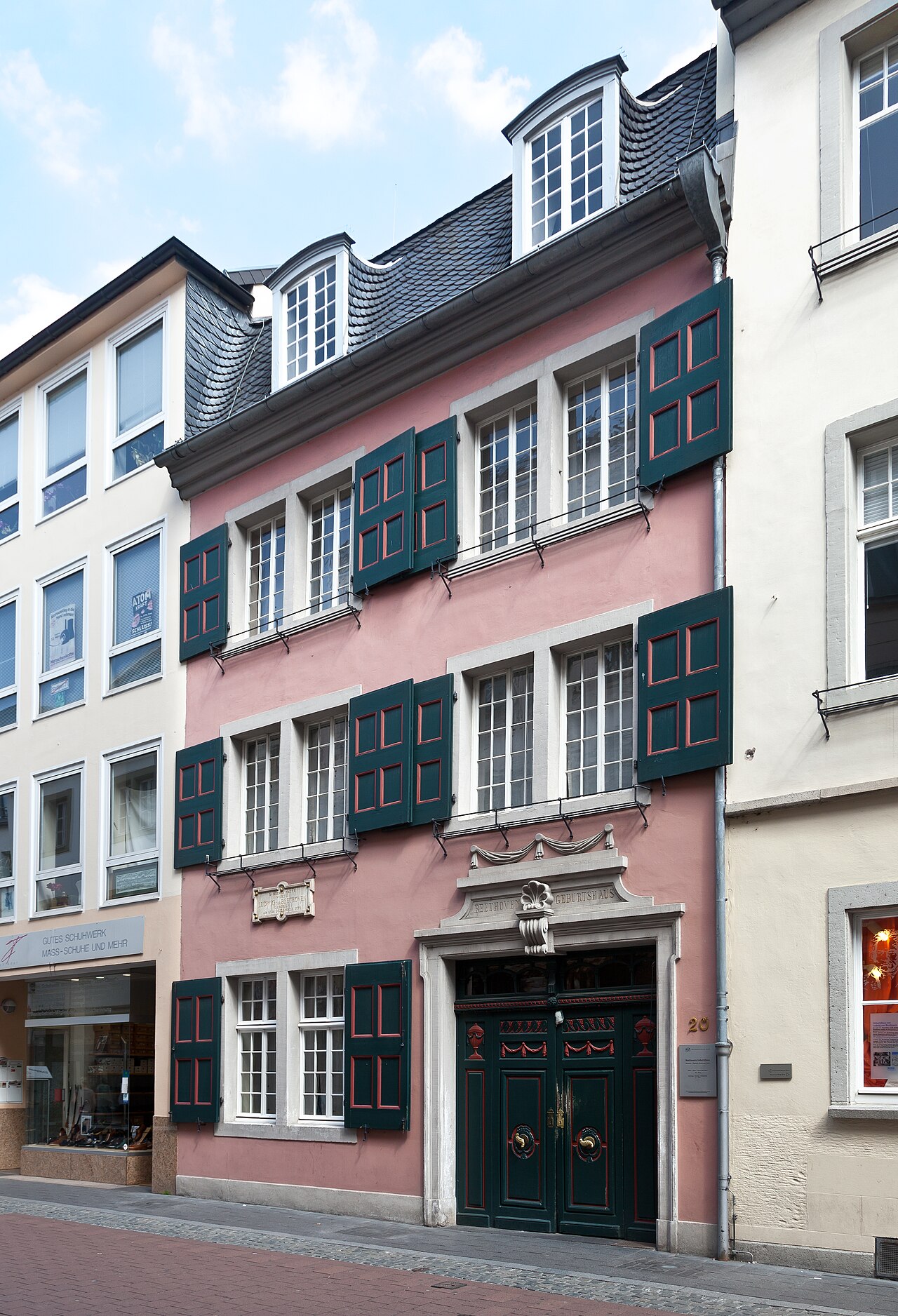
Front view of a pink three-story townhouse with dark green shutters and a green double door under a carved stone portal inscribed with 'Beethoven Haus'. Steep slate roof with two dormer windows. Modern shop buildings flank it on both sides.Artifact

Secondary source

Beethoven House

archive building opened 1927; house from c. 1700

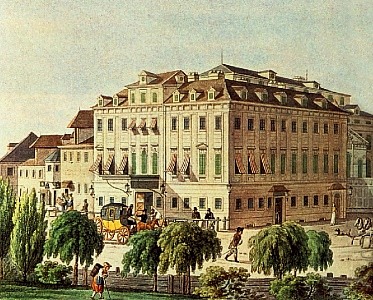
Colored print of a large multi-story cream-colored building with a mansard roof and rows of windows, flags on the facade, a yellow horse-drawn carriage at the entrance, trees and pedestrians in the foreground.Artifact

Secondary source

Theater an der Wien

Franz Jäger (architect) · 1801

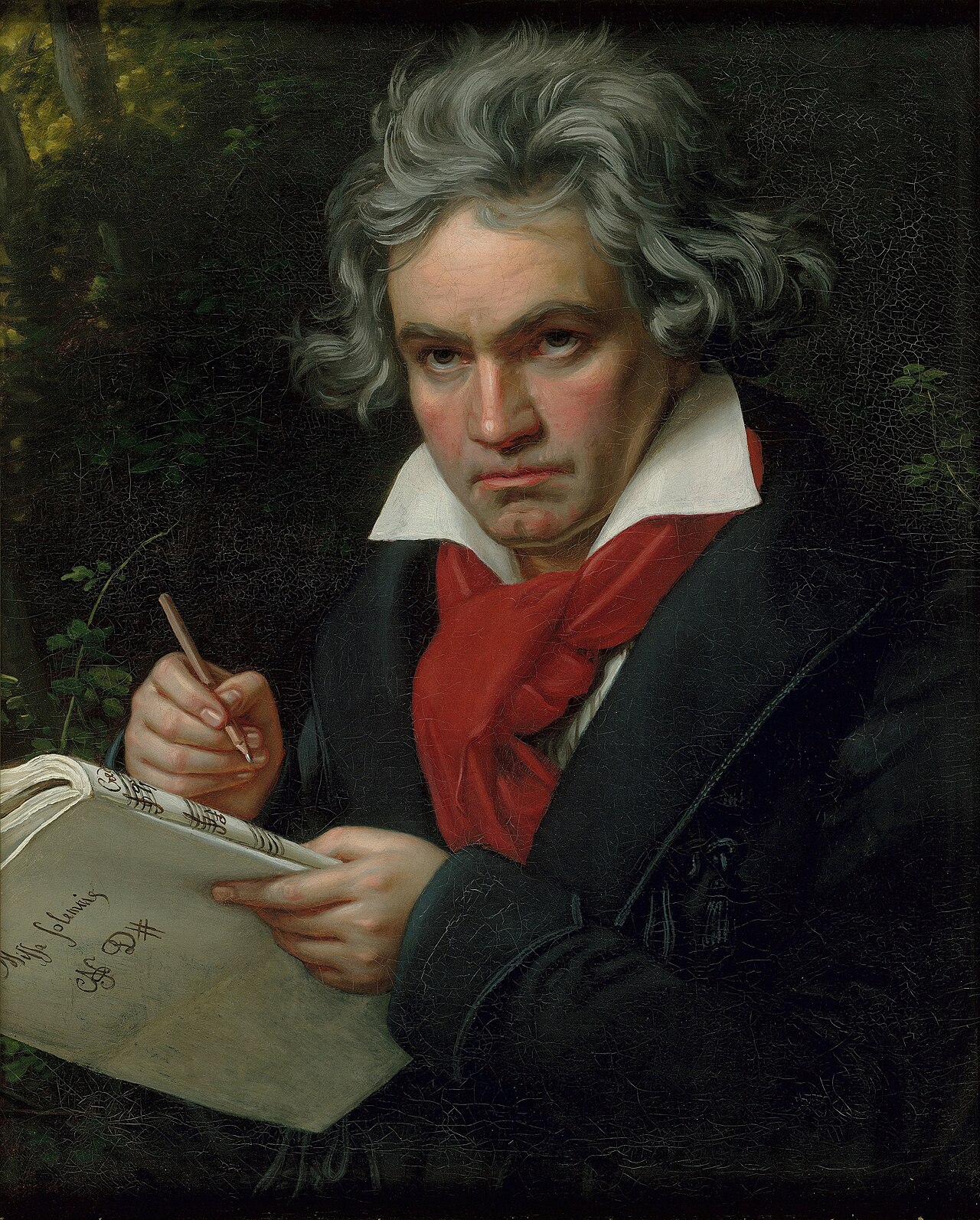
Painting of a man with wild, graying hair in a dark coat, white collar, and red cravat, holding a quill pen over an open music manuscript with handwritten notes, against a dark green leafy background.Painting

Primary source

Portrait of Beethoven with the Manuscript of the Missa Solemnis

Joseph Karl Stieler · 1820

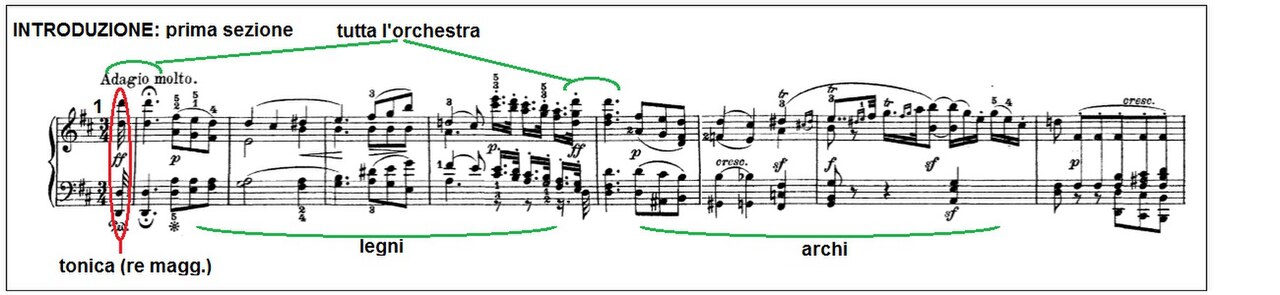
Annotated musical score excerpt of the opening of a symphony in D major, showing the Adagio molto introduction. Handwritten-style Italian labels mark 'INTRODUZIONE: prima sezione', 'tutta l'orchestra', 'legni' and 'archi', and 'tonica (re magg.)' in red, with green bracket lines grouping the instrument sections across the staves.Document

Primary source

Symphony No. 2

Ludwig van Beethoven · 1801-1802

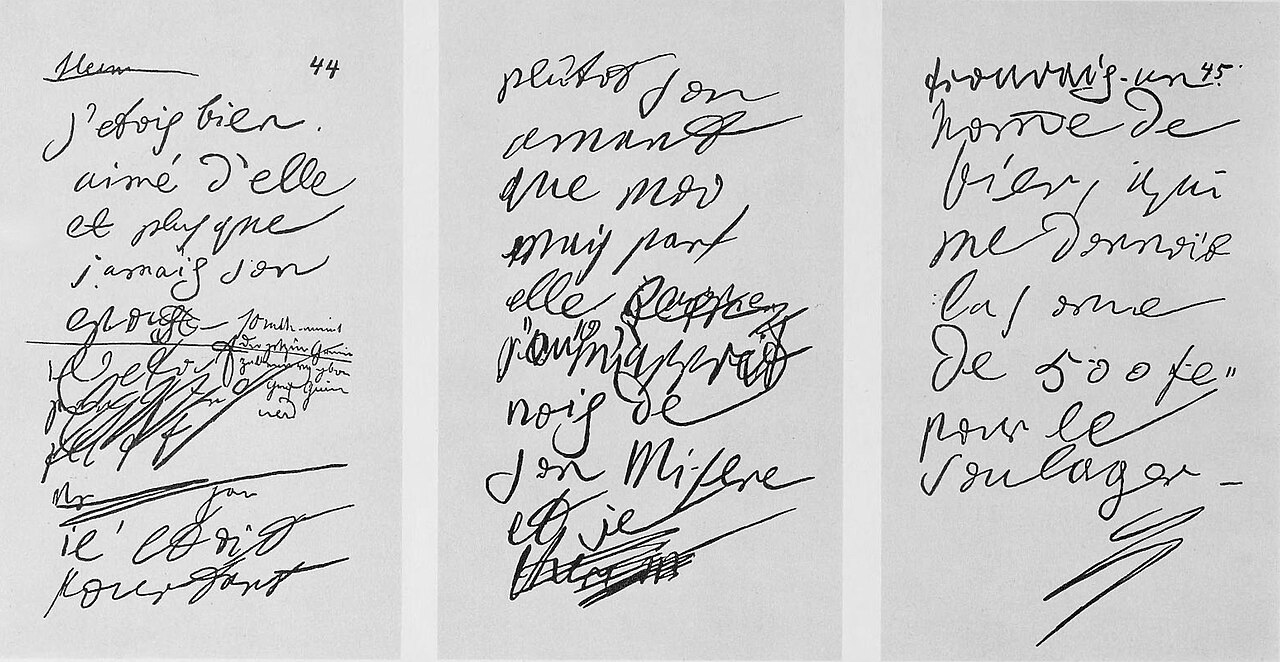
Three panels of handwritten manuscript pages in French, with crossed-out and overwritten words. Page numbers 44 and 45 appear at the top. Some pencil marginal notes are visible on the left page.Document

Primary source

Conversation Book Entry on Julie Guicciardi

Ludwig van Beethoven

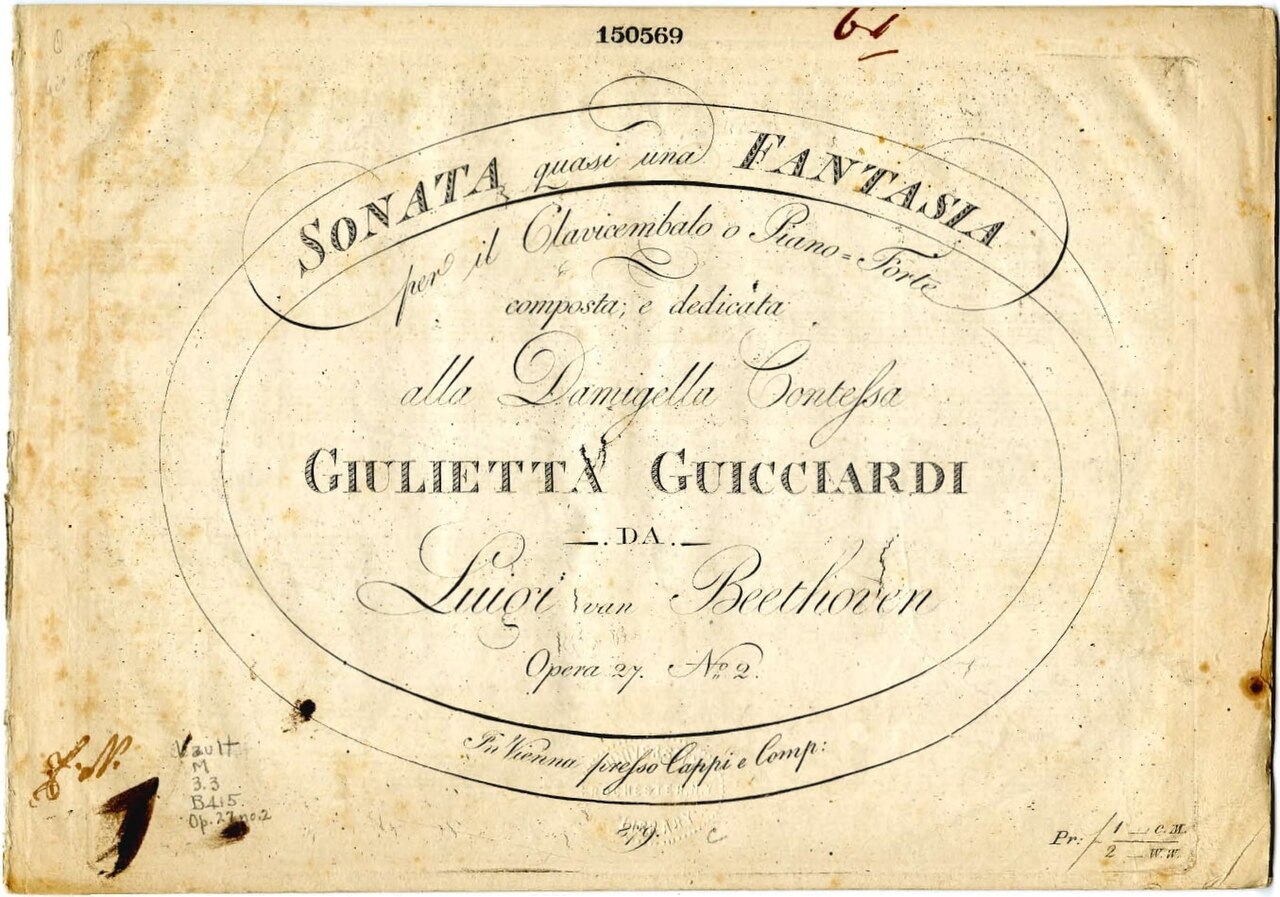
Engraved title page of a music score on aged cream paper. Italian text reads 'Sonata quasi una Fantasia' and 'Giulietta Guicciardi' with 'Ludwig van Beethoven' and 'Opera 27 No. 2', published in Vienna by Cappi e Comp.Document

Primary source

Piano Sonata No. 14, 'Moonlight Sonata'

Ludwig van Beethoven · 1801, published 1802

Musical score excerpt on a treble staff with three flats in the key signature. It shows the opening theme of the piano concerto: a short melody of half, quarter, and eighth notes with rests, written in staccato.Document

Primary source

Piano Concerto No. 3

Ludwig van Beethoven · 1804 (published); composed c. 1800

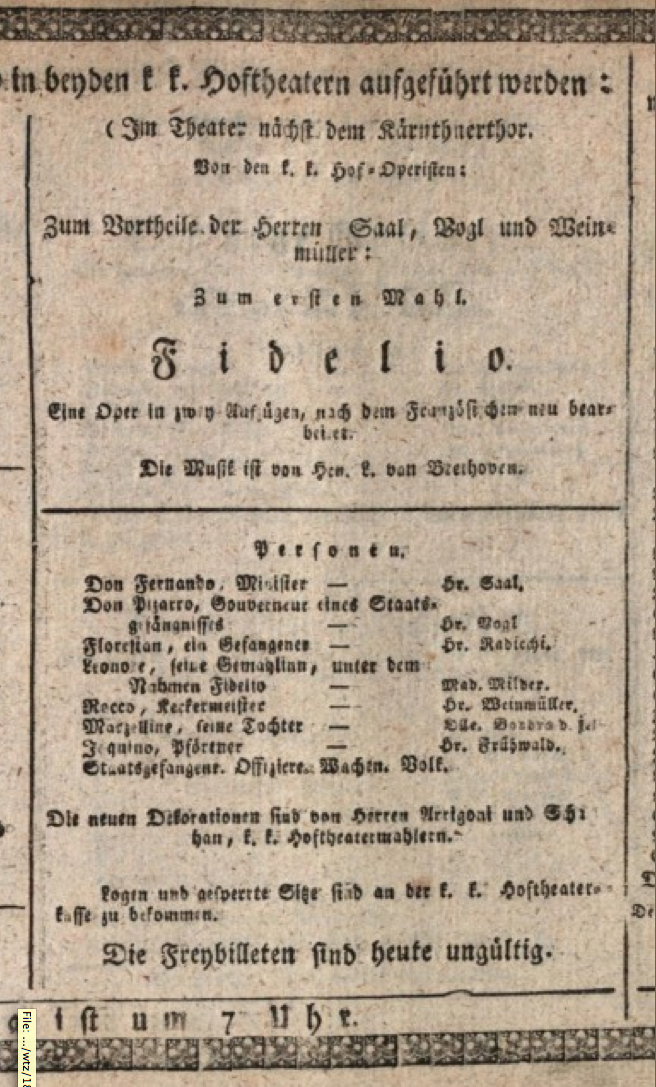
Scan of an 1814 Viennese theatre playbill in old German blackletter type announcing Fidelio, an opera in two acts after the French, with music by Herr k. v. Beethoven, performed at the Theater am Kärntnertor. It lists the cast, new decorations, and a note that free tickets are invalid today.Document

Primary source

Fidelio Premiere Playbill

23 May 1814

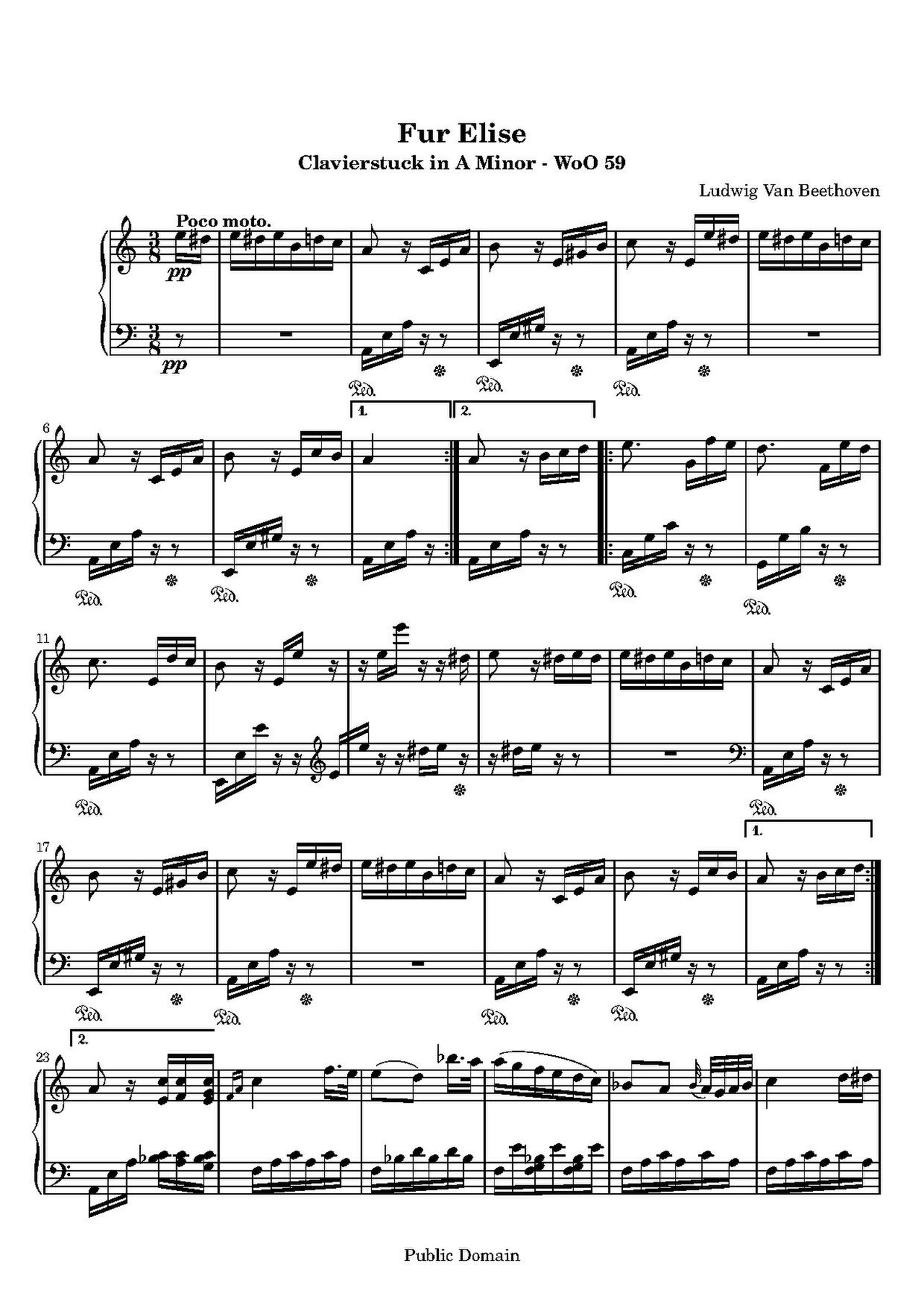
Printed sheet music score of Für Elise, titled 'Poco moto' in A minor, 3/8 time, for piano with treble and bass staves, showing the opening measures with the melody notes and pedal markings.Document

Secondary source

Für Elise

Ludwig van Beethoven · 1810, published 1867

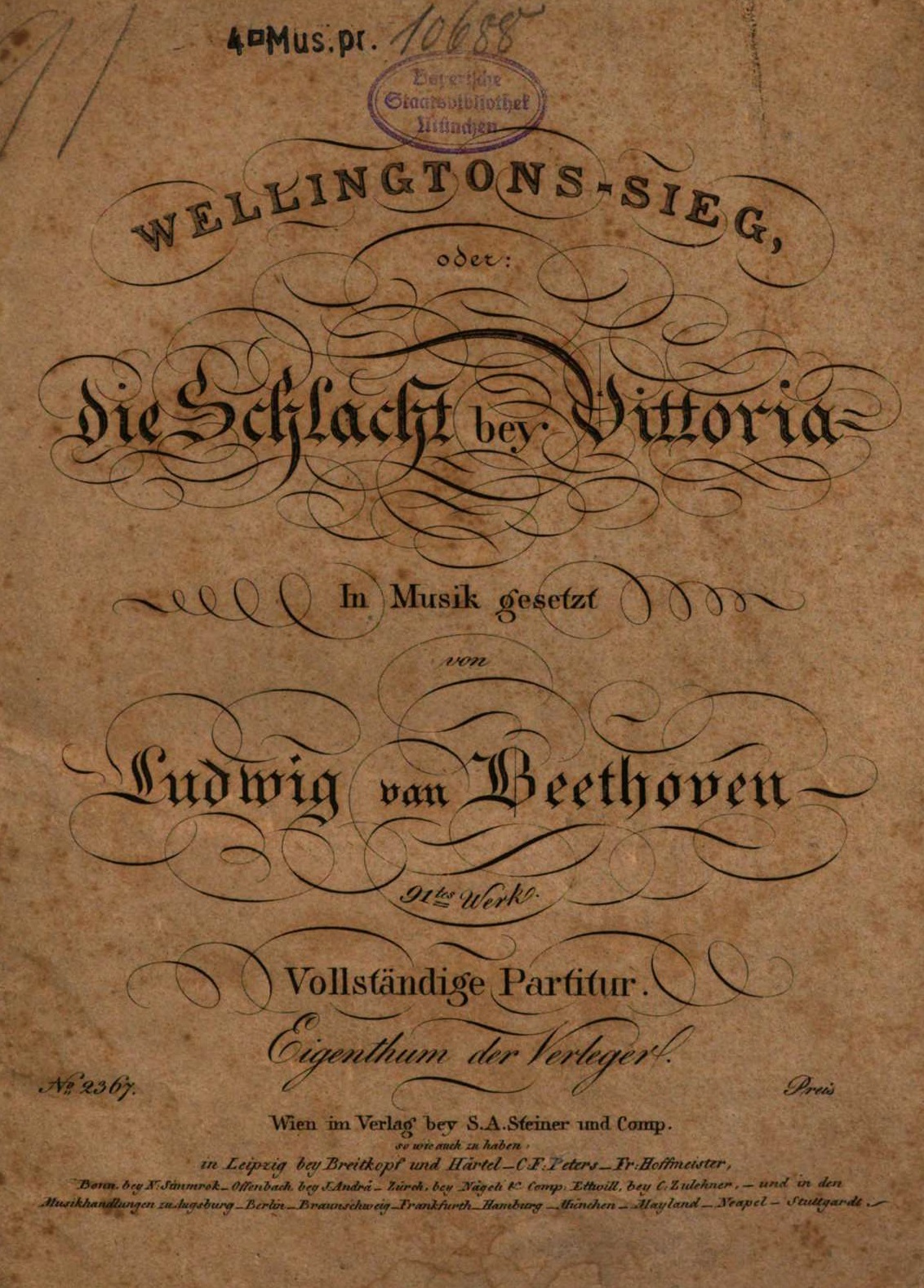
Title page of the printed full score of Beethoven's Wellingtons Sieg, oder Die Schlacht bey Vittoria, in ornate calligraphic lettering on aged tan paper. Handwritten and stamped library marks appear at the top, including a purple oval stamp reading Bayerische Staatsbibliothek Muenchen. Lower text lists publisher S.A. Steiner und Comp. in Wien, with further distributors in Leipzig, Bonn, Offenbach and other cities.Document

Primary source

Wellington's Victory

Ludwig van Beethoven · 1813

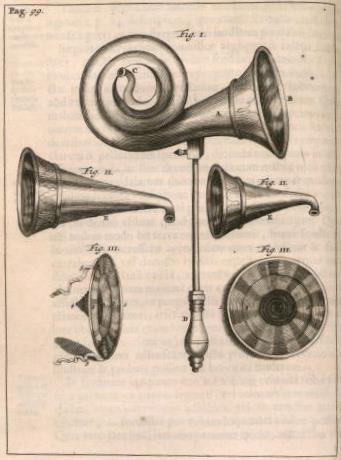
Engraved plate labeled Pag. 29 showing ear trumpets. Fig. I is a large spiral horn with a flared bell, with a handle and stem below. Fig. II and Fig. IV are smaller flared horns. Fig. III shows a round disc-shaped device at lower left and right.Artifact

Primary source

Beethoven's Ear Trumpet

Johann Nepomuk Mälzel · 1810s

Musical score excerpt in treble clef, 4/4 time, showing the opening theme of a piano concerto: a sequence of staccato quarter notes, rests, and a run of sixteenth and thirty-second notes across several bars.Document

Primary source

Piano Concerto No. 1

Ludwig van Beethoven · 1795

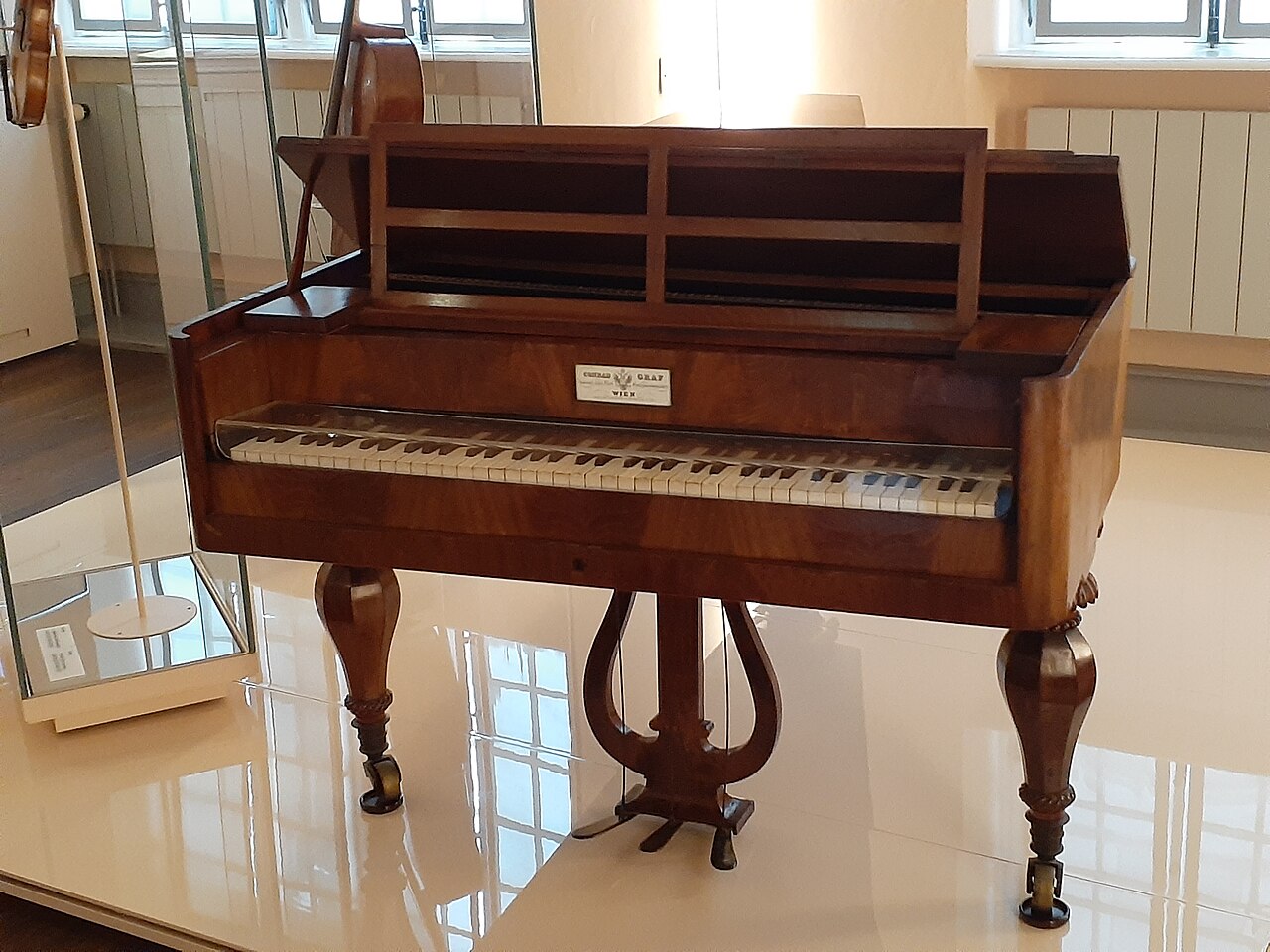
A dark wooden square grand piano with carved legs, a lyre-shaped pedal stand, and a brass plate reading 'Conrad Graf Wien'. Its lid is open with a music rack, and the ivory keys are visible. It stands on a glossy floor beside a glass display case containing a violin.Artifact

Primary source

Beethoven's Last Fortepiano

Conrad Graf · 1826

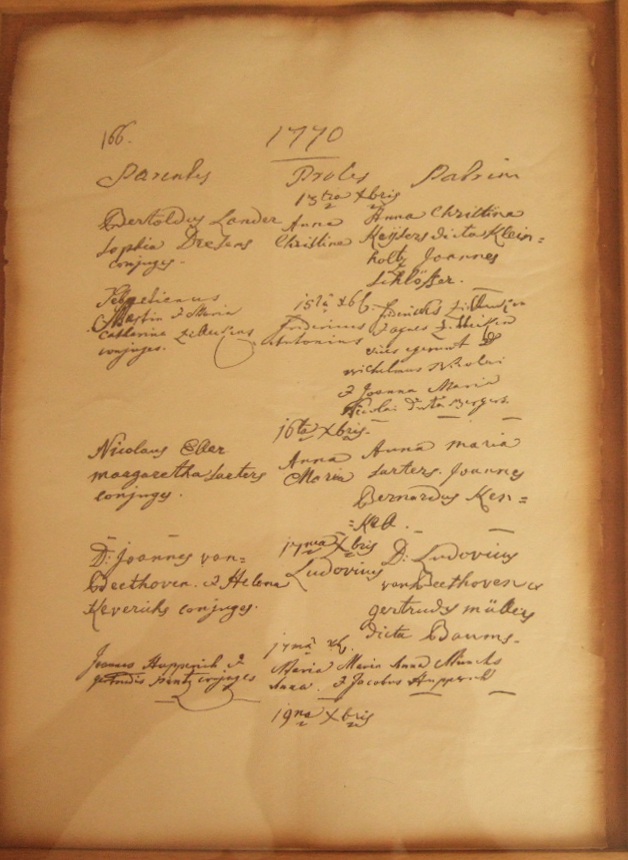
Photograph of an aged, yellowed handwritten baptismal register page dated 1770, with columns headed Parents, Godparents, and Parish in old German script. The entry for Ludwig van Beethoven appears in the middle section.Document

Primary source

Baptismal Register Entry of Ludwig van Beethoven

17 December 1770

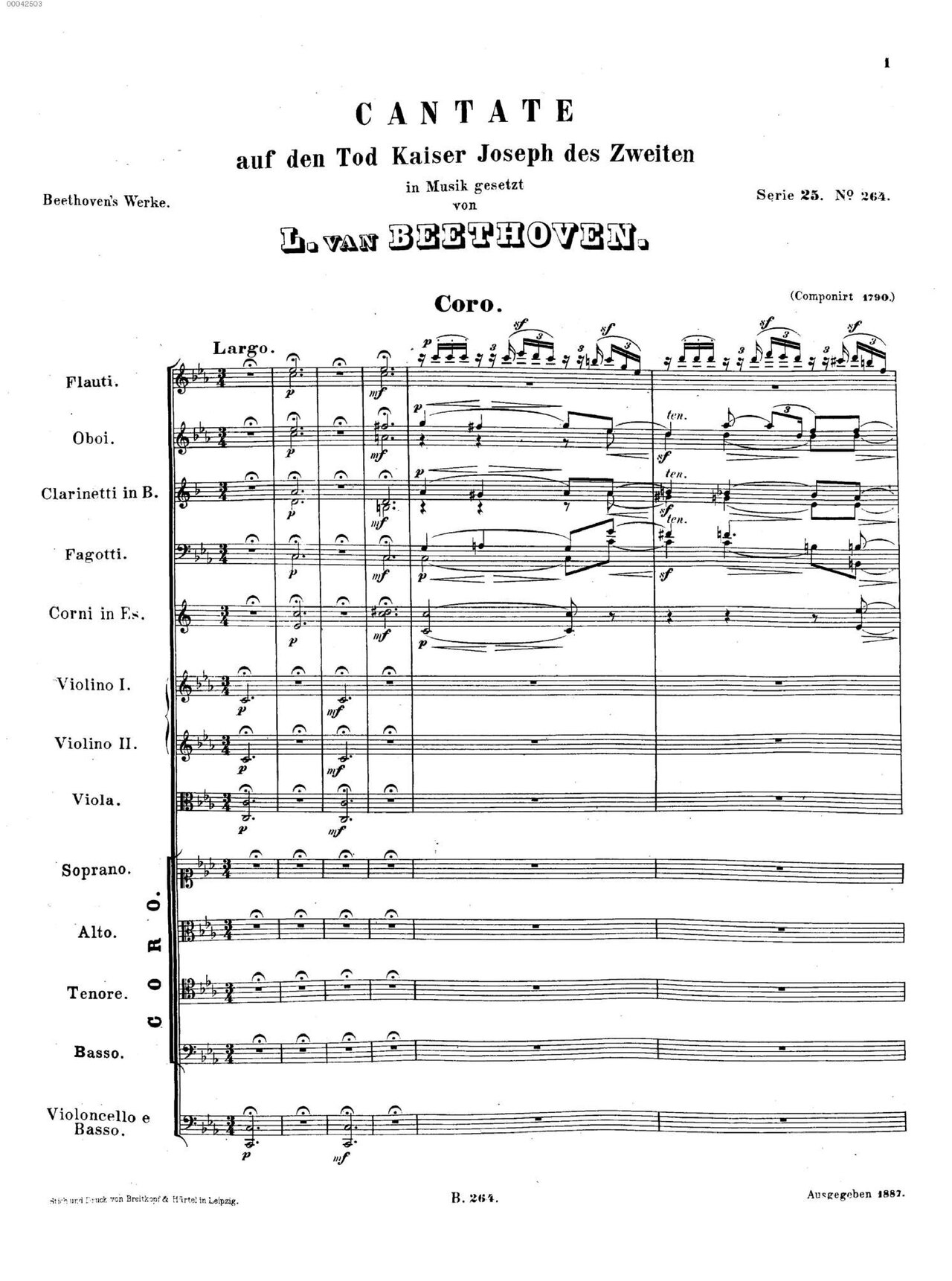
First page of a printed orchestral and choral score titled Cantate auf den Tod Kaiser Joseph des Zweiten, in Musik gesetzt von L. van Beethoven, with Largo tempo marking, instrument staves, and chorus staves.Document

Primary source

Cantata on the Death of Emperor Joseph II

Ludwig van Beethoven · 1790

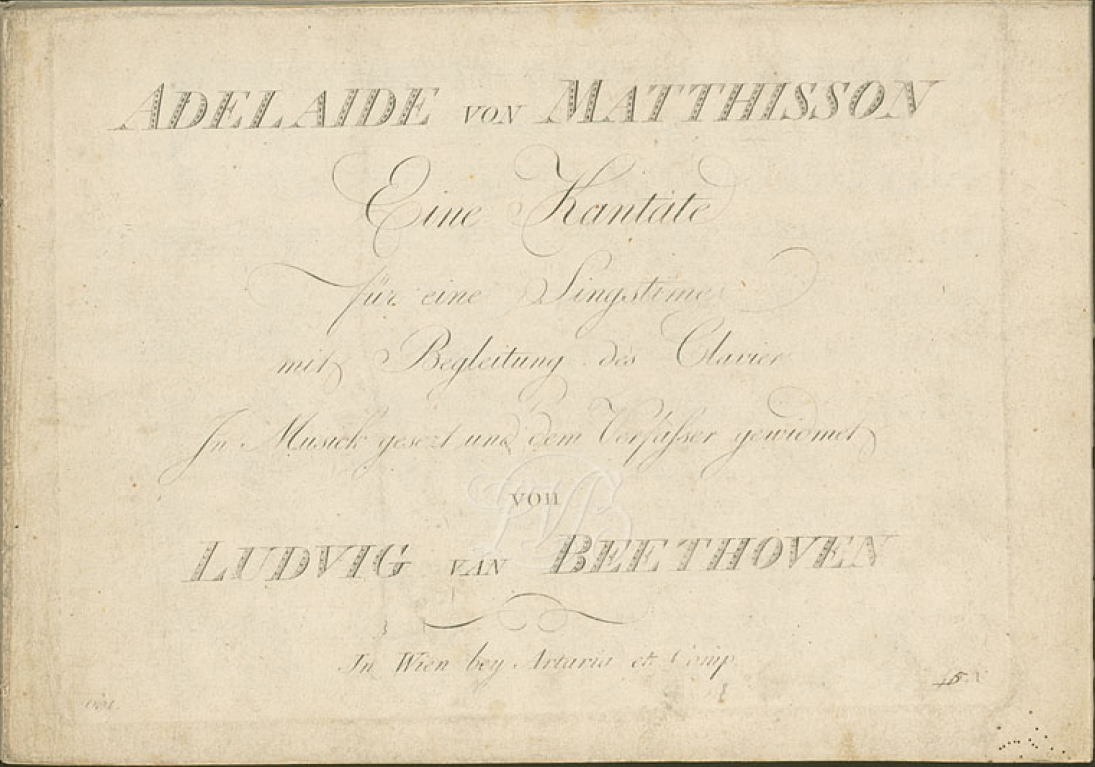
Title page of the 1797 Artaria edition of Beethoven's song Adelaide, in curly engraved script: 'Adelaide von Matthisson, Eine Kantate, für eine Singstimme mit Begleitung des Clavier, in Musick gesetzt und dem Verfasser gewidmet, vom Ludwig van Beethoven, In Wien bey Artaria et Comp.'Document

Primary source

Adelaide

Ludwig van Beethoven · c. 1794-1797

Title page of a digitized volume of the Allgemeine musikalische Zeitung, published in Leipzig and Winterthur in 1809. Text reads: Rochlitz, Friedrich; Allgemeine musikalische Zeitung; Leipzig ; Winterthur 1809; 4 Mus.th. 1800-11; urn:nbn:de:bvb:12-bsb10527959-0; VD18 90291972-001. Logos of Bayerische StaatsBibliothek and MDZ appear at top.Newspaper article

Primary source

Review of the 22 December 1808 Concert

Friedrich Rochlitz · 25 January 1809

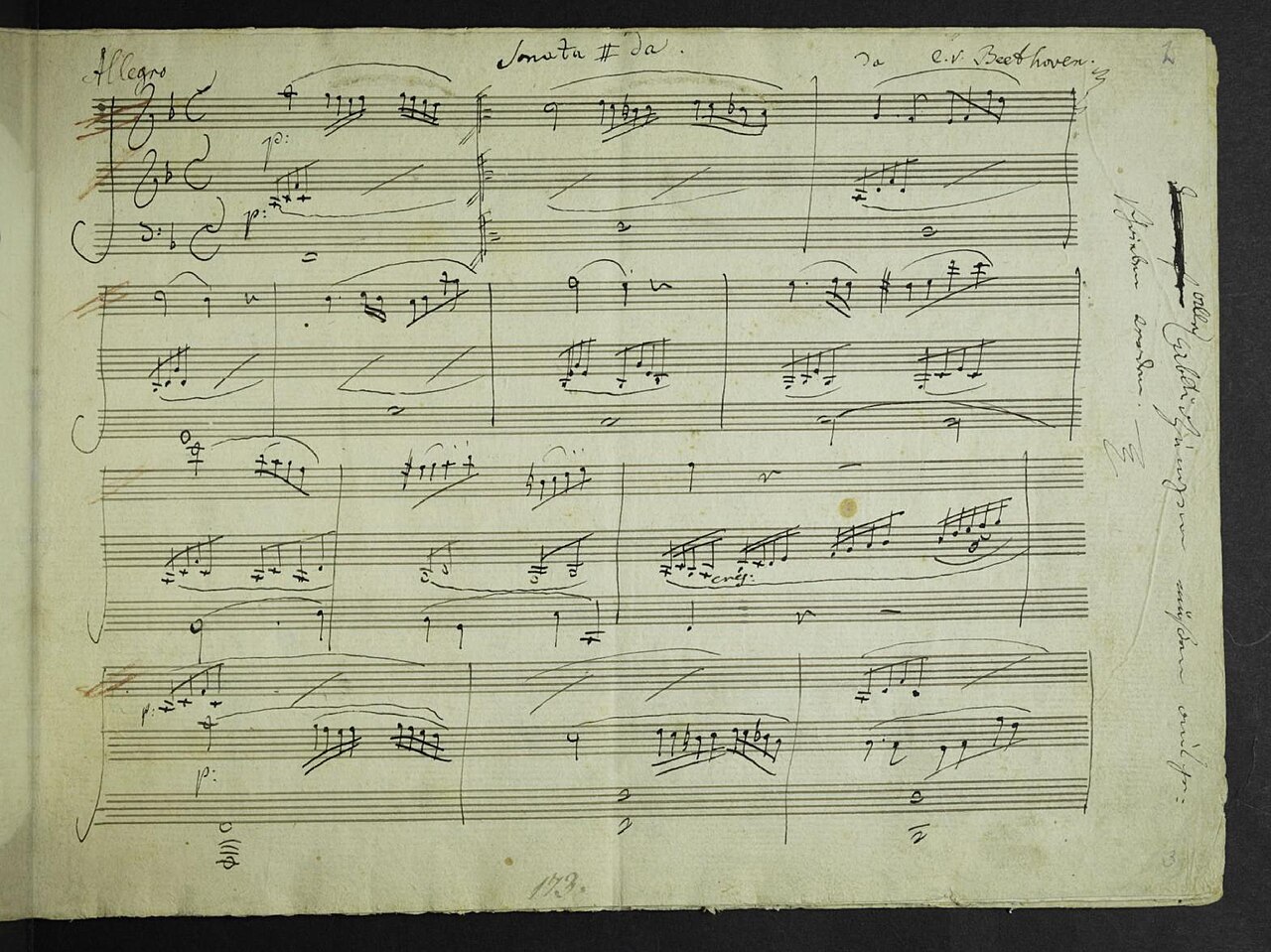
Handwritten manuscript page of music on aged paper, headed 'Allegro' and 'Sonata #5' with 'de L.v. Beethoven' written above. Several staves of notes, slurs and dynamic marks are visible, with handwritten notes in the margin on the right.Document

Primary source

Violin Sonata No. 5 (Spring Sonata)

Ludwig van Beethoven · 1801

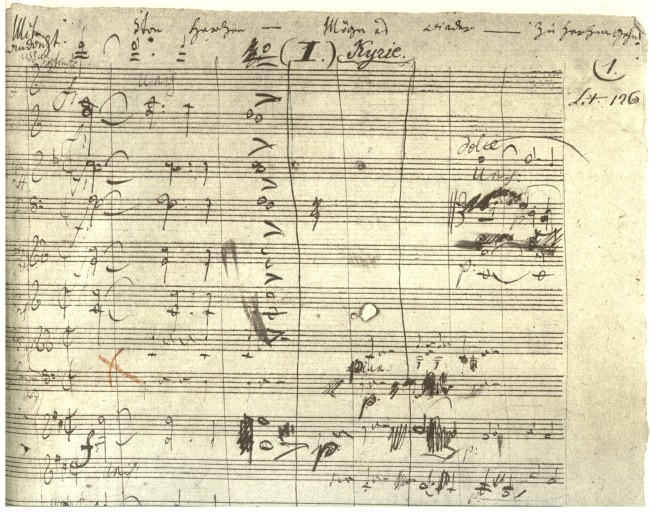
Handwritten manuscript score of the opening of the Kyrie from Beethoven's Missa Solemnis, on aged yellowed paper. Multiple staves of musical notation in ink, with German inscriptions across the top and the word Kyrie written above the first section. A large handwritten number 1 and a date marking appear at the upper right.Document

Primary source

Missa Solemnis

Ludwig van Beethoven · 1819-1823

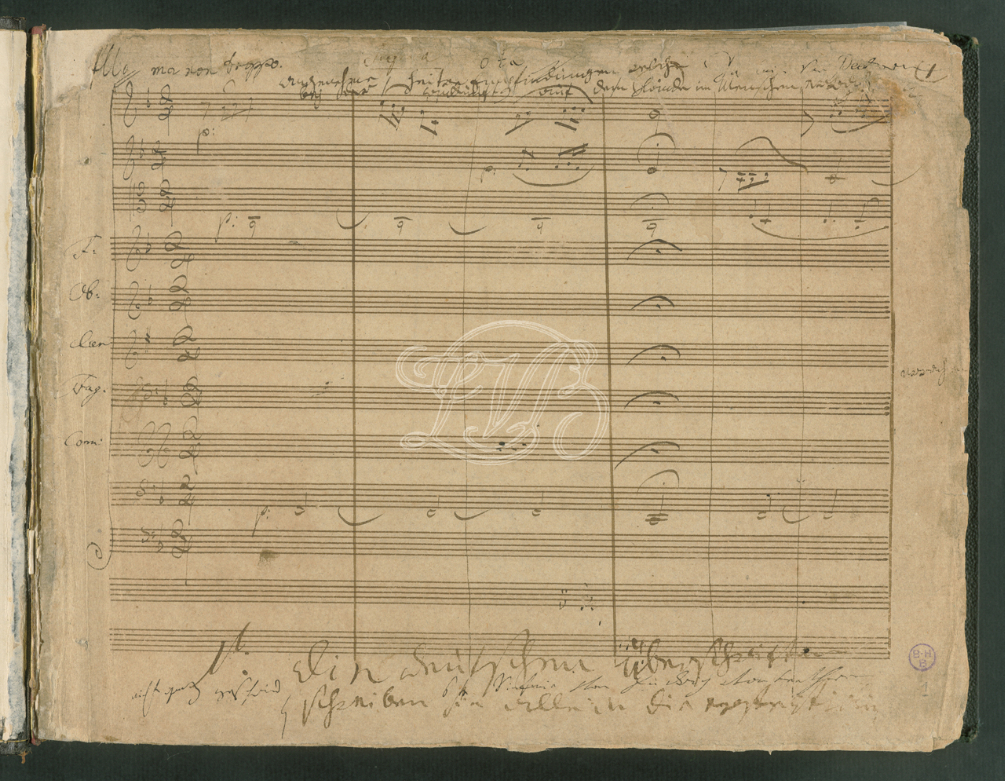
Handwritten manuscript page of orchestral music in ink on aged brownish paper, with many staves, notes, and Italian and German performance annotations written above and below. A faded library stamp appears at the lower right.Document

Primary source

Symphony No. 6 (Pastoral Symphony)

Ludwig van Beethoven · 1808

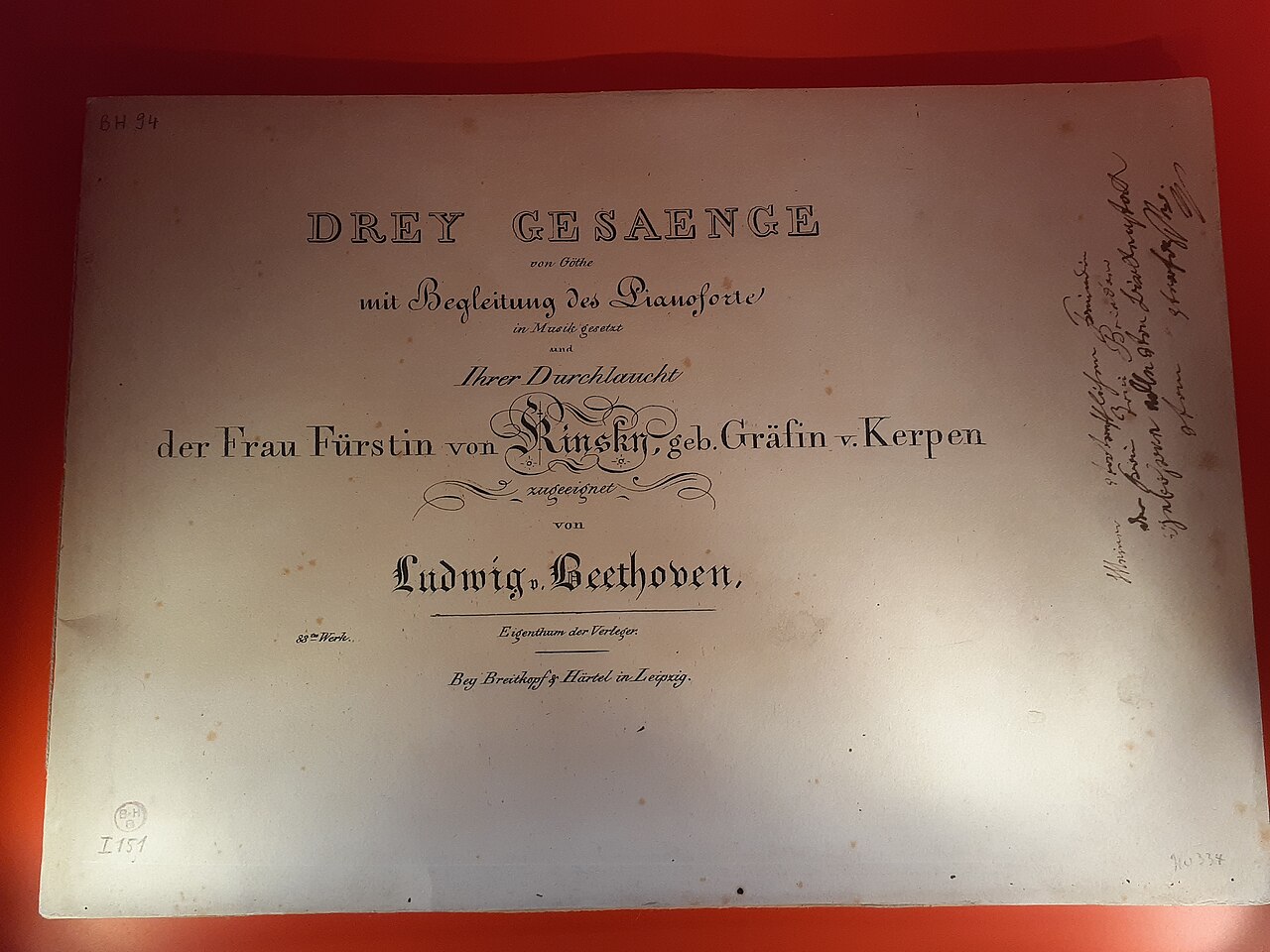
Photograph of a printed title page on a red background. Large capital letters read 'DREY GESAENGE, von Goethe, mit Begleitung des Pianoforte, in Musik gesetzt', dedicated to 'Ihrer Durchlaucht der Frau Fürstin von Kinsky, geb. Gräfin v. Kerpen', by 'Ludwig v. Beethoven'. Below: 'Eigenthum der Verleger' and 'Bey Breitkopf & Härtel in Leipzig'. Handwritten notes appear in the right margin.Document

Primary source

Drey Gesaenge von Goethe

Ludwig van Beethoven · 1811

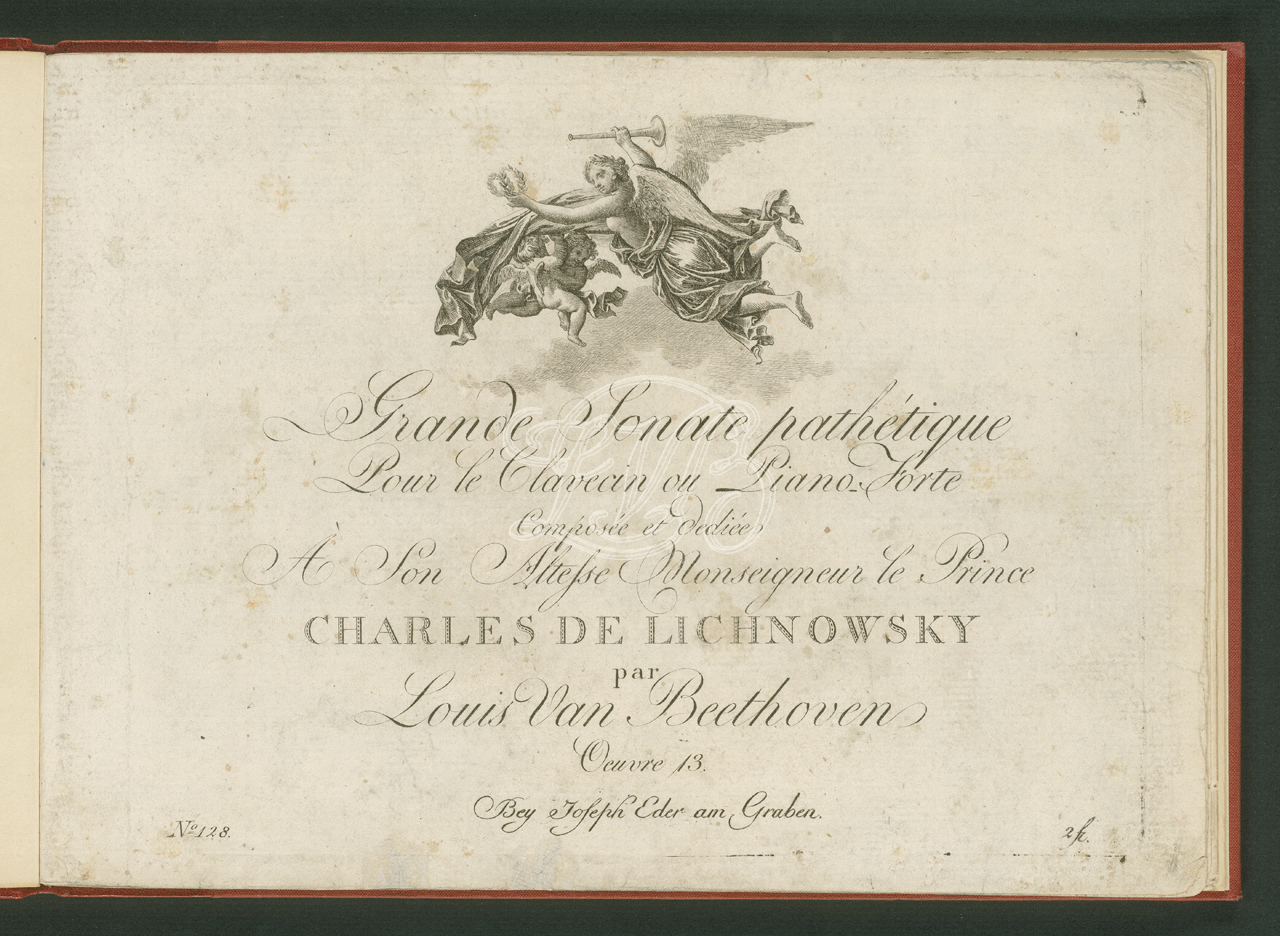
Engraved title page of a music edition, with an ornate engraving of a winged angel blowing a trumpet and two cherubs above. Script text reads Grande Sonate pathétique, pour le Clavecin ou Piano-Forte, dedicated to Charles de Lichnowsky, par Louis Van Beethoven, Oeuvre 13, Bey Joseph Eder am Graben.Document

Primary source

Piano Sonata No. 8 (Pathétique)

Ludwig van Beethoven · 1798

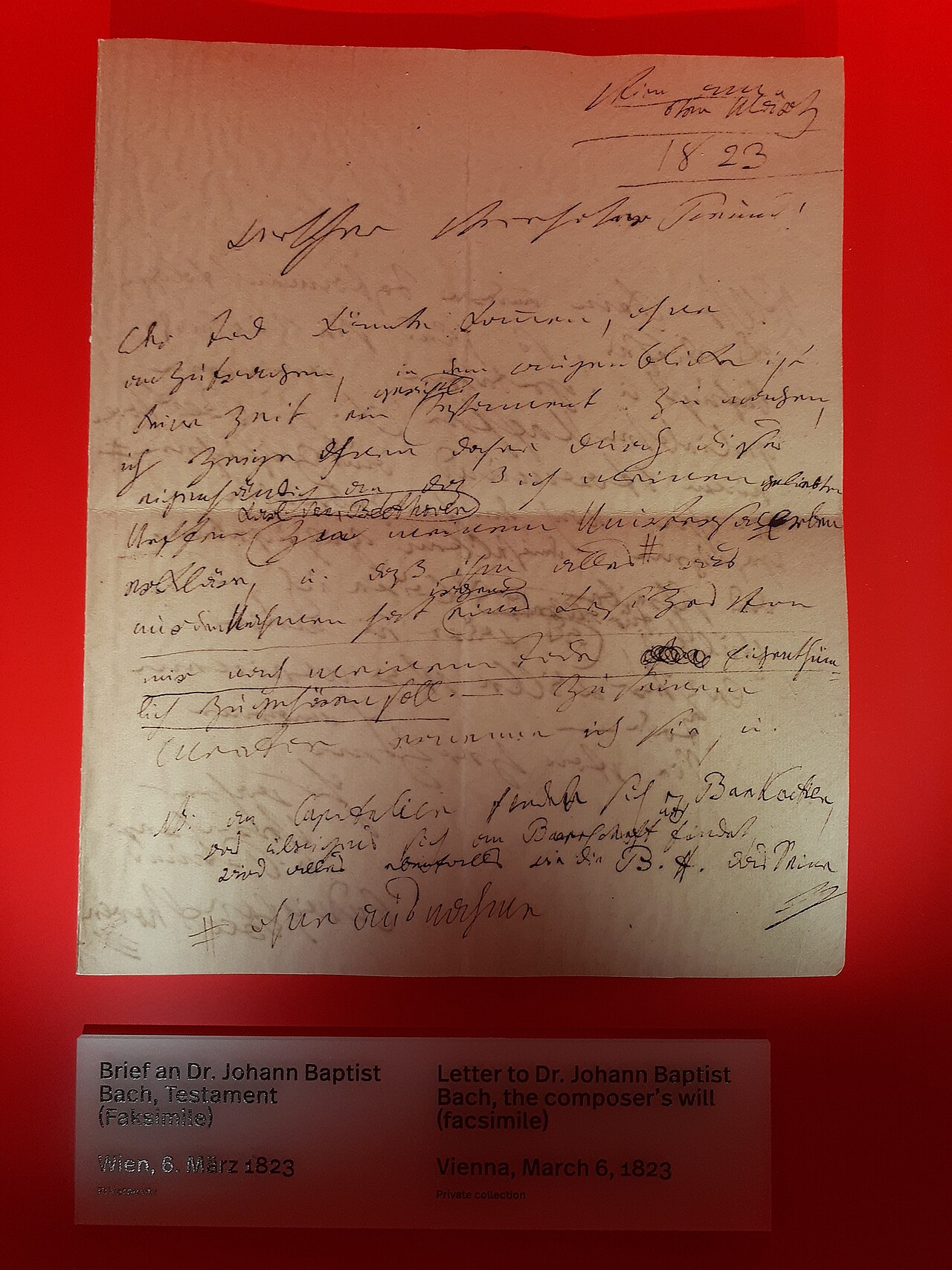
Photo of a facsimile of a handwritten letter dated Vienna, March 6, 1823, displayed on a red background. Below it is a museum label reading 'Letter to Dr. Johann Baptist Bach, the composer's will (facsimile)'.Document

Primary source

Letter Concerning Beethoven's Will

Johann Baptist Bach · 6 March 1823

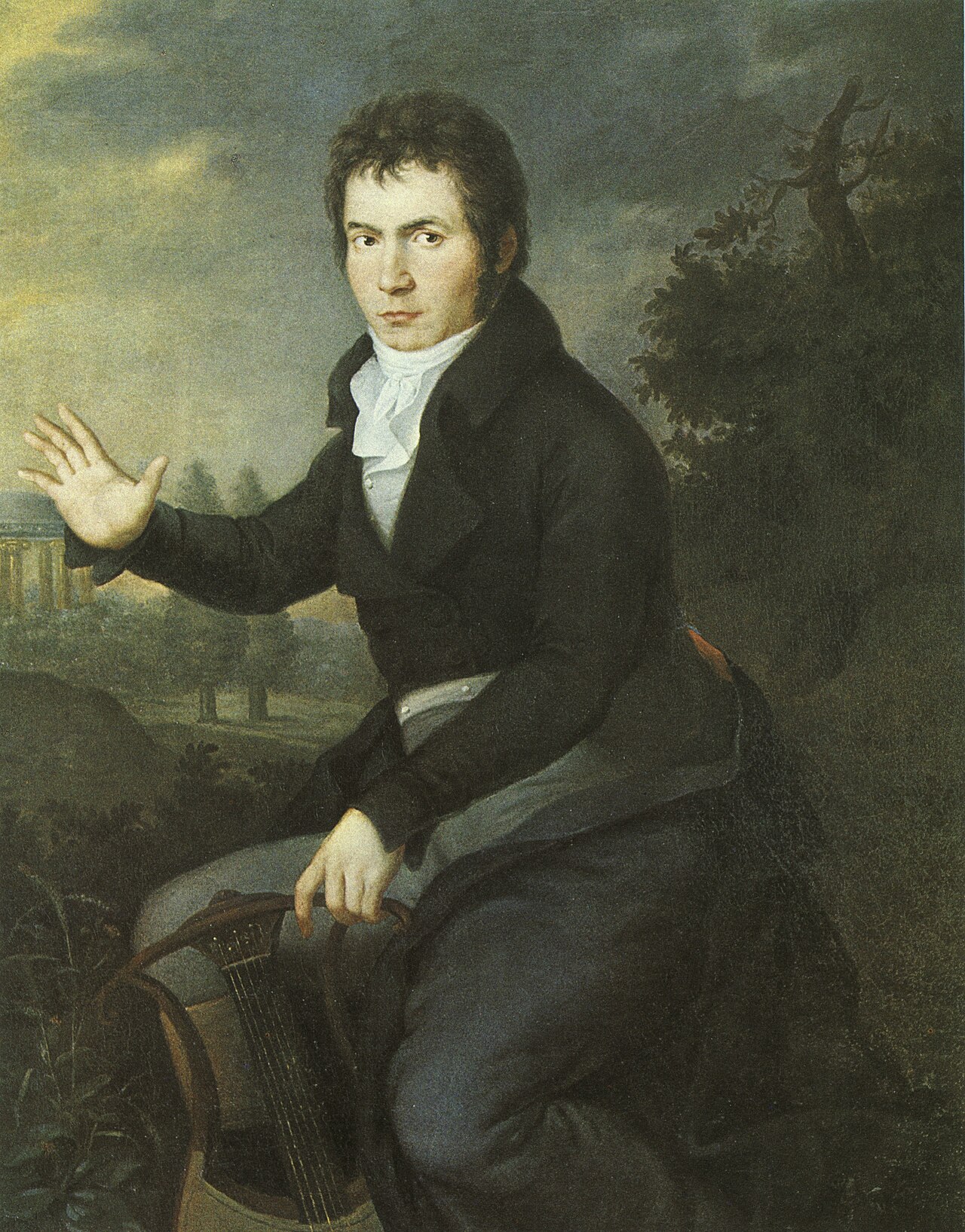
Oil painting of a man with dark, tousled hair seated beside a harp-like instrument, wearing a dark coat and white cravat. He raises his right hand toward the viewer against a stormy landscape with a tree and classical columns in the distance.Painting

Primary source

Beethoven

Joseph Willibrord Mähler · c. 1804-1805

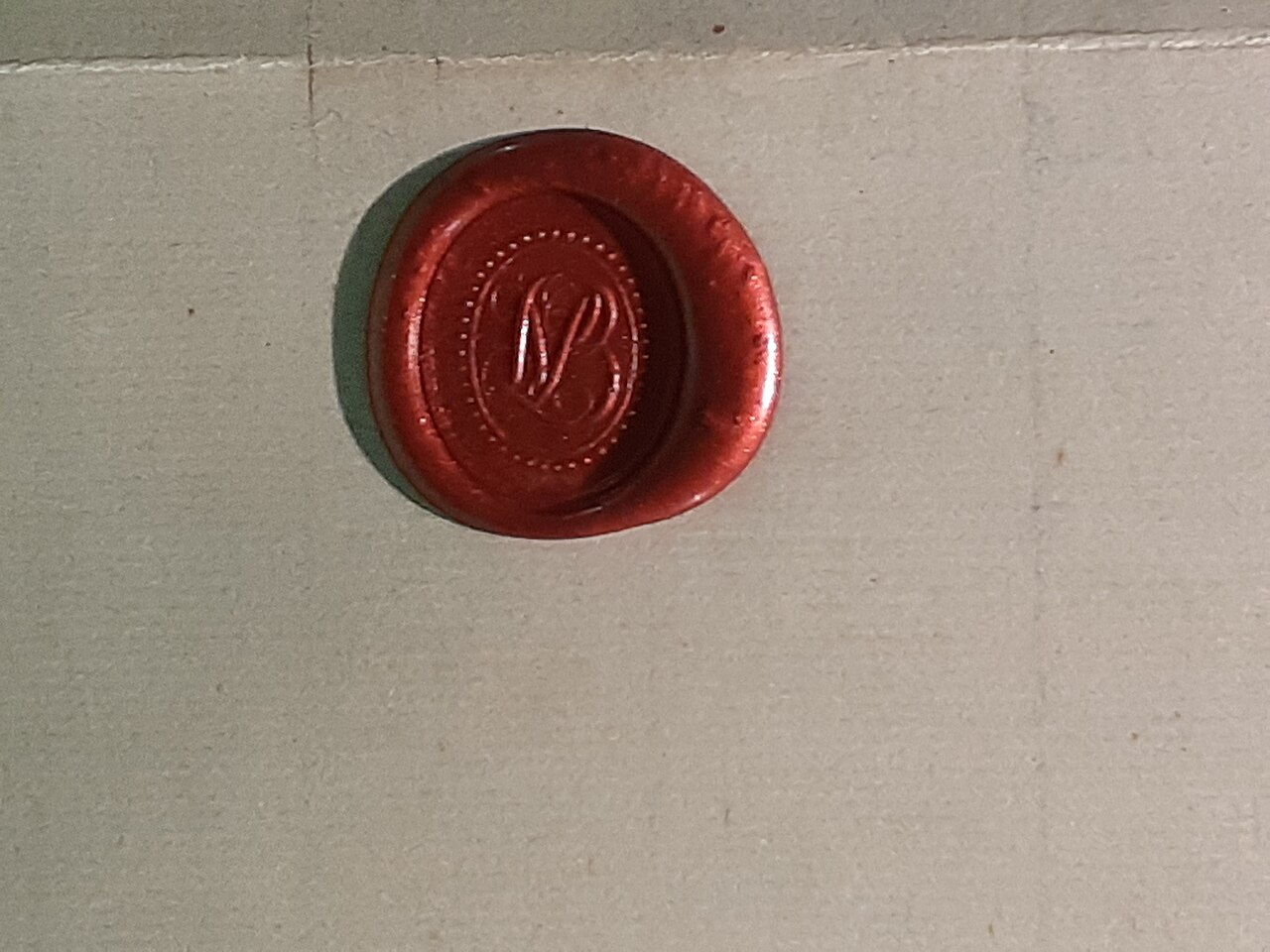
Photo of a red sealing-wax seal on a pale surface, with an embossed monogram of intertwined letters inside a dotted circular border. The wax has a glossy, slightly uneven surface.Artifact

Primary source

Beethoven's Personal Seal

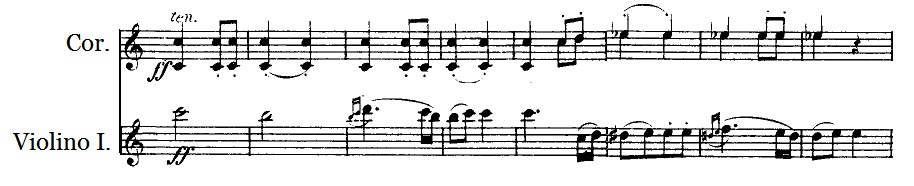
Musical score excerpt with two staves, horn (Cor.) and first violin (Violino I.), showing a passage of notes with dynamic markings such as ff and slurs. The image is a detail of the theme, not the full symphony.Document

Primary source

Symphony No. 7

Ludwig van Beethoven · 1811-1812

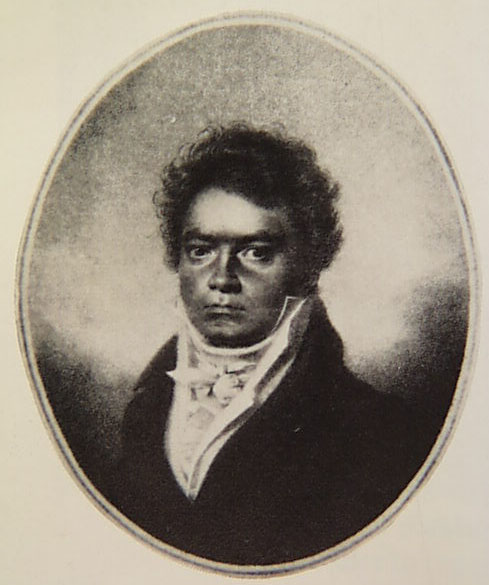
Oval black-and-white engraved portrait of a man with curly dark hair, dark eyes, and a high white cravat, wearing a dark coat, set against a shaded background.Painting

Primary source

Engraving of Beethoven by Blasius Höfel

Blasius Höfel after Louis Letronne · 1814

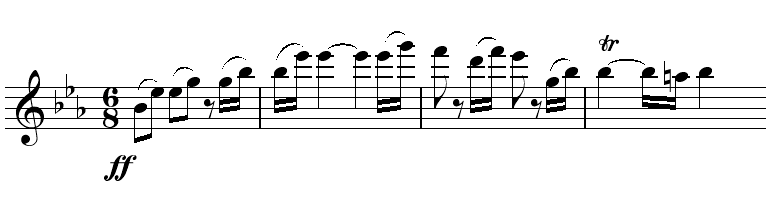
Musical excerpt in E-flat major, 6/8 time, marked ff, showing a melodic motif of eighth, sixteenth and quarter notes with slurs and a trill, from the third movement of Beethoven's Piano Concerto No. 5.Document

Primary source

Piano Concerto No. 5

Ludwig van Beethoven · 1809

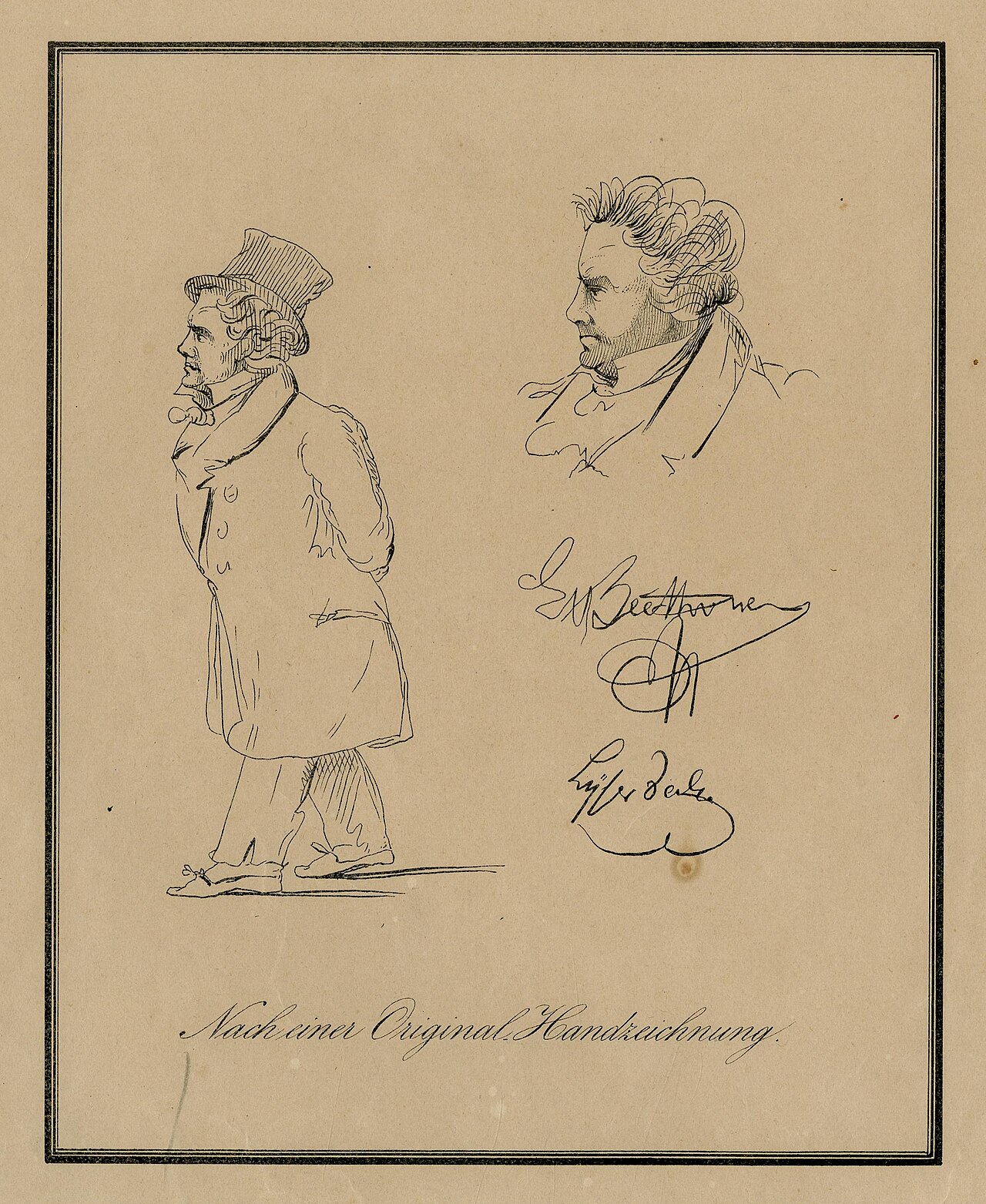
Ink drawing on tan paper within a double-line border. Left: a full-length figure in profile facing left, wearing a tall hat, long coat and trousers, hands behind back. Upper right: a head-and-shoulders profile facing left with tousled hair. Below: two handwritten signatures. Caption at bottom reads 'Nach einer Original Handzeichnung'.Painting

Secondary source

Sketches of Beethoven Walking

Johann Peter Lyser · c. 1830s

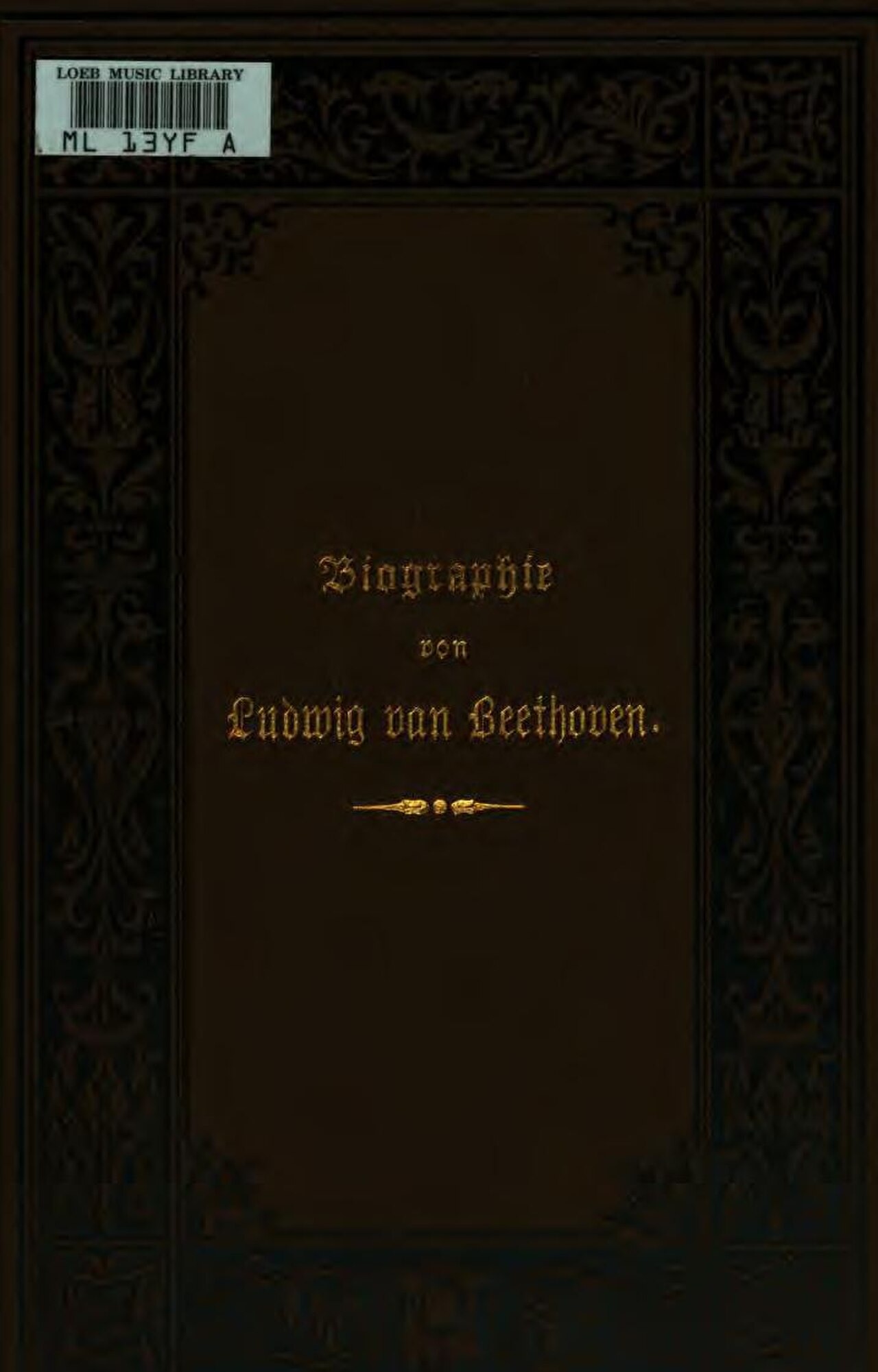
Front cover of a dark brown bound book with ornate gilt-stroked decorative borders. Gold blackletter title reads 'Biographie von Ludwig van Beethoven.' A small gold ornamental divider sits below. A library label at top left reads 'Loeb Music Library, ML 13YF A'.Book

Secondary source

Beethoven-Biographie

Anton Schindler · 1840

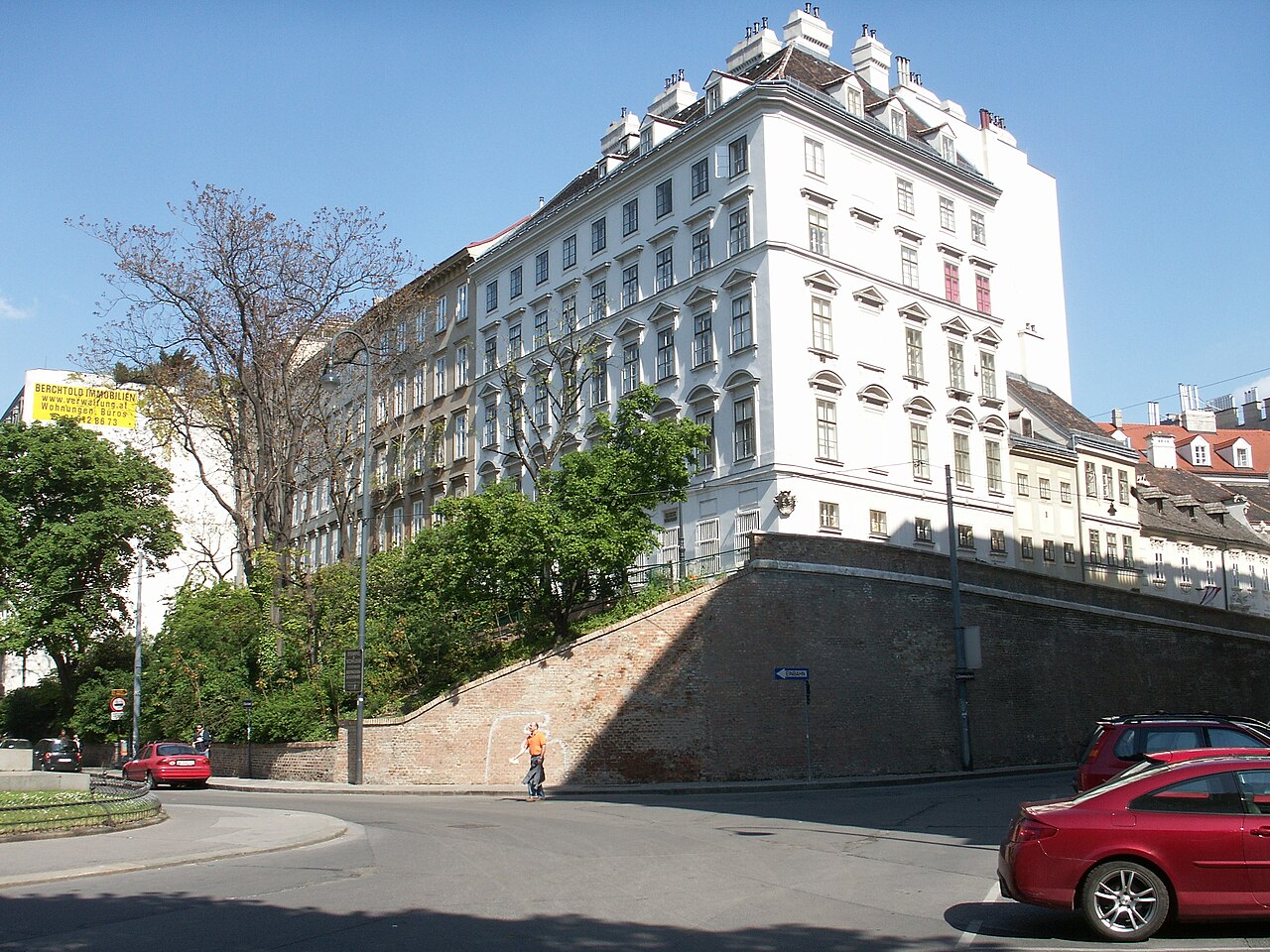
A large white multi-story Baroque-style building with many windows and chimneys stands atop a brick retaining wall on a corner, with green trees, a red car, and a pedestrian in the foreground under a clear blue sky.Artifact

Primary source

Pasqualati House

18th century

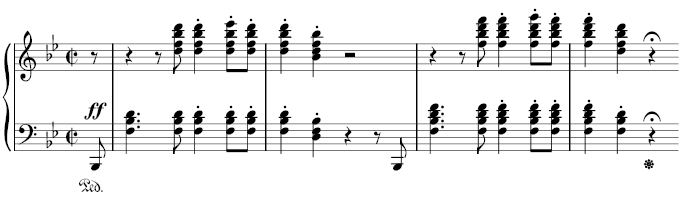
Musical score excerpt for piano, two staves (treble and bass) in B-flat major, showing dense chords with dynamic marking ff and a pedal marking, from the opening of the Hammerklavier sonata.Document

Primary source

Piano Sonata No. 29 'Hammerklavier'

Ludwig van Beethoven · 1817

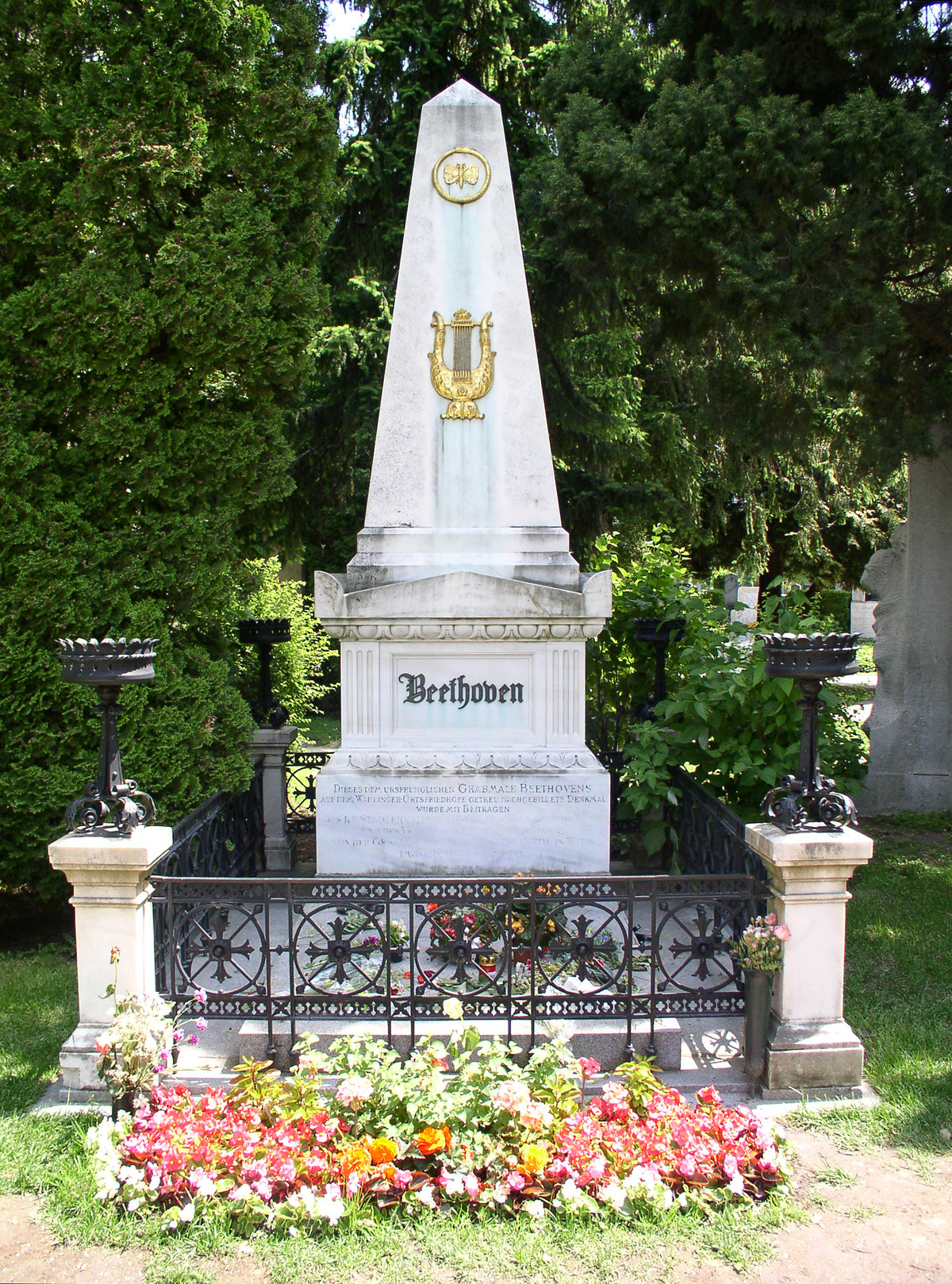
White marble obelisk gravestone with a gold lyre and wreath emblem, inscribed 'Beethoven', set behind an ornate black iron railing with flower beds and urns in a green cemetery.Sculpture

Secondary source

Grave of Ludwig van Beethoven

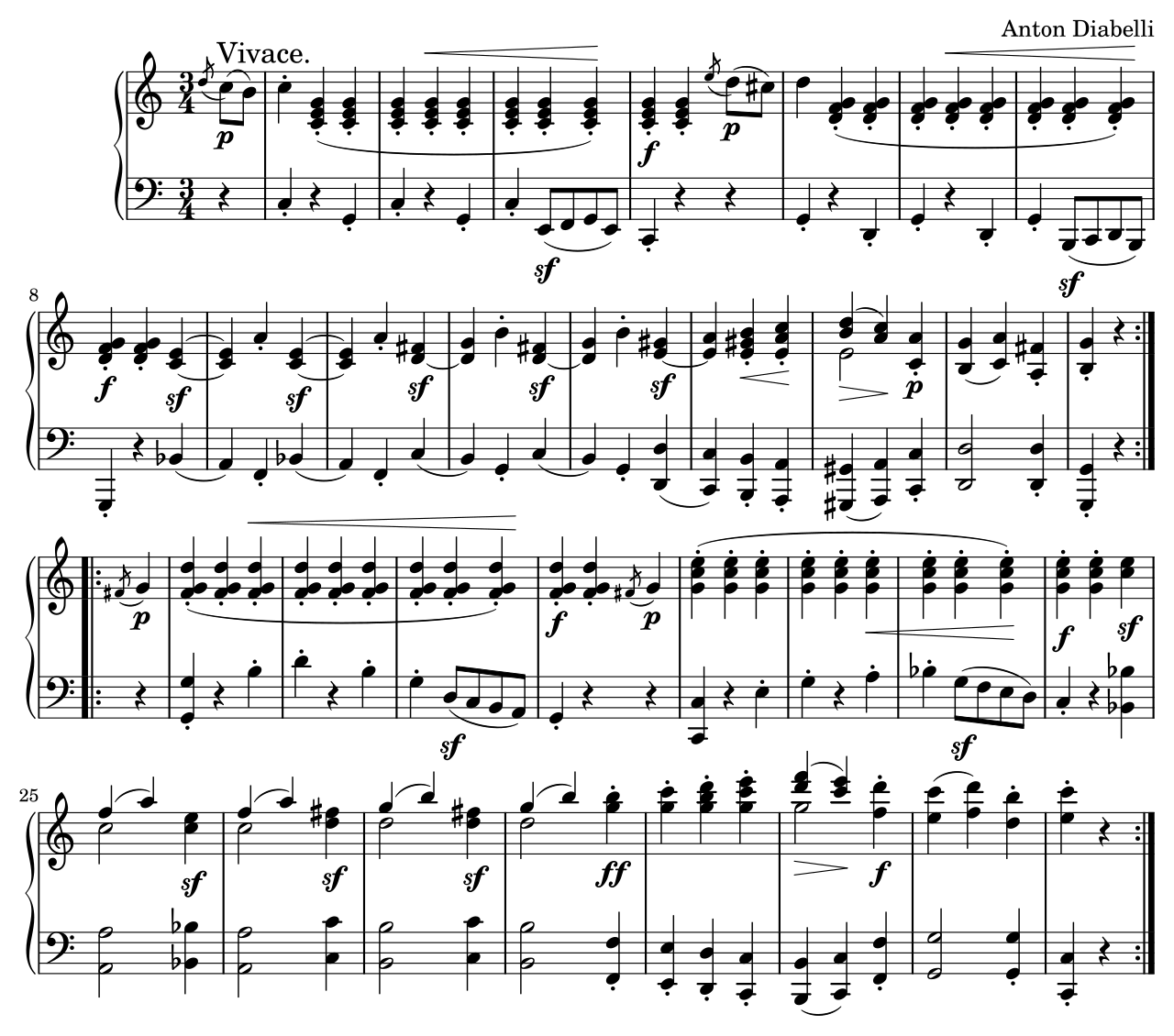
Printed score of the theme of Anton Diabelli's waltz, for piano, marked Vivace in 3/4 time with two staves, treble and bass, in repeated sections. Dynamics such as p, f and sf are shown.Artifact

Primary source

Diabelli Variations

Ludwig van Beethoven · 1819-1823

Letter

Primary source

The Letters of Ludwig van Beethoven

Ludwig van Beethoven · 1909

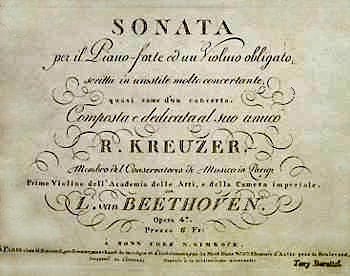
Title page of the printed score of the Sonata per il Piano-forte ed un Violino obligato, scritta in uno stile molto concertante, quasi come un concerto, composta e dedicata al suo amico R. Kreutzer, by L. van Beethoven, Opera 47, published in Bonn by Simrock. Ornate decorative lettering in black ink on cream paper.Artifact

Primary source

Kreutzer Sonata

Ludwig van Beethoven · 1803 (published 1805)

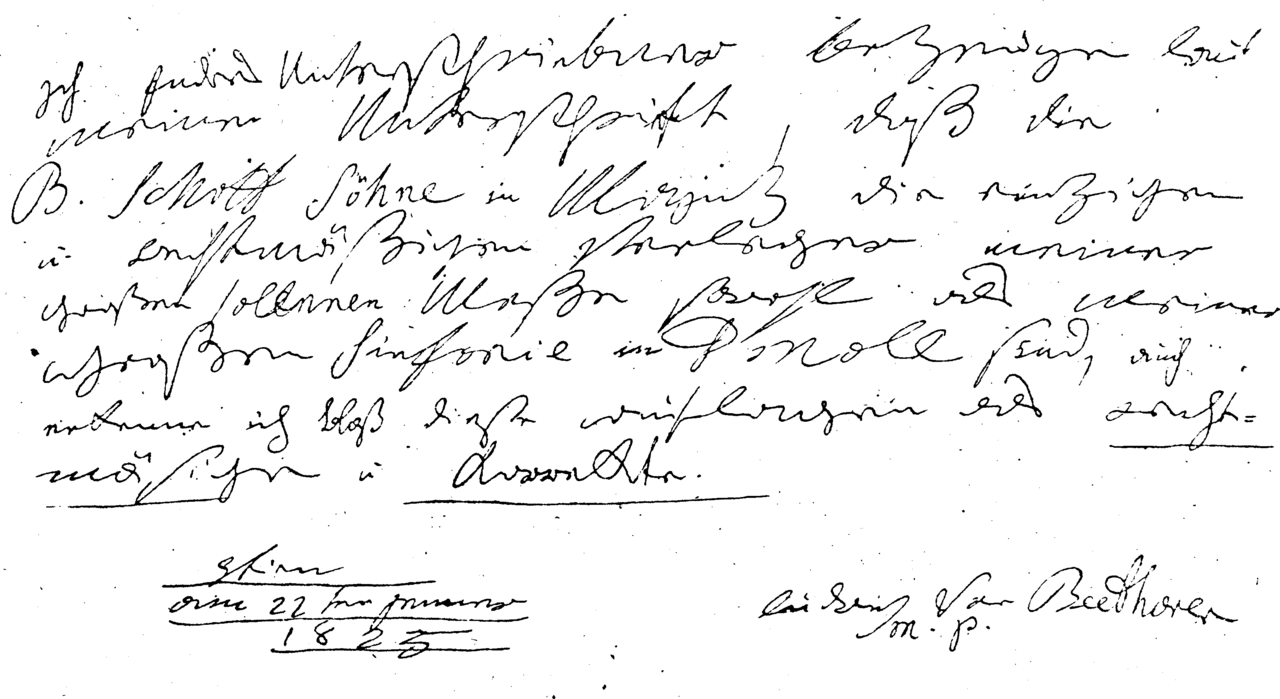
Scan of a handwritten German letter in cursive script by Beethoven, dated 22 January 1823, signed 'm.p. van Beethoven'. The text mentions the Ninth Symphony and a Missa solemnis in D.Document

Primary source

Authorisation to Publish the Ninth Symphony and Missa Solemnis

Ludwig van Beethoven · 22 January 1823

Document

Secondary source

The Life of Ludwig van Beethoven

Alexander Wheelock Thayer · 1921

Black handwritten signature on a white background reading 'Ludwig van Beethoven', with long flowing strokes and a large capital L and B.Document

Primary source

Signature of Ludwig van Beethoven

Ludwig van Beethoven

Printed musical score excerpt for Violino I (first violin) with the tempo marking Adagio, quarter note equals 63, showing staff notation in 2/4 time with sixteenth-note runs, slurs, and dynamic markings including p and a crescendo hairpin.Book

Primary source

Symphony No. 1

Ludwig van Beethoven · 1799-1800

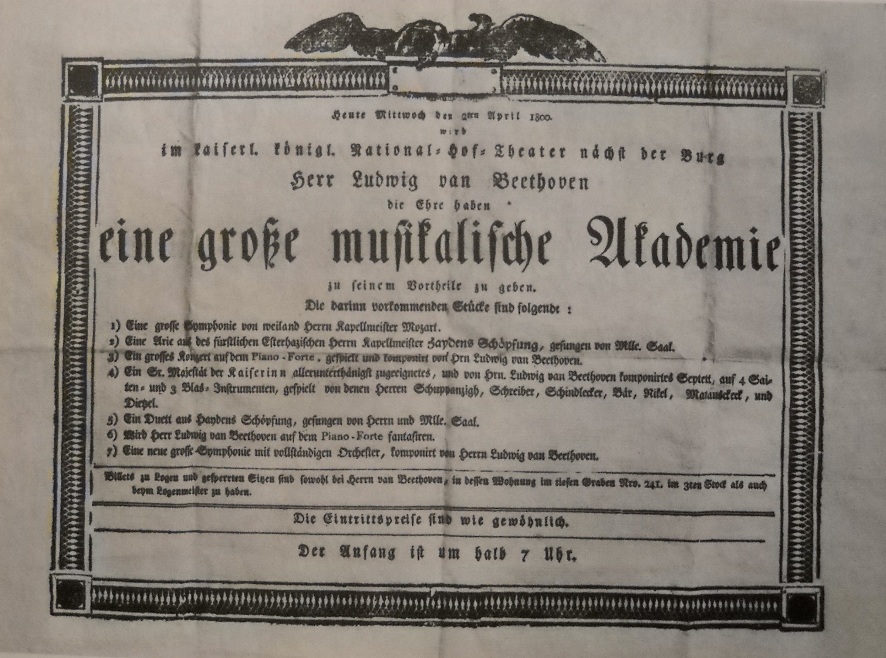
Photo of an antique printed German concert poster with a decorative bordered frame and an eagle at the top. It announces Beethoven's large musical academy at the Imperial-Royal National Court Theatre on 29 April 1800, listing the program.Document

Primary source

Beethoven concert poster

1800

Book

Secondary source

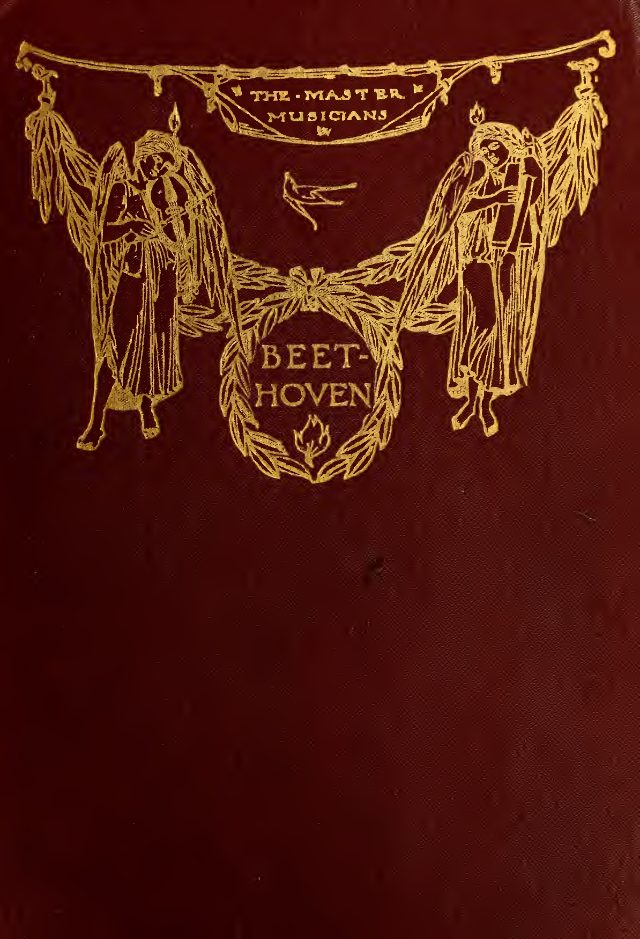
Beethoven, by Romain Rolland (English translation)

Romain Rolland · 1927

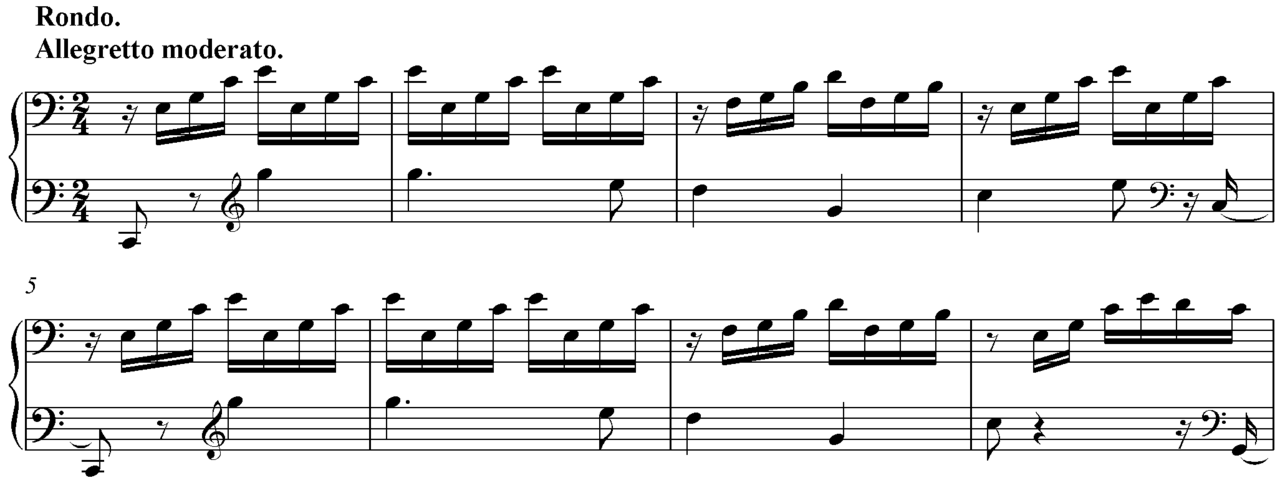
Musical score excerpt in two staves, labeled Rondo, Allegretto moderato, in 2/4 time. Bass clef upper staff with sixteenth-note arpeggios; lower staff with bass and treble clefs and quarter and eighth notes. Bars 1 to 8 are numbered at bar 5.Book

Primary source

Piano Sonata No. 21, 'Waldstein'

Ludwig van Beethoven · 1803-1804

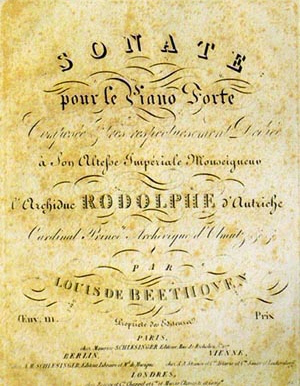
Title page of the first edition of Beethoven's Piano Sonata, reading 'Sonate pour le Piano Forte' with a dedication to Archduke Rodolphe d'Autriche and the composer's name 'Louis de Beethoven' in large letters, printed on aged, yellowed paper.Document

Primary source

Piano Sonata No. 32

Ludwig van Beethoven · 1821-1822

Book

Secondary source

Beethoven: Bibliography

Romain Rolland · 1927

Newspaper article

Secondary source

Beethoven: His Childhood and Youth

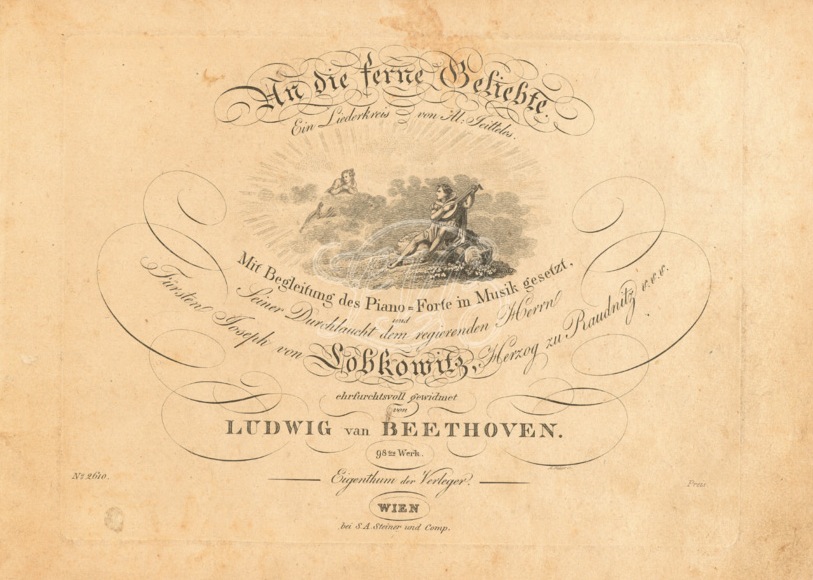
Engraved title page of the 1816 first edition of Beethoven's song cycle 'An die ferne Geliebte', printed in Vienna by S.A. Steiner. Ornate script title at top, a small central vignette of a seated figure playing a lyre beneath a sunburst, dedication text to Prince Joseph von Lobkowitz, and the composer's name Ludwig van Beethoven in capitals below.Document

Primary source

An die ferne Geliebte

Ludwig van Beethoven · April 1816

Book

Primary source

Beethoven, the Man and the Artist, as Revealed in His Own Words

Ludwig van Beethoven · 1905 (English translation)

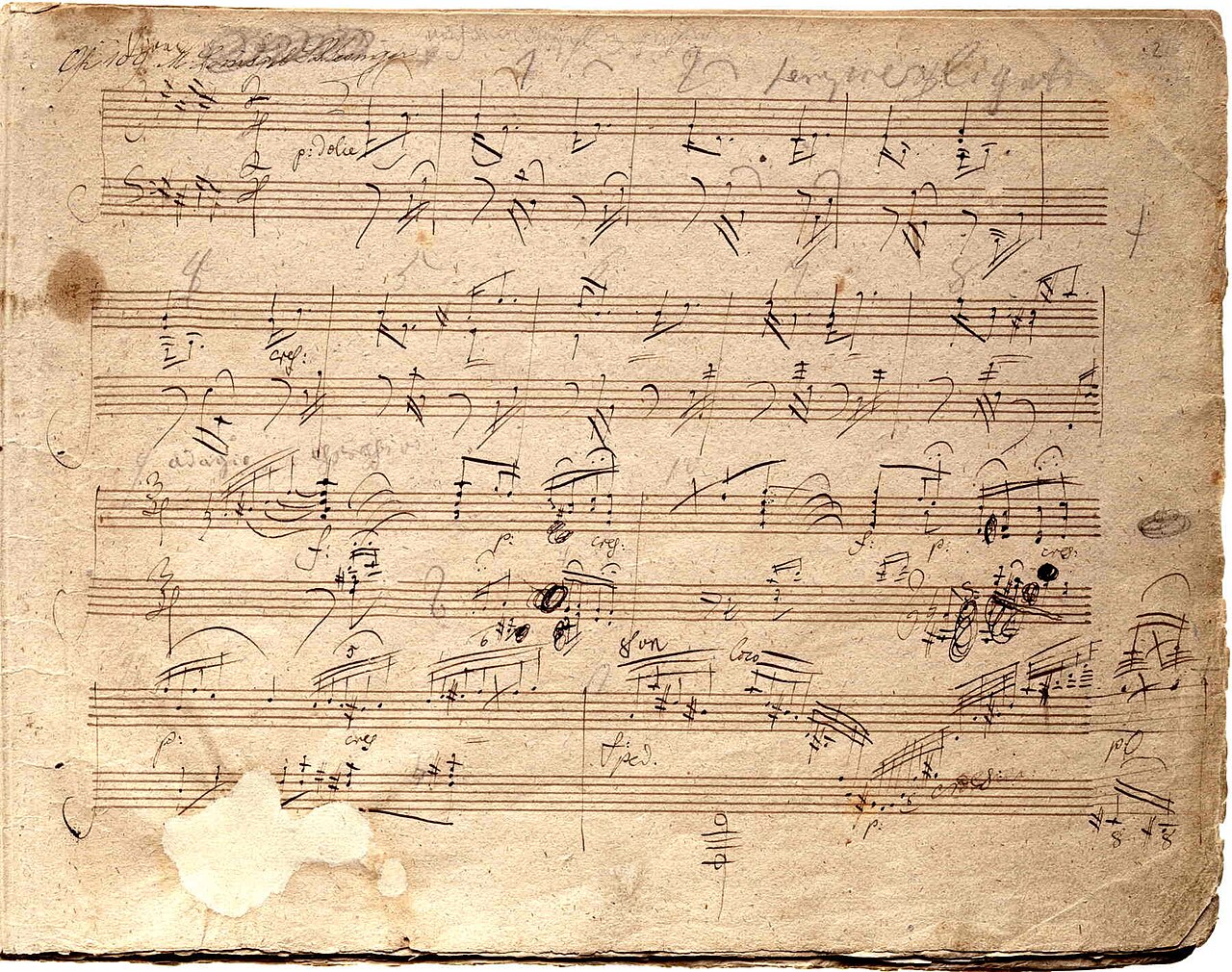
Handwritten manuscript page of music on aged, yellowed paper with several staves of hand-drawn notes, slurs, dynamic markings and Italian performance directions, including 'Vivace' and 'Adagio' near the top, with a faded stain at lower left.Document

Primary source

Autograph First Page of Piano Sonata No. 30, Op. 109

Ludwig van Beethoven · 1820

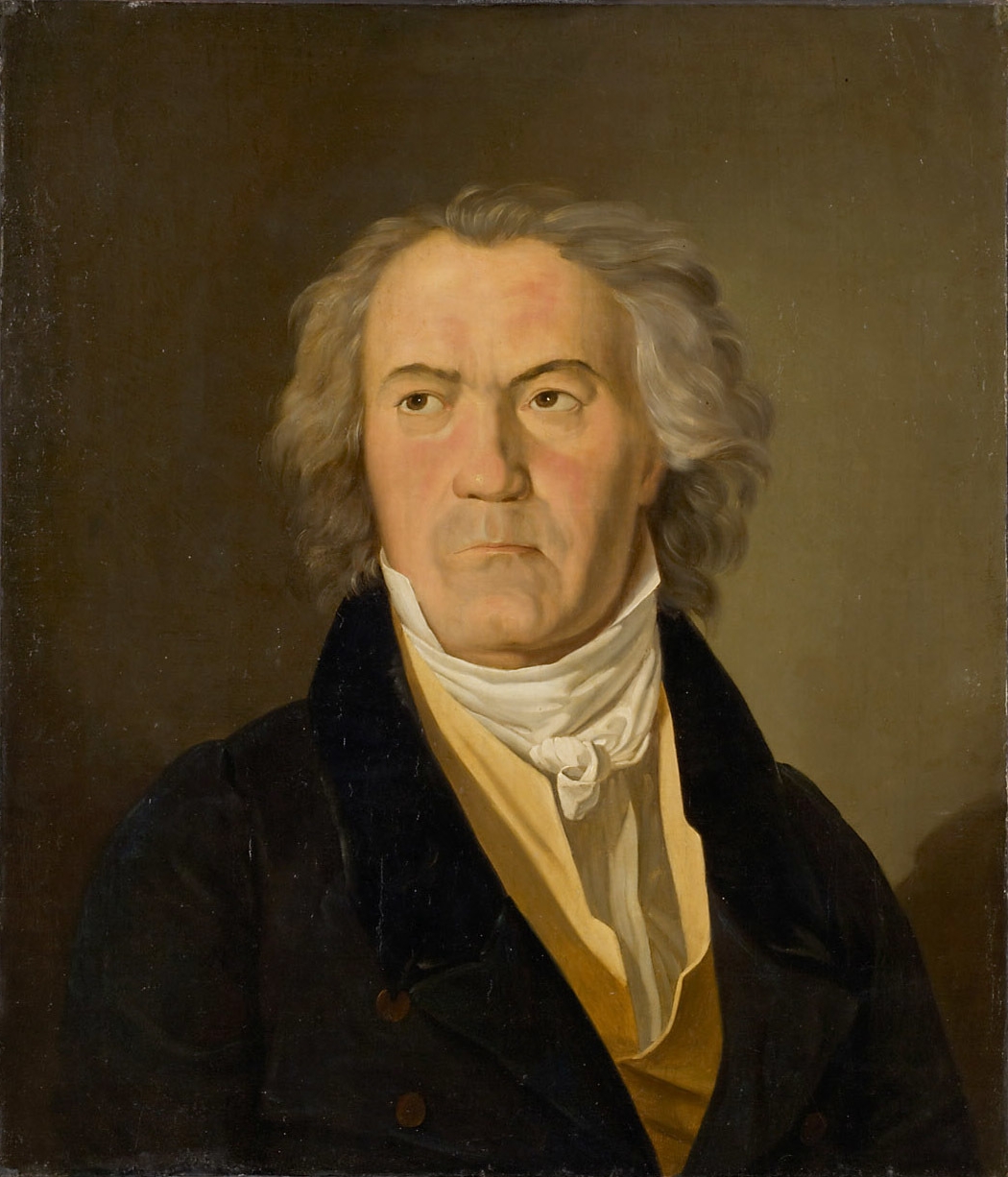
Oil portrait of an older man with swept-back graying hair, pale face, and direct brown-eyed gaze, wearing a dark coat with a high collar, a yellow waistcoat, and a white cravat, against a dark brownish background.Painting

Primary source

Portrait of Ludwig van Beethoven

Ferdinand Georg Waldmüller · 1823

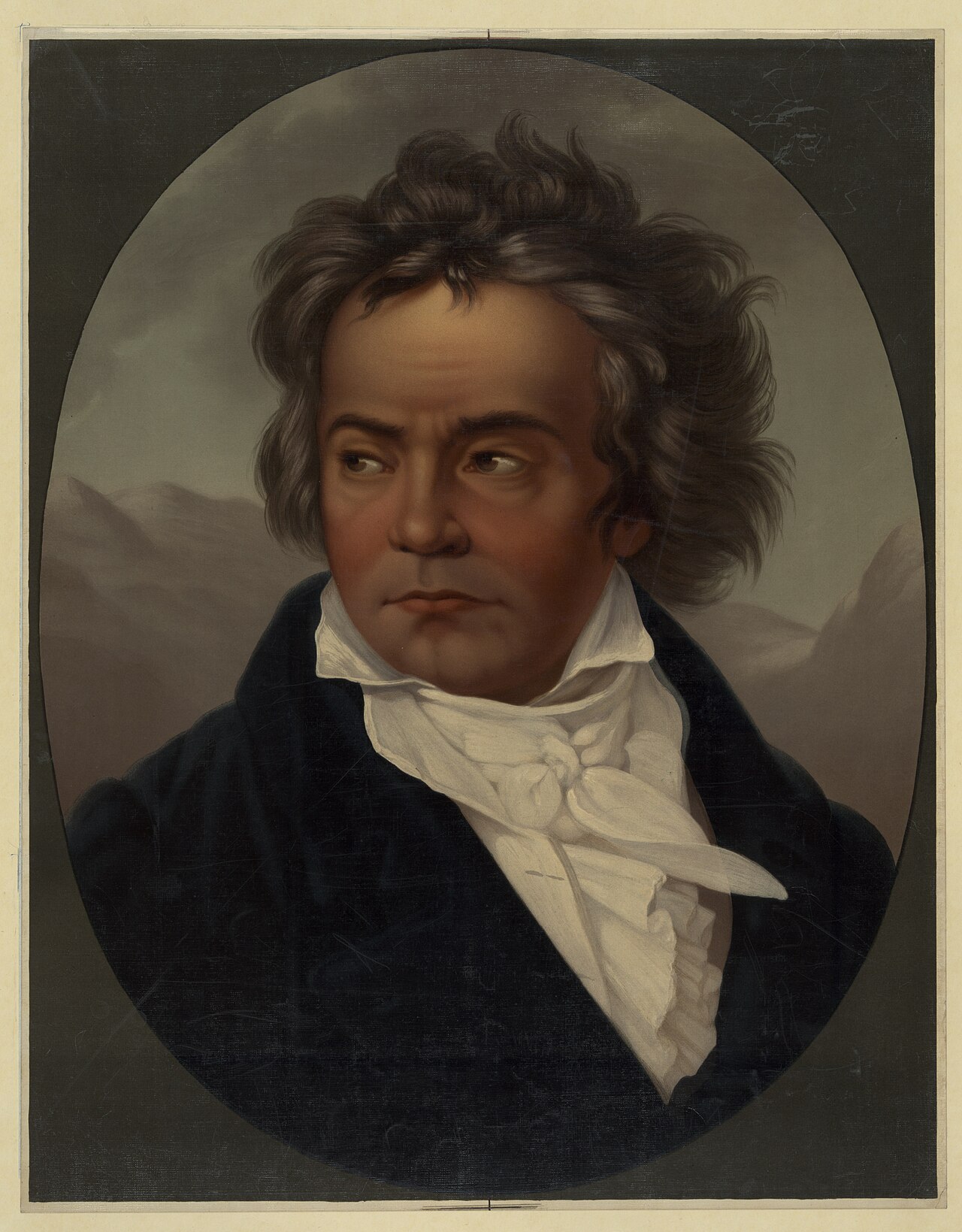
Oval-framed color print of a man with wild, tousled dark hair, looking to the side with a stern expression. He wears a dark high-collared coat and a large white cravat, against a grey, misty mountain landscape on a dark border.Painting

Primary source

Portrait of Beethoven by Ferdinand Schimon

Ferdinand Schimon · 1819

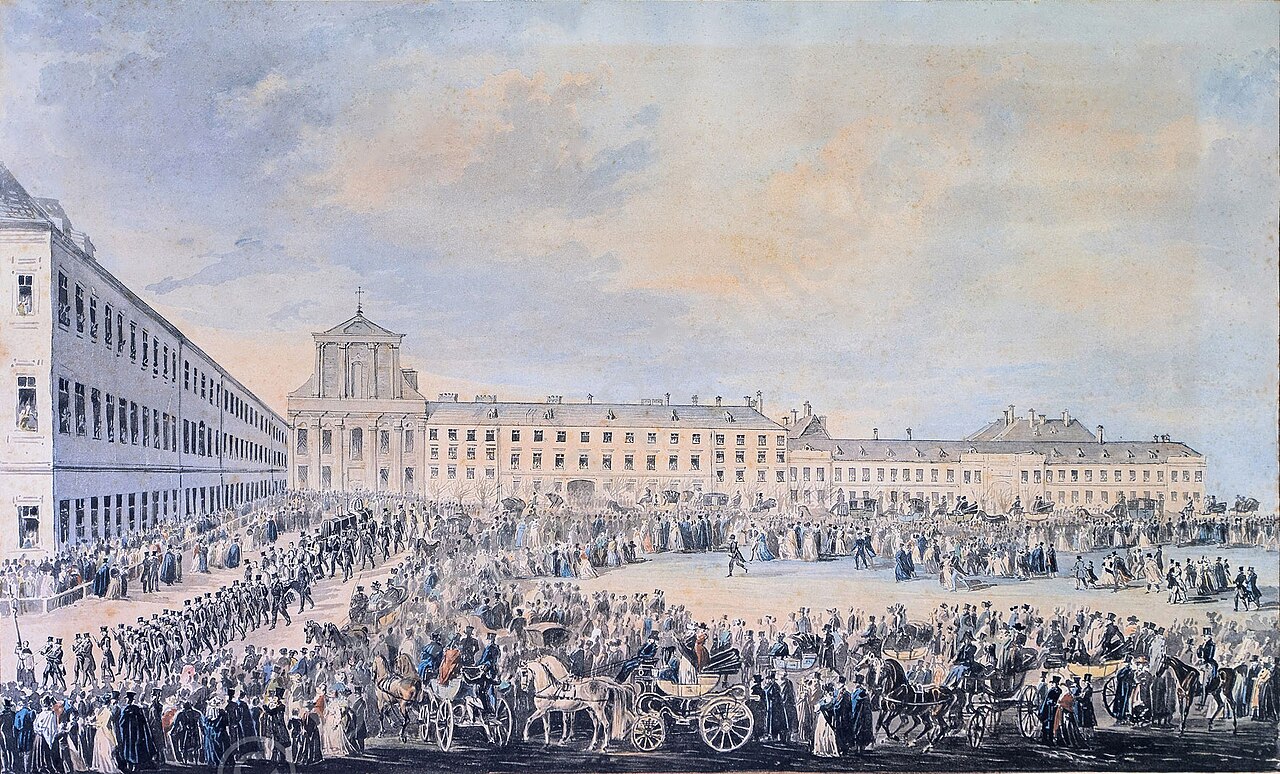
Watercolor of a large crowd of people in a city square before a pale yellow multi-story building with a central domed church facade. Horse-drawn carriages and horsemen move through the crowd under a pale sky.Painting

Primary source

Beethoven's Funeral

Franz Xaver Stöber · 1827

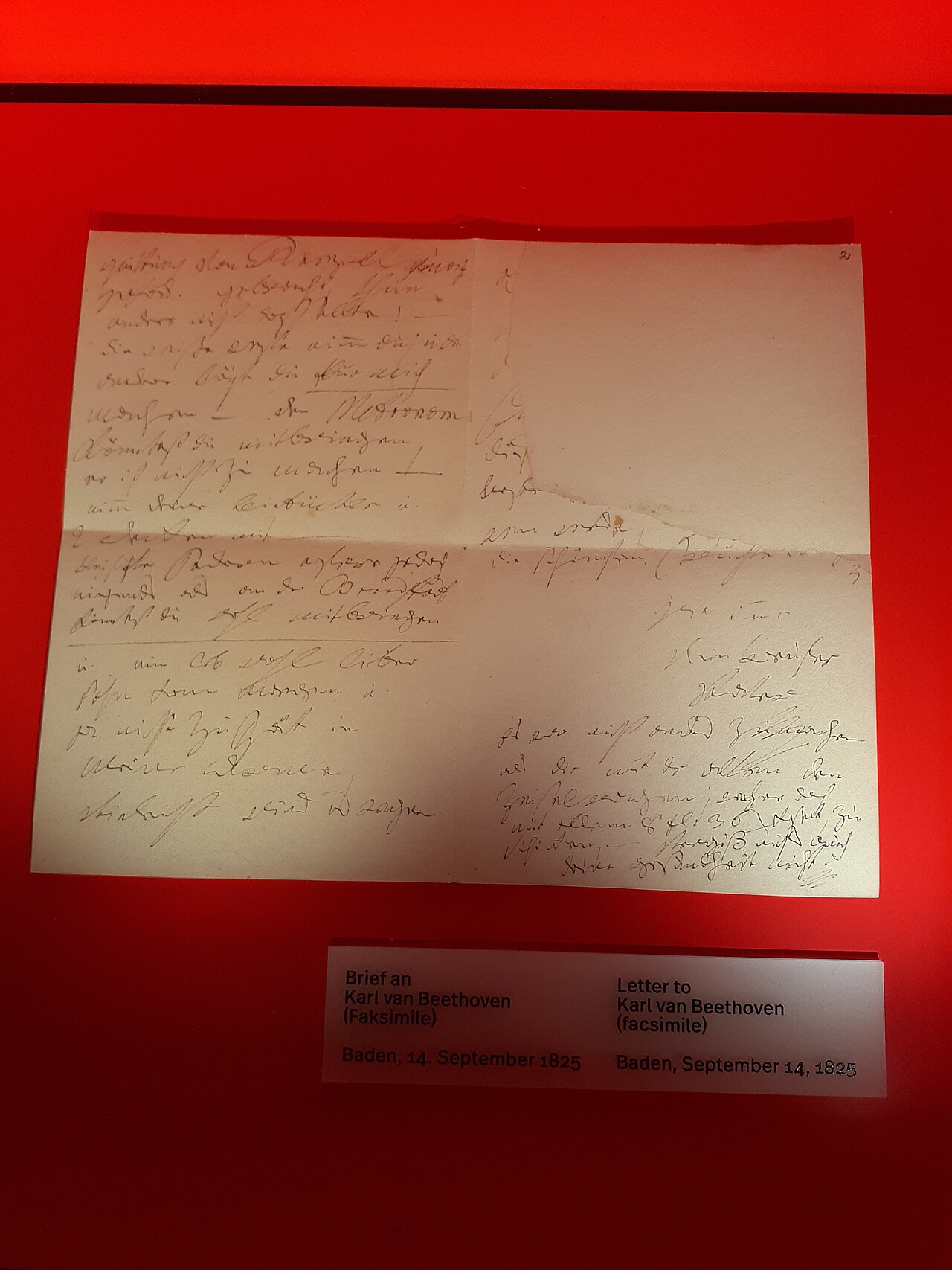
Photo of a handwritten letter in a display case against a red background. Two sheets of paper with cursive German handwriting, a page number 2 at top right. Below is a museum label reading 'Brief an Karl van Beethoven (Faksimile), Baden, 14. September 1825' in German and English.Letter

Primary source

Letter to Karl van Beethoven

Ludwig van Beethoven · 14 September 1825

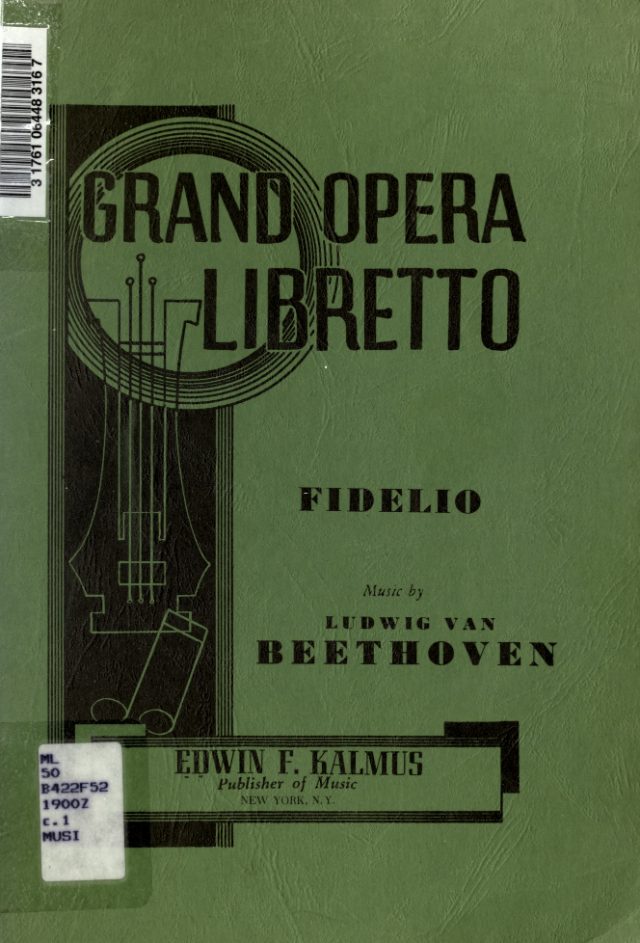
Fidelio, an Opera in Two ActsBook

Secondary source

Fidelio, an Opera in Two Acts

Ludwig van Beethoven · 1900

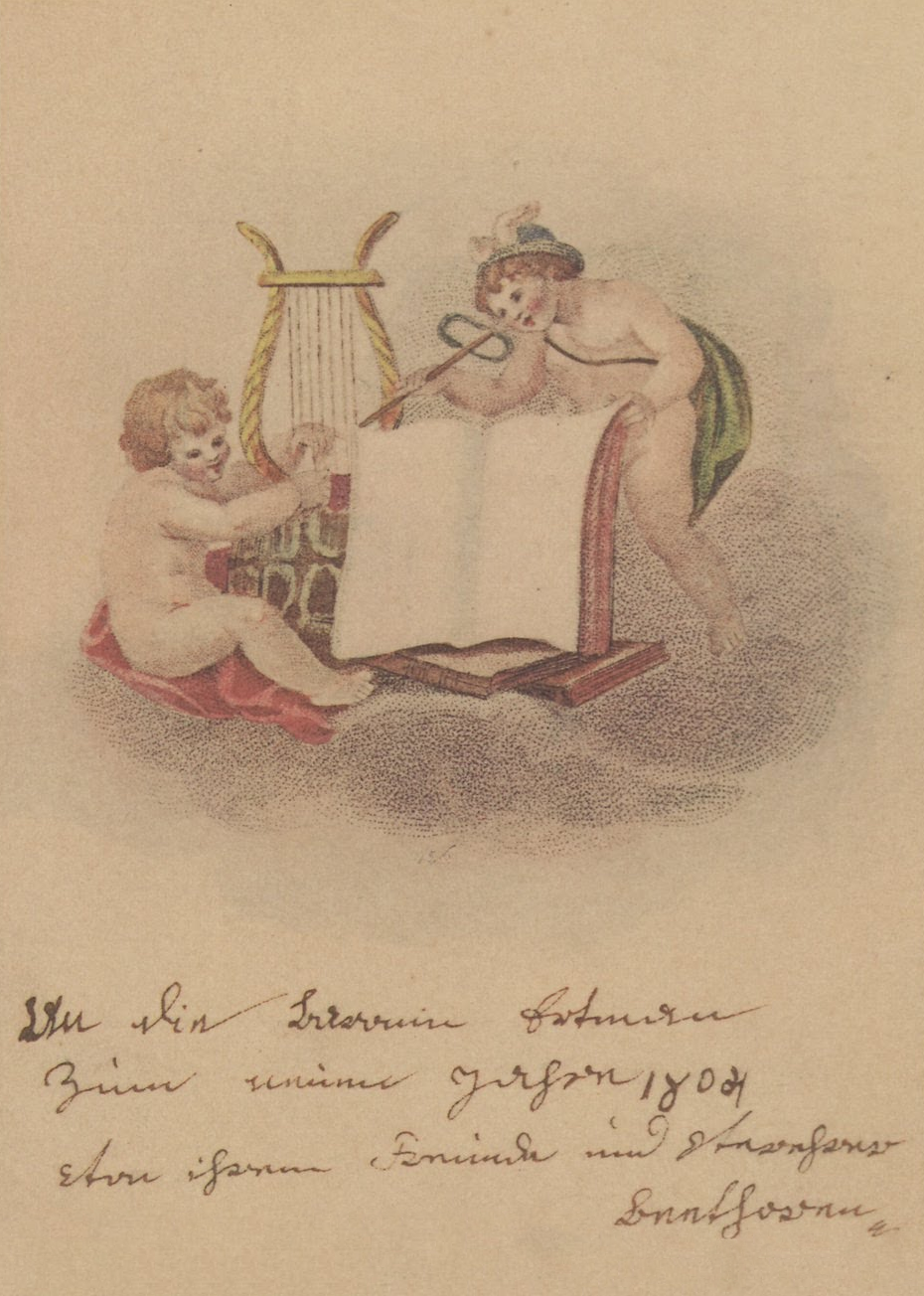
Hand-colored printed greeting card showing two putti: one seated on red cloth playing a gold lyre, the other leaning over a music book on a stand. Handwritten German inscription in brown ink below.Letter

Primary source

New Year Greeting Card to Dorothea von Ertmann

Ludwig van Beethoven · 1804

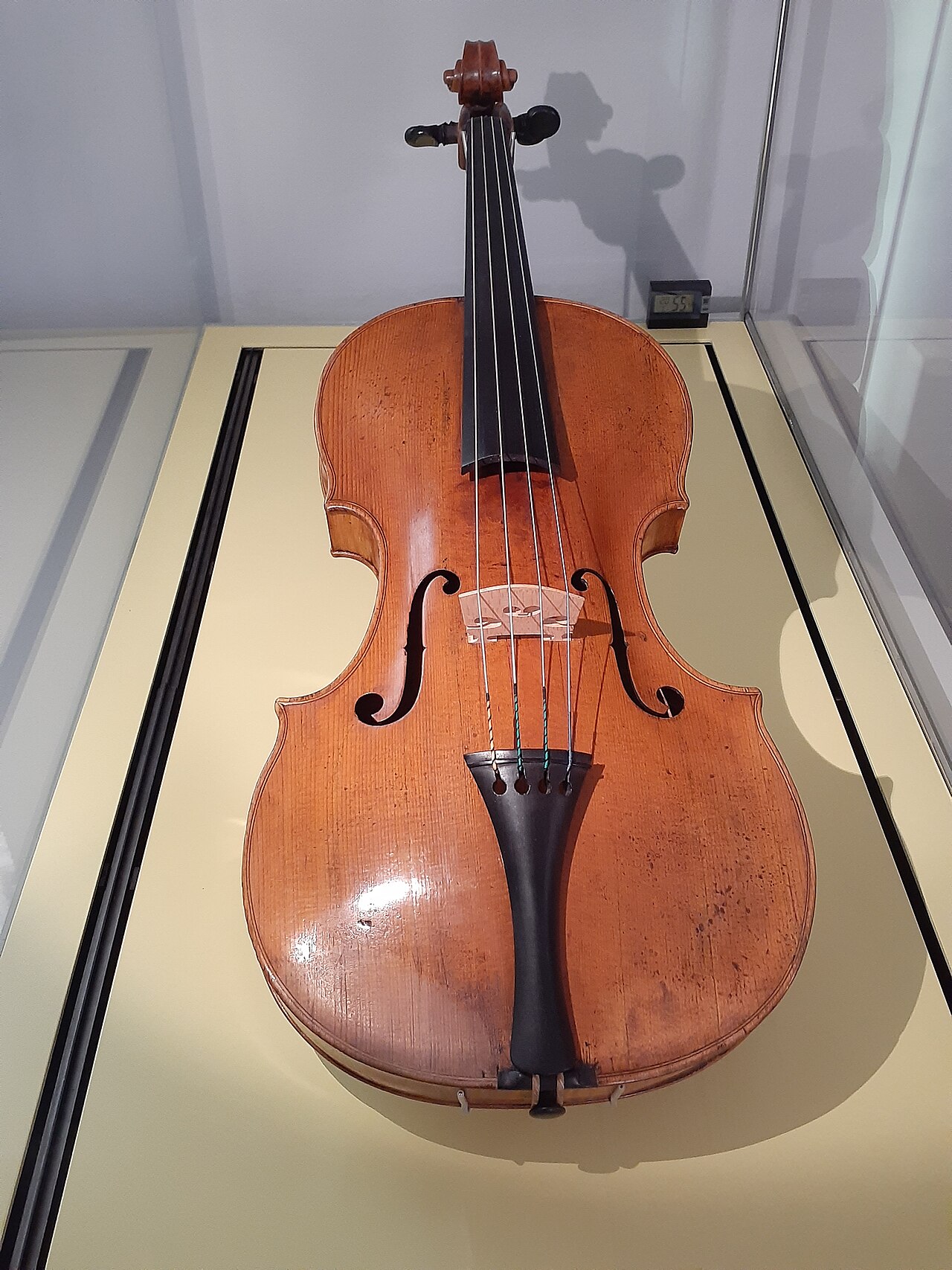
A reddish-brown wooden string instrument with f-holes, four strings, and a dark fingerboard, displayed upright in a glass case on a cream-colored pedestal. A digital thermometer sits on the wall behind it.Artifact

Primary source

Beethoven's Viola from the Bonn Court Orchestra

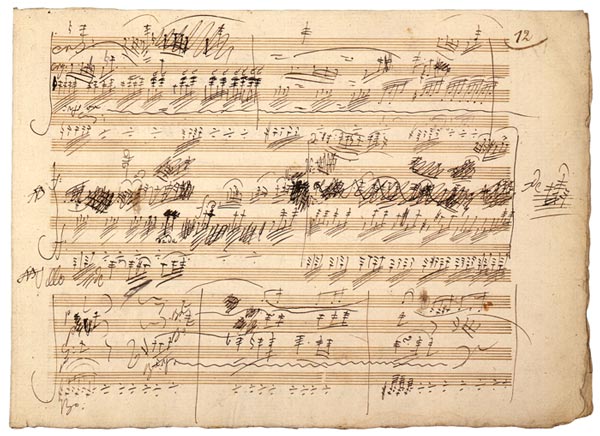
Scan of a handwritten musical manuscript on aged, yellowish paper with five-line staves densely covered in hand-drawn notes, heavy crossings-out and smudged ink. A page number 12 appears in the upper right corner.Document

Primary source

Manuscript of Piano Trio Op. 70, the Ghost Trio

Ludwig van Beethoven · circa 1810

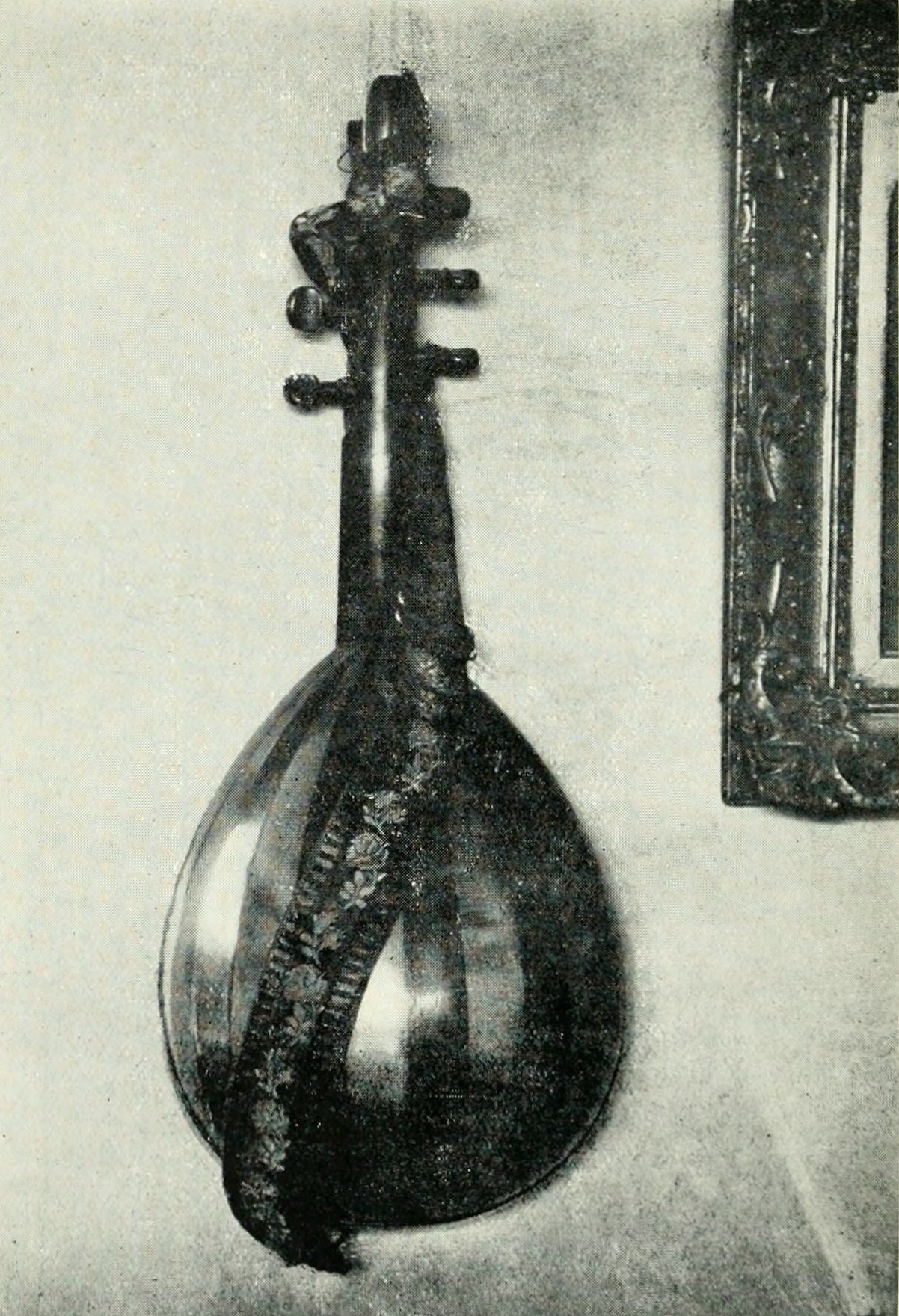
Black and white photograph of a pear-shaped mandolin with a long neck, four tuning pegs on the headstock, and a decorated ribbon-like strap or border across its rounded body. A carved gilt picture frame is visible at the right edge.Artifact

Primary source

Beethoven's Mandolin

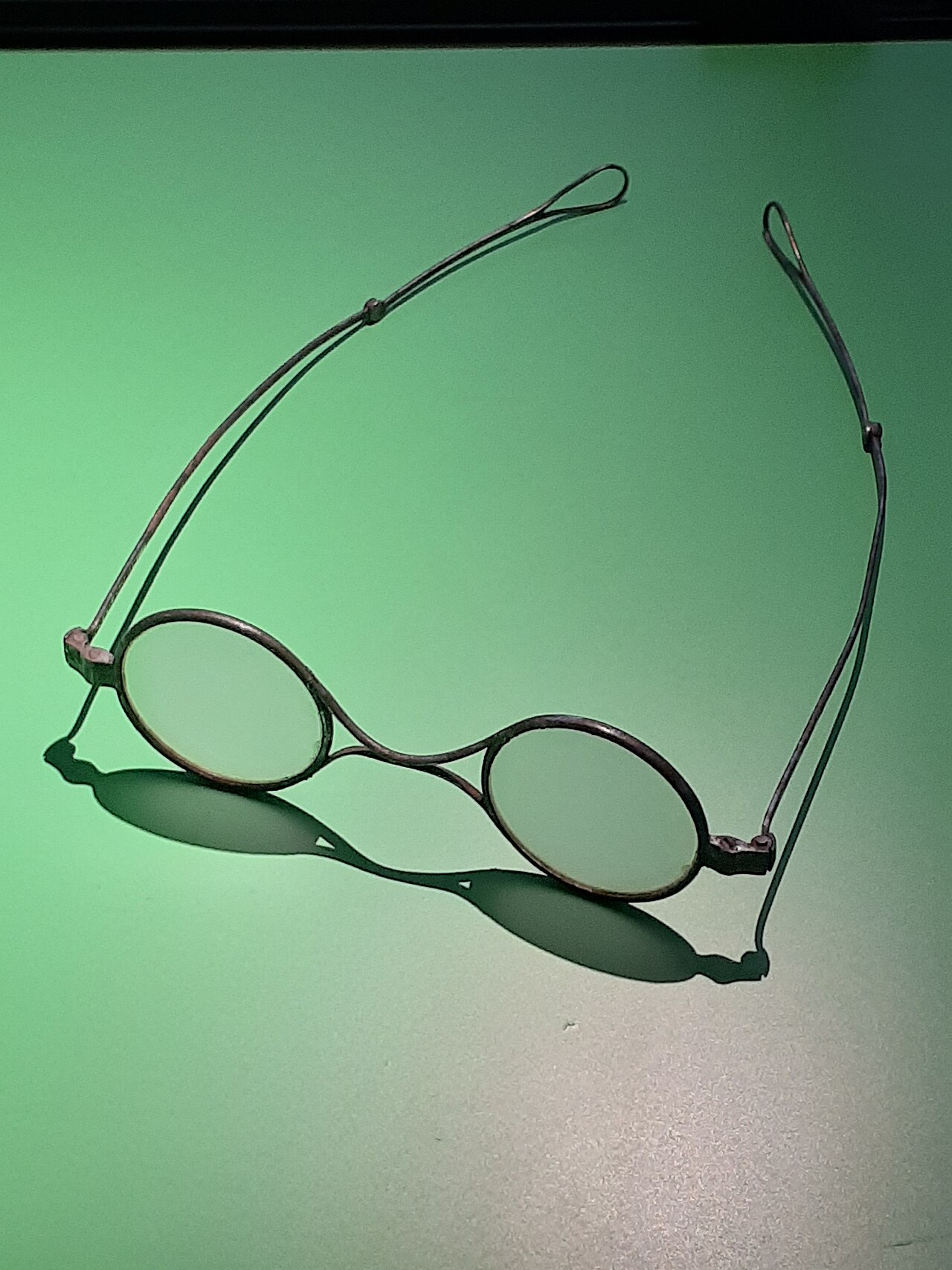
Photo of a pair of old round wire-rimmed eyeglasses with oval lenses, thin metal frame and looped temple ends, lying open on a green-lit surface with shadows cast beside them.Artifact

Primary source

Beethoven's Spectacles

1806-1810

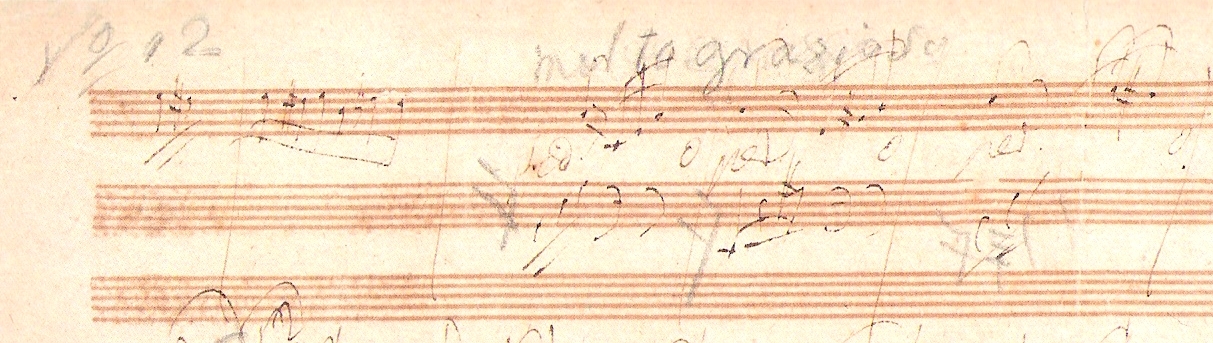
Close-up detail of a handwritten music sketch on aged paper with faint orange staff lines. Handwritten annotations include the words 'nicht zu grazioso' above the staves, with scattered notes, slurs, and markings, and numerals and an 'opus' mark near the middle.Document

Primary source

Original Sketch Leaf for Für Elise

Ludwig van Beethoven

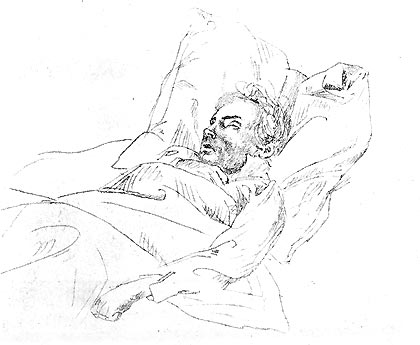
Pencil drawing of a bearded man reclining in bed on pillows, head turned slightly upward and to the side, with one hand resting on the bedclothes at lower left. The sketch uses fine, loose graphite lines with light shading.Painting

Primary source

Beethoven on His Deathbed

Josef Eduard Teltscher · 1827

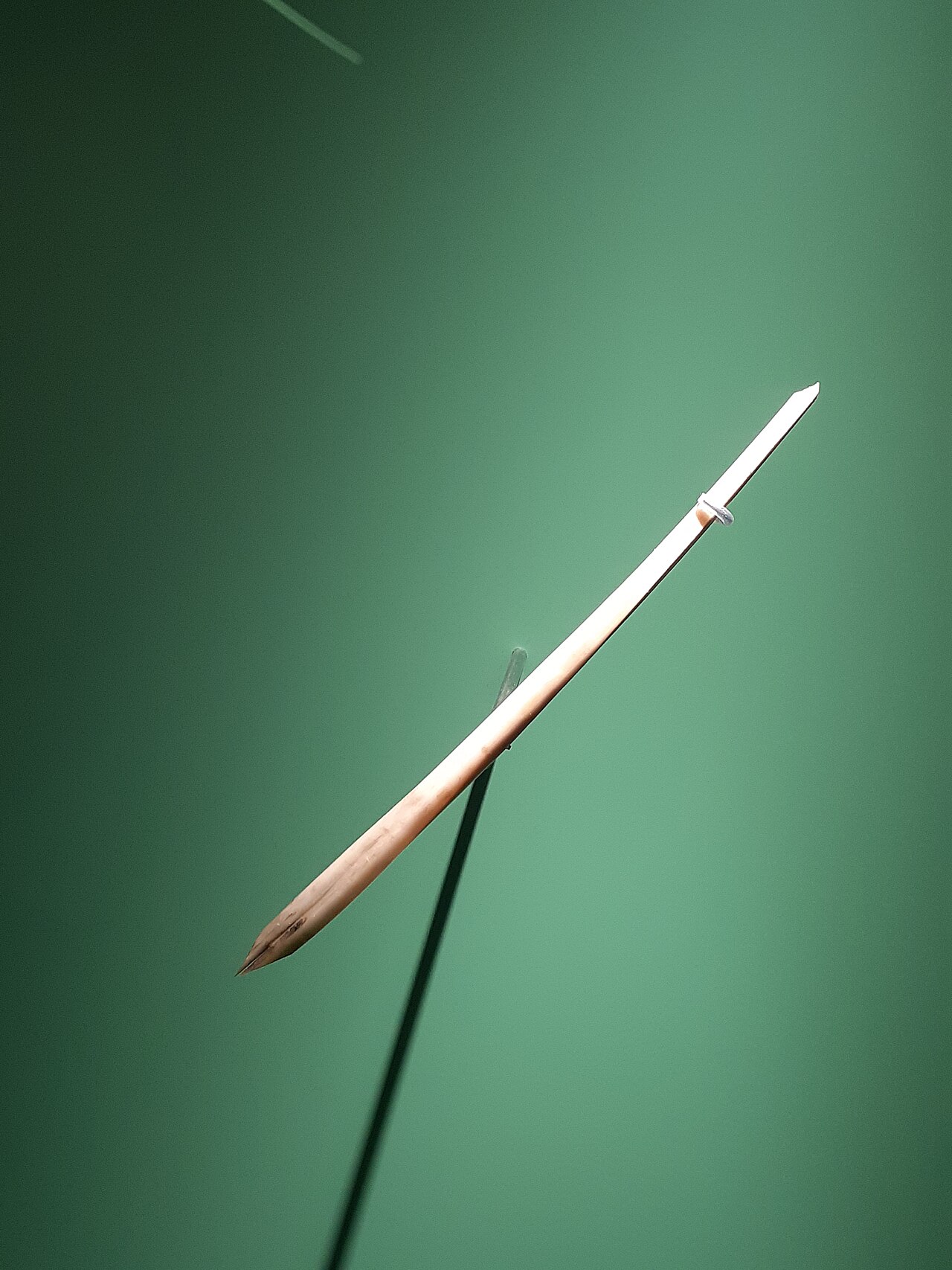
A pale quill pen with a tapered, brownish-stained nib at lower left and a pointed tip at upper right, held diagonally against a green background. A small metal clamp or band sits near the upper end, and a shadow falls below it.Artifact

Primary source

Beethoven's Last Quill

1827

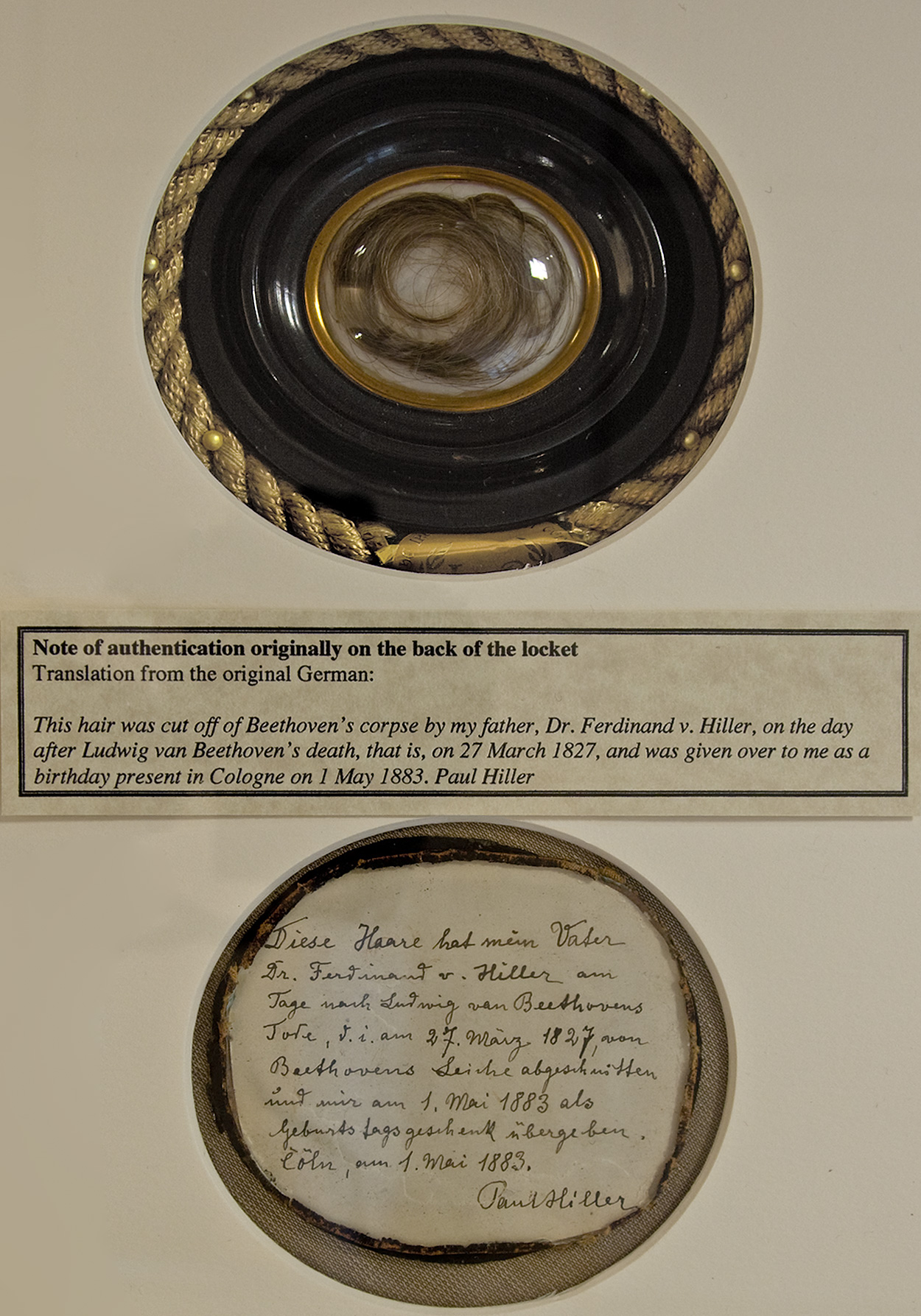
Photo of an oval black-and-gold mourning locket containing a coil of light brown hair under glass, with a gold rim and braided gold border. Below is a printed authentication note in English and an oval back panel with handwritten German text describing the hair as cut from Beethoven's corpse in 1827.Artifact

Primary source

Guevara Lock

1827

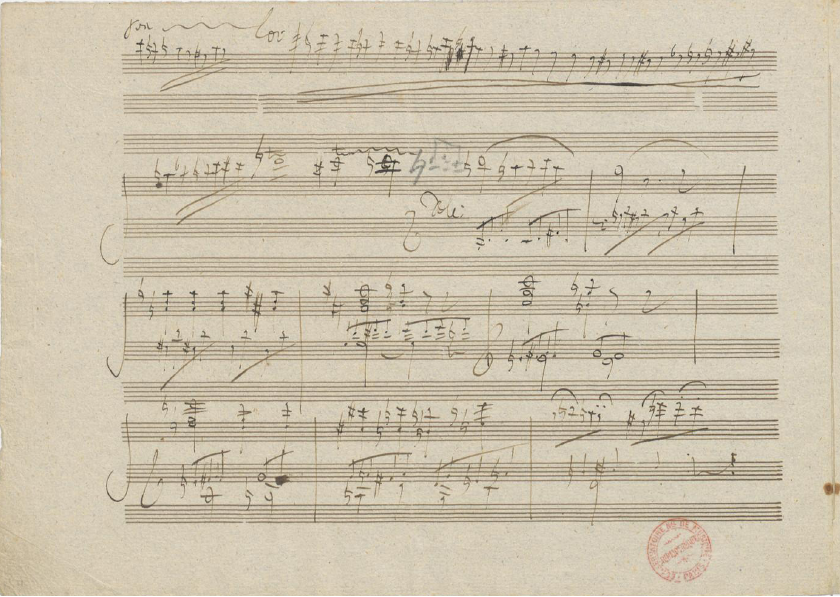
Handwritten manuscript page of music notation on aged paper, with five-line staves in ink showing a piano cadenza with dense notes, slurs, and accidentals. A red library stamp appears at the bottom right.Document

Primary source

Cadenza for the First Movement of Piano Concerto No. 3

Ludwig van Beethoven

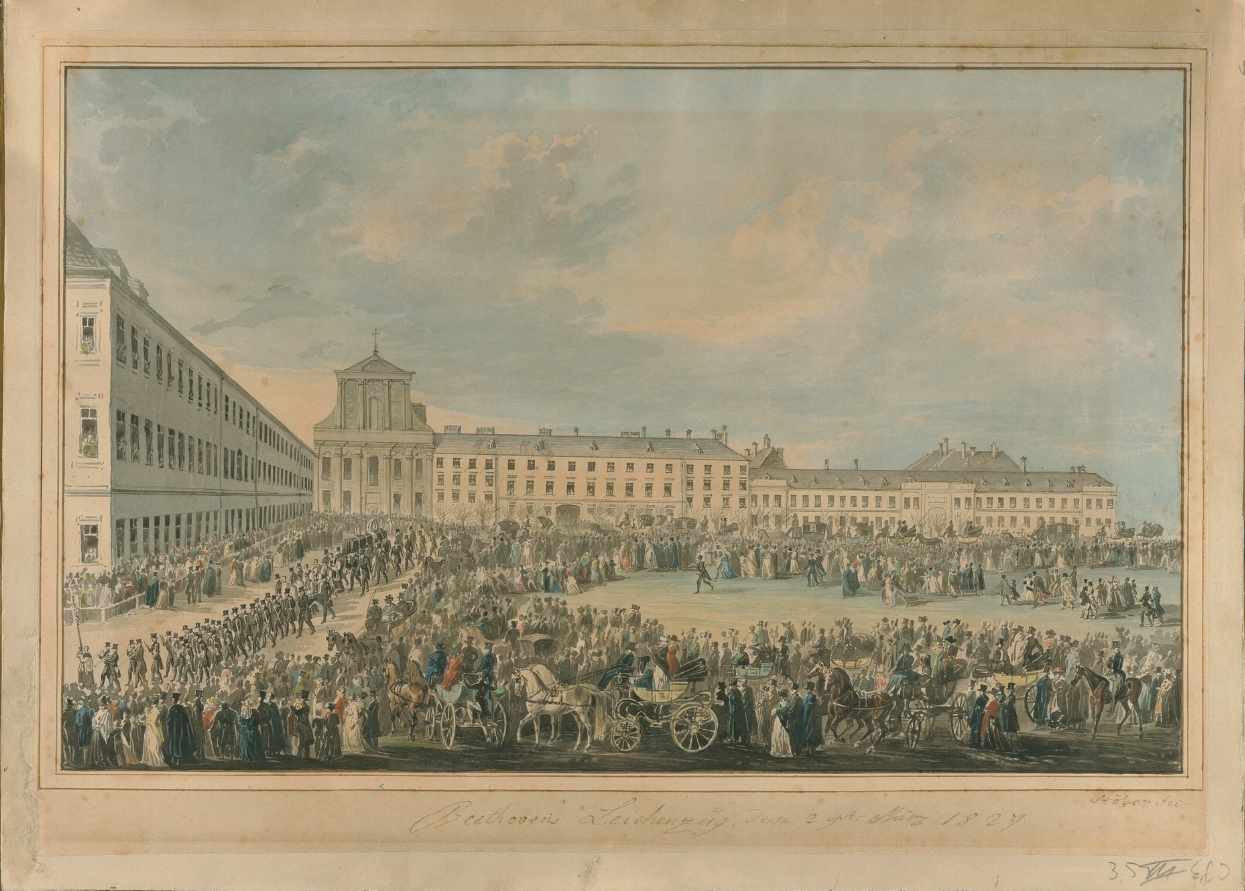
Colored drawing of Beethoven's funeral procession in Vienna in 1827. Crowds in dark and colorful clothing fill a large open square in front of a pale yellow multi-story building with a central church facade. Horse-drawn carriages and mounted riders move through the crowd, and a line of soldiers marches along the left. Handwritten German caption along the bottom reads Beethovens Leichenzug, 29 Mar 1827.Painting

Primary source

Beethoven's Funeral Procession, Vienna 1827

Franz Xaver Stöber · 1827

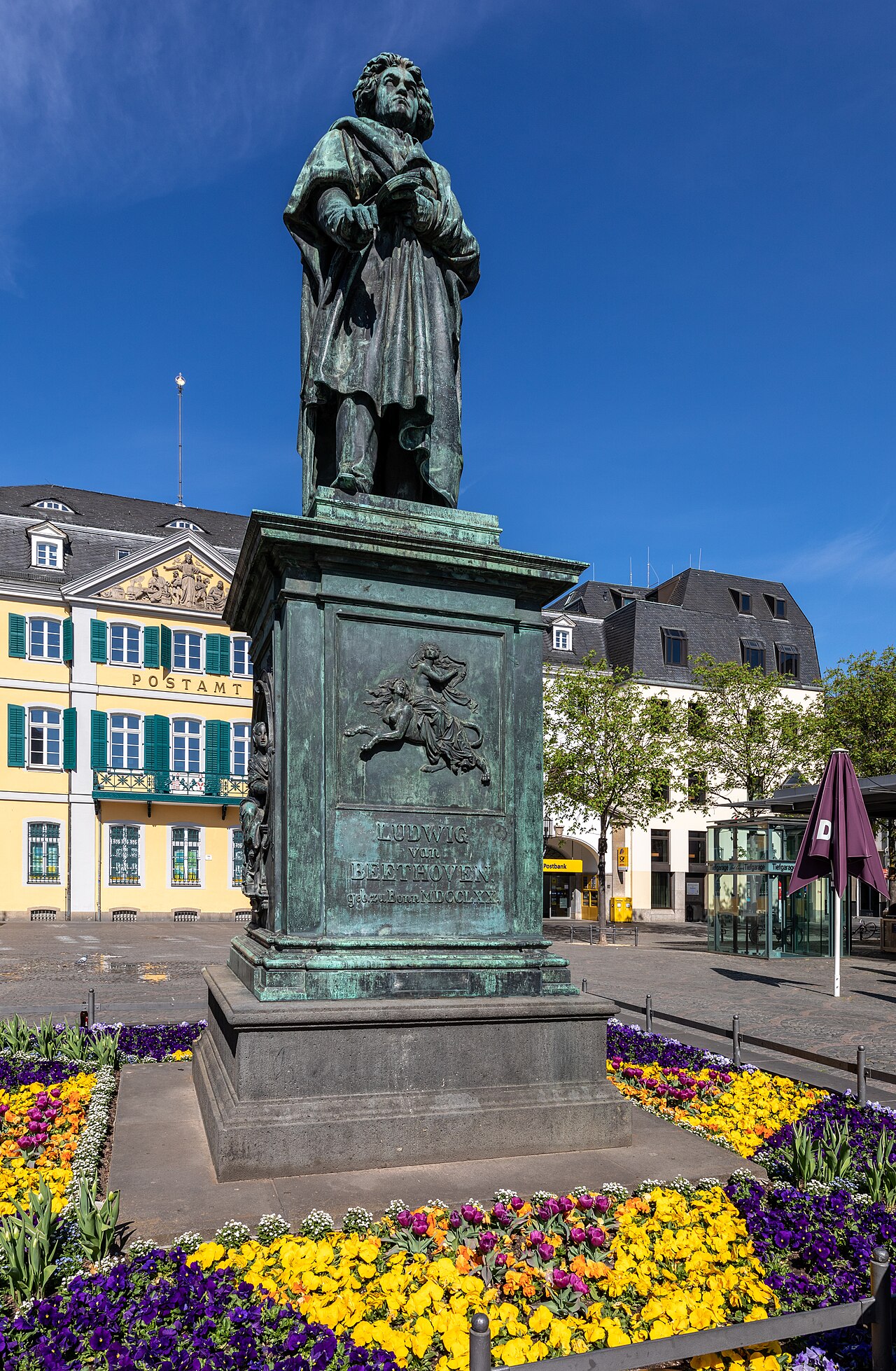
Bronze statue of Ludwig van Beethoven standing on a tall green-patinated stone pedestal in a city square, surrounded by yellow and purple flowerbeds. Behind it is a yellow building with green shutters labeled Postamt, and a blue sky.Sculpture

Secondary source

Beethoven Monument

Ernst Julius Hähnel · 1845

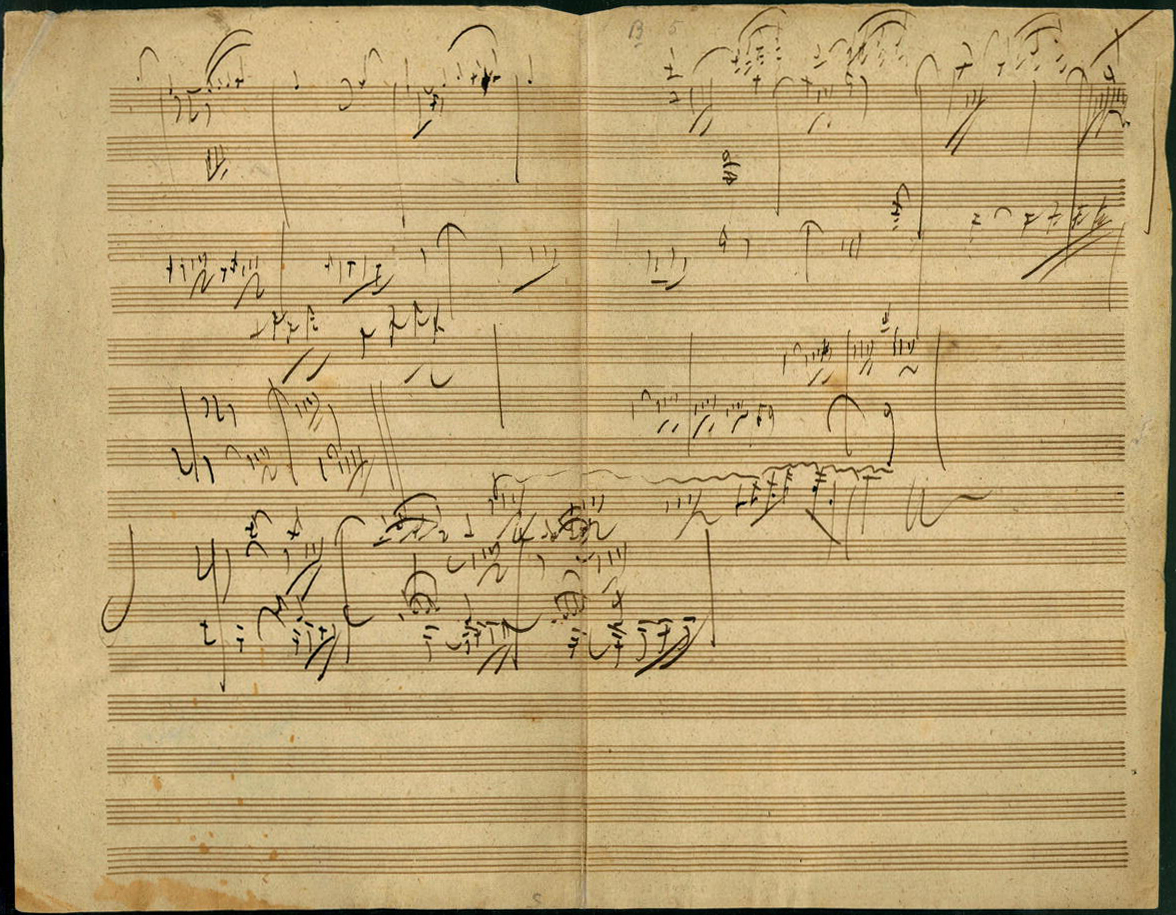
Scanned page of handwritten music manuscript on aged, yellowed paper with pen-drawn staves. Dense, rapid, sketchy notation of notes, slurs and markings fills the upper and middle staves, with fewer marks on the lower staves.Document

Primary source

Manuscript Sketch for Piano Sonata in A Major, Op. 101

Ludwig van Beethoven · 1816

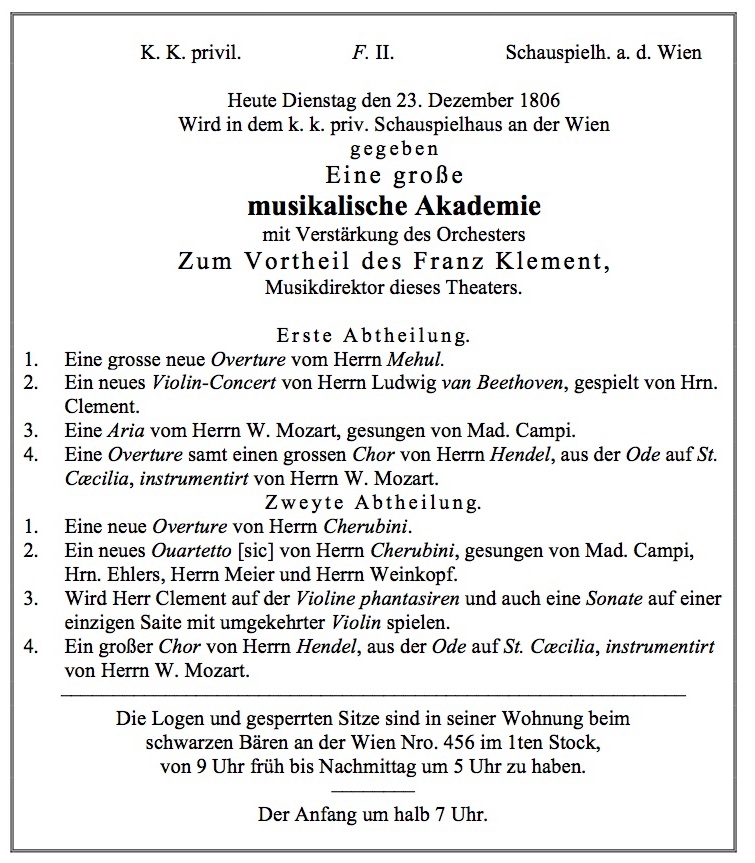
Printed Viennese concert announcement in German, dated Tuesday 23 December 1806, for a large musical academy at the Theater an der Wien for the benefit of Franz Clement. Lists two parts with numbered works by Mehul, Beethoven (violin concerto), Mozart, Handel, Cherubini, and a closing time of half past six.Document

Primary source

Vienna Concert Poster for Beethoven's Concert of 23 December 1806

23 December 1806

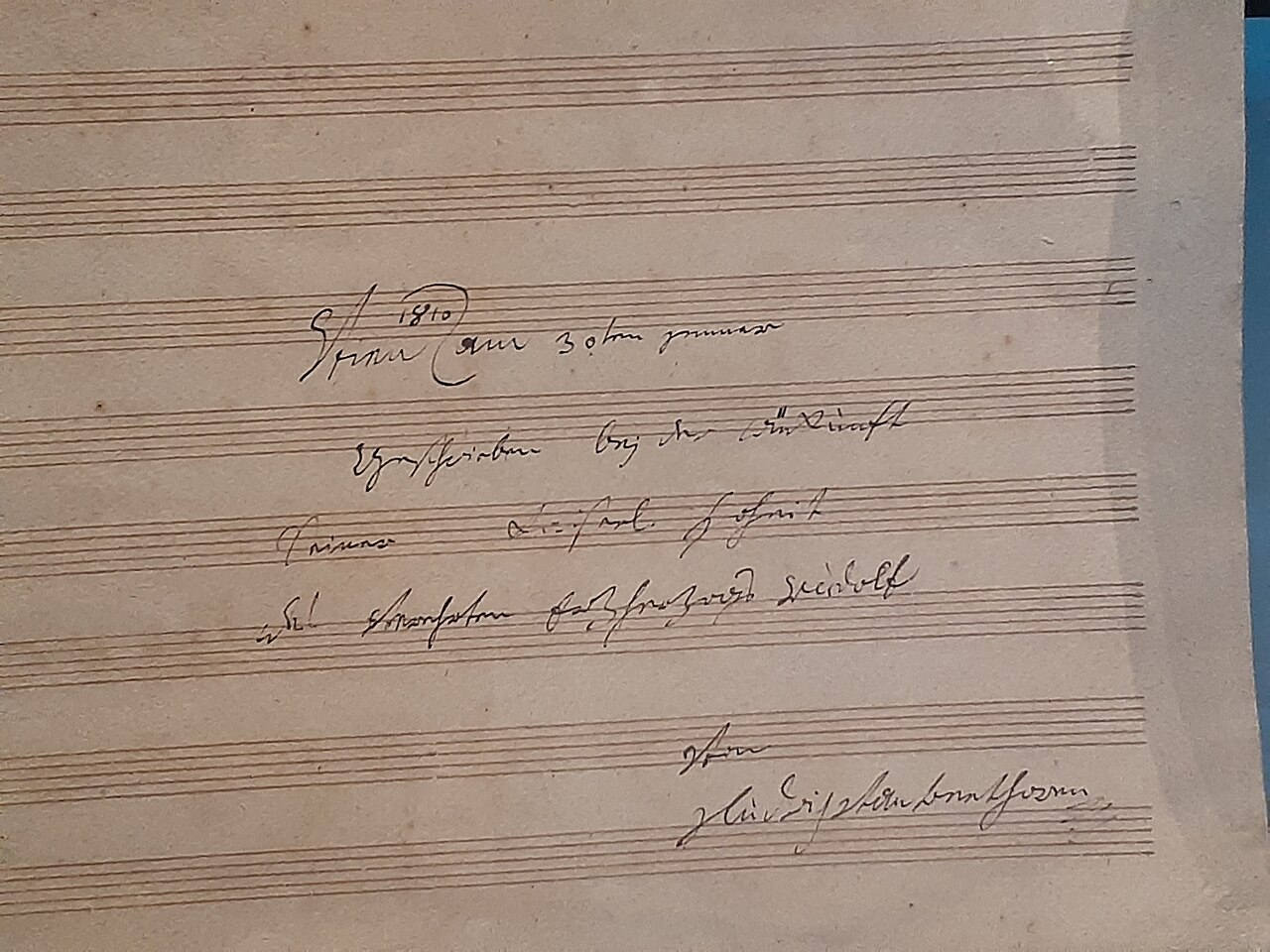
Handwritten manuscript on staff paper with faint lines. Ink text at top reads '1810' and a dedication in German script, with a signature in the lower right. The paper is pale and slightly curled.Document

Primary source

Piano Sonata Op. 81a with Corrections and Dedication to Archduke Rudolf

Ludwig van Beethoven · 1810

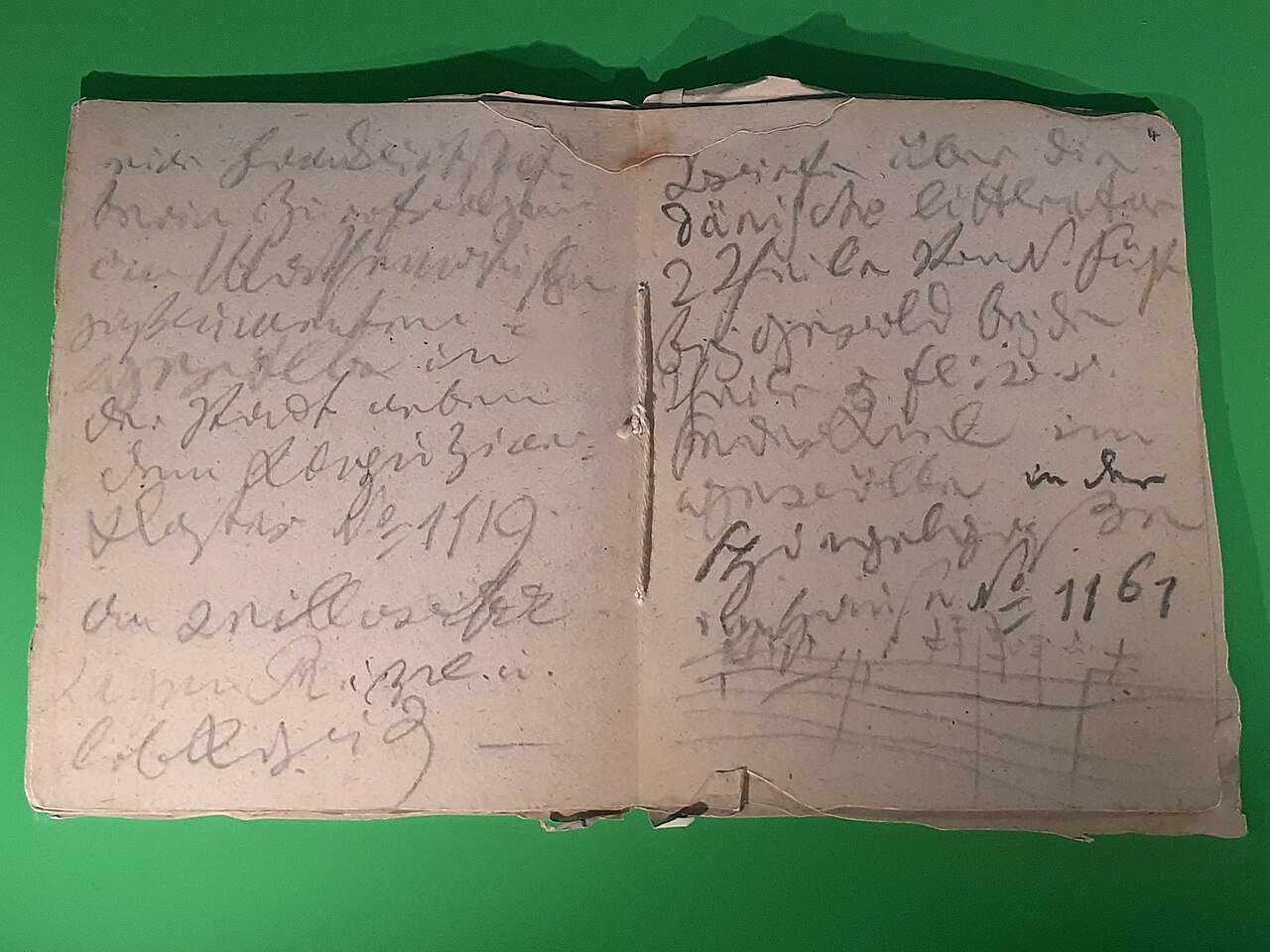
An open, worn paper notebook lying on a green background, with handwritten pencil notes in German script on both pages, including the numbers 1119 and 1161 and the words 'dänische Litteratur'. The pages are creased and torn at the edges.Document

Primary source

Sketchbook for the Ninth Symphony

Ludwig van Beethoven · 1823

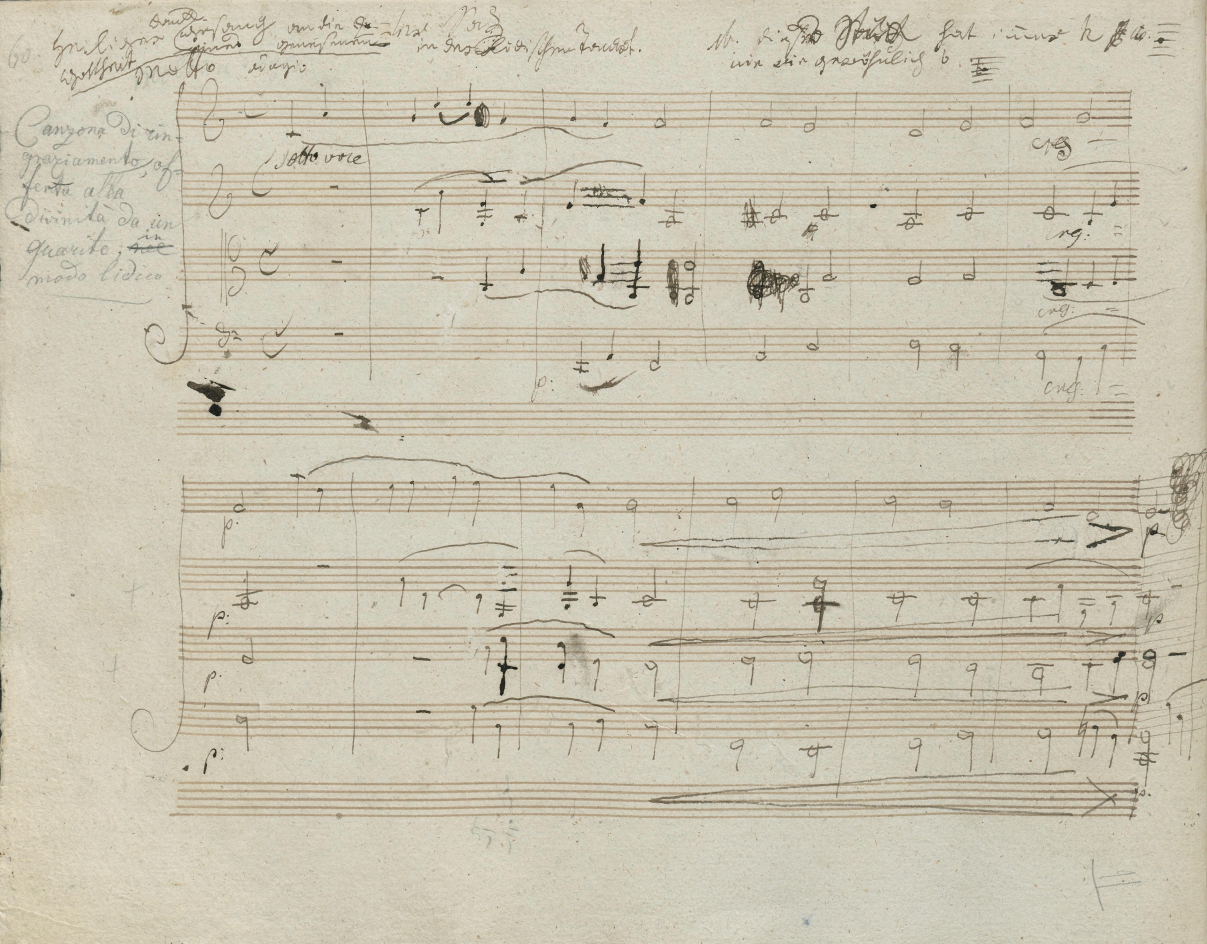
Handwritten manuscript page of musical score in ink on aged paper, with multiple staves of notes, Italian performance markings and annotations at top and left, and sketched corrections across the staves.Document

Primary source

Autograph of the Heiliger Dankgesang

Ludwig van Beethoven · 1 August 1825

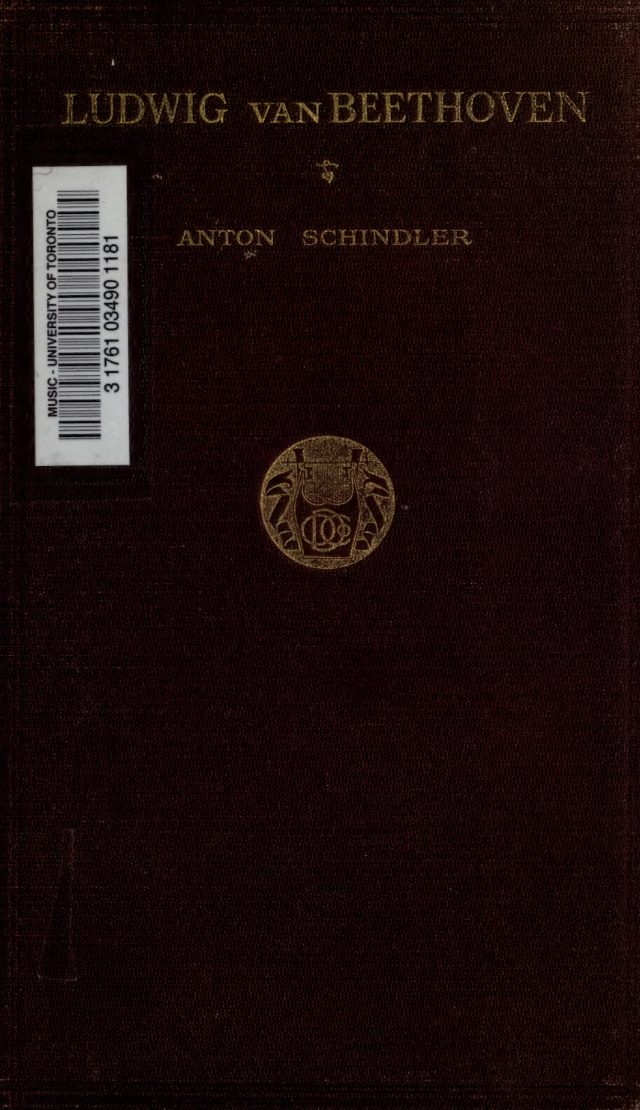
The Life of BeethovenBook

Secondary source

The Life of Beethoven

Anton Schindler · 1900

Beethoven by Romain RollandBook

Secondary source

Beethoven by Romain Rolland

Romain Rolland · 1919

Book

Secondary source

Ludwig van Beethoven, Leben und Schaffen

Adolf Bernhard Marx · 1901

Book

Secondary source

Beethoven by Paul Bekker

Paul Bekker · 1912

Book

Secondary source

Beethoven's Ninth Symphony: An Analysis

Heinrich Schenker · 1912

Beethoven et ses trois stylesBook

Secondary source

Beethoven et ses trois styles

Wilhelm von Lenz · 1855

Newspaper article

Secondary source

Analysis of the Storm in the Pastoral Symphony

Maurice Griveau · 1896

Beethoven and His ForerunnersBook

Secondary source

Beethoven and His Forerunners

Daniel Gregory Mason · 1904

BeethovenBook

Secondary source

Beethoven

Frederick James Crowest · 1903

Book

Secondary source

Beethoven et Wagner: essais d'histoire et de critique musicales

Théodore de Wyzewa · 1914

Thematic Catalogue of Beethoven's Published WorksBook

Secondary source

Thematic Catalogue of Beethoven's Published Works

Gustav Nottebohm · 1868

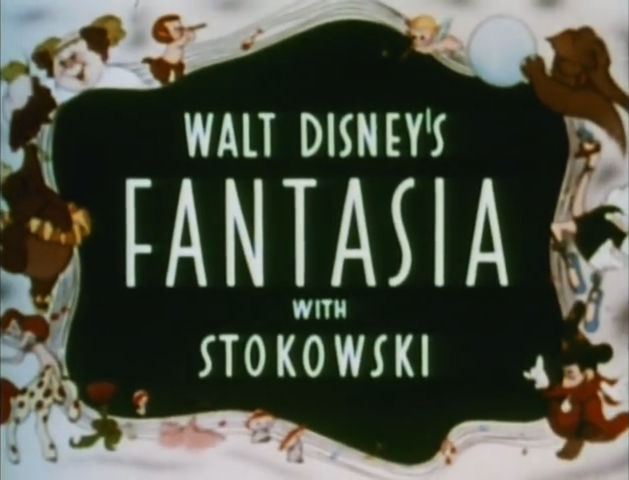
Title card reading 'WALT DISNEY'S FANTASIA WITH STOKOWSKI' in white letters on a dark green panel, framed by colorful cartoon characters including Mickey Mouse at lower right, a dog, and cherubs.Documentary

Primary source

Fantasia

Walt Disney Productions · 1940

Want the full shelf? Chat with Ludwig van Beethoven in the app and open the Sources panel — every quote links back to the original.

Use Ludwig van Beethoven in class

1 collection

A ready-made collection from the Humy team that features Ludwig van Beethoven. Preview it, then try it free.

Trusted by educators worldwide

Conversations
375,000+
Real exchanges between students and historical figures
Messages exchanged
4,142,000+
Across every figure, classroom and language
Historical figures
100,000+
Each informed by a curated biography and selected sources
Languages supported
50+
From English and Spanish to Arabic and Korean

Paying customers

Used by 98 schools and universities

Partner school logo
Tecnológico de Monterrey logo
Hyper Island logo
Partner school logo
Chambersburg Area School District logo
Broward County Public Schools logo
Nebo School District logo
National Louis University logo
South Florida PBS logo
Punahou School logo
University of Wisconsin–River Falls logo
Partner school logo
Partner school logo
Archbishop Mitty High School logo
Kingsburg High School logo
Norwalk Public Schools logo
Partner school logo
Connections logo
Partner school logo
Moore Public Schools logo
Partner school logo
Partner school logo
Partner school logo
Partner school logo
Robbinsville Public Schools logo
Partner school logo
Partner school logo
Partner school logo
Tecnológico de Monterrey logo
Hyper Island logo
Partner school logo
Chambersburg Area School District logo
Broward County Public Schools logo
Nebo School District logo
National Louis University logo
South Florida PBS logo
Punahou School logo
University of Wisconsin–River Falls logo
Partner school logo
Partner school logo
Archbishop Mitty High School logo
Kingsburg High School logo
Norwalk Public Schools logo
Partner school logo
Connections logo
Partner school logo
Moore Public Schools logo
Partner school logo
Partner school logo
Partner school logo
Partner school logo
Robbinsville Public Schools logo
Partner school logo
Partner school logo

What educators are saying

“We enjoyed the program last year and used it frequently.”
“My students say it’s a welcome change of pace. I’m not a fan of the “sage on the stage” model, so I try to incorporate research-oriented and self-paced activities. With Humy, students have to take charge of their learning. They’ve become more adept at critical thinking, forming better questions, and improving their reading comprehension. The interview feature has been my go-to tool. I create assignments where students must ask historical figures a set number of questions, then summarize the responses to ensure they’re truly absorbing the material. This approach lets them actively explore the past rather than passively consuming information.”
“Humy has helped me bring historical figures, sometimes long past, to life. When my students interact with these figures in real-time, it eliminates some of the perceived “ancient” characteristics of my curriculum. This has shifted my students’ thinking away from viewing history as abstract or irrelevant. Real-time interactions make historical figures relatable, even allowing students to ask off-topic questions that help put historical lives in a more relevant context for 13-year-olds. The feature I use the most is the interview feature. After teaching a topic, most recently Gandhi and Joan of Arc, I have the students ask pointed, focused questions. We practice good conversation techniques beforehand, teaching them to listen (or read) carefully and formulate thoughtful follow-up questions rather than just interrogating. It helps students practice effective conversation skills.”

FAQ

Frequently asked questions

Who is Ludwig van Beethoven?
Renowned German composer and pianist of the classical and romantic eras. On Humy.ai you can chat with an AI version of Ludwig van Beethoven that draws on a short biography and 96 historical sources during the conversation — by text or voice, in 42 languages.
Is Ludwig van Beethoven AI free?
Ludwig van Beethoven is part of Humy's full library of more than 100,000 figures, which comes with a paid plan. A free account (no credit card) includes 20 messages a month with the free library's figures, so you can try how the conversations work first.
What sources does the Ludwig van Beethoven AI use?
It draws on a short biography and 96 historical sources (documents, books and artifacts), including “Symphony No. 9”, “Death of Ludwig van Beethoven” and “Bust of Ludwig van Beethoven by Frederic Storck”. Each source has its own page on Humy.ai.
How historically accurate is the AI version of Ludwig van Beethoven?
Each figure uses a short biography and a small set of selected historical sources as context (retrieval-augmented generation), so answers stay closer to known material than the model's general knowledge alone. It isn't a citation-grade research tool — like any LLM, the AI can get details wrong or extrapolate. Treat it as a strong starting point for inquiry and cross-reference important claims.
Can I talk to Ludwig van Beethoven by voice?
Yes. In addition to text chat, you can call Ludwig van Beethoven and hear their voice respond in real time — useful for auditory learners, interview practice and Socratic dialogue.
Is Humy.ai safe and compliant for schools?
Yes. Humy.ai is used by more than 100 schools, universities and organisations. The platform is FERPA- and GDPR-aligned, supports SSO, and offers an IT-approval pack tailored for school procurement teams.

Cross-reference Ludwig van Beethoven

Like any LLM, the AI version of Ludwig van Beethoven can get details wrong. Open one of these sources in a new tab to verify what you’ve read.

Ready when you are

Start chatting with Ludwig van Beethoven now.

20 messages free · No credit card · Available in 50+ languages.