Portrait of Saint Paul

AI Historical Figure

Saint Paul

Prominent early Christian missionary and writer of the New Testament.

Chat with Saint Paul via text or voice — in 42 languages, drawing on a curated biography and 91 historical sources. Available 24/7.

Start chatting with Saint Paul20 messages free · No credit card
Lived
c. 5–64 CE
From
TürkiyeItaly
Known for
ReligionLiterature & writing
Saint Paul

Saint Paul

Online · responds in seconds

Hello — I'm Saint Paul. Prominent early Christian missionary and writer of the New Testament. What would you like to ask me?

20 messages free · No credit card · Powered by Humy.ai

Live preview · Switch between 42 languages above · Send a message to continue in the app

Multilingual

Talk to Saint Paul in 42 languages

Ask Saint Paul questions in any language below, and the rest of Humy's app speaks it too. Pick yours to open the chat in that language.

Also in German (Austria), German (Switzerland), English (UK), English (Australia), English (Canada).

The sources behind this AI

91 sources · 34 paintings · 24 books · 19 letters · 6 documents · 4 artifacts · 2 sculptures · 1 speech · 1 photograph

Saint Paul doesn’t improvise from thin air. The AI is grounded in 91 curated historical sources students can inspect. Open any of them to see what informs the conversation.

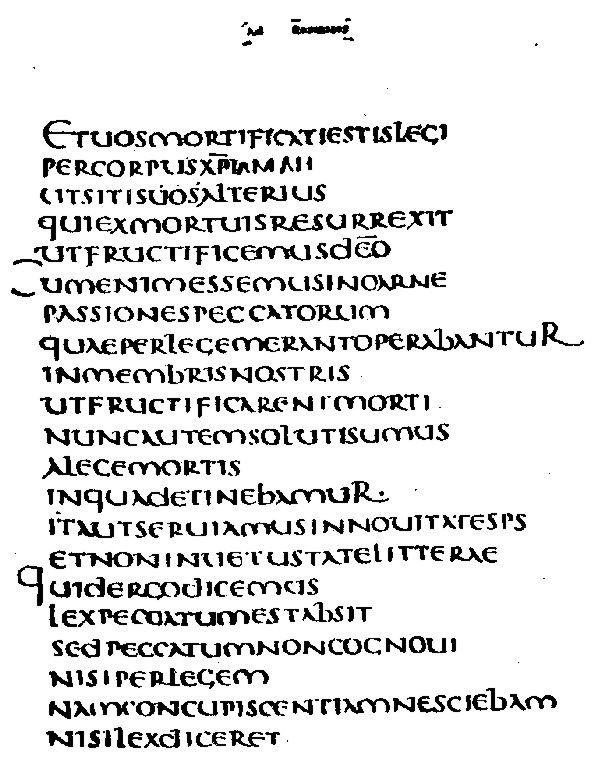
Scan of a manuscript page with about twenty lines of handwritten Latin in a medieval-style hand, with a small decorative heading at the top. Some lines have large initial letters and flourishes.Letter

Primary source

Epistle to the Romans

Paul the Apostle · c. AD 57

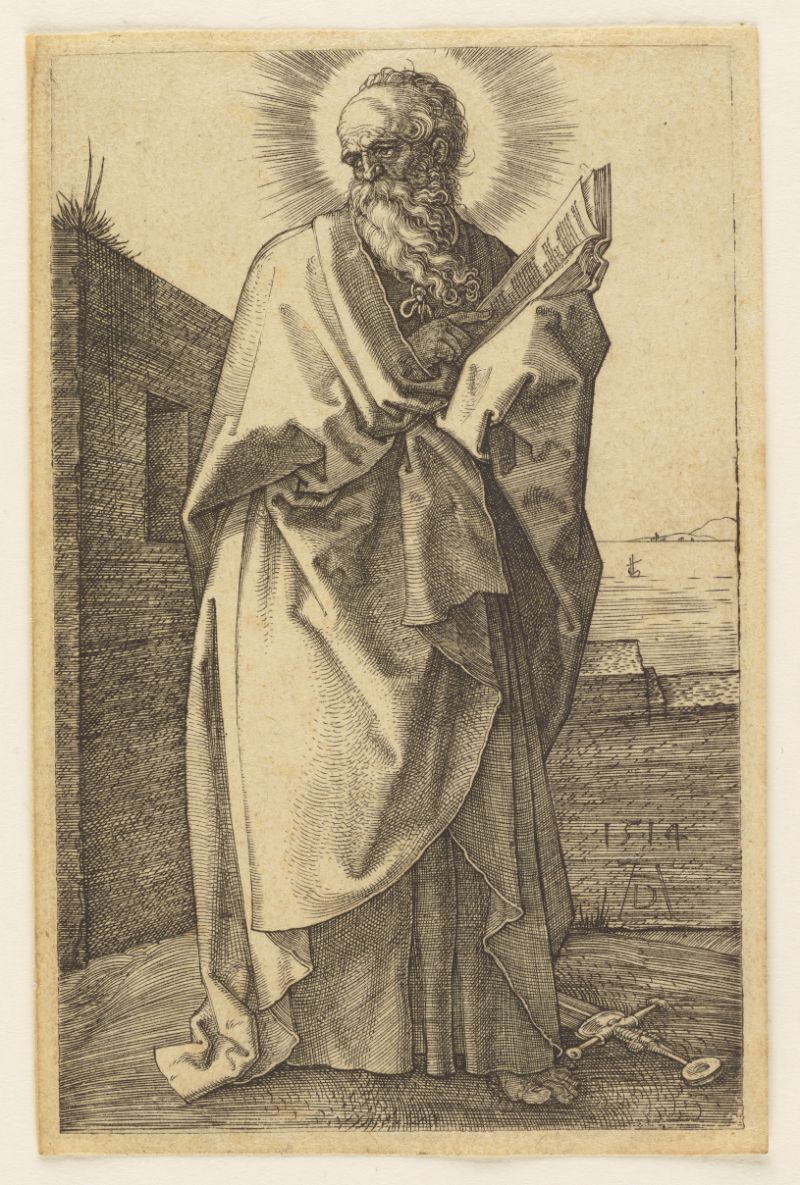
Engraving of an elderly bearded man with a halo, wearing a draped robe and holding an open book, standing beside a wall with a sword at his feet. Dated 1514 with the AD monogram. Black and white.Painting

Secondary source

Saint Paul

Albrecht Dürer · 1514

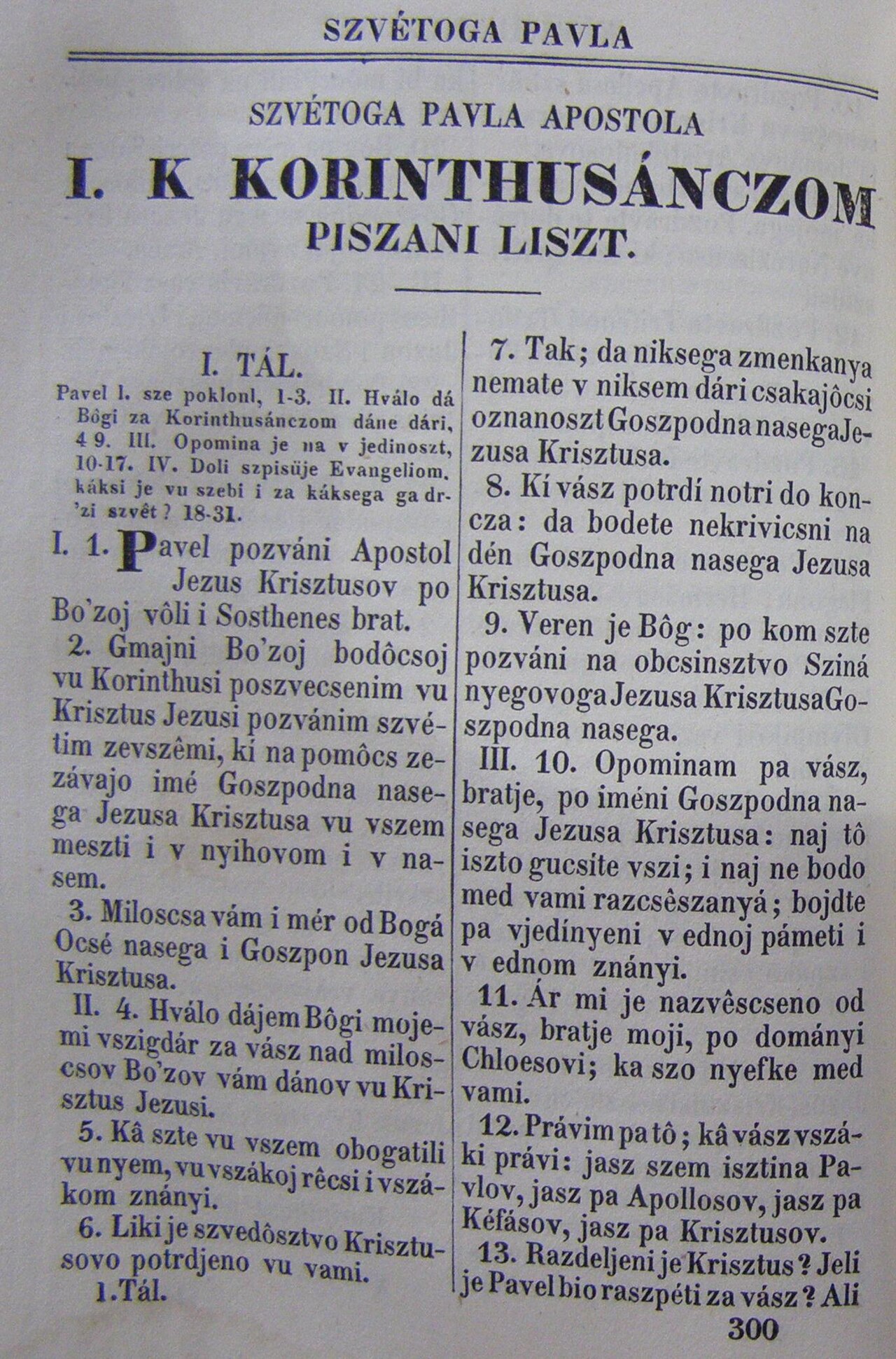
Page 300 of the 1848 Prekmurian New Testament, headed 'Szvétoga Pavla Apostola I. K Korinthusánczom Piszani Liszt' with two columns of Prekmurian Slovene text, chapter 1 verses 1 to 13.Letter

Secondary source

First Epistle to the Corinthians

Paul the Apostle · c. 54 AD

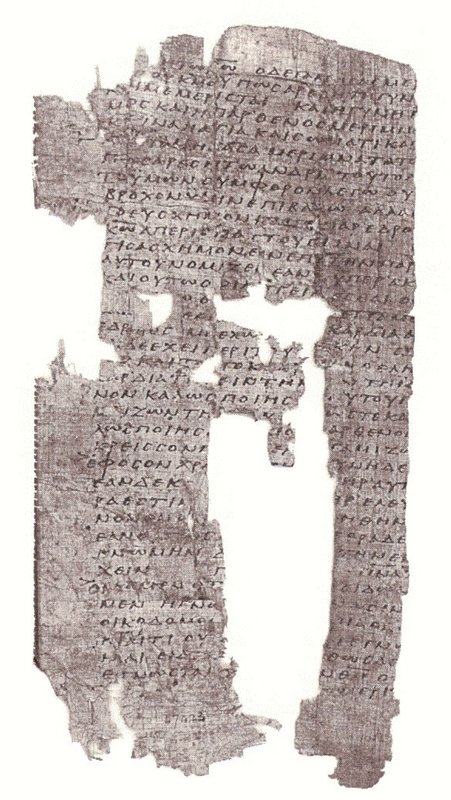
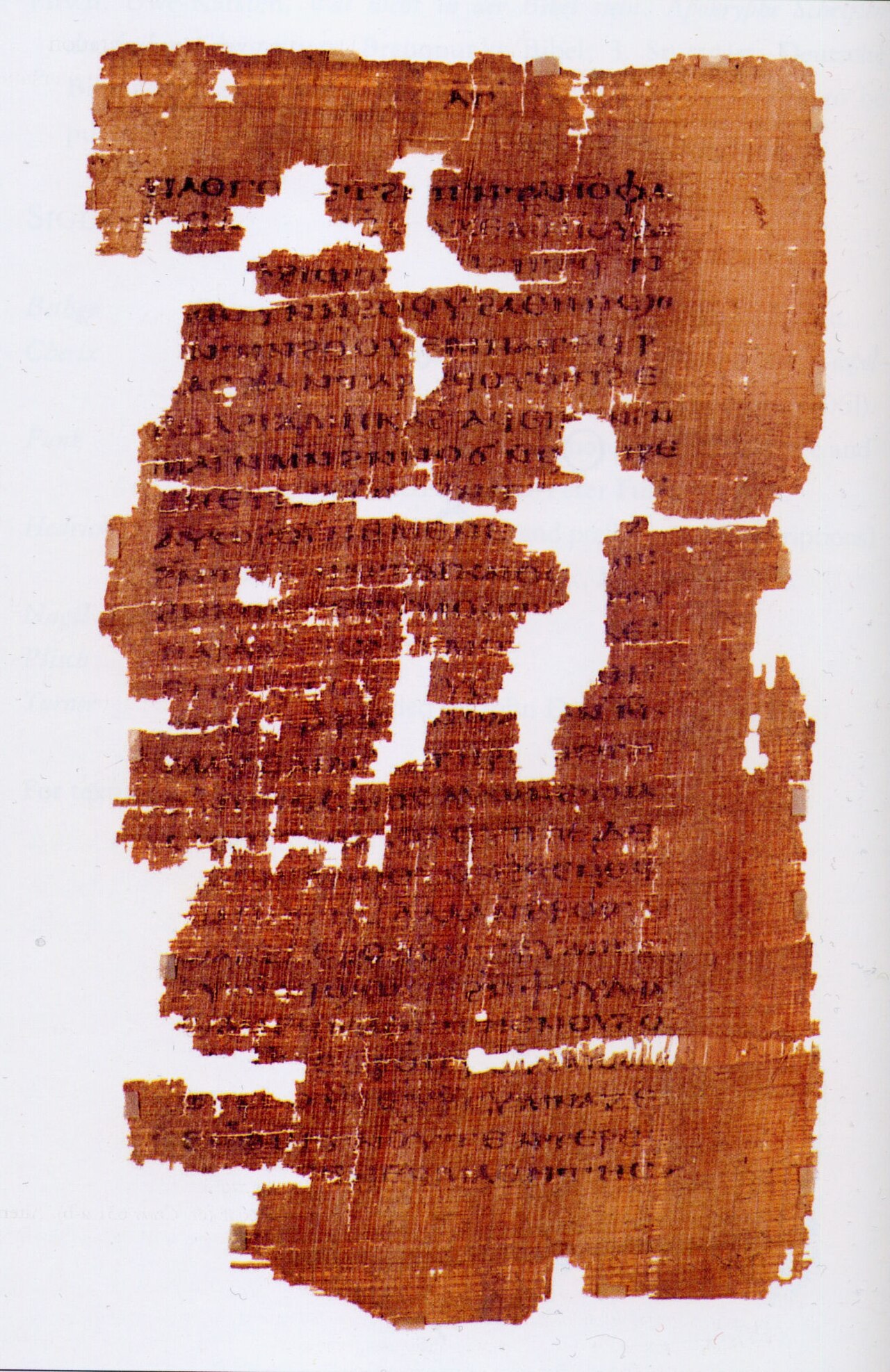
Scan of a fragmentary papyrus leaf with faded brown Greek uncial-style text in columns, with torn and missing sections. It is a manuscript of 1 Corinthians 7:33-8:4, not chapter 13.Book

Primary source

1 Corinthians 13

Paul the Apostle · c. AD 53-57

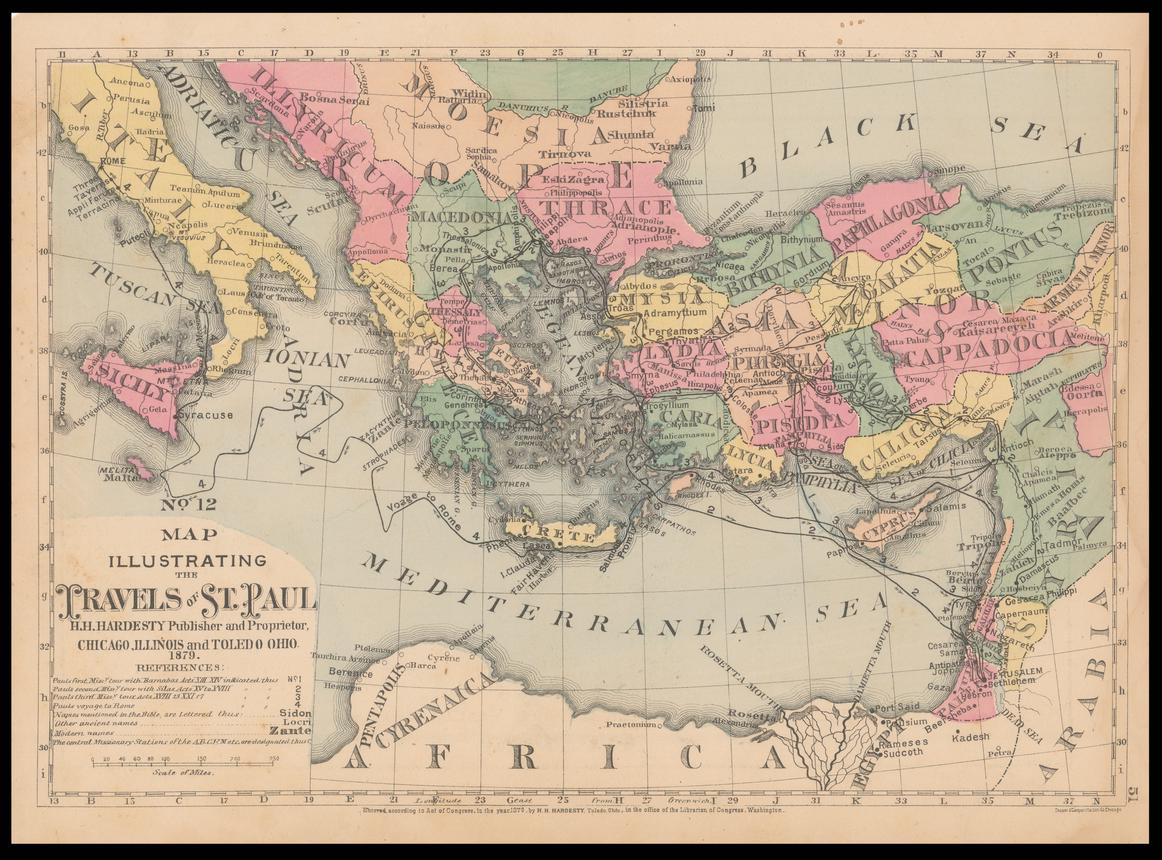
Colored 1879 map titled 'Map Illustrating the Travels of St. Paul' by H.H. Hardesty, showing the Mediterranean, Asia Minor, Greece, Italy, Egypt and the Holy Land with routes marked in lines and numbered journeys.Document

Secondary source

Map Illustrating the Travels of St. Paul

H.H. Hardesty · 1879

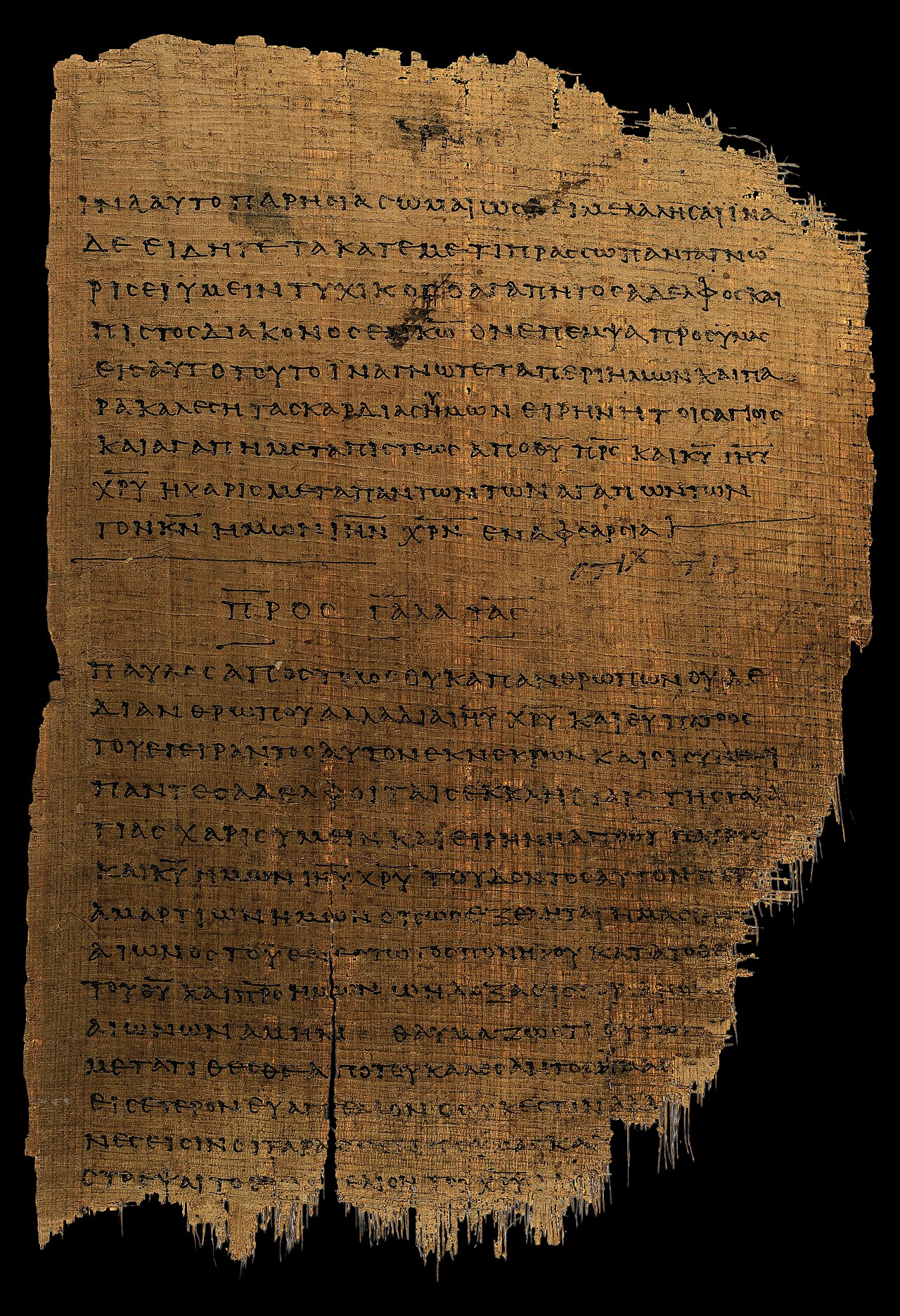
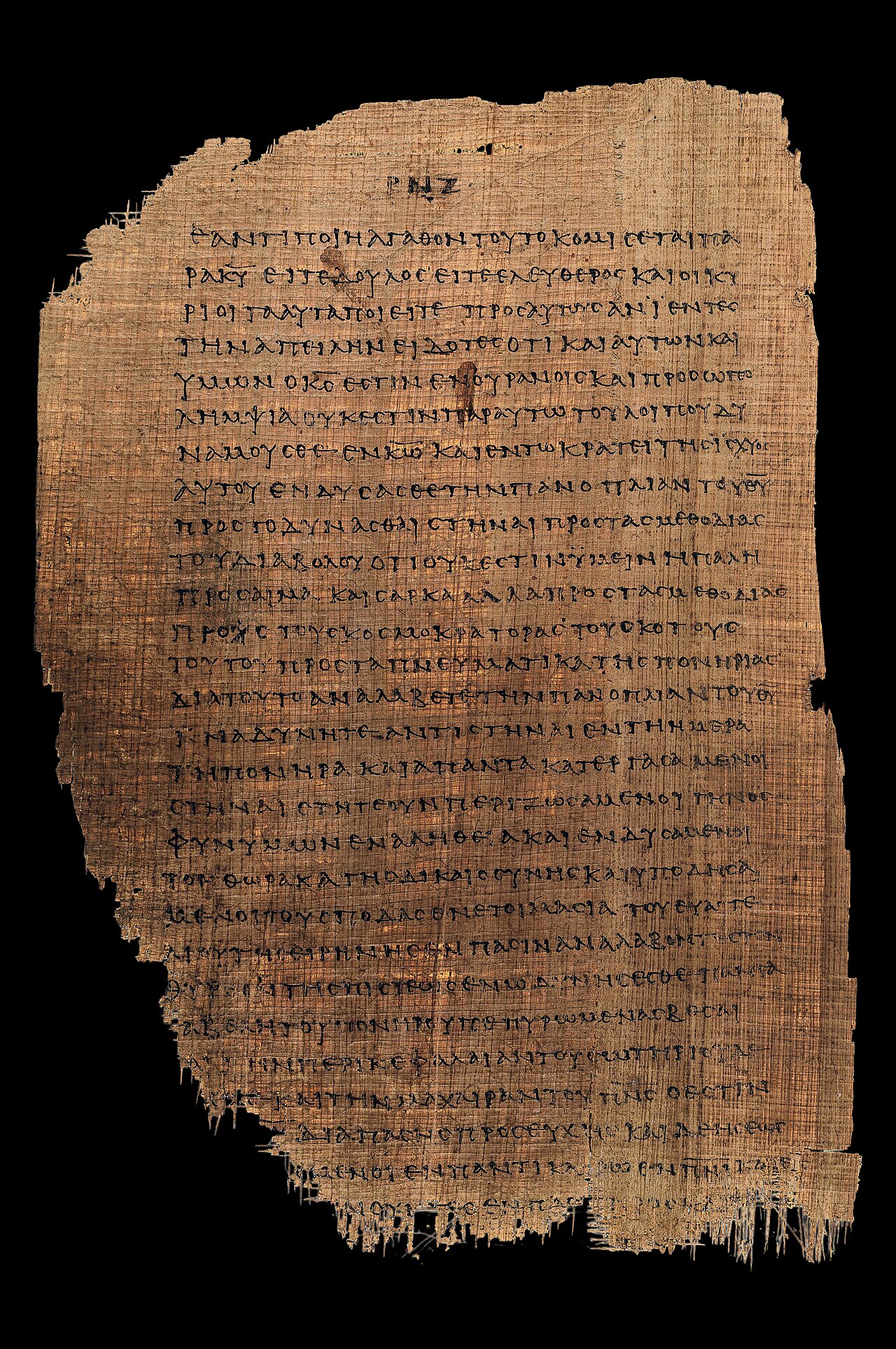
Photograph of a fragmentary papyrus leaf with dark ink Greek uncial-style text in columns on a black background. A section ends with a heading reading Pros Galatas, then continues with the opening lines of the letter.Letter

Primary source

Epistle to the Galatians

Paul the Apostle · c. AD 48

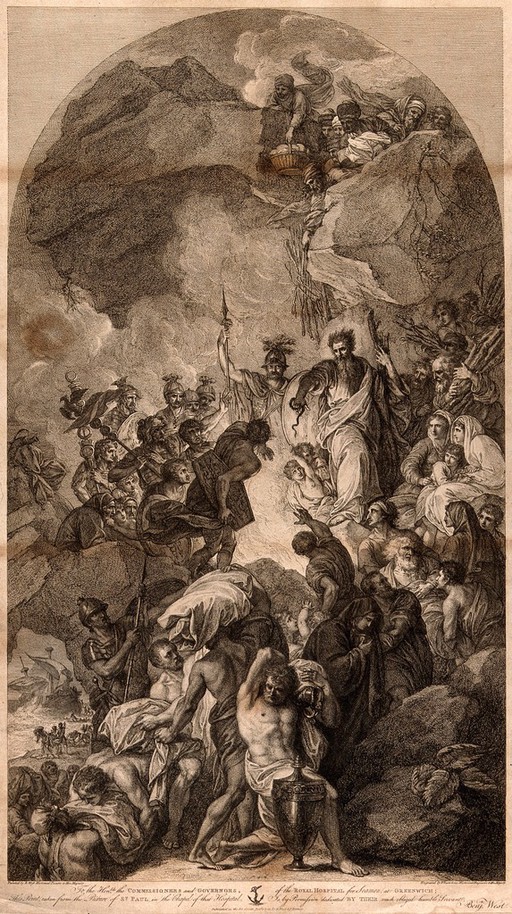
Engraved print of a dramatic scene: a robed figure with a halo-like radiance stands on a rocky shore, shaking a serpent from his hand into a fire, while onlookers in ancient dress react. Crowds surround him, and a man bends beside a vessel in the foreground.Painting

Secondary source

Saint Paul the Apostle

Benjamin West · 1791

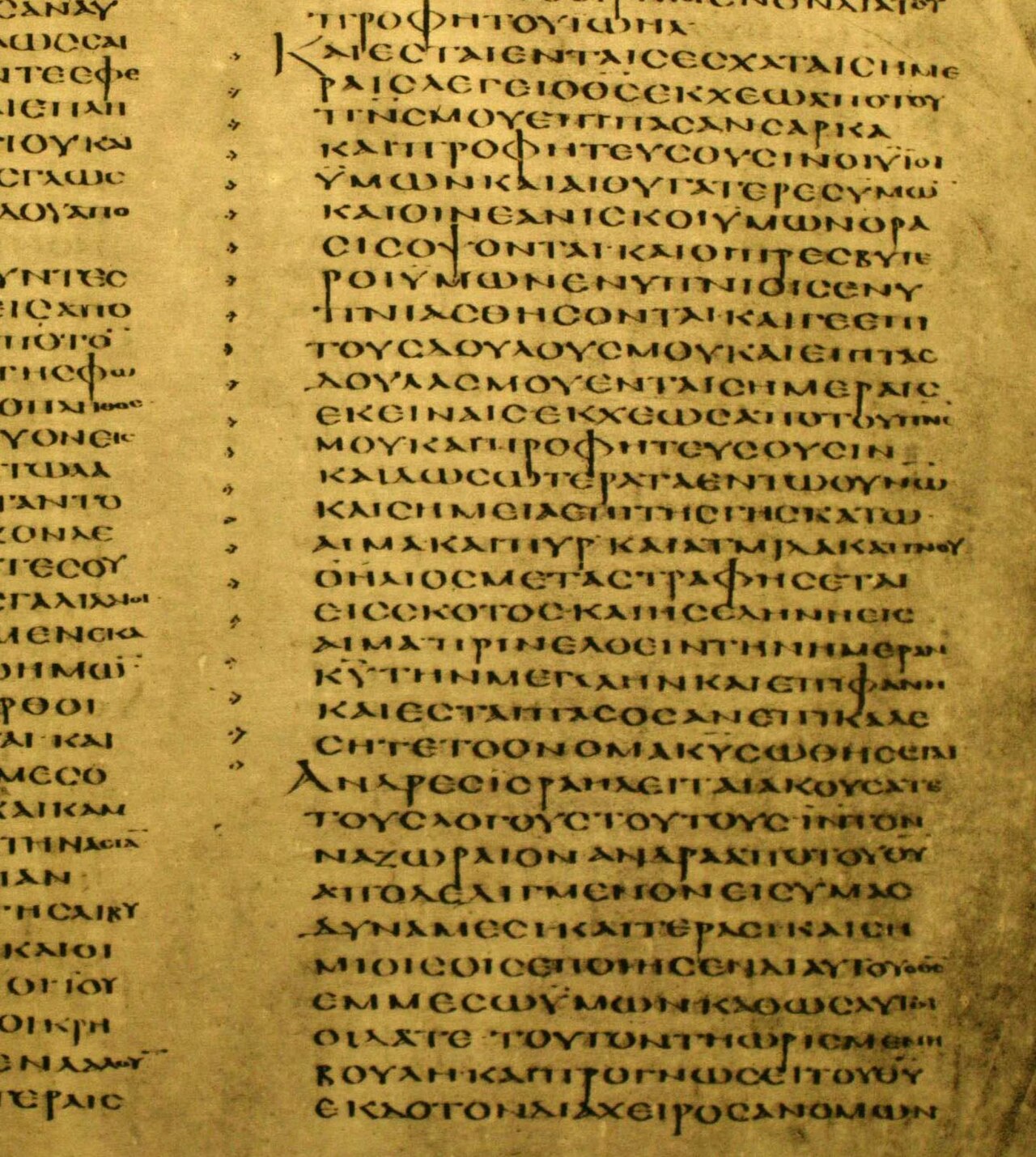
Close-up of a page of the Codex Alexandrinus, an ancient parchment manuscript in uncial Greek script with columns of dense capital letters, marginal marks and a few decorative stroke marks. The text is Greek, consistent with the Acts of the Apostles passage.Book

Secondary source

Acts of the Apostles

Luke the Evangelist · c. 80-90 AD

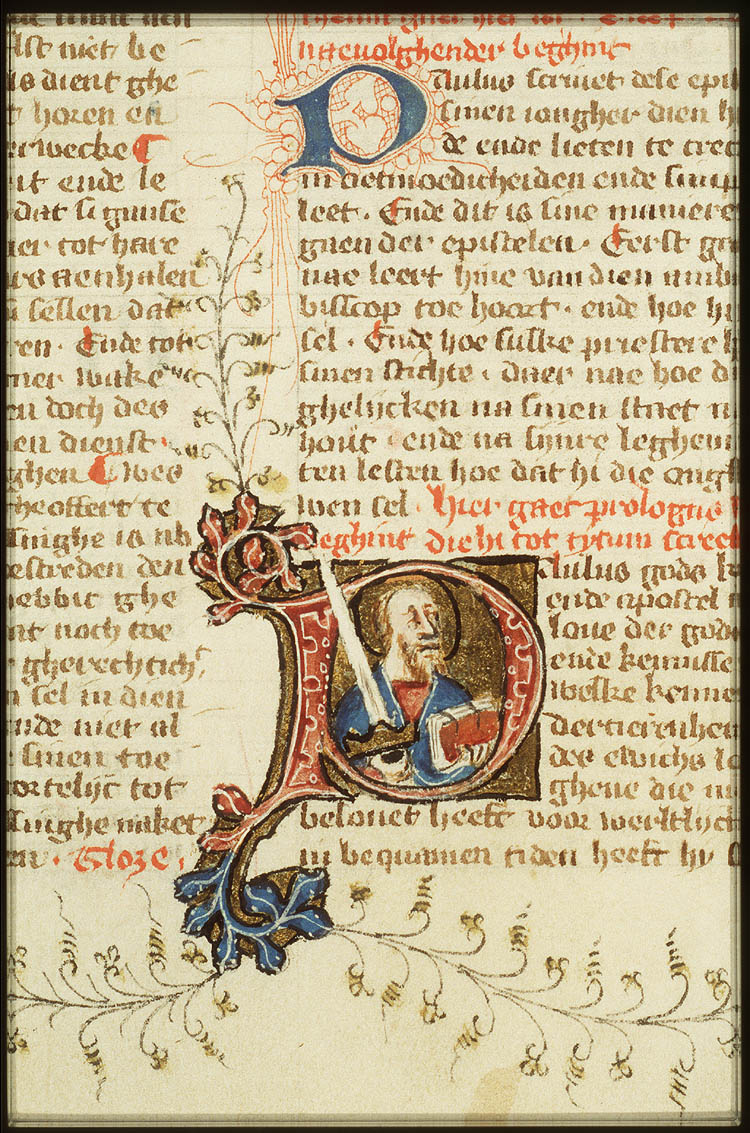
Page of a handwritten Middle Dutch manuscript in black and red ink, with a large blue and red decorated initial. Inside a gold-framed initial, a bearded man in a blue robe holds a red book, with a sword-like shape beside him. Sprigs of foliage decorate the margins.Painting

Secondary source

St. Paul

c. 1430

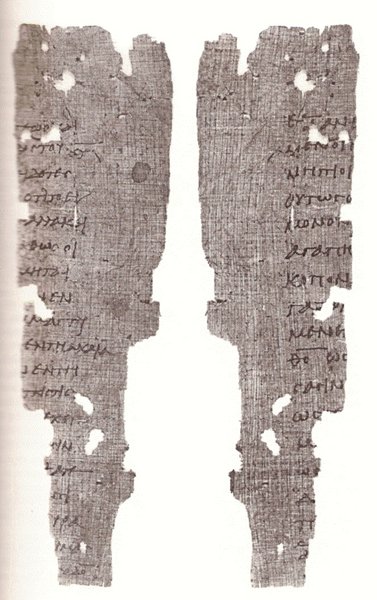
Two narrow, vertical strips of brownish papyrus with faded Greek handwriting in dark ink, several lines per strip. Holes and worn edges are visible, and the fragments are shown against a plain white background.Letter

Primary source

First Epistle to the Thessalonians

Paul the Apostle · c. AD 50

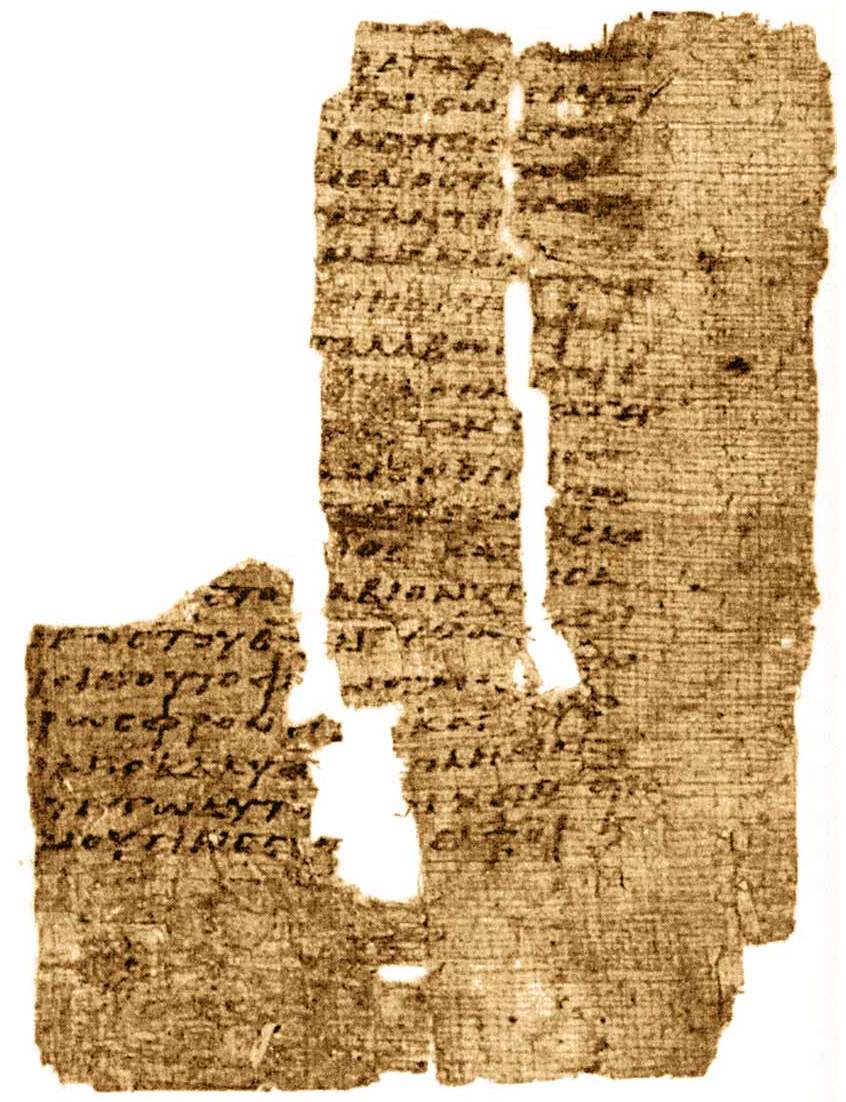
Sepia-toned photograph of a fragmentary papyrus leaf with several columns of faded Greek handwriting in dark ink. The sheet is torn and has holes, with a gap down the middle and a missing lower-left section.Letter

Primary source

Epistle to the Philippians

Paul the Apostle · c. AD 54-62

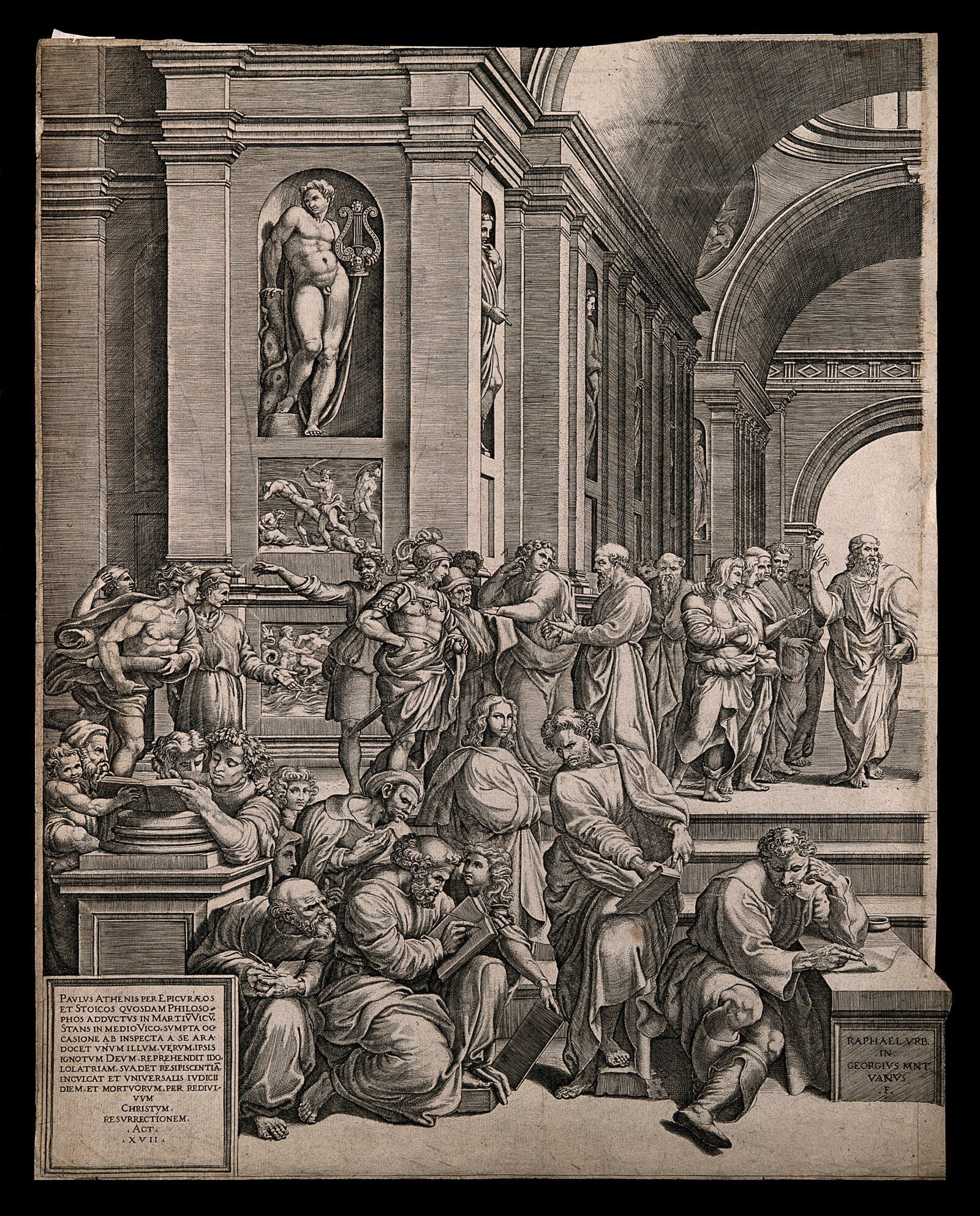
Black and white engraving of an architectural hall with columns and arches, where many robed figures gather around a central group, some seated and writing on the steps. A niche holds a nude statue with a lyre. Latin inscription text sits in the lower left corner and a signature plaque in the lower right.Painting

Secondary source

The School of Athens engraving with Saint Paul

Raphael · 1550

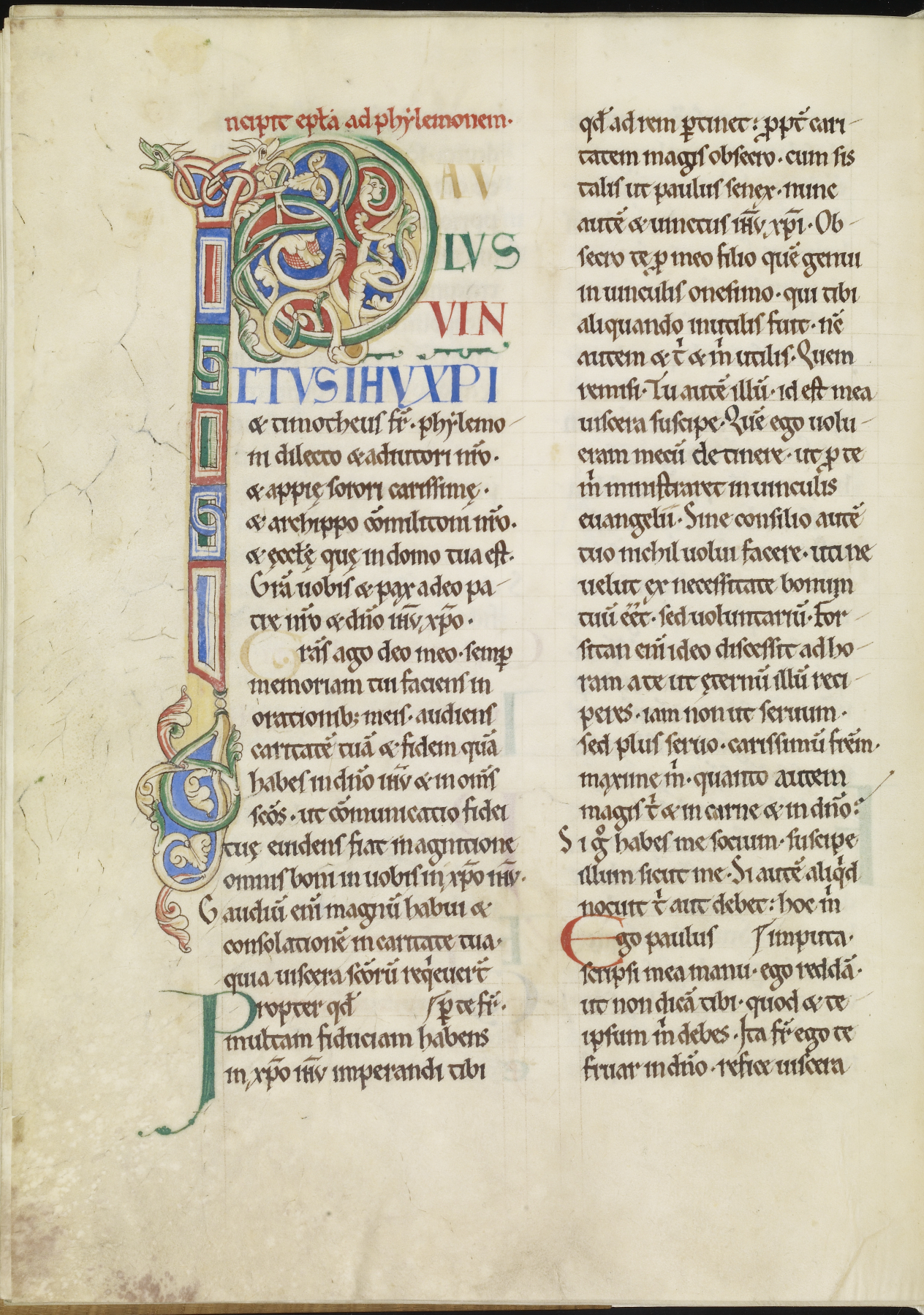
Medieval illuminated manuscript page with Latin text in two columns, a large decorated initial letter P with interlaced animal and foliate ornament in blue, red, green and gold, and red heading text at top. The text begins the Epistle to Philemon.Letter

Primary source

Epistle to Philemon

Paul the Apostle · c. AD 57-62

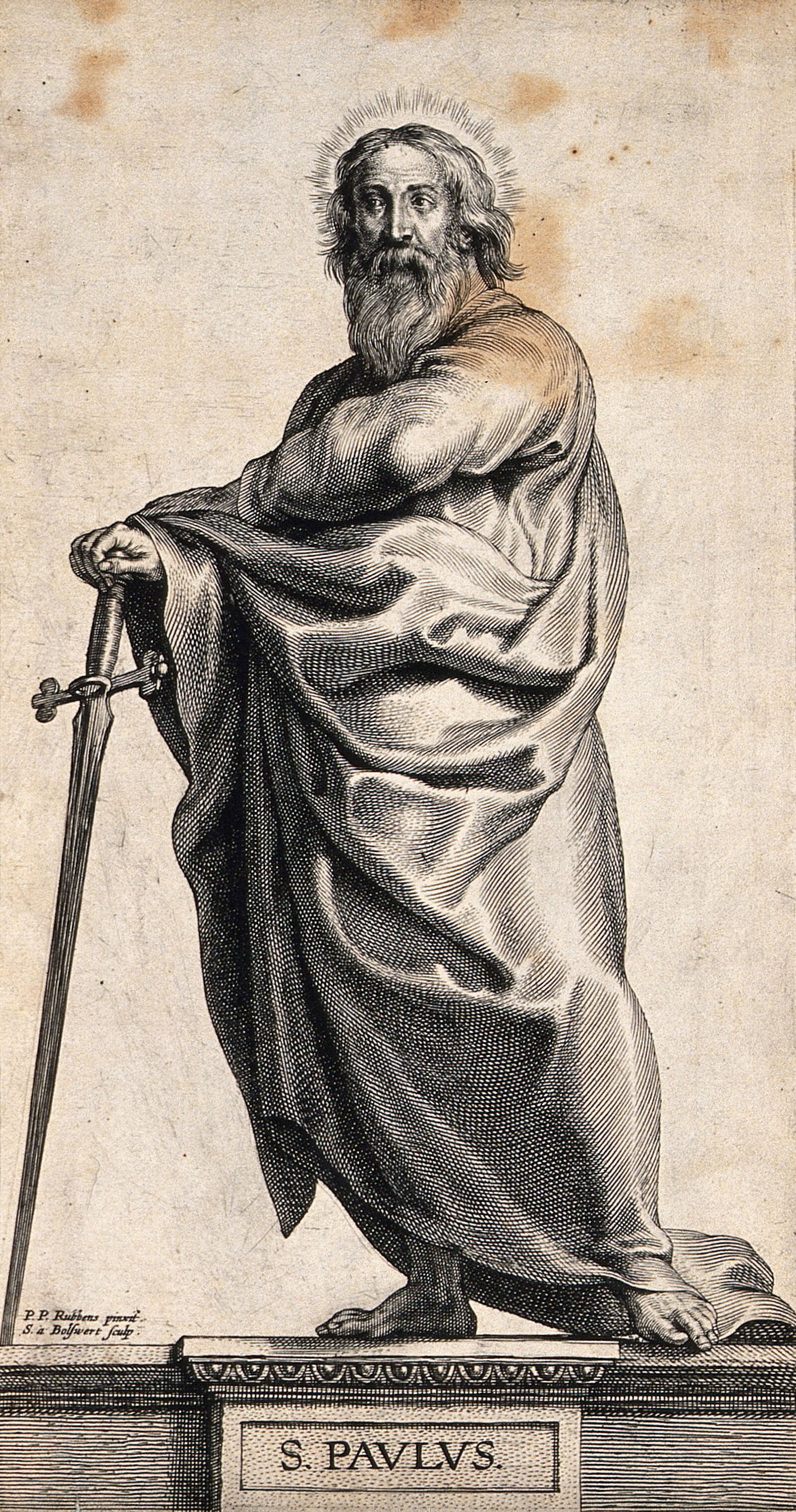
Engraving of a bearded, long-haired man with a halo, wrapped in a draped cloak, leaning on a sword with his left hand and standing on a pedestal inscribed 'S. PAVLVS'. Signed 'P.P. Rubbens pinxit, S.a. Bolswert sculp.' at lower left.Painting

Secondary source

Saint Paul

Peter Paul Rubens · 1600-1699

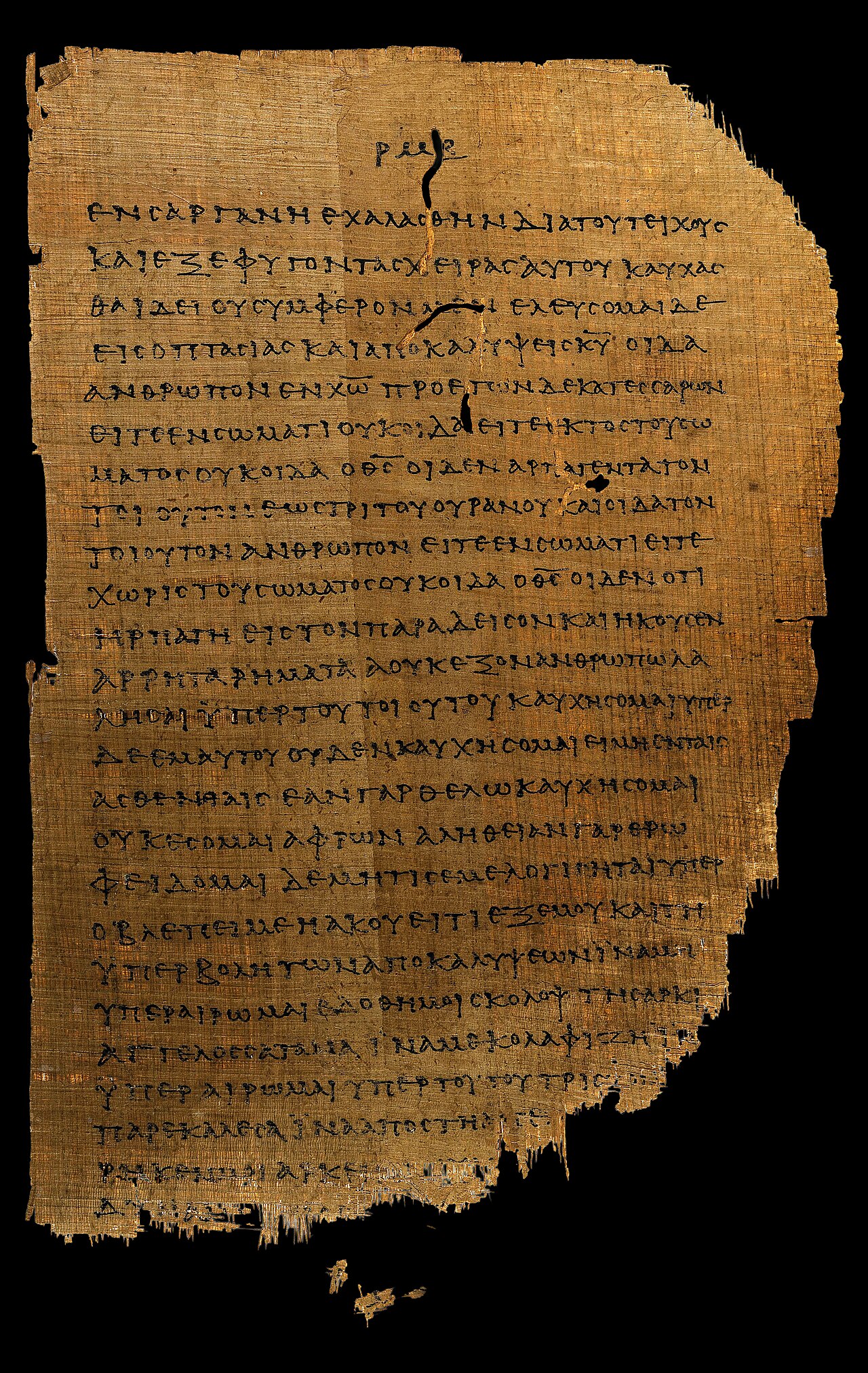
Photograph of a fragmentary, tan papyrus leaf with dark brown ink lines of Greek uncial-style text in neat columns, set against a black background. The torn edges are irregular and a small fragment sits below the main leaf.Document

Secondary source

Papyrus 46

c. 175-225 AD

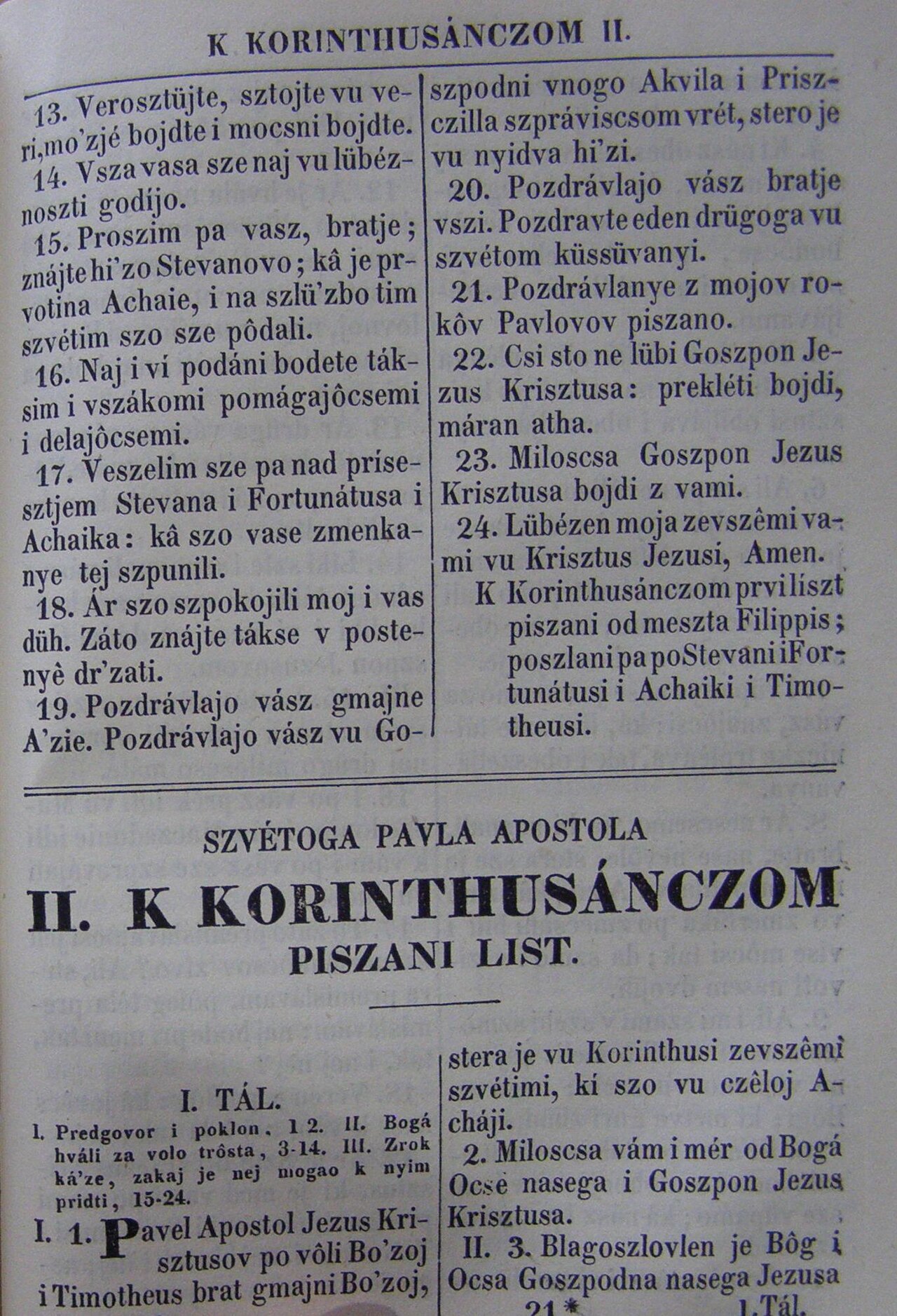
Scanned page of a 19th-century Prekmurian Slovene Bible printed in two columns of text in a Latin-based orthography. The running header reads K Korinthusánczom II. The page contains verses 13 to 24 of chapter 1, followed by the chapter heading for the Second Epistle to the Corinthians and the start of chapter 1.Letter

Primary source

Second Epistle to the Corinthians

Paul the Apostle · c. AD 56

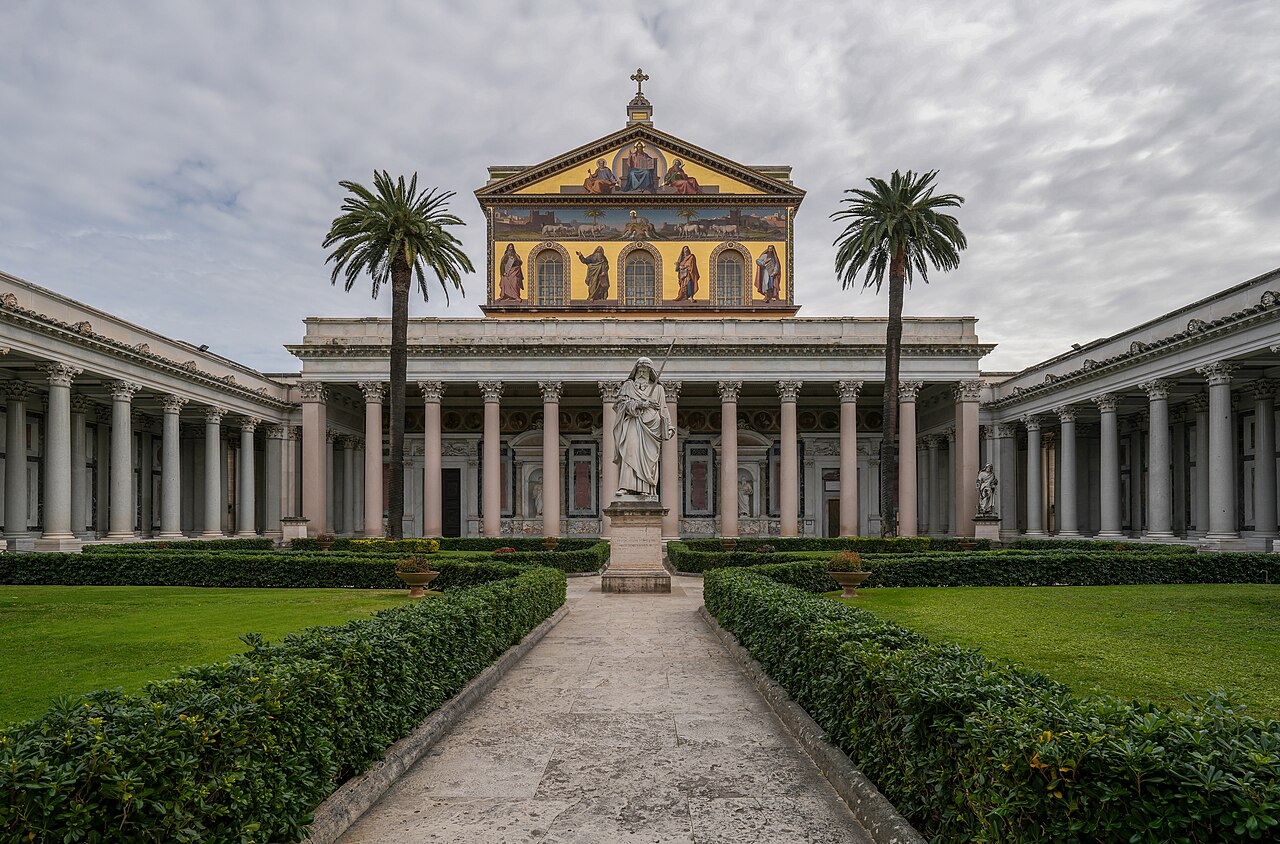
Facade of the Basilica of Saint Paul outside the Walls in Rome, with a columned portico, a central statue of a robed figure holding a sword on a pedestal, two tall palm trees, clipped hedges, and a gold mosaic gable above under a cloudy sky.Artifact

Secondary source

Basilica of Saint Paul outside the Walls

386 (rebuilt 1840)

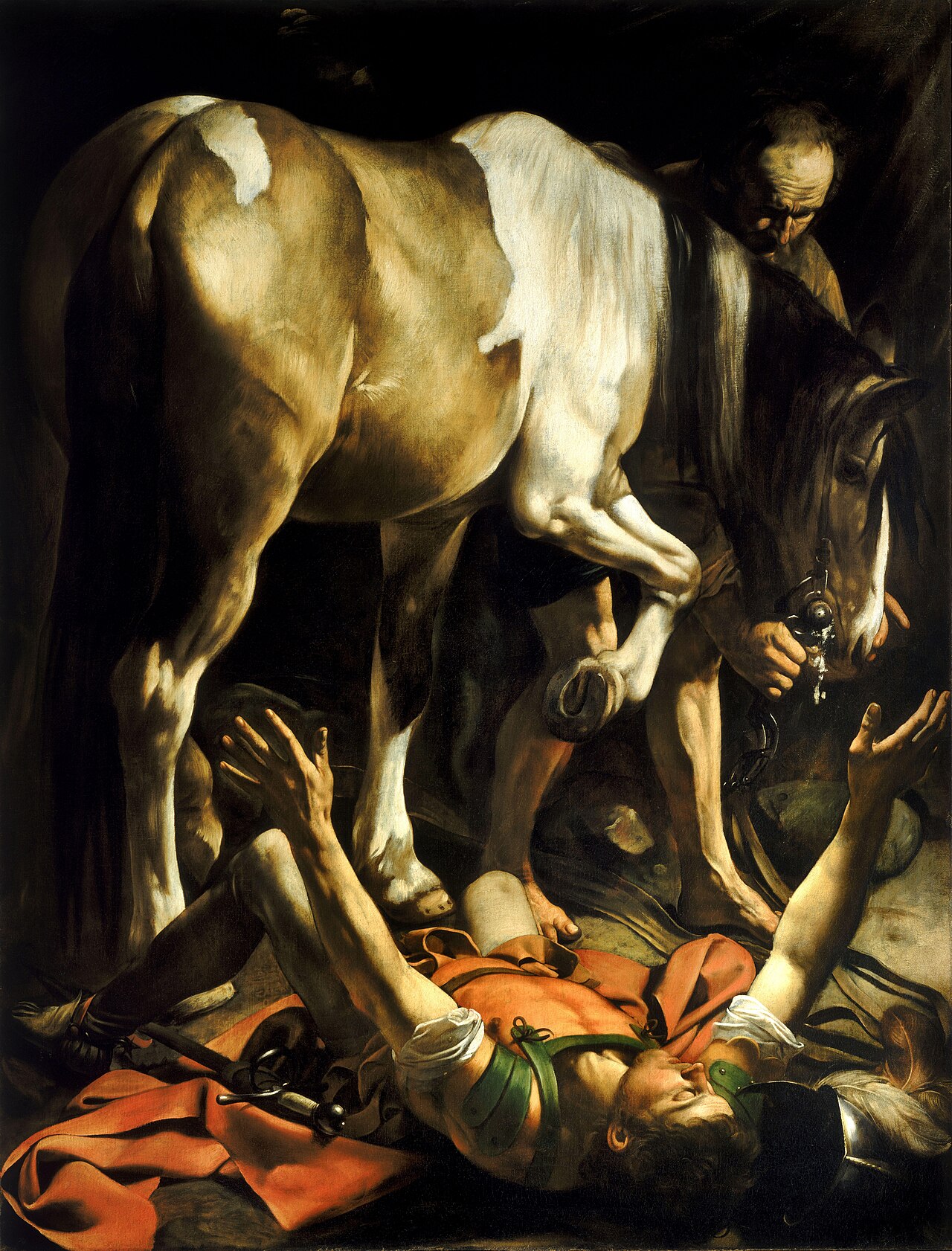
Painting of a fallen man on the ground with arms outstretched, a white horse looming above him, and an older man with a pained expression holding the horse's bridle in a dark setting.Painting

Secondary source

Conversion on the Way to Damascus

Caravaggio · 1600-1601

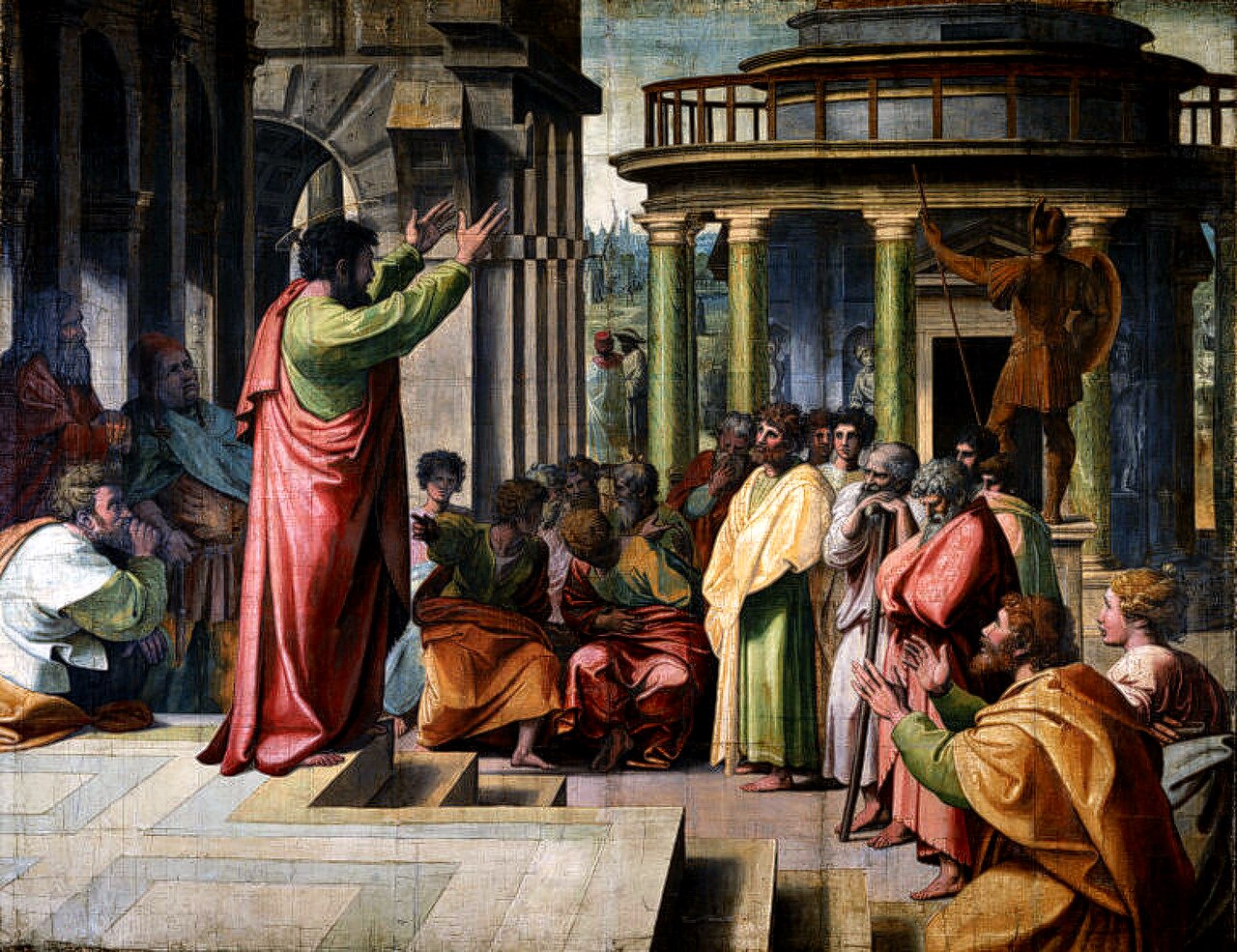
Painting of Paul preaching in Athens: a bearded man in a red cloak and green tunic raises his arms before a crowd of robed listeners on steps, beside classical columns and a rotunda with a balcony.Speech

Secondary source

Areopagus Sermon

Paul the Apostle

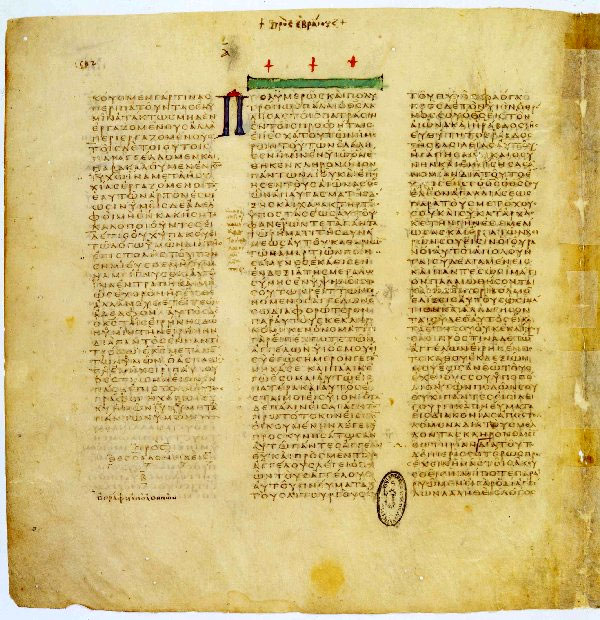
Scan of a page from the Codex Vaticanus, an ancient Greek uncial manuscript. Three columns of brown, aged parchment with dense Greek text in black ink, a green decorated heading bar with red markings, and a large decorated initial letter. The page contains passages from 2 Thessalonians and Hebrews.Letter

Primary source

Second Epistle to the Thessalonians

Paul the Apostle · c. AD 50-52

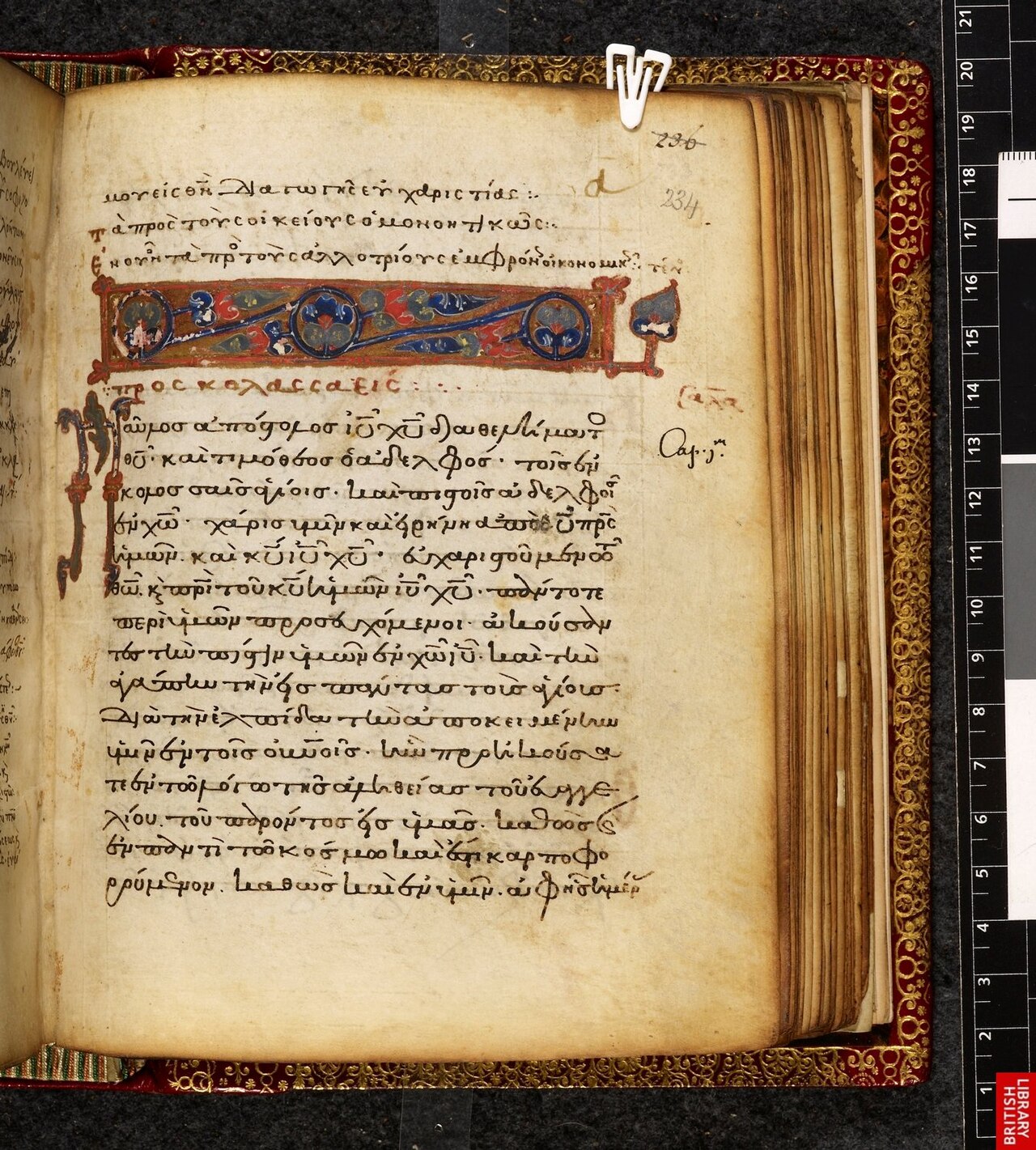
Photograph of an open illuminated Greek manuscript page with red and blue decorative headpiece and gold-edged red binding, showing dense handwritten Greek text in brown ink with a large decorated initial letter, and a measurement scale on the right edge.Letter

Primary source

Epistle to the Colossians

Paul the Apostle · c. AD 60

Photograph of a torn, brownish papyrus leaf on a black background, with several lines of Greek uncial script in dark ink, with a heading at top. The edges are ragged and fibrous.Letter

Secondary source

Epistle to the Ephesians

c. AD 62

Photograph of a torn, brownish papyrus leaf with black Greek uncial script in two sections, against a black background. A heading in the middle reads Pros Galatas, marking the start of the Epistle to the Galatians.Book

Primary source

Pauline Epistles

Paul the Apostle · 1st century AD

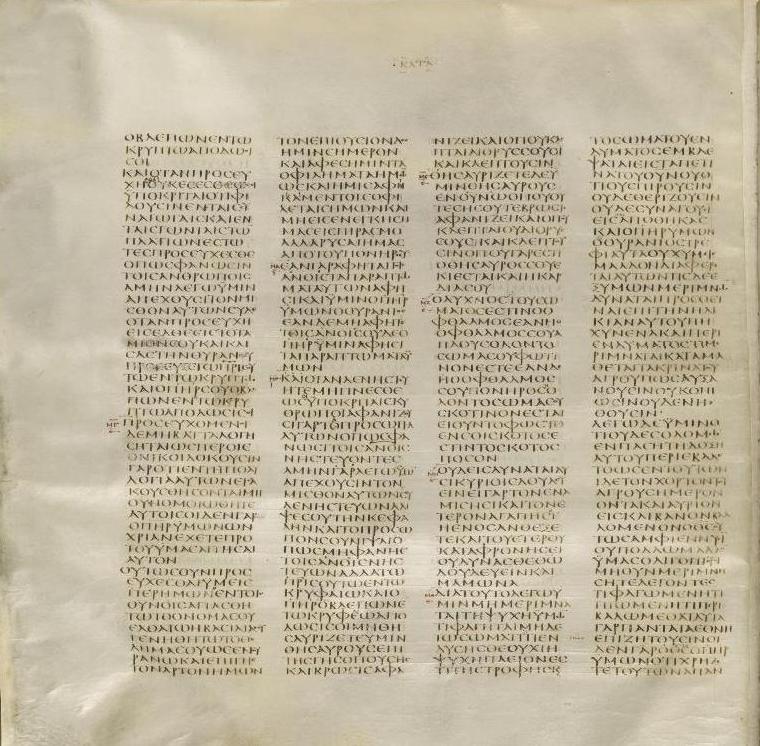
Manuscript page of Codex Sinaiticus: four columns of dense Greek uncial script on aged parchment, with a small heading mark at the top center. Text is in faded brown ink.Book

Secondary source

Codex Sinaiticus

mid-4th century AD

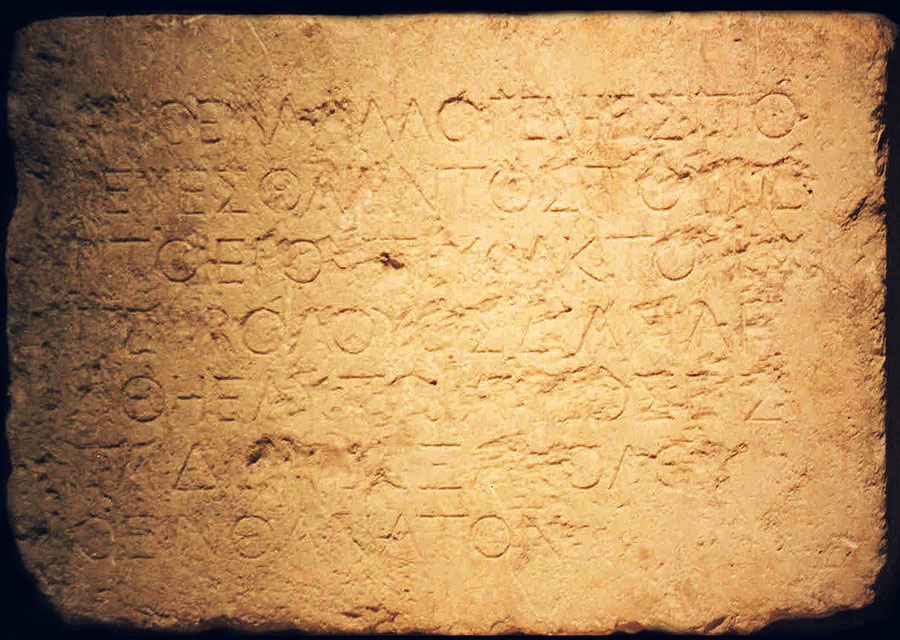
Photograph of a limestone block with several lines of carved Greek capital letters, lit warmly from one side. The letters are partly worn and the surface is rough and pitted.Artifact

Primary source

Soreg Inscription

late 1st century BC – early 1st century AD

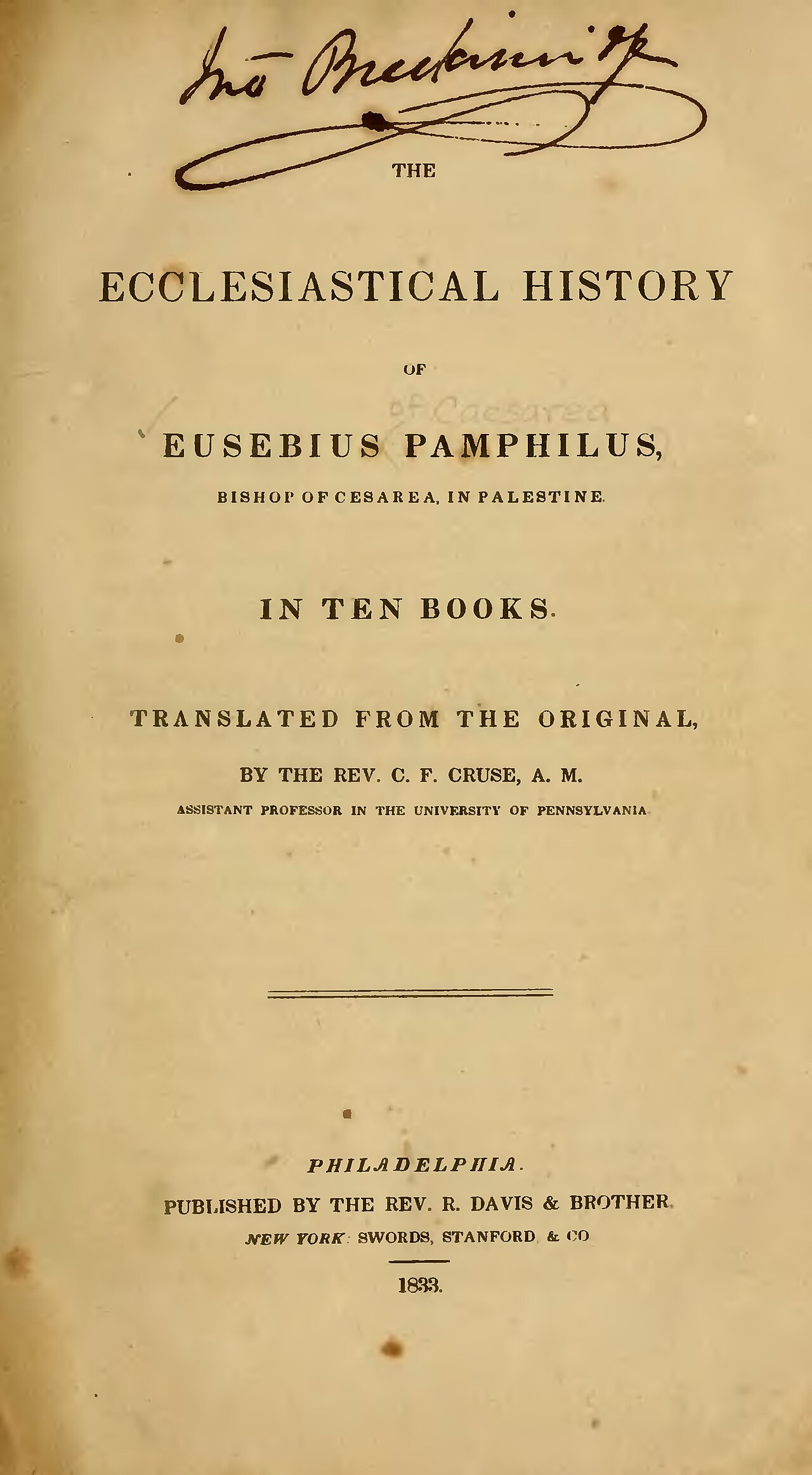
Title page of a printed book: a handwritten signature at top, then the title 'The Ecclesiastical History of Eusebius Pamphilus, Bishop of Cesarea, in Palestine, in ten books, translated from the original by the Rev. C. F. Cruse, A. M., Assistant Professor in the University of Pennsylvania.' Below: Philadelphia, published by Rev. R. Davis & Brother; New York, Swords, Stanford & Co; dated 1833.Book

Secondary source

Church History

Eusebius of Caesarea · c. 313–324

Book

Secondary source

Acts of Paul and Thecla

Anonymous (Asia Minor) · c. AD 160-190

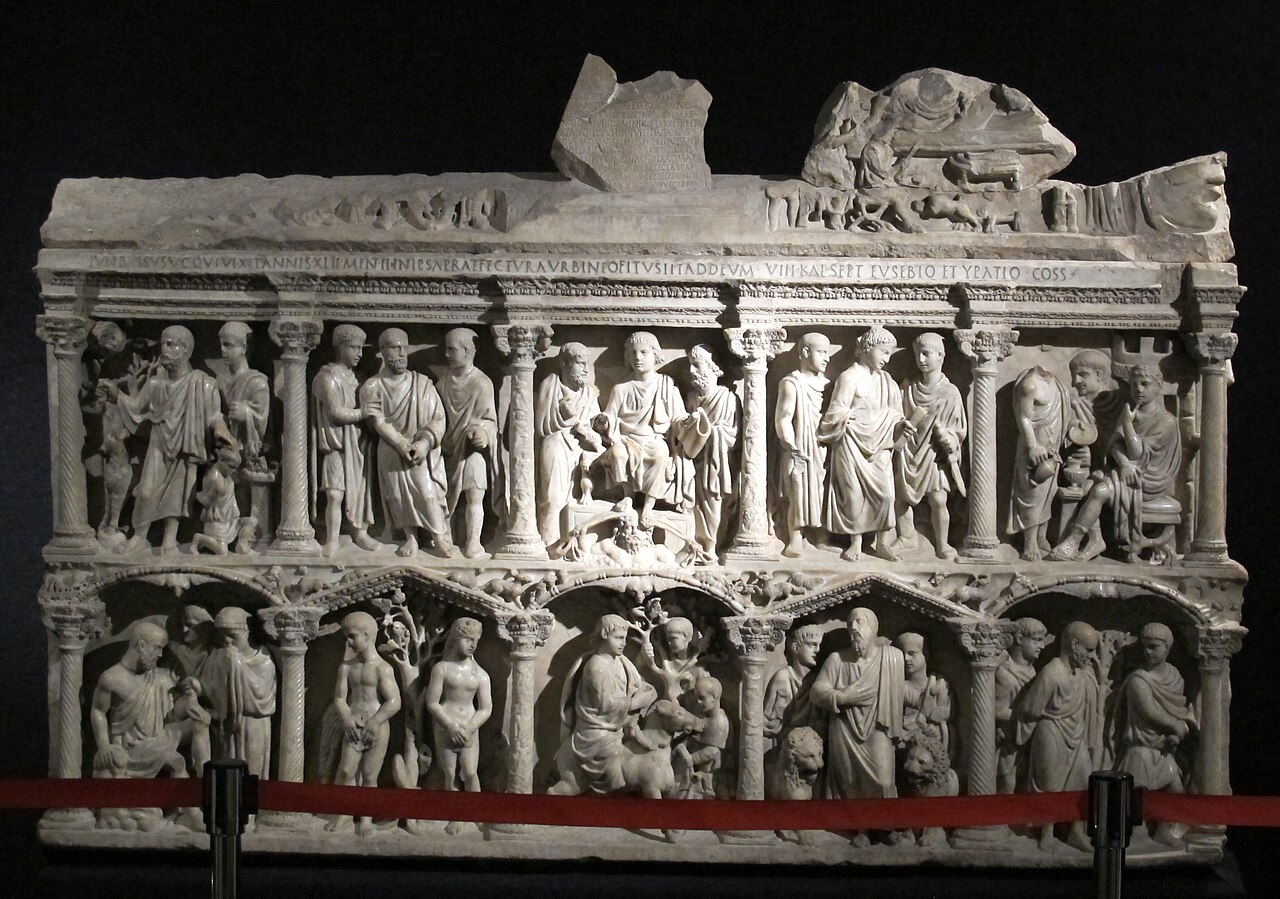
Photograph of the Sarcophagus of Junius Bassus, a marble Roman sarcophagus with two tiers of carved relief scenes of figures, columns and arches, displayed behind a red barrier rope.Sculpture

Primary source

Sarcophagus of Junius Bassus

c. 350 AD

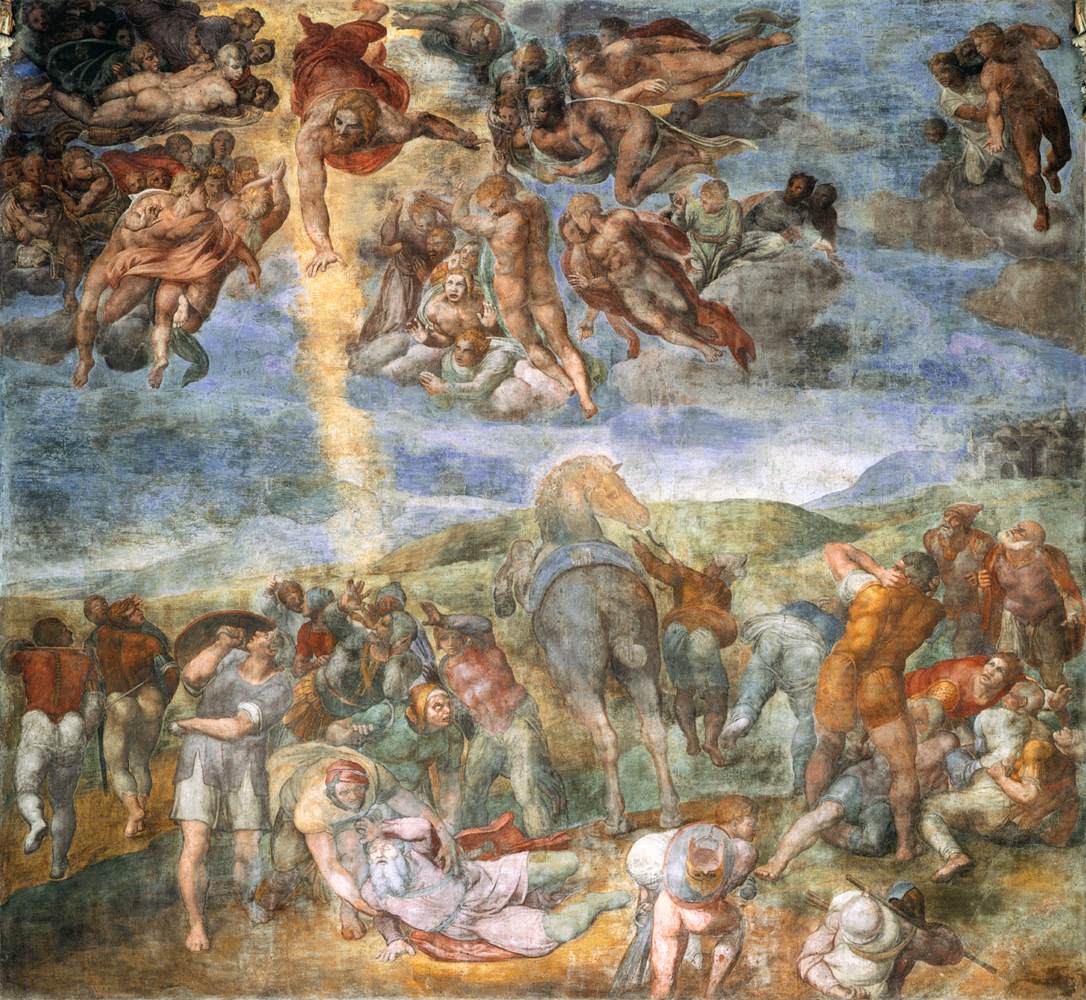
Fresco of the Conversion of Saul by Michelangelo. Christ, haloed and in a beam of light, descends from the upper left. Below, a horse with a blue saddle and soldiers in disarray, some falling, raise their arms, and an older man lies on the ground. Hills and sky fill the background.Painting

Primary source

The Conversion of Saul

Michelangelo · c. 1542-1545

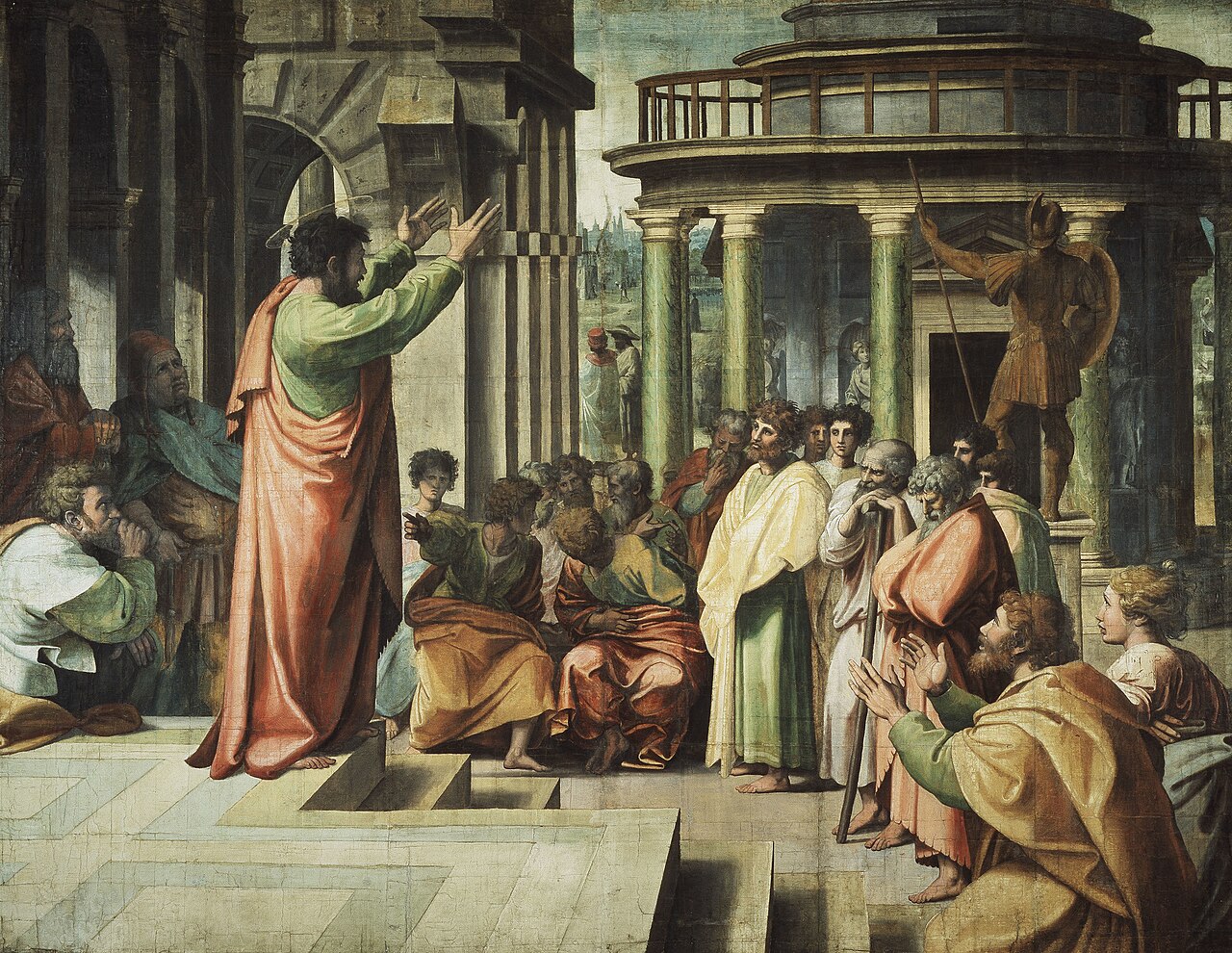
Painting of a bearded man in a green robe and red cloak raising his arms on a stone platform, addressing a crowd of seated and standing people in a classical colonnaded setting. A bronze-like armored statue stands on a pedestal at right.Painting

Secondary source

St Paul Preaching at Athens

Raphael · 1515

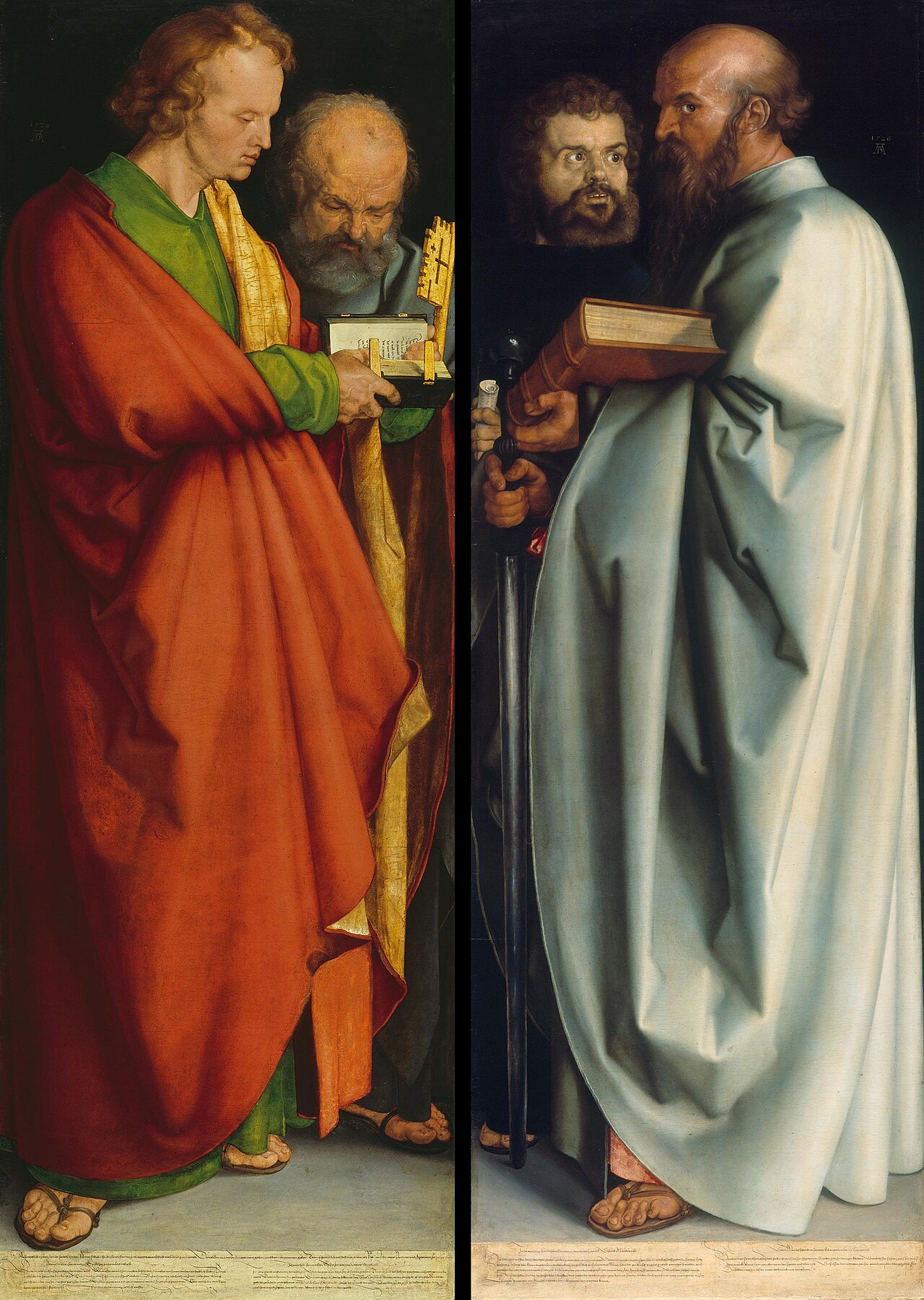
Two side-by-side painted panels showing four robed men. Left panel: a young man in red robe and green undergarment holds a open book, with an older bearded man behind him holding a book and golden key. Right panel: a bald bearded man in white robe holds a large red-bound book, with a bearded man behind him holding a sword.Painting

Secondary source

The Four Apostles

Albrecht Dürer · 1526

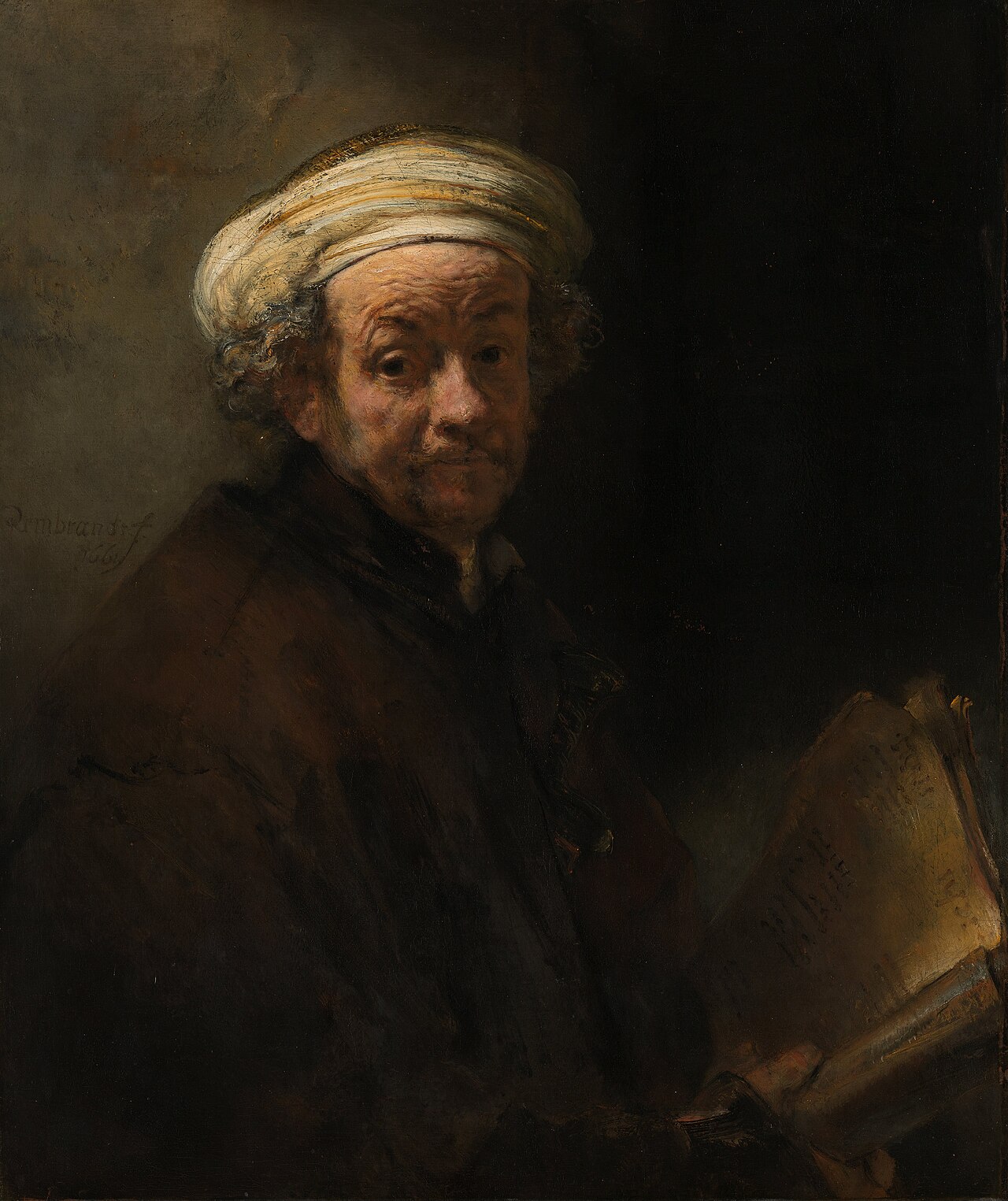
Oil painting of an older man with a pale turban, wrinkled face and dark brown robe, holding a large open book in his right hand. Dark background with light on the face and book. Signature and date at left.Painting

Secondary source

Self-portrait as the Apostle Paul

Rembrandt · 1661

Photograph of a leaf from the Codex Vaticanus, an ancient Greek uncial manuscript. Aged, yellowish parchment with three columns of brown Greek text, a decorated green heading bar with red marks, a large ornamental initial letter, and a small oval seal stamp near the bottom.Document

Secondary source

Codex Vaticanus

4th century AD

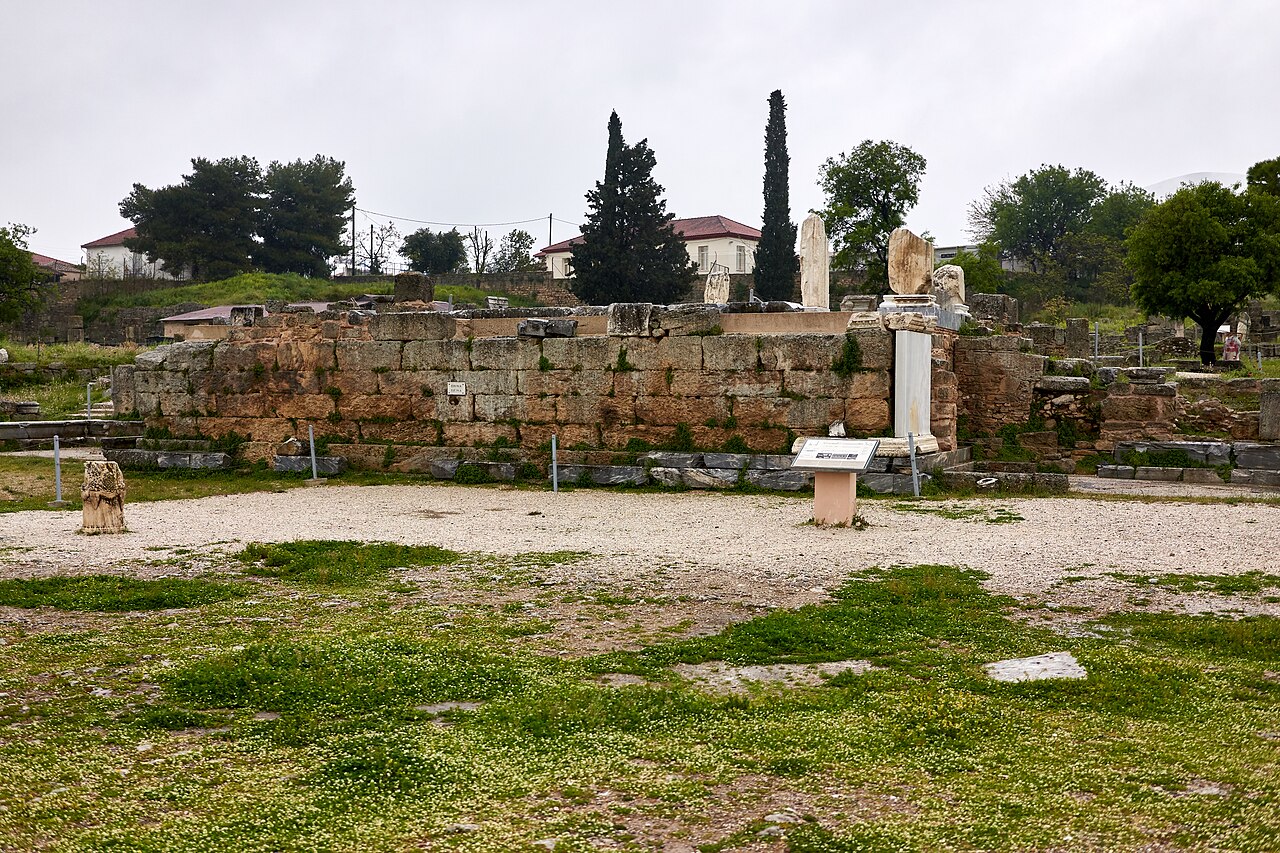
Ruins of the Bema in the Roman forum at ancient Corinth: a long limestone wall of large cut blocks, with broken marble columns and fragments on a pedestal, a gravel path in front, and an information sign on a stand. Cypress trees and a white building stand behind.Artifact

Secondary source

Bema of Corinth

1st century AD

Letter

Secondary source

Epistles of Ignatius of Antioch

Ignatius of Antioch · c. AD 110

Letter

Secondary source

Epistle of Polycarp to the Philippians

Polycarp · c. 200 (text); manuscript later

Dark brown cloth book cover with a library barcode label and call number in the top left corner. Gold embossed title reads 'CANON MURATORIANUS' with a short gold rule below, and 'S. P. TREGELLES' beneath it.Document

Secondary source

Muratorian Fragment

c. 2nd-4th century text; 8th-century manuscript

Photograph of a fragmentary papyrus leaf with brown, worn edges and dark Greek-looking text in several columns, with large holes and missing areas. The page is torn and irregular in shape against a white background.Book

Secondary source

Acts of Peter and Paul

5th century

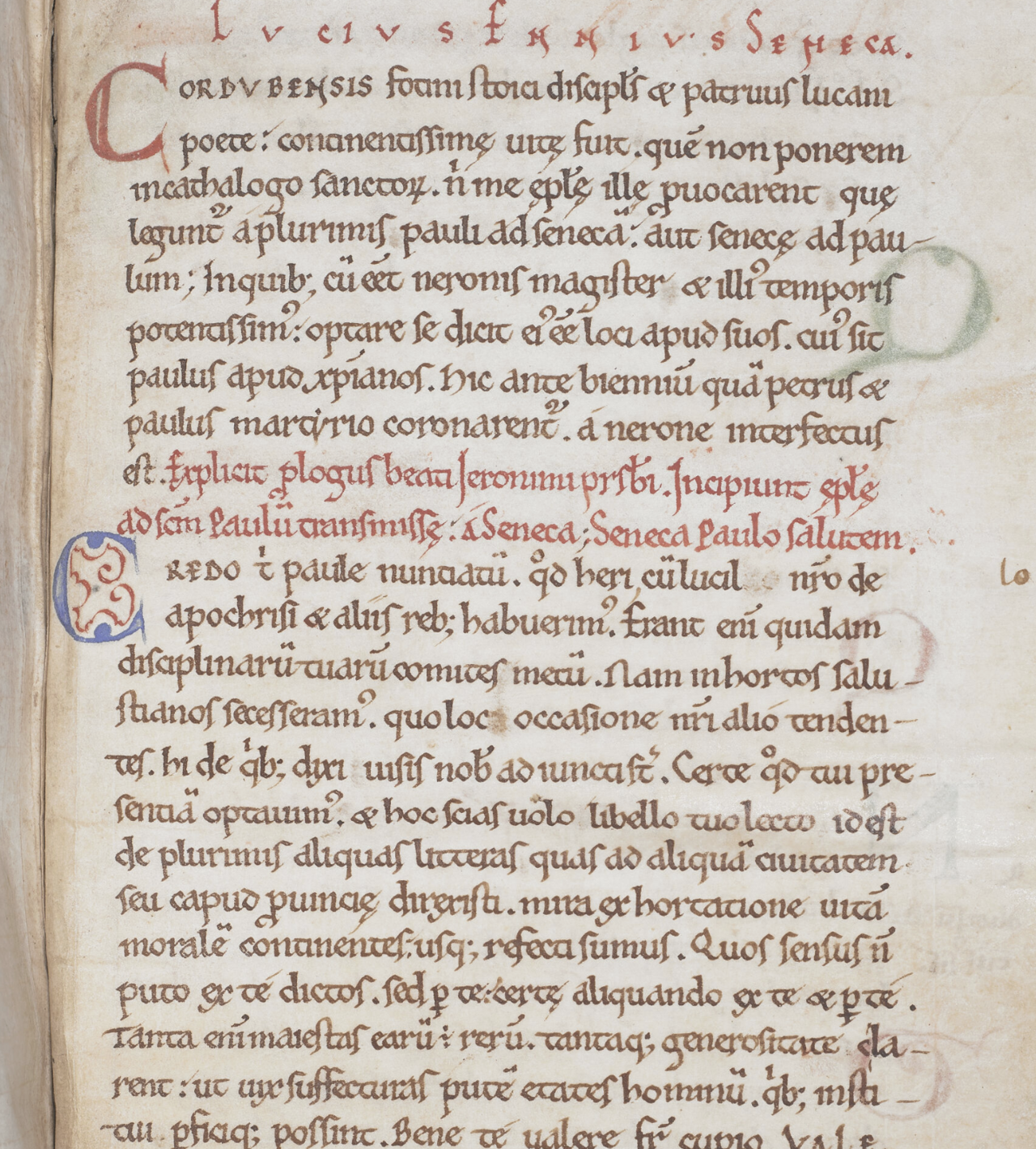
Manuscript page in Latin with red rubrics and black text in a cursive hand, with decorated initial letters. Red heading at top reads 'Lucius Annaeus Seneca', followed by text about Cordubensis and the letter exchange, and a red line reading 'Seneca Paulo salutem' near the middle of the page.Letter

Secondary source

Correspondence of Paul and Seneca

c. 320-380 CE

Letter

Secondary source

Epistle to the Laodiceans

c. 4th century (Latin forgery)

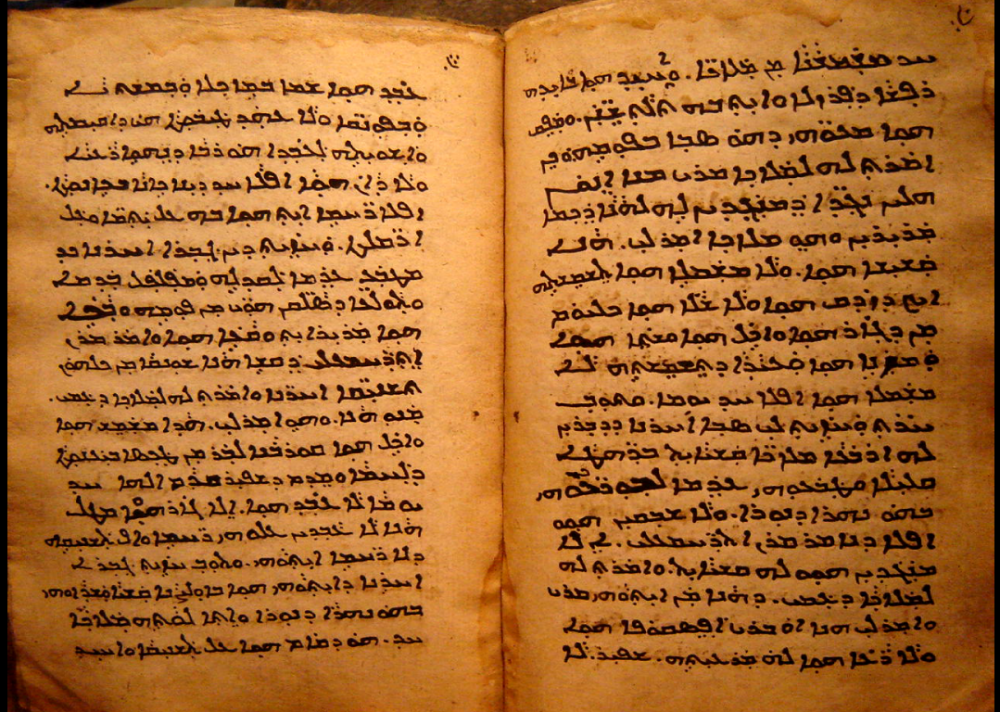
Open manuscript spread showing two pages of handwritten Syriac script in dark brown ink on aged, yellowed parchment. The text runs in columns with page numbers visible in the top corners.Book

Secondary source

Apocalypse of Paul

c. 388-400 CE

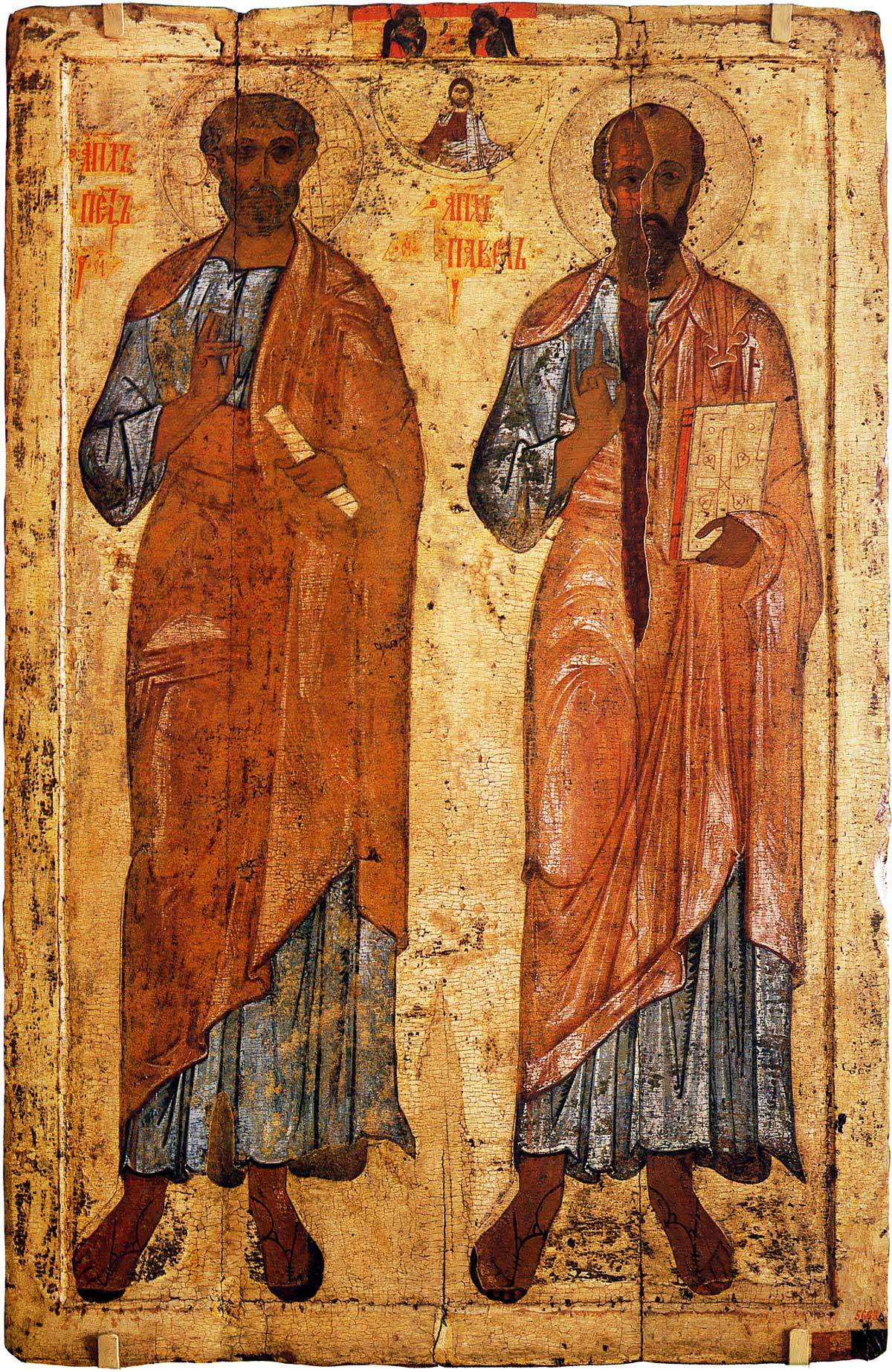
Russian icon painting of two standing robed apostles on a gold background. Left figure, Peter, has short dark hair and beard, holds a scroll. Right figure, Paul, has a haloed head, dark beard, holds an open scroll. A small blessing Christ medallion appears at top center, with two angel busts at top.Painting

Secondary source

Icon of Apostles Peter and Paul

c. 1200

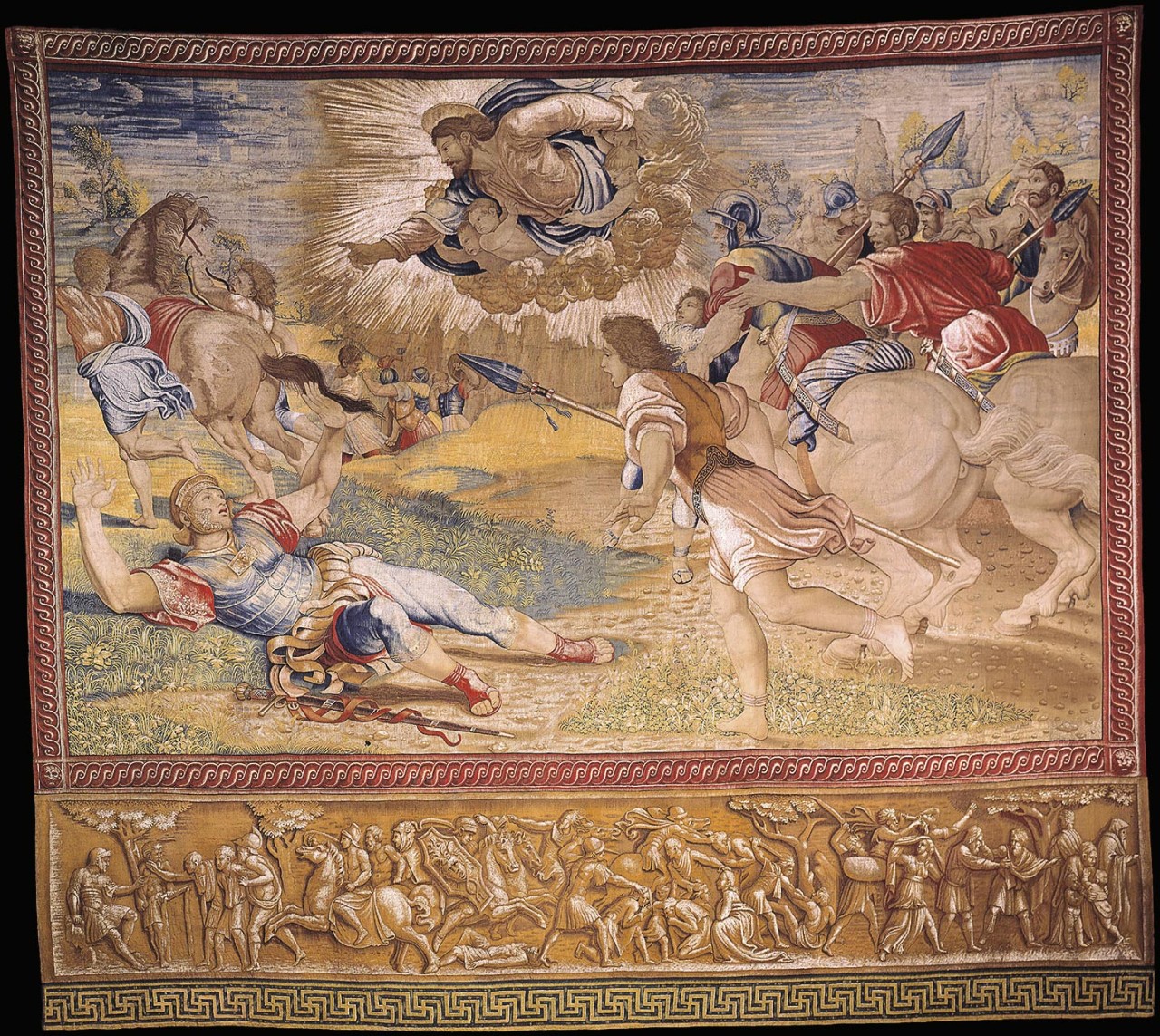
Tapestry with a red and gold border. In the upper center, a bearded figure in a blue and white robe floats in a bright cloud, surrounded by small angels. Below, a fallen armored man lies on the grass, and a rider on a white horse with a red-clad soldier reaches toward him. Other soldiers with spears and helmets stand around. A relief frieze of marching figures runs along the bottom.Artifact

Secondary source

Conversion of Saint Paul (Tapestry)

Raphael (design); workshop of Pieter van Aelst (weaving) · 1510

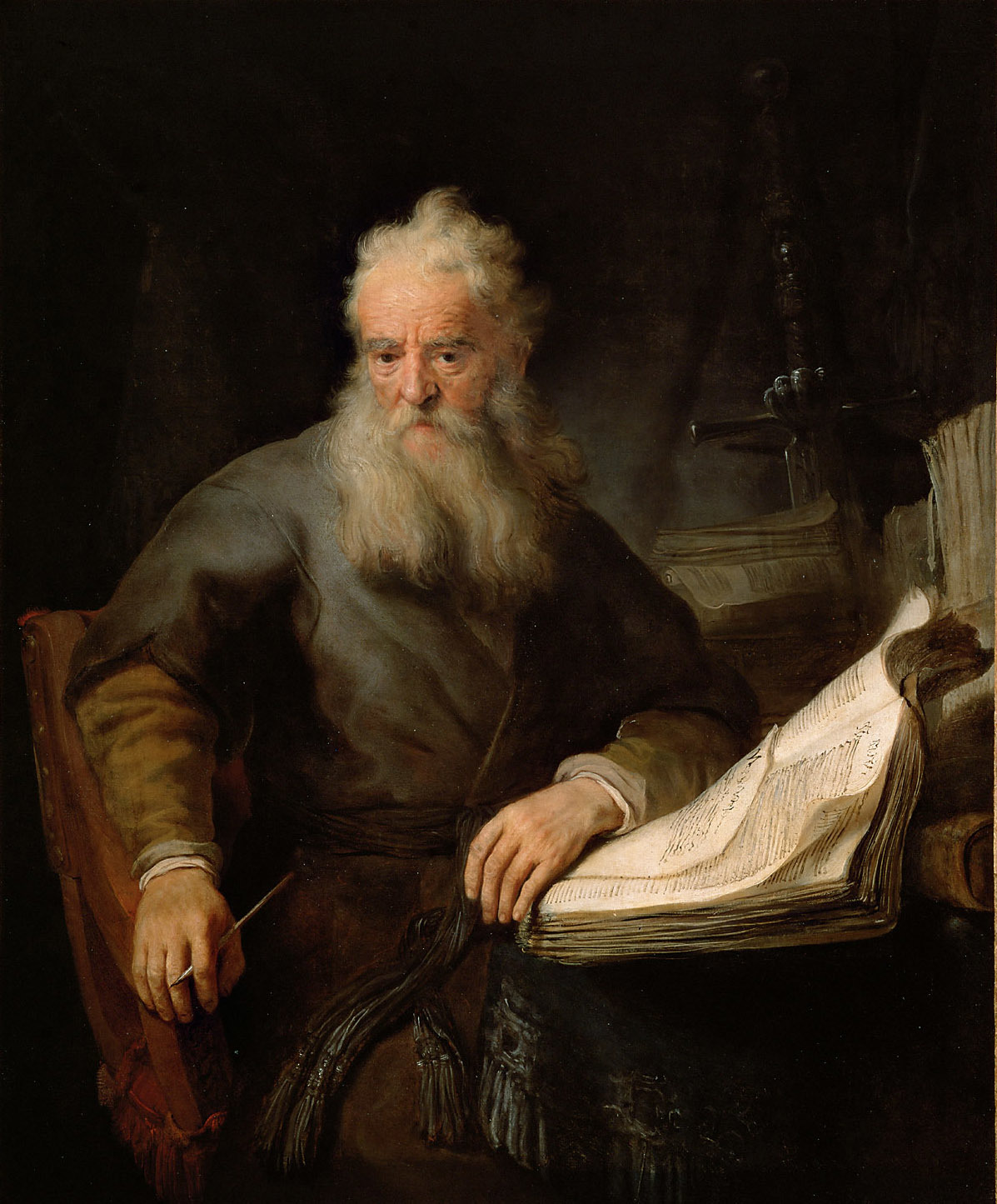
Painting of an elderly bearded man with white hair seated in a wooden chair beside a large open book, with a sword leaning behind him in a dark room. He rests one hand on the book and holds a quill in the other.Painting

Secondary source

Apostle Paul

Rembrandt · 1633

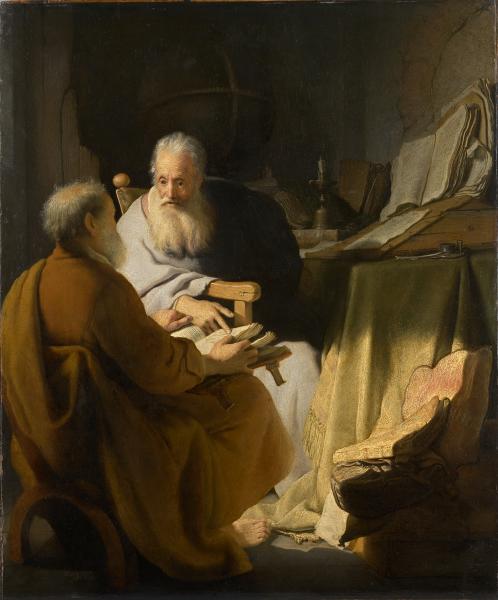
Painting of two elderly bearded men in a dim study. The man on the left, in a brown-gold robe, leans forward holding an open book. The man on the right, in white and dark clothing, gestures toward him. A globe, open books, and a draped table are visible in the shadowy room.Painting

Secondary source

Two Old Men Disputing

Rembrandt · 1628

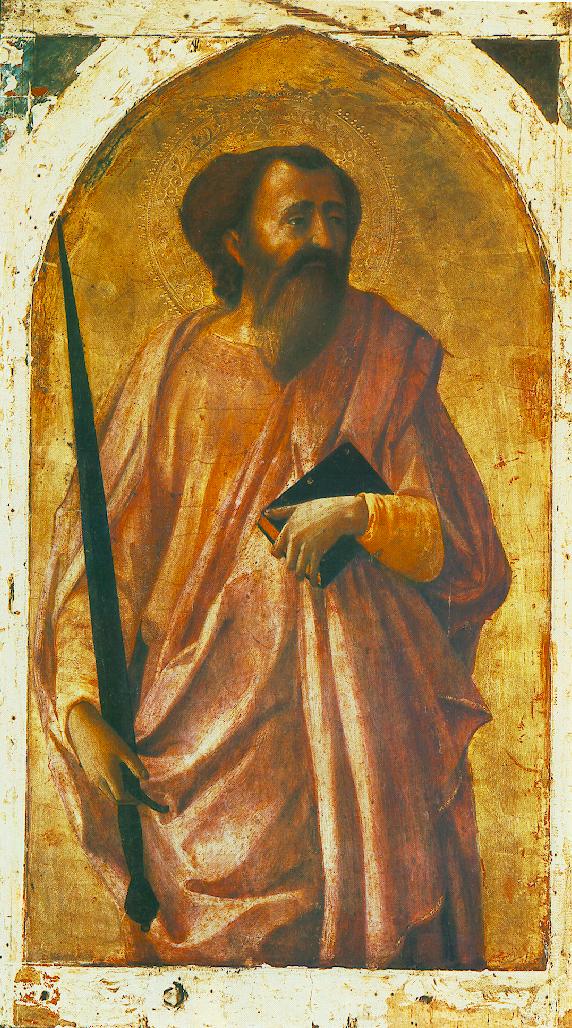
Painting of a bearded man with a halo in a gold arched panel. He wears a red-pink robe and holds a long dark sword in his left hand and a closed book in his right. The gold background has a faint halo around his head.Painting

Secondary source

Saint Paul (Pisa Altarpiece)

Masaccio · 1426

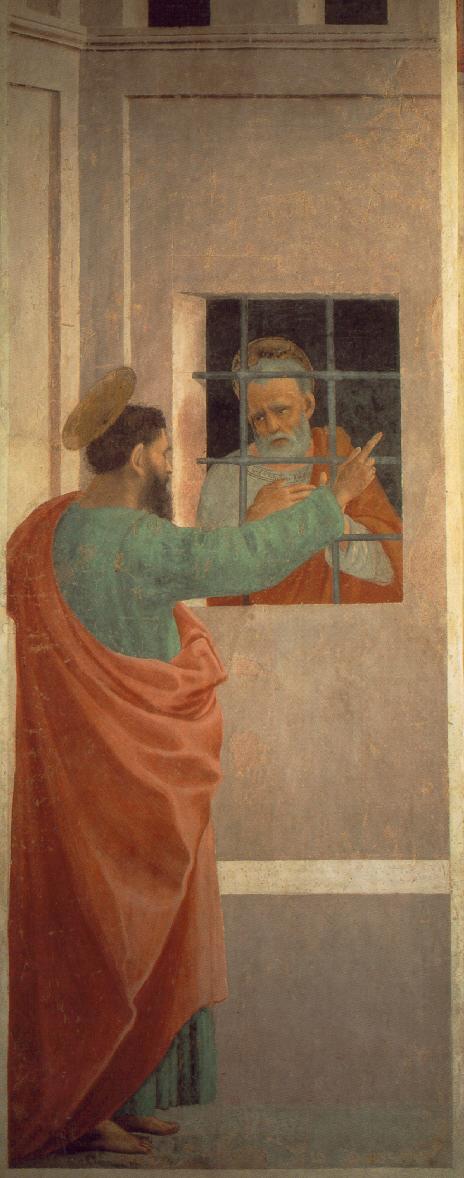
Fresco painting of a bearded man with a halo in a green tunic and red cloak, pointing upward toward an older bearded man with a halo behind iron prison bars in a small barred window.Painting

Secondary source

St Paul Visits St Peter in Prison

Filippino Lippi · 1482

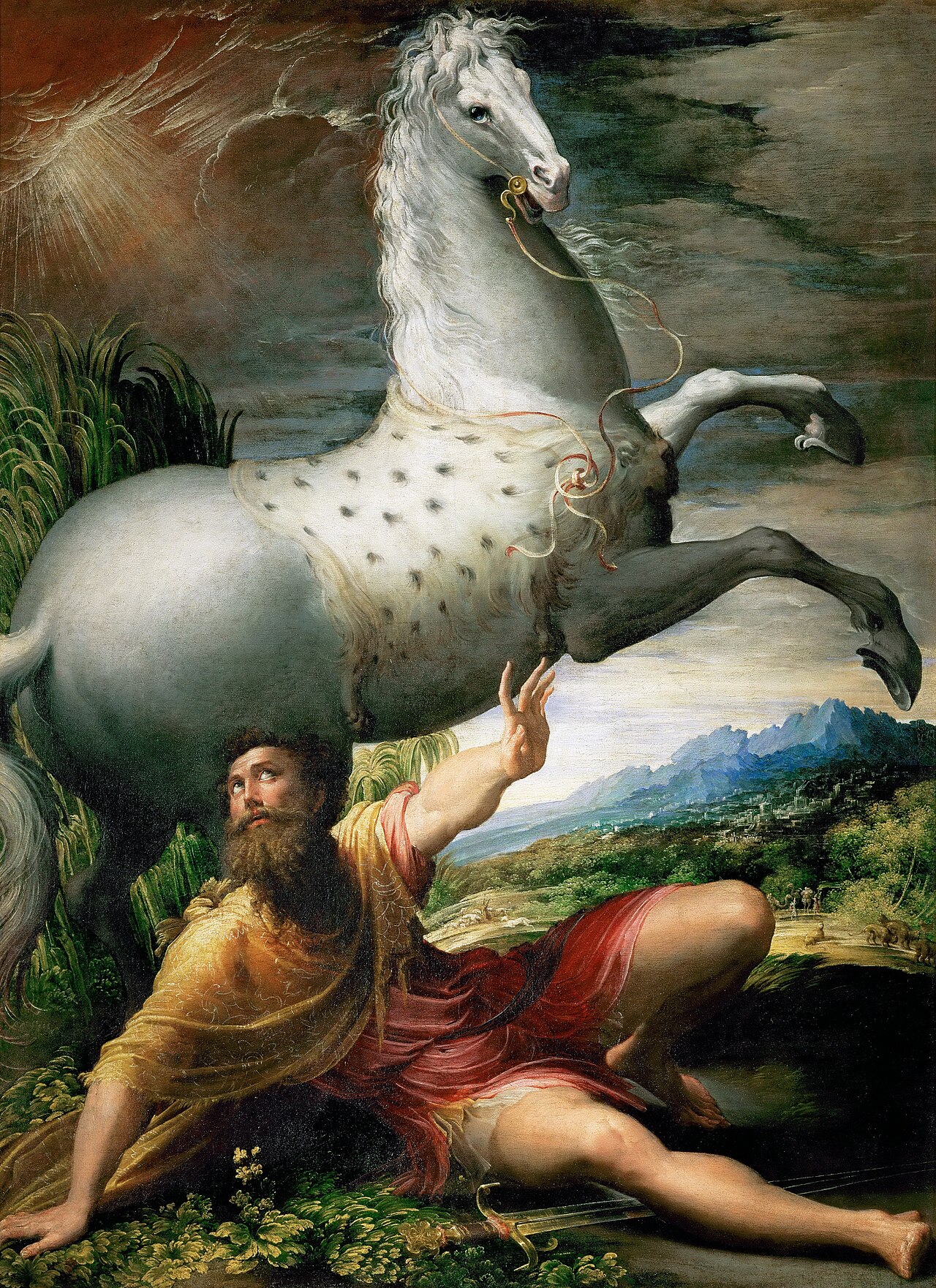
A painting of a man with a full beard lying on the ground, one arm raised toward a rearing white horse with a gold-trimmed bridle and a light-filled sky. Green vegetation and a distant hilltop town fill the landscape.Painting

Secondary source

The Conversion of Saint Paul

Parmigianino · 1527

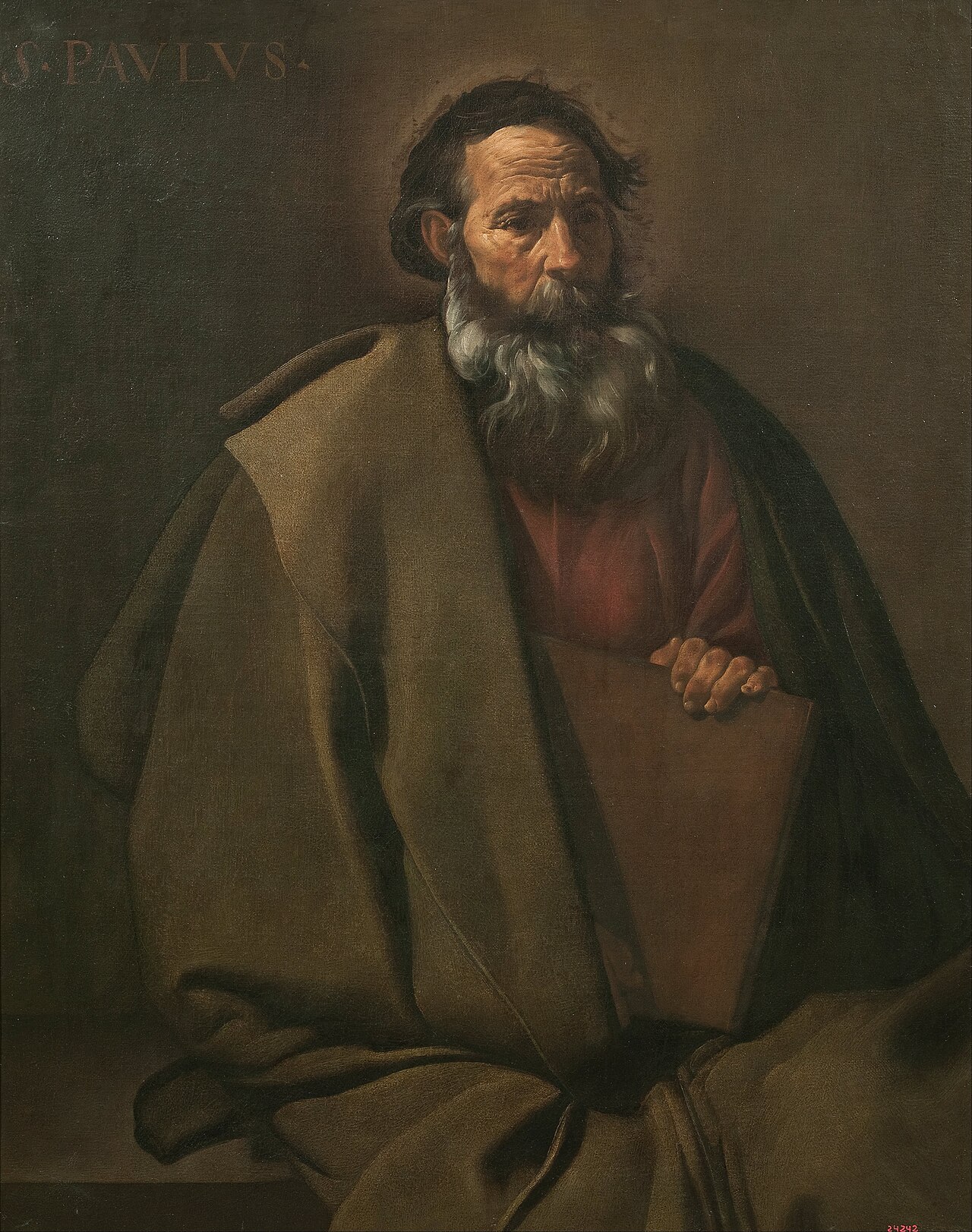
Painting of an elderly bearded man with grey-white beard and dark, tousled hair, wearing a brownish-olive cloak over a red garment. He rests his clasped hands on a reddish book or board. Dark background with the inscription 'S. PAVLVS' at upper left.Painting

Secondary source

Saint Paul

Diego Velázquez · c. 1619

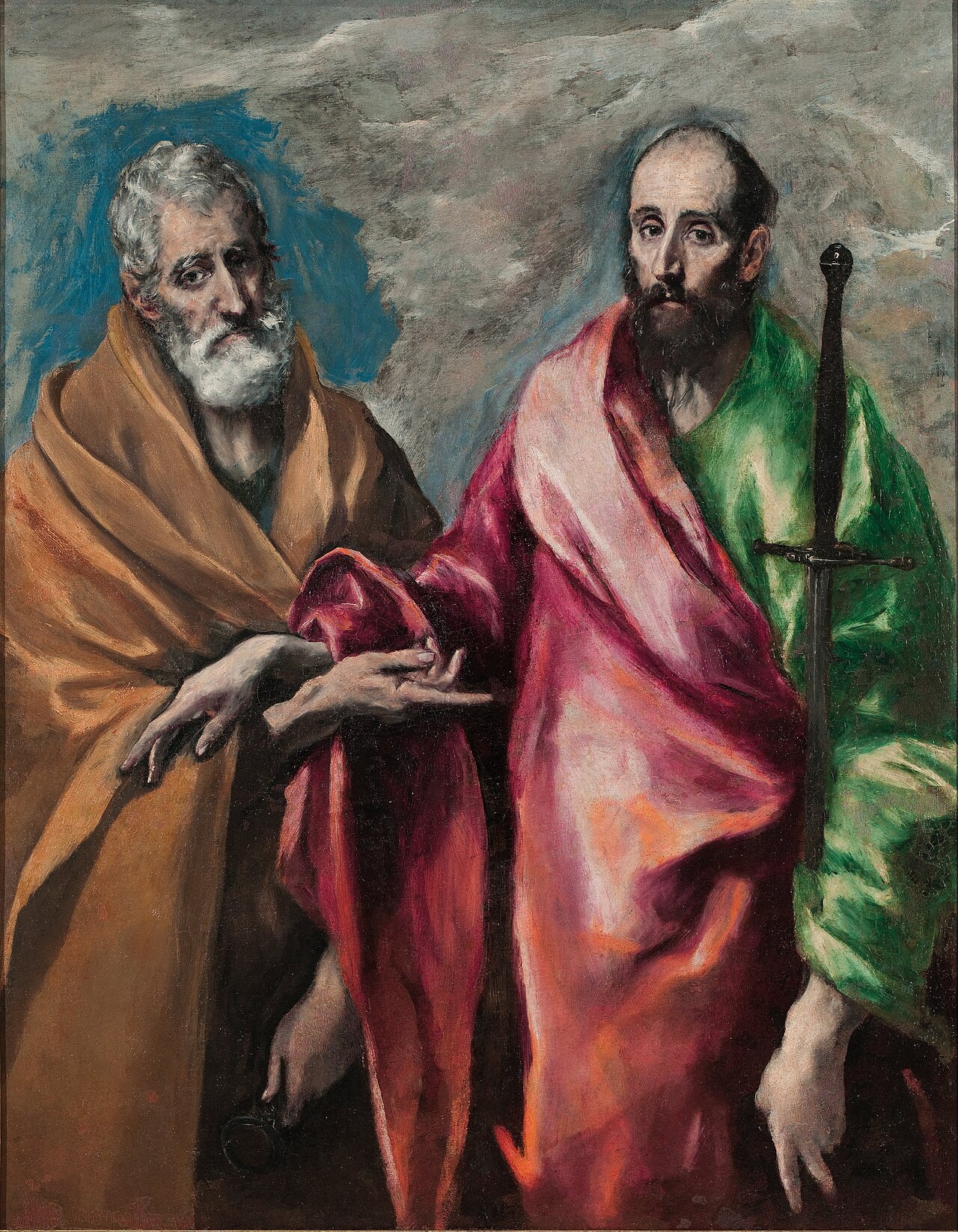
Painting of two bearded apostles against a cloudy grey sky with blue patches. The older man on the left, with white hair and beard, wears a golden-brown cloak and gestures with his hands. The man on the right wears a pink-red cloak over a green robe and holds a sword upright.Painting

Secondary source

Saint Peter and Saint Paul

El Greco · 1590–1600

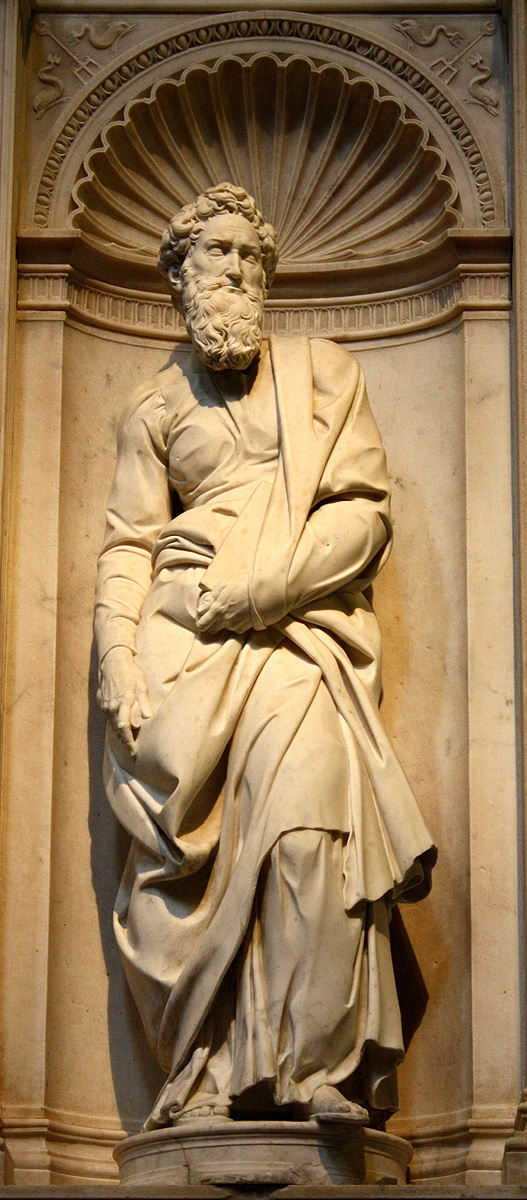
Marble statue of a bearded man with curly hair in a niche topped by a fan-shaped shell arch. He wears a long draped robe and a cloak, with one hand resting at his waist and the other at his side. The statue stands on a round base.Sculpture

Secondary source

Saint Paul

Michelangelo · 1503

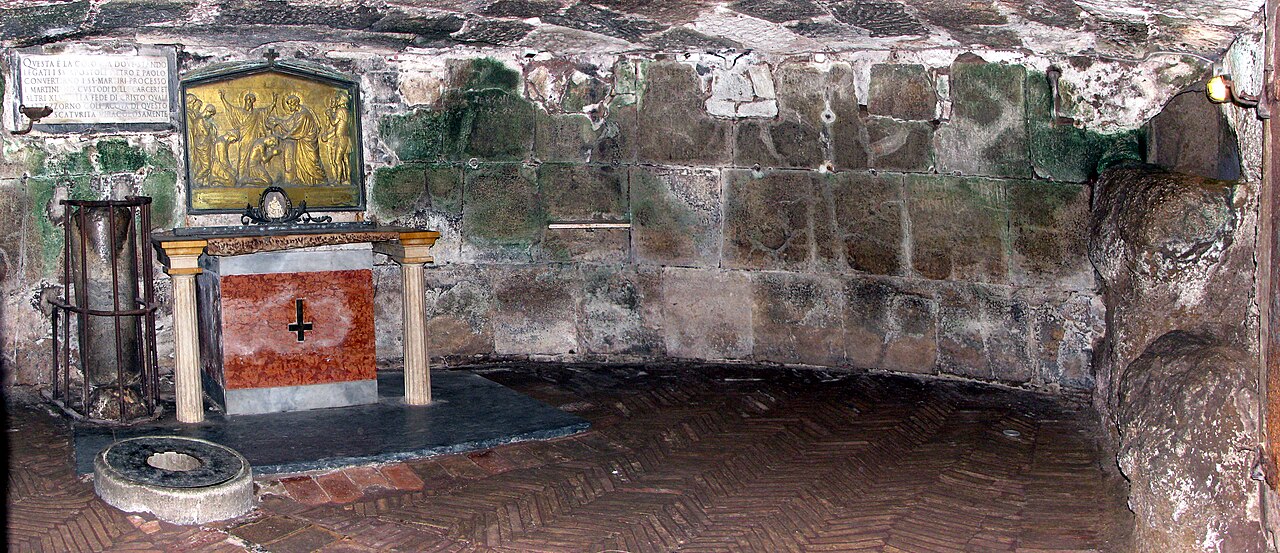
Interior of the Mamertine Prison in Rome: a stone chamber with rough masonry walls, a red marble altar with a black cross, a gilded bronze relief panel above it, two small columns, a circular well opening in the floor, and an inscribed plaque at upper left.Photograph

Tertiary source

Mamertine Prison

Chris 73

The Letters of St. Paul to Seven Churches and Three FriendsBook

Secondary source

The Letters of St. Paul to Seven Churches and Three Friends

Arthur S. Way (translator) · 1906

St. Paul the Traveller and the Roman CitizenBook

Secondary source

St. Paul the Traveller and the Roman Citizen

William Mitchell Ramsay · 1895

The Life and Work of St. Paul, Volume 1Book

Secondary source

The Life and Work of St. Paul, Volume 1

Frederic William Farrar · 1880

Book

Secondary source

Paul the Apostle of Jesus Christ, His Life and Work, His Epistles and His Doctrine

Ferdinand Christian Baur · 1876

The Origin of Paul's ReligionBook

Secondary source

The Origin of Paul's Religion

J. Gresham Machen · 1921

Book

Secondary source

The Earlier Epistles of St. Paul: Their Motive and Origin

Kirsopp Lake · 1911

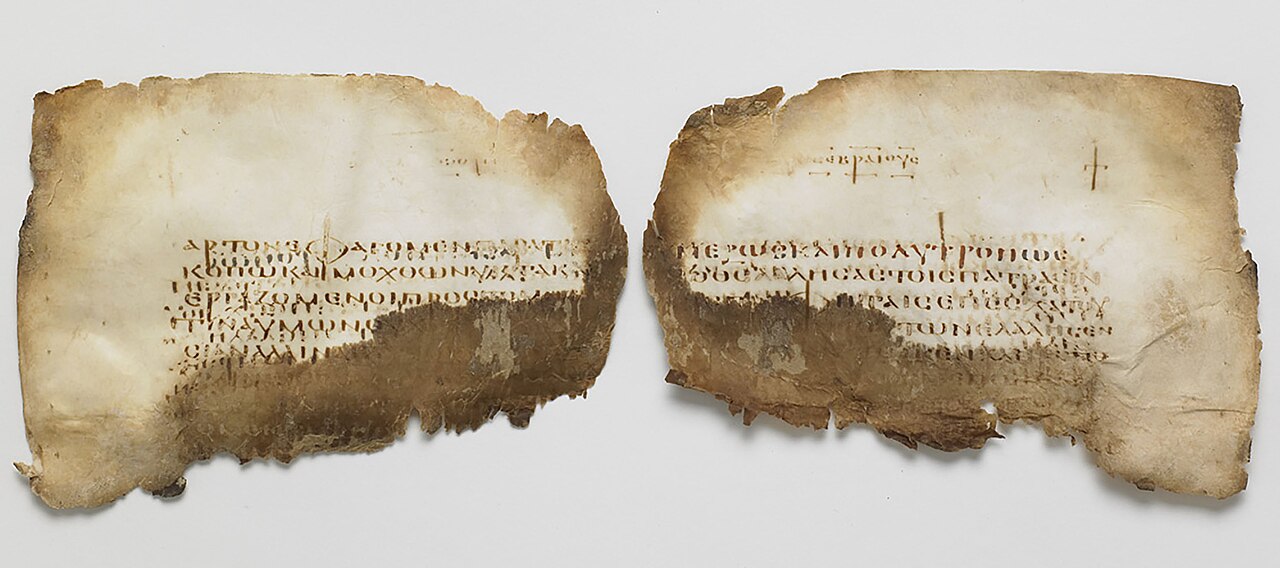
Two fragmentary parchment leaves, aged brownish-tan with torn and darkened edges, lying side by side on a pale background. Each leaf bears lines of brown Greek uncial script, with a decorative marking near the top of the right leaf.Book

Secondary source

Washington Manuscript IV, Epistles of Paul

6th century

The Story of the Life of St. Paul the ApostleBook

Secondary source

The Story of the Life of St. Paul the Apostle

M. F. S. · 1877

Missionary Methods: St. Paul's or OursBook

Secondary source

Missionary Methods: St. Paul's or Ours

Roland Allen · 1912

Book

Secondary source

The Epistles of Paul the Apostle, Translated with Notes

Thomas Belsham · 1822

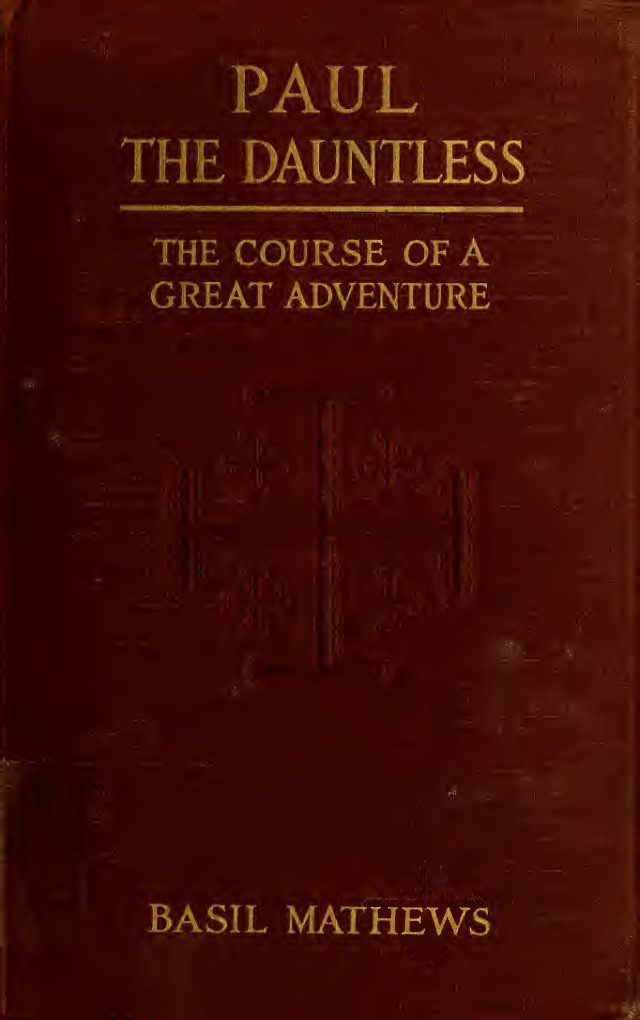
Paul the DauntlessBook

Secondary source

Paul the Dauntless

Basil Mathews · 1916

St. Paul and the Mystery-ReligionsBook

Secondary source

St. Paul and the Mystery-Religions

H. A. A. Kennedy · 1913

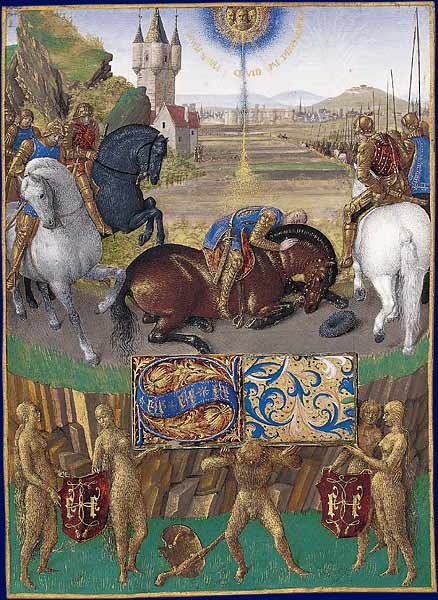
Illuminated manuscript miniature: a knight in armor has fallen from a brown horse on a road, while other mounted armored riders on gray and black horses look on. A sun-like face shines from a blue sky above a walled town with towers. Gold-figured decorative panels and grotesque figures holding shields fill the bottom.Painting

Secondary source

Saint Paul on the Road to Damascus

Jean Fouquet · c. 1452-1460

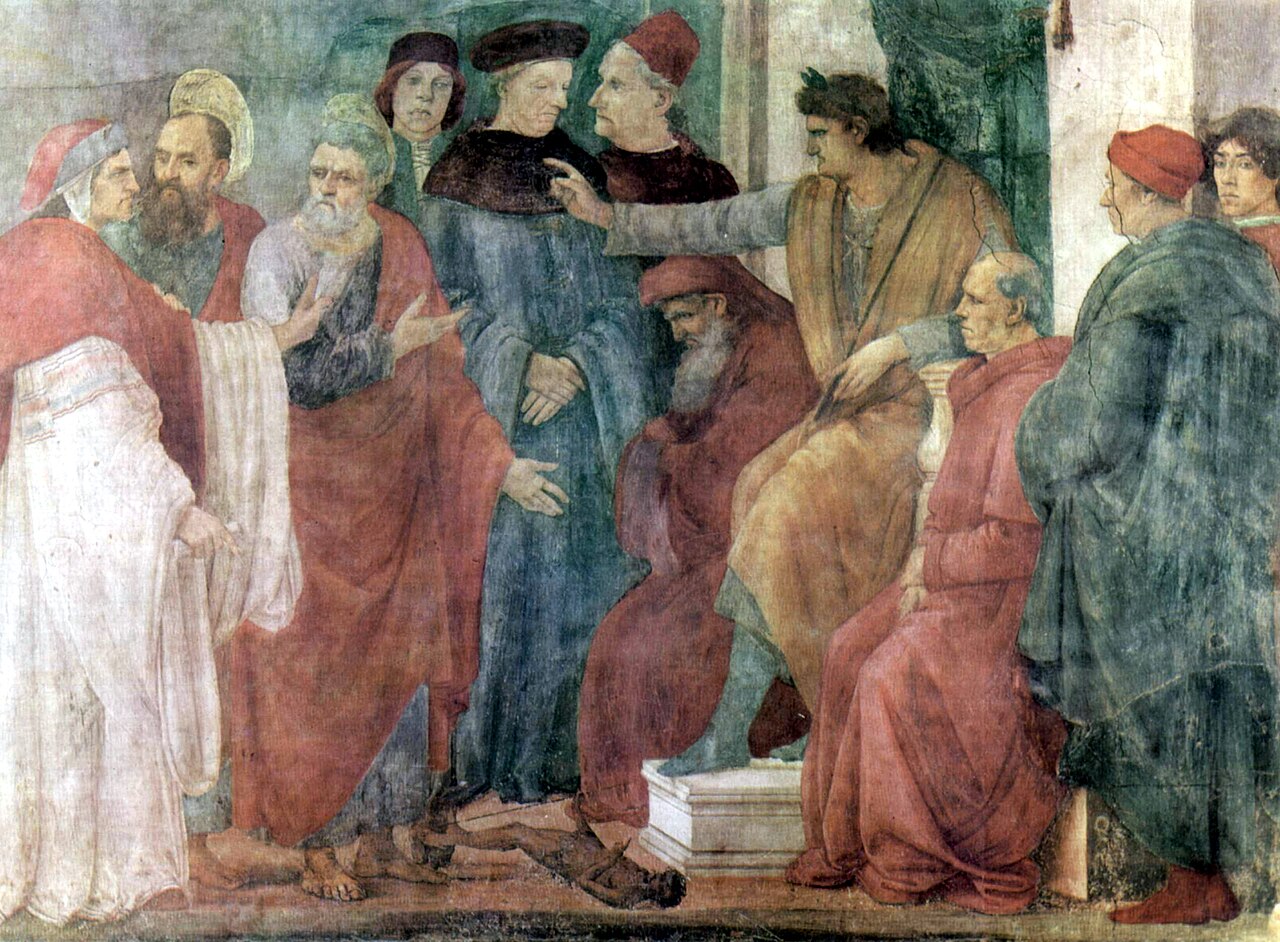
Fresco of a crowded Renaissance scene: on the left, figures in red and white robes gather around a bearded man; a turbaned elder gestures with open hands; a man in blue stands centre-left. On the right, a seated bearded man in red robes sits on a white pedestal while a robed figure in ochre points toward a group of onlookers in red and green.Painting

Secondary source

Peter and Paul Disputing with Simon Magus before Nero

Filippino Lippi · 1481-1482

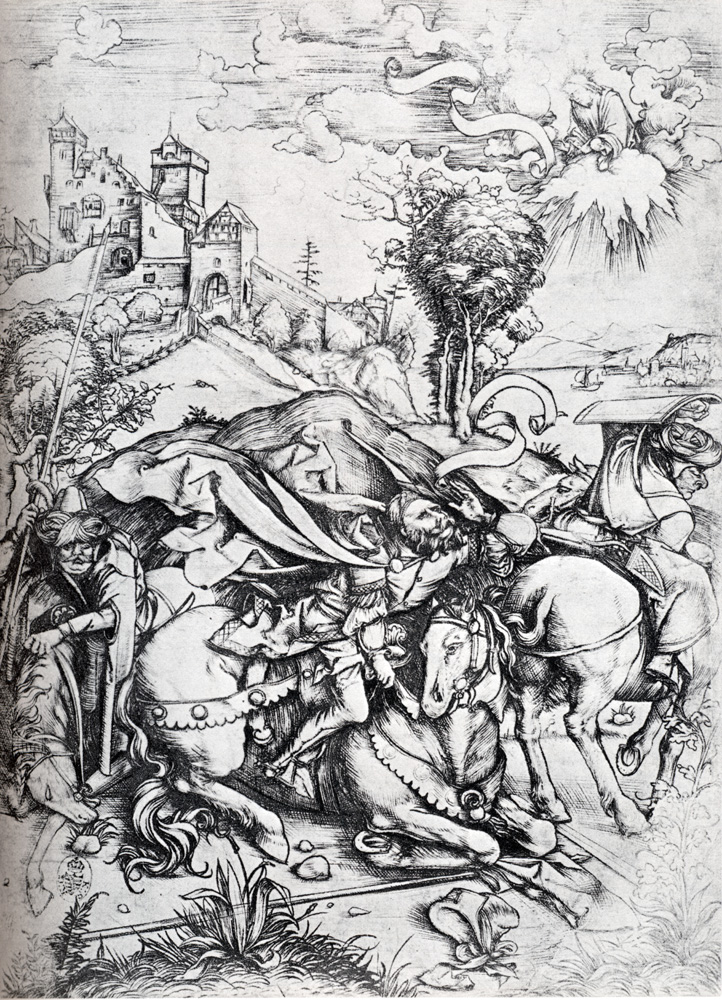
Black and white engraving of a dramatic scene: a rider on a rearing white horse falls backward amid a mountain landscape, with a fallen horse in the foreground, armed attendants on the left and right, a castle on a hill, and clouds with a bright burst of light above.Painting

Secondary source

The Conversion of Paul

Albrecht Dürer · 1494

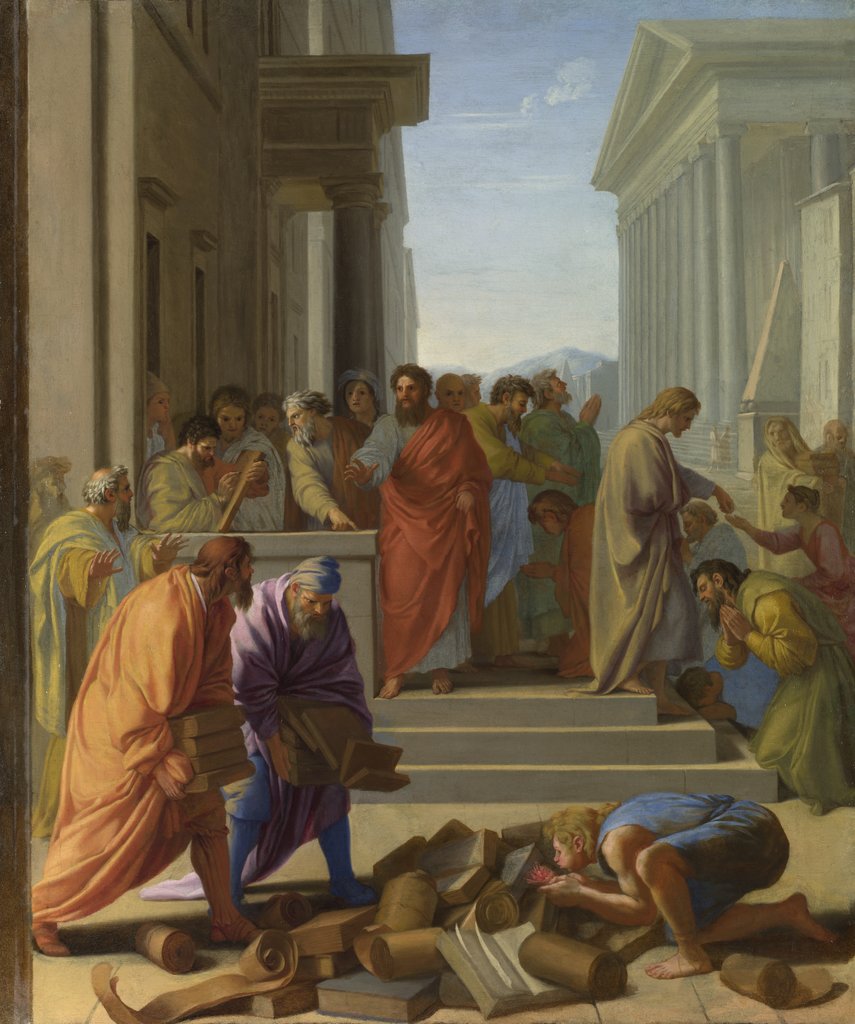
Painting of St Paul preaching at Ephesus: a red-robed bearded man stands on steps before a crowd, while on the lower right a figure kneels among scattered scrolls and books; in the foreground another man carries books. Classical columned buildings frame the scene.Painting

Secondary source

St Paul Preaching at Ephesus

Eustache Le Sueur · 1649

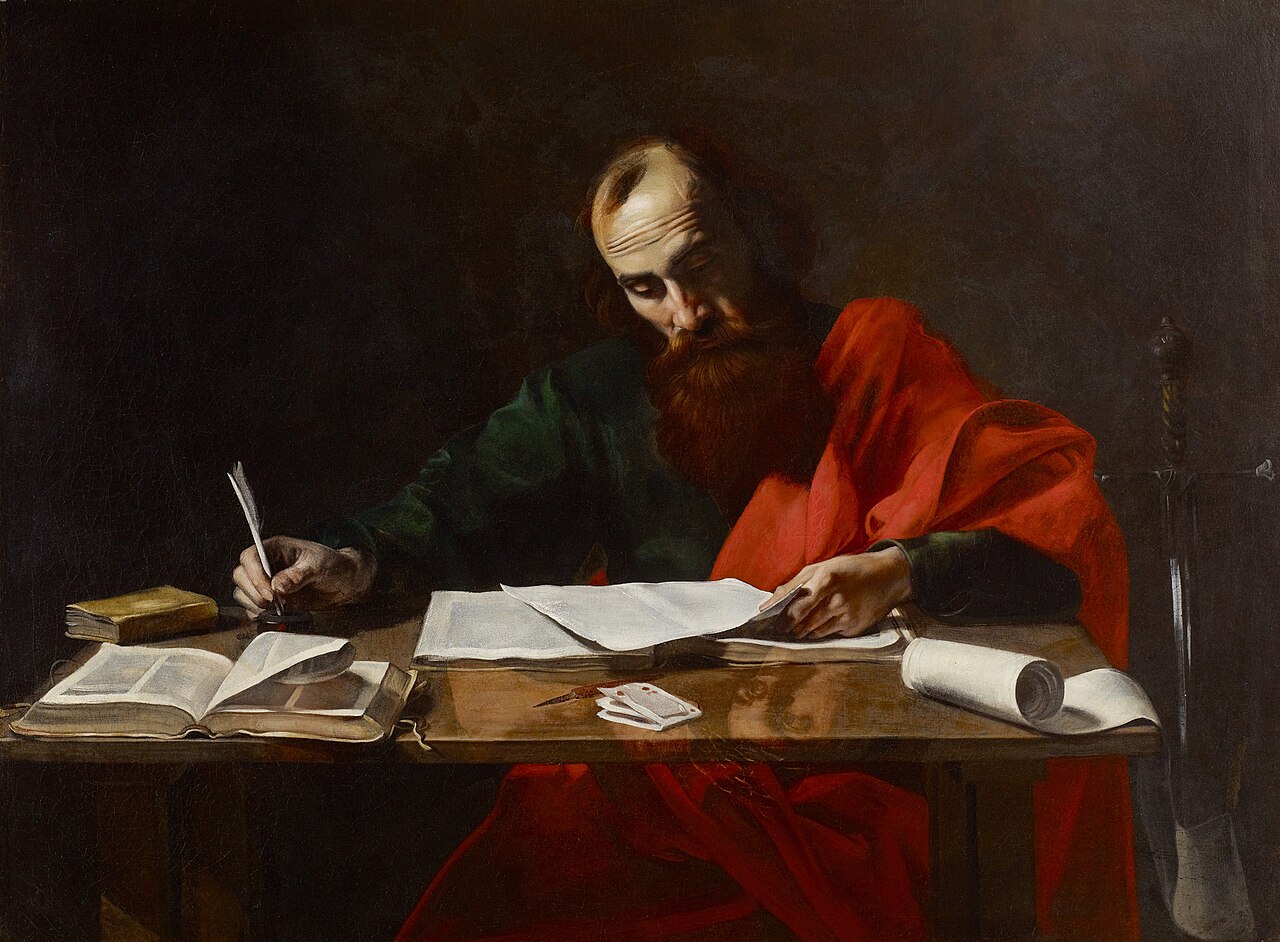
Painting of a bearded man with a receding hairline in a dark green robe and red cloak, writing with a quill at a wooden table. Open books, a rolled scroll, papers, and a sword lie nearby against a dark background.Painting

Secondary source

Saint Paul Writing His Epistles

Valentin de Boulogne · c. 1618-1620

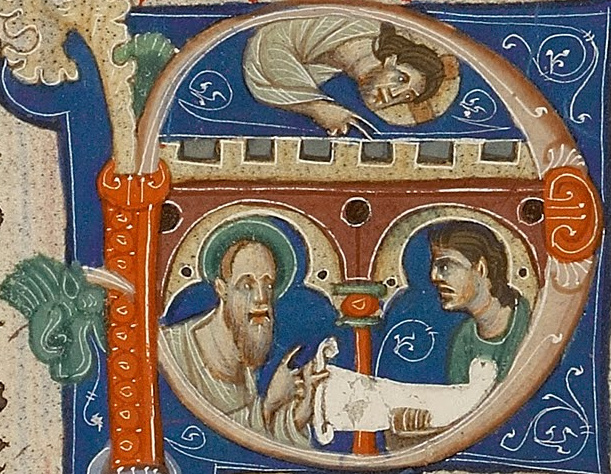
Medieval manuscript initial P on blue ground with red and gold decoration. Inside the letter, a bearded saint with a halo at left hands a scroll to a young messenger at right. God's head appears at top, and a young man bends beneath the letter's bowl.Painting

Secondary source

Initial P: Saint Paul Giving a Letter to a Messenger

Unknown illuminator · c. 1280-1290

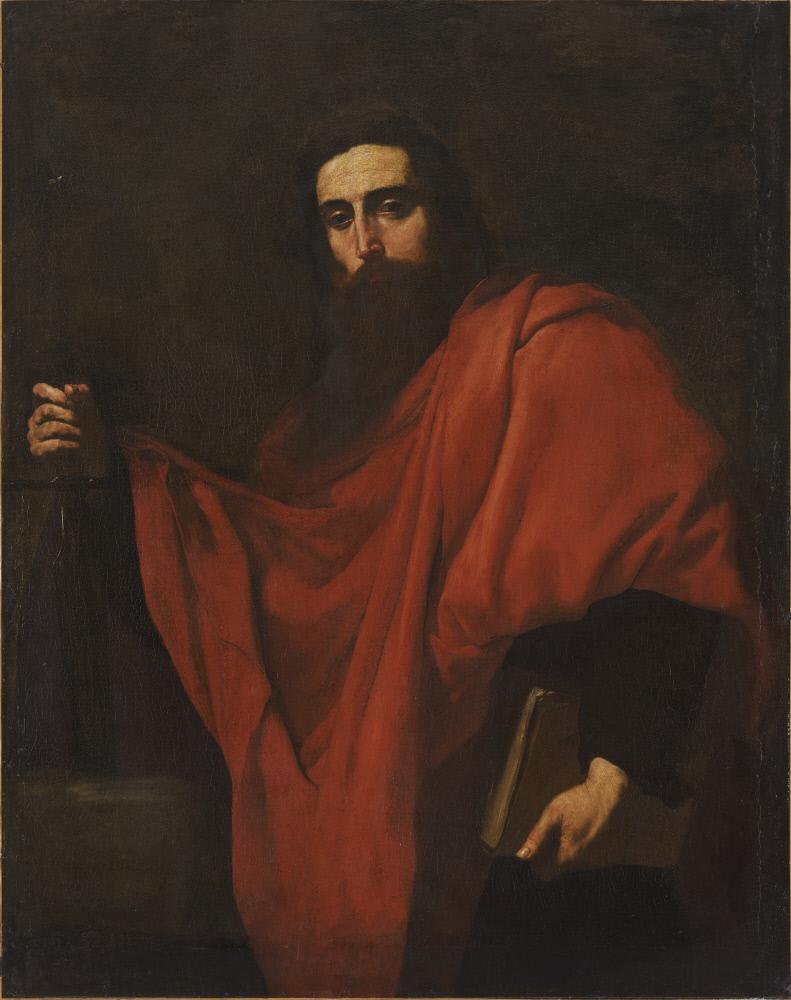
Painting of a bearded man with dark hair wearing a flowing red cloak over dark clothing. He grips a ledge with his left hand and holds a closed book against his body with his right. Dark brown background.Painting

Secondary source

Saint Paul

Jusepe de Ribera · 1630

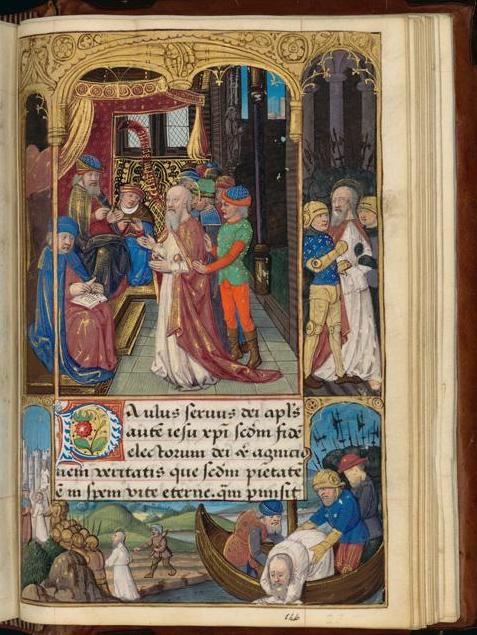
Illuminated manuscript page with a miniature painting of a robed bearded figure in a red and white garment standing before a seated judge in a canopied bed-like throne, with attendants in blue and green. Below, a decorated initial and Latin text, and a small scene of a bearded man in a boat being handled by men. Illustrates the arrest and hearing of Paul.Painting

Secondary source

Arrest of Paul and Hearing Before Festus

Master of the Cardinal de Bourbon · c. 1470-1500

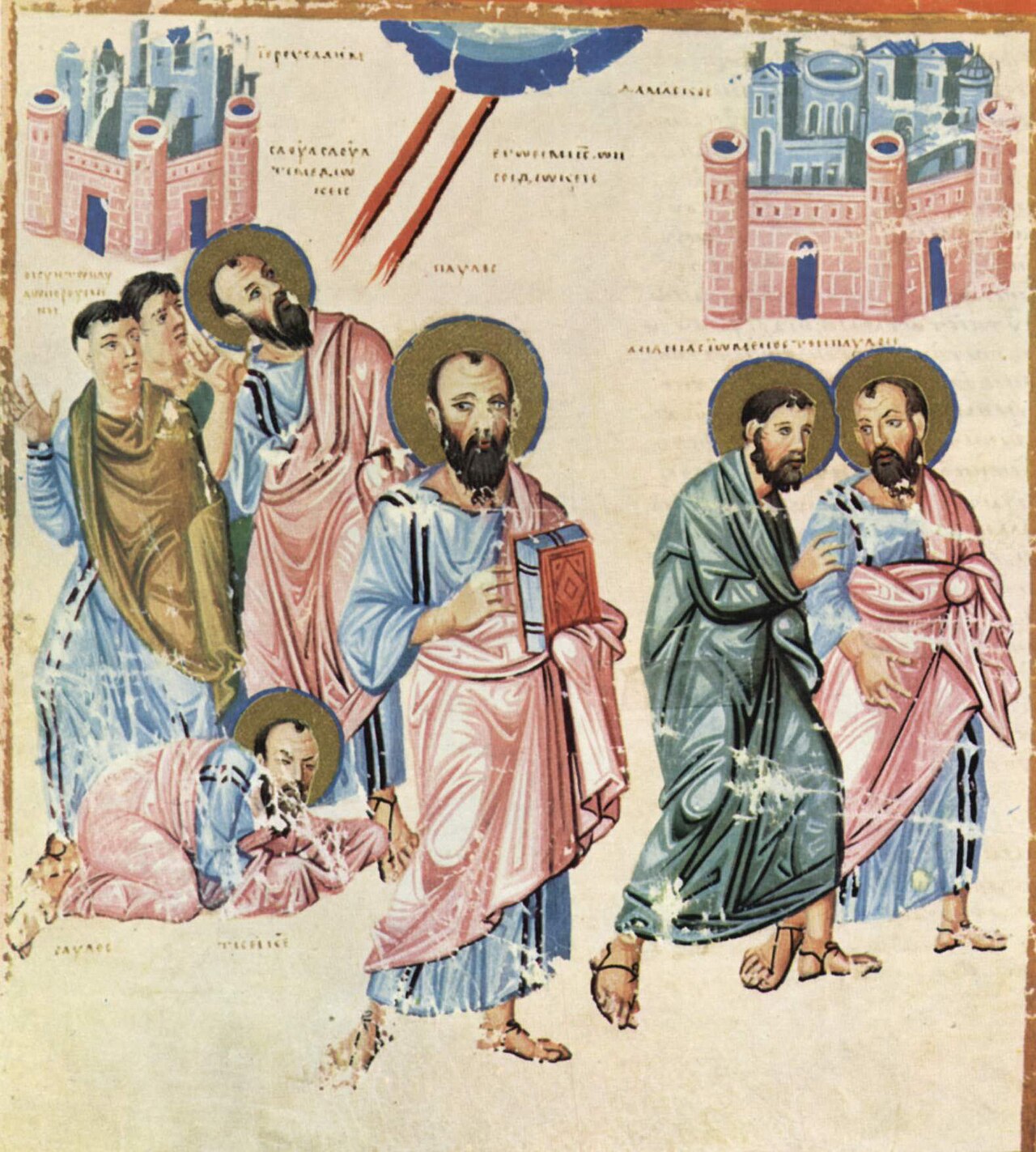
Illuminated manuscript miniature with Greek inscriptions. Two cities with towers appear at top left and right, with a blue cloud and red streaks of light above. Bearded figures with gold halos stand in pink and blue robes; one kneels on the ground at lower left, and another figure at left gestures upward. A figure at center holds a red book.Painting

Secondary source

Paul on the Road to Damascus

Meister nach Cosmas Indicopleustes · 9th century

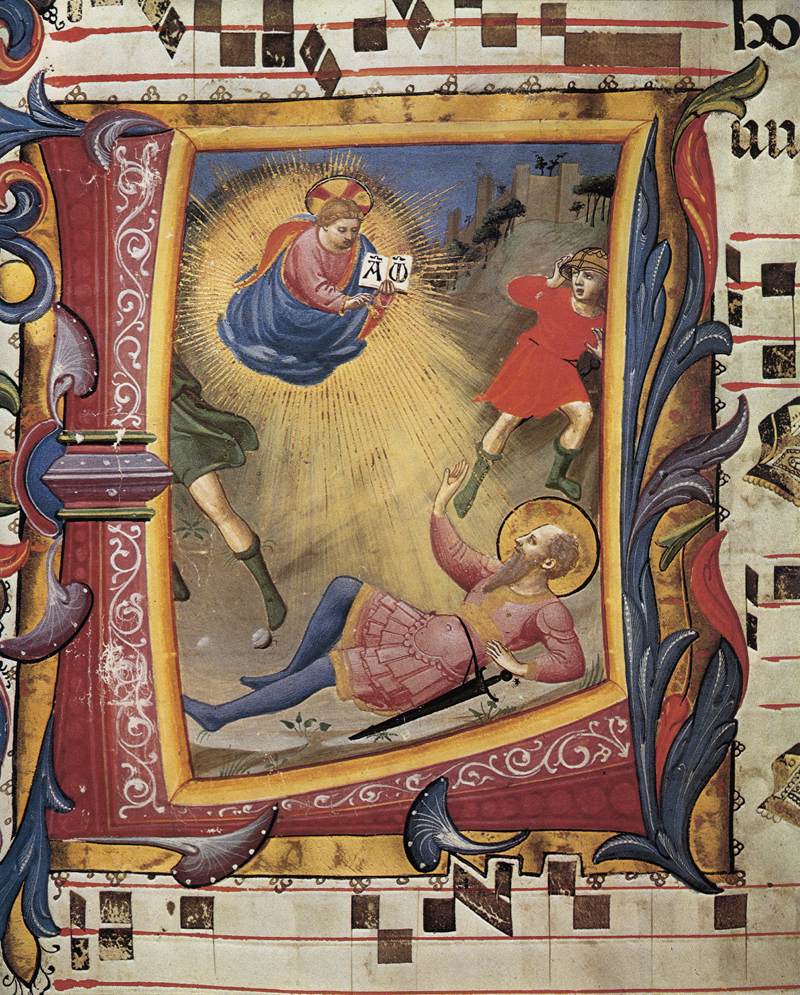
Illuminated manuscript miniature in a decorated border showing the Conversion of Saint Paul: Christ appears in a radiating golden light holding a book marked with Alpha and Omega, while Saul in red tunic falls to the ground with a haloed figure, a sword nearby, and a companion in green shields his eyes. A walled town is in the background.Painting

Secondary source

Conversion of St Paul

Fra Angelico · c. 1430

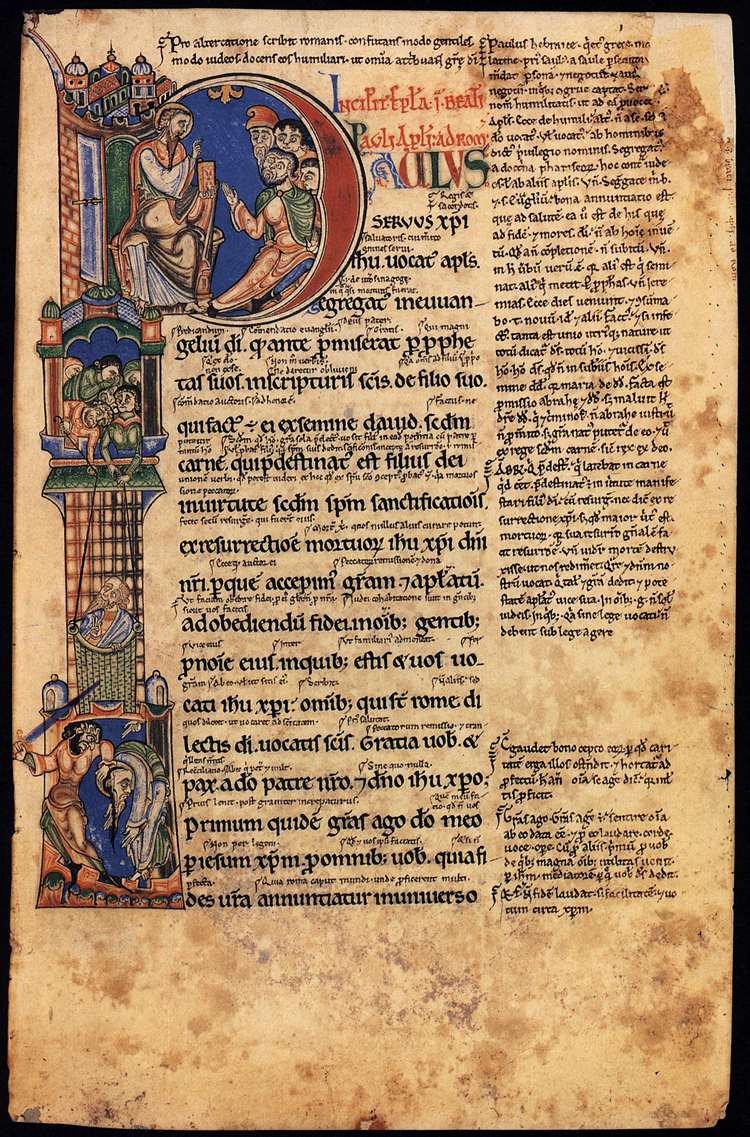
Manuscript page of the Epistles of St Paul with gloss, written in Latin in dark brown ink on vellum. A large decorated initial D with blue, red and green illumination contains a seated figure, possibly Paul, dictating to scribes. Historiated initials with small figures run down the left margin, and marginal gloss appears in smaller script on the right.Book

Secondary source

Epistles of St Paul with Gloss

Unknown Miniaturist, English, active c. 1150 in Winchester · c. 1150

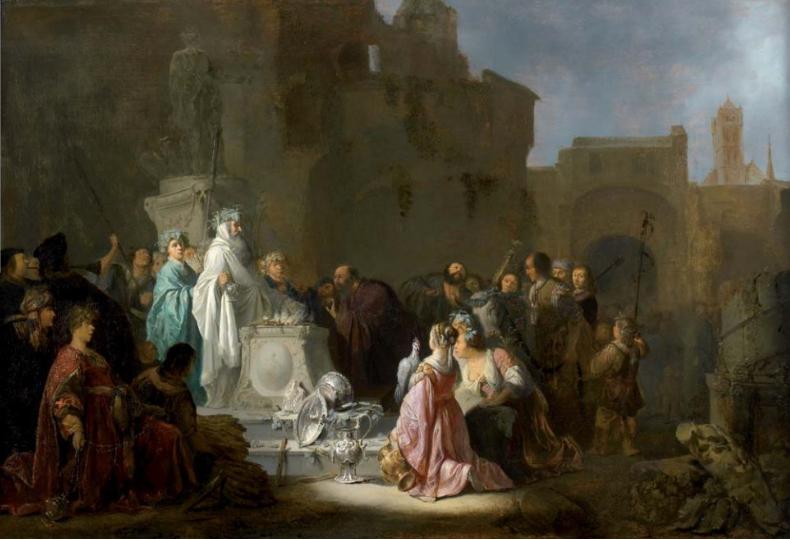
Painting of a classical town scene with ruins and a crowd. In the center, two robed figures stand on a raised platform, with a white-robed figure before a pedestal and a crowd of onlookers. In the foreground, kneeling figures in pink and red garments look toward silver vessels and a helmet on the ground. Figures in period dress stand around, with a statue and tall tower in the background.Painting

Secondary source

Paul and Barnabas at Lystra

Willem de Poorter · 1636

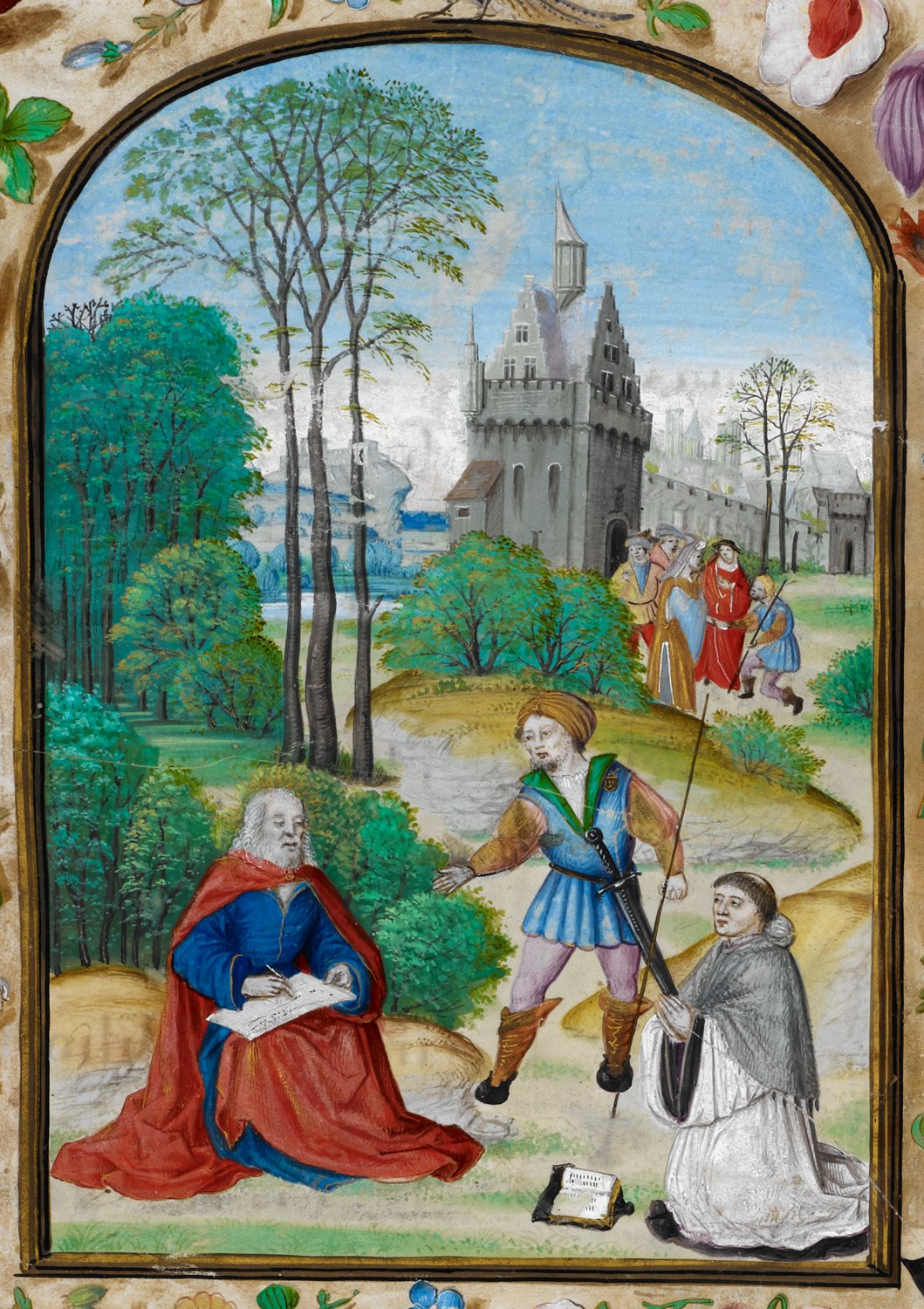
Illuminated manuscript miniature in an arched frame: an elderly bearded man in a blue robe under a red cloak sits writing on a sheet in a landscape. A standing man in a blue tunic and orange hat gestures toward a kneeling figure in grey and white. A castle and small figures appear behind.Painting

Secondary source

St Paul Writing His Epistles with John Colet

Unknown (possibly school of Simon Bening or a follower of Horenbout) · 1506

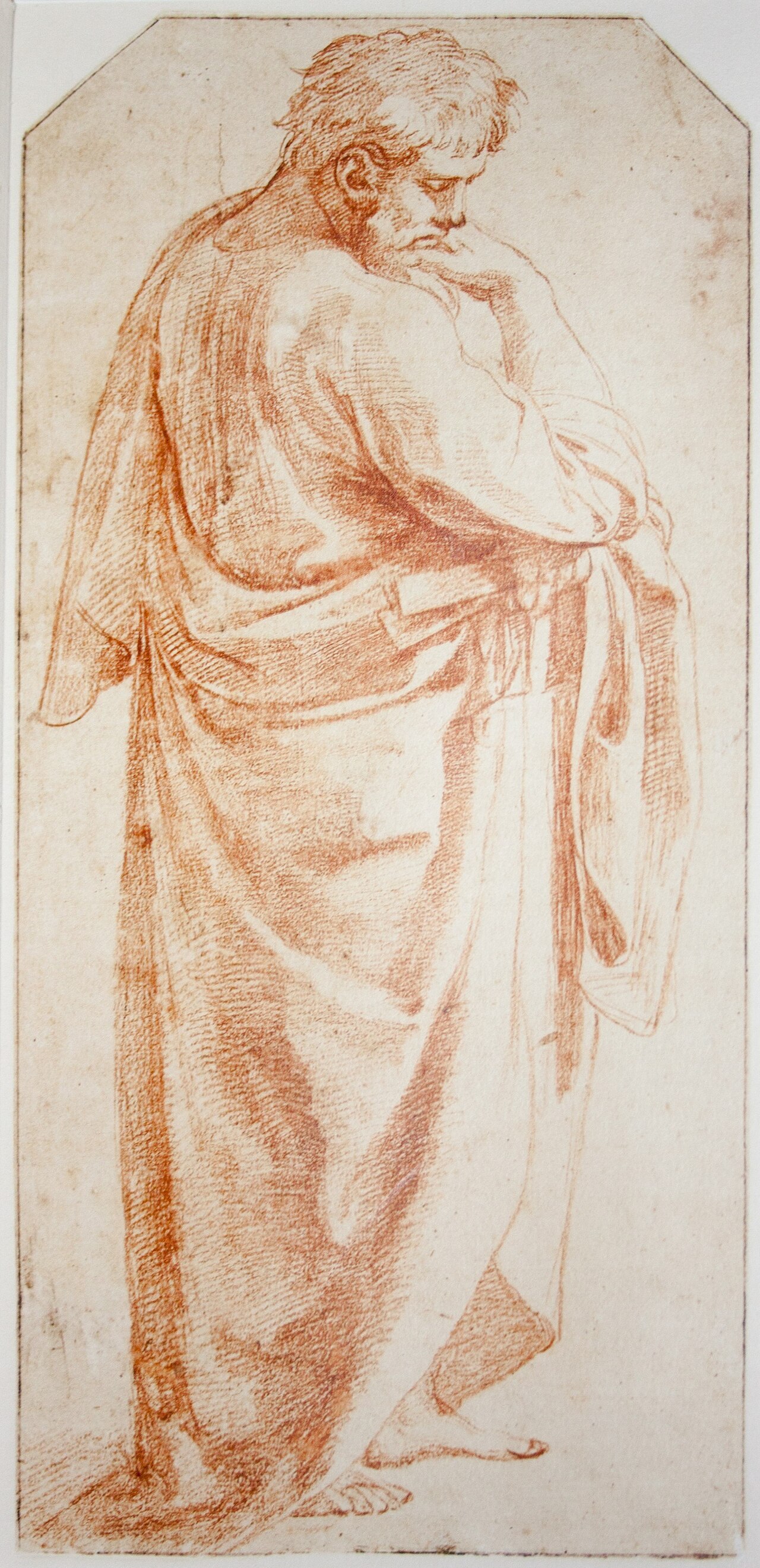
Red chalk drawing on a cream paper with cut corners showing a standing bearded male figure in a draped robe, head bowed, one hand raised to his chin, the other arm holding the cloth; bare feet visible.Painting

Secondary source

Study of Saint Paul

Raphael · circa 1514

Letter

Primary source

1 Timothy

Paul the Apostle

Letter

Primary source

Titus

Paul the Apostle

Letter

Primary source

First Epistle to Timothy in Greek

Paul the Apostle

Letter

Primary source

Epistle to Titus in Greek

Paul the Apostle

Letter

Primary source

Second Epistle to Timothy in Latin

Paul the Apostle

Document

Tertiary source

St. Paul entry, Catholic Encyclopedia

F. Prat · 1913

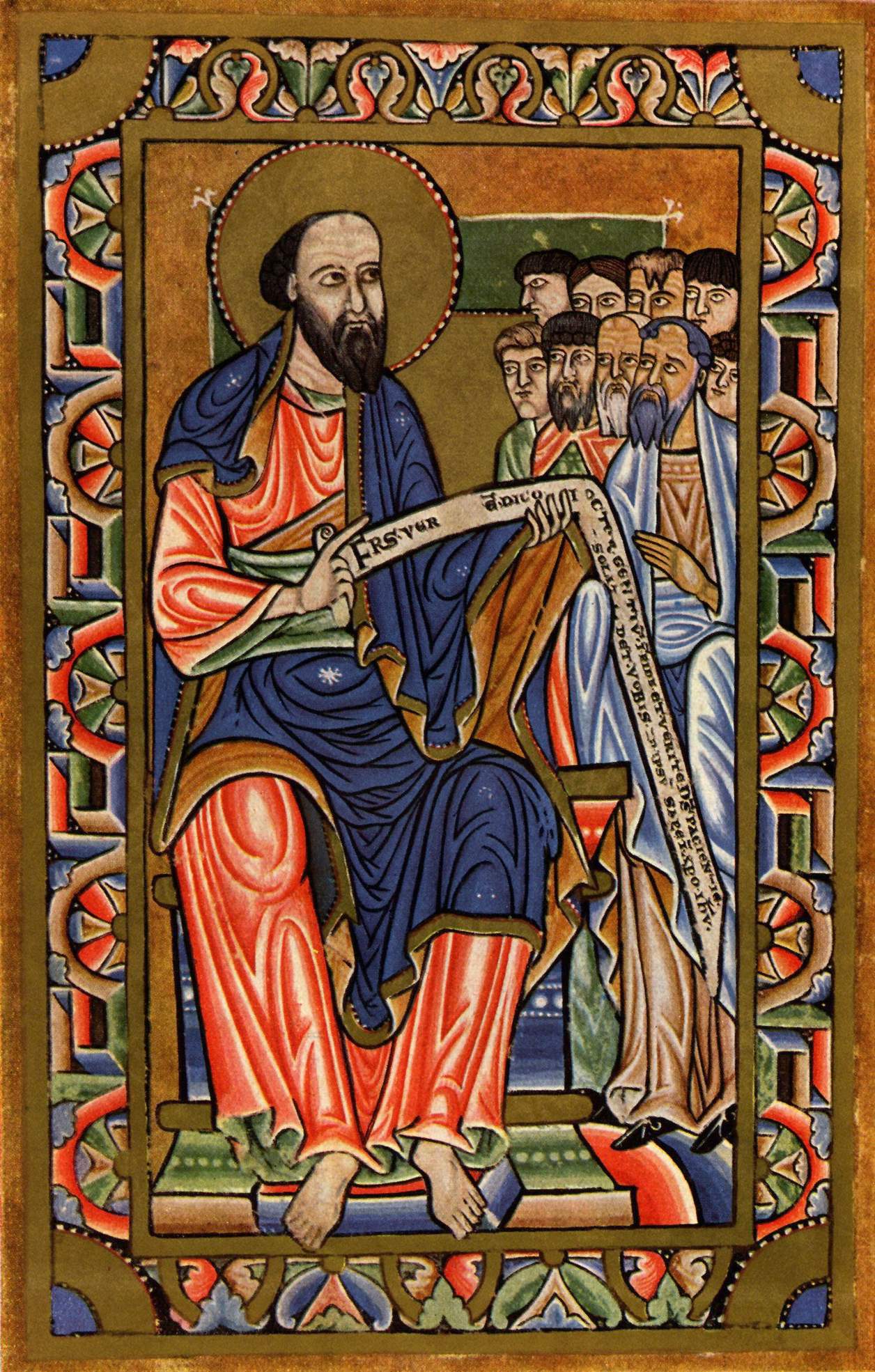
Illuminated manuscript page in bright colors within an ornate decorative border. A bearded man with a halo sits on a bench, wearing a blue cloak over red robes, holding an unrolled scroll with Latin text. Behind him stand a group of bearded and beardless men looking toward him.Painting

Secondary source

Paul and the Recipients of His Letters

Meister aus Halberstadt · circa 1185

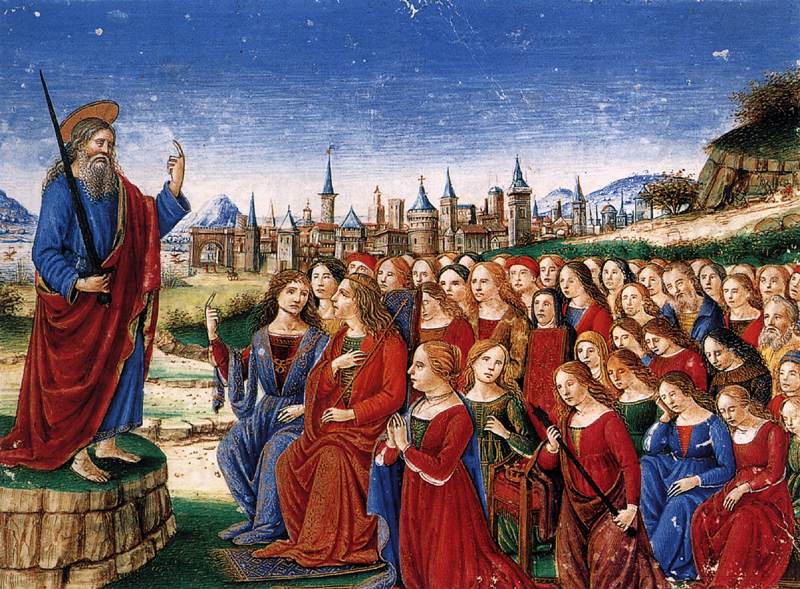
Painted miniature of a bearded man in blue and red robes with a golden halo, holding a sword and raising one hand, standing on a stone pedestal. Before him sits a group of richly dressed people in red and blue. A crowd of onlookers fills the background, with a walled city of towers under a blue sky.Painting

Secondary source

St Paul Preaching before King Matthias Corvinus

Attavante degli Attavanti · circa 1487-1492

Book

Tertiary source

Paul, Saint (American Cyclopaedia entry)

F.H. Hedge · 1879

Book

Tertiary source

Paul (Encyclopaedia Britannica entry by E. Hatch)

E. Hatch · 1885

Book

Tertiary source

Paul (apostle) (New International Encyclopedia entry by M.W. Jacobus)

M.W. Jacobus · 1905

Document

Secondary source

Commentary on the Epistle of Paul to the Galatians

John Calvin · 16th century

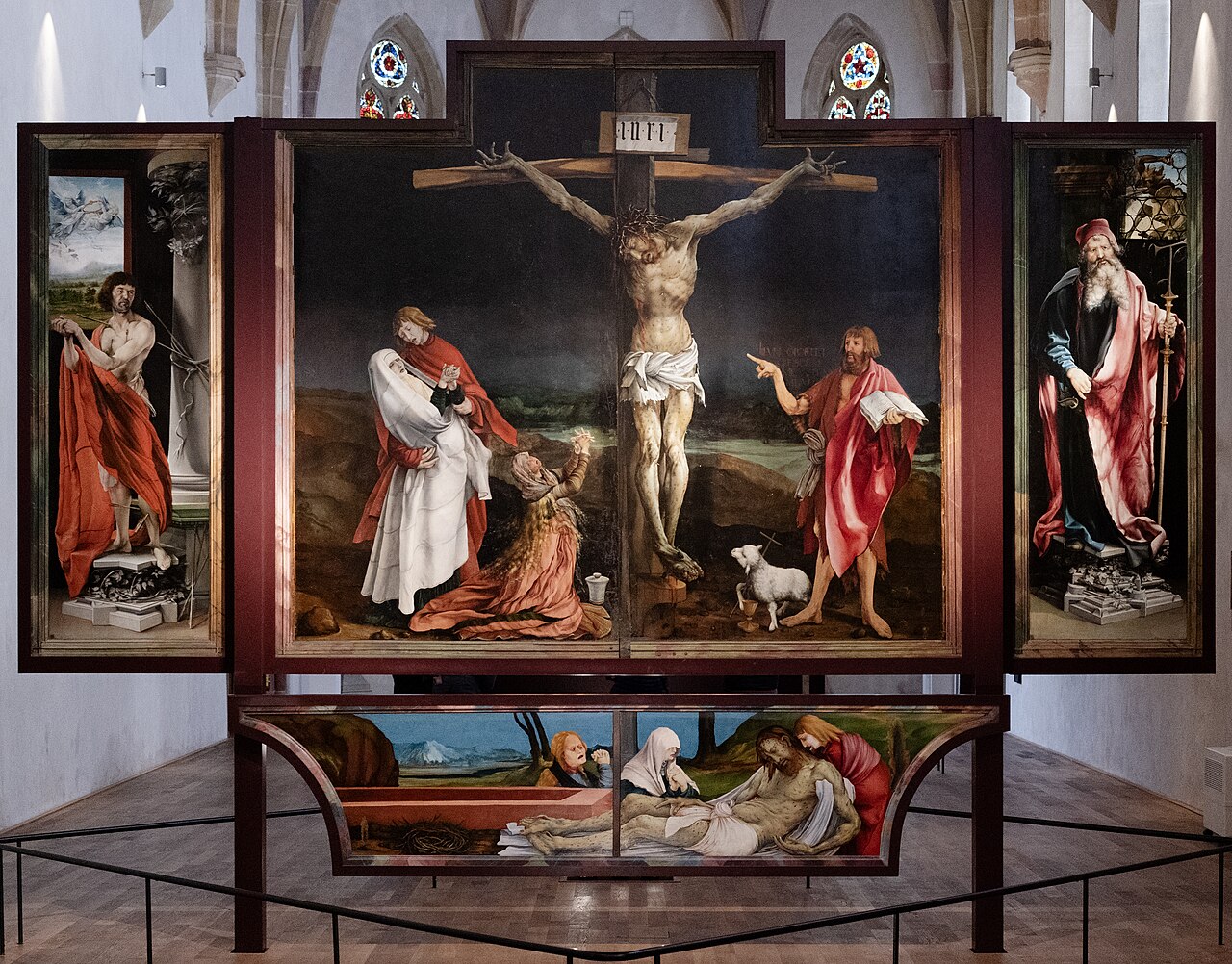
The open Isenheim Altarpiece displayed in a church interior. The central panel shows the crucified Christ with figures at the foot of the cross, including a lamb, a kneeling woman, and John pointing. Side panels show saints, and the predella below shows the entombment.Painting

Secondary source

Isenheim Altarpiece

Matthias Grünewald · 1512-1516

Want the full shelf? Chat with Saint Paul in the app and open the Sources panel — every quote links back to the original.

Use Saint Paul in class

1 collection

A ready-made collection from the Humy team that features Saint Paul. Preview it, then try it free.

Trusted by educators worldwide

Conversations
375,000+
Real exchanges between students and historical figures
Messages exchanged
4,142,000+
Across every figure, classroom and language
Historical figures
100,000+
Each informed by a curated biography and selected sources
Languages supported
50+
From English and Spanish to Arabic and Korean

Paying customers

Used by 98 schools and universities

Partner school logo
Tecnológico de Monterrey logo
Hyper Island logo
Partner school logo
Chambersburg Area School District logo
Broward County Public Schools logo
Nebo School District logo
National Louis University logo
South Florida PBS logo
Punahou School logo
University of Wisconsin–River Falls logo
Partner school logo
Partner school logo
Archbishop Mitty High School logo
Kingsburg High School logo
Norwalk Public Schools logo
Partner school logo
Connections logo
Partner school logo
Moore Public Schools logo
Partner school logo
Partner school logo
Partner school logo
Partner school logo
Robbinsville Public Schools logo
Partner school logo
Partner school logo
Partner school logo
Tecnológico de Monterrey logo
Hyper Island logo
Partner school logo
Chambersburg Area School District logo
Broward County Public Schools logo
Nebo School District logo
National Louis University logo
South Florida PBS logo
Punahou School logo
University of Wisconsin–River Falls logo
Partner school logo
Partner school logo
Archbishop Mitty High School logo
Kingsburg High School logo
Norwalk Public Schools logo
Partner school logo
Connections logo
Partner school logo
Moore Public Schools logo
Partner school logo
Partner school logo
Partner school logo
Partner school logo
Robbinsville Public Schools logo
Partner school logo
Partner school logo

What educators are saying

“We enjoyed the program last year and used it frequently.”
“My students say it’s a welcome change of pace. I’m not a fan of the “sage on the stage” model, so I try to incorporate research-oriented and self-paced activities. With Humy, students have to take charge of their learning. They’ve become more adept at critical thinking, forming better questions, and improving their reading comprehension. The interview feature has been my go-to tool. I create assignments where students must ask historical figures a set number of questions, then summarize the responses to ensure they’re truly absorbing the material. This approach lets them actively explore the past rather than passively consuming information.”
“Humy has helped me bring historical figures, sometimes long past, to life. When my students interact with these figures in real-time, it eliminates some of the perceived “ancient” characteristics of my curriculum. This has shifted my students’ thinking away from viewing history as abstract or irrelevant. Real-time interactions make historical figures relatable, even allowing students to ask off-topic questions that help put historical lives in a more relevant context for 13-year-olds. The feature I use the most is the interview feature. After teaching a topic, most recently Gandhi and Joan of Arc, I have the students ask pointed, focused questions. We practice good conversation techniques beforehand, teaching them to listen (or read) carefully and formulate thoughtful follow-up questions rather than just interrogating. It helps students practice effective conversation skills.”

FAQ

Frequently asked questions

Who is Saint Paul?
Prominent early Christian missionary and writer of the New Testament. On Humy.ai you can chat with an AI version of Saint Paul that draws on a short biography and 91 historical sources during the conversation — by text or voice, in 42 languages.
Is Saint Paul AI free?
Saint Paul is part of Humy's full library of more than 100,000 figures, which comes with a paid plan. A free account (no credit card) includes 20 messages a month with the free library's figures, so you can try how the conversations work first.
What sources does the Saint Paul AI use?
It draws on a short biography and 91 historical sources (paintings, books and letters), including “Epistle to the Romans”, “Saint Paul” and “First Epistle to the Corinthians”. Each source has its own page on Humy.ai.
How historically accurate is the AI version of Saint Paul?
Each figure uses a short biography and a small set of selected historical sources as context (retrieval-augmented generation), so answers stay closer to known material than the model's general knowledge alone. It isn't a citation-grade research tool — like any LLM, the AI can get details wrong or extrapolate. Treat it as a strong starting point for inquiry and cross-reference important claims.
Can I talk to Saint Paul by voice?
Yes. In addition to text chat, you can call Saint Paul and hear their voice respond in real time — useful for auditory learners, interview practice and Socratic dialogue.
Is Humy.ai safe and compliant for schools?
Yes. Humy.ai is used by more than 100 schools, universities and organisations. The platform is FERPA- and GDPR-aligned, supports SSO, and offers an IT-approval pack tailored for school procurement teams.

Ready when you are

Start chatting with Saint Paul now.

20 messages free · No credit card · Available in 50+ languages.