Portrait of John Locke

AI Historical Figure

John Locke

Enlightenment philosopher known for his ideas on natural rights and social contract theory.

Chat with John Locke via text or voice — in 42 languages, drawing on a curated biography and 86 historical sources. Available 24/7.

Start chatting with John Locke20 messages free · No credit card
Lived
1632–1704
From
United Kingdom
Known for
Politics & governmentPhilosophy
John Locke

John Locke

Online · responds in seconds

Hello — I'm John Locke. Enlightenment philosopher known for his ideas on natural rights and social contract theory. What would you like to ask me?

20 messages free · No credit card · Powered by Humy.ai

Live preview · Switch between 42 languages above · Send a message to continue in the app

Multilingual

Talk to John Locke in 42 languages

Ask John Locke questions in any language below, and the rest of Humy's app speaks it too. Pick yours to open the chat in that language.

Also in German (Austria), German (Switzerland), English (UK), English (Australia), English (Canada).

The sources behind this AI

86 sources · 43 books · 27 paintings · 6 documents · 3 letters · 3 sculptures · 2 photographs · 2 artifacts

John Locke doesn’t improvise from thin air. The AI is grounded in 86 curated historical sources students can inspect. Open any of them to see what informs the conversation.

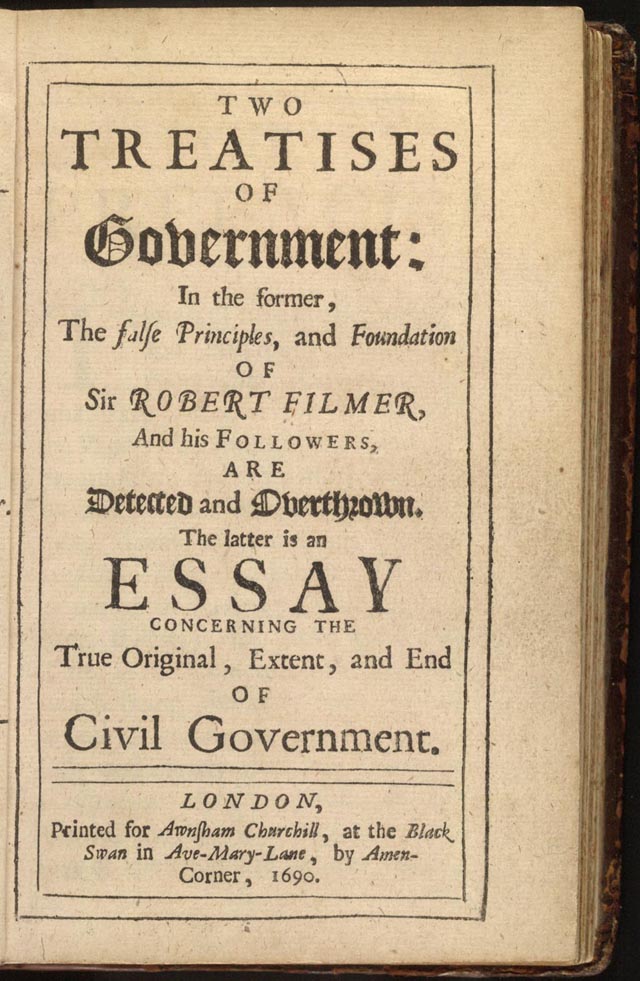
Title page of the 1690 London edition of Two Treatises of Government, printed in black letter and roman type in a bordered frame, reading 'Two Treatises of Government... an Essay concerning the True Original, Extent, and End of Civil Government', printed for Awnsham Churchill at the Black Swan in Ave-Mary-Lane, by Amen-Corner, 1690.Book

Primary source

Two Treatises of Government

John Locke · 1689 (dated 1690)

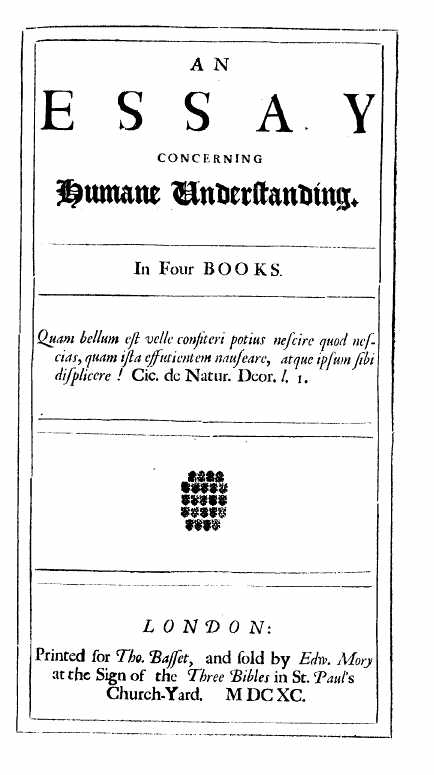
Title page of the 1690 first edition of An Essay Concerning Humane Understanding. Large capitals read 'AN ESSAY CONCERNING Humane Understanding. In Four Books.' A Latin epigraph from Cicero follows, then a printer's ornament and the imprint 'LONDON: Printed for Tho. Basset, and sold by Edw. Mory at the Sign of the Three Bibles in St. Paul's Church-Yard. MDCXC.'Book

Primary source

An Essay Concerning Human Understanding

John Locke · 1689 (dated 1690)

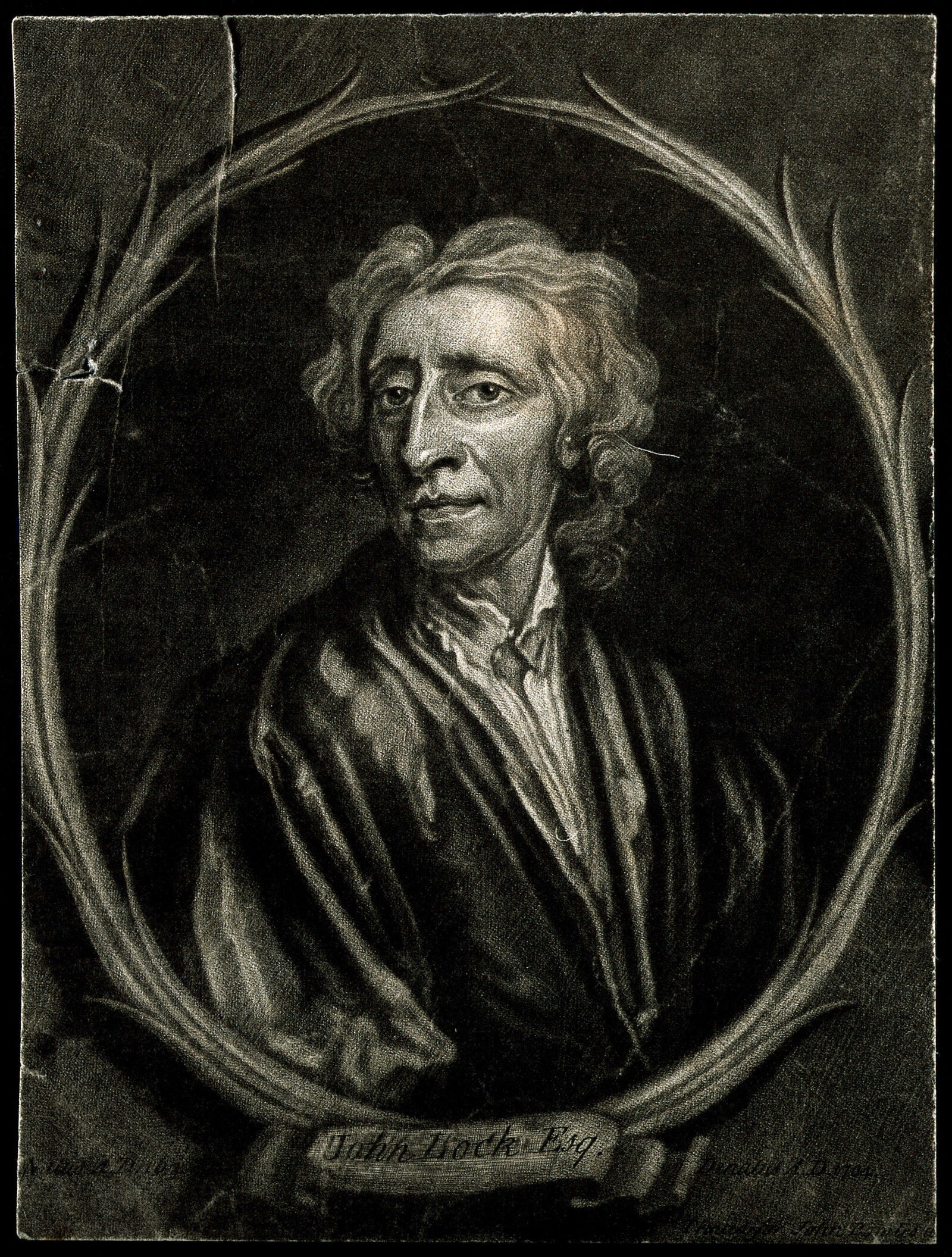
Sepia-toned mezzotint portrait of a man with long wavy hair, wearing a loose coat and open collar, turning slightly to his left within an oval frame of foliage. A cartouche at the bottom reads 'John Locke Esq.' with inscriptions in the lower corners.Painting

Secondary source

John Locke, Mezzotint after Godfrey Kneller

Godfrey Kneller

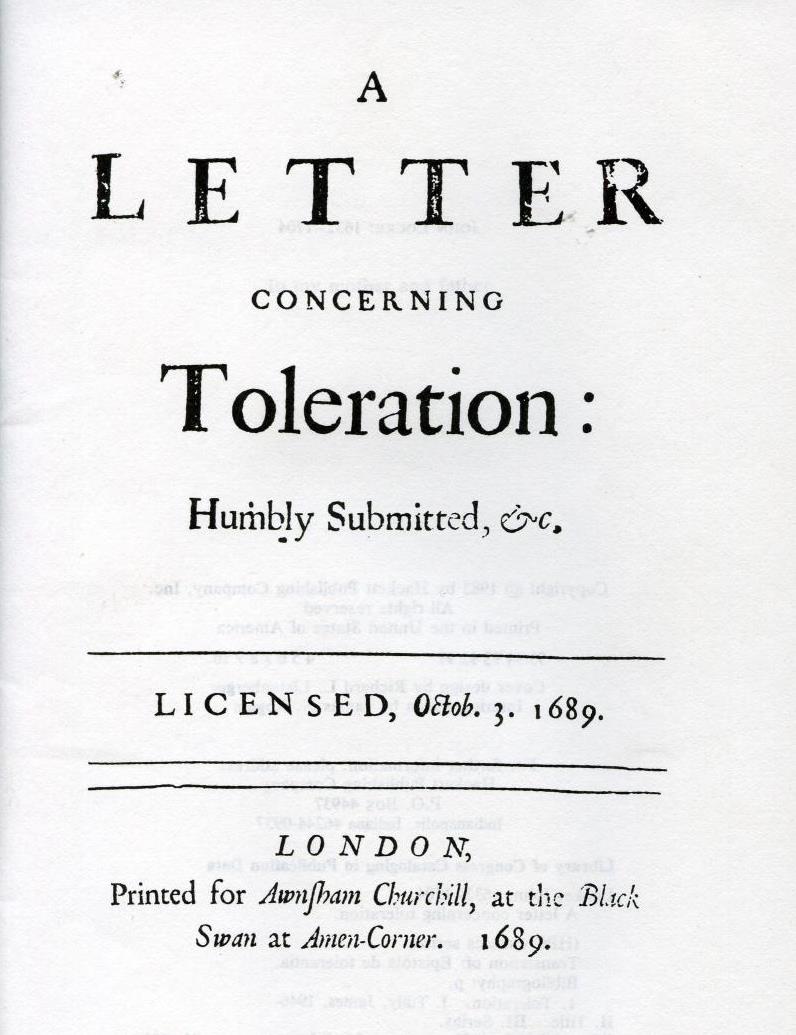
Title page of A Letter Concerning Toleration. Large capitals read 'A LETTER', then 'CONCERNING', then 'Toleration: Humbly Submitted, &c.' Below: 'LICENSED, October 3, 1689', then 'LONDON, Printed for Awnsham Churchill, at the Black Swan at Amen-Corner. 1689.' Faint reprint copyright text in background.Letter

Primary source

A Letter Concerning Toleration

John Locke · written 1685-1686, published 1689

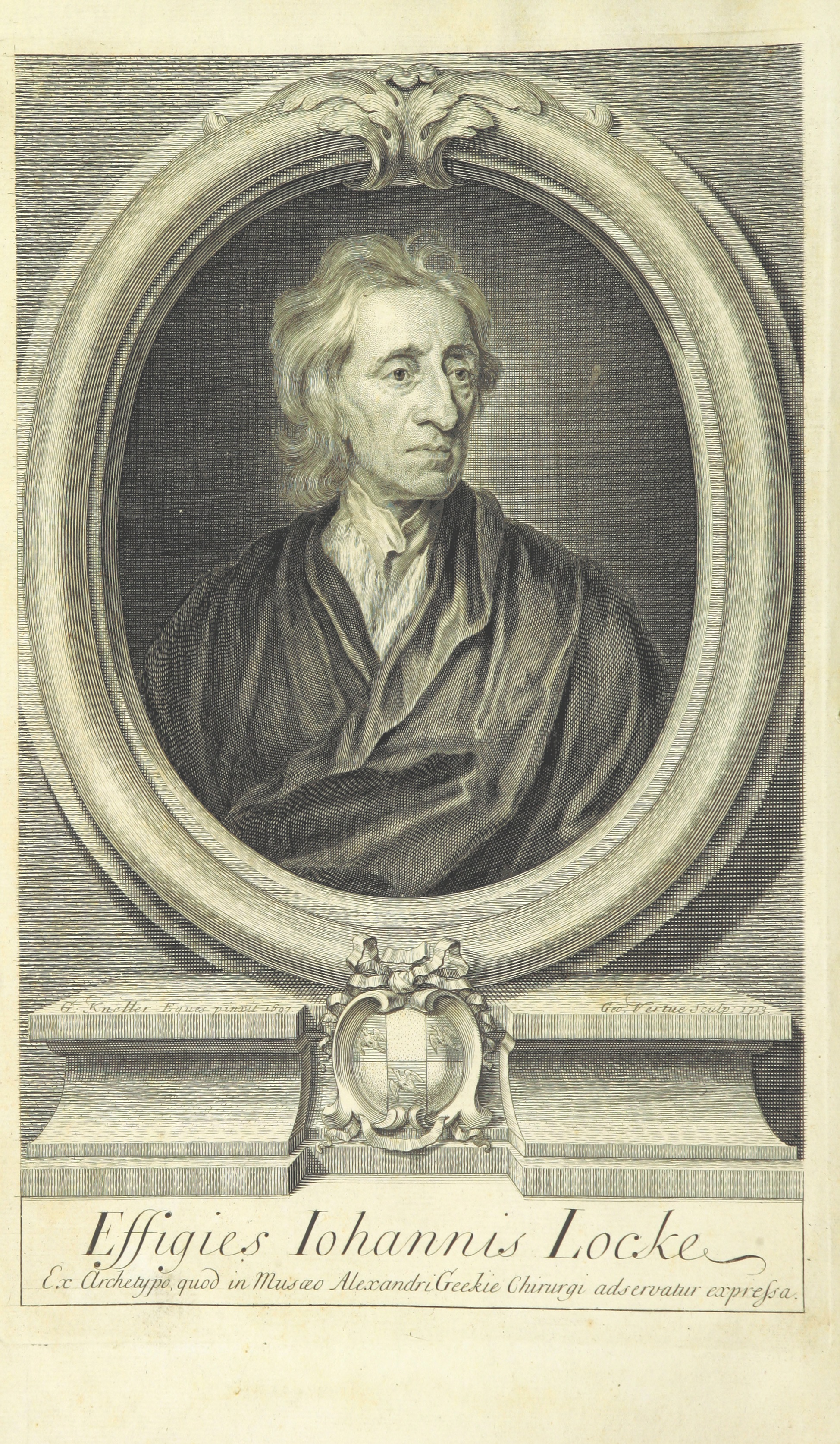
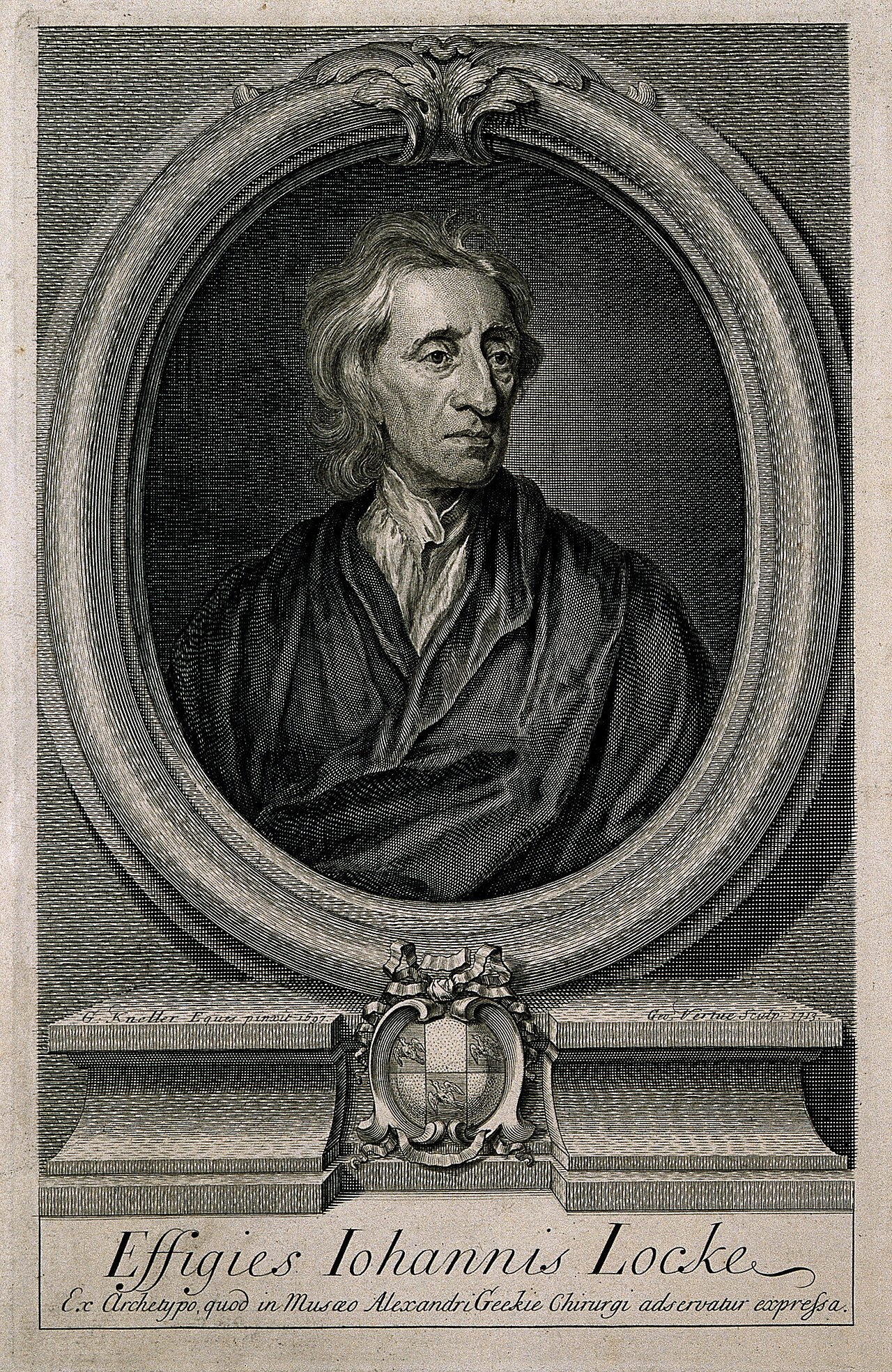
Engraved oval portrait of a man with long wavy hair, wearing a loose dark gown over a white collared shirt, set in an ornate oval frame atop a pedestal bearing a coat of arms. Inscription below reads 'Effigies Iohannis Locke' with a Latin line beneath, plus artist credits 'G. Kneller Equ. pinxit 1697' and 'Geo. Vertue Sculp. 1722'.Painting

Secondary source

Portrait of John Locke, frontispiece to Works

George Vertue, after Sir Godfrey Kneller · 1722

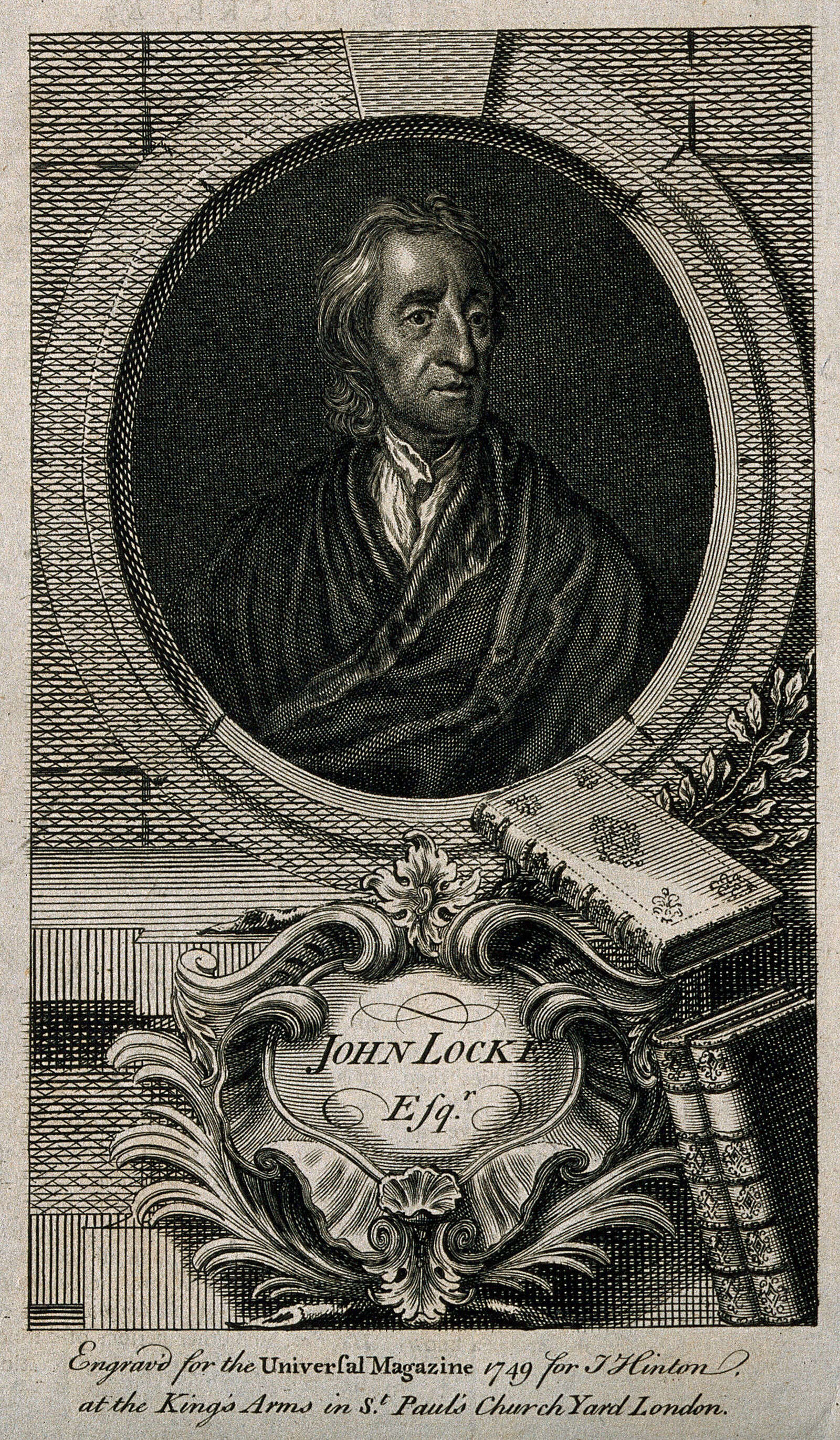
Black and white line engraving of a man with long wavy hair in a dark oval frame, wearing a loose coat over a white shirt. Below are books and a cartouche reading 'JOHN LOCKE Esq.' with a caption engraved for the Universal Magazine 1749.Painting

Secondary source

John Locke, Line Engraving after Kneller, 1749

Godfrey Kneller · 1749

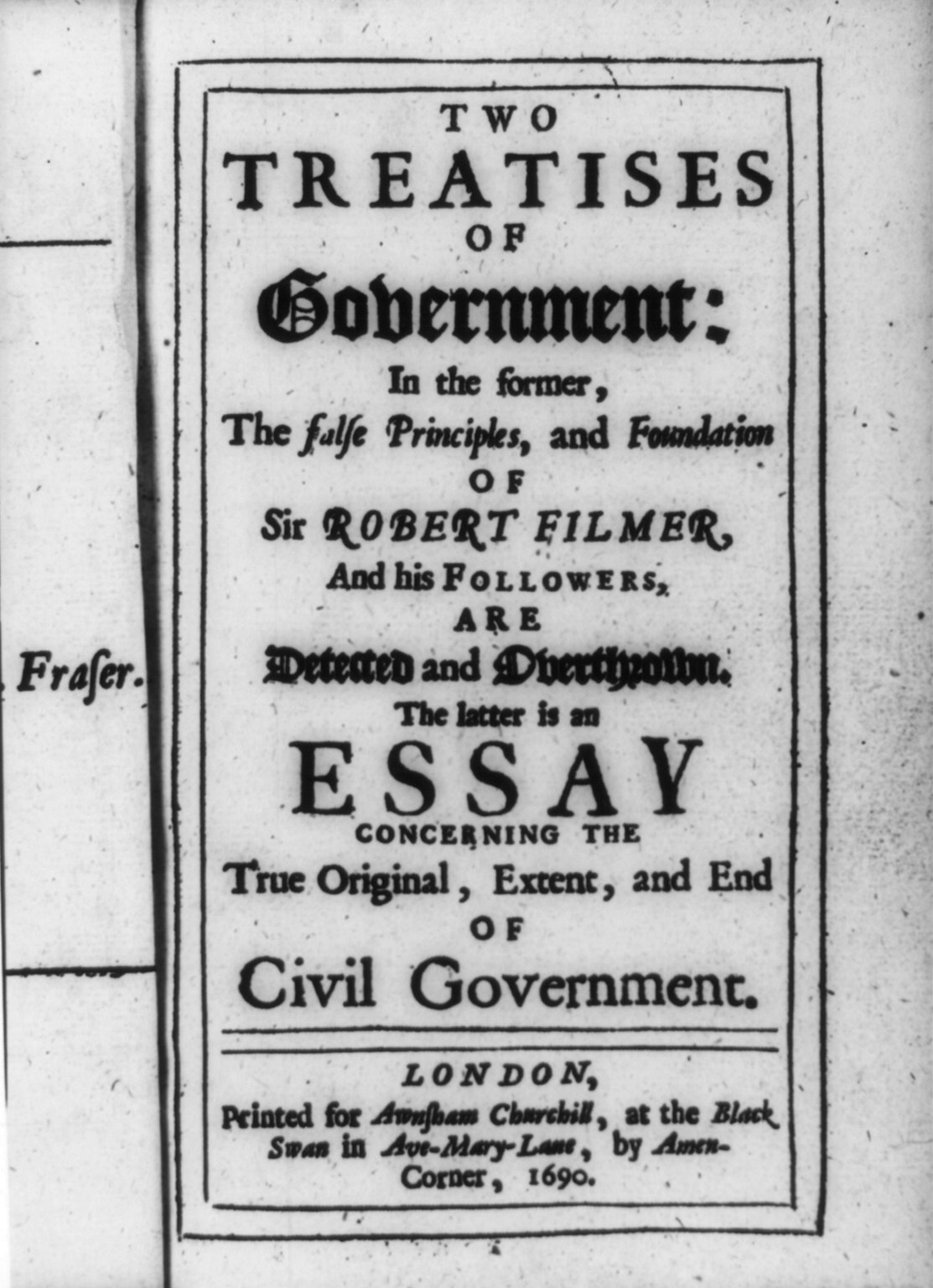
Black and white scan of the title page of Two Treatises of Government, printed in London in 1690. Large capitals read 'TWO TREATISES OF Government', followed by a long subtitle about Sir Robert Filmer and an essay on civil government. The imprint reads 'LONDON, Printed for Awnsham Churchill, at the Black Swan in Ave-Mary-Lane, by Amen-Corner, 1690.' A handwritten 'Fraser' appears at the left edge.Photograph

Primary source

Title page of Two Treatises of Government, 1690 edition

Miscellaneous Items in High Demand, PPOC, Library of Congress · 1690

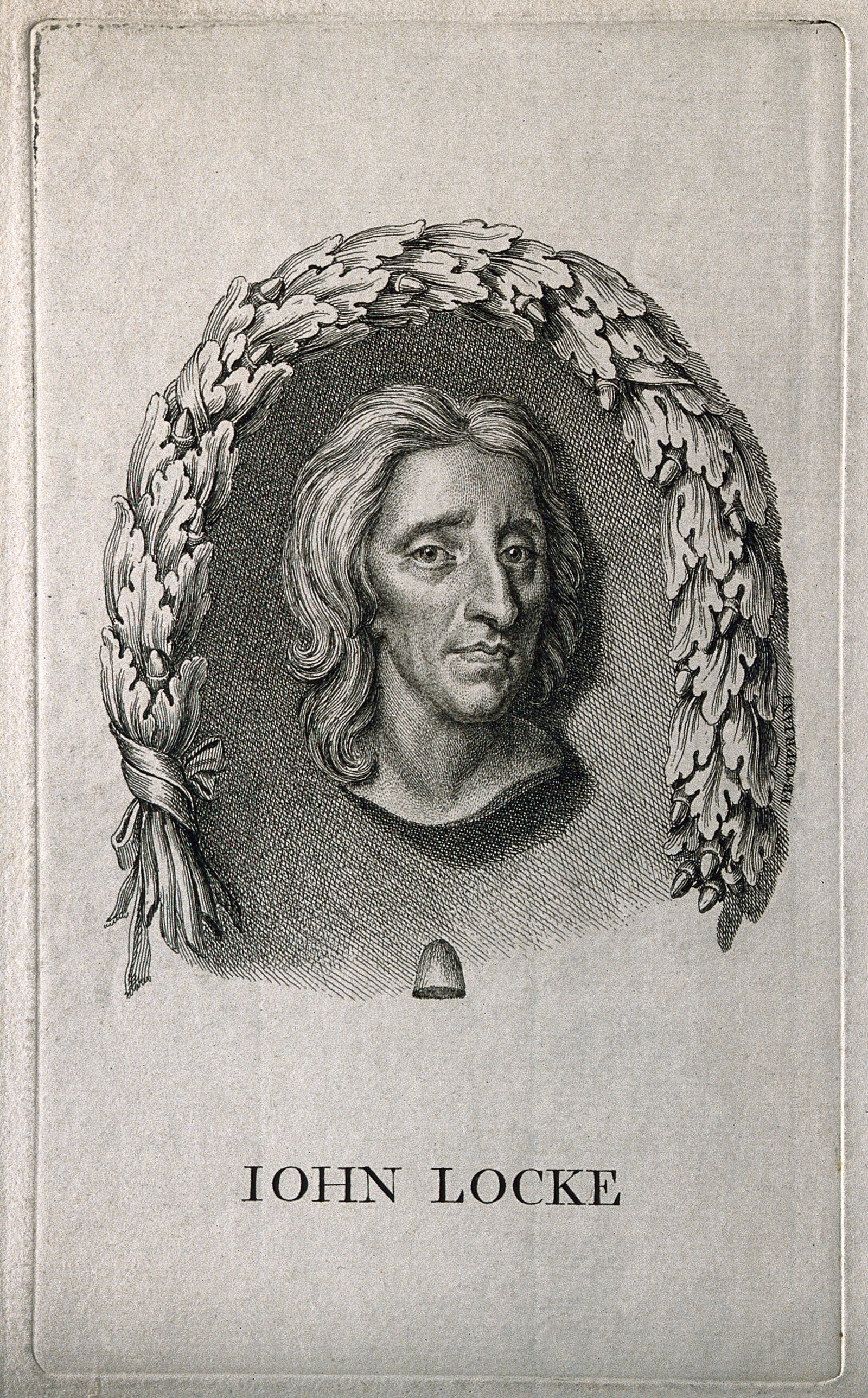
Oval engraved portrait of a man with shoulder-length wavy hair and a plain dark collar, set within a carved oak-leaf and acorn wreath tied with a ribbon at lower left. A thimble-like shape hangs below. The printed caption reads JOHN LOCKE.Painting

Secondary source

John Locke, Etching by Bartolozzi after Cipriani, 1765

Giovanni Battista Cipriani · 1765

Portrait print of John Locke.Painting

Secondary source

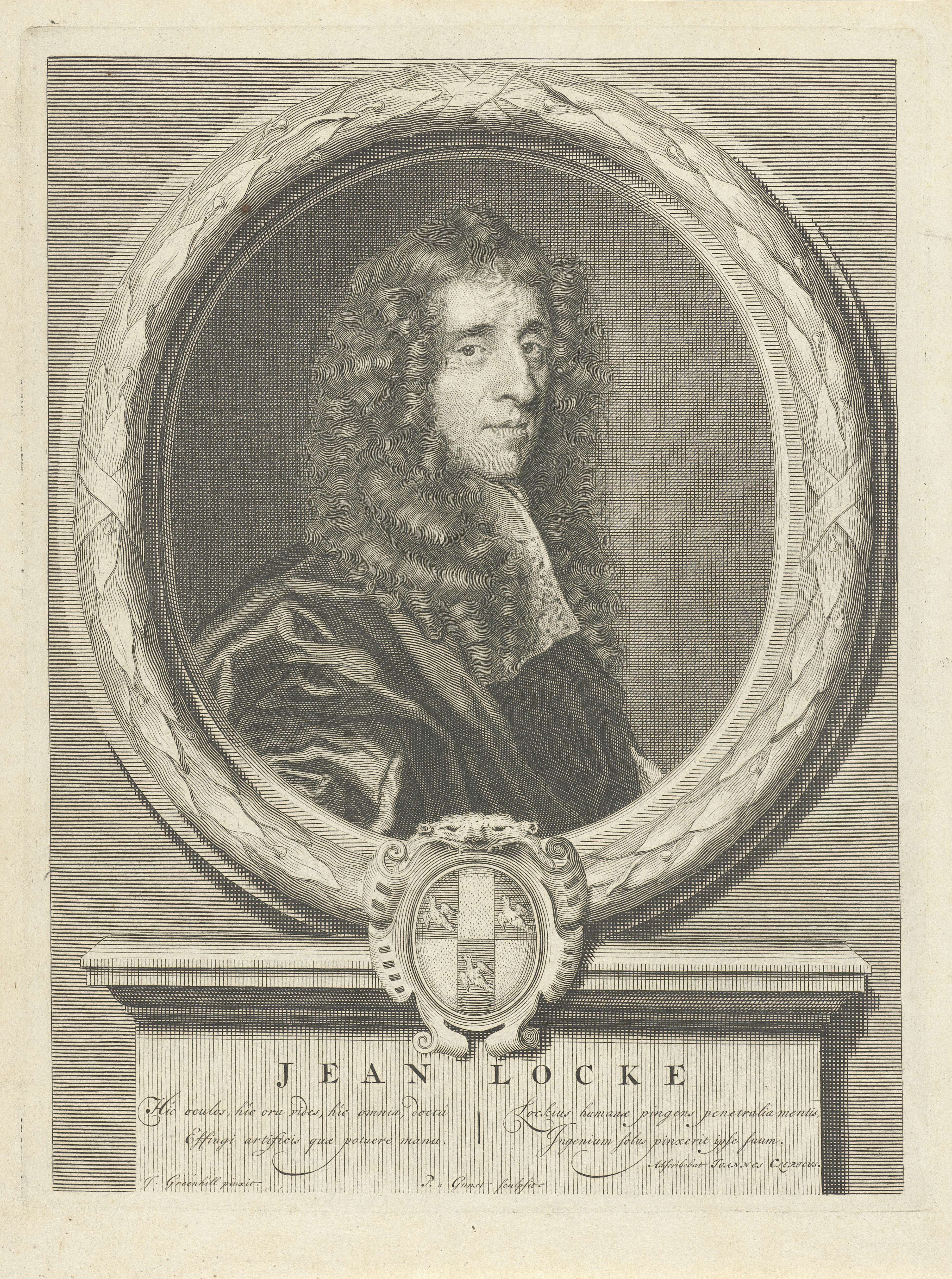
Portrait of John Locke, Dutch print with Latin inscription

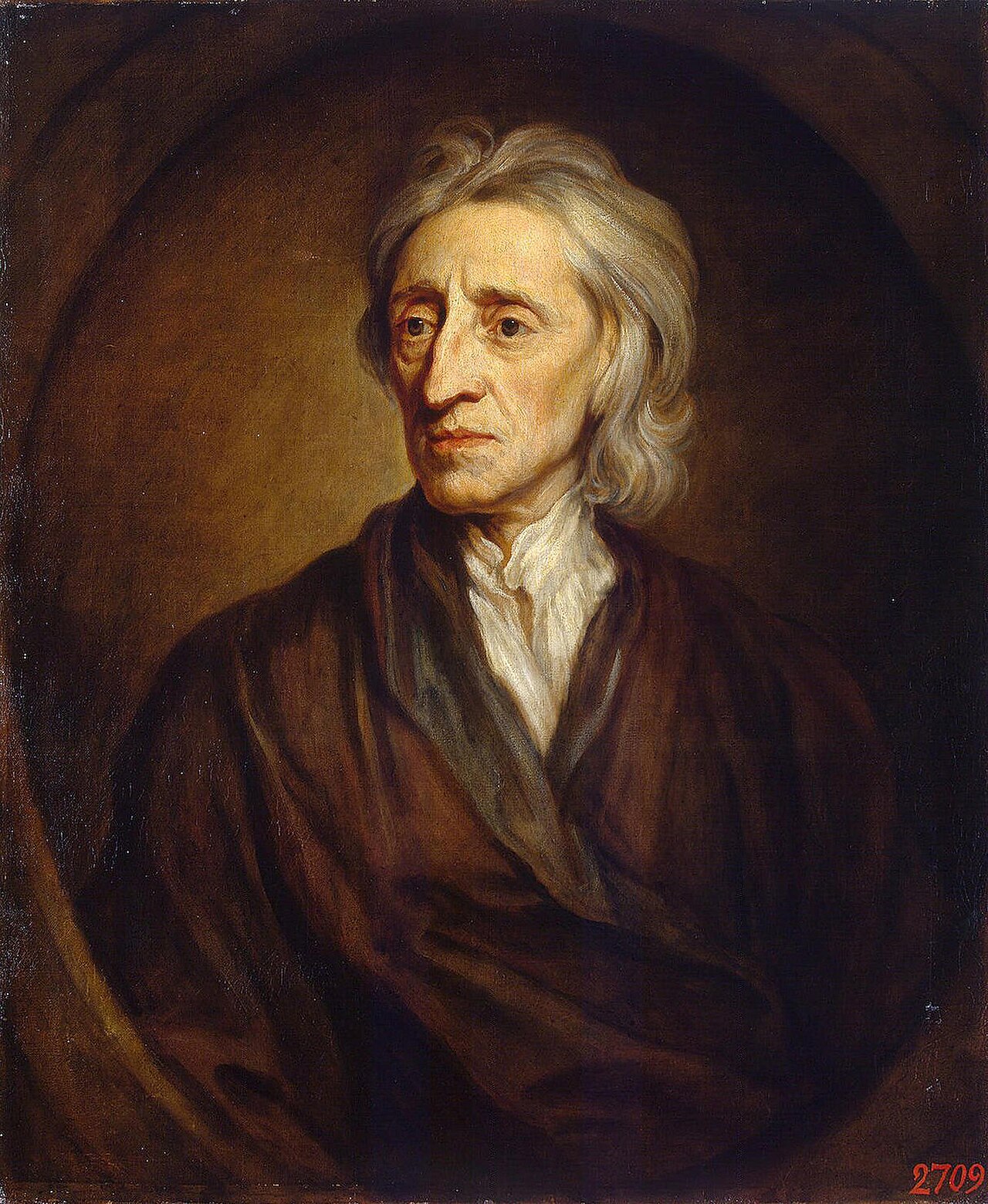
Oil portrait of an elderly man with long, wavy gray hair, wearing a brown robe over a white collarless shirt, set against a dark brown background within an oval frame. A red number 2709 appears at the lower right.Painting

Primary source

Portrait of John Locke

Godfrey Kneller · 1697

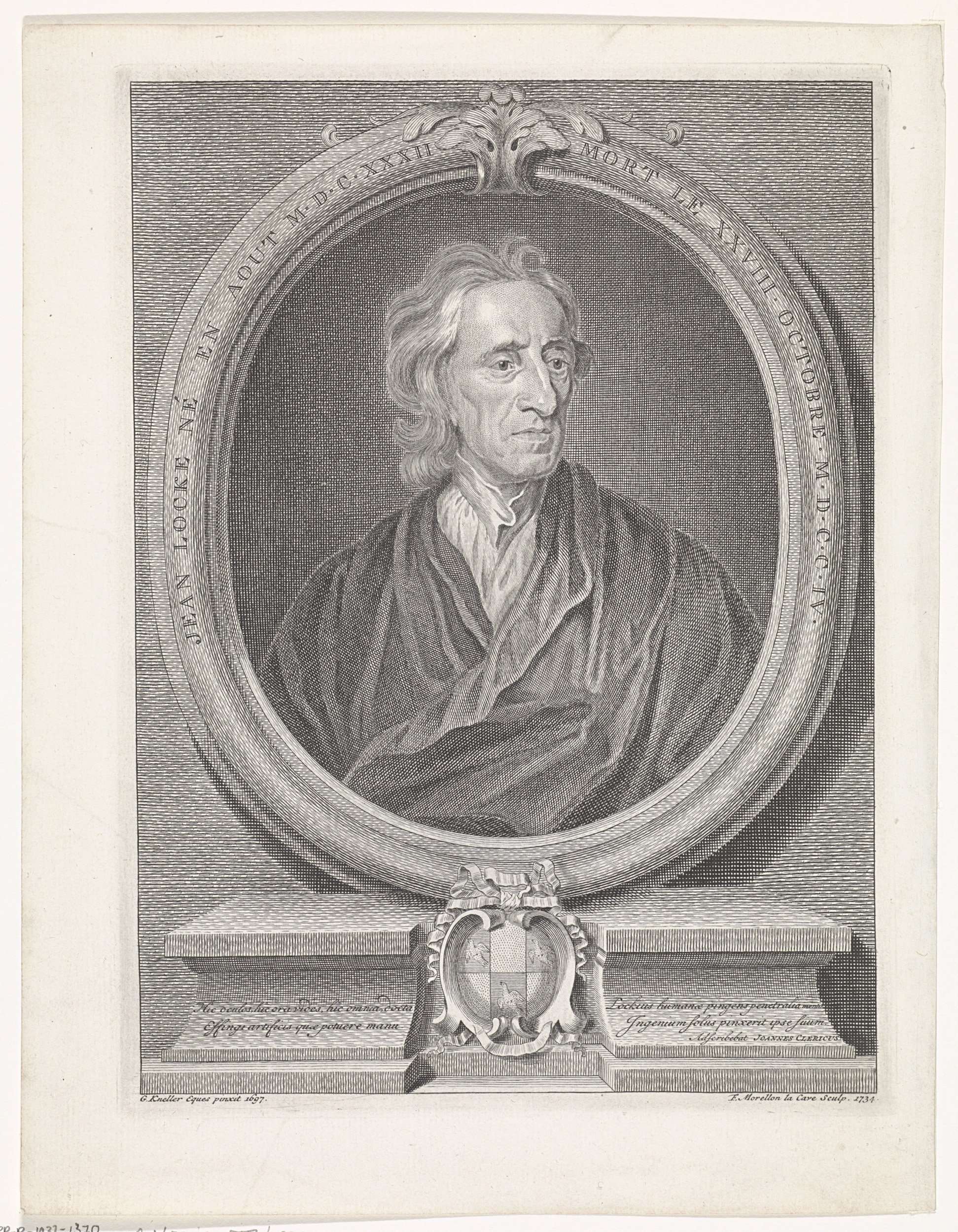
Engraved oval portrait of an older man with shoulder-length wavy hair, wearing a loose robe and open collar, in an ornate oval frame with inscriptions above and a crest below. Engraved by E. Morellon la Cave, 1734.Painting

Secondary source

Portrait of philosopher John Locke, 1734 print

E. Morellon la Cave · 1734

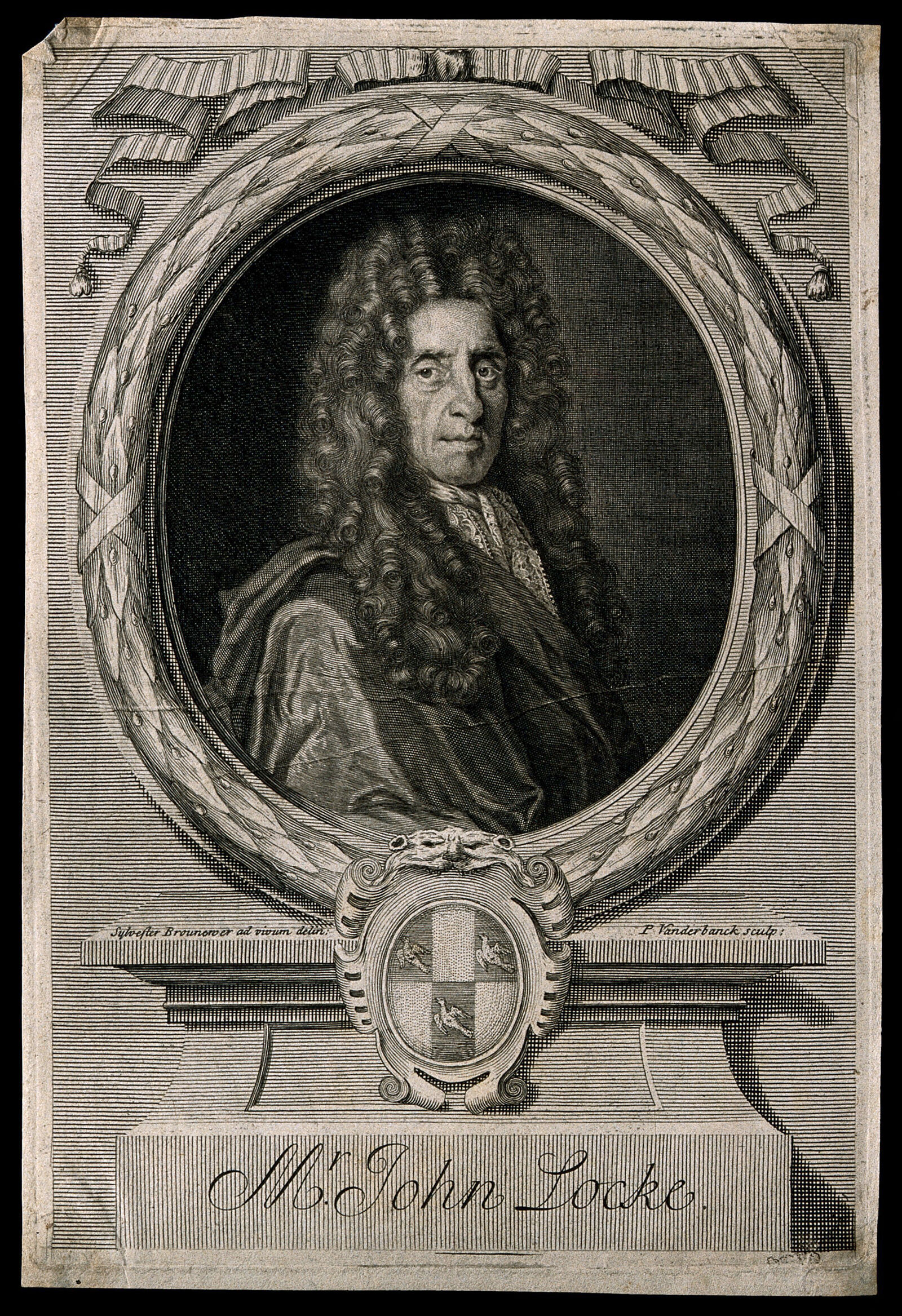
Engraved portrait of a man with long curled wig and plain cloak with lace collar, in an oval frame decorated with laurel and ribbons. Below is a coat of arms and the inscription 'Mr John Locke'. Inscriptions read 'Sylvester Brounower ad vivum delin' and 'P. Vanderbanck sculp'.Painting

Secondary source

John Locke, Line Engraving by Nutting after Brownover

Sylvester Brownover

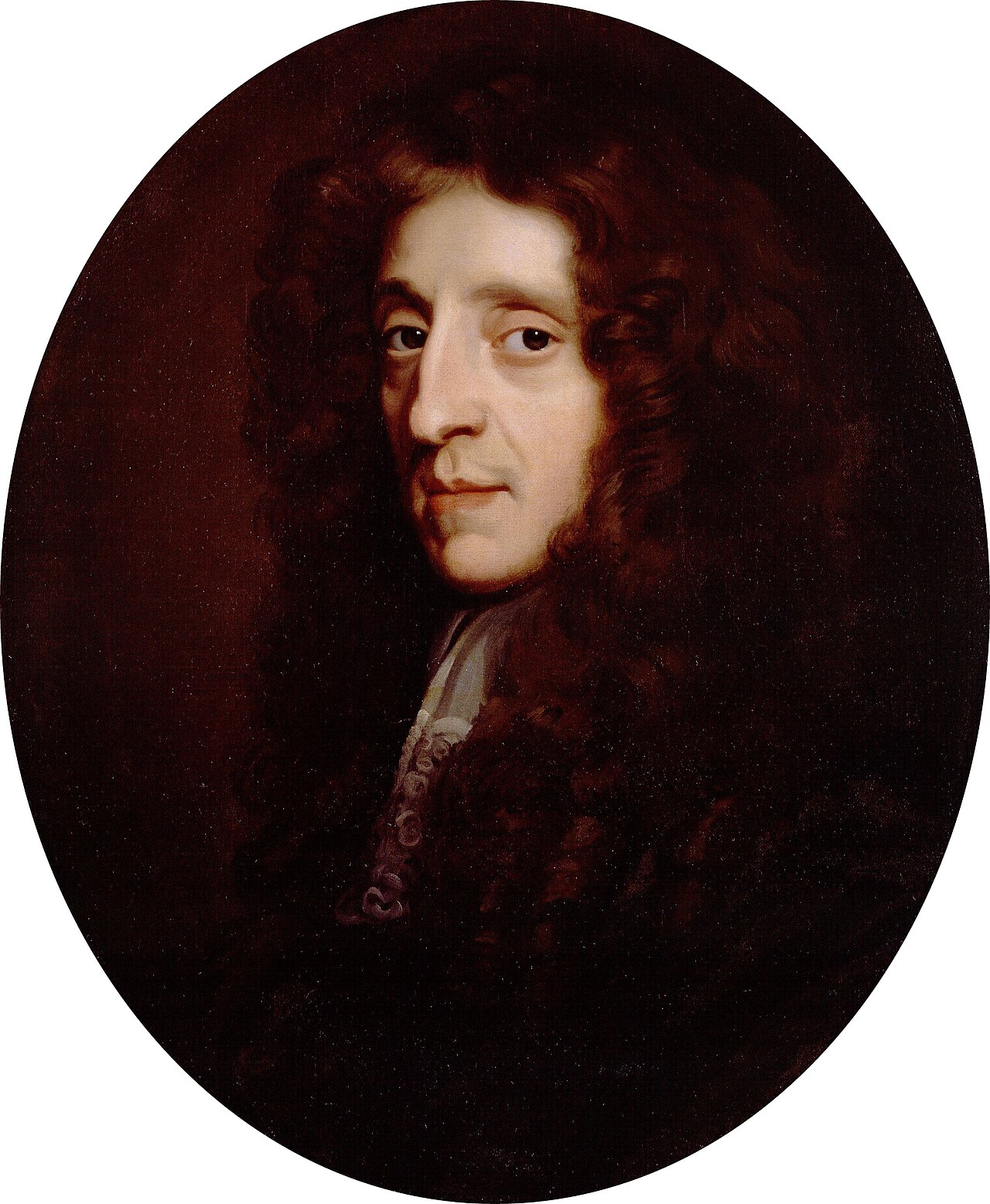
Oval-framed oil portrait of a man with shoulder-length curly brown hair, shown from the shoulders up against a dark brown background. He wears a dark garment with a lace or white collar and looks toward the viewer with a calm expression.Painting

Primary source

John Locke

John Greenhill · c. 1672

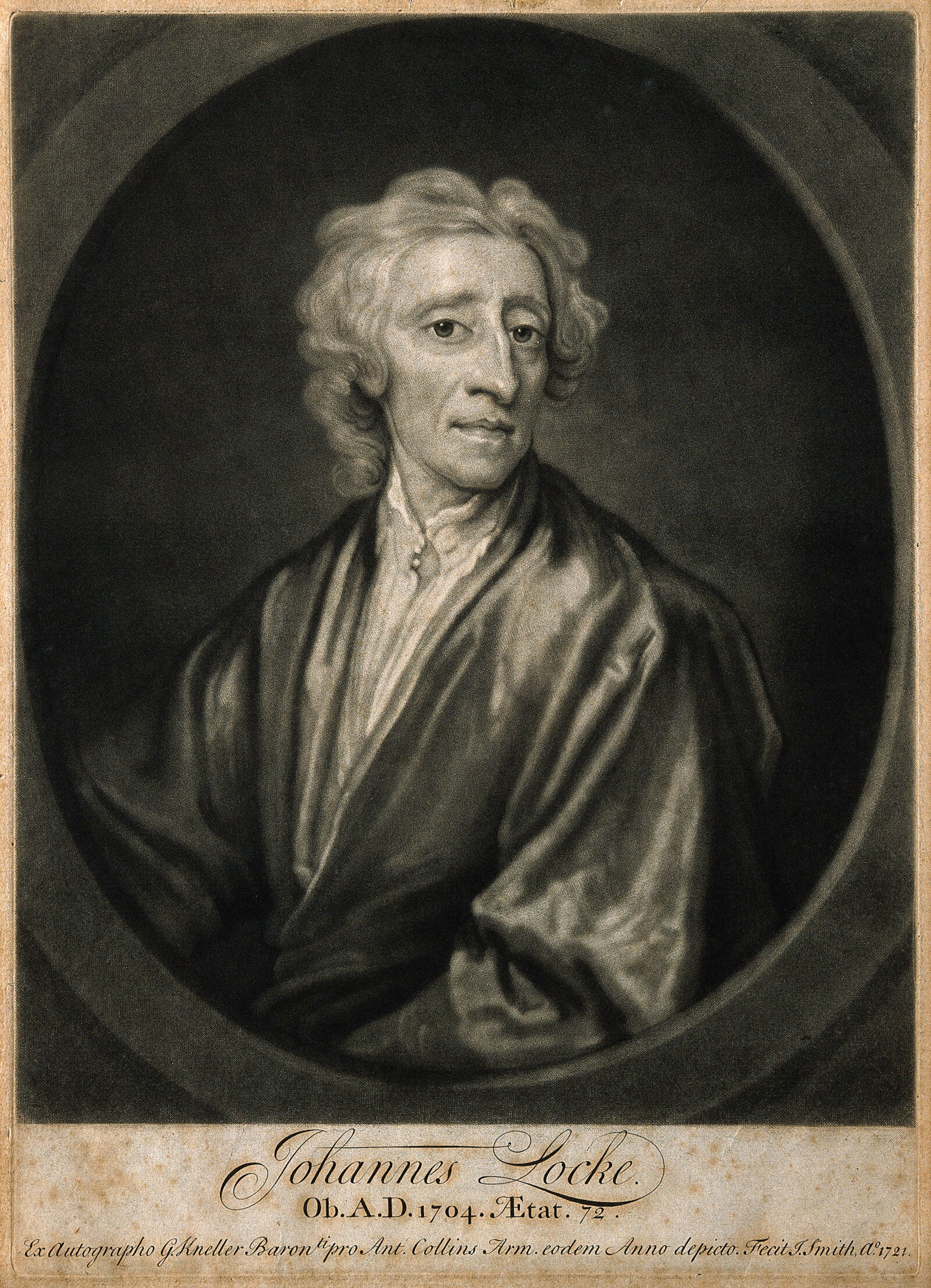
Oval mezzotint portrait of a man with shoulder-length wavy grey hair, wearing a loose dark coat over a white shirt, against a dark background. Caption below reads Johannes Locke, Ob. A.D. 1704, Aetat. 72, with inscription naming Kneller and Smith, 1721.Painting

Secondary source

John Locke, Mezzotint by J. Smith after Kneller, 1721

Godfrey Kneller · 1721

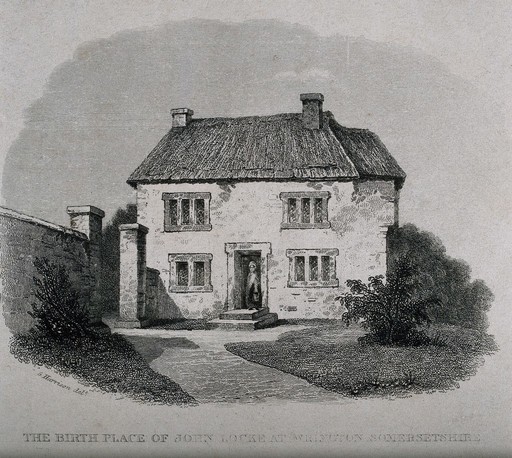
Black and white etching of a two-storey stone cottage with a slate roof, two chimneys, mullioned windows, and a central porch with steps, set among trees and a stone wall. Caption below reads: The birth place of John Locke at Wrington Somersetshire.Painting

Secondary source

The birthplace cottage of John Locke at Wrington

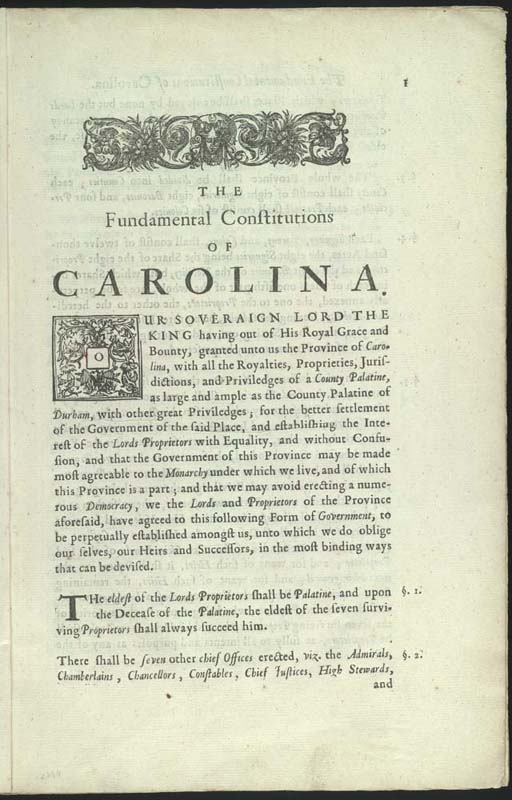
Scanned first page of the Fundamental Constitutions of Carolina, printed in black text on aged cream paper. A decorative ornamental header sits above the bold title 'The Fundamental Constitutions of Carolina', followed by an opening paragraph beginning 'Our Sovereign Lord the King' and a section marked 'The eldest of the Lords Proprietors shall be Palatine'.Document

Primary source

Fundamental Constitutions of Carolina

1669

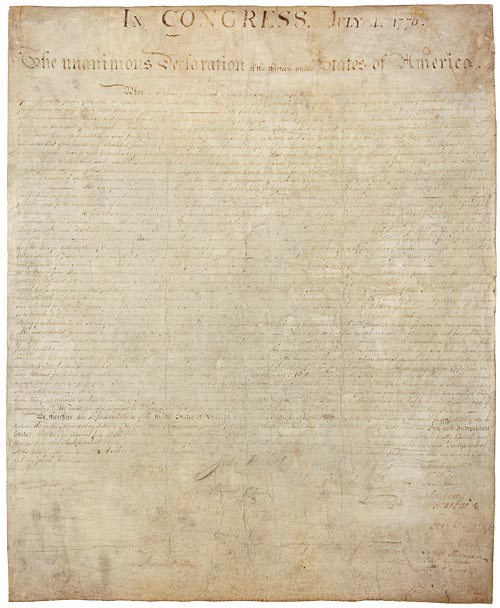
Scan of the engrossed Declaration of Independence on aged parchment. Heading reads 'In Congress, July 4, 1776' with the title 'The unanimous Declaration of the thirteen United States of America' below. Dense handwritten text fills the page; signatures appear at the bottom.Document

Primary source

Declaration of Independence

Continental Congress (drafted by Thomas Jefferson) · 1776

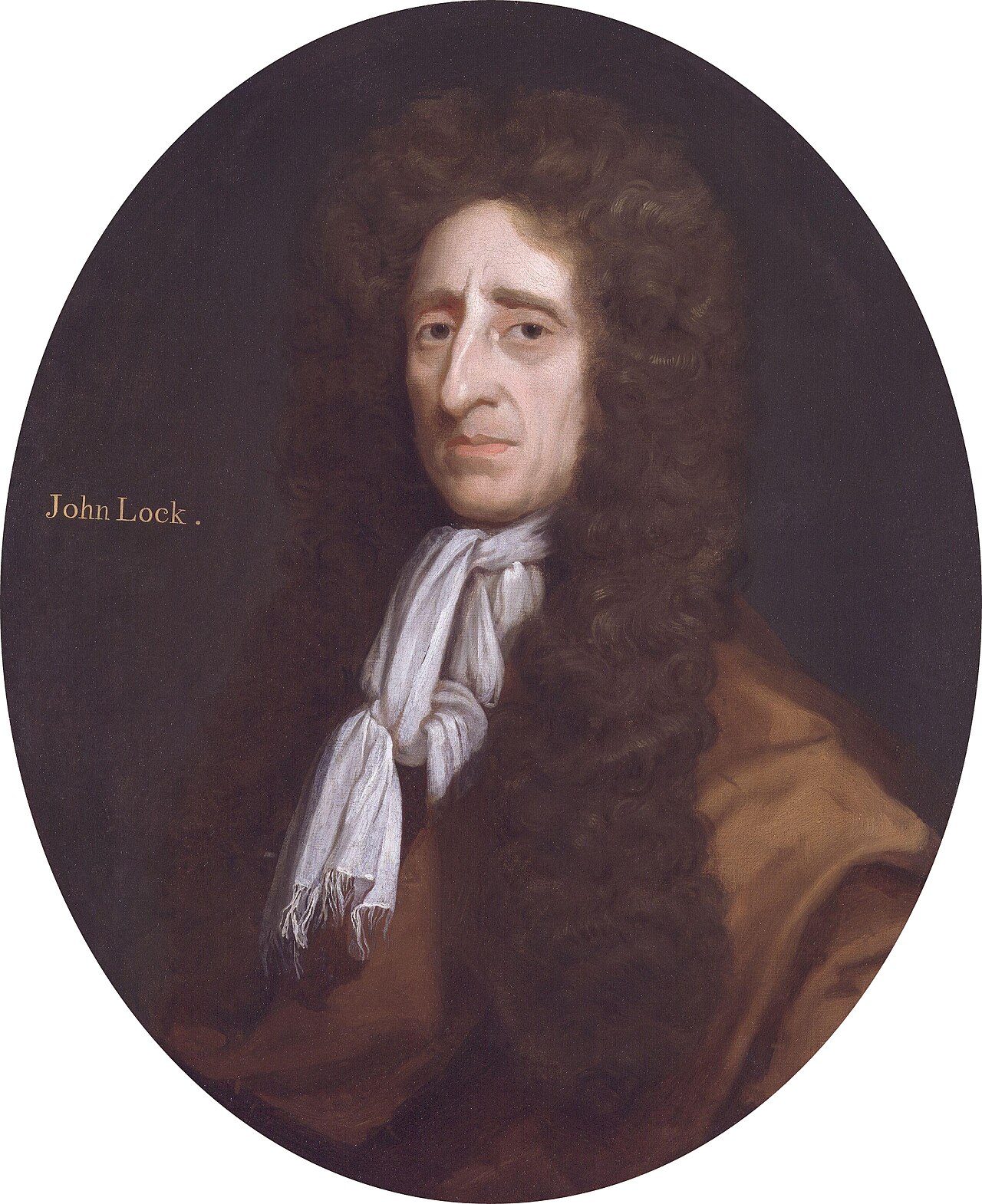
Oval oil portrait of a man with shoulder-length curled brown hair, wearing a white cravat and a brown cloak against a dark background. The label reads 'John Lock.' He looks toward the viewer.Painting

Primary source

Portrait of John Locke by Michael Dahl

Michael Dahl · 1696

Oval oil portrait of a man with shoulder-length curled brown hair, a pale face and dark eyes, looking toward the viewer. He wears a dark garment with a light grey collar and lace-like trim against a dark brown background.Painting

Primary source

Portrait of John Locke by John Greenhill

John Greenhill · c. 1672–1676

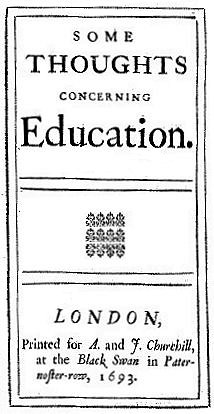
Title page of 'Some Thoughts Concerning Education' in black and white. Text reads SOME THOUGHTS CONCERNING Education, with an ornament in the middle and imprint: LONDON, Printed for A. and J. Churchill, at the Black Swan in Paternoster-row, 1693.Book

Primary source

Some Thoughts Concerning Education

John Locke · 1693

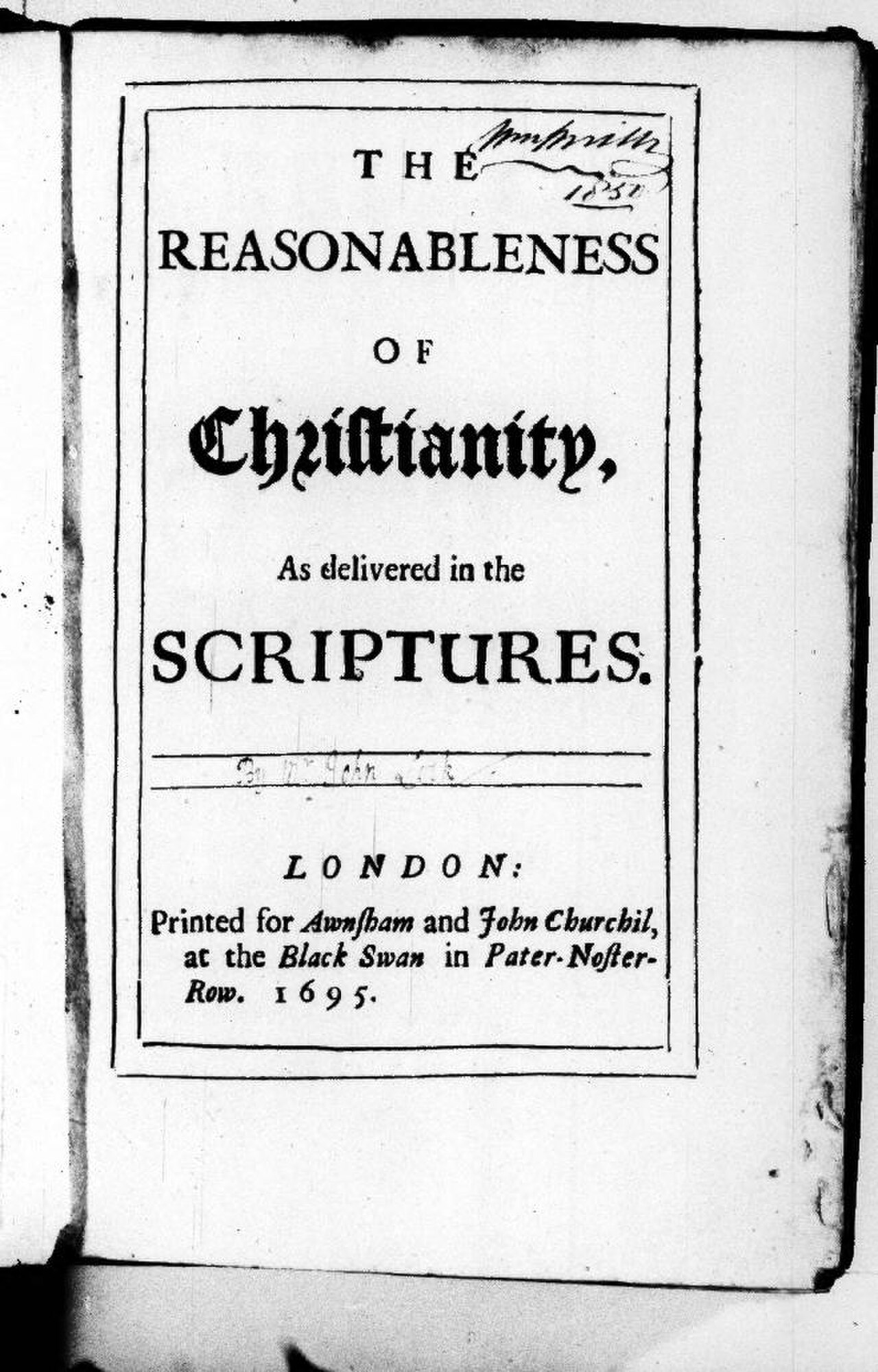
Title page of The Reasonableness of Christianity, As delivered in the Scriptures, printed in London for Awnsham and John Churchill at the Black Swan in Pater-Noster-Row, 1695. Handwritten annotations appear at the top right and in a ruled area.Book

Primary source

The Reasonableness of Christianity

John Locke · 1695

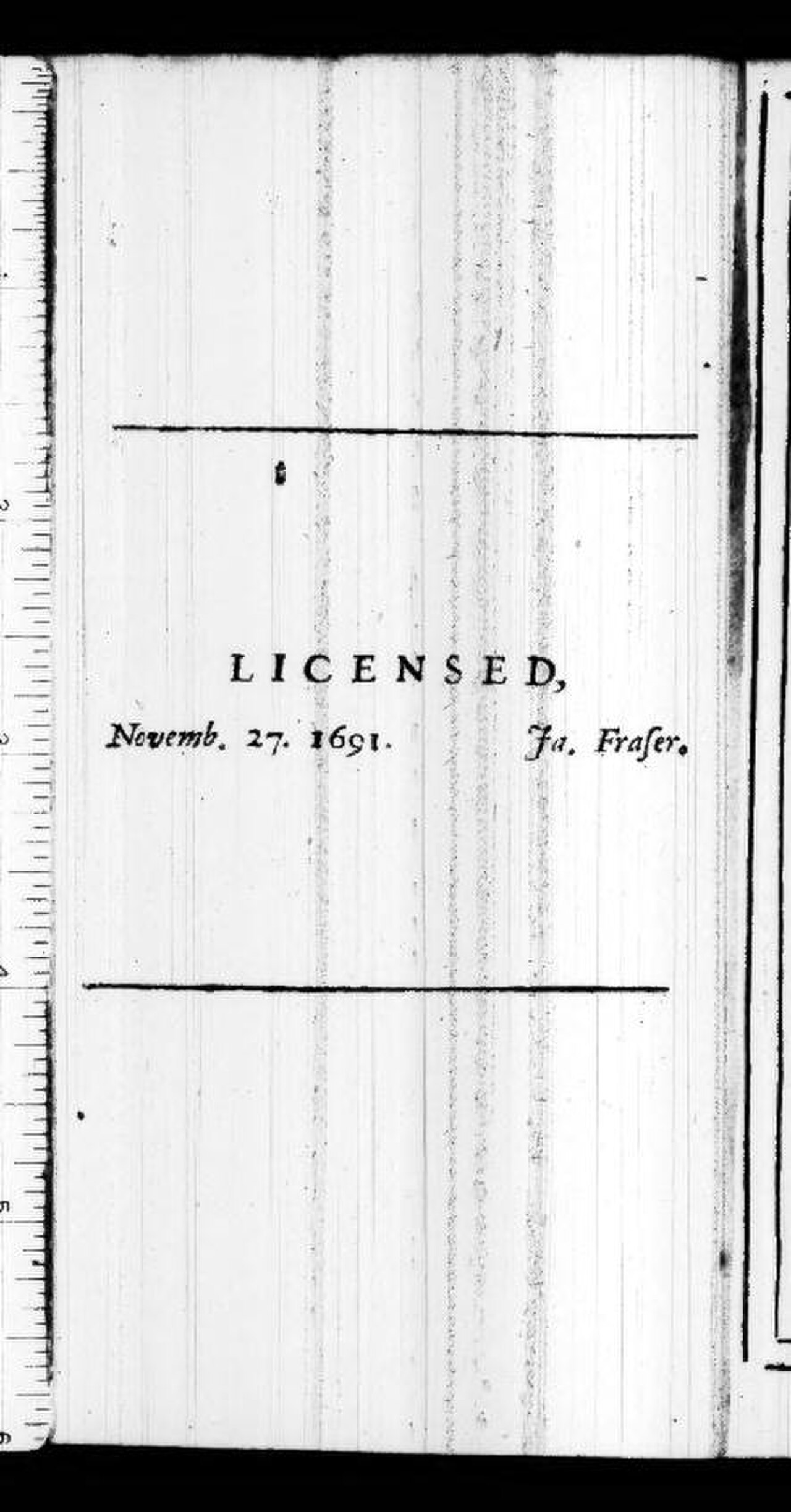
Scanned black-and-white title page verso of an early printed book, showing a centered printed line reading 'LICENSED,' followed by 'Novemb. 27. 1691.' and 'Ja. Fraser' in italic script, with horizontal rules above and below and a ruler along the left edge.Book

Primary source

Some Considerations of the Consequences of the Lowering of Interest and Raising the Value of Money

John Locke · 1691

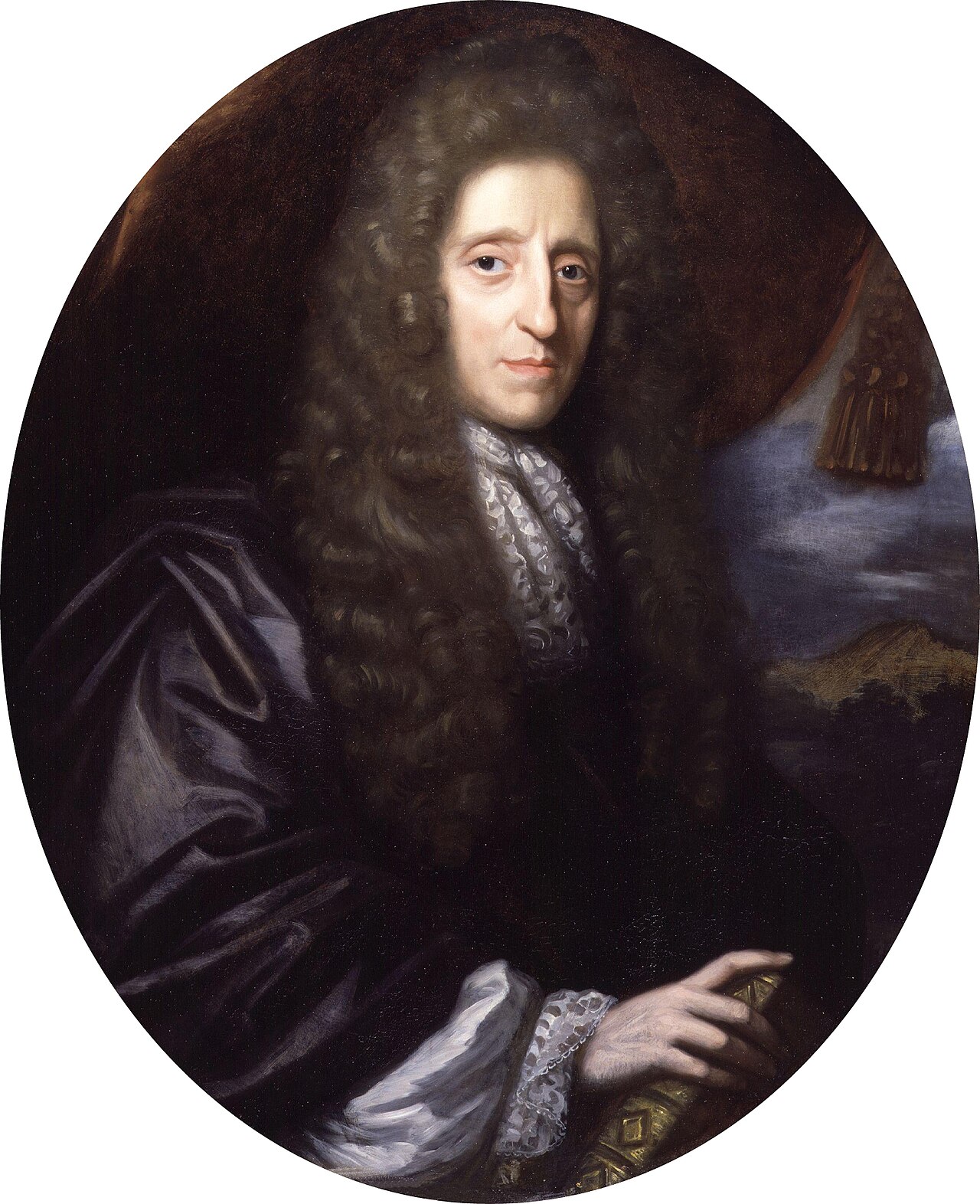
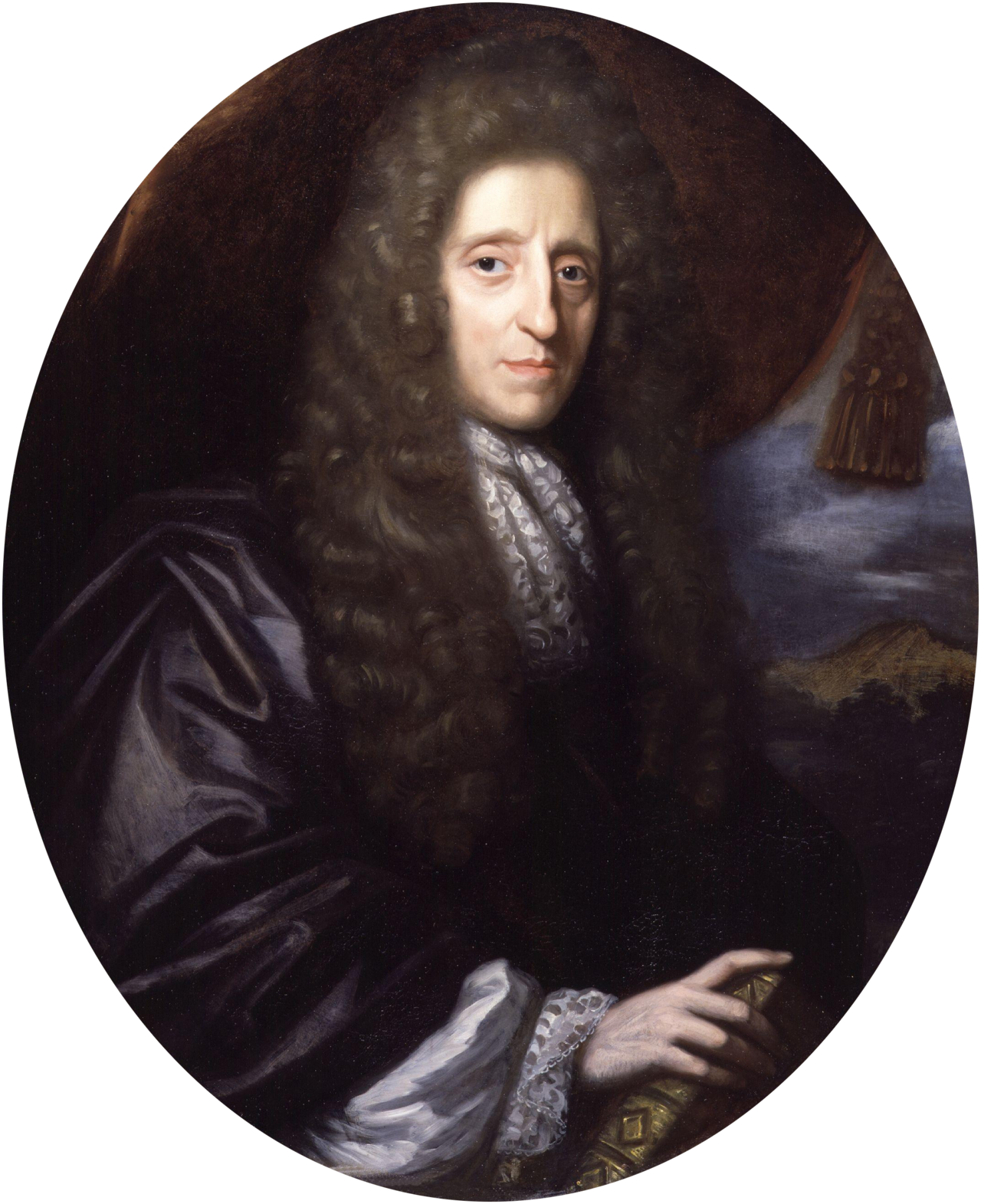
Oval oil portrait of a man with long curled wig, dark cloak, white lace cravat and cuffs, one hand resting on a gold-trimmed cloth, with a dark red drape and a cloudy landscape behind him.Painting

Primary source

John Locke

Herman Verelst · 1689

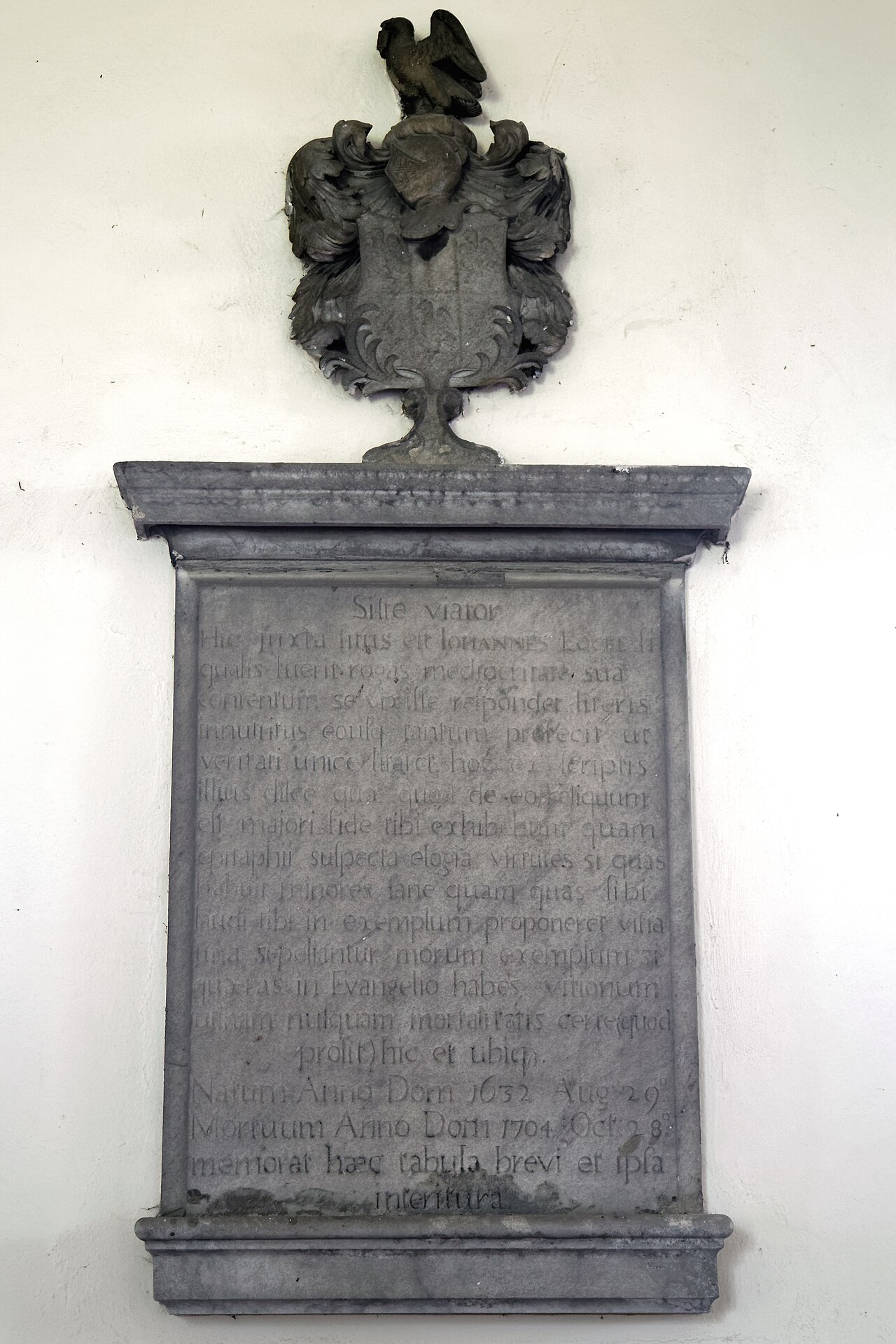
Grey stone wall monument with a carved coat of arms and a bird crest at top, above a rectangular inscribed tablet with a moulded frame and Latin text, mounted on a white wall.Sculpture

Primary source

John Locke Memorial, All Saints Church, High Laver

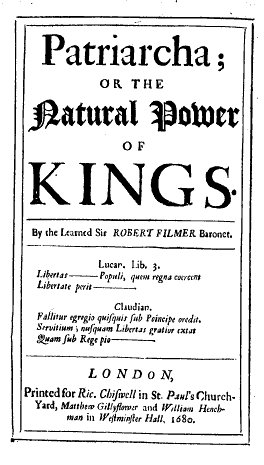
Title page of Patriarcha; or the Natural Power of Kings, by Sir Robert Filmer Baronet. Large black-letter title, epigraphs from Lucan and Claudian in Latin, and imprint reading London, printed for Ric. Chiswell, 1680.Book

Primary source

Patriarcha

Robert Filmer · 1680

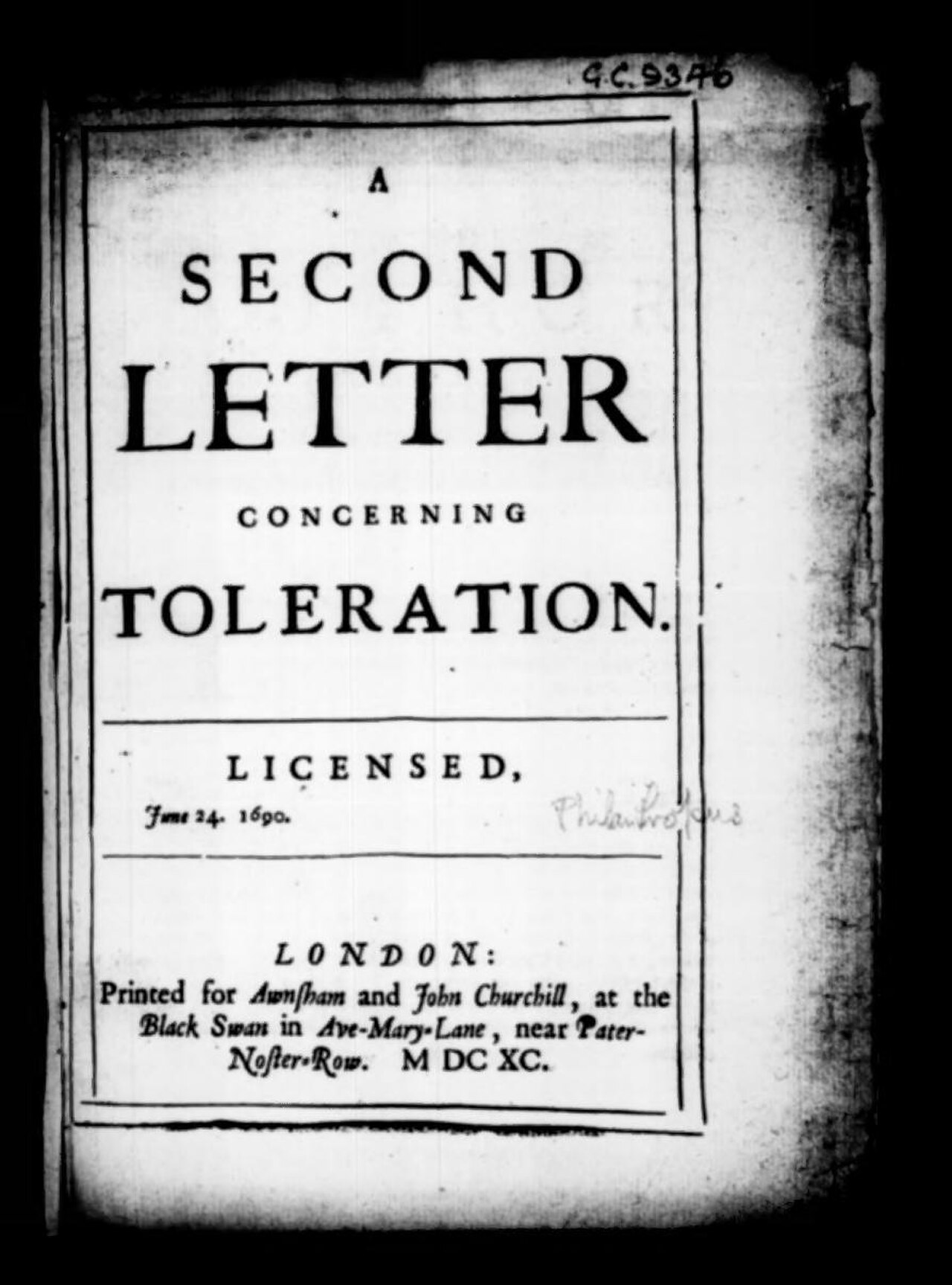
Title page of A Second Letter Concerning Toleration, black and white scan. Text reads: A SECOND LETTER CONCERNING TOLERATION. Licensed, June 24, 1690. London: Printed for Awnsham and John Churchill, at the Black Swan in Ave-Mary-Lane, near Pater-Noster-Row, MDCXC. Handwritten note reads Philadelphus. Library stamp at top reads C.C.9346.Book

Primary source

A Second Letter Concerning Toleration

John Locke · 1690

Title page of a book, scanned in black and white. Centered text reads: Mr. Locke's LETTER TO THE Bishop of Worcester. Horizontal rules appear above and below the title. Black borders frame the scan.Letter

Primary source

A Letter to the Right Reverend Edward, Lord Bishop of Worcester

John Locke · 1697

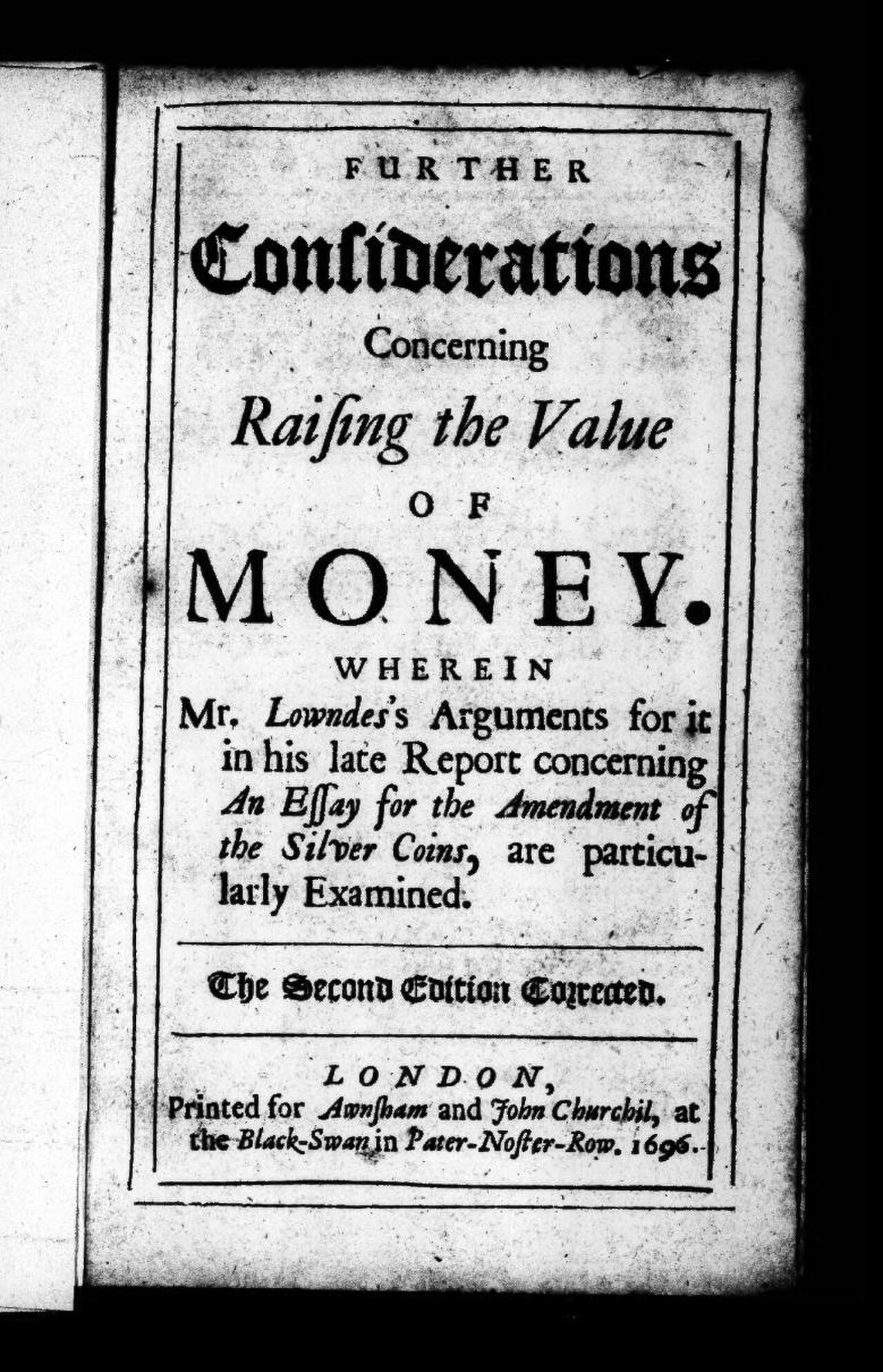
Title page of a 1696 book, second edition corrected. Large heading reads 'Further Considerations Concerning Raising the Value of Money', followed by 'Wherein Mr. Lowndes's Arguments for it in his late Report concerning An Essay for the Amendment of the Silver Coins, are particularly Examined.' Imprint: London, printed for Awnsham and John Churchill at the Black-Swan in Pater-Noster-Row, 1696.Book

Primary source

Further Considerations Concerning Raising the Value of Money

John Locke · 1695

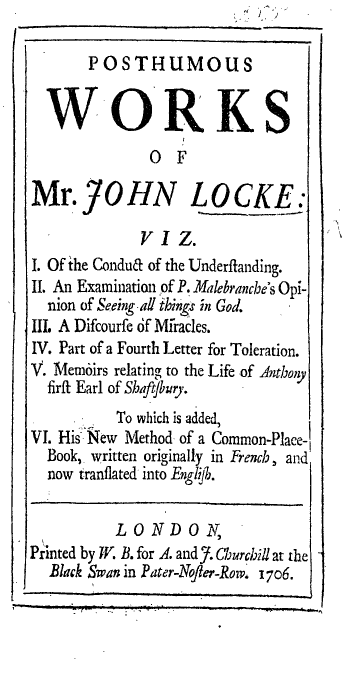
Title page of 'Posthumous Works of Mr. John Locke', 1706, listing contents including 'Of the Conduct of the Understanding', printed in London by W. B. for A. and J. Churchill at the Black Swan in Paternoster Row.Book

Secondary source

Of the Conduct of the Understanding

John Locke · 1706

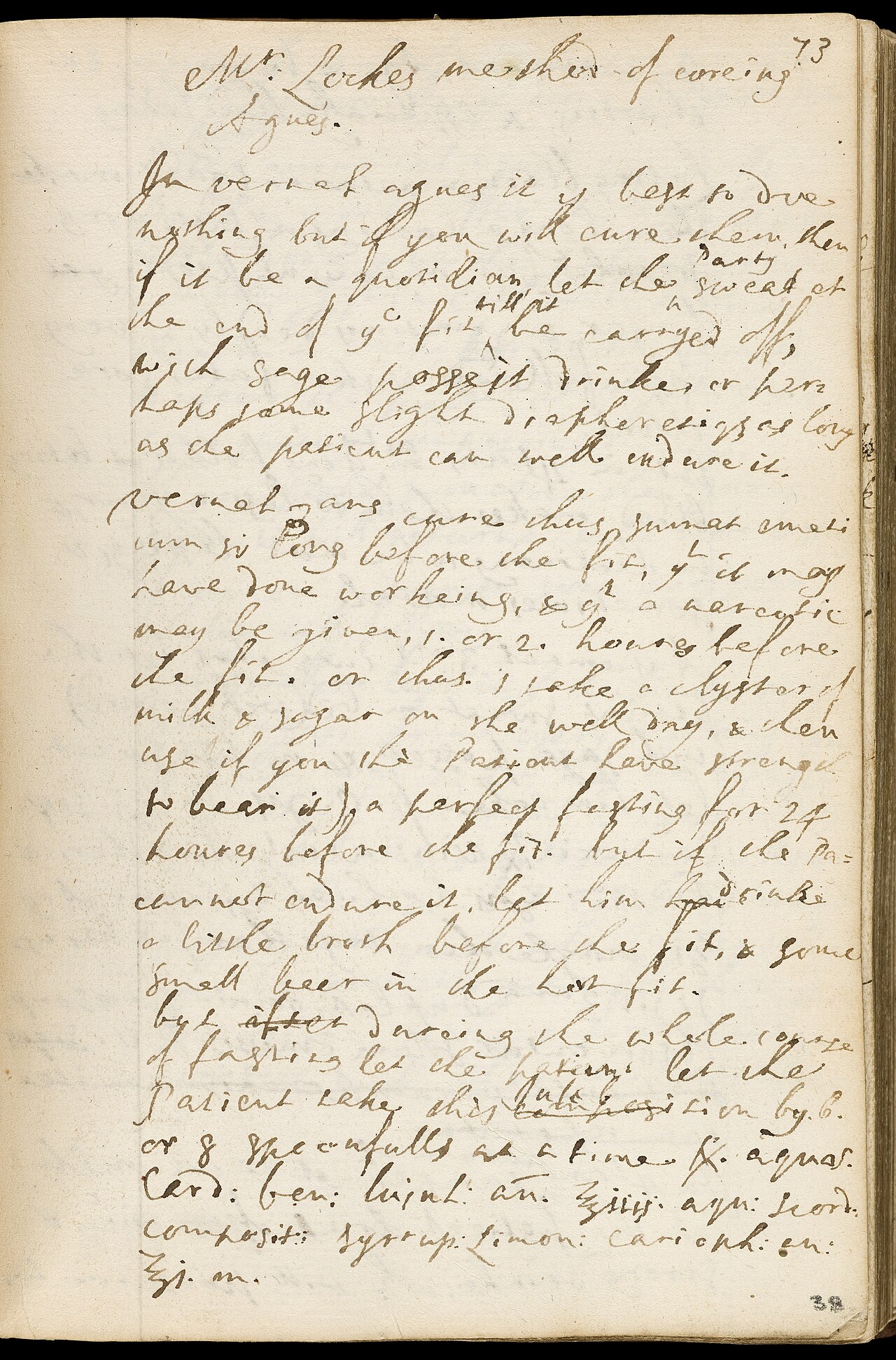
Handwritten manuscript page numbered 73 in brown ink on aged cream paper, titled 'Mr Lockes method of curing Agnes', with a dense cursive medical text describing treatment for agues, including sage, sweat, diet and draughts.Document

Primary source

Mr Lockes Method of Curing Agnes Wellcome L0063399

1691

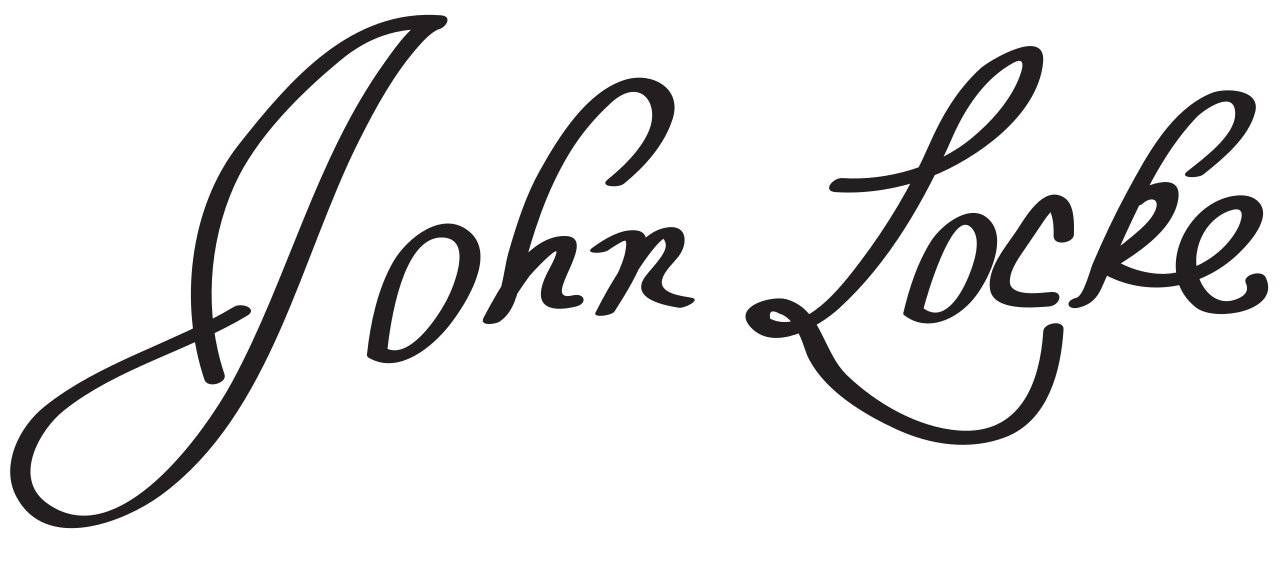
Black handwritten-style cursive signature reading 'John Locke' on a white background, with large looping capital J and L.Document

Primary source

Signature of John Locke

John Locke

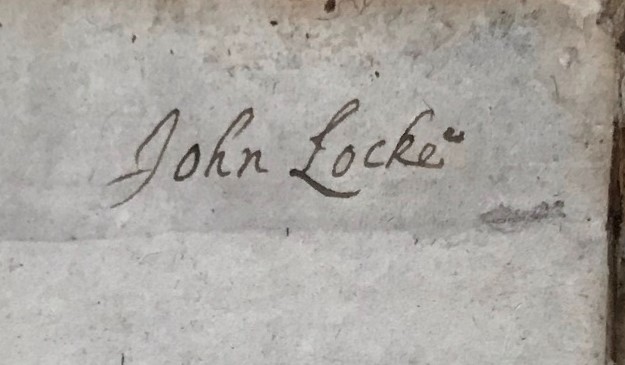
Close-up photograph of a handwritten signature in brown ink reading 'John Locke' in cursive script on a pale, slightly textured paper surface, with a faint fold line below.Photograph

Primary source

Locke Signature

Wtownley

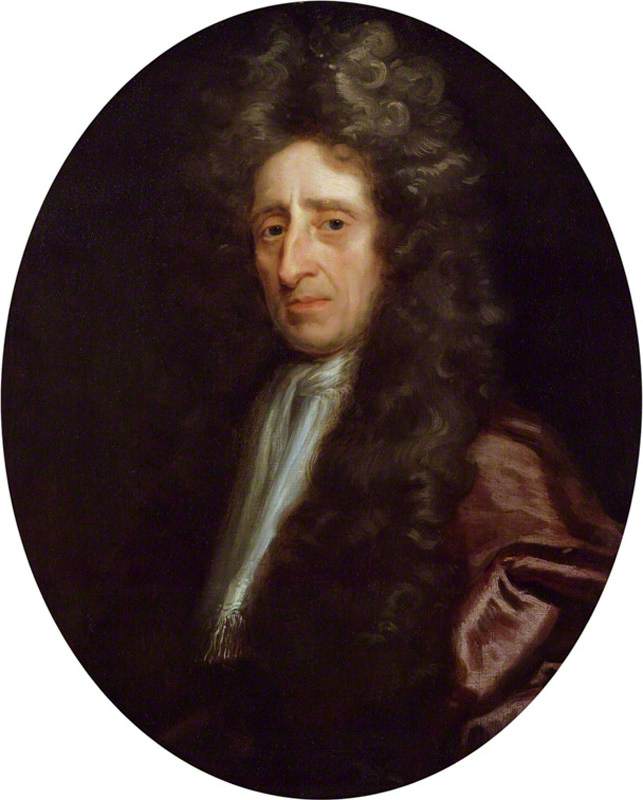
Oval-framed oil portrait of a man with a long, curled, shoulder-length wig, wearing a white cravat and a reddish-brown satin garment against a dark background.Painting

Primary source

John Locke

Michael Dahl · 1693

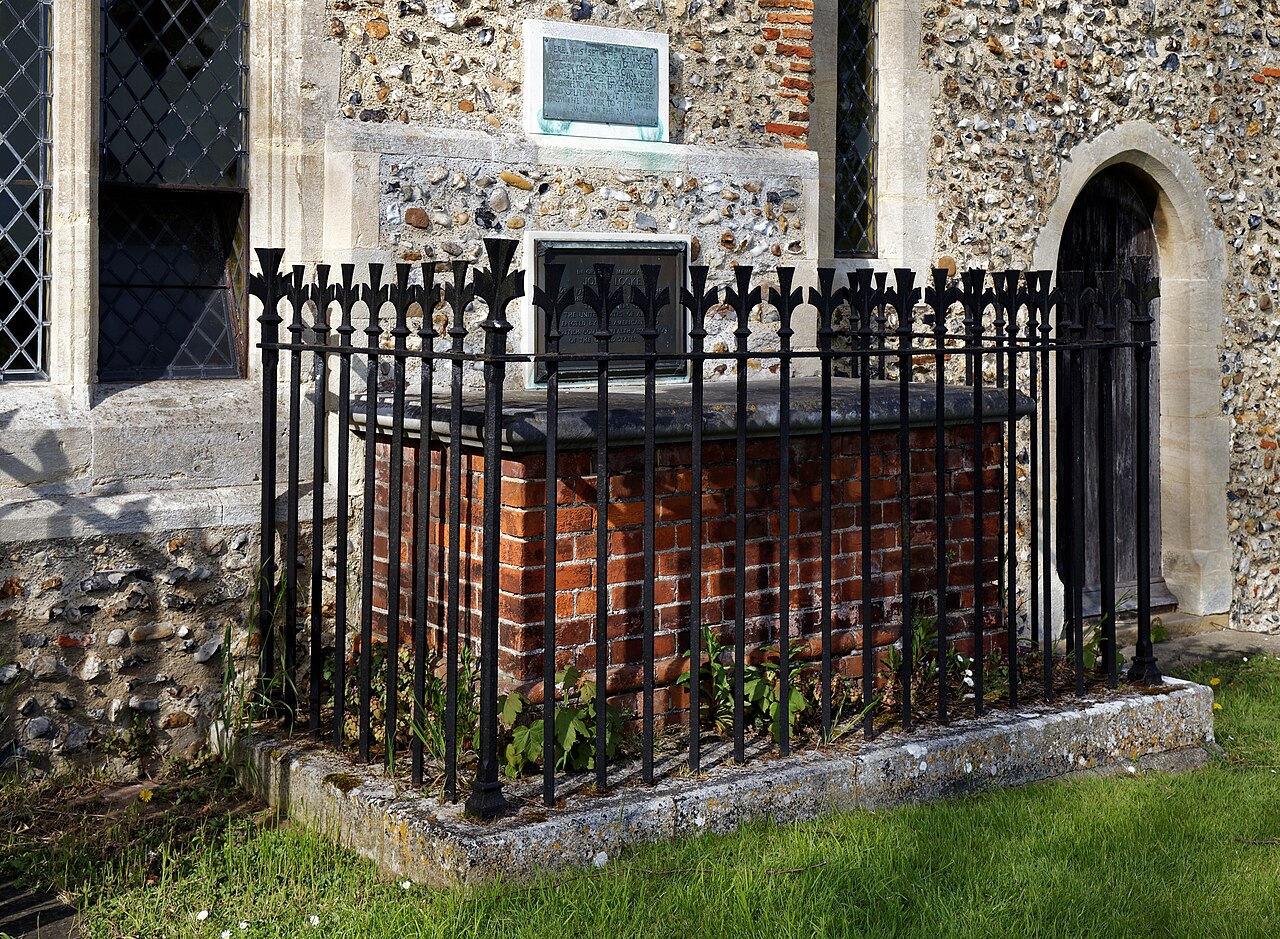
A brick tomb with a stone top slab, enclosed by a black wrought-iron railing with spiked finials, set on a stone base in a churchyard beside a flint church wall with a small inscribed plaque and an arched wooden door nearby.Artifact

Secondary source

Grave of John Locke

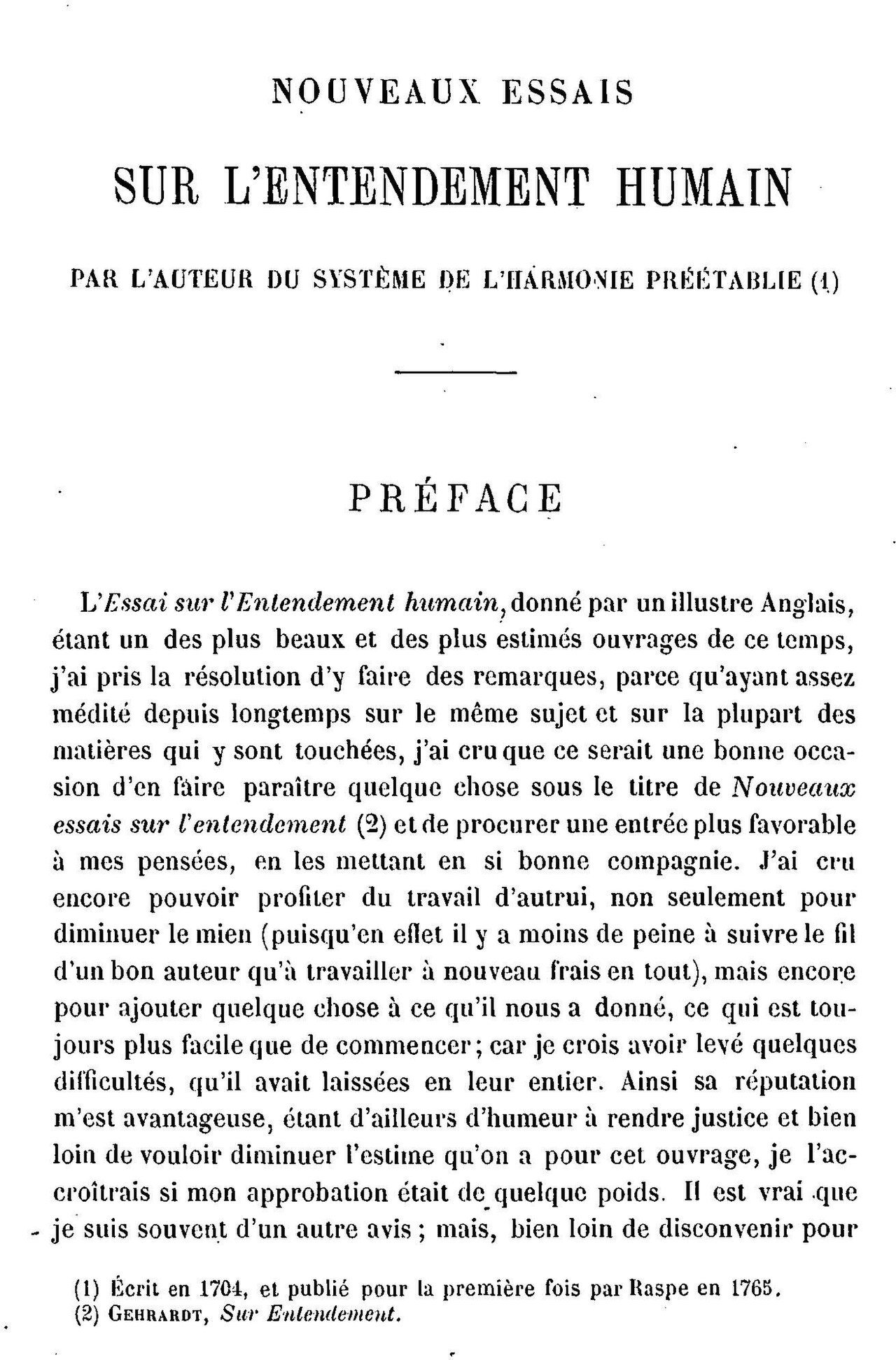
Title page and preface of the French edition of Nouveaux essais sur l'entendement humain, headed 'Par l'auteur du système de l'harmonie préétablie', with a preface beginning 'L'Essai sur l'Entendement humain, donné par un illustre Anglais'. Footnotes note it was written in 1704 and first published by Raspe in 1765.Book

Secondary source

New Essays on Human Understanding

Gottfried Wilhelm Leibniz · 1765 (written 1704)

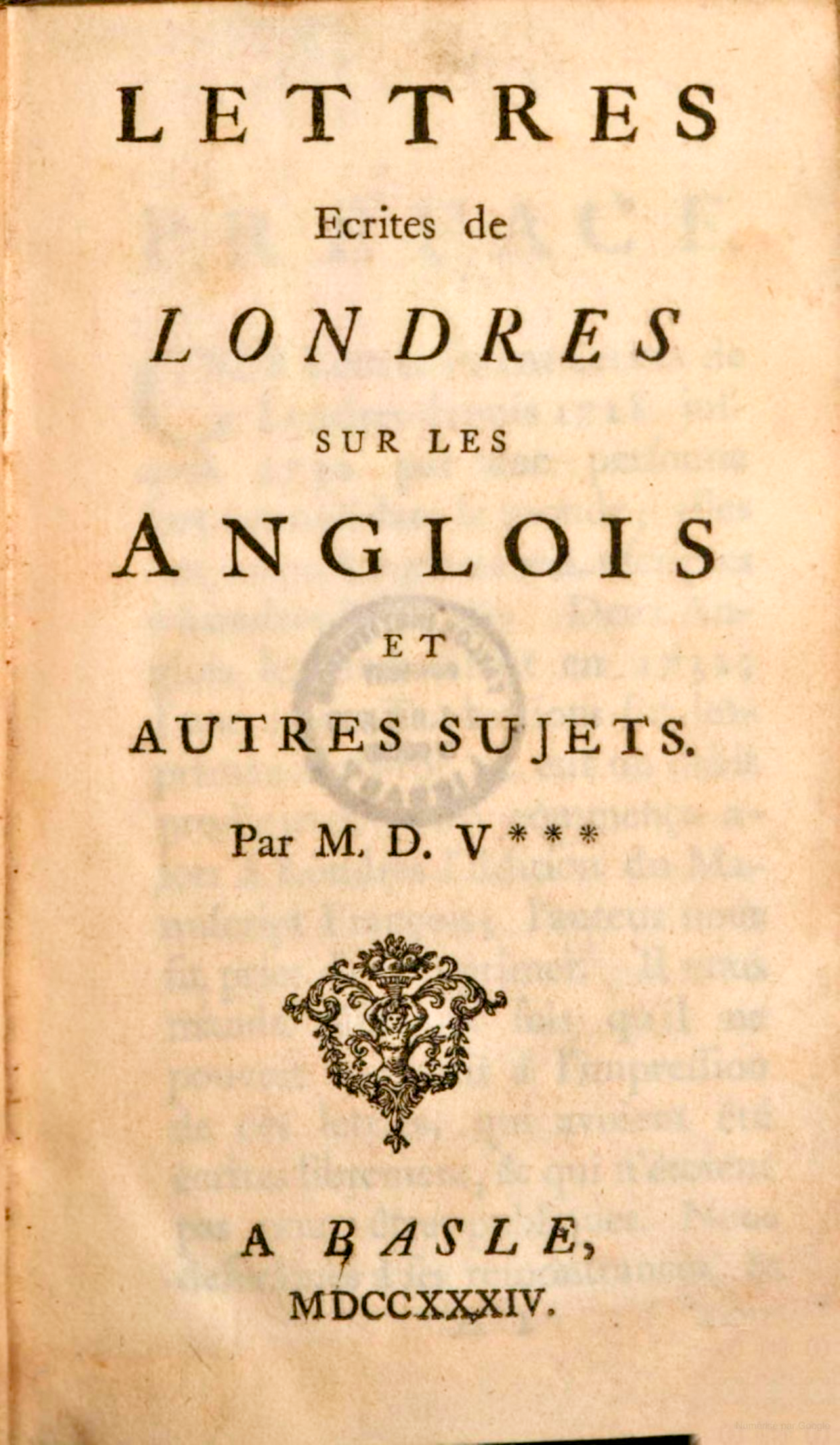
Title page of a book in French reading 'Lettres Ecrites de Londres sur les Anglois et autres sujets, Par M. D. V***, A Basle, MDCCXXXIV', with a decorative ornament below the title. Cream-colored, slightly aged paper; faint text from another page shows through.Book

Secondary source

Letters on the English

Voltaire · 1734

Book

Primary source

Essai philosophique concernant l'entendement humain

John Locke · 1735

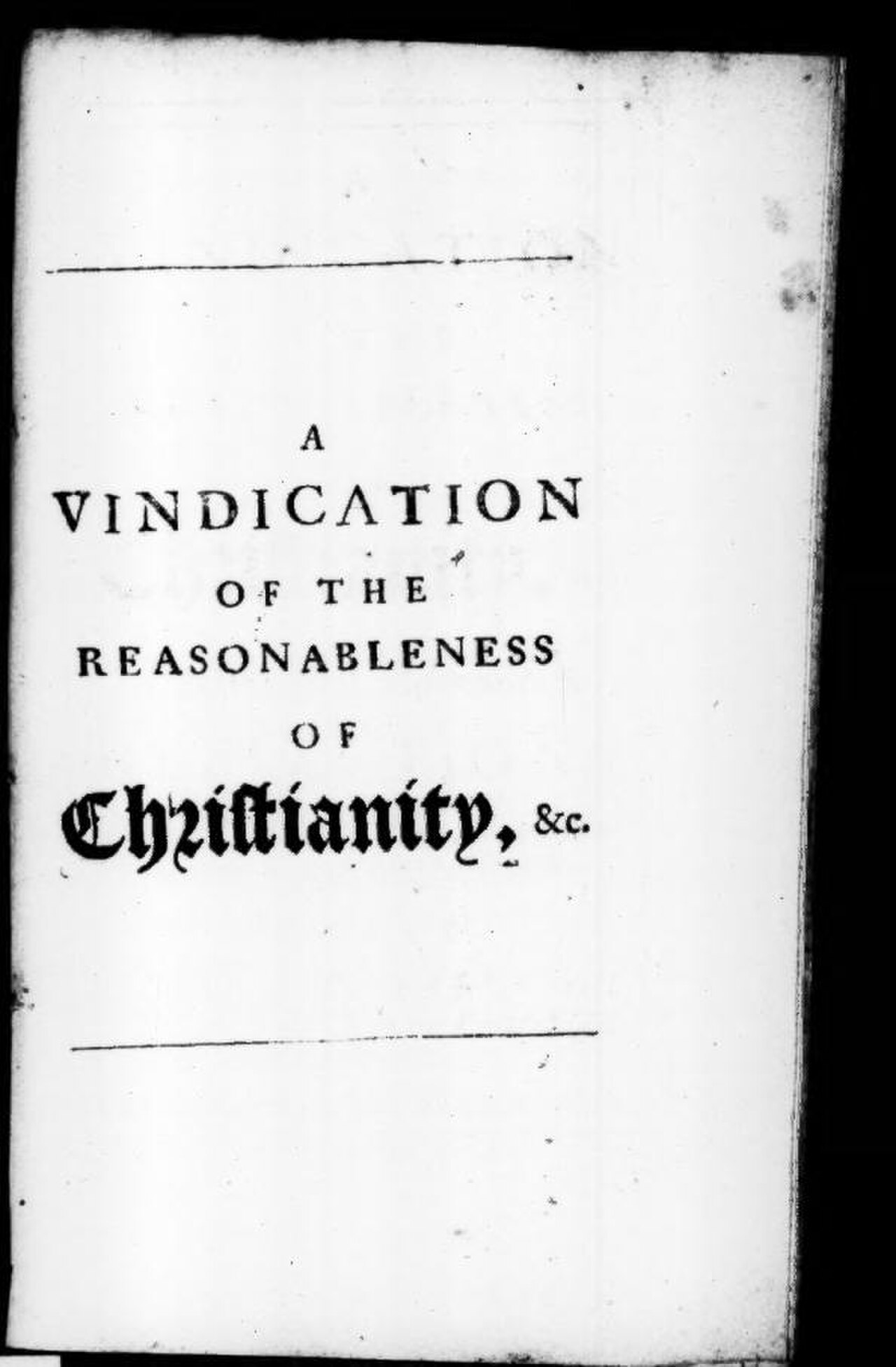
Title page of a book, black text on white paper with a scanned page border. Reads: 'A VINDICATION OF THE REASONABLENESS OF Christianity, &c.' with decorative horizontal rules above and below the title.Book

Primary source

A Vindication of the Reasonableness of Christianity

John Locke · 1695

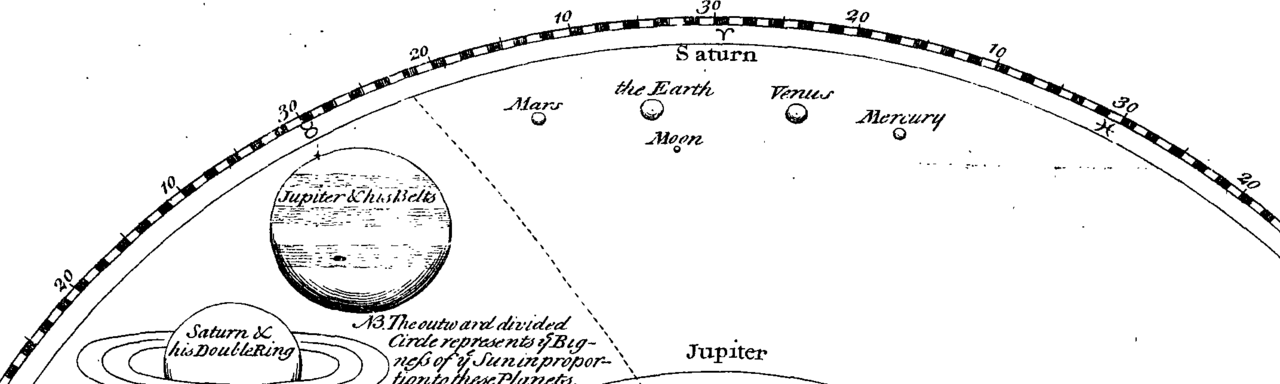
Engraved diagram from an early eighteenth-century astronomical plate showing a circular zodiac scale with degree markings, labeled planets Mars, the Earth, Moon, Venus, Mercury, Saturn, and Jupiter, plus a large Jupiter with its belts and a Saturn with its ring.Book

Primary source

Elements of Natural Philosophy

John Locke · published 1720 (posthumous)

Front cover of a book bound in brown leather with a blind-stamped border of dotted and beaded lines and small floral corner ornaments. The cover has no visible title or lettering.Book

Primary source

An Essay Concerning Humane Understanding, London Reprint

John Locke · reprint of 1694 edition

Scan of the blue cloth cover of a bound book, with a faint lighter mark near the upper left and a visible spine edge along the left side. No title or lettering is legible.Book

Primary source

An Essay Concerning Human Understanding, Annotated by Fraser

John Locke · 19th-century edition of 1690s text

Dark, worn brown leather book cover with a faded gilt title label at top and a rectangular red-brown panel with a small gold decorative fleuron. The spine edge is visible at left.Book

Primary source

An Essay Concerning Humane Understanding

John Locke

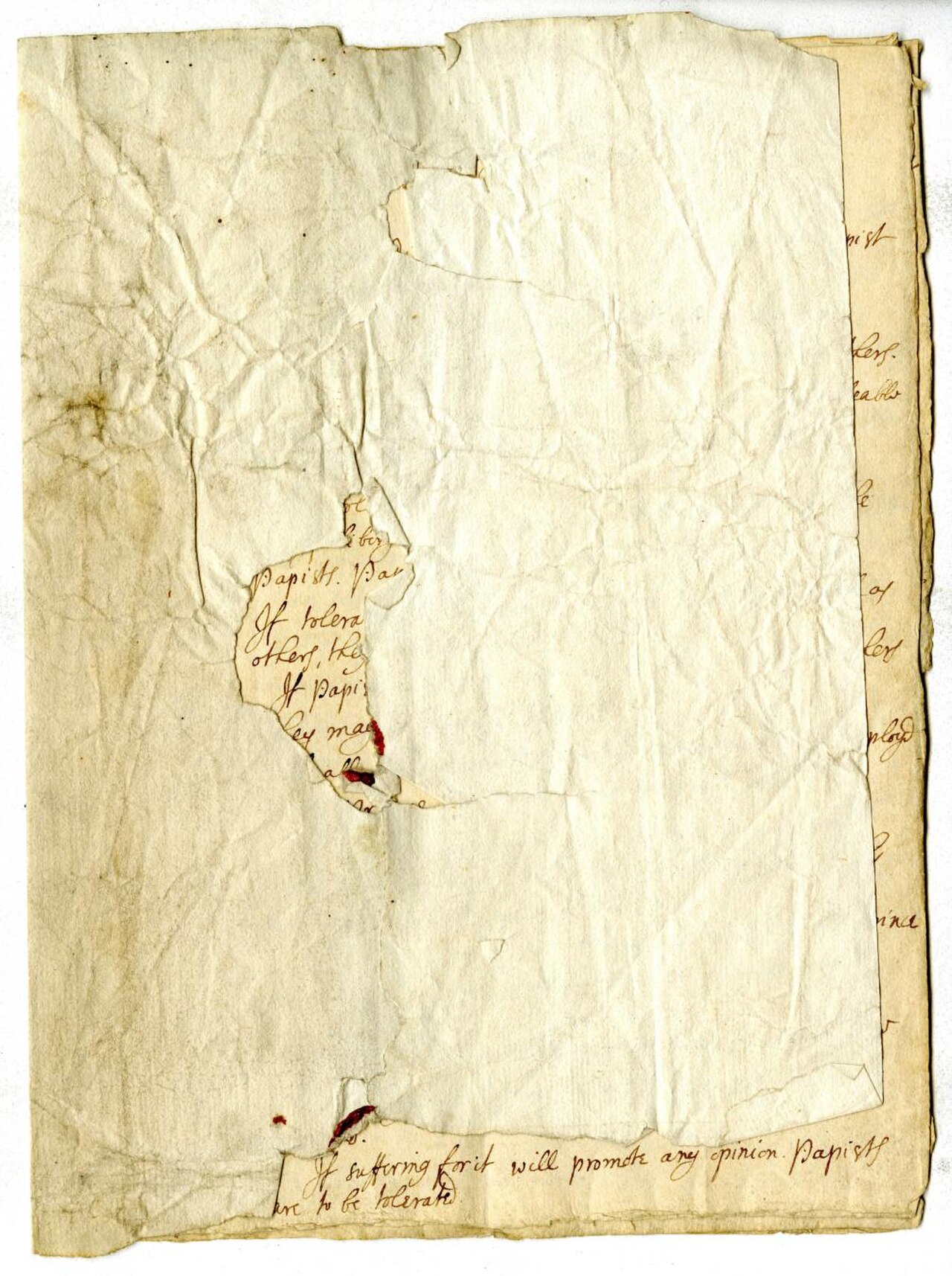
Photograph of a worn, creased, and torn manuscript sheet of aged paper with brownish handwritten lines in the margins and lower section, including the phrases 'Papists' and 'If suffering for it will promote any opinion, Papists ought to be tolerated'. Torn areas expose the paper edges, and some reddish stains appear near the tears.Document

Primary source

Reasons for Tolerating Papists Equally with Others

John Locke · c. 1667-1668

The Educational Writings of John LockeBook

Primary source

The Educational Writings of John Locke

John Locke · 1922

A Collection of Several Pieces of Mr. John LockeBook

Primary source

A Collection of Several Pieces of Mr. John Locke

John Locke · 1739

Book

Secondary source

The Life of John Locke, Volume 1

H. R. Fox Bourne · 1876

Book

Secondary source

Locke

Thomas Fowler

Plain dark red cloth book cover with no visible title or lettering, showing faint wear and a vertical spine crease along the left side.Book

Secondary source

The Life of John Locke, with Extracts from His Correspondence and Journals

Peter King, Lord King · 1829

Front cover of a dark maroon cloth-bound book with a blind-stamped border of thin parallel rules and a small central ornament. A blue library label on the left edge reads partial text including 'ornia', 'nal', and 'y'.Book

Primary source

Locke on Words: Essay Concerning Human Understanding

John Locke

Oval-framed painting of a man with shoulder-length curled grey-brown wig, white lace collar and cuffs, dark purple-grey cloak, and a gold-trimmed sleeve. He gazes at the viewer with his right hand resting on a book or ledge. Dark background with a tasselled drape and a distant landscape at right.Painting

Primary source

Portrait of John Locke by Herman Verelst

Herman Verelst · 1689

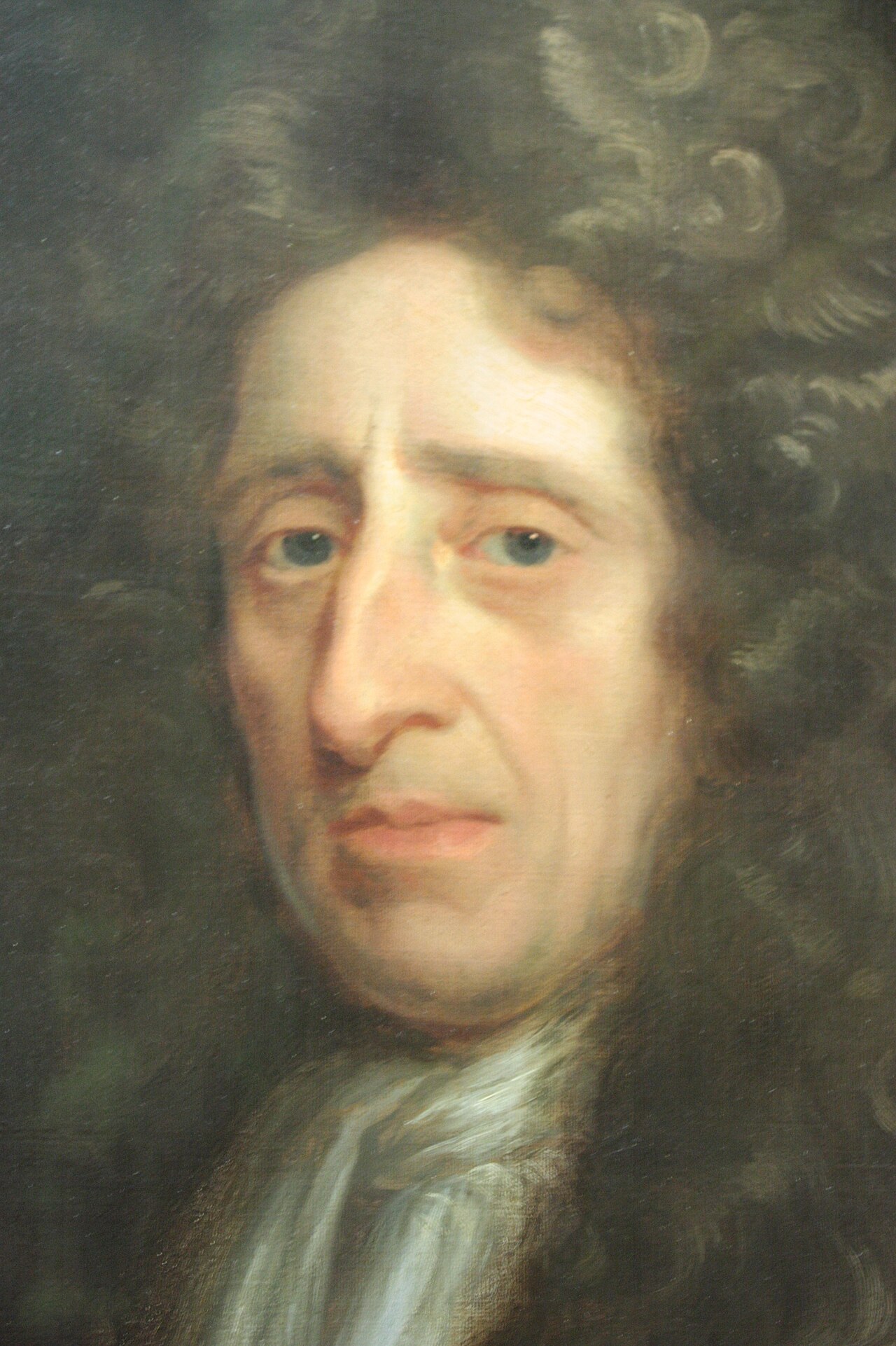
Close-up of an oil painting of a man with a long, curly grey-brown wig, pale complexion, blue-grey eyes, a prominent nose and a set, slightly downturned mouth, wearing a white cravat against a dark background.Painting

Primary source

John Locke's Kit-cat Portrait

Godfrey Kneller

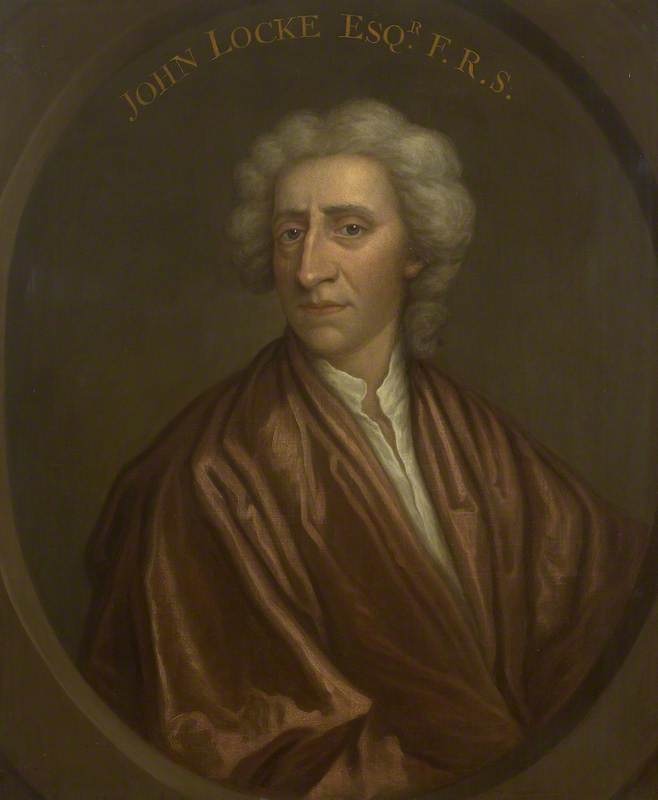
Oval-framed oil portrait of a man with shoulder-length grey wig, wearing a reddish-brown draped robe over a white open-necked shirt. Gold inscription across the top reads 'JOHN LOCKE ESQR F.R.S.'Painting

Primary source

Portrait of John Locke by Godfrey Kneller

Godfrey Kneller

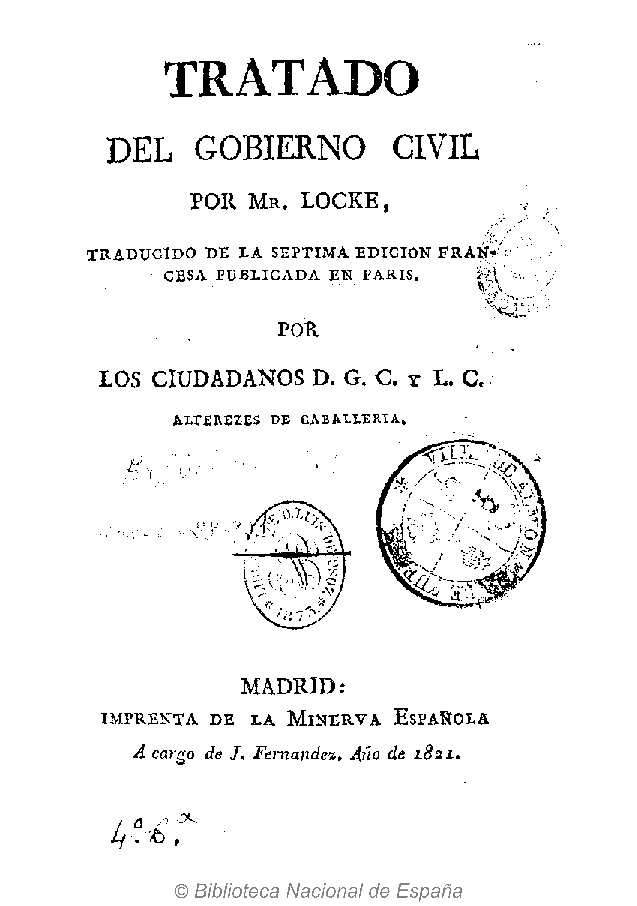
Title page of the 1821 Madrid Spanish edition of Locke's Tratado del Gobierno Civil, printed by Imprenta de la Minerva Española. Two ink stamps and a handwritten shelfmark appear on the page.Book

Primary source

Tratado del Gobierno Civil

John Locke · 1821

Book

Secondary source

Locke, John (1632-1704), Dictionary of National Biography

1885-1900

Document

Tertiary source

Locke, John, Encyclopaedia Britannica, 11th edition

1911

Dark brown book cover with a small pale label in the upper left corner bearing the handwritten call number 'B 1294 .L35'. No title or text is visible on the cover itself.Book

Secondary source

A series of lectures upon Locke's Essay

Dionysius Lardner

Cover of a book bound in dark brown and orange marbled paper, with a black spine on the left. A small cream-colored library label at the top left reads 'B 1298 K7H3'.Book

Secondary source

Locke's doctrine of human knowledge compared with Leibniz's critique

Gustav Hartenstein

Plain dark red book cover with a white rounded label in the upper left corner bearing handwritten call number B 1296 F7 1887. No title or text is printed on the cover itself.Book

Secondary source

Locke by Thomas Fowler

Thomas Fowler · 1887

Front cover of a brown cloth-bound book embossed with the word LOCKE in a dark banner at top, an oil lamp motif in the center above a decorative panel, and the series title Blackwood's Philosophical Classics at the bottom. A partial library label is visible on the left edge.Book

Secondary source

Locke by Alexander Campbell Fraser

Alexander Campbell Fraser · 1890

Dark red cloth book cover with a library barcode label reading 'A 000 670 130 4' and 'UC Southern Regional Library Facility' on the upper left. Faded gold title text is visible at top right, with a circular emblem in the center and faded gold lettering at the bottom.Book

Secondary source

Locke by Samuel Alexander

Samuel Alexander · late 19th or early 20th century

Black book cover with a white library label at top reading UC-NRLF and a barcode with the call number $B 191 665. The rest of the cover is plain black.Book

Secondary source

Locke by Thomas Fowler

Thomas Fowler · 1880s

Scan of the brown cloth cover of a library book. A white UC-NRLF catalog label with a barcode and the number B 44 882 is at top right. Handwritten call number B 1298 K6M3 and a yellow circular sticker are at top left. A white spine strip runs down the left edge.Book

Secondary source

Locke's Theory of Knowledge with a Notice of Berkeley

James McCosh · 19th century

Plain dark green cloth surface with faint mottled texture and light speckles, showing no visible text, title, or illustration. Appears to be the cover of a bound book.Book

Secondary source

Locke's Theory of Knowledge and Its Historical Relations

James Gibson · early 20th century

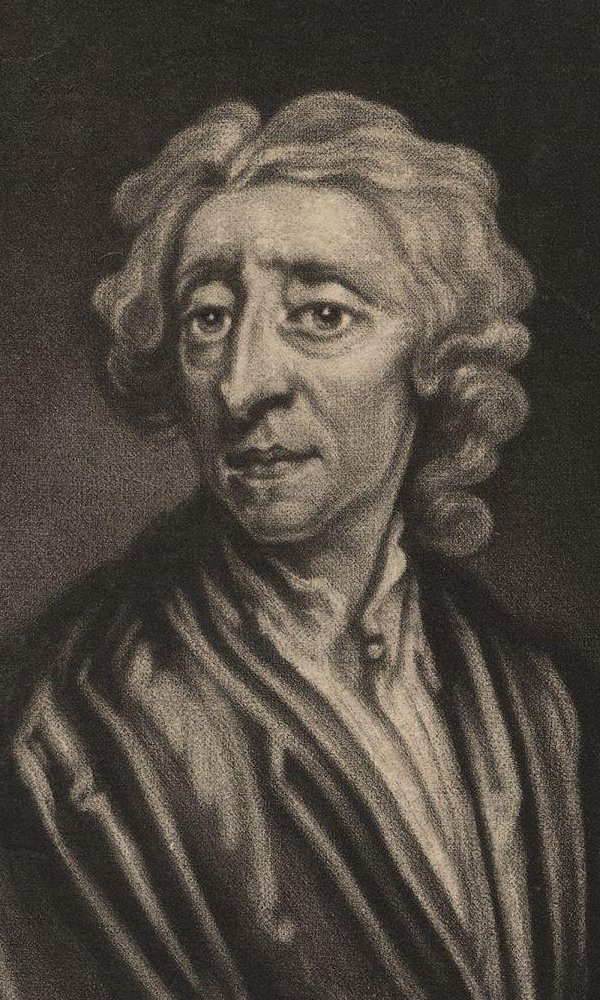
Monochrome engraved portrait of a man with a long, wavy wig falling to his shoulders, a lined face, and a direct gaze. He wears a striped, loose coat over a light shirt against a dark background.Painting

Primary source

John Locke engraving by John Simon

John Simon · 18th century, before 1751

Book

Primary source

Some Thoughts Concerning Education, audio reading

John Locke

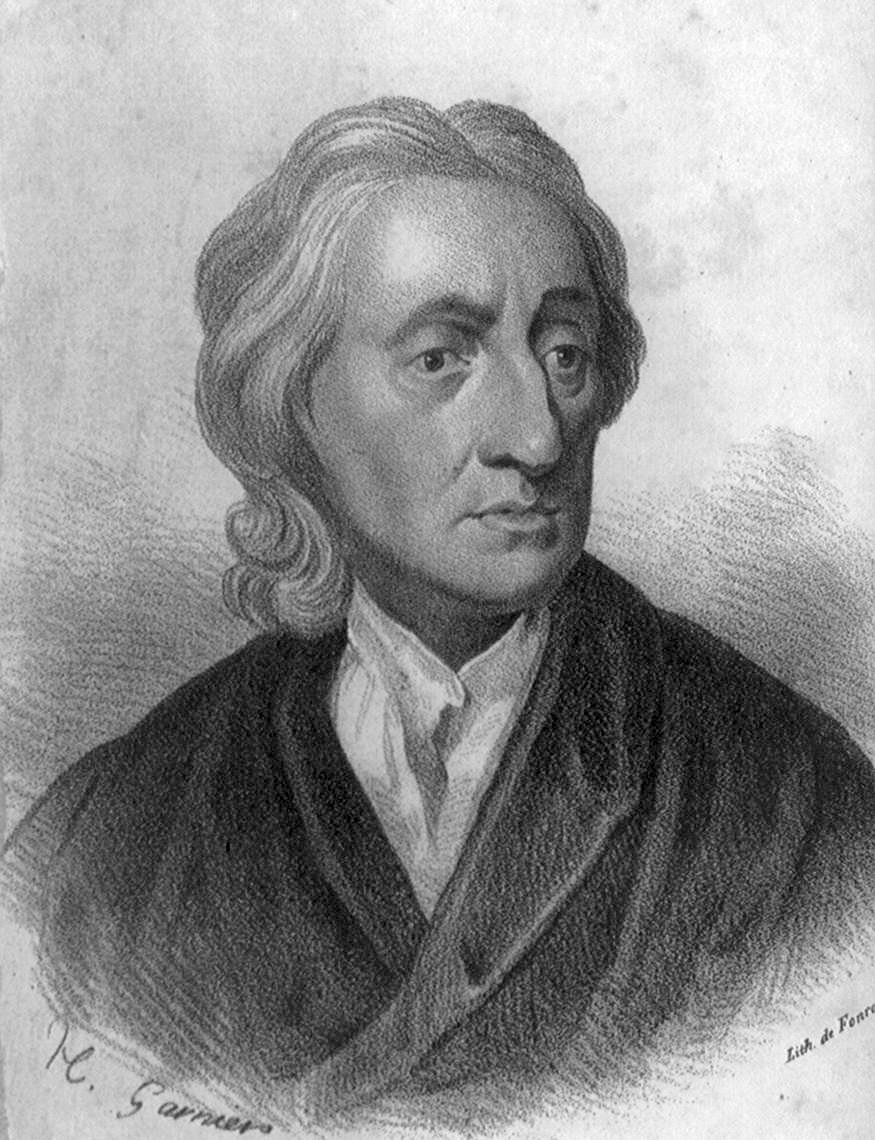
Black and white lithographic portrait of an older man with wavy shoulder-length hair, wearing a dark coat over a white open-necked shirt, looking to the side. Signed in the lower left, with a printer's credit in the lower right.Painting

Secondary source

Portrait of John Locke

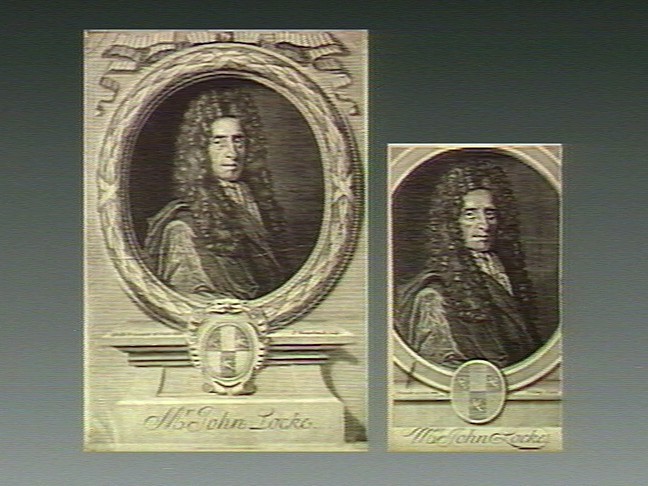
Photograph of two engraved portraits of John Locke, shown side by side on a grey background. The larger left print is an oval bust portrait of a man in a long curled wig and dark robe, within an ornate carved frame, with the caption 'Mr John Locke' below. The smaller right print shows a similar portrait with the same caption.Painting

Primary source

John Locke, line engraving by P. Vanderbank

P. Vanderbank (after S. Brownover) · 1694

Dark brown, mottled leather book cover with a faint vertical spine band along the left edge and a small pale mark near the center. No title or text is visible.Book

Primary source

Oeuvres diverses de Locke

John Locke (translated by Jean Le Clerc) · 1710

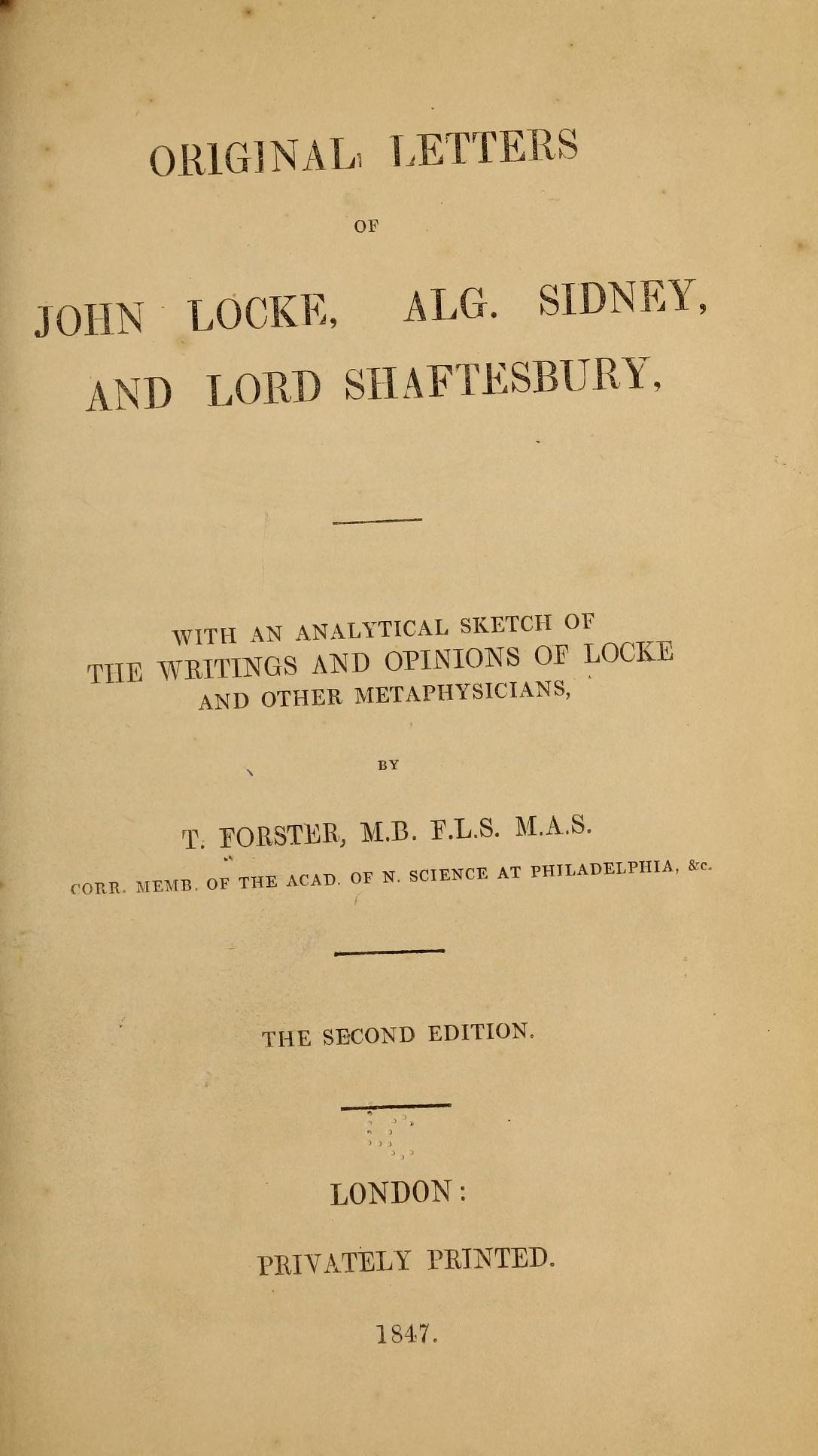
Title page of a book reading 'Original Letters of John Locke, Alg. Sidney, and Lord Shaftesbury, with an analytical sketch of the writings and opinions of Locke and other metaphysicians, by T. Forster, M.B. F.L.S. M.A.S., The Second Edition, London: Privately Printed, 1847.' Yellowed paper, black serif type.Letter

Primary source

Original Letters of John Locke, Algernon Sidney, and Lord Shaftesbury

John Locke; edited by T. Forster · 1847

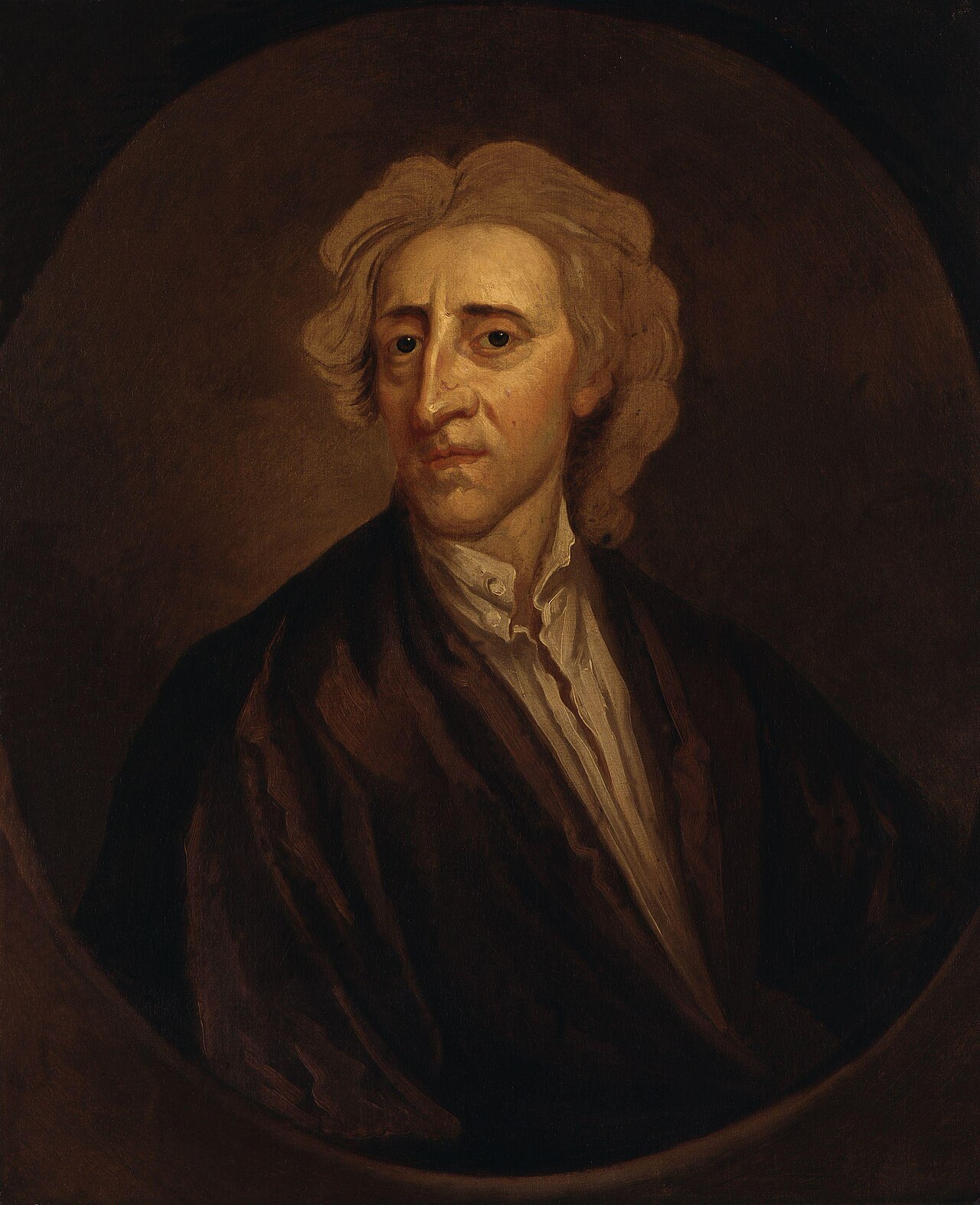
Oil portrait of a man with light, untidy shoulder-length hair and a dark coat over a white shirt, shown in an oval frame against a dark brown background. He looks toward the viewer with a serious expression.Painting

Secondary source

John Locke, after Godfrey Kneller

After Sir Godfrey Kneller · 1704

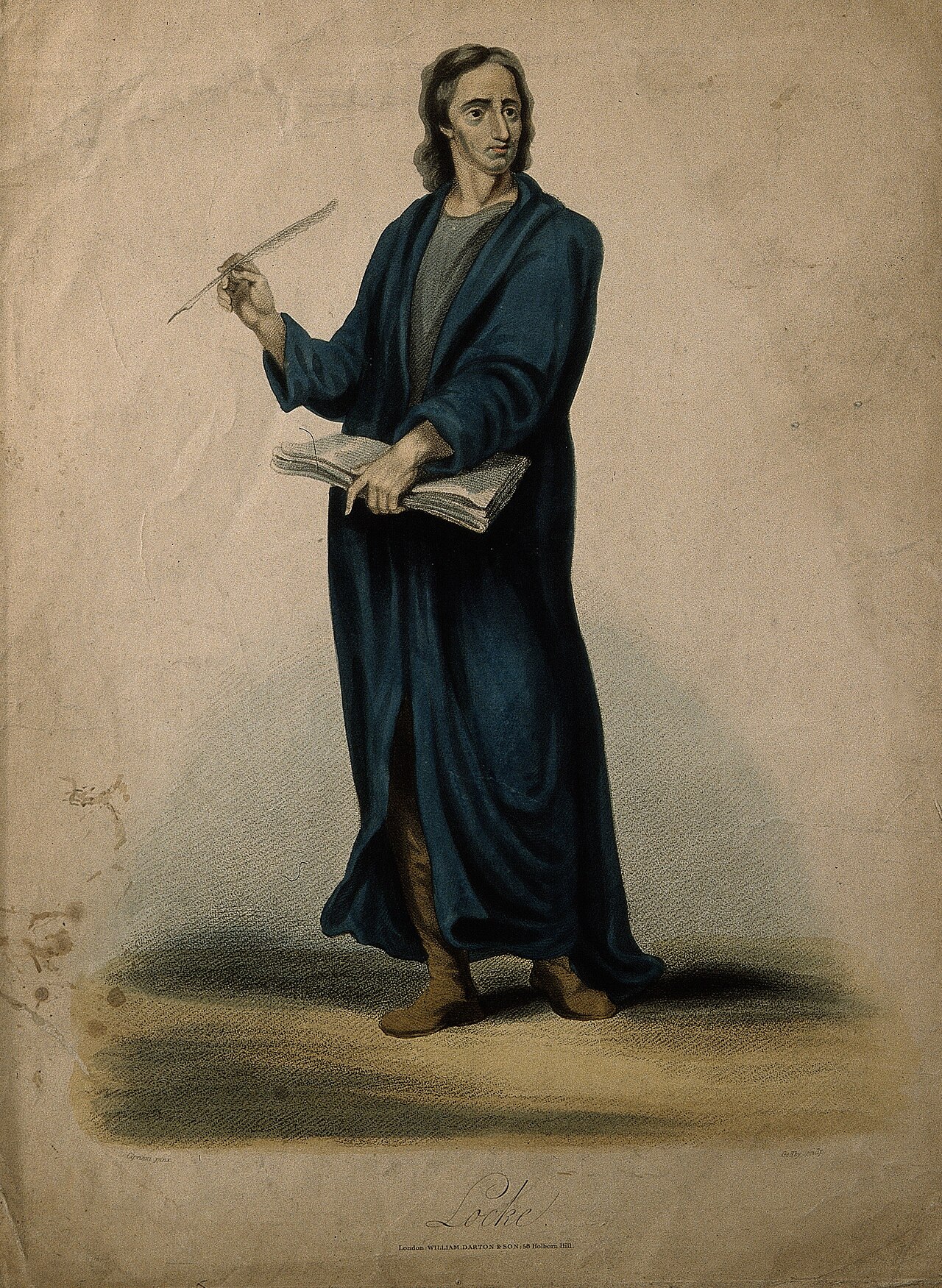
Full-length hand-coloured stipple engraving of a standing man with long grey hair wearing a blue robe over a grey tunic, holding a quill pen raised in one hand and a stack of papers in the other. Brown trousers and shoes show below. The caption reads 'Locke' with a London publisher's imprint below.Painting

Secondary source

John Locke, Stipple Engraving by James Godby after Cipriani

James Godby after Giovanni Battista Cipriani

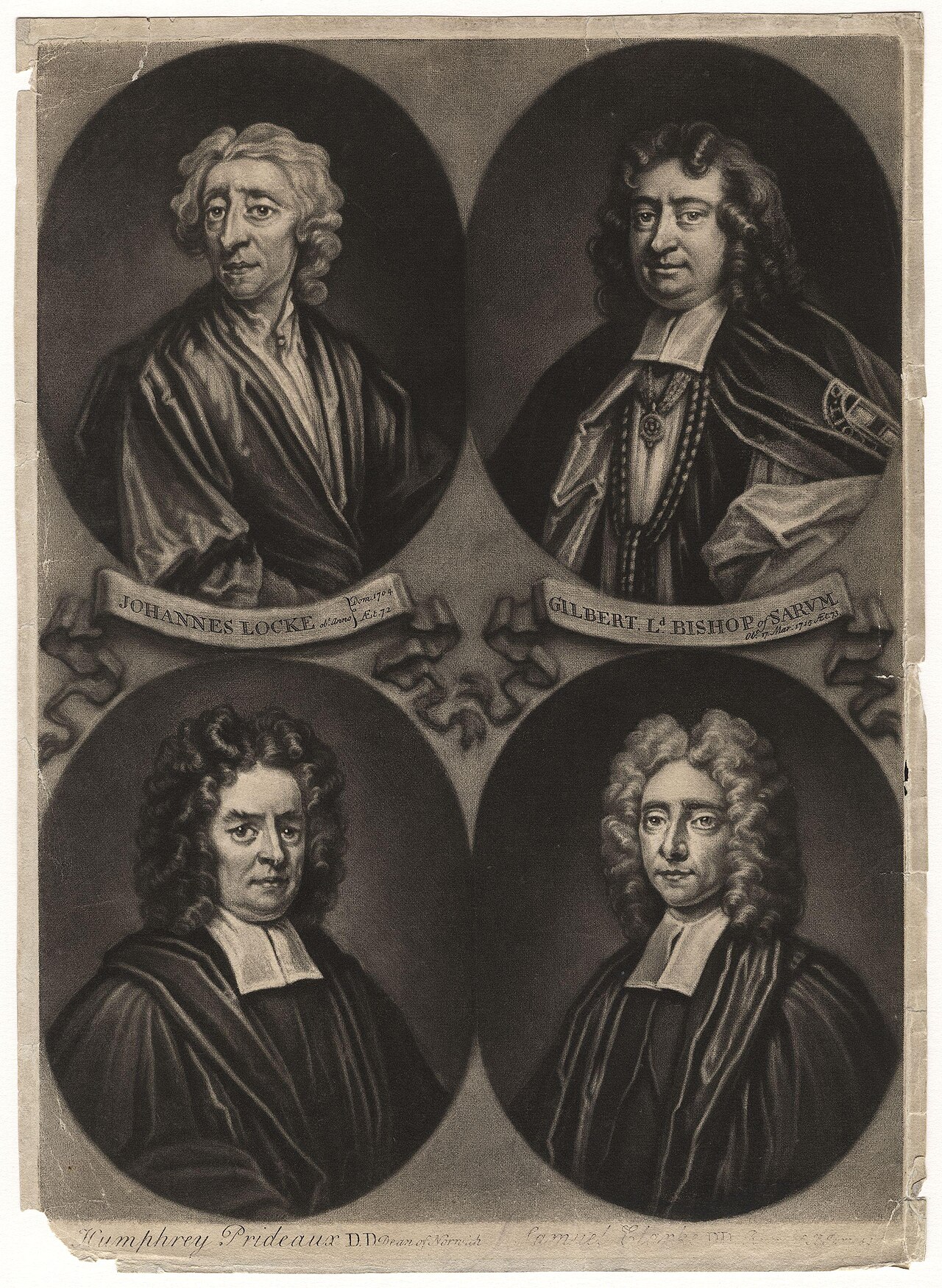
Mezzotint print with four oval portraits of men in 17th-18th century dress: top left John Locke with long curled hair and loose robe, top right Gilbert Burnet, Bishop of Salisbury, in clerical robes with a chain; bottom left Humphrey Prideaux and bottom right Samuel Clarke in clerical bands and gowns. Inscribed name banners and captions below.Painting

Secondary source

John Locke, from a Set of Portraits by John Simon

John Simon · before 1751

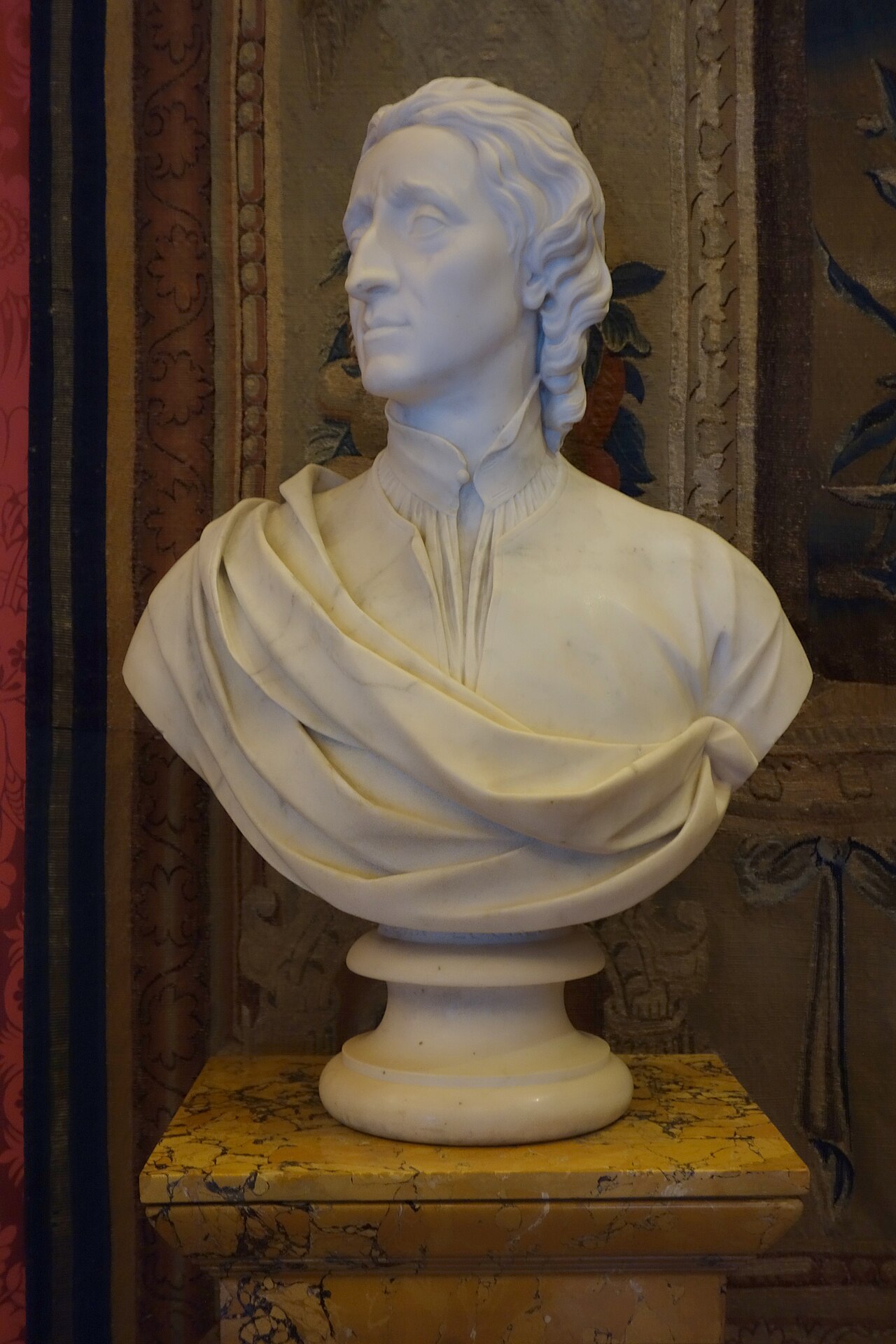
White marble bust of a man with wavy shoulder-length hair, a high collared shirt, and a draped cloth over one shoulder, set on a round pedestal atop a yellow veined marble plinth, in front of a tapestry.Sculpture

Secondary source

Marble Bust of John Locke by Giovanni Battista Guelfi

Giovanni Battista Guelfi · 1730-1731

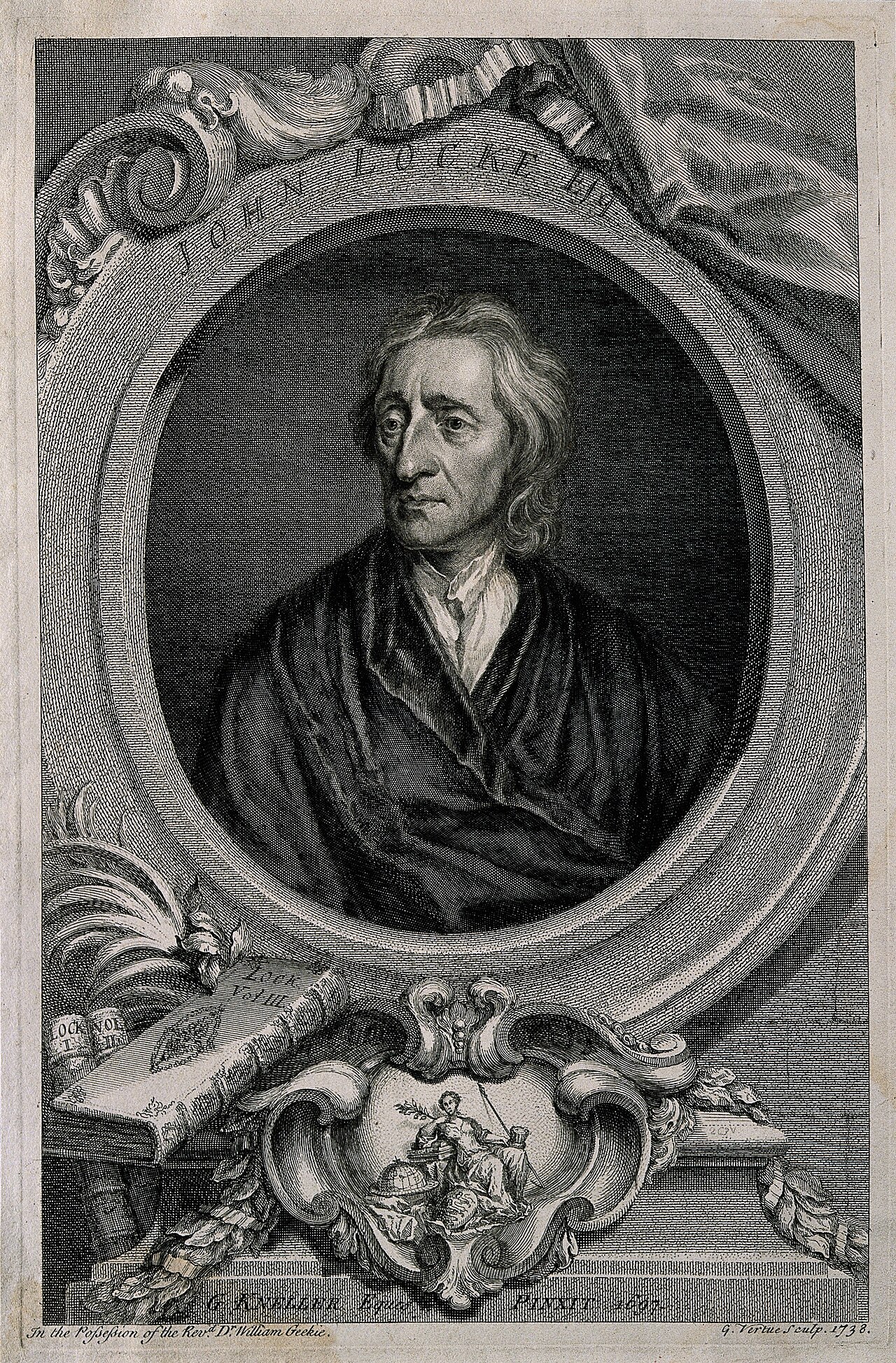
Oval line-engraved portrait of an older man with long gray hair, wearing a dark robe over a white shirt, set within an ornate decorative frame. Inscription 'JOHN LOCKE' appears at top; a book labeled 'Locke' lies at bottom left; a cartouche with figures sits below. Caption text reads 'G. Vertue Sculp 1738' at lower right.Painting

Secondary source

John Locke, Line Engraving by George Vertue after Kneller

George Vertue after Godfrey Kneller · 1738, after a 1697 portrait

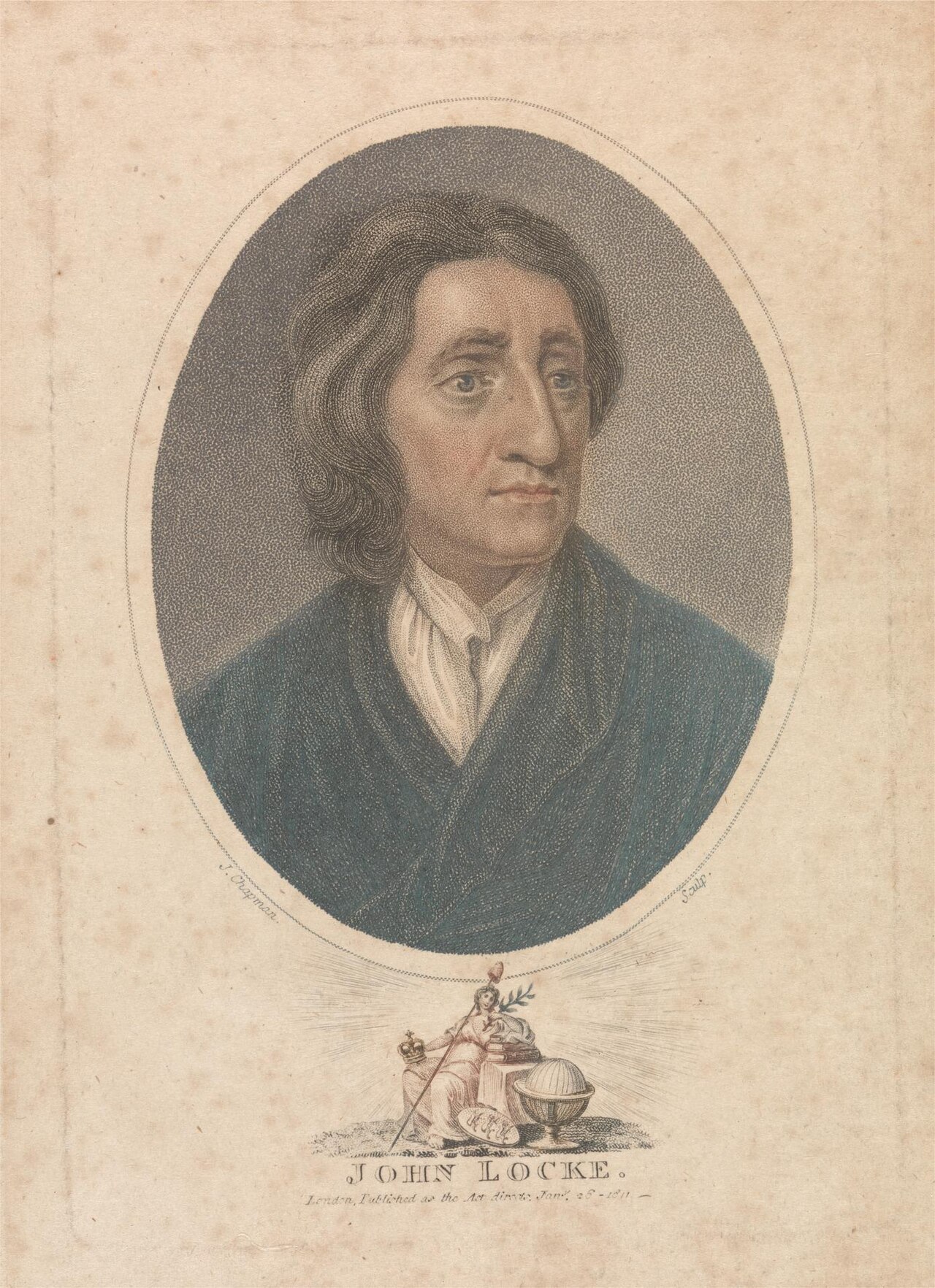
Hand-colored engraved oval portrait of a man with shoulder-length wavy hair, wearing a dark blue coat over a white cravat, with the caption JOHN LOCKE below. Beneath the oval is an allegorical vignette of a seated woman with a scepter and crown, beside a globe and books, and the publication line 'London, Published as the Act directs, June 25, 1811'.Painting

Secondary source

John Locke Portrait by John Chapman, 1811

John Chapman · 25 June 1811

Oval-framed line engraving portrait of John Locke, a older man with long wavy hair, plain collar and loose robe, looking to the side. Below is a cartouche with a coat of arms and the Latin caption 'Effigies Iohannis Locke'.Painting

Secondary source

John Locke, Line Engraving by George Vertue

George Vertue · 1713

Nearly entirely dark brown scanned cover or page of a book with faint, blurred, barely visible printed text in the center and a faint small mark near the upper right. Text is too faint to read.Book

Secondary source

Locke's Writings and Philosophy Considered

Edward Tagart · 19th century

Free Will and Four English PhilosophersBook

Secondary source

Free Will and Four English Philosophers

Joseph Rickaby · 1906

Book

Secondary source

New Essays Concerning Human Understanding

Gottfried Wilhelm Leibniz · 1896

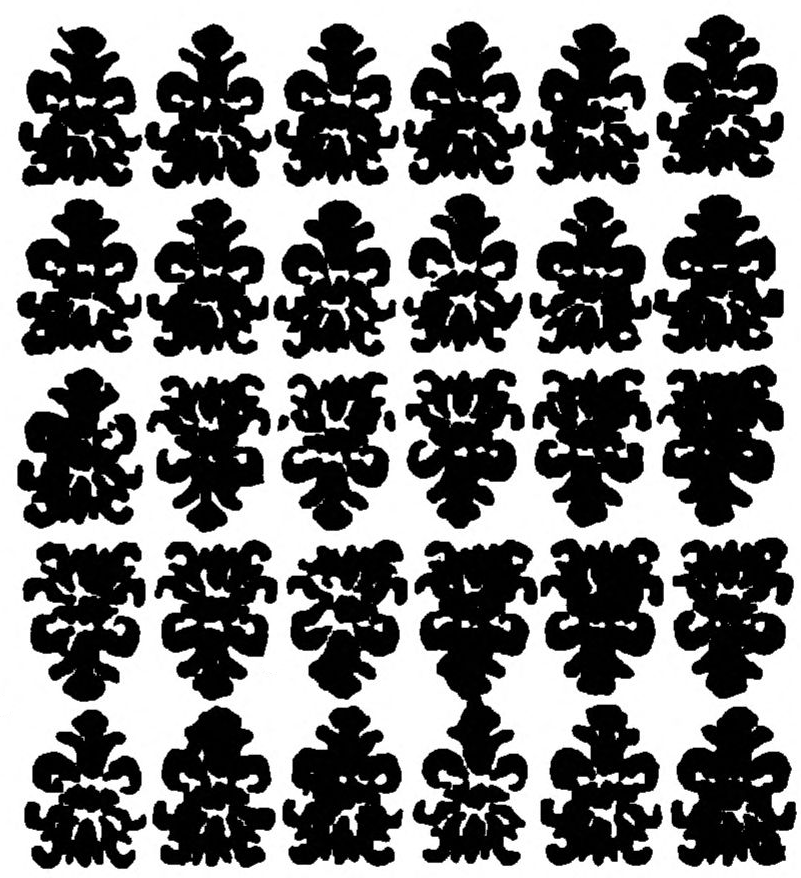
A grid of 30 black silhouette ornaments arranged in five rows of six on a white background. Each is a symmetrical, florid printer's ornament with scroll-like lobes and fleur-like tops, with slight variations between them.Artifact

Primary source

Title Page Decoration, An Essay Concerning Humane Understanding

Unknown artist; printed by Elizabeth Holt · 1690

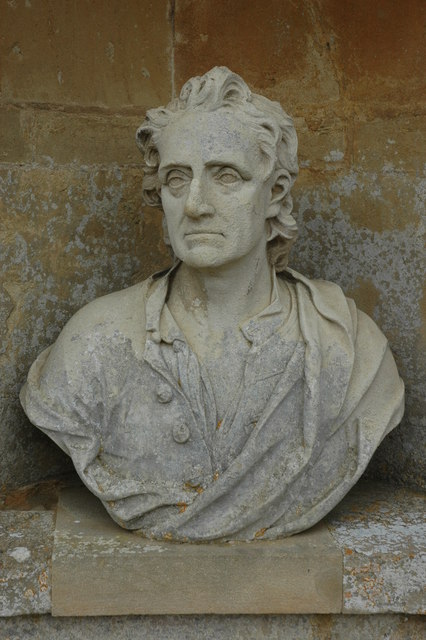
Weathered pale stone bust of a man with curly hair, a furrowed brow, and a stern expression, wearing a loose draped garment with buttons. It sits on a stone plinth against a warm-toned stone wall.Sculpture

Secondary source

John Locke bust, Temple of British Worthies, Stowe

18th century (monument); photographed 2008

Book

Secondary source

Locke, John, in A Short Biographical Dictionary of English Literature

John William Cousin · 1910

Book

Tertiary source

Locke, John, in the New International Encyclopaedia

1905

Book

Secondary source

Of the Conduct of the Understanding, Bibliography by Gilbert

Anna Louise Myers Gilbert · 1901

Book

Secondary source

Of the Conduct of the Understanding, Critical Opinions

Anna Louise Myers Gilbert · 1901

Book

Secondary source

Some Turns of Thought in Modern Philosophy

George Santayana · 1933

Want the full shelf? Chat with John Locke in the app and open the Sources panel — every quote links back to the original.

Use John Locke in class

2 collections

Ready-made collections from the Humy team that feature John Locke. Preview any of them, then try it free.

Trusted by educators worldwide

Conversations
375,000+
Real exchanges between students and historical figures
Messages exchanged
4,142,000+
Across every figure, classroom and language
Historical figures
100,000+
Each informed by a curated biography and selected sources
Languages supported
50+
From English and Spanish to Arabic and Korean

Paying customers

Used by 98 schools and universities

Partner school logo
Tecnológico de Monterrey logo
Hyper Island logo
Partner school logo
Chambersburg Area School District logo
Broward County Public Schools logo
Nebo School District logo
National Louis University logo
South Florida PBS logo
Punahou School logo
University of Wisconsin–River Falls logo
Partner school logo
Partner school logo
Archbishop Mitty High School logo
Kingsburg High School logo
Norwalk Public Schools logo
Partner school logo
Connections logo
Partner school logo
Moore Public Schools logo
Partner school logo
Partner school logo
Partner school logo
Partner school logo
Robbinsville Public Schools logo
Partner school logo
Partner school logo
Partner school logo
Tecnológico de Monterrey logo
Hyper Island logo
Partner school logo
Chambersburg Area School District logo
Broward County Public Schools logo
Nebo School District logo
National Louis University logo
South Florida PBS logo
Punahou School logo
University of Wisconsin–River Falls logo
Partner school logo
Partner school logo
Archbishop Mitty High School logo
Kingsburg High School logo
Norwalk Public Schools logo
Partner school logo
Connections logo
Partner school logo
Moore Public Schools logo
Partner school logo
Partner school logo
Partner school logo
Partner school logo
Robbinsville Public Schools logo
Partner school logo
Partner school logo

What educators are saying

“We enjoyed the program last year and used it frequently.”
“My students say it’s a welcome change of pace. I’m not a fan of the “sage on the stage” model, so I try to incorporate research-oriented and self-paced activities. With Humy, students have to take charge of their learning. They’ve become more adept at critical thinking, forming better questions, and improving their reading comprehension. The interview feature has been my go-to tool. I create assignments where students must ask historical figures a set number of questions, then summarize the responses to ensure they’re truly absorbing the material. This approach lets them actively explore the past rather than passively consuming information.”
“Humy has helped me bring historical figures, sometimes long past, to life. When my students interact with these figures in real-time, it eliminates some of the perceived “ancient” characteristics of my curriculum. This has shifted my students’ thinking away from viewing history as abstract or irrelevant. Real-time interactions make historical figures relatable, even allowing students to ask off-topic questions that help put historical lives in a more relevant context for 13-year-olds. The feature I use the most is the interview feature. After teaching a topic, most recently Gandhi and Joan of Arc, I have the students ask pointed, focused questions. We practice good conversation techniques beforehand, teaching them to listen (or read) carefully and formulate thoughtful follow-up questions rather than just interrogating. It helps students practice effective conversation skills.”

FAQ

Frequently asked questions

Who is John Locke?
Enlightenment philosopher known for his ideas on natural rights and social contract theory. On Humy.ai you can chat with an AI version of John Locke that draws on a short biography and 86 historical sources during the conversation — by text or voice, in 42 languages.
Is John Locke AI free?
Yes. John Locke is in Humy's free library: a free account includes 20 messages a month with John Locke and the other free figures, by text or voice. No credit card is needed.
What sources does the John Locke AI use?
It draws on a short biography and 86 historical sources (books, paintings and documents), including “Two Treatises of Government”, “An Essay Concerning Human Understanding” and “John Locke, Mezzotint after Godfrey Kneller”. Each source has its own page on Humy.ai.
How historically accurate is the AI version of John Locke?
Each figure uses a short biography and a small set of selected historical sources as context (retrieval-augmented generation), so answers stay closer to known material than the model's general knowledge alone. It isn't a citation-grade research tool — like any LLM, the AI can get details wrong or extrapolate. Treat it as a strong starting point for inquiry and cross-reference important claims.
Can I talk to John Locke by voice?
Yes. In addition to text chat, you can call John Locke and hear their voice respond in real time — useful for auditory learners, interview practice and Socratic dialogue.
Is Humy.ai safe and compliant for schools?
Yes. Humy.ai is used by more than 100 schools, universities and organisations. The platform is FERPA- and GDPR-aligned, supports SSO, and offers an IT-approval pack tailored for school procurement teams.

Ready when you are

Start chatting with John Locke now.

20 messages free · No credit card · Available in 50+ languages.