Portrait of Thurgood Marshall

AI Historical Figure

Thurgood Marshall

First African American Supreme Court Justice and a prominent civil rights lawyer.

Chat with Thurgood Marshall via text or voice — in 42 languages, drawing on a curated biography and 99 historical sources. Available 24/7.

Start chatting with Thurgood Marshall20 messages free · No credit card
Lived
1908–1993
From
United States
Known for
Politics & governmentActivism & reform
Thurgood Marshall

Thurgood Marshall

Online · responds in seconds

Hello — I'm Thurgood Marshall. First African American Supreme Court Justice and a prominent civil rights lawyer. What would you like to ask me?

20 messages free · No credit card · Powered by Humy.ai

Live preview · Switch between 42 languages above · Send a message to continue in the app

Multilingual

Talk to Thurgood Marshall in 42 languages

Ask Thurgood Marshall questions in any language below, and the rest of Humy's app speaks it too. Pick yours to open the chat in that language.

Also in German (Austria), German (Switzerland), English (UK), English (Australia), English (Canada).

The sources behind this AI

99 sources · 74 documents · 21 photographs · 1 painting · 1 letter · 1 artifact · 1 news clip

Thurgood Marshall doesn’t improvise from thin air. The AI is grounded in 99 curated historical sources students can inspect. Open any of them to see what informs the conversation.

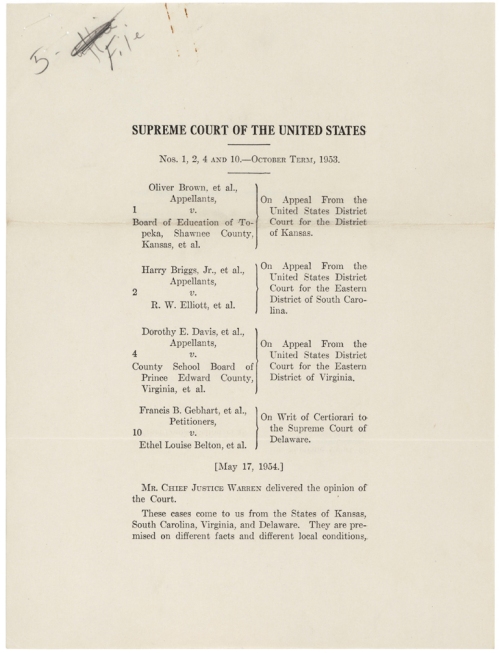
Scanned first page of the Supreme Court opinion in Brown v. Board of Education, dated May 17, 1954. Heading reads Supreme Court of the United States, Nos. 1, 2, 4 and 10, October Term, 1953, listing the consolidated cases and courts of appeal, with the opening text by Chief Justice Warren below. Handwritten marks appear at the top left.Document

Primary source

Brown v. Board of Education

Earl Warren · 17 May 1954

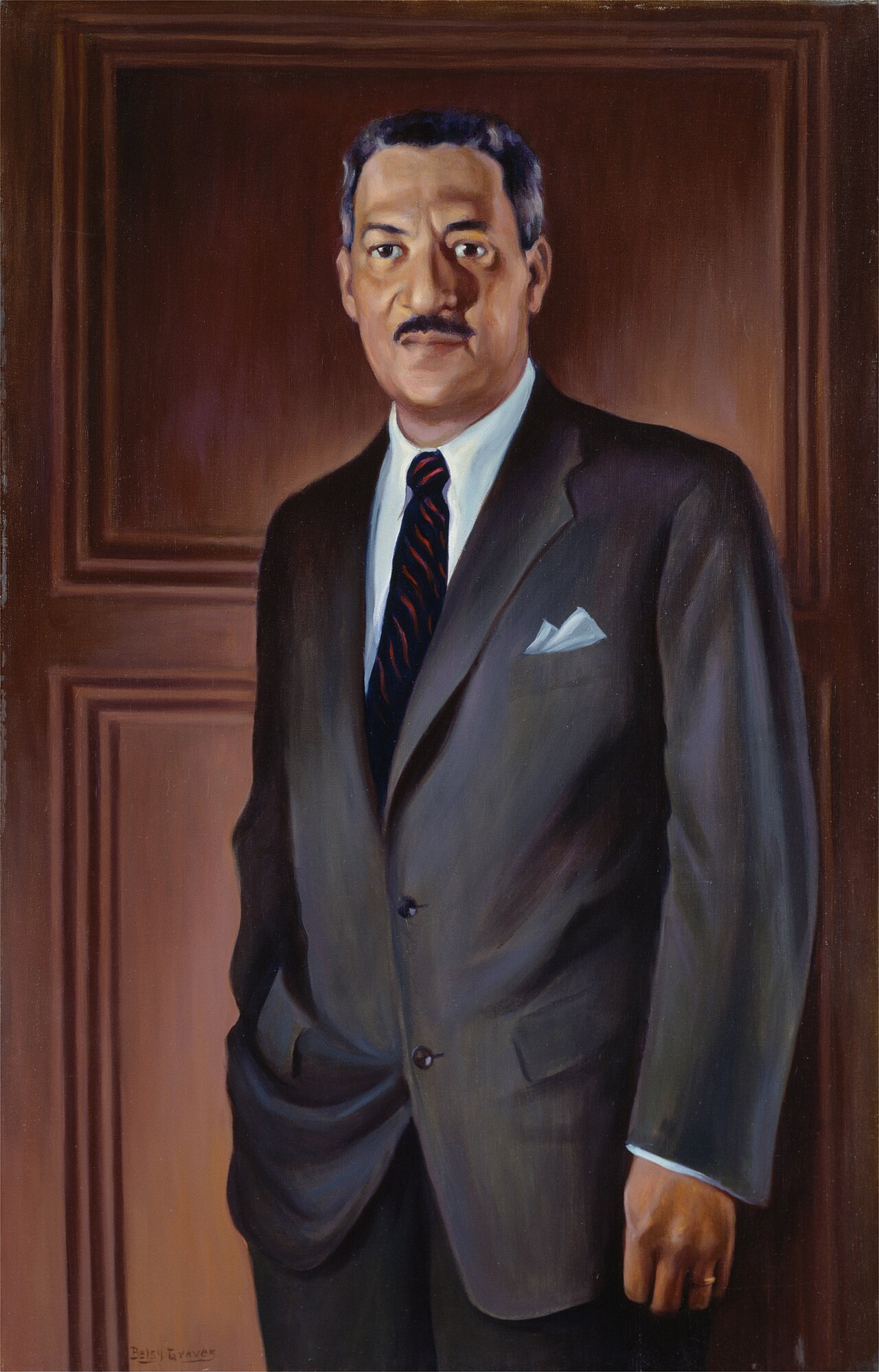
Oil portrait of a man in a dark gray suit, white shirt, and dark striped tie, standing with his left hand in his pocket and his right hand at his side. He has short graying hair and a mustache, against a dark reddish-brown paneled wall.Painting

Primary source

Thurgood Marshall

Betsy Graves Reyneau · 1956

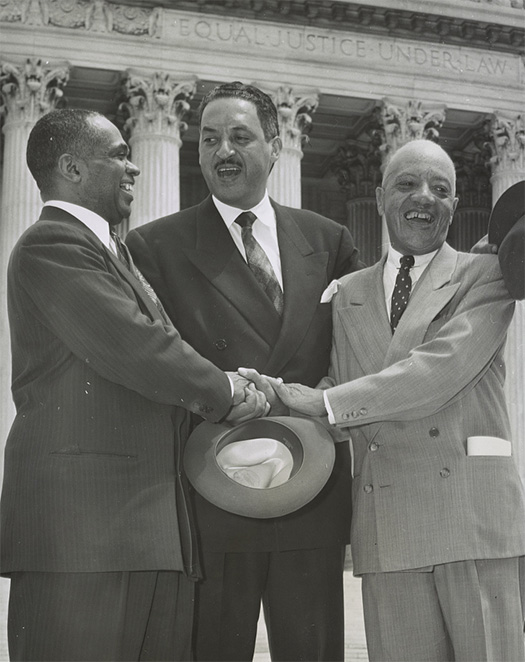
Three smiling Black men in suits on the steps of a columned building with the words 'Equal Justice Under Law' carved above. The man on the left and the man on the right shake hands in front of a man in the middle who holds a fedora.Photograph

Primary source

George Edward Chalmer Hayes, Thurgood Marshall, and James Nabrit in 1954 winning Brown case

1954

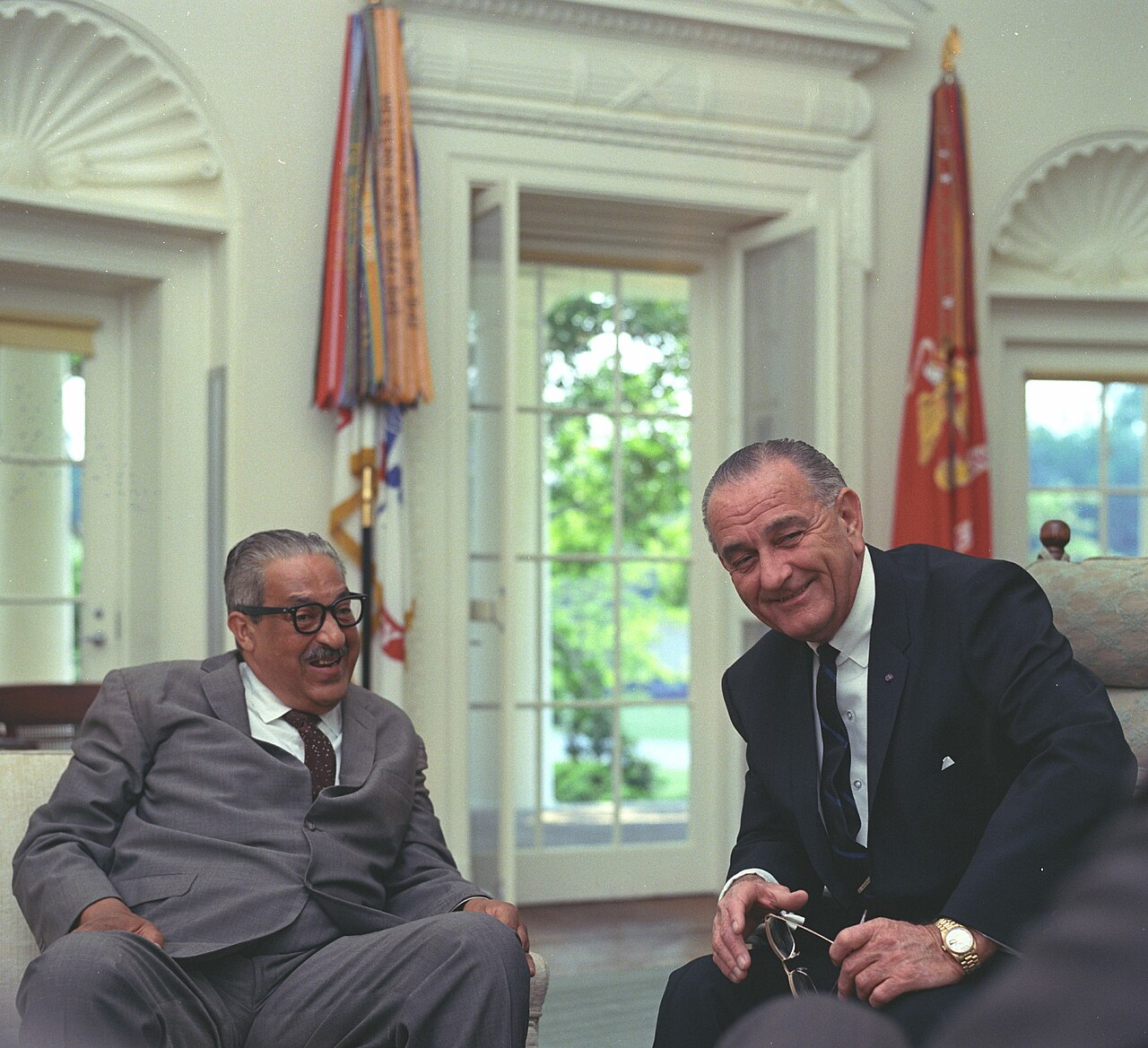
Two men seated in an office with white paneled walls, French doors, and two flags behind them. The man on the left wears dark-rimmed glasses, a gray suit, and a dark patterned tie, and is smiling. The man on the right wears a dark suit and tie, is seated and smiling, and holds eyeglasses in his hands.Photograph

Primary source

Thurgood Marshall and President Lyndon B. Johnson, June 13, 1967

Frank Wolfe · 13 June 1967

Document

Primary source

Cooper v. Aaron

12 September 1958

Document

Primary source

Furman v. Georgia

Thurgood Marshall · 1972

Document

Primary source

Regents of the University of California v. Bakke

28 June 1978

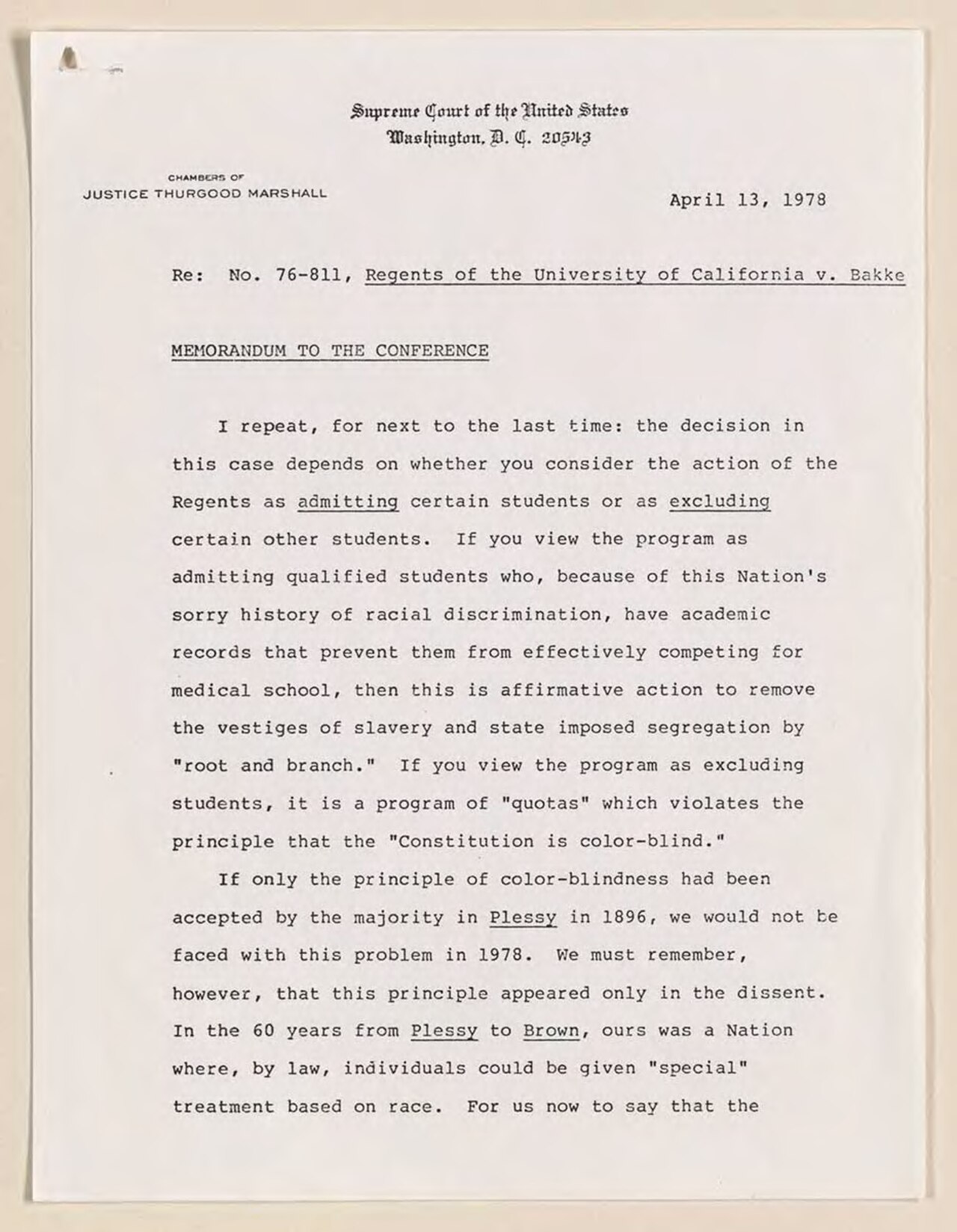
Scan of a typed memorandum on Supreme Court of the United States letterhead, Chambers of Justice Thurgood Marshall, dated April 13, 1978, regarding Regents of the University of California v. Bakke. Text discusses admissions and exclusion in affirmative action.Letter

Primary source

Thurgood Marshall's Memorandum to the Conference on Bakke

Thurgood Marshall · 13 April 1978

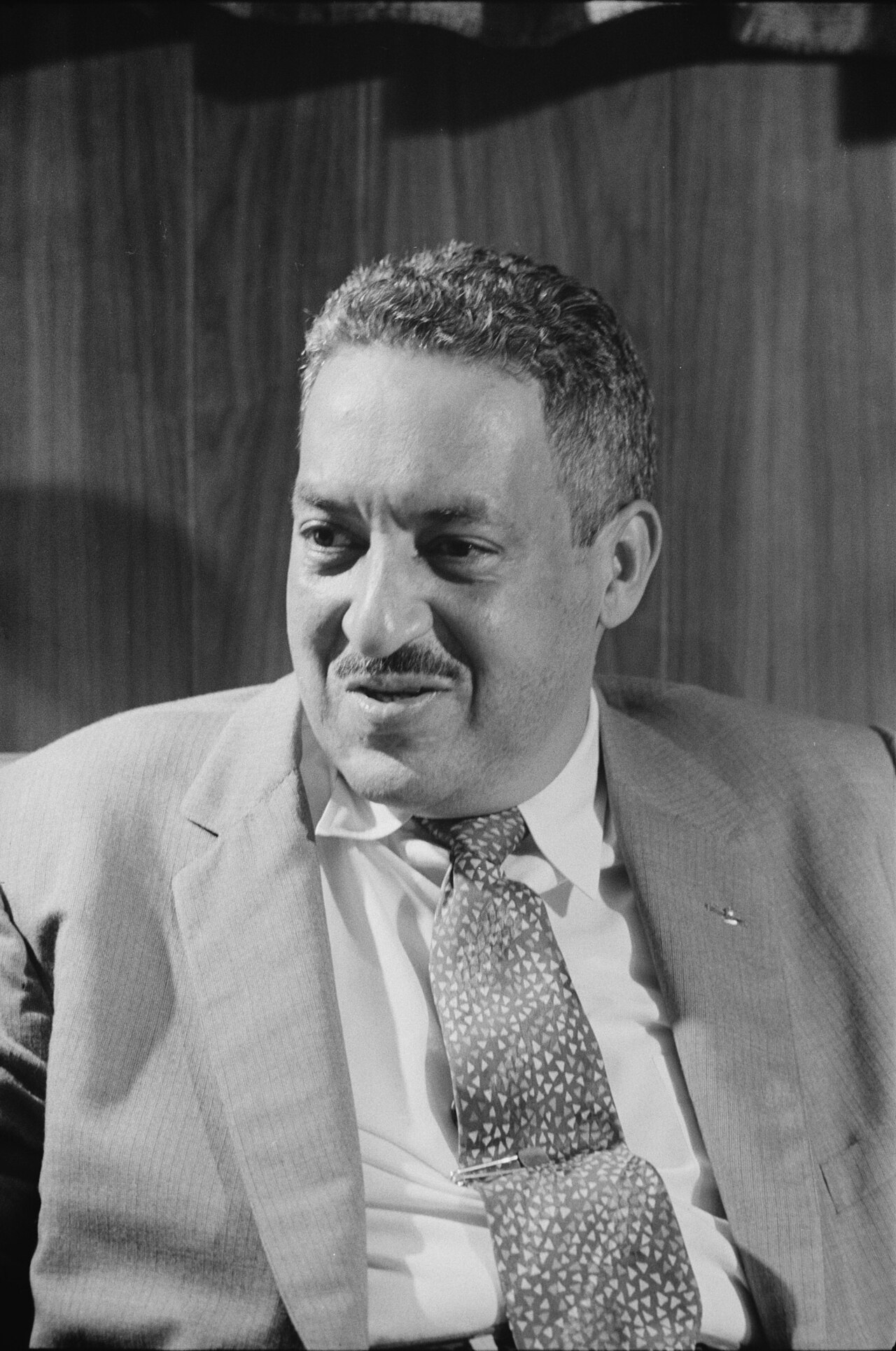
Black-and-white photograph of a man in a light suit jacket, white shirt, and patterned tie, seated in front of a wood-paneled wall. He has short curly hair and a mustache and is looking to the side.Photograph

Primary source

Thurgood Marshall, 1957

Thomas J. O'Halloran · 17 September 1957

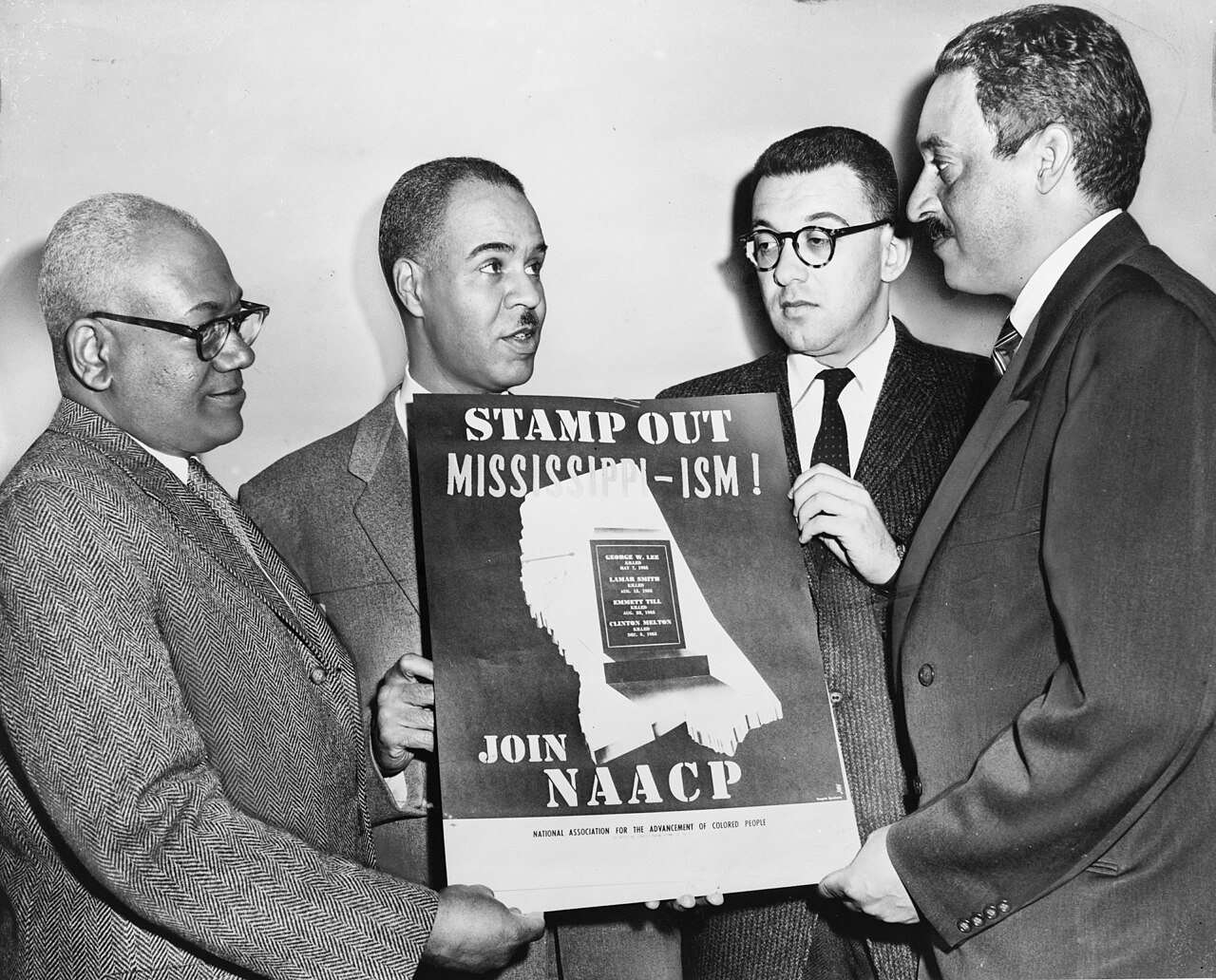
Four men in suits hold a black-and-white poster reading 'STAMP OUT MISSISSIPPI-ISM! Join NAACP', showing a Mississippi map with a memorial plaque. Left to right: a man in glasses, a man speaking, a man in glasses and tie, and a man in a dark suit looking at the poster.Photograph

Primary source

NAACP Leaders Holding Anti-Discrimination Poster

Al Ravenna · 1956

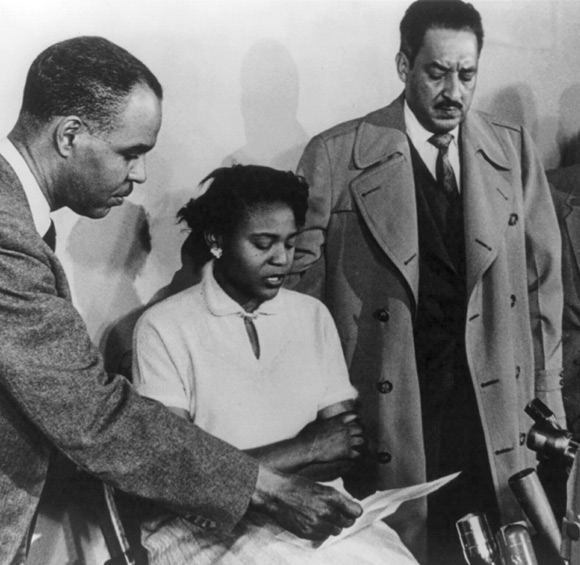
Black-and-white photo of three people. A man in a tweed jacket on the left leans over and points at a document. A young woman in a light blouse sits in the center and reads the paper. A taller man in a long overcoat and tie stands behind her on the right. Microphones are visible in the lower right.Photograph

Primary source

Roy Wilkins, Autherine Lucy, and Thurgood Marshall at Press Conference

Library of Congress · 2 March 1956

Document

Primary source

Sweatt v. Painter

5 June 1950

Document

Primary source

Shelley v. Kraemer

Supreme Court of the United States · 1948

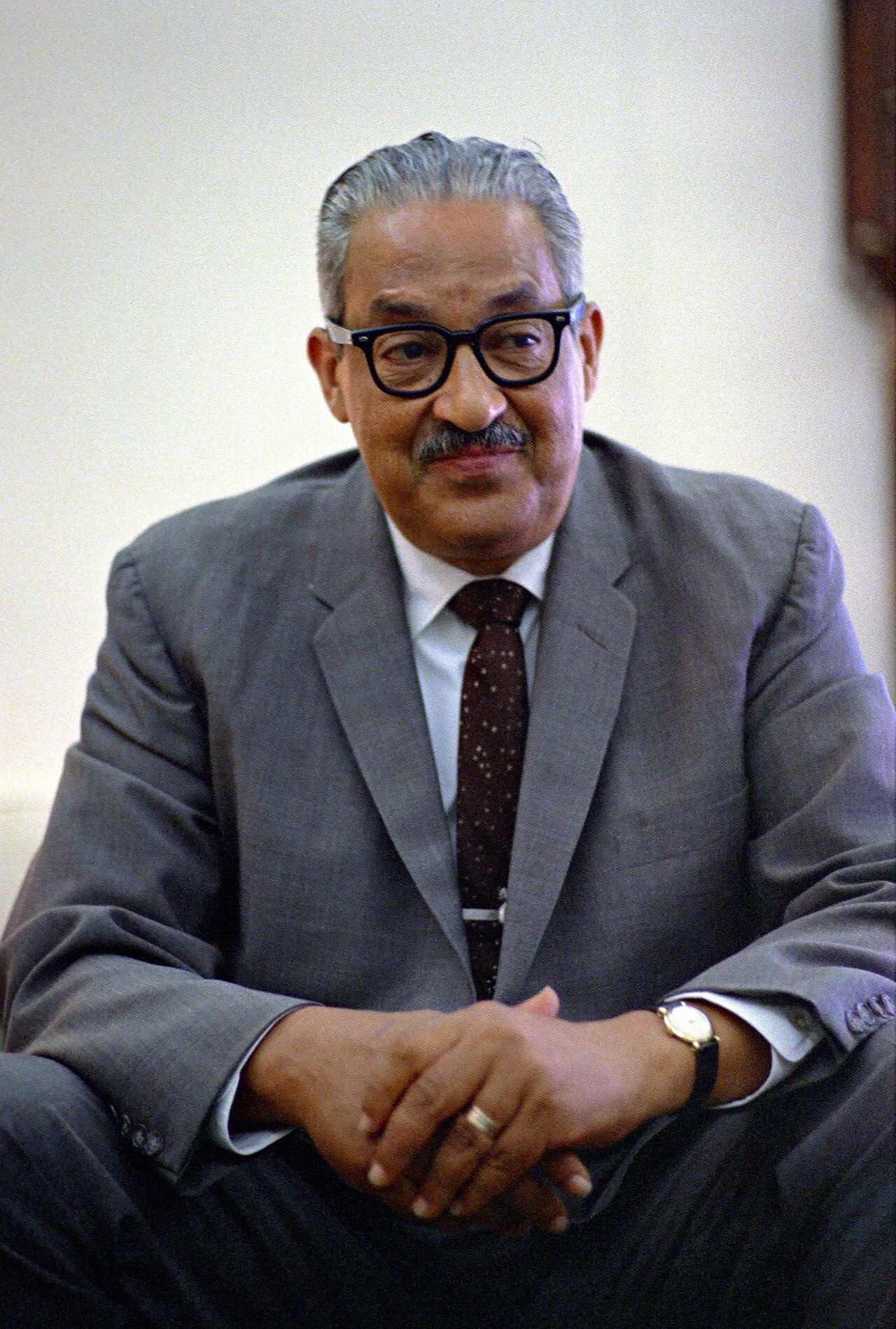
Portrait of an older man with gray hair, dark-rimmed glasses, and a gray mustache, seated with hands clasped over his knee. He wears a gray suit, white shirt, and dark patterned tie with a tie bar, and a gold wristwatch. He smiles faintly against a pale wall.Photograph

Primary source

Thurgood Marshall, 1967

Yoichi R. Okamoto · 1967

Document

Primary source

San Antonio Independent School District v. Rodriguez

Thurgood Marshall · 1973

Document

Primary source

Milliken v. Bradley

Thurgood Marshall · 1974

Document

Primary source

Payne v. Tennessee

Thurgood Marshall · 1991

Document

Primary source

Stanley v. Georgia

Thurgood Marshall · 1969

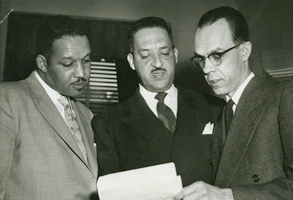
Black-and-white photograph of three men in suits gathered closely, looking down at a document held at the bottom of the frame. The man on the left wears a patterned tie, the man in the center wears a dark suit and tie, and the man on the right wears glasses.Photograph

Primary source

Harold Boulware, Thurgood Marshall, and Spottswood Robinson III Conferring During Brown Case

Unknown · 1953

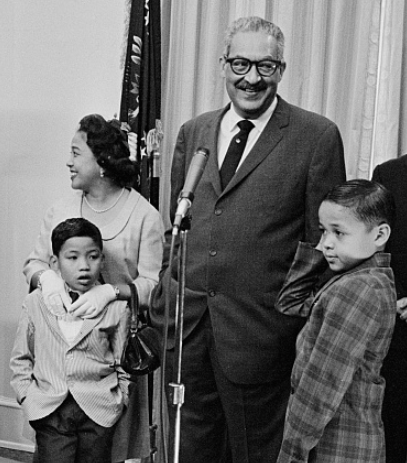
Black and white photograph of a smiling man in dark suit, tie and glasses speaking at a microphone, with a woman in a light cardigan and two young boys beside him, one in a striped jacket and one in a plaid jacket. A dark flag hangs behind them.Photograph

Primary source

Thurgood Marshall and Family at the White House

Marion S. Trikosko · 1965

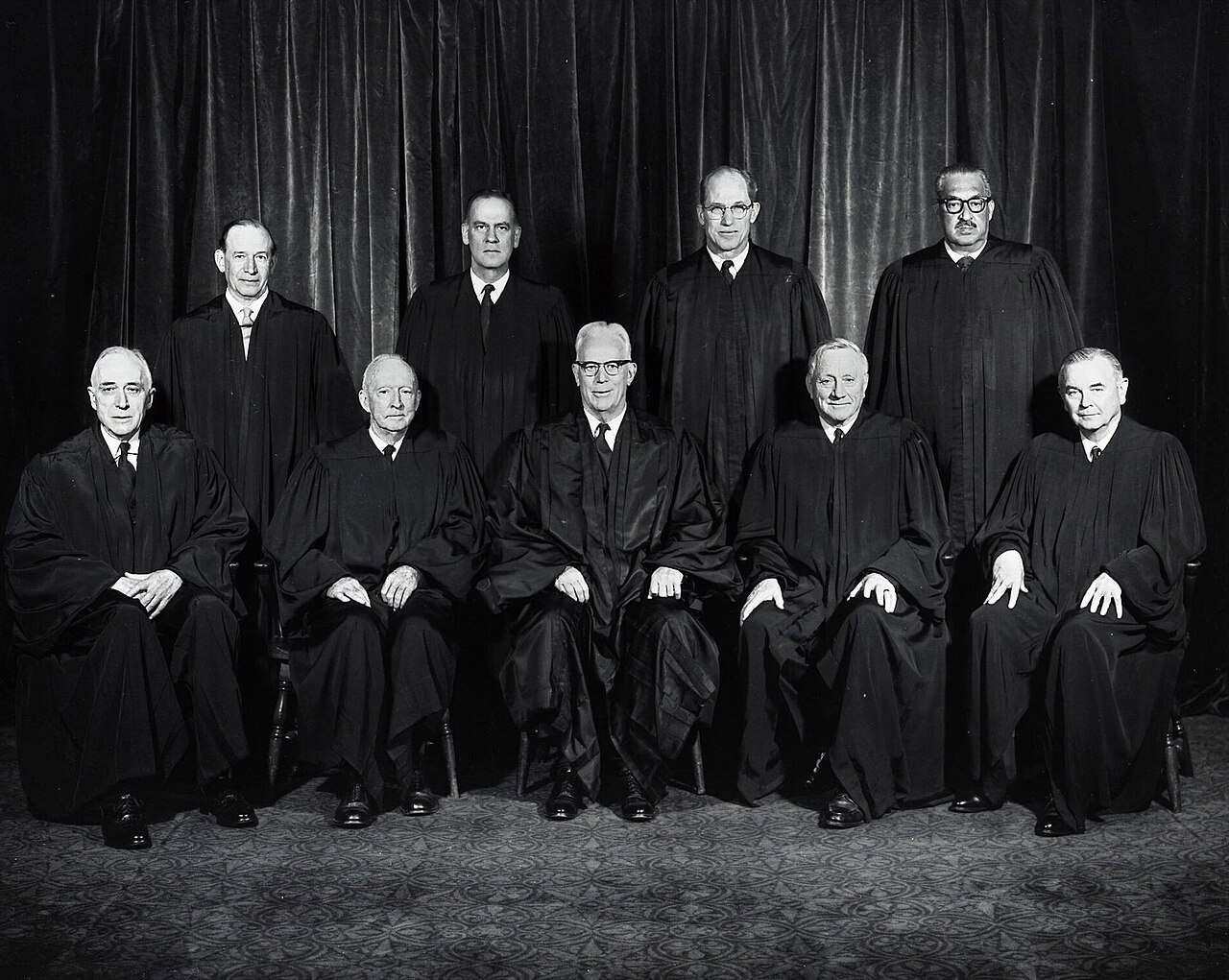
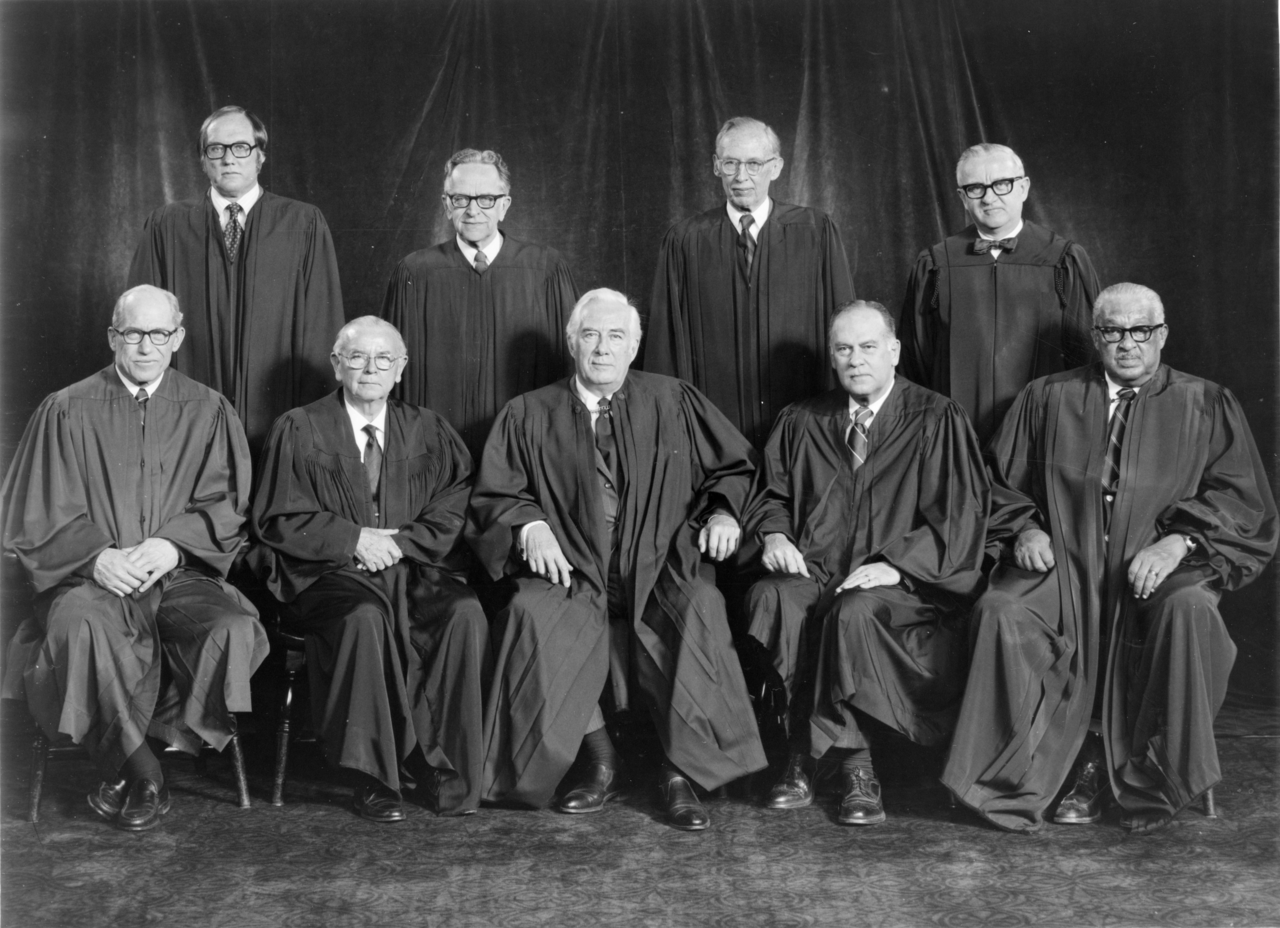
Black and white group portrait of nine Supreme Court justices in black robes. Five sit in the front row and four stand behind them, in front of a dark draped curtain. The floor has a patterned carpet.Photograph

Primary source

Warren Court Official Portrait

Supreme Court Official Photo · 1967-1969

Document

Primary source

Gregg v. Georgia

1976

Document

Primary source

Ford v. Wainwright

Thurgood Marshall · 1986

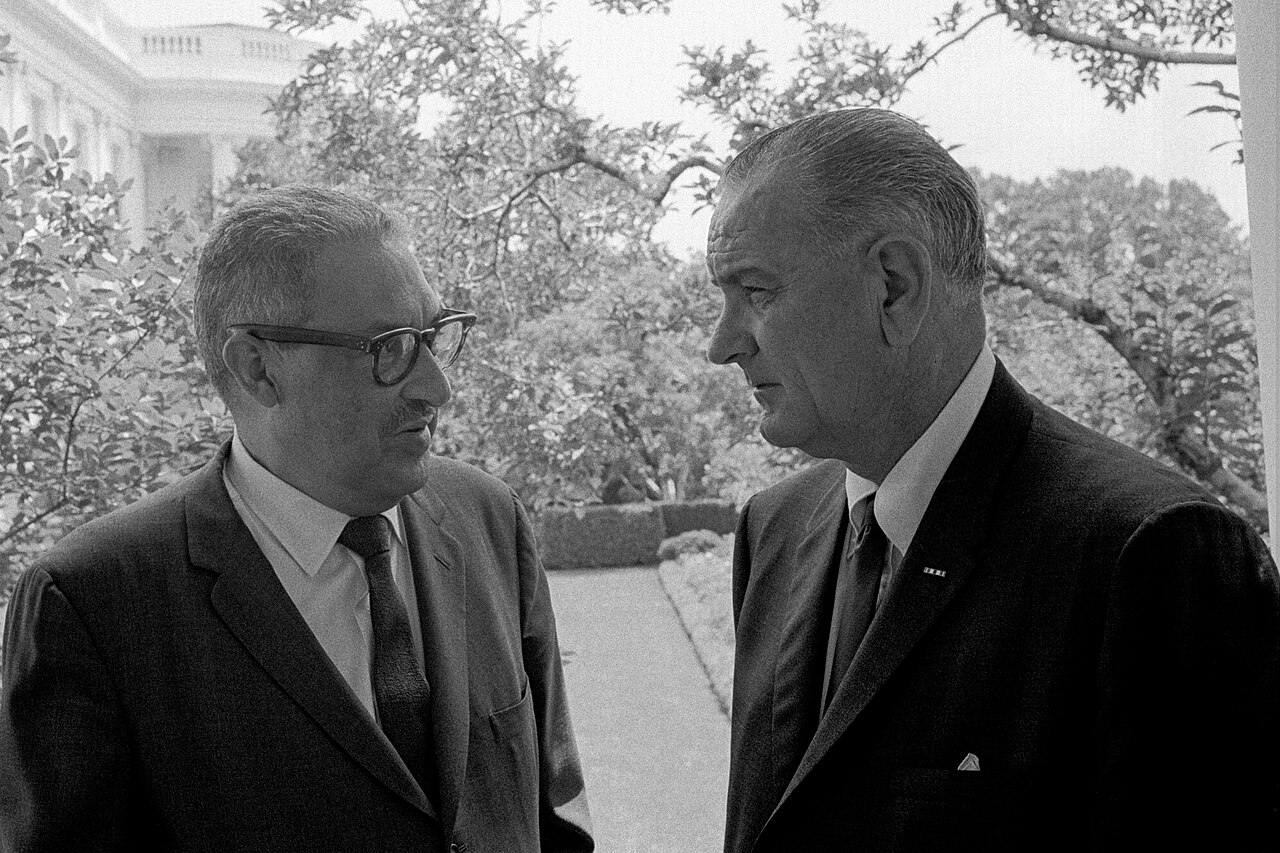
Black-and-white photo of two men in dark suits talking outdoors near leafy trees and a garden path. The man on the left wears dark-framed glasses and a dark tie. The taller man on the right, with a lapel pin, looks toward him.Photograph

Primary source

President Johnson with Thurgood Marshall

Yoichi Okamoto · 1965

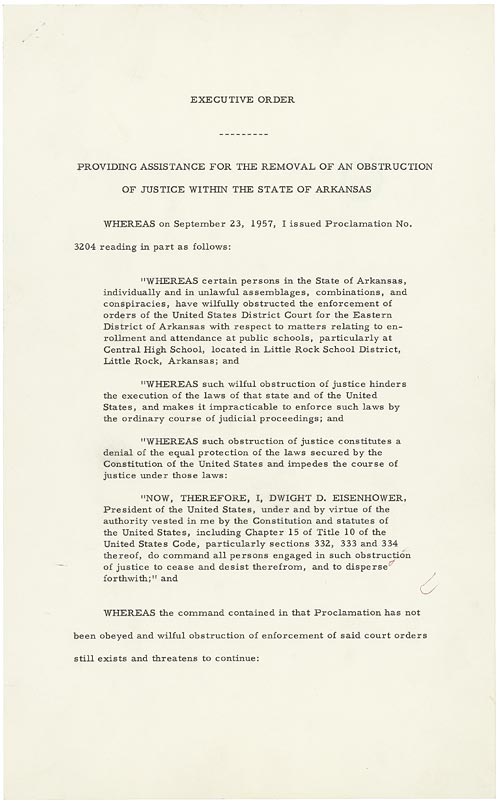
Scanned page of a 1957 typed document titled Executive Order, providing assistance for the removal of an obstruction of justice within the State of Arkansas. It quotes Proclamation 3204 and President Eisenhower's command to disperse obstructers, with a handwritten red mark near the bottom right.Document

Primary source

Executive Order 10730: Desegregation of Central High School

Dwight D. Eisenhower · 23 September 1957

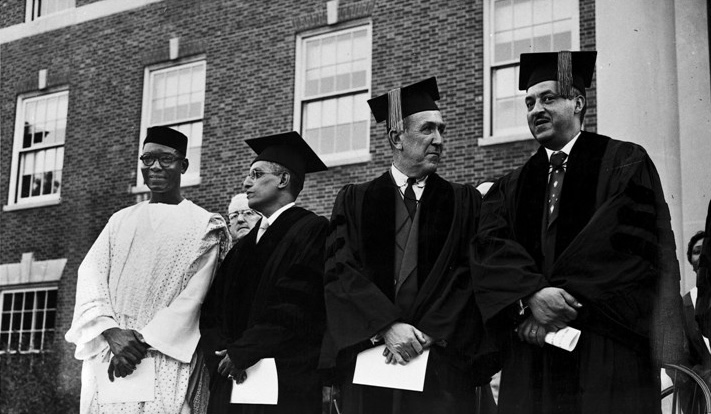
Black-and-white photo of four men in academic regalia on an outdoor stage in front of a brick building. Left: a man in a light robe and mortarboard with glasses. Second: a man in a gown and mortarboard. Third: a tall man in gown and hood. Right: a man in gown, hood and tie.Photograph

Primary source

Azikiwe with Thurgood Marshall, Chester Bowles and Roy Williston Bornn at Howard University 1954 commencement

Unknown · 1954

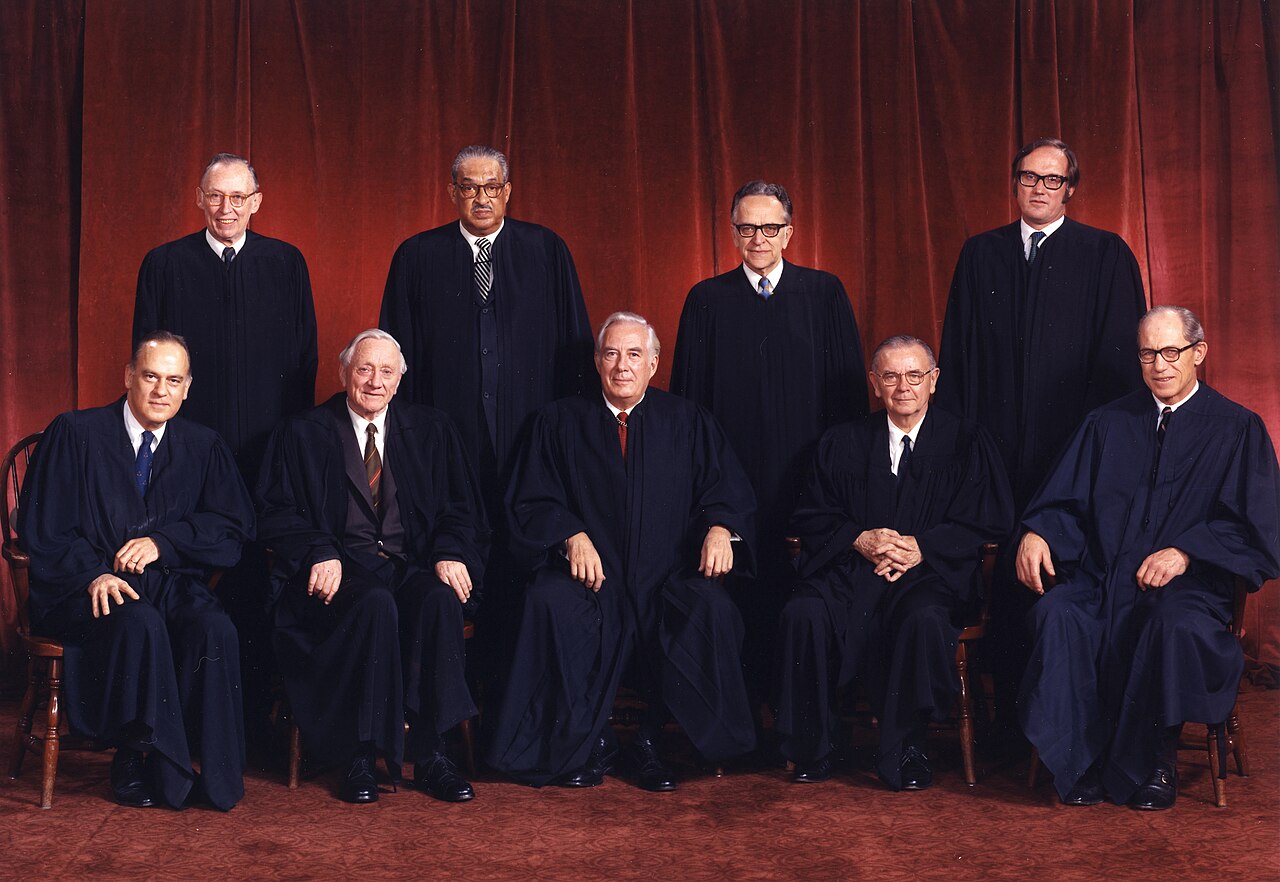
Official group portrait of nine Supreme Court justices in black robes, posed against a red velvet curtain. Five sit in front and four stand behind, with the standing justices wearing dark robes and some glasses.Photograph

Primary source

Burger Court in 1973

US Government · 1973

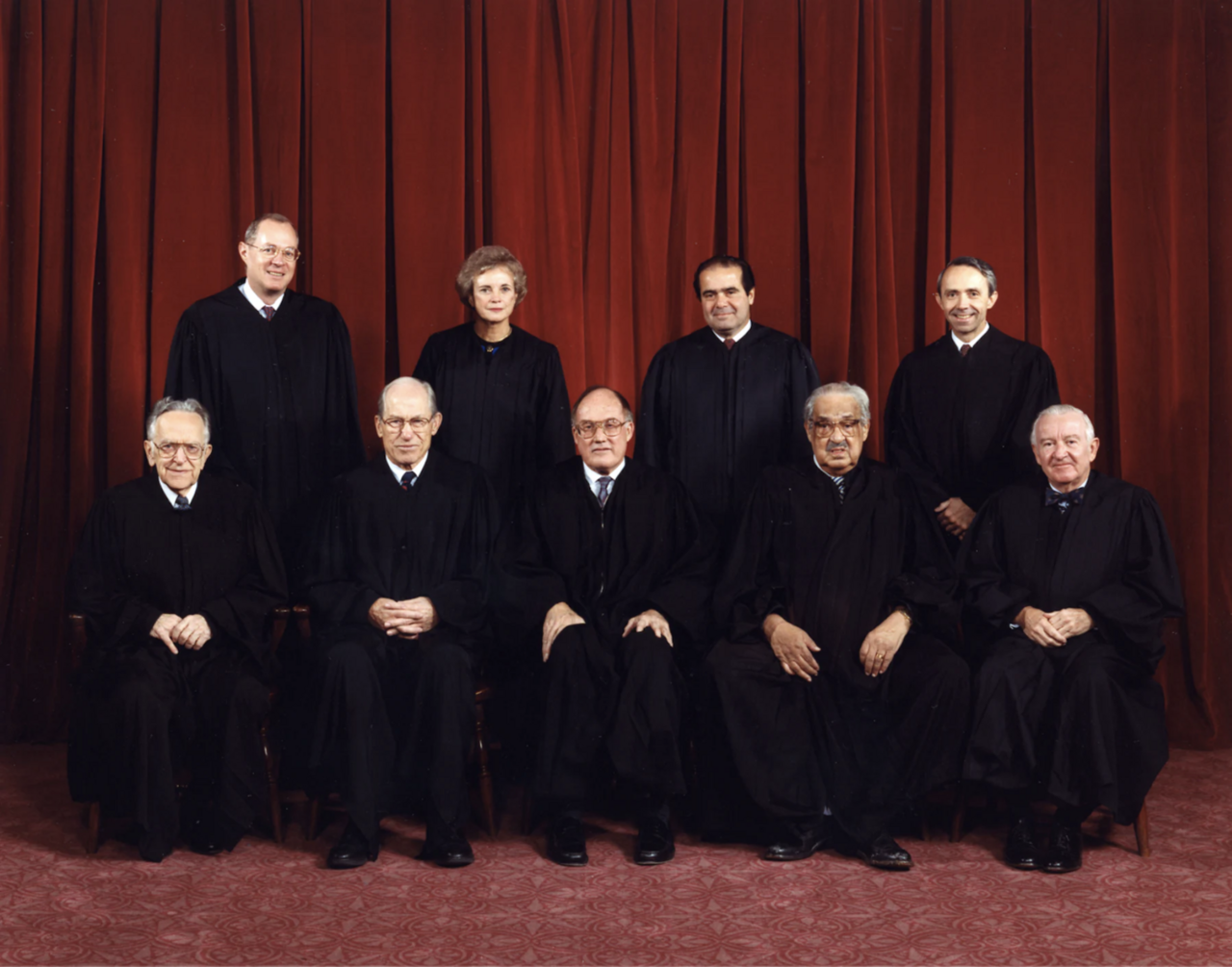
Group portrait of nine robed justices in front of red velvet drapes. Five seated in the front row and four standing behind them. All wear black robes; the front row sits on wooden chairs against a red patterned carpet.Photograph

Primary source

Rehnquist Court from 1990-1991

Supreme Court Official Photo · 1990-1991

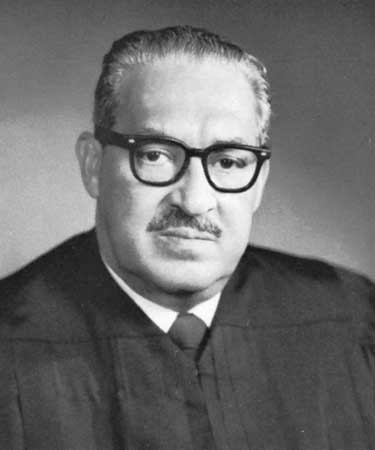
Black-and-white studio portrait of a man with short wavy hair, dark-framed eyeglasses, and a mustache, wearing a dark judicial robe over a white collared shirt and dark tie against a plain backdrop.Photograph

Primary source

Thurgood Marshall in His Judicial Robe

The Supreme Court

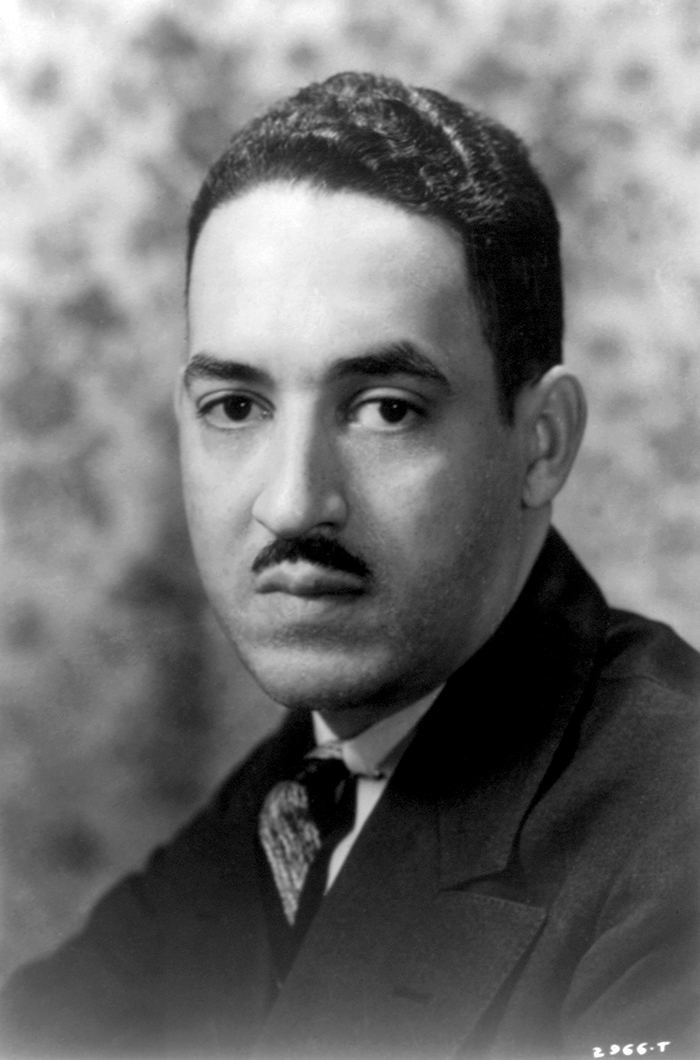
Black-and-white studio portrait of a man with short dark wavy hair and a thin mustache, wearing a dark suit jacket, white shirt, and patterned tie, against a mottled backdrop. He looks directly at the camera.Photograph

Primary source

Thurgood Marshall Publicity Photograph

Unknown

Document

Secondary source

Proclamation 6526

Bill Clinton · 1993

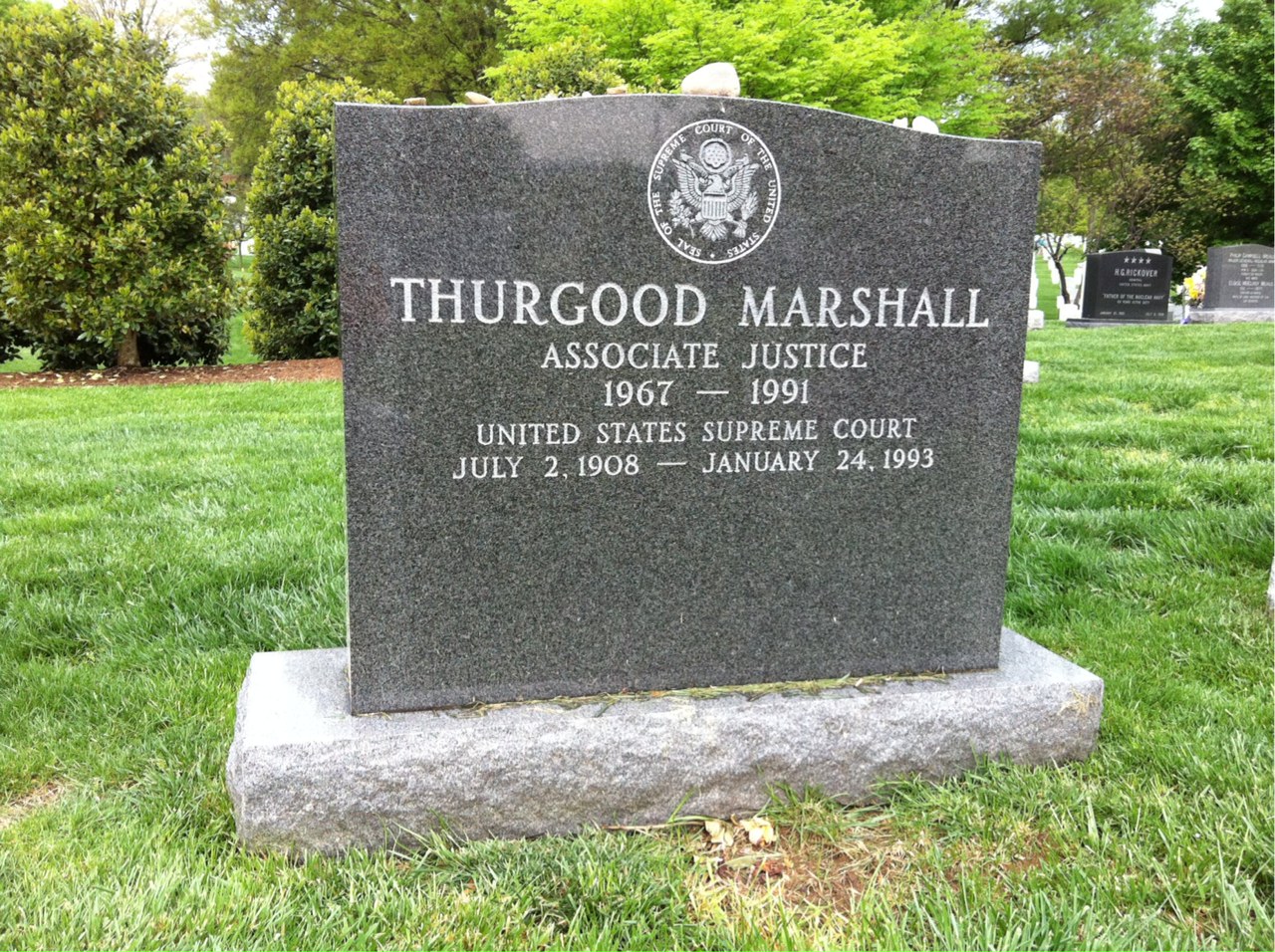
Dark gray granite headstone on green grass for Thurgood Marshall, with the Supreme Court seal above his name, Associate Justice 1967-1991, and dates July 2, 1908 to January 24, 1993.Artifact

Secondary source

Grave of Thurgood Marshall

Document

Primary source

Benton v. Maryland

Thurgood Marshall · 23 June 1969

Black-and-white group photograph of nine justices of the US Supreme Court in black robes against a dark draped backdrop. Five are seated in the front row and four stand behind them.Photograph

Primary source

US Supreme Court 1976

Robert S. Oakes · 1976

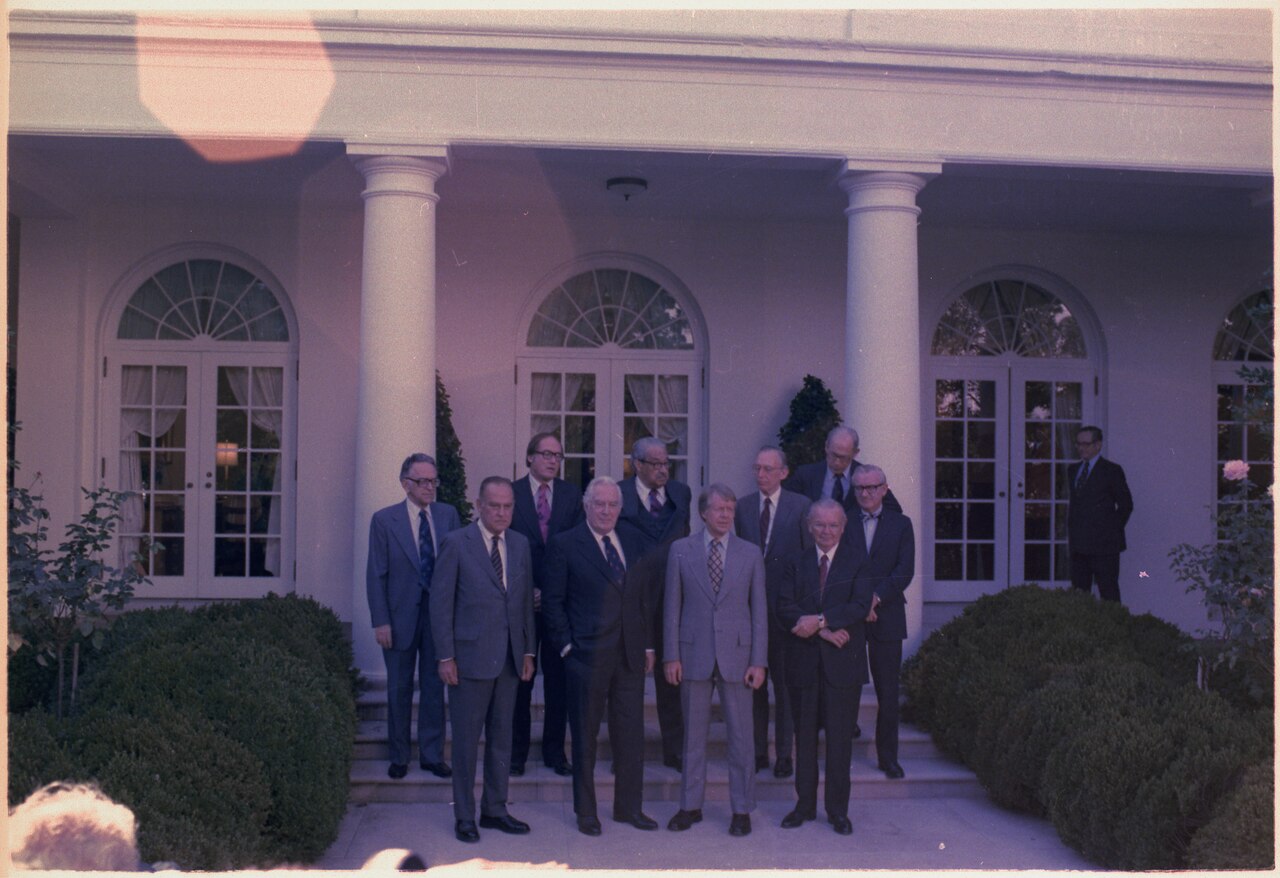
Eleven men in dark suits stand in two rows on the steps of a columned, arched-window building with bushes in front. A man in a light gray suit stands at the center front. One man stands apart at the far right edge.Photograph

Primary source

Jimmy Carter with the Supreme Court of the United States

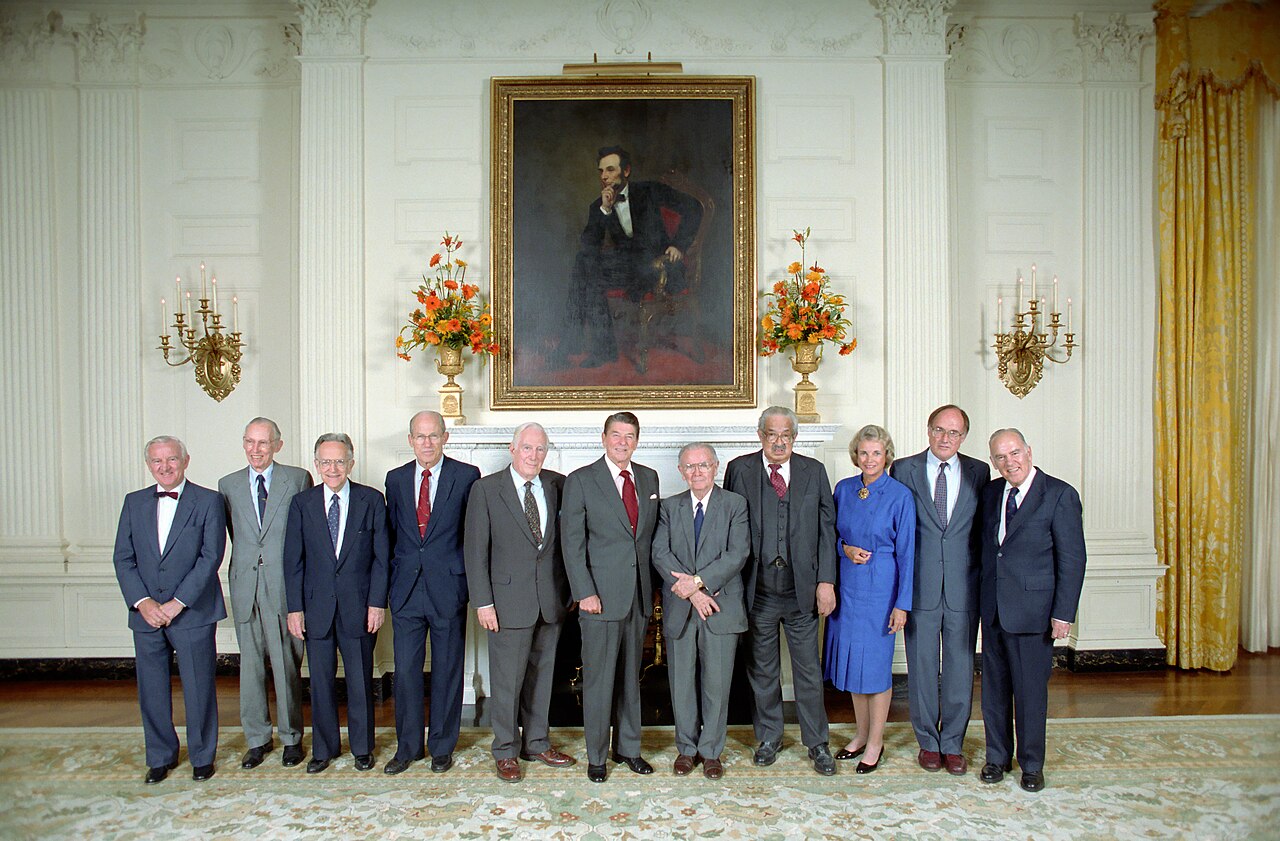
Group photograph of about eleven men and two women standing in a formal room with white paneled walls, a large framed portrait of a seated Abraham Lincoln above a fireplace, and gold curtains at right. Orange floral arrangements flank the portrait.Photograph

Primary source

President Ronald Reagan with the Supreme Court of the United States

White House Photographic Office

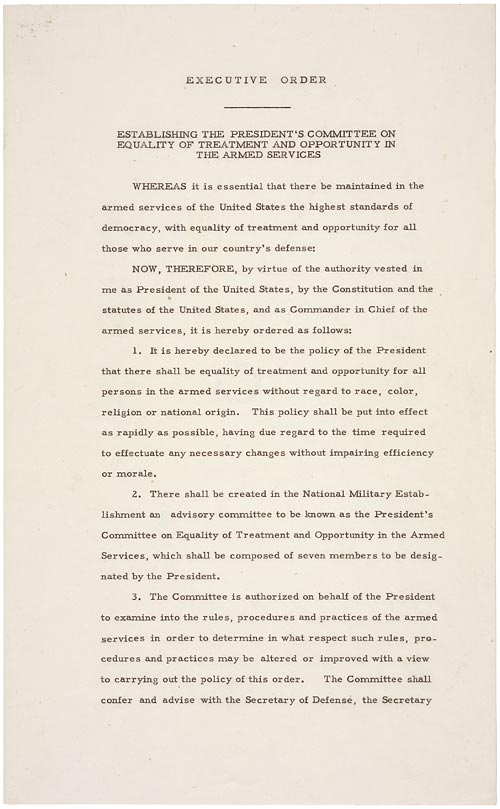
Scanned page of Executive Order 9981 titled 'Establishing the President's Committee on Equality of Treatment and Opportunity in the Armed Services', typed on cream paper with numbered paragraphs.Document

Primary source

Executive Order 9981

Harry S. Truman · 26 July 1948

Document

Primary source

Executive Order 9066

Franklin Delano Roosevelt · 19 February 1942

News clip

Primary source

Universal Newsreel: Marshall Sworn In to Supreme Court, 1967

Universal Newsreel · 6 October 1967

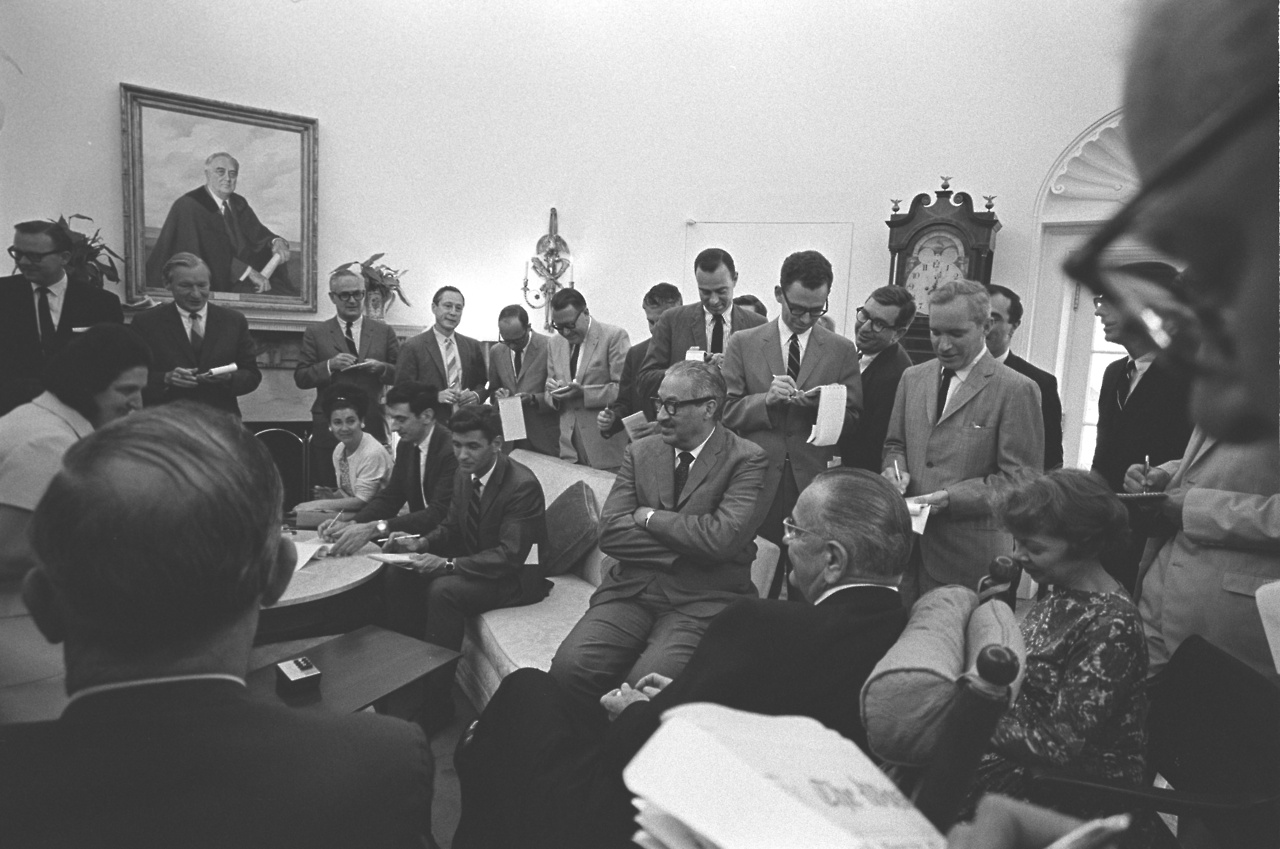
Black-and-white photograph of a crowded room in the White House where reporters stand and sit taking notes. In the center, a seated man in a dark suit with glasses looks down, and in the foreground a man in a dark suit sits with his back partly to the camera. A large framed portrait hangs on the left wall and a tall case clock stands on the right.Photograph

Primary source

Johnson Announces Marshall's Nomination to the Supreme Court

Yoichi Okamoto · 13 June 1967

Document

Primary source

New York Times v. United States Concurrence

Thurgood Marshall · 1971

Document

Primary source

Furman v. Georgia Concurrence

Thurgood Marshall · 1972

Document

Primary source

Neitzke v. Williams

Thurgood Marshall · 1989

Document

Primary source

United States v. Centennial Savings Bank FSB

Thurgood Marshall · 1991

Document

Primary source

Ortwein v. Schwab Dissent

Thurgood Marshall · 1973

Document

Primary source

United States v. Reidel Dissent

Thurgood Marshall · 1971

Document

Primary source

McKoy v. North Carolina Concurrence

Thurgood Marshall · 1990

Document

Primary source

The Florida Star v. B.J.F.

Thurgood Marshall · 1989

Document

Primary source

Newman-Green Inc v. Alfonzo-Larrain

Thurgood Marshall · 1989

Document

Primary source

United States Department of Justice v. Tax Analysts

Thurgood Marshall · 1989

Document

Primary source

Reves v. Ernst & Young

Thurgood Marshall · 21 February 1990

Document

Primary source

Cottage Savings Association v. Commissioner Dissent

Thurgood Marshall · 17 April 1991

Document

Primary source

Mead Corporation v. Tilley

Thurgood Marshall · 5 June 1989

Document

Primary source

Burns v. United States Dissent

Thurgood Marshall · 13 June 1991

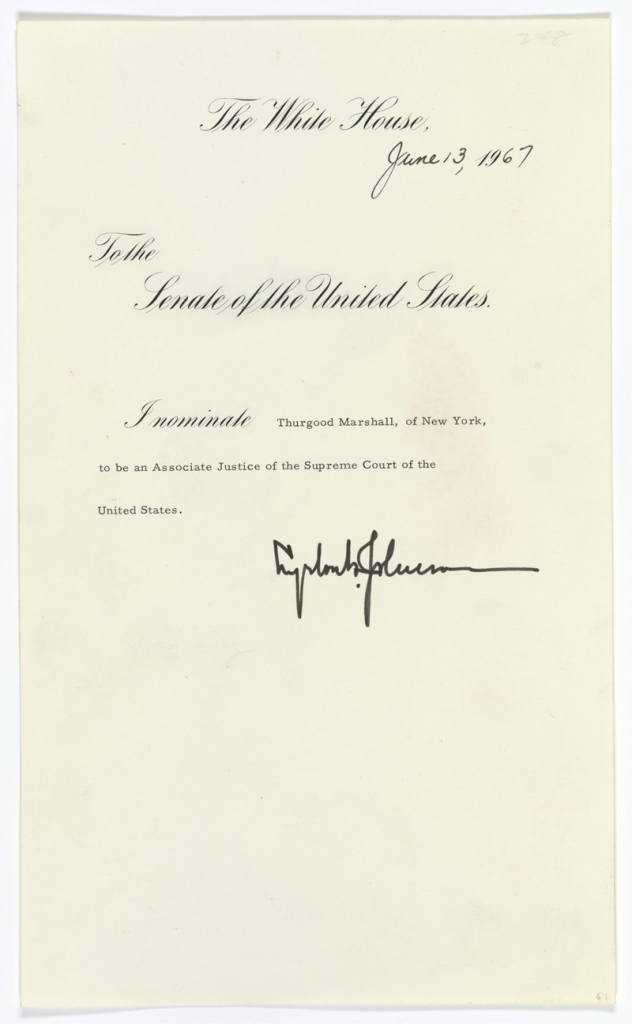
Scan of a White House nomination message dated June 13, 1967, addressed to the Senate of the United States, nominating Thurgood Marshall of New York as an Associate Justice of the Supreme Court, signed by Lyndon B. Johnson.Document

Primary source

Nomination of Thurgood Marshall to the Supreme Court

Lyndon B. Johnson · 13 June 1967

Document

Primary source

Grayned v. City of Rockford Opinion

Thurgood Marshall · 1972

Document

Primary source

Estelle v. Gamble Opinion

Thurgood Marshall · 1976

Document

Primary source

California v. Trombetta Opinion

Thurgood Marshall · 1984

Document

Primary source

Arkansas Writers' Project v. Ragland Opinion

Thurgood Marshall · 1987

Document

Primary source

Puerto Rico v. Branstad Opinion

Thurgood Marshall · 1987

Document

Primary source

Rankin v. McPherson Opinion

Thurgood Marshall · 1987

Document

Primary source

Community for Creative Non-Violence v. Reid Opinion

Thurgood Marshall · 1989

Document

Primary source

Meritor Savings Bank v. Vinson Concurrence

Thurgood Marshall · 1986

Document

Primary source

New Jersey v. T.L.O. Concurrence-Dissent

William Brennan · 1985

Document

Primary source

City of Cleburne v. Cleburne Living Center Opinion

Thurgood Marshall · 1985

Document

Primary source

Edelman v. Jordan Dissent

Thurgood Marshall · 1974

Document

Primary source

Massachusetts Board of Retirement v. Murgia

Thurgood Marshall · 1976

Document

Primary source

Bethel School District No. 403 v. Fraser

Thurgood Marshall · 1986

Document

Primary source

Duckworth v. Eagan

Thurgood Marshall · 1989

Document

Primary source

Holland v. Illinois

Thurgood Marshall · 1990

Document

Primary source

Harmelin v. Michigan

Thurgood Marshall · 1991

Document

Primary source

Schilb v. Kuebel

Thurgood Marshall · 1971

Document

Primary source

Nelson v. O'Neil dissent

Thurgood Marshall · 1 June 1971

Document

Primary source

Williams v. Florida dissent

Thurgood Marshall · 22 June 1970

Document

Primary source

Gibson v. Berryhill concurrence

Thurgood Marshall · 1973

Document

Primary source

Mansell v. Mansell dissent

Thurgood Marshall · 1989

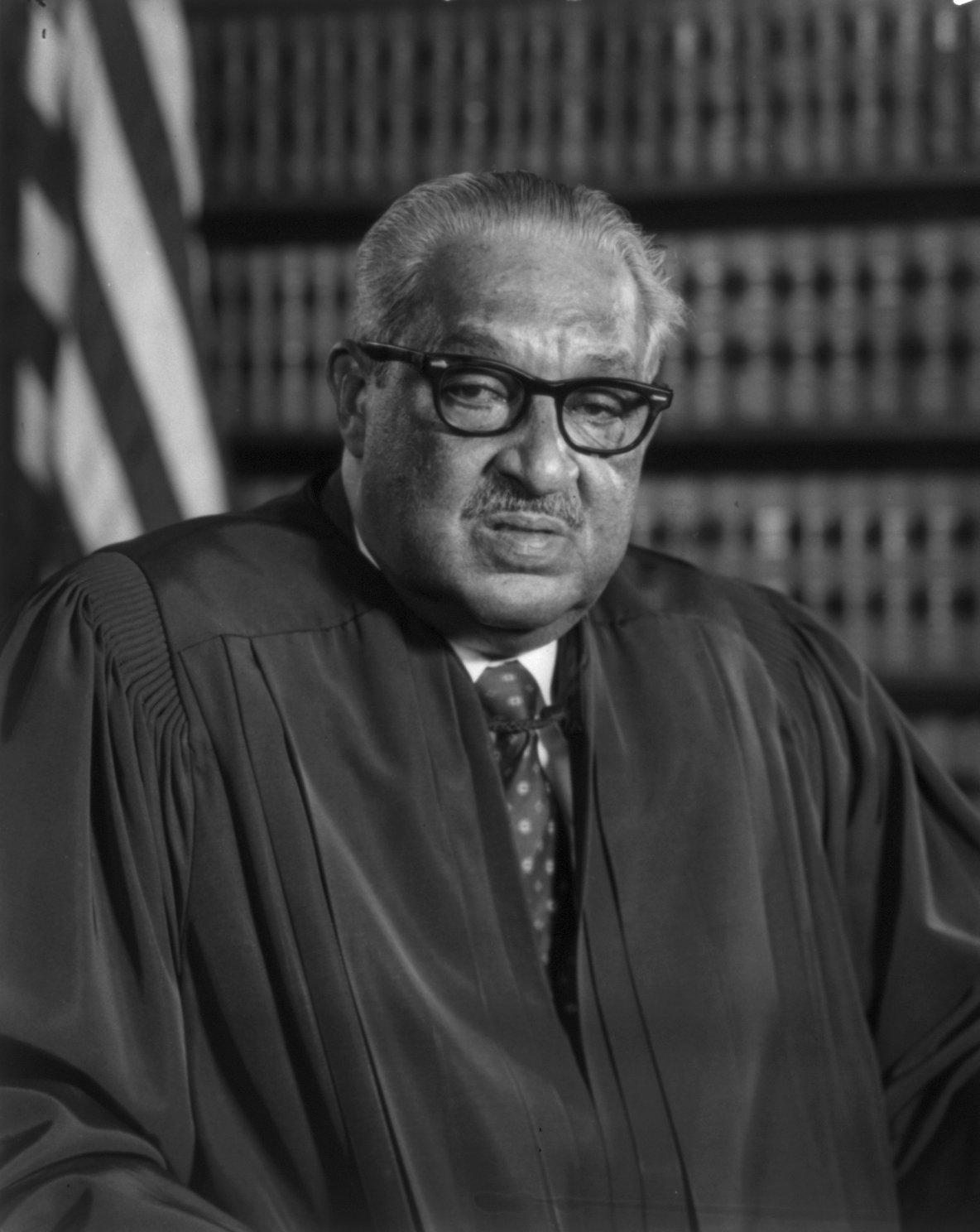
Black-and-white portrait of an older man with gray hair, dark-framed glasses, and a mustache, wearing a black judicial robe over a white shirt and patterned tie. An American flag and rows of law books are behind him.Photograph

Primary source

Official portrait of Justice Thurgood Marshall

Robert S. Oakes · 1976

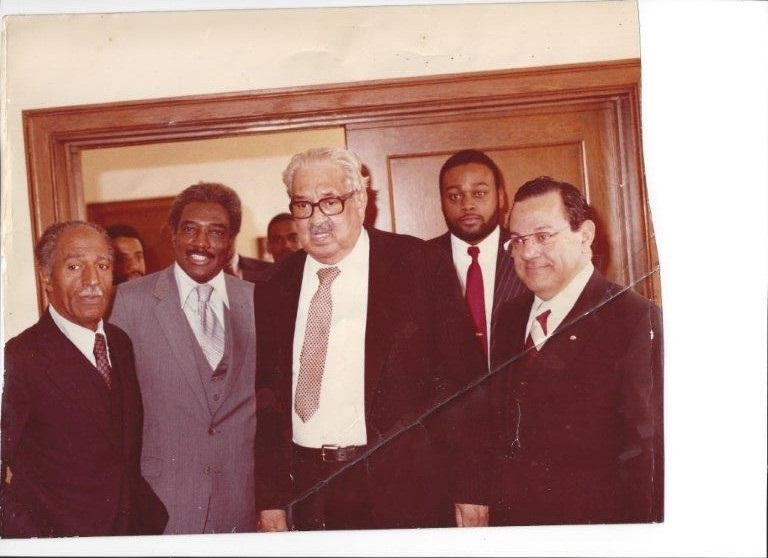
Five men in dark suits posed in a doorway with wood trim. Left to right: an older man in a dark suit, a smiling man in a gray suit and tie, an older man with glasses and a gray-white beard in a dark suit and patterned tie, a younger man in a dark suit and red tie, and a man with glasses in a dark suit and striped tie.Photograph

Secondary source

Thurgood Marshall with Student Bar president Matthews

Carlostmayers

Document

Primary source

Mansell v. Mansell

Thurgood Marshall · 1989

Document

Primary source

White v. United States

Thurgood Marshall · 1989

Document

Primary source

United States v. Goodyear Tire and Rubber Company

Thurgood Marshall · 1989

Document

Primary source

Kamen v. Kemper Financial Services

Thurgood Marshall · 1991

Document

Primary source

Burns v. United States

Thurgood Marshall · 1991

Document

Primary source

Touby v. United States

Thurgood Marshall · 1991

Document

Primary source

Lehnert v. Ferris Faculty Association

Thurgood Marshall · 1991

Document

Primary source

Village of Belle Terre v. Boraas

Thurgood Marshall · 1974

Document

Primary source

South Dakota v. Opperman

Thurgood Marshall · 1976

Document

Primary source

Smith v. Arkansas State Highway Employees

Thurgood Marshall · 1979

Document

Primary source

Lockhart v. Nelson

Thurgood Marshall · 1988

Document

Primary source

United States v. Sokolow

Thurgood Marshall · 1989

Document

Primary source

Kentucky Department of Corrections v. Thompson

Thurgood Marshall · 1989

Document

Primary source

Lorance v. AT&T Technologies

Thurgood Marshall · 1989

Document

Primary source

Public Employees Retirement System of Ohio v. Betts

Thurgood Marshall · 1989

Document

Primary source

Hallstrom v. Tillamook County

Thurgood Marshall · 1989

Document

Primary source

Baltimore City Department of Social Services v. Bouknight

Thurgood Marshall · 1990

Document

Primary source

Whitmore v. Arkansas

Thurgood Marshall · 1990

Document

Primary source

In Re Amendment to Rule 39 (Marshall dissent)

Thurgood Marshall · 1991

Document

Primary source

County of Riverside v. McLaughlin (Marshall dissent)

Thurgood Marshall · 1991

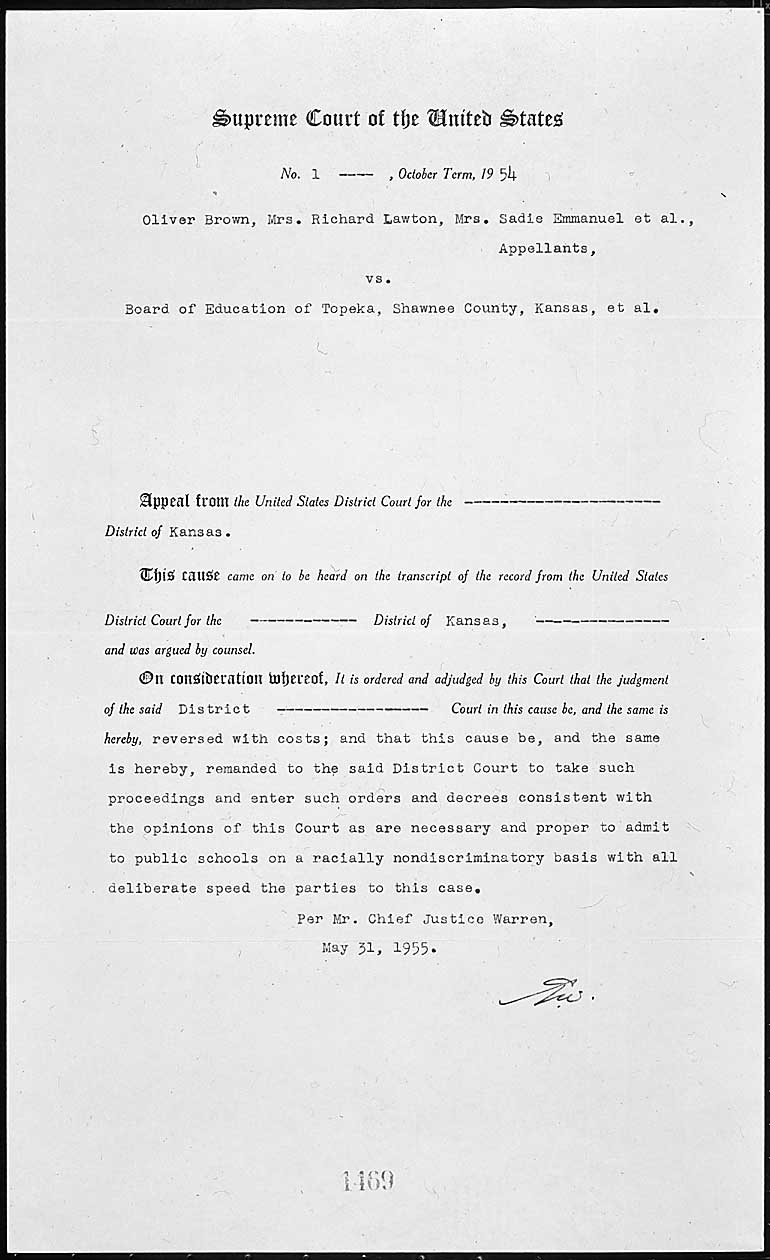
Scan of the Supreme Court of the United States judgment in Brown v. Board of Education, dated May 31, 1955. Typed text orders the judgment reversed and the case remanded to the District Court for proceedings toward racially nondiscriminatory public schools. Signed 'Per Mr. Chief Justice Warren' with a handwritten signature and page number 1169 at bottom.Document

Primary source

Judgment, Brown v. Board of Education, May 31, 1955

1955-05-31

Want the full shelf? Chat with Thurgood Marshall in the app and open the Sources panel — every quote links back to the original.

Use Thurgood Marshall in class

1 collection

A ready-made collection from the Humy team that features Thurgood Marshall. Preview it, then try it free.

Trusted by educators worldwide

Conversations
375,000+
Real exchanges between students and historical figures
Messages exchanged
4,142,000+
Across every figure, classroom and language
Historical figures
100,000+
Each informed by a curated biography and selected sources
Languages supported
50+
From English and Spanish to Arabic and Korean

Paying customers

Used by 98 schools and universities

Partner school logo
Tecnológico de Monterrey logo
Hyper Island logo
Partner school logo
Chambersburg Area School District logo
Broward County Public Schools logo
Nebo School District logo
National Louis University logo
South Florida PBS logo
Punahou School logo
University of Wisconsin–River Falls logo
Partner school logo
Partner school logo
Archbishop Mitty High School logo
Kingsburg High School logo
Norwalk Public Schools logo
Partner school logo
Connections logo
Partner school logo
Moore Public Schools logo
Partner school logo
Partner school logo
Partner school logo
Partner school logo
Robbinsville Public Schools logo
Partner school logo
Partner school logo
Partner school logo
Tecnológico de Monterrey logo
Hyper Island logo
Partner school logo
Chambersburg Area School District logo
Broward County Public Schools logo
Nebo School District logo
National Louis University logo
South Florida PBS logo
Punahou School logo
University of Wisconsin–River Falls logo
Partner school logo
Partner school logo
Archbishop Mitty High School logo
Kingsburg High School logo
Norwalk Public Schools logo
Partner school logo
Connections logo
Partner school logo
Moore Public Schools logo
Partner school logo
Partner school logo
Partner school logo
Partner school logo
Robbinsville Public Schools logo
Partner school logo
Partner school logo

What educators are saying

“We enjoyed the program last year and used it frequently.”
“My students say it’s a welcome change of pace. I’m not a fan of the “sage on the stage” model, so I try to incorporate research-oriented and self-paced activities. With Humy, students have to take charge of their learning. They’ve become more adept at critical thinking, forming better questions, and improving their reading comprehension. The interview feature has been my go-to tool. I create assignments where students must ask historical figures a set number of questions, then summarize the responses to ensure they’re truly absorbing the material. This approach lets them actively explore the past rather than passively consuming information.”
“Humy has helped me bring historical figures, sometimes long past, to life. When my students interact with these figures in real-time, it eliminates some of the perceived “ancient” characteristics of my curriculum. This has shifted my students’ thinking away from viewing history as abstract or irrelevant. Real-time interactions make historical figures relatable, even allowing students to ask off-topic questions that help put historical lives in a more relevant context for 13-year-olds. The feature I use the most is the interview feature. After teaching a topic, most recently Gandhi and Joan of Arc, I have the students ask pointed, focused questions. We practice good conversation techniques beforehand, teaching them to listen (or read) carefully and formulate thoughtful follow-up questions rather than just interrogating. It helps students practice effective conversation skills.”

FAQ

Frequently asked questions

Who is Thurgood Marshall?
First African American Supreme Court Justice and a prominent civil rights lawyer. On Humy.ai you can chat with an AI version of Thurgood Marshall that draws on a short biography and 99 historical sources during the conversation — by text or voice, in 42 languages.
Is Thurgood Marshall AI free?
Thurgood Marshall is part of Humy's full library of more than 100,000 figures, which comes with a paid plan. A free account (no credit card) includes 20 messages a month with the free library's figures, so you can try how the conversations work first.
What sources does the Thurgood Marshall AI use?
It draws on a short biography and 99 historical sources (documents, photographs and paintings), including “Brown v. Board of Education”, “Thurgood Marshall” and “George Edward Chalmer Hayes, Thurgood Marshall, and James Nabrit in 1954 winning Brown case”. Each source has its own page on Humy.ai.
How historically accurate is the AI version of Thurgood Marshall?
Each figure uses a short biography and a small set of selected historical sources as context (retrieval-augmented generation), so answers stay closer to known material than the model's general knowledge alone. It isn't a citation-grade research tool — like any LLM, the AI can get details wrong or extrapolate. Treat it as a strong starting point for inquiry and cross-reference important claims.
Can I talk to Thurgood Marshall by voice?
Yes. In addition to text chat, you can call Thurgood Marshall and hear their voice respond in real time — useful for auditory learners, interview practice and Socratic dialogue.
Is Humy.ai safe and compliant for schools?
Yes. Humy.ai is used by more than 100 schools, universities and organisations. The platform is FERPA- and GDPR-aligned, supports SSO, and offers an IT-approval pack tailored for school procurement teams.

Cross-reference Thurgood Marshall

Like any LLM, the AI version of Thurgood Marshall can get details wrong. Open one of these sources in a new tab to verify what you’ve read.

Ready when you are

Start chatting with Thurgood Marshall now.

20 messages free · No credit card · Available in 50+ languages.