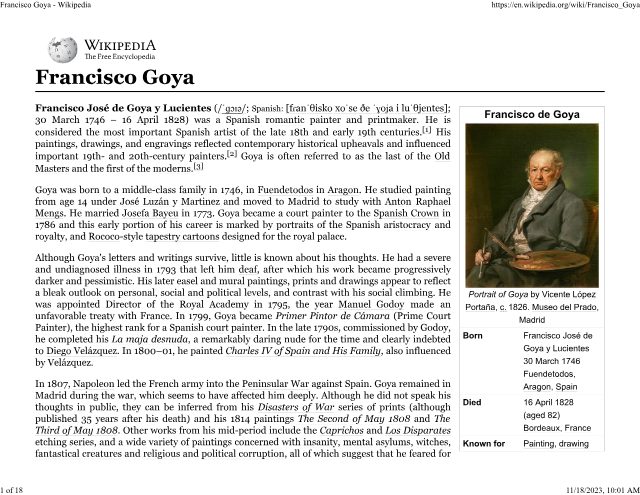

Portrait of Francisco Goya

AI Historical Figure

Francisco Goya

Renowned Spanish painter and printmaker.

Chat with Francisco Goya via text or voice — in 42 languages, drawing on a curated biography and 80 historical sources. Available 24/7.

Start chatting with Francisco Goya20 messages free · No credit card
Lived
1746–1828
From
Spain
Known for
Visual arts & architecture
Francisco Goya

Francisco Goya

Online · responds in seconds

Hello — I'm Francisco Goya. Renowned Spanish painter and printmaker. What would you like to ask me?

20 messages free · No credit card · Powered by Humy.ai

Live preview · Switch between 42 languages above · Send a message to continue in the app

Multilingual

Talk to Francisco Goya in 42 languages

Ask Francisco Goya questions in any language below, and the rest of Humy's app speaks it too. Pick yours to open the chat in that language.

Also in German (Austria), German (Switzerland), English (UK), English (Australia), English (Canada).

The sources behind this AI

80 sources · 62 paintings · 11 books · 4 documents · 2 artifacts · 1 letter

Francisco Goya doesn’t improvise from thin air. The AI is grounded in 80 curated historical sources students can inspect. Open any of them to see what informs the conversation.

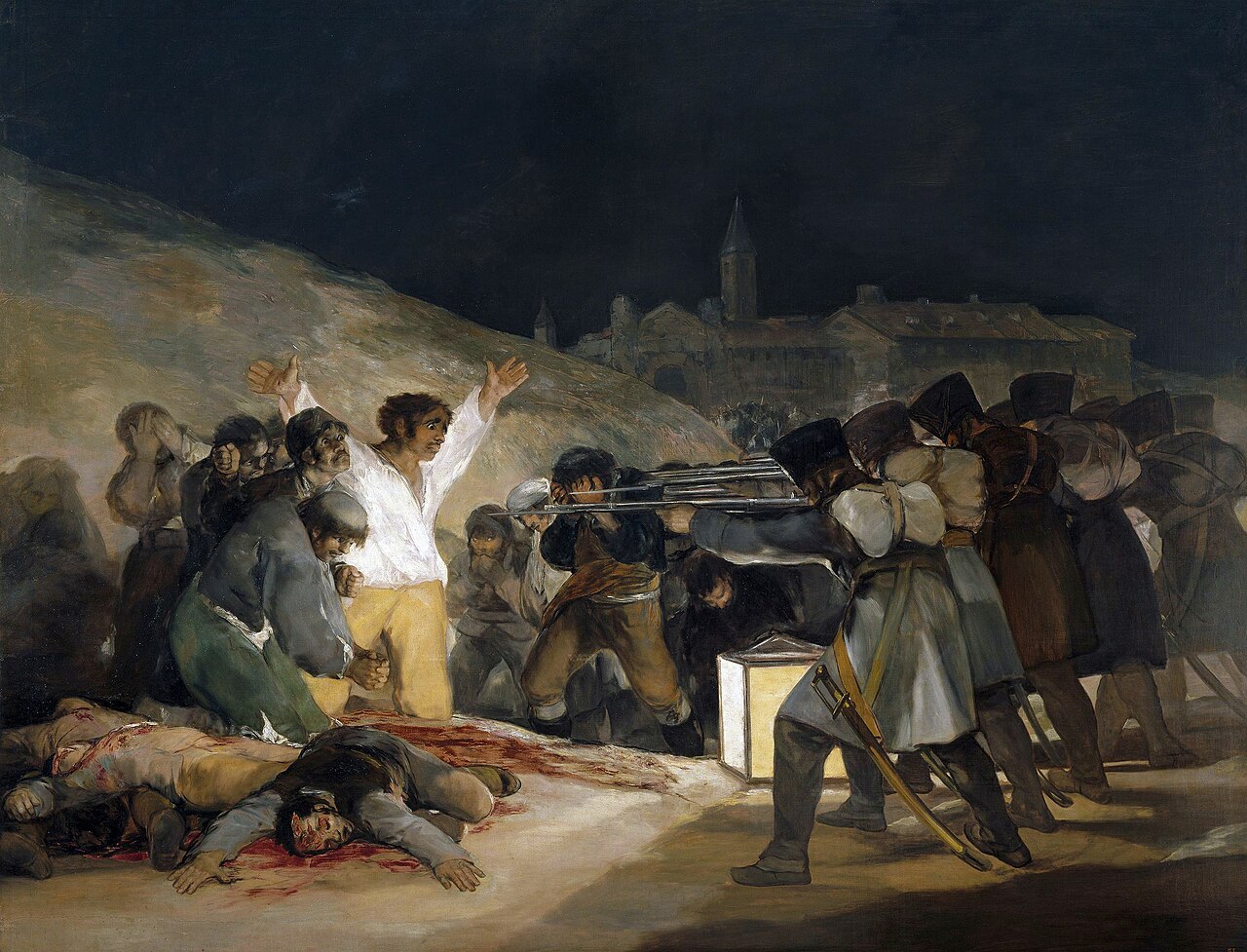
Painting of a nighttime execution. On the left, a man in a white shirt and yellow trousers throws his arms up while other prisoners cover their faces or kneel. Bodies lie bloodied on the ground in the foreground. On the right, a row of soldiers in dark shakos aims muskets at the prisoners, beside a lantern-lit box. A town with a church tower sits under a dark sky.Painting

Secondary source

The Third of May 1808

Francisco Goya · 1814

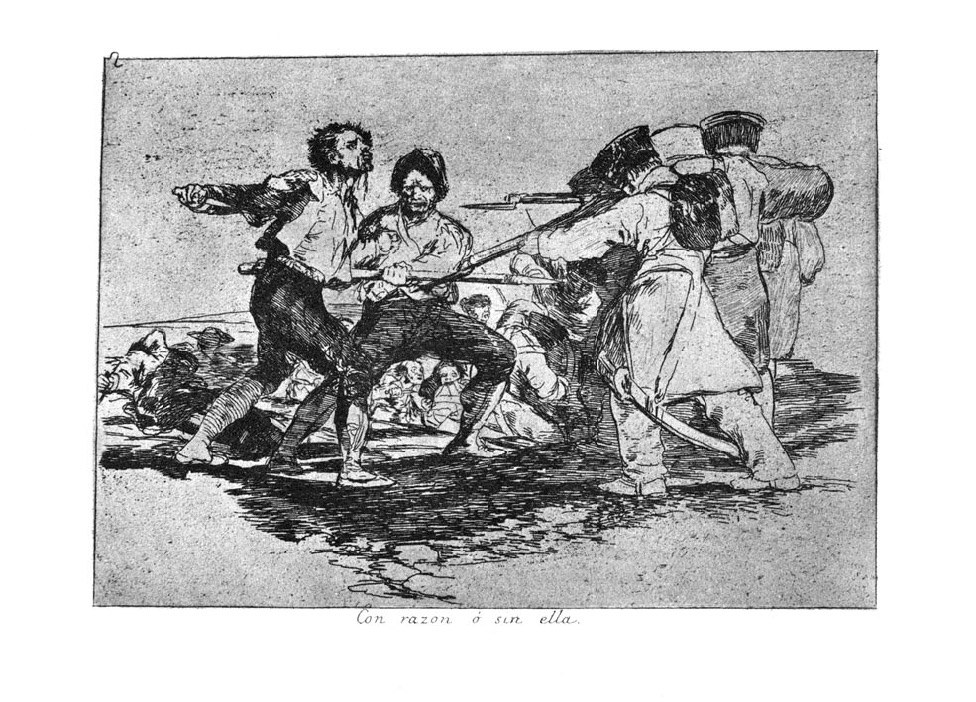
Black and white etching of Goya's Disasters of War series, plate 2, titled 'Con razón ó sin ella'. A bearded man in dark clothing, arm outstretched, is pushed back by a soldier thrusting a rifle with bayonet; another soldier in a tall hat stands behind. Bodies lie on the ground at left, and a crowd of figures is crouched in the background.Painting

Primary source

The Disasters of War

Francisco Goya · 1810-1820

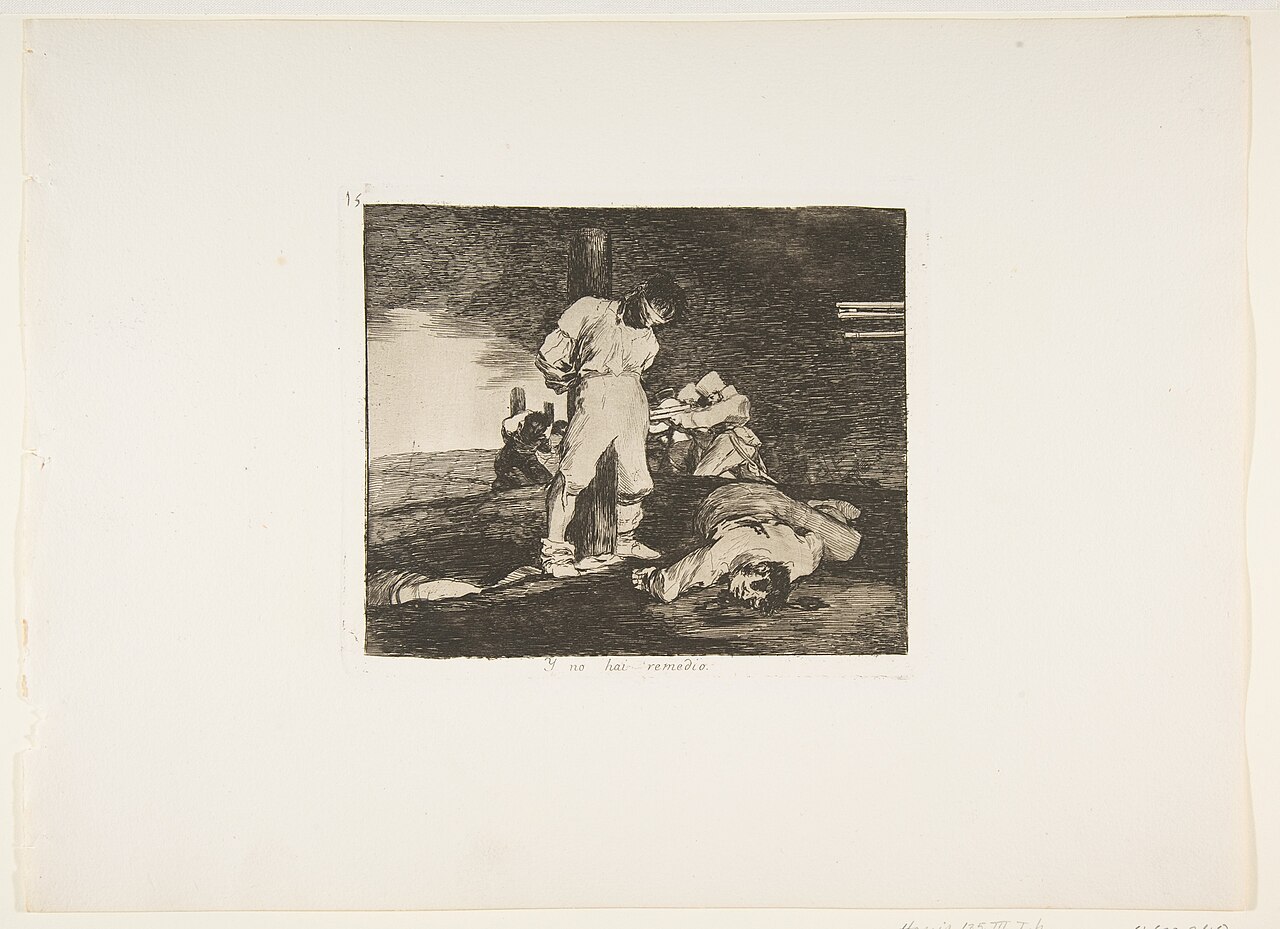
Etching showing a standing man in pale clothing with head bowed, leaning against a wooden post, while a seated figure and a lying body in the foreground appear in dark shadow. Plate labeled 'Y no hai remedio' beneath the image.Painting

Primary source

Y no hai remedio

Francisco de Goya · c. 1810-1814 (published 1863)

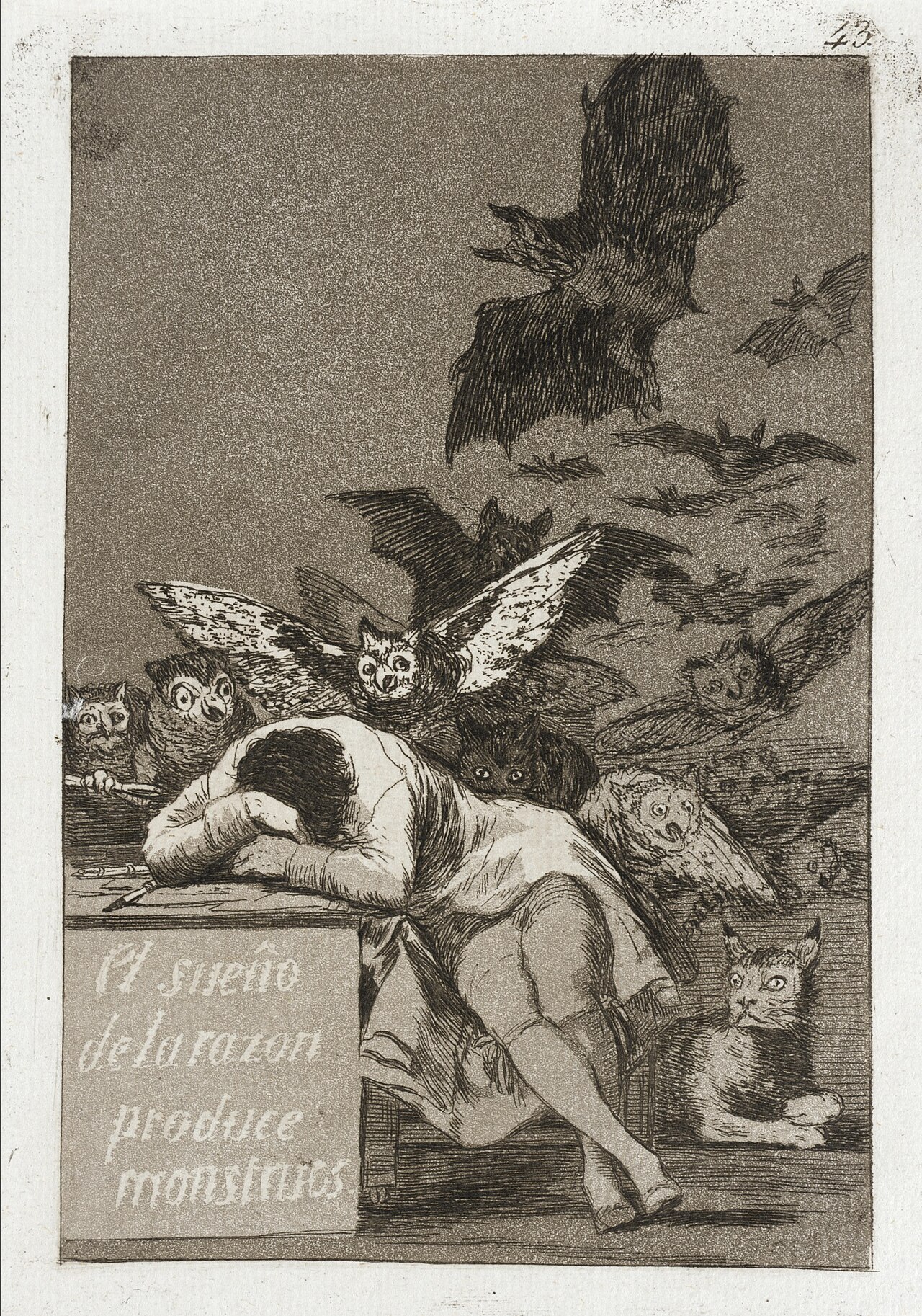
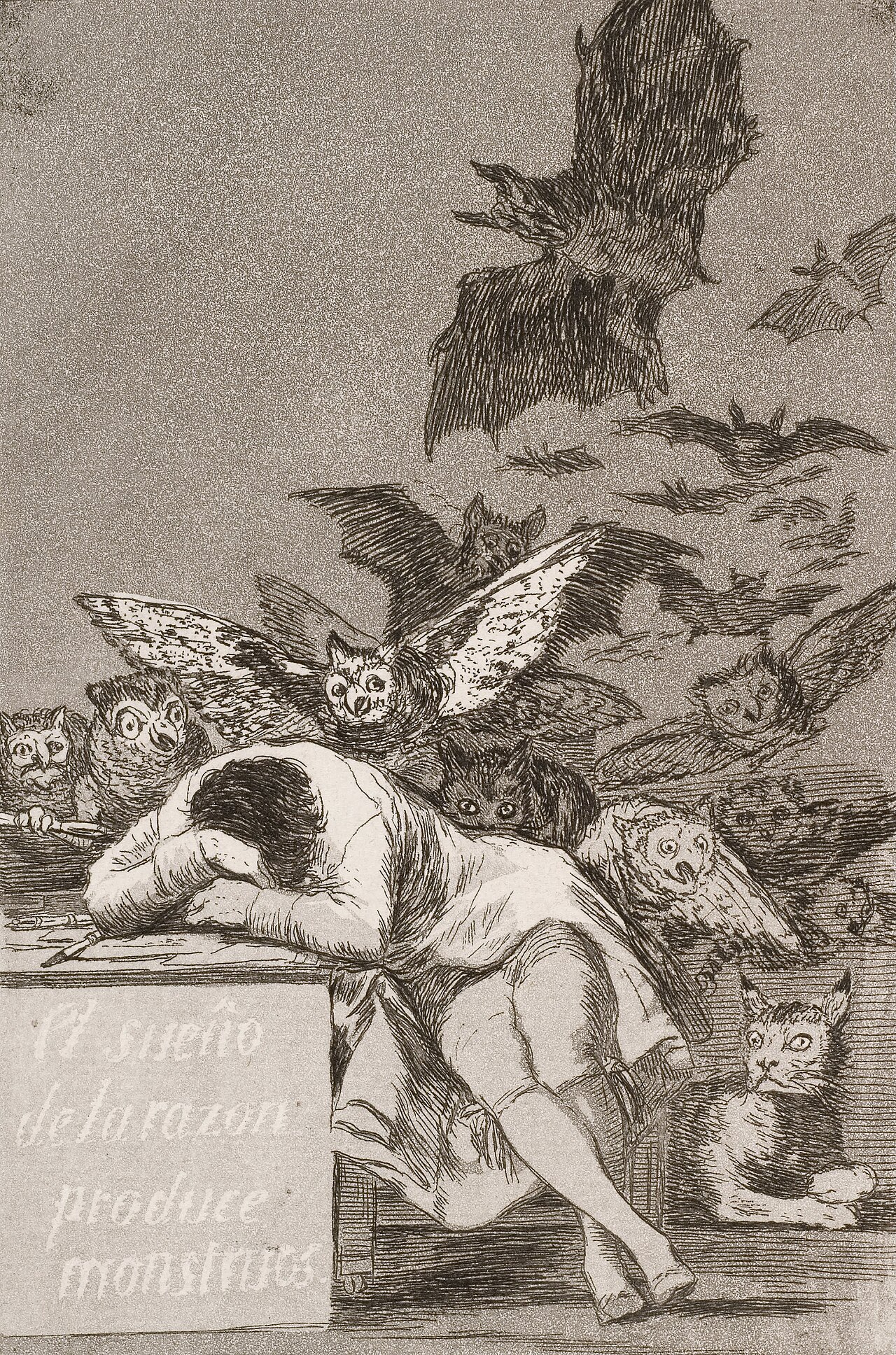
Etching from Goya's Caprichos, plate 43. A sleeping man rests his head on a desk with his arms folded while owls, bats, and a cat gather around him in a dark sky. Caption reads 'El sueño de la razón produce monstruos.' Number 43 in the top right corner.Painting

Primary source

Caprichos

Francisco Goya · 1799 (created 1797-1798)

Etching of a man asleep with his head on his arms at a desk, surrounded by owls, bats, and a cat. Inscription in the lower left reads 'El sueño de la razón produce monstruos'. Dark, hatched lines on a light ground.Painting

Primary source

The Sleep of Reason Produces Monsters

Francisco Goya · 1797-1799

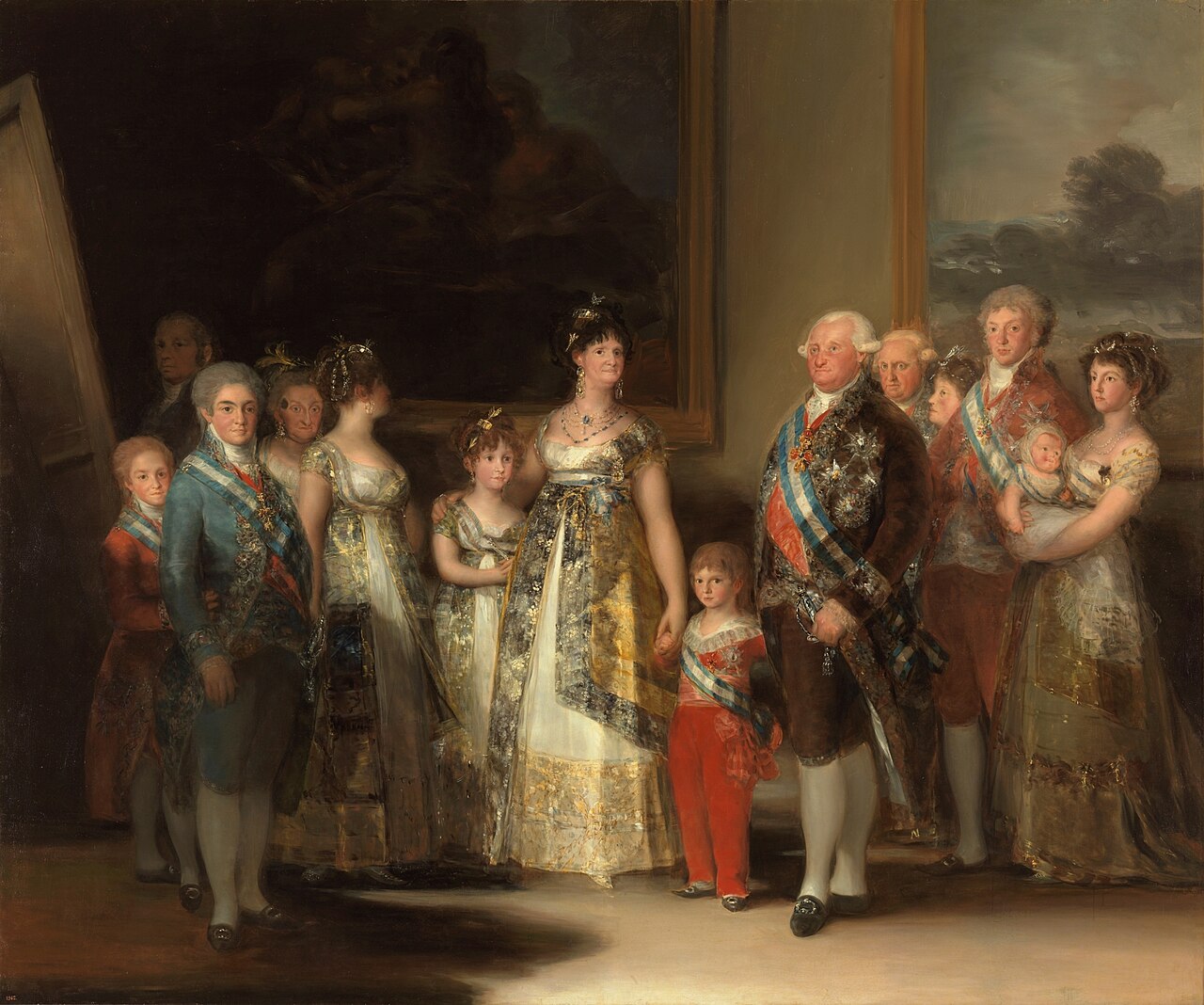
Group portrait of the Spanish royal family in a palace room. Richly dressed figures stand in a dim interior before a large dark painting, with a landscape window at right. King Charles IV in a brown embroidered coat and sash stands at center right, a queen in a white and gold gown at center, and children and adults surround them.Painting

Primary source

Charles IV of Spain and His Family

Francisco Goya · 1800-1801

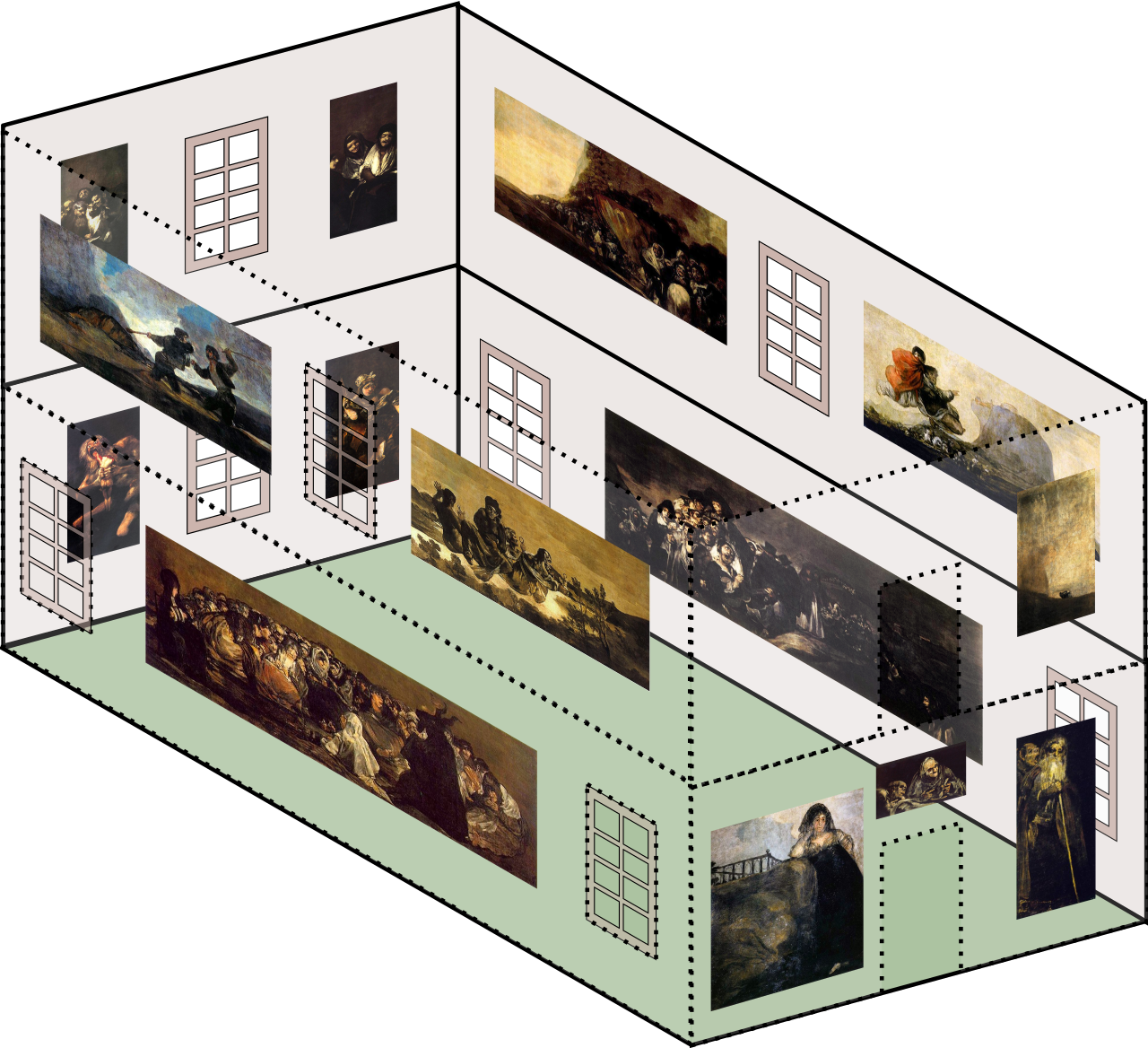
Isometric cutaway diagram of a two-story house with its walls drawn as beige planes, showing a hypothesis of how Goya's Black Paintings were arranged across the rooms, with small paintings placed on walls, windows drawn, and floors shaded green.Painting

Primary source

Black Paintings

Francisco Goya · c. 1820-1823

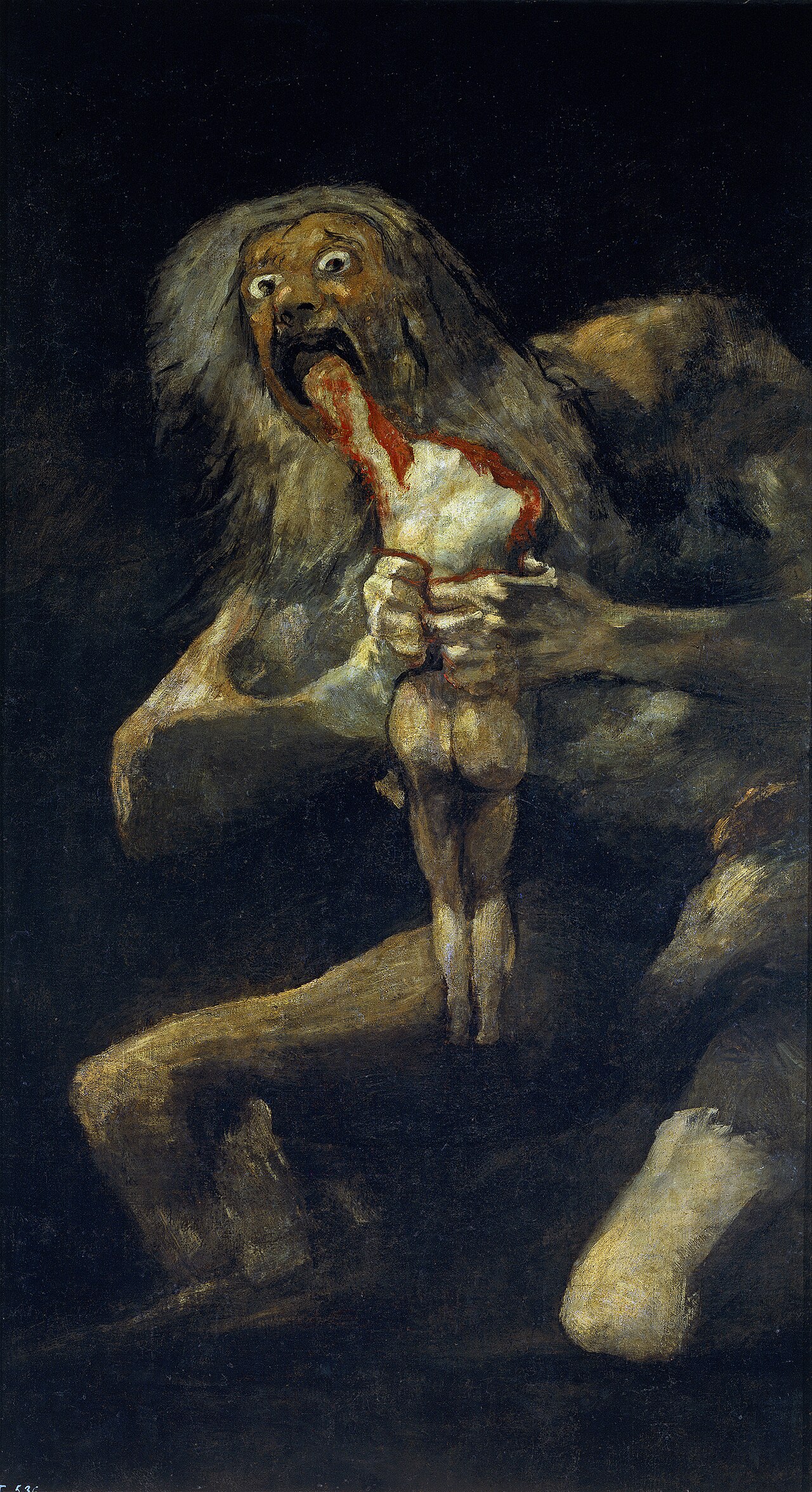
Painting of a wild-haired, wide-eyed figure biting into the headless, pale body of a smaller figure, with blood running down the victim's torso. Dark background, muted brown and grey tones.Painting

Primary source

Saturn Devouring His Son

Francisco Goya · c. 1820-1823

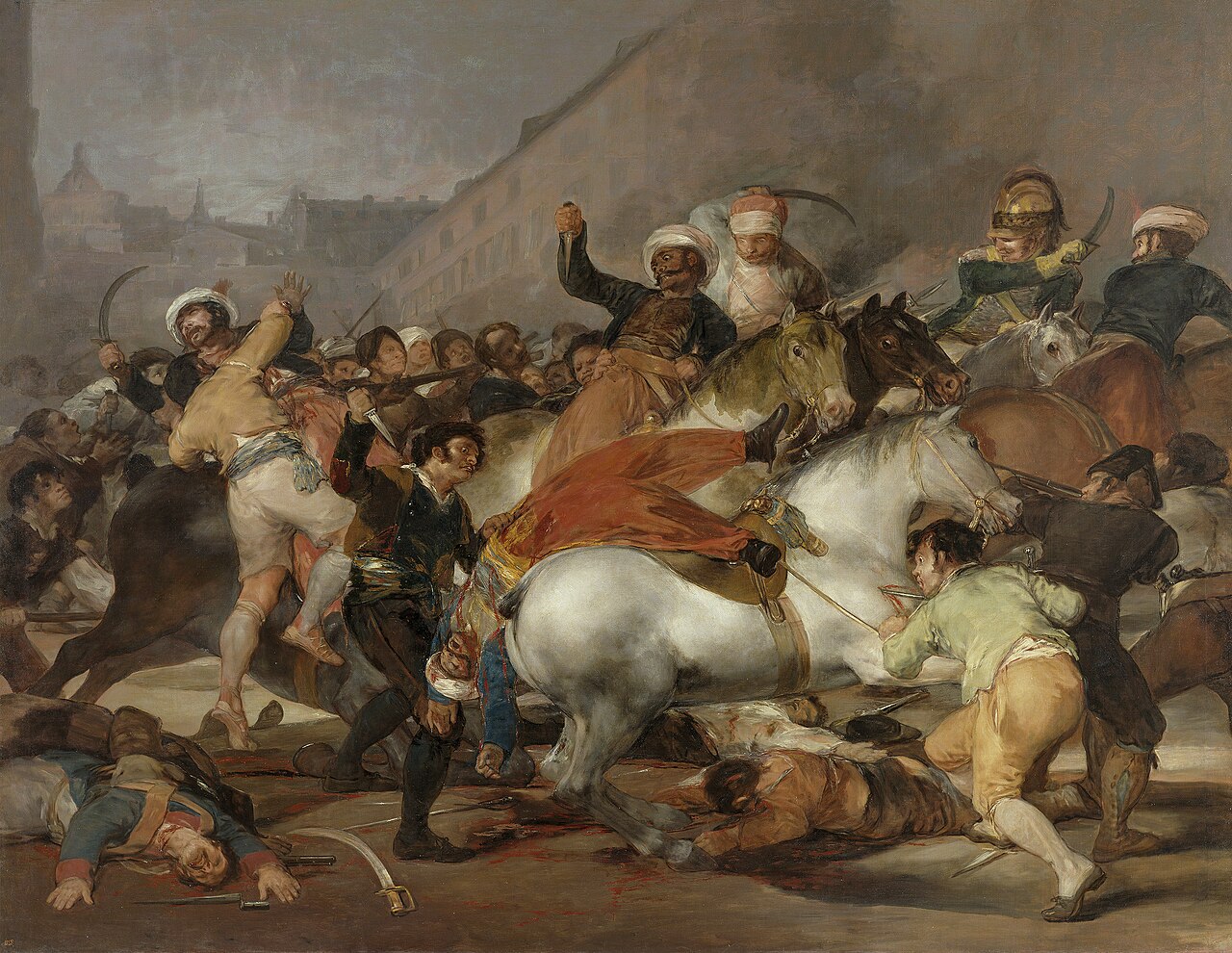
Goya's painting The Second of May 1808: a chaotic street battle in Madrid. Mounted soldiers in helmets and plumed hats charge into a crowd; a white horse rears over fallen bodies, and a man in a yellow jacket swings a curved blade. Smoke and buildings fill the background.Painting

Primary source

The Second of May 1808

Francisco Goya · 1814

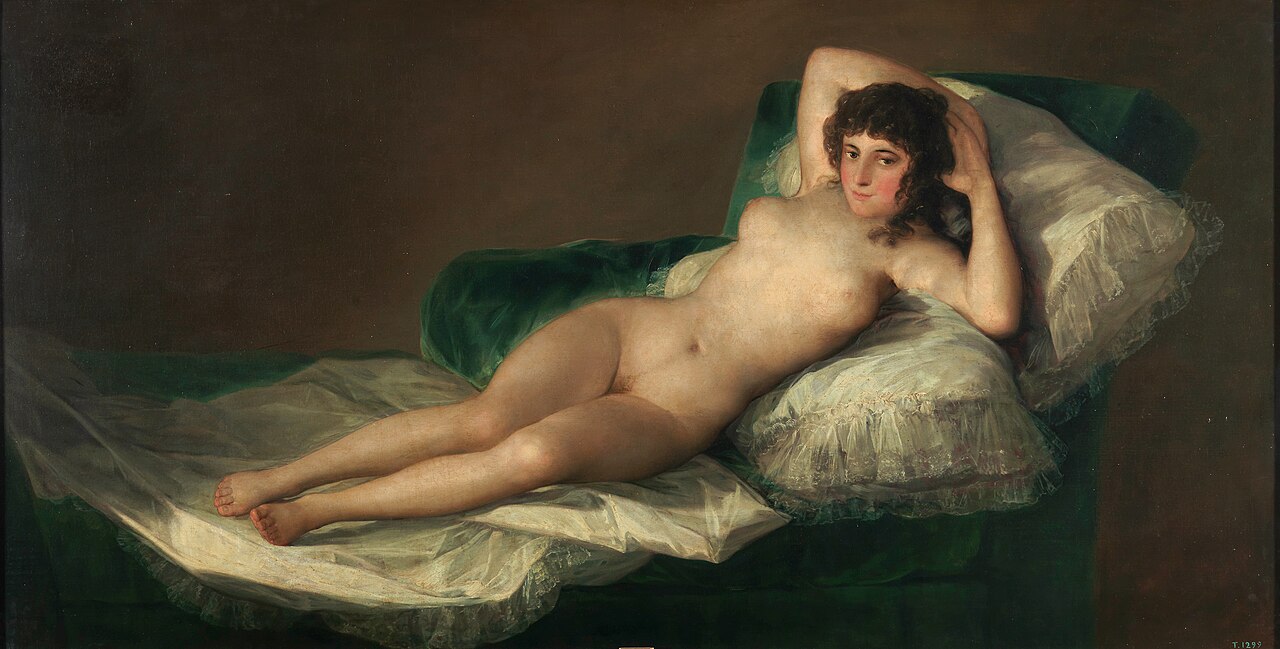
Painting of a reclining nude woman with dark curly hair, one arm raised behind her head, lying on a green velvet divan with white pillows and a sheet, against a dark brown background.Painting

Primary source

La maja desnuda

Francisco Goya · c. 1797-1800

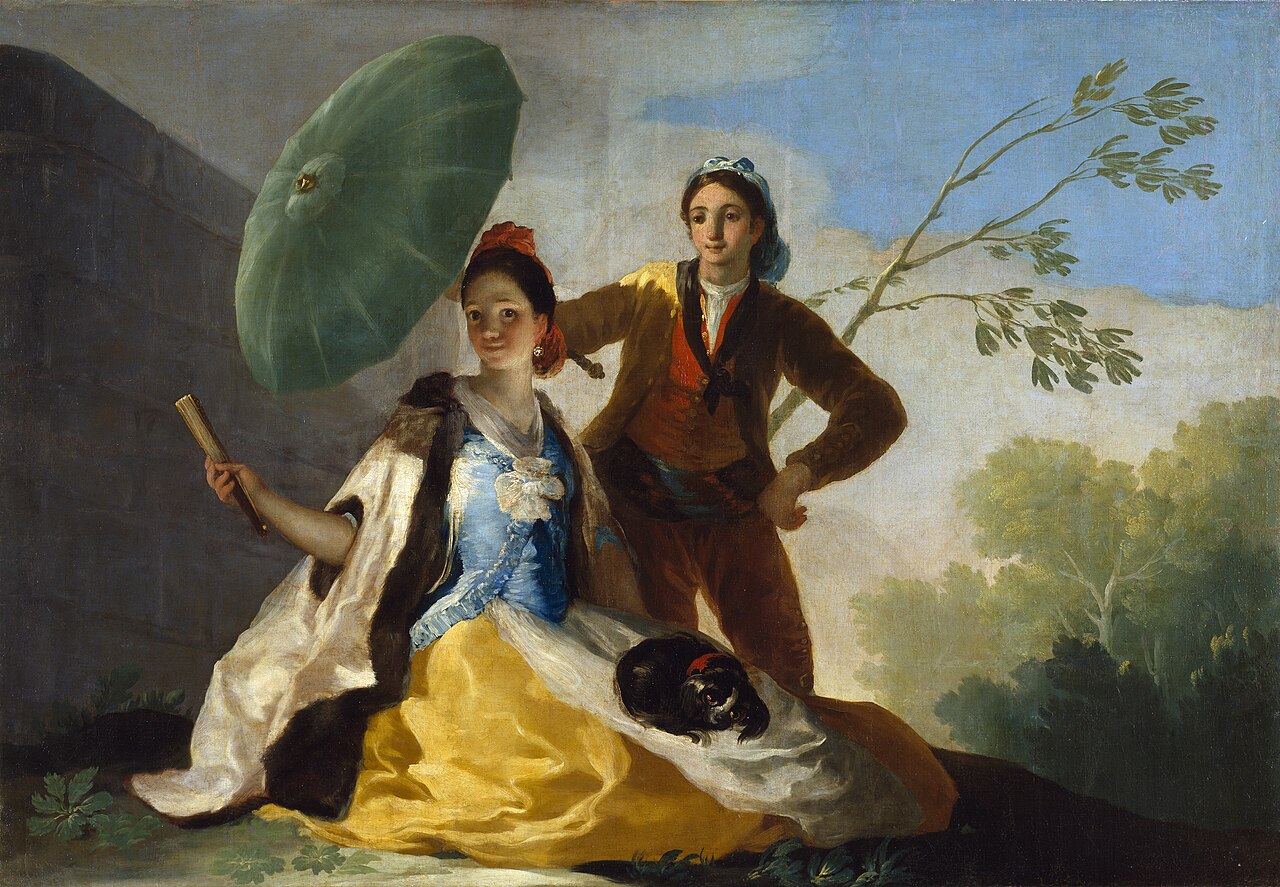
Painting of a seated young woman in a blue bodice and yellow skirt holding a green parasol and folding fan, with a standing young man in brown clothes and a small black dog beside her, against a stone wall and blue sky.Painting

Primary source

The Parasol

Francisco Goya · 1777

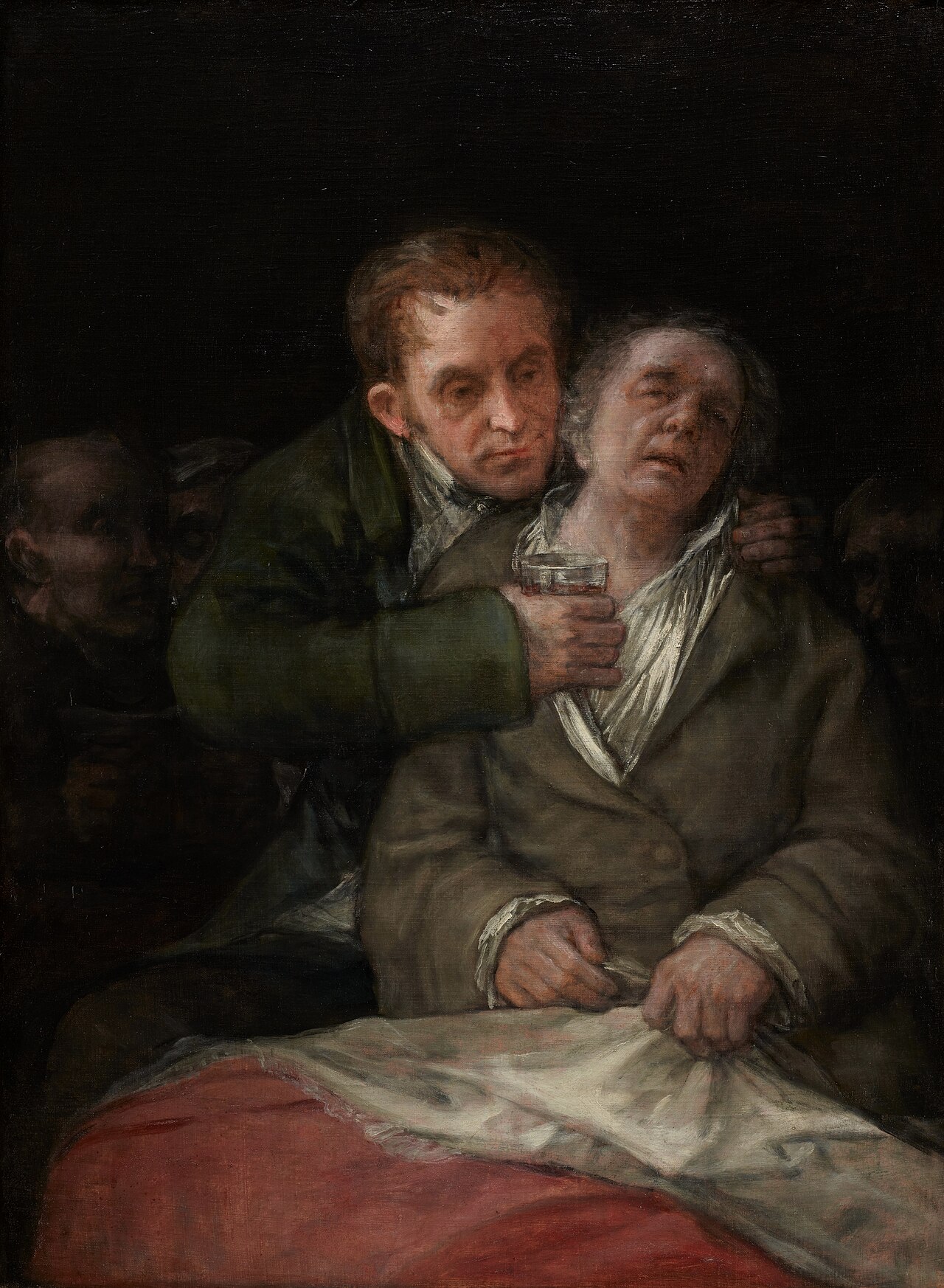
Painting of a man in a dark green coat holding a small glass to the throat of a pale, slumped figure in a brown coat, whose head tilts back. Two shadowy figures stand in the background against a dark room.Painting

Primary source

Self-Portrait with Dr Arrieta

Francisco Goya · 1820

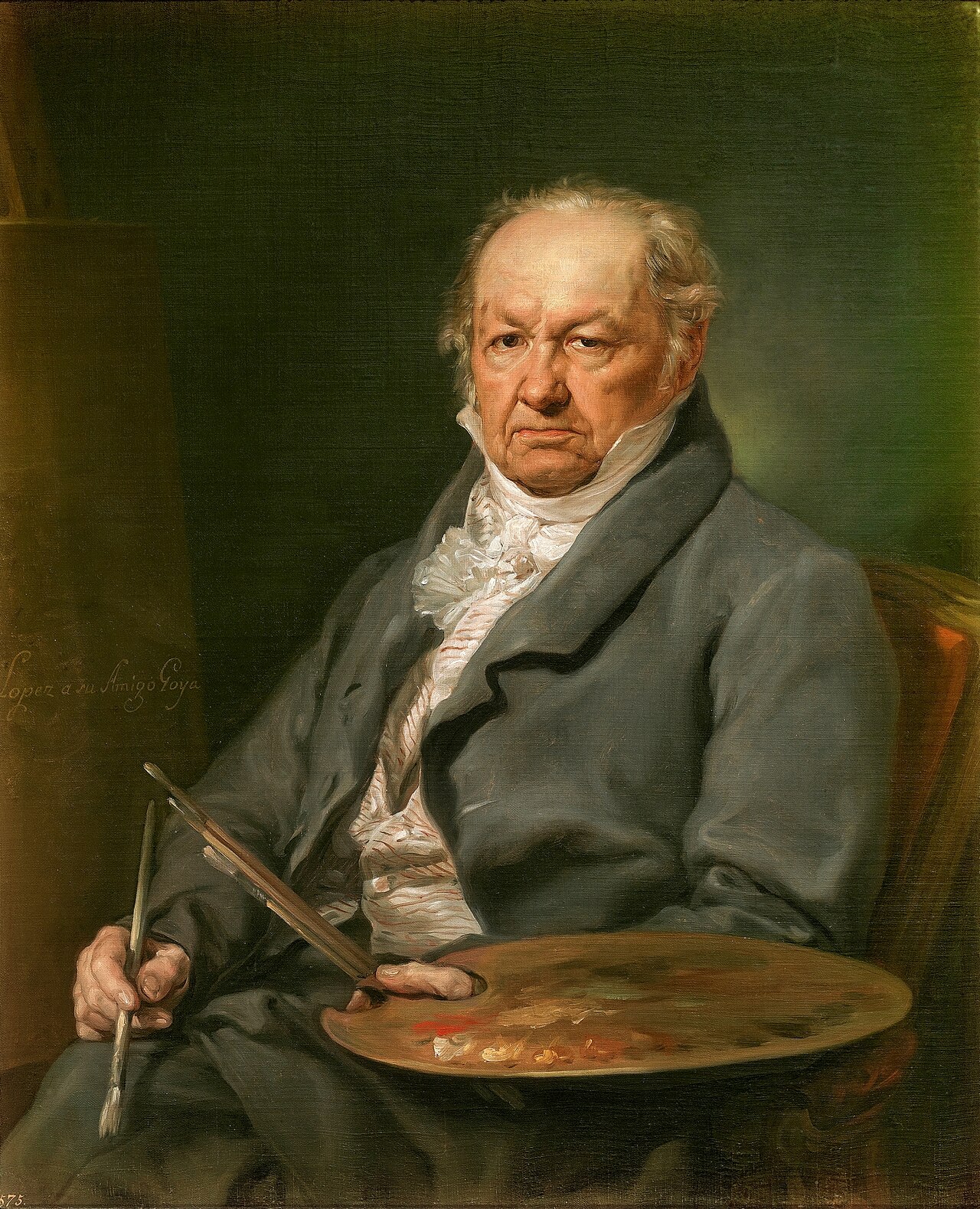
Oil portrait of an elderly man with white hair, seated in a wooden chair against a dark background. He wears a gray-blue coat over a white ruffled shirt and cravat, and holds a paintbrush and an oval palette. Inscription at left reads 'Lopez a su amigo Goya'.Painting

Primary source

The Painter Francisco Goya

Vicente López Portaña · 1826

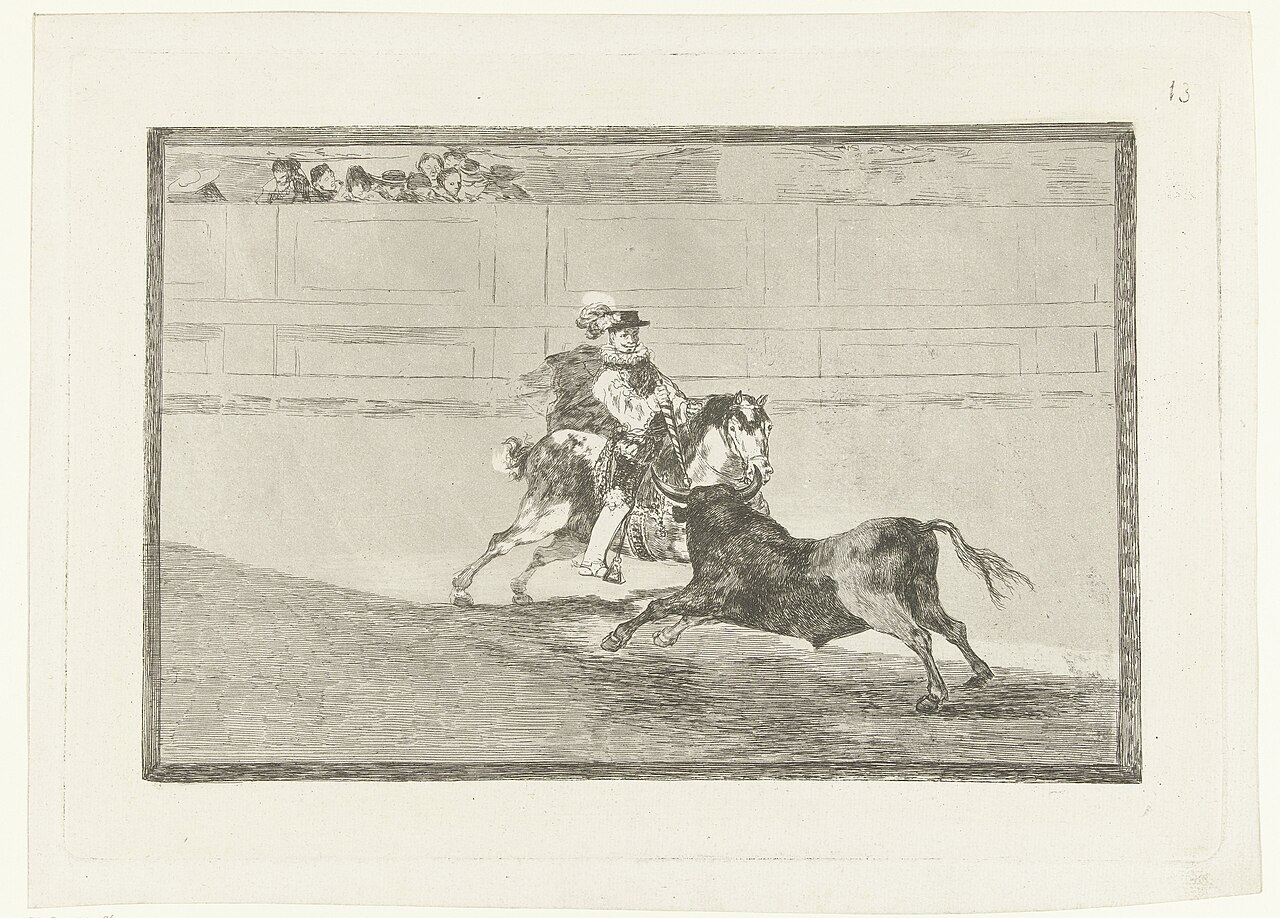
Etching from Goya's La Tauromaquia, numbered 13 in the upper right. A mounted horseman in a plumed hat and ruffled costume spears a charging bull in a bullring; spectators watch from the stands above a wall.Painting

Primary source

La Tauromaquia

Francisco Goya · 1815-1816

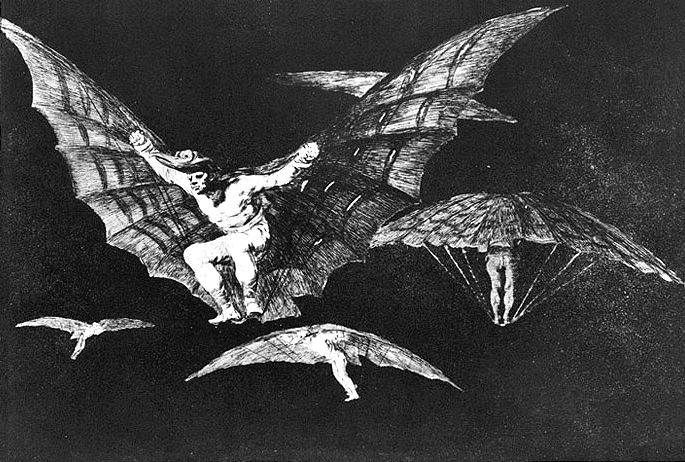
Black-and-white etching of a man with bat-like wings strapped to his arms, flying through a dark sky. Two other winged figures are below him, and a third figure hangs from a canopy-like wing on the right.Painting

Primary source

Los disparates

Francisco Goya · 1815-1823

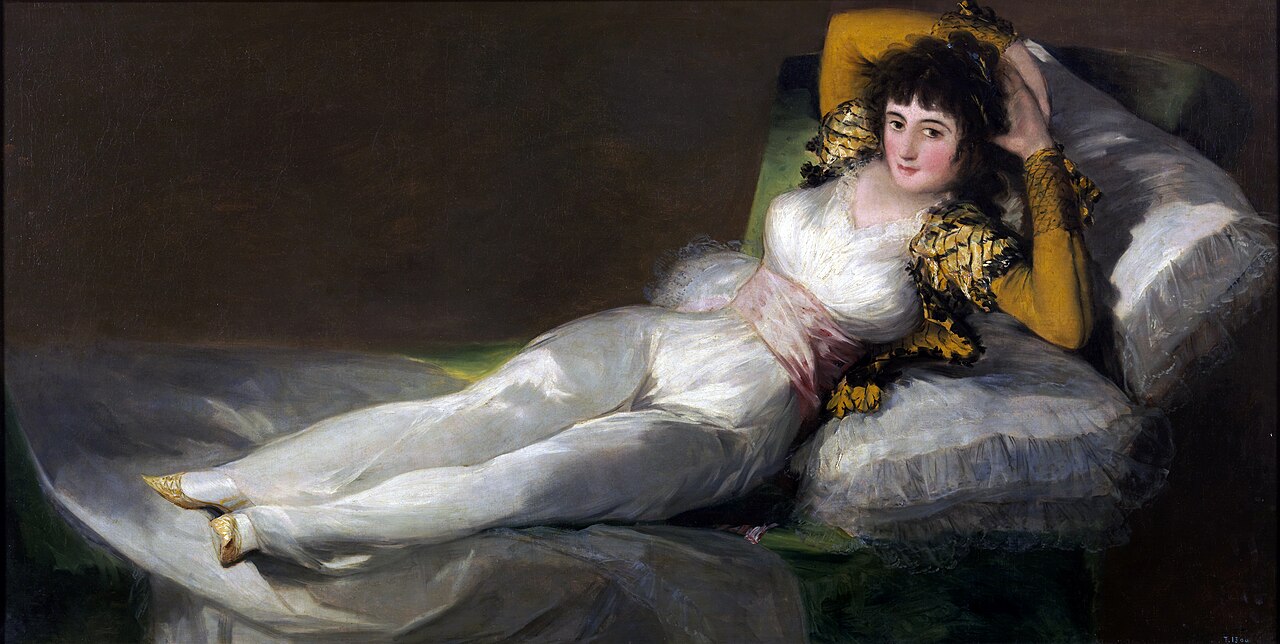
Painting of a woman reclining on a green divan with her left arm raised behind her head. She wears a white dress with a pink sash, gold-embroidered yellow sleeves with black ribbons, and gold shoes. Dark background.Painting

Primary source

The Clothed Maja

Francisco Goya · 1800-1807

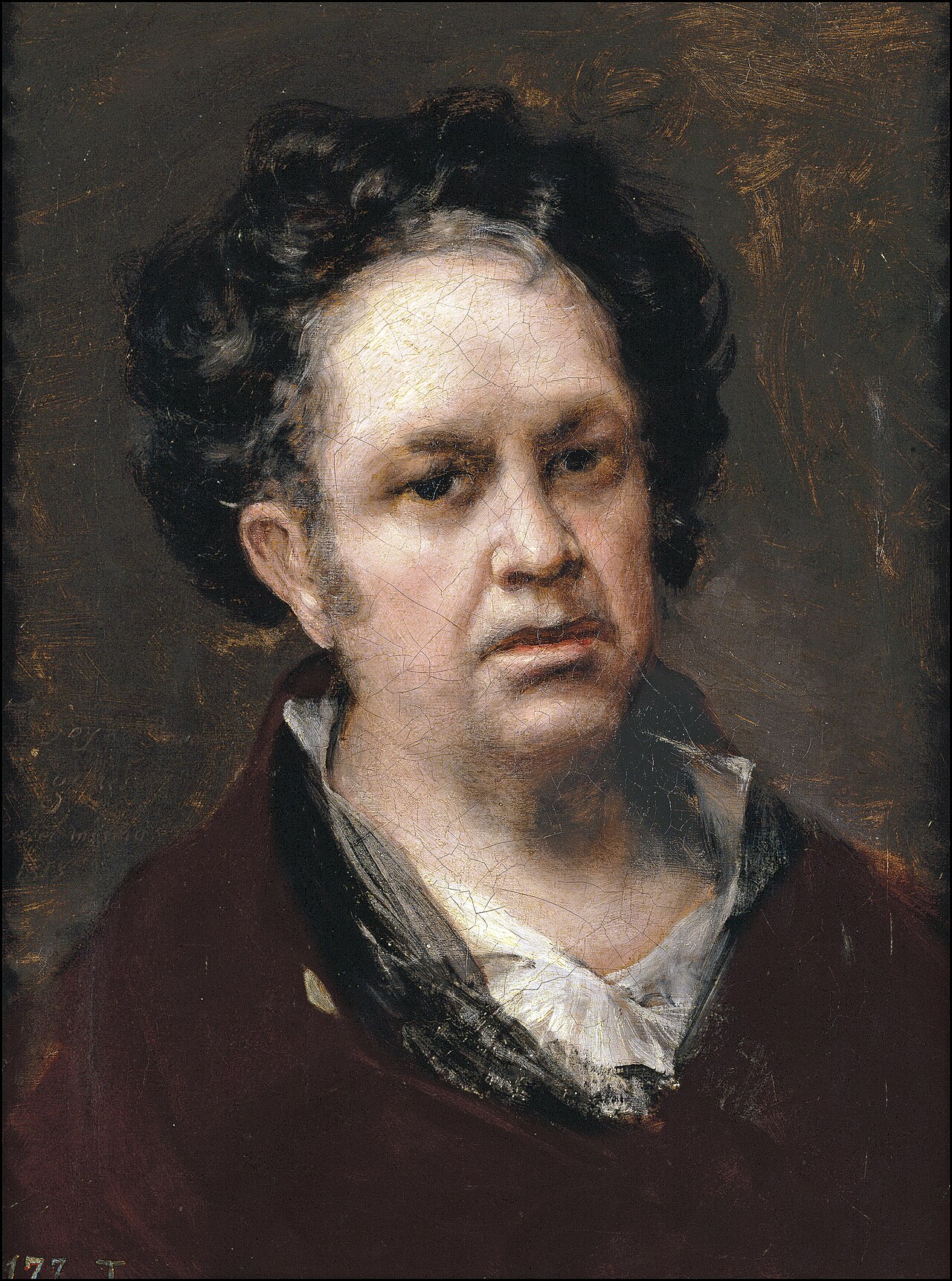
Oil painting of a man with dark curly hair, receding hairline, and a pale face, wearing a dark red coat, dark cravat and white ruffled shirt, against a dark brown background with visible brushstrokes and cracked paint surface.Painting

Primary source

Self-Portrait at 69 Years

Francisco Goya · 1815

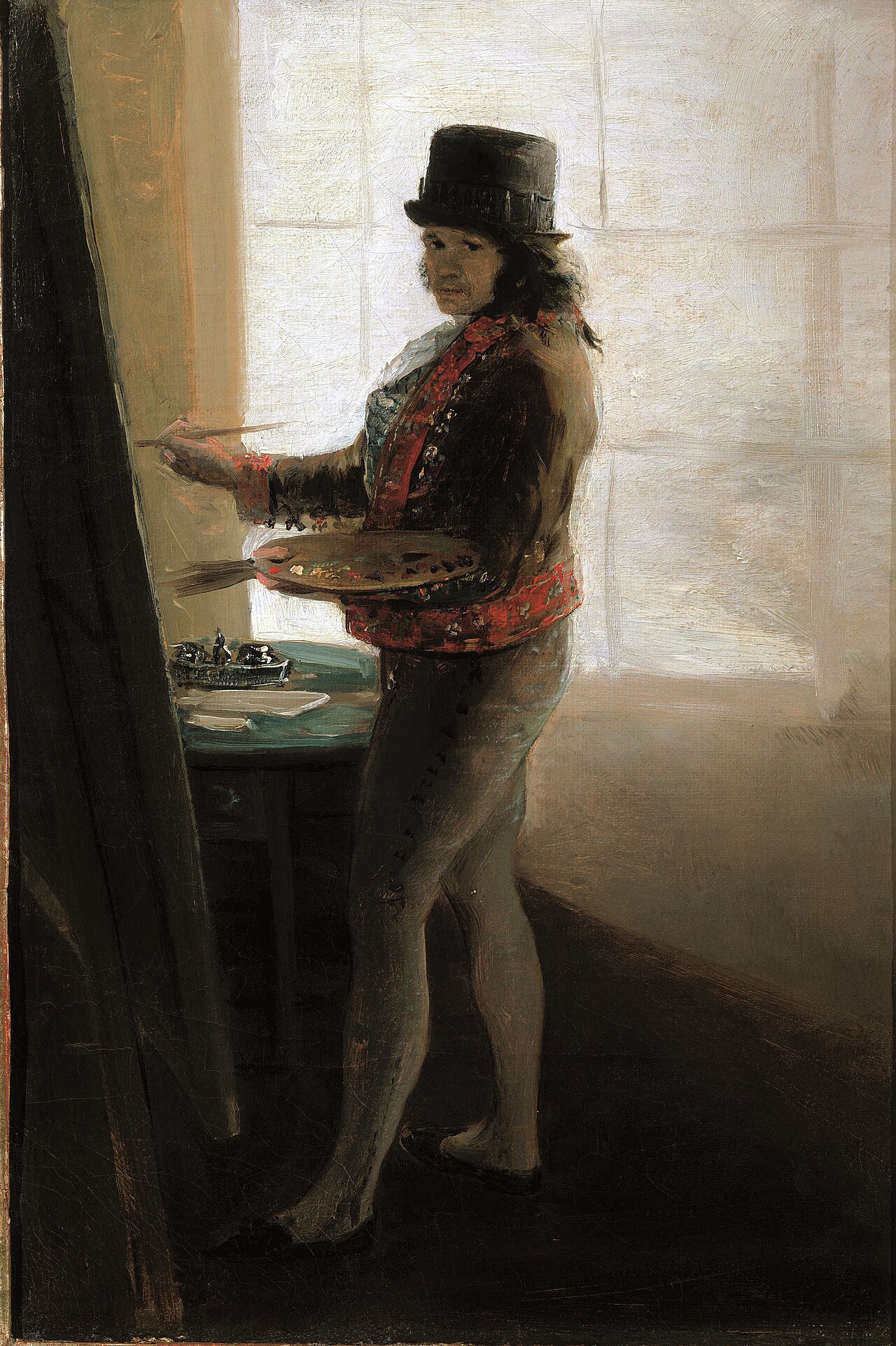
Painting of a man in a black top hat and dark coat with red trim, holding a palette and brush at a canvas in a studio with a large window behind him. A small table with objects stands to the left.Painting

Primary source

Self-Portrait in the Studio

Francisco Goya · c. 1790-1795

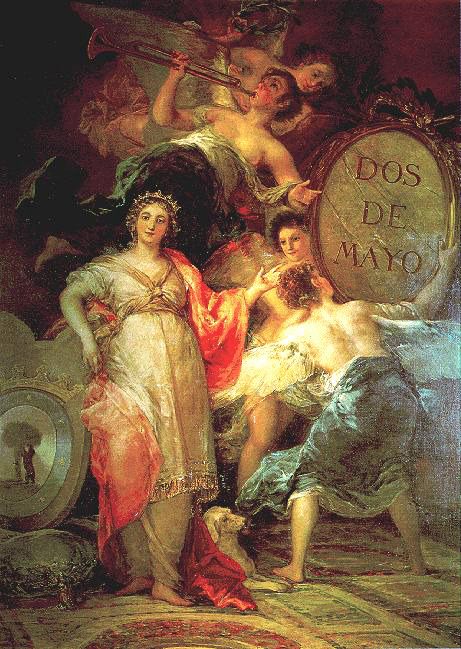
Painting of a crowned female allegorical figure in white and red drapes standing at left, with a winged figure blowing a trumpet above and a reclining bare-chested male figure at right. An oval medallion reads 'DOS DE MAYO'. A small dog sits at the lower center.Painting

Primary source

Allegory of the City of Madrid

Francisco Goya · 1809-1810

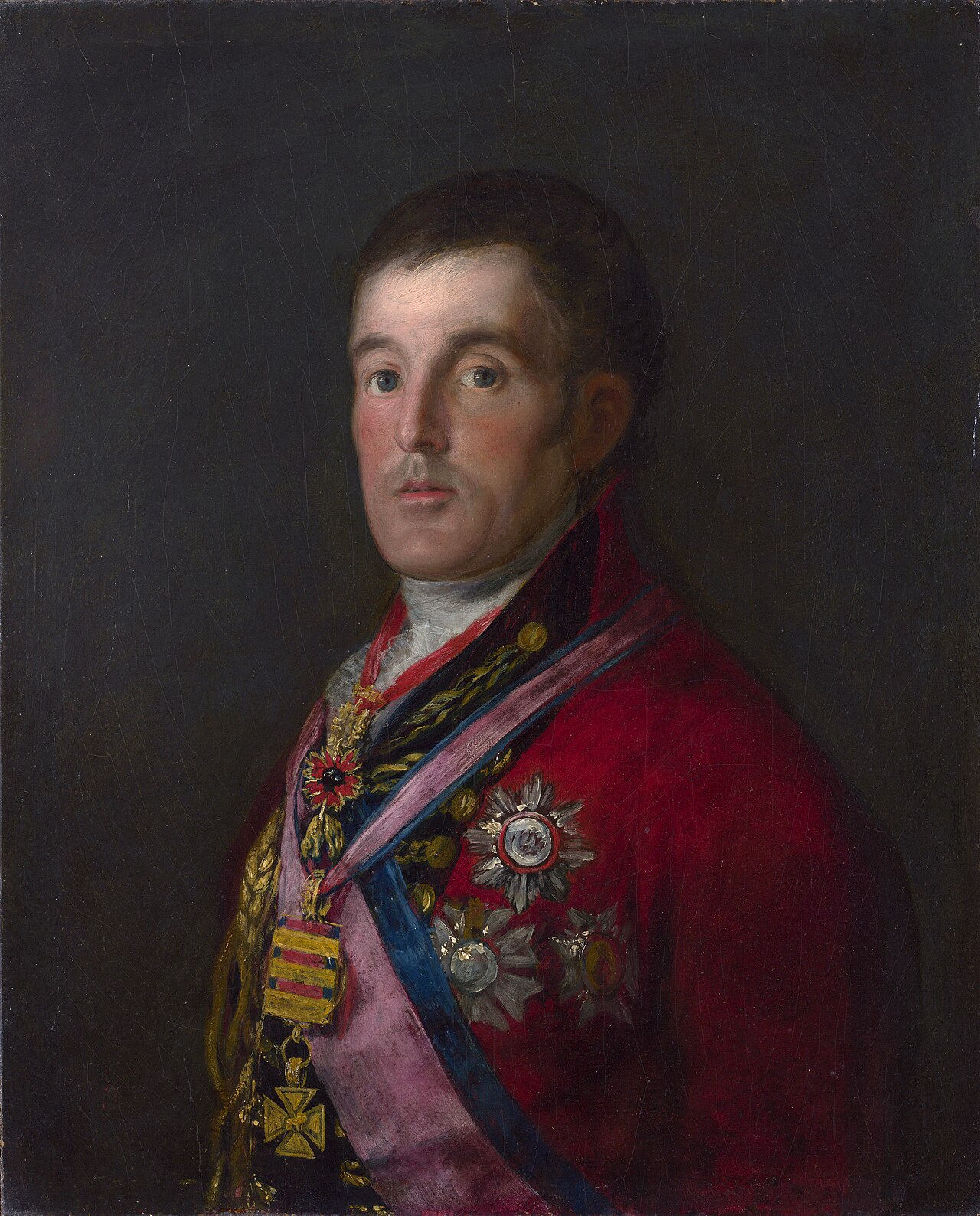
Oil painting of a man with short dark hair and light eyes, wearing a red military coat with a dark collar, white cravat, gold chains, medals, and a pink and blue sash, against a dark background.Painting

Primary source

Portrait of the Duke of Wellington

Francisco Goya · 1812-1814

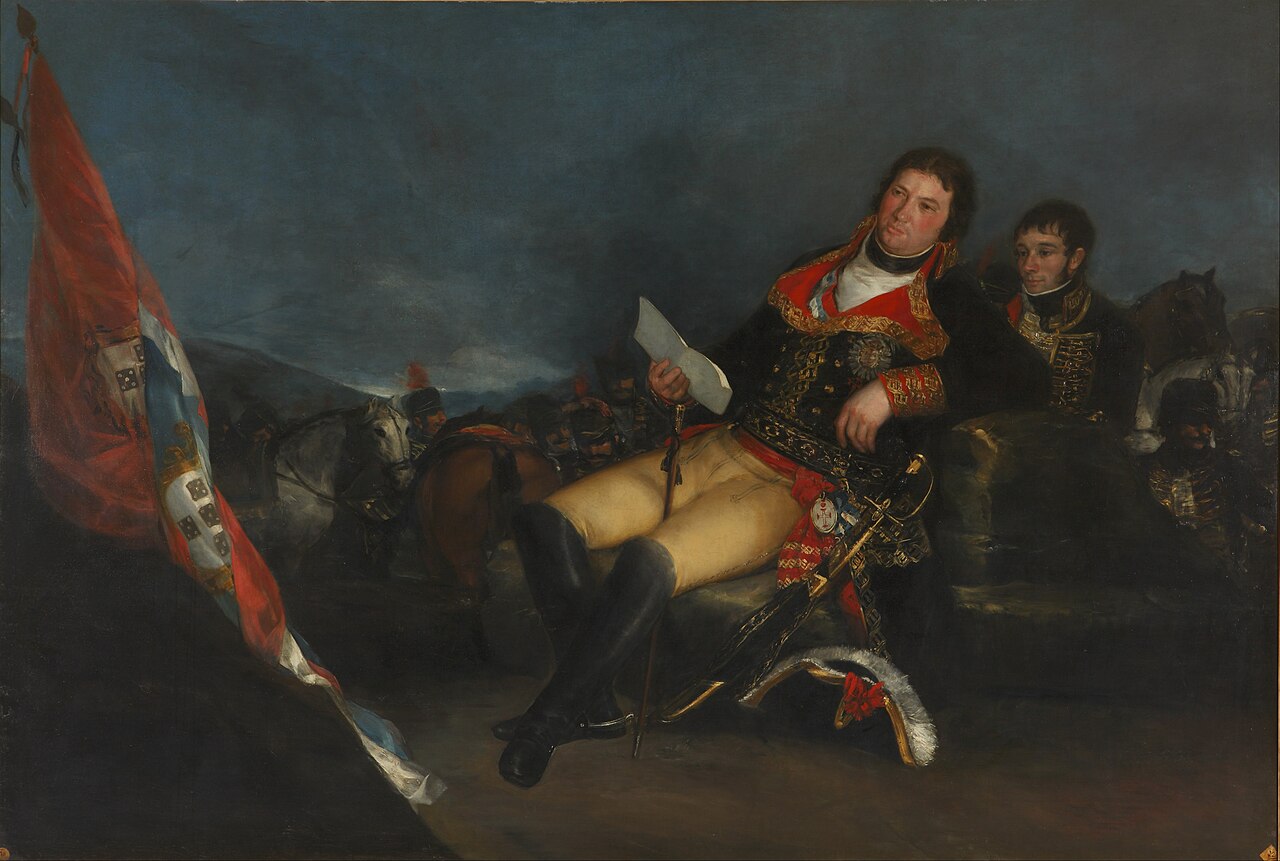
Painting of a man in a dark military uniform with a red collar and gold embroidery, yellow breeches, and black boots, leaning on a rock and holding a folded paper. A large red and white flag with a coat of arms fills the left side. Horses and soldiers appear in the background, and a second uniformed officer stands at the right under a dark, cloudy sky.Painting

Primary source

Portrait of Manuel Godoy

Francisco Goya · 1801

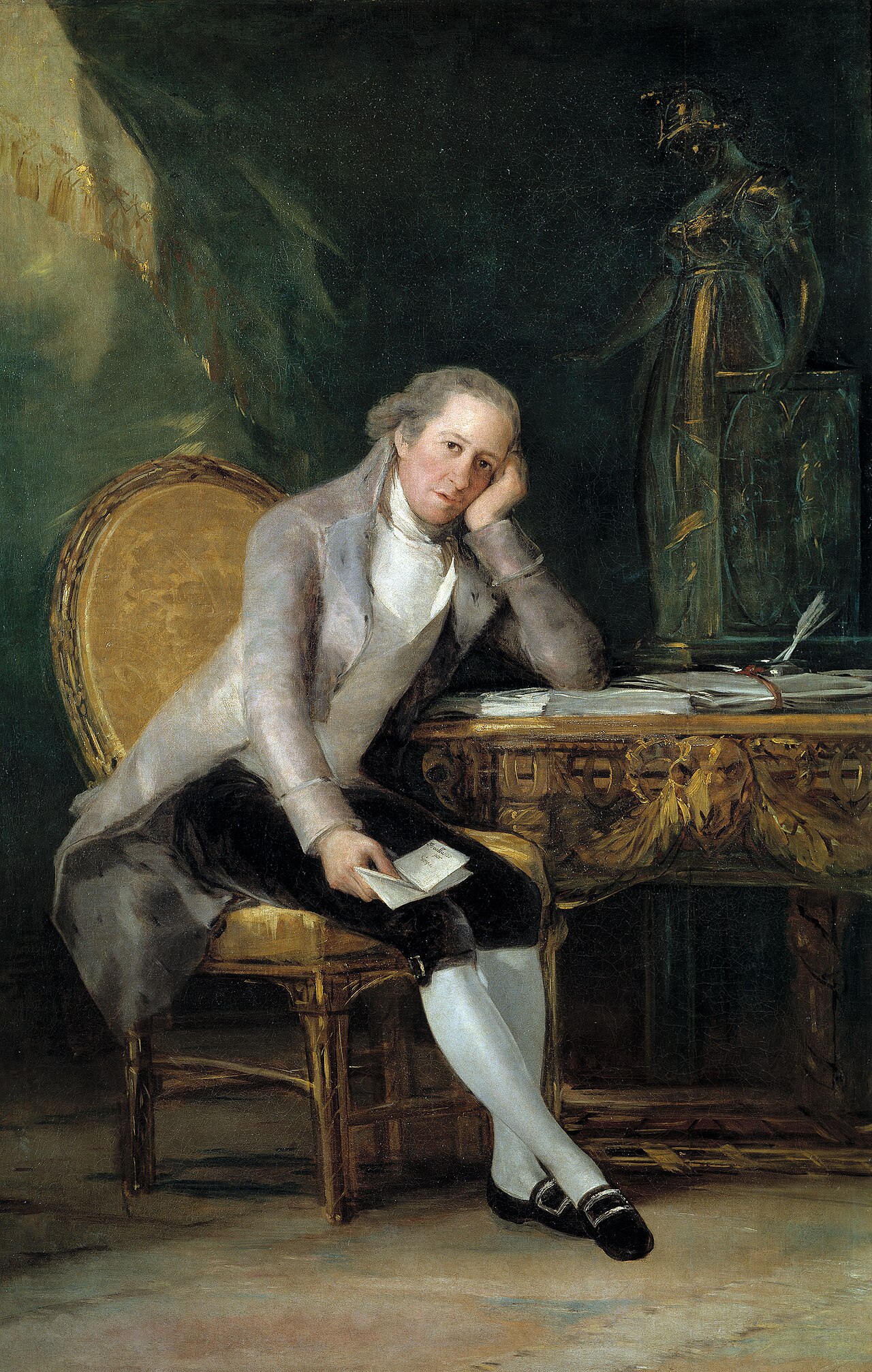
Oil painting of a seated man with powdered gray hair in a light gray coat, white cravat and dark breeches and white stockings. He leans his cheek on his hand at a gilded desk with papers, a quill, and a dark statue behind him. A gilded oval chair is at left.Painting

Primary source

Portrait of Gaspar Melchor de Jovellanos

Francisco Goya · 1798

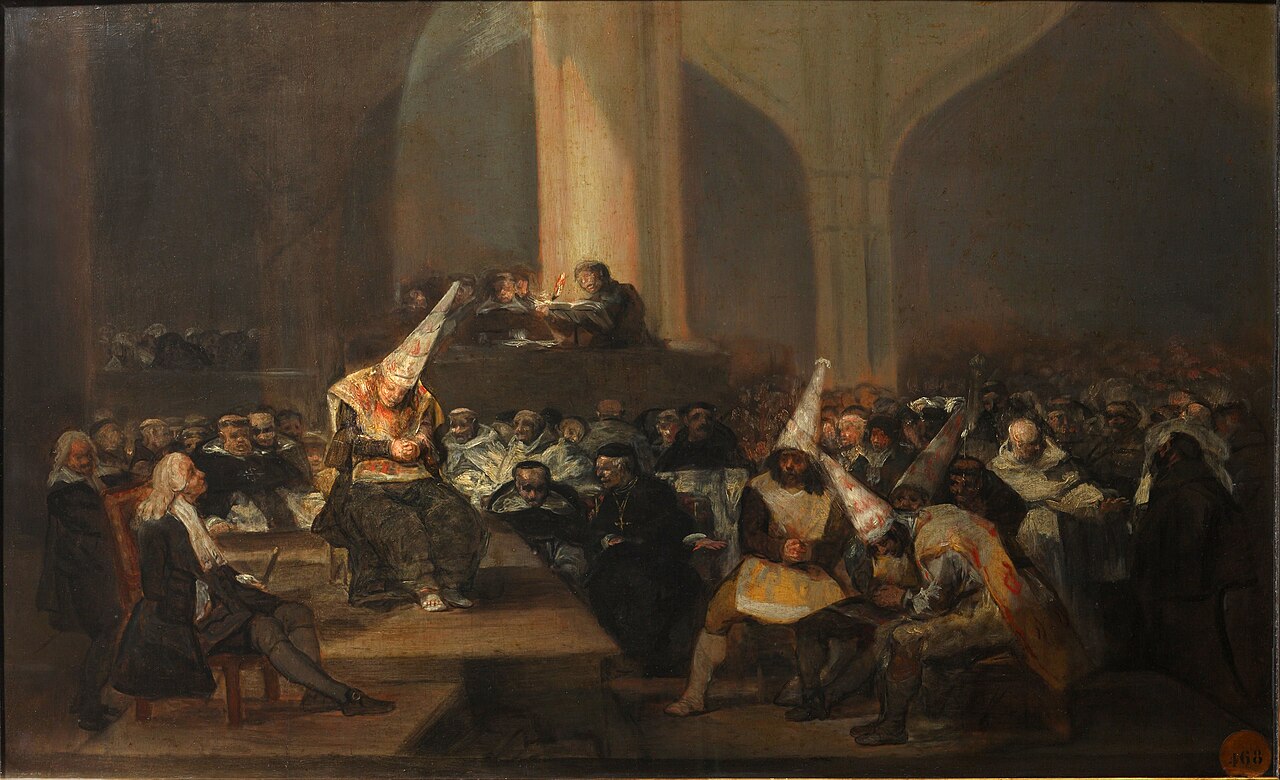
Painting of an Inquisition tribunal scene: a central figure in a tall pointed paper hat sits on a bench among robed clergy and seated spectators in a dim vaulted hall. A judge's bench with a candle is lit at upper center, and a seated figure in a white wig sits at left.Painting

Primary source

The Inquisition Tribunal

Francisco Goya · 1812-1819

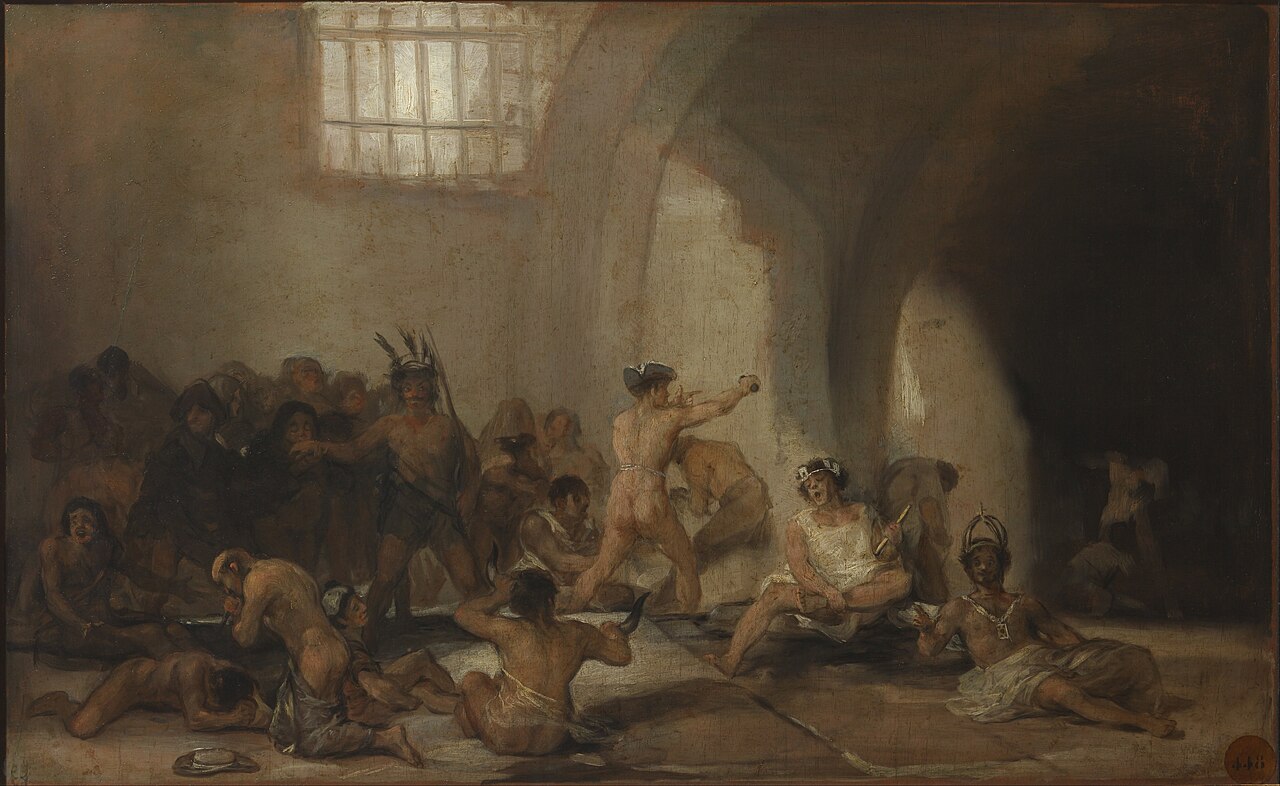
Painting of an interior of a barred, vaulted room with a grated window high on the left. Semi-nude and ragged figures sit, lie, and stand on a stone floor; a figure in a tricorn hat and loincloth gestures among them, and a woman in a white dress sits at right. Earth tones throughout.Painting

Primary source

The Madhouse

Francisco Goya · 1812-1819

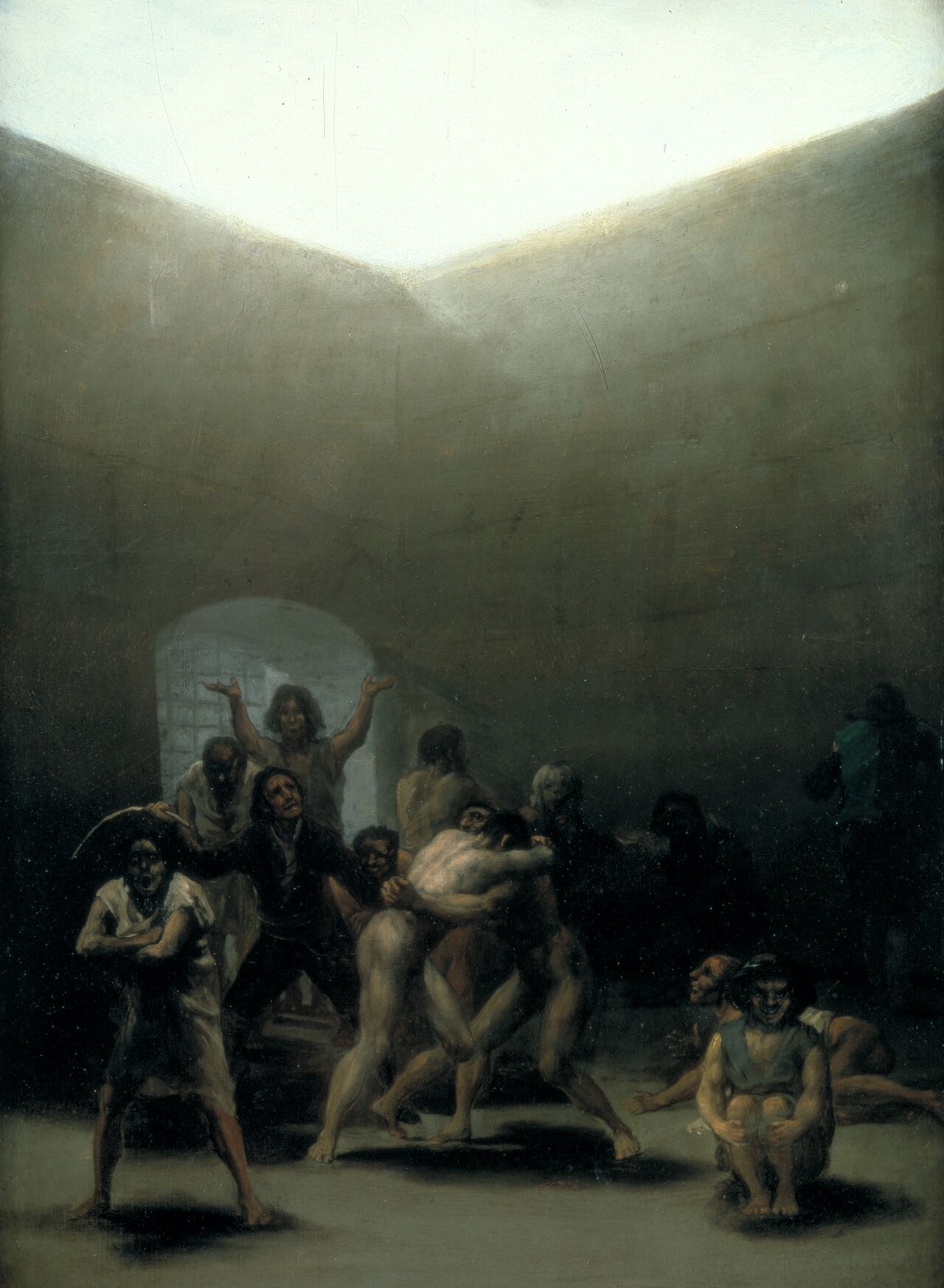
Painting of a walled courtyard under a bright opening in the sky. Several disturbed, partly nude and clothed figures gather in a tangle near an arched doorway; a man in a green coat stands at the right, and figures sit or sprawl on the ground at the lower right.Painting

Primary source

Yard with Lunatics

Francisco Goya · 1793–1794

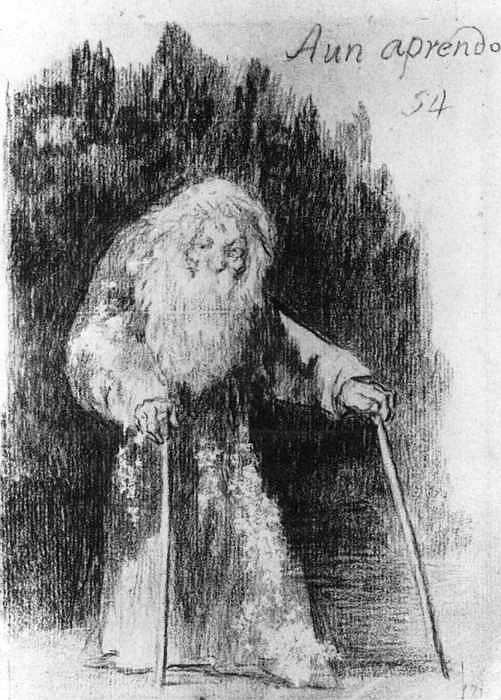
Black chalk drawing of an elderly man with a long beard and wild hair, leaning on two walking sticks, against a dark, scribbled background. Handwritten Spanish text reads 'Aún aprendo' and the number 54 at the top right.Painting

Primary source

Aún aprendo (I Am Still Learning)

Francisco Goya · c. 1825–1828

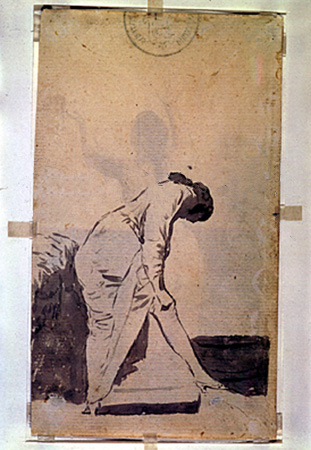
Photograph of an ink and wash drawing on aged paper mounted on a white backing, with tape at the corners and a faded stamp at the top. It shows a figure in a long coat bent forward, hands on knees, with a shadowy outline behind and a dark wash at the lower right.Painting

Primary source

Dibujos del Álbum A de Goya

Francisco Goya · 1796

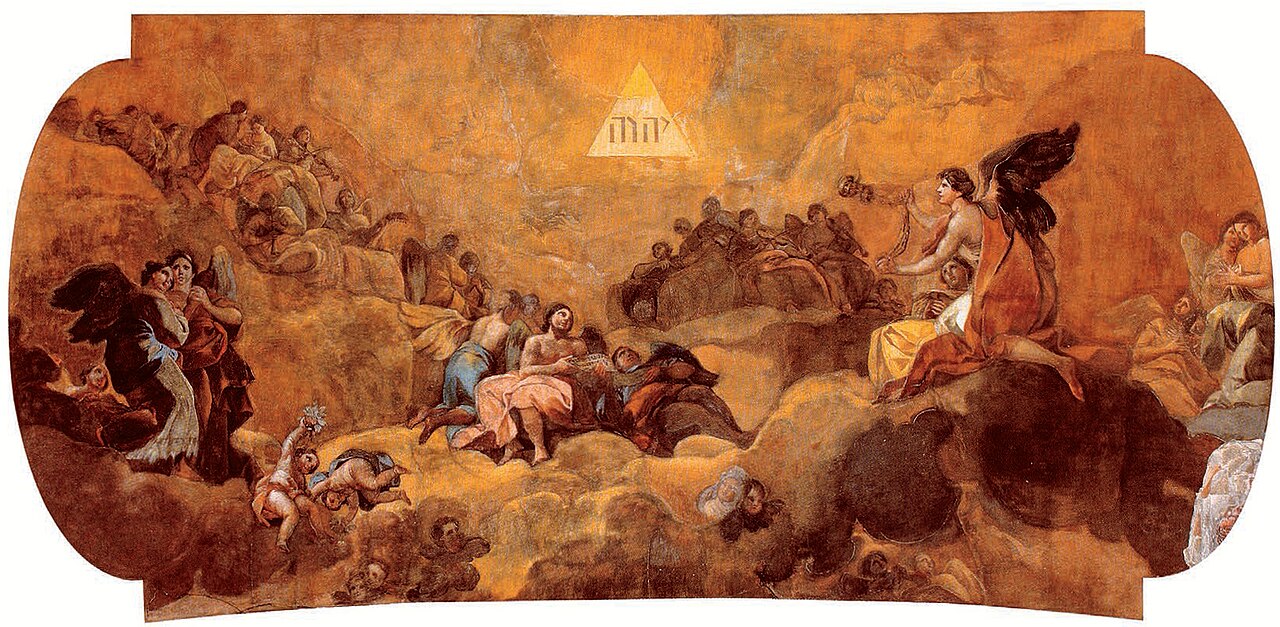
Painted ceiling-style composition in warm ochre tones showing clouds filled with angels and figures gathered beneath a glowing triangle containing Hebrew letters at the top. A winged angel on the right holds a bundle of rays, and figures cluster on the left.Painting

Primary source

Adoration of the Name of God

Francisco Goya · 1772

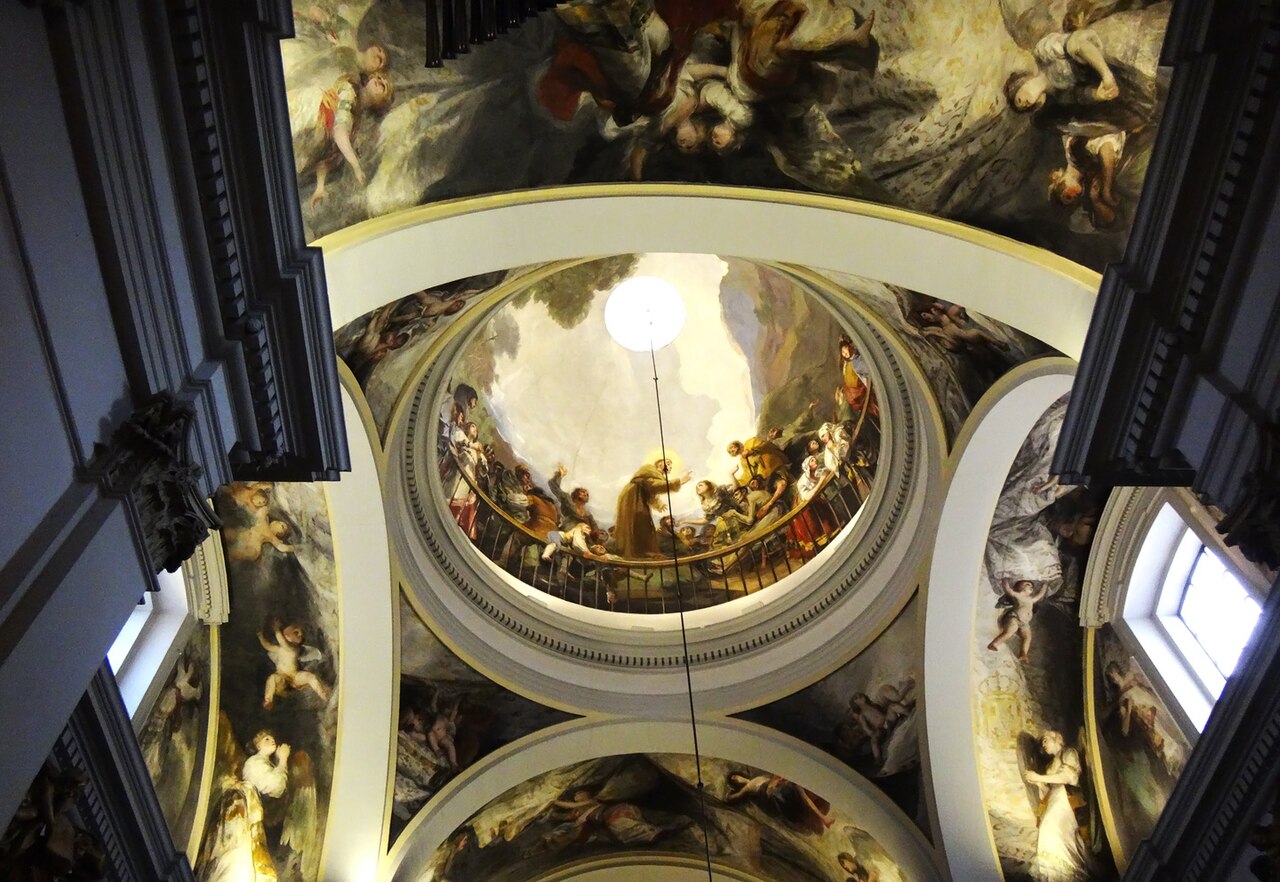
Interior dome and vaulted ceiling of a church, painted with frescoes: a central dome depicting a crowd of figures on a balcony-like rail around a bright light, with angels and figures in painted clouds on the surrounding pendentives and walls.Artifact

Primary source

Frescoes of San Antonio de la Florida

Francisco Goya · 1798

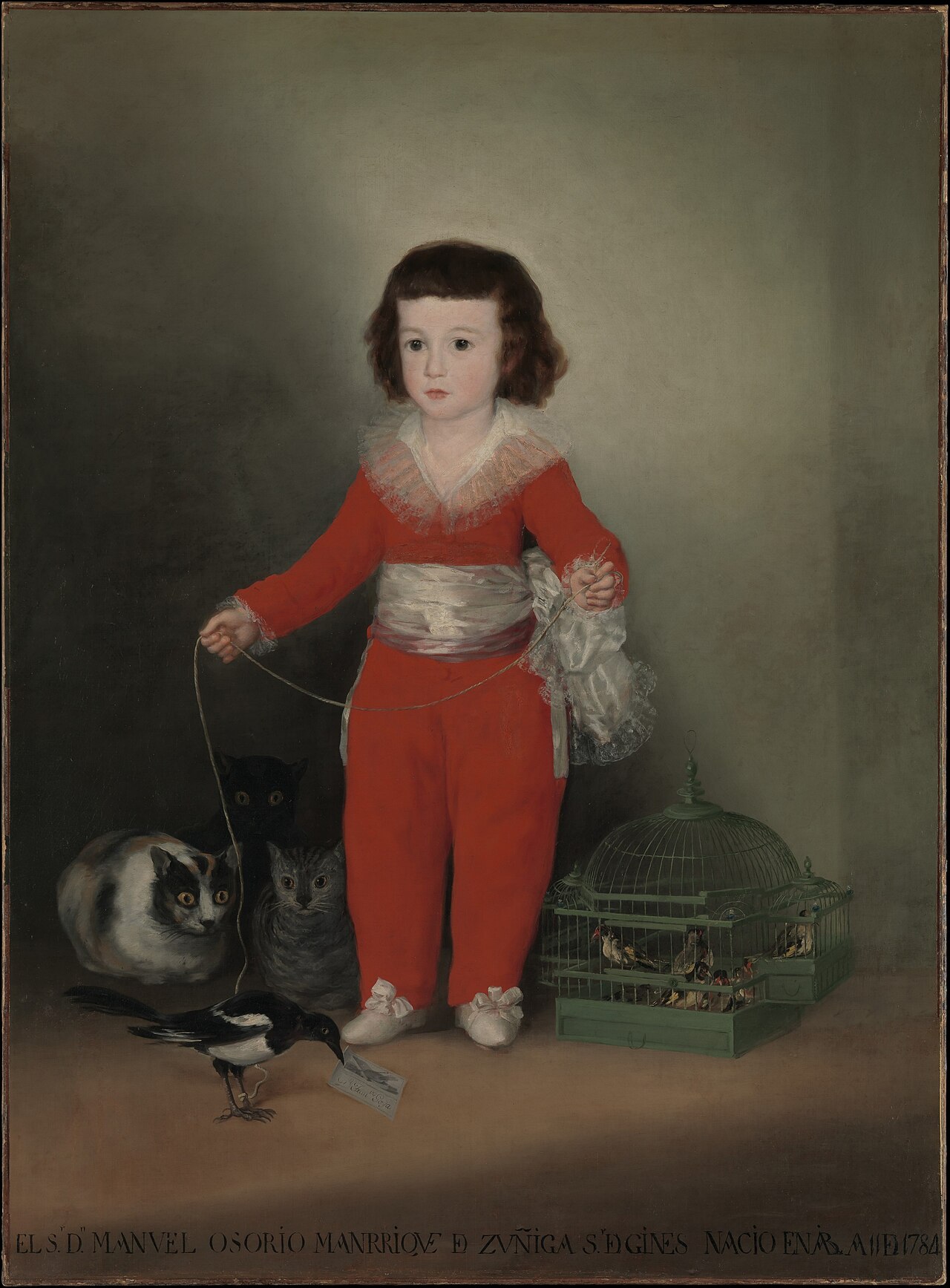
Painting of a young boy in a red suit with a white lace collar and white sash, holding a string attached to a magpie at lower left. Two cats and a cage of finches stand beside him; an inscription runs along the bottom edge.Painting

Primary source

Don Manuel Osorio de Zuniga

Francisco Goya · 1787–1788

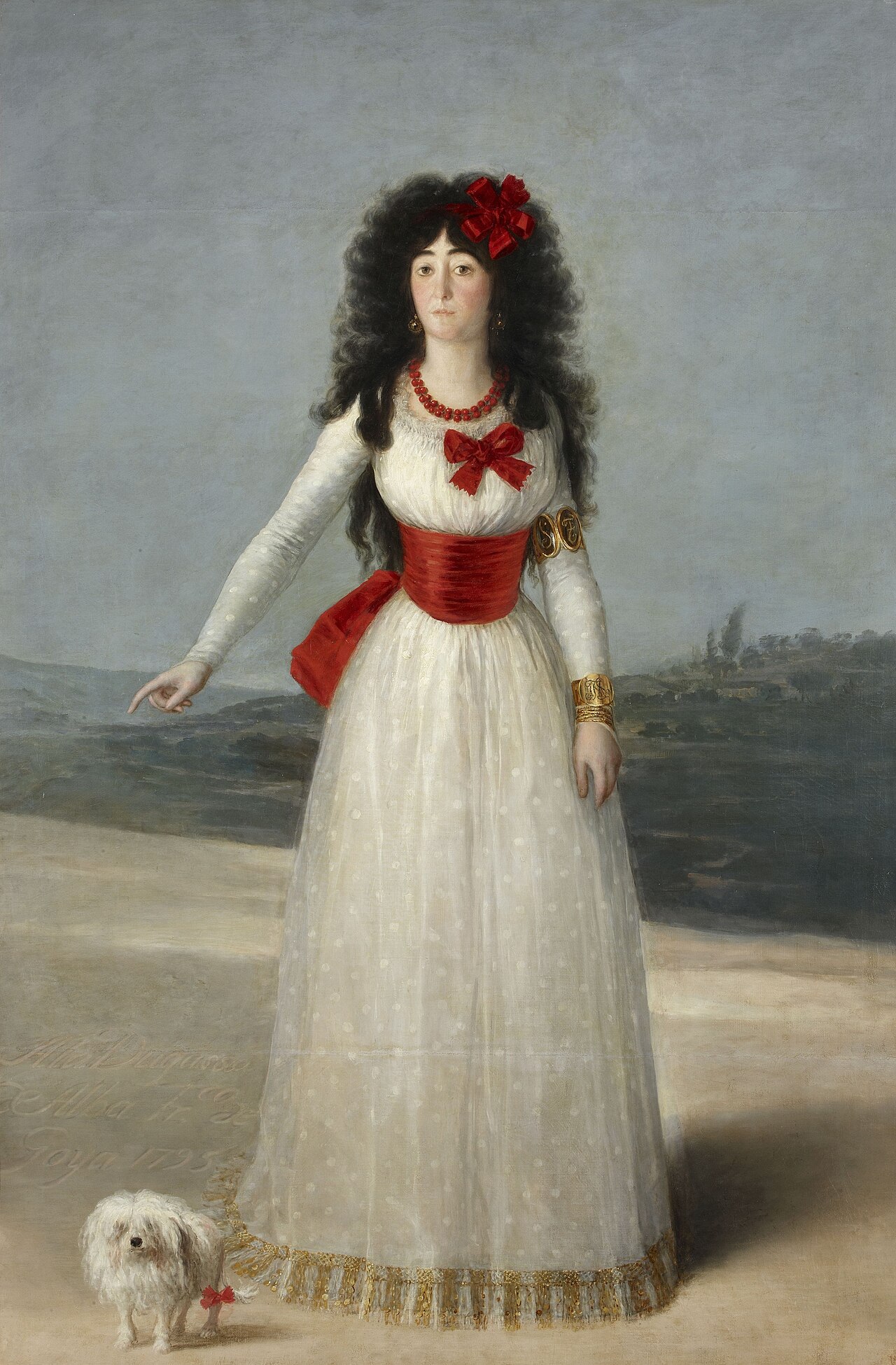
Full-length painting of a woman with voluminous dark curly hair adorned with a red bow, wearing a white dress with dots, a red sash at the waist, a red bow at the bodice, and a red coral necklace. She points with one hand toward a landscape while a small white dog with a red bow stands at her hem. Inscription visible on the ground at lower left.Painting

Primary source

Portrait of the Duchess of Alba

Francisco Goya · 1795

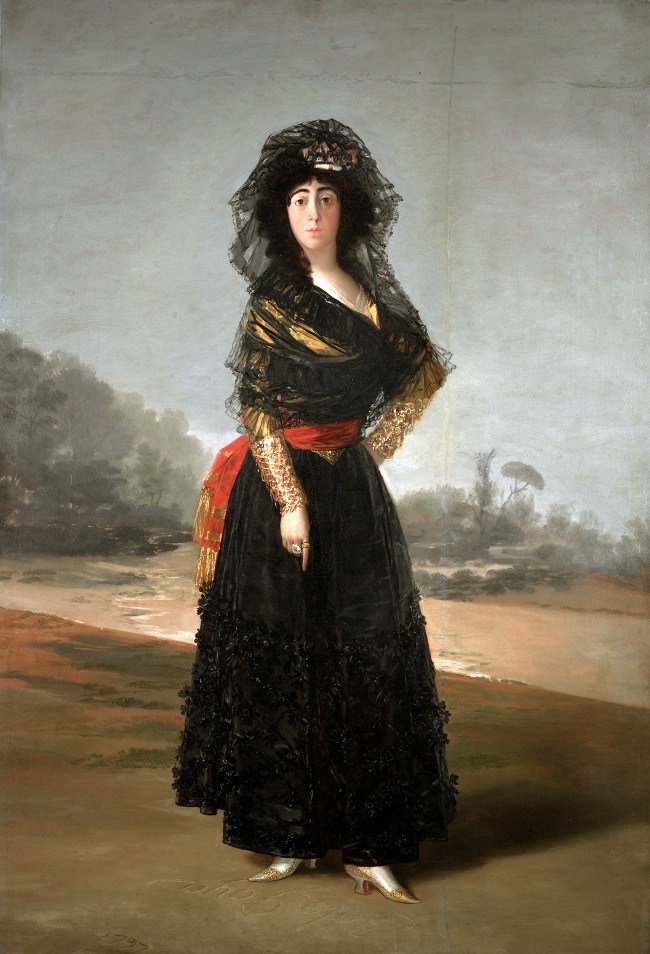
Full-length painting of a woman in a black dress and black lace mantilla, with a red sash and gold-trimmed sleeves, standing on a sandy path in a landscape with trees and a pale sky. Her right hand rests at her side and her left hand is on her hip. Her hand has rings. Faint inscription at the lower left.Painting

Primary source

The Black Duchess

Francisco Goya · 1797

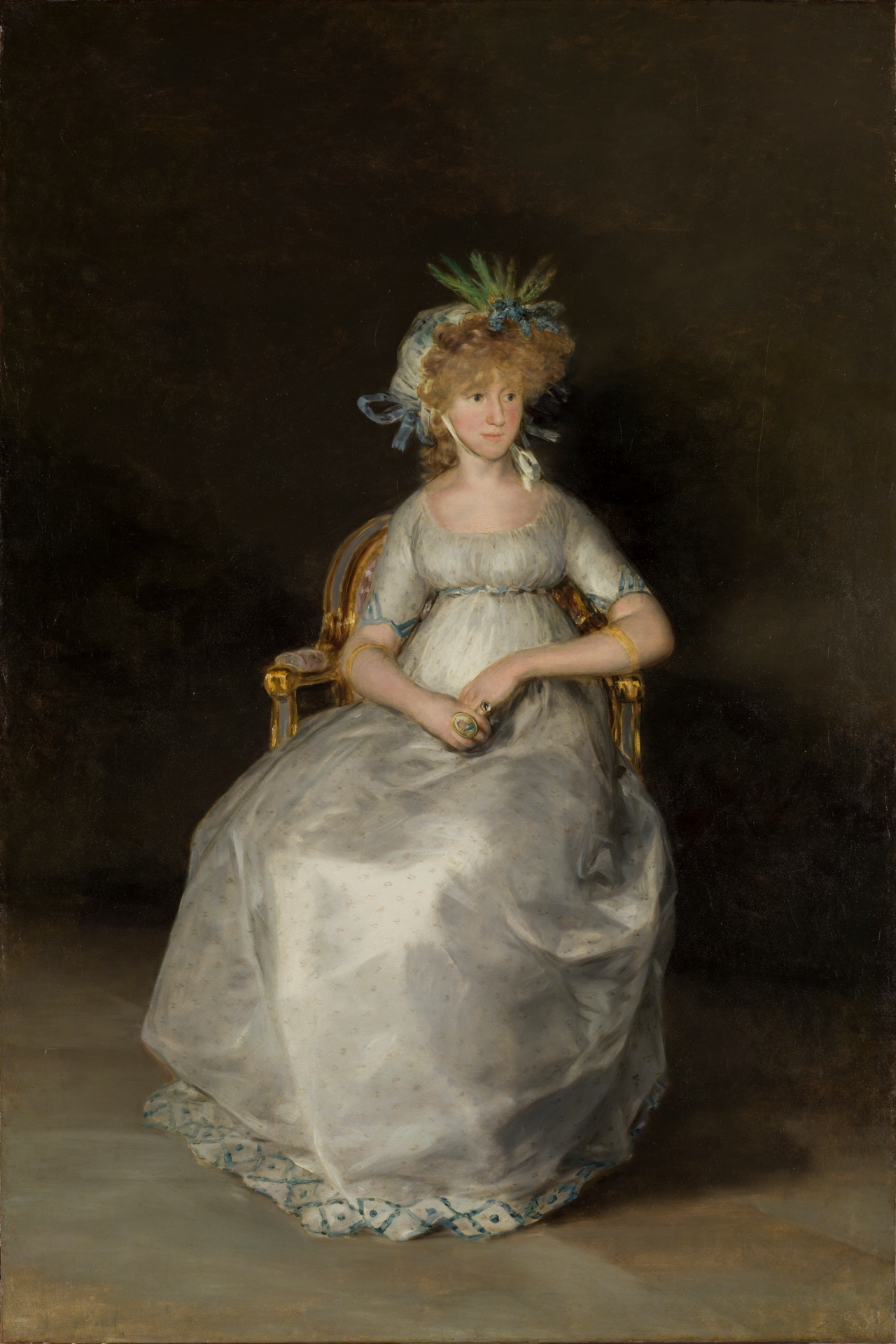
Full-length painting of a seated woman in a white dress with blue trim and a white bonnet decorated with green and blue feathers and blue ribbons. She sits in a gilded armchair against a dark background, hands clasped in her lap, wearing gold bracelets.Painting

Primary source

Countess of Chinchon

Francisco Goya · c. 1800

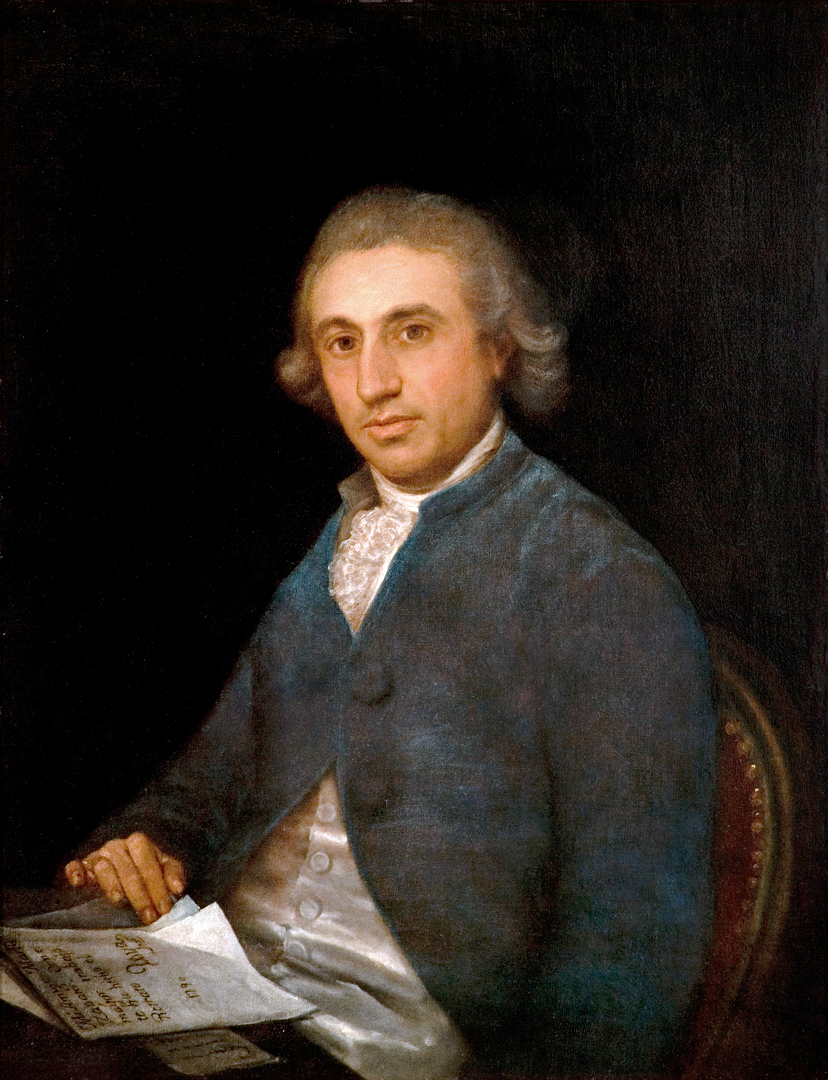
Oil painting of a man with powdered gray hair in a blue jacket, white lace cravat and silver waistcoat, seated against a dark background, resting one hand on a folded letter with handwriting.Painting

Primary source

Portrait of Martín Zapater

Francisco Goya · 1790

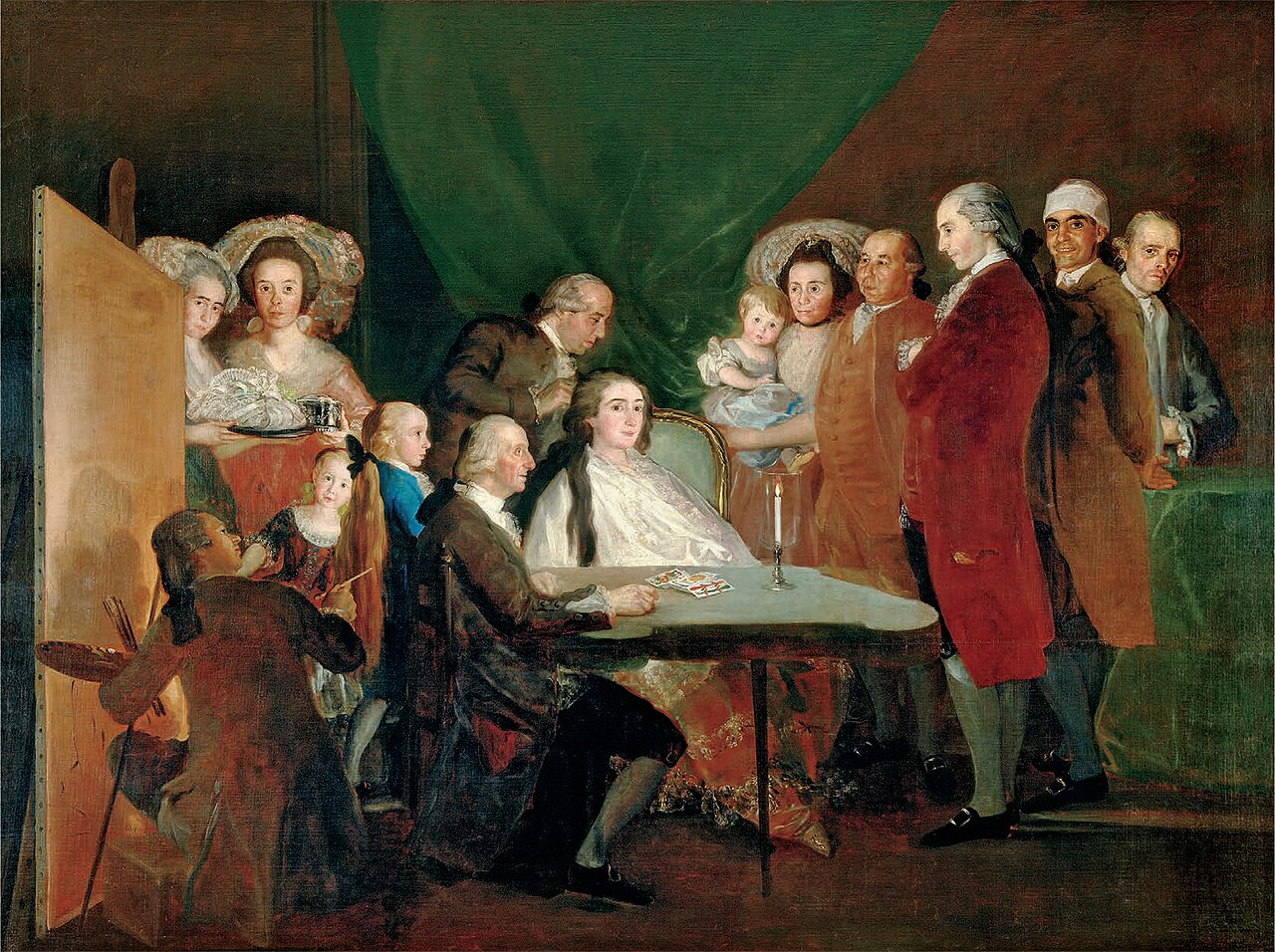
Painting of a group portrait: a seated man at a card table with a seated woman in white beside him, a painter at an easel on the left, and many standing family members in elegant 18th-century clothing, with a green curtain behind.Painting

Primary source

The Family of the Infante Don Luis

Francisco Goya · 1783–1784

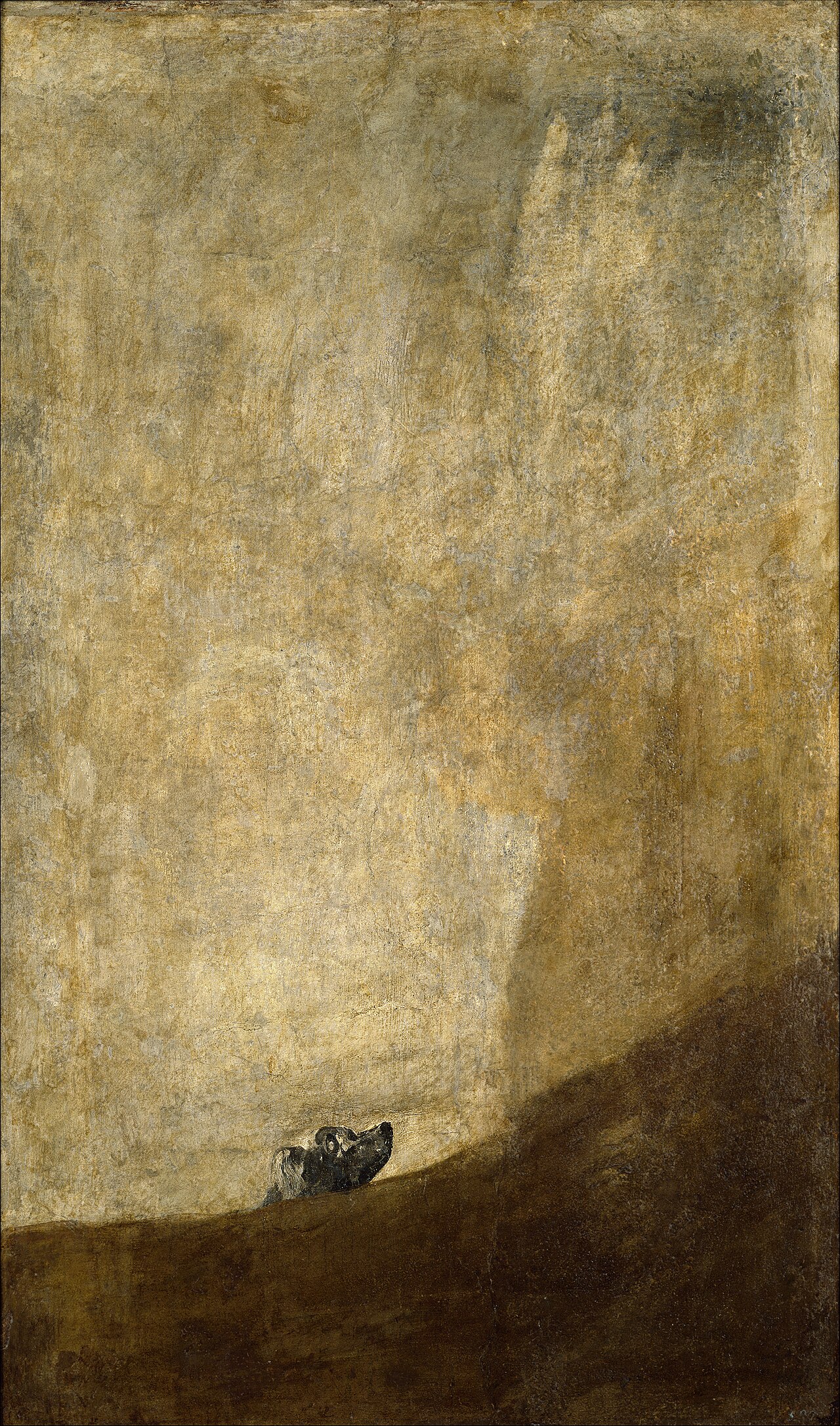
A large, muted ochre and brown painting with a vast, pale, hazy expanse above and a dark brown slope across the bottom. A small dark head of a dog peers over the edge of the slope near the lower left.Painting

Primary source

The Dog

Francisco Goya · 1819–1823

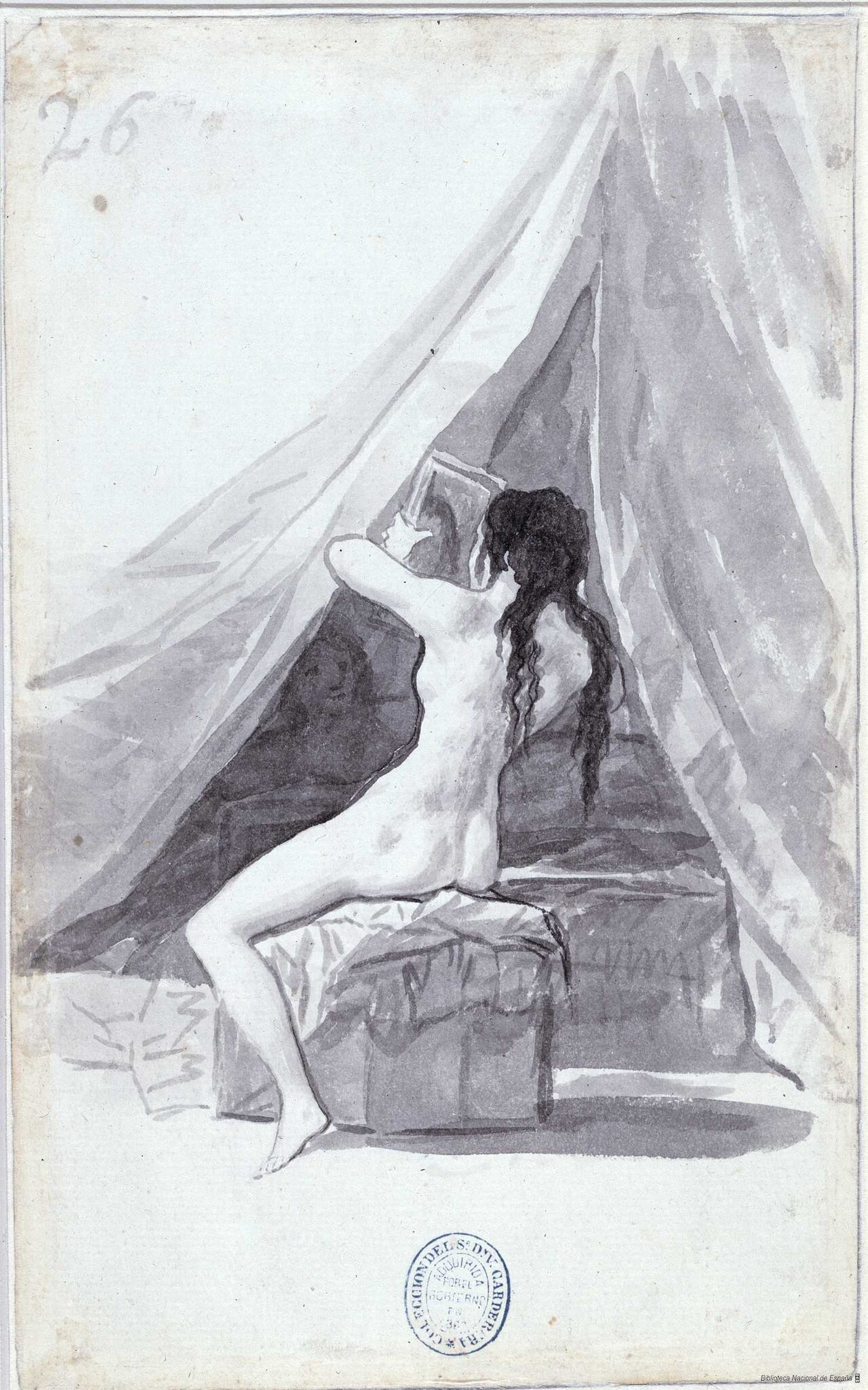
Ink and wash drawing of a nude woman seen from behind, seated on a bundle or stool, holding a mirror raised toward her face. Long dark hair falls down her back. A tent-like fabric canopy frames the scene. Page numbered 26, with a library stamp at the bottom.Painting

Primary source

Album B

Francisco Goya · 1796

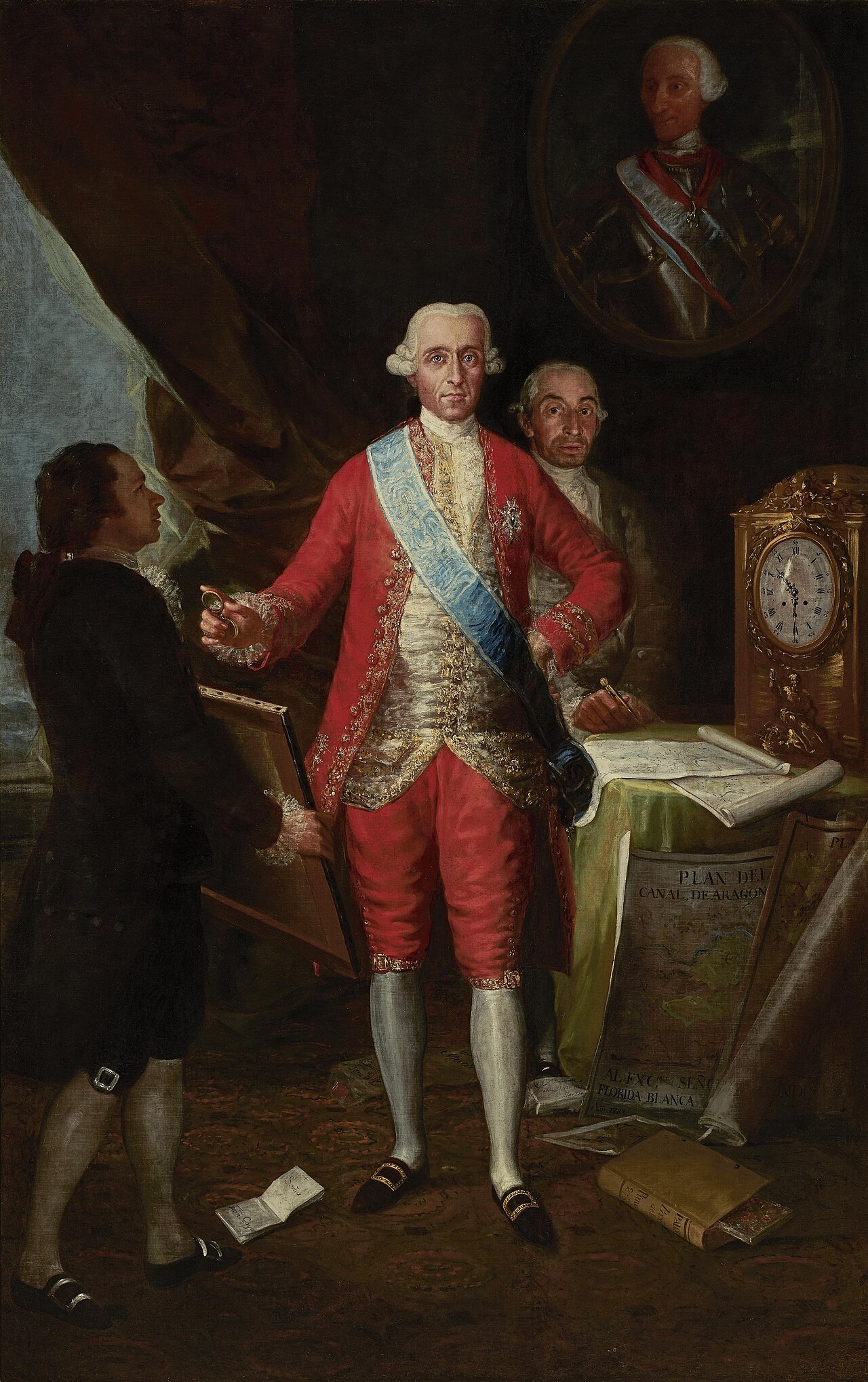
Painting of a standing man in a red coat and red breeches with a blue sash, gold embroidery, and white wig, holding a small object, beside a table with rolled maps and a large ornate gilt clock. A seated man writes behind him and an oval portrait hangs above.Painting

Primary source

The Count of Floridablanca

Francisco Goya · 1783

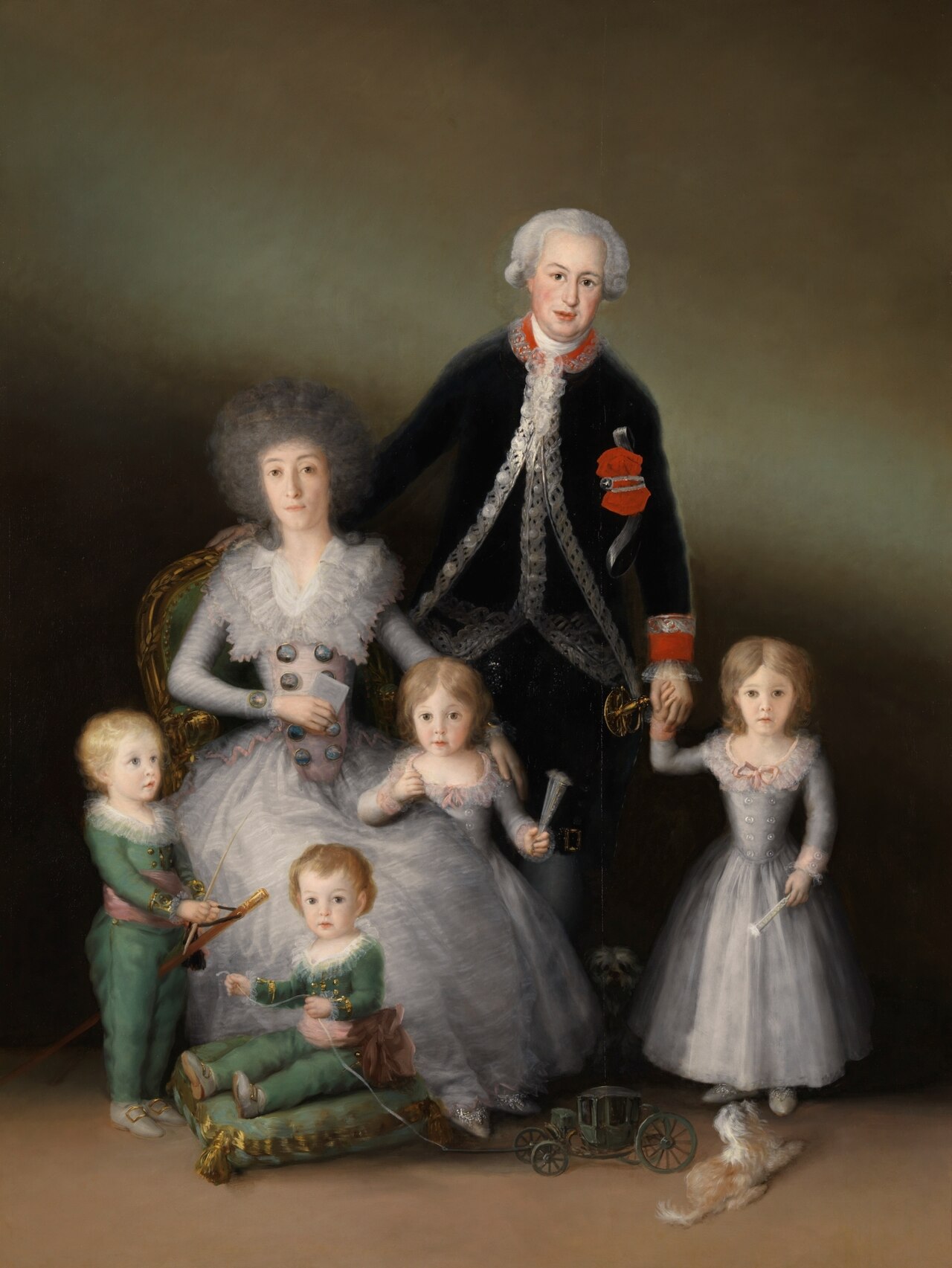
Group portrait of a man and woman in 18th-century dress with five children. The standing man wears a black coat with silver trim and a red sash; the seated woman wears a pale grey gown with a ruffled collar. Children stand and sit around them, one with a toy carriage and a small dog nearby.Painting

Primary source

The Duke and Duchess of Osuna and their Children

Francisco Goya · 1787

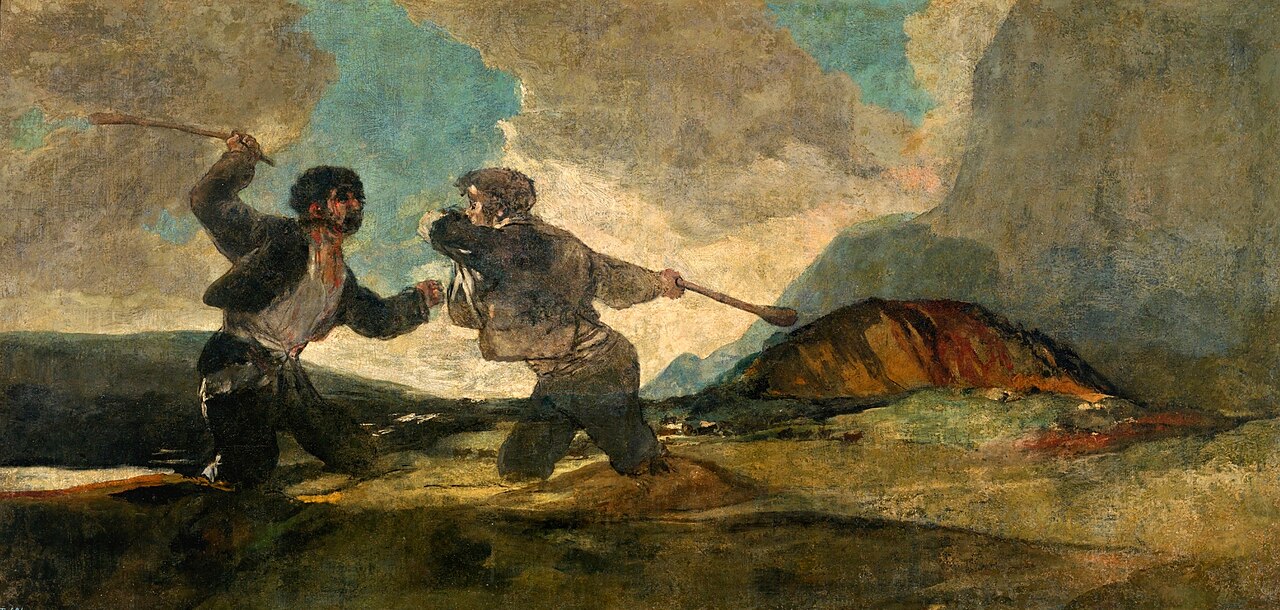
Painting of two men fighting with wooden clubs on a barren, cloudy landscape. The man on the left raises his club overhead while the man on the right swings his club forward. Hills and a rocky outcrop are behind them.Painting

Primary source

Fight with Cudgels

Francisco Goya · c. 1820-1823

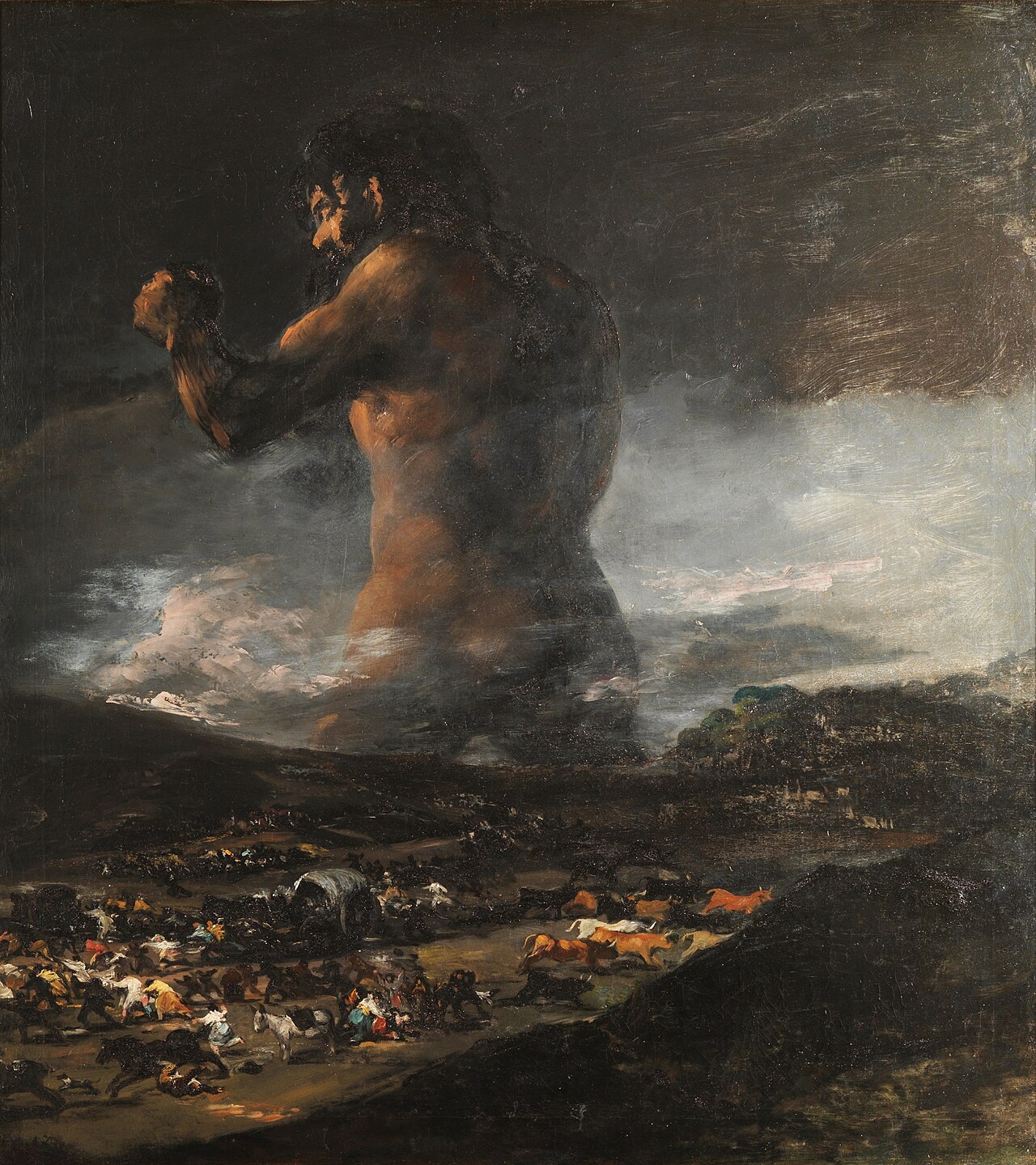
Painting of a enormous, muscular giant with a dark beard and hair, seen from behind and partly turned, rising above a dark landscape. Below, tiny figures flee in panic among scattered cattle, a cart, and a dark hillside under a gray, stormy sky.Painting

Secondary source

The Colossus

Attributed to Francisco Goya (reattributed to Goya's circle) · c. 1818

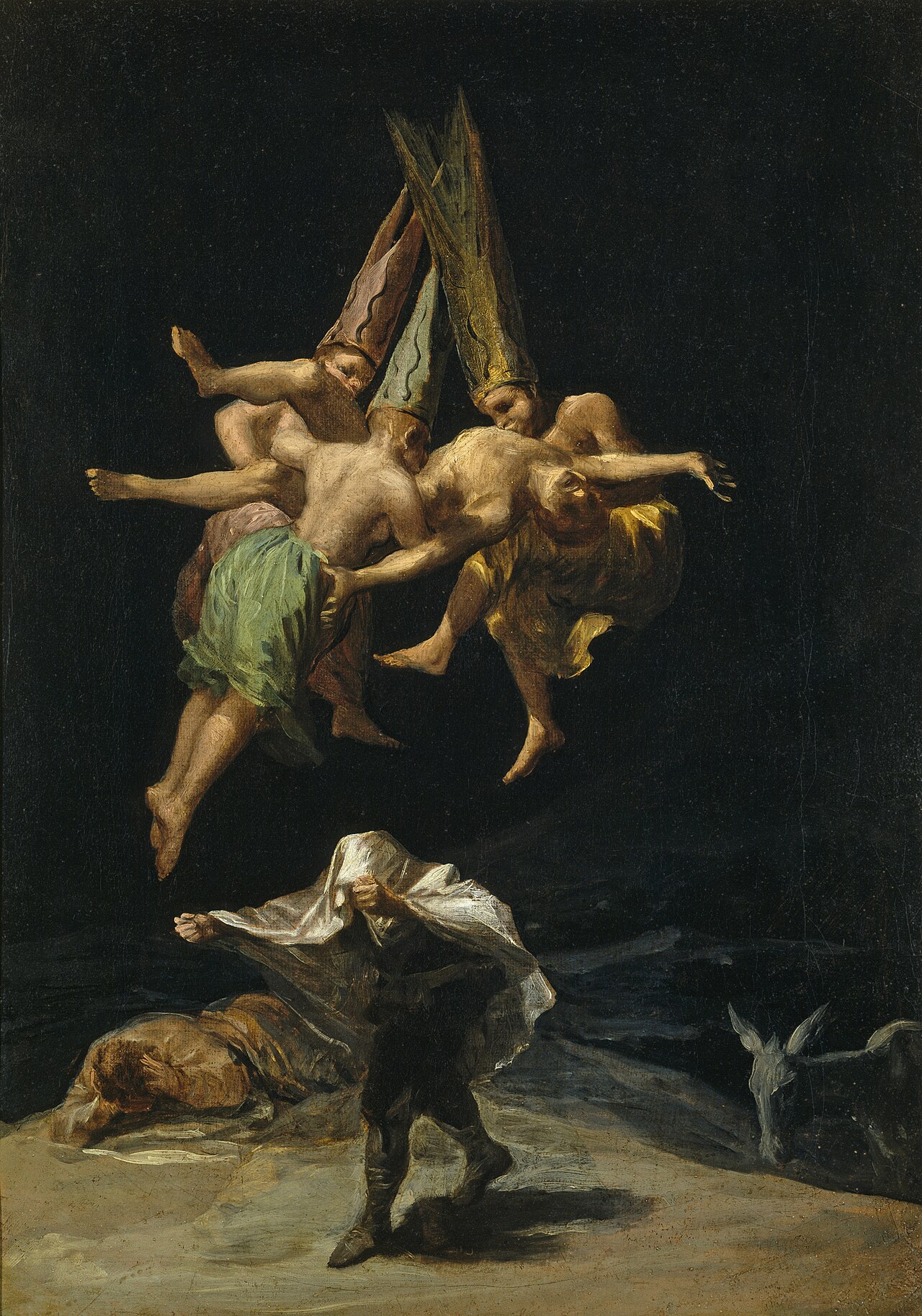
Painting of three witches flying through a dark night sky, with tall pointed hats and bare limbs, carrying a companion in a green skirt. Below, a figure in a white sheet stands beside a sprawled figure and a grey donkey.Painting

Primary source

Witches' Flight

Francisco Goya · 1797-1798

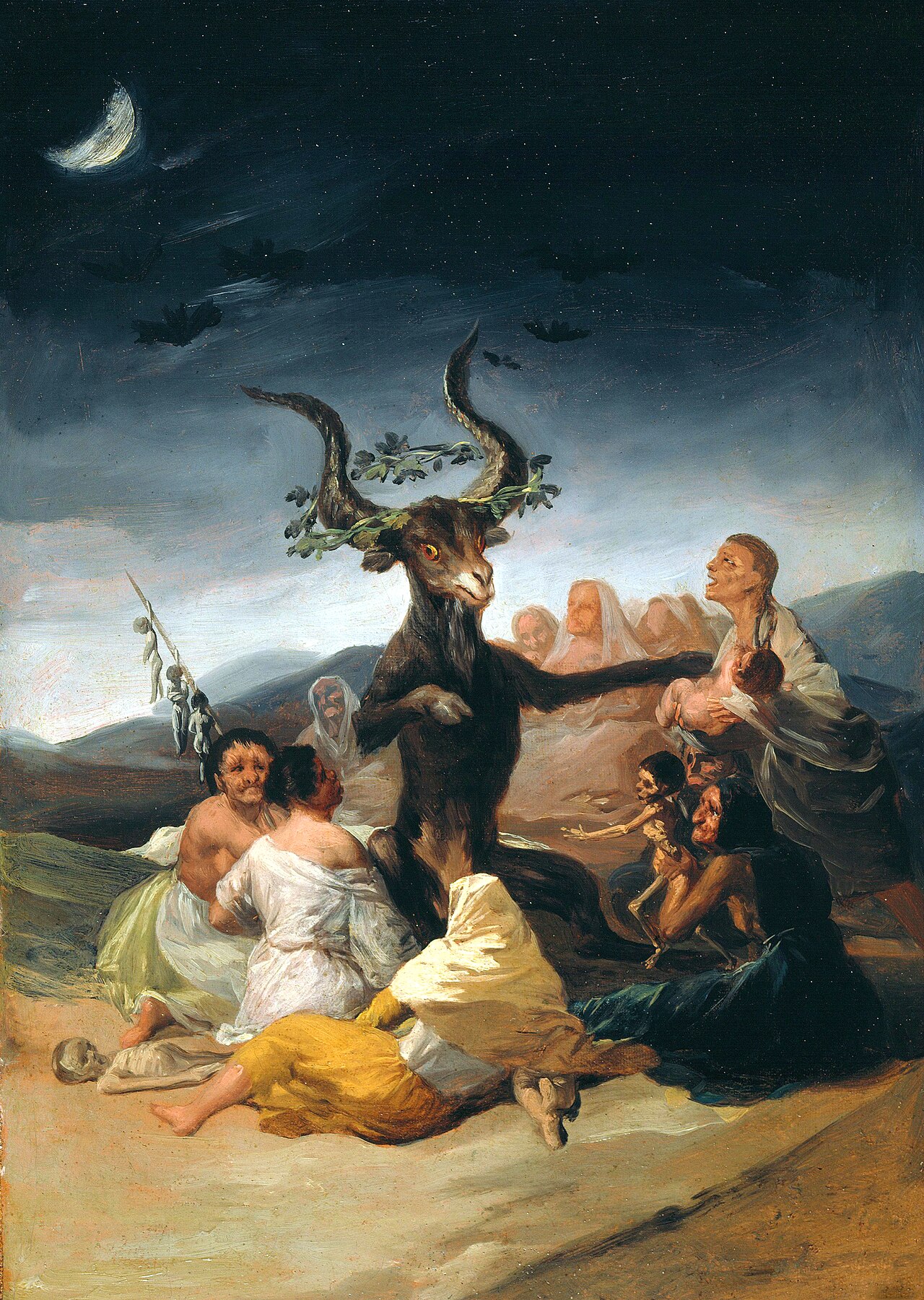
Painting of a night scene on a barren hillside under a crescent moon and bats. A large horned goat-like figure with a wreath of leaves on its head stands center, surrounded by hunched figures, a woman holding a child, and a small skeletal figure. Distant figures in white veils stand on the hills.Painting

Primary source

Witches' Sabbath

Francisco Goya · 1798

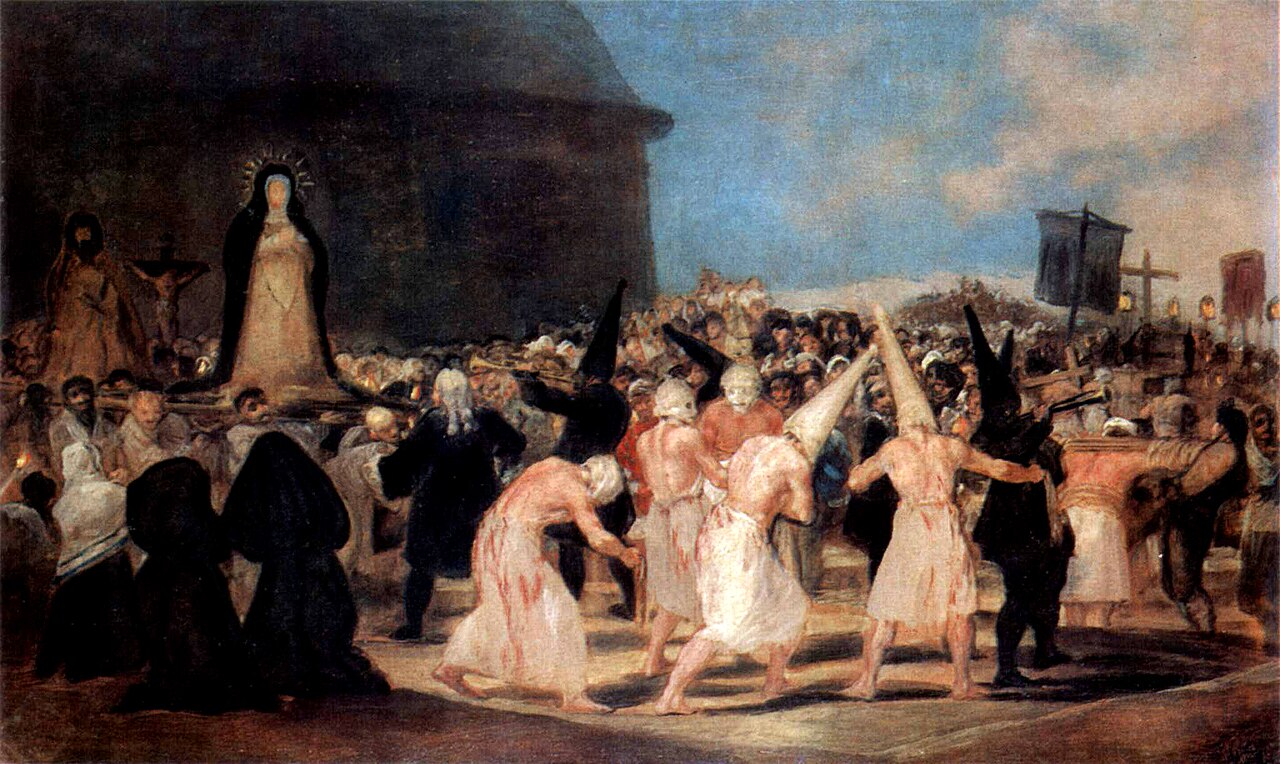
Painting of a religious procession at dusk-lit town square. Hooded penitents in white robes and tall pointed hats walk barefoot, some with bloodied backs, while a dark-robed figure leads. A statue of a veiled Virgin with a halo is carried on a float before a large dark building, with a crowd of onlookers and a cross and banner in the background under a blue sky.Painting

Primary source

A Procession of Flagellants

Francisco Goya · 1814-1816

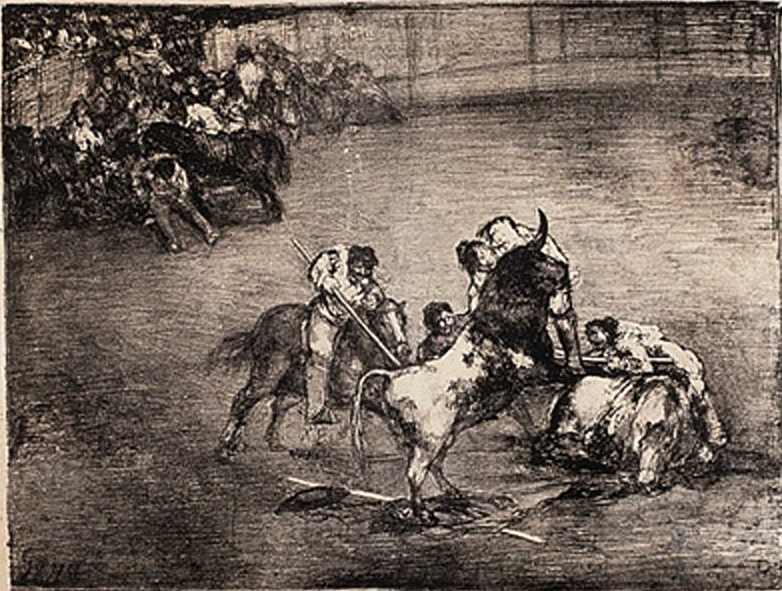
Etching-style print of a bullring: a bull charges at a man on a horse with a lance, while a fallen horse lies on the right and spectators fill the stands behind a wall in the upper left.Painting

Primary source

The Bulls of Bordeaux

Francisco Goya · 1825

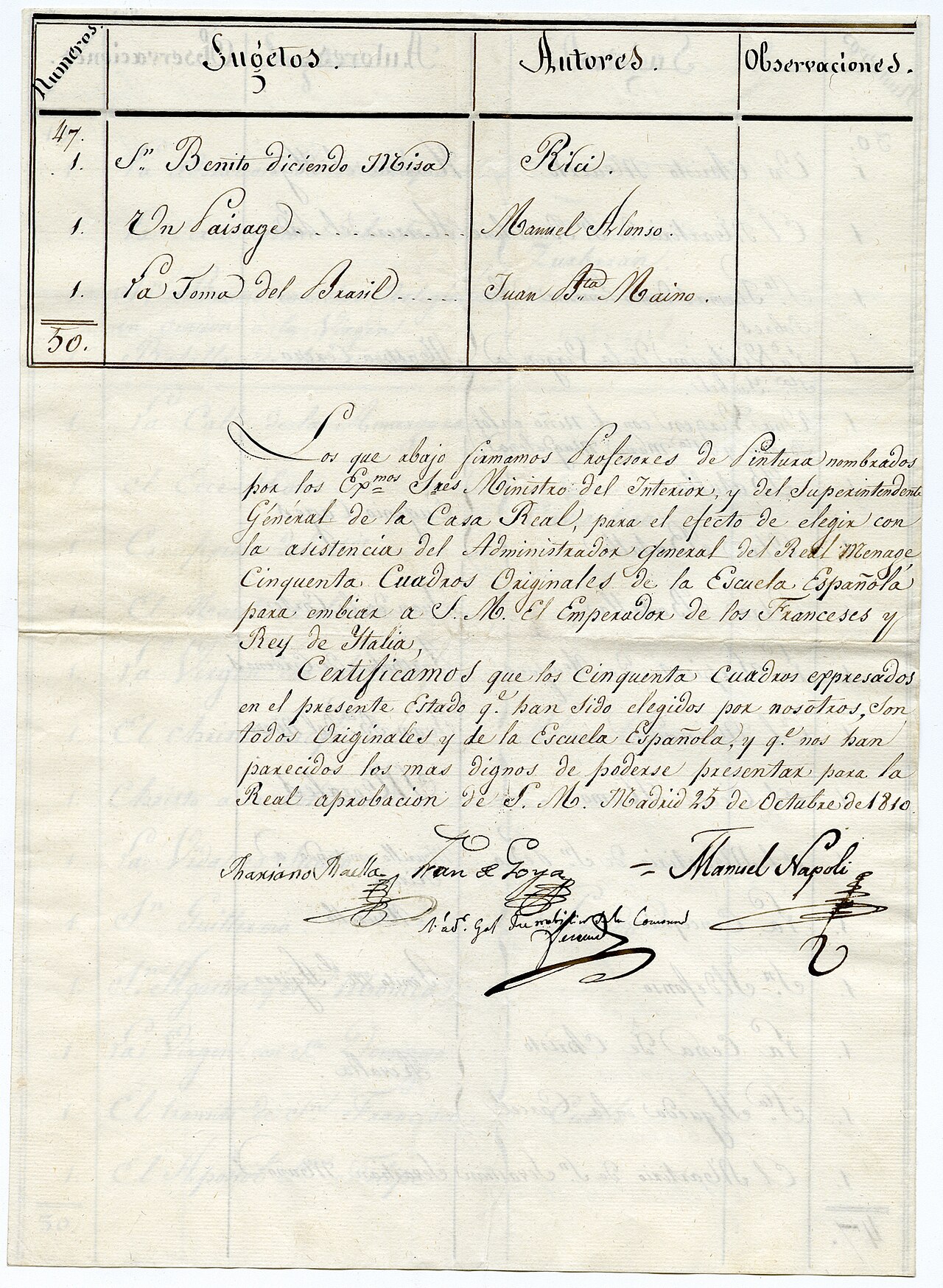
Handwritten Spanish document on aged paper with a table of columns headed Números, Sujetos, Autores, Observaciones, listing paintings and artists. Below is a certifying paragraph dated Madrid 25 de Octubre de 1810, with three signatures.Document

Primary source

Estado de los cuadros escogidos por Maella, Goya y Nápoli

Francisco de Goya, Mariano Salvador Maella, Manuel Nápoli · 25 October 1810

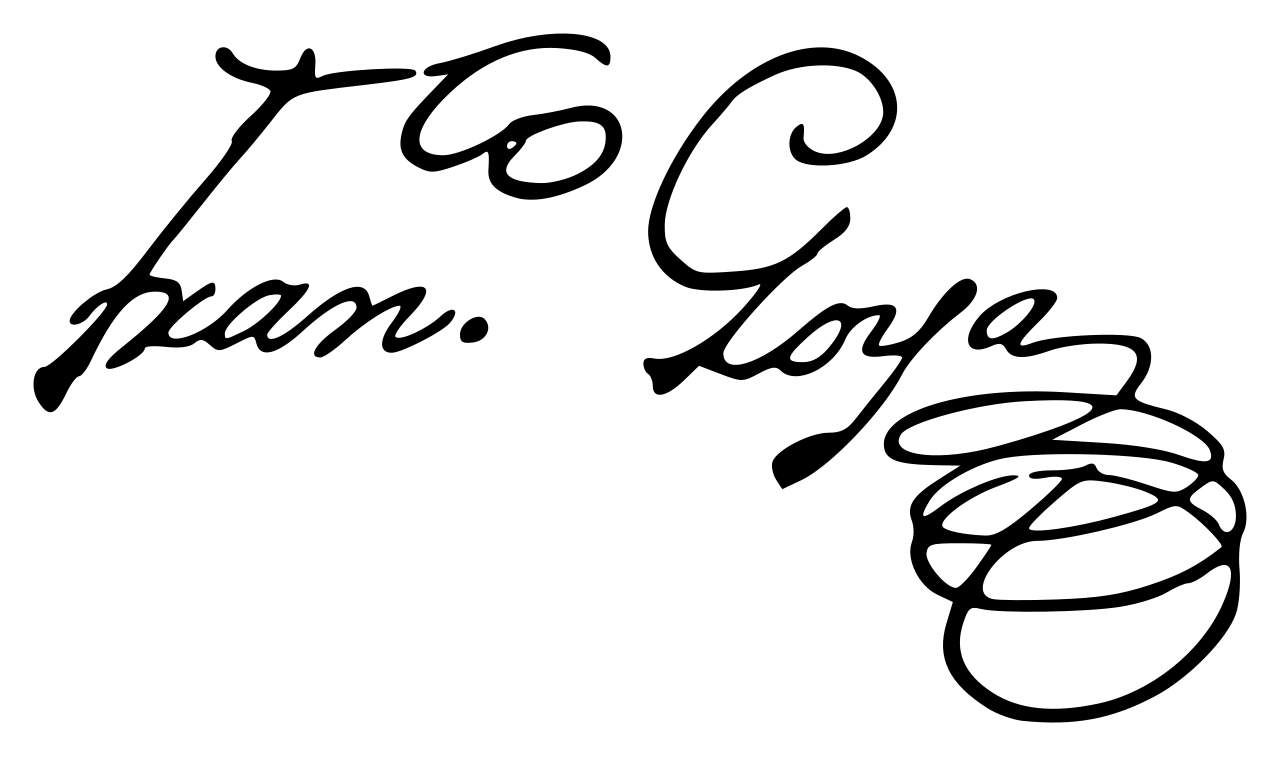
Black ink line drawing of a handwritten autograph signature on white background. Reads 'To Joan' or similar with 'Goya' below, followed by a looping flourish beneath the name.Artifact

Primary source

Signature of Francisco Goya

Francisco Goya

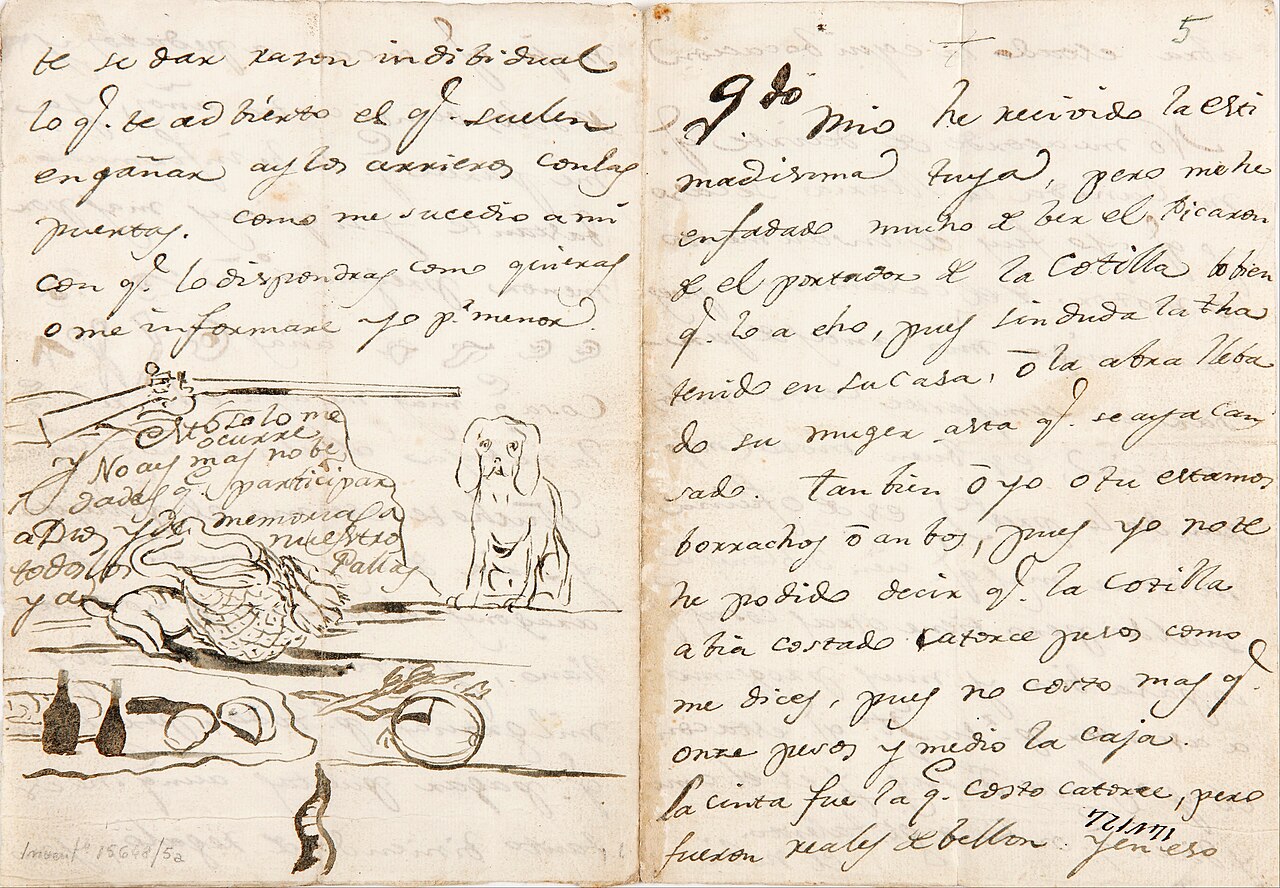
Two facing pages of a handwritten letter in brown ink on aged paper, written in Spanish cursive. The right page has a dated salutation and several lines of text. The left page contains a pen-and-ink sketch of a seated dog, a reclining figure, bottles, and a round object below.Letter

Primary source

Letter from Francisco Goya to Martín Zapater, 1783

Francisco Goya · 1783

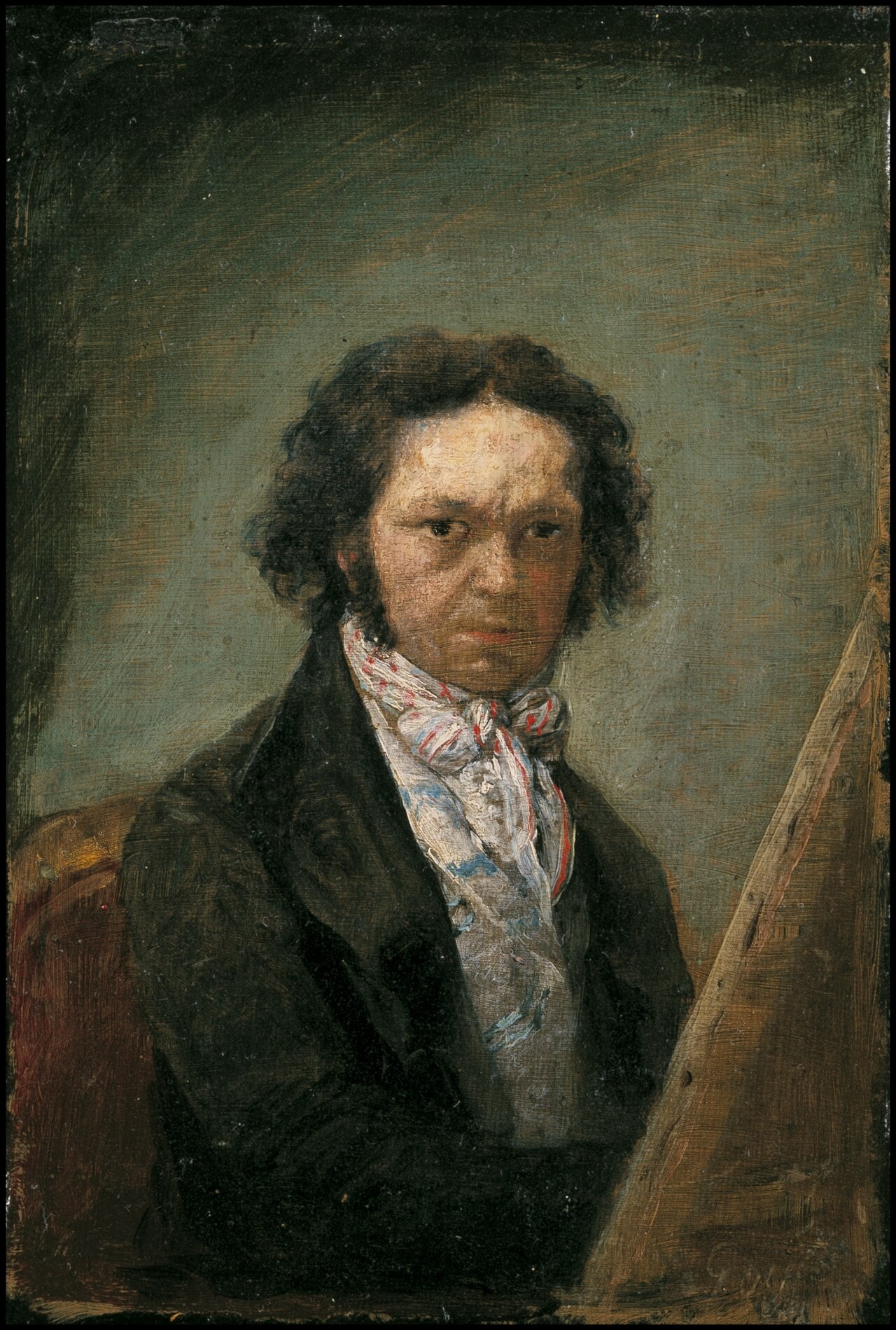
Oil painting of a man with dark, wavy hair in a dark coat and a white cravat with red and blue stripes, seen against a greenish-grey background, with a wooden easel edge at the lower right. His head is turned slightly, and he looks toward the viewer.Painting

Primary source

Self-portrait on Linen

Francisco Goya · c. 1796

Book

Secondary source

Francisco Goya: A Study of His Work and Personality

Hugh Stokes · 1914

Goya as Portrait PainterBook

Secondary source

Goya as Portrait Painter

Aureliano de Beruete y Moret · 1922

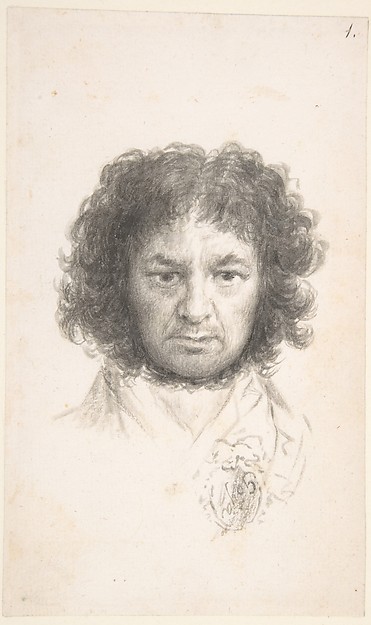
Pencil or chalk drawing of a man's head and upper chest on pale paper. He has wild, curly dark hair, a furrowed brow, and a stern, direct gaze. A cravat and jacket collar are visible, with a small emblem near the chest. A number 1 is in the top right corner.Painting

Primary source

Self-Portrait

Francisco de Goya y Lucientes · ca. 1796

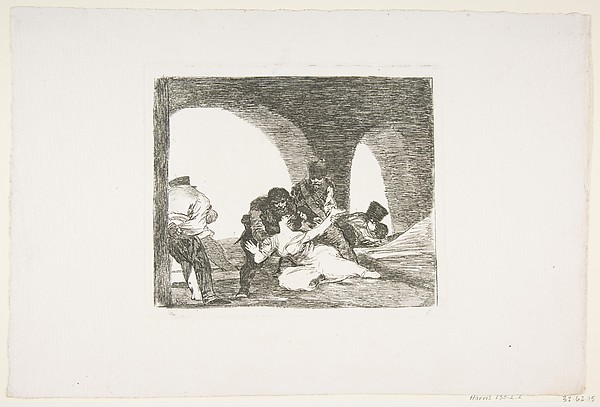
Black-and-white etching on cream paper showing a dark interior with arched openings. A figure in a white dress lies on the ground, supported by a dark-clothed man. Other men in dark coats and hats stand nearby, and a man in light clothing stands at the left edge.Painting

Primary source

Disasters of War, Plate 13: Bitter to be Present

Francisco de Goya y Lucientes · 1810

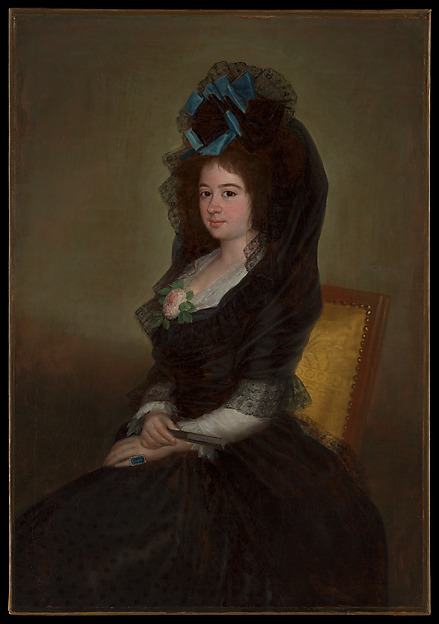
Painting of a woman seated in a gold upholstered chair, wearing a black dress with lace trim, a black lace mantilla, and a blue bow on her hair. She holds a folded fan and wears a pink rose pinned at her chest against a dark background.Painting

Primary source

Portrait of Narcisa Barañano Gayoso de Goicoechea

Francisco de Goya y Lucientes · ca. 1805

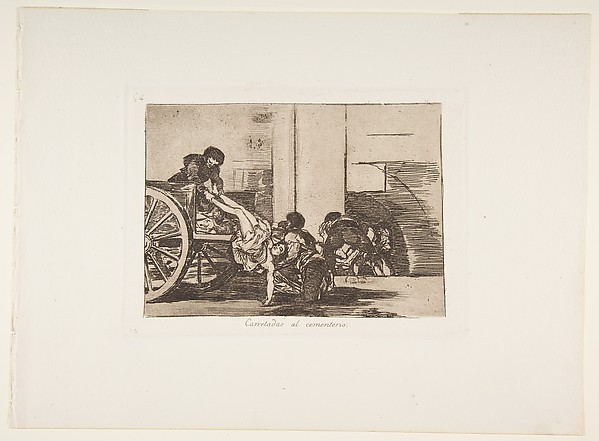
Etching on paper of a horse-drawn cart with large spoked wheels at left, loaded with bodies, while a figure lifts a body from the cart and others bend low on the ground at right beside a dark doorway. Caption below reads 'Carretadas al cementerio.'Painting

Primary source

Disasters of War, Plate 64: Cartloads to the Cemetery

Francisco de Goya y Lucientes · 1811-12 (published 1863)

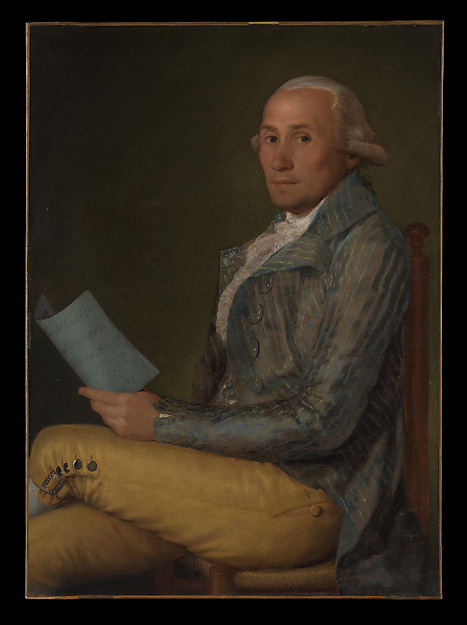
Oil painting of a seated man with powdered white hair in a striped blue-gray coat, yellow breeches, and white cravat. He holds a blue sheet of paper with handwriting and rests on a wooden chair against a dark olive background.Painting

Primary source

Portrait of Sebastián Martínez y Pérez

Francisco de Goya y Lucientes · 1792

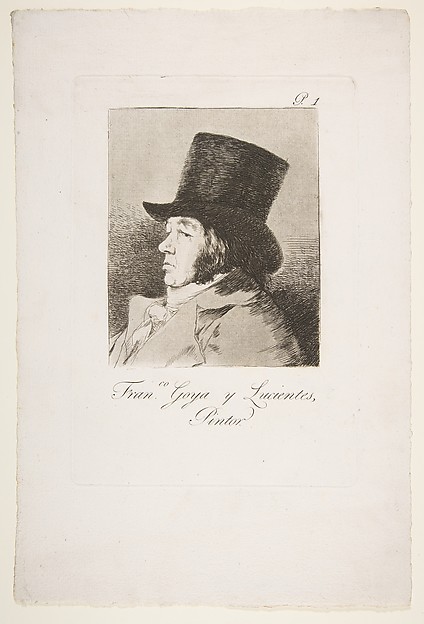
Etching on cream paper showing Plate 1 from Los Caprichos: a profile portrait of a man in a tall top hat and high-collared coat, facing left, with the plate number Q 1 at upper right and the inscription 'Fran.co Goya y Lucientes, Pintor' below the image.Painting

Primary source

Self-Portrait, Plate 1 from Los Caprichos

Francisco de Goya y Lucientes · 1799

Book

Secondary source

Goya, an Account of His Life and Works

Albert Frederick Calvert

Book

Secondary source

Goya

François Crastre

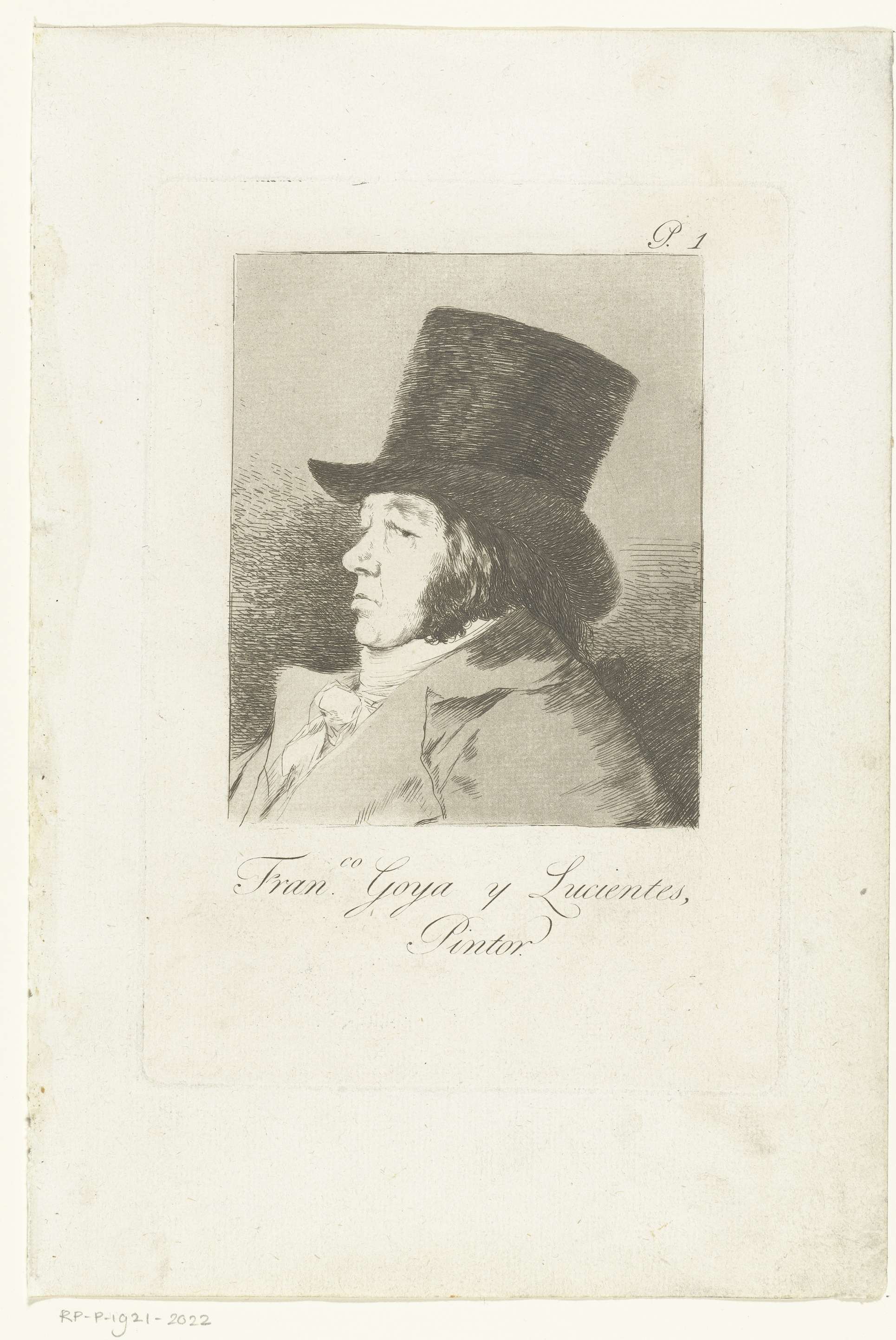
Etching showing a man in profile facing left, wearing a tall top hat and a dark high-collared coat with a cravat. Below the image is the inscription 'Fran.co Goya y Lucientes, Pintor' and the plate number 'P. 1' appears at upper right.Painting

Primary source

Self-Portrait of Goya in a Hat

Francisco Goya · 1799

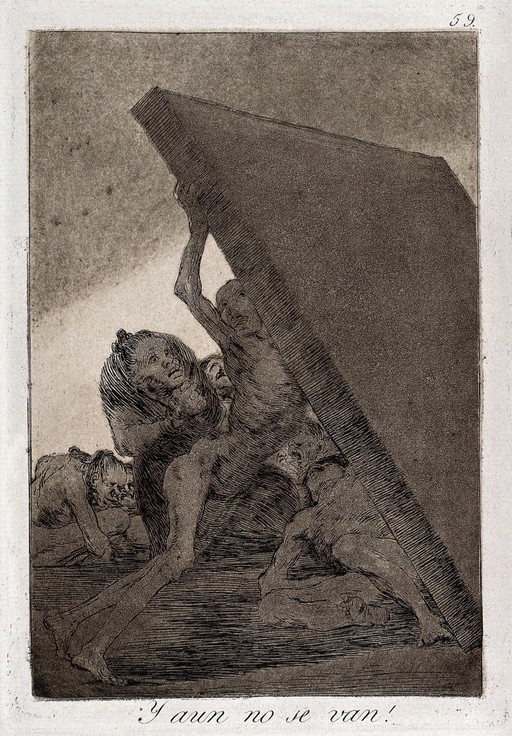
Etching of plate 59 from Goya's Caprichos, showing two gaunt, withered figures straining to lift a large tilted stone slab. Their bodies are thin and bent, and a caption reads 'Y aun no se van!' at the bottom.Painting

Primary source

Caprichos Plate 59: Two Withered Wretches Lifting a Stone

Francisco Goya · 1796-1798

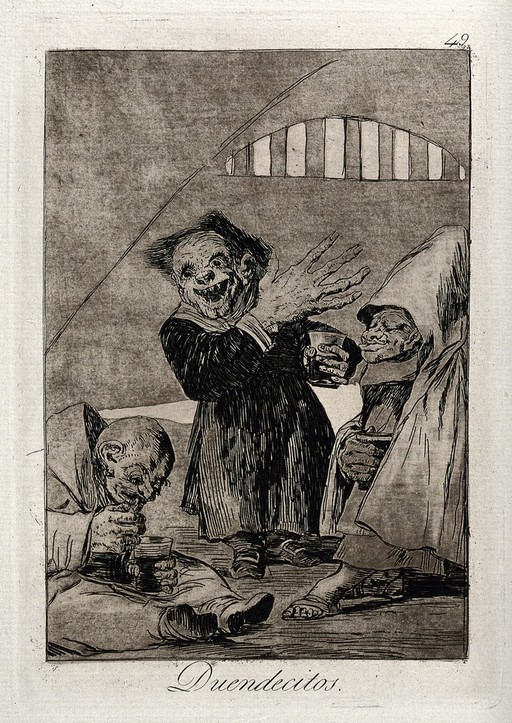
Etching titled Duendecitos, plate 49 numbered in the top right corner. A grotesque, grinning figure in a dark cloak and cap raises a hand while holding a cup. Beside him a hooded figure with a sneering face holds a cup, and at lower left a small hunched figure drinks from a cup. Barred window in the background.Painting

Primary source

Caprichos Plate 49: Three Monsters in Clerical Robes

Francisco Goya · 1797

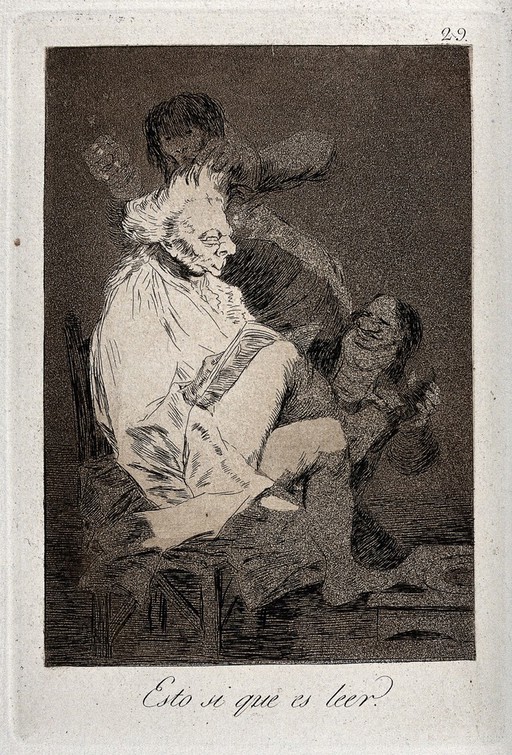
Etching of an old man with a hooked nose and white hair sitting on a chair, reading a paper, while a younger figure behind him pulls on his shirt and another figure kneels at his feet attending to his legs. Caption below in Spanish: Esto si que es leer? Plate number 29 in the top right.Painting

Primary source

Caprichos Plate 29: An Old Man Reading While Being Dressed

Francisco Goya

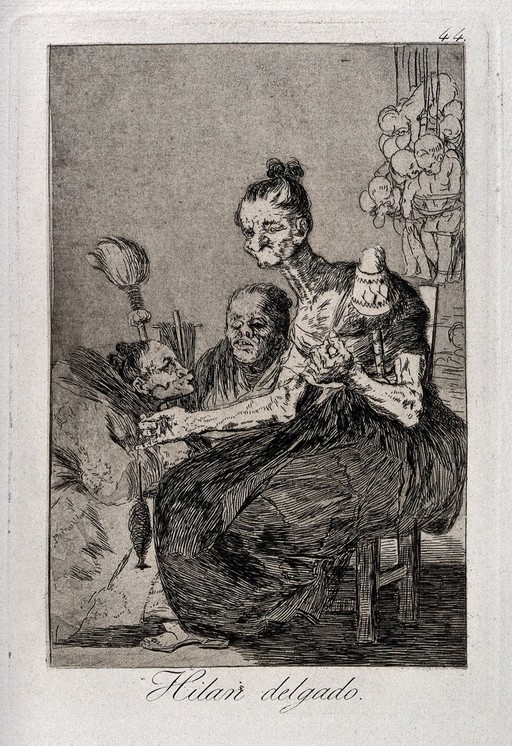
Etching of three gaunt, old women spinning thread in a dim room. The central figure, with hair in a bun, works a spindle held in her hands. Behind them, bundled infant bodies hang from hooks on the wall. The inscription 'Hilar delgado' appears at the bottom, and the plate number 44 is at the top right.Painting

Primary source

Three Witches Spinning with Bound Babies

Francisco Goya y Lucientes · 1796-1798

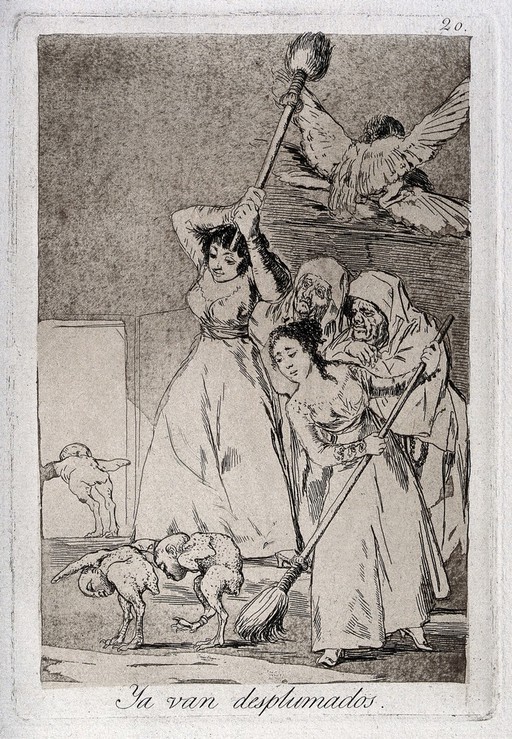
Etching titled Ya van desplumados, plate 20 of Goya's Caprichos. A young woman with arms raised holds a broom above her head while another young woman bends forward sweeping. Two hooded old figures stand behind them. On the left, two bird-like creatures with human heads crouch on the floor, and a winged bird figure flies at upper right. A doorway appears at left with a small figure in it.Painting

Primary source

Women Chasing Bird-Men Out of a Door

Francisco Goya y Lucientes · 1796-1798

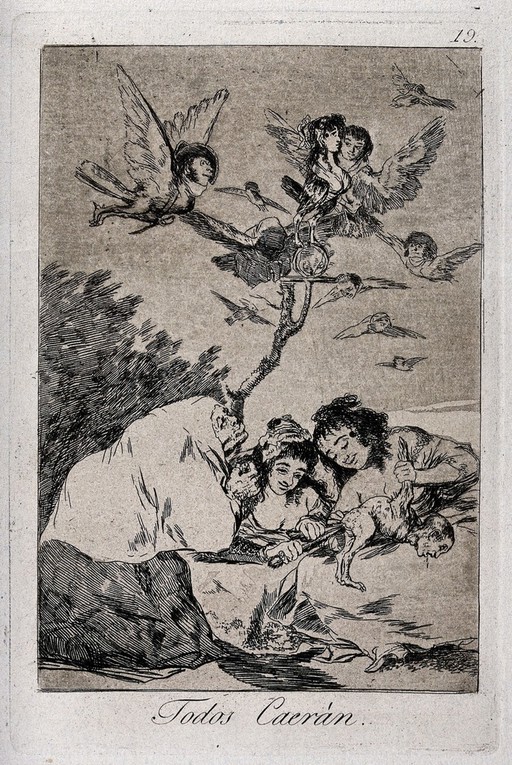
Etching titled Todos Caeran, plate 12 of Goya's Caprichos. Winged creatures fly above a tree while a hooded old woman stands at left and two young women pluck a bird with a human head on the ground. Dark shading fills the left side.Painting

Primary source

Women Plucking a Man-Headed Bird

Francisco Goya y Lucientes · 1796-1798

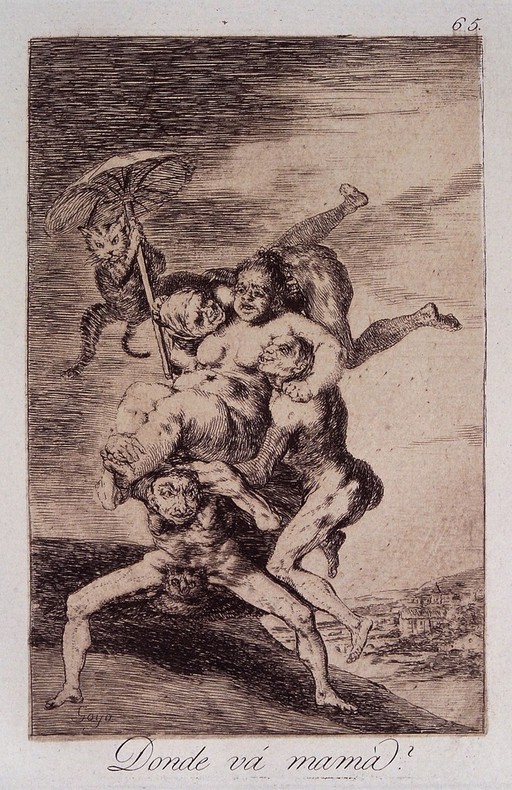
Etching titled 'Donde vá mamà?' with plate number 65 in the top right. A heavyset nude woman is carried aloft by several contorted, thin figures with animal-like faces. A cat-like creature on the upper left holds a parasol. A town sits on the distant right horizon.Painting

Primary source

Fat Woman Carried by Demons

Francisco Goya y Lucientes · 1796-1798

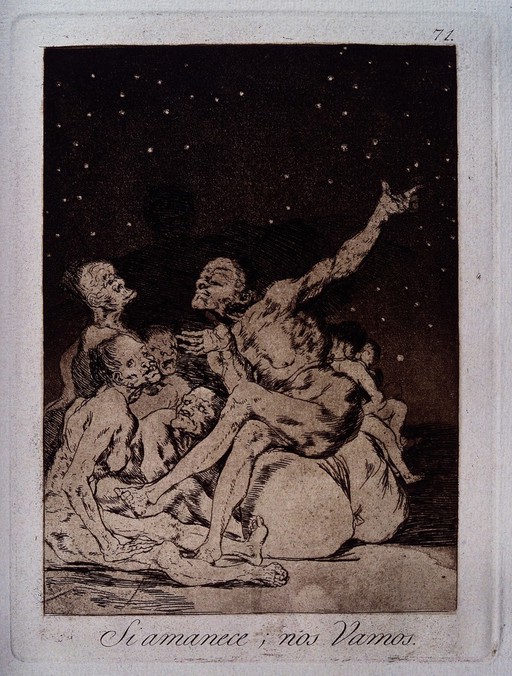
Etching of a night scene: a dark starry sky above a group of gaunt, grotesque figures, one elderly man pointing upward with a raised arm while others gather around. Caption below reads 'Si amanece, nos vamos.' Plate numbered 74 at upper right.Painting

Primary source

Dawn Breaks Up the Witches' Gathering

Francisco Goya y Lucientes · 1796-1798

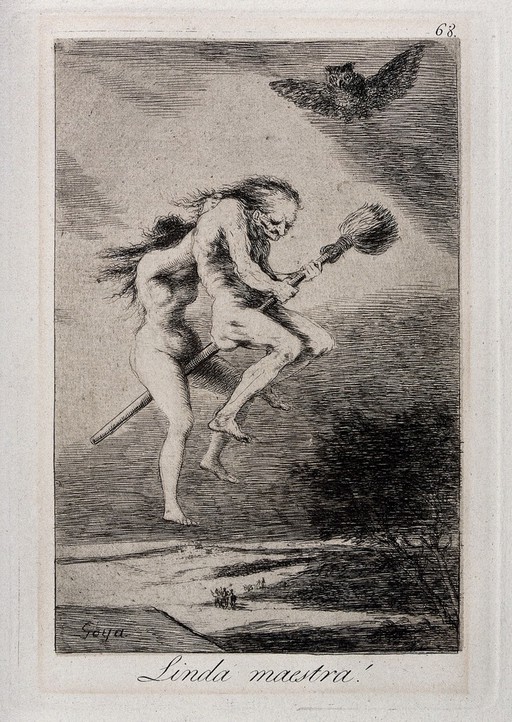
Etching of two thin, naked witches flying on a broomstick under a dark sky, with an owl flying above and a dark landscape below. Plate numbered 63 at upper right, with the caption 'Linda maestra' and the signature 'Goya' at the bottom.Painting

Primary source

Two Naked Witches on a Broomstick

Francisco Goya y Lucientes · 1796-1798

Book

Secondary source

Paintings and Drawings by Goya, Hispanic Society Catalogue

Hispanic Society of America · 1916

Francisco GoyaBook

Secondary source

Francisco Goya

Arthur Mayger Hind · 1911

Francisco de GoyaBook

Secondary source

Francisco de Goya

Richard Muther · 1905

Francisco de GoyaBook

Secondary source

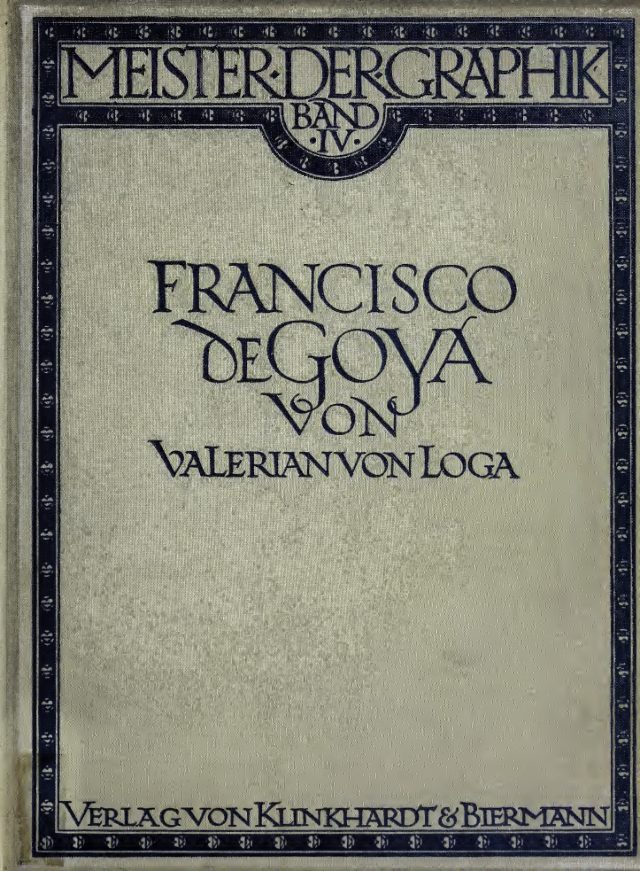
Francisco de Goya

Valerian von Loga · 1910

Book

Secondary source

Goya: Noticias Bibliográficas

Francisco Zapater y Gómez · 1860

Loan Exhibition of Paintings by El Greco and GoyaDocument

Secondary source

Loan Exhibition of Paintings by El Greco and Goya

M. Knoedler & Co · 1915

Francisco GoyaBook

Secondary source

Francisco Goya

Julius von Schlosser · 1922

Book

Secondary source

Francisco de Goya (Spanish translation)

Richard Muther

Document

Tertiary source

Francisco Goya y Lucientes, Encyclopaedia Britannica 9th ed.

Francisco Goya, Victorian VaultDocument

Tertiary source

Francisco Goya, Victorian Vault

Victorian Vault · 1808

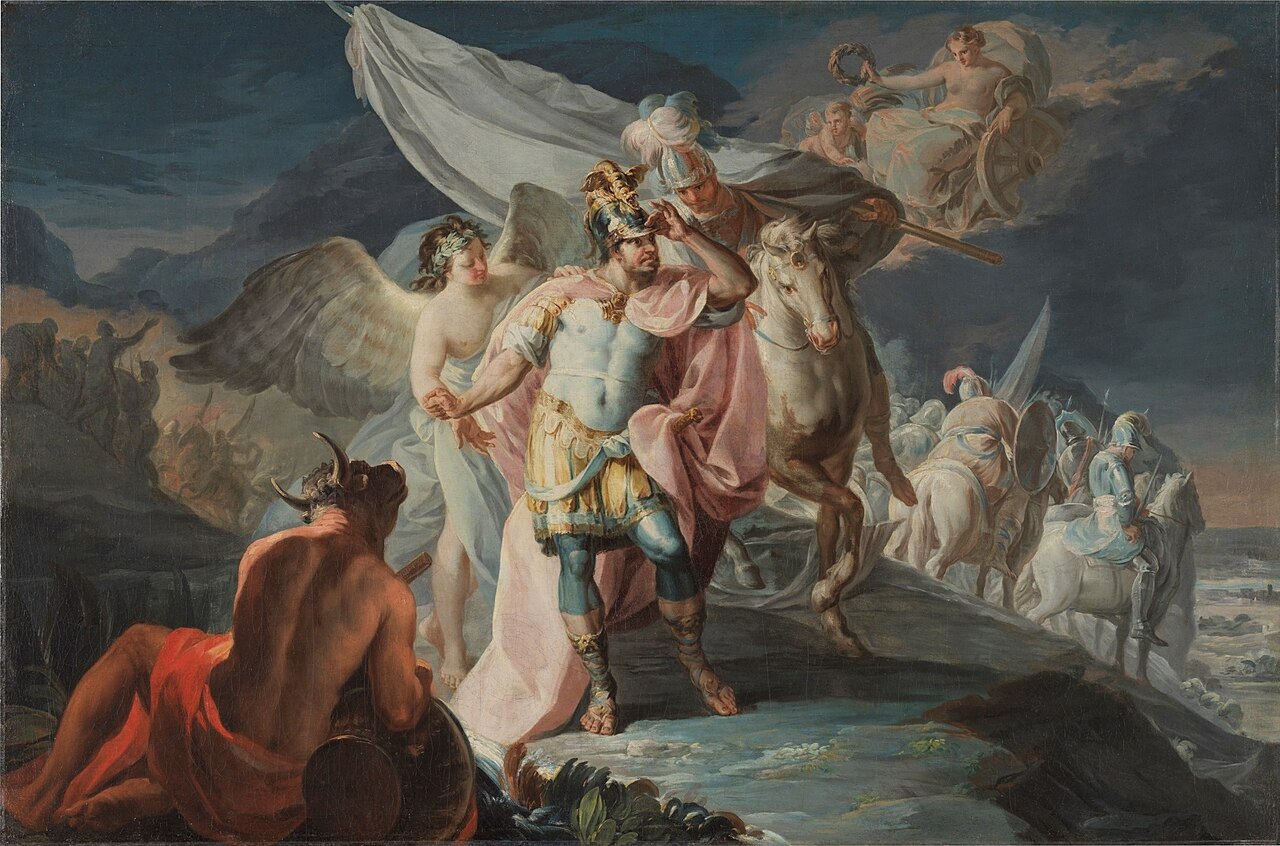
Oil painting of a helmeted, armored man standing on a rocky ridge, pointing forward with one hand while a winged female figure with a laurel wreath supports his arm. A bearded man on horseback stands behind him beside a white horse, and a horned, reclining figure sits at lower left. Soldiers on horses march along the ridge at right, and a winged figure with a wreath and chariot-like wheel floats in the clouds above. Stormy sky with a billowing white cloth.Painting

Secondary source

The Victorious Hannibal Seeing Italy from the Alps for the First Time

Francisco Goya · 1770-1771

Want the full shelf? Chat with Francisco Goya in the app and open the Sources panel — every quote links back to the original.

Use Francisco Goya in class

2 collections

Ready-made collections from the Humy team and other teachers that feature Francisco Goya. Preview any of them, then try it free.

Trusted by educators worldwide

Conversations
375,000+
Real exchanges between students and historical figures
Messages exchanged
4,142,000+
Across every figure, classroom and language
Historical figures
100,000+
Each informed by a curated biography and selected sources
Languages supported
50+
From English and Spanish to Arabic and Korean

Paying customers

Used by 98 schools and universities

Partner school logo
Tecnológico de Monterrey logo
Hyper Island logo
Partner school logo
Chambersburg Area School District logo
Broward County Public Schools logo
Nebo School District logo
National Louis University logo
South Florida PBS logo
Punahou School logo
University of Wisconsin–River Falls logo
Partner school logo
Partner school logo
Archbishop Mitty High School logo
Kingsburg High School logo
Norwalk Public Schools logo
Partner school logo
Connections logo
Partner school logo
Moore Public Schools logo
Partner school logo
Partner school logo
Partner school logo
Partner school logo
Robbinsville Public Schools logo
Partner school logo
Partner school logo
Partner school logo
Tecnológico de Monterrey logo
Hyper Island logo
Partner school logo
Chambersburg Area School District logo
Broward County Public Schools logo
Nebo School District logo
National Louis University logo
South Florida PBS logo
Punahou School logo
University of Wisconsin–River Falls logo
Partner school logo
Partner school logo
Archbishop Mitty High School logo
Kingsburg High School logo
Norwalk Public Schools logo
Partner school logo
Connections logo
Partner school logo
Moore Public Schools logo
Partner school logo
Partner school logo
Partner school logo
Partner school logo
Robbinsville Public Schools logo
Partner school logo
Partner school logo

What educators are saying

“We enjoyed the program last year and used it frequently.”
“My students say it’s a welcome change of pace. I’m not a fan of the “sage on the stage” model, so I try to incorporate research-oriented and self-paced activities. With Humy, students have to take charge of their learning. They’ve become more adept at critical thinking, forming better questions, and improving their reading comprehension. The interview feature has been my go-to tool. I create assignments where students must ask historical figures a set number of questions, then summarize the responses to ensure they’re truly absorbing the material. This approach lets them actively explore the past rather than passively consuming information.”
“Humy has helped me bring historical figures, sometimes long past, to life. When my students interact with these figures in real-time, it eliminates some of the perceived “ancient” characteristics of my curriculum. This has shifted my students’ thinking away from viewing history as abstract or irrelevant. Real-time interactions make historical figures relatable, even allowing students to ask off-topic questions that help put historical lives in a more relevant context for 13-year-olds. The feature I use the most is the interview feature. After teaching a topic, most recently Gandhi and Joan of Arc, I have the students ask pointed, focused questions. We practice good conversation techniques beforehand, teaching them to listen (or read) carefully and formulate thoughtful follow-up questions rather than just interrogating. It helps students practice effective conversation skills.”

FAQ

Frequently asked questions

Who is Francisco Goya?
Renowned Spanish painter and printmaker. On Humy.ai you can chat with an AI version of Francisco Goya that draws on a short biography and 80 historical sources during the conversation — by text or voice, in 42 languages.
Is Francisco Goya AI free?
Francisco Goya is part of Humy's full library of more than 100,000 figures, which comes with a paid plan. A free account (no credit card) includes 20 messages a month with the free library's figures, so you can try how the conversations work first.
What sources does the Francisco Goya AI use?
It draws on a short biography and 80 historical sources (paintings, books and documents), including “The Third of May 1808”, “The Disasters of War” and “Y no hai remedio”. Each source has its own page on Humy.ai.
How historically accurate is the AI version of Francisco Goya?
Each figure uses a short biography and a small set of selected historical sources as context (retrieval-augmented generation), so answers stay closer to known material than the model's general knowledge alone. It isn't a citation-grade research tool — like any LLM, the AI can get details wrong or extrapolate. Treat it as a strong starting point for inquiry and cross-reference important claims.
Can I talk to Francisco Goya by voice?
Yes. In addition to text chat, you can call Francisco Goya and hear their voice respond in real time — useful for auditory learners, interview practice and Socratic dialogue.
Is Humy.ai safe and compliant for schools?
Yes. Humy.ai is used by more than 100 schools, universities and organisations. The platform is FERPA- and GDPR-aligned, supports SSO, and offers an IT-approval pack tailored for school procurement teams.

Ready when you are

Start chatting with Francisco Goya now.

20 messages free · No credit card · Available in 50+ languages.