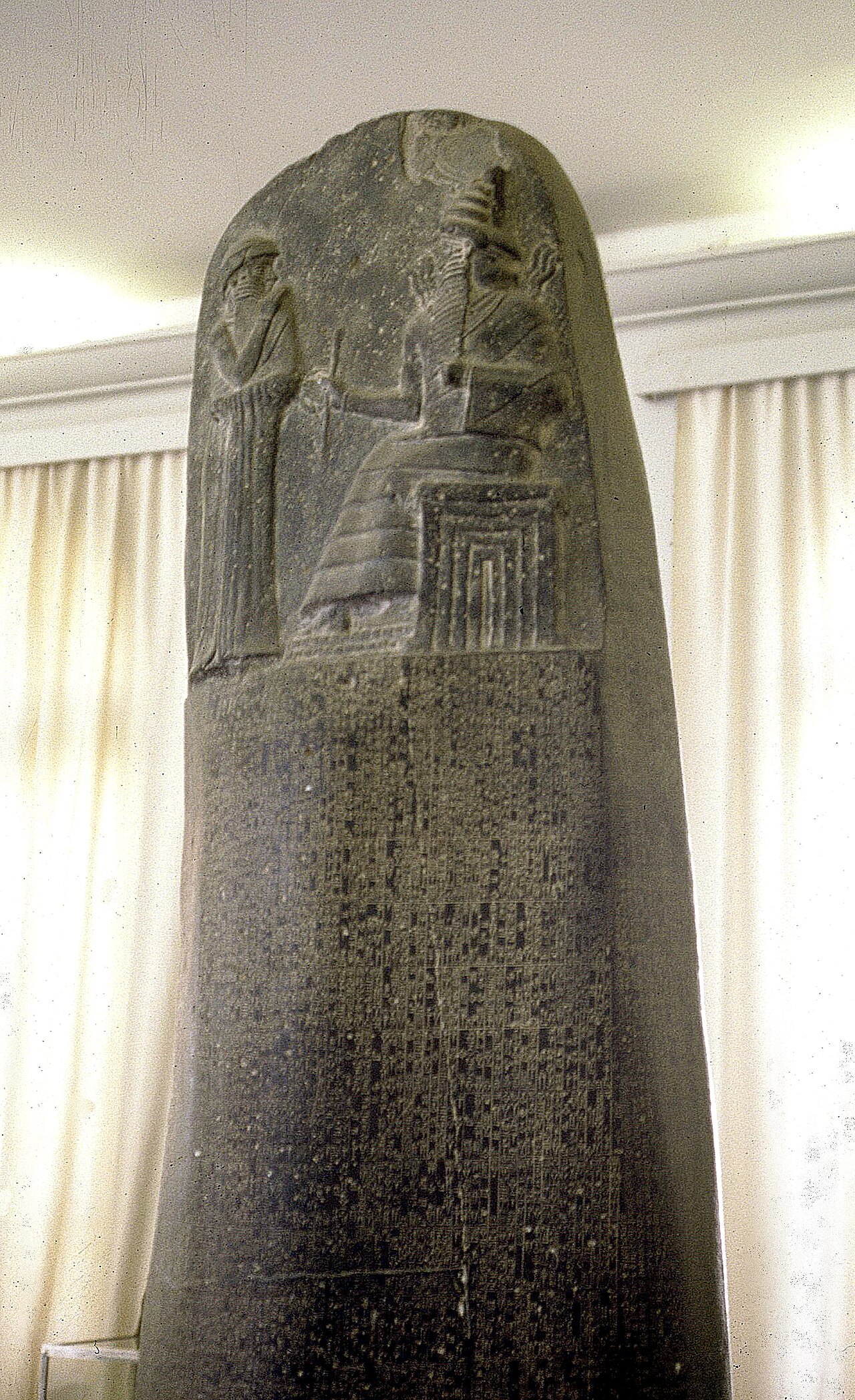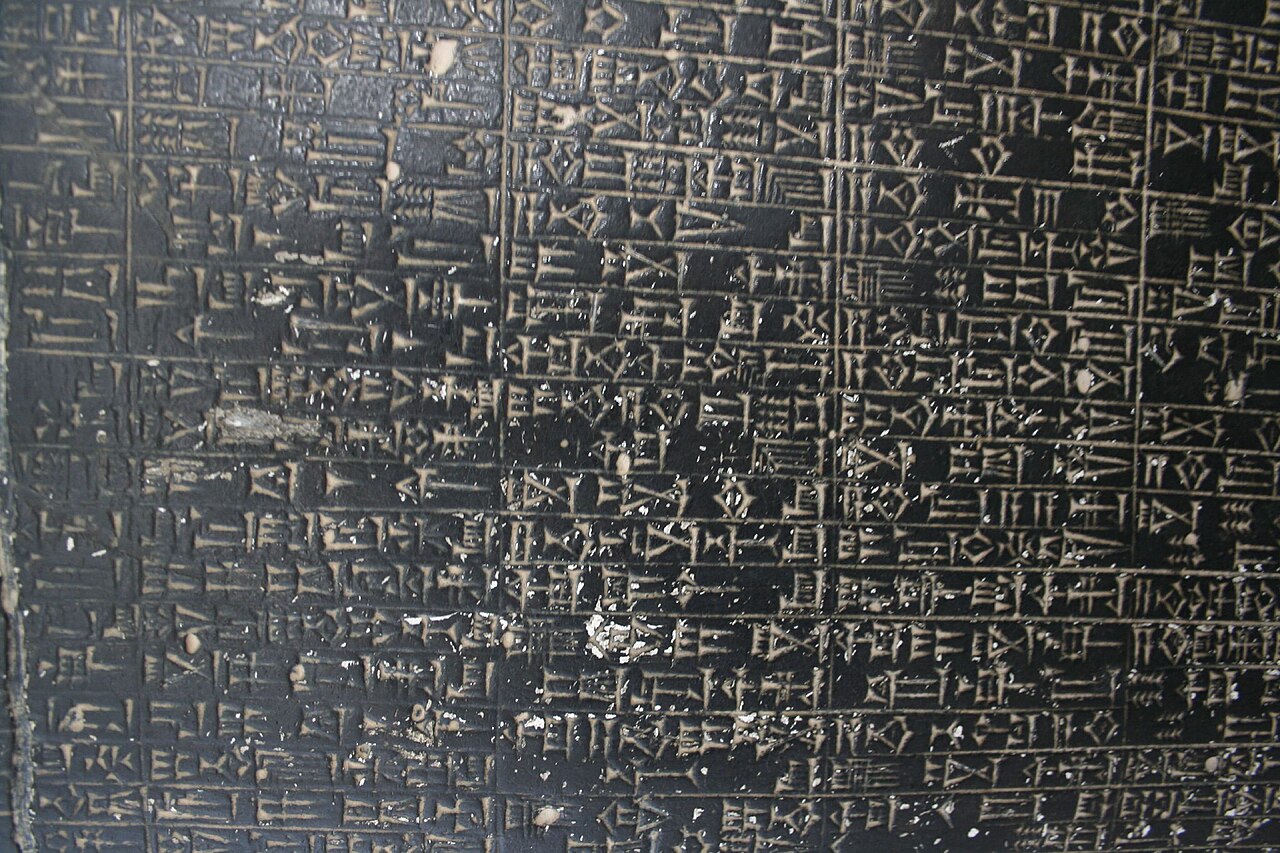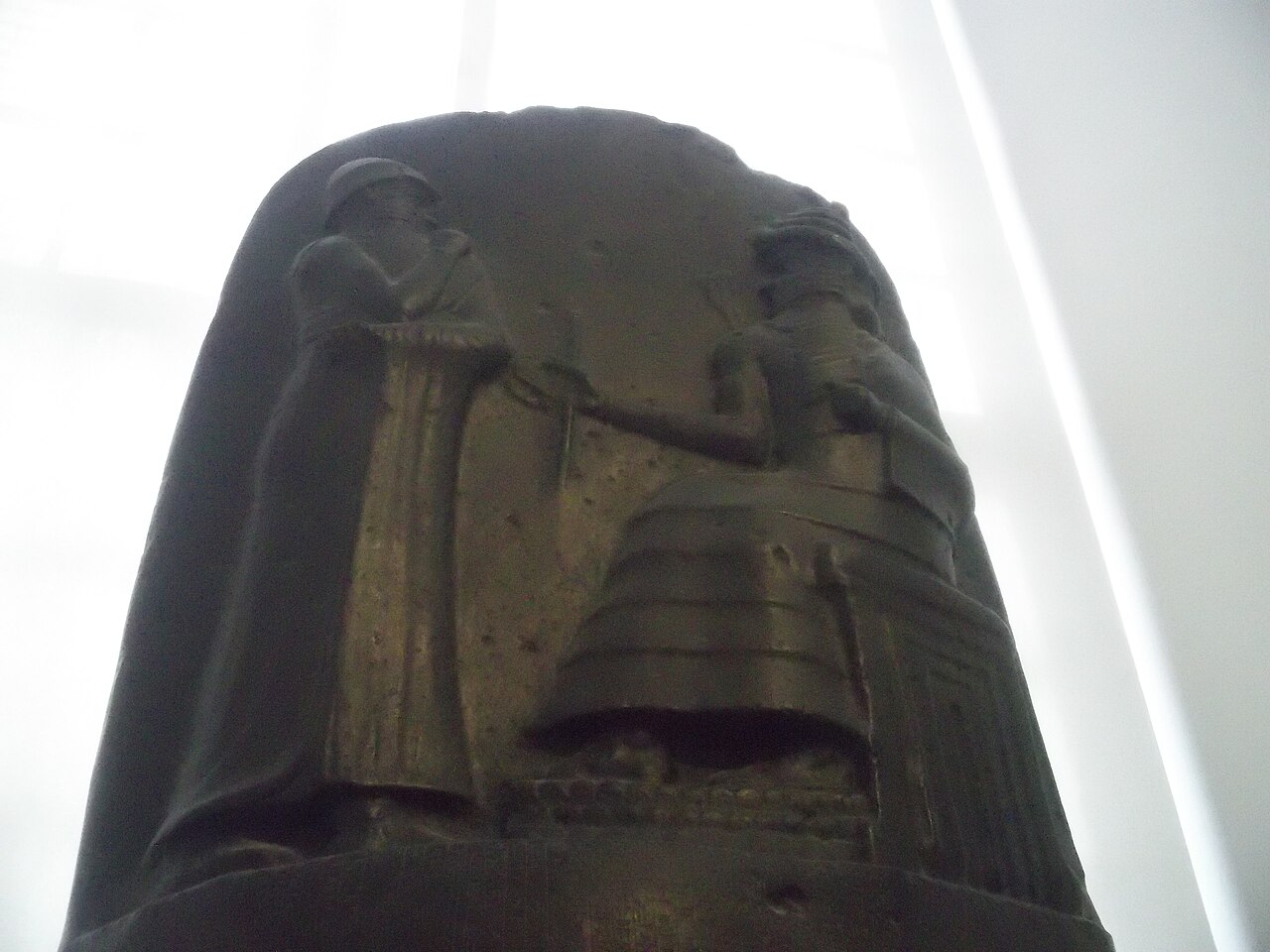

Portrait of Hammurabi

AI Historical Figure

Hammurabi

Babylonian king known for his code of laws.

Chat with Hammurabi via text or voice — in 42 languages, drawing on a curated biography and 70 historical sources. Available 24/7.

Start chatting with Hammurabi20 messages free · No credit card
Lived
c. 1810–1750 BCE
From
Iraq
Known for
Rulers & royaltyPolitics & government
Hammurabi

Hammurabi

Online · responds in seconds

Hello — I'm Hammurabi. Babylonian king known for his code of laws. What would you like to ask me?

20 messages free · No credit card · Powered by Humy.ai

Live preview · Switch between 42 languages above · Send a message to continue in the app

Multilingual

Talk to Hammurabi in 42 languages

Ask Hammurabi questions in any language below, and the rest of Humy's app speaks it too. Pick yours to open the chat in that language.

Also in German (Austria), German (Switzerland), English (UK), English (Australia), English (Canada).

The sources behind this AI

70 sources · 22 documents · 18 books · 11 artifacts · 9 sculptures · 4 letters · 4 photographs · 2 paintings

Hammurabi doesn’t improvise from thin air. The AI is grounded in 70 curated historical sources students can inspect. Open any of them to see what informs the conversation.

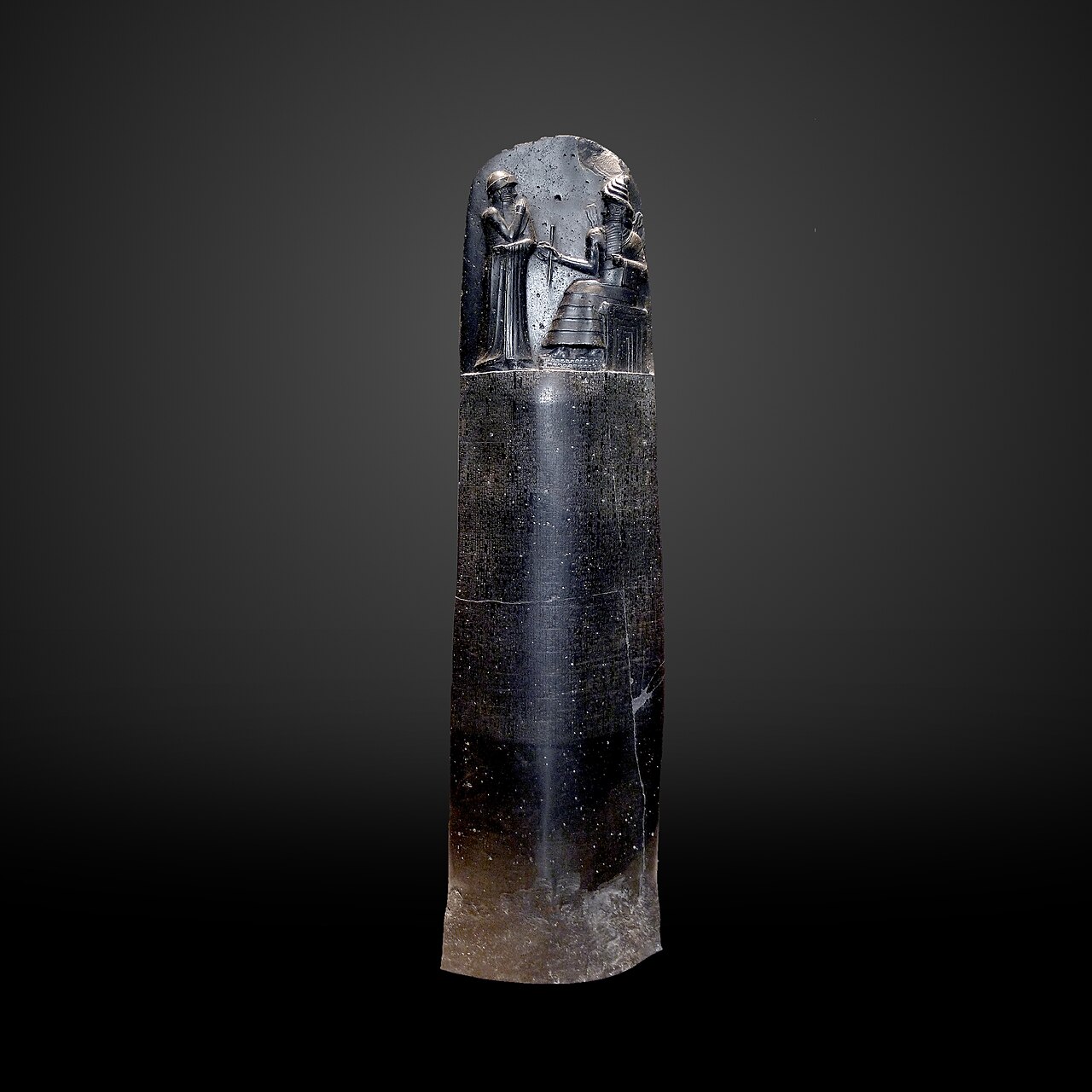
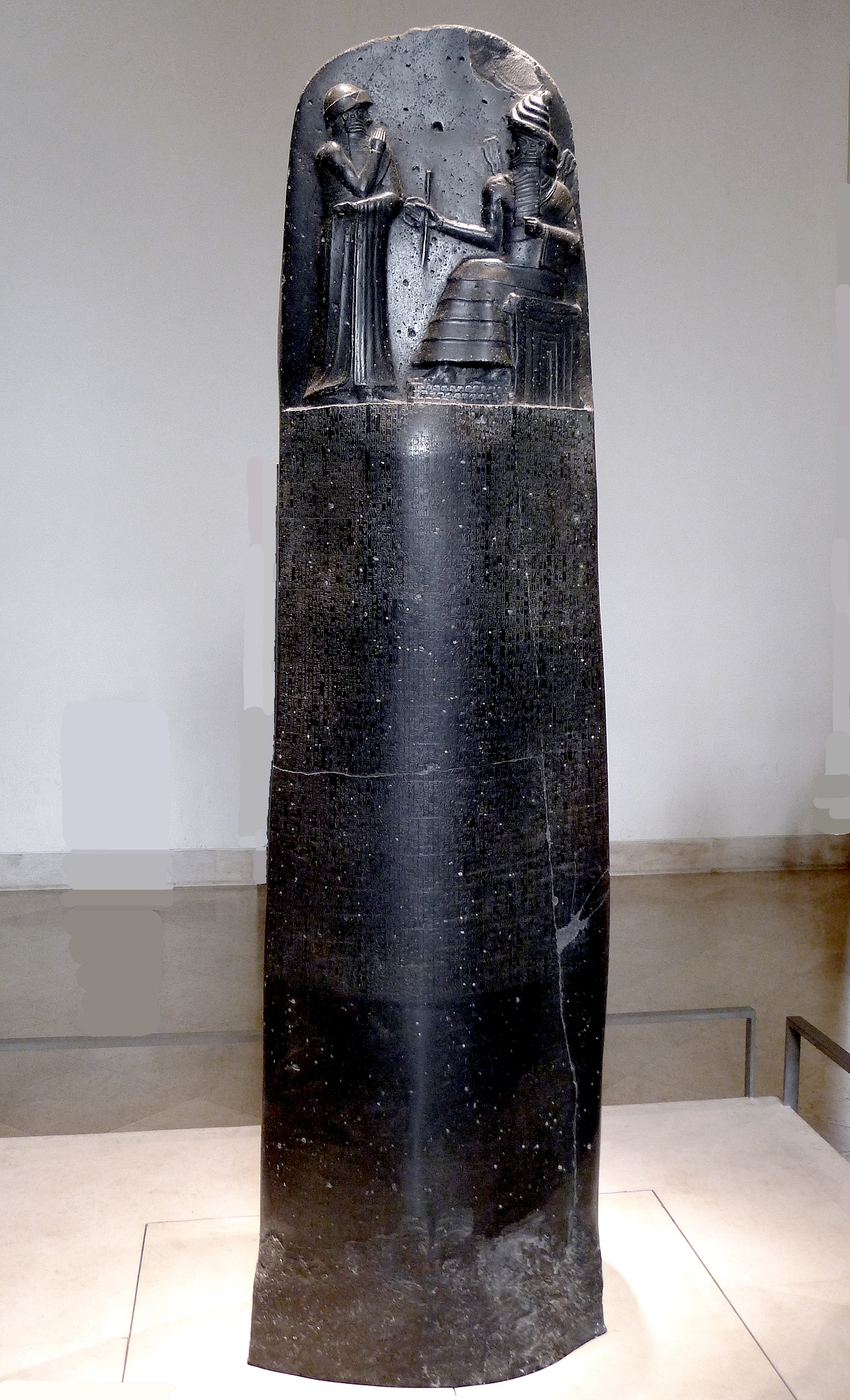
Photo of the black basalt Code of Hammurabi stele on a dark background. The tall, tapering stone has a rounded top carved in relief with a standing figure facing a seated figure on a throne, and below are rows of carved cuneiform text.Document

Primary source

Code of Hammurabi

Hammurabi · c. 1753 BCE

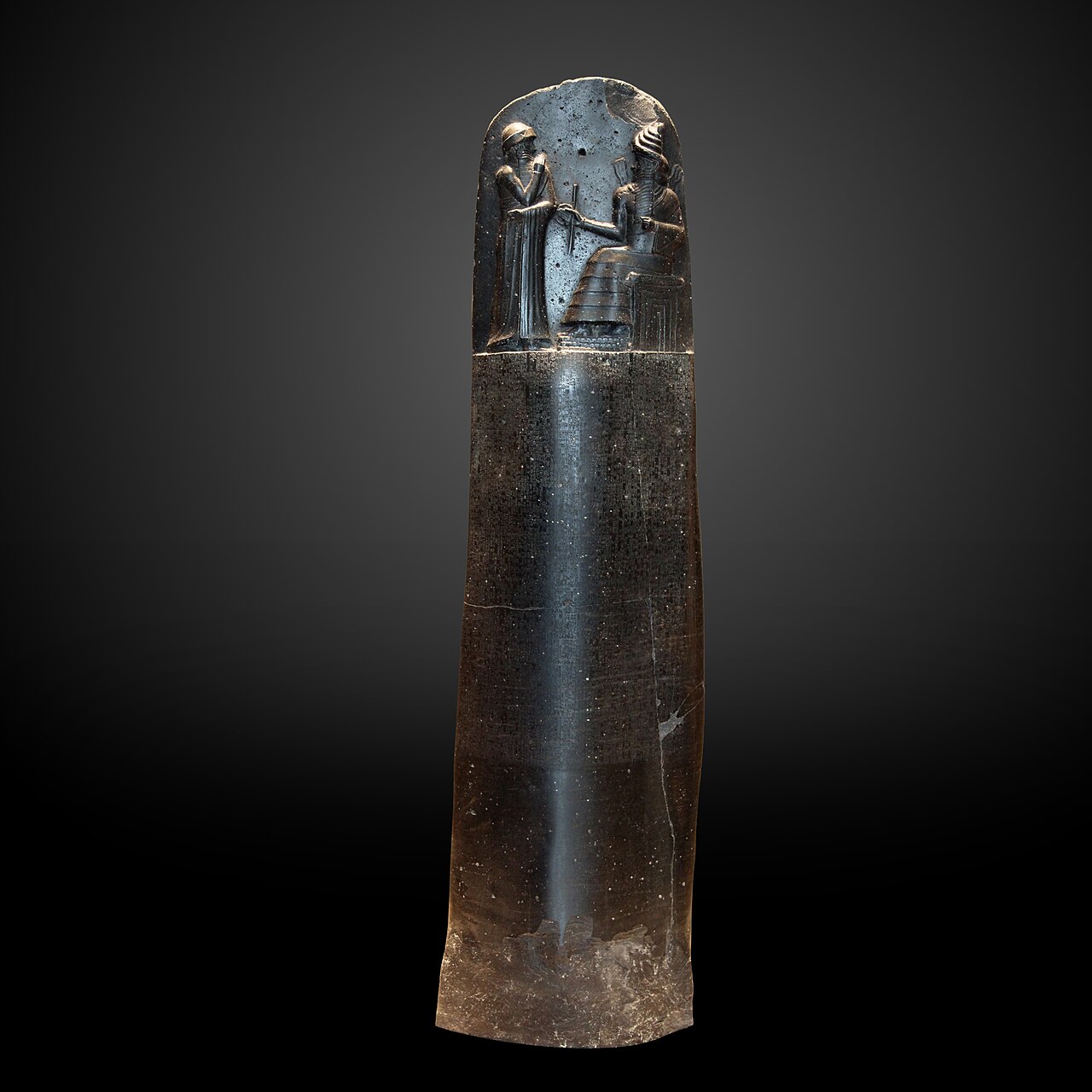
Photo of a tall black basalt stele with a rounded top. Carved relief at the top shows a standing figure at left facing a seated figure with a horned crown at right. Below, the stone is covered in rows of cuneiform script.Sculpture

Primary source

Stele with the Code of Hammurabi

Hammurabi · c. 1792 BCE

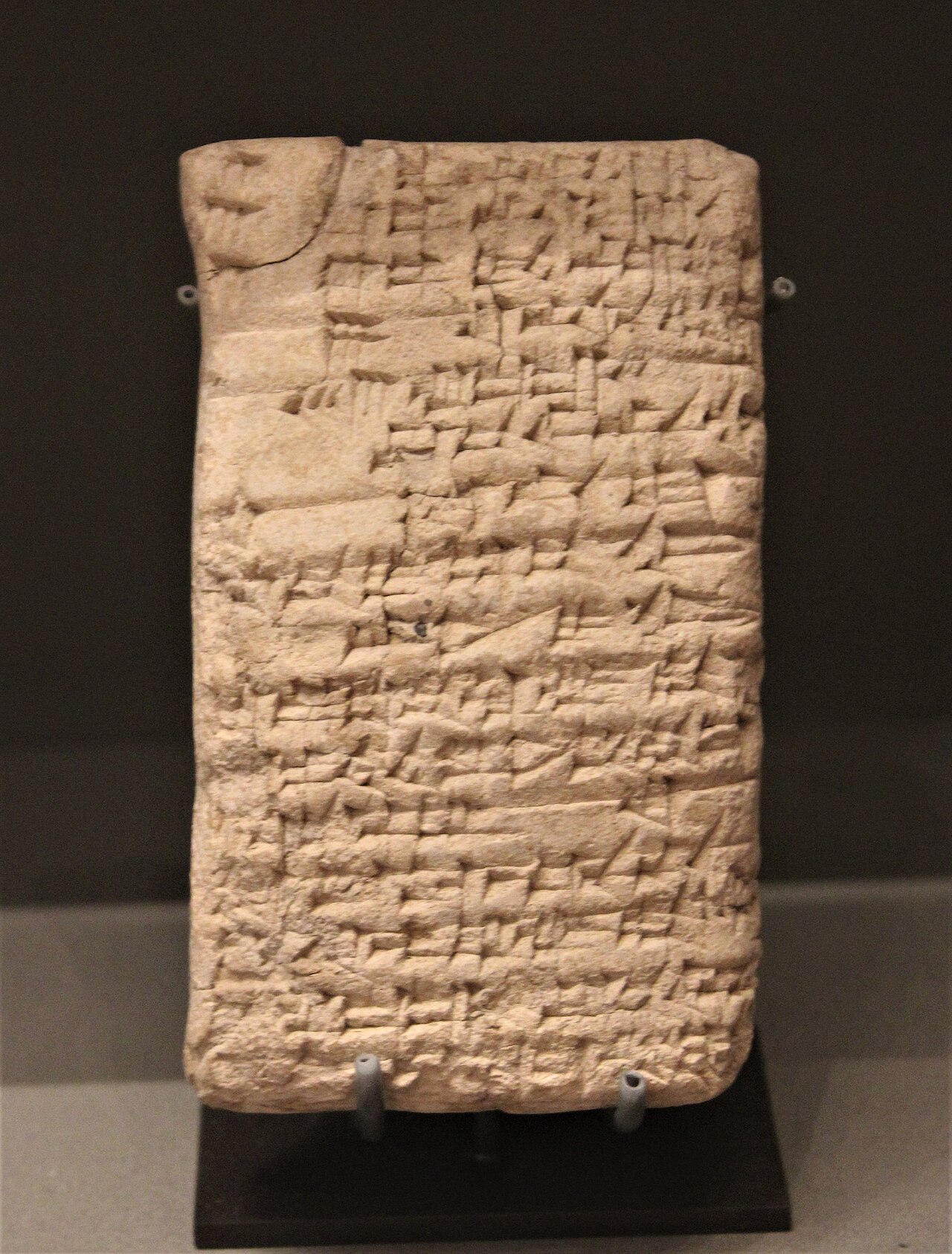
Photograph of a clay cuneiform tablet, pale beige and roughly rectangular with a chipped upper-left corner, covered in wedge-shaped impressed signs in horizontal lines. It rests on a black stand against a dark background.Letter

Primary source

Letter from Hammurabi to Sîn-iddinam

Hammurabi · c. 1792-1750 BCE

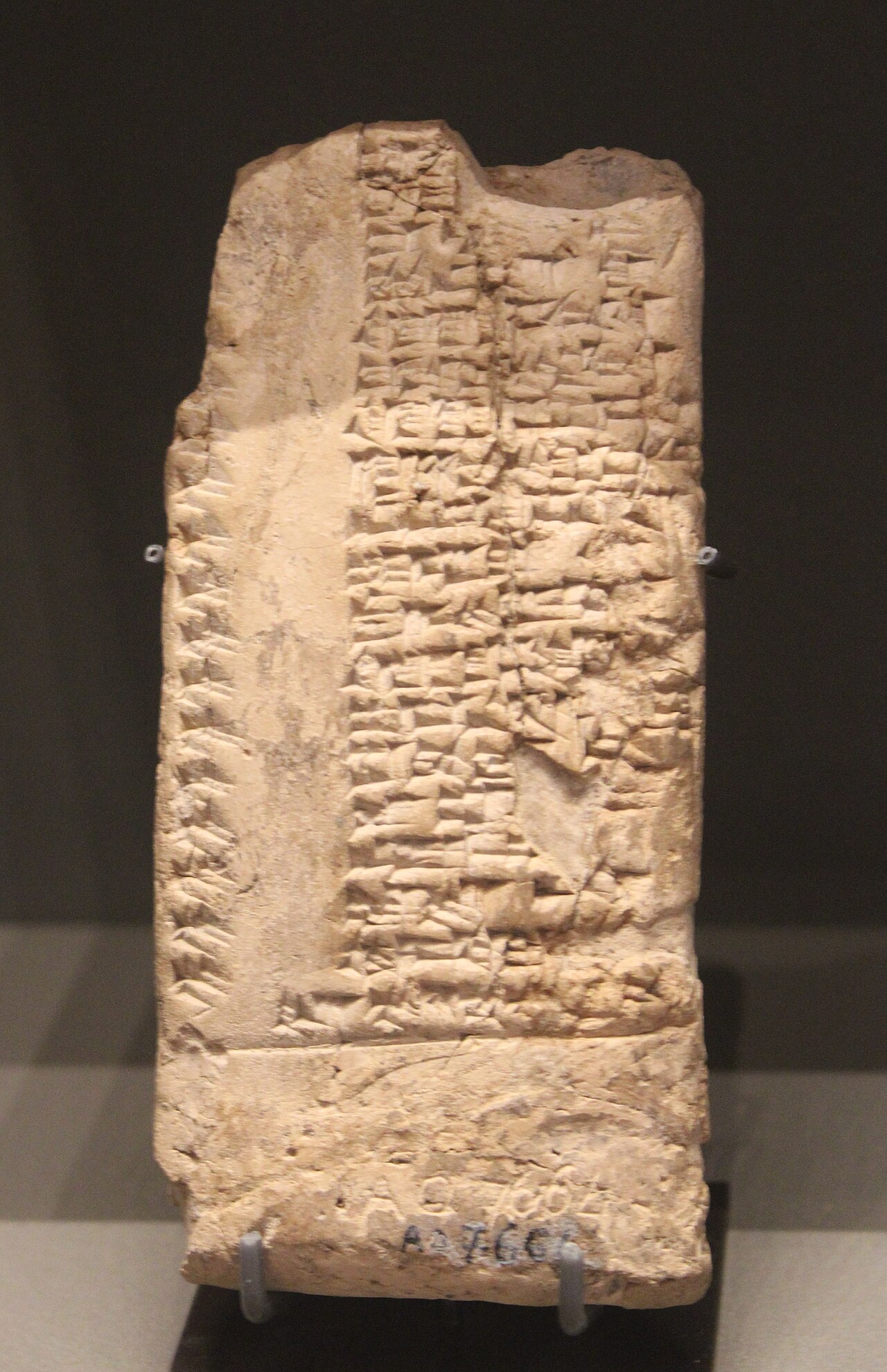
Photograph of a cuneiform clay tablet on a display stand against a dark background. The tablet is pale beige, with a broken upper edge, and is covered in rows of wedge-shaped cuneiform signs. A museum label with a catalogue number is visible at the bottom.Document

Primary source

List of the year-names of Hammurabi's reign

Old Babylonian period, reign of Hammurabi (c. 1792-1750 BCE)

Five groups of black cuneiform wedge signs on a white background, rendered in a row. The signs are angular, made of wedge-shaped strokes arranged in clusters, and appear to be a short inscription.Document

Secondary source

Chronicle of Early Kings

Babylonian scribes · c. 6th century BCE copy

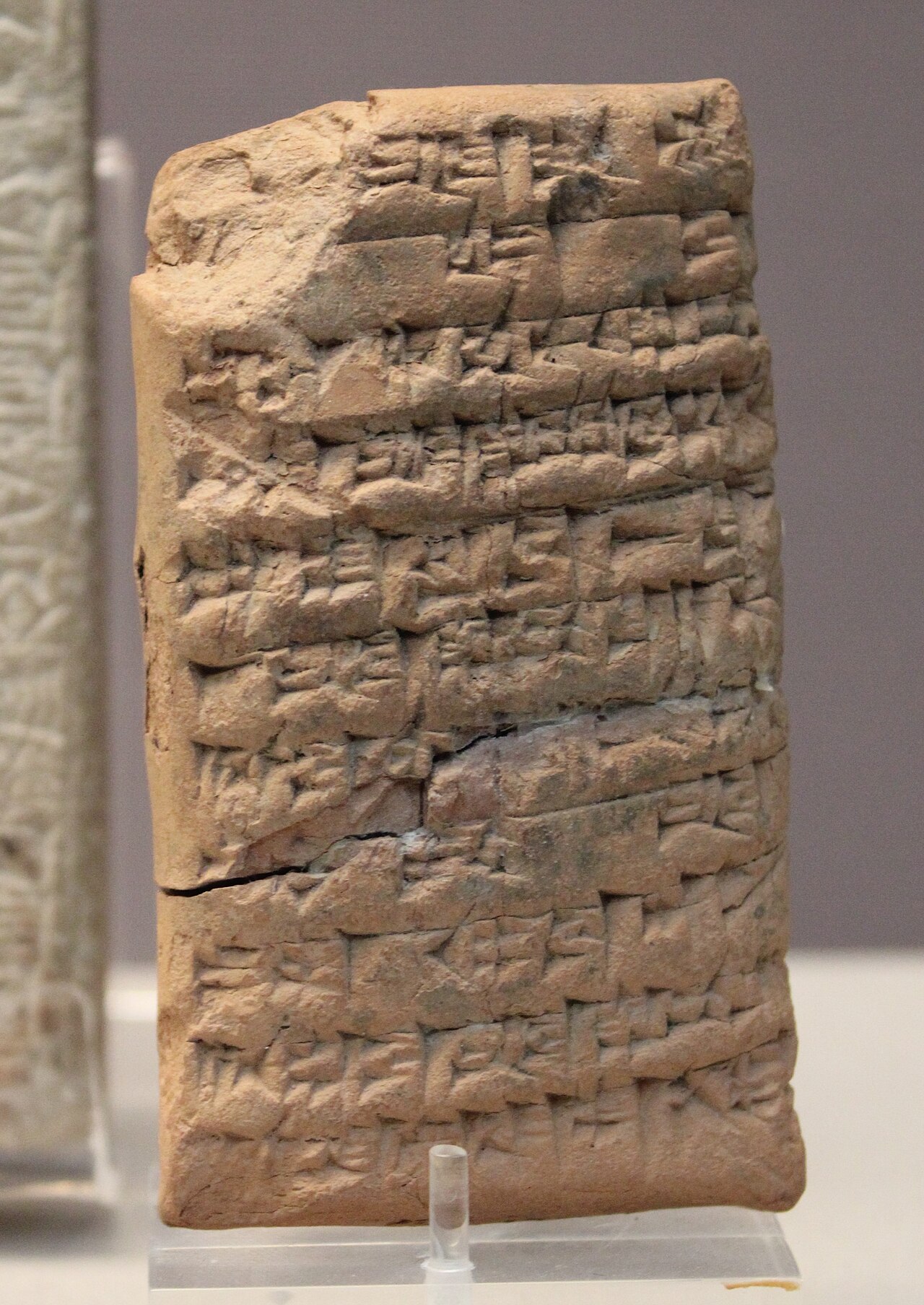
A tan clay cuneiform tablet, roughly rectangular with a broken upper-left corner, covered in rows of wedge-shaped cuneiform signs on its face. It rests on a clear acrylic stand against a grey background.Letter

Primary source

Letter from Hammurabi to Sîn-iddinam ordering a court hearing

Hammurabi · c. 1792-1750 BCE

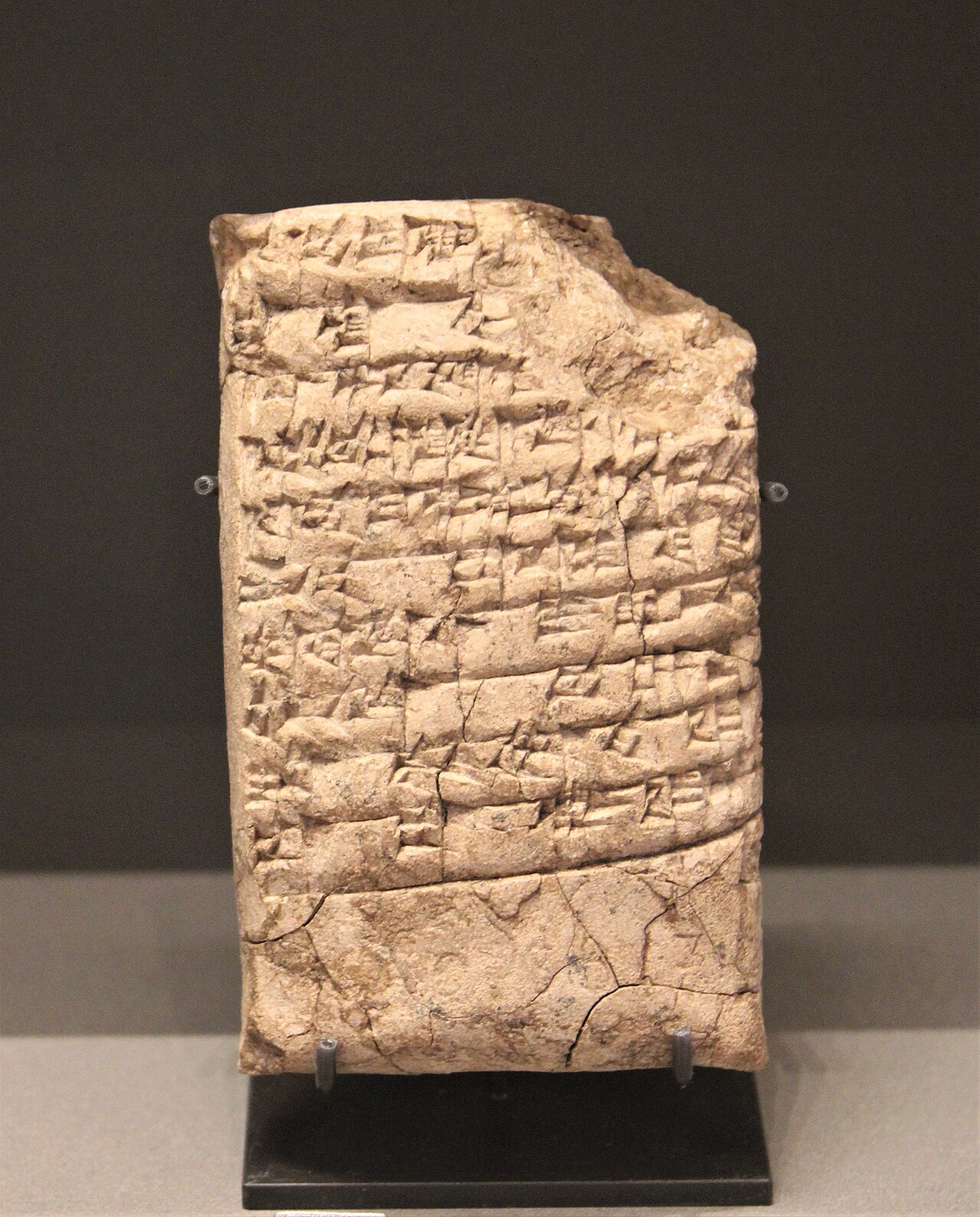
A cuneiform clay tablet, light buff in color, with an irregular broken upper right corner, displayed upright on a black stand against a dark background. Rows of wedge-shaped script cover its face; the lower portion is cracked and blank.Letter

Primary source

Letter from Hammurabi to Shamash-hazir

Hammurabi · c. 1792-1750 BCE

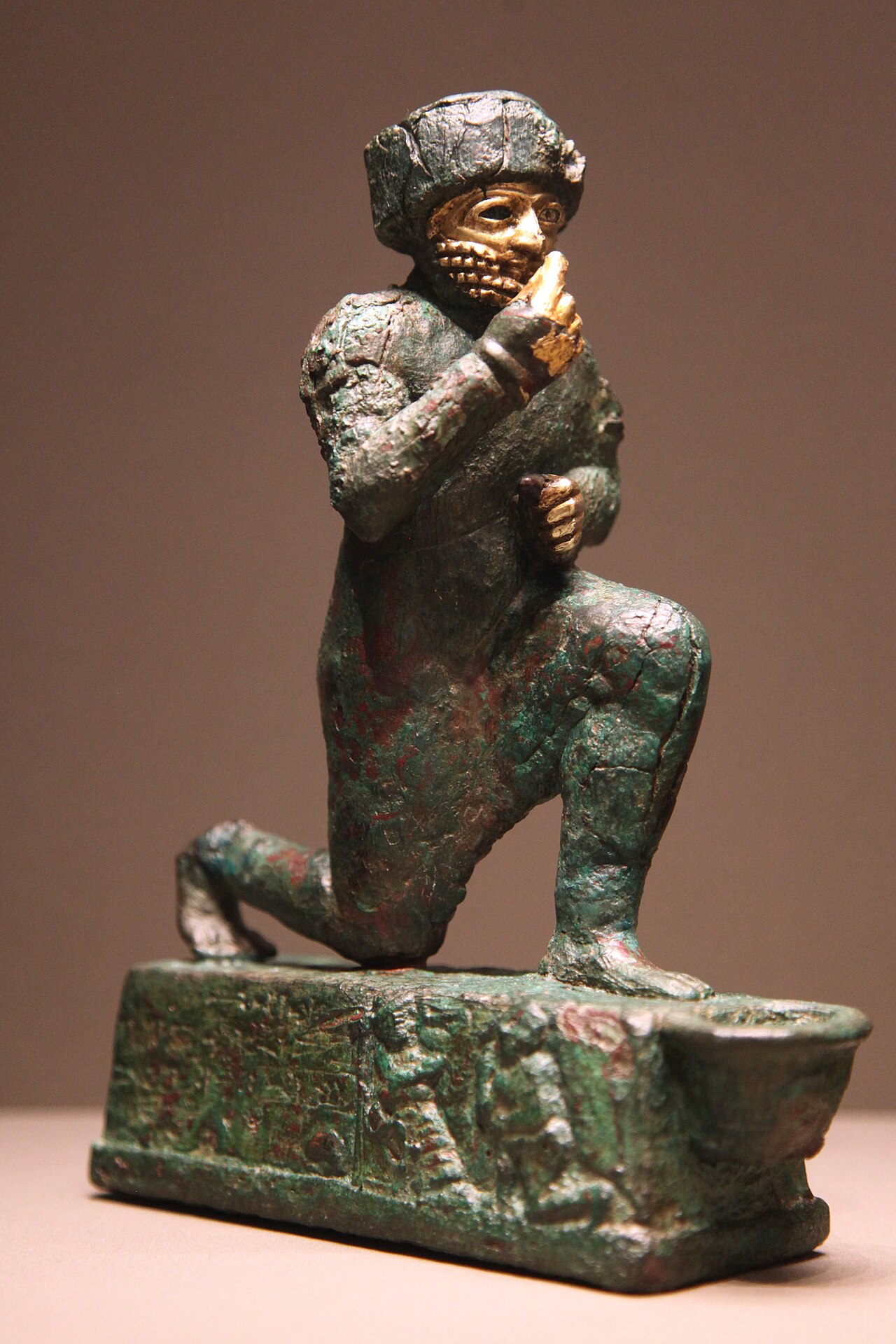
A small green-patinated bronze statuette of a kneeling bearded figure with gold-leaf face and hands, wearing a cap, one hand raised to the mouth, on a rectangular base with carved relief and a shallow bowl.Sculpture

Primary source

Worshipper of Larsa

Lu-Nanna · c. 1500 BCE

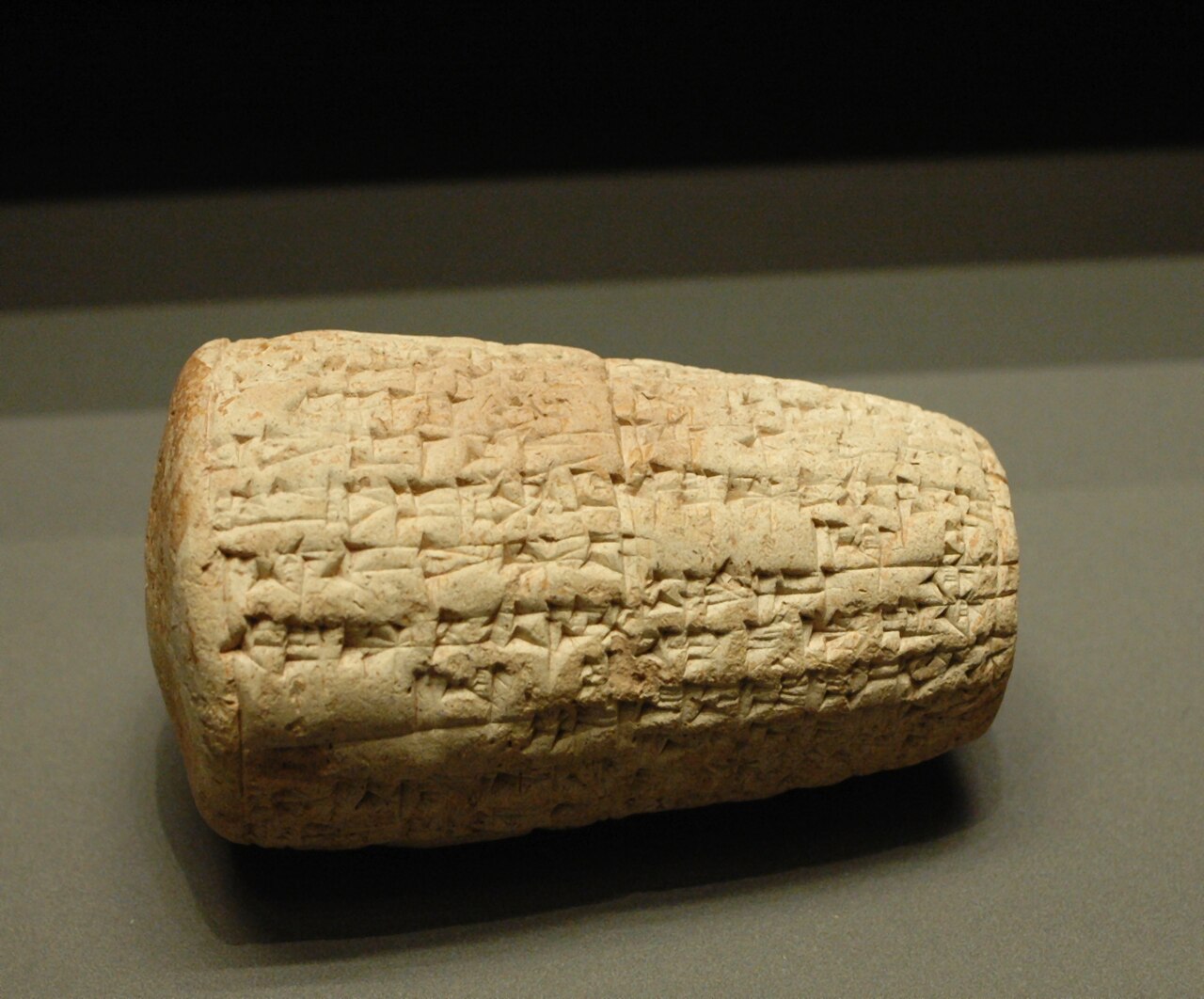
A tan clay cone, tapering slightly, covered with rows of cuneiform wedge-shaped inscriptions, resting on a grey display surface in a dark museum setting.Artifact

Primary source

Clay Cone from Sippar

Hammurabi · c. 1792-1750 BCE

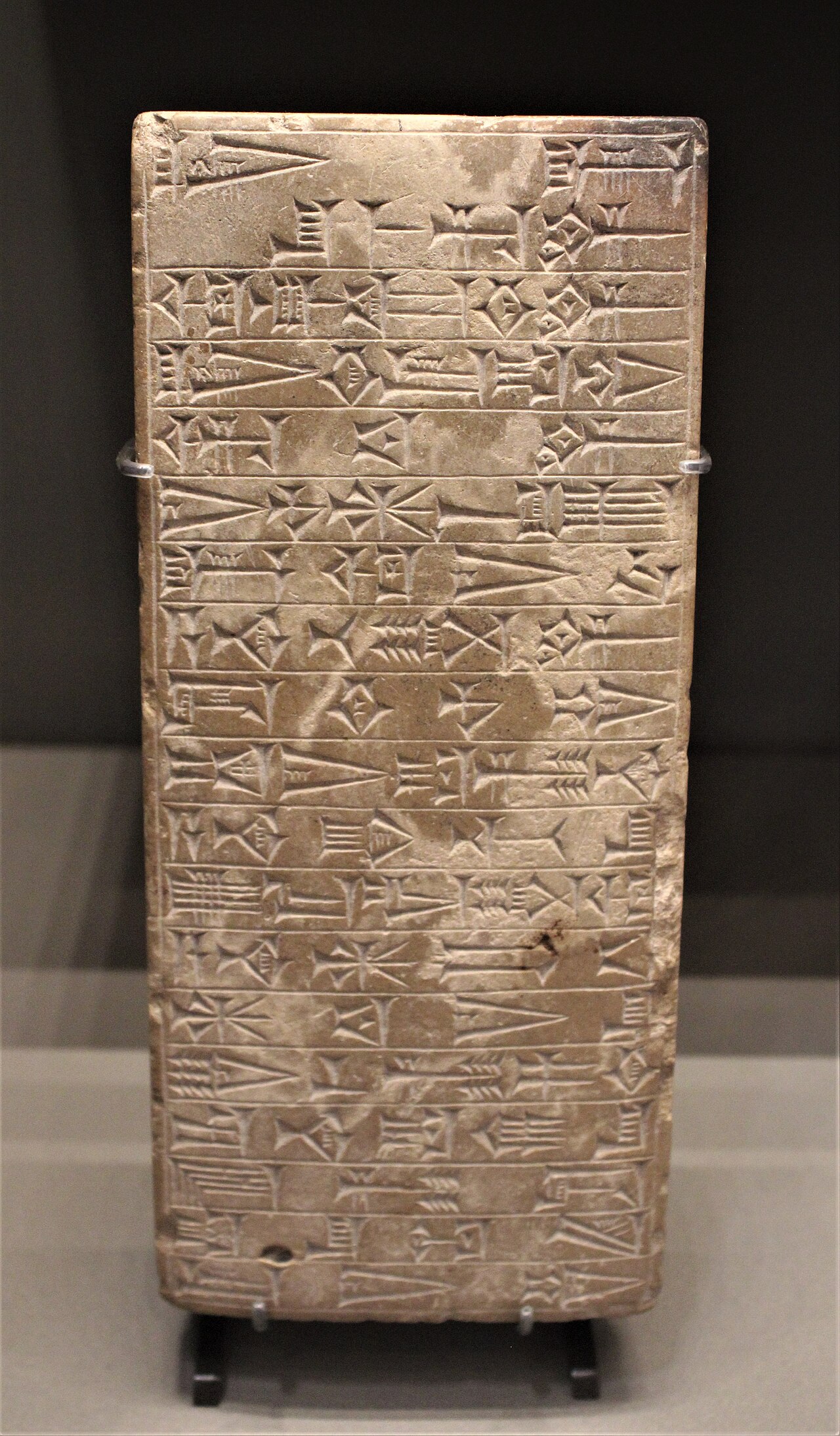
Photograph of a tall rectangular limestone tablet on a black stand in a museum display, its face covered in rows of wedge-shaped cuneiform signs separated by horizontal lines. Dark background.Document

Primary source

Inscription of Hammurabi on the Restoration of Ezida

Hammurabi · c. 1792-1750 BCE

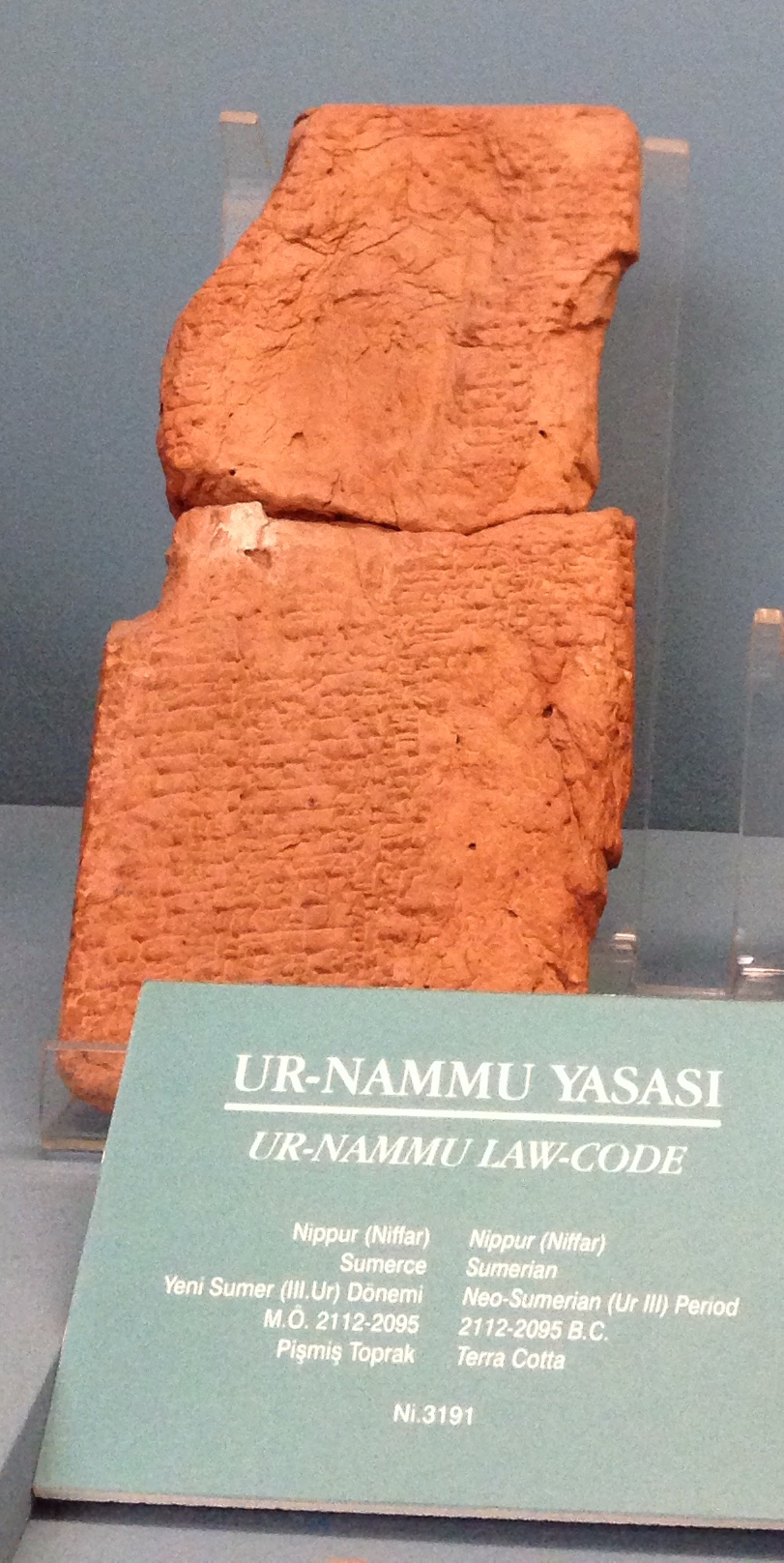
Photo of a reddish-brown terra cotta clay tablet, broken into two pieces and stacked, covered with cuneiform script. Behind it is a display card reading 'UR-NAMMU YASASI, UR-NAMMU LAW-CODE', Nippur, Neo-Sumerian period, 2112-2095 B.C.Document

Secondary source

Code of Ur-Nammu

Ur-Nammu · c. 2112-2095 BCE

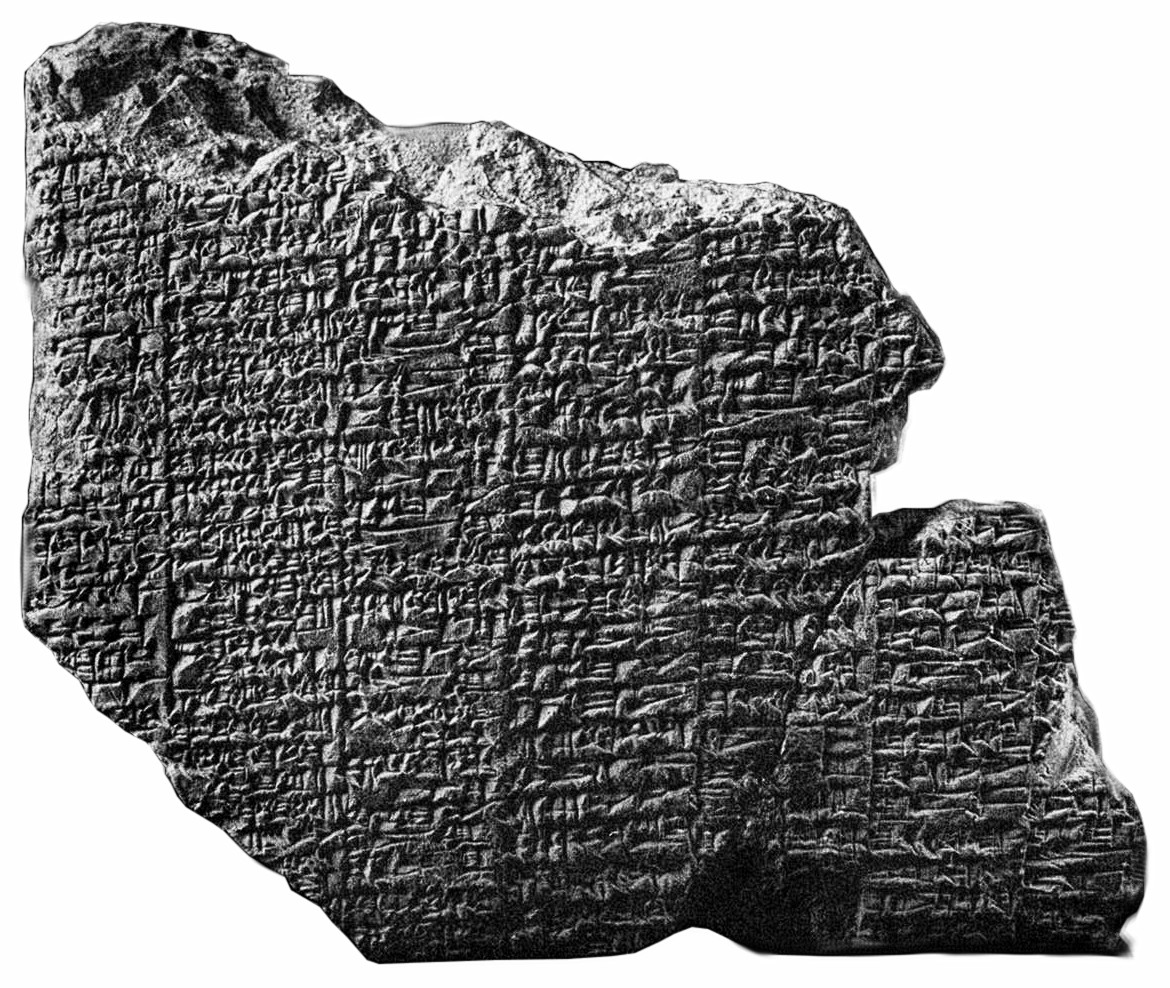
Black-and-white photograph of a fragmentary clay tablet covered in rows of cuneiform wedge-shaped writing. The tablet is irregular in outline, with a notch cut out of its lower right side.Document

Secondary source

Code of Lipit-Ishtar

Lipit-Ishtar · c. 1934-1924 BCE

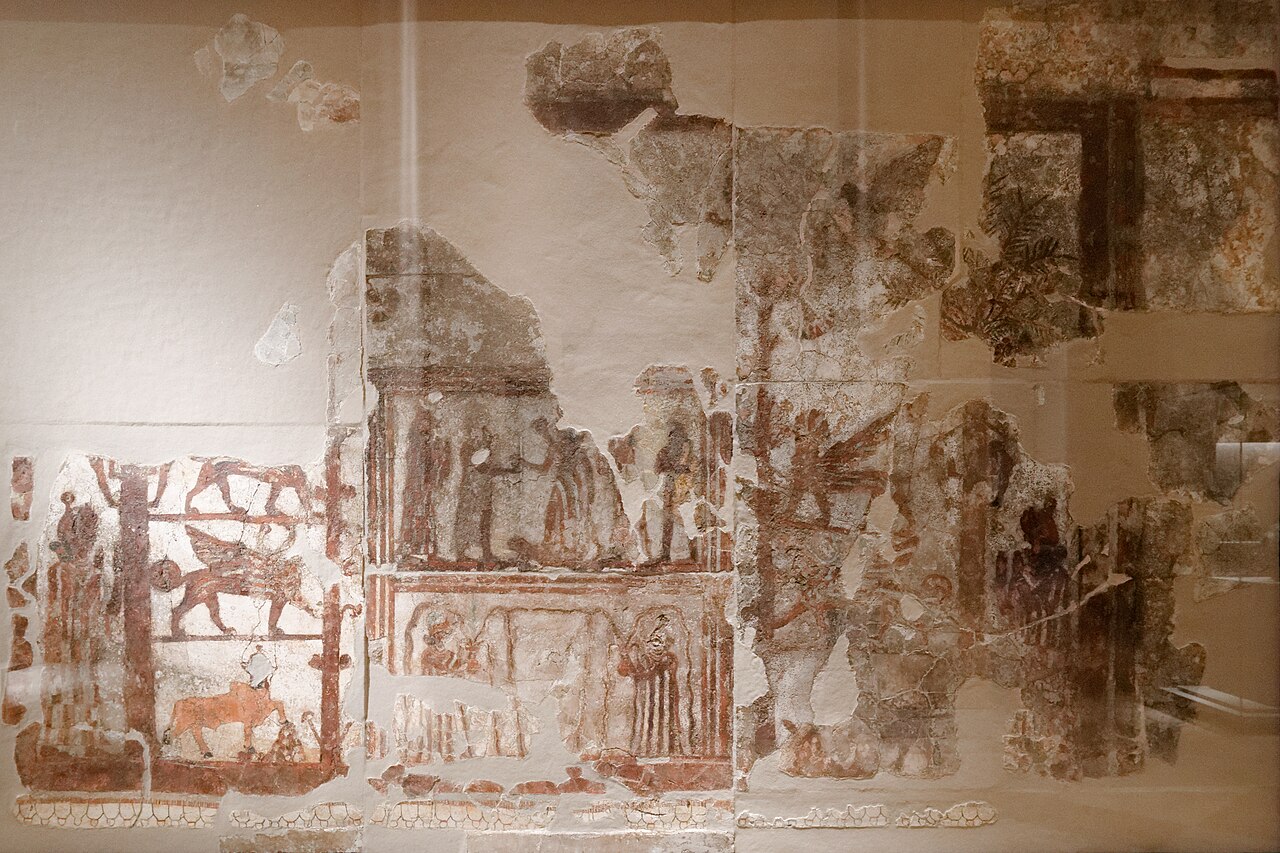
Fragmentary ancient fresco on a plastered wall, displayed in a museum. Faded red, brown and ochre figures are visible in panels, including a standing robed figure at left, a winged figure and animals, a bull, and a central scene of figures before a structure. Large areas of plaster are missing.Painting

Primary source

Investiture of Zimrilim

c. 1800 BCE

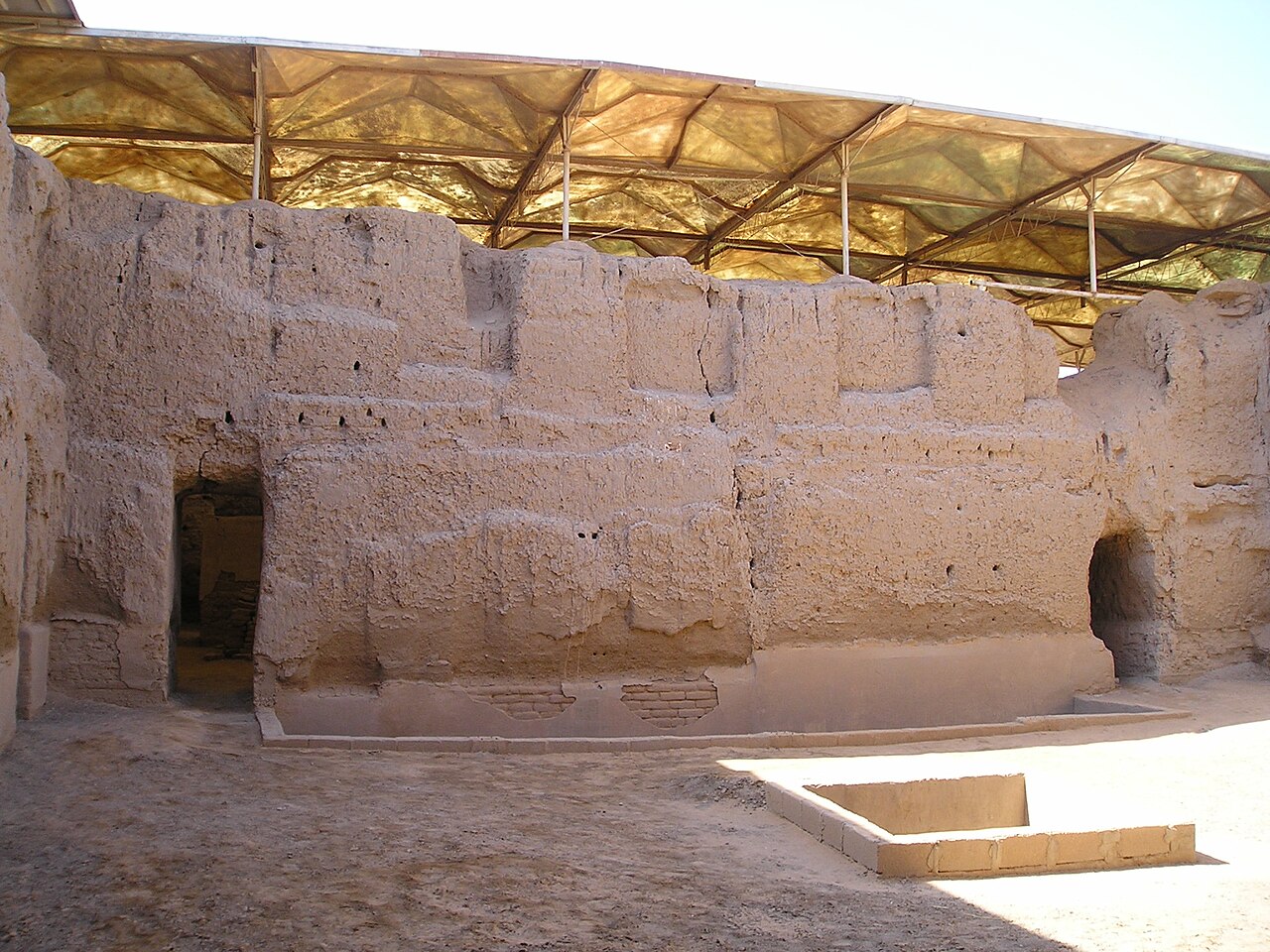
Ruins of mud-brick walls of an ancient palace, sheltered under a golden tent-like canopy roof. Two doorways are visible in the walls, and a low rectangular brick-lined structure sits in the sandy courtyard in front.Artifact

Primary source

Royal Palace of Mari

c. 1800 BCE

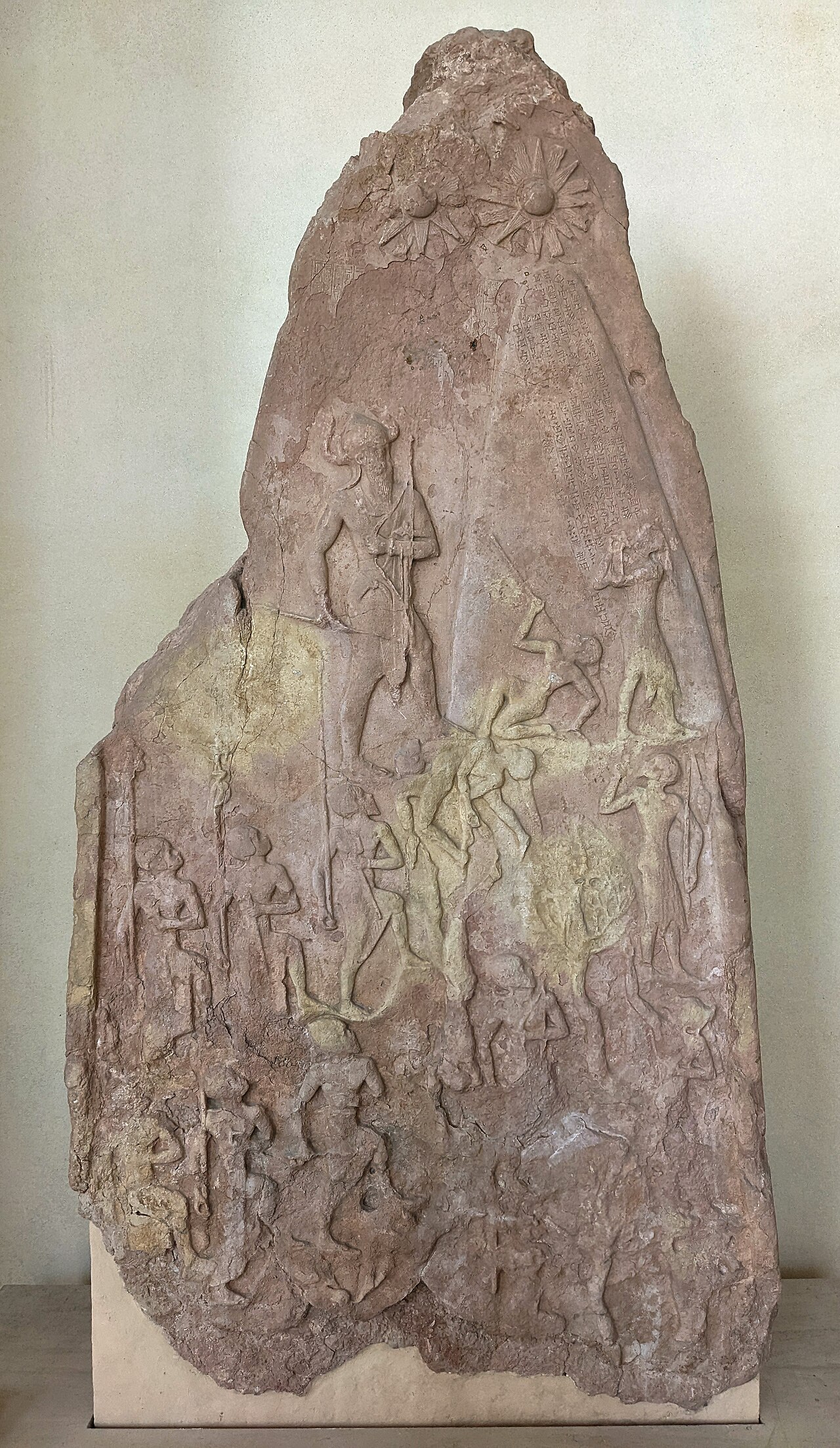
Photograph of a tall, tapering pink sandstone stele carved in relief. At the top are two sun disks with radiating rays. A standing figure wearing a horned headdress holds a bow, and smaller figures climb a mountain, with cuneiform inscription in columns on the upper right. Lower registers show many small figures in procession and combat on a rough, weathered surface.Sculpture

Primary source

Victory Stele of Naram-Sin

c. 2254-2218 BCE

Two-column cuneiform tablet with dense rows of wedge-shaped signs on a white background, drawn as a black-and-white reproduction of the Hammurabi inscription tablet.Document

Primary source

Hammurabi Inscription Tablet, British Museum 91076

Hammurabi

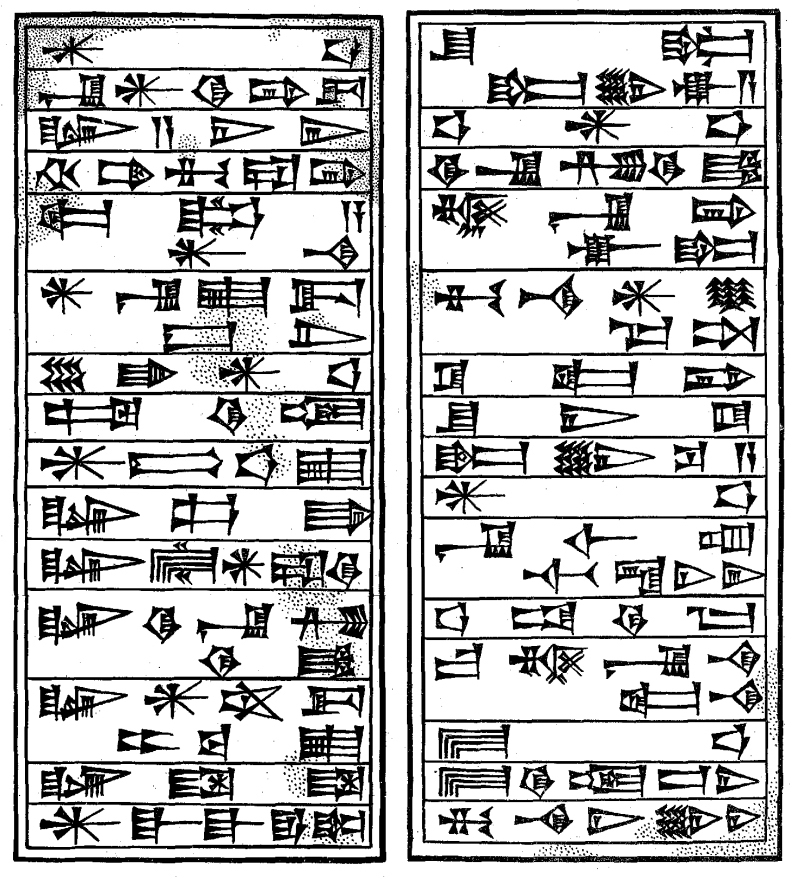
Line drawing of a cuneiform tablet transcription showing two framed blocks of wedge-shaped signs arranged in vertical columns, with the upper block containing dotted shading along its right side. Signs are dense and stylized.Document

Primary source

Hammurabi Tablet, British Museum 90939

Hammurabi

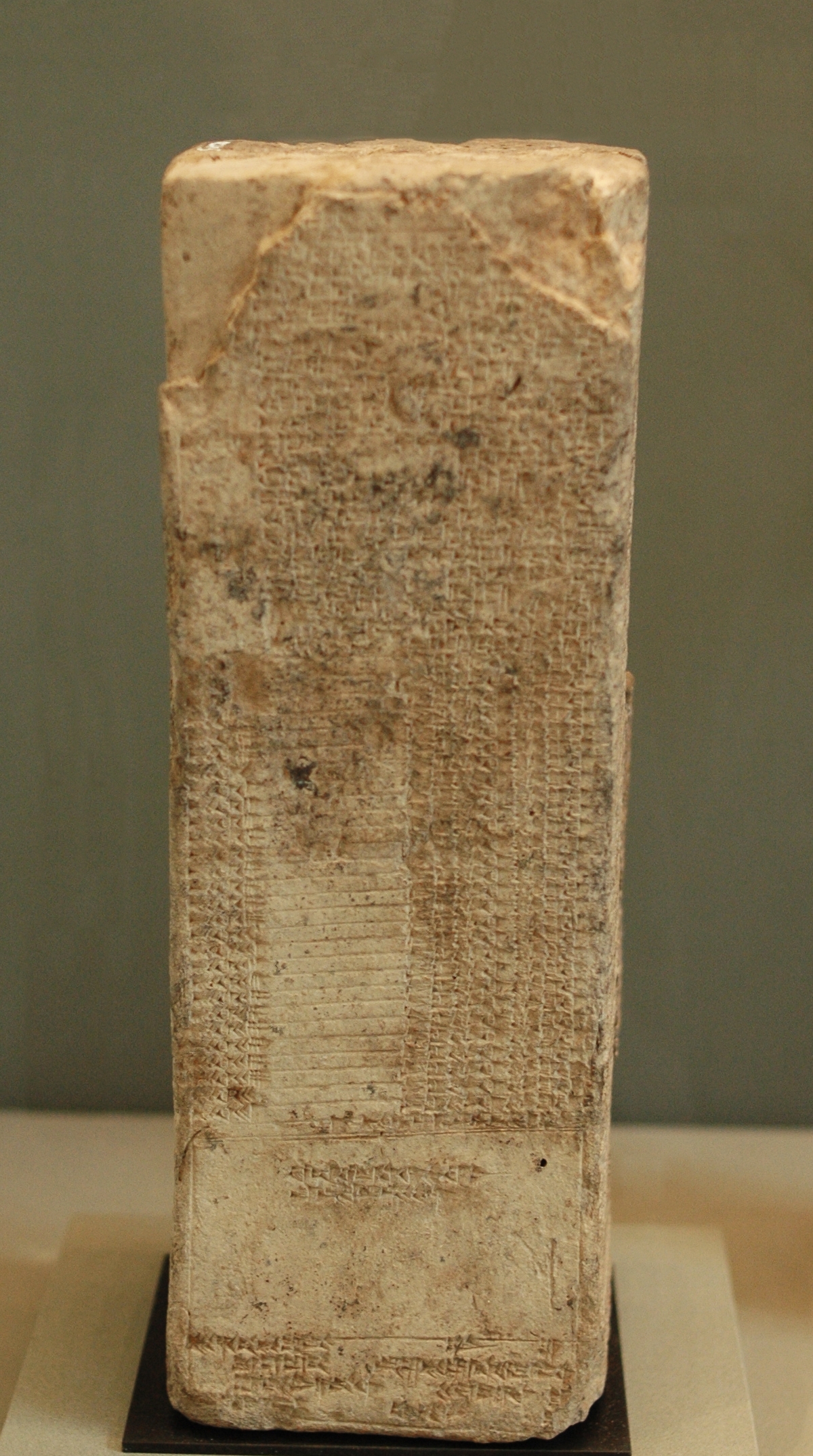
Photo of a tall, rectangular pale clay or stone prism inscribed on all visible faces with rows of cuneiform wedge-shaped writing, displayed on a dark base against a grey wall. The lower section has a framed panel of text.Document

Primary source

King List of Larsa

c. 2025-1763 BCE

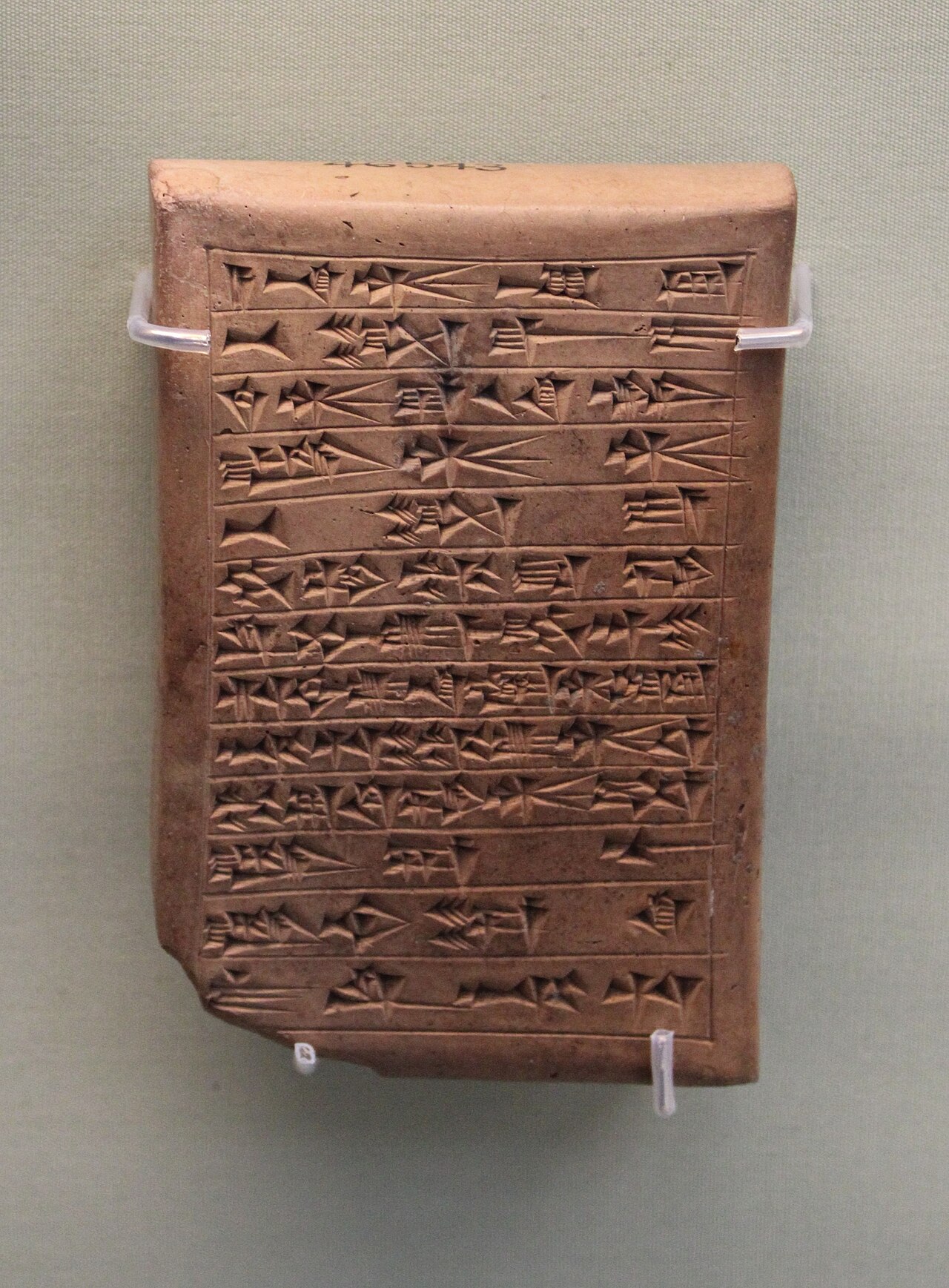
Photo of a rectangular clay tablet with fine cuneiform script in many horizontal rows, mounted on a display stand against a pale green wall. The tablet's top edge and lower-left corner are visibly chipped.Document

Secondary source

Copy of a Royal Inscription of Hammurabi

Unknown Neo-Babylonian scribe · 6th century BC (copy of an inscription originally from c. 1792-1750 BC)

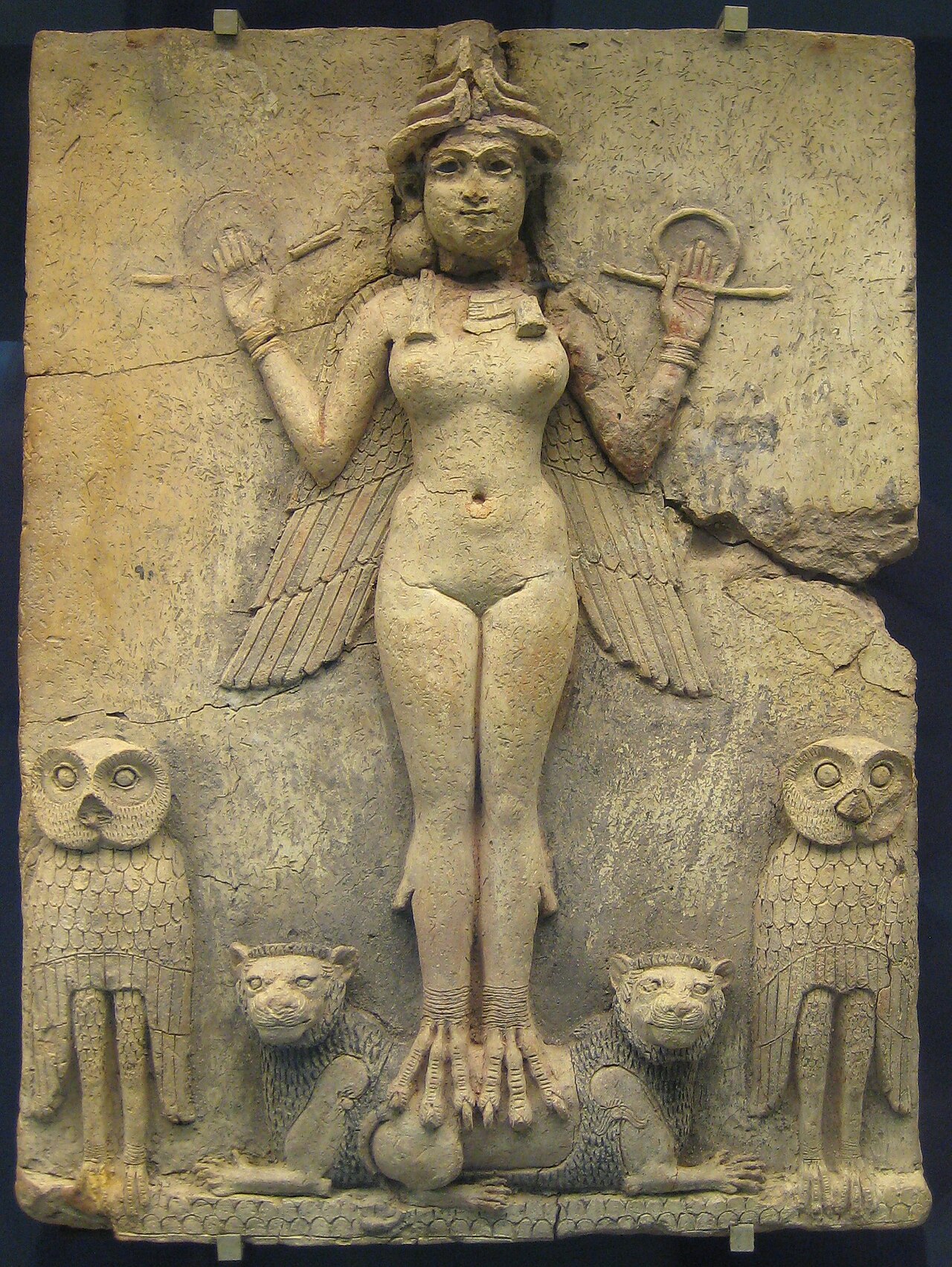
Front view of a baked clay relief panel showing a winged, nude female figure standing frontally between two owls and two lions, with feathered wings, talon-like feet, and a horned headdress.Sculpture

Primary source

Burney Relief

c. 1800-1750 BCE

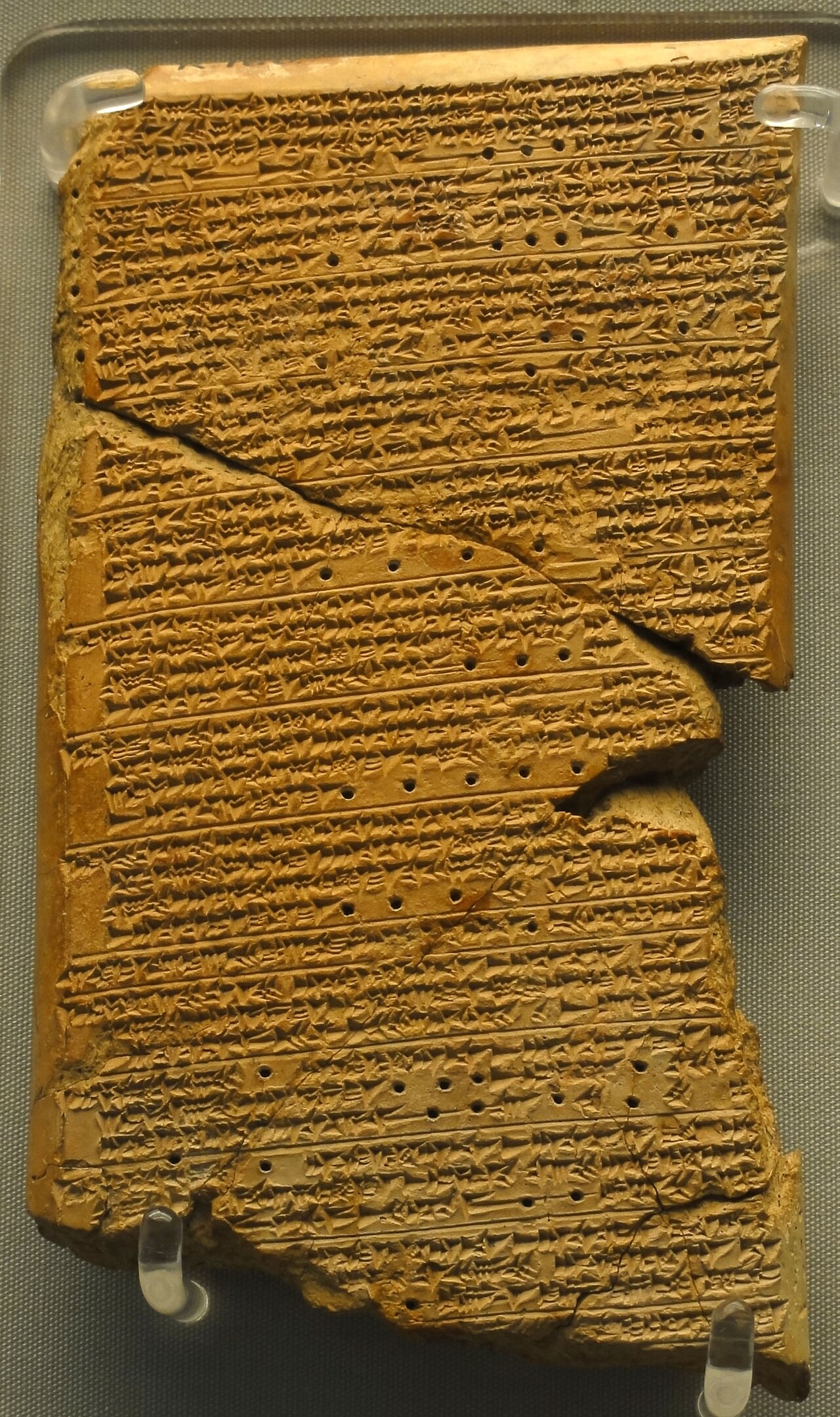
Photograph of a broken clay tablet covered in cuneiform script arranged in horizontal lines, with small circular holes punched along some lines. It is displayed behind glass with plastic mounting clips.Document

Secondary source

Venus Tablet of Ammisaduqa

Neo-Assyrian period copy, originally compiled c. mid-17th century BC

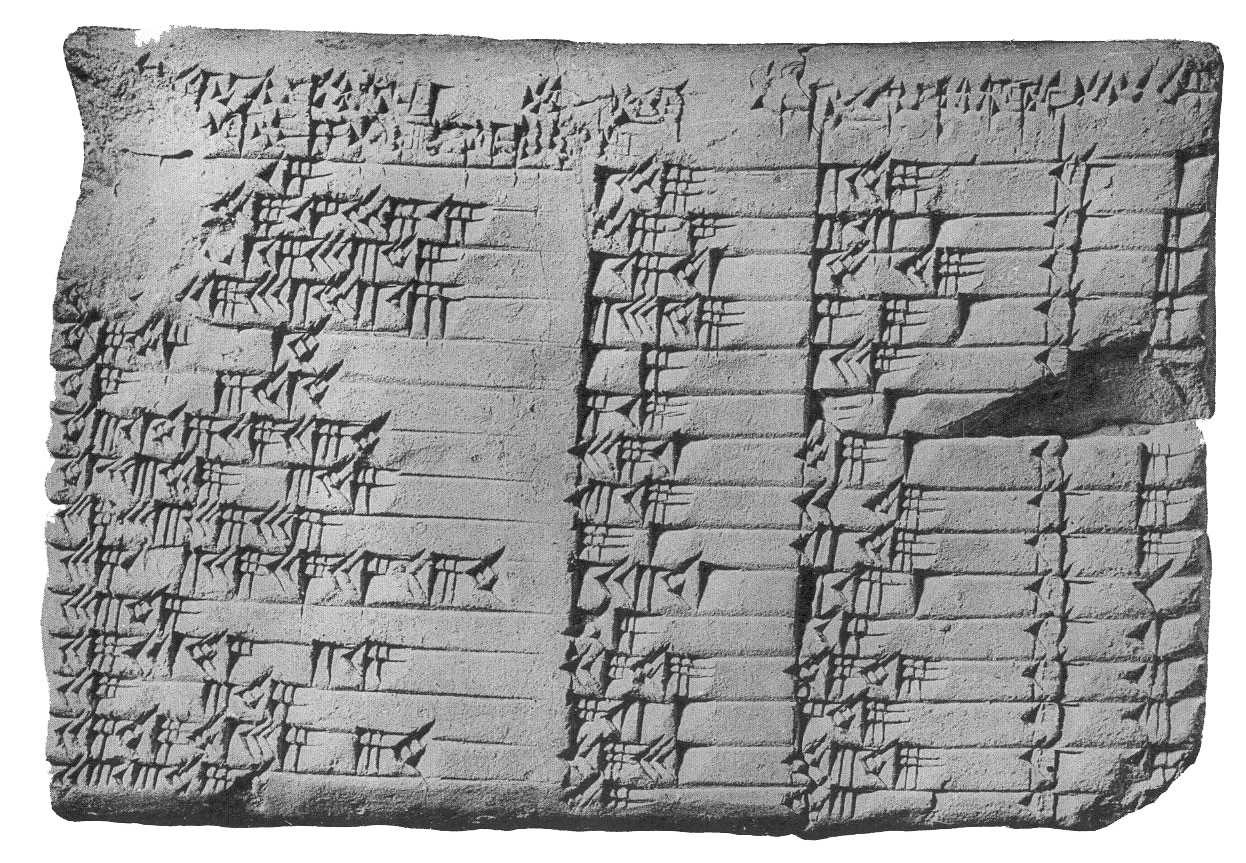
Black and white photograph of a clay tablet covered in cuneiform wedge-shaped script arranged in rows and columns. The tablet is broken on its edges, with the script organized into several vertical columns of numerical entries.Document

Primary source

Plimpton 322

c. 1800 BC

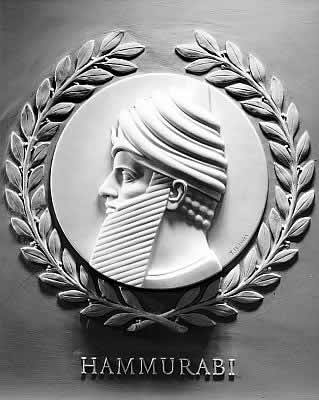
Black-and-white photograph of a white marble-look circular bas-relief portrait of Hammurabi in profile, facing left, wearing a turban-like headdress and a layered curled beard, framed by a carved laurel wreath, with the name HAMMURABI engraved below.Sculpture

Secondary source

Hammurabi Bas-Relief in the U.S. House of Representatives Chamber

Thomas Hudson Jones · 1950

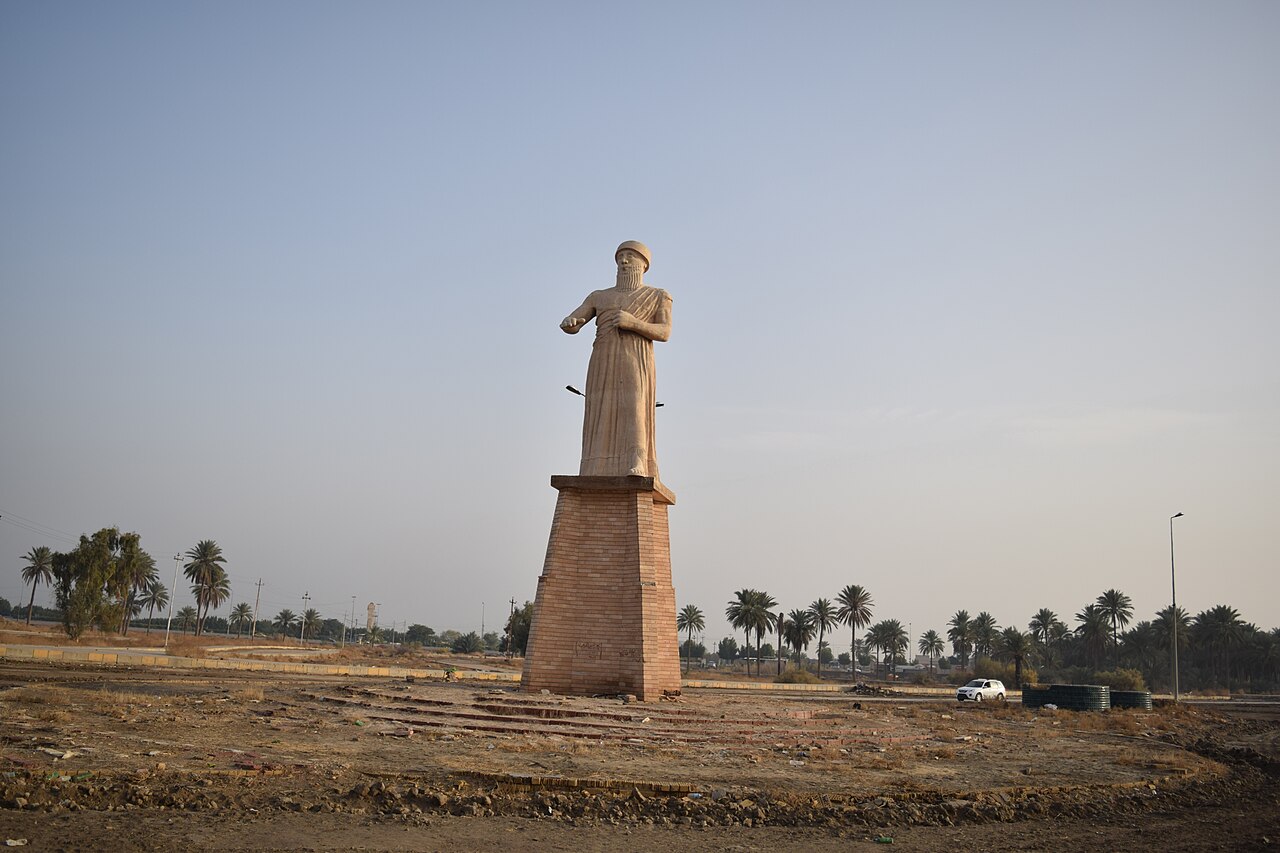
A tall light-colored statue of a robed, bearded figure wearing a cap stands on a tall brick pedestal in an open dusty field. Palm trees, a few streetlights, and a white car lie in the background under a pale sky.Sculpture

Secondary source

Statue of Hammurabi near Babylon

Hamody al-iraqi

The Letters and Inscriptions of Hammurabi, King of BabylonBook

Primary source

The Letters and Inscriptions of Hammurabi, King of Babylon

Hammurabi · 1898

Hammurabi's GesetzBook

Primary source

Hammurabi's Gesetz

Hammurabi · 1904

Document

Primary source

Sommer Translation of the Code of Hammurabi

Hammurabi · 1903

Document

Primary source

Harper Translation of the Code of Hammurabi

Hammurabi · 1904

Book

Secondary source

Hammurabi's Earliest Law Code

Hugo Winckler · 1905

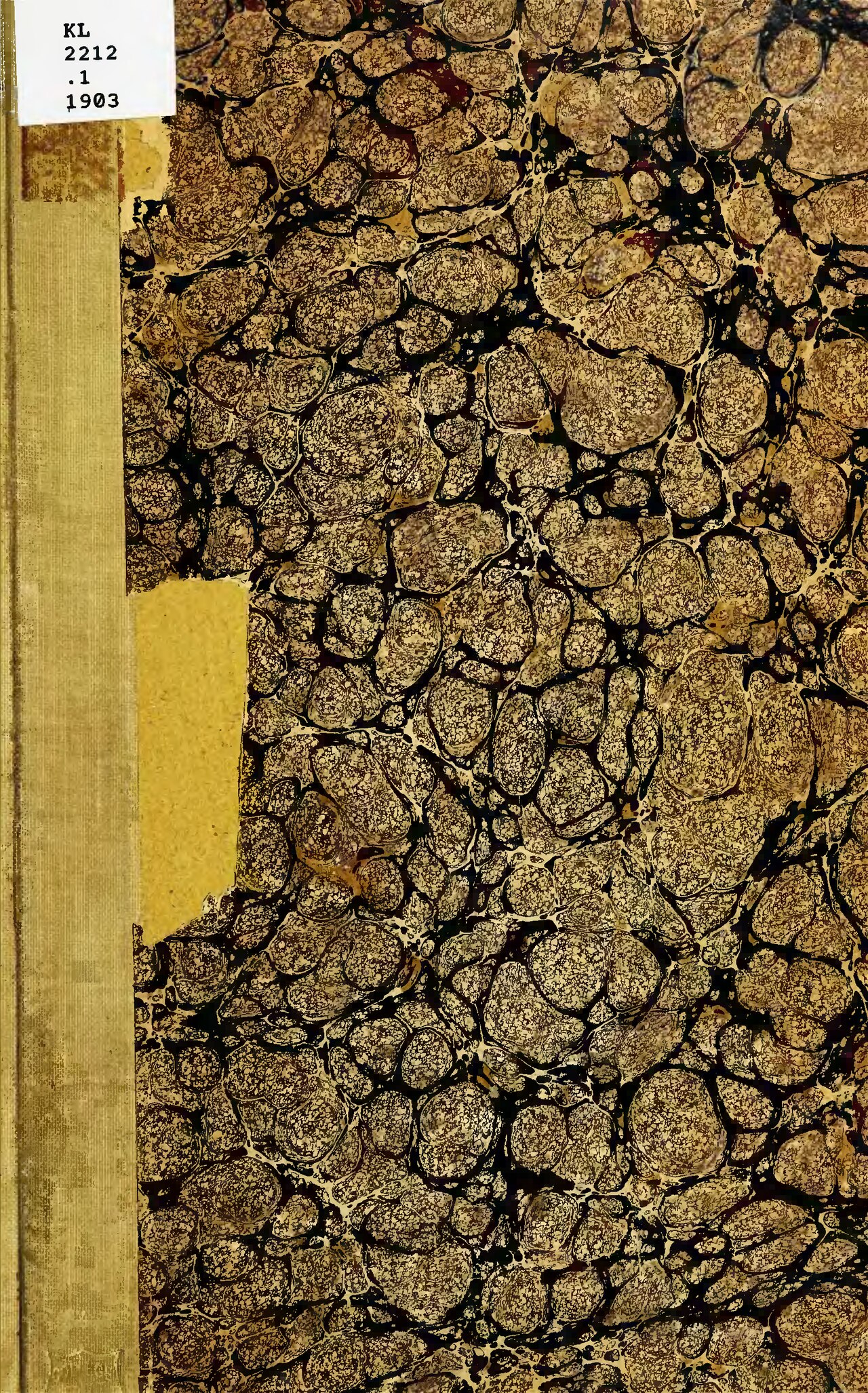
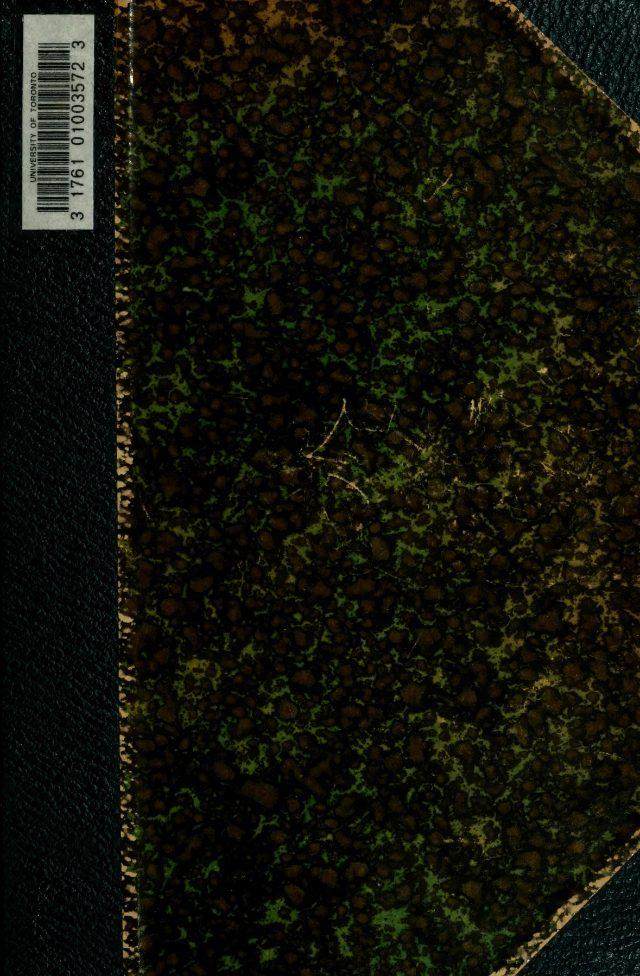
Book cover with a marbled brown, black and cream pattern on the boards, a yellow-tan spine with a worn cloth area, and a white label at top left reading KL 2212 .1 1903.Book

Primary source

Laws of Hammurabi, King of Babylonia

Records of the Past Exploration Society · 1903

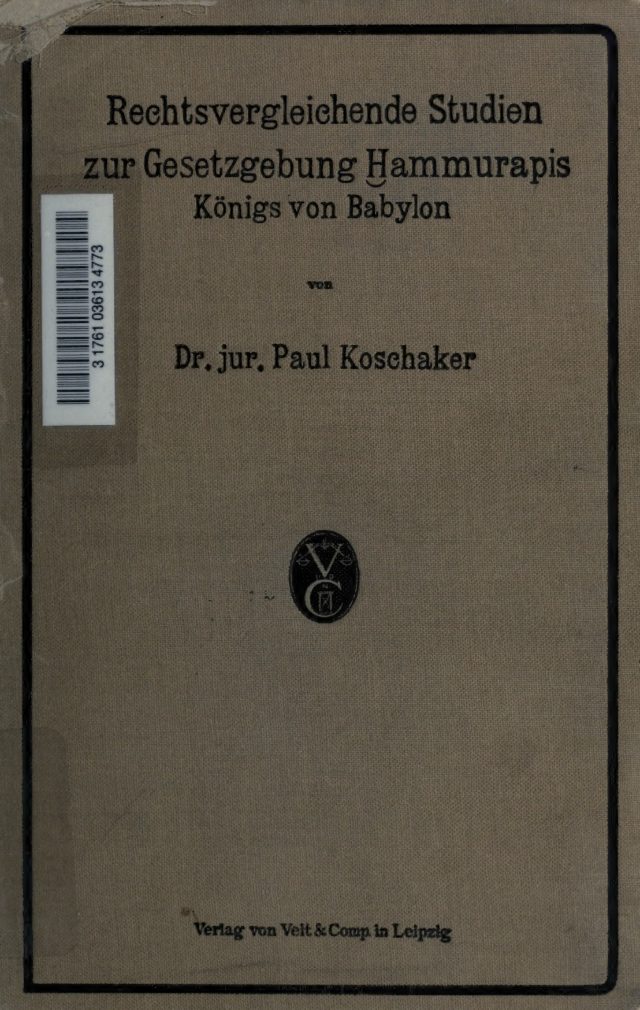
Comparative legal studies of Hammurabi's legislationBook

Secondary source

Comparative legal studies of Hammurabi's legislation

Paul Koschaker · 1917

New fragments of Hammurabi's code on interest and partnershipsBook

Secondary source

New fragments of Hammurabi's code on interest and partnerships

Édouard Cuq · 1918

Plain dark red cloth book cover with a fine woven texture and no visible title, lettering, or ornament.Letter

Primary source

Letters and Inscriptions of Hammurabi

Hammurabi; ed. L. W. King · 1898-1900

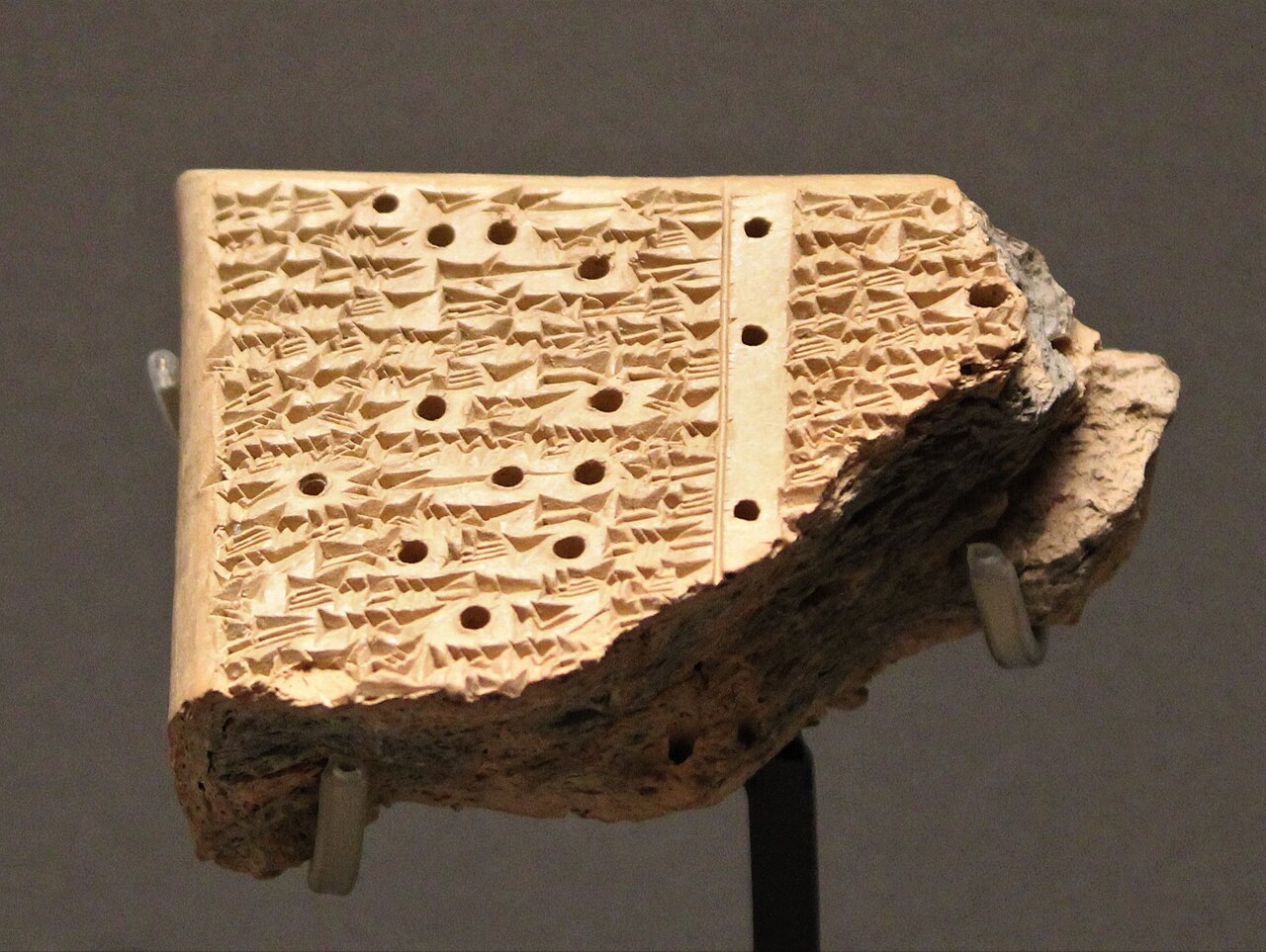
Photo of a broken clay tablet fragment with rows of cuneiform wedge-shaped writing on its face, with a vertical ruled line and small round holes, displayed on a black stand against a grey background.Artifact

Secondary source

Fragment of a Nineveh copy of the Code of Hammurabi

7th century BC

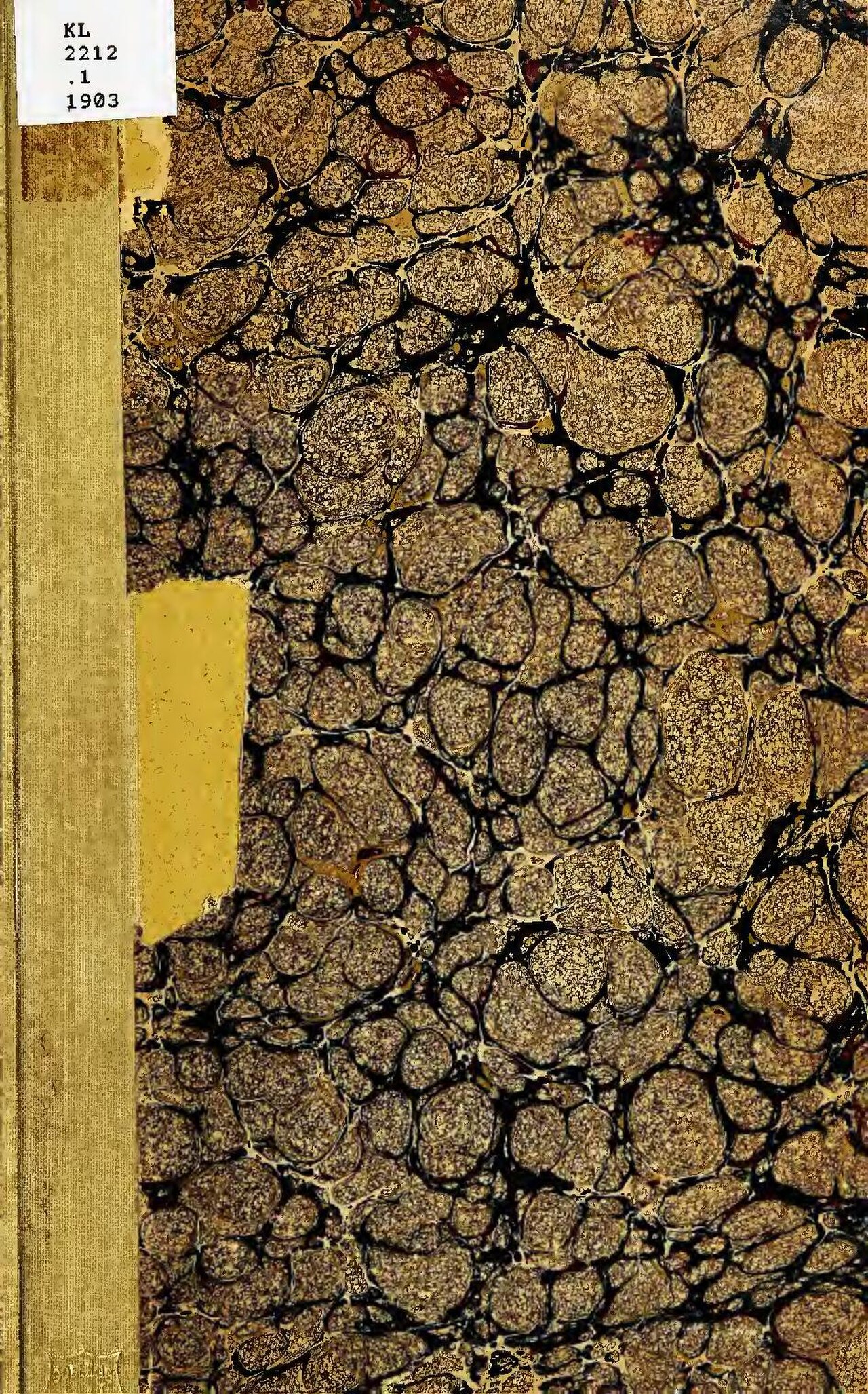
Front cover of a book with brown and black marbled paper boards and a tan cloth spine. A white label at top left reads KL 2212 .1 1903. A yellow patch on the spine is visible.Book

Primary source

Code of Hammurabi, King of Babylon

Hammurabi; Records of the Past Exploration Society · 1903

Document

Tertiary source

Hammurabi entry, Catholic Encyclopedia

Charles Léon Souvay · 1913

Book

Secondary source

The Codes of Hammurabi and Moses

William W. Davies · 1905 (book); recording modern

Die Gesetze HammurabisBook

Primary source

Die Gesetze Hammurabis

David Heinrich Müller · 1903

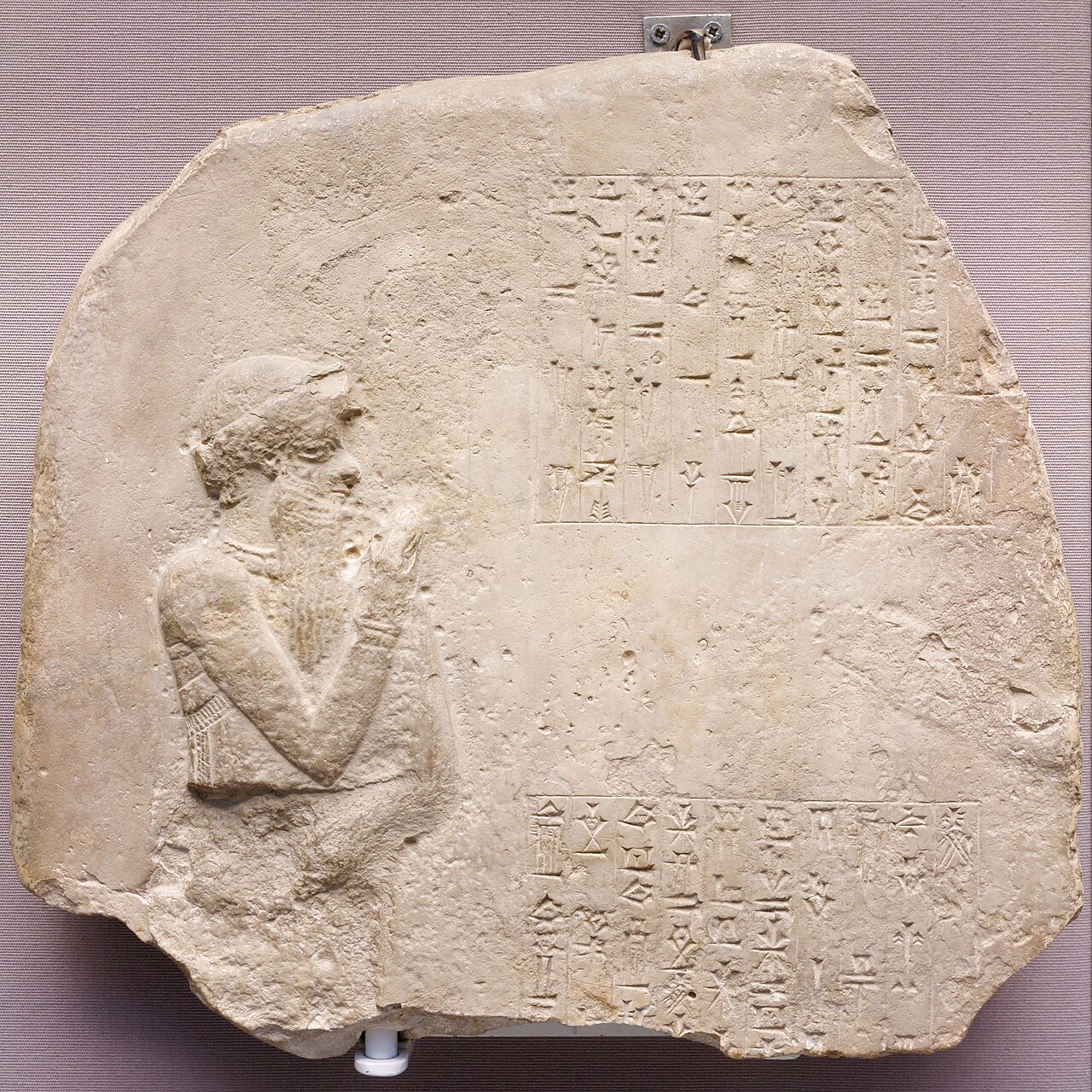
Photo of a pale limestone relief slab with a carved figure in profile on the left, hands clasped at chest, wearing a cap and robe. Right side has rows of cuneiform inscription in horizontal bands. Mounted on a grey backdrop.Sculpture

Primary source

Votive Monument of Hammurabi

reign of Hammurabi, c. 1792-1750 BCE

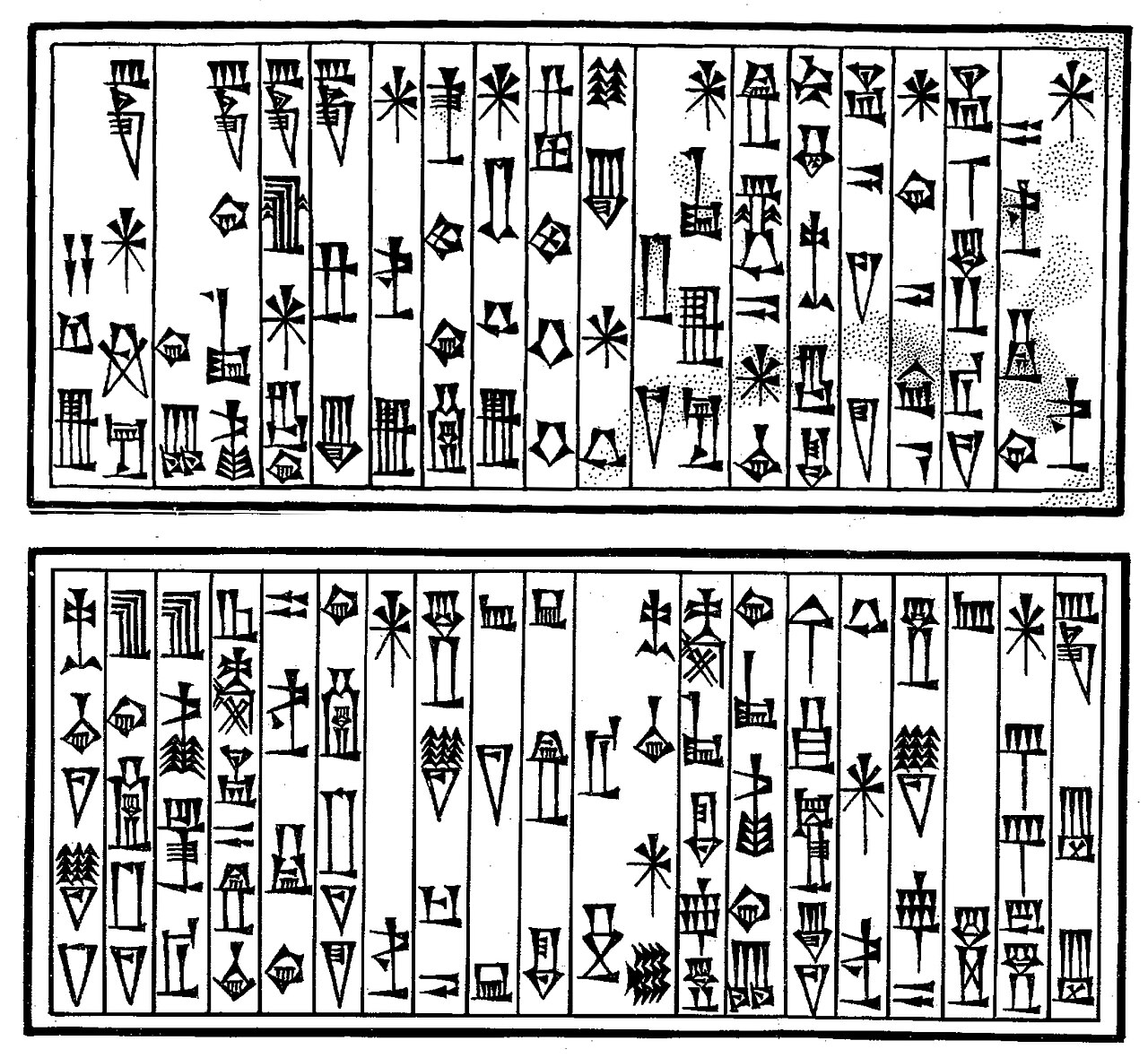
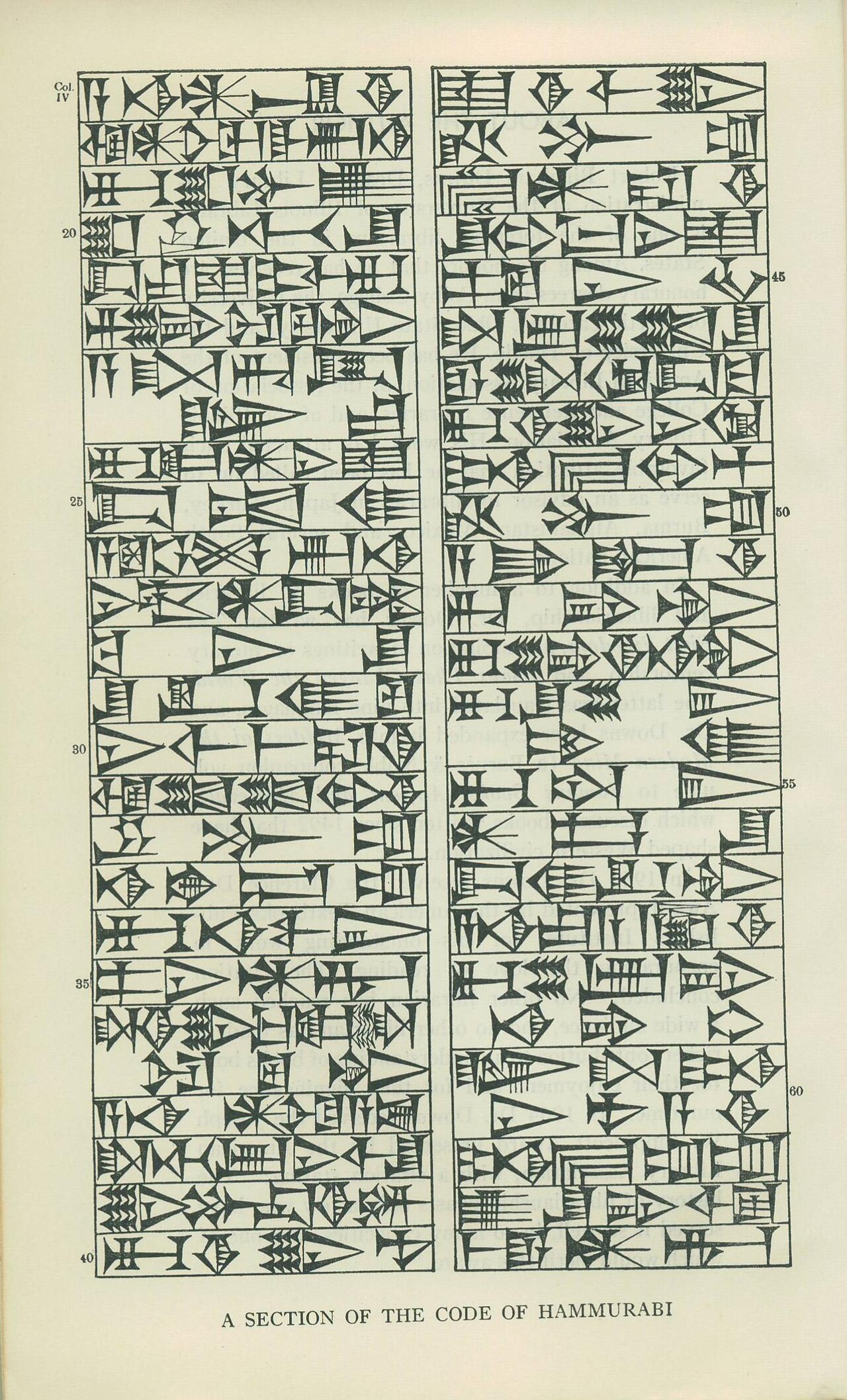
Scanned book page showing two columns of cuneiform wedge-shaped signs in horizontal rows, labeled Col. IV with line numbers 20 to 60, captioned 'A Section of the Code of Hammurabi'.Document

Primary source

A Section of the Code of Hammurabi, Harper Edition

Robert Francis Harper · 1904 (edition); code from Hammurabi's reign

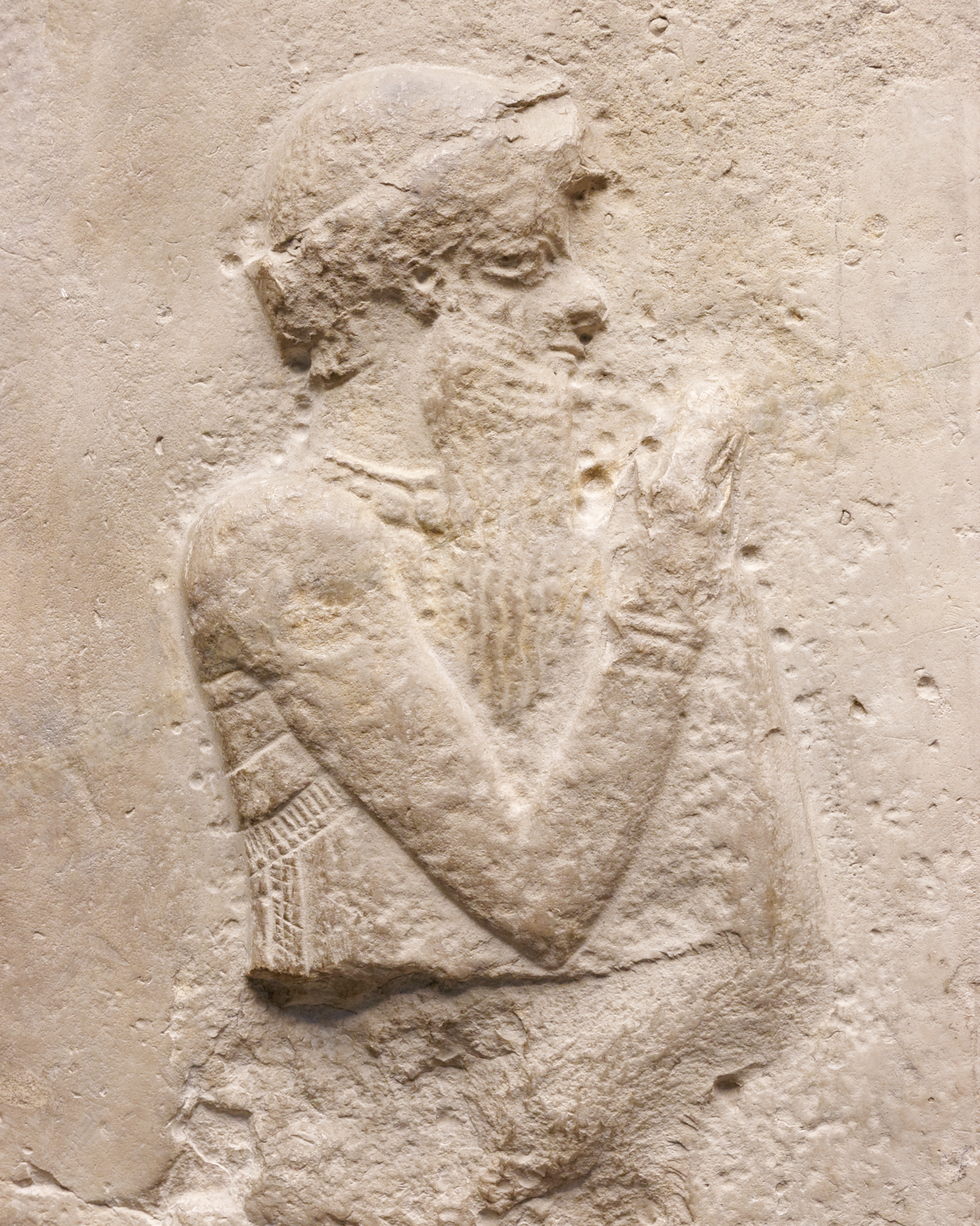
Close-up of a carved relief in pale stone showing a bearded figure in profile wearing a rounded cap, with arms folded across the chest and a fringed garment; the surface is weathered and pitted.Sculpture

Primary source

Votive Monument to Hammurabi, Detail

18th century BCE

Book

Secondary source

The Codes of Hammurabi and Moses

W. W. Davies · 1905

The Laws of Moses and the Code of HammurabiBook

Secondary source

The Laws of Moses and the Code of Hammurabi

Stanley A. Cook · 1903

The Relations Between the Laws of Babylonia and the Laws of the Hebrew PeoplesBook

Secondary source

The Relations Between the Laws of Babylonia and the Laws of the Hebrew Peoples

C. H. W. Johns · 1914

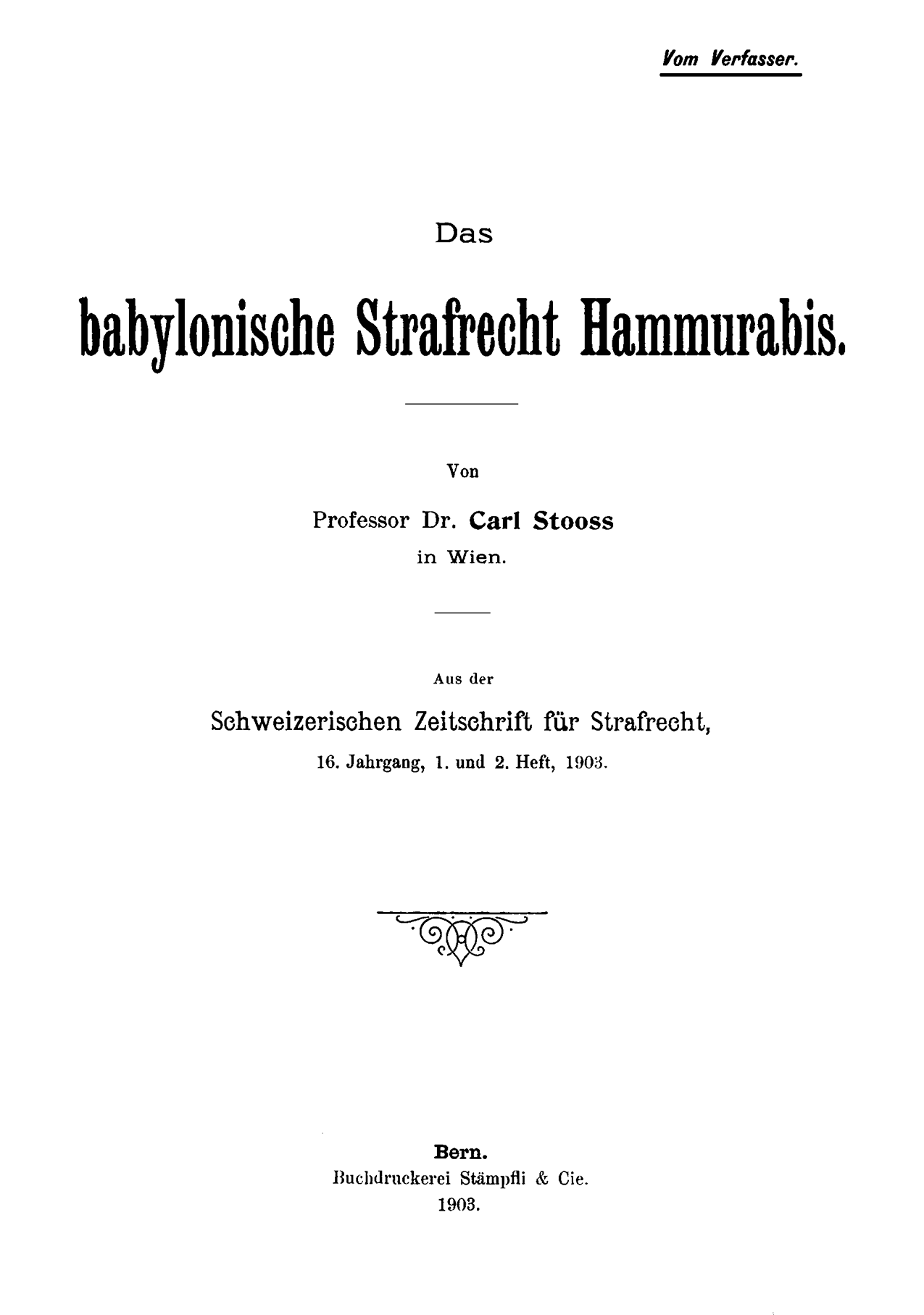
Title page of the 1903 German work 'Das babylonische Strafrecht Hammurabis' by Professor Dr. Carl Stooss in Wien. Top right reads 'Vom Verfasser'. Below the title, it notes it is from the Schweizerischen Zeitschrift für Strafrecht, 16th volume, 1st and 2nd issues, 1903, printed in Bern by Buchdruckerei Stämpfli & Cie.Document

Secondary source

Title Page of Das babylonische Strafrecht Hammurabis

Carl Stooss · 1903

Document

Secondary source

Oriental Imperialism

1918

Dark cloth-bound book cover with two library labels: a white barcode label reading 3 1822 02479 1675 from University of California, San Diego at top, a smaller white label with barcode and text 'UC Southern Regional Library Facility' on the left edge, and a blue label at lower left partially reading 'ifornia', 'onal', 'ity'. A small light stain sits near the lower right.Book

Secondary source

The Oldest Code of Laws in the World

C. H. W. Johns

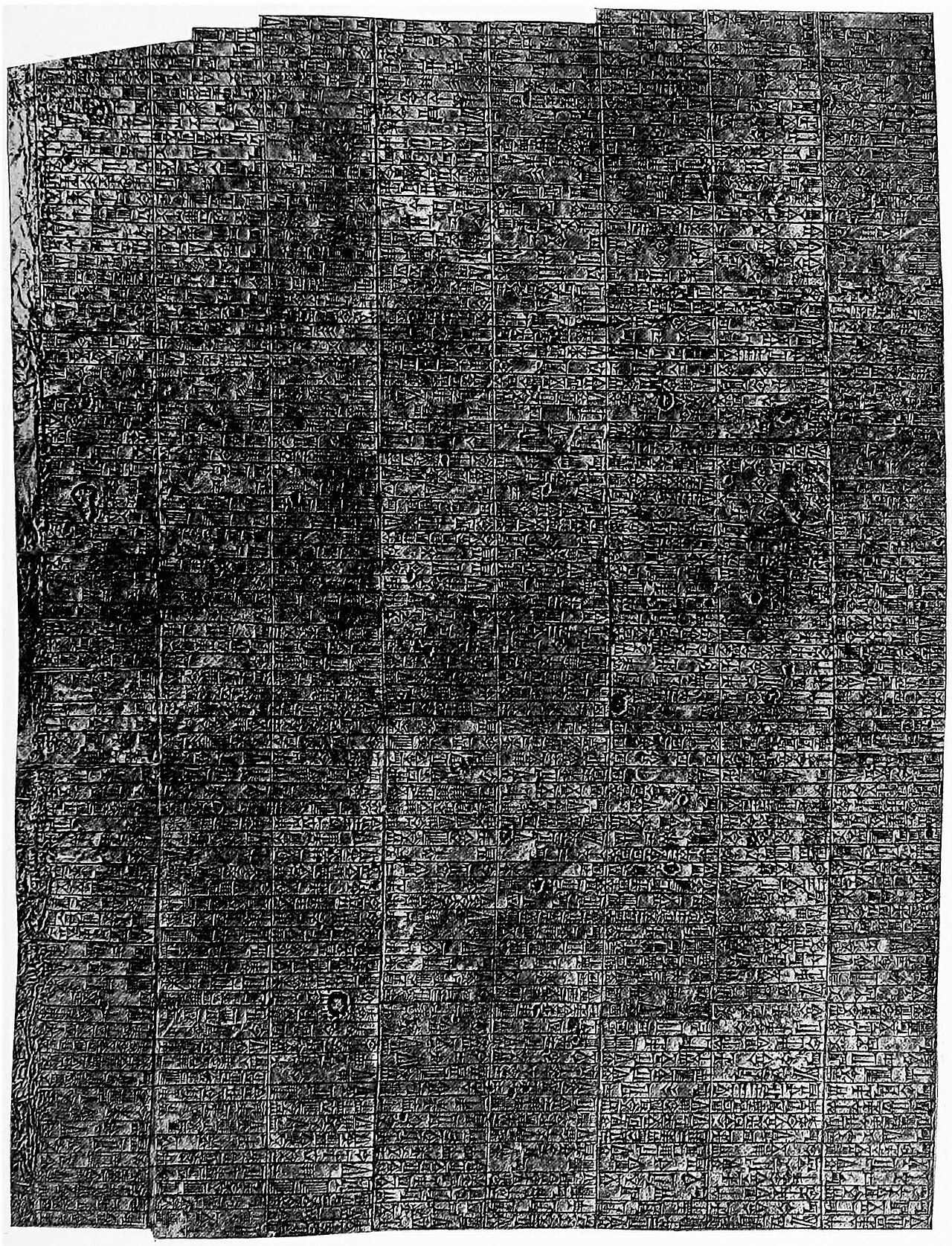
Black-and-white photographic plate of a dense field of cuneiform script carved in rows across a large dark stone surface, reproduced in a printed book. The stone's edges are visible at the left and top, with several vertical panels of text.Document

Primary source

Laws of Hammurabi, Plate 1

Hammurabi · 1903

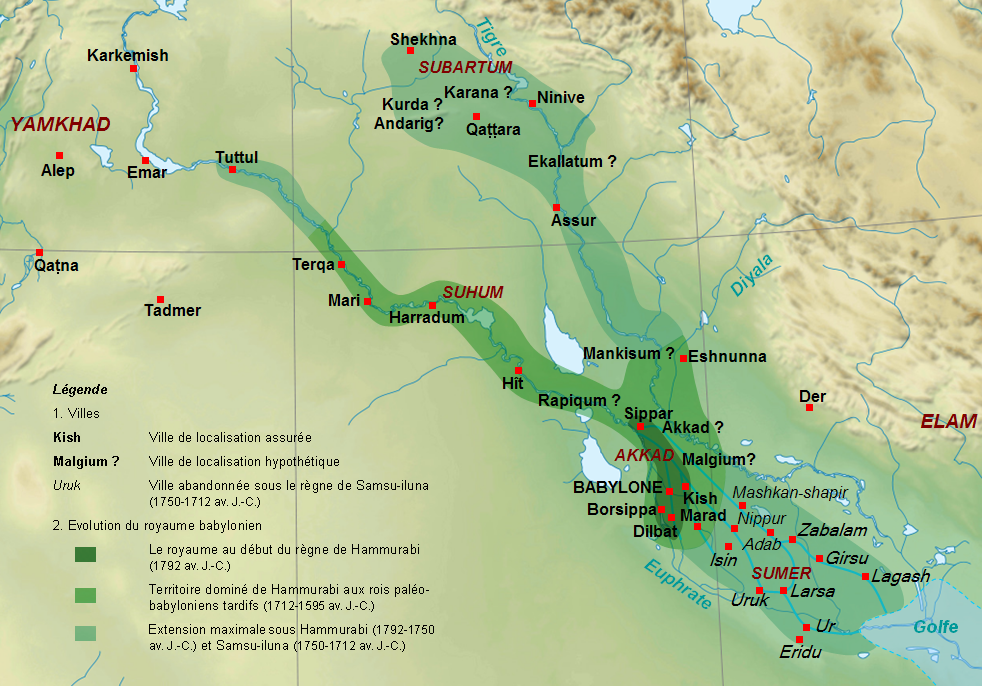
Map of ancient Mesopotamia showing the Babylonian kingdom's territory under Hammurabi and Samsu-iluna. Dark green core around Babylon, Kish and Sippar expands into lighter green zones along the Tigris and Euphrates, with red dots marking cities, place names in black, and a French legend at lower left.Document

Tertiary source

Map of the Babylonian Kingdom under Hammurabi and Samsu-iluna

Sémhur; Zunkir · 2010

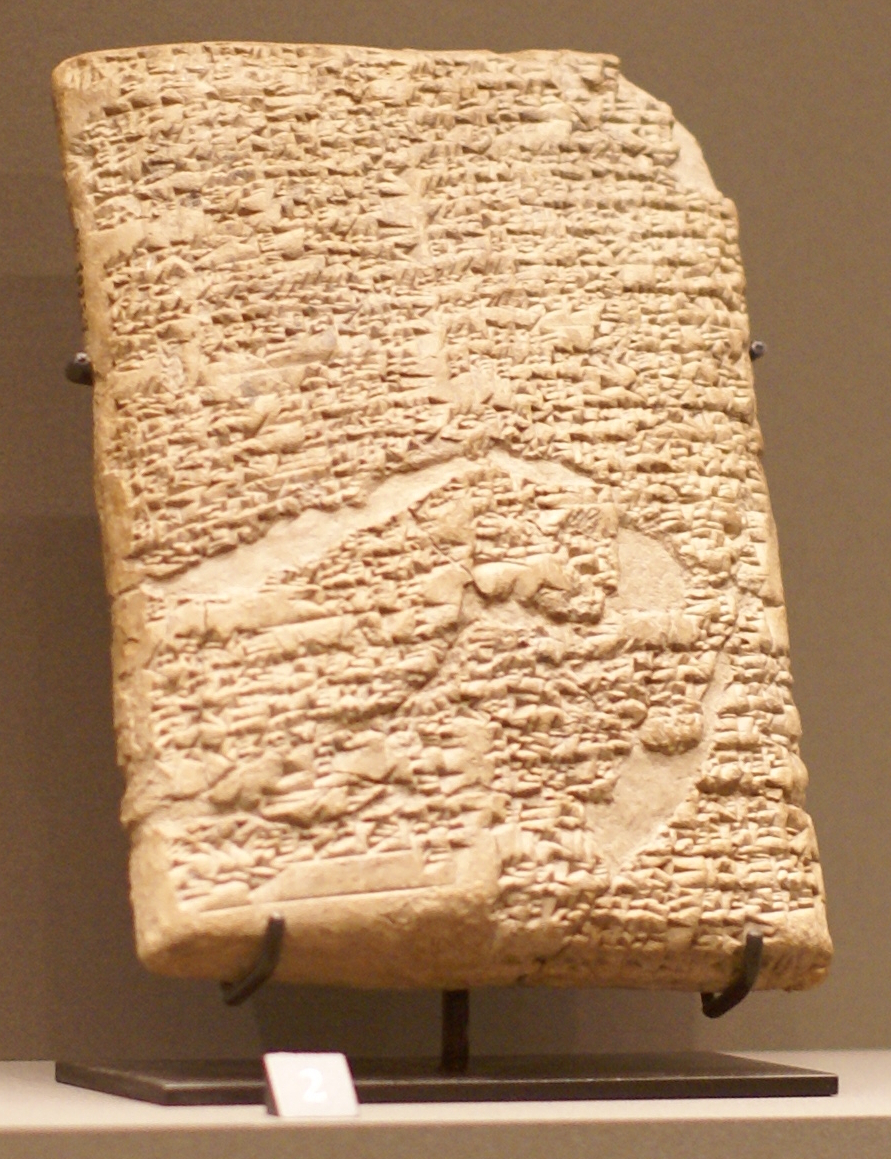
Photo of a tan clay cuneiform tablet, tall and slightly curved at the top, densely covered with small wedge-shaped inscriptions. It rests on a black metal stand on a display shelf, with a small white number label reading 2 at its base.Document

Primary source

Prologue Tablet of Hammurabi's Code

Hammurabi

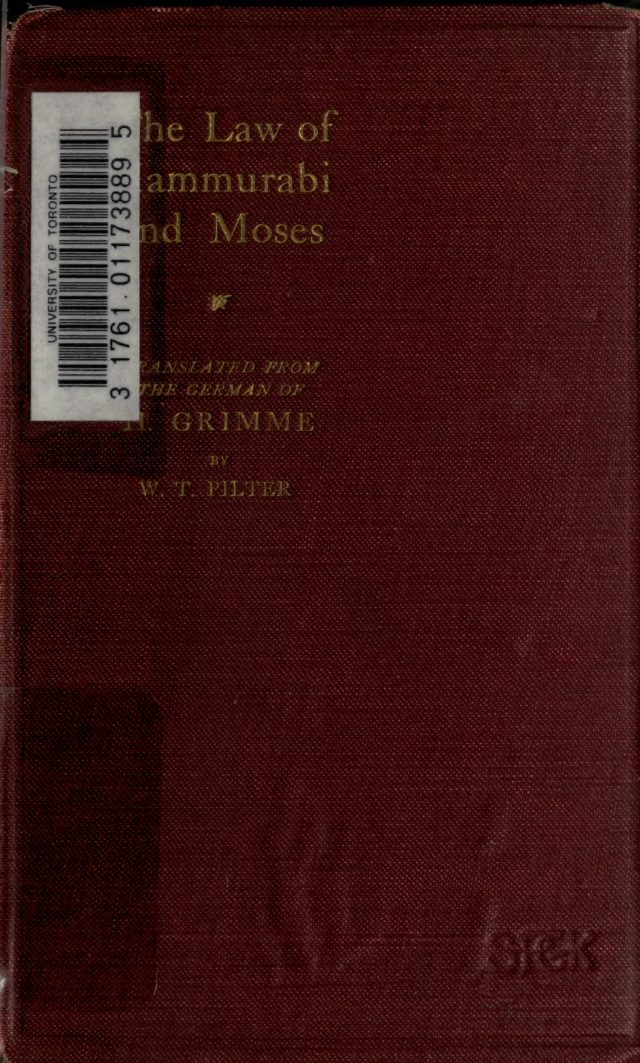
The Law of Hammurabi and Moses: A SketchBook

Secondary source

The Law of Hammurabi and Moses: A Sketch

Hubert Grimme · 1907

Le code de Hammourabi et ses originesBook

Secondary source

Le code de Hammourabi et ses origines

Dominique Mirande · 1913

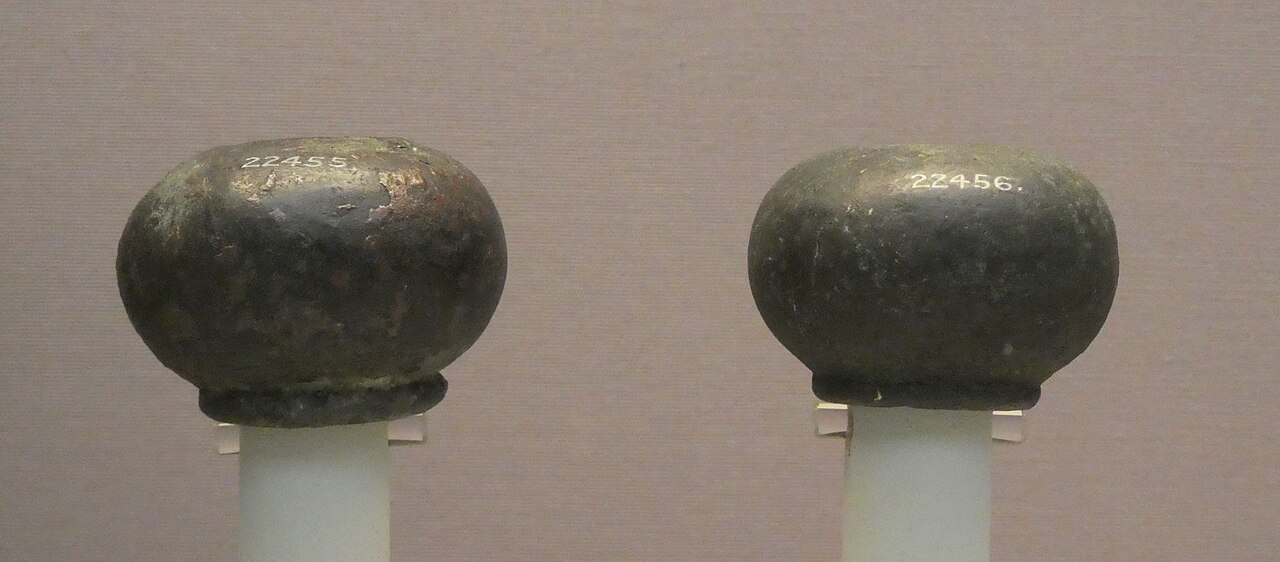
Two dark, rounded copper alloy mace heads on pale pedestals against a grey-mauve background. Each has a museum catalogue number painted on it: left reads 22455, right reads 22456. The left head shows green patina and wear.Artifact

Primary source

Copper Mace Heads of Hammurabi

c. 1792-1750 BCE

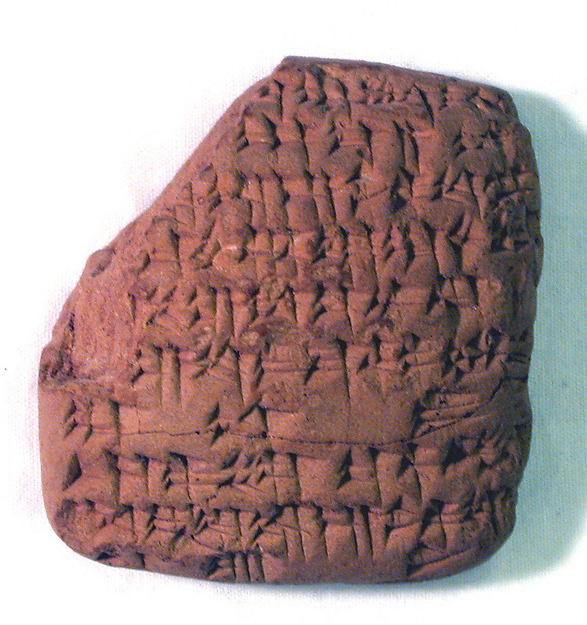
Photograph of a reddish-brown clay tablet with irregular, broken edges, covered in rows of wedge-shaped cuneiform signs pressed into its surface, against a plain light background.Document

Primary source

Old Babylonian Cuneiform Tablet (Private Letter)

ca. 17th-16th century BCE

Tall black basalt stele on a pale stone plinth in a museum gallery. The top carved relief shows a standing figure with a hand raised facing a seated figure with a horned crown before a stepped altar. Below, rows of cuneiform script cover the stone.Photograph

Secondary source

Code of Hammurabi Stele, Front Face

Mbzt · 2011

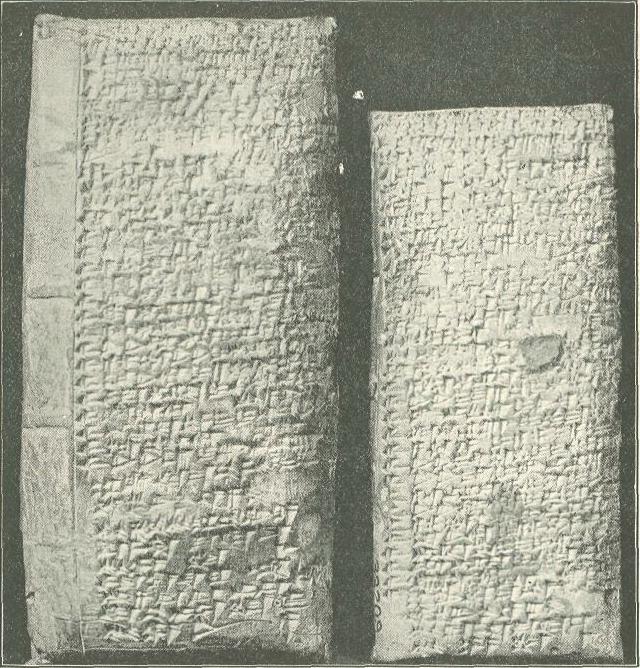
Black and white photograph of two cuneiform clay tablets side by side on a dark background. The left tablet is larger and covered in wedge-shaped script; the right tablet is smaller, also densely inscribed, with a small chipped spot near its upper middle.Photograph

Secondary source

Babylonian Contract Tablet from Hammurabi's Reign

Messrs. Mansell & Co. · 1906

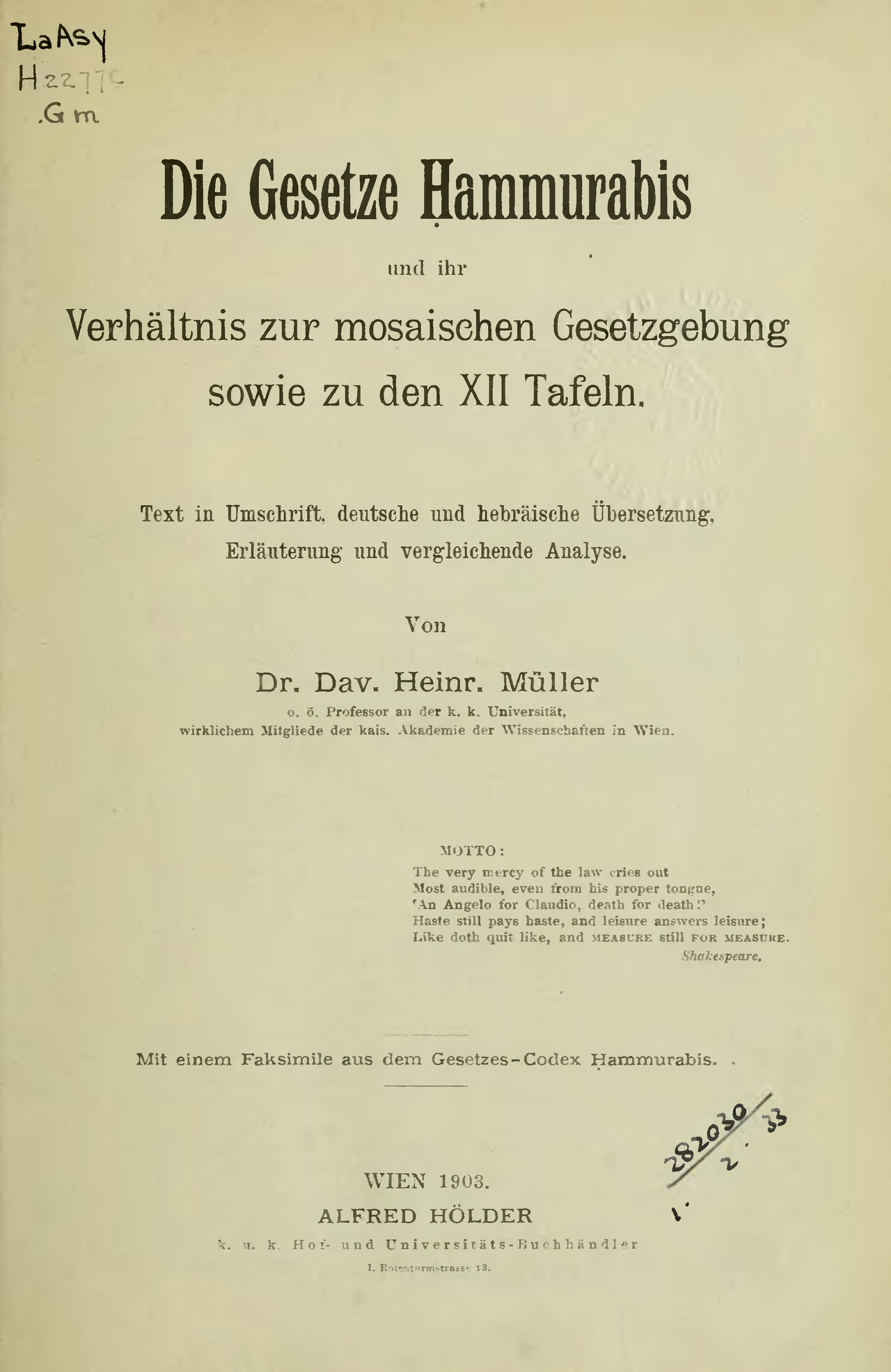
Title page of the 1903 book Die Gesetze Hammurabis by Dr. Dav. Heinr. Müller, Vienna, published by Alfred Hölder. It includes a Shakespeare motto and a note of a facsimile from the Hammurabi law code.Book

Secondary source

Die Gesetze Hammurabis und ihr Verhältnis zur mosaischen Gesetzgebung

David Heinrich Müller · 1903

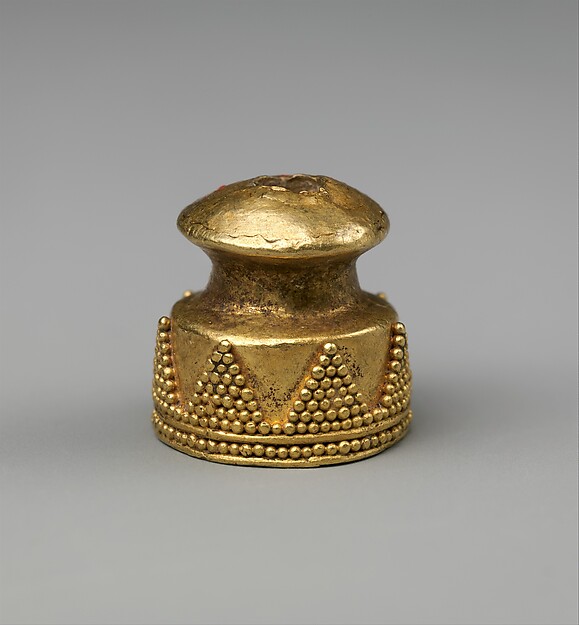
Photo of a small gold cylinder seal cap on a grey background. It has a mushroom-shaped knob on top, a narrow neck, and a wider base decorated with rows of granulated gold beads forming triangular patterns and a beaded rim.Artifact

Primary source

Gold Cylinder Seal Cap

ca. 17th–16th century BCE

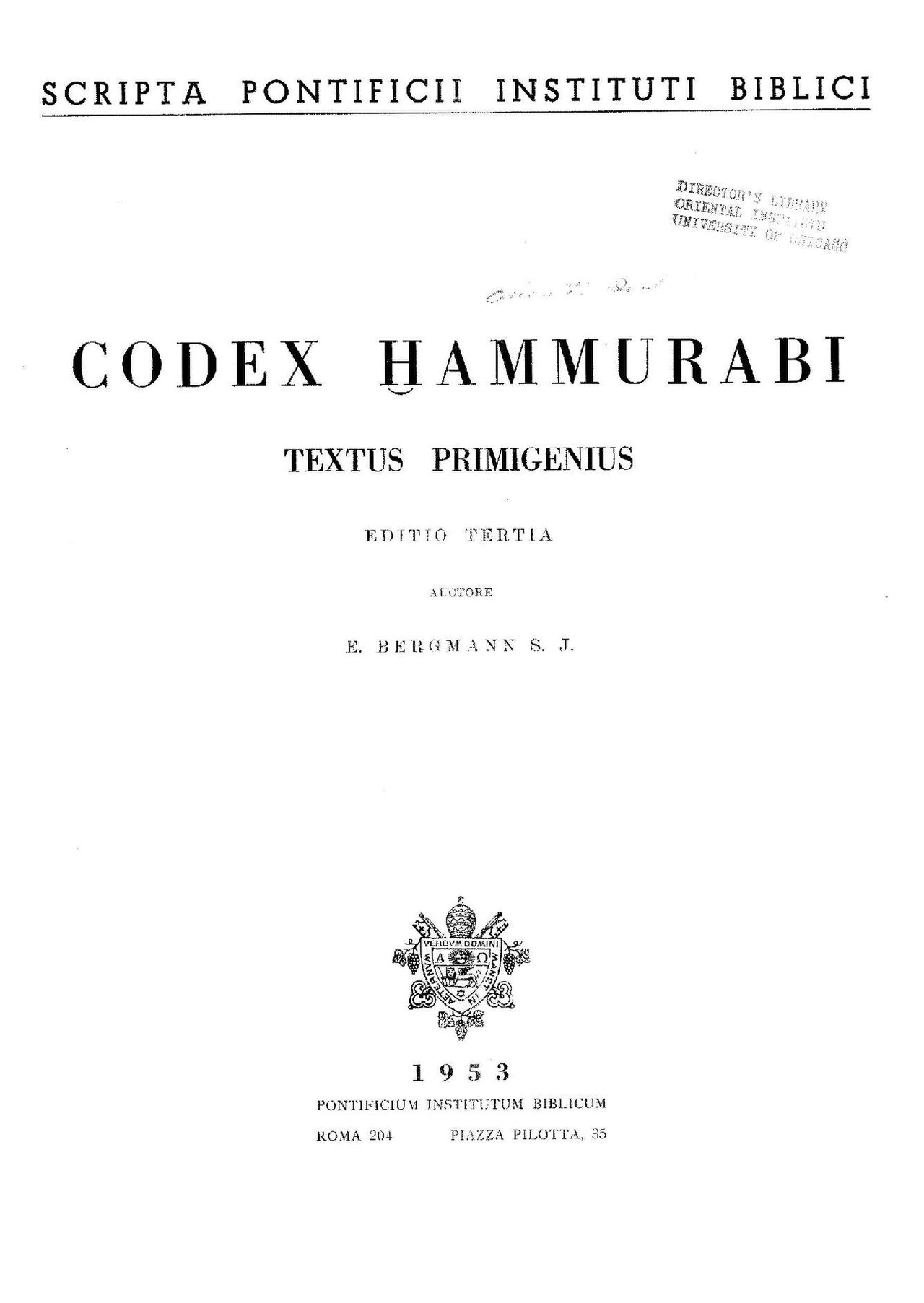
Title page of the book Codex Hammurabi, Textus Primigenius, Editio Tertia, by E. Bergmann S.J., published in 1953 by the Pontificium Institutum Biblicum in Rome, with a Vatican-style coat of arms and a library stamp reading Director's Library, Oriental Institute, Universita di Chicago partly visible.Book

Secondary source

Codex Hammurabi, Textus Primigenius

E. Bergmann · 1953

Title page of a German book in black Fraktur blackletter type: 'Die Gesetze Hammurabis, Königs von Babylon, um 2250 v. Chr., Das älteste Gesetzbuch der Welt, Übersetzt von Dr. Hugo Winckler, Mit einer Abbildung, Leipzig, J. C. Hinrichs'sche Buchhandlung, 1902', with a small floral emblem.Book

Secondary source

Die Gesetze Hammurabis

Hugo Winckler · 1902

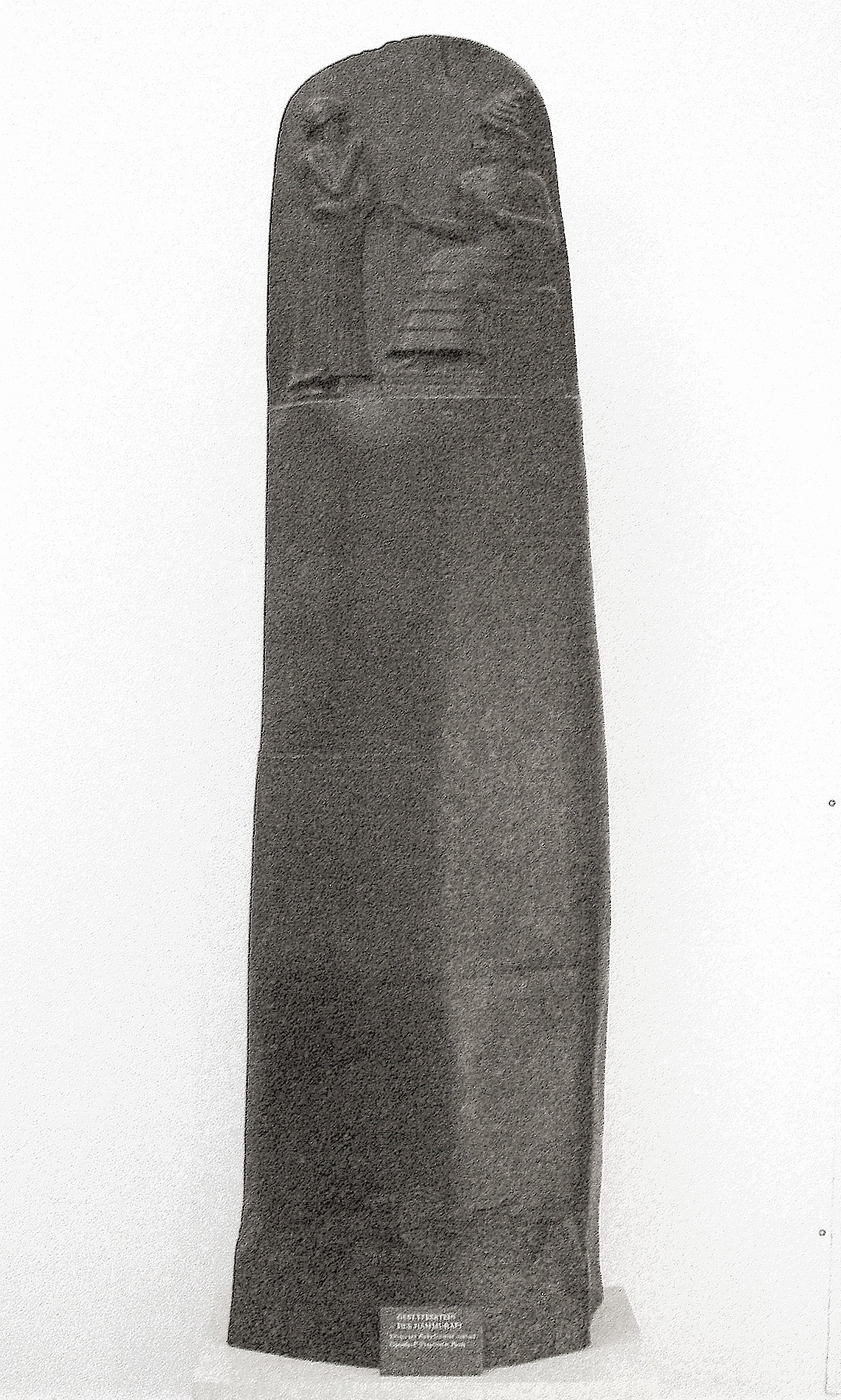
A tall, dark basalt stele with a rounded top, photographed against a white wall. Low relief carvings at the top show a standing figure facing a seated figure in front of a stepped structure. The lower shaft is blank. A small museum label sits at the base.Sculpture

Secondary source

Stele of Hammurabi, Pergamon Museum

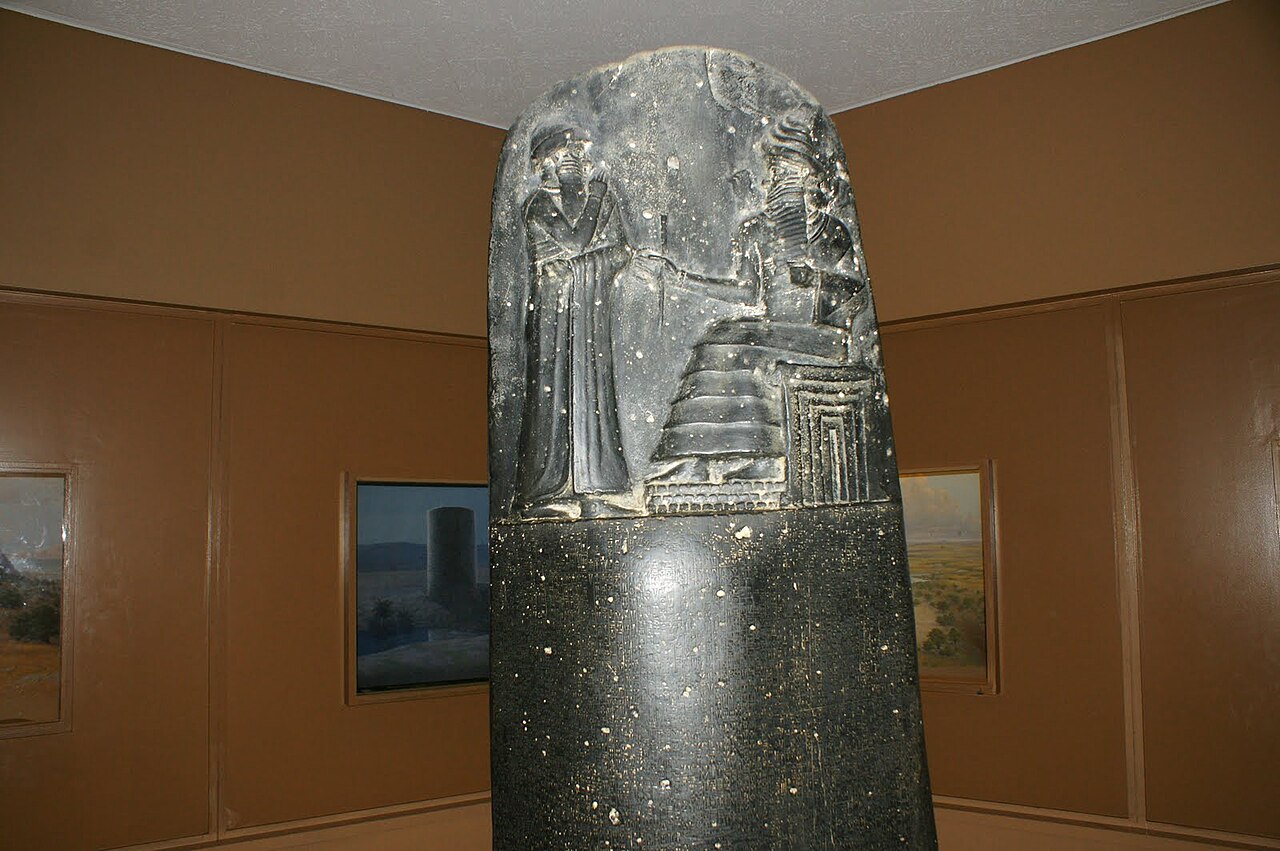
A tall black basalt stele in a museum gallery, with a carved relief at the top showing a standing robed figure facing a seated figure on a stepped throne. Below, dense cuneiform text is carved in columns. Brown walls and framed paintings are behind it.Photograph

Secondary source

Hammurabi Stele Replica, American Museum of Natural History

Valugi · Photographed 17 April 2012

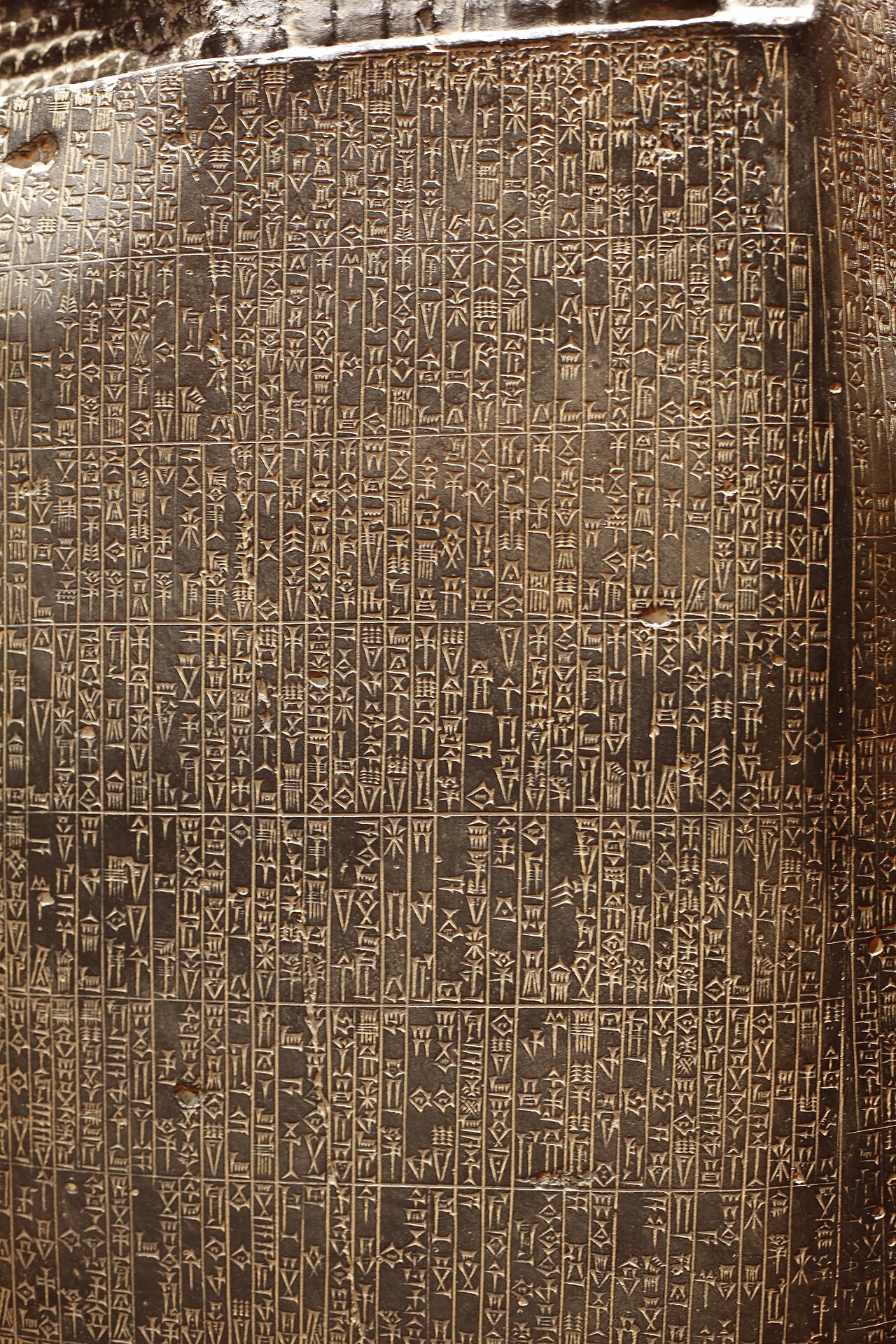
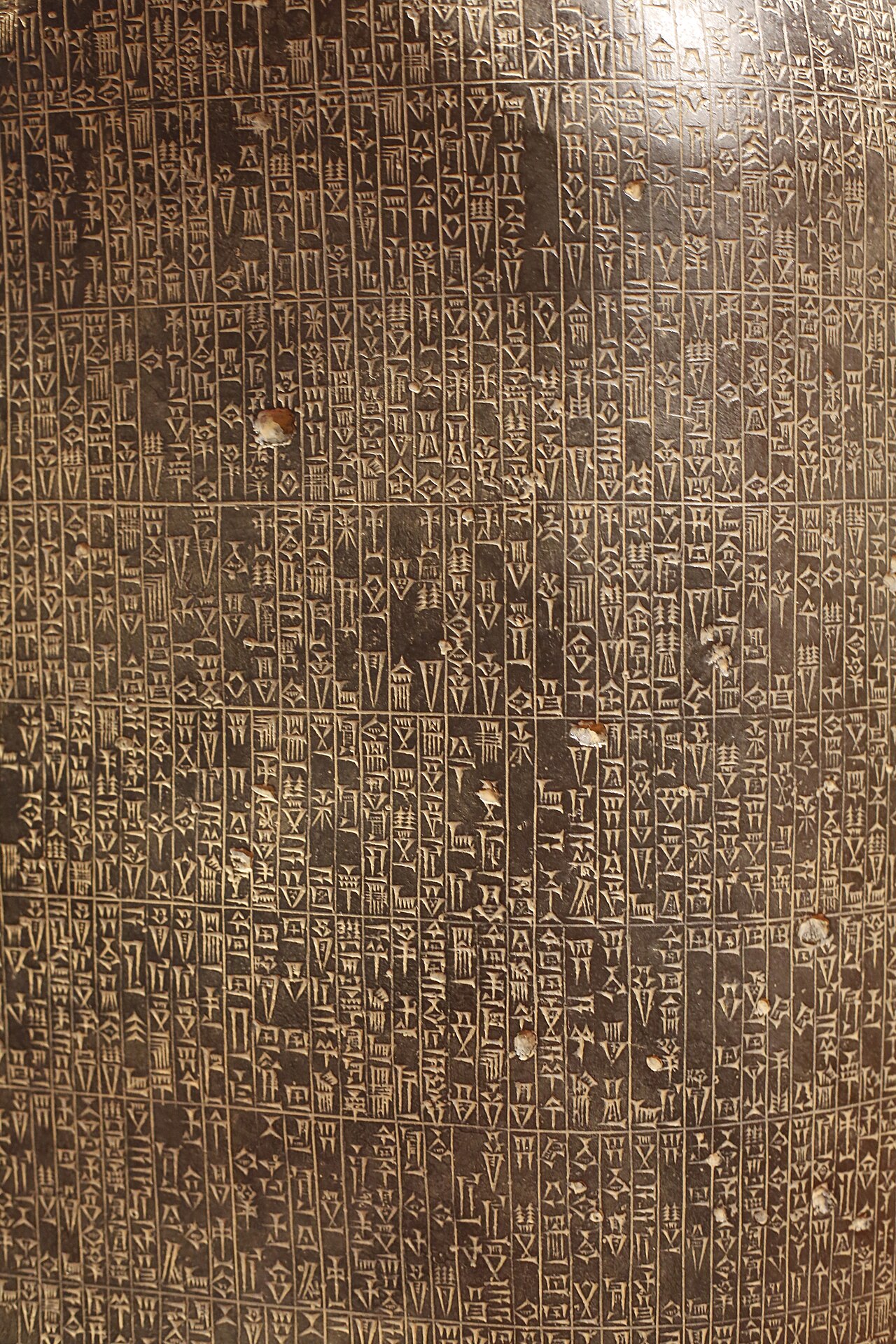
Close view of a dark stone surface densely covered with rows of carved cuneiform wedge-shaped signs arranged in vertical columns separated by thin incised lines. Some small holes and chips are visible in the stone.Artifact

Secondary source

Detail of the Code of Hammurabi, Musée Champollion, Figeac

VIGNERON · Photographed 1 August 2013

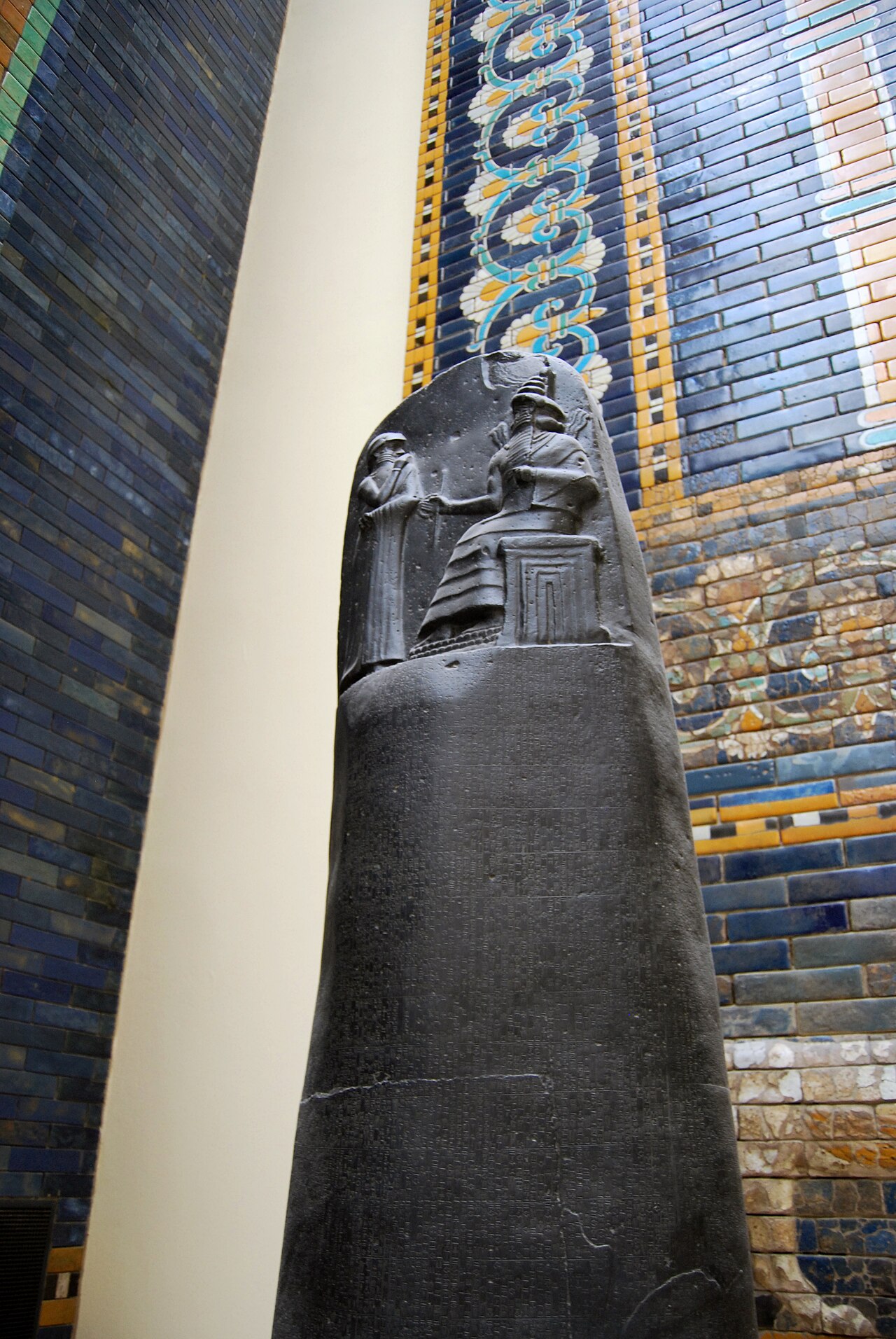
Photograph of the black basalt Code of Hammurabi stele in a museum. It is tall and narrow with a carved relief at the top showing a seated figure with a standing figure before him, and dense cuneiform text below. Blue and gold glazed tile wall is behind it.Photograph

Secondary source

Code of Hammurabi Stele, Pergamon Museum

MaryG90 · Photographed 8 August 2011

Close-up of a dark stone surface covered in rows of incised cuneiform wedge-shaped signs arranged in vertical columns, with small pits and chips visible across the surface.Artifact

Secondary source

Code of Hammurabi Replica, Figeac Museum (Detail)

VIGNERON · 2013

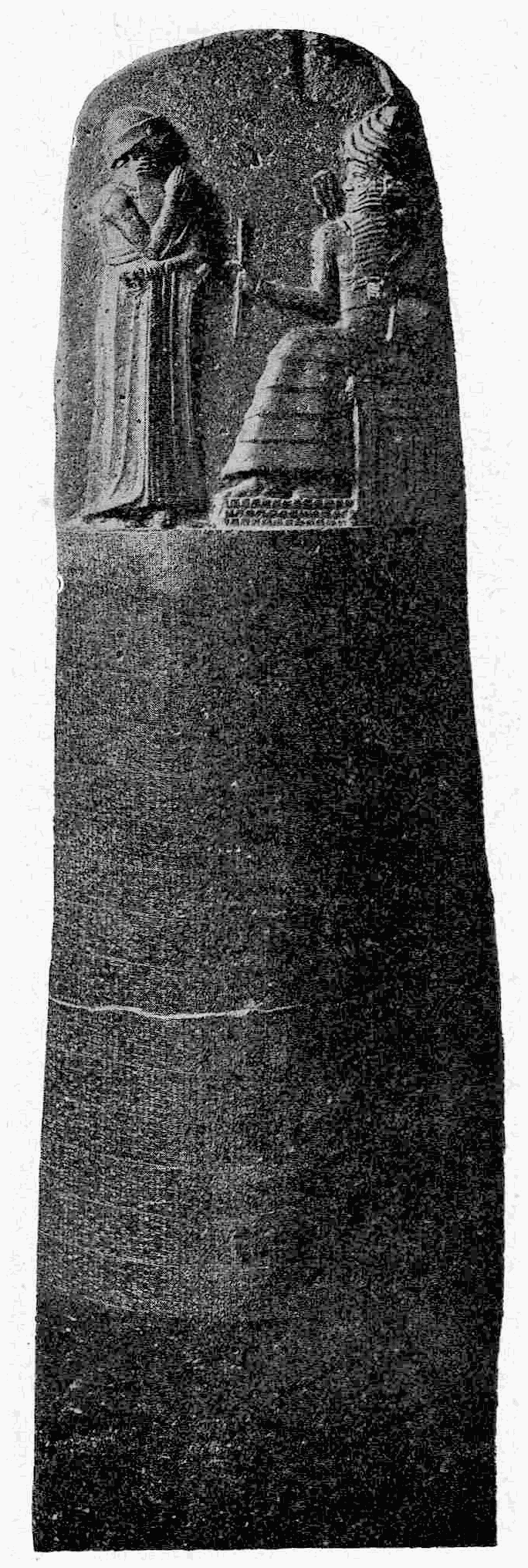
Black-and-white print of the upper part of the Code of Hammurabi stele: a carved relief on a tall rounded-top stone, showing a standing figure with a hat on the left facing a seated bearded king with a tall headdress on the right. Below is a lower section of dark inscribed text.Painting

Secondary source

Engraving of Hammurabi's Law Code from Reclus

Élisée Reclus · 19th century

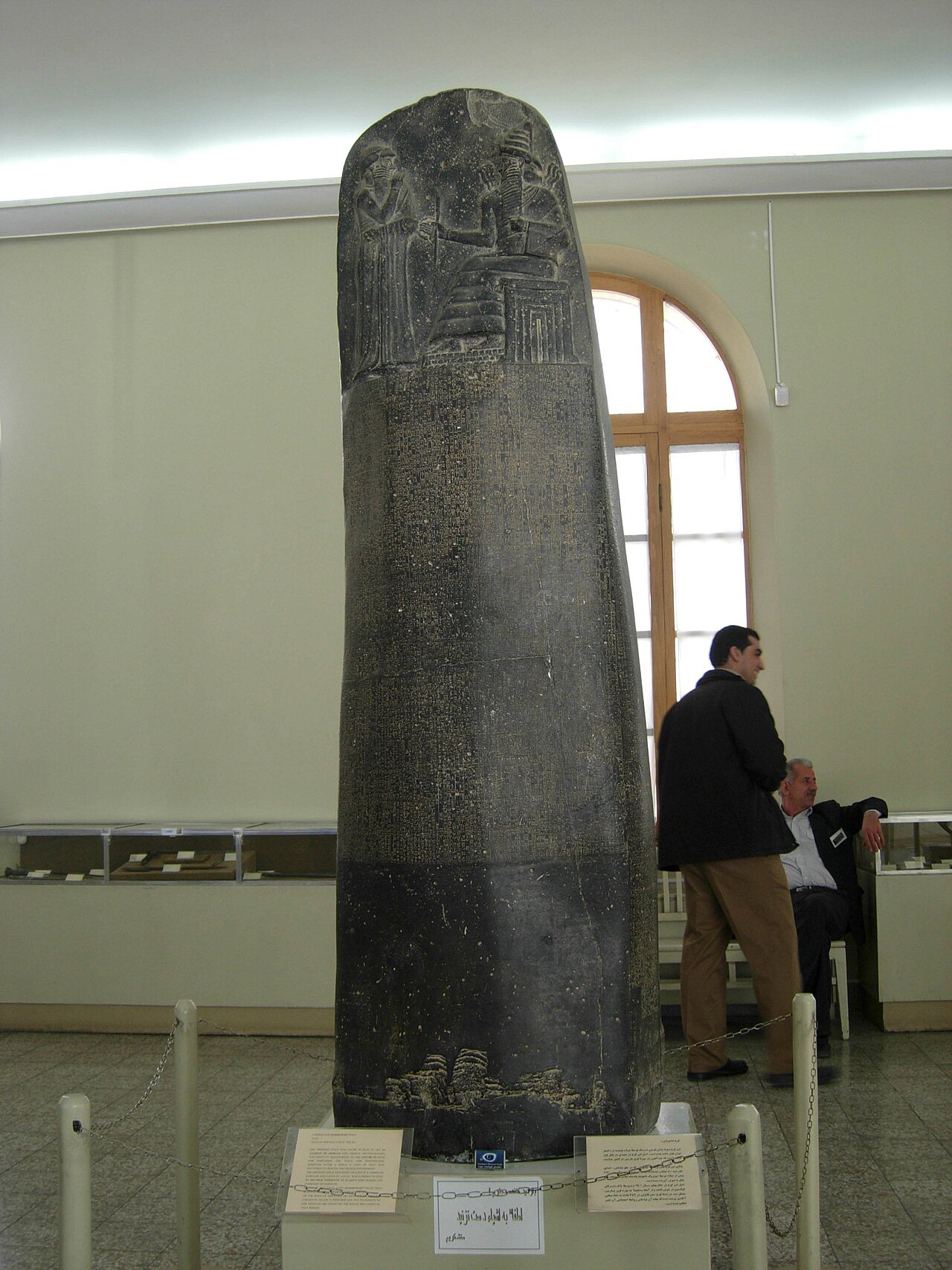
A tall black basalt stele with a carved relief at the top showing a seated figure before a standing figure, and dense cuneiform text below, displayed in a museum hall. Two people stand and sit nearby, and display labels sit at the base.Artifact

Secondary source

Code of Hammurabi Copy, National Museum of Iran

xiquinhosilva · 2008

Tall dark basalt stele with rounded top, carved relief of a standing figure at left and a seated figure before a symbol at upper center, with dense cuneiform inscription below. Cream curtains behind.Artifact

Secondary source

Hammurabi Stele at Tehran Archaeological Museum

Ziegler175 · 1991

Close-up photograph of a dark black stone surface densely covered with rows of incised cuneiform wedge-shaped signs, with light wear and chips visible across the stone. Vertical divisions separate columns of text.Artifact

Secondary source

Hammurabi Stela Photograph, Iran

Petra Kohlstädt · 2006

Close-up of a dark stone stele with carved relief: on the right, a seated bearded figure with a tall headdress faces left toward a standing figure in robes on the left. Bright background light surrounds the stone.Artifact

Secondary source

Code of Hammurabi Replica, Pergamon Museum, Berlin (Detail)

Tomás Guardia · 2015

Want the full shelf? Chat with Hammurabi in the app and open the Sources panel — every quote links back to the original.

Trusted by educators worldwide

Conversations
375,000+
Real exchanges between students and historical figures
Messages exchanged
4,142,000+
Across every figure, classroom and language
Historical figures
100,000+
Each informed by a curated biography and selected sources
Languages supported
50+
From English and Spanish to Arabic and Korean

Paying customers

Used by 98 schools and universities

Partner school logo
Tecnológico de Monterrey logo
Hyper Island logo
Partner school logo
Chambersburg Area School District logo
Broward County Public Schools logo
Nebo School District logo
National Louis University logo
South Florida PBS logo
Punahou School logo
University of Wisconsin–River Falls logo
Partner school logo
Partner school logo
Archbishop Mitty High School logo
Kingsburg High School logo
Norwalk Public Schools logo
Partner school logo
Connections logo
Partner school logo
Moore Public Schools logo
Partner school logo
Partner school logo
Partner school logo
Partner school logo
Robbinsville Public Schools logo
Partner school logo
Partner school logo
Partner school logo
Tecnológico de Monterrey logo
Hyper Island logo
Partner school logo
Chambersburg Area School District logo
Broward County Public Schools logo
Nebo School District logo
National Louis University logo
South Florida PBS logo
Punahou School logo
University of Wisconsin–River Falls logo
Partner school logo
Partner school logo
Archbishop Mitty High School logo
Kingsburg High School logo
Norwalk Public Schools logo
Partner school logo
Connections logo
Partner school logo
Moore Public Schools logo
Partner school logo
Partner school logo
Partner school logo
Partner school logo
Robbinsville Public Schools logo
Partner school logo
Partner school logo

What educators are saying

“We enjoyed the program last year and used it frequently.”
“My students say it’s a welcome change of pace. I’m not a fan of the “sage on the stage” model, so I try to incorporate research-oriented and self-paced activities. With Humy, students have to take charge of their learning. They’ve become more adept at critical thinking, forming better questions, and improving their reading comprehension. The interview feature has been my go-to tool. I create assignments where students must ask historical figures a set number of questions, then summarize the responses to ensure they’re truly absorbing the material. This approach lets them actively explore the past rather than passively consuming information.”
“Humy has helped me bring historical figures, sometimes long past, to life. When my students interact with these figures in real-time, it eliminates some of the perceived “ancient” characteristics of my curriculum. This has shifted my students’ thinking away from viewing history as abstract or irrelevant. Real-time interactions make historical figures relatable, even allowing students to ask off-topic questions that help put historical lives in a more relevant context for 13-year-olds. The feature I use the most is the interview feature. After teaching a topic, most recently Gandhi and Joan of Arc, I have the students ask pointed, focused questions. We practice good conversation techniques beforehand, teaching them to listen (or read) carefully and formulate thoughtful follow-up questions rather than just interrogating. It helps students practice effective conversation skills.”

FAQ

Frequently asked questions

Who is Hammurabi?
Babylonian king known for his code of laws. On Humy.ai you can chat with an AI version of Hammurabi that draws on a short biography and 70 historical sources during the conversation — by text or voice, in 42 languages.
Is Hammurabi AI free?
Yes. Hammurabi is in Humy's free library: a free account includes 20 messages a month with Hammurabi and the other free figures, by text or voice. No credit card is needed.
What sources does the Hammurabi AI use?
It draws on a short biography and 70 historical sources (documents, books and artifacts), including “Code of Hammurabi”, “Stele with the Code of Hammurabi” and “Letter from Hammurabi to Sîn-iddinam”. Each source has its own page on Humy.ai.
How historically accurate is the AI version of Hammurabi?
Each figure uses a short biography and a small set of selected historical sources as context (retrieval-augmented generation), so answers stay closer to known material than the model's general knowledge alone. It isn't a citation-grade research tool — like any LLM, the AI can get details wrong or extrapolate. Treat it as a strong starting point for inquiry and cross-reference important claims.
Can I talk to Hammurabi by voice?
Yes. In addition to text chat, you can call Hammurabi and hear their voice respond in real time — useful for auditory learners, interview practice and Socratic dialogue.
Is Humy.ai safe and compliant for schools?
Yes. Humy.ai is used by more than 100 schools, universities and organisations. The platform is FERPA- and GDPR-aligned, supports SSO, and offers an IT-approval pack tailored for school procurement teams.

Ready when you are

Start chatting with Hammurabi now.

20 messages free · No credit card · Available in 50+ languages.