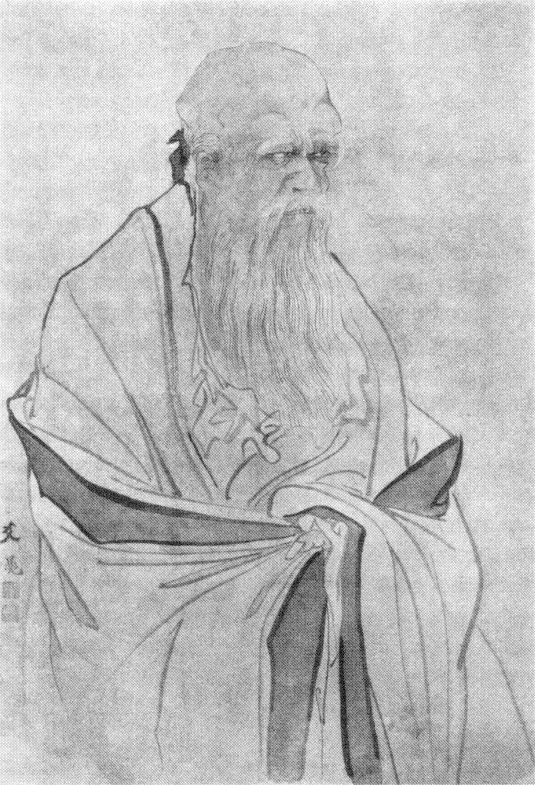

Portrait of Laozi

AI Historical Figure

Laozi

Ancient Chinese philosopher and writer of the Tao Te Ching.

Chat with Laozi via text or voice — in 42 languages, drawing on a curated biography and 85 historical sources. Available 24/7.

Start chatting with Laozi20 messages free · No credit card
Lived
c. 6th century BCE
From
China
Known for
ReligionPhilosophy
Laozi

Laozi

Online · responds in seconds

Hello — I'm Laozi. Ancient Chinese philosopher and writer of the Tao Te Ching. What would you like to ask me?

20 messages free · No credit card · Powered by Humy.ai

Live preview · Switch between 42 languages above · Send a message to continue in the app

Multilingual

Talk to Laozi in 42 languages

Ask Laozi questions in any language below, and the rest of Humy's app speaks it too. Pick yours to open the chat in that language.

Also in German (Austria), German (Switzerland), English (UK), English (Australia), English (Canada).

The sources behind this AI

85 sources · 33 books · 27 paintings · 12 sculptures · 10 artifacts · 2 photographs · 1 document

Laozi doesn’t improvise from thin air. The AI is grounded in 85 curated historical sources students can inspect. Open any of them to see what informs the conversation.

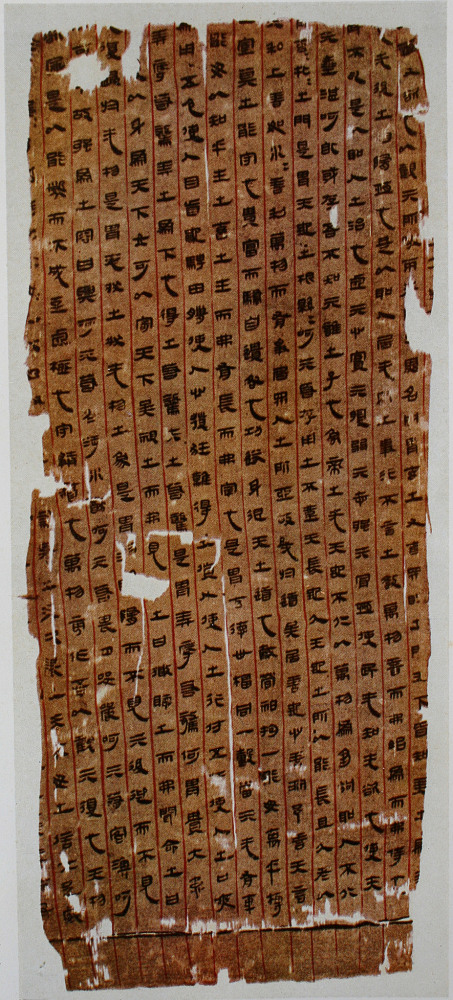
Photograph of a long vertical manuscript fragment with brown, degraded edges, written in black ink in columns of seal-script-style Chinese characters separated by faint red ruling lines. Light patches and damage are visible across the surface.Book

Secondary source

Tao Te Ching

Laozi · c. 4th-3rd century BCE

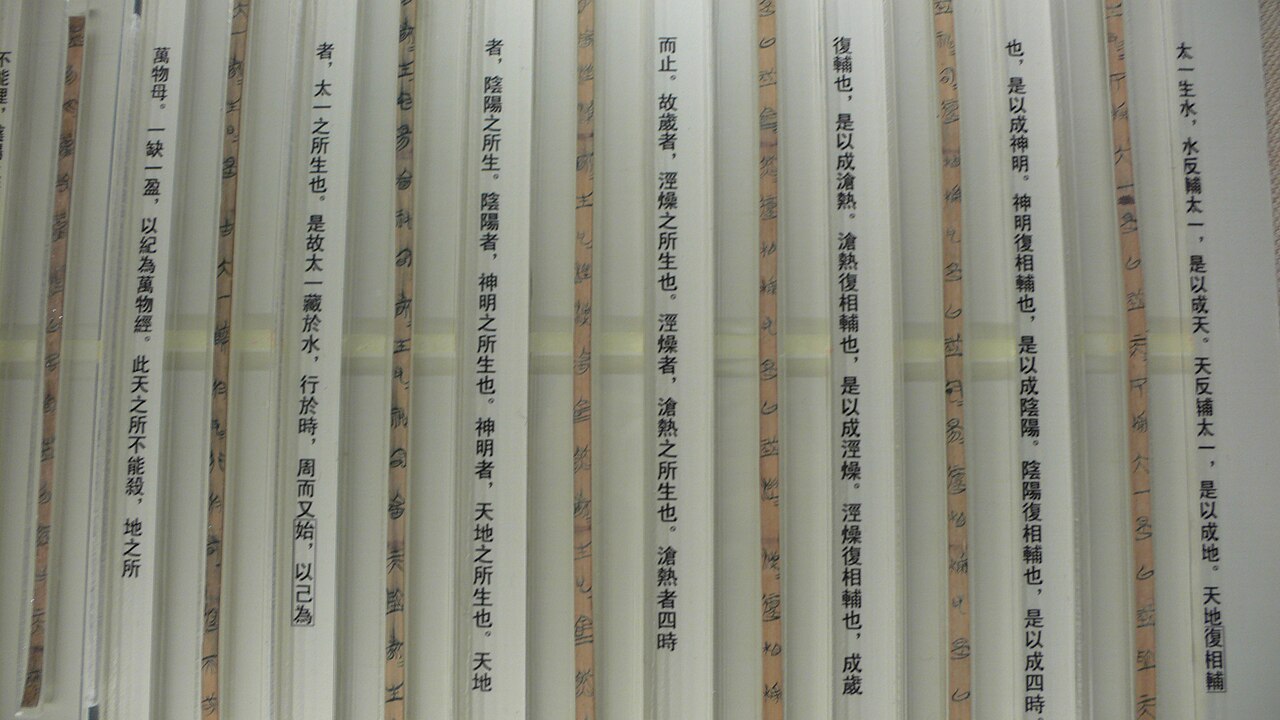
Partial view of a museum display of thin bamboo slips standing upright in a row, each with vertical Chinese characters. Printed black text on white panels in front of the slips reads in columns.Artifact

Primary source

Bamboo Texts of Guodian

c. 300 BCE

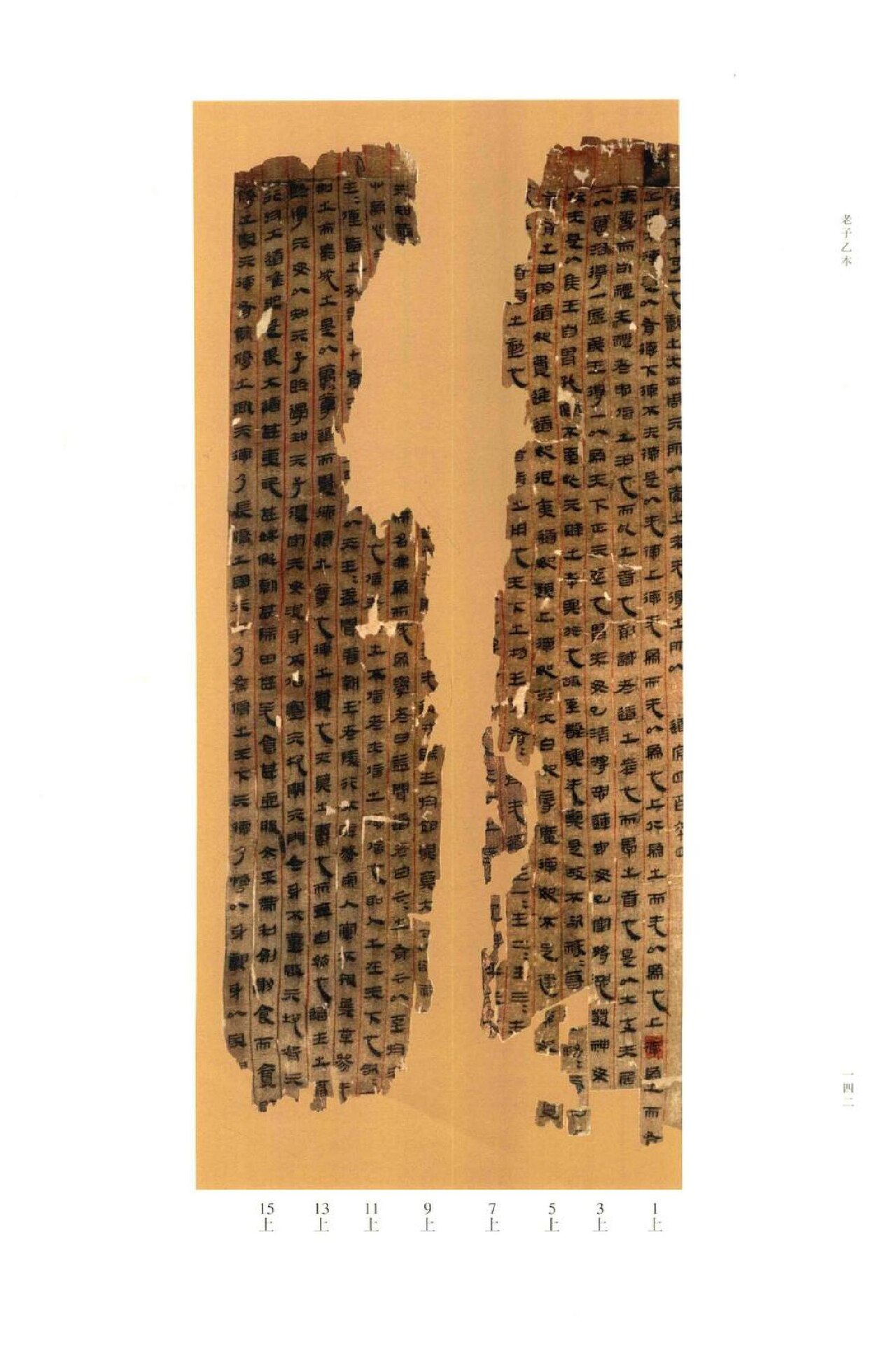
Photograph of a long, damaged strip of silk-like manuscript with rows of dark brown Chinese characters in vertical columns on a tan background, with numbered column labels below (15 上, 13 上, 11 上, 9 上, 7 上, 5 上, 3 上, 1 上). The strip is torn and fragmented, with a red seal mark near the lower right.Book

Primary source

Mawangdui Silk Texts of the Laozi

Anonymous Han scribes · c. 200-168 BCE

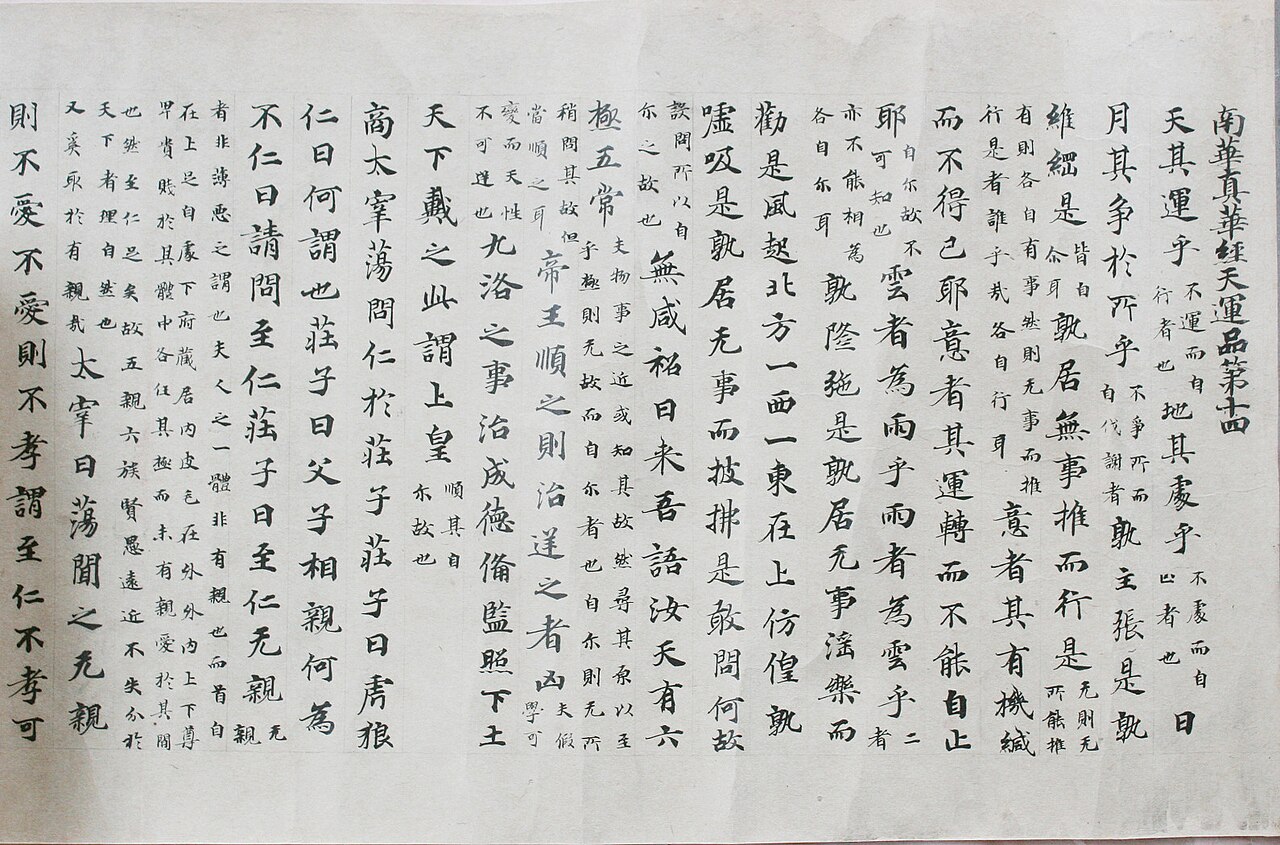
Photograph of a handwritten classical Chinese manuscript page in vertical columns of brush-written characters on aged paper, with a title line at the top right reading as a chapter heading from the Zhuangzi.Book

Secondary source

Zhuangzi

Zhuang Zhou · c. 300 BCE

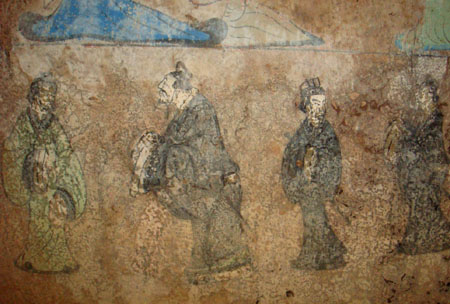
Faded fresco on a tan plastered wall showing several robed figures standing in a row, painted in green, grey and black tones, with a blue painted band at the top. Part of the fresco is worn and discolored.Painting

Secondary source

Confucius and Laozi fresco, Dongping tomb

Anonymous Chinese painter of the Western Han period · Western Han period, c. 2000 years old

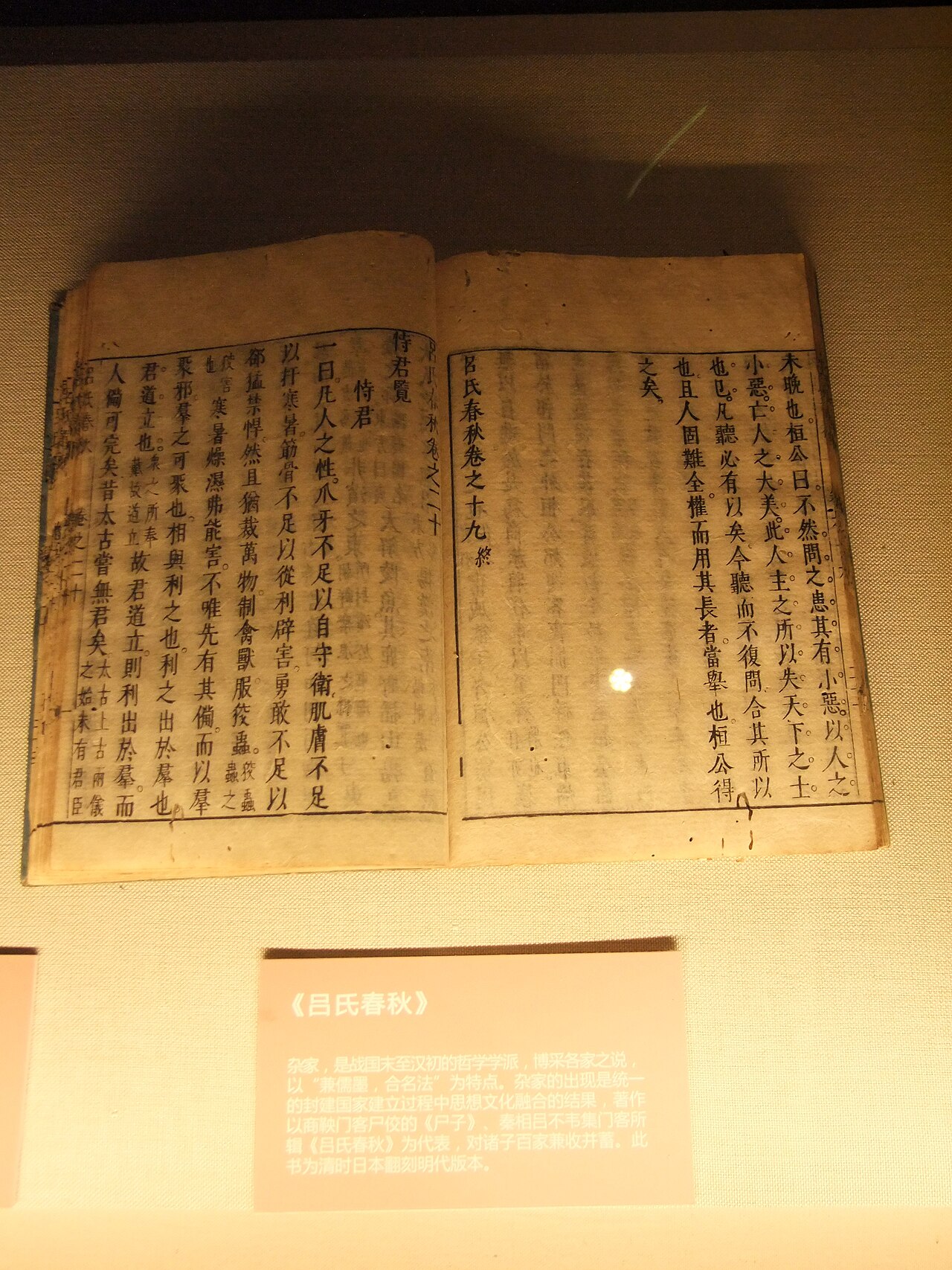
An open old Chinese woodblock-printed book in a museum display case, with vertical columns of black characters on yellowed paper. A Chinese caption card below reads 呂氏春秋 (Lüshi Chunqiu).Book

Secondary source

Lüshi Chunqiu

Lü Buwei (compiler) · c. 239 BCE

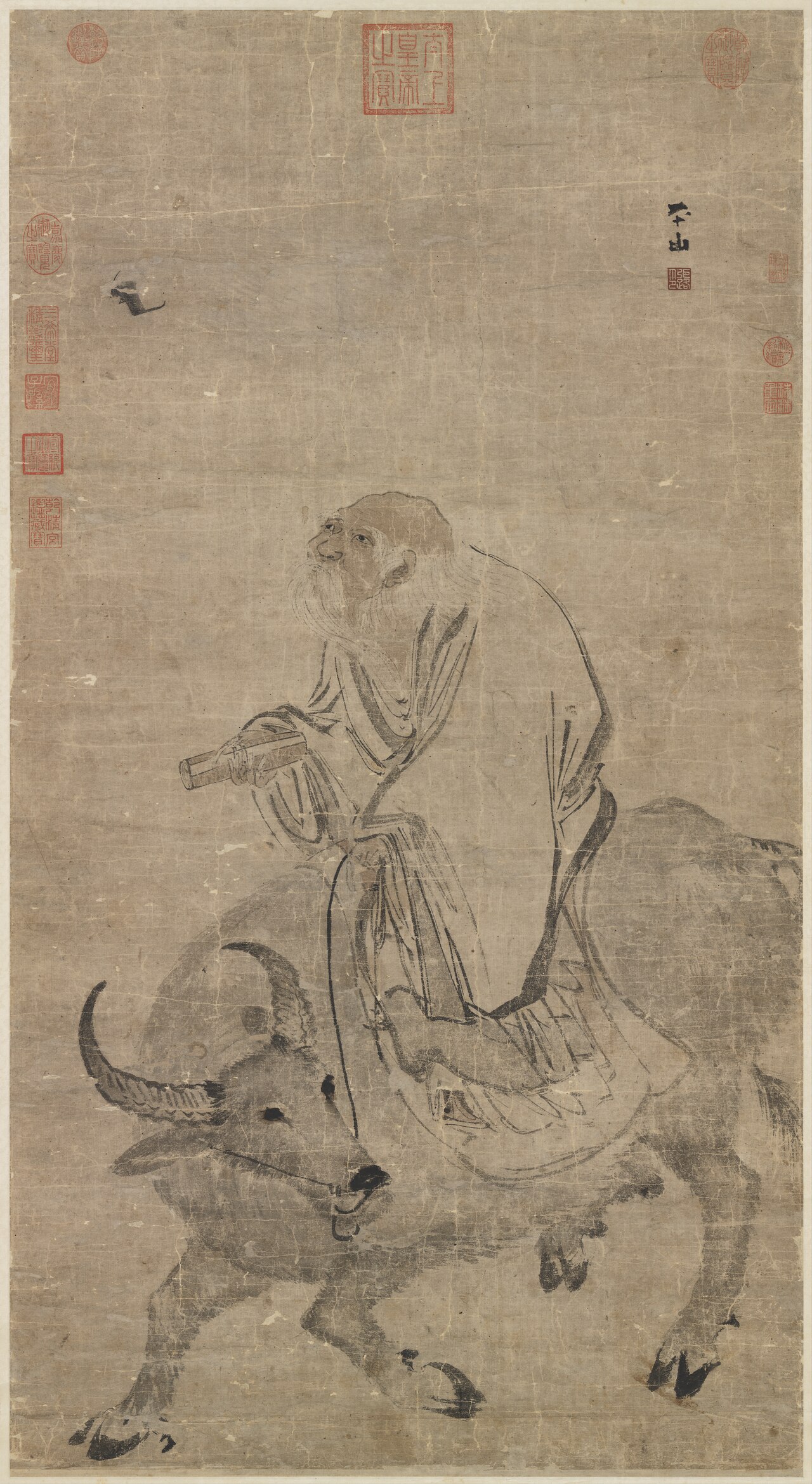
Ink painting on aged paper, showing an elderly bearded robed man holding a scroll and riding a horned ox that walks toward the lower left. Several red seals appear along the top and sides of the paper.Painting

Secondary source

Lao-tzu Riding an Ox

Zhang Lu · Ming dynasty

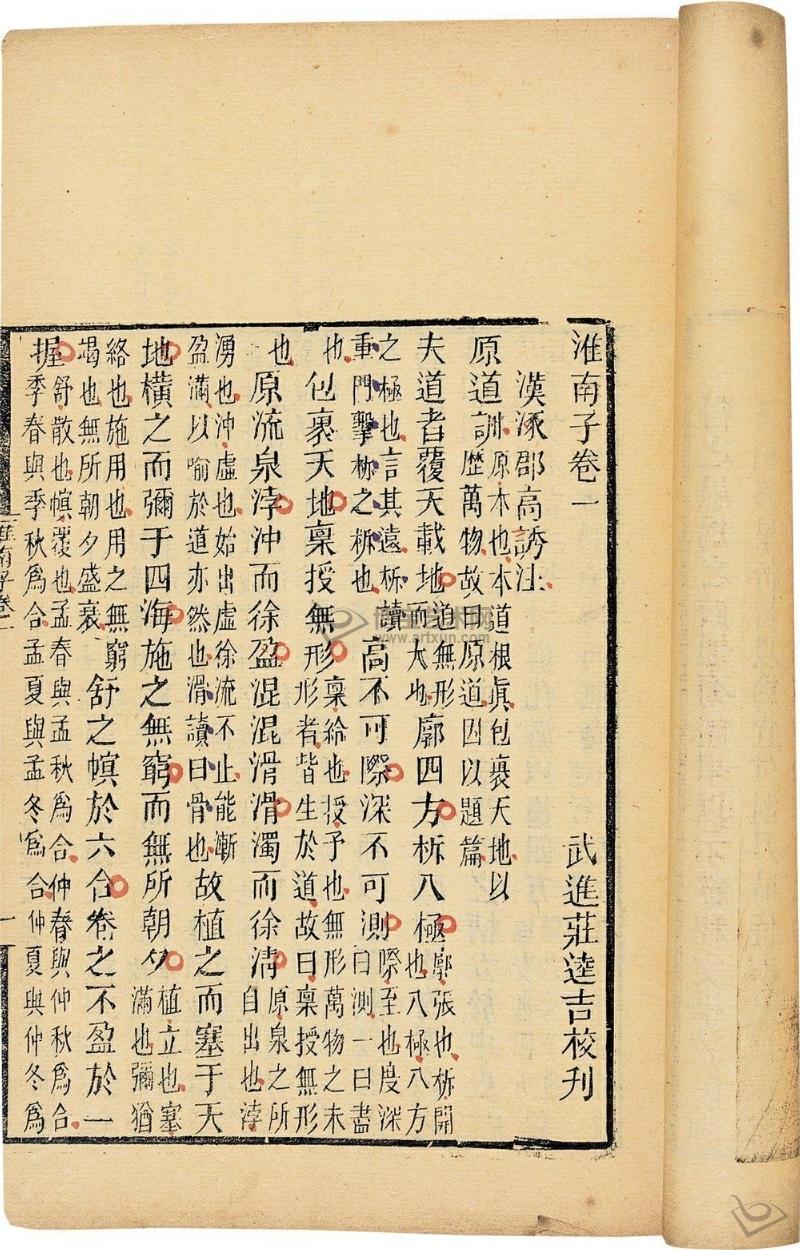
Page of a printed Chinese book in vertical columns of black characters with red punctuation marks, on yellowed paper. Header reads 淮南子卷一 and the colophon reads 武進莊逵吉校刊. The page is the first juan of the Huainanzi.Book

Secondary source

Huainanzi

Liu An · c. 139 BCE

Book

Secondary source

Shenxian Zhuan

Ge Hong · early 4th century CE

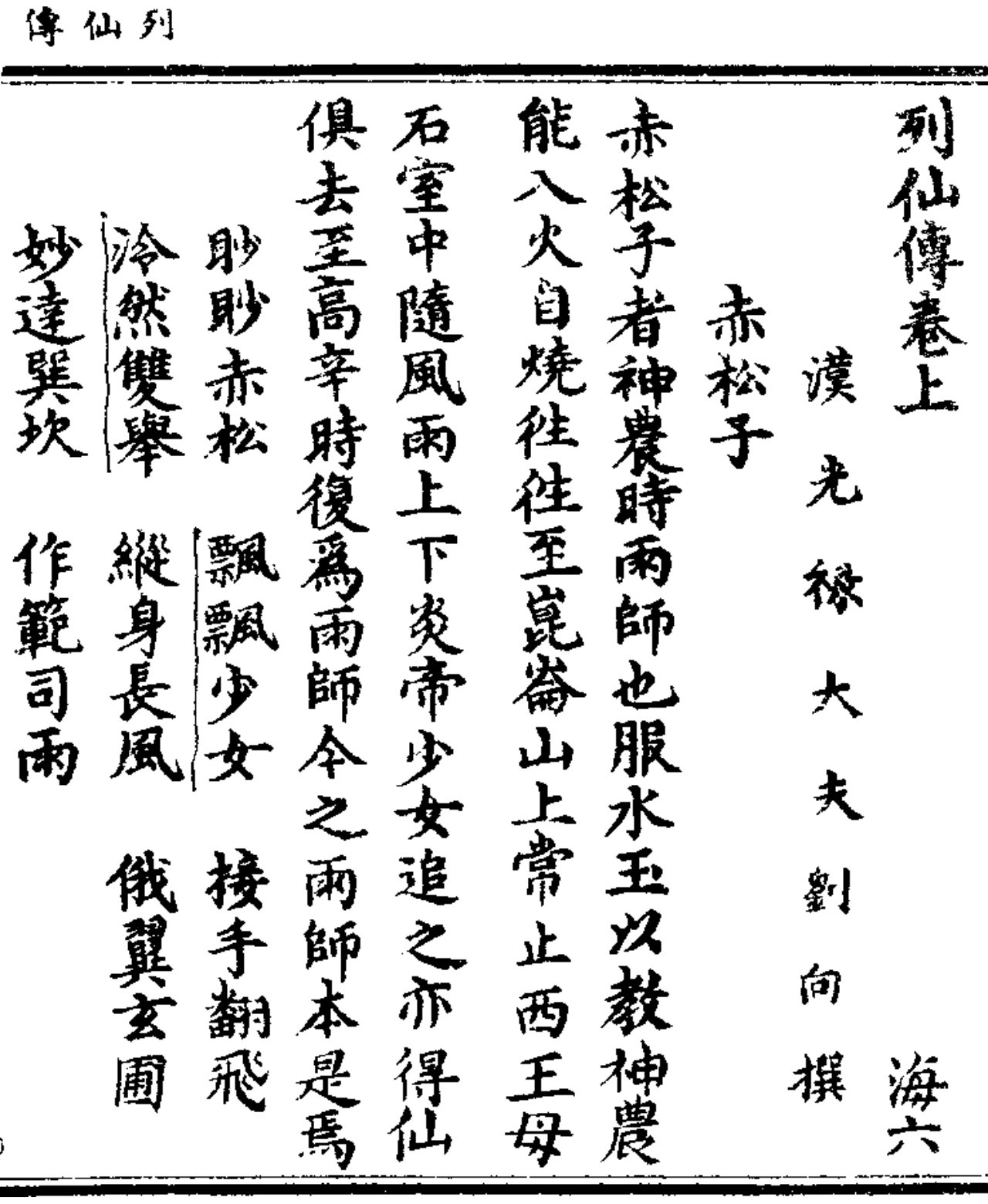
Printed page of Chinese vertical text in traditional characters. Header reads 列仙傳卷上 and 漢 劉向 撰, with the entry 赤松子 and a column of its narrative text below. Page marked 海六 at right.Book

Secondary source

Liexian Zhuan

Liu Xiang · 2nd century CE (traditionally attributed to Liu Xiang, 1st century BCE)

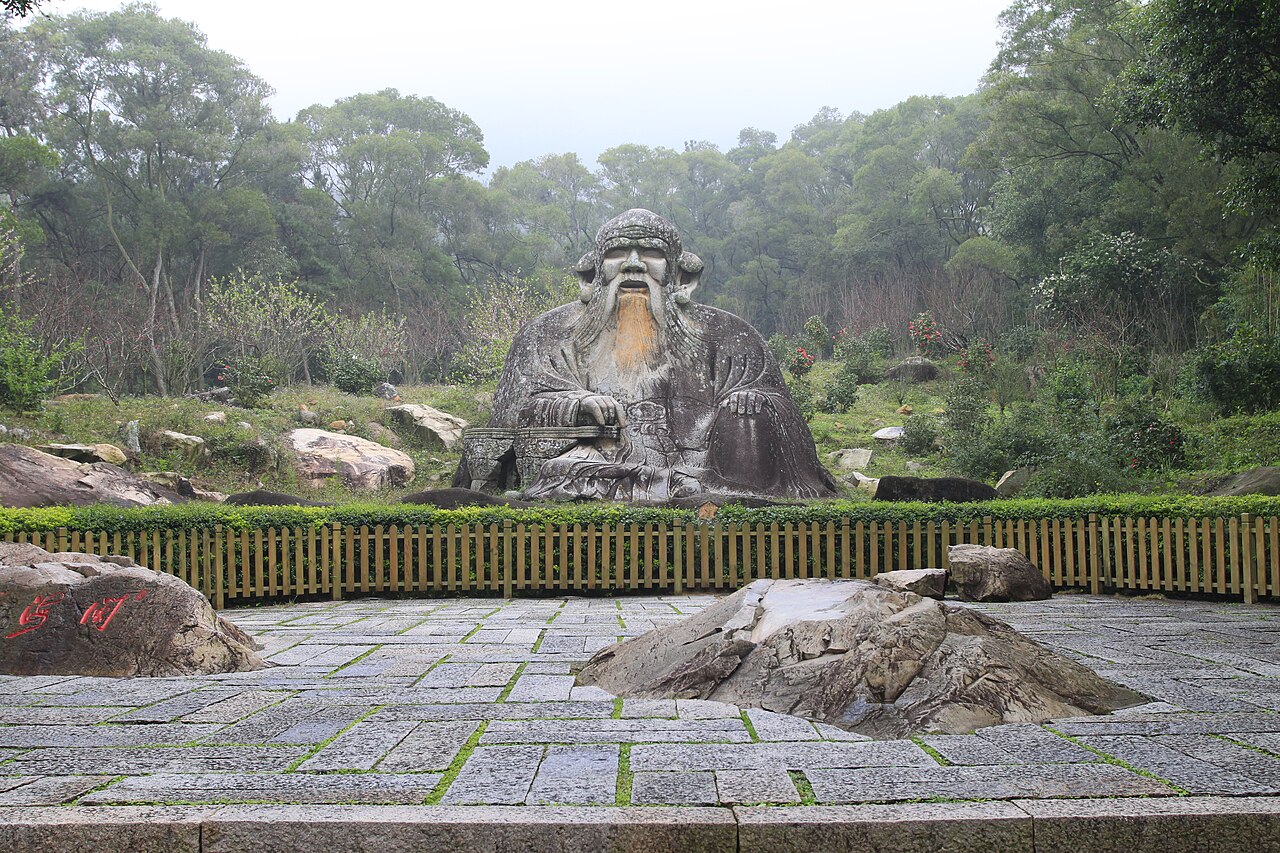
A large seated stone statue of an elderly bearded man with a long beard and topknot, carved from dark rock, in a landscaped park with paved stone ground, a low wooden fence, shrubs, and misty trees behind it.Sculpture

Secondary source

Stone Statue of Laozi at Qingyuan Mountain

Song dynasty sculptors · Song dynasty, c. 10th–12th century

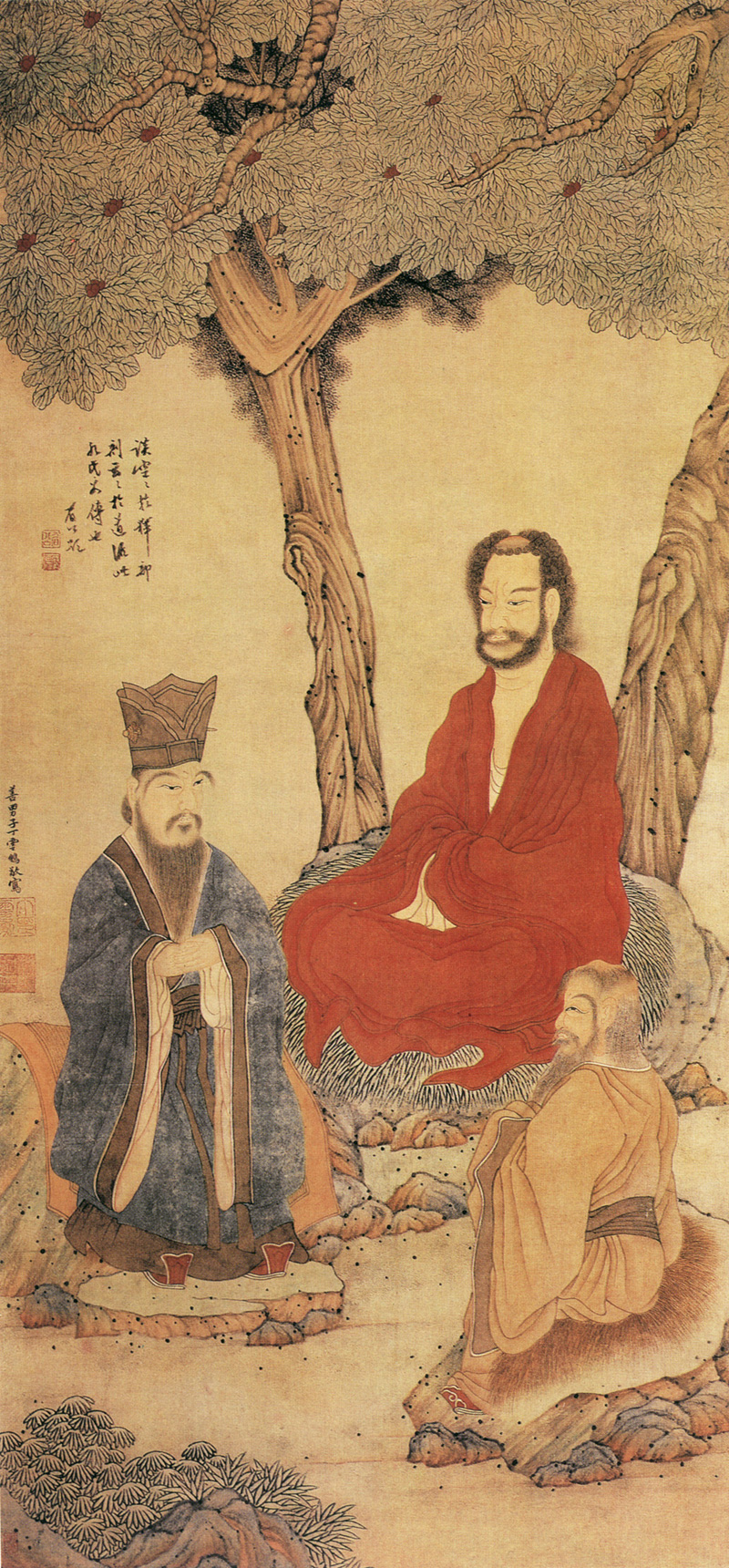
Hanging scroll painting in ink and color on paper showing three seated figures under a large tree: on the left a bearded man in a blue robe and tall hat, in the center a red-robed bald figure with a beard seated on a rock, and on the right a kneeling older man in a yellow robe. Calligraphy and seal stamps appear at the upper left.Painting

Secondary source

Confucius, Laozi and Buddhist Arhat

Ding Yunpeng · Ming dynasty

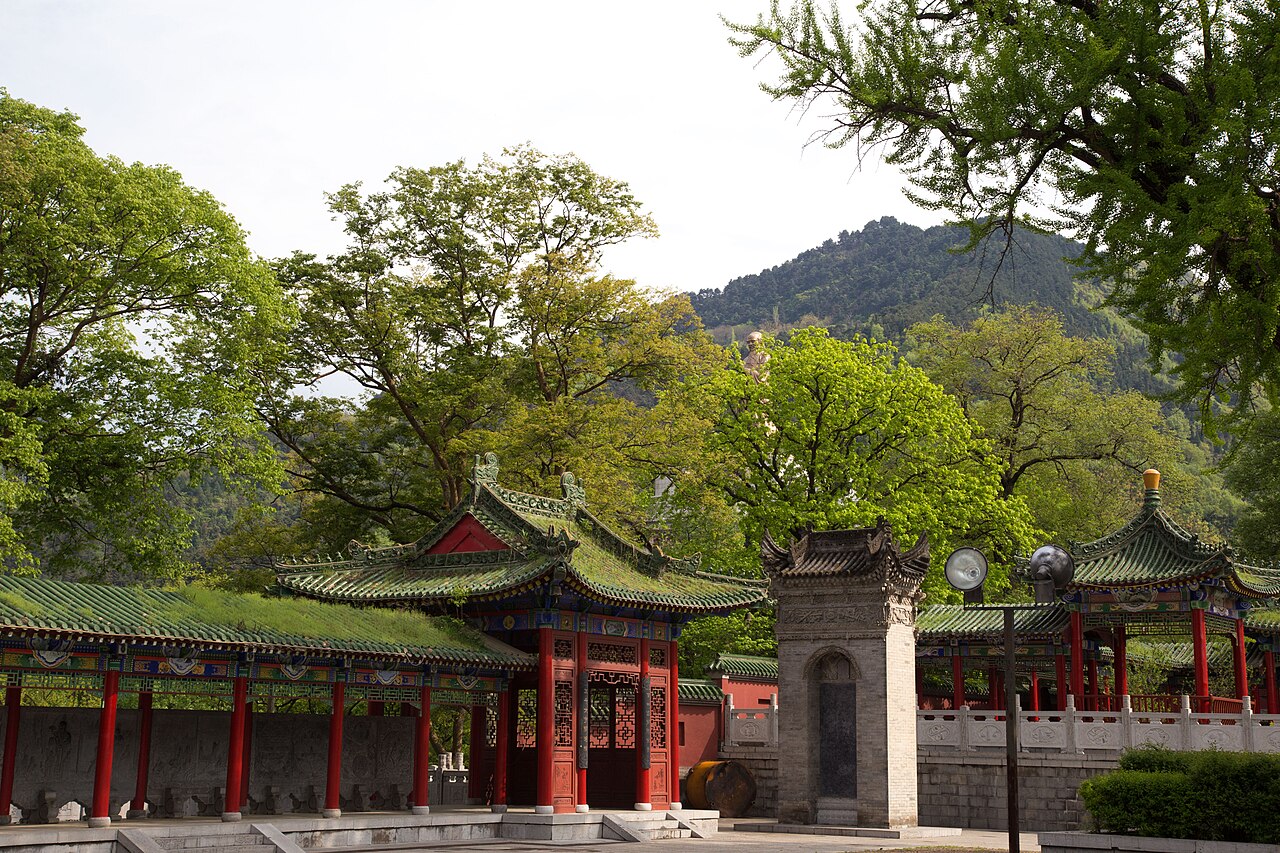
Louguantai Temple complex under green trees. Red-pillared pavilions with green-tiled, upturned roofs stand beside a stone gate tower and a white balustrade. A wooded mountain rises behind under a pale sky.Artifact

Secondary source

Louguantai

tradition from Han/Tang; present buildings later

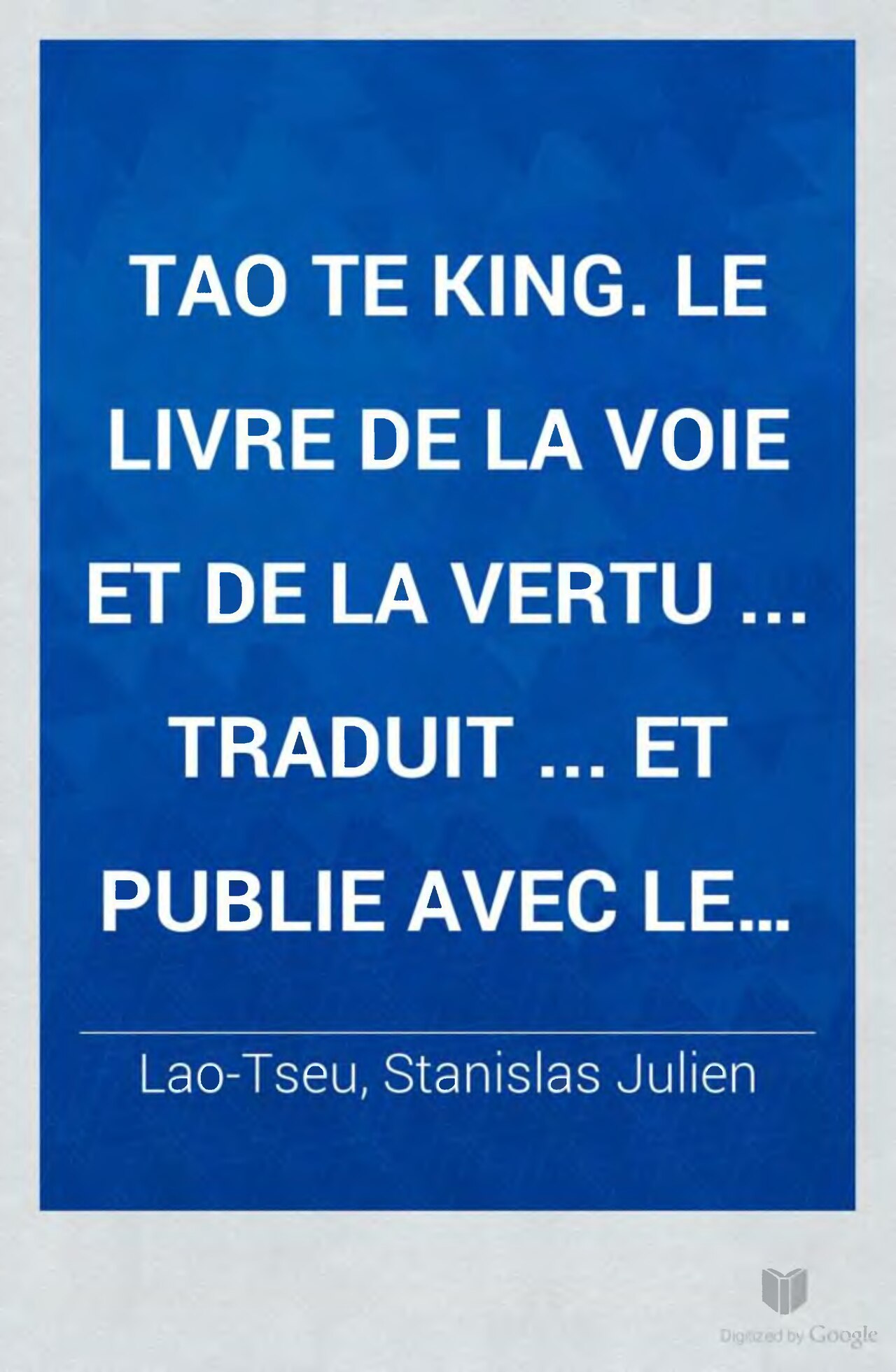
Blue cover of a book with white capital letters reading: TAO TE KING. LE LIVRE DE LA VOIE ET DE LA VERTU ... TRADUIT ... ET PUBLIE AVEC LE... Below a line, the author names Lao-Tseu, Stanislas Julien. A Google Digitized by Google logo appears at the lower right.Book

Secondary source

Le livre de la voie et de la vertu

Stanislas Julien · 1842

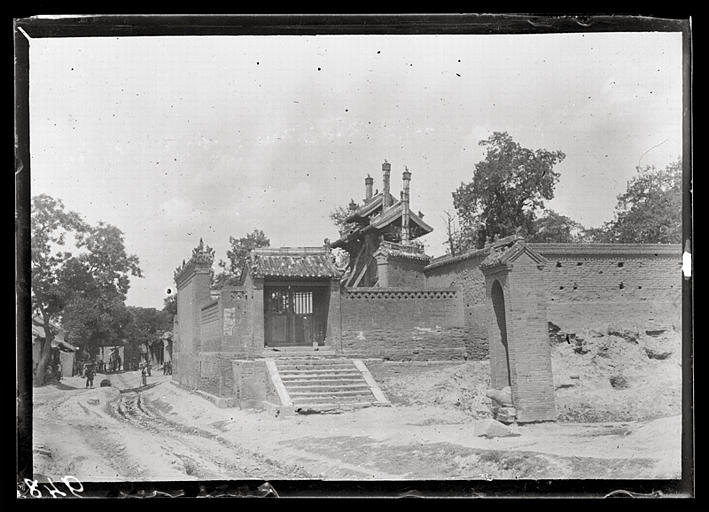
Black and white photograph of a brick temple-like building with a tiled, curved roof, a wooden door reached by a flight of stone steps, and a long brick wall. An arched brick gateway stands at right, with a dirt road and small figures in front and trees behind.Photograph

Secondary source

Stele Marking Where Confucius Questioned Laozi

Édouard Chavannes · 1907

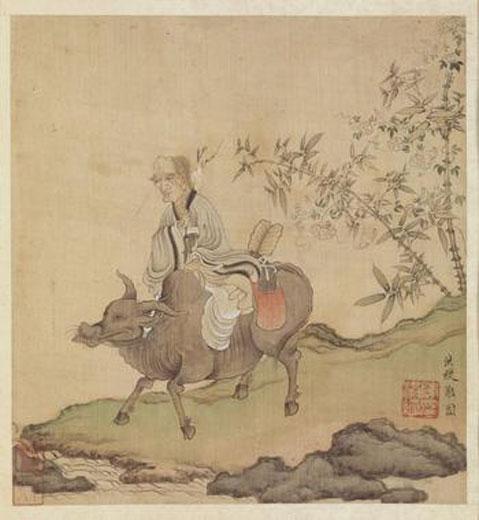
Chinese ink and color painting on silk of an elderly robed man with a topknot riding a dark ox along a grassy path beside rocks and a flowering branch with bamboo leaves. A red seal and inscription appear at lower right.Painting

Secondary source

Laozi Riding an Ox

Chen Hongshou · late Ming dynasty

Book

Secondary source

The Philosophers

Arthur Waley

Book

Secondary source

The Texts of Taoism (Sacred Books of the East)

James Legge · 1891

Painting of a robed figure in a dark, hooded cloak riding a dark ox or water buffalo across a path below pink and lavender snow-capped mountains with deep blue shadows. The sky is purple-lilac.Painting

Secondary source

Lao Tse

Nicholas Roerich

Document

Tertiary source

1911 Encyclopædia Britannica: Lâo-Tsze

1911

Original Chinese Texts of Laou-tsze, The Great Learning, The Doctrine of the MeanBook

Primary source

Original Chinese Texts of Laou-tsze, The Great Learning, The Doctrine of the Mean

Laozi · 1861

Book

Primary source

Dao De Jing

Laozi

Book

Primary source

Laozi (老子)

Laozi

Book

Secondary source

Lao-tzu, A Study in Chinese Philosophy

Thomas Watters · 1870

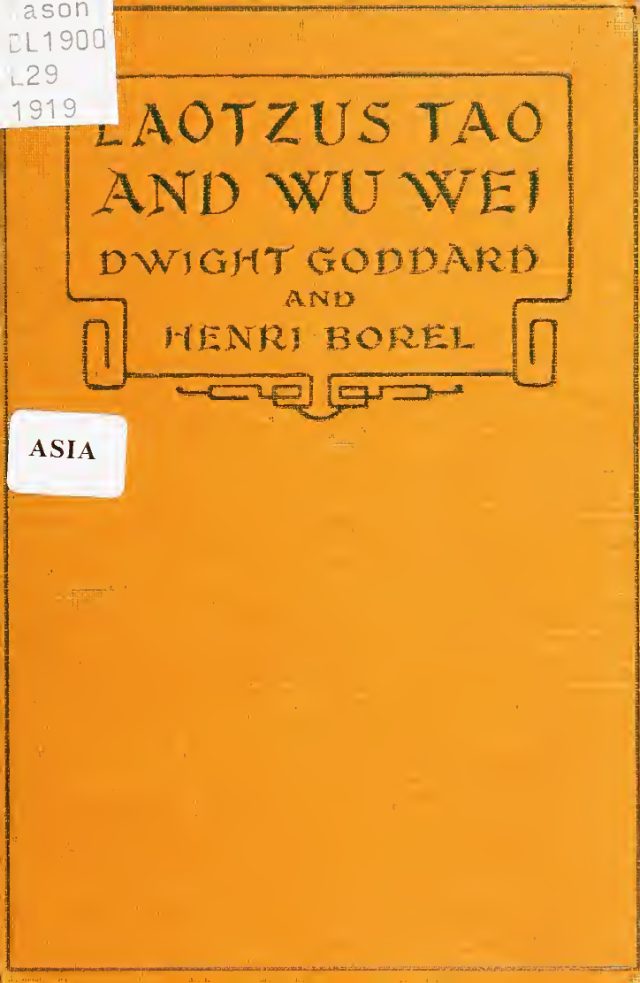
Laotzu's Tao and Wu WeiBook

Primary source

Laotzu's Tao and Wu Wei

Laozi · 1919

The Book of the Simple Way of LaotzeBook

Primary source

The Book of the Simple Way of Laotze

Laozi · 1904

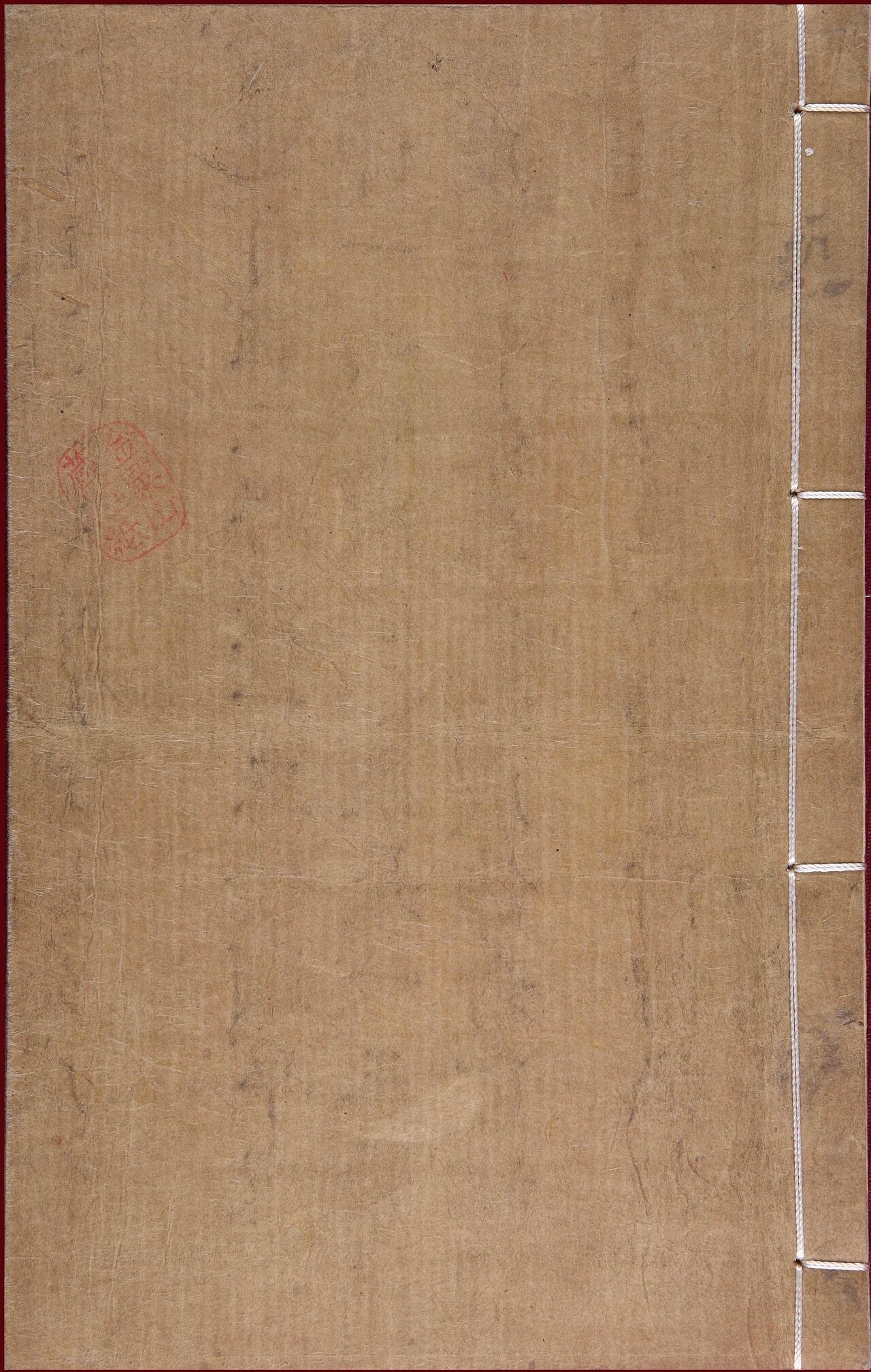
Plain tan paper page with white thread binding stitches along the right edge and a red oval seal impression on the left. The page is blank, apart from faint marks, and appears to be the inside of a book cover or endpaper.Book

Primary source

Daode jing, Song Jian'an Edition

Li Er (attributed)

Book

Secondary source

The Sayings of Lao Tzu

Lionel Giles · 1904

The Taoteh KingBook

Secondary source

The Taoteh King

T. W. Kingsmill · 1899

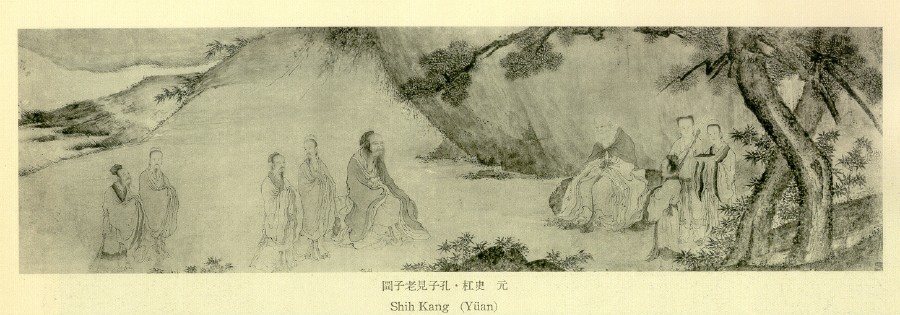
Monochrome reproduction of a Yuan dynasty handscroll painting of Confucius meeting Laozi. Robed figures stand and kneel on a misty landscape beside rocks and pine trees; a seated elderly sage is at right. Caption below in Chinese characters and 'Shih Kang (Yuan)'.Painting

Secondary source

Confucius Meets Laozi

Shih K'ang · Yuan dynasty (1261-1368)

Ink and light color painting on a grey-beige silk or paper ground of three elderly men in traditional robes and tall dark hats, gathered closely around a large tub. The central man is set back, and the two in front lean in toward the tub. A red seal and signature appear at the lower left.Painting

Secondary source

The Three Vinegar Tasters

Kanō Isen'in · c. 1802-1816

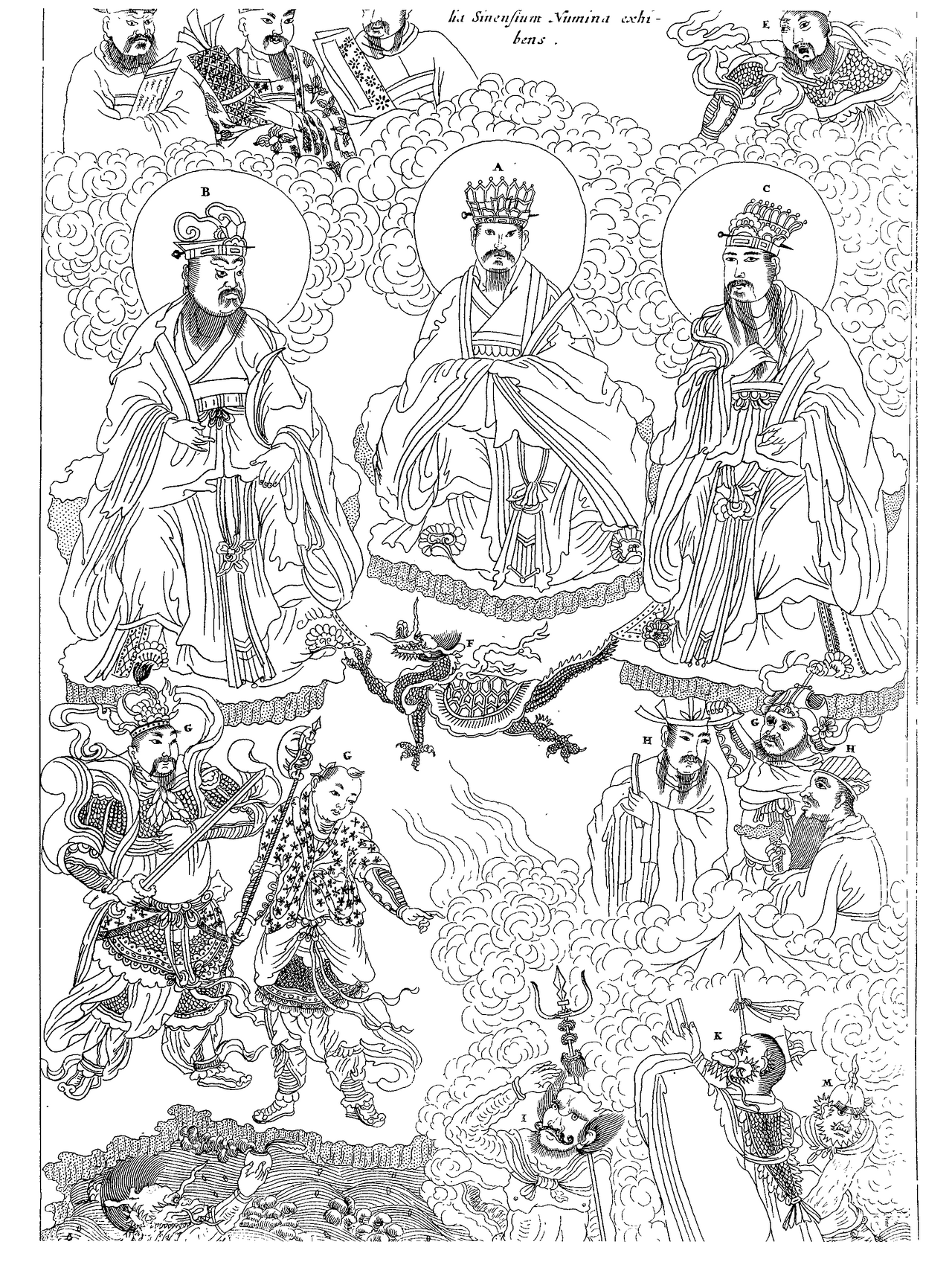
Engraved plate titled in Latin 'Principalia Sinensium Numina exhibens' showing labeled figures: three seated or standing robed deities in halos at top center and sides, a dragon with a tortoise shell between them, and below, armored guardian figures, attendants, a demon with a trident, and figures in clouds.Painting

Secondary source

Principal Deities of the Chinese

Unknown Chinese artist, with Latin captions by Athanasius Kircher · 1667

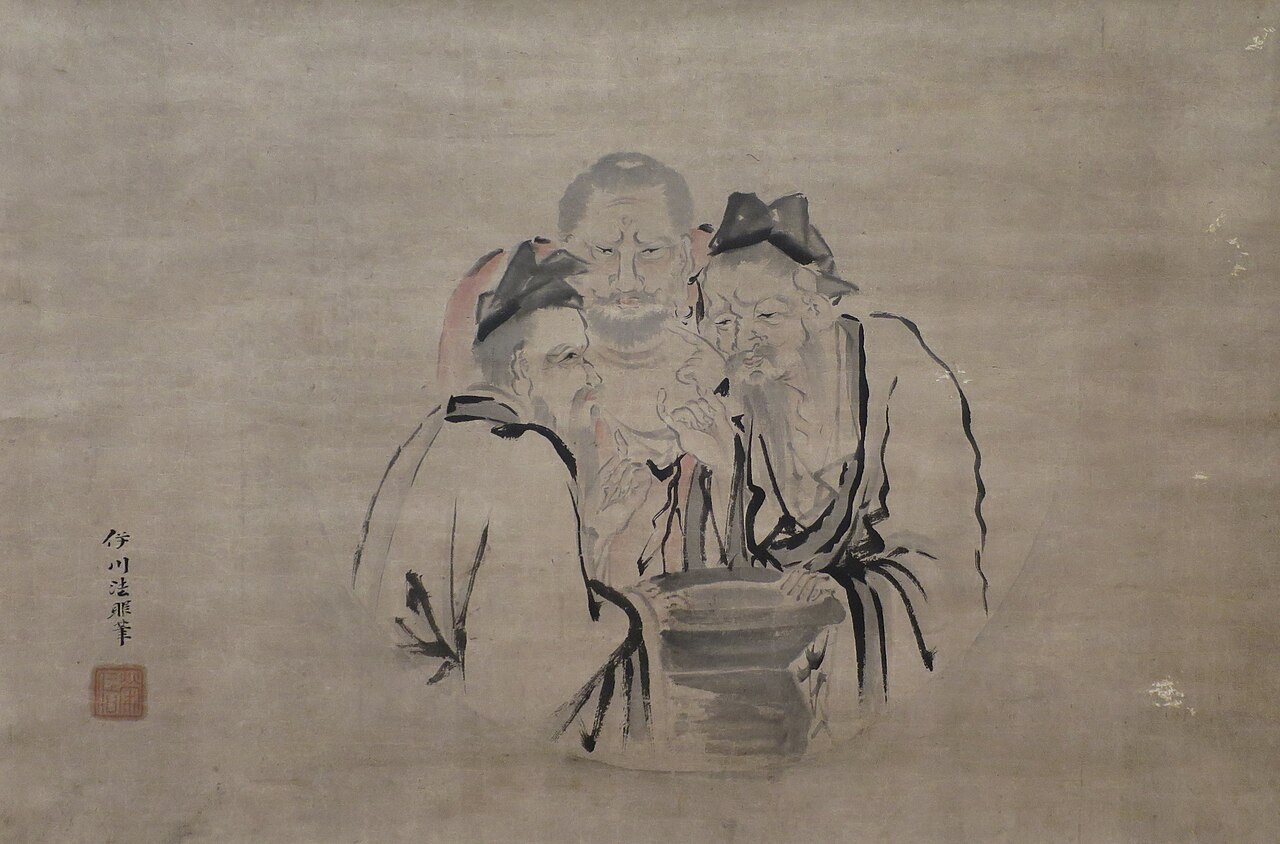
Hanging scroll painting of three men in robes crowded around a large earthenware vat, each leaning over and dipping a finger or looking into it. Muted grey-brown background with pale, ink-outlined figures.Painting

Secondary source

The Three Vinegar Tasters

Kanō school artist · 16th century

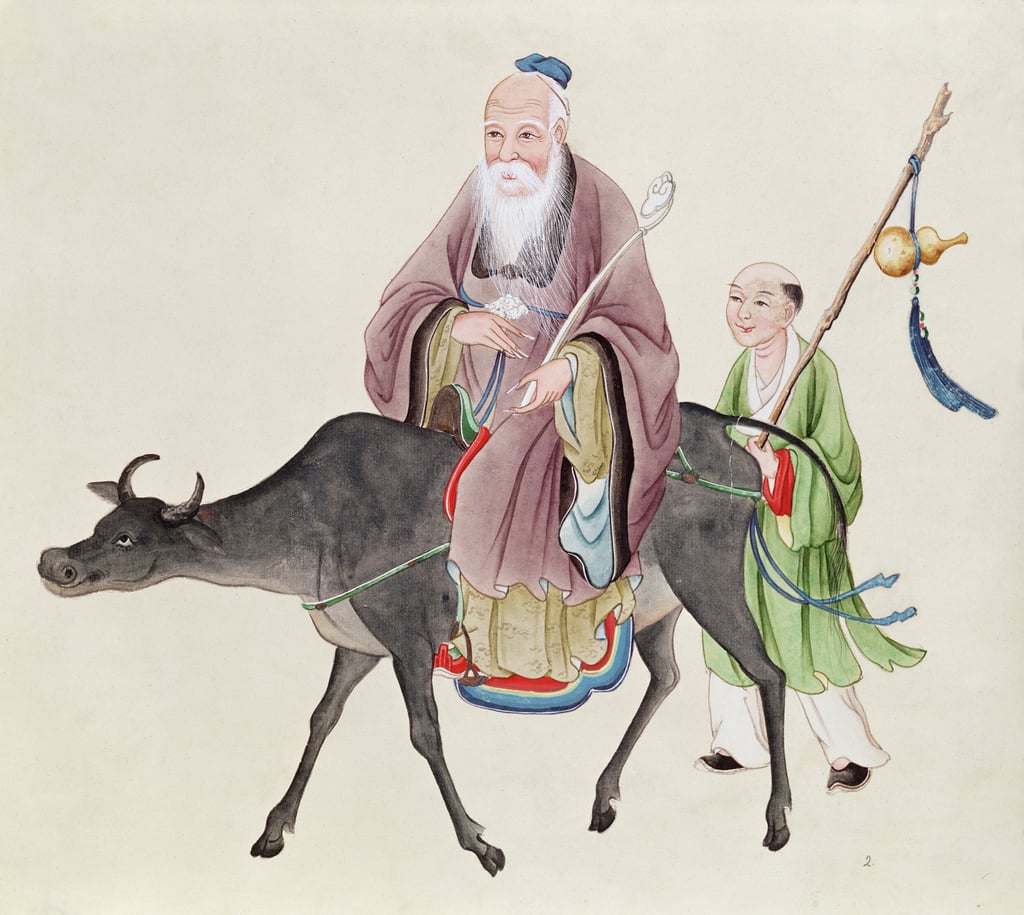
Painting on pale paper of an elderly bearded man with a white beard and a blue hair knot, wearing a mauve robe and holding a white fly-whisk, riding a dark water buffalo. A bald younger attendant in a green robe and white trousers walks beside, holding a long staff with a gourd and blue tassel.Painting

Secondary source

Lao-Tzu on his Buffalo, Followed by a Disciple

Unknown Chinese School artist · 18th century

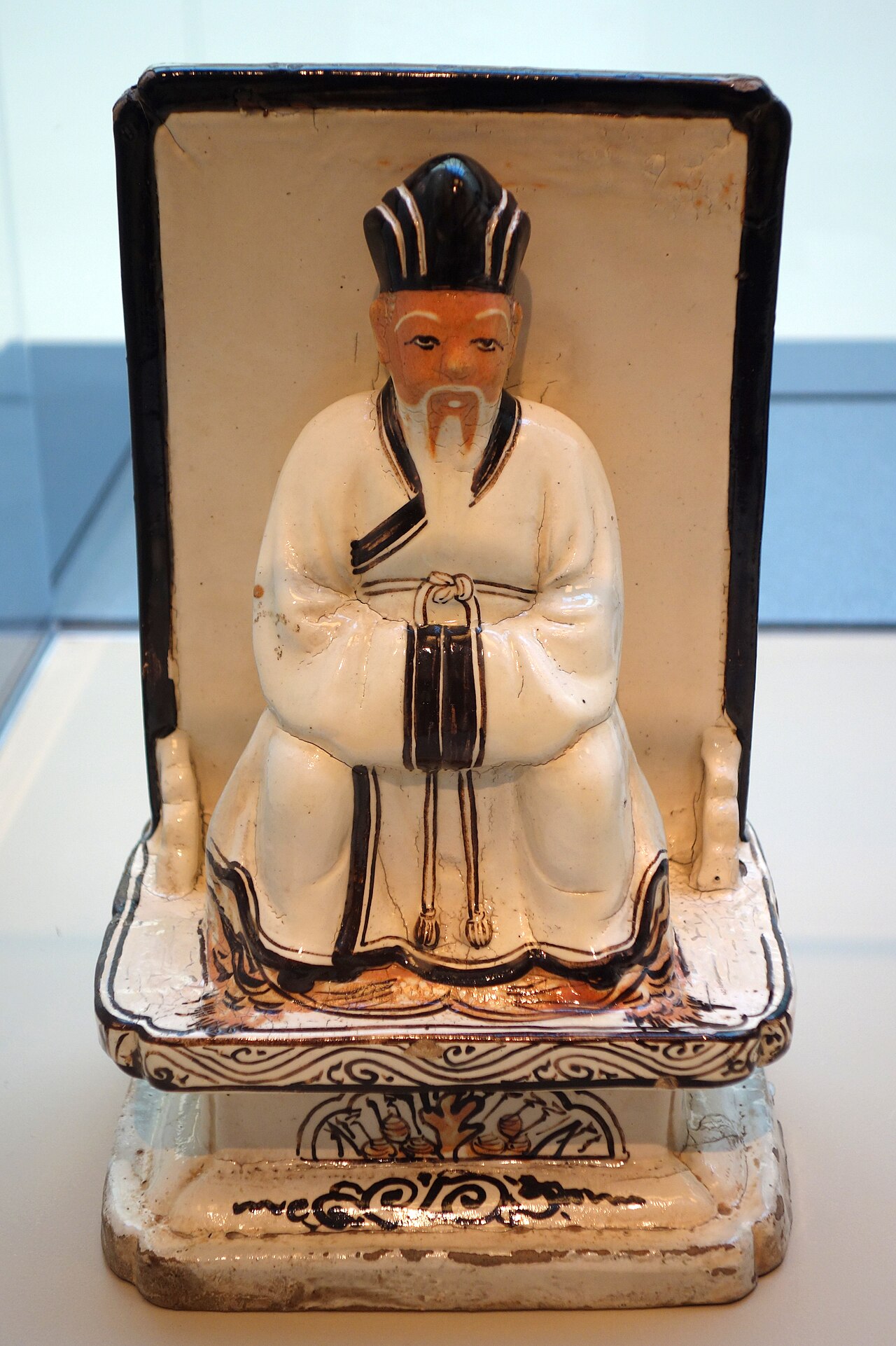
Glazed ceramic figure of a seated bearded old man in white robes with black trim and a black hat, hands clasped in his sleeves, set against a black-edged backboard on a white decorated pedestal.Artifact

Secondary source

Seated Laozi Figure, Cizhou Ware

Unknown Ming dynasty craftsman · Ming dynasty

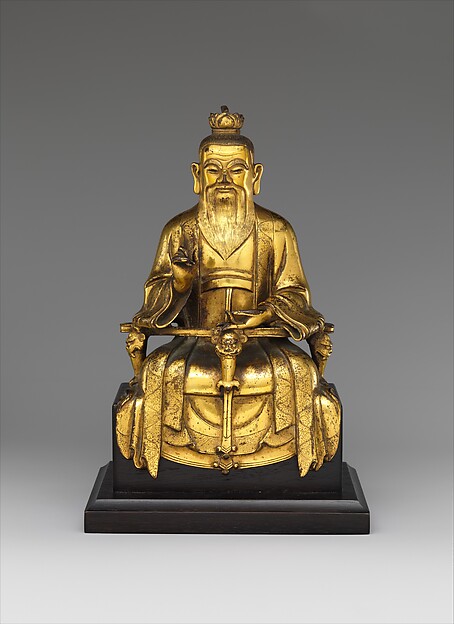
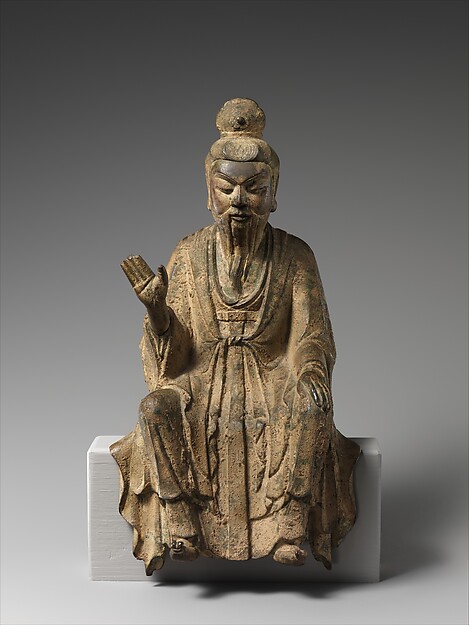
Gilded bronze seated figure of an elderly bearded man wearing a tall crown, with long flowing robes, resting on a lotus-like pedestal on a dark wooden base, against a plain gray background.Sculpture

Secondary source

Daoist Immortal Laozi

Chen Yanqing · 1438

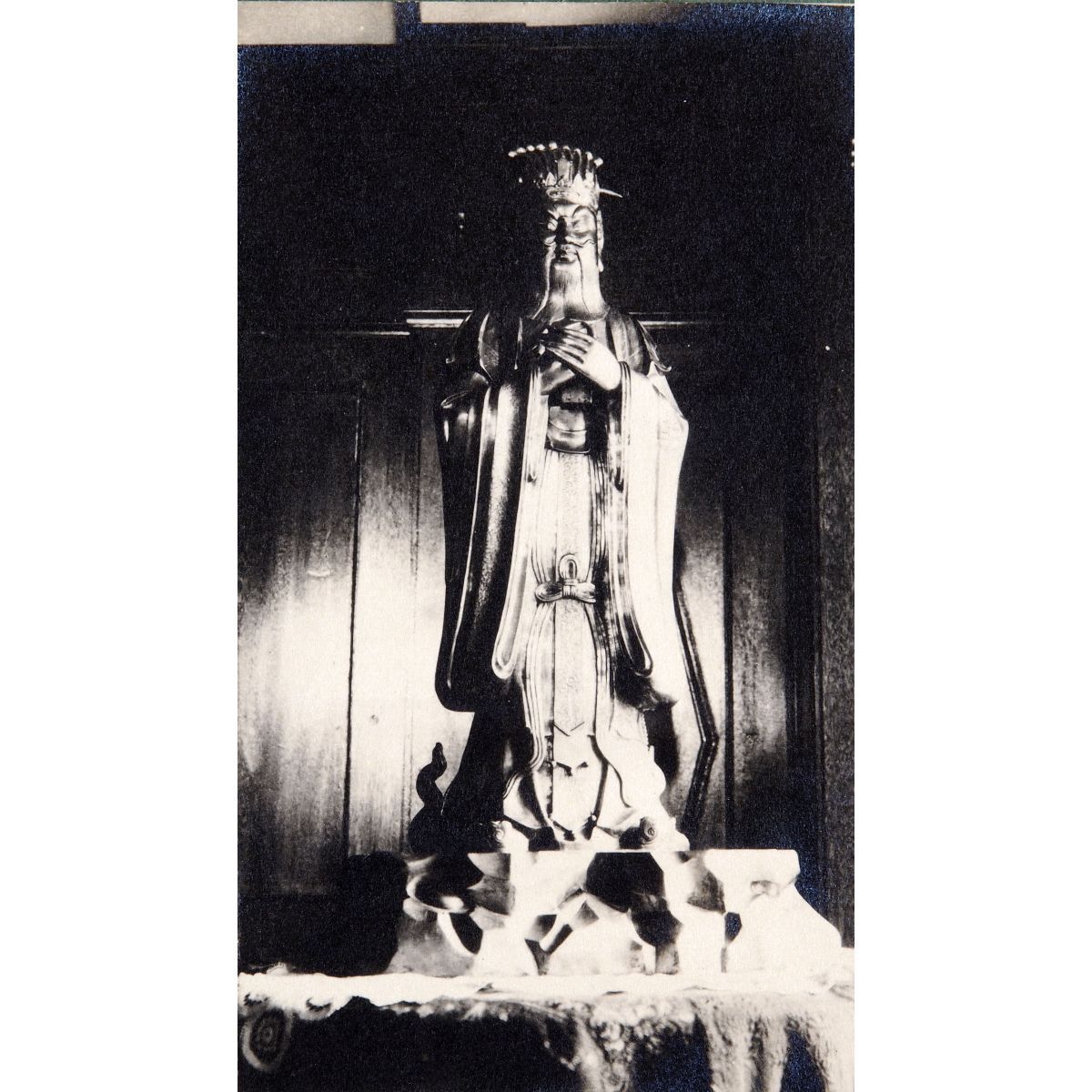
Black-and-white photograph of a standing statue of a robed figure wearing a crown-like headdress, hands clasped at the chest, on a stone pedestal over a draped altar table, in front of a dark wooden background.Photograph

Secondary source

Photograph of Laozi Statue in the Forbidden City

1914-1920

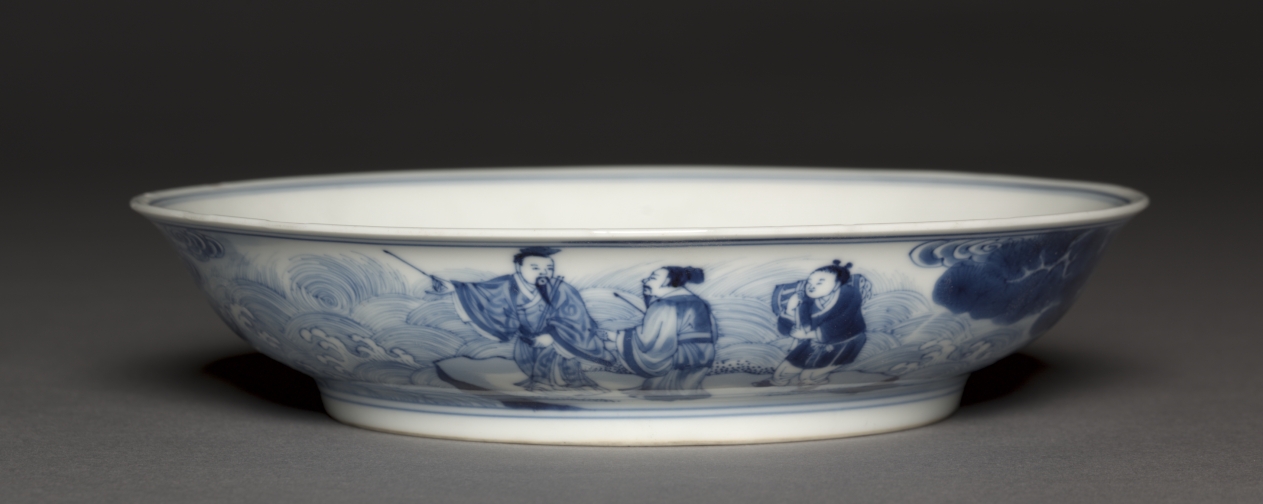
Side view of a shallow blue-and-white porcelain dish on a dark grey background. The exterior shows three robed figures painted in cobalt blue on wave-patterned ground, and a dark blue rocky outcrop with clouds at the right edge.Artifact

Secondary source

Dish with Laozi Riding a Water Buffalo

1723–1735

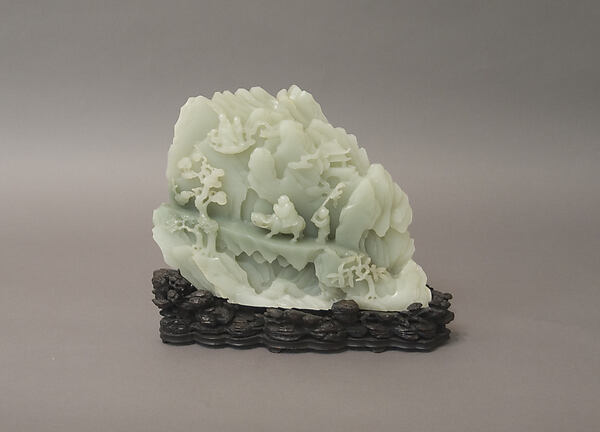
Photograph of a pale celadon-green jade carving of a mountainous landscape with small carved figures and trees, mounted on a dark carved wooden base shaped like rocks. Plain grey background.Artifact

Secondary source

Laozi Crossing the Han Pass

18th century

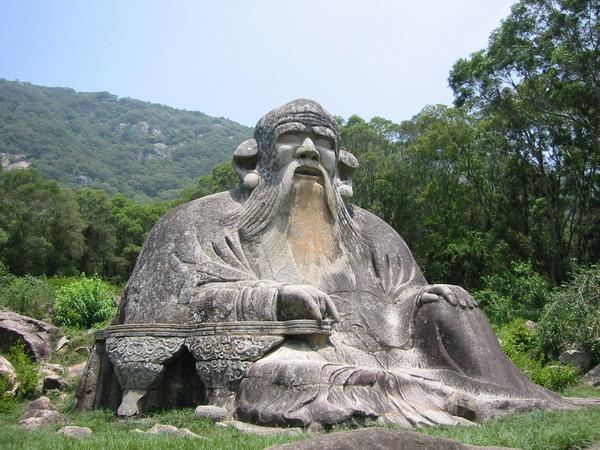
A large carved stone statue of a seated, bearded old man in traditional robes, with a long beard and topknot-like headwear, set outdoors among green trees and a hillside under a pale sky. The figure rests one hand on a carved stone pedestal.Sculpture

Secondary source

Laozi Sculpture

Thanato

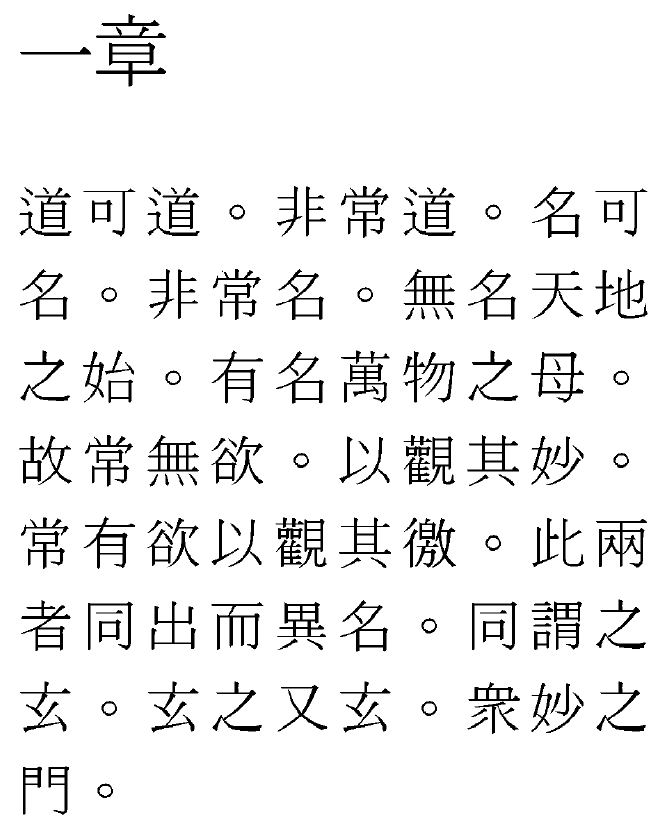
Black Chinese characters on white background. Heading 一章 (chapter one), then vertical-style lines of text beginning 道可道。非常道。名可名。非常名。無名天地之始。有名萬物之母。 Eight lines in total.Book

Primary source

Dao De Jing, Chapter One

Laozi

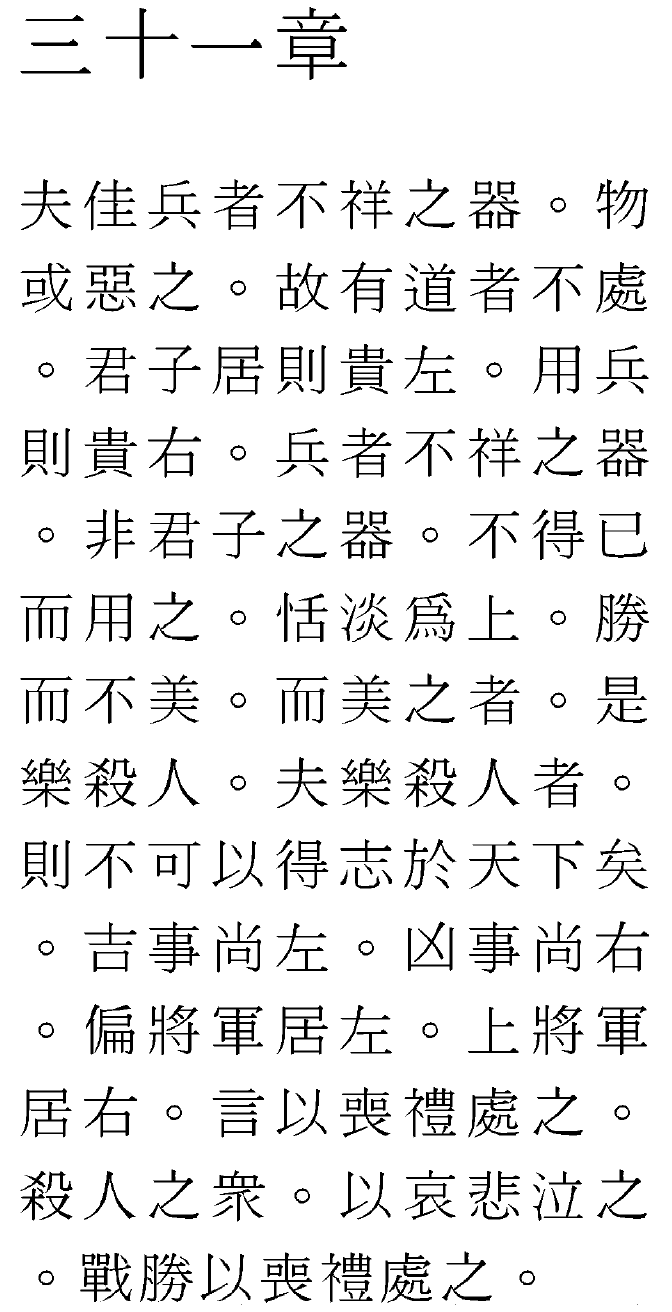
Text image of chapter 31 of the Dàodéjīng in traditional Chinese characters, vertical columns under the heading 三十一章, set in a plain black serif typeface on a white background.Book

Primary source

Dào Dé Jīng, Chapter Thirty-One

Laozi

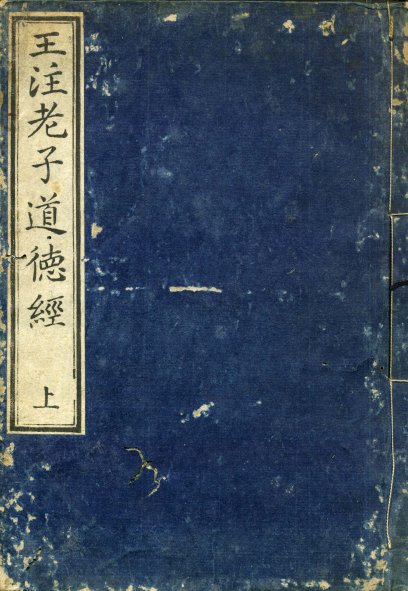
Front cover of a Chinese woodblock-printed book with a faded blue cloth or paper wrapper. A cream label on the upper left has a black border and vertical Chinese characters reading 王注老子道德經, with 上 at the bottom of the label.Book

Secondary source

Dao De Jing with Wang Bi Commentary

Wang Bi

Book

Secondary source

A History of Chinese Literature

Herbert A. Giles · 1901

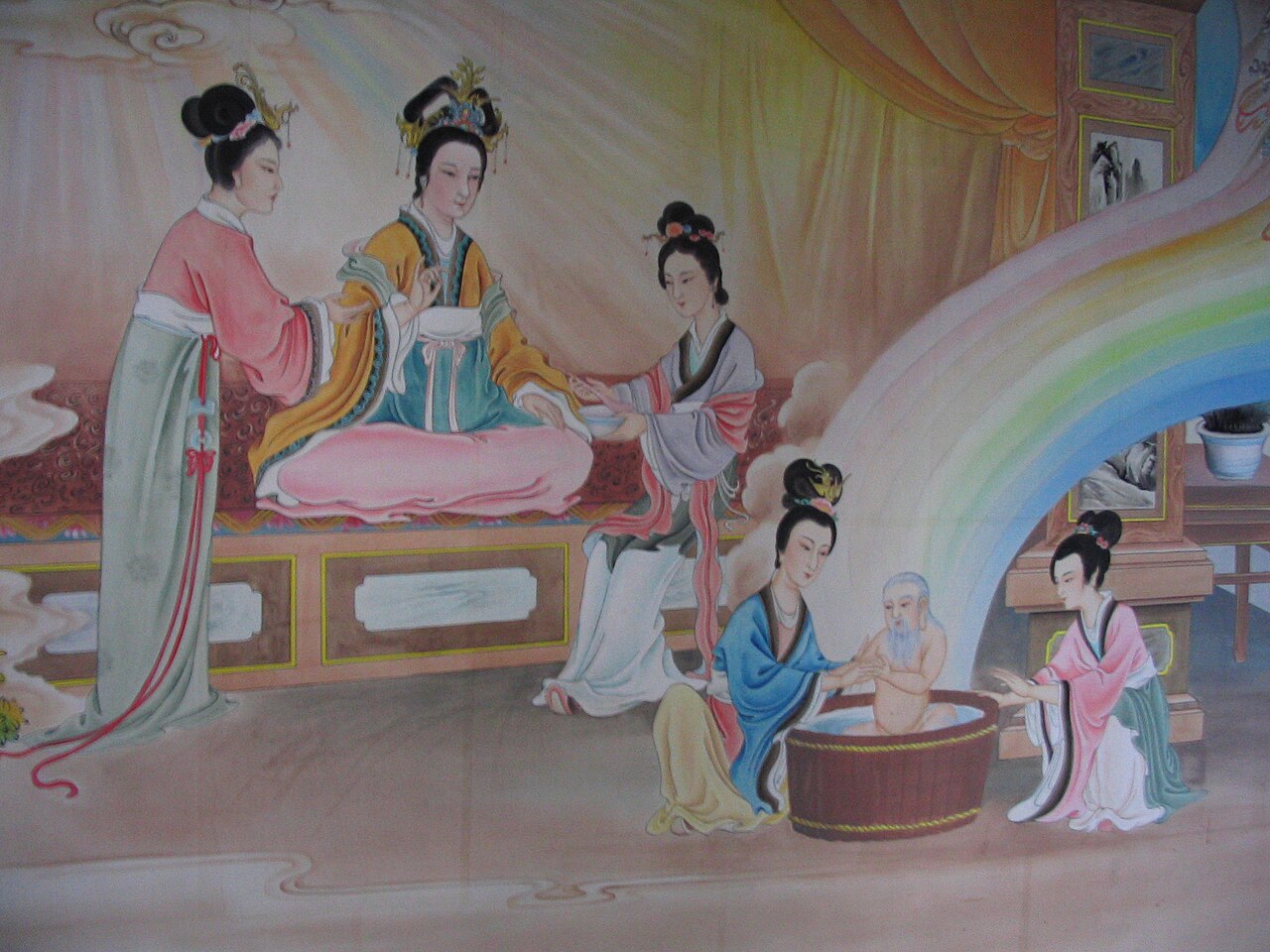
Painted wall mural in pastel colors showing a seated woman in gold and teal robes attended by female servants. A kneeling woman in blue bathes a small bald infant in a wooden tub, beside a painted rainbow arch and a kneeling attendant in pink.Painting

Secondary source

Baby Laozi Wall Painting, Qingyanggong

Unknown · Unknown date (photographed 2005)

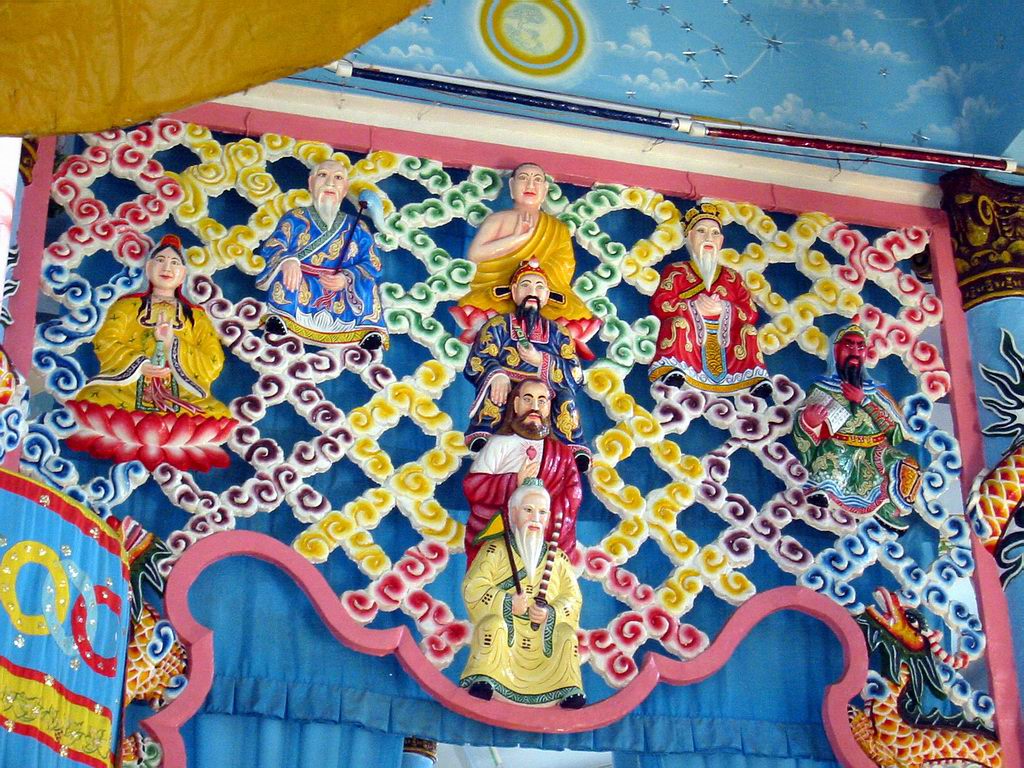
Colorful painted temple relief panel behind a lattice of swirling cloud motifs in pink, yellow, green, and blue. Robed figures are arranged in tiers: a bald figure at top, a bearded sage in blue on the left, a bearded figure in red on the right, a woman in yellow seated on a lotus at left, a red-faced warrior at right, and a yellow-robed bearded sage at bottom.Sculpture

Secondary source

Cao Dai Temple Relief with Lao Tzu

Unknown · 2005 (photographed)

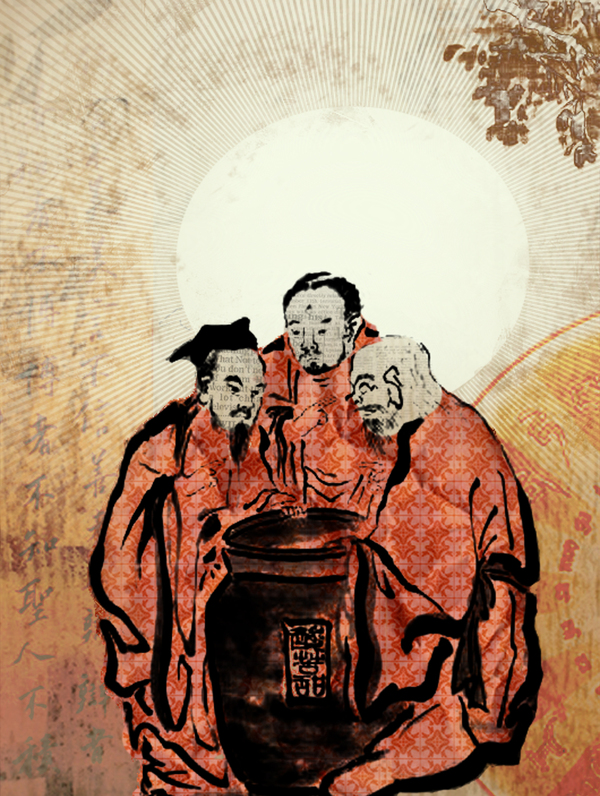
Three robed figures in red and black ink-style drawing stand around a large dark jar, each tasting from it, against a glowing pale sun and rays with faint Chinese characters at the left edge. Ink-like brushwork and red patterned fabric are visible.Painting

Secondary source

The Three Vinegar Tasters

Unknown · c. 1880

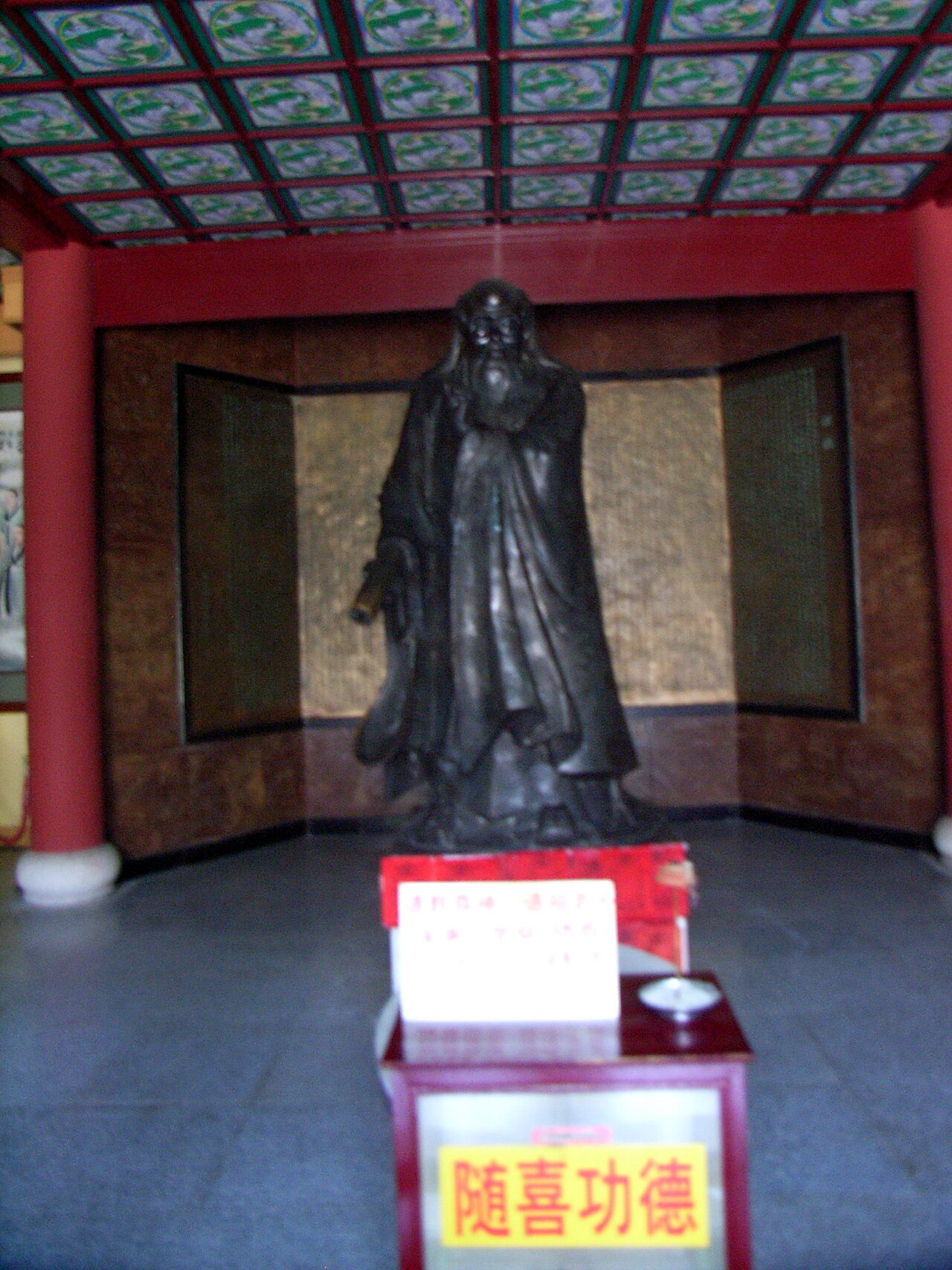
A dark bronze statue of the philosopher Laozi, bearded and robed, stands in a red-pillared temple hall under a painted ceiling. A small red and yellow placard with Chinese characters and a candle sit in front of it.Sculpture

Secondary source

Laotze Image in Nanyue Damiao Temple

Unknown · 2007 (photographed)

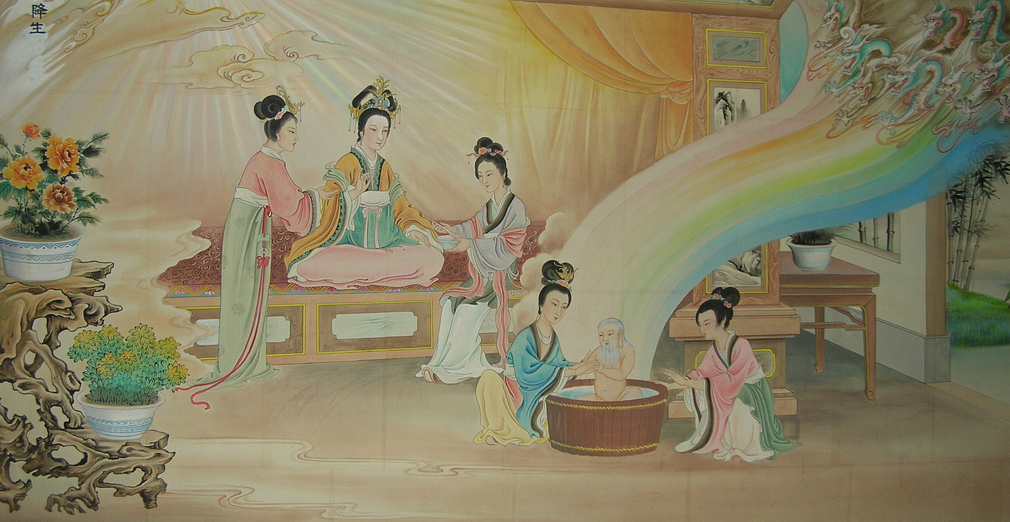
Painting of a Chinese scene with richly dressed women in flowing robes seated and attending on a central figure on a raised platform, with rainbow light and a flowing light beam from the upper right. An elderly white-bearded man is bathed in a wooden tub by a kneeling attendant, while another attendant kneels nearby. Potted flowers, a rock formation, and a painted screen are in the background.Painting

Secondary source

Birth of Laozi

Nyo · 2007

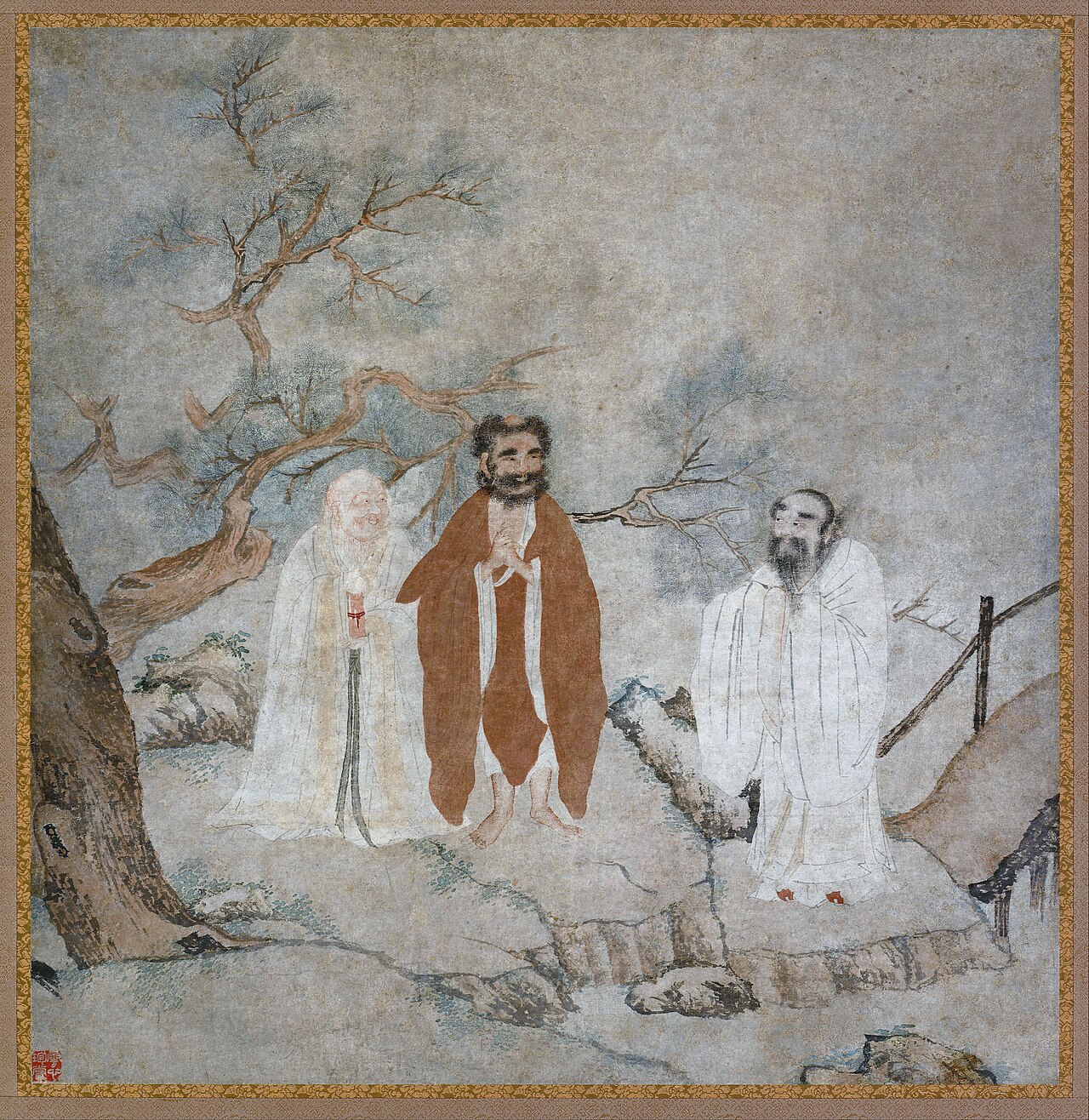
Painting on silk or paper with a pale grey-blue background, a bare-branched pine tree at left, and three robed figures standing on rocks: a white-robed elder with a staff at left, a barefoot bearded man in a brown-red robe in the center, and a white-robed bearded elder at right. A red seal appears in the lower left corner, framed by a gold brocade border.Painting

Secondary source

Sakyamuni, Lao Tzu and Confucius

Unknown · 1368–1644

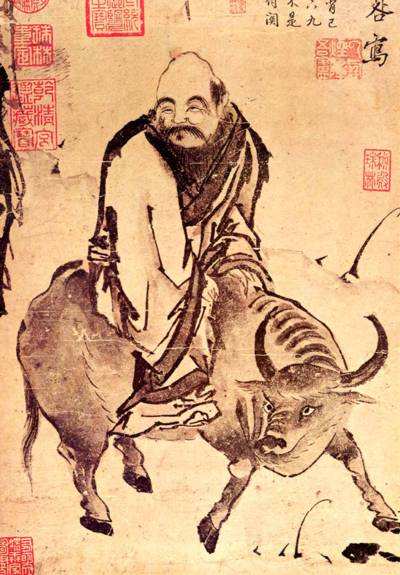
Ink painting on aged silk or paper with red seals: an old bearded man in flowing robes rides a dark water buffalo with curved horns, shown in brown ink wash with red seal stamps in the margins.Painting

Secondary source

Laozi Riding a Water Buffalo

Black-and-white ink drawing of an elderly bearded man with a long white beard and a bald head, wearing loose flowing robes with a sash. He is seated with hands clasped in his sleeves, and a seal-like inscription appears at lower left.Painting

Secondary source

Representation of Laozi

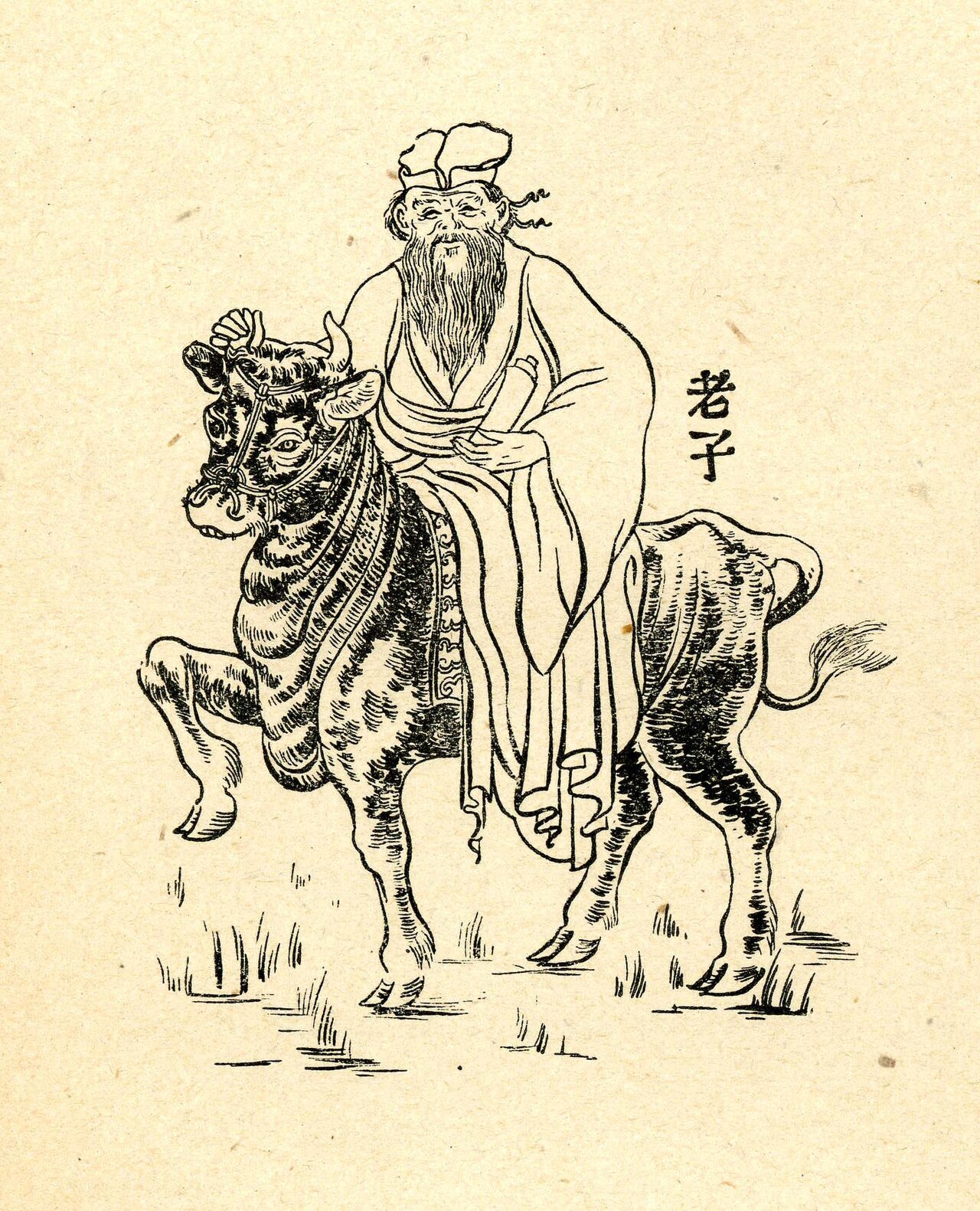
Black ink line drawing on cream paper of an elderly bearded man in long flowing robes and a tall hat, riding a horned water buffalo that walks left. Chinese characters 老子 appear to the right.Painting

Secondary source

Laozi Riding a Buffalo, Czech Edition Illustration

Tomáš Páv (copy) · 2008

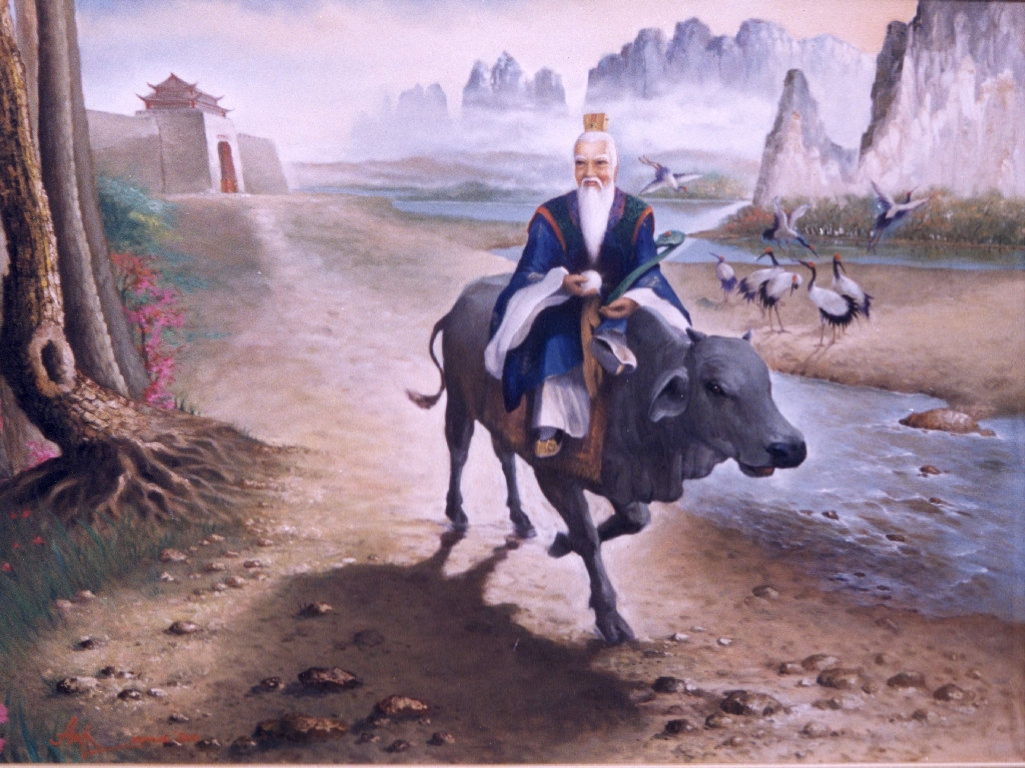
Painting of an elderly bearded man with white hair and a gold crown, wearing a blue robe, riding a dark grey ox along a dirt path. Cranes and birds are by a river, with misty mountains, a walled gate with a pagoda roof, and tree roots on the left.Painting

Secondary source

Laozi (ThaySangLawCin) Riding an Ox

widodo

Book

Secondary source

The Rhythm of Life, Based on the Philosophy of Lao-Tse

Henri Borel · 1921

The Inner Life and the Tao-Teh-KingBook

Secondary source

The Inner Life and the Tao-Teh-King

C. H. A. Bjerregaard · 1912

The Teaching of the Old BoyBook

Secondary source

The Teaching of the Old Boy

Tom MacInnes · 1927

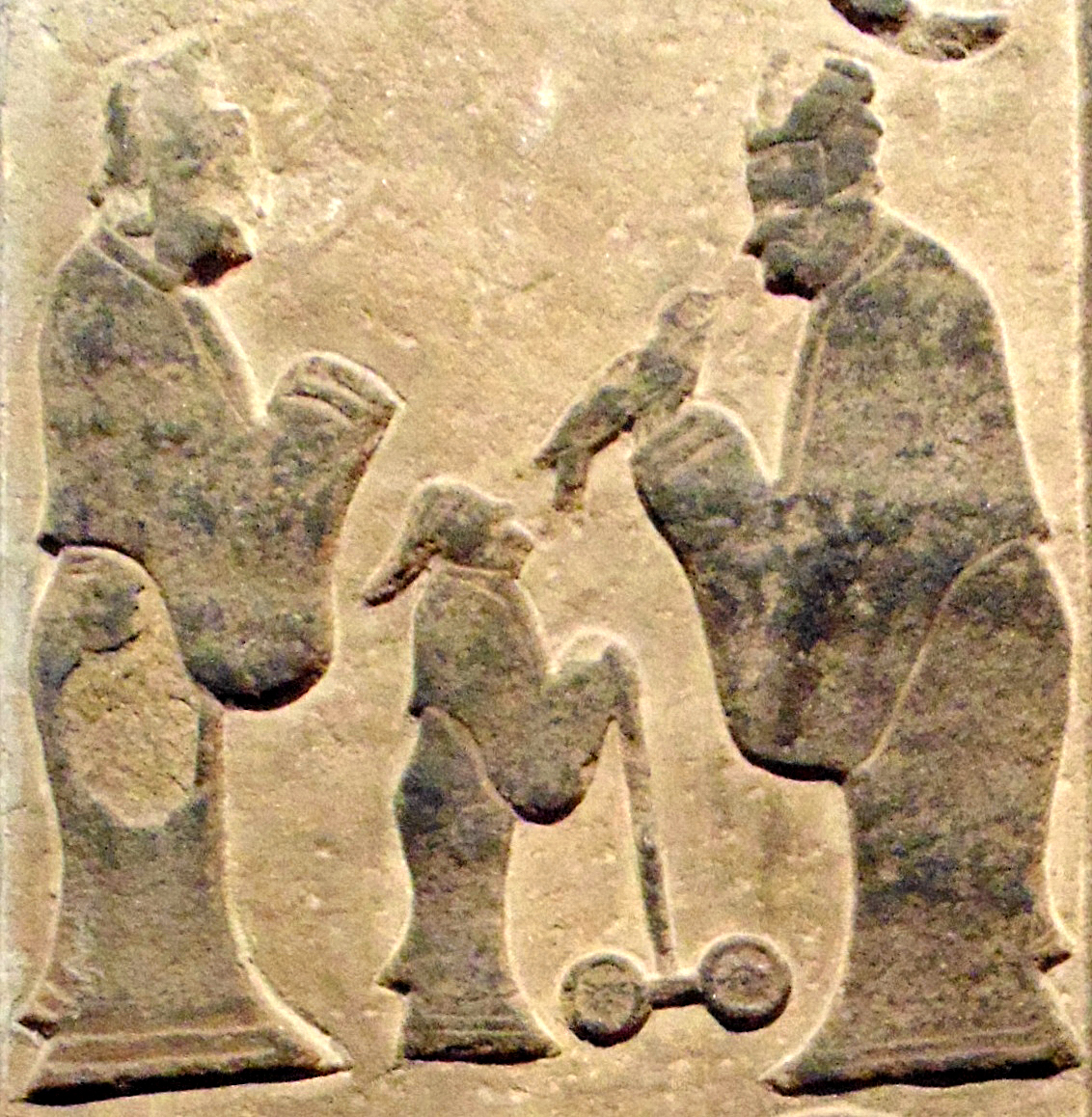
Low-relief stone carving of two bearded robed men facing each other, with a small child-sized figure between them holding a toy cart with wheels at the bottom. Worn sandstone surface with carved outlines.Sculpture

Secondary source

Confucius Meeting Laozi (stone relief)

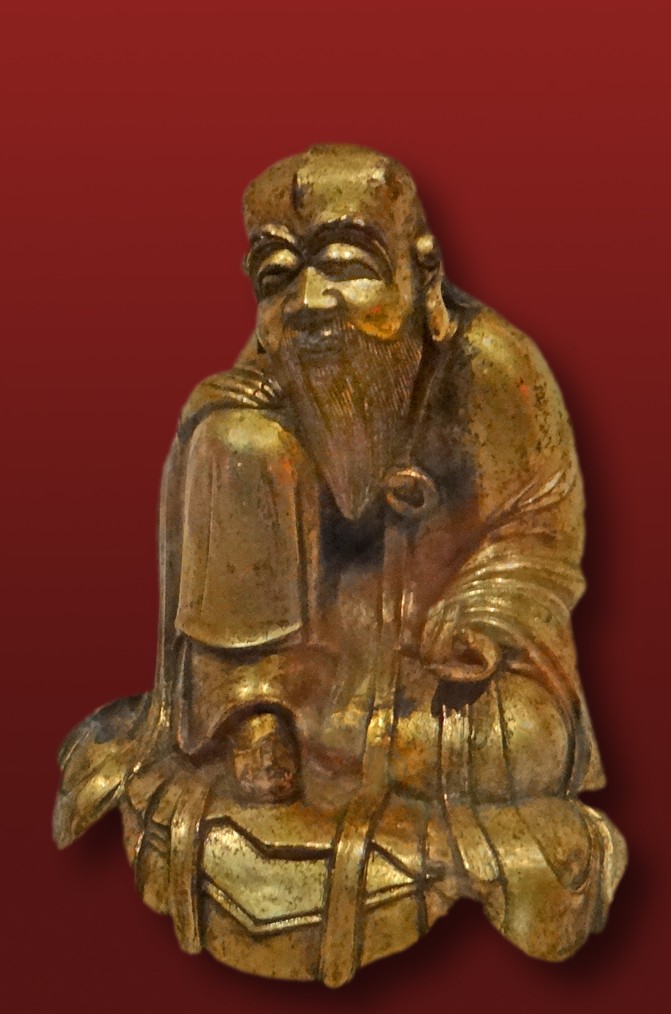
Photograph of a small seated gilt bronze figure of an elderly bearded man with a bald head, long beard, and robed body, resting one arm on a raised knee, set against a dark red background.Sculpture

Secondary source

Seated Gilt Bronze Laozi

Ming dynasty (1366-1644)

A long horizontal handscroll with yellow silk mounts. Most of its length is filled with dense columns of black Chinese text on a pale ground. At the far right end, a small ink landscape painting shows trees, rocks, and a building.Painting

Secondary source

Li Er (Laozi) Transmitting the Scripture

Sheng Mao · Yuan dynasty

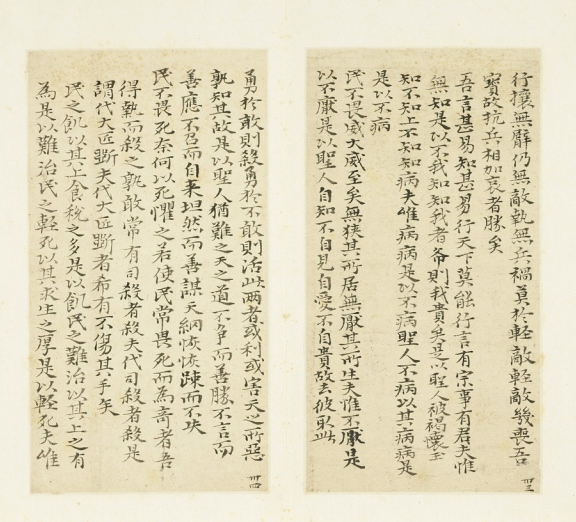
Two facing pages of cursive Chinese calligraphy in black ink on aged, yellowish paper. The text is written in vertical columns and includes characters from the Tao Te Ching. Small seal marks appear in the lower corners of each page.Painting

Secondary source

Shitao Calligraphy of the Tao Te Ching

Shitao · Qing dynasty

Handscroll of Chinese calligraphy in black ink on yellowish paper, with columns of vertical characters, red seal impressions, and a silk mounting border. On the right, a large black-ink character block reads 众妙之门.Book

Secondary source

Zhao Mengfu Calligraphy Scroll of Three Chapters of the Tao Te Ching

Zhao Mengfu · Yuan dynasty

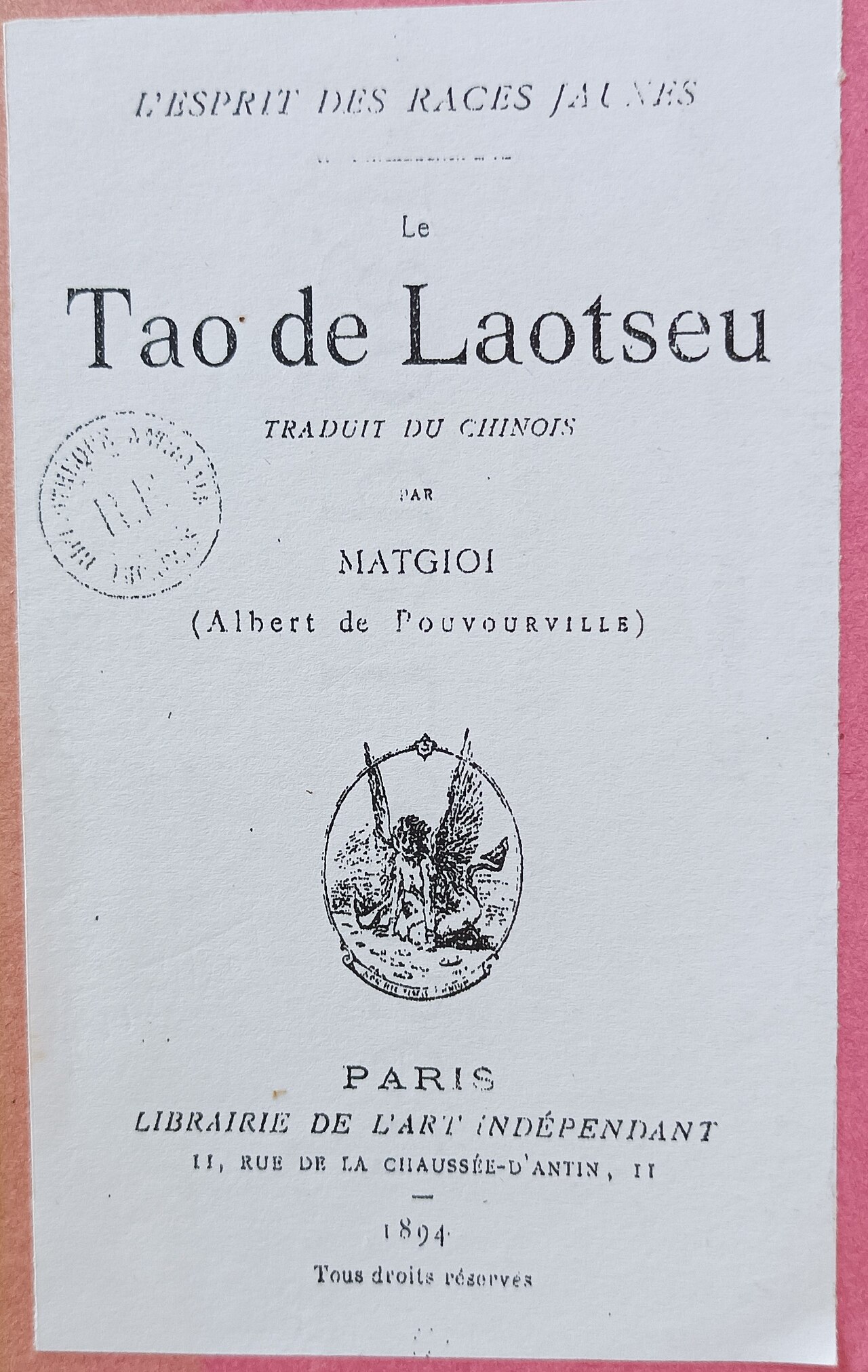
Title page of the book Le Tao de Laotseu, traduit du chinois par Matgioi (Albert de Pouvourville), Paris, Librairie de l'Art Indépendant, 1894. Includes a small oval vignette of a winged figure and a library stamp at left.Book

Secondary source

Le Tao de Laotseu

Matgioi · 1894

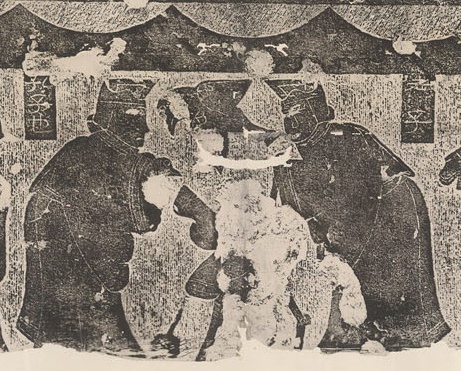
Detail of an ink rubbing of a carved stone relief. Two tall robed figures stand facing each other beneath a scalloped canopy band, with vertical inscription panels on each side. The rubbing is dark, with worn, pale patches.Painting

Secondary source

Confucius Visiting Laozi, Wu Family Shrine relief rubbing

Huang Yi · 1786

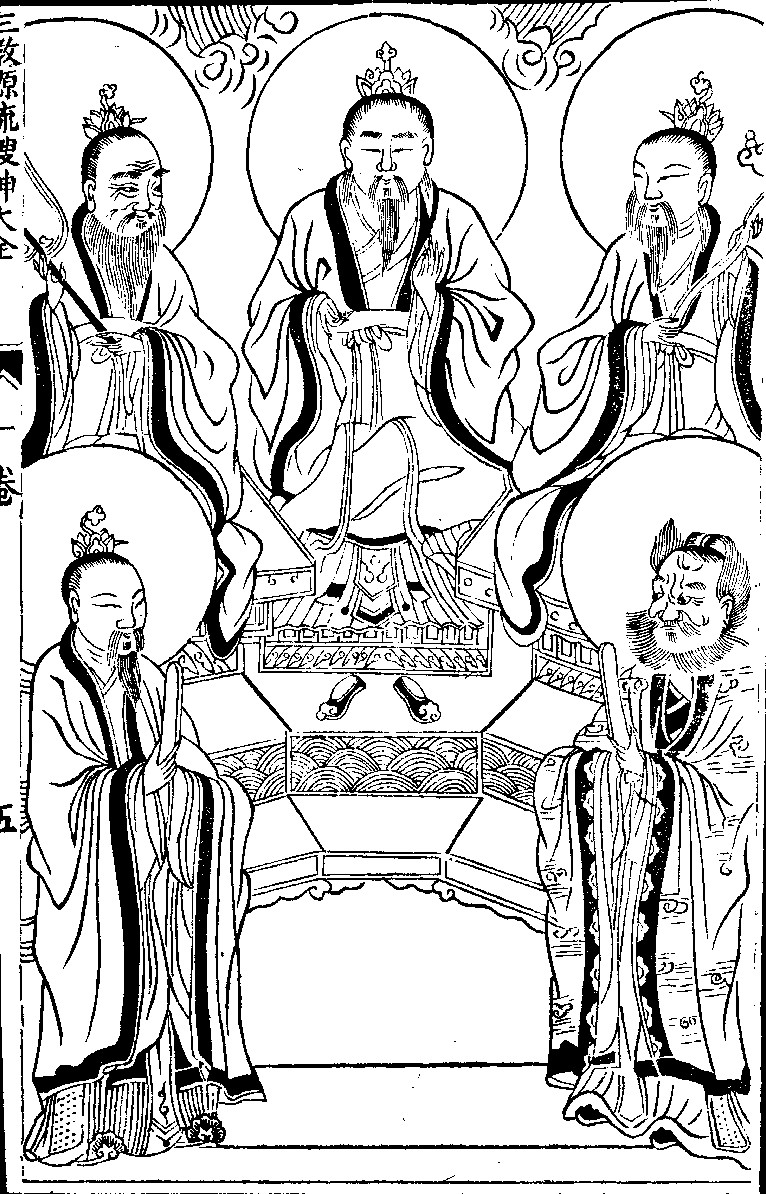
Black and white woodcut-style print of five deities or immortals seated and standing in a hall. Five robed figures with halos sit above and around a central altar with ornamental rails and a tripod-like object. The central figure wears a crown and sits on a raised platform. A bearded figure on the lower left holds his hands together, and a fierce-looking figure with a beard stands on the lower right holding a staff. Vertical Chinese text runs along the left edge.Painting

Secondary source

Taishang Laojun illustration from Sanjiao Yuanliu Soushen Daquan

1909

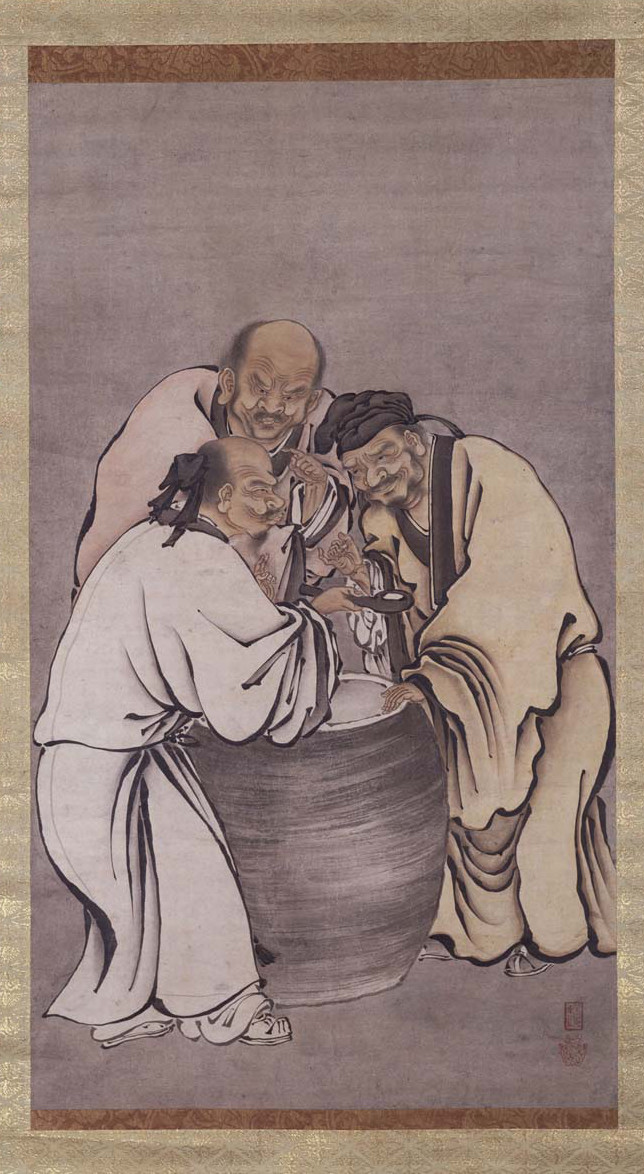
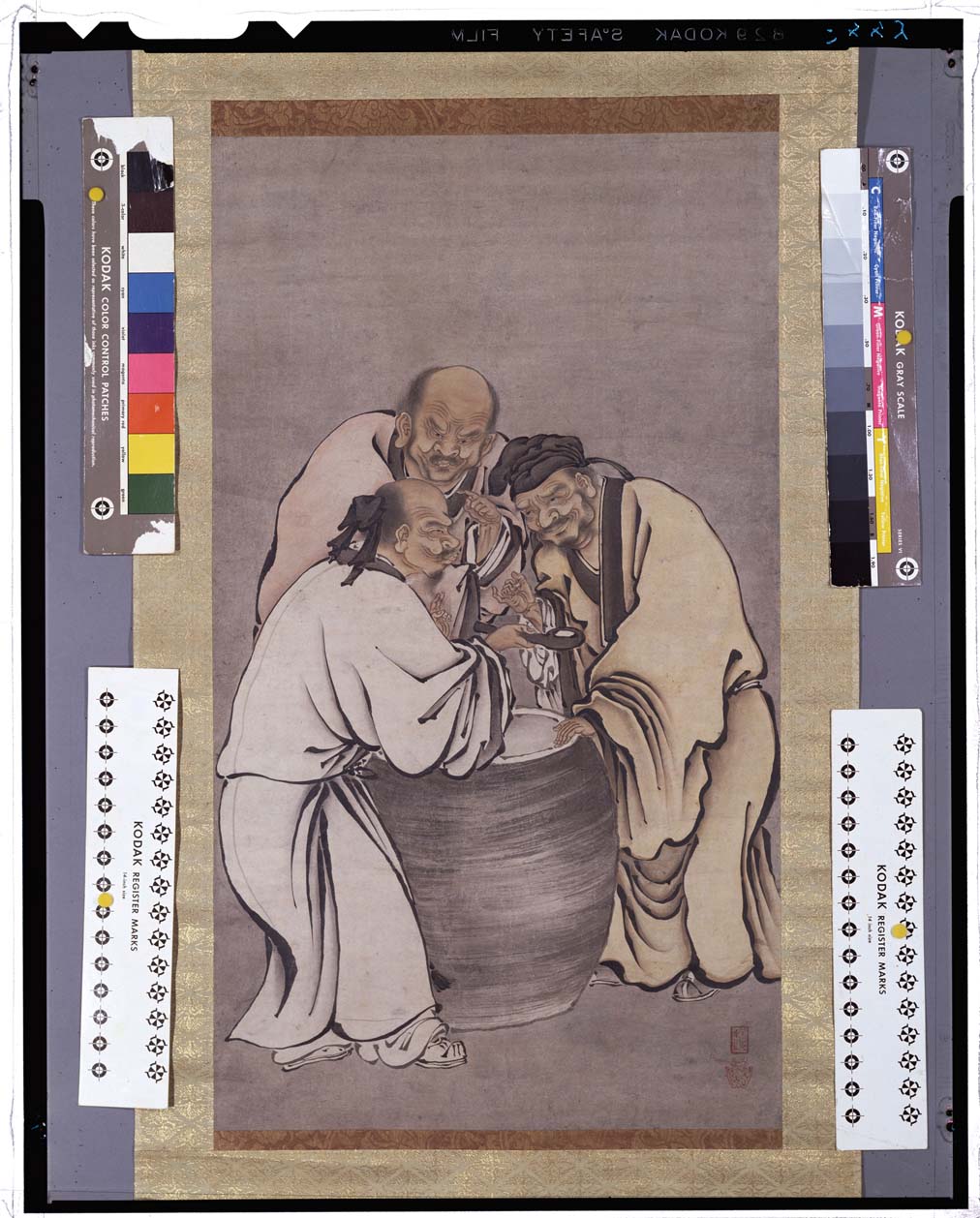
Photographic reproduction of a hanging scroll painting on a gold-brocaded mount, with Kodak color control patches, a gray scale, and register marks along the edges. The painting shows three robed figures with shaved heads leaning over a large dark ceramic vat, each dipping a finger or spoon into it. Muted tones of gray, beige, and pale pink with black ink outlines.Painting

Secondary source

The Three Vinegar Tasters

Kanō school artist · 16th century

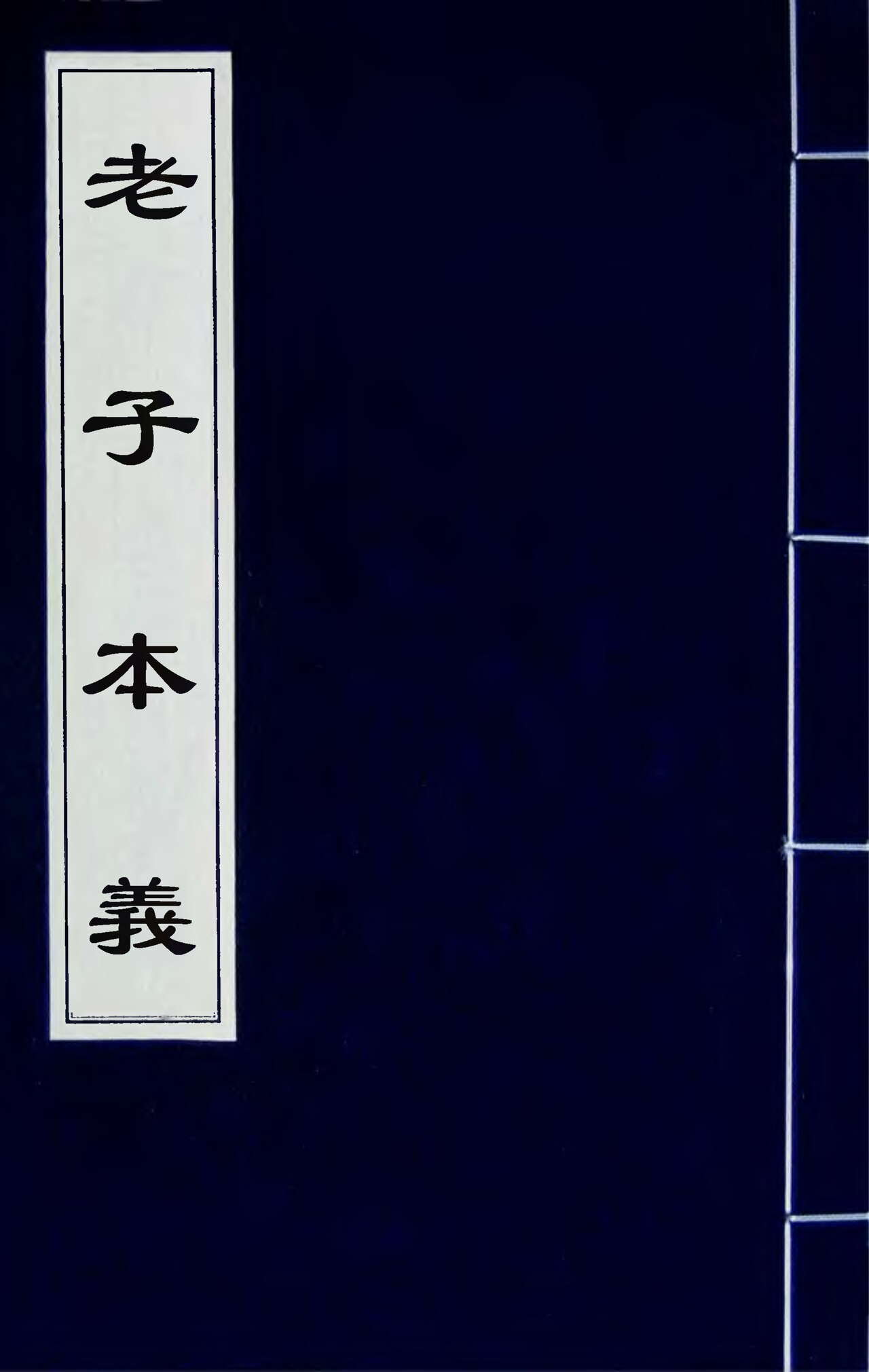
Cover of a Chinese bound book in dark blue cloth with a white rectangular title label on the left reading 老子本義 in black brush-style characters, with a thin black border inside the label. Right side shows white stitched binding lines.Book

Secondary source

Laozi Benyi (Original Meaning of Laozi)

Wei Yuan

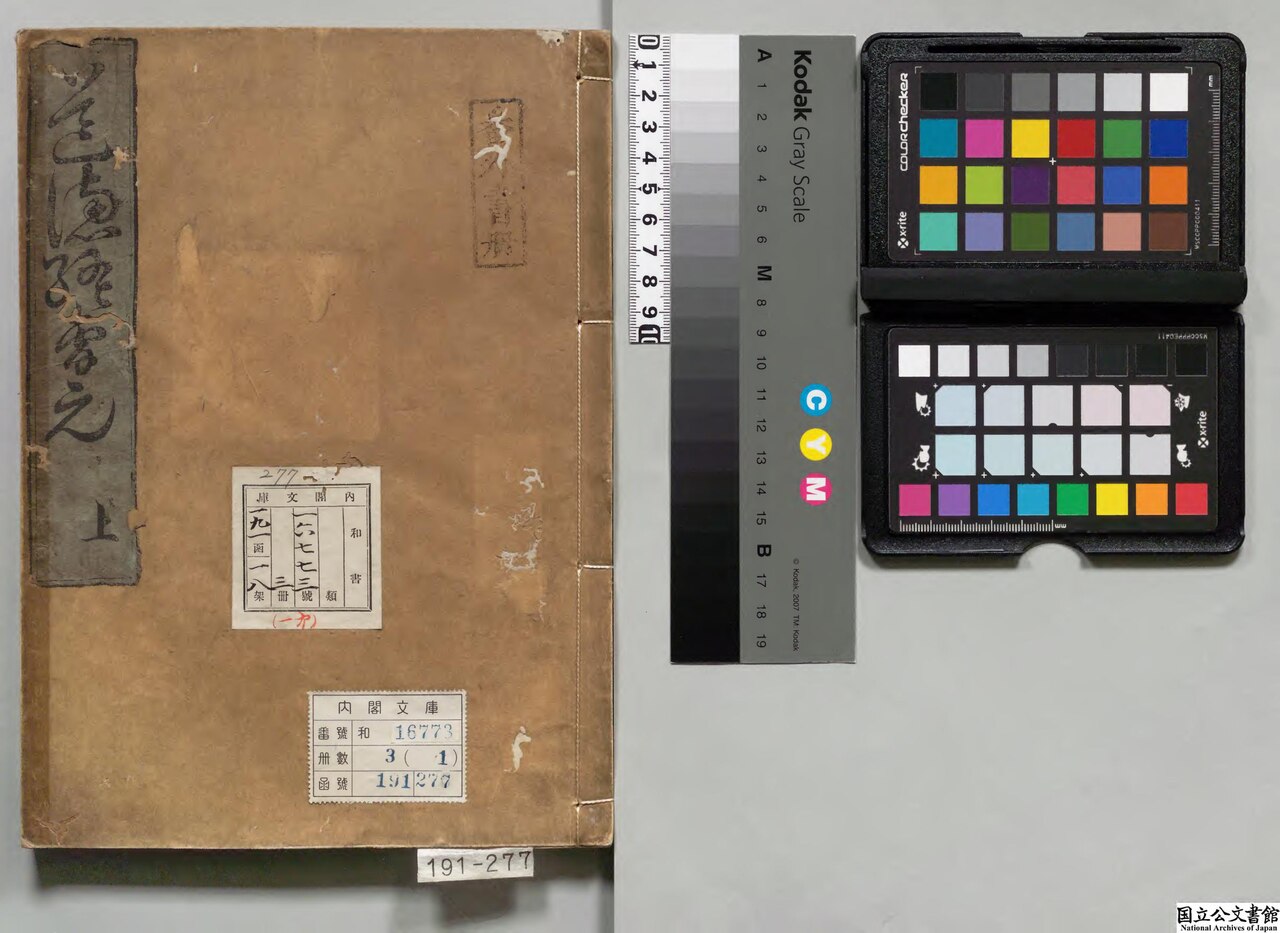
Photograph of the front cover of a Japanese bound book with a brown paper cover and a dark label bearing vertical Japanese characters, with library labels and a Kodak color scale and color checker beside it.Book

Secondary source

Laozi Daodejing huiyuan, volume 1

Sanjia Genmin

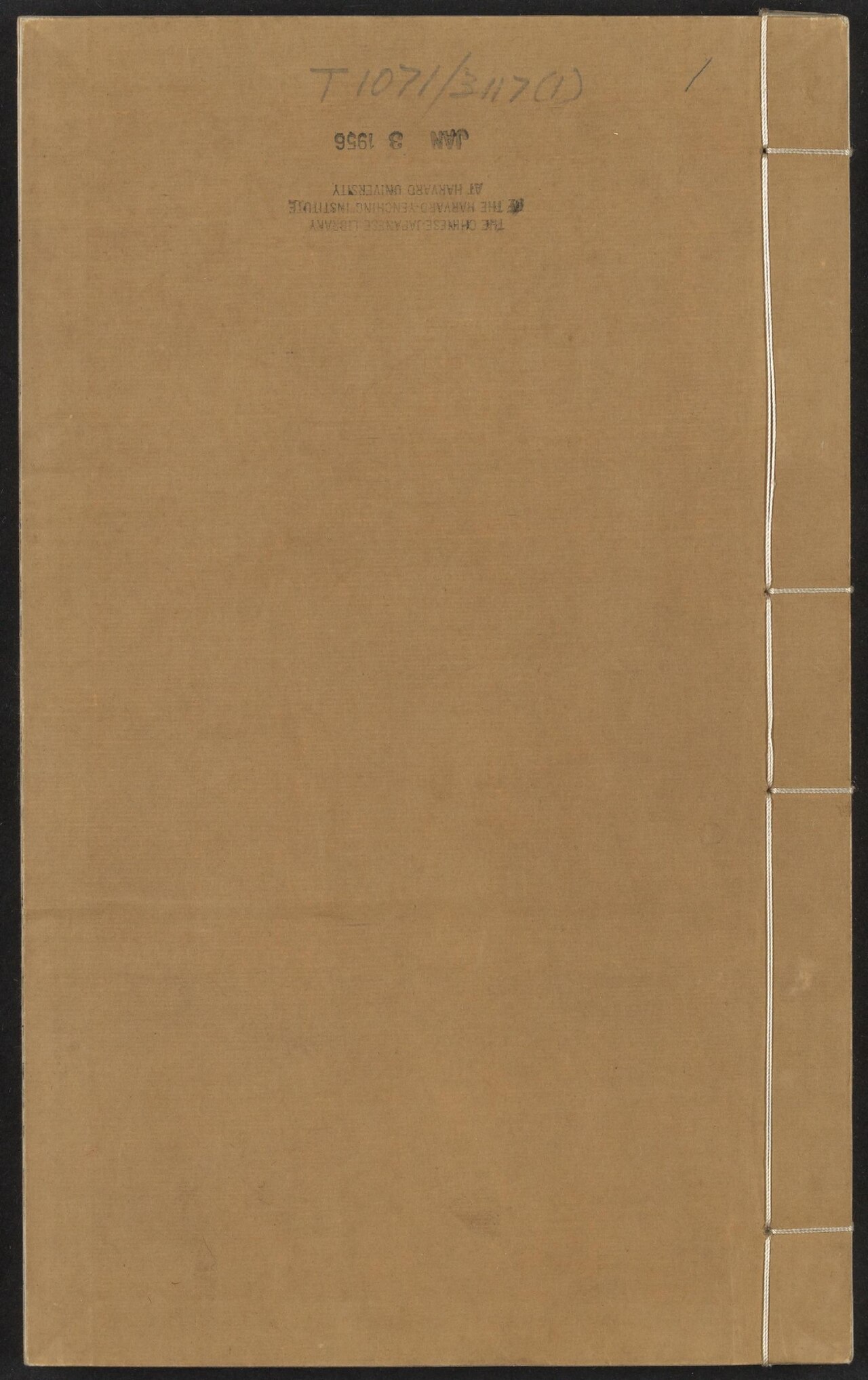
Photograph of the brown paper cover of a Chinese bound book with a pale string binding along the right edge. Handwritten pencil call number T1071/3417(1) is at top, with a upside-down stamp reading Jan 3 1956 and a Harvard-Yenching Library ownership stamp below.Book

Secondary source

Daodejing jie (Harvard copy, volume 1)

Shen Yiguan · 1588

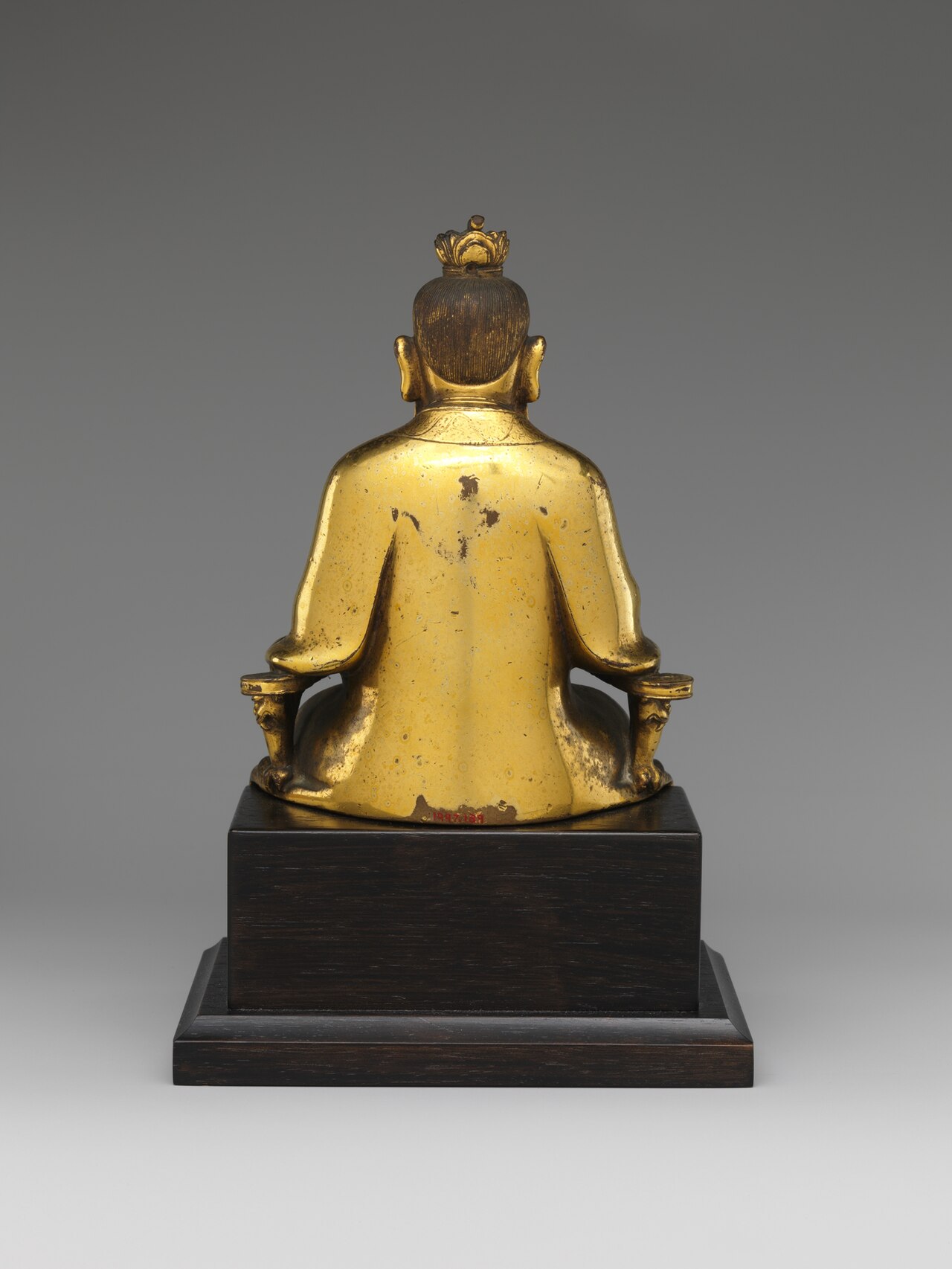
Back view of a gilt bronze seated figure on a dark wooden stand. The figure wears a flowing robe, has a topknot with a small crown, and is seated with hands resting on a platform. Gold surface shows some wear.Sculpture

Secondary source

Seated Figure, Probably Laozi (Gilt Bronze, 1438)

Chen Yanqing · 1438

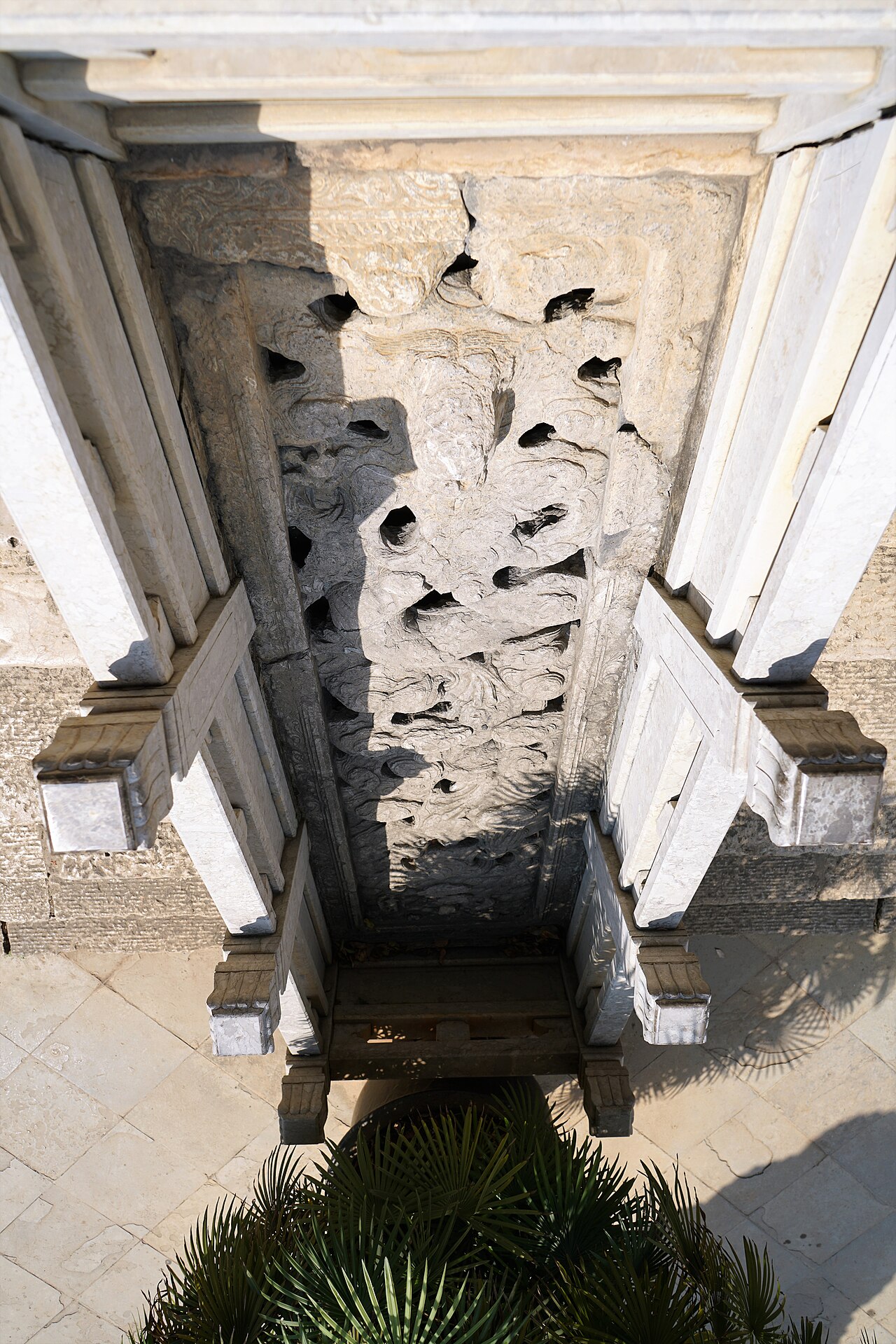
Looking up at a carved stone ceiling or underside of a stone panel framed by white marble pillars and ornate corbels. The carved surface shows swirling cloud-like and dragon-like relief patterns with many holes, and a wooden structure with a green plant visible below.Artifact

Secondary source

Laojun Hall Imperial Path Stone

Yuan dynasty

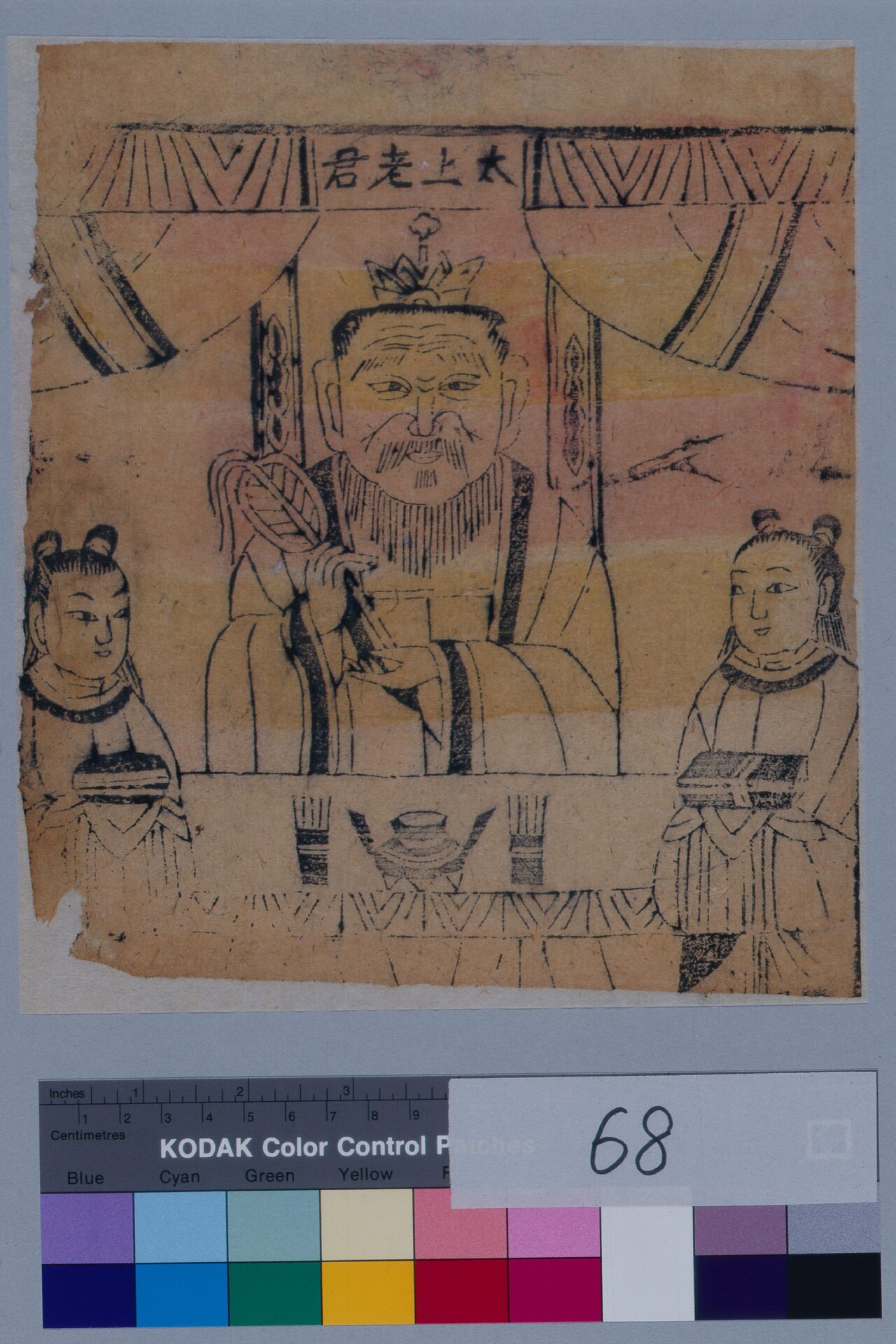
A woodblock-style print on yellowed paper showing an elderly bearded man with a crown seated on a throne, holding a fan-like object, flanked by two young attendants holding objects. Chinese characters 太上老君 appear at the top. The paper is torn at the edges and a color calibration strip is below.Painting

Secondary source

Taishang Laojun, Deified Laozi (Early Republican Print)

early Republican era (民国初期)

Photograph of a seated bronze-like figure of a bearded Daoist immortal with a topknot, raising one hand, wearing flowing robes with a sash, set on a white pedestal against a gray background.Sculpture

Secondary source

Daoist Immortal, Probably Laozi (Five Dynasties Bronze)

10th century (Five Dynasties period, 907–960)

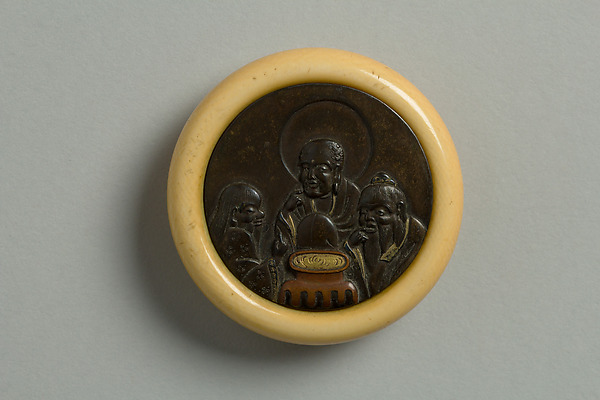
Round netsuke with a pale ivory rim and a dark metal inlaid medallion showing three figures around a wine vessel: a central figure with a halo, and two figures at the sides, one with a bald head and one with long hair. Set against a grey background.Artifact

Secondary source

Netsuke of the Three Wine Tasters

19th century

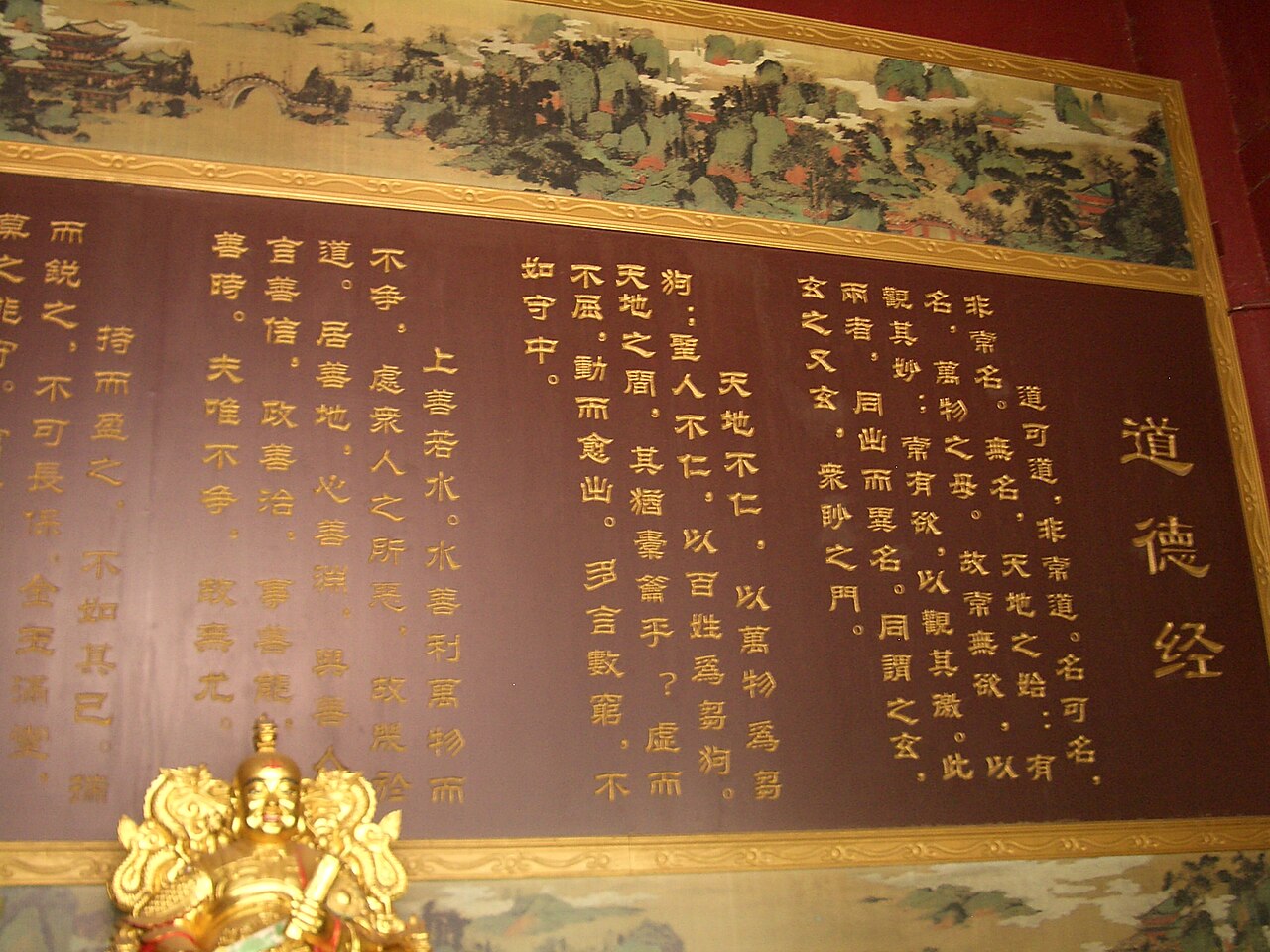
Vertical columns of gold Chinese characters engraved on a dark purple panel framed by gold borders, with the title 道德经 (Dao De Jing) on the right. A painted landscape scroll runs along the top and a gilded figure appears at lower left.Artifact

Secondary source

Dao De Jing Engraving, Tai Qing Dian, Changchun Temple

2008 (photograph date; engraving date not given)

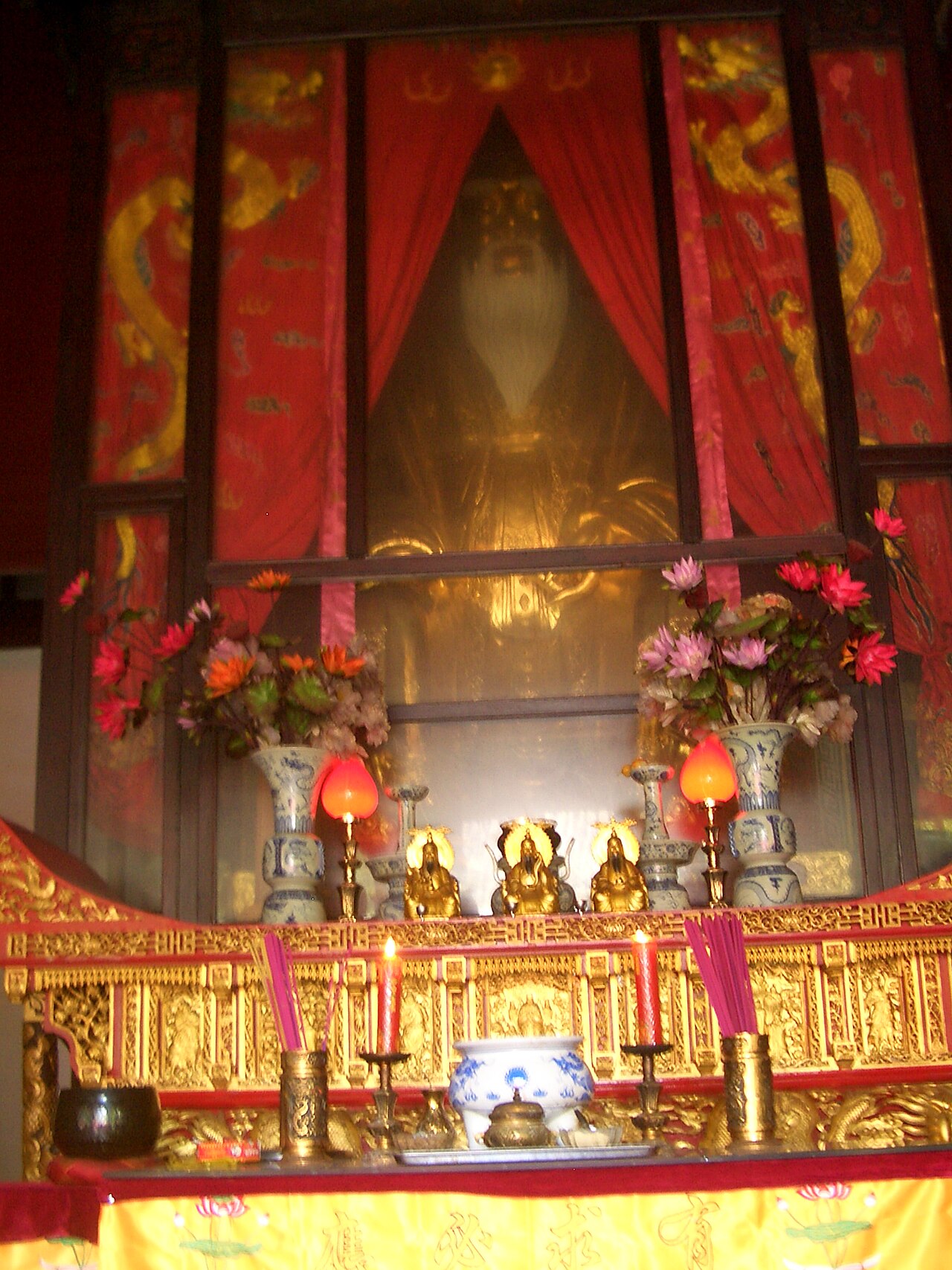
Interior of a Chinese temple altar with red and gold dragon-patterned hangings. A large gilded seated statue of a bearded figure stands in a central niche. In front are blue-and-white vases with flower arrangements, small gold seated figures, red candles, incense sticks, a blue-and-white bowl, and a gold-carved altar table.Sculpture

Secondary source

Tai Shang Lao Jun statue, Changchun Temple, Wuhan

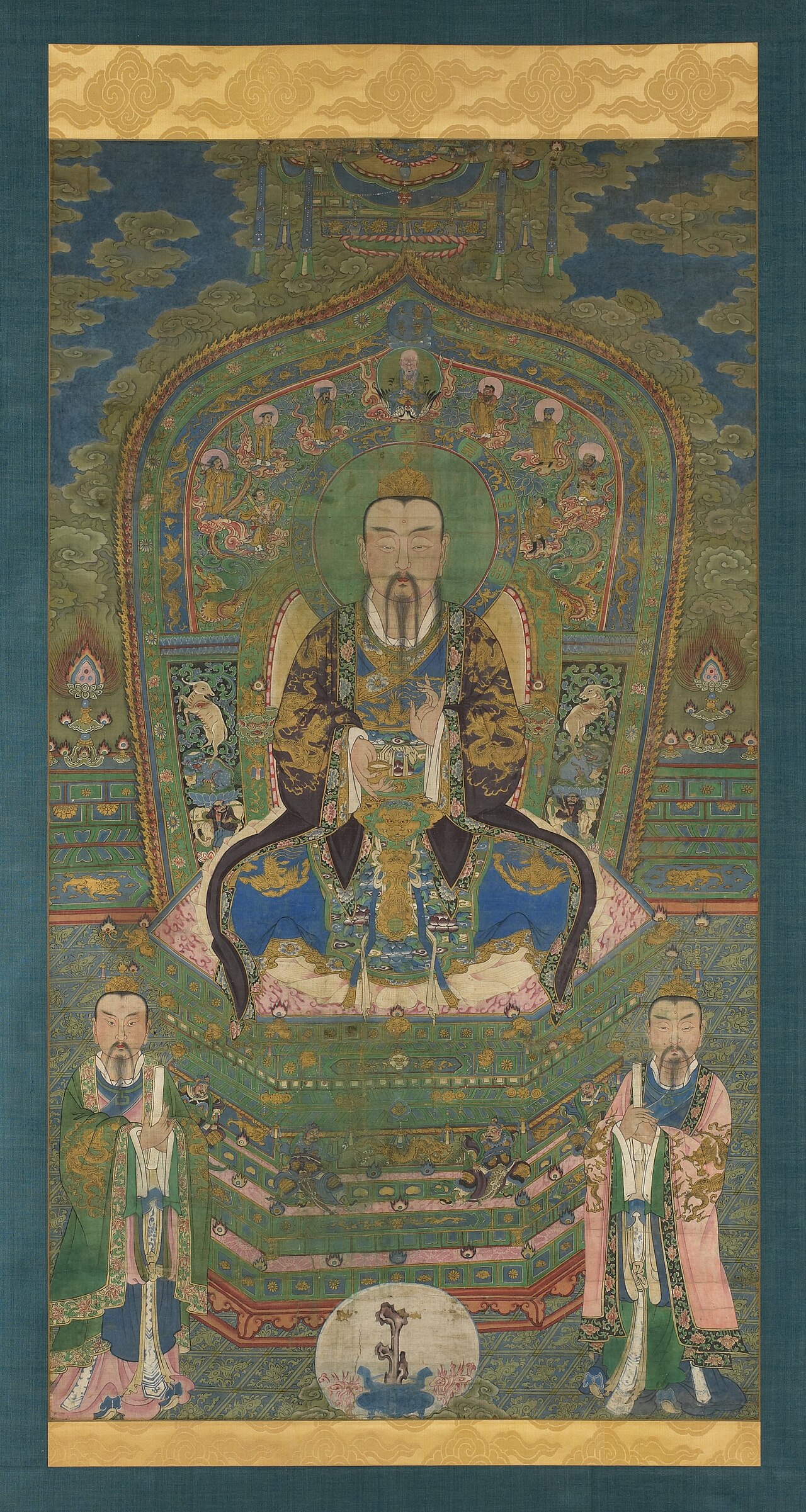
A hanging scroll painting with a yellow silk top border and blue-green outer mount. A bearded, crowned figure in dark robes with gold dragon patterns sits on a tiered green and pink throne, surrounded by a halo, with attendant figures standing at the lower left and right and a small circular offering scene below. Clouds and deities fill the background.Painting

Secondary source

The Three Purities: Daode Tianzun, Ming dynasty painting

Ming Dynasty, 16th century (1368-1644)

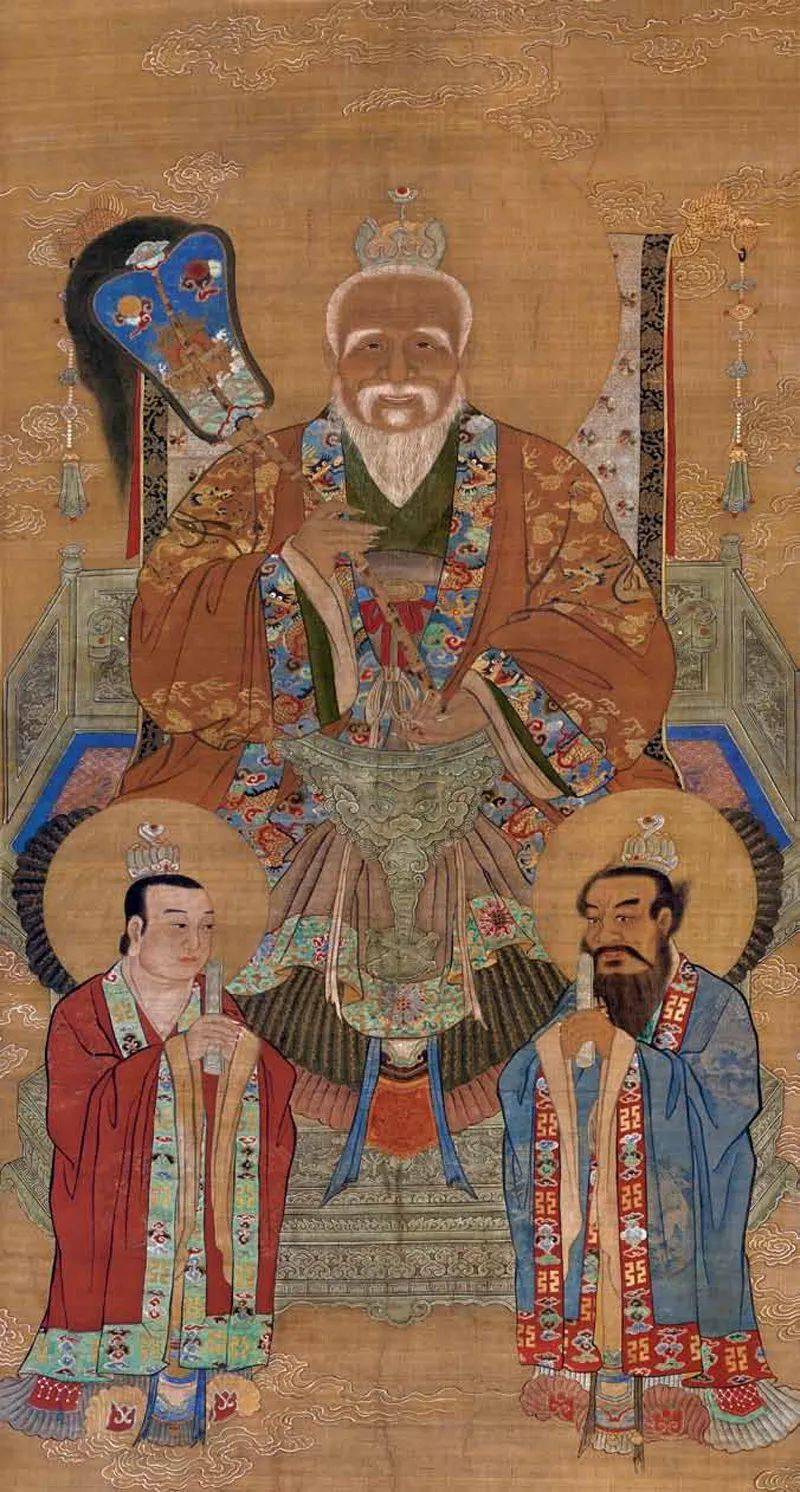
Hanging scroll painting on gold silk of a bearded, white-haired elder seated on a throne wearing a crown and embroidered robes, flanked by two smaller attendant figures in halos, one in red and one in blue, holding ceremonial tablets. Clouds decorate the background.Painting

Secondary source

Taiqing Daode Tianzun, Qing dynasty painting

Qing Dynasty (1644-1911)

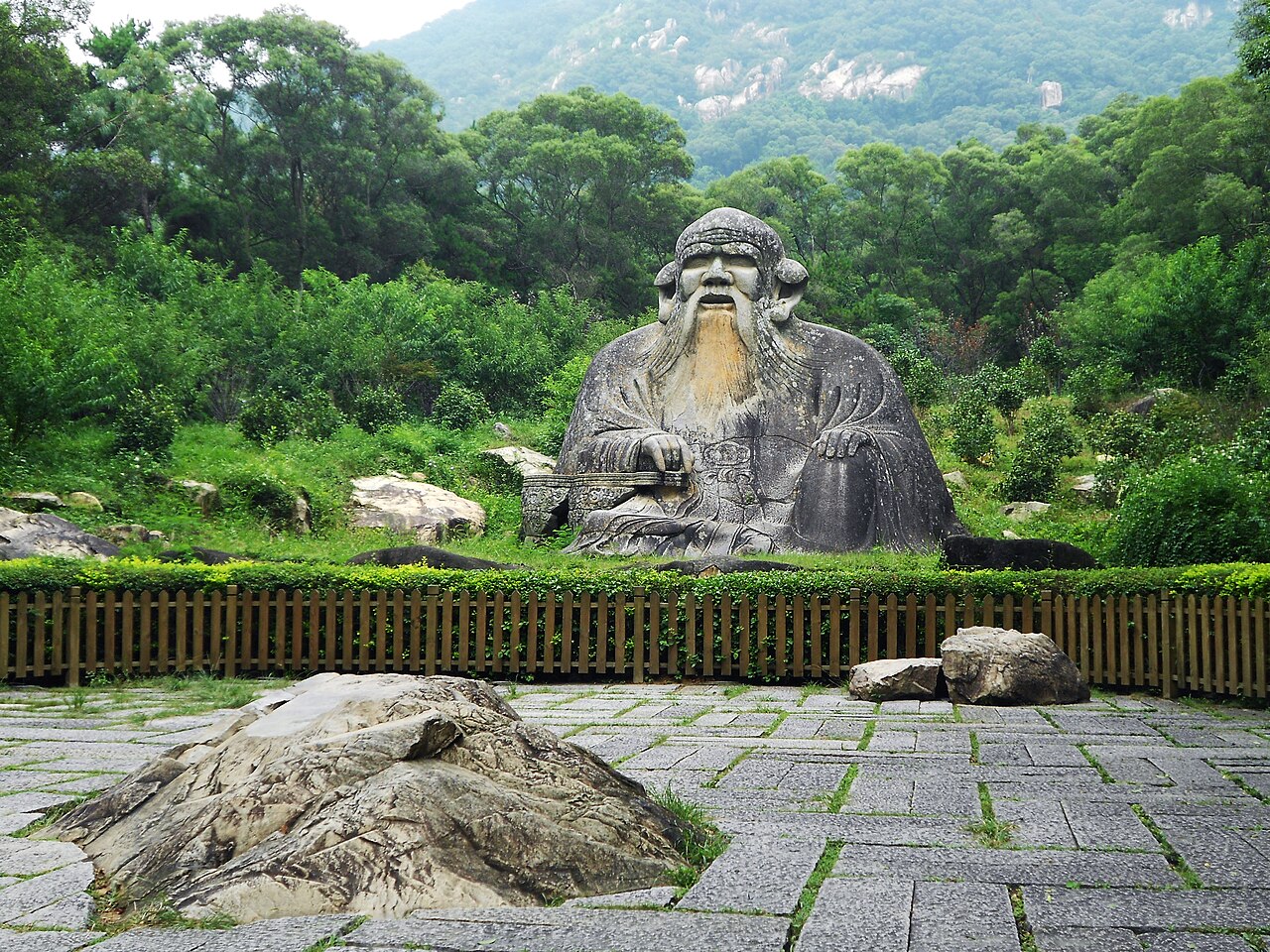
A large carved stone statue of a seated bearded figure in robes and a headcovering, set in a green garden with trees and a mountain behind it. A wooden fence and stone paving are in the foreground, with rocks beside the path.Sculpture

Secondary source

Laozi statue at a national heritage site, China

2012

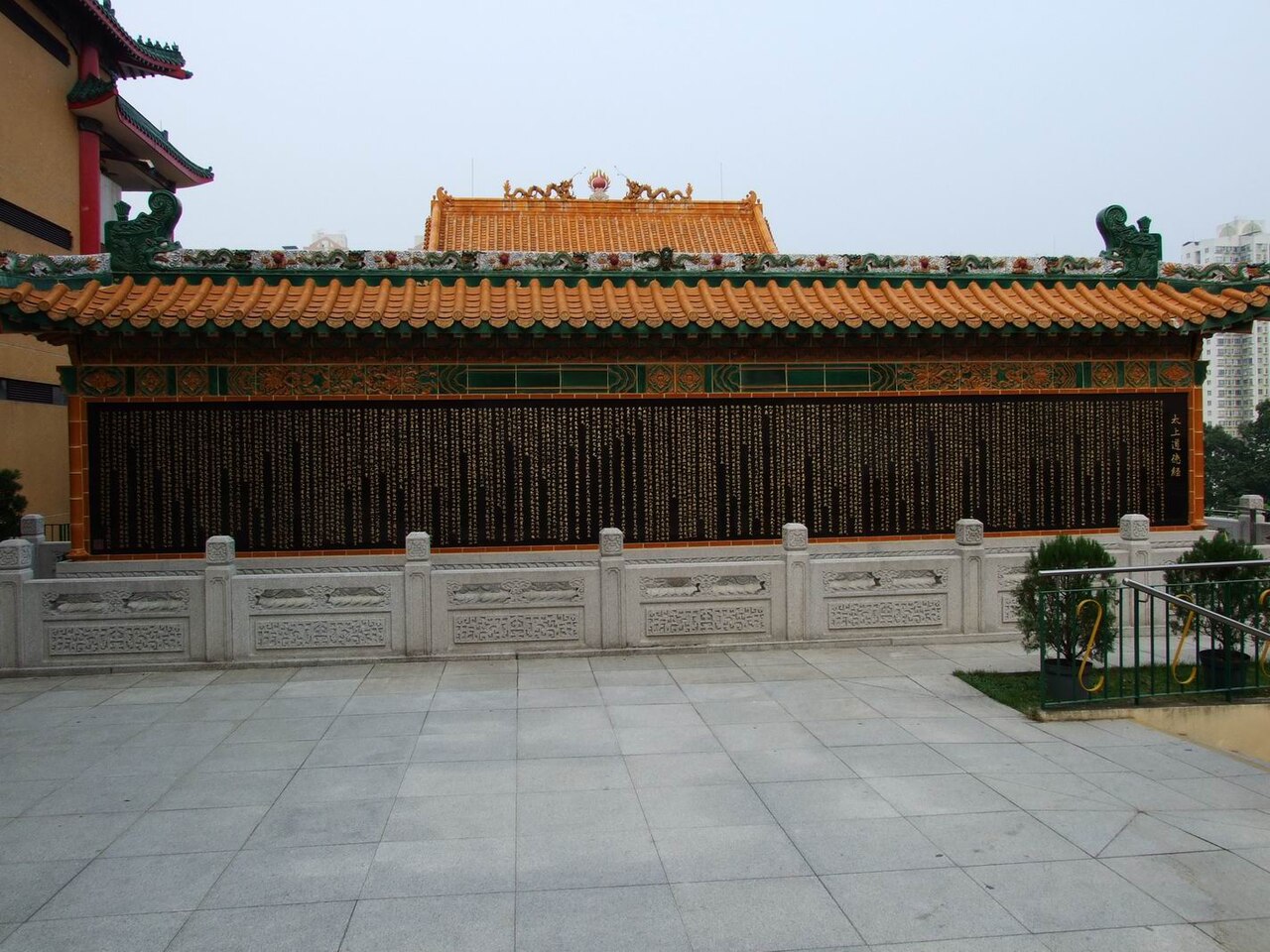
A long black stone wall with rows of small gold-colored inscribed characters, set beneath an orange-tiled roof with green and gold trim. A stone balustrade with carved panels runs along the base, with a paved courtyard in front and a tall building in the background.Artifact

Secondary source

Tao Te Ching inscribed on temple wall, Hong Kong

Chong Fat · 2007 (date of photograph)

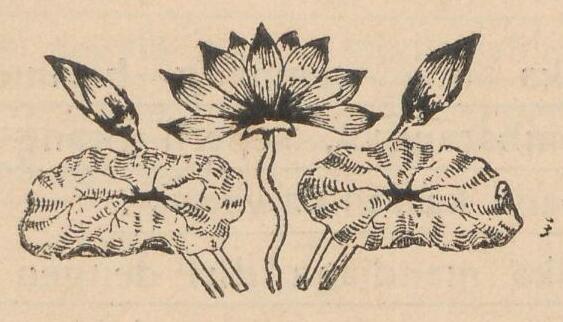
Black-and-white line drawing on a beige paper background of a lotus flower in bloom at the center, with two lotus buds and two large lily pads, one on each side. Thin stems extend downward from the flower and pads.Book

Secondary source

Tao Teh King by Kwee Tek Hoay, page 81 (1938)

Kwee Tek Hoay · 1938

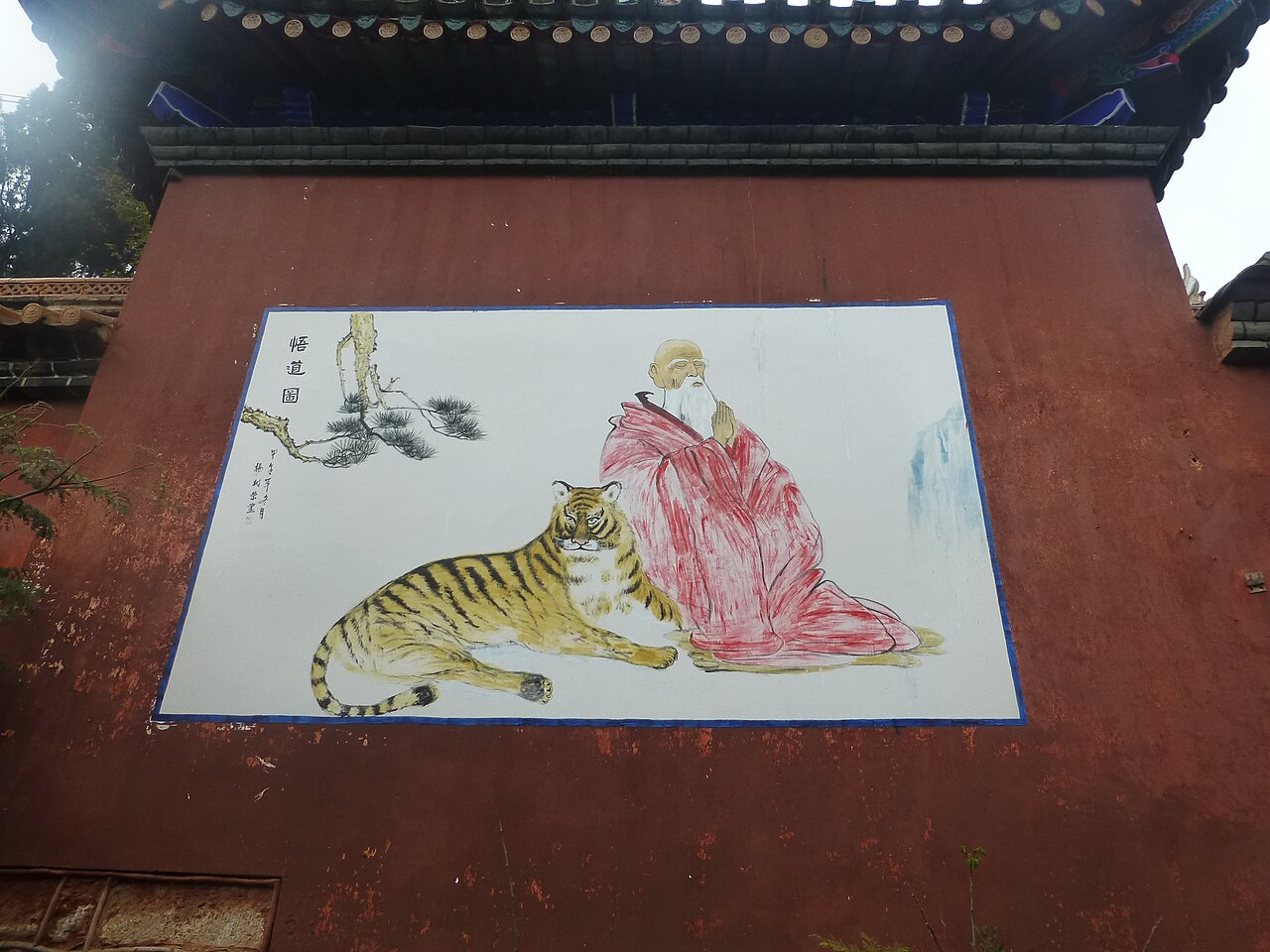
A painted mural on a red wall beneath a tiled roof shows an elderly bearded man in a red robe seated with clasped hands beside a reclining striped tiger, with a pine branch and calligraphy at the upper left.Painting

Secondary source

Laozi and a Tiger (Jade Emperor Pavilion mural)

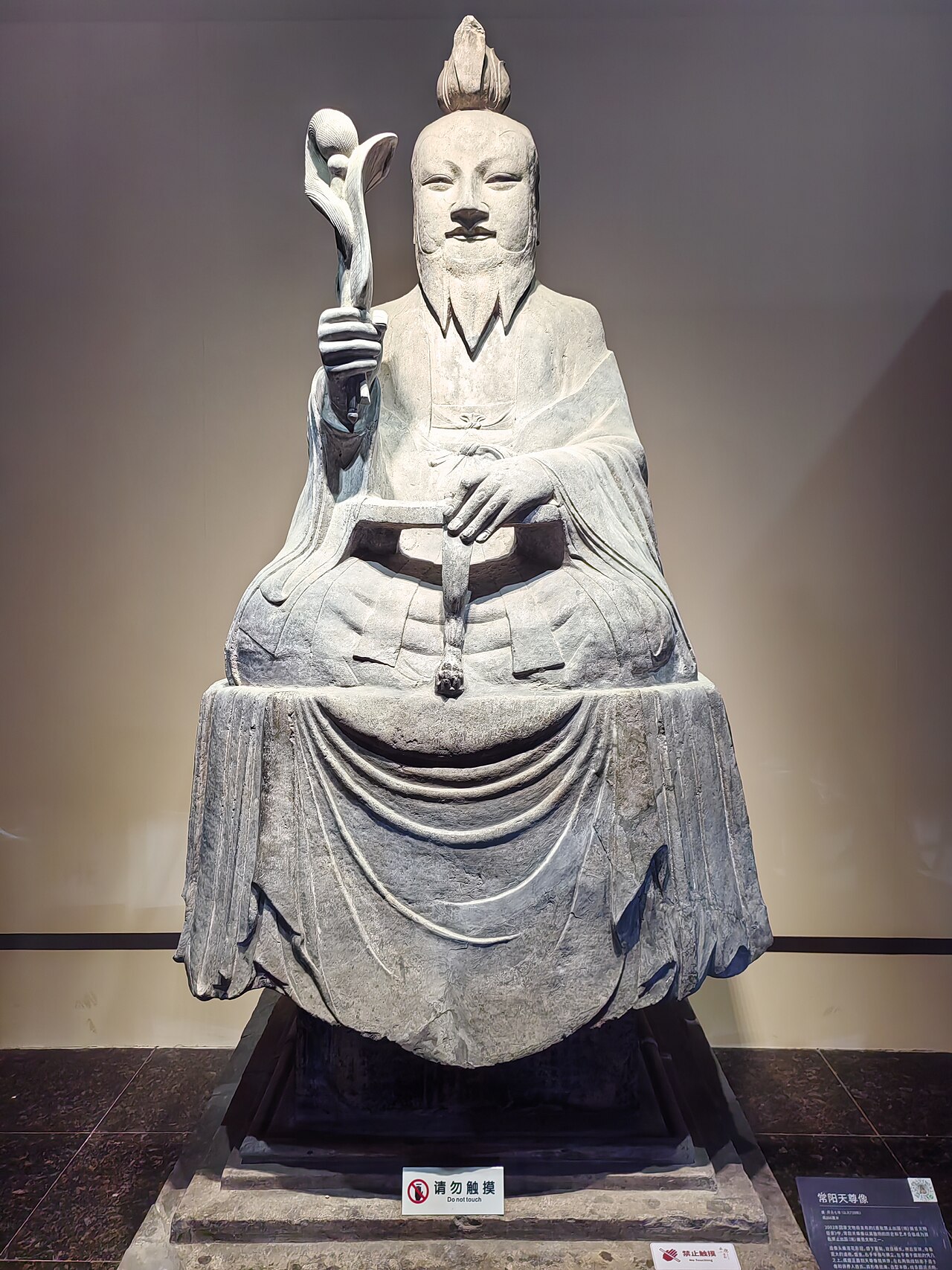
Photo of a large grey stone seated statue of an elderly bearded man holding a staff topped with a curled ornament, in a museum gallery. A small 'Do not touch' sign is at its base and an info panel is to the right.Sculpture

Secondary source

Statue of Laozi (Changyang Taizun), Shanxi Ancient Architecture Museum

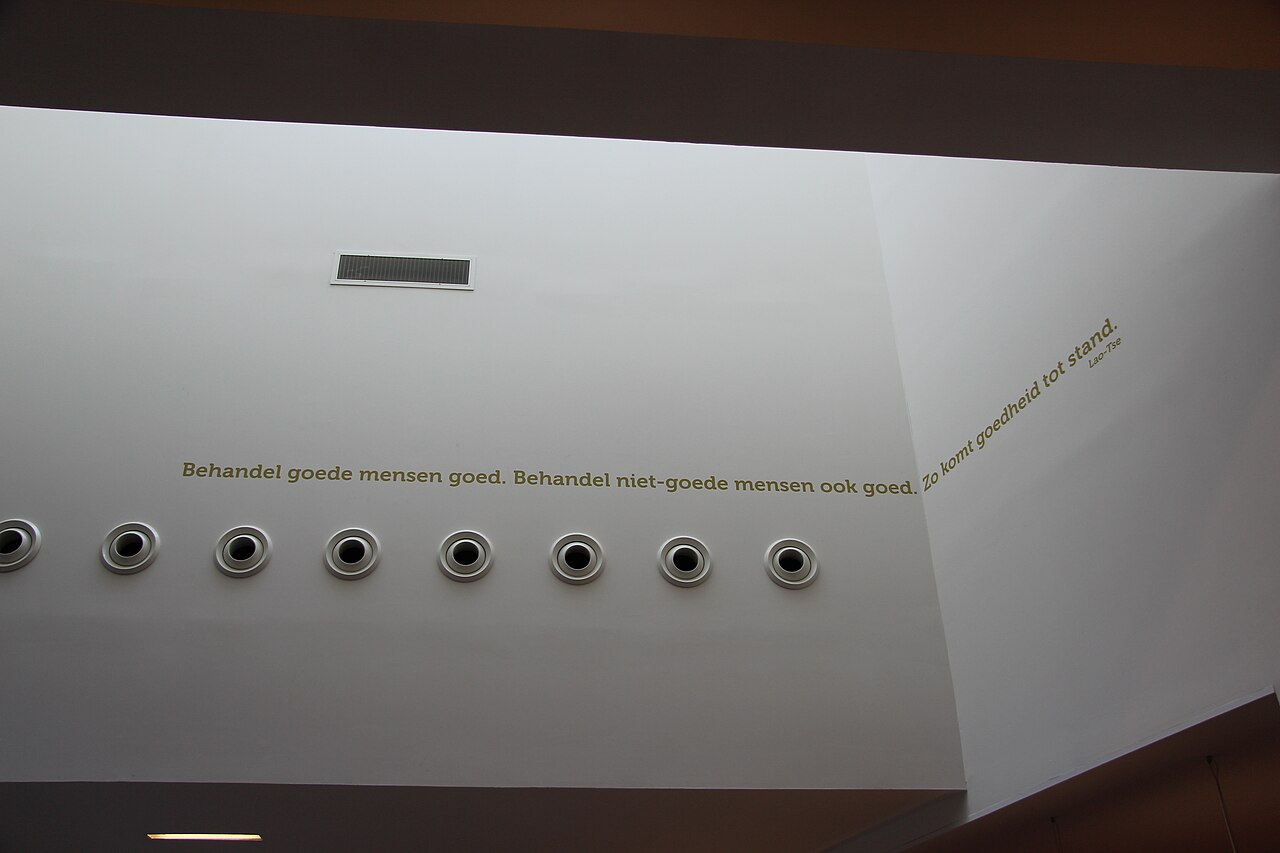
Interior wall with Dutch text in olive-green lettering reading 'Behandel goede mensen goed. Behandel niet-goede mensen ook goed. Zo komt goedheid tot stand.' with 'Lao-Tse' attribution. Row of eight round ceiling or wall fixtures below and a ventilation grille above.Artifact

Secondary source

Laozi Saying Inscribed on a Leiden Building Wall

2013

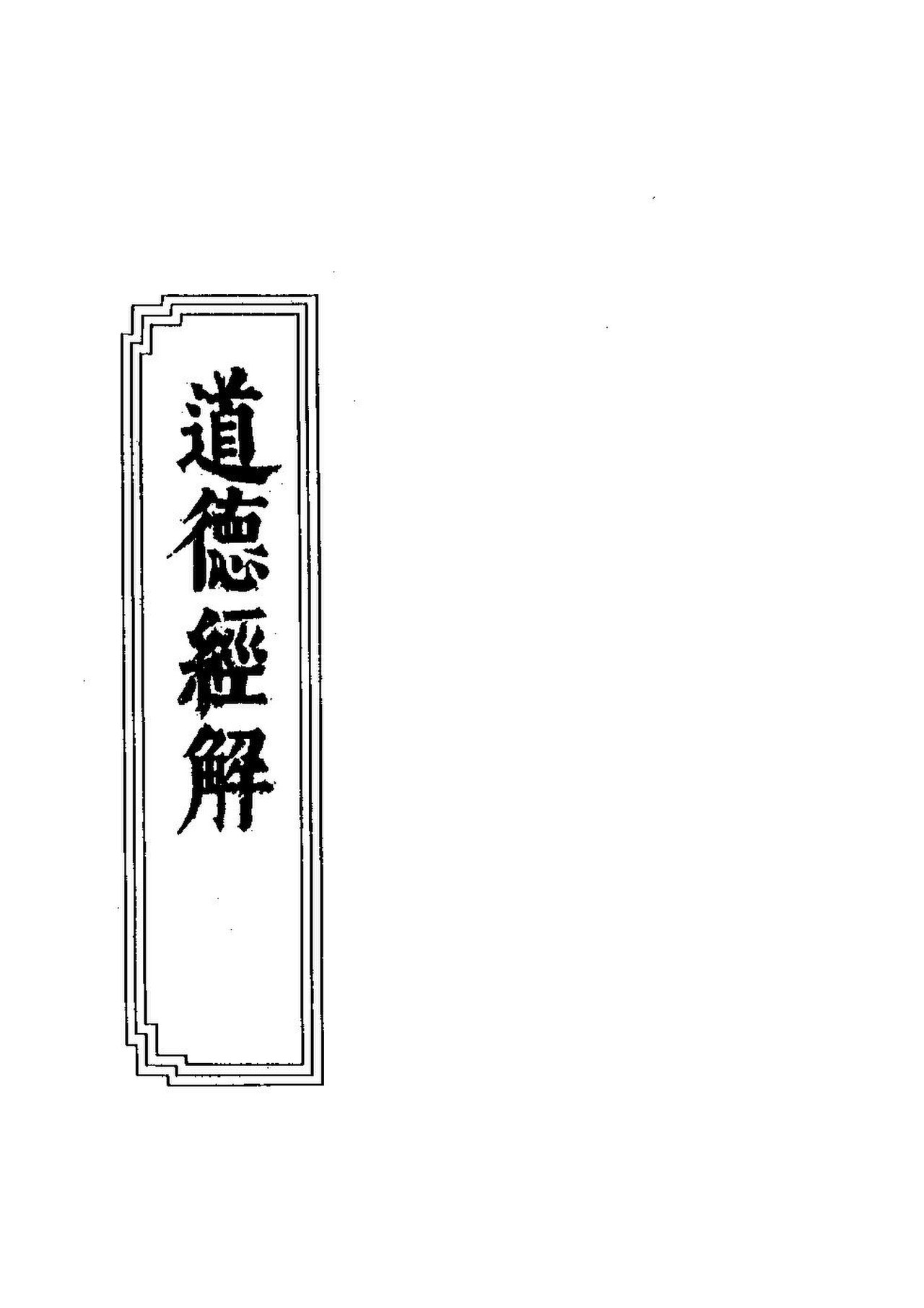
Title page of a Chinese book: a vertical rectangular stepped-border frame enclosing three large black brush characters reading 道德經解 (Daodejing jie), on a white background.Book

Secondary source

Daodejing jie (Commentary on the Daodejing attributed to Lü Zhenren)

Lü Zhenren

Want the full shelf? Chat with Laozi in the app and open the Sources panel — every quote links back to the original.

Use Laozi in class

3 collections

Ready-made collections from the Humy team that feature Laozi. Preview any of them, then try it free.

Trusted by educators worldwide

Conversations
375,000+
Real exchanges between students and historical figures
Messages exchanged
4,142,000+
Across every figure, classroom and language
Historical figures
100,000+
Each informed by a curated biography and selected sources
Languages supported
50+
From English and Spanish to Arabic and Korean

Paying customers

Used by 98 schools and universities

Partner school logo
Tecnológico de Monterrey logo
Hyper Island logo
Partner school logo
Chambersburg Area School District logo
Broward County Public Schools logo
Nebo School District logo
National Louis University logo
South Florida PBS logo
Punahou School logo
University of Wisconsin–River Falls logo
Partner school logo
Partner school logo
Archbishop Mitty High School logo
Kingsburg High School logo
Norwalk Public Schools logo
Partner school logo
Connections logo
Partner school logo
Moore Public Schools logo
Partner school logo
Partner school logo
Partner school logo
Partner school logo
Robbinsville Public Schools logo
Partner school logo
Partner school logo
Partner school logo
Tecnológico de Monterrey logo
Hyper Island logo
Partner school logo
Chambersburg Area School District logo
Broward County Public Schools logo
Nebo School District logo
National Louis University logo
South Florida PBS logo
Punahou School logo
University of Wisconsin–River Falls logo
Partner school logo
Partner school logo
Archbishop Mitty High School logo
Kingsburg High School logo
Norwalk Public Schools logo
Partner school logo
Connections logo
Partner school logo
Moore Public Schools logo
Partner school logo
Partner school logo
Partner school logo
Partner school logo
Robbinsville Public Schools logo
Partner school logo
Partner school logo

What educators are saying

“We enjoyed the program last year and used it frequently.”
“My students say it’s a welcome change of pace. I’m not a fan of the “sage on the stage” model, so I try to incorporate research-oriented and self-paced activities. With Humy, students have to take charge of their learning. They’ve become more adept at critical thinking, forming better questions, and improving their reading comprehension. The interview feature has been my go-to tool. I create assignments where students must ask historical figures a set number of questions, then summarize the responses to ensure they’re truly absorbing the material. This approach lets them actively explore the past rather than passively consuming information.”
“Humy has helped me bring historical figures, sometimes long past, to life. When my students interact with these figures in real-time, it eliminates some of the perceived “ancient” characteristics of my curriculum. This has shifted my students’ thinking away from viewing history as abstract or irrelevant. Real-time interactions make historical figures relatable, even allowing students to ask off-topic questions that help put historical lives in a more relevant context for 13-year-olds. The feature I use the most is the interview feature. After teaching a topic, most recently Gandhi and Joan of Arc, I have the students ask pointed, focused questions. We practice good conversation techniques beforehand, teaching them to listen (or read) carefully and formulate thoughtful follow-up questions rather than just interrogating. It helps students practice effective conversation skills.”

FAQ

Frequently asked questions

Who is Laozi?
Ancient Chinese philosopher and writer of the Tao Te Ching. On Humy.ai you can chat with an AI version of Laozi that draws on a short biography and 85 historical sources during the conversation — by text or voice, in 42 languages.
Is Laozi AI free?
Laozi is part of Humy's full library of more than 100,000 figures, which comes with a paid plan. A free account (no credit card) includes 20 messages a month with the free library's figures, so you can try how the conversations work first.
What sources does the Laozi AI use?
It draws on a short biography and 85 historical sources (books, paintings and sculptures), including “Tao Te Ching”, “Bamboo Texts of Guodian” and “Mawangdui Silk Texts of the Laozi”. Each source has its own page on Humy.ai.
How historically accurate is the AI version of Laozi?
Each figure uses a short biography and a small set of selected historical sources as context (retrieval-augmented generation), so answers stay closer to known material than the model's general knowledge alone. It isn't a citation-grade research tool — like any LLM, the AI can get details wrong or extrapolate. Treat it as a strong starting point for inquiry and cross-reference important claims.
Can I talk to Laozi by voice?
Yes. In addition to text chat, you can call Laozi and hear their voice respond in real time — useful for auditory learners, interview practice and Socratic dialogue.
Is Humy.ai safe and compliant for schools?
Yes. Humy.ai is used by more than 100 schools, universities and organisations. The platform is FERPA- and GDPR-aligned, supports SSO, and offers an IT-approval pack tailored for school procurement teams.

Ready when you are

Start chatting with Laozi now.

20 messages free · No credit card · Available in 50+ languages.