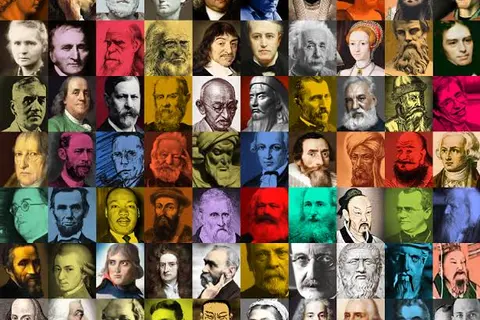

Portrait of Queen Nefereti

AI Historical Figure

Queen Nefereti

An Egyptian queen and the Great Royal Wife of Akhenaten.

Chat with Queen Nefereti via text or voice — in 42 languages, drawing on a curated biography and 83 historical sources. Available 24/7.

Start chatting with Queen Nefereti20 messages free · No credit card
Lived
c. 1370–1330 BCE
From
Egypt
Known for
Rulers & royalty
Queen Nefereti

Queen Nefereti

Online · responds in seconds

Hello — I'm Queen Nefereti. An Egyptian queen and the Great Royal Wife of Akhenaten. What would you like to ask me?

20 messages free · No credit card · Powered by Humy.ai

Live preview · Switch between 42 languages above · Send a message to continue in the app

Multilingual

Talk to Queen Nefereti in 42 languages

Ask Queen Nefereti questions in any language below, and the rest of Humy's app speaks it too. Pick yours to open the chat in that language.

Also in German (Austria), German (Switzerland), English (UK), English (Australia), English (Canada).

The sources behind this AI

83 sources · 42 sculptures · 29 artifacts · 6 paintings · 3 photographs · 2 documents · 1 book

Queen Nefereti doesn’t improvise from thin air. The AI is grounded in 83 curated historical sources students can inspect. Open any of them to see what informs the conversation.

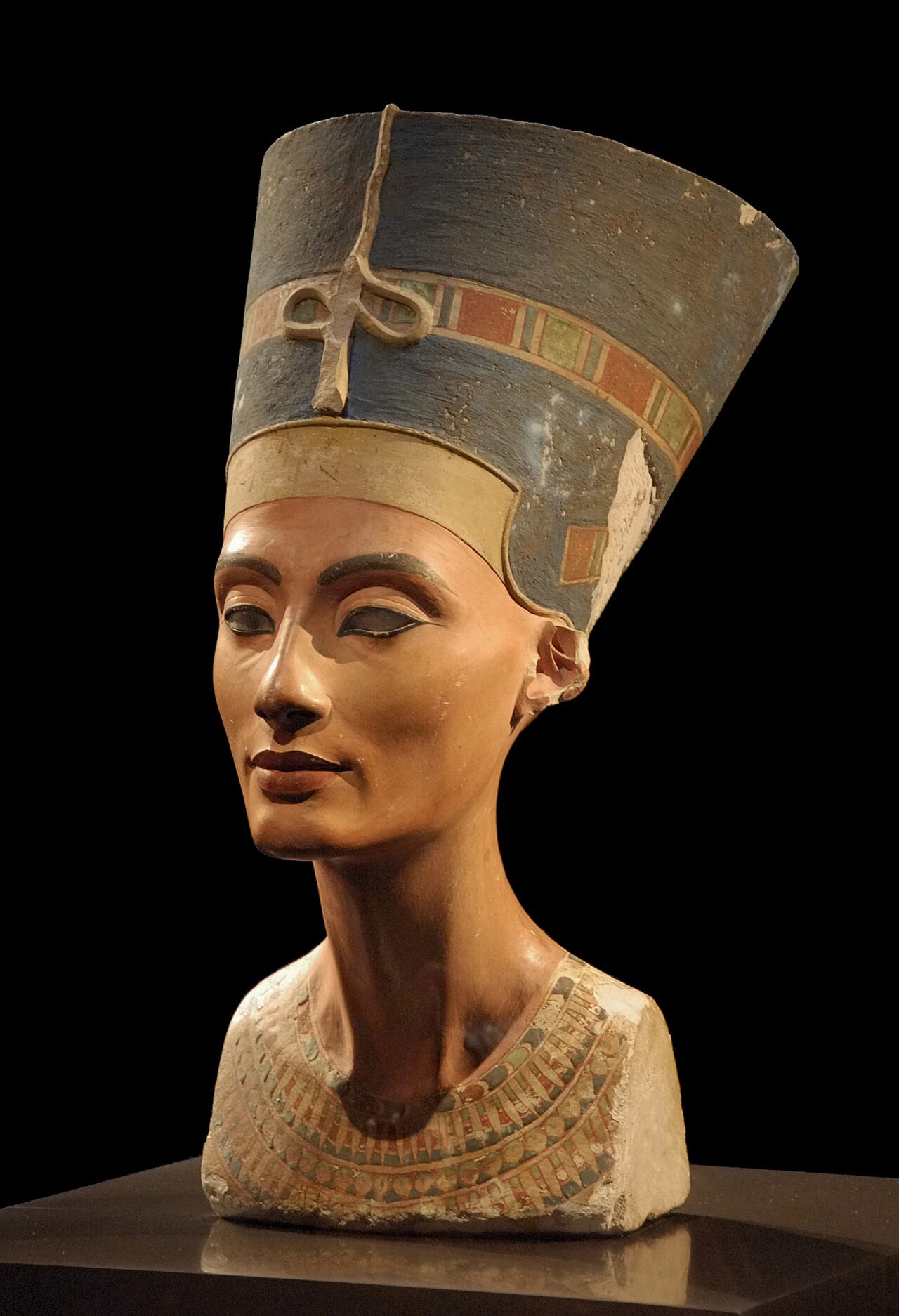
Painted limestone bust of an Egyptian queen wearing a tall blue crown with a red and green band and a gold-colored brow band. The eyes are inlaid with dark outlines, and the bust rests on a dark base against a black background.Sculpture

Primary source

Bust of Queen Nefertiti

Thutmose · c. 1345 BC

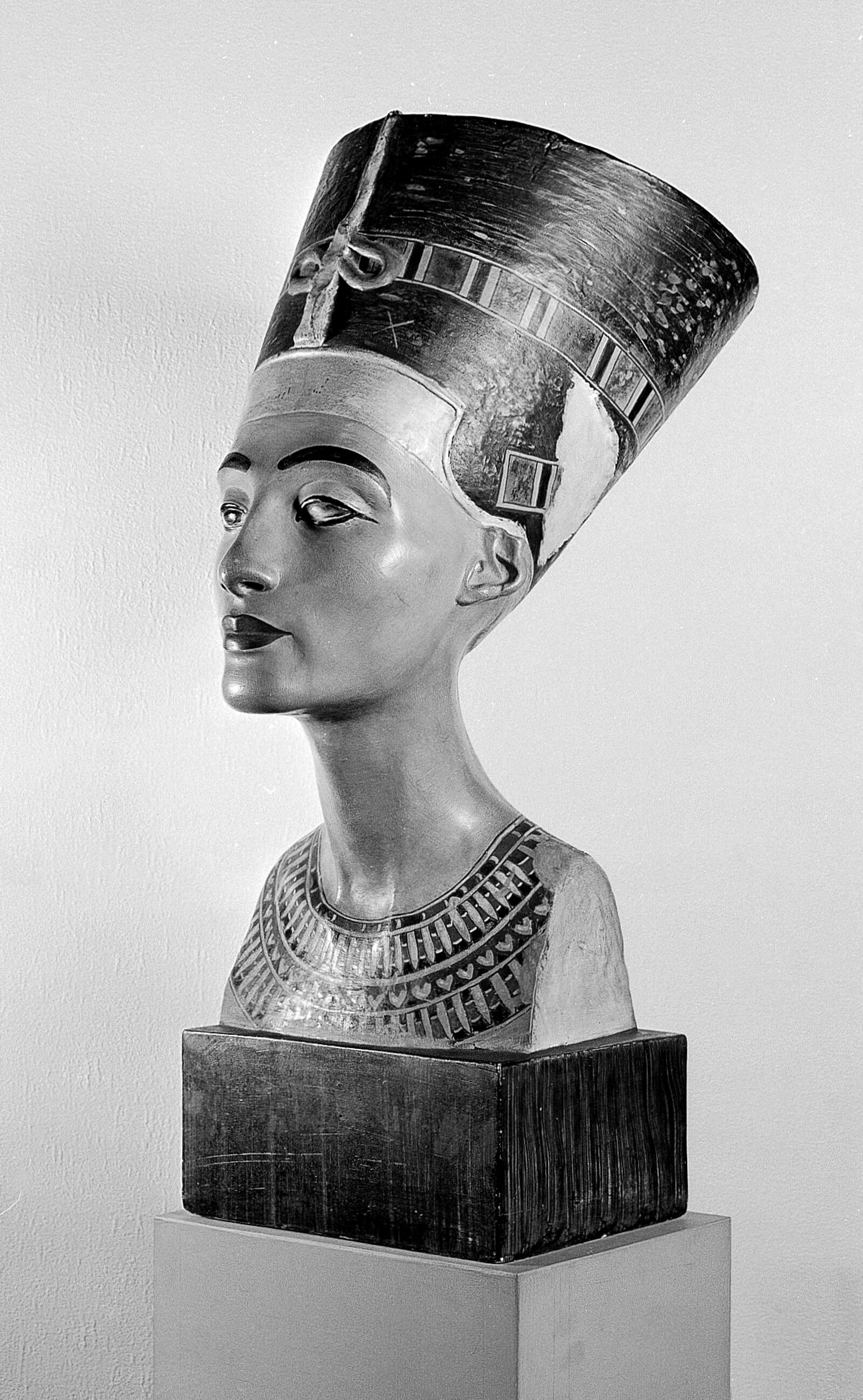
Black-and-white photograph of a painted bust of a woman with a tall flat-topped crown, side-facing, on a dark rectangular pedestal set on a pale plinth. The collar has striped and patterned bands.Sculpture

Primary source

Figure of Nefertiti

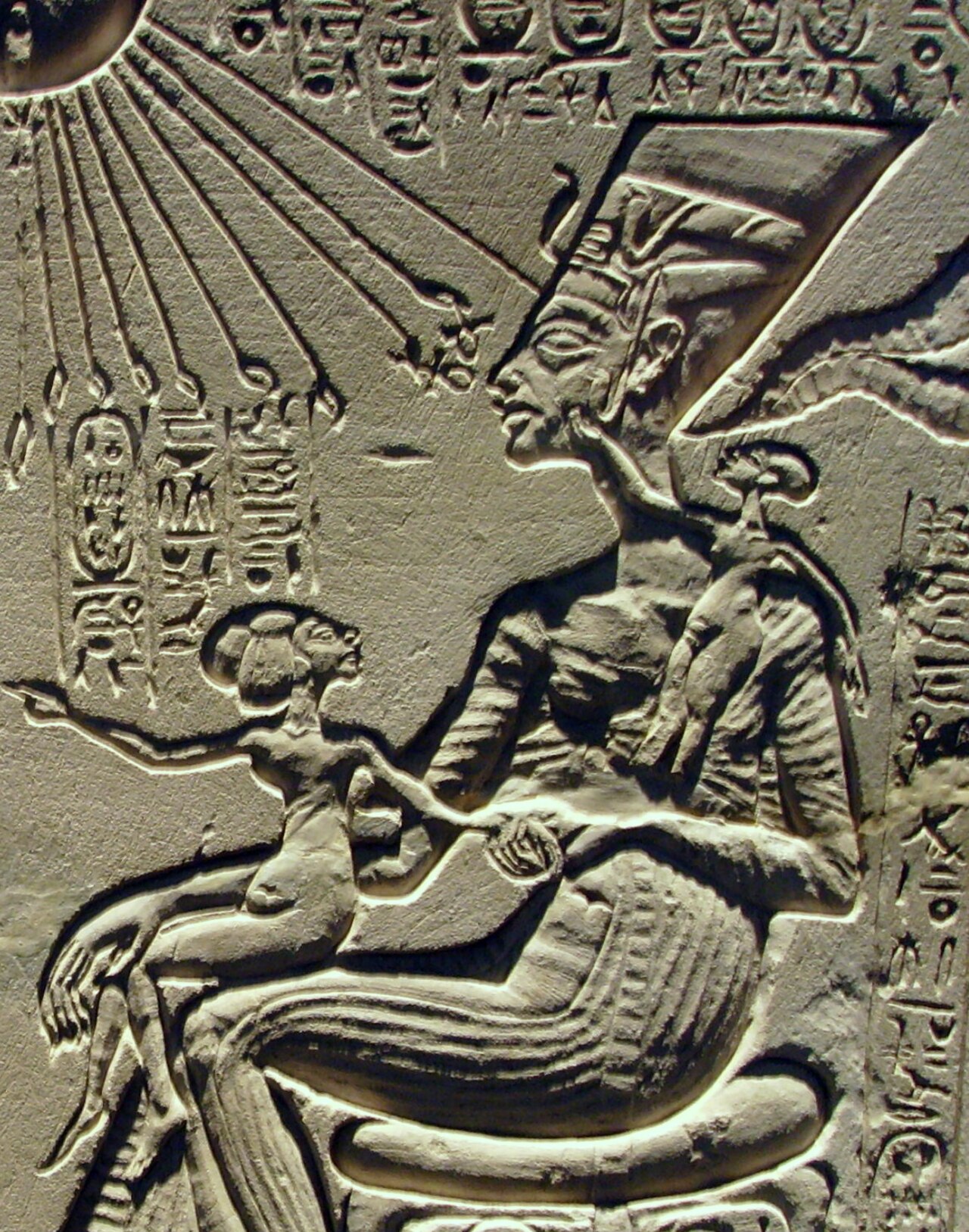
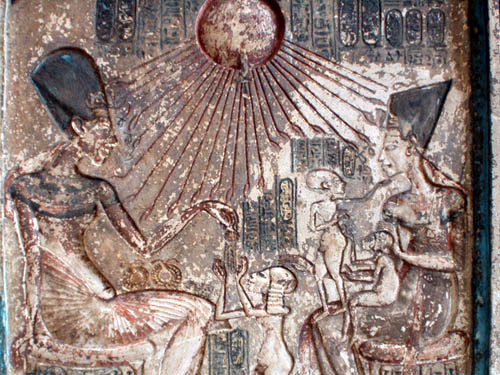
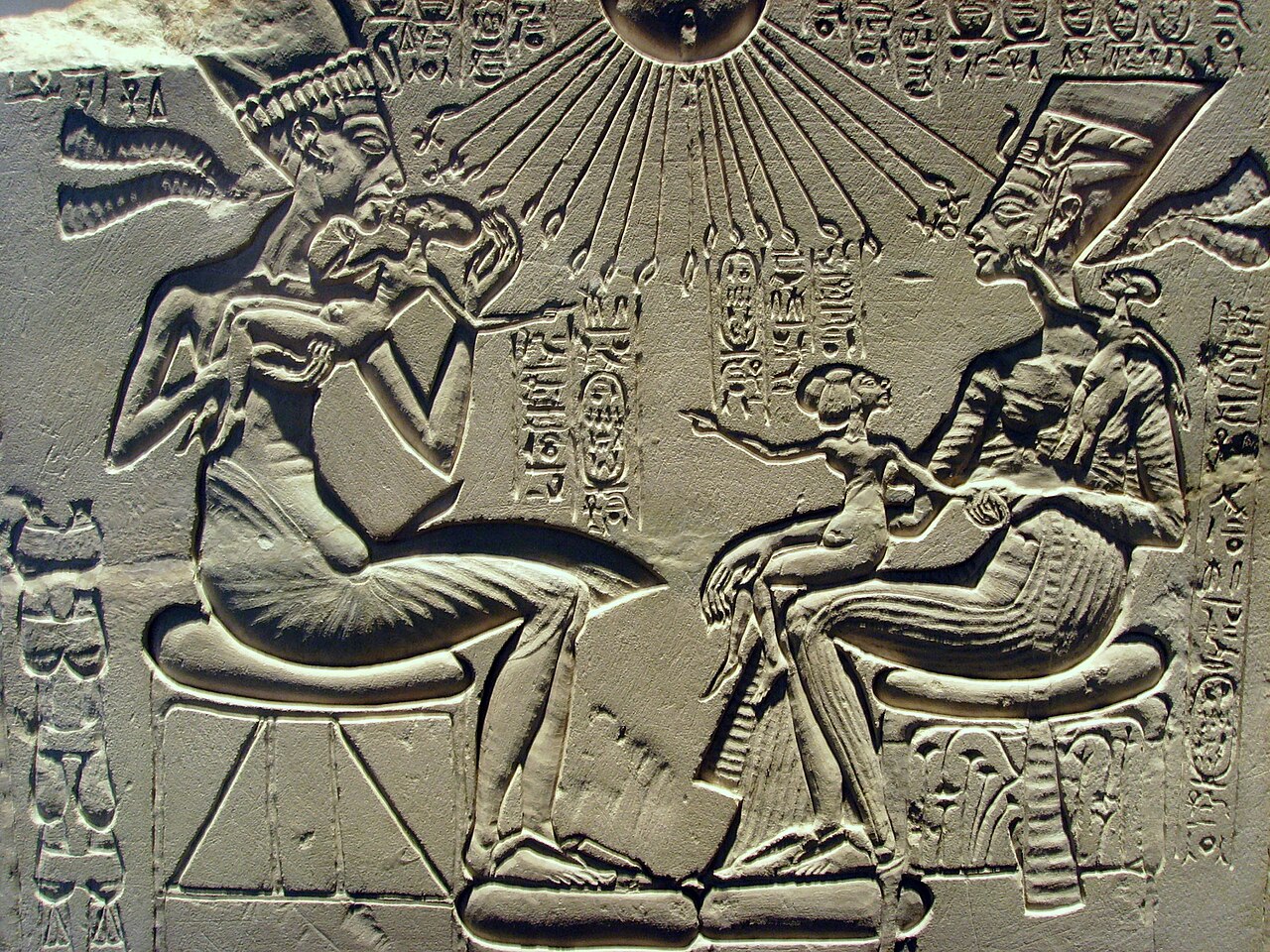
Close-up detail of an Amarna limestone relief. A seated woman wearing a tall flat-topped crown is at right, with a sun disc and rays above. At left, a smaller figure with a child's head is seated near her, and carved hieroglyphs fill the background.Sculpture

Primary source

Akhenaten and His Family

c. 1352 BC

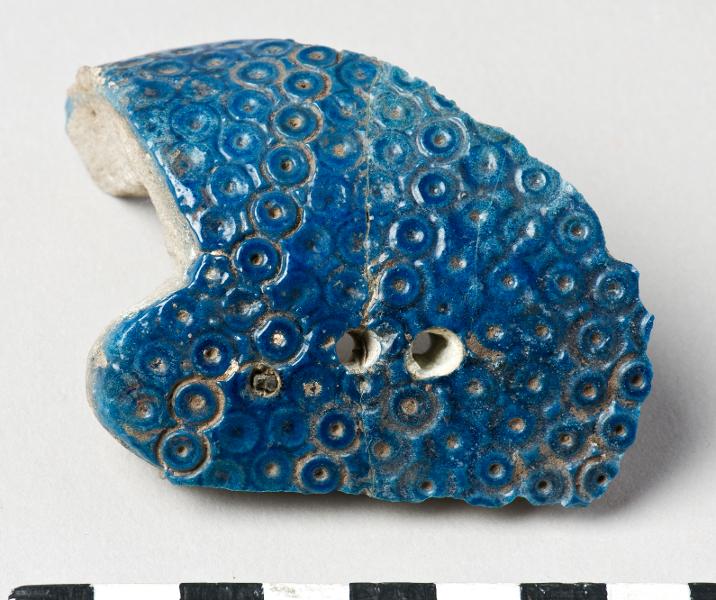
Photo of a curved, blue glazed ceramic fragment with white body edge, covered in raised concentric ring motifs with dots. Two holes pierce the piece near its center, with a scale bar along the bottom.Sculpture

Primary source

Relief Fragment Showing the Blue Crown of Nefertiti

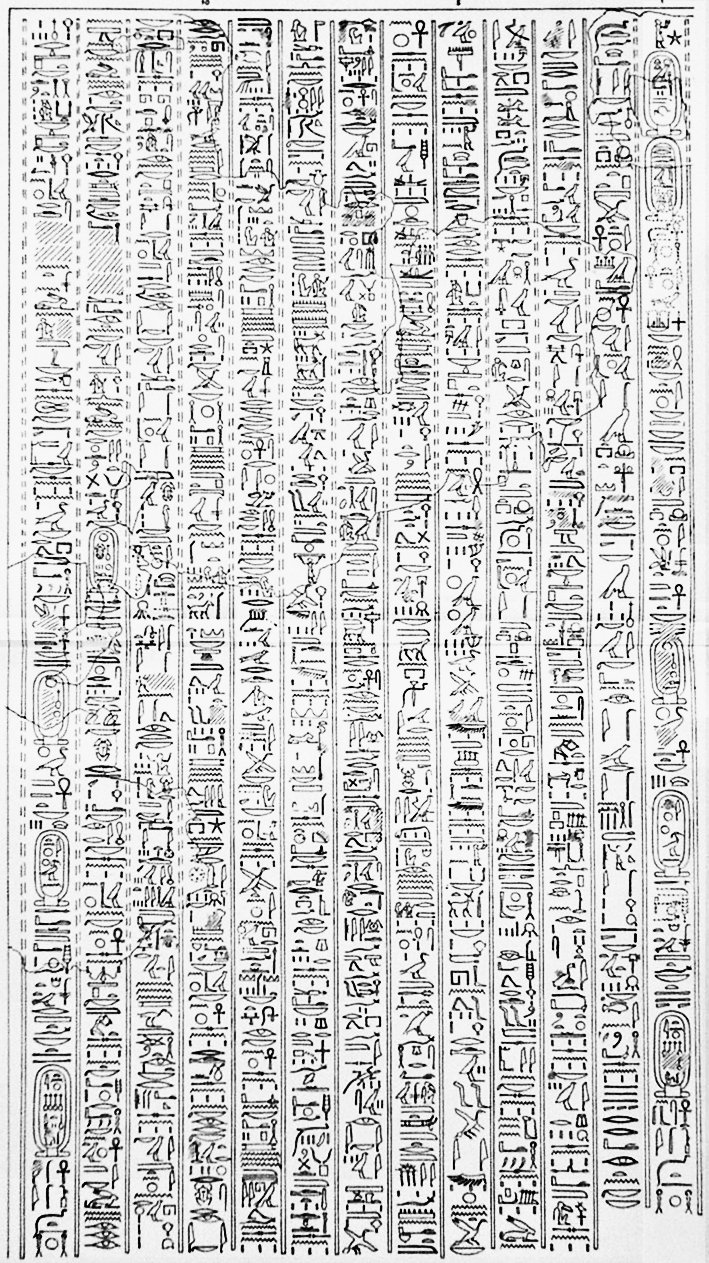
Black-and-white line drawing of columns of Egyptian hieroglyphic text arranged in vertical lines, with cartouches visible, copied from a wall inscription. This is a facsimile of the Great Hymn to the Aten.Document

Primary source

Great Hymn to the Aten

Akhenaten · c. 1350 BC

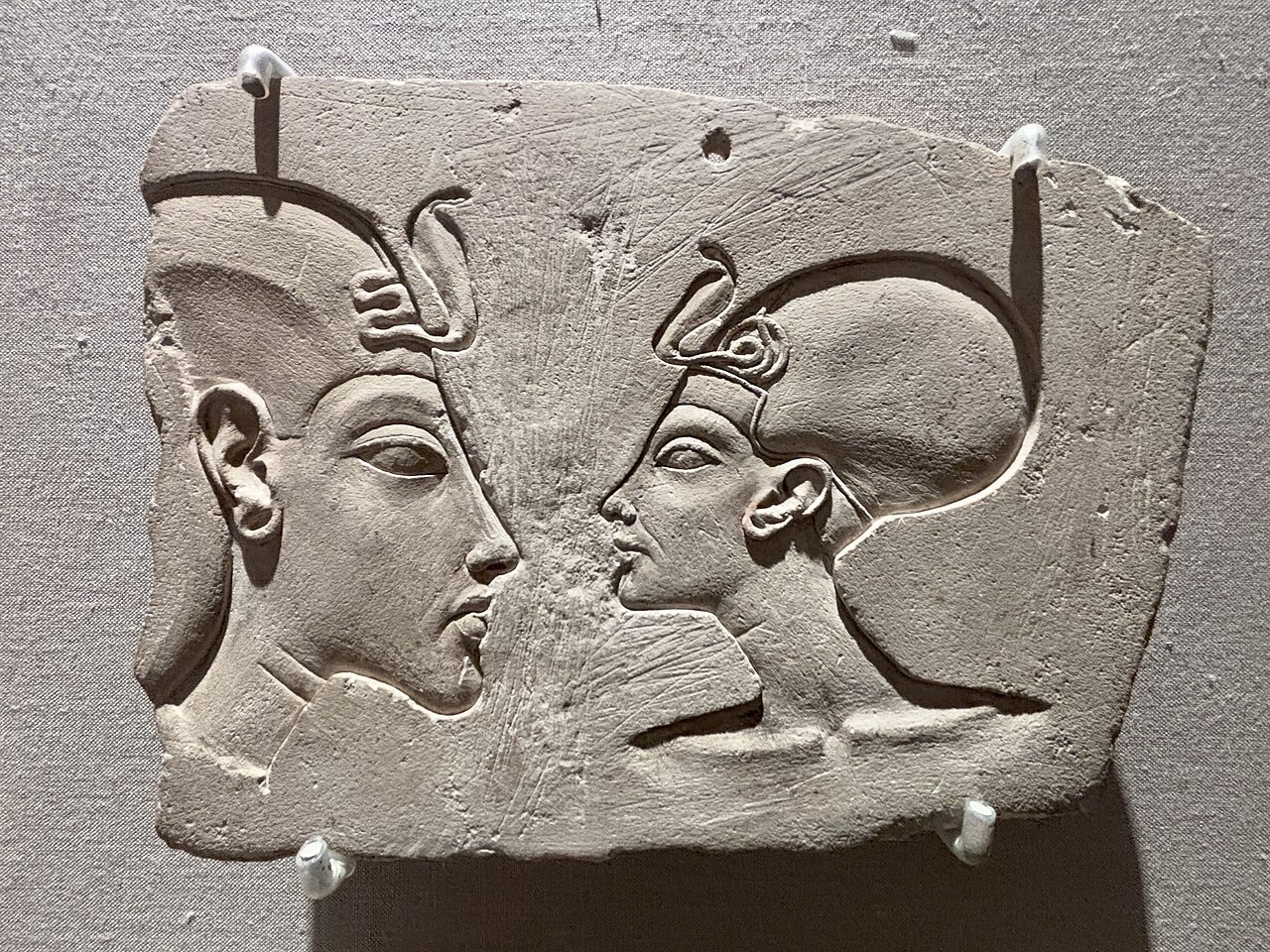
Photo of a pale sandstone relief plaque showing two profile heads facing each other: an Egyptian ruler with a tall crown on the left and a figure with a headdress on the right. Both have carved eyes, ears, and chins. Mounted on a gray background with small white supports.Sculpture

Primary source

Wilbour Plaque

c. 1352-1336 BC

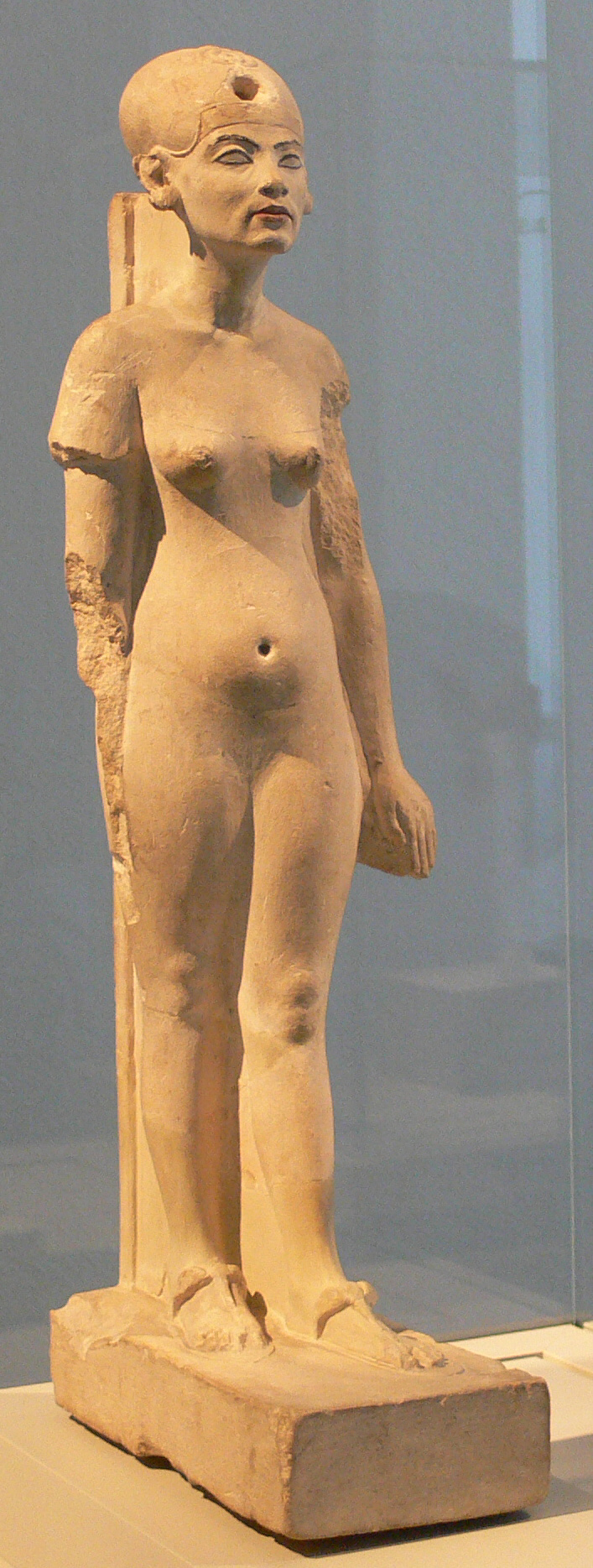
Photograph of a pale limestone statue of a standing nude female figure with a tall crown, shown in profile on a rectangular base, with a back pillar behind it. Arms are at the sides, one hand is partly visible, and the feet are on the base.Sculpture

Primary source

Standing Figure of Nefertiti

c. 1345 BC

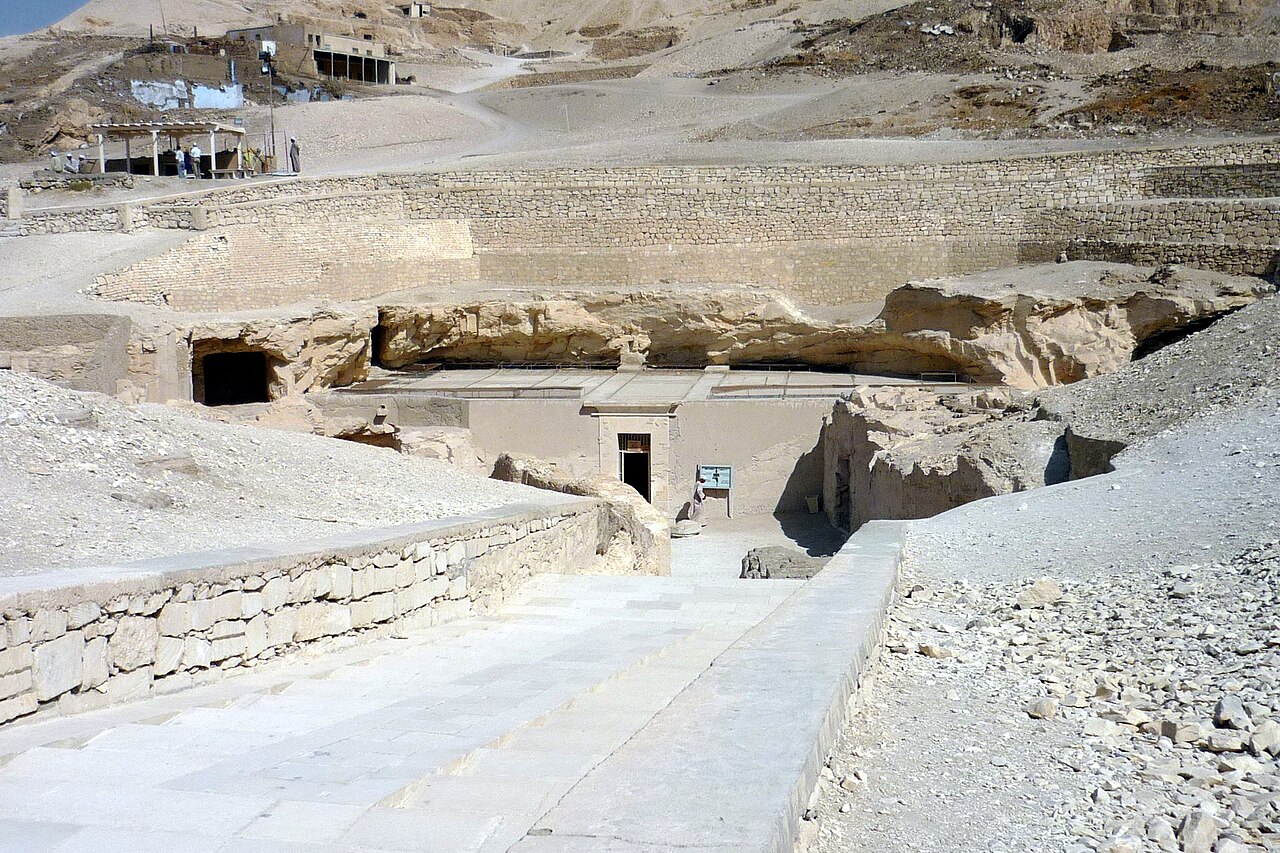
Photo of a rock-cut tomb facade in a desert hillside. A stone-paved ramp with a low retaining wall leads up to a pale mudbrick and stone entrance with a doorway, above which a cliff ledge and terraced stone walls rise. A small dark cave opening is at left, and a few visitors stand on a higher terrace.Artifact

Primary source

TT55 (Tomb of Ramose)

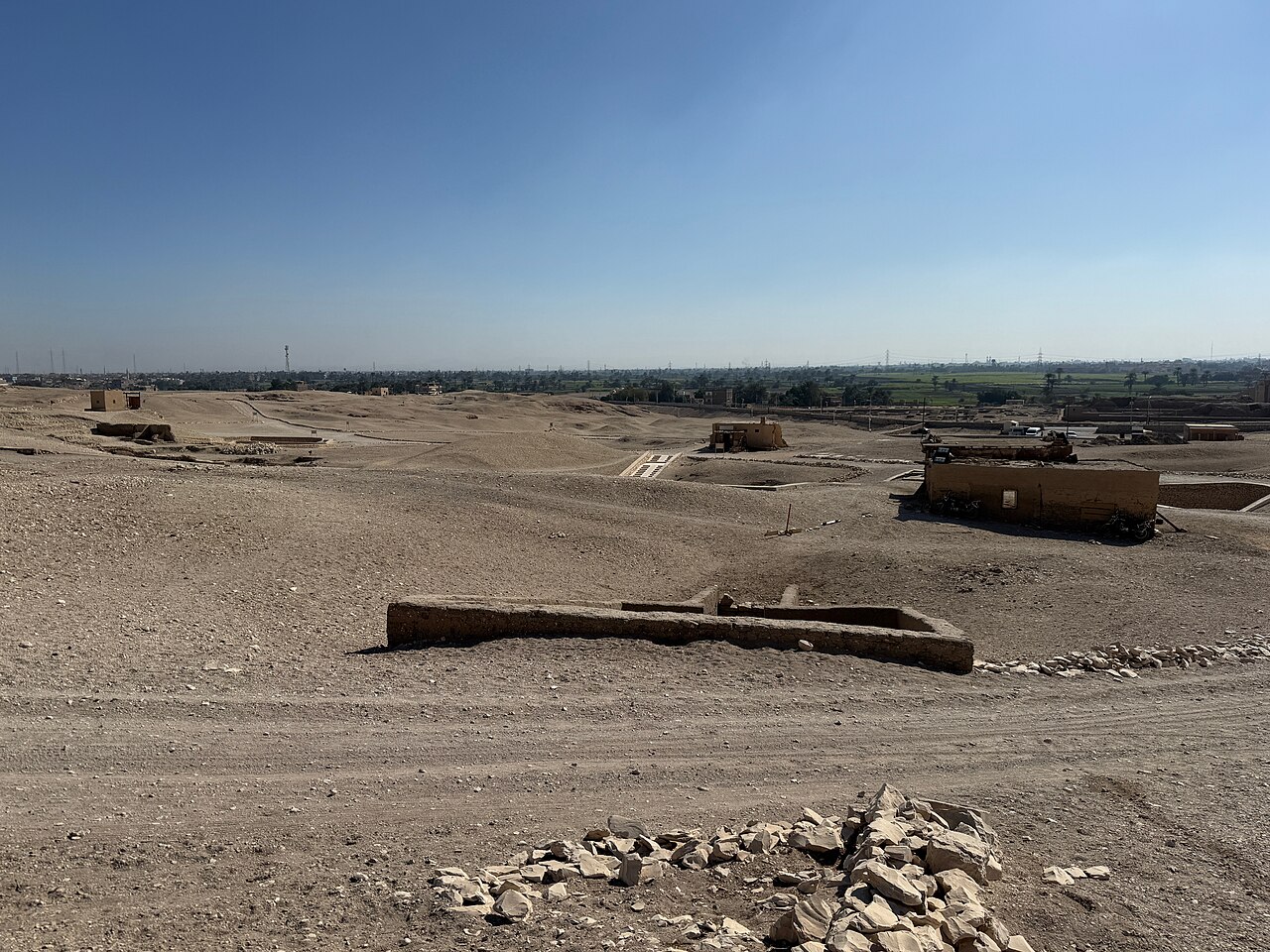
Wide view of a dry, stony desert hillside in the Valley of the Nobles near Luxor. Low mudbrick and concrete structures, a rectangular stone wall foundation, and rubble sit in the foreground. Green fields and a town lie in the distance under a clear blue sky.Document

Primary source

Tomb TT139 of Pairy

18th Dynasty, Amarna period

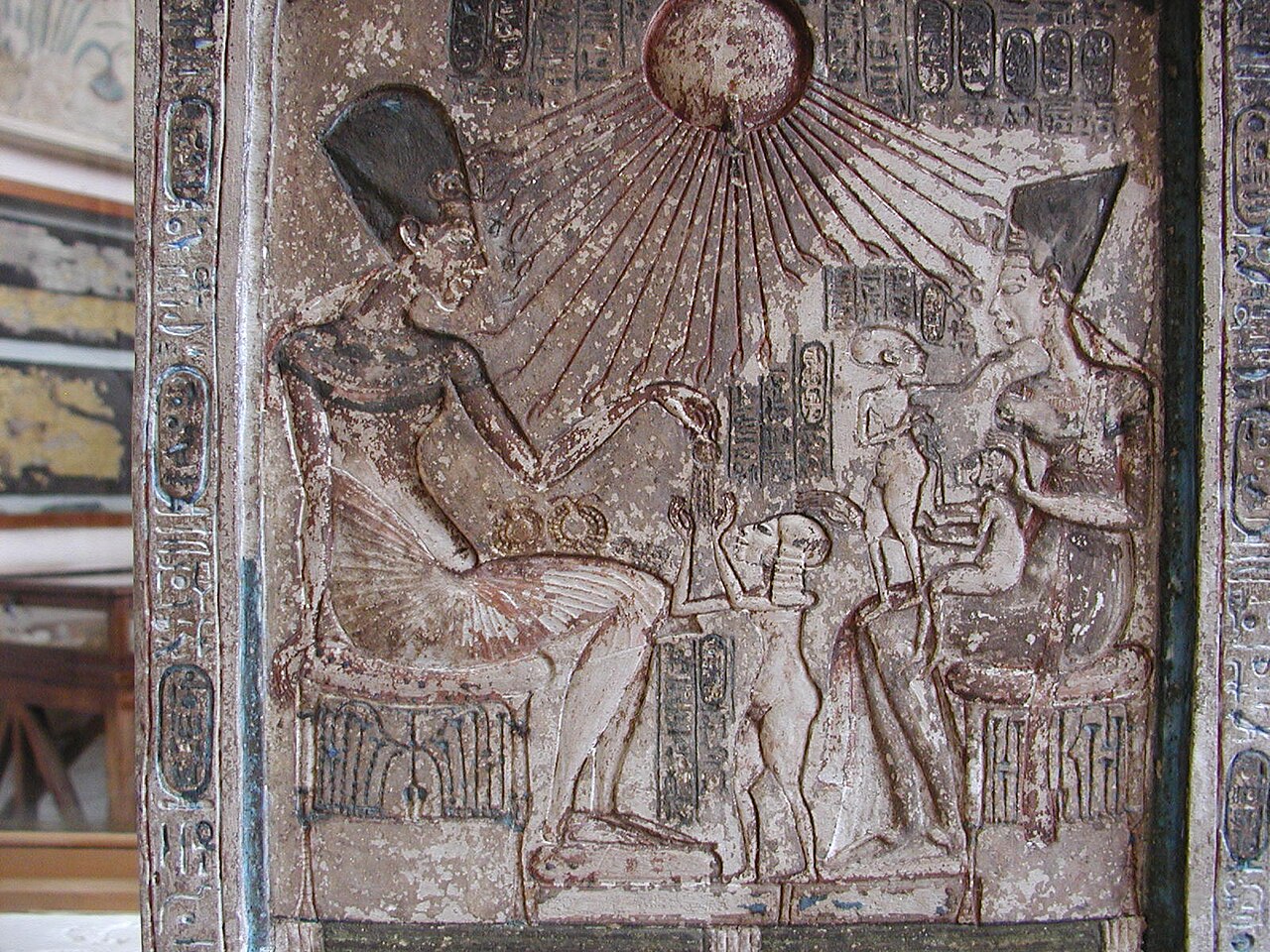
Relief carving on a limestone stela showing the royal family of Akhenaten under a sun disk with rays ending in hands. Figures sit and stand, with hieroglyphic inscriptions framing the panel. Weathered stone with traces of paint.Sculpture

Primary source

Stela of Akhenaten and his Family

Amarna period

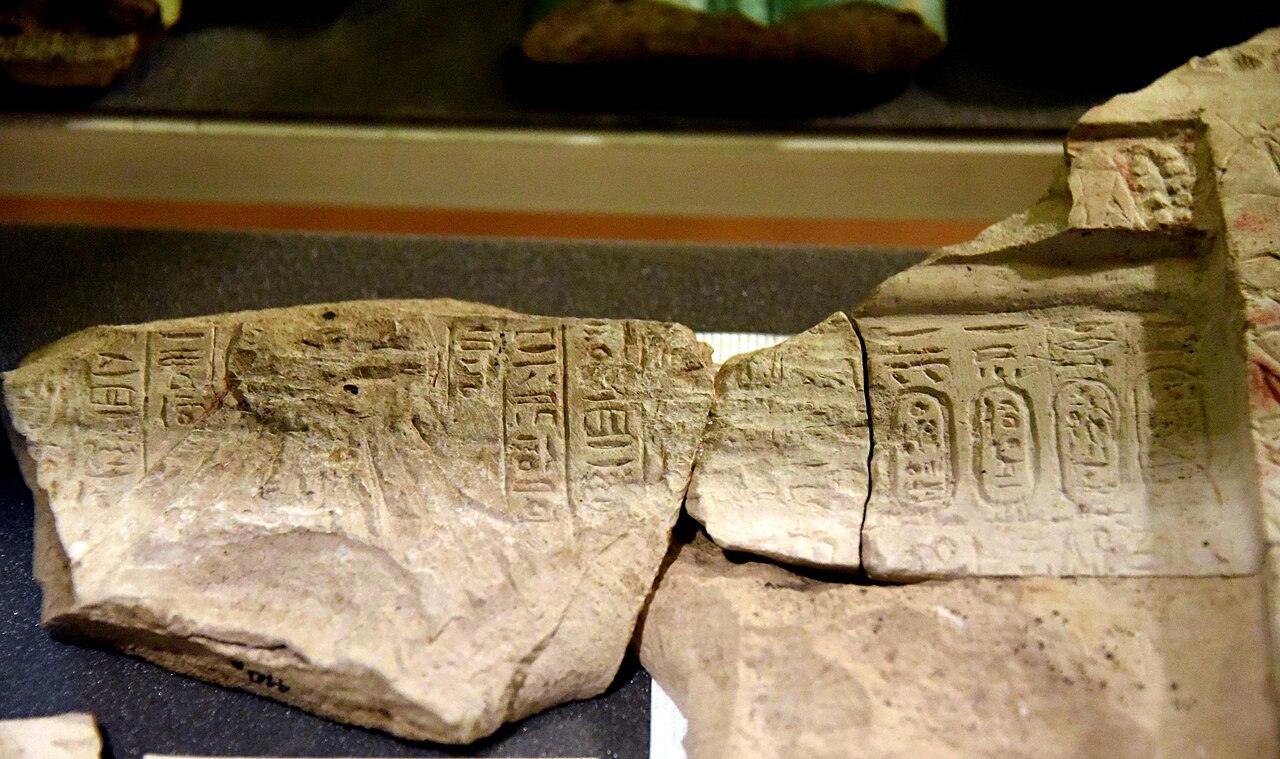
Two broken pieces of pale limestone with carved Egyptian hieroglyphic inscriptions, including cartouches, displayed on a dark surface in a museum case. Part of a stela fragment is visible on the right.Sculpture

Primary source

Coregency Stela

18th Dynasty, Amarna period

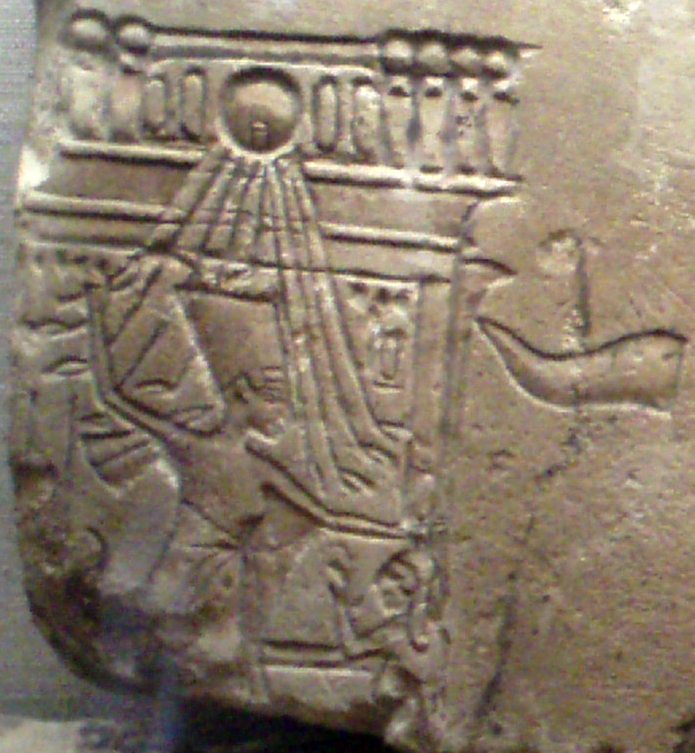
Close-up of a carved limestone relief showing a royal figure with a sun disk above, raying down with rays ending in hands, beside an ornate cornice and a figure on a boat-like structure with a curved prow at right. Surface is weathered.Sculpture

Primary source

Relief of Nefertiti Smiting a Captive on the Royal Barge

Unknown Amarna-period sculptor · c. 1353–1336 BCE

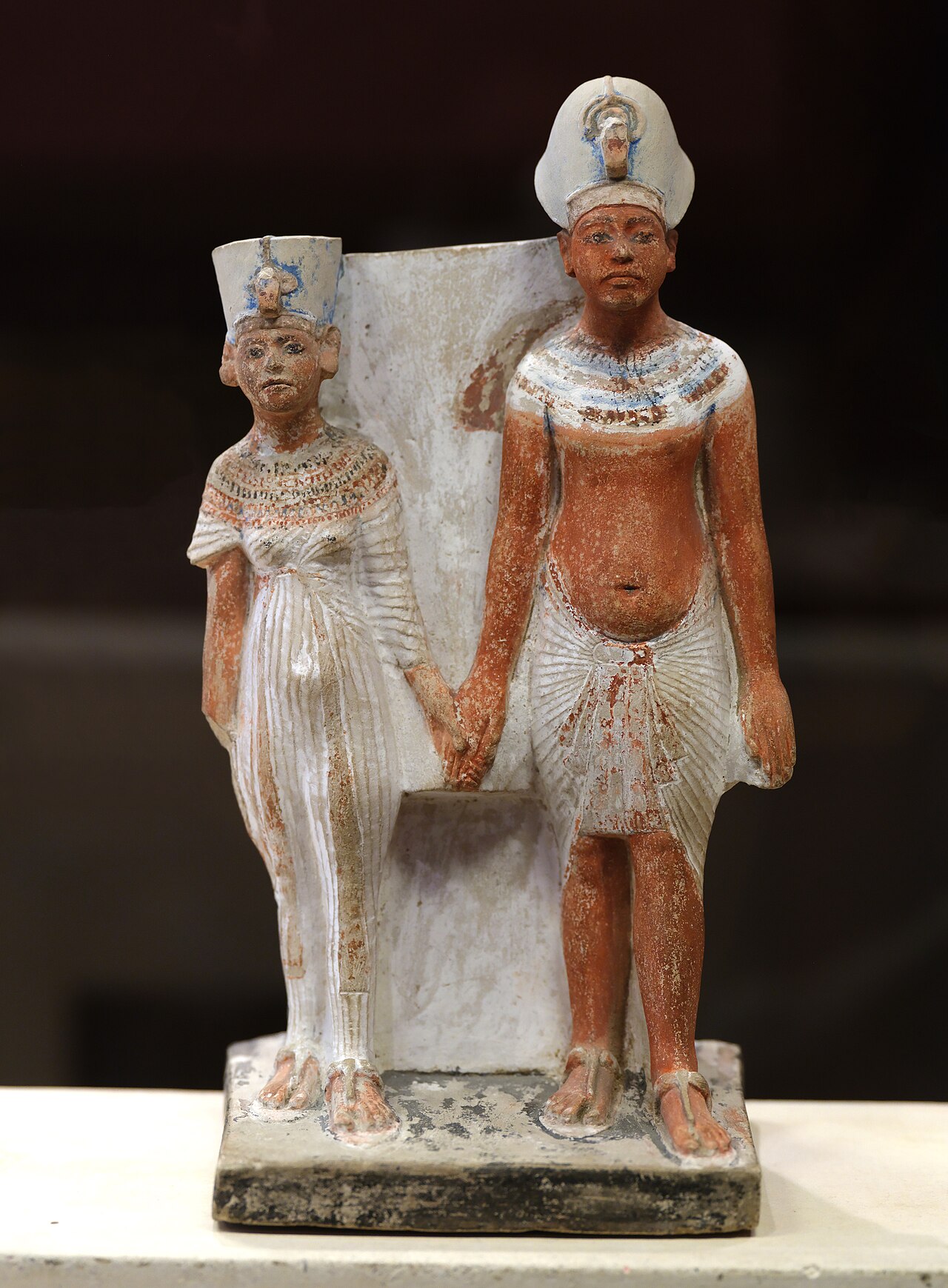
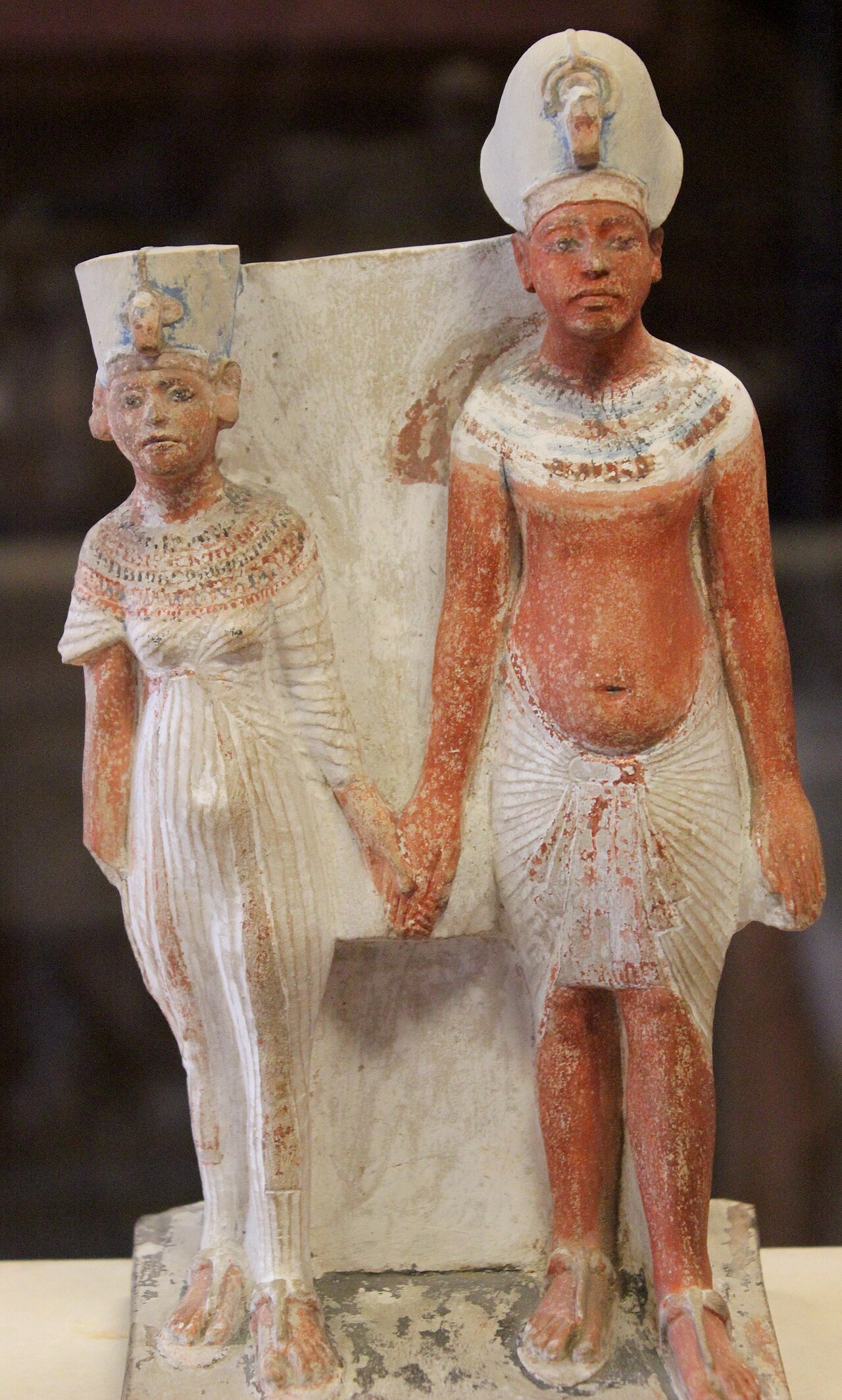
Painted limestone statuette of a king and queen standing side by side holding hands against a back slab. Both wear tall blue-and-white crowns and broad collars; the figure on the right is nude above a pleated kilt. Dark background.Sculpture

Primary source

Statuette of Akhenaten and Nefertiti

c. 1344 BCE

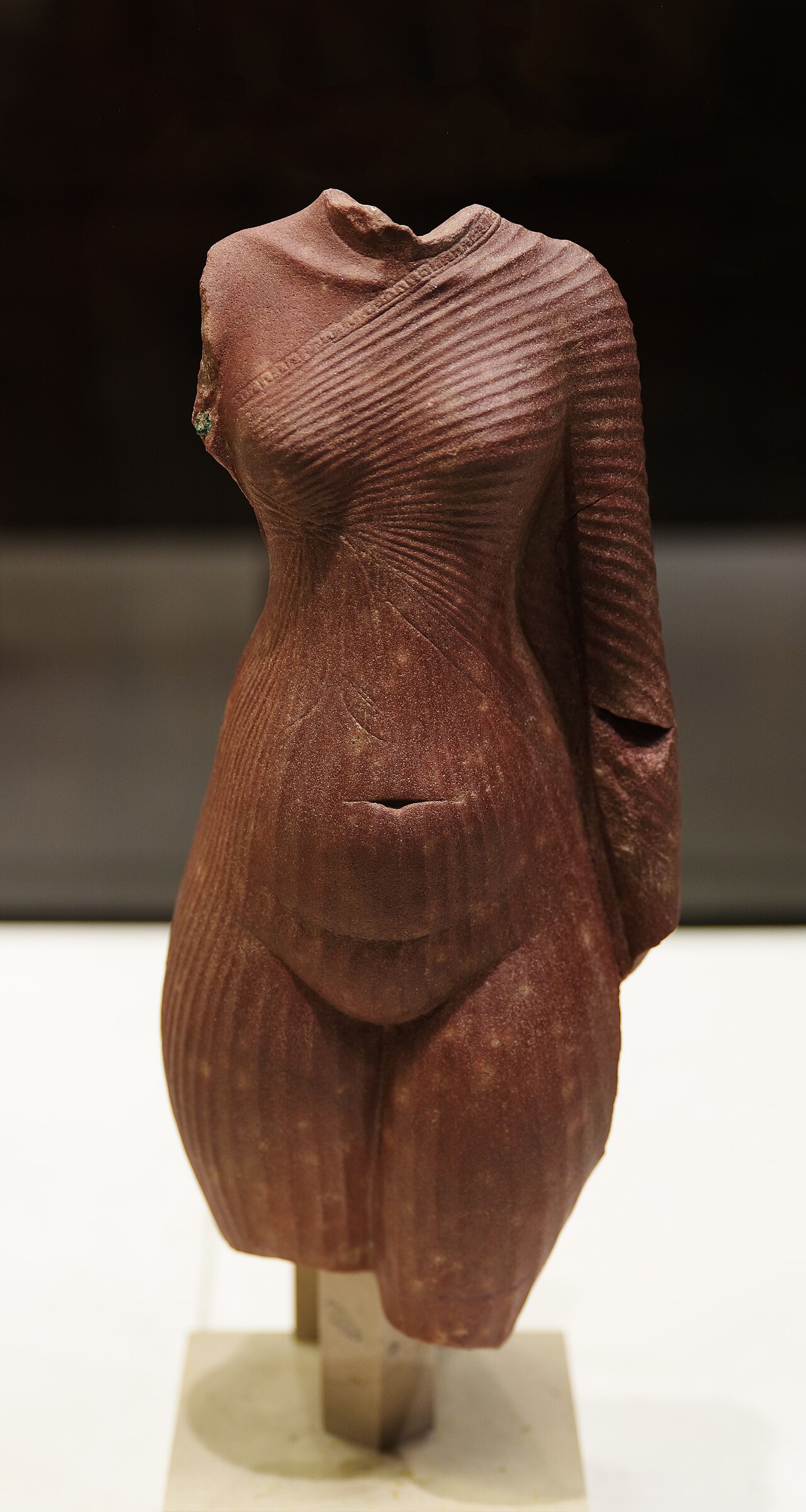
Photograph of a reddish-brown quartzite sculpture of a headless female torso with pleated, ribbed fabric-like texture, one arm hanging at the side, mounted on a small pale stand against a dark background.Sculpture

Primary source

Body of a Woman, probably Nefertiti

c. 1400 BCE

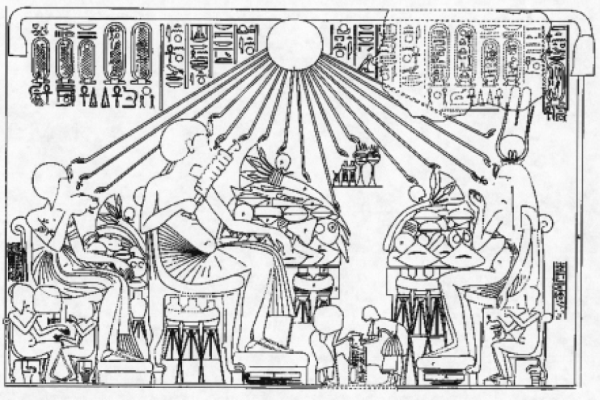
Line drawing of an ancient Egyptian banquet scene: a seated king and queen at left, a seated figure at right under rays of a sun disk, with offering tables piled with food and hieroglyphic inscriptions above.Painting

Secondary source

Banquet Scene in Huya's Tomb

Unknown author

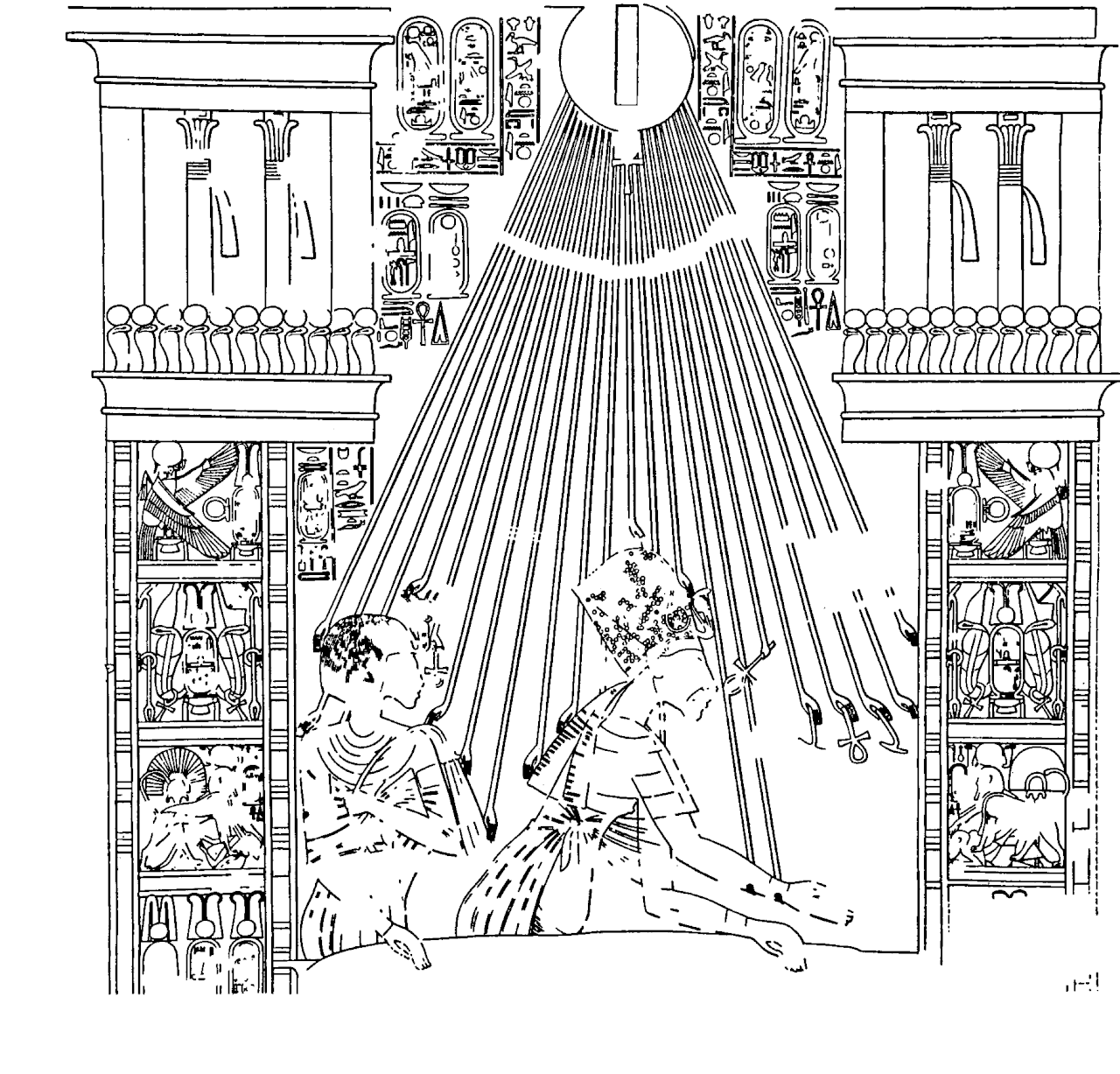
Line drawing of the Window of Appearances scene: a king and queen seated side by side under a sun disk with rays ending in hands, flanked by columns, with hieroglyphs and decorative panels around them.Painting

Secondary source

Window of Appearances Relief

Unknown author

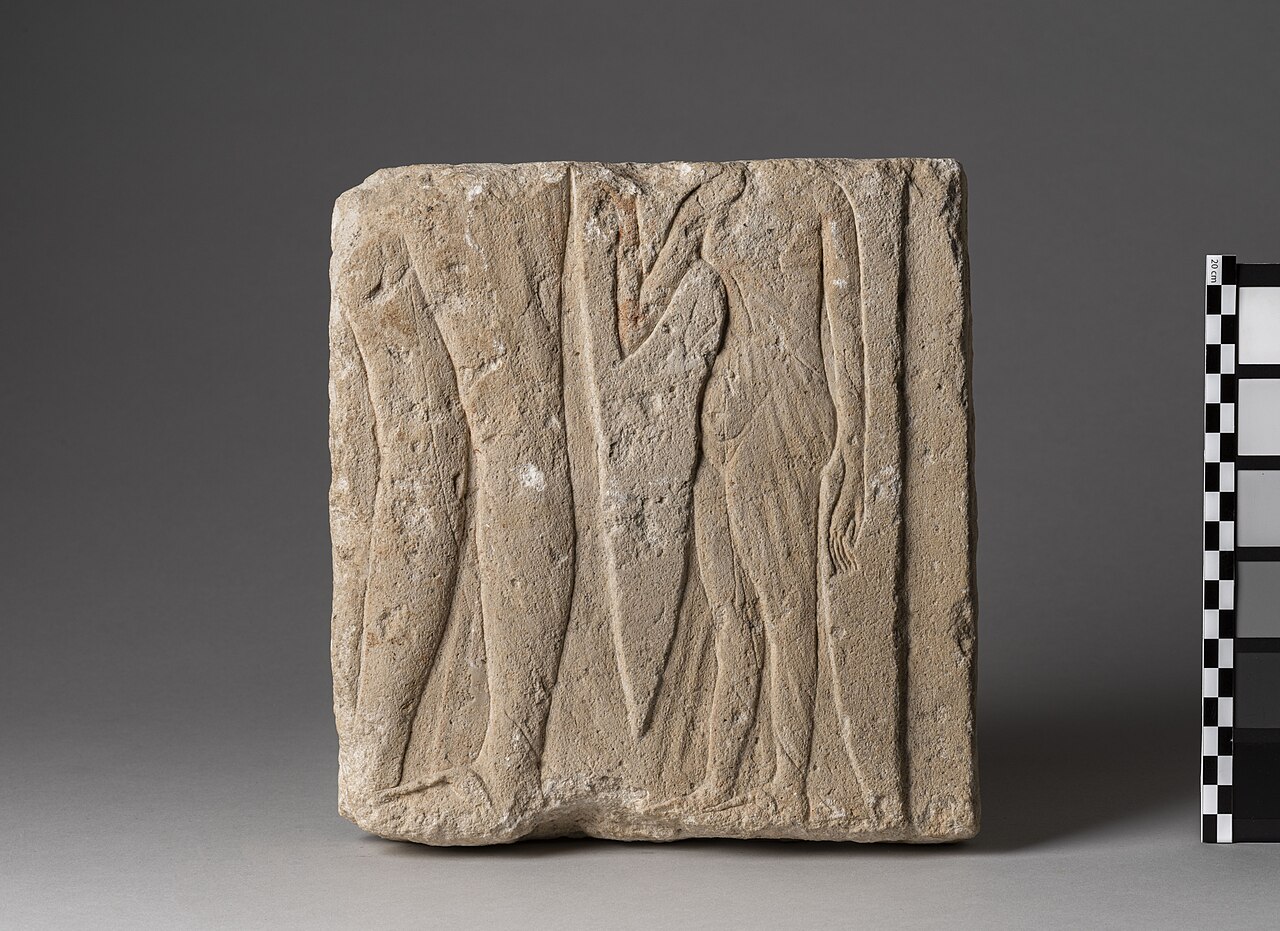
Photograph of a rectangular limestone block carved in low relief with figures in profile, shown against a grey background with a measurement scale bar at right. The stone is weathered and has a rough, pale surface.Sculpture

Primary source

Talatat Showing Nefertiti with a Princess

c. 1353-1336 BCE

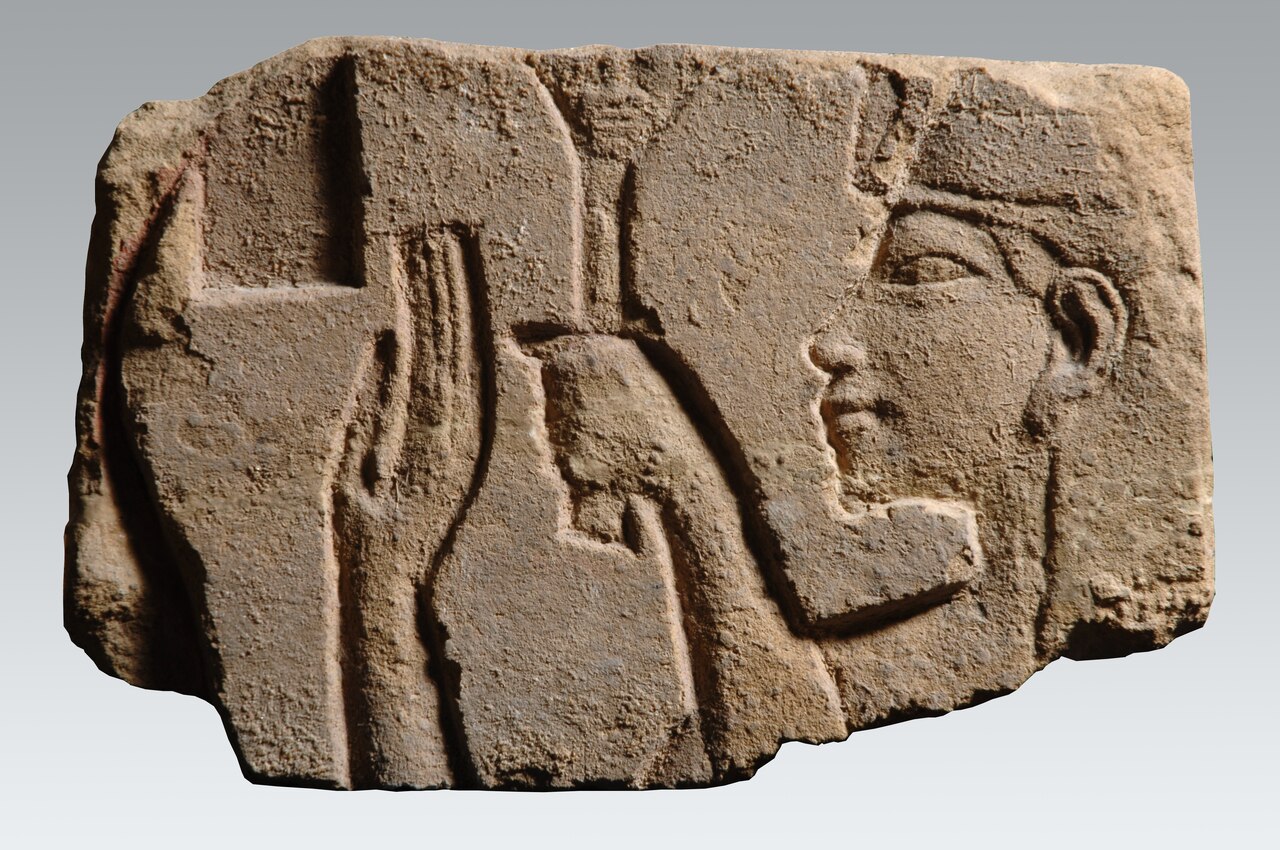
Photograph of a carved sandstone block (talatat) in raised relief against a grey background. A female figure in profile on the right holds up a sistrum toward the left, with her hand raised; the carving is weathered and the stone edges are irregular.Sculpture

Primary source

Talatat Showing a Queen Shaking a Sistrum

c. 1353-1336 BCE

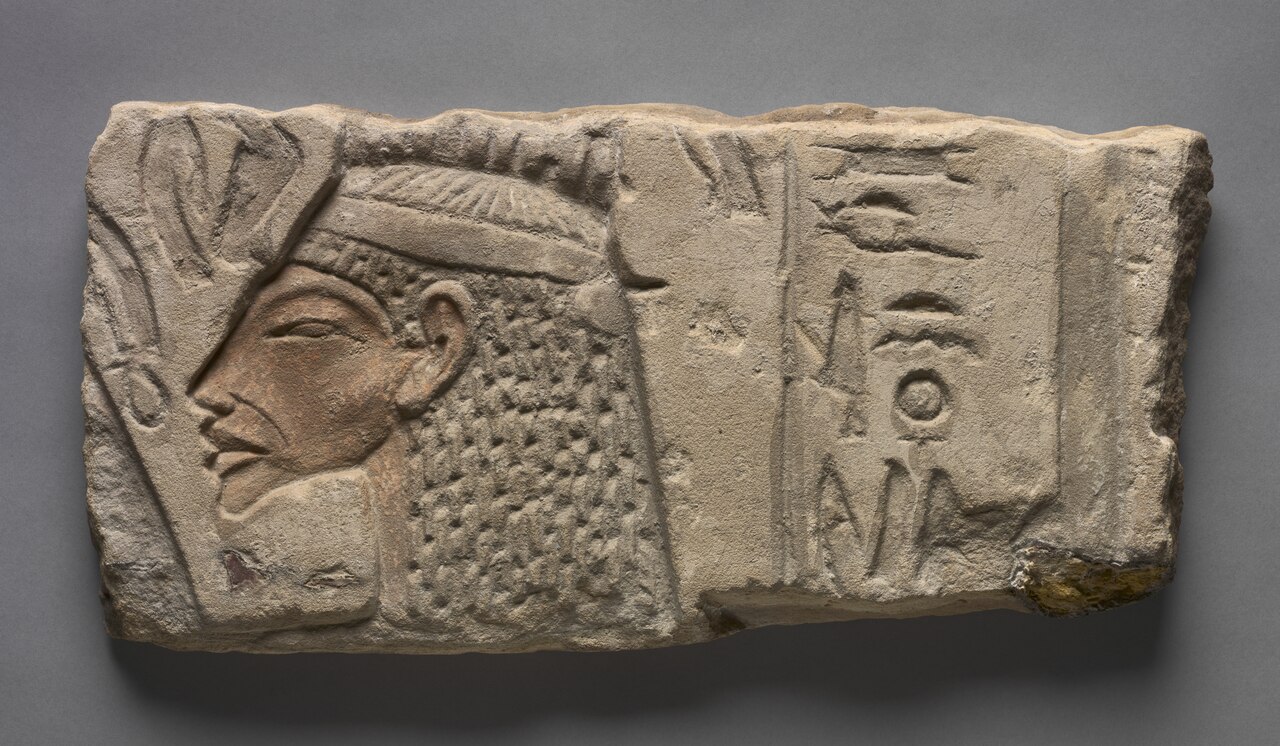
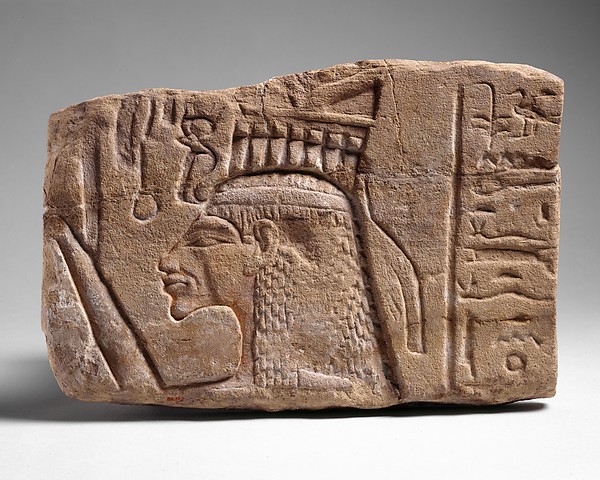
Carved limestone block relief showing a left-facing figure with a tall striped headdress, a faint ear, and a beaded or textured collar on a grey background; at right are carved hieroglyphic signs including an eye and a circular sign.Sculpture

Primary source

Talatat: Nefertiti Offers to the Aten

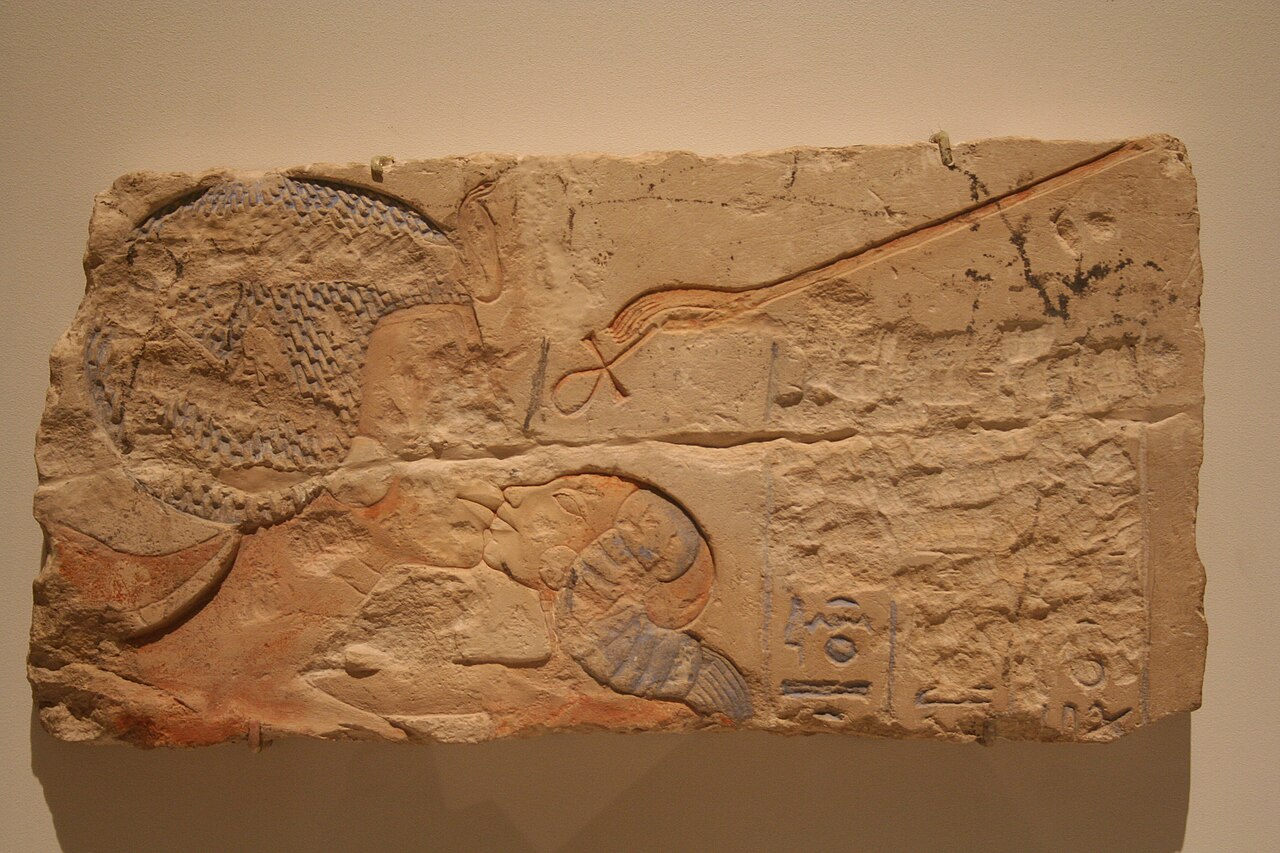
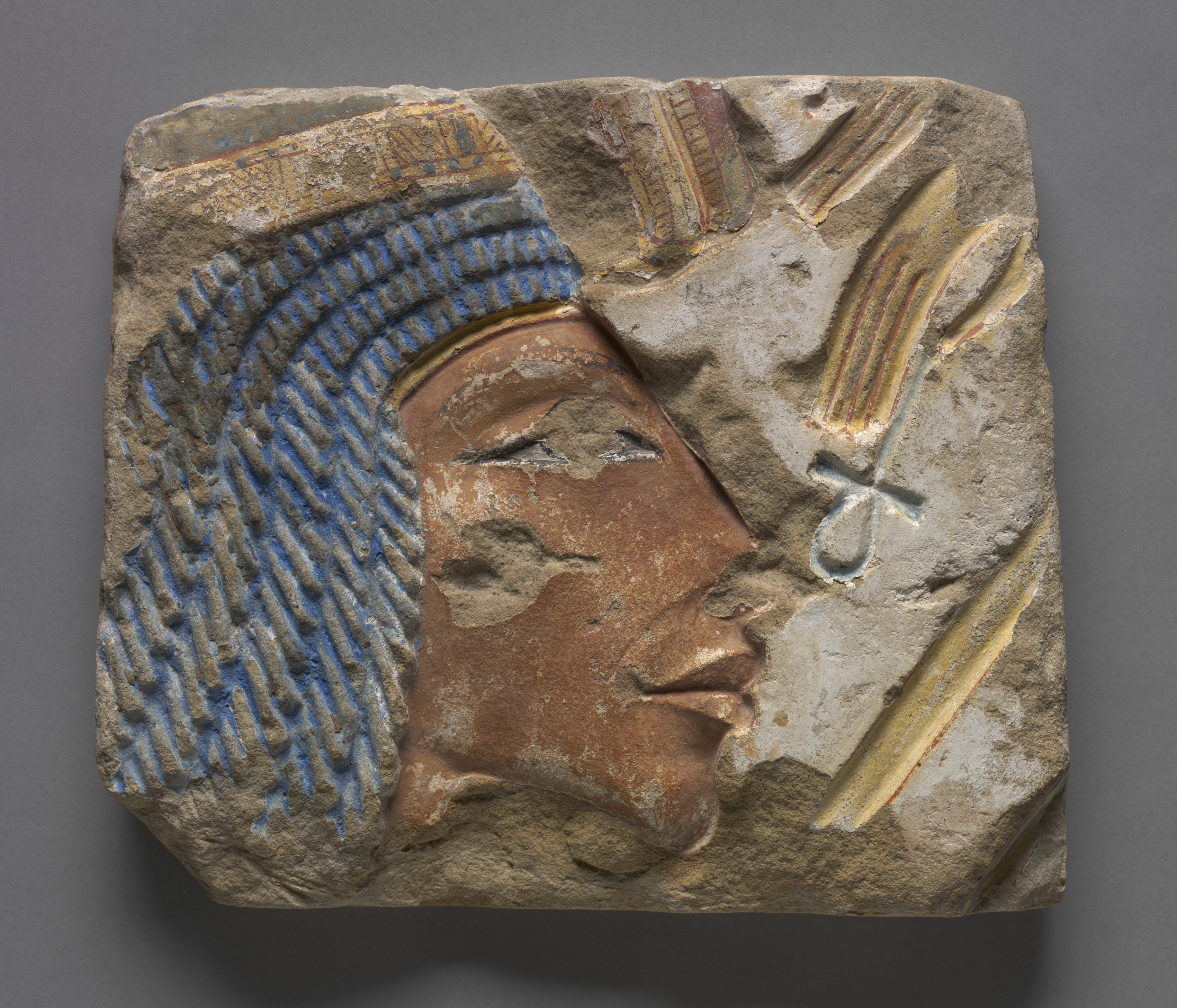
Painted limestone relief in a museum setting. On the left, a figure with a blue-and-white patterned wig and face in profile; in the center, a smaller figure with a large cone-shaped head and a child's profile, with an ankh sign and hieroglyphs on the right. Warm, tan stone with red and blue pigment traces.Sculpture

Primary source

Relief of Nefertiti Kissing One of Her Daughters

c. 1352-1336 BCE

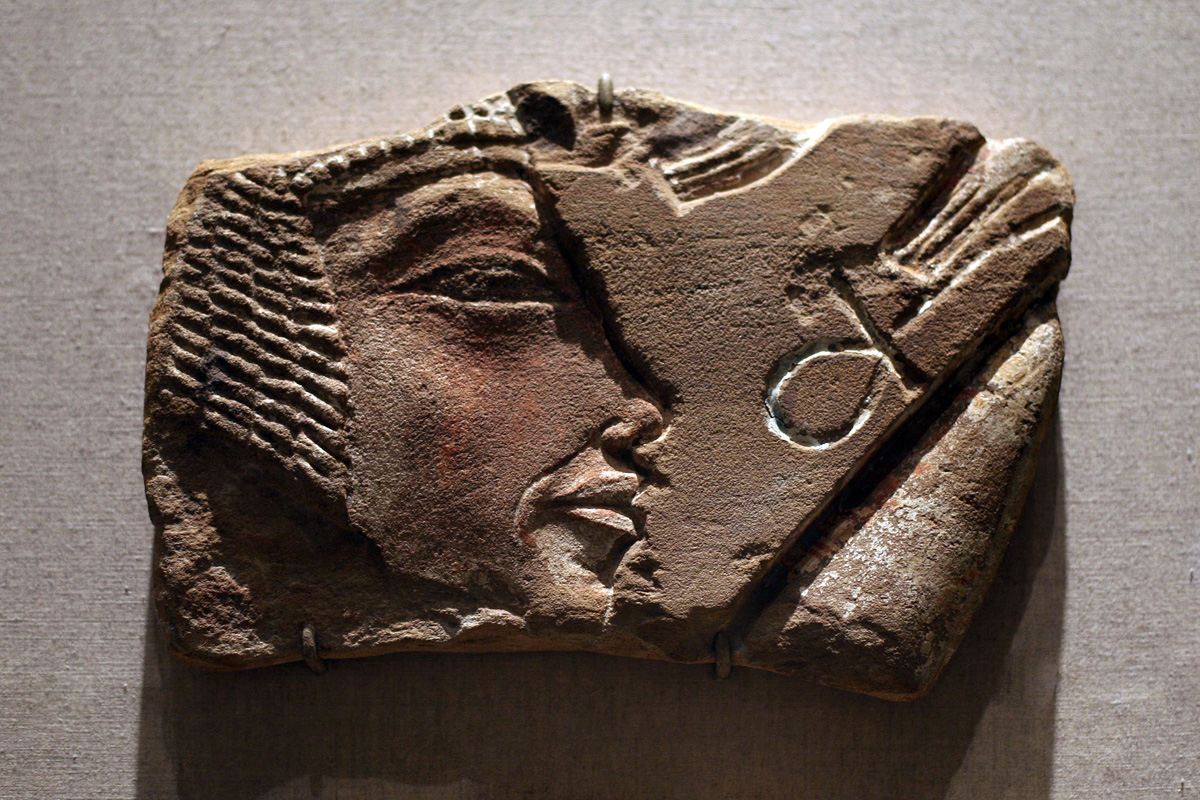
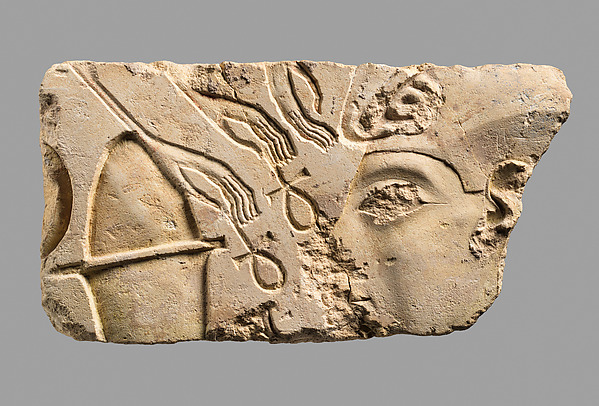
Photo of a carved sandstone relief fragment showing a left-facing profile of a face with a large almond eye, a straight nose, and full lips. A ring-shaped earring, a striated headdress, and a raised hand are visible. The fragment is mounted on a gray background.Artifact

Primary source

Early Image of Nefertiti

c. 1352-1347 BCE

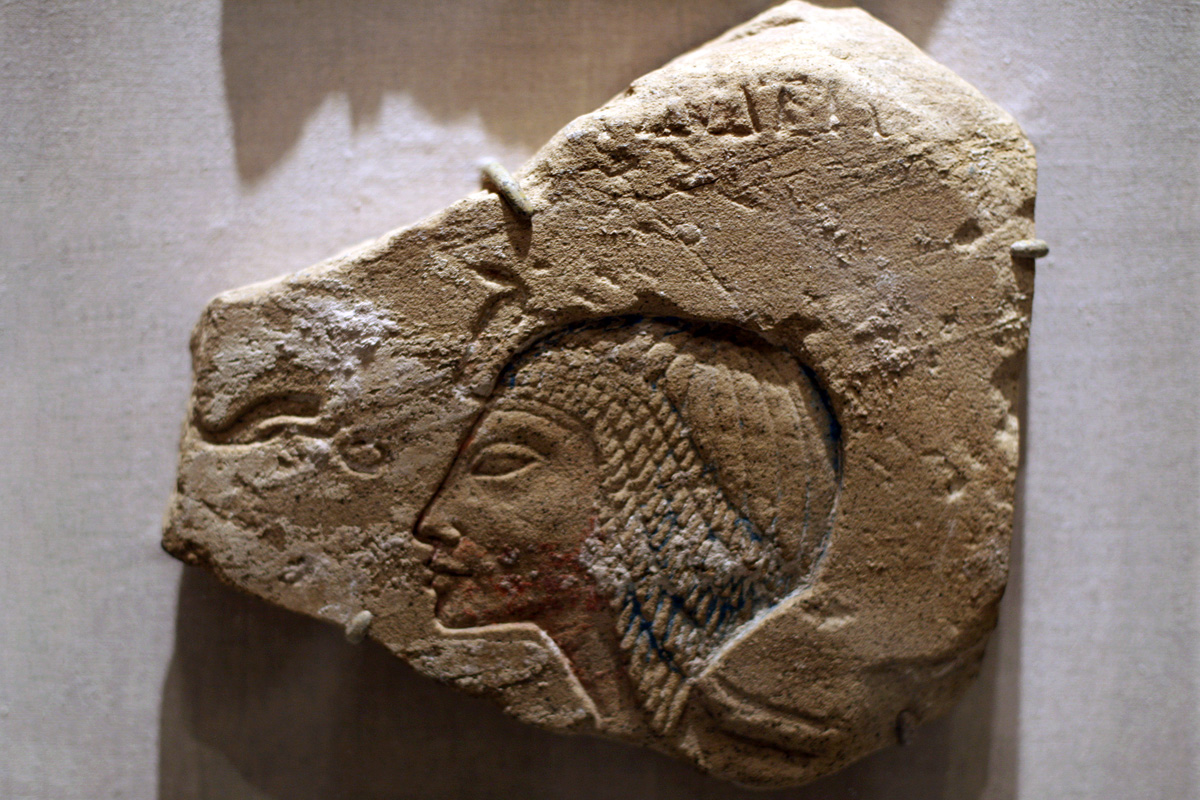
Fragment of a sandstone relief carved in profile, showing a woman's face facing left with a rounded eye, a straight nose, full lips, and a striated headdress with traces of blue paint. Pale stone background.Artifact

Primary source

Late Image of Nefertiti

c. 1352-1336 BCE

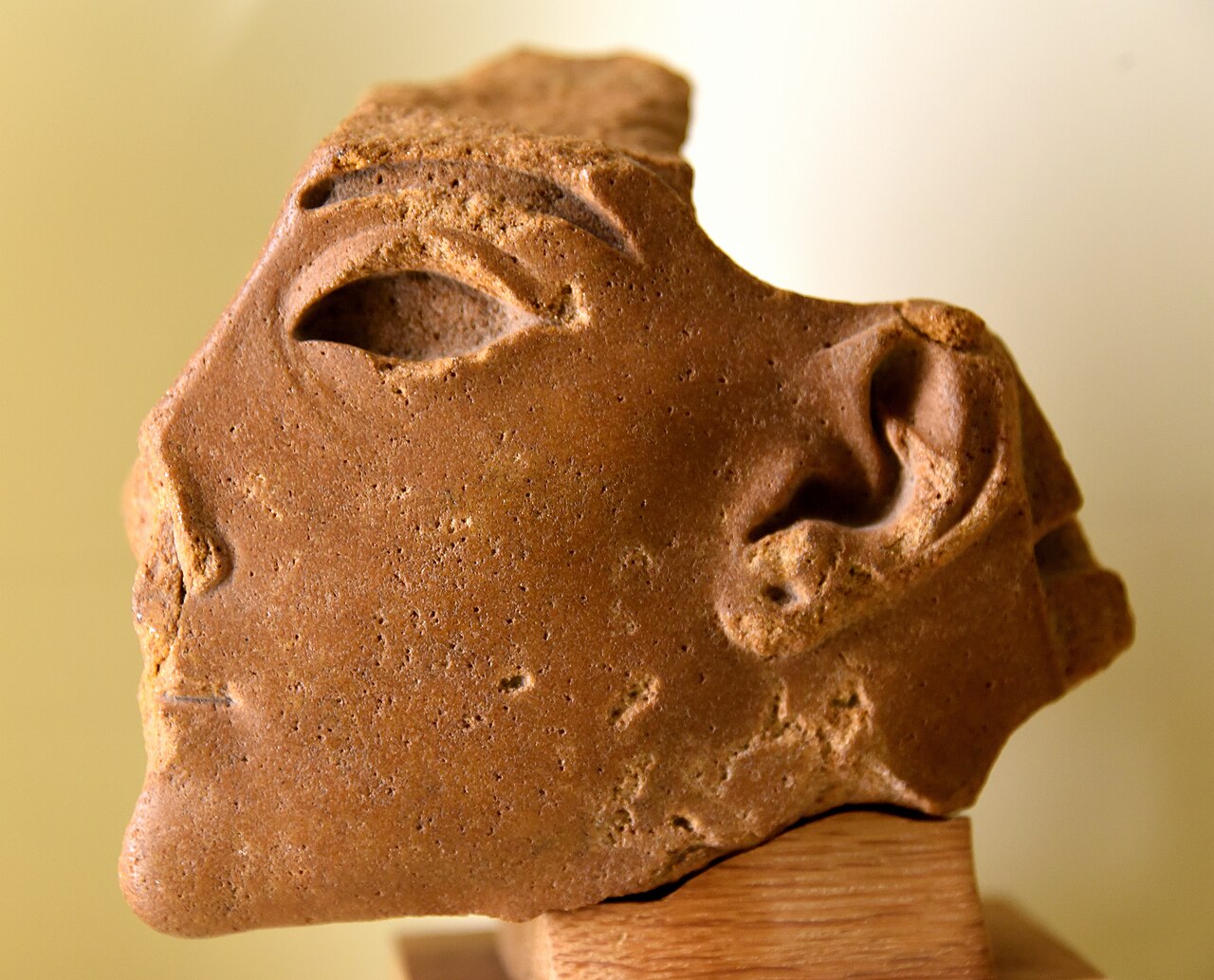
Close-up photograph of a brown stone fragment carved with part of a face: a almond-shaped eye with a raised brow, a carved ear on the right, and a rough broken edge on the left and top. It rests on a wooden block against a pale yellow background.Sculpture

Primary source

Inlay Head of Akhenaten or Nefertiti

Reign of Akhenaten

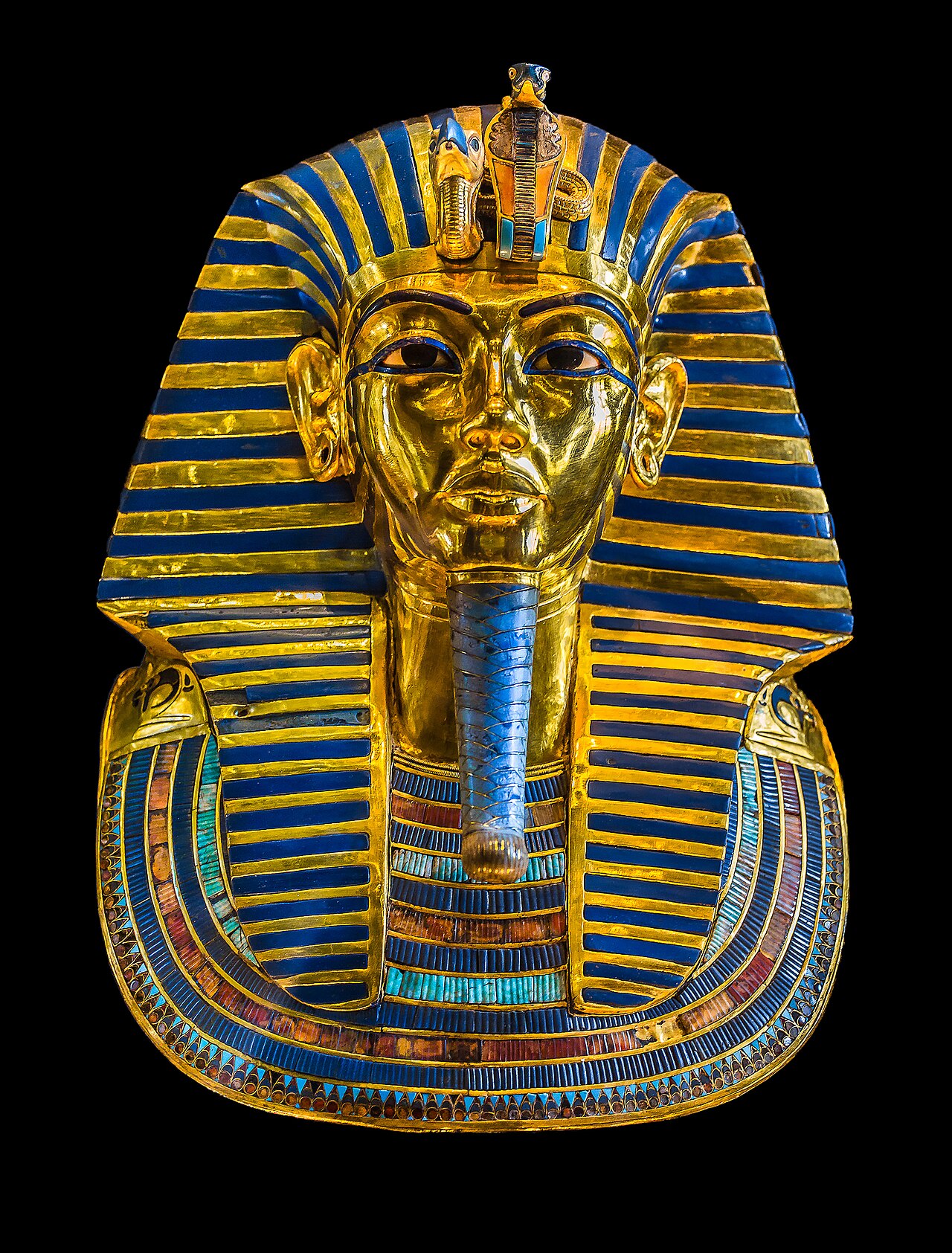
Photograph of the gold funerary mask of Tutankhamun against a black background. The mask shows a stylized face with inlaid blue eyes and eyebrows, a striped blue and gold headdress, a vulture and cobra emblem on the brow, a blue false beard, and a collar of colored inlays.Artifact

Primary source

Mask of Tutankhamun

c. 1333 BCE

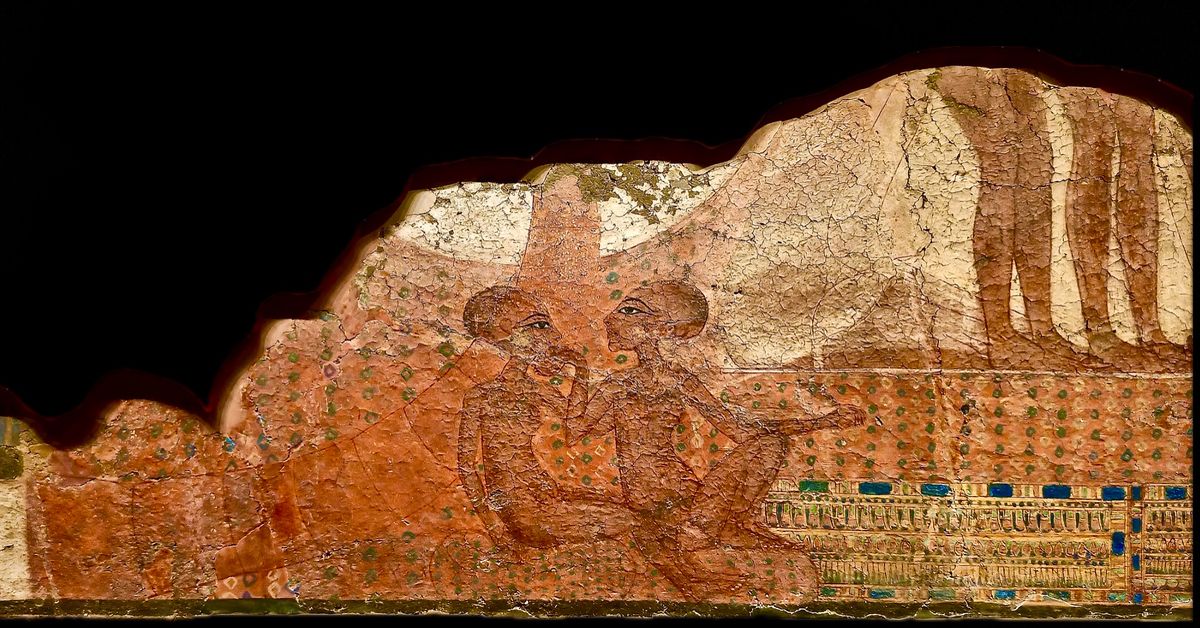
Fragment of painted plaster showing two young figures with large shaved heads, sitting close together against a reddish-orange background dotted with green spots. Part of a band of blue and gold hieroglyphic inscriptions is visible at lower right. Black background at upper left.Painting

Primary source

Fresco of the Daughters of Akhenaten and Nefertiti

Amarna palace painters · c. 1345 BCE

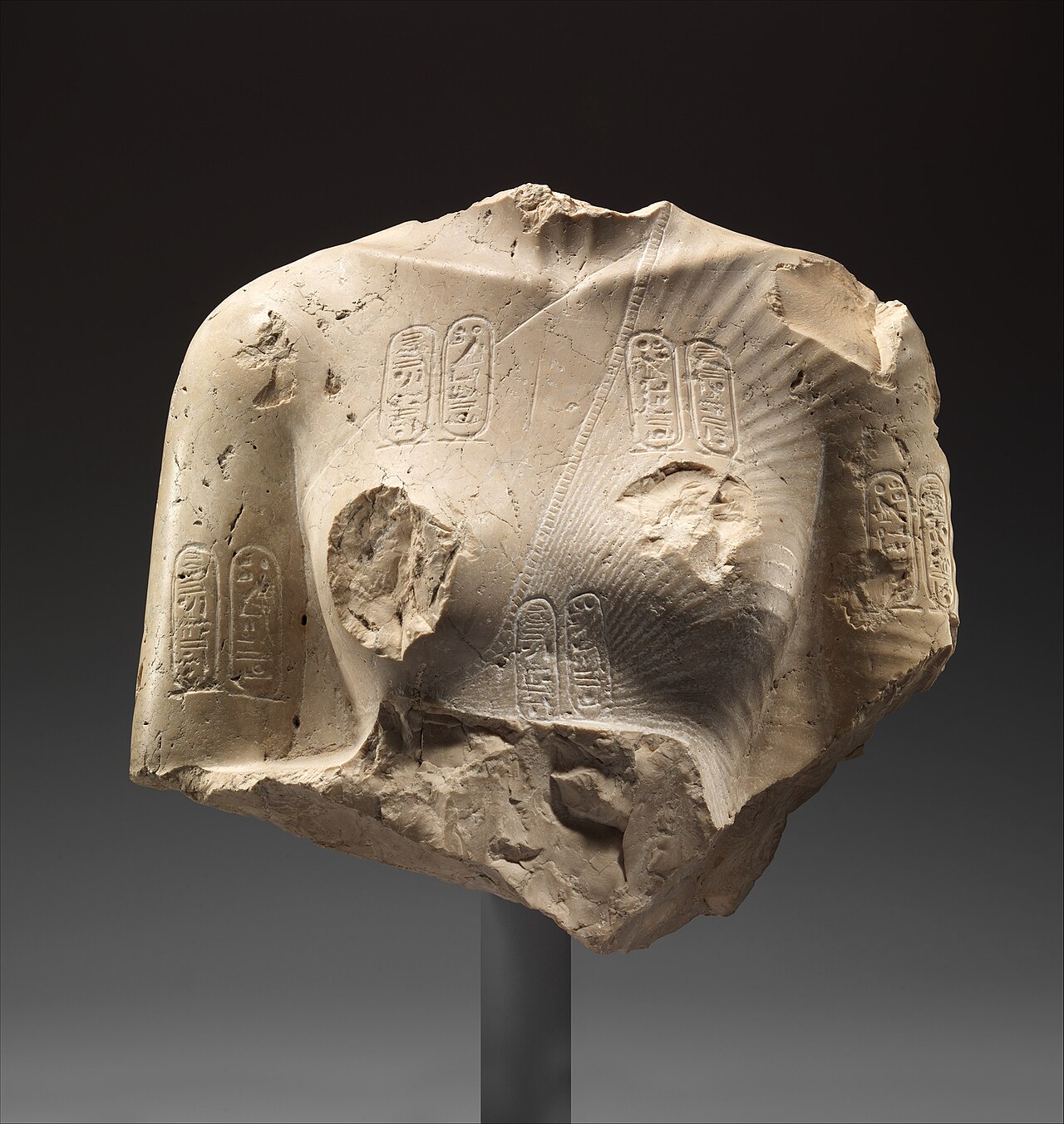
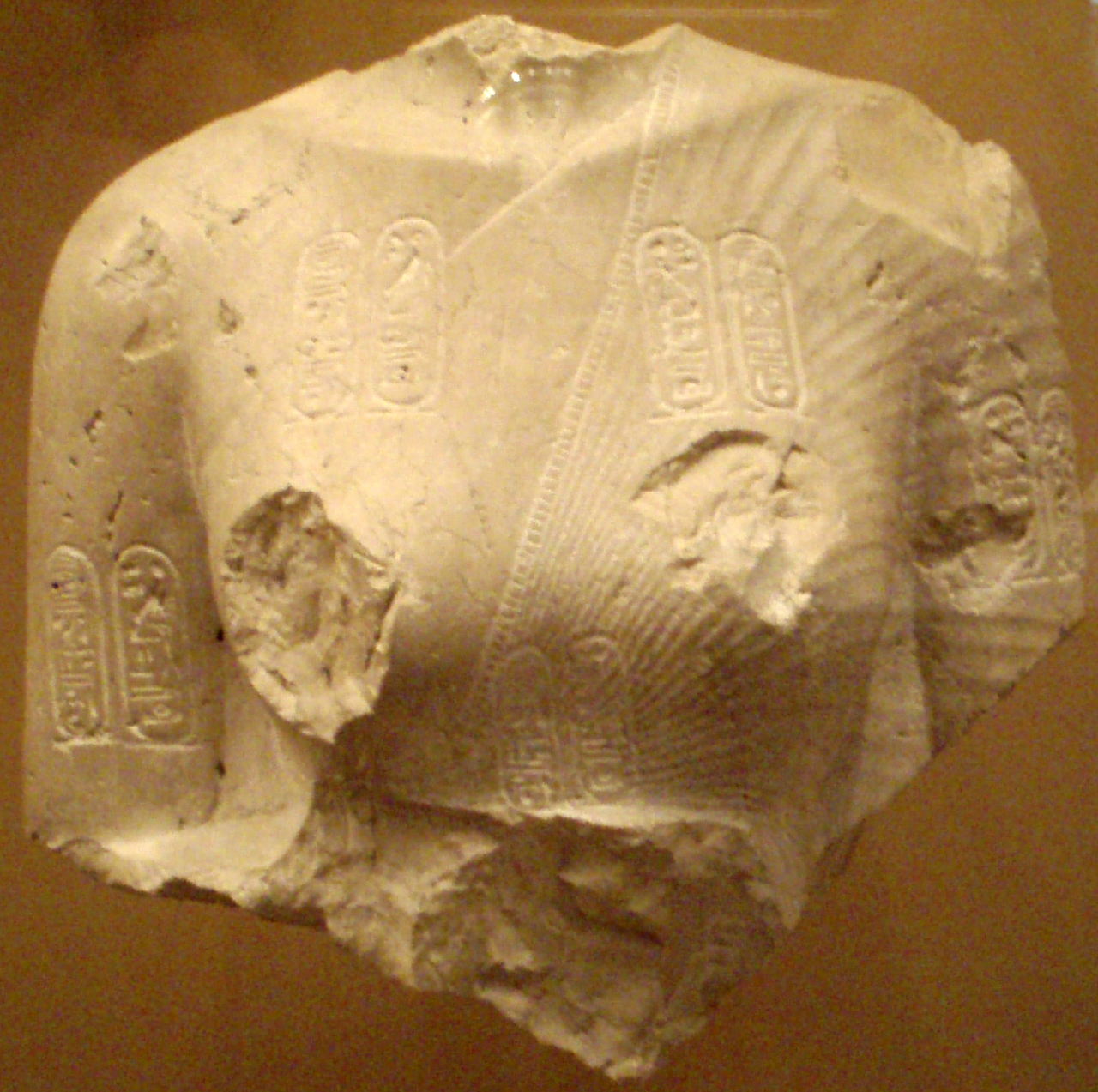
A fragmentary pale limestone sculpture on a dark stand, showing a broken torso-like block with incised hieroglyphic cartouches arranged on its surface and radiating sunray lines. Some edges are chipped and rough.Sculpture

Primary source

Torso of Nefertiti with Aten Cartouches

Reign of Akhenaten

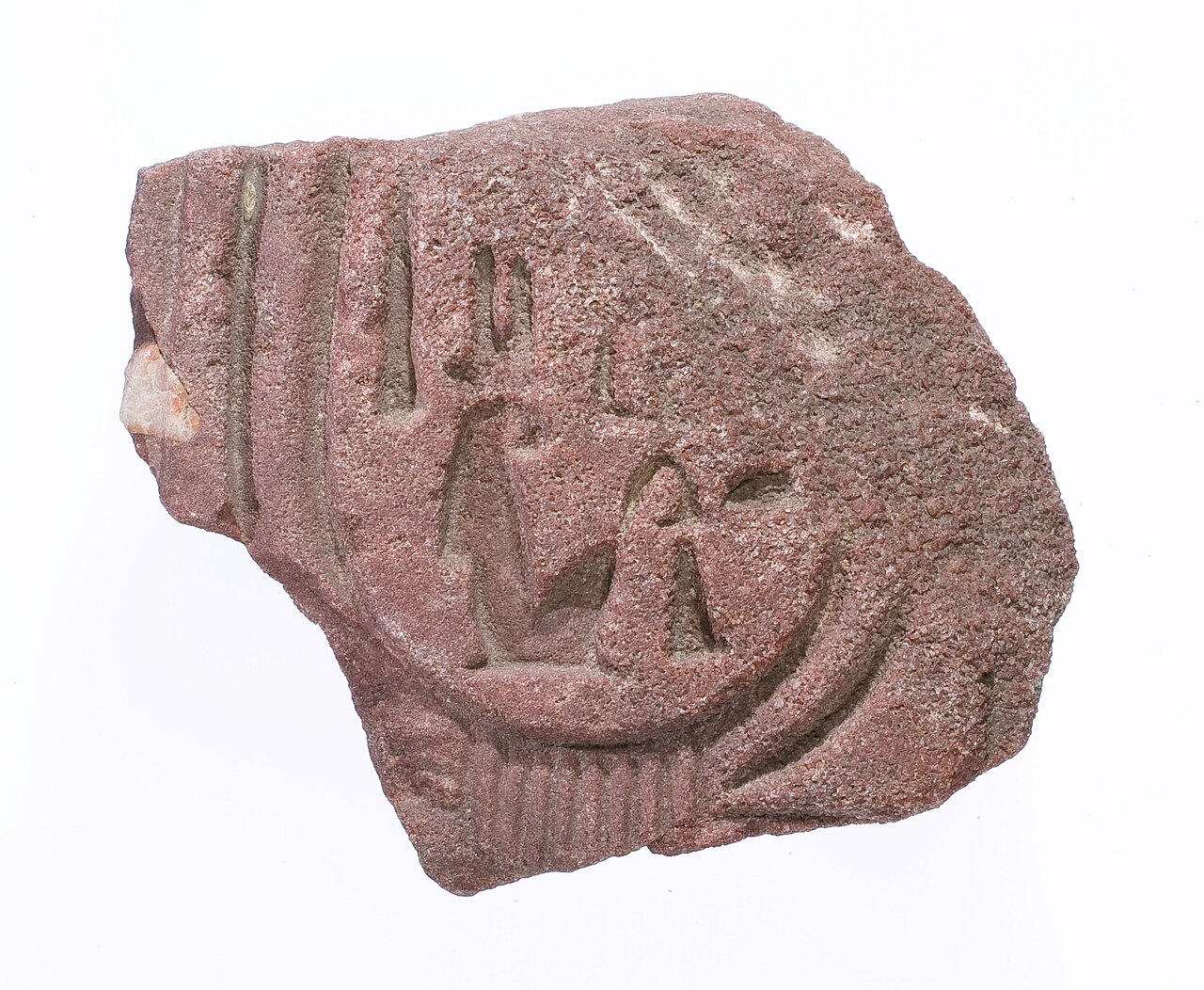
Photograph of a reddish-brown granite fragment on a white background, with a carved hieroglyphic cartouche in shallow relief and a partial fluted or striated band at the bottom edge.Artifact

Primary source

Fragment with the Cartouche of Nefertiti

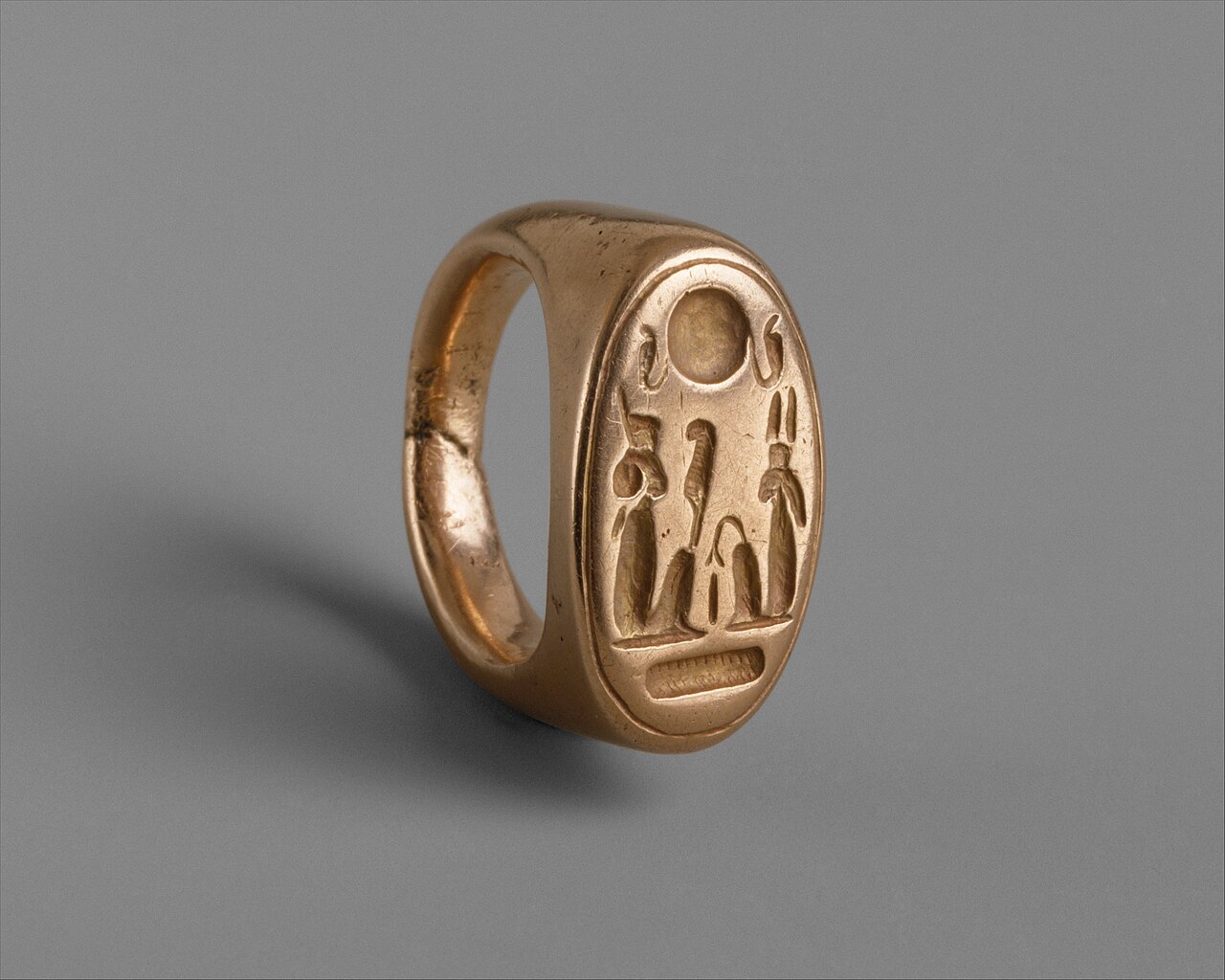
Photograph of a gold finger ring with an oval bezel. The bezel is engraved with a sun disk above two kneeling figures with feathered headdresses, with a horizontal cartouche-like base below. Grey background.Artifact

Primary source

Finger Ring Depicting Akhenaten and Nefertiti as Shu and Tefnut

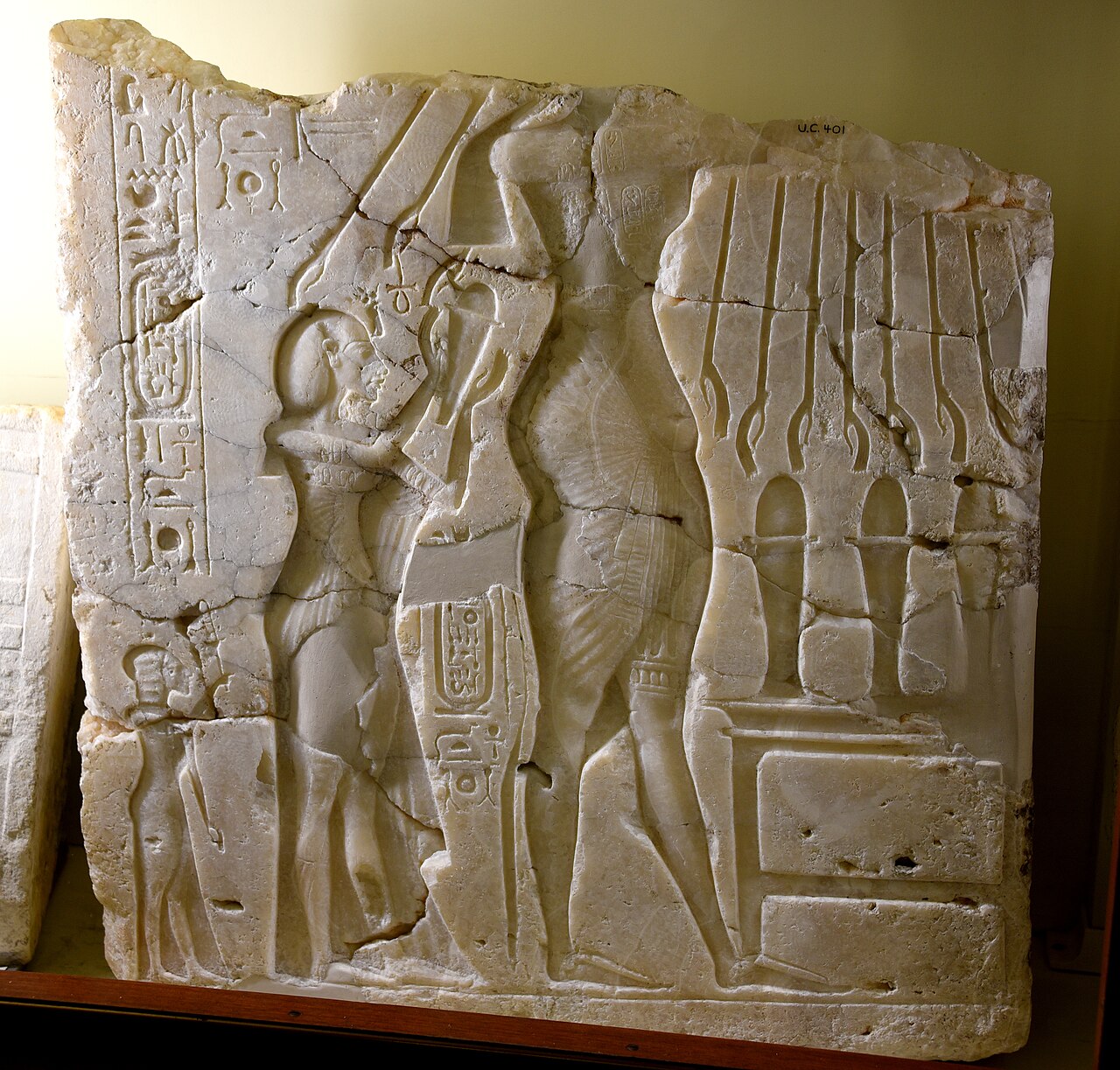
Photograph of an alabaster sunken relief in a museum case, with a light background. A standing figure with cartouches on the arm and chest holds an object; a second figure stands behind; a seated figure and a table with offerings are on the right. Carved hieroglyphs run down the left side. A label reads UC 401.Artifact

Primary source

Alabaster Relief of Akhenaten, Nefertiti, and Meritaten

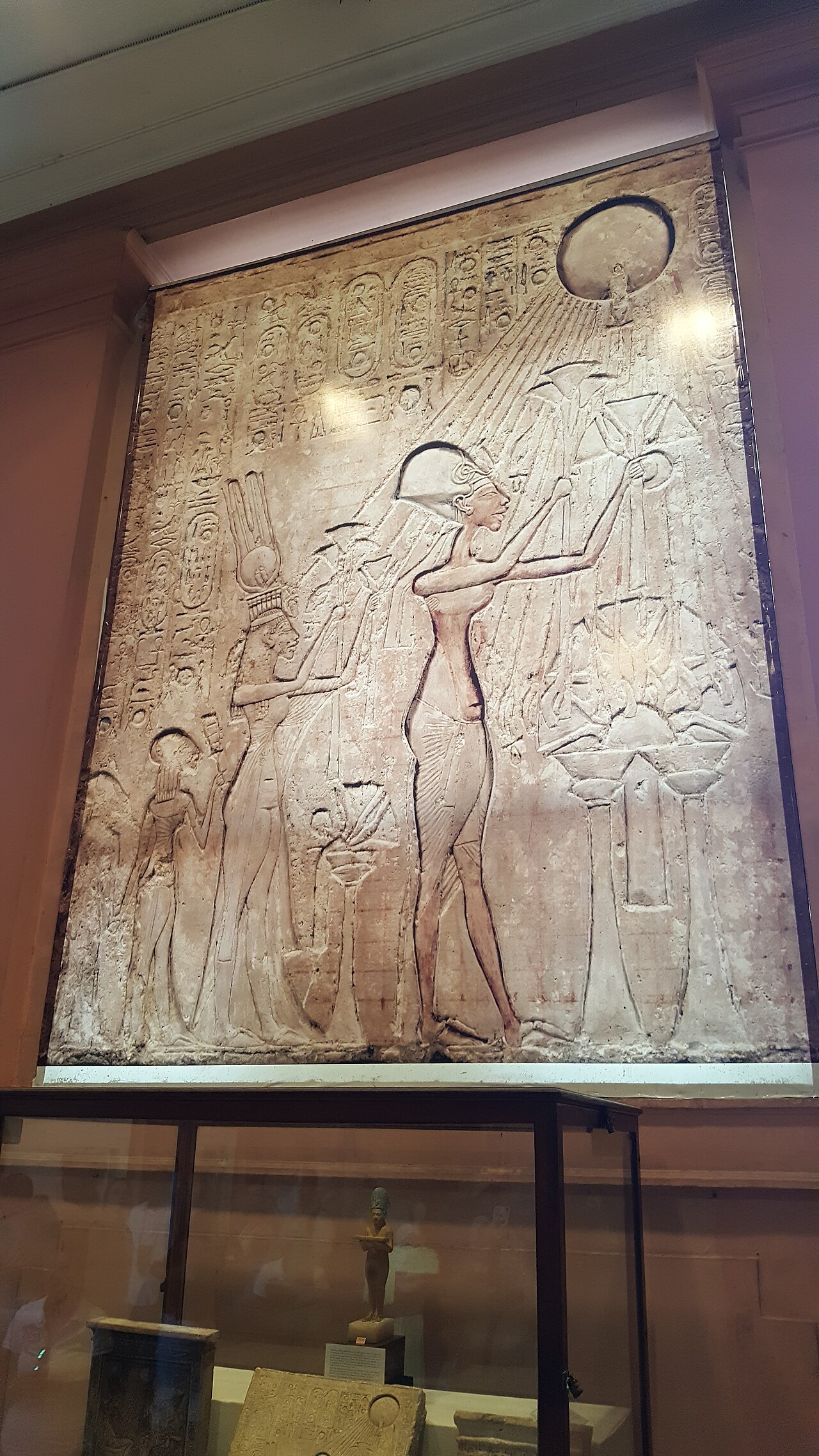
Photograph of a large limestone relief in a museum display. Akhenaten, with elongated head and bare body, and Nefertiti, wearing a tall crown, face the sun disk with rays ending in hands. Two small daughters stand before them; altars with offerings are at right, and columns of hieroglyphs fill the upper left. A glass case with small objects is below.Artifact

Primary source

Relief of Akhenaten, Nefertiti, and Two Daughters Adoring the Aten

Weathered limestone relief talatat block from Amarna, showing faded carved figures and rays of the Aten sun disk ending in hands. The stone is worn, with chipped edges and cracks, mounted against a pale wall.Artifact

Primary source

Talatat Block of Nefertiti and Akhenaten Worshipping the Aten

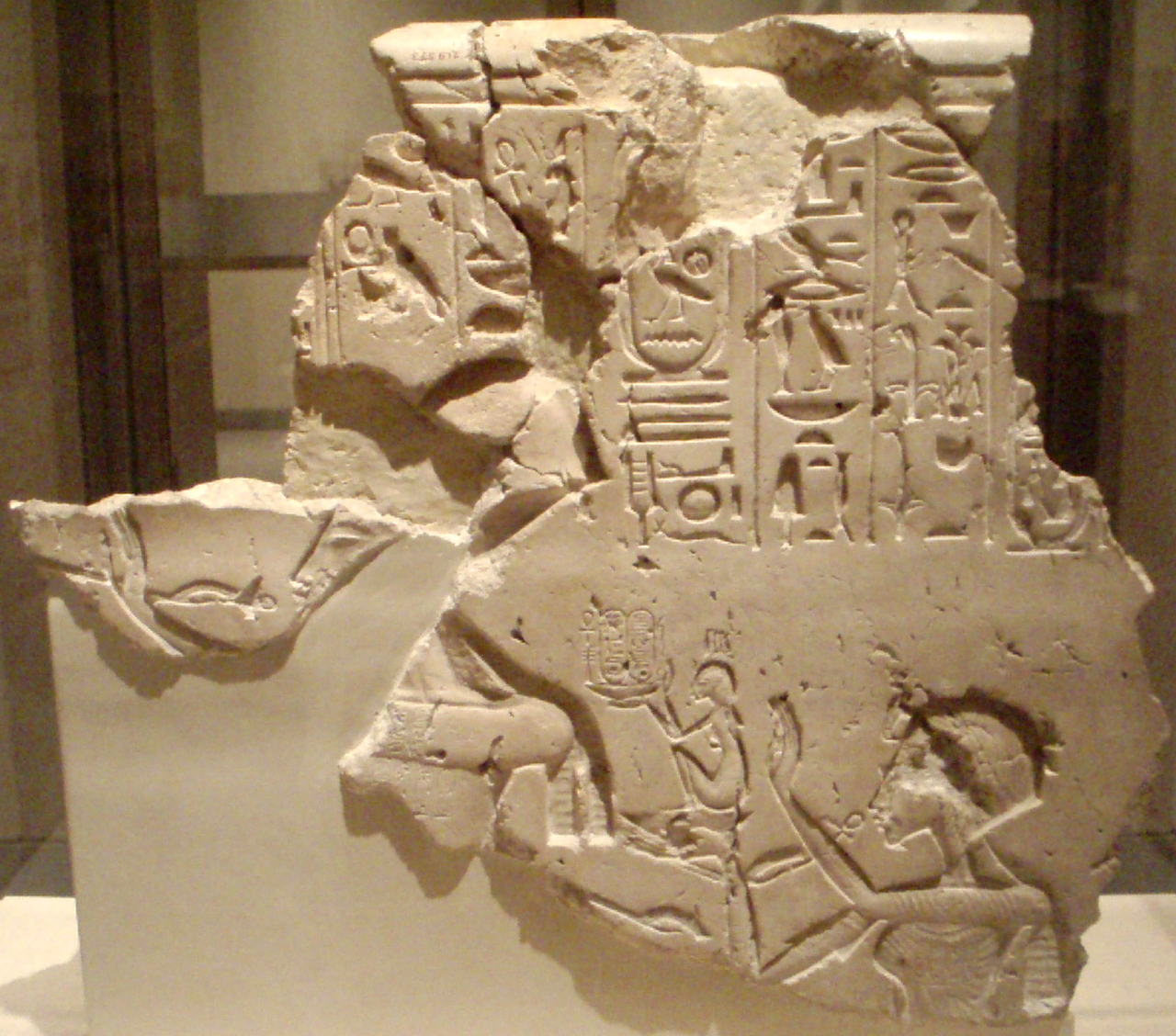
Photo of a limestone relief fragment with carved Egyptian hieroglyphs across the top and a lower scene of a queen with a cartouche presenting an image to a figure. Edges are broken and the stone is pale and weathered.Artifact

Primary source

Parapet Fragment of Nefertiti Presenting Maat to the Aten

Photograph of an ancient Egyptian sandstone relief fragment in a museum, mounted on a pale pedestal. Carved raised figures include a bent arm with a hand holding an ankh sign, and a blue-painted section with traces of red and white paint, against a stone background with vertical carved stripes.Artifact

Primary source

Relief of Nefertiti Before the Aten

c. 1350 BCE

A blurry, close-cropped photo of a weathered, grey-brown stone fragment with an irregular outline. Carved relief forms are faintly visible, including a curved shape near the centre and rounded forms on the right side. The background is a plain, dim tan.Sculpture

Primary source

Relief of Nefertiti Receiving Life from the Aten

Amarna period

Limestone relief from the Amarna period. On the left, a woman in a tall flat-topped crown with a cobra, profile facing right, holds an offering object toward a sun disk with hands. Hieroglyphs run across the top.Sculpture

Primary source

Relief of Nefertiti Holding an Offering to the Aten

Amarna period

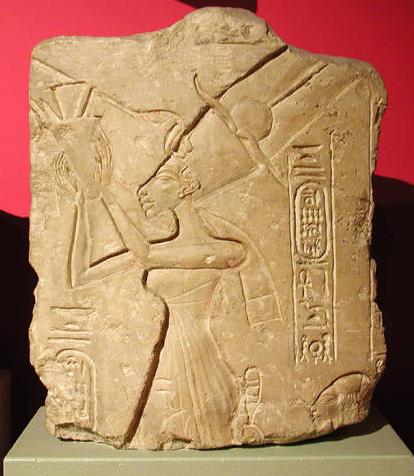
Limestone relief carving of Queen Nefertiti in profile, wearing a tall crown, making an offering with raised hands. Carved hieroglyphs run down the right side, and a sun disk with rays appears at the upper right. Plain red background behind the stone on a green base.Sculpture

Primary source

Limestone Relief of Nefertiti Making Offerings

Amarna period

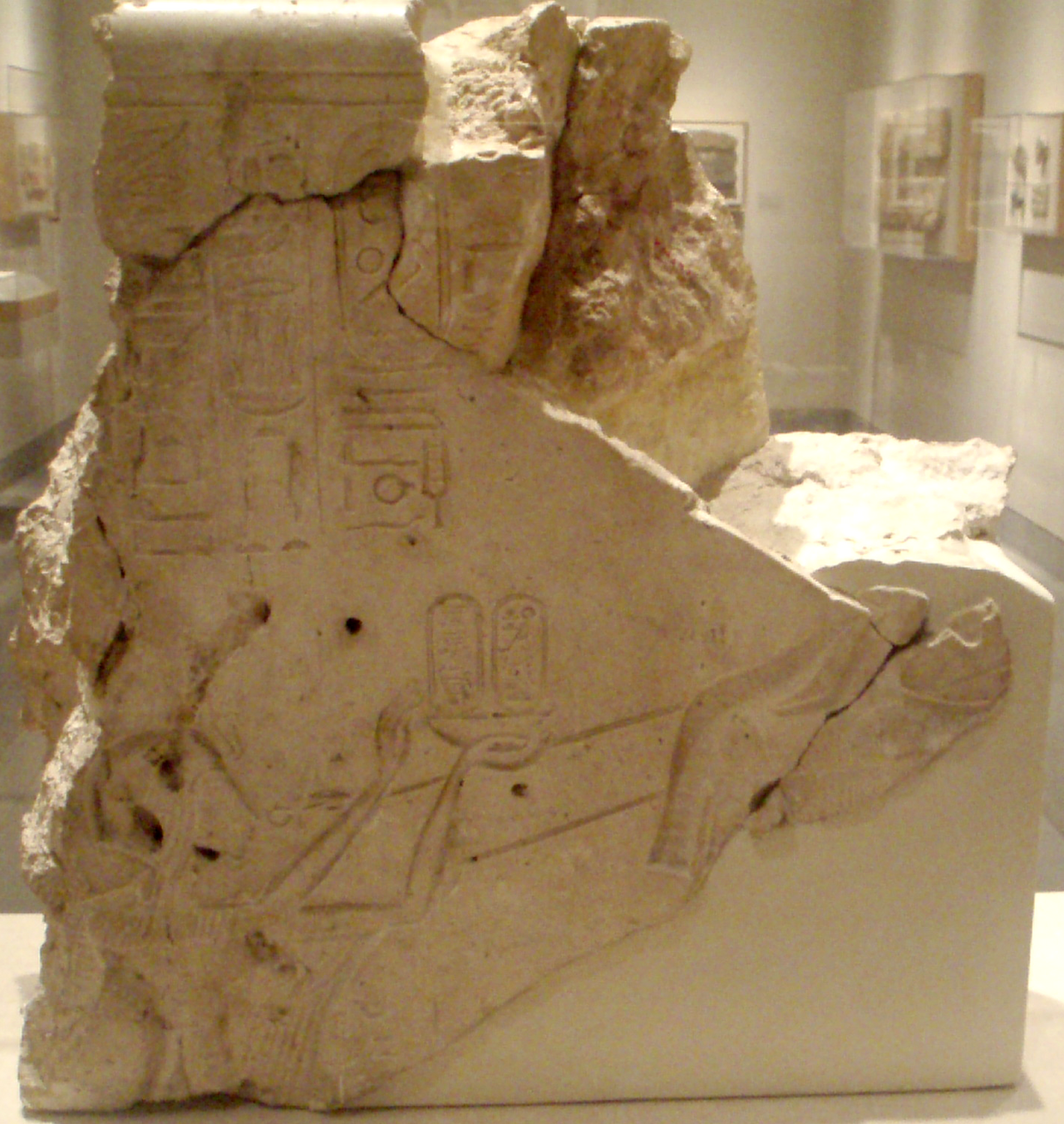
Photo of a limestone relief fragment in a museum gallery. Carved hieroglyphs run down the upper left, and a figure kneels at lower left presenting two cartouches, while a rounded shape with a raised arm appears at right. The stone is broken and chipped along its edges.Sculpture

Primary source

Parapet Fragment of Nefertiti Presenting Cartouches of the Aten

Amarna period

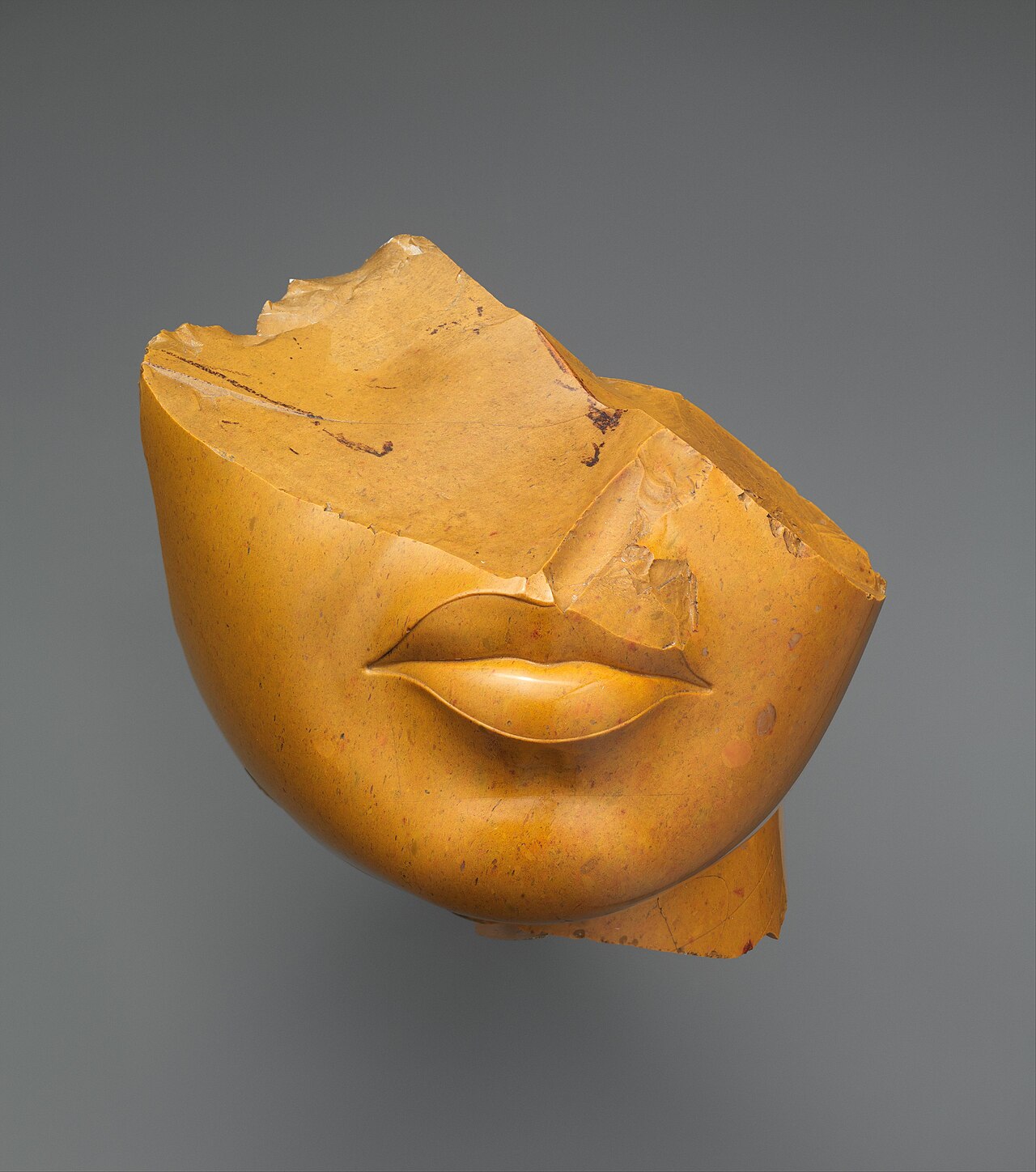
Photo of a carved yellow jasper fragment of a face showing the lips, chin, and part of a nose and brow, with broken, jagged edges at the top and a short stub of neck at the bottom, against a gray background.Sculpture

Primary source

Fragment of a Queen's Face

Amarna royal workshop · c. 1353–1336 BCE

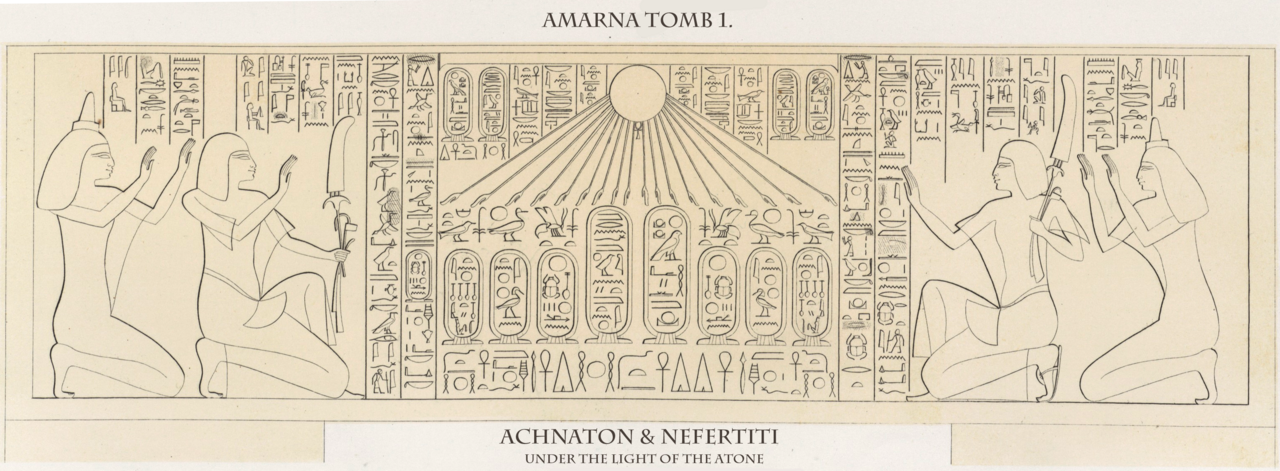
Line drawing of the Amarna Tomb 1 relief, titled 'Achnaton & Nefertiti Under the Light of the Aton'. A central sun disk with rays shines over cartouches; kneeling figures with raised hands flank both sides, with columns of hieroglyphs above and below.Painting

Secondary source

Akhenaten and Nefertiti Under the Light of the Aten

NYPL · 19th century (copy of Amarna-period original)

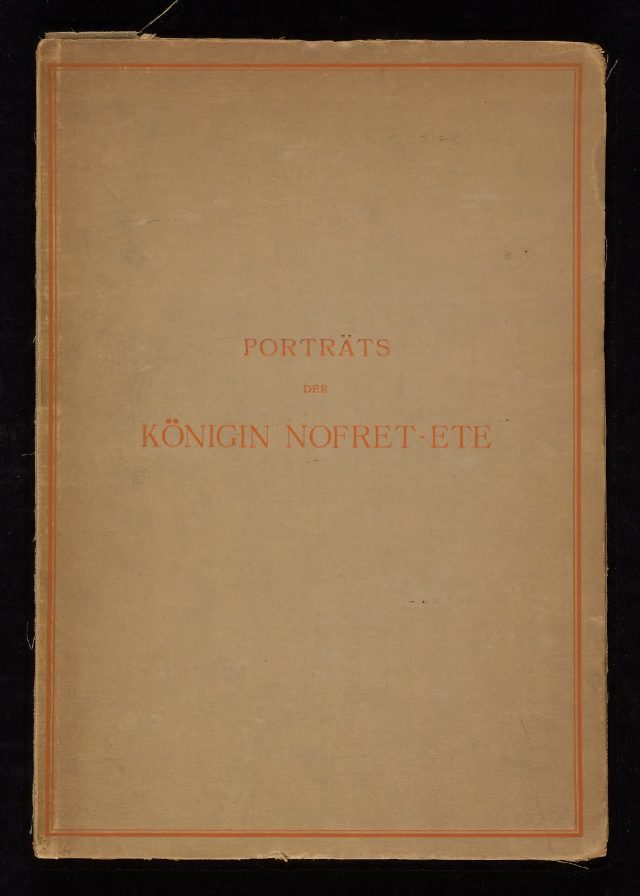
Portraits of Queen Nofret-ete from the 1912/13 Tell el-Amarna ExcavationsBook

Secondary source

Portraits of Queen Nofret-ete from the 1912/13 Tell el-Amarna Excavations

Ludwig Borchardt · 1923

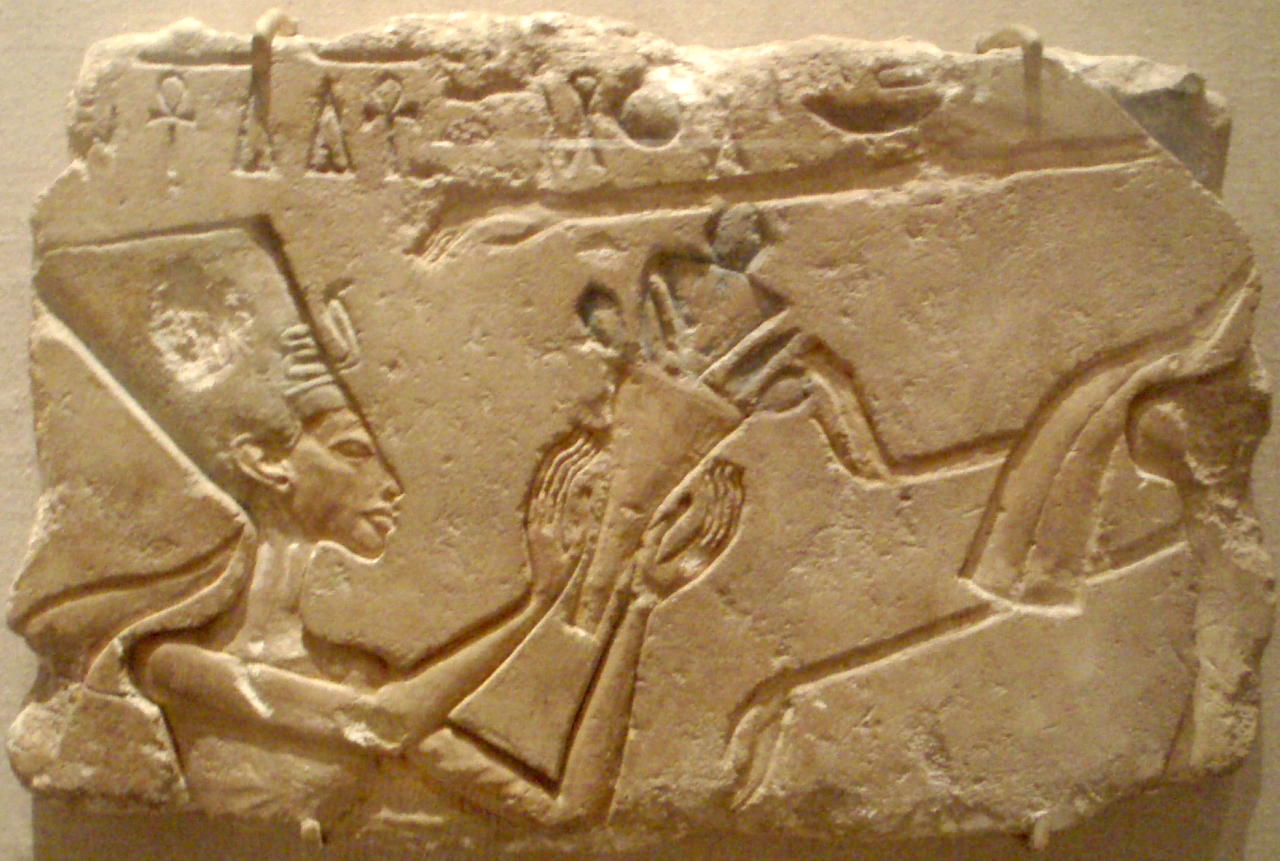
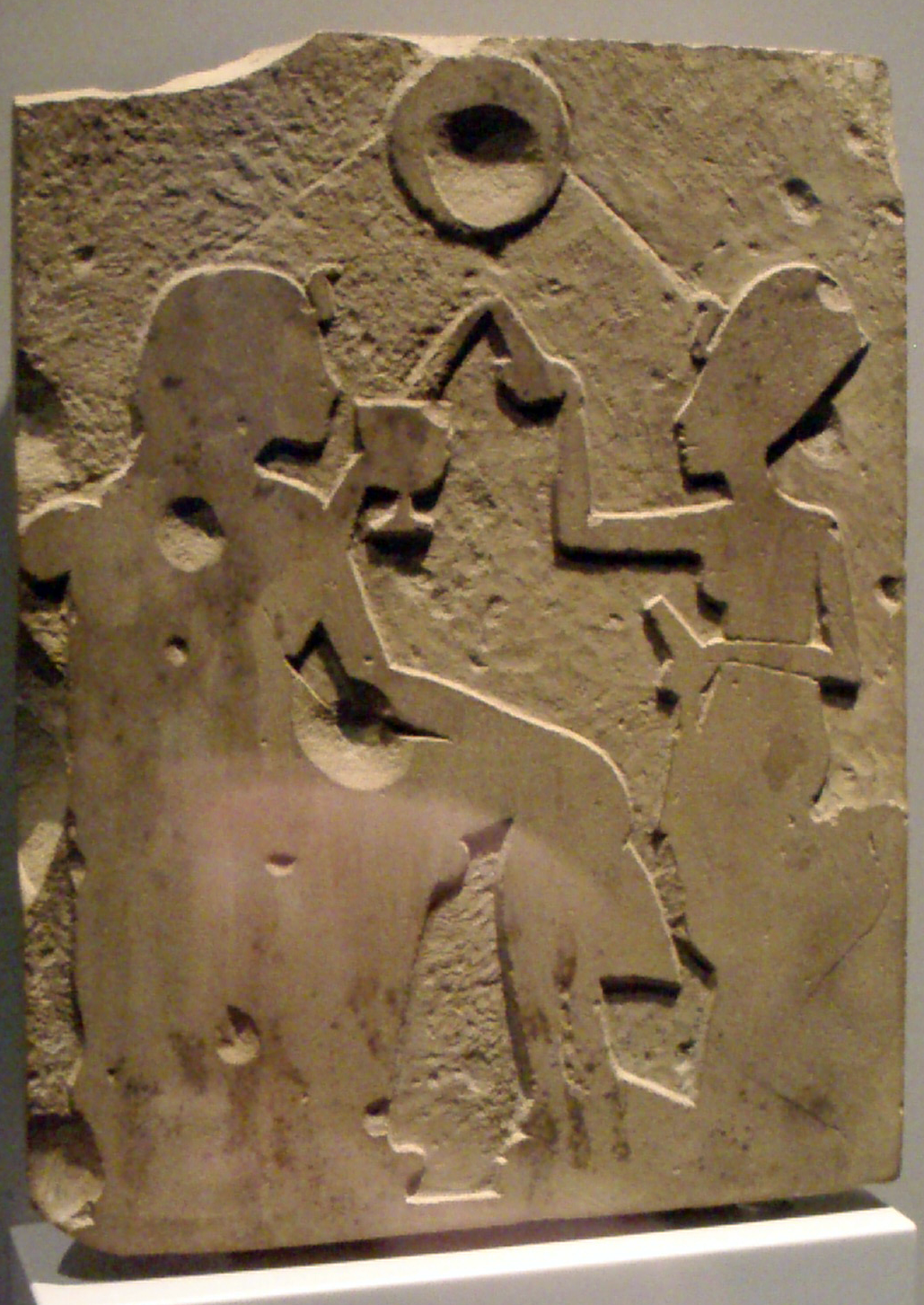
Photo of a limestone relief fragment, unfinished, showing two figures in profile. The figure on the left holds a cup or vessel; the figure on the right extends an arm toward it, with a round disc above.Sculpture

Primary source

Unfinished Stele of Nefertiti Pouring Wine for Akhenaten

Amarna period, 18th dynasty

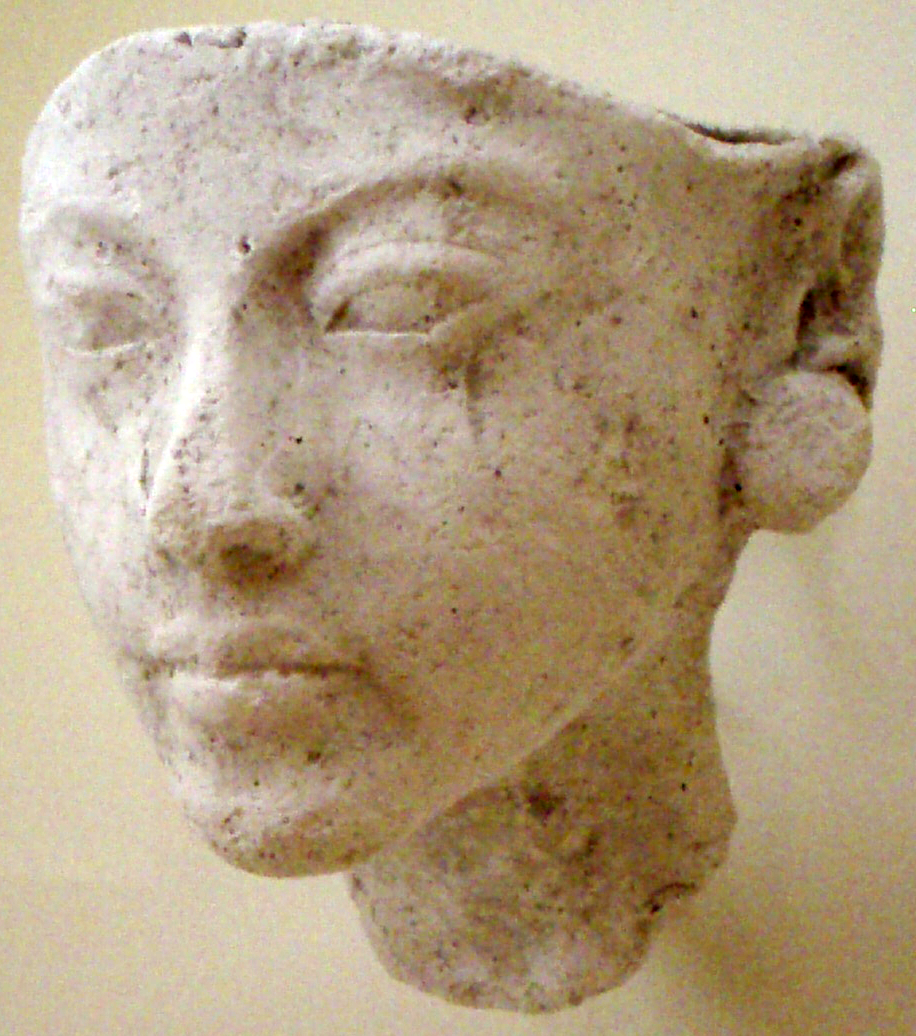
Photograph of a pale plaster head sculpture of a woman's face, shown in three-quarter view with smooth features, almond-shaped eyes, a straight nose, and full lips. The head is cropped at the top and the neck is partially visible.Sculpture

Primary source

Plaster Portrait Study Thought to Be Nefertiti

Workshop of Thutmose · Amarna period, 18th dynasty

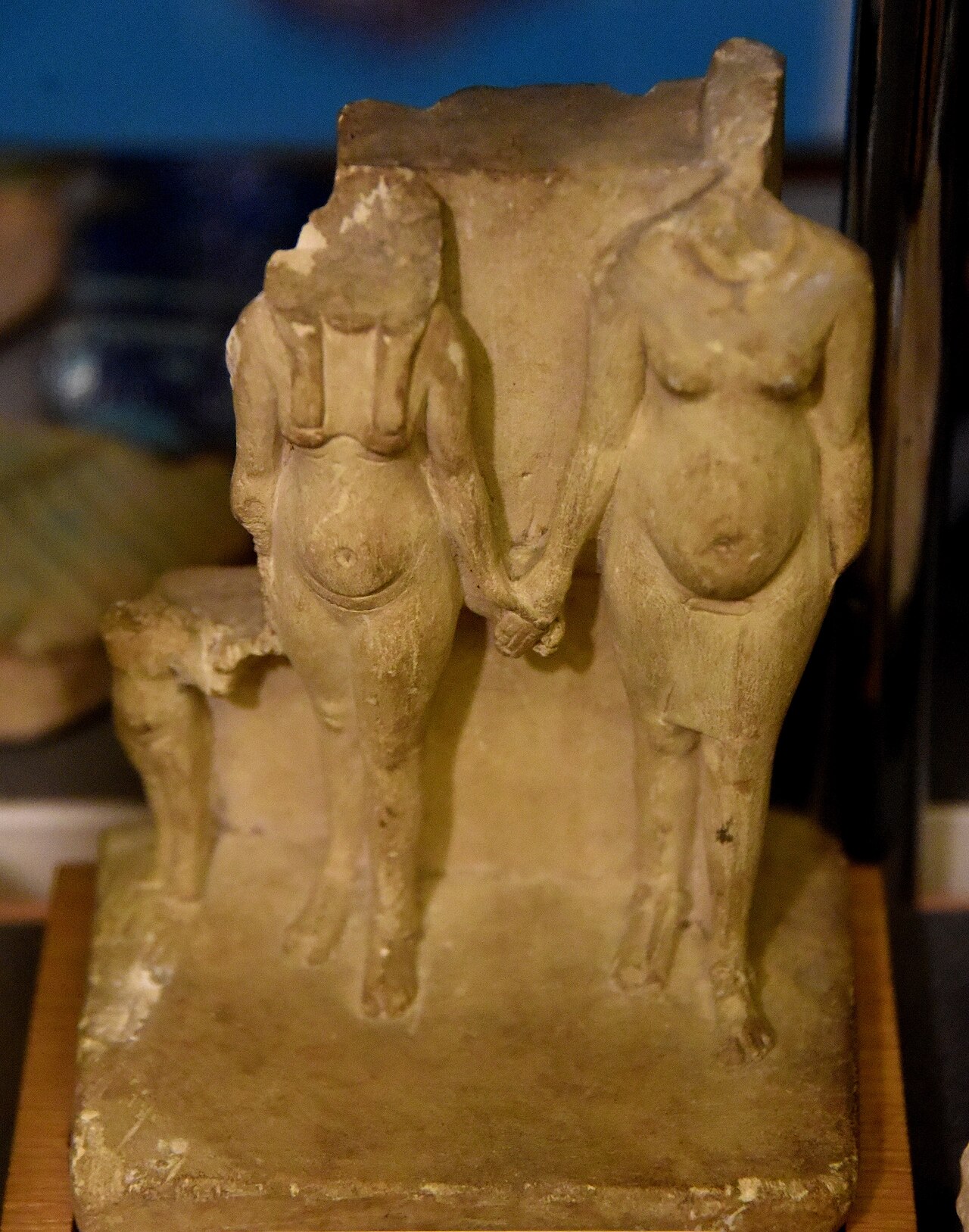
Photo of a weathered, headless limestone statuette. Two standing female figures with bare torsos hold hands in front of a slab-like back panel, and a partial third figure is visible at the left edge. The base is a flat plinth.Sculpture

Primary source

Limestone Statuette of Akhenaten, Nefertiti and a Princess

Reign of Akhenaten, Amarna period

Photograph of a pale limestone fragment of a statue torso, broken at the edges, with carved cartouche inscriptions and pleated linen-like lines on a brown background. Some surface areas are chipped away.Sculpture

Primary source

Fragmentary Torso of Nefertiti from the Great Temple of the Aten

Amarna period, 18th dynasty

Carved relief of a royal family under a sun disk with rays ending in hands. A seated pharaoh with a tall crown is at left, a queen with a tall crown stands at right, and small children are depicted between them, all in a warm-toned stone.Sculpture

Primary source

Stela of Akhenaten and his family

Amarna period, c. 1350-1330 BCE

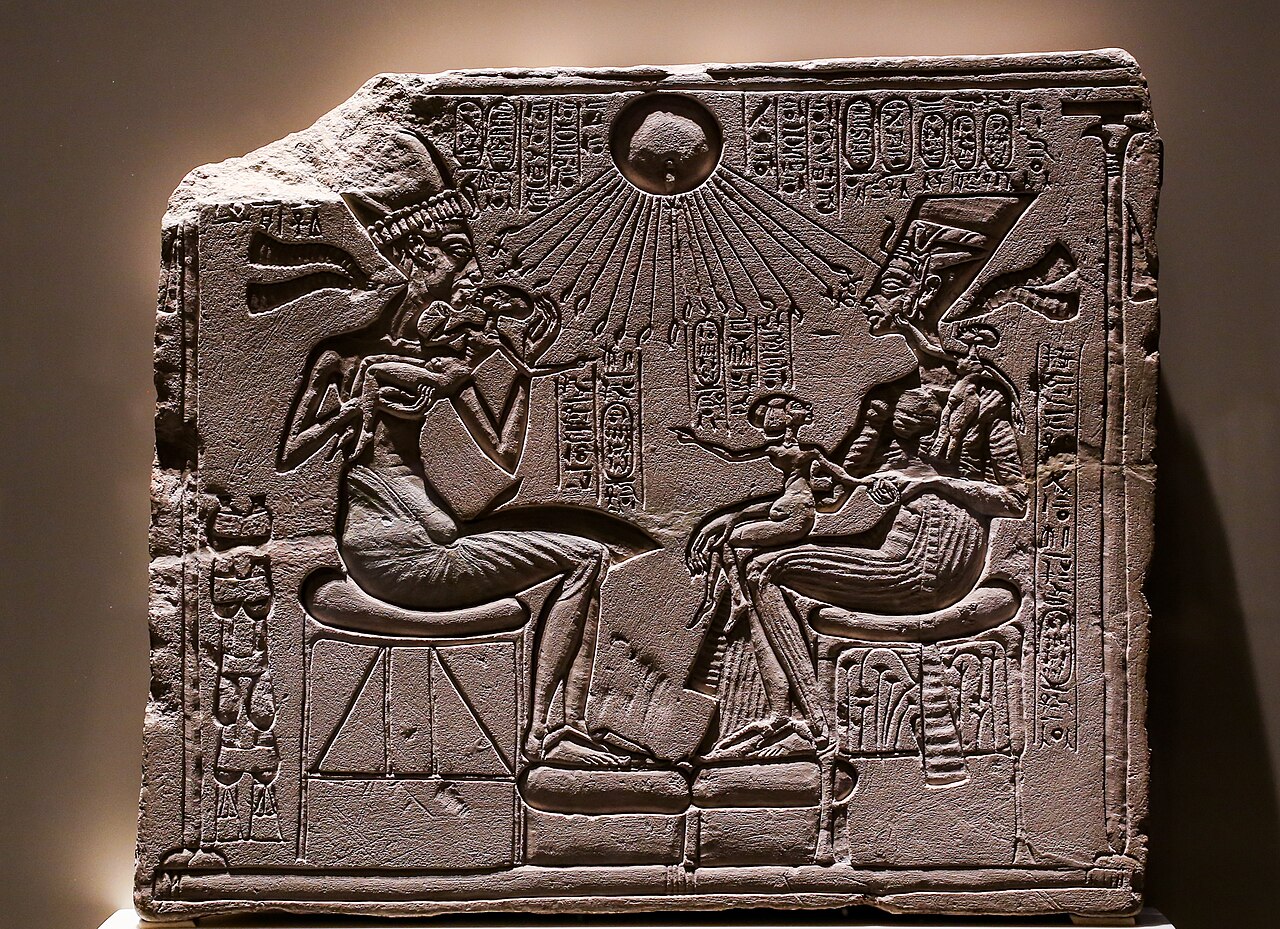
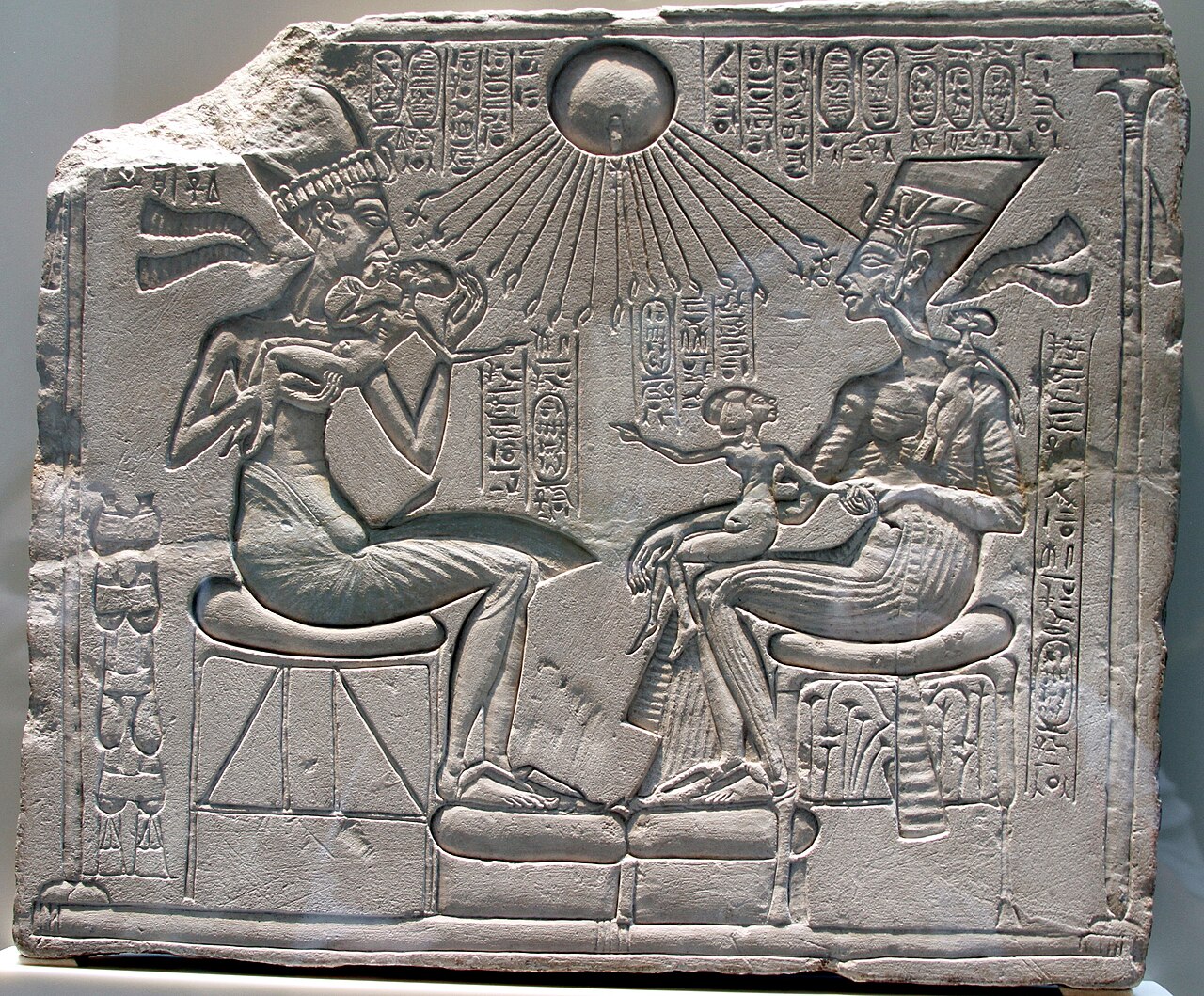
Limestone relief of Akhenaten and Nefertiti seated on cushions under the sun disk Aten, whose rays end in ankh symbols. Akhenaten, left, holds a daughter; Nefertiti, right, holds another. Carved hieroglyphs fill the upper area and sides.Sculpture

Primary source

Shrine Relief of Akhenaten and Nefertiti with Three Daughters

c. 1350-1340 BCE

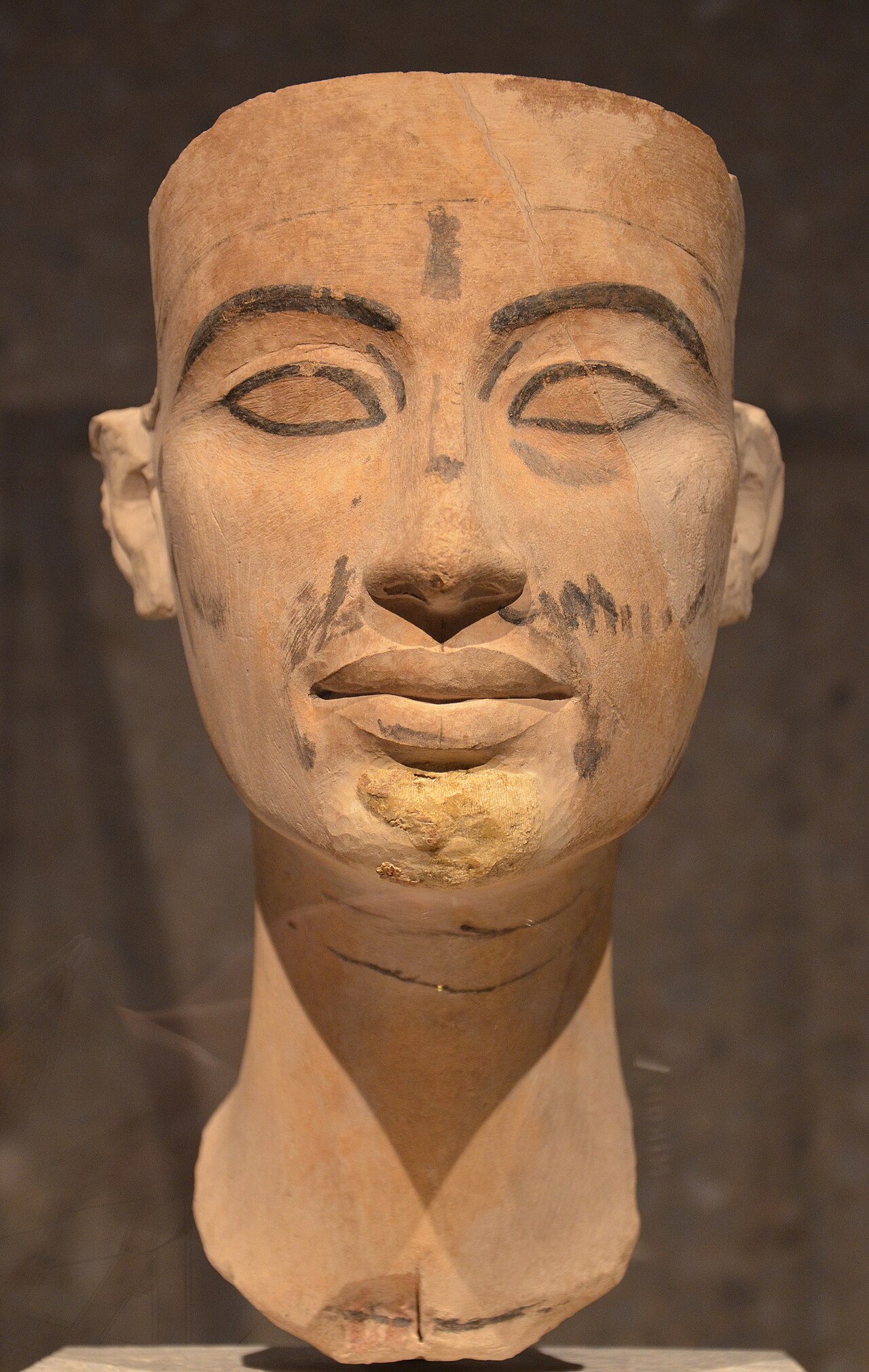
Front view of an unfinished limestone model head of a woman, with painted black eyebrows, eyes, and lines on the cheeks and neck, a plain flat-topped crown area, and a partly gilded chin. Plain dark background.Sculpture

Primary source

Unfinished Model Head of Nefertiti

1351-1334 BCE

Carved stone talatat block with a portrait of Nefertiti in relief.Sculpture

Primary source

Talatat Relief Portrait of Nefertiti from Karnak

c. 1353-1347 BCE

Photo of a sandstone relief fragment with a carved human figure in profile facing left, wearing a tall headdress and a pleated garment, with hieroglyphs carved in vertical columns on the right. The background is a plain gray gradient.Sculpture

Primary source

Relief of Queen Nefertiti

c. 1347-1330 BCE

Close-up of a carved relief on a limestone house altar. Akhenaten sits on the left holding a small child on his lap, and Nefertiti sits on the right with a child on her lap and another child reaching toward her. Rays from a sun disk with an Aten hand extend above, and hieroglyphic inscriptions run along the sides.Sculpture

Primary source

House Altar of Akhenaten, Nefertiti and Their Daughters

c. 1340 BCE

Limestone relief of Akhenaten and Nefertiti seated under the sun disc Aten, whose rays end in hands. Akhenaten, left, holds a daughter; Nefertiti, right, holds another; a third child sits between them. Hieroglyphic inscriptions surround the scene.Sculpture

Primary source

Akhenaten, Nefertiti and Three Daughters Beneath the Aten

Unknown Amarna artist · 14th century BCE (photographed 2017)

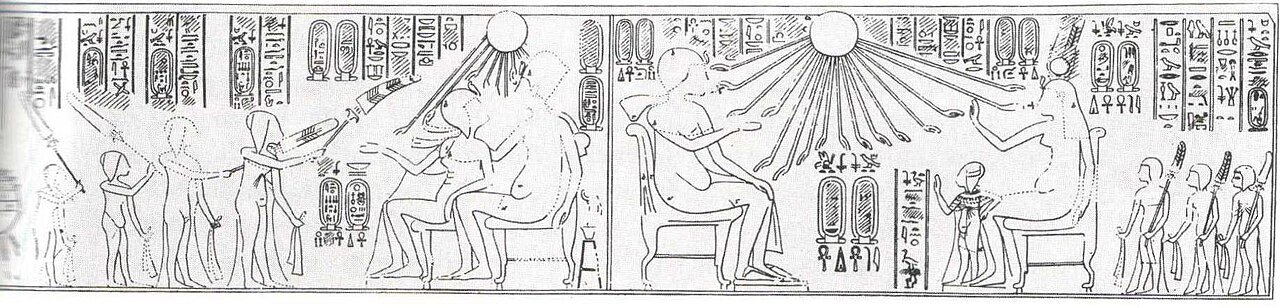
Line drawing of Egyptian relief carvings in a horizontal band: on the left, Akhenaten and Nefertiti seated under sun rays with small daughters before them; on the right, Amenhotep III and Tiye seated with a child, with hieroglyphic inscriptions above and between.Painting

Primary source

Akhenaten, Nefertiti and Daughters in the Tomb of Huya

Unknown Amarna artist · 14th century BCE

Painted limestone statuette of a pharaoh and queen standing side by side holding hands. Both wear tall white crowns with uraeus cobras. The man is bare-chested with a pleated kilt, the woman wears a long pleated dress and a collar.Sculpture

Primary source

Statuette of Akhenaten and Nefertiti

Unknown Amarna artist · Amarna period

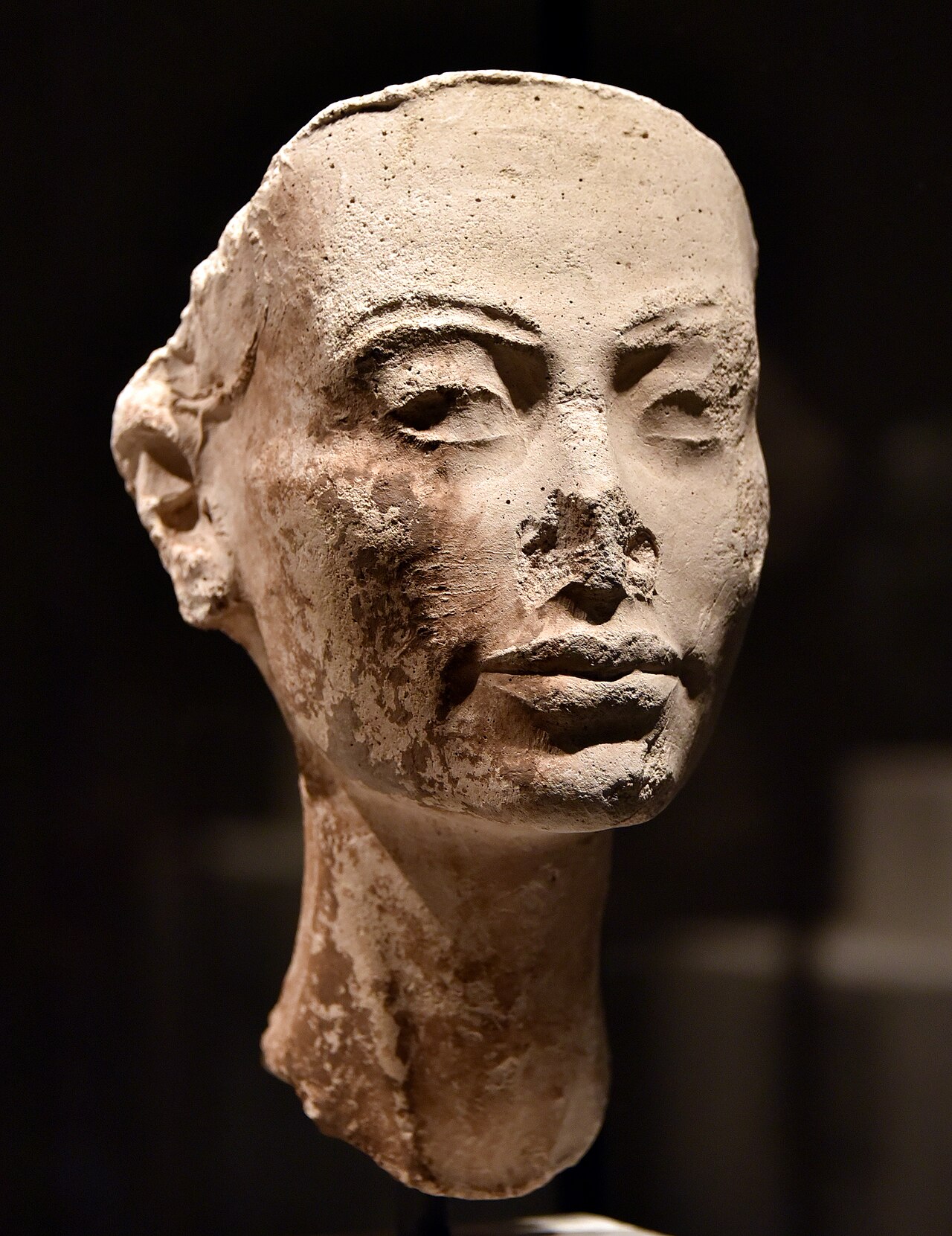
Photo of a plaster portrait head, shown from a three-quarter angle against a dark background. The head has a smooth face with defined eyes, a straight nose, and full lips. Its surface is worn and chipped, and the neck is broken off at the bottom.Sculpture

Primary source

Plaster Portrait Head of Queen Nefertiti

Unknown Amarna artist · c. 1340 BCE

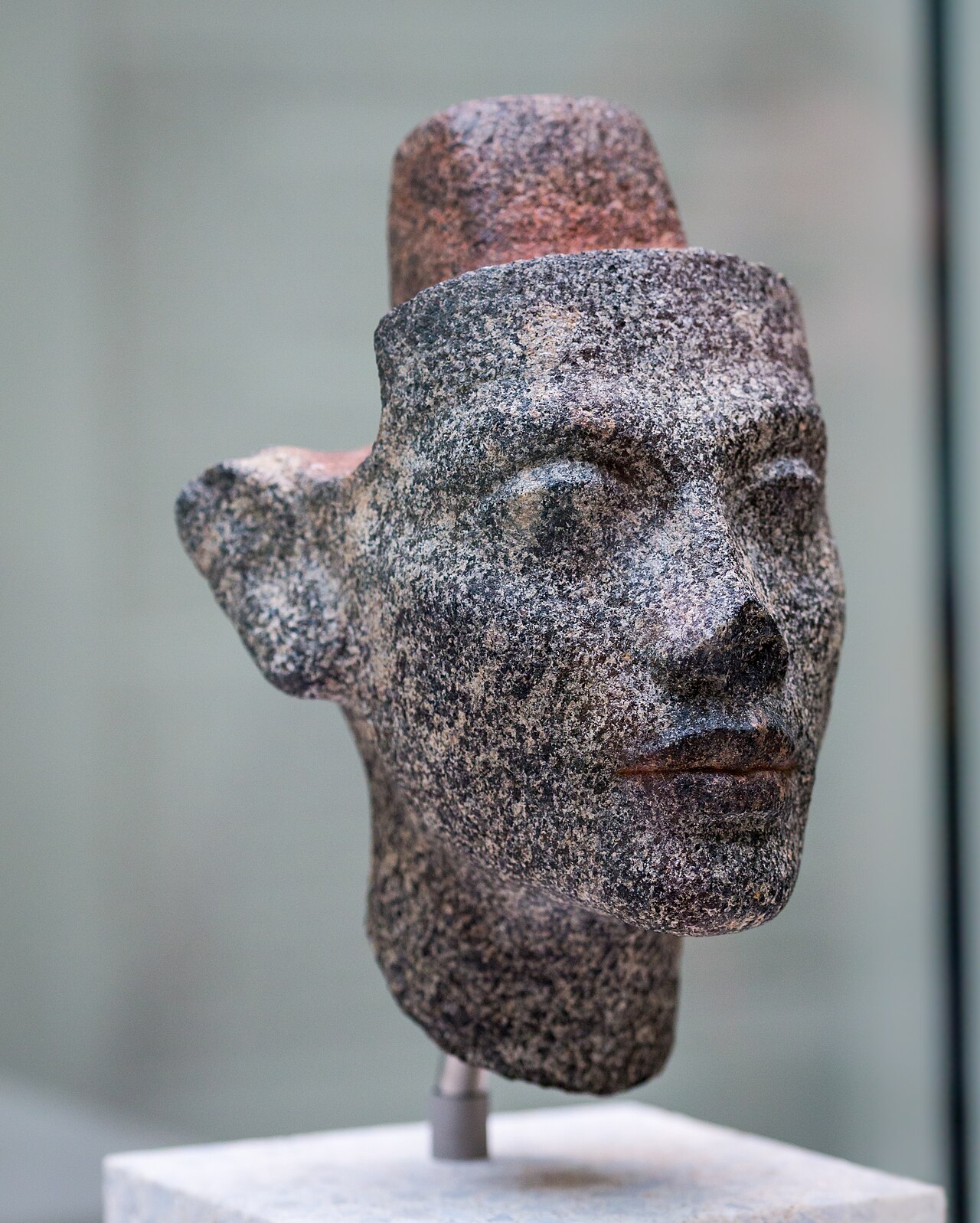
Photograph of a dark grey granite sculpted head with a flat rectangular cylinder projecting from its top, a broken-off ear on the left side, and a pale stone base with a metal pin underneath. The face has a straight nose, closed lips and smooth eyes.Sculpture

Primary source

Broken Head of Queen Nefertiti

c. 1350-1340 BCE

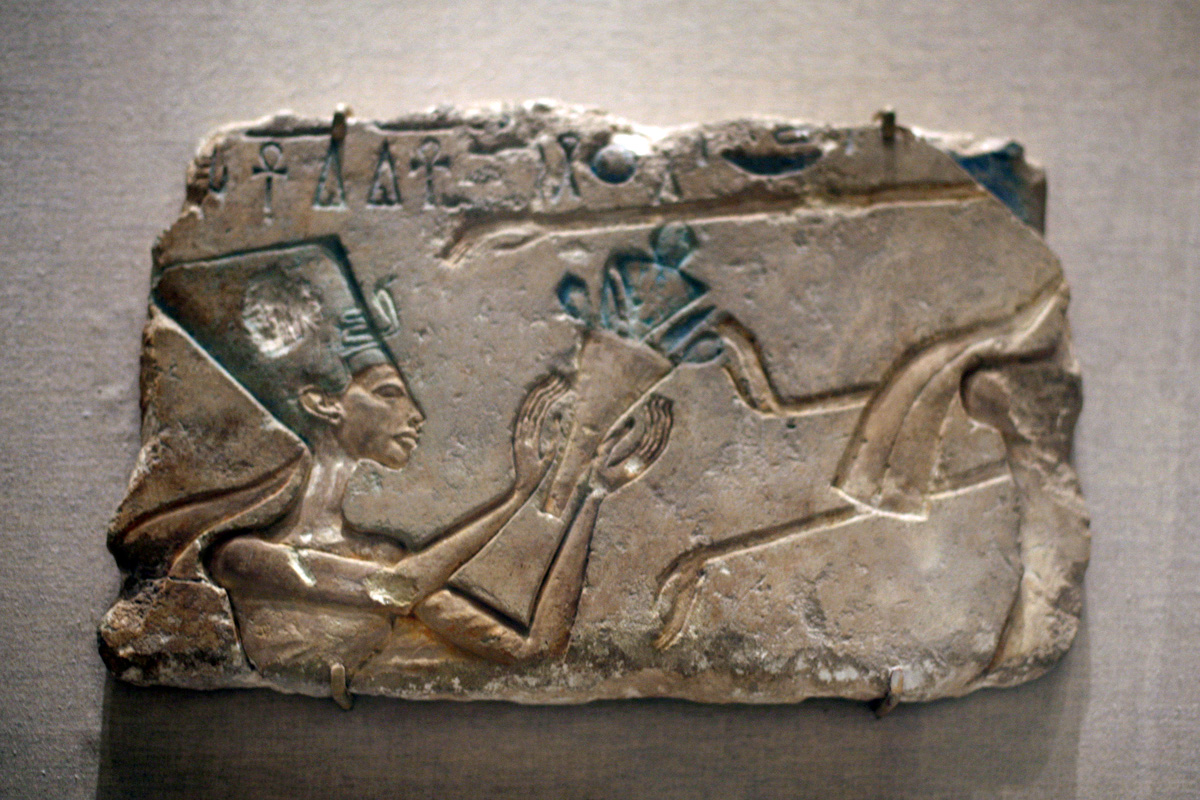
Photograph of a painted limestone relief fragment showing Queen Nefertiti in profile wearing a tall blue crown, offering or holding a vessel, with a hieroglyphic inscription above and a figure with raised arms behind, displayed in a museum case.Painting

Primary source

Nefertiti Limestone Relief

c. 1352-1336 BCE

Fragment of a sandstone talatat block with raised relief carving. Visible are a human eye with heavy eye paint and part of a face, a royal headdress edge, a sun disk with rays ending in hands, and ankh-shaped symbols. The stone is pale tan with rough, broken edges against a gray background.Artifact

Primary source

Talatat Relief of the Queen's Face with the Aten

c. 1347-1330 BCE

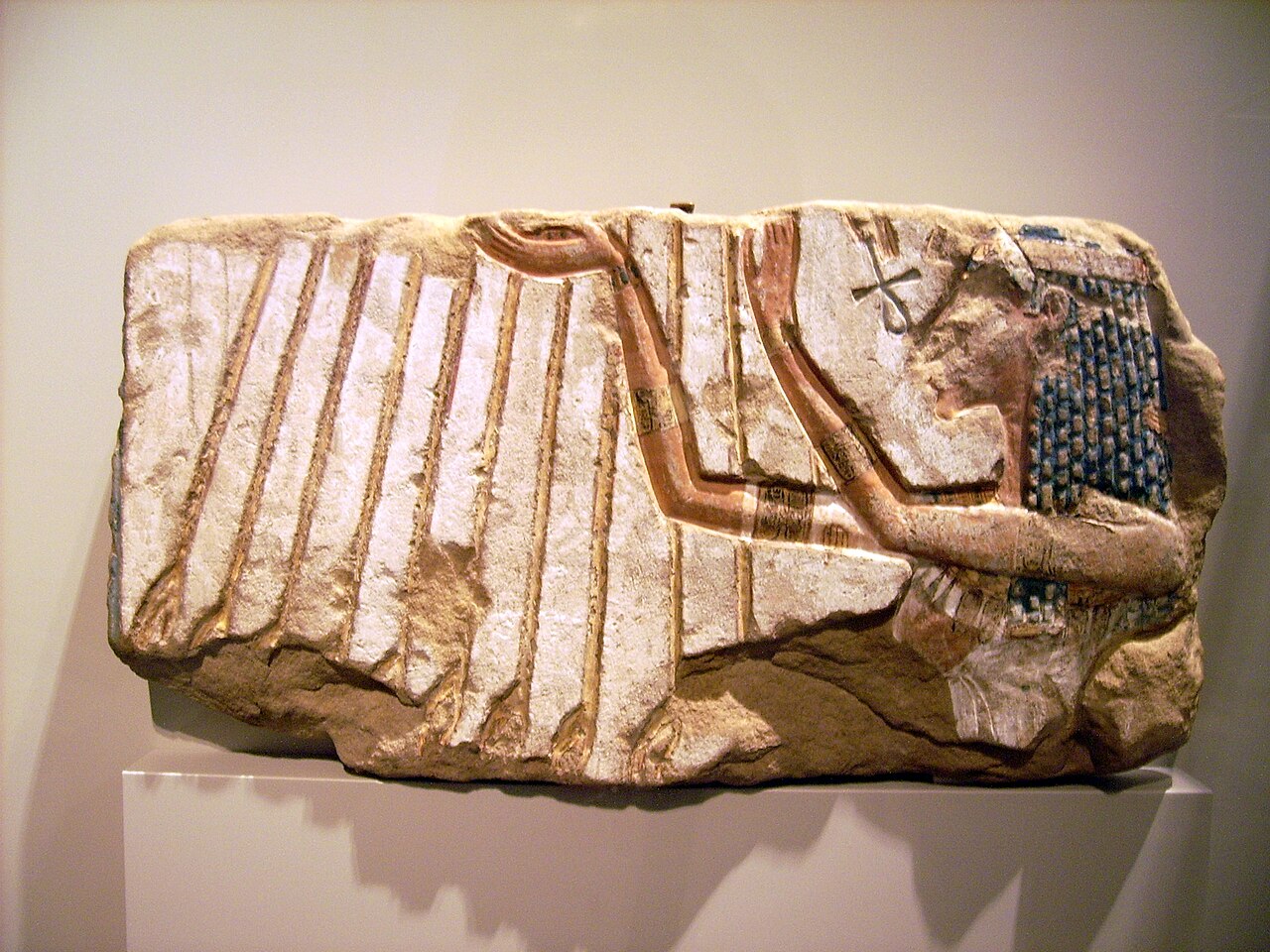
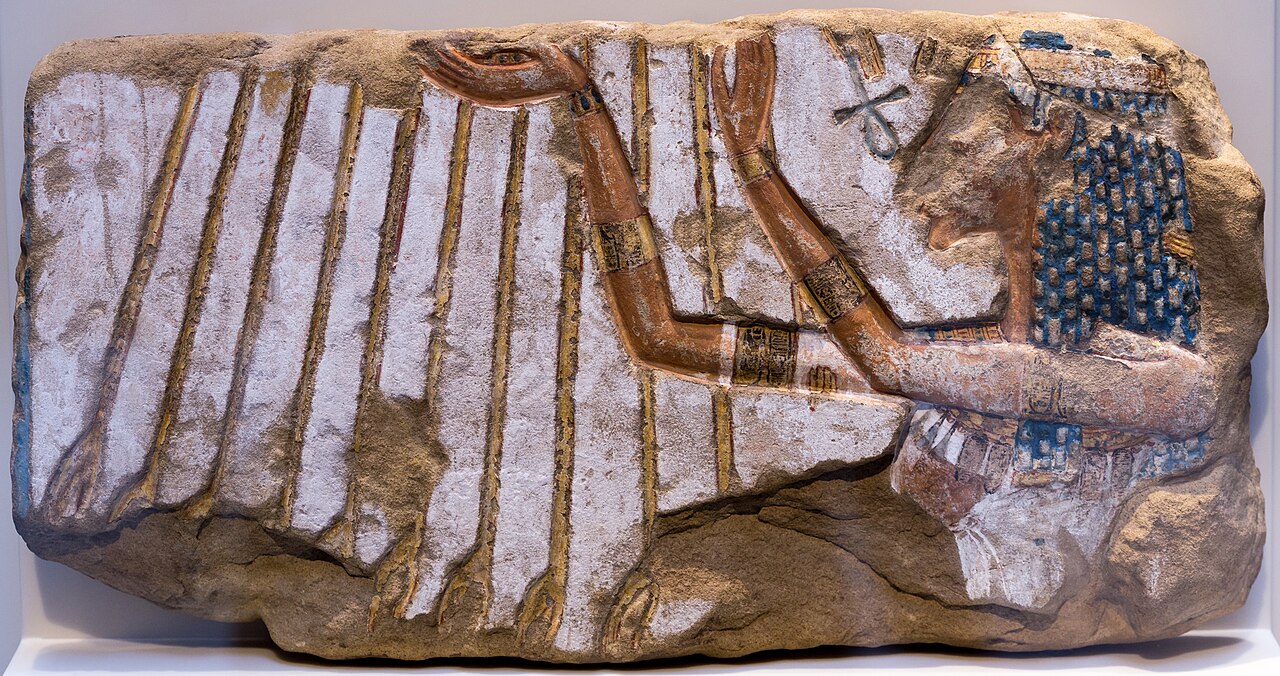
Photo of a sandstone talatat block with painted relief. Two raised arms, with hands and bracelets carved with hieroglyphs, reach up and left toward a field of vertical painted rays. A blue-patterned headdress or wig is at the right. The block is weathered, with yellow and white painted stripes.Artifact

Primary source

Talatat Block of Nefertiti at Prayer, Temple of Aten at Karnak

c. 1350 BCE

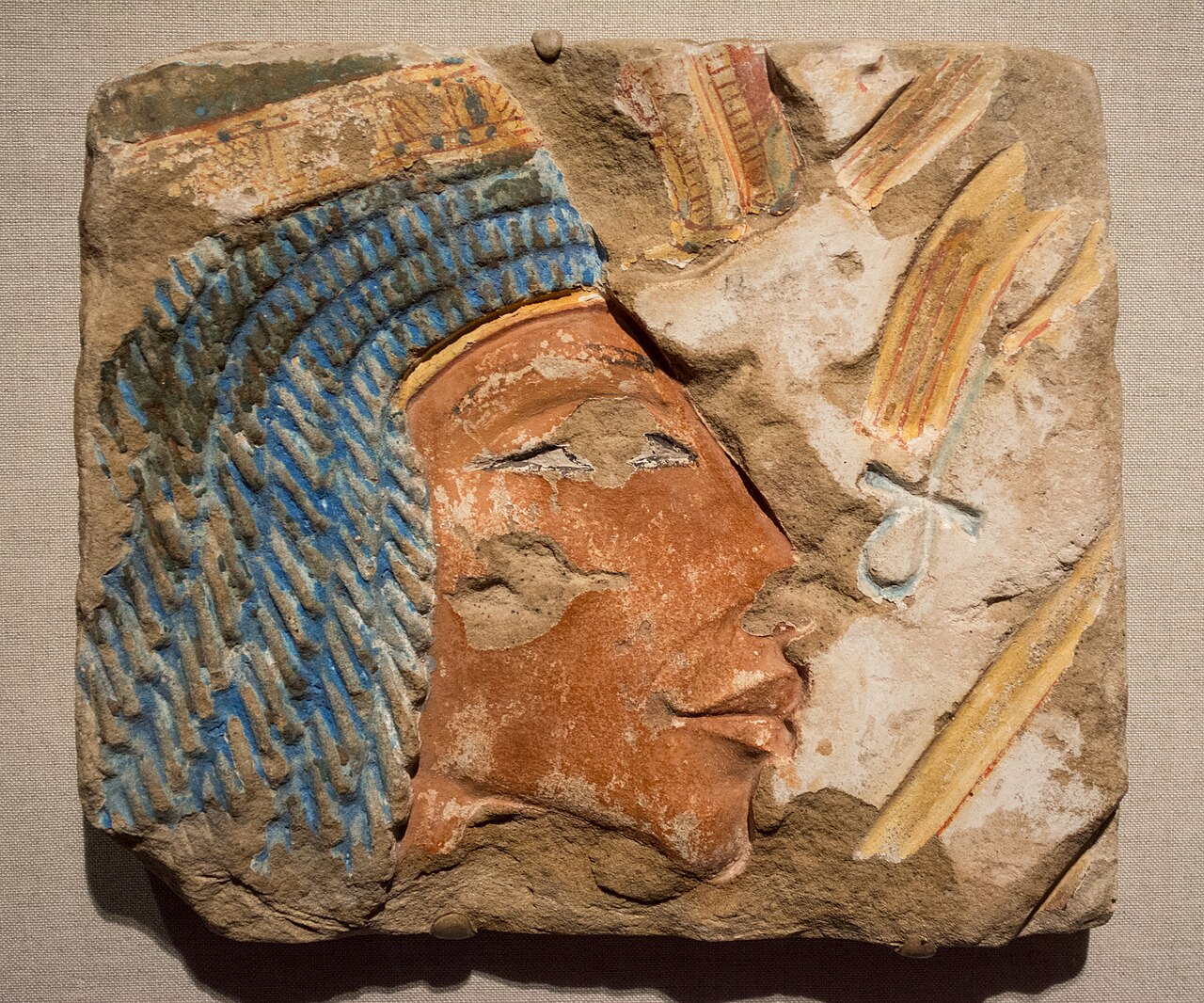
Carved and painted limestone relief block showing a profile face in orange-red with a blue striated headdress, a painted ankh and feather-like shapes on the right, displayed in a museum case against a fabric backdrop.Artifact

Primary source

Nefertiti Talatat from East Karnak

c. 1353-1357 BCE

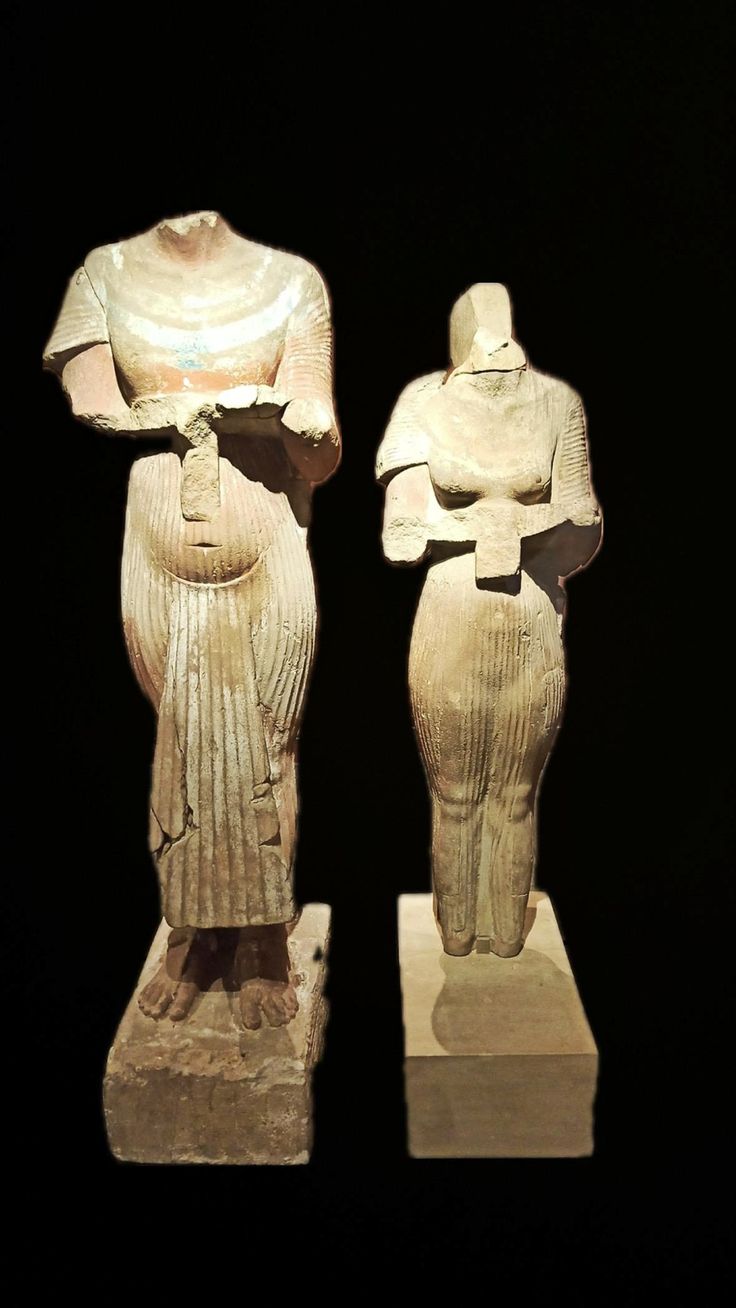
Two headless sandstone statues against a black background. The taller left figure is male, in a short-sleeved garment and a pleated kilt, with arms bent and a hand holding a sign. The shorter right figure is female, with a slender form and a sash across the chest, on a rectangular base. Both are weathered.Sculpture

Primary source

Paired Sandstone Statues of Akhenaten and Nefertiti

18th Dynasty

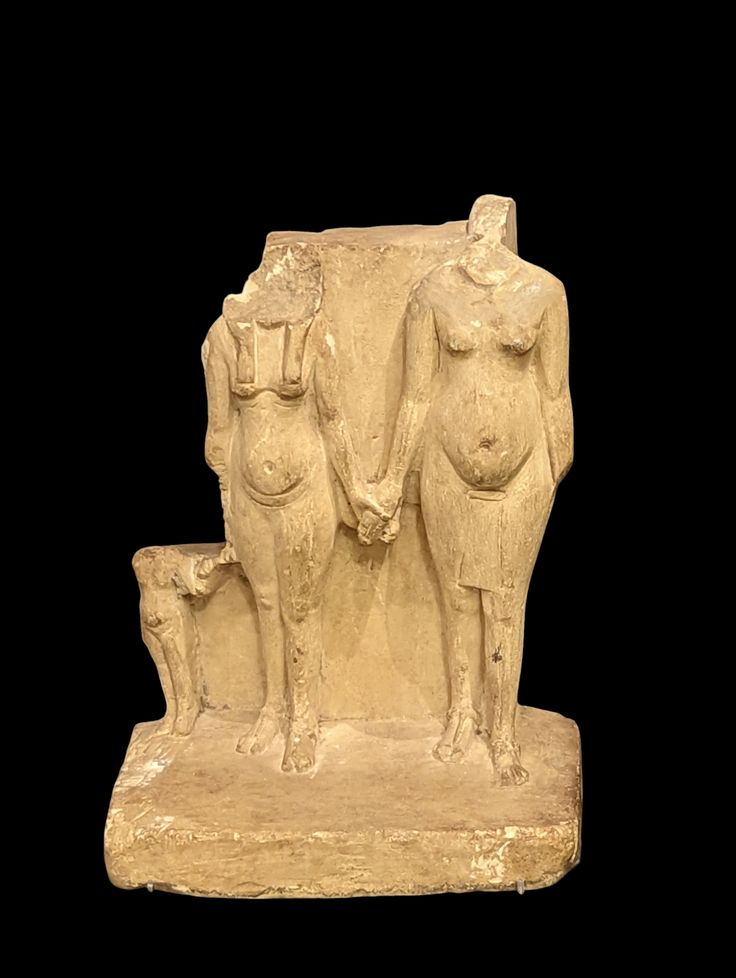
Photo of a carved tan limestone statuette on a rectangular base against a black background. Two standing figures hold hands; both are headless, with damaged upper areas. A third figure, smaller and partly broken, stands at the left edge.Sculpture

Primary source

Limestone Statuette of Akhenaten, Nefertiti and a Daughter

18th Dynasty, c. 1350s BC

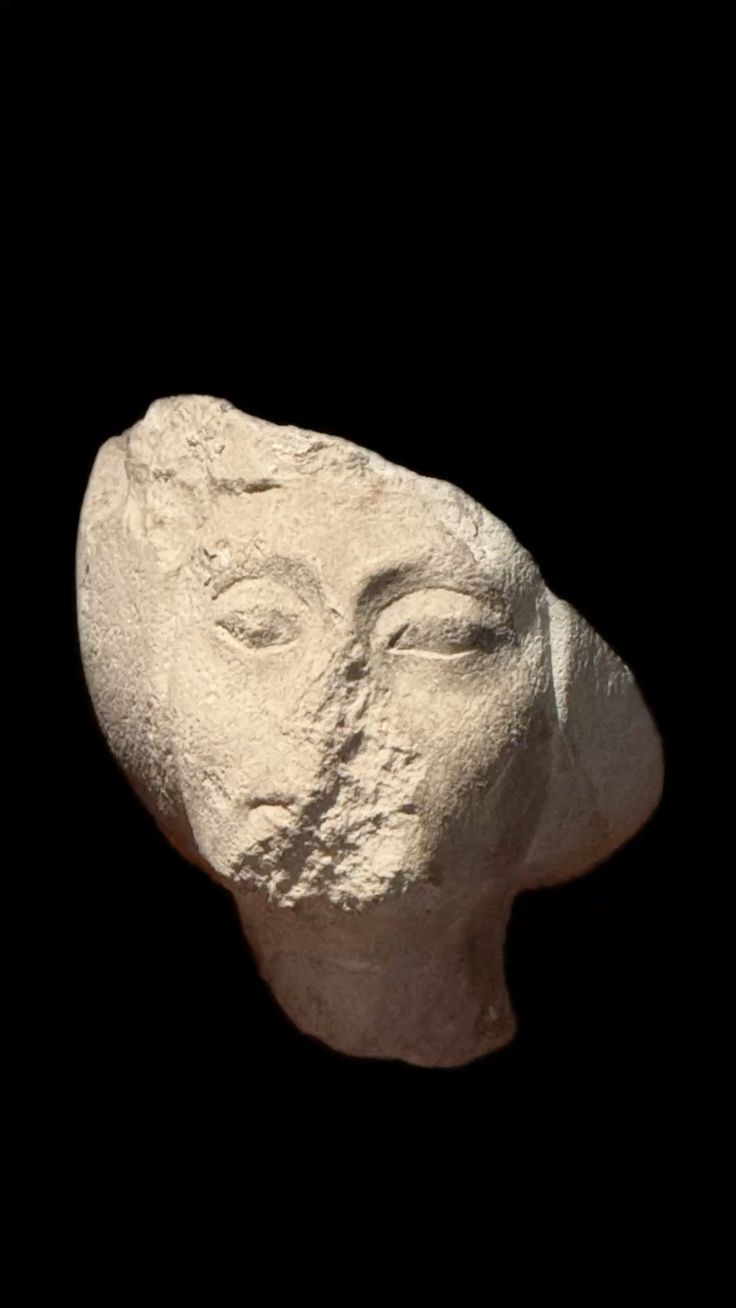
Photograph of a small pale limestone head sculpture against a black background, showing a face with heavy-lidded almond-shaped eyes, a straight nose partly eroded, and a small mouth, with the head tilted and the back rough and broken.Sculpture

Primary source

Head of Aged Nefertiti from Amarna

18th Dynasty, Amarna period

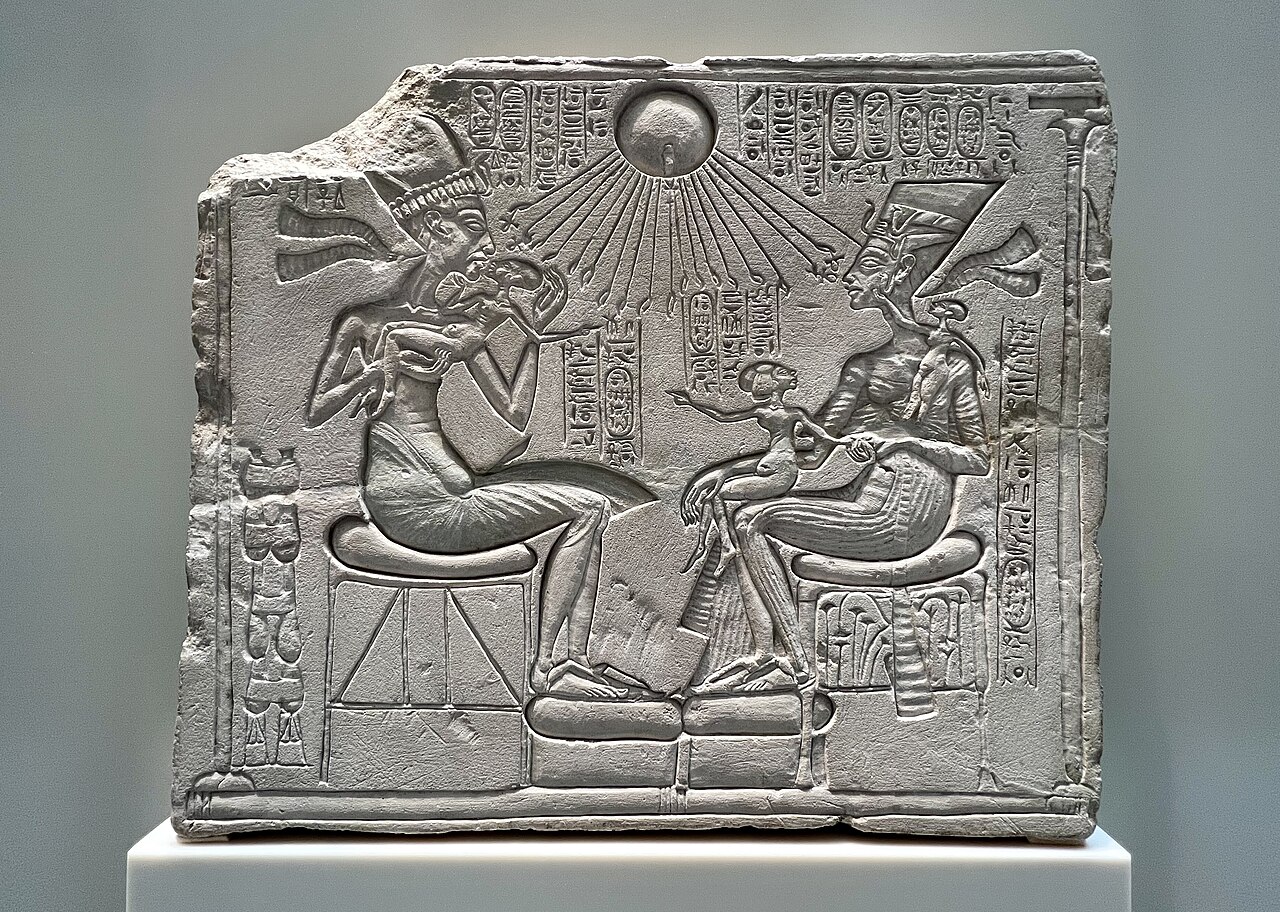
Limestone relief in a museum showing the Amarna royal family seated: Akhenaten on the left with a sun disk above with rays, Nefertiti on the right, and a small daughter on Nefertiti's lap. Hieroglyphs fill the upper and side areas.Sculpture

Primary source

Relief of Akhenaten, Nefertiti and Three Daughters

1352–1336 BC

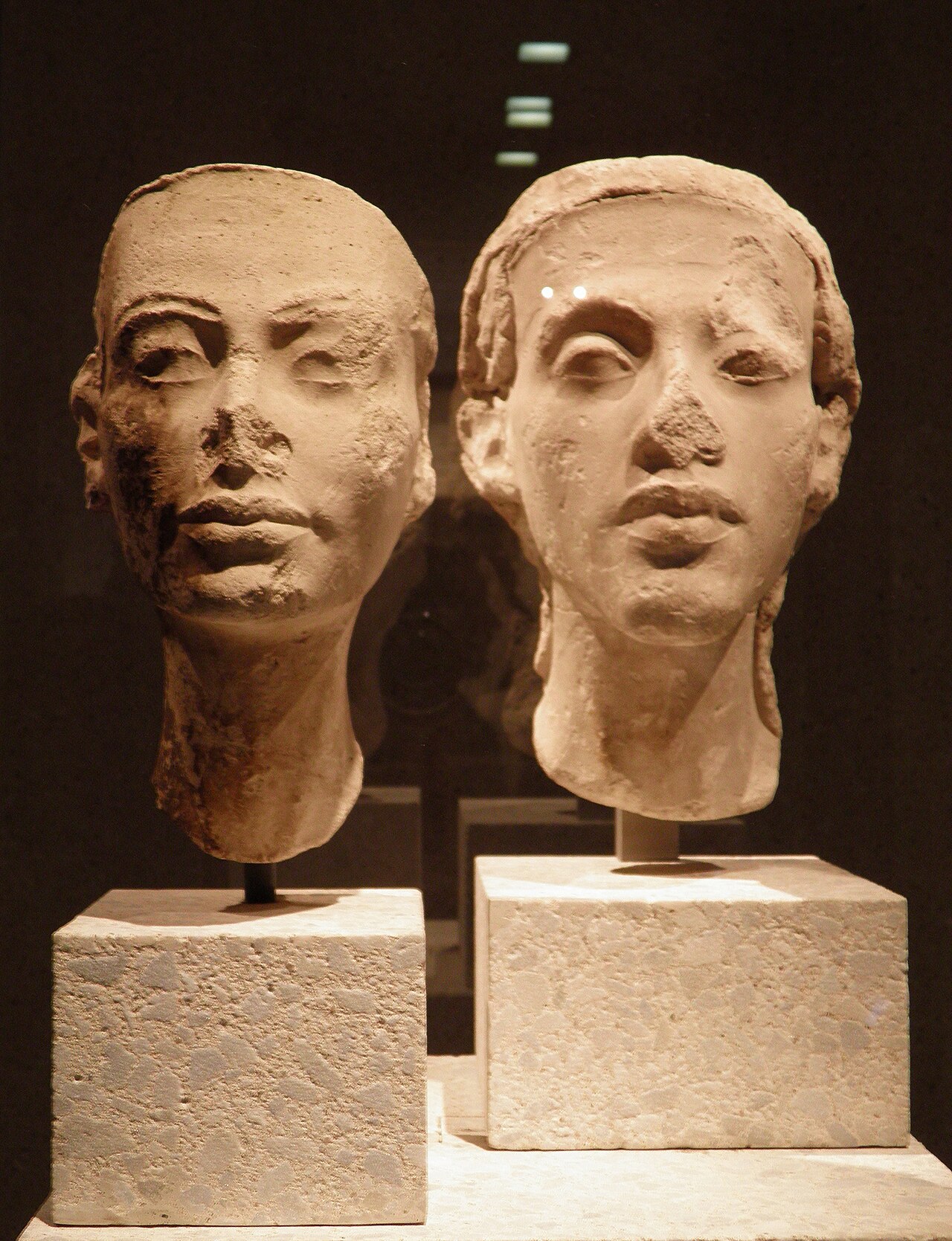
Two limestone sculpted heads on square stone bases in a dark museum display. The left head has heavy-lidded, downcast eyes and a long neck; the right head has a fuller face with a tall headdress outline. Both have smooth, idealized features.Sculpture

Primary source

Portrait Heads of Akhenaten and Nefertiti

c. 1340 BC

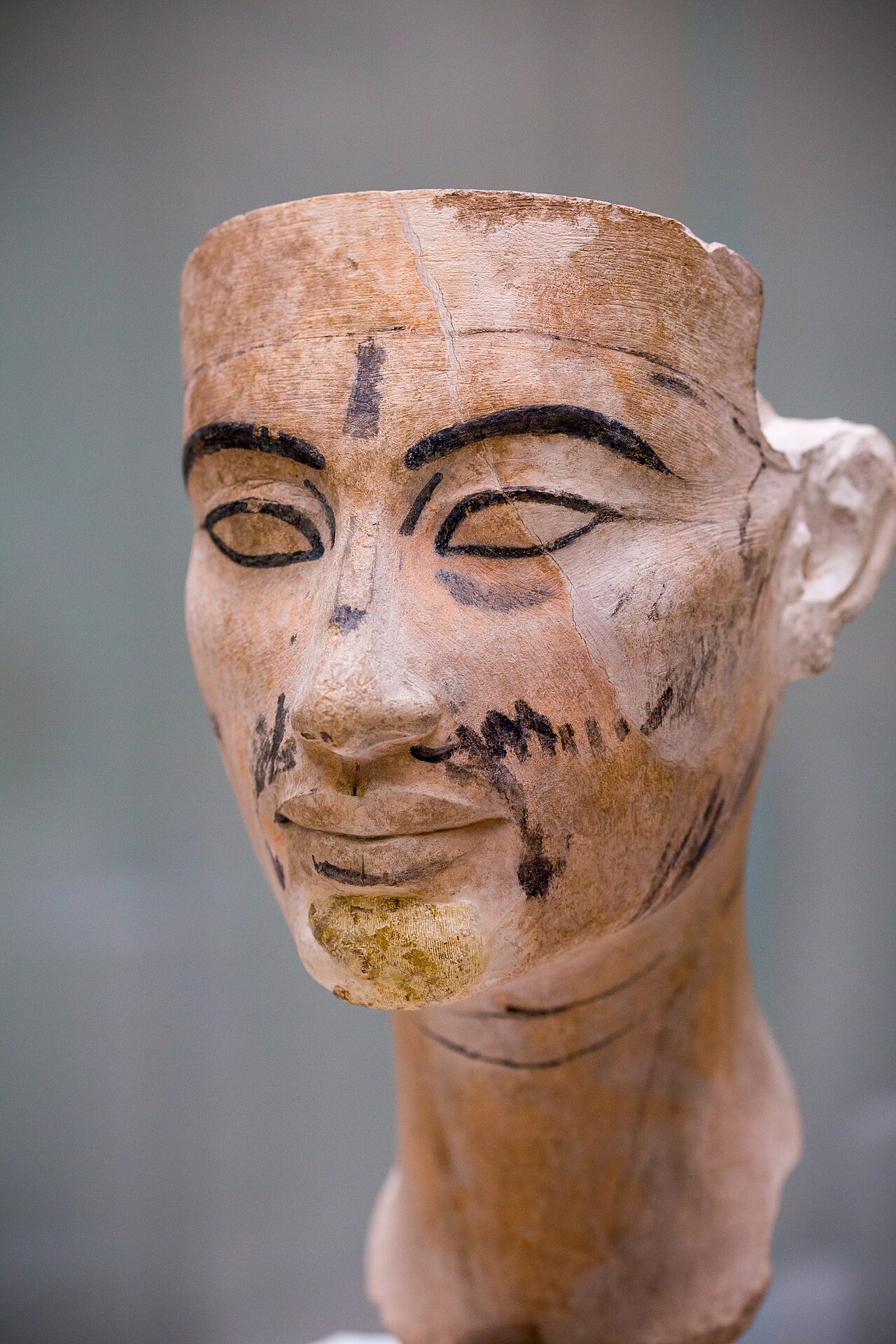
Close-up of the unfinished limestone portrait head of Queen Nefertiti, showing a smooth face with black painted sketch lines for eyes, eyebrows, nose, lips and chin, and a gold-colored chin area. The top of the head is unfinished and the neck is cut off at the bottom.Sculpture

Primary source

Unfinished Portrait Head of Nefertiti with Sculptor's Sketches

c. 1340 BC

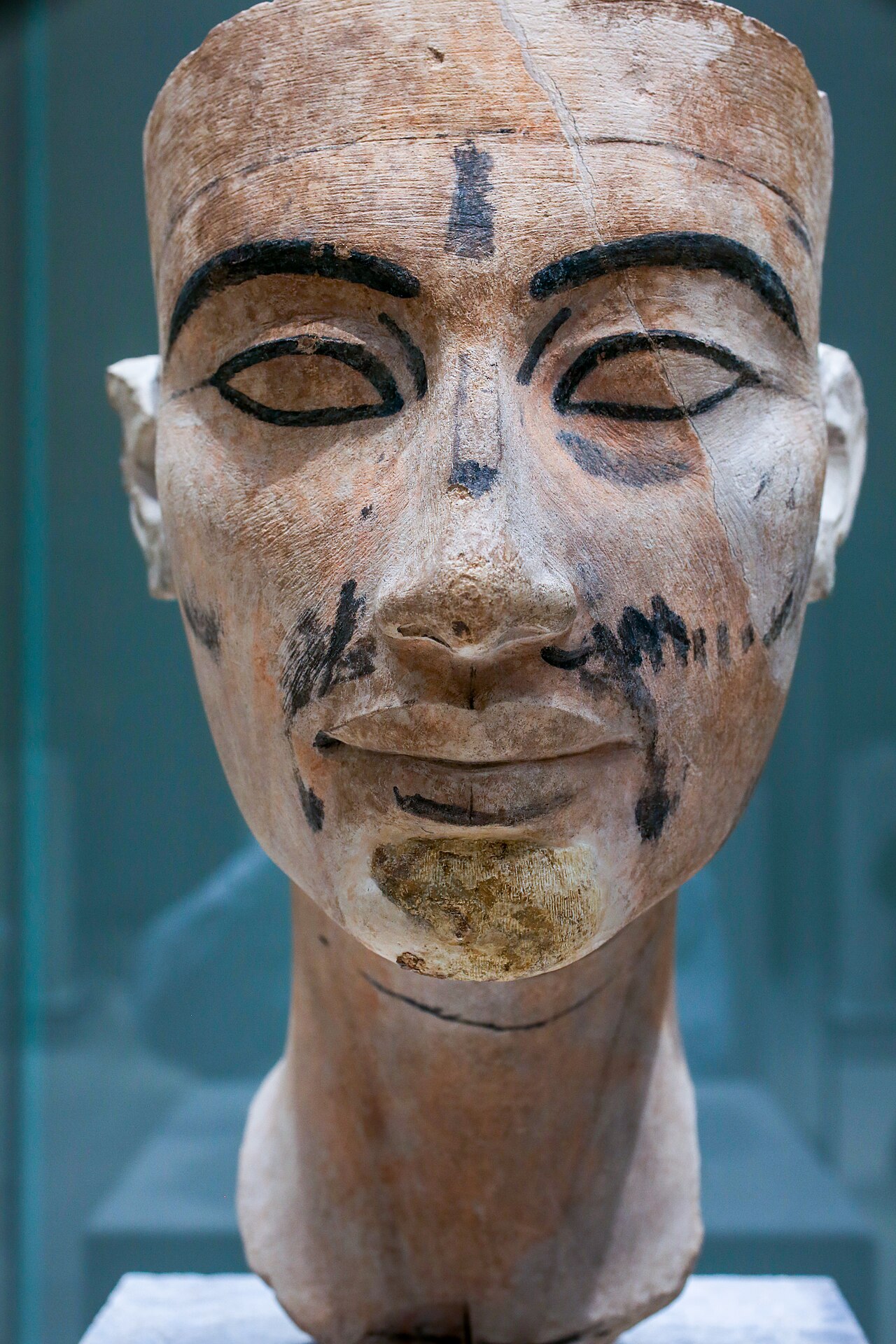
Close-up photograph of the unfinished limestone portrait head of Queen Nefertiti, showing a smooth face with black paint sketch lines marking the eyebrows, eyes, nose, lips, and cheek, and a partly gilded or golden-toned chin area. The neck is visible below against a blurred teal background.Photograph

Secondary source

Photograph of the Unfinished Nefertiti Head with Sculptor's Sketches

ArchaiOptix · photograph taken 2014; object c. 1340 BC

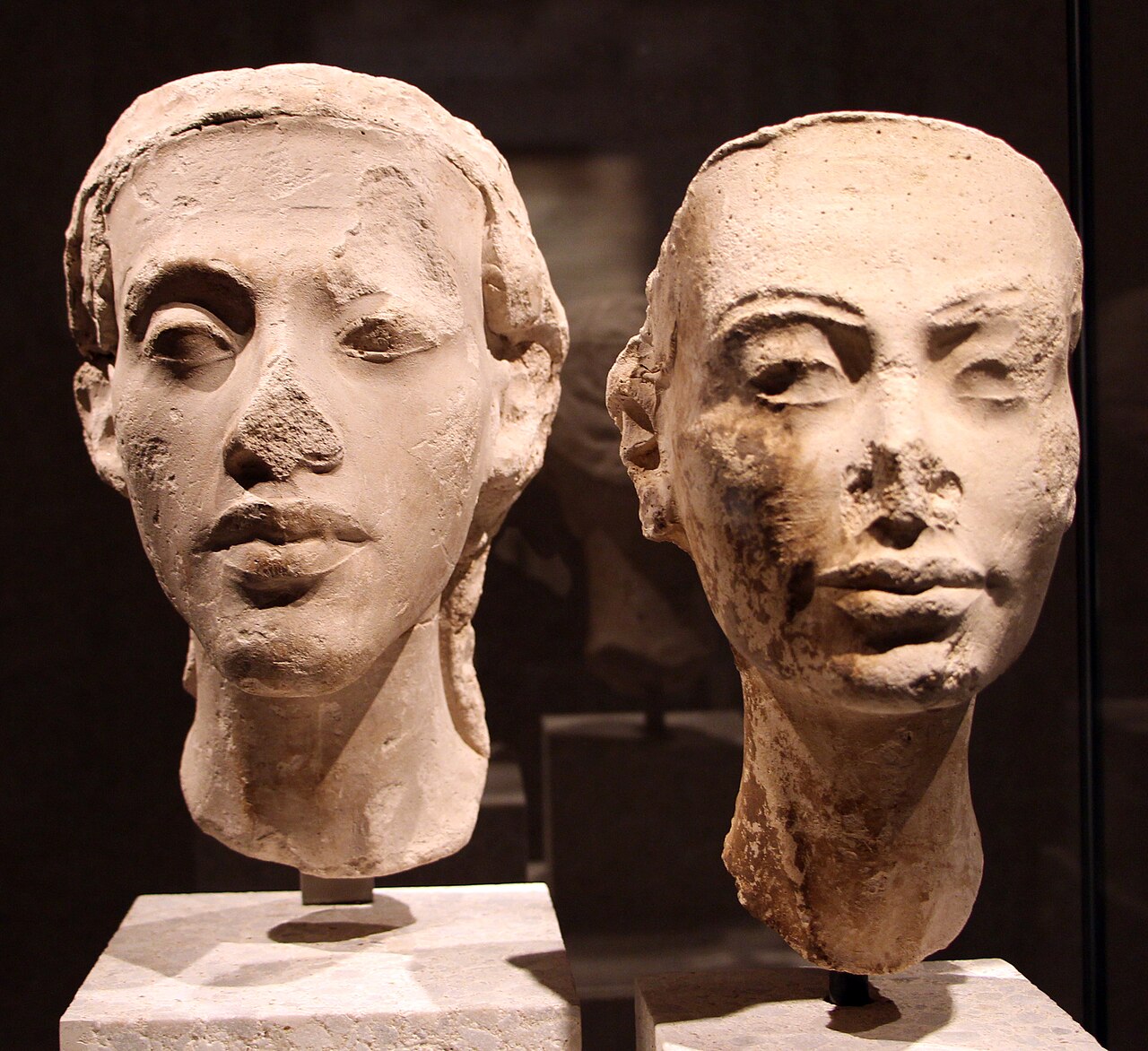
Two pale limestone sculpted heads on separate stone pedestals against a dark background. The left head has a narrow face, long straight nose, and a slightly parted mouth. The right head is more weathered, with darker stains and worn features.Photograph

Secondary source

Portrait of the Royal Couple Nefertiti and Akhenaten, Berlin

Sailko · 2014-03-07

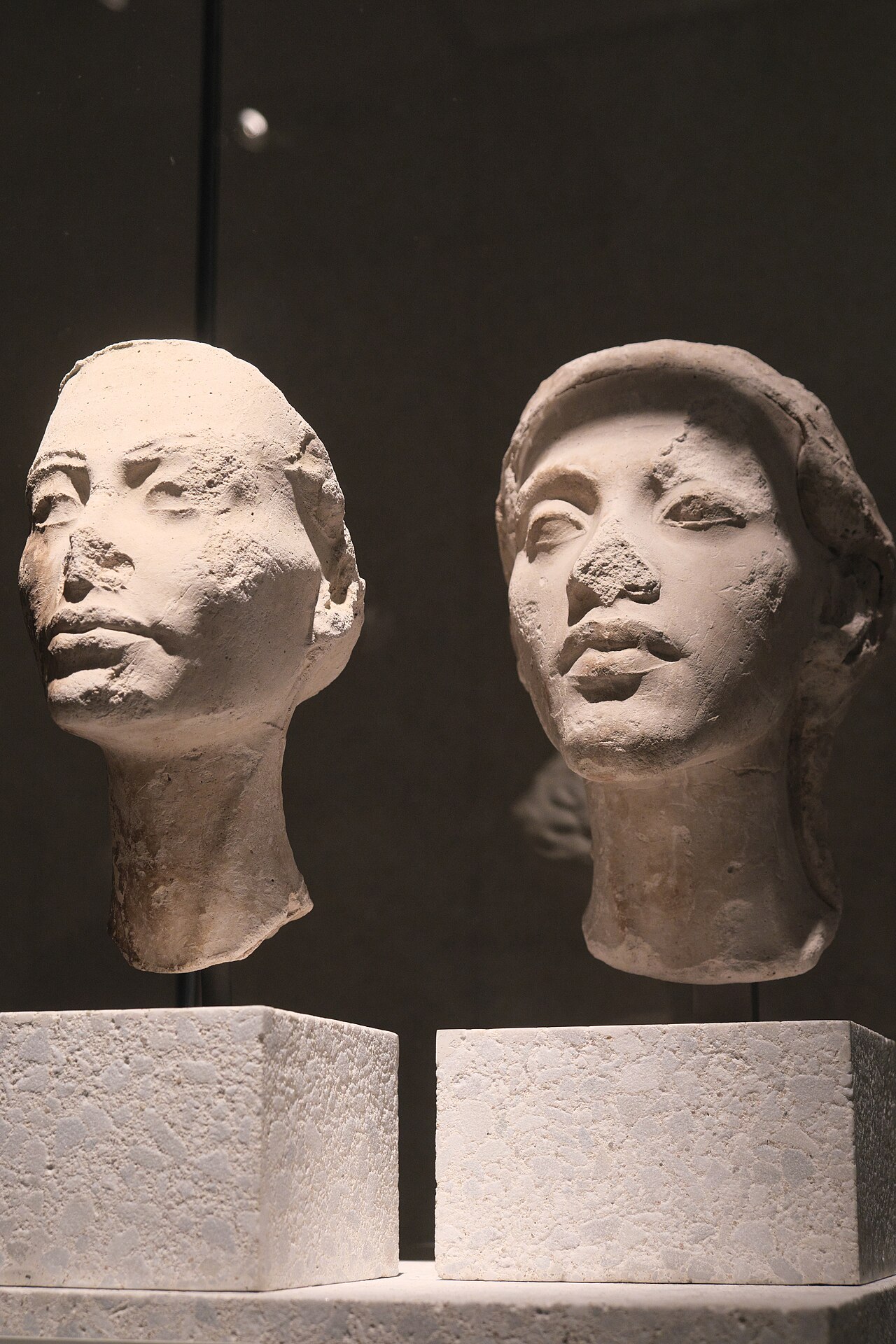
Two pale plaster or limestone portrait heads displayed on stone bases in a dark museum case. The left head shows a male figure with a narrow face and the right head a female figure with a headdress, both with calm expressions.Photograph

Secondary source

Busts of Nefertiti and Akhenaten, Egyptian Museum Berlin

GFreihalter · 2026-04-07

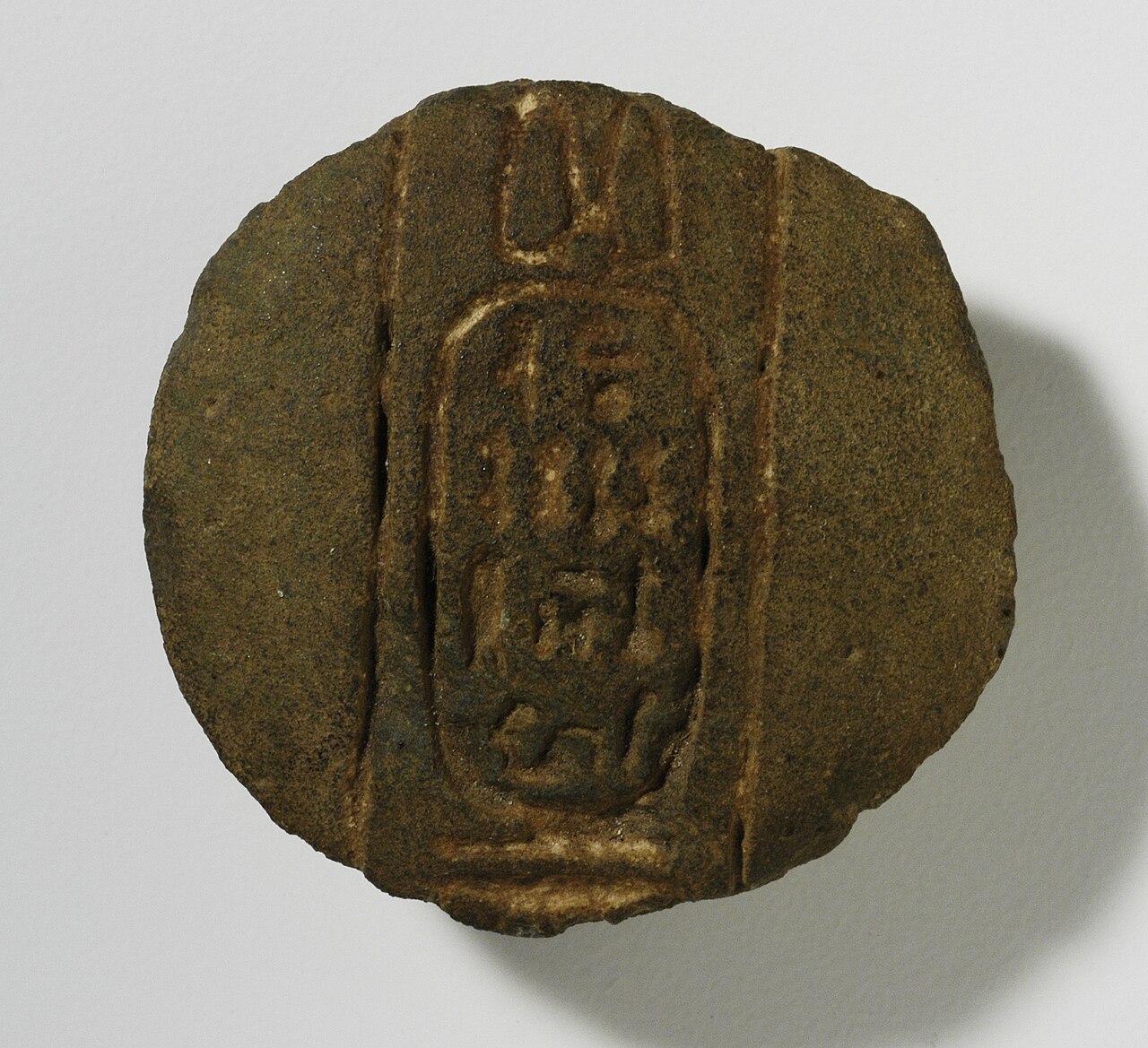
A circular, dark greenish-brown frit knob with a raised cartouche inscription in hieroglyphs, topped by a crown-like sign. The object sits on a light grey background, photographed from the front.Artifact

Primary source

Frit Knob Inscribed with the Name of Nefertiti

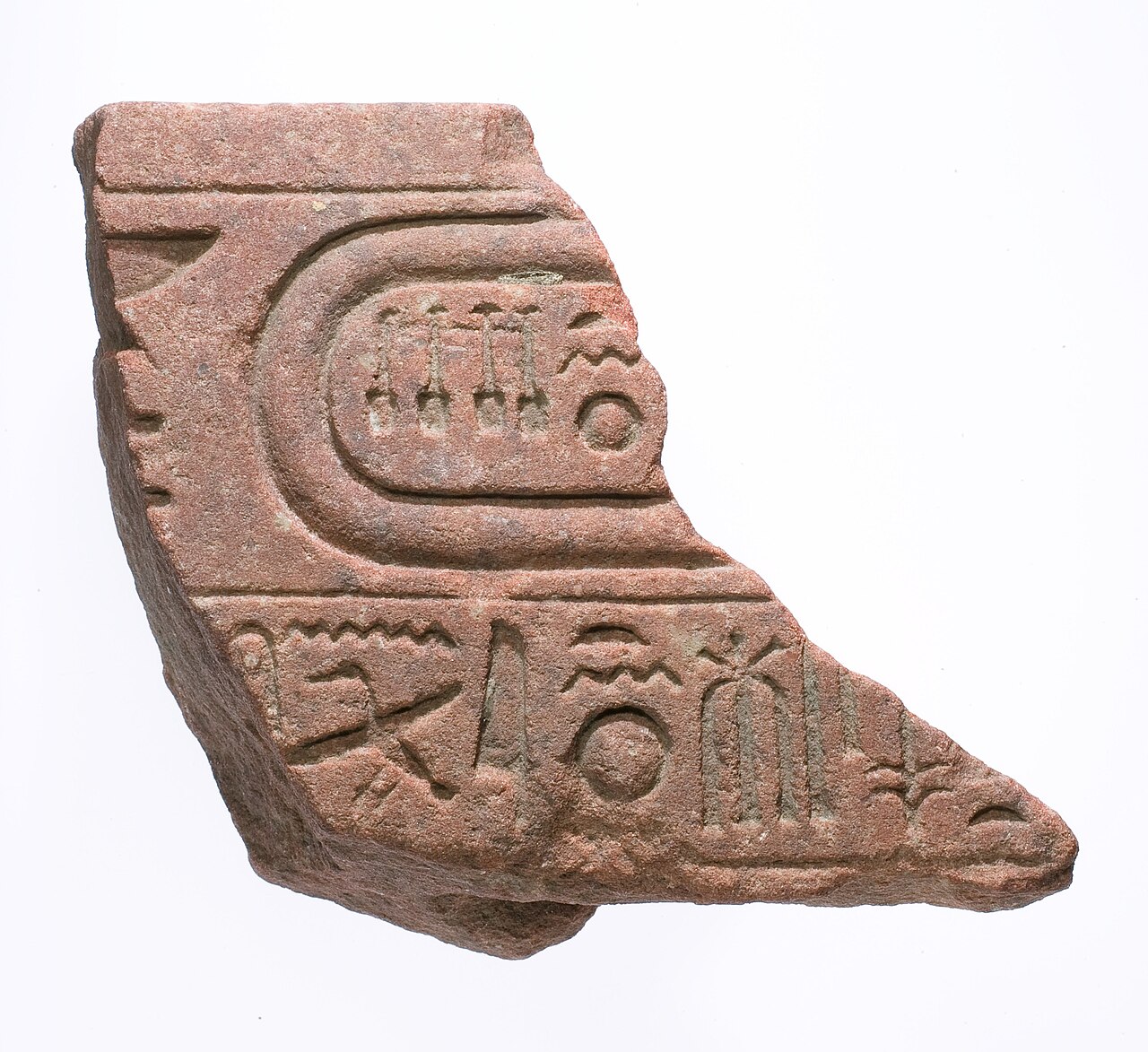
Photograph of a reddish-brown sandstone fragment with raised Egyptian hieroglyphic inscriptions. An upper cartouche-shaped oval contains signs including a sun disk, and a lower row of hieroglyphs runs along the fragment's edge against a white background.Artifact

Primary source

Fragment with the Names of Nefertiti and Ankhesenpaaten

c. 1353–1336 BCE

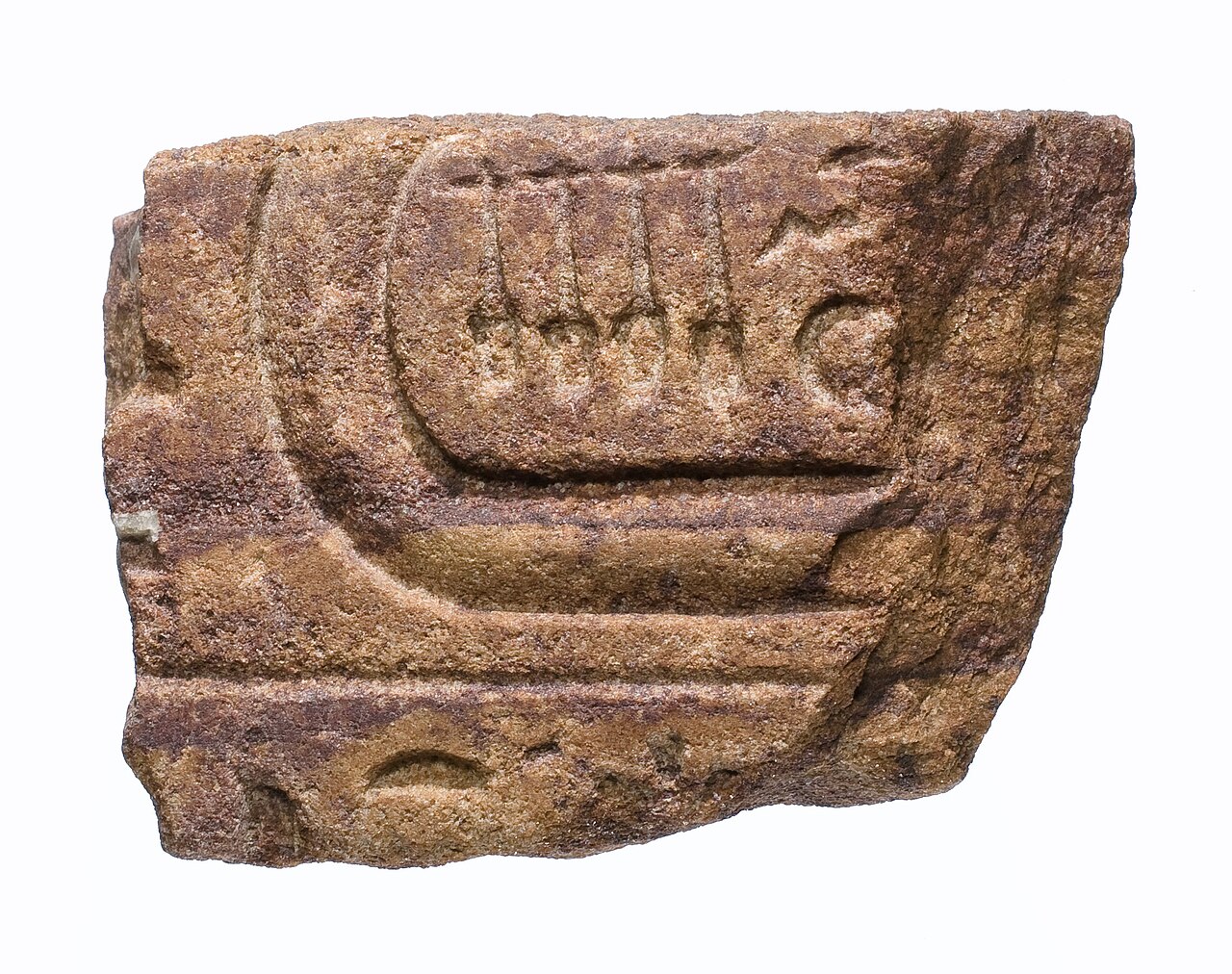
Photograph of a brownish sandstone fragment with raised carved hieroglyphic signs in relief on a white background. The fragment is irregularly broken at its edges and shows a cartouche-like outline with several vertical strokes and a curved sign, with horizontal carved bands below.Artifact

Primary source

Fragment with the Name of Nefertiti and a Princess

c. 1353–1336 BCE

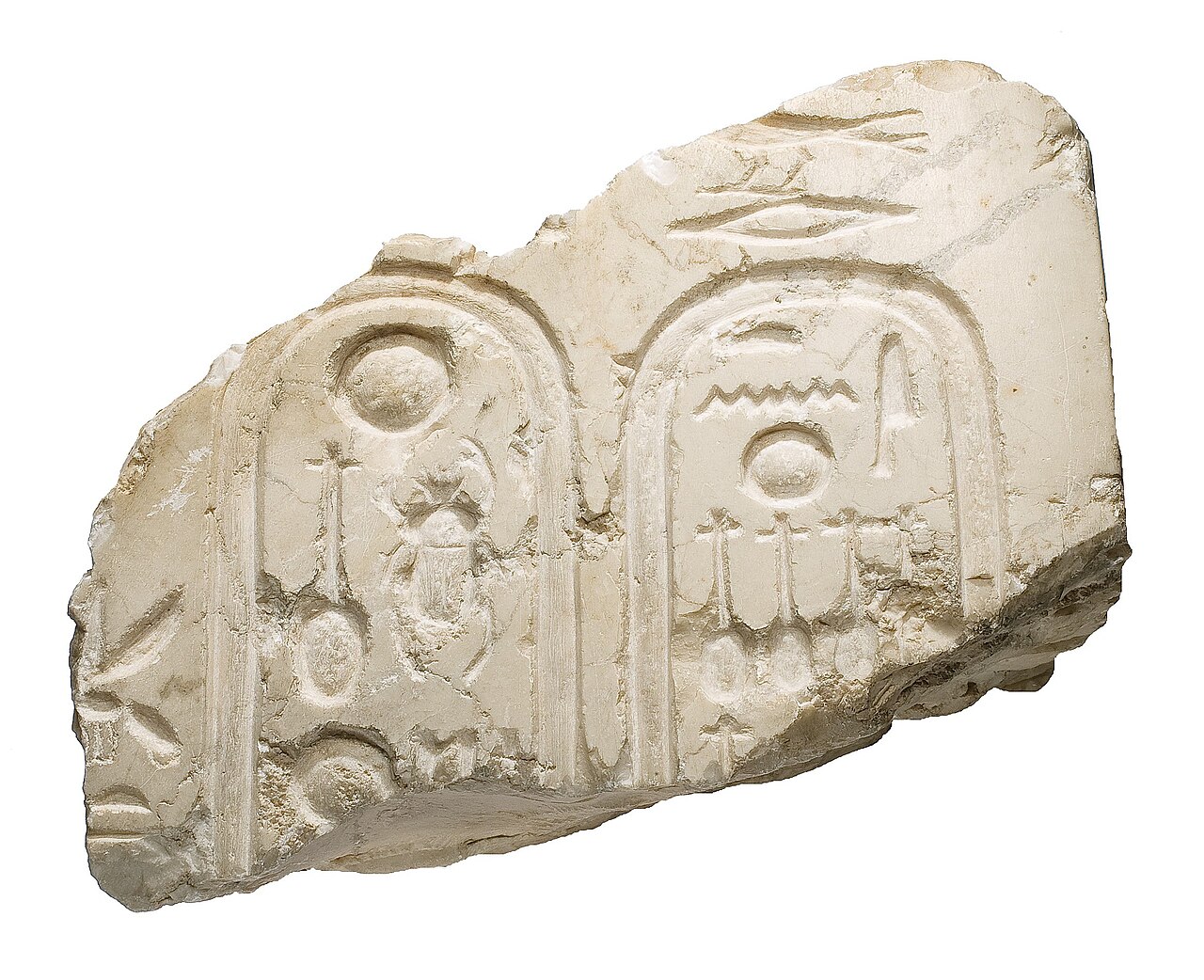
Photograph of a pale limestone fragment, irregular in outline, carved in raised relief with hieroglyphs. Two arched cartouche frames show a sun disk, a scarab beetle, ankh signs and other symbols. Carved signs also appear at the top and left edge.Artifact

Primary source

Inscribed Fragment with Akhenaten and Nefertiti's Names

c. 1353-1336 BCE

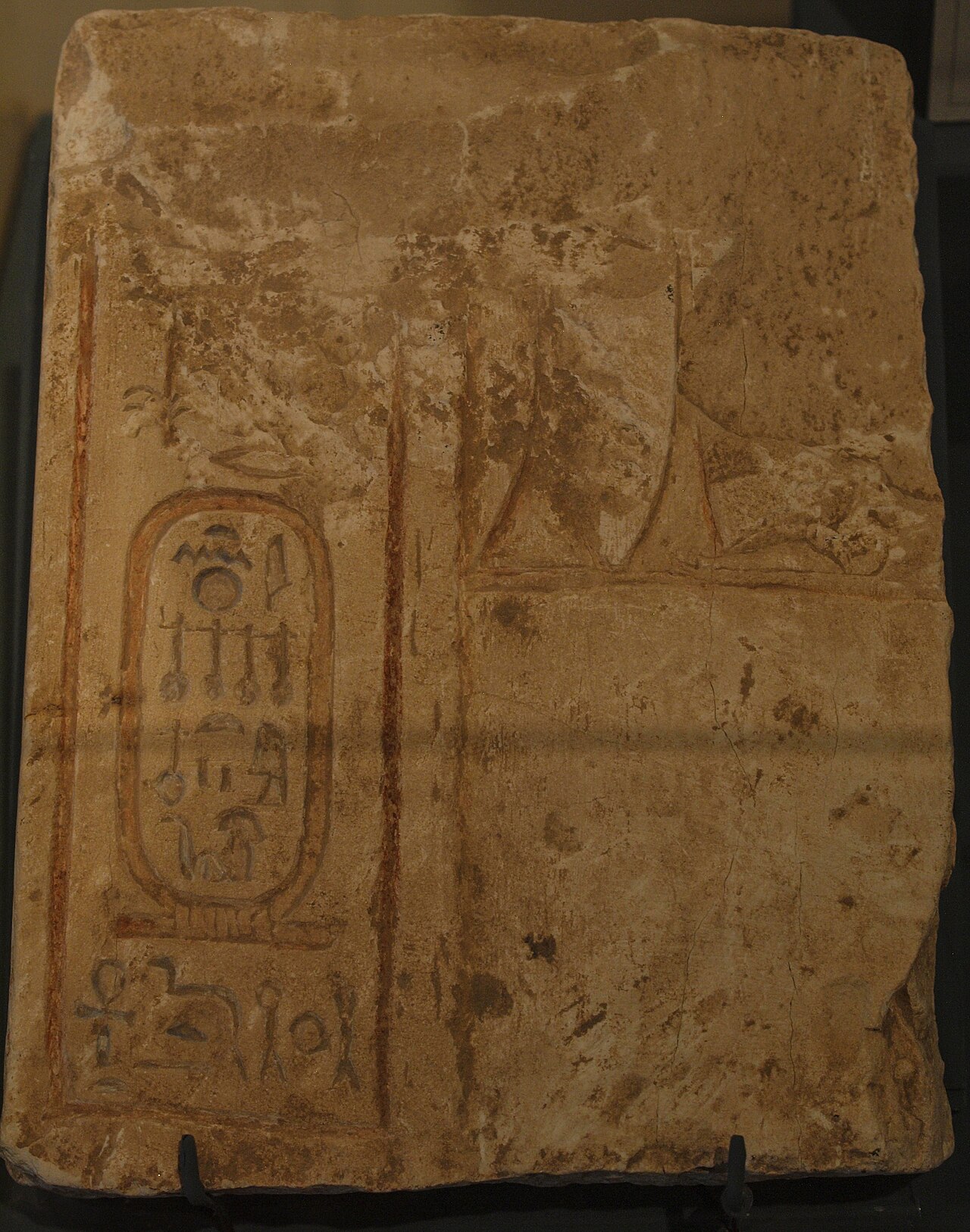
Photo of a limestone relief block with painted red-brown border lines. A cartouche containing hieroglyphs is carved on the left, with a sitting figure and other figures below it. Right side shows a flat, weathered surface with carved shapes at top. Displayed on a black stand.Artifact

Primary source

Cartouche of Nefertiti from the House of Panehsy, Amarna

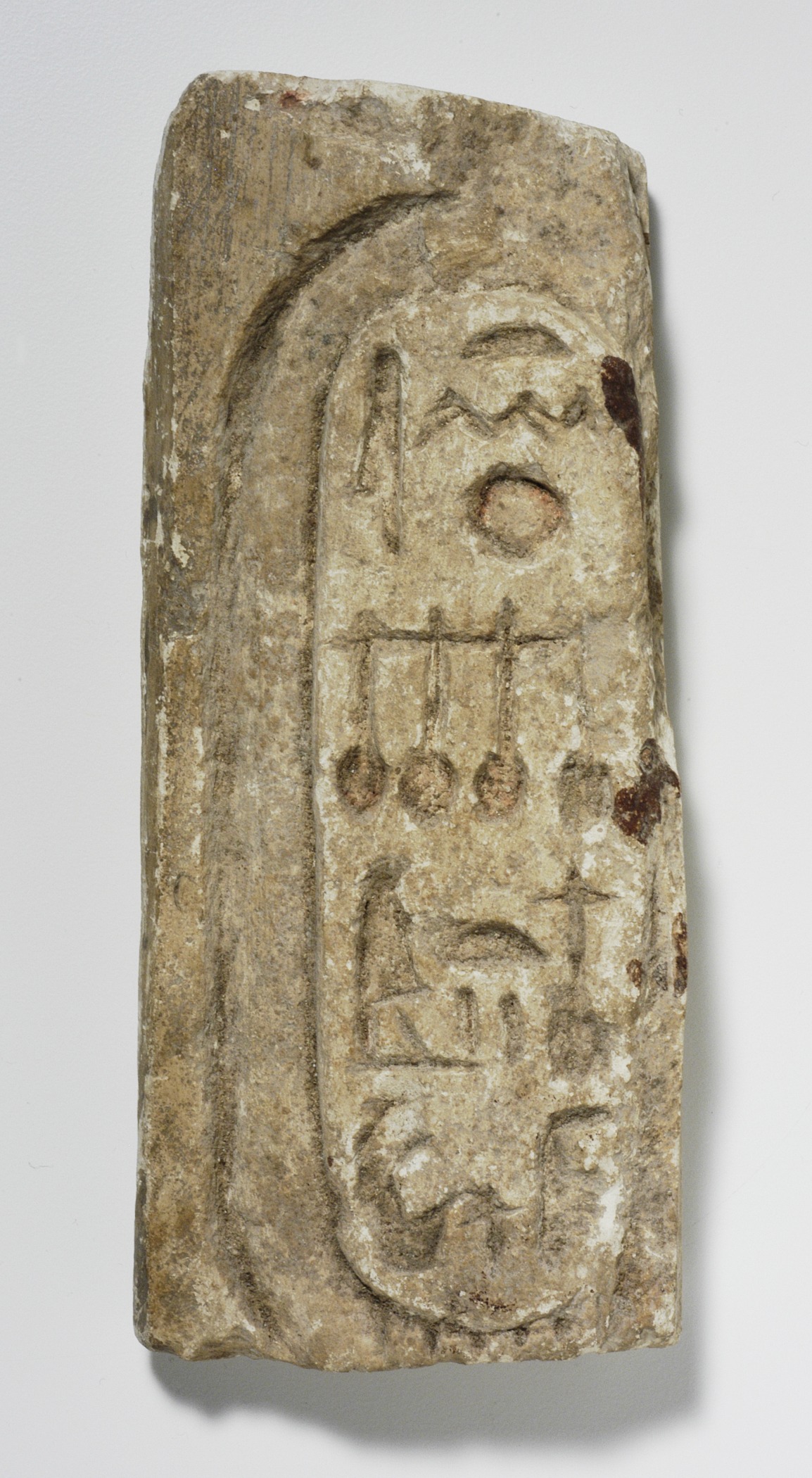
A rectangular limestone fragment, pale grey-beige with weathered surface, carved in raised relief with a cartouche containing hieroglyphic signs, including a sun disk, wavy lines, and vertical strokes. Photographed against a light background.Artifact

Primary source

Limestone Fragment with Cartouche of Neferneferuaten Nefertiti

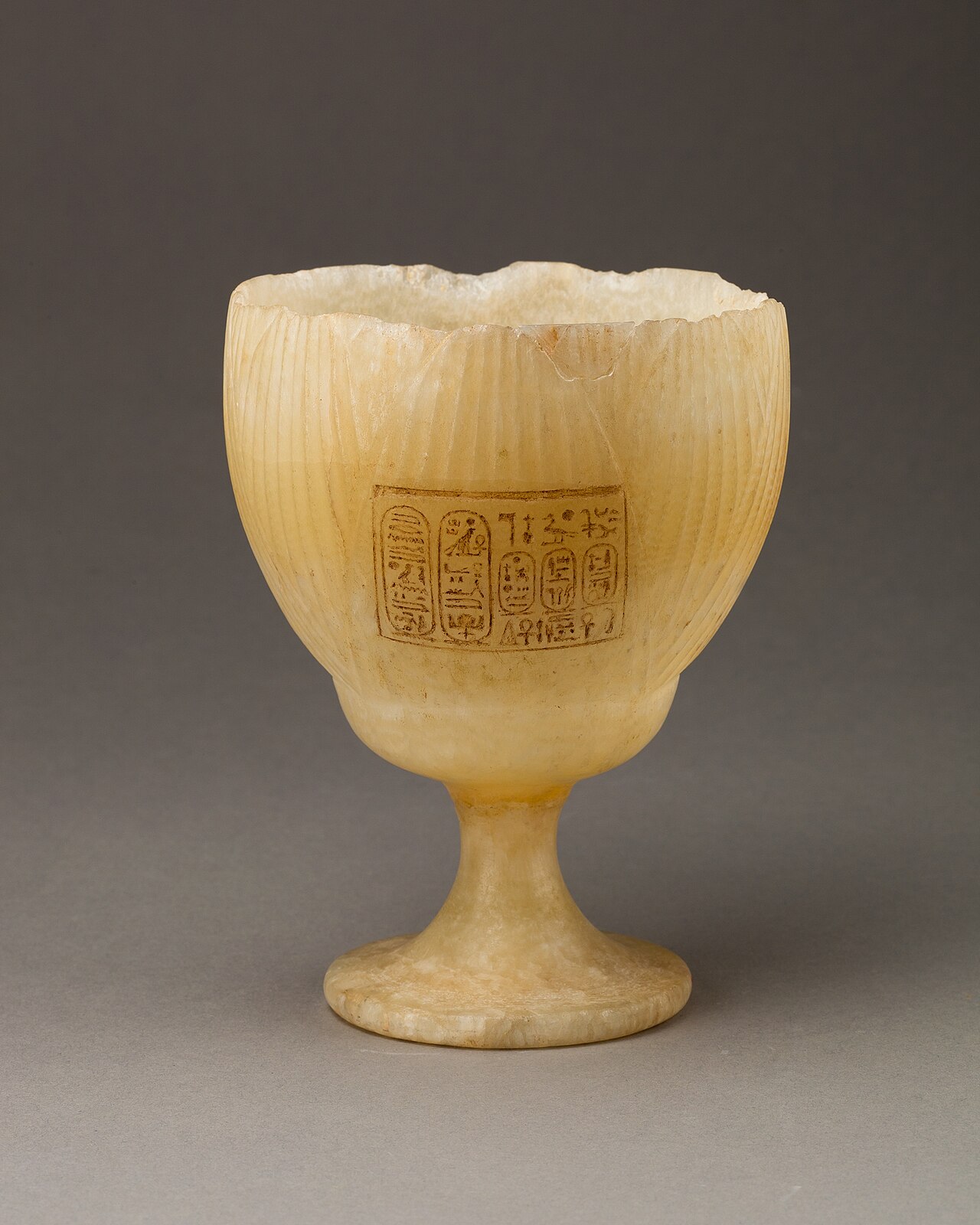
Photograph of a small pale alabaster goblet on a grey background. The cup has a fluted, flaring bowl with a ragged rim and a short stem on a round foot. A column of incised hieroglyphic cartouches is carved on the bowl.Artifact

Primary source

Goblet Inscribed with Names of Amenhotep IV and Queen Nefertiti

c. 1353 BCE

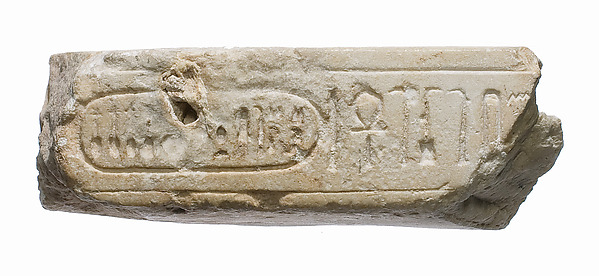
Photograph of a weathered, pale limestone fragment carved with Egyptian hieroglyphs. Two oval cartouches with hieroglyphic signs sit on the left and center, followed by a column of signs on the right. The stone is broken and chipped at its edges against a white background.Artifact

Primary source

Offering Table with Nefertiti Cartouches

c. 1347-1330 BCE

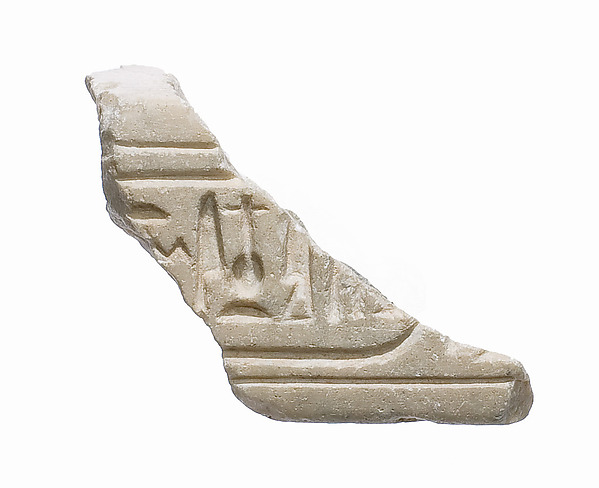
Photo of a small, fragmentary pale limestone object on a white background. It is elongated and angled, with a broken upper-left end and a flat base. Carved into its surface are shallow hieroglyphic signs, including vertical and curved forms, and horizontal grooved bands.Artifact

Primary source

Offering Table with Nefertiti Cartouche, Indurated Limestone

c. 1347-1330 BCE

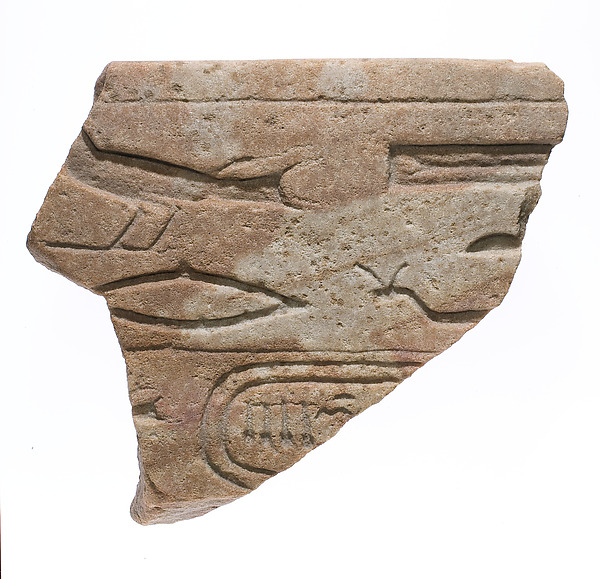
Photograph of an irregular sandstone block fragment on a white background. Incised hieroglyphic relief includes a partial oval cartouche at the lower right with signs inside, and horizontal bands and carved figures above.Artifact

Primary source

Block Fragment with Cartouche of Nefertiti

ca. 1347-1330 BCE

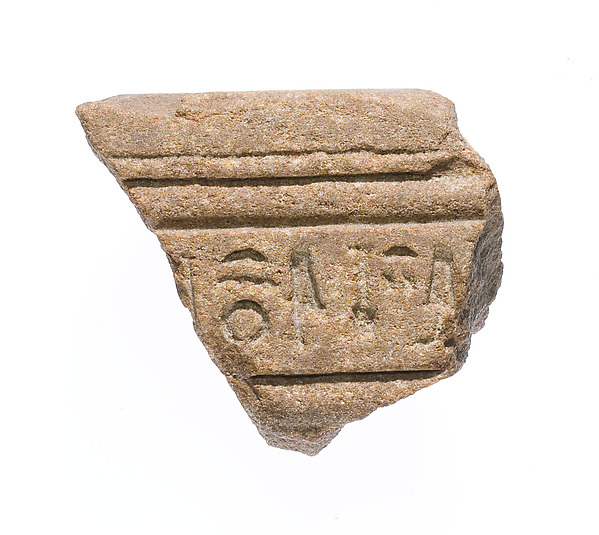
Photograph of a tan sandstone block fragment on a white background. Its face has incised hieroglyphs in a recessed panel, including a circle-like sign and vertical strokes, with horizontal raised bands along the top and bottom edges.Artifact

Primary source

Block Edge with Cartouche of Nefertiti

ca. 1347-1330 BCE

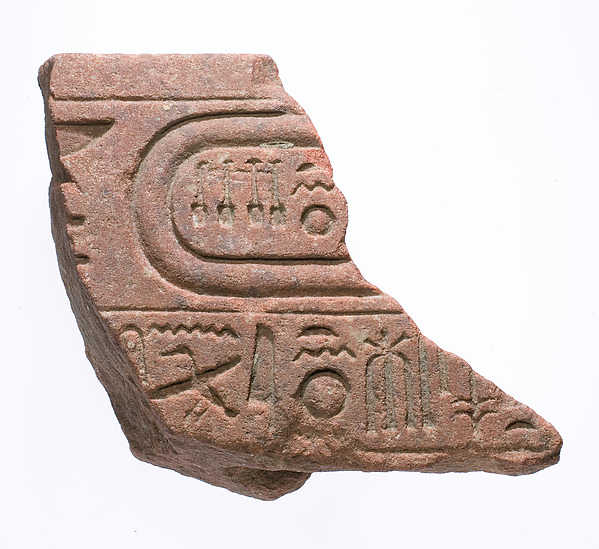
Photograph of a reddish-brown sandstone fragment with raised and incised Egyptian hieroglyphs. An oval cartouche with signs is at upper center, and a band of hieroglyphs runs below it. The fragment is irregular in outline on a white background.Artifact

Primary source

Element with Names of Nefertiti and Ankhesenpaaten

ca. 1347-1330 BCE

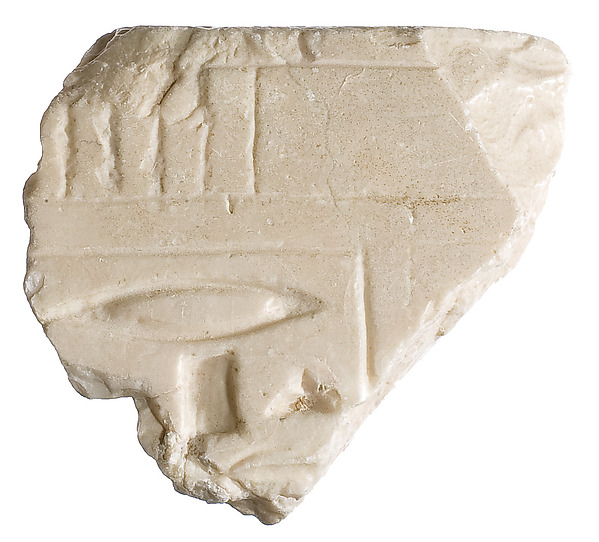
Photograph of a pale limestone fragment, irregular in outline, with shallow carved hieroglyphic signs in raised relief. Visible are vertical strokes at upper left, a horizontal band, an elongated oval sign at center left, and a partial sign at lower center.Artifact

Primary source

Throne Block with Nefertiti Titulary

ca. 1347-1330 BCE

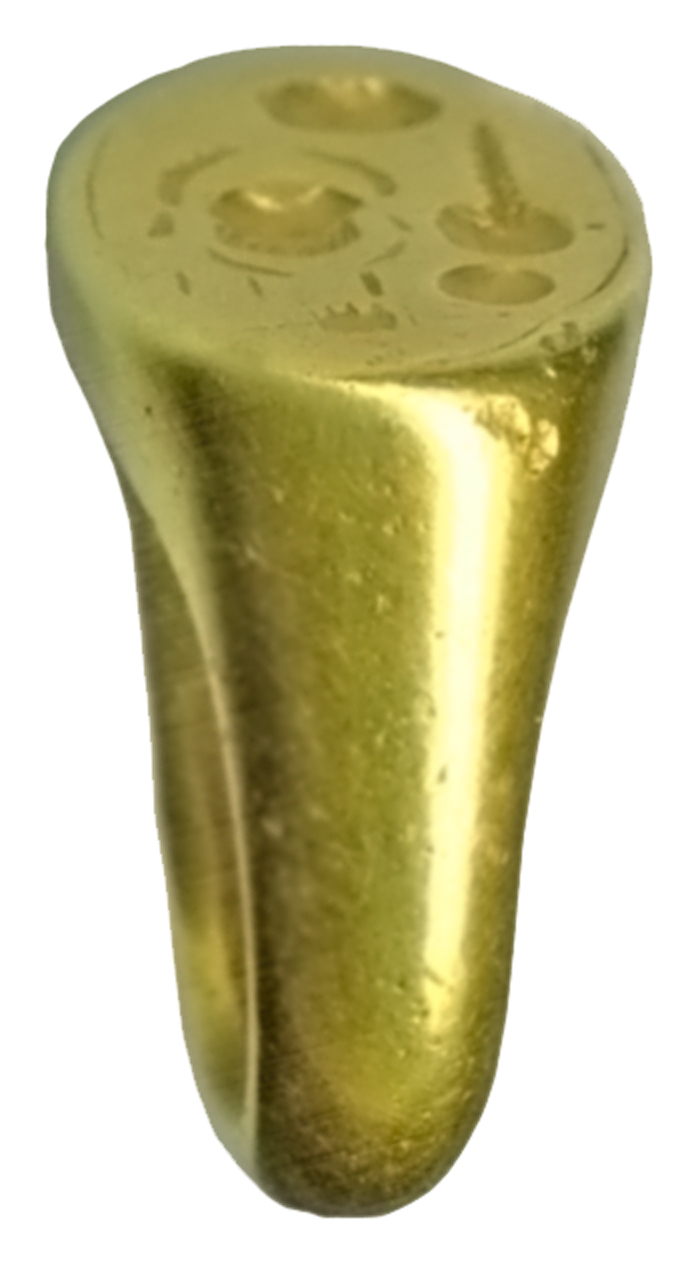
Side view of a heavy gold signet ring with a flat oval bezel on top bearing incised hieroglyphic signs, set on a thick tapered band. The bezel shows circular and sign-like engravings; the metal has a bright yellow-gold sheen with some surface pitting.Artifact

Secondary source

Gold Signet Ring with the Throne Name of Akhenaten

Unknown · circa 1340 BCE or early 20th century

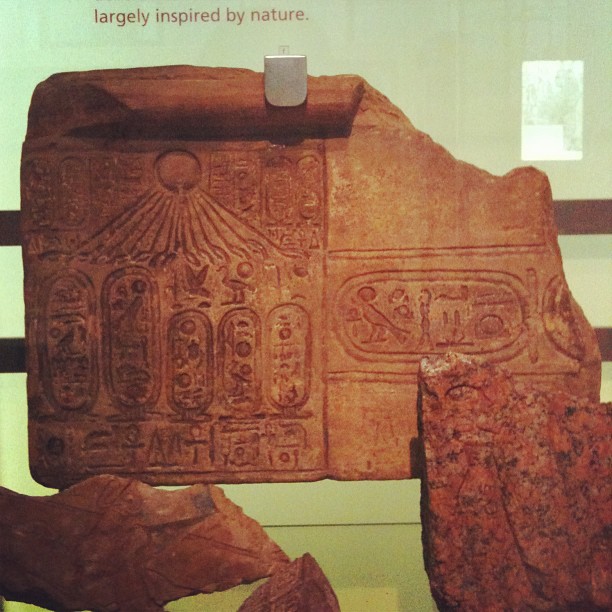
A reddish sandstone relief fragment in a museum display case, carved with hieroglyphic cartouches and a sun disc with rays. Below it are other rock fragments and a panel with text reading 'largely inspired by nature.'Artifact

Primary source

Limestone Cornice Fragment with Cartouches of the Aten, Akhenaten, and Nefertiti

New Kingdom, Dynasty 18 (Amarna Period)

Want the full shelf? Chat with Queen Nefereti in the app and open the Sources panel — every quote links back to the original.

Use Queen Nefereti in class

2 collections

Ready-made collections from the Humy team and other teachers that feature Queen Nefereti. Preview any of them, then try it free.

Trusted by educators worldwide

Conversations
375,000+
Real exchanges between students and historical figures
Messages exchanged
4,142,000+
Across every figure, classroom and language
Historical figures
100,000+
Each informed by a curated biography and selected sources
Languages supported
50+
From English and Spanish to Arabic and Korean

Paying customers

Used by 98 schools and universities

Partner school logo
Tecnológico de Monterrey logo
Hyper Island logo
Partner school logo
Chambersburg Area School District logo
Broward County Public Schools logo
Nebo School District logo
National Louis University logo
South Florida PBS logo
Punahou School logo
University of Wisconsin–River Falls logo
Partner school logo
Partner school logo
Archbishop Mitty High School logo
Kingsburg High School logo
Norwalk Public Schools logo
Partner school logo
Connections logo
Partner school logo
Moore Public Schools logo
Partner school logo
Partner school logo
Partner school logo
Partner school logo
Robbinsville Public Schools logo
Partner school logo
Partner school logo
Partner school logo
Tecnológico de Monterrey logo
Hyper Island logo
Partner school logo
Chambersburg Area School District logo
Broward County Public Schools logo
Nebo School District logo
National Louis University logo
South Florida PBS logo
Punahou School logo
University of Wisconsin–River Falls logo
Partner school logo
Partner school logo
Archbishop Mitty High School logo
Kingsburg High School logo
Norwalk Public Schools logo
Partner school logo
Connections logo
Partner school logo
Moore Public Schools logo
Partner school logo
Partner school logo
Partner school logo
Partner school logo
Robbinsville Public Schools logo
Partner school logo
Partner school logo

What educators are saying

“We enjoyed the program last year and used it frequently.”
“My students say it’s a welcome change of pace. I’m not a fan of the “sage on the stage” model, so I try to incorporate research-oriented and self-paced activities. With Humy, students have to take charge of their learning. They’ve become more adept at critical thinking, forming better questions, and improving their reading comprehension. The interview feature has been my go-to tool. I create assignments where students must ask historical figures a set number of questions, then summarize the responses to ensure they’re truly absorbing the material. This approach lets them actively explore the past rather than passively consuming information.”
“Humy has helped me bring historical figures, sometimes long past, to life. When my students interact with these figures in real-time, it eliminates some of the perceived “ancient” characteristics of my curriculum. This has shifted my students’ thinking away from viewing history as abstract or irrelevant. Real-time interactions make historical figures relatable, even allowing students to ask off-topic questions that help put historical lives in a more relevant context for 13-year-olds. The feature I use the most is the interview feature. After teaching a topic, most recently Gandhi and Joan of Arc, I have the students ask pointed, focused questions. We practice good conversation techniques beforehand, teaching them to listen (or read) carefully and formulate thoughtful follow-up questions rather than just interrogating. It helps students practice effective conversation skills.”

FAQ

Frequently asked questions

Who is Queen Nefereti?
An Egyptian queen and the Great Royal Wife of Akhenaten. On Humy.ai you can chat with an AI version of Queen Nefereti that draws on a short biography and 83 historical sources during the conversation — by text or voice, in 42 languages.
Is Queen Nefereti AI free?
Queen Nefereti is part of Humy's full library of more than 100,000 figures, which comes with a paid plan. A free account (no credit card) includes 20 messages a month with the free library's figures, so you can try how the conversations work first.
What sources does the Queen Nefereti AI use?
It draws on a short biography and 83 historical sources (sculptures, artifacts and paintings), including “Bust of Queen Nefertiti”, “Figure of Nefertiti” and “Akhenaten and His Family”. Each source has its own page on Humy.ai.
How historically accurate is the AI version of Queen Nefereti?
Each figure uses a short biography and a small set of selected historical sources as context (retrieval-augmented generation), so answers stay closer to known material than the model's general knowledge alone. It isn't a citation-grade research tool — like any LLM, the AI can get details wrong or extrapolate. Treat it as a strong starting point for inquiry and cross-reference important claims.
Can I talk to Queen Nefereti by voice?
Yes. In addition to text chat, you can call Queen Nefereti and hear their voice respond in real time — useful for auditory learners, interview practice and Socratic dialogue.
Is Humy.ai safe and compliant for schools?
Yes. Humy.ai is used by more than 100 schools, universities and organisations. The platform is FERPA- and GDPR-aligned, supports SSO, and offers an IT-approval pack tailored for school procurement teams.

Ready when you are

Start chatting with Queen Nefereti now.

20 messages free · No credit card · Available in 50+ languages.